PHOTON THERAPY IN CANCER
BIOPHARMACEUTICS
BY: KRUPA BAROT
KASHVI DESAI
INTODUCTION
 Radiation Therapy sends energy to cancer cells to kill them.
Traditional Radiation Therapy is delivered by photons, the same photons that
are light. Photon Therapy delivers the killing energy with protons, the large,
heavy elements in the nucleus of an atom.
 A type of radiation therapy that uses x-rays or gamma rays that come from a
special machine called a linear accelerator (linac).
MECHANISM OF ACTION
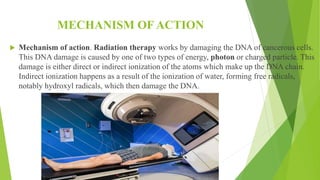
 Mechanism of action. Radiation therapy works by damaging the DNA of cancerous cells.
This DNA damage is caused by one of two types of energy, photon or charged particle. This
damage is either direct or indirect ionization of the atoms which make up the DNA chain.
Indirect ionization happens as a result of the ionization of water, forming free radicals,
notably hydroxyl radicals, which then damage the DNA.
TYPES OF PHOTON THERAPY
Historically, the three main divisions of radiation therapy are :
 external beam radiation therapy (EBRT or XRT) or teletherapy;
 brachytherapy or sealed source radiation therapy; and
 systemic radioisotope therapy or unsealed source radiotherapy.
The differences relate to the position of the radiation source; external is outside the body,
brachytherapy uses sealed radioactive sources placed precisely in the area under treatment, and
systemic radioisotopes are given by infusion or oral ingestion. Brachytherapy can use temporary
or permanent placement of radioactive sources.
ADVANTAGES OF PHOTON THERAPY
 Death of a large proportion of cancer cells within the entire tumor (there are minimal, if any,
cancer cells are left behind in small tumors; thus, radiation alone may be used to cure certain
small tumors)
 Death of microscopic disease at the periphery of the tumor that would not be visible to the
naked eye (e.g. at the time of surgery)
 Ability to shrink tumors (which may help to relieve mass effect; or it may be done before
surgery, to convert certain patients from unresectable to resectable status)
 Relative safety for the patient (radiation can be delivered from outside of the body and focused
on the tumor, is painless, and generally does not require anesthesia)
 Synergy with systemic therapy(i.e. the ability to kill more cells together than either therapy
could do alone)
 Possible stimulation of an immune response against the tumor.
DISADVANTAGES OF PHOTON THERAPY
 Damage to surrounding tissues (e.g. lung, heart)
 Inability to kill the all cancer cells
 Inability to relieve mass effect
 Increased incidence in wound complication and poor healing (e.g. if surgery is used after
radiation; or in parts without good circulation)
 Inconvenience of radiation therapy (e.g. in some cases it must be delivered daily, 5 days per
week, for 1-2 months)
 Contraindications to radiation therapy (e.g. prior radiation; certain medical disorders)
SIDE EFFECT OF PHOTON THERAPY
1. Acute side effect:
 Nausea and vomiting
 Damage to the epithelial surfaces
 Mouth, throat and stomach sores
 Intestinal discomfort
 Swelling
 Infertility
2. Late side effects:
 Fibrosis
 Epilation
 Dryness
 Lymphedema
FUTURE OF RADIATION THERAPY
 Radiation therapy is an active area of research. One of the key objectives is the design of
treatments that are more selective in their effects, damaging cancer cells and sparing normal
cells. We will look at one current treatment being studied; Radiogenic therapy and Equivalent
Uniform Dose(EUD) in conjunction with Intensity Modulated Radiation Therapy(IMRT).
 Radiogenic therapy has been proposed as a method of using radiation technology to induce the
formation of cytotoxic (cell killing) agents within cancer cells. Using lower doses of radiation
with a biological agent may yield the same results as higher dose radiation alone, but with
reduced toxicity.
 Researchers have found that there may be just as much therapeutic benefit to administering
consistent, lower-dose radiation to tumors than by varying doses dependent on the volume of
the treatment field. Whereas IMRT varies the amount of radiation targeted at specific regions,
EUD distributes equal intensities with the same efficacy, but without the same levels of
toxicity.

Photon therapy in cancer

  • 1.
    PHOTON THERAPY INCANCER BIOPHARMACEUTICS BY: KRUPA BAROT KASHVI DESAI
  • 2.
    INTODUCTION  Radiation Therapysends energy to cancer cells to kill them. Traditional Radiation Therapy is delivered by photons, the same photons that are light. Photon Therapy delivers the killing energy with protons, the large, heavy elements in the nucleus of an atom.  A type of radiation therapy that uses x-rays or gamma rays that come from a special machine called a linear accelerator (linac).
  • 3.
    MECHANISM OF ACTION Mechanism of action. Radiation therapy works by damaging the DNA of cancerous cells. This DNA damage is caused by one of two types of energy, photon or charged particle. This damage is either direct or indirect ionization of the atoms which make up the DNA chain. Indirect ionization happens as a result of the ionization of water, forming free radicals, notably hydroxyl radicals, which then damage the DNA.
  • 4.
    TYPES OF PHOTONTHERAPY Historically, the three main divisions of radiation therapy are :  external beam radiation therapy (EBRT or XRT) or teletherapy;  brachytherapy or sealed source radiation therapy; and  systemic radioisotope therapy or unsealed source radiotherapy. The differences relate to the position of the radiation source; external is outside the body, brachytherapy uses sealed radioactive sources placed precisely in the area under treatment, and systemic radioisotopes are given by infusion or oral ingestion. Brachytherapy can use temporary or permanent placement of radioactive sources.
  • 5.
    ADVANTAGES OF PHOTONTHERAPY  Death of a large proportion of cancer cells within the entire tumor (there are minimal, if any, cancer cells are left behind in small tumors; thus, radiation alone may be used to cure certain small tumors)  Death of microscopic disease at the periphery of the tumor that would not be visible to the naked eye (e.g. at the time of surgery)  Ability to shrink tumors (which may help to relieve mass effect; or it may be done before surgery, to convert certain patients from unresectable to resectable status)  Relative safety for the patient (radiation can be delivered from outside of the body and focused on the tumor, is painless, and generally does not require anesthesia)  Synergy with systemic therapy(i.e. the ability to kill more cells together than either therapy could do alone)  Possible stimulation of an immune response against the tumor.
  • 6.
    DISADVANTAGES OF PHOTONTHERAPY  Damage to surrounding tissues (e.g. lung, heart)  Inability to kill the all cancer cells  Inability to relieve mass effect  Increased incidence in wound complication and poor healing (e.g. if surgery is used after radiation; or in parts without good circulation)  Inconvenience of radiation therapy (e.g. in some cases it must be delivered daily, 5 days per week, for 1-2 months)  Contraindications to radiation therapy (e.g. prior radiation; certain medical disorders)
  • 7.
    SIDE EFFECT OFPHOTON THERAPY 1. Acute side effect:  Nausea and vomiting  Damage to the epithelial surfaces  Mouth, throat and stomach sores  Intestinal discomfort  Swelling  Infertility 2. Late side effects:  Fibrosis  Epilation  Dryness  Lymphedema
  • 8.
    FUTURE OF RADIATIONTHERAPY  Radiation therapy is an active area of research. One of the key objectives is the design of treatments that are more selective in their effects, damaging cancer cells and sparing normal cells. We will look at one current treatment being studied; Radiogenic therapy and Equivalent Uniform Dose(EUD) in conjunction with Intensity Modulated Radiation Therapy(IMRT).  Radiogenic therapy has been proposed as a method of using radiation technology to induce the formation of cytotoxic (cell killing) agents within cancer cells. Using lower doses of radiation with a biological agent may yield the same results as higher dose radiation alone, but with reduced toxicity.  Researchers have found that there may be just as much therapeutic benefit to administering consistent, lower-dose radiation to tumors than by varying doses dependent on the volume of the treatment field. Whereas IMRT varies the amount of radiation targeted at specific regions, EUD distributes equal intensities with the same efficacy, but without the same levels of toxicity.