Anil Kumar Talluri, Ph.D.
Medical Physicist,
Basavatarakam Indo American Cancer Hospital
 Radiotherapy- using ionizing radiation to
treat a disease
 Aim- to deliver high radiation dose to
tumor while minimizing dose to
surrounding healthy tissue
1. Minimize amount of time patient spends
positioned and fixed on the treatment couch.
2. Minimize beam-on time (time in which radiation
is applied to patient)
 Plastic is subset of polymers
 Plastic
• Thermoplastic
• Thermosets
• Thermoplastic elastomers
• Polymer composites
 Thermosofting plastics
 Consists of simple molecular structure
 All macro or monomers are chemical
independent
 Intermolecular forces keeps them
together
 Made from matrix of either themoplastics
or thermosets
 And non- miscible reinforcement closely
linked with matrix
 Acrylic, a polymer called poly(methyl
methacrylate) (PMMA), is also known by trade
names such as Lucite, Perspex and Plexiglas.
 Acrylonitrile butadiene styrene (ABS) is
a terpolymer synthesized
from styrene and acrylonitrile in the presence
of polybutadiene.
 Nylon
 PLA - Polylactic acid
 Polycarbonate
 Polybenzimidazole
 Polyethylene
 Polyvinyl chloride
 Teflon- is a brand name of DuPont
 Polycaprolactone reinforced with a
discontinuous short length fiber and/or
fines
 aramid, carbon fiber, ultra high molecular
weight (UHMW) polyethylene, cellulose, Nylon,
polyester, fiberglass, polybenzoxazole (PBO),
liquid crystal polymer fiber, polypropylene,
polyamide, polybutyleneterepthalate, man
made fiber, cotton, wood pulp and natural fiber
 fiber comprises from 2% to 60% of the total
material by weight.
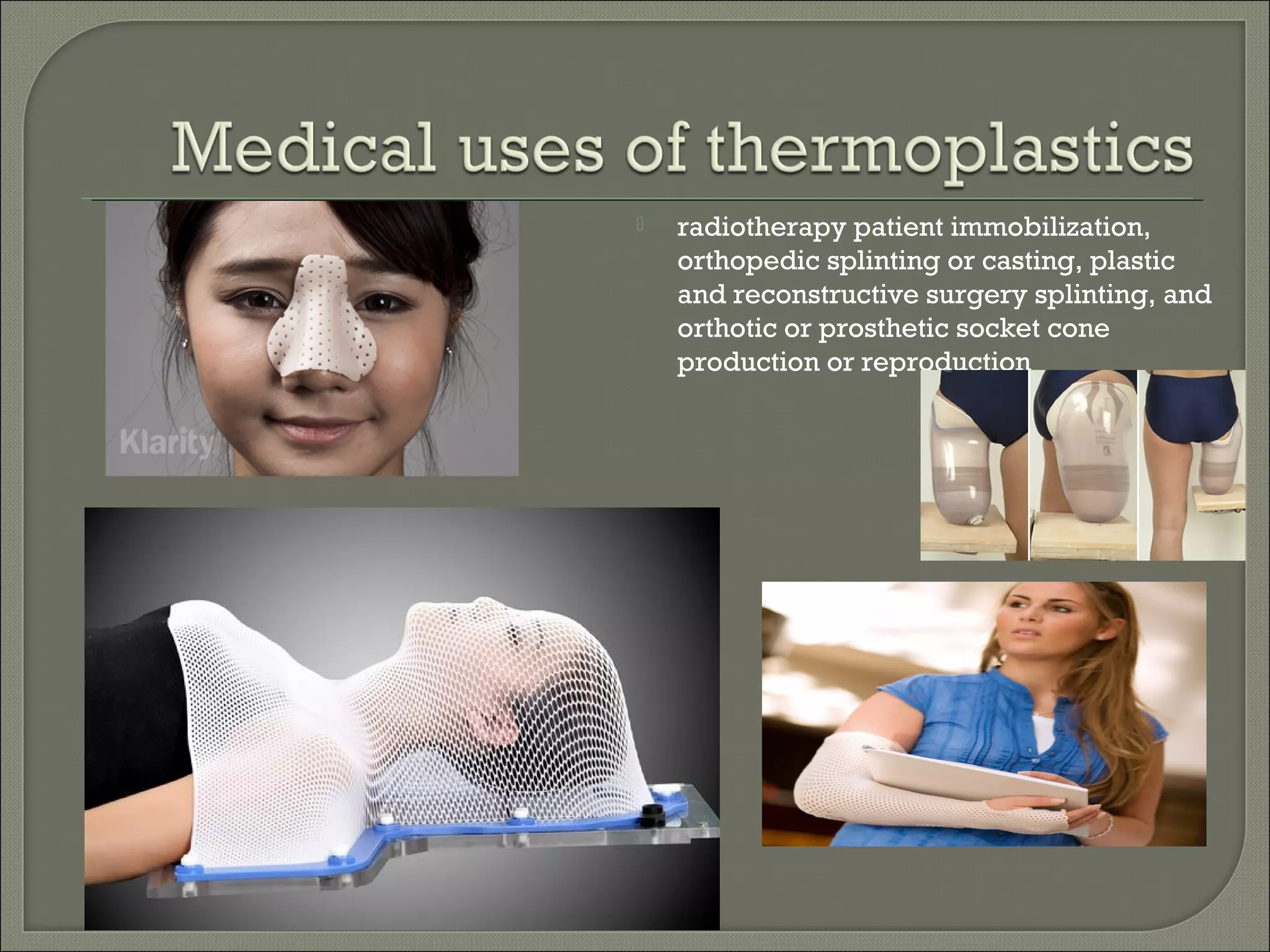
 radiotherapy patient immobilization,
orthopedic splinting or casting, plastic
and reconstructive surgery splinting, and
orthotic or prosthetic socket cone
production or reproduction
Type attenuation Skin build up
6 MV 15 MV mm H2O equiv
2.4 mm maxi 0.5% 0.35% 2.3
3.2 mm maxi 0.7% 0.45% 2.9
 Physical density is about 1.13 g/cc
 Density of water is 1 g/cc
 Patient comfort
 Shrinkage forces
 Strength of the mask
 Thickness of the mask
 Thermoplastic mask-related anxiety or
(claustrophobia) is low and possibly lies in the
positive representation patients have about the
mask.The explanations provided by health
professionals on the radiotherapy mask possibly
have a very positive effect on this perception.
 There is a proportional relationship
between amount of post-fabrication
shrinkage and the perforation density.
 Also there is an inverse relationship
between the strength of a mask and the
perforation density (Q-fix, 2013).
 Moreover, the Q-fix manufacturer claims
that the material composition of a mask
can affect its rigidity and shrinkage.
 Aquaplast masks shrink more and are
less rigid than Fiberplast masks which
incorporate Kevlar fiber to increase mask
stiffness and decrease shrinkage for
improved patient comfort
 A study was performed to measure the
shrinkage force of three thermoplastic
masks (UONTH from Orfit Industries, Uni-
frameTH from Med-Tec, and U-frameTH
from WFR).
 The internal shrinkage force for the
thermoplastic mask material sample
increased for 24 hours, then held
relatively constant until 170 hours as
shown in
 Assessment of Comfort and Shrinkage in Four
Styles of Thermoplastic Masks by V Dovell et al
• A total of 24 masks were made. Shrinkage was assessed
by tracking radiopaque fiducials affixed to the masks, and
their movement over three weekly CT scans.
• Comfort was assessed weekly from the time masks were
fabricated to the end of three weeks via questionnaires
given to participants
• Standard perforation and thermoplastic composition is
the optimal mask style based on minimal shrinkage and
lowest discomfort rating. Masks with variable perforation
had the highest mean shrinkage in all directions.
Assessment of Comfort and Shrinkage in Four Styles of Thermoplastic Masks, Valerie Dovella, Shahzad Bhuttoa et al..
 One method to deal with the consequences of
shrinkage is to place a spacer of thickness 3mm
under the head rest for patients.
 This spacer is used during thermoplastic mask
fabrication at Juravinski cancer center.
 The main purpose of the spacer is to
accommodate shrinkage.The spacer is inserted
under the patient’s head rest flange to shift the
patient’s head in the anterior direction.
 After the mask shrinks, the spacer is removed.
Courtesy: Assessment of Various Thermoplastic Masks Used for Radiation
Therapy Immobilization in Terms of Shrinkage and Pressure by Ayman Sameer Tunkr
 The thickness of the thermoplastic mask
also influences stiffness and the amount
of shrinkage; whereby a thicker mask is
more rigid, but shrinks more.
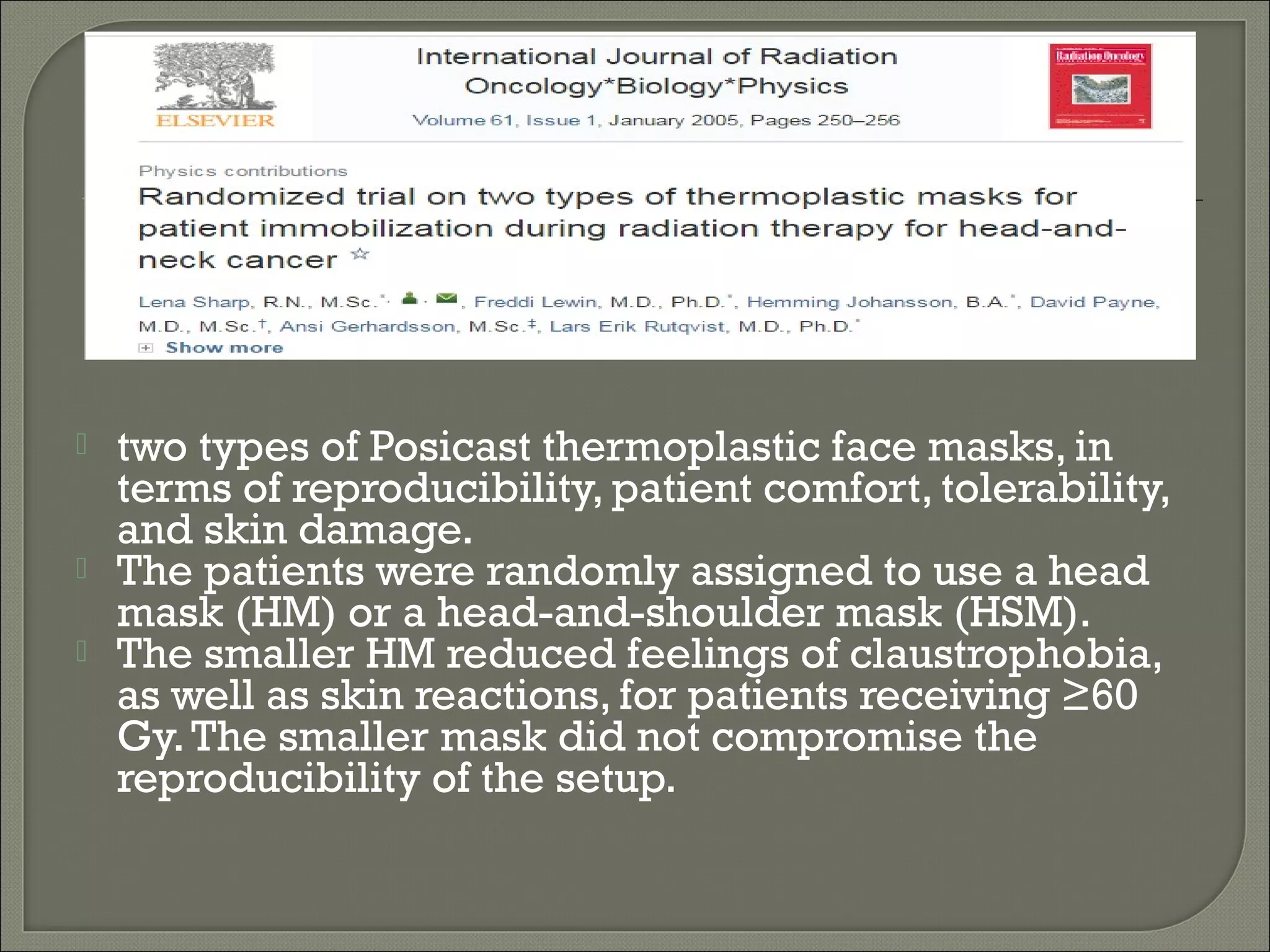
 two types of Posicast thermoplastic face masks, in
terms of reproducibility, patient comfort, tolerability,
and skin damage.
 The patients were randomly assigned to use a head
mask (HM) or a head-and-shoulder mask (HSM).
 The smaller HM reduced feelings of claustrophobia,
as well as skin reactions, for patients receiving ≥60
Gy.The smaller mask did not compromise the
reproducibility of the setup.
 The success of conformal radiotherapy
depends greatly on rigid immobilization
of patient
 The thermoplastic mask which offers
comfort yet rigid enough is preferable.
Thermoplastic mask in Radiation Therapy

Thermoplastic mask in Radiation Therapy

  • 1.
    Anil Kumar Talluri,Ph.D. Medical Physicist, Basavatarakam Indo American Cancer Hospital
  • 2.
     Radiotherapy- usingionizing radiation to treat a disease  Aim- to deliver high radiation dose to tumor while minimizing dose to surrounding healthy tissue 1. Minimize amount of time patient spends positioned and fixed on the treatment couch. 2. Minimize beam-on time (time in which radiation is applied to patient)
  • 4.
     Plastic issubset of polymers  Plastic • Thermoplastic • Thermosets • Thermoplastic elastomers • Polymer composites
  • 5.
     Thermosofting plastics Consists of simple molecular structure  All macro or monomers are chemical independent  Intermolecular forces keeps them together
  • 9.
     Made frommatrix of either themoplastics or thermosets  And non- miscible reinforcement closely linked with matrix
  • 10.
     Acrylic, apolymer called poly(methyl methacrylate) (PMMA), is also known by trade names such as Lucite, Perspex and Plexiglas.  Acrylonitrile butadiene styrene (ABS) is a terpolymer synthesized from styrene and acrylonitrile in the presence of polybutadiene.  Nylon  PLA - Polylactic acid  Polycarbonate  Polybenzimidazole  Polyethylene  Polyvinyl chloride  Teflon- is a brand name of DuPont
  • 12.
     Polycaprolactone reinforcedwith a discontinuous short length fiber and/or fines  aramid, carbon fiber, ultra high molecular weight (UHMW) polyethylene, cellulose, Nylon, polyester, fiberglass, polybenzoxazole (PBO), liquid crystal polymer fiber, polypropylene, polyamide, polybutyleneterepthalate, man made fiber, cotton, wood pulp and natural fiber  fiber comprises from 2% to 60% of the total material by weight.
  • 13.
     radiotherapy patientimmobilization, orthopedic splinting or casting, plastic and reconstructive surgery splinting, and orthotic or prosthetic socket cone production or reproduction
  • 15.
    Type attenuation Skinbuild up 6 MV 15 MV mm H2O equiv 2.4 mm maxi 0.5% 0.35% 2.3 3.2 mm maxi 0.7% 0.45% 2.9  Physical density is about 1.13 g/cc  Density of water is 1 g/cc
  • 16.
     Patient comfort Shrinkage forces  Strength of the mask  Thickness of the mask
  • 17.
     Thermoplastic mask-relatedanxiety or (claustrophobia) is low and possibly lies in the positive representation patients have about the mask.The explanations provided by health professionals on the radiotherapy mask possibly have a very positive effect on this perception.
  • 18.
     There isa proportional relationship between amount of post-fabrication shrinkage and the perforation density.  Also there is an inverse relationship between the strength of a mask and the perforation density (Q-fix, 2013).
  • 19.
     Moreover, theQ-fix manufacturer claims that the material composition of a mask can affect its rigidity and shrinkage.  Aquaplast masks shrink more and are less rigid than Fiberplast masks which incorporate Kevlar fiber to increase mask stiffness and decrease shrinkage for improved patient comfort
  • 20.
     A studywas performed to measure the shrinkage force of three thermoplastic masks (UONTH from Orfit Industries, Uni- frameTH from Med-Tec, and U-frameTH from WFR).  The internal shrinkage force for the thermoplastic mask material sample increased for 24 hours, then held relatively constant until 170 hours as shown in
  • 21.
     Assessment ofComfort and Shrinkage in Four Styles of Thermoplastic Masks by V Dovell et al • A total of 24 masks were made. Shrinkage was assessed by tracking radiopaque fiducials affixed to the masks, and their movement over three weekly CT scans. • Comfort was assessed weekly from the time masks were fabricated to the end of three weeks via questionnaires given to participants • Standard perforation and thermoplastic composition is the optimal mask style based on minimal shrinkage and lowest discomfort rating. Masks with variable perforation had the highest mean shrinkage in all directions. Assessment of Comfort and Shrinkage in Four Styles of Thermoplastic Masks, Valerie Dovella, Shahzad Bhuttoa et al..
  • 23.
     One methodto deal with the consequences of shrinkage is to place a spacer of thickness 3mm under the head rest for patients.  This spacer is used during thermoplastic mask fabrication at Juravinski cancer center.  The main purpose of the spacer is to accommodate shrinkage.The spacer is inserted under the patient’s head rest flange to shift the patient’s head in the anterior direction.  After the mask shrinks, the spacer is removed.
  • 24.
    Courtesy: Assessment ofVarious Thermoplastic Masks Used for Radiation Therapy Immobilization in Terms of Shrinkage and Pressure by Ayman Sameer Tunkr
  • 25.
     The thicknessof the thermoplastic mask also influences stiffness and the amount of shrinkage; whereby a thicker mask is more rigid, but shrinks more.
  • 26.
     two typesof Posicast thermoplastic face masks, in terms of reproducibility, patient comfort, tolerability, and skin damage.  The patients were randomly assigned to use a head mask (HM) or a head-and-shoulder mask (HSM).  The smaller HM reduced feelings of claustrophobia, as well as skin reactions, for patients receiving ≥60 Gy.The smaller mask did not compromise the reproducibility of the setup.
  • 27.
     The successof conformal radiotherapy depends greatly on rigid immobilization of patient  The thermoplastic mask which offers comfort yet rigid enough is preferable.

Editor's Notes

  • #4 Thermoplastics are a subset of plastics that can be re-shaped with the application of pressure and heat multiple times.
  • #6 Because they become soft on application of heat. Thermoplastic materials are those materials that are made of polymers linked by intermolecular interactions or van der Waals forces, forming linear or branched structures. Although they are pliable above a certain heat threshold, they return to a solid once they have been sufficiently cooled. This is a contrast to most other types of plastic, which are unable to return to a solid state after they have been heated beyond a certain point. For this reason, thermoplastics are put to unique uses in a number of manufacturing and engineering industries.
  • #8 Like tp themosets have simple molecular structures and macor molecules are chemical independent before hardening. Once hardened there is formation of threedimensional structure consists of crosslinks between molecules.
  • #9 These are copolymers made up of rubber and themoplastics
  • #10 To increase strength some fibres are introduced
  • #13 Low temperature thermoplastics
  • #14 Can be used as orthotic and splinting materials
  • #18 Few patients may suffer from claustrophobia - extreme or irrational fear of confined places