Composition:
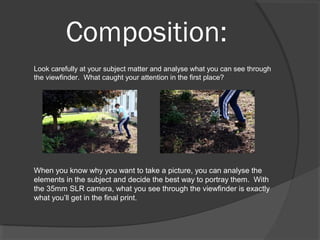
Look carefully at your subject matter and analyse what you can see through
the viewfinder. What caught your attention in the first place?
When you know why you want to take a picture, you can analyse the
elements in the subject and decide the best way to portray them. With
the 35mm SLR camera, what you see through the viewfinder is exactly
what you’ll get in the final print.
Viewpoint:
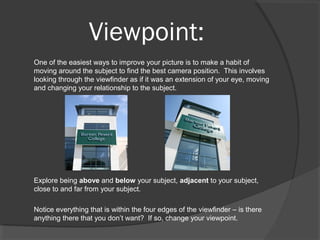
One of the easiest ways to improve your picture is to make a habit of
moving around the subject to find the best camera position. This involves
looking through the viewfinder as if it was an extension of your eye, moving
and changing your relationship to the subject.
Explore being above and below your subject, adjacent to your subject,
close to and far from your subject.
Notice everything that is within the four edges of the viewfinder – is there
anything there that you don’t want? If so, change your viewpoint.
Format and focal point:
Choose Your Focal Point
Decide upon the main point of
interest in the picture. It should
occupy a strong place within the
frame.
Experiment with placing the main
focal point to one side or corner of
the frame rather than
the middle.
Choose Your
Format
You can choose
to hold your
camera
horizontal or
vertical.
Effects using lighting:
Become aware when choosing your subject matter of where light is coming
from. Be sensitive to the direction and quality of light falling on the
subject/object. Is the light coming from the front, side, back, or is it all-over
light?
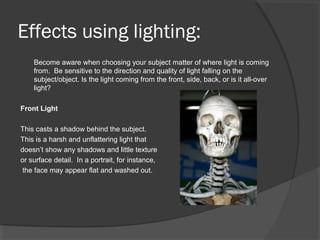
Front Light
This casts a shadow behind the subject.
This is a harsh and unflattering light that
doesn’t show any shadows and little texture
or surface detail. In a portrait, for instance,
the face may appear flat and washed out.
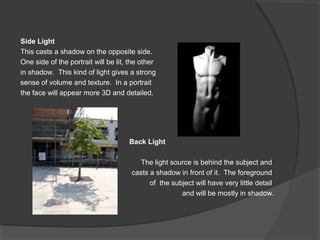
Side Light
This casts a shadow on the opposite side.
One side of the portrait will be lit, the other
in shadow. This kind of light gives a strong
sense of volume and texture. In a portrait
the face will appear more 3D and detailed.
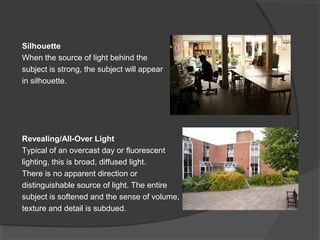
Back Light
The light source is behind the subject and
casts a shadow in front of it. The foreground
of the subject will have very little detail
and will be mostly in shadow.
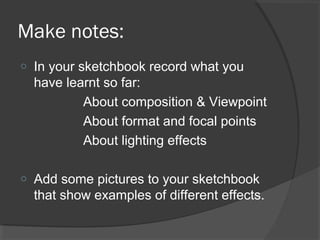
Silhouette
When the source of light behind the
subject is strong, the subject will appear
in silhouette.
Revealing/All-Over Light
Typical of an overcast day or fluorescent
lighting, this is broad, diffused light.
There is no apparent direction or
distinguishable source of light. The entire
subject is softened and the sense of volume,
texture and detail is subdued.
Make notes:
o In your sketchbook record what you
have learnt so far:
About composition & Viewpoint
About format and focal points
About lighting effects
o Add some pictures to your sketchbook
that show examples of different effects.

Photography: As compositon and lighting

  • 2.
    Composition: Look carefully atyour subject matter and analyse what you can see through the viewfinder. What caught your attention in the first place? When you know why you want to take a picture, you can analyse the elements in the subject and decide the best way to portray them. With the 35mm SLR camera, what you see through the viewfinder is exactly what you’ll get in the final print.
  • 3.
    Viewpoint: One of theeasiest ways to improve your picture is to make a habit of moving around the subject to find the best camera position. This involves looking through the viewfinder as if it was an extension of your eye, moving and changing your relationship to the subject. Explore being above and below your subject, adjacent to your subject, close to and far from your subject. Notice everything that is within the four edges of the viewfinder – is there anything there that you don’t want? If so, change your viewpoint.
  • 4.
    Format and focalpoint: Choose Your Focal Point Decide upon the main point of interest in the picture. It should occupy a strong place within the frame. Experiment with placing the main focal point to one side or corner of the frame rather than the middle. Choose Your Format You can choose to hold your camera horizontal or vertical.
  • 5.
    Effects using lighting: Becomeaware when choosing your subject matter of where light is coming from. Be sensitive to the direction and quality of light falling on the subject/object. Is the light coming from the front, side, back, or is it all-over light? Front Light This casts a shadow behind the subject. This is a harsh and unflattering light that doesn’t show any shadows and little texture or surface detail. In a portrait, for instance, the face may appear flat and washed out.
  • 6.
    Side Light This castsa shadow on the opposite side. One side of the portrait will be lit, the other in shadow. This kind of light gives a strong sense of volume and texture. In a portrait the face will appear more 3D and detailed. Back Light The light source is behind the subject and casts a shadow in front of it. The foreground of the subject will have very little detail and will be mostly in shadow.
  • 7.
    Silhouette When the sourceof light behind the subject is strong, the subject will appear in silhouette. Revealing/All-Over Light Typical of an overcast day or fluorescent lighting, this is broad, diffused light. There is no apparent direction or distinguishable source of light. The entire subject is softened and the sense of volume, texture and detail is subdued.
  • 8.
    Make notes: o Inyour sketchbook record what you have learnt so far: About composition & Viewpoint About format and focal points About lighting effects o Add some pictures to your sketchbook that show examples of different effects.