1/12/2017
1
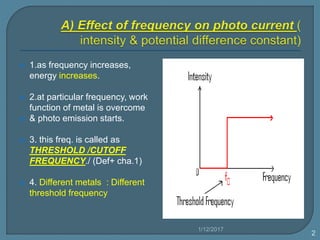
 1.as frequency increases,
energy increases.
 2.at particular frequency, work
function of metal is overcome
 & photo emission starts.
 3. this freq. is called as
THRESHOLD /CUTOFF
FREQUENCY./ (Def+ cha.1)
 4. Different metals : Different
threshold frequency
1/12/2017
2
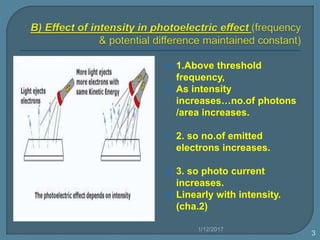
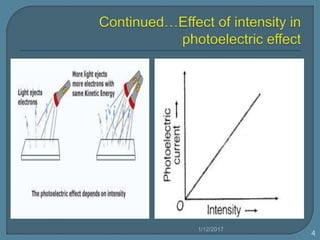
 1.Above threshold
frequency,
 As intensity
increases…no.of photons
/area increases.
 2. so no.of emitted
electrons increases.
 3. so photo current
increases.
 Linearly with intensity.
(cha.2)
1/12/2017
3
1/12/2017
4
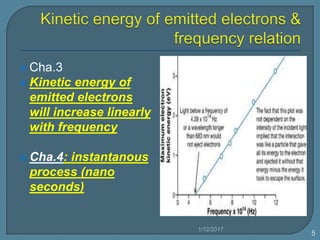
 Cha.3
 Kinetic energy of
emitted electrons
will increase linearly
with frequency
 Cha.4: instantanous
process (nano
seconds)
1/12/2017
5
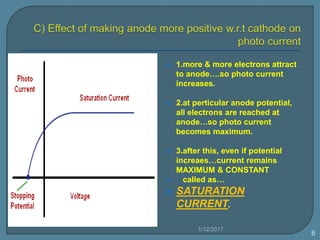
 1.more & more electrons attract
to anode….so photo current
increases.
 2.at perticular anode potential,
all electrons are reached at
anode…so photo current
becomes maximum.
 3.after this, even if potential
increaes…current remains
MAXIMUM & CONSTANT
 called as…
 SATURATION
CURRENT.
1/12/2017
6
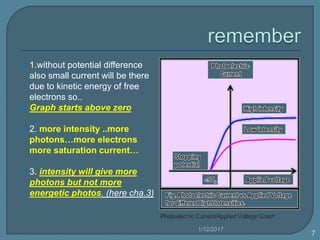
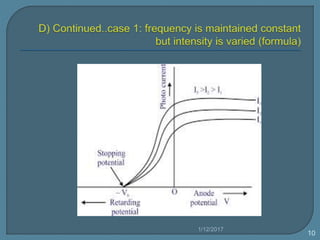
 1.without potential difference
also small current will be there
due to kinetic energy of free
electrons so..
 Graph starts above zero
 2. more intensity ..more
photons…more electrons
more saturation current…
 3. intensity will give more
photons but not more
energetic photos. (here cha.3)
1/12/2017
7
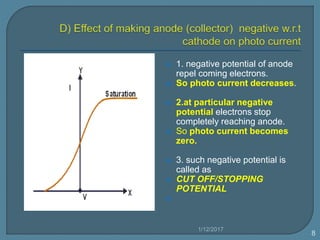
 1. negative potential of anode
repel coming electrons.
 So photo current decreases.
 2.at particular negative
potential electrons stop
completely reaching anode.
 So photo current becomes
zero.
 3. such negative potential is
called as
 CUT OFF/STOPPING
POTENTIAL

1/12/2017
8
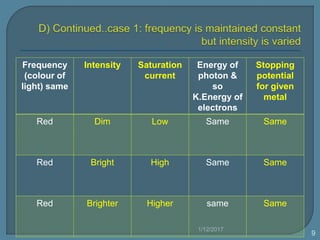
Frequency
(colour of
light) same
Intensity Saturation
current
Energy of
photon &
so
K.Energy of
electrons
Stopping
potential
for given
metal
Red Dim Low Same Same
Red Bright High Same Same
Red Brighter Higher same Same
1/12/2017
9
1/12/2017
10
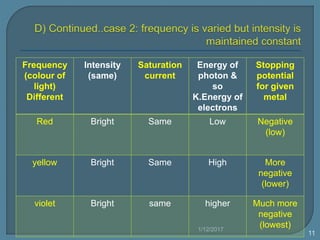
Frequency
(colour of
light)
Different
Intensity
(same)
Saturation
current
Energy of
photon &
so
K.Energy of
electrons
Stopping
potential
for given
metal
Red Bright Same Low Negative
(low)
yellow Bright Same High More
negative
(lower)
violet Bright same higher Much more
negative
(lowest)1/12/2017
11
1/12/2017
12
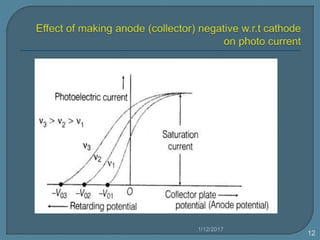
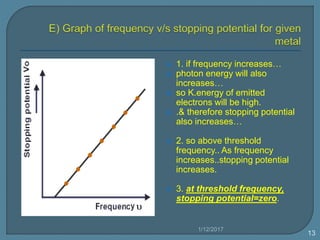
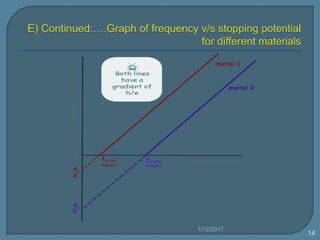
 1. if frequency increases…
 photon energy will also
increases…
 so K.energy of emitted
electrons will be high.
 .& therefore stopping potential
also increases…
 2. so above threshold
frequency.. As frequency
increases..stopping potential
increases.
 3. at threshold frequency,
stopping potential=zero.
1/12/2017
13
1/12/2017
14
1/12/2017
15
1/12/2017
16
1/12/2017
17
1/12/2017
18

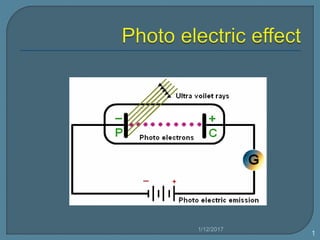
photoelectric effect

  • 1.
  • 2.
     1.as frequencyincreases, energy increases.  2.at particular frequency, work function of metal is overcome  & photo emission starts.  3. this freq. is called as THRESHOLD /CUTOFF FREQUENCY./ (Def+ cha.1)  4. Different metals : Different threshold frequency 1/12/2017 2
  • 3.
     1.Above threshold frequency, As intensity increases…no.of photons /area increases.  2. so no.of emitted electrons increases.  3. so photo current increases.  Linearly with intensity. (cha.2) 1/12/2017 3
  • 4.
  • 5.
     Cha.3  Kineticenergy of emitted electrons will increase linearly with frequency  Cha.4: instantanous process (nano seconds) 1/12/2017 5
  • 6.
     1.more &more electrons attract to anode….so photo current increases.  2.at perticular anode potential, all electrons are reached at anode…so photo current becomes maximum.  3.after this, even if potential increaes…current remains MAXIMUM & CONSTANT  called as…  SATURATION CURRENT. 1/12/2017 6
  • 7.
     1.without potentialdifference also small current will be there due to kinetic energy of free electrons so..  Graph starts above zero  2. more intensity ..more photons…more electrons more saturation current…  3. intensity will give more photons but not more energetic photos. (here cha.3) 1/12/2017 7
  • 8.
     1. negativepotential of anode repel coming electrons.  So photo current decreases.  2.at particular negative potential electrons stop completely reaching anode.  So photo current becomes zero.  3. such negative potential is called as  CUT OFF/STOPPING POTENTIAL  1/12/2017 8
  • 9.
    Frequency (colour of light) same IntensitySaturation current Energy of photon & so K.Energy of electrons Stopping potential for given metal Red Dim Low Same Same Red Bright High Same Same Red Brighter Higher same Same 1/12/2017 9
  • 10.
  • 11.
    Frequency (colour of light) Different Intensity (same) Saturation current Energy of photon& so K.Energy of electrons Stopping potential for given metal Red Bright Same Low Negative (low) yellow Bright Same High More negative (lower) violet Bright same higher Much more negative (lowest)1/12/2017 11
  • 12.
  • 13.
     1. iffrequency increases…  photon energy will also increases…  so K.energy of emitted electrons will be high.  .& therefore stopping potential also increases…  2. so above threshold frequency.. As frequency increases..stopping potential increases.  3. at threshold frequency, stopping potential=zero. 1/12/2017 13
  • 14.
  • 15.
  • 16.
  • 17.
  • 18.

Editor's Notes

  • #3 Wavelength corresponding to threshold frequency is called as threshold wavelength
  • #11 Formula:
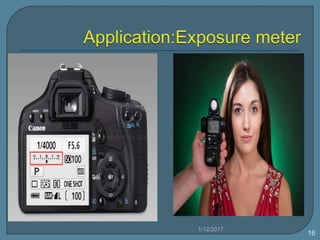
  • #17 Used along with camera to determine the correct time of exposure for having photograph
  • #18 Photoelectric cell is used to activate Relay mechanism connected to alarm.
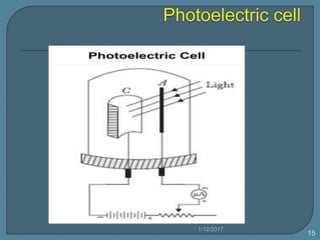
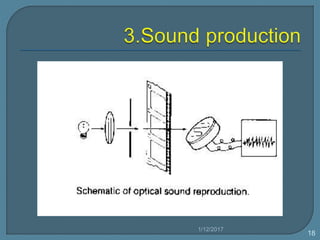
  • #19 Light falls on photoelectric cell.photo current varies according to intensity & that is fed to amplifier & then speaker.