LIMITLESS POTENTIAL | LIMITLESS OPPORTUNITIES | LIMITLESS IMPACTLIMITLESS POTENTIAL | LIMITLESS OPPORTUNITIES | LIMITLESS IMPACTLIMITLESS POTENTIAL | LIMITLESS OPPORTUNITIES | LIMITLESS IMPACTCopyright Universityof Reading
PHOSPHORUS CYCLING IN THE
SOIL-MICROBE-PLANT CONTINUUM
Dr John P. Hammond
j.p.hammond@reading.ac.uk
School of Agriculture, Policy and
Development
LIMITLESS POTENTIAL | LIMITLESS OPPORTUNITIES | LIMITLESS IMPACT
2
MicrobeSoil
Prof. Liz Wellington
Prof. David Scanlan
Prof. Gary Bending
Dr Alex Jones
Dr Jonathan Moore
Dr Ian Lidbury
Andrew Murphy
Christopher Hale
Prof. Mark Tibbett
Plant
Dr John Hammond
Dr Andrew Goodall
Dr Ron Smernik
LIMITLESS POTENTIAL | LIMITLESS OPPORTUNITIES | LIMITLESS IMPACT
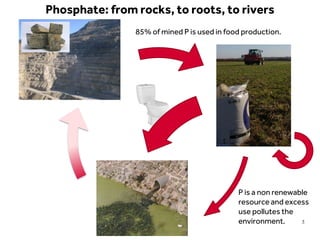
Phosphate: from rocks, to roots, to rivers
85% of mined P is used in food production.
P is a non renewable
resource and excess
use pollutes the
environment. 3
LIMITLESS POTENTIAL | LIMITLESS OPPORTUNITIES | LIMITLESS IMPACT
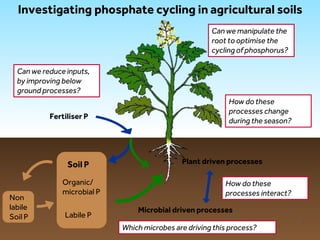
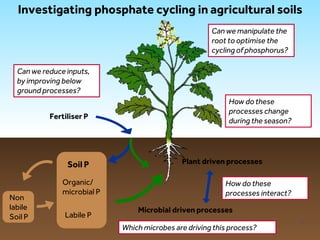
Fertiliser P
Soil P
Organic/
microbial P
Non
labile
Soil P Labile P
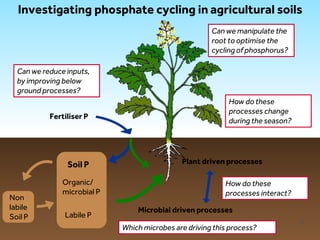
Investigating phosphate cycling in agricultural soils
Plant driven processes
Microbial driven processes
How do these
processes interact?
Which microbes are driving this process?
How do these
processes change
during the season?
Can we reduceinputs,
by improving below
ground processes?
Can we manipulate the
root to optimise the
cycling of phosphorus?
4
LIMITLESS POTENTIAL | LIMITLESS OPPORTUNITIES | LIMITLESS IMPACT
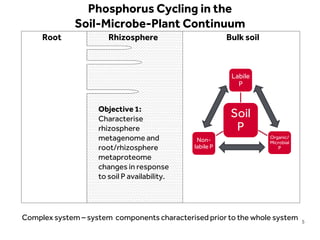
Root Bulk soilRhizosphere
Phosphorus Cycling in the
Soil-Microbe-Plant Continuum
Soil
P
Labile
P
Organic/
Microbial
P
Non-
labile P
Objective 1:
Characterise
rhizosphere
metagenome and
root/rhizosphere
metaproteome
changes in response
to soil P availability.
Complex system – system components characterised prior to the whole system 5
LIMITLESS POTENTIAL | LIMITLESS OPPORTUNITIES | LIMITLESS IMPACT
6
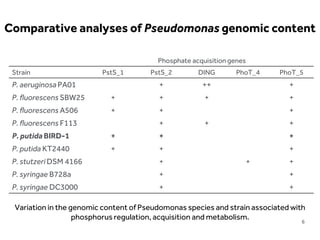
Phosphate acquisition genes
Strain PstS_1 PstS_2 DING PhoT_4 PhoT_5
P. aeruginosa PA01 + ++ +
P. fluorescens SBW25 + + + +
P. fluorescens A506 + + +
P. fluorescens F113 + + +
P. putida BIRD-1 + + +
P. putida KT2440 + + +
P. stutzeri DSM 4166 + + +
P. syringae B728a + +
P. syringae DC3000 + +
Comparative analyses of Pseudomonas genomic content
Variation in the genomic content of Pseudomonas species and strain associated with
phosphorus regulation, acquisition and metabolism.
LIMITLESS POTENTIAL | LIMITLESS OPPORTUNITIES | LIMITLESS IMPACT
7
0.01
0.1
1
10
0 10 20 30
Growth(OD600)
Time (h)
SBW25 - 50 µM P
SBW25 - 1.4 mM P
BIRD-1 - 50 µM
BIRD-1 - 1.4 mM
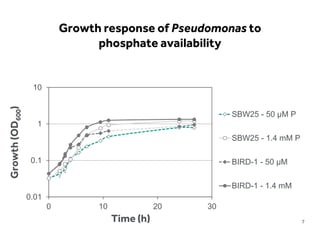
Growth response of Pseudomonas to
phosphate availability
LIMITLESS POTENTIAL | LIMITLESS OPPORTUNITIES | LIMITLESS IMPACT
8
0
1000
2000
3000
4000
5000
50 µM P 1.4 mM P
Phosphataseactivity
(PNPmghr-1)
Phosphate concentration
SBW25
BIRD-1
DSM4166
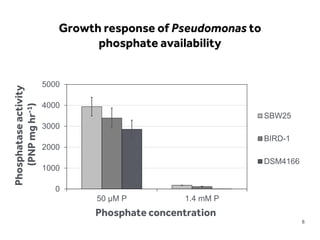
Growth response of Pseudomonas to
phosphate availability
LIMITLESS POTENTIAL | LIMITLESS OPPORTUNITIES | LIMITLESS IMPACT
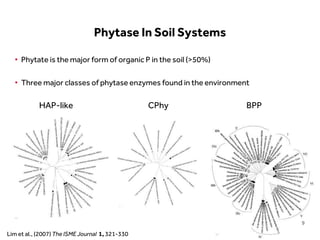
• Phytate is the major form of organic P in the soil (>50%)
• Three major classes of phytase enzymes found in the environment
Phytase In Soil Systems
HAP-like CPhy BPP
Lim et al., (2007) The ISME Journal 1, 321-330
9
LIMITLESS POTENTIAL | LIMITLESS OPPORTUNITIES | LIMITLESS IMPACT
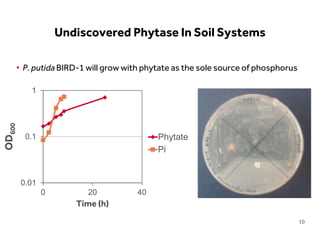
• P. putida BIRD-1 will grow with phytate as the sole source of phosphorus
0.01
0.1
1
0 20 40
OD600
Time (h)
Phytate
Pi
Undiscovered Phytase In Soil Systems
10
LIMITLESS POTENTIAL | LIMITLESS OPPORTUNITIES | LIMITLESS IMPACT
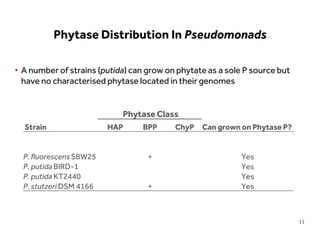
• A number of strains (putida) can grow on phytate as a sole P source but
have no characterised phytase located in their genomes
Phytase Distribution In Pseudomonads
Phytase Class
Strain HAP BPP ChyP Can grown on Phytase P?
P. fluorescens SBW25 + Yes
P. putida BIRD-1 Yes
P. putida KT2440 Yes
P. stutzeri DSM 4166 + Yes
11
LIMITLESS POTENTIAL | LIMITLESS OPPORTUNITIES | LIMITLESS IMPACT
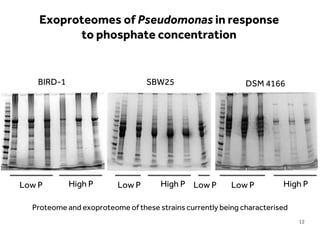
Low P High P
BIRD-1
Low P Low PHigh P Low P High P
SBW25 DSM 4166
Exoproteomes of Pseudomonas in response
to phosphate concentration
Proteome and exoproteome of these strains currently being characterised
12
LIMITLESS POTENTIAL | LIMITLESS OPPORTUNITIES | LIMITLESS IMPACT
13
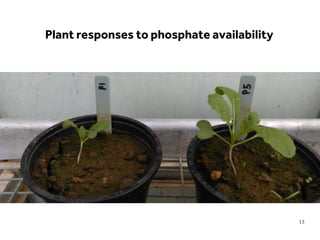
Plant responses to phosphate availability
LIMITLESS POTENTIAL | LIMITLESS OPPORTUNITIES | LIMITLESS IMPACT
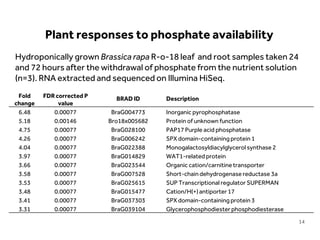
Hydroponically grown Brassica rapa R-o-18 leaf and root samples taken 24
and 72 hours after the withdrawal of phosphate from the nutrient solution
(n=3). RNA extracted and sequenced on Illumina HiSeq.
Fold
change
FDR corrected P
value
BRAD ID Description
6.48 0.00077 BraG004773 Inorganic pyrophosphatase
5.18 0.00146 Bro18x005682 Protein of unknown function
4.75 0.00077 BraG028100 PAP17 Purple acid phosphatase
4.26 0.00077 BraG006242 SPX domain-containing protein 1
4.04 0.00077 BraG022388 Monogalactosyldiacylglycerol synthase 2
3.97 0.00077 BraG014829 WAT1-related protein
3.66 0.00077 BraG023544 Organic cation/carnitinetransporter
3.58 0.00077 BraG007528 Short-chain dehydrogenase reductase 3a
3.53 0.00077 BraG025615 SUP Transcriptional regulator SUPERMAN
3.48 0.00077 BraG015477 Cation/H(+)antiporter 17
3.41 0.00077 BraG037303 SPX domain-containing protein 3
3.31 0.00077 BraG039104 Glycerophosphodiester phosphodiesterase
Plant responses to phosphate availability
14
LIMITLESS POTENTIAL | LIMITLESS OPPORTUNITIES | LIMITLESS IMPACT
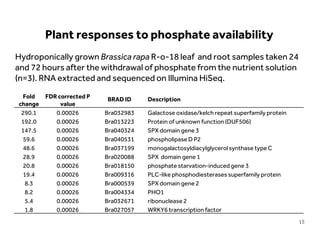
Hydroponically grown Brassica rapa R-o-18 leaf and root samples taken 24
and 72 hours after the withdrawal of phosphate from the nutrient solution
(n=3). RNA extracted and sequenced on Illumina HiSeq.
Fold
change
FDR corrected P
value
BRAD ID Description
290.1 0.00026 Bra032983 Galactose oxidase/kelch repeat superfamily protein
192.0 0.00026 Bra013223 Protein of unknown function (DUF506)
147.5 0.00026 Bra040324 SPX domain gene 3
59.6 0.00026 Bra040531 phospholipase D P2
48.6 0.00026 Bra037199 monogalactosyldiacylglycerolsynthase type C
28.9 0.00026 Bra020088 SPX domain gene 1
20.8 0.00026 Bra018150 phosphate starvation-induced gene 3
19.4 0.00026 Bra009316 PLC-like phosphodiesterases superfamily protein
8.3 0.00026 Bra000539 SPX domain gene 2
8.2 0.00026 Bra004334 PHO1
5.4 0.00026 Bra032671 ribonuclease 2
1.8 0.00026 Bra027057 WRKY6 transcription factor
Plant responses to phosphate availability
15
LIMITLESS POTENTIAL | LIMITLESS OPPORTUNITIES | LIMITLESS IMPACT
Fertiliser P
Soil P
Organic/
microbial P
Non
labile
Soil P Labile P
Investigating phosphate cycling in agricultural soils
Plant driven processes
Microbial driven processes
How do these
processes interact?
Which microbes are driving this process?
How do these
processes change
during the season?
Can we reduceinputs,
by improving below
ground processes?
Can we manipulate the
root to optimise the
cycling of phosphorus?
16
LIMITLESS POTENTIAL | LIMITLESS OPPORTUNITIES | LIMITLESS IMPACT
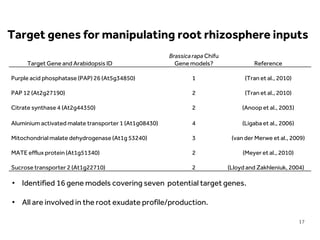
Target Gene and Arabidopsis ID
Brassicarapa Chifu
Gene models? Reference
Purple acid phosphatase (PAP) 26 (At5g34850) 1 (Tran et al., 2010)
PAP 12 (At2g27190) 2 (Tran et al., 2010)
Citrate synthase 4 (At2g44350) 2 (Anoop et al., 2003)
Aluminium activated malate transporter 1 (At1g08430) 4 (Ligaba et al., 2006)
Mitochondrial malate dehydrogenase (At1g 53240) 3 (van der Merwe et al., 2009)
MATE efflux protein (At1g51340) 2 (Meyer et al., 2010)
Sucrose transporter 2 (At1g22710) 2 (Lloyd and Zakhleniuk, 2004)
• Identified 16 gene models covering seven potential target genes.
• All are involved in the root exudate profile/production.
Target genes for manipulating root rhizosphere inputs
17
LIMITLESS POTENTIAL | LIMITLESS OPPORTUNITIES | LIMITLESS IMPACT
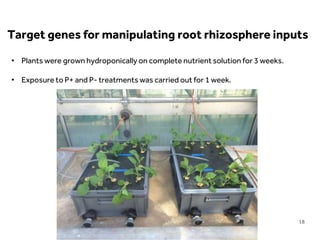
• Plants were grown hydroponically on complete nutrient solution for 3 weeks.
• Exposure to P+ and P- treatments was carried out for 1 week.
Target genes for manipulating root rhizosphere inputs
18
LIMITLESS POTENTIAL | LIMITLESS OPPORTUNITIES | LIMITLESS IMPACT
19
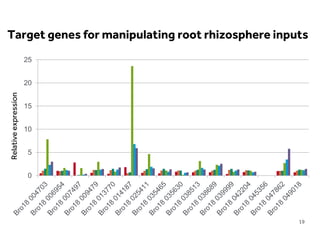
0
5
10
15
20
25
Relativeexpression
Target genes for manipulating root rhizosphere inputs
LIMITLESS POTENTIAL | LIMITLESS OPPORTUNITIES | LIMITLESS IMPACT
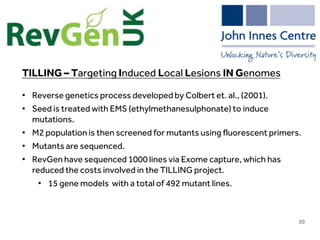
TILLING – Targeting Induced Local Lesions IN Genomes
• Reverse genetics process developed by Colbert et. al., (2001).
• Seed is treated with EMS (ethylmethanesulphonate) to induce
mutations.
• M2 population is then screened for mutants using fluorescent primers.
• Mutants are sequenced.
• RevGen have sequenced 1000 lines via Exome capture, which has
reduced the costs involved in the TILLING project.
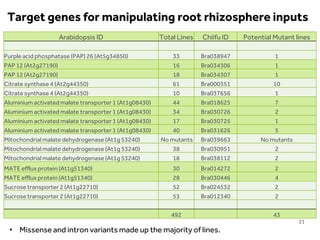
• 15 gene models with a total of 492 mutant lines.
20
LIMITLESS POTENTIAL | LIMITLESS OPPORTUNITIES | LIMITLESS IMPACT
Arabidopsis ID Total Lines Chiifu ID Potential Mutant lines
Purple acid phosphatase (PAP) 26 (At5g34850) 33 Bra038947 1
PAP 12 (At2g27190) 16 Bra034306 1
PAP 12 (At2g27190) 18 Bra034307 1
Citrate synthase 4 (At2g44350) 61 Bra000351 10
Citrate synthase 4 (At2g44350) 10 Bra037656 1
Aluminium activated malate transporter 1 (At1g08430) 44 Bra018625 7
Aluminium activated malate transporter 1 (At1g08430) 34 Bra030726 2
Aluminium activated malate transporter 1 (At1g08430) 17 Bra030725 1
Aluminium activated malate transporter 1 (At1g08430) 40 Bra031626 5
Mitochondrial malate dehydrogenase (At1g 53240) No mutants Bra039663 No mutants
Mitochondrial malate dehydrogenase (At1g 53240) 38 Bra030951 2
Mitochondrial malate dehydrogenase (At1g 53240) 18 Bra038112 2
MATE efflux protein (At1g51340) 30 Bra014272 2
MATE efflux protein (At1g51340) 28 Bra030446 4
Sucrose transporter 2 (At1g22710) 52 Bra024532 2
Sucrose transporter 2 (At1g22710) 53 Bra012340 2
492 43
• Missense and intron variants made up the majority of lines.
Target genes for manipulating root rhizosphere inputs
21
LIMITLESS POTENTIAL | LIMITLESS OPPORTUNITIES | LIMITLESS IMPACT
22
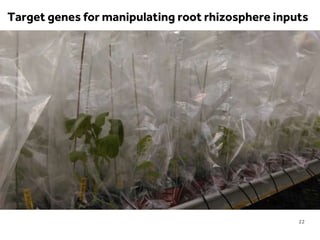
Target genes for manipulating root rhizosphere inputs
LIMITLESS POTENTIAL | LIMITLESS OPPORTUNITIES | LIMITLESS IMPACT
Fertiliser P
Soil P
Organic/
microbial P
Non
labile
Soil P Labile P
Investigating phosphate cycling in agricultural soils
Plant driven processes
Microbial driven processes
How do these
processes interact?
Which microbes are driving this process?
How do these
processes change
during the season?
Can we reduceinputs,
by improving below
ground processes?
Can we manipulate the
root to optimise the
cycling of phosphorus?
23
LIMITLESS POTENTIAL | LIMITLESS OPPORTUNITIES | LIMITLESS IMPACT
10 cm
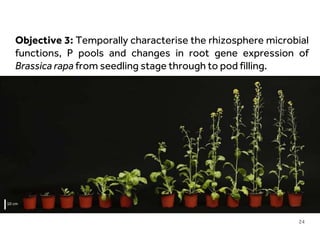
Objective 3: Temporally characterise the rhizosphere microbial
functions, P pools and changes in root gene expression of
Brassica rapa from seedling stage through to pod filling.
24
LIMITLESS POTENTIAL | LIMITLESS OPPORTUNITIES | LIMITLESS IMPACT
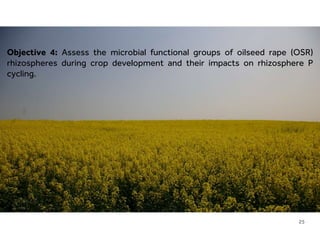
Objective 4: Assess the microbial functional groups of oilseed rape (OSR)
rhizospheres during crop development and their impacts on rhizosphere P
cycling.
25
LIMITLESS POTENTIAL | LIMITLESS OPPORTUNITIES | LIMITLESS IMPACT
26
Objective 4: Assess the microbial functional groups of oilseed rape (OSR)
rhizospheres during crop development and their impacts on rhizosphere P
cycling.
• Two field trials
• OSR following spring barley with and without phosphate fertiliser.
• 192 different varieties of OSR grown under non-limiting conditions as part of
Defra funded Oilseed Rape Genetic Improvement Network (OREGIN)
• 192 OSR varieties are part of Genome Wide Association Mapping panel
LIMITLESS POTENTIAL | LIMITLESS OPPORTUNITIES | LIMITLESS IMPACT
27
Summary
• Characterising components of the rhizosphere system.
• Observed variation in genomic content of soil bacteria and their response
to phosphorus.
• Brassica rapa growth and transcriptional responses to available P are
consistent with previous research
• Plants with mutations in genes involved in rhizosphere inputs obtained

Phosphorus Cycling

  • 1.
    LIMITLESS POTENTIAL |LIMITLESS OPPORTUNITIES | LIMITLESS IMPACTLIMITLESS POTENTIAL | LIMITLESS OPPORTUNITIES | LIMITLESS IMPACTLIMITLESS POTENTIAL | LIMITLESS OPPORTUNITIES | LIMITLESS IMPACTCopyright Universityof Reading PHOSPHORUS CYCLING IN THE SOIL-MICROBE-PLANT CONTINUUM Dr John P. Hammond j.p.hammond@reading.ac.uk School of Agriculture, Policy and Development
  • 2.
    LIMITLESS POTENTIAL |LIMITLESS OPPORTUNITIES | LIMITLESS IMPACT 2 MicrobeSoil Prof. Liz Wellington Prof. David Scanlan Prof. Gary Bending Dr Alex Jones Dr Jonathan Moore Dr Ian Lidbury Andrew Murphy Christopher Hale Prof. Mark Tibbett Plant Dr John Hammond Dr Andrew Goodall Dr Ron Smernik
  • 3.
    LIMITLESS POTENTIAL |LIMITLESS OPPORTUNITIES | LIMITLESS IMPACT Phosphate: from rocks, to roots, to rivers 85% of mined P is used in food production. P is a non renewable resource and excess use pollutes the environment. 3
  • 4.
    LIMITLESS POTENTIAL |LIMITLESS OPPORTUNITIES | LIMITLESS IMPACT Fertiliser P Soil P Organic/ microbial P Non labile Soil P Labile P Investigating phosphate cycling in agricultural soils Plant driven processes Microbial driven processes How do these processes interact? Which microbes are driving this process? How do these processes change during the season? Can we reduceinputs, by improving below ground processes? Can we manipulate the root to optimise the cycling of phosphorus? 4
  • 5.
    LIMITLESS POTENTIAL |LIMITLESS OPPORTUNITIES | LIMITLESS IMPACT Root Bulk soilRhizosphere Phosphorus Cycling in the Soil-Microbe-Plant Continuum Soil P Labile P Organic/ Microbial P Non- labile P Objective 1: Characterise rhizosphere metagenome and root/rhizosphere metaproteome changes in response to soil P availability. Complex system – system components characterised prior to the whole system 5
  • 6.
    LIMITLESS POTENTIAL |LIMITLESS OPPORTUNITIES | LIMITLESS IMPACT 6 Phosphate acquisition genes Strain PstS_1 PstS_2 DING PhoT_4 PhoT_5 P. aeruginosa PA01 + ++ + P. fluorescens SBW25 + + + + P. fluorescens A506 + + + P. fluorescens F113 + + + P. putida BIRD-1 + + + P. putida KT2440 + + + P. stutzeri DSM 4166 + + + P. syringae B728a + + P. syringae DC3000 + + Comparative analyses of Pseudomonas genomic content Variation in the genomic content of Pseudomonas species and strain associated with phosphorus regulation, acquisition and metabolism.
  • 7.
    LIMITLESS POTENTIAL |LIMITLESS OPPORTUNITIES | LIMITLESS IMPACT 7 0.01 0.1 1 10 0 10 20 30 Growth(OD600) Time (h) SBW25 - 50 µM P SBW25 - 1.4 mM P BIRD-1 - 50 µM BIRD-1 - 1.4 mM Growth response of Pseudomonas to phosphate availability
  • 8.
    LIMITLESS POTENTIAL |LIMITLESS OPPORTUNITIES | LIMITLESS IMPACT 8 0 1000 2000 3000 4000 5000 50 µM P 1.4 mM P Phosphataseactivity (PNPmghr-1) Phosphate concentration SBW25 BIRD-1 DSM4166 Growth response of Pseudomonas to phosphate availability
  • 9.
    LIMITLESS POTENTIAL |LIMITLESS OPPORTUNITIES | LIMITLESS IMPACT • Phytate is the major form of organic P in the soil (>50%) • Three major classes of phytase enzymes found in the environment Phytase In Soil Systems HAP-like CPhy BPP Lim et al., (2007) The ISME Journal 1, 321-330 9
  • 10.
    LIMITLESS POTENTIAL |LIMITLESS OPPORTUNITIES | LIMITLESS IMPACT • P. putida BIRD-1 will grow with phytate as the sole source of phosphorus 0.01 0.1 1 0 20 40 OD600 Time (h) Phytate Pi Undiscovered Phytase In Soil Systems 10
  • 11.
    LIMITLESS POTENTIAL |LIMITLESS OPPORTUNITIES | LIMITLESS IMPACT • A number of strains (putida) can grow on phytate as a sole P source but have no characterised phytase located in their genomes Phytase Distribution In Pseudomonads Phytase Class Strain HAP BPP ChyP Can grown on Phytase P? P. fluorescens SBW25 + Yes P. putida BIRD-1 Yes P. putida KT2440 Yes P. stutzeri DSM 4166 + Yes 11
  • 12.
    LIMITLESS POTENTIAL |LIMITLESS OPPORTUNITIES | LIMITLESS IMPACT Low P High P BIRD-1 Low P Low PHigh P Low P High P SBW25 DSM 4166 Exoproteomes of Pseudomonas in response to phosphate concentration Proteome and exoproteome of these strains currently being characterised 12
  • 13.
    LIMITLESS POTENTIAL |LIMITLESS OPPORTUNITIES | LIMITLESS IMPACT 13 Plant responses to phosphate availability
  • 14.
    LIMITLESS POTENTIAL |LIMITLESS OPPORTUNITIES | LIMITLESS IMPACT Hydroponically grown Brassica rapa R-o-18 leaf and root samples taken 24 and 72 hours after the withdrawal of phosphate from the nutrient solution (n=3). RNA extracted and sequenced on Illumina HiSeq. Fold change FDR corrected P value BRAD ID Description 6.48 0.00077 BraG004773 Inorganic pyrophosphatase 5.18 0.00146 Bro18x005682 Protein of unknown function 4.75 0.00077 BraG028100 PAP17 Purple acid phosphatase 4.26 0.00077 BraG006242 SPX domain-containing protein 1 4.04 0.00077 BraG022388 Monogalactosyldiacylglycerol synthase 2 3.97 0.00077 BraG014829 WAT1-related protein 3.66 0.00077 BraG023544 Organic cation/carnitinetransporter 3.58 0.00077 BraG007528 Short-chain dehydrogenase reductase 3a 3.53 0.00077 BraG025615 SUP Transcriptional regulator SUPERMAN 3.48 0.00077 BraG015477 Cation/H(+)antiporter 17 3.41 0.00077 BraG037303 SPX domain-containing protein 3 3.31 0.00077 BraG039104 Glycerophosphodiester phosphodiesterase Plant responses to phosphate availability 14
  • 15.
    LIMITLESS POTENTIAL |LIMITLESS OPPORTUNITIES | LIMITLESS IMPACT Hydroponically grown Brassica rapa R-o-18 leaf and root samples taken 24 and 72 hours after the withdrawal of phosphate from the nutrient solution (n=3). RNA extracted and sequenced on Illumina HiSeq. Fold change FDR corrected P value BRAD ID Description 290.1 0.00026 Bra032983 Galactose oxidase/kelch repeat superfamily protein 192.0 0.00026 Bra013223 Protein of unknown function (DUF506) 147.5 0.00026 Bra040324 SPX domain gene 3 59.6 0.00026 Bra040531 phospholipase D P2 48.6 0.00026 Bra037199 monogalactosyldiacylglycerolsynthase type C 28.9 0.00026 Bra020088 SPX domain gene 1 20.8 0.00026 Bra018150 phosphate starvation-induced gene 3 19.4 0.00026 Bra009316 PLC-like phosphodiesterases superfamily protein 8.3 0.00026 Bra000539 SPX domain gene 2 8.2 0.00026 Bra004334 PHO1 5.4 0.00026 Bra032671 ribonuclease 2 1.8 0.00026 Bra027057 WRKY6 transcription factor Plant responses to phosphate availability 15
  • 16.
    LIMITLESS POTENTIAL |LIMITLESS OPPORTUNITIES | LIMITLESS IMPACT Fertiliser P Soil P Organic/ microbial P Non labile Soil P Labile P Investigating phosphate cycling in agricultural soils Plant driven processes Microbial driven processes How do these processes interact? Which microbes are driving this process? How do these processes change during the season? Can we reduceinputs, by improving below ground processes? Can we manipulate the root to optimise the cycling of phosphorus? 16
  • 17.
    LIMITLESS POTENTIAL |LIMITLESS OPPORTUNITIES | LIMITLESS IMPACT Target Gene and Arabidopsis ID Brassicarapa Chifu Gene models? Reference Purple acid phosphatase (PAP) 26 (At5g34850) 1 (Tran et al., 2010) PAP 12 (At2g27190) 2 (Tran et al., 2010) Citrate synthase 4 (At2g44350) 2 (Anoop et al., 2003) Aluminium activated malate transporter 1 (At1g08430) 4 (Ligaba et al., 2006) Mitochondrial malate dehydrogenase (At1g 53240) 3 (van der Merwe et al., 2009) MATE efflux protein (At1g51340) 2 (Meyer et al., 2010) Sucrose transporter 2 (At1g22710) 2 (Lloyd and Zakhleniuk, 2004) • Identified 16 gene models covering seven potential target genes. • All are involved in the root exudate profile/production. Target genes for manipulating root rhizosphere inputs 17
  • 18.
    LIMITLESS POTENTIAL |LIMITLESS OPPORTUNITIES | LIMITLESS IMPACT • Plants were grown hydroponically on complete nutrient solution for 3 weeks. • Exposure to P+ and P- treatments was carried out for 1 week. Target genes for manipulating root rhizosphere inputs 18
  • 19.
    LIMITLESS POTENTIAL |LIMITLESS OPPORTUNITIES | LIMITLESS IMPACT 19 0 5 10 15 20 25 Relativeexpression Target genes for manipulating root rhizosphere inputs
  • 20.
    LIMITLESS POTENTIAL |LIMITLESS OPPORTUNITIES | LIMITLESS IMPACT TILLING – Targeting Induced Local Lesions IN Genomes • Reverse genetics process developed by Colbert et. al., (2001). • Seed is treated with EMS (ethylmethanesulphonate) to induce mutations. • M2 population is then screened for mutants using fluorescent primers. • Mutants are sequenced. • RevGen have sequenced 1000 lines via Exome capture, which has reduced the costs involved in the TILLING project. • 15 gene models with a total of 492 mutant lines. 20
  • 21.
    LIMITLESS POTENTIAL |LIMITLESS OPPORTUNITIES | LIMITLESS IMPACT Arabidopsis ID Total Lines Chiifu ID Potential Mutant lines Purple acid phosphatase (PAP) 26 (At5g34850) 33 Bra038947 1 PAP 12 (At2g27190) 16 Bra034306 1 PAP 12 (At2g27190) 18 Bra034307 1 Citrate synthase 4 (At2g44350) 61 Bra000351 10 Citrate synthase 4 (At2g44350) 10 Bra037656 1 Aluminium activated malate transporter 1 (At1g08430) 44 Bra018625 7 Aluminium activated malate transporter 1 (At1g08430) 34 Bra030726 2 Aluminium activated malate transporter 1 (At1g08430) 17 Bra030725 1 Aluminium activated malate transporter 1 (At1g08430) 40 Bra031626 5 Mitochondrial malate dehydrogenase (At1g 53240) No mutants Bra039663 No mutants Mitochondrial malate dehydrogenase (At1g 53240) 38 Bra030951 2 Mitochondrial malate dehydrogenase (At1g 53240) 18 Bra038112 2 MATE efflux protein (At1g51340) 30 Bra014272 2 MATE efflux protein (At1g51340) 28 Bra030446 4 Sucrose transporter 2 (At1g22710) 52 Bra024532 2 Sucrose transporter 2 (At1g22710) 53 Bra012340 2 492 43 • Missense and intron variants made up the majority of lines. Target genes for manipulating root rhizosphere inputs 21
  • 22.
    LIMITLESS POTENTIAL |LIMITLESS OPPORTUNITIES | LIMITLESS IMPACT 22 Target genes for manipulating root rhizosphere inputs
  • 23.
    LIMITLESS POTENTIAL |LIMITLESS OPPORTUNITIES | LIMITLESS IMPACT Fertiliser P Soil P Organic/ microbial P Non labile Soil P Labile P Investigating phosphate cycling in agricultural soils Plant driven processes Microbial driven processes How do these processes interact? Which microbes are driving this process? How do these processes change during the season? Can we reduceinputs, by improving below ground processes? Can we manipulate the root to optimise the cycling of phosphorus? 23
  • 24.
    LIMITLESS POTENTIAL |LIMITLESS OPPORTUNITIES | LIMITLESS IMPACT 10 cm Objective 3: Temporally characterise the rhizosphere microbial functions, P pools and changes in root gene expression of Brassica rapa from seedling stage through to pod filling. 24
  • 25.
    LIMITLESS POTENTIAL |LIMITLESS OPPORTUNITIES | LIMITLESS IMPACT Objective 4: Assess the microbial functional groups of oilseed rape (OSR) rhizospheres during crop development and their impacts on rhizosphere P cycling. 25
  • 26.
    LIMITLESS POTENTIAL |LIMITLESS OPPORTUNITIES | LIMITLESS IMPACT 26 Objective 4: Assess the microbial functional groups of oilseed rape (OSR) rhizospheres during crop development and their impacts on rhizosphere P cycling. • Two field trials • OSR following spring barley with and without phosphate fertiliser. • 192 different varieties of OSR grown under non-limiting conditions as part of Defra funded Oilseed Rape Genetic Improvement Network (OREGIN) • 192 OSR varieties are part of Genome Wide Association Mapping panel
  • 27.
    LIMITLESS POTENTIAL |LIMITLESS OPPORTUNITIES | LIMITLESS IMPACT 27 Summary • Characterising components of the rhizosphere system. • Observed variation in genomic content of soil bacteria and their response to phosphorus. • Brassica rapa growth and transcriptional responses to available P are consistent with previous research • Plants with mutations in genes involved in rhizosphere inputs obtained