
Soil Security
Programme
Annual Conference – Day 2
© University of Reading
Aims of the day
• To provide an update on the work of the SSP
team and advise on its future operation
• To get an overview of SSP and SARISA
research projects
• To investigate the potential for synergies
across the projects
• Explore the best ways to achieve impact
© University of Reading
Programme aims and
goals
The overarching aim of the Soil Security programme is to deliver
improved forecasts of the response of the soil system to changes
in climate, vegetation or management at the scale of decision
making.
We need to understand
• The ability of soils to perform multiple functions in different
contexts and at different scales
• Their ability to resist, recover and adapt to perturbations, such
as those caused by land use change and extreme climatic
events.
We can then
• Define suitable metrics of sustainability
• Identify and prioritise appropriate management interventions.
© University of Reading
Land and water management:
a. Announce firm measures to
preserve the fertility and organic
content of important agricultural
soils, to achieve the stated goal for
all soils to be sustainably managed
by 2030.
b. Accelerate efforts to restore
England’s priority natural assets
and counter long-term declines in
the ecological condition of the
farmed countryside.
© University of Reading
The Co-ordinator team
Coordinator
Chris Collins
KE Manager
Anna Louise
Batchelor
Administrator
Sharon Burton
Comms Manager
Jeremy Lelean
© University of Reading
Roles of SSP
Coordinator
• Leadership for the SSP, oversight of funded research and delivery
against programme objectives, advice on future activities
• Represent the Soil Security and SARISA to wider research community
and stakeholder groups
• Promote a joined up approach between the Soil Security programme and
SARISA,
• Links with SARIC and the Defra farm platforms
• Promote the research aims and teams of the SSP and SARISA
programmes, both nationally and internationally
• To lead an evidence review that will advise Defra on priorities for their
soils research programme.
© University of Reading
Progress to date
• Evidence review of sustainably managed soils by
ADAS - workshops in Edinburgh, Aberystwyth and
Reading
• Visits to all the project PIs
• Promotion of the programme AHDB, ESPA, AgriTech-
Imperial, BSSS
• Close liaison with Defra – evidence review and future
research priorities.
• Conference and PDRA training this year
• Launch of website
• Advisory Board
© University of Reading
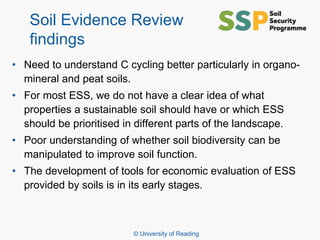
Soil Evidence Review
findings
• Need to understand C cycling better particularly in organo-
mineral and peat soils.
• For most ESS, we do not have a clear idea of what
properties a sustainable soil should have or which ESS
should be prioritised in different parts of the landscape.
• Poor understanding of whether soil biodiversity can be
manipulated to improve soil function.
• The development of tools for economic evaluation of ESS
provided by soils is in its early stages.
© University of Reading
Next steps
• Continuing project visits
• Soil expertise/requirements mapping in the context of
the review – practitioners, researchers and policy
makers
– Last Defra audit 2004
– Structured questionnaire
• Joint meeting with BSSS 2016
• Further PDRA training
© University of Reading
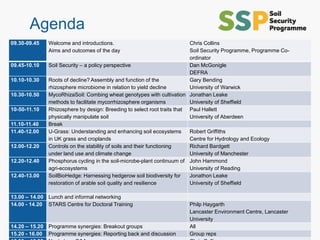
Agenda
09.30-09.45 Welcome and introductions.
Aims and outcomes of the day
Chris Collins
Soil Security Programme, Programme Co-
ordinator
09.45-10.10 Soil Security – a policy perspective Dan McGonigle
DEFRA
10.10-10.30 Roots of decline? Assembly and function of the
rhizosphere microbiome in relation to yield decline
Gary Bending
University of Warwick
10.30-10.50 MycoRhizaSoil: Combing wheat genotypes with cultivation
methods to facilitate mycorrhizosphere organisms
Jonathan Leake
University of Sheffield
10-50-11.10 Rhizosphere by design: Breeding to select root traits that
physically manipulate soil
Paul Hallett
University of Aberdeen
11.10-11.40 Break
11.40-12.00 U-Grass: Understanding and enhancing soil ecosystems
in UK grass and croplands
Robert Griffiths
Centre for Hydrology and Ecology
12.00-12.20 Controls on the stability of soils and their functioning
under land use and climate change
Richard Bardgett
University of Manchester
12.20-12.40 Phosphorus cycling in the soil-microbe-plant continuum of
agri-ecosystems
John Hammond
University of Reading
12.40-13.00 SoilBioHedge: Harnessing hedgerow soil biodiversity for
restoration of arable soil quality and resilience
Jonathon Leake
University of Sheffield
13.00 – 14.00 Lunch and informal networking
14.00 - 14.20 STARS Centre for Doctoral Training Philp Haygarth
Lancaster Environment Centre, Lancaster
University
14.20 – 15.20 Programme synergies: Breakout groups All
15.20 - 16.00 Programme synergies: Reporting back and discussion Group reps

Conference 2015 Day 2

  • 1.
  • 2.
    © University ofReading Aims of the day • To provide an update on the work of the SSP team and advise on its future operation • To get an overview of SSP and SARISA research projects • To investigate the potential for synergies across the projects • Explore the best ways to achieve impact
  • 3.
    © University ofReading Programme aims and goals The overarching aim of the Soil Security programme is to deliver improved forecasts of the response of the soil system to changes in climate, vegetation or management at the scale of decision making. We need to understand • The ability of soils to perform multiple functions in different contexts and at different scales • Their ability to resist, recover and adapt to perturbations, such as those caused by land use change and extreme climatic events. We can then • Define suitable metrics of sustainability • Identify and prioritise appropriate management interventions.
  • 4.
    © University ofReading Land and water management: a. Announce firm measures to preserve the fertility and organic content of important agricultural soils, to achieve the stated goal for all soils to be sustainably managed by 2030. b. Accelerate efforts to restore England’s priority natural assets and counter long-term declines in the ecological condition of the farmed countryside.
  • 5.
    © University ofReading The Co-ordinator team Coordinator Chris Collins KE Manager Anna Louise Batchelor Administrator Sharon Burton Comms Manager Jeremy Lelean
  • 6.
    © University ofReading Roles of SSP Coordinator • Leadership for the SSP, oversight of funded research and delivery against programme objectives, advice on future activities • Represent the Soil Security and SARISA to wider research community and stakeholder groups • Promote a joined up approach between the Soil Security programme and SARISA, • Links with SARIC and the Defra farm platforms • Promote the research aims and teams of the SSP and SARISA programmes, both nationally and internationally • To lead an evidence review that will advise Defra on priorities for their soils research programme.
  • 7.
    © University ofReading Progress to date • Evidence review of sustainably managed soils by ADAS - workshops in Edinburgh, Aberystwyth and Reading • Visits to all the project PIs • Promotion of the programme AHDB, ESPA, AgriTech- Imperial, BSSS • Close liaison with Defra – evidence review and future research priorities. • Conference and PDRA training this year • Launch of website • Advisory Board
  • 8.
    © University ofReading Soil Evidence Review findings • Need to understand C cycling better particularly in organo- mineral and peat soils. • For most ESS, we do not have a clear idea of what properties a sustainable soil should have or which ESS should be prioritised in different parts of the landscape. • Poor understanding of whether soil biodiversity can be manipulated to improve soil function. • The development of tools for economic evaluation of ESS provided by soils is in its early stages.
  • 9.
    © University ofReading Next steps • Continuing project visits • Soil expertise/requirements mapping in the context of the review – practitioners, researchers and policy makers – Last Defra audit 2004 – Structured questionnaire • Joint meeting with BSSS 2016 • Further PDRA training
  • 10.
    © University ofReading Agenda 09.30-09.45 Welcome and introductions. Aims and outcomes of the day Chris Collins Soil Security Programme, Programme Co- ordinator 09.45-10.10 Soil Security – a policy perspective Dan McGonigle DEFRA 10.10-10.30 Roots of decline? Assembly and function of the rhizosphere microbiome in relation to yield decline Gary Bending University of Warwick 10.30-10.50 MycoRhizaSoil: Combing wheat genotypes with cultivation methods to facilitate mycorrhizosphere organisms Jonathan Leake University of Sheffield 10-50-11.10 Rhizosphere by design: Breeding to select root traits that physically manipulate soil Paul Hallett University of Aberdeen 11.10-11.40 Break 11.40-12.00 U-Grass: Understanding and enhancing soil ecosystems in UK grass and croplands Robert Griffiths Centre for Hydrology and Ecology 12.00-12.20 Controls on the stability of soils and their functioning under land use and climate change Richard Bardgett University of Manchester 12.20-12.40 Phosphorus cycling in the soil-microbe-plant continuum of agri-ecosystems John Hammond University of Reading 12.40-13.00 SoilBioHedge: Harnessing hedgerow soil biodiversity for restoration of arable soil quality and resilience Jonathon Leake University of Sheffield 13.00 – 14.00 Lunch and informal networking 14.00 - 14.20 STARS Centre for Doctoral Training Philp Haygarth Lancaster Environment Centre, Lancaster University 14.20 – 15.20 Programme synergies: Breakout groups All 15.20 - 16.00 Programme synergies: Reporting back and discussion Group reps

Editor's Notes

  • #2 Announcements – Toilets, Fire escapes,
  • #4 Note different scales Functions - Flood protection, clean water, food and carbon storage Rates of loss of arable soils by erosion and degradation exceed rates of soil formation by 1-2 orders of magnitude globally, so current management is unsustainably depleting this resource.
  • #5 Soils on the government agenda these programmes and wider e.g. SARIC Policy context Defra aspiration Sustainable soils 2030 Scottish Soil Framework • SO1 - Soil organic matter stock protected and enhanced where appropriate • SO2 - Soil erosion reduced and where possible remediated
  • #6 I am leading the team. Much of my recent experience has been in the contaminated land sector, working in health risk assessment from soil pollutants lots of familiarity working at the academic/regulator/practitioner interface. Anna KE ensuring the uptake of your research findings by the wider community and developing connections to co-develop those findings . Research Officer for a number of European Projects, Office of the Deputy PM, more recently as a consultant to the food industry e.g. sustainable supply chains. Sharon undertook an Agricultural Economics degree at Reading, has worked for Defra and the insurance industry in the past. Key contact for the programme and many of you will have communicated with her recently. Jeremy graduated in Biochemistry undertook a postdoc in the US and in recent years set up his own antique book business. Responsible for website encouraging you all to provide content. I am sure you will find all the team will provide substantial support.
  • #7 Are there any projects using Defra platforms or plans to do so
  • #8 Evidence review in a minute Further visits next year Agriculture and Horticulture Development Board
  • #9 Thresholds and workable ranges for physical and chemical indicators have been developed, but not necessarily related to the delivery of specific ES. What sustainability means for each ESS in each location? SSP can deliver on the first 3