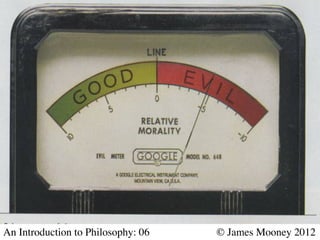
An Introduction to Philosophy: 06   	


   © James Mooney 2012
What is Ethics?
•  Meta-Ethics
  –  Addresses questions about the nature of ethics itself.
     What is morality? Is morality objective or subjective?
•  Normative Ethics
  –  Focuses on the ethical standards (norms) on which
     moral conduct is based. Is the rightness and
     wrongness of an act determined its consequences?
     Should I always act in accordance with my duty?
•  Applied Ethics
  –  Applies philosophical theory to practical issues. Is
     abortion permissible? Is there a distinction between
     killing and letting die? How ought we to act in war?
     What is the proper form of punishment?
Outlining the basic positions	

•  Objectivism (realism)	

    –  The view that values and properties (goodness, beauty) exist independently of
       human apprehension of them.	

•  Subjectivism (anti-realism)	

    –  The view that values such as goodness and beauty are not a feature of external
       reality but a product of human beliefs and responses to it.	

•  Absolutism	

    –  The view that certain actions are right or wrong under any circumstances.	

•  Relativism	

    –  In terms of ethics, the view that notions of rightness and wrongness are wholly
       determined by, and relative to, particular cultures.	

•  Deontology	

    –  The view that rightness or wrongness of an action is determined solely in terms
       of duty or intension, irrespective of consequences.	

•  Consequentialism	

    –  The view that the rightness or wrongness of an action should be solely
       determined by its consequences.
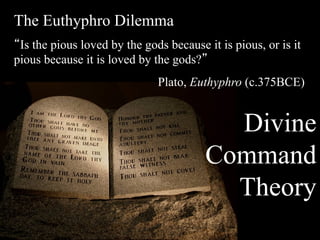
The Euthyphro Dilemma
“Is the pious loved by the gods because it is pious, or is it
pious because it is loved by the gods?”
                              Plato, Euthyphro (c.375BCE))


                                          Divine
                                        Command
                                          Theory
Moral      “When Darius was king of Persia, he
Relativism   summoned the Greeks who happened
             to be present at his court, and asked
             them what they would take to eat the
             dead bodies of their fathers. They
             relied that they would not do it for any
             money in the world. Later, in the
             presence of the Greeks and through an
             interpreter (so they could understand
             what was said) he asked some Indian,
             of the tribe Callatiae, who do in fact
             eat their parents’ dead bodies, what
             they would take to burn them [as was
             the Greek custom]. They uttered a cry
             of horror and forbade him to mention
             such a dreadful thing. One can see by
             this what custom can do, and Pindar, in
             my opinion was right when he called it
             ‘king of all’.”
                    Herodotus, Histories (c.440BCE)
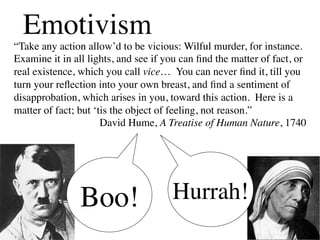
Emotivism
“Take any action allow’d to be vicious: Wilful murder, for instance.
Examine it in all lights, and see if you can find the matter of fact, or
real existence, which you call vice… You can never find it, till you
turn your reflection into your own breast, and find a sentiment of
disapprobation, which arises in you, toward this action. Here is a
matter of fact; but ‘tis the object of feeling, not reason.”	


David Hume, A Treatise of Human Nature, 1740


                Boo!	

               Hurrah!
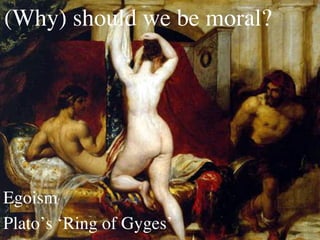
(Why) should we be moral?


Egoism	

Plato’s ‘Ring of Gyges’
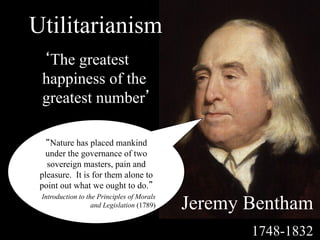
Utilitarianism
 ‘The greatest
 happiness of the
 greatest number’

   “Nature has placed mankind
   under the governance of two
   sovereign masters, pain and
 pleasure. It is for them alone to
 point out what we ought to do.”

                                            Jeremy Bentham
 Introduction to the Principles of Morals
                   and Legislation (1789)


                                                   1748-1832
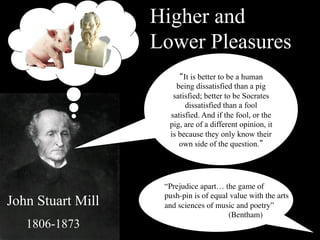
Higher and
                   Lower Pleasures
                        “It is better to be a human
                       being dissatisfied than a pig
                      satisfied; better to be Socrates
                          dissatisfied than a fool
                     satisfied. And if the fool, or the
                     pig, are of a different opinion, it
                     is because they only know their
                        own side of the question.”


                    “Prejudice apart… the game of 	

                    push-pin is of equal value with the arts 	

John Stuart Mill    and sciences of music and poetry”	


(Bentham)	

   1806-1873
The Experience Machine
	

“Suppose there were an experience machine that
   would give you any experience you desired.
   Superduper neuropsychologists could stimulate your
   brain so that you would think that you were writing a
   great novel, or making a friend, or reading an
   interesting book. All the time you would be floating
   in a tank, with electrodes attached to your brain.
   Should you plug into this machine for life,
   preprogramming your life’s desires? … Of course,
   while in the tank you won’t know that you’re there;
   you’ll think it’s all actually happening … Would you
   plug in? What else can matter to us, other than how
   our lives feel from the inside?”	

             Robert Nozick, Anarchy, State,and Utopia, 1974
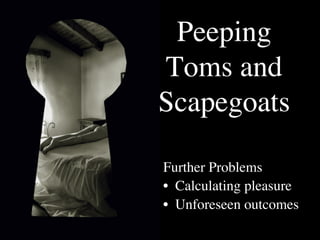
Peeping
Toms and
Scapegoats

Further Problems	

•  Calculating pleasure	

•  Unforeseen outcomes
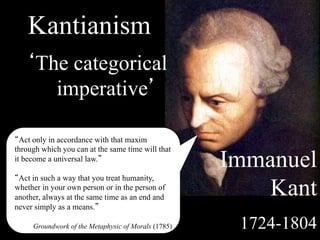
Kantianism
   ‘The categorical
      imperative’

“Act only in accordance with that maxim
through which you can at the same time will that
it become a universal law.”
                                                     Immanuel
“Act in such a way that you treat humanity,
whether in your own person or in the person of
another, always at the same time as an end and
                                                        Kant
never simply as a means.”

     Groundwork of the Metaphysic of Morals (1785)    1724-1804
The Case
of the
Inquiring
Murderer
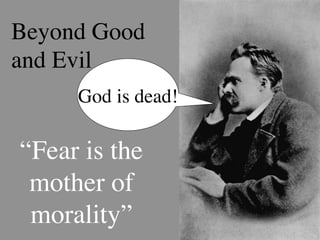
Beyond Good
and Evil
      God is dead!	


“Fear is the
 mother of
 morality”
A return to virtue?
•  Virtue Ethics	

   –  Competitor to Utilitarianism and Kantianism	

   –  Asks ‘What sort of person should I be?’ as
      opposed to ‘What should I do?’	

   –  Emphasis on character, not on individual action.
      The goodness of an action derives from the person
      that performs it, not vice versa.	

   –  Inspiration for contemporary virtue ethics comes
      from Aristotle."
Aristotle’s Ethics
•  Aristotle believes that everything has a purpose or function (ergon) which it
   must perfect in order to flourish.	

•  The ergon for humans is to live according to reason.	

•  This involves developing the excellences of character which he identifies as the
   virtues.	

•  A good upbringing is important to becoming a virtuous person.	

•  Living according to the virtues is known as eudaimonia.	

•  Aristotle proposes twelve moral virtues:	

    –  Courage, temperance, liberality, magnificence, magnanimity, proper ambition,
       patience, truthfulness, wittiness, friendliness, modesty, righteous indignation.	

•  The ‘doctrine of the mean’	

    –  Aristotle states that the virtuous person must avoid the vices of excess or deficiency
       and act according to the mean.	

    –  E.g. One must be courageous rather than cowardly; but not to the extent of being
       foolhardy. 	

•  The ‘unity of the virtues’	

    –  In addition, in order to have any one virtue, one must possess them all. This enables
       you to choose the mean between them.	

    –  E,g. One must be able to identify at what stage truthfulness should give way to
       loyalty.
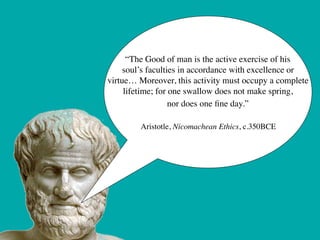
“The Good of man is the active exercise of his 	

     soul’s faculties in accordance with excellence or 	

virtue… Moreover, this activity must occupy a complete 	

     lifetime; for one swallow does not make spring, 	

                   nor does one fine day.”	


         Aristotle, Nicomachean Ethics, c.350BCE
Details
James Mooney
Open Studies
The University of Edinburgh
j.mooney@ed.ac.uk

www.filmandphilosophy.com
@film_philosophy

Philosophy06

  • 1.
    An Introduction toPhilosophy: 06 © James Mooney 2012
  • 2.
    What is Ethics? • Meta-Ethics –  Addresses questions about the nature of ethics itself. What is morality? Is morality objective or subjective? •  Normative Ethics –  Focuses on the ethical standards (norms) on which moral conduct is based. Is the rightness and wrongness of an act determined its consequences? Should I always act in accordance with my duty? •  Applied Ethics –  Applies philosophical theory to practical issues. Is abortion permissible? Is there a distinction between killing and letting die? How ought we to act in war? What is the proper form of punishment?
  • 3.
    Outlining the basicpositions •  Objectivism (realism) –  The view that values and properties (goodness, beauty) exist independently of human apprehension of them. •  Subjectivism (anti-realism) –  The view that values such as goodness and beauty are not a feature of external reality but a product of human beliefs and responses to it. •  Absolutism –  The view that certain actions are right or wrong under any circumstances. •  Relativism –  In terms of ethics, the view that notions of rightness and wrongness are wholly determined by, and relative to, particular cultures. •  Deontology –  The view that rightness or wrongness of an action is determined solely in terms of duty or intension, irrespective of consequences. •  Consequentialism –  The view that the rightness or wrongness of an action should be solely determined by its consequences.
  • 4.
    The Euthyphro Dilemma “Isthe pious loved by the gods because it is pious, or is it pious because it is loved by the gods?” Plato, Euthyphro (c.375BCE)) Divine Command Theory
  • 5.
    Moral “When Darius was king of Persia, he Relativism summoned the Greeks who happened to be present at his court, and asked them what they would take to eat the dead bodies of their fathers. They relied that they would not do it for any money in the world. Later, in the presence of the Greeks and through an interpreter (so they could understand what was said) he asked some Indian, of the tribe Callatiae, who do in fact eat their parents’ dead bodies, what they would take to burn them [as was the Greek custom]. They uttered a cry of horror and forbade him to mention such a dreadful thing. One can see by this what custom can do, and Pindar, in my opinion was right when he called it ‘king of all’.” Herodotus, Histories (c.440BCE)
  • 6.
    Emotivism “Take any actionallow’d to be vicious: Wilful murder, for instance. Examine it in all lights, and see if you can find the matter of fact, or real existence, which you call vice… You can never find it, till you turn your reflection into your own breast, and find a sentiment of disapprobation, which arises in you, toward this action. Here is a matter of fact; but ‘tis the object of feeling, not reason.” David Hume, A Treatise of Human Nature, 1740 Boo! Hurrah!
  • 7.
    (Why) should webe moral? Egoism Plato’s ‘Ring of Gyges’
  • 8.
    Utilitarianism ‘The greatest happiness of the greatest number’ “Nature has placed mankind under the governance of two sovereign masters, pain and pleasure. It is for them alone to point out what we ought to do.” Jeremy Bentham Introduction to the Principles of Morals and Legislation (1789) 1748-1832
  • 9.
    Higher and Lower Pleasures “It is better to be a human being dissatisfied than a pig satisfied; better to be Socrates dissatisfied than a fool satisfied. And if the fool, or the pig, are of a different opinion, it is because they only know their own side of the question.” “Prejudice apart… the game of push-pin is of equal value with the arts John Stuart Mill and sciences of music and poetry” (Bentham) 1806-1873
  • 10.
    The Experience Machine “Supposethere were an experience machine that would give you any experience you desired. Superduper neuropsychologists could stimulate your brain so that you would think that you were writing a great novel, or making a friend, or reading an interesting book. All the time you would be floating in a tank, with electrodes attached to your brain. Should you plug into this machine for life, preprogramming your life’s desires? … Of course, while in the tank you won’t know that you’re there; you’ll think it’s all actually happening … Would you plug in? What else can matter to us, other than how our lives feel from the inside?” Robert Nozick, Anarchy, State,and Utopia, 1974
  • 11.
    Peeping Toms and Scapegoats Further Problems • Calculating pleasure •  Unforeseen outcomes
  • 12.
    Kantianism ‘The categorical imperative’ “Act only in accordance with that maxim through which you can at the same time will that it become a universal law.” Immanuel “Act in such a way that you treat humanity, whether in your own person or in the person of another, always at the same time as an end and Kant never simply as a means.” Groundwork of the Metaphysic of Morals (1785) 1724-1804
  • 13.
  • 14.
    Beyond Good and Evil God is dead! “Fear is the mother of morality”
  • 15.
    A return tovirtue? •  Virtue Ethics –  Competitor to Utilitarianism and Kantianism –  Asks ‘What sort of person should I be?’ as opposed to ‘What should I do?’ –  Emphasis on character, not on individual action. The goodness of an action derives from the person that performs it, not vice versa. –  Inspiration for contemporary virtue ethics comes from Aristotle."
  • 16.
    Aristotle’s Ethics •  Aristotlebelieves that everything has a purpose or function (ergon) which it must perfect in order to flourish. •  The ergon for humans is to live according to reason. •  This involves developing the excellences of character which he identifies as the virtues. •  A good upbringing is important to becoming a virtuous person. •  Living according to the virtues is known as eudaimonia. •  Aristotle proposes twelve moral virtues: –  Courage, temperance, liberality, magnificence, magnanimity, proper ambition, patience, truthfulness, wittiness, friendliness, modesty, righteous indignation. •  The ‘doctrine of the mean’ –  Aristotle states that the virtuous person must avoid the vices of excess or deficiency and act according to the mean. –  E.g. One must be courageous rather than cowardly; but not to the extent of being foolhardy. •  The ‘unity of the virtues’ –  In addition, in order to have any one virtue, one must possess them all. This enables you to choose the mean between them. –  E,g. One must be able to identify at what stage truthfulness should give way to loyalty.
  • 17.
    “The Good ofman is the active exercise of his soul’s faculties in accordance with excellence or virtue… Moreover, this activity must occupy a complete lifetime; for one swallow does not make spring, nor does one fine day.” Aristotle, Nicomachean Ethics, c.350BCE
  • 18.
    Details James Mooney Open Studies TheUniversity of Edinburgh j.mooney@ed.ac.uk www.filmandphilosophy.com @film_philosophy