Open Source Philosophy
Daniel Lezcano
ENGINEERS
AND DEVICES
WORKING
TOGETHER
What is Open Source ?
● Open Source is not Free Software
Richard Stallman : “Open source is a development
methodology; free software is a social movement.” [1]
● Important to understand the difference, let’s do some
history
[1] https://www.gnu.org/philosophy/open-source-misses-the-point.en.html
ENGINEERS AND DEVICES
WORKING TOGETHER
Open Source Origin
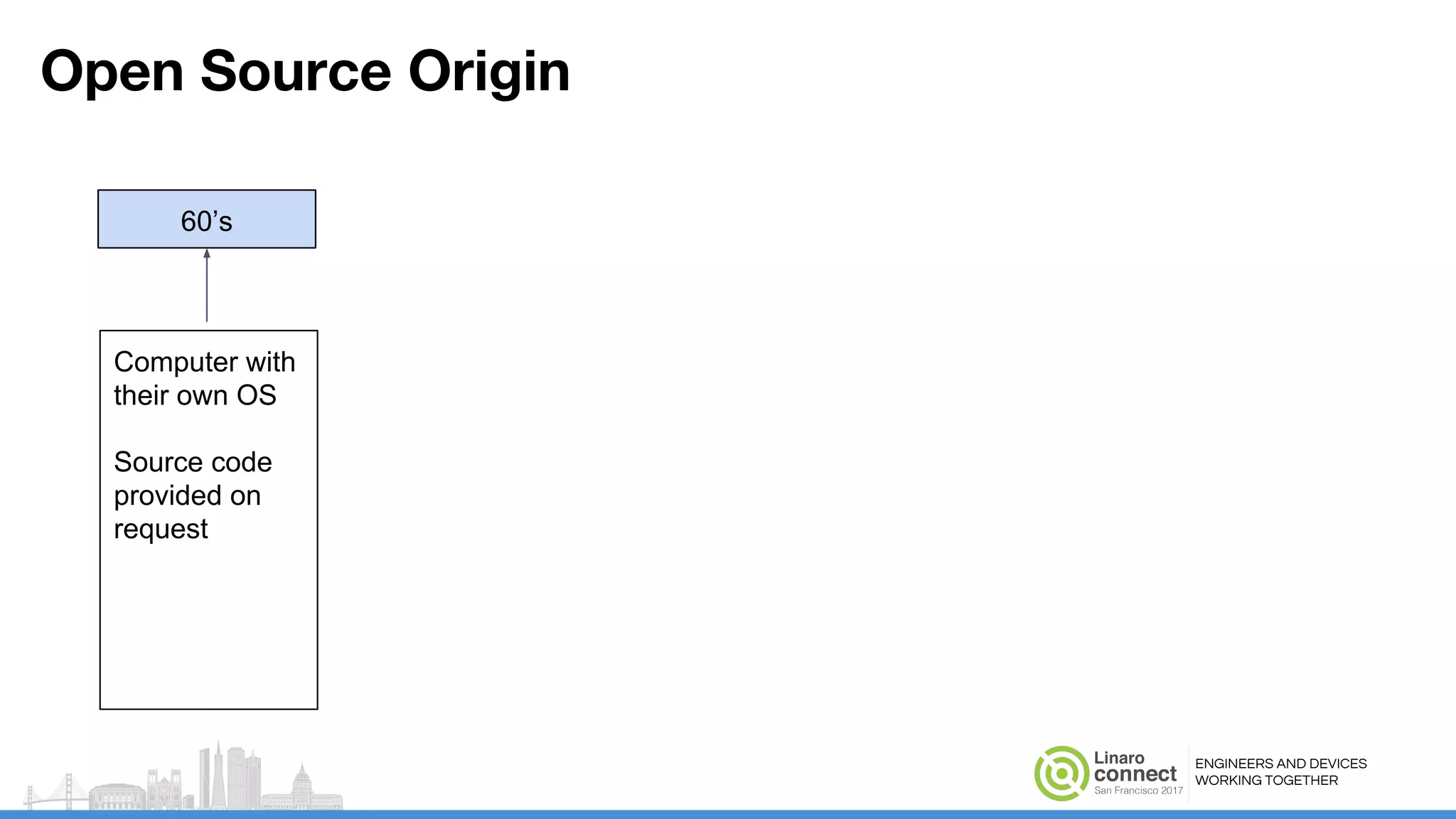
60’s
Computer with
their own OS
Source code
provided on
request
ENGINEERS AND DEVICES
WORKING TOGETHER
Open Source Origin
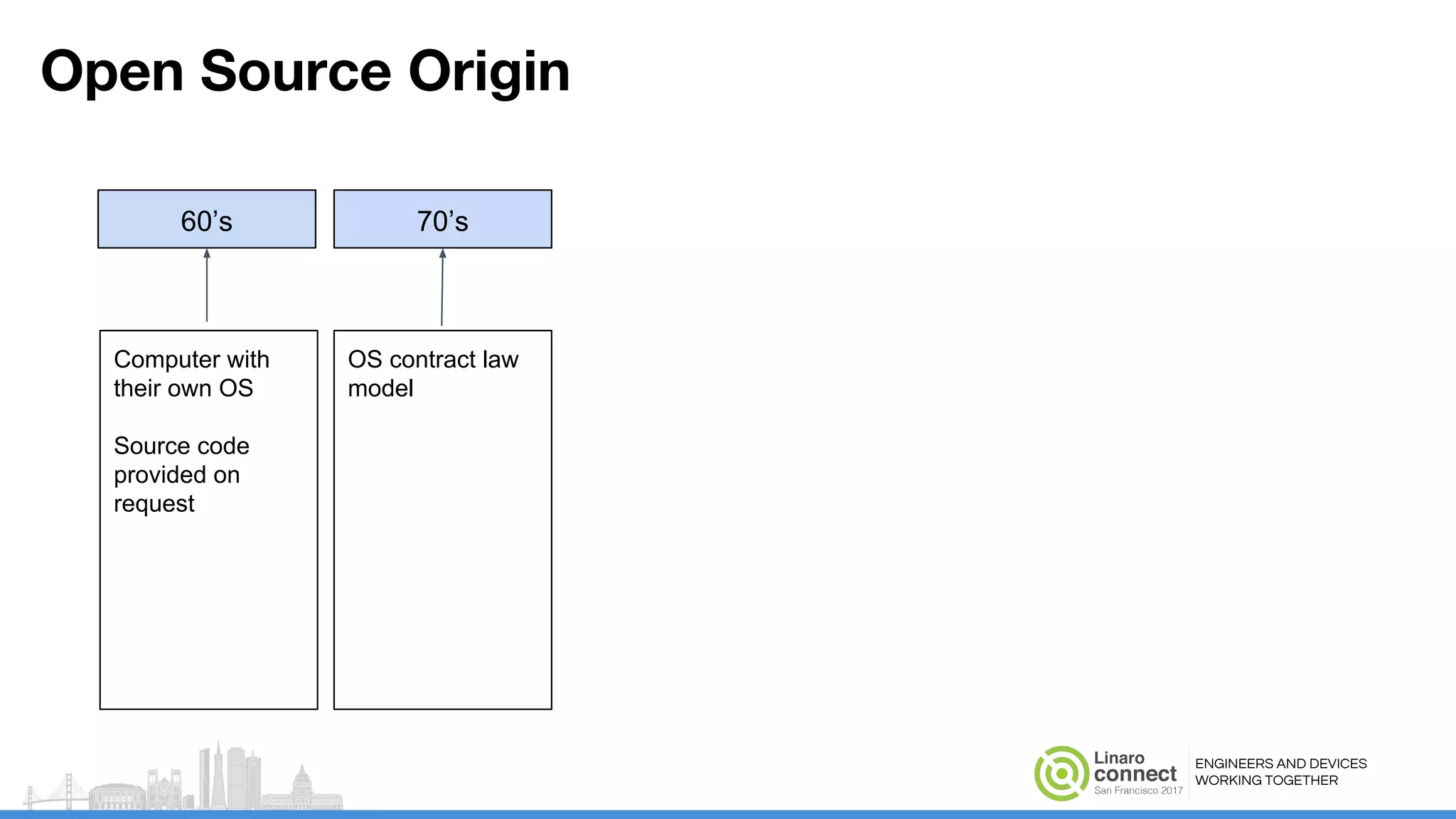
60’s 70’s
OS contract law
model
Computer with
their own OS
Source code
provided on
request
ENGINEERS AND DEVICES
WORKING TOGETHER
Open Source Origin
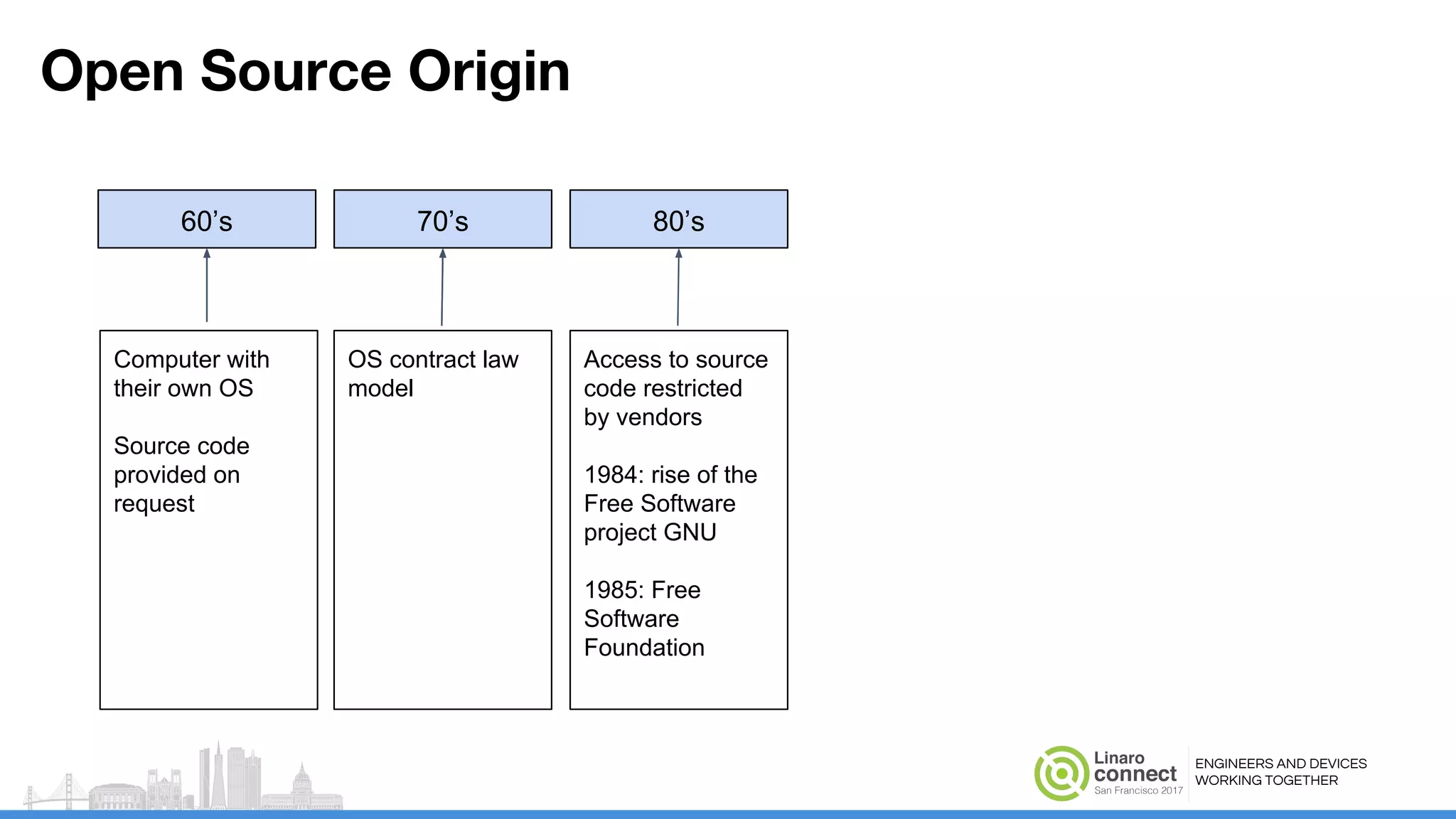
60’s 70’s 80’s
Computer with
their own OS
Source code
provided on
request
Access to source
code restricted
by vendors
1984: rise of the
Free Software
project GNU
1985: Free
Software
Foundation
OS contract law
model
ENGINEERS AND DEVICES
WORKING TOGETHER
Open Source Origin
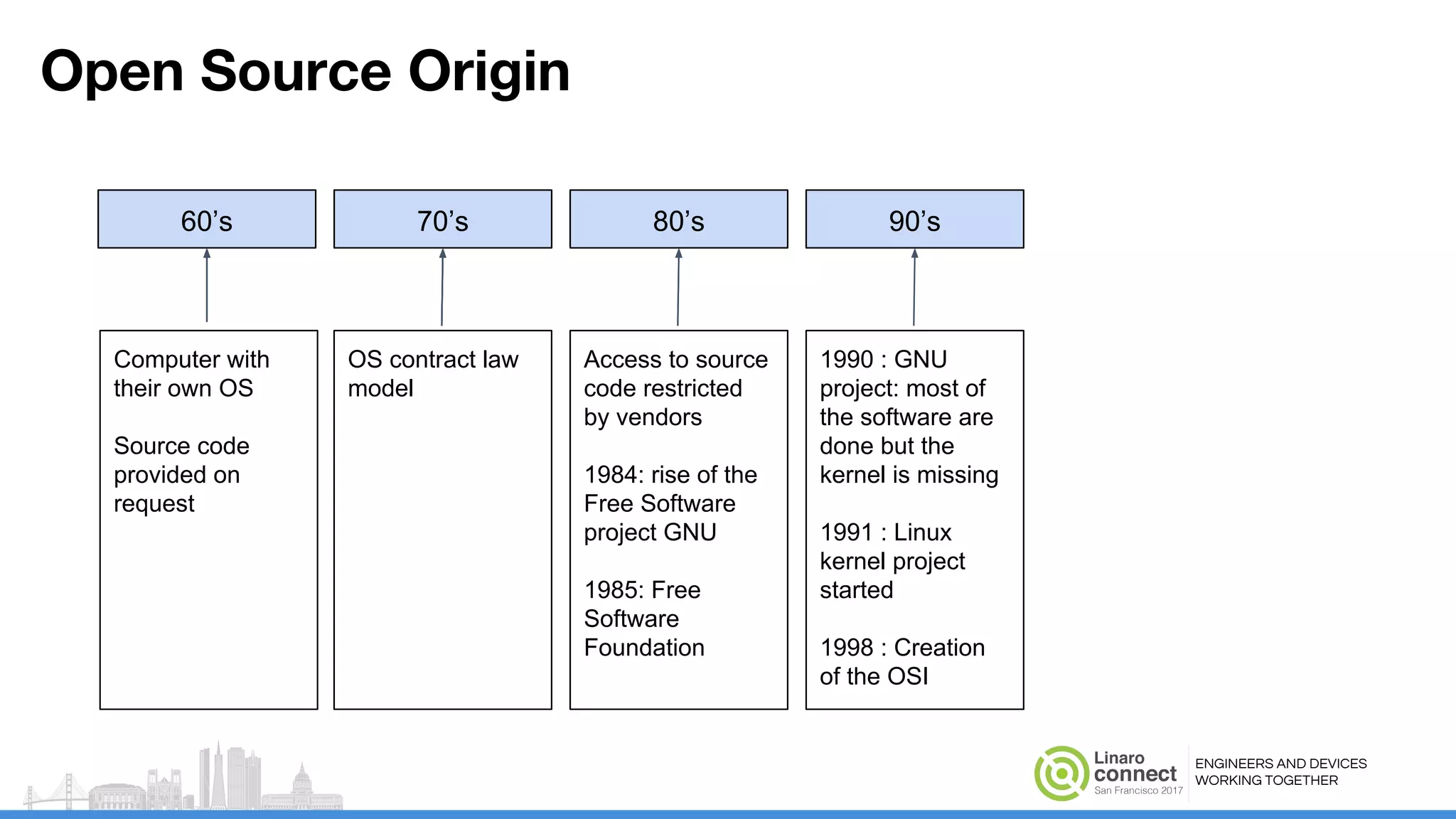
60’s 70’s 80’s 90’s
1990 : GNU
project: most of
the software are
done but the
kernel is missing
1991 : Linux
kernel project
started
1998 : Creation
of the OSI
Access to source
code restricted
by vendors
1984: rise of the
Free Software
project GNU
1985: Free
Software
Foundation
Computer with
their own OS
Source code
provided on
request
OS contract law
model
ENGINEERS AND DEVICES
WORKING TOGETHER
Open Source Origin
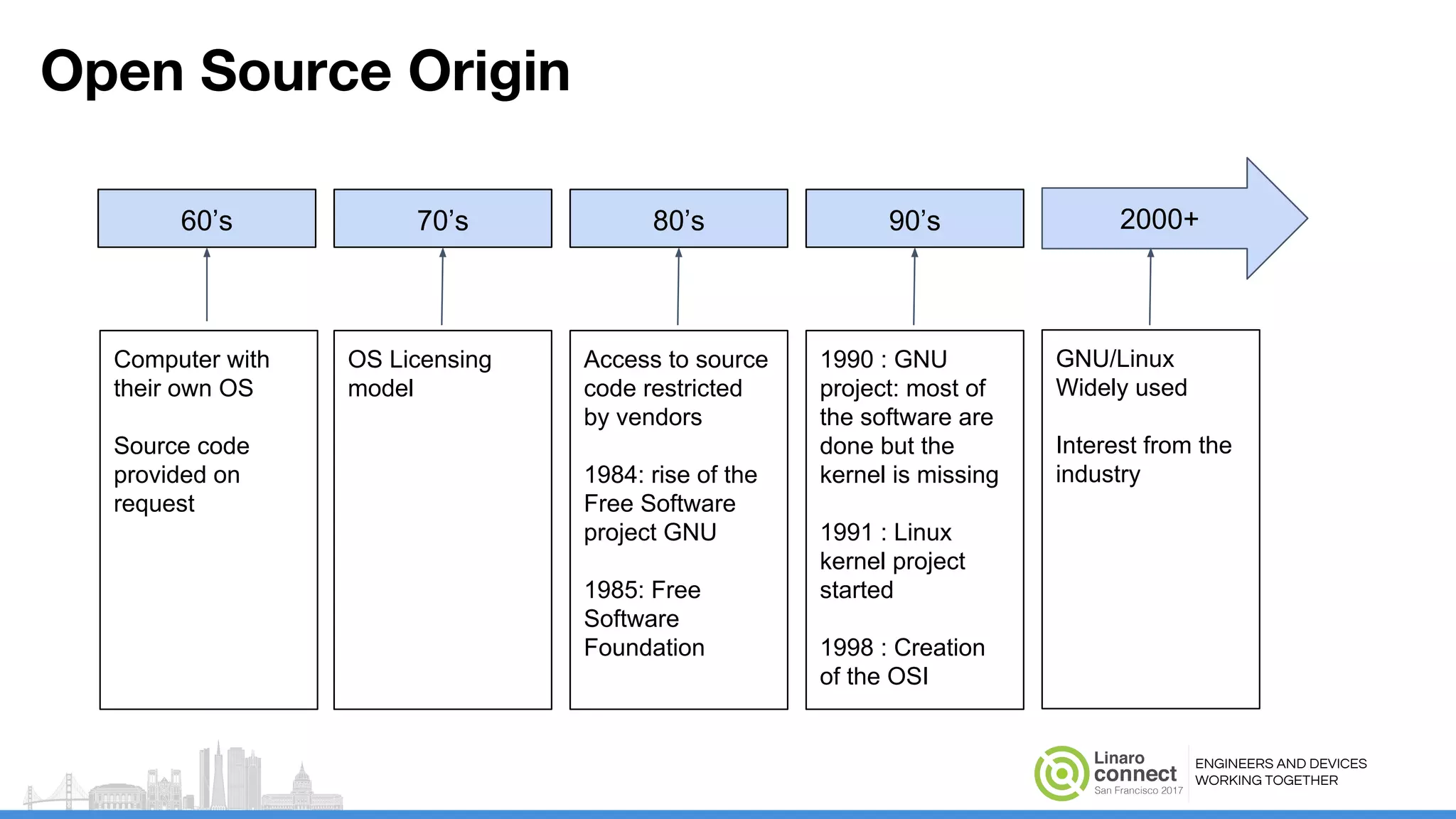
60’s 70’s 80’s 90’s 2000+
GNU/Linux
Widely used
Interest from the
industry
Access to source
code restricted
by vendors
1984: rise of the
Free Software
project GNU
1985: Free
Software
Foundation
OS Licensing
model
Computer with
their own OS
Source code
provided on
request
1990 : GNU
project: most of
the software are
done but the
kernel is missing
1991 : Linux
kernel project
started
1998 : Creation
of the OSI
ENGINEERS
AND DEVICES
WORKING
TOGETHER
Open Source origin
Market share
Desktop / laptop 2.18 %
Mobile + table 63.31 %
Server 36.72 %
Mainframe 28 %
Super computer 99.79 %
Embedded 29.44 %
● GNU/Linux widely used nowadays [1]
[1]
https://en.wikipedia.org/wiki/Usage_share_of_operating_systems
ENGINEERS
AND DEVICES
WORKING
TOGETHER
Open Source origin
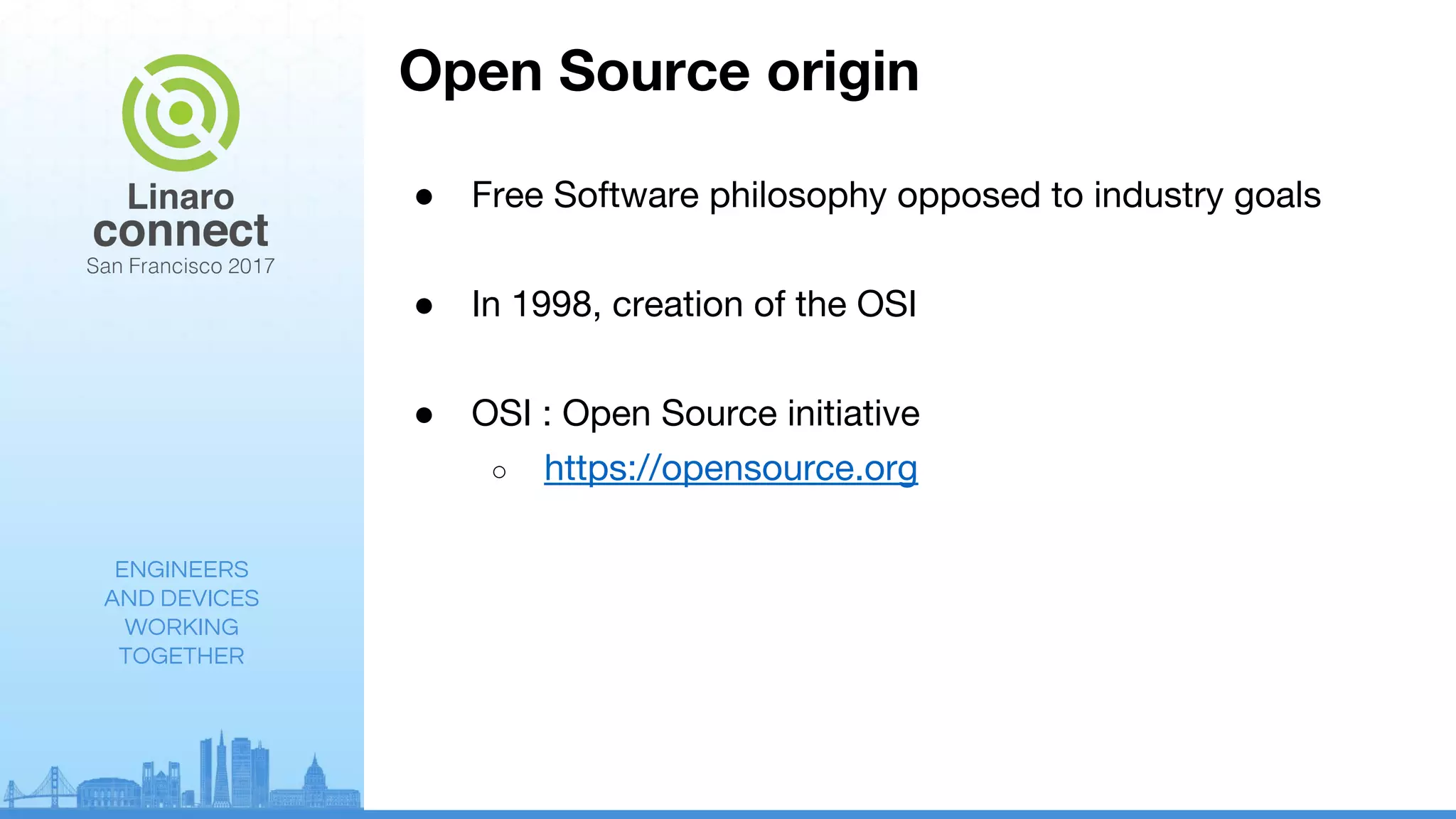
● Free Software philosophy opposed to industry goals
● In 1998, creation of the OSI
● OSI : Open Source initiative
○ https://opensource.org
ENGINEERS
AND DEVICES
WORKING
TOGETHER
Open Source Initiative
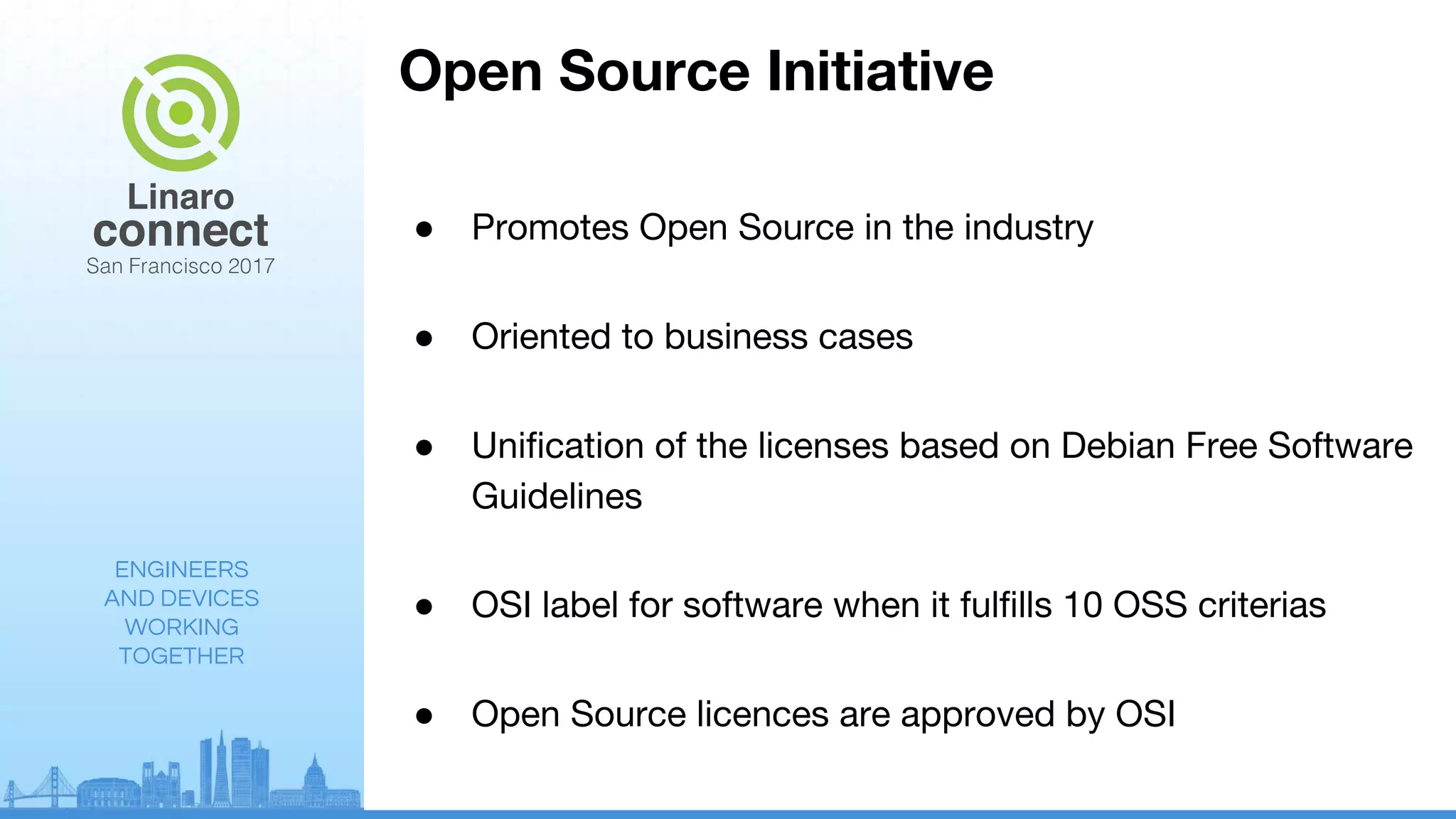
● Promotes Open Source in the industry
● Oriented to business cases
● Unification of the licenses based on Debian Free Software
Guidelines
● OSI label for software when it fulfills 10 OSS criterias
● Open Source licences are approved by OSI
ENGINEERS
AND DEVICES
WORKING
TOGETHER
Open Source Initiative
● OSI criterias[1]
1. Free Redistribution
2. Source Code
3. Derived Works
4. Integrity of The Author's Source Code
5. No Discrimination Against Persons or Groups
6. No Discrimination Against Fields of Endeavor
7. Distribution of License
8. License Must Not Be Specific to a Product
9. License Must Not Restrict Other Software
10. License Must Be Technology-Neutral
[1]
https://opensource.org/osd-annotated
ENGINEERS
AND DEVICES
WORKING
TOGETHER
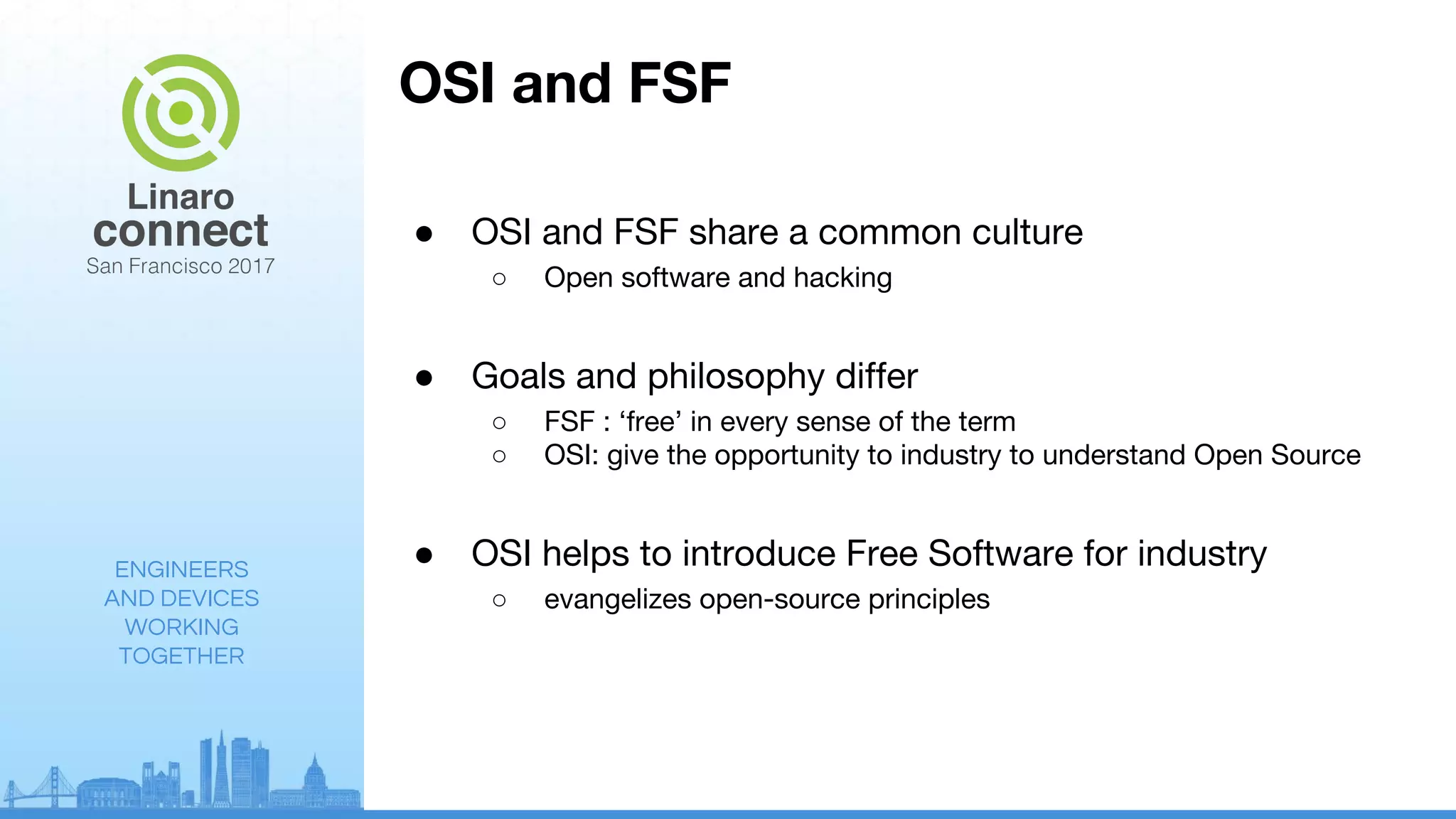
OSI and FSF
● OSI and FSF share a common culture
○ Open software and hacking
● Goals and philosophy differ
○ FSF : ‘free’ in every sense of the term
○ OSI: give the opportunity to industry to understand Open Source
● OSI helps to introduce Free Software for industry
○ evangelizes open-source principles
ENGINEERS
AND DEVICES
WORKING
TOGETHER
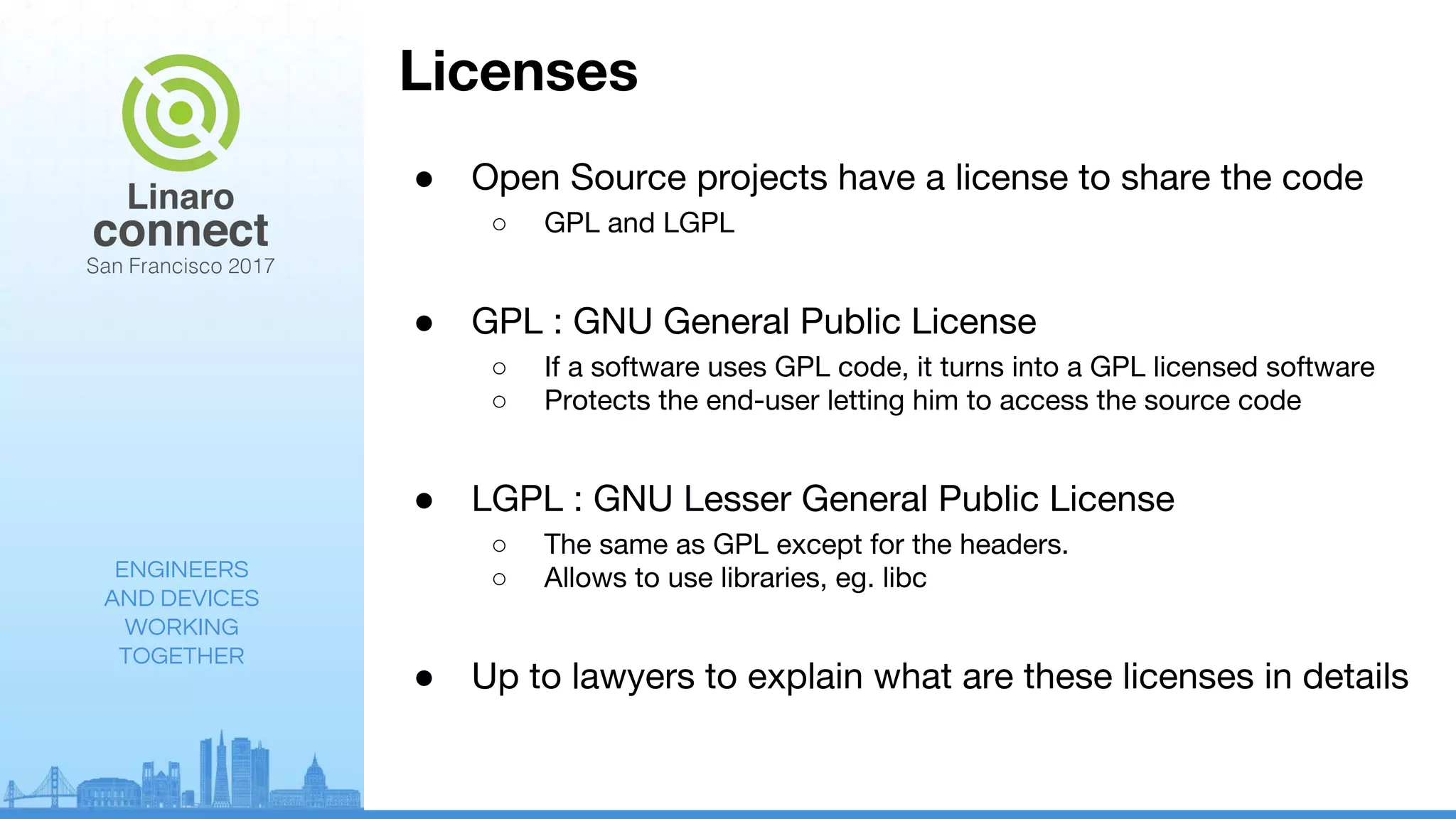
Licenses
● Open Source projects have a license to share the code
○ GPL and LGPL
● GPL : GNU General Public License
○ If a software uses GPL code, it turns into a GPL licensed software
○ Protects the end-user letting him to access the source code
● LGPL : GNU Lesser General Public License
○ The same as GPL except for the headers.
○ Allows to use libraries, eg. libc
● Up to lawyers to explain what are these licenses in details
ENGINEERS
AND DEVICES
WORKING
TOGETHER
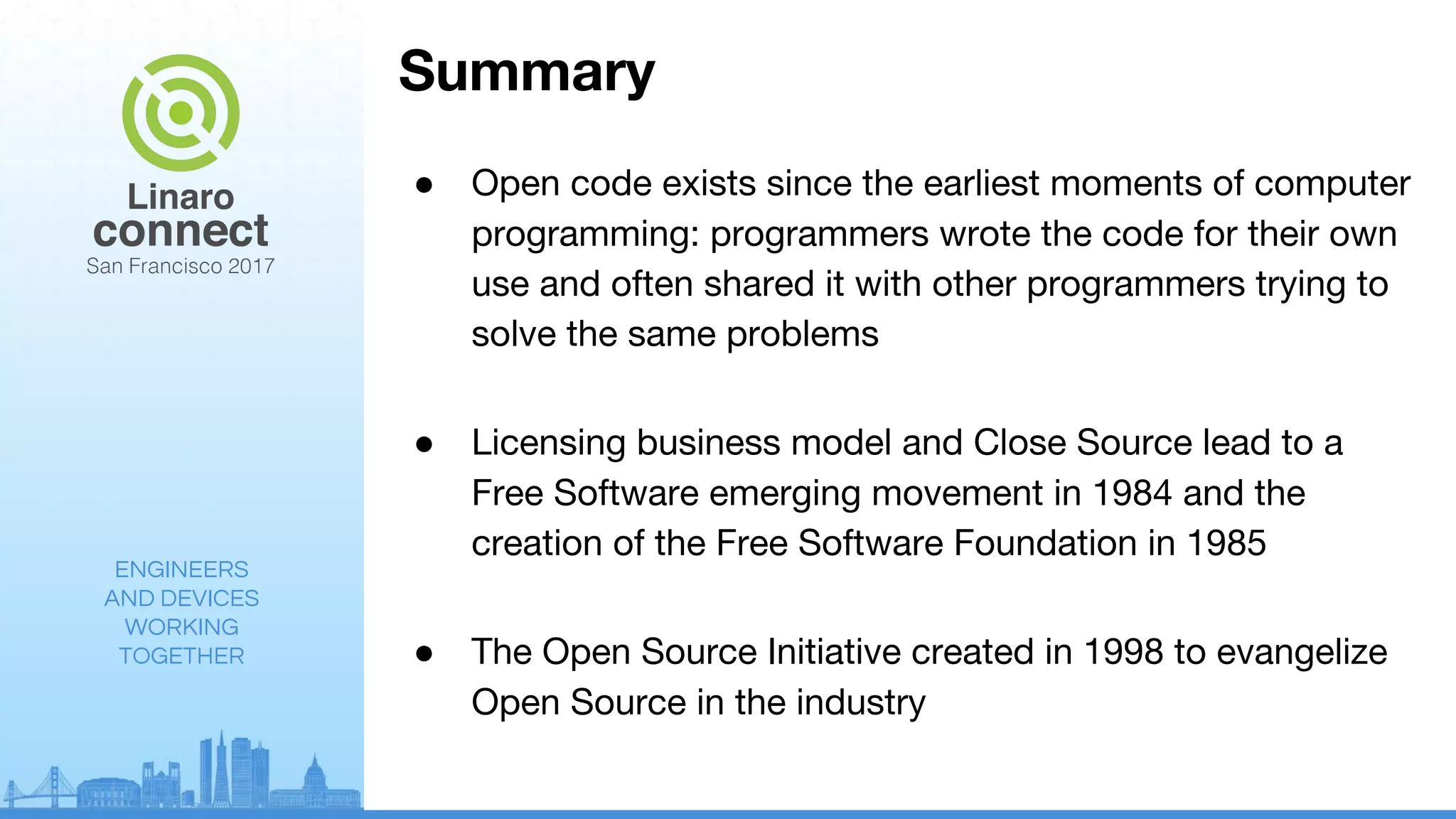
Summary
● Open code exists since the earliest moments of computer
programming: programmers wrote the code for their own
use and often shared it with other programmers trying to
solve the same problems
● Licensing business model and Close Source lead to a
Free Software emerging movement in 1984 and the
creation of the Free Software Foundation in 1985
● The Open Source Initiative created in 1998 to evangelize
Open Source in the industry
ENGINEERS
AND DEVICES
WORKING
TOGETHER
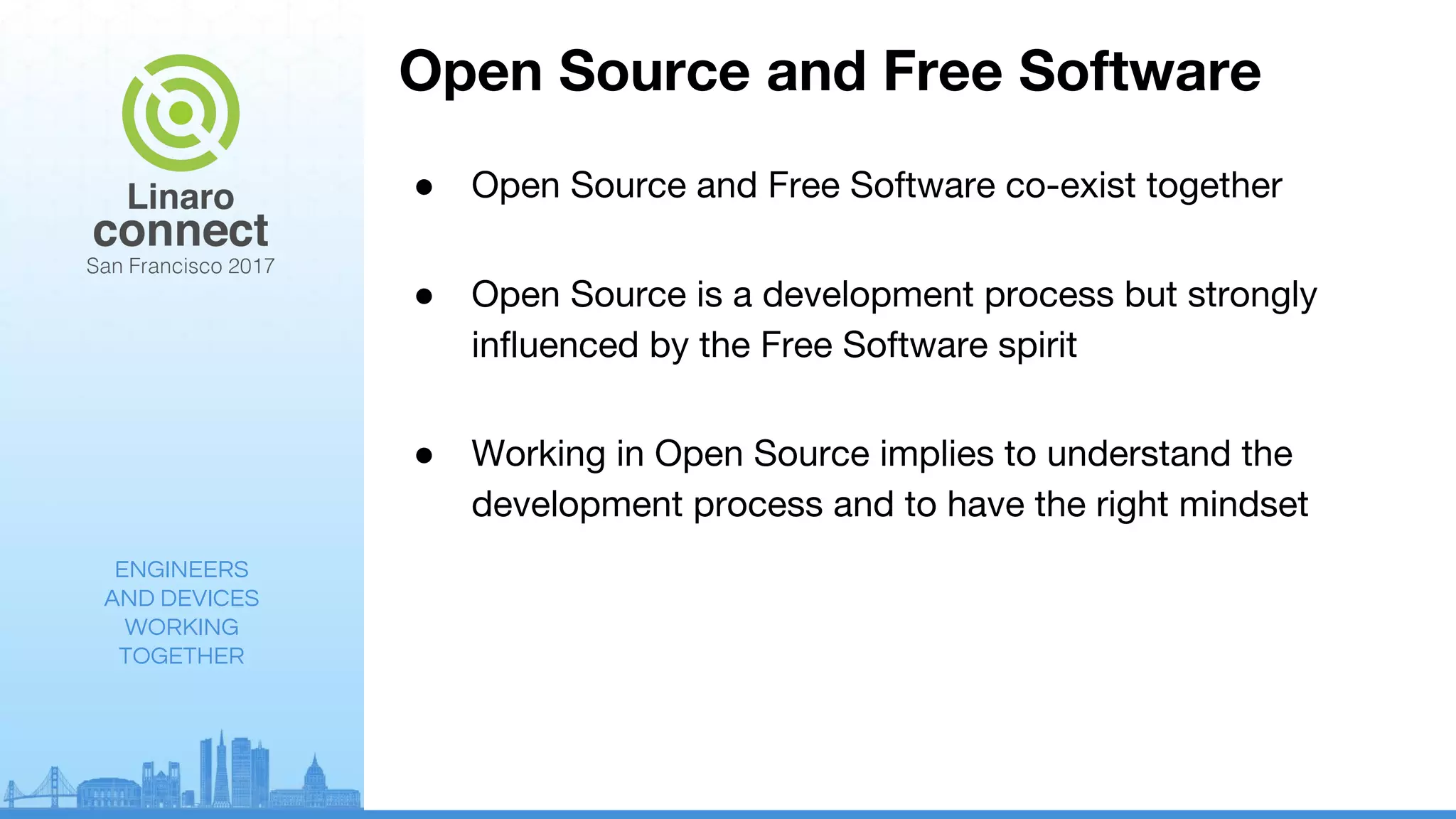
Open Source and Free Software
● Open Source and Free Software co-exist together
● Open Source is a development process but strongly
influenced by the Free Software spirit
● Working in Open Source implies to understand the
development process and to have the right mindset
ENGINEERS AND DEVICES
WORKING TOGETHER
The development process
ENGINEERS
AND DEVICES
WORKING
TOGETHER
The cathedral and the bazaar
● A description of two open source development processes:
○ The cathedral model: source code is available with each software
release
○ The bazaar model: in which the code is developed over the Internet in
view of the public
○ Gives 19 “lessons” for good Open Source practices
○ https://en.wikipedia.org/wiki/The_Cathedral_and_the_Bazaar
○ http://www.catb.org/esr/writings/cathedral-bazaar/
ENGINEERS
AND DEVICES
WORKING
TOGETHER
The cathedral
● In the past, computers were very expensives and the
network reserved for a very few
● A group of persons works on a project, privately
● A new release is delivered with the source code
● Hard to participate to the project
● No view on the current work
ENGINEERS
AND DEVICES
WORKING
TOGETHER
The bazaar
● Nowadays a large public have access to computers and
to internet
● The source code is widely available, the changes are
visible and the development is based on the review
process
● Linus’s law [1]
: "given enough eyeballs, all bugs are
shallow"
[1] https://en.wikipedia.org/wiki/Linus%27s_Law
ENGINEERS
AND DEVICES
WORKING
TOGETHER
The fork
● When an Open Source project is cloned and diverges
from the original project: it is a fork
● A community may be frustrated by a project:
○ Lack of communication or collaboration
○ Project is not very responsive or taking a direction that the bulk of
the community does not like
● A community wants to have more control on the project
○ Skip the review process and commit what they want
● Forking can be bad if it is done for wrong reasons
because it can scatter the resources
ENGINEERS
AND DEVICES
WORKING
TOGETHER
The community
● A group of persons working together on an Open Source
project: the community
● A community is composed from:
○ Education (students, scientists, teachers)
○ Hobbyist
○ Workers (from companies or freelance)
● The community takes predominance over individuals
➔ Consensus
● The collaboration is the cornerstone of the Open Source
ENGINEERS
AND DEVICES
WORKING
TOGETHER
The collaboration
● The collaboration relies on tools
● Development:
○ Distributed version control system: git
○ Compilation tools : gcc, make
○ Debugging: gdb
○ Etc …
● Communication:
○ Emails and mailing lists
○ Instant messaging: IRC
○ Text sharing: pastebin
○ bugzilla
ENGINEERS
AND DEVICES
WORKING
TOGETHER
The contribution
● Any kind of help beneficial for the Open Source project is
called a contribution
● A contribution increases the merit inside community
● The Open Source is karma based
● The more a contributor provides pertinent contributions,
the more he has voice inside the community
ENGINEERS AND DEVICES
WORKING TOGETHER
The right mindset
ENGINEERS
AND DEVICES
WORKING
TOGETHER
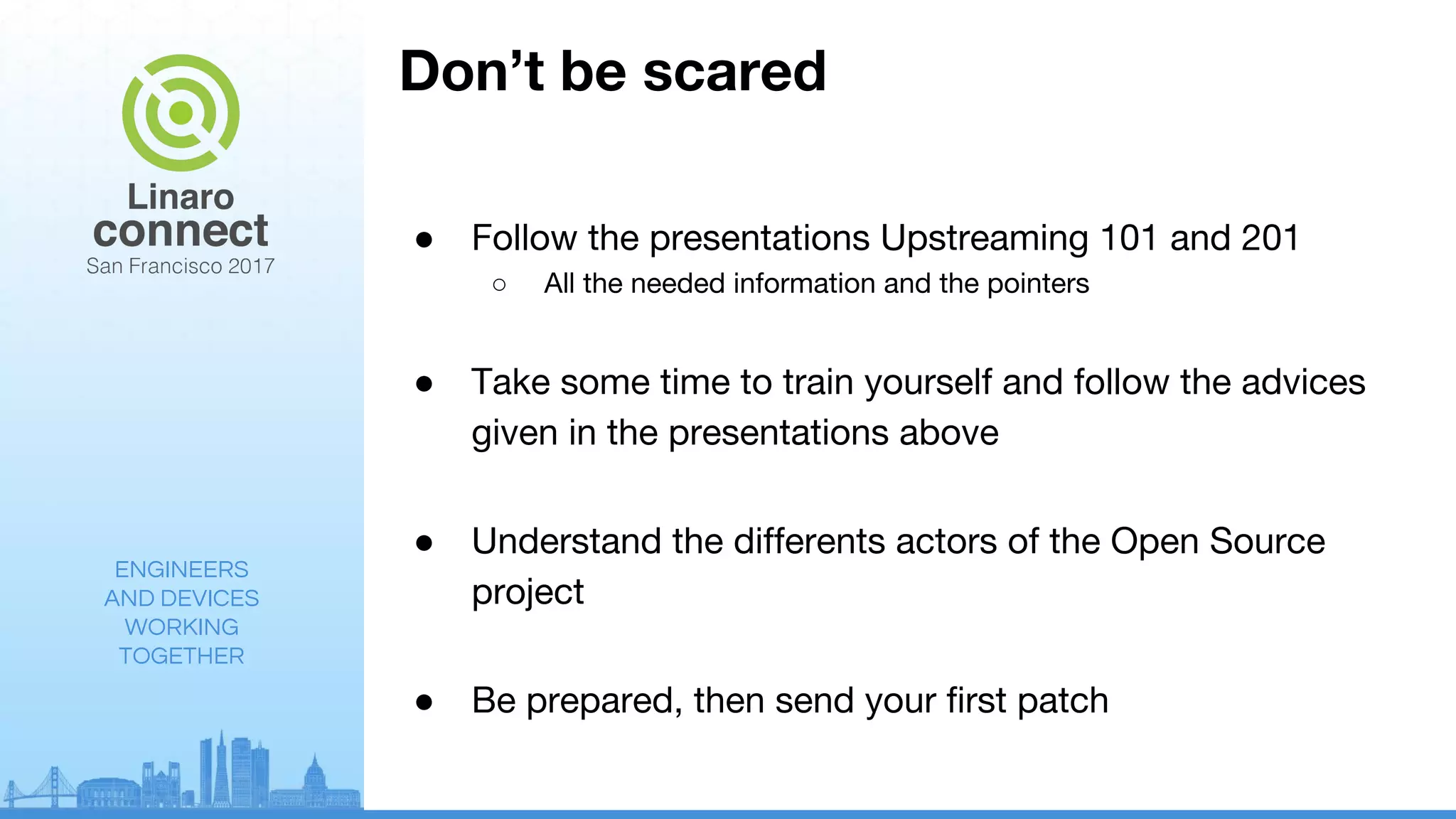
Don’t be scared
● Follow the presentations Upstreaming 101 and 201
○ All the needed information and the pointers
● Take some time to train yourself and follow the advices
given in the presentations above
● Understand the differents actors of the Open Source
project
● Be prepared, then send your first patch
ENGINEERS
AND DEVICES
WORKING
TOGETHER
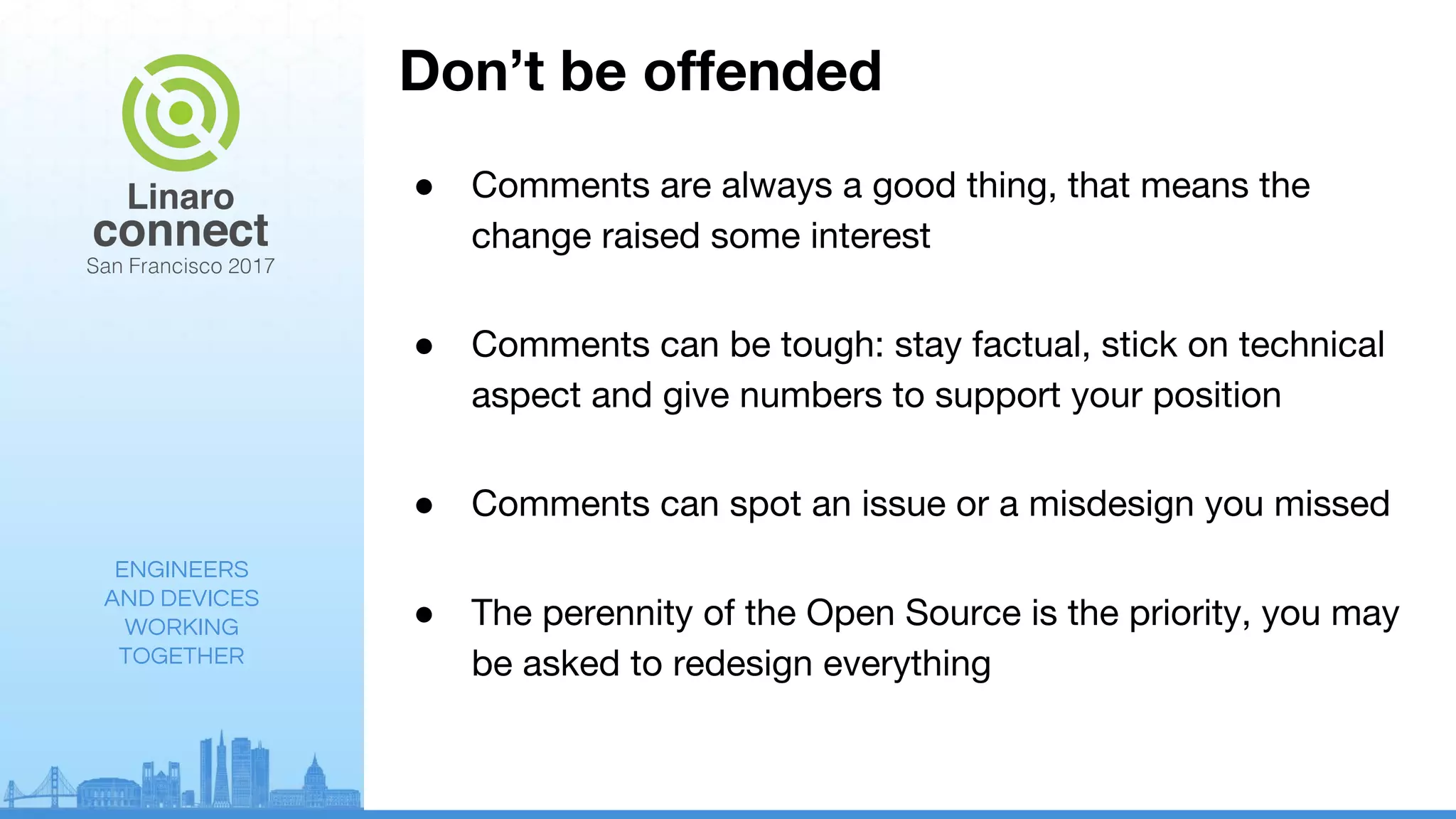
Don’t be offended
● Comments are always a good thing, that means the
change raised some interest
● Comments can be tough: stay factual, stick on technical
aspect and give numbers to support your position
● Comments can spot an issue or a misdesign you missed
● The perennity of the Open Source is the priority, you may
be asked to redesign everything
ENGINEERS
AND DEVICES
WORKING
TOGETHER
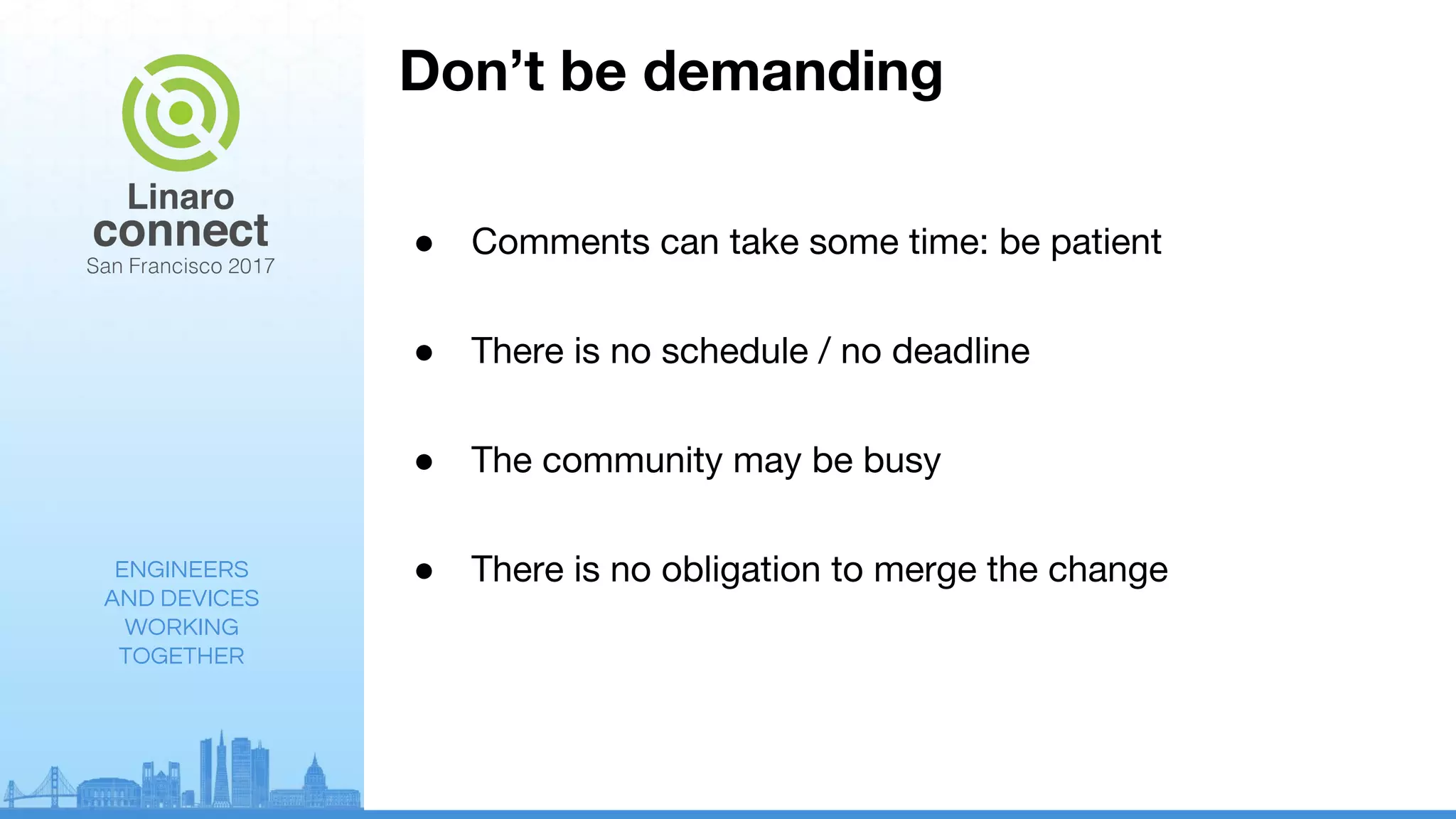
Don’t be demanding
● Comments can take some time: be patient
● There is no schedule / no deadline
● The community may be busy
● There is no obligation to merge the change
ENGINEERS
AND DEVICES
WORKING
TOGETHER
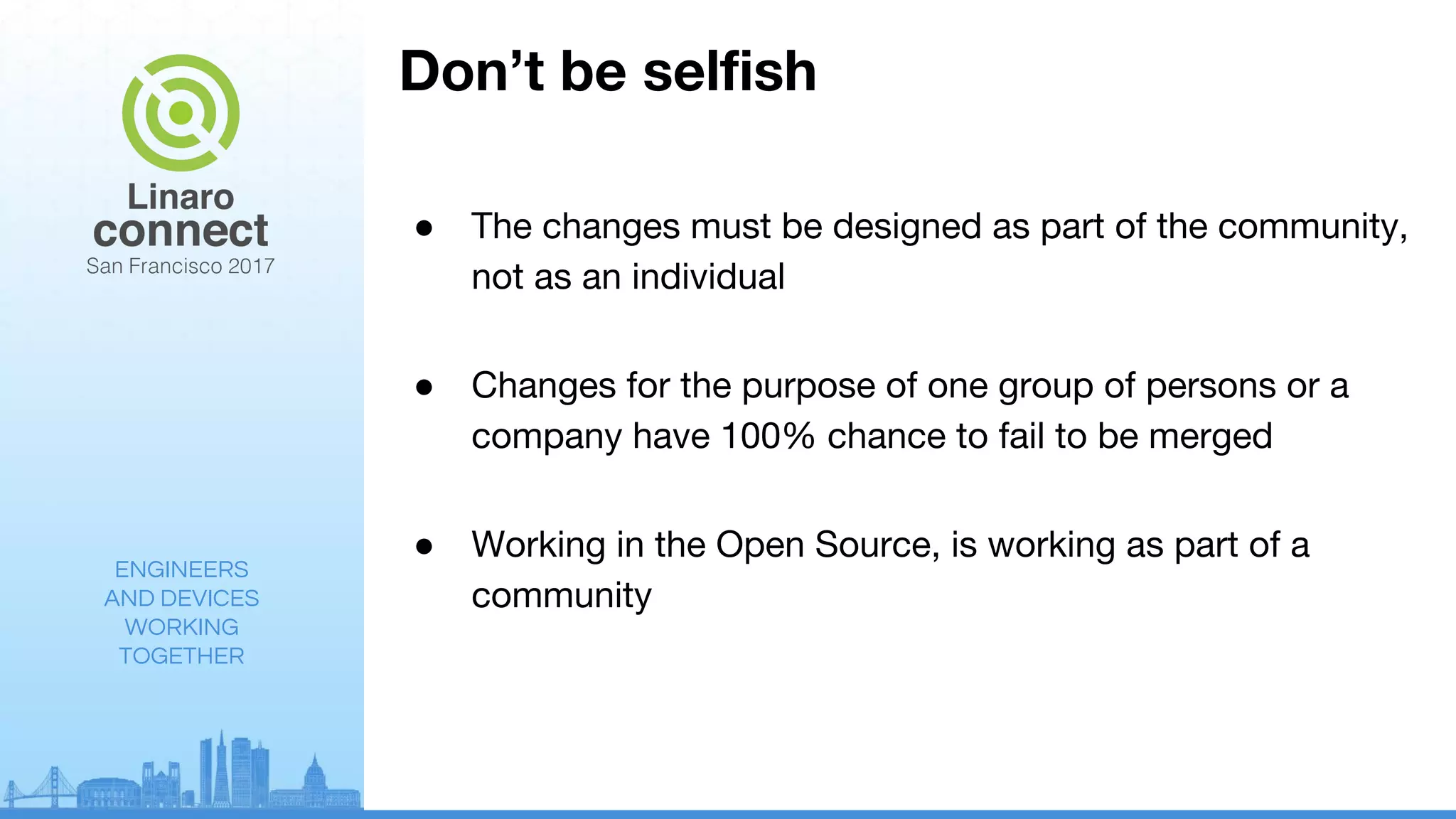
Don’t be selfish
● The changes must be designed as part of the community,
not as an individual
● Changes for the purpose of one group of persons or a
company have 100% chance to fail to be merged
● Working in the Open Source, is working as part of a
community
ENGINEERS
AND DEVICES
WORKING
TOGETHER
Comments
● The consensus is the key to merge a change
○ No consensus = No merge
● Always take into account the comments in order to reach
the consensus
ENGINEERS
AND DEVICES
WORKING
TOGETHER
Collaborate !
● Collaborate in order to be part of the community
● Begin with simple things
○ Review code
○ Fix compilation warnings/error (often)
○ Help to test the proposed changes (functional and benchmark)
○ Answer questions being asked on the mailing list
● Do more complex things
○ Dead listing and spot potential issues
○ Propose ideas to improve the proposed changes
ENGINEERS
AND DEVICES
WORKING
TOGETHER
Next presentations
● Upstreaming 101 : Linux kernel development process,
DCO, writing a patch
● Upstreaming 201 : Send the changes for upstreaming, the
review process, the comments
ENGINEERS
AND DEVICES
WORKING
TOGETHER
Conclusion
● Open Source is a development process
● Open Source projects are supported by a community
● A community mindset can be aligned to the Free Software
philosophy
● The collaboration is the path, the consensus is the key
Special thanks to
Jon “Maddog” Hall
Thank You
#SFO17
For further information: www.linaro.org
SFO17 keynotes and videos on: connect.linaro.org

Philosophy of Open Source - SFO17-TR01

  • 1.
  • 2.
    ENGINEERS AND DEVICES WORKING TOGETHER What isOpen Source ? ● Open Source is not Free Software Richard Stallman : “Open source is a development methodology; free software is a social movement.” [1] ● Important to understand the difference, let’s do some history [1] https://www.gnu.org/philosophy/open-source-misses-the-point.en.html
  • 3.
    ENGINEERS AND DEVICES WORKINGTOGETHER Open Source Origin 60’s Computer with their own OS Source code provided on request
  • 4.
    ENGINEERS AND DEVICES WORKINGTOGETHER Open Source Origin 60’s 70’s OS contract law model Computer with their own OS Source code provided on request
  • 5.
    ENGINEERS AND DEVICES WORKINGTOGETHER Open Source Origin 60’s 70’s 80’s Computer with their own OS Source code provided on request Access to source code restricted by vendors 1984: rise of the Free Software project GNU 1985: Free Software Foundation OS contract law model
  • 6.
    ENGINEERS AND DEVICES WORKINGTOGETHER Open Source Origin 60’s 70’s 80’s 90’s 1990 : GNU project: most of the software are done but the kernel is missing 1991 : Linux kernel project started 1998 : Creation of the OSI Access to source code restricted by vendors 1984: rise of the Free Software project GNU 1985: Free Software Foundation Computer with their own OS Source code provided on request OS contract law model
  • 7.
    ENGINEERS AND DEVICES WORKINGTOGETHER Open Source Origin 60’s 70’s 80’s 90’s 2000+ GNU/Linux Widely used Interest from the industry Access to source code restricted by vendors 1984: rise of the Free Software project GNU 1985: Free Software Foundation OS Licensing model Computer with their own OS Source code provided on request 1990 : GNU project: most of the software are done but the kernel is missing 1991 : Linux kernel project started 1998 : Creation of the OSI
  • 8.
    ENGINEERS AND DEVICES WORKING TOGETHER Open Sourceorigin Market share Desktop / laptop 2.18 % Mobile + table 63.31 % Server 36.72 % Mainframe 28 % Super computer 99.79 % Embedded 29.44 % ● GNU/Linux widely used nowadays [1] [1] https://en.wikipedia.org/wiki/Usage_share_of_operating_systems
  • 9.
    ENGINEERS AND DEVICES WORKING TOGETHER Open Sourceorigin ● Free Software philosophy opposed to industry goals ● In 1998, creation of the OSI ● OSI : Open Source initiative ○ https://opensource.org
  • 10.
    ENGINEERS AND DEVICES WORKING TOGETHER Open SourceInitiative ● Promotes Open Source in the industry ● Oriented to business cases ● Unification of the licenses based on Debian Free Software Guidelines ● OSI label for software when it fulfills 10 OSS criterias ● Open Source licences are approved by OSI
  • 11.
    ENGINEERS AND DEVICES WORKING TOGETHER Open SourceInitiative ● OSI criterias[1] 1. Free Redistribution 2. Source Code 3. Derived Works 4. Integrity of The Author's Source Code 5. No Discrimination Against Persons or Groups 6. No Discrimination Against Fields of Endeavor 7. Distribution of License 8. License Must Not Be Specific to a Product 9. License Must Not Restrict Other Software 10. License Must Be Technology-Neutral [1] https://opensource.org/osd-annotated
  • 12.
    ENGINEERS AND DEVICES WORKING TOGETHER OSI andFSF ● OSI and FSF share a common culture ○ Open software and hacking ● Goals and philosophy differ ○ FSF : ‘free’ in every sense of the term ○ OSI: give the opportunity to industry to understand Open Source ● OSI helps to introduce Free Software for industry ○ evangelizes open-source principles
  • 13.
    ENGINEERS AND DEVICES WORKING TOGETHER Licenses ● OpenSource projects have a license to share the code ○ GPL and LGPL ● GPL : GNU General Public License ○ If a software uses GPL code, it turns into a GPL licensed software ○ Protects the end-user letting him to access the source code ● LGPL : GNU Lesser General Public License ○ The same as GPL except for the headers. ○ Allows to use libraries, eg. libc ● Up to lawyers to explain what are these licenses in details
  • 14.
    ENGINEERS AND DEVICES WORKING TOGETHER Summary ● Opencode exists since the earliest moments of computer programming: programmers wrote the code for their own use and often shared it with other programmers trying to solve the same problems ● Licensing business model and Close Source lead to a Free Software emerging movement in 1984 and the creation of the Free Software Foundation in 1985 ● The Open Source Initiative created in 1998 to evangelize Open Source in the industry
  • 15.
    ENGINEERS AND DEVICES WORKING TOGETHER Open Sourceand Free Software ● Open Source and Free Software co-exist together ● Open Source is a development process but strongly influenced by the Free Software spirit ● Working in Open Source implies to understand the development process and to have the right mindset
  • 16.
    ENGINEERS AND DEVICES WORKINGTOGETHER The development process
  • 17.
    ENGINEERS AND DEVICES WORKING TOGETHER The cathedraland the bazaar ● A description of two open source development processes: ○ The cathedral model: source code is available with each software release ○ The bazaar model: in which the code is developed over the Internet in view of the public ○ Gives 19 “lessons” for good Open Source practices ○ https://en.wikipedia.org/wiki/The_Cathedral_and_the_Bazaar ○ http://www.catb.org/esr/writings/cathedral-bazaar/
  • 18.
    ENGINEERS AND DEVICES WORKING TOGETHER The cathedral ●In the past, computers were very expensives and the network reserved for a very few ● A group of persons works on a project, privately ● A new release is delivered with the source code ● Hard to participate to the project ● No view on the current work
  • 19.
    ENGINEERS AND DEVICES WORKING TOGETHER The bazaar ●Nowadays a large public have access to computers and to internet ● The source code is widely available, the changes are visible and the development is based on the review process ● Linus’s law [1] : "given enough eyeballs, all bugs are shallow" [1] https://en.wikipedia.org/wiki/Linus%27s_Law
  • 20.
    ENGINEERS AND DEVICES WORKING TOGETHER The fork ●When an Open Source project is cloned and diverges from the original project: it is a fork ● A community may be frustrated by a project: ○ Lack of communication or collaboration ○ Project is not very responsive or taking a direction that the bulk of the community does not like ● A community wants to have more control on the project ○ Skip the review process and commit what they want ● Forking can be bad if it is done for wrong reasons because it can scatter the resources
  • 21.
    ENGINEERS AND DEVICES WORKING TOGETHER The community ●A group of persons working together on an Open Source project: the community ● A community is composed from: ○ Education (students, scientists, teachers) ○ Hobbyist ○ Workers (from companies or freelance) ● The community takes predominance over individuals ➔ Consensus ● The collaboration is the cornerstone of the Open Source
  • 22.
    ENGINEERS AND DEVICES WORKING TOGETHER The collaboration ●The collaboration relies on tools ● Development: ○ Distributed version control system: git ○ Compilation tools : gcc, make ○ Debugging: gdb ○ Etc … ● Communication: ○ Emails and mailing lists ○ Instant messaging: IRC ○ Text sharing: pastebin ○ bugzilla
  • 23.
    ENGINEERS AND DEVICES WORKING TOGETHER The contribution ●Any kind of help beneficial for the Open Source project is called a contribution ● A contribution increases the merit inside community ● The Open Source is karma based ● The more a contributor provides pertinent contributions, the more he has voice inside the community
  • 24.
    ENGINEERS AND DEVICES WORKINGTOGETHER The right mindset
  • 25.
    ENGINEERS AND DEVICES WORKING TOGETHER Don’t bescared ● Follow the presentations Upstreaming 101 and 201 ○ All the needed information and the pointers ● Take some time to train yourself and follow the advices given in the presentations above ● Understand the differents actors of the Open Source project ● Be prepared, then send your first patch
  • 26.
    ENGINEERS AND DEVICES WORKING TOGETHER Don’t beoffended ● Comments are always a good thing, that means the change raised some interest ● Comments can be tough: stay factual, stick on technical aspect and give numbers to support your position ● Comments can spot an issue or a misdesign you missed ● The perennity of the Open Source is the priority, you may be asked to redesign everything
  • 27.
    ENGINEERS AND DEVICES WORKING TOGETHER Don’t bedemanding ● Comments can take some time: be patient ● There is no schedule / no deadline ● The community may be busy ● There is no obligation to merge the change
  • 28.
    ENGINEERS AND DEVICES WORKING TOGETHER Don’t beselfish ● The changes must be designed as part of the community, not as an individual ● Changes for the purpose of one group of persons or a company have 100% chance to fail to be merged ● Working in the Open Source, is working as part of a community
  • 29.
    ENGINEERS AND DEVICES WORKING TOGETHER Comments ● Theconsensus is the key to merge a change ○ No consensus = No merge ● Always take into account the comments in order to reach the consensus
  • 30.
    ENGINEERS AND DEVICES WORKING TOGETHER Collaborate ! ●Collaborate in order to be part of the community ● Begin with simple things ○ Review code ○ Fix compilation warnings/error (often) ○ Help to test the proposed changes (functional and benchmark) ○ Answer questions being asked on the mailing list ● Do more complex things ○ Dead listing and spot potential issues ○ Propose ideas to improve the proposed changes
  • 31.
    ENGINEERS AND DEVICES WORKING TOGETHER Next presentations ●Upstreaming 101 : Linux kernel development process, DCO, writing a patch ● Upstreaming 201 : Send the changes for upstreaming, the review process, the comments
  • 32.
    ENGINEERS AND DEVICES WORKING TOGETHER Conclusion ● OpenSource is a development process ● Open Source projects are supported by a community ● A community mindset can be aligned to the Free Software philosophy ● The collaboration is the path, the consensus is the key
  • 33.
    Special thanks to Jon“Maddog” Hall
  • 34.
    Thank You #SFO17 For furtherinformation: www.linaro.org SFO17 keynotes and videos on: connect.linaro.org