Open Source is Good for
both Business and Humanity
Jonas Rosland
Community Manager
EMC {code}
History of OSS
Genesis
Where it led us
Definitions
Agenda
Create OSS
Get started
Community
The results
For Business
For Humanity
The Future
History of OSS
Giving away things
for free
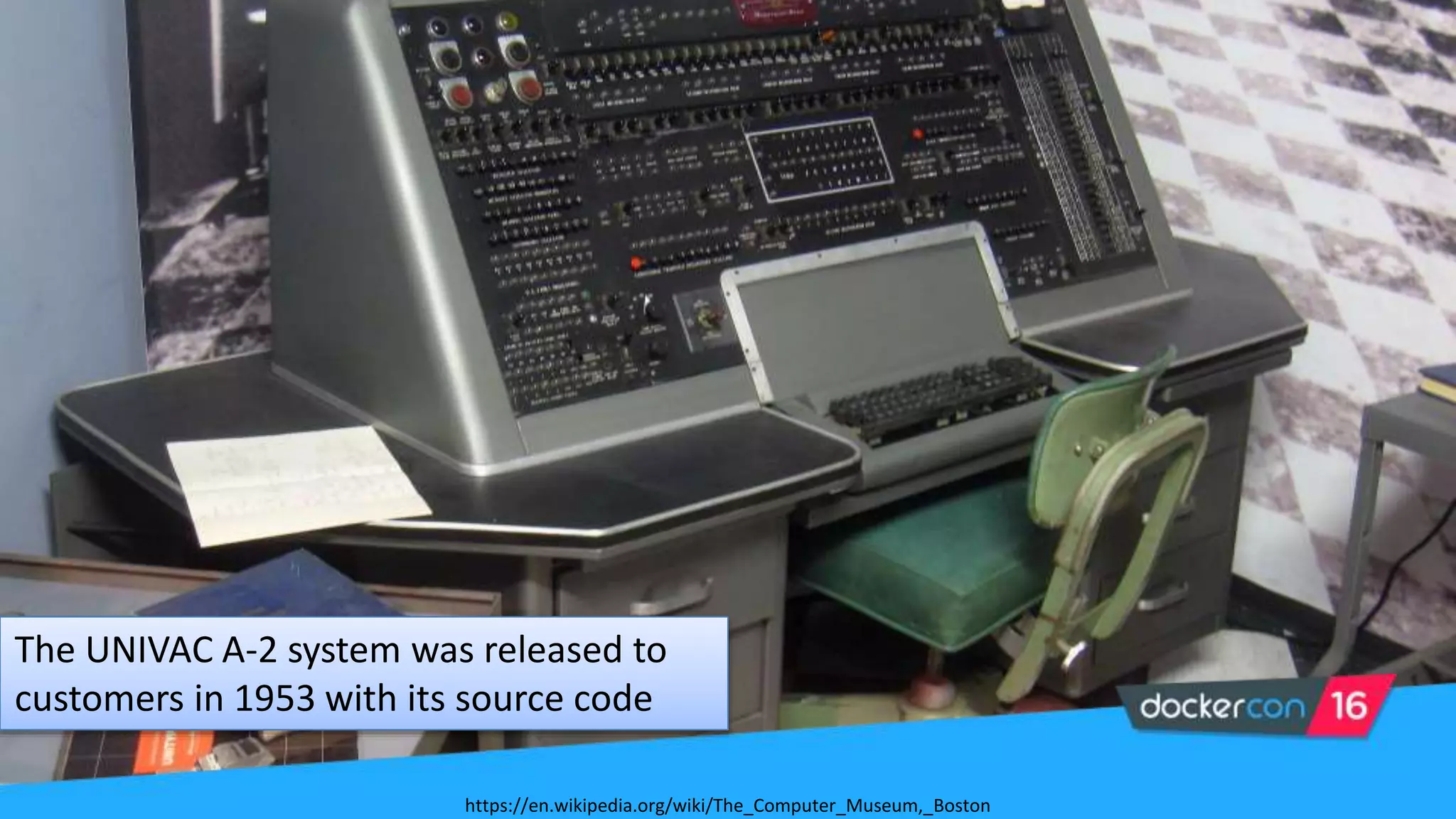
The UNIVAC A-2 system was released to
customers in 1953 with its source code
https://en.wikipedia.org/wiki/The_Computer_Museum,_Boston
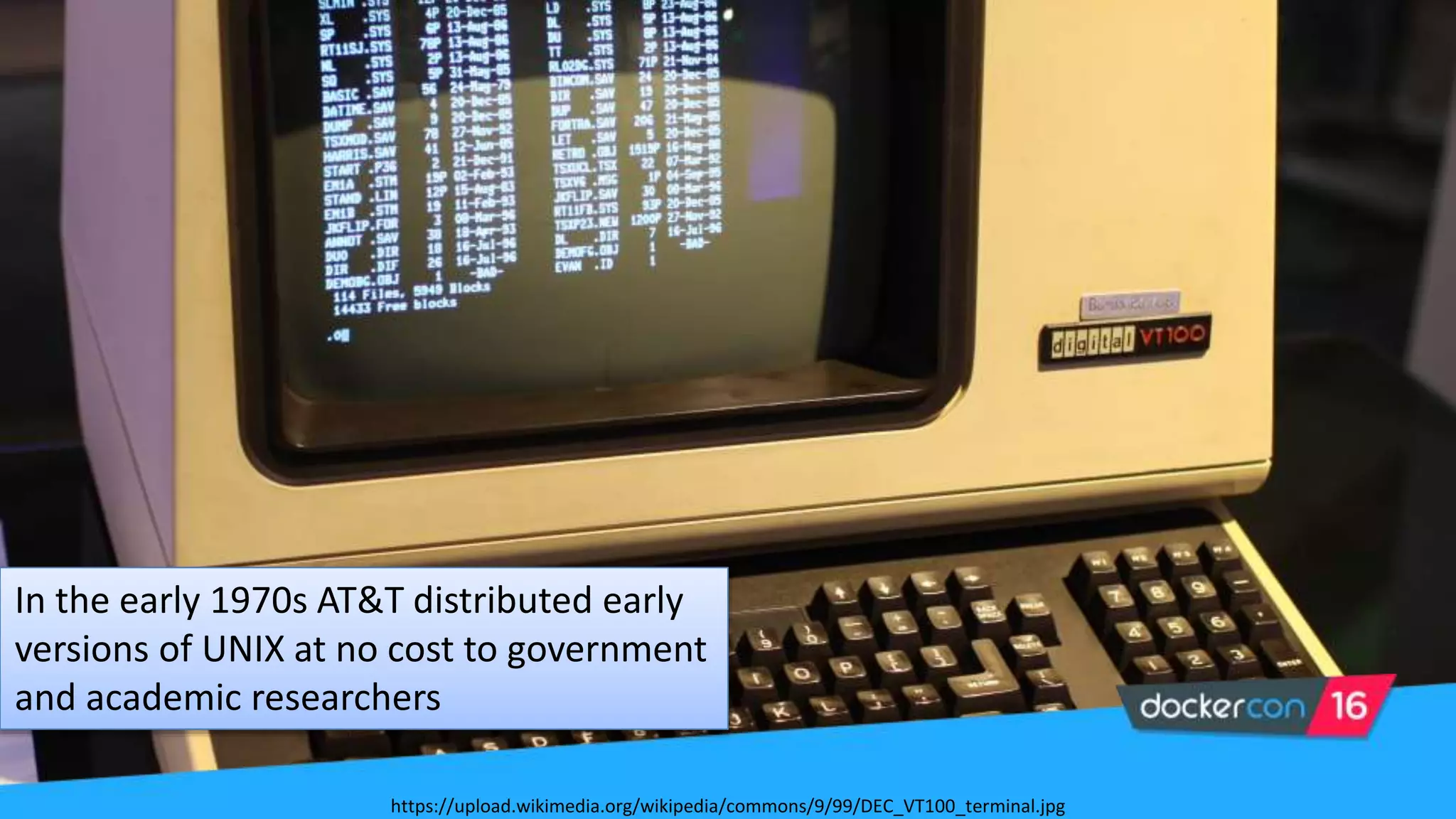
In the early 1970s AT&T distributed early
versions of UNIX at no cost to government
and academic researchers
https://upload.wikimedia.org/wikipedia/commons/9/99/DEC_VT100_terminal.jpg
In 1983, Richard Stallman published the
GNU Manifesto and launched the GNU
Project
http://www.gnu.org/graphics/gerwinski-gnu-head.png
https://commons.wikimedia.org/wiki/File:GPLv3_Logo.svg
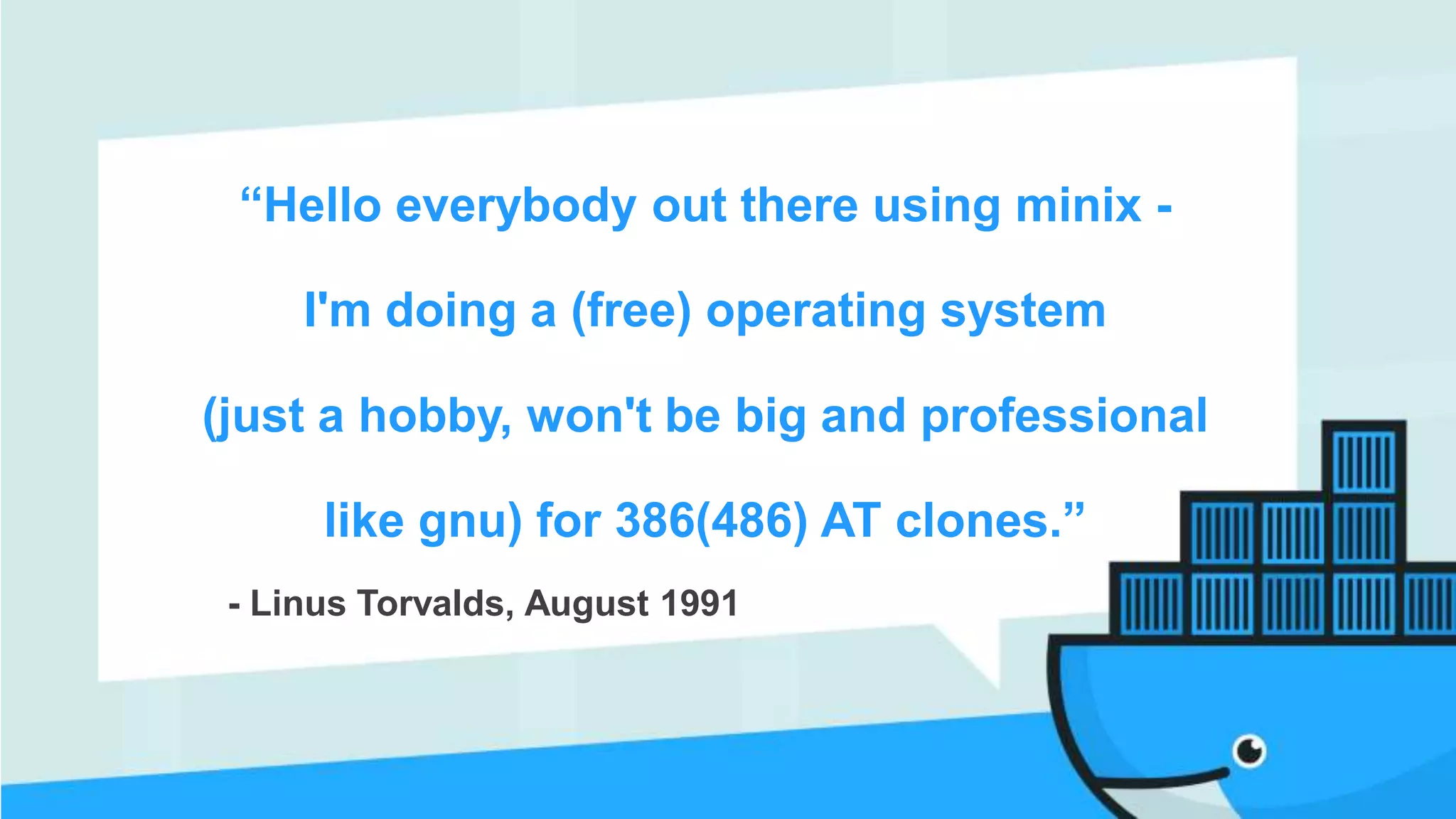
“Hello everybody out there using minix -
I'm doing a (free) operating system
(just a hobby, won't be big and professional
like gnu) for 386(486) AT clones.”
- Linus Torvalds, August 1991
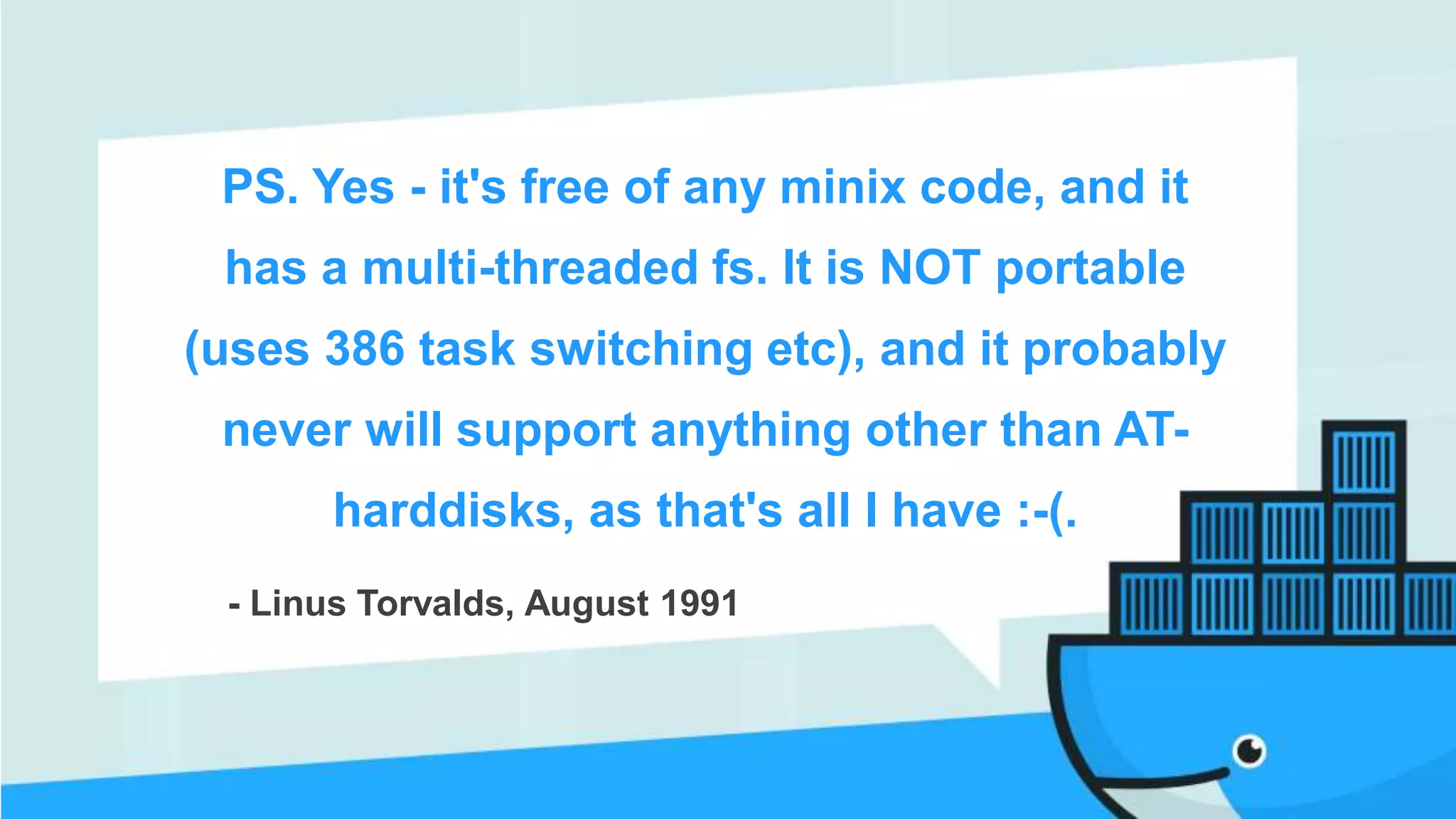
PS. Yes - it's free of any minix code, and it
has a multi-threaded fs. It is NOT portable
(uses 386 task switching etc), and it probably
never will support anything other than AT-
harddisks, as that's all I have :-(.
- Linus Torvalds, August 1991
The Apache HTTP Server is released 1995
http://www.apache.org/foundation/press/kit/feather.png
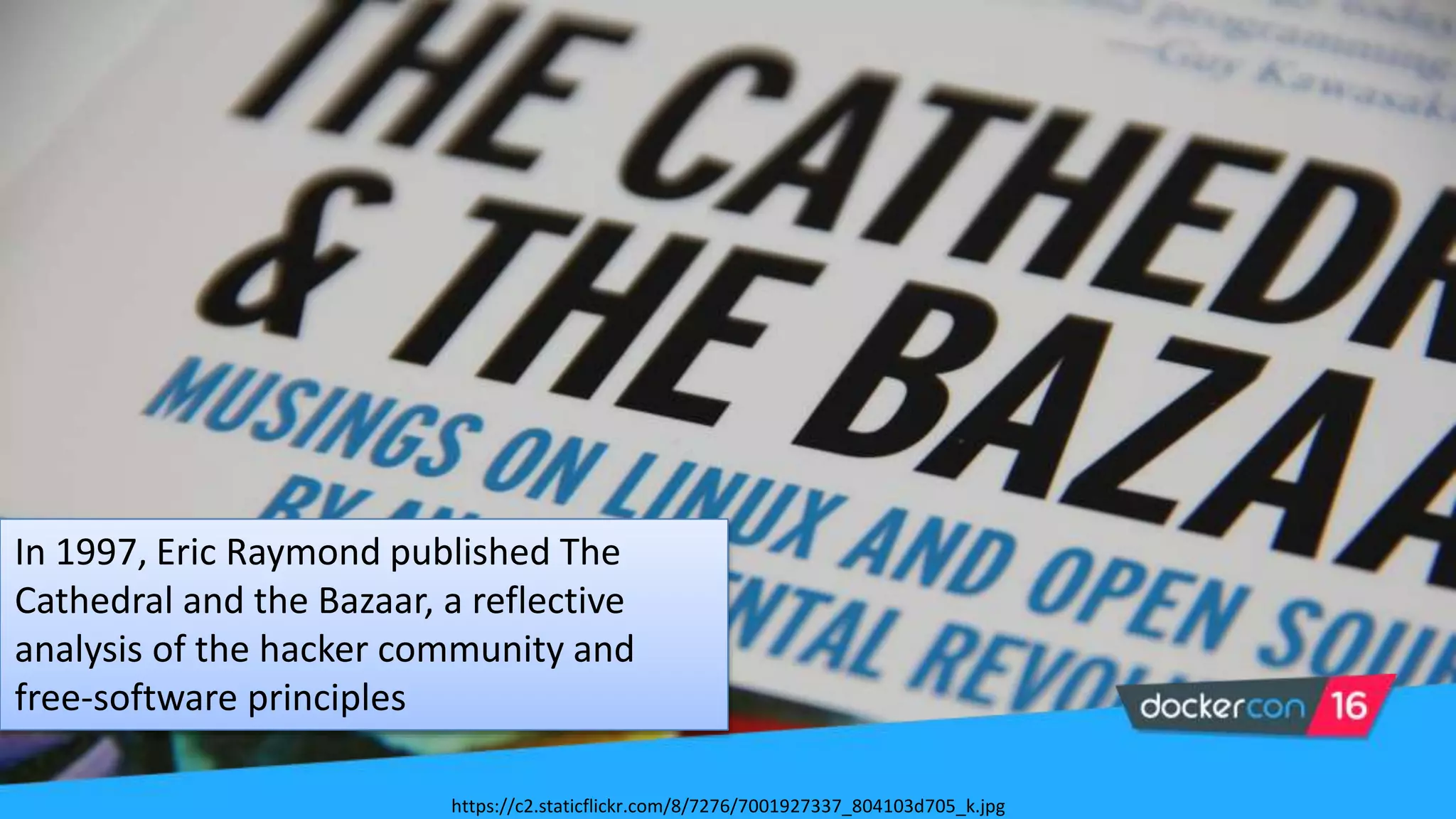
In 1997, Eric Raymond published The
Cathedral and the Bazaar, a reflective
analysis of the hacker community and
free-software principles
https://c2.staticflickr.com/8/7276/7001927337_804103d705_k.jpg
Now here’s where it
gets interesting
OSS Definition
Gather around a
common goal
On January 22, 1998, Netscape announces
that they will give away their Navigator
browser and it's source code
https://en.wikipedia.org/wiki/Netscape_Navigator
The “open source” label was created at a
strategy session held on February 3rd,
1998 in Palo Alto, California
https://c2.staticflickr.com/8/7276/7001927337_804103d705_k.jpg
On February 23rd, Netscape created the
Mozilla project to coordinate the
development of their now Open Source
software
https://en.wikipedia.org/wiki/Mozilla
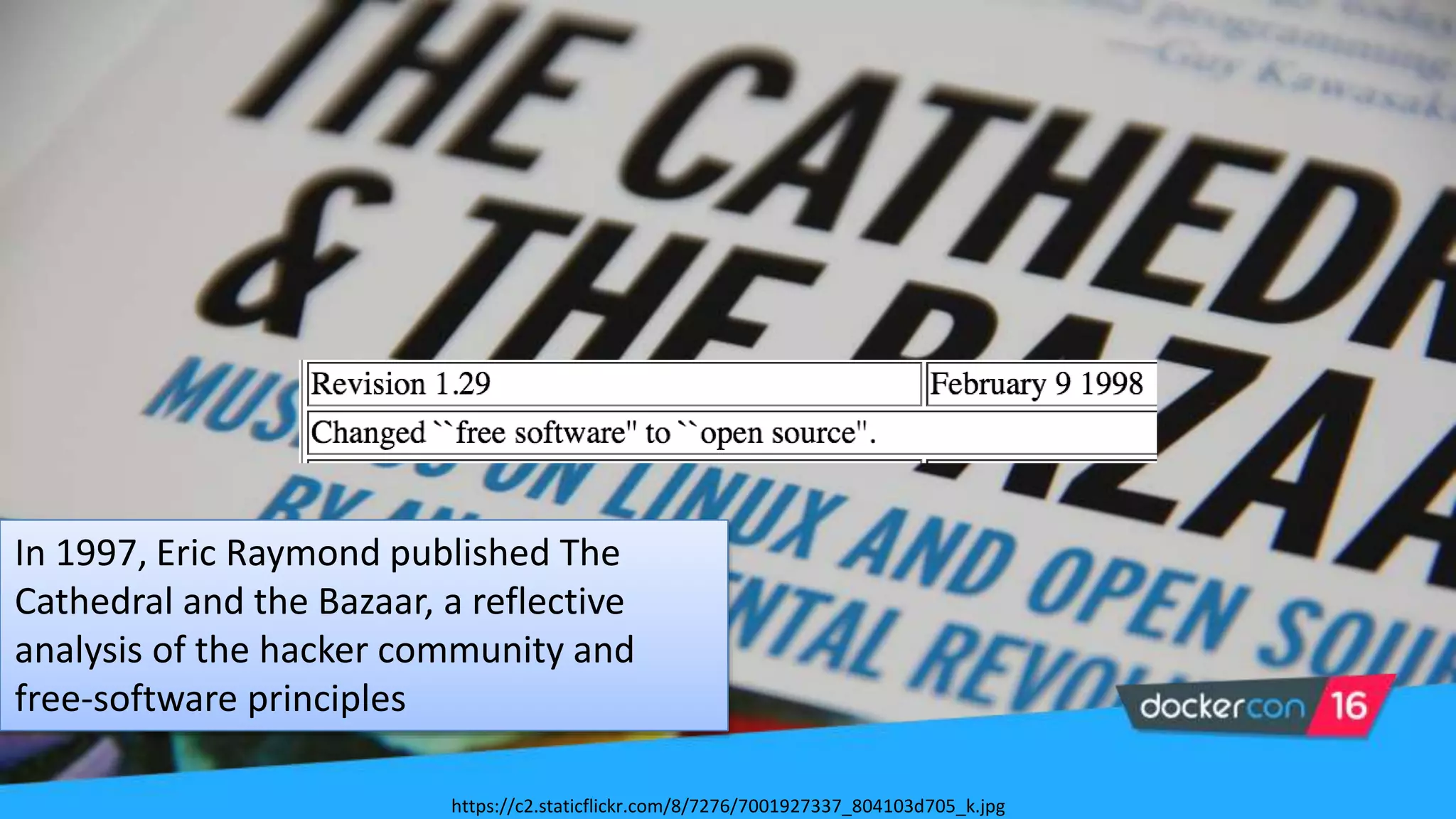
In 1997, Eric Raymond published The
Cathedral and the Bazaar, a reflective
analysis of the hacker community and
free-software principles
https://c2.staticflickr.com/8/7276/7001927337_804103d705_k.jpg
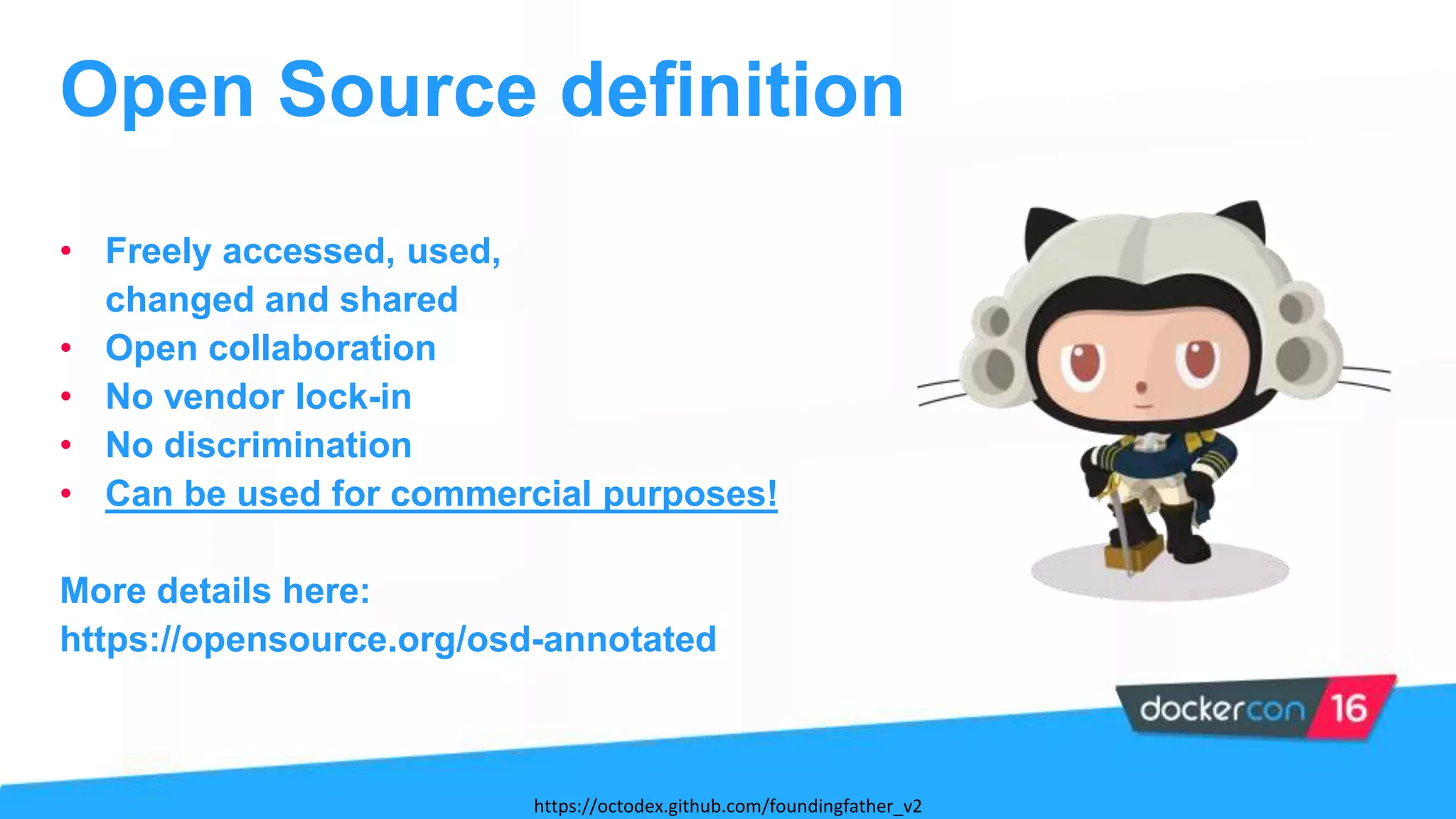
• Freely accessed, used,
changed and shared
• Open collaboration
• No vendor lock-in
• No discrimination
• Can be used for commercial purposes!
More details here:
https://opensource.org/osd-annotated
Open Source definition
https://octodex.github.com/foundingfather_v2
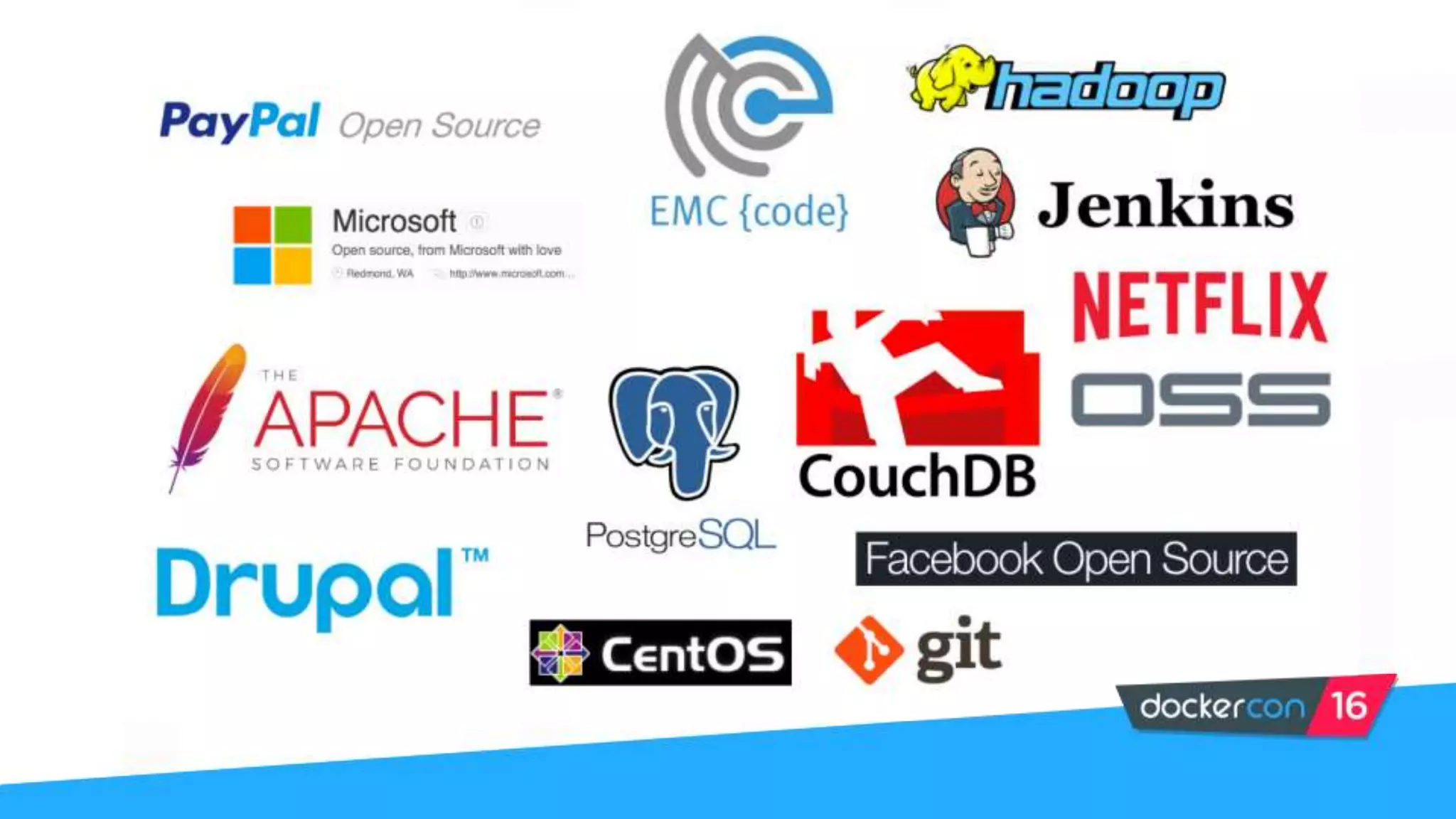
Who creates Open
Source software?
Patents and OSS can co-exist, but needs commitment to survive
• Microsoft Patent Promises and Patents
• https://msdn.microsoft.com/en-us/openspecifications/dn750984
• Google Open Patent Non-Assertion Pledge
• https://www.google.com/patents/opnpledge/pledge/
• Tesla Patent Pledge
• https://www.teslamotors.com/about/legal#patent-pledge
What about patents?
So how do you get
started with OSS?
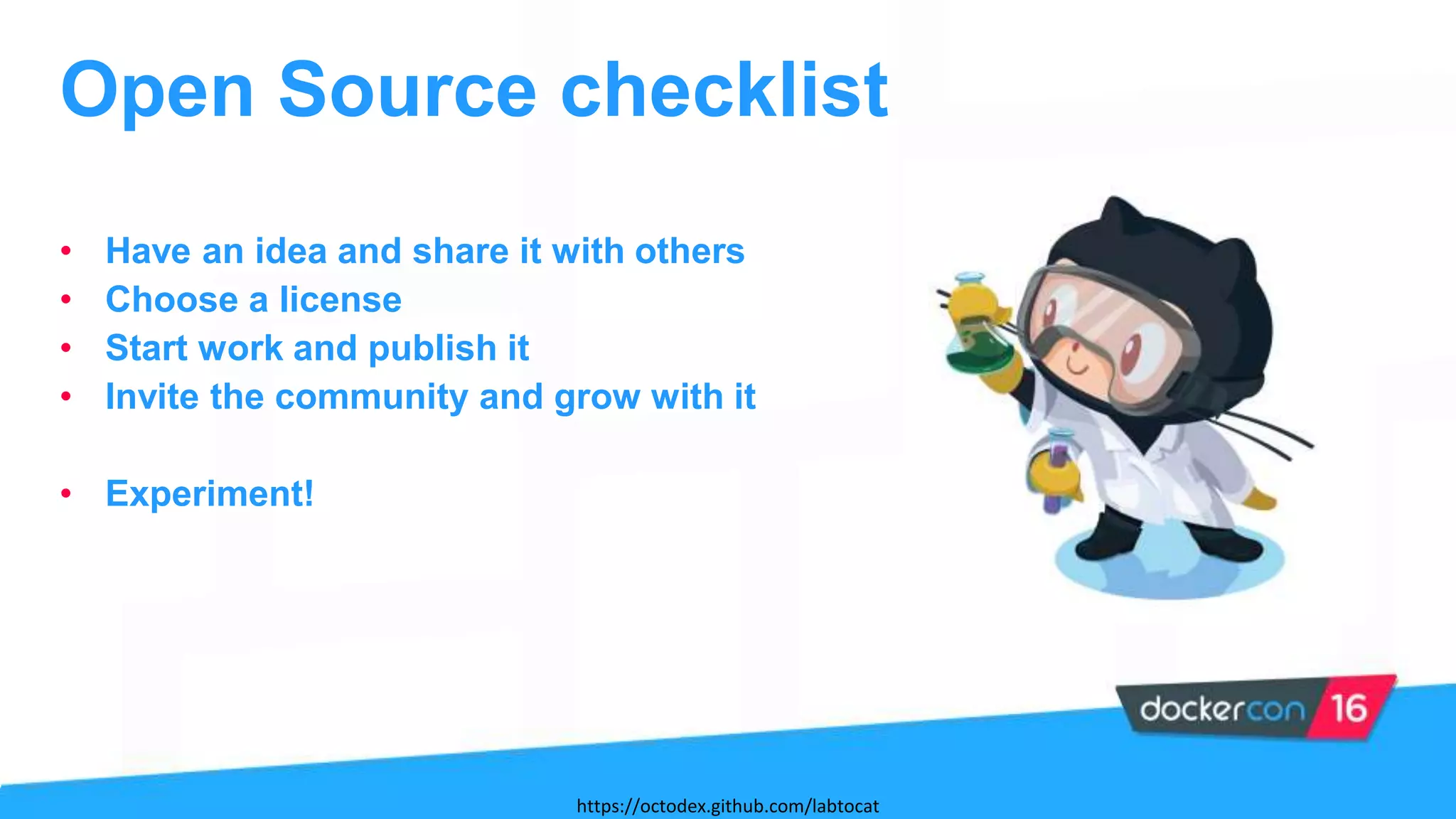
• Have an idea and share it with others
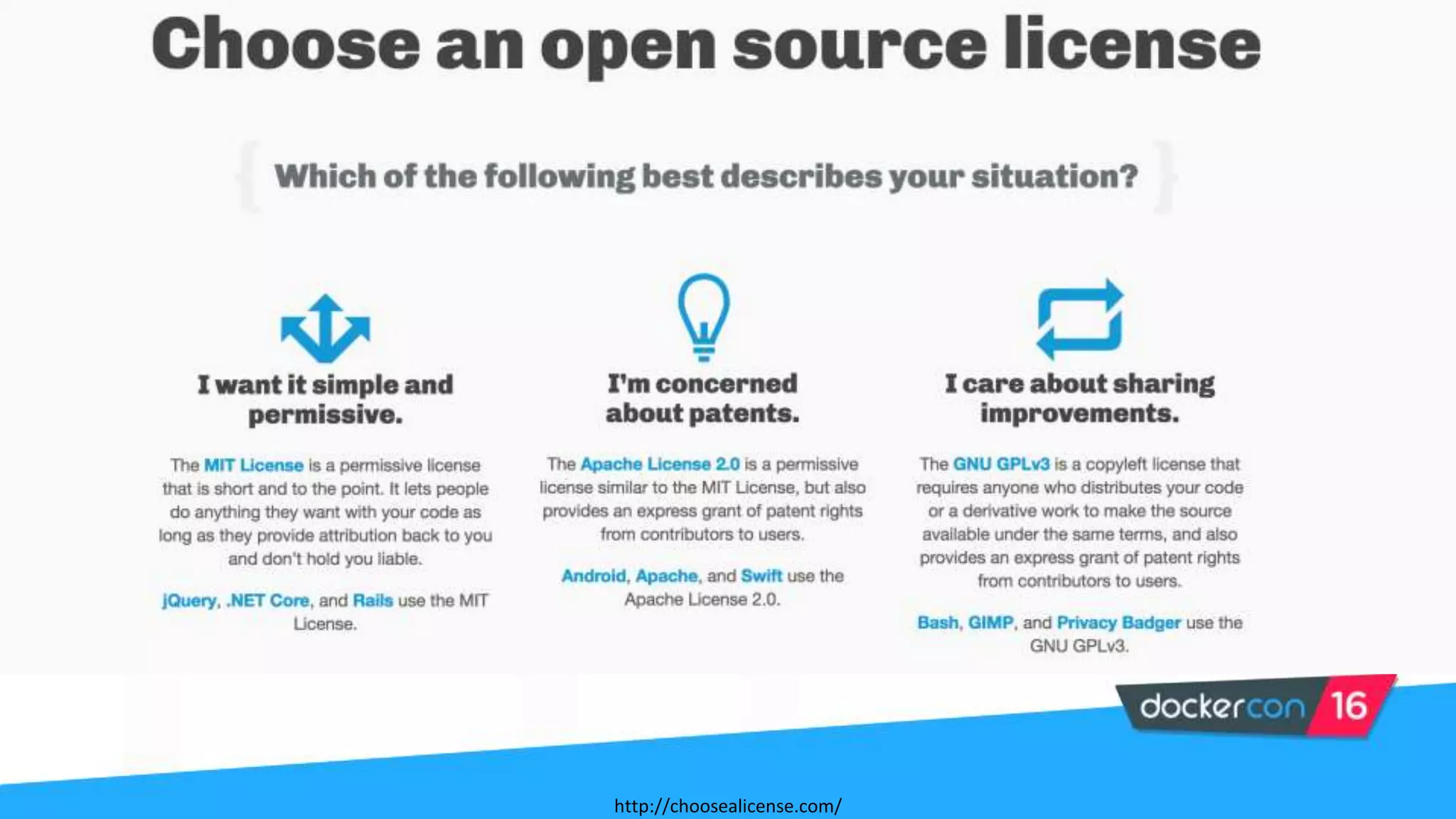
• Choose a license
• Start work and publish it
• Invite the community and grow with it
• Experiment!
Open Source checklist
https://octodex.github.com/labtocat
http://choosealicense.com/
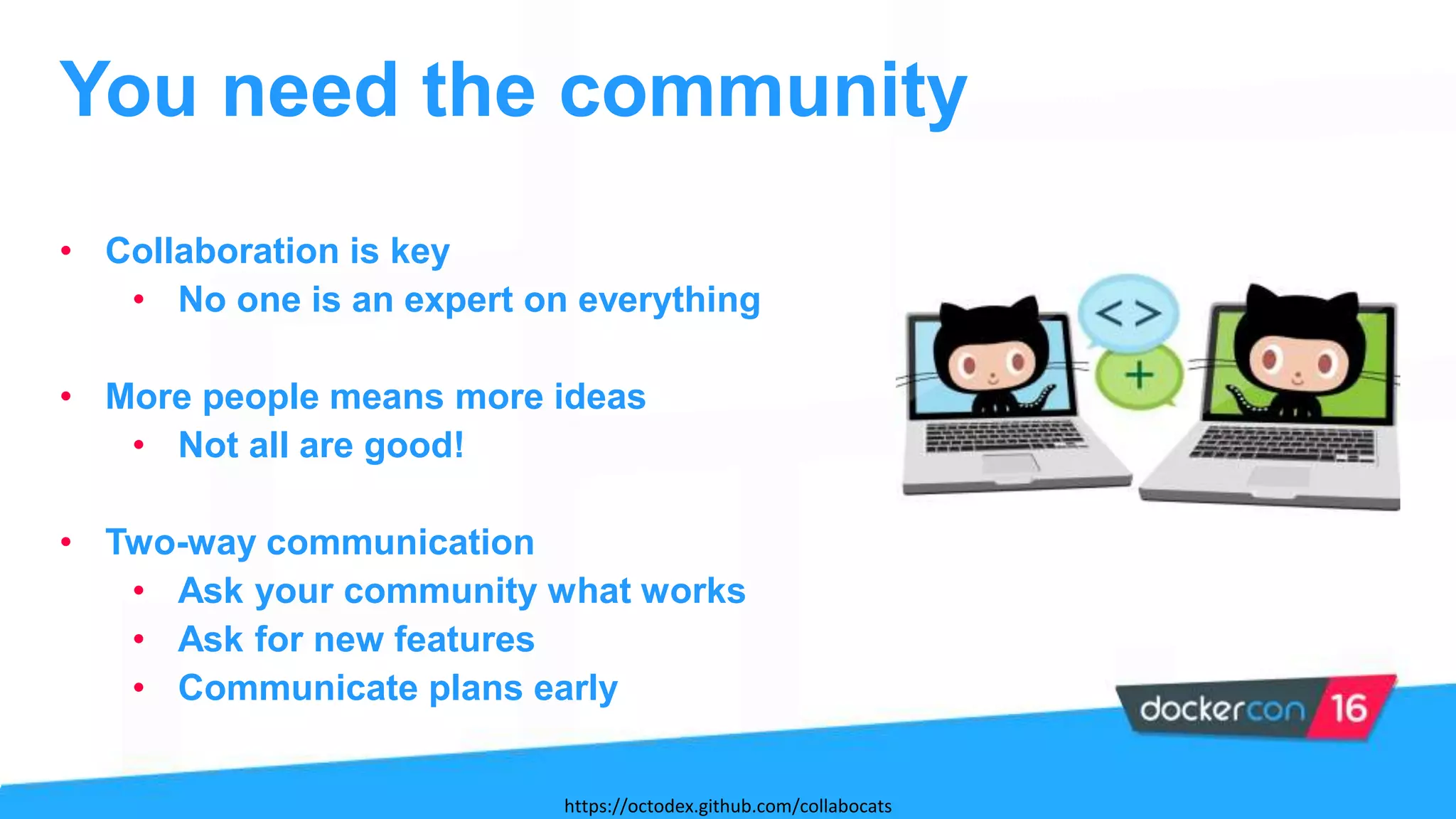
• Collaboration is key
• No one is an expert on everything
• More people means more ideas
• Not all are good!
• Two-way communication
• Ask your community what works
• Ask for new features
• Communicate plans early
You need the community
https://octodex.github.com/collabocats
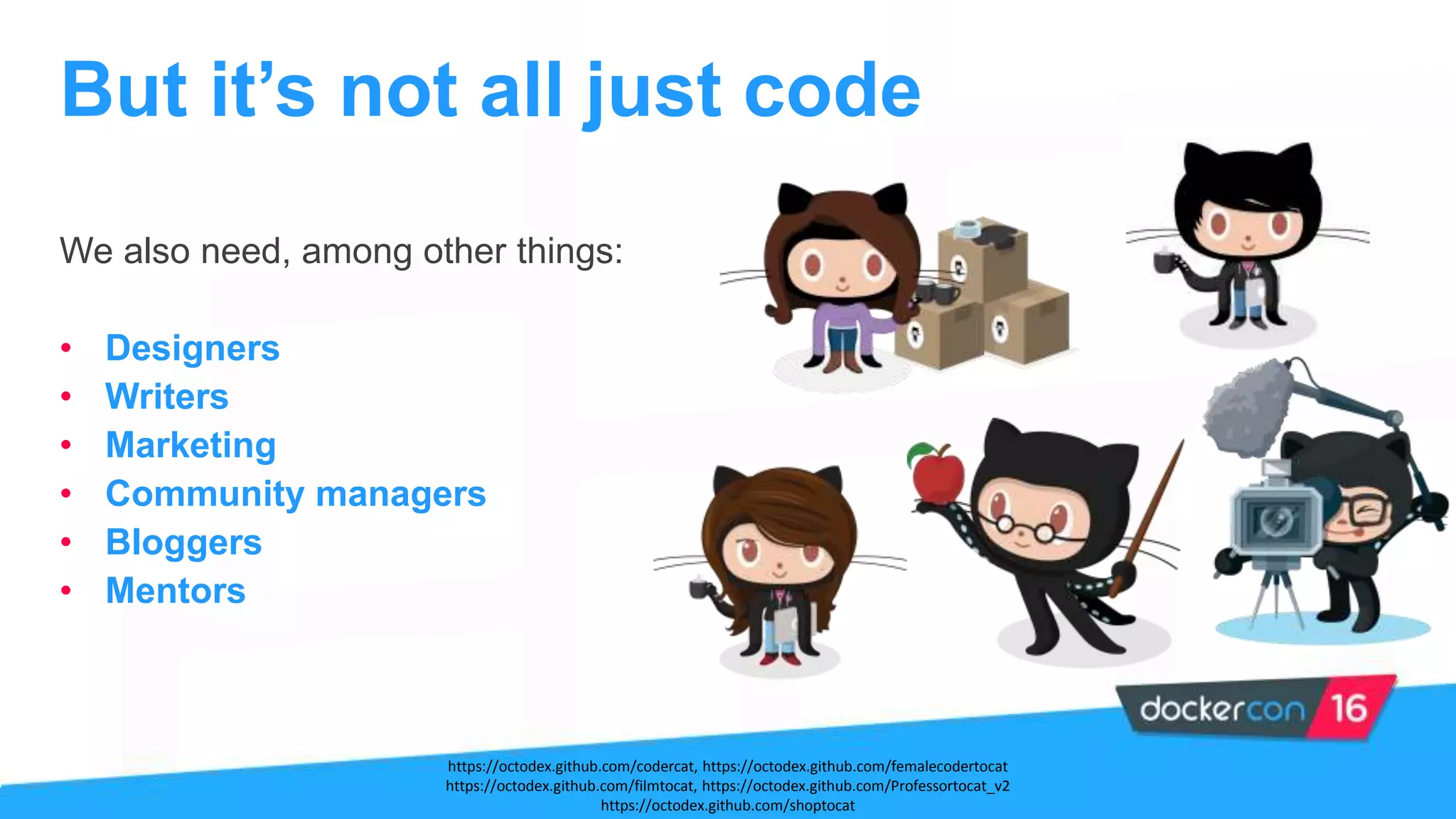
We also need, among other things:
• Designers
• Writers
• Marketing
• Community managers
• Bloggers
• Mentors
But it’s not all just code
https://octodex.github.com/codercat, https://octodex.github.com/femalecodertocat
https://octodex.github.com/filmtocat, https://octodex.github.com/Professortocat_v2
https://octodex.github.com/shoptocat
The results
You’re using Open
Source things daily!
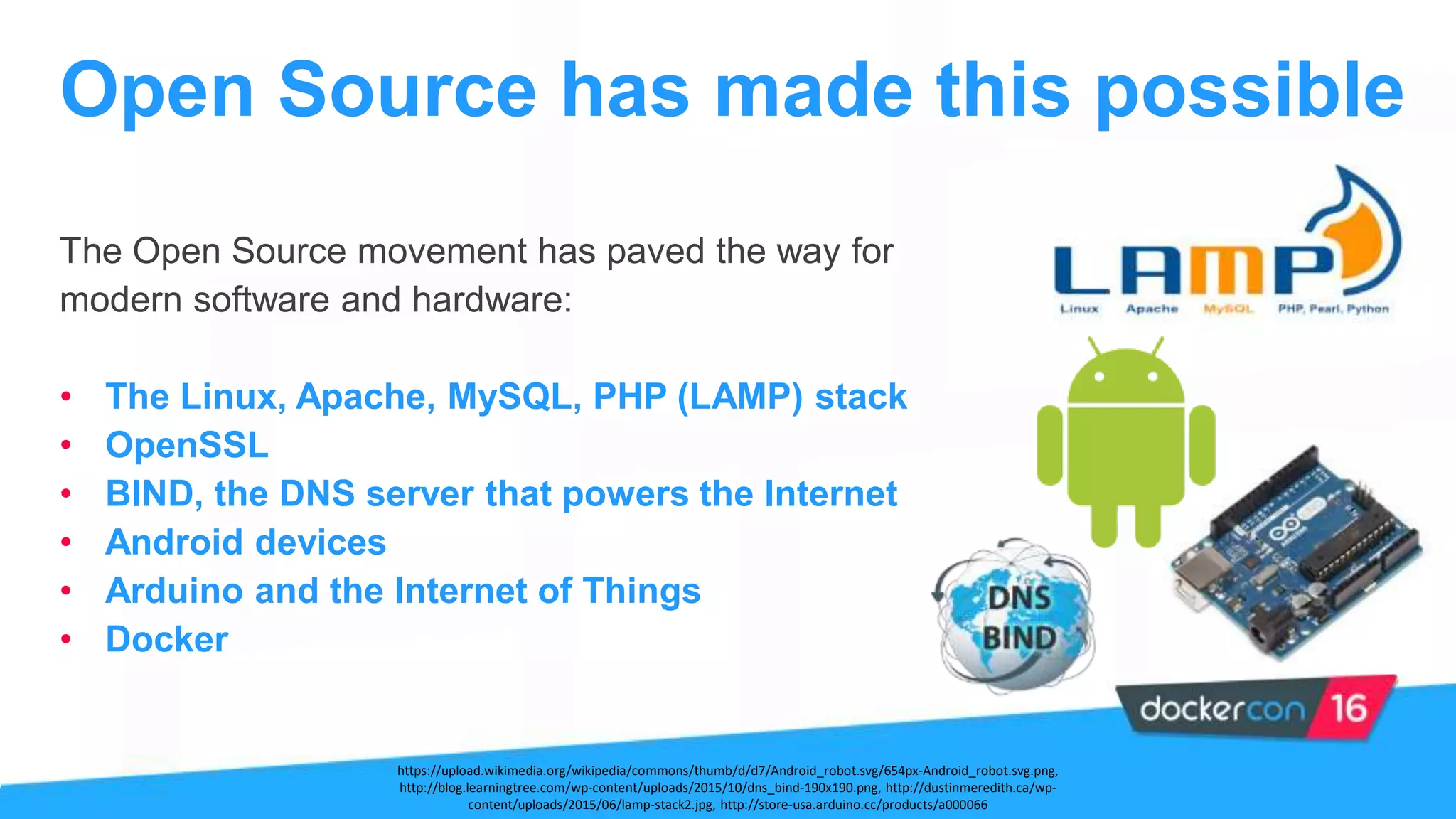
The Open Source movement has paved the way for
modern software and hardware:
• The Linux, Apache, MySQL, PHP (LAMP) stack
• OpenSSL
• BIND, the DNS server that powers the Internet
• Android devices
• Arduino and the Internet of Things
• Docker
Open Source has made this possible
https://upload.wikimedia.org/wikipedia/commons/thumb/d/d7/Android_robot.svg/654px-Android_robot.svg.png,
http://blog.learningtree.com/wp-content/uploads/2015/10/dns_bind-190x190.png, http://dustinmeredith.ca/wp-
content/uploads/2015/06/lamp-stack2.jpg, http://store-usa.arduino.cc/products/a000066
• Highly available cloud resources
• Cheap hardware
• Automation tools
• Short, iterative development cycles
• Massive amounts of ready-to-run code
Thanks to Open Source we now have
https://thenewkingmakers.com/
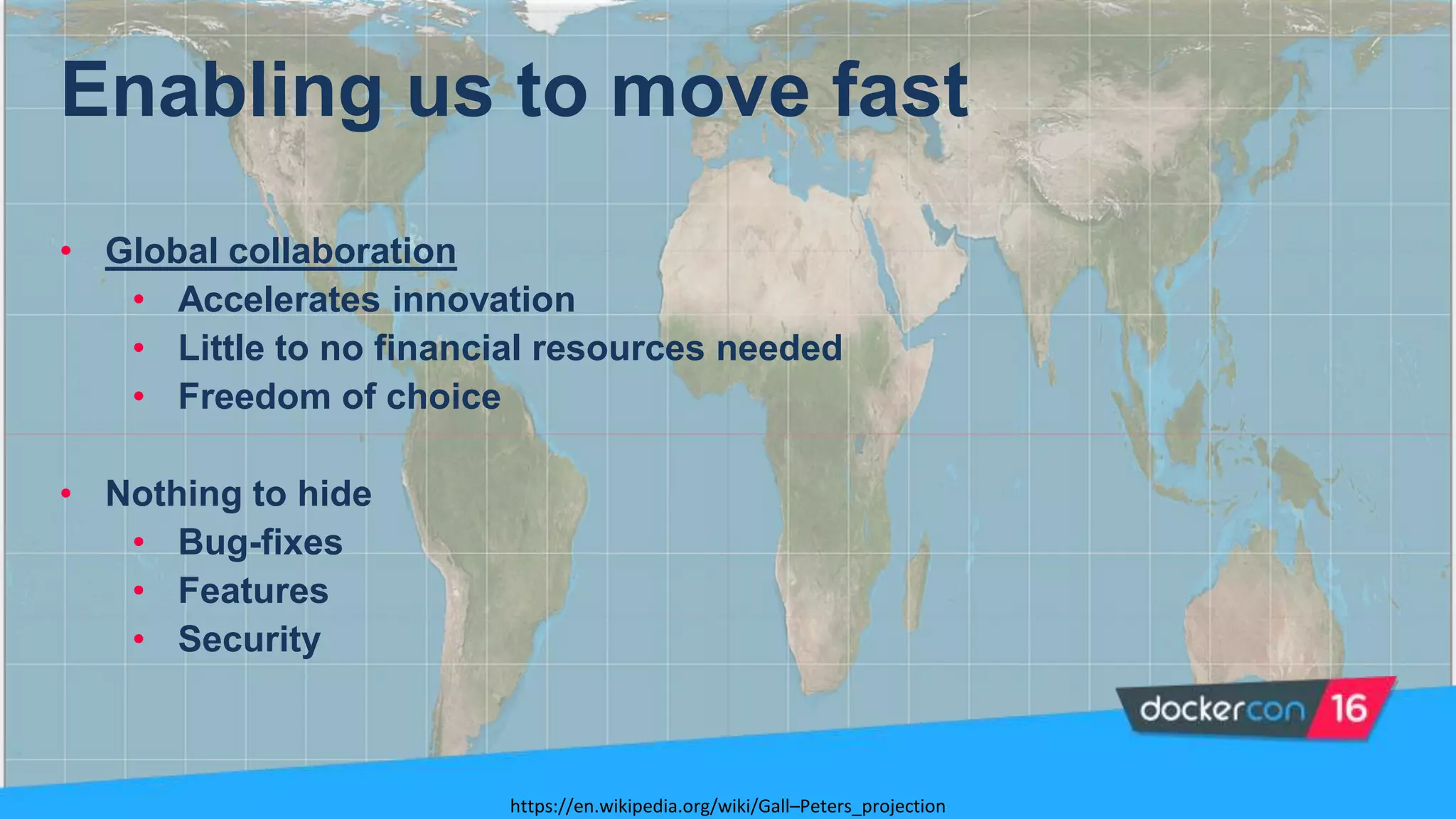
• Global collaboration
• Accelerates innovation
• Little to no financial resources needed
• Freedom of choice
• Nothing to hide
• Bug-fixes
• Features
• Security
Enabling us to move fast
https://en.wikipedia.org/wiki/Gall–Peters_projection
• Secure communications world-wide
• Self-driving cars
• Retrieving images from the surface of Mars
• Posting pictures on Facebook
To create life-changing opportunities
http://photojournal.jpl.nasa.gov/catalog/PIA02406
The Future
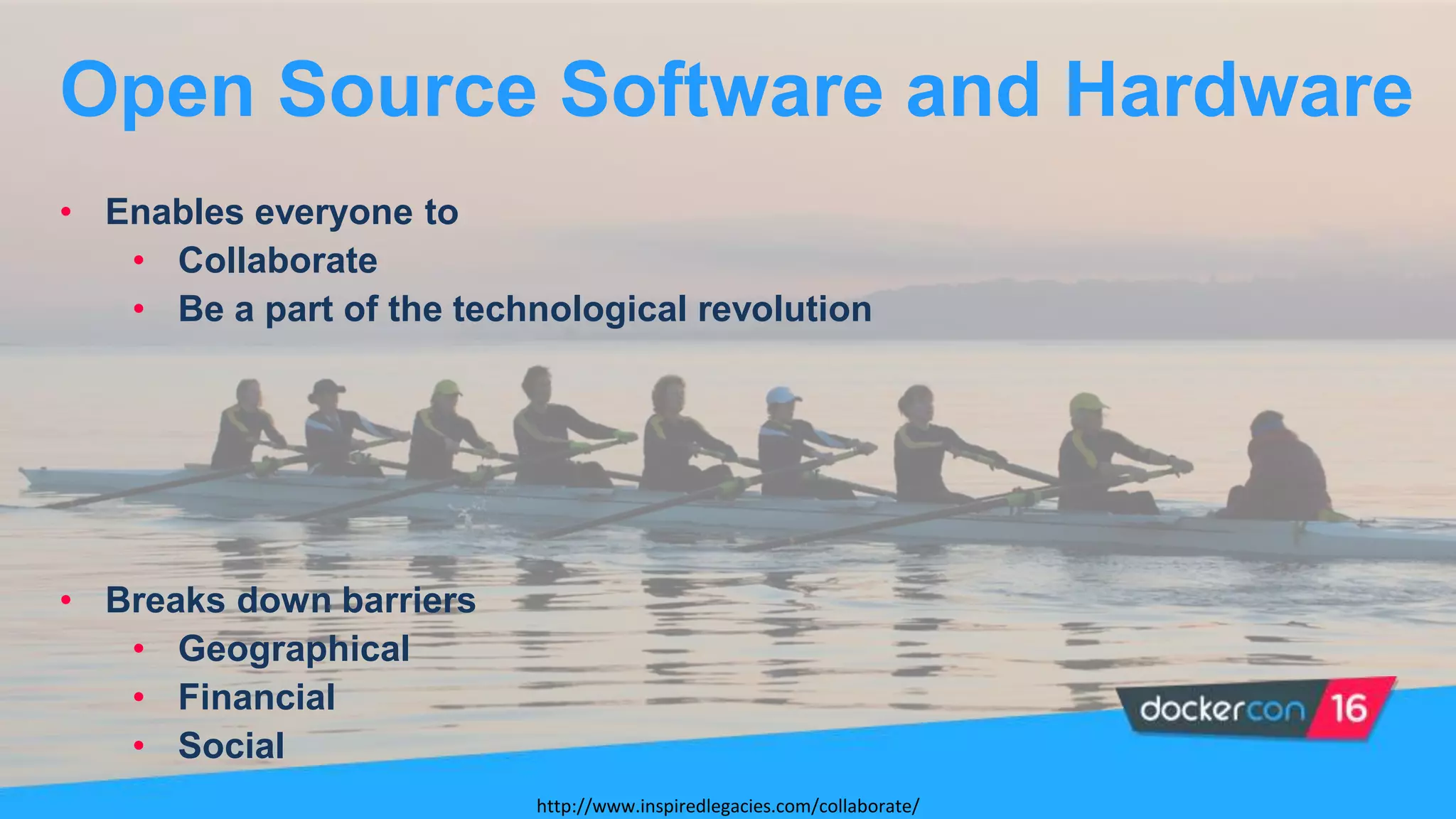
• Enables everyone to
• Collaborate
• Be a part of the technological revolution
• Breaks down barriers
• Geographical
• Financial
• Social
Open Source Software and Hardware
http://www.inspiredlegacies.com/collaborate/
Keep innovating.
Summary
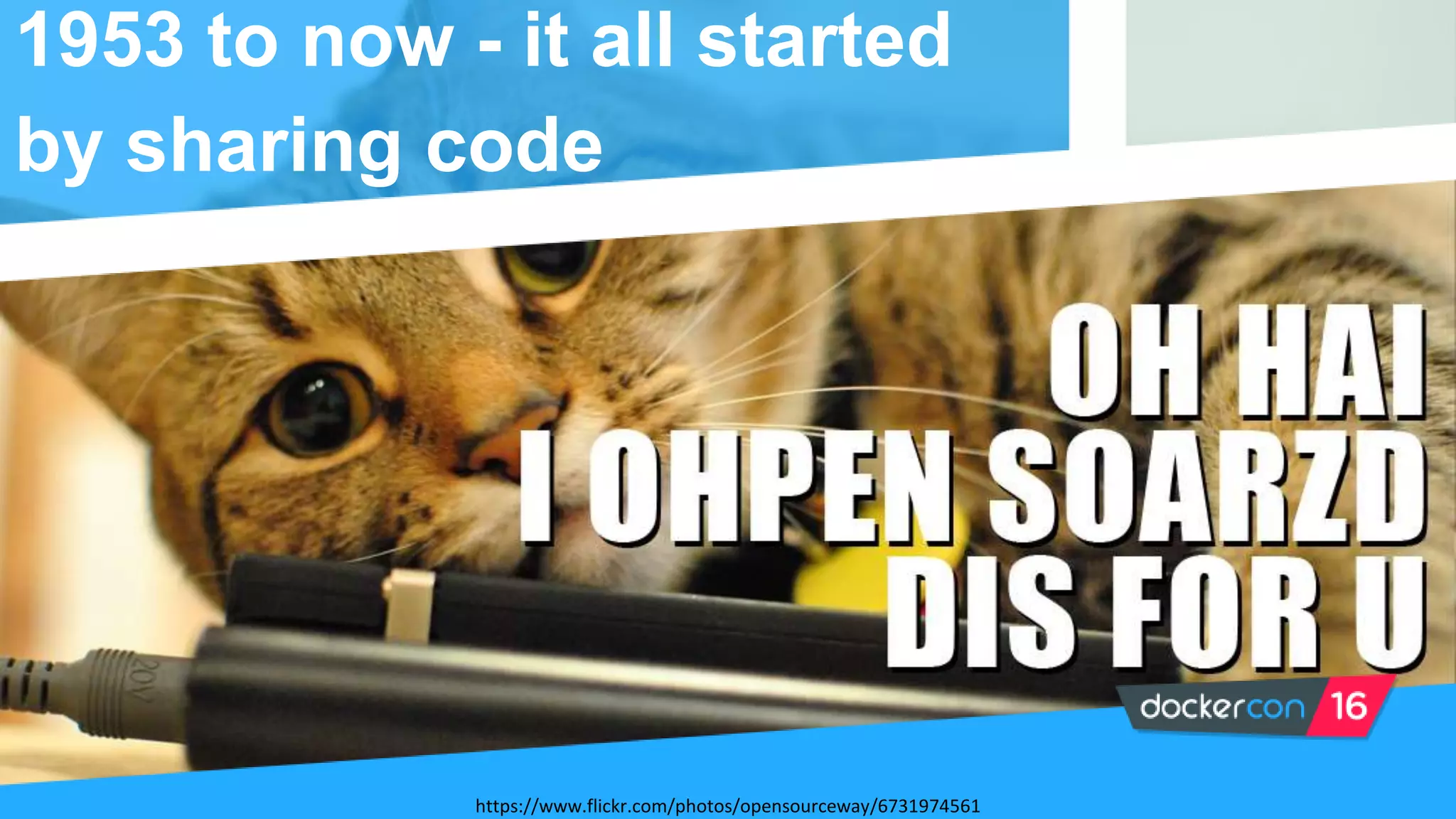
1953 to now - it all started
by sharing code
https://www.flickr.com/photos/opensourceway/6731974561
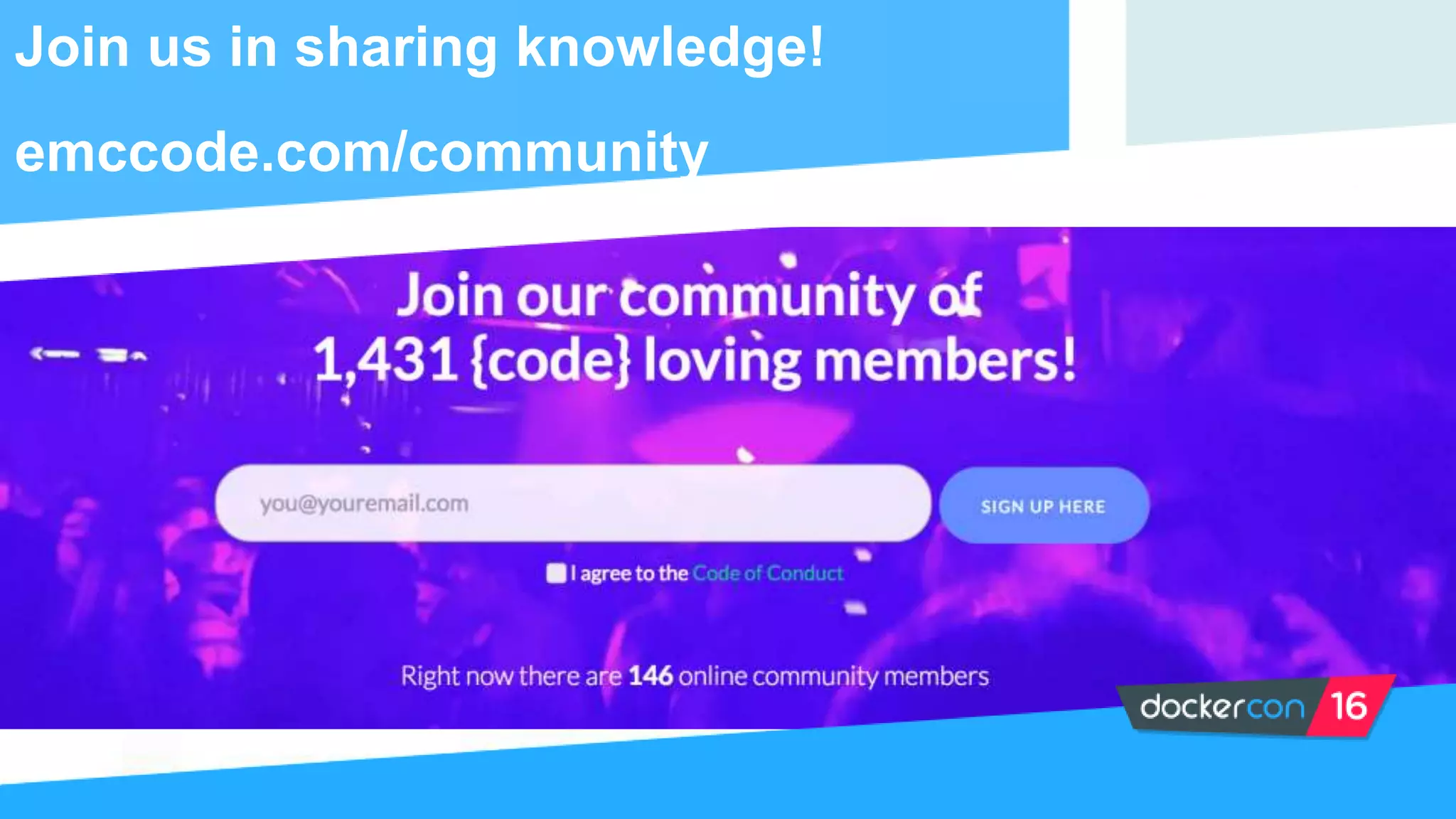
Join us in sharing knowledge!
emccode.com/community
Thank you!

Open Source is Good for Both Business and Humanity - DockerCon 2016

  • 1.
    Open Source isGood for both Business and Humanity Jonas Rosland Community Manager EMC {code}
  • 2.
    History of OSS Genesis Whereit led us Definitions Agenda Create OSS Get started Community The results For Business For Humanity The Future
  • 3.
    History of OSS Givingaway things for free
  • 4.
    The UNIVAC A-2system was released to customers in 1953 with its source code https://en.wikipedia.org/wiki/The_Computer_Museum,_Boston
  • 5.
    In the early1970s AT&T distributed early versions of UNIX at no cost to government and academic researchers https://upload.wikimedia.org/wikipedia/commons/9/99/DEC_VT100_terminal.jpg
  • 6.
    In 1983, RichardStallman published the GNU Manifesto and launched the GNU Project http://www.gnu.org/graphics/gerwinski-gnu-head.png https://commons.wikimedia.org/wiki/File:GPLv3_Logo.svg
  • 7.
    “Hello everybody outthere using minix - I'm doing a (free) operating system (just a hobby, won't be big and professional like gnu) for 386(486) AT clones.” - Linus Torvalds, August 1991
  • 8.
    PS. Yes -it's free of any minix code, and it has a multi-threaded fs. It is NOT portable (uses 386 task switching etc), and it probably never will support anything other than AT- harddisks, as that's all I have :-(. - Linus Torvalds, August 1991
  • 9.
    The Apache HTTPServer is released 1995 http://www.apache.org/foundation/press/kit/feather.png
  • 10.
    In 1997, EricRaymond published The Cathedral and the Bazaar, a reflective analysis of the hacker community and free-software principles https://c2.staticflickr.com/8/7276/7001927337_804103d705_k.jpg
  • 11.
    Now here’s whereit gets interesting
  • 12.
  • 13.
    On January 22,1998, Netscape announces that they will give away their Navigator browser and it's source code https://en.wikipedia.org/wiki/Netscape_Navigator
  • 14.
    The “open source”label was created at a strategy session held on February 3rd, 1998 in Palo Alto, California https://c2.staticflickr.com/8/7276/7001927337_804103d705_k.jpg
  • 15.
    On February 23rd,Netscape created the Mozilla project to coordinate the development of their now Open Source software https://en.wikipedia.org/wiki/Mozilla
  • 16.
    In 1997, EricRaymond published The Cathedral and the Bazaar, a reflective analysis of the hacker community and free-software principles https://c2.staticflickr.com/8/7276/7001927337_804103d705_k.jpg
  • 17.
    • Freely accessed,used, changed and shared • Open collaboration • No vendor lock-in • No discrimination • Can be used for commercial purposes! More details here: https://opensource.org/osd-annotated Open Source definition https://octodex.github.com/foundingfather_v2
  • 18.
  • 20.
    Patents and OSScan co-exist, but needs commitment to survive • Microsoft Patent Promises and Patents • https://msdn.microsoft.com/en-us/openspecifications/dn750984 • Google Open Patent Non-Assertion Pledge • https://www.google.com/patents/opnpledge/pledge/ • Tesla Patent Pledge • https://www.teslamotors.com/about/legal#patent-pledge What about patents?
  • 21.
    So how doyou get started with OSS?
  • 22.
    • Have anidea and share it with others • Choose a license • Start work and publish it • Invite the community and grow with it • Experiment! Open Source checklist https://octodex.github.com/labtocat
  • 23.
  • 24.
    • Collaboration iskey • No one is an expert on everything • More people means more ideas • Not all are good! • Two-way communication • Ask your community what works • Ask for new features • Communicate plans early You need the community https://octodex.github.com/collabocats
  • 25.
    We also need,among other things: • Designers • Writers • Marketing • Community managers • Bloggers • Mentors But it’s not all just code https://octodex.github.com/codercat, https://octodex.github.com/femalecodertocat https://octodex.github.com/filmtocat, https://octodex.github.com/Professortocat_v2 https://octodex.github.com/shoptocat
  • 26.
    The results You’re usingOpen Source things daily!
  • 27.
    The Open Sourcemovement has paved the way for modern software and hardware: • The Linux, Apache, MySQL, PHP (LAMP) stack • OpenSSL • BIND, the DNS server that powers the Internet • Android devices • Arduino and the Internet of Things • Docker Open Source has made this possible https://upload.wikimedia.org/wikipedia/commons/thumb/d/d7/Android_robot.svg/654px-Android_robot.svg.png, http://blog.learningtree.com/wp-content/uploads/2015/10/dns_bind-190x190.png, http://dustinmeredith.ca/wp- content/uploads/2015/06/lamp-stack2.jpg, http://store-usa.arduino.cc/products/a000066
  • 28.
    • Highly availablecloud resources • Cheap hardware • Automation tools • Short, iterative development cycles • Massive amounts of ready-to-run code Thanks to Open Source we now have https://thenewkingmakers.com/
  • 29.
    • Global collaboration •Accelerates innovation • Little to no financial resources needed • Freedom of choice • Nothing to hide • Bug-fixes • Features • Security Enabling us to move fast https://en.wikipedia.org/wiki/Gall–Peters_projection
  • 30.
    • Secure communicationsworld-wide • Self-driving cars • Retrieving images from the surface of Mars • Posting pictures on Facebook To create life-changing opportunities http://photojournal.jpl.nasa.gov/catalog/PIA02406
  • 31.
  • 32.
    • Enables everyoneto • Collaborate • Be a part of the technological revolution • Breaks down barriers • Geographical • Financial • Social Open Source Software and Hardware http://www.inspiredlegacies.com/collaborate/
  • 33.
  • 34.
  • 35.
    1953 to now- it all started by sharing code https://www.flickr.com/photos/opensourceway/6731974561
  • 36.
    Join us insharing knowledge! emccode.com/community
  • 37.

Editor's Notes

  • #5 J. Presper Eckert and John Mauchly built the ENIAC (Electronic Numerical Integrator and Computer) at the University of Pennsylvania's Moore School of Electrical Engineering between 1943 and 1946. A 1946 patent rights dispute with the university led Eckert and Mauchly to depart the Moore School to form the Electronic Control Company, later renamed Eckert-Mauchly Computer Corporation (EMCC), based in Philadelphia, Pennsylvania. That company first built a computer called BINAC (BINary Automatic Computer) for Northrop Aviation (which was little used, or perhaps not at all). Afterwards began the development of UNIVAC. UNIVAC was first intended for the Bureau of the Census, which paid for much of the development, and then was put in production. With the death of EMCC's chairman and chief financial backer Harry L. Straus in a plane crash on October 25, 1949, EMCC was sold to typewriter maker Remington Rand on February 15, 1950. Eckert and Mauchly now reported to Leslie Groves, the retired army general who had managed the Manhattan Project. The original model range was the UNIVAC I (UNIVersal Automatic Computer I), the second commercial computer made in the United States.[4] The main memory consisted of tanks of liquid mercury implementing delay line memory, arranged in 1000 words of 12 alphanumeric characters each. The first machine was delivered on 31 March 1951. To promote sales, the company joined with CBS to have UNIVAC I predict the result of the 1952 Presidential election. This incident is particularly noteworthy because the computer predicted an Eisenhower landslide when traditional pollsters all called it for Adlai Stevenson.[1] The numbers were so skewed that CBS's news boss in New York, Mickelson, decided the computer was in error and refused to allow the prediction to be read. Instead they showed some staged theatrics that suggested the computer was not responsive, and announced it was predicting 8-7 odds for an Eisenhower win (the actual prediction was 100-1). When the predictions proved true and Eisenhower won a landslide within 1% of the initial prediction, Charles Collingwood, the on-air announcer, embarrassingly announced that they had covered up the earlier prediction.[2] The result of this was a greater public awareness of computing technology. The A-0 system (Arithmetic Language version 0), written by Grace Hopper in 1951 and 1952 for the UNIVAC I, was the first compiler ever developed for an electronic computer.[1 Developed at the UNIVAC division of Remington Rand in 1953, the A-2 system was released to customers with its source code. They were invited to send their improvements back to UNIVAC. Thus it is believed that A-2 was the first example of free and open-source software.
  • #6 In the early 1970s AT&T distributed versions of UNIX at no cost to government and academic researchers, but these versions did not come with permission to redistribute or to distribute modified versions, and were thus not free software in the modern meaning of the phrase. In the late 1970s and early 1980s, computer vendors and software-only companies began routinely charging for software licences, marketing it as "Program Products" and imposing legal restrictions on new software developments, now seen as assets, through copyrights, trademarks, and leasing contracts. After UNIX became more widespread in the early 1980s, AT&T stopped the free distribution and charged for system patches. As it is quite difficult to switch to another architecture, most researchers paid for a commercial license.
  • #7 In 1983, Richard Stallman published the GNU Manifesto and launched the GNU Project to write a complete operating system free from constraints on use of its source code. Particular incidents motivated this. One case includes an annoying printer couldn't be fixed because the source code was withheld from users. The GNU Manifesto outlined the GNU project's purpose and explained the importance of free software. Soon after the launch, he coined the term "free software" and founded the Free Software Foundation to promote the concept and a free software definition was published in February 1986
  • #8 The Linux kernel, started by Linus Torvalds, was released as freely modifiable source code in 1991. The licence wasn't a free-software licence, but in February 1992, Torvalds relicensed the project under the GNU General Public License. Much like Unix, Torvalds' kernel attracted the attention of volunteer programmers everywhere. Until this point, the GNU project's lack of a kernel meant that no complete free-software operating systems existed. The development of the Linux kernel closed that last gap. The combination of these two made the first complete free-software operating system. Hello everybody out there using minix - I'm doing a (free) operating system (just a hobby, won't be big and professional like gnu) for 386(486) AT clones. This has been brewing since april, and is starting to get ready. I'd like any feedback on things people like/dislike in minix, as my OS resembles it somewhat (same physical layout of the file-system (due to practical reasons) among other things). I've currently ported bash(1.08) and gcc(1.40), and things seem to work. This implies that I'll get something practical within a few months, and I'd like to know what features most people would want. Any suggestions are welcome, but I won't promise I'll implement them :-) Linus (torvalds@kruuna.helsinki.fi) PS. Yes - it's free of any minix code, and it has a multi-threaded fs. It is NOT portable (uses 386 task switching etc), and it probably never will support anything other than AT-harddisks, as that's all I have :-(. — Linus Torvalds https://groups.google.com/forum/#!original/comp.os.minix/dlNtH7RRrGA/SwRavCzVE7gJ
  • #9 The Linux kernel, started by Linus Torvalds, was released as freely modifiable source code in 1991. The licence wasn't a free-software licence, but in February 1992, Torvalds relicensed the project under the GNU General Public License. Much like Unix, Torvalds' kernel attracted the attention of volunteer programmers everywhere. Until this point, the GNU project's lack of a kernel meant that no complete free-software operating systems existed. The development of the Linux kernel closed that last gap. The combination of these two made the first complete free-software operating system. Hello everybody out there using minix - I'm doing a (free) operating system (just a hobby, won't be big and professional like gnu) for 386(486) AT clones. This has been brewing since april, and is starting to get ready. I'd like any feedback on things people like/dislike in minix, as my OS resembles it somewhat (same physical layout of the file-system (due to practical reasons) among other things). I've currently ported bash(1.08) and gcc(1.40), and things seem to work. This implies that I'll get something practical within a few months, and I'd like to know what features most people would want. Any suggestions are welcome, but I won't promise I'll implement them :-) Linus (torvalds@kruuna.helsinki.fi) PS. Yes - it's free of any minix code, and it has a multi-threaded fs. It is NOT portable (uses 386 task switching etc), and it probably never will support anything other than AT-harddisks, as that's all I have :-(. — Linus Torvalds https://groups.google.com/forum/#!original/comp.os.minix/dlNtH7RRrGA/SwRavCzVE7gJ
  • #10 Without the Apache HTTP Server, the Internet wouldn’t have boomed as it did. Later on, LAMP-stacks became commonplace for every new web service. Also mention BIND here.
  • #11 In 1997, Eric Raymond published The Cathedral and the Bazaar, a reflective analysis of the hacker community and free-software principles. The paper received significant attention in early 1998 and was one factor in motivating Netscape to release their popular Netscape Communicator Internet suite as free software. This code is today the basis for Mozilla Firefox and Thunderbird. Netscape's act prompted Raymond and others to look into how to bring free-software principles and benefits to the commercial-software industry. They concluded that FSF's social activism was not appealing to companies like Netscape, and looked for a way to rebrand the free-software movement to emphasize the business potential of the sharing of source code.
  • #14 http://www.cnet.com/news/netscape-now-for-free/
  • #15 https://opensource.org/history
  • #16 https://en.wikipedia.org/wiki/Mozilla
  • #17 Remember this? On February 9 1998 Eric Raymond changed ”free software” to “open source”.
  • #18 No vendor lockin: 8. License Must Not Be Specific to a Product The rights attached to the program must not depend on the program's being part of a particular software distribution. If the program is extracted from that distribution and used or distributed within the terms of the program's license, all parties to whom the program is redistributed should have the same rights as those that are granted in conjunction with the original software distribution.
  • #21 To facilitate the use and implementation of certain specifications, Microsoft has made available the Open Web Foundation Agreement and the following patent promises regarding certain uses of its intellectual property. And to assist in determining whether a patent license or patent covenant agreement may be beneficial, the following Patent Map identifies patents and patent applications associated with the programs. Google is committed to promoting innovation to further the overall growth and advancement of information technology and believes that Free or Open Source Software is a very important tool for fostering innovation. Google is therefore pledging the free use of certain of its patents in connection with Free or Open Source Software on the following terms: Tesla irrevocably pledges that it will not initiate a lawsuit against any party for infringing a Tesla Patent through activity relating to electric vehicles or related equipment for so long as such party is acting in good faith.
  • #37 http://emccode.com/community