A SunCam Online Continuing Education Course
2023
National Electrical Code
(NEC®
)
OVERVIEW EMPHASIS
Chapters 1-4
General / Wiring & Protection / Wiring Methods & Material / General Use Equipment [Motors]
GENERAL OVERVIEW MATERIAL
Future Courses
Special Equipment [Solar]
Special Conditions [Standby Power]
by
John A Camara, BS, MS, PE, TF
414.pdf
2023 National Electric Code (NEC®), OVERVIEW
A SunCam Online Continuing Education Course
www.SunCam.com Copyright©
2023 John A Camara Page 2 of 42
HISTORY and CODE OVERVIEW1
Edison invented the first practical incandescent light bulb in 1879. In the very same year, the
National Association of Fire Engineers met for the purpose of establishing requirements for
electrical installations. As with many standards, in a few years there were six different standards
in place. Therefore, in 1896 the various concerned groups convened a national meeting and one
year later the National Electrical Code (NEC) (hereafter referred to as the “Code”) was born.
The Code is official endorsed by ANSI (American National Standards Institute). The National Fire
Protection Association (NFPA) committee responsible for the code is known as ANSI Standards
Committee C1. The Code is utilized nationwide with local jurisdictions adoption en masse though
with the occasional supplemental additions or deletions. The Code applies to electrical installations
within or on public and private buildings up to and including connection to the providing power
supply, see Fig. 1. Its overall purpose: prevent fires!
Figure 1: NEC Coverage
[Source: Power Reference Manual for the PE Exam]
The building code at the international level is International Electrotechnical Commission (IEC)
Standard 60364-1, Electrical Installations of Buildings. The principles of protection and safety in
the IEC code are addressed in the NEC, making it widely applicable.
This course will focus on requirements for such buildings (residential and commercial) and their
internals for items with voltages less than 1000 V. Units will be both SI and USCS (United States
1
Paraphrased from the author’s book published by Professional Publications Incorporated of
Belmont, CA—now a Kaplan Company: John Camara, Power Reference Manual for the PE
Exam, 3rd
ed., (2018), (Kaplan, Inc., 2018), Chap. 56. In the 4th
ed., the NEC is in. Chap. 44.
414.pdf
2023 National Electric Code (NEC®), OVERVIEW
A SunCam Online Continuing Education Course
www.SunCam.com Copyright©
2023 John A Camara Page 3 of 42
Customary System)2
, reflecting their usage in the NEC. The code itself often displays both units
with primary emphasis on SI units except where USCS units are still more often used. Conversion
between the units in the Code are defined as either soft or hard conversions. Soft conversions are
a change in the description of the measurement without changing the actual dimension—thus, the
part will be interchangeable. Hard conversions change the dimensions making the part different
than the original. As an example, a soft conversion of ½ is 12.7 mm, while a hard conversion is 13
mm.
The course will refer directly to Code Chapters (1-9), Parts (I, II…) Articles (###), Sections (A,
A(1), B, B(1)…), and Informative Annexes (A–J).3
While a copy of the code will be adequate for
verification and usage, for those whose occupations require a deeper understanding of the Code
and its three-year updates, I recommend the following.4
NFPA 70®
National Electrical Code®
HANDBOOK
by
Mark W. Earley, PE
Editor-in-Chief
2023
This is an official publication of the NFPA with numerous advantages over a mere copy of the
Code. For instance, the Handbook contains commentary text in blue, which is used to explain the
reasons for the requirement or its application. Revised Code text is shaded gray for ease of noting
changes. A single circular bullet on an empty line space, such as that below, indicates deleted
sections of the code.
•
The Greek delta symbol (“change”), Δ, when used by a section number indicates words were
deleted; when used beside a table it signifies a revision of the data within. An italic N reveals a
new article, section, table or figure. The Handbook also contains a “See also” marking bringing
2
Informally referred to as the English Engineering System. Differences do exist but are
unimportant for our purposes.
3
Articles are single-subject entries and Sections and Sub-Sections contain the rules themselves.
The word “Article” is often used for “Section” though technically the terminology “Section”
should be used. Additionally, in this course, not all Parts are mentioned. They are mentioned
when the topics are considered significant.
4
The author is not associated with this text or the NFPA. I have simply found this handbook
extremely useful throughout the years. Also, regardless of the NEC update year, the principles
provided in this course will be useful guidance—some article locations may change with the
occasional technical update or addition as well.
414.pdf
2023 National Electric Code (NEC®), OVERVIEW
A SunCam Online Continuing Education Course
www.SunCam.com Copyright©
2023 John A Camara Page 4 of 42
to the reader’s attention other Code areas where additional information is found.5
Finally, and
arguably the most useful features, are the Exhibits containing figures or pictures that bring the
words to visual life, Calculation Examples providing scenarios for application of the Code
requirements, and a Summary of Technical Changes listed prior to the Code itself.
The Code consists of an introduction followed by nine chapters, which are further subdivided into
articles, parts, and sections. It ends with “informative annexes” that provide useful information but
no actual requirements.
• Introduction
•
• Chapter 1: General
• Chapter 2: Wiring and Protection
• Chapter 3: Wiring Methods and Materials
• Chapter 4: Equipment for General Use
•
• Chapter 5: Special Occupancies
• Chapter 6: Special Equipment
• Chapter 7: Special Conditions
•
• Chapter 8: Communications Systems
•
• Chapter 9: Tables
•
• Annex A: Product Safety Standards
• Annex B: Application Information for Ampacity Calculations
• Annex C: Conduit, Tubing, and Cable Tray Fill Tables…
• Annex D: Examples
• Annex E: Types of Construction
• Annex F: Critical Operations Power Systems…
• Annex G: Supervisory Control and Data Acquisition (SCADA)
• Annex H: Administration and Enforcement
• Annex I: Recommended Torque Tables…
• Annex J: ADA Standards for Accessible Design
• Annex K: Use of Medical Equipment in Dwellings…
5
The “see also” feature is new and extremely helpful. This course will focus on the methodology
of finding all the information required to ensure compliance. The Handbook’s use of this feature
is very much along these lines.
414.pdf
2023 National Electric Code (NEC®), OVERVIEW
A SunCam Online Continuing Education Course
www.SunCam.com Copyright©
2023 John A Camara Page 5 of 42
The breaks shown in the bullet list are to resolve the NEC into relevant areas. The Introduction is
just that. Chapters 1–4 generally applies to all electrical installations. Chapter 5–7 supplements or
modifies the information in Chaps. 1–7. Chapter 8 stands alone unless it specifically references an
earlier requirement. Chapter 9 contains major tables and are used when referenced as applicable
in the Code. The annexes are for information only and are not mandatory for compliance with the
Code.
Article 90 Introduction
The Introduction of the code explains its purpose as the “practical safeguarding of persons and
property from hazards arising from the use of electricity.” Such hazards may exist due to a lack of
conformity to the code or not allowing for future expansion of electrical system loading.
The scope of the Code includes public and private building, parking lots, industrial substations,
carnivals, installations that connect to the electricity supply, and those electric utility installations
that are not an integral part of the power generation, among others. Relativly new (in 2020) is
application of the Code to power to ships, marinas, and shipyards.6
Also new is coverage of
installations that allow power from vehicles to be exported into premises. Check Art. 90.2 for a
complete list of items covered and exempted.
The Code is meant to be a legal document for interpretation and implementation by local
governmental bodies. Most implement the Code en masse. However, some may adjust portions of
the Code as required for local needs. Mandatory Rules are those where action is specifically
required or prohibited. The words “shall” or “shall not” are indicative of such rules. Permissive
Rules are those where action is allowed but not required. The words “shall be permitted” or “shall
not be required” are indicative of such rules. Explanatory Materials is contained in Informational
Notes. Such notes are just that, “information,” and as such are not enforceable portions of the
Code. Another unenforceable portion of the Code are the Informational Annexes, which provide
guidance on Code use.
6
This is a timely addition given the increased prevalence of ESD—Electric Shock Drowning.
Many “drownings” around boats are labeled as such when in fact they may be due to electric
current flowing in the water due to a faulty wiring condition on a nearby boat.
414.pdf
2023 National Electric Code (NEC®), OVERVIEW
A SunCam Online Continuing Education Course
www.SunCam.com Copyright©
2023 John A Camara Page 6 of 42
Chapter 1 General
Article 100 Definitions
This article contains essential definitions; that is, those indispensable to the Code while exempting
common technical terms found in other codes and standards.
Accessible equipment is capable of being reached for “operation, renewal, and inspection.”
Accessible wiring is that capable of being “removed or exposed without damaging” a structure or
finish. Readily Accessible indicates the ability to reach equipment or items without using tools
(except for keys) or having to remove interfering equipment.
Ampacity is the maximum current a conductor can carry without exceeding its temperature rating.
The Authority having Jurisdiction (AHJ) is the authority with responsibility for enforcing the Code
or approving installations, equipment, et cetera.
Bond and Bonding is the connection or cable/wire, and process used to ensure electrical continuity
and conductivity. Bonding is NOT grounding, do not confuse the two. A Ground is the earth with
Grounding indicating the connection to the ground or the connective body that extends to the
ground.
Consider a typical distribution system as shown in Fig. 2. The definitions for the individual
portions, though somewhat self-explanatory, are also contained in Art. 100. A branch circuit are
the conductors between the final overcurrent device and the outlet(s). A continuous load is one in
which the maximum current is expected to last for 3 hours or more. Continuous duty is operation
at a substantially constant load for an infinitely long time.
Electrical circuits are subject to overcurrent conditions and as such a system should be designed
for selective coordination; that is, localization of an overcurrent condition to the circuit or
equipment effected. Meaning, should a fault occur, it impacts the circuit or equipment with the
fault and not the rest of the system. This is isolating closest to the fault and as far from the source
as possible. Also, of note for those designing protective systems, overcurrent is a fault condition
exceeding the range of the equipment, which could result in damage. Overcurrent (faults) can
ripple through a poorly designed system and are defined as any current in excess of rated
equipment current or ampacity of the conductor and may result from short circuit, ground fault, or
overload. Overload is a condition where current is slightly above the maximum, which could result
in overheating. Overloads generally impact one circuit or piece of equipment only. Per Fig. 2, a
fault on the lower branch circuit should open the fixed overcurrent protective device in the
panelboard and not any protection for the feeders in the power supply source.
414.pdf
2023 National Electric Code (NEC®), OVERVIEW
A SunCam Online Continuing Education Course
www.SunCam.com Copyright©
2023 John A Camara Page 7 of 42
Figure 2: Typical Distribution System
[Source: Power Reference Manual for the PE Exam]
Figure 3 should be referred to for the bonding and grounding explanation that follows. The generic
terms used by electricians and engineers for the grounding wiring doesn’t match-up with the
technical names provided by the NEC, so understanding the differences is very helpful in the field.
A Bonding Conductor or Jumper is a reliable conductor necessary to ensure electrical conductivity
between metal parts. The Bonding Jumper is shown as yellow in the NEC figures. An Equipment
Bonding Jumper provides connection between two or more portions of the Equipment Grounding
Conductor, the latter of which is the green wiring. That is, when all the metal parts are not
electrically connected, the bonding jumper provides the continuity to the grounding (green)
system. Of note, the equipment grounding conductor (green) is NOT meant to carry current under
normal conditions. It is there for safety in the event of a fault to prevent the metal parts from
achieving a voltage above that of earth ground and thus presenting a hazard to people. The
grounding electrode is a conducting object through which a direct connection to Earth. The
grounding electrode conductor connects the system grounded conductor (intentional grounded
conductor—white wire, the neutral) or the equipment grounding conductor (safety ground—green
wire), or both, or to a point on the grounding electrode system.7
The Main Bonding Jumper is the connection between the grounded circuit (service) conductor
(white—commonly called the “neutral”) and the equipment grounding conductor (green—
commonly called the “ground”) or the supply-side bonding jumper, or both. All are shown in Fig.
3. The terminology shown in quotations represents the name one might hear in the field, from
electricians, or those familiar with wiring and its usage.
The numbering and connection scheme on the panelboard in Fig. 3 are standard. The black “hot”
wire is connected to breaker slots #1 and #2. The red “hot” wire is connected to breaker slots #3
and #4. The potential between the red and black wires is 208 V for most households. The potential
7
The “grounded conductor” is almost always the neutral conductor; that is, the white wire. One
exception is a corner grounded delta, which does not have a neutral point but instead grounds
one end of two different phases.
414.pdf
2023 National Electric Code (NEC®), OVERVIEW
A SunCam Online Continuing Education Course
www.SunCam.com Copyright©
2023 John A Camara Page 8 of 42
between the red and neutral, or black and neutral, is 120 V. Therefore, if a double breaker setup is
used between slots #1 and #3, the voltage is 208 V. Now consider the single receptacle shown in
the diagram. The red hot wire in slot #36 (not labeled in order to show the circuit breaker) connects
to the hot side of the receptacle. The neutral white wire connects to the larger receptacle opening.
The voltage on the receptacle and between slot #36 and neutral is 120 V. The equipment grounding
conductor, the green wire, is connected to the grounding input on the receptacle—no current
intentionally flows on this green wire, only during as fault does current use this path thus keeping
the potential at Earth ground potential, 0 V, and protecting anyone touching the receptacle metal.
Breakers used in the household panel boards provide overcurrent, overload, arc fault circuit
interruption (AFCI), and ground fault circuit interruption (GFCI), all of which will be covered in
the appropriate articles.
414.pdf
2023 National Electric Code (NEC®), OVERVIEW
A SunCam Online Continuing Education Course
www.SunCam.com Copyright©
2023 John A Camara Page 9 of 42
Figure 3: Bonding and Grounding Terminology
The demand factor is the ratio of the maximum demand of the system (or portion thereof) and the
total connected load. This value is always less than one. This is not to be confused with the
diversity factor, which is not found in the NEC—instead it is found in the IEC 61439 (Low Voltage
Switchgear and Control Gear Assemblies), and is used in electrical switchgear designs outside the
purview of the NEC. Think of this as the requirements for industrial low voltage assemblies.
Grounded Circuit Conductor
System Grounded Conductor
Equipment
Grounding
Conductor
2
1
6
5
10
9
14
13
18
17
22
21
26
25
30
29
34
33
4
3
8
7
12
11
16
15
20
19
24
23
28
27
32
31
35
Service Transformer
[Two Phases Shown]
208Y/120V
System Colors
Black--A
Red--B
Blue--C
Supply Side
Equipment Bonding Jumper
Main Bonding Jumper
"Neutral" Hot
Grounding Electrode Conductor
Grounding Electrode
"Ground Rod" or "Ground"
Equipment Grounding Bus
"Safety Ground" or "Green Wire"
EARTH
NEUTRAL BUS
"Neutral" or "White Wire"
414.pdf
2023 National Electric Code (NEC®), OVERVIEW
A SunCam Online Continuing Education Course
www.SunCam.com Copyright©
2023 John A Camara Page 10 of 42
The diversity factor is the ratio of the sum of the individual maximum demand of the systems to
the total connected load. The diversity factor is greater than or equal to one. The distinction is a
demand factor is time independent (and conservative), which results in the need for larger wires—
and thus is the standard in the NEC. The diversity factor accounts for time, meaning, not all the
maximum loads will occur at the same time. So, for example, an 80% diversity means a device or
subsystem operates at its maximum 80% of the time it is turned on. Residential loads have the
highest diversity factors while industrial systems generally have the lowest.
When performing feeder calculations with the NEC, the load is multiplied by the demand factor
lowering the overall wiring size. When performing feeder calculations for feeders upstream of the
service entrance panel to a residence or in and industrial facility for switchgear assemblies, the
load is divided by the diversity factor to lower the overall wiring size.
_______________________________________
Example 1
Four feeders in a large hotel complex are utilized to provide power to lighting loads. The feeder
power is as follows.
Feeder #1: 15 kVA
Feeder #2: 10 kVA
Feeder #3: 50 kVA
Feeder #4: 75 kVA
Demand Factor 1: 60% for first 20 kVA
Demand Factor 2: 50% for 20,001 VA to 100 kVA
Demand Factor 3: 35% for total loads > 100 kVA
What total power must the incoming transformer provide, and the incoming service feeder carry,
using the demand factors shown?
Solution
The maximum total loading is as follows.
LTotal
= L1
+ L2
+ L3
+ L4
=15 kVA+10 kVA+50 kVA+75 kVA
=150 kVA
Applying the demands factors gives the demand factor (DF) load, which the transformer must be
designed for and the feeders must carry at the appropriate voltage, gives the following.
414.pdf
2023 National Electric Code (NEC®), OVERVIEW
A SunCam Online Continuing Education Course
www.SunCam.com Copyright©
2023 John A Camara Page 11 of 42
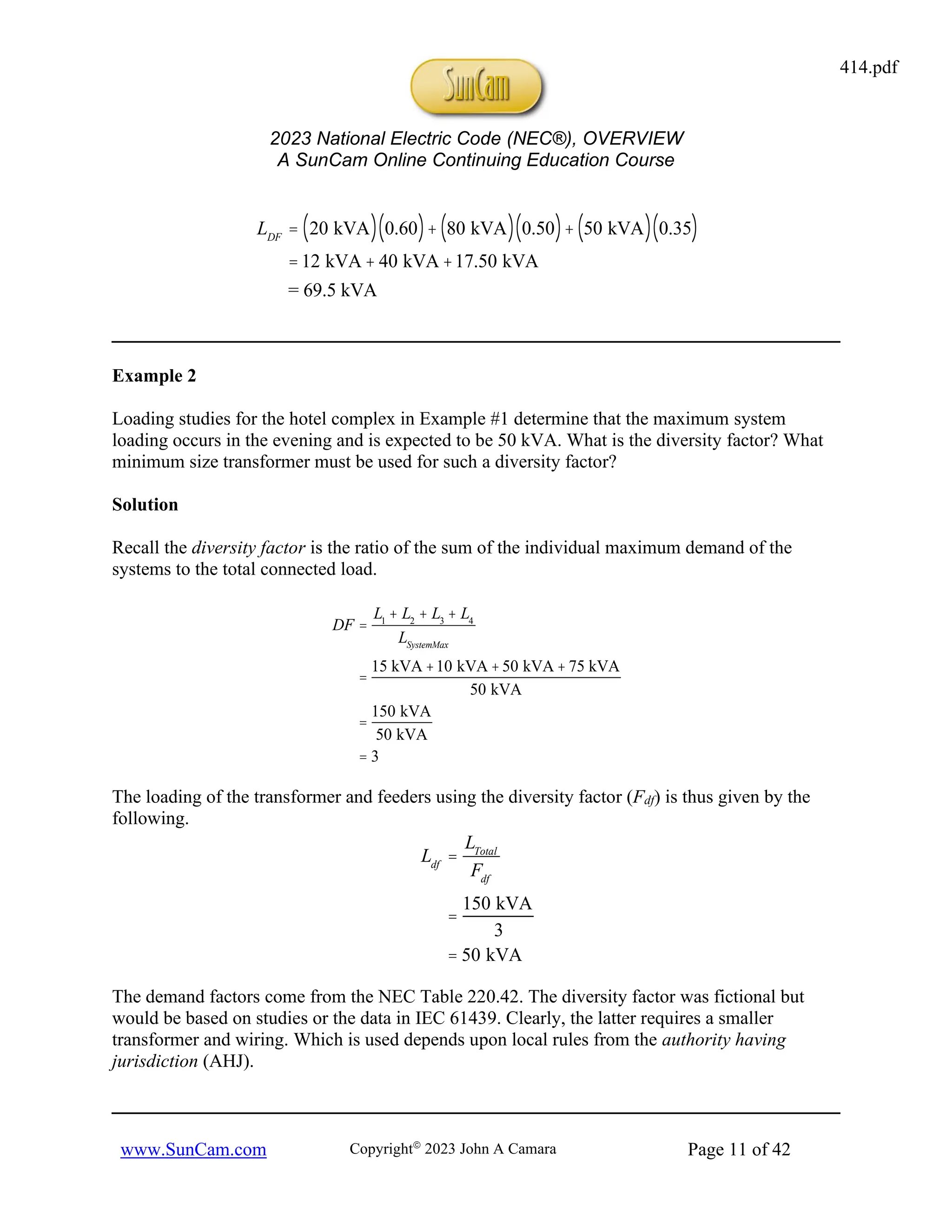
LDF
= 20 kVA
( ) 0.60
( )+ 80 kVA
( ) 0.50
( )+ 50 kVA
( ) 0.35
( )
=12 kVA + 40 kVA +17.50 kVA
= 69.5 kVA
_______________________________________
Example 2
Loading studies for the hotel complex in Example #1 determine that the maximum system
loading occurs in the evening and is expected to be 50 kVA. What is the diversity factor? What
minimum size transformer must be used for such a diversity factor?
Solution
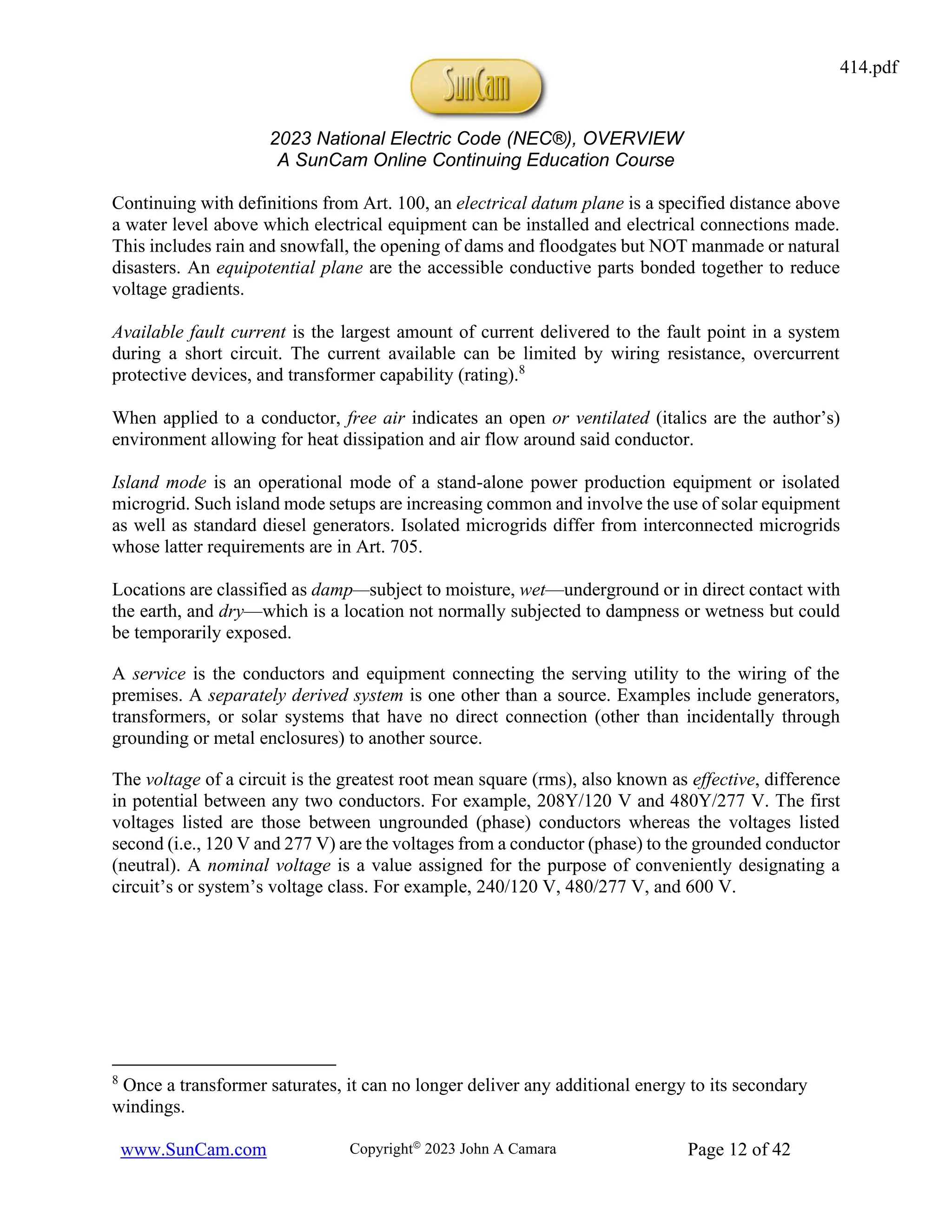
Recall the diversity factor is the ratio of the sum of the individual maximum demand of the
systems to the total connected load.
DF =
L1
+ L2
+ L3
+ L4
LSystemMax
=
15 kVA +10 kVA +50 kVA + 75 kVA
50 kVA
=
150 kVA
50 kVA
= 3
The loading of the transformer and feeders using the diversity factor (Fdf) is thus given by the
following.
Ldf
=
LTotal
Fdf
=
150 kVA
3
= 50 kVA
The demand factors come from the NEC Table 220.42. The diversity factor was fictional but
would be based on studies or the data in IEC 61439. Clearly, the latter requires a smaller
transformer and wiring. Which is used depends upon local rules from the authority having
jurisdiction (AHJ).
_______________________________________
414.pdf
2023 National Electric Code (NEC®), OVERVIEW
A SunCam Online Continuing Education Course
www.SunCam.com Copyright©
2023 John A Camara Page 12 of 42
Continuing with definitions from Art. 100, an electrical datum plane is a specified distance above
a water level above which electrical equipment can be installed and electrical connections made.
This includes rain and snowfall, the opening of dams and floodgates but NOT manmade or natural
disasters. An equipotential plane are the accessible conductive parts bonded together to reduce
voltage gradients.
Available fault current is the largest amount of current delivered to the fault point in a system
during a short circuit. The current available can be limited by wiring resistance, overcurrent
protective devices, and transformer capability (rating).8
When applied to a conductor, free air indicates an open or ventilated (italics are the author’s)
environment allowing for heat dissipation and air flow around said conductor.
Island mode is an operational mode of a stand-alone power production equipment or isolated
microgrid. Such island mode setups are increasing common and involve the use of solar equipment
as well as standard diesel generators. Isolated microgrids differ from interconnected microgrids
whose latter requirements are in Art. 705.
Locations are classified as damp—subject to moisture, wet—underground or in direct contact with
the earth, and dry—which is a location not normally subjected to dampness or wetness but could
be temporarily exposed.
A service is the conductors and equipment connecting the serving utility to the wiring of the
premises. A separately derived system is one other than a source. Examples include generators,
transformers, or solar systems that have no direct connection (other than incidentally through
grounding or metal enclosures) to another source.
The voltage of a circuit is the greatest root mean square (rms), also known as effective, difference
in potential between any two conductors. For example, 208Y/120 V and 480Y/277 V. The first
voltages listed are those between ungrounded (phase) conductors whereas the voltages listed
second (i.e., 120 V and 277 V) are the voltages from a conductor (phase) to the grounded conductor
(neutral). A nominal voltage is a value assigned for the purpose of conveniently designating a
circuit’s or system’s voltage class. For example, 240/120 V, 480/277 V, and 600 V.
8
Once a transformer saturates, it can no longer deliver any additional energy to its secondary
windings.
414.pdf
2023 National Electric Code (NEC®), OVERVIEW
A SunCam Online Continuing Education Course
www.SunCam.com Copyright©
2023 John A Camara Page 13 of 42
Article 110 Requirements for Electrical Installations9
The scope of this article includes the general requirements for installation, use, access, and
examination and approval of such electrical systems (Art. 110.1). Conductors and electrical
equipment must be approved (Art. 110.2). This approval is often from the electrical inspection
authority, or listing from laboratories (such as UL—Underwriters Laboratories), or testing from
field-based third-party laboratories. The Occupational Safety and Health Administration (OSHA)
provides recognition of qualified testing laboratories (Art. 110.3(C) Informational Note).
Conductors in the Code refer to copper, aluminum, or copper-clad aluminum only. If not specified,
the conductor referred to is copper (Art. 110.5). Conductor sizes are specified as AWG (American
Wire Gauge) or in circular mils (cmil or kcmil) (Art. 110.6). Wire sizes up to 4/0 (called “four
aught" or exactly as 0000 AWG) are in AWG while those above (larger) are in circular mils. The
wire sizes then are 4/0, 3/0, 2/0, 1/0, 1 AWG through 40 AWG, from largest to smallest. The unit
circular mil represents an area equal to the area of a circle with a diameter of 0.001 inches. Various
conversions to more standard areas are as follows.
Acmil
=
dinches
0.001
æ
è
ç
ö
ø
÷
2
Ain2 = 7.854´10-7
´ Acmil
Acm2 = 5.067 ´10-6
´ Acmil
Electrical equipment shall be installed in a “neat and workmanlike manner” per Art. 110.1. Many
discrepancies occurring during inspections fail this category. While somewhat subjective,
guidelines are in ANSI/NECA 1-2015, Standard for Good Workmanship on Electrical
Construction.10
Exposed live parts, for systems 1000 V nominal or less, have height, depth, and width restrictions
as laid out in Art. 110.26. The clearance depth depends how the live parts are exposed and are
delineated in Table 110.26(A)(1). The minimum width is the width of the equipment or 30 inches,
whichever is greater, and must allow for 90 degree opening of hinged panels per Art. 110.26(A)(2).
The clearance height shall be 2.0 m (6 ½ ft) or the height of the equipment, whichever is greater
per Art. 110.26(A)(3).
9
From this point onward, the “Chapter, and Part” designations generally will not be utilized.
While helpful when directly viewing the table of contents, the individual article / section
numbers will take one directly to the required information.
10
NECA stands for National Electrical Contractors Association.
414.pdf
2023 National Electric Code (NEC®), OVERVIEW
A SunCam Online Continuing Education Course
www.SunCam.com Copyright©
2023 John A Camara Page 14 of 42
Chapter 2 Wiring and Protection
While wiring and protection is covered here, this will be an overview only—covering those items
a PE should know.11
Items specific to certain installations will be discussed in detail in the
appropriate part of the course; for example, motors, standby power, solar installations, and
communication systems.
Article 200 Use and Identification of Grounded Conductors
An insulated grounded conductor size AWG 6 or smaller shall be identified as follows (Art.
200.6(A)).
• Continuous white outer finish
• Continuous gray outer finish
• Three continuous white or grey stripes on other than green insulation
• Colored tracer threads in the braid identifying the source of manufacture12
• Mineral-insulated, metal-sheathed cable (Type MI) shall be identified by distinctive
markings at its terminations
• Fixture wires shall be identified by one or more continuous stripes (Art. 402.8; See also
400.22(A)-(E))13
• Aerial cables may comply with thee above or by having a ridge on the exterior of the
cable as the means of identification
An insulated grounded conductor size AWG 4 or larger shall be identified by the first three
methods above or by white or gray markings on the terminations (Art. 200.6(B)).
Grounded conductors of different systems in the same raceway, cable, et cetera, are identified as
above but differently from one another (Art. 200.6(D)). For example, the neutral in a 480Y/277 V
system could be gray while the other neutral for the 208Y/120 V would then be white.
Receptacles, plugs, and connectors terminal connections for the grounded conductor (neutral) shall
be white, marked “W” or “white” or be silver in color. The other terminal (hot) shall be different—
often brass (Art. 200.10(B)).
11
The term, “What as PE should know” is taken from NCEES guidance for those studying for
the Professional Engineer (PE) exam. It indicates that while engineers will be familiar with, and
parts
have to look up specifics on, many topics some things should be resident or base knowledge.
12
This allows an electrician to trace a neutral through a conduit or raceway containing multiple
neutrals and know at the other end the correct one for the system being worked.
13
A fixture is a piece of equipment in a fixed position, while cord- and plug-connected wiring
may be easily moved.
414.pdf
2023 National Electric Code (NEC®), OVERVIEW
A SunCam Online Continuing Education Course
www.SunCam.com Copyright©
2023 John A Camara Page 15 of 42
Article 210 Branch Circuits
Part I General Provisions
Article 210 cover branch circuits. Regardless of application, one should always start at Table
210.3, which gives the articles pertaining to specific types of branch circuits.
A branch circuit supplying DC loads shall be marked at its positive polarity marked with a red
outer finish, red stripe, a + sign or the word “POSITIVE” or “POS” at least every 24 inches. The
negative polarity shall be marked with a black outer finish, black stripe, a − sign or the word
“NEGATIVE” or “NEG” at least every 24 inches. (Art. 210.5(C)(2)(a) and (b))
A ground-fault circuit interrupter (GFCI) is a device that deenergizes a device within an
established period of time when the current to ground exceeds some predetermined value, which
is less than that required to operate the overcurrent protective device of the supply circuit (see
ground-fault protection of equipment in Art. 100). Such a device is shown in Fig. 4.
Figure 4: Ground-Fault Circuit Interrupter (GFCI)
[Source: Author’s Power Reference Manual]
GFCIs are to be installed in locations required by 210.8(A)-(F). That is, bathrooms, garages,
outdoors, crawl spaces, basements, kitchens, near sinks, boathouses, bathtubs or shower stalls (if
within 1.8 m (6 ft) of the outside edge of tub or stall, laundry areas, and roof tops. Specific
appliances requiring GFCI protection are covered in Art. 422.5 and includes automotive vacuum
machines, drinking water coolers and fill stations, cord- and plug-connected spray washing
machines, tire inflation machines, vending machines, sump pumps, and dishwashers. Many other
articles list requirements for GFCI. See the Handbook Commentary Table 210.1 for a full list. See
Figure 5 for as picture of a GFCI receptacle.
current
transformer
414.pdf
2023 National Electric Code (NEC®), OVERVIEW
A SunCam Online Continuing Education Course
www.SunCam.com Copyright©
2023 John A Camara Page 16 of 42
Figure 5: GFCI 20A Receptacle [Test Black / Reset Red]
The number of branch circuits required is generally set by the loads as calculated in Art. 220.10.
But, specific branch circuits are required regardless per Art. 210.11. These include two 20A small
appliance branch circuits, at least one 20A circuit for a laundry receptacle, one or more 20A circuit
for bathroom receptacles, and at least one 20A for garage receptacles.
Relatively new (in 2020) to the requirements is for AFCI (Arc Fault Circuit Interrupter) protection
for all 120V single-phase 15- and 20-ampere branch circuits (see Art. 210.12). Of note, AFCI is
NOT required for a branch circuit supplying a fire alarm system per Art. 210.12(B)(1) Exception.
Ground-fault circuit-interrupter protection for personnel or equipment and arc-fault circuit-
interrupter protection are not allowed to be reconditioned per Art. 210.15.
Article 210
Part II Branch Circuit Ratings
The “rating” of a branch circuit is based on the maximum permitted ampere rating or setting of the
“overcurrent device” and not on the conductor ampacity per 210.18. Standard ratings are 15, 20,
30, 40, and 50 amperes.
The minimum ampacity and size of conductors for Branch Circuits less than 600 V are found in
Art. 210.19, which should be used as the starting point for such research. Section 210.19(A)(1)
sends the reader to Art. 310.14, which takes one to the appropriate ampacity tables. The
Informational Note provides guidance for voltage drops: branch circuit drop of 3% to the farthest
outlet and 5% total to include the feeders. Though the note is technically only guidance it is widely
followed.
The maximum cord-and-plug-connected loading is given in Table 210.21(B)(2). For example, a
15 A receptacle should be loaded to not more than 12 A. Of importance, this is 80% of the possible
414.pdf
2023 National Electric Code (NEC®), OVERVIEW
A SunCam Online Continuing Education Course
www.SunCam.com Copyright©
2023 John A Camara Page 17 of 42
loading—which is a normal design criteria. The 80% (0.8) value also correlates with a 125%
loading calculation for overload protection (loading calculation) to be covered later. This is
because 100% divided by 80% equals 125%, or 1/0.8 = 1.25. Permissible loads for various sizes
of branch circuits are covered in Art. 210.23 with a summary given in Table 210.24.
Article 210
Part III Required Outlets
Receptacles must be installed within 1.8 m (6 ft) of the intended appliance per Art. 210.50(C).
Additionally, general receptacles should not be spaced more than 1.8 m (6 ft) measured
horizontally along the floor line of any wall space per Art. 210.52(A)(1) with “wall space” defined
as any space 600 mm (2 ft) or more in unbroken floor line per 210.52(A)(2)(1). On countertops,
no point along the wall line shall be more than 600 mm (2 ft) from a receptacle per 210.52(C)(1).
Article 215 Feeders
Article 215 covers feeder requirements. And, similar to branch circuits, the minimum conductor
size shall have an ampacity not less than 100% of the non-continuous load and 125% of the
continuous load. (This is directly related to the 80% design loading mentioned earlier.) This sizing
is after correction factors have been applied. Of importance, though the NEC my require the use
of the 60°C column ampacity for loading and overload protection, derating can be done on a higher
ampacity from the 75°C or 90°C columns if the wire is so rated.
Article 220 Branch-Circuit, Feeder, and Service Load Calculations
Guidance and values for various loads and appliances used in dwellings and non-dwelling units
are explained and provided in 220.10. Lighting loads are calculated based on the area covered, that
is, the square meters of the units per Table 220.42(A). Demand factors, based on the total load,
are used to realistically calculate loading, Table 220.45. Receptacles are included in the lighting
load for dwelling units, but may be calculated using the demand factors in Table 220.45 for non-
dwelling units. Washers, dryers, ovens and motors are all mentioned but point to other articles for
the values. But, starting in Art. 220 one will not miss any of the required calculations.
And often used value for receptacles include 180 VA for single, duplex, and triplex receptacles
and 360 VA for quad receptacles (90 VA per receptacle). Considering these restrictions, one can
put a maximum of 10 receptacles on a 15 A branch circuit and 13 on a 20 A branch circuit.
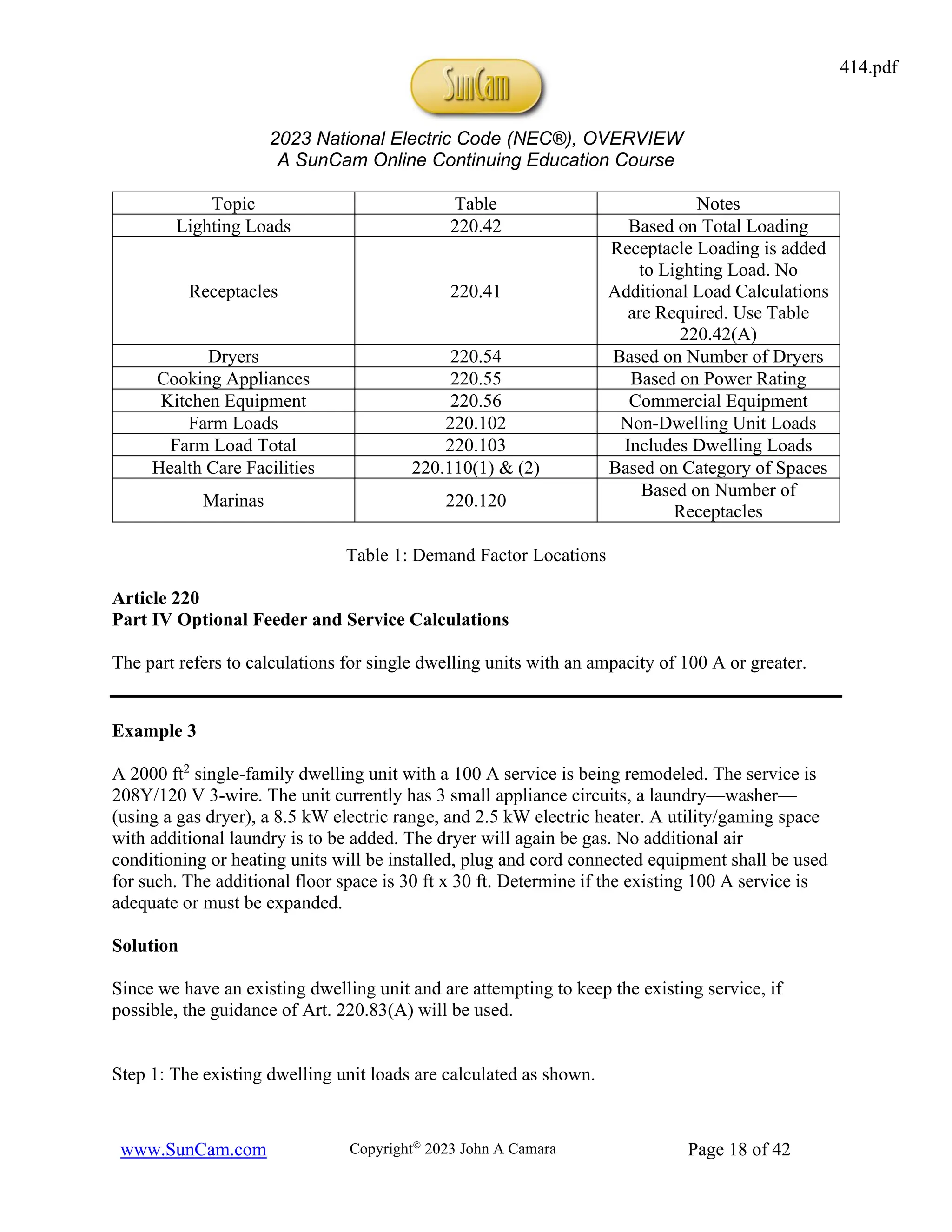
Demand factors, where allowed, are used to lower the overall load requirements. See Table 1 for
a summary of demand factor tables.
414.pdf
2023 National Electric Code (NEC®), OVERVIEW
A SunCam Online Continuing Education Course
www.SunCam.com Copyright©
2023 John A Camara Page 18 of 42
Topic Table Notes
Lighting Loads 220.42 Based on Total Loading
Receptacles 220.41
Receptacle Loading is added
to Lighting Load. No
Additional Load Calculations
are Required. Use Table
220.42(A)
Dryers 220.54 Based on Number of Dryers
Cooking Appliances 220.55 Based on Power Rating
Kitchen Equipment 220.56 Commercial Equipment
Farm Loads 220.102 Non-Dwelling Unit Loads
Farm Load Total 220.103 Includes Dwelling Loads
Health Care Facilities 220.110(1) & (2) Based on Category of Spaces
Marinas 220.120
Based on Number of
Receptacles
Table 1: Demand Factor Locations
Article 220
Part IV Optional Feeder and Service Calculations
The part refers to calculations for single dwelling units with an ampacity of 100 A or greater.
Example 3
A 2000 ft2
single-family dwelling unit with a 100 A service is being remodeled. The service is
208Y/120 V 3-wire. The unit currently has 3 small appliance circuits, a laundry—washer—
(using a gas dryer), a 8.5 kW electric range, and 2.5 kW electric heater. A utility/gaming space
with additional laundry is to be added. The dryer will again be gas. No additional air
conditioning or heating units will be installed, plug and cord connected equipment shall be used
for such. The additional floor space is 30 ft x 30 ft. Determine if the existing 100 A service is
adequate or must be expanded.
Solution
Since we have an existing dwelling unit and are attempting to keep the existing service, if
possible, the guidance of Art. 220.83(A) will be used.
Step 1: The existing dwelling unit loads are calculated as shown.
414.pdf
2023 National Electric Code (NEC®), OVERVIEW
A SunCam Online Continuing Education Course
www.SunCam.com Copyright©
2023 John A Camara Page 19 of 42
NOTE
The sequences in brackets are the NEC articles listed from the initial reference to the final
requirement.
Also, the NEC refers to VA, which is technically apparent power, S. The apparent power is used
for sizing of components to ensure they can handle the power required, P in units of watts (W),
as well as all the losses. The NEC will use the power P rating of equipment as the apparent
power S. I’ve shown both symbols here to emphasize this usage.
General Lighting [Art. 220.83(A)(1); 220.11(B); 220.14(J)]
SLighting
= PL
= 2000 ft2
´ 3
VA
ft2
= 6000 VA
Small Appliance Circuits [Art. 220.83(A)(2); 210.11(C)(1)—2 or more Circuits per
210.52(B)(1); 210.11(C)(2)—1 Laundry Circuit per 210.52(F)]
SSmall Appliance
= PSA
= 3 units ´1500
VA
unit
= 4500 VA
SLaundry
= PLaundry
= 1 units ´1500
VA
unit
=1500 VA
One Electric Range [Art. 220.83(A)(3)b] using the nameplate rating.
SRange
= PR
= 8.5 kW = 8500 VA
One Electric Water Heater [Art. 220.83(A)(3)d] using the nameplate rating.
SWater Heater
= P
WH
= 2.5 kW = 2500 VA
The total existing load is the sum of the loads above.
STotal
= SL
+ SSA
+ SLaundry
+ SR
+ SWH
= 6000 VA + 4500 VA +1500 VA + 8500 VA + 2500 VA
= 23,000 VA
Step 2: Now, determine the additional load for the remodeling effort.
General Lighting [Art. 220.83(A)(1); 220.11; 220.14(J)]
414.pdf
2023 National Electric Code (NEC®), OVERVIEW
A SunCam Online Continuing Education Course
www.SunCam.com Copyright©
2023 John A Camara Page 20 of 42
SLighting
= PL
= 30 ft ´ 30 ft ´3
VA
ft2
= 2700 VA
Small Appliance Circuits [Art. 220.83(A)(2); 210.11(C)(1)—2 or more Circuits per
210.52(B)(1)—Previously Installed; 210.11(C)(2)—1 Laundry Circuit per 210.52(F);
Laundry Load per 220.52(B)]
SLaundry
= PSA
= 1 units ´1500
VA
unit
=1500 VA
The total additional load is the sum of the loads above.
STotal
= SL
+ SSA
= 2700 VA +1500 VA
= 4200 VA
Step 3: Determine the total load. Apply the demand factors for the total load. [Art. 220.83(A)]
STotal
= SExisting
+ SRemodel
= 23,000 VA + 4200 VA
= 27,200 VA
The demand factors are 100% for the first 8 kVA and 40% for the remainder.
STotal
= 1.0
( ) S8kVA
( )+ 0.4
( ) SRemainder
( )
= 1.0
( ) 8000 VA
( )+ 0.4
( ) 27,200 VA -8000 VA
( )
= 8000 VA + 7680 VA
= 15,680 VA
Step 4: Determine the current load for the entire 208 V system and compare to the 100 A
available. Round the answer up to be conservative.
414.pdf
2023 National Electric Code (NEC®), OVERVIEW
A SunCam Online Continuing Education Course
www.SunCam.com Copyright©
2023 John A Camara Page 21 of 42
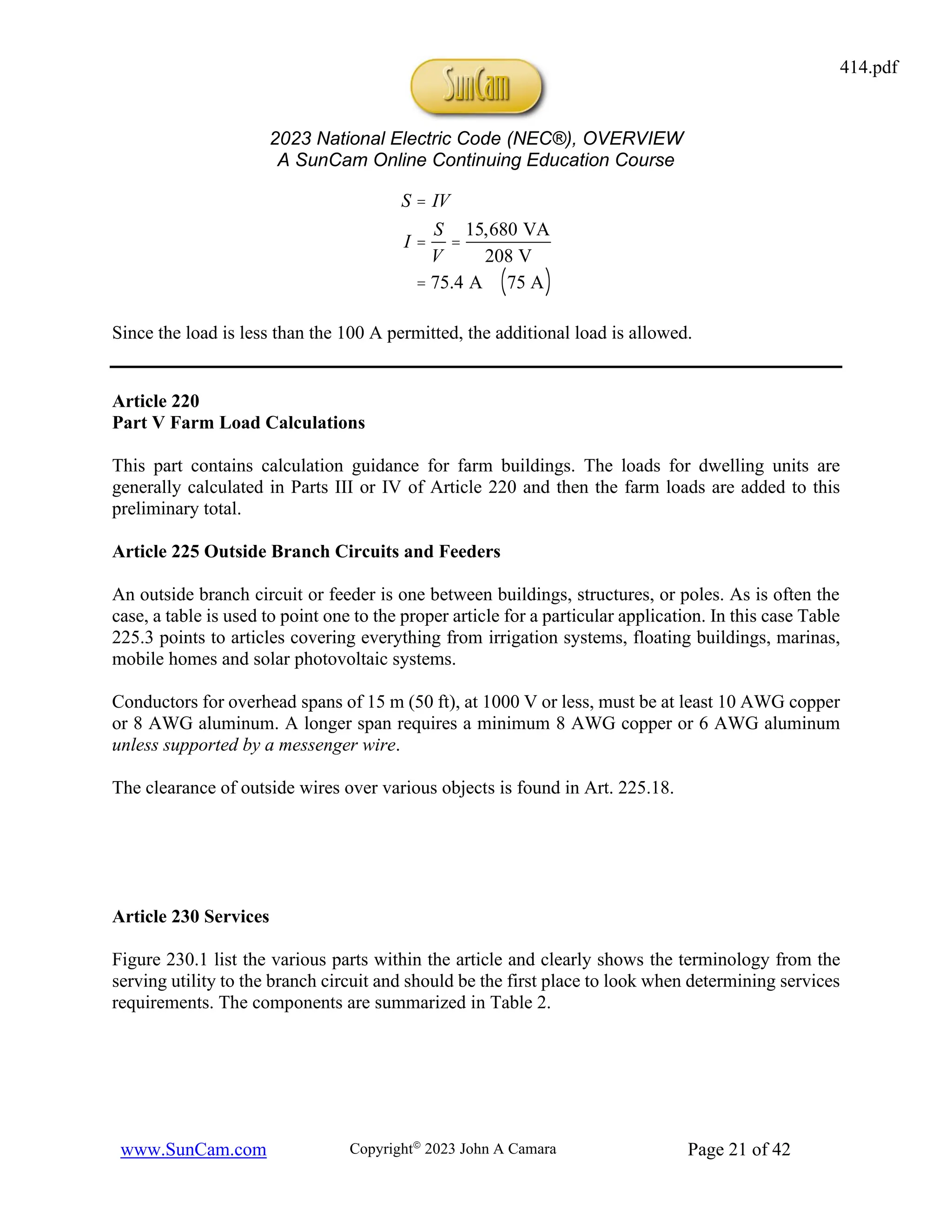
S = IV
I =
S
V
=
15,680 VA
208 V
= 75.4 A 75 A
( )
Since the load is less than the 100 A permitted, the additional load is allowed.
Article 220
Part V Farm Load Calculations
This part contains calculation guidance for farm buildings. The loads for dwelling units are
generally calculated in Parts III or IV of Article 220 and then the farm loads are added to this
preliminary total.
Article 225 Outside Branch Circuits and Feeders
An outside branch circuit or feeder is one between buildings, structures, or poles. As is often the
case, a table is used to point one to the proper article for a particular application. In this case Table
225.3 points to articles covering everything from irrigation systems, floating buildings, marinas,
mobile homes and solar photovoltaic systems.
Conductors for overhead spans of 15 m (50 ft), at 1000 V or less, must be at least 10 AWG copper
or 8 AWG aluminum. A longer span requires a minimum 8 AWG copper or 6 AWG aluminum
unless supported by a messenger wire.
The clearance of outside wires over various objects is found in Art. 225.18.
Article 230 Services
Figure 230.1 list the various parts within the article and clearly shows the terminology from the
serving utility to the branch circuit and should be the first place to look when determining services
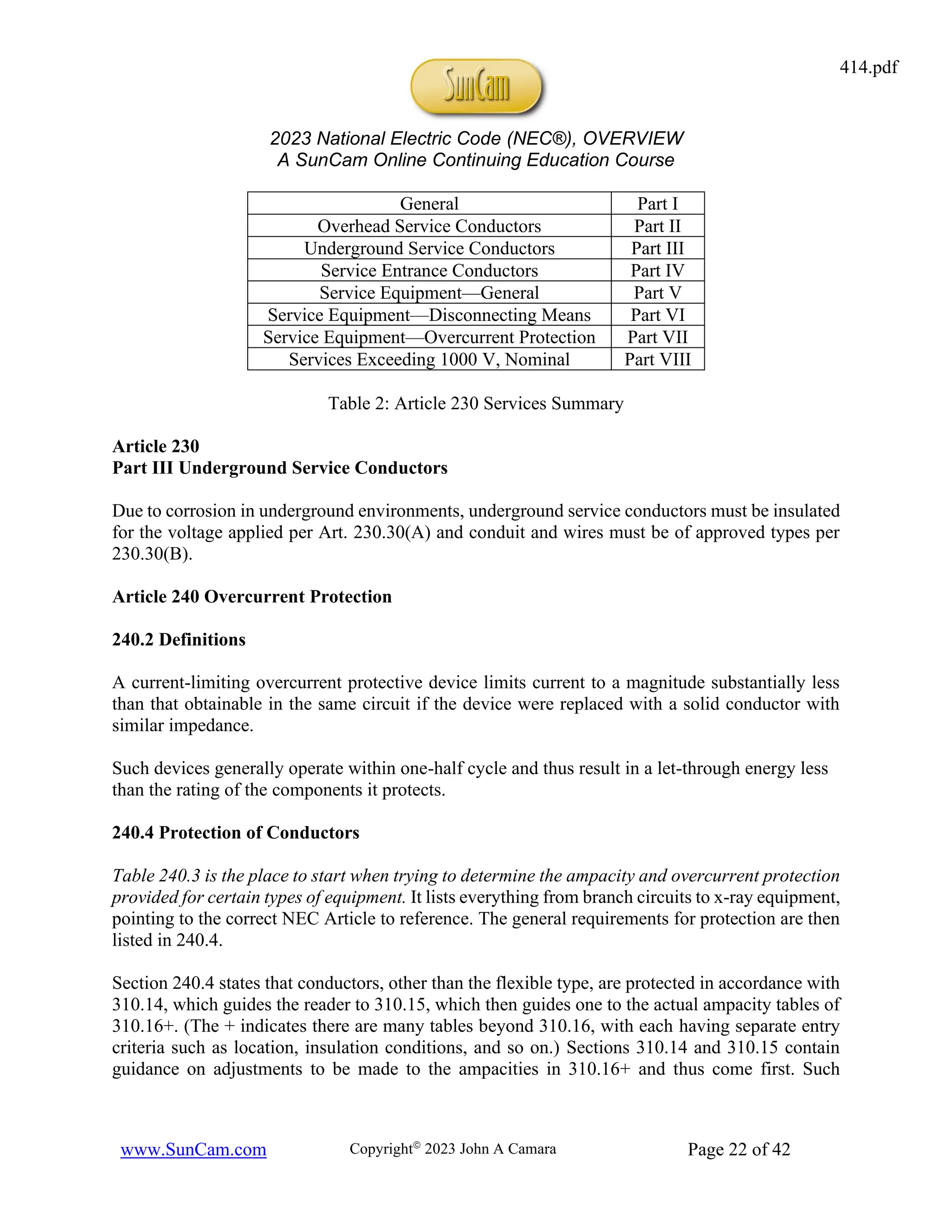
requirements. The components are summarized in Table 2.
414.pdf
2023 National Electric Code (NEC®), OVERVIEW
A SunCam Online Continuing Education Course
www.SunCam.com Copyright©
2023 John A Camara Page 22 of 42
General Part I
Overhead Service Conductors Part II
Underground Service Conductors Part III
Service Entrance Conductors Part IV
Service Equipment—General Part V
Service Equipment—Disconnecting Means Part VI
Service Equipment—Overcurrent Protection Part VII
Services Exceeding 1000 V, Nominal Part VIII
Table 2: Article 230 Services Summary
Article 230
Part III Underground Service Conductors
Due to corrosion in underground environments, underground service conductors must be insulated
for the voltage applied per Art. 230.30(A) and conduit and wires must be of approved types per
230.30(B).
Article 240 Overcurrent Protection
240.2 Definitions
A current-limiting overcurrent protective device limits current to a magnitude substantially less
than that obtainable in the same circuit if the device were replaced with a solid conductor with
similar impedance.
Such devices generally operate within one-half cycle and thus result in a let-through energy less
than the rating of the components it protects.
240.4 Protection of Conductors
Table 240.3 is the place to start when trying to determine the ampacity and overcurrent protection
provided for certain types of equipment. It lists everything from branch circuits to x-ray equipment,
pointing to the correct NEC Article to reference. The general requirements for protection are then
listed in 240.4.
Section 240.4 states that conductors, other than the flexible type, are protected in accordance with
310.14, which guides the reader to 310.15, which then guides one to the actual ampacity tables of
310.16+. (The + indicates there are many tables beyond 310.16, with each having separate entry
criteria such as location, insulation conditions, and so on.) Sections 310.14 and 310.15 contain
guidance on adjustments to be made to the ampacities in 310.16+ and thus come first. Such
414.pdf
2023 National Electric Code (NEC®), OVERVIEW
A SunCam Online Continuing Education Course
www.SunCam.com Copyright©
2023 John A Camara Page 23 of 42
adjustments include temperature limitations, location limitations (such as in a raceway with other
conductors) and more.
Table 310.16 is a great place to start when ampacity is required. It is the most commonly used
table. Notes at the table bottom will lead one to the proper adjustments.
Section 240.4(B) allows the next higher standard overcurrent device rating, which is above the
ampacity of the conductors) if certain conditions are met. The standard ratings of overcurrent
devices can be found in Table 240.6(A).
Section 240.4(D) covers maximums for small conductors. These values override the values that
might be given in 310.16. The two most common gauges used in household and building work 10
AWG and 12 AWG copper. These limits are worth remembering, especially if one works with the
NEC often, with 12 AWG limited to 20 A and 10 AWG limited to 30 A.
240.5 Protection of Flexible Cords, Flexible Cables, and Fixture Wires
Having just mentioned the limits for conductors from 240.4(D), this section allows smaller wires
to be utilized as “tap” conductors to be attached to circuits protection at values above their
ampacities. For example, A 14 AWG wire that is limited to 15 A by 240.4(D)(3) is allowed to be
connected to a circuit protected at 20 A or 30 A per 250.5(B)(2)(2) and 250.5(B)(2)(3).
240.12 Electrical System Coordination
Coordination of trip devices is used when an orderly shutdown of a system is required, or when it
is desired to maintain the unaffected parts of the system in operation. The main premise of
coordination is summarized as opening the breaker closest to the fault first and furthest from the
fault last.
240.21 Location in Circuit
Multiple requirements here for taps, according to lengths and locations. One to remember is that
a transformers overcurrent protection can be located on the primary side only if the conditions of
240.21(C)(1) are met.
Part III Enclosures
240.33 Vertical Position
Enclosures to be mounted vertically. This is primarily to comply with 240.81 that requires “up” to
be “on” and “down” to be “off”.
414.pdf
2023 National Electric Code (NEC®), OVERVIEW
A SunCam Online Continuing Education Course
www.SunCam.com Copyright©
2023 John A Camara Page 24 of 42
Part VII Circuit Breakers
240.83 Marking
Many marking provisions exist. Of note for most PE’s would be the interrupting rating, which, if
anything other than 5000 A, must be marked on the breaker per 240.83(C).
Article 242 Overvoltage Protection
This entire article is focused on surge protection devices (SPDs). Use Table 242.3 for requirements
for specialized equipment.
Article 250 Grounding & Bonding
Much confused, a “ground” is a connection to Earth. Bonding is a connection established in such
a way as to ensure electrical continuity and conductivity. So the ground is the actual connection
and bonding is the ohmic requirements for that connection. Start in Figure 250.1 to find the
appropriate Part containing the requirements for which you are interested. Use Informational
Note Fig. 250.3 for specific types of equipment.
Refer back to figure 3 for the various grounding conductor terminology.
250.36 High-Impedance Grounded Neutral Systems
Neutrals installed deliberately with a grounding impedance device (resistor) are known as high-
impedance grounded systems. They are used to limit ground fault current to a value that does NOT
exceed the capacitive charging current and thus does not result in tripped breaker. This is used in
systems where continuity of power is at a premium.
The capacitive charging current is the current that flows in a transmission line even when no load
is connected. For information, this current can be calculated by summing the zero-sequence
capacitance or by determining the capacitive reactance of the cabling and using Ohm’s law to
determine the current flow.
The cable connecting the grounding device must be rated for the current, but in no case shall it be
smaller than 8 AWG copper or 6 AWG aluminum or copper-clad aluminum per 250.36(B).
Part III Grounding Electrode System
250.52 Grounding Electrodes
414.pdf
2023 National Electric Code (NEC®), OVERVIEW
A SunCam Online Continuing Education Course
www.SunCam.com Copyright©
2023 John A Camara Page 25 of 42
Common grounding electrodes include water pipes—if in contact with the earth for 3 m (10 ft) or
more and metal in ground support structures, again with the same contact requirement.14
Concrete-
encased electrodes of zinc or copper can be used but must have contact of at least 6 m (20 ft).
Many other types are listed include the very common rod electrodes, which have contact of 2.44
m (8 ft).
The primary goal (requirement) is for the grounding system to have resistance to earth of 25 Ω per
250.53(A)(2) Exception. This requirement for 25 Ω can be found in numerous references.
The grounding electrode conductor that connects the system to the grounding electrode is sized per Table
250.66.
Part V Bonding
Bonding is the process of connecting material to ensure electrical continuity. The NEC tells one how to
bond and the size of the connecting cable, Table 250.102(C)(1). It does not provide an ohmic specification
for the bond. This varies according to the type of equipment, connection, and purpose. The value varies
from 1 mΩ and upward.
Part VI Equipment Grounding and Equipment Grounding Conductors
The title is self-explanatory with this part providing guidance on the grounding requirements for everything
from metal enclosures to pipe organs.
Equipment grounding conductors (see Figure 3) are sized to be up to but not larger than the circuit
conductors per 250.122(A). A relatively new requirement (in 2020 Code) requires the equipment grounding
conductor to be increased proportionally if the circuit conductors are increased per 250.122(B).
Example 4
The original plan for conductors used in a long run were for 300 kcmil conductors and a 6 AWG
equipment grounding conductor (EGC). When operated, and after load changes, the voltage drop
was found to be excessive. The circuit conductors were updated to 400 kcmil. What is the
minimum size required for the equipment grounding conductor following the change?
Solution
Step 1: Calculate the proportional increase (ratio) in the ungrounded conductors.
14
The NEC used the USCS (US Customary System) often called the English Engineering
System (though there are differences—see the Author’s Power Reference Manual for a fuller
explanation). Now, metric is used, or given first, with the traditional value in parenthesis.
414.pdf
2023 National Electric Code (NEC®), OVERVIEW
A SunCam Online Continuing Education Course
www.SunCam.com Copyright©
2023 John A Camara Page 26 of 42
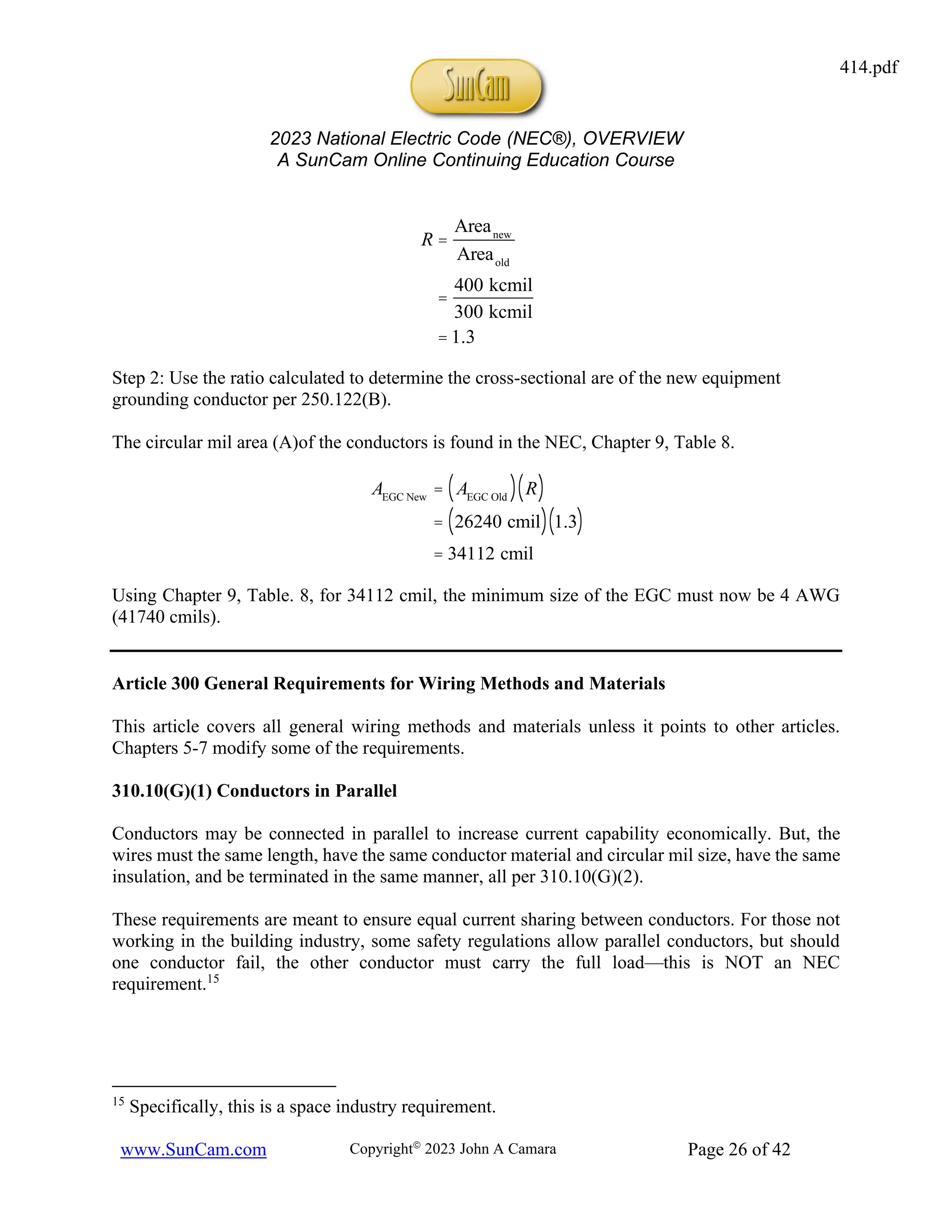
R =
Areanew
Areaold
=
400 kcmil
300 kcmil
= 1.3
Step 2: Use the ratio calculated to determine the cross-sectional are of the new equipment
grounding conductor per 250.122(B).
The circular mil area (A)of the conductors is found in the NEC, Chapter 9, Table 8.
AEGC New
= AEGC Old
( ) R
( )
= 26240 cmil
( ) 1.3
( )
= 34112 cmil
Using Chapter 9, Table. 8, for 34112 cmil, the minimum size of the EGC must now be 4 AWG
(41740 cmils).
Article 300 General Requirements for Wiring Methods and Materials
This article covers all general wiring methods and materials unless it points to other articles.
Chapters 5-7 modify some of the requirements.
310.10(G)(1) Conductors in Parallel
Conductors may be connected in parallel to increase current capability economically. But, the
wires must the same length, have the same conductor material and circular mil size, have the same
insulation, and be terminated in the same manner, all per 310.10(G)(2).
These requirements are meant to ensure equal current sharing between conductors. For those not
working in the building industry, some safety regulations allow parallel conductors, but should
one conductor fail, the other conductor must carry the full load—this is NOT an NEC
requirement.15
15
Specifically, this is a space industry requirement.
414.pdf
2023 National Electric Code (NEC®), OVERVIEW
A SunCam Online Continuing Education Course
www.SunCam.com Copyright©
2023 John A Camara Page 27 of 42
Conductor ampacities can be determine from table or calculated using engineering supervision.
Most use the tables of 310.16. The Table Notes should be read and utilized for correction factors
and conditions that differ from the table assumptions.
310.15 Ampacity Tables
Section 310.15 points to Table 310.16, which is truly the correct place to start for ampacity
determine. Section 310.15 contains the Ambient Temperature Correction Factors in 310.15(B)(1)
and (2) as well as adjustment factors for more than three current-carrying conductors in
310.15(C)(1). Actual ampacities are in 310.16 through 310.21. An important item to note: even if
another section of the NEC requires you to use the 60ºC column, if your wire is rated for 75ºC or
higher, the adjustment factors are applied to that ampacity, not the 60ºC ampacity per 110.14(C).
Example 5
Termination provisions for a branch circuit are marked to handle 14 AWG through 1 AWG. The
circuit is to carry 80 A in a raceway of 6 current carrying conductors at an ambient temperature
of 35ºC. Type THHW wire rated for 75ºC is the conductor of choice. What size wire should be
used?
Solution
For circuits carrying 100 A or less with terminations marked 14 AWG through 1 AWG, the
ampacity of the THHW wire in Table 310.16 must be determined from the 60ºC column per
110.14(C)(1)(a)(2). For carrying at least 80 A, using the 60ºC, the wire must be at least 3
AWG—which has a rating of 85 A.
Now, two corrections must be applied. Table 310.16 uses an ambient of 30ºC, see Note 1, which
directs one to 310.15(B). Using 310.15(B)(1) and the row containing 35ºC, the correction
factor—using the 75ºC column—is 0.94.
Note 2 of 310.16 directs one to 310.15(C)(1) that requires an adjustment factor of 80% or 0.8.
Applying these factors to the 75ºC ampacity gives a final value.
ICorrected
= IInitial
TCorrection
CCorrection
= 100 A
( ) 0.94
( ) 0.80
( )
= 75.2 A
414.pdf
2023 National Electric Code (NEC®), OVERVIEW
A SunCam Online Continuing Education Course
www.SunCam.com Copyright©
2023 John A Camara Page 28 of 42
Therefore, the 3 AWG wire is too small. Using 2 AWG wire and starting with Table 310.16
gives
ICorrected
= IInitial
TCorrection
CCorrection
= 115 A
( ) 0.94
( ) 0.80
( )
= 86.48 A
This value is greater than the 80 A required. The answer then is 2 AWG wire.
312.6 Deflection of Conductors
If you are responsible for installation of wiring in panel boards or cable boxes, normal performed
by licensed electricians, an in-depth study of 312.6 and the associated tables is recommended.
Much of the rest of Article 300 covers installation and construction specifications as well as types
of cables and their uses.
Chapter 4 Equipment for General Use
Article 400 Flexible Cords and Flexible Cables
400.4 Types
This section lists the various types of cords and cable along with their properties in Table 400.4
that includes circular mil size, voltage, insulation, and more. The markings on each cable needed
to enter the table can be found on the cord or cable at intervals of not more than 610 mm (24 in)
apart per 400.6.
400.5 Ampacities for Flexible Cords and Flexible Cables
Tables 400.56(A)(1) and (2) lists the associated ampacities by wire gauge size with Table
400.5(A)(3) having the adjustment factors for the number of conductors. Their permitted and
prohibited uses are in 400.10(A) and 400.12, respectively.
402 Fixture Wires
Fixture wire types are in Table 402.3 with ampacities in Table 402.5.
Both flexible cords/cables and fixture wires are not “wiring methods” per the NEC. Hence, they
are covered in Article 400 instead of Article 300. Flexible cords/cables connect a device to a power
414.pdf
2023 National Electric Code (NEC®), OVERVIEW
A SunCam Online Continuing Education Course
www.SunCam.com Copyright©
2023 John A Camara Page 29 of 42
source. Fixture wires are inside those devices, for example, the wiring inside a lamp. Neither type
is considered part of the branch circuit.
Article 408 Switchboards, Switchgear, and Panelboards
Ungrounded AC systems are sometimes used for reliability purposes and must be marked per
408.3(F)(2).16
High-Impedance Grounded Neutral AC Systems are used to help operators identify
the location of the fault using ground detectors without taking the equipment off-line. Because this
results in a higher voltage to ground, such systems are also labeled to indicate the potential hazard
per 408.3(F)(3).
Article 410 Luminaires, Lampholders, and Lamps
Luminaires must be mounted 900 mm (3 ft) horizontally and 2.5 m (8 ft) vertically from a
bathroom or shower area, 410.10(D)(1). If located within this zone they must be listed for wet
locations, 410.10(D)(2).
Part XV Decorative Lighting and Similar Accessories
Part XVI Special Provisions for Horticultural Lighting Equipment
Article 422 Appliances
Most of the typical calculations required for appliances was covered in Section 220.
Article 430 Motors, Motor Circuits, and Controllers
Part I General
This is the place to start any search for information, see Figure 430.1 that details what each part
covers and provides a visual aid of those components. See Table 430.5 for specialty applications
such as air-conditioning equipment, cranes, and theaters.
430.6 Ampacity and Motor Rating Determination
Nameplate ampere rating causing quite a bit of confusing in the industry. Section 430.6(A)(1)
requires the use of the horsepower rating on the motor as the entry information to obtain the
ampacity from Table 430.247, 430.248, 430.249, and 430.250. (Except for low speed motors,
<1200 rpm, high torque and multispeed motors.) The reason for this is that the tables account for
typical efficiencies, power factors, and rpm changes that result in higher currents whereas the
nameplate does not. The sentence that confuses states, “Where a motor is marked in amperes, but
16
Submarines, in which the author has experience, is one such system.
414.pdf
2023 National Electric Code (NEC®), OVERVIEW
A SunCam Online Continuing Education Course
www.SunCam.com Copyright©
2023 John A Camara Page 30 of 42
not horsepower, the horsepower shall be assumed to be that corresponding to the value given in
Table 430.247, 430.248, 430.249, and 430.250.” What this essentially means is that one is using
the nameplate amperage. That is, one looks up the nameplate amperage and determines the
horsepower rating from the table, interpolating if required, and uses that value for all calculations.
The exceptions to 430.6(A)(1) are important. Exception #1 points to 430.22(B) and 430.52 for
amperage guidance. Exception #2 allows the use of the nameplate amperage for shaded-pole or
permanent-split capacitor-type fan or blower motor. Exception #3, another source of confusion,
allows the use of the appliance nameplate amperage even when both the amperage and
horsepower of the motor are listed. In simple terms, this is because the appliance contains more
than just the motor.
430.7 Marking on Motors and Multimotor Equipment
In 430.7(A)(9) specifies that a motor shall be marked with a Design Letter of A, B, C, or D that
relate motor characteristics such as current, slip, locked-rotor and breakdown torque. These letters
are defined in ANSI/NEMA MG-1-1993, Motors and Generators, Part 1, Definitions and IEEE
100-1996, Standard Dictionary of Electrical and Electronic Terms.17
These design letters should not be confused with the locked rotor indicating code letters, which
also have an A,B, C, and D and are listed in Table 430.7(B).
Example 6
A 50 hp, three phase, 208 V motor has a locked rotor code letter of H. What is the highest
expected locked rotor current?
Solution
Step 1: Use Table 430.7(B) to find the maximum value of kVA/hp for Code H, which is 7.09.
Step 2: Determine the maximum locked rotor kVA.
PLocked kVA
= Php
( ) LRC
( )
= 50 hp
( ) 7.09
( )
= 354.5 kVA
17
If one has access, I highly recommend obtaining an authorized copy of IEEE 100-1996.
McGraw-Hill also has an excellent Dictionary of Scientific and Technical Terms.
414.pdf
2023 National Electric Code (NEC®), OVERVIEW
A SunCam Online Continuing Education Course
www.SunCam.com Copyright©
2023 John A Camara Page 31 of 42
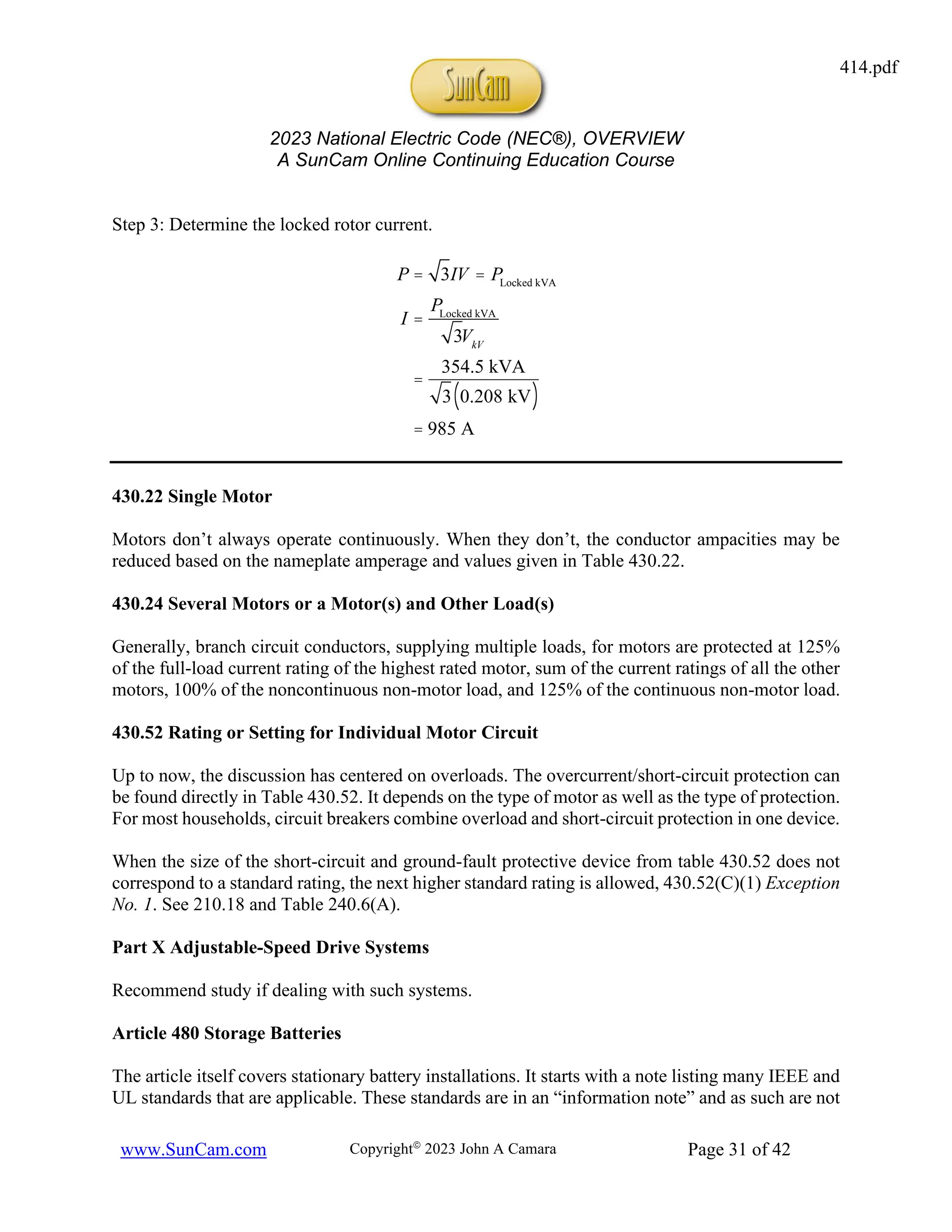
Step 3: Determine the locked rotor current.
P = 3IV = PLocked kVA
I =
PLocked kVA
3VkV
=
354.5 kVA
3 0.208 kV
( )
= 985 A
430.22 Single Motor
Motors don’t always operate continuously. When they don’t, the conductor ampacities may be
reduced based on the nameplate amperage and values given in Table 430.22.
430.24 Several Motors or a Motor(s) and Other Load(s)
Generally, branch circuit conductors, supplying multiple loads, for motors are protected at 125%
of the full-load current rating of the highest rated motor, sum of the current ratings of all the other
motors, 100% of the noncontinuous non-motor load, and 125% of the continuous non-motor load.
430.52 Rating or Setting for Individual Motor Circuit
Up to now, the discussion has centered on overloads. The overcurrent/short-circuit protection can
be found directly in Table 430.52. It depends on the type of motor as well as the type of protection.
For most households, circuit breakers combine overload and short-circuit protection in one device.
When the size of the short-circuit and ground-fault protective device from table 430.52 does not
correspond to a standard rating, the next higher standard rating is allowed, 430.52(C)(1) Exception
No. 1. See 210.18 and Table 240.6(A).
Part X Adjustable-Speed Drive Systems
Recommend study if dealing with such systems.
Article 480 Storage Batteries
The article itself covers stationary battery installations. It starts with a note listing many IEEE and
UL standards that are applicable. These standards are in an “information note” and as such are not
414.pdf
2023 National Electric Code (NEC®), OVERVIEW
A SunCam Online Continuing Education Course
www.SunCam.com Copyright©
2023 John A Camara Page 32 of 42
part of the requirements of the NEC, but by listing them they clearly should be read and
understood. Figure 6 shows some battery terminology.18
Figure 6: Battery Standard Terminology
[Source: Power Reference Manual for the PE Exam]
480.2 Definitions
Nominal Voltage (Battery or Cell): The value assigned to a cell or battery for the purpose of
convenient designation. The operating voltage varies depending on a variety of factors.
Informational Note: Lead-Acid has a nominal cell voltage of 2 V/cell. Alkali systems have a
nominal of 1.2 V/cell. Li-ion cells, now in widespread use to due high energy density, have a
nominal voltage of 3.6 V/cell to 3.8 V/cell.
Example 7
A standard car battery is lead-acid and operates at approximately 12 V. Approximately how
many cells does the car battery contain?
Solution
Using 2 V/cell nominal gives the following number of cells.
18
Anode is from a Greek word meaning ascent, sometimes translated as high water. When Ben
Franklin performed his famous kite experiment, it appeared to him as if a cup was being filled to
overflow. He named those charges as positive and from that we get anode since current (water)
flows from high to low. Unfortunately, the sparks he observed were electrons, which were
discovered later and given the negative charge. So now, as engineers we learn that “conventional
current flows” from positive to negative (which it does inside the battery, hence the
anode/cathode designations) and positive to negative when discharging outside the battery, hence
the red cover on the cathode connection of the battery and the label +, and the black cable on the
anode connection of the cable and the label –.
414.pdf
2023 National Electric Code (NEC®), OVERVIEW
A SunCam Online Continuing Education Course
www.SunCam.com Copyright©
2023 John A Camara Page 33 of 42
Ncells
=
Voperating
Vper cell
=
12 V
2 V/cell
= 6 Cells
480.6 Overcurrent Protection for Prime Movers
The cable running from the battery in your car to the starter has no overcurrent protection. This is
because of 480.6 that allows batteries with a voltage of 60 V or less to forego overcurrent
protection if they provide power for starting, ignition, or control of prime movers.
480.10 Battery Locations
Battery spaces require ventilation to prevent an explosive mixture from forming. Mechanical
ventilation may not be required. Hydrogen disperses easily though. It accumulates at the top of
spaces and a means of removal must be installed. Certain batteries called “Valve-Regulated” are
considered to be sealed but even during normal operation may emit some hydrogen.19
During
failure of such a battery large amounts of explosive gasses can be released. Only Li-Ion and Nickle
Chloride do not require ventilation during normal and abnormal charging conditions.
Chapter 5 Special Occupancies
Article 500 Hazardous (Classified) Locations, Classes I, II, and III. Divisions 1 and 2
Areas that are deemed hazardous locations have additional requirements for electrical installations
beyond those normally employed by the NEC. NEC Art. 500, “Hazardous (Classified) Locations,”
contains the requirements to ensure electrical equipment or systems within a hazardous location
will not ignite flammable or combustible material.20
The NEC itself does not classify the locations;
classification is left to the appropriate NFPA standards.
NEC Art. 500 incorporates some of the more common standards used by electrical engineers,
including NFPA 497, Recommended Practices for the Classification of Flammable Liquids, Gases,
or Vapors and of Hazardous (Classified) Location for Electrical Installations in Chemical Process
19
VRLA stands for Valve-Regulated Lead Acid.
20
The classification is determined by the hazardous material itself and how it is used in a given
facility. Once this is determined per the appropriate standard, then the appropriate electrical
requirements of the NEC are invoked.
414.pdf
2023 National Electric Code (NEC®), OVERVIEW
A SunCam Online Continuing Education Course
www.SunCam.com Copyright©
2023 John A Camara Page 34 of 42
Areas, and NFPA 499, Recommended Practice for the Classification of Combustible Dust and
Hazardous (Classified) Locations for Installations in Chemical Process Areas.21
The terms
hazardous and classified in the titles are used interchangeably in standards and codes.
NEC 500.4 (B), Informational Notes 1-6 lists numerous reference standards. A relatively common
standard for electrical engineers to encounter is NFPA 30, Flammable and Combustible Liquids
Code.22
When it became clear that flammable aerosol products were a more significant fire hazard
than previously recognized, a specific version of this code, NFPA 30B, Code for the Manufacture
and Storage of Aerosol Products, was created.
The various hazardous standards comprise information primarily regarding classification, basic
facility requirements, storage of hazardous material, occupancy limits, and operational and
maintenance requirements. While impacting the overall design of a facility, these standards are not
the focus for the electrical engineer. Each standard does, however, place design limitations directly
on the electrical systems—nearly all of which point back to the appropriate articles in the NEC.23
Each standard breaks the requirements into a class based on the properties of the flammable gas or
vapor (Class I), combustible dusts (Class II), or fibers/flyings (Class III) that might be present.
Each class is further subdivided into a division depending, generally, on whether the hazard is
present during normal operations (Division 1) or present during abnormal conditions (Division 2).
NEC Art. 500 covers Classes I, II, and III with Divisions 1 and 2.
Class I locations can also be divided into zones (instead of divisions) where ignitable
concentrations of flammable gasses or vapors are present continuously or for long periods of times
(Zone 0); are present under normal operating conditions or due to frequent maintenance (Zone 1);
or are present for a short period of time or enclosed in containers (Zone 2). Class II and Class III
may also be alternatively handled as zones where the dust (Class II) or fibers/flyings (Class III)
21
See NEC Art. 500 Informational Note for the standard NFPA 497 whose focus is on liquids,
gasses, or vapors and NFPA Standard 499 whose focus is on dust. NFPA 30B focuses on
aerosols, and while not specifically mentioned in NEC Art. 500.4(B), it is mentioned in
Informational Note 2 as a follow-on to NFPA 30. None of these standards covers explosives,
pyrotechnics, or blasting agents—nor does the NEC. Since pyrotechnics ignite spontaneously in
air, NEC requirements won’t minimize the hazard. Explosives and blasting agents have unique
requirements and therefore separate standards unrelated to the NEC.
22
A flammable liquid has a flash point below 100F while a combustible liquid has a flash point
at or above 100F. Flammable means easily set on fire while combustible requires more vigorous
conditions to be set on fire; and generally, a combustible material is considered one that may
burn or explode. The flash point is the lowest temperature at which the vapors of the material
will ignite, given an ignition source.
23
Given this, and the exact hazardous classifications will likely be provided in the design. The
recommended focus should be on the NEC 70 requirements for the various locations.
414.pdf
2023 National Electric Code (NEC®), OVERVIEW
A SunCam Online Continuing Education Course
www.SunCam.com Copyright©
2023 John A Camara Page 35 of 42
are present continuously or for long periods of times (Zone 20); are present under normal operating
conditions or due to frequent maintenance (Zone 21); or are present for a short period of time or
enclosed in containers (Zone 22).
The requirements for divisions and zones parallel each other with the zone designation guided by
the International Electrotechnical Commission (IEC). Zone protection methods are defined in NEC
505.2. In the zone system, no differentiation exists for fibers/flyings, and the material groups are
numbered differently. See the comparison of groups in the division system and the zone system in
Table 3.
Class I division requirements are in NEC Art. 501; Class II division requirements are in
NEC Art. 502; and Class III division requirements are in Art. 503. Intrinsically safe systems
are covered in Art. 504.24 Class I zone requirements are in NEC Art. 505, with Class II and
Class III zone requirements in Art. 506.25
Atmospheric groups are attached to each of the classes to further differentiate the hazardous
conditions, with each class having several groupings: Class I, Groups A, B, C, D, and E; Class II,
Groups E, F, and G.
The groups used for equipment testing, approval, and area classification for Class I, Zones 0, 1,
and 2 are known as Material Groups IIC, IIB, and IIA (listed in order of severity from least to
worst). When Class II (dusts) and Class III (fibers/flyings) locations are classified by zones rather
than divisions, they are divided into three material groups: Group IIIC, Group IIIB, and IIIA (listed
in order of severity from least to worst). It is these material groups that are used to test and then
rate equipment for use in the appropriate zones. Additional design guidance for intrinsically safe
(IS) equipment for use around such materials and in the indicated hazardous divisions or zones is
in NEC Art. 504.
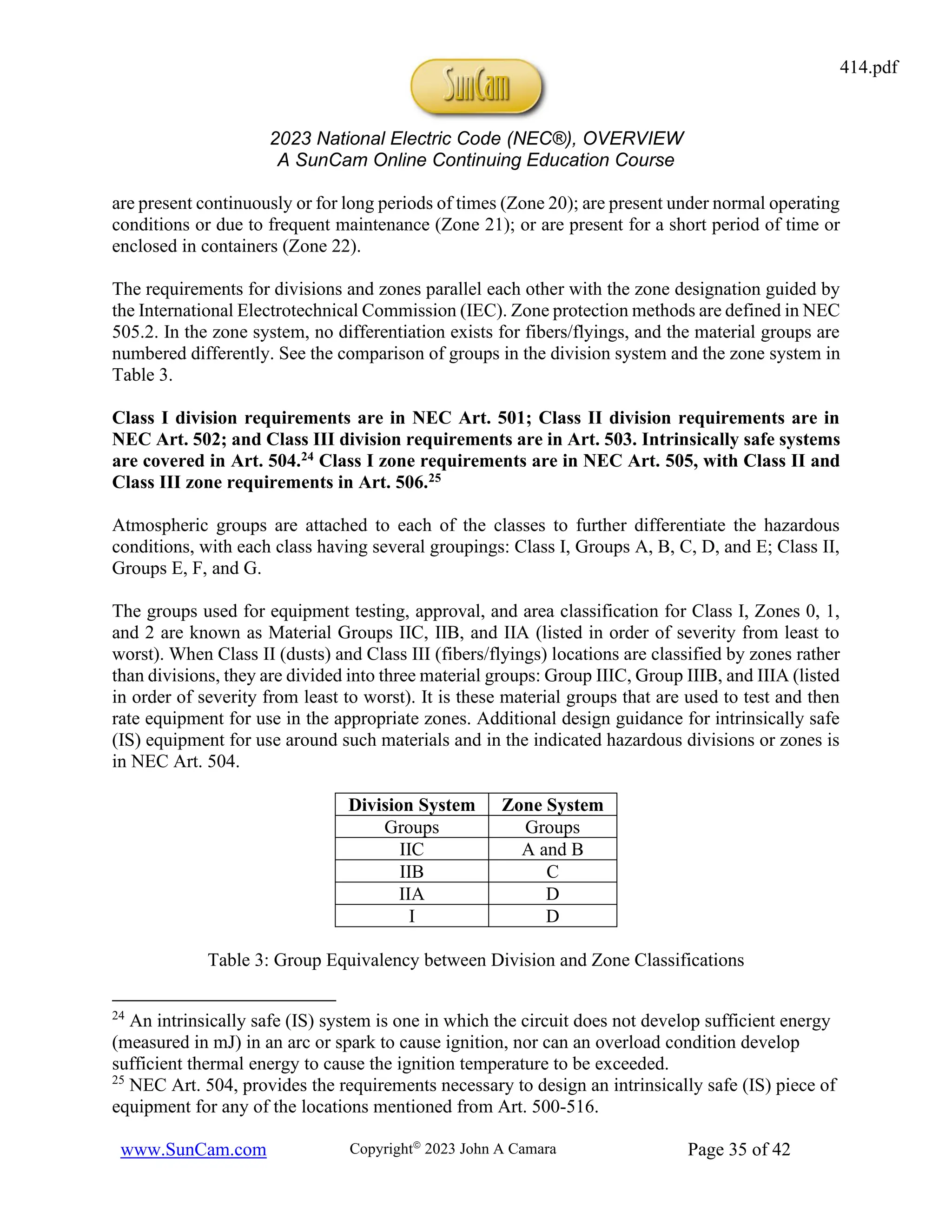
Division System Zone System
Groups Groups
IIC A and B
IIB C
IIA D
I D
Table 3: Group Equivalency between Division and Zone Classifications
24
An intrinsically safe (IS) system is one in which the circuit does not develop sufficient energy
(measured in mJ) in an arc or spark to cause ignition, nor can an overload condition develop
sufficient thermal energy to cause the ignition temperature to be exceeded.
25
NEC Art. 504, provides the requirements necessary to design an intrinsically safe (IS) piece of
equipment for any of the locations mentioned from Art. 500-516.
414.pdf
2023 National Electric Code (NEC®), OVERVIEW
A SunCam Online Continuing Education Course
www.SunCam.com Copyright©
2023 John A Camara Page 36 of 42
Example 8
A welding facility using acetylene normally stores the material in a closed container when not in
use. What class, division, and group designation is expected?
Solution
Acetylene, a flammable vapor, is normally stored when not in use; therefore, NEC Art.
505.5(B)(2)(1) applies and the designation is Class I, Division 2.
The Class I group classifications are given in 500.6 (A), and for acetylene in particular, in 500.6
(A)(1), which shows it as a Group A material.
The final designation is thus Class I, Division 2, Group A.
Note: The word “expected” was used in the question because the NEC does not classify a space.
Such classification, in this case, would be using the standards in NFPA 497.
Example 9
A Class I, Division 2 area requires wiring. The installation drawing shows the use of rigid
metallic conduit (RMC) in the space. Can RMC be used? Are there any restrictions?
Solution
The requirements for Class I locations are in NEC Art. 501. Specifically for Class I, Division 2,
the wiring requirements are in 501.10 (B)(1)(1) for RMC. This section states the RMC can be
used, but only with “listed threadless fittings.”
The answer is yes, the RMC may be used, with the additional restriction of using threadless
fittings.
Hazardous Location Classification: Aerosol Products
NFPA 30B focuses on the hazards of aerosol products. It requires electrical equipment and wiring
to meet general NEC requirements.26
However, when aerosols are installed in areas where
26
NFPA 30B 4.3.1
414.pdf
2023 National Electric Code (NEC®), OVERVIEW
A SunCam Online Continuing Education Course
www.SunCam.com Copyright©
2023 John A Camara Page 37 of 42
flammable liquids and gasses are handled, NEC Arts. 500 and 501 must be met.27
Limiting sources
of ignition, such as lightning, static electricity, arcs and sparks, and stray currents, are a concern.28
These hazards are minimized by complying with NEC requirements during installation. For
example, lightning protection should be provided using rods, grounding, and surge protectors.29
When a facility has a flammable propellant and charging pump room, the electrical equipment and
wiring in the room must meet the requirements of a Class I, Division 1 location or Class I, Zone 1
location according to NEC Art. 500, 501, 504, and 505.30
Example 10
An intrinsically safe (IS) device is to be installed per a customer request in a hazardous location.
The installing electrician ask the responsible engineer how the device is to be wired and if there
are any specific restrictions. What articles in the NEC should the responsible engineer point out
to the electrician?
Solution
The wiring method for IS devices is given in NEC Art. 504.20. This article states that any
methods used in unclassified locations may be used in a hazardous (classified) location.
However, the conductors must be separated from non-IS wiring per NEC Art. 504.30, and
conduits and cables used must be sealed to minimize the passage of gases, vapors, or dust per
NEC Art. 504.70.
Hazardous Location Classification: Liquids, Gasses, and Vapors
NFPA 497 focuses on the hazards of liquids, gasses, and vapors in chemical process areas.
Combustible materials are divided into classes. Class I division requirements apply to specific
materials with a flash point of less than 100F and is further divided into four groups. Group A is
acetylene. Group B is a gas, liquid, or vapor that may burn or explode with a minimum
experimental safe gap (MESG) of less than or equal to 0.45mm or a minimum igniting current
ratio (MIC ratio) of less than or equal to 0.40—typically, hydrogen. Group C and D have higher
MESG or MIC ratios than Group B.
27
NFPA 30B 4.3.1.1
28
NFPA 30B 4.8.2 and 8.3. Only those sources directly concerning electrical engineering are
listed in this manual.
29
See the NEC Handbook index for a list of the numerous articles covering these topics.
30
NFPA 30B 5.3
414.pdf
2023 National Electric Code (NEC®), OVERVIEW
A SunCam Online Continuing Education Course
www.SunCam.com Copyright©
2023 John A Camara Page 38 of 42
Class I zone requirements apply to locations within a facility where combustible material mixes
with air. Zones are divided into Groups IIA, IIB, and IIC as determined by the MESG or MIC
ratio. Tables listing various chemicals and their classifications are provided.
The classifications are further delineated in NFPA 497, Chap. 5 as Class I, Division 1 or 2, and
Class I, Zone 0, 1 or 2. The classifications are dependent upon the hazardous material, whether it
is present in the atmosphere frequently or not, the ventilation system, and the potential impact to
electrical systems. These zones are then used to determine the applicable articles in the NEC.
The items impacting electrical design and installation from NFPA 497 are incorporated into the
NEC. Therefore, once the classification is known, or provided in design documentation, the
applicable sections of the NEC are then applied to the electrical design—NEC Art. 500, 501, 502,
503, and 505.
Hazardous Location Classification: Combustible Dust
NFPA 499 focuses on combustible dust in chemical process areas. It divides combustible dusts,
considered Class II, into Groups E, F, and G depending upon the presence of combustible dust in
atmosphere. Class III, Groups IIIA, IIIB, and IIIC are material groups where combustible dust is
present, being handled, manufactured, or stored.
Dust ignition-proof electrical equipment, pressurized electrical equipment, and intrinsically safe
(IS) equipment can be used in both Division I and Division 2 locations.31
Other dust tight
equipment enclosures as specified in NFPA 70 (the NEC) may be used in Division 2 locations.32
However, electrical wiring or equipment approved for Class I, Division 1 (normal operations) may
not be suitable in a Class II location.33
Protection for an electrical breakdown resulting in an
ignition is not provided in the standard because the possibility of changes in the breakdown voltage
and the release of combustible material occurring simultaneously is considered remote.34
Where
both flammable gasses or vapors and combustible dust are present, the design must comply with
both Class I and Class II conditions.35
Combustible dusts are divided into three groups in the
Division system (Groups E, F, and G) and three groups in the Zones system (Groups IIIC, IIIB,
IIIA).36
The various combustible dusts along with their properties are listed in NFPA 497 Table 5.2.1 using
their CAS number (Chemical Abstract number). Ignition temperatures are provided to place the
dust into the appropriate material group. Once the materials are known, the process for properly
classifying an area is given in NFPA 497 Sections 6.6.1 through 6.6.4.
31
NFPA 499 5.1.6.1 and 5.1.6.3
32
NFPA 499 5.1.6.2
33
NFPA 499 5.1.6.4
34
NFPA 499 5.1.8.1
35
NFPA 499 5.1.9
36
NFPA 499 5.2.1 and 5.2.2
414.pdf
2023 National Electric Code (NEC®), OVERVIEW
A SunCam Online Continuing Education Course
www.SunCam.com Copyright©
2023 John A Camara Page 39 of 42
The items impacting electrical design and installation from NFPA 497 are incorporated into the
NEC. Therefore, once the classification is known, or provided in design documentation, the
applicable sections of the NEC are then applied to the electrical design—NEC Art. 500, 502, and
506.
Article 510 Hazardous (Classified) Locations—Specific
Such locations covered include commercial garages, repair and storage per Article 511, aircraft
hangers in Article 513, fuel dispensing facilities in Article 514, bulk storage plants in Article 515,
and so on through mobile homes (Art. 550), recreational vehicles (Art. 551), and marinas (Art.
555).
Of potential importance to an engineer who occasionally works to assist a company expand or
remodel an area is Art. 590 for temporary installations.
Chapter 6 Special Equipment
This will be covered in-depth in a future course with emphasis on solar power installations.
Chapter 7 Special Conditions
This will be covered in-depth in a future course with emphasis on standby power, that is, critical
operations power systems (COPS).
Chapter 8 Communication Systems
Chapter 8 is standalone, meaning, the requirements of Chapters 1-7 do not apply unless specifically
mentioned in Chapter 8. The title is communication systems also applies to cable television
(CATV) and broadband communications aka the “internet” and its connections in the home or
office. But it does not cover all building with communication equipment, refer to 90.2(B)(4) for
those installations of circuits and equipment that are not. Many new sections were added to the
Code in Chapter 8 and should be reviewed if updating any portion of such a system.
800.53 Separation from Lightning Conductors
One of the new requirements is that, where practicable, a separation of at least 1.8 m (6 ft) shall
be maintained between lightning conductors and communication wires/cables and CATV coaxial
cables.
414.pdf
2023 National Electric Code (NEC®), OVERVIEW
A SunCam Online Continuing Education Course
www.SunCam.com Copyright©
2023 John A Camara Page 40 of 42
Part III Grounding Methods
In 800.100(A)(3), which is also new, it specifies that a bonding conductor or grounding electrode
conductor cannot be smaller than 14 AWG nor does it have to be larger than 6 AWG. See
Informational Note Figure 800.100(B)(1) for a visual of the terminology.
There are many restrictions on where certain types of cables may be used be it horizontally,
vertically, under carpet, in a duct, in a raceway, air plenums, et cetera. See 800.154 and Tables
800.154(a), 800.154(b), and 500.154(c) for the many uses and restrictions.
Codes for the various cables are given in 800.179 and repeated in Table 4.
Cable Marking Type of Use
CMP Communications Plenum Cable
CMR Communications Riser Cable
CMG Communications General-Purpose Cable
CM Communications General-Purpose Cable
CMX Communications Limited Use
CMUC Communications Under-Carpet
Table 4: Communication Table Types
[Adapted from NEC 800.179]
Chapter 9 Tables
Chapter 9 is a mandatory part of the NEC. Since the metric system is worldwide with the exception
of the US, the tables for conduit list a metric trade designator and trade size. These can be found
in Table 300.1(C). For example, a ¾ inch conduit metric designator 21 and trade size ¾.
One of the more commonly used tables during construction or remodeling is Table 1 Percent of
Cross Section of conduit and tubing for Conductors and Cables. The remaining tables provide
the allowable fill for the different types of conduit. Since most conduit carries two or more wires,
the author recommends remembering one number from the table for immediate recall: 40%. That
is, for two or more wires in the conduit the area filled cannot exceed 40%.
General guidance, not part of the NEC itself is something called the jam ratio. The jam ratio is
defined as follows.
Rjam
=
IDraceway/conduit
ODconductor
414.pdf
2023 National Electric Code (NEC®), OVERVIEW
A SunCam Online Continuing Education Course
www.SunCam.com Copyright©
2023 John A Camara Page 41 of 42
To avoid jams in conduits or raceways, avoid values between 2.8 and 3.2.37
Annexes
Recall that all annexes are not part of the NEC per se, meaning they are not requirements.
Annex A
Annex A contains an extensive list Product Safety Standard references with very specific
applications.
Annex B
Annex B provide guidance and examples for ampacity calculations.
Annex C
Annex C contains fill tables for various configurations
Annex D
This annex just might be the most useful in that it contains example calculations directed related
to dwelling requirements.
Annex E
This annex contains construction guidance for buildings. For those requiring more information,
see NFPA 5000, Building Construction and Safety Code.
Annex F
The title for this annex says it all, Availability and Reliability for Critical Operations Power
Systems; and Development and Implementation of Functional Performance Tests (FPTs) for
Critical Operations Power Systems.
For those responsible for standby power systems, this is the appropriate annex.
Annex G
This annex covers Supervisory Control and Data Acquisition (SCADA) systems. One important
suggestion given is that the COPS loads be separate from the rest of the building.
37
Source NFPA 70 NEC Handbook guidance in Chapter 9.
414.pdf
2023 National Electric Code (NEC®), OVERVIEW
A SunCam Online Continuing Education Course
www.SunCam.com Copyright©
2023 John A Camara Page 42 of 42
Annex H
This annex is meant to be a template for local jurisdictions adopting the NEC. It should be noted
that some jurisdictions will adopt the code and modify, delete, or add requirements. Those
modifications, of whatever type must be understood when building in an area of a given AHJ
(Authority Having Jurisdiction).
Annex I
This annex contains recommended tightening torque tables from UL Standard 468A-486B.
Annex J
This annex contains guidance to meet ADA standards in buildings.
Annex K
This annex provides guidance for the use of Medical Electrical Equipment in Dwellings and
Residential Board-and-Care Occupancies.
414.pdf

NEC 2023 NATIONAL ELECTRICAL DODE 2023 NEC

  • 1.
    A SunCam OnlineContinuing Education Course 2023 National Electrical Code (NEC® ) OVERVIEW EMPHASIS Chapters 1-4 General / Wiring & Protection / Wiring Methods & Material / General Use Equipment [Motors] GENERAL OVERVIEW MATERIAL Future Courses Special Equipment [Solar] Special Conditions [Standby Power] by John A Camara, BS, MS, PE, TF 414.pdf
  • 2.
    2023 National ElectricCode (NEC®), OVERVIEW A SunCam Online Continuing Education Course www.SunCam.com Copyright© 2023 John A Camara Page 2 of 42 HISTORY and CODE OVERVIEW1 Edison invented the first practical incandescent light bulb in 1879. In the very same year, the National Association of Fire Engineers met for the purpose of establishing requirements for electrical installations. As with many standards, in a few years there were six different standards in place. Therefore, in 1896 the various concerned groups convened a national meeting and one year later the National Electrical Code (NEC) (hereafter referred to as the “Code”) was born. The Code is official endorsed by ANSI (American National Standards Institute). The National Fire Protection Association (NFPA) committee responsible for the code is known as ANSI Standards Committee C1. The Code is utilized nationwide with local jurisdictions adoption en masse though with the occasional supplemental additions or deletions. The Code applies to electrical installations within or on public and private buildings up to and including connection to the providing power supply, see Fig. 1. Its overall purpose: prevent fires! Figure 1: NEC Coverage [Source: Power Reference Manual for the PE Exam] The building code at the international level is International Electrotechnical Commission (IEC) Standard 60364-1, Electrical Installations of Buildings. The principles of protection and safety in the IEC code are addressed in the NEC, making it widely applicable. This course will focus on requirements for such buildings (residential and commercial) and their internals for items with voltages less than 1000 V. Units will be both SI and USCS (United States 1 Paraphrased from the author’s book published by Professional Publications Incorporated of Belmont, CA—now a Kaplan Company: John Camara, Power Reference Manual for the PE Exam, 3rd ed., (2018), (Kaplan, Inc., 2018), Chap. 56. In the 4th ed., the NEC is in. Chap. 44. 414.pdf
  • 3.
    2023 National ElectricCode (NEC®), OVERVIEW A SunCam Online Continuing Education Course www.SunCam.com Copyright© 2023 John A Camara Page 3 of 42 Customary System)2 , reflecting their usage in the NEC. The code itself often displays both units with primary emphasis on SI units except where USCS units are still more often used. Conversion between the units in the Code are defined as either soft or hard conversions. Soft conversions are a change in the description of the measurement without changing the actual dimension—thus, the part will be interchangeable. Hard conversions change the dimensions making the part different than the original. As an example, a soft conversion of ½ is 12.7 mm, while a hard conversion is 13 mm. The course will refer directly to Code Chapters (1-9), Parts (I, II…) Articles (###), Sections (A, A(1), B, B(1)…), and Informative Annexes (A–J).3 While a copy of the code will be adequate for verification and usage, for those whose occupations require a deeper understanding of the Code and its three-year updates, I recommend the following.4 NFPA 70® National Electrical Code® HANDBOOK by Mark W. Earley, PE Editor-in-Chief 2023 This is an official publication of the NFPA with numerous advantages over a mere copy of the Code. For instance, the Handbook contains commentary text in blue, which is used to explain the reasons for the requirement or its application. Revised Code text is shaded gray for ease of noting changes. A single circular bullet on an empty line space, such as that below, indicates deleted sections of the code. • The Greek delta symbol (“change”), Δ, when used by a section number indicates words were deleted; when used beside a table it signifies a revision of the data within. An italic N reveals a new article, section, table or figure. The Handbook also contains a “See also” marking bringing 2 Informally referred to as the English Engineering System. Differences do exist but are unimportant for our purposes. 3 Articles are single-subject entries and Sections and Sub-Sections contain the rules themselves. The word “Article” is often used for “Section” though technically the terminology “Section” should be used. Additionally, in this course, not all Parts are mentioned. They are mentioned when the topics are considered significant. 4 The author is not associated with this text or the NFPA. I have simply found this handbook extremely useful throughout the years. Also, regardless of the NEC update year, the principles provided in this course will be useful guidance—some article locations may change with the occasional technical update or addition as well. 414.pdf
  • 4.
    2023 National ElectricCode (NEC®), OVERVIEW A SunCam Online Continuing Education Course www.SunCam.com Copyright© 2023 John A Camara Page 4 of 42 to the reader’s attention other Code areas where additional information is found.5 Finally, and arguably the most useful features, are the Exhibits containing figures or pictures that bring the words to visual life, Calculation Examples providing scenarios for application of the Code requirements, and a Summary of Technical Changes listed prior to the Code itself. The Code consists of an introduction followed by nine chapters, which are further subdivided into articles, parts, and sections. It ends with “informative annexes” that provide useful information but no actual requirements. • Introduction • • Chapter 1: General • Chapter 2: Wiring and Protection • Chapter 3: Wiring Methods and Materials • Chapter 4: Equipment for General Use • • Chapter 5: Special Occupancies • Chapter 6: Special Equipment • Chapter 7: Special Conditions • • Chapter 8: Communications Systems • • Chapter 9: Tables • • Annex A: Product Safety Standards • Annex B: Application Information for Ampacity Calculations • Annex C: Conduit, Tubing, and Cable Tray Fill Tables… • Annex D: Examples • Annex E: Types of Construction • Annex F: Critical Operations Power Systems… • Annex G: Supervisory Control and Data Acquisition (SCADA) • Annex H: Administration and Enforcement • Annex I: Recommended Torque Tables… • Annex J: ADA Standards for Accessible Design • Annex K: Use of Medical Equipment in Dwellings… 5 The “see also” feature is new and extremely helpful. This course will focus on the methodology of finding all the information required to ensure compliance. The Handbook’s use of this feature is very much along these lines. 414.pdf
  • 5.
    2023 National ElectricCode (NEC®), OVERVIEW A SunCam Online Continuing Education Course www.SunCam.com Copyright© 2023 John A Camara Page 5 of 42 The breaks shown in the bullet list are to resolve the NEC into relevant areas. The Introduction is just that. Chapters 1–4 generally applies to all electrical installations. Chapter 5–7 supplements or modifies the information in Chaps. 1–7. Chapter 8 stands alone unless it specifically references an earlier requirement. Chapter 9 contains major tables and are used when referenced as applicable in the Code. The annexes are for information only and are not mandatory for compliance with the Code. Article 90 Introduction The Introduction of the code explains its purpose as the “practical safeguarding of persons and property from hazards arising from the use of electricity.” Such hazards may exist due to a lack of conformity to the code or not allowing for future expansion of electrical system loading. The scope of the Code includes public and private building, parking lots, industrial substations, carnivals, installations that connect to the electricity supply, and those electric utility installations that are not an integral part of the power generation, among others. Relativly new (in 2020) is application of the Code to power to ships, marinas, and shipyards.6 Also new is coverage of installations that allow power from vehicles to be exported into premises. Check Art. 90.2 for a complete list of items covered and exempted. The Code is meant to be a legal document for interpretation and implementation by local governmental bodies. Most implement the Code en masse. However, some may adjust portions of the Code as required for local needs. Mandatory Rules are those where action is specifically required or prohibited. The words “shall” or “shall not” are indicative of such rules. Permissive Rules are those where action is allowed but not required. The words “shall be permitted” or “shall not be required” are indicative of such rules. Explanatory Materials is contained in Informational Notes. Such notes are just that, “information,” and as such are not enforceable portions of the Code. Another unenforceable portion of the Code are the Informational Annexes, which provide guidance on Code use. 6 This is a timely addition given the increased prevalence of ESD—Electric Shock Drowning. Many “drownings” around boats are labeled as such when in fact they may be due to electric current flowing in the water due to a faulty wiring condition on a nearby boat. 414.pdf
  • 6.
    2023 National ElectricCode (NEC®), OVERVIEW A SunCam Online Continuing Education Course www.SunCam.com Copyright© 2023 John A Camara Page 6 of 42 Chapter 1 General Article 100 Definitions This article contains essential definitions; that is, those indispensable to the Code while exempting common technical terms found in other codes and standards. Accessible equipment is capable of being reached for “operation, renewal, and inspection.” Accessible wiring is that capable of being “removed or exposed without damaging” a structure or finish. Readily Accessible indicates the ability to reach equipment or items without using tools (except for keys) or having to remove interfering equipment. Ampacity is the maximum current a conductor can carry without exceeding its temperature rating. The Authority having Jurisdiction (AHJ) is the authority with responsibility for enforcing the Code or approving installations, equipment, et cetera. Bond and Bonding is the connection or cable/wire, and process used to ensure electrical continuity and conductivity. Bonding is NOT grounding, do not confuse the two. A Ground is the earth with Grounding indicating the connection to the ground or the connective body that extends to the ground. Consider a typical distribution system as shown in Fig. 2. The definitions for the individual portions, though somewhat self-explanatory, are also contained in Art. 100. A branch circuit are the conductors between the final overcurrent device and the outlet(s). A continuous load is one in which the maximum current is expected to last for 3 hours or more. Continuous duty is operation at a substantially constant load for an infinitely long time. Electrical circuits are subject to overcurrent conditions and as such a system should be designed for selective coordination; that is, localization of an overcurrent condition to the circuit or equipment effected. Meaning, should a fault occur, it impacts the circuit or equipment with the fault and not the rest of the system. This is isolating closest to the fault and as far from the source as possible. Also, of note for those designing protective systems, overcurrent is a fault condition exceeding the range of the equipment, which could result in damage. Overcurrent (faults) can ripple through a poorly designed system and are defined as any current in excess of rated equipment current or ampacity of the conductor and may result from short circuit, ground fault, or overload. Overload is a condition where current is slightly above the maximum, which could result in overheating. Overloads generally impact one circuit or piece of equipment only. Per Fig. 2, a fault on the lower branch circuit should open the fixed overcurrent protective device in the panelboard and not any protection for the feeders in the power supply source. 414.pdf
  • 7.
    2023 National ElectricCode (NEC®), OVERVIEW A SunCam Online Continuing Education Course www.SunCam.com Copyright© 2023 John A Camara Page 7 of 42 Figure 2: Typical Distribution System [Source: Power Reference Manual for the PE Exam] Figure 3 should be referred to for the bonding and grounding explanation that follows. The generic terms used by electricians and engineers for the grounding wiring doesn’t match-up with the technical names provided by the NEC, so understanding the differences is very helpful in the field. A Bonding Conductor or Jumper is a reliable conductor necessary to ensure electrical conductivity between metal parts. The Bonding Jumper is shown as yellow in the NEC figures. An Equipment Bonding Jumper provides connection between two or more portions of the Equipment Grounding Conductor, the latter of which is the green wiring. That is, when all the metal parts are not electrically connected, the bonding jumper provides the continuity to the grounding (green) system. Of note, the equipment grounding conductor (green) is NOT meant to carry current under normal conditions. It is there for safety in the event of a fault to prevent the metal parts from achieving a voltage above that of earth ground and thus presenting a hazard to people. The grounding electrode is a conducting object through which a direct connection to Earth. The grounding electrode conductor connects the system grounded conductor (intentional grounded conductor—white wire, the neutral) or the equipment grounding conductor (safety ground—green wire), or both, or to a point on the grounding electrode system.7 The Main Bonding Jumper is the connection between the grounded circuit (service) conductor (white—commonly called the “neutral”) and the equipment grounding conductor (green— commonly called the “ground”) or the supply-side bonding jumper, or both. All are shown in Fig. 3. The terminology shown in quotations represents the name one might hear in the field, from electricians, or those familiar with wiring and its usage. The numbering and connection scheme on the panelboard in Fig. 3 are standard. The black “hot” wire is connected to breaker slots #1 and #2. The red “hot” wire is connected to breaker slots #3 and #4. The potential between the red and black wires is 208 V for most households. The potential 7 The “grounded conductor” is almost always the neutral conductor; that is, the white wire. One exception is a corner grounded delta, which does not have a neutral point but instead grounds one end of two different phases. 414.pdf
  • 8.
    2023 National ElectricCode (NEC®), OVERVIEW A SunCam Online Continuing Education Course www.SunCam.com Copyright© 2023 John A Camara Page 8 of 42 between the red and neutral, or black and neutral, is 120 V. Therefore, if a double breaker setup is used between slots #1 and #3, the voltage is 208 V. Now consider the single receptacle shown in the diagram. The red hot wire in slot #36 (not labeled in order to show the circuit breaker) connects to the hot side of the receptacle. The neutral white wire connects to the larger receptacle opening. The voltage on the receptacle and between slot #36 and neutral is 120 V. The equipment grounding conductor, the green wire, is connected to the grounding input on the receptacle—no current intentionally flows on this green wire, only during as fault does current use this path thus keeping the potential at Earth ground potential, 0 V, and protecting anyone touching the receptacle metal. Breakers used in the household panel boards provide overcurrent, overload, arc fault circuit interruption (AFCI), and ground fault circuit interruption (GFCI), all of which will be covered in the appropriate articles. 414.pdf
  • 9.
    2023 National ElectricCode (NEC®), OVERVIEW A SunCam Online Continuing Education Course www.SunCam.com Copyright© 2023 John A Camara Page 9 of 42 Figure 3: Bonding and Grounding Terminology The demand factor is the ratio of the maximum demand of the system (or portion thereof) and the total connected load. This value is always less than one. This is not to be confused with the diversity factor, which is not found in the NEC—instead it is found in the IEC 61439 (Low Voltage Switchgear and Control Gear Assemblies), and is used in electrical switchgear designs outside the purview of the NEC. Think of this as the requirements for industrial low voltage assemblies. Grounded Circuit Conductor System Grounded Conductor Equipment Grounding Conductor 2 1 6 5 10 9 14 13 18 17 22 21 26 25 30 29 34 33 4 3 8 7 12 11 16 15 20 19 24 23 28 27 32 31 35 Service Transformer [Two Phases Shown] 208Y/120V System Colors Black--A Red--B Blue--C Supply Side Equipment Bonding Jumper Main Bonding Jumper "Neutral" Hot Grounding Electrode Conductor Grounding Electrode "Ground Rod" or "Ground" Equipment Grounding Bus "Safety Ground" or "Green Wire" EARTH NEUTRAL BUS "Neutral" or "White Wire" 414.pdf
  • 10.
    2023 National ElectricCode (NEC®), OVERVIEW A SunCam Online Continuing Education Course www.SunCam.com Copyright© 2023 John A Camara Page 10 of 42 The diversity factor is the ratio of the sum of the individual maximum demand of the systems to the total connected load. The diversity factor is greater than or equal to one. The distinction is a demand factor is time independent (and conservative), which results in the need for larger wires— and thus is the standard in the NEC. The diversity factor accounts for time, meaning, not all the maximum loads will occur at the same time. So, for example, an 80% diversity means a device or subsystem operates at its maximum 80% of the time it is turned on. Residential loads have the highest diversity factors while industrial systems generally have the lowest. When performing feeder calculations with the NEC, the load is multiplied by the demand factor lowering the overall wiring size. When performing feeder calculations for feeders upstream of the service entrance panel to a residence or in and industrial facility for switchgear assemblies, the load is divided by the diversity factor to lower the overall wiring size. _______________________________________ Example 1 Four feeders in a large hotel complex are utilized to provide power to lighting loads. The feeder power is as follows. Feeder #1: 15 kVA Feeder #2: 10 kVA Feeder #3: 50 kVA Feeder #4: 75 kVA Demand Factor 1: 60% for first 20 kVA Demand Factor 2: 50% for 20,001 VA to 100 kVA Demand Factor 3: 35% for total loads > 100 kVA What total power must the incoming transformer provide, and the incoming service feeder carry, using the demand factors shown? Solution The maximum total loading is as follows. LTotal = L1 + L2 + L3 + L4 =15 kVA+10 kVA+50 kVA+75 kVA =150 kVA Applying the demands factors gives the demand factor (DF) load, which the transformer must be designed for and the feeders must carry at the appropriate voltage, gives the following. 414.pdf
  • 11.
    2023 National ElectricCode (NEC®), OVERVIEW A SunCam Online Continuing Education Course www.SunCam.com Copyright© 2023 John A Camara Page 11 of 42 LDF = 20 kVA ( ) 0.60 ( )+ 80 kVA ( ) 0.50 ( )+ 50 kVA ( ) 0.35 ( ) =12 kVA + 40 kVA +17.50 kVA = 69.5 kVA _______________________________________ Example 2 Loading studies for the hotel complex in Example #1 determine that the maximum system loading occurs in the evening and is expected to be 50 kVA. What is the diversity factor? What minimum size transformer must be used for such a diversity factor? Solution Recall the diversity factor is the ratio of the sum of the individual maximum demand of the systems to the total connected load. DF = L1 + L2 + L3 + L4 LSystemMax = 15 kVA +10 kVA +50 kVA + 75 kVA 50 kVA = 150 kVA 50 kVA = 3 The loading of the transformer and feeders using the diversity factor (Fdf) is thus given by the following. Ldf = LTotal Fdf = 150 kVA 3 = 50 kVA The demand factors come from the NEC Table 220.42. The diversity factor was fictional but would be based on studies or the data in IEC 61439. Clearly, the latter requires a smaller transformer and wiring. Which is used depends upon local rules from the authority having jurisdiction (AHJ). _______________________________________ 414.pdf
  • 12.
    2023 National ElectricCode (NEC®), OVERVIEW A SunCam Online Continuing Education Course www.SunCam.com Copyright© 2023 John A Camara Page 12 of 42 Continuing with definitions from Art. 100, an electrical datum plane is a specified distance above a water level above which electrical equipment can be installed and electrical connections made. This includes rain and snowfall, the opening of dams and floodgates but NOT manmade or natural disasters. An equipotential plane are the accessible conductive parts bonded together to reduce voltage gradients. Available fault current is the largest amount of current delivered to the fault point in a system during a short circuit. The current available can be limited by wiring resistance, overcurrent protective devices, and transformer capability (rating).8 When applied to a conductor, free air indicates an open or ventilated (italics are the author’s) environment allowing for heat dissipation and air flow around said conductor. Island mode is an operational mode of a stand-alone power production equipment or isolated microgrid. Such island mode setups are increasing common and involve the use of solar equipment as well as standard diesel generators. Isolated microgrids differ from interconnected microgrids whose latter requirements are in Art. 705. Locations are classified as damp—subject to moisture, wet—underground or in direct contact with the earth, and dry—which is a location not normally subjected to dampness or wetness but could be temporarily exposed. A service is the conductors and equipment connecting the serving utility to the wiring of the premises. A separately derived system is one other than a source. Examples include generators, transformers, or solar systems that have no direct connection (other than incidentally through grounding or metal enclosures) to another source. The voltage of a circuit is the greatest root mean square (rms), also known as effective, difference in potential between any two conductors. For example, 208Y/120 V and 480Y/277 V. The first voltages listed are those between ungrounded (phase) conductors whereas the voltages listed second (i.e., 120 V and 277 V) are the voltages from a conductor (phase) to the grounded conductor (neutral). A nominal voltage is a value assigned for the purpose of conveniently designating a circuit’s or system’s voltage class. For example, 240/120 V, 480/277 V, and 600 V. 8 Once a transformer saturates, it can no longer deliver any additional energy to its secondary windings. 414.pdf
  • 13.
    2023 National ElectricCode (NEC®), OVERVIEW A SunCam Online Continuing Education Course www.SunCam.com Copyright© 2023 John A Camara Page 13 of 42 Article 110 Requirements for Electrical Installations9 The scope of this article includes the general requirements for installation, use, access, and examination and approval of such electrical systems (Art. 110.1). Conductors and electrical equipment must be approved (Art. 110.2). This approval is often from the electrical inspection authority, or listing from laboratories (such as UL—Underwriters Laboratories), or testing from field-based third-party laboratories. The Occupational Safety and Health Administration (OSHA) provides recognition of qualified testing laboratories (Art. 110.3(C) Informational Note). Conductors in the Code refer to copper, aluminum, or copper-clad aluminum only. If not specified, the conductor referred to is copper (Art. 110.5). Conductor sizes are specified as AWG (American Wire Gauge) or in circular mils (cmil or kcmil) (Art. 110.6). Wire sizes up to 4/0 (called “four aught" or exactly as 0000 AWG) are in AWG while those above (larger) are in circular mils. The wire sizes then are 4/0, 3/0, 2/0, 1/0, 1 AWG through 40 AWG, from largest to smallest. The unit circular mil represents an area equal to the area of a circle with a diameter of 0.001 inches. Various conversions to more standard areas are as follows. Acmil = dinches 0.001 æ è ç ö ø ÷ 2 Ain2 = 7.854´10-7 ´ Acmil Acm2 = 5.067 ´10-6 ´ Acmil Electrical equipment shall be installed in a “neat and workmanlike manner” per Art. 110.1. Many discrepancies occurring during inspections fail this category. While somewhat subjective, guidelines are in ANSI/NECA 1-2015, Standard for Good Workmanship on Electrical Construction.10 Exposed live parts, for systems 1000 V nominal or less, have height, depth, and width restrictions as laid out in Art. 110.26. The clearance depth depends how the live parts are exposed and are delineated in Table 110.26(A)(1). The minimum width is the width of the equipment or 30 inches, whichever is greater, and must allow for 90 degree opening of hinged panels per Art. 110.26(A)(2). The clearance height shall be 2.0 m (6 ½ ft) or the height of the equipment, whichever is greater per Art. 110.26(A)(3). 9 From this point onward, the “Chapter, and Part” designations generally will not be utilized. While helpful when directly viewing the table of contents, the individual article / section numbers will take one directly to the required information. 10 NECA stands for National Electrical Contractors Association. 414.pdf
  • 14.
    2023 National ElectricCode (NEC®), OVERVIEW A SunCam Online Continuing Education Course www.SunCam.com Copyright© 2023 John A Camara Page 14 of 42 Chapter 2 Wiring and Protection While wiring and protection is covered here, this will be an overview only—covering those items a PE should know.11 Items specific to certain installations will be discussed in detail in the appropriate part of the course; for example, motors, standby power, solar installations, and communication systems. Article 200 Use and Identification of Grounded Conductors An insulated grounded conductor size AWG 6 or smaller shall be identified as follows (Art. 200.6(A)). • Continuous white outer finish • Continuous gray outer finish • Three continuous white or grey stripes on other than green insulation • Colored tracer threads in the braid identifying the source of manufacture12 • Mineral-insulated, metal-sheathed cable (Type MI) shall be identified by distinctive markings at its terminations • Fixture wires shall be identified by one or more continuous stripes (Art. 402.8; See also 400.22(A)-(E))13 • Aerial cables may comply with thee above or by having a ridge on the exterior of the cable as the means of identification An insulated grounded conductor size AWG 4 or larger shall be identified by the first three methods above or by white or gray markings on the terminations (Art. 200.6(B)). Grounded conductors of different systems in the same raceway, cable, et cetera, are identified as above but differently from one another (Art. 200.6(D)). For example, the neutral in a 480Y/277 V system could be gray while the other neutral for the 208Y/120 V would then be white. Receptacles, plugs, and connectors terminal connections for the grounded conductor (neutral) shall be white, marked “W” or “white” or be silver in color. The other terminal (hot) shall be different— often brass (Art. 200.10(B)). 11 The term, “What as PE should know” is taken from NCEES guidance for those studying for the Professional Engineer (PE) exam. It indicates that while engineers will be familiar with, and parts have to look up specifics on, many topics some things should be resident or base knowledge. 12 This allows an electrician to trace a neutral through a conduit or raceway containing multiple neutrals and know at the other end the correct one for the system being worked. 13 A fixture is a piece of equipment in a fixed position, while cord- and plug-connected wiring may be easily moved. 414.pdf
  • 15.
    2023 National ElectricCode (NEC®), OVERVIEW A SunCam Online Continuing Education Course www.SunCam.com Copyright© 2023 John A Camara Page 15 of 42 Article 210 Branch Circuits Part I General Provisions Article 210 cover branch circuits. Regardless of application, one should always start at Table 210.3, which gives the articles pertaining to specific types of branch circuits. A branch circuit supplying DC loads shall be marked at its positive polarity marked with a red outer finish, red stripe, a + sign or the word “POSITIVE” or “POS” at least every 24 inches. The negative polarity shall be marked with a black outer finish, black stripe, a − sign or the word “NEGATIVE” or “NEG” at least every 24 inches. (Art. 210.5(C)(2)(a) and (b)) A ground-fault circuit interrupter (GFCI) is a device that deenergizes a device within an established period of time when the current to ground exceeds some predetermined value, which is less than that required to operate the overcurrent protective device of the supply circuit (see ground-fault protection of equipment in Art. 100). Such a device is shown in Fig. 4. Figure 4: Ground-Fault Circuit Interrupter (GFCI) [Source: Author’s Power Reference Manual] GFCIs are to be installed in locations required by 210.8(A)-(F). That is, bathrooms, garages, outdoors, crawl spaces, basements, kitchens, near sinks, boathouses, bathtubs or shower stalls (if within 1.8 m (6 ft) of the outside edge of tub or stall, laundry areas, and roof tops. Specific appliances requiring GFCI protection are covered in Art. 422.5 and includes automotive vacuum machines, drinking water coolers and fill stations, cord- and plug-connected spray washing machines, tire inflation machines, vending machines, sump pumps, and dishwashers. Many other articles list requirements for GFCI. See the Handbook Commentary Table 210.1 for a full list. See Figure 5 for as picture of a GFCI receptacle. current transformer 414.pdf
  • 16.
    2023 National ElectricCode (NEC®), OVERVIEW A SunCam Online Continuing Education Course www.SunCam.com Copyright© 2023 John A Camara Page 16 of 42 Figure 5: GFCI 20A Receptacle [Test Black / Reset Red] The number of branch circuits required is generally set by the loads as calculated in Art. 220.10. But, specific branch circuits are required regardless per Art. 210.11. These include two 20A small appliance branch circuits, at least one 20A circuit for a laundry receptacle, one or more 20A circuit for bathroom receptacles, and at least one 20A for garage receptacles. Relatively new (in 2020) to the requirements is for AFCI (Arc Fault Circuit Interrupter) protection for all 120V single-phase 15- and 20-ampere branch circuits (see Art. 210.12). Of note, AFCI is NOT required for a branch circuit supplying a fire alarm system per Art. 210.12(B)(1) Exception. Ground-fault circuit-interrupter protection for personnel or equipment and arc-fault circuit- interrupter protection are not allowed to be reconditioned per Art. 210.15. Article 210 Part II Branch Circuit Ratings The “rating” of a branch circuit is based on the maximum permitted ampere rating or setting of the “overcurrent device” and not on the conductor ampacity per 210.18. Standard ratings are 15, 20, 30, 40, and 50 amperes. The minimum ampacity and size of conductors for Branch Circuits less than 600 V are found in Art. 210.19, which should be used as the starting point for such research. Section 210.19(A)(1) sends the reader to Art. 310.14, which takes one to the appropriate ampacity tables. The Informational Note provides guidance for voltage drops: branch circuit drop of 3% to the farthest outlet and 5% total to include the feeders. Though the note is technically only guidance it is widely followed. The maximum cord-and-plug-connected loading is given in Table 210.21(B)(2). For example, a 15 A receptacle should be loaded to not more than 12 A. Of importance, this is 80% of the possible 414.pdf
  • 17.
    2023 National ElectricCode (NEC®), OVERVIEW A SunCam Online Continuing Education Course www.SunCam.com Copyright© 2023 John A Camara Page 17 of 42 loading—which is a normal design criteria. The 80% (0.8) value also correlates with a 125% loading calculation for overload protection (loading calculation) to be covered later. This is because 100% divided by 80% equals 125%, or 1/0.8 = 1.25. Permissible loads for various sizes of branch circuits are covered in Art. 210.23 with a summary given in Table 210.24. Article 210 Part III Required Outlets Receptacles must be installed within 1.8 m (6 ft) of the intended appliance per Art. 210.50(C). Additionally, general receptacles should not be spaced more than 1.8 m (6 ft) measured horizontally along the floor line of any wall space per Art. 210.52(A)(1) with “wall space” defined as any space 600 mm (2 ft) or more in unbroken floor line per 210.52(A)(2)(1). On countertops, no point along the wall line shall be more than 600 mm (2 ft) from a receptacle per 210.52(C)(1). Article 215 Feeders Article 215 covers feeder requirements. And, similar to branch circuits, the minimum conductor size shall have an ampacity not less than 100% of the non-continuous load and 125% of the continuous load. (This is directly related to the 80% design loading mentioned earlier.) This sizing is after correction factors have been applied. Of importance, though the NEC my require the use of the 60°C column ampacity for loading and overload protection, derating can be done on a higher ampacity from the 75°C or 90°C columns if the wire is so rated. Article 220 Branch-Circuit, Feeder, and Service Load Calculations Guidance and values for various loads and appliances used in dwellings and non-dwelling units are explained and provided in 220.10. Lighting loads are calculated based on the area covered, that is, the square meters of the units per Table 220.42(A). Demand factors, based on the total load, are used to realistically calculate loading, Table 220.45. Receptacles are included in the lighting load for dwelling units, but may be calculated using the demand factors in Table 220.45 for non- dwelling units. Washers, dryers, ovens and motors are all mentioned but point to other articles for the values. But, starting in Art. 220 one will not miss any of the required calculations. And often used value for receptacles include 180 VA for single, duplex, and triplex receptacles and 360 VA for quad receptacles (90 VA per receptacle). Considering these restrictions, one can put a maximum of 10 receptacles on a 15 A branch circuit and 13 on a 20 A branch circuit. Demand factors, where allowed, are used to lower the overall load requirements. See Table 1 for a summary of demand factor tables. 414.pdf
  • 18.
    2023 National ElectricCode (NEC®), OVERVIEW A SunCam Online Continuing Education Course www.SunCam.com Copyright© 2023 John A Camara Page 18 of 42 Topic Table Notes Lighting Loads 220.42 Based on Total Loading Receptacles 220.41 Receptacle Loading is added to Lighting Load. No Additional Load Calculations are Required. Use Table 220.42(A) Dryers 220.54 Based on Number of Dryers Cooking Appliances 220.55 Based on Power Rating Kitchen Equipment 220.56 Commercial Equipment Farm Loads 220.102 Non-Dwelling Unit Loads Farm Load Total 220.103 Includes Dwelling Loads Health Care Facilities 220.110(1) & (2) Based on Category of Spaces Marinas 220.120 Based on Number of Receptacles Table 1: Demand Factor Locations Article 220 Part IV Optional Feeder and Service Calculations The part refers to calculations for single dwelling units with an ampacity of 100 A or greater. Example 3 A 2000 ft2 single-family dwelling unit with a 100 A service is being remodeled. The service is 208Y/120 V 3-wire. The unit currently has 3 small appliance circuits, a laundry—washer— (using a gas dryer), a 8.5 kW electric range, and 2.5 kW electric heater. A utility/gaming space with additional laundry is to be added. The dryer will again be gas. No additional air conditioning or heating units will be installed, plug and cord connected equipment shall be used for such. The additional floor space is 30 ft x 30 ft. Determine if the existing 100 A service is adequate or must be expanded. Solution Since we have an existing dwelling unit and are attempting to keep the existing service, if possible, the guidance of Art. 220.83(A) will be used. Step 1: The existing dwelling unit loads are calculated as shown. 414.pdf
  • 19.
    2023 National ElectricCode (NEC®), OVERVIEW A SunCam Online Continuing Education Course www.SunCam.com Copyright© 2023 John A Camara Page 19 of 42 NOTE The sequences in brackets are the NEC articles listed from the initial reference to the final requirement. Also, the NEC refers to VA, which is technically apparent power, S. The apparent power is used for sizing of components to ensure they can handle the power required, P in units of watts (W), as well as all the losses. The NEC will use the power P rating of equipment as the apparent power S. I’ve shown both symbols here to emphasize this usage. General Lighting [Art. 220.83(A)(1); 220.11(B); 220.14(J)] SLighting = PL = 2000 ft2 ´ 3 VA ft2 = 6000 VA Small Appliance Circuits [Art. 220.83(A)(2); 210.11(C)(1)—2 or more Circuits per 210.52(B)(1); 210.11(C)(2)—1 Laundry Circuit per 210.52(F)] SSmall Appliance = PSA = 3 units ´1500 VA unit = 4500 VA SLaundry = PLaundry = 1 units ´1500 VA unit =1500 VA One Electric Range [Art. 220.83(A)(3)b] using the nameplate rating. SRange = PR = 8.5 kW = 8500 VA One Electric Water Heater [Art. 220.83(A)(3)d] using the nameplate rating. SWater Heater = P WH = 2.5 kW = 2500 VA The total existing load is the sum of the loads above. STotal = SL + SSA + SLaundry + SR + SWH = 6000 VA + 4500 VA +1500 VA + 8500 VA + 2500 VA = 23,000 VA Step 2: Now, determine the additional load for the remodeling effort. General Lighting [Art. 220.83(A)(1); 220.11; 220.14(J)] 414.pdf
  • 20.
    2023 National ElectricCode (NEC®), OVERVIEW A SunCam Online Continuing Education Course www.SunCam.com Copyright© 2023 John A Camara Page 20 of 42 SLighting = PL = 30 ft ´ 30 ft ´3 VA ft2 = 2700 VA Small Appliance Circuits [Art. 220.83(A)(2); 210.11(C)(1)—2 or more Circuits per 210.52(B)(1)—Previously Installed; 210.11(C)(2)—1 Laundry Circuit per 210.52(F); Laundry Load per 220.52(B)] SLaundry = PSA = 1 units ´1500 VA unit =1500 VA The total additional load is the sum of the loads above. STotal = SL + SSA = 2700 VA +1500 VA = 4200 VA Step 3: Determine the total load. Apply the demand factors for the total load. [Art. 220.83(A)] STotal = SExisting + SRemodel = 23,000 VA + 4200 VA = 27,200 VA The demand factors are 100% for the first 8 kVA and 40% for the remainder. STotal = 1.0 ( ) S8kVA ( )+ 0.4 ( ) SRemainder ( ) = 1.0 ( ) 8000 VA ( )+ 0.4 ( ) 27,200 VA -8000 VA ( ) = 8000 VA + 7680 VA = 15,680 VA Step 4: Determine the current load for the entire 208 V system and compare to the 100 A available. Round the answer up to be conservative. 414.pdf
  • 21.
    2023 National ElectricCode (NEC®), OVERVIEW A SunCam Online Continuing Education Course www.SunCam.com Copyright© 2023 John A Camara Page 21 of 42 S = IV I = S V = 15,680 VA 208 V = 75.4 A 75 A ( ) Since the load is less than the 100 A permitted, the additional load is allowed. Article 220 Part V Farm Load Calculations This part contains calculation guidance for farm buildings. The loads for dwelling units are generally calculated in Parts III or IV of Article 220 and then the farm loads are added to this preliminary total. Article 225 Outside Branch Circuits and Feeders An outside branch circuit or feeder is one between buildings, structures, or poles. As is often the case, a table is used to point one to the proper article for a particular application. In this case Table 225.3 points to articles covering everything from irrigation systems, floating buildings, marinas, mobile homes and solar photovoltaic systems. Conductors for overhead spans of 15 m (50 ft), at 1000 V or less, must be at least 10 AWG copper or 8 AWG aluminum. A longer span requires a minimum 8 AWG copper or 6 AWG aluminum unless supported by a messenger wire. The clearance of outside wires over various objects is found in Art. 225.18. Article 230 Services Figure 230.1 list the various parts within the article and clearly shows the terminology from the serving utility to the branch circuit and should be the first place to look when determining services requirements. The components are summarized in Table 2. 414.pdf
  • 22.
    2023 National ElectricCode (NEC®), OVERVIEW A SunCam Online Continuing Education Course www.SunCam.com Copyright© 2023 John A Camara Page 22 of 42 General Part I Overhead Service Conductors Part II Underground Service Conductors Part III Service Entrance Conductors Part IV Service Equipment—General Part V Service Equipment—Disconnecting Means Part VI Service Equipment—Overcurrent Protection Part VII Services Exceeding 1000 V, Nominal Part VIII Table 2: Article 230 Services Summary Article 230 Part III Underground Service Conductors Due to corrosion in underground environments, underground service conductors must be insulated for the voltage applied per Art. 230.30(A) and conduit and wires must be of approved types per 230.30(B). Article 240 Overcurrent Protection 240.2 Definitions A current-limiting overcurrent protective device limits current to a magnitude substantially less than that obtainable in the same circuit if the device were replaced with a solid conductor with similar impedance. Such devices generally operate within one-half cycle and thus result in a let-through energy less than the rating of the components it protects. 240.4 Protection of Conductors Table 240.3 is the place to start when trying to determine the ampacity and overcurrent protection provided for certain types of equipment. It lists everything from branch circuits to x-ray equipment, pointing to the correct NEC Article to reference. The general requirements for protection are then listed in 240.4. Section 240.4 states that conductors, other than the flexible type, are protected in accordance with 310.14, which guides the reader to 310.15, which then guides one to the actual ampacity tables of 310.16+. (The + indicates there are many tables beyond 310.16, with each having separate entry criteria such as location, insulation conditions, and so on.) Sections 310.14 and 310.15 contain guidance on adjustments to be made to the ampacities in 310.16+ and thus come first. Such 414.pdf
  • 23.
    2023 National ElectricCode (NEC®), OVERVIEW A SunCam Online Continuing Education Course www.SunCam.com Copyright© 2023 John A Camara Page 23 of 42 adjustments include temperature limitations, location limitations (such as in a raceway with other conductors) and more. Table 310.16 is a great place to start when ampacity is required. It is the most commonly used table. Notes at the table bottom will lead one to the proper adjustments. Section 240.4(B) allows the next higher standard overcurrent device rating, which is above the ampacity of the conductors) if certain conditions are met. The standard ratings of overcurrent devices can be found in Table 240.6(A). Section 240.4(D) covers maximums for small conductors. These values override the values that might be given in 310.16. The two most common gauges used in household and building work 10 AWG and 12 AWG copper. These limits are worth remembering, especially if one works with the NEC often, with 12 AWG limited to 20 A and 10 AWG limited to 30 A. 240.5 Protection of Flexible Cords, Flexible Cables, and Fixture Wires Having just mentioned the limits for conductors from 240.4(D), this section allows smaller wires to be utilized as “tap” conductors to be attached to circuits protection at values above their ampacities. For example, A 14 AWG wire that is limited to 15 A by 240.4(D)(3) is allowed to be connected to a circuit protected at 20 A or 30 A per 250.5(B)(2)(2) and 250.5(B)(2)(3). 240.12 Electrical System Coordination Coordination of trip devices is used when an orderly shutdown of a system is required, or when it is desired to maintain the unaffected parts of the system in operation. The main premise of coordination is summarized as opening the breaker closest to the fault first and furthest from the fault last. 240.21 Location in Circuit Multiple requirements here for taps, according to lengths and locations. One to remember is that a transformers overcurrent protection can be located on the primary side only if the conditions of 240.21(C)(1) are met. Part III Enclosures 240.33 Vertical Position Enclosures to be mounted vertically. This is primarily to comply with 240.81 that requires “up” to be “on” and “down” to be “off”. 414.pdf
  • 24.
    2023 National ElectricCode (NEC®), OVERVIEW A SunCam Online Continuing Education Course www.SunCam.com Copyright© 2023 John A Camara Page 24 of 42 Part VII Circuit Breakers 240.83 Marking Many marking provisions exist. Of note for most PE’s would be the interrupting rating, which, if anything other than 5000 A, must be marked on the breaker per 240.83(C). Article 242 Overvoltage Protection This entire article is focused on surge protection devices (SPDs). Use Table 242.3 for requirements for specialized equipment. Article 250 Grounding & Bonding Much confused, a “ground” is a connection to Earth. Bonding is a connection established in such a way as to ensure electrical continuity and conductivity. So the ground is the actual connection and bonding is the ohmic requirements for that connection. Start in Figure 250.1 to find the appropriate Part containing the requirements for which you are interested. Use Informational Note Fig. 250.3 for specific types of equipment. Refer back to figure 3 for the various grounding conductor terminology. 250.36 High-Impedance Grounded Neutral Systems Neutrals installed deliberately with a grounding impedance device (resistor) are known as high- impedance grounded systems. They are used to limit ground fault current to a value that does NOT exceed the capacitive charging current and thus does not result in tripped breaker. This is used in systems where continuity of power is at a premium. The capacitive charging current is the current that flows in a transmission line even when no load is connected. For information, this current can be calculated by summing the zero-sequence capacitance or by determining the capacitive reactance of the cabling and using Ohm’s law to determine the current flow. The cable connecting the grounding device must be rated for the current, but in no case shall it be smaller than 8 AWG copper or 6 AWG aluminum or copper-clad aluminum per 250.36(B). Part III Grounding Electrode System 250.52 Grounding Electrodes 414.pdf
  • 25.
    2023 National ElectricCode (NEC®), OVERVIEW A SunCam Online Continuing Education Course www.SunCam.com Copyright© 2023 John A Camara Page 25 of 42 Common grounding electrodes include water pipes—if in contact with the earth for 3 m (10 ft) or more and metal in ground support structures, again with the same contact requirement.14 Concrete- encased electrodes of zinc or copper can be used but must have contact of at least 6 m (20 ft). Many other types are listed include the very common rod electrodes, which have contact of 2.44 m (8 ft). The primary goal (requirement) is for the grounding system to have resistance to earth of 25 Ω per 250.53(A)(2) Exception. This requirement for 25 Ω can be found in numerous references. The grounding electrode conductor that connects the system to the grounding electrode is sized per Table 250.66. Part V Bonding Bonding is the process of connecting material to ensure electrical continuity. The NEC tells one how to bond and the size of the connecting cable, Table 250.102(C)(1). It does not provide an ohmic specification for the bond. This varies according to the type of equipment, connection, and purpose. The value varies from 1 mΩ and upward. Part VI Equipment Grounding and Equipment Grounding Conductors The title is self-explanatory with this part providing guidance on the grounding requirements for everything from metal enclosures to pipe organs. Equipment grounding conductors (see Figure 3) are sized to be up to but not larger than the circuit conductors per 250.122(A). A relatively new requirement (in 2020 Code) requires the equipment grounding conductor to be increased proportionally if the circuit conductors are increased per 250.122(B). Example 4 The original plan for conductors used in a long run were for 300 kcmil conductors and a 6 AWG equipment grounding conductor (EGC). When operated, and after load changes, the voltage drop was found to be excessive. The circuit conductors were updated to 400 kcmil. What is the minimum size required for the equipment grounding conductor following the change? Solution Step 1: Calculate the proportional increase (ratio) in the ungrounded conductors. 14 The NEC used the USCS (US Customary System) often called the English Engineering System (though there are differences—see the Author’s Power Reference Manual for a fuller explanation). Now, metric is used, or given first, with the traditional value in parenthesis. 414.pdf
  • 26.
    2023 National ElectricCode (NEC®), OVERVIEW A SunCam Online Continuing Education Course www.SunCam.com Copyright© 2023 John A Camara Page 26 of 42 R = Areanew Areaold = 400 kcmil 300 kcmil = 1.3 Step 2: Use the ratio calculated to determine the cross-sectional are of the new equipment grounding conductor per 250.122(B). The circular mil area (A)of the conductors is found in the NEC, Chapter 9, Table 8. AEGC New = AEGC Old ( ) R ( ) = 26240 cmil ( ) 1.3 ( ) = 34112 cmil Using Chapter 9, Table. 8, for 34112 cmil, the minimum size of the EGC must now be 4 AWG (41740 cmils). Article 300 General Requirements for Wiring Methods and Materials This article covers all general wiring methods and materials unless it points to other articles. Chapters 5-7 modify some of the requirements. 310.10(G)(1) Conductors in Parallel Conductors may be connected in parallel to increase current capability economically. But, the wires must the same length, have the same conductor material and circular mil size, have the same insulation, and be terminated in the same manner, all per 310.10(G)(2). These requirements are meant to ensure equal current sharing between conductors. For those not working in the building industry, some safety regulations allow parallel conductors, but should one conductor fail, the other conductor must carry the full load—this is NOT an NEC requirement.15 15 Specifically, this is a space industry requirement. 414.pdf
  • 27.
    2023 National ElectricCode (NEC®), OVERVIEW A SunCam Online Continuing Education Course www.SunCam.com Copyright© 2023 John A Camara Page 27 of 42 Conductor ampacities can be determine from table or calculated using engineering supervision. Most use the tables of 310.16. The Table Notes should be read and utilized for correction factors and conditions that differ from the table assumptions. 310.15 Ampacity Tables Section 310.15 points to Table 310.16, which is truly the correct place to start for ampacity determine. Section 310.15 contains the Ambient Temperature Correction Factors in 310.15(B)(1) and (2) as well as adjustment factors for more than three current-carrying conductors in 310.15(C)(1). Actual ampacities are in 310.16 through 310.21. An important item to note: even if another section of the NEC requires you to use the 60ºC column, if your wire is rated for 75ºC or higher, the adjustment factors are applied to that ampacity, not the 60ºC ampacity per 110.14(C). Example 5 Termination provisions for a branch circuit are marked to handle 14 AWG through 1 AWG. The circuit is to carry 80 A in a raceway of 6 current carrying conductors at an ambient temperature of 35ºC. Type THHW wire rated for 75ºC is the conductor of choice. What size wire should be used? Solution For circuits carrying 100 A or less with terminations marked 14 AWG through 1 AWG, the ampacity of the THHW wire in Table 310.16 must be determined from the 60ºC column per 110.14(C)(1)(a)(2). For carrying at least 80 A, using the 60ºC, the wire must be at least 3 AWG—which has a rating of 85 A. Now, two corrections must be applied. Table 310.16 uses an ambient of 30ºC, see Note 1, which directs one to 310.15(B). Using 310.15(B)(1) and the row containing 35ºC, the correction factor—using the 75ºC column—is 0.94. Note 2 of 310.16 directs one to 310.15(C)(1) that requires an adjustment factor of 80% or 0.8. Applying these factors to the 75ºC ampacity gives a final value. ICorrected = IInitial TCorrection CCorrection = 100 A ( ) 0.94 ( ) 0.80 ( ) = 75.2 A 414.pdf
  • 28.
    2023 National ElectricCode (NEC®), OVERVIEW A SunCam Online Continuing Education Course www.SunCam.com Copyright© 2023 John A Camara Page 28 of 42 Therefore, the 3 AWG wire is too small. Using 2 AWG wire and starting with Table 310.16 gives ICorrected = IInitial TCorrection CCorrection = 115 A ( ) 0.94 ( ) 0.80 ( ) = 86.48 A This value is greater than the 80 A required. The answer then is 2 AWG wire. 312.6 Deflection of Conductors If you are responsible for installation of wiring in panel boards or cable boxes, normal performed by licensed electricians, an in-depth study of 312.6 and the associated tables is recommended. Much of the rest of Article 300 covers installation and construction specifications as well as types of cables and their uses. Chapter 4 Equipment for General Use Article 400 Flexible Cords and Flexible Cables 400.4 Types This section lists the various types of cords and cable along with their properties in Table 400.4 that includes circular mil size, voltage, insulation, and more. The markings on each cable needed to enter the table can be found on the cord or cable at intervals of not more than 610 mm (24 in) apart per 400.6. 400.5 Ampacities for Flexible Cords and Flexible Cables Tables 400.56(A)(1) and (2) lists the associated ampacities by wire gauge size with Table 400.5(A)(3) having the adjustment factors for the number of conductors. Their permitted and prohibited uses are in 400.10(A) and 400.12, respectively. 402 Fixture Wires Fixture wire types are in Table 402.3 with ampacities in Table 402.5. Both flexible cords/cables and fixture wires are not “wiring methods” per the NEC. Hence, they are covered in Article 400 instead of Article 300. Flexible cords/cables connect a device to a power 414.pdf
  • 29.
    2023 National ElectricCode (NEC®), OVERVIEW A SunCam Online Continuing Education Course www.SunCam.com Copyright© 2023 John A Camara Page 29 of 42 source. Fixture wires are inside those devices, for example, the wiring inside a lamp. Neither type is considered part of the branch circuit. Article 408 Switchboards, Switchgear, and Panelboards Ungrounded AC systems are sometimes used for reliability purposes and must be marked per 408.3(F)(2).16 High-Impedance Grounded Neutral AC Systems are used to help operators identify the location of the fault using ground detectors without taking the equipment off-line. Because this results in a higher voltage to ground, such systems are also labeled to indicate the potential hazard per 408.3(F)(3). Article 410 Luminaires, Lampholders, and Lamps Luminaires must be mounted 900 mm (3 ft) horizontally and 2.5 m (8 ft) vertically from a bathroom or shower area, 410.10(D)(1). If located within this zone they must be listed for wet locations, 410.10(D)(2). Part XV Decorative Lighting and Similar Accessories Part XVI Special Provisions for Horticultural Lighting Equipment Article 422 Appliances Most of the typical calculations required for appliances was covered in Section 220. Article 430 Motors, Motor Circuits, and Controllers Part I General This is the place to start any search for information, see Figure 430.1 that details what each part covers and provides a visual aid of those components. See Table 430.5 for specialty applications such as air-conditioning equipment, cranes, and theaters. 430.6 Ampacity and Motor Rating Determination Nameplate ampere rating causing quite a bit of confusing in the industry. Section 430.6(A)(1) requires the use of the horsepower rating on the motor as the entry information to obtain the ampacity from Table 430.247, 430.248, 430.249, and 430.250. (Except for low speed motors, <1200 rpm, high torque and multispeed motors.) The reason for this is that the tables account for typical efficiencies, power factors, and rpm changes that result in higher currents whereas the nameplate does not. The sentence that confuses states, “Where a motor is marked in amperes, but 16 Submarines, in which the author has experience, is one such system. 414.pdf
  • 30.
    2023 National ElectricCode (NEC®), OVERVIEW A SunCam Online Continuing Education Course www.SunCam.com Copyright© 2023 John A Camara Page 30 of 42 not horsepower, the horsepower shall be assumed to be that corresponding to the value given in Table 430.247, 430.248, 430.249, and 430.250.” What this essentially means is that one is using the nameplate amperage. That is, one looks up the nameplate amperage and determines the horsepower rating from the table, interpolating if required, and uses that value for all calculations. The exceptions to 430.6(A)(1) are important. Exception #1 points to 430.22(B) and 430.52 for amperage guidance. Exception #2 allows the use of the nameplate amperage for shaded-pole or permanent-split capacitor-type fan or blower motor. Exception #3, another source of confusion, allows the use of the appliance nameplate amperage even when both the amperage and horsepower of the motor are listed. In simple terms, this is because the appliance contains more than just the motor. 430.7 Marking on Motors and Multimotor Equipment In 430.7(A)(9) specifies that a motor shall be marked with a Design Letter of A, B, C, or D that relate motor characteristics such as current, slip, locked-rotor and breakdown torque. These letters are defined in ANSI/NEMA MG-1-1993, Motors and Generators, Part 1, Definitions and IEEE 100-1996, Standard Dictionary of Electrical and Electronic Terms.17 These design letters should not be confused with the locked rotor indicating code letters, which also have an A,B, C, and D and are listed in Table 430.7(B). Example 6 A 50 hp, three phase, 208 V motor has a locked rotor code letter of H. What is the highest expected locked rotor current? Solution Step 1: Use Table 430.7(B) to find the maximum value of kVA/hp for Code H, which is 7.09. Step 2: Determine the maximum locked rotor kVA. PLocked kVA = Php ( ) LRC ( ) = 50 hp ( ) 7.09 ( ) = 354.5 kVA 17 If one has access, I highly recommend obtaining an authorized copy of IEEE 100-1996. McGraw-Hill also has an excellent Dictionary of Scientific and Technical Terms. 414.pdf
  • 31.
    2023 National ElectricCode (NEC®), OVERVIEW A SunCam Online Continuing Education Course www.SunCam.com Copyright© 2023 John A Camara Page 31 of 42 Step 3: Determine the locked rotor current. P = 3IV = PLocked kVA I = PLocked kVA 3VkV = 354.5 kVA 3 0.208 kV ( ) = 985 A 430.22 Single Motor Motors don’t always operate continuously. When they don’t, the conductor ampacities may be reduced based on the nameplate amperage and values given in Table 430.22. 430.24 Several Motors or a Motor(s) and Other Load(s) Generally, branch circuit conductors, supplying multiple loads, for motors are protected at 125% of the full-load current rating of the highest rated motor, sum of the current ratings of all the other motors, 100% of the noncontinuous non-motor load, and 125% of the continuous non-motor load. 430.52 Rating or Setting for Individual Motor Circuit Up to now, the discussion has centered on overloads. The overcurrent/short-circuit protection can be found directly in Table 430.52. It depends on the type of motor as well as the type of protection. For most households, circuit breakers combine overload and short-circuit protection in one device. When the size of the short-circuit and ground-fault protective device from table 430.52 does not correspond to a standard rating, the next higher standard rating is allowed, 430.52(C)(1) Exception No. 1. See 210.18 and Table 240.6(A). Part X Adjustable-Speed Drive Systems Recommend study if dealing with such systems. Article 480 Storage Batteries The article itself covers stationary battery installations. It starts with a note listing many IEEE and UL standards that are applicable. These standards are in an “information note” and as such are not 414.pdf
  • 32.
    2023 National ElectricCode (NEC®), OVERVIEW A SunCam Online Continuing Education Course www.SunCam.com Copyright© 2023 John A Camara Page 32 of 42 part of the requirements of the NEC, but by listing them they clearly should be read and understood. Figure 6 shows some battery terminology.18 Figure 6: Battery Standard Terminology [Source: Power Reference Manual for the PE Exam] 480.2 Definitions Nominal Voltage (Battery or Cell): The value assigned to a cell or battery for the purpose of convenient designation. The operating voltage varies depending on a variety of factors. Informational Note: Lead-Acid has a nominal cell voltage of 2 V/cell. Alkali systems have a nominal of 1.2 V/cell. Li-ion cells, now in widespread use to due high energy density, have a nominal voltage of 3.6 V/cell to 3.8 V/cell. Example 7 A standard car battery is lead-acid and operates at approximately 12 V. Approximately how many cells does the car battery contain? Solution Using 2 V/cell nominal gives the following number of cells. 18 Anode is from a Greek word meaning ascent, sometimes translated as high water. When Ben Franklin performed his famous kite experiment, it appeared to him as if a cup was being filled to overflow. He named those charges as positive and from that we get anode since current (water) flows from high to low. Unfortunately, the sparks he observed were electrons, which were discovered later and given the negative charge. So now, as engineers we learn that “conventional current flows” from positive to negative (which it does inside the battery, hence the anode/cathode designations) and positive to negative when discharging outside the battery, hence the red cover on the cathode connection of the battery and the label +, and the black cable on the anode connection of the cable and the label –. 414.pdf
  • 33.
    2023 National ElectricCode (NEC®), OVERVIEW A SunCam Online Continuing Education Course www.SunCam.com Copyright© 2023 John A Camara Page 33 of 42 Ncells = Voperating Vper cell = 12 V 2 V/cell = 6 Cells 480.6 Overcurrent Protection for Prime Movers The cable running from the battery in your car to the starter has no overcurrent protection. This is because of 480.6 that allows batteries with a voltage of 60 V or less to forego overcurrent protection if they provide power for starting, ignition, or control of prime movers. 480.10 Battery Locations Battery spaces require ventilation to prevent an explosive mixture from forming. Mechanical ventilation may not be required. Hydrogen disperses easily though. It accumulates at the top of spaces and a means of removal must be installed. Certain batteries called “Valve-Regulated” are considered to be sealed but even during normal operation may emit some hydrogen.19 During failure of such a battery large amounts of explosive gasses can be released. Only Li-Ion and Nickle Chloride do not require ventilation during normal and abnormal charging conditions. Chapter 5 Special Occupancies Article 500 Hazardous (Classified) Locations, Classes I, II, and III. Divisions 1 and 2 Areas that are deemed hazardous locations have additional requirements for electrical installations beyond those normally employed by the NEC. NEC Art. 500, “Hazardous (Classified) Locations,” contains the requirements to ensure electrical equipment or systems within a hazardous location will not ignite flammable or combustible material.20 The NEC itself does not classify the locations; classification is left to the appropriate NFPA standards. NEC Art. 500 incorporates some of the more common standards used by electrical engineers, including NFPA 497, Recommended Practices for the Classification of Flammable Liquids, Gases, or Vapors and of Hazardous (Classified) Location for Electrical Installations in Chemical Process 19 VRLA stands for Valve-Regulated Lead Acid. 20 The classification is determined by the hazardous material itself and how it is used in a given facility. Once this is determined per the appropriate standard, then the appropriate electrical requirements of the NEC are invoked. 414.pdf
  • 34.
    2023 National ElectricCode (NEC®), OVERVIEW A SunCam Online Continuing Education Course www.SunCam.com Copyright© 2023 John A Camara Page 34 of 42 Areas, and NFPA 499, Recommended Practice for the Classification of Combustible Dust and Hazardous (Classified) Locations for Installations in Chemical Process Areas.21 The terms hazardous and classified in the titles are used interchangeably in standards and codes. NEC 500.4 (B), Informational Notes 1-6 lists numerous reference standards. A relatively common standard for electrical engineers to encounter is NFPA 30, Flammable and Combustible Liquids Code.22 When it became clear that flammable aerosol products were a more significant fire hazard than previously recognized, a specific version of this code, NFPA 30B, Code for the Manufacture and Storage of Aerosol Products, was created. The various hazardous standards comprise information primarily regarding classification, basic facility requirements, storage of hazardous material, occupancy limits, and operational and maintenance requirements. While impacting the overall design of a facility, these standards are not the focus for the electrical engineer. Each standard does, however, place design limitations directly on the electrical systems—nearly all of which point back to the appropriate articles in the NEC.23 Each standard breaks the requirements into a class based on the properties of the flammable gas or vapor (Class I), combustible dusts (Class II), or fibers/flyings (Class III) that might be present. Each class is further subdivided into a division depending, generally, on whether the hazard is present during normal operations (Division 1) or present during abnormal conditions (Division 2). NEC Art. 500 covers Classes I, II, and III with Divisions 1 and 2. Class I locations can also be divided into zones (instead of divisions) where ignitable concentrations of flammable gasses or vapors are present continuously or for long periods of times (Zone 0); are present under normal operating conditions or due to frequent maintenance (Zone 1); or are present for a short period of time or enclosed in containers (Zone 2). Class II and Class III may also be alternatively handled as zones where the dust (Class II) or fibers/flyings (Class III) 21 See NEC Art. 500 Informational Note for the standard NFPA 497 whose focus is on liquids, gasses, or vapors and NFPA Standard 499 whose focus is on dust. NFPA 30B focuses on aerosols, and while not specifically mentioned in NEC Art. 500.4(B), it is mentioned in Informational Note 2 as a follow-on to NFPA 30. None of these standards covers explosives, pyrotechnics, or blasting agents—nor does the NEC. Since pyrotechnics ignite spontaneously in air, NEC requirements won’t minimize the hazard. Explosives and blasting agents have unique requirements and therefore separate standards unrelated to the NEC. 22 A flammable liquid has a flash point below 100F while a combustible liquid has a flash point at or above 100F. Flammable means easily set on fire while combustible requires more vigorous conditions to be set on fire; and generally, a combustible material is considered one that may burn or explode. The flash point is the lowest temperature at which the vapors of the material will ignite, given an ignition source. 23 Given this, and the exact hazardous classifications will likely be provided in the design. The recommended focus should be on the NEC 70 requirements for the various locations. 414.pdf
  • 35.
    2023 National ElectricCode (NEC®), OVERVIEW A SunCam Online Continuing Education Course www.SunCam.com Copyright© 2023 John A Camara Page 35 of 42 are present continuously or for long periods of times (Zone 20); are present under normal operating conditions or due to frequent maintenance (Zone 21); or are present for a short period of time or enclosed in containers (Zone 22). The requirements for divisions and zones parallel each other with the zone designation guided by the International Electrotechnical Commission (IEC). Zone protection methods are defined in NEC 505.2. In the zone system, no differentiation exists for fibers/flyings, and the material groups are numbered differently. See the comparison of groups in the division system and the zone system in Table 3. Class I division requirements are in NEC Art. 501; Class II division requirements are in NEC Art. 502; and Class III division requirements are in Art. 503. Intrinsically safe systems are covered in Art. 504.24 Class I zone requirements are in NEC Art. 505, with Class II and Class III zone requirements in Art. 506.25 Atmospheric groups are attached to each of the classes to further differentiate the hazardous conditions, with each class having several groupings: Class I, Groups A, B, C, D, and E; Class II, Groups E, F, and G. The groups used for equipment testing, approval, and area classification for Class I, Zones 0, 1, and 2 are known as Material Groups IIC, IIB, and IIA (listed in order of severity from least to worst). When Class II (dusts) and Class III (fibers/flyings) locations are classified by zones rather than divisions, they are divided into three material groups: Group IIIC, Group IIIB, and IIIA (listed in order of severity from least to worst). It is these material groups that are used to test and then rate equipment for use in the appropriate zones. Additional design guidance for intrinsically safe (IS) equipment for use around such materials and in the indicated hazardous divisions or zones is in NEC Art. 504. Division System Zone System Groups Groups IIC A and B IIB C IIA D I D Table 3: Group Equivalency between Division and Zone Classifications 24 An intrinsically safe (IS) system is one in which the circuit does not develop sufficient energy (measured in mJ) in an arc or spark to cause ignition, nor can an overload condition develop sufficient thermal energy to cause the ignition temperature to be exceeded. 25 NEC Art. 504, provides the requirements necessary to design an intrinsically safe (IS) piece of equipment for any of the locations mentioned from Art. 500-516. 414.pdf
  • 36.
    2023 National ElectricCode (NEC®), OVERVIEW A SunCam Online Continuing Education Course www.SunCam.com Copyright© 2023 John A Camara Page 36 of 42 Example 8 A welding facility using acetylene normally stores the material in a closed container when not in use. What class, division, and group designation is expected? Solution Acetylene, a flammable vapor, is normally stored when not in use; therefore, NEC Art. 505.5(B)(2)(1) applies and the designation is Class I, Division 2. The Class I group classifications are given in 500.6 (A), and for acetylene in particular, in 500.6 (A)(1), which shows it as a Group A material. The final designation is thus Class I, Division 2, Group A. Note: The word “expected” was used in the question because the NEC does not classify a space. Such classification, in this case, would be using the standards in NFPA 497. Example 9 A Class I, Division 2 area requires wiring. The installation drawing shows the use of rigid metallic conduit (RMC) in the space. Can RMC be used? Are there any restrictions? Solution The requirements for Class I locations are in NEC Art. 501. Specifically for Class I, Division 2, the wiring requirements are in 501.10 (B)(1)(1) for RMC. This section states the RMC can be used, but only with “listed threadless fittings.” The answer is yes, the RMC may be used, with the additional restriction of using threadless fittings. Hazardous Location Classification: Aerosol Products NFPA 30B focuses on the hazards of aerosol products. It requires electrical equipment and wiring to meet general NEC requirements.26 However, when aerosols are installed in areas where 26 NFPA 30B 4.3.1 414.pdf
  • 37.
    2023 National ElectricCode (NEC®), OVERVIEW A SunCam Online Continuing Education Course www.SunCam.com Copyright© 2023 John A Camara Page 37 of 42 flammable liquids and gasses are handled, NEC Arts. 500 and 501 must be met.27 Limiting sources of ignition, such as lightning, static electricity, arcs and sparks, and stray currents, are a concern.28 These hazards are minimized by complying with NEC requirements during installation. For example, lightning protection should be provided using rods, grounding, and surge protectors.29 When a facility has a flammable propellant and charging pump room, the electrical equipment and wiring in the room must meet the requirements of a Class I, Division 1 location or Class I, Zone 1 location according to NEC Art. 500, 501, 504, and 505.30 Example 10 An intrinsically safe (IS) device is to be installed per a customer request in a hazardous location. The installing electrician ask the responsible engineer how the device is to be wired and if there are any specific restrictions. What articles in the NEC should the responsible engineer point out to the electrician? Solution The wiring method for IS devices is given in NEC Art. 504.20. This article states that any methods used in unclassified locations may be used in a hazardous (classified) location. However, the conductors must be separated from non-IS wiring per NEC Art. 504.30, and conduits and cables used must be sealed to minimize the passage of gases, vapors, or dust per NEC Art. 504.70. Hazardous Location Classification: Liquids, Gasses, and Vapors NFPA 497 focuses on the hazards of liquids, gasses, and vapors in chemical process areas. Combustible materials are divided into classes. Class I division requirements apply to specific materials with a flash point of less than 100F and is further divided into four groups. Group A is acetylene. Group B is a gas, liquid, or vapor that may burn or explode with a minimum experimental safe gap (MESG) of less than or equal to 0.45mm or a minimum igniting current ratio (MIC ratio) of less than or equal to 0.40—typically, hydrogen. Group C and D have higher MESG or MIC ratios than Group B. 27 NFPA 30B 4.3.1.1 28 NFPA 30B 4.8.2 and 8.3. Only those sources directly concerning electrical engineering are listed in this manual. 29 See the NEC Handbook index for a list of the numerous articles covering these topics. 30 NFPA 30B 5.3 414.pdf
  • 38.
    2023 National ElectricCode (NEC®), OVERVIEW A SunCam Online Continuing Education Course www.SunCam.com Copyright© 2023 John A Camara Page 38 of 42 Class I zone requirements apply to locations within a facility where combustible material mixes with air. Zones are divided into Groups IIA, IIB, and IIC as determined by the MESG or MIC ratio. Tables listing various chemicals and their classifications are provided. The classifications are further delineated in NFPA 497, Chap. 5 as Class I, Division 1 or 2, and Class I, Zone 0, 1 or 2. The classifications are dependent upon the hazardous material, whether it is present in the atmosphere frequently or not, the ventilation system, and the potential impact to electrical systems. These zones are then used to determine the applicable articles in the NEC. The items impacting electrical design and installation from NFPA 497 are incorporated into the NEC. Therefore, once the classification is known, or provided in design documentation, the applicable sections of the NEC are then applied to the electrical design—NEC Art. 500, 501, 502, 503, and 505. Hazardous Location Classification: Combustible Dust NFPA 499 focuses on combustible dust in chemical process areas. It divides combustible dusts, considered Class II, into Groups E, F, and G depending upon the presence of combustible dust in atmosphere. Class III, Groups IIIA, IIIB, and IIIC are material groups where combustible dust is present, being handled, manufactured, or stored. Dust ignition-proof electrical equipment, pressurized electrical equipment, and intrinsically safe (IS) equipment can be used in both Division I and Division 2 locations.31 Other dust tight equipment enclosures as specified in NFPA 70 (the NEC) may be used in Division 2 locations.32 However, electrical wiring or equipment approved for Class I, Division 1 (normal operations) may not be suitable in a Class II location.33 Protection for an electrical breakdown resulting in an ignition is not provided in the standard because the possibility of changes in the breakdown voltage and the release of combustible material occurring simultaneously is considered remote.34 Where both flammable gasses or vapors and combustible dust are present, the design must comply with both Class I and Class II conditions.35 Combustible dusts are divided into three groups in the Division system (Groups E, F, and G) and three groups in the Zones system (Groups IIIC, IIIB, IIIA).36 The various combustible dusts along with their properties are listed in NFPA 497 Table 5.2.1 using their CAS number (Chemical Abstract number). Ignition temperatures are provided to place the dust into the appropriate material group. Once the materials are known, the process for properly classifying an area is given in NFPA 497 Sections 6.6.1 through 6.6.4. 31 NFPA 499 5.1.6.1 and 5.1.6.3 32 NFPA 499 5.1.6.2 33 NFPA 499 5.1.6.4 34 NFPA 499 5.1.8.1 35 NFPA 499 5.1.9 36 NFPA 499 5.2.1 and 5.2.2 414.pdf
  • 39.
    2023 National ElectricCode (NEC®), OVERVIEW A SunCam Online Continuing Education Course www.SunCam.com Copyright© 2023 John A Camara Page 39 of 42 The items impacting electrical design and installation from NFPA 497 are incorporated into the NEC. Therefore, once the classification is known, or provided in design documentation, the applicable sections of the NEC are then applied to the electrical design—NEC Art. 500, 502, and 506. Article 510 Hazardous (Classified) Locations—Specific Such locations covered include commercial garages, repair and storage per Article 511, aircraft hangers in Article 513, fuel dispensing facilities in Article 514, bulk storage plants in Article 515, and so on through mobile homes (Art. 550), recreational vehicles (Art. 551), and marinas (Art. 555). Of potential importance to an engineer who occasionally works to assist a company expand or remodel an area is Art. 590 for temporary installations. Chapter 6 Special Equipment This will be covered in-depth in a future course with emphasis on solar power installations. Chapter 7 Special Conditions This will be covered in-depth in a future course with emphasis on standby power, that is, critical operations power systems (COPS). Chapter 8 Communication Systems Chapter 8 is standalone, meaning, the requirements of Chapters 1-7 do not apply unless specifically mentioned in Chapter 8. The title is communication systems also applies to cable television (CATV) and broadband communications aka the “internet” and its connections in the home or office. But it does not cover all building with communication equipment, refer to 90.2(B)(4) for those installations of circuits and equipment that are not. Many new sections were added to the Code in Chapter 8 and should be reviewed if updating any portion of such a system. 800.53 Separation from Lightning Conductors One of the new requirements is that, where practicable, a separation of at least 1.8 m (6 ft) shall be maintained between lightning conductors and communication wires/cables and CATV coaxial cables. 414.pdf
  • 40.
    2023 National ElectricCode (NEC®), OVERVIEW A SunCam Online Continuing Education Course www.SunCam.com Copyright© 2023 John A Camara Page 40 of 42 Part III Grounding Methods In 800.100(A)(3), which is also new, it specifies that a bonding conductor or grounding electrode conductor cannot be smaller than 14 AWG nor does it have to be larger than 6 AWG. See Informational Note Figure 800.100(B)(1) for a visual of the terminology. There are many restrictions on where certain types of cables may be used be it horizontally, vertically, under carpet, in a duct, in a raceway, air plenums, et cetera. See 800.154 and Tables 800.154(a), 800.154(b), and 500.154(c) for the many uses and restrictions. Codes for the various cables are given in 800.179 and repeated in Table 4. Cable Marking Type of Use CMP Communications Plenum Cable CMR Communications Riser Cable CMG Communications General-Purpose Cable CM Communications General-Purpose Cable CMX Communications Limited Use CMUC Communications Under-Carpet Table 4: Communication Table Types [Adapted from NEC 800.179] Chapter 9 Tables Chapter 9 is a mandatory part of the NEC. Since the metric system is worldwide with the exception of the US, the tables for conduit list a metric trade designator and trade size. These can be found in Table 300.1(C). For example, a ¾ inch conduit metric designator 21 and trade size ¾. One of the more commonly used tables during construction or remodeling is Table 1 Percent of Cross Section of conduit and tubing for Conductors and Cables. The remaining tables provide the allowable fill for the different types of conduit. Since most conduit carries two or more wires, the author recommends remembering one number from the table for immediate recall: 40%. That is, for two or more wires in the conduit the area filled cannot exceed 40%. General guidance, not part of the NEC itself is something called the jam ratio. The jam ratio is defined as follows. Rjam = IDraceway/conduit ODconductor 414.pdf
  • 41.
    2023 National ElectricCode (NEC®), OVERVIEW A SunCam Online Continuing Education Course www.SunCam.com Copyright© 2023 John A Camara Page 41 of 42 To avoid jams in conduits or raceways, avoid values between 2.8 and 3.2.37 Annexes Recall that all annexes are not part of the NEC per se, meaning they are not requirements. Annex A Annex A contains an extensive list Product Safety Standard references with very specific applications. Annex B Annex B provide guidance and examples for ampacity calculations. Annex C Annex C contains fill tables for various configurations Annex D This annex just might be the most useful in that it contains example calculations directed related to dwelling requirements. Annex E This annex contains construction guidance for buildings. For those requiring more information, see NFPA 5000, Building Construction and Safety Code. Annex F The title for this annex says it all, Availability and Reliability for Critical Operations Power Systems; and Development and Implementation of Functional Performance Tests (FPTs) for Critical Operations Power Systems. For those responsible for standby power systems, this is the appropriate annex. Annex G This annex covers Supervisory Control and Data Acquisition (SCADA) systems. One important suggestion given is that the COPS loads be separate from the rest of the building. 37 Source NFPA 70 NEC Handbook guidance in Chapter 9. 414.pdf
  • 42.
    2023 National ElectricCode (NEC®), OVERVIEW A SunCam Online Continuing Education Course www.SunCam.com Copyright© 2023 John A Camara Page 42 of 42 Annex H This annex is meant to be a template for local jurisdictions adopting the NEC. It should be noted that some jurisdictions will adopt the code and modify, delete, or add requirements. Those modifications, of whatever type must be understood when building in an area of a given AHJ (Authority Having Jurisdiction). Annex I This annex contains recommended tightening torque tables from UL Standard 468A-486B. Annex J This annex contains guidance to meet ADA standards in buildings. Annex K This annex provides guidance for the use of Medical Electrical Equipment in Dwellings and Residential Board-and-Care Occupancies. 414.pdf