PHILIPPINE
ELECTRICAL CODE
“The Philippine Electrical Code is used nationally as the
basis for safeguarding persons, buildings and its contents
from hazards that may arise from the use of electricity.
This Code contains provisions which is necessary for safety
and thus is used as basis for the legal enforcement in the
installation of electrical system design in the country… It
serves as our guide in the assessment and inspection on the
safeness and completeness of electrical design application
in the issuance of electrical wiring permit.” – PEC 2009
An electrical code is a set of regulations for the design
and installation of electrical wiring in a building. The
intention of a code is to provide standards to
ensure electrical wiring systems that are safe for
people and property. Such wiring is subject to rigorous
safety standards for design and installation.
Chapter 1. General ARTICLE 1.0
INTRODUCTION 1.0.1.1 Purpose.
(a)Practical Safeguarding. The purpose of this Code is the practical
safeguarding of persons and property from hazards arising from the
use of electricity.
(b) Adequacy. This Code contains provisions that are considered
minimum requirements necessary for safety. Compliance therewith and
proper maintenance will result in an installation that is essentially free
from hazard but not necessarily efficient, convenient, or adequate for
good service or future expansion of electrical use.
FPN No. 1: Hazards often occur because of overloading of wiring systems by
methods or usage not in conformity with this Code. This occurs because initial
wiring did not provide for increases in the use of electricity. An initial
installation and reasonable provisions for system changes will provide for
increases in the use of electricity.
FPN No 2: It is highly recommended that a licensed electrical practitioner be
consulted for any electrical requirements, including changes. Failure to do so
result in fire, serious injury, or death.
FPN No. 3: Fire hazard, electrocution, serious injury or even death may also
with lack or improper maintenance of wiring system. Wiring system is
to be inspected and tested by a licensed electrical practitioner at least once a
for wiring system of more than three (3) years in installation
(c) Intention. This Code is intended for the exclusive use of
licensed electrical practitioners (PEE, REE, and RME). This Code
is not intended as a design specification nor an instruction
manual for a non-licensed electrical practitioner, unless under
the supervision of a licensed electrical practitioner.
(d) Relation to Other International Standards. The
requirements in this Code address the fundamental principles
of protection for safety
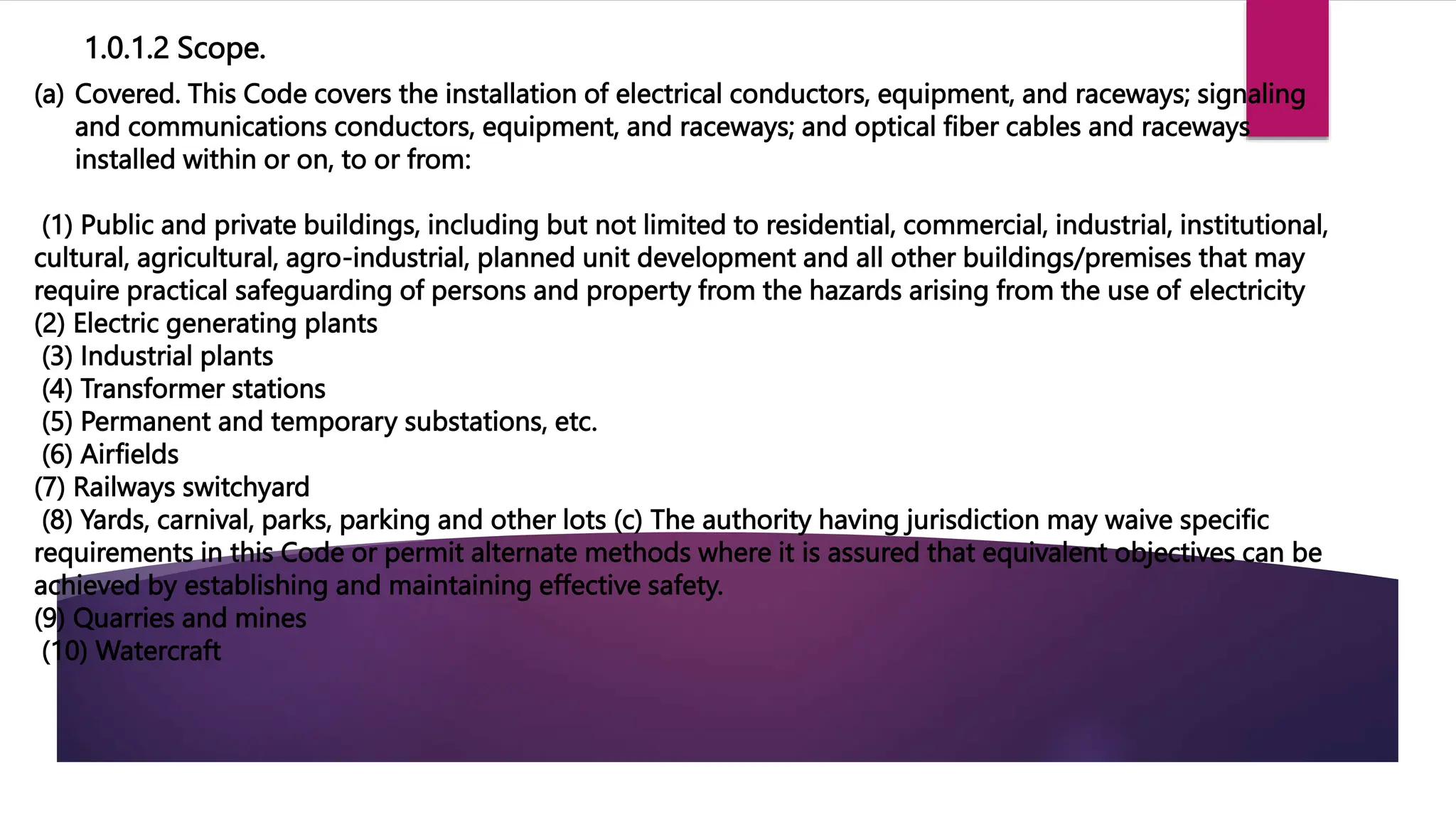
1.0.1.2 Scope.
(a) Covered. This Code covers the installation of electrical conductors, equipment, and raceways; signaling
and communications conductors, equipment, and raceways; and optical fiber cables and raceways
installed within or on, to or from:
(1) Public and private buildings, including but not limited to residential, commercial, industrial, institutional,
cultural, agricultural, agro-industrial, planned unit development and all other buildings/premises that may
require practical safeguarding of persons and property from the hazards arising from the use of electricity
(2) Electric generating plants
(3) Industrial plants
(4) Transformer stations
(5) Permanent and temporary substations, etc.
(6) Airfields
(7) Railways switchyard
(8) Yards, carnival, parks, parking and other lots (c) The authority having jurisdiction may waive specific
requirements in this Code or permit alternate methods where it is assured that equivalent objectives can be
achieved by establishing and maintaining effective safety.
(9) Quarries and mines
(10) Watercraft
(11) Dockyards
(12) Trailers
(13) Mobile homes and recreational vehicles (d) This Code may require new products, constructions, or
materials that may not yet be available at the time this Code is adopted. In such event, the authority having
jurisdiction may permit the use of the products, constructions, or materials that comply with the most recent
previous edition of this Code adopted by the jurisdiction.
(14) Offshore facilities
(b) Not Covered.
This Code does not cover the following:
(1) Installations in railway rolling stock, aircraft, or automotive vehicles FPN: Application of electrical products
products and equipment for additional installation or replacement is suggested to be consulted with a licensed
electrical practitioner prior to installation for safety.
(2) Installations of railways for generation, transformation, transmission, or distribution of power used
exclusively for operation of rolling stock
1.2.1 Electrical Permits
1.2.1.1 Electrical Permit Needed Before Work is Started.
Before starting any installation work, alternation, repair or
extension on any electrical system, the owners, lessors,
operators, occupants, or licensed electrical practitioners
shall obtain Electrical Permit for buildings, trailers, mobile
homes, or other premises from the Office of the Local
Building Official, and for watercrafts from the Maritime
Industry Authority (Marina). In securing the electrical permit,
the services of a licensed electrical practitioner is required
under the New Electrical Engineering Law (RA 7920)[1].
Notes:
It is explicitly stated in this clause of the Philippine
Electrical Code that the services of a Licensed Electrical
Practitioner is required. RA 7920[1] Sec. 31. Field of
Practice states the field of practice for professional
electrical engineers, registered electrical engineers, and
registered master electricians.
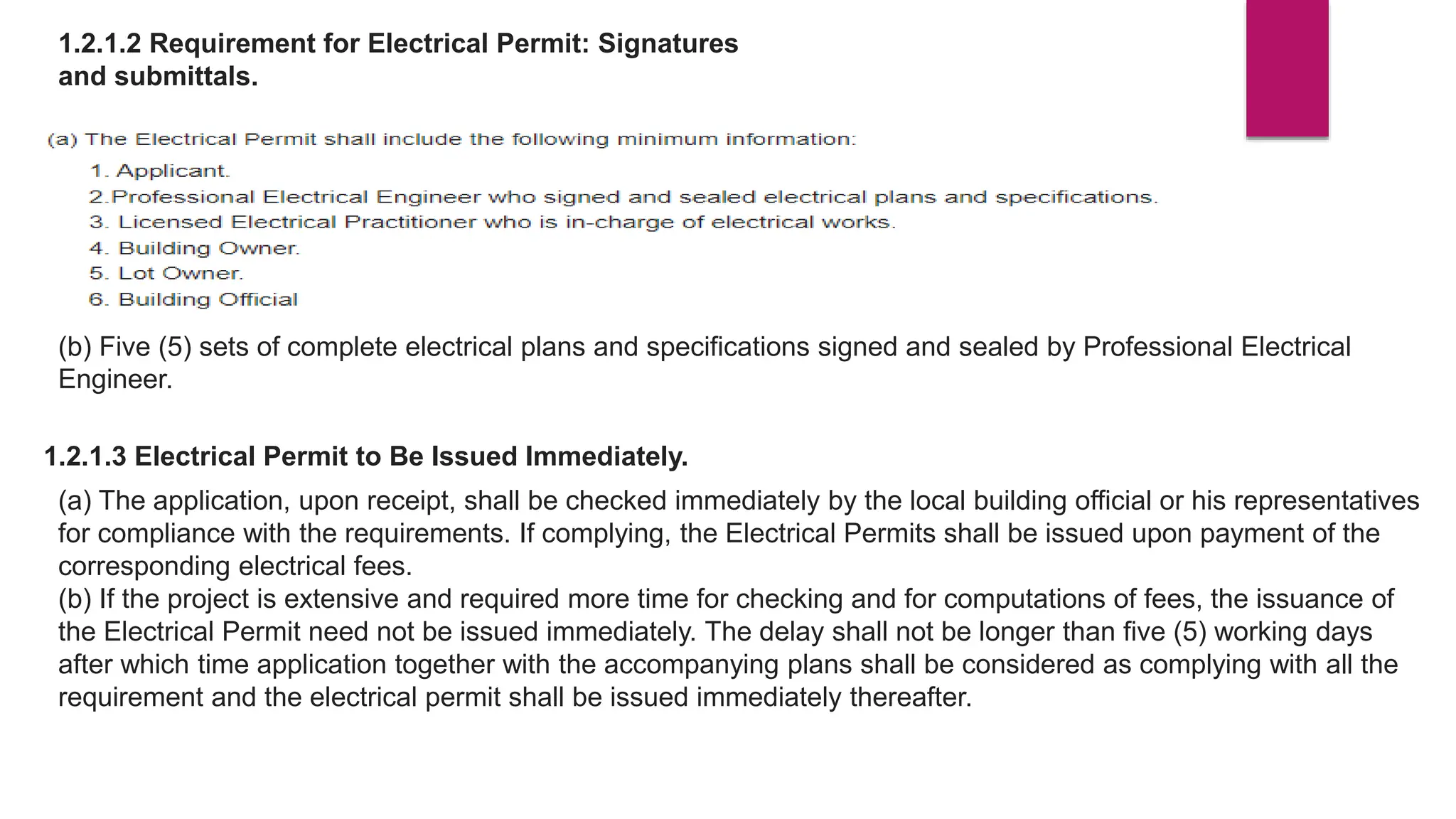
1.2.1.2 Requirement for Electrical Permit: Signatures
and submittals.
(b) Five (5) sets of complete electrical plans and specifications signed and sealed by Professional Electrical
Engineer.
1.2.1.3 Electrical Permit to Be Issued Immediately.
(a) The application, upon receipt, shall be checked immediately by the local building official or his representatives
for compliance with the requirements. If complying, the Electrical Permits shall be issued upon payment of the
corresponding electrical fees.
(b) If the project is extensive and required more time for checking and for computations of fees, the issuance of
the Electrical Permit need not be issued immediately. The delay shall not be longer than five (5) working days
after which time application together with the accompanying plans shall be considered as complying with all the
requirement and the electrical permit shall be issued immediately thereafter.
1.2.1.4 Posting of Electrical Permit.
A copy of the Electrical Permit, upon issuance, shall be posted at a conspicuous location at the job site and
shall not be removed until final inspection and approval of the work shall have been made.
Licensed Electrical Practitioner in-charge of the design, and the licensed electrical practitioner in-charge of the
installation shall post a copy of their respective Professional Regulation Commission (PRC)[2] identification card
together with the electrical permit at all times.
1.2.2 Electrical Inspection
1.2.2.1 Application for Inspection.
An application for inspection shall be filed with the government authority concerned before a preliminary and/or
final inspection is done.
1.2.2.2 Certificate of Inspection.
No electrical installation, alteration, and/or addition shall be connected or reconnected to any power supply or any
other source of electrical energy without a Certificate of Final Electrical Inspection/Completion obtained from the
local building official signed by their respective licensed electrical practitioner.
1.2.3 Special
1.2.3.1 Temporary Installation.
For temporary electrical installation, the same procedure as stated above shall be followed. At the end of the period
covered by the certificate of inspection, the temporary installation shall be removed. Extended use of the temporary
installation shall require a new approval electrical permit.
1.2.3.3 Special Permission Required.
Electrical equipment and wiring not specifically covered or mentioned in the various articles of this Code shall
require special permission and written approval of a licensed electrical practitioner under the enforcing
government authority concerned, prior to installation.
1.2.3.4 Reconnection of Disconnected Services
In cases where service has been cut off for more than one (1) year, a new certificate of final electrical
inspection shall be required before reconnection.
1.3.1 General
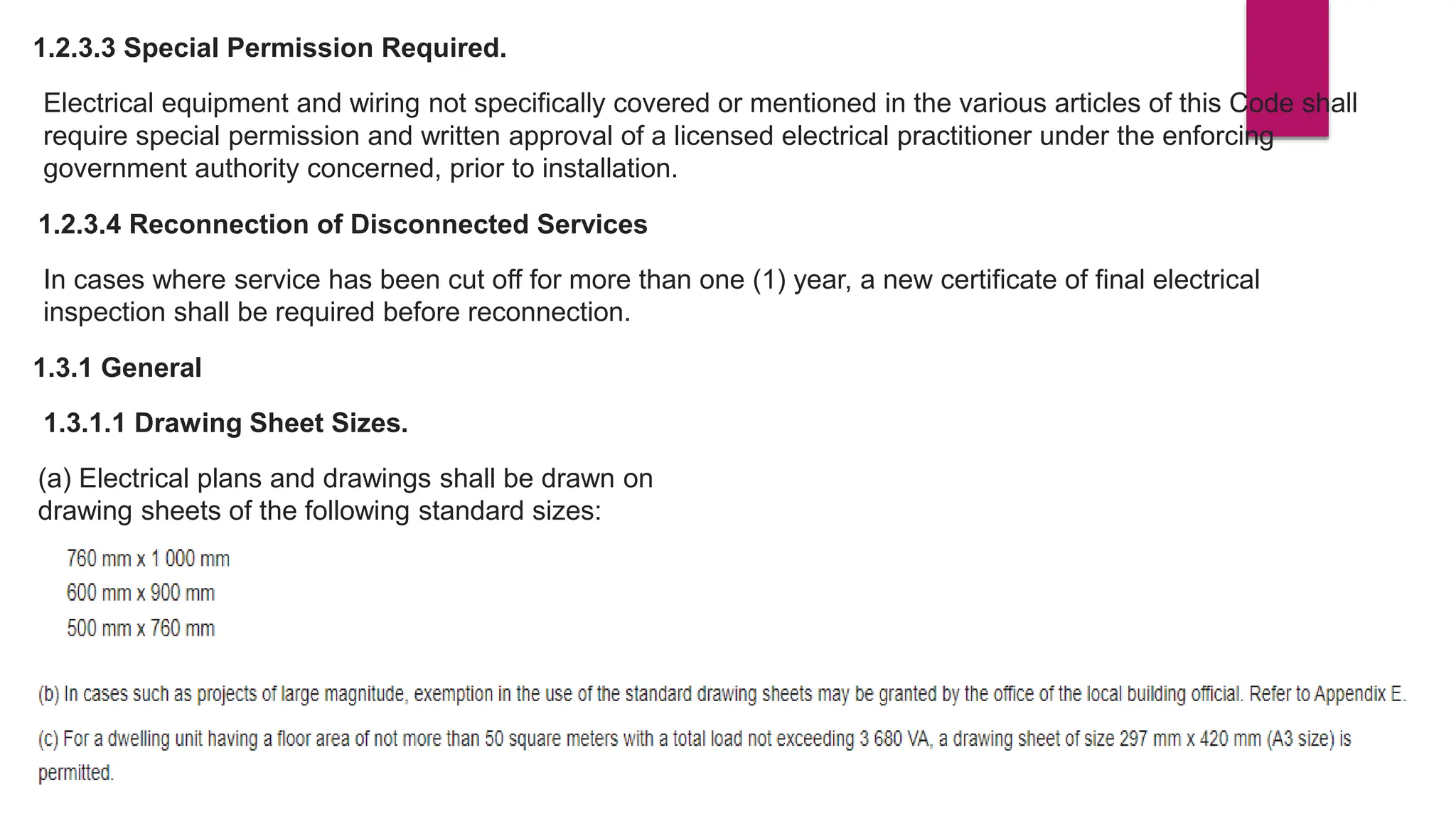
1.3.1.1 Drawing Sheet Sizes.
(a) Electrical plans and drawings shall be drawn on
drawing sheets of the following standard sizes:
1.3.1.2 Drawing Scale.
Appropriate metric drawing scales shall be used.
1.3.1.3. Graphic Scale.
Since the size of the drawing sheet can be changed photographically, graphic scale shall be shown on each
drawing sheet.
1.3.2 Plans and Specifications
1.3.2.1 Plan Requirements.
(a) Location and Site Plans.
FPN: In residences, apartment houses and small commercial establishments, layout of equipment and
motors of one horsepower or less may be incorporated in the layout for General Lighting and Receptacle
Outlets. In general, layout of motors and power outlets not exceeding a total of ten, may be included in the
lighting layout provided such inclusion will not make reading, interpretation and/or checking of said plan
difficult.
a presenattion of PHILIPPINE ELECTRICAL CODE.pptx

a presenattion of PHILIPPINE ELECTRICAL CODE.pptx

  • 1.
  • 2.
    “The Philippine ElectricalCode is used nationally as the basis for safeguarding persons, buildings and its contents from hazards that may arise from the use of electricity. This Code contains provisions which is necessary for safety and thus is used as basis for the legal enforcement in the installation of electrical system design in the country… It serves as our guide in the assessment and inspection on the safeness and completeness of electrical design application in the issuance of electrical wiring permit.” – PEC 2009
  • 3.
    An electrical codeis a set of regulations for the design and installation of electrical wiring in a building. The intention of a code is to provide standards to ensure electrical wiring systems that are safe for people and property. Such wiring is subject to rigorous safety standards for design and installation. Chapter 1. General ARTICLE 1.0
  • 4.
    INTRODUCTION 1.0.1.1 Purpose. (a)PracticalSafeguarding. The purpose of this Code is the practical safeguarding of persons and property from hazards arising from the use of electricity. (b) Adequacy. This Code contains provisions that are considered minimum requirements necessary for safety. Compliance therewith and proper maintenance will result in an installation that is essentially free from hazard but not necessarily efficient, convenient, or adequate for good service or future expansion of electrical use.
  • 5.
    FPN No. 1:Hazards often occur because of overloading of wiring systems by methods or usage not in conformity with this Code. This occurs because initial wiring did not provide for increases in the use of electricity. An initial installation and reasonable provisions for system changes will provide for increases in the use of electricity. FPN No 2: It is highly recommended that a licensed electrical practitioner be consulted for any electrical requirements, including changes. Failure to do so result in fire, serious injury, or death. FPN No. 3: Fire hazard, electrocution, serious injury or even death may also with lack or improper maintenance of wiring system. Wiring system is to be inspected and tested by a licensed electrical practitioner at least once a for wiring system of more than three (3) years in installation
  • 6.
    (c) Intention. ThisCode is intended for the exclusive use of licensed electrical practitioners (PEE, REE, and RME). This Code is not intended as a design specification nor an instruction manual for a non-licensed electrical practitioner, unless under the supervision of a licensed electrical practitioner. (d) Relation to Other International Standards. The requirements in this Code address the fundamental principles of protection for safety
  • 7.
    1.0.1.2 Scope. (a) Covered.This Code covers the installation of electrical conductors, equipment, and raceways; signaling and communications conductors, equipment, and raceways; and optical fiber cables and raceways installed within or on, to or from: (1) Public and private buildings, including but not limited to residential, commercial, industrial, institutional, cultural, agricultural, agro-industrial, planned unit development and all other buildings/premises that may require practical safeguarding of persons and property from the hazards arising from the use of electricity (2) Electric generating plants (3) Industrial plants (4) Transformer stations (5) Permanent and temporary substations, etc. (6) Airfields (7) Railways switchyard (8) Yards, carnival, parks, parking and other lots (c) The authority having jurisdiction may waive specific requirements in this Code or permit alternate methods where it is assured that equivalent objectives can be achieved by establishing and maintaining effective safety. (9) Quarries and mines (10) Watercraft
  • 8.
    (11) Dockyards (12) Trailers (13)Mobile homes and recreational vehicles (d) This Code may require new products, constructions, or materials that may not yet be available at the time this Code is adopted. In such event, the authority having jurisdiction may permit the use of the products, constructions, or materials that comply with the most recent previous edition of this Code adopted by the jurisdiction. (14) Offshore facilities (b) Not Covered. This Code does not cover the following: (1) Installations in railway rolling stock, aircraft, or automotive vehicles FPN: Application of electrical products products and equipment for additional installation or replacement is suggested to be consulted with a licensed electrical practitioner prior to installation for safety. (2) Installations of railways for generation, transformation, transmission, or distribution of power used exclusively for operation of rolling stock
  • 9.
    1.2.1 Electrical Permits 1.2.1.1Electrical Permit Needed Before Work is Started. Before starting any installation work, alternation, repair or extension on any electrical system, the owners, lessors, operators, occupants, or licensed electrical practitioners shall obtain Electrical Permit for buildings, trailers, mobile homes, or other premises from the Office of the Local Building Official, and for watercrafts from the Maritime Industry Authority (Marina). In securing the electrical permit, the services of a licensed electrical practitioner is required under the New Electrical Engineering Law (RA 7920)[1]. Notes: It is explicitly stated in this clause of the Philippine Electrical Code that the services of a Licensed Electrical Practitioner is required. RA 7920[1] Sec. 31. Field of Practice states the field of practice for professional electrical engineers, registered electrical engineers, and registered master electricians.
  • 10.
    1.2.1.2 Requirement forElectrical Permit: Signatures and submittals. (b) Five (5) sets of complete electrical plans and specifications signed and sealed by Professional Electrical Engineer. 1.2.1.3 Electrical Permit to Be Issued Immediately. (a) The application, upon receipt, shall be checked immediately by the local building official or his representatives for compliance with the requirements. If complying, the Electrical Permits shall be issued upon payment of the corresponding electrical fees. (b) If the project is extensive and required more time for checking and for computations of fees, the issuance of the Electrical Permit need not be issued immediately. The delay shall not be longer than five (5) working days after which time application together with the accompanying plans shall be considered as complying with all the requirement and the electrical permit shall be issued immediately thereafter.
  • 11.
    1.2.1.4 Posting ofElectrical Permit. A copy of the Electrical Permit, upon issuance, shall be posted at a conspicuous location at the job site and shall not be removed until final inspection and approval of the work shall have been made. Licensed Electrical Practitioner in-charge of the design, and the licensed electrical practitioner in-charge of the installation shall post a copy of their respective Professional Regulation Commission (PRC)[2] identification card together with the electrical permit at all times. 1.2.2 Electrical Inspection 1.2.2.1 Application for Inspection. An application for inspection shall be filed with the government authority concerned before a preliminary and/or final inspection is done. 1.2.2.2 Certificate of Inspection. No electrical installation, alteration, and/or addition shall be connected or reconnected to any power supply or any other source of electrical energy without a Certificate of Final Electrical Inspection/Completion obtained from the local building official signed by their respective licensed electrical practitioner. 1.2.3 Special 1.2.3.1 Temporary Installation. For temporary electrical installation, the same procedure as stated above shall be followed. At the end of the period covered by the certificate of inspection, the temporary installation shall be removed. Extended use of the temporary installation shall require a new approval electrical permit.
  • 12.
    1.2.3.3 Special PermissionRequired. Electrical equipment and wiring not specifically covered or mentioned in the various articles of this Code shall require special permission and written approval of a licensed electrical practitioner under the enforcing government authority concerned, prior to installation. 1.2.3.4 Reconnection of Disconnected Services In cases where service has been cut off for more than one (1) year, a new certificate of final electrical inspection shall be required before reconnection. 1.3.1 General 1.3.1.1 Drawing Sheet Sizes. (a) Electrical plans and drawings shall be drawn on drawing sheets of the following standard sizes:
  • 13.
    1.3.1.2 Drawing Scale. Appropriatemetric drawing scales shall be used. 1.3.1.3. Graphic Scale. Since the size of the drawing sheet can be changed photographically, graphic scale shall be shown on each drawing sheet. 1.3.2 Plans and Specifications 1.3.2.1 Plan Requirements. (a) Location and Site Plans.
  • 17.
    FPN: In residences,apartment houses and small commercial establishments, layout of equipment and motors of one horsepower or less may be incorporated in the layout for General Lighting and Receptacle Outlets. In general, layout of motors and power outlets not exceeding a total of ten, may be included in the lighting layout provided such inclusion will not make reading, interpretation and/or checking of said plan difficult.