
PHILIPPIANS
PHILIPPI

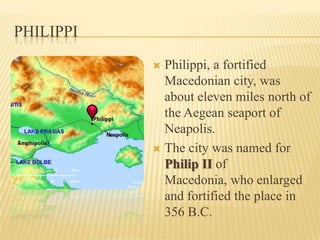
            Philippi, a fortified
             Macedonian city, was
             about eleven miles north of
             the Aegean seaport of
             Neapolis.
            The city was named for
             Philip II of
             Macedonia, who enlarged
             and fortified the place in
             356 B.C.
 Romans, native Macedonians, and Orientals
  comprised the city’s population.
 Because the city was a military and agricultural
  center instead of a commercial one, few Jews were
  attracted to Philippi.
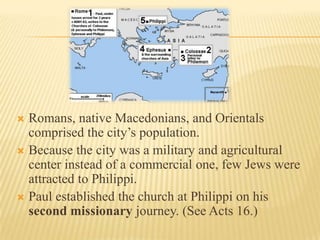
 Paul established the church at Philippi on his
  second missionary journey. (See Acts 16.)
 Philippi is a caring and generous church (2
  Corinthians 8:1-5), for whom Paul has a special
  affection.
 Its members probably included Lydia, the dealer in
  purple cloth, the Phillipian jailer and his family, and
  perhaps Luke.
 In this Letter, Paul shows his joy in spite of his
  imprisonment, his love for the church, his
  overwhelming devotion to Christ and all he
  means, and his concern that the Philippians will drift
  away from all they have been taught.
 Paul visited the Philippian church at least twice
  and maintained a close, intimate relationship with
  them.
 Paul’s receiving an offering from them indicates
  that they were friends of deep love, for Paul
  ordinarily made his own living.
PURPOSE
   Paul wrote Philippians during his first Roman
    imprisonment, around A.D. 64.
   The church at Philippi had sent Epaphroditus to minister to
    Paul’s needs and to take an offering to him.
    Paul wrote to express appreciation for their concern for
    him.
   The theme of the epistle is the joy of the Christian life
    and service manifested under all circumstances.
   Sixteen times the words joy and rejoice appear in the
    book.
   Christian joy is more and better than mere happiness
    because it does not depend on what happens.
OUTLINE

INTRODUCTION: Philippians 1:1-11

I. PAUL’S EXPERIENCES: Philippians 1:12-30
   A. His Joy in Tribulation (1:12-20)
   B. The Secret of His Joy (1:21-30)
II. PAUL’S EXAMPLES: Philippians 2:1-30
  A. The Sacrifice of Jesus Christ (2:1-18)
  B. The Service of Timothy (2:19-24)
  C. The Sickness of Epaphroditus (2:25-30)
III. PAUL’S EXHORTATIONS: 3:1-4:20
  A. The Power of Proper Theology (3:1-21)
  B. The Power of Positive Thinking (4:1-9)
  C. The Power of Perpetual Thanksgiving (4:10-
  20)

 CONCLUSION: 4:21-23
INTRODUCTION
   Philippians 1:1-11
   Paul began his epistle to the Philippians by identifying himself and
    Timothy and the addressees, the saints in Jesus Christ at
    Philippi.
   In doing so, he established his position in life as a servant of Jesus
    Christ. He saluted the saints with the grace of God and then peace.
   Joy characterized Paul’s remembrance of and prayer ministry for
    the Philippians.
   His relationship with them was very intimate.
   He desired this relationship and their good fellowship with God to
    continue. He had great esteem, love, and confidence toward them.
   He was confident that they would grow in Christ and be steadfast
    unto the end.
I. PAUL’S EXPERIENCES
PHILIPPIANS 1:12-30
   A. His Joy in Tribulation
    Paul had suffered because of the gospel, but it had
    been for the glory of God.
    The gospel had been advanced rather than hindered.
    His imprisonment in Rome had inspired a fearless
    confidence in many to preach the Word.
    Even though some men preached with the wrong
    attitude, there were those who preached with love
    and sincerity. Paul rejoiced in that Christ was
    preached.
B. THE SECRET OF HIS JOY

 The secret of Paul’s confident joy was his Christ-
  centered life.
 He wrapped his hope and expectations in the gospel
  and in his salvation.
 He wanted always to be bold in preaching.

 His longing to be with the Lord and his desire to
  preach the gospel, which would be more beneficial
  to the rest of the world, tore at him. For the gospel’s
  sake, he was content to stay on earth to be a witness.
 Paul advised the Philippians to let their
  conversation-their conduct or their actions-be
  godly, to be unified in their efforts to win
  souls, and to keep the faith.
 He told them not to fear their adversaries.

 Even though these enemies thought they were
  doing harm, they were actually bringing the
  salvation of the saints closer.
II. PAUL’S EXAMPLES
PHILIPPIANS 2:1-30
   Christians must keep the proper spirit in
    relationship to other saints.
     First,
           they must be unified.
     Second, they must be humble and meek.

     Third, they must not be puffed up. (Self-importance)

   To emphasize the importance of maintaining the
    proper attitude in adversity, Paul cited three
    examples.
A. THE SACRIFICE OF JESUS CHRIST
   The first example was Jesus Christ’s sacrifice (2:5-11).
   God displayed the supreme spirit of humility in taking
    upon Himself the status of humanity.
   He, as deity, could never be humbled unless He did it
    Himself.
   He did so by coming in the flesh as Jesus Christ. Through
    the incarnation Jesus was glorified, however, and His name
    was exalted above all others.
   Obtaining salvation for eternity is a serious matter.
   It is to be considered with fear and trembling.
 Paul admonished the Philippians to live blameless
  lives-not to justify themselves, but because they
  had been justified (James 2:18).
 If they were faithful, Paul’s work among them
  would not have been in vain.
 Paul rejoiced in them enough that if he were to
  give his life for them, he could still rejoice (2:17-
  18).
B. THE SERVICE OF TIMOTHY

 As a second example, Paul cited Timothy’s
  service (2:19-24).
 Paul planned to send Timothy to the Philippians
  soon.
 He knew that Timothy would care for them in the
  same way that he would.
C. THE SICKNESS OF EPAPHRODITUS

 The third example Paul gave was Epaphroditus’s
  sickness (2:25-30).
 The Philippians sent Epaphroditus to Rome to
  minister to the imprisoned apostle.
 Before he returned, he became ill and had to stay
  in Rome until he recuperated.
 Paul advised them to be thankful for the
  consecration of this servant of Christ.
III. PAUL’S EXHORTATION
PHILIPPIANS 3:1-4:20
A. The Power of Proper Theology
 Paul warned against those who taught the
  necessity of a literal circumcision for
  salvation, calling them “dogs”.
 He reminded the church that they were of the
  circumcision of Christ, which is of the heart and
  not the law.
 Salvation is a work of the Spirit.
 Paul could have boasted of more in the flesh than
  these false teachers.
 Paul excelled as far as
  education, rank, intelligence, zeal, and culture
  (3:4-6). Yet Paul gladly gave up all he had for the
  cause. of Christ (3:7-14). He had been stopped by
  God in his climb in the world. He could not claim
  perfection in Christ, as he could in the world.
 Nevertheless, he pressed toward it. He strove to
  live completely in Christ-knowing and being
  acquainted with His suffering, death, and
  resurrection.
 To be perfect, we must press toward the mark as
  Paul did. We must keep going upward and
  onward (3:15-17). We must keep what we have
  attained and press on. Unfortunately, some do
  not, and their end is destruction (3:18-19).
B. THE POWER OF POSITIVE THINKING

 Christians have the hope of being changed,
  glorified, and made like Christ.
 Therefore they must be strong and steadfast.

 Constant perseverance will heal personal rifts and
  cause Christians to agree with each other in the
  Lord. Paul gave some personal messages and
  general admonitions to be moderate, joyful,
  thankful, and prayerful (4:1-7).
 In Philippians 4:8-9, Paul focused on Christians’
  mental life.
 They are to think on things that are
  true, honorable, just, righteous, pure, lovely, of
  good report, virtuous, and praiseworthy.
 They are to practice the things that Paul taught
  and exemplified.
 The result will mean not only possessing “the
  peace of God” but also “the God of peace”.
C. THE POWER OF PERPETUAL
THANKSGIVING
 Paul had learned to be content in every situation.
 Whether abased or abounding, Paul knew the joy of
  giving thanks.
 He was thankful for the Philippians’ liberality.
 And he had learned in the gospel work that he could
  depend upon God for every need.
 He could be content in Him. He assured the
  Philippians that God would also supply their needs:
  “My God shall supply all your need according to his
  riches in glory by Christ Jesus” (4:19).
CONCLUSION

Philippians 4:21-23
 In closing, Paul saluted the saints at Philippi.
  Likewise, he extended the greetings of those with
  him, especially those who belonged to the
  emperor’s household.

Philippians

  • 1.
  • 2.
    PHILIPPI  Philippi, a fortified Macedonian city, was about eleven miles north of the Aegean seaport of Neapolis.  The city was named for Philip II of Macedonia, who enlarged and fortified the place in 356 B.C.
  • 3.
     Romans, nativeMacedonians, and Orientals comprised the city’s population.  Because the city was a military and agricultural center instead of a commercial one, few Jews were attracted to Philippi.  Paul established the church at Philippi on his second missionary journey. (See Acts 16.)
  • 4.
     Philippi isa caring and generous church (2 Corinthians 8:1-5), for whom Paul has a special affection.  Its members probably included Lydia, the dealer in purple cloth, the Phillipian jailer and his family, and perhaps Luke.  In this Letter, Paul shows his joy in spite of his imprisonment, his love for the church, his overwhelming devotion to Christ and all he means, and his concern that the Philippians will drift away from all they have been taught.
  • 5.
     Paul visitedthe Philippian church at least twice and maintained a close, intimate relationship with them.  Paul’s receiving an offering from them indicates that they were friends of deep love, for Paul ordinarily made his own living.
  • 6.
    PURPOSE  Paul wrote Philippians during his first Roman imprisonment, around A.D. 64.  The church at Philippi had sent Epaphroditus to minister to Paul’s needs and to take an offering to him.  Paul wrote to express appreciation for their concern for him.  The theme of the epistle is the joy of the Christian life and service manifested under all circumstances.  Sixteen times the words joy and rejoice appear in the book.  Christian joy is more and better than mere happiness because it does not depend on what happens.
  • 7.
    OUTLINE INTRODUCTION: Philippians 1:1-11 I.PAUL’S EXPERIENCES: Philippians 1:12-30 A. His Joy in Tribulation (1:12-20) B. The Secret of His Joy (1:21-30)
  • 8.
    II. PAUL’S EXAMPLES:Philippians 2:1-30 A. The Sacrifice of Jesus Christ (2:1-18) B. The Service of Timothy (2:19-24) C. The Sickness of Epaphroditus (2:25-30)
  • 9.
    III. PAUL’S EXHORTATIONS:3:1-4:20 A. The Power of Proper Theology (3:1-21) B. The Power of Positive Thinking (4:1-9) C. The Power of Perpetual Thanksgiving (4:10- 20) CONCLUSION: 4:21-23
  • 10.
    INTRODUCTION  Philippians 1:1-11  Paul began his epistle to the Philippians by identifying himself and Timothy and the addressees, the saints in Jesus Christ at Philippi.  In doing so, he established his position in life as a servant of Jesus Christ. He saluted the saints with the grace of God and then peace.  Joy characterized Paul’s remembrance of and prayer ministry for the Philippians.  His relationship with them was very intimate.  He desired this relationship and their good fellowship with God to continue. He had great esteem, love, and confidence toward them.  He was confident that they would grow in Christ and be steadfast unto the end.
  • 11.
    I. PAUL’S EXPERIENCES PHILIPPIANS1:12-30  A. His Joy in Tribulation Paul had suffered because of the gospel, but it had been for the glory of God. The gospel had been advanced rather than hindered. His imprisonment in Rome had inspired a fearless confidence in many to preach the Word. Even though some men preached with the wrong attitude, there were those who preached with love and sincerity. Paul rejoiced in that Christ was preached.
  • 12.
    B. THE SECRETOF HIS JOY  The secret of Paul’s confident joy was his Christ- centered life.  He wrapped his hope and expectations in the gospel and in his salvation.  He wanted always to be bold in preaching.  His longing to be with the Lord and his desire to preach the gospel, which would be more beneficial to the rest of the world, tore at him. For the gospel’s sake, he was content to stay on earth to be a witness.
  • 13.
     Paul advisedthe Philippians to let their conversation-their conduct or their actions-be godly, to be unified in their efforts to win souls, and to keep the faith.  He told them not to fear their adversaries.  Even though these enemies thought they were doing harm, they were actually bringing the salvation of the saints closer.
  • 14.
    II. PAUL’S EXAMPLES PHILIPPIANS2:1-30  Christians must keep the proper spirit in relationship to other saints.  First, they must be unified.  Second, they must be humble and meek.  Third, they must not be puffed up. (Self-importance)  To emphasize the importance of maintaining the proper attitude in adversity, Paul cited three examples.
  • 15.
    A. THE SACRIFICEOF JESUS CHRIST  The first example was Jesus Christ’s sacrifice (2:5-11).  God displayed the supreme spirit of humility in taking upon Himself the status of humanity.  He, as deity, could never be humbled unless He did it Himself.  He did so by coming in the flesh as Jesus Christ. Through the incarnation Jesus was glorified, however, and His name was exalted above all others.  Obtaining salvation for eternity is a serious matter.  It is to be considered with fear and trembling.
  • 16.
     Paul admonishedthe Philippians to live blameless lives-not to justify themselves, but because they had been justified (James 2:18).  If they were faithful, Paul’s work among them would not have been in vain.  Paul rejoiced in them enough that if he were to give his life for them, he could still rejoice (2:17- 18).
  • 17.
    B. THE SERVICEOF TIMOTHY  As a second example, Paul cited Timothy’s service (2:19-24).  Paul planned to send Timothy to the Philippians soon.  He knew that Timothy would care for them in the same way that he would.
  • 18.
    C. THE SICKNESSOF EPAPHRODITUS  The third example Paul gave was Epaphroditus’s sickness (2:25-30).  The Philippians sent Epaphroditus to Rome to minister to the imprisoned apostle.  Before he returned, he became ill and had to stay in Rome until he recuperated.  Paul advised them to be thankful for the consecration of this servant of Christ.
  • 19.
    III. PAUL’S EXHORTATION PHILIPPIANS3:1-4:20 A. The Power of Proper Theology  Paul warned against those who taught the necessity of a literal circumcision for salvation, calling them “dogs”.  He reminded the church that they were of the circumcision of Christ, which is of the heart and not the law.  Salvation is a work of the Spirit.
  • 20.
     Paul couldhave boasted of more in the flesh than these false teachers.  Paul excelled as far as education, rank, intelligence, zeal, and culture (3:4-6). Yet Paul gladly gave up all he had for the cause. of Christ (3:7-14). He had been stopped by God in his climb in the world. He could not claim perfection in Christ, as he could in the world.
  • 21.
     Nevertheless, hepressed toward it. He strove to live completely in Christ-knowing and being acquainted with His suffering, death, and resurrection.  To be perfect, we must press toward the mark as Paul did. We must keep going upward and onward (3:15-17). We must keep what we have attained and press on. Unfortunately, some do not, and their end is destruction (3:18-19).
  • 22.
    B. THE POWEROF POSITIVE THINKING  Christians have the hope of being changed, glorified, and made like Christ.  Therefore they must be strong and steadfast.  Constant perseverance will heal personal rifts and cause Christians to agree with each other in the Lord. Paul gave some personal messages and general admonitions to be moderate, joyful, thankful, and prayerful (4:1-7).
  • 23.
     In Philippians4:8-9, Paul focused on Christians’ mental life.  They are to think on things that are true, honorable, just, righteous, pure, lovely, of good report, virtuous, and praiseworthy.  They are to practice the things that Paul taught and exemplified.  The result will mean not only possessing “the peace of God” but also “the God of peace”.
  • 24.
    C. THE POWEROF PERPETUAL THANKSGIVING  Paul had learned to be content in every situation.  Whether abased or abounding, Paul knew the joy of giving thanks.  He was thankful for the Philippians’ liberality.  And he had learned in the gospel work that he could depend upon God for every need.  He could be content in Him. He assured the Philippians that God would also supply their needs: “My God shall supply all your need according to his riches in glory by Christ Jesus” (4:19).
  • 25.
    CONCLUSION Philippians 4:21-23  Inclosing, Paul saluted the saints at Philippi. Likewise, he extended the greetings of those with him, especially those who belonged to the emperor’s household.