Chapter 1
Introduction, Paul’s prayer and ministry
Billericay Bible Study, 5th February 2020
Philippians chapter 1 3
Pauland Timotheus,the servants of Jesus Christ, to allthe saints in Christ Jesus
which are at Philippi, with the bishops and deacons…
The epistle to the Philippians (God willing)
Chapter 1– Introduction, Paul’s prayer and ministry
• Today
Chapter 2 – Christ’s pattern and Paul’s heartfelt plea
• 22nd April
Chapter 3 – Paul’s example and warning to believers
• 3rd June
Chapter 4 – Paul’s appreciation and closing exhortation
• 23rd September
Philippians chapter 1 4
‘Theepistle of brotherlylove’ (e.g. Chapter 4 v 1)
13-14 years old!
Context – Paul’s Second Missionary Journey
49-52 AD
• Philippi perhaps
visited Summer-
Autumn 50 AD
• Paul, Silas,
Timothy and
Luke arrive
(Acts 16 v 12 “we”)
• Paul, Silas and
Timothy depart
(and Luke
remains behind)
(Acts 17 v 1 “they”)
Philippians chapter 1 5
[re-joins in Acts 20 v 6,
perhaps 58 AD, 3rd MJ]
Philippians chapter 1 6
Philippi “the chief city of that part”
Background to the city
• Important Roman city (“a colony”1) on the via Egnatia road
Philippians chapter 1 7
1 Acts 16 v 12
The main trade
route from Asia
to Rome
Road
constructed in
2nd century BC
About 696
miles long
(1,120 km)
6m / 19.6ft
[From Philippi
to Rome about
800 miles!]
Background to the city (continued)
• Founded between 359-336 BC (per UNESCO: 356 BC) by
Philip of Macedonia, father of Alexander the Great
• In North-East Macedonia (Greece), about 10 miles from the
sea (the port Neapolis, Acts 16 v 11)
• Key strategic position, linking continents of Europe and Asia
• Had become “a colony” during time of Emperor Augustus, in
celebration of local military victory (27 BC)
• As a colony, exempt from tribute… with ownership of land and
slaves permissible
• Many Roman citizens and active/retired soldiers in the city
Philippians chapter 1 8
Philippians chapter 1 9
The first converts in Europe
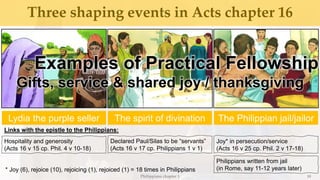
Three shaping events in Acts chapter 16
Philippians chapter 1 10
Lydia the purple seller The spirit of divination The Philippian jail/jailor
Links with the epistle to the Philippians:
Hospitality and generosity
(Acts 16 v 15 cp. Phil. 4 v 10-18)
Joy* in persecution/service
(Acts 16 v 25 cp. Phil. 2 v 17-18)
Philippians written from jail
(in Rome, say 11-12 years later)* Joy (6), rejoice (10), rejoicing (1), rejoiced (1) = 18 times in Philippians
Declared Paul/Silas to be “servants”
(Acts 16 v 17 cp. Philippians 1 v 1)
Examples of Practical Fellowship:
Gifts, service & shared joy / thanksgiving
Philippians chapter 1 11
“they cast them into prison”
The timing of the epistle itself
• Probably written 63-64 AD, from Rome (in prison); see refs. to:
• “Bonds” (1 v 7, 13, 14, 16)
• ‘Praetorian guard’ [1 v 13, see Moffatt translation]
• “Caesar’s household” (4 v 22)
• At that time Paul was
under house arrest*
(see Acts 28 v 30-31)
• 3-4 years later Paul
was imprisoned again
and executed
Philippians chapter 1 12
* Explaining how Epaphroditus was able
to deliver the gift (Phil. 4 v 18)
Epistle’s footnote
whilst not inspired
appears reasonable
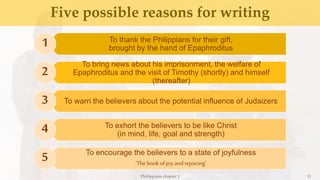
Five possible reasons for writing
To thank the Philippians for their gift,
brought by the hand of Epaphroditus
1
To bring news about his imprisonment, the welfare of
Epaphroditus and the visit of Timothy (shortly) and himself
(thereafter)
2
To warn the believers about the potential influence of Judaizers3
To exhort the believers to be like Christ
(in mind, life, goal and strength)
4
To encourage the believers to a state of joyfulness
‘The book of joy and rejoicing’
5
Philippians chapter 1 13
Philippians chapter 1 – Key sections / precis
v. 1-2 Opening address / Superscription
v. 3-8 Thanksgiving for their fellowship. Expression of
Paul’s profound love for them
v. 9-11 Paul’s prayer for their spiritual growth and fruitfulness
v. 12-18 Account of how God had used Paul, though a
prisoner, for the progress of the Gospel. The opposition of
some, but his own contentment
v. 19-26 Though wishing to die at times, their need for Paul
confirms his hopes of immediate deliverance
v. 27-30 Exhortation to steadfastness in the face of adversity
Philippians chapter 1 14
v. 1-2 Opening address
• The opening tone markedly different to other epistles (e.g.
Galatians 1 v 1), incl. no need to state Apostolic credentials
• “bishops and deacons” mentioned (in this epistle only),
perhaps because of the role they had in the gift? (see ch. 4 v
15-18)*
• Mention of Timothy, who was known to the believers (seen on
Second [50 AD] and probably Third journey [58 AD]), he was
shortly to be sent to them (see 2 v 19)
• Characteristic superscription mentions “grace” and “peace”,
the unspeakable gifts from God, through Jesus (these two
together in the opening of every one of the named letters of
Paul) Philippians chapter 1 15
* Those of Macedonia singled out for generosity in giving, cp. 2 Corinthians 8 v 1, 11 v 9 and Romans 15 v 26
v. 3-8 Thanksgiving and profound love
• NET v.3 “I thank my God every time I remember you.”
(Probably daily, given what Paul said in 2 Corinthians 11 v 28)
• “from the first day” = perhaps a reference to the vision
received in Troas (“Come over into Macedonia, and help us”
Acts 16 v 9)
• The close association was multifaceted, such that they were
“partakers with me of grace” (see KJV mg. and other versions)
• “I have you in my heart”, the definition of brotherly love (also
compare with the High Priest, Aaron, in Exodus 28 v 29)
• An innermost feeling (“bowels” = seat of deepest emotions) of
longing by Paul (note also ch. 2 v 26 and 4 v 1)
Philippians chapter 1 16
v. 9-11 Paul’s prayer for them
• Having been told believers were in Paul’s prayers, we have
the themes prayed for – growth, purity, fruitfulness, future
commendation (instructive for us in framing our prayers)
• Even those greatly favoured must “abound yet more and
more”, only progression or regression possible in truth (v. 25
“furtherance”)
• “sincere” = Greek eilikrines  comes from heile (the sun’s
ray), hence ‘found pure when unfolded and examined by the
sun’s light’ (Thayer); ultimately, at rising of true Sun (Malachi 4
v 2)
• Most other translations “fruit” (sing.) of righteousness (KJV
mg., ESV, NET, YLT, NIV), as in Galatians 5 v 22 and James 3Philippians chapter 1 17
v. 12-18 God’s use of Paul for the Gospel
• Having expressed his concern for their welfare, it is evident
that this is reciprocated (and they had been anxious about his
state)
• Paul reassured believers that in the context of the truth (rather
than his own personal circumstances in isolation), God’s will
was being done! (Paul’s consistent view, 2 Corinthians 4 v 16-
17)
• Repeatedly in the first century, seemingly negative
circumstances brought positive results (cp. early persecution,
Acts 8 v 1,4)
• The power of Paul’s energising example, with even those “in
pretence” (‘outward show’) still spreading truth (as Luke 9 vPhilippians chapter 1 18
v. 19-26 Paul’s confidence of deliverance
• Reminder: Paul was effectively on death row in Rome, hence
when he speaks of life/death this was very literal for him
• “To live is Christ” i.e. striving to do Christ’s work and emulate
his example (1 Corinthians 11 v 1, also Galatians 6 v 17: “I
bear in my body the marks of the Lord Jesus”)
• “To die is gain” i.e. the next moment being with the Lord, to
receive the longed-for reward (2 Corinthians 5 v 4)
• v.25 “I know that I shall abide” suggests Paul was clear about
his eventual release, his probation not yet concluded
• This would lead to great joy/rejoicing, although only for a time
Philippians chapter 1 19
v. 27-30 Exhortation
• “Only” = the one important thing, the key focus of their service
• “Conversation” = Gk. politeuomai = ‘to behave as a citizen’
(Strong), perhaps play on status of Philippi, the colony full of
Roman citizens; only other appearance in epistles is Phil. 3 v
20
• The Philippian believers were living Christ’s instruction to
make friends by way of the mammon of unrighteousness
(Luke 16 v 9)
• “One mind”, importance of unity to stand (cp. Roman tortoise)
• “The same conflict which ye saw in me” – the power of
example, Paul and Silas suffered “many stripes” (Acts 16 v 23)
Philippians chapter 1 20
Philippians chapter 1 21
“the multitude rose up together against them”
Philippians chapter 1 22
Concluding thoughts
Do we (you) care enough?
For the truth entrusted to us
About how we live our lives
About one another
That we would sacrifice all?
Philippians chapter 1 23
Philippians chapter 1 25
Chapter 2
Christ’s pattern and Paul’s heartfelt plea
Billericay Bible Study, 22nd April 2020 (God willing)

Philippians - chapter 1

  • 2.
    Chapter 1 Introduction, Paul’sprayer and ministry Billericay Bible Study, 5th February 2020
  • 3.
    Philippians chapter 13 Pauland Timotheus,the servants of Jesus Christ, to allthe saints in Christ Jesus which are at Philippi, with the bishops and deacons…
  • 4.
    The epistle tothe Philippians (God willing) Chapter 1– Introduction, Paul’s prayer and ministry • Today Chapter 2 – Christ’s pattern and Paul’s heartfelt plea • 22nd April Chapter 3 – Paul’s example and warning to believers • 3rd June Chapter 4 – Paul’s appreciation and closing exhortation • 23rd September Philippians chapter 1 4 ‘Theepistle of brotherlylove’ (e.g. Chapter 4 v 1) 13-14 years old!
  • 5.
    Context – Paul’sSecond Missionary Journey 49-52 AD • Philippi perhaps visited Summer- Autumn 50 AD • Paul, Silas, Timothy and Luke arrive (Acts 16 v 12 “we”) • Paul, Silas and Timothy depart (and Luke remains behind) (Acts 17 v 1 “they”) Philippians chapter 1 5 [re-joins in Acts 20 v 6, perhaps 58 AD, 3rd MJ]
  • 6.
    Philippians chapter 16 Philippi “the chief city of that part”
  • 7.
    Background to thecity • Important Roman city (“a colony”1) on the via Egnatia road Philippians chapter 1 7 1 Acts 16 v 12 The main trade route from Asia to Rome Road constructed in 2nd century BC About 696 miles long (1,120 km) 6m / 19.6ft [From Philippi to Rome about 800 miles!]
  • 8.
    Background to thecity (continued) • Founded between 359-336 BC (per UNESCO: 356 BC) by Philip of Macedonia, father of Alexander the Great • In North-East Macedonia (Greece), about 10 miles from the sea (the port Neapolis, Acts 16 v 11) • Key strategic position, linking continents of Europe and Asia • Had become “a colony” during time of Emperor Augustus, in celebration of local military victory (27 BC) • As a colony, exempt from tribute… with ownership of land and slaves permissible • Many Roman citizens and active/retired soldiers in the city Philippians chapter 1 8
  • 9.
    Philippians chapter 19 The first converts in Europe
  • 10.
    Three shaping eventsin Acts chapter 16 Philippians chapter 1 10 Lydia the purple seller The spirit of divination The Philippian jail/jailor Links with the epistle to the Philippians: Hospitality and generosity (Acts 16 v 15 cp. Phil. 4 v 10-18) Joy* in persecution/service (Acts 16 v 25 cp. Phil. 2 v 17-18) Philippians written from jail (in Rome, say 11-12 years later)* Joy (6), rejoice (10), rejoicing (1), rejoiced (1) = 18 times in Philippians Declared Paul/Silas to be “servants” (Acts 16 v 17 cp. Philippians 1 v 1) Examples of Practical Fellowship: Gifts, service & shared joy / thanksgiving
  • 11.
    Philippians chapter 111 “they cast them into prison”
  • 12.
    The timing ofthe epistle itself • Probably written 63-64 AD, from Rome (in prison); see refs. to: • “Bonds” (1 v 7, 13, 14, 16) • ‘Praetorian guard’ [1 v 13, see Moffatt translation] • “Caesar’s household” (4 v 22) • At that time Paul was under house arrest* (see Acts 28 v 30-31) • 3-4 years later Paul was imprisoned again and executed Philippians chapter 1 12 * Explaining how Epaphroditus was able to deliver the gift (Phil. 4 v 18) Epistle’s footnote whilst not inspired appears reasonable
  • 13.
    Five possible reasonsfor writing To thank the Philippians for their gift, brought by the hand of Epaphroditus 1 To bring news about his imprisonment, the welfare of Epaphroditus and the visit of Timothy (shortly) and himself (thereafter) 2 To warn the believers about the potential influence of Judaizers3 To exhort the believers to be like Christ (in mind, life, goal and strength) 4 To encourage the believers to a state of joyfulness ‘The book of joy and rejoicing’ 5 Philippians chapter 1 13
  • 14.
    Philippians chapter 1– Key sections / precis v. 1-2 Opening address / Superscription v. 3-8 Thanksgiving for their fellowship. Expression of Paul’s profound love for them v. 9-11 Paul’s prayer for their spiritual growth and fruitfulness v. 12-18 Account of how God had used Paul, though a prisoner, for the progress of the Gospel. The opposition of some, but his own contentment v. 19-26 Though wishing to die at times, their need for Paul confirms his hopes of immediate deliverance v. 27-30 Exhortation to steadfastness in the face of adversity Philippians chapter 1 14
  • 15.
    v. 1-2 Openingaddress • The opening tone markedly different to other epistles (e.g. Galatians 1 v 1), incl. no need to state Apostolic credentials • “bishops and deacons” mentioned (in this epistle only), perhaps because of the role they had in the gift? (see ch. 4 v 15-18)* • Mention of Timothy, who was known to the believers (seen on Second [50 AD] and probably Third journey [58 AD]), he was shortly to be sent to them (see 2 v 19) • Characteristic superscription mentions “grace” and “peace”, the unspeakable gifts from God, through Jesus (these two together in the opening of every one of the named letters of Paul) Philippians chapter 1 15 * Those of Macedonia singled out for generosity in giving, cp. 2 Corinthians 8 v 1, 11 v 9 and Romans 15 v 26
  • 16.
    v. 3-8 Thanksgivingand profound love • NET v.3 “I thank my God every time I remember you.” (Probably daily, given what Paul said in 2 Corinthians 11 v 28) • “from the first day” = perhaps a reference to the vision received in Troas (“Come over into Macedonia, and help us” Acts 16 v 9) • The close association was multifaceted, such that they were “partakers with me of grace” (see KJV mg. and other versions) • “I have you in my heart”, the definition of brotherly love (also compare with the High Priest, Aaron, in Exodus 28 v 29) • An innermost feeling (“bowels” = seat of deepest emotions) of longing by Paul (note also ch. 2 v 26 and 4 v 1) Philippians chapter 1 16
  • 17.
    v. 9-11 Paul’sprayer for them • Having been told believers were in Paul’s prayers, we have the themes prayed for – growth, purity, fruitfulness, future commendation (instructive for us in framing our prayers) • Even those greatly favoured must “abound yet more and more”, only progression or regression possible in truth (v. 25 “furtherance”) • “sincere” = Greek eilikrines  comes from heile (the sun’s ray), hence ‘found pure when unfolded and examined by the sun’s light’ (Thayer); ultimately, at rising of true Sun (Malachi 4 v 2) • Most other translations “fruit” (sing.) of righteousness (KJV mg., ESV, NET, YLT, NIV), as in Galatians 5 v 22 and James 3Philippians chapter 1 17
  • 18.
    v. 12-18 God’suse of Paul for the Gospel • Having expressed his concern for their welfare, it is evident that this is reciprocated (and they had been anxious about his state) • Paul reassured believers that in the context of the truth (rather than his own personal circumstances in isolation), God’s will was being done! (Paul’s consistent view, 2 Corinthians 4 v 16- 17) • Repeatedly in the first century, seemingly negative circumstances brought positive results (cp. early persecution, Acts 8 v 1,4) • The power of Paul’s energising example, with even those “in pretence” (‘outward show’) still spreading truth (as Luke 9 vPhilippians chapter 1 18
  • 19.
    v. 19-26 Paul’sconfidence of deliverance • Reminder: Paul was effectively on death row in Rome, hence when he speaks of life/death this was very literal for him • “To live is Christ” i.e. striving to do Christ’s work and emulate his example (1 Corinthians 11 v 1, also Galatians 6 v 17: “I bear in my body the marks of the Lord Jesus”) • “To die is gain” i.e. the next moment being with the Lord, to receive the longed-for reward (2 Corinthians 5 v 4) • v.25 “I know that I shall abide” suggests Paul was clear about his eventual release, his probation not yet concluded • This would lead to great joy/rejoicing, although only for a time Philippians chapter 1 19
  • 20.
    v. 27-30 Exhortation •“Only” = the one important thing, the key focus of their service • “Conversation” = Gk. politeuomai = ‘to behave as a citizen’ (Strong), perhaps play on status of Philippi, the colony full of Roman citizens; only other appearance in epistles is Phil. 3 v 20 • The Philippian believers were living Christ’s instruction to make friends by way of the mammon of unrighteousness (Luke 16 v 9) • “One mind”, importance of unity to stand (cp. Roman tortoise) • “The same conflict which ye saw in me” – the power of example, Paul and Silas suffered “many stripes” (Acts 16 v 23) Philippians chapter 1 20
  • 21.
    Philippians chapter 121 “the multitude rose up together against them”
  • 22.
    Philippians chapter 122 Concluding thoughts
  • 23.
    Do we (you)care enough? For the truth entrusted to us About how we live our lives About one another That we would sacrifice all? Philippians chapter 1 23
  • 25.
    Philippians chapter 125 Chapter 2 Christ’s pattern and Paul’s heartfelt plea Billericay Bible Study, 22nd April 2020 (God willing)