C
REFORMATION VS
COUNTERREFORMATI
ON
“Truth is independent of opinion. By its very definition, Truth is intolerant of error, every aspect petitioning the
conscience for acknowledgement. The individual however, holds the key to admission or rejection.”
Reformation vs Counterreformation
roots in the Bible
• Genesis 1vs2 darkness upon the face of the deep type of the antitype dark ages preceding the
reformation of history in the 16th century.Genesis1vs3-5, God spoke let there be light and there was
light and divided light from darkness 2Corinthians4vs6.
• Reformation was a dawn of light again on the earth after a period of church apostasy 2Corinthians
4vs3-4 since the apostles death Acts 20vs29-30, ‘for what hath been it is which shall be; and that
which is done that shall be done: and no new thing under the sun’ Ecclesiastes1vs9.
• A typical dark ages scenario took place in Genesis 3 man’s fall from his holy estate to succumb to sin,
afterwards God took initiative for the required salvific reformation rescuing man from the depths of
sin through promising hatred between the woman’s seed (Jesus) and the serpent’s seed Genesis3vs15
prophetic.
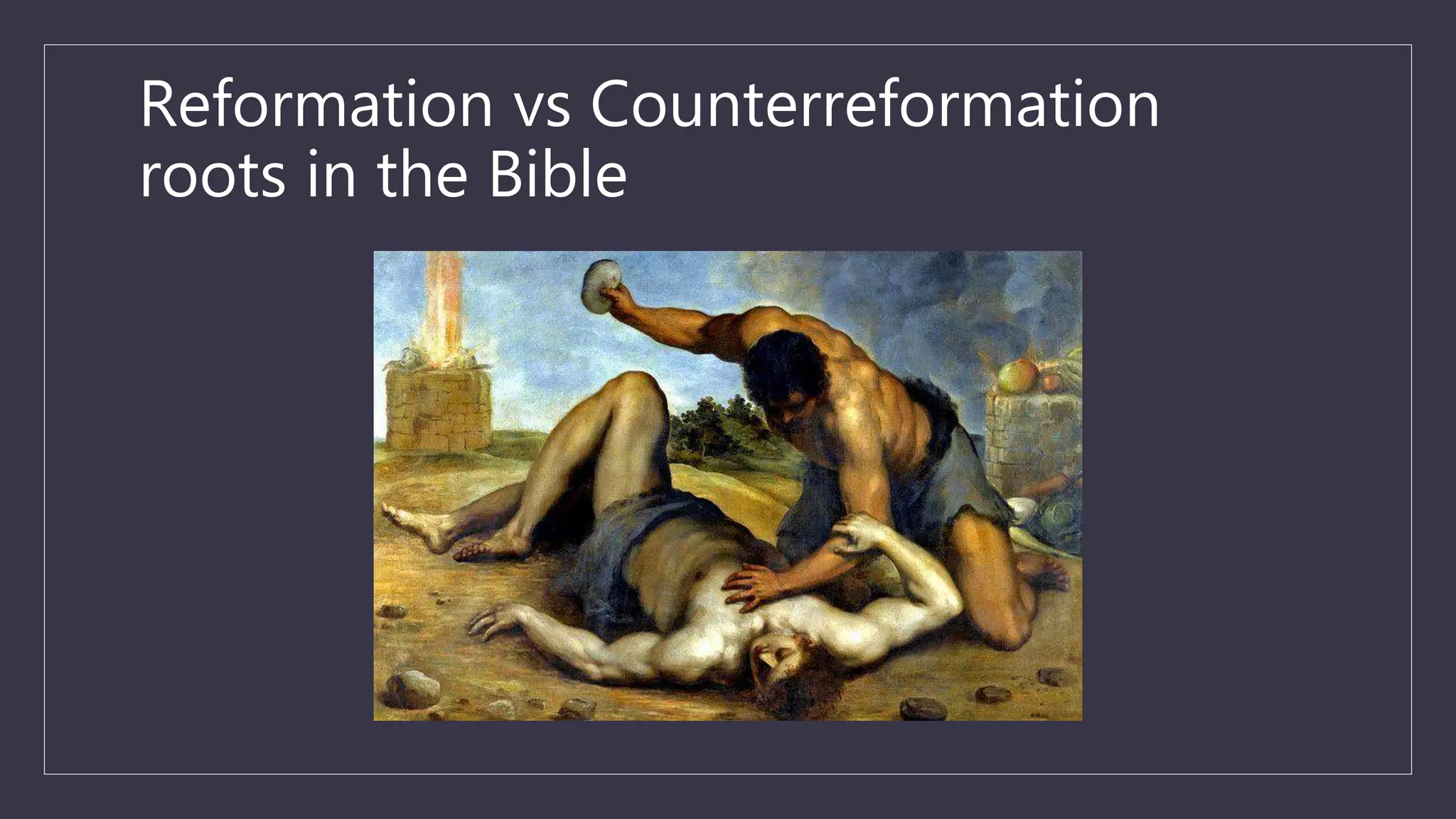
• Genesis 4vs26 ‘then men began to call upon the name of the LORD’, implies a reformation in contrast
to the counterreformation’s seed symbolised by Cain’s slaying his brother Abel for his righteous
deeds.
• Genesis 5 genealogy of patriarchs names from Adam to Noah has the gospel message encapsulated
in the Strong’s Greek and Hebrew lexicon in its simplicity 2 Corinthians11vs3.
Reformation vs Counterreformation
roots in the Bible
Reformation vs Counterreformation
roots in the Bible
Reformation vs Counterreformation
roots in the Bible
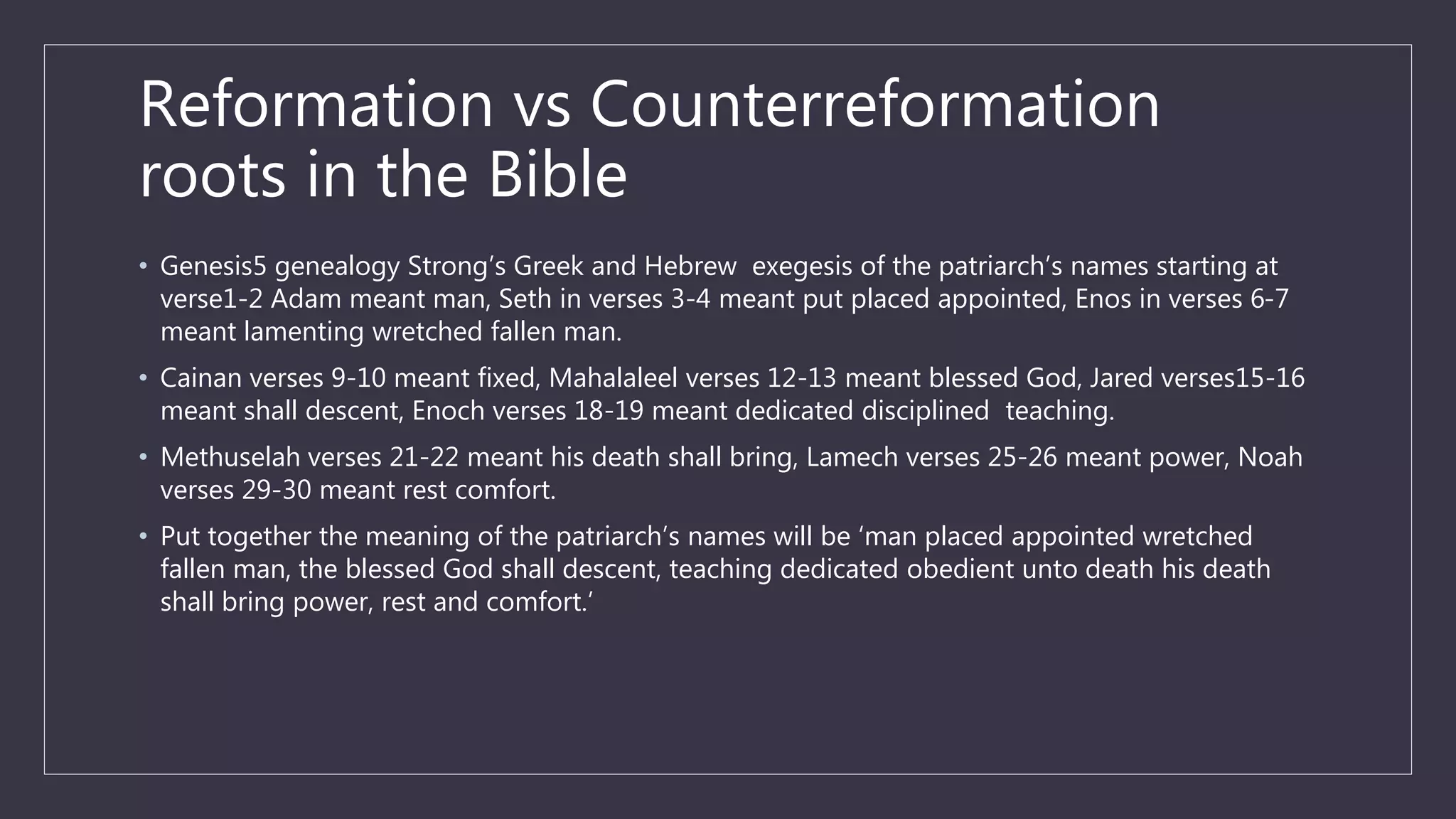
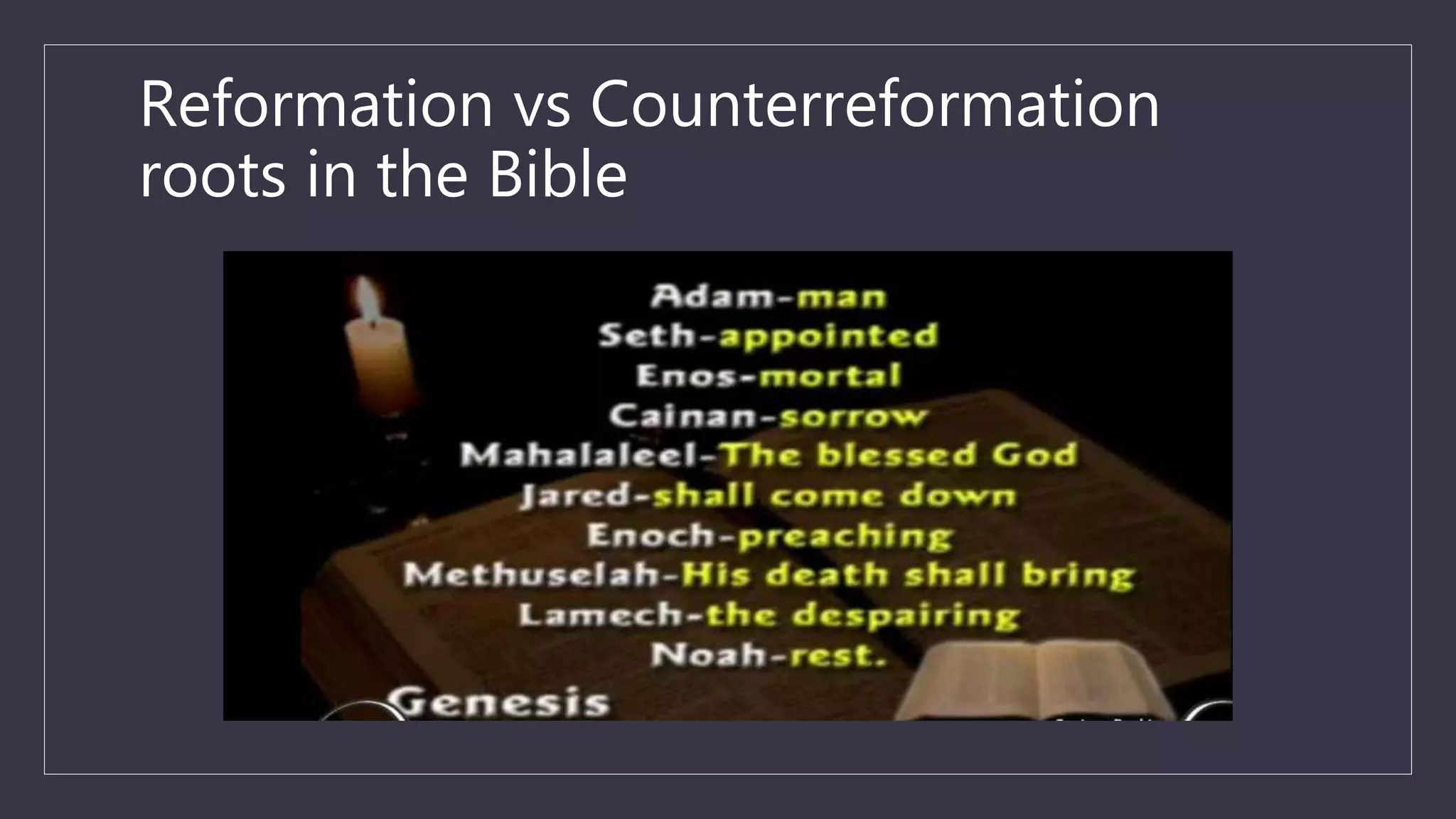
• Genesis5 genealogy Strong’s Greek and Hebrew exegesis of the patriarch’s names starting at
verse1-2 Adam meant man, Seth in verses 3-4 meant put placed appointed, Enos in verses 6-7
meant lamenting wretched fallen man.
• Cainan verses 9-10 meant fixed, Mahalaleel verses 12-13 meant blessed God, Jared verses15-16
meant shall descent, Enoch verses 18-19 meant dedicated disciplined teaching.
• Methuselah verses 21-22 meant his death shall bring, Lamech verses 25-26 meant power, Noah
verses 29-30 meant rest comfort.
• Put together the meaning of the patriarch’s names will be ‘man placed appointed wretched
fallen man, the blessed God shall descent, teaching dedicated obedient unto death his death
shall bring power, rest and comfort.’
Reformation vs Counterreformation
roots in the Bible
Reformation vs Counterreformation
roots in the Bible
Reformation vs Counterreformation
roots in the Bible
Reformation vs Counterreformation
roots in the Bible
• 2 Kings 22vs1 Josiah was an eight year king who spearheaded spiritual reforms in southern
kingdom of Judah and even into northern kingdom of Israel where syncretism was rife God’s
worship mixed with Baal foreign gods worship. Josiah’s name according to the Greek Hebrew
lexicon means founded of Jah, marrying the topic that every reformation should be founded by
Jah God.
• Josiah’s mother Jedidah means beloved whilst his maternal grandfather Adaiah means Jah has
adorned, implying that if reformation is founded on God’s word it will be beloved and invested
with divine power attending it even the gates of hell will not prevail over God’s reformed church,
Matthew 16vs18, 2 Kings 23vs1-25 & 2Chronicles34vs30-33.
• Malachi 4vs4-5 tells of the reform that will precede the great day of the LORD’s judgement at
the Second Advent, the reform involves studying the law and tells of the prophetic Elijah’s
coming and office.
Reformation vs Counterreformation
roots in the Bible
Reformation vs Counterreformation
roots in the Bible
Reformation vs Counterreformation
roots in the Bible
• Jesus came in the flesh as one of us at the same time being God incarnate to show us the
undistorted character of God which is love in the fullness of time, Galatians 4vs4 & 1 Timothy
3vs16.
• Matthew 5-7, Christ the Messiah gives what could be termed an awaited manifesto the sermon
on the mount propelling his ministry which was a type of a reformation of the church in his time
which was now riddled with traditions and commandments of man, Matthew 15vs1-9.
• Our LORD and Saviour Jesus Christ was a reformer whilst those who rejected him like the
Pharisees, Sadducees and Chief priests were the counter-reformers, in his doctrine he taught
truth in love not mixing it with error lest, it becomes more dangerous although more innocent
looking , it is equivalent to all error, Isiah 5vs20 & Ezekiel 22vs26.
• John 8vs12-59 passage is manifest the spirit of reformation in contrast to the spirit of
counterreformation, as Christ tells the Pharisees without mincing words that they were indeed
the offspring of the devil not of Abraham for their deeds testified the former.
Reformation vs Counterreformation
roots in the Bible
• As a golden thread running through elements of the reformation vs counterreformation
continued even after the death of Jesus Christ the Messiah within the seven church ages,
Revelation 1vs20,2 & 3.
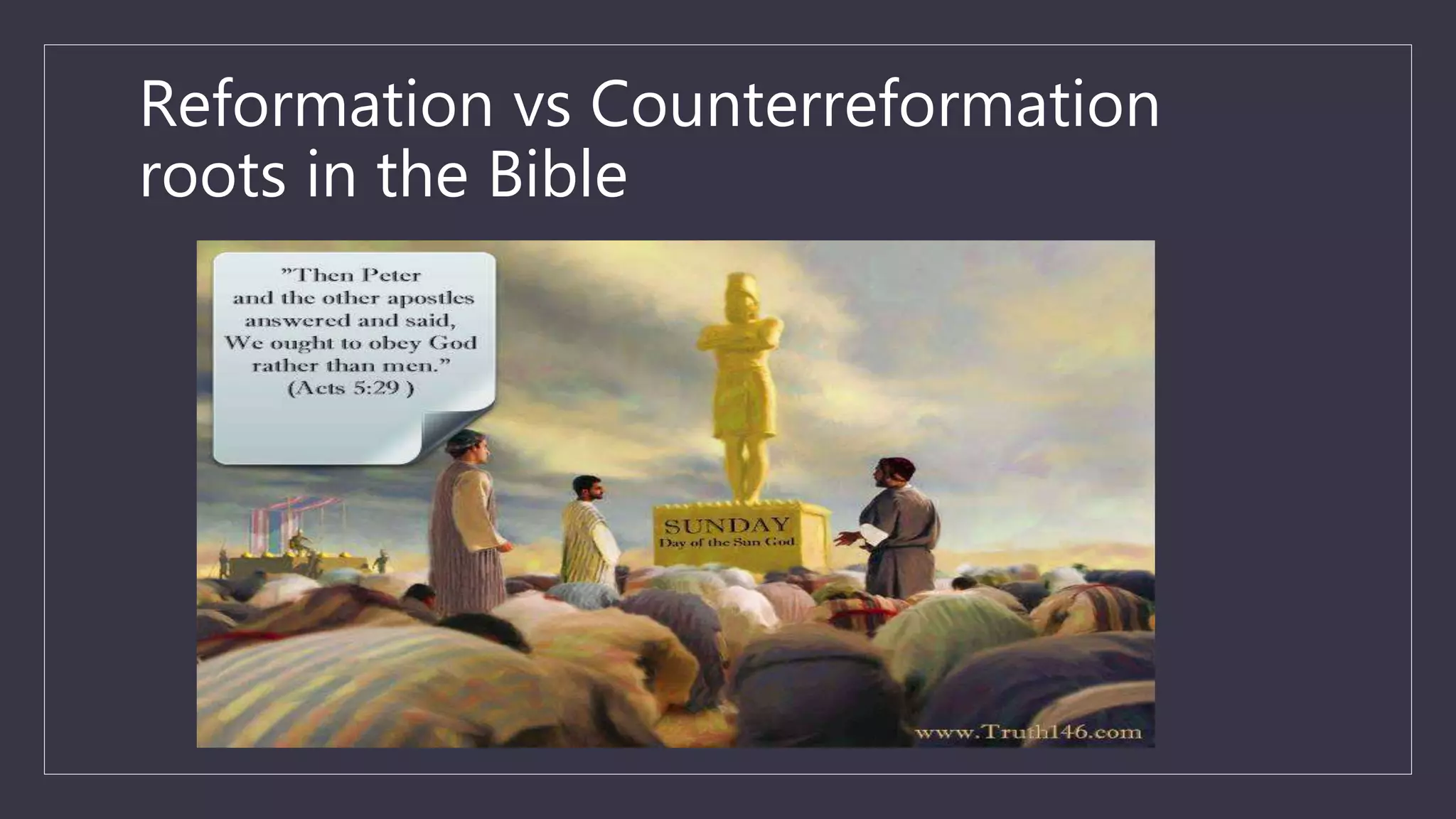
• With the early church the apostles after the Pentecost experience with the Holy Spirit went
forward with holy boldness even amidst persecutions and constantly being brought before
councils to recant their teachings their motto was in Acts 5vs29.
• As the reformation was rekindled of God it would stand the test of time even though the raging
counterreformation persecutions tried to quench it, the blood of the Christian martyrs like
Stephen was seed to the growth of the Gospel and disciples increased, Acts 5vs32,33-42 & 6vs7.
• Acts 14vs22 tells us how we must expect to enter the kingdom of God which is the cost of
discipleship precept upon precept line upon line also 2Timothy 3vs12, Acts 24vs25-26 Paul’s
case parallels what happened to Luther at Worms diet council and Jesus had prophesied what
our response should be in Luke 21vs12-19.
Reformation vs Counterreformation
roots in the Bible
Reformation vs Counterreformation in
History
Reformation vs Counterreformation in
History
Reformation vs Counterreformation in
History
• "Erasmus and Luther, viewed in connection with the Reformation, are the representatives of two
great ideas,-of two great parties in their age, and indeed in every age. The one is composed of
men of timid prudence; the other, of men of resolution and courage." J. H. Merle D'Aubigne,
D.D., History of the Reformation of the Sixteenth Century, book 1, ch. 8, p. 43.
• Martin Luther, the leader of the Protestant Reformation, and Ignatius Loyola, the leader of the
counter-Reformation, both were men of resolution and courage. Luther and Ignatius formed
movements which have now been at war with each other for centuries. Erasmus, attempting to
remain neutral, strove to unite what he saw as the extremes in Christianity.
• These three positions personified in the contemporaries Luther, Erasmus, and Loyola, still exist
within Christianity today.
• We will now take a look at some history sources of what these characters were and the position
they took.
Reformation vs Counterreformation in
History
• "Since His Imperial Majesty wants a plain answer, I shall give him a plain answer without horns or
teeth. Unless I am refuted and convicted by testimonies of the Scriptures or by clear arguments since I
believe neither the popes nor the Councils alone, it being evident that they have often erred and
contradicted one another. I am conquered by the passages of the Holy Scriptures I have quoted, and
my conscience is bound in the Word of God. I can not and will not recant anything, since it is unsafe
and dangerous to act against one's conscience. Here I stand. I can not do otherwise. God help me.
Amen." Luther, cited in Luther the Leader, pp. 117, 118.
• Ellen G. White, speaking through inspiration, spoke thus of Luther: "Foremost among those who were
called to lead the church from the darkness of popery into the light of a purer faith, stood Martin
Luther. Zealous, ardent, and devoted, knowing no fear but the fear of God, and acknowledging no
foundation for religious faith but the Holy Scriptures, Luther was the man for his time; through him
God accomplished a great work for the reformation of the church and the enlightenment of the
world." The Great Controversy, p. 120.
• "I observe that the greater their evangelical piety and the purer their morals, the less are men
opposed to Luther. His life is praised even by those who cannot endure his faith." Duke George of
Saxony, cited in Ibid., b. 3, ch. 6, p. 101.
Reformation vs Counterreformation in
History
• "Oh that there were seen in this day, so deep abhorrence of self, so great humiliation of soul before
God, and so earnest a faith when light is given, as were manifested by Martin Luther! True conviction
of sin is now rarely experienced, superficial conversions abound, and Christian experience is dwarfed
and spiritless. And why is this? Because of the false and fatal education given by parents to their
children, and by ministers to their people." Signs of the Times, 5-31-83 (chapter entitled "Martin
Luther-His Character and early Life").
• Ignatius Loyola was a contemporary of Luther, born eight years after Luther’s birth. "On these strong
walls [of the fortress Pampeluna] was kindled an enthusiasm destined afterwards to oppose the
enthusiasm of the reformer [Luther], and to breathe into the papacy a new spirit of energy,
devotedness, and control. Pampeluna was destined to be the cradle, as it were, of the rival of the
Wittenberg monk." Ibid., pp. 352, 353.
• "As soon as his health was restored, he determined to bid adieu to the world .... He departed alone, in
great secrecy, for the solitary dwellings that the hermits of St. Benedict had hewn out of the rocks of
Montserrat. Impelled not by a sense of his sins or his need of Divine grace, but by a desire to become
a `knight of the Virgin,' and of obtaining renown by mortifications and pious works." Ibid, p.
353.1Timothy4vs1-5.
Reformation vs Counterreformation in
History
• "Visions came erelong to confirm Inigo in the conviction at which he had arrived. His own resolves
had become a substitute for the grace of the Lord; his own imaginings supplied the place of God's
Word. He had looked upon the voice of God in his conscience as the voice of the devil; and
accordingly the remainder of his history represents him as given up to the inspirations of the spirit of
darkness. Romans1vs21-22,Isiah5vs20&Matthew6vs23.
• "Luther, on taking his doctor's degree, had pledged his oath to Holy Scripture, and the only infallible
authority of the Word of God had become the fundamental principle of the Reformation. Loyola, at
this time, bound himself to dreams and visions; and chimerical apparitions became the principle of his
life and faith." Ibid., p 354.Matthew7vs24-27.
• Ignatius Loyola founded the order called the Jesuits or Society of Jesus on August 15, 1534. The order
was sanctioned by Pope Paul II, September 27, 1540. Talking of the Jesuits Ellen White says: "The first
triumphs of the Reformation past, Rome summoned new forces, hoping to accomplish its destruction.
At this time, the order of the Jesuits was created, the most cruel, unscrupulous, and powerful of all the
champions of popery....The Great Controversy, p. 234. "Let us suffer everything, rather than surrender."
Loyola, cited in History of the Reformation, b. 5, ch. 1, p. 352.
Reformation vs Counterreformation in
History
• DESIDERIUS ERASMUS OF ROTTERDAM was also a peer of Luther: "It is dangerous to speak, and it is dangerous to
be silent." Erasmus cited in Ibid., b. 1, ch. 8, p. 44. Not all in Luther's day had the thoughts of Loyola. There was yet
another thinking not of the Papacy and yet separate from Luther. This thought can be seen in the man, Erasmus.
• D'Aubigne in contrasting the position of Erasmus with that of Luther says: "While Luther desired a thorough
reform, Erasmus, a friend of half-measures, was endeavouring to obtain concessions from the hierarchy that would
unite the extreme parties. The vacillations and inconsistency of Erasmus disgusted Luther. `You desire to walk upon
eggs without crushing them,' said the latter, `and among glasses without breaking them..."' Ibid., b. 11, ch. 9, p.
413.James3vs11-12,Joel3vs14,Matthew6vs24&1Kings18vs21.
• "At the epoch of the Reformation, Erasmus was the leader of the moderates; he imagined himself to be so, but
without just cause; for when truth and error meet face to face, justice lies not between them. He was the chief of
that philosophical and academical party which, for ages, had attempted to correct Rome, but had never succeeded;
he was the representative of human wisdom, but that wisdom was too weak to batter down the high places of
Popery. It needed that wisdom from God, which men often call foolishness, but at whose voice mountains crumble
into dust. Erasmus would neither throw himself into the arms of Luther, nor sit at the pope's feet. He hesitated, and
often wavered between these two powers, attracted at one time towards Luther, then suddenly repelled in the
direction of the pope." Ibid., b. 6, ch. 6, p. 213.Revelations3vs14-15.
Reformation vs Counterreformation in
History
• Perhaps the greatest thing that Erasmus did for the reformation was to publish his Greek and Latin
version of the New Testament. Of this text Ellen White says: "Wycliffe's Bible had been translated from
the Latin text [Latin Vulgate], which contained many errors ... In 1516, a year before the appearance of
Luther's theses, Erasmus had published his Greek and Latin version of the New Testament. Now for
the first times the Word of God was printed in the original tongue. In this work many errors of former
versions were corrected, and the sense was more clearly rendered." The Great Controversy, p. 245.
• It was Erasmus' New Testament which was used for our authorized King James Version. The
translators of the King James Version wrote in their dedication to King James: "...the zeal of your
majesty toward the house of God doth not slack or go backward but is more and more kindled,
manifesting itself abroad in the farthest parts of Christendom by writing a defence of the truth which
hath given such a blow to that man of sin as will not be healed." However, when it came to the
reformation and involvement with doctrine,
• Erasmus, took a mild position. D'Aubigne describes Erasmus' desire for peace and unity: "`A
disadvantageous peace,' Erasmus used to say, `is better than the most righteous war....' He thought-
and how many Erasmuses have lived since, and are living even in our own days! he thought that a
reformation which might shake the - Church would endanger its overthrow...
Reformation vs Counterreformation in
History
Reformation vs Counterreformation in
History
• "But the courageous portion of his contemporaries were prepared with an answer. History had
sufficiently proved that a free display of the truth and a decided struggle against falsehood could
alone ensure the victory. "If they had compromised, with the stratagem of policy and the wiles of the
papal court, truth would have been extinguished in its first glimmerings. "Had not conciliatory
measures been employed for ages? Had not council after council been involved to reform the
Church? All had been unavailing. Why now pretend to repeat an experiment that had so often
failed?2Corinthians13vs8&Ephesians5vs11-13.
• "The leading principle of Erasmus was: `Give light, and the darkness will disappear of itself.' This
principle is good, and Luther acted upon it. But when the enemies of the light endeavour to
extinguish it, or to wrest the torch from the hand of him who bears it, must we (for the sake of peace)
allow him to do so? Must we not resist the wicked?... "He [Erasmus] had not the strength of faith
which animated Luther. While the latter was ever prepared to lay down his life for the truth, Erasmus
candidly observed, `Let others aspire to martyrdom: as for me, I do not think myself worthy of such an
honour. I fear that if any disturbance were to arise, I should imitate Peter in his fall."' History of the
Reformation, b. 1, ch. 8, pp. 43, 44. Judevs3,1Thessalonians2vs2-6,1Peter4vs12-19&Matthew10vs16-
28,32-34.
Reformation vs Counterreformation in
History
• Luther, in contrast to Erasmus, had an unchangeable nature. Luther said: "If you do not contend
with your whole heart against the impious government of the pope, you cannot be saved.
Whoever takes delight in the religion and worship of popery, will be eternally lost in the world
to come. If you reject it, you must expect to incur every kind of danger, and even to lose your
lives. But it is far better to be exposed to such perils in this world than to keep silence! So long
as I live, I will denounce to my brethren the sore and the plague of Babylon, for fear that many
who are with us should fall back like the rest into the bottomless pit!" Cited in History of the
Reformation, b. 6, ch. 5, p. 208.
• "In proportion as he beheld Rome rising up against the friends of the Reformation, he prudently
retreated. He was applied to from all quarters; the pope, the emperor, kings, princes, scholars,
and even his most intimate friends, entreated him to write against the reformer. `No work,'
wrote the pope, `can be more acceptable to God, and worthier of yourself and of your
genius.‘Isiah8vs11-12.
Reformation vs Counterreformation in
History
Reformation vs Counterreformation in
History
• "He [Erasmus] was fond of glory, and already men were accusing him of fearing Luther, and of being too weak to
answer him; he was accustomed to the highest seat, and the little monk of Wittenberg had dethroned the mighty
philosopher of Rotterdam." Ibid., pp. 414, 415.1Corinthians1vs19-25.
• Erasmus could not remain neutral forever. The point came when Erasmus decided to write against Luther. This
came as a result of a communication from Luther, the man of strife, asking for peace. It was Erasmus the man of
peace who began the strife. In April 1524 Luther wrote to Erasmus: Galatians6vs7-
8,2Cor6vs14,Amos3vs3&Ecclesiastes11vs3.
• "You have not yet received from the Lord the courage necessary to walk with us against the papists. We put up
with your weakness. If learning flourishes: if by its means the treasures of Scripture are opened to all; this is a gift
which God has bestowed on us through you. Our thanksgivings ascend to heaven! But do not forsake the task that
has been imposed upon you, and pass over to our camp. No doubt your eloquence and genius might be very
useful to us but since you are wanting in courage, remain where you are. But on the other hand, my dear Erasmus,
refrain from scattering over us with such profusion that pungent salt which you know so well how to conceal under
the flowers of rhetoric; for it is more dangerous to be slightly wounded by Erasmus than to be ground to powder
by all the papists put together. Be satisfied to remain a spectator of our tragedy; and publish no books against me;
and for my part, I will write none against you." History of the Reformation, b. 11, ch. 9, p. 414.
Reformation vs Counterreformation in
History
• It was this letter that Erasmus received as the bitterest of insults and prompted his action in attacking
Luther. In doing this Erasmus selected the doctrine of free will. Erasmus' attack on Luther gained him
the fame and applause he desired. D'Aubigne quotes Erasmus as saying: "`The Pope,' wrote he
[Erasmus] with childish vanity to an intimate friend, at the period he declared himself the opponent of
Luther, `has sent me a diploma full of kindness and honourable testimonials. His secretary declares
that this is an unprecedented honour and that the pope dictated every word himself. "' Cited in Ibid.,
b. 1, ch. 8, p. 43. Galatians4vs16.
• However, in the end Erasmus regretted the step he had taken. Again D'Aubigne quotes him as saying:
"`Why was I not permitted to grow old in the garden of the Muses?' exclaimed he. `Here am I, at sixty,
driven into the arena, and holding the cestus and the net of the gladiator, instead of the lyre!- I am
aware,' wrote he to the Bishop of Rochester, `that in writing upon free will, I have gone beyond my
sphere ... You congratulate me upon my triumphs! Ah! I know not that I triumph. The faction (i. e. the
Reformation) is spreading daily. Was it then fated, that at my time of life I should be transformed
from a friend of the Muses into a wretched gladiator!"' Cited in Ibid., b. 11, ch. 9, p. 415. Acts5vs34-39.
• `But his [Erasmus] work was not the formation of doctrinal opinion or belief. His best friends must be
rather ashamed of the weakness of this side of his mind...2Timothy2vs15.
Reformation vs Counterreformation in
History
• "And the reader of Erasmus is reluctantly forced to the conclusion that this carelessness about
doctrinal theology led him sometimes to utter opinions which at other times he disavowed. "The
question that results from the consideration of Erasmus' neutral attitude is this: Ought a man in
every great conflict to take a side? To say that a man must in every such case take a side, implies
that of two sides, one must be right and the other wrong, which is frequently not the case, the
truth being almost equally distributed between them. But in the instance before us, it will be
said, that one side was right, or so much nearer the right than the other, that it was a weakness
not to take a side." Erasmus, pp. 63, 64, 65. 2Timothy1vs7,3vs7-9,Titus2vs1,7-8.
• How sad Erasmus took this neutral attitude. How much greater would have been his end if he
had made the cause of the reformers his own. However, the blame for the darkness of the Dark
Ages can not be cast on Erasmus.
Reformation vs Counterreformation in
History
• What was the final outcome of Erasmus? D'Aubigne portrays it as thus: "He was as the dying
man who was asked by the devil, What do you believe? The poor man, fearful of being caught in
some heresy, if he should make a confession of his faith, replied, What the Church believes. The
devil demanded, And what does the Church believe?- What I believe.- Once more he was
questioned, What do you believe?-and the expiring man answered once more, What the Church
believes! James4vs7,2Peter2vs15-22.
• "Such was Erasmus. How different would he have been had he abandoned self, and sacrificed all
for the truth! But... after having deserted the Reformation for Rome, when he saw that these two
things could not go hand in hand; -he lost ground with all parties. The fanatical partisans of the
papacy felt all the hurt he had done them, and would not pardon him. Furious monks loaded
him with abuse from the pulpits: they called him a second Lucian, -a fox that had laid waste the
Lord's vineyard.
Reformation vs Counterreformation in
History
• "A doctor of Constance had hung the portrait of Erasmus in his study, that he might be able at
any moment to spit in his face.-But, on the other hand, Erasmus, deserting the standard of the
Gospel, lost the affection and esteem of the noblest men of the age in which he lived, and was
forced to renounce, there can be little doubt, those heavenly consolations which God sheds in
the heart of those who act as good soldiers of Christ. This at least seems to be indicated by
those bitter tears, those painful vigils, that broken sleep, that tasteless food, that loathing of the
study of the Muses, (formerly his only consolation), those saddened features, that pale face,
those sorrowful and downcast eyes, that hatred of existence which he calls `a cruel life,' and
those longings after death, which he describes to his friends. Unhappy Erasmus!" History of the
Reformation, b. 1, ch. 8, pp. 44, 45.Proverbs14vs12-14,2Thessalonians2vs12-13,2Timothy4vs2-
5,Titus3vs9-11.
• Final admonition to us from the LORD is in the following texts Isiah58vs8-12,55vs6-
13&Ezekiel3vs17,Ezekiel33vs1-7,Revelation3vs14-22&Revelation14vs6-13.The Gospel of Christ
will not be preached entirely without offence.
Reformation vs Counterreformation in
History
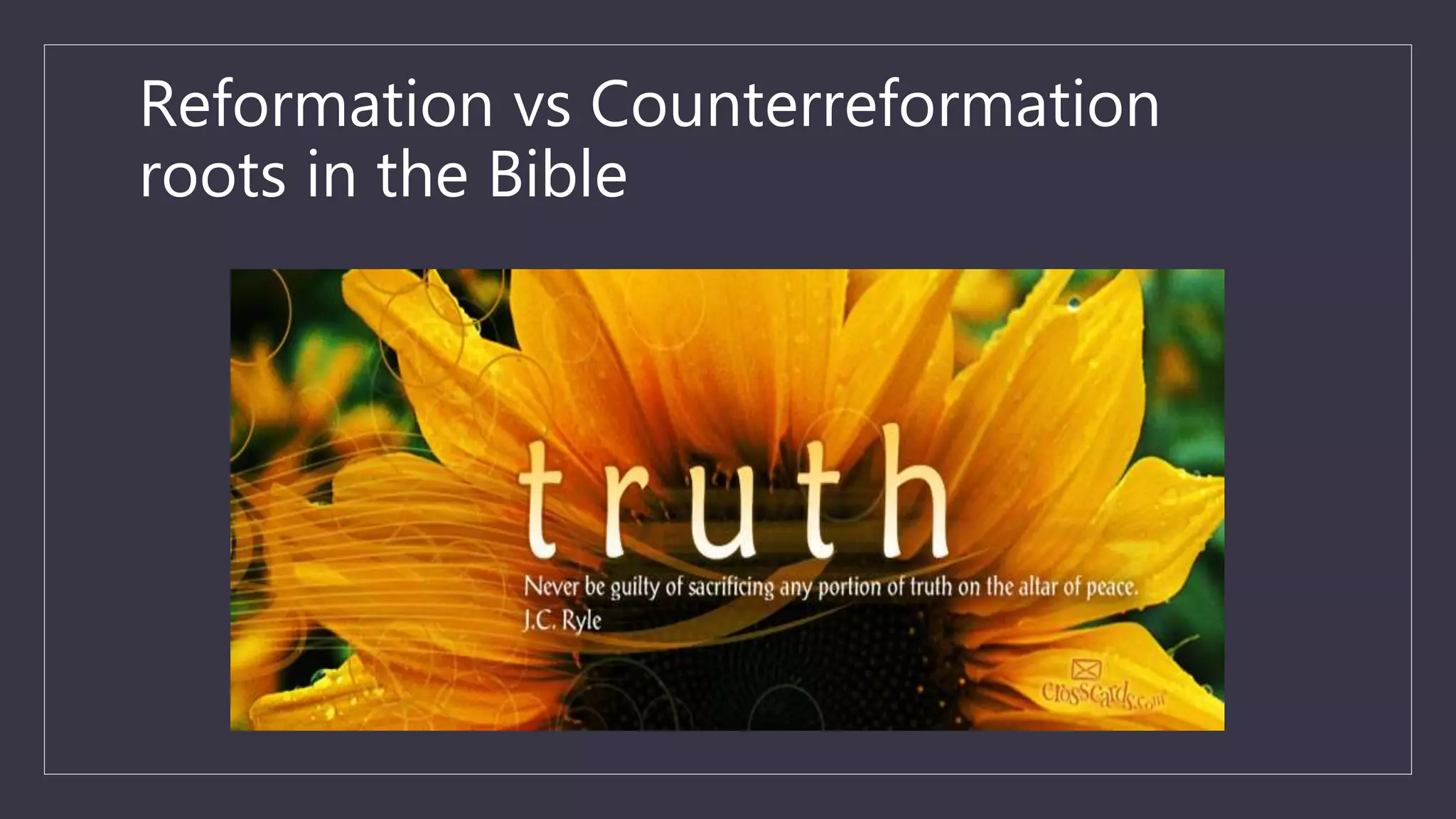
• Truth mixed with error is equivalent to all error, except that it is more innocent looking and,
therefore, more dangerous.”-H.A. Ironside.
Reformation vs Counterreformation in
History
Reformation vs Counterreformation in
History
• Jeremiah6vs16 Thus saith the LORD, Stand ye in the ways, and see, and ask for the old paths,
where is the good way, and walk therein, and ye shall find rest for your souls. But they said, We
will not walk therein.
Reformation vs Counterreformation in
History
Reformation vs Counterreformation in
History

Reformation vs counterreformation

  • 1.
    C REFORMATION VS COUNTERREFORMATI ON “Truth isindependent of opinion. By its very definition, Truth is intolerant of error, every aspect petitioning the conscience for acknowledgement. The individual however, holds the key to admission or rejection.”
  • 2.
    Reformation vs Counterreformation rootsin the Bible • Genesis 1vs2 darkness upon the face of the deep type of the antitype dark ages preceding the reformation of history in the 16th century.Genesis1vs3-5, God spoke let there be light and there was light and divided light from darkness 2Corinthians4vs6. • Reformation was a dawn of light again on the earth after a period of church apostasy 2Corinthians 4vs3-4 since the apostles death Acts 20vs29-30, ‘for what hath been it is which shall be; and that which is done that shall be done: and no new thing under the sun’ Ecclesiastes1vs9. • A typical dark ages scenario took place in Genesis 3 man’s fall from his holy estate to succumb to sin, afterwards God took initiative for the required salvific reformation rescuing man from the depths of sin through promising hatred between the woman’s seed (Jesus) and the serpent’s seed Genesis3vs15 prophetic. • Genesis 4vs26 ‘then men began to call upon the name of the LORD’, implies a reformation in contrast to the counterreformation’s seed symbolised by Cain’s slaying his brother Abel for his righteous deeds. • Genesis 5 genealogy of patriarchs names from Adam to Noah has the gospel message encapsulated in the Strong’s Greek and Hebrew lexicon in its simplicity 2 Corinthians11vs3.
  • 3.
  • 4.
  • 5.
    Reformation vs Counterreformation rootsin the Bible • Genesis5 genealogy Strong’s Greek and Hebrew exegesis of the patriarch’s names starting at verse1-2 Adam meant man, Seth in verses 3-4 meant put placed appointed, Enos in verses 6-7 meant lamenting wretched fallen man. • Cainan verses 9-10 meant fixed, Mahalaleel verses 12-13 meant blessed God, Jared verses15-16 meant shall descent, Enoch verses 18-19 meant dedicated disciplined teaching. • Methuselah verses 21-22 meant his death shall bring, Lamech verses 25-26 meant power, Noah verses 29-30 meant rest comfort. • Put together the meaning of the patriarch’s names will be ‘man placed appointed wretched fallen man, the blessed God shall descent, teaching dedicated obedient unto death his death shall bring power, rest and comfort.’
  • 6.
  • 7.
  • 8.
  • 9.
    Reformation vs Counterreformation rootsin the Bible • 2 Kings 22vs1 Josiah was an eight year king who spearheaded spiritual reforms in southern kingdom of Judah and even into northern kingdom of Israel where syncretism was rife God’s worship mixed with Baal foreign gods worship. Josiah’s name according to the Greek Hebrew lexicon means founded of Jah, marrying the topic that every reformation should be founded by Jah God. • Josiah’s mother Jedidah means beloved whilst his maternal grandfather Adaiah means Jah has adorned, implying that if reformation is founded on God’s word it will be beloved and invested with divine power attending it even the gates of hell will not prevail over God’s reformed church, Matthew 16vs18, 2 Kings 23vs1-25 & 2Chronicles34vs30-33. • Malachi 4vs4-5 tells of the reform that will precede the great day of the LORD’s judgement at the Second Advent, the reform involves studying the law and tells of the prophetic Elijah’s coming and office.
  • 10.
  • 11.
  • 12.
    Reformation vs Counterreformation rootsin the Bible • Jesus came in the flesh as one of us at the same time being God incarnate to show us the undistorted character of God which is love in the fullness of time, Galatians 4vs4 & 1 Timothy 3vs16. • Matthew 5-7, Christ the Messiah gives what could be termed an awaited manifesto the sermon on the mount propelling his ministry which was a type of a reformation of the church in his time which was now riddled with traditions and commandments of man, Matthew 15vs1-9. • Our LORD and Saviour Jesus Christ was a reformer whilst those who rejected him like the Pharisees, Sadducees and Chief priests were the counter-reformers, in his doctrine he taught truth in love not mixing it with error lest, it becomes more dangerous although more innocent looking , it is equivalent to all error, Isiah 5vs20 & Ezekiel 22vs26. • John 8vs12-59 passage is manifest the spirit of reformation in contrast to the spirit of counterreformation, as Christ tells the Pharisees without mincing words that they were indeed the offspring of the devil not of Abraham for their deeds testified the former.
  • 13.
    Reformation vs Counterreformation rootsin the Bible • As a golden thread running through elements of the reformation vs counterreformation continued even after the death of Jesus Christ the Messiah within the seven church ages, Revelation 1vs20,2 & 3. • With the early church the apostles after the Pentecost experience with the Holy Spirit went forward with holy boldness even amidst persecutions and constantly being brought before councils to recant their teachings their motto was in Acts 5vs29. • As the reformation was rekindled of God it would stand the test of time even though the raging counterreformation persecutions tried to quench it, the blood of the Christian martyrs like Stephen was seed to the growth of the Gospel and disciples increased, Acts 5vs32,33-42 & 6vs7. • Acts 14vs22 tells us how we must expect to enter the kingdom of God which is the cost of discipleship precept upon precept line upon line also 2Timothy 3vs12, Acts 24vs25-26 Paul’s case parallels what happened to Luther at Worms diet council and Jesus had prophesied what our response should be in Luke 21vs12-19.
  • 14.
  • 15.
  • 16.
  • 17.
    Reformation vs Counterreformationin History • "Erasmus and Luther, viewed in connection with the Reformation, are the representatives of two great ideas,-of two great parties in their age, and indeed in every age. The one is composed of men of timid prudence; the other, of men of resolution and courage." J. H. Merle D'Aubigne, D.D., History of the Reformation of the Sixteenth Century, book 1, ch. 8, p. 43. • Martin Luther, the leader of the Protestant Reformation, and Ignatius Loyola, the leader of the counter-Reformation, both were men of resolution and courage. Luther and Ignatius formed movements which have now been at war with each other for centuries. Erasmus, attempting to remain neutral, strove to unite what he saw as the extremes in Christianity. • These three positions personified in the contemporaries Luther, Erasmus, and Loyola, still exist within Christianity today. • We will now take a look at some history sources of what these characters were and the position they took.
  • 18.
    Reformation vs Counterreformationin History • "Since His Imperial Majesty wants a plain answer, I shall give him a plain answer without horns or teeth. Unless I am refuted and convicted by testimonies of the Scriptures or by clear arguments since I believe neither the popes nor the Councils alone, it being evident that they have often erred and contradicted one another. I am conquered by the passages of the Holy Scriptures I have quoted, and my conscience is bound in the Word of God. I can not and will not recant anything, since it is unsafe and dangerous to act against one's conscience. Here I stand. I can not do otherwise. God help me. Amen." Luther, cited in Luther the Leader, pp. 117, 118. • Ellen G. White, speaking through inspiration, spoke thus of Luther: "Foremost among those who were called to lead the church from the darkness of popery into the light of a purer faith, stood Martin Luther. Zealous, ardent, and devoted, knowing no fear but the fear of God, and acknowledging no foundation for religious faith but the Holy Scriptures, Luther was the man for his time; through him God accomplished a great work for the reformation of the church and the enlightenment of the world." The Great Controversy, p. 120. • "I observe that the greater their evangelical piety and the purer their morals, the less are men opposed to Luther. His life is praised even by those who cannot endure his faith." Duke George of Saxony, cited in Ibid., b. 3, ch. 6, p. 101.
  • 19.
    Reformation vs Counterreformationin History • "Oh that there were seen in this day, so deep abhorrence of self, so great humiliation of soul before God, and so earnest a faith when light is given, as were manifested by Martin Luther! True conviction of sin is now rarely experienced, superficial conversions abound, and Christian experience is dwarfed and spiritless. And why is this? Because of the false and fatal education given by parents to their children, and by ministers to their people." Signs of the Times, 5-31-83 (chapter entitled "Martin Luther-His Character and early Life"). • Ignatius Loyola was a contemporary of Luther, born eight years after Luther’s birth. "On these strong walls [of the fortress Pampeluna] was kindled an enthusiasm destined afterwards to oppose the enthusiasm of the reformer [Luther], and to breathe into the papacy a new spirit of energy, devotedness, and control. Pampeluna was destined to be the cradle, as it were, of the rival of the Wittenberg monk." Ibid., pp. 352, 353. • "As soon as his health was restored, he determined to bid adieu to the world .... He departed alone, in great secrecy, for the solitary dwellings that the hermits of St. Benedict had hewn out of the rocks of Montserrat. Impelled not by a sense of his sins or his need of Divine grace, but by a desire to become a `knight of the Virgin,' and of obtaining renown by mortifications and pious works." Ibid, p. 353.1Timothy4vs1-5.
  • 20.
    Reformation vs Counterreformationin History • "Visions came erelong to confirm Inigo in the conviction at which he had arrived. His own resolves had become a substitute for the grace of the Lord; his own imaginings supplied the place of God's Word. He had looked upon the voice of God in his conscience as the voice of the devil; and accordingly the remainder of his history represents him as given up to the inspirations of the spirit of darkness. Romans1vs21-22,Isiah5vs20&Matthew6vs23. • "Luther, on taking his doctor's degree, had pledged his oath to Holy Scripture, and the only infallible authority of the Word of God had become the fundamental principle of the Reformation. Loyola, at this time, bound himself to dreams and visions; and chimerical apparitions became the principle of his life and faith." Ibid., p 354.Matthew7vs24-27. • Ignatius Loyola founded the order called the Jesuits or Society of Jesus on August 15, 1534. The order was sanctioned by Pope Paul II, September 27, 1540. Talking of the Jesuits Ellen White says: "The first triumphs of the Reformation past, Rome summoned new forces, hoping to accomplish its destruction. At this time, the order of the Jesuits was created, the most cruel, unscrupulous, and powerful of all the champions of popery....The Great Controversy, p. 234. "Let us suffer everything, rather than surrender." Loyola, cited in History of the Reformation, b. 5, ch. 1, p. 352.
  • 21.
    Reformation vs Counterreformationin History • DESIDERIUS ERASMUS OF ROTTERDAM was also a peer of Luther: "It is dangerous to speak, and it is dangerous to be silent." Erasmus cited in Ibid., b. 1, ch. 8, p. 44. Not all in Luther's day had the thoughts of Loyola. There was yet another thinking not of the Papacy and yet separate from Luther. This thought can be seen in the man, Erasmus. • D'Aubigne in contrasting the position of Erasmus with that of Luther says: "While Luther desired a thorough reform, Erasmus, a friend of half-measures, was endeavouring to obtain concessions from the hierarchy that would unite the extreme parties. The vacillations and inconsistency of Erasmus disgusted Luther. `You desire to walk upon eggs without crushing them,' said the latter, `and among glasses without breaking them..."' Ibid., b. 11, ch. 9, p. 413.James3vs11-12,Joel3vs14,Matthew6vs24&1Kings18vs21. • "At the epoch of the Reformation, Erasmus was the leader of the moderates; he imagined himself to be so, but without just cause; for when truth and error meet face to face, justice lies not between them. He was the chief of that philosophical and academical party which, for ages, had attempted to correct Rome, but had never succeeded; he was the representative of human wisdom, but that wisdom was too weak to batter down the high places of Popery. It needed that wisdom from God, which men often call foolishness, but at whose voice mountains crumble into dust. Erasmus would neither throw himself into the arms of Luther, nor sit at the pope's feet. He hesitated, and often wavered between these two powers, attracted at one time towards Luther, then suddenly repelled in the direction of the pope." Ibid., b. 6, ch. 6, p. 213.Revelations3vs14-15.
  • 22.
    Reformation vs Counterreformationin History • Perhaps the greatest thing that Erasmus did for the reformation was to publish his Greek and Latin version of the New Testament. Of this text Ellen White says: "Wycliffe's Bible had been translated from the Latin text [Latin Vulgate], which contained many errors ... In 1516, a year before the appearance of Luther's theses, Erasmus had published his Greek and Latin version of the New Testament. Now for the first times the Word of God was printed in the original tongue. In this work many errors of former versions were corrected, and the sense was more clearly rendered." The Great Controversy, p. 245. • It was Erasmus' New Testament which was used for our authorized King James Version. The translators of the King James Version wrote in their dedication to King James: "...the zeal of your majesty toward the house of God doth not slack or go backward but is more and more kindled, manifesting itself abroad in the farthest parts of Christendom by writing a defence of the truth which hath given such a blow to that man of sin as will not be healed." However, when it came to the reformation and involvement with doctrine, • Erasmus, took a mild position. D'Aubigne describes Erasmus' desire for peace and unity: "`A disadvantageous peace,' Erasmus used to say, `is better than the most righteous war....' He thought- and how many Erasmuses have lived since, and are living even in our own days! he thought that a reformation which might shake the - Church would endanger its overthrow...
  • 23.
  • 24.
    Reformation vs Counterreformationin History • "But the courageous portion of his contemporaries were prepared with an answer. History had sufficiently proved that a free display of the truth and a decided struggle against falsehood could alone ensure the victory. "If they had compromised, with the stratagem of policy and the wiles of the papal court, truth would have been extinguished in its first glimmerings. "Had not conciliatory measures been employed for ages? Had not council after council been involved to reform the Church? All had been unavailing. Why now pretend to repeat an experiment that had so often failed?2Corinthians13vs8&Ephesians5vs11-13. • "The leading principle of Erasmus was: `Give light, and the darkness will disappear of itself.' This principle is good, and Luther acted upon it. But when the enemies of the light endeavour to extinguish it, or to wrest the torch from the hand of him who bears it, must we (for the sake of peace) allow him to do so? Must we not resist the wicked?... "He [Erasmus] had not the strength of faith which animated Luther. While the latter was ever prepared to lay down his life for the truth, Erasmus candidly observed, `Let others aspire to martyrdom: as for me, I do not think myself worthy of such an honour. I fear that if any disturbance were to arise, I should imitate Peter in his fall."' History of the Reformation, b. 1, ch. 8, pp. 43, 44. Judevs3,1Thessalonians2vs2-6,1Peter4vs12-19&Matthew10vs16- 28,32-34.
  • 25.
    Reformation vs Counterreformationin History • Luther, in contrast to Erasmus, had an unchangeable nature. Luther said: "If you do not contend with your whole heart against the impious government of the pope, you cannot be saved. Whoever takes delight in the religion and worship of popery, will be eternally lost in the world to come. If you reject it, you must expect to incur every kind of danger, and even to lose your lives. But it is far better to be exposed to such perils in this world than to keep silence! So long as I live, I will denounce to my brethren the sore and the plague of Babylon, for fear that many who are with us should fall back like the rest into the bottomless pit!" Cited in History of the Reformation, b. 6, ch. 5, p. 208. • "In proportion as he beheld Rome rising up against the friends of the Reformation, he prudently retreated. He was applied to from all quarters; the pope, the emperor, kings, princes, scholars, and even his most intimate friends, entreated him to write against the reformer. `No work,' wrote the pope, `can be more acceptable to God, and worthier of yourself and of your genius.‘Isiah8vs11-12.
  • 26.
  • 27.
    Reformation vs Counterreformationin History • "He [Erasmus] was fond of glory, and already men were accusing him of fearing Luther, and of being too weak to answer him; he was accustomed to the highest seat, and the little monk of Wittenberg had dethroned the mighty philosopher of Rotterdam." Ibid., pp. 414, 415.1Corinthians1vs19-25. • Erasmus could not remain neutral forever. The point came when Erasmus decided to write against Luther. This came as a result of a communication from Luther, the man of strife, asking for peace. It was Erasmus the man of peace who began the strife. In April 1524 Luther wrote to Erasmus: Galatians6vs7- 8,2Cor6vs14,Amos3vs3&Ecclesiastes11vs3. • "You have not yet received from the Lord the courage necessary to walk with us against the papists. We put up with your weakness. If learning flourishes: if by its means the treasures of Scripture are opened to all; this is a gift which God has bestowed on us through you. Our thanksgivings ascend to heaven! But do not forsake the task that has been imposed upon you, and pass over to our camp. No doubt your eloquence and genius might be very useful to us but since you are wanting in courage, remain where you are. But on the other hand, my dear Erasmus, refrain from scattering over us with such profusion that pungent salt which you know so well how to conceal under the flowers of rhetoric; for it is more dangerous to be slightly wounded by Erasmus than to be ground to powder by all the papists put together. Be satisfied to remain a spectator of our tragedy; and publish no books against me; and for my part, I will write none against you." History of the Reformation, b. 11, ch. 9, p. 414.
  • 28.
    Reformation vs Counterreformationin History • It was this letter that Erasmus received as the bitterest of insults and prompted his action in attacking Luther. In doing this Erasmus selected the doctrine of free will. Erasmus' attack on Luther gained him the fame and applause he desired. D'Aubigne quotes Erasmus as saying: "`The Pope,' wrote he [Erasmus] with childish vanity to an intimate friend, at the period he declared himself the opponent of Luther, `has sent me a diploma full of kindness and honourable testimonials. His secretary declares that this is an unprecedented honour and that the pope dictated every word himself. "' Cited in Ibid., b. 1, ch. 8, p. 43. Galatians4vs16. • However, in the end Erasmus regretted the step he had taken. Again D'Aubigne quotes him as saying: "`Why was I not permitted to grow old in the garden of the Muses?' exclaimed he. `Here am I, at sixty, driven into the arena, and holding the cestus and the net of the gladiator, instead of the lyre!- I am aware,' wrote he to the Bishop of Rochester, `that in writing upon free will, I have gone beyond my sphere ... You congratulate me upon my triumphs! Ah! I know not that I triumph. The faction (i. e. the Reformation) is spreading daily. Was it then fated, that at my time of life I should be transformed from a friend of the Muses into a wretched gladiator!"' Cited in Ibid., b. 11, ch. 9, p. 415. Acts5vs34-39. • `But his [Erasmus] work was not the formation of doctrinal opinion or belief. His best friends must be rather ashamed of the weakness of this side of his mind...2Timothy2vs15.
  • 29.
    Reformation vs Counterreformationin History • "And the reader of Erasmus is reluctantly forced to the conclusion that this carelessness about doctrinal theology led him sometimes to utter opinions which at other times he disavowed. "The question that results from the consideration of Erasmus' neutral attitude is this: Ought a man in every great conflict to take a side? To say that a man must in every such case take a side, implies that of two sides, one must be right and the other wrong, which is frequently not the case, the truth being almost equally distributed between them. But in the instance before us, it will be said, that one side was right, or so much nearer the right than the other, that it was a weakness not to take a side." Erasmus, pp. 63, 64, 65. 2Timothy1vs7,3vs7-9,Titus2vs1,7-8. • How sad Erasmus took this neutral attitude. How much greater would have been his end if he had made the cause of the reformers his own. However, the blame for the darkness of the Dark Ages can not be cast on Erasmus.
  • 30.
    Reformation vs Counterreformationin History • What was the final outcome of Erasmus? D'Aubigne portrays it as thus: "He was as the dying man who was asked by the devil, What do you believe? The poor man, fearful of being caught in some heresy, if he should make a confession of his faith, replied, What the Church believes. The devil demanded, And what does the Church believe?- What I believe.- Once more he was questioned, What do you believe?-and the expiring man answered once more, What the Church believes! James4vs7,2Peter2vs15-22. • "Such was Erasmus. How different would he have been had he abandoned self, and sacrificed all for the truth! But... after having deserted the Reformation for Rome, when he saw that these two things could not go hand in hand; -he lost ground with all parties. The fanatical partisans of the papacy felt all the hurt he had done them, and would not pardon him. Furious monks loaded him with abuse from the pulpits: they called him a second Lucian, -a fox that had laid waste the Lord's vineyard.
  • 31.
    Reformation vs Counterreformationin History • "A doctor of Constance had hung the portrait of Erasmus in his study, that he might be able at any moment to spit in his face.-But, on the other hand, Erasmus, deserting the standard of the Gospel, lost the affection and esteem of the noblest men of the age in which he lived, and was forced to renounce, there can be little doubt, those heavenly consolations which God sheds in the heart of those who act as good soldiers of Christ. This at least seems to be indicated by those bitter tears, those painful vigils, that broken sleep, that tasteless food, that loathing of the study of the Muses, (formerly his only consolation), those saddened features, that pale face, those sorrowful and downcast eyes, that hatred of existence which he calls `a cruel life,' and those longings after death, which he describes to his friends. Unhappy Erasmus!" History of the Reformation, b. 1, ch. 8, pp. 44, 45.Proverbs14vs12-14,2Thessalonians2vs12-13,2Timothy4vs2- 5,Titus3vs9-11. • Final admonition to us from the LORD is in the following texts Isiah58vs8-12,55vs6- 13&Ezekiel3vs17,Ezekiel33vs1-7,Revelation3vs14-22&Revelation14vs6-13.The Gospel of Christ will not be preached entirely without offence.
  • 32.
    Reformation vs Counterreformationin History • Truth mixed with error is equivalent to all error, except that it is more innocent looking and, therefore, more dangerous.”-H.A. Ironside.
  • 33.
  • 34.
    Reformation vs Counterreformationin History • Jeremiah6vs16 Thus saith the LORD, Stand ye in the ways, and see, and ask for the old paths, where is the good way, and walk therein, and ye shall find rest for your souls. But they said, We will not walk therein.
  • 35.
  • 36.