STUDIES IN PHILIPPIANS 
BY GLENN PEASE 
CONTENTS 
1. INCURABLE OPTIMISM Based on Phil. 1:1-11 
2. JOYFUL SAINTS Based on Phil. 1:1-11 
3. EDUCATED LOVE Based on Phil. 1:1-11 
4. ENVIOUS CHRISTIANS Based on Phil. 1:12-18 
5. GOOD OUT OF EVIL Based on Phil. 1:12-26 
6. FANATIC FOR JESUS Based on Phil. 1:18-26 
7. COURAGEOUS FOR CHRIST Based on Phil. 1:19-26 
8. PARTNERS WITH GOD Based on Phil 1:19-26 
9. THE PRAYER OF THANKSGIVING based on Phil. 1:3-6 
10. THE SACRIFICIAL PERSPECTIVE Based on Phil. 2:1-11 
11. A SEASON TO BE SELFLESS Based on Phil. 2:1-11 
12. RECIPE FOR A MERRY CHRISTMAS based on Phil. 2:1-4 
13. ENCOURAGEMENT ENCOURAGES ENCOURAGERS. 2:1f 
14. THE PROBLEM AND SOLUTION Based on Phil. 2:1-11 
15. THE POWER OF THE RESURRECTION Phil. 3:1-16 
16. A FUTURE WITH FOCUS Based on Phil. 3:7-14 
17. THE GREATEST EDUCATION Based on Phil. 3:8 
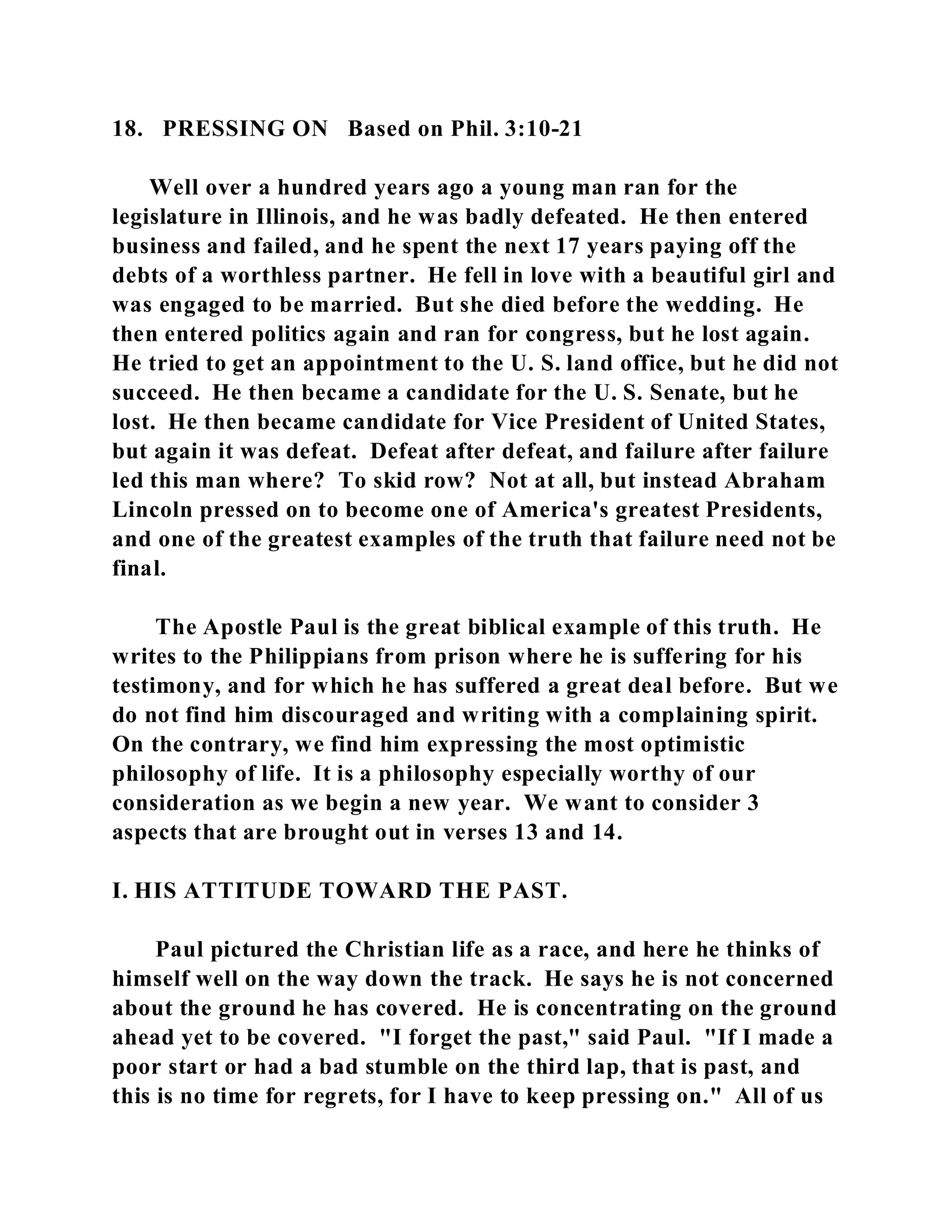
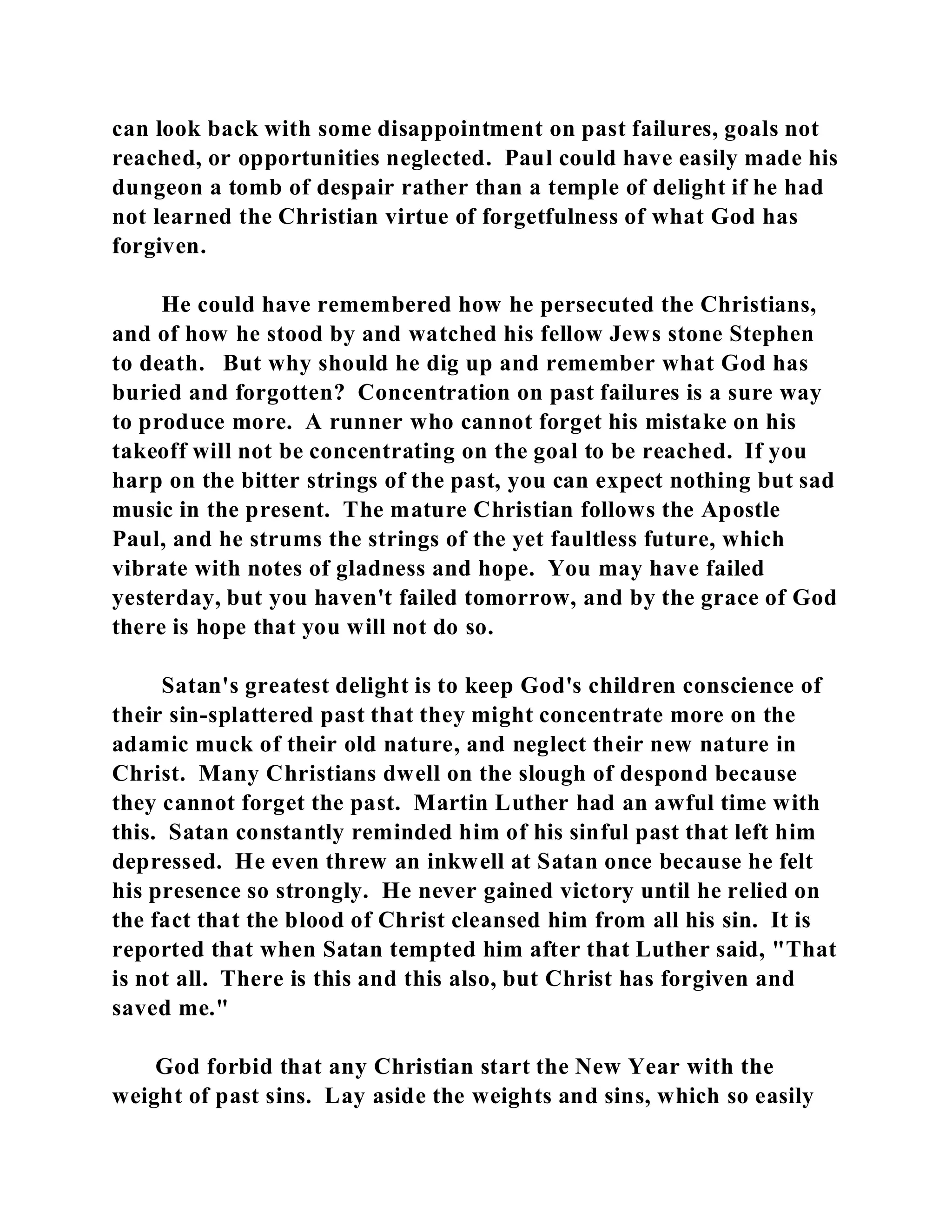
18. PRESSING ON Based on Phil. 3:10-21 
19. GIVERS BY CHOICE Based on Phil. 4:10-20 
1. INCURABLE OPTIMISM Based on Phil. 1:1-11 
The things that can go wrong in Christian service could fill an
encyclopedia. Tal Bonham has recorded just a few. A note in the 
bulletin said, "Ladies don't forget the rummage sale. It is a good 
chance to get rid of those things not worth keeping around the 
house. Bring your husbands." He tells of a pastor who preached on 
Samson, and unknowingly called him Tarzan through the whole 
sermon. Another pastor, when he asked, who had special prayer 
requests to raise their hands, had his mind on the previous business 
meeting, and he said, "All those opposed, same sign." Another 
pastor introduced the new choir director by saying, "We are 
delighted he is coming to lead us in our sinning." 
Even Billy Graham has made his occasional slip of the tongue. 
The police chief of Memphis, Tenn. asked him to help promote their 
traffic safety campaign. So Graham pointed to the large neon sign 
which said 150 days. "You see that sign," he said, "That means that 
there has been 150 days without a fertility." His mistake was not a 
fatality, but it was terribly embarrassing. Several world renowned 
clergymen almost fell off the platform in hysterics. Chuck Swindoll 
preaching on Joshua at Jericho meant to say, "They circumscribed 
the wall," but it came out, "They circumcised the wall." It brought 
the house down. The point is, you have got to be an optimist to 
believe God can use such a fallible creature as man to accomplish 
His will on earth. 
Paul was just such an optimist, and the main message of his letter 
to the Philippians is that everyone who is a believer in Jesus Christ 
is obligated to be an optimist. Paul says, "Rejoice in the Lord 
always," and just in case you didn't hear, he says it again, "and 
again I say rejoice." Pessimism is one of the greatest sins of the 
Christian, and Paul fights that negative spirit in this letter. It is a 
sin for a Christian to be ever gripping, complaining, and grumbling. 
Behind every silver lining some Christians can find a dark cloud. 
Their pessimism becomes a bad habit. It is like swearing. Some 
people do it so often they don't even realize they are doing it. So it is
possible to think negative so often that you don't even realize you 
are being a pessimist. 
Like the persistent pessimist who grumbled to his neighbor, "My 
hen hatched out 12 chicks, and all of them died but 11." The 
negative had distorted a positive reality into a negative feeling. This 
habitual focus on the negative leads to the unconscious prayer of the 
pessimist-"Give us this day our daily dread." If you are going to 
focus your attention on the problems of life, then anyone can be a 
pessimist, for problems are part of every life, and Paul the optimist 
was no exception. He was not writing this letter of joy from his 
yacht in the Mediterranean, or from a luxury villa in Rome. It was 
written from a prison, and not from the warden's office either, but 
from the dungeon. He was there unjustly for serving his Lord, and 
blessing people with the good news of the Gospel. Yet, out of this 
unfair and unjust suffering Paul does not fire off a bitter letter of 
anger, but a letter of joy and optimism about the church and God's 
plan for it. 
This optimistic letter has been used of God to comfort, encourage, 
and challenge Christians all through history to be optimists in a 
fallen world. Gene Daille, the great French expositor told of how 
deeply the Indians of the new world were impressed by the white 
man's ability to put marks on a piece of paper, and then convey it to 
another at a great distance, and thereby, bear a message to them. 
Letters were magic to them. It is marvelous to us too when you 
think of it. By means of letters the Apostle Paul, long dead, can go 
on speaking to the church all over the world, and urge them to 
rejoice always, and be incurable optimists. Paul was the first in a 
long line of Christian writers who wrote Christian literature in 
prison that influenced the church to be optimistic in spite of 
problems. 
We have to face this reality, however. Paul had more reason to
be optimistic about the Philippians than other churches to which he 
wrote. We need to see honestly that Paul had a different 
relationship with this church then other churches. There was a 
loving friendship here that was not the case with others. He had to 
scold and blast the Corinthians, and focus on their many defects in 
ways that do not happen in this letter. Paul Rees, the one time great 
Twin City preacher, wrote, "Philippians gives us a Paul we do not 
see, for example in Galatians or Corinthians. It is natural that we 
wonder if the theologian has not been swallowed up in the friend."" 
Professor David Smith calls it, "The sweetest and tenderest thing to 
be found in all of Paul's correspondence." 
The only church Paul ever accepted a gift from was this church of 
Philippi. They supplied him many times, and he writes in 4:16, "For 
even when I was in Thessalonica, you sent me aid again and again 
when I was in need." William Barclay, the great New Testament 
scholar, wrote, "Paul was closer to the church of Philippi than to 
any other church." Listen to his loving terms in 4:1, "Therefore, my 
brothers, you whom I love and long for, my joy and crown, that is 
how you should stand firm in the Lord, dear friends!" In one verse 
they are called his brothers, the ones he loves, his joy, his crown, and 
his friends. Here are 5 terms of endearment in one verse. 
So let's do a reality check, and face the facts. You are more likely 
to be an optimist when you are dealing with people you love, and 
who love you, then with people who rub you the wrong way, and 
irritate you by their indifference or opposition. The fact that Paul is 
most optimistic with those he most loves and enjoys makes it clear 
that relationship is a key factor in the degree of your optimism about 
people. Your optimism about God and His plan should not be 
affected. That should be on a high degree of intensity no matter 
what. But on the human level the degree of optimism is determined 
by the level of Christian love that exists between Christian people.
One of the reasons Paul had such a good relationship with this 
church is because it was mainly Gentiles, with only a few Jews, and 
so his enemies who poisoned the minds of people against him did not 
have much of a foundation in this church. There were only a 
handful of Jews, for when Paul first came to Philippi there was even 
a synagogue, but the people met by the river. Lydia, a Gentile, was 
converted, and the church met in her home. Then the Philippian 
jailer and his family were converted, and he too was a Gentile, and 
so the church had few people that Paul's enemies could confuse. 
In chapter 3 Paul still has to warn them about the Jewish legalist 
who would take them back to the law, but it is a small part of his 
letter compared to others. So we see that where Christians are on 
the same wavelength as to theological convictions, there will be 
greater peace, joy, and optimism. Paul is writing as a Christian 
friend, and not as a theologian. The valuable lesson to see in all of 
this is that Christians are like anyone else when it comes to 
relationships. When they have good ones there is joy and positive 
vibes. If there is conflict and disagreement over theology and values, 
there can be a wall that makes friendship difficult if not impossible. 
That is why you have Christians who are friends, and Christians 
who are only acquaintances. Then you have Christians that you will 
not even bother to get to know better until heaven. There we will all 
be able to love everyone in the body, just as Christ does. Until then, 
like Paul, we will have better relationships with some than with 
others. 
God used the bad things that happened to Paul in Philippi to 
bring forth good, and so every memory of even his bad times made 
him joyful. He was harassed by the demon possessed girl; he was 
arrested, beaten, and thrown in prison, but God used all of this to 
lead the Philippian jailer and his family to Christ. It was a bad day 
in the life of Paul, with a lot of rejection and pain, but in the end it 
was one of the best days of his life, for a whole pagan family was
now in the kingdom of God, and a part of the Philippian church. 
Paul was an optimist about what God could do with a day where all 
was going wrong. He could say amen to the poet who wrote- 
The inner side of every cloud 
Is bright and shining. 
I therefore turn my clouds about, 
And always wear them inside out 
To show the lining. 
Paul did not pretend that all the bad stuff was good. Just because 
God used all the bad to lead to a good end did not make the bad 
good or right, and so even when it was all over, and the Philippian 
jailer and his family were baptized, and the officials came to release 
Paul and Silas from the jail, Paul protested the injustice of what had 
been done. He demanded that the magistrates who put them in 
prison come and apologize for their unjust decision. Paul did not 
say that it was okay because God used it for good. It was still 
wrong, and a bad decision. It was an injustice that needed to be 
corrected, and not merely forgotten because God used it for good. 
This is important to see, so that we can recognize there is more than 
one kind of optimist. 
Wrong and evil and injustice are not made good just because God 
can use them to achieve good goals. They are still bad, and those 
who do them are held accountable. Evil does not become good no 
matter what good God can bring out of it. It is still evil. A 
superficial optimist makes a major mistake of thinking that if God 
uses bad things for good, then the bad things become good. Wrong! 
Paul was no superficial optimist that says, all is for the best. Those 
who think this way deny the reality of evil and folly in man. If all is 
for the best, then there is no evil, and we are compelled to be 
Christian Science followers, who say all evil is in the mind.
Paul was not so superficial. In 2:21 Paul complains about the 
self-centeredness of Christians. Timothy is unique in his loving care 
for others, but he writes, "For everyone looks out for his own 
interest, not those of Jesus Christ." Paul does not say, this is for the 
best, and will, in the long run, be a great blessing. It is a defect in 
the body of Christ, and it is not a good thing. Paul did not reject the 
reality of problems and weaknesses in the Christian life, as if this 
was the best of all possible worlds. That would be a form of 
blindness, and not optimism. He could be pessimistic about people 
without losing his optimism in God, and God's ability to win the 
final victory even with the obstacles of sinful people. 
In 4:2 he pleads with Euodia and Syntyche to settle their dispute 
peacefully, and asks the church to help them do so. He does not say, 
a good fight will clean the air, and is healthy for the body. Paul 
recognized that saints are not perfect, and that they would get into 
conflict and would need to agree to disagree on some things. He did 
not pretend that it was all for the best, but said that Christians need 
to focus on their common bond in Christ. There would be things in 
areas of individual differences where they would never agree. Paul 
was optimistic that Christians could be one in Christ even though 
they may disagree on many things. 
Why is it important to see this distinction between the realistic 
and the superficial optimist? For one thing, it makes people feel 
guilty when they hate evil, if they feel it is contrary to Christian 
optimism to do so. Some Christians delight in making other 
Christians feel guilty for being pessimistic about man. This is 
superficial, for the Bible is loaded with this kind of pessimism. "All 
have sinned and come short of the glory of God." "There is none 
that does good." "All our righteousness is as filthy rags." You 
could go on for pages with such negative quotes. A Christian has 
every right to be pessimistic about man apart from the grace of God.
The false prophets said all is well, and everything is for the best. 
You are God's people, and God will bless you no matter how you 
disregard His laws. This kind of superficial optimism is what lead to 
the judgment of God's people time and time again. It is evil to be a 
shallow optimist and seduce people into believing all is right when it 
is not. Paul could, as an optimist, still face the reality of a fallen 
world where plenty is wrong that he did not like, and he deals with it 
even in this most optimistic of his letters. In 2:27 Paul writes of 
Epaphroditus, "Indeed he was ill, and almost died. But God had 
mercy on him, and not on him only, but also on me, to spare me 
sorrow upon sorrow." Paul was not so gullible as to fall for the 
"Everything is best," philosophy. He says that he would have cried 
his heart out had his friend died, for it would have been a tragic loss, 
and he would not be comforted by some superficial theory that God 
needed him more than he did. It would have broken his heart 
because even an incurable optimist recognizes that evil and sorrow 
are a real part of life, and you can't whitewash it with a pretense 
that it is all for the best. Life is full of things that are not for the 
best. That is why there is a Gospel to give men hope of escape from 
this fallen world, and to be in a world where all will be for the best. 
Rejoice in the Lord he repeats over and over, but he also says in 
3:2, "Watch out for the dogs-those men who do evil..." He does not 
say rejoice in the world, the flesh, and the devil, which are the 
source of endless problems. The optimist still has his pessimistic 
side, for the world of evil and folly is a temporary reality that has to 
be faced. The saints are fallible; the world has fallen; and the devil 
is alive and well. The Christian who believes all is best in such a 
world is what we call a superficial optimist, where he denies the 
reality of the very battle of good and evil. This is as superficial as 
the little ditty that goes- 
The optimist fell ten stories, 
And at each window bar
He shouted to the people, 
"I'm alright so far!" 
This is as unrealistic as the man who, without a dime to his name, 
went into a fancy restaurant and ordered an oyster dinner with the 
hope of finding a pearl in an oyster to pay for the meal. It is as 
superficial as the woman who reported her neighbor had been shot 
in a fight. "Were the wounds fatal," her friend asked. "Only two of 
them," she said. "The other three were just flesh wounds." This is 
the kind of person who will say everything is for the best. Paul 
would not, for his was not a shallow optimism. His was a deep 
optimism that says, even in a fallen world where much is wrong, and 
far from the best, God is going to achieve His purpose, and I am 
delighted to be part of His team, for they will be the ultimate 
winners. 
Paul's optimism was based on Christ and His victory over all the 
forces of evil. It was not superficial like that of the student who was 
asked, "Did you pass?" He responded, "No, but I was the highest of 
those who failed." Paul could say, "I have failed. I am the least of 
the Apostles, and not worthy to be an Apostle, but I can do all things 
through Christ who strengthens me." He was a realistic optimist 
who could be pessimistic about man, himself, and even the church, 
but always rejoicing because he was optimistic about Christ and His 
victory. 
Optimism is based on the broader scope. The detail of the 
moment may be a pain, and a cloud on you day that rains on your 
parade. Pessimism is based on the negative realities of the moment. 
Optimism is based on the positive realities that will be forever. In 
Christ, the positives will last, and all negatives will vanish. You need 
to see everything in the light of the long run. Someone said that 
maybe all your dreams have not come true, but then neither have all 
your nightmares. You have gone through a lot of trials, but you have
come through the storms into the light again, and have enjoyed the 
day after many a troubled night. It is the long range look that keeps 
you smiling when you face temporary pain. Some humorous poet 
put it- 
It is easy enough to be happy 
When life is a bright, rosy wreath, 
But the man worth while 
Is the man who can smile 
When the dentist is filling his teeth. 
Christian optimism is based on the big picture, and is dependent 
upon patience. Love is patient, and patience is one of the great 
Christian virtues, for only the patient can live on the long run level. 
The impatient are short run people, and they are pessimistic, for in 
the short run you have to focus on the failure and folly of man, 
rather than on the faithfulness of God. 
Pessimists see only the viciousness of the battle, and not the 
victory that makes the battle worth it. A neighbor said to a father 
who kept bailing his son out of trouble, "If that were my boy, I 
would forget him." The father replied, "If he were your boy I would 
forget him too, but he is my boy." Love makes you more patient and 
longsuffering because love makes you more optimistic. Take love out 
of any relationship, and you can count on pessimism taking over. 
Love is what made Paul so optimistic in relation to the 
Philippians. Where love abounds optimism will thrive, and that is 
why Paul writes in v. 9, "..and this is my prayer that your love may 
abound more and more..." Christians who love are Christians who 
are fun to be with, for they are, like Paul, incurable optimists. We 
cannot be like Paul in many ways, but we can all be like him in this 
way. We can all be Christians who are fun to be with. Ask yourself, 
am I a Christian who is fun to be with because I focus on the goals of
the true, and the beautiful, and I tend to rejoice in life even when it 
is full of problems? Or, am I one of those who is a gloomy Gus, or 
cloudy Claudia who tends to rain on everybody's parade? 
This letter of Philippians will change you if you let it, for it is the 
most joyful book of the Bible. Chuck Swindoll's book on Philippians 
is titled Laugh Again. In it he seeks to get Christians to stop being 
sour pusses, and start being the kind of joyful people God wants 
them to be. We all need to pray that God will help us learn the 
essence of this letter and learn to be incurable optimists. 
2. JOYFUL SAINTS Based on Phil. 1:1-11 
Roger Fredricksen, a well-known pastor in my hometown of 
Sioux Falls, South Dakota, wrote a book titled God Loves The 
Dandelions. In it he tells of how he and his wife Ruth were at a 
small cabin on the lake in Minnesota. They had just finished 
reading the book of Philippians with all its powerful statements on 
being able to do all things through Christ, and to have the peace of 
God which passes understanding. Roger cracked opened his boiled 
egg to enjoy his breakfast, and it came out watery and raw. He was 
irritated, for he has a built in prejudice against half-boiled eggs. He 
could not, for the life of him, understand why Ruth could not watch 
the time when it comes to boiling eggs. 
He had just thanked God for the food, and so he tried to be 
consistent and not gripe. He scooped away the uncooked part, and 
tried to make the best of it. But he was peeved, and then he was 
angered at himself for being so peeved over a bit of egg. He left the 
table in silence, and he went off to write about new life in the 
church. It was so hypocritical, for here he was all bent out of shape
over an egg. It was so petty it was pathetic. He got up and went 
back to the kitchen where he blurted out, "Ruth, the egg got to me. 
I don't understand myself. It's a beautiful glorious day, and I'm 
hung up on an egg. Will you forgive me?" Together they had a 
good laugh, and they went on to have a good day. 
A saint is not a person who never gets disturbed over trifles, but 
one who, when disturbed, confesses, and seeks for a Christ honoring 
solution to his or her weakness. The Christian does not differ from 
the world so much in what life brings to them. They differ in what 
they bring to life. The Christian faces the same trials and 
temptations, and frustrations as anyone else, but they are to deal 
with them with a transformed mind, that looks for a way of escape 
from evil, and a way to overcome evil with good. The saint is not a 
figure with a halo, as portrayed in stained glass windows, but just an 
ordinary human being who recognizes he or she is chosen by God to 
be different and how they respond to life's pressures. Not all saints 
are equal, of course, and some do a much better job than others. 
The Philippians, for example, were superior in many ways to 
other Christians in the New Testament. Even the bad Christians are 
called saints, for all who trust in Jesus as Savior are saints. That is, 
they are separated unto God for His purpose. Anything, or anyone, 
who is separated unto God's service is called holy. Pots and pans in 
the temple were holy because they were separated unto the service of 
God. People are holy, not just when they are morally pure, and 
without sin, but when they are called to be servants of God. The 
saints are servants, and all servants of God are saints. It is not a 
state of perfection that makes a saint. It is a position. If a person is 
in Christ, that is, they are a part of the body of Christ, they are, by 
their very position, automatically saints. They are people separated 
from the world to be servants in the kingdom of God. 
If you are born in the U.S. you are an American.
If you are born in Mexico, you are a Mexican. 
If you are born again, you are a saint. 
There are only saints in Christ, and all the world is divided into 
those who are saints and those who are not. Christians will often say 
they are not saints, and they mean by this that they are far from 
perfect, but the fact is, if you are in Christ, you are a saint. You 
might be a weak saint, or fallen saint, or a baby saint, but you are a 
saint. If you are not a saint, you are not a Christian, for all 
Christians are saints. A saint is not determined by what they are, 
but by where they are. If they are in Christ, that is the bottom line. 
The degree of holiness varies tremendously, but all who are in 
Christ are equally saints. They may not be equally saintly, but they 
are all saints. There is no term for half-saints, or quarter saints, or 
any other percentage. A saint is a saint, just as an American is an 
American. An American can be one who loves his country, or one 
indifferent to his country, and even one who is hostile to his country, 
but all are equally Americans. Likewise, all saints are equally saints, 
but they may not be equally like Christ at all. 
Paul thought of the Philippian saints as the cream of the crop, 
and so we can learn much about being a saint by examining what 
kind of Christians these Philippians were. The outstanding 
characteristic of these people was their joyful spirit. The idea that a 
saint is one who is sad and somber has no basis in the New 
Testament. The best saints are those who are delighted with life and 
the chance to enjoy all that God has made possible. Paul is so full of 
joy over these Christians because they add joy to his life and joy to 
the world. They are fun people to love and serve because they show 
their appreciation with a joyful response. 
Paul wanted to go to heaven, but he also wanted to stay and serve 
these saints, and he was convinced God would let him stay and he 
writes in 1:25-26, "I know that I will remain, and I will continue
with all of you for your progress and joy in the faith, so that through 
my being with you again your joy in Christ Jesus will overflow on 
account me." God left Paul on earth because there was a colony of 
heaven already here in the saints of Philippi, and Paul could get a 
good taste of the essence of heaven right here by serving and 
growing with this joyful body of believers. 
The essence of heaven is joy, and the best small group; the best 
Sunday School class, and the best church is one where the saints 
enjoy one another. This is what makes the Philippian church the 
best in the New Testament. Paul urges them on to perfection, 
however, so as not to loose what they have, which is a taste of heaven 
on earth. He writes in 2:3-4, "Do nothing out of selfish ambition or 
vain conceit, but in humility consider others better than yourselves. 
Each of you should look not only to your own interests but also to 
the interests of others." The essence of the ideal church is the same 
as the essence of the ideal marriage, or any other ideal relationship. 
It is, love one another, and give each other the attention and support 
they need to be joyful. Where joy reigns, Jesus is Lord, and you 
have the very best atmosphere for the growing of saints. 
If you pay no attention to the joy of people in your group, church, 
or family, you cease to be the servant of Christ in that context. 
Where Christ is served there will be joy, and the saints will be at 
their best level of sainthood. There is an ancient story about St. 
Anthony who lived in the desert alone, and he felt superior to the 
rest of Christians. God told him to go to Jerusalem, and he would 
find a better saint. When he got there he was told to look up 
Cobbler Conrad, and when he did he found him pounding on a pair 
of shoes. Anthony asked, "What do you do that so pleases the 
Lord?" "I have done very little," he replied. "I just mend shoes, 
but I mend each pair as though they belonged to Jesus Himself. I 
mend them as I would for Him my Savior. That is all I do."
St. Anthony left Conrad the Cobbler, and he went back to his 
desert tent, and there with a more humble spirit he prayed, "Now, I 
see, Lord God. I have set up myself as a saint. But Conrad sees 
something of Christ in every man, woman, and child. That is true 
sainthood. That is true perfection in thy work. I shall leave this 
desert place where I have isolated myself from human kind, and I 
shall go down into the city slums and serve my fellow man. There 
shall I be a saint, indeed, worthy of Thy fellowship." The best saints 
are not those in isolation, but those, like the Philippians, who serve 
one another, and add joy to the lives of those about them. 
Are you a saint who brings joy wherever you go, or one who 
brings joy whenever you go? Christians tend toward one or the 
other category. Those that others enjoy having around do so 
because they add to the joy of being a Christian. Paul could not wait 
to get back with the saints of Philippi, for it was pleasant; it was fun, 
and it was a joy to be with them. They were saints who knew how to 
flavor this fallen world with a taste of heaven's joy. That is why 
Paul could write, "I thank God every time I remember you." Paul 
had nothing but pleasant memories of being with them. He showers 
them with compliments, for he is doing for them what they did for 
him. They were such a source of encouragement, and he wants to 
be that to them as well. It makes you feel good to know that you 
make others feel good, and so Paul tells them forcefully, you make 
me feel good. 
We all leave an impression in the minds of others. Will people 
remember us as one who added joy and pleasure to their lives? Will 
they be grateful to God when they remember us? Or will they 
remember how hard we were to get along with, and how seldom we 
added to their joy? Do we have Pauls in our in our lives who say 
thanks to God when they remember us? That is what being a saint 
is all about. It is about being a channel through which God can 
pour into this world some of the joy of heaven.
This letter of Paul teaches us clearly that the essence of Christian 
joy; the essence of optimism; the essence of tasting heaven on earth, 
is one word-relationships. Listen to Paul again in 1:4-5, "I always 
pray with joy because of your partnership in the Gospel." In 
1:25-26 we read, "I will continue with you for your joy. Your joy 
will overflow on account of me." In 2:29 they are urged to, 
"welcome Ephaphroditus in joy." In 4:1 he calls them, "His joy and 
crown," and he repeats it, "Rejoice in the Lord." All the joy of this 
letter revolves around the relationships of himself and Timothy; he 
and Ephaphroditus; he and the Philippians, and them and 
Ephaphroditus. A saint is one who stands in a special relationship 
to God. A joyful saint is one who stands in a special relationship to 
the family of God. Relationships are the foundation for most, if not 
all, of the values of life such as, family values; social values; national 
values, and you name it. In both the secular and sacred realms of 
life relationships are the foundation. 
It was the worst weather in the entire world, and yet six men 
spent 220 days in it in 1989. They made the first unmechanized trek 
across Antartica. Will Steger lead this group which had to brave 2 
months of storms with temperatures as low as 43 below zero, and 
winds up to 90 miles per hour. With only dog sleds and skies they 
traveled 3,741 miles. Just 2 days before they finished their journey 
32 year old Keizo Funatsu from Japan, the youngest member of the 
expedition, went out to feed the huskies. Even though it was just a 
few yards away, a blinding snow storm caused him to loose his sense 
of direction. He knew he was in trouble, and he took immediate 
measures for survival. Here is what he wrote in his journal. 
"Once I was in my snow ditch, blowing snow covered me in 
5, 10 seconds....I could breathe through a cavity close to my 
body but the snow was blowing inside my clothes, and I was 
wet. I knew my teammates would be looking for me. I 
believed I would be found; it was just a matter of time. I had
to believe that.... 
Very few people have that kind of experience, lost in the blizzard. 
I said to myself, 'Settle down, try and enjoy this.' In my snow 
ditch I truly felt Antarctica. With the snow and quiet covering 
me, I felt like I was in mother's womb. I could hear my heart 
beat-bomb, bomb, bomb-like a small baby's. My life seemed 
very small compared to nature, to Antarctica." 
Two hours later the others realized the others realized he was 
missing, and they began a search. After 4 hours they had to stop 
because of darkness and the fierceness of the storm. At 4 in the 
morning they were up searching again, and at 6 in the morning 
Keizo heard them calling his name. He emerged from his snowy 
burial, and cried, "I am alive! I am alive!" The most macho men on 
the planet stood there crying. Will Steger reported, "Finding Keizo 
alive was the greatest relief I have ever known." 
When men faced all the obstacles that these men faced together, 
they developed a relationship that is deep, and which unites them as 
a unbreakable team. This is what we see with Paul and Timothy. 
They are such two different people. Paul is old and Timothy is 
young, and yet, they become one of the great pairs of the Bible, like 
David and Jonathan. Timothy was like a son to Paul, and he calls 
him his son in the faith, for he led him to Christ. He was so precious 
to Paul that out of the 13 letters he wrote in the New Testament, ten 
of them include Timothy as his partner. We see it here in the first 
verse of Philippians. In this letter Paul exalts Timothy as one of a 
kind. In 2:19 he says that he hopes to send Timothy to them, and 
then in 2:20 he writes, "I have no one else like him who takes a 
genuine interest in your welfare. For everyone looks out for his own 
interests, not those of Jesus Christ. He goes on to say that Timothy 
has proved himself in his service. 
The point is, everybody needs somebody who is truly a friend,
and a loyal companion. Paul could not have done what he did 
without Timothy. That is true for the Will Steger team, and of every 
team in history, including Christian teams. Why does Paul almost 
always include Timothy, or in a few cases, other companions in his 
letters? A man does not need help writing a letter. A lot of books 
have two authors who work together, but a letter can be the work of 
just one easily. Yet Paul includes Timothy frequently as if he could 
not write a letter alone. 
This common characteristic of Paul's letters is itself a valuable 
lesson. Paul is saying that he is dependant upon others to 
accomplish the will of God. He is no loner, but needs the help of 
other members of the body to succeed. Paul is always asking for 
prayer. Why? It is because he needs help, and is dependant upon 
the aid of other Christians as they back him up with prayer and 
support. The reason Paul has a special place in his heart for these 
Philippians is because they were the most helpful in supporting him. 
He says that he thanks God every time he thinks of them, and he 
prays for them with joy because, as he says in verse 5, "...You are 
partnership in the Gospel from the first day till now." They hit it 
off from day one, and were partners who gave encouragement and 
support to one another. That is why this is such a positive letter. 
Paul has Timothy, and he has the Philippians, and with this kind 
of support he is on top of the world singing songs of joy. Paul is 
revealing this basic truth of life, that the essence of happiness is 
found in relationships. Paul is in a good mood, and he is an optimist, 
and a positive thinker in this letter. God made man in his image, 
and he can never feel at his best until he has a positive relationship 
with another person. God is a trinity of three Persons, and they are 
in perfect unity. There relationship is ideal, with a oneness that has 
no weakness. They are wholly one, and man is so made that he can 
never be content until he has this oneness in some relationship. 
Jesus provides the foundation for Christians to develop this oneness.
Paul and Timothy had it, and Paul had it with the Philippians. 
Every Christian needs to develop this kind of relationship with 
someone else in the body of Christ in order to be as joyful as they 
are capable of being. 
I suspect a lot of people do not like Paul because they think of 
him as a cold theologian who is more interested in ideas than people. 
This is a false image, for he was a people person, and he clearly 
admitted his need for people. It was a basic part of his theology. He 
scolded the Corinthians for hurting their relationships in the body 
by failing to recognize every member is a vital part of the whole. He 
said, "The eye cannot say to the hand, I have no need of you; or 
again the head to the feet I have no need of you." Every part of the 
body needs every other part to be complete, and Paul related to all 
Christians as vital members of the body of Christ. He needed people 
with all of the gifts. 
Carlisle said, "A great man show his greatness by the way he 
treats the little man." Paul wrote one of his New Testament letters, 
that of Philemon, to a Christian slave owner. He urged him to take 
back his runaway slave Onesimus as a brother in Christ. Paul went 
out of his way for the sake of one in the lowest class of his day. Paul 
valued all people, and he had a deep and warm relationship to 
people of every class, race, and sex. He was a relationship person, 
and he put the value of people above all other things, for that was 
the way of Jesus, and Paul's goal in life was to be pleasing to his 
Lord. 
Paul had more problems than the average man, and he suffered a 
great deal, but he was an optimist, and a happy man because of his 
good relationships to others. He had plenty of people who hated the 
ground he walked on, and they sought to undermine his work, and 
get him executed, but Paul was still happy because of the people in 
his life. He devoted much time to maintaining relationships. In
Rom. 16 we see the entire chapter is one of greetings to his dear 
friends, and praise for those whom he loved in the Lord. Why 
would God preserve such a personal list of Paul's relationships 
unless there was a valuable lesson for the whole church. The 
message of his many close relationships is that every Christian needs 
to work at relationships to have the best Christian life. 
You don't serve God alone. You don't bless the church alone. 
You don't enjoy life alone. Life at its best is plural. It has friends, 
partners, and companions. That is the key to being joyful saints. 
Ellen Kreidman in her book Light His Fire writes this about 
relationships: "A relationship, like a corporation, consists of a 
combination of personalities but has a life of its own. Just as a 
corporation requires dedication and concentration if it is to grow, so 
too does a relationship between two people. Perhaps I didn't feel 
like a walk on the beach, but the marriage required a walk on the 
beach. I certainly didn't feel like a weekend alone with my husband, 
but the marriage required a weekend alone together." 
She gives other examples, but you get the picture. It is the very 
thing we see with Paul and Timothy, and with Paul and the 
churches. The issue is not just Paul, Timothy, or the Philippians. 
The issue is the relationship. The relationship is a value to be 
preserved, enhanced, and treasured, for the relationship is a reality 
of great worth. Seeing this, and practicing it, will make you a better 
mate, a better person, a better friend, and a better saint. 
Paul was a joyful saint because of his positive relationship to 
other saints, and that is his goal for all saints, for that is God's goal. 
Jesus died to save us from all sin, and that includes all the sins that 
rob us of the joy of tasting heaven on earth 
through positive relationships in the body of Christ. Let us thank 
Jesus anew for what He made possible on the cross, and pray for 
forgiveness for our role in blocking his joy, and for the wisdom to
ever press on to be joyful saints. 
3. EDUCATED LOVE Based on Phil. 1:1-11 
The best of Christians make their share of mistakes, but John 
Turner was apparently trying to get a large portion of his quota of 
mistakes out of the way all in one day. John was a conscientious 
pastor who got to his church early one Sunday morning, and he 
discovered that he had left his sermon notes at home. He thought it 
was no problem. There was plenty of time to correct his first 
mistake of the day. But when he got home, he discovered his second 
mistake. He had left his notes on the table right where his 18 month 
old daughter eats breakfast. The notes were sopping wet from a 
glass she had turned over. It was no problem he thought, for he 
could wipe them dry in time. The words were blurred somewhat, 
but still readable. 
He finally left for church as he corrected his second mistake of 
the day, and all was still under control. Out of the house he 
bounded with all he needed, except for one thing. He left his car 
keys in the house, and also the key to the house on the same key 
chain. Mistake number three was staring him in the face. He didn't 
have time for mistake number 3. Church was about to begin and he 
was several miles away locked out of his house, and with no keys to 
the car, and his family had already gone to church. 
Desperation drives one to desperate measures. They had a dog's 
door on the bottom of their back door that led to the back yard. It 
was for the dog to be able to come and go, especially to go. Pastor 
Turner was not so proud that he would not lower himself to getting 
into his house by Woofy's door. He shed his suit coat, and got on his
knees and proceeded to squirm into mistake number 4. He was 
bigger than the dog, and when he got half way in he was stuck, and 
could not move either way. There he was half in and half out, and 
his congregation was probably already singing, "Stand up, Stand up 
for Jesus." 
His dog was deeply impressed with the new game, and was 
licking his face the whole time. It seemed like an eternity that he 
was stuck there, but he finally was able to twist around and reach 
the door knob. He even eventually got to church, but due to his 
lateness he had to share the whole embarrassing story of his comedy 
of errors. His experience proves that reality can be funnier than 
fiction, and that there is always room for improvement in our lives 
as Christians. And not just in the trivialities of where we put our 
notes and keys, but in the tremendous areas of life like what do we 
do with our love? 
Is it possible to ever make mistakes with our love, and follow up 
life with a poor use of the highest of all virtues? If not, why would 
Paul pray that the love of the Philippians would abound more and 
more in knowledge, and depth of insight, so they could discern what 
is best. The implication is that love can lack knowledge, and when it 
does it can chose what is less than the best. In other words, 
uneducated love can make foolish choices. 
J. Vernon McGee in his famous Through The Bible Series tells of 
when he first became a pastor of a church in downtown Los Angeles. 
He did not know that there were people who loved to see new 
preachers come into the area, for they tended to be such suckers. 
One Sunday morning a man came forward in the service, and he 
refused to talk to anyone but the pastor. The personal worker told 
pastor McGee, and the pastor showed the man the way of salvation. 
He was so interested that tears came to his eyes. He got on his knees 
and prayed the sinner's prayer. Then he told pastor McGee that he
needed money to get his suitcase out of a hotel. They were holding it 
until he paid for his room. McGee felt obligated to help him out and 
so he gave him the money for the hotel. He felt good about being 
such a Good Samaritan. But then, six weeks later, he saw the man's 
picture in the paper. He had been arrested. The article told of how 
he had been living for six months off the preachers of the city. His 
comment was, "They are the biggest saps in the world." McGee 
knew he was one of them, and he learned quickly that love has to be 
discerning, or it can be used for folly. 
McGee focused on this verse for his own life, and he wrote, "Paul 
says to let your love abound more and more, but let it abound in 
judgment, let it abound in being able to discern. Over the years 
when I would drive to my study in Los Angeles, I use to say to the 
Lord, "I'm going to meet new people today, and I don't know them. 
Some of them I will be able to help. Others of them will put a knife 
in my back. Lord, help me to be able to distinguish between the two. 
Show me which I should help." Actually this verse rescues a 
Christian from being naïve and gullible. His love is to abound in 
knowledge and discernment." 
Like most loving people, he had to learn by experience that love 
alone is not enough, for love can be uneducated, and when it is it can 
do stupid things. Love has to abound in knowledge. It has to get 
educated if it is to make wise choices that lead to the glory and 
praise of God. Feelings alone can set you up for a fall. A young boy 
wanted to go swimming but his mother said no because it is to cold. 
He said, "Can I just go and look at the swimming hole?" She said, 
okay to that. He came back and his hair was all wet. She said, "Did 
you swim?" "No, I fell in." "Then why are your clothes dry?" "I 
felt like I was going to fall in, so I took them off." His punishment 
made him realize that he allowed his feelings to lead him into 
making a wrong choice.
Paul's point here is, if love gets educated and abounds in 
knowledge, it will be able to discern what is best. Uneducated love 
chooses what is less than the best because it is not able to discern. 
Uneducated love goes too much by feelings alone, and this leads to 
unwise decisions. I love music, for example, but if I went by my 
feelings alone and decided to give my life to music, I may waste my 
life trying to do what I am not gifted to do. Wise love seeks for 
confirmation of feelings. If other Christians do not feel the same, 
then I have to recognize my feelings may not fit the evidence. If 
there is no abounding evidence to support my feelings, they must be 
seen as love on a very low level of education, and not mature enough 
to make major decisions. "It is not the calling of cats to plow, or 
horses to cat mice." 
Every Christian needs to do for God what they are gifted to do, 
and it is growing in knowledge that helps them discover their gifts. 
My mother had less than an 8th grade education. She would be 
what many would call a non-gifted Christian. But at her funeral I 
was impressed by the service of my mother. For 46 years she did 
what she could. She loved other people's babies in the nursery at 
her church. There are all different levels of love, and all of them are 
good, but they are not all the best. Kindergarten love is good, for it 
is a loving feeling of caring about people, but it is like the tiny bean 
spout, and not the full grown bean ready for harvest. All love has to 
begin here just as all beans have to start as mere sprouts. Christian 
puppy love is positive, for all love has to start somewhere, but it has 
to press on and get an education is what Paul is getting at. Light is 
good, but there is candle light, moon light, and sun light. There is an 
enormous difference in the power and value in these different 
degrees of light, and so it is with love. 
Paul is not knocking the love of the Philippians. Kindergarten 
love is not bad, but it is no place to level off and be content. A child 
who does not progress beyond kindergarten is greatly handicapped,
and so is the Christian whose love does not abound more and more 
in knowledge. Why is it that Christians can do every stupid thing 
man is capable of doing stupidly? It is because their love has not 
abounded more and more in knowledge, and so they choose what is 
second best, third, or tenth, or even worse. If there is no limit to 
how wise love can be, then there is no limit either as to its lack of 
wisdom. If love does not go the way Paul prays it will, and abound 
in knowledge, it can become a drop out, and abound in ignorance or 
lethargy. This can lead to all the folly Christians have proven 
themselves capable of in history. 
Christians have supported tyranny, persecution, intolerance, 
slavery, and every form of non-loving oppression you can think of. 
It was because they had a kindergarten love that did not abound 
more and more in knowledge. But to the credit of Christians, it was 
those Christians who did what Paul prayed for who did so abound, 
and who became the key leaders in history for the victories over 
oppression. Christians with educated love have given us a world 
with rights and freedoms that make us the richest and most blest of 
peoples. 
Abraham Lincoln was opposed by many Christians with 
kindergarten love, but those who had abounded more and more in 
knowledge gave him their support, and he came to appreciate the 
church as his strongest ally in the fight to end slavery. The same 
thing happened to Albert Einstein in Germany. There were so many 
baby Christians who supported Hitler that Einstein hated 
Christians. But then he found out there were also mature Christians 
with a degree in discerning love, and he came to treasure the church 
as the key ally in fight against Hitler. He wrote, "I'm forced to 
confess that what I once despised I now praise unreservedly." 
There were Christians who loved Hitler; Christians who loved 
slavery, and there have been Christians who loved every form of
folly in history because their love was feelings without knowledge. 
In a previous message we saw that Paul was an affectionate Apostle, 
and the ideal Christian is one who, like Jesus, was full of affection 
and deep feelings that can be expressed. But now we see those 
feelings have to be guided and controlled by knowledge. So we have 
in the Bible the wedding of the heart and the head. Christians are 
forever trying to separate the two, and when they do they put 
asunder what God has united, and they create a monster. 
Christians who stress emotion without the mind, and say that the 
heart is to lead, produce fanatics. Those who see this as folly, and 
reverse the focus so that the head leads without the heart, produce 
dead intellectualism which is an equal curse. What God has put 
together we should not separate. Just as God made it so that your 
body cannot be alive and well if both the heart and head are not 
functioning together, so he has made the body of Christ the same 
way. The heart of love must abound in the knowledge of the head, 
or there will be a very inadequate expression of the love and wisdom 
of God. 
I love the suffering people of the world. I have some degree of 
pity and compassion, but my love is mere kid's stuff of feelings. But 
there are Christians such as the World Relief Organization who 
have abounded more and more in love with knowledge, and depth of 
insight, on how to choose what is the best way to meet the needs of 
these people. I give my money to them because I have not done the 
research to make a wise choice as to how to show love. I could go off 
and try something based on mere feelings, and give my money to 
someone who will spend 10 cents on the dollar to meet the need. I 
could give my money to con men all over the place, and be a sucker, 
and support evil rather than good. I would be operating on my 
feelings of love which is good and noble, but because it would not be 
informed love, it could end up being very ineffective in achieving the 
goals of love. By supporting a well-known, and reliable Christian
organization, my love will be making a wiser choice. 
The point is, my love has to be more than a feeling. It has to be 
informed by facts and knowledge of what is truly a wise way of 
loving. I can love foolishly or wisely, and the only way to love wisely 
is to abound in knowledge more and more. Love cannot just feel its 
way to right choices. It has to study and learn, and get educated as 
to what is the best way to love. The issue is not, do I feel right about 
people and needs, but do I care enough about people to find out 
what is the best way to express love. Do I take a hundred dollars in 
ones and throw them off the roof of an inner city building, or do I 
buy one hundred dollars worth of books on poverty, or do I give it to 
the Union Gospel Mission where they can get nearly two hundred 
dollars worth of goods and services to needy people. The first is a 
heart plan; the second is a head plan, and the third is the heart and 
head combined to do what is best for the people you claim to love. 
Paul made it clear in I Cor. 13 that love is the greatest of all 
values, and without it nothing else is of value. But he does not 
intend us to conclude that this means that love needs nothing else as 
if it alone can be sufficient without all the other things that would be 
nothing without it. He says in 13:2, "If I have the gift of prophecy 
and can fathom all mysteries and all knowledge, and if I have a faith 
that can move mountains, but have not love, I am nothing." This is 
not to say that prophecy, knowledge, and faith, are of no value. It is 
to say that their value comes from their being linked with love. But 
love which has not the gifts of prophecy, faith, and knowledge, is 
puppy love, and will not be able to make mature choices for the 
glory of God. Knowledge without love may be nothing, but love 
with knowledge is more than something-it is the best. 
The history of medicine is full of examples. Doctors have always 
loved health and hated disease. They love to see people get well, but 
if this love is not coupled with knowledge, they can very lovingly kill
the people they seek to help. In 1837 four out of every ten women 
died in child birth. Ignaz Semmelweis, a Hungarian lad at the 
University of Vienna, the most advanced center of medicine in the 
world of that day, was determined to find the cause for this fever 
that took so many lives. He gave his life to get the facts, and spent 
all his time seeking for an answer. What he learned was that 
doctors were spreading the disease by not washing their hands. He 
was thought to be a fool and a madman, but he persisted in his 
crusade to get doctors to wash. It took a generation to change 
things, but in 1906 his home town in Hungry erected a statue in his 
honor. His love had abounded in knowledge more and more so that 
doctors could choose what is best. 
Their love and caring was just as real before their knowledge, but 
because it was ignorant love it hurt rather than help. It was 
knowledgeable love, or educated love, that made the difference. 
History is full of such examples, and so is each of our lives. We 
cannot know what is the most loving choice to make in many areas 
of life without a head that is willing to get all it can to help our love 
be informed. Christian education is simply helping Christian love 
know what is the best choice. The more you know, the more likely 
your love will make the best choice. The bottom line is, Christians 
are never done with their education. Christians are to be students all 
of their lives, and ever learning so they can be intelligent and 
effective lovers of the world, the church, their families, and 
themselves. Love motivate us to care; knowledge helps us care 
wisely. 
Why did Paul have to pray that good Christians like the 
Philippians would abound in knowledge? Because there is nothing 
automatic about this. You don't pray for what is inevitable. You 
don't pray that sun will rise in the East, or that the river will run to 
the sea. You pray for what will not happen unless people choose to 
let it happen, or make it happen. If Christians say, I am loving
enough, and I am content with the level I've reached, they will 
plateau right there, and growth is over. If 4th grade love is your 
bag, and that is what satisfies your ambition, you will stay right 
there the rest of your life. But it is a rejection of the biblical goal of 
never ending growth. We are to love God with all of our mind, and 
that means love is to grow in knowledge forever, for there is infinite 
room for growth. 
Jesus healed a leper, and then told him not to tell any man of his 
healing, but the man was so happy, and so convinced that Jesus was 
the best thing that ever happened to him that he went out and told 
everybody. It seems like a loving thing to do, and it came from a 
grateful heart, but it was foolish love, for Mark 1:45 tells us that 
because of the publicity of this grateful man Jesus could no longer 
openly enter the city. His love was real, but it was self-centered and 
ignorant. He hindered the ministry of Jesus, and deprived others of 
the very healing that he experienced. The man was not bad. It was 
just that his love was not educated. An educated love would have 
recognized that Jesus had good reason for His request for silence. 
Educated love would have obeyed the Master, and would have been 
a blessing instead of a hindrance. 
Paul does not teach that love is the greatest thing in the world. 
He teaches that educated love is the greatest thing in the world. 
Love alone is not enough. It is not enough in marriage; it is not 
enough in medicine; it is not enough in Christian service, and it is 
not enough anywhere. Men of God in the Middle Ages loved the 
people they served, and so when the great plagues struck they urged 
people to assemble in the churches to pray. The result was that 
infection spread with a greater rapidness. It was uneducated love, 
and it did great harm to the people. Love has to be educated, or it 
can be harmful, and that is why Paul prays for the Philippians, and 
why we need to pray for each other, that we will be a loving people 
whose love is abounding more and more in knowledge.
The reason the love of money is the root of all evil is because it is 
stupid love. It is immature love that does not grow. It is like a small 
child that loves a toy, and all of life revolves around that toy. But 
the child grows up and discovers there are greater things to love like 
God and people. The lover of money does not grow up, but goes on 
all his or her life locked into infant love. Any love that loves things 
more than persons is stupid love. Educated love is love that loves 
according to God's value system. Things are loved according to the 
measure of their value. Creation deserves to be loved, for it is God's 
gift, but when men love the creation more than the Creator they 
become fools. They are like one who falls in love with the pretty 
jewelry box, and throws the ring away, or one who falls in love with 
a letter, and rejects the writer of it. 
If I love my car, that is fine, but if I love it to the point where it is 
more important than my mate, child, or even my neighbor, it is 
stupid love. It is uneducated love that does not go on to higher 
learning, but got to the 3rd grade and stopped. Smart love is ever 
moving on to be loving on a higher level. The degree to which your 
love grows in knowledge is the degree of your Christian maturity. 
The goal is to get love so smart and well educated that you can 
choose the best, and so be pure and blameless. The way to 
Christlikeness is the way of educated love. Educated love is love 
that loves everything and everyone with a measure of love that it 
deserves. That is wise living, for it puts all of reality into it proper 
perspective, so that God is loved supremely, and then mate, family, 
church, country, and things all fall into their level of priority where 
the best gets your best, and the lesser gets the lesser commitment of 
your life. 
If we link love and learning we will have life with a capital L, for 
it will be the abundant life Jesus came to give us. Educated love will 
love according to priorities. If number 47 on the list of loves gets 
80% of your time, that is stupid love. The purpose of every sermon
and Bible study, and every discussion of Christian values is to 
educate our love so it can lead us to make the best choices in all 
areas of life. In heaven we will all get our doctor's degree in love, 
but in this life the goal is to get as many degrees as possible. We are 
to be love scholars for life, and that is why Paul prays that God will 
motivate us to be such. 
Why? Because life is not a matter of choosing the good or the 
bad. Christians think that when they can do that, they can quit 
learning and growing in knowledge, but this is a major mistake. 
Choosing the good is not the goal of the Christian life, for there is 
also the better and the best. Having the knowledge to choose the 
best is to be our aim, and the only way we can ever get to love on this 
level is to have a love that abounds more and more in knowledge and 
depth of insight. Educated love is "more and more love." It is not 
content to just grow. It abounds in more and more knowledge, and 
more and more insight, so it is more and more able to choose the 
best, and be more and more pure, and more and more blameless, 
and thus, more and more fruitful, and, therefore, more and more 
productive of glory and praise to God. Paul prays for the 
Philippians, and we need to pray for one another, and for ourselves, 
that we might be abounding in educated love. 
4. ENVIOUS CHRISTIANS Based on Phil. 1:12-18 
We seldom get the whole story on anything. No doubt, most of 
us are aware of how the rocks brought back from the moon were 
kept in isolation for some time less the contain some organism that 
could spread disease for which we have no defense. That made a lot 
of sense, and made everyone feel more comfortable about bringing 
back to earth that which was unearthly. But what I didn't know
until I read Isaac Asimov is that man was thoughtful enough to be 
concerned about taking earth's germs to the moon, and elsewhere, 
as well. So at enormous expense the space vessels we have launched 
have sterilized. If there is life of any kind out there, man did not 
want to be responsible for destroying it with his diseases. 
Man, even in his fallen state, is certainly more noble than Satan, 
for he did not hesitate to contaminate our planet with the deadly 
virus that got him booted out of heaven. He enticed Adam and Eve 
to be envious just as he was. He wanted to be like God, and even 
better than God, and this envy cost him the loss of all godliness 
rather than its acquisition. Satan then deceived Adam and Eve by 
saying they could be like God knowing good and evil if they ate the 
forbidden fruit. The envied God having what they did not have, and 
so they ate, and every since we have lived in an envy infested world. 
It is the major plague of all time. It infects more people than 
small pox ever did in the past, or that aids does in the present. Yet, 
you will have a hard time finding any government spending big 
bucks to study it. It is terribly destructive to Christian lives, and the 
ministry of the church, but you will have a hard time finding 
sermons on this serious issue. You can find sermons on murder, for 
most Christians don't murder, and there are plenty of sermons on 
all of the Ten Commandments because most Christians do not break 
these basic laws of life. But when it comes to envy, you are really 
meddling, for there is not likely a Christian anywhere who is not 
infected with the virus of envy. We do not like to deal with stuff like 
this, for it is not comfortable like dealing with the sins of other 
people. All I have to do when I hear about the sins of others is to be 
grateful I am not one of those sinners. It gives you a sense of pride 
when you can say with the Pharisee, "I thank God I am not as other 
men." But envy is not in the same category. 
The first thing we need to understand about envy is that it is a
common Christian sin. It is common in non- Christians too, but it 
does not go away because one becomes a Christian. These people 
that Paul is referring to here are not pagans or Jews, but Christian 
men who preach Christ. There is nothing wrong with their message, 
but their motive is sinful. It is amazing, for Paul says it is possible to 
do the highest things in life with the lowest motives. These good 
Christian preachers were motivated by envy, rivalry, and selfish 
ambition. Their goal was not the body of Christ being built up, but 
their own reputation being built up. They wanted the fame and 
glory of Paul, and they were willing to hurt Paul if that would help 
them achieve the goal. 
In spite of these terrible motives, Paul rejoices because people can 
be saved by the Gospel even if those preaching it are jerks. The 
message that faith in Jesus Christ can cleanse and free you from sin, 
and make you a child of God, is just as true, and just as effective, no 
matter what the source. It can come to people by the printed word; 
by radio; or television, and it doesn't make any difference what the 
motive is of those who spread it. It is not the messenger, but the 
message that is the power of God unto salvation. If an atheist sees a 
chance to make a quick buck by selling Bibles, those Bibles will be 
just as effective as Bible given by the Gideons. 
Paul says that it makes no difference how people hear the 
Gospel, for faith comes by hearing, and the messenger can be awful 
sinner, but the message will still save. Paul is not saying that it is 
okay that some Christian preachers are motivated by envy, rivalry, 
and selfish ambition. These are sins are that condemned everywhere 
in the Bible. Paul is not saying that he enjoyed having Christian 
brothers stir up trouble for him, for this would be to confess he was 
a sadistic person. There is nothing good about the motives of these 
men. To think so would be to make hypocrisy equal to honesty. 
Paul is not rejoicing in them, but in the Gospel they preach, for that 
is his first love, and he will not attack, even these self-centered jerks,
as long as they preach the Gospel. 
There are many things that bother me about preachers. There 
are so many self-serving ministers in the world. Many get rich off 
the Gospel by false pretenses. People are appalled by the revelation 
of a popular youth evangelist who has made millions in his ministry 
because of his fantastic testimony of being a cult leader before he 
came to Christ. His story deeply impressed me along with millions 
of others, but it was all concocted out of selfish ambition. It worked 
to keep the checks coming in, but it was all a lie. 
I don't have any intention of attacking his evil motives. God will 
deal with that. The fact is, he exalted Christ as the Savior, and 
people were saved by his dynamic preaching. You will seldom hear 
me denounce any popular preacher or evangelist because, even if I 
question their methods or motives, if they preach the Gospel, it is 
cause for rejoicing. This is the spirit of Paul, and of Christ who told 
His disciples who wanted to forbid a certain man to perform 
ministry: If he is not against us, He is for us. It is a shame that 
Christians can be so sinful in their motives, but it is wonderful that 
God can use even these stained vessels to carry the water of life. 
Being a Christian optimist does not mean being blind to the sin, 
folly, and pathetic weaknesses of God's people. It means an 
awareness that God gets His will done, and His kingdom expanded, 
regardless of the sorry motives of His messengers. Optimism about 
God and what He can accomplish does not mean there is no place 
for Christian pessimism about people. Paul was so honest it was 
shocking as he deals with the negative side of the Christian life. 
These were men of God, yet they were full of envy. The Greek word 
Paul used here is phthonos, and it also means jealously. They were 
jealous of the way God had used Paul, and envious of the love and 
fame he had gotten in preaching the Gospel.
Before we throw too many rocks at these Christian slime balls, we 
need to examine what the rest of the New Testament says about this 
sin in the Christian life. We might just discover that the New 
Testament will say to us what Jesus said to the Pharisees who were 
ready to stone the woman taken in adultery: " He who is without 
sin among you cast the first stone." I say this because the New 
Testament makes it so clear this is a basic Christian weakness, and it 
is a flaw in Christian personality. It is no minor sin either, but one 
of the worse that the New Testament deals with. In fact, it is the sin 
that sent Jesus to the cross. 
In Matt. 27:18 we read the thought of Pilate when he was trying 
to release Jesus. It says, "For he knew it was out of envy that they 
had handed Jesus over to him." The Jewish leaders were jealous of 
Jesus. They saw people flock to Him, and He was not even an 
ordained man. They hated it that the people loved Jesus, for they 
were suppose to be the ones that people turned to for spiritual 
guidance. It makes trained professional people angry when the 
non-trained amateurs get more fame than they do. Lawyers are 
screaming mad at a layman who wrote a book telling people how to 
make out their own living will. 
This sin of envy is capable of any evil, even to the point of killing 
the Son of God to eliminate Him from the competition. We live in a 
dangerous world because of the potential of this sin. Paul lists it as 
with the worst sins of depravity in Rom. 1:29. In Titus 3:3 he lists it 
again as one of the terrible sins of the Christians in their 
free-conversion days. He writes, "At one time we too were foolish, 
disobedient, deceived and enslaved by all kinds of passions and 
pleasures. We lived in malice and envy, being hated and hating one 
another." Paul uses the same word when he describes these 
Christian preachers and teachers in I Tim. 6:3-5 where he 
concludes, "...who think that godliness is a means to financial gain."
There is nothing new under the sun. This is a major problem in 
our day as millions of Christians fall for the health and wealth 
gospel. They send in millions of dollars to those preachers who tell 
them God wants them rich. They do just what the false teachers of 
Paul's day were doing by convincing people that the point of being a 
Christian is to become financially independent. Paul goes on in this 
context of I Tim. 6, and urges Timothy to learn to be content, and 
not seek for riches that lead to so many desires that ruin Christians. 
Then he says those famous words in verse 10, "For the love of 
money is the root of all kinds of evil. Some people, eager for money, 
have wandered from the faith and pierced themselves with many 
grief's." 
The point is, Christians can get so full of envy of what others 
have that they will harm the cause of Christ, become deceitful and 
dangerous, and even forsake their faith in the pursuit of keeping up 
with the Jones. Envy is a curse on all men, but especially the 
Christian. We do not have the time to study James chapter 4, but in 
that chapter James teaches the same thing as Paul. He says a major 
sin of the Christian life is the envy that makes them love the world 
and materialism more than the spiritual values of life. When they 
do this, they are submitting to the devil, and resisting God, which is 
just the opposite of what should be the Christian commitment. 
Can Christians really be that worldly, and out of God's will? 
Peter in I Pet. 2:1 confirms Paul and James by writing to Christians: 
"Therefore, rid yourself of all malice and all deceit, hypocrisy, envy, 
and slander of every kind." You don't have to rid yourself of what 
you can't have, and so it is established beyond a doubt that 
Christians can be loaded with envy that makes them a danger to the 
body and to themselves. It is a powerful feeling that can make them 
behave like the devil himself. We think lust is powerful, and it is, 
but here is a more hidden sin that is just as powerful, if not more so, 
and it is scary what it can do to the Christian. Lust may slay its
thousands, but envy slays its tens of thousands. 
In the Old Testament envy turned the sons of Jacob into brutal 
brothers who were willing to kill Joseph to get him out of the way. 
God used their envy for good, just as He used that of Pharisees who 
killed Jesus, and that of the preachers who envied Paul. God can 
bring good out of evil, but those who do the evil are just as guilty, 
and just as accountable. God's using of evil for good does not excuse 
the evil. Envy in the Christian life is pure evil and not good, even if 
Christians with it can still share the Gospel. Those who are poor 
Christians can still do a lot of good, but their badness is still bad, 
and they will suffer loss in both time and eternity. 
If you start turning green with envy you are getting right for 
judgment. Psychiatrist Willard Gaylin describes envy as a mental 
illness. It is the feeling that anyone else's achievements or happiness 
diminish mine, and, therefore, it is a desire to bring others down and 
spoil their dreams because it makes me seem better. When you hear 
a Christian put others down, you can diagnose their problem as 
envy. That is what Christian brothers were doing to Paul. They 
had the common perception of the envious which says, there is not 
enough love to go around, and so, if somebody else is getting it, I am 
losing it. 
Envious people resent anyone who seems to have more than their 
share of life's blessings. They are easy to find, for there is always 
someone richer, more successful, prettier, or more handsome. No 
amount of good fortune can make envy go away because you are 
never ahead of everybody. Satan was, but he still had God to envy, 
and because he could not be number one he lost his status in heaven 
and eternal happiness. Envy is the entry way to hell, and Christians 
can live that close to the devil's sphere of influence. Experts say that 
it is a hard emotion to unlearn, for it becomes a habit because one 
gets pleasure out of tearing others down.
The Christians tearing Paul down were, no doubt, feeling 
completely justified, for Paul was in prison and they were not. Who 
is the most blessed of God? Is it those of us who are free, or Paul 
who is a jail-bird, and bringing disgrace on the cause of Christ? 
They would have facts like this to point to in order to justify their 
mean spirited competition. The envious Christian lives in a 
self-centered world where the I is lord, and not Jesus. The result is, 
he or she is not a team player. It is not what is good for the kingdom 
that matters to them, but what is good for me only. If someone is 
getting too much love and praise, that is not good for me, and so I 
must find some dirt about that person to put a stop to their pleasure. 
Most gossip is a tool of envy, for it is a means to lower others so 
we can be exalted. It is very hard to avoid this sort of thing, for even 
this sermon is an illustration of it. By putting down these Christian 
brothers were envious of Paul, we can all feel better, for by 
comparison with them we are paragons of virtue. Finding terrible 
Christians to compare yourself with is a good way to feel good with 
little cost. These guys are so bad that being better than them is a 
snap. This can lead to pride and self-deception that makes us feel 
mature when we are an inch taller than these pigmy Christians. 
Envy is so common and so dangerous that it has always been 
listed next to pride in the 7 deadly sins. Being aware of it is a key 
factor in controlling it. Every relationship in life where you feel 
inferior to another person is a potential temptation to become 
envious. We are tempted to envy anyone who is superior in any 
way. Envy is makes people delight in the fall of the great. Where 
big name people blow it, and fall from their height of fame, it gives 
us pleasure because we had envy in our hearts, and envy glories in 
the fall of the famous. We feel bad when great Christians lose their 
fame and fortune by sinning, but on the other hand, we also feel 
satisfaction, for what right did they have to be so honored and 
happy? They are no better than we are, we say, and that is envy at
work. 
One of the burdens of greatness is the host of people who watch 
for your downfall. Psa. 106:16 says, "They envied Moses also in the 
camp." Every major leader in the Bible was envied, and there were 
those just hoping they would fall. 
Men are a lot like lobsters. They say if you have a bucket full of 
them none can ever get out, because if one starts to climb up the 
others will pull it down. Men love to pull each other down lest 
someone climb higher than they are. That is envy at work. If you 
aspire to be a star in any field of life, be prepared to be both loved 
and hated, for envy will be inevitable in the hearts of many, 
including those who love you. 
Envy does not have a positive side effect. When criminals do not 
treat each other fairly it is a blessing, for envy usually trips them up. 
Police count on successful robbers making their friends and 
neighbors envious of their prosperity, for this brings them forth with 
information. In a one hundred thousand dollar swindle the man 
who got only two thousand squealed on the others who took ninety 
eight thousand. Envy is the policeman's friend and that is true until 
one of his fellow officers gets to be captain, and then it is the same 
old enemy of peace of mind. 
In many cases we can sympathize with the victims of envy. 
Rachel wanted a child so bad, and her sister Leah could have them 
easy. Gen. 30:1 says that Rachel envied her sister. It is hard to 
condemn her for her envy, for her desire to have a child was valid. 
It is not as if she wanted a bigger tent, or more jewelry. She just 
wanted to have a baby. So even in areas of legitimate desire envy 
can get into our hearts and make us have wrong attitudes towards 
people that we care about. 
The Emperor Tiberius Caesar exiled and architect because of the
beauty of the porch he designed, and he killed a poet for the writing 
of a superb tragedy. The superior qualities of these men's works 
made him so envious that he hurt them, because he could not 
produce such works. History is full of such abuse of power. If you 
can do something better than another, you will likely produce envy. 
Mothers have killed their daughters-in law because they made the 
sons love them more than mom. Such is the power of envy. There is 
no sin envy will not commit to express its hatred of superiority. The 
Emperor Caligula killed his own brother because he was more 
handsome than himself. 
The Queen could not tolerate it when the mirror on the wall said 
Snow White was the fairest of them all. In a fit of fury she devised a 
plan to rid the world of this superior competition. Envy wants to 
deprive others of what they have. The willow asked the thorn, 
"Why are you envious of the clothes of those who passed by us? 
What good are they to you?" The thorn replied, "None whatever, I 
have no desire to wear them. I only wish to tare them." If the 
envious cannot read, he wishes all books to be burned. Envy hates 
others enjoying what he cannot. Envy rejoices when others weep, 
and weeps when other rejoice. 
Some sins get less offensive in time, and their definition varies 
with the culture, but envy has the unenviable position of being 
consistently despised from Plato to the present. Horace wrote in the 
first century, "Sicilian Tyrants never invented a greater torment 
than envy." Envy robs people of what they have by making them 
sad for what they have not. It is Satan's best foot in the door scheme 
to get us miserable, for all of us have the potential for falling into 
this sin. In the 18th century Richard Sheridan observed, "There is 
not a passion so strongly rooted in the human heart as envy." 
The paradox is that it is good that provokes this evil. Good 
things happening to others is what makes people envious. If Paul
was just a poor or mediocre evangelist, who was basically ineffective 
in touching people's lives, he would have been ignored, but because 
he was so effective he made other Christian evangelists envious. His 
success was their basis for failure. So we see that the very essence of 
sin is a hatred of others for having what we don't have. Satan fell 
because he wanted to be better than God. He brought Adam and 
Eve to their fall by making them want what God had forbidden. He 
made them envious to have that one thing they did not have, even 
though they had everything else in the world. Every being with a 
mind and a will can be brought down by the power of envy. 
Sin is not a lust for what is bad, but a lust for what you don't 
have that somebody else does. Envy says, he has a better wife than I 
do, and this leaves the door open for adultery. Envy says, he has a 
better car than I do, and this leaves the door open for stealing. Envy 
says, he has a better life than I do, and this leaves the door open for 
murder. Envy plays a role in almost all sin. Man just does not like 
it that others have what he does not, and so every form of evil is 
committed to get it, or at least rob the others of it. Man's 
inhumanity to man is due to envy. Almost every Christian sin can 
be linked to envy. Envy enables man to do on the negative side what 
God does on the positive. God can bring good out of evil, but man 
can bring evil out of good. 
Every good thing that happens in this life can, by the power of 
envy, be turned into an evil force that hurts the body of Christ. The 
history of Christian evil and folly can be traced to this awful 
emotion of envy. How do we conquer this green eyed monster that 
can take over our emotional system, and damage our role in the 
body of Christ? As with every sin, you first must become aware of 
it. Face honestly that you too are in some way infected. Confess it, 
and tell the Lord you know it is there, and you hate feeling it. Then 
act your way out of this destructive feeling. That is Paul's advise in 
Phil. 2:3-4, where he says, "Let nothing be done through strife or
vain glory; but in lowliness of mind let each esteem others better 
then themselves. Look not every man on his own things, but every 
man also on the things of others." 
Then Paul describes what Jesus did in giving up equality with the 
Father to become a man and lay down His life for us. The opposite 
of envy is humility, which is the ability not to grasp at what others 
have, but to share what you have with others. This was the spirit of 
Paul, and he had the spirit of Christ. May God help us to have that 
same spirit, and escape the snare of the devil that can make us 
envious Christians. 
5. GOOD OUT OF EVIL Based on Phil. 1:12-26 
Luther Burbank, the world famous scientist, worked for years to 
try and develop a black-petaled lily. He had several thousand 
experimental lily plants in his laboratory. A sudden cloudburst let 
loose a flood of rain that they were all washed away. William 
Stidger tells of sympathizing with him over what had happened, and 
Burbank said to him , "When anything like this happens I always 
remember a little couplet my mother use to quote: 
From the day you are born 
Till you ride in a hearse, 
There's nothing that happens 
Which couldn't be worse. 
We have all sought to comfort ourselves at some point in life by 
recognizing this reality-it could be worse. It is almost always true, 
but still it is a negative comfort. Your life can be a mess, but others 
are even worse. If this is the best you got, then it has to be what you
hang on to, but there is a better and more positive way to deal with 
the negatives of life, and that is to wait and see if what you thought 
was bad turns out to be good, and instead of being the worst, it may 
in reality be the best thing that could have happened. 
That is what Paul is writing about to the Philippians. They are 
worried about Paul. They heard he was thrown in prison in Rome, 
and they have naturally concluded that his being arrested was not a 
good thing. They assumed that his ministry, which they supported, 
was now on hold, and Paul would be of no value in advancing the 
Gospel now. Paul says not to worry, for your gifts are not money 
down a hole. His being arrested turns out to actually help the 
advance of the Gospel, and give him a better ministry than the one 
he had planned. 
The key to being an optimist is having the patience to wait and 
see what God will do with your negative experience. We so often 
jump to the conclusion that bad stuff is just that, and that alone. 
Sickness, trials, shipwrecks, stoning, and prison do not sound like 
prizes for which you would sell many lottery tickets. Nobody wants 
this sort of stuff in their life if they can avoid it. What Paul learned 
by his experience is that the bad stuff of life can be a way for God to 
use your life in a way that good things could not be used. Paul's 
being a prisoner led to his having a ministry to the palace guard of 
Nero, and some of these soldiers came to Christ, which never would 
have happened had he not become a prisoner. He never would have 
crossed their path had he not been arrested. 
The fruit of Paul's ministry in prison was quite extensive, and he 
writes in 4:22, "All the saints send you greetings, especially those 
who belong to Caesar's household." Paul had Christian friends in 
the highest places, even the house of the Emperor. There is no 
reason to believe this ever could have happened if Paul had not been 
treated like a criminal. This is one of the answers to the
question-why do bad things happen to good people? It is because 
bad things are often the only way to get us in touch with the right 
people, and to make us willing to go the way God wants us to go. In 
other words, bad things are tools God uses to get the job done in our 
lives. The point is not to rejoice in bad things, but to rejoice in the 
Lord who can use bad things for good goals we never would have 
achieved without the bad things. 
Colonel Bringle of the Salvation Army became a very popular 
author. He came out of Harvard with honors, and began his 
ministry on a street corner in Boston. A drunken hooligan threw a 
brick at him and hit him in the head. He received a concussion that 
put him in the hospital for months. During his convalescence he 
wrote a book called Help To Holiness. He added four volumes, and 
these devotional aids sold in large numbers around the world. He 
said, "My brethren, if there had never been a brick, there never 
would have been a book." His bad experience opened up doors he 
never would have entered had they not compelled him to do so. 
Don't be so quick to label bad things as a curse. Wait to see if it 
might be a blessing. Even pray to that end. 
Grace Crowell wrote a poem that says it all. 
Yet as I live them, strange I did not know 
Which hours were destined thus to live and shine, 
And which among the countless ones would grow 
To be, peculiarly, forever mine. 
If I but wait, perhaps, this hour will be 
Like silver in the sun, some day, to me! 
Paul never dreamed that his days in prison would be days God 
would use him to let his light shine through all of history because of 
the epistles he would write there. We should pray, "Lord this is a 
bad day I am having, what good can you help me make of it for your 
glory?"
F. W. Boreham, the great Australian preacher and author, tells of 
his pastor friend who was asked in Seminary to preach at a certain 
church one weekend when the pastor became ill. He had other plans 
with 2 of his best friends, and he did not want to go. He suggested 
other names and begged to be excused, but the Professor refused to 
let him off the hook. It was with deep anger that he submitted, and 
he went to the church in a negative mood, wanting to curse them 
rather than bless them. But all of his negative feelings were sheer 
waste, for he met the love of his life there, and his whole future was 
changed. Had he just waited to see what the end result would be, he 
could have saved himself a lot of grief. On of the most common 
phrases of the Bible is wait on the Lord, and the reason is, we need 
to learn to wait and see what God in his providence is going to do 
before we label bad things as a curse. 
Bad things often turn out like Paul's being thrown in prison. 
They are stepping stones to fruitful blessings that could not be 
foreseen. God loves to work in all things, even bad things, for good. 
It is God's specialty, and wise is the Christian who has a wait and 
see attitude toward bad things. Because Paul had this attitude, he 
did not have to back off earlier testimony. Had he jumped the gun 
and written saying this is the worst thing to ever happen to me, and 
now my ministry is ruined, he would have been embarrassed to have 
to later say it was a great blessing. He waited to see what God would 
bring to pass. Jowett wrote, "The cloud, which appeared so 
ominous, brought a gracious shower; the restriction became the 
mother of a larger liberty." Prison bars and progress sound 
incompatible, but Paul just waited and sure enough, he saw his 
arrest lead to advance. It was a promotion to a higher ministry. 
Why is it so important for Christians to grasp this reality that 
God can use evil for good? Because most of the unbelief in this world 
is base on this very issue. Most atheists are so because they say a 
good God cannot exist and permit all the terrible evil and suffering
there is in this world. Many people do not believe in God because 
they feel they are better than God, for they would not permit the evil 
that exists if they had the power of God. So who needs a God who is 
less noble and compassionate than they are themselves? This would 
be a fairly powerful argument if the Bible did not reveal that God 
permits evil for a higher good. He permitted evil men to kill His Son 
for the sake of redeeming lost men. He permits men to become lost, 
because only those who are lost and then found again can be truly 
righteous and loyal to God forever. Satan was made perfect by God, 
but he fell because of pride. That will never happen to those 
redeemed by the Son of God. They will be eternally loyal, for they 
know they are what they are by the grace of God, and not by their 
own wisdom, power, or goodness. If God is going to have an eternal 
kingdom with assurance their will never be another rebellion, he 
had to permit a world with evil and free choice. This terrible fallen 
world is essential to the perfect world to come. God will bring good 
out of all its evil. 
What good is evil? It is the opportunity to be a child of God. Paul 
says do not be overcome by evil, but overcome evil with good. Use 
evil to reveal your good. Let your light shine by showing the contrast 
of the good to the evil. 
Where there is hate show love. 
Where there is greed show generosity. 
Where there is bitterness show forgiveness. 
Where there is gloom show joy. 
Where there is anxiety show peace. 
Where there is violence show gentleness. 
The point is, if there was no evil their would be no way to identify 
the good. The goal of history for the Christian is to bring good out 
of evil, so that evil does not win the war. Whenever you stop with 
evil, you let it win. The Christian is to overcome evil with good, and 
that means to go over, around, or through it, and if you can't avoid
it no matter what, then seek to use it for some good and outwit it. 
The providence of God is God working in history to make bad 
events and circumstances lead to good consequences. Paul's 
imprisonment was bad for it was unjust and unfair, and caused by 
hate. God used their evil scheme to get the Gospel into the very 
household of Caesar. This was the beginning of Christianity 
becoming the official faith of the Roman Empire. 
We often forget the idea of no pain, no gain philosophy, and we 
resist making anything bad for our children to endure, even when 
we should know that helps them to become stronger. Cheryl Forbes, 
a Christian journalist who worked for Zondervan Publishing House, 
wrote a book called Backdoor Blessings. Her first job was terrible. 
The boss was an older women who made her rewrite almost 
everything she submitted for publication. For a year she resented 
this snooty miss know-it-all. But slowly it dawned on her that she 
had become a good writer, and she owed it all to this boss she did 
not like. Had the boss been a good buddy, and let her get by with less 
than her best, she never would have attained the level of expertise 
she had reached. The one she thought was her enemy was really her 
secret friend. 
In Acts 9:16 God said of Paul, "I will show him how much he 
must suffer for my name." Paul was chosen for a tough life, but out 
of all the evil he had to suffer, the world is still, an will forever, 
reaping the good fruit of his life. His thorn in the flesh was a pain he 
had to endure lest his pride caused him to lose his favored status 
with God. It is a principle of life that if someone you love will be a 
better person by what they suffer, then love will permit that 
suffering for the sake of that goal. If your child will be more loving 
as a person by being discipline, then in love you must inflect pain for 
the sake of this higher goal. If its a good enough principle for God, 
it is a good enough principle for us to practice in all loving 
relationships.
I had to hurt Lavonne over and over again this past week. I 
rubbed her damaged muscle to fight the inflammation. It was 
painful, but I did it willingly, for I knew it was the only way to get 
her back to health. Pain was the necessary path to pleasure. I hurt 
her on purpose for the sake of a positive goal. That was why Paul 
was in prison, and that is why a lot of negative things happen in life 
to all of us. The path of pain can lead to pleasure for those who wait 
to see where the path will lead. 
Dr. Reuben Youngdahl, of Mt. Olivet Lutheran Church in 
Minneapolis, tells of his experience on a world tour. He was 
enjoying the white sands of the Indian Ocean at Durham, South 
Africa. He gave no thought to sunburn until it was too late, and he 
looked like a lobster. He was so sick in the night he considered going 
to the hospital. He had to spend the rest of his time there sitting in 
the shade watching others have fun. The day of his great suffering 
was the day the blue-battle fish infested the shore waters, and with 
their stingers sent over 1000 swimmers to the hospital. 150 were 
poisoned serious enough to be hospitalized. Several almost died. He 
could have been one, and so he realized that his misfortune was also 
his good fortune. His pain saved him from worse pain, or even 
death. 
President Theodore Roosevelt lived before bifocals were invented. 
The result was he had to carry two pairs of glasses with him. One 
was for near vision, and the other for far vision. In his last 
campaign he was shot when he was in Milwaukee. The surgeon who 
examined his wound handed him his steel spectacle case and said 
that the bullet hit this case, and it was deflected from your heart, 
and saved your life. The president took the case with its shattered 
spectacle and said, I've always considered the burden and handicap 
of having to carry these two pairs of glasses, especially these heavy 
ones that were in this case, as a very sore one, and here at last they 
have been the means of saving my life." It was a long wait to see any
good from that negative reality, but in the long run it turned out that 
his burden was a blessing. 
Arturo Toscanini, the famous orchestra conductor, hated being 
handicapped with his near sightedness. At nineteen he was playing 
the cello in an orchestra, but he could not see the music on the stand, 
so he had to work harder than anyone, and memorize the music. 
One day the orchestra leader became ill, and suddenly Toscanini 
was the only member of the orchestra who knew the score. So he 
conducted it without the score, and got great responses from the 
audience. Had he not been near sighted he never would have been 
ready for this opportunity that lead him to become one of the great 
conductors of all time. The bad thing in his life became the best 
thing in his life for his career. 
Charles Spurgeon tells the true story of how lies can be used to 
the glory of God. An evangelist was to preach in a small Italian 
town back when there was a great deal of hostility between 
Catholics and Protestants. The local priest told his people that this 
man who was coming was a worshipers of the devil. This scared 
many, and so they stayed away, but one depraved soul was 
interested in devil worship, so he went to hear the man. Nothing 
could have gotten him there but this lie. But when he came and 
heard of Jesus, the devil's conqueror, he became a convert to Jesus 
rather than the devil he was going to seek. God used a lie to bring 
this man to Jesus. 
The point is not, that liars are good, or handicaps, or other bad 
things are of value. The whole negative aspect of a fallen world is 
just that-negative. It is bad, and not good, for it would all be taken 
into the eternal kingdom if it was good. But the fact is, it is all 
eliminated. We are calling black white, or evil good, for all bad 
things are bad. The point is, God is not limited to using good things 
for His purpose. He can use bad things as well, and it is to be one of
the challenges of life to work with God to bring good out of evil. 
What happened at Standard Oil is a good illustration in the 
world of industry. After oil is refined, a greasy black liquid is a 
waste product. They use to empty it at the river, but laws were 
passed to stop that. Then they dug a pit to get rid of it, but that 
failed. They tried to burn it, but that was almost a disaster. Finally, 
in desperation, they called in chemists from all over the country, and 
by accident they stumbled on to a way to make this massive nuisance 
into paraffin. This became one of the most profitable products of 
the refineries. This story is repeated in the history of dozens of 
waste products. 
The point being, what is true for things is true also for events. 
Negatives, like the wastes of life and the bad events, can, by the 
grace of God be transformed into valuable products and good 
experiences. So don't waste anything in life, for what you feel is bad 
and worthless can become your most treasured event. Charles 
Kettering was cranking his car in the good old days, and it kicked on 
him and broke his arm. He thought, this is terrible. There must be 
an easier way to start a car. This painful event motivated him to go 
and invent the self-starter that has saved millions of others from 
suffering. One man's pain led to the greater pleasure of the masses. 
That good can come out of evil does not mean there is nothing 
difficult to bear in the evil. Paul lost his freedom and had to be 
confined in chains and pay a heavy price for the good that came of 
it. It was not free but costly to be used of God this way. It would be 
just as hard, or even harder, however, if no good ever came of it. 
The hard part is made easier in knowing good will be the end result. 
Paul did eventually get executed, but he had all the joy of seeing the 
good that was coming because of his suffering. This is not always the 
case. The nuclear crisis at the reactor in Chernobyl is a good 
example. Many people died in that crisis, but it forced doctors to
learn rapidly about the removal, treatment and transplant of bone 
marrow. They had to act quickly, and they learned by trial and 
error, but the end result was they learned what will benefit all 
mankind. One of the doctors made this comment. 
"We were like Star Trek. We were going 
where mankind had never gone before, 
but we were being dragged there reluctantly. 
Now, as a result, we have a whole new way to 
deal with an even cure cancer." The same 
chaotic energy that killed so many at 
Chernobyl may now result in a procedure 
of donor and autologous bone marrow 
transplants that will save thousands of lives. 
This new order was born of loss and chaos. 
So often in history terrible things for the few can be tremendous 
benefits for the many. We are among the millions who are benefiting 
from Paul's imprisonment. Because of it,we have all the wisdom of 
this letter he wrote in prison. Paul suffered for your pleasure 
and mine. God used the bad things Paul had to endure to give good 
things to us. It is one of the ways of God in history to show that He 
is in control even though man, by his sin and folly, is perpetually 
doing evil and harmfully things. God is in the business of reversing 
the effects of man's folly. 
What we need to learn from all of this is not to jump to 
conclusions, and write off bad experiences as total loss. Ask God to 
help you use the bad as a stepping stone to some good. If God loves 
to bring good out of evil, then don't waste evil, and let it be evil only, 
but seek for ways it can lead to good. A most dramatic and radical 
illustration of this comes from the diary of Ann Traylor, a servant 
girl coming to America from England. She was raped on board the 
ship. It was so devastating she wanted to die, but fortunately for her
a Quaker lady named Henrietta Best was there, and she had been 
raped decades before by French soldiers. Now let's make this 
clear-this was a totally evil experience-it was pure evil. But the 
point is, it was not wasted, but used. Henrietta came to Ann and 
used her evil experience to bring comfort to her. Ann wrote in her 
diary- 
"She could say to me, "Hush, it happened to me, 
too." And those words saved my life and my 
reason. What resurrected me, were her love 
and her understanding, which, clearly, were 
the fruit of her own suffering; she could identify 
with me without pious pretense. When she 
consoled me and took me in her arms, I ex-perienced 
the presence of God." 
The evil of the past was still evil, and those who did it will be 
judged, but good was brought out of the evil by a wise use of it. Had 
Paul laid around his cell swearing at the guards, his evil experience 
would not have been used for good. He had to be an impressive 
witness to his joy in Christ in spite of his suffering, or he would have 
seen no fruit from his evil experience. Bad things don't lead to good 
by their nature. They only root like fruit and get worse. They can 
only lead to good as we learn to use them wisely. 
The point here is not to say let's all get arrested and see what 
good can come of it. We are to avoid all evil, and try to prevent 
every bad thing in life. But when we cannot, and we have to suffer 
in this fallen world, let's not waste it, and jump to the conclusion 
that it is of no value. Let's work with God, and seek to overcome 
evil with good, and rob the devil of his pleasure. Robert Schuller in 
his popular book, Life's Not Fair But God Is Good, deals with this 
issue, and gives many marvelous illustrations. One is of Serena 
Young, a Los Angeles Orthopedic Surgeon. As a two year girl in
Taiwan, this Chinese toddler contracted polio, and lost the use of 
her legs. She was in and out of the hospital until she was 21, but 
never regained the use of her legs. 
She was a bitter young woman. She was angry at God for 
allowing this to happen to her. She started to search in high school 
for some way to make sense of this, which seems so senseless, and 
this is what she discovered; Rom. 8:28, "And we know that in all 
things God works for the good of those who love Him, who have 
called according to His purpose."She wanted her handicap to be 
used for good, and so she began to pray that God would use her 
tragedy for something good. She stopped her grieving and accepted 
her disability. She decided she wanted to be an orthopedic surgeon. 
She was told that it was crazy, but she felt it was God's calling, and 
though the training was so hard she wanted to quit at times. 
she persevered, and now has a very fulfilling career helping 
people deal with their handicaps. The Los Angeles Times had a 
picture of her propped up on crutches leaning over an operating 
table giving help and hope to others, who like her, had been dealt a 
bad hand. She was not wasting her bad experience, but was using it 
for good, and for the glory of God, whom she praises for helping her 
see bad things can be used for His purposes. May God help us all 
learn this lesson, and strive by God's grace to bring good out of evil. 
6. FANATIC FOR JESUS Based on Phil. 1:18-26 
In Tiger Of The Snows Tenzig Norgay is a fanatic for mountain 
climbing. He and a British companion were going to climb Mt. 
Everest. His wife did not share his enthusiasm, and she felt he was 
obsessed. "You are a dare devil," she said, "And you care nothing
about what your death would do to me or the children." He 
responded, "Of course I care...but this is my work-my life." She 
said, "But you are crazy. You will kill yourself on this mountain. 
You will die." "All right," he said, "I will die!" For to him, to live 
was to climb Mt. Everest. His life revolved around that mountain, 
and it was better to die than not to climb it. 
This is the kind of fanaticism that gives us our adventurers and 
heroes. You have to be something of a fanatic to be spectacular at 
anything. In sports, in music, in art, in education of all kinds, and in 
business, the best are people who are obsessed with their field of 
expertise. Show me the half-hearted heroes; show me the goof-off 
gold metal holders; show me the lackadaisical super successes in any 
realm of human endeavor, and I'll change my tune. But until then 
I'll face this reality-fanatics are the winners. 
The explorers, trailblazers, pioneers, and prophets of history 
have always been called fanatics. But before we leap on this 
fanatical band wagon, we need to see the other side. Fanaticism is 
also the curse of history as well as the source of great blessings. 
Hitler, Mussolini, and Stalin were also fanatics, as were most of the 
tyrants of history. So we see that fanaticism works for evil as well as 
for good. So the value of fanaticism is determined by the cause. If 
you are fanatical for an evil cause, you will be successfully evil. If 
you are fanatical for a superficial cause, you will be successfully 
superficial. If you are fanatical for a good cause, you will be 
successfully good. 
This makes Paul the supreme fanatic, for in Phil. 1:21 he sums up 
his life in this simple statement, "For to me-to live is Christ and to 
die is gain." This is the ultimate fanaticism, for it is an all out 
commitment to the highest cause. Paul's point is that when your life 
is devoted to the highest you can't lose, for even if you die it is not 
loss, but gain. Fanaticism for Christ is the only perfect fanaticism,
for it is the only fanaticism that is a no lose situation. 
History is filled with religious fanatics who did not please God, 
but brought His wrath down on them. Jesus blasted the Pharisees 
for being religious fanatics in Matt. 23. Listen to just one of the 7 
woes in that chapter. In verse 15 Jesus said, "Woe to you, teachers 
of the law and Pharisees, you hypocrites! You travel over land and 
sea to win a single convert, and when he becomes one, you make him 
twice as much a son of hell as you are." Religious fanatics are the 
worst, and they make earth a part of hell. Paul was one of these 
Pharisee fanatics. He persecuted Jews who loved Jesus. He 
imprisoned them and killed them in his zeal for his religious 
convictions. For him to live was the law. This led him to be a cruel 
and violent man. This is a test of the valued or vicious fanatic. The 
vicious fanatic will bring horror to others, but the valued fanatic will 
bring healing and help to others. Paul hurt people by his 
pre-Christian fanaticism, but when he came to Christ, he became a 
fanatic who brought life and health everywhere he went. 
Paul meant by this statement, "For me to live is Christ," that his 
life would be an extension of the life of Christ. He will use me as an 
instrument to keep doing in this world what He did when He walked 
this earth in the flesh. He will give life and health, and be merciful 
in aiding all who cross His path. For me to live is Christ means my 
body is His body, subject to His Spirit, and doing what He would do 
in the same situation. That is the beautiful fanaticism that God 
wants to see in each of our lives. This is radically different from 
being a religious fanatic, and one who is obnoxious because you are 
obsessed with trying to force everybody to buy into your agenda. 
Even your Christian friends do not like this kind of offensive 
fanaticism. It is one part of the body trying to get all the other parts 
to conform to it. This is offensive because it is counter to God's will 
which is for the body to be diverse with many gifts. And eye that 
wants all members to be eyes is trying to play God, and trying to
create all Christians in his image. 
History is full of Christians falling for this trick of the devil. The 
Catholic church for centuries thought that salvation was impossible 
without submission to the Pope. Finally, their theologians came to 
admit, it was possible for Protestants to be saved. But some fanatics 
like Leonard Feeney, a Catholic scholar and leader in the 1940's and 
50's refuse to except the change. He went back to the 1492 doctrine 
that nobody outside the Catholic church could have eternal life. He 
was dismissed from his Jesuite order, and no longer permitted to 
teach at Boston College. Did he let this stop him? Not at all. He 
held a rally at Notre Dame denouncing the Protestants they had on 
their football team. He was offensive to everybody; even the church 
he sought to exalt. He had his convictions, and he stood fast 
regardless of the cost to himself. This is usually a noble virtue to be 
admired, but in a fanatic it can be a curse. 
Religious fanatics have done every vile and vicious thing men are 
capable of doing, and all in the name of standing for their 
convictions. They forget the crucial teaching of Paul that even if 
they give up everything, and lay down their life, if they have not 
love, they are nothing, and they gain nothing. A fanatic, even if he is 
right, is a fool if he does not have a fanatical love to go along with his 
convictions. You can be 100% right, and biblical in your 
convictions, and still be 100% out of the will of God, if your 
dominant motive is not love. Christians mistakenly think that being 
right is all that matters, but they are wrong. People often reject the 
truth of God because those promoting it are unloving people. 
Christian fanatics often forget love because it slows you down. Love 
has to move with caution, patience, and tolerance, and that rubs a 
fanatic the wrong way. So they put love on the back burner, and 
fight evil with evil. They think the short cut is justified because their 
cause is good.
Such misguided fanatics may be totally sincere, but they are 
wrong, for whatever is not Christlike is wrong for the Christian. A 
fanatic that is not loving is not a Christian fanatic, even if they are 
Christians. Their fanaticism is evil, even if they are good Christian 
people. A Christian who is a fanatic is only a Christian fanatic if his 
fanaticism is Christlike, as was the case with Paul. Ask Paul what 
the meaning of life is, and he will say, "Christ is the meaning of my 
life." Life means Christ to me. I live to serve Him. 
I eat to have energy to do His will.I sleep to feel good to be a better 
tool for Him to use.I do all that I do in life as a means to be more 
effective for Christ. 
That is fanaticism, but it is beautiful, for Paul is ready to do 
anything for people. If you are a non-believer, he will heal you, pray 
for you, share the Gospel with you, and anything else that Jesus 
would do. If you are a brother in Christ, he will help you bear your 
burden, give counsel to guide you, go out of his way to do anything 
to encourage you, just as Jesus would do. Why? Because, for him to 
live was Christ. His life mirrored the life of Jesus, and the Spirit of 
Jesus. If he died, he would do that like Jesus also, with full 
assurance that he would be raised into the presence of God, and gain 
reward beyond anything this life could offer. To die was gain, and 
so he could live free of the fear of death, for it would only be a 
promotion. 
The two statements of Paul are linked so that the second is only 
true because of the first. If your priority is different, so will your 
prospects be different in death. If you say for example, "For me to 
live is cash," then you cannot say, and to die is gain, for you loose 
your cash in death. You do not benefit from it any longer. So what 
fits is, for me to live is cash, and to die is pain. Death is a threat to 
your meaning of life. The same is true with any other priority. For 
me to live as country, and to die is pain, for you lose country in 
death. For me to live is sports, and to die is pain, for you lose that
love in death. We could go on and on, for if the meaning of your life 
is not something that can survive death, it is not an adequate 
meaning. Paul found the only meaning in life that is eternal, and 
that is why he could say, "For me to live is Christ, and to die is 
gain." Death does not rob him of Christ, for it joins him to Christ 
instead. 
The great challenge of the Christian life is to see how all of life 
can be linked to Christ, so that all your loves, interests, and desires 
can be a part of the total package so you can say with Paul, "For me 
to live is Christ." This ultimate meaning will give meaning to 
everything tied into it. But if you say, "for me to live is_______(fill in 
the blank with anything but Christ), you have a problem with 
idolatry. If you put in self, you are a self-centered person, and all of 
life will revolve around you, and you will not be Christlike. Hitler is 
a good example of the self-centered life. He was rejected at art 
school for lack of talent. But in his sickly mind he felt he was a good 
artist. He painted some pictures, and took them to an art museum to 
have them exhibited. The committee looked them over, and turned 
him down. He felt is was a conspiracy, and he got the name of the 
five member committee. He learned that three of them were Jews. 
That is when he decided he would get even with the Jews, for they 
were his enemies. 
When he came to power he destroyed that art museum, and he 
had a new one built costing millions of dollars. He was so 
self-centered he had to have his way no matter what, and millions of 
Jews died because some dared to stand in his way. Christ was 
dethroned, and self was enthroned. Every man in history who does 
this becomes an anti-Christ. Hitler filled in the most important 
blank in life with a bad choice, and said, "For me to live is self." It 
is a one word test to fill in the blank. If you get it wrong, you flunk 
the school of life. If you get it right, you pass, and move on to a 
higher life, for then, death is gain. The meaning of life is really very
simple. It is a one blank fill in, and what you put there determines 
your destiny. 
In contrast to Hitler who put self in the blank, listen to the great 
Spurgeon as he fills in the blank. "I have now concentrated all my 
prayers into one, and that one prayer is this, that I may die to self, 
and live wholly to Him. It seems to me to be the highest stage of 
man, to have no wish, no thought, no desire but Christ..." It is one 
thing to trust in Christ as your Savior, and to acknowledge Him as 
your Lord, but quite another to say, "For me to live is Christ." In 
the one we take Him into our lives, and we become part of the family 
of God. In the other, we give Him our life as a tool He can use to be 
present in the world. We are a tool He can fill with His Spirit, and 
use as He used His earthly body to minister to a lost world. You are 
only saved once, but this surrender of your life for Christ to live in 
and through you, needs to be done often, for self keeps on striving to 
take it back everyday. This is a great battle in spiritual warfare. 
Who is going to get your body, mind, and the resources they 
control-the self or the Savior? 
The reason Bible reading and devotions often become boring 
routine for Christians is because they do not see that everyday is a 
battle to fill in the blank properly. Because we do not consciously 
settle it each day that, "For me to live is Christ," we go off into any 
one day and the reality is- 
For me to live is self. 
For me to live is things. 
For me to live is revenge. 
For me to live is ______. Fill in the blank with many other issues. 
The alternatives are legion, and the point is, the purpose for all 
we do as Christians in Christian education, Bible study, worship, 
devotions, and Christian fellowship, is to help us to keep filling in
the blank with, "For me to live is Christ." Paul had no idea how 
many days he would be alive in this world, but he wanted everyone 
of them to be a day that counted for Christ. J. C. Levator wrote a 
poem that represents a prayer we know Paul would gladly pray 
daily. 
O Jesus Christ, grow Thou in me, 
And all things else recede. 
My heart be daily nearer Thee, 
From sin be daily freed. 
More of Thy glory see, 
Thou holy, wise, and true. 
I would Thy loving image be, 
Enjoy, and sorrow too. 
The battle of the blank can only be won if we see it is a constant 
temptation to replace Christ in that blank. The life of St. Patrick is 
a great illustration of this. At 17 he and some companions were 
having fun at the beach when they were kidnapped by a group of 
Irish thugs. They were taken to their ship and carried away in 
chains to Ireland. They were sold as slaves, and for 6 years he 
endured the unspeakable horrors of slavery. He was filled with 
hatred and bitterness, but at the same time he remembered his 
Christian teaching, and he surrendered his whole being to Christ. 
He made a sensational escape, and got back to the continent. For 20 
years he tried to figure out how to get revenge on the Irish for the 
hell they put him through. 
For 20 years he fought the battle of the blank. He wanted to fill it 
in as, for me to live is revenge. But the Holy Spirit within him kept 
saying, forgive and go back to these pathetic people with the Gospel. 
His youth passed, and he became a mature man, and a leader in the 
church. At length he became a bishop, and Ireland was a part of his 
territory. He had to make up his mind on the blank in relation to
Ireland. Would it be revenge, or the redeemer. St. Patrick was one 
of the most famous missionaries of all time because he made the 
choice-for me to live is Christ. He went to Ireland with a passion to 
share Christ with those people he once hated. His zeal led to a 
revival, and Christianity spread like wildfire. Irish missionaries 
were sent out over the world making Ireland the most missionary 
nation on earth at that time. St. Patrick became the Apostle of 
Ireland. The place that was once his hell became his heaven on 
earth. He had won the battle of the blank. 
St Patrick is best known for this poem he wore on his 
breastplate. It is an expansion of our text. 
Christ be with me, Christ within me; 
Christ behind me, Christ before me; 
Christ beside me, Christ to win me. 
Christ to comfort and restore me. 
Christ beneath me, Christ above me. 
Christ in quite, Christ in danger. 
Christ in hearts of all who love me. 
Christ in mouth of friend and stranger. 
Multitudes will be singing the praises of Christ forever because 
he won the battle of the blank, and filled it in as Paul did-for me to 
live is Christ. Now Paul had many pleasures as well as pains, and 
abundant blessings as well as burdens. He could enjoy a good 
sporting event as well as the next man. He could relish a good pot 
luck as much as anybody. Paul loved life, and would not put a 
damper on the Christians need for enjoyment and escape. The point 
is, these are not the goals of life, or the purpose of life. These are the 
perks, and fringe benefits. Their primary value is in making it a 
greater joy to live for Christ. But when all of life's fringe benefits 
become the center of life, they crowd out Christ, and lead to 
disillusionment. We see this in the poem by Dorothy Parker.
There's little in taking and giving, 
There's little in water and wine, 
This living, this living, this living 
Was never a project of mine. 
Oh, hard as the struggle, and sparse is 
The gain of one at the top, 
For art is a form of catharsis, 
And love is a permanent flop, 
And work is the province of cattle, 
And rest's for a clam in a shell, 
So I'm thinking of throwing the battle- 
Would you kindly direct me to hell? 
Look for example at the life of Earnest Hemingway. His was the 
playboy philosophy which said, for me to live is pleasure. God is not 
opposed to pleasure. He is the one who made it possible by the way 
He made our nervous system, and at His right hand there will be 
pleasures for evermore. God is pro-pleasure. But like any value, 
when you make it your goal, it becomes an idol, and a rival with the 
true God. In other words, anything you chose to fill in the blank 
that is not, for me to live is Christ is in essence, for me to live is not 
Christ. Any good thing can become a rival to Christ when it takes 
His place in the blank. It was so for Hemingway. He became a 
symbol of worldliness. It was wine, women, and song, with emphasis 
on the wine and women. His immoral life did not hinder his fame. 
He won both Nobel and Pulitzer prizes. Playboy magazine in 1956 
said, "Sin has paid off for Hemingway. 
Ten years later after several attempted suicides, he succeeded 
with a rifle, and we see playboy was right. Sin had pain off for 
Hemmingway, for the wages of sin is death, and he was paid in full 
for his choices in the battle of the blank. For me to live is sin was his 
choice, and he was rewarded accordingly. There is no escaping the 
evidence of history. The choice you make to fill in the blank at the
end of that sentence, for me to live is _______, is the most destiny 
deciding choice we make in life. May God help us to fill it in as Paul 
did, and be fanatics for Jesus. 
7. COURAGEOUS FOR CHRIST Based on Phil. 1:19-26 
Max Lucado in his book In The Eye Of The Storm tells the true 
story of poor Chippie. Chippie was a pet bird just peacefully 
perched in his cage when all of the sudden life was changed into a 
living nightmare. It all began when Chippie's owner decided to 
clean his cage with a vacuum cleaner. She had just stuck the end of 
the hose into the cage when the phone rang. She turned to pick it 
up, and as she said, "Hello," she heard a strange sound in the cage. 
She looked, and Chippie was gone. He had gotten sucked into the 
vacuum. She gasped, put down the phone, turned off the vacuum, 
and opened the bag. There was Chippie. He was alive but stunned 
by his involuntary flight into utter darkness. 
He was covered with dust, and so she grabbed him and ran to the 
bathroom. There she held him under running water. When she 
realized he was soaked and shivering she got her hair dryer, and 
blasted him until he was dry. Now you know what I mean by poor 
Chippie. He never knew what hit him. In a matter of minutes he 
had been through more trauma then most birds see in a lifetime. A 
few days later the owner was asked how the bird was doing, and she 
replied, "Chippie doesn't sing much anymore. He just sits and 
stares. 
As we look at Paul, the jail bird, we are looking at a man who has 
been through great trauma as well. He has been sucked up into a 
vast legal system where he is a mere pawn between the major
players of Judaism and Rome. To make matters worse, it is not just 
his enemies he has to put up with, but his friends are also trying to 
take advantage of his imprisonment to further their own careers. 
But unlike Chippie Paul is not singing less, and just staring at the 
prison walls. He is rejoicing, and looking ahead to a greater life in 
time, and a glorious life in eternity. Paul is an incurable optimist 
because he cannot lose. For him to live is Christ, and to die is gain, 
and so no matter which way the ball bounces, he wins. No matter 
how much Paul was put through the mill, he never stopped 
rejoicing. He said to others, "Rejoice in the Lord always," and he 
practiced what he preached. 
Paul was honest about his emotions, and he tells us in verse 20 
that he did have some fear that he would fail his Lord, and be 
ashamed to stand fast if it would cost him his life. Paul was not a 
computer program to smile even when the roof was caving in. He 
was a man, and he had his weaknesses, and though he expected to 
pass the test, he knew it would take a lot of courage. Paul was going 
through what we all do when we think of being put to the ultimate 
test of our faith. What if a gunman said, "Deny Jesus as your Lord, 
or I will pull this trigger." We all sweat with self-doubt as we ask, 
"What would I do?" Would I have the courage to die for Jesus, or 
would I hang my head in shame as I denied Him? Cowardice or 
courage-which will it be? Paul says that he hopes he would not be a 
coward, but have the courage to exalt his Lord by either life or 
death. 
We do not face the same pressure as Paul did, but the fact is, 
everyone of us faces the alternative constantly between cowardice or 
courage. Let's look at these two forces that hinder or help us to be 
what God wants us to be. First consider, 
I. COWARDICE.
Shakespeare said, "Cowards die many times before their death. 
The valiant never taste of death but once." His point being that the 
fear of death that cowards feel makes them taste of death over and 
over. The courageous, however, only have to taste it when it 
actually comes. Cowardice is a paradox, for the cowardly fears to 
suffer, but by so doing he suffers far more than the courageous. By 
trying to avoid suffering he actually multiplies his suffering. 
Cowardice brings on itself more of the very thing that it fears. 
For example: If I do not have the boldness to tell my peers that I do 
not take drugs because of my Christian conviction, they will keep 
bugging me to do so, and I will have to go through the cowardly 
agony over and over of figuring out how to avoid it. I have to keep 
faking excuses, and being hypocritical. I add to the problem more 
misery than anybody seeks to lay on me, but it is all self-inflicted, 
because I am ashamed to confess with my mouth that I want to 
honor Christ with my body. 
One bold and courageous confession of your Christian 
convictions can solve a mass of problems. But because of cowardice, 
and fear to speak out, Christians go through great agony in trying to 
please both God and the world. Jesus said it cannot be done, for you 
cannot serve two masters. Your cowardice will lead you to 
compromise with the world. And God will not be pleased, and 
neither will you. The world, the flesh, and the devil will be pleased 
with cowardice, but God will not, and you will add to your own 
pain. 
Peter turned coward and denied he even knew Jesus. Paul 
expresses concern that he not be ashamed if he has to take a stand at 
great personal cost. The point we need to see is, every Christian, at 
some point in their life, is going to be tempted to be a coward. The 
best defense against this is to be aware of the yellow streak that is in 
all of us. The fear of pain and suffering; the fear to be rejected and
made ashamed, is common to all. We have enough fears to make us 
fail in almost any trial. We are wise if, like Paul, we admit our 
weaknesses, and recognize our limitations. It is not being honest 
about our potential cowardice that will lead us to make the very 
mistakes we most fear. 
This happened to Beethoven. He was ashamed to admit he was 
going deaf. Everyone else knew it, and they tried to advise him not 
to conduct a performance of Fidelio. He would not admit his 
limitation, but went ahead and created a disaster. The orchestra got 
ahead of the vocalist, and soon there was total confusion. He threw 
down his baton, and rushed from the building. He was later found 
on a sofa with his head between his hands shaking with sobs. It was 
a painful experience from which he never fully recovered. He died 
with hope, however, for his last words were, "I shall hear in 
heaven." It was his cowardice and fear to face his handicap, 
however, that lead to failure in time, and it was unnecessary 
suffering. He could have been spared this burden had he been 
willing to acknowledge his weakness. 
If Peter would have said, "I have a fear of being accused of being 
guilty. I feel shame when I am identified with a failing cause. I had 
better stay back and see what is happening," he could have avoided 
his cowardly denial. But oblivious to his weakness, he stomps right 
into the presence of Christ's enemies, and is forced to reveal his 
yellow streak. We do not always have a choice. Paul did not, for he 
was a prisoner. But we often do, and we need to avoid situations 
where we know our weaknesses will lead us to be cowards. If you 
are a chicken to say no, then you just don't go to places where you 
will be asked to do what you know is not God's will for you. Be 
honest about your potential cowardice, and you will be better 
prepared to either avoid it, or be courageous to make the right 
choice. Paul faced his potential cowardice, and was confident he 
could control it, and when the test came he could exhibit courage.
Let's look at his- 
II.COURAGE. 
The primary focus of Paul is on boldness of speech. The area 
where most Christians become cowardly is right here on this issue of 
speech. Christians can boldly boast of their love of sports, or their 
love of the theatre, or any number of loves, but when it comes to the 
love of God, and the love of His Word, they freeze up and turn as 
yellow as a dandelion. You would never dream that Paul would ever 
struggle with this, but the fact is, a verbal defense of the Gospel, 
when it can hurt you, and embarrass you, calls for the same kind of 
courage as that of the soldier who is ordered to advance when 
machine gun bunkers are just ahead. It takes heroic boldness. 
The Greek word Paul uses here is PARRHESIA. It is a word the 
Greeks loved, for it represented one of the essential characteristics 
of their democracy-freedom of speech. A Greek citizen had the same 
rights as you and I have in our democracy. They could speak out 
and disagree with the leaders of the land. If we do not like a policy of 
the President, we can boldly go on T.V. or radio, or write to the 
editor, and say in public that we think it is all wrong. We can be so 
bold because it is a right, and the President cannot send police to 
shut us up, as is the case in some countries where there is not such 
right. The Greeks said, bring your complaints to the officials with 
PARRHESIA, that is, boldness, and with a spirit of courage rather 
than cowardice. Socrates, Plato, and Aristotle all saw this as a key 
virtue of their society. This sense of freedom to speak boldly. They 
also wrote of its abuse where people insult and say shameful things, 
and use their tongue as a cruel weapon to do harm. Like every 
virtue, it can be misused, and become a vice. 
In the New Testament this word is used over and over to 
represent courage and boldness in speech. Jesus said to the High
Priest when he was arrested, "I have spoken openly to the world, I 
always taught in synagogues or at the temple...I said nothing in 
secret." John 18:20. The word PARRHESIA is here translated 
openly. Jesus was saying that he taught boldly in public, and not in 
cowardly secrecy. Jesus did not go about like a secret society with 
whispers and code language with hidden messages. He spoke openly 
and courageously, and not behind anyone's back. This is what Paul 
wants in his life. He wants the ability to come right out and boldly 
speak forth his faith in Christ, and not become weak, and back off 
denying that he knew Christ, as Peter did in his weakness. 
Paul was aware that he was a model for other Christians. He was 
the first Apostle to the Gentile world. He would, by his behavior, set 
the precedent for all future generations of Christians. George 
Washington was in this same boat as the first President of the U.S. 
He was fully aware of how his behavior would effect the rest of 
history in this nation. He wrote, "Few who are not philosophical 
spectators can realize the difficult and delicate part which a man in 
my situation had to act....I walk on untrodden ground. There is 
scarcely any part of my conduct which may not hereafter be drawn 
into precedent." 
Washington was not only courageous on the battlefield, but also 
in the life of his country. He set the pattern for the leaders of our 
nation. He was a firm believer in Christ, and a man of prayer who 
sought God's guidance in his decisions. This bold faith of his made 
it impossible for an ungodly man to ever reach that high office. Had 
he been a wimp of a Christian, or no Christian at all, the whole 
history of our nation's leadership could have been different. He 
boldly lead the way, and though you may not agree with the faith or 
the methods of the leaders of our land, you will note that there are 
none who dare to deny the Christian faith. That is why Washington 
is the subject of millions of sermons, and why thousands have taken 
on his name. Some of them have been very famous, such as George
Washington Carver, and Booker T. Washington. According to the 
Smithsonian, "In 1800 "Federal City" became formerly known as 
Washington, D. C. By 1932, the bicentennial of George 
Washington's birth, his name had been conferred upon one 
American state, 32 countries, nearly 400 cities and townships, ten 
lakes, seven mountains, and a host of schools and colleges. Streets 
and highways, parks and monuments." 
Most of us have heard the story of Washington and the cherry 
tree, but I want to share the details, for they illustrate the courage 
that Paul is writing about. Mason Locke Weems wrote the 
biography of Washington that was read by millions in the early 
1800's. The story that has become legendary is the one of 6 year old 
George damaging one of his father's favorite trees. "George," said 
his father, "Do you know who killed that beautiful little cherry-tree 
yonder in the garden?" This was a tough question; and George 
staggered under it for a moment; but...with the sweet face of youth 
brightened with the inexpressible charm of all-conquering truth, he 
bravely cried out, "I can't tell a lie, Pa; you know I can't tell a lie. I 
did cut it with my hatchet." "Run to my arms, you dearest boy," 
cried his father in transports, "Run to my arms; glad am I, George, 
that you killed my tree; for you have paid me for it a thousand fold. 
Such an act of heroism in my son is worth more than a thousand 
trees, though blossomed with silver, and their fruits of purest gold." 
The courage to be honest when this could be what leads to 
personal pain is what Paul hoped to demonstrate, and this is what 
we see in Washington as a boy, and all through his life. He lived and 
died a courageous man because, like Paul, he could say, for me to 
live is Christ and to die is gain. Courage is based on certainty. If 
you have no assurance about the future, it is hard to take any kind 
of risk. Uncertainty makes cowards of us all. A Night to Remember 
is the story of the supposed unsinkable Titanic. The author, at the 
end of the book, says, "People have never been sure of anything
since." When the Challenger exploded shortly after liftoff at the 
Kennedy Space Center, a lot of people went through this Titanic 
syndrome again. How can you be sure of anything? Life is just full 
of risks. This is true, and Paul felt it too as he writes, "I hope I will 
not fail my Lord, and be ashamed to stand boldly for Him." Paul 
had a twinge of self-doubt, but he quickly recovers, for he is certain 
of two things that make it impossible for him to lose-to live is Christ, 
and to die is gain. 
Paul was certain that if he lived he would be a channel of 
Christlikeness in the world, and he was certain that if he died, it 
would not be a loss but a gain, for being with Christ can never be 
less than even the best this life has to offer. Death is a promotion for 
those in Christ. Paul could face the future with a sense of optimism 
because whatever his handicap, as long as he is alive, he is a tool 
Christ can use. If he died, he is a tool Christ will take to Himself. 
This kind of certainty and optimism makes a man courageous. 
History is filled with Christian people who had every right to be 
pessimistic, for they were handicapped and burdened with loads 
extremely unfair. David McKechnie in Experiencing God's Pleasure 
tells of some. 
Tim Hansel, for example, was a big muscular man who loved to 
climb mountains. He fell one day and crushed several vertebrae in 
his back. He had to give up climbing with his body, but not his 
spirit. In his book, You Gotta To Keep Dancin, he wrote, "My life is 
filled with pain." But he adds, "I have learned that pain is either a 
prison or a prism. Pain is inevitable but misery is optional." Like 
Paul, he chose to not be miserable in his miserable situation. He 
chose instead to keep on dancin, for he is convinced Kenneth 
Caraway is right when he writes- 
There is no box 
Made by God
Nor us 
But that the sides can be flattened out 
And the top blown off 
To make a dance floor 
On which to celebrate life. 
Paul was in prison celebrating life. It was a privilege to be alive 
even in his miserable setting, deprived of freedom, because, no 
matter what life held, it was a channel by which Christ could make 
His presence felt in the world. Can you be that optimistic? Can you 
say that life is hard, and there are so many burdens to bear, but as 
long as I am alive this body and mind are tools Christ can use to 
make a difference. Just the way we handle our pain and frustration 
can bear witness, just as does Paul's dealing with his burdens. 
Shakespeare in Othello has the evil Iago say to Cassio, "He hath 
a daily beauty in his life that makes me ugly." We should feel some 
of this when we look at Paul's life. The beauty of his courageous 
commitment should make us feel at least homely in comparison, and 
motivate us to examine our lives to see if there is any measure of 
truth for us to say, "For me to live is Christ." History is filled with 
acts of great courage, but most of us feel like we will never have the 
chance to show such courage. Sir Irving Benson, for example, tells 
the story of John Simpson Kirkpatrick in his book The Man With 
The Donkey. 
John was a plain private in the Australian Army in World War 
I. The allied forces suffered heavy casualties landing on Gollipoli. 
Wounded men were left to die because there was no means for 
transporting them. Kirkpatrick found a donkey and got the idea 
this animal could be an ambulance. For 24 days and nights he went 
up and down the shrapnel-swept gully putting wounded men on the 
donkey. He saved hundred lives. The Indians called him Bahadur, 
which means the bravest of the brave. It was inevitable that he
would get killed, for he was in dangerous territory, and he did. In 
Melbourne, Australia you will find a statue of John and his donkey 
with a wounded soldier on the donkey's back. He was a man of 
great courage, and a hero. 
The problem with this kind of courageous hero is, he makes the 
rest of us feel so inadequate. We cannot do what he did, for we will 
never have the chance, and so it is with hundreds of such heroic 
stories. But we are mistaken if we think that is the only way to be a 
courageous person. There is more than one kind of battlefield, and 
the warfare with evil is just as real as the physical battle. Paul was 
not wielding a sword, and cutting down Roman soldiers, and freeing 
captives. Paul was showing courage by taking a stand for Christ, 
and making every situation in his life a chance to witness for Christ. 
This is the kind of hero the kingdom of God needs. 
It is the awareness that we are in warfare that will bring out the 
courage of the Christian. It is because we sense no urgency, as those 
in battle, that we get complacent and indifferent, and feel no call to 
be bold for Christ. We lose the sense of living in crisis, and so we 
feel no need for courage. Two of the greatest men the world has 
ever known were born in our country in the same month. The key 
to the greatness of Washington and Lincoln was that they were both 
engaged in warfare. They fought the Revoluntionary War, and the 
Civil War. Warfare is a setting that produces heroes. They were 
very different men, just as Paul was very different from most men, 
but they had this in common, that in their warfare they were 
determined to be courageous for Christ. 
8. PARTNERS WITH GOD Based on Phil 1:19-26
Chuck Swindoll was told this true story of Joe Gibbs, head coach 
of the Washington Red Skins. Joe's friend Frank looked out the 
window one morning and there was his faithful Labrador Retriever 
sitting on the front porch with something hanging from the dog's 
jaws. A closer look revealed it was his neighbor's pet rabbit. Frank 
panicked-what was he to do? His mind raced through the options, 
and landed on one he thought was best. 
He pulled the rabbit from his dogs mouth, and brought it into his 
kitchen. He washed off all the dirt and gunk. Then he too it into the 
bathroom and pulled out the hair dryer and blew the dead creature 
until it was nice and fluffy. For a dead rabbit it looked quite nice. 
That night after dark Frank crawled over the back fence and placed 
the dead rabbit back in his cage. He then slipped back through the 
darkness, hopped the fence, and breathed a sigh of relief. His scheme 
seemed perfect until the next morning when there was a loud 
banging on his front door. When frank opened it, there was his 
neighbor with the dead rabbit clutched in his hand. "Frank," he 
said, "we have a real sicko in the neighborhood. My rabbit died 
three days ago and I buried it in the back. Some nut dug it up and 
cleaned it off, and stuck it back in the hutch." 
You can just imagine how stupid Frank must have felt in hearing 
the facts which totally altered his whole perception of reality. He 
had totally misread the evidence and assumed his dog had killed the 
rabbit. It is amazing how we can turn reality into fiction by not 
knowing the facts. Most of the major divisions of history that put 
men at odds with one another are based on this demonic inspired 
ability to jump to conclusions without the facts. Men are forever 
trying to make divisions where the Word of God is making unity. 
Men often live in a world of fiction of their own making, and not the 
real world that God has made. 
Man tries to divide the more female feeling approach to life, and
the more male intellectual approach, and thus, separate the head 
and the heart. Paul makes all who so think feel stupid, for he links 
the two together as one, and says that love is to abound more and 
more in knowledge. Man tries to divide life into the good things and 
the bad things-the positive events, and the negative events. But Paul 
says that this neat classification is an exercise in futility, for God 
uses the bad things and negative events for our good, and His glory. 
You cannot compartmentalize life and keep the good and bad 
separate, for going to prison was the way God advanced the Gospel 
through Paul. The good and bad are linked together. 
Man tries to separate the bad preachers from the good ones by 
focusing on their motives, but Paul says that what matters is not the 
motive, but the message, and so all the differences are not the issue, 
but the unity of all who preach Christ. The fact of the united 
message changes the whole picture of how you see the great 
variations and divisions of the church. Man is constantly looking for 
ways to divide and separate. God is looking for constant ways to 
link and unite. Division is the goal of man, but unity is the goal of 
God. 
Man tries to say there are saints and non-saints, but Paul says, all 
who are in Christ are saints. Man says, there are clergy and lay 
people. Paul says to the Philippians, you are partners with me in the 
Gospel. There is no division in Christ. Man says, there is male and 
female in Christ, but Paul says, there is neither male nor female, and 
in 4:3 he says, the women equally contended for the Gospel at his 
side. Paul says, you cannot even divide between God and man, for 
in chapter 2 he says, God became man, and in Jesus Christ the 
divine and the human were linked forever as one. Men love to 
distinguish between what is human and what is divine less in mixing 
the two the divine gets contaminated. Apparently God was not 
worried about this, for He sent His Son to enter wholly into human 
nature. We don't have to worry that God will be offended by
linking man to Him as partner. 
It is true that man at best is sinful, and God is holy, and some 
things don't mix well, like gas and water; sin and holiness. We don't 
want to pretend like many cults do, that man is God. There will be 
an eternal distinction between man and God, and man will never be 
God. But the fact is, God made man in His image, and He makes 
man His partner in the history of His plan of salvation. It is this 
unity that we want to focus on, because of Paul's doing so in verse 
19. "For I know that through your prayers and the help given by 
the Spirit of Jesus Christ, what has happened to me will turn out for 
my deliverance." 
I have read that verse many times and never saw the 
implications. It seems like a mere matter of fact, common place 
statement. But let me call your attention to the rather shocking 
thing Paul has done in this verse. He has linked together as one in 
partnership the prayers of the Philippians, and the help of the Holy 
Spirit. He even puts their prayers first before the help of the Holy 
Spirit. Will this not grieve the Spirit to be put in second place in the 
providence of God? Not at all, for the Holy Spirit is the Spirit of 
Christ who humbly welcomes the cooperation and oneness of man's 
prayers for the cause of the kingdom. 
We love to make division, and distinguish between the role of 
men and the role of God. Paul does not do this. He links the prayers 
of men and the providence of God. He makes them partners, and 
makes them one. We cannot claim to know that this is a fifty-fifty 
deal with the prayers being equal with the Spirit. But we cannot say 
its one percent prayers and 99% Spirit either. There is no 
percentage breakdown, for that is not the issue, but the issue is the 
partnership. God includes man in his plan. What we do, and what 
we pray for as Christians is not irrelevant to the plan of God.
Paul counted on the help of man and God. Here was one of the 
greatness men of God who ever lived. He was full of the Holy Spirit. 
He was gifted and empowered by the risen Christ, and yet, he 
needed the prayers of lay people for his success. Christian leaders 
do not succeed just because they are gifted and full of the Spirit. 
They need the support of God's people in prayer. Billy Graham has 
reached millions of people with the Gospel because of the masses of 
lay people that back him up in prayer. I don't know how God is 
going to credit people for their role in the kingdom of God, and 
reward all according to that role, but I have a hunch it is going to be 
surprising when we get to heaven to see the great rewards that go, 
not to great leaders, evangelists, and pastors, but to the unknown lay 
people who back them up in prayer. 
Some of the big names are like the preacher Paul deals with in 
this letter. They have false motives and sinful attitudes, and you will 
see them poorly rewarded, but obscure unknown people who prayed 
for them will be greatly rewarded. The credit for the success of 
many God uses may not belong to them at all, but to the people who 
pray for God to use them. This gives every child of God an equal 
chance to get the highest rewards of heaven, for every Christian, 
however, handicapped and ungifted, has an equal opportunity to 
pray for the gifted instruments that God is using. That makes 
praying partners as partners also in rewards. Prayer is the great 
equalizer. We cannot all be Pauls or Billy Grahams, but we can all 
pray for the Pauls and Billy Grahams of history, and be partners in 
the plan of God on all levels. 
Paul was no independent evangelist doing his own thing. He was 
a part of the body needing the body to support him. He was not on 
who says, "I don't need anybody. I've got God's support, and the 
guidance of the Holy Spirit. Pray for yourself, but not me."" Paul 
needed the prayer and support of the body , for he did not divide the 
support of God and man into two categories where some needed one
and others needed the other. Paul linked the two and said they are 
one, and all of God's people need the prayers of men and the help of 
the Holy Spirit. 
If someone ever asks you if you depend upon people's prayers or 
the Holy Spirit, do not fall for this false division as if you are being 
more spiritual by saying you only depend on the Spirit. The only 
truly spiritual choice is the say you depend on both. Anyone who 
gets so spiritual that they no longer need the prayers of men are 
fanatics who have forsaken the Word of God for fantasies of their 
own making. If they sound spiritual to us, it is because we too have 
forsaken the facts of God's revelation. God has made men partners 
in His providence, and we are to be grateful, as Paul was. 
One of the best illustrations I have ever read of this partnership 
comes from the book Simple Faith by Chuck Swindoll. He found this 
true story in Elmer Bendines book The Fall of Fortresses. It is the 
remarkable story of a B-17 Flying Fortress that flew a bombing 
mission over Germany at the end of World War II. The bomber 
took several direct hits from Nazi antiaircraft guns. A few even hit 
the fuel tank, but by some miracle the crippled bomber made it back 
without exploding. After landing, they discovered it was a man made 
miracle. Eleven unexploded shells were removed from the bomber's 
fuel tank, and each was dismantled. To everyone's amazement they 
were all empty of explosives. 
Why in the world would the enemy be firing empty 20 millimeter 
shells? They mystery was solved when a note was found in one of 
the empty shells. It was in the Czech language, and had to be 
translated. It was a short sentence that said, "This is all we can do 
for you now." A member of the Czech underground working in a 
Nazi munitions factory had deliberately omitted the explosives in at 
least these 11 shells on his assembly line. He slipped this note in one 
hoping someone would benefit. He would never know, at least in this
life, if his prayer was answered and someone was blest, and even 
saved by his small effort to overcome evil with good. But there is a 
crew from a Flying Fortress who no longer questions the role that 
men can play in the providence of God. They have their lives and a 
future because of the partnership of God and man. Thank God for 
man, for he is one of the key tools God uses in getting His will done 
on earth as it is in heaven. 
The lesson we need to grasp is that it does make a difference who 
we pray for. If you dismiss your prayers for someone as being so 
insignificant as to be irrelevant, you may be cutting yourself out of a 
partnership with the Spirit of Christ to achieve a goal that God will 
not achieve on His own, because He depends upon your partnership. 
This is both scary and exciting. It is scary to think God might let a 
plan fail because He did not get our support. But is it is also exciting 
and encouraging to think God lets us play a role in His plan. Prayer 
may be all we can contribute to the plan, and it seems like a mere 
penny toward the national debt, but don't minimize it, and lose your 
motivation to pray. Your partnership in prayer is a mystery, and 
why God ever bothers to make it a factor is beyond our 
comprehension, but we need to take it seriously. If you know of a 
need of any child of God, lift that need to God in prayer. 
You may feel an impulse to pray for someone you know little 
about at a very strange time of the day. Do not quench such an 
impulse, but pray for that person, for you could be playing a key 
role in their victory. The poet has captured the idea- 
I cannot tell why there should come to me 
A thought of someone miles and miles away, 
In swift insistence on the memory 
Unless there be a need that I should pray. 
Perhaps, just then, my friend has fiercer fight 
A more appalling weakness, a decay
Of courage, darkness, some lost sense of right 
And so, in case he needs my prayer, I pray. 
Author unknown 
Is it pride to think there is anybody who needs your prayer? Not 
at all. If Paul is right, and God makes man a partner in His 
providence, then your prayer may be just that needed element for 
the success of God's plan. The Holy Spirit will do His part without 
fail, but if His partner does not do his part, there may be failure 
where success would have been easy. 
If Paul did not believe he could be self-sufficient, and get by 
without the prayers of the saints, and if he could not be content with 
the help of the Holy Spirit alone, but felt the need for the prayers of 
men, who are we to dismiss the prayers of others as a mere 
meaningless ritual of no real consequence for life? Listen to Paul's 
amazing testimony in IICor. 1. Paul says he was facing pressures 
beyond his ability to endure in Asia. He felt like he was going to die 
it was so bad. But he says in verse 10, "He had delivered us from 
such a deadly peril, and he will deliver us. On him we have set our 
hope that he will continue to deliver us." Then he adds in verse 11, 
"as you help us by your prayers." 
Paul credits the power of God for his survival to be sure, but he 
does not dismiss the role of men and their prayers. He links them 
with God as a factor in his overcoming the hardest battles of his life. 
The challenge of the poet was right- 
Draw if thou canst the mystic line 
Severing rightly His from thine- 
Which is human, which divine. 
Paul did not waste his time trying to determine the distinction 
between divine deliverance and human help. As far as he was
concerned, they were one. 
This partnership of God and man really gets front page covering 
with Jesus. He implies that God often will not act on His own as the 
senior partner until He get the O.K. from us through prayer. In 
Matt. 9:37-38 we read, "The harvest is plentiful but the workers are 
few. Pray the Lord of the harvest therefore to send out workers into 
his harvest field." Why doesn't he just make an executive decision 
and do it? But no, He waits for the prayers of his junior partners. 
But what if they don't pray? We can then assume the issue is tabled 
until they do. By our lack of prayer we can hold up the progress of 
the plan of God. 
You have three theological choices as you study Paul. You can be 
a Calvinistic Christian and focus on the sovereign acts of God, or 
you can be an Arminian Christian and focus on the human acts of 
obedience, or you can be a fully biblical Christian, and focus on the 
two of them as equally a part of God's revelation. God is clearly 
sovereign, and man is clearly free to obey or disobey, and so fully 
responsible for his choices. Paul refuses to pick one and reject the 
other. He makes them partners and nowhere is it more strongly 
stated than in Phil. 2:12-13 where he writes, "work out your 
salvation with fear and trembling, for it is God who works in you..." 
Everything you do, and everything you pray matters because God 
has made you a partner in building your own life, and in building 
His kingdom on earth. God made Paul a partner, and Paul says we 
are all partners with him, and so we are all partners with God. 
9. THE PRAYER OF THANKSGIVING based on Phil. 1:3-6
My earliest childhood memories of being in church are of the 
rope that I could ride. The thick rope hung down through the 
ceiling in the church entry way. I was so little that when the rope 
was pulled to ring the bell in the belfry, I could hang on to it and get 
a ride as it would pull me up off the floor, and then set me down 
again. It is a pleasant memory in my mind, and my earliest thoughts 
of being in church are memories of church being a fun place to be. 
This memory was brought back to my mind when I read this 
statement by Christmas Evans, the great Welsh preacher. He said, 
"Prayer is the rope up in the belfry; we pull it and it rings the bell 
up in heaven." 
For the first time in my life this image linked prayer and fun. I 
had never given it a thought that prayer and fun could be 
compatible partners. After all, prayer is a solemn and serious 
business, and that is why we tell children to be quiet, and stop 
having fun and clowning around. Bow you head and close your eyes 
and knock off anything you are doing that could be construed as 
having fun. From this childhood lesson we move on to a life time of 
having it drilled into our brain that prayer is anything but fun. It is 
a chore; it is a challenge; it is such a burdensome labor that it is one 
of the hardest aspects of the Christian life to develop. 
C. S. Lewis, one of the greatest Christians of the 20th century, 
describes the feelings of millions of Christians when it comes to 
prayer. 
"...Prayer is irksome. And excuse to omit it 
is never unwelcome. When it is over, this 
casts a feeling of relief and holiday over the 
rest of the day. We are reluctant to begin. 
We are delighted to finish. While we are at 
prayer but not while we are reading a novel 
or solving a cross-word puzzle, any trifle is
enough to distract us.... 
The odd thing is that this reluctance to 
pray is not confined to periods of dryness. 
When yesterday's prayers are full of comfort 
and exaltation, today's will still be felt as, in 
some degree, a burden." 
We could quote many others who feel the same, and all the 
evidence indicates the majority of Christians feel that prayer is a 
hard part of the Christian life. Seldom to never does anyone relate 
prayer and fun. I must confess I certainly never did until this past 
week when I saw, for the first time, that for Paul prayer was fun. It 
was a time to be joyful, and a time of happy memories, and 
thanksgiving to God for His abundant goodness and grace. 
Let me show you what has been before my eyes for years, but 
which I never saw until the Holy Spirit opened my eyes to see. Now 
I want to be the instrument to illumine you on what is clearly 
revealed in God's Word, but is also hidden because Satan does not 
want God's people to discover that prayer can be fun. Look at the 
facts. Paul says in verse 4, "I always pray with joy." Then in 
chapter 4 Paul goes all out to make it clear that prayer is to be 
surrounded with positive joyful feelings, and the negative feelings of 
life are to be eliminated. Listen to 4:4-7, "Rejoice in the Lord 
always, I will say it again, rejoice! Let your gentleness be evident to 
all. The Lord is near. Do not be anxious about anything, but in 
everything, by prayer and petition, with thanksgiving, present your 
requests to God. And the peace of God, which transcends all 
understanding will guard your hearts and your minds in Christ 
Jesus." 
Paul is clearly revealing a life of prayer full of joy and 
thanksgiving. Eliminate the negative and accentuate the positive. 
Prayer is to be a fun and enjoyable time, and not a time we dread as
a duty we have to be dragged into. Paul lived the way he wrote for 
others to live, and he demonstrated these words in his own life. 
When he was in the prison there is Philippi, having been attacked, 
beaten, flogged, and locked in stocks in a cell, we read this of Paul's 
attitude in Acts 16:25, "About midnight Paul and Silas were praying 
and singing hymns to God..." 
It was one of the most miserable days of his life, yet Paul is 
enjoying his prayer time, and he is singing hymns to God. In the 
midst of pain he is finding pleasure in prayer. He is singing songs of 
thanksgiving, and rejoicing in the Lord with the peace that passes 
understanding. Paul demonstrated the power of a thankful heart to 
overcome enormous negative circumstances. Prayer is not the dark 
garment of despair. Prayer is a bright garment of praise that will 
dress up the soul even on the dreariest of days. 
It is not that there is never a time for lament and a pouring out of 
the poison in our soul to God. This is a legitimate aspect of prayer 
as well, but the dominant note of Paul in prayer is the high note of 
joyful thanksgiving. This enabled Paul to look any direction in his 
life and see reasons for being and optimistic Christian. We want to 
focus on each of the directions Paul could look: The past, the 
present, and the future, and see how his thankful spirit made prayer 
a fun time. First look at- 
I. HIS THANKFULNESS FOR THE PAST. V. 3. 
"I thank my God every time I remember you." Paul had fun in 
prayer because his prayer was full of gratitude for memories of the 
past. When Paul says later in this letter that he forgets what is 
behind, he was not referring to his past blessings, but to the burdens 
he bore. His past was not all good at all. It was loaded with bad 
things like being falsely arrested, and kept in prison. He was treated 
like dirt, and humiliated. He had to suffer great injustice, but Paul
says I forgot all that of my past, and I press on to the future, and the 
prize God has for me in Christ. 
What Paul does not forget is all the good things and blessings he 
had in Philippi. We have a choice as to what we bring on to the 
screen of our mind from the computer-like data bank of our brain. 
Some Christians chose to remember the hurts, the failures, and the 
bad stuff of the past. That is why you have Christians who are 
neurotics of all kinds, and depressive type people. They have 
legitimate records of life's injustices, and damaging negatives. 
There is no question they have had some, and even many, raw deals, 
but they let these bad memories dominate their memory. The result 
is, they seldom feel joyful and thankful, for you cannot have these 
positive emotions when your focus is on pain. Imagine how 
depressed Paul would have felt if he would have written to the 
Philippians, "I can't help remembering how miserable it was to be 
in that damp moldy prison. I still wake up in the night remembering 
the stench of the other prisoners, and the unsanitary conditions of 
the jail. The injustice of it all still burns me to the core as I languish 
here in Rome incarcerated for doing good. It truly is a rotten world, 
and hell is too good for the scum who treat people like this." All of 
this would be authentic reality, but it was not the reality Paul chose 
to remember. 
Paul was thankful for the past, not because it was free from evil 
and hurts, but because he forgot that bad stuff, and remembered 
instead the goodness of the Philippians, and the grace of God in his 
life. Everyone of us could look back and pick out bad things in our 
past. People who did us wrong, and events that were unfair are in 
everyone's past. Everyone has their own personal copy of, when bad 
things happen to good people. Some feel it is their gift to be able to 
recall the negatives of life, and remember every terrible detail. Then 
they wonder why the Christian life is not making them happy, and 
why prayer is a laborious chore.
We need to see that the only way to be a happy Christian, who 
can even make prayer time a fun time, is to forget the bad past, and 
remember those things that fill our minds with a sense of gratitude. 
Precious memories for which we can thank God are the key to joyful 
praying. Tom Landry, the Christian coach for the Dallas Cowboys 
for many years said, "I suffer over a loss like everyone else, but its 
how soon you forget it and get going again that's important." If 
your thankometer needle gets stuck on the negatives of the past, it 
will not work, and you will be locked into a non-thankful mode 
letting life's burdens, rather than life's blessings, be the dominant 
influence in your life. 
In the book Tiger Of The Snows by Tenzig Norgay, one of the 
two men, who on May 29, 1953 reached the top of Mt. Everest said, 
"What I felt was a great closeness to God and that was enough for 
me. In my deepest heart I thanked God." All the fears and 
frustrations, and the pain and struggle, were forgotten. All that 
mattered was the blessing. Only those who learned this can live like 
Paul with a perpetual thankful spirit. 
Examine your memory bank, and ask yourself which memories 
do you tend to focus on in the past. If you find you tend to 
remember the negatives, you need to listen to Paul, and follow his 
instructions. He practiced what he preached, and that is why he is 
our guide to a thankful spirit for the past, and a fun time in prayer 
time. Listen to the focus he gives to the Philippians in 4:8, 
"...Whatever is true, whatever is noble, whatever is right, whatever 
is pure, whatever is lovely, whatever if admirable-if anything is 
excellent or 
praiseworthy,think about such things." If this is the kind of stuff 
you bring to the screen of your mind from your memory bank, you 
too will, like Paul, be a person full of thankfulness for the past. Next 
look at-
II. HIS THANKFULNESS FOR THE PRESENT. 
The same principle applies here as to the past. Which present 
realities are you going to choose to focus on? The fact that you are 
in prison unjustly, or the fact that God is using this bad thing for the 
advancement of the Gospel? The fact that you are separated from 
your good friends in Philippi, or the fact that in spite of that 
separation they are still supporting you in prayer, and by means of 
gifts. In the end of this letter Paul is so grateful for their renewed 
financial support. He says he has learned to be content in both 
plenty and want, but he was thankful that they met his need, for 
even Paul found life easier when he had plenty rather than being in 
want. 
Notice here in verses 4 and 5, the real source of his joy and 
thanksgiving and prayer was their partnership in the Gospel from 
the first day until now. Right now in the present moment Paul felt 
not alone, even though isolated in prison. He felt like a part of a 
body of people who cared for him. Paul was thankful for the 
present because of his partnership with people. Thanksgiving is a 
relational thing. If there are no people in your life adding to your 
joys and comforts, then you are living a deprived life. You have got 
to have relationships to be a thankful person. Paul was a million 
miles away from these people, but they were still partners, and that 
oneness gave him a joyful and thankful perspective on life. 
Paul was thankful for their gifts, but more thankful that he had 
partners who cared enough to give gifts. In other words, Paul, like 
all of us, enjoyed physical comforts, and was not opposed to having 
some cash in his pocket. But the real source of his gratitude was not 
the gifts, but the giving people. Sometimes we get so excited about 
good things that we forget they are relatively insignificant compared 
to good people. Paul had his priority on people, and not their 
possessions. We often forget that almost all of our blessings in life
come to us through other people. If we are thankful for the 
blessings, but fail to see the value of the people they come through, 
we will be operating on a lower level of thanksgiving. 
The Jews have a story that illustrates this lower level of thanks 
which ends up being a no thanks spirit. "Rabbi Jacobs, I need 
$50.00 to get out of debt," sobbed Gottlieb. "I keep praying to God 
for help but He doesn't send it!" 
"Don't lose faith," said the rabbi. "Keep praying." 
After Gottlieb left his house, the rabbi felt sorry for him. "I don't 
make much money," he thought, "but that poor man needs it." I'll 
give him twenty-five dollars out of my own pocket." 
A week later, the rabbi stopped Gottlieb, "Here, God sent this to 
you!" 
Back in his home, Gottleib bowed his head. "Thank you, Lord!" 
he said. "But next time you send money, don't sent it through Rabbi 
Jacobs-that crook kept half of it." 
Because he did not recognize God works through people to bless 
him, he had a bitter spirit rather than a thankful spirit. If you don't 
find yourself thanking God for other people often, you are taking 
the low road rather than the high road of thanksgiving. 
In 4:6 Paul says, "Do not be anxious about anything, but in 
everything, by prayer and petition with thanksgiving present your 
requests to God." Paul has a high view of what the Christian is 
capable of doing. He feels the Christian can choose where to focus 
his mind. Life is full of things to be anxious about, but he says, you 
don't have to give them your attention. You can choose instead to 
focus on things for which to be grateful. Easier said than done, but 
he did it, and so can we. Chuck Swindoll says, "Worry forces us to 
focus on the wrong things." If you are anxious, you are focused on 
the things that are wrong, or could go wrong. But if you are 
thankful, you are focused on the things that are right, or could go 
right. We all have a choice as to where we focus our minds, and
which choice we make determines whether we are anxious or 
thankful Christians. 
Paul says if we choose to focus on what is right so that we rejoice 
with thanksgiving, this will lead to a peace that guards our hearts 
and minds in Christ Jesus. In other words, thanksgiving is like a 
spiritual body guard that protects our emotions and thoughts from 
being captured by the negative spirit that Satan would love to get us 
ensnared with. The Christian who is ever focusing on the negative 
that makes them frustrated and anxious is a Christian with no 
security system. They are sitting ducks for the devil to rob them of 
their joy in Jesus. A safe Christian is a thankful Christian. If you 
want to live dangerously, and risk losing your Christian testimony, 
just leave thanksgiving out of your life. It is the equivalent of a 
layoff notice to the Spirit of God. It is like saying, your services are 
no longer needed. I can take care of myself. 
When you hear a Christian locked into the negatives of life, full 
of bitterness, frustration, and resentment, you know they have laid 
off the Holy Spirit, or as the Bible puts it, quenched the Spirit. They 
have lost the attitude of gratitude which enables them to see the 
present blessings of life in spite of the burdens. Paul looked right 
past the negatives all around him, and focused on the pleasant 
blessings of the support and partnership of the Philippians. He was 
not going to wait for all to turn out okay before he was thankful. He 
was thankful right now in the present, for the bad things of life 
cannot rob you of the good things of life, if that is where you focus. 
Next we see- 
III. HIS THANKFULNESS FOR THE FUTURE. 
Paul was thankful every direction he looked, because God is same 
yesterday, today, and forever, and He does not leave any good work 
unfinished. What He starts He completes, and the result will be a
truly Christlike people to enjoy for all eternity. Paul writes in verse 
6, "Being confident of this, that he who began a good work in you 
will carry it on to completion until the day of Christ Jesus." Paul 
was joyfully thankful because never stops working in us, and 
through us. He never said the Philippians were perfect. They had 
their weaknesses and faults that he had to deal with. He never said 
he was perfect. In chapter 3 he says he was not complete, but keeps 
pressing on, for the best is always yet to be. 
Nobody knows better than Paul how poorly Christians can reflect 
the light of Christ. He knew of their sin and follies, and all the ways 
they fell short of the glory of God. He never wore blinders, or rose 
colored glasses. He was as fully aware of Christians sins as any 
human being has ever been, but this was not his primary focus. He 
had to deal with sin in Christians often, but his confidence and 
thankful spirit thrived on his vision of the future. This is the 
perspective of all the Biblical writers. The hope and expectation of 
the Christian is a future where all in Christ will be what He is-the 
perfect example of what God had in mind when He made man in His 
image. When God completes His work in us, we will be like Jesus. 
It is true, the vision of heaven that John saw in Revelation was 
filled with delights for all the senses. The golden streets, the jeweled 
walls, the glorious light and music that thrill the eyes and ears, plus 
the fruit for taste, and incense for smell entice all of the senses to 
anticipate the ultimate in pleasure. But the fact is, all of this would 
be meaningless without the people out of every tongue, tribe, and 
nation that praise the Lamb for ever and ever. The bottom line is 
never things, but always people. Jesus lived for people, and he died 
for people. They were the treasure he came to seek and to save, and 
when this focus of God becomes our focus, as it was of Paul, we will 
be able to praise and thank God for the future. 
The future in Christ is loaded with people who are like Jesus.
They love and care and share, and make the future a paradise. The 
first paradise was no big deal without another person to relate to. 
Perfection, beauty, and abundance do not fill the bill. God made 
man so he cannot be complete without relationship. People and 
paradise are linked as necessities. If you could have the New 
Jerusalem all to yourself, you would be miserable, and soon realize it 
is nothing but glorified hell without other people. Someone once said 
that hell is other people, but the fact is hell is the lack of other 
people. Paul had a thankful spirit about the future because he knew 
he had a future filled with Christlike people. 
Paul was thankful for the past because of these people, and their 
response to the Gospel. He was thankful for the present because 
these people were his partners in the Gospel. She was thankful for 
the future because these people would be with him as perfected 
saints. Lets face the reality of this. Much, if not most, of what we 
have to thank God for comes to us through other people. They are 
the primary tools of God to achieve His purpose in history. 
Consider our American heritage from the Pilgrims. Governor 
Bradford of the Plymouth Colony wrote in his diary of a man he 
called, "A special instrument sent of God." He was referring to the 
incredible Indian named Squanto. His story, and how God used him 
to save the Pilgrims from certain destruction is one of the great 
providence's of history. Squanto was kidnapped and sold as a slave 
and taken to Spain. There he was trained in the Christian faith, and 
then sold to a merchant in England. He sent him with an expedition 
back to America. He was back in his native land just six months 
before the Pilgrims arrived. Here was an Indian who knew English. 
He helped the Pilgrims communicate and form friendly relations 
with the Indians. He lives with them and taught them how to plant 
corn, and to fish, and to use them as fertilizer. It is not likely they 
could have survived without this gift of God. They thanked God 
often for this man.
An artist painted a picture of an old church with its time worn 
steeple. The bell is there and the rope hangs down to the earth. 
Beside the bell sits an owl suggesting that the bell had not been used 
for a long time. People are running by it as the street is full of 
hurrying people, but the motto under the picture says, "Why don't 
they ring?" Why don't we have fun in prayer by ringing the bell of 
heaven by thanksgiving to God for people in our past, present, and 
future? The opportunity to ring the bell of heaven by means of the 
joyful prayer of thanksgiving is ever available. May God help us to 
pull the rope, and add to the harmony of heaven, and the mirth on 
earth, with the prayer of thanksgiving. 
10. THE SACRIFICIAL PERSPECTIVE Based on Phil. 2:1-11 
One of the major causes of human suffering is the fact that 
people see life from many different perspectives. While we were in 
Duluth we went to a park where we stood on a bridge and watched a 
bus load of junior boys and girls eat their lunch on the rocks below. 
A lovely stream flowed over the rocks creating a beautiful site with 
falls and pools of water. Further down a number of fishermen were 
on the bank. It was a picture of pleasure, but pain was nearer than 
anyone could suspect. A young couple came past us on the bridge, 
and they made their way down the stream, and then down into the 
valley where a very small island had formed, and a delightful pool 
awaited the swimmers. The girl sat on the sand, and the boy in his 
early twenties pulled off his shirt and dove into the pool. We were 
impressed with the natural pool, and standing in the hot sun we 
could enjoy vicariously the refreshing feeling of the swimmer. 
The rocks hid him from our view, but soon we noticed that he 
came climbing up on the rocks holding his neck. It was obvious he
had experienced some sort of injury. He made his way back to the 
girl, and she quickly gathered up their belongings, and they retraced 
their path back over the bridge where we were standing, and into 
their car. I was deeply curious as to the nature of the young man's 
problem, and so I walked over to the only other swimmer in the pool 
who was also leaving the area because of the accident. I asked, 
"What happened to the other young man who was swimming?" He 
said, "One of the junior boys had thrown a rock into the pool and it 
hit him in the neck as he was under the water, and it cut a gash. 
They were heading for the hospital for stitches." 
Everybody in that beautiful setting was there for pleasure, but 
because people find their pleasure in different ways the end result 
was pain and suffering. Junior boys see such a setting as a place for 
throwing rocks. I cannot imagine a boy not wanting to throw rocks 
into that water. For the young couple in their twenties it was a 
place for a refreshing swim. Both perspectives were legitimate, for it 
was a lovely spot for both activities, but just not at the same time. 
Both could have been enjoyed without pain had they been 
experienced at different times. But here were two people trying to 
practice perfectly normal and acceptable behavior, but behavior 
which became incompatible when practiced in the same place at the 
same time. 
There is nothing wrong with track events or stock car races, but 
to try and have them on the same track at the same time would be a 
disaster. The point is, you do not need to be doing anything wrong 
to cause suffering. Even right and good things create suffering. You 
cannot be content to ask only of your actions, is this right or wrong? 
You must also ask, is this selfish? Is this behavior which is good for 
me a risk of the well being of others? It may be an okay thing in 
itself, but is it appropriate in the circumstance? By broadening our 
perspective on life, we can prevent suffering which is caused so often 
by a narrow self-centered perspective.
The accident we saw could have easily been prevented by all of 
the people involved. The swimmer could have seen the danger of 
this environment with junior boys swarming all over the place. He 
could have waited ten minutes to swim, and all could have shared 
the joy of the setting without pain. A few minutes of sacrifice for the 
sake of the others enjoying their activity would have prevented the 
accident. Or the leaders of the youth could have seen that the young 
man was going to have his own way and swim in that risky 
environment. They could have warned the boys to cease all rock 
throwing. Neither of these things happened because everybody was 
operating from a narrow selfish perspective that saw only 
self-interest, and was oblivious to the interest of others. Nobody was 
being evil, and nobody wanted anything but pleasure for all, but a 
too narrow perspective led to pain. 
According to Paul in the text here in Phil. 2, the whole history of 
man would be one of suffering without hope had Jesus had a narrow 
selfish perspective. Had He said, "It is in my best interest to cling to 
equality with the Father," there would not be any plan of salvation. 
The whole plan depended on Jesus seeing beyond a selfish to a 
sacrificial perspective. The sacrificial perspective sees life from the 
point of view of the interests of others. Because Jesus saw what was 
in our best interest, He paid the price necessary for our salvation, 
and He prevented perpetual pain by eliminating everlasting 
suffering for all who receive Him as Savior. 
Paul is using Jesus as the prime example of how all of us can 
prevent suffering by developing a proper perspective. There are 
only two basic ways in which all of us see life, and the one we chose 
as our perspective determines whether we are a part of the cause, or 
part of the cure. The selfish perspective sees life only from the point 
of view of its effects on one's own interest. The sacrificial 
perspective sees life from the point of view of the interest of others. 
Paul says that one of the goals of Christian growth in Christlikeness
is to shift your perspective from the selfish to the sacrificial. This is 
no small task, for it goes against the grain of our selfish nature, 
which Satan and the world encourage and support. 
The world, the flesh, and the devil are all allies in strengthening 
the selfish perspective of life that causes so much suffering. The 
majority of the influences in our culture push us to the selfish 
perspective. It is only by refusing to conform to the world, and by 
being transformed by the renewing of our minds by surrender to the 
Holy Spirit, and obedience to God's Word, that we can move from 
the selfish to the sacrificial perspective. I want to look at how these 
two perspectives change all of life so we can see why it is worth the 
cost of moving from the one to the other. Let's begin by looking at- 
I.THE SELFISH PERSPECTIVE. 
The first thing we need to do is set the record straight, and make 
clear that self-interest is not a sin. We are made to be responsible 
for ourselves, and we have an obligation to have self-interest. People 
who lose this are not fine specimens of humanity. They are the 
people who have lost their pride and self-respect, and no longer care 
about how they look and live. They become their own worse 
enemies. It is curse to have no self-interest. It is self-interest that 
motivates us to be our best, and achieve excellence in some area of 
life by persistent use of our gifts. 
Note Paul's language carefully in verse 4. He says, "Each of you 
should look not only to your own interest..." He did not say they 
should have no self-interest. He was saying they should not have 
such a perspective of self-interest exclusively. It is not that they 
should not look at their own interests at all, but not that only. Only 
is the key word here for clarification. There is no point of feeling 
guilty because you care about yourself, and the things that matter to 
you. That is not only normal and natural, it is the way you are
expected to see life. To have no self-interest is to be sick, and in need 
of healing, for it is healthy to have self-interest, and unhealthy not to 
have it. 
The problem is the extreme which makes self-interest the 
exclusive concern. Then it becomes the negative we call selfishness. 
Paul in verse 3 says, "Do nothing from selfishness." Selfishness is 
bad, but self-interest is good as long as it does not become exclusive. 
When it becomes your only perspective it is a vice and not a virtue. 
There is a big debate on whether selfishness is good or evil. Both 
sides have a good case because it is matter of degree. If you mean by 
selfishness, a concern for the self, and a focus on self-interest, then 
you are right; it is a virtue. But if you mean by selfishness, and 
exclusive interest in your own well being regardless of others; then 
you are wrong. 
So many debates are like this. Opponents are talking about two 
different things, but using the same word to describe them, and so 
they think they are in radical disagreement when in reality they are 
not. It is important to define our terms so we know exactly what we 
are talking about. The selfish perspective that we are looking at as 
the cause of so much preventable suffering is not self-interest, 
self-respect, or self-esteem. These are all vital to good mental health. 
We are looking at that perspective on life that is self-centered to the 
exclusion of others. A person with this perspective makes decisions 
and takes actions based solely on what is good for him or her 
regardless of the consequences for others. 
The drug dealer, for example, has no concern about the destroyed 
brains and lives of his victims. All he sees is the growing bank 
account in his name. Self-interest is all he can see. It is this 
exclusive nature of his view point that makes it so evil, and the cause 
of so much pain. The druggist, no doubt, enjoys seeing his bank 
account rise as well, and he has an interest in people using drugs for
the sake of his own benefit. But he is respected because his 
perspective takes in the interest of others. He dispenses drugs, not 
for his own interest exclusively, but for the benefit of all who use 
them. This broadened perspective makes all the difference in the 
world. He is concerned about himself, but not only himself. He has 
to have great concern for all those he serves so as to be careful and 
accurate for their sake. 
The Prodigal Son was seeing life from the selfish perspective 
when he took his inheritance and left home. He cared only for his 
own pleasure, and nothing for the dream of his father. When he 
came back home he was still being motivated by self-interest. He 
hated eating with the pigs, and living in poverty, when his father's 
servants lived like kings in comparison. He came home for his own 
good, and nobody condemns him for that. His self-interest was a 
part of the virtue that brought him home. But it was no longer like 
that pure selfishness that led him away. Now he saw life from the 
father's perspective as well, and that broadened perspective led to 
his salvation. C. Moore Hunt wrote this word for the Prodigal: 
It isn't that the way back 
Is any longer. 
The mode of transportation is different. 
Walking toward the father's house 
You see things you didn't notice 
On galloping away. 
In other words, the Prodigal had a changed perspective. He left 
with the selfish perspective, but he came back recognizing he had 
sinned against heaven and his father. He felt unworthy to be his 
son, and asked to be treated as one of the hired servants. He now is 
grateful for what he had, and hopes to get at least a portion of it 
back. He now knew he was responsible to God and to his family. He 
is now even willing to suffer and sacrifice his rights as a son in order
to be restored to fellowship. His selfish perspective caused great 
pain and suffering that was unnecessary, but his sacrificial 
perspective is now leading him to his greatest joys. He is now willing 
to be part of a team, and part of the family, where he will pitch in 
and do his part for the benefit of the whole family. 
Selfishness says all others exist only for me. The sacrificial 
perspective says we exist for each other, and must be willing to 
suffer personal loss for the sake of the goals of the whole. This is the 
foundation for patriotism that sends a man off to lose his own life 
that his nation and family might live. This is the foundation for all 
Christian service. We give up personal pleasure and satisfaction in 
order to enrich others lives that would not be enriched if we did not 
sacrifice personal comfort. Let's look at this opposite of the selfish 
perspective, and see how it changes all of life, and helps us be those 
who prevent suffering. 
II. THE SACRIFICIAL PERSPECTIVE. 
By sacrificial it is not meant the giving up of one's life for others. 
Jesus did that for us, it is true, and he said greater love has no man 
than this that he lay down his life for a friend. That is indeed a 
sacrificial perspective, but we do not want to focus on that, for it is 
seldom to never we are called upon to give our life for others. What 
Paul is getting at in this text is that we move from the selfish to the 
sacrificial perspective by simply letting others share in our concern. 
In other words, they get on our agenda, and we look at their 
interests as well as our own. It is a call to a broader perspective. 
Selfishness does not care about the interests of others. It focuses on 
the self only. To give up this focus at all is to sacrifice some time, 
energy, thought, and possibly even some resources for the needs of 
others. 
This may seem like a waste to the selfish person, but the Bible
says those who strive to avoid such so-called waste lose their life, and 
they waste the opportunity to be channels of God's love in the world, 
and that is life's biggest and saddest waste. We are called to lose our 
life and thereby save it by sacrificing some of our time, energy, and 
resources to care for others. This is not waste, but that which gives 
us worth. The very essence of Christian living is the sacrificing of 
some aspect of our life for the sake of others. That is what love is. It 
is the sacrifice of the self for the sake of the other. Paul says in I 
Cor. 13:5, "Love does not insist on its own way." That is the same 
as saying that love is not selfish, but it is sacrificial. 
We all do this to some degree right along. We have to sacrifice 
some of our life for the sake of our mates, children, and friends. 
This often does not seem sacrificial, for there is so much pleasure 
gained by this sacrifice. We need to recognize that sacrifice does not 
need to be a negative experience. Love is sacrificial, but it is also the 
most enjoyable experience of life. But sacrifice can be very hard 
when we are called upon to look at the interest of others, and not 
insist on our way. 
The teaching of the Bible and the lessons of history make it clear 
that it is a virtue to compromise one's conviction when that 
conviction is not a matter of biblical revelation. In other words, it is 
not wrong to be flexible, and to cooperate with an opponent on 
issues of human opinion. When the father's of our nation met in 
Richmond, Virginia to debate whether or not to adopt the 
Constitution, there were radical differences of opinion among great 
men. For three weeks the debate went on, and almost every day 
Patrick Henry spoke against the adoption. This great patriot feared 
it would lead us into monarchy. 
He said, "You will sip sorrow if you give away your rights....It 
squints toward monarchy. Your president may easily become 
king...He will be a man of ambition and abilities; how easy for him
to render himself absolute....We shall have a king." He carried a lot 
of weight, and so when the vote was taken it only carried by ten 
votes. This ten vote majority agreed with Washington that the 13 
states had to become one nation. It was the first time Patrick Henry 
ever lost. His convictions were deep, and he fought for all he was 
worth, but when the vote went against him he did not stomp out in 
stubborn defiance. He compromise and said that we must give the 
Constitution a fair chance. His flexible spirit of cooperation lead the 
majority to move in his direction and support the addition of the Bill 
Of Rights to protect against the very things he feared. Stubbornness 
could have led to the disunited states, but cooperative compromise 
led to the United States. Henry had the sacrificial perspective on 
life. He had to give up a lot of self to take on the interests of others. 
There are times to be stubborn and uncompromisingly committed 
to your convictions. Thank God Jesus did not respond when He was 
challenged to come down from the cross. He stubbornly persisted in 
laying down His life for our salvation. Compromise would have 
been the most colossal curse to mankind. When we know the will of 
God, we dare not deviate and compromise His will with that of the 
world. But even the highest of convictions which are only human 
can be, and ought to be, compromise when by so doing we can obey 
God and live peaceably with all men as far as it lies within our 
power to do so. Even had it turned out that Patrick Henry was 
right, and the Constitution led to a monarchy, he was still right to 
have given it a chance rather than to stubbornly rebel and destroy 
any hope of its working. 
Few men in the history of our nation have had deeper 
convictions then Robert E. Lee. He was convinced this nation 
should be divided and become two, with one nation free to have 
slaves. He was a handsome, brave, charming, and clever leader who 
had never failed in anything. He was a born winner. But as he led 
the South in war against the North he lost for the first time in his
noble career. Men came to Lee after their defeat and said, "Let's 
not except this result as final. Let's keep our anger alive. Let's be 
grim and unconvinced, and wear our bitterness like a medal. You 
can be our leader in this." Here was an offer to be stubborn to the 
end, but Lee shook his head and said, "Abandon your animosities 
and make your sons Americans." 
He became the president of a small college of 40 students. He 
had commanded thousands of young men in battle, but now he 
wanted to prepare a few hundred for the duties of peace. He showed 
the nation how a born winner could lose, and because of his 
submission and cooperative spirit he became a hero even in the 
North. He lost the war, but he won immortality in American history 
because he refused to follow the way of the stubborn who insist on 
their own way. 
These men represent what we mean by the sacrificial perspective 
on life. It is a way of looking at life that does not demand that others 
see it my way or else. It is a way of looking at life that is willing to 
bend over backwards to try and see why people think and act so 
different from you. It is a striving to look at what does not interest 
you to figure out why it is of such interest to others. It is a 
willingness to say that maybe I am not the center of the universe, 
and maybe all of my convictions are not the final and ultimate word 
on the issues of life. No man can do this easily. It hurts, and it calls 
for a sacrifice of some aspects of one's self-love. You have to give up 
the same thing Jesus had to give up. He had to give up equality with 
the Father. The selfish perspective on life implies that we to are 
equal with God. We need to give up this illusion, and, like Jesus, 
humble ourselves and sacrifice some of this self for the sake of 
serving others.
11. A SEASON TO BE SELFLESS Based on Phil. 2:1-11 
On Dec. 7, 1682 the Great Law of Pennsylvania was passed which 
became the basis for governing the state for 94 years. It represented 
William Penn's ideal of a Christian state. It provided for religious 
freedom and the protection of individual rights. It provided for the 
care of poor and orphans. It gave work to prisoners in contrast to 
England where they were merely locked up. William Penn was a 
man concerned about the interests of others. He made just treaties 
with the Indians, and the Delaware chief-Tammany and he were 
great personal friends. As long as they lived there was peace and 
harmony between their peoples. 
Penn arranged the famous "Walking Purchase" by which he 
bought from the Indians all the land North along the Delaware 
River that a man could cover in a three day walk. He walked off the 
first day himself in leisurely fashion. After his death his son 
Governor Thomas Penn hired three back woodsmen to complete the 
purchase. The fastest of them ran, and did not walk, more than 60 
miles in 36 hours. He defrauded the Indians of valuable hunting 
grounds. This selfish act lead to wars on the Pennsylvania frontier 
in which hundreds of lives were lost. The beautiful harmony 
became ugly discord. 
Selfishness has thrown a money wrench into every smooth 
operation in history. We see it in the New Testament. The church 
at Philippi was the best church in the New Testament. Paul's letter 
to them is almost totally positive, and it is filled with praise and joy. 
They were not trouble makers like the Corinthians, nor emotional 
infants like the Thessalonians. They were well-balanced mature 
Christians, but they still had the flaw, that universal flaw of every 
church because it is the flaw of all men-selfishness. 
Selfishness is that sin we can hardly stand in others, or hardly see
in ourselves. It is so hard to forgive in others, and so hard to forsake 
in ourselves. It was the one weakness of the Philippian church, and 
it led to strife and disunity. No group of people, not even God's 
people can agree on everything, and this is not all bad, for God loves 
variety. We do also, but it so often leads to conflict in human 
relations. Paul tells the Philippians there is only one cure for the 
flaw of selfishness, and it is not the blood of Christ. His blood 
atoned for this sin, but His death did not eliminate it in believers. 
He is writing to men who are already saved, but they are still selfish, 
and they still face all the potential evils of selfishness. Paul says the 
answer is not the blood of Christ, but the mind of Christ. He says, 
"Let this mind be in you which was also in Christ Jesus." 
You can be saved by the blood of Christ, but still be selfish 
because you are not controlled by the mind of Christ. Only the mind 
of Christ in us can enable us to be selfless rather than selfish. It was 
the mind of Christ that thought of Christmas, and made all that 
Christmas means a reality. It didn't just happen, it was planned and 
carried out by that unique mind of the Master as the most selfless 
act of love in all of history. The only way we can properly prepare 
for Christmas, and enter into the Christmas spirit is to let the mind 
of Christ dwell in us. Only as we have His mind can we be selfless 
rather than selfish. 
This passage of Paul's is one of the most profound in all the New 
Testament, and yet it is so simple. It deals with the basic realities of 
life and God's plan. It consists of a simple exhortation, and a 
sublime example, and we want to examine each of them. 
I. THE SIMPLE EXHORTATION. 
Paul says in verse 4, "Don't look only at your own interests, but 
consider the interests of others also." There is nothing profound 
about that, but giving heed to it can profoundly change your life.
The fact is, we must be perpetually freeing ourselves from the jail of 
self-imprisonment. Millions whom seem free are in the solitary 
confinement of their own self-interest. Someone said, "You can pick 
out entertainers by the glazed look that comes into their eyes when 
the conversation wonders away from themselves." We don't have to 
look to famous people to find selfishness, however, for we need only 
look at our own lives to discover that even the good things we do are 
selfish in part. 
I have given money to Bethel College and Seminary, not just 
because I think it is a great school deserving of support, but also 
because I wanted to be on the list of loyal alumni. I have given to 
mission organizations, not only because I believe in the work they 
are doing, but also because I got a tax deduction, and the good 
feeling of supporting the work of God. I have given to feed the 
needy, not only because I have compassion for the hungry, but also 
because I have felt guilty for having so much, and it gave relief by 
making me feel good to be of help. 
I know I am not confessing to any shocking sin because I know 
most Christians have the same experience. The point is, we tend to 
be somewhat selfish even at our best. Fortunately, we do not need to 
feel crushed by a heavy weight of guilt because of it, for Paul does 
not say here that we are never to look to our own interests, but that 
we are not to look to them only. Paul Rees comments, "What is 
forbidden is the fixing of one's eye on one's own interests to the 
exclusion of the interests of others." The Bible does not set a 
standard so high that it is beyond the reach of the redeemed. God 
does not expect us to be so super selfless that we are to say, "I don't 
care what my Christmas is like as long as I can make someone else 
happy." God expects us each to desire to be happy, but to recognize 
that everyone else has that same desire, and to be concerned about 
their needs as well as your own.
When self-interest is balanced with interest in others it is not only 
not a sin, but it is of the essence of obedience to God, for it is a 
fulfillment of the whole law of God to love your neighbor as 
yourself. You do not cease to love yourself when you add your 
neighbor to your love list. The movement of the good life God wants 
for us is always in a positive direction. You don't cut self off, or 
others off. You add both and love both. The positive addition of 
others into your concern redeems your natural selfishness and 
transforms it into selflessness. The Word of God does not say to not 
love yourself, to not be yourself, to not please yourself, but rather, 
do not limit yourself to yourself, but reach out and take others in. 
When you do this you are not selfish. 
We grow in Christlikeness according to the extension of our 
vision. If we look only at our own interest we get I strain, and we 
are blind to the needs of others, and so do not have the mind of 
Christ. Many have heard the prayer of the man who said, 
Lord, bless me and my wife, 
My son, John, and his wife; 
Us four and no more. 
A childless couple had an even narrower vision, and prayed, 
Lord, bless us two, 
And that will do. 
A bachelor went the final step and prayed, 
Bless only me, 
That's as far as I can see. 
In contrast, we see the mind of Christ in John 3:16, "For God so 
loved the world that He gave His only begotten Son that whosoever
believes in Him should not parish but have everlasting life." The 
further we see from the one to the all, the closer we come to seeing 
with the mind of Christ. The Christian ideal is not to live and let 
live, but to live and help live. 
We live in a world where specialization leads to tunnel vision. 
We see only a very limited segment of life that revolves around the 
self. There is a story of a man who was promoted to vice president 
of his company. He was so proud and boasted so much that his wife 
finally got sick of it and told him that vice presidents were a dime a 
dozen. She said the supermarket even has a vice president in charge 
of prunes. He was furious, and he phoned the supermarket to refute 
his wife. He asked to speak to the vice president in charge of prunes, 
and the one who answered the phone if he wanted the one in charge 
of packaged or bulk prunes. The story is far fetched, of course, but 
the fact is that we live in a world where specialization leads people to 
focus on less and less. This produces people whose world gets 
smaller and smaller. The mind of Christ, however, is an expanding 
mind, and is ever reaching out to take in more so that there might be 
more of self to give. 
It is not to be assumed that one is selfless, however, just because 
he seeks to give others what they want. We often give people what 
they want in order to win their approval. Our own interests 
dominate the giving, and so it really is being selfish. Selfless giving 
must often deny another what they want in order to give them what 
they need. God gave His Son at Christmas, but nobody really 
wanted a Son or a Savior. He came unto His own and His own 
received Him not. They wanted a warrior to kill their enemies, and 
not a Savior to die for their sin. God is like a wise Father who does 
not always give His children what they want, but what they most 
need. 
It is selfish to give only what people want, for it is seldom enough,
nor is it right for their best interest. If a child had its way, it would 
eat candy, cake, and desserts of all kinds almost exclusively, but no 
parent would be loving who allowed it. Men want so much that is 
harmful to themselves. They want the shallow and the shocking, 
and so Hollywood gives it to them. This is not loving giving, but 
selfish, for it gets Hollywood plenty of bucks. As Christians we are 
to rise above this kind of giving, and not just in the Christmas 
season, but always. Christlike giving says that I have an interest in 
well being for time and eternity, and that is why I give you this book 
and urge you to study, for this is what you need. We need to give 
heed to Paul's simple exhortation and focus on the interests of 
others, and what they most need. The second thing we see is- 
II. THE SUBLIME EXAMPLE. 
In verse 5 Paul exhorts us to have the mind of Christ, and then he 
describes for us just how that mind function to bring about 
Christmas and the whole plan of salvation. This most sublime of 
Christological passages is used by Paul to illustrate his simple 
exhortation to be selfless rather than selfish. This fact alone ought 
to make us realize that we are dealing with one of the most 
important and practical subjects of life. The effort to be guided by 
the selfless mind of Christ is no minor message. It is no side road on 
the theological map. It is a super highway leading to everywhere 
that it is important to get to in the Christian experience. 
An example is meant to be imitated, and, thereby, multiplied and 
extended. It is not optional, but a necessity for us to have the mind 
of Christ to be in the spirit of Christmas, which is the spirit of 
selfless giving. Having Him mind is a must. The poet writes, 
Ever patient, gentle, meek, 
Holy Savior, was Thy mind; 
Vainly in myself I seek
Likeness to my Lord to find; 
Yet that mind which was in Thee 
May be, must be formed in me. 
Days of toil, mid throngs of men, 
Vexed not, ruffled not Thy soul; 
Still, collected, calm, serene, 
Thou each feeling couldst control: 
Lord, that mind which was in Thee 
May be must be formed in me. 
Though such grief's were Thine to bear, 
For each sufferer Thou couldst feel; 
Every mourner's burden share, 
Every wounded spirit heal: 
Savior! Let Thy grace in me 
Form that mind which was in Thee. 
Author unknown 
Paul does not mean that we must have the intelligence of Christ, 
but the attitudes of his mind that made him other-centered rather 
than self-centered. In Rom. 12 Paul says we are not to be conformed 
to this world, but be transformed by the renewing of our minds. 
This process of letting the mind of Christ take control of us is called 
sanctification. All Christians are equally saved, but they are not all 
equally sanctified. We are all on different levels in this process. 
That explains why so much of what we do as Christians is not 
always Christlike. To have the mind of Christ is not a mere matter 
of imitating some aspect of the life of Christ. Almost everyone does 
that at times, and even non-Christians do it. To have the mind of 
Christ is to have a lifestyle that is consistently other-centered rather 
than self-centered.
Had Jesus put His own self interest first there never would have 
been a Christmas. He would have clung to the glory of His equality 
with God the Father, and He never would have left the throne of 
heaven. He never would have dirtied His feet with the scum of this 
earth, and He never would have stooped to wash His disciples dirty 
feet. But thank God Jesus did not have a selfish mind, but He had a 
mind that said, "I must reach out and stoop down to meet the needs 
of others." That is the spirit of Christmas, and that is true 
Christlike giving. 
There is nothing wrong with exchanging gifts. There is nothing 
wrong with the way we buy each other nice things, but in itself it is 
not the true spirit of Christlike giving. Selfless giving is a matter of 
self-denial where something you might have kept for yourself is 
sacrificed for the sake of others. During the battle of Yorktown, the 
last and decisive battle in the American Revolution, it became 
necessary to dislodge the enemy from a prominent home where they 
had set up headquarters. It happened to be the home of General 
Nelson who was governor of Virginia, and the leader of the Colonial 
troops. With full knowledge that he was ordering the destruction of 
all his cherished possessions, he turned to his artillery squadron and 
gave the order, "Sargent, train your cannon on my house!" The 
battery roared and the cannon balls met their mark, and the enemy 
was driven out. 
General Nelson paid a heavy personal price for the freedom of 
Americans. Here was selfless sacrificial giving for the good of 
others. He did not cling to what was his, but he gave it up for the 
sake of others. That is the kind of giving that is truly Christlike. 
Paul says that Jesus had it made in the glory of heaven, but He did 
not grasp it and cling to it. He gave it up to enter the flesh in order 
to meet our needs, and not His own. That is the kind of selfless 
giving that represents the mind of God. God loves this kind of 
giving so much that it receives His highest reward.
Jesus gave up equality with the Father to become a servant, and 
to die for our sin. The result is that God exalted Him and gave Him 
a name above every name, and that includes the name of God 
Himself. Before Jesus came into the world He was equal with the 
Father, but after His incarnation, death, and resurrection, He was 
given a name superior to that of the Father. Now every knee in all 
the universe will bow to Him. The precious name of Jesus means 
more to believers than any other name, and His name carries more 
authority that any other name in the universe. 
If you want to make a name for yourself, and a name that is to 
last, and is to be loved, you must imitate the glorious example of 
Christ, and be selfless rather than selfish. But no matter how much 
we fail in this area it is such good news to know that the mind of 
Christ is the mind that controls the destiny of the universe. All the 
mindless madness of selfish men, including ourselves, is so often 
discouraging. We need this encouraging truth to build on; that the 
mind that reigns on the throne of the universe is not the selfish and 
self-centered mind of man, but the selfless mind of Christ. It is the 
mind that gave us Christmas, life, hope, forgiveness, and all that 
salvation means for time and eternity. 
Jesus is the greatest name in the universe, and not because of 
what He got, but because of what He gave. Jesus said that it is 
better to give than to receive, and He practiced what He preached. 
He gave up all the riches of glory to become poor. He took on the 
form of a servant, and a suffering servant, and He laid down His life 
to atone for our sin. Giving is better than receiving because in God's 
plan giving leads to greater receiving. Jesus could have grasped at 
equality with God and never let go. He could have had an eternity 
of praise from all the angels of heaven, but by letting go and giving 
His all for our redemption, He received a name above every name, 
and will have the added praise of all the redeemed forever.
Selfless giving leads to greater benefits for the self than what 
selfish grasping can ever achieve. It is one of the great paradoxes 
that God has built into the fabric of reality. If you loose your life 
you will find it. Give and it shall be given unto you. Humble 
yourself under the mighty hand of God and He will exalt you. It 
would seem that God's way up is down. Jesus is the greatest 
example of this truth. He emptied Himself and took on the form of a 
servant. He looked on the interests of others; in fact, all others, and 
their greatest interests. Here is the essence of the Christmas spirit. 
It is the denying of self, and the giving of self for others. The wonder 
of what Jesus did is put in poetry by Milton. 
That glorious form, that light insufferable 
And that far-beaming blaze of majesty, 
Wherewith He wont at Heaven's high council table 
To sit the midst of Trinal unity, 
He laid aside; and here with us to be, 
Forsook the courts of everlasting day 
And chose with us a darksome house of clay. 
We cannot comprehend it, but we are to do likewise to some 
degree, and let the mind of Christ be in us. We cannot give what 
Jesus gave, but we can, like Him, be selfless in our giving, and there 
is no better time than Christmas time, for this is a season to be 
selfless. 
12. RECIPE FOR A MERRY CHRISTMAS based on Phil. 2:1-4 
Back in the 60's, a movie was made telling the story of a man, 
who, like Job, got so discouraged that he wished he had never been 
born. His guardian angel granted him his wish, and also the freedom
to go back to his hometown to observe the consequences. Nobody 
knew him, of course, not even his own wife and mother , for he had 
never lived. He discovered many things had not been done because 
he had not lived to do them. Many of the lives he had aided in rough 
times had gone astray because he had not been there to give a 
helping hand. Many bad influences had grown strong in the 
community because he had not been there to prevent them. He then 
realized how important one ordinary life can be in it's long range 
influence for good. He was so grateful that he was allowed to wake 
up, as from a dream, and be alive. His life was full of meaning and 
significance after all. 
Most all of us would have had the same experience. Most of us 
underestimate ourselves and the influence we have on other lives. 
Paul did not do this with himself, or any other child of God. He 
knew that every believer could, if they would, add to this world the 
same kind of joy that Jesus brought when he entered history on that 
first Christmas. 
Paul, in this passage, holds up the example of Jesus in His 
Incarnation as the pattern for all Christians to imitate. He says, that 
if the Philippian Christians will imitate Jesus, his joy will be 
complete, and he implies their joy and the joy of Jesus would also be 
complete. What we have here then, is a first century recipe for a 
merry Christmas. All we have to do is mix into the bowl of life those 
ingredients that Jesus brought into the world on the first Christmas. 
This is the season to be jolly, but we often make it a season of 
folly because we spend most of our time conforming to the world, 
rather than to Christ. We become so busy getting things ready for 
Christmas that we tend to neglect relationships. Jesus did not come 
into the world to give us religious jewelry, though it has great value 
as being both beautiful and symbolic. He did not come to give us a 
holiday and a day of feasting, though it is much appreciated. No
Christian should complain of all the fringe benefits. But He came to 
give Himself and His Spirit, and all the fruit of the Spirit. When you 
care enough to give the best, you give yourself. 
Christmas is a time when God would have us look back at our 
roots. As Christians, Paul expects that by focusing on the roots of 
Christmas it will help Christians produce the fruits of Christmas. 
He expects Christians to look at what Jesus did in the giving of 
Himself, which led to the cross, and apply that spirit in their 
relationship to others. 
The Philippian Church was one of the best churches of the New 
Testament. But even there, the problems of disagreement 
developed. Chapter 4, verse 2, tells of two women who were in a 
state of contention, and this was hurting the unity of the church. A 
breakdown in unity is a major problem in the church and in the 
family. Paul is offering, in this passage, a recipe that will restore 
unity to any group and produce a merry Christmas. 
The beauty of this recipe is that all of the ingredients are 
available to every believer. You don't have to order them and wait 
for them to be imported from some distant land. Another great 
value is that each of the ingredients is a gift that does not diminish, 
but multiplies when given away. The more you give it away, the 
more you have. If I have one pen and I give it to you, I no longer 
have a pen, and have been diminished by my giving. But, if I have a 
sense of encouragement, comfort, and joy in Christ, and I share that 
with you, I have multiplied these values, and by so doing, have even 
more myself. It is like an idea. If I share it with you, it is multiplied, 
and the idea becomes stronger in my mind by sharing it. 
Self-interest, rightly seen, leads us to share our gifts, and thereby 
enrich others as we enrich ourselves. In the realm of spiritual values 
it is always better to give then to receive, for the giver gains more 
than the receiver, just as a teacher gains more than the student.
That is why we should be excited about this recipe for a merry 
Christmas. Like any good recipe it can be used the year around. 
Let's examine the ingredients. The first is- 
I. ENCOURAGEMENT. 
The first part of verse 1 has many different translations, but the 
key word in most of them is encouragement. The KJV has 
consolation, and the Living Bible puts it in a question form, "Is 
there any such thing as Christians cheering each other up?" That is 
the same thing as encouragement. The NIV has, "If you have any 
encouragement from being united with Christ." The RSV has, "So 
if there is any encouragement in Christ." Phillips has, "Now if your 
experience of Christ's encouragement and love mean anything to 
you..." 
What Paul is saying is that encouragement is one of the 
ingredients Jesus added to our lives by His coming into history. If 
we in turn add encouragement to the lives of others, we are keeping 
alive that which Jesus came to give. Abundant life does not come 
only from Christ directly, but it comes indirectly through His body. 
As believers imitate Jesus and encourage one another, they have a 
profound influence on each others happiness. 
Dr. Lewis Dunnington, whose books have been an encouragement 
to many, tells of how he learned the power of encouragement. He 
was just 18 and working his way through college. He was selling, 
The Volume Library, in Bay City, Wisconsin. After four days 
without a sale, he was ready to hang it up. He wrote to the sales 
manager for a transfer. That sales manager wrote him such a letter 
of encouragement, it changed his life. The letter explained that he 
knew it was a tough area, but he sent Dunnington there because he 
had confidence in him. He was convinced that Dunnington had the 
ability to persuade people that these volumes were the best on the
market. This letter of encouragement so motivated Dunnington, that 
he went out and began to sell, and he stayed in Bay City all summer. 
Success or failure often depend on whether you get a kick in the 
pants or an encouraging slap on the back. Encouragement can make 
a big difference. 
He tells the story of the late William Henry Eustice, one of the 
best mayors Minneapolis ever had. At age 12 he was stricken with 
infantile paralysis and lay helpless for four years. By super human 
effort he was able to educate himself. At 19 he proudly applied for 
entrance to a small college. It was hard for a cripple, and just when 
he needed a boost, he got a kick. One of the instructors told him he 
was incapable of college work and he advised him to drop out. 
The discouragement mounted in him that night until he was 
overwhelmed by despair. He decided to take his own life. 
Fortunately, the rope he used broke, instead of his neck. By 
morning the dark mood had passed, and he was determined to 
graduate from college. He not only did that, but went on to establish 
a record of public service that was outstanding, and he gave a 
fortune to meet the needs of others. All that he did to encourage 
others was almost lost because someone failed to give him 
encouragement when he most needed it. 
Very few of us go through life without coming to those points 
where we need a word of encouragement. One of the most helpful 
ministries in the body of Christ is the ministry of encouragement. 
The more I evaluate life the more I am convinced the greatest 
tragedy is wasted love. Love that never gets expressed is love locked 
in because we do not know how to release it. If you really want to 
help others have a merry Christmas, let the Spirit of Christ be 
incarnated in your flesh, so that your life, acts, and words are used 
to encourage others.
Don't be just thinking of yourself, Paul says, but think on the 
things of others round about you, and ask yourself-who in my 
environment can use a boost. Search for appropriate ways of doing 
it, and you will give a greater gift than money can buy, for 
encouragement is priceless. You can run yourself ragged and spend 
a small fortune, and never make anyone as happy as you could by 
giving them yourself in deeds or words of encouragement. 
A woman was asked why she put artificial flowers around her 
flower garden, and she said they were just there to encourage the 
real ones. It may not have any effect on flowers, but encouragement 
has a major effect on people. Walt Whitman, like many creative 
people, had a hard time believing in himself. Then one day he 
received this letter in the mail that said, "Dear Sir, I am not blind to 
the worth of the wonderful gift of Leaves of Grass. I find it the most 
extraordinary piece of wit and wisdom that America has yet 
contributed. I greet you at the beginning of a great career!" The 
letter was signed, Ralph Waldo Emerson. From that day, Whitman 
never doubted his own ability, and he did have a great career. All he 
needed was the encouragement of one he admired. All of us can add 
this ingredient to what we share with the people in our lives. 
The second ingredient sounds so much like the first, but like the 
ingredients of any recipe, each one has it's own special flavor. The 
second is- 
II. THE COMFORT OF LOVE. 
In this context, it is that sense of warmth and security we have 
when we realize how much Jesus loved us. He emptied Himself of 
equality with God and reduced Himself to a servant. He finally 
humbled Himself to be put to death on the cross. All of this He did, 
not for His own interest, but for ours. The comfort of such love is 
beyond calculation. We are comforted both by the gift of the lover
and the love of the giver. 
When you begin to grasp the wonder of Christ's love, it begins to 
grasp you and make you a channel of His love to others. That is why 
Paul describes the great humiliation of Christ as our example. That 
is why Jesus said, do this in remembrance of me. If we are not 
constantly focusing on the love of Christ, we have a tendency to 
become self-centered. This was the one flaw in the church of 
Philippi-selfishness. It is the one problem that produces friction in 
the best churches and the best families. When children fight and 
make parents frustrated, you can trace the problem to 
self-centeredness. So it is with the vast majority of conflicts in the 
family of God. 
Paul had such joy in the Philippian Christians, but he also had 
some pain. It is like your experience as a parent. You can be so 
proud and delighted with most aspects of your children's lives, but 
then be frustrated and wish they would change in other aspects. 
Paul's cup of happiness would be filled if only the Philippian 
Christians would be less self-centered and begin to think of others. 
Even a non-Christian like Albert Einstein could say, "Only a life 
lived for others is a life worth while." That is the Christlike life that 
Paul holds before the Philippian Christians. But the fact is, 
Christians are constantly forgetting this basic truth, and the result is 
million of Christians struggle with the pain of being part of the 
church. 
J. H. Oldham said to a friend, "You know-Christianity has no 
meaning for me apart from the church, but I sometimes feel as 
though the church as it actually exists is the source of all my doubts 
and difficulties." That is the very paradox Paul was fighting, and 
the one that every pastor struggles with along with most of the 
members. The church is both the source of our pleasure and our 
pain. Christians are other Christians greatest problem.
The healing of this pain lies in the comfort of love. Love has 
tremendous healing power. Dr. Karl Menninger, in his famous 
clinic in Topeka, Kansas, told his staff of doctors, nurses, orderlies, 
and cleaning people, that the most important thing they had to offer 
patients was love. He said, if people could learn to give and receive 
love they would recover from most illnesses. The church is a 
spiritual clinic treating the illnesses of the soul, and there is no doubt 
about it, love is the primary medicine by which it brings healing. By 
dispensing love the church becomes a true assistant to the Great 
Physician. 
It is amazing when you think about it, many of us have it in our 
power to give healing to others. None of us lack this power, really, 
for by words of encouragement and deeds of love, we can heal many 
of the hurts of this world. By mixing these ingredients together we 
can produce, not only a merry Christmas, but a happy forever, for 
the sharing of these values is the essence of eternal life. 
A man once dreamed he had a vision of the after life. In one place 
he saw people all seated at a great banquet table with forks with 
such long handles that no one could get any food into their mouth. It 
was a terrible scene, for the food could only be touched by the long 
forks and nobody could get it. It was a scene of agony, torment, and 
starvation. 
Then he saw another banquet table full of people, and all the 
same provisions, and the same forks. The same rule applied that 
only the forks could touch the food. Yet this scene was one of great 
joy and feasting, for each person was picking up the food and 
feeding the person on the other side of the table from them. They 
were having a delightful time because they were being selfless and 
not selfish. That is the difference between heaven and hell. 
Paul would say "amen" to this story, for it is saying just what he
wants to convey to the Philippians. Selfishness is the road to a 
miserable now and forever. Selflessness is the road to a merry now 
and forever. There are other ingredients that Paul mentions also but 
these two are the major ones for producing a merry Christmas. 
If a merry Christmas is to be, 
One blest by heaven above, 
You must add to life this recipe, 
Encouragement and the comfort of love. 
13. ENCOURAGEMENT ENCOURAGES ENCOURAGERS. 2:1f 
Admiral Richard Byrd, the famous polar explorer, had 
adventures of being lost and then found that are amazing. In his 
book Alone, he tells of being alone for six months in his little shack 
in 1934 living through a long Antartic winter. Every day he would 
take a walk, but he would take a bundle of sticks with him which he 
would push into the snow every 30 yards so he would have a guide to 
get back to his shack. He would then pick them up as he returned. 
One day he was out for a long walk and did not notice the drifting 
that was taking place behind him. When he finally decided to return 
he looked back and could not see his line of sticks. He knew 
immediately he was in big trouble. He knew his life depended on 
finding one of those bamboo sticks. He put up a pile of crusted snow 
chunks to give him a point of reference. As he backtracked he kept 
his flashlight on his reference point. But he cam to a point where he 
could no longer see it. If he lost that and did not find a stick he was 
doomed. He decided to take 30 more steps in the direction he was 
going. On the 29th he found his first stick and his line. He was all 
alone, but he was filled with joy and encouragement, for that 
discovery meant he would live and not die.
Most of us do not experience that kind of dramatic rescue and 
feel overwhelming joy at being spared a tragic death. But the fact is, 
when we trust Christ we go from being lost and dying with no 
direction to being found of God and saved with a destiny of heaven. 
This ought to be the most joyous and encouraging fact in our lives as 
Christians, and so Paul begins this second chapter of Philippians by 
appealing to that encouraging reality of being united to Christ. He 
writes, "If you have any encouragement from being united with 
Christ...." Paul's if here is not the if of doubt, as if they might not be 
encouraged at all by their being saved in Christ. It is an if-then 
sentence he is writing. If such and such is so, then it follows that 
such and such shall also be so. For example: If you love your 
counntry, then you should vote. If you love your mate, then you 
should be kind. Paul has a series of 4 if phrases here that set the tone 
for Christians to have the right attitude that leads them to be truly 
Christlike. 
The if phrases are equivalent to, if there is any water in the sea, 
or if there is any light in the sun. In other words, it is obvious that 
each of these things are true. Paul is simply reminding Christians as 
to why they are to make an effort to be Christians in their attitudes. 
It is because of these values which we can easily take for granted, 
but when we think of them, compel us to move toward Christlike 
goals. When a Christian is being self-centered, demanding his own 
way, and not contributing to the unity of the body, it is because he is 
neglecting to consider these values that Paul says are the foundation 
for a Christian attitude. Lets look at them and learn to think about 
them so we can develop a Christian spirit. 
I. ENCOURAGEMENT. 
This word, paraklesis, is used 29 times in the New Testament. 
What we learn from a study of this word is that an encouraged 
Christian is a positive functioning member of the body, but that a
discouraged Christian is a malfunctioning member of the body. 
Encouragement is like oil. It makes things run smoothly. The 
encouraged Christian is the one who can give of self and foster unity 
and harmony in the body. The discouraged Christian is looking to 
take and not give. The one running on empty and needing the flow 
to come from others to them is not bad. This is a part of the purpose 
of the body. But they are takers in that state of mind and not able to 
look beyond themselves to the interest of others. When self-need is 
high one becomes a care-receiver and not a care-giver. This will be a 
part of everyone's experience at some point, but the goal is to be a 
healthy care-giver. This can only be when we are encouraged about 
who we are in Christ. 
Paul likes to use this word in a context of unity. Encouraged 
Christians are united, but discouraged Christians tend to be divided. 
From the frequent references in the New Testament, we know that 
one of the hardest tasks of the church is to keep Christians united. 
They have so many different personalities and perspectives that 
division is the constant tendency, and Paul is fighting it everywhere. 
This gift of encouragement is a big factor in unity. In Rom. 15:5-6 
Paul uses this word in the same way he does here. "May the God 
who gives endurance and encouragement give you a spirit of unity 
among yourselves as you follow Christ Jesus, so that with one heart 
and mouth you may glorify the God and Father of our Lord Jesus 
Christ." 
Encouragement is a gift of God, and when you have it you are a 
blessing to the rest of the body, for this gift leads you to be a force 
for unity. We cannot go through all 29 uses of this word, which is a 
vast study in itself, but let me share on more strong passage of Paul. 
In IITim. 2:16-17 Paul writes, "May our Lord Jesus Christ himself 
and God our Father, who loved us and by His grace gave us eternal 
encouragement and good hope, encourage your hearts and 
strengthen you in every good deed and word." Again we see
encouragement as a gift of God and when we have it we are more 
useful tools to do his will. 
We could study another whole aspect of this subject which is the 
encouragement we get from one another, but this is not the issue 
that Paul is dealing with here. He is dealing with a source of 
encouragement that comes from God and what he has done for us in 
Christ, and what he continues to do for us in Christ. The reason 
Paul is specializing in this aspect of encouragement is that it is 
certain, and what we get from man is uncertain. If we are going to 
be Christlike, we cannot depend on what we get from men-even 
Christian men. This source can dry up just as it did for Jesus. His 
people rejected him, and his disciples forsook him. If all he had was 
that one well, Jesus would have been running on empty, but he was 
able to do the will of God and lay down his life for lthe very people 
who rejected him because he had another well of encouragement. 
Paul's focus is on that heavenly well because he knows all other 
wells can go dry. He has been there more than once himself. 
Christians need an unfailing source of encouragement, and so 
Paul's focus here is on the encouragement that comes from being 
united to Christ. You can be robbed of all other encouragements, 
but the only way you can be robbed of this is by your own neglect to 
consider it. At the end of this sentence Paul deals with the 
encouragement we give each other in the body by tenderness and 
compassion, but here at the start it is the encouragement which is 
ours by being united to Christ. The next two are also values that 
come directly from our relationship to God, and they are the 
comfort of His love, and the fellowship with the Spirit. 
The implication is clear that Christians often try to get more out 
of the human level than it can provide. Our greatest resources come 
from God, Jesus, and the Holy Spirit. But because we focus on the 
human level, which is good, but not not the best, we have a hard
time living up to the level that Paul describes as God's will for us. 
The only way you and I are going to be able to be more Christlike is 
to have more of a focus on the encouragement of Christ and the 
fellowship of the Holy Spirit. The focus of the vast majority of 
literature for the Christian is on the encouragement to be gained 
from the body. This is a valid and vital subject to be sure, but it is 
not the priority of Paul. That is second place to the resources that 
come directly from our relationship to Christ. 
The result is that Christians are not united. They do operate out 
of selfish ambition or vain conceit, and they do not consider others 
better than themselves, and they do not have the attitude of Christ 
who humbled Himself to lift others. If you do not have the right 
foundation, you cannot build the right building. If you build on a 
purely human foundation, you will have what humans can produce. 
If you build on a divine foundation you can have what God can 
produce. Thus, we see why Paul's focus is on the values gained by 
direct relation to God. If I am focused on the encouragement I have 
by being united with Christ, and the comfort I have in His love, and 
the fellowship I have with the spirit of God, I have a degree of 
satisfaction in life that enables me to let go of selfish interest, and 
take on the interests of others. 
When you feel empty and deprived of love, encouragement, and 
fellowship, you are like a straving man, and nobody else's needs 
mean a thing to you. It's every man for himself, and you are totally 
self-centered. But when you are content and full of encouragement 
because of what is yours in Christ, you feel generous and have a 
sharing spirit, and are ready to give to others in tenderness and 
compassion. The most encouraging people are those who have been 
most encouraged by Christ. They see the value of little things they 
can do to encourage others. 
The late Frank Crane said: "It takes so little to make people
happy. Just a touch if we know how to give it; just a word fitly 
spoken; just a trick, a knack, a slight readjustment of some bolt or 
pin or bearing in the delicate machinery of the soul-it takes little, so 
little, to make people happy." Stopford Brooke wrote: 
A little sun, a little rain, 
A soft wind blowing from the West- 
And woods and fields are sweet again, 
And warmth within the mountain's breast. 
A little love, a little trust, 
A soft impulse, a sudden dream- 
And life as dry as desert dust 
Is fresher than a mountain stream. 
Our own cup has to be full if we are to fill the cup of others. That 
is the point of Paul in his focus on the personal spiritual life. Ivan 
Panin said, "The art of living consists in keeping earthly step to 
heavenly music." This is Paul's point. Listen to the beautiful tunes 
of your heavenly relationship, and you will then be able to take 
earthly steps in harmony with those tunes. The great comforters of 
history were people who were passing on the comfort they had 
received from God. 
"One day in the winter of 1864 an old Quaker lady visited Lincoln 
at the White House and took the hand of that harassed man. 
"Friend Abraham," she said, "Thee must not think thee stands 
alone. Back where I live we are all praying for thee. The hearts of 
all the people are behind thee, and thee cannot fail. The Lord has 
appointed thee; the Lord will sustain thee and the people love thee. 
Yea, as no other man was ever loved before, does this people love 
thee. Take comfort, friend Abraham. God is with thee. The people 
are behind thee." Those who were present and witnessed the scene 
remembered for long years afterward the relief and glad radiance 
that came to Lincoln's face. The great man straigthened his body,
and with tears in his voice, as well as in his eyes, he said, "You have 
given a cup of water to a very thirsty and grateful man. You have 
done me a great kindness." 
Even a cup of cold water given in his name will not go 
unrewarded Jesus said, for the gift of encouragement is one of the 
most needed gifts in life. But sometimes we do not get if from the 
body as we ought, and that is why we need to get it directly fro our 
relationship to Christ. Jesus went through this lack of 
encouragement from men and found it in his Father. He then called 
his disciples to look to him for encouragement in a world of trouble. 
Jesus said in John 16:32-33, "But a time is coming, and has come, 
when you will be scattered, each to his own home. You will leave me 
all alone. Yet I am not alone, for my Father is with Me. I have told 
you these things so that in Me you may have peace. In the world you 
will have trouble. But take heart! I have overcome the world." 
Jesus had the gift of encouragement from God, and He passed it 
on to His disciples, for He knew it would be the key to survival and 
ministry in a hostile world. It always has been, and it is amazing to 
see how God's people fail or succeed depending on whether they 
listen to encouragers or discouragers. Something can be clearly the 
will of God, but if the majority is lacking in the gift of 
encouragement, God's will is not done. Poor Joshua and Caleb, they 
were the encouragers of God's people. Caleb said in Num. 13:30, 
"We should go up and take possession of the land, for we can 
certainly do it." But the majority rules, even if they are fools, and in 
spite of the fact that it was clearly God's will, we read in the next 
two verses, "But the men who had gone up with him said, we can't 
attack those people; they are stronger than we are, and they spread 
among the Israelites a bad report about the land they had 
explored." 
These discouragers led God's people into a judgment of God, and
they had to wander for 40 years in the wilderness until all the 
discouragers were dead. Joshua and Caleb alone survived of their 
generation, and eventually these encouragers led God's people to 
victory. But a tragedy when the majority of God's people lacked the 
gift of encouragement. That is why Paul is always urging Christians 
to focus on their gift and build on it, for it is the only way Christians 
can live the Christian life in a way that is truly Christlike. 
It is contrary to our nature to consider others better than 
ourselves, and to be so selfless that we put the interest of others 
before our own. There is not a lot of this going around, and the 
reason is, Christians do not often reflect enough on the 
encouragement and comfort they have in Christ, even though they 
are so unworthy of it. We are loved by Christ and united with Him 
as part of the family of God. It is not by any merit or works of our 
own, but solely because of His love and sacrifice. As soon as we take 
our eyes off this truth we revert back to people of pride who feel 
better than others, and so we are unwilling to stoop as Jesus did to 
lift the lowly. 
It hard to be Christlike if your eyes are not always on Christ. Get 
your eyes off Him and His encouragement and you will soon cease to 
be a channel of encouragement to others. But keep your eyes on 
Him, and be aware of the encouraging reality of being united with 
Christ, and you can be a channel of encouragement to everyone in 
your life. Listen to this testimony of William Lyon Phelps, the 
famous Christian professor of Yale. 
"I never go into a hotel or a barbershop or a store without saying 
something agreeable to everyone I meet. I try to say something that 
treats each one as an individual, not merely a cog in the machine. I 
will ask a barber how he came to take up barbering, how long he 
has been at it and how many heads of hair he has cut. I frequently 
shake hands with a redcap who has carried my grip.
"One extremely hot summer day, I went into a railroad dining 
car to have lunch. The crowed car was almost like a furnace and the 
service was slow. When the steward finally got around to handing 
me the menu, I said, 'The boys back there cooking in that hot 
kitchen certainly must be suffering today!' The steward began to 
curse, 'Good God Almighty!' he exclaimed. 'People come in here 
and complain about the food. They kick about the slow service and 
growl about the heat and the prices. I have listened to their 
criticisms for 19 years, and you are the first person that has every 
expressed any sympathy for the cooks back there in the broiling 
kitchen. I wish we had more passengers like you.' 
"He was astounded because I had thought of the cooks not merely as 
cogs in the organization of a great railway. What people want is a 
little attention as human beings." 
This testimony convicted me, for I have done this on occasion and 
felt good about it, but I usually get so caught up in my own agenda 
that I do not consider others better than myself and take on their 
interests. The reason is the very thing I am pointing out in this text. 
I have taken my eyes off Christ and the encouragement of being 
accepted and loved by Him, and the result is I am not a channel of 
that love and acceptance to others. It is hard to be a Christian all 
the time, but the more we are the more we will be encouragers to all 
who come across our path, both within and without the body of 
Christ. 
Now, what about this phrase, "If any fellowship with the Spirit." 
We think of this even less than we do the encouragement we have in 
Christ. The word for fellowship is koinonia, and is a basic New 
Testament word for relationships where two or more persons have 
something in common. Business partners have fellowship; friends 
have fellowship; mates have fellowship, and the more people have in 
common the deeper the fellowship. To have fellowship with the 
Spirit of God is the same idea as, "Let this mind be in you which was
also in Christ Jesus." Be of one mind with the Spirit, and you have 
fellowship with the Spirit and with Christ. 
It is amazing, but we, as fallen creatures with all our weaknesses 
and sins, can have much in common with the Holy Spirit. We can 
love what He loves and hate what He hates, and feel great peace and 
comfort in His presence. Like a friend who accepts us just as we 
are, so we do not need to be fake and hypocritical, but can be real, 
for we know we have the same basic values and goals. So we can be 
comforted by the Comforter, and be encouraged by our fellowship. 
Someone wrote, "Oh, the comfort-the inexpressible comfort of 
feeling safe with a person; having neither to weigh thoughts or 
measure words, but pouring them all right out, just as they are, 
chaff and grain together; certain that a faithful hand will take an sift 
them, keep what is worth keeping, and with a breath of kindness 
blow the rest away." 
This is what we have in the fellowship of the Spirit, and having 
that is to compel us to be that kind of friend to others, and help them 
experience the same level of love and acceptance. The essense of 
Paul's message here is this: If you would think more about what you 
have in Christ and the Holy Spirit, you would be better tools by 
which they could communicate the same blessings to others. If you 
would get all the encouragement they offer you, you would be a 
greater encourager of them. Encouragement encourages 
encouragers. 
14. THE PROBLEM AND SOLUTION Based on Phil. 2:1-11 
William Stidger, the great preacher, was in France during World 
War I, and he visited the city of Marseilles where he saw the
aqueduct that all visitors are guided to see. The story of this source 
of water to the city goes back to the old man who became known as 
the miser of Marseilles. He walked the streets saving every piece of 
junk he could find, and he hoarded his money. He was hated, for he 
was considered the freak of the community. He was so despised that 
when he died there was only one person at his funeral. What a 
shock it was to all when his will was read and made public. Let me 
share what it said. 
"From my infancy I noticed that the poor people of Marseilles 
had great difficulty in getting water. I noticed that water the 
gift of God, was very dear and difficult to obtain. And when 
they could get that water, it was not as pure and clean as God 
intended it to be. Therefore I vowed before God that I would live but 
for one purpose, for one end. I would save money, money, 
money;that I might give it to the city on one condition: That an 
aqueduct be built to bring fresh, pure water from yonder lake 
in the hills to Marseilles. That I now make possible by leaving 
all my hoarded wealth to this city. This is my last will and 
testament." 
The people have now had pure water for decades because of a 
man who thought not only of his own interest, but of the interest of 
others. Like Jesus, he became despised and rejected of men that he 
might provide for them the water of life. Let's face it, there is not a 
lot of this going around, but Paul writes to the Philippian Christians 
and implies this is to be a part of the normal Christian life. This is 
not for super-duper saints, but for every member of the body of 
Christ. 
To be a Christian is to be Christlike, and that means to be 
self-sacrificing rather than self-centered. This is not a popular 
message in a culture where self-centeredness is the essense of the 
cultural religion. All through history Christianity has been
corrupted by taking on the flavor of the popular religions in its 
environment, just as Israel did all through its history. There is 
nothing new under the sun, and so the process continues, and all of 
us are affected by it. Our Christian faith and values are always 
being flavored by the culture. It is so subtle that we do not even 
realize it, and that is why the Bible often has to be so radical to jar 
us awake to the fact that we are to be different from the world. 
The Christlike life is no easy mark to hit. We have to go against 
the grain of culture, and our own natural tendencies to even get 
close. It is no big deal to be religious. You can do that with a 
minimum of effort and nearly no sacrifice. Paul is not challenging 
anybody to be religious, but to be like Christ, and to do this we have 
to face up honestly to the problem and the solution. First look at: 
I. THE PROBLEM. 
Verse 3 says, "Do nothing out of selfish ambition or vain 
conceit." This is a good verse to illustrate how you can prove 
anything from the Bible by taking its words out of context. Paul 
actually says, "Do nothing." If you stop there and do not finish the 
sentence, that becomes the message, "Do nothing." All that is 
necessary for evil to triumph is for good men to do nothing. Yet 
Paul says, "Do nothing." You can see how easy it is to pervert the 
Word of God, and anyone else's words if you take them out of 
context. It is done all the time, and you have a responsibility to 
make sure of the context before you judge another's words. This is 
especially true if you hear them from a critic, for critics love to quote 
out of context. 
Paul is not saying that we are to do nothing. He is saying that we 
are to do nothing with these two most popular motives of the world: 
Selfish ambition and vain conceit. The word for selfish ambition 
refers to the strive and quarreling Christians go through because
they want their own way. In other words, it is fighting for my 
perspective without concern for the rest of the body. This 
self-centered perspective, where the only goal is self-satisfaction, not 
the welfare of the body, is a major problem. Where is exists 
Christlikeness does not exist. 
When you read of Christians being terrible to each other, and 
splitting a church over the color of the carpet or some such minor 
issue, that is not a failure of Christianity, for there is no Christianity 
there. That is not Christianity failing. It is the lack of Christianity 
that is failing. That is the problem that Christians can still function 
on a non-Christian level, and cling to their self-centered perspective 
regardless of who gets hurt. 
Jesus was equal with the Father, but He did not cling to that 
equality, but gave up His right to be above all the folly and pain of a 
fallen world. He came into it to suffer and die for us and all 
mankind. If Jesus would have been self-centered, we never would 
have heard of the Gospel. The incarnation would not even be in our 
imagination, for selfishness would have made it inconceivable. 
Everything we have in Christ is due to His not having selfish 
ambition. But unfortunately not all Christians have this selfless 
spirit, and no Christian has it always. 
We fight a constant tendency to be self-centered. That is why 
authentic Christianity is rare. It is not that we don't all succeed 
daily, but the goal is a life time of being Christlike. It is hard 
because Christians are in the same culture as the world that says 
success at any price. This means that Christians too have to fight 
for success, and this often involved putting others down to raise self 
up. There are Christian leaders who get their egos built up by 
tearing Billy Graham down. I know some very godly men whom 
God has blessed who would not set on the same platform with Billy 
Graham. They would not attend one of his crusades, nor pray for
his success in leading people to Christ. 
If these things were not possible for true Christians to do, Paul 
would not be wasting his time telling Christians not to do it. Of 
course, Christians can be self-centered and fight other Christians for 
their share of fame, honor, and contributions. It is part of the 
Christian world, but it is not Christlike. When your non-Christian 
friends are critical of Christians, do not defend these brothers at 
that point, but admit that it is so that Christians are far short of the 
mark. But point out that Christianity is not based on Christians, but 
on Christ, and He is the Savior and the giver of eternal life. The 
church and Christians cannot save anyone, but only Christ can. 
Christians are just saved sinners who are supposed to be working all 
their life at becoming sanctified sinners. This means they are 
sinning less and less and learning more and more about how to be 
truly Christlike. 
To reject Christ because of poor Christians is as foolish as not 
drinking good milk because some milk is sour. It is to not eat good 
fruit because some fruit is rotten. It is to not buy a car because some 
cars are lemons. Imperfect examples never stop people from seeking 
for good examples of any product, and that is to be the same 
approach to the Christian faith. Christians will fail everywhere, but 
Jesus does not, and neither do many of His mature disciples. If 
people reject Jesus because of poor examples, it is like sitting in the 
dark because some light bulbs do not work. It is folly. 
Christian pride and selfishness is a problem, but it is never a 
valid excuse for anyone to reject Christ, for He is not a problem. He 
is always the answer. Nevertheless, if Christians were more 
Christlike and less selfish, it would eliminate a major excuse people 
have for rejecting the Christian faith. Selfish ambition and vain 
conceit in Christians are major turn offs for the world. The world 
thrives on these things, but they know they are inappropriate for
Christians who profess to follow Jesus. 
George Nathan represents the typical worldly perspective when 
he writes, "To me pleasure and my own personal happiness-only 
infrequently collaborating with that of others-are all I deem worth a 
hoot....As a matter of fact, the happiness and welfare of mankind are 
not my profession; I am perfectly willing to leave them to the care of 
the professional missionaries of one sort or another; I have all that I 
can do to look out for my own happiness and welfare...." 
Nobody is shocked when a worldly person canveys this 
philosophy of life. It is what should be expected. But when a 
believer is this self-centered it becomes an offense even to the 
non-believer, for self-centeredness is a form of idolatry. From a 
Jewish point of view Lawrence Kushner says that the essense of 
idolatry is thinking you are better than other people. He quotes 
Menachem Mendl who says, "The great hazard is that one will be 
filled with himself or herself, with conceit, with self-satisfaction, 
feelings which are nothing less than idol-worship...." Then he adds, 
"The prohibition against idolatry, ineffect, also prohibits egotism, 
self-centeredness at the expense of someone else. Self-centeredness 
at the expense of someone else is the root of being a mean person. 
Therefore, the prohibition against worshiping idols is just a fancy 
theological way of saying, don't be self-centered." 
A self-centered person cannot be a good Jew or a good Christian, 
or a good person in any religion, for self-centeredness is basically a 
denial of God, and a worship of the self as God. Jesus was God, but 
He could not be a good God if He was self-centered. Had He been 
such He would not have left His glory and eternal power to come 
into human life and endure the pain of its fallenness. You can't even 
be a good God, let alone a good human, if you are self-centered. 
God is love and that means He had to consider the interest of His 
creatures, and plan a
merciful way of saving them from the consequences of the free will 
He gave them. Love has to sacrifice self, and give self for others, or it 
ceases to be love. 
So we see that the greatest problem in the universe is selfishness, 
which is the same thing as pride, or another way of saying it: It is 
the lack of love. This is where all sin and all evil have their origin. 
Every problem can be traced to this cause. But because God is love 
there is an answer, or a solution, to every problem. Let's look at the 
solution. 
II. THE SOLUTION. 
How do we counter-act the natural tendency to compete and rise 
above others in conceit and pride, and use them for our selfish 
ambitions? Paul says in verse 3, "In humility consider others better 
than yourselves." In verse 4 he says, "Each of you should look not 
only to your own interest, but also to the interests of others." These 
are not things you are going to hear in seminars on how to succeed 
and get ahead in our culture. You have got to have a self-centered 
focus to do that. Paul is telling you that you need to recognize the 
value of other people, and that their perspective is not only valid, 
but worthy of your consideration. 
This is pure heresy in the world of self-assertion. You will never 
get to first base if you do not think you are number one, and if you 
waste your time caring about other people's interests. This whole 
Christian philosophy of being Christlike throws a damper on much 
that we take for granted as a valid part of our way of life. It is hard 
to be a Christian when you start taking passages like this seriously. 
The goal of most Christians fits our cultural values more than the 
values Paul speaks of here. The self-centered Christian tends to 
think like this: My goal is to be better than other Christians so I can 
be admired as such, just like the Pharisees. I want to be known as
the best teacher, best prayer, best giver, and receive the praise of 
men. This is the source of all the religious pride Jesus blasted in the 
Pharisees. 
Paul says we are to see others better than ourselves. This is the 
essense of humility. It is the ability to say it and mean it, that others 
are just as valuable as we are. Their lives, their time, their interests, 
are just as worthy as mine. Chuck Swindoll in his book Laugh 
Again asks the question, "What is the most Christlike attitude on 
earth? He says that some will say love, others patience, and still 
others will say grace. These are all good choices, but then he writes, 
"As important as those traits may be, however, they are not the ones 
Jesus Himself referred to when He decribed Himself for the only 
time in Scripture. I am thinking of those familiar words: "Come to 
me, all who are weary and heavy-laden, and I will give you rest. 
Take my yoke upon you, and learn from me, for I am gentle and 
humble in heart; and you shall find rest for your souls. For my yoke 
is easy, and my load is light." Matt. 11:28-30. 
"Did you catch the key words? "I am gentle and humble in 
heart," which might best be summed up in one word unselfish. 
According to Jesus' testimony, that is the most Christlike attitude we 
can demonstrate. Because He was so humble-so unselfish-the last 
person He thought of was Himself." 
Jesus thought of everyone as worthy of dying for, for He died for 
the sin of the whole world. He put Himself below everyone, and God 
exalted Him above everyone. He is the greatest example ever of 
humility and unselfishness. What we need to see is that considering 
others better than yourself does not mean you have to trick your 
mind into believing you are inferior to everybody. This would make 
and inferiority complex the key to being a good Christian. This 
would be nonsense. Jesus did not have to convince Himself that 
every sinner in this fallen world was superior to Him. He was the
pure and spotless Son of God, and equal with God the Father. He 
reveals that the greatest and most superior can be humble. 
Humility is not intellectual dishonesty, but rather, absolute 
honesty. Humility is saying that other persons given the gifts, 
opportunities, love, and guidance I have had, may well have done 
more for the glory of God than I have. I can look at the sinner, and 
in pride say, "Thank God I am not such scum." Or I can say, "If 
that person had all God has blessed me with, he probably would be a 
better Christian than I am. And if I had all the neglect, trial, and 
handicaps they have had, I might be a rebel living a godless life that 
would leave them out of the competition." In other words, humility 
is just the opposite of pride which takes all the credit for what one is, 
not recognizing we are mostly what we are by the grace of God. We 
have not done nearly all we could to capitalize on His grace. Honest 
self-evaluation will lead us to consider others better than ourselves, 
even if objectively we measure up as superior, for we know we are 
far from what we ought to be. 
Jesus did not have to think this way, for He was perfect and 
without sin. But you do not see Him flaunting His perfection in the 
face of sinners. He treated them as people of worth. Look at how 
He treated Zacchaeus. He did not say, "You sniviling little twerp 
and rip-off artist. You should be hung up on that tree for your 
crimes." That is how the Pharisees would treat him, and snear at 
him. But Jesus treated him like a superior and said in effect: "I 
have no place to invite you, but you can have me to your place for 
supper. I would like to be your guest." 
Nobody would dream of making Zacchaeus their host, but Jesus did. 
That is humility. Jesus treated him like a valued person, and he 
repented of his ways, and chose to become an honest man in his 
financial dealing with others. Treat people like dirt, and they will 
treat others the same way. Treat them as diamonds, and they will
treat others as gems too. Consider others better than yourself, and 
they will consider you better than themselves. If you look down your 
nose at others and make it clear you think they are inferior, they will 
feel superior to you, and despise you for your pride and arrogance. 
The reason Jesus is the universal person is because He never 
treated anyone as inferior. He treated sinners as people worthy of 
His friendship. Children were welcome to come to Him. Women, be 
they pure or prostitutes, were treated with respect and compassion. 
Publicans were called to follow Him. He even ate with the hated 
Pharisees. There was not a proud or prejudiced bone in the body of 
our Lord. He loved all people, and treated them with dignity. Jesus 
was not the perfect man just because He never did any evil. He was 
perfect because He always did what was good. 
He took an interest in every person who crossed His path. He 
never asked if it was politically correct to associate with Publicans. 
He never asked if it was culturally correct to associate with a 
Samaritan woman. He never asked if it was ethically correct to 
associate with the Pharisees. He never asked if it was morally 
correct to associate with fallen women. He never asked if it was 
socially correct to associate with lepers. He never asked if it was 
intellectually correct to associate with children. Jesus had none of 
the pride that leads to discrimination, but in humility He loved and 
accepted all people. 
To achieve this level of Christlikeness Paul says we need to 
consider others better than ourselves, for as soon as we even think 
we are better than anyone else we have established a basis for 
discrimination. If I am better than blacks, Mexicans, or Orientals, 
why should I stoop to associate with them? They should climb to 
associate with me. This is the kind of pride that hinders the unity of 
Christians all over the world.
The solution to all the evils of human pride is in Christlike 
humility. If you are involved in any relationship that is not going 
well, and there is failure and frustration, try some self-examination 
in the light of this passage. Edward Biederdolf put it in poetry: 
When you're criticizing others and finding here and there, 
A fault or two to speak of or a weakness you can tear; 
When you're blaming someone's meanness or accusing some of pelf, 
It's time that you went out to take a walk around yourself. 
There's a lot of human failures in the average of us all, 
And lot's of grave short comings in the short ones and the tall; 
But when we think of evils men should lay upon the shelves, 
It's time we all went out to take a walk around ourselves. 
We need so often in this life the balancing of scales, 
This seening in us how much wins and how much in us fails; 
But before you judge another-just to lay him on the shelf- 
It would be a splendid plan to take a walk around yourself. 
Look at yourself and ask, do I treat others better than myself? 
Do I have respect, and give them a sense of worth and dignity? Do I 
take an equal concern in their interests as I do in my own? Every 
relationship would improve radically if Paul's words were taken 
seriously and applied. Do you want to be a mediator between labor 
and management? Do you want to be a marriage counselor? Do 
you want to settle disputes of all kinds? You do not need to go to 
school and study for years. You need only to persuade people to 
read and heed these words of Paul. "Do nothing out of selfish 
ambition or vain conceit, but in humility consider others better than 
yourselves. Each of you should look not only to your own interests, 
but also to the interests of others." 
There is no school on the planet that can teach you a better
solution to life's conflicts. Having this Christlike attitude does not 
solve every conflict and problem, for Jesus still had people reject 
Him and walk away. Nobody wins them all, but this spirit will save 
you alot of unnecessary internal conflict, even if it does not win an 
apponent. 
Dr. David Schwartz tells of his experience in a Memphis hotel. 
The clerk was busy checking people in, and one fellow came to the 
desk and asked for his room. "Yes sir Mr. R," the clerk said. "We 
have a fine single for you." "Single!" he shouted. "I ordered a 
double." "Let me check sir," the clerk said politely. He pulled out 
the reservation file and said, "I'm sorry sir, your telegram specified 
a single. I'd be happy to put you in a double, but there are none 
available." The irate customer shouted, "I don't care what that 
blankety blank paper says, I want a double." He began to threaten 
the clerk. "I'll get you fired," he shouted as he headed for the door, 
"I wouldn't stay in this hotel anyway." 
Dr. Schwartz stepped up to the clerk and said, "I certainly 
admired the way you handled yourself. You have marvelous temper 
control. "Well, sir," the clerk replied, "I really can't get mad at a 
fellow like that. You see, he really isn't mad at me. I was just a 
scapegoat. The poor fellow may be in bad trouble with his wife, or 
his business may be off. I'm just the guy who gave him a chance to 
get something out of his system. Underneath he's probably a very 
nice guy." 
The clerk may be right, but even if he isn't, and this guy is a 
perpetual jerk going through life making people miserable, the clerk 
prevented himself from becoming a combatant and making the 
conflict spread. His attitude confined the problem so it did not spill 
over and damage other relationships. The point is, this solution 
works whether the other person is a jerk or a gem. Humility always 
comes out a winner over pride. If you want to be part of the answer,
and not part of the problem, counteract Christ-less pride with 
Christlike humility. 
15. THE POWER OF THE RESURRECTION Phil. 3:1-16 
John Scott Harrison was the only man in the history of our nation 
who was the son of one president and the father of another. A man 
of such distinction you would think would be treated with great 
respect in his death, but the fact was, nobody was safe in 1878 when 
he died. Body snatching was at a peak. The demand for bodies in 
medical schools was so great that men became experts in grave 
robbing. John and Ben were his two sons, and they were 
determined that their father's body would be secure. 
They had his grave sealed with brick and cement, and then had 
large stones placed on top of it. They hired a watchman to check 
the grave every hour. In spite of all these precautions the body of 
John Harrison ended up in the Ohio medical college. The shock of 
this lead the Ohio General Assembly, in 1881, to pass a law 
permitting medical schools to use unclaimed bodies. This put an end 
to grave robbing. 
I share this bit of history in order to point out that men have 
always had the power to break into the tomb. The ancient 
Egyptians took elaborate precautions to protect the wealth they 
buried with their Pharaohs in the pyramids. But to the great 
disappointment of archeologists, thieves found a way in and 
removed the treasures centuries before they found the way in. All 
through history man has developed the skill to get him into graves 
and tombs, and to take what the dead had to offer. What man 
lacked was the power to break out of the tomb. Getting in was not
necessarily easy, but getting out was impossible. That is why Easter 
is the special day that it is, for Easter is the day we celebrate the 
discovery of the power to break out of the grip of the grave. 
Many a tomb has been broken into, but the tomb of Jesus is 
unique in that it was a tomb broken out of. It was truly an inside 
job. Helen Frazee-Bower put this truth so beautifully in poetry. 
One helped Him bare His cross up Calvary, 
And there were those who placed Him in the tomb. 
But when He burst death's bonds and came forth free 
No human hands were in that narrow room. 
No one but God could reach beyond the rim 
Of death's confines and touch the dark unknown: 
Though there were those who longed to do for Him, 
When Jesus rose He did it all alone. 
No one but God? Then truly He was God! 
And is an will be evermore. And those 
Who trust His grace sleep not beneath the sod: 
They are not dead. Because the Savior rose, 
These too shall rise. The tomb is open wide- 
The stone was rolled away by One inside. 
This makes Easter a day in which there was a display of 
unprecedented power. Others had been raised from the dead 
before, but by someone else outside the tomb. Jesus was the first 
and only person to rise by His own power. Jesus said in John 
10:17-18, "The reason the Father loves me is that I lay down my 
life-only to take it up again. No one takes it from me, but I lay it 
down of my own accord. I have authority to lay it down and 
authority to take it up again." No one ever before or since has had 
that kind of authority. That is why, if you want to know the power 
of the resurrection, you must know Jesus, for He is the only source
of such power. 
Paul was a man of authority. He had great credentials, and was 
a man of power in the Jewish community. He had the power of 
prestige, which comes with a great heritage, good education, and 
belonging to the right circles. Paul had the power to push people 
around and persecute them if they did not conform to the values of 
his heritage. He was a powerful man for he was not only a leader in 
Judaism, but he was also a Roman citizen. But this powerful man 
tells the Philippians that he did not know what power was until he 
met Christ. In comparison, all of his other powers became mere 
rubbish, and the loss of them was nothing compared to the 
surpassing greatness of knowing Christ. It is in this context that 
Paul makes the statement in verse 10, "I want to know Christ and 
the power of His resurrection." We want to focus on the three 
characteristics of this power that are evident in this passage. 
I. A PASSIONATE POWER. 
It is an emotionally compelling power. Passionate means fervent, 
enthusiastic, and zealous. It is an intense power that motivates and 
dominates. Paul is not expressing a craving for information. He 
knows about Jesus, and even unbelievers can know about Jesus. He 
longs to know the person and the power of Christ experientially. It 
is a passionate desire for relationship. Paul knows there is power in 
who you know, and the power of knowing Christ is the greatest 
power of all. Paul would not deny the importance of "know 
thyself," but his passion was to know the Savior. 
We know that power corrupts and that Christians do not escape 
the corruption that comes with power. That is why there is a mixed 
feeling about Paul's passion for power, and his clear ambition to rise 
to higher levels of power. It can be scary when a man longs for 
power. Jesus warned of the danger of power. He was tempted
Himself to use the power of politics, showmanship, or compromise 
with Satan to achieve His goals. Jesus rejected all abuse of power. 
He rejected force and violence, and said that we are to put up our 
sword, and be careful not to pull up the wheat with the tares. All 
forms of coercive power which do not respect the freedom of the will 
are inconsistent with godly power. 
There is great danger in a passion for power. It costs Judas his 
life and his place in history among the twelve. But we need not fear 
Paul's passion for power, for he longs for the power of the 
resurrection, and this is a power distinctly different from all other 
powers. Resurrection power is the power to help, to hope, and to 
heal. Had Jesus risen from the dead and gone back to Jerusalem to 
wreak vengeance on the Pharisees and rulers of Israel, we could be 
fearful of the power of the resurrection. But Jesus came out of the 
tomb with a spirit of love and not of revenge. His concern was that 
the whole world benefit from what He had done on Good Friday and 
Easter Sunday. He wanted His sheep fed, cared for, trained, and 
then empowered by the Holy Spirit to go into all the world to preach 
the Good News of His salvation. 
The measure of a man is what he does with power, and Jesus was 
the most powerful person in the universe after His resurrection. We 
do not see Jesus spending a second in trying to get even for the 
hatred, rejection, and suffering He had to endure. He now had the 
power to go and nail Herod, Pilate, and all the Jewish leaders to 
crosses, but that was over and past, and what mattered to Jesus was 
the future. The future was to be one filled with the power to bring 
life out of death, and light where darkness once reigned. The future 
was to be filled with help, hope, and healing. 
There is no need to fear a passion for resurrection power, for it 
will never be a power that crushes or destroys. It will always be a 
power to lift and love the fallen and feeble. Resurrection power is
one kind of power we can afford to crave with passionate ambition. 
In a world where lives are continually blinded and blighted and 
blasted by the power of evil it is a sin not to have a passion for 
power to make a difference, and the only power that can make a 
lasting difference is the power of the resurrection. 
This power made the greatest difference in history of any event. 
The Supreme Court of heaven on the third day reversed the decision 
of the lower court that sentenced Jesus to die. Never has a death 
sentence been reversed after it was already executed so that the 
condemned was restored to life. This was the most unique event in 
history, and the power of it was awesome, and it changes everything. 
Paul had a passion for this power because the power of the 
resurrection is the power to reverse all of the effects of sin and evil. 
In the power of the resurrection fear can be changed to faith; hate 
can be changed to love, and despair can be changed to joy. 
Paul's passion for resurrection power is a passion for life. There 
is good reason why the rabbit is a symbol of Easter. Rabbits have a 
passion for life. They multiply rapidly with 5 or 6 litters a year. 
They also live in dark holes in the earth, and so you can see how they 
are a natural illustration of the resurrection. They represent the 
power of life to rise out of the darkness of the earth. 
There are those who say that Jesus was just revived by the 
coolness of the tomb and never did really die. This is a very 
superficial view of the resurrection. I love the way Leslie 
Weatherhead answers this view. He writes, "Such a suggestion asks 
more of credulity than orthodoxy asks of faith. How could a person 
too weak before his crucifixion to carry his cross, who had been 
scourged, tortured, nailed to a cross through the hot hours of a 
whole day, and into whose side a spear had been thrust, drawing not 
only blood but the water-like serum in the pericardial sac-or else 
urine from the bladder-get off a stone slab in the dark, remove his
own tightly wound wrappings or bandages, push back from the 
mouth of the cave-tomb a heavy, grindstone-shaped boulder, like a 
solid stone wheel, which it took several strong men to move, evade 
the guards, procure from some unexplained source some clothing, 
and then appear to his friends not as an invalid needing weeks of 
nursing back to health, but as a man so fit that, in spite of two 
terrible wounds in his feet, he could, on the same day, walk seven 
miles to Emmaus with two disciples, have supper with them, and 
then travel another seven miles to Jerusalem in time to meet the rest 
of his friends?" Such a view is a denial of everything we see in the 
Easter account, and in the experience of Paul in his encounter with 
the risen Christ. 
Paul had a passion to see this happen in the world of darkness. 
He wanted to see those dead in trespasses and sin arise and live and 
walk in the light. Life out of death, and light out of darkness-that 
was his dream, and it was a dream that came true in the measure 
that he saw the power of the resurrection at work. In the shower 
there is power to bring forth the brilliant flower. Nature is full of 
the power of God, but in the Son who has arisen there is power to 
empty death's prison, and this is power not found in nature. It is 
only in Christ, and that is why Paul has a passion to know Christ 
and the power of His resurrection. All other powers fade in 
importance compared to the power of the resurrection. 
It is exciting to see man's passion for power, for it has enabled 
him to exploit the power of electricity, the power of the atom, the 
power of gas and oil, and the power of the sun. We were impressed 
by the display of man's power at Epcot. It was spectacle of man's 
power, and it was thrilling, but all of it together cannot give a person 
of one second of forgiveness, or one second of hope for life that will 
conquer death. Man's greatest powers and wonders are only 
weakness compared to the power of the resurrection. Next we see it 
is-
II. A PROGRESSIVE POWER. 
This is not Paul, the babe in Christ, who is writing. This is not 
Paul two days after being confronted by the risen, reigning, 
redeeming Christ. This is Paul, the Apostle. The mature servant of 
Christ who in the power of the Holy Spirit has saved multitudes, and 
started churches, and written New Testament theology. It is this 
man who says that he wants to know Christ and the power of His 
resurrection. This is not the longing of a new convert. This is the 
longing of a veteran of the faith. 
He already knows Christ and the power of His resurrection. He 
has lived and served in this power, but he is saying that there is 
always more. You can never come to the place where you can say 
that you know Christ as well as you need to. There is no end to 
growing in this relationship, and in the power that can come from it. 
It is progressive power. It starts when we confront the reality of the 
risen Christ and experience the power of His forgiveness, and of His 
love that incorporates us into the family of God. 
To think that this is the end of it is to think that because 
Columbus discovered America he knew all there was to know about 
it. Every school child knows more about America than Columbus 
did. He only got a taste of America and its potential and power. 
You do not know America just because you know how to find it in 
the world's geography. America had potential that Columbus could 
not have seen in his wildest dreams. Those who know most about 
this great land will say they want to know more of it and its 
potential. This is the spirit of all who are dealing with life's great 
subjects. 
Michaelangelo, after 70 years of working at creating masterpieces 
that made him famous for all time, said, "I am learning, I am 
learning." Right to the end he was pressing on and saying I want to
know art and the power of its potential. I just learned how to use 
the computer a few years ago, and I realize that I am waiting in a 
puddle when there is a whole vast ocean yet untouched. I can say 
that I know how to operate a computer, but I still want to know the 
computer and the power of its potential. All knowledge that deals 
with that which has infinite potential is progressive knowledge. 
That means growth is endless, and the adventure of knowing is for 
all time, and in some cases it is for ever. 
How much more is this true of Jesus Christ in whom are hid all 
the treasures of wisdom and knowledge? Nobody can ever know 
enough of the person and power of the risen Christ. Being saved is 
only the beginning. It is the gunshot that starts the race. It is not 
the finish line. There is endless potential after one is saved. It is the 
losing of this longing to press on and on in the progressive knowing 
of Christ and His power that leads the Christian life to become 
stagnant. We need to cease being foolish, and instead be wise like 
Paul. Here he is as the advance runner of the Christian race, but he 
is not slowing down as if the race is almost over and the goal is 
reached. He is dealing with an infinite Christ, and a power that 
knows no limit, and so he is pressing on ever growing in knowledge, 
wisdom, and power. A limitless Lord means a limitless life of 
learning. 
If you have been leveling off, and even regressing in your 
knowledge of Christ and the power to live effectively for Him, you 
need to pray for forgiveness for treating Christ like finite and 
limited subject. Morly Shekleton wrote, 
"It passeth knowledge, that dear love of thine, 
My Savior, Jesus! Yet this soul of mine 
Would of Thy love, in all its bredth and length, 
Its height and depth, its everlasting strength, 
Know more and more."
This is the spirit of Paul. He knew Christ well, and he had 
tremendous power, but he knew he had not yet begun to experience 
the full potential there is in Him who said, "All power in heaven and 
on earth is given unto me." The Easter message is the message of 
good news that in the power of the resurrection there is a never 
ending, exhaustless source of power to give life abundant. 
Because this is so, it is nothing short of sinful if we confine the 
power of the resurrection to the Easter season. Because the power 
of the resurrection is progressive, the desire for it is to be perpetual. 
There are heights of sweet communion 
That are all awaiting me; 
There are ocean-depths of mercy 
That are flowing full and free; 
There are precious pearls of promise 
That can ne'er be priced in gold; 
There's a fullness in my Savior 
That has never yet been told. 
Author unknown 
A pastor reported that he asked a 6 year old girl what Easter 
meant to her, and she said that it was lots of candy and new clothes. 
He asked a youth of 16, and he said that it means Christ rose from 
the dead. Then he asked a 60 year old man, and he said it means, 
"I've only begun to live." That is what Easter means to those who 
love Jesus. We have only begun to live, for there is a perpetual 
progression of more and more, and endlessly more in Christ. Next 
we see it is- 
III. A PRESENT POWER. 
Paul would agree with the poet who wrote,
There are depths of love that I cannot know 
Till I cross the narrow sea. 
There are heights of joy that I may not reach 
Till I rest in heaven with Thee. 
Paul knew that the best was always yet to be, for we can never 
know in time what we will know and experience in eternity. 
Nevertheless, Paul's desire to know Christ and the power of His 
resurrection was not just a hope, for he says I want it-I want it now. 
Paul says there is life after death, but there is also life before death, 
and I want all I can get of both. I want the eternal life that is ours in 
Christ, but I want the abundant life that He came to give us in time 
as well. Sometimes Christians think we have to choose either the 
good life of eternity, or the good life of time. There is no biblical 
basis for thinking the one eliminates the other. The wise Christian 
follows Paul and develops a passion for the progressive power in 
Christ. It is both a present power, and a power that will become 
even greater in the future. The resurrection is a reality. It is a part 
of history, and its power is available for now, even though the 
fullness of its effects will not be felt until eternity. 
We do not take any source of power and say that I will not use it 
until I can have the fullness of its potential. I will not use a 
computer until I can do all that can be done with a computer. I will 
not use electric power, or solar power until I can use it in all the 
fullness of its potential. These would be foolish statements, for we 
use a source of power to the limit of our knowledge as we are 
growing in our ability to use it more fully. So it is with the power of 
the resurrection. We will never know the fullness of this power in 
time. We may not even be able to reach its fullness in eternity, but 
we can grow and know more and more of this power now. The poet 
expands the words of Paul and writes, 
"That I may know Him." Ah, I long to know
Not just a Christ of far-gone years ago; 
Nor even reigning on a heavenly throne, 
Too high and distant to be really known. 
I long to know Him closely; this is how, 
Alive-and in this ever-pressing "now"; 
Communicating His all-conquering power, 
A living One, within my heart this hour, 
Who now no longer lives from me apart, 
But shares His resurrection in my heart. 
J. S. B. 
The power of the resurrection is the power to do all that God 
wants you to do in time. Paul wrote in Phil. 4 that he could do all 
things through Christ who strengthens him. That is why he wants to 
know Christ and the power of the resurrection, for in that 
knowledge there is present power to accomplish the will of God. 
With your focus on the power of the resurrection you always aim for 
the maximum, but when you take your eyes off Christ it is easy to 
aim only for the minimum. 
A man rushing through the lobby of a hotel suddenly stopped a 
bell boy and asked, "Would you please hurry to room 1203. I think 
I left my briefcase there. The airport limo leaves in 6 minutes. 
Could you run and see if it is there?" Several minutes later the bell 
boy came rushing back and reported, "Yes, sir. Your briefcase is 
still there." That is all he was asked to do, just see if it was there. 
He did as he was told and no more. He could have used common 
sense and brought the brief case with him, but he was not asked to 
do that. He did just the minimum. Many times we live on that level, 
but Paul had a passionate longing to live on the level of the 
maximum, and to gain the power to do God's will as fully as 
possible. 
We will always fall short of the glory of God and the maximum
potential that is ours in Christ. But Paul says in verse 16 that we 
can live up to the level of what we have already attained. Even if we 
are not climbing but just holding our own, we can be living a life 
that is pleasing to God and a blessing to man. If we would just use 
the knowledge and power that is already ours we would be fairly 
effective Christians. But the better way is to crave more and more, 
and press on to greater and greater power. 
The message of Easter is a message of power. It is the dynamo, 
and the powerhouse for all Christian beliefs. The birth of Christ, 
His teaching, and His death are all powerless events without the 
power of the resurrection. Paul says our faith if vain and so is our 
preaching if the resurrection is not a reality. If death conquers in 
the end, then all power is weakness in its presence. But Jesus rolled 
the stone away and made the grave a two way street. Now you can 
come, and go. Before the resurrection it was a one way street, but 
Jesus became our Samson. He arose and carried away the gate of 
Gaza leaving it a city wide open. So Jesus did to the strong hold of 
death. Not all the power of Judaism, nor all the legions of Rome, 
nor any other power on earth, or in hell, can roll that stone back. 
Death is conquered by life, and in the power of the resurrection 
Jesus captured the keys of death and hell, and is now the most 
powerful person in the universe. 
"Who shall rebuild for the tyrant his prison? 
The scepter lies broken that fell from his hands, 
The stone is removed; the Lord is arisen: 
The helpless are now released from their bonds." 
The joy of Easter is not in the Easter parade, but in Easter 
power. It is the power that has the potential for blasting away the 
boulders of life's burdens into a pile of pieces we can handle with 
hope. The power of the resurrection took histories saddest event-the 
crucifixion, and changed it into the center of our Christian focus of
joy. The cross is now history's greatest symbol of love, forgiveness, 
and hope. In the power of the resurrection there is power for 
victory over all the forces of darkness. 
16. A FUTURE WITH FOCUS Based on Phil. 3:7-14 
Vanna White, the glamorous star who turns the letter on Wheel 
Of Fortune, was a leader in her church youth group at North Myrtle 
Beach, North Carolina. Her pastor wrote about how he asked her, 
when she was a senior, what she was going to do after graduation. 
She responded that her dream was to become a model, and so she 
was going to modeling school in Atlanta. This is how the pastor 
reacted. 
"Vanna, no!" I said. "Don't do that! Those schools will do nothing 
but take your money. Nobody ever gets a job at one of those places. 
You have brains! Ability! You could be more than a model!" She 
thanked me politely and said, "But I have this dream of going to 
Hollywood and becoming an actress." 
"From North Myrtle Beach?" I asked. "Vanna, that only happens 
in movies. This is crazy!" 
He goes on to say, he is not surprised that her autobiography does 
not mention his ministerial influence. When David Lettermen asked 
Vanna about the most interesting men she has met, she mentioned 
only Merv Griffin and Tom Selleck. This former pastor ends his 
article by pointing out that Vanna makes more in one week on 
Wheel Of Fortune than he makes in a whole year of giving good 
advice to aspiring teenagers. 
The whole point of this article in the Christian Ministry
magazine is to call our attention to the fact that it is not wise to try 
and interfere with other people's dreams. They may not be what we 
want for them, but if it is their dream, and they have made it their 
priority, and their aim in life, we should support and encourage that 
dream if it is consistent with the will of God. 
The key to happiness and success in the new year is to have a 
dream, and a goal to pursue. Without a dream or goal to motivate 
us we will just drift through the new year, and whatever we achieve 
will be a matter of chance and not design. God wants us to plan 
ahead, and to set some goals for life, and to work toward a designed 
growth. By His grace and providence we can grow and achiever 
positive things, even by just drifting along without a plan, but 
Scripture and history make it clear, the most successful people in the 
kingdom of God are those who aim for specific goals, and focus on 
them as a priority in their life. 
Listen to the Apostle Paul who was a great achiever for the glory 
of God. He writes to his favorite Christians in Phil. 3:13-14, 
"Brothers, I do not consider myself yet to have taken hold of it. But 
one thing I do: Forgetting what is behind and striving toward what 
is ahead, I press on toward the goal to win the prize for which God 
has called me heavenward in Christ Jesus." Then Paul says in the 
next verse, "All of us who are mature should take such a view of 
things." In other words, this is not a personal Pauline perspective of 
no relevance to anyone else. It is the way all mature Christians are 
to look at life. 
You start with an honest recognition that you are not yet all you 
ought to be. You do not have all God wants you to have. Then you 
forget the failures of the past, and do not get bogged down in grief 
and despair over what you can't change. You set your sights on the 
goal of Christian growth, and you press on to move in the direction 
of that goal. That is the plan for mature Christian living. A big
factor in the plan is concentration. That is the source of power for 
progress. You cannot do everything in life. You have to make some 
choices. This is an agonizing process in a world with more good 
choices than men have ever had. But it has always been the case. 
Successful people are people who concentrate on doing something 
well. It might seem superficial to use Vanna White as an example, 
but the fact is she is the best letter turner in the world. When she 
was off the program to have her baby, they got another model to 
take her place. It was so conspicuous that it takes unique poise to do 
that job. Vanna is so smooth and graceful, but the substitute was 
awkward, and she made it clear that even the most mundane tasks 
can be done poorly or efficiently. 
But let's look at a more sophisticated level of achievement. Fritz 
Creisler, who became a famous director of the Philharmonic 
Orchestra, began playing the violin as a boy. He was not good at all. 
At 14 he toured the U. S. with moderate success, but when he 
returned to Vienna he could not get a job as second violinist. He 
dropped the violin feeling he was a failure, and he took up medicine. 
He did not like that, and so he tried painting, but he was not content 
with that either. After a few more things he came back to his first 
love, the violin. He made up his mind he was going to succeed. He 
spent 8 weeks just practicing finger exercises. He went on to become 
one of history's greatest violin players. He could have spent his life 
going from thing to another, but he stopped and concentrated on an 
area of his life, and he became the best. 
The problem with new year resolutions is that we bite off more 
than we can chew. We choke on it, and spit it all out, and decide 
change is to painful. We don't like to gag, so we give up. The 
solution to the resolution problem is concentration, or specialization. 
You do not aim to hit a multitude of targets, but just one. In other 
words, it is a new year's resolution, and not resolutions that will 
change your life for the best. There are always many areas of life
that need improvement, but the best way to deal with them is by a 
focus on one. 
The best way to clean a house is not all at once, but one room at a 
time. To clean the soap dish in the bathroom, and then run to the 
basement to clean the lint out of the dryer, and then up to the 
kitchen to throw out the over ripe fruit, and then into the bedroom 
to put on clean pillow cases, and then back to the bathroom to 
remove the dirty towels, is not the way to do it. Efficiency calls for 
focus. Get something done, and then move on to something else. To 
try to do all things at once is to never be done. Paul says, "This one 
thing I do," and not, "These 40 things I dabble at." To get 
something done you need to focus on something, and not everything. 
Focus on a specific goal you can achieve, or at least make significant 
progress toward. This is a way to happy new year. Light that is 
focused becomes a powerful laser. A falls that is channeled can 
produce great power. Energy has to be concentrated to be of value. 
Non-focused energy is like a flood, or a storm. It can be destructive, 
for it is not funneled toward a goal. 
Look at the life of Jesus. He could have become a great political 
leader. He could have become a great poet, artist, or musician. He 
could have become great in many areas of life, and been the best of 
whatever He chose to be. But He did not use His many gifts to be a 
multitude of things. He focused on being a servant of the people. 
There was no big money in it, but Jesus was happy in His human life 
as the Son of God, for He was doing what He loved, and was 
pleasing God. That is the goal of life-to do what you love, and to 
please God. That was the essence of Paul's life as well. He suffered 
plenty, but he was a very happy man, for he loved what he was 
doing, and in this letter he is always rejoicing in the Lord as he 
presses on to those goals that please God. 
You want a happy new year? Then make it a year of focus and
concentration on doing what you love to do in such a way that it is 
pleasing to God. There is no higher happiness, for this is to taste of 
heaven in time. The life of Paul is summed up by himself in this one 
sentence in Phil. 1:21, "For to me, to live as Christ and to die is 
gain." You can't get any more focused than that- to live as Christ. 
Though it is true that Paul was a man of great variety, and his 
strategy was to be all things to all men that he might win them to 
Christ, we need to see that all his diversity was channeled to one 
goal, and that was Christ. Focus does not mean a lack of variety and 
diversity in life. It just means that all of life however diverse has a 
target. All is aimed in the same direction-the glory of Christ. 
A Christ centered life does not mean you do not enjoy anything 
in life but the Bible, prayer, witnessing, and Christian services. It 
means you enjoy these and hundreds of other things, and all with the 
aim of pleasing God. Paul stated it so clearly in Col. 3:17, "And 
whatever you do, whether in word or deed, do all in the name of the 
Lord Jesus, giving thanks to God the Father through Him." 
Whatever you cannot do or say in the name of Jesus with a thankful 
heart to God is to be eliminated from your life; so that all you do 
and say are pleasing to God. That is the focus life that leads to a 
happy new year, and happy forever. The Christian who is 
committed to concentrate on some specific godly goal will make 
choices that eliminate those things inconsistent with the goal. 
In the book Shadows On The Rock by Willa Cather, a French 
missionary who has left the high culture of his country to minister to 
the primitive people of early Eastern Canada, is being urged to go 
back to France. This is his response: "Thank you but no. I have 
taken a vow that will spoil your plans for me. I shall not return to 
France...No man can give himself heart and soul to one thing while 
in the back of his mind he cherishes a desire, a secret hope, for 
something very different. You...must know that even in worldly 
affairs nothing worth while is accomplished except by that last
sacrifice, the giving of oneself all together and finally. Since I made 
that final sacrifice, I have been twice the man I was before." 
If we are to be more of what God wants us to be, and make the 
coming year one of lasting happiness, it will be because we have 
chosen to sacrifice something in life to concentrate on other things 
that make us channels of God's love and light in this needy world. 
Get it out of your head that you can do many things, and 
concentrate on the reality that you can do something well for the 
glory of Christ. 
Ghiberti was asked to make bronze doors for the baptistery in 
Florence, Italy. He took 21 years on this project, and they were 
illustrated with scenes from the New Testament. They made such a 
stir that he was immediately given the task of making another pair. 
He spent 27 years on these illustrating the Old Testament. He spent 
almost his whole life on two pairs of doors, but his work has been an 
inspiration to countless artists through the centuries. When 
Michelangelo saw these doors he said that they were beautiful 
enough to be the gates of paradise. He might have done hundreds of 
things with his gift, but he choose to concentrate, and by so doing 
became one of the immortals in the world of art. 
Our happy new year, and happy forever, will be determined by 
how well we concentrate on beautifying the door of life, and that is 
Christ. For me to live is Christ, said Paul. He was devoted to using 
his life and gifts to make the door to the kingdom of God more 
attractive. One thing done well is worth many dozens of things done 
poorly. The first law of success in a world where a multitude of 
stimuli clamor for attention is, concentration. 
It was no accident that God chose Paul to be the Apostle to the 
whole world of the Gentiles, and, thereby, expand the people of God 
to include the whole of humanity. God needed a man who knew how
to concentrate to get such a work done. Everything He will do 
through you will also be because you learned to focus, and 
concentrate on a specific goal. Emerson said, "The one prudence in 
life is concentration. The one evil is dissipation." Carlyle wrote that 
the weakest living creature by concentrating his powers on an object 
can accomplish something; the strongest by dispersing his over 
many may fail to accomplish anything. 
The point is, every Christian, no matter how ungifted they feel, 
has the potential to bless the body in some specific way, and their 
happiness and the health of the body depends upon each member 
discovering, developing, and dedicating their gift to the glory of 
Christ. Jesus loved Martha and Mary, but He gave the highest 
compliment to Mary because she had her life focused more. Martha 
was trying to hard to do many things. She had so many irons in the 
fire, and she was not a happy camper because of it. She was a 
nervous wreck because her sister would not join her in her 
self-imposed rat race. Jesus said, in response to her complaint, in 
Luke 10:41-42, "Martha, Martha, you are worried and upset about 
many things, but only one thing is needed. Mary has chosen what is 
better, and it will not be taken away from her." 
Mary was focused, and she was happy and content in her relation 
to her Lord. Martha was trying to be a super woman, and she was 
unhappy with herself and others. Jesus said, this was a matter of 
choice. Nobody forces us to give up a focused life to dissipate our 
energies in a dozen directions. Martha tried t get Mary to follow her 
in her folly, but Mary chose to concentrate on Jesus. She did not 
listen to the angry voice of her sister. She chose to sit at the feet of 
Jesus and listen to Him instead. For me to live is Christ, she also 
said. What will your life say in the coming year? For me to live is 
fame; for me to live is fortune, or, for me to live is fun? All of these 
can be legitimate goals for the Christian if they are by-products of 
the highest goal, which is to live for Christ.
Vance Havner, the great American evangelist, and author of 
numerous books, considers this one of the most important lessons of 
life for Christians to learn. He wrote, "I am convinced that next to 
consecration comes concentration, and much well-meant devotion 
has failed because it dribbled itself away in too many ineffectual 
efforts instead of majoring on one thing." Jesus set His face 
steadfastly to go to Jerusalem, for He had a goal, and nothing could 
shake His concentration. A one track mind can be the track that 
gets you where you want to go. This one thing I do was Paul's 
motto. He had a one track mind. Vance Havner gives us this 
personal testimony. 
"I have never forgotten something Dr. Torrey told me years ago. I 
was interested in a great many things then and getting no where at 
any of them. I was trying to preach and write and chop-talk and 
then I thought I would go in for music. He advised me to 
concentrate on one thing. Better do one thing well than half-do a 
great many things, -that was his position and he was right. 
Here lies the Christian's peril and it shows up in the church at large. 
Never have we had a greater opportunity to minister to a needy 
world than today, and never has the church bungled its opportunity 
more miserably. We are pitching around, making a lunge first in 
this direction, then that, and breaking through nowhere. A lot of 
movements aiming at the same thing are overlapping each other, 
duplicating each other, busy trying to outmaneuver each other, but 
not making much impression on the enemy. If only the saints could 
get together and concentrate on one objective, we could make a 
breach in the devil's line." 
As individuals and as a body we will make a difference in our 
world in the coming year only to the degree that we focus our energy 
on some specific goal for the glory of Christ. Our common goal is to 
be able to say with Paul, "For me to live is Christ," and, "This one 
thing I do." Each of us has to select some way we are going to
concentrate to exhibit this commitment. My challenge to you, and to 
myself, is to get serious about a specific goal you want to achieve in 
the coming year. Doing this will give us a future with a focus. 
17. THE GREATEST EDUCATION Based on Phil. 3:8 
G. A. Studdert-Kennedy wrote a poem called "Faith," which has 
become very widely quoted. Let me share the whole of it with you. 
How do I know that God is good? I don't. I gamble like a man. I bet 
my life Upon one side in life's great war. I must. I can't stand out. I 
must take sides. The man Who is neutral in this fight is not a man. 
He's bulk and body without breath. I want to live, live out, not 
wobble through my life somehow, and then into the dark. I must 
have God. This life's too dull without- 
I know not why the evil, I know not why the good, both mysteries 
Remain unsolved, and both insoluble. I know that both are there, 
the battle set, And I must fight on this side or on that. I can't stand 
shivering on the bank, I plunge Head first. I bet my life on Beauty, 
Truth, and Love, not abstract but incarnate Truth, 
Not Beauty's passing shadow but its Self. Its very self made flesh, 
Love realized. 
I bet my life on Christ-Christ crucified. Behold your God! My soul 
cried out- 
Such is my faith, and such my reasons for it, and I find them strong 
Enough. And you? You want to argue! Well, I can't. It is a choice. 
I choose the Christ. 
This is the experience and choice of all believers, and is what Paul 
was saying when he wrote, "I count everything as loss because of the 
surpassing worth of knowing Christ Jesus as my Lord." Christ is
the supreme choice. He is the supreme object of knowledge. The 
greatest education is to know Christ. The crown of the curriculum 
in the college of life, for the Christian, is Christ. Any alternative is 
like offering a candle to replace the Sun. It was Moody who said, 
"You may know all there is know about the age of rocks, but if you 
do not know the Rock of Ages, your education is in vain." 
To know Him and the power of His resurrection was Paul's 
ambition, and is the ambition of all who really want the greatest 
education. It is the greatest for it is more comprehensive than the 
best liberal arts education if one pursues it, for in Christ are hidden 
all the treasures of wisdom and knowledge. Barclay calls the 
knowledge of Christ the master science of life. 
Knowing Christ does not exclude other knowledge, but rather, it 
expands it and lifts it to a new level. All of the values of 
philosophers through the centuries are made more precious when 
related to the knowledge of God in Christ. To be spiritually minded 
does not mean to ignore and scoff at the values of the secular world, 
but rather, to exalt them by relating them to God, and His glory and 
purpose. Herman Horne in his book Jesus-Our Standard shows 
how all of the values of life recognized by all men are made spiritual 
values by relating them to the knowledge of God. He writes, "Our 
enjoyment of health acquires the spiritual tone when health is 
recognized as the result of conformity to the laws of nature which 
are the laws of God. Our goodness becomes spiritual when it is 
recognized that the laws of morality are the laws of God. Our 
appreciation of beauty is spiritualized when beauty is traced to its 
origin in the perfection of God manifested in the works of nature 
and man. And our knowledge of the truth acquires a spiritual value 
when such knowledge is viewed as the rethinking of the thoughts of 
God." 
To know Christ, therefore, is the greatest education, for only
through Christ can God be known, and only as God is known can all 
knowledge acquire its highest significance and value. Therefore, 
with Paul and the poet we choose Christ. It is the choice that even a 
wise and thoughtful pagan would make. In Plato's Dialogues we see 
Simmias speak to Socrates just before he drank the fatal hemlock, 
and he said, "I dare say that you, Socrates feel as I do, how very 
hard or almost impossible is the attainment of any certainty about 
questions such as these in the present life. And yet I should deem 
him a coward who did not prove what is said about them to the 
uttermost...For he should persevere until he has achieved one of two 
things: either he should discover, or be taught the truth about them; 
or, if this is impossible, I would have him take the best and most 
irrefragable of human theories, and let this be the raft upon which 
he sails through life-not without risk, as I admit, if he cannot find 
some word of God which will more surely and safely carry him." 
As Christians, we agree with this pagan philosopher. We must 
follow reason as far as we can take us, but if we can find a word of 
God, that will be our security and confidence. We have found the 
Word of God in Christ. He is the Word of God, and all that is of 
God is to be known through Him. Jesus said in Matt. 11:27, "All 
things have been delivered to me by my Father, and no one knows 
the Son except the Father, and no one knows the Father except the 
Son, and any one to whom the Son chooses t reveal Him." We 
choose Him then only because He has chosen us. We are free to 
grow in the knowledge of God and Christ, not by merit, but through 
a scholarship of grace. Therefore, let us be grateful and press on to 
know the Lord, and take full advantage of our opportunity for the 
greatest education. 
It is good to begin with a study of the humanity of Christ. We 
assume His deity, or we would not be studying Him as the source of 
the greatest education. It is by means of His humanity that He leads 
us to deity. Martin Luther said, "Take hold of Jesus as a man, and
you will discover that He is God. God is abstract, but the man 
Christ Jesus is concrete. We can behold Him, and observe His 
attitudes and actions. Most of the study of Christ in the New 
Testament is on the level of His humanity. This is the very purpose 
of the incarnation. God is known finally and fully in Christ, for 
Christ alone is a revelation on our level that we can grasp. Dr. 
Fosdick said, "I do not primarily believe in Christianity. That is an 
abstraction. I believe in Christ. He is the incarnation." 
The average Christian is unaware of the vital importance of the 
humanity of Christ both theologically and practically. We do not 
take advantage of the fact that even many non-believers think of 
Jesus as a great man. We know he was more, but they are not 
wrong as far as they go. Let us talk then more of the greatness of 
this man. Why was He great and what did He teach? Let us take 
advantage of the world's interest in Christ as a great man, and make 
Him a topic of conversation as we do other great men. There is good 
reason to believe that it is by means of the humanity of Christ that 
men will be won to Him. 
Our goal is not to promote ideas about denominations or the 
church. It is the knowledge of Christ's humanity that will enable us 
to be a voice listened to in our day. Every element of human 
experience is related to Christ in some way, and Christian education 
is to enable us to see this relation, and make it known by life and lip. 
Through the Manhood of Christ God is revealed. E. H. Divall 
wrote- 
"Revelation of the Father's glory, Son of God most high- 
Lo! Thou camest as a man to suffer-as a man to die! 
And we look upon Thy perfect Manhood-Look until we see, 
How the wondrous fullness of the Father, Surely filleth thee, 
And we know Thee, tender Man of Sorrows-In Thy lowliness, 
Walking up and down earth's ways among us, Strong to help and
bless,For the voice of God through Thee is speaking, and the Life 
divine,Hidden in Himself through all the ages, Is revealed in Thine! 
Thou art such a Word our dim vision clearly may receive; 
Eyes that could not look upon the Father, See Thee and believe; 
Hearts that could not reach Him in the heavens, In Thy Manhood 
read His desire toward them, and within Thee, Find there Life 
indeed." 
Before we look at some aspect of the humanity of Christ we need 
to recognize that Christ did not become man just for the sake of a 
clearer and more practical revelation of God. It was a necessary 
part of God's plan for our redemption that His Son become 
incarnate, and be a complete man. Jonathan Edwards, the great 
American theologian and preacher of the 1700's explained it in a 
clear way sufficient to satisfy our aim before we move on. He wrote, 
"Though Christ, as God, was infinitely sufficient for the work, yet to 
His being in an immediate capacity for it, it was needful that He 
should not only be God, but man. If Christ had remained only in the 
divine nature, He would not have been in the capacity to have 
purchased our salvation. .....for Christ, merely as God, was not 
capable either of that obedience or suffering that was needed. The 
divine nature is not capable of suffering; for it is infinitely above all 
suffering. Neither is it capable of obedience to that law that was 
given to man. It is as impossible that one who is only God should 
obey the law that was given to man, as it is that He should suffer 
man's punishment." 
The point he is making is that God had no alternative but that 
His Son become man if man was to be saved. The man Christ Jesus 
is the only mediator between God and man, for only He is truly God 
and truly man. Jesus is the goal of life as God, and the way of life as 
man. As the poet put it- 
Thou art the Way.
Hadst Thou been nothing but the Goal, 
I cannot say 
If Thou hadst ever won my soul. 
It is as the Way that we must communicate Christ to the world. 
Those who listen and respond will soon know Him also as the Goal. 
Christians were first known as people of the Way. We must know 
the Great Commissioner before we can fulfill the Great 
Commission. The personal always comes first in God's order. Paul 
says he wants to know Him and the power of His resurrection. It is 
first Him, and then the power. 
Usually the first thing you learn about any person is their name. 
Our Lord has a multitude of names in the New Testament, and in 
prophecy, but His legal and official human name is Jesus. It is a 
common Jewish name life Bill or Bob would be in our culture. This 
was a heaven selected name, and was given, not just to insure easy 
remembrance, but because, as Gabriel said, He was going to fulfill 
its meaning by saving His people from their sin. Jesus is the name 
used in the New Testament to specify the humanity of Christ. It 
locates Him in His historical setting. Jesus of Nazareth, and Jesus 
the Galilean. Jesus is the name we should use in communicating 
with the world. Christ and Lord are titles more than names, and 
there is no power in them. 
Jesus was known in His day by His personal name. When He 
rode into Jerusalem on Palm Sunday and stirred up the people the 
crowd said, "This is Jesus from Nazareth of Galilee. When the 
soldiers came to take Jesus in the garden, and He asked them, 
"Whom do you seek?" They said, "Jesus of Nazareth." This was 
His name, and this was the name by which He did great things. 
Demons were cast out in the name of Jesus. Men were healed in the 
name of Jesus. Other names like Christ, Lord, Savior, or King were 
not used to accomplish miracles. In acts 3:6 Peter said to the lame
man, "In the name of Jesus Christ of Nazareth, walk." We see 
Christ added to Jesus, and you can't go wrong there, but the name 
of Jesus is the source of the power. Peter used Jesus Christ as the 
name of power, and Jesus alone, but never Christ alone. Jesus is the 
name that uniquely designates the Savior. 
It is not the name, but the person that heals. In Acts 9:34 Peter 
said, "Aeneas, Jesus Christ heals you, rise and make your bed." He 
could have said in the name of Jesus rise and make your bed, and 
the meaning would be the same. The name of Jesus is powerful 
because when it is used by one who is aware of the presence and 
power of Jesus it is equivalent to asking Jesus face to face to help 
you do something. Charles Spurgeon preached on the name of Jesus 
and said, "Every name is like the honeycomb dropping with honey, 
and luscious are the drops that distill from it. But if their be one 
name sweeter than another in the believer's ear, it is the name of 
Jesus. Jesus! It is the name which moves the harps of heaven to 
melody. Jesus, the life of all our joys..... 
It is the music with which the bells of heaven 
ring; a song in a word; and ocean for comprehension; 
although a drop for brevity; a matchless 
oratorio in two syllables; a gathering up of 
the hallelujahs of eternity in five letters. 
Jesus, I love Thy charming name. 
Tis music to mine ear. 
The first assignment in the greatest education is to learn to love 
and use often the precious name of Jesus.
18. PRESSING ON Based on Phil. 3:10-21 
Well over a hundred years ago a young man ran for the 
legislature in Illinois, and he was badly defeated. He then entered 
business and failed, and he spent the next 17 years paying off the 
debts of a worthless partner. He fell in love with a beautiful girl and 
was engaged to be married. But she died before the wedding. He 
then entered politics again and ran for congress, but he lost again. 
He tried to get an appointment to the U. S. land office, but he did not 
succeed. He then became a candidate for the U. S. Senate, but he 
lost. He then became candidate for Vice President of United States, 
but again it was defeat. Defeat after defeat, and failure after failure 
led this man where? To skid row? Not at all, but instead Abraham 
Lincoln pressed on to become one of America's greatest Presidents, 
and one of the greatest examples of the truth that failure need not be 
final. 
The Apostle Paul is the great biblical example of this truth. He 
writes to the Philippians from prison where he is suffering for his 
testimony, and for which he has suffered a great deal before. But we 
do not find him discouraged and writing with a complaining spirit. 
On the contrary, we find him expressing the most optimistic 
philosophy of life. It is a philosophy especially worthy of our 
consideration as we begin a new year. We want to consider 3 
aspects that are brought out in verses 13 and 14. 
I. HIS ATTITUDE TOWARD THE PAST. 
Paul pictured the Christian life as a race, and here he thinks of 
himself well on the way down the track. He says he is not concerned 
about the ground he has covered. He is concentrating on the ground 
ahead yet to be covered. "I forget the past," said Paul. "If I made a 
poor start or had a bad stumble on the third lap, that is past, and 
this is no time for regrets, for I have to keep pressing on." All of us
can look back with some disappointment on past failures, goals not 
reached, or opportunities neglected. Paul could have easily made his 
dungeon a tomb of despair rather than a temple of delight if he had 
not learned the Christian virtue of forgetfulness of what God has 
forgiven. 
He could have remembered how he persecuted the Christians, 
and of how he stood by and watched his fellow Jews stone Stephen 
to death. But why should he dig up and remember what God has 
buried and forgotten? Concentration on past failures is a sure way 
to produce more. A runner who cannot forget his mistake on his 
takeoff will not be concentrating on the goal to be reached. If you 
harp on the bitter strings of the past, you can expect nothing but sad 
music in the present. The mature Christian follows the Apostle 
Paul, and he strums the strings of the yet faultless future, which 
vibrate with notes of gladness and hope. You may have failed 
yesterday, but you haven't failed tomorrow, and by the grace of God 
there is hope that you will not do so. 
Satan's greatest delight is to keep God's children conscience of 
their sin-splattered past that they might concentrate more on the 
adamic muck of their old nature, and neglect their new nature in 
Christ. Many Christians dwell on the slough of despond because 
they cannot forget the past. Martin Luther had an awful time with 
this. Satan constantly reminded him of his sinful past that left him 
depressed. He even threw an inkwell at Satan once because he felt 
his presence so strongly. He never gained victory until he relied on 
the fact that the blood of Christ cleansed him from all his sin. It is 
reported that when Satan tempted him after that Luther said, "That 
is not all. There is this and this also, but Christ has forgiven and 
saved me." 
God forbid that any Christian start the New Year with the 
weight of past sins. Lay aside the weights and sins, which so easily
beset us, and run the race that is set before us. Confess to God and 
claim His promise of forgiveness. The forget it and press on. The 
Christian is never to make light of sin, but neither is he to make a 
weight of it. Lots wife could not forget the past, and the result was 
she let the past dominate the present and eliminate the future. She 
became salt for her folly, and the Christian who follows her example 
will lose their salt and no longer be effective as a servant of God. 
Leslie Weatherhead said he visited an orchard and saw a plum 
tree that had fallen in a storm. He asked the owner what he did with 
it now. He replied, "I gather the fruit and burn the tree." That was 
Paul's attitude toward the past. You can learn from past failure, but 
you don't live with it. You gather the fruit and burn the tree. 
II. HIS AIM TOWARD THE FUTURE. 
Paul diverts his attention from the past that he might direct it to 
the future. The word here for reaching forth is used of a runner 
straining with his chest out to cross the finish line. Paul admits he 
has not yet attained to perfection, but he is aiming toward it, and he 
makes that the goal of his life. Paul has been in the race for a long 
time, and he is coming near the end, but he does not level off and 
think of retiring before the race ends. There is no such thing as 
retirement from the Christian race according to Paul. The goal is 
ever before us, and that is to be the primary motivating factor in our 
lives. 
In 1838 a man resigned from the U. S. Patent Office because as 
he said in his letter of resignation, which is still on file in the Hall of 
Archives in Washington, "There is no future in the Patent Office. 
All the great inventions have been accomplished." In contrast 
Henry Ford once said, "We, here in this nation, are just beginning! 
We have the whole of eternity before us. What we have done in 
invention and industry is just a drop in the bucket. Our real future
is ahead of us. I have faith in the future. The result is that he kept 
pressing on to what was ever new and greater inventions. 
When a man loses his ideals, he is no longer pressing on, but 
beginning to fall back. Sinclair Lewis in Main Street pictured a 
young man who came back to a small town from college with great 
ideals. After a year he was going to the office unshaven, and in 
another year he didn't care if his shirt was dirty or clean. In 3 or 4 
years he walked slumped and slouched. He had started out as a 
lawyer with ideals, but he ended with only deals. He lost faith in 
himself and in the future, and he quite trying to attain ideals. He 
settled for the shabby real. Paul says I have not yet attained but I 
press on. Those who lose their ideals say, I have not attained, and so 
I quit. Someone said, "The kingdom of God will be brought in by 
Christians who, when last seen, were heading toward the summit. 
Press on! Surmount the rocky steeps, 
Climb boldly o'er the torrent's arch; 
He fails alone who feebly creeps, 
He wins who dares the hero's march. 
There is tremendous power in singleness of purpose. Many 
times people risk their life in a daring effort to save someone by 
doing what they could never do under normal circumstance. The 
crisis causes them to concentrate all their energies toward one 
objective, and with singleness of purpose they drive toward the goal. 
Mothers have been known to lift a car off the road to pull a child 
free. 
Such goals can only be reached when all of one's energies is 
concentrated on that goal. That was the source of Paul's power, and 
it will be the source of ours for the coming year. It is singleness of 
purpose. Get your eye on the goal and do not let anything divert 
your attention from it, and the future will be as bright as the 
promises of God.
Paul was aiming toward the mark of Christian perfection. He 
was not yet perfect, and Paul knew he never would be until he saw 
his Savior face to face, and that would be the prize. In other words, 
there is a distinction here between the mark and the prize. The 
mark is to be like Christ, and the prize is to be with Christ. Holiness 
is our goal, and heaven is our prize. The distinction is important 
because many are confused by thinking that the aim of life is to get 
to heaven. This is like a runner who thinks that the first one to get 
to the trophy is the winner instead of the first one to break the 
marker at the finish line. This would make his task complicated and 
uncertain if he did not know exactly where the prize was. For those 
who aim for heaven there is even more uncertainty, for how does 
one aim for heaven? Our aim is to be like Christ, and heaven then is 
the reward. 
There is a principle here that holds true in many teachings of 
Scripture. Happy are they who hunger and thirst for righteousness, 
for they shall be filled. Righteousness is the goal and happiness is 
the prize. If we seek the prize instead of the goal we will miss both, 
but if we strive for the goal we will get both. The world tries to get 
the prize, such as happiness, but they ignore the goal needed to be 
reached, and so they are like the runner who leaves the track to look 
for the trophy. 
The ancient Egyptians had a prize-centered focus rather than a 
goal centered focus as Christianity has. Before you died you had 
opportunity to buy a magic formula from the priest that would get 
you into heaven. They knew their human heart was evil, and their 
concept of judgment was that their god would require their heart to 
speak all it knew about you. They knew that no one would ever 
make it, and so they devised a system of magic that could make your 
heart lie for you. It would deceive the god and get you into heaven. 
They had no goal of being worthy because all they wanted was the 
prize.
We find this in students in terms of their motivation. One 
student loves knowledge and learns in order to know, and when he 
gains knowledge the prize comes with it, for the prize is the joy of 
knowing. The other kind of student studies only for the prize and 
what he can get out of it. If it will not make him richer, he will not 
bother to learn it. This is the strictly self-centered point of view, and 
when it is cared over into one's religious aim it results in people who 
have no interest in being like Christ, but who only want God's 
blessings. They want the prize without reaching the goal. All of us 
are in danger of aiming for the prize instead of the goal, and so we 
need to make a conscience effort to be like Paul and aim toward 
Christ likeness. 
III. HIS ACTION IN THE PRESENT. 
There is no point in forgetting the past and aiming toward the 
future if one does not do something in the present. Paul says with 
part of the track behind and part of the track ahead, I press on. On 
the tombstone of a man killed while trying to reach a peak in the 
Alps are the words, "He died climbing." This could be Paul's 
epitaph. Ask Paul at any time what he is doing and will say, "I am 
pressing on." This should be our motto all through the year. Paul 
was a great Christian because he specialized in being like Christ. He 
did not say, these 40 things I dabble at, but this one thing I do. Paul 
was a specialist. 
It is common knowledge that specializing is the trend in our 
society. Reality is so complex and time is so short in any one life that 
without specialization man would practically be at a stand still in 
their growth in knowledge. None of us can know all things and be 
all things. We need to focus on being like Christ in our realm of life. 
Students must be specialists as Christian students. Mothers and 
fathers need to specialize in being Christ like as mothers and fathers. 
All workers must specialize in being Christ like in their jobs.
Paul's stress is on his personal responsibility when he says this 
one thing I do. Paul either does it, or it will not be done. In verse 12 
he says, "I follow after and I try to apprehend that for which I am 
apprehended by Christ." The point is, Jesus has already saved him 
and opened up the opportunity to be in the race. It is no longer up 
to Jesus to determine how you run it. It is up to you. Jesus has done 
his part, and now it is up to each runner to run the race. How far 
and how fast is a personal decision. Whether you make progress or 
not is not determined by God, but by you. Some will say they will 
press on, but others will just not do it. You cannot blame God or 
anyone else. A. W. Tozer said, "I have preached for years to some 
people who still have bad dispositional flaws. In addition they have 
moral weaknesses, and suffer frequent defeats. They have a dulled 
understanding and often live far below the standard of Scripture 
and thus outside the will of God." What was true for him is true in 
every church. Millions of Christians are content to level off and stop 
climbing. But thank God that every church also has those who are 
pressing on. 
The greatest improvement any of us can make in our lives is to 
concentrate on being like Christ in all that we do. We cannot be just 
like Paul, but we can have Paul's philosophy of life, and we can give 
heed to it by forgetting the past, being faithful in the present, and 
pressing on into the future to reap the fruit of such faithfulness. 
19. GIVERS BY CHOICE Based on Phil. 4:10-20 
Winston Churchill use to love to tell the story about the family 
who were having a picnic by the lake, and the little boy fell into the 
water by accident. The family did not see it, but a stranger passing 
by saw the boy slip under the water, and fully clothed, he leaped into
the lake and rescued the little guy from drowning. He presented the 
boy to his mother alive and well. Instead of thanking the stranger 
for his heroic effort, she snapped, "Where is his cap?" 
Some people have the neurotic ability to be discontent in 
whatever state they are. No matter how much there is to be grateful 
for, they have an eagle eye that can spot that hidden detrimental 
detail that others overlook. Such eagle eyed, or should we say, evil 
eyed, people are what we call neurotic. All of us pass through this 
valley from time to time, and we feel a negativism that says, I just 
don't like reality as it is. Karen Horney says, the psychotic is one 
who says two plus two equals five. They are out of touch with 
reality. The neurotic says, two plus two equals four, but I don't like 
it. The neurotic is in touch with reality, but it is reality that they 
can't stand. 
Paul is far removed from this category, for he goes so far as to 
say, even if reality is not to his liking; even if it falls short of basic 
expectations, he has the ability to be content. Let's face it, there are 
few Christians who can boast such a well-balanced personality. 
Paul was not always this way himself. In his B. C. days, before 
being converted by the Savior, he was a malcontent if there ever was 
one. He was ranting and raving about reality, and by anger and 
force he was trying to change reality to his liking. He was 
determined to sink the Christian ship, and restore reality to its 
previous stability. He could not be content until he had external 
circumstances in the shape he considered ideal. That is why he was 
arresting Christians, and even killing some. 
Now, he says that in Christ he has the power to do everything. 
That is, he can be content whether he lives in poverty, or in plenty. 
The external circumstances are no longer the determining factor in 
his contentment. Now he has a sense of peace and security in Christ 
that enables him to disregard the externals. He does not have to
change reality to be content, for the reality of what he has in Christ 
can never change, and that unchanging rock is the foundation on 
which he builds his house of contentment. 
The fascinating thing we note about Paul here is that he does not 
become a Stoic. The Stoics taught that man should learn to be 
content whatever the external circumstance, be they good or bad. 
But they went one step further and said that man should free himself 
from the emotions that go with good and bad circumstances. They 
said you should not feel joy or grief, but be indifferent to pleasure or 
pain, and keep your feelings on a dead level plateau regardless if you 
are at a wedding or a funeral. The Stoics were indifferent to 
feelings. 
This is not what Paul is about at all, and not what Christians are 
to be, for it is not Christlike to be unfeeling. Paul could, like his 
Lord, weep with those who weep, and rejoice with those who rejoice. 
And in this very text that highlights his contentment he reveals just 
how emotional he could be as he expresses himself concerning the 
gift from his good friends in Philippi. Paul is so moved by their 
generosity to him that he ends his letter to them with this fairly 
lengthy thank you note exalting their gift, and giving spirit. Even 
calls their gifts a fragrant offering, and acceptable sacrifice pleasing 
to God. 
For a man content to go without, he sure goes wild with praise 
when he gets to go with. There is no Stoic indifference to feelings in 
Paul. He lets them all hang out, and in so doing, teaches us some 
powerful lessons in Christian giving. The first thing we see here is 
the importance of- 
I. THE RENEWAL OF GIVING. 
Notice how Paul is so delighted in verse 10 where he says, "At last
you have renewed your concern for me." The Greek word is 
anathallow, and it means to flourish, or shoot up again. Paul has 
gone through a winter of neglect, but now spring has sprung, and 
they have renewed their giving to him. Vincent translates it, "Ye 
cause your thinking on me to bloom anew..." Alford has it, "Ye 
budded forth again in caring for my interests." The point is, out of 
the dry branch of neglect came a blossoming of renewed concern, 
and Paul was not indifferent to this fresh aroma of new life. He 
says, not merely that I rejoice, but rather, "I rejoice greatly!" Paul 
was elated by their renewed love. 
Keep in mind that we are dealing here with Paul's favorite 
church. These people in Philippi were very special to Paul. He 
makes it a point to set them apart from all others by saying in verse 
15 that they were the only church to support him in his early 
ministry. They did not do it once, but again an again. They were his 
primary source of support, and they gave Paul more joy than any 
other church. But the point is, even they let their support lapse. 
Even the best Christian givers need to be reminded of the needs and 
their opportunity to meet those needs, or they can neglect their 
giving. It is a sad reality that a man of Paul's caliber could be 
starting churches all over the world, and the established churches 
not caring enough to support him. Many a faith missionary has 
been abandoned by churches who support them at first, but then 
lose interest and stop sending their gifts. 
Paul is not complaining, but you can easily read between the 
lines, and sense that Paul wonders how it can be that Christians do 
not give to support the expansion of God's kingdom. He bends over 
backwards not to be the least critical, but his language does convey 
the message, it is about time. The truth is inescapable, Christians 
are not computers that you program to give regularly, and then they 
just do it automatically. They are people who are subject to mood 
swings, and a host of things to keep them busy and demands greater
than their time and strength. They can easily be led by 
circumstance to neglect even those things most near to them if they 
are not reminded. 
These people were Paul's best friends, and yet they just left him 
hanging uncertain of whether he would receive their support or not. 
We do not know how long they left him hanging, but his words 
convey the idea that it was too long. But now they have responded 
again, and we see why giving is so needed and precious. It 
stimulated praise to God, and a heart of thankfulness in Paul. It was 
such a source of encouragement, and encouragement is a major 
ministry in the Christian life. Giving is one of the key ways to 
produce encouragement. Givers create grateful hearts, and the 
world can never have too many grateful hearts. 
All that we have to be grateful for is because God gave His Son, 
and our gratitude to God is rekindled when we see the by product of 
His giving in the giving of His children. 
Say not, my soul, from whence 
Can God relieve my care? 
Remember that Omnipotence 
Has servants everywhere. 
And these servants serve by giving. And they need to be reminded 
to renew their gifts for their own sake as well as the kingdoms sake. 
All of us have in our power the ability to make glad the servants of 
God by renewing our support just as the Philippians did for Paul. 
Next let's look at- 
II. THE REASONS FOR GIVING. 
In this thank you note Paul states three reasons why the 
Philippians gave to him.
1. v. 10 to show their concern for Paul. 
2. v. 14 to share in his troubles. 
3. v. 16 to meet his need. 
Money is a means for meeting other people's needs, and, thereby, 
expressing your love for them. Paul saw their gifts as investments in 
his ministry. They set him free from the need to make tents for a 
living so he could give his time for building the church by preaching 
and teaching. In chapter one v. 5 he thanks them for their 
partnership in the Gospel. Giving is a way we can all get in on the 
doing what we cannot do ourselves. If you set another free to do it 
by giving him the money so he can devote his gifts to his special 
calling, then you are a part of that calling and ministry. We would 
be speaking accurately if we said, Paul and the Philippians were 
church planters. 
The point of this is, that we might see the only valid reason for 
Christian giving is because we care about the people and the 
ministries we give too. Paul was so grateful that they cared. There 
was no law that said they had to give. Nobody was forcing them to 
give. Paul never begged them for gifts. The whole beautiful picture 
of giving here is giving that is free-willed giving. There are three 
basic kinds of giving we want to look at. 
1. Forced giving: This is what you had under the law. It was like 
our taxes. There was no choice, for you had to do it, like it or not. 
2. Formal giving: This is giving according to a formula. The most 
common being the tithe. This is the pattern laid down as the 
standard, and you conform to it by giving a tenth of your income. 
Billions of stewardship sermons focus on the amount. The stress is 
on the formula of tithing. This is the most universal formula 
promoted. It probably brings in more money for religious causes 
than any other fund raising method.
3. Free willed giving: This is giving that is not determined by 
external authority, but by ones own inner conviction as to how he or 
she will share in meeting the needs of others, and, thereby, express 
their love. This is harder to control, and is not the favorite of any 
established organization. Organizations prefer the other two, for 
they are subject to better regulation and calculation. 
Nevertheless, this is the predominant kind of giving we see in the 
New Testament. I have been tithing since I was a teenager, and I 
joined the majority of preachers and scholars who say the church 
would never have any financial problems if every Christian tithed. 
But the fact is, that is not the most satisfying kind of giving. It has 
the taste of legalism in it. The real joy of giving is the giving you do 
that you do not have to do, and do not feel obligated to do. The 
giving that you freely chose to do because, like the Philippians, you 
care. You give to meet needs and solve problems, and be a partner 
in doing things you can never do on your own. This is fun giving, 
and this is the kind of giving that is also fun to receive. 
I never write a thank you for my check, but I do for gifts that I 
receive. Paul is not receiving his check here from the Philippians. It 
is a gift, and a free will gift. They did not have to give it, and nobody 
ever asked for it. They just gave it because they cared, and Paul is so 
delighted they did. You only feel this kind of joy for free willed gifts, 
and not for money that you earned. I can't imagine any of you 
writing a note like this to your employer after you received your pay 
envelope. You would, however, if he suddenly decided to throw in a 
two week vacation to Hawaii with all expenses paid. 
Grace giving inspires gratitude like no other kind of giving, and 
that is why it is the most Christian kind of giving. It is because it is 
most Christ like. He gave His all out of love. He labored to heal, 
teach, and deliver people from sin, disease, and ignorance, because 
He loved them. He had compassion, and He wanted to meet their
needs. That is Christ like giving. 
The Pharisees were great tithers, but they missed the best kind of 
giving, which is the free willed giving of care and love. They missed 
it because they were such legalists that love could not squeeze in. 
They gave because it was the law; it was their duty; it was an 
obligation, and the right thing to do. That kind of giving gets the job 
done, and it is better than no giving at all, but it is a far cry from 
Christ like giving. The best reason to give is because you want to, 
and because you love to help meet the needs of others. 
Ideal giving in both the Old Testament and New Testament is free 
will giving. When God wanted the Tabernacle built He told Moses 
to do some fund raising. Listen to the method God laid down in Ex. 
25:2: "Tell the Israelites to me an offering. You are to receive the 
offering for me from each man whose heart prompts him to give." 
Nobody was compelled. It was to be a gift they wanted to give from 
their heart. It was to be seen as an opportunity an not an obligation. 
In the New Testament Paul makes it clear this is still the kind of 
giving that most pleases God. In II Cor. 9:7 he writes, "Each man 
should give what he has decided in his heart to give, not reluctantly 
or under compulsion, for God loves a cheerful giver." 
Paul, as a former Pharisee, had his fill of forced giving by rules 
and regulations. He wanted Christians to give because they wanted 
to give, and could have pleasure in giving. That is the giving God 
loves to see, and that should be the giving all Christian prefer. The 
temptation is ever present to conform to the world, and use high 
pressure fund raising techniques. This has been a problem in the 
church all through history, and has done a great deal of harm to the 
credibility of the church. The church has often promote gambling as 
a means of fund raising, and developed the belief that the end 
justifies the means. This leads to this kind of thinking: If you are 
doing God's work and doing good things, then whatever works is
right. If you can manipulate people by guilt, fear, peer pressure, or 
pride, to give more money, than, by all means, do so. Who cares 
how the money is made, or where it comes from, or the motive for 
which it is given? The bottom line is the quantity that comes in. 
We can point the finger at some who are more notorious than 
others in applying this principle, but the fact is, few denominations 
escape this temptation because it works. And in a utilitarian society, 
where this is the main question, does it work? It is hard for 
Christians not to conform. But that it works is not the Christian 
question. The Christian question is, is it biblical? Is it Christ like? 
Would Jesus use this method, or would Paul? Jesus seems to have 
neglected His chance to make a killing at His great rallies. Crowds 
of thousands were fed; marvelous miracles of healing took place, 
and as far as the record shows, He forgot to take the offering. Jesus 
depended on the free will gifts of people to support His ministry. He 
did not even take advantage of what all us would feel was legitimate. 
He could have passed a basket, and long with collecting the crumbs, 
He could have taken a free will offering. But Jesus did not even do 
that. 
Jesus talked a great deal about money, but He did not take 
offerings. Any money Jesus received was freely given. Paul took 
offerings, but he did not demand them. What pressure he put on the 
churches was for gifts to help others. He did not solicit funds for 
himself and his own support. Support came because people, like the 
Philippians, cared, and they wanted to share in his labor. My point 
in all this is, neither the urgency of the need, nor the merit of the 
work can justify playing with people's minds. It is neither Christ 
like nor Pauline to get people to give by force, or by mind 
manipulation. Christian giving is chosen giving. It is from the 
heart, and cheerfully given. All other giving is sub-Christian. 
This means that many Christians give on this lower level, but, as
we said, this is better than not giving at all. The ideal, however, is 
still free-willed giving, and that should be the goal we aim for in 
Christian stewardship. We should always give because we care, and 
because we want to be partners in doing what meets needs. The 
gimicry of giving we see in the church today is simply the church 
riding piggy back on the methods of the world. Send us money and 
God will bless you, and double your income. Buy our religious 
paraphernalia, and you will be blest. This is nothing but 
superstition with a Christian label. 
It is true that Paul says the gift of the Philippians will be credited 
to their account, and that they will reap as they have sown, and be 
blessed because of their generous giving. But these things were not 
the motive for their giving, nor did Paul promote them. Their gifts 
were given because they cared, and any reward they got in return 
was a fringe benefit, and not the cause of their giving. Those who 
give to get are not giving at all. They are merely entering into a loan 
arrangement with the Lord. They expect the loan paid back with 
interest, and usually very high interest. 
This give to God and double your money is a very popular game, 
and it seems to go over quite well with many Christians. It is too 
bad it didn't develop in time for the Apostles to get in on it. Peter 
left a good fishing business to follow the Lord, but he never seemed 
to get rich. In fact, he said to the lame man in Acts 3, "Silver and 
gold have I none." Peter had more going for him as a fisherman 
than he did as an Apostle when it came to his bank account. Paul 
had to learn to be content when he was in want and hungry because 
he actually had to live on that level. Somehow the health and wealth 
Gospel did not seem to work for these special chosen men of God, 
but, no matter, Christians by the millions swallow it today, and give 
their money with the same motive as people do who gamble in order 
to get. The basic motive is greed, and not a love that seeks to meet a 
need.
Do I give out of the pure Christian motive of love? Of course not. 
I give for tax breaks, I give for recognition. I give in hopes of 
reward. I give out of peer pressure. I give out of guilt. I have 
probably given for every sub-Christian motive that ever got on a list 
of sub-Christian motives. I am not embarrassed to admit this 
because I know sub-Christian motives are universal among 
Christians. If they were not, false methods of fund raising would not 
work so well among Christians. We all give for a lot of reasons that 
are far from the ideal, but the ideal is still the goal for which we aim. 
Paul was ever pressing on to be all that Christ wanted him to be, 
and so ought we to be so pressing on. 
The story is told of a man who entered a drug store one Sunday 
morning and asked for change for a dollar. The clerk handed the 
man his four quarters and said, "There you are; I hope you enjoy 
the sermon." The fact is, the sermon may have been only worth a 
quarter, but the Christian is not to give on the basis of what he gets 
in return. That is not giving, that is buying. A Christian is to give 
because he cares, and he wants to be a partner in supporting others 
who care. Forced giving says I have to. Formal giving says I ought 
to. Free giving says I want to. 
If we can't give on this highest level, let us not cease to give, for 
God brings much good out of sub-ideal giving. But let us ever aim 
for the highest, for a giving heart that cares and wants to share in 
meeting the enormous needs of a lost world. Every ministry that 
ever was, and ever will be till Christ comes again, depends upon 
givers. Not all Christians can go, but all Christians can give that 
others might go to fulfill the great commission. 
How much should you give? If it is a free gift you want to give, 
then that has to be up to you. You cannot command what is freely 
chosen. The Bible does tell us what God's ideal is. He wants us to 
give in proportion to what we have received. If we have had a hard
time making ends meet because of low income, that will be a factor 
in our giving. It we have been blest with over flowing abundance, 
that will lead to more abundant sharing. This is both an Old 
Testament an New Testament principle. In Deut. 16-17 we read that 
every man in Israel was to come before God with an offering, and 
God says, "No man should appear before the Lord empty-handed. 
Each of you must bring a gift in proportion to the way the Lord 
your God has blessed you." In I Cor. 16:2 Paul writes, "On the first 
day of every week, each one of you should set aside a sum of money 
in keeping with his income, saving it up, so that when I come no 
collection will have to be made." The ideal, then, is to give in 
proportion to what you have received. Let us follow this rule, and 
be givers by choice.
Studies in philippians

Studies in philippians

  • 1.
    STUDIES IN PHILIPPIANS BY GLENN PEASE CONTENTS 1. INCURABLE OPTIMISM Based on Phil. 1:1-11 2. JOYFUL SAINTS Based on Phil. 1:1-11 3. EDUCATED LOVE Based on Phil. 1:1-11 4. ENVIOUS CHRISTIANS Based on Phil. 1:12-18 5. GOOD OUT OF EVIL Based on Phil. 1:12-26 6. FANATIC FOR JESUS Based on Phil. 1:18-26 7. COURAGEOUS FOR CHRIST Based on Phil. 1:19-26 8. PARTNERS WITH GOD Based on Phil 1:19-26 9. THE PRAYER OF THANKSGIVING based on Phil. 1:3-6 10. THE SACRIFICIAL PERSPECTIVE Based on Phil. 2:1-11 11. A SEASON TO BE SELFLESS Based on Phil. 2:1-11 12. RECIPE FOR A MERRY CHRISTMAS based on Phil. 2:1-4 13. ENCOURAGEMENT ENCOURAGES ENCOURAGERS. 2:1f 14. THE PROBLEM AND SOLUTION Based on Phil. 2:1-11 15. THE POWER OF THE RESURRECTION Phil. 3:1-16 16. A FUTURE WITH FOCUS Based on Phil. 3:7-14 17. THE GREATEST EDUCATION Based on Phil. 3:8 18. PRESSING ON Based on Phil. 3:10-21 19. GIVERS BY CHOICE Based on Phil. 4:10-20 1. INCURABLE OPTIMISM Based on Phil. 1:1-11 The things that can go wrong in Christian service could fill an
  • 2.
    encyclopedia. Tal Bonhamhas recorded just a few. A note in the bulletin said, "Ladies don't forget the rummage sale. It is a good chance to get rid of those things not worth keeping around the house. Bring your husbands." He tells of a pastor who preached on Samson, and unknowingly called him Tarzan through the whole sermon. Another pastor, when he asked, who had special prayer requests to raise their hands, had his mind on the previous business meeting, and he said, "All those opposed, same sign." Another pastor introduced the new choir director by saying, "We are delighted he is coming to lead us in our sinning." Even Billy Graham has made his occasional slip of the tongue. The police chief of Memphis, Tenn. asked him to help promote their traffic safety campaign. So Graham pointed to the large neon sign which said 150 days. "You see that sign," he said, "That means that there has been 150 days without a fertility." His mistake was not a fatality, but it was terribly embarrassing. Several world renowned clergymen almost fell off the platform in hysterics. Chuck Swindoll preaching on Joshua at Jericho meant to say, "They circumscribed the wall," but it came out, "They circumcised the wall." It brought the house down. The point is, you have got to be an optimist to believe God can use such a fallible creature as man to accomplish His will on earth. Paul was just such an optimist, and the main message of his letter to the Philippians is that everyone who is a believer in Jesus Christ is obligated to be an optimist. Paul says, "Rejoice in the Lord always," and just in case you didn't hear, he says it again, "and again I say rejoice." Pessimism is one of the greatest sins of the Christian, and Paul fights that negative spirit in this letter. It is a sin for a Christian to be ever gripping, complaining, and grumbling. Behind every silver lining some Christians can find a dark cloud. Their pessimism becomes a bad habit. It is like swearing. Some people do it so often they don't even realize they are doing it. So it is
  • 3.
    possible to thinknegative so often that you don't even realize you are being a pessimist. Like the persistent pessimist who grumbled to his neighbor, "My hen hatched out 12 chicks, and all of them died but 11." The negative had distorted a positive reality into a negative feeling. This habitual focus on the negative leads to the unconscious prayer of the pessimist-"Give us this day our daily dread." If you are going to focus your attention on the problems of life, then anyone can be a pessimist, for problems are part of every life, and Paul the optimist was no exception. He was not writing this letter of joy from his yacht in the Mediterranean, or from a luxury villa in Rome. It was written from a prison, and not from the warden's office either, but from the dungeon. He was there unjustly for serving his Lord, and blessing people with the good news of the Gospel. Yet, out of this unfair and unjust suffering Paul does not fire off a bitter letter of anger, but a letter of joy and optimism about the church and God's plan for it. This optimistic letter has been used of God to comfort, encourage, and challenge Christians all through history to be optimists in a fallen world. Gene Daille, the great French expositor told of how deeply the Indians of the new world were impressed by the white man's ability to put marks on a piece of paper, and then convey it to another at a great distance, and thereby, bear a message to them. Letters were magic to them. It is marvelous to us too when you think of it. By means of letters the Apostle Paul, long dead, can go on speaking to the church all over the world, and urge them to rejoice always, and be incurable optimists. Paul was the first in a long line of Christian writers who wrote Christian literature in prison that influenced the church to be optimistic in spite of problems. We have to face this reality, however. Paul had more reason to
  • 4.
    be optimistic aboutthe Philippians than other churches to which he wrote. We need to see honestly that Paul had a different relationship with this church then other churches. There was a loving friendship here that was not the case with others. He had to scold and blast the Corinthians, and focus on their many defects in ways that do not happen in this letter. Paul Rees, the one time great Twin City preacher, wrote, "Philippians gives us a Paul we do not see, for example in Galatians or Corinthians. It is natural that we wonder if the theologian has not been swallowed up in the friend."" Professor David Smith calls it, "The sweetest and tenderest thing to be found in all of Paul's correspondence." The only church Paul ever accepted a gift from was this church of Philippi. They supplied him many times, and he writes in 4:16, "For even when I was in Thessalonica, you sent me aid again and again when I was in need." William Barclay, the great New Testament scholar, wrote, "Paul was closer to the church of Philippi than to any other church." Listen to his loving terms in 4:1, "Therefore, my brothers, you whom I love and long for, my joy and crown, that is how you should stand firm in the Lord, dear friends!" In one verse they are called his brothers, the ones he loves, his joy, his crown, and his friends. Here are 5 terms of endearment in one verse. So let's do a reality check, and face the facts. You are more likely to be an optimist when you are dealing with people you love, and who love you, then with people who rub you the wrong way, and irritate you by their indifference or opposition. The fact that Paul is most optimistic with those he most loves and enjoys makes it clear that relationship is a key factor in the degree of your optimism about people. Your optimism about God and His plan should not be affected. That should be on a high degree of intensity no matter what. But on the human level the degree of optimism is determined by the level of Christian love that exists between Christian people.
  • 5.
    One of thereasons Paul had such a good relationship with this church is because it was mainly Gentiles, with only a few Jews, and so his enemies who poisoned the minds of people against him did not have much of a foundation in this church. There were only a handful of Jews, for when Paul first came to Philippi there was even a synagogue, but the people met by the river. Lydia, a Gentile, was converted, and the church met in her home. Then the Philippian jailer and his family were converted, and he too was a Gentile, and so the church had few people that Paul's enemies could confuse. In chapter 3 Paul still has to warn them about the Jewish legalist who would take them back to the law, but it is a small part of his letter compared to others. So we see that where Christians are on the same wavelength as to theological convictions, there will be greater peace, joy, and optimism. Paul is writing as a Christian friend, and not as a theologian. The valuable lesson to see in all of this is that Christians are like anyone else when it comes to relationships. When they have good ones there is joy and positive vibes. If there is conflict and disagreement over theology and values, there can be a wall that makes friendship difficult if not impossible. That is why you have Christians who are friends, and Christians who are only acquaintances. Then you have Christians that you will not even bother to get to know better until heaven. There we will all be able to love everyone in the body, just as Christ does. Until then, like Paul, we will have better relationships with some than with others. God used the bad things that happened to Paul in Philippi to bring forth good, and so every memory of even his bad times made him joyful. He was harassed by the demon possessed girl; he was arrested, beaten, and thrown in prison, but God used all of this to lead the Philippian jailer and his family to Christ. It was a bad day in the life of Paul, with a lot of rejection and pain, but in the end it was one of the best days of his life, for a whole pagan family was
  • 6.
    now in thekingdom of God, and a part of the Philippian church. Paul was an optimist about what God could do with a day where all was going wrong. He could say amen to the poet who wrote- The inner side of every cloud Is bright and shining. I therefore turn my clouds about, And always wear them inside out To show the lining. Paul did not pretend that all the bad stuff was good. Just because God used all the bad to lead to a good end did not make the bad good or right, and so even when it was all over, and the Philippian jailer and his family were baptized, and the officials came to release Paul and Silas from the jail, Paul protested the injustice of what had been done. He demanded that the magistrates who put them in prison come and apologize for their unjust decision. Paul did not say that it was okay because God used it for good. It was still wrong, and a bad decision. It was an injustice that needed to be corrected, and not merely forgotten because God used it for good. This is important to see, so that we can recognize there is more than one kind of optimist. Wrong and evil and injustice are not made good just because God can use them to achieve good goals. They are still bad, and those who do them are held accountable. Evil does not become good no matter what good God can bring out of it. It is still evil. A superficial optimist makes a major mistake of thinking that if God uses bad things for good, then the bad things become good. Wrong! Paul was no superficial optimist that says, all is for the best. Those who think this way deny the reality of evil and folly in man. If all is for the best, then there is no evil, and we are compelled to be Christian Science followers, who say all evil is in the mind.
  • 7.
    Paul was notso superficial. In 2:21 Paul complains about the self-centeredness of Christians. Timothy is unique in his loving care for others, but he writes, "For everyone looks out for his own interest, not those of Jesus Christ." Paul does not say, this is for the best, and will, in the long run, be a great blessing. It is a defect in the body of Christ, and it is not a good thing. Paul did not reject the reality of problems and weaknesses in the Christian life, as if this was the best of all possible worlds. That would be a form of blindness, and not optimism. He could be pessimistic about people without losing his optimism in God, and God's ability to win the final victory even with the obstacles of sinful people. In 4:2 he pleads with Euodia and Syntyche to settle their dispute peacefully, and asks the church to help them do so. He does not say, a good fight will clean the air, and is healthy for the body. Paul recognized that saints are not perfect, and that they would get into conflict and would need to agree to disagree on some things. He did not pretend that it was all for the best, but said that Christians need to focus on their common bond in Christ. There would be things in areas of individual differences where they would never agree. Paul was optimistic that Christians could be one in Christ even though they may disagree on many things. Why is it important to see this distinction between the realistic and the superficial optimist? For one thing, it makes people feel guilty when they hate evil, if they feel it is contrary to Christian optimism to do so. Some Christians delight in making other Christians feel guilty for being pessimistic about man. This is superficial, for the Bible is loaded with this kind of pessimism. "All have sinned and come short of the glory of God." "There is none that does good." "All our righteousness is as filthy rags." You could go on for pages with such negative quotes. A Christian has every right to be pessimistic about man apart from the grace of God.
  • 8.
    The false prophetssaid all is well, and everything is for the best. You are God's people, and God will bless you no matter how you disregard His laws. This kind of superficial optimism is what lead to the judgment of God's people time and time again. It is evil to be a shallow optimist and seduce people into believing all is right when it is not. Paul could, as an optimist, still face the reality of a fallen world where plenty is wrong that he did not like, and he deals with it even in this most optimistic of his letters. In 2:27 Paul writes of Epaphroditus, "Indeed he was ill, and almost died. But God had mercy on him, and not on him only, but also on me, to spare me sorrow upon sorrow." Paul was not so gullible as to fall for the "Everything is best," philosophy. He says that he would have cried his heart out had his friend died, for it would have been a tragic loss, and he would not be comforted by some superficial theory that God needed him more than he did. It would have broken his heart because even an incurable optimist recognizes that evil and sorrow are a real part of life, and you can't whitewash it with a pretense that it is all for the best. Life is full of things that are not for the best. That is why there is a Gospel to give men hope of escape from this fallen world, and to be in a world where all will be for the best. Rejoice in the Lord he repeats over and over, but he also says in 3:2, "Watch out for the dogs-those men who do evil..." He does not say rejoice in the world, the flesh, and the devil, which are the source of endless problems. The optimist still has his pessimistic side, for the world of evil and folly is a temporary reality that has to be faced. The saints are fallible; the world has fallen; and the devil is alive and well. The Christian who believes all is best in such a world is what we call a superficial optimist, where he denies the reality of the very battle of good and evil. This is as superficial as the little ditty that goes- The optimist fell ten stories, And at each window bar
  • 9.
    He shouted tothe people, "I'm alright so far!" This is as unrealistic as the man who, without a dime to his name, went into a fancy restaurant and ordered an oyster dinner with the hope of finding a pearl in an oyster to pay for the meal. It is as superficial as the woman who reported her neighbor had been shot in a fight. "Were the wounds fatal," her friend asked. "Only two of them," she said. "The other three were just flesh wounds." This is the kind of person who will say everything is for the best. Paul would not, for his was not a shallow optimism. His was a deep optimism that says, even in a fallen world where much is wrong, and far from the best, God is going to achieve His purpose, and I am delighted to be part of His team, for they will be the ultimate winners. Paul's optimism was based on Christ and His victory over all the forces of evil. It was not superficial like that of the student who was asked, "Did you pass?" He responded, "No, but I was the highest of those who failed." Paul could say, "I have failed. I am the least of the Apostles, and not worthy to be an Apostle, but I can do all things through Christ who strengthens me." He was a realistic optimist who could be pessimistic about man, himself, and even the church, but always rejoicing because he was optimistic about Christ and His victory. Optimism is based on the broader scope. The detail of the moment may be a pain, and a cloud on you day that rains on your parade. Pessimism is based on the negative realities of the moment. Optimism is based on the positive realities that will be forever. In Christ, the positives will last, and all negatives will vanish. You need to see everything in the light of the long run. Someone said that maybe all your dreams have not come true, but then neither have all your nightmares. You have gone through a lot of trials, but you have
  • 10.
    come through thestorms into the light again, and have enjoyed the day after many a troubled night. It is the long range look that keeps you smiling when you face temporary pain. Some humorous poet put it- It is easy enough to be happy When life is a bright, rosy wreath, But the man worth while Is the man who can smile When the dentist is filling his teeth. Christian optimism is based on the big picture, and is dependent upon patience. Love is patient, and patience is one of the great Christian virtues, for only the patient can live on the long run level. The impatient are short run people, and they are pessimistic, for in the short run you have to focus on the failure and folly of man, rather than on the faithfulness of God. Pessimists see only the viciousness of the battle, and not the victory that makes the battle worth it. A neighbor said to a father who kept bailing his son out of trouble, "If that were my boy, I would forget him." The father replied, "If he were your boy I would forget him too, but he is my boy." Love makes you more patient and longsuffering because love makes you more optimistic. Take love out of any relationship, and you can count on pessimism taking over. Love is what made Paul so optimistic in relation to the Philippians. Where love abounds optimism will thrive, and that is why Paul writes in v. 9, "..and this is my prayer that your love may abound more and more..." Christians who love are Christians who are fun to be with, for they are, like Paul, incurable optimists. We cannot be like Paul in many ways, but we can all be like him in this way. We can all be Christians who are fun to be with. Ask yourself, am I a Christian who is fun to be with because I focus on the goals of
  • 11.
    the true, andthe beautiful, and I tend to rejoice in life even when it is full of problems? Or, am I one of those who is a gloomy Gus, or cloudy Claudia who tends to rain on everybody's parade? This letter of Philippians will change you if you let it, for it is the most joyful book of the Bible. Chuck Swindoll's book on Philippians is titled Laugh Again. In it he seeks to get Christians to stop being sour pusses, and start being the kind of joyful people God wants them to be. We all need to pray that God will help us learn the essence of this letter and learn to be incurable optimists. 2. JOYFUL SAINTS Based on Phil. 1:1-11 Roger Fredricksen, a well-known pastor in my hometown of Sioux Falls, South Dakota, wrote a book titled God Loves The Dandelions. In it he tells of how he and his wife Ruth were at a small cabin on the lake in Minnesota. They had just finished reading the book of Philippians with all its powerful statements on being able to do all things through Christ, and to have the peace of God which passes understanding. Roger cracked opened his boiled egg to enjoy his breakfast, and it came out watery and raw. He was irritated, for he has a built in prejudice against half-boiled eggs. He could not, for the life of him, understand why Ruth could not watch the time when it comes to boiling eggs. He had just thanked God for the food, and so he tried to be consistent and not gripe. He scooped away the uncooked part, and tried to make the best of it. But he was peeved, and then he was angered at himself for being so peeved over a bit of egg. He left the table in silence, and he went off to write about new life in the church. It was so hypocritical, for here he was all bent out of shape
  • 12.
    over an egg.It was so petty it was pathetic. He got up and went back to the kitchen where he blurted out, "Ruth, the egg got to me. I don't understand myself. It's a beautiful glorious day, and I'm hung up on an egg. Will you forgive me?" Together they had a good laugh, and they went on to have a good day. A saint is not a person who never gets disturbed over trifles, but one who, when disturbed, confesses, and seeks for a Christ honoring solution to his or her weakness. The Christian does not differ from the world so much in what life brings to them. They differ in what they bring to life. The Christian faces the same trials and temptations, and frustrations as anyone else, but they are to deal with them with a transformed mind, that looks for a way of escape from evil, and a way to overcome evil with good. The saint is not a figure with a halo, as portrayed in stained glass windows, but just an ordinary human being who recognizes he or she is chosen by God to be different and how they respond to life's pressures. Not all saints are equal, of course, and some do a much better job than others. The Philippians, for example, were superior in many ways to other Christians in the New Testament. Even the bad Christians are called saints, for all who trust in Jesus as Savior are saints. That is, they are separated unto God for His purpose. Anything, or anyone, who is separated unto God's service is called holy. Pots and pans in the temple were holy because they were separated unto the service of God. People are holy, not just when they are morally pure, and without sin, but when they are called to be servants of God. The saints are servants, and all servants of God are saints. It is not a state of perfection that makes a saint. It is a position. If a person is in Christ, that is, they are a part of the body of Christ, they are, by their very position, automatically saints. They are people separated from the world to be servants in the kingdom of God. If you are born in the U.S. you are an American.
  • 13.
    If you areborn in Mexico, you are a Mexican. If you are born again, you are a saint. There are only saints in Christ, and all the world is divided into those who are saints and those who are not. Christians will often say they are not saints, and they mean by this that they are far from perfect, but the fact is, if you are in Christ, you are a saint. You might be a weak saint, or fallen saint, or a baby saint, but you are a saint. If you are not a saint, you are not a Christian, for all Christians are saints. A saint is not determined by what they are, but by where they are. If they are in Christ, that is the bottom line. The degree of holiness varies tremendously, but all who are in Christ are equally saints. They may not be equally saintly, but they are all saints. There is no term for half-saints, or quarter saints, or any other percentage. A saint is a saint, just as an American is an American. An American can be one who loves his country, or one indifferent to his country, and even one who is hostile to his country, but all are equally Americans. Likewise, all saints are equally saints, but they may not be equally like Christ at all. Paul thought of the Philippian saints as the cream of the crop, and so we can learn much about being a saint by examining what kind of Christians these Philippians were. The outstanding characteristic of these people was their joyful spirit. The idea that a saint is one who is sad and somber has no basis in the New Testament. The best saints are those who are delighted with life and the chance to enjoy all that God has made possible. Paul is so full of joy over these Christians because they add joy to his life and joy to the world. They are fun people to love and serve because they show their appreciation with a joyful response. Paul wanted to go to heaven, but he also wanted to stay and serve these saints, and he was convinced God would let him stay and he writes in 1:25-26, "I know that I will remain, and I will continue
  • 14.
    with all ofyou for your progress and joy in the faith, so that through my being with you again your joy in Christ Jesus will overflow on account me." God left Paul on earth because there was a colony of heaven already here in the saints of Philippi, and Paul could get a good taste of the essence of heaven right here by serving and growing with this joyful body of believers. The essence of heaven is joy, and the best small group; the best Sunday School class, and the best church is one where the saints enjoy one another. This is what makes the Philippian church the best in the New Testament. Paul urges them on to perfection, however, so as not to loose what they have, which is a taste of heaven on earth. He writes in 2:3-4, "Do nothing out of selfish ambition or vain conceit, but in humility consider others better than yourselves. Each of you should look not only to your own interests but also to the interests of others." The essence of the ideal church is the same as the essence of the ideal marriage, or any other ideal relationship. It is, love one another, and give each other the attention and support they need to be joyful. Where joy reigns, Jesus is Lord, and you have the very best atmosphere for the growing of saints. If you pay no attention to the joy of people in your group, church, or family, you cease to be the servant of Christ in that context. Where Christ is served there will be joy, and the saints will be at their best level of sainthood. There is an ancient story about St. Anthony who lived in the desert alone, and he felt superior to the rest of Christians. God told him to go to Jerusalem, and he would find a better saint. When he got there he was told to look up Cobbler Conrad, and when he did he found him pounding on a pair of shoes. Anthony asked, "What do you do that so pleases the Lord?" "I have done very little," he replied. "I just mend shoes, but I mend each pair as though they belonged to Jesus Himself. I mend them as I would for Him my Savior. That is all I do."
  • 15.
    St. Anthony leftConrad the Cobbler, and he went back to his desert tent, and there with a more humble spirit he prayed, "Now, I see, Lord God. I have set up myself as a saint. But Conrad sees something of Christ in every man, woman, and child. That is true sainthood. That is true perfection in thy work. I shall leave this desert place where I have isolated myself from human kind, and I shall go down into the city slums and serve my fellow man. There shall I be a saint, indeed, worthy of Thy fellowship." The best saints are not those in isolation, but those, like the Philippians, who serve one another, and add joy to the lives of those about them. Are you a saint who brings joy wherever you go, or one who brings joy whenever you go? Christians tend toward one or the other category. Those that others enjoy having around do so because they add to the joy of being a Christian. Paul could not wait to get back with the saints of Philippi, for it was pleasant; it was fun, and it was a joy to be with them. They were saints who knew how to flavor this fallen world with a taste of heaven's joy. That is why Paul could write, "I thank God every time I remember you." Paul had nothing but pleasant memories of being with them. He showers them with compliments, for he is doing for them what they did for him. They were such a source of encouragement, and he wants to be that to them as well. It makes you feel good to know that you make others feel good, and so Paul tells them forcefully, you make me feel good. We all leave an impression in the minds of others. Will people remember us as one who added joy and pleasure to their lives? Will they be grateful to God when they remember us? Or will they remember how hard we were to get along with, and how seldom we added to their joy? Do we have Pauls in our in our lives who say thanks to God when they remember us? That is what being a saint is all about. It is about being a channel through which God can pour into this world some of the joy of heaven.
  • 16.
    This letter ofPaul teaches us clearly that the essence of Christian joy; the essence of optimism; the essence of tasting heaven on earth, is one word-relationships. Listen to Paul again in 1:4-5, "I always pray with joy because of your partnership in the Gospel." In 1:25-26 we read, "I will continue with you for your joy. Your joy will overflow on account of me." In 2:29 they are urged to, "welcome Ephaphroditus in joy." In 4:1 he calls them, "His joy and crown," and he repeats it, "Rejoice in the Lord." All the joy of this letter revolves around the relationships of himself and Timothy; he and Ephaphroditus; he and the Philippians, and them and Ephaphroditus. A saint is one who stands in a special relationship to God. A joyful saint is one who stands in a special relationship to the family of God. Relationships are the foundation for most, if not all, of the values of life such as, family values; social values; national values, and you name it. In both the secular and sacred realms of life relationships are the foundation. It was the worst weather in the entire world, and yet six men spent 220 days in it in 1989. They made the first unmechanized trek across Antartica. Will Steger lead this group which had to brave 2 months of storms with temperatures as low as 43 below zero, and winds up to 90 miles per hour. With only dog sleds and skies they traveled 3,741 miles. Just 2 days before they finished their journey 32 year old Keizo Funatsu from Japan, the youngest member of the expedition, went out to feed the huskies. Even though it was just a few yards away, a blinding snow storm caused him to loose his sense of direction. He knew he was in trouble, and he took immediate measures for survival. Here is what he wrote in his journal. "Once I was in my snow ditch, blowing snow covered me in 5, 10 seconds....I could breathe through a cavity close to my body but the snow was blowing inside my clothes, and I was wet. I knew my teammates would be looking for me. I believed I would be found; it was just a matter of time. I had
  • 17.
    to believe that.... Very few people have that kind of experience, lost in the blizzard. I said to myself, 'Settle down, try and enjoy this.' In my snow ditch I truly felt Antarctica. With the snow and quiet covering me, I felt like I was in mother's womb. I could hear my heart beat-bomb, bomb, bomb-like a small baby's. My life seemed very small compared to nature, to Antarctica." Two hours later the others realized the others realized he was missing, and they began a search. After 4 hours they had to stop because of darkness and the fierceness of the storm. At 4 in the morning they were up searching again, and at 6 in the morning Keizo heard them calling his name. He emerged from his snowy burial, and cried, "I am alive! I am alive!" The most macho men on the planet stood there crying. Will Steger reported, "Finding Keizo alive was the greatest relief I have ever known." When men faced all the obstacles that these men faced together, they developed a relationship that is deep, and which unites them as a unbreakable team. This is what we see with Paul and Timothy. They are such two different people. Paul is old and Timothy is young, and yet, they become one of the great pairs of the Bible, like David and Jonathan. Timothy was like a son to Paul, and he calls him his son in the faith, for he led him to Christ. He was so precious to Paul that out of the 13 letters he wrote in the New Testament, ten of them include Timothy as his partner. We see it here in the first verse of Philippians. In this letter Paul exalts Timothy as one of a kind. In 2:19 he says that he hopes to send Timothy to them, and then in 2:20 he writes, "I have no one else like him who takes a genuine interest in your welfare. For everyone looks out for his own interests, not those of Jesus Christ. He goes on to say that Timothy has proved himself in his service. The point is, everybody needs somebody who is truly a friend,
  • 18.
    and a loyalcompanion. Paul could not have done what he did without Timothy. That is true for the Will Steger team, and of every team in history, including Christian teams. Why does Paul almost always include Timothy, or in a few cases, other companions in his letters? A man does not need help writing a letter. A lot of books have two authors who work together, but a letter can be the work of just one easily. Yet Paul includes Timothy frequently as if he could not write a letter alone. This common characteristic of Paul's letters is itself a valuable lesson. Paul is saying that he is dependant upon others to accomplish the will of God. He is no loner, but needs the help of other members of the body to succeed. Paul is always asking for prayer. Why? It is because he needs help, and is dependant upon the aid of other Christians as they back him up with prayer and support. The reason Paul has a special place in his heart for these Philippians is because they were the most helpful in supporting him. He says that he thanks God every time he thinks of them, and he prays for them with joy because, as he says in verse 5, "...You are partnership in the Gospel from the first day till now." They hit it off from day one, and were partners who gave encouragement and support to one another. That is why this is such a positive letter. Paul has Timothy, and he has the Philippians, and with this kind of support he is on top of the world singing songs of joy. Paul is revealing this basic truth of life, that the essence of happiness is found in relationships. Paul is in a good mood, and he is an optimist, and a positive thinker in this letter. God made man in his image, and he can never feel at his best until he has a positive relationship with another person. God is a trinity of three Persons, and they are in perfect unity. There relationship is ideal, with a oneness that has no weakness. They are wholly one, and man is so made that he can never be content until he has this oneness in some relationship. Jesus provides the foundation for Christians to develop this oneness.
  • 19.
    Paul and Timothyhad it, and Paul had it with the Philippians. Every Christian needs to develop this kind of relationship with someone else in the body of Christ in order to be as joyful as they are capable of being. I suspect a lot of people do not like Paul because they think of him as a cold theologian who is more interested in ideas than people. This is a false image, for he was a people person, and he clearly admitted his need for people. It was a basic part of his theology. He scolded the Corinthians for hurting their relationships in the body by failing to recognize every member is a vital part of the whole. He said, "The eye cannot say to the hand, I have no need of you; or again the head to the feet I have no need of you." Every part of the body needs every other part to be complete, and Paul related to all Christians as vital members of the body of Christ. He needed people with all of the gifts. Carlisle said, "A great man show his greatness by the way he treats the little man." Paul wrote one of his New Testament letters, that of Philemon, to a Christian slave owner. He urged him to take back his runaway slave Onesimus as a brother in Christ. Paul went out of his way for the sake of one in the lowest class of his day. Paul valued all people, and he had a deep and warm relationship to people of every class, race, and sex. He was a relationship person, and he put the value of people above all other things, for that was the way of Jesus, and Paul's goal in life was to be pleasing to his Lord. Paul had more problems than the average man, and he suffered a great deal, but he was an optimist, and a happy man because of his good relationships to others. He had plenty of people who hated the ground he walked on, and they sought to undermine his work, and get him executed, but Paul was still happy because of the people in his life. He devoted much time to maintaining relationships. In
  • 20.
    Rom. 16 wesee the entire chapter is one of greetings to his dear friends, and praise for those whom he loved in the Lord. Why would God preserve such a personal list of Paul's relationships unless there was a valuable lesson for the whole church. The message of his many close relationships is that every Christian needs to work at relationships to have the best Christian life. You don't serve God alone. You don't bless the church alone. You don't enjoy life alone. Life at its best is plural. It has friends, partners, and companions. That is the key to being joyful saints. Ellen Kreidman in her book Light His Fire writes this about relationships: "A relationship, like a corporation, consists of a combination of personalities but has a life of its own. Just as a corporation requires dedication and concentration if it is to grow, so too does a relationship between two people. Perhaps I didn't feel like a walk on the beach, but the marriage required a walk on the beach. I certainly didn't feel like a weekend alone with my husband, but the marriage required a weekend alone together." She gives other examples, but you get the picture. It is the very thing we see with Paul and Timothy, and with Paul and the churches. The issue is not just Paul, Timothy, or the Philippians. The issue is the relationship. The relationship is a value to be preserved, enhanced, and treasured, for the relationship is a reality of great worth. Seeing this, and practicing it, will make you a better mate, a better person, a better friend, and a better saint. Paul was a joyful saint because of his positive relationship to other saints, and that is his goal for all saints, for that is God's goal. Jesus died to save us from all sin, and that includes all the sins that rob us of the joy of tasting heaven on earth through positive relationships in the body of Christ. Let us thank Jesus anew for what He made possible on the cross, and pray for forgiveness for our role in blocking his joy, and for the wisdom to
  • 21.
    ever press onto be joyful saints. 3. EDUCATED LOVE Based on Phil. 1:1-11 The best of Christians make their share of mistakes, but John Turner was apparently trying to get a large portion of his quota of mistakes out of the way all in one day. John was a conscientious pastor who got to his church early one Sunday morning, and he discovered that he had left his sermon notes at home. He thought it was no problem. There was plenty of time to correct his first mistake of the day. But when he got home, he discovered his second mistake. He had left his notes on the table right where his 18 month old daughter eats breakfast. The notes were sopping wet from a glass she had turned over. It was no problem he thought, for he could wipe them dry in time. The words were blurred somewhat, but still readable. He finally left for church as he corrected his second mistake of the day, and all was still under control. Out of the house he bounded with all he needed, except for one thing. He left his car keys in the house, and also the key to the house on the same key chain. Mistake number three was staring him in the face. He didn't have time for mistake number 3. Church was about to begin and he was several miles away locked out of his house, and with no keys to the car, and his family had already gone to church. Desperation drives one to desperate measures. They had a dog's door on the bottom of their back door that led to the back yard. It was for the dog to be able to come and go, especially to go. Pastor Turner was not so proud that he would not lower himself to getting into his house by Woofy's door. He shed his suit coat, and got on his
  • 22.
    knees and proceededto squirm into mistake number 4. He was bigger than the dog, and when he got half way in he was stuck, and could not move either way. There he was half in and half out, and his congregation was probably already singing, "Stand up, Stand up for Jesus." His dog was deeply impressed with the new game, and was licking his face the whole time. It seemed like an eternity that he was stuck there, but he finally was able to twist around and reach the door knob. He even eventually got to church, but due to his lateness he had to share the whole embarrassing story of his comedy of errors. His experience proves that reality can be funnier than fiction, and that there is always room for improvement in our lives as Christians. And not just in the trivialities of where we put our notes and keys, but in the tremendous areas of life like what do we do with our love? Is it possible to ever make mistakes with our love, and follow up life with a poor use of the highest of all virtues? If not, why would Paul pray that the love of the Philippians would abound more and more in knowledge, and depth of insight, so they could discern what is best. The implication is that love can lack knowledge, and when it does it can chose what is less than the best. In other words, uneducated love can make foolish choices. J. Vernon McGee in his famous Through The Bible Series tells of when he first became a pastor of a church in downtown Los Angeles. He did not know that there were people who loved to see new preachers come into the area, for they tended to be such suckers. One Sunday morning a man came forward in the service, and he refused to talk to anyone but the pastor. The personal worker told pastor McGee, and the pastor showed the man the way of salvation. He was so interested that tears came to his eyes. He got on his knees and prayed the sinner's prayer. Then he told pastor McGee that he
  • 23.
    needed money toget his suitcase out of a hotel. They were holding it until he paid for his room. McGee felt obligated to help him out and so he gave him the money for the hotel. He felt good about being such a Good Samaritan. But then, six weeks later, he saw the man's picture in the paper. He had been arrested. The article told of how he had been living for six months off the preachers of the city. His comment was, "They are the biggest saps in the world." McGee knew he was one of them, and he learned quickly that love has to be discerning, or it can be used for folly. McGee focused on this verse for his own life, and he wrote, "Paul says to let your love abound more and more, but let it abound in judgment, let it abound in being able to discern. Over the years when I would drive to my study in Los Angeles, I use to say to the Lord, "I'm going to meet new people today, and I don't know them. Some of them I will be able to help. Others of them will put a knife in my back. Lord, help me to be able to distinguish between the two. Show me which I should help." Actually this verse rescues a Christian from being naïve and gullible. His love is to abound in knowledge and discernment." Like most loving people, he had to learn by experience that love alone is not enough, for love can be uneducated, and when it is it can do stupid things. Love has to abound in knowledge. It has to get educated if it is to make wise choices that lead to the glory and praise of God. Feelings alone can set you up for a fall. A young boy wanted to go swimming but his mother said no because it is to cold. He said, "Can I just go and look at the swimming hole?" She said, okay to that. He came back and his hair was all wet. She said, "Did you swim?" "No, I fell in." "Then why are your clothes dry?" "I felt like I was going to fall in, so I took them off." His punishment made him realize that he allowed his feelings to lead him into making a wrong choice.
  • 24.
    Paul's point hereis, if love gets educated and abounds in knowledge, it will be able to discern what is best. Uneducated love chooses what is less than the best because it is not able to discern. Uneducated love goes too much by feelings alone, and this leads to unwise decisions. I love music, for example, but if I went by my feelings alone and decided to give my life to music, I may waste my life trying to do what I am not gifted to do. Wise love seeks for confirmation of feelings. If other Christians do not feel the same, then I have to recognize my feelings may not fit the evidence. If there is no abounding evidence to support my feelings, they must be seen as love on a very low level of education, and not mature enough to make major decisions. "It is not the calling of cats to plow, or horses to cat mice." Every Christian needs to do for God what they are gifted to do, and it is growing in knowledge that helps them discover their gifts. My mother had less than an 8th grade education. She would be what many would call a non-gifted Christian. But at her funeral I was impressed by the service of my mother. For 46 years she did what she could. She loved other people's babies in the nursery at her church. There are all different levels of love, and all of them are good, but they are not all the best. Kindergarten love is good, for it is a loving feeling of caring about people, but it is like the tiny bean spout, and not the full grown bean ready for harvest. All love has to begin here just as all beans have to start as mere sprouts. Christian puppy love is positive, for all love has to start somewhere, but it has to press on and get an education is what Paul is getting at. Light is good, but there is candle light, moon light, and sun light. There is an enormous difference in the power and value in these different degrees of light, and so it is with love. Paul is not knocking the love of the Philippians. Kindergarten love is not bad, but it is no place to level off and be content. A child who does not progress beyond kindergarten is greatly handicapped,
  • 25.
    and so isthe Christian whose love does not abound more and more in knowledge. Why is it that Christians can do every stupid thing man is capable of doing stupidly? It is because their love has not abounded more and more in knowledge, and so they choose what is second best, third, or tenth, or even worse. If there is no limit to how wise love can be, then there is no limit either as to its lack of wisdom. If love does not go the way Paul prays it will, and abound in knowledge, it can become a drop out, and abound in ignorance or lethargy. This can lead to all the folly Christians have proven themselves capable of in history. Christians have supported tyranny, persecution, intolerance, slavery, and every form of non-loving oppression you can think of. It was because they had a kindergarten love that did not abound more and more in knowledge. But to the credit of Christians, it was those Christians who did what Paul prayed for who did so abound, and who became the key leaders in history for the victories over oppression. Christians with educated love have given us a world with rights and freedoms that make us the richest and most blest of peoples. Abraham Lincoln was opposed by many Christians with kindergarten love, but those who had abounded more and more in knowledge gave him their support, and he came to appreciate the church as his strongest ally in the fight to end slavery. The same thing happened to Albert Einstein in Germany. There were so many baby Christians who supported Hitler that Einstein hated Christians. But then he found out there were also mature Christians with a degree in discerning love, and he came to treasure the church as the key ally in fight against Hitler. He wrote, "I'm forced to confess that what I once despised I now praise unreservedly." There were Christians who loved Hitler; Christians who loved slavery, and there have been Christians who loved every form of
  • 26.
    folly in historybecause their love was feelings without knowledge. In a previous message we saw that Paul was an affectionate Apostle, and the ideal Christian is one who, like Jesus, was full of affection and deep feelings that can be expressed. But now we see those feelings have to be guided and controlled by knowledge. So we have in the Bible the wedding of the heart and the head. Christians are forever trying to separate the two, and when they do they put asunder what God has united, and they create a monster. Christians who stress emotion without the mind, and say that the heart is to lead, produce fanatics. Those who see this as folly, and reverse the focus so that the head leads without the heart, produce dead intellectualism which is an equal curse. What God has put together we should not separate. Just as God made it so that your body cannot be alive and well if both the heart and head are not functioning together, so he has made the body of Christ the same way. The heart of love must abound in the knowledge of the head, or there will be a very inadequate expression of the love and wisdom of God. I love the suffering people of the world. I have some degree of pity and compassion, but my love is mere kid's stuff of feelings. But there are Christians such as the World Relief Organization who have abounded more and more in love with knowledge, and depth of insight, on how to choose what is the best way to meet the needs of these people. I give my money to them because I have not done the research to make a wise choice as to how to show love. I could go off and try something based on mere feelings, and give my money to someone who will spend 10 cents on the dollar to meet the need. I could give my money to con men all over the place, and be a sucker, and support evil rather than good. I would be operating on my feelings of love which is good and noble, but because it would not be informed love, it could end up being very ineffective in achieving the goals of love. By supporting a well-known, and reliable Christian
  • 27.
    organization, my lovewill be making a wiser choice. The point is, my love has to be more than a feeling. It has to be informed by facts and knowledge of what is truly a wise way of loving. I can love foolishly or wisely, and the only way to love wisely is to abound in knowledge more and more. Love cannot just feel its way to right choices. It has to study and learn, and get educated as to what is the best way to love. The issue is not, do I feel right about people and needs, but do I care enough about people to find out what is the best way to express love. Do I take a hundred dollars in ones and throw them off the roof of an inner city building, or do I buy one hundred dollars worth of books on poverty, or do I give it to the Union Gospel Mission where they can get nearly two hundred dollars worth of goods and services to needy people. The first is a heart plan; the second is a head plan, and the third is the heart and head combined to do what is best for the people you claim to love. Paul made it clear in I Cor. 13 that love is the greatest of all values, and without it nothing else is of value. But he does not intend us to conclude that this means that love needs nothing else as if it alone can be sufficient without all the other things that would be nothing without it. He says in 13:2, "If I have the gift of prophecy and can fathom all mysteries and all knowledge, and if I have a faith that can move mountains, but have not love, I am nothing." This is not to say that prophecy, knowledge, and faith, are of no value. It is to say that their value comes from their being linked with love. But love which has not the gifts of prophecy, faith, and knowledge, is puppy love, and will not be able to make mature choices for the glory of God. Knowledge without love may be nothing, but love with knowledge is more than something-it is the best. The history of medicine is full of examples. Doctors have always loved health and hated disease. They love to see people get well, but if this love is not coupled with knowledge, they can very lovingly kill
  • 28.
    the people theyseek to help. In 1837 four out of every ten women died in child birth. Ignaz Semmelweis, a Hungarian lad at the University of Vienna, the most advanced center of medicine in the world of that day, was determined to find the cause for this fever that took so many lives. He gave his life to get the facts, and spent all his time seeking for an answer. What he learned was that doctors were spreading the disease by not washing their hands. He was thought to be a fool and a madman, but he persisted in his crusade to get doctors to wash. It took a generation to change things, but in 1906 his home town in Hungry erected a statue in his honor. His love had abounded in knowledge more and more so that doctors could choose what is best. Their love and caring was just as real before their knowledge, but because it was ignorant love it hurt rather than help. It was knowledgeable love, or educated love, that made the difference. History is full of such examples, and so is each of our lives. We cannot know what is the most loving choice to make in many areas of life without a head that is willing to get all it can to help our love be informed. Christian education is simply helping Christian love know what is the best choice. The more you know, the more likely your love will make the best choice. The bottom line is, Christians are never done with their education. Christians are to be students all of their lives, and ever learning so they can be intelligent and effective lovers of the world, the church, their families, and themselves. Love motivate us to care; knowledge helps us care wisely. Why did Paul have to pray that good Christians like the Philippians would abound in knowledge? Because there is nothing automatic about this. You don't pray for what is inevitable. You don't pray that sun will rise in the East, or that the river will run to the sea. You pray for what will not happen unless people choose to let it happen, or make it happen. If Christians say, I am loving
  • 29.
    enough, and Iam content with the level I've reached, they will plateau right there, and growth is over. If 4th grade love is your bag, and that is what satisfies your ambition, you will stay right there the rest of your life. But it is a rejection of the biblical goal of never ending growth. We are to love God with all of our mind, and that means love is to grow in knowledge forever, for there is infinite room for growth. Jesus healed a leper, and then told him not to tell any man of his healing, but the man was so happy, and so convinced that Jesus was the best thing that ever happened to him that he went out and told everybody. It seems like a loving thing to do, and it came from a grateful heart, but it was foolish love, for Mark 1:45 tells us that because of the publicity of this grateful man Jesus could no longer openly enter the city. His love was real, but it was self-centered and ignorant. He hindered the ministry of Jesus, and deprived others of the very healing that he experienced. The man was not bad. It was just that his love was not educated. An educated love would have recognized that Jesus had good reason for His request for silence. Educated love would have obeyed the Master, and would have been a blessing instead of a hindrance. Paul does not teach that love is the greatest thing in the world. He teaches that educated love is the greatest thing in the world. Love alone is not enough. It is not enough in marriage; it is not enough in medicine; it is not enough in Christian service, and it is not enough anywhere. Men of God in the Middle Ages loved the people they served, and so when the great plagues struck they urged people to assemble in the churches to pray. The result was that infection spread with a greater rapidness. It was uneducated love, and it did great harm to the people. Love has to be educated, or it can be harmful, and that is why Paul prays for the Philippians, and why we need to pray for each other, that we will be a loving people whose love is abounding more and more in knowledge.
  • 30.
    The reason thelove of money is the root of all evil is because it is stupid love. It is immature love that does not grow. It is like a small child that loves a toy, and all of life revolves around that toy. But the child grows up and discovers there are greater things to love like God and people. The lover of money does not grow up, but goes on all his or her life locked into infant love. Any love that loves things more than persons is stupid love. Educated love is love that loves according to God's value system. Things are loved according to the measure of their value. Creation deserves to be loved, for it is God's gift, but when men love the creation more than the Creator they become fools. They are like one who falls in love with the pretty jewelry box, and throws the ring away, or one who falls in love with a letter, and rejects the writer of it. If I love my car, that is fine, but if I love it to the point where it is more important than my mate, child, or even my neighbor, it is stupid love. It is uneducated love that does not go on to higher learning, but got to the 3rd grade and stopped. Smart love is ever moving on to be loving on a higher level. The degree to which your love grows in knowledge is the degree of your Christian maturity. The goal is to get love so smart and well educated that you can choose the best, and so be pure and blameless. The way to Christlikeness is the way of educated love. Educated love is love that loves everything and everyone with a measure of love that it deserves. That is wise living, for it puts all of reality into it proper perspective, so that God is loved supremely, and then mate, family, church, country, and things all fall into their level of priority where the best gets your best, and the lesser gets the lesser commitment of your life. If we link love and learning we will have life with a capital L, for it will be the abundant life Jesus came to give us. Educated love will love according to priorities. If number 47 on the list of loves gets 80% of your time, that is stupid love. The purpose of every sermon
  • 31.
    and Bible study,and every discussion of Christian values is to educate our love so it can lead us to make the best choices in all areas of life. In heaven we will all get our doctor's degree in love, but in this life the goal is to get as many degrees as possible. We are to be love scholars for life, and that is why Paul prays that God will motivate us to be such. Why? Because life is not a matter of choosing the good or the bad. Christians think that when they can do that, they can quit learning and growing in knowledge, but this is a major mistake. Choosing the good is not the goal of the Christian life, for there is also the better and the best. Having the knowledge to choose the best is to be our aim, and the only way we can ever get to love on this level is to have a love that abounds more and more in knowledge and depth of insight. Educated love is "more and more love." It is not content to just grow. It abounds in more and more knowledge, and more and more insight, so it is more and more able to choose the best, and be more and more pure, and more and more blameless, and thus, more and more fruitful, and, therefore, more and more productive of glory and praise to God. Paul prays for the Philippians, and we need to pray for one another, and for ourselves, that we might be abounding in educated love. 4. ENVIOUS CHRISTIANS Based on Phil. 1:12-18 We seldom get the whole story on anything. No doubt, most of us are aware of how the rocks brought back from the moon were kept in isolation for some time less the contain some organism that could spread disease for which we have no defense. That made a lot of sense, and made everyone feel more comfortable about bringing back to earth that which was unearthly. But what I didn't know
  • 32.
    until I readIsaac Asimov is that man was thoughtful enough to be concerned about taking earth's germs to the moon, and elsewhere, as well. So at enormous expense the space vessels we have launched have sterilized. If there is life of any kind out there, man did not want to be responsible for destroying it with his diseases. Man, even in his fallen state, is certainly more noble than Satan, for he did not hesitate to contaminate our planet with the deadly virus that got him booted out of heaven. He enticed Adam and Eve to be envious just as he was. He wanted to be like God, and even better than God, and this envy cost him the loss of all godliness rather than its acquisition. Satan then deceived Adam and Eve by saying they could be like God knowing good and evil if they ate the forbidden fruit. The envied God having what they did not have, and so they ate, and every since we have lived in an envy infested world. It is the major plague of all time. It infects more people than small pox ever did in the past, or that aids does in the present. Yet, you will have a hard time finding any government spending big bucks to study it. It is terribly destructive to Christian lives, and the ministry of the church, but you will have a hard time finding sermons on this serious issue. You can find sermons on murder, for most Christians don't murder, and there are plenty of sermons on all of the Ten Commandments because most Christians do not break these basic laws of life. But when it comes to envy, you are really meddling, for there is not likely a Christian anywhere who is not infected with the virus of envy. We do not like to deal with stuff like this, for it is not comfortable like dealing with the sins of other people. All I have to do when I hear about the sins of others is to be grateful I am not one of those sinners. It gives you a sense of pride when you can say with the Pharisee, "I thank God I am not as other men." But envy is not in the same category. The first thing we need to understand about envy is that it is a
  • 33.
    common Christian sin.It is common in non- Christians too, but it does not go away because one becomes a Christian. These people that Paul is referring to here are not pagans or Jews, but Christian men who preach Christ. There is nothing wrong with their message, but their motive is sinful. It is amazing, for Paul says it is possible to do the highest things in life with the lowest motives. These good Christian preachers were motivated by envy, rivalry, and selfish ambition. Their goal was not the body of Christ being built up, but their own reputation being built up. They wanted the fame and glory of Paul, and they were willing to hurt Paul if that would help them achieve the goal. In spite of these terrible motives, Paul rejoices because people can be saved by the Gospel even if those preaching it are jerks. The message that faith in Jesus Christ can cleanse and free you from sin, and make you a child of God, is just as true, and just as effective, no matter what the source. It can come to people by the printed word; by radio; or television, and it doesn't make any difference what the motive is of those who spread it. It is not the messenger, but the message that is the power of God unto salvation. If an atheist sees a chance to make a quick buck by selling Bibles, those Bibles will be just as effective as Bible given by the Gideons. Paul says that it makes no difference how people hear the Gospel, for faith comes by hearing, and the messenger can be awful sinner, but the message will still save. Paul is not saying that it is okay that some Christian preachers are motivated by envy, rivalry, and selfish ambition. These are sins are that condemned everywhere in the Bible. Paul is not saying that he enjoyed having Christian brothers stir up trouble for him, for this would be to confess he was a sadistic person. There is nothing good about the motives of these men. To think so would be to make hypocrisy equal to honesty. Paul is not rejoicing in them, but in the Gospel they preach, for that is his first love, and he will not attack, even these self-centered jerks,
  • 34.
    as long asthey preach the Gospel. There are many things that bother me about preachers. There are so many self-serving ministers in the world. Many get rich off the Gospel by false pretenses. People are appalled by the revelation of a popular youth evangelist who has made millions in his ministry because of his fantastic testimony of being a cult leader before he came to Christ. His story deeply impressed me along with millions of others, but it was all concocted out of selfish ambition. It worked to keep the checks coming in, but it was all a lie. I don't have any intention of attacking his evil motives. God will deal with that. The fact is, he exalted Christ as the Savior, and people were saved by his dynamic preaching. You will seldom hear me denounce any popular preacher or evangelist because, even if I question their methods or motives, if they preach the Gospel, it is cause for rejoicing. This is the spirit of Paul, and of Christ who told His disciples who wanted to forbid a certain man to perform ministry: If he is not against us, He is for us. It is a shame that Christians can be so sinful in their motives, but it is wonderful that God can use even these stained vessels to carry the water of life. Being a Christian optimist does not mean being blind to the sin, folly, and pathetic weaknesses of God's people. It means an awareness that God gets His will done, and His kingdom expanded, regardless of the sorry motives of His messengers. Optimism about God and what He can accomplish does not mean there is no place for Christian pessimism about people. Paul was so honest it was shocking as he deals with the negative side of the Christian life. These were men of God, yet they were full of envy. The Greek word Paul used here is phthonos, and it also means jealously. They were jealous of the way God had used Paul, and envious of the love and fame he had gotten in preaching the Gospel.
  • 35.
    Before we throwtoo many rocks at these Christian slime balls, we need to examine what the rest of the New Testament says about this sin in the Christian life. We might just discover that the New Testament will say to us what Jesus said to the Pharisees who were ready to stone the woman taken in adultery: " He who is without sin among you cast the first stone." I say this because the New Testament makes it so clear this is a basic Christian weakness, and it is a flaw in Christian personality. It is no minor sin either, but one of the worse that the New Testament deals with. In fact, it is the sin that sent Jesus to the cross. In Matt. 27:18 we read the thought of Pilate when he was trying to release Jesus. It says, "For he knew it was out of envy that they had handed Jesus over to him." The Jewish leaders were jealous of Jesus. They saw people flock to Him, and He was not even an ordained man. They hated it that the people loved Jesus, for they were suppose to be the ones that people turned to for spiritual guidance. It makes trained professional people angry when the non-trained amateurs get more fame than they do. Lawyers are screaming mad at a layman who wrote a book telling people how to make out their own living will. This sin of envy is capable of any evil, even to the point of killing the Son of God to eliminate Him from the competition. We live in a dangerous world because of the potential of this sin. Paul lists it as with the worst sins of depravity in Rom. 1:29. In Titus 3:3 he lists it again as one of the terrible sins of the Christians in their free-conversion days. He writes, "At one time we too were foolish, disobedient, deceived and enslaved by all kinds of passions and pleasures. We lived in malice and envy, being hated and hating one another." Paul uses the same word when he describes these Christian preachers and teachers in I Tim. 6:3-5 where he concludes, "...who think that godliness is a means to financial gain."
  • 36.
    There is nothingnew under the sun. This is a major problem in our day as millions of Christians fall for the health and wealth gospel. They send in millions of dollars to those preachers who tell them God wants them rich. They do just what the false teachers of Paul's day were doing by convincing people that the point of being a Christian is to become financially independent. Paul goes on in this context of I Tim. 6, and urges Timothy to learn to be content, and not seek for riches that lead to so many desires that ruin Christians. Then he says those famous words in verse 10, "For the love of money is the root of all kinds of evil. Some people, eager for money, have wandered from the faith and pierced themselves with many grief's." The point is, Christians can get so full of envy of what others have that they will harm the cause of Christ, become deceitful and dangerous, and even forsake their faith in the pursuit of keeping up with the Jones. Envy is a curse on all men, but especially the Christian. We do not have the time to study James chapter 4, but in that chapter James teaches the same thing as Paul. He says a major sin of the Christian life is the envy that makes them love the world and materialism more than the spiritual values of life. When they do this, they are submitting to the devil, and resisting God, which is just the opposite of what should be the Christian commitment. Can Christians really be that worldly, and out of God's will? Peter in I Pet. 2:1 confirms Paul and James by writing to Christians: "Therefore, rid yourself of all malice and all deceit, hypocrisy, envy, and slander of every kind." You don't have to rid yourself of what you can't have, and so it is established beyond a doubt that Christians can be loaded with envy that makes them a danger to the body and to themselves. It is a powerful feeling that can make them behave like the devil himself. We think lust is powerful, and it is, but here is a more hidden sin that is just as powerful, if not more so, and it is scary what it can do to the Christian. Lust may slay its
  • 37.
    thousands, but envyslays its tens of thousands. In the Old Testament envy turned the sons of Jacob into brutal brothers who were willing to kill Joseph to get him out of the way. God used their envy for good, just as He used that of Pharisees who killed Jesus, and that of the preachers who envied Paul. God can bring good out of evil, but those who do the evil are just as guilty, and just as accountable. God's using of evil for good does not excuse the evil. Envy in the Christian life is pure evil and not good, even if Christians with it can still share the Gospel. Those who are poor Christians can still do a lot of good, but their badness is still bad, and they will suffer loss in both time and eternity. If you start turning green with envy you are getting right for judgment. Psychiatrist Willard Gaylin describes envy as a mental illness. It is the feeling that anyone else's achievements or happiness diminish mine, and, therefore, it is a desire to bring others down and spoil their dreams because it makes me seem better. When you hear a Christian put others down, you can diagnose their problem as envy. That is what Christian brothers were doing to Paul. They had the common perception of the envious which says, there is not enough love to go around, and so, if somebody else is getting it, I am losing it. Envious people resent anyone who seems to have more than their share of life's blessings. They are easy to find, for there is always someone richer, more successful, prettier, or more handsome. No amount of good fortune can make envy go away because you are never ahead of everybody. Satan was, but he still had God to envy, and because he could not be number one he lost his status in heaven and eternal happiness. Envy is the entry way to hell, and Christians can live that close to the devil's sphere of influence. Experts say that it is a hard emotion to unlearn, for it becomes a habit because one gets pleasure out of tearing others down.
  • 38.
    The Christians tearingPaul down were, no doubt, feeling completely justified, for Paul was in prison and they were not. Who is the most blessed of God? Is it those of us who are free, or Paul who is a jail-bird, and bringing disgrace on the cause of Christ? They would have facts like this to point to in order to justify their mean spirited competition. The envious Christian lives in a self-centered world where the I is lord, and not Jesus. The result is, he or she is not a team player. It is not what is good for the kingdom that matters to them, but what is good for me only. If someone is getting too much love and praise, that is not good for me, and so I must find some dirt about that person to put a stop to their pleasure. Most gossip is a tool of envy, for it is a means to lower others so we can be exalted. It is very hard to avoid this sort of thing, for even this sermon is an illustration of it. By putting down these Christian brothers were envious of Paul, we can all feel better, for by comparison with them we are paragons of virtue. Finding terrible Christians to compare yourself with is a good way to feel good with little cost. These guys are so bad that being better than them is a snap. This can lead to pride and self-deception that makes us feel mature when we are an inch taller than these pigmy Christians. Envy is so common and so dangerous that it has always been listed next to pride in the 7 deadly sins. Being aware of it is a key factor in controlling it. Every relationship in life where you feel inferior to another person is a potential temptation to become envious. We are tempted to envy anyone who is superior in any way. Envy is makes people delight in the fall of the great. Where big name people blow it, and fall from their height of fame, it gives us pleasure because we had envy in our hearts, and envy glories in the fall of the famous. We feel bad when great Christians lose their fame and fortune by sinning, but on the other hand, we also feel satisfaction, for what right did they have to be so honored and happy? They are no better than we are, we say, and that is envy at
  • 39.
    work. One ofthe burdens of greatness is the host of people who watch for your downfall. Psa. 106:16 says, "They envied Moses also in the camp." Every major leader in the Bible was envied, and there were those just hoping they would fall. Men are a lot like lobsters. They say if you have a bucket full of them none can ever get out, because if one starts to climb up the others will pull it down. Men love to pull each other down lest someone climb higher than they are. That is envy at work. If you aspire to be a star in any field of life, be prepared to be both loved and hated, for envy will be inevitable in the hearts of many, including those who love you. Envy does not have a positive side effect. When criminals do not treat each other fairly it is a blessing, for envy usually trips them up. Police count on successful robbers making their friends and neighbors envious of their prosperity, for this brings them forth with information. In a one hundred thousand dollar swindle the man who got only two thousand squealed on the others who took ninety eight thousand. Envy is the policeman's friend and that is true until one of his fellow officers gets to be captain, and then it is the same old enemy of peace of mind. In many cases we can sympathize with the victims of envy. Rachel wanted a child so bad, and her sister Leah could have them easy. Gen. 30:1 says that Rachel envied her sister. It is hard to condemn her for her envy, for her desire to have a child was valid. It is not as if she wanted a bigger tent, or more jewelry. She just wanted to have a baby. So even in areas of legitimate desire envy can get into our hearts and make us have wrong attitudes towards people that we care about. The Emperor Tiberius Caesar exiled and architect because of the
  • 40.
    beauty of theporch he designed, and he killed a poet for the writing of a superb tragedy. The superior qualities of these men's works made him so envious that he hurt them, because he could not produce such works. History is full of such abuse of power. If you can do something better than another, you will likely produce envy. Mothers have killed their daughters-in law because they made the sons love them more than mom. Such is the power of envy. There is no sin envy will not commit to express its hatred of superiority. The Emperor Caligula killed his own brother because he was more handsome than himself. The Queen could not tolerate it when the mirror on the wall said Snow White was the fairest of them all. In a fit of fury she devised a plan to rid the world of this superior competition. Envy wants to deprive others of what they have. The willow asked the thorn, "Why are you envious of the clothes of those who passed by us? What good are they to you?" The thorn replied, "None whatever, I have no desire to wear them. I only wish to tare them." If the envious cannot read, he wishes all books to be burned. Envy hates others enjoying what he cannot. Envy rejoices when others weep, and weeps when other rejoice. Some sins get less offensive in time, and their definition varies with the culture, but envy has the unenviable position of being consistently despised from Plato to the present. Horace wrote in the first century, "Sicilian Tyrants never invented a greater torment than envy." Envy robs people of what they have by making them sad for what they have not. It is Satan's best foot in the door scheme to get us miserable, for all of us have the potential for falling into this sin. In the 18th century Richard Sheridan observed, "There is not a passion so strongly rooted in the human heart as envy." The paradox is that it is good that provokes this evil. Good things happening to others is what makes people envious. If Paul
  • 41.
    was just apoor or mediocre evangelist, who was basically ineffective in touching people's lives, he would have been ignored, but because he was so effective he made other Christian evangelists envious. His success was their basis for failure. So we see that the very essence of sin is a hatred of others for having what we don't have. Satan fell because he wanted to be better than God. He brought Adam and Eve to their fall by making them want what God had forbidden. He made them envious to have that one thing they did not have, even though they had everything else in the world. Every being with a mind and a will can be brought down by the power of envy. Sin is not a lust for what is bad, but a lust for what you don't have that somebody else does. Envy says, he has a better wife than I do, and this leaves the door open for adultery. Envy says, he has a better car than I do, and this leaves the door open for stealing. Envy says, he has a better life than I do, and this leaves the door open for murder. Envy plays a role in almost all sin. Man just does not like it that others have what he does not, and so every form of evil is committed to get it, or at least rob the others of it. Man's inhumanity to man is due to envy. Almost every Christian sin can be linked to envy. Envy enables man to do on the negative side what God does on the positive. God can bring good out of evil, but man can bring evil out of good. Every good thing that happens in this life can, by the power of envy, be turned into an evil force that hurts the body of Christ. The history of Christian evil and folly can be traced to this awful emotion of envy. How do we conquer this green eyed monster that can take over our emotional system, and damage our role in the body of Christ? As with every sin, you first must become aware of it. Face honestly that you too are in some way infected. Confess it, and tell the Lord you know it is there, and you hate feeling it. Then act your way out of this destructive feeling. That is Paul's advise in Phil. 2:3-4, where he says, "Let nothing be done through strife or
  • 42.
    vain glory; butin lowliness of mind let each esteem others better then themselves. Look not every man on his own things, but every man also on the things of others." Then Paul describes what Jesus did in giving up equality with the Father to become a man and lay down His life for us. The opposite of envy is humility, which is the ability not to grasp at what others have, but to share what you have with others. This was the spirit of Paul, and he had the spirit of Christ. May God help us to have that same spirit, and escape the snare of the devil that can make us envious Christians. 5. GOOD OUT OF EVIL Based on Phil. 1:12-26 Luther Burbank, the world famous scientist, worked for years to try and develop a black-petaled lily. He had several thousand experimental lily plants in his laboratory. A sudden cloudburst let loose a flood of rain that they were all washed away. William Stidger tells of sympathizing with him over what had happened, and Burbank said to him , "When anything like this happens I always remember a little couplet my mother use to quote: From the day you are born Till you ride in a hearse, There's nothing that happens Which couldn't be worse. We have all sought to comfort ourselves at some point in life by recognizing this reality-it could be worse. It is almost always true, but still it is a negative comfort. Your life can be a mess, but others are even worse. If this is the best you got, then it has to be what you
  • 43.
    hang on to,but there is a better and more positive way to deal with the negatives of life, and that is to wait and see if what you thought was bad turns out to be good, and instead of being the worst, it may in reality be the best thing that could have happened. That is what Paul is writing about to the Philippians. They are worried about Paul. They heard he was thrown in prison in Rome, and they have naturally concluded that his being arrested was not a good thing. They assumed that his ministry, which they supported, was now on hold, and Paul would be of no value in advancing the Gospel now. Paul says not to worry, for your gifts are not money down a hole. His being arrested turns out to actually help the advance of the Gospel, and give him a better ministry than the one he had planned. The key to being an optimist is having the patience to wait and see what God will do with your negative experience. We so often jump to the conclusion that bad stuff is just that, and that alone. Sickness, trials, shipwrecks, stoning, and prison do not sound like prizes for which you would sell many lottery tickets. Nobody wants this sort of stuff in their life if they can avoid it. What Paul learned by his experience is that the bad stuff of life can be a way for God to use your life in a way that good things could not be used. Paul's being a prisoner led to his having a ministry to the palace guard of Nero, and some of these soldiers came to Christ, which never would have happened had he not become a prisoner. He never would have crossed their path had he not been arrested. The fruit of Paul's ministry in prison was quite extensive, and he writes in 4:22, "All the saints send you greetings, especially those who belong to Caesar's household." Paul had Christian friends in the highest places, even the house of the Emperor. There is no reason to believe this ever could have happened if Paul had not been treated like a criminal. This is one of the answers to the
  • 44.
    question-why do badthings happen to good people? It is because bad things are often the only way to get us in touch with the right people, and to make us willing to go the way God wants us to go. In other words, bad things are tools God uses to get the job done in our lives. The point is not to rejoice in bad things, but to rejoice in the Lord who can use bad things for good goals we never would have achieved without the bad things. Colonel Bringle of the Salvation Army became a very popular author. He came out of Harvard with honors, and began his ministry on a street corner in Boston. A drunken hooligan threw a brick at him and hit him in the head. He received a concussion that put him in the hospital for months. During his convalescence he wrote a book called Help To Holiness. He added four volumes, and these devotional aids sold in large numbers around the world. He said, "My brethren, if there had never been a brick, there never would have been a book." His bad experience opened up doors he never would have entered had they not compelled him to do so. Don't be so quick to label bad things as a curse. Wait to see if it might be a blessing. Even pray to that end. Grace Crowell wrote a poem that says it all. Yet as I live them, strange I did not know Which hours were destined thus to live and shine, And which among the countless ones would grow To be, peculiarly, forever mine. If I but wait, perhaps, this hour will be Like silver in the sun, some day, to me! Paul never dreamed that his days in prison would be days God would use him to let his light shine through all of history because of the epistles he would write there. We should pray, "Lord this is a bad day I am having, what good can you help me make of it for your glory?"
  • 45.
    F. W. Boreham,the great Australian preacher and author, tells of his pastor friend who was asked in Seminary to preach at a certain church one weekend when the pastor became ill. He had other plans with 2 of his best friends, and he did not want to go. He suggested other names and begged to be excused, but the Professor refused to let him off the hook. It was with deep anger that he submitted, and he went to the church in a negative mood, wanting to curse them rather than bless them. But all of his negative feelings were sheer waste, for he met the love of his life there, and his whole future was changed. Had he just waited to see what the end result would be, he could have saved himself a lot of grief. On of the most common phrases of the Bible is wait on the Lord, and the reason is, we need to learn to wait and see what God in his providence is going to do before we label bad things as a curse. Bad things often turn out like Paul's being thrown in prison. They are stepping stones to fruitful blessings that could not be foreseen. God loves to work in all things, even bad things, for good. It is God's specialty, and wise is the Christian who has a wait and see attitude toward bad things. Because Paul had this attitude, he did not have to back off earlier testimony. Had he jumped the gun and written saying this is the worst thing to ever happen to me, and now my ministry is ruined, he would have been embarrassed to have to later say it was a great blessing. He waited to see what God would bring to pass. Jowett wrote, "The cloud, which appeared so ominous, brought a gracious shower; the restriction became the mother of a larger liberty." Prison bars and progress sound incompatible, but Paul just waited and sure enough, he saw his arrest lead to advance. It was a promotion to a higher ministry. Why is it so important for Christians to grasp this reality that God can use evil for good? Because most of the unbelief in this world is base on this very issue. Most atheists are so because they say a good God cannot exist and permit all the terrible evil and suffering
  • 46.
    there is inthis world. Many people do not believe in God because they feel they are better than God, for they would not permit the evil that exists if they had the power of God. So who needs a God who is less noble and compassionate than they are themselves? This would be a fairly powerful argument if the Bible did not reveal that God permits evil for a higher good. He permitted evil men to kill His Son for the sake of redeeming lost men. He permits men to become lost, because only those who are lost and then found again can be truly righteous and loyal to God forever. Satan was made perfect by God, but he fell because of pride. That will never happen to those redeemed by the Son of God. They will be eternally loyal, for they know they are what they are by the grace of God, and not by their own wisdom, power, or goodness. If God is going to have an eternal kingdom with assurance their will never be another rebellion, he had to permit a world with evil and free choice. This terrible fallen world is essential to the perfect world to come. God will bring good out of all its evil. What good is evil? It is the opportunity to be a child of God. Paul says do not be overcome by evil, but overcome evil with good. Use evil to reveal your good. Let your light shine by showing the contrast of the good to the evil. Where there is hate show love. Where there is greed show generosity. Where there is bitterness show forgiveness. Where there is gloom show joy. Where there is anxiety show peace. Where there is violence show gentleness. The point is, if there was no evil their would be no way to identify the good. The goal of history for the Christian is to bring good out of evil, so that evil does not win the war. Whenever you stop with evil, you let it win. The Christian is to overcome evil with good, and that means to go over, around, or through it, and if you can't avoid
  • 47.
    it no matterwhat, then seek to use it for some good and outwit it. The providence of God is God working in history to make bad events and circumstances lead to good consequences. Paul's imprisonment was bad for it was unjust and unfair, and caused by hate. God used their evil scheme to get the Gospel into the very household of Caesar. This was the beginning of Christianity becoming the official faith of the Roman Empire. We often forget the idea of no pain, no gain philosophy, and we resist making anything bad for our children to endure, even when we should know that helps them to become stronger. Cheryl Forbes, a Christian journalist who worked for Zondervan Publishing House, wrote a book called Backdoor Blessings. Her first job was terrible. The boss was an older women who made her rewrite almost everything she submitted for publication. For a year she resented this snooty miss know-it-all. But slowly it dawned on her that she had become a good writer, and she owed it all to this boss she did not like. Had the boss been a good buddy, and let her get by with less than her best, she never would have attained the level of expertise she had reached. The one she thought was her enemy was really her secret friend. In Acts 9:16 God said of Paul, "I will show him how much he must suffer for my name." Paul was chosen for a tough life, but out of all the evil he had to suffer, the world is still, an will forever, reaping the good fruit of his life. His thorn in the flesh was a pain he had to endure lest his pride caused him to lose his favored status with God. It is a principle of life that if someone you love will be a better person by what they suffer, then love will permit that suffering for the sake of that goal. If your child will be more loving as a person by being discipline, then in love you must inflect pain for the sake of this higher goal. If its a good enough principle for God, it is a good enough principle for us to practice in all loving relationships.
  • 48.
    I had tohurt Lavonne over and over again this past week. I rubbed her damaged muscle to fight the inflammation. It was painful, but I did it willingly, for I knew it was the only way to get her back to health. Pain was the necessary path to pleasure. I hurt her on purpose for the sake of a positive goal. That was why Paul was in prison, and that is why a lot of negative things happen in life to all of us. The path of pain can lead to pleasure for those who wait to see where the path will lead. Dr. Reuben Youngdahl, of Mt. Olivet Lutheran Church in Minneapolis, tells of his experience on a world tour. He was enjoying the white sands of the Indian Ocean at Durham, South Africa. He gave no thought to sunburn until it was too late, and he looked like a lobster. He was so sick in the night he considered going to the hospital. He had to spend the rest of his time there sitting in the shade watching others have fun. The day of his great suffering was the day the blue-battle fish infested the shore waters, and with their stingers sent over 1000 swimmers to the hospital. 150 were poisoned serious enough to be hospitalized. Several almost died. He could have been one, and so he realized that his misfortune was also his good fortune. His pain saved him from worse pain, or even death. President Theodore Roosevelt lived before bifocals were invented. The result was he had to carry two pairs of glasses with him. One was for near vision, and the other for far vision. In his last campaign he was shot when he was in Milwaukee. The surgeon who examined his wound handed him his steel spectacle case and said that the bullet hit this case, and it was deflected from your heart, and saved your life. The president took the case with its shattered spectacle and said, I've always considered the burden and handicap of having to carry these two pairs of glasses, especially these heavy ones that were in this case, as a very sore one, and here at last they have been the means of saving my life." It was a long wait to see any
  • 49.
    good from thatnegative reality, but in the long run it turned out that his burden was a blessing. Arturo Toscanini, the famous orchestra conductor, hated being handicapped with his near sightedness. At nineteen he was playing the cello in an orchestra, but he could not see the music on the stand, so he had to work harder than anyone, and memorize the music. One day the orchestra leader became ill, and suddenly Toscanini was the only member of the orchestra who knew the score. So he conducted it without the score, and got great responses from the audience. Had he not been near sighted he never would have been ready for this opportunity that lead him to become one of the great conductors of all time. The bad thing in his life became the best thing in his life for his career. Charles Spurgeon tells the true story of how lies can be used to the glory of God. An evangelist was to preach in a small Italian town back when there was a great deal of hostility between Catholics and Protestants. The local priest told his people that this man who was coming was a worshipers of the devil. This scared many, and so they stayed away, but one depraved soul was interested in devil worship, so he went to hear the man. Nothing could have gotten him there but this lie. But when he came and heard of Jesus, the devil's conqueror, he became a convert to Jesus rather than the devil he was going to seek. God used a lie to bring this man to Jesus. The point is not, that liars are good, or handicaps, or other bad things are of value. The whole negative aspect of a fallen world is just that-negative. It is bad, and not good, for it would all be taken into the eternal kingdom if it was good. But the fact is, it is all eliminated. We are calling black white, or evil good, for all bad things are bad. The point is, God is not limited to using good things for His purpose. He can use bad things as well, and it is to be one of
  • 50.
    the challenges oflife to work with God to bring good out of evil. What happened at Standard Oil is a good illustration in the world of industry. After oil is refined, a greasy black liquid is a waste product. They use to empty it at the river, but laws were passed to stop that. Then they dug a pit to get rid of it, but that failed. They tried to burn it, but that was almost a disaster. Finally, in desperation, they called in chemists from all over the country, and by accident they stumbled on to a way to make this massive nuisance into paraffin. This became one of the most profitable products of the refineries. This story is repeated in the history of dozens of waste products. The point being, what is true for things is true also for events. Negatives, like the wastes of life and the bad events, can, by the grace of God be transformed into valuable products and good experiences. So don't waste anything in life, for what you feel is bad and worthless can become your most treasured event. Charles Kettering was cranking his car in the good old days, and it kicked on him and broke his arm. He thought, this is terrible. There must be an easier way to start a car. This painful event motivated him to go and invent the self-starter that has saved millions of others from suffering. One man's pain led to the greater pleasure of the masses. That good can come out of evil does not mean there is nothing difficult to bear in the evil. Paul lost his freedom and had to be confined in chains and pay a heavy price for the good that came of it. It was not free but costly to be used of God this way. It would be just as hard, or even harder, however, if no good ever came of it. The hard part is made easier in knowing good will be the end result. Paul did eventually get executed, but he had all the joy of seeing the good that was coming because of his suffering. This is not always the case. The nuclear crisis at the reactor in Chernobyl is a good example. Many people died in that crisis, but it forced doctors to
  • 51.
    learn rapidly aboutthe removal, treatment and transplant of bone marrow. They had to act quickly, and they learned by trial and error, but the end result was they learned what will benefit all mankind. One of the doctors made this comment. "We were like Star Trek. We were going where mankind had never gone before, but we were being dragged there reluctantly. Now, as a result, we have a whole new way to deal with an even cure cancer." The same chaotic energy that killed so many at Chernobyl may now result in a procedure of donor and autologous bone marrow transplants that will save thousands of lives. This new order was born of loss and chaos. So often in history terrible things for the few can be tremendous benefits for the many. We are among the millions who are benefiting from Paul's imprisonment. Because of it,we have all the wisdom of this letter he wrote in prison. Paul suffered for your pleasure and mine. God used the bad things Paul had to endure to give good things to us. It is one of the ways of God in history to show that He is in control even though man, by his sin and folly, is perpetually doing evil and harmfully things. God is in the business of reversing the effects of man's folly. What we need to learn from all of this is not to jump to conclusions, and write off bad experiences as total loss. Ask God to help you use the bad as a stepping stone to some good. If God loves to bring good out of evil, then don't waste evil, and let it be evil only, but seek for ways it can lead to good. A most dramatic and radical illustration of this comes from the diary of Ann Traylor, a servant girl coming to America from England. She was raped on board the ship. It was so devastating she wanted to die, but fortunately for her
  • 52.
    a Quaker ladynamed Henrietta Best was there, and she had been raped decades before by French soldiers. Now let's make this clear-this was a totally evil experience-it was pure evil. But the point is, it was not wasted, but used. Henrietta came to Ann and used her evil experience to bring comfort to her. Ann wrote in her diary- "She could say to me, "Hush, it happened to me, too." And those words saved my life and my reason. What resurrected me, were her love and her understanding, which, clearly, were the fruit of her own suffering; she could identify with me without pious pretense. When she consoled me and took me in her arms, I ex-perienced the presence of God." The evil of the past was still evil, and those who did it will be judged, but good was brought out of the evil by a wise use of it. Had Paul laid around his cell swearing at the guards, his evil experience would not have been used for good. He had to be an impressive witness to his joy in Christ in spite of his suffering, or he would have seen no fruit from his evil experience. Bad things don't lead to good by their nature. They only root like fruit and get worse. They can only lead to good as we learn to use them wisely. The point here is not to say let's all get arrested and see what good can come of it. We are to avoid all evil, and try to prevent every bad thing in life. But when we cannot, and we have to suffer in this fallen world, let's not waste it, and jump to the conclusion that it is of no value. Let's work with God, and seek to overcome evil with good, and rob the devil of his pleasure. Robert Schuller in his popular book, Life's Not Fair But God Is Good, deals with this issue, and gives many marvelous illustrations. One is of Serena Young, a Los Angeles Orthopedic Surgeon. As a two year girl in
  • 53.
    Taiwan, this Chinesetoddler contracted polio, and lost the use of her legs. She was in and out of the hospital until she was 21, but never regained the use of her legs. She was a bitter young woman. She was angry at God for allowing this to happen to her. She started to search in high school for some way to make sense of this, which seems so senseless, and this is what she discovered; Rom. 8:28, "And we know that in all things God works for the good of those who love Him, who have called according to His purpose."She wanted her handicap to be used for good, and so she began to pray that God would use her tragedy for something good. She stopped her grieving and accepted her disability. She decided she wanted to be an orthopedic surgeon. She was told that it was crazy, but she felt it was God's calling, and though the training was so hard she wanted to quit at times. she persevered, and now has a very fulfilling career helping people deal with their handicaps. The Los Angeles Times had a picture of her propped up on crutches leaning over an operating table giving help and hope to others, who like her, had been dealt a bad hand. She was not wasting her bad experience, but was using it for good, and for the glory of God, whom she praises for helping her see bad things can be used for His purposes. May God help us all learn this lesson, and strive by God's grace to bring good out of evil. 6. FANATIC FOR JESUS Based on Phil. 1:18-26 In Tiger Of The Snows Tenzig Norgay is a fanatic for mountain climbing. He and a British companion were going to climb Mt. Everest. His wife did not share his enthusiasm, and she felt he was obsessed. "You are a dare devil," she said, "And you care nothing
  • 54.
    about what yourdeath would do to me or the children." He responded, "Of course I care...but this is my work-my life." She said, "But you are crazy. You will kill yourself on this mountain. You will die." "All right," he said, "I will die!" For to him, to live was to climb Mt. Everest. His life revolved around that mountain, and it was better to die than not to climb it. This is the kind of fanaticism that gives us our adventurers and heroes. You have to be something of a fanatic to be spectacular at anything. In sports, in music, in art, in education of all kinds, and in business, the best are people who are obsessed with their field of expertise. Show me the half-hearted heroes; show me the goof-off gold metal holders; show me the lackadaisical super successes in any realm of human endeavor, and I'll change my tune. But until then I'll face this reality-fanatics are the winners. The explorers, trailblazers, pioneers, and prophets of history have always been called fanatics. But before we leap on this fanatical band wagon, we need to see the other side. Fanaticism is also the curse of history as well as the source of great blessings. Hitler, Mussolini, and Stalin were also fanatics, as were most of the tyrants of history. So we see that fanaticism works for evil as well as for good. So the value of fanaticism is determined by the cause. If you are fanatical for an evil cause, you will be successfully evil. If you are fanatical for a superficial cause, you will be successfully superficial. If you are fanatical for a good cause, you will be successfully good. This makes Paul the supreme fanatic, for in Phil. 1:21 he sums up his life in this simple statement, "For to me-to live is Christ and to die is gain." This is the ultimate fanaticism, for it is an all out commitment to the highest cause. Paul's point is that when your life is devoted to the highest you can't lose, for even if you die it is not loss, but gain. Fanaticism for Christ is the only perfect fanaticism,
  • 55.
    for it isthe only fanaticism that is a no lose situation. History is filled with religious fanatics who did not please God, but brought His wrath down on them. Jesus blasted the Pharisees for being religious fanatics in Matt. 23. Listen to just one of the 7 woes in that chapter. In verse 15 Jesus said, "Woe to you, teachers of the law and Pharisees, you hypocrites! You travel over land and sea to win a single convert, and when he becomes one, you make him twice as much a son of hell as you are." Religious fanatics are the worst, and they make earth a part of hell. Paul was one of these Pharisee fanatics. He persecuted Jews who loved Jesus. He imprisoned them and killed them in his zeal for his religious convictions. For him to live was the law. This led him to be a cruel and violent man. This is a test of the valued or vicious fanatic. The vicious fanatic will bring horror to others, but the valued fanatic will bring healing and help to others. Paul hurt people by his pre-Christian fanaticism, but when he came to Christ, he became a fanatic who brought life and health everywhere he went. Paul meant by this statement, "For me to live is Christ," that his life would be an extension of the life of Christ. He will use me as an instrument to keep doing in this world what He did when He walked this earth in the flesh. He will give life and health, and be merciful in aiding all who cross His path. For me to live is Christ means my body is His body, subject to His Spirit, and doing what He would do in the same situation. That is the beautiful fanaticism that God wants to see in each of our lives. This is radically different from being a religious fanatic, and one who is obnoxious because you are obsessed with trying to force everybody to buy into your agenda. Even your Christian friends do not like this kind of offensive fanaticism. It is one part of the body trying to get all the other parts to conform to it. This is offensive because it is counter to God's will which is for the body to be diverse with many gifts. And eye that wants all members to be eyes is trying to play God, and trying to
  • 56.
    create all Christiansin his image. History is full of Christians falling for this trick of the devil. The Catholic church for centuries thought that salvation was impossible without submission to the Pope. Finally, their theologians came to admit, it was possible for Protestants to be saved. But some fanatics like Leonard Feeney, a Catholic scholar and leader in the 1940's and 50's refuse to except the change. He went back to the 1492 doctrine that nobody outside the Catholic church could have eternal life. He was dismissed from his Jesuite order, and no longer permitted to teach at Boston College. Did he let this stop him? Not at all. He held a rally at Notre Dame denouncing the Protestants they had on their football team. He was offensive to everybody; even the church he sought to exalt. He had his convictions, and he stood fast regardless of the cost to himself. This is usually a noble virtue to be admired, but in a fanatic it can be a curse. Religious fanatics have done every vile and vicious thing men are capable of doing, and all in the name of standing for their convictions. They forget the crucial teaching of Paul that even if they give up everything, and lay down their life, if they have not love, they are nothing, and they gain nothing. A fanatic, even if he is right, is a fool if he does not have a fanatical love to go along with his convictions. You can be 100% right, and biblical in your convictions, and still be 100% out of the will of God, if your dominant motive is not love. Christians mistakenly think that being right is all that matters, but they are wrong. People often reject the truth of God because those promoting it are unloving people. Christian fanatics often forget love because it slows you down. Love has to move with caution, patience, and tolerance, and that rubs a fanatic the wrong way. So they put love on the back burner, and fight evil with evil. They think the short cut is justified because their cause is good.
  • 57.
    Such misguided fanaticsmay be totally sincere, but they are wrong, for whatever is not Christlike is wrong for the Christian. A fanatic that is not loving is not a Christian fanatic, even if they are Christians. Their fanaticism is evil, even if they are good Christian people. A Christian who is a fanatic is only a Christian fanatic if his fanaticism is Christlike, as was the case with Paul. Ask Paul what the meaning of life is, and he will say, "Christ is the meaning of my life." Life means Christ to me. I live to serve Him. I eat to have energy to do His will.I sleep to feel good to be a better tool for Him to use.I do all that I do in life as a means to be more effective for Christ. That is fanaticism, but it is beautiful, for Paul is ready to do anything for people. If you are a non-believer, he will heal you, pray for you, share the Gospel with you, and anything else that Jesus would do. If you are a brother in Christ, he will help you bear your burden, give counsel to guide you, go out of his way to do anything to encourage you, just as Jesus would do. Why? Because, for him to live was Christ. His life mirrored the life of Jesus, and the Spirit of Jesus. If he died, he would do that like Jesus also, with full assurance that he would be raised into the presence of God, and gain reward beyond anything this life could offer. To die was gain, and so he could live free of the fear of death, for it would only be a promotion. The two statements of Paul are linked so that the second is only true because of the first. If your priority is different, so will your prospects be different in death. If you say for example, "For me to live is cash," then you cannot say, and to die is gain, for you loose your cash in death. You do not benefit from it any longer. So what fits is, for me to live is cash, and to die is pain. Death is a threat to your meaning of life. The same is true with any other priority. For me to live as country, and to die is pain, for you lose country in death. For me to live is sports, and to die is pain, for you lose that
  • 58.
    love in death.We could go on and on, for if the meaning of your life is not something that can survive death, it is not an adequate meaning. Paul found the only meaning in life that is eternal, and that is why he could say, "For me to live is Christ, and to die is gain." Death does not rob him of Christ, for it joins him to Christ instead. The great challenge of the Christian life is to see how all of life can be linked to Christ, so that all your loves, interests, and desires can be a part of the total package so you can say with Paul, "For me to live is Christ." This ultimate meaning will give meaning to everything tied into it. But if you say, "for me to live is_______(fill in the blank with anything but Christ), you have a problem with idolatry. If you put in self, you are a self-centered person, and all of life will revolve around you, and you will not be Christlike. Hitler is a good example of the self-centered life. He was rejected at art school for lack of talent. But in his sickly mind he felt he was a good artist. He painted some pictures, and took them to an art museum to have them exhibited. The committee looked them over, and turned him down. He felt is was a conspiracy, and he got the name of the five member committee. He learned that three of them were Jews. That is when he decided he would get even with the Jews, for they were his enemies. When he came to power he destroyed that art museum, and he had a new one built costing millions of dollars. He was so self-centered he had to have his way no matter what, and millions of Jews died because some dared to stand in his way. Christ was dethroned, and self was enthroned. Every man in history who does this becomes an anti-Christ. Hitler filled in the most important blank in life with a bad choice, and said, "For me to live is self." It is a one word test to fill in the blank. If you get it wrong, you flunk the school of life. If you get it right, you pass, and move on to a higher life, for then, death is gain. The meaning of life is really very
  • 59.
    simple. It isa one blank fill in, and what you put there determines your destiny. In contrast to Hitler who put self in the blank, listen to the great Spurgeon as he fills in the blank. "I have now concentrated all my prayers into one, and that one prayer is this, that I may die to self, and live wholly to Him. It seems to me to be the highest stage of man, to have no wish, no thought, no desire but Christ..." It is one thing to trust in Christ as your Savior, and to acknowledge Him as your Lord, but quite another to say, "For me to live is Christ." In the one we take Him into our lives, and we become part of the family of God. In the other, we give Him our life as a tool He can use to be present in the world. We are a tool He can fill with His Spirit, and use as He used His earthly body to minister to a lost world. You are only saved once, but this surrender of your life for Christ to live in and through you, needs to be done often, for self keeps on striving to take it back everyday. This is a great battle in spiritual warfare. Who is going to get your body, mind, and the resources they control-the self or the Savior? The reason Bible reading and devotions often become boring routine for Christians is because they do not see that everyday is a battle to fill in the blank properly. Because we do not consciously settle it each day that, "For me to live is Christ," we go off into any one day and the reality is- For me to live is self. For me to live is things. For me to live is revenge. For me to live is ______. Fill in the blank with many other issues. The alternatives are legion, and the point is, the purpose for all we do as Christians in Christian education, Bible study, worship, devotions, and Christian fellowship, is to help us to keep filling in
  • 60.
    the blank with,"For me to live is Christ." Paul had no idea how many days he would be alive in this world, but he wanted everyone of them to be a day that counted for Christ. J. C. Levator wrote a poem that represents a prayer we know Paul would gladly pray daily. O Jesus Christ, grow Thou in me, And all things else recede. My heart be daily nearer Thee, From sin be daily freed. More of Thy glory see, Thou holy, wise, and true. I would Thy loving image be, Enjoy, and sorrow too. The battle of the blank can only be won if we see it is a constant temptation to replace Christ in that blank. The life of St. Patrick is a great illustration of this. At 17 he and some companions were having fun at the beach when they were kidnapped by a group of Irish thugs. They were taken to their ship and carried away in chains to Ireland. They were sold as slaves, and for 6 years he endured the unspeakable horrors of slavery. He was filled with hatred and bitterness, but at the same time he remembered his Christian teaching, and he surrendered his whole being to Christ. He made a sensational escape, and got back to the continent. For 20 years he tried to figure out how to get revenge on the Irish for the hell they put him through. For 20 years he fought the battle of the blank. He wanted to fill it in as, for me to live is revenge. But the Holy Spirit within him kept saying, forgive and go back to these pathetic people with the Gospel. His youth passed, and he became a mature man, and a leader in the church. At length he became a bishop, and Ireland was a part of his territory. He had to make up his mind on the blank in relation to
  • 61.
    Ireland. Would itbe revenge, or the redeemer. St. Patrick was one of the most famous missionaries of all time because he made the choice-for me to live is Christ. He went to Ireland with a passion to share Christ with those people he once hated. His zeal led to a revival, and Christianity spread like wildfire. Irish missionaries were sent out over the world making Ireland the most missionary nation on earth at that time. St. Patrick became the Apostle of Ireland. The place that was once his hell became his heaven on earth. He had won the battle of the blank. St Patrick is best known for this poem he wore on his breastplate. It is an expansion of our text. Christ be with me, Christ within me; Christ behind me, Christ before me; Christ beside me, Christ to win me. Christ to comfort and restore me. Christ beneath me, Christ above me. Christ in quite, Christ in danger. Christ in hearts of all who love me. Christ in mouth of friend and stranger. Multitudes will be singing the praises of Christ forever because he won the battle of the blank, and filled it in as Paul did-for me to live is Christ. Now Paul had many pleasures as well as pains, and abundant blessings as well as burdens. He could enjoy a good sporting event as well as the next man. He could relish a good pot luck as much as anybody. Paul loved life, and would not put a damper on the Christians need for enjoyment and escape. The point is, these are not the goals of life, or the purpose of life. These are the perks, and fringe benefits. Their primary value is in making it a greater joy to live for Christ. But when all of life's fringe benefits become the center of life, they crowd out Christ, and lead to disillusionment. We see this in the poem by Dorothy Parker.
  • 62.
    There's little intaking and giving, There's little in water and wine, This living, this living, this living Was never a project of mine. Oh, hard as the struggle, and sparse is The gain of one at the top, For art is a form of catharsis, And love is a permanent flop, And work is the province of cattle, And rest's for a clam in a shell, So I'm thinking of throwing the battle- Would you kindly direct me to hell? Look for example at the life of Earnest Hemingway. His was the playboy philosophy which said, for me to live is pleasure. God is not opposed to pleasure. He is the one who made it possible by the way He made our nervous system, and at His right hand there will be pleasures for evermore. God is pro-pleasure. But like any value, when you make it your goal, it becomes an idol, and a rival with the true God. In other words, anything you chose to fill in the blank that is not, for me to live is Christ is in essence, for me to live is not Christ. Any good thing can become a rival to Christ when it takes His place in the blank. It was so for Hemingway. He became a symbol of worldliness. It was wine, women, and song, with emphasis on the wine and women. His immoral life did not hinder his fame. He won both Nobel and Pulitzer prizes. Playboy magazine in 1956 said, "Sin has paid off for Hemingway. Ten years later after several attempted suicides, he succeeded with a rifle, and we see playboy was right. Sin had pain off for Hemmingway, for the wages of sin is death, and he was paid in full for his choices in the battle of the blank. For me to live is sin was his choice, and he was rewarded accordingly. There is no escaping the evidence of history. The choice you make to fill in the blank at the
  • 63.
    end of thatsentence, for me to live is _______, is the most destiny deciding choice we make in life. May God help us to fill it in as Paul did, and be fanatics for Jesus. 7. COURAGEOUS FOR CHRIST Based on Phil. 1:19-26 Max Lucado in his book In The Eye Of The Storm tells the true story of poor Chippie. Chippie was a pet bird just peacefully perched in his cage when all of the sudden life was changed into a living nightmare. It all began when Chippie's owner decided to clean his cage with a vacuum cleaner. She had just stuck the end of the hose into the cage when the phone rang. She turned to pick it up, and as she said, "Hello," she heard a strange sound in the cage. She looked, and Chippie was gone. He had gotten sucked into the vacuum. She gasped, put down the phone, turned off the vacuum, and opened the bag. There was Chippie. He was alive but stunned by his involuntary flight into utter darkness. He was covered with dust, and so she grabbed him and ran to the bathroom. There she held him under running water. When she realized he was soaked and shivering she got her hair dryer, and blasted him until he was dry. Now you know what I mean by poor Chippie. He never knew what hit him. In a matter of minutes he had been through more trauma then most birds see in a lifetime. A few days later the owner was asked how the bird was doing, and she replied, "Chippie doesn't sing much anymore. He just sits and stares. As we look at Paul, the jail bird, we are looking at a man who has been through great trauma as well. He has been sucked up into a vast legal system where he is a mere pawn between the major
  • 64.
    players of Judaismand Rome. To make matters worse, it is not just his enemies he has to put up with, but his friends are also trying to take advantage of his imprisonment to further their own careers. But unlike Chippie Paul is not singing less, and just staring at the prison walls. He is rejoicing, and looking ahead to a greater life in time, and a glorious life in eternity. Paul is an incurable optimist because he cannot lose. For him to live is Christ, and to die is gain, and so no matter which way the ball bounces, he wins. No matter how much Paul was put through the mill, he never stopped rejoicing. He said to others, "Rejoice in the Lord always," and he practiced what he preached. Paul was honest about his emotions, and he tells us in verse 20 that he did have some fear that he would fail his Lord, and be ashamed to stand fast if it would cost him his life. Paul was not a computer program to smile even when the roof was caving in. He was a man, and he had his weaknesses, and though he expected to pass the test, he knew it would take a lot of courage. Paul was going through what we all do when we think of being put to the ultimate test of our faith. What if a gunman said, "Deny Jesus as your Lord, or I will pull this trigger." We all sweat with self-doubt as we ask, "What would I do?" Would I have the courage to die for Jesus, or would I hang my head in shame as I denied Him? Cowardice or courage-which will it be? Paul says that he hopes he would not be a coward, but have the courage to exalt his Lord by either life or death. We do not face the same pressure as Paul did, but the fact is, everyone of us faces the alternative constantly between cowardice or courage. Let's look at these two forces that hinder or help us to be what God wants us to be. First consider, I. COWARDICE.
  • 65.
    Shakespeare said, "Cowardsdie many times before their death. The valiant never taste of death but once." His point being that the fear of death that cowards feel makes them taste of death over and over. The courageous, however, only have to taste it when it actually comes. Cowardice is a paradox, for the cowardly fears to suffer, but by so doing he suffers far more than the courageous. By trying to avoid suffering he actually multiplies his suffering. Cowardice brings on itself more of the very thing that it fears. For example: If I do not have the boldness to tell my peers that I do not take drugs because of my Christian conviction, they will keep bugging me to do so, and I will have to go through the cowardly agony over and over of figuring out how to avoid it. I have to keep faking excuses, and being hypocritical. I add to the problem more misery than anybody seeks to lay on me, but it is all self-inflicted, because I am ashamed to confess with my mouth that I want to honor Christ with my body. One bold and courageous confession of your Christian convictions can solve a mass of problems. But because of cowardice, and fear to speak out, Christians go through great agony in trying to please both God and the world. Jesus said it cannot be done, for you cannot serve two masters. Your cowardice will lead you to compromise with the world. And God will not be pleased, and neither will you. The world, the flesh, and the devil will be pleased with cowardice, but God will not, and you will add to your own pain. Peter turned coward and denied he even knew Jesus. Paul expresses concern that he not be ashamed if he has to take a stand at great personal cost. The point we need to see is, every Christian, at some point in their life, is going to be tempted to be a coward. The best defense against this is to be aware of the yellow streak that is in all of us. The fear of pain and suffering; the fear to be rejected and
  • 66.
    made ashamed, iscommon to all. We have enough fears to make us fail in almost any trial. We are wise if, like Paul, we admit our weaknesses, and recognize our limitations. It is not being honest about our potential cowardice that will lead us to make the very mistakes we most fear. This happened to Beethoven. He was ashamed to admit he was going deaf. Everyone else knew it, and they tried to advise him not to conduct a performance of Fidelio. He would not admit his limitation, but went ahead and created a disaster. The orchestra got ahead of the vocalist, and soon there was total confusion. He threw down his baton, and rushed from the building. He was later found on a sofa with his head between his hands shaking with sobs. It was a painful experience from which he never fully recovered. He died with hope, however, for his last words were, "I shall hear in heaven." It was his cowardice and fear to face his handicap, however, that lead to failure in time, and it was unnecessary suffering. He could have been spared this burden had he been willing to acknowledge his weakness. If Peter would have said, "I have a fear of being accused of being guilty. I feel shame when I am identified with a failing cause. I had better stay back and see what is happening," he could have avoided his cowardly denial. But oblivious to his weakness, he stomps right into the presence of Christ's enemies, and is forced to reveal his yellow streak. We do not always have a choice. Paul did not, for he was a prisoner. But we often do, and we need to avoid situations where we know our weaknesses will lead us to be cowards. If you are a chicken to say no, then you just don't go to places where you will be asked to do what you know is not God's will for you. Be honest about your potential cowardice, and you will be better prepared to either avoid it, or be courageous to make the right choice. Paul faced his potential cowardice, and was confident he could control it, and when the test came he could exhibit courage.
  • 67.
    Let's look athis- II.COURAGE. The primary focus of Paul is on boldness of speech. The area where most Christians become cowardly is right here on this issue of speech. Christians can boldly boast of their love of sports, or their love of the theatre, or any number of loves, but when it comes to the love of God, and the love of His Word, they freeze up and turn as yellow as a dandelion. You would never dream that Paul would ever struggle with this, but the fact is, a verbal defense of the Gospel, when it can hurt you, and embarrass you, calls for the same kind of courage as that of the soldier who is ordered to advance when machine gun bunkers are just ahead. It takes heroic boldness. The Greek word Paul uses here is PARRHESIA. It is a word the Greeks loved, for it represented one of the essential characteristics of their democracy-freedom of speech. A Greek citizen had the same rights as you and I have in our democracy. They could speak out and disagree with the leaders of the land. If we do not like a policy of the President, we can boldly go on T.V. or radio, or write to the editor, and say in public that we think it is all wrong. We can be so bold because it is a right, and the President cannot send police to shut us up, as is the case in some countries where there is not such right. The Greeks said, bring your complaints to the officials with PARRHESIA, that is, boldness, and with a spirit of courage rather than cowardice. Socrates, Plato, and Aristotle all saw this as a key virtue of their society. This sense of freedom to speak boldly. They also wrote of its abuse where people insult and say shameful things, and use their tongue as a cruel weapon to do harm. Like every virtue, it can be misused, and become a vice. In the New Testament this word is used over and over to represent courage and boldness in speech. Jesus said to the High
  • 68.
    Priest when hewas arrested, "I have spoken openly to the world, I always taught in synagogues or at the temple...I said nothing in secret." John 18:20. The word PARRHESIA is here translated openly. Jesus was saying that he taught boldly in public, and not in cowardly secrecy. Jesus did not go about like a secret society with whispers and code language with hidden messages. He spoke openly and courageously, and not behind anyone's back. This is what Paul wants in his life. He wants the ability to come right out and boldly speak forth his faith in Christ, and not become weak, and back off denying that he knew Christ, as Peter did in his weakness. Paul was aware that he was a model for other Christians. He was the first Apostle to the Gentile world. He would, by his behavior, set the precedent for all future generations of Christians. George Washington was in this same boat as the first President of the U.S. He was fully aware of how his behavior would effect the rest of history in this nation. He wrote, "Few who are not philosophical spectators can realize the difficult and delicate part which a man in my situation had to act....I walk on untrodden ground. There is scarcely any part of my conduct which may not hereafter be drawn into precedent." Washington was not only courageous on the battlefield, but also in the life of his country. He set the pattern for the leaders of our nation. He was a firm believer in Christ, and a man of prayer who sought God's guidance in his decisions. This bold faith of his made it impossible for an ungodly man to ever reach that high office. Had he been a wimp of a Christian, or no Christian at all, the whole history of our nation's leadership could have been different. He boldly lead the way, and though you may not agree with the faith or the methods of the leaders of our land, you will note that there are none who dare to deny the Christian faith. That is why Washington is the subject of millions of sermons, and why thousands have taken on his name. Some of them have been very famous, such as George
  • 69.
    Washington Carver, andBooker T. Washington. According to the Smithsonian, "In 1800 "Federal City" became formerly known as Washington, D. C. By 1932, the bicentennial of George Washington's birth, his name had been conferred upon one American state, 32 countries, nearly 400 cities and townships, ten lakes, seven mountains, and a host of schools and colleges. Streets and highways, parks and monuments." Most of us have heard the story of Washington and the cherry tree, but I want to share the details, for they illustrate the courage that Paul is writing about. Mason Locke Weems wrote the biography of Washington that was read by millions in the early 1800's. The story that has become legendary is the one of 6 year old George damaging one of his father's favorite trees. "George," said his father, "Do you know who killed that beautiful little cherry-tree yonder in the garden?" This was a tough question; and George staggered under it for a moment; but...with the sweet face of youth brightened with the inexpressible charm of all-conquering truth, he bravely cried out, "I can't tell a lie, Pa; you know I can't tell a lie. I did cut it with my hatchet." "Run to my arms, you dearest boy," cried his father in transports, "Run to my arms; glad am I, George, that you killed my tree; for you have paid me for it a thousand fold. Such an act of heroism in my son is worth more than a thousand trees, though blossomed with silver, and their fruits of purest gold." The courage to be honest when this could be what leads to personal pain is what Paul hoped to demonstrate, and this is what we see in Washington as a boy, and all through his life. He lived and died a courageous man because, like Paul, he could say, for me to live is Christ and to die is gain. Courage is based on certainty. If you have no assurance about the future, it is hard to take any kind of risk. Uncertainty makes cowards of us all. A Night to Remember is the story of the supposed unsinkable Titanic. The author, at the end of the book, says, "People have never been sure of anything
  • 70.
    since." When theChallenger exploded shortly after liftoff at the Kennedy Space Center, a lot of people went through this Titanic syndrome again. How can you be sure of anything? Life is just full of risks. This is true, and Paul felt it too as he writes, "I hope I will not fail my Lord, and be ashamed to stand boldly for Him." Paul had a twinge of self-doubt, but he quickly recovers, for he is certain of two things that make it impossible for him to lose-to live is Christ, and to die is gain. Paul was certain that if he lived he would be a channel of Christlikeness in the world, and he was certain that if he died, it would not be a loss but a gain, for being with Christ can never be less than even the best this life has to offer. Death is a promotion for those in Christ. Paul could face the future with a sense of optimism because whatever his handicap, as long as he is alive, he is a tool Christ can use. If he died, he is a tool Christ will take to Himself. This kind of certainty and optimism makes a man courageous. History is filled with Christian people who had every right to be pessimistic, for they were handicapped and burdened with loads extremely unfair. David McKechnie in Experiencing God's Pleasure tells of some. Tim Hansel, for example, was a big muscular man who loved to climb mountains. He fell one day and crushed several vertebrae in his back. He had to give up climbing with his body, but not his spirit. In his book, You Gotta To Keep Dancin, he wrote, "My life is filled with pain." But he adds, "I have learned that pain is either a prison or a prism. Pain is inevitable but misery is optional." Like Paul, he chose to not be miserable in his miserable situation. He chose instead to keep on dancin, for he is convinced Kenneth Caraway is right when he writes- There is no box Made by God
  • 71.
    Nor us Butthat the sides can be flattened out And the top blown off To make a dance floor On which to celebrate life. Paul was in prison celebrating life. It was a privilege to be alive even in his miserable setting, deprived of freedom, because, no matter what life held, it was a channel by which Christ could make His presence felt in the world. Can you be that optimistic? Can you say that life is hard, and there are so many burdens to bear, but as long as I am alive this body and mind are tools Christ can use to make a difference. Just the way we handle our pain and frustration can bear witness, just as does Paul's dealing with his burdens. Shakespeare in Othello has the evil Iago say to Cassio, "He hath a daily beauty in his life that makes me ugly." We should feel some of this when we look at Paul's life. The beauty of his courageous commitment should make us feel at least homely in comparison, and motivate us to examine our lives to see if there is any measure of truth for us to say, "For me to live is Christ." History is filled with acts of great courage, but most of us feel like we will never have the chance to show such courage. Sir Irving Benson, for example, tells the story of John Simpson Kirkpatrick in his book The Man With The Donkey. John was a plain private in the Australian Army in World War I. The allied forces suffered heavy casualties landing on Gollipoli. Wounded men were left to die because there was no means for transporting them. Kirkpatrick found a donkey and got the idea this animal could be an ambulance. For 24 days and nights he went up and down the shrapnel-swept gully putting wounded men on the donkey. He saved hundred lives. The Indians called him Bahadur, which means the bravest of the brave. It was inevitable that he
  • 72.
    would get killed,for he was in dangerous territory, and he did. In Melbourne, Australia you will find a statue of John and his donkey with a wounded soldier on the donkey's back. He was a man of great courage, and a hero. The problem with this kind of courageous hero is, he makes the rest of us feel so inadequate. We cannot do what he did, for we will never have the chance, and so it is with hundreds of such heroic stories. But we are mistaken if we think that is the only way to be a courageous person. There is more than one kind of battlefield, and the warfare with evil is just as real as the physical battle. Paul was not wielding a sword, and cutting down Roman soldiers, and freeing captives. Paul was showing courage by taking a stand for Christ, and making every situation in his life a chance to witness for Christ. This is the kind of hero the kingdom of God needs. It is the awareness that we are in warfare that will bring out the courage of the Christian. It is because we sense no urgency, as those in battle, that we get complacent and indifferent, and feel no call to be bold for Christ. We lose the sense of living in crisis, and so we feel no need for courage. Two of the greatest men the world has ever known were born in our country in the same month. The key to the greatness of Washington and Lincoln was that they were both engaged in warfare. They fought the Revoluntionary War, and the Civil War. Warfare is a setting that produces heroes. They were very different men, just as Paul was very different from most men, but they had this in common, that in their warfare they were determined to be courageous for Christ. 8. PARTNERS WITH GOD Based on Phil 1:19-26
  • 73.
    Chuck Swindoll wastold this true story of Joe Gibbs, head coach of the Washington Red Skins. Joe's friend Frank looked out the window one morning and there was his faithful Labrador Retriever sitting on the front porch with something hanging from the dog's jaws. A closer look revealed it was his neighbor's pet rabbit. Frank panicked-what was he to do? His mind raced through the options, and landed on one he thought was best. He pulled the rabbit from his dogs mouth, and brought it into his kitchen. He washed off all the dirt and gunk. Then he too it into the bathroom and pulled out the hair dryer and blew the dead creature until it was nice and fluffy. For a dead rabbit it looked quite nice. That night after dark Frank crawled over the back fence and placed the dead rabbit back in his cage. He then slipped back through the darkness, hopped the fence, and breathed a sigh of relief. His scheme seemed perfect until the next morning when there was a loud banging on his front door. When frank opened it, there was his neighbor with the dead rabbit clutched in his hand. "Frank," he said, "we have a real sicko in the neighborhood. My rabbit died three days ago and I buried it in the back. Some nut dug it up and cleaned it off, and stuck it back in the hutch." You can just imagine how stupid Frank must have felt in hearing the facts which totally altered his whole perception of reality. He had totally misread the evidence and assumed his dog had killed the rabbit. It is amazing how we can turn reality into fiction by not knowing the facts. Most of the major divisions of history that put men at odds with one another are based on this demonic inspired ability to jump to conclusions without the facts. Men are forever trying to make divisions where the Word of God is making unity. Men often live in a world of fiction of their own making, and not the real world that God has made. Man tries to divide the more female feeling approach to life, and
  • 74.
    the more maleintellectual approach, and thus, separate the head and the heart. Paul makes all who so think feel stupid, for he links the two together as one, and says that love is to abound more and more in knowledge. Man tries to divide life into the good things and the bad things-the positive events, and the negative events. But Paul says that this neat classification is an exercise in futility, for God uses the bad things and negative events for our good, and His glory. You cannot compartmentalize life and keep the good and bad separate, for going to prison was the way God advanced the Gospel through Paul. The good and bad are linked together. Man tries to separate the bad preachers from the good ones by focusing on their motives, but Paul says that what matters is not the motive, but the message, and so all the differences are not the issue, but the unity of all who preach Christ. The fact of the united message changes the whole picture of how you see the great variations and divisions of the church. Man is constantly looking for ways to divide and separate. God is looking for constant ways to link and unite. Division is the goal of man, but unity is the goal of God. Man tries to say there are saints and non-saints, but Paul says, all who are in Christ are saints. Man says, there are clergy and lay people. Paul says to the Philippians, you are partners with me in the Gospel. There is no division in Christ. Man says, there is male and female in Christ, but Paul says, there is neither male nor female, and in 4:3 he says, the women equally contended for the Gospel at his side. Paul says, you cannot even divide between God and man, for in chapter 2 he says, God became man, and in Jesus Christ the divine and the human were linked forever as one. Men love to distinguish between what is human and what is divine less in mixing the two the divine gets contaminated. Apparently God was not worried about this, for He sent His Son to enter wholly into human nature. We don't have to worry that God will be offended by
  • 75.
    linking man toHim as partner. It is true that man at best is sinful, and God is holy, and some things don't mix well, like gas and water; sin and holiness. We don't want to pretend like many cults do, that man is God. There will be an eternal distinction between man and God, and man will never be God. But the fact is, God made man in His image, and He makes man His partner in the history of His plan of salvation. It is this unity that we want to focus on, because of Paul's doing so in verse 19. "For I know that through your prayers and the help given by the Spirit of Jesus Christ, what has happened to me will turn out for my deliverance." I have read that verse many times and never saw the implications. It seems like a mere matter of fact, common place statement. But let me call your attention to the rather shocking thing Paul has done in this verse. He has linked together as one in partnership the prayers of the Philippians, and the help of the Holy Spirit. He even puts their prayers first before the help of the Holy Spirit. Will this not grieve the Spirit to be put in second place in the providence of God? Not at all, for the Holy Spirit is the Spirit of Christ who humbly welcomes the cooperation and oneness of man's prayers for the cause of the kingdom. We love to make division, and distinguish between the role of men and the role of God. Paul does not do this. He links the prayers of men and the providence of God. He makes them partners, and makes them one. We cannot claim to know that this is a fifty-fifty deal with the prayers being equal with the Spirit. But we cannot say its one percent prayers and 99% Spirit either. There is no percentage breakdown, for that is not the issue, but the issue is the partnership. God includes man in his plan. What we do, and what we pray for as Christians is not irrelevant to the plan of God.
  • 76.
    Paul counted onthe help of man and God. Here was one of the greatness men of God who ever lived. He was full of the Holy Spirit. He was gifted and empowered by the risen Christ, and yet, he needed the prayers of lay people for his success. Christian leaders do not succeed just because they are gifted and full of the Spirit. They need the support of God's people in prayer. Billy Graham has reached millions of people with the Gospel because of the masses of lay people that back him up in prayer. I don't know how God is going to credit people for their role in the kingdom of God, and reward all according to that role, but I have a hunch it is going to be surprising when we get to heaven to see the great rewards that go, not to great leaders, evangelists, and pastors, but to the unknown lay people who back them up in prayer. Some of the big names are like the preacher Paul deals with in this letter. They have false motives and sinful attitudes, and you will see them poorly rewarded, but obscure unknown people who prayed for them will be greatly rewarded. The credit for the success of many God uses may not belong to them at all, but to the people who pray for God to use them. This gives every child of God an equal chance to get the highest rewards of heaven, for every Christian, however, handicapped and ungifted, has an equal opportunity to pray for the gifted instruments that God is using. That makes praying partners as partners also in rewards. Prayer is the great equalizer. We cannot all be Pauls or Billy Grahams, but we can all pray for the Pauls and Billy Grahams of history, and be partners in the plan of God on all levels. Paul was no independent evangelist doing his own thing. He was a part of the body needing the body to support him. He was not on who says, "I don't need anybody. I've got God's support, and the guidance of the Holy Spirit. Pray for yourself, but not me."" Paul needed the prayer and support of the body , for he did not divide the support of God and man into two categories where some needed one
  • 77.
    and others neededthe other. Paul linked the two and said they are one, and all of God's people need the prayers of men and the help of the Holy Spirit. If someone ever asks you if you depend upon people's prayers or the Holy Spirit, do not fall for this false division as if you are being more spiritual by saying you only depend on the Spirit. The only truly spiritual choice is the say you depend on both. Anyone who gets so spiritual that they no longer need the prayers of men are fanatics who have forsaken the Word of God for fantasies of their own making. If they sound spiritual to us, it is because we too have forsaken the facts of God's revelation. God has made men partners in His providence, and we are to be grateful, as Paul was. One of the best illustrations I have ever read of this partnership comes from the book Simple Faith by Chuck Swindoll. He found this true story in Elmer Bendines book The Fall of Fortresses. It is the remarkable story of a B-17 Flying Fortress that flew a bombing mission over Germany at the end of World War II. The bomber took several direct hits from Nazi antiaircraft guns. A few even hit the fuel tank, but by some miracle the crippled bomber made it back without exploding. After landing, they discovered it was a man made miracle. Eleven unexploded shells were removed from the bomber's fuel tank, and each was dismantled. To everyone's amazement they were all empty of explosives. Why in the world would the enemy be firing empty 20 millimeter shells? They mystery was solved when a note was found in one of the empty shells. It was in the Czech language, and had to be translated. It was a short sentence that said, "This is all we can do for you now." A member of the Czech underground working in a Nazi munitions factory had deliberately omitted the explosives in at least these 11 shells on his assembly line. He slipped this note in one hoping someone would benefit. He would never know, at least in this
  • 78.
    life, if hisprayer was answered and someone was blest, and even saved by his small effort to overcome evil with good. But there is a crew from a Flying Fortress who no longer questions the role that men can play in the providence of God. They have their lives and a future because of the partnership of God and man. Thank God for man, for he is one of the key tools God uses in getting His will done on earth as it is in heaven. The lesson we need to grasp is that it does make a difference who we pray for. If you dismiss your prayers for someone as being so insignificant as to be irrelevant, you may be cutting yourself out of a partnership with the Spirit of Christ to achieve a goal that God will not achieve on His own, because He depends upon your partnership. This is both scary and exciting. It is scary to think God might let a plan fail because He did not get our support. But is it is also exciting and encouraging to think God lets us play a role in His plan. Prayer may be all we can contribute to the plan, and it seems like a mere penny toward the national debt, but don't minimize it, and lose your motivation to pray. Your partnership in prayer is a mystery, and why God ever bothers to make it a factor is beyond our comprehension, but we need to take it seriously. If you know of a need of any child of God, lift that need to God in prayer. You may feel an impulse to pray for someone you know little about at a very strange time of the day. Do not quench such an impulse, but pray for that person, for you could be playing a key role in their victory. The poet has captured the idea- I cannot tell why there should come to me A thought of someone miles and miles away, In swift insistence on the memory Unless there be a need that I should pray. Perhaps, just then, my friend has fiercer fight A more appalling weakness, a decay
  • 79.
    Of courage, darkness,some lost sense of right And so, in case he needs my prayer, I pray. Author unknown Is it pride to think there is anybody who needs your prayer? Not at all. If Paul is right, and God makes man a partner in His providence, then your prayer may be just that needed element for the success of God's plan. The Holy Spirit will do His part without fail, but if His partner does not do his part, there may be failure where success would have been easy. If Paul did not believe he could be self-sufficient, and get by without the prayers of the saints, and if he could not be content with the help of the Holy Spirit alone, but felt the need for the prayers of men, who are we to dismiss the prayers of others as a mere meaningless ritual of no real consequence for life? Listen to Paul's amazing testimony in IICor. 1. Paul says he was facing pressures beyond his ability to endure in Asia. He felt like he was going to die it was so bad. But he says in verse 10, "He had delivered us from such a deadly peril, and he will deliver us. On him we have set our hope that he will continue to deliver us." Then he adds in verse 11, "as you help us by your prayers." Paul credits the power of God for his survival to be sure, but he does not dismiss the role of men and their prayers. He links them with God as a factor in his overcoming the hardest battles of his life. The challenge of the poet was right- Draw if thou canst the mystic line Severing rightly His from thine- Which is human, which divine. Paul did not waste his time trying to determine the distinction between divine deliverance and human help. As far as he was
  • 80.
    concerned, they wereone. This partnership of God and man really gets front page covering with Jesus. He implies that God often will not act on His own as the senior partner until He get the O.K. from us through prayer. In Matt. 9:37-38 we read, "The harvest is plentiful but the workers are few. Pray the Lord of the harvest therefore to send out workers into his harvest field." Why doesn't he just make an executive decision and do it? But no, He waits for the prayers of his junior partners. But what if they don't pray? We can then assume the issue is tabled until they do. By our lack of prayer we can hold up the progress of the plan of God. You have three theological choices as you study Paul. You can be a Calvinistic Christian and focus on the sovereign acts of God, or you can be an Arminian Christian and focus on the human acts of obedience, or you can be a fully biblical Christian, and focus on the two of them as equally a part of God's revelation. God is clearly sovereign, and man is clearly free to obey or disobey, and so fully responsible for his choices. Paul refuses to pick one and reject the other. He makes them partners and nowhere is it more strongly stated than in Phil. 2:12-13 where he writes, "work out your salvation with fear and trembling, for it is God who works in you..." Everything you do, and everything you pray matters because God has made you a partner in building your own life, and in building His kingdom on earth. God made Paul a partner, and Paul says we are all partners with him, and so we are all partners with God. 9. THE PRAYER OF THANKSGIVING based on Phil. 1:3-6
  • 81.
    My earliest childhoodmemories of being in church are of the rope that I could ride. The thick rope hung down through the ceiling in the church entry way. I was so little that when the rope was pulled to ring the bell in the belfry, I could hang on to it and get a ride as it would pull me up off the floor, and then set me down again. It is a pleasant memory in my mind, and my earliest thoughts of being in church are memories of church being a fun place to be. This memory was brought back to my mind when I read this statement by Christmas Evans, the great Welsh preacher. He said, "Prayer is the rope up in the belfry; we pull it and it rings the bell up in heaven." For the first time in my life this image linked prayer and fun. I had never given it a thought that prayer and fun could be compatible partners. After all, prayer is a solemn and serious business, and that is why we tell children to be quiet, and stop having fun and clowning around. Bow you head and close your eyes and knock off anything you are doing that could be construed as having fun. From this childhood lesson we move on to a life time of having it drilled into our brain that prayer is anything but fun. It is a chore; it is a challenge; it is such a burdensome labor that it is one of the hardest aspects of the Christian life to develop. C. S. Lewis, one of the greatest Christians of the 20th century, describes the feelings of millions of Christians when it comes to prayer. "...Prayer is irksome. And excuse to omit it is never unwelcome. When it is over, this casts a feeling of relief and holiday over the rest of the day. We are reluctant to begin. We are delighted to finish. While we are at prayer but not while we are reading a novel or solving a cross-word puzzle, any trifle is
  • 82.
    enough to distractus.... The odd thing is that this reluctance to pray is not confined to periods of dryness. When yesterday's prayers are full of comfort and exaltation, today's will still be felt as, in some degree, a burden." We could quote many others who feel the same, and all the evidence indicates the majority of Christians feel that prayer is a hard part of the Christian life. Seldom to never does anyone relate prayer and fun. I must confess I certainly never did until this past week when I saw, for the first time, that for Paul prayer was fun. It was a time to be joyful, and a time of happy memories, and thanksgiving to God for His abundant goodness and grace. Let me show you what has been before my eyes for years, but which I never saw until the Holy Spirit opened my eyes to see. Now I want to be the instrument to illumine you on what is clearly revealed in God's Word, but is also hidden because Satan does not want God's people to discover that prayer can be fun. Look at the facts. Paul says in verse 4, "I always pray with joy." Then in chapter 4 Paul goes all out to make it clear that prayer is to be surrounded with positive joyful feelings, and the negative feelings of life are to be eliminated. Listen to 4:4-7, "Rejoice in the Lord always, I will say it again, rejoice! Let your gentleness be evident to all. The Lord is near. Do not be anxious about anything, but in everything, by prayer and petition, with thanksgiving, present your requests to God. And the peace of God, which transcends all understanding will guard your hearts and your minds in Christ Jesus." Paul is clearly revealing a life of prayer full of joy and thanksgiving. Eliminate the negative and accentuate the positive. Prayer is to be a fun and enjoyable time, and not a time we dread as
  • 83.
    a duty wehave to be dragged into. Paul lived the way he wrote for others to live, and he demonstrated these words in his own life. When he was in the prison there is Philippi, having been attacked, beaten, flogged, and locked in stocks in a cell, we read this of Paul's attitude in Acts 16:25, "About midnight Paul and Silas were praying and singing hymns to God..." It was one of the most miserable days of his life, yet Paul is enjoying his prayer time, and he is singing hymns to God. In the midst of pain he is finding pleasure in prayer. He is singing songs of thanksgiving, and rejoicing in the Lord with the peace that passes understanding. Paul demonstrated the power of a thankful heart to overcome enormous negative circumstances. Prayer is not the dark garment of despair. Prayer is a bright garment of praise that will dress up the soul even on the dreariest of days. It is not that there is never a time for lament and a pouring out of the poison in our soul to God. This is a legitimate aspect of prayer as well, but the dominant note of Paul in prayer is the high note of joyful thanksgiving. This enabled Paul to look any direction in his life and see reasons for being and optimistic Christian. We want to focus on each of the directions Paul could look: The past, the present, and the future, and see how his thankful spirit made prayer a fun time. First look at- I. HIS THANKFULNESS FOR THE PAST. V. 3. "I thank my God every time I remember you." Paul had fun in prayer because his prayer was full of gratitude for memories of the past. When Paul says later in this letter that he forgets what is behind, he was not referring to his past blessings, but to the burdens he bore. His past was not all good at all. It was loaded with bad things like being falsely arrested, and kept in prison. He was treated like dirt, and humiliated. He had to suffer great injustice, but Paul
  • 84.
    says I forgotall that of my past, and I press on to the future, and the prize God has for me in Christ. What Paul does not forget is all the good things and blessings he had in Philippi. We have a choice as to what we bring on to the screen of our mind from the computer-like data bank of our brain. Some Christians chose to remember the hurts, the failures, and the bad stuff of the past. That is why you have Christians who are neurotics of all kinds, and depressive type people. They have legitimate records of life's injustices, and damaging negatives. There is no question they have had some, and even many, raw deals, but they let these bad memories dominate their memory. The result is, they seldom feel joyful and thankful, for you cannot have these positive emotions when your focus is on pain. Imagine how depressed Paul would have felt if he would have written to the Philippians, "I can't help remembering how miserable it was to be in that damp moldy prison. I still wake up in the night remembering the stench of the other prisoners, and the unsanitary conditions of the jail. The injustice of it all still burns me to the core as I languish here in Rome incarcerated for doing good. It truly is a rotten world, and hell is too good for the scum who treat people like this." All of this would be authentic reality, but it was not the reality Paul chose to remember. Paul was thankful for the past, not because it was free from evil and hurts, but because he forgot that bad stuff, and remembered instead the goodness of the Philippians, and the grace of God in his life. Everyone of us could look back and pick out bad things in our past. People who did us wrong, and events that were unfair are in everyone's past. Everyone has their own personal copy of, when bad things happen to good people. Some feel it is their gift to be able to recall the negatives of life, and remember every terrible detail. Then they wonder why the Christian life is not making them happy, and why prayer is a laborious chore.
  • 85.
    We need tosee that the only way to be a happy Christian, who can even make prayer time a fun time, is to forget the bad past, and remember those things that fill our minds with a sense of gratitude. Precious memories for which we can thank God are the key to joyful praying. Tom Landry, the Christian coach for the Dallas Cowboys for many years said, "I suffer over a loss like everyone else, but its how soon you forget it and get going again that's important." If your thankometer needle gets stuck on the negatives of the past, it will not work, and you will be locked into a non-thankful mode letting life's burdens, rather than life's blessings, be the dominant influence in your life. In the book Tiger Of The Snows by Tenzig Norgay, one of the two men, who on May 29, 1953 reached the top of Mt. Everest said, "What I felt was a great closeness to God and that was enough for me. In my deepest heart I thanked God." All the fears and frustrations, and the pain and struggle, were forgotten. All that mattered was the blessing. Only those who learned this can live like Paul with a perpetual thankful spirit. Examine your memory bank, and ask yourself which memories do you tend to focus on in the past. If you find you tend to remember the negatives, you need to listen to Paul, and follow his instructions. He practiced what he preached, and that is why he is our guide to a thankful spirit for the past, and a fun time in prayer time. Listen to the focus he gives to the Philippians in 4:8, "...Whatever is true, whatever is noble, whatever is right, whatever is pure, whatever is lovely, whatever if admirable-if anything is excellent or praiseworthy,think about such things." If this is the kind of stuff you bring to the screen of your mind from your memory bank, you too will, like Paul, be a person full of thankfulness for the past. Next look at-
  • 86.
    II. HIS THANKFULNESSFOR THE PRESENT. The same principle applies here as to the past. Which present realities are you going to choose to focus on? The fact that you are in prison unjustly, or the fact that God is using this bad thing for the advancement of the Gospel? The fact that you are separated from your good friends in Philippi, or the fact that in spite of that separation they are still supporting you in prayer, and by means of gifts. In the end of this letter Paul is so grateful for their renewed financial support. He says he has learned to be content in both plenty and want, but he was thankful that they met his need, for even Paul found life easier when he had plenty rather than being in want. Notice here in verses 4 and 5, the real source of his joy and thanksgiving and prayer was their partnership in the Gospel from the first day until now. Right now in the present moment Paul felt not alone, even though isolated in prison. He felt like a part of a body of people who cared for him. Paul was thankful for the present because of his partnership with people. Thanksgiving is a relational thing. If there are no people in your life adding to your joys and comforts, then you are living a deprived life. You have got to have relationships to be a thankful person. Paul was a million miles away from these people, but they were still partners, and that oneness gave him a joyful and thankful perspective on life. Paul was thankful for their gifts, but more thankful that he had partners who cared enough to give gifts. In other words, Paul, like all of us, enjoyed physical comforts, and was not opposed to having some cash in his pocket. But the real source of his gratitude was not the gifts, but the giving people. Sometimes we get so excited about good things that we forget they are relatively insignificant compared to good people. Paul had his priority on people, and not their possessions. We often forget that almost all of our blessings in life
  • 87.
    come to usthrough other people. If we are thankful for the blessings, but fail to see the value of the people they come through, we will be operating on a lower level of thanksgiving. The Jews have a story that illustrates this lower level of thanks which ends up being a no thanks spirit. "Rabbi Jacobs, I need $50.00 to get out of debt," sobbed Gottlieb. "I keep praying to God for help but He doesn't send it!" "Don't lose faith," said the rabbi. "Keep praying." After Gottlieb left his house, the rabbi felt sorry for him. "I don't make much money," he thought, "but that poor man needs it." I'll give him twenty-five dollars out of my own pocket." A week later, the rabbi stopped Gottlieb, "Here, God sent this to you!" Back in his home, Gottleib bowed his head. "Thank you, Lord!" he said. "But next time you send money, don't sent it through Rabbi Jacobs-that crook kept half of it." Because he did not recognize God works through people to bless him, he had a bitter spirit rather than a thankful spirit. If you don't find yourself thanking God for other people often, you are taking the low road rather than the high road of thanksgiving. In 4:6 Paul says, "Do not be anxious about anything, but in everything, by prayer and petition with thanksgiving present your requests to God." Paul has a high view of what the Christian is capable of doing. He feels the Christian can choose where to focus his mind. Life is full of things to be anxious about, but he says, you don't have to give them your attention. You can choose instead to focus on things for which to be grateful. Easier said than done, but he did it, and so can we. Chuck Swindoll says, "Worry forces us to focus on the wrong things." If you are anxious, you are focused on the things that are wrong, or could go wrong. But if you are thankful, you are focused on the things that are right, or could go right. We all have a choice as to where we focus our minds, and
  • 88.
    which choice wemake determines whether we are anxious or thankful Christians. Paul says if we choose to focus on what is right so that we rejoice with thanksgiving, this will lead to a peace that guards our hearts and minds in Christ Jesus. In other words, thanksgiving is like a spiritual body guard that protects our emotions and thoughts from being captured by the negative spirit that Satan would love to get us ensnared with. The Christian who is ever focusing on the negative that makes them frustrated and anxious is a Christian with no security system. They are sitting ducks for the devil to rob them of their joy in Jesus. A safe Christian is a thankful Christian. If you want to live dangerously, and risk losing your Christian testimony, just leave thanksgiving out of your life. It is the equivalent of a layoff notice to the Spirit of God. It is like saying, your services are no longer needed. I can take care of myself. When you hear a Christian locked into the negatives of life, full of bitterness, frustration, and resentment, you know they have laid off the Holy Spirit, or as the Bible puts it, quenched the Spirit. They have lost the attitude of gratitude which enables them to see the present blessings of life in spite of the burdens. Paul looked right past the negatives all around him, and focused on the pleasant blessings of the support and partnership of the Philippians. He was not going to wait for all to turn out okay before he was thankful. He was thankful right now in the present, for the bad things of life cannot rob you of the good things of life, if that is where you focus. Next we see- III. HIS THANKFULNESS FOR THE FUTURE. Paul was thankful every direction he looked, because God is same yesterday, today, and forever, and He does not leave any good work unfinished. What He starts He completes, and the result will be a
  • 89.
    truly Christlike peopleto enjoy for all eternity. Paul writes in verse 6, "Being confident of this, that he who began a good work in you will carry it on to completion until the day of Christ Jesus." Paul was joyfully thankful because never stops working in us, and through us. He never said the Philippians were perfect. They had their weaknesses and faults that he had to deal with. He never said he was perfect. In chapter 3 he says he was not complete, but keeps pressing on, for the best is always yet to be. Nobody knows better than Paul how poorly Christians can reflect the light of Christ. He knew of their sin and follies, and all the ways they fell short of the glory of God. He never wore blinders, or rose colored glasses. He was as fully aware of Christians sins as any human being has ever been, but this was not his primary focus. He had to deal with sin in Christians often, but his confidence and thankful spirit thrived on his vision of the future. This is the perspective of all the Biblical writers. The hope and expectation of the Christian is a future where all in Christ will be what He is-the perfect example of what God had in mind when He made man in His image. When God completes His work in us, we will be like Jesus. It is true, the vision of heaven that John saw in Revelation was filled with delights for all the senses. The golden streets, the jeweled walls, the glorious light and music that thrill the eyes and ears, plus the fruit for taste, and incense for smell entice all of the senses to anticipate the ultimate in pleasure. But the fact is, all of this would be meaningless without the people out of every tongue, tribe, and nation that praise the Lamb for ever and ever. The bottom line is never things, but always people. Jesus lived for people, and he died for people. They were the treasure he came to seek and to save, and when this focus of God becomes our focus, as it was of Paul, we will be able to praise and thank God for the future. The future in Christ is loaded with people who are like Jesus.
  • 90.
    They love andcare and share, and make the future a paradise. The first paradise was no big deal without another person to relate to. Perfection, beauty, and abundance do not fill the bill. God made man so he cannot be complete without relationship. People and paradise are linked as necessities. If you could have the New Jerusalem all to yourself, you would be miserable, and soon realize it is nothing but glorified hell without other people. Someone once said that hell is other people, but the fact is hell is the lack of other people. Paul had a thankful spirit about the future because he knew he had a future filled with Christlike people. Paul was thankful for the past because of these people, and their response to the Gospel. He was thankful for the present because these people were his partners in the Gospel. She was thankful for the future because these people would be with him as perfected saints. Lets face the reality of this. Much, if not most, of what we have to thank God for comes to us through other people. They are the primary tools of God to achieve His purpose in history. Consider our American heritage from the Pilgrims. Governor Bradford of the Plymouth Colony wrote in his diary of a man he called, "A special instrument sent of God." He was referring to the incredible Indian named Squanto. His story, and how God used him to save the Pilgrims from certain destruction is one of the great providence's of history. Squanto was kidnapped and sold as a slave and taken to Spain. There he was trained in the Christian faith, and then sold to a merchant in England. He sent him with an expedition back to America. He was back in his native land just six months before the Pilgrims arrived. Here was an Indian who knew English. He helped the Pilgrims communicate and form friendly relations with the Indians. He lives with them and taught them how to plant corn, and to fish, and to use them as fertilizer. It is not likely they could have survived without this gift of God. They thanked God often for this man.
  • 91.
    An artist painteda picture of an old church with its time worn steeple. The bell is there and the rope hangs down to the earth. Beside the bell sits an owl suggesting that the bell had not been used for a long time. People are running by it as the street is full of hurrying people, but the motto under the picture says, "Why don't they ring?" Why don't we have fun in prayer by ringing the bell of heaven by thanksgiving to God for people in our past, present, and future? The opportunity to ring the bell of heaven by means of the joyful prayer of thanksgiving is ever available. May God help us to pull the rope, and add to the harmony of heaven, and the mirth on earth, with the prayer of thanksgiving. 10. THE SACRIFICIAL PERSPECTIVE Based on Phil. 2:1-11 One of the major causes of human suffering is the fact that people see life from many different perspectives. While we were in Duluth we went to a park where we stood on a bridge and watched a bus load of junior boys and girls eat their lunch on the rocks below. A lovely stream flowed over the rocks creating a beautiful site with falls and pools of water. Further down a number of fishermen were on the bank. It was a picture of pleasure, but pain was nearer than anyone could suspect. A young couple came past us on the bridge, and they made their way down the stream, and then down into the valley where a very small island had formed, and a delightful pool awaited the swimmers. The girl sat on the sand, and the boy in his early twenties pulled off his shirt and dove into the pool. We were impressed with the natural pool, and standing in the hot sun we could enjoy vicariously the refreshing feeling of the swimmer. The rocks hid him from our view, but soon we noticed that he came climbing up on the rocks holding his neck. It was obvious he
  • 92.
    had experienced somesort of injury. He made his way back to the girl, and she quickly gathered up their belongings, and they retraced their path back over the bridge where we were standing, and into their car. I was deeply curious as to the nature of the young man's problem, and so I walked over to the only other swimmer in the pool who was also leaving the area because of the accident. I asked, "What happened to the other young man who was swimming?" He said, "One of the junior boys had thrown a rock into the pool and it hit him in the neck as he was under the water, and it cut a gash. They were heading for the hospital for stitches." Everybody in that beautiful setting was there for pleasure, but because people find their pleasure in different ways the end result was pain and suffering. Junior boys see such a setting as a place for throwing rocks. I cannot imagine a boy not wanting to throw rocks into that water. For the young couple in their twenties it was a place for a refreshing swim. Both perspectives were legitimate, for it was a lovely spot for both activities, but just not at the same time. Both could have been enjoyed without pain had they been experienced at different times. But here were two people trying to practice perfectly normal and acceptable behavior, but behavior which became incompatible when practiced in the same place at the same time. There is nothing wrong with track events or stock car races, but to try and have them on the same track at the same time would be a disaster. The point is, you do not need to be doing anything wrong to cause suffering. Even right and good things create suffering. You cannot be content to ask only of your actions, is this right or wrong? You must also ask, is this selfish? Is this behavior which is good for me a risk of the well being of others? It may be an okay thing in itself, but is it appropriate in the circumstance? By broadening our perspective on life, we can prevent suffering which is caused so often by a narrow self-centered perspective.
  • 93.
    The accident wesaw could have easily been prevented by all of the people involved. The swimmer could have seen the danger of this environment with junior boys swarming all over the place. He could have waited ten minutes to swim, and all could have shared the joy of the setting without pain. A few minutes of sacrifice for the sake of the others enjoying their activity would have prevented the accident. Or the leaders of the youth could have seen that the young man was going to have his own way and swim in that risky environment. They could have warned the boys to cease all rock throwing. Neither of these things happened because everybody was operating from a narrow selfish perspective that saw only self-interest, and was oblivious to the interest of others. Nobody was being evil, and nobody wanted anything but pleasure for all, but a too narrow perspective led to pain. According to Paul in the text here in Phil. 2, the whole history of man would be one of suffering without hope had Jesus had a narrow selfish perspective. Had He said, "It is in my best interest to cling to equality with the Father," there would not be any plan of salvation. The whole plan depended on Jesus seeing beyond a selfish to a sacrificial perspective. The sacrificial perspective sees life from the point of view of the interests of others. Because Jesus saw what was in our best interest, He paid the price necessary for our salvation, and He prevented perpetual pain by eliminating everlasting suffering for all who receive Him as Savior. Paul is using Jesus as the prime example of how all of us can prevent suffering by developing a proper perspective. There are only two basic ways in which all of us see life, and the one we chose as our perspective determines whether we are a part of the cause, or part of the cure. The selfish perspective sees life only from the point of view of its effects on one's own interest. The sacrificial perspective sees life from the point of view of the interest of others. Paul says that one of the goals of Christian growth in Christlikeness
  • 94.
    is to shiftyour perspective from the selfish to the sacrificial. This is no small task, for it goes against the grain of our selfish nature, which Satan and the world encourage and support. The world, the flesh, and the devil are all allies in strengthening the selfish perspective of life that causes so much suffering. The majority of the influences in our culture push us to the selfish perspective. It is only by refusing to conform to the world, and by being transformed by the renewing of our minds by surrender to the Holy Spirit, and obedience to God's Word, that we can move from the selfish to the sacrificial perspective. I want to look at how these two perspectives change all of life so we can see why it is worth the cost of moving from the one to the other. Let's begin by looking at- I.THE SELFISH PERSPECTIVE. The first thing we need to do is set the record straight, and make clear that self-interest is not a sin. We are made to be responsible for ourselves, and we have an obligation to have self-interest. People who lose this are not fine specimens of humanity. They are the people who have lost their pride and self-respect, and no longer care about how they look and live. They become their own worse enemies. It is curse to have no self-interest. It is self-interest that motivates us to be our best, and achieve excellence in some area of life by persistent use of our gifts. Note Paul's language carefully in verse 4. He says, "Each of you should look not only to your own interest..." He did not say they should have no self-interest. He was saying they should not have such a perspective of self-interest exclusively. It is not that they should not look at their own interests at all, but not that only. Only is the key word here for clarification. There is no point of feeling guilty because you care about yourself, and the things that matter to you. That is not only normal and natural, it is the way you are
  • 95.
    expected to seelife. To have no self-interest is to be sick, and in need of healing, for it is healthy to have self-interest, and unhealthy not to have it. The problem is the extreme which makes self-interest the exclusive concern. Then it becomes the negative we call selfishness. Paul in verse 3 says, "Do nothing from selfishness." Selfishness is bad, but self-interest is good as long as it does not become exclusive. When it becomes your only perspective it is a vice and not a virtue. There is a big debate on whether selfishness is good or evil. Both sides have a good case because it is matter of degree. If you mean by selfishness, a concern for the self, and a focus on self-interest, then you are right; it is a virtue. But if you mean by selfishness, and exclusive interest in your own well being regardless of others; then you are wrong. So many debates are like this. Opponents are talking about two different things, but using the same word to describe them, and so they think they are in radical disagreement when in reality they are not. It is important to define our terms so we know exactly what we are talking about. The selfish perspective that we are looking at as the cause of so much preventable suffering is not self-interest, self-respect, or self-esteem. These are all vital to good mental health. We are looking at that perspective on life that is self-centered to the exclusion of others. A person with this perspective makes decisions and takes actions based solely on what is good for him or her regardless of the consequences for others. The drug dealer, for example, has no concern about the destroyed brains and lives of his victims. All he sees is the growing bank account in his name. Self-interest is all he can see. It is this exclusive nature of his view point that makes it so evil, and the cause of so much pain. The druggist, no doubt, enjoys seeing his bank account rise as well, and he has an interest in people using drugs for
  • 96.
    the sake ofhis own benefit. But he is respected because his perspective takes in the interest of others. He dispenses drugs, not for his own interest exclusively, but for the benefit of all who use them. This broadened perspective makes all the difference in the world. He is concerned about himself, but not only himself. He has to have great concern for all those he serves so as to be careful and accurate for their sake. The Prodigal Son was seeing life from the selfish perspective when he took his inheritance and left home. He cared only for his own pleasure, and nothing for the dream of his father. When he came back home he was still being motivated by self-interest. He hated eating with the pigs, and living in poverty, when his father's servants lived like kings in comparison. He came home for his own good, and nobody condemns him for that. His self-interest was a part of the virtue that brought him home. But it was no longer like that pure selfishness that led him away. Now he saw life from the father's perspective as well, and that broadened perspective led to his salvation. C. Moore Hunt wrote this word for the Prodigal: It isn't that the way back Is any longer. The mode of transportation is different. Walking toward the father's house You see things you didn't notice On galloping away. In other words, the Prodigal had a changed perspective. He left with the selfish perspective, but he came back recognizing he had sinned against heaven and his father. He felt unworthy to be his son, and asked to be treated as one of the hired servants. He now is grateful for what he had, and hopes to get at least a portion of it back. He now knew he was responsible to God and to his family. He is now even willing to suffer and sacrifice his rights as a son in order
  • 97.
    to be restoredto fellowship. His selfish perspective caused great pain and suffering that was unnecessary, but his sacrificial perspective is now leading him to his greatest joys. He is now willing to be part of a team, and part of the family, where he will pitch in and do his part for the benefit of the whole family. Selfishness says all others exist only for me. The sacrificial perspective says we exist for each other, and must be willing to suffer personal loss for the sake of the goals of the whole. This is the foundation for patriotism that sends a man off to lose his own life that his nation and family might live. This is the foundation for all Christian service. We give up personal pleasure and satisfaction in order to enrich others lives that would not be enriched if we did not sacrifice personal comfort. Let's look at this opposite of the selfish perspective, and see how it changes all of life, and helps us be those who prevent suffering. II. THE SACRIFICIAL PERSPECTIVE. By sacrificial it is not meant the giving up of one's life for others. Jesus did that for us, it is true, and he said greater love has no man than this that he lay down his life for a friend. That is indeed a sacrificial perspective, but we do not want to focus on that, for it is seldom to never we are called upon to give our life for others. What Paul is getting at in this text is that we move from the selfish to the sacrificial perspective by simply letting others share in our concern. In other words, they get on our agenda, and we look at their interests as well as our own. It is a call to a broader perspective. Selfishness does not care about the interests of others. It focuses on the self only. To give up this focus at all is to sacrifice some time, energy, thought, and possibly even some resources for the needs of others. This may seem like a waste to the selfish person, but the Bible
  • 98.
    says those whostrive to avoid such so-called waste lose their life, and they waste the opportunity to be channels of God's love in the world, and that is life's biggest and saddest waste. We are called to lose our life and thereby save it by sacrificing some of our time, energy, and resources to care for others. This is not waste, but that which gives us worth. The very essence of Christian living is the sacrificing of some aspect of our life for the sake of others. That is what love is. It is the sacrifice of the self for the sake of the other. Paul says in I Cor. 13:5, "Love does not insist on its own way." That is the same as saying that love is not selfish, but it is sacrificial. We all do this to some degree right along. We have to sacrifice some of our life for the sake of our mates, children, and friends. This often does not seem sacrificial, for there is so much pleasure gained by this sacrifice. We need to recognize that sacrifice does not need to be a negative experience. Love is sacrificial, but it is also the most enjoyable experience of life. But sacrifice can be very hard when we are called upon to look at the interest of others, and not insist on our way. The teaching of the Bible and the lessons of history make it clear that it is a virtue to compromise one's conviction when that conviction is not a matter of biblical revelation. In other words, it is not wrong to be flexible, and to cooperate with an opponent on issues of human opinion. When the father's of our nation met in Richmond, Virginia to debate whether or not to adopt the Constitution, there were radical differences of opinion among great men. For three weeks the debate went on, and almost every day Patrick Henry spoke against the adoption. This great patriot feared it would lead us into monarchy. He said, "You will sip sorrow if you give away your rights....It squints toward monarchy. Your president may easily become king...He will be a man of ambition and abilities; how easy for him
  • 99.
    to render himselfabsolute....We shall have a king." He carried a lot of weight, and so when the vote was taken it only carried by ten votes. This ten vote majority agreed with Washington that the 13 states had to become one nation. It was the first time Patrick Henry ever lost. His convictions were deep, and he fought for all he was worth, but when the vote went against him he did not stomp out in stubborn defiance. He compromise and said that we must give the Constitution a fair chance. His flexible spirit of cooperation lead the majority to move in his direction and support the addition of the Bill Of Rights to protect against the very things he feared. Stubbornness could have led to the disunited states, but cooperative compromise led to the United States. Henry had the sacrificial perspective on life. He had to give up a lot of self to take on the interests of others. There are times to be stubborn and uncompromisingly committed to your convictions. Thank God Jesus did not respond when He was challenged to come down from the cross. He stubbornly persisted in laying down His life for our salvation. Compromise would have been the most colossal curse to mankind. When we know the will of God, we dare not deviate and compromise His will with that of the world. But even the highest of convictions which are only human can be, and ought to be, compromise when by so doing we can obey God and live peaceably with all men as far as it lies within our power to do so. Even had it turned out that Patrick Henry was right, and the Constitution led to a monarchy, he was still right to have given it a chance rather than to stubbornly rebel and destroy any hope of its working. Few men in the history of our nation have had deeper convictions then Robert E. Lee. He was convinced this nation should be divided and become two, with one nation free to have slaves. He was a handsome, brave, charming, and clever leader who had never failed in anything. He was a born winner. But as he led the South in war against the North he lost for the first time in his
  • 100.
    noble career. Mencame to Lee after their defeat and said, "Let's not except this result as final. Let's keep our anger alive. Let's be grim and unconvinced, and wear our bitterness like a medal. You can be our leader in this." Here was an offer to be stubborn to the end, but Lee shook his head and said, "Abandon your animosities and make your sons Americans." He became the president of a small college of 40 students. He had commanded thousands of young men in battle, but now he wanted to prepare a few hundred for the duties of peace. He showed the nation how a born winner could lose, and because of his submission and cooperative spirit he became a hero even in the North. He lost the war, but he won immortality in American history because he refused to follow the way of the stubborn who insist on their own way. These men represent what we mean by the sacrificial perspective on life. It is a way of looking at life that does not demand that others see it my way or else. It is a way of looking at life that is willing to bend over backwards to try and see why people think and act so different from you. It is a striving to look at what does not interest you to figure out why it is of such interest to others. It is a willingness to say that maybe I am not the center of the universe, and maybe all of my convictions are not the final and ultimate word on the issues of life. No man can do this easily. It hurts, and it calls for a sacrifice of some aspects of one's self-love. You have to give up the same thing Jesus had to give up. He had to give up equality with the Father. The selfish perspective on life implies that we to are equal with God. We need to give up this illusion, and, like Jesus, humble ourselves and sacrifice some of this self for the sake of serving others.
  • 101.
    11. A SEASONTO BE SELFLESS Based on Phil. 2:1-11 On Dec. 7, 1682 the Great Law of Pennsylvania was passed which became the basis for governing the state for 94 years. It represented William Penn's ideal of a Christian state. It provided for religious freedom and the protection of individual rights. It provided for the care of poor and orphans. It gave work to prisoners in contrast to England where they were merely locked up. William Penn was a man concerned about the interests of others. He made just treaties with the Indians, and the Delaware chief-Tammany and he were great personal friends. As long as they lived there was peace and harmony between their peoples. Penn arranged the famous "Walking Purchase" by which he bought from the Indians all the land North along the Delaware River that a man could cover in a three day walk. He walked off the first day himself in leisurely fashion. After his death his son Governor Thomas Penn hired three back woodsmen to complete the purchase. The fastest of them ran, and did not walk, more than 60 miles in 36 hours. He defrauded the Indians of valuable hunting grounds. This selfish act lead to wars on the Pennsylvania frontier in which hundreds of lives were lost. The beautiful harmony became ugly discord. Selfishness has thrown a money wrench into every smooth operation in history. We see it in the New Testament. The church at Philippi was the best church in the New Testament. Paul's letter to them is almost totally positive, and it is filled with praise and joy. They were not trouble makers like the Corinthians, nor emotional infants like the Thessalonians. They were well-balanced mature Christians, but they still had the flaw, that universal flaw of every church because it is the flaw of all men-selfishness. Selfishness is that sin we can hardly stand in others, or hardly see
  • 102.
    in ourselves. Itis so hard to forgive in others, and so hard to forsake in ourselves. It was the one weakness of the Philippian church, and it led to strife and disunity. No group of people, not even God's people can agree on everything, and this is not all bad, for God loves variety. We do also, but it so often leads to conflict in human relations. Paul tells the Philippians there is only one cure for the flaw of selfishness, and it is not the blood of Christ. His blood atoned for this sin, but His death did not eliminate it in believers. He is writing to men who are already saved, but they are still selfish, and they still face all the potential evils of selfishness. Paul says the answer is not the blood of Christ, but the mind of Christ. He says, "Let this mind be in you which was also in Christ Jesus." You can be saved by the blood of Christ, but still be selfish because you are not controlled by the mind of Christ. Only the mind of Christ in us can enable us to be selfless rather than selfish. It was the mind of Christ that thought of Christmas, and made all that Christmas means a reality. It didn't just happen, it was planned and carried out by that unique mind of the Master as the most selfless act of love in all of history. The only way we can properly prepare for Christmas, and enter into the Christmas spirit is to let the mind of Christ dwell in us. Only as we have His mind can we be selfless rather than selfish. This passage of Paul's is one of the most profound in all the New Testament, and yet it is so simple. It deals with the basic realities of life and God's plan. It consists of a simple exhortation, and a sublime example, and we want to examine each of them. I. THE SIMPLE EXHORTATION. Paul says in verse 4, "Don't look only at your own interests, but consider the interests of others also." There is nothing profound about that, but giving heed to it can profoundly change your life.
  • 103.
    The fact is,we must be perpetually freeing ourselves from the jail of self-imprisonment. Millions whom seem free are in the solitary confinement of their own self-interest. Someone said, "You can pick out entertainers by the glazed look that comes into their eyes when the conversation wonders away from themselves." We don't have to look to famous people to find selfishness, however, for we need only look at our own lives to discover that even the good things we do are selfish in part. I have given money to Bethel College and Seminary, not just because I think it is a great school deserving of support, but also because I wanted to be on the list of loyal alumni. I have given to mission organizations, not only because I believe in the work they are doing, but also because I got a tax deduction, and the good feeling of supporting the work of God. I have given to feed the needy, not only because I have compassion for the hungry, but also because I have felt guilty for having so much, and it gave relief by making me feel good to be of help. I know I am not confessing to any shocking sin because I know most Christians have the same experience. The point is, we tend to be somewhat selfish even at our best. Fortunately, we do not need to feel crushed by a heavy weight of guilt because of it, for Paul does not say here that we are never to look to our own interests, but that we are not to look to them only. Paul Rees comments, "What is forbidden is the fixing of one's eye on one's own interests to the exclusion of the interests of others." The Bible does not set a standard so high that it is beyond the reach of the redeemed. God does not expect us to be so super selfless that we are to say, "I don't care what my Christmas is like as long as I can make someone else happy." God expects us each to desire to be happy, but to recognize that everyone else has that same desire, and to be concerned about their needs as well as your own.
  • 104.
    When self-interest isbalanced with interest in others it is not only not a sin, but it is of the essence of obedience to God, for it is a fulfillment of the whole law of God to love your neighbor as yourself. You do not cease to love yourself when you add your neighbor to your love list. The movement of the good life God wants for us is always in a positive direction. You don't cut self off, or others off. You add both and love both. The positive addition of others into your concern redeems your natural selfishness and transforms it into selflessness. The Word of God does not say to not love yourself, to not be yourself, to not please yourself, but rather, do not limit yourself to yourself, but reach out and take others in. When you do this you are not selfish. We grow in Christlikeness according to the extension of our vision. If we look only at our own interest we get I strain, and we are blind to the needs of others, and so do not have the mind of Christ. Many have heard the prayer of the man who said, Lord, bless me and my wife, My son, John, and his wife; Us four and no more. A childless couple had an even narrower vision, and prayed, Lord, bless us two, And that will do. A bachelor went the final step and prayed, Bless only me, That's as far as I can see. In contrast, we see the mind of Christ in John 3:16, "For God so loved the world that He gave His only begotten Son that whosoever
  • 105.
    believes in Himshould not parish but have everlasting life." The further we see from the one to the all, the closer we come to seeing with the mind of Christ. The Christian ideal is not to live and let live, but to live and help live. We live in a world where specialization leads to tunnel vision. We see only a very limited segment of life that revolves around the self. There is a story of a man who was promoted to vice president of his company. He was so proud and boasted so much that his wife finally got sick of it and told him that vice presidents were a dime a dozen. She said the supermarket even has a vice president in charge of prunes. He was furious, and he phoned the supermarket to refute his wife. He asked to speak to the vice president in charge of prunes, and the one who answered the phone if he wanted the one in charge of packaged or bulk prunes. The story is far fetched, of course, but the fact is that we live in a world where specialization leads people to focus on less and less. This produces people whose world gets smaller and smaller. The mind of Christ, however, is an expanding mind, and is ever reaching out to take in more so that there might be more of self to give. It is not to be assumed that one is selfless, however, just because he seeks to give others what they want. We often give people what they want in order to win their approval. Our own interests dominate the giving, and so it really is being selfish. Selfless giving must often deny another what they want in order to give them what they need. God gave His Son at Christmas, but nobody really wanted a Son or a Savior. He came unto His own and His own received Him not. They wanted a warrior to kill their enemies, and not a Savior to die for their sin. God is like a wise Father who does not always give His children what they want, but what they most need. It is selfish to give only what people want, for it is seldom enough,
  • 106.
    nor is itright for their best interest. If a child had its way, it would eat candy, cake, and desserts of all kinds almost exclusively, but no parent would be loving who allowed it. Men want so much that is harmful to themselves. They want the shallow and the shocking, and so Hollywood gives it to them. This is not loving giving, but selfish, for it gets Hollywood plenty of bucks. As Christians we are to rise above this kind of giving, and not just in the Christmas season, but always. Christlike giving says that I have an interest in well being for time and eternity, and that is why I give you this book and urge you to study, for this is what you need. We need to give heed to Paul's simple exhortation and focus on the interests of others, and what they most need. The second thing we see is- II. THE SUBLIME EXAMPLE. In verse 5 Paul exhorts us to have the mind of Christ, and then he describes for us just how that mind function to bring about Christmas and the whole plan of salvation. This most sublime of Christological passages is used by Paul to illustrate his simple exhortation to be selfless rather than selfish. This fact alone ought to make us realize that we are dealing with one of the most important and practical subjects of life. The effort to be guided by the selfless mind of Christ is no minor message. It is no side road on the theological map. It is a super highway leading to everywhere that it is important to get to in the Christian experience. An example is meant to be imitated, and, thereby, multiplied and extended. It is not optional, but a necessity for us to have the mind of Christ to be in the spirit of Christmas, which is the spirit of selfless giving. Having Him mind is a must. The poet writes, Ever patient, gentle, meek, Holy Savior, was Thy mind; Vainly in myself I seek
  • 107.
    Likeness to myLord to find; Yet that mind which was in Thee May be, must be formed in me. Days of toil, mid throngs of men, Vexed not, ruffled not Thy soul; Still, collected, calm, serene, Thou each feeling couldst control: Lord, that mind which was in Thee May be must be formed in me. Though such grief's were Thine to bear, For each sufferer Thou couldst feel; Every mourner's burden share, Every wounded spirit heal: Savior! Let Thy grace in me Form that mind which was in Thee. Author unknown Paul does not mean that we must have the intelligence of Christ, but the attitudes of his mind that made him other-centered rather than self-centered. In Rom. 12 Paul says we are not to be conformed to this world, but be transformed by the renewing of our minds. This process of letting the mind of Christ take control of us is called sanctification. All Christians are equally saved, but they are not all equally sanctified. We are all on different levels in this process. That explains why so much of what we do as Christians is not always Christlike. To have the mind of Christ is not a mere matter of imitating some aspect of the life of Christ. Almost everyone does that at times, and even non-Christians do it. To have the mind of Christ is to have a lifestyle that is consistently other-centered rather than self-centered.
  • 108.
    Had Jesus putHis own self interest first there never would have been a Christmas. He would have clung to the glory of His equality with God the Father, and He never would have left the throne of heaven. He never would have dirtied His feet with the scum of this earth, and He never would have stooped to wash His disciples dirty feet. But thank God Jesus did not have a selfish mind, but He had a mind that said, "I must reach out and stoop down to meet the needs of others." That is the spirit of Christmas, and that is true Christlike giving. There is nothing wrong with exchanging gifts. There is nothing wrong with the way we buy each other nice things, but in itself it is not the true spirit of Christlike giving. Selfless giving is a matter of self-denial where something you might have kept for yourself is sacrificed for the sake of others. During the battle of Yorktown, the last and decisive battle in the American Revolution, it became necessary to dislodge the enemy from a prominent home where they had set up headquarters. It happened to be the home of General Nelson who was governor of Virginia, and the leader of the Colonial troops. With full knowledge that he was ordering the destruction of all his cherished possessions, he turned to his artillery squadron and gave the order, "Sargent, train your cannon on my house!" The battery roared and the cannon balls met their mark, and the enemy was driven out. General Nelson paid a heavy personal price for the freedom of Americans. Here was selfless sacrificial giving for the good of others. He did not cling to what was his, but he gave it up for the sake of others. That is the kind of giving that is truly Christlike. Paul says that Jesus had it made in the glory of heaven, but He did not grasp it and cling to it. He gave it up to enter the flesh in order to meet our needs, and not His own. That is the kind of selfless giving that represents the mind of God. God loves this kind of giving so much that it receives His highest reward.
  • 109.
    Jesus gave upequality with the Father to become a servant, and to die for our sin. The result is that God exalted Him and gave Him a name above every name, and that includes the name of God Himself. Before Jesus came into the world He was equal with the Father, but after His incarnation, death, and resurrection, He was given a name superior to that of the Father. Now every knee in all the universe will bow to Him. The precious name of Jesus means more to believers than any other name, and His name carries more authority that any other name in the universe. If you want to make a name for yourself, and a name that is to last, and is to be loved, you must imitate the glorious example of Christ, and be selfless rather than selfish. But no matter how much we fail in this area it is such good news to know that the mind of Christ is the mind that controls the destiny of the universe. All the mindless madness of selfish men, including ourselves, is so often discouraging. We need this encouraging truth to build on; that the mind that reigns on the throne of the universe is not the selfish and self-centered mind of man, but the selfless mind of Christ. It is the mind that gave us Christmas, life, hope, forgiveness, and all that salvation means for time and eternity. Jesus is the greatest name in the universe, and not because of what He got, but because of what He gave. Jesus said that it is better to give than to receive, and He practiced what He preached. He gave up all the riches of glory to become poor. He took on the form of a servant, and a suffering servant, and He laid down His life to atone for our sin. Giving is better than receiving because in God's plan giving leads to greater receiving. Jesus could have grasped at equality with God and never let go. He could have had an eternity of praise from all the angels of heaven, but by letting go and giving His all for our redemption, He received a name above every name, and will have the added praise of all the redeemed forever.
  • 110.
    Selfless giving leadsto greater benefits for the self than what selfish grasping can ever achieve. It is one of the great paradoxes that God has built into the fabric of reality. If you loose your life you will find it. Give and it shall be given unto you. Humble yourself under the mighty hand of God and He will exalt you. It would seem that God's way up is down. Jesus is the greatest example of this truth. He emptied Himself and took on the form of a servant. He looked on the interests of others; in fact, all others, and their greatest interests. Here is the essence of the Christmas spirit. It is the denying of self, and the giving of self for others. The wonder of what Jesus did is put in poetry by Milton. That glorious form, that light insufferable And that far-beaming blaze of majesty, Wherewith He wont at Heaven's high council table To sit the midst of Trinal unity, He laid aside; and here with us to be, Forsook the courts of everlasting day And chose with us a darksome house of clay. We cannot comprehend it, but we are to do likewise to some degree, and let the mind of Christ be in us. We cannot give what Jesus gave, but we can, like Him, be selfless in our giving, and there is no better time than Christmas time, for this is a season to be selfless. 12. RECIPE FOR A MERRY CHRISTMAS based on Phil. 2:1-4 Back in the 60's, a movie was made telling the story of a man, who, like Job, got so discouraged that he wished he had never been born. His guardian angel granted him his wish, and also the freedom
  • 111.
    to go backto his hometown to observe the consequences. Nobody knew him, of course, not even his own wife and mother , for he had never lived. He discovered many things had not been done because he had not lived to do them. Many of the lives he had aided in rough times had gone astray because he had not been there to give a helping hand. Many bad influences had grown strong in the community because he had not been there to prevent them. He then realized how important one ordinary life can be in it's long range influence for good. He was so grateful that he was allowed to wake up, as from a dream, and be alive. His life was full of meaning and significance after all. Most all of us would have had the same experience. Most of us underestimate ourselves and the influence we have on other lives. Paul did not do this with himself, or any other child of God. He knew that every believer could, if they would, add to this world the same kind of joy that Jesus brought when he entered history on that first Christmas. Paul, in this passage, holds up the example of Jesus in His Incarnation as the pattern for all Christians to imitate. He says, that if the Philippian Christians will imitate Jesus, his joy will be complete, and he implies their joy and the joy of Jesus would also be complete. What we have here then, is a first century recipe for a merry Christmas. All we have to do is mix into the bowl of life those ingredients that Jesus brought into the world on the first Christmas. This is the season to be jolly, but we often make it a season of folly because we spend most of our time conforming to the world, rather than to Christ. We become so busy getting things ready for Christmas that we tend to neglect relationships. Jesus did not come into the world to give us religious jewelry, though it has great value as being both beautiful and symbolic. He did not come to give us a holiday and a day of feasting, though it is much appreciated. No
  • 112.
    Christian should complainof all the fringe benefits. But He came to give Himself and His Spirit, and all the fruit of the Spirit. When you care enough to give the best, you give yourself. Christmas is a time when God would have us look back at our roots. As Christians, Paul expects that by focusing on the roots of Christmas it will help Christians produce the fruits of Christmas. He expects Christians to look at what Jesus did in the giving of Himself, which led to the cross, and apply that spirit in their relationship to others. The Philippian Church was one of the best churches of the New Testament. But even there, the problems of disagreement developed. Chapter 4, verse 2, tells of two women who were in a state of contention, and this was hurting the unity of the church. A breakdown in unity is a major problem in the church and in the family. Paul is offering, in this passage, a recipe that will restore unity to any group and produce a merry Christmas. The beauty of this recipe is that all of the ingredients are available to every believer. You don't have to order them and wait for them to be imported from some distant land. Another great value is that each of the ingredients is a gift that does not diminish, but multiplies when given away. The more you give it away, the more you have. If I have one pen and I give it to you, I no longer have a pen, and have been diminished by my giving. But, if I have a sense of encouragement, comfort, and joy in Christ, and I share that with you, I have multiplied these values, and by so doing, have even more myself. It is like an idea. If I share it with you, it is multiplied, and the idea becomes stronger in my mind by sharing it. Self-interest, rightly seen, leads us to share our gifts, and thereby enrich others as we enrich ourselves. In the realm of spiritual values it is always better to give then to receive, for the giver gains more than the receiver, just as a teacher gains more than the student.
  • 113.
    That is whywe should be excited about this recipe for a merry Christmas. Like any good recipe it can be used the year around. Let's examine the ingredients. The first is- I. ENCOURAGEMENT. The first part of verse 1 has many different translations, but the key word in most of them is encouragement. The KJV has consolation, and the Living Bible puts it in a question form, "Is there any such thing as Christians cheering each other up?" That is the same thing as encouragement. The NIV has, "If you have any encouragement from being united with Christ." The RSV has, "So if there is any encouragement in Christ." Phillips has, "Now if your experience of Christ's encouragement and love mean anything to you..." What Paul is saying is that encouragement is one of the ingredients Jesus added to our lives by His coming into history. If we in turn add encouragement to the lives of others, we are keeping alive that which Jesus came to give. Abundant life does not come only from Christ directly, but it comes indirectly through His body. As believers imitate Jesus and encourage one another, they have a profound influence on each others happiness. Dr. Lewis Dunnington, whose books have been an encouragement to many, tells of how he learned the power of encouragement. He was just 18 and working his way through college. He was selling, The Volume Library, in Bay City, Wisconsin. After four days without a sale, he was ready to hang it up. He wrote to the sales manager for a transfer. That sales manager wrote him such a letter of encouragement, it changed his life. The letter explained that he knew it was a tough area, but he sent Dunnington there because he had confidence in him. He was convinced that Dunnington had the ability to persuade people that these volumes were the best on the
  • 114.
    market. This letterof encouragement so motivated Dunnington, that he went out and began to sell, and he stayed in Bay City all summer. Success or failure often depend on whether you get a kick in the pants or an encouraging slap on the back. Encouragement can make a big difference. He tells the story of the late William Henry Eustice, one of the best mayors Minneapolis ever had. At age 12 he was stricken with infantile paralysis and lay helpless for four years. By super human effort he was able to educate himself. At 19 he proudly applied for entrance to a small college. It was hard for a cripple, and just when he needed a boost, he got a kick. One of the instructors told him he was incapable of college work and he advised him to drop out. The discouragement mounted in him that night until he was overwhelmed by despair. He decided to take his own life. Fortunately, the rope he used broke, instead of his neck. By morning the dark mood had passed, and he was determined to graduate from college. He not only did that, but went on to establish a record of public service that was outstanding, and he gave a fortune to meet the needs of others. All that he did to encourage others was almost lost because someone failed to give him encouragement when he most needed it. Very few of us go through life without coming to those points where we need a word of encouragement. One of the most helpful ministries in the body of Christ is the ministry of encouragement. The more I evaluate life the more I am convinced the greatest tragedy is wasted love. Love that never gets expressed is love locked in because we do not know how to release it. If you really want to help others have a merry Christmas, let the Spirit of Christ be incarnated in your flesh, so that your life, acts, and words are used to encourage others.
  • 115.
    Don't be justthinking of yourself, Paul says, but think on the things of others round about you, and ask yourself-who in my environment can use a boost. Search for appropriate ways of doing it, and you will give a greater gift than money can buy, for encouragement is priceless. You can run yourself ragged and spend a small fortune, and never make anyone as happy as you could by giving them yourself in deeds or words of encouragement. A woman was asked why she put artificial flowers around her flower garden, and she said they were just there to encourage the real ones. It may not have any effect on flowers, but encouragement has a major effect on people. Walt Whitman, like many creative people, had a hard time believing in himself. Then one day he received this letter in the mail that said, "Dear Sir, I am not blind to the worth of the wonderful gift of Leaves of Grass. I find it the most extraordinary piece of wit and wisdom that America has yet contributed. I greet you at the beginning of a great career!" The letter was signed, Ralph Waldo Emerson. From that day, Whitman never doubted his own ability, and he did have a great career. All he needed was the encouragement of one he admired. All of us can add this ingredient to what we share with the people in our lives. The second ingredient sounds so much like the first, but like the ingredients of any recipe, each one has it's own special flavor. The second is- II. THE COMFORT OF LOVE. In this context, it is that sense of warmth and security we have when we realize how much Jesus loved us. He emptied Himself of equality with God and reduced Himself to a servant. He finally humbled Himself to be put to death on the cross. All of this He did, not for His own interest, but for ours. The comfort of such love is beyond calculation. We are comforted both by the gift of the lover
  • 116.
    and the loveof the giver. When you begin to grasp the wonder of Christ's love, it begins to grasp you and make you a channel of His love to others. That is why Paul describes the great humiliation of Christ as our example. That is why Jesus said, do this in remembrance of me. If we are not constantly focusing on the love of Christ, we have a tendency to become self-centered. This was the one flaw in the church of Philippi-selfishness. It is the one problem that produces friction in the best churches and the best families. When children fight and make parents frustrated, you can trace the problem to self-centeredness. So it is with the vast majority of conflicts in the family of God. Paul had such joy in the Philippian Christians, but he also had some pain. It is like your experience as a parent. You can be so proud and delighted with most aspects of your children's lives, but then be frustrated and wish they would change in other aspects. Paul's cup of happiness would be filled if only the Philippian Christians would be less self-centered and begin to think of others. Even a non-Christian like Albert Einstein could say, "Only a life lived for others is a life worth while." That is the Christlike life that Paul holds before the Philippian Christians. But the fact is, Christians are constantly forgetting this basic truth, and the result is million of Christians struggle with the pain of being part of the church. J. H. Oldham said to a friend, "You know-Christianity has no meaning for me apart from the church, but I sometimes feel as though the church as it actually exists is the source of all my doubts and difficulties." That is the very paradox Paul was fighting, and the one that every pastor struggles with along with most of the members. The church is both the source of our pleasure and our pain. Christians are other Christians greatest problem.
  • 117.
    The healing ofthis pain lies in the comfort of love. Love has tremendous healing power. Dr. Karl Menninger, in his famous clinic in Topeka, Kansas, told his staff of doctors, nurses, orderlies, and cleaning people, that the most important thing they had to offer patients was love. He said, if people could learn to give and receive love they would recover from most illnesses. The church is a spiritual clinic treating the illnesses of the soul, and there is no doubt about it, love is the primary medicine by which it brings healing. By dispensing love the church becomes a true assistant to the Great Physician. It is amazing when you think about it, many of us have it in our power to give healing to others. None of us lack this power, really, for by words of encouragement and deeds of love, we can heal many of the hurts of this world. By mixing these ingredients together we can produce, not only a merry Christmas, but a happy forever, for the sharing of these values is the essence of eternal life. A man once dreamed he had a vision of the after life. In one place he saw people all seated at a great banquet table with forks with such long handles that no one could get any food into their mouth. It was a terrible scene, for the food could only be touched by the long forks and nobody could get it. It was a scene of agony, torment, and starvation. Then he saw another banquet table full of people, and all the same provisions, and the same forks. The same rule applied that only the forks could touch the food. Yet this scene was one of great joy and feasting, for each person was picking up the food and feeding the person on the other side of the table from them. They were having a delightful time because they were being selfless and not selfish. That is the difference between heaven and hell. Paul would say "amen" to this story, for it is saying just what he
  • 118.
    wants to conveyto the Philippians. Selfishness is the road to a miserable now and forever. Selflessness is the road to a merry now and forever. There are other ingredients that Paul mentions also but these two are the major ones for producing a merry Christmas. If a merry Christmas is to be, One blest by heaven above, You must add to life this recipe, Encouragement and the comfort of love. 13. ENCOURAGEMENT ENCOURAGES ENCOURAGERS. 2:1f Admiral Richard Byrd, the famous polar explorer, had adventures of being lost and then found that are amazing. In his book Alone, he tells of being alone for six months in his little shack in 1934 living through a long Antartic winter. Every day he would take a walk, but he would take a bundle of sticks with him which he would push into the snow every 30 yards so he would have a guide to get back to his shack. He would then pick them up as he returned. One day he was out for a long walk and did not notice the drifting that was taking place behind him. When he finally decided to return he looked back and could not see his line of sticks. He knew immediately he was in big trouble. He knew his life depended on finding one of those bamboo sticks. He put up a pile of crusted snow chunks to give him a point of reference. As he backtracked he kept his flashlight on his reference point. But he cam to a point where he could no longer see it. If he lost that and did not find a stick he was doomed. He decided to take 30 more steps in the direction he was going. On the 29th he found his first stick and his line. He was all alone, but he was filled with joy and encouragement, for that discovery meant he would live and not die.
  • 119.
    Most of usdo not experience that kind of dramatic rescue and feel overwhelming joy at being spared a tragic death. But the fact is, when we trust Christ we go from being lost and dying with no direction to being found of God and saved with a destiny of heaven. This ought to be the most joyous and encouraging fact in our lives as Christians, and so Paul begins this second chapter of Philippians by appealing to that encouraging reality of being united to Christ. He writes, "If you have any encouragement from being united with Christ...." Paul's if here is not the if of doubt, as if they might not be encouraged at all by their being saved in Christ. It is an if-then sentence he is writing. If such and such is so, then it follows that such and such shall also be so. For example: If you love your counntry, then you should vote. If you love your mate, then you should be kind. Paul has a series of 4 if phrases here that set the tone for Christians to have the right attitude that leads them to be truly Christlike. The if phrases are equivalent to, if there is any water in the sea, or if there is any light in the sun. In other words, it is obvious that each of these things are true. Paul is simply reminding Christians as to why they are to make an effort to be Christians in their attitudes. It is because of these values which we can easily take for granted, but when we think of them, compel us to move toward Christlike goals. When a Christian is being self-centered, demanding his own way, and not contributing to the unity of the body, it is because he is neglecting to consider these values that Paul says are the foundation for a Christian attitude. Lets look at them and learn to think about them so we can develop a Christian spirit. I. ENCOURAGEMENT. This word, paraklesis, is used 29 times in the New Testament. What we learn from a study of this word is that an encouraged Christian is a positive functioning member of the body, but that a
  • 120.
    discouraged Christian isa malfunctioning member of the body. Encouragement is like oil. It makes things run smoothly. The encouraged Christian is the one who can give of self and foster unity and harmony in the body. The discouraged Christian is looking to take and not give. The one running on empty and needing the flow to come from others to them is not bad. This is a part of the purpose of the body. But they are takers in that state of mind and not able to look beyond themselves to the interest of others. When self-need is high one becomes a care-receiver and not a care-giver. This will be a part of everyone's experience at some point, but the goal is to be a healthy care-giver. This can only be when we are encouraged about who we are in Christ. Paul likes to use this word in a context of unity. Encouraged Christians are united, but discouraged Christians tend to be divided. From the frequent references in the New Testament, we know that one of the hardest tasks of the church is to keep Christians united. They have so many different personalities and perspectives that division is the constant tendency, and Paul is fighting it everywhere. This gift of encouragement is a big factor in unity. In Rom. 15:5-6 Paul uses this word in the same way he does here. "May the God who gives endurance and encouragement give you a spirit of unity among yourselves as you follow Christ Jesus, so that with one heart and mouth you may glorify the God and Father of our Lord Jesus Christ." Encouragement is a gift of God, and when you have it you are a blessing to the rest of the body, for this gift leads you to be a force for unity. We cannot go through all 29 uses of this word, which is a vast study in itself, but let me share on more strong passage of Paul. In IITim. 2:16-17 Paul writes, "May our Lord Jesus Christ himself and God our Father, who loved us and by His grace gave us eternal encouragement and good hope, encourage your hearts and strengthen you in every good deed and word." Again we see
  • 121.
    encouragement as agift of God and when we have it we are more useful tools to do his will. We could study another whole aspect of this subject which is the encouragement we get from one another, but this is not the issue that Paul is dealing with here. He is dealing with a source of encouragement that comes from God and what he has done for us in Christ, and what he continues to do for us in Christ. The reason Paul is specializing in this aspect of encouragement is that it is certain, and what we get from man is uncertain. If we are going to be Christlike, we cannot depend on what we get from men-even Christian men. This source can dry up just as it did for Jesus. His people rejected him, and his disciples forsook him. If all he had was that one well, Jesus would have been running on empty, but he was able to do the will of God and lay down his life for lthe very people who rejected him because he had another well of encouragement. Paul's focus is on that heavenly well because he knows all other wells can go dry. He has been there more than once himself. Christians need an unfailing source of encouragement, and so Paul's focus here is on the encouragement that comes from being united to Christ. You can be robbed of all other encouragements, but the only way you can be robbed of this is by your own neglect to consider it. At the end of this sentence Paul deals with the encouragement we give each other in the body by tenderness and compassion, but here at the start it is the encouragement which is ours by being united to Christ. The next two are also values that come directly from our relationship to God, and they are the comfort of His love, and the fellowship with the Spirit. The implication is clear that Christians often try to get more out of the human level than it can provide. Our greatest resources come from God, Jesus, and the Holy Spirit. But because we focus on the human level, which is good, but not not the best, we have a hard
  • 122.
    time living upto the level that Paul describes as God's will for us. The only way you and I are going to be able to be more Christlike is to have more of a focus on the encouragement of Christ and the fellowship of the Holy Spirit. The focus of the vast majority of literature for the Christian is on the encouragement to be gained from the body. This is a valid and vital subject to be sure, but it is not the priority of Paul. That is second place to the resources that come directly from our relationship to Christ. The result is that Christians are not united. They do operate out of selfish ambition or vain conceit, and they do not consider others better than themselves, and they do not have the attitude of Christ who humbled Himself to lift others. If you do not have the right foundation, you cannot build the right building. If you build on a purely human foundation, you will have what humans can produce. If you build on a divine foundation you can have what God can produce. Thus, we see why Paul's focus is on the values gained by direct relation to God. If I am focused on the encouragement I have by being united with Christ, and the comfort I have in His love, and the fellowship I have with the spirit of God, I have a degree of satisfaction in life that enables me to let go of selfish interest, and take on the interests of others. When you feel empty and deprived of love, encouragement, and fellowship, you are like a straving man, and nobody else's needs mean a thing to you. It's every man for himself, and you are totally self-centered. But when you are content and full of encouragement because of what is yours in Christ, you feel generous and have a sharing spirit, and are ready to give to others in tenderness and compassion. The most encouraging people are those who have been most encouraged by Christ. They see the value of little things they can do to encourage others. The late Frank Crane said: "It takes so little to make people
  • 123.
    happy. Just atouch if we know how to give it; just a word fitly spoken; just a trick, a knack, a slight readjustment of some bolt or pin or bearing in the delicate machinery of the soul-it takes little, so little, to make people happy." Stopford Brooke wrote: A little sun, a little rain, A soft wind blowing from the West- And woods and fields are sweet again, And warmth within the mountain's breast. A little love, a little trust, A soft impulse, a sudden dream- And life as dry as desert dust Is fresher than a mountain stream. Our own cup has to be full if we are to fill the cup of others. That is the point of Paul in his focus on the personal spiritual life. Ivan Panin said, "The art of living consists in keeping earthly step to heavenly music." This is Paul's point. Listen to the beautiful tunes of your heavenly relationship, and you will then be able to take earthly steps in harmony with those tunes. The great comforters of history were people who were passing on the comfort they had received from God. "One day in the winter of 1864 an old Quaker lady visited Lincoln at the White House and took the hand of that harassed man. "Friend Abraham," she said, "Thee must not think thee stands alone. Back where I live we are all praying for thee. The hearts of all the people are behind thee, and thee cannot fail. The Lord has appointed thee; the Lord will sustain thee and the people love thee. Yea, as no other man was ever loved before, does this people love thee. Take comfort, friend Abraham. God is with thee. The people are behind thee." Those who were present and witnessed the scene remembered for long years afterward the relief and glad radiance that came to Lincoln's face. The great man straigthened his body,
  • 124.
    and with tearsin his voice, as well as in his eyes, he said, "You have given a cup of water to a very thirsty and grateful man. You have done me a great kindness." Even a cup of cold water given in his name will not go unrewarded Jesus said, for the gift of encouragement is one of the most needed gifts in life. But sometimes we do not get if from the body as we ought, and that is why we need to get it directly fro our relationship to Christ. Jesus went through this lack of encouragement from men and found it in his Father. He then called his disciples to look to him for encouragement in a world of trouble. Jesus said in John 16:32-33, "But a time is coming, and has come, when you will be scattered, each to his own home. You will leave me all alone. Yet I am not alone, for my Father is with Me. I have told you these things so that in Me you may have peace. In the world you will have trouble. But take heart! I have overcome the world." Jesus had the gift of encouragement from God, and He passed it on to His disciples, for He knew it would be the key to survival and ministry in a hostile world. It always has been, and it is amazing to see how God's people fail or succeed depending on whether they listen to encouragers or discouragers. Something can be clearly the will of God, but if the majority is lacking in the gift of encouragement, God's will is not done. Poor Joshua and Caleb, they were the encouragers of God's people. Caleb said in Num. 13:30, "We should go up and take possession of the land, for we can certainly do it." But the majority rules, even if they are fools, and in spite of the fact that it was clearly God's will, we read in the next two verses, "But the men who had gone up with him said, we can't attack those people; they are stronger than we are, and they spread among the Israelites a bad report about the land they had explored." These discouragers led God's people into a judgment of God, and
  • 125.
    they had towander for 40 years in the wilderness until all the discouragers were dead. Joshua and Caleb alone survived of their generation, and eventually these encouragers led God's people to victory. But a tragedy when the majority of God's people lacked the gift of encouragement. That is why Paul is always urging Christians to focus on their gift and build on it, for it is the only way Christians can live the Christian life in a way that is truly Christlike. It is contrary to our nature to consider others better than ourselves, and to be so selfless that we put the interest of others before our own. There is not a lot of this going around, and the reason is, Christians do not often reflect enough on the encouragement and comfort they have in Christ, even though they are so unworthy of it. We are loved by Christ and united with Him as part of the family of God. It is not by any merit or works of our own, but solely because of His love and sacrifice. As soon as we take our eyes off this truth we revert back to people of pride who feel better than others, and so we are unwilling to stoop as Jesus did to lift the lowly. It hard to be Christlike if your eyes are not always on Christ. Get your eyes off Him and His encouragement and you will soon cease to be a channel of encouragement to others. But keep your eyes on Him, and be aware of the encouraging reality of being united with Christ, and you can be a channel of encouragement to everyone in your life. Listen to this testimony of William Lyon Phelps, the famous Christian professor of Yale. "I never go into a hotel or a barbershop or a store without saying something agreeable to everyone I meet. I try to say something that treats each one as an individual, not merely a cog in the machine. I will ask a barber how he came to take up barbering, how long he has been at it and how many heads of hair he has cut. I frequently shake hands with a redcap who has carried my grip.
  • 126.
    "One extremely hotsummer day, I went into a railroad dining car to have lunch. The crowed car was almost like a furnace and the service was slow. When the steward finally got around to handing me the menu, I said, 'The boys back there cooking in that hot kitchen certainly must be suffering today!' The steward began to curse, 'Good God Almighty!' he exclaimed. 'People come in here and complain about the food. They kick about the slow service and growl about the heat and the prices. I have listened to their criticisms for 19 years, and you are the first person that has every expressed any sympathy for the cooks back there in the broiling kitchen. I wish we had more passengers like you.' "He was astounded because I had thought of the cooks not merely as cogs in the organization of a great railway. What people want is a little attention as human beings." This testimony convicted me, for I have done this on occasion and felt good about it, but I usually get so caught up in my own agenda that I do not consider others better than myself and take on their interests. The reason is the very thing I am pointing out in this text. I have taken my eyes off Christ and the encouragement of being accepted and loved by Him, and the result is I am not a channel of that love and acceptance to others. It is hard to be a Christian all the time, but the more we are the more we will be encouragers to all who come across our path, both within and without the body of Christ. Now, what about this phrase, "If any fellowship with the Spirit." We think of this even less than we do the encouragement we have in Christ. The word for fellowship is koinonia, and is a basic New Testament word for relationships where two or more persons have something in common. Business partners have fellowship; friends have fellowship; mates have fellowship, and the more people have in common the deeper the fellowship. To have fellowship with the Spirit of God is the same idea as, "Let this mind be in you which was
  • 127.
    also in ChristJesus." Be of one mind with the Spirit, and you have fellowship with the Spirit and with Christ. It is amazing, but we, as fallen creatures with all our weaknesses and sins, can have much in common with the Holy Spirit. We can love what He loves and hate what He hates, and feel great peace and comfort in His presence. Like a friend who accepts us just as we are, so we do not need to be fake and hypocritical, but can be real, for we know we have the same basic values and goals. So we can be comforted by the Comforter, and be encouraged by our fellowship. Someone wrote, "Oh, the comfort-the inexpressible comfort of feeling safe with a person; having neither to weigh thoughts or measure words, but pouring them all right out, just as they are, chaff and grain together; certain that a faithful hand will take an sift them, keep what is worth keeping, and with a breath of kindness blow the rest away." This is what we have in the fellowship of the Spirit, and having that is to compel us to be that kind of friend to others, and help them experience the same level of love and acceptance. The essense of Paul's message here is this: If you would think more about what you have in Christ and the Holy Spirit, you would be better tools by which they could communicate the same blessings to others. If you would get all the encouragement they offer you, you would be a greater encourager of them. Encouragement encourages encouragers. 14. THE PROBLEM AND SOLUTION Based on Phil. 2:1-11 William Stidger, the great preacher, was in France during World War I, and he visited the city of Marseilles where he saw the
  • 128.
    aqueduct that allvisitors are guided to see. The story of this source of water to the city goes back to the old man who became known as the miser of Marseilles. He walked the streets saving every piece of junk he could find, and he hoarded his money. He was hated, for he was considered the freak of the community. He was so despised that when he died there was only one person at his funeral. What a shock it was to all when his will was read and made public. Let me share what it said. "From my infancy I noticed that the poor people of Marseilles had great difficulty in getting water. I noticed that water the gift of God, was very dear and difficult to obtain. And when they could get that water, it was not as pure and clean as God intended it to be. Therefore I vowed before God that I would live but for one purpose, for one end. I would save money, money, money;that I might give it to the city on one condition: That an aqueduct be built to bring fresh, pure water from yonder lake in the hills to Marseilles. That I now make possible by leaving all my hoarded wealth to this city. This is my last will and testament." The people have now had pure water for decades because of a man who thought not only of his own interest, but of the interest of others. Like Jesus, he became despised and rejected of men that he might provide for them the water of life. Let's face it, there is not a lot of this going around, but Paul writes to the Philippian Christians and implies this is to be a part of the normal Christian life. This is not for super-duper saints, but for every member of the body of Christ. To be a Christian is to be Christlike, and that means to be self-sacrificing rather than self-centered. This is not a popular message in a culture where self-centeredness is the essense of the cultural religion. All through history Christianity has been
  • 129.
    corrupted by takingon the flavor of the popular religions in its environment, just as Israel did all through its history. There is nothing new under the sun, and so the process continues, and all of us are affected by it. Our Christian faith and values are always being flavored by the culture. It is so subtle that we do not even realize it, and that is why the Bible often has to be so radical to jar us awake to the fact that we are to be different from the world. The Christlike life is no easy mark to hit. We have to go against the grain of culture, and our own natural tendencies to even get close. It is no big deal to be religious. You can do that with a minimum of effort and nearly no sacrifice. Paul is not challenging anybody to be religious, but to be like Christ, and to do this we have to face up honestly to the problem and the solution. First look at: I. THE PROBLEM. Verse 3 says, "Do nothing out of selfish ambition or vain conceit." This is a good verse to illustrate how you can prove anything from the Bible by taking its words out of context. Paul actually says, "Do nothing." If you stop there and do not finish the sentence, that becomes the message, "Do nothing." All that is necessary for evil to triumph is for good men to do nothing. Yet Paul says, "Do nothing." You can see how easy it is to pervert the Word of God, and anyone else's words if you take them out of context. It is done all the time, and you have a responsibility to make sure of the context before you judge another's words. This is especially true if you hear them from a critic, for critics love to quote out of context. Paul is not saying that we are to do nothing. He is saying that we are to do nothing with these two most popular motives of the world: Selfish ambition and vain conceit. The word for selfish ambition refers to the strive and quarreling Christians go through because
  • 130.
    they want theirown way. In other words, it is fighting for my perspective without concern for the rest of the body. This self-centered perspective, where the only goal is self-satisfaction, not the welfare of the body, is a major problem. Where is exists Christlikeness does not exist. When you read of Christians being terrible to each other, and splitting a church over the color of the carpet or some such minor issue, that is not a failure of Christianity, for there is no Christianity there. That is not Christianity failing. It is the lack of Christianity that is failing. That is the problem that Christians can still function on a non-Christian level, and cling to their self-centered perspective regardless of who gets hurt. Jesus was equal with the Father, but He did not cling to that equality, but gave up His right to be above all the folly and pain of a fallen world. He came into it to suffer and die for us and all mankind. If Jesus would have been self-centered, we never would have heard of the Gospel. The incarnation would not even be in our imagination, for selfishness would have made it inconceivable. Everything we have in Christ is due to His not having selfish ambition. But unfortunately not all Christians have this selfless spirit, and no Christian has it always. We fight a constant tendency to be self-centered. That is why authentic Christianity is rare. It is not that we don't all succeed daily, but the goal is a life time of being Christlike. It is hard because Christians are in the same culture as the world that says success at any price. This means that Christians too have to fight for success, and this often involved putting others down to raise self up. There are Christian leaders who get their egos built up by tearing Billy Graham down. I know some very godly men whom God has blessed who would not set on the same platform with Billy Graham. They would not attend one of his crusades, nor pray for
  • 131.
    his success inleading people to Christ. If these things were not possible for true Christians to do, Paul would not be wasting his time telling Christians not to do it. Of course, Christians can be self-centered and fight other Christians for their share of fame, honor, and contributions. It is part of the Christian world, but it is not Christlike. When your non-Christian friends are critical of Christians, do not defend these brothers at that point, but admit that it is so that Christians are far short of the mark. But point out that Christianity is not based on Christians, but on Christ, and He is the Savior and the giver of eternal life. The church and Christians cannot save anyone, but only Christ can. Christians are just saved sinners who are supposed to be working all their life at becoming sanctified sinners. This means they are sinning less and less and learning more and more about how to be truly Christlike. To reject Christ because of poor Christians is as foolish as not drinking good milk because some milk is sour. It is to not eat good fruit because some fruit is rotten. It is to not buy a car because some cars are lemons. Imperfect examples never stop people from seeking for good examples of any product, and that is to be the same approach to the Christian faith. Christians will fail everywhere, but Jesus does not, and neither do many of His mature disciples. If people reject Jesus because of poor examples, it is like sitting in the dark because some light bulbs do not work. It is folly. Christian pride and selfishness is a problem, but it is never a valid excuse for anyone to reject Christ, for He is not a problem. He is always the answer. Nevertheless, if Christians were more Christlike and less selfish, it would eliminate a major excuse people have for rejecting the Christian faith. Selfish ambition and vain conceit in Christians are major turn offs for the world. The world thrives on these things, but they know they are inappropriate for
  • 132.
    Christians who professto follow Jesus. George Nathan represents the typical worldly perspective when he writes, "To me pleasure and my own personal happiness-only infrequently collaborating with that of others-are all I deem worth a hoot....As a matter of fact, the happiness and welfare of mankind are not my profession; I am perfectly willing to leave them to the care of the professional missionaries of one sort or another; I have all that I can do to look out for my own happiness and welfare...." Nobody is shocked when a worldly person canveys this philosophy of life. It is what should be expected. But when a believer is this self-centered it becomes an offense even to the non-believer, for self-centeredness is a form of idolatry. From a Jewish point of view Lawrence Kushner says that the essense of idolatry is thinking you are better than other people. He quotes Menachem Mendl who says, "The great hazard is that one will be filled with himself or herself, with conceit, with self-satisfaction, feelings which are nothing less than idol-worship...." Then he adds, "The prohibition against idolatry, ineffect, also prohibits egotism, self-centeredness at the expense of someone else. Self-centeredness at the expense of someone else is the root of being a mean person. Therefore, the prohibition against worshiping idols is just a fancy theological way of saying, don't be self-centered." A self-centered person cannot be a good Jew or a good Christian, or a good person in any religion, for self-centeredness is basically a denial of God, and a worship of the self as God. Jesus was God, but He could not be a good God if He was self-centered. Had He been such He would not have left His glory and eternal power to come into human life and endure the pain of its fallenness. You can't even be a good God, let alone a good human, if you are self-centered. God is love and that means He had to consider the interest of His creatures, and plan a
  • 133.
    merciful way ofsaving them from the consequences of the free will He gave them. Love has to sacrifice self, and give self for others, or it ceases to be love. So we see that the greatest problem in the universe is selfishness, which is the same thing as pride, or another way of saying it: It is the lack of love. This is where all sin and all evil have their origin. Every problem can be traced to this cause. But because God is love there is an answer, or a solution, to every problem. Let's look at the solution. II. THE SOLUTION. How do we counter-act the natural tendency to compete and rise above others in conceit and pride, and use them for our selfish ambitions? Paul says in verse 3, "In humility consider others better than yourselves." In verse 4 he says, "Each of you should look not only to your own interest, but also to the interests of others." These are not things you are going to hear in seminars on how to succeed and get ahead in our culture. You have got to have a self-centered focus to do that. Paul is telling you that you need to recognize the value of other people, and that their perspective is not only valid, but worthy of your consideration. This is pure heresy in the world of self-assertion. You will never get to first base if you do not think you are number one, and if you waste your time caring about other people's interests. This whole Christian philosophy of being Christlike throws a damper on much that we take for granted as a valid part of our way of life. It is hard to be a Christian when you start taking passages like this seriously. The goal of most Christians fits our cultural values more than the values Paul speaks of here. The self-centered Christian tends to think like this: My goal is to be better than other Christians so I can be admired as such, just like the Pharisees. I want to be known as
  • 134.
    the best teacher,best prayer, best giver, and receive the praise of men. This is the source of all the religious pride Jesus blasted in the Pharisees. Paul says we are to see others better than ourselves. This is the essense of humility. It is the ability to say it and mean it, that others are just as valuable as we are. Their lives, their time, their interests, are just as worthy as mine. Chuck Swindoll in his book Laugh Again asks the question, "What is the most Christlike attitude on earth? He says that some will say love, others patience, and still others will say grace. These are all good choices, but then he writes, "As important as those traits may be, however, they are not the ones Jesus Himself referred to when He decribed Himself for the only time in Scripture. I am thinking of those familiar words: "Come to me, all who are weary and heavy-laden, and I will give you rest. Take my yoke upon you, and learn from me, for I am gentle and humble in heart; and you shall find rest for your souls. For my yoke is easy, and my load is light." Matt. 11:28-30. "Did you catch the key words? "I am gentle and humble in heart," which might best be summed up in one word unselfish. According to Jesus' testimony, that is the most Christlike attitude we can demonstrate. Because He was so humble-so unselfish-the last person He thought of was Himself." Jesus thought of everyone as worthy of dying for, for He died for the sin of the whole world. He put Himself below everyone, and God exalted Him above everyone. He is the greatest example ever of humility and unselfishness. What we need to see is that considering others better than yourself does not mean you have to trick your mind into believing you are inferior to everybody. This would make and inferiority complex the key to being a good Christian. This would be nonsense. Jesus did not have to convince Himself that every sinner in this fallen world was superior to Him. He was the
  • 135.
    pure and spotlessSon of God, and equal with God the Father. He reveals that the greatest and most superior can be humble. Humility is not intellectual dishonesty, but rather, absolute honesty. Humility is saying that other persons given the gifts, opportunities, love, and guidance I have had, may well have done more for the glory of God than I have. I can look at the sinner, and in pride say, "Thank God I am not such scum." Or I can say, "If that person had all God has blessed me with, he probably would be a better Christian than I am. And if I had all the neglect, trial, and handicaps they have had, I might be a rebel living a godless life that would leave them out of the competition." In other words, humility is just the opposite of pride which takes all the credit for what one is, not recognizing we are mostly what we are by the grace of God. We have not done nearly all we could to capitalize on His grace. Honest self-evaluation will lead us to consider others better than ourselves, even if objectively we measure up as superior, for we know we are far from what we ought to be. Jesus did not have to think this way, for He was perfect and without sin. But you do not see Him flaunting His perfection in the face of sinners. He treated them as people of worth. Look at how He treated Zacchaeus. He did not say, "You sniviling little twerp and rip-off artist. You should be hung up on that tree for your crimes." That is how the Pharisees would treat him, and snear at him. But Jesus treated him like a superior and said in effect: "I have no place to invite you, but you can have me to your place for supper. I would like to be your guest." Nobody would dream of making Zacchaeus their host, but Jesus did. That is humility. Jesus treated him like a valued person, and he repented of his ways, and chose to become an honest man in his financial dealing with others. Treat people like dirt, and they will treat others the same way. Treat them as diamonds, and they will
  • 136.
    treat others asgems too. Consider others better than yourself, and they will consider you better than themselves. If you look down your nose at others and make it clear you think they are inferior, they will feel superior to you, and despise you for your pride and arrogance. The reason Jesus is the universal person is because He never treated anyone as inferior. He treated sinners as people worthy of His friendship. Children were welcome to come to Him. Women, be they pure or prostitutes, were treated with respect and compassion. Publicans were called to follow Him. He even ate with the hated Pharisees. There was not a proud or prejudiced bone in the body of our Lord. He loved all people, and treated them with dignity. Jesus was not the perfect man just because He never did any evil. He was perfect because He always did what was good. He took an interest in every person who crossed His path. He never asked if it was politically correct to associate with Publicans. He never asked if it was culturally correct to associate with a Samaritan woman. He never asked if it was ethically correct to associate with the Pharisees. He never asked if it was morally correct to associate with fallen women. He never asked if it was socially correct to associate with lepers. He never asked if it was intellectually correct to associate with children. Jesus had none of the pride that leads to discrimination, but in humility He loved and accepted all people. To achieve this level of Christlikeness Paul says we need to consider others better than ourselves, for as soon as we even think we are better than anyone else we have established a basis for discrimination. If I am better than blacks, Mexicans, or Orientals, why should I stoop to associate with them? They should climb to associate with me. This is the kind of pride that hinders the unity of Christians all over the world.
  • 137.
    The solution toall the evils of human pride is in Christlike humility. If you are involved in any relationship that is not going well, and there is failure and frustration, try some self-examination in the light of this passage. Edward Biederdolf put it in poetry: When you're criticizing others and finding here and there, A fault or two to speak of or a weakness you can tear; When you're blaming someone's meanness or accusing some of pelf, It's time that you went out to take a walk around yourself. There's a lot of human failures in the average of us all, And lot's of grave short comings in the short ones and the tall; But when we think of evils men should lay upon the shelves, It's time we all went out to take a walk around ourselves. We need so often in this life the balancing of scales, This seening in us how much wins and how much in us fails; But before you judge another-just to lay him on the shelf- It would be a splendid plan to take a walk around yourself. Look at yourself and ask, do I treat others better than myself? Do I have respect, and give them a sense of worth and dignity? Do I take an equal concern in their interests as I do in my own? Every relationship would improve radically if Paul's words were taken seriously and applied. Do you want to be a mediator between labor and management? Do you want to be a marriage counselor? Do you want to settle disputes of all kinds? You do not need to go to school and study for years. You need only to persuade people to read and heed these words of Paul. "Do nothing out of selfish ambition or vain conceit, but in humility consider others better than yourselves. Each of you should look not only to your own interests, but also to the interests of others." There is no school on the planet that can teach you a better
  • 138.
    solution to life'sconflicts. Having this Christlike attitude does not solve every conflict and problem, for Jesus still had people reject Him and walk away. Nobody wins them all, but this spirit will save you alot of unnecessary internal conflict, even if it does not win an apponent. Dr. David Schwartz tells of his experience in a Memphis hotel. The clerk was busy checking people in, and one fellow came to the desk and asked for his room. "Yes sir Mr. R," the clerk said. "We have a fine single for you." "Single!" he shouted. "I ordered a double." "Let me check sir," the clerk said politely. He pulled out the reservation file and said, "I'm sorry sir, your telegram specified a single. I'd be happy to put you in a double, but there are none available." The irate customer shouted, "I don't care what that blankety blank paper says, I want a double." He began to threaten the clerk. "I'll get you fired," he shouted as he headed for the door, "I wouldn't stay in this hotel anyway." Dr. Schwartz stepped up to the clerk and said, "I certainly admired the way you handled yourself. You have marvelous temper control. "Well, sir," the clerk replied, "I really can't get mad at a fellow like that. You see, he really isn't mad at me. I was just a scapegoat. The poor fellow may be in bad trouble with his wife, or his business may be off. I'm just the guy who gave him a chance to get something out of his system. Underneath he's probably a very nice guy." The clerk may be right, but even if he isn't, and this guy is a perpetual jerk going through life making people miserable, the clerk prevented himself from becoming a combatant and making the conflict spread. His attitude confined the problem so it did not spill over and damage other relationships. The point is, this solution works whether the other person is a jerk or a gem. Humility always comes out a winner over pride. If you want to be part of the answer,
  • 139.
    and not partof the problem, counteract Christ-less pride with Christlike humility. 15. THE POWER OF THE RESURRECTION Phil. 3:1-16 John Scott Harrison was the only man in the history of our nation who was the son of one president and the father of another. A man of such distinction you would think would be treated with great respect in his death, but the fact was, nobody was safe in 1878 when he died. Body snatching was at a peak. The demand for bodies in medical schools was so great that men became experts in grave robbing. John and Ben were his two sons, and they were determined that their father's body would be secure. They had his grave sealed with brick and cement, and then had large stones placed on top of it. They hired a watchman to check the grave every hour. In spite of all these precautions the body of John Harrison ended up in the Ohio medical college. The shock of this lead the Ohio General Assembly, in 1881, to pass a law permitting medical schools to use unclaimed bodies. This put an end to grave robbing. I share this bit of history in order to point out that men have always had the power to break into the tomb. The ancient Egyptians took elaborate precautions to protect the wealth they buried with their Pharaohs in the pyramids. But to the great disappointment of archeologists, thieves found a way in and removed the treasures centuries before they found the way in. All through history man has developed the skill to get him into graves and tombs, and to take what the dead had to offer. What man lacked was the power to break out of the tomb. Getting in was not
  • 140.
    necessarily easy, butgetting out was impossible. That is why Easter is the special day that it is, for Easter is the day we celebrate the discovery of the power to break out of the grip of the grave. Many a tomb has been broken into, but the tomb of Jesus is unique in that it was a tomb broken out of. It was truly an inside job. Helen Frazee-Bower put this truth so beautifully in poetry. One helped Him bare His cross up Calvary, And there were those who placed Him in the tomb. But when He burst death's bonds and came forth free No human hands were in that narrow room. No one but God could reach beyond the rim Of death's confines and touch the dark unknown: Though there were those who longed to do for Him, When Jesus rose He did it all alone. No one but God? Then truly He was God! And is an will be evermore. And those Who trust His grace sleep not beneath the sod: They are not dead. Because the Savior rose, These too shall rise. The tomb is open wide- The stone was rolled away by One inside. This makes Easter a day in which there was a display of unprecedented power. Others had been raised from the dead before, but by someone else outside the tomb. Jesus was the first and only person to rise by His own power. Jesus said in John 10:17-18, "The reason the Father loves me is that I lay down my life-only to take it up again. No one takes it from me, but I lay it down of my own accord. I have authority to lay it down and authority to take it up again." No one ever before or since has had that kind of authority. That is why, if you want to know the power of the resurrection, you must know Jesus, for He is the only source
  • 141.
    of such power. Paul was a man of authority. He had great credentials, and was a man of power in the Jewish community. He had the power of prestige, which comes with a great heritage, good education, and belonging to the right circles. Paul had the power to push people around and persecute them if they did not conform to the values of his heritage. He was a powerful man for he was not only a leader in Judaism, but he was also a Roman citizen. But this powerful man tells the Philippians that he did not know what power was until he met Christ. In comparison, all of his other powers became mere rubbish, and the loss of them was nothing compared to the surpassing greatness of knowing Christ. It is in this context that Paul makes the statement in verse 10, "I want to know Christ and the power of His resurrection." We want to focus on the three characteristics of this power that are evident in this passage. I. A PASSIONATE POWER. It is an emotionally compelling power. Passionate means fervent, enthusiastic, and zealous. It is an intense power that motivates and dominates. Paul is not expressing a craving for information. He knows about Jesus, and even unbelievers can know about Jesus. He longs to know the person and the power of Christ experientially. It is a passionate desire for relationship. Paul knows there is power in who you know, and the power of knowing Christ is the greatest power of all. Paul would not deny the importance of "know thyself," but his passion was to know the Savior. We know that power corrupts and that Christians do not escape the corruption that comes with power. That is why there is a mixed feeling about Paul's passion for power, and his clear ambition to rise to higher levels of power. It can be scary when a man longs for power. Jesus warned of the danger of power. He was tempted
  • 142.
    Himself to usethe power of politics, showmanship, or compromise with Satan to achieve His goals. Jesus rejected all abuse of power. He rejected force and violence, and said that we are to put up our sword, and be careful not to pull up the wheat with the tares. All forms of coercive power which do not respect the freedom of the will are inconsistent with godly power. There is great danger in a passion for power. It costs Judas his life and his place in history among the twelve. But we need not fear Paul's passion for power, for he longs for the power of the resurrection, and this is a power distinctly different from all other powers. Resurrection power is the power to help, to hope, and to heal. Had Jesus risen from the dead and gone back to Jerusalem to wreak vengeance on the Pharisees and rulers of Israel, we could be fearful of the power of the resurrection. But Jesus came out of the tomb with a spirit of love and not of revenge. His concern was that the whole world benefit from what He had done on Good Friday and Easter Sunday. He wanted His sheep fed, cared for, trained, and then empowered by the Holy Spirit to go into all the world to preach the Good News of His salvation. The measure of a man is what he does with power, and Jesus was the most powerful person in the universe after His resurrection. We do not see Jesus spending a second in trying to get even for the hatred, rejection, and suffering He had to endure. He now had the power to go and nail Herod, Pilate, and all the Jewish leaders to crosses, but that was over and past, and what mattered to Jesus was the future. The future was to be one filled with the power to bring life out of death, and light where darkness once reigned. The future was to be filled with help, hope, and healing. There is no need to fear a passion for resurrection power, for it will never be a power that crushes or destroys. It will always be a power to lift and love the fallen and feeble. Resurrection power is
  • 143.
    one kind ofpower we can afford to crave with passionate ambition. In a world where lives are continually blinded and blighted and blasted by the power of evil it is a sin not to have a passion for power to make a difference, and the only power that can make a lasting difference is the power of the resurrection. This power made the greatest difference in history of any event. The Supreme Court of heaven on the third day reversed the decision of the lower court that sentenced Jesus to die. Never has a death sentence been reversed after it was already executed so that the condemned was restored to life. This was the most unique event in history, and the power of it was awesome, and it changes everything. Paul had a passion for this power because the power of the resurrection is the power to reverse all of the effects of sin and evil. In the power of the resurrection fear can be changed to faith; hate can be changed to love, and despair can be changed to joy. Paul's passion for resurrection power is a passion for life. There is good reason why the rabbit is a symbol of Easter. Rabbits have a passion for life. They multiply rapidly with 5 or 6 litters a year. They also live in dark holes in the earth, and so you can see how they are a natural illustration of the resurrection. They represent the power of life to rise out of the darkness of the earth. There are those who say that Jesus was just revived by the coolness of the tomb and never did really die. This is a very superficial view of the resurrection. I love the way Leslie Weatherhead answers this view. He writes, "Such a suggestion asks more of credulity than orthodoxy asks of faith. How could a person too weak before his crucifixion to carry his cross, who had been scourged, tortured, nailed to a cross through the hot hours of a whole day, and into whose side a spear had been thrust, drawing not only blood but the water-like serum in the pericardial sac-or else urine from the bladder-get off a stone slab in the dark, remove his
  • 144.
    own tightly woundwrappings or bandages, push back from the mouth of the cave-tomb a heavy, grindstone-shaped boulder, like a solid stone wheel, which it took several strong men to move, evade the guards, procure from some unexplained source some clothing, and then appear to his friends not as an invalid needing weeks of nursing back to health, but as a man so fit that, in spite of two terrible wounds in his feet, he could, on the same day, walk seven miles to Emmaus with two disciples, have supper with them, and then travel another seven miles to Jerusalem in time to meet the rest of his friends?" Such a view is a denial of everything we see in the Easter account, and in the experience of Paul in his encounter with the risen Christ. Paul had a passion to see this happen in the world of darkness. He wanted to see those dead in trespasses and sin arise and live and walk in the light. Life out of death, and light out of darkness-that was his dream, and it was a dream that came true in the measure that he saw the power of the resurrection at work. In the shower there is power to bring forth the brilliant flower. Nature is full of the power of God, but in the Son who has arisen there is power to empty death's prison, and this is power not found in nature. It is only in Christ, and that is why Paul has a passion to know Christ and the power of His resurrection. All other powers fade in importance compared to the power of the resurrection. It is exciting to see man's passion for power, for it has enabled him to exploit the power of electricity, the power of the atom, the power of gas and oil, and the power of the sun. We were impressed by the display of man's power at Epcot. It was spectacle of man's power, and it was thrilling, but all of it together cannot give a person of one second of forgiveness, or one second of hope for life that will conquer death. Man's greatest powers and wonders are only weakness compared to the power of the resurrection. Next we see it is-
  • 145.
    II. A PROGRESSIVEPOWER. This is not Paul, the babe in Christ, who is writing. This is not Paul two days after being confronted by the risen, reigning, redeeming Christ. This is Paul, the Apostle. The mature servant of Christ who in the power of the Holy Spirit has saved multitudes, and started churches, and written New Testament theology. It is this man who says that he wants to know Christ and the power of His resurrection. This is not the longing of a new convert. This is the longing of a veteran of the faith. He already knows Christ and the power of His resurrection. He has lived and served in this power, but he is saying that there is always more. You can never come to the place where you can say that you know Christ as well as you need to. There is no end to growing in this relationship, and in the power that can come from it. It is progressive power. It starts when we confront the reality of the risen Christ and experience the power of His forgiveness, and of His love that incorporates us into the family of God. To think that this is the end of it is to think that because Columbus discovered America he knew all there was to know about it. Every school child knows more about America than Columbus did. He only got a taste of America and its potential and power. You do not know America just because you know how to find it in the world's geography. America had potential that Columbus could not have seen in his wildest dreams. Those who know most about this great land will say they want to know more of it and its potential. This is the spirit of all who are dealing with life's great subjects. Michaelangelo, after 70 years of working at creating masterpieces that made him famous for all time, said, "I am learning, I am learning." Right to the end he was pressing on and saying I want to
  • 146.
    know art andthe power of its potential. I just learned how to use the computer a few years ago, and I realize that I am waiting in a puddle when there is a whole vast ocean yet untouched. I can say that I know how to operate a computer, but I still want to know the computer and the power of its potential. All knowledge that deals with that which has infinite potential is progressive knowledge. That means growth is endless, and the adventure of knowing is for all time, and in some cases it is for ever. How much more is this true of Jesus Christ in whom are hid all the treasures of wisdom and knowledge? Nobody can ever know enough of the person and power of the risen Christ. Being saved is only the beginning. It is the gunshot that starts the race. It is not the finish line. There is endless potential after one is saved. It is the losing of this longing to press on and on in the progressive knowing of Christ and His power that leads the Christian life to become stagnant. We need to cease being foolish, and instead be wise like Paul. Here he is as the advance runner of the Christian race, but he is not slowing down as if the race is almost over and the goal is reached. He is dealing with an infinite Christ, and a power that knows no limit, and so he is pressing on ever growing in knowledge, wisdom, and power. A limitless Lord means a limitless life of learning. If you have been leveling off, and even regressing in your knowledge of Christ and the power to live effectively for Him, you need to pray for forgiveness for treating Christ like finite and limited subject. Morly Shekleton wrote, "It passeth knowledge, that dear love of thine, My Savior, Jesus! Yet this soul of mine Would of Thy love, in all its bredth and length, Its height and depth, its everlasting strength, Know more and more."
  • 147.
    This is thespirit of Paul. He knew Christ well, and he had tremendous power, but he knew he had not yet begun to experience the full potential there is in Him who said, "All power in heaven and on earth is given unto me." The Easter message is the message of good news that in the power of the resurrection there is a never ending, exhaustless source of power to give life abundant. Because this is so, it is nothing short of sinful if we confine the power of the resurrection to the Easter season. Because the power of the resurrection is progressive, the desire for it is to be perpetual. There are heights of sweet communion That are all awaiting me; There are ocean-depths of mercy That are flowing full and free; There are precious pearls of promise That can ne'er be priced in gold; There's a fullness in my Savior That has never yet been told. Author unknown A pastor reported that he asked a 6 year old girl what Easter meant to her, and she said that it was lots of candy and new clothes. He asked a youth of 16, and he said that it means Christ rose from the dead. Then he asked a 60 year old man, and he said it means, "I've only begun to live." That is what Easter means to those who love Jesus. We have only begun to live, for there is a perpetual progression of more and more, and endlessly more in Christ. Next we see it is- III. A PRESENT POWER. Paul would agree with the poet who wrote,
  • 148.
    There are depthsof love that I cannot know Till I cross the narrow sea. There are heights of joy that I may not reach Till I rest in heaven with Thee. Paul knew that the best was always yet to be, for we can never know in time what we will know and experience in eternity. Nevertheless, Paul's desire to know Christ and the power of His resurrection was not just a hope, for he says I want it-I want it now. Paul says there is life after death, but there is also life before death, and I want all I can get of both. I want the eternal life that is ours in Christ, but I want the abundant life that He came to give us in time as well. Sometimes Christians think we have to choose either the good life of eternity, or the good life of time. There is no biblical basis for thinking the one eliminates the other. The wise Christian follows Paul and develops a passion for the progressive power in Christ. It is both a present power, and a power that will become even greater in the future. The resurrection is a reality. It is a part of history, and its power is available for now, even though the fullness of its effects will not be felt until eternity. We do not take any source of power and say that I will not use it until I can have the fullness of its potential. I will not use a computer until I can do all that can be done with a computer. I will not use electric power, or solar power until I can use it in all the fullness of its potential. These would be foolish statements, for we use a source of power to the limit of our knowledge as we are growing in our ability to use it more fully. So it is with the power of the resurrection. We will never know the fullness of this power in time. We may not even be able to reach its fullness in eternity, but we can grow and know more and more of this power now. The poet expands the words of Paul and writes, "That I may know Him." Ah, I long to know
  • 149.
    Not just aChrist of far-gone years ago; Nor even reigning on a heavenly throne, Too high and distant to be really known. I long to know Him closely; this is how, Alive-and in this ever-pressing "now"; Communicating His all-conquering power, A living One, within my heart this hour, Who now no longer lives from me apart, But shares His resurrection in my heart. J. S. B. The power of the resurrection is the power to do all that God wants you to do in time. Paul wrote in Phil. 4 that he could do all things through Christ who strengthens him. That is why he wants to know Christ and the power of the resurrection, for in that knowledge there is present power to accomplish the will of God. With your focus on the power of the resurrection you always aim for the maximum, but when you take your eyes off Christ it is easy to aim only for the minimum. A man rushing through the lobby of a hotel suddenly stopped a bell boy and asked, "Would you please hurry to room 1203. I think I left my briefcase there. The airport limo leaves in 6 minutes. Could you run and see if it is there?" Several minutes later the bell boy came rushing back and reported, "Yes, sir. Your briefcase is still there." That is all he was asked to do, just see if it was there. He did as he was told and no more. He could have used common sense and brought the brief case with him, but he was not asked to do that. He did just the minimum. Many times we live on that level, but Paul had a passionate longing to live on the level of the maximum, and to gain the power to do God's will as fully as possible. We will always fall short of the glory of God and the maximum
  • 150.
    potential that isours in Christ. But Paul says in verse 16 that we can live up to the level of what we have already attained. Even if we are not climbing but just holding our own, we can be living a life that is pleasing to God and a blessing to man. If we would just use the knowledge and power that is already ours we would be fairly effective Christians. But the better way is to crave more and more, and press on to greater and greater power. The message of Easter is a message of power. It is the dynamo, and the powerhouse for all Christian beliefs. The birth of Christ, His teaching, and His death are all powerless events without the power of the resurrection. Paul says our faith if vain and so is our preaching if the resurrection is not a reality. If death conquers in the end, then all power is weakness in its presence. But Jesus rolled the stone away and made the grave a two way street. Now you can come, and go. Before the resurrection it was a one way street, but Jesus became our Samson. He arose and carried away the gate of Gaza leaving it a city wide open. So Jesus did to the strong hold of death. Not all the power of Judaism, nor all the legions of Rome, nor any other power on earth, or in hell, can roll that stone back. Death is conquered by life, and in the power of the resurrection Jesus captured the keys of death and hell, and is now the most powerful person in the universe. "Who shall rebuild for the tyrant his prison? The scepter lies broken that fell from his hands, The stone is removed; the Lord is arisen: The helpless are now released from their bonds." The joy of Easter is not in the Easter parade, but in Easter power. It is the power that has the potential for blasting away the boulders of life's burdens into a pile of pieces we can handle with hope. The power of the resurrection took histories saddest event-the crucifixion, and changed it into the center of our Christian focus of
  • 151.
    joy. The crossis now history's greatest symbol of love, forgiveness, and hope. In the power of the resurrection there is power for victory over all the forces of darkness. 16. A FUTURE WITH FOCUS Based on Phil. 3:7-14 Vanna White, the glamorous star who turns the letter on Wheel Of Fortune, was a leader in her church youth group at North Myrtle Beach, North Carolina. Her pastor wrote about how he asked her, when she was a senior, what she was going to do after graduation. She responded that her dream was to become a model, and so she was going to modeling school in Atlanta. This is how the pastor reacted. "Vanna, no!" I said. "Don't do that! Those schools will do nothing but take your money. Nobody ever gets a job at one of those places. You have brains! Ability! You could be more than a model!" She thanked me politely and said, "But I have this dream of going to Hollywood and becoming an actress." "From North Myrtle Beach?" I asked. "Vanna, that only happens in movies. This is crazy!" He goes on to say, he is not surprised that her autobiography does not mention his ministerial influence. When David Lettermen asked Vanna about the most interesting men she has met, she mentioned only Merv Griffin and Tom Selleck. This former pastor ends his article by pointing out that Vanna makes more in one week on Wheel Of Fortune than he makes in a whole year of giving good advice to aspiring teenagers. The whole point of this article in the Christian Ministry
  • 152.
    magazine is tocall our attention to the fact that it is not wise to try and interfere with other people's dreams. They may not be what we want for them, but if it is their dream, and they have made it their priority, and their aim in life, we should support and encourage that dream if it is consistent with the will of God. The key to happiness and success in the new year is to have a dream, and a goal to pursue. Without a dream or goal to motivate us we will just drift through the new year, and whatever we achieve will be a matter of chance and not design. God wants us to plan ahead, and to set some goals for life, and to work toward a designed growth. By His grace and providence we can grow and achiever positive things, even by just drifting along without a plan, but Scripture and history make it clear, the most successful people in the kingdom of God are those who aim for specific goals, and focus on them as a priority in their life. Listen to the Apostle Paul who was a great achiever for the glory of God. He writes to his favorite Christians in Phil. 3:13-14, "Brothers, I do not consider myself yet to have taken hold of it. But one thing I do: Forgetting what is behind and striving toward what is ahead, I press on toward the goal to win the prize for which God has called me heavenward in Christ Jesus." Then Paul says in the next verse, "All of us who are mature should take such a view of things." In other words, this is not a personal Pauline perspective of no relevance to anyone else. It is the way all mature Christians are to look at life. You start with an honest recognition that you are not yet all you ought to be. You do not have all God wants you to have. Then you forget the failures of the past, and do not get bogged down in grief and despair over what you can't change. You set your sights on the goal of Christian growth, and you press on to move in the direction of that goal. That is the plan for mature Christian living. A big
  • 153.
    factor in theplan is concentration. That is the source of power for progress. You cannot do everything in life. You have to make some choices. This is an agonizing process in a world with more good choices than men have ever had. But it has always been the case. Successful people are people who concentrate on doing something well. It might seem superficial to use Vanna White as an example, but the fact is she is the best letter turner in the world. When she was off the program to have her baby, they got another model to take her place. It was so conspicuous that it takes unique poise to do that job. Vanna is so smooth and graceful, but the substitute was awkward, and she made it clear that even the most mundane tasks can be done poorly or efficiently. But let's look at a more sophisticated level of achievement. Fritz Creisler, who became a famous director of the Philharmonic Orchestra, began playing the violin as a boy. He was not good at all. At 14 he toured the U. S. with moderate success, but when he returned to Vienna he could not get a job as second violinist. He dropped the violin feeling he was a failure, and he took up medicine. He did not like that, and so he tried painting, but he was not content with that either. After a few more things he came back to his first love, the violin. He made up his mind he was going to succeed. He spent 8 weeks just practicing finger exercises. He went on to become one of history's greatest violin players. He could have spent his life going from thing to another, but he stopped and concentrated on an area of his life, and he became the best. The problem with new year resolutions is that we bite off more than we can chew. We choke on it, and spit it all out, and decide change is to painful. We don't like to gag, so we give up. The solution to the resolution problem is concentration, or specialization. You do not aim to hit a multitude of targets, but just one. In other words, it is a new year's resolution, and not resolutions that will change your life for the best. There are always many areas of life
  • 154.
    that need improvement,but the best way to deal with them is by a focus on one. The best way to clean a house is not all at once, but one room at a time. To clean the soap dish in the bathroom, and then run to the basement to clean the lint out of the dryer, and then up to the kitchen to throw out the over ripe fruit, and then into the bedroom to put on clean pillow cases, and then back to the bathroom to remove the dirty towels, is not the way to do it. Efficiency calls for focus. Get something done, and then move on to something else. To try to do all things at once is to never be done. Paul says, "This one thing I do," and not, "These 40 things I dabble at." To get something done you need to focus on something, and not everything. Focus on a specific goal you can achieve, or at least make significant progress toward. This is a way to happy new year. Light that is focused becomes a powerful laser. A falls that is channeled can produce great power. Energy has to be concentrated to be of value. Non-focused energy is like a flood, or a storm. It can be destructive, for it is not funneled toward a goal. Look at the life of Jesus. He could have become a great political leader. He could have become a great poet, artist, or musician. He could have become great in many areas of life, and been the best of whatever He chose to be. But He did not use His many gifts to be a multitude of things. He focused on being a servant of the people. There was no big money in it, but Jesus was happy in His human life as the Son of God, for He was doing what He loved, and was pleasing God. That is the goal of life-to do what you love, and to please God. That was the essence of Paul's life as well. He suffered plenty, but he was a very happy man, for he loved what he was doing, and in this letter he is always rejoicing in the Lord as he presses on to those goals that please God. You want a happy new year? Then make it a year of focus and
  • 155.
    concentration on doingwhat you love to do in such a way that it is pleasing to God. There is no higher happiness, for this is to taste of heaven in time. The life of Paul is summed up by himself in this one sentence in Phil. 1:21, "For to me, to live as Christ and to die is gain." You can't get any more focused than that- to live as Christ. Though it is true that Paul was a man of great variety, and his strategy was to be all things to all men that he might win them to Christ, we need to see that all his diversity was channeled to one goal, and that was Christ. Focus does not mean a lack of variety and diversity in life. It just means that all of life however diverse has a target. All is aimed in the same direction-the glory of Christ. A Christ centered life does not mean you do not enjoy anything in life but the Bible, prayer, witnessing, and Christian services. It means you enjoy these and hundreds of other things, and all with the aim of pleasing God. Paul stated it so clearly in Col. 3:17, "And whatever you do, whether in word or deed, do all in the name of the Lord Jesus, giving thanks to God the Father through Him." Whatever you cannot do or say in the name of Jesus with a thankful heart to God is to be eliminated from your life; so that all you do and say are pleasing to God. That is the focus life that leads to a happy new year, and happy forever. The Christian who is committed to concentrate on some specific godly goal will make choices that eliminate those things inconsistent with the goal. In the book Shadows On The Rock by Willa Cather, a French missionary who has left the high culture of his country to minister to the primitive people of early Eastern Canada, is being urged to go back to France. This is his response: "Thank you but no. I have taken a vow that will spoil your plans for me. I shall not return to France...No man can give himself heart and soul to one thing while in the back of his mind he cherishes a desire, a secret hope, for something very different. You...must know that even in worldly affairs nothing worth while is accomplished except by that last
  • 156.
    sacrifice, the givingof oneself all together and finally. Since I made that final sacrifice, I have been twice the man I was before." If we are to be more of what God wants us to be, and make the coming year one of lasting happiness, it will be because we have chosen to sacrifice something in life to concentrate on other things that make us channels of God's love and light in this needy world. Get it out of your head that you can do many things, and concentrate on the reality that you can do something well for the glory of Christ. Ghiberti was asked to make bronze doors for the baptistery in Florence, Italy. He took 21 years on this project, and they were illustrated with scenes from the New Testament. They made such a stir that he was immediately given the task of making another pair. He spent 27 years on these illustrating the Old Testament. He spent almost his whole life on two pairs of doors, but his work has been an inspiration to countless artists through the centuries. When Michelangelo saw these doors he said that they were beautiful enough to be the gates of paradise. He might have done hundreds of things with his gift, but he choose to concentrate, and by so doing became one of the immortals in the world of art. Our happy new year, and happy forever, will be determined by how well we concentrate on beautifying the door of life, and that is Christ. For me to live is Christ, said Paul. He was devoted to using his life and gifts to make the door to the kingdom of God more attractive. One thing done well is worth many dozens of things done poorly. The first law of success in a world where a multitude of stimuli clamor for attention is, concentration. It was no accident that God chose Paul to be the Apostle to the whole world of the Gentiles, and, thereby, expand the people of God to include the whole of humanity. God needed a man who knew how
  • 157.
    to concentrate toget such a work done. Everything He will do through you will also be because you learned to focus, and concentrate on a specific goal. Emerson said, "The one prudence in life is concentration. The one evil is dissipation." Carlyle wrote that the weakest living creature by concentrating his powers on an object can accomplish something; the strongest by dispersing his over many may fail to accomplish anything. The point is, every Christian, no matter how ungifted they feel, has the potential to bless the body in some specific way, and their happiness and the health of the body depends upon each member discovering, developing, and dedicating their gift to the glory of Christ. Jesus loved Martha and Mary, but He gave the highest compliment to Mary because she had her life focused more. Martha was trying to hard to do many things. She had so many irons in the fire, and she was not a happy camper because of it. She was a nervous wreck because her sister would not join her in her self-imposed rat race. Jesus said, in response to her complaint, in Luke 10:41-42, "Martha, Martha, you are worried and upset about many things, but only one thing is needed. Mary has chosen what is better, and it will not be taken away from her." Mary was focused, and she was happy and content in her relation to her Lord. Martha was trying to be a super woman, and she was unhappy with herself and others. Jesus said, this was a matter of choice. Nobody forces us to give up a focused life to dissipate our energies in a dozen directions. Martha tried t get Mary to follow her in her folly, but Mary chose to concentrate on Jesus. She did not listen to the angry voice of her sister. She chose to sit at the feet of Jesus and listen to Him instead. For me to live is Christ, she also said. What will your life say in the coming year? For me to live is fame; for me to live is fortune, or, for me to live is fun? All of these can be legitimate goals for the Christian if they are by-products of the highest goal, which is to live for Christ.
  • 158.
    Vance Havner, thegreat American evangelist, and author of numerous books, considers this one of the most important lessons of life for Christians to learn. He wrote, "I am convinced that next to consecration comes concentration, and much well-meant devotion has failed because it dribbled itself away in too many ineffectual efforts instead of majoring on one thing." Jesus set His face steadfastly to go to Jerusalem, for He had a goal, and nothing could shake His concentration. A one track mind can be the track that gets you where you want to go. This one thing I do was Paul's motto. He had a one track mind. Vance Havner gives us this personal testimony. "I have never forgotten something Dr. Torrey told me years ago. I was interested in a great many things then and getting no where at any of them. I was trying to preach and write and chop-talk and then I thought I would go in for music. He advised me to concentrate on one thing. Better do one thing well than half-do a great many things, -that was his position and he was right. Here lies the Christian's peril and it shows up in the church at large. Never have we had a greater opportunity to minister to a needy world than today, and never has the church bungled its opportunity more miserably. We are pitching around, making a lunge first in this direction, then that, and breaking through nowhere. A lot of movements aiming at the same thing are overlapping each other, duplicating each other, busy trying to outmaneuver each other, but not making much impression on the enemy. If only the saints could get together and concentrate on one objective, we could make a breach in the devil's line." As individuals and as a body we will make a difference in our world in the coming year only to the degree that we focus our energy on some specific goal for the glory of Christ. Our common goal is to be able to say with Paul, "For me to live is Christ," and, "This one thing I do." Each of us has to select some way we are going to
  • 159.
    concentrate to exhibitthis commitment. My challenge to you, and to myself, is to get serious about a specific goal you want to achieve in the coming year. Doing this will give us a future with a focus. 17. THE GREATEST EDUCATION Based on Phil. 3:8 G. A. Studdert-Kennedy wrote a poem called "Faith," which has become very widely quoted. Let me share the whole of it with you. How do I know that God is good? I don't. I gamble like a man. I bet my life Upon one side in life's great war. I must. I can't stand out. I must take sides. The man Who is neutral in this fight is not a man. He's bulk and body without breath. I want to live, live out, not wobble through my life somehow, and then into the dark. I must have God. This life's too dull without- I know not why the evil, I know not why the good, both mysteries Remain unsolved, and both insoluble. I know that both are there, the battle set, And I must fight on this side or on that. I can't stand shivering on the bank, I plunge Head first. I bet my life on Beauty, Truth, and Love, not abstract but incarnate Truth, Not Beauty's passing shadow but its Self. Its very self made flesh, Love realized. I bet my life on Christ-Christ crucified. Behold your God! My soul cried out- Such is my faith, and such my reasons for it, and I find them strong Enough. And you? You want to argue! Well, I can't. It is a choice. I choose the Christ. This is the experience and choice of all believers, and is what Paul was saying when he wrote, "I count everything as loss because of the surpassing worth of knowing Christ Jesus as my Lord." Christ is
  • 160.
    the supreme choice.He is the supreme object of knowledge. The greatest education is to know Christ. The crown of the curriculum in the college of life, for the Christian, is Christ. Any alternative is like offering a candle to replace the Sun. It was Moody who said, "You may know all there is know about the age of rocks, but if you do not know the Rock of Ages, your education is in vain." To know Him and the power of His resurrection was Paul's ambition, and is the ambition of all who really want the greatest education. It is the greatest for it is more comprehensive than the best liberal arts education if one pursues it, for in Christ are hidden all the treasures of wisdom and knowledge. Barclay calls the knowledge of Christ the master science of life. Knowing Christ does not exclude other knowledge, but rather, it expands it and lifts it to a new level. All of the values of philosophers through the centuries are made more precious when related to the knowledge of God in Christ. To be spiritually minded does not mean to ignore and scoff at the values of the secular world, but rather, to exalt them by relating them to God, and His glory and purpose. Herman Horne in his book Jesus-Our Standard shows how all of the values of life recognized by all men are made spiritual values by relating them to the knowledge of God. He writes, "Our enjoyment of health acquires the spiritual tone when health is recognized as the result of conformity to the laws of nature which are the laws of God. Our goodness becomes spiritual when it is recognized that the laws of morality are the laws of God. Our appreciation of beauty is spiritualized when beauty is traced to its origin in the perfection of God manifested in the works of nature and man. And our knowledge of the truth acquires a spiritual value when such knowledge is viewed as the rethinking of the thoughts of God." To know Christ, therefore, is the greatest education, for only
  • 161.
    through Christ canGod be known, and only as God is known can all knowledge acquire its highest significance and value. Therefore, with Paul and the poet we choose Christ. It is the choice that even a wise and thoughtful pagan would make. In Plato's Dialogues we see Simmias speak to Socrates just before he drank the fatal hemlock, and he said, "I dare say that you, Socrates feel as I do, how very hard or almost impossible is the attainment of any certainty about questions such as these in the present life. And yet I should deem him a coward who did not prove what is said about them to the uttermost...For he should persevere until he has achieved one of two things: either he should discover, or be taught the truth about them; or, if this is impossible, I would have him take the best and most irrefragable of human theories, and let this be the raft upon which he sails through life-not without risk, as I admit, if he cannot find some word of God which will more surely and safely carry him." As Christians, we agree with this pagan philosopher. We must follow reason as far as we can take us, but if we can find a word of God, that will be our security and confidence. We have found the Word of God in Christ. He is the Word of God, and all that is of God is to be known through Him. Jesus said in Matt. 11:27, "All things have been delivered to me by my Father, and no one knows the Son except the Father, and no one knows the Father except the Son, and any one to whom the Son chooses t reveal Him." We choose Him then only because He has chosen us. We are free to grow in the knowledge of God and Christ, not by merit, but through a scholarship of grace. Therefore, let us be grateful and press on to know the Lord, and take full advantage of our opportunity for the greatest education. It is good to begin with a study of the humanity of Christ. We assume His deity, or we would not be studying Him as the source of the greatest education. It is by means of His humanity that He leads us to deity. Martin Luther said, "Take hold of Jesus as a man, and
  • 162.
    you will discoverthat He is God. God is abstract, but the man Christ Jesus is concrete. We can behold Him, and observe His attitudes and actions. Most of the study of Christ in the New Testament is on the level of His humanity. This is the very purpose of the incarnation. God is known finally and fully in Christ, for Christ alone is a revelation on our level that we can grasp. Dr. Fosdick said, "I do not primarily believe in Christianity. That is an abstraction. I believe in Christ. He is the incarnation." The average Christian is unaware of the vital importance of the humanity of Christ both theologically and practically. We do not take advantage of the fact that even many non-believers think of Jesus as a great man. We know he was more, but they are not wrong as far as they go. Let us talk then more of the greatness of this man. Why was He great and what did He teach? Let us take advantage of the world's interest in Christ as a great man, and make Him a topic of conversation as we do other great men. There is good reason to believe that it is by means of the humanity of Christ that men will be won to Him. Our goal is not to promote ideas about denominations or the church. It is the knowledge of Christ's humanity that will enable us to be a voice listened to in our day. Every element of human experience is related to Christ in some way, and Christian education is to enable us to see this relation, and make it known by life and lip. Through the Manhood of Christ God is revealed. E. H. Divall wrote- "Revelation of the Father's glory, Son of God most high- Lo! Thou camest as a man to suffer-as a man to die! And we look upon Thy perfect Manhood-Look until we see, How the wondrous fullness of the Father, Surely filleth thee, And we know Thee, tender Man of Sorrows-In Thy lowliness, Walking up and down earth's ways among us, Strong to help and
  • 163.
    bless,For the voiceof God through Thee is speaking, and the Life divine,Hidden in Himself through all the ages, Is revealed in Thine! Thou art such a Word our dim vision clearly may receive; Eyes that could not look upon the Father, See Thee and believe; Hearts that could not reach Him in the heavens, In Thy Manhood read His desire toward them, and within Thee, Find there Life indeed." Before we look at some aspect of the humanity of Christ we need to recognize that Christ did not become man just for the sake of a clearer and more practical revelation of God. It was a necessary part of God's plan for our redemption that His Son become incarnate, and be a complete man. Jonathan Edwards, the great American theologian and preacher of the 1700's explained it in a clear way sufficient to satisfy our aim before we move on. He wrote, "Though Christ, as God, was infinitely sufficient for the work, yet to His being in an immediate capacity for it, it was needful that He should not only be God, but man. If Christ had remained only in the divine nature, He would not have been in the capacity to have purchased our salvation. .....for Christ, merely as God, was not capable either of that obedience or suffering that was needed. The divine nature is not capable of suffering; for it is infinitely above all suffering. Neither is it capable of obedience to that law that was given to man. It is as impossible that one who is only God should obey the law that was given to man, as it is that He should suffer man's punishment." The point he is making is that God had no alternative but that His Son become man if man was to be saved. The man Christ Jesus is the only mediator between God and man, for only He is truly God and truly man. Jesus is the goal of life as God, and the way of life as man. As the poet put it- Thou art the Way.
  • 164.
    Hadst Thou beennothing but the Goal, I cannot say If Thou hadst ever won my soul. It is as the Way that we must communicate Christ to the world. Those who listen and respond will soon know Him also as the Goal. Christians were first known as people of the Way. We must know the Great Commissioner before we can fulfill the Great Commission. The personal always comes first in God's order. Paul says he wants to know Him and the power of His resurrection. It is first Him, and then the power. Usually the first thing you learn about any person is their name. Our Lord has a multitude of names in the New Testament, and in prophecy, but His legal and official human name is Jesus. It is a common Jewish name life Bill or Bob would be in our culture. This was a heaven selected name, and was given, not just to insure easy remembrance, but because, as Gabriel said, He was going to fulfill its meaning by saving His people from their sin. Jesus is the name used in the New Testament to specify the humanity of Christ. It locates Him in His historical setting. Jesus of Nazareth, and Jesus the Galilean. Jesus is the name we should use in communicating with the world. Christ and Lord are titles more than names, and there is no power in them. Jesus was known in His day by His personal name. When He rode into Jerusalem on Palm Sunday and stirred up the people the crowd said, "This is Jesus from Nazareth of Galilee. When the soldiers came to take Jesus in the garden, and He asked them, "Whom do you seek?" They said, "Jesus of Nazareth." This was His name, and this was the name by which He did great things. Demons were cast out in the name of Jesus. Men were healed in the name of Jesus. Other names like Christ, Lord, Savior, or King were not used to accomplish miracles. In acts 3:6 Peter said to the lame
  • 165.
    man, "In thename of Jesus Christ of Nazareth, walk." We see Christ added to Jesus, and you can't go wrong there, but the name of Jesus is the source of the power. Peter used Jesus Christ as the name of power, and Jesus alone, but never Christ alone. Jesus is the name that uniquely designates the Savior. It is not the name, but the person that heals. In Acts 9:34 Peter said, "Aeneas, Jesus Christ heals you, rise and make your bed." He could have said in the name of Jesus rise and make your bed, and the meaning would be the same. The name of Jesus is powerful because when it is used by one who is aware of the presence and power of Jesus it is equivalent to asking Jesus face to face to help you do something. Charles Spurgeon preached on the name of Jesus and said, "Every name is like the honeycomb dropping with honey, and luscious are the drops that distill from it. But if their be one name sweeter than another in the believer's ear, it is the name of Jesus. Jesus! It is the name which moves the harps of heaven to melody. Jesus, the life of all our joys..... It is the music with which the bells of heaven ring; a song in a word; and ocean for comprehension; although a drop for brevity; a matchless oratorio in two syllables; a gathering up of the hallelujahs of eternity in five letters. Jesus, I love Thy charming name. Tis music to mine ear. The first assignment in the greatest education is to learn to love and use often the precious name of Jesus.
  • 166.
    18. PRESSING ONBased on Phil. 3:10-21 Well over a hundred years ago a young man ran for the legislature in Illinois, and he was badly defeated. He then entered business and failed, and he spent the next 17 years paying off the debts of a worthless partner. He fell in love with a beautiful girl and was engaged to be married. But she died before the wedding. He then entered politics again and ran for congress, but he lost again. He tried to get an appointment to the U. S. land office, but he did not succeed. He then became a candidate for the U. S. Senate, but he lost. He then became candidate for Vice President of United States, but again it was defeat. Defeat after defeat, and failure after failure led this man where? To skid row? Not at all, but instead Abraham Lincoln pressed on to become one of America's greatest Presidents, and one of the greatest examples of the truth that failure need not be final. The Apostle Paul is the great biblical example of this truth. He writes to the Philippians from prison where he is suffering for his testimony, and for which he has suffered a great deal before. But we do not find him discouraged and writing with a complaining spirit. On the contrary, we find him expressing the most optimistic philosophy of life. It is a philosophy especially worthy of our consideration as we begin a new year. We want to consider 3 aspects that are brought out in verses 13 and 14. I. HIS ATTITUDE TOWARD THE PAST. Paul pictured the Christian life as a race, and here he thinks of himself well on the way down the track. He says he is not concerned about the ground he has covered. He is concentrating on the ground ahead yet to be covered. "I forget the past," said Paul. "If I made a poor start or had a bad stumble on the third lap, that is past, and this is no time for regrets, for I have to keep pressing on." All of us
  • 167.
    can look backwith some disappointment on past failures, goals not reached, or opportunities neglected. Paul could have easily made his dungeon a tomb of despair rather than a temple of delight if he had not learned the Christian virtue of forgetfulness of what God has forgiven. He could have remembered how he persecuted the Christians, and of how he stood by and watched his fellow Jews stone Stephen to death. But why should he dig up and remember what God has buried and forgotten? Concentration on past failures is a sure way to produce more. A runner who cannot forget his mistake on his takeoff will not be concentrating on the goal to be reached. If you harp on the bitter strings of the past, you can expect nothing but sad music in the present. The mature Christian follows the Apostle Paul, and he strums the strings of the yet faultless future, which vibrate with notes of gladness and hope. You may have failed yesterday, but you haven't failed tomorrow, and by the grace of God there is hope that you will not do so. Satan's greatest delight is to keep God's children conscience of their sin-splattered past that they might concentrate more on the adamic muck of their old nature, and neglect their new nature in Christ. Many Christians dwell on the slough of despond because they cannot forget the past. Martin Luther had an awful time with this. Satan constantly reminded him of his sinful past that left him depressed. He even threw an inkwell at Satan once because he felt his presence so strongly. He never gained victory until he relied on the fact that the blood of Christ cleansed him from all his sin. It is reported that when Satan tempted him after that Luther said, "That is not all. There is this and this also, but Christ has forgiven and saved me." God forbid that any Christian start the New Year with the weight of past sins. Lay aside the weights and sins, which so easily
  • 168.
    beset us, andrun the race that is set before us. Confess to God and claim His promise of forgiveness. The forget it and press on. The Christian is never to make light of sin, but neither is he to make a weight of it. Lots wife could not forget the past, and the result was she let the past dominate the present and eliminate the future. She became salt for her folly, and the Christian who follows her example will lose their salt and no longer be effective as a servant of God. Leslie Weatherhead said he visited an orchard and saw a plum tree that had fallen in a storm. He asked the owner what he did with it now. He replied, "I gather the fruit and burn the tree." That was Paul's attitude toward the past. You can learn from past failure, but you don't live with it. You gather the fruit and burn the tree. II. HIS AIM TOWARD THE FUTURE. Paul diverts his attention from the past that he might direct it to the future. The word here for reaching forth is used of a runner straining with his chest out to cross the finish line. Paul admits he has not yet attained to perfection, but he is aiming toward it, and he makes that the goal of his life. Paul has been in the race for a long time, and he is coming near the end, but he does not level off and think of retiring before the race ends. There is no such thing as retirement from the Christian race according to Paul. The goal is ever before us, and that is to be the primary motivating factor in our lives. In 1838 a man resigned from the U. S. Patent Office because as he said in his letter of resignation, which is still on file in the Hall of Archives in Washington, "There is no future in the Patent Office. All the great inventions have been accomplished." In contrast Henry Ford once said, "We, here in this nation, are just beginning! We have the whole of eternity before us. What we have done in invention and industry is just a drop in the bucket. Our real future
  • 169.
    is ahead ofus. I have faith in the future. The result is that he kept pressing on to what was ever new and greater inventions. When a man loses his ideals, he is no longer pressing on, but beginning to fall back. Sinclair Lewis in Main Street pictured a young man who came back to a small town from college with great ideals. After a year he was going to the office unshaven, and in another year he didn't care if his shirt was dirty or clean. In 3 or 4 years he walked slumped and slouched. He had started out as a lawyer with ideals, but he ended with only deals. He lost faith in himself and in the future, and he quite trying to attain ideals. He settled for the shabby real. Paul says I have not yet attained but I press on. Those who lose their ideals say, I have not attained, and so I quit. Someone said, "The kingdom of God will be brought in by Christians who, when last seen, were heading toward the summit. Press on! Surmount the rocky steeps, Climb boldly o'er the torrent's arch; He fails alone who feebly creeps, He wins who dares the hero's march. There is tremendous power in singleness of purpose. Many times people risk their life in a daring effort to save someone by doing what they could never do under normal circumstance. The crisis causes them to concentrate all their energies toward one objective, and with singleness of purpose they drive toward the goal. Mothers have been known to lift a car off the road to pull a child free. Such goals can only be reached when all of one's energies is concentrated on that goal. That was the source of Paul's power, and it will be the source of ours for the coming year. It is singleness of purpose. Get your eye on the goal and do not let anything divert your attention from it, and the future will be as bright as the promises of God.
  • 170.
    Paul was aimingtoward the mark of Christian perfection. He was not yet perfect, and Paul knew he never would be until he saw his Savior face to face, and that would be the prize. In other words, there is a distinction here between the mark and the prize. The mark is to be like Christ, and the prize is to be with Christ. Holiness is our goal, and heaven is our prize. The distinction is important because many are confused by thinking that the aim of life is to get to heaven. This is like a runner who thinks that the first one to get to the trophy is the winner instead of the first one to break the marker at the finish line. This would make his task complicated and uncertain if he did not know exactly where the prize was. For those who aim for heaven there is even more uncertainty, for how does one aim for heaven? Our aim is to be like Christ, and heaven then is the reward. There is a principle here that holds true in many teachings of Scripture. Happy are they who hunger and thirst for righteousness, for they shall be filled. Righteousness is the goal and happiness is the prize. If we seek the prize instead of the goal we will miss both, but if we strive for the goal we will get both. The world tries to get the prize, such as happiness, but they ignore the goal needed to be reached, and so they are like the runner who leaves the track to look for the trophy. The ancient Egyptians had a prize-centered focus rather than a goal centered focus as Christianity has. Before you died you had opportunity to buy a magic formula from the priest that would get you into heaven. They knew their human heart was evil, and their concept of judgment was that their god would require their heart to speak all it knew about you. They knew that no one would ever make it, and so they devised a system of magic that could make your heart lie for you. It would deceive the god and get you into heaven. They had no goal of being worthy because all they wanted was the prize.
  • 171.
    We find thisin students in terms of their motivation. One student loves knowledge and learns in order to know, and when he gains knowledge the prize comes with it, for the prize is the joy of knowing. The other kind of student studies only for the prize and what he can get out of it. If it will not make him richer, he will not bother to learn it. This is the strictly self-centered point of view, and when it is cared over into one's religious aim it results in people who have no interest in being like Christ, but who only want God's blessings. They want the prize without reaching the goal. All of us are in danger of aiming for the prize instead of the goal, and so we need to make a conscience effort to be like Paul and aim toward Christ likeness. III. HIS ACTION IN THE PRESENT. There is no point in forgetting the past and aiming toward the future if one does not do something in the present. Paul says with part of the track behind and part of the track ahead, I press on. On the tombstone of a man killed while trying to reach a peak in the Alps are the words, "He died climbing." This could be Paul's epitaph. Ask Paul at any time what he is doing and will say, "I am pressing on." This should be our motto all through the year. Paul was a great Christian because he specialized in being like Christ. He did not say, these 40 things I dabble at, but this one thing I do. Paul was a specialist. It is common knowledge that specializing is the trend in our society. Reality is so complex and time is so short in any one life that without specialization man would practically be at a stand still in their growth in knowledge. None of us can know all things and be all things. We need to focus on being like Christ in our realm of life. Students must be specialists as Christian students. Mothers and fathers need to specialize in being Christ like as mothers and fathers. All workers must specialize in being Christ like in their jobs.
  • 172.
    Paul's stress ison his personal responsibility when he says this one thing I do. Paul either does it, or it will not be done. In verse 12 he says, "I follow after and I try to apprehend that for which I am apprehended by Christ." The point is, Jesus has already saved him and opened up the opportunity to be in the race. It is no longer up to Jesus to determine how you run it. It is up to you. Jesus has done his part, and now it is up to each runner to run the race. How far and how fast is a personal decision. Whether you make progress or not is not determined by God, but by you. Some will say they will press on, but others will just not do it. You cannot blame God or anyone else. A. W. Tozer said, "I have preached for years to some people who still have bad dispositional flaws. In addition they have moral weaknesses, and suffer frequent defeats. They have a dulled understanding and often live far below the standard of Scripture and thus outside the will of God." What was true for him is true in every church. Millions of Christians are content to level off and stop climbing. But thank God that every church also has those who are pressing on. The greatest improvement any of us can make in our lives is to concentrate on being like Christ in all that we do. We cannot be just like Paul, but we can have Paul's philosophy of life, and we can give heed to it by forgetting the past, being faithful in the present, and pressing on into the future to reap the fruit of such faithfulness. 19. GIVERS BY CHOICE Based on Phil. 4:10-20 Winston Churchill use to love to tell the story about the family who were having a picnic by the lake, and the little boy fell into the water by accident. The family did not see it, but a stranger passing by saw the boy slip under the water, and fully clothed, he leaped into
  • 173.
    the lake andrescued the little guy from drowning. He presented the boy to his mother alive and well. Instead of thanking the stranger for his heroic effort, she snapped, "Where is his cap?" Some people have the neurotic ability to be discontent in whatever state they are. No matter how much there is to be grateful for, they have an eagle eye that can spot that hidden detrimental detail that others overlook. Such eagle eyed, or should we say, evil eyed, people are what we call neurotic. All of us pass through this valley from time to time, and we feel a negativism that says, I just don't like reality as it is. Karen Horney says, the psychotic is one who says two plus two equals five. They are out of touch with reality. The neurotic says, two plus two equals four, but I don't like it. The neurotic is in touch with reality, but it is reality that they can't stand. Paul is far removed from this category, for he goes so far as to say, even if reality is not to his liking; even if it falls short of basic expectations, he has the ability to be content. Let's face it, there are few Christians who can boast such a well-balanced personality. Paul was not always this way himself. In his B. C. days, before being converted by the Savior, he was a malcontent if there ever was one. He was ranting and raving about reality, and by anger and force he was trying to change reality to his liking. He was determined to sink the Christian ship, and restore reality to its previous stability. He could not be content until he had external circumstances in the shape he considered ideal. That is why he was arresting Christians, and even killing some. Now, he says that in Christ he has the power to do everything. That is, he can be content whether he lives in poverty, or in plenty. The external circumstances are no longer the determining factor in his contentment. Now he has a sense of peace and security in Christ that enables him to disregard the externals. He does not have to
  • 174.
    change reality tobe content, for the reality of what he has in Christ can never change, and that unchanging rock is the foundation on which he builds his house of contentment. The fascinating thing we note about Paul here is that he does not become a Stoic. The Stoics taught that man should learn to be content whatever the external circumstance, be they good or bad. But they went one step further and said that man should free himself from the emotions that go with good and bad circumstances. They said you should not feel joy or grief, but be indifferent to pleasure or pain, and keep your feelings on a dead level plateau regardless if you are at a wedding or a funeral. The Stoics were indifferent to feelings. This is not what Paul is about at all, and not what Christians are to be, for it is not Christlike to be unfeeling. Paul could, like his Lord, weep with those who weep, and rejoice with those who rejoice. And in this very text that highlights his contentment he reveals just how emotional he could be as he expresses himself concerning the gift from his good friends in Philippi. Paul is so moved by their generosity to him that he ends his letter to them with this fairly lengthy thank you note exalting their gift, and giving spirit. Even calls their gifts a fragrant offering, and acceptable sacrifice pleasing to God. For a man content to go without, he sure goes wild with praise when he gets to go with. There is no Stoic indifference to feelings in Paul. He lets them all hang out, and in so doing, teaches us some powerful lessons in Christian giving. The first thing we see here is the importance of- I. THE RENEWAL OF GIVING. Notice how Paul is so delighted in verse 10 where he says, "At last
  • 175.
    you have renewedyour concern for me." The Greek word is anathallow, and it means to flourish, or shoot up again. Paul has gone through a winter of neglect, but now spring has sprung, and they have renewed their giving to him. Vincent translates it, "Ye cause your thinking on me to bloom anew..." Alford has it, "Ye budded forth again in caring for my interests." The point is, out of the dry branch of neglect came a blossoming of renewed concern, and Paul was not indifferent to this fresh aroma of new life. He says, not merely that I rejoice, but rather, "I rejoice greatly!" Paul was elated by their renewed love. Keep in mind that we are dealing here with Paul's favorite church. These people in Philippi were very special to Paul. He makes it a point to set them apart from all others by saying in verse 15 that they were the only church to support him in his early ministry. They did not do it once, but again an again. They were his primary source of support, and they gave Paul more joy than any other church. But the point is, even they let their support lapse. Even the best Christian givers need to be reminded of the needs and their opportunity to meet those needs, or they can neglect their giving. It is a sad reality that a man of Paul's caliber could be starting churches all over the world, and the established churches not caring enough to support him. Many a faith missionary has been abandoned by churches who support them at first, but then lose interest and stop sending their gifts. Paul is not complaining, but you can easily read between the lines, and sense that Paul wonders how it can be that Christians do not give to support the expansion of God's kingdom. He bends over backwards not to be the least critical, but his language does convey the message, it is about time. The truth is inescapable, Christians are not computers that you program to give regularly, and then they just do it automatically. They are people who are subject to mood swings, and a host of things to keep them busy and demands greater
  • 176.
    than their timeand strength. They can easily be led by circumstance to neglect even those things most near to them if they are not reminded. These people were Paul's best friends, and yet they just left him hanging uncertain of whether he would receive their support or not. We do not know how long they left him hanging, but his words convey the idea that it was too long. But now they have responded again, and we see why giving is so needed and precious. It stimulated praise to God, and a heart of thankfulness in Paul. It was such a source of encouragement, and encouragement is a major ministry in the Christian life. Giving is one of the key ways to produce encouragement. Givers create grateful hearts, and the world can never have too many grateful hearts. All that we have to be grateful for is because God gave His Son, and our gratitude to God is rekindled when we see the by product of His giving in the giving of His children. Say not, my soul, from whence Can God relieve my care? Remember that Omnipotence Has servants everywhere. And these servants serve by giving. And they need to be reminded to renew their gifts for their own sake as well as the kingdoms sake. All of us have in our power the ability to make glad the servants of God by renewing our support just as the Philippians did for Paul. Next let's look at- II. THE REASONS FOR GIVING. In this thank you note Paul states three reasons why the Philippians gave to him.
  • 177.
    1. v. 10to show their concern for Paul. 2. v. 14 to share in his troubles. 3. v. 16 to meet his need. Money is a means for meeting other people's needs, and, thereby, expressing your love for them. Paul saw their gifts as investments in his ministry. They set him free from the need to make tents for a living so he could give his time for building the church by preaching and teaching. In chapter one v. 5 he thanks them for their partnership in the Gospel. Giving is a way we can all get in on the doing what we cannot do ourselves. If you set another free to do it by giving him the money so he can devote his gifts to his special calling, then you are a part of that calling and ministry. We would be speaking accurately if we said, Paul and the Philippians were church planters. The point of this is, that we might see the only valid reason for Christian giving is because we care about the people and the ministries we give too. Paul was so grateful that they cared. There was no law that said they had to give. Nobody was forcing them to give. Paul never begged them for gifts. The whole beautiful picture of giving here is giving that is free-willed giving. There are three basic kinds of giving we want to look at. 1. Forced giving: This is what you had under the law. It was like our taxes. There was no choice, for you had to do it, like it or not. 2. Formal giving: This is giving according to a formula. The most common being the tithe. This is the pattern laid down as the standard, and you conform to it by giving a tenth of your income. Billions of stewardship sermons focus on the amount. The stress is on the formula of tithing. This is the most universal formula promoted. It probably brings in more money for religious causes than any other fund raising method.
  • 178.
    3. Free willedgiving: This is giving that is not determined by external authority, but by ones own inner conviction as to how he or she will share in meeting the needs of others, and, thereby, express their love. This is harder to control, and is not the favorite of any established organization. Organizations prefer the other two, for they are subject to better regulation and calculation. Nevertheless, this is the predominant kind of giving we see in the New Testament. I have been tithing since I was a teenager, and I joined the majority of preachers and scholars who say the church would never have any financial problems if every Christian tithed. But the fact is, that is not the most satisfying kind of giving. It has the taste of legalism in it. The real joy of giving is the giving you do that you do not have to do, and do not feel obligated to do. The giving that you freely chose to do because, like the Philippians, you care. You give to meet needs and solve problems, and be a partner in doing things you can never do on your own. This is fun giving, and this is the kind of giving that is also fun to receive. I never write a thank you for my check, but I do for gifts that I receive. Paul is not receiving his check here from the Philippians. It is a gift, and a free will gift. They did not have to give it, and nobody ever asked for it. They just gave it because they cared, and Paul is so delighted they did. You only feel this kind of joy for free willed gifts, and not for money that you earned. I can't imagine any of you writing a note like this to your employer after you received your pay envelope. You would, however, if he suddenly decided to throw in a two week vacation to Hawaii with all expenses paid. Grace giving inspires gratitude like no other kind of giving, and that is why it is the most Christian kind of giving. It is because it is most Christ like. He gave His all out of love. He labored to heal, teach, and deliver people from sin, disease, and ignorance, because He loved them. He had compassion, and He wanted to meet their
  • 179.
    needs. That isChrist like giving. The Pharisees were great tithers, but they missed the best kind of giving, which is the free willed giving of care and love. They missed it because they were such legalists that love could not squeeze in. They gave because it was the law; it was their duty; it was an obligation, and the right thing to do. That kind of giving gets the job done, and it is better than no giving at all, but it is a far cry from Christ like giving. The best reason to give is because you want to, and because you love to help meet the needs of others. Ideal giving in both the Old Testament and New Testament is free will giving. When God wanted the Tabernacle built He told Moses to do some fund raising. Listen to the method God laid down in Ex. 25:2: "Tell the Israelites to me an offering. You are to receive the offering for me from each man whose heart prompts him to give." Nobody was compelled. It was to be a gift they wanted to give from their heart. It was to be seen as an opportunity an not an obligation. In the New Testament Paul makes it clear this is still the kind of giving that most pleases God. In II Cor. 9:7 he writes, "Each man should give what he has decided in his heart to give, not reluctantly or under compulsion, for God loves a cheerful giver." Paul, as a former Pharisee, had his fill of forced giving by rules and regulations. He wanted Christians to give because they wanted to give, and could have pleasure in giving. That is the giving God loves to see, and that should be the giving all Christian prefer. The temptation is ever present to conform to the world, and use high pressure fund raising techniques. This has been a problem in the church all through history, and has done a great deal of harm to the credibility of the church. The church has often promote gambling as a means of fund raising, and developed the belief that the end justifies the means. This leads to this kind of thinking: If you are doing God's work and doing good things, then whatever works is
  • 180.
    right. If youcan manipulate people by guilt, fear, peer pressure, or pride, to give more money, than, by all means, do so. Who cares how the money is made, or where it comes from, or the motive for which it is given? The bottom line is the quantity that comes in. We can point the finger at some who are more notorious than others in applying this principle, but the fact is, few denominations escape this temptation because it works. And in a utilitarian society, where this is the main question, does it work? It is hard for Christians not to conform. But that it works is not the Christian question. The Christian question is, is it biblical? Is it Christ like? Would Jesus use this method, or would Paul? Jesus seems to have neglected His chance to make a killing at His great rallies. Crowds of thousands were fed; marvelous miracles of healing took place, and as far as the record shows, He forgot to take the offering. Jesus depended on the free will gifts of people to support His ministry. He did not even take advantage of what all us would feel was legitimate. He could have passed a basket, and long with collecting the crumbs, He could have taken a free will offering. But Jesus did not even do that. Jesus talked a great deal about money, but He did not take offerings. Any money Jesus received was freely given. Paul took offerings, but he did not demand them. What pressure he put on the churches was for gifts to help others. He did not solicit funds for himself and his own support. Support came because people, like the Philippians, cared, and they wanted to share in his labor. My point in all this is, neither the urgency of the need, nor the merit of the work can justify playing with people's minds. It is neither Christ like nor Pauline to get people to give by force, or by mind manipulation. Christian giving is chosen giving. It is from the heart, and cheerfully given. All other giving is sub-Christian. This means that many Christians give on this lower level, but, as
  • 181.
    we said, thisis better than not giving at all. The ideal, however, is still free-willed giving, and that should be the goal we aim for in Christian stewardship. We should always give because we care, and because we want to be partners in doing what meets needs. The gimicry of giving we see in the church today is simply the church riding piggy back on the methods of the world. Send us money and God will bless you, and double your income. Buy our religious paraphernalia, and you will be blest. This is nothing but superstition with a Christian label. It is true that Paul says the gift of the Philippians will be credited to their account, and that they will reap as they have sown, and be blessed because of their generous giving. But these things were not the motive for their giving, nor did Paul promote them. Their gifts were given because they cared, and any reward they got in return was a fringe benefit, and not the cause of their giving. Those who give to get are not giving at all. They are merely entering into a loan arrangement with the Lord. They expect the loan paid back with interest, and usually very high interest. This give to God and double your money is a very popular game, and it seems to go over quite well with many Christians. It is too bad it didn't develop in time for the Apostles to get in on it. Peter left a good fishing business to follow the Lord, but he never seemed to get rich. In fact, he said to the lame man in Acts 3, "Silver and gold have I none." Peter had more going for him as a fisherman than he did as an Apostle when it came to his bank account. Paul had to learn to be content when he was in want and hungry because he actually had to live on that level. Somehow the health and wealth Gospel did not seem to work for these special chosen men of God, but, no matter, Christians by the millions swallow it today, and give their money with the same motive as people do who gamble in order to get. The basic motive is greed, and not a love that seeks to meet a need.
  • 182.
    Do I giveout of the pure Christian motive of love? Of course not. I give for tax breaks, I give for recognition. I give in hopes of reward. I give out of peer pressure. I give out of guilt. I have probably given for every sub-Christian motive that ever got on a list of sub-Christian motives. I am not embarrassed to admit this because I know sub-Christian motives are universal among Christians. If they were not, false methods of fund raising would not work so well among Christians. We all give for a lot of reasons that are far from the ideal, but the ideal is still the goal for which we aim. Paul was ever pressing on to be all that Christ wanted him to be, and so ought we to be so pressing on. The story is told of a man who entered a drug store one Sunday morning and asked for change for a dollar. The clerk handed the man his four quarters and said, "There you are; I hope you enjoy the sermon." The fact is, the sermon may have been only worth a quarter, but the Christian is not to give on the basis of what he gets in return. That is not giving, that is buying. A Christian is to give because he cares, and he wants to be a partner in supporting others who care. Forced giving says I have to. Formal giving says I ought to. Free giving says I want to. If we can't give on this highest level, let us not cease to give, for God brings much good out of sub-ideal giving. But let us ever aim for the highest, for a giving heart that cares and wants to share in meeting the enormous needs of a lost world. Every ministry that ever was, and ever will be till Christ comes again, depends upon givers. Not all Christians can go, but all Christians can give that others might go to fulfill the great commission. How much should you give? If it is a free gift you want to give, then that has to be up to you. You cannot command what is freely chosen. The Bible does tell us what God's ideal is. He wants us to give in proportion to what we have received. If we have had a hard
  • 183.
    time making endsmeet because of low income, that will be a factor in our giving. It we have been blest with over flowing abundance, that will lead to more abundant sharing. This is both an Old Testament an New Testament principle. In Deut. 16-17 we read that every man in Israel was to come before God with an offering, and God says, "No man should appear before the Lord empty-handed. Each of you must bring a gift in proportion to the way the Lord your God has blessed you." In I Cor. 16:2 Paul writes, "On the first day of every week, each one of you should set aside a sum of money in keeping with his income, saving it up, so that when I come no collection will have to be made." The ideal, then, is to give in proportion to what you have received. Let us follow this rule, and be givers by choice.