The Carbon Reduction Commitment (CRC) CBI Climate Change Summit conference  2 December 2008 Dr Philip Douglas Head of Branch, CRC
CRC Summary Mandatory auction based emissions trading scheme targeting UK energy use emissions of highest parent organisation, from business + public sector organisations Large organisations: HHM electricity > 6,000 MWhr / year Climate Committee to advise Ministers on CRC caps Revenue neutral to the Exchequer Auction revenue recycled to participants Avoiding overlap Target energy use emissions outside EU ETS and CCAs Organisations with more than 25% of their emissions in CCAs would be completely exempt As  simple  a scheme as possible
CRC Summary “ Cap and trade”: Certainty of environmental outcome through the cap – participants decide where reductions take place Three key actions during the scheme year Purchase allowances at auction, taking account of energy efficiency effort Surrender allowances equal to total emissions,  buying / selling allowances as appropriate Receive a recycling payment
Policy development
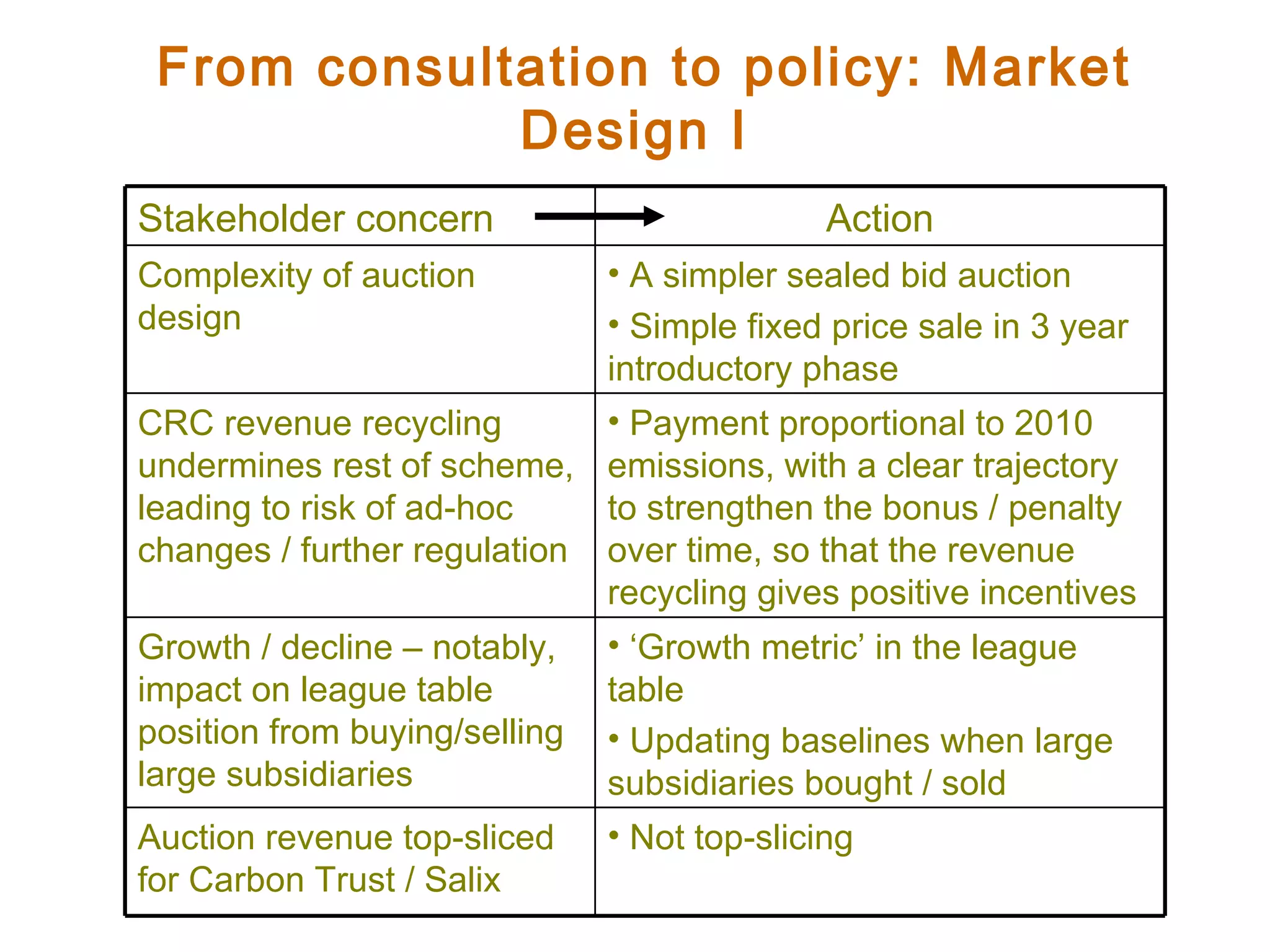
From consultation to policy: Market Design I Not top-slicing Auction revenue top-sliced for Carbon Trust / Salix Stakeholder concern Action Complexity of auction design A simpler sealed bid auction Simple fixed price sale in 3 year introductory phase CRC revenue recycling undermines rest of scheme, leading to risk of ad-hoc changes / further regulation Payment proportional to 2010 emissions, with a clear trajectory to strengthen the bonus / penalty over time, so that the revenue recycling gives positive incentives Growth / decline – notably, impact on league table position from buying/selling large subsidiaries ‘ Growth metric’ in the league table  Updating baselines when large subsidiaries bought / sold
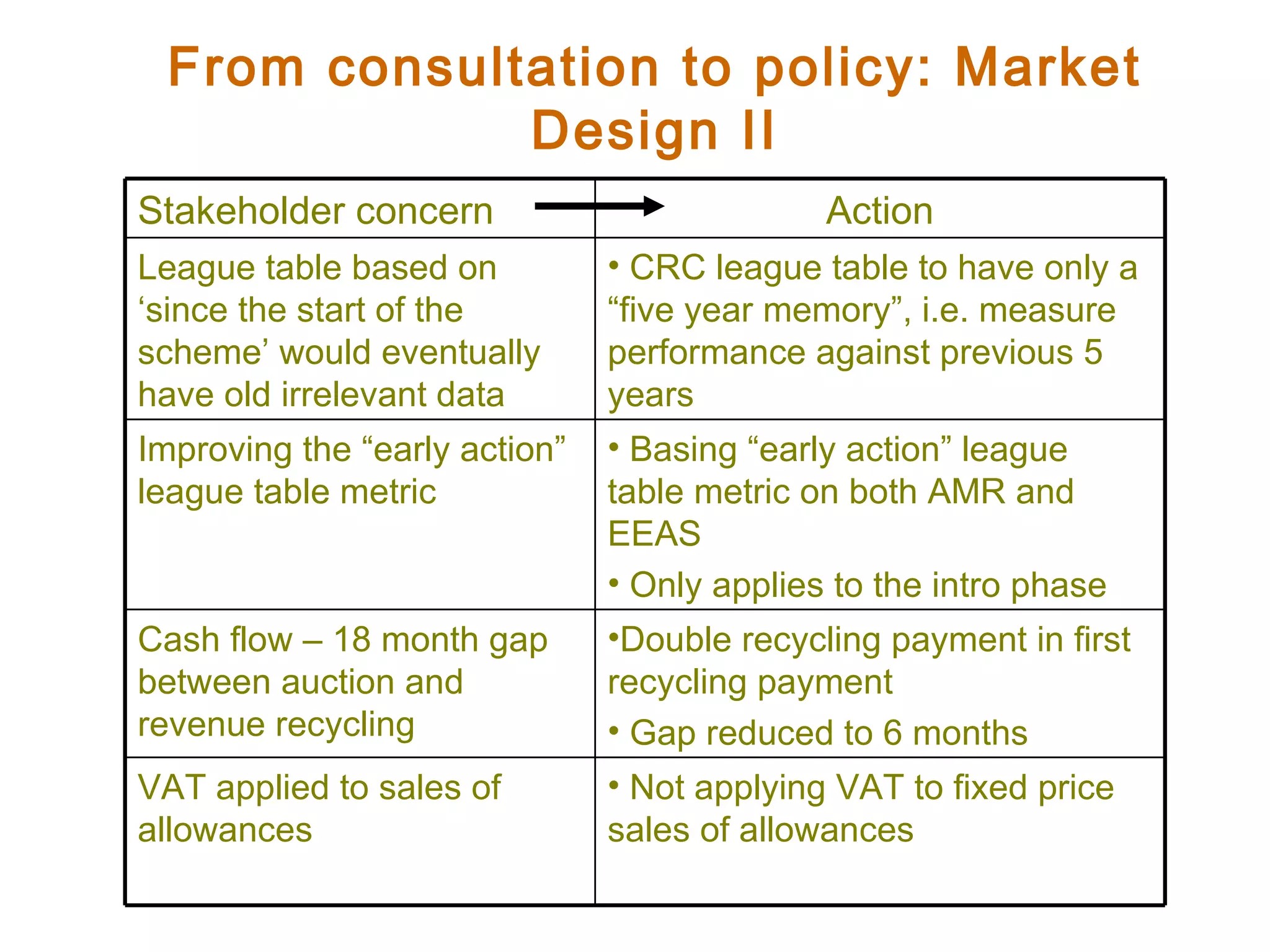
From consultation to policy: Market Design II Not applying VAT to fixed price sales of allowances  VAT applied to sales of allowances Stakeholder concern Action League table based on ‘since the start of the scheme’ would eventually have old irrelevant data CRC league table to have only a “five year memory”, i.e. measure performance against previous 5 years Improving the “early action” league table metric Basing “early action” league table metric on both AMR and EEAS Only applies to the intro phase Cash flow – 18 month gap between auction and revenue recycling Double recycling payment in first recycling payment Gap reduced to 6 months
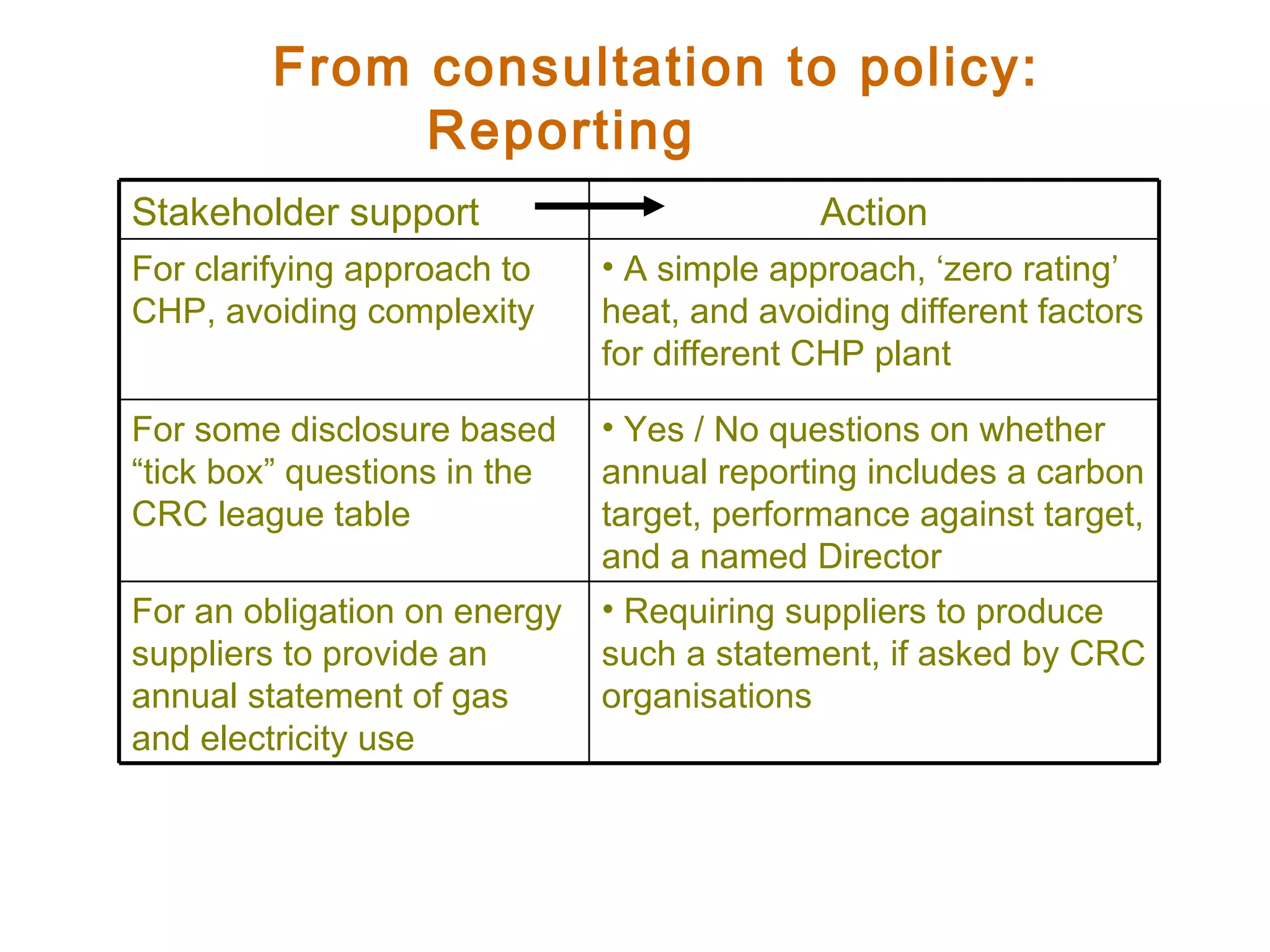
From consultation to policy: Reporting Stakeholder support Action For clarifying approach to CHP, avoiding complexity A simple approach, ‘zero rating’ heat, and avoiding different factors for different CHP plant  For some disclosure based “tick box” questions in the CRC league table Yes / No questions on whether annual reporting includes a carbon target, performance against target, and a named Director For an obligation on energy suppliers to provide an annual statement of gas and electricity use Requiring suppliers to produce such a statement, if asked by CRC organisations
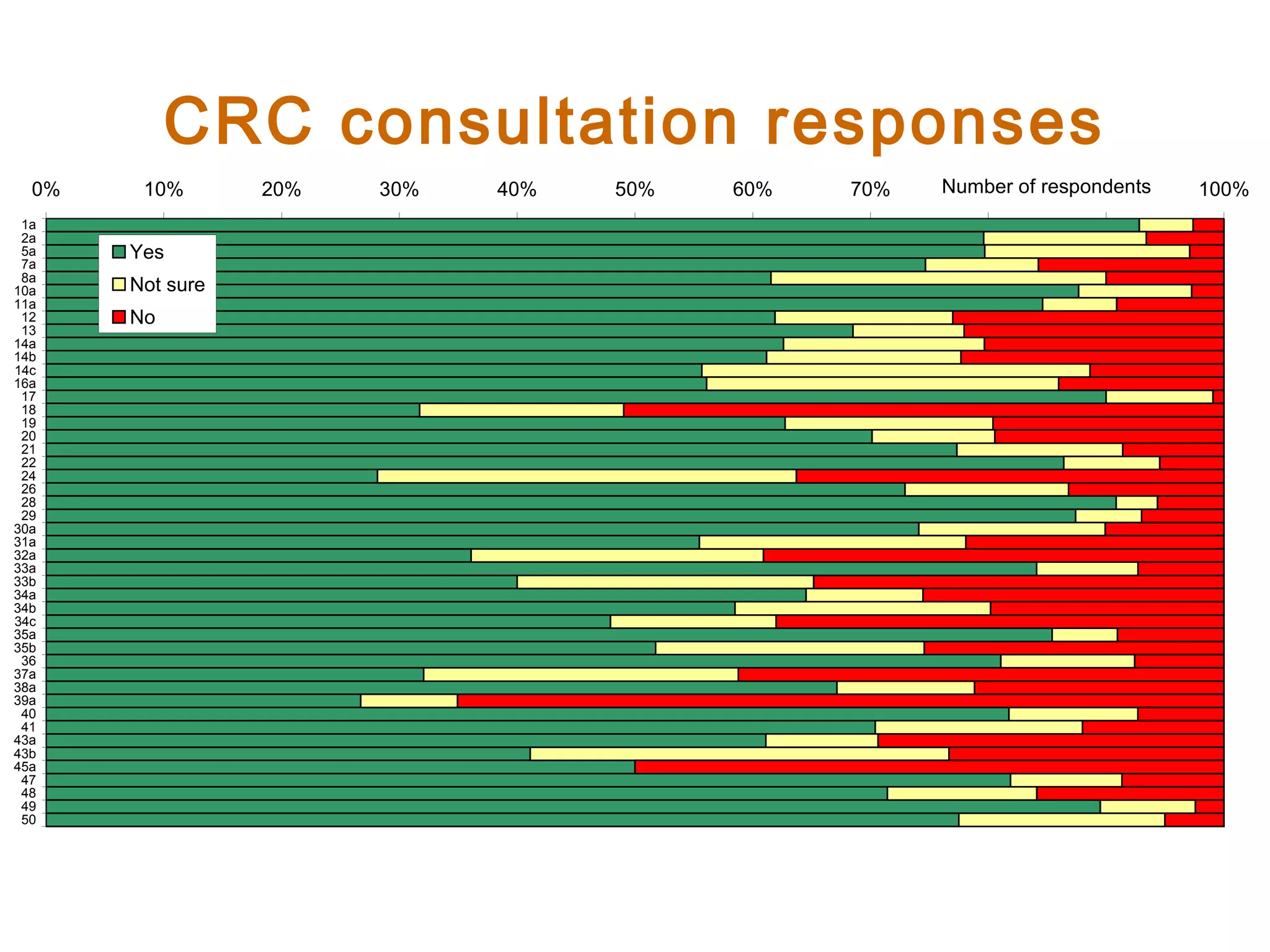
CRC consultation responses
Some key practicalities
Latest thinking on timetable Government consultation on the draft CRC regulations and CRC User Guide – expected around ~ end Feb 2009 Stakeholder engagement and awareness raising by the Environment Agency – in Spring 2009 CRC regulations go before UK Parliament and DAs – Autumn 2009 Entry into force of the CRC regulations and start of scheme – in April 2010 Note this timetable means that there would  not  be reporting in the period October 2009 – March 2010
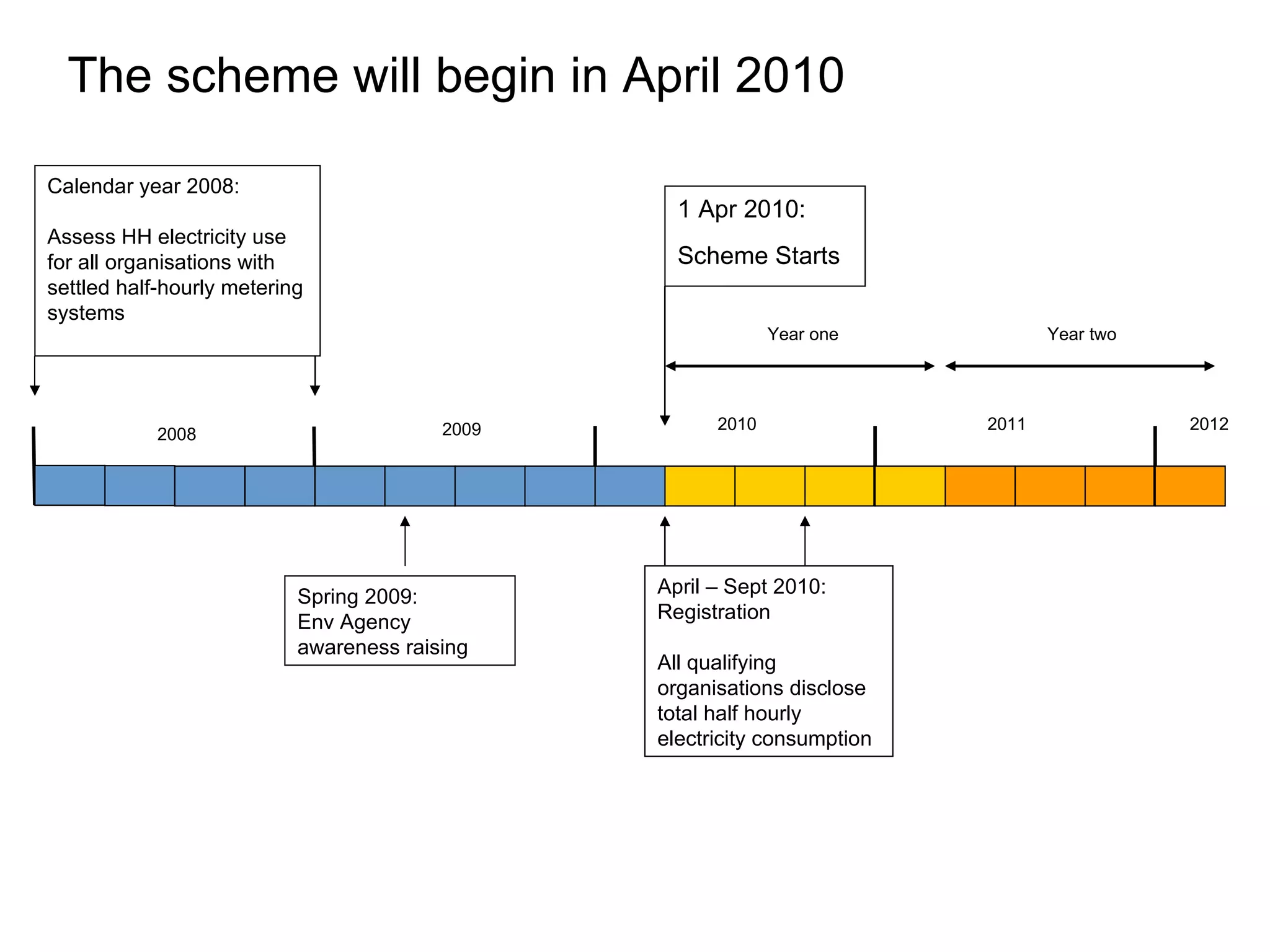
2008 2009 2010 Calendar year 2008:  Assess HH electricity use for all organisations with settled half-hourly metering systems 1 Apr 2010:  Scheme Starts April – Sept 2010: Registration  All qualifying organisations disclose total half hourly electricity consumption Spring 2009: Env Agency awareness raising The scheme will begin in April 2010 2011 Year one 2012 Year two
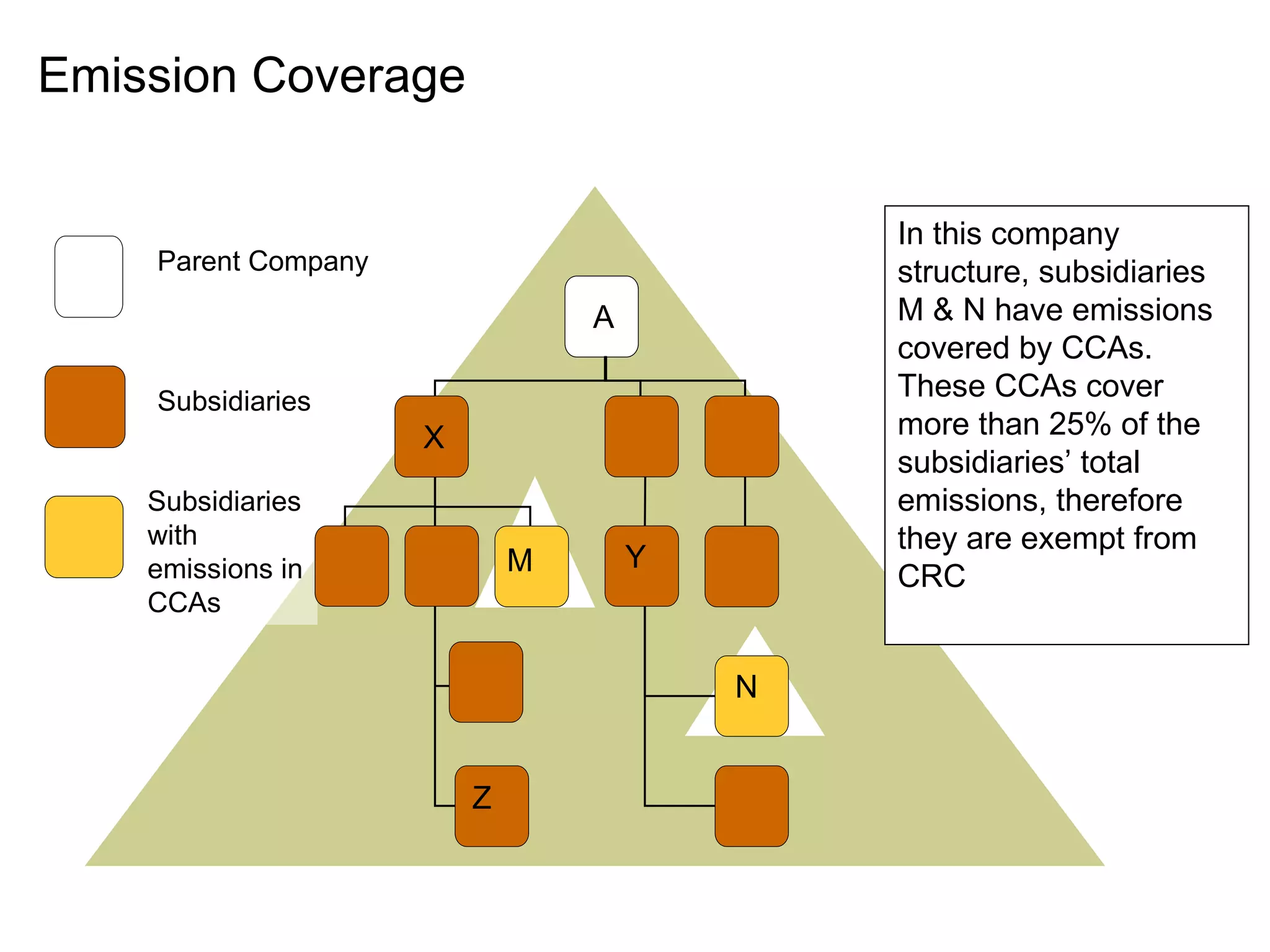
Parent Company Subsidiaries with emissions in CCAs Subsidiaries In this company structure, subsidiaries M & N have emissions covered by CCAs.  These CCAs cover more than 25% of the subsidiaries’ total emissions, therefore they are exempt from CRC A X Y Z M N Emission Coverage
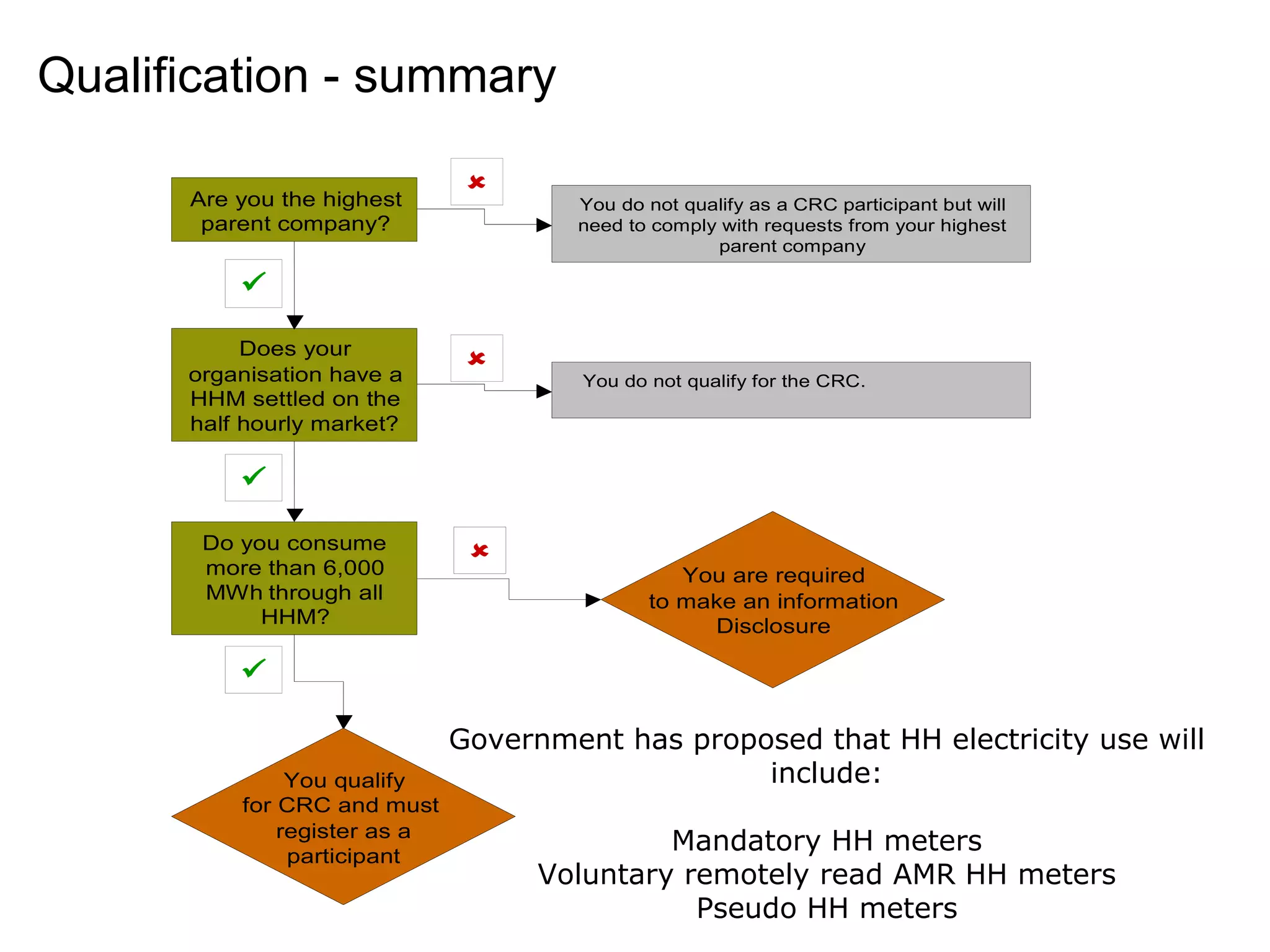
Qualification - summary Government has proposed that HH electricity use will include: Mandatory HH meters Voluntary remotely read AMR HH meters Pseudo HH meters
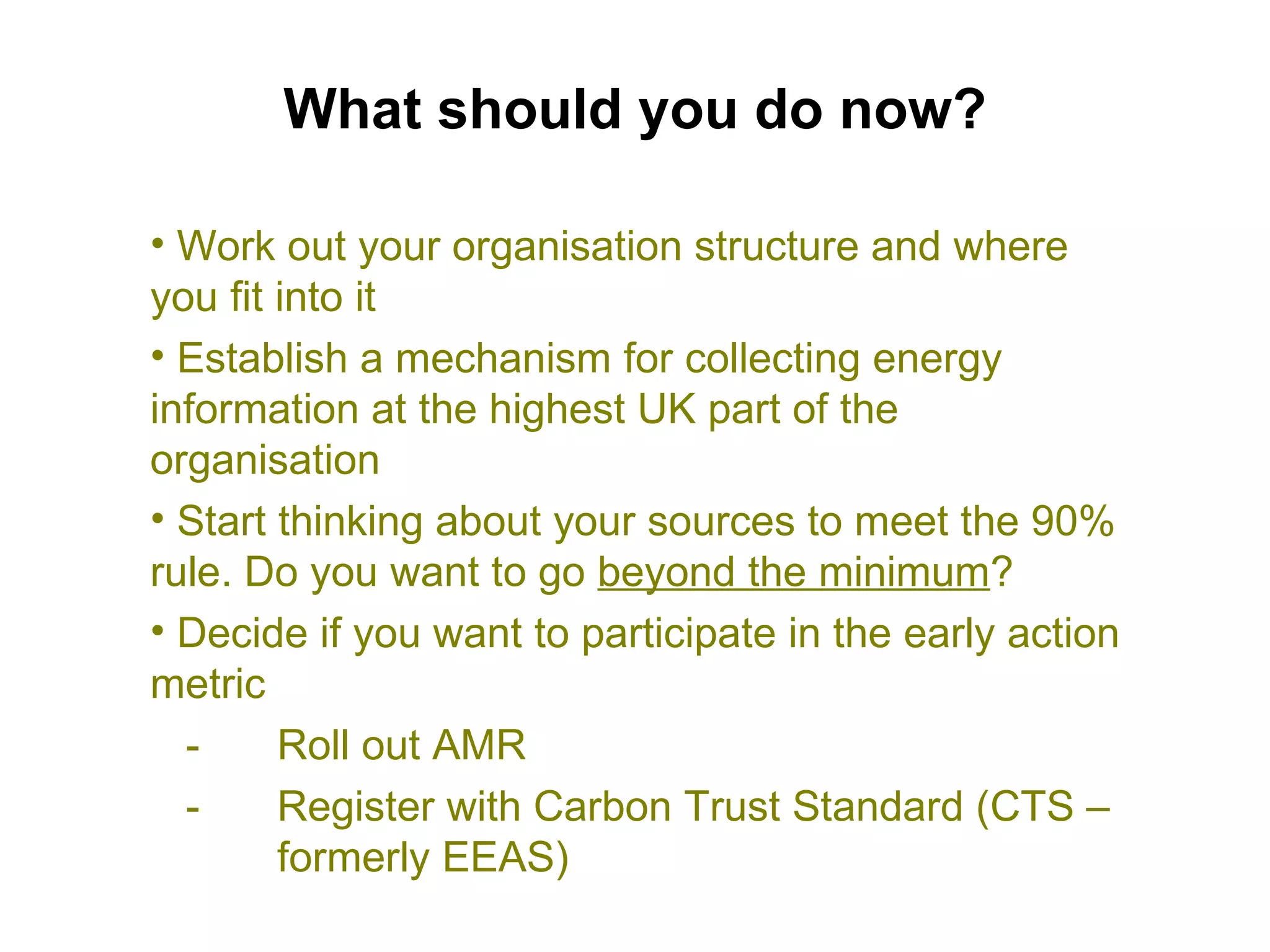
What should you do now? Work out your organisation structure and where you fit into it Establish a mechanism for collecting energy information at the highest UK part of the organisation Start thinking about your sources to meet the 90% rule. Do you want to go  beyond the minimum ? Decide if you want to participate in the early action metric -  Roll out AMR -  Register with Carbon Trust Standard (CTS –  formerly EEAS)
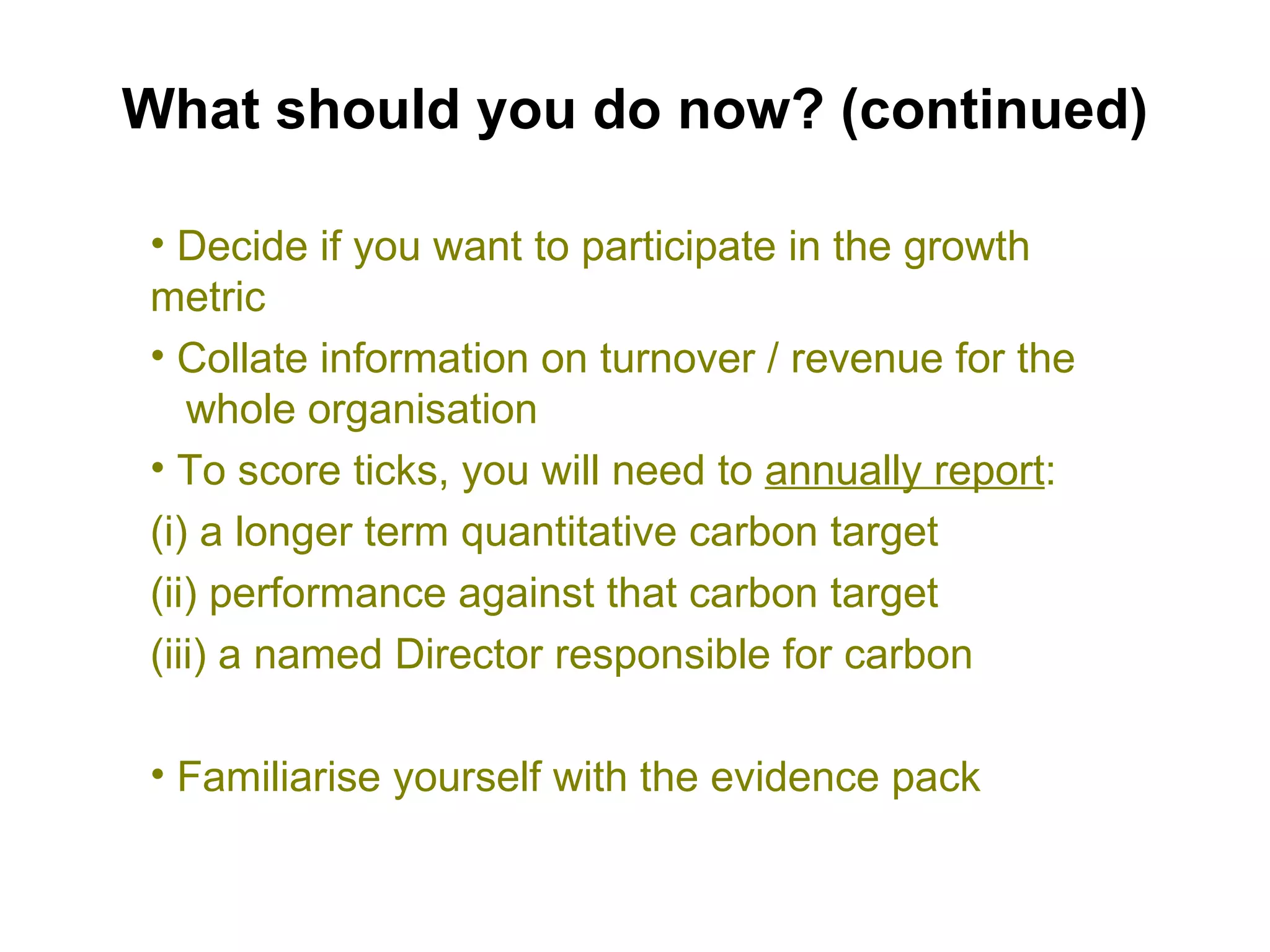
What should you do now? (continued) Decide if you want to participate in the growth metric Collate information on turnover / revenue for the  whole organisation To score ticks, you will need to  annually report : (i) a longer term quantitative carbon target (ii) performance against that carbon target (iii) a named Director responsible for carbon Familiarise yourself with the evidence pack
Context
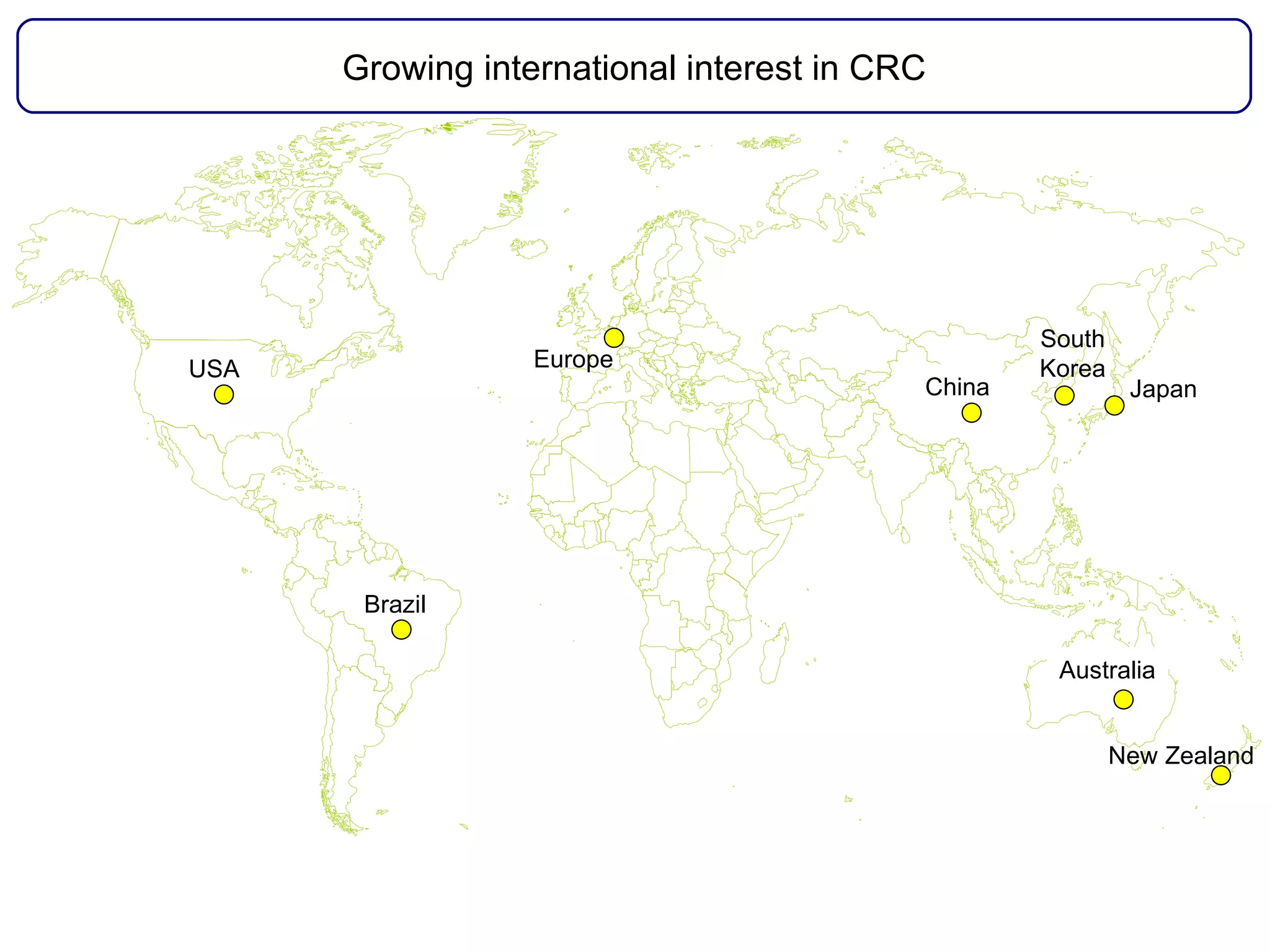
Growing international interest in CRC USA Brazil Japan South Korea China Australia New Zealand Europe
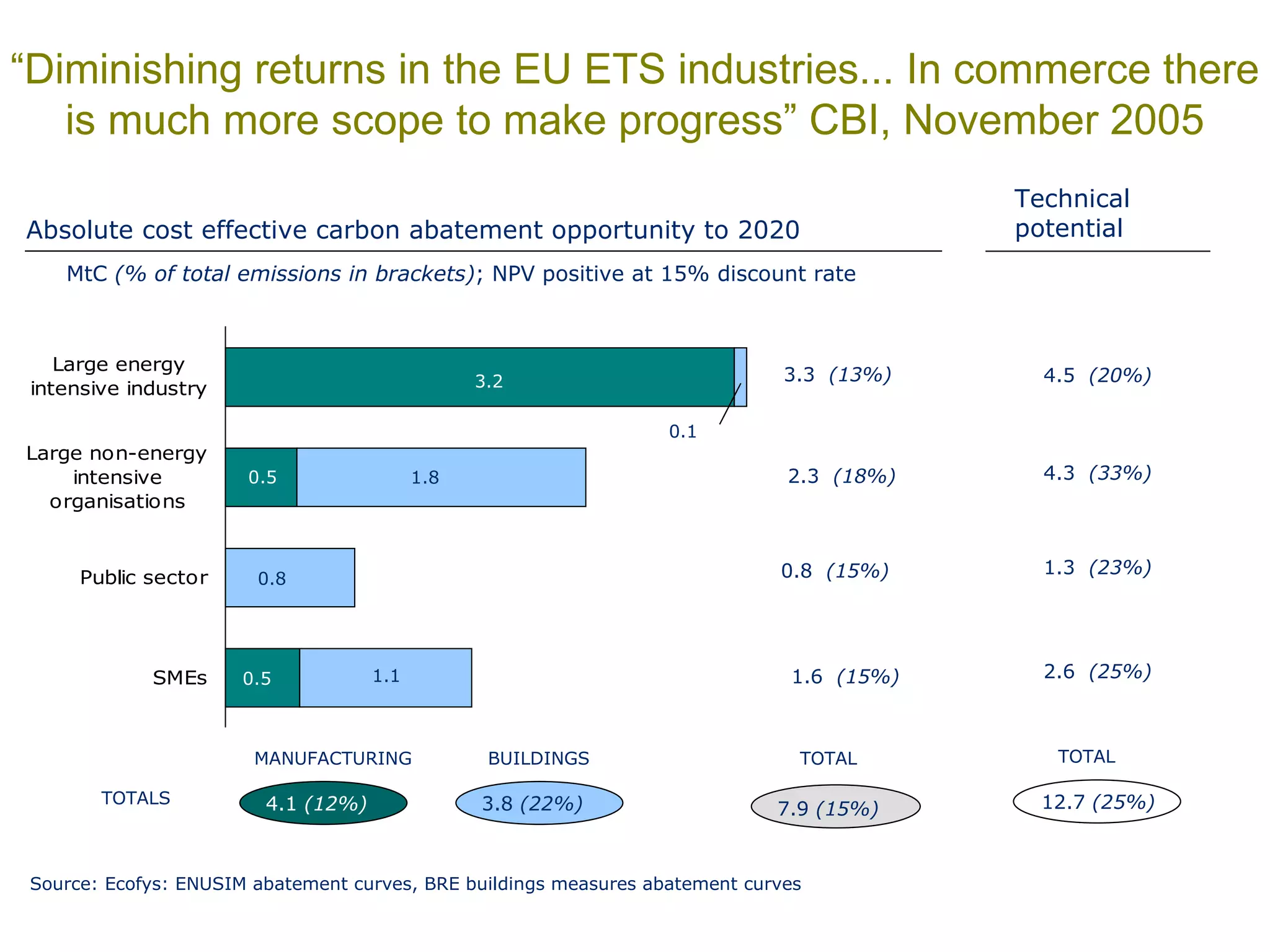
“ Diminishing returns in the EU ETS industries... In commerce there is much more scope to make progress” CBI, November 2005 Source: Ecofys: ENUSIM abatement curves, BRE buildings measures abatement curves Absolute cost effective carbon abatement opportunity to 2020 3.2 0.1 0.5 1.8 0.8 1.1 0.5 MtC  (% of total emissions in brackets) ; NPV positive at 15% discount rate 3.3  (13%) 2.3  (18%) 1.6  (15%) 0.8  (15%) 4.5  (20%) 4.3  (33%) 2.6  (25%) 1.3  (23%) TOTALS MANUFACTURING BUILDINGS TOTAL 4.1  (12%) 3.8  (22%) 7.9  (15%) Technical  potential TOTAL 12.7  (25%)
 

The carbon reduction commitment

  • 1.
    The Carbon ReductionCommitment (CRC) CBI Climate Change Summit conference 2 December 2008 Dr Philip Douglas Head of Branch, CRC
  • 2.
    CRC Summary Mandatoryauction based emissions trading scheme targeting UK energy use emissions of highest parent organisation, from business + public sector organisations Large organisations: HHM electricity > 6,000 MWhr / year Climate Committee to advise Ministers on CRC caps Revenue neutral to the Exchequer Auction revenue recycled to participants Avoiding overlap Target energy use emissions outside EU ETS and CCAs Organisations with more than 25% of their emissions in CCAs would be completely exempt As simple a scheme as possible
  • 3.
    CRC Summary “Cap and trade”: Certainty of environmental outcome through the cap – participants decide where reductions take place Three key actions during the scheme year Purchase allowances at auction, taking account of energy efficiency effort Surrender allowances equal to total emissions, buying / selling allowances as appropriate Receive a recycling payment
  • 4.
  • 5.
    From consultation topolicy: Market Design I Not top-slicing Auction revenue top-sliced for Carbon Trust / Salix Stakeholder concern Action Complexity of auction design A simpler sealed bid auction Simple fixed price sale in 3 year introductory phase CRC revenue recycling undermines rest of scheme, leading to risk of ad-hoc changes / further regulation Payment proportional to 2010 emissions, with a clear trajectory to strengthen the bonus / penalty over time, so that the revenue recycling gives positive incentives Growth / decline – notably, impact on league table position from buying/selling large subsidiaries ‘ Growth metric’ in the league table Updating baselines when large subsidiaries bought / sold
  • 6.
    From consultation topolicy: Market Design II Not applying VAT to fixed price sales of allowances VAT applied to sales of allowances Stakeholder concern Action League table based on ‘since the start of the scheme’ would eventually have old irrelevant data CRC league table to have only a “five year memory”, i.e. measure performance against previous 5 years Improving the “early action” league table metric Basing “early action” league table metric on both AMR and EEAS Only applies to the intro phase Cash flow – 18 month gap between auction and revenue recycling Double recycling payment in first recycling payment Gap reduced to 6 months
  • 7.
    From consultation topolicy: Reporting Stakeholder support Action For clarifying approach to CHP, avoiding complexity A simple approach, ‘zero rating’ heat, and avoiding different factors for different CHP plant For some disclosure based “tick box” questions in the CRC league table Yes / No questions on whether annual reporting includes a carbon target, performance against target, and a named Director For an obligation on energy suppliers to provide an annual statement of gas and electricity use Requiring suppliers to produce such a statement, if asked by CRC organisations
  • 8.
  • 9.
  • 10.
    Latest thinking ontimetable Government consultation on the draft CRC regulations and CRC User Guide – expected around ~ end Feb 2009 Stakeholder engagement and awareness raising by the Environment Agency – in Spring 2009 CRC regulations go before UK Parliament and DAs – Autumn 2009 Entry into force of the CRC regulations and start of scheme – in April 2010 Note this timetable means that there would not be reporting in the period October 2009 – March 2010
  • 11.
    2008 2009 2010Calendar year 2008: Assess HH electricity use for all organisations with settled half-hourly metering systems 1 Apr 2010: Scheme Starts April – Sept 2010: Registration All qualifying organisations disclose total half hourly electricity consumption Spring 2009: Env Agency awareness raising The scheme will begin in April 2010 2011 Year one 2012 Year two
  • 12.
    Parent Company Subsidiarieswith emissions in CCAs Subsidiaries In this company structure, subsidiaries M & N have emissions covered by CCAs. These CCAs cover more than 25% of the subsidiaries’ total emissions, therefore they are exempt from CRC A X Y Z M N Emission Coverage
  • 13.
    Qualification - summaryGovernment has proposed that HH electricity use will include: Mandatory HH meters Voluntary remotely read AMR HH meters Pseudo HH meters
  • 14.
    What should youdo now? Work out your organisation structure and where you fit into it Establish a mechanism for collecting energy information at the highest UK part of the organisation Start thinking about your sources to meet the 90% rule. Do you want to go beyond the minimum ? Decide if you want to participate in the early action metric - Roll out AMR - Register with Carbon Trust Standard (CTS – formerly EEAS)
  • 15.
    What should youdo now? (continued) Decide if you want to participate in the growth metric Collate information on turnover / revenue for the whole organisation To score ticks, you will need to annually report : (i) a longer term quantitative carbon target (ii) performance against that carbon target (iii) a named Director responsible for carbon Familiarise yourself with the evidence pack
  • 16.
  • 17.
    Growing international interestin CRC USA Brazil Japan South Korea China Australia New Zealand Europe
  • 18.
    “ Diminishing returnsin the EU ETS industries... In commerce there is much more scope to make progress” CBI, November 2005 Source: Ecofys: ENUSIM abatement curves, BRE buildings measures abatement curves Absolute cost effective carbon abatement opportunity to 2020 3.2 0.1 0.5 1.8 0.8 1.1 0.5 MtC (% of total emissions in brackets) ; NPV positive at 15% discount rate 3.3 (13%) 2.3 (18%) 1.6 (15%) 0.8 (15%) 4.5 (20%) 4.3 (33%) 2.6 (25%) 1.3 (23%) TOTALS MANUFACTURING BUILDINGS TOTAL 4.1 (12%) 3.8 (22%) 7.9 (15%) Technical potential TOTAL 12.7 (25%)
  • 19.