Integrated approach involving liquid membranes and forward osmosis for
the processing of fruit juice and natural colorants
Thesis submitted to the
Academy of Scientific & Innovative Research
In fulfillment of the requirements for the degree of
DOCTOR OF PHILOSOPHY
in Engineering sciences
by
(Reg. No: 20EE11A08007)
Under the guidance of
at
Department of Food Engineering,
CSIR-Central Food Technological Research Institute,
Mysore - 570 020, India
September 2015
Dr.Navin K. Rastogi
B.E., M.Tech., MBA., Ph.D.
B.S. Chanukya
B.E., M.Tech. (Chemical engg.)
B.S. Chanukya
B.E., M.Tech. (Chemical engg.)
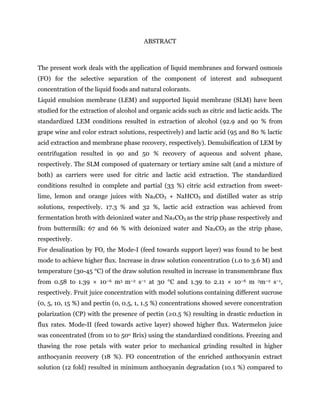
ABSTRACT
The present work deals with the application of liquid membranes and forward osmosis
(FO) for the selective separation of the component of interest and subsequent
concentration of the liquid foods and natural colorants.
Liquid emulsion membrane (LEM) and supported liquid membrane (SLM) have been
studied for the extraction of alcohol and organic acids such as citric and lactic acids. The
standardized LEM conditions resulted in extraction of alcohol (92.9 and 90 % from
grape wine and color extract solutions, respectively) and lactic acid (95 and 80 % lactic
acid extraction and membrane phase recovery, respectively). Demulsification of LEM by
centrifugation resulted in 90 and 50 % recovery of aqueous and solvent phase,
respectively. The SLM composed of quaternary or tertiary amine salt (and a mixture of
both) as carriers were used for citric and lactic acid extraction. The standardized
conditions resulted in complete and partial (33 %) citric acid extraction from sweet-
lime, lemon and orange juices with Na2CO3 + NaHCO3 and distilled water as strip
solutions, respectively. 17.3 % and 32 %, lactic acid extraction was achieved from
fermentation broth with deionized water and Na2CO3 as the strip phase respectively and
from buttermilk: 67 and 66 % with deionized water and Na2CO3 as the strip phase,
respectively.
For desalination by FO, the Mode-I (feed towards support layer) was found to be best
mode to achieve higher flux. Increase in draw solution concentration (1.0 to 3.6 M) and
temperature (30-45 °C) of the draw solution resulted in increase in transmembrane flux
from 0.58 to 1.39 × 10⁻⁶ m3 m−2 s−1 at 30 °C and 1.39 to 2.11 × 10⁻⁶ m 3m−2 s−1,
respectively. Fruit juice concentration with model solutions containing different sucrose
(0, 5, 10, 15 %) and pectin (0, 0.5, 1, 1.5 %) concentrations showed severe concentration
polarization (CP) with the presence of pectin (≥0.5 %) resulting in drastic reduction in
flux rates. Mode-II (feed towards active layer) showed higher flux. Watermelon juice
was concentrated (from 10 to 50o Brix) using the standardized conditions. Freezing and
thawing the rose petals with water prior to mechanical grinding resulted in higher
anthocyanin recovery (18 %). FO concentration of the enriched anthocyanin extract
solution (12 fold) resulted in minimum anthocyanin degradation (10.1 %) compared to
thermal method. Supplementation of the processed enriched rose anthocyanin extract
to yoghurt and storage for 2 weeks showed first-order kinetics degradation of
anthocyanin of 31.8 mg/l. 30 kHz ultrasound (US) was effective in partially mitigating
overall CP occurring in the FO membrane when the feed contains sucrose upto 5 %
(when feed was towards active layer) resulting in higher fluxes. At higher pectin
concentration (≥0.5 %) US was not found to be effective.
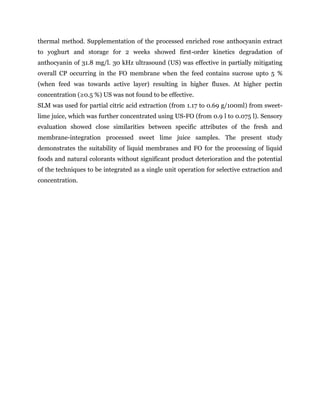
SLM was used for partial citric acid extraction (from 1.17 to 0.69 g/100ml) from sweet-
lime juice, which was further concentrated using US-FO (from 0.9 l to 0.075 l). Sensory
evaluation showed close similarities between specific attributes of the fresh and
membrane-integration processed sweet lime juice samples. The present study
demonstrates the suitability of liquid membranes and FO for the processing of liquid
foods and natural colorants without significant product deterioration and the potential
of the techniques to be integrated as a single unit operation for selective extraction and
concentration.

Ph.D. thesis title page and abstract

  • 1.
    Integrated approach involvingliquid membranes and forward osmosis for the processing of fruit juice and natural colorants Thesis submitted to the Academy of Scientific & Innovative Research In fulfillment of the requirements for the degree of DOCTOR OF PHILOSOPHY in Engineering sciences by (Reg. No: 20EE11A08007) Under the guidance of at Department of Food Engineering, CSIR-Central Food Technological Research Institute, Mysore - 570 020, India September 2015 Dr.Navin K. Rastogi B.E., M.Tech., MBA., Ph.D. B.S. Chanukya B.E., M.Tech. (Chemical engg.) B.S. Chanukya B.E., M.Tech. (Chemical engg.)
  • 2.
    ABSTRACT The present workdeals with the application of liquid membranes and forward osmosis (FO) for the selective separation of the component of interest and subsequent concentration of the liquid foods and natural colorants. Liquid emulsion membrane (LEM) and supported liquid membrane (SLM) have been studied for the extraction of alcohol and organic acids such as citric and lactic acids. The standardized LEM conditions resulted in extraction of alcohol (92.9 and 90 % from grape wine and color extract solutions, respectively) and lactic acid (95 and 80 % lactic acid extraction and membrane phase recovery, respectively). Demulsification of LEM by centrifugation resulted in 90 and 50 % recovery of aqueous and solvent phase, respectively. The SLM composed of quaternary or tertiary amine salt (and a mixture of both) as carriers were used for citric and lactic acid extraction. The standardized conditions resulted in complete and partial (33 %) citric acid extraction from sweet- lime, lemon and orange juices with Na2CO3 + NaHCO3 and distilled water as strip solutions, respectively. 17.3 % and 32 %, lactic acid extraction was achieved from fermentation broth with deionized water and Na2CO3 as the strip phase respectively and from buttermilk: 67 and 66 % with deionized water and Na2CO3 as the strip phase, respectively. For desalination by FO, the Mode-I (feed towards support layer) was found to be best mode to achieve higher flux. Increase in draw solution concentration (1.0 to 3.6 M) and temperature (30-45 °C) of the draw solution resulted in increase in transmembrane flux from 0.58 to 1.39 × 10⁻⁶ m3 m−2 s−1 at 30 °C and 1.39 to 2.11 × 10⁻⁶ m 3m−2 s−1, respectively. Fruit juice concentration with model solutions containing different sucrose (0, 5, 10, 15 %) and pectin (0, 0.5, 1, 1.5 %) concentrations showed severe concentration polarization (CP) with the presence of pectin (≥0.5 %) resulting in drastic reduction in flux rates. Mode-II (feed towards active layer) showed higher flux. Watermelon juice was concentrated (from 10 to 50o Brix) using the standardized conditions. Freezing and thawing the rose petals with water prior to mechanical grinding resulted in higher anthocyanin recovery (18 %). FO concentration of the enriched anthocyanin extract solution (12 fold) resulted in minimum anthocyanin degradation (10.1 %) compared to
  • 3.
    thermal method. Supplementationof the processed enriched rose anthocyanin extract to yoghurt and storage for 2 weeks showed first-order kinetics degradation of anthocyanin of 31.8 mg/l. 30 kHz ultrasound (US) was effective in partially mitigating overall CP occurring in the FO membrane when the feed contains sucrose upto 5 % (when feed was towards active layer) resulting in higher fluxes. At higher pectin concentration (≥0.5 %) US was not found to be effective. SLM was used for partial citric acid extraction (from 1.17 to 0.69 g/100ml) from sweet- lime juice, which was further concentrated using US-FO (from 0.9 l to 0.075 l). Sensory evaluation showed close similarities between specific attributes of the fresh and membrane-integration processed sweet lime juice samples. The present study demonstrates the suitability of liquid membranes and FO for the processing of liquid foods and natural colorants without significant product deterioration and the potential of the techniques to be integrated as a single unit operation for selective extraction and concentration.