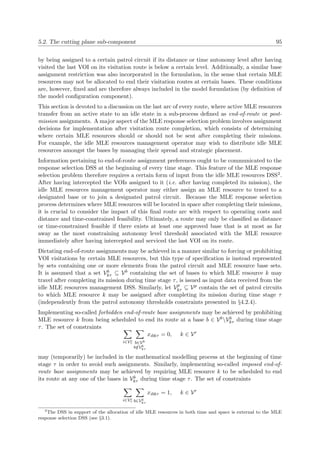
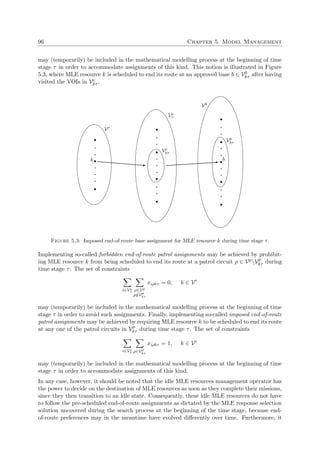
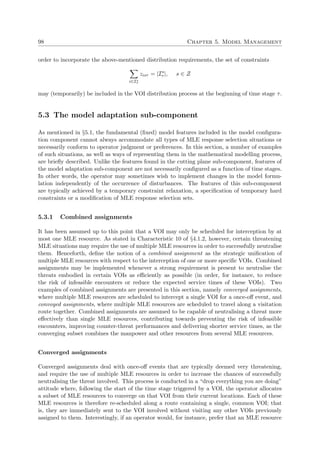
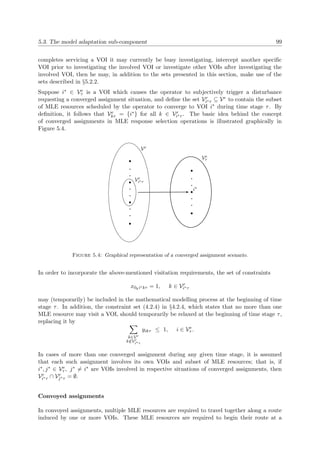
Decision Support for Response Selection in
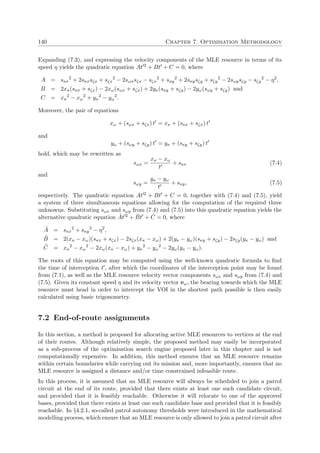
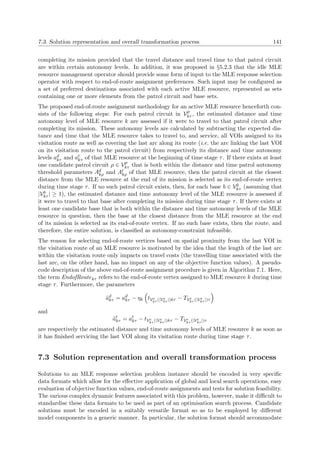
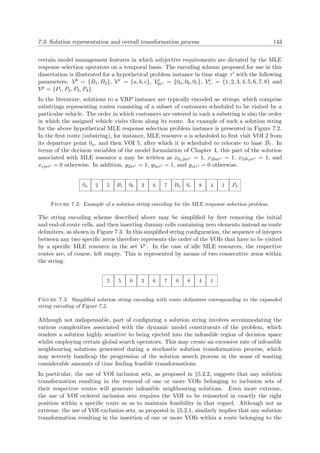
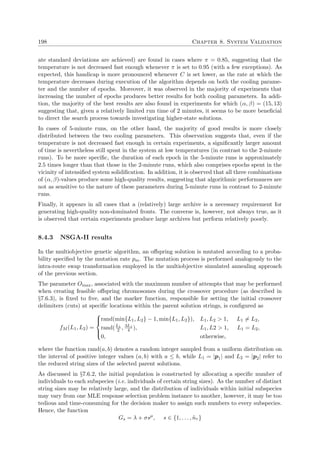
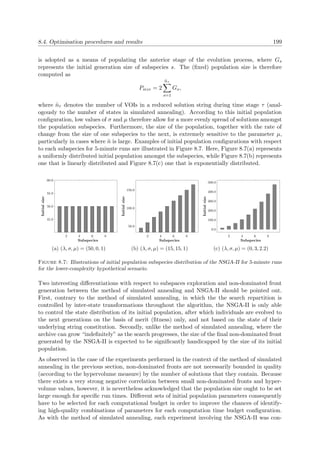
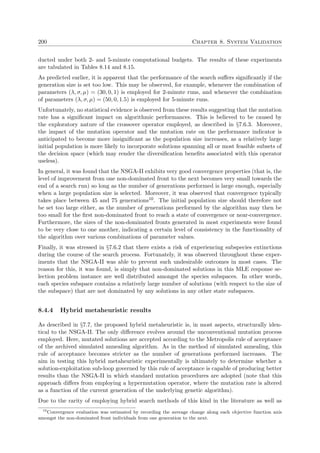
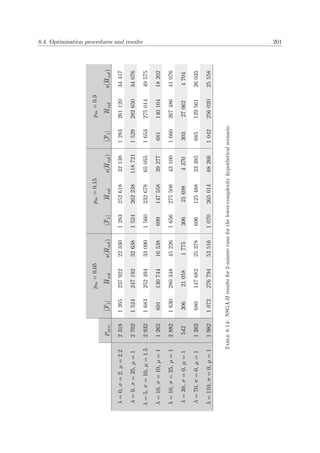
Maritime Law Enforcement
Alexandre Colmant
Dissertation presented for the degree of
Doctor of Philosophy
in the Faculty of Engineering at Stellenbosch University
Promoter: Prof JH van Vuuren December 2016
Declaration
By submitting this dissertation electronically, I declare that the entirety of the work contained
therein is my own, original work, that I am the sole author thereof (save to the extent explicitly
otherwise stated), that reproduction and publication thereof by Stellenbosch University will not
infringe any third party rights and that I have not previously in its entirety or in part submitted
it for obtaining any qualification.
Date: December 1, 2016
Copyright c 2016 Stellenbosch University
All rights reserved
i
ii
Abstract
In the context of maritime law enforcement (MLE), a human operator is typically required to
make a variety of counter-threat decisions following the detection and evaluation of threats at sea.
These decisions reside within a so-called response selection process during which MLE resources,
such as patrol vessels, military vessels and armed helicopters, have to be dispatched to intercept
maritime vessels that are deemed potential threats. Because the number of potential maritime
threats can be overwhelming and the nature of the decision process is typically complex, the
quality of resource assignment decisions can be improved significantly by providing maritime
operators with computerised decision support.
A generic, semi-automated MLE response selection and resource routing decision support system
(DSS) is designed in this dissertation. This DSS is capable of assisting human operators in
spatio-temporal resource dispatch decision making so that MLE resources may be employed
effectively and efficiently. These decisions are made based on kinematic vessel-related data
obtained from associated threat detection and threat evaluation systems, as well as subjective
input data contributed by MLE response selection operators. Fully automated decision making
is therefore not pursued; the aim of this study is to establish a support tool for an operator.
Multiple response selection objectives are accommodated in the proposed DSS in a generic
manner, so as to provide users of the system with the freedom of configuring their own, preferred
goals. This generic DSS design is populated with examples of models capable of performing the
functions of the various constituent parts of the system, and their workability is tested and
demonstrated by solving the MLE response selection problem in the context of two realistic, but
simulated, MLE scenarios.
The MLE DSS proposed in this dissertation may be used in future to assist maritime operators
in their complex decision making processes. In particular, operators may use it as a guideline to
validate and/or justify their decisions, especially when the level of uncertainty pertaining to the
observed maritime scenario is high and/or only parts of the problem may be resolved by hand.
Use of this system in a real-world context is expected to reduce the stress levels of operators
typically associated with difficult decisions, while simultaneously improving the overall quality
of MLE decisions in an integrated fashion.
iii
iv
Uittreksel
In die konteks van maritieme wetstoepassing (MWT) word daar tipies van ’n menslike operateur
verwag om, in reaksie op die opsporing en evaluering van maritieme bedreigings, ’n verskeiden-
heid besluite te neem waarvolgens hierdie bedreigings geneutraliseer kan word. Hierdie besluite
vind plaas binne ’n sogenaamde MWT-responsseleksieproses waartydens MWT-hulpbronne, soos
patrolliebote, militˆere skepe en gewapende helikopters, ontplooi moet word om maritieme vaar-
tuie wat as bedreigings beskou word, te onderskep. Aangesien die aantal potensi¨ele maritieme
bedreigings oorweldigend kan wees en die aard van die MWT-besluitnemingsproses tipies kom-
pleks is, kan die kwaliteit van hulpbrontoedelingsbesluite noemenswaardig verhoog word deur
maritieme operateurs met gerekenariseerde besluitsteun te bedien.
’n Generiese, gedeeltelik ge-outomatiseerde besluitsteunstelsel (BSS) word in hierdie dissertatie
vir MWT-responsseleksie en hulpbronroetering ontwerp. Hierdie BSS is daartoe in staat om
menslike operateurs met effektiewe en doeltreffende besluitsteun in terme van die ontplooiing van
MWT-hulpbronne oor tyd en ruimte te bedien. Hierdie besluite word gemaak gebaseer op kine-
matiese vaartuigdata wat vanuit gepaardgaande BSSe vir bedreigingsopsporing en bedreigings-
afskatting verkry word, sowel as subjektiewe toevoerdata vanaf MWT-responsseleksie opera-
teurs. Ten volle ge-outomatiseerde besluitneming word dus nie nagestreef nie; die doel van
hierdie studie is om ’n steunstelsel vir ’n menslike operateur daar te stel.
’n Verskeidenheid responsseleksiedoele word in die voorgestelde BSS op ’n generiese wyse geak
kommodeer om sodoende aan gebruikers die vryheid te bied om hul eie voorkeurdoele te spe-
sifiseer. Hierdie generiese BSS-ontwerp word vergesel met voorbeelde van modelle waarvolgens
die verskeie funksionaliteite van die onderskeie stelselkomponente gerealiseer kan word, en hulle
werkbaarheid word aan die hand van twee realistiese, maar gesimuleerde, MWT-scenarios getoets
en gedemonstreer.
Die MWT BSS wat in hierdie dissertatie voorgestel word, mag in die toekoms gebruik word
om maritieme operateurs in hulle komplekse besluitprosesse by te staan. In die besonder kan
operateurs die stelsel as ’n riglyn gebruik om hul besluite te valideer of te regverdig, veral
wanneer die vlak van onsekerheid onderliggend aan die maritieme scenario hoog is en/of slegs
dele van die MWT-responsseleksieprobleem met die hand oplosbaar is. Daar word verwag dat
gebruik van hierdie slelsel in die praktyk die stresvlakke van operateurs as gevolg van moeilike
MWT-besluite noemenswaardig kan verlaag, en terselfdertyd die oorkoepelende kwaliteit van
MWT-besluite op ’n ge¨ıntegreerde wyse kan verbeter.
v
vi
Acknowledgements
The author wishes to acknowledge the following people and institutions for their various
contributions towards the completion of this work:
• My promoter, Prof Jan van Vuuren, for his dedication, guidance and valuable insight
throughout the compilation of this dissertation. I admire his professionalism and inclina-
tion towards promoting a standard of excellence in the work delivered. I appreciate his
enthusiasm towards the nature of the work pursued in this dissertation, as well as the
numerous intellectual conversations shared with him during the past three years.
• My colleague, Jacques du Toit, for his valuable insight into the maritime law enforcement
domain, particularly in the early stages of work towards this dissertation.
• The Departments of Logistics and the SUnORE group for the use of their excellent com-
puting facilities, office space and kitchens.
• The Armaments Corporation of South Africa (ARMSCOR) for funding the research re-
ported in this dissertation.
• Finally, my friends and family for their moral support and encouragements during the past
three years, and their understanding during times of great pressure and unavailability to
socialise on my part.
vii
viii
Table of Contents
Abstract iii
Uittreksel v
Acknowledgements vii
List of Reserved Symbols xvii
List of Acronyms xxi
List of Figures xxiii
List of Tables xxvii
List of Algorithms xxix
1 Introduction 1
1.1 Background . . . . . . . . . . . . . . . . . . . . . . . . . . . . . . . . . . . . . . . 1
1.1.1 The law of the seas . . . . . . . . . . . . . . . . . . . . . . . . . . . . . . . 2
1.1.2 Activities of vessels at sea . . . . . . . . . . . . . . . . . . . . . . . . . . . 2
1.2 Informal problem description . . . . . . . . . . . . . . . . . . . . . . . . . . . . . 4
1.3 Dissertation aim and scope . . . . . . . . . . . . . . . . . . . . . . . . . . . . . . 9
1.4 Dissertation objectives . . . . . . . . . . . . . . . . . . . . . . . . . . . . . . . . . 9
1.5 Dissertation organisation . . . . . . . . . . . . . . . . . . . . . . . . . . . . . . . . 11
2 Literature Review 13
2.1 Decision theory . . . . . . . . . . . . . . . . . . . . . . . . . . . . . . . . . . . . . 13
2.1.1 Elementary concepts of decision making . . . . . . . . . . . . . . . . . . . 14
2.1.2 On the decision structuring process . . . . . . . . . . . . . . . . . . . . . . 14
2.1.3 Decision making with multiple conflicting objectives . . . . . . . . . . . . 15
2.1.4 The notions of dominance, Pareto optimality and the Pareto front . . . . 17
ix
x Table of Contents
2.1.5 Multiperson decision making . . . . . . . . . . . . . . . . . . . . . . . . . 18
2.2 Optimisation techniques . . . . . . . . . . . . . . . . . . . . . . . . . . . . . . . . 19
2.3 The method of simulated annealing . . . . . . . . . . . . . . . . . . . . . . . . . . 22
2.3.1 The notion of annealing . . . . . . . . . . . . . . . . . . . . . . . . . . . . 22
2.3.2 Algorithm outline . . . . . . . . . . . . . . . . . . . . . . . . . . . . . . . 23
2.3.3 Multiobjective simulated annealing . . . . . . . . . . . . . . . . . . . . . . 24
2.4 Evolutionary algorithms . . . . . . . . . . . . . . . . . . . . . . . . . . . . . . . . 27
2.4.1 Algorithm outline . . . . . . . . . . . . . . . . . . . . . . . . . . . . . . . 27
2.4.2 Multiobjective evolutionary algorithms . . . . . . . . . . . . . . . . . . . . 28
2.4.3 Fitness assignment and diversity preservation . . . . . . . . . . . . . . . . 31
2.4.4 Genetic operators . . . . . . . . . . . . . . . . . . . . . . . . . . . . . . . . 31
2.5 Other popular metaheuristics . . . . . . . . . . . . . . . . . . . . . . . . . . . . . 34
2.5.1 The method of tabu search . . . . . . . . . . . . . . . . . . . . . . . . . . 34
2.5.2 Ant colony optimisation . . . . . . . . . . . . . . . . . . . . . . . . . . . . 35
2.5.3 Particle swarm optimisation . . . . . . . . . . . . . . . . . . . . . . . . . . 39
2.6 The vehicle routing problem . . . . . . . . . . . . . . . . . . . . . . . . . . . . . . 39
2.6.1 The origin and variations of the problem . . . . . . . . . . . . . . . . . . . 41
2.6.2 The nature of specific problem information . . . . . . . . . . . . . . . . . 42
2.6.3 Dynamic VRPs . . . . . . . . . . . . . . . . . . . . . . . . . . . . . . . . . 43
2.6.4 Stochastic VRPs . . . . . . . . . . . . . . . . . . . . . . . . . . . . . . . . 44
2.6.5 VRP solution methodologies in the literature . . . . . . . . . . . . . . . . 44
2.7 Dynamic multiobjective optimisation approaches . . . . . . . . . . . . . . . . . . 46
2.7.1 On-line versus off-line optimisation . . . . . . . . . . . . . . . . . . . . . . 47
2.7.2 The notion of jump-start optimisation . . . . . . . . . . . . . . . . . . . . 47
2.7.3 Adaptive evolutionary mechanisms . . . . . . . . . . . . . . . . . . . . . . 48
2.8 MLE DSSs in existence . . . . . . . . . . . . . . . . . . . . . . . . . . . . . . . . 49
2.8.1 MLE threat detection DSSs . . . . . . . . . . . . . . . . . . . . . . . . . . 50
2.8.2 MLE threat evaluation DSSs . . . . . . . . . . . . . . . . . . . . . . . . . 50
2.8.3 MLE resource assignment DSSs . . . . . . . . . . . . . . . . . . . . . . . . 51
2.9 Chapter Summary . . . . . . . . . . . . . . . . . . . . . . . . . . . . . . . . . . . 53
3 System Architecture 55
3.1 Functional elements in an MLE environment . . . . . . . . . . . . . . . . . . . . 55
3.1.1 Overview of the proposed architecture . . . . . . . . . . . . . . . . . . . . 57
3.1.2 External MLE resource assignment infrastructure . . . . . . . . . . . . . . 59
3.1.3 The MLE response selection DSS . . . . . . . . . . . . . . . . . . . . . . . 62
Table of Contents xi
3.2 The chronological order of MLE events . . . . . . . . . . . . . . . . . . . . . . . . 63
3.3 Three MLE response selection paradigms . . . . . . . . . . . . . . . . . . . . . . 65
3.3.1 A centralised decision making paradigm . . . . . . . . . . . . . . . . . . . 65
3.3.2 An intermediate decision making paradigm . . . . . . . . . . . . . . . . . 66
3.3.3 A decentralised decision making paradigm . . . . . . . . . . . . . . . . . . 67
3.4 Chapter summary . . . . . . . . . . . . . . . . . . . . . . . . . . . . . . . . . . . 68
4 Model Configuration 69
4.1 Concepts and assumptions . . . . . . . . . . . . . . . . . . . . . . . . . . . . . . . 70
4.1.1 Reaching a consensus . . . . . . . . . . . . . . . . . . . . . . . . . . . . . 70
4.1.2 Vehicle routing characteristics . . . . . . . . . . . . . . . . . . . . . . . . . 71
4.1.3 The objectives informing MLE response selection decisions . . . . . . . . 72
4.1.4 VOI input data . . . . . . . . . . . . . . . . . . . . . . . . . . . . . . . . . 73
4.1.5 Disturbances and time stages . . . . . . . . . . . . . . . . . . . . . . . . . 73
4.1.6 MLE resources counter-threat performances . . . . . . . . . . . . . . . . . 74
4.1.7 MLE resources autonomy levels . . . . . . . . . . . . . . . . . . . . . . . . 74
4.1.8 VOI servicing . . . . . . . . . . . . . . . . . . . . . . . . . . . . . . . . . . 75
4.1.9 VOI response time . . . . . . . . . . . . . . . . . . . . . . . . . . . . . . . 75
4.1.10 A graphical representation of MLE response selection . . . . . . . . . . . 76
4.2 Model configuration in the centralised paradigm . . . . . . . . . . . . . . . . . . 77
4.2.1 Model parameters . . . . . . . . . . . . . . . . . . . . . . . . . . . . . . . 77
4.2.2 Decision variables . . . . . . . . . . . . . . . . . . . . . . . . . . . . . . . 79
4.2.3 Model objectives . . . . . . . . . . . . . . . . . . . . . . . . . . . . . . . . 79
4.2.4 Fundamental model constraints . . . . . . . . . . . . . . . . . . . . . . . . 82
4.3 Model configuration in an intermediate paradigm . . . . . . . . . . . . . . . . . . 84
4.4 Model configuration in the decentralised paradigm . . . . . . . . . . . . . . . . . 85
4.5 Chapter summary . . . . . . . . . . . . . . . . . . . . . . . . . . . . . . . . . . . 86
5 Model Management 89
5.1 The model management sub-components . . . . . . . . . . . . . . . . . . . . . . . 90
5.2 The cutting plane sub-component . . . . . . . . . . . . . . . . . . . . . . . . . . . 91
5.2.1 Exclusion sets for forbidden VOI assignments . . . . . . . . . . . . . . . . 91
5.2.2 Inclusion sets for imposed VOI assignments . . . . . . . . . . . . . . . . . 92
5.2.3 End-of-route assignments . . . . . . . . . . . . . . . . . . . . . . . . . . . 94
5.2.4 Customer profit thresholds . . . . . . . . . . . . . . . . . . . . . . . . . . 97
5.2.5 VOI distribution . . . . . . . . . . . . . . . . . . . . . . . . . . . . . . . . 97
xii Table of Contents
5.3 The model adaptation sub-component . . . . . . . . . . . . . . . . . . . . . . . . 98
5.3.1 Combined assignments . . . . . . . . . . . . . . . . . . . . . . . . . . . . . 98
5.3.2 Non-operational MLE resources . . . . . . . . . . . . . . . . . . . . . . . . 100
5.3.3 Capacity restrictions . . . . . . . . . . . . . . . . . . . . . . . . . . . . . . 101
5.3.4 Deployable bases . . . . . . . . . . . . . . . . . . . . . . . . . . . . . . . . 101
5.4 Comments . . . . . . . . . . . . . . . . . . . . . . . . . . . . . . . . . . . . . . . . 102
5.5 Chapter summary . . . . . . . . . . . . . . . . . . . . . . . . . . . . . . . . . . . 102
6 Management of stochastic information 105
6.1 The stochastic MLE response selection problem . . . . . . . . . . . . . . . . . . . 106
6.1.1 General sources of uncertainty . . . . . . . . . . . . . . . . . . . . . . . . 106
6.1.2 Stochastic elements . . . . . . . . . . . . . . . . . . . . . . . . . . . . . . . 107
6.2 Stochastic information pertaining to VOI locations . . . . . . . . . . . . . . . . . 108
6.2.1 The bivariate Gaussian probability distribution . . . . . . . . . . . . . . . 108
6.2.2 On threat detection performance and VOI location uncertainty . . . . . . 111
6.3 Stochastic information pertaining to visitation locations . . . . . . . . . . . . . . 112
6.3.1 Anticipated VOI trajectories . . . . . . . . . . . . . . . . . . . . . . . . . 112
6.3.2 On the representation of anticipated VOI velocity vectors . . . . . . . . . 113
6.3.3 Uncertainty factors pertaining to anticipated VOI locations . . . . . . . . 115
6.3.4 Derivation of anticipated VOI location probability distributions . . . . . . 117
6.3.5 A worked example . . . . . . . . . . . . . . . . . . . . . . . . . . . . . . . 119
6.3.6 The dynamic bivariate Gaussian probability distribution . . . . . . . . . . 120
6.3.7 Confidence ellipses . . . . . . . . . . . . . . . . . . . . . . . . . . . . . . . 123
6.3.8 Discussion . . . . . . . . . . . . . . . . . . . . . . . . . . . . . . . . . . . . 124
6.4 Stochastic information pertaining to route distances . . . . . . . . . . . . . . . . 125
6.4.1 On the probability distribution of route distances . . . . . . . . . . . . . . 126
6.4.2 Confidence bounds on route distances . . . . . . . . . . . . . . . . . . . . 128
6.5 On the benefits of conservatively estimated service times . . . . . . . . . . . . . . 128
6.6 Error management of threat evaluation input data . . . . . . . . . . . . . . . . . 130
6.7 Dominance assessment in stochastic multiobjective spaces . . . . . . . . . . . . . 130
6.7.1 An introduction to the notion of “most likely better” . . . . . . . . . . . . 131
6.7.2 Formal assessment procedure . . . . . . . . . . . . . . . . . . . . . . . . . 131
6.7.3 Alternative assessment procedures . . . . . . . . . . . . . . . . . . . . . . 132
6.7.4 A numerical example . . . . . . . . . . . . . . . . . . . . . . . . . . . . . . 133
6.8 Chapter summary . . . . . . . . . . . . . . . . . . . . . . . . . . . . . . . . . . . 135
Table of Contents xiii
7 Optimisation Methodology 137
7.1 Interception estimate of two objects moving on a 2D plane . . . . . . . . . . . . . 138
7.2 End-of-route assignments . . . . . . . . . . . . . . . . . . . . . . . . . . . . . . . 140
7.3 Solution representation and overall transformation process . . . . . . . . . . . . . 141
7.4 Pareto front approximation . . . . . . . . . . . . . . . . . . . . . . . . . . . . . . 145
7.5 Multiobjective simulated annealing methodology . . . . . . . . . . . . . . . . . . 146
7.5.1 The notion of archiving . . . . . . . . . . . . . . . . . . . . . . . . . . . . 147
7.5.2 Algorithm outline . . . . . . . . . . . . . . . . . . . . . . . . . . . . . . . 148
7.5.3 General solution sub-transformation procedures . . . . . . . . . . . . . . . 151
7.5.4 Parametric configurations for inter-state transformations . . . . . . . . . . 152
7.5.5 Strategic exploration transformation procedures . . . . . . . . . . . . . . 155
7.6 Multiobjective genetic algorithm methodology . . . . . . . . . . . . . . . . . . . . 156
7.6.1 Algorithm outline . . . . . . . . . . . . . . . . . . . . . . . . . . . . . . . 157
7.6.2 Generating an initial population . . . . . . . . . . . . . . . . . . . . . . . 160
7.6.3 Crossover operator configuration . . . . . . . . . . . . . . . . . . . . . . . 164
7.7 Design of a hybrid metaheuristic . . . . . . . . . . . . . . . . . . . . . . . . . . . 167
7.8 Simulated annealing methodology for parallel optimisation . . . . . . . . . . . . . 168
7.9 Chapter summary . . . . . . . . . . . . . . . . . . . . . . . . . . . . . . . . . . . 170
8 System Validation 173
8.1 Stochastic multiobjective optimisers performance assessment . . . . . . . . . . . 174
8.1.1 The hypervolume quality indicator . . . . . . . . . . . . . . . . . . . . . . 175
8.1.2 The HSO algorithm . . . . . . . . . . . . . . . . . . . . . . . . . . . . . . 178
8.1.3 Other performance measures . . . . . . . . . . . . . . . . . . . . . . . . . 179
8.2 On the growth of problem complexity . . . . . . . . . . . . . . . . . . . . . . . . 180
8.2.1 Permutation and combination coefficients . . . . . . . . . . . . . . . . . . 181
8.2.2 k-multicombinations . . . . . . . . . . . . . . . . . . . . . . . . . . . . . . 181
8.2.3 The permutated subgrouped k-multicombinations counting problem . . . 182
8.2.4 Discussion . . . . . . . . . . . . . . . . . . . . . . . . . . . . . . . . . . . . 182
8.3 A lower-complexity hypothetical scenario . . . . . . . . . . . . . . . . . . . . . . 184
8.3.1 Fixed input parameters . . . . . . . . . . . . . . . . . . . . . . . . . . . . 184
8.3.2 Dynamic input parameters . . . . . . . . . . . . . . . . . . . . . . . . . . 187
8.3.3 Mathematical model . . . . . . . . . . . . . . . . . . . . . . . . . . . . . . 188
8.4 Optimisation procedures and results . . . . . . . . . . . . . . . . . . . . . . . . . 190
8.4.1 Objectives normalisation and selection of a reference point . . . . . . . . . 191
8.4.2 Simulated annealing results . . . . . . . . . . . . . . . . . . . . . . . . . . 192
xiv Table of Contents
8.4.3 NSGA-II results . . . . . . . . . . . . . . . . . . . . . . . . . . . . . . . . 198
8.4.4 Hybrid metaheuristic results . . . . . . . . . . . . . . . . . . . . . . . . . 200
8.4.5 Augmented multistart simulated annealing results . . . . . . . . . . . . . 205
8.4.6 Discussion . . . . . . . . . . . . . . . . . . . . . . . . . . . . . . . . . . . . 206
8.5 A higher-complexity hypothetical scenario . . . . . . . . . . . . . . . . . . . . . . 209
8.5.1 Pre-optimisation analysis . . . . . . . . . . . . . . . . . . . . . . . . . . . 211
8.5.2 Simulated annealing results . . . . . . . . . . . . . . . . . . . . . . . . . . 213
8.5.3 Augmented multistart simulated annealing results . . . . . . . . . . . . . 215
8.6 Post-optimisation solution analysis . . . . . . . . . . . . . . . . . . . . . . . . . . 217
8.6.1 Filtering mechanisms . . . . . . . . . . . . . . . . . . . . . . . . . . . . . . 217
8.6.2 Alternative selection . . . . . . . . . . . . . . . . . . . . . . . . . . . . . . 224
8.7 Chapter summary . . . . . . . . . . . . . . . . . . . . . . . . . . . . . . . . . . . 224
9 Consolidation of system dynamism 227
9.1 The problem instance reinitialisation component . . . . . . . . . . . . . . . . . . 228
9.1.1 Input data threshold violations . . . . . . . . . . . . . . . . . . . . . . . . 228
9.1.2 Automated instance reinitialisation protocol examples . . . . . . . . . . . 230
9.2 Problem instance landscape shifts . . . . . . . . . . . . . . . . . . . . . . . . . . . 234
9.2.1 Category 1 shifts . . . . . . . . . . . . . . . . . . . . . . . . . . . . . . . . 235
9.2.2 Category 2 shifts . . . . . . . . . . . . . . . . . . . . . . . . . . . . . . . . 236
9.2.3 Category 3 shifts . . . . . . . . . . . . . . . . . . . . . . . . . . . . . . . . 237
9.2.4 Category 4 shifts . . . . . . . . . . . . . . . . . . . . . . . . . . . . . . . . 237
9.2.5 Category 5 shifts . . . . . . . . . . . . . . . . . . . . . . . . . . . . . . . . 238
9.2.6 Category 6 shifts . . . . . . . . . . . . . . . . . . . . . . . . . . . . . . . . 238
9.3 Temporal retraction of foreseen dynamic input parameters . . . . . . . . . . . . . 238
9.4 Jump-start optimisation for MLE response selection . . . . . . . . . . . . . . . . 240
9.5 The solution tracking component . . . . . . . . . . . . . . . . . . . . . . . . . . . 241
9.5.1 The solution tracking algorithm . . . . . . . . . . . . . . . . . . . . . . . . 241
9.5.2 Evolutionary mechanisms considerations . . . . . . . . . . . . . . . . . . . 242
9.6 The optimisation tracker component . . . . . . . . . . . . . . . . . . . . . . . . . 244
9.7 Fusion scheme for on-line multiobjective optimisation . . . . . . . . . . . . . . . 246
9.7.1 Framework description . . . . . . . . . . . . . . . . . . . . . . . . . . . . . 246
9.7.2 Advantages, recommendations and hidden benefits . . . . . . . . . . . . . 248
9.8 Micro management of MLE resources . . . . . . . . . . . . . . . . . . . . . . . . . 249
9.9 Chapter summary . . . . . . . . . . . . . . . . . . . . . . . . . . . . . . . . . . . 250
Table of Contents xv
10 Conclusion 251
10.1 Dissertation summary . . . . . . . . . . . . . . . . . . . . . . . . . . . . . . . . . 251
10.2 Overcoming situation redeployment challenges . . . . . . . . . . . . . . . . . . . . 254
10.3 Dissertation contributions . . . . . . . . . . . . . . . . . . . . . . . . . . . . . . . 255
10.4 Future work . . . . . . . . . . . . . . . . . . . . . . . . . . . . . . . . . . . . . . . 256
References 261
A Preliminary experiments 273
xvi
List of Reserved Symbols
The symbols listed below are reserved for a specific use. Other symbols may be used throughout
the dissertation in an unreserved fashion.
Symbols in this dissertation conform to the following font conventions:
A Symbol denoting a set (Calligraphic capitals)
a, A Symbol denoting a vector or matrix (Boldface lower case letters or capitals)
a, A Symbol denoting a parameter or variable (Roman lower case letters or capitals)
Symbol Meaning
Fixed
parameters
Ad
kρ The distance autonomy threshold of MLE resource k for patrol circuit ρ
At
kρ The time autonomy threshold of MLE resource k for patrol circuit ρ
C The number of epochs in the method of simulated annealing
Cd
k The trajectory disruption cost associated with MLE resource k
Cs
k The setup cost incurred when preparing MLE resource k for departure on a
mission
Gs The initial generation size of subspecies s in the NSGA-II
Omax The maximum number of attempts allowed in the crossover procedure of the
NSGA-II
pbrd The probability of performing a between-route delete-and-insert transformation
in the method of simulated annealing
pbrs The probability of performing a between-route swap transformation in the
method of simulated annealing
pis The probability of performing an inter-state transformation in the method of
simulated annealing
pm The mutation rate in the NSGA-II
pwr The probability of performing a within-route swap transformation in the
method of simulated annealing
Psize The population size in the NSGA-II
Qh The score associated with the neutralisation of class h threats
St
kh The expected service time of MLE resource k for VOIs of threat class h
Tc The temperature during epoch c in the method of simulated annealing
Tw
k The expected setup time incurred when preparing MLE resource k for a mission
Wkh The score associated with the efficiency of MLE resource k in terms of neutral-
ising a class h threat
xvii
xviii List of Reserved Symbols
Zs The weight representing the relative importance of decision entity s to the
coastal nation
α A user-defined parameter for inter-state transformations in the method of sim-
ulated annealing
β A user-defined parameter for inter-state transformations in the method of sim-
ulated annealing
βbk A binary parameter taking the value 1 if MLE resource k is allowed to be
scheduled to end its route at base b, or zero otherwise
δkh A binary parameter taking the value 1 if MLE resource k is strictly incapable
of neutralising VOIs of threat class h, or zero otherwise
ηk The fixed average speed of MLE resource k
Γk The cost per kilometre travelled associated with MLE resource k
λ A user-defined parameter for generating the initial population in the NSGA-II
µ A user-defined parameter for generating the initial population in the NSGA-II
π The cooling parameter in the method of simulated annealing
σ A user-defined parameter for generating the initial population in the NSGA-II
θkh An upper bound threshold associated with MLE resource k and threat type h
for managing the risk of infeasible encounters
Dynamic
parameters
ad
kτ The distance autonomy level of MLE resource k at the start of time stage τ
˜ad
kτ The estimated distance autonomy level of MLE resource k as soon as it has
finished servicing the last VOI along its visitation route during time stage τ
at
kτ The time autonomy level of MLE resource k at the start of time stage τ
˜at
kτ The estimated time autonomy level of MLE resource k as soon as it has finished
servicing the last VOI along its visitation route during time stage τ
Ce
ikhτ The estimated cost resulting from a potentially infeasible encounter between
VOI i and MLE resource k during time stage τ
dijkτ The length of travel arc (i, j)τ during time stage τ
nτ The number of VOIs tracked during time stage τ
Nsτ The ideal number of VOIs that decision entity s would prefer to investigate
during time stage τ
pihτ The probability that VOI i resides in threat class h during time stage τ
Sikτ The expected service time of MLE resource k for VOI i during time stage τ
Siτ The expected remaining time required to complete the service of VOI i at the
end of time stage τ
Td
iτ The time elapsed between the detection of VOI i and the start of time stage τ
∆τ The minimum proportion of VOIs that have to be intercepted during time stage
τ
γkτ A binary parameter taking the value 1 if MLE resource k is idle and not in
patrol mode at the end of time stage τ − 1, or zero otherwise
Sets
A The archived set of non-dominated solutions in the method of simulated an-
nealing
Ekτ The VOI exclusion set associated with MLE resource k during time stage τ
F The set of objective function vectors in the Pareto front
˜F The set of objective function vectors in the non-dominated front
H The set of indices of VOI threat types
List of Reserved Symbols xix
Ikτ The VOI unordered inclusion set associated with MLE resource k during time
stage τ
Ikτ The VOI ordered inclusion set associated with MLE resource k during time
stage τ
Osτ The ordered set of input data received from decision entity s at the beginning
of time stage τ
P The set of Pareto optimal solutions
Px The portion of P that dominates the solution x
˜P The set of candidate solutions whose corresponding objective function vectors
are elements of ˜F
Ve
τ The set of indices of VOIs at the start of time stage τ
Vr The set of indices of MLE resources
Vr
0τ
The set of indices of MLE resource initial spatial locations
Vb The set of indices of bases
Vb
kτ The set of bases to which MLE resource k may travel after completing its
mission during time stage τ
Vr
cτ A subset of MLE resources configured in a convoyed assignment during time
stage τ
Vp The set of indices of patrol circuits
Vp
kτ The set of patrol circuits to which MLE resource k may be assigned after
completing its mission during time stage τ
Ve
kτ The ordered set of VOIs scheduled to be investigated by MLE resource k during
time stage τ
Z The set of indices of decision entities
Variables
xijkτ A binary variable taking the value 1 if MLE resource k is scheduled to traverse
arc (i, j)τ during time stage τ, or zero otherwise
yikτ A binary variable taking the value 1 if MLE resource k is scheduled to visit
VOI i during time stage τ, or zero otherwise
zisτ A binary variable taking the value 1 if VOI i is scheduled on a route assigned
to entity s during time stage τ, or zero otherwise
wd
kρτ A linking constraint variable
wt
kρτ A linking constraint variable
Functions
E(x) The energy of solution x in the method of simulated annealing
fc A discrete function measuring the penalty incurred from the spread around Nsτ
in an intermediate decision making paradigm
f+
c A discrete function measuring the penalty incurred from the spread around Nsτ
in the decentralised decision making paradigm
fo
norm A normalising function along the values of objective o
f(x)|o The value of objective function o achieved by a solution x
fM The marker function in the crossover operator of the NSGA-II
Hi The hypervolume indicator
s(Hi) The hypervolume indicator standard deviation
xx
List of Acronyms
AMOSA: Archived Multiobjective Simulated Annealing
DSS: Decision Support System
FNSA: Fast Non-dominated Sorting Algorithm
HMI: Human Machine Interface
HSO: Hypervolume by Slicing Objectives
MLE: Maritime Law Enforcement
NSGA-II: Non-dominated Sorting Genetic Algorithm II
UNCLOS: United Nations Convention on the Law of the Sea
VOI: Vessel of Interest
VRP: Vehicle Routing Problem
xxi
xxii
List of Figures
1.1 The four maritime zones defined by the UNCLOS . . . . . . . . . . . . . . . . . . 3
1.2 Top view of a hypothetical MLE environment . . . . . . . . . . . . . . . . . . . . 4
1.3 Hypothetical example illustrating the notions of routing and system dynamism . 6
1.4 Various MLE response selection scenes from around the world . . . . . . . . . . . 8
2.1 The primary features of a multiobjective optimisation problem . . . . . . . . . . 18
2.2 Global search categories and examples of optimisation techniques . . . . . . . . . 20
2.3 Flow of events in the method of simulated annealing . . . . . . . . . . . . . . . . 24
2.4 Flow of events in a genetic algorithm . . . . . . . . . . . . . . . . . . . . . . . . . 29
2.5 Three popular crossover procedures in the literature . . . . . . . . . . . . . . . . 33
2.6 A bit string mutation operator . . . . . . . . . . . . . . . . . . . . . . . . . . . . 34
2.7 Flow of operations in the method of tabu search . . . . . . . . . . . . . . . . . . 36
2.8 Flow of operations in the method of ant colony optimisation . . . . . . . . . . . . 38
2.9 Flow of operations in the method of particle swarm optimisation . . . . . . . . . 40
3.1 MLE functional elements and the flow of information between these elements . . 56
3.2 Proposed MLE response selection DSS architecture . . . . . . . . . . . . . . . . . 63
3.3 The sequential order of events within an MLE cycle . . . . . . . . . . . . . . . . 64
3.4 Functional elements in the centralised decision making paradigm . . . . . . . . . 66
3.5 Sequential order of events within the centralised decision making paradigm . . . 66
3.6 Functional elements in the decentralised decision making paradigm . . . . . . . . 67
3.7 Sequential order of events within the decentralised decision making paradigm . . 68
4.1 Graph representation of the MLE response selection routing process . . . . . . . 76
5.1 The model management component with its two sub-components . . . . . . . . . 90
5.2 Unordered VOI inclusion set . . . . . . . . . . . . . . . . . . . . . . . . . . . . . . 93
5.3 Imposed end-of-route base assignment . . . . . . . . . . . . . . . . . . . . . . . . 96
5.4 Graphical representation of a converged assignment scenario . . . . . . . . . . . . 99
xxiii
xxiv List of Figures
6.4 A local bivariate Gaussian probability distribution . . . . . . . . . . . . . . . . . 118
6.5 Visualisation of the anticipated trajectory of VOI i . . . . . . . . . . . . . . . . . 121
6.6 Routing confidence ellipses . . . . . . . . . . . . . . . . . . . . . . . . . . . . . . . 129
6.7 Mappings of two decision vectors x and y . . . . . . . . . . . . . . . . . . . . . . 133
7.1 Computing the point of interception for two objects at sea . . . . . . . . . . . . . 139
7.2 Example of a solution string encoding for the MLE response selection problem . 143
7.3 Simplified solution string encoding with route delimiters . . . . . . . . . . . . . . 143
7.4 Solution string encoding after removing certain VOIs . . . . . . . . . . . . . . . . 144
7.5 A general sub-transformation performed on a reduced string . . . . . . . . . . . . 144
7.6 A reinsertion sub-transformation performed on a reduced string . . . . . . . . . . 145
7.7 An end-of-route assignment sub-transformation performed on a reduced string . 145
7.8 Flow of events in the proposed solution transformation procedure . . . . . . . . . 146
7.9 Archiving process for a bi-objective minimisation problem . . . . . . . . . . . . . 147
7.10 The energy measure for current and neighbouring solutions . . . . . . . . . . . . 148
7.11 Flow of events in the multiobjective simulated annealing algorithm . . . . . . . . 150
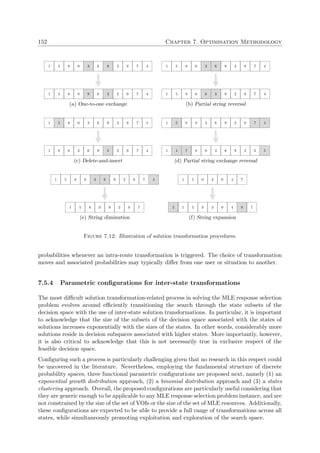
7.12 Illustration of solution transformation procedures . . . . . . . . . . . . . . . . . . 152
7.13 Markov chain of inter-state transition probabilities . . . . . . . . . . . . . . . . . 154
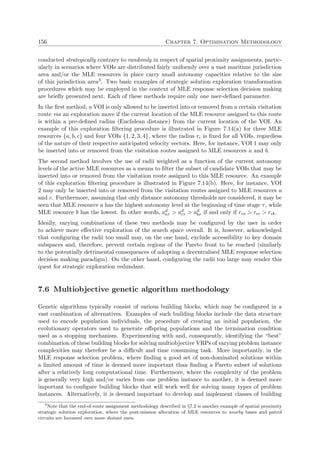
7.14 Illustrations of strategic exploration transformation procedures . . . . . . . . . . 157
7.15 Illustration of domination fronts in the NSGA-II . . . . . . . . . . . . . . . . . . 158
7.16 Sequence of operations carried out in the NSGA-II . . . . . . . . . . . . . . . . . 162
7.17 Flow of events in the NSGA-II . . . . . . . . . . . . . . . . . . . . . . . . . . . . 163
7.18 Procedure completed during the first sub-process of the crossover operator . . . . 165
7.19 Procedure completed during the second sub-process of the crossover operator . . 167
8.1 The hypervolume of a non-dominated front . . . . . . . . . . . . . . . . . . . . . 176
8.2 A poorly chosen reference point for use in hypervolume evaluation . . . . . . . . 177
8.3 Illustration of two incomparable non-dominated sets . . . . . . . . . . . . . . . . 179
8.4 Visual representations of the domain and search spaces . . . . . . . . . . . . . . . 184
8.5 Elements in the lower-complexity hypothetical scenario . . . . . . . . . . . . . . . 186
8.6 Steady-state distributions for the lower-complexity hypothetical scenario . . . . . 193
8.7 Initial population distributions for the lower-complexity hypothetical scenario . . 199
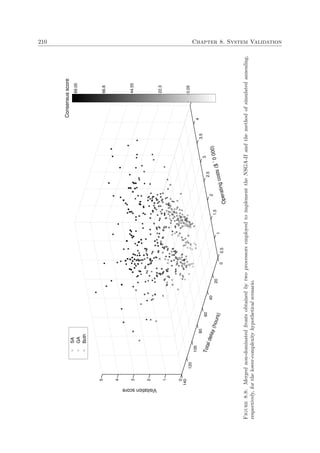
8.8 Merged non-dominated fronts . . . . . . . . . . . . . . . . . . . . . . . . . . . . . 210
8.9 Elements in the higher-complexity hypothetical scenario . . . . . . . . . . . . . . 213
8.10 Illustration of the steady-state probability distributions . . . . . . . . . . . . . . 215
8.11 Increases in average archive sizes and hypervolume quantities . . . . . . . . . . . 217
List of Figures xxv
8.12 Non-dominated front generated for the lower-complexity hypothetical scenario . . 218
8.13 Filtered non-dominated front with objective function bounds . . . . . . . . . . . 220
8.14 Application of the -filter technique . . . . . . . . . . . . . . . . . . . . . . . . . . 221
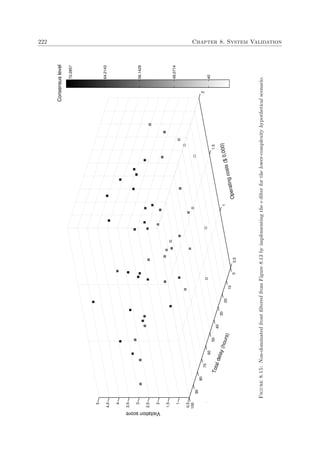
8.15 Filtered non-dominated front after implementing the -filter . . . . . . . . . . . . 222
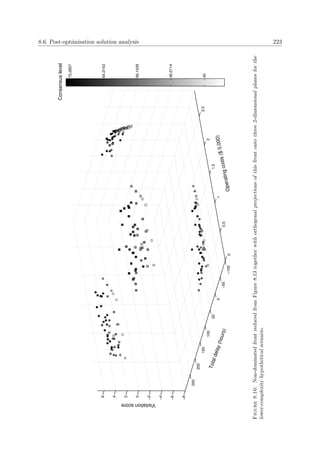
8.16 Reduced non-dominated front with projections onto two-dimensional planes . . . 223
8.17 String representation of a solution to the lower-complexity hypothetical scenario 224
8.18 Visual representation of a solution to the lower-complexity hypothetical scenario 224
9.1 Coordinate values of a confidence ellipse . . . . . . . . . . . . . . . . . . . . . . . 231
9.2 Space-time diagram of the α-bounded Gaussian corridor of VOI i . . . . . . . . . 233
9.3 Spatial projection of the graph in Figure 9.2 . . . . . . . . . . . . . . . . . . . . . 233
9.4 The effect of a Category 1 shift on the decision and objective spaces . . . . . . . 235
9.5 The effect of a Category 2 shift on the decision and objective spaces . . . . . . . 236
9.6 Generic representation of the time stages horizon . . . . . . . . . . . . . . . . . . 239
9.7 The solution tracking process . . . . . . . . . . . . . . . . . . . . . . . . . . . . . 242
9.8 The optimisation tracker process . . . . . . . . . . . . . . . . . . . . . . . . . . . 245
9.9 Proposed on-line, dynamic multiobjective optimisation fusion scheme . . . . . . . 247
9.10 Information sharing process in the fusion scheme . . . . . . . . . . . . . . . . . . 247
9.11 Examples of HMI displays that may be found on board MLE resources . . . . . . 250
xxvi
List of Tables
2.1 Classification of VRPs with respect to the nature of problem information . . . . 42
6.1 Anticipated VOI observations in the form of a time series . . . . . . . . . . . . . 120
6.2 Bivariate Gaussian probability distribution parameters . . . . . . . . . . . . . . . 121
8.1 MLE response selection domain space size estimates . . . . . . . . . . . . . . . . 183
8.2 Threat type intensity levels . . . . . . . . . . . . . . . . . . . . . . . . . . . . . . 185
8.3 MLE resource counter-threat ability levels and service times . . . . . . . . . . . . 186
8.4 MLE resource attribute characteristics . . . . . . . . . . . . . . . . . . . . . . . . 187
8.5 Patrol circuit distance and time autonomy thresholds . . . . . . . . . . . . . . . . 187
8.6 Input data for detected VOIs . . . . . . . . . . . . . . . . . . . . . . . . . . . . . 188
8.7 Input data for MLE resources and model management . . . . . . . . . . . . . . . 188
8.8 Input data received from the decision making entities . . . . . . . . . . . . . . . . 188
8.9 Approximate evaluation of objective function bounds . . . . . . . . . . . . . . . . 192
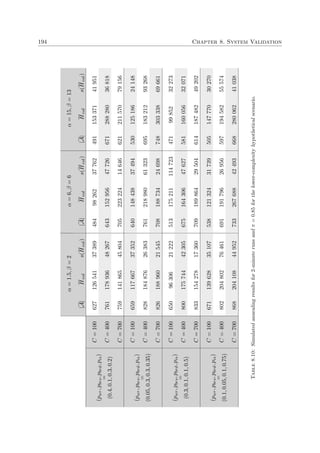
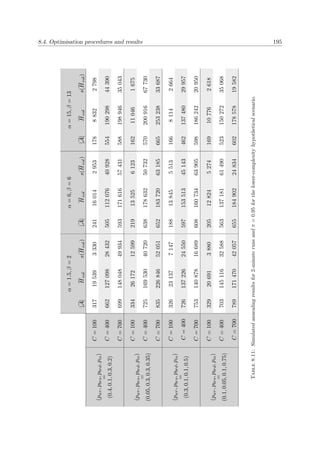
8.10 Simulated annealing lower-complexity results for 2-minute runs and π = 0.85 . . 194
8.11 Simulated annealing lower-complexity results for 2-minute runs and π = 0.95 . . 195
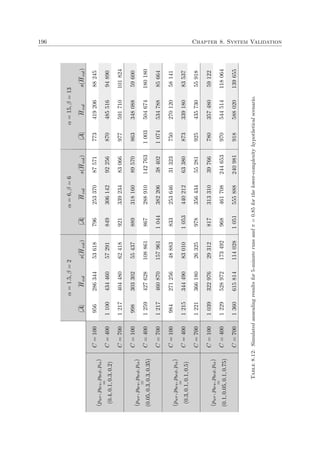
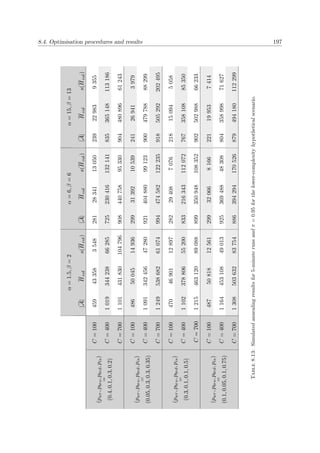
8.12 Simulated annealing lower-complexity results for 5-minute runs and π = 0.85 . . 196
8.13 Simulated annealing lower-complexity results for 5-minute runs and π = 0.95 . . 197
8.14 NSGA-II results for 2-minute runs . . . . . . . . . . . . . . . . . . . . . . . . . . 201
8.15 NSGA-II results for 5-minute runs . . . . . . . . . . . . . . . . . . . . . . . . . . 202
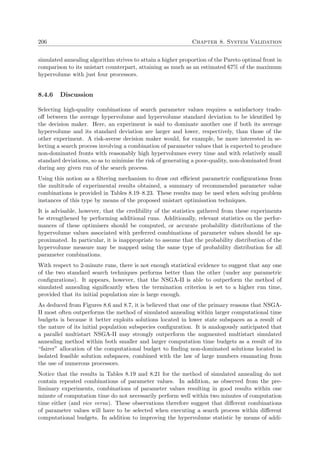
8.16 Hybrid metaheuristic results for a fast cooling annealing schedule . . . . . . . . . 204
8.17 Hybrid metaheuristic results for a slow cooling annealing schedule . . . . . . . . 204
8.18 Multistart results for the lower-complexity hypothetical scenario . . . . . . . . . 207
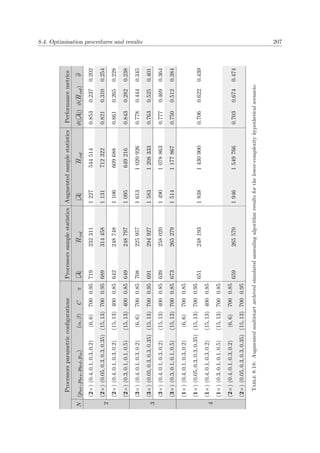
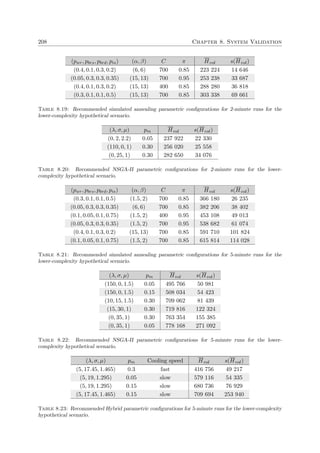
8.19 Recommended simulated annealing configurations for 2-minute runs . . . . . . . 208
8.20 Recommended genetic algorithm configurations for 2-minute runs . . . . . . . . . 208
8.21 Recommended simulated annealing configurations for 5-minute runs . . . . . . . 208
8.22 Recommended NSGA-II configurations for 5-minute runs . . . . . . . . . . . . . 208
8.23 Recommended Hybrid configurations for 5-minute runs . . . . . . . . . . . . . . . 208
xxvii
xxviii List of Tables
8.24 MLE resource counter-threat ability levels and service times . . . . . . . . . . . . 209
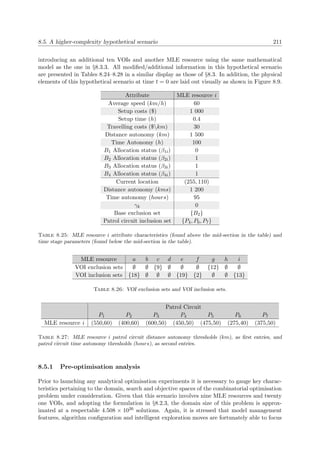
8.25 MLE resource attribute characteristics . . . . . . . . . . . . . . . . . . . . . . . . 211
8.26 VOI exclusion sets and VOI inclusion sets . . . . . . . . . . . . . . . . . . . . . . 211
8.27 Patrol circuit distance and time autonomy thresholds . . . . . . . . . . . . . . . . 211
8.28 Input data received from the decision making entities . . . . . . . . . . . . . . . . 212
8.29 Input data for additional VOIs . . . . . . . . . . . . . . . . . . . . . . . . . . . . 212
8.30 Approximate evaluation of objective function bounds . . . . . . . . . . . . . . . . 212
8.31 Simulated annealing higher-complexity results for 2-minute runs . . . . . . . . . 214
8.32 Simulated annealing higher-complexity results for 5-minute runs . . . . . . . . . 214
8.33 Multistart results . . . . . . . . . . . . . . . . . . . . . . . . . . . . . . . . . . . . 216
9.1 General categories of multiobjective optimisation landscape shifts . . . . . . . . . 234
9.2 Classification of dynamic input parameters . . . . . . . . . . . . . . . . . . . . . 239
9.3 Numerical examples of temporal retraction . . . . . . . . . . . . . . . . . . . . . 240
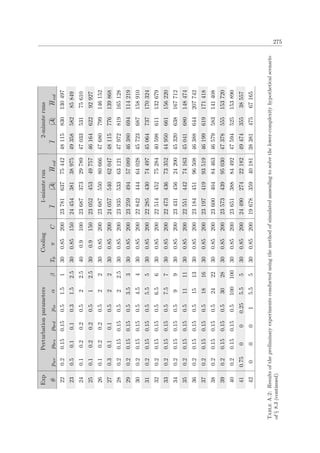
A.1 Preliminary experiments conducted with the method of simulated annealing . . . 274
A.2 Preliminary experiments with the method of simulated annealing (continued) . . 275
A.3 Preliminary experiments with the method of simulated annealing (continued) . . 276
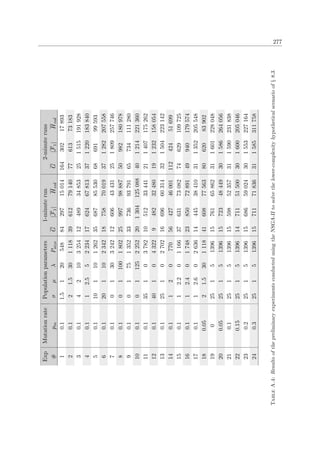
A.4 Preliminary experiments conducted with the NSGA-II . . . . . . . . . . . . . . . 277
List of Algorithms
2.1 Simulated annealing algorithm outline (for a minimisation problem) . . . . . . . . 25
2.2 Genetic algorithm outline . . . . . . . . . . . . . . . . . . . . . . . . . . . . . . . . 28
2.3 Tabu search algorithm outline . . . . . . . . . . . . . . . . . . . . . . . . . . . . . 35
2.4 Ant colony optimisation algorithm outline . . . . . . . . . . . . . . . . . . . . . . . 37
2.5 Particle swarm optimisation algorithm outline . . . . . . . . . . . . . . . . . . . . 40
7.1 End-of-route assignments procedure . . . . . . . . . . . . . . . . . . . . . . . . . . 142
7.2 Multiobjective simulated annealing algorithm outline . . . . . . . . . . . . . . . . 149
7.3 Fast non-dominated sorting algorithm (FNSA) . . . . . . . . . . . . . . . . . . . . 159
7.4 Crowding distance assignment algorithm . . . . . . . . . . . . . . . . . . . . . . . 159
7.5 Non-dominated Sorting Genetic Algorithm II (NSGA-II) . . . . . . . . . . . . . . 161
7.6 Crossover procedure outline . . . . . . . . . . . . . . . . . . . . . . . . . . . . . . . 166
7.7 Hybrid metaheuristic (NSGAII–AMOSA) outline . . . . . . . . . . . . . . . . . . . 168
7.8 Interactive multiobjective simulated annealing algorithm outline . . . . . . . . . . 170
7.9 Augmented multiobjective simulated annealing algorithm outline . . . . . . . . . . 171
9.1 Solution tracking algorithm . . . . . . . . . . . . . . . . . . . . . . . . . . . . . . . 243
xxix
xxx
CHAPTER 1
Introduction
Contents
1.1 Background . . . . . . . . . . . . . . . . . . . . . . . . . . . . . . . . . . . . . . 1
1.1.1 The law of the seas . . . . . . . . . . . . . . . . . . . . . . . . . . . . . . 2
1.1.2 Activities of vessels at sea . . . . . . . . . . . . . . . . . . . . . . . . . . 2
1.2 Informal problem description . . . . . . . . . . . . . . . . . . . . . . . . . . . . 4
1.3 Dissertation aim and scope . . . . . . . . . . . . . . . . . . . . . . . . . . . . . 9
1.4 Dissertation objectives . . . . . . . . . . . . . . . . . . . . . . . . . . . . . . . . 9
1.5 Dissertation organisation . . . . . . . . . . . . . . . . . . . . . . . . . . . . . . . 11
Following the raid of an al-Qa’ida intelligence base in May 2011, evidence was uncovered suggest-
ing that the terrorist organisation planned to blow up an unknown number of oil tankers within
the US maritime transportation system [146]. Due to the strengths of their hulls, these tankers
either have to be blown up from the inside (as the result of an inside-job) or, more likely, have to
be intercepted by a terrorist vessel while in transit (and then blown up). The large quantity of
tankers transiting these waters, combined with the vastness of the US maritime transportation
system and the limited security resources available, however, has made it impossible for the US
maritime defense authorities to achieve constant coverage of potentially threatening activities
occurring in the vicinity of these terrorist targets. In addition, it was believed that the adversary
had had the opportunity to observe security patrol patterns in order to better plan its attacking
strategy. This alarming situation, coupled with challenging economic times, has forced the US
maritime defense authorities to deploy its resources as effectively as possible so as to minimise
the risk of allowing potentially threatening activities to progress towards the destruction of one
or more targets, while simultaneously attempting to maintain operating costs at a minimum
level [148].
1.1 Background
The obligations and privileges of coastal nations form part of a global legislation process to
create an efficient international framework defining their rights and responsibilities in respect of
seabeds and ocean floors. The establishment of such a framework is, however, a very complex
process, and has for centuries been a frustrating and unfulfilled idealistic notion [151]. It is
instructive to review certain laws pertaining to activities at sea in order to establish a context
for the complex challenges faced by coastal nations.
1
2 Chapter 1. Introduction
1.1.1 The law of the seas
In 1982, the United Nations Convention on the Law of the Sea (UNCLOS) at last settled on
a legal order for the seas and oceans with the aim of promoting international communication,
peaceful uses of the seas, equitable and efficient utilisation of maritime resources, jurisdiction
demarcation over waters, and conservation of maritime ecosystems [49, 124, 151]. In addition,
this order clearly defines the nature of crimes committed at sea and provides coastal nations
with the appropriate responses to enforce a variety of laws aimed at curbing these crimes. Under
the UNCLOS, every coastal nation is given the rights and responsibilities to establish territorial
waters over which they exercise various controls, as follows:
• The outer limit of the territorial sea of a coastal nation is the line consisting of every point
at a distance of twelve nautical miles from the nearest point along the coastline [151].
The standard baseline for measuring the width of the territorial sea is the low-water line
along the coast, as marked on large-scale maps officially recognized by the coastal nation1.
Within this territory, the coastal state may exercise all sovereign rights over the seabed,
water and associated airspace, but is obliged to afford the right of innocent passage to
vessels of any state.
• The waters contiguous to the territorial sea, known as the contiguous zone, extends for
twenty four nautical miles from the same baseline from which the extent of the territorial
sea is measured. Here, the coastal state may exercise the rights to prevent violations of
its fiscal, customs, immigration and waste disposal laws [151]. Additionally, the coastal
state may also take actions within this zone to punish violations of these laws previously
committed within its land territory or territorial sea.
• The exclusive economic zone (EEZ) stretches out to sea for a further 188 miles from
the seaward boundary of the territorial sea. Here, the coastal state has the sovereign
rights to explore, exploit, conserve and manage living and nonliving natural resources; to
establish and use artificial islands, installations, and structures; to conduct marine scientific
research; and to protect and preserve the marine environment [151]. The UNCLOS is,
however, in the process of allowing certain coastal nations to extend specific zones within
their EEZ beyond 200 nautical miles from the low-water line along the coast, based on
certain physical characteristics of the continental shelf [124].
Lastly, the waters beyond the EEZ (which are not considered archipelagic waters) are defined as
the high seas. The sense of liberty enjoyed by seafarers in these waters is applicable to all states,
whether coastal or not. Subject to certain rules and regulations laid down by the UNCLOS and
other entities, navigators of the high seas have the right to freedom of navigation; the freedom
to lay underwater infrastructure; the freedom to construct artificial islands, installations and
structures; the freedom of fishing; and the freedom to perform scientific research [151]. It is,
nevertheless, imperative that these waters remain crime-free and that activities in these regions
are only aimed toward peaceful ends. The four general maritime zones described above are
illustrated in Figure 1.1.
1.1.2 Activities of vessels at sea
Maritime activities by seafearing vessels embody a very important part of global society; the
globally connected economy relies on the seas and adjoined littorals for fishing, access to natural
1
In the case of islands situated on atolls or of islands having fringing reefs, the baseline for measuring the
extent of the territorial sea is the seaward low-water line of the reef.
1.1. Background 3
Land
Sea
Territorial sea
(12 nm)
Contiguous zone
(12 nm)
EEZ
(188 nm)
High seas
Baseline
Figure 1.1: The four maritime zones defined by the UNCLOS [151].
resources and the transportation of most of the world’s import and export commodities. These
maritime activities today contribute, inter alia, to over 90 percent of global trade [8] and are
directly responsible for 91 million tons of food for human consumption annually [39]. Effective
governance of these maritime regions is therefore essential for both the economic growth and the
national security of coastal nations. Indeed, according to the Maritime Security Sector Reform
[124], “the maritime sector is fundamental, directly or indirectly, to the national defense, law
enforcement, social, and economic goals and objectives of nearly every country. It is a crucial
source of livelihood for many in developing nations, a platform for trade, and a theater for
potential conflict or crime.”
A sizable portion of maritime activities are unfortunately responsible for a wide variety of
problems, ranging from being detrimental to only a few individuals to harming society on a global
scale. These maritime problems are typically caused by lawless vessels that choose to disrupt the
harmony at sea for personal gain. Such activities, or threats, typically include piracy acts, illegal
or unregulated fishing, narcotics trafficking, illegal immigration, environmental degradation,
human trafficking, proliferation of weapons of mass destruction, and terrorism.
For instance, it is estimated that five to fifteen percent of all large vessels (that is, 5 000 to
7 500 vessels) break the law each year by discharging waste into the high seas, including 70 to
210 million gallons of illegal oil waste disposal [92]. Such negligence and inconsideration can
potentially devastate the marine environment on a local or even global scale. It is also estimated
that a third of all fish populations are over-exploited or have collapsed because of illegal fishing
[39]. As a result, some of these species face a constant danger of extinction, and over-exploitation
is estimated to generate an indirect annual cost of US $50 billion in lost fishing opportunities
[111], which accounts for approximately half of the value of the global seafood trade. Moreover,
the global economic cost resulting from acts of piracy is estimated to lie between US $7 and
US $12 billion per annum [10].
4 Chapter 1. Introduction
1.2 Informal problem description
Pursuing the goal of effective Maritime Law Enforcement (MLE) requires coastal nations to
establish suitable monitoring procedures aimed at vessels within their jurisdictions. These pro-
cedures are underpinned by a so-called response selection process, where, following the detection
and evaluation of potentially threatening events involving vessels of interest (VOIs) at sea, MLE
resources, such as high-speed interception boats, military vessels, helicopters, and/or seaplanes,
are dispatched by coast guards and related authorities to intercept and investigate these threats.
MLE resources are generally either allocated for the purpose of intercepting VOIs at sea (such
resources are said to be in an active state), or are strategically allocated to certain patrol circuits
or bases until needed for future law enforcement purposes (such resources are said to be in an
idle state). Additionally, MLE resources may temporally be unavailable for law enforcement
operations over certain periods of time due to routine maintenance, infrastructure damage, un-
availability of crew or depleted autonomy prerequisites. MLE resources which are both idle
and assigned to a patrol circuit are said to be on stand-by. In this dissertation, the MLE re-
sponse selection operations considered focus almost exclusively on the management of active
MLE resources.
Shortages of law enforcement infrastructure, large jurisdiction coverage areas, high operating
costs of MLE resources, the requirement of using complex threat detection and evaluation sys-
tems, scarce maritime intelligence and a lack of adequately trained operators are examples of
factors contributing to the difficulty of effective MLE by coastal nations, inevitably affecting
their overall ability to achieve effective counter-threat performance at sea. A simplified hypo-
thetical MLE scenario, depicting the kind of visual information that an MLE response selection
operator may be observing on a human-computer interface in order to assist him in making
MLE response selection decisions, is portrayed in Figure 1.2.
Active MLE Resources
Idle MLE Resources
VOIs
Bases
Patrol Circuits
MLE Boundaries
LandSea
Figure 1.2: Top view of a hypothetical MLE environment.
MLE operations often comprise complex tasks, typically involving a number of explicitly or
implicitly identified subtasks, each with specific resource capability requirements that need to
be matched with the capabilities of available MLE resources in order to ensure successful VOI
interception [54]. These tasks are stochastically distributed in both time and space, making the
1.2. Informal problem description 5
coordination of these MLE resources, which operate in a harsh and unpredictable environment,
a very challenging problem. Additionally, the ability to adapt dynamically to changes in the
availability of MLE resources and the services they provide is critical for the success of MLE
efforts.
The assignment of MLE resources to intercept VOIs requires the formation of so-called visitation
routes. These are ordered sets containing specific subsets of VOIs that are scheduled to be
intercepted and investigated by specific MLE resources over the course of a certain time horizon.
This concept is known in the literature as vehicle routing. Initial MLE resource deployment is,
however, typically carried without full information in respect of the current and future maritime
situation. Ancillary information is expected to be gathered from external sources on a continual
basis and contribute to the evolution of VOI threat assessment, providing operators with access
to actionable information. In order to achieve MLE efficiency, it is therefore required that these
decisions be made and coordinated in such a way as to enable the rapid and semi-autonomous
re-deployment of MLE resources at various points in time as the sea picture unfolds. This
phenomenon is known in the literature as system dynamism. Moreover, several input data are
not known with certainty, but are rather described by random variables with known or estimated
probability distributions. This phenomenon is known in the literature as system stochasticity.
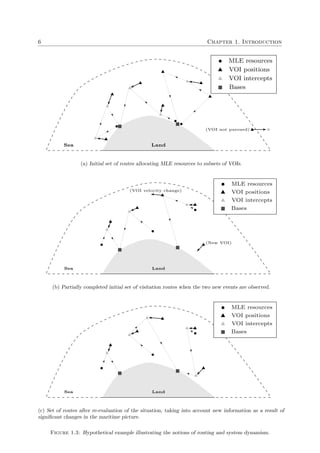
The notions of MLE resource routing and system dynamism mentioned above are elucidated by
means of a hypothetical MLE response selection scenario whose evolution over time is illustrated
in Figure 1.3. At first, an initial set of MLE resource visitation routes (denoted by directed
dotted arcs) is generated, as shown in Figure 1.3(a), in which MLE resources are each allocated
to a subset of VOIs. Here, the arrows pointing outwards from VOIs (denoted by black triangles)
represent their respective velocity vectors (not to scale), while their estimated interception points
are denoted by gray triangles. Later on in this scenario, however, after the MLE resources
have only covered parts of their visitation routes, suppose that two new events are observed
in the system, as shown in Figure 1.3(b). In the first event, one of the VOIs in the north of
the jurisdiction area, which was previously immobile, begins to accelerate towards the west.
In the second event, a new VOI is detected in the south-east of the jurisdiction area and its
threatening nature is evaluated. Given this new information, the current MLE routing solution
is re-assessed, and the initial, partially completed visitation routes, are replaced with a new set
of more appropriate routes, as shown in Figure 1.3(c).
In order to achieve this level of dynamism, it is necessary to analyse the situation at sea whenever
new events are observed and to update the current response for dealing with the potential
threats. A semi-autonomous MLE response selection Decision Support System (DSS) may be
employed to assist human operators in solving the so-called MLE response selection problem
described above — which encompasses allocation and routing decisions for MLE resources for
the purpose of intercepting and investigating VOIs. The purpose of such a DSS is to provide the
operators with a set of high-quality response selection alternatives in limited time, particularly
when dealing with decisions involving large numbers of VOIs that are subject to a high level of
stochasticity with respect to their nature and hence uncertainty. The output of such a DSS may
then be used in conjunction with operator judgment to select a single, most preferred alternative
from a non-dominated set of solutions, typically in a multiobjective decision space.
Since each coastal nation has its own values, preferences and perceptions of the desirability of
trade-offs between a miriad of objectives when dealing with VOIs, MLE responses following
the detection and evaluation of new events at sea typically vary from nation to nation. These
responses should, however, be coherent and carried out according to a pre-determined protocol,
based on a set of goals and objectives appropriate for the coastal nation in question. A deep
understanding of the specific strategic aims and subjective preferences of a coastal nation’s MLE
6 Chapter 1. Introduction
LandSea
(VOI not pursued)
MLE resources
VOI positions
VOI intercepts
Bases
(a) Initial set of routes allocating MLE resources to subsets of VOIs.
LandSea
(New VOI)
(VOI velocity change)
MLE resources
VOI positions
VOI intercepts
Bases
(b) Partially completed initial set of visitation routes when the two new events are observed.
LandSea
MLE resources
VOI positions
VOI intercepts
Bases
(c) Set of routes after re-evaluation of the situation, taking into account new information as a result of
significant changes in the maritime picture.
Figure 1.3: Hypothetical example illustrating the notions of routing and system dynamism.
1.2. Informal problem description 7
efforts is therefore necessary in order to identify a suitable set of fundamental objectives for use
in the creation of that nation’s MLE response strategy.
Furthermore, it is typically the case that the entire MLE response selection process of a coastal
nation is not conducted by a centralised operator assisted by a single DSS, but is rather or-
chestrated by multiple role players, called MLE decision entities in this dissertation. These
decision entities may perceive the quality of MLE response selection operations in their own,
different ways, as they each tend to pursue their own goals and subjective perception of what
is deemed important while carrying out MLE operations. In particular, these decision entities
may perceive the threatening intensities of VOIs differently, function largely independently from
one another, follow their own guidelines or rules of engagement, and utilise their own subsets of
MLE resources.
Various MLE resource assignment scenes from around the world are illustrated in Figure 1.4.
The high-speed vessel represented in Figure 1.4(a) is one that is used to patrol the waters around
Cape Town. Patrolling allows MLE resources to be placed strategically, on expectation, until
assigned to investigate one or more VOIs at sea as the need arises. There is, of course, a trade-off
involved in having certain MLE resources patrol territorial waters between the costs of operating
those MLE resources effectively (instead of being idle at a base) and the expected response times
of these MLE resources once becoming active again.
The five vessels aligned in Figure 1.4(b) represent five different types of MLE resources available
to the Canadian Coast Guard. A coastal nation typically possesses a fixed number of MLE
resources, each belonging to a certain type or class of MLE resource with unique characteristics
(such as maximum speed, travel costs per kilometre, level of autonomy at sea and ability to
respond to certain types of threats). Two further such characteristics are the set-up time and
set-up cost — an MLE resource is required to undergo a careful preparation process (including
refueling, briefing of the crew and the preparation of on-board equipment), which takes up a
certain amount of time and incurs certain costs in the process, prior to being dispatched on
a mission. An example of an MLE resource in the set-up process at a base is illustrated in
Figure1.4(c).
Some VOIs may only be detected far out in the jurisdiction area of a coastal nation. In such
cases, it may be necessary to dispatch long-range MLE resources to intercept those VOIs. Search-
oriented MLE resources, such as seaplanes or unmanned airplanes, may be deployed to visually
scout out the precise locations of VOIs that are difficult to track by radars and relay this and
other information back to the intercepting vessel commander. Such resources can be seen in
Figures 1.4(d) and 1.4(e). Moreover, the threatening nature of a VOI may not always be known
a priori, in which case these scouting MLE resources — unmanned airplanes in particular due
to their stealth, speed, and high-altitude autonomy — may also be utilised to assess the VOI
threat situation visually and relay relevant information back to a threat evaluation operator.
Finally, as was discussed in §1.1.2, coastal nations around the world are faced with many dif-
ferent types of threats of differing intensities. Piracy and oil pollution are usually seen as very
harmful threats; examples of neutralising such threats are illustrated in Figures 1.4(f) and 1.4(g),
respectively. Certain situations may also require an operator to allocate multiple MLE resources
to a VOI in order to successfully neutralise it, such as in the scene depicted in Figure 1.4(h),
in which two Japanese Coast Guard MLE resources are utilised to neutralise a VOI carrying
dangerous Chinese activists.
8 Chapter 1. Introduction
(a) Light, high-speed patrol vessel used in waters
around Cape Town [22].
(b) Various types of MLE resources available to
the Canadian Coast Guard [57].
(c) US coast guards in the process of setting up
several MLE resources prior to dispatch [94].
(d) Seaplanes are effective scouts when deployed
in parallel with long-range MLE resources [94].
(e) Unmanned airplanes are popular for acquiring
threat evaluation information [70].
(f) Interception of a suspicious boat thought to
carry ammunition off the coast of Somalia [59].
(g) Preventative measures against a potential oil
spill situation off the Panama coast [99].
(h) Combined assignment of MLE resources onto
a high-alert VOI in the East-China sea [63].
Figure 1.4: Various MLE response selection scenes from around the world.
1.3. Dissertation aim and scope 9
1.3 Dissertation aim and scope
The aim in this dissertation is to contribute on an advanced research level to coastal MLE re-
sponse selection and routing decision infrastructure in the form of the design of a semi-automated
DSS capable of assisting human operators in spatio-temporal resource dispatch decision making
so that MLE resources may be employed effectively and efficiently. As explained in §1.2, these
decisions are made based on input data (which are assumed throughout this dissertation to
be complete and accurate) obtained from the threat detection and threat evaluation systems
employed with a view to analyse the potentially threatening behaviour of vessels observed at
sea at any given time, as well as subjective input data contributed by MLE response selection
operators2. Automated decision making is therefore not pursued as the aim of this study is to
provide a support tool to a human operator.
The multiple objectives component of the proposed DSS will be incorporated in the system in a
generic manner, so as to provide users of the system with the freedom of configuring their own,
preferred goals. This generic DSS design will be populated with examples of models capable of
performing the functions of the various constituent parts of the system, and their workability
will be tested and demonstrated by solving the MLE response selection problem in the context
of realistic, but simulated, practical scenarios, employing multiple solution search techniques.
These examples may, of course, be replaced with more desirable or better performing features,
were such a DSS to be implemented in a realistic environment in the future.
Although difficult to measure against a simple MLE response selection human operator in terms
of performance, this system may be used in the future to assist such an operator in his decision
making process. In particular, the operator may use it as a guideline to validate and/or justify
his decisions when the level of uncertainty pertaining to the observed maritime scenario is high
and/or if only parts of the problem may be solved with the sole use of his competence and
expertise in the field. Overall, usage of this system in a real-world context may reduce operator
stress levels typically associated with difficult decisions, while improving the overall performance
of MLE operations in an integrated fashion across multiple decision entities.
The research hypothesis of this dissertation is therefore as follows: Semi-automated decision
support based on mathematical modelling principles may be used to assist in making better deci-
sions in an MLE response selection context than those based purely on subjective human operator
judgment.
1.4 Dissertation objectives
The following objectives are pursued in this dissertation:
I To compile a literature survey of the theoretical concepts underlying the design of an MLE
response selection and routing DSS, by
(a) discussing the nature of decision making procedures in general,
(b) presenting an array of popular stochastic search techniques used to solve complex
discrete optimisation problems,
(c) elaborating on the workings of two such techniques in the context of multiobjective
optimisation,
2
This process is better known as a “human in the loop” approach to decision making [49].
10 Chapter 1. Introduction
(d) studying various relevant variants on the vehicle routing problem,
(e) focusing on certain procedures designed to cope with the intricacies of dynamic mul-
tiobjective optimisation problems, and
(f) reviewing key MLE DSSs in existence.
II To design a generic MLE response selection framework and overall MLE system architec-
ture.
III To propose suitable paradigms of decision entity autonomy in which the MLE response
selection framework of Objective II may function in a practical manner.
IV To derive mathematical descriptions for each MLE response selection paradigm proposed
in Objective III, by
(a) identifying the system components required for effective response selection and rout-
ing decision support,
(b) investigating the functioning of such components and their integration within an MLE
response selection environment, and
(c) incorporating these components into the formulation of a generic design populated
with examples of (replaceable) mathematical models.
V To educe an array of non-deterministic mathematical model components capable of man-
aging the risk associated with the potentially adverse impact of stochastic input data on
real-time solution development.
VI To put forward a number of solution search techniques capable of solving the MLE response
selection problem approximately.
VII To determine experimentally whether the proposed DSS is capable of producing relatively
good solutions in limited computational time, by
(a) designing realistic, but hypothetical, MLE response selection and routing scenarios,
(b) repeatedly solving the MLE response selection routing problem in the context of the
scenarios in (a) using the solution search techniques put forward in Objective VI and
different choices of parametric configurations within these solution search techniques,
(c) comparing the performances of the solution search techniques in (b) above using a
widely accepted performance indicator, and
(d) analysing the results obtained, drawing conclusions and commenting on the validity
of the research hypothesis.
VIII To consolidate the evolution of information into a multi-level, dynamic framework capable
of triggering rapid and effective MLE response selection problem instance reinitialisation
protocols at various points in time, as required.
IX To suggest a number of ideas for possible future work in the context of MLE threat
evaluation and MLE resource assignment as enhancements to the work contained in this
dissertation.
1.5. Dissertation organisation 11
1.5 Dissertation organisation
This dissertation comprises nine further chapters, following this introductory chapter. In Chap-
ter 2, a literature survey is performed in respect of the theoretical concepts underlying the design
of an MLE response selection and routing DSS. A discussion on the philosophy and fundamental
concepts behind the underlying decision making process is conducted and an overview of appro-
priate solution techniques is provided, with a particular emphasis on the use of metaheuristics.
The method of simulated annealing and the notion of an evolutionary algorithm are covered in
detail, and a general description of three other innovative search techniques is also given. A
review of routing problems and dynamic multiobjective problems is finally pursued, and this is
followed by a review of MLE semi or fully automated DSSs already in existence.
In Chapter 3, a generic system architecture is proposed for use in coordinating the MLE op-
erations of a coastal nation. Such a system is put forward in order to capture the essence of
the process involved in MLE response selection as well as to describe the typical chronological
order of MLE events. Moreover, a discussion of three hypothetical paradigms with respect to
the autonomy of decision makers using the DSS is conducted in order to capture the roles of the
various decision entities typically responsible for solving the MLE response selection problem.
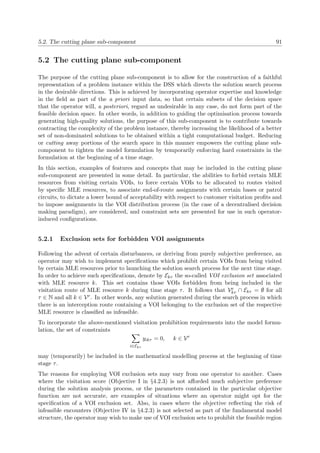
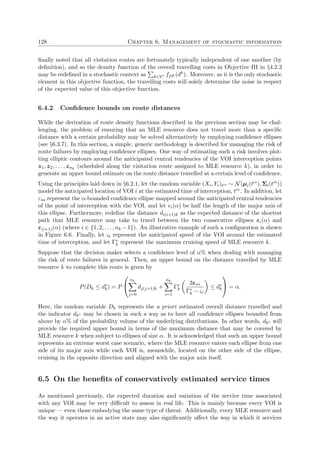
Chapter 4 contains various preliminary concepts, ideas and assumptions underlying the MLE
response selection problem. In particular, a description of the modelling approach adopted in
respect of mathematically incorporating each of three decision making paradigms is presented.
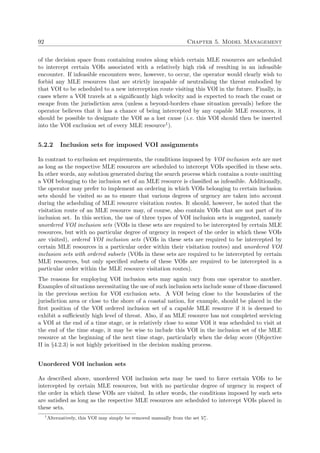
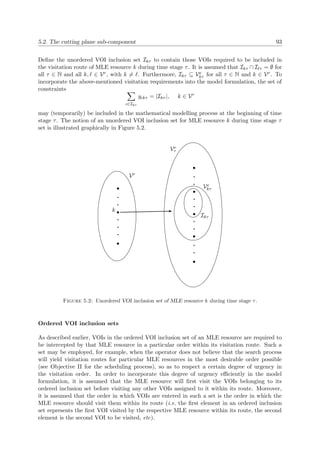
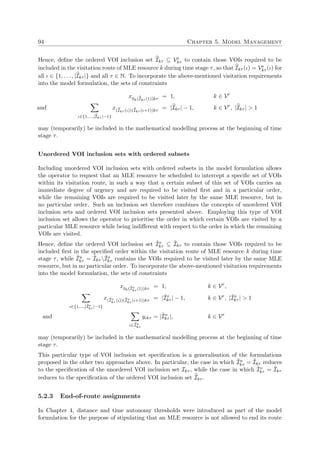
The focus in Chapter 5 shifts to a system component which aims to accommodate a variety
of potential special requests in the system prior to launching the solution search process. This
component provides the operator with a range of configuration modules that may be used to
implement personal preferences as well as to reduce the computational complexity of the problem
using certain a priori conditions.
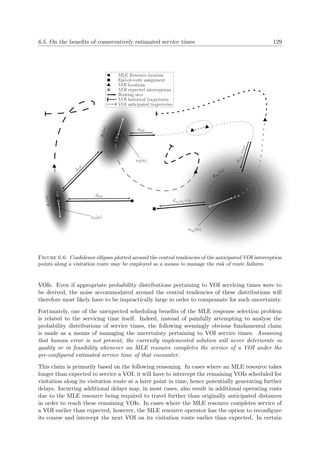
The limitations associated with exclusive deterministic modelling in the context of MLE response
selection are unveiled in Chapter 6. The need to manage uncertainty in the form of various
mathematical model components dealing with stochastic input data is subsequently motivated.
More specifically, this chapter focuses on investigating the extent to which the development of a
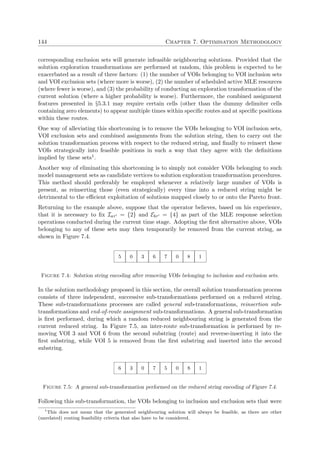
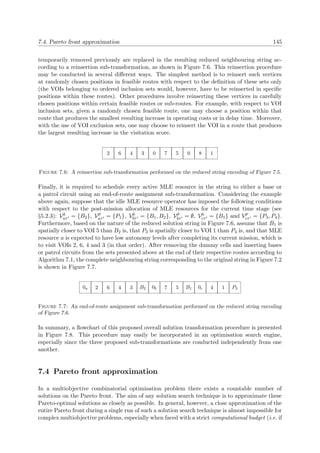
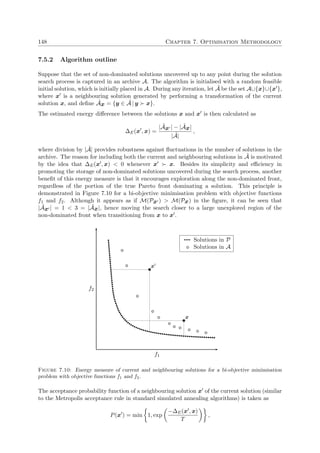
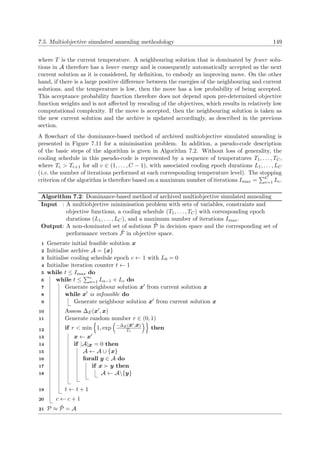
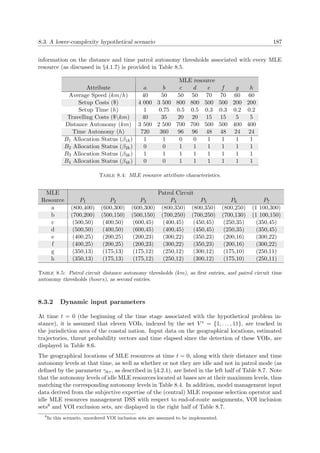
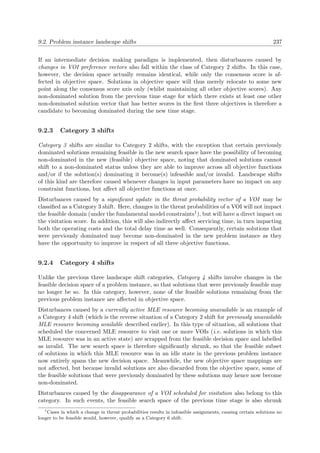
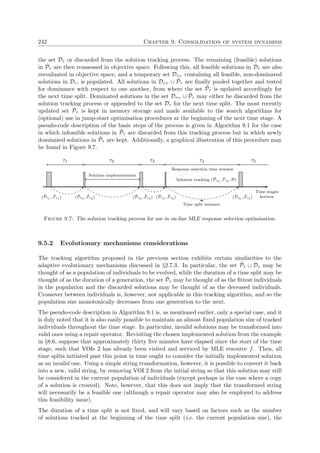
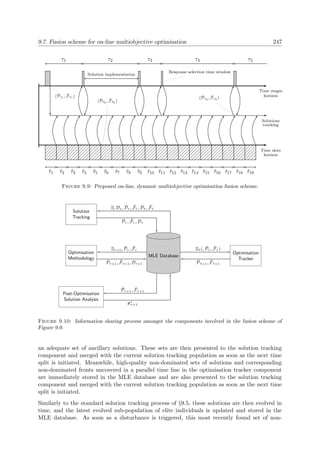
set of routes in real time is expected to differ from the a priori configuration of these routes, as
well as to provide the operator with certain modelling tools aimed at minimising or nullifying
the risk of solution deterioration caused by stochastic input data.
Four appropriate solution search techniques for solving the MLE response selection routing
problem are described in some detail in Chapter 7. Other topics covered in Chapter 7 include
an algebraic approach towards calculating the interception point of two moving objects in a
two-dimensional plane and a suitable solution encoding scheme adapted specifically for the
MLE response selection problem.
In Chapter 8, the optimisation methodologies proposed in the previous chapter are tested in
respect of their abilities to yield high-quality solutions to a hypothetical scenario involving the
MLE response selection. Methods of filtering and presenting to the decision maker the various
trade-off solutions thus uncovered are also provided.
The dynamic nature of MLE response selection operations is elucidated in Chapter 9 by con-
sidering the time continuum in which problem instance reinitialisation procedures and solutions
progressions are mapped sequentially in a functional and effective manner. A dynamic multi-
level framework is proposed for this purpose in which the synchronised use of real-time system
memory is combined with three DSS dynamism components to, ultimately, enhance the execu-
12 Chapter 1. Introduction
tion of the problem instance reinitialisation methodology as disturbances occur in the picture
unfolding at sea.
Finally, the dissertation closes with a short conclusion in Chapter 10 in which the work presented
in the dissertation is summarised. The chapter also contains an appraisal of the contributions
of the dissertation as well as a number of ideas and recommendations with respect to possible
future follow-up work.
CHAPTER 2
Literature Review
Contents
2.1 Decision theory . . . . . . . . . . . . . . . . . . . . . . . . . . . . . . . . . . . . 13
2.2 Optimisation techniques . . . . . . . . . . . . . . . . . . . . . . . . . . . . . . . 19
2.3 The method of simulated annealing . . . . . . . . . . . . . . . . . . . . . . . . . 22
2.4 Evolutionary algorithms . . . . . . . . . . . . . . . . . . . . . . . . . . . . . . . 27
2.5 Other popular metaheuristics . . . . . . . . . . . . . . . . . . . . . . . . . . . . 34
2.6 The vehicle routing problem . . . . . . . . . . . . . . . . . . . . . . . . . . . . . 39
2.7 Dynamic multiobjective optimisation approaches . . . . . . . . . . . . . . . . . 46
2.8 MLE DSSs in existence . . . . . . . . . . . . . . . . . . . . . . . . . . . . . . . 49
2.9 Chapter Summary . . . . . . . . . . . . . . . . . . . . . . . . . . . . . . . . . . 53
This chapter contains a review of the literature on topics related to the design of a DSS for as-
sisting operators in their complex MLE response selection decisions. The purpose of the chapter
is to provide the reader with the necessary background in order to facilitate an understanding
of the material presented in the remainder of this dissertation.
In §2.1, a discussion is conducted on the philosophy and fundamental concepts behind decision
making, while an overview of solution techniques for optimisation problems is provided in §2.2,
with particular emphasis on the use of metaheuristics. The methods of simulated annealing and
evolutionary algorithms are then presented in more detail in §2.3 and §2.4, respectively, and this
is followed by a general description of three other innovative metaheuristic search techniques in
§2.5. A review of routing problems with emphasis on dynamic and stochastic routing problems
may be found in §2.6. In §2.7, a closer look is taken at various approaches used in the literature
toward solving multiobjective dynamic optimisation problems, while the focus turns in §2.8 to
a review of MLE semi or fully automated DSSs in existence. The chapter finally closes with a
brief summary in §2.9.
2.1 Decision theory
The etymology of the term decision derives from the Latin word decidere, which means to decide
or to determine. This word consists of the words de, which means “off”, and caedere, which
means “to cut” [30]. According to this description, decision making is the process whereby
plausible alternatives with respect to the course of actions to be taken when exposed to a
13
14 Chapter 2. Literature Review
certain situation are rejected from a finite set of choices (i.e. cut-off) until all that remains is
a most desirable alternative to be executed as a response to the situation. This definition is
particularly applicable in the field of operations research, in which the feasible decision space of
a problem is traditionally analysed, or “searched”, and alternative solutions to the problem are
rejected according to a certain sequence of rules until a single (i.e. most preferred) alternative
(or set of alternatives) remains. Decision making is a critical component in almost any situation.
Although most decisions take place on the subconscious level, the ability to make high-quality
choices under uncertainty may usually only be realisable with the use of some complex analytical
process.
2.1.1 Elementary concepts of decision making
In decision making, a goal may be thought of as a purpose towards which an endeavor is directed,
while an objective may be thought of as a specific result or results that a person or system aims
to achieve within a certain time frame and with available resources. Whereas goals do not
necessarily have to be measurable or tangible, objectives are expected to be so [46]. The choice
of alternatives in a decision making situation should be measurable in terms of evaluative criteria.
A criterion is a principle or standard which provides a means to compare a set of alternatives
on the basis of some particular aspect that is relevant or meaningful to the decision maker(s)
[27]; they help define, on the most fundamental level, what “best” really means. Objectives are
measured on suitable attribute scales, which provide a means to evaluate the quality of each
alternative with respect to every criterion relevant to the decision problem.
In order to identify these criteria, it is critical to first determine and assess the basic values of
the decision maker with respect to the situation at hand (i.e. what really matters to him) [27].
Values underlie decision making in a fundamental manner; if a decision maker does not care
about the criteria, there would be no reason for him to make a decision in the first place, as he
would be completely indifferent with respect to assessing the desirability of alternative solutions.
Objectives are therefore necessary in order to establish a direct relationship with one or more
particular criteria in terms that relate directly to the basic values of the decision maker. In the
field of operations research, analysts and consultants unfortunately often neglect such values,
instead tending to solve a decision making problem with respect to what they think is deemed
important, and thereby disregarding certain critical aspects associated with the psychological
needs and preferences of their clients1 [61].
In general, the goal in any decision making process is to seek the best alternative by considering
all decision-impacting criteria simultaneously whilst acknowledging decision space delimitations.
Incorporating these criteria, as well as the values of the decision maker, in the process is achieved
by configuring the objective(s) accordingly. As hinted at previously, every decision making
situation is relevant within a specific context, which calls for specific objectives to be considered.
A criterion may either be advantageous or disadvantageous with respect to the preferences
of the decision makers; alternatives simultaneously minimising or maximising each criterion,
respectively, are therefore sought.
2.1.2 On the decision structuring process
According to Clemen & Reilly [27], modelling a decision making problem consists of three
fundamental steps: (1) identifying the values of the decision maker with respect to the problem
1
This discrepancy has given rise to the field of behavioural operational research over the last decade.
2.1. Decision theory 15
at hand and defining all objectives so as to correctly integrate the decision model, (2) structuring
the elements of the decision making problem into a logical framework, and (3) defining and fully
refining all the elements of the model.
Furthermore, the set of objectives should include all relevant aspects of the underlying decision
yet be as small as possible (so as to avoid unnecessary computational complexity). The set
of objectives should therefore not contain redundant elements and should be decomposable2.
Finally, the objectives should be clearly distinguishable and the relevant attribute scales should
provide a simple way of measuring the performance of alternatives with respect to the objectives.
Generally speaking, objectives may either be categorised as fundamental or mean [27]. Fun-
damental objectives are the basis on which various alternatives may be measured (the type
of objectives discussed in the previous section). Mean objectives, on the other hand, are of a
purely intermediate nature, and are used to help achieve other objectives. While fundamental
objectives are organised into hierarchies, which are crucial for the development of a multiobjec-
tive decision model, mean objectives are usually organised in the form of networks (similar to a
brainstorming configuration).
Influence diagrams and decision trees are examples of techniques often used to structure the
decision making process into a logical framework [27]. An influence diagram captures the decision
maker’s current state of knowledge by providing a simple graphical representation of the decision
situation. In such a diagram, the decision process is represented as various shapes, interlinked
by directed arcs in specific ways so as to reflect the relationship among the decision components
in a relevant, sequential order. Although appropriate for displaying a decision’s basic structure,
influence diagrams tend to hide details. A decision tree, on the other hand, expands in size
and level of detail in a time sequence as the decision process evolves. Such a tree represents all
possible paths that the decision maker might follow throughout the decision making process,
depicting all alternative choices, as well as consequences resulting from uncertain events. The
alternatives, represented by branches leaving a decision node, must be such that only one option
can be chosen, while the branches leaving uncertain event nodes must correspond to a set of
mutually exclusive and collectively exhaustive outcomes (that is, at most one outcome may
occur from a finite set of outcomes with specific probabilities, and at least one of these outcomes
has to occur). Overall, both influence diagrams and decision trees have their own advantages
for structuring the decision making process. Their combined use in parallel during the decision
making process, however, provides a complete model of the decision framework. One may
therefore think of them as complementary rather than competitors in structuring a decision
making process.
2.1.3 Decision making with multiple conflicting objectives
Multiobjective decision making problems occur in most disciplines. Despite the considerable va-
riety of techniques that have been developed in the field of operations research since the 1950s,
solving such problems has presented a non-trivial challenge to researchers. Indeed, the earli-
est theoretical work on multiobjective problems dates back to 1895, when the mathematicians
Cantor and Hausdorff laid the foundations of infinitely dimensional ordered spaces [72]. Cantor
also introduced equivalence classes and utility functions a few years later [29], while Hausdorff
published the first example of a complete ordering set [29].
In most decision making situations, the decision maker is required to consider more than one
2
A set of objectives is decomposable if the decision maker is able to think about each objective easily without
having to consider the others simultaneously.
16 Chapter 2. Literature Review
criterion simultaneously in order to build a complete, accurate decision making model. These
criteria, however, typically conflict with one another as informed by the values of the decision
maker. Objectives are said to be conflicting if trading an alternative with a higher achievement
measure in terms of a certain criterion comes at a cost (i.e. a decrease in the levels of achievement
of some of the other criteria for that alternative). A crucial problem in multiobjective decision
making therefore lies in analysing how to best perform trade-offs between the values projected
by these conflicting objectives.
There exist multiple techniques for determining the quality of an alternative in a decision making
process [27]. An appropriate technique should be selected based on factors such as the complexity
of the problem, the nature of the decision maker, the time frame for solving the problem or the
minimum quality level of the best alternative. The additive preference model, for example, is a
popular method in the literature [43, 117], in which the decision maker is required to construct
a so-called additive utility function for comparing the attribute levels of available alternatives,
as well as the fundamental objectives, in terms of their relative importance, using weight ratios.
This decision making model approach is, however, incomplete, as it ignores certain fundamental
characteristics of choice theory amongst multiatribute alternatives [27]. In order to resolve this
discrepancy, slightly more complex methods such as multiattribute utility models were designed
[104]. Here, the decision maker considers attribute interactions by establishing sub-functions
for all pairwise combinations of individual utility functions, in contrast to utilising an additive
combination of preferences for individual attributes.
In general, the approach adopted toward solving a multiobjective decision making problem may
be classified into two paradigms [27, 81]. The first involves combining the individual objective
functions into a single composite function, or to move all except one objective to the set of
constraints. This is typically the case in utility theory and weighted sum methods. The additive
utility function and multiattribute utility models mentioned above, are examples of decision
making techniques in this paradigm. Optimisation methods in this paradigm therefore return
a single “optimal” solution to a multiobjective decision making problem. This procedure of
handling multiobjective optimisation problems is a relatively simple one. Due to the subjective
nature of the decision making problem in terms that depend purely on the decision maker’s pref-
erences, however, it may often be very difficult to determine all the necessary utility functions
and weight ratio parameters accurately, particularly when the number of attributes to be consid-
ered is large. Perhaps more importantly, parts of the front are inaccessible when adopting fixed
weights in the case of non-convex problems [42]. This optimisation procedure may be enhanced
to some extent by considering multiple a priori weight vectors; this is particularly useful in
cases where choosing a single appropriate set of weight ratio parameters is not obvious. In most
non-linear multiobjective problems, however, it has been shown that a uniformly distributed set
of weight vectors need not necessarily result in a uniformly distributed set of Pareto-optimal
solutions [42]. Once again, since the nature of this mapping is not usually known, it is often
difficult to select weight vectors which are expected to result in a Pareto-optimal solution located
within some desired region of the objective space.
Alternatively, the second paradigm, referred to as multiobjective optimisation, aims to enumer-
ate and filter the set of all alternatives into a suggested decision set in such a way that the
decision maker is indifferent between any two alternatives within the set and so that there exists
no alternative outside the set which is preferred to any alternatives within the set. Due to the
conflicting nature of the objectives, no single solution typically exists that minimises or max-
imises all objectives simultaneously. In other words, each alternative in the suggested decision
set yields objective achievement measures at an acceptable level without being outperformed by
any other alternatives [81]. Decision making techniques within this paradigm therefore aim to
2.1. Decision theory 17
identify a set of alternative solutions which represent acceptable inter-attribute compromises.
This approach is elucidated in the following section. One of the principal advantages of multiob-
jective optimisation is that the relative importance of the objectives can be decided a posteriori
with the Pareto front on hand.
2.1.4 The notions of dominance, Pareto optimality and the Pareto front
In contrast to single objective optimisation problems, in which a single, optimal solution is
sought, multiobjective problems induce a set of alternative solutions in the decision space of
the problem which, when evaluated, produce vectors whose components represent trade-offs in
the multidimensional objective space of the problem. As described in the previous section, the
objectives being optimised in a multiobjective optimisation problem usually always conflict with
one another, placing a partial, rather than total, ordering on the search space [29].
Consider a multiobjective optimisation model consisting of n decision variables x1, . . . , xn with
respective restricting lower and upper bound values (x
(L)
1 , x
(U)
1 ), . . . , (x
(L)
n , x
(U)
n ), m constraints
with standardised evaluative functions g1, . . . , gm, k objectives with evaluative functions f1, . . . , fk
mapping the n-dimensional vector x = (x1, . . . , xn) in decision space (or solution space) to the
k-dimensional vector f(x) = (f1(x), . . . , fk(x)) in objective space. This mapping may or may
not be surjective, depending on the evaluative functions and constraint configurations [42]. The
multiobjective optimisation problem in its general form may be stated as:
Minimise/Maximise fo(x), o ∈ 1, 2, . . . , k,
subject to gc(x) ≤ 0, c ∈ 1, 2, . . . , m,
x
(L)
i ≤ xi ≤ x
(U)
i , i ∈ 1, 2, . . . , n.
Let Ψ ⊆ n be a compact set representing the feasible decision space of the maximisation
problem described above, and let Φi ⊆ represent the feasible objective space with respect to
the ith objective function; i.e. fi : Ψ → Φi. Then, x∗ ∈ Ψ is a global maximum with respect to
fi if and only if fi(x∗) ≥ fi(x) for all x ∈ Ψ.
The notion of a global optimum for the ith objective function may be extended to the full
multiobjective optimisation problem in the following way. A decision vector x ∈ Ψ is said to
dominate a decision vector y ∈ Ψ, denoted here by x y, if fi(x) ≥ fi(y) for all i ∈ {1, . . . , k}
and if there exists at least one i∗ ∈ {1, . . . , k} such that fi∗ (x) > fi∗ (y). It follows that any two
candidate solutions to the mulitobjective problem described above are related to each other in
two possible ways only: (1) either one dominates the other, or (2) neither one is dominated by
the other. Moreover, x is said to be non-dominated with respect to the set Ψ ⊆ Ψ if there exist
no vectors y ∈ Ψ such that y x. Finally, a candidate solution x is said to be Pareto optimal
if it is non-dominated with respect to the entire decision space Ψ.
According to the above definition, Pareto optimal solution vectors therefore represent trade-off
solutions which, when evaluated, produce vectors whose performance measure in one dimension
cannot be improved without detrimentally affecting at least some subset of the other k − 1
dimensions. The Pareto optimal set P is, henceforth, defined as the set of candidate solutions
containing all Pareto optimal solutions in Ψ. That is,
P = {x ∈ Ψ | y ∈ Ψ such that y x}.
Pareto optimal solutions may have no obvious apparent relationship besides their membership
of the Pareto optimal set; such solutions are purely classified as such on the basis of their values
18 Chapter 2. Literature Review
in objective space. These values produce a set of objective function vectors, known as the Pareto
front F, whose corresponding decision vectors are elements of P. That is,
F = {f(x) | x ∈ P}.
A graphical illustration of certain concepts discussed above is provided in Figure 2.1 for a
multiobjective problem for which n = 3, k = 2 and m = 6. Here, elements from the cubic
feasible solution space Ψ ⊂ 3 (delimited by the dashed planes), are mapped to the pentagonal
objective space Φ ⊂ 2. The Pareto front is denoted by the bold curve in objective space.
Moreover, all objectives are here assumed to be computable functions available in closed form
which have to be maximised.
x1
x3
x2
x
Ψ
(a) Solution space (b) Objective space
f1
f2 f(x)
Φ
f
Figure 2.1: Graphical example of the primary features of a multiobjective problem with n = 3 deci-
sion variables constrained by m = 6 constraints, k = 2 and objective functions f1, f2 which are to be
maximised. The Pareto front is denoted by the bold curve in objective space.
2.1.5 Multiperson decision making
In most decision making situations, the outcome of the decision directly or indirectly affects
more than just the decision maker; although he might be the only one responsible for ultimately
making the decision, regardless of the impact of the decision outcome on other individuals. In
certain cases, however, the decision maker may wish to analyse how the outcome of a particu-
lar decision affects a group of individuals, or he may consider individual preferences as part of
the decision making process. Alternatively, several decision makers may carry out the decision
making process together, with the aim of reaching some form of consensus or agreement. De-
cisions involving the contribution of multiple members or parties in a decision making process
are defined in the literature as multiperson decision making problems [65].
Examples of two well-known techniques (from opposite ends of the methodological spectrum) for
solving multiperson decision making problems are majority voting and consensus attainment.
Whereas in majority voting, agreement by a set majority of members is sufficient to reach a
final decision, most or all members must reach a certain level of mutual agreement in order for
the decision process to move forward in a consensus attainment process.
Consensus attainment therefore deals with the cooperative process of obtaining the maximum
degree of agreement between a number of decision makers with respect to selecting and sup-
2.2. Optimisation techniques 19
porting a solution from a given set of alternatives, for the greater good of the situation at hand.
In practice, the consensus process is typically a dynamic and iterative group discussion process,
usually coordinated by a moderator, responsible for helping the members to bring their opinions
closer to one another [65]. During each step of the process, the moderator keeps track of the ac-
tual level of consensus between the decision makers, typically by means of some pre-determined
consensus measure establishing the distance from the current consensus level to the ideal state
of consensus (i.e. full and unanimous agreement of all members with respect to a specific alter-
native). If the current consensus level is deemed unacceptable, that is, if it is lower than some
pre-determined threshold level, indicating that there exists a considerable degree of discrepancy
between the decision makers’ opinions, then the moderator asks the members to discuss their
opinions further in an effort to bring them closer to consensus. The consensus attainment deci-
sion making process is also sometimes able to function without the use of a moderator, whose
inclusion in the process may be too time-consuming, but is rather controlled automatically by
the group, receiving input from the various decision makers, assessing the consensus level at
each step of the process, and providing feedback (output) on the current state and progress of
the process back to the decision makers.
According to Bressen [14], while majority voting typically leads to a (technically) much simpler
and faster decision making process than does consensus attainment, consensus attainment offers
three major advantages over majority voting. First, consensus attainment leads to more effective
implementation (when all decision makers’ ideas and concerns are accounted for, they are more
likely to participate actively towards making something happen). In majority voting, on the
other hand, members with a minority position are usually overruled and are naturally unwilling
to participate in the decision process with much eagerness. Secondly, consensus attainment
builds connections amongst decision makers (using consensus attainment suggests that some
time is taken to achieve a certain level of agreement amongst the members on how to proceed
with the decision making process before actually moving forward). Majority voting, on the other
hand, creates winners and losers, which has a dividing effect amongst the decision makers [14].
Lastly, consensus attainment usually leads to higher quality decisions (integrating the wisdom
and experience of all members into the decision making process typically generates better and
smarter decisions than majority voting does, particularly when the decision makers are assumed
to be rational).
2.2 Optimisation techniques
In this section, an overview is provided of general search techniques aimed at finding exact or
approximate solutions to optimisation problems. This is followed by a more elaborate discussion
on the class of stochastic search techniques, members of which are later implemented in this
dissertation. There does, however, not seem to be full consensus on a standard classification for
optimisation search methods in the literature.
According to Coello et al. [29], one way to differentiating between different types of solution
search and optimisation techniques is to classify them as enumerative, deterministic or stochastic.
Such techniques may further be classified as exact, heuristic or metaheuristic [153]. Examples of
popular search techniques in these categories are listed in Figure 2.2. Other classifications of op-
timisation techniques may also include partitions according to traditional versus non-traditional,
local versus global or sequential versus parallel techniques.
Full enumeration techniques evaluate every possible solution in the solution space of the op-
timisation problem, either explicitly or implicitly. If the problem complexity is relatively low
20 Chapter 2. Literature Review
StochasticDeterministicEnumerative
Exact
Heuristic
Metaheuristic
Full Depth First Search
Full Breadth First Search
Full Branch-and-Bound
The Simplex Algorithm Full Simulated Annealing
Rule-Based
Partial Enumeration
Greedy Heuristics
Gradient Methods
Random Walk
Monte Carlo Simulation
Intelligent
Partial Enumeration
Tabu Search
Truncated Simulated Annealing
Particle Swarm Optimisation
Ant Colony Optimisation
Evolutionary Algorithms
Figure 2.2: Global search categories and examples of techniques.
and the search can be performed within a reasonable amount of time, then these techniques are
guaranteed to find a global optimum. Adopting this kind of approach when solving an optimisa-
tion problem is typically extremely straightforward and easy to apply. Enumeration approaches
may, however, be entirely insufficient when dealing with large optimisation problems.
Deterministic search techniques overcome the problem of a large search space, by incorporating
the notion of problem domain knowledge to reduce the size of the search space. Here, the aim is to
implement some means of guiding or restricting the search space in order to find good solutions
within an acceptable time. Although proven to be successful methods for solving a wide variety
of problems, the complex features associated with many real-world optimisation problems, such
as multimodality3, highly dimensionality, discontinuous and/or NP-completeness, often cause
deterministic methods to be ineffective for solving problems of this kind4 over large search
spaces, due to their dependence on problem domain knowledge for guiding the search process
[29].
Stochastic search techniques were developed as an alternative for solving such irregular problems.
Here, the subsequent state of the search process is induced probabilistically (i.e. randomly)
instead of deterministically. These techniques are based on probabilistic sampling of a set of
possible solutions and, throughout the search, maintain some form of record of good solutions
found. A predetermined function assigning performance values to candidate/partial solutions as
well as a mapping mechanism linking the problem domain to the algorithm is required. Given
3
A problem is said to be multimodal if it contains an objective function with more than one optimum (i.e. one
or more global optimum in addition to one or more local optimum of inferior quality) [162].
4
Problems exhibiting one or more of these characteristics are sometimes called irregular [29].
2.2. Optimisation techniques 21
the level of complexity of some irregular multiobjective problems, stochastic methods are often
able to yield satisfactory solutions to such problems for which the search space is not chaotic5.
Metaheuristics have recently become very popular for solving multiobjective optimisation prob-
lems. A metaheuristic is a state-of-the-art search technique which may be defined as a higher-
level procedure designed to strategically guide one or more lower-level procedures or heuristics to
search for feasible solutions in spaces where the search task is hard [31]. Metaheuristics are char-
acterised by their typically approximate, stochastic and non problem-specific nature. According
to Suman and Kumar [138], the increasing acceptance of these search techniques is a result of
their ability to: (1) find multiple candidate solutions in a single run, (2) function without the
use of derivatives, (3) converge with great speed and accuracy towards Pareto optimal solutions,
(4) accommodate both continuous and combinatorial optimisation problems with relative ease
and (5) be less affected by the shape or continuity of the Pareto front.
One way of classifying metaheuristics is to refer to their search strategies, which, according to
Blum and Roli [7], is either trajectory-based or population-based. These categories are typically
characterised by the number of candidate solutions generated during every iteration of the search
process. Trajectory-based metaheuristics start with a single initial candidate solution and, at
every iteration, replace the current solution by a different, single candidate solution in its neigh-
bourhood (examples of such metaheuristics include simulated annealing [138], tabu search [48]
and variable neighbourhood search [123]). Population-based metaheuristics, on the other hand,
start with an initial population of multiple candidate solutions, which are enhanced through
an iterative process by replacing part of the population with carefully selected new solutions
(examples of such metaheuristics include genetic algorithms [29], ant colony optimisation [47]
and particle swarm optimisation [114]). Trajectory-based approaches are usually able to find
locally optimal solutions quickly, and are thus often referred to as exploitation-oriented meth-
ods. Population-based approaches, on the other hand, strongly promote diversification within
the search space, and are thus often referred to as exploration-oriented methods. Additionally,
population-based approaches often incorporate a learning component.
Other classes of stochastic search techniques include hybrid metaheuristics, parallel metaheuris-
tics and hyperheuristics. A hybrid metaheuristic typically combines several optimisation ap-
proaches (such as other metaheuristics, artificial intelligence, or mathematical programming
techniques) with a standard metaheuristic. These approaches run concurrently with one an-
other, and exchange information, in order to guide the search process. Parallel metaheuristics,
on the other hand, use the techniques of parallel programming to implement multiple meta-
heuristic searches in parallel so as to guide the search process more effectively. Hyperheuristics
were initially introduced to devise new algorithms for solving problems by combining known
search techniques in ways that allow each of them to compensate, to some extent, for the weak-
nesses of others [17]. Their goal is to be generally applicable to a large range of problems by
performing well in terms of computational speed, solution quality, repeatability and favourable
worst-case behaviours, in cases where standard metaheuristic techniques fail to perform well on
some of these counts.
In the following three sections, five metaheuristics are presented in varying amounts of detail.
For reasons that will later become apparent, simulated annealing and evolutionary algorithm
techniques are discussed in more detail and are reviewed in the context of both single- and
multiobjective optimisation problems, while the remaining algorithms are only briefly discussed
in the context of single-objective optimisation problems.
5
A problem is said to be chaotic if small differences in initial conditions yield widely diverging outcomes in
the long run, rendering long-term predictions near-impossible [149].
22 Chapter 2. Literature Review
2.3 The method of simulated annealing
The method of simulated annealing is a metaheuristic that exploits the deep and useful con-
nection between statistical mechanics and large combinatorial optimisation problems. It was
initially developed for use in the context of highly non-linear optimisation problems [18, 78].
Statistical mechanics may be described as the central discipline of condensed matter physics,
embodying methods for analysing aggregate properties of the large number of molecules to be
found in samples of liquid or solid matter.
The notion of simulating the evolution of the state of a system towards its thermodynamic
equilibrium at a certain temperature dates back to the work of Metropolis et al. [100] in 1953.
In their paper, they present an algorithm (now called the Metropolis algorithm) which simulates
the behaviour of a collection of molecules in thermodynamic equilibrium at a given temperature.
Each iteration of this process consists of moving an atom by a small random displacement,
consequently generating a certain change ∆E in the energy state of the system. If the move
results in a decrease in the energy of the system, it is accepted. If the move results in an increase
in the energy of the system, it is accepted with a probability exp(−∆E
T ), where T represents the
current temperature of the system. This occasional increase in objective function value prevents
the system from becoming trapped at a local optimum. Repeating this process generates a
sequence of configurations which may be modelled as a Markov chain, in which a certain state
of the chain represents a state of energy corresponding to its respective system configuration,
eventually causing the system to reach a thermodynamic equilibrium6. Once a thermodynamic
equilibrium at a particular temperature is reached, the temperature is lowered according to a
cooling schedule and a new Markov chain of energy states is configured for that new temperature.
2.3.1 The notion of annealing
A fundamental question in statistical mechanics, evolves around the behaviour of a system as
the temperature decreases (for example, whether the molecules remain fluid or solidify). From
a practical point of view, low temperature is not a sufficient condition for seeking ground states
of matter such as crystalline solids [78]. Experiments that determine such states are conducted
according to the process of annealing.
Annealing involves the heating and cooling of a material to alter its physical properties as a
result of the changes in its internal structure [71]. It is initiated by heating a material to a
certain temperature in order to convey a certain level of thermal energy to it. The material is
then cooled in stages according to a specific schedule. During this process, the temperature of
the material is carefully controlled so that the material spends a significant amount of time close
to its freezing point. In doing so, the particles of a solid first randomly rearrange themselves
once a liquid stage is reached during the melting phase, and then form a crystalised solid state as
the temperature is slowly lowered during the cooling phase. The annealing process is terminated
when the system reaches a solidified state.
At high temperatures, a material in liquid form allows the molecules to rearrange themselves
with more freedom, hence increasing the potential combination of inter-molecular moves. Low
temperatures, on the other hand, cause the molecules to become more confined due to high
energy costs of movement, therefore only allowing a limited amount of possible moves to be
conducted in the system. Every time a molecule is moved while a system is in equilibrium,
6
This research later on allowed for the population of the so-called Boltzman distribution of the energy states
at a specific temperature to be extracted [48].
2.3. The method of simulated annealing 23
a certain amount of energy is released, causing the energy level of the system to change in
accordance with the motion of that molecule. A sudden change in the energy state of a system
is known as a perturbation.
In solidified form, the material is uniformly dense and contains almost no structural flaws. In
order for the crystal lattices to form in a suitably organised manner, however, the energy level
released in the system during the cooling process has to be as small as possible as it approaches
this state. Quickly lowering the temperature, known as quenching, causes the material to be
out of equilibrium as it reaches the state, resulting in low crystalline order or locally optimal
structure which ultimately causes defects in the formation of the crystals [78].
2.3.2 Algorithm outline
The annealing process discussed in the previous section exhibits analogies with the solution
of combinatorial optimisation problems. Here, a control parameter mimicking the role of the
temperature is introduced in the optimisation process. This parameter must have the same
effect as the temperature of the physical system in statistical mechanics, namely conditioning the
accessibility of energy states (i.e. objective function achievement measures), and lead towards a
globally optimal state of the system (i.e. a globally optimal solution), provided that it is lowered
in a carefully controlled manner. The final solution obtained is analogous to a solidified form of
the system.
Under the Metropolis acceptance rule, the role of the temperature in simulated annealing is now
more clear. Assuming a minimisation problem, exp(−∆E
T ) → 1 as T → ∞, suggesting that many
solutions are accepted while the temperature is high7. The algorithm therefore performs similarly
to a simple random walk search during these early stages, which greatly favours exploration of
the search space. On the other hand, the probability of accepting non-improving moves decreases
as the temperature decreases, suggesting that solutions degrading the objective function are less
likely to be accepted as the next configuration state in the system, but nevertheless giving
the system a small chance to be perturbed out of a local optimum. Non-improving moves are
accepted according to a so-called probability acceptance function, which may or may not be the
Metropolis acceptance rule.
Lowering the temperature is controlled according to a so-called cooling schedule. Careful con-
sideration must be given to the nature of the cooling schedule; lowering the temperature too
quickly lowers the chances of accepting solutions too quickly which may cause large parts of the
solution space to remain unexplored, while lowering the temperature too slowly may result in the
consideration of many redundant solutions which do not lead to a high-quality non-dominated
front in objective space.
Therefore, as the temperature is reduced, only perturbations leading to small decreases in energy
are accepted, so that the search is limited to a smaller subset of the solution space (i.e so that
exploitation of good regions of the solution space occurs) as the system hopefully settles on a
global minimum. The analogy of simulated annealing therefore evolves around the assumption
that if the move probability decreases slowly enough, a global optimum may be found. If
quenching occurs, however, the search is more likely to lead to a local minimum.
A flowchart of the process of simulated annealing is presented in Figure 2.3. Here, the outer
loop controls the temperature schedule, while the inner loop attempts to reach a thermodynamic
equilibrium according to the Metropolis algorithm. In addition, a pseudo-code description of the
basic working of the method of simulated annealing is given in Algorithm 2.1. In the outlined
7
In a maximisation problem, moves are accepted with probability 1 if they increase the energy of the system.
24 Chapter 2. Literature Review
simulated annealing algorithm, a move refers to a modification made to the current solution. The
algorithm keeps track of the best solution found thus far during the search, called the incumbent
solution. Once the system reaches a solidified state, the incumbent solution is reported as an
approximate solution to the optimisation problem.
Generate initial solution
Set initial temperature
Perturb current solution
∆E ≤ 0 ? Accept move
TrueAccept move with
probability e
−∆E
T
False
Thermodynamic
equilibrium?
False
True
System
solidified?
Lower temperature
according to
cooling schedule
False Report
incumbent solution
True
Figure 2.3: Flow of events in the simulated annealing algorithm for a minimisation problem.
2.3.3 Multiobjective simulated annealing
It is possible to compare the relative quality of two vector solutions with the dominance
relation, but note that it gives, essentially only three values of quality — better, worse,
equal — in contrast to the energy difference in uni-objective problems which usually
give a continuum. — K. Smith [130]
The method of simmulated annealing may also be used to solve multiobjective problems in which
the decision maker is eventually presented with an acceptable set of non-dominated solutions.
2.3. The method of simulated annealing 25
Algorithm 2.1: Simulated annealing algorithm outline (for a minimisation problem)
Generate initial feasible solution1
while System not solidified (i.e. T > 0) do2
while Thermodynamic equilibrium not reached do3
Generate neighbouring solution (i.e. perturb current solution)4
Evaluate the change in energy ∆E resulting from the perturbation5
if ∆E ≤ 0 then6
Accept the move and make the neighbouring solution the current solution7
else8
Accept the move with probability e
−∆E
T9
Lower temperature according to the cooling schedule10
Report incumbent solution11
Just like in single-objective optimisation problems, most multiobjective simulated annealing
algorithms have the advantage that they allow for a broad search of the solution space at first,
before gradually restricting the search so as to decrease the acceptance of non-improving moves
later on during the search.
In multiobjective problems, generating neighbouring moves via simulated annealing can result
in one of three different outcomes: (1) An improving move with respect to all objectives (i.e. the
current solution is dominated by the neighbouring solution); or (2) simultaneous improvement
and deterioration with respect to different objectives (i.e. neither solution dominates the other);
or (3) a deteriorating move with respect to all objectives (i.e. the neighbouring solution is
dominated by the current solution). While outcomes (1) and (3) above may also occur in single-
objective optimisation problems, outcome (2) only manifests itself in multiobjective optimisation
problems.
Because simulated annealing only generates a single solution at every iteration and does not
involve a learning component, an archive may be employed to record all non-dominated solutions
found during the course of the search. All generated moves are candidates for archiving, and are
each tested for dominance with respect to every solution in the archive. If a candidate solution
dominates any solutions in the archive, these now dominated solutions are permanently removed
from the archive and the candidate solution is added instead. If, on the other hand, a candidate
solution is dominated by any solutions in the archive, it is not archived, and the archive remains
unchanged. Finally, if a candidate solution neither dominates nor is dominated by any solutions
in the archive, it is added to the archive without removing any other archived solutions.
The remainder of this section is dedicated to a brief discussion of certain popular multiobjective
simulated annealing implementations from the literature. The reader is referred to [138] for a
more in-depth discussion on these multiobjective simulated annealing implementations.
The first multiobjective version of the method of simulated annealing was presented by Ser-
afini [127] in 1994, who examined various rules associated with the probability of accepting a
neighbouring solution, namely scalar ordering, Pareto ordering and cone ordering. A special rule
which aims to concentrate the search exclusively on the non-dominated solutions, and consists of
a combination of the above-mentioned rules, was also proposed. Following this pioneering study
on multiobjective simulated annealing, many papers proposed unique techniques for tackling
various types of multiobjective optimisation problems with the aim of improving algorithmic
performance.
26 Chapter 2. Literature Review
In 1998, the so-called Ulungu multiobjective simulated annealing algorithm was proposed [138].
The algorithm was designed to accommodate the simultaneous improvement and deterioration of
different objectives when transforming candidate solutions. The probability of accepting a move
was calculated by taking the distance between the two solutions into account using a criteria
scalarising approach. According to this approach, a solution in multidimensional objective space
is projected to a unidimensional space using a pre-defined, diversified set of uniformly generated
random weight vectors. During the process, a list of solutions is constructed which are not
dominated by any other solutions evaluated throughout the search (i.e. the archive).
Czyz˙zak and Jaszkiewicz [35] undertook to modify the Ulungu multiobjective simulated anneal-
ing algorithm by proposing a method for combining unicriterion simulated annealing with a
genetic algorithm, together called the Pareto simulated annealing algorithm. According to this
approach, the concept of neighbourhood acceptance of new solutions was based on a cooling
schedule (obtained from the method of simulated annealing) combined with a population sam-
ple of solutions (obtained from the genetic algorithm). At each iteration, the objective weights
used in the acceptance probability of neighbouring solutions were tuned in a certain manner to
ensure that the solutions generated cover the entire non-dominated front. In other words, the
higher the weight associated with a certain objective, the lower the probability of accepting a
move that decreases the value of this objective and, therefore, the greater the probability of
improving that objective from one generation to another. The use of a population exploring the
search space configured by the annealing procedure ensured that a large and diversified set of
good solutions was uncovered by the time the system reached a solidified state.
In 2000, Suppapitnarm et al. [139] combined the notion of archiving with a new systematic tech-
nique for periodically restarting the search from a carefully selected archived solution according
to a subprocess called the return-to-base period strategy. The return-to-base period refers to
a pre-determined, fixed number of iterations during which the search process is calibrated in-
dependently of the cooling schedule and independently of the acceptance probability function.
The aim of this technique is to expose trade-offs between objectives as much as possible. Solu-
tions that are isolated from other archived solutions are favoured as return-to-base candidates.
In addition, extremal solutions are also favoured as candidates, as these reside most probably
at the limits of feasibility, making the search space around them difficult to access otherwise.
The return-to-base strategy is only activated once the basic elements of the trade-offs between
objectives have developed sufficiently (a good rule of thumb is as soon as the temperatures are
first lowered). Thereafter, the return-to-base rate is increased in order to intensify the search
around the archived solutions. A new acceptance probability formulation based on an annealing
schedule with multiple temperatures (one for each objective) was also proposed in this approach:
if a generated solution is dominated by an archived solution, it is accepted based on the product
of changes in all objectives combined.
According to Smith et al. [130], however, adapting simulated annealing algorithms to multiob-
jective optimisation problems by combining the objectives into a single objective function either
damages the rate of convergence, or causes the search to potentially restrict its ability severely
with respect to fully exploring the non-dominated front. Consequently, Smith et al. [130, 131]
proposed a dominance-based multiobjective simulated annealing approach which utilises the
relative dominance of a solution as part of the acceptance probability function, thereby elimi-
nating the problems associated with composite objective functions. This approach promotes the
search towards and across the Pareto front, maintaining the convergence properties of a single-
objective annealer, while encouraging exploration of the full trade-off surface, by incorporating
the archiving and return-to-base strategies of [139].
2.4. Evolutionary algorithms 27
2.4 Evolutionary algorithms
The original mechanisms of evolution of the living beings rest on the competition
which selects the most well adapted individuals to their environment while ensuring
a descent, as in the transmission of the useful characteristics to the children which
allowed the survival of the parents. — C. Darwin [19]
Evolutionary computations are stochastic search techniques that imitate the genetic evolutionary
process of species based on the Darwinian concepts of natural selection and survival of the fittest.
That is, in nature, evolution occurs as a result of the competition among individuals for scarce
resources, resulting in the fittest individuals dominating the weaker ones. Those individuals
best adapted for survival are selected for reproduction in order to ensure that strong, useful
genetic material is transmitted to their offspring, thus promoting the continuation of the species
[24, 48]. A genetic algorithm is a population-based metaheuristic in the class of evolutionary
algorithms which operates analogously to the concept of evolution via natural selection. This
algorithm was first introduced by Holland [68] in 1975 in an attempt to understand the (then
not-so-popular) mechanisms of self-adaptive systems.
2.4.1 Algorithm outline
In a genetic algorithm, a population of individuals representing candidate solutions to an op-
timisation problem is iteratively evolved toward better solutions. A fitness function measures
the performance of a candidate solution or individual, and is a quantisation of its desirability of
being selected for propagation. Each individual is genetically represented by a set of chromo-
somes (or a genome) made up of genes which may take on a certain range of values from some
genetic domain, known as alleles. The position of a gene within its chromosome is identified by
means of a locus. The population evolves in an iterative manner over a certain number of gen-
erations until a stopping criterion is met. Individuals are represented as strings corresponding
to a biological genotype (encoded), which defines an individual organism when it is expressed as
a phenotype (decoded).
Inspired by nature, genetic algorithms attempt to improve the population of individuals at
every generation through repetitive application of a range of genetic operators. During every
generation, a proportion of parent solutions from the current population is chosen to produce
a new generation of offspring solutions. Parent solutions are selected for reproduction through
a fitness-based process called selection in such a manner that fitter solutions have a higher
probability of being selected to reproduce. Offspring solutions are generated via a combination
of two operators, namely a crossover operator, which exchanges genetic material in the form of
chromosome sub-strings of a pair of parent solutions to produce one or more offspring solutions
(analogous to the process of species reproduction in nature), and a mutation operator, which
alters a gene in the chromosome string of an offspring solution with a certain probability so
as to form a mutated individual. In addition, a replacement operator filters the individuals to
move on to the next generation so as to maintain a certain population size, after which the
entire process is repeated. Record is kept of the fittest individual found throughout the search,
which is again called the incumbent solution (similarly to the incumbent solution recorded in
the method of simulated annealing).
Populating the next generation mostly by means of new offspring solutions can, however, cause
the loss of the best individual(s) from the previous generation. To remedy to this disadvantage,
an elitism operator may be introduced, which ensures that at least one best solution from the
28 Chapter 2. Literature Review
current parent population is retained (without changes) to the next generation, so that the
best solution(s) found throughout the algorithm can survive until the end. Examples of other
genetic operators include immigration, where one or more randomly generated solutions are
introduced into the population during every generation; education, where a local transformation
is intentionally conducted in respect of certain offspring solutions to try improve their fitness
prior to initiation of the selection process or to cure possible infeasibilities; and inbreeding, where
two highly fit offspring solutions generated from the same pair of parent solutions intentionally
reproduce with one another during the following generation.
Although genetic algorithms typically use a subset or variation of genetic operators, the general
concept nevertheless remains the same in all cases: genetic algorithms are motivated by the basic
idea that populations improve in a way that the average fitness of the population of solutions
generally increases during every generation, which consequently increases the chances of finding
a global optimum to the optimisation problem at hand after a large number of generations. A
flowchart of the general working of a genetic algorithm is presented in Figure 2.4, where only
the fundamental genetic operators are considered, and a pseudo-code description of the basic
steps featured in this kind of search is given in Algorithm 2.2.
Algorithm 2.2: Genetic algorithm outline
Generate initial population of individuals1
Evaluate the fitness of each individual2
while Stopping criterion not met do3
Select parent solutions for reproduction4
Generate offspring population5
Apply mutation operator to offspring solutions6
Evaluate fitness of offspring solutions7
Select individuals to be carried over to the next generation8
Update incumbent solution (if necessary)9
Report incumbent solution10
2.4.2 Multiobjective evolutionary algorithms
Like numerous other search techniques, multiobjective evolutionary algorithms were initially
designed as a means to find trade-offs between the objective performance measures of candidate
solutions. The overall benefits that evolutionary algorithms bring to multiobjective decision
making problems are today the reason for the growing interest of researchers in this field, in
particular with regard to their ability to generate several elements of the Pareto optimal set in a
single run [81]. It is believed that evolutionary algorithms and, in particular, genetic algorithms,
are so well suited for these types of problems as a result of their analogous connection to biological
processes exhibiting multiobjective features in nature. According to Zitzler et al. [167], two major
problems must be addressed when solving a multiobjective optimisation problem by means of a
genetic algorithm. One is to configure the fitness assignment and selection processes effectively
in order to guide the search towards the Pareto front, and the other is to maintain a diverse
population in order to prevent premature convergence and generate a good spread of solutions
along the approximate Pareto front.
During the period 1993–1995, researchers began in earnest to investigate the possibility of using
evolutionary algorithmic techniques for solving multiobjective optimisation problems. Among
these early approaches, the multiobjective genetic algorithm [105], the non-dominated sorting
2.4. Evolutionary algorithms 29
Generate initial population
Evaluate fitness
of individuals
Select parent
solutions for reproduction
Generate
offspring population
Apply mutation operator
on offspring solutions
Evaluate fitness of
offspring solutions
Select individuals to be
carried over to next generation
Update incumbent
solution (if necessary)
Stopping
criterion met?
False Report
incumbent solution
True
Figure 2.4: Flow of events in a genetic algorithm.
30 Chapter 2. Literature Review
genetic algorithm (NSGA-I) [134] and the niched Pareto genetic algorithm [69] received partic-
ular attention. These algorithms were designed with the necessary additional components to
convert single objective evolutionary algorithms to multiobjective counterparts without the use
of weighting techniques, which often induce inconsistencies. Moreover, they are able to solve
problems in multidimentional objective space and generate multiple non-dominated solutions
near/along the Pareto front in a single run for a wide variety of optimisation problems. In gen-
eral, two fundamental features are found in such techniques: (1) the assignment of fitness values
to population individuals based on non-dominated sorting and (2) the preservation of diversity
among solutions located on the same non-dominated front.
Researchers have, however, realised that, although the above-mentioned approaches are per-
haps surprisingly effective in finding non-dominated solutions for many test problems, a wider
variety of operators than mere crossover and mutation are required to improve computational
performance. For example, elitism was introduced in an attempt to improve the convergence
properties of the algorithms and to prevent the extinction of good solutions once they have been
uncovered. The suggestion to include elitism was indeed a good one, as it has been shown that
multiobjective evolutionary algorithms are subsequently able to achieve better converging prop-
erties [167], and are generally able to find non-dominated solutions faster. The strength Pareto
evolutionary algorithm [169] and the Pareto archived evolution strategy [79], in particular, are
popular multiobjective genetic algorithm techniques which make use of the notion of elitism.
The NSGA-I mentioned above was one of the very first multiobjective evolutionary algorithms to
function without the use of user-defined objective preference weights (which amounts to solving a
multiobjective problem in uni-dimensional objective space). In other words, the non-dominated
population of the last generation represents an approximation of the Pareto-optimal set, from
which a compromise solution may be chosen at the discretion of the decision maker. During the
1990s, the performance level of this algorithm was very high relative to the alternative, more
traditional methods then available. Continual research in the field of multiobjective evolutionary
algorithms over time, however, allowed for the discovery of shortcomings in the method. More
specifically, three important criticisms were raised. The first had to do with the high computa-
tional complexity of the NSGA-I. Implementation of the algorithm is computationally expensive
for large population sizes, particularly due to the complexity associated with its non-dominated
sorting procedure, which has to be performed at every generation. Secondly, the NSGA-I lacked
the incorporation of elitism. As mentioned earlier, not only does elitism improve the convergence
rate of the algorithm, it also prevents the loss of good solutions once they have been uncovered.
Lastly, it was argued that the NSGA-I requires an additional parameter for a more effective
diversity-preservation mechanism. In particular, the NSGA-I incorporated a so-called sharing
parameter to this effect, which may be thought of as the distance metric chosen to calculate a
proximity measure between two individuals in the current population. However, the addition of
such a parameter raises two main complications. First, the performance of the sharing function
in terms of maintaining a good spread of solutions relies too heavily on the parameter value
chosen (which is user-defined). Secondly, according to this diversity preservation mechanism,
every solution in the current population must be compared with every other solution, which
may dramatically increase the problem complexity when the size of the population is large (in
addition to the complexity associated with the non-dominated sorting procedure pointed out
above).
Seven years later, Deb et al. [41] developed an improved version of the original NSGA-I, and
called it the NSGA-II. Their method incorporates a better sorting algorithm, allows for elitism,
and does not require the user to define a sharing parameter a priori, hence addressing all of the
disadvantages raised in respect of the original NSGA-I. Perhaps the main difference between
2.4. Evolutionary algorithms 31
the two algorithm versions is that, while the fitness of a candidate solution in the NSGA-
I is evaluated using non-dominated sorting only, the NSGA-II makes use of non-dominated
sorting as well as diversity preservation in order to assess the fitness of individuals. Moreover,
it has been demonstrated that the NSGA-II outperforms two other successful multiobjective
evolutionary algorithms (namely the Strength Pareto Evolutionary Algorithm and the Pareto
Archived Evolution Strategy) on the grounds of not only finding a more diverse set of candidate
solutions but also in achieving convergence in close proximity to the true Pareto-optimal set for
a wide variety of problems.
Overall, multiobjective evolutionary algorithms generally share certain fundamental common
features. Their differences are not as complex as one might expect; they are often just individ-
ually designed incarnations of the same basic principle achieved in a unique, creative manner.
According to Coello et al. [29], the generic goals and operator design of all these algorithmic
variations are (1) to preserve non-dominated points in objective space and respective solution
points in decision space, (2) to continue to make algorithmic progress toward the Pareto front in
objective space, (3) to maintain diversity among the points on or near the Pareto front, and (4)
to provide the decision maker with a sufficient, but not overwhelming number of non-dominated
points for alternative selection.
2.4.3 Fitness assignment and diversity preservation
As previously discussed, one goal in multiobjective evolutionary optimisation is to ensure that
higher quality individuals have a greater chance of being selected to pass their genetic material
on to the next generation. Moreover, it was mentioned in §2.4.1 that the quality of a solution
in a genetic algorithm is assessed by its fitness level. In single-objective optimisation problems,
the fitness values of individuals are typically assessed on a uni-dimensional continuum, where
individuals with higher fitness values are deemed more desirable. In multiobjective optimisation
problems, however, the notion of dominance (see §2.1.4) is typically used to assess the fitness
of individuals (such fitness measures are thus represented as cardinal numbers), in contrast to
single-objective optimisation problems, where the fitness of a solution is purely based on its
objective function value along the real number line. Perhaps the two most popular dominance
criteria used in the design of a fitness measure in multiobjective genetic algorithms are dominance
strength, which represents the number of solutions that a particular individual dominates in a
population, and dominance count, which is the number of solutions in the population that
dominate a particular individual solution [120].
Another goal in multiobjective evolutionary optimisation is to maintain diversity among pop-
ulation members. This may be achieved by considering the density of individual solutions in
objective space, in the sense that solutions in less crowded regions are favoured to be selected for
reproduction and/or carried over to the next generation in an attempt to stimulate exploration
of unexplored regions of the search space. Restricted mating, crowding distance and relaxed
domination are examples of popular diversity preservation measures [120].
2.4.4 Genetic operators
A brief overview of some fundamental genetic algorithm operators, namely selection, crossover
and mutation, is presented in this section. Because these operators are applicable to both single
and multiobjective problems, no differentiation is made between these two classes of optimisation
problems in this section.
32 Chapter 2. Literature Review
Selection operators
Selection refers to the process of selecting parent solutions from a population based primarily on
their fitness values and, secondarily on their relative density values, to form a mating pool from
which offspring solutions are created. In evolutionary algorithms, selective pressure is a term
widely used to characterise the high emphasis on selection of the best individuals [3]. Selection
pressure may be interpreted as the driving force behind improving the average population fitness
over the course of generations which, in turn, has an impact on the convergence properties of the
algorithm. Because selection is completely independent of the remaining operators applied in
the algorithm, it may be characterised as a universal, problem-independent, operator. According
to Back [3], the impact of the control parameters on the selection pressure should be simple and
predictable to some extent. Additionally, a single parameter is preferred for the implementation
of selective pressure, and the range of selective pressure that may be achieved by varying this
control parameter should be as large as possible.
Many types of selection operators are described in the literature, all essentially with the single
collective purpose of selecting individuals from the population in a probabilistic manner and
inserting them in the mating pool. Examples of selection operators which may be employed
in evolutionary algorithms include fitness proportion selection (also known as roulette wheel
selection), where the probability of an individual being selected is simply assessed as the quotient
of its fitness level and the sum of the fitness levels of all individuals in the population; stochastic
universal sampling, where weaker individuals are given a fairer chance of being selected than in
fitness proportion selection; tournament selection, where a certain number of individuals chosen
at random from the population compete with one another in terms of fitness levels from whence
a victor is selected8; and truncation selection, where the population members are ranked by
fitness, and a certain proportion of the fittest individuals are all selected, each to reproduce
a certain number of times. The interested reader is referred to [81] for a description on the
workings of these selection procedures.
Crossover operators
The crossover genetic operator combines the chromosomes of two parent solutions in order to
produce one or more offspring solutions. The motivation behind the use of this operator is that
an offspring solution might turn out better than both of its parents if it acquires good sets of
genes from each of them. There exist many types of crossover operators in the literature, and
the type of operator to be implemented depends mostly on the type of optimisation problem at
hand and, in particular, on the nature of the solution representation scheme adopted.
Examples of crossover operators which may be employed include single point crossover, in which
all genetic data beyond the crossover point in each chromosome string is swapped between the
two strings; two-point crossover, in which all genetic material between two crossover points in
each chromosome string is swapped between the two strings; cut-and-splice crossover, in which
each parent solution has a separate crossover point, causing the resulting offspring chromosome
strings to vary in size; and uniform crossover, which may be viewed as a multipoint crossover in
which the number of crossover points is unspecified a priori. The interested reader is referred to
[81] for a more thorough description on the workings of these crossover procedures. Graphical
illustrations of the first three crossover operators listed above may be found in Figure 2.5 for
the case where the chromosome strings are represented as binary coded genotypes.
8
With tournament selection, selection pressure is adjusted by altering the tournament size, where a larger
tournament size affords weaker individuals a lower chance of being selected.
2.4. Evolutionary algorithms 33
1 1 0 0 1 0 1 1
Parent 1 genotype
0 1 1 0 1 0 1 0
Parent 2 genotype
1 1 0 0 1 0 1 0
Offspring 1 genotype
0 1 1 0 1 0 1 1
Offspring 2 genotype
(a) Single point crossover.
1 1 0 0 1 0 1 1
Parent 1 genotype
0 1 1 0 1 0 1 0
Parent 2 genotype
1 1 1 0 1 0 1 1
Offspring 1 genotype
0 1 0 0 1 0 1 0
Offspring 2 genotype
(b) Two-point crossover.
1 1 0 0 1 0 1 1
Parent 1 genotype
0 1 1 0 1 0 1 0
Parent 2 genotype
1 1 0 0 1 1 0
Offspring 1 genotype
0 1 1 0 1 0 0 1 1
Offspring 2 genotype
(c) Cut-and-splice crossover.
Figure 2.5: Illustration of three popular crossover procedures in the literature.
Mutation operators
The individuals having the best fitnesses are reproduced more often than the others
and replace the worst ones. If the variation operators are inhibited, the best individual
should reproduce more quickly than the others, until its copies completely take over
the population. — J. Dr´eo [48]
Mutation is often considered a minor operator in genetic algorithms. It is aimed at maintaining
a minimum level of diversity among population individuals, which the crossover operator may
perhaps not be able to ensure at all times, in an attempt to move the search toward unexplored
regions of the search space with the hope of finding high-quality solutions there. A mutation
operator typically modifies an offspring solution stochastically in such a way that the result of
the transformation is close to its original chromosome form (i.e. a local search is performed). The
proportion of mutated individuals in the offspring population is controlled using a mutation rate
parameter. A mutation operator with a significantly high mutation rate is expected to produce
the desired results in terms of preservation of diversity, particularly in respect of preventing
population individuals from becoming too similar to one another. As a result, it is expected to
slow down the evolution progress to a certain extent. Moreover, according to Dr´eo [48], mutations
may be particularly useful for significantly improving the quality of solutions discovered when
most of the population is located in the neighbourhood of a global optimum or Pareto front
(whereas the importance of the crossover operator diminishes once the population reaches that
stage in the algorithm), provided that the mutation rate is high enough. Setting the mutation
34 Chapter 2. Literature Review
rate too high, however, may result in individuals being produced almost independently from
the genetic material passed on to them from their parents, which may cause the algorithmic
progress to mimic a collection of primitive random walks in the solution space.
Mutation is typically performed by altering the state of a gene in a chromosome string according
to a certain probability, which is obtained from the mutation rate parameter. As with crossover
operators, the type of mutation operator to be implemented depends mostly on the type of opti-
misation problem at hand. Examples of mutation operators which may be employed include bit
string mutation, where alleles of binary coded genotypes are each altered according to a certain
probability based on the length of the chromosome string and the mutation rate; boundary mu-
tation, where alleles are replaced by either one of user-defined upper or lower bounds according
to a certain probability; uniform mutation, where alleles are replaced by a uniform random
value selected between user-defined bounds according to a certain probability; and non-uniform
mutation, where the mutation rate is altered throughout the algorithm in order to prevent the
population from stagnating during the early stages of evolution while increasing the expected
number of mutated offspring solutions during later stages of the process. An example of bit
string mutation is shown in Figure 2.6. The interested reader is referred to [81] for a more
detailed description of the workings of the mutation operators mentioned above.
1 1 0 0 1 1 0 1
Pre-mutated genotype
1 1 0 0 1 0 0 1
Post-mutated genotype
Figure 2.6: Illustration of a bit string mutation operator.
2.5 Other popular metaheuristics
In this section, three other popular metaheuristics are briefly discussed for single objective
optimisation problems, namely the methods of tabu search, ant colony optimisation and particle
swarm optimisation. Unlike the previous two sections, in which detailed algorithmic descriptions
were provided, the purpose of this section is rather to describe the conceptual ideas behind
these innovative search techniques in order to provide more insight into three modern, high-
performance metaheuristics.
2.5.1 The method of tabu search
Tabu search is primarily a deterministic local search method which is based on the idea that
a short-term memory component should be used during the exploration of the neighbourhood
around a candidate solution in an optimisation problem. The goal of incorporating such a
memory component in the search is to prohibit it from periodically returning to recently visited
solutions and, in particular, to avoid the search from revisiting local optima [48].
The local search process conducted in a tabu search evolves around the neighbourhood set N(x)
of a solution x. This set contains all feasible solutions obtainable from x by applying a move
from a so-called move set. This move set traditionally consists of a finite number of solution
transformation methods. In general, however, a tabu search does not need to evaluate the full
neighbourhood set of a solution when this set is large9, but is rather expected to make an
9
In contrast, the method of simulated annealing only considers one neighbouring solution at every iteration.
2.5. Other popular metaheuristics 35
intelligent choice with respect to the nature of the generated neighbourhood set. Hence, the
purpose of a move set is to reduce the size of the neighbourhood around a solution in order
to prevent the search from visiting neighbouring solutions not worth visiting. Alternatively,
restrictions may be imposed on move instances, rather than specific solutions, whose reversals
are thereby forbidden. A strong tabu search is therefore required to include, amongst other
aspects, an effective local search mechanism. In particular, the relationship between the quality
of the move set, the types of moves and the computational budget necessary for their evaluation
in objective space, ought to be configured in the correct manner.
Following the creation of a neighbourhood set around a current solution, the best solution within
that set is then selected as the new current solution. To prevent the search from revisiting a
recent solution, a tabu list T is maintained which keeps track of the |T | previously visited
solutions, called tabu solutions. These solutions are excluded from the neighbourhood set of the
current solution as long as they remain members of the tabu list. This list is usually managed to
maintain a fixed length in a first-in-first-out fashion, after which tabu solutions removed from
the list are relabelled as non-tabu. There exist several stopping criteria that may be employed
to terminate the algorithm.
A flowchart of the working of the method of tabu search is presented in Figure 2.7. In addition,
a pseudo-code description of the basic steps featured in a tabu search is given in Algorithm 2.3.
In line 8 of the pseudo-code, the previous solution is added to the head of the tabu list, while
the solution at the tail of the list is reclassified as being non-tabu, provided that the list has
already reached its full capacity (if that is not the case, then the tail in this list may be thought
of as an empty slot).
Algorithm 2.3: Tabu search algorithm outline
Generate initial feasible solution1
Set tabu list T ← ∅2
while Stopping criterion not met do3
Generate current solution neighbourhood N(x)4
Evaluate the performance of non-tabu solutions in N(x)5
Select best neighbour solution x∗6
Update incumbent solution (if necessary)7
Update tabu list T ← {T T (|T |)} ∪ x8
Set new current solution x ← x∗9
Report incumbent solution10
2.5.2 Ant colony optimisation
The method of ant colony optimisation is a so-called self-organisation metaheuristic naturally
inspired by the collective behaviour of ants whilst seeking food sources. In nature, a colony of
ants communicate indirectly with one another via ground trails of odorous volatile substances,
known as pheromones [48]. The ants collectively use these trails to indicate desired channels
between their nest and a food source for exploitation, enabling the colony to ultimately assess
an optimal path towards the source without requiring individual ants to have a global pattern
overview (i.e. only local information is utilised by the ants). These indirect social interactions
by means of modifications of the environment is better known as stigmergy in biological studies.
A trail containing a higher concentration of pheromones is deemed more desirable and has
36 Chapter 2. Literature Review
Generate initial solution
Set tabu list T ← ∅
Generate current
solution neighbourhood
Evaluate the performance
of non-tabu solutions in the
generated neighbourhood
Select best
neighbouring solution
Update incumbent
solution (if necessary)
Stopping
criterion met?
Update tabu list
False
Set new
current solution
Report
incumbent solution
True
Figure 2.7: Flow of operations in the method of tabu search.
a higher probability of being traversed by any given ant. In addition, the natural chemical
constitution of pheromone levels causes these trails to evaporate over time, unless other ants
re-traverse the trails and deposit more pheromones onto them. This is a necessary phenomenon
in the process as it allows the system to “forget poor solutions” and avoid being trapped at
local optima. The concentration of pheromones along a certain trail is therefore an indication
of the volume of ant traffic on that trail. As a result, the path with the highest concentration of
pheromones (typically the shortest path) will be chosen by the majority of ants in the long run
until the food source expires. This method has proven to be very popular for solving variants
of the travelling salesman problem (which initially motivated the design of the method of ant
colony optimisation by Dorigo and Gambardella [47] in 1997), as well as routing and graph
colouring problems later on.
An ant colony system may be modelled as a complete graph G(V, E) with a set V of nodes and
a set E of edges inter-linking all pairs of these nodes, where each ant a in a set of ants traverses
the graph and builds a pheromone trail at every iteration t ∈ {1, . . . , tmax} of the process. Each
edge is initially assigned a certain pheromone concentration. For each ant at any given node
i ∈ V, the selection of the edge between node i and node j is determined by three factors, namely
the list Jai of remaining nodes to be visited by ant a provided that it is currently at node i,
2.5. Other popular metaheuristics 37
the reciprocal of the distance between each pair of nodes, called the visibility factor, and the
concentration of pheromones deposited on each edge in E, called the trail intensity factor. An
ant moves from its current node toward another node according to a probability distribution
constructed according to a so-called rule of displacement, which takes these three factors into
consideration. In addition, the system uses a list of candidates that stores, for each node, its
closest neighbours distance-wise. An ant only considers traversing an edge towards a node in
such a list if this node has not previously been explored by the same ant.
The concentration of pheromones on an edge is immediately updated on a local level once an ant
has traversed that edge, considering both the trail intensity of that edge as well as the evaporation
rate of the pheromone levels. The global update of the system takes place at the end of every
iteration and the best feasible solution found is updated in both decision and objective space
(i.e. the best tour for a travelling salesman problem or the best set of routes for a vehicle routing
problem is recorded as the incumbent solution). The edges forming the incumbent solution are
then updated on a global level by increasing the pheromone levels of these edges according
to a pre-defined rule, thus promoting intensification around the incumbent solution over the
next iterations. Because the incumbent solution is updated at every iteration, the termination
criterion is generally configured as a pre-specified number of iterations to be performed.
A flowchart of the working of the method of ant colony optimisation is presented in Figure 2.8
and a pseudo-code description of the basic steps featured in this method is given in Algorithm 2.4.
It is conceded that the pseudocode in Algorithm 2.4 is not completely generic, but has rather
been adapted for travelling salesman problems and routing problems in respect of the number
of nodes to be visited in order to form a feasible solution (i.e. each node is required to be visited
exactly once in such combinatorial optimisation problems).
Algorithm 2.4: Ant colony optimisation algorithm outline
Assign every edge in G(V, E) an initial pheromone level1
t ← 02
Generate a set A of ants3
while t < tmax do4
forall a ∈ A do5
Assign an initial random node i∗ ∈ V to ant a6
Jai∗ ← V{i∗}7
← 08
while < |V| do9
Choose a node j ∈ Jai according to the rule of displacement10
Update the pheromone concentration on edge (i∗, j)11
Update the set of nodes to be visited Jai ← Jai∗ {j}12
i∗ ← j13
← + 114
Update incumbent solution15
Perform global pheromone update on incumbent solution edges16
t ← t + 117
Report incumbent solution18
38 Chapter 2. Literature Review
Assign initial
pheromone levels
Choose initial random node
Choose next node according
to rule of displacement
Local pheromone
update on traversed edge
Nodes
remaining?
True
False
Ants
remaining?
True
False
Update incumbent
solution (if necessary)
Global pheromone update
on incumbent solution edges
Stopping
criterion met?
Report
incumbent solution
TrueFalse
Figure 2.8: Flow of operations in the method of ant colony optimisation.
2.6. The vehicle routing problem 39
2.5.3 Particle swarm optimisation
The method of partical swarm optimisation is a population-based metaheuristic which was orig-
inally based on the socio-psychological principles emanating from the collective behaviour of
decentralised, self-organised agents [76, 114]. Unlike evolutionary algorithms, particle swarm
optimisation does not make use of selection and reproduction operators. Instead, all popula-
tion members survive throughout the algorithm (as is the case in ant colony optimisation) and
their interactions mainly evolve around the iterative improvement of solutions over time. The
initial idea behind swarm intelligence was presented by Eberhart and Kennedy [50] in 1995,
who attempted to produce computational intelligence by exploiting certain analogues of so-
cial interaction, rather than purely being individual-based like most other metaheuristic search
techniques.
In the method of particle swarm optimisation, a population of particles is initially individually
placed at random locations in the solution space of some optimisation problem, and are evaluated
in objective space. Each particle in the swarm S then follows a path through the solution space.
This path is determined by combining its current and historically best locations (“best” with
respect to the performance of that location in objective space) with those of one or more other
particles in the swarm, as well as allowing for random perturbations.
At every iteration, each particle p is moved one step further from its current location p according
to a certain velocity vector pv. The coordinates of pv are added to the coordinates of p to
determine the new location of the particle. The best location p ∗ found thus far during the
search for a specific particle is updated at every iteration. In addition, the best location N(p) ∗
found thus during the search in the neighbourhood of a specific particle is tracked by the particle
swarm optimiser. Finally, an incumbent solution representing the best location found thus far
by the entire swarm is also archived (i.e. the best location found when any particle takes all
swarm particles as its topological neighbours). The particle swarm optimisation concept consists
of tuning the velocity vector of each particle toward N(p) ∗ and toward the incumbent solution
at every iteration. This sudden change in velocity is magnified by random terms generated for
accelerating particles toward these locations [165].
The swarm is more than just a collection of particle solutions. A particle by itself has almost
no power to influence the search direction; improvement in the search only occurs when the
particles interact with one another. The idea is that, similarly to a flock of birds seeking food
sources, the swarm will eventually approach a global optimum of the optimisation problem at
hand. A flowchart of the working of the method of particle swarm optimisation is presented in
Figure 2.9 and a pseudo-code description of the basic steps featured in this method is given in
Algorithm 2.5.
2.6 The vehicle routing problem
The VRP is considered one of the most important and complex combinatorial optimisation
problems in the operations research literature. It is easy to describe, but very difficult to solve
[135], and is itself a combination of two other celebrated combinatorial optimisation problems,
namely the bin packing problem in which, given the capacity of a bin and a finite set of items
of specific sizes, the minimum number of bins required to contain all the items is sought, and
the travelling salesman problem in which, given a weighted complete graph, a shortest closed
tour including every node in the graph is sought. Perhaps the most appealing feature of the
VRP is that its original formulation, known as the capacitated VRP, may be extended to nu-
40 Chapter 2. Literature Review
Generate initial
swarm population
Evaluate performance
Update best
location (if necessary)
Update best neighbouring
location (if necessary)
Update velocity
Particles
remaining?
True
False
Update incumbent
solution (if necessary)
Stopping
criterion met?
False Report
incumbent solution
True
Figure 2.9: Flow of operations in the method of particle swarm optimisation.
Algorithm 2.5: Particle swarm optimisation algorithm outline
Generate initial feasible swarm population with random locations and velocity vectors1
while Stopping criterion not met do2
forall p ∈ S do3
Evaluate the performance of the particle in objective space4
Update best location of the particle (if necessary)5
Update best location in the neighbourhood of the particle (if necessary)6
Update velocity vector of the particle7
Accelerate the particle toward a new location8
Update incumbent solution (if necessary)9
Report incumbent solution10
2.6. The vehicle routing problem 41
merous variations for solving a variety of real-world routing problems. This section contains a
brief review on the origin and variation of VRPs, and this is followed by a discussion on the
nature of specific problem information associated with VRPs. In this discussion, dynamic and
stochastic VRPs are afforded special attention. Additionally, a specialised review of solution
search methodologies for VRPs related to the MLE response selection problem is conducted.
2.6.1 The origin and variations of the problem
The first description of the VRP was given by Dantzig and Ramser [37] in 1959 in a paper called
the Truck dispatching problem. The reason for investigating this type of problem was to propose
a generalisation of the travelling salesman problem in which the salesman is required to return
to his starting point after visiting a certain number of customers. In generic terms, the problem
was to find a shortest set of tours which together pass through all vertices of a weighted complete
graph such that all tours contain a pre-defined, single point (called the depot) in common and
the total tour length is a minimum. A real-life problem involving the optimal routing of a fleet of
fuel delivery trucks between a fuel depot and a large number of petrol service stations supplied
by the depot was then formulated in the 1959 paper of Dantzig and Ramser [37], in which it was
assumed that information related to the shortest path between any two nodes in the set of petrol
service stations and the fuel demand of each station are known a priori. In this scenario, each
petrol station was required to be visited exactly once by a single delivery truck, and no truck’s
cargo was allowed to exceed its pre-determined capacity. Moreover, the routing was to occur in
such a way that the fuel demand quantities are all met and such that the total distance covered
by the fleet of trucks is a minimum. A procedure based on a linear programming formulation
for obtaining a near-optimal solution was proposed as an approximate approach toward solving
this problem.
This method, however, has a significant shortcoming with respect to satisfying the minimisation
of total routing costs. Indeed, according to this procedure, the distribution routes are prioritised
based on the combined demands of a set of customers relative to a certain fraction expressed in
terms of the capacity of the vehicle in use and the total number of customers to be served in
the system. In other words, the procedure places more emphasis on filling the trucks as close
to their full capacities as possible rather than on minimising the overall distance covered by the
fleet10. As a result, it is possible for customers located far from each other to be assigned to the
same route without any form of penalties.
In 1964, Clarke and Wright [26] published a paper introducing an effective greedy heuristic for
solving capacitated VRPs, which later became known as the Clarke-Wright algorithm. This
method iteratively forms routes by creating links between pairs of vertices, ranked according
to their savings in distance travelled, while maintaining feasibility. The real-life problem in
[37] was then solved using this heuristic in order to demonstrate its reasoning and evaluate its
performance. Despite consisting of only 30 customers, the Clarke-Wright algorithm generated
a 17% improvement in the objective function value of the problem over the former method by
Dantzig and Ramser [37].
Numerous algorithms and greedy heuristics have subsequently been published during the fifty
years following the publications of these two seminal papers, as the applications of the VRP
to real-life problems grew significantly during that period. Modifications to the capacitated
VRP model are routinely introduced in the literature in order to incorporate new, fundamental
aspects of some practical problem, such as VRPs with customer time windows, split deliveries,
10
In multiobjective VRPs, however, one might be interested in minimising the total distance travelled by the
fleet and to minimise the size of the fleet in service.
42 Chapter 2. Literature Review
multiple depots, heterogeneous fleets of vehicles, customer profits, asymmetric travel arcs, demand
ranges, etc. The interested reader is referred to the authoritative book by Toth and Vigo [150]
for generic formulations of these VRP variants. Many papers also focus on in-depth theoretical
analyses of these problems, often putting forward effective search techniques for solving them.
Smaller studies have also focused on niched practical aspects of variations on the VRP, such
as simulating the impact of service lead time on the costs of deliveries from a centralised fuel
depot with a homogeneous fleet of vehicles in a medium-scale, semi-rural environment [34]. In
most real-life VRP applications, the problem to be solved is very specific. It is therefore critical
to achieve a good understanding of the specifics of the problem at hand, and also of the VRP
variants and associated optimisation techniques available in the literature, in order to describe,
model and solve the problem in an appropriate and effective manner.
2.6.2 The nature of specific problem information
According to Psaraftis [118], real-world applications of VRP formulations may be classified ac-
cording to four attributes of the nature of information required to specify problem instances,
namely the evolution, quality, availability and processing of information. The nature of infor-
mation in a VRP plays a critical role in the characterisation, modelling and solution search
methodology that should be adopted. These attributes, together with their respective values,
are shown in Table 2.1.
In the above discussion, the evolution of information refers to the information available to the
decision maker during the execution of vehicle routes, which may either be classified as static
(where the input data are known for the entire duration of the routing process and are not subject
to any updates), or dynamic (where the input data are not known for the entire duration of the
routing process, but are generally revealed or updated as time passes). The quality of information
refers to possible uncertainty in respect of the available input data, which may either be classified
as deterministic (where the input data are known with certainty once made available), forecasts
(where the input data are subject to revisions as the process evolves), stochastic (where certain
input data are prescribed as probability distributions or evolve according to certain stochastic
processes), or unknown. The availability of information may either be classified as local (where
only certain role players in the routing process are immediately made aware of changes in input
data), or global (where changes in input data are updated continuously to most or all role
players). Finally, the processing of information refers to two main paradigms in respect of the
processes followed once new information is made available, which may be classified as either
centralised (where all information is collected and processed by a central unit), or decentralised
(where some of the information is processed separately from the central unit).
Evolution Quality Availability Processing
Static Deterministic Local Centralised
Dynamic Forecasts Global Decentralised
Stochastic
Unknown
Table 2.1: Classification of VRPs with respect to the nature of specific problem information [118].
2.6. The vehicle routing problem 43
2.6.3 Dynamic VRPs
As mentioned in the previous section, a VRP is said to be dynamic if input data to the problem
are made known to the decision maker in a continual fashion and are updated concurrently
with the determination of the set of routes. The decision maker is therefore required to solve
the problem in a sequential fashion; that is, to solve part of the problem on the basis of the
information already available, and then to resolve parts of the problem as new input data are
revealed. What distinguishes most modern VRP variants today (particularly in the context of
commodity distribution) from their past counterparts is that information used to determine the
nature of the routes is today typically continually revealed to the decision maker as a result of
revolutionary advances in information and communication technologies [118]. This advancement
in the role that information plays in VRP-related systems, together with the significant increase
in computing power at relatively low costs, makes it possible for large amounts of input data to
be updated in real time.
In contrast to their static counterparts, dynamic VRPs introduce new model aspects and chal-
lenges that increase the complexity of the decision making process as well as the assessment of
the overall performance of a given routing strategy. It is, for example, more likely that certain
customer requests may be rejected at any given time in a dynamic VRP because of the compli-
cation and costs associated with serving them on short notice, particularly with respect to the
locations of the vehicles in space at that time. Moreover, the ability to redirect an active vehicle
to a new route generally allows for cost savings. Dynamic VRPs are also known to increase the
set size of the objective functions in a model. For example, whereas the common objective in
static VRPs is to minimise routing costs, dynamic VRPs are more likely to introduce subsidiary
objectives such as service levels, throughput achievement, revenue maximisation or minimisation
of the overall delay between the placements and servicing of new orders [113].
Dynamic VRPs require making decisions in which a compromise or trade-off is sought between
the speed of generating a solution and the overall solution quality; that is, the time invested
in searching for good decisions comes at the price of less reactiveness to changes in the input
data [118]. This aspect is of particular importance in cases where customers are expected to be
serviced shortly after placing an order, and where a good decision must consequently be made as
fast as possible. In terms of performance, it is therefore critical to design a model and identify an
appropriate search technique that produces satisfactory solutions shortly after having received
a significant update in input data.
Some dynamic VRP methodologies also account for simplifying the complexity associated with
revisiting the decision making process at deterministic points in time by making use of pre-
defined time frames to bound the time dedicated to each problem instance in the form of a
sequence of static VRPs [113]. This approach may significantly reduce stress levels on the
decision maker as he is only required to perform a decision making process at known, evenly (or
appropriately) spread, points in time. Additionally, it potentially allows more time for finding a
better solution to each problem instance (provided that the time frames are large enough). This
kind of dynamic VRP methodology is therefore effective for solving VRPs in which customer
orders are not subject to a high degree of urgency straight after they have been placed (i.e.
where a long lead time is allowed), or where there exists no objective function for minimising
the combined customer service delay time. The solution strategy proposed in [101], for example,
divides a working day into a fixed number of time slices of equal lengths. The input data
associated with the processing of new orders (which are generated stochastically in time) which
fall within a specific time slice are postponed to the beginning of the following time slice. The
decision maker then resolves the problem at the beginning of every time slice by computing a
44 Chapter 2. Literature Review
new set of routes using the input data accumulated during the course of the previous time slice
in addition to the (known and still applicable) data gathered prior to that time slice over the
course of the working day.
2.6.4 Stochastic VRPs
As mentioned earlier, VRPs in which certain input data are prescribed as probability distribu-
tions (i.e. whenever one or more of the model parameters take the form of random variables), or
evolve with respect to certain stochastic processes, are said to be stochastic. In the literature,
VRPs of this type often tend to focus on the management of stochastic input data in such a way
as to minimise expected costs of routing operations (in the case of VRPs with stochastic travel
distances and/or travel times [83]), minimise expected delivery shortages (in the case of VRPs
with stochastic customer demands [64]) and preventing vehicle autonomy route failures11. Such
planning therefore typically involves designing routes in an economical fashion before actual
customer demands become known while minimising the overall probability of route failures.
In stochastic VRPs, unforeseen consequences manifested in real time typically lead to an increase
in expenses, both directly and indirectly. In particular, a trade-off exists between the savings in
travel costs due to larger routes and the frequency of route failures [136]. These expenses are
typically triggered in the form of additional vehicles dispatched to complete unfinished routes,
extra-time remuneration of drivers as a result of autonomy failures, customer dissatisfaction due
to poor service (where certain customers were never serviced or only partially serviced), waste
of time associated with loading and unloading vehicle shipments which were not delivered and
waste of fuel caused by vehicles travelling with undelivered (and thus unnecessary) loads.
Two general mathematical modelling approaches are found in the literature of stochastic VRPs
(and, in fact, in any stochastic programming problems). The first of these approaches is chance
constrained programming, where the objective function is to minimise planned route costs while
ensuring that having a route duration/distance in excess of the assigned vehicle’s time/distance
autonomy does not exceed a predetermined threshold. The second approach is stochastic pro-
gramming with recourse, where the cost of repairing a violated constrained to feasibility is
directly considered in the problem formulation, and where the objective function consists in
minimising the expected routing costs as well as the penalty costs associated with violated con-
straints. While chance constrained programming is relatively more appealing and easier to use,
stochastic programming with recourse is able to take the expected costs related to excess route
durations into account as well as in proportion to the extent of excess. In one of the recourse
models proposed for the VRP with stochastic travel times by Laporte et al. [83], for example, the
vehicles incur a routing penalty which is directly proportional to the duration of their respective
routes in excess of a (preset) fixed time parameter.
2.6.5 VRP solution methodologies in the literature
Due to their simplicity and fast computations, VRP heuristics are very popular for obtaining sat-
isfactory, though only approximately Pareto-optimal, solutions to small-scale problem instances.
Solving large-scale VRP instances with multiple complex objectives is, however, very difficult
using only heuristic techniques if the goal is to attain a good approximation of the Pareto front.
VRPs of this nature call for the use of alternative, more powerful solution search techniques.
11
A route failure is said to occur whenever the travel time and/or travel distance associated with a route
exceeds the assigned vehicle’s distance and/or time autonomy levels. Such a route is then said to be incomplete
or unfinished.
2.6. The vehicle routing problem 45
There is consensus in the literature that VRPs are computationally very hard to solve, to the
point where instances of the capacitated, single-objective VRP (the most basic VRP formulation)
with 10 vehicles and more than 30–40 customers can only be solved approximately with the use of
metaheuristics [119]. Of course, this computational complexity typically increases when solving
more specialised VRP variants, such as solving VRPs with multiple depots in multiobjective
space. Moreover, VRPs with a heterogeneous fleet of vehicles are considered much harder to
solve than those with a homogeneous fleet [109].
The multi-depot VRP is a variant of the capacitated VRP in which routes are simultaneously
sought for several vehicles originating from multiple depots, serving a fixed set of customers
and then returning to their original depots. Compared to simpler VRPs and their variants, for
which abundant literature exists, only a relatively small volume of research has been done on
multi-depot VRPs. A small number of good optimisation techniques have nevertheless appeared
in the literature for this problem. Most of these techniques tend to break down an instance of
the problem into a series of single-depot sub-instances and/or only solve it for a single objective
and/or for a homogeneous fleet of vehicles [66, 67, 109, 140, 157]. Because vehicles always start
and complete their routes at the same depots, it is easy to merge the set of customer vertices
with that of the depot vertices in such simplified model formulations.
In [66] and [140], for example, the solution process for a single-objective, multi-depot VRP with
a homogeneous vehicle fleet is decomposed into a three-phase heuristic approach. The first phase
involves grouping the set of customers to be served by each depot (a clustering sub-problem),
while the second phase entails assigning customers served from the same depot to several routes
so that the capacity constraint associated with the vehicles is not violated (a routing sub-
problem). The third phase consists of determining the visitation sequence of customers located
on the same route (a scheduling sub-problem). The chief difference between considering multiple
depots simultaneously and solving multiple single-depot sub-problems separately is that the local
search operators in metaheuristics tailored to these approaches differ significantly in nature [157].
According to Salhi et al. [123], however, the decomposition of a multi-depot VRP into several
single-depot sub-problems by (naively) assigning the customers to the depots closest to them
(distance-wise), and solving these sub-problems individually, using a suitable approach, is easy
to carry out, but usually leads to poor, significantly sub-optimal solutions. As a result, the
mathematical modelling approach proposed in [123] is perhaps best suited to solving instances of
the MLE response selection problem in a centralised or intermediate decision making paradigm
(where the problem is solved globally). Salhi et al. [123] propose a complete mixed-integer,
linear formulation for a generic multi-depot VRP with a heterogeneous vehicle fleet. Moreover,
formulation variants are also offered for alternative VRP scenarios. For instance, multi-depot
VRP variants are considered in which the number of vehicles of a given type is known (i.e. a
heterogeneous fleet with defined classes of vehicles); in which certain types of vehicles cannot
be accommodated at certain depots; in which a vehicle is not required to return to the same
depot from whence it originated; or in which a maximum route length constraint associated
with each class of vehicle is imposed (i.e. a distance-constrained VRP). Salhi et al. [123] then
solve the problem (approximately) using a variable neighbourhood search applied to the notion
of borderline customers, using six different local search operators. Unfortunately, the model
formulation and search technique presented in [123] is applicable to single-objective optimisation
only. Consequently, it is unlikely that this variable neighbourhood search heuristic may be as
effective for solving similar problems in multiobjective space.
Many studies favour the use of genetic algorithms for solving the above-mentioned multiobjec-
tive VRP variants, often suggesting specific or unique genetic operators [66, 67, 88, 140, 157].
Moreover, due to the high complexity level associated with problems of this kind, many stud-
46 Chapter 2. Literature Review
ies favour the use of hybrids over more traditional evolutionary computation approaches in an
attempt to improve algorithmic performance. The innovative hybrid genetic search with adap-
tive control proposed by Vidal et al. [157], for example, offers an optimisation methodology for
solving (among other problems), the multi-depot, periodic VRP with capacitated vehicles and
time windows. This hybrid includes a number of advanced features in terms of chromosome
fitness evaluation, offspring generation and improvement, and effective population management.
Two sub-populations are managed in [157] (one containing feasible individuals and the other
infeasible ones), and the mating pool is populated using parents from both sub-populations.
Furthermore, the selection operator mechanism takes into account both the fitness of individ-
uals and the level of contribution they provide to the diversity of the population. Offspring
solutions are enhanced fitness-wise using so-called education and repair local search procedures.
In [66], another hybrid genetic algorithm is proposed for solving difficult multi-depot VRPs.
Here, three external heuristics are combined with a traditional genetic algorithm to design a
hybrid between the Clarke-Wright algorithm [26], the nearest neighbour heuristic [145] and the
iterated swap procedure [86]. While the former two heuristics are solely used for generating
high-quality initial populations, the iterated swap procedure is applied to offspring solutions
which, if found to have better fitness values than one (or both) of their parents, replace that (or
those) parent solution(s) in the next generation of candidate solutions.
Although not as popular for solving complex multiobjective VRPs, certain authors have also
adopted traditional, sequential simulated annealing techniques as a means to finding solutions
to less complex VRPs [80, 87, 156, 164]. In these approaches, the very popular inter-route
and intra-route solution transformation techniques [156] are often used to provide the necessary
exploration and exploitation features to this metaheuristic for the purpose of generating a good
non-dominated front when tuned appropriately. Harnessing the processing power of parallel
computing has also been proposed for solving complex multiobjective VRPs [4].
Combining genetic algorithms with simulated annealing is not an uncommon strategy in the
literature for both single-objective and multiobjective optimisation VRPs [25, 108, 115, 128].
The hybrid proposed by Chen and Xu [25], for example, first employs the crossover and mutation
operations of genetic algorithms to produce offspring solutions, after which the fitness values
of the offspring solutions are evaluated, accepting offspring solutions in the next generation of
candidate solutions according to the Metropolis acceptance rule of simulated annealing.
Other metaheursitics employed in the literature for solving multiobjective VRPs include tabu
search, ant colony optimisation and particle swarm optimisation (see §2.5). Szymon and Dominik
[141], for instance, emphasise the value of using a parallel tabu search algorithm for solving a
multiobjective distance-constrained VRP. In [5], an ant colony system is put forward for solving a
tri-objective VRP in which it is required to minimise the number of vehicles used, the total travel
time and the overall delivery time. Finally, in [23], a particle swarm algorithm incorporating
certain features from multiobjective optimisation is used to allow particle solutions to conduct
a dynamic inter-objective trade-off in order to evolve seemingly poor infeasible routes to very
good ones using the benefits of swarm intelligence.
2.7 Dynamic multiobjective optimisation approaches
As discussed in §2.6.3, significant changes in one or more input parameters in a dynamic op-
timisation problem may cause the currently implemented solution to deteriorate significantly
in terms of quality and reliability. A decision maker must therefore solve part of the problem
on the basis of the information currently available, and then re-solve part of the problem as
2.7. Dynamic multiobjective optimisation approaches 47
certain new input data are revealed and as fragments of the solution might no longer be feasible
or preferred. In this section, various approaches from the literature adopted in the context of
solving dynamic multiobjective optimisation problems are discussed in varying amount of detail.
2.7.1 On-line versus off-line optimisation
According to Deb et al. [40], one of two computational procedures is typically adopted for solv-
ing dynamic optimisation problems in general. In one procedure, optimal control laws or rules
are transformed over time by solving a so-called off-line optimisation problem, configured by
evaluating a given solution on a number of potential feasible scenarios to the dynamic problem.
The alternative procedure is known as on-line optimisation, where the (dynamic) problem is
considered stationary over a fixed period of time, and during which a solution search technique
is expected to seek an approximation set of the Pareto front. Thereafter, a new problem is con-
structed based on the current situation, following which a new optimisation process is conducted
during the new time period. Dynamic on-line optimisation problems can be classified further
into two subproblems in which the problem re-initialisation and optimisation procedures may
either occur at known, regular intervals in time, or may occur stochastically in time whenever a
significant change in the input data environment occurs.
While the off-line optimisation approach is typically useful in dynamic problems that are com-
putationally too complex for any algorithm to be applied in an on-line fashion, constructing and
finding appropriate control laws can, however, be a complex task and is very problem specific.
On the other hand, although much easier to implement than its off-line counterpart, the on-
line optimisation procedure may significantly be handicapped by the static consideration of the
problem during which the period of problem re-initialisation and optimisation procedures take
place, as the theoretical model upon which the domain space is defined may no longer be a true
and accurate representation of the present reality.
2.7.2 The notion of jump-start optimisation
It is often the case in many real-life dynamic problems that a certain level of urgency for
finding high-quality alternatives to high-complexity problem instances at certain points in time is
present. Although well adapted for static, once-off or sequential independent problem instances,
the various metaheuristics discussed so far in this chapter ultimately fail to capitalise on the
hidden benefits of domain space memory in the context of dynamic multiobjective optimisation
problems. In other words, these search techniques are only configured to treat every new problem
instance independently from the previous ones.
Unless changes in the domain space brought upon by input data alterations are very strong,
it has been demonstrated that significant computational effort may often be saved, and better
solution quality achieved, by reusing information gained in past problem instances when solving
dynamic multiobjective optimisation problems [20, 21, 40, 56]. In particular, it may often be
the case that any two consecutive feasible decision spaces in a dynamic multiobjective optimisa-
tion problem both contain identical subsets of solutions (provided that such solutions from the
previous problem instance are evolved in time accordingly). More importantly, it may be the
case that the intersection of any two consecutive Pareto optimal sets of solutions is significantly
large.
The notion of jump-start optimisation12 is the implementation of intelligent solution search
12
For lack of a unified term pertaining to this concept in the literature.
48 Chapter 2. Literature Review
techniques that consider (to varying extents) a posteriori knowledge on the nature of the decision
and objective spaces configured during the previous problem instance at the start of the decision
making process accompanying a new problem instance. Additionally, jump-start optimisation
techniques may also be configured to track the shift in Pareto optimal solutions along the time
continuum of a dynamic multiobjective optimisation problem.
2.7.3 Adaptive evolutionary mechanisms
It is reasonable to expect that evolutionary algorithms may prove to be useful in dynamic
multiobjective problems, as they are inspired by a natural process that is subject to continu-
ous adaptation. In particular, the occurrences of major input data changes on a high-quality,
highly-diverse population of solutions in a dynamic multiobjective optimisation problem may,
analogously, be compared to the effect that local and global events have on the individuals of a
certain species (examples of such events include climatic changes, food sources depletion, natural
cataclysms, diseases and predators upsurge), and how these individuals are able to cope and
adapt to these events. Many studies therefore primarily focus on evolutionary techniques as a
means of adapting a solution search process to dynamic multiobjective optimisation problems
[12, 13, 20, 40, 74, 166].
In [40], for instance, various changes are performed on the original NSGA-II in order to adapt it
to dynamic multiobjective optimisation problems. This adaptive evolutionary algorithm was re-
named DNSGA-II. Due to a practical lack of consensus as to what level of input data variations
are deemed “significant”, this metaheuristic is not explicitly informed of all input data changes
that take place. Instead, a sub-loop is required to test whether a significant change has occurred
in the problem by selecting a few solutions at random from the current population and reevaluat-
ing them in both decision and objective space. If at least one change is observed amongst these
random individuals, all parent solutions in the current population undergo full reevaluation,
following which a new offspring population is generated. These two-subpopulations are then
merged into a new, more representative population. Moreover, two versions of the DNSGA-II
are presented in [40]. In the first version, a certain percentage of the newly adapted population
is replaced with random immigrants, which supposedly works better whenever changes in de-
cision and objective space are generally large. In the second version, instead of being replaced
by random immigrants, the selected percentage of population members undergo mutation, so
that the new solutions introduced into the new population are related to existing members of
the population. It is claimed that this approach generally works better for dynamic problems
in which small changes in input data generally take place.
According to C´amara et al. [21], an adaptive evolutionary optimisation tracking mechanism is
required to continuously maintain diversity and generate uniformly distributed solutions along
the non-dominated front as changes in the nature of the non-dominated objective space take
place. In addition, solution transformation procedures (such as mutation and crossover) should
ideally be set similarly to static problems, where an efficient trade-off is pursued between the
exploration of solutions in new areas and the general convergence toward better solutions in the
vicinity of the already good ones found.
In addition, Jin et al. [74] have stated in their research that diversity after the changes and di-
versity along the runtime are two very important notions that must be addressed in evolutionary
dynamic multiobjective optimisation problems. On the one hand, the notion of diversity after
the changes suggests that, as soon as a change in input data has been detected, diversity among
population members should temporary be increased in order to access new regions of the search
space and reassess the nature of the resulting new Pareto front. This is easily achievable using
2.8. MLE DSSs in existence 49
a so-called hypermutation operator, where a sudden increment in the mutation rate is triggered
over a fixed computational period as soon as an observable change in input data has taken place.
On the other hand, the notion of diversity along the runtime suggests that close Pareto front
convergence throughout the execution of the algorithm (particularly during the early stages of
execution) should be avoided, so as to allow the algorithm to self-adapt and respond to the
changes more effectively. This adaptation process may be achieved by inserting random im-
migrants in the population once a certain number of generations has occurred. An even more
effective, yet more complicated, way to achieve this is to immigrate individuals exclusively to
the newly available feasible subregions of the search space.
Moreover, according to Cobb and Grefenstette [28], there exist two basic strategies for modifying
genetic algorithms to accommodate changing environments. The first strategy evolves around
expanding the memory space of the algorithm in order to build up a repertoire of ready responses
for pre-defined environmental conditions. The second strategy, similarly to that followed in [74],
is to employ some method for increasing diversity in the population (such as hypermutation) as
a means of compensating for changes encountered in the environment.
Finally, in the process of seeking non-dominated fronts throughout their adaptive evolutionary
algorithm, Farina et al. [56] have suggested that there exist four fundamental ways in which a
problem can demonstrate time-varying changes, namely (1) changes in Pareto optimal decision
variables (P) but not in the objective function mappings of Pareto optimal solutions (F), (2)
changes in both P and F, (3) changes in P but no changes in F and (4) no changes in either P
or F.
2.8 MLE DSSs in existence
Complex decisions made by system operators are usually supported to some extent by certain
automated assistance tools, better known in the literature as decision support systems (DSSs).
These tools aim to provide the operators with a set of high-quality alternatives in a limited time
for solving specific problem instances, particularly when dealing with decisions that are complex
and which are subject to a high level of uncertainty. This output may then be used in conjunction
with operator judgment (based on extensive knowledge, experience in the field and training) so
as to select a single, most preferred alternative for solving the problem at hand. A DSS does
not usually have the power to override operator decisions; the operator normally has the final
say in the outcome of the decision making process, although in extreme cases, the operator
may choose to implement one of the alternatives proposed by the DSS without contributing any
personal input to the decision process himself. On the other hand, if the problem complexity
is relatively low, the operator may simply prefer to make a subjective decision regardless of
the information provided by the DSS. In any case, alternatives proposed by a DSS should not
surprise an experienced operator, but rather confirm what he intuitively believes to be good
solutions to the problem at hand, as well as ease his conscience were he to experience some form
of doubt.
It is instructive to review some of the material presented in previous MLE-related research in
order to gain an understanding of certain aspects relevant to the scope of this dissertation.
Information related to the detection, evaluation and tracking of VOIs at sea provides most
of the essential input data for the MLE response selection process. These input data play a
critical role in the design of models for assessing the potentially threatening behaviour of VOIs
at sea and, as a result, many studies have been devoted to the processes of data collection, and
understanding and documenting the processes of threat detection, threat evaluation and vessel
50 Chapter 2. Literature Review
tracking [9, 49, 60, 62, 82, 85, 102, 116, 125, 158]. These publications often contain work by
groups of researchers from different nationalities who, together, possess a large set of diverse
skills and accumulated experience with respect to the design of high-performance DSSs.
2.8.1 MLE threat detection DSSs
The threat detection process should provide an MLE response selection operator with kinematic
information, such as the locations and velocities, of potentially threatening VOIs at sea, which
are, in turn, required for the assignment decision process underlying the MLE response selection
process.
The Integrated Maritime Surveillance System described by Ponsford et al. [116] is an example
of a shore-based system which detects, tracks, classifies and identifies surface and air targets
within the EEZ of a coastal nation. In general, the detection process is carried out using high-
performance radars13.
In [62], a so-called Automated Identification System is described, which is a large detection
infrastructure including infrared cameras, an airborne platform carrying a radar, and various
video cameras. The overall functions of this automated decision support system, however,
encompass the detection, tracking, identification and classification of multiple targets, as well
as the evaluation of their respective levels of threat and the selection of a course of intervention
with respect to these threats (i.e. MLE response selection for the interception of these targets).
2.8.2 MLE threat evaluation DSSs
In contrast to the threat detection process, in which the focus falls on being aware of the presence
of potentially threatening VOI locations in real time, the threat evaluation process should provide
the operator with expectations in respect of the nature of a potentially threatening event at
sea, the degree of “oddness” associated with its behaviour (such as deviation from standard
trajectories, suspect encounters between vessels at sea, quick in-and-out crossing of the EEZ
boundary or rapid pursuit of a commercial vessel by an unidentified vessel) as well as expectations
with respect to the levels of threats that these VOIs may induce.
Farina et al. [55], for example, categorise VOIs as being either “neutral,” “suspect” or “threaten-
ing” for objects heading towards a coastal-based structure. They mention that threat evaluation
depends on the target type, and is typically based on a deterministic comparison between the
target kinematic parameters (namely speed, distance from the coast and course) and certain
allowable values defined by tolerance thresholds.
In [116], part of the system includes the use of a broad range of sensors which provide target
information on an ad-hoc basis to distinguish non-cooperative from cooperative targets. The
basic idea behind their threat evaluation logic is to delay classification of threat levels when not
enough information is available to determine the nature of the object.
Furthermore, the innovative work of Dabrowski and de Villiers [36] contains a framework for
modelling maritime vessel behaviour, and in particular piracy situations, using simulated track
data. This framework is based on a dynamic Bayesian network modelling paradigm and is
applied to generate a hypothetical data set of pirate locations. The framework is evaluated by
comparing this data set to a real-world data set consisting of locations of pirate attacks that have
13
A radar’s performance is typically measured by its ability to detect and track targets at long ranges, and to
resolve targets in close proximity to one another [116].
2.8. MLE DSSs in existence 51
occurred over the course of a year by employing cross validation techniques. It is demonstrated
that the framework has the ability to simulate data that are similar to real-world data sets. A
meta-framework for evaluating behavioural models is also introduced in [36].
2.8.3 MLE resource assignment DSSs
The decision making process involved in MLE response selection by developing coastal nations
is often exclusively conducted on the basis of human judgment, without the use of automated
DSSs [49]. These decisions are usually made by one or more individuals, based on intuition
and (often considerable) experience in the MLE domain, in contrast to being the result of
an automated, analytical process. Although many technical MLE-related papers have been
published in the past, relatively few primarily focus on resource assignment problems and, of
those, most primarily focus on the management of non-active (i.e. idle) resources14, rather than
on assigning resources to missions for intercepting VOIs in real time in a generic manner [38,
54, 91, 103, 129, 158]. A small niche of studies nevertheless consider the MLE response selection
process in significant detail. For example, in order to address the increase in pirate attacks
against shipping and oil field installations, Bouejla et al. [9] propose an innovative solution
search process to counter the problem of offshore piracy from the perspective of the entire MLE
flow of events (i.e. from the detection of a VOI to the implementation of a response). According
to this study, the response selection process must take into account multiple variables, such
as the characteristics of the threat, the potential target, the available protection resources,
as well as various environmental constraints. The use of Bayesian networks is employed as a
means of managing the large number of parameters associated with this process and identifying
appropriate counter-threat measures. The contents of two of the impact papers referred to above
are summarised in some detail in the remainder of this section.
Dynamic configuration and management of multiple MLE resources
Farahbod et al. [54] present an extensive Dynamic Resource Configuration & Management Ar-
chitecture DSS. The aim of this DSS is to address adaptability requirements with respect to
dynamic changes in the availability of mobile resources and the service they provide for surveil-
lance and rescue missions.
Here, the underlying architecture adopts a decentralised organisational structure which deals
with internal changes in resource requirements and external changes impacting on the availability
of resources. A hierarchical network of nodes representing mobile resources is assumed in this
structure. The reason for a decentralised approach is motivated by the scale of the system to
be managed, particularly with respect to the very large volume of input data and information
to be processed, the complexity of tasks and the dynamic nature of mission implementations.
Two fundamental components are considered in the design of this DSS, which are responsible
for controlling the logical and physical distribution of resources in both time and space, namely
resource assignment and task management. Resource assignment involves the orchestration
of the operational resources, such as resource clustering, migration policies and monitoring
capability changes. Task management, on the other hand, deals with complexities associated
with missions and their decomposition into tasks to be performed by available resources, such
as task allocation, task prioritisation and task scheduling.
14
A clear differentiation between active and idle MLE resources will be made at a later stage in this dissertation.
52 Chapter 2. Literature Review
In line with the task management component, a model based on the concept of a task lifecycle is
presented, which is defined as an abstract operational framework for controlling and managing
the resource processing tasks in a local environment. The execution of these tasks is continued
over a series of temporal stages.
In line with the resource assignment component, two types of resource distribution processes are
identified, namely physical and logical distribution. Physical distribution involves the spatio-
temporal distribution of resources in a geographical environment. Logical distribution, on the
other hand, refers to the dynamic configuration of physical resources into clusters, which vary
according to changes in task management procedures, changes in resource capabilities (e.g.
breakdowns or previously unavailable resources becoming available) and changes in the envi-
ronment (e.g. weather conditions and oceanic currents). More specifically, certain resources
may be clustered into a higher resource level associated with augmented capabilities required
to perform more complex tasks. These clusters are configured to operate in a semi-autonomous
manner and to reduce control and communication costs by making local decisions in respect of
the task allocation of individual resources within the cluster. Overall, these two distribution
processes are required, inter alia, to maintain a desirable assignment workload balance within
and between the clusters of the network.
The cutter scheduling problem
Darby-Dowman et al. [38] present an automated DSS for producing a schedule for a fleet of
ships on a daily basis, over a one-year time frame. It is used for tactical and strategic purposes
as an investigative tool for the US Coast Guard.
The proposed DSS is fully integrated with a mathematical model responsible for schedule gener-
ation and optimisation. The operator is, however, able to make decisions without any specialised
mathematical knowledge. The purpose of the DSS is not to replace the operator, but rather

to provide him with a powerful automated tool to significantly enhance his decision making
effectiveness. It is stated in [38] that decision problems may be classified as either programmed
or non-programmed. Programmed decisions are characterised as structured, routine and repeti-
tive. They can be delegated to lower echelons of the organisation and do not require intensive
supervision. Non-programmed decisions, on the other hand, are characterised as unstructured,
complex and abstract; they cannot be established by well-defined procedures and solving them
typically requires creativity, subjective input and abstract thinking. Consequently, senior man-
agers usually deal with decisions of this type due to their considerable experience in the field.
The various missions undertaken by the US Coast Guard in its maritime jurisdiction areas
consist of search and rescue, law enforcement, response to maritime environmental incidents,
illegal and regulated fishing, customs regulation, and vessel safety. The jurisdiction area around
the US is partitioned into district areas. Each of these areas is managed by a district commander,
responsible for overseeing the operational and administrative matters occurring in his district.
In addition, an area commander is responsible for overseeing situations that concern multiple
district areas with regard to the geographical region, the scope or the resources.
Operations at sea are carried out by a heterogeneous fleet of vessels and aircraft, defined in
[38] as cutters. The primary task of these cutters evolves around patrolling in a number of
maritime areas until needed for a counter-threat or reconnaissance mission, but they are also
used for other types of assignments, such as planned maintenance, attendance at public events
and training exercises. Each cutter belongs to a certain class of MLE resources with specific
performance characteristics. Additionally, ports with unique attributes are located along the
coastline for the purpose of undertaking various types of maintenance and spending allowable
2.9. Chapter Summary 53
transit times between patrol schedules. Each cutter is associated with a single port and thereby
inherits the specified attributes of that port.
In this DSS, a mathematical modelling and optimisation subsystem is responsible for solving the
cutter scheduling problem, which involves the optimal allocation of cutters within time windows
in a dynamic environment while dealing with various subjective and objective issues. A major
challenge faced in this process is that these schedules require real-time revision to account for
unplanned maintenance, military actions or any other particular situations that are external to
the model.
An integer goal programming formulation in the form of a set partitioning model is adopted to
model the problem. Two requirements placed on the cutter scheduling process are accounted
for in the model. One deals with minimising the level of coverage of cutters, and the other
deals with regular training and cutter maintenance. In addition, upper bounds are placed on
the number of cutters undertaking these tasks at any given time. Because MLE roleplayer-
induced requirements may, however, often result in the non-existence of feasible solutions to
such a problem instance, a relaxation of these requirements is also conducted using penalising
functions. The solution “requirements” may therefore be interpreted as desirable attributes,
rather than strict, inflexible conditions. A branch-and-bound search strategy is then employed
in order to find a near-optimal integer feasible solution to a given problem instance.
Finally, the DSS is also enhanced with a post-solution analysis subsystem responsible for in-
specting and diagnosing the schedules generated. Using a list of rules which has been provided
by experienced schedulers, this subsystem informs the operator of potential functional problems
for a particular cutter schedule. This is motivated by the idea that there exist many situations
which require human intervention after the generation of a cutter schedule, as the mathematical
model cannot account for all possible scenarios.
2.9 Chapter Summary
The purpose of this chapter was to provide the reader with sufficient information from the liter-
ature so as to facilitate an understanding of the concepts presented later in this dissertation. In
§2.1, a discussion was conducted on the philosophy and fundamental concepts behind decision
making, and this was followed by an introduction to decision making problems with multiple
conflicting objectives. A mathematical description of the notion of dominance and Pareto op-
timality was then provided and the section closed with a discussion on multiperson decision
making. In §2.2, a general discussion on search techniques was conducted, and a method of
classifying these techniques was presented. The popular use of metaheuristics for solving com-
plex multiobjective optimisation problems in the literature was also motivated in this section.
Following this, the nature and working of simulated annealing and evolutionary algorithms were
outlined and discussed thoroughly in §2.3 and §2.4, respectively, within the context of both
single and multiobjective optimisation problems. In addition, the methods of tabu search, ant
colony optimisation and particle swarm optimisation were described in §2.5 within the context
of single objective optimisation problems. A brief review of the classical VRP and a number
of its variants was then presented in §2.6. The nature of the contents in this section focused
particularly on the role of the nature of information with respect to defining, modelling and
solving difficult VRP variants, the principles behind dynamic and stochastic VRPs, as well as
popular methodologies employed in the literature for solving multiobjective VRPs. In §2.7, var-
ious intricate concepts and technical approaches considered in the context of solving dynamic
multiobjective optimisation problems in general were discussed. Finally, a review of MLE DSSs
54 Chapter 2. Literature Review
in existence was conducted in §2.8, with an emphasis on MLE resource assignment DSSs, where
two high-quality relatable studies were summarised in some detail.
Based on most of the reviewed MLE DSSs in existence, it appears that the MLE response
selection processes followed by a coastal nation are typically informed by five major factors: the
set of MLE resources available, the geographical layout of the jurisdiction waters, the priorities
assigned to neutralising various threat types in the jurisdiction waters, the assignment of idle
MLE resources to bases or patrol circuits, and the opinions of multiple role players and decision
makers regarding the courses of action to be followed in an MLE environment. Very few studies,
however, tend to focus on the MLE response selection process for active MLE resources in real
time, and no previous studies were found in the literature treating the MLE response selection
problem as a combinatorial optimisation problem, adopting the analogy of the dynamic VRP
as a means to model the problem. In addition, most studies are usually conducted within the
context of the environment of a specific coastal nation and thus tend to not be formulated in
a generic manner. In the following chapter, therefore, a generic architecture is presented for
a generic MLE response selection DSS within three generic autonomy paradigms of decision
making.
CHAPTER 3
System Architecture
Contents
3.1 Functional elements in an MLE environment . . . . . . . . . . . . . . . . . . . 55
3.1.1 Overview of the proposed architecture . . . . . . . . . . . . . . . . . . . 57
3.1.2 External MLE resource assignment infrastructure . . . . . . . . . . . . . 59
3.1.3 The MLE response selection DSS . . . . . . . . . . . . . . . . . . . . . . 62
3.2 The chronological order of MLE events . . . . . . . . . . . . . . . . . . . . . . . 63
3.3 Three MLE response selection paradigms . . . . . . . . . . . . . . . . . . . . . 65
3.3.1 A centralised decision making paradigm . . . . . . . . . . . . . . . . . . 65
3.3.2 An intermediate decision making paradigm . . . . . . . . . . . . . . . . 66
3.3.3 A decentralised decision making paradigm . . . . . . . . . . . . . . . . . 67
3.4 Chapter summary . . . . . . . . . . . . . . . . . . . . . . . . . . . . . . . . . . 68
In §2.7, a literature review of existing MLE DSSs was conducted and it was observed that such
DSSs tend to be designed for use in very specific scenarios, for use by a certain coastal nation
only or without primarily focusing on the MLE response selection process as defined in Chapter
1. A generic system architecture is therefore proposed in this chapter for use in coordinating
the MLE operations of a coastal nation. The architecture is discussed in some detail in §3.1 in
order to capture the essence of the process involved and this is followed by a description of the
chronological order of MLE events running concurrently within the context of this architecture
in §3.2. A discussion of three hypothetical paradigms with respect to the autonomy of decision
makers using the DSS is then conducted in §3.3. Finally, the chapter closes in §3.4 with a brief
summary.
3.1 Functional elements in an MLE environment
As discussed in Chapter 1, decisions in a typical MLE environment may be classified into three
broad fields, namely decisions related to threat detection, threat evaluation and resource assign-
ment. The MLE system architecture proposed here consists of ten classes of functional elements,
namely external MLE threat detection infrastructure elements, external MLE threat evaluation
infrastructure elements, external MLE resource assignment infrastructure elements, an attribute
management system, a VOI flagging DSS, a VOI threat analysis DSS, an MLE response selection
DSS, an idle MLE resources management DSS, an MLE Human Machine Interface (HMI), and
55
56 Chapter 3. System Architecture
MLEDatabase
ExternalInfrastructure
MLEThreat
Detection
Infrastructure
MLEThreat
Evaluation
Infrastructure
MLEResource
Assignment
Infrastructure
DSSs
VOIDSSs
FlaggingThreatAnalysis
ResourceAssignmentDSSs
MLEResponseSelection
Centralised
Paradigm
Decentralised
Paradigm
Intermediate
Paradigm
IdleMLEResourcesManagement
MLEHMI
HumanOperators
MLEThreatDetection
&ThreatEvaluation
MLEResource
Assignment
Attribute
Management
MLEDatabaseManager
(a)
(b)
(c)
(d)
(e)
(f)
(g)
(h)
(i)
(j)(k)
(l)
(m)
(n)
Figure 3.1: MLE functional elements and the flow of information between these elements.
3.1. Functional elements in an MLE environment 57
an MLE database and associated database manager. These functional elements, together with
the flow of information between them, are illustrated in Figure 3.1.
3.1.1 Overview of the proposed architecture
The first and most central functional element in Figure 3.1 is the MLE database manager and
its associated central database, denoted in the figure by (a) and (b), respectively. This database
is a storage and retrieval mechanism housing a large collection of data, and it also serves as
the communication hub of the system from where data are continually transmitted between
the functional elements of the system — all functional elements therefore communicate with one
another via this database. The associated database manager is responsible for managing updates
to or facilitating queries for MLE operations-related data as well as processing and converting
output data from one functional element to the correct input data format for another.
The HMI in Figure 3.1(c) is the link between man and machine; it enables a human operator to
communicate with the functional elements of the system by providing him with an interactive
graphic user interface which displays the situation at sea in real time together with the results
generated by the other functional elements on a series of computer screens. It is advocated that
this transfer of information should be implemented in the form of so-called data streams, which
are strings of bits associated with identifiers that allow an operator to request specific data in
real time. These streams may be fed live to the HMI and, depending on whether or not they
are activated by the operator, may be visualised on a display screen. For instance,
[VesselIdentifier; (Long,Lat); Course; Speed] = [0020; (−35.83, 18.90); 120.3; 18]
is an example of a snapshot from a data stream which may be visualised in a user-friendly
fashion via the HMI for the benefit of a threat detection operator, while
[VesselIdentifier; Status; FlagCode] = [0113; Flagged; ZoneInfraction]
is an example of a data stream snapshot which may be displayed similarly via the HMI for the
benefit of a threat evaluation operator. Here, the “VesselIdentifier” data field is used as a unique
identifier for attaching information to a particular VOI.
In this system architecture, it is proposed that, as the MLE threat detection and threat eval-
uation processes tend naturally to function closely together, so too should the MLE resource
assignment operators in Figure 3.1(d) work closely together with the MLE threat detection and
threat evaluation operators. In certain cases, however, where there are a very limited number of
MLE human resource operators, or if a certain human operator has considerable expertise in all
three MLE areas, one or a small number of operators may very well be responsible for decision
making in all aspects of MLE.
The external threat detection infrastructure functional elements in Figure 3.1(f) comprise all
devices used, directly or indirectly, for detecting and tracking maritime objects in specified areas
of the ocean as well as for gathering kinematic information associated with these objects, such as
their sizes, locations and velocities. Examples of such threat detection devices are land-based,
aerial or vessel-based radars, infrared cameras, video surveillance cameras and observations
reported from active naval, aerial or reconnaissance MLE resources.
These measured attributes of VOIs, obtained from the sensor systems, are fused together by
the attribute management system in Figure 3.1(e) to create so-called system tracks and derived
attributes associated with each of the VOIs within the jurisdiction area of the coastal nation [49].
58 Chapter 3. System Architecture
A system track is a record of the historical displacement of a VOI in space from its detection
to the present time, while a derived attribute of a VOI is a parameter value that is computed
from the measured attributes of the VOI, such as its acceleration or rate of changing course.
Based on these attributes, the system also provides future VOI trajectory estimates to the DSSs.
Track stitching methods and Markov models are examples of techniques that may be employed
to assemble system tracks [49].
This fusion process is conducted by employing all data and knowledge associated with a VOI
and results in a combination of these elements into a single consistent, accurate, and useful data
representation for that VOI. Successfully implementing the fusion process is critical in cases
where VOI input data are obtained from multiple threat detection infrastructure sources which
may individually yield slightly or significantly different perspectives on information. The JDL
data fusion model, for example, is perhaps the most widely-used method for categorizing data
fusion-related functions [2]. This model has been shown to be useful across multiple application
areas and is typically intended to identify the processes, functions, categories of techniques, and
specific techniques applicable to data fusion.
In order to filter VOIs from the multitude of maritime objects tracked at sea within the jurisdic-
tion area of a coastal nation, threat detection operators are tasked with analysing these objects
in respect of the physical and kinematic information attached to them, and assessing whether
their behaviour is deemed unexplained, suspicious or threatening (to some extent). Following
this analysis, the status of a maritime object may be designated as either a VOI or a maritime
object of no interest. This procedure must be carried out on a continual basis as the situation
at sea unfolds, typically involves a large number of maritime objects and may therefore easily
overwhelm a human operator. The aim of the VOI flagging functional element in Figure 3.1(j)
is to assist human operators in their threat detection decisions by providing automated decision
support for identifying and tracking suspicious maritime activities.
An adaptive early-warning maritime surveillance DSS capable of supporting a maritime oper-
ator in his decision making process with regard to various threats and scenarios was proposed
by du Toit [49]. Here, so-called fusion, rule-based system, activity classifier and data mining
components are incorporated into the proposed DSS. Moreover, the HMI component in this DSS
provides the operator with relevant information as well as a mechanism by which the operator
may provide feedback to the system. The fusion component, for instance, processes the infor-
mation received from threat detection devices, such as radars or infrared cameras, in the form of
vessel track updates, which are stored in an operational database. This operational database is
directly utilised by the rule-based system component which processes the data as they become
available and aims to identify potentially threatening activities amongst the observed vessel
tracks according to certain pre-configured sets of rules, such as rules pertaining to zone infrac-
tions, proximity of vessels or anomalous activities. Data from the operational database are
migrated to a central database after being cleaned and transformed into the necessary format.
As tracks become available in the central database, they are processed by the activity classifier
component. The work in [49] is strictly limited to the maritime domain and the primary source
of data is spatio-temporal AIS data.
The input data provided by the external threat detection infrastructure functional elements may
not always provide all the information necessary to facilitate good inferences with respect to the
potentially threatening nature of a VOI. The external MLE threat evaluation infrastructure
functional elements in Figure 3.1(g) comprise a collection of physical devices which may be
used, when requested by an operator, to collect more detailed and/or accurate information
related to a particular VOI. Scouting resources (such as unmanned airplanes) dispatched to
specific maritime zones in order to establish line-of-sight contact with respect to targeted VOIs,
3.1. Functional elements in an MLE environment 59
and advanced radar systems whose primary function is effectively to zoom in on particular VOI
locations, are examples of such devices.
The purpose of the VOI threat analysis DSS in Figure 3.1(i) is to assist a threat evaluation
operator in classifying and quantifying the potentially threatening nature of VOIs, by providing
automated decision support for analysing the behaviour of VOIs based on the information col-
lected during the threat detection process and making automated inferences with respect to the
nature and level of threat posed by VOIs. This process therefore only involves system tracks
of VOIs and not the tracks of maritime objects deemed of little or no interest. Ultimately, the
output of such a DSS consists of a vector associated with each VOI containing entries which
correspond to estimated probabilities with which the VOI in question belongs to a finite number
of pre-determined threat classes, an unknown threat class and a false alarm class. Various math-
ematical models may underlie this process of quantifying these probabilities. Bayes’ theorem
may, for example, be used as a framework for introducing newly observed information [9, 36].
The MLE resource assignment subsystem in Figure 3.1(l) is responsible for assisting human
operators with decisions related to the utilisation of MLE resources in both time and space.
These MLE resources are generally either allocated for the purpose of intercepting VOIs at sea
(such resources are said to be in an active state) or are otherwise strategically allocated to
certain patrol areas at sea or moved to bases until needed for future law enforcement purposes
(such resources are said to be in an idle state). Whereas the MLE response selection DSS
in Figure 3.1(m) deals with the allocation of active MLE resources, the idle MLE resources
management in DSS Figure 3.1(n) deals with the allocation of idle MLE resources. These two
functional elements should operate in perfect real-time synchronisation with one another.
Tasks performed within the idle MLE resources management DSS involve, inter alia, the config-
uration of patrol schedules, the planning of repair and maintenance of resources and the design
of effective scouting strategies. This DSS should combine the expertise and experience of human
operators with large amounts of historical data (e.g. probability distributions of specific threat-
ening activities occurring in specific zones of the jurisdiction area over specific time intervals)
and various mathematical models for scheduling idle MLE resources in both time and space.
Because occurrences of newly detected VOIs are stochastically distributed in space and time, it
is crucial to manage idle MLE resources in such a way that leaves them, a posteriori, in central
positions of relative readiness so that they may be dispatched rapidly when shifted into an active
state.
3.1.2 External MLE resource assignment infrastructure
As discussed earlier, all physical infrastructure elements dealing with the assignment of MLE
resources reside in the external MLE resource assignment infrastructure functional element class
in Figure 3.1(h). Five major components that are relevant to MLE response selection operations
have been identified. These are a geographical information system model of the jurisdiction area,
used to define clear boundaries at sea and to incorporate rules and regulations that are applicable
within these boundaries; a set of decision making entities comprising the various MLE resource
assignment role players of a coastal nation; an MLE fleet of resources comprising one or more
classes of units, each class possessing a clear, unique set of attributes and capabilities as well
as a parent decision entity; a set of MLE resource assignment bases providing various types of
essential services to idle MLE resources; and a set of pre-defined circuits used for patrol purposes.
These five components are described in more detail in this section.
60 Chapter 3. System Architecture
The jurisdiction area
The set of the maritime zones, as defined in the UNCLOS [151], should be used as a guideline to
define the maritime law enforcement boundaries of a coastal nation. These boundaries should
therefore at the very least enclose the territorial seas, the contiguous zone and the exclusive
economic zone as jurisdiction areas, but these areas may be subdivided or refined further, as
required by the coastal nation in question in order to meet specific MLE goals. Farina et al.
[55], for example, simulate a maritime border control environment with an off-limit zone and
a warning zone, measured at 20 km and 50 km from the coastal baseline, respectively. The
jurisdiction area of a coastal nation may be modelled using shape-lines generated by standard
Geographic Information System software packages.
The decision entities
As mentioned in §1.2, it is typically the case that the entire MLE response selection process
of a coastal nation is not conducted by a centralised operator assisted by a single DSS, but
is rather orchestrated by multiple role players, called MLE decision entities. These decision
entities may perceive the quality of MLE response selection operations in their own, different
ways, as they each tend to pursue their own goals and subjective perceptions of what is deemed
important while carrying out MLE operations. In particular, these decision entities may perceive
the threatening intensity of VOIs differently, function largely independently from one another,
follow their own guidelines, and utilise their own subsets of MLE resources.
The South African Navy, the South African Maritime Safety Authority (SAMSA) and the De-
partment of Agriculture, Forestry and Fisheries (DAFF) are three examples of major decision
entities in the South African MLE environment [49]. While the South African Navy specialises
in investigating and neutralising acts of piracy, threats to sovereignty1 and terrorism threats,
SAMSA specialises in investigating and neutralising incidents of pollution, accidents at sea and
hazardous vessel threats, while DAFF resources specialise in investigating and neutralising illegal
fishing threats. Sometimes these decision entities function independently and sometimes they
collaborate. For example, the South African Navy and SAMSA often combine their resources
when investigating and neutralising smuggling and illegal immigration threats.
The MLE resources
MLE operations require law enforcement resources capable of neutralizing a variety of threats
at sea. These resources perform differently, depending on their physical characteristics (such
as size, maximum speed, manpower on board, weapon system infrastructure and other defense
mechanisms, autonomy at sea, and set-up time). Here, the speed of a resource influences its
ability to intercept VOIs effectively, while its weapon system infrastructure and other defense
mechanisms determine its effectiveness with respect to neutralising threats. The autonomy of a
resource refers to its ability to be self-sufficient at sea for an extended period of time while on a
mission, whilst its set-up time refers to the time required to prepare the resource for departure
on a mission.
The optimal resource fleet composition of MLE resources is not addressed as part of this MLE
resource assignment problem; the set of MLE resources at the disposal of a coastal nation is
normally assumed fixed and, consequently, the fixed costs associated with the acquisition of MLE
1
A foreign warship arriving unannounced in the jurisdiction area of a coastal nation constitutes a threat to
the sovereignty of the coastal nation.
3.1. Functional elements in an MLE environment 61
resources are external to the problem. The variable (set-up and operating) costs associated with
these resources are, however, taken into consideration.
The simulator proposed by Farina et al. [55], for example, incorporates two types of resources,
namely a helicopter and a patrol boat. Here, the resource response time is calculated based on
the velocity of the target and the resource parameters. The system considers the current MLE
resources available in order to select an appropriate resource to be dispatched to intercept the
target. The resource parameters considered in [55] are availability, speed, inspection time and
departure time.
The MLE resource bases
A base may be defined as a facility providing the necessary re-supplying, stationing and main-
tenance services to MLE resources. Every base is typically unique with respect to certain
characteristics that are relevant to resource assignment operations, such as size, accessibility
or geographical location. These characteristics, combined with external factors, may have a
significant impact on the way MLE resource assignment operations are conducted. Bases may
be classified as either inland, coastal or deployable. Inland bases are usually accessible to only
certain types of MLE resources if connected to the maritime jurisdiction area via a network of
rivers, or only accessible to aerial MLE resources otherwise. Coastal bases are located at fixed
locations along a coastline and provide a vast range of services to a variety of MLE resource
types. Finally, deployable bases have the ability to be dispatched in both time and space, from
where they, themselves, may dispatch fixed sets of MLE resources associated with the particular
bases.
The work of Malik et al. [91], for example, deals with the optimal allocation of MLE resources
distributed amongst three stations (bases) to undertake assignments in the Great Lakes region
of North America. The study focused on determining the spatial and temporal distribution of
response cases and their assorted MLE resources for all search and rescue operations and how
closing any one of these three stations may affect the workload of the other stations that would
subsequently be required to absorb the additional tasks. It was concluded that the closure of
auxiliary stations would imply longer response times, which may potentially translate into the
loss of lives and property. Overall, the DSS in place allowed users to conduct a sensitivity
analysis by determining the change in risks associated with closing certain stations in terms of
the success rate of search and rescue operations in the medium and long run.
The patrol circuits
In an MLE environment, the notion of patrol may be described as the strategic allocation of
idle MLE resources in specific regions of the jurisdiction area. A patrol circuit may be any pre-
defined maritime zone boundary, route or singular point to which an idle MLE resources may
be assigned strategically. A patrolling MLE resource typically breaks away from its designated
patrol circuit as a result of one of the following occurrences: (a) the MLE resource has travelled
further than a certain maximum distance threshold and is re-allocated to performing a different
task, (b) the MLE resource has travelled for more than a pre-determined maximum amount of
time since it was last re-supplied and is therefore re-allocated to performing a different task, (c)
the MLE resource is assigned a mission to intercept one or more VOIs (i.e. the MLE resource
transits from an idle state to an active state) or (d) an operator decides to re-allocate the MLE
resource to a different patrol circuit or to a base for any reasons other than the occurrences (a)
and (b) above.
62 Chapter 3. System Architecture
Shieh et al. [129], for example, introduce an interesting game theoretic DSS premised on an
attacker-defender Stackelberg game model, where the adversary is defined as an individual with
ties to al-Qa’ida. This DSS has been deployed by the US Coast Guard to schedule patrols
around the port of Boston. The DSS is currently in the process of being deployed around the
port of New York as well.
3.1.3 The MLE response selection DSS
The proposed core MLE response selection DSS consists of a model generation subsystem, a
model solution subsystem and an information management subsystem. The model genera-
tion subsystem comprises a model configuration component, which allows for the construction
and storage of fundamental mathematical structures and modelling components (such as ob-
jective functions, routing constraints and MLE resource parameters), and a model management
component, which accommodates dynamic features that are used to model the problem on a
temporal basis. The solution search subsystem is concerned with finding and presenting a set
of non-dominated trade-off solutions to the MLE response selection operator for every prob-
lem instance formulated in the mathematical modelling subsystem. The first component of the
information management subsystem is the problem instance reinitialisation component, which
is responsible for detecting significant changes in input data transferred from relevant external
sources, and to inform the operator of the extent and nature of these changes. The second
component is the optimisation tracker component, which acts as an independent, automated
solution search engine; its purpose is to track the (possibly approximate) Pareto-optimal set of
solutions in real time while considering all input data changes taking place. The last component
is the solution tracker component. Here, solution tracking may be thought of as an independent
process which continuously updates, filters and stores strategic solutions to the current real-time
situation for eventual use in MLE response selection-related decisions. This component is also
responsible for communicating minor changes observed in the currently implemented solution
to micro-management role players, following which the necessary adjustments in solution imple-
mentation can be made. These subsystems share input data via the centralised MLE database,
as illustrated schematically in Figure 3.2. Here, the external data sources node refers to input
data received from functional elements that are external to this DSS (see Figure 3.1).
The overall working of the proposed MLE response selection process is summarised as follows.
A new cycle of the DSS, or problem instance, is initiated whenever the problem instance reini-
tialisation component detects a significant change in input data. This event in time is called a
disturbance. Disturbances may cause the currently implemented solution no longer to be con-
sidered the most preferred MLE response selection alternative, as these are typically likely to
cause current solution changes on a macroscopic level. The rate of reinitialisation of problem
instances over time is therefore proportional to the rate of flow of events triggering disturbances.
Before the next problem instance may be initiated, however, it is advocated that the operator
be required to confirm that the detected changes in input data are indeed categorised as a
disturbance.
Following the advent of a disturbance, the new MLE situation is remodelled as a new MLE
response selection problem instance in the model configuration component. In addition, the
operator should be able to participate in the process by contributing input based on his expertise
in the field in respect of certain subjective conditions or preferences related to the current MLE
situation via the model management component.
Following the mathematical modelling process pertaining to a problem instance, the solution
search subsystem is required to find a high-quality, filtered set of so-called non-dominated solu-
3.2. The chronological order of MLE events 63
Mathematical Modelling Model Solution
Model configuration
Model management
Optimisation methodology
Post-optimisation
solution analysis
MLE Database
External
Data Sources
Information management
Optimisation
tracker
Problem instance
reinitialisation
Solution
tracker
Figure 3.2: The MLE response selection DSS with its three subsystems and their components.
tions in multiobjective space using effective (metaheuristic) search techniques. Because the time
elapsed between the previously implemented solution and the new one causes a deterioration in
the effectiveness of MLE response selection operations, it is critical for these search techniques
to be able to find high-quality solutions to the new problem instance in a very limited time.
The operator is then required to select a single (most preferred) alternative from this set of
suggested trade-off solutions in the post-optimisation solution analysis component, which con-
sists in assigning a subset of MLE resources to intercept and investigate a subset of VOIs. This
solution should finally be communicated to the MLE database, from where the various MLE
response selection decision entities and other various role-players may immediately be notified
of the changes in routing implementations brought along by this new solution.
Meanwhile, the optimisation tracker and solution tracker components should operate in parallel
along a time continuum, tracking a high-quality, highly diverse set of non-dominates alterna-
tives and managing these alternatives as the MLE response selection situation changes in real
time and new input data are made available. These solutions should be made available to the
mathematical modelling and model solution subsystems at the start of a problem instance as a
means of speeding up the decision making process brought along by the start of a new problem
instance.
3.2 The chronological order of MLE events
The functional elements described in the previous section operate as part of a so-called MLE
cycle of events, inspired by the so-called Threat Evaluation Weapon Assignment cycle proposed
by L¨otter & van Vuuren [89] in the context of ground-based air defense. A trigger of such a
cycle initiates consecutive calls to these elements in an orderly fashion so as to provide updated
data to the operators in real time. It is assumed that an MLE cycle is triggered by a significant
change in any of the input data fields of the MLE database or by the natural continuation of an
implementation clock cycle. The sequential order in which the functional elements are utilised
within an MLE cycle is illustrated graphically in Figure 3.3.
64 Chapter 3. System Architecture
Threat Detection Subcycle
Trigger
Problem
Instance
VOI Flagging
Database
Update
Threat Evaluation Subcycle
Trigger
Problem
Instance
VOI Threat
Analysis
Database
Update
MLE Response Selection Subcycle
Trigger
Problem
Instance
MLE Response
Selection
Database
Update
Figure 3.3: The sequential order of events within an MLE cycle.
Once an MLE threat detection subcycle is triggered, a snapshot of the MLE database is taken at
that specific time instant. This snapshot contains the data streams (obtained from the external
MLE threat detection infrastructure elements) to be used during the current MLE computation
cycle, displayed via the HMI. Thereafter, VOI flagging commences during which the objects at
sea deemed suspicious are flagged, after which the information associated with the identifiers of
these objects are updated in the database after having formatted their contents via the MLE
database manager.
Upon completion of the threat detection subcycle, the threat evaluation subcycle is triggered,
another snapshot of the MLE database is taken and the VOI threat analysis commences, during
which VOIs are assessed in terms of the perceived nature and level of threat embodied in
their activities. Finally, the updated information associated with the identifiers of the relevant
maritime objects are transferred to the database.
Upon completion of the threat evaluation subcycle, the MLE response selection subcycle is fi-
nally triggered, another snapshot of the MLE database is taken and the MLE response selection
process commences, during which the present situation at sea is assesed and suitable routes
and VOI visitation schedules are devised for the available MLE resources, after which the up-
dated information associated with the identifiers of the relevant maritime objects are once again
transferred to the database.
3.3. Three MLE response selection paradigms 65
3.3 Three MLE response selection paradigms
Ideally, the MLE response selection problem should be solved by a centralised operator, responsi-
ble for making all of a coastal nation’s MLE response selection related decisions. Alternatively, a
group of central operators should have the power to override any MLE response selection-related
decisions made by less significant operators, should their decisions be considered in contravention
of the fundamental MLE goals and objectives of the coastal nation. As discussed in §3.1.2, how-
ever, the MLE operations of coastal nations are typically conducted by a set of semi-independent
entities, each possessing their own DSSs, operators and MLE resources. The above-mentioned
ideal situation may be approximated closely when these entities not only work together in perfect
harmony, but also agree altogether that the purposes of certain decision entities are ultimately
more important (with respect to the greater good of the coastal nation) than others. Such an
altruistic situation cannot, however, realistically be expected to prevail in practice.
In this section, three paradigms for solving the MLE response selection problem are therefore
proposed and described in some detail. These paradigms are:
A centralised paradigm, where a single operator dictates how decision entities should assign
their MLE resources in terms of routing schedules in real time,
An intermediate paradigm, where a central operator considers the preferences of decision enti-
ties to a certain extent when assessing routing schedules in real time, and
A decentralised paradigm, where a central operator shares the MLE response selection decision
making process with operators of the various decision entities in the sense that the central
operator represents a neutral party in charge of the VOI assignment to decision entities
in real time, and the operators of the various decision entities are, in turn, in charge of
establishing routing schedules with respect to the VOIs assigned to them involving their
own MLE resources in real time.
It is acknowledged that, while from the collective perspective of an entire coastal nation, the first
paradigm above represents an ideal scenario in terms of subsequent solution quality, the latter
two paradigms represent more likely and realistic MLE response selection decision paradigms
to be found in practice. But it is also acknowledged that the first two paradigms above are
expected to suffer in solution quality whenever large volumes of input data have to be processed
within short time frames from a central processing unit. If a coastal nation therefore does not
possess a central infrastructure with strong processing power, then it may be more beneficial to
split the tasks among multiple decentralised processing units, perhaps under the jurisdiction of
the various decision making entities.
3.3.1 A centralised decision making paradigm
In the centralised decision making paradigm, it is envisaged that a central operator is responsible
for overseeing the entire MLE response selection process of a coastal nation with the assistance
of a centralised DSS. The duty of the central operator is to dictate to decision entity operators
how to allocate their MLE resources to VOIs in real time. Decision entity operators therefore
have no say at any point in the decision making process; their duty is merely to ensure that
the operations put forward by the central operator are carried out by their respective decision
entities. Decision entity operators are still required, however, to update information in the MLE
database in respect of real time developments that are relevant to MLE operations assigned
66 Chapter 3. System Architecture
to them. VOI line-of-sight observation reports or status updates in respect of the functional
attributes associated with the MLE resources of an entity are other examples of the duties of
decision entity operators in this paradigm. The DSS functional elements within this paradigm,
together with the flow of information between them, are illustrated in Figure 3.4. In addition,
the sequential order in which the functional elements operate within this MLE response selection
paradigm cycle is shown in Figure 3.5.
MLE Database
External
Data Sources
MLE Resource
Assignment
Infrastructure
Centralised
MLE Response
Selection DSS
MLE HMI
MLE
Response Selection
Central Operator
MLE Database Manager
Figure 3.4: Functional elements in the MLE response selection centralised decision making paradigm
and the flow of information between these elements.
Trigger MLE
Response
Selection Subcycle
Database
Snapshot
MLE Response
Selection
Database
Update
Figure 3.5: The sequential order of events within the MLE response selection centralised decision
making paradigm.
3.3.2 An intermediate decision making paradigm
In an intermediate decision making paradigm, the central operator may choose to consider
advice, preferences and expertise from the operators of the various decision entities as to how the
MLE response selection routing process should be conducted in real time. The degree of attention
that the central operator affords to the opinions of decision entity operators may, however, vary
from one scenario to another. Consequently, this paradigm may exist anywhere between the two
3.3. Three MLE response selection paradigms 67
extreme paradigms (the centralised paradigm described above and the decentralised paradigm
proposed hereafter), possibly under different configurations. The central operator nevertheless
has the final authority as to which decision alternative should be implemented.
3.3.3 A decentralised decision making paradigm
In a fully decentralised decision making paradigm, a central operator and multiple decision entity
operators are together responsible for overseeing the MLE response selection process of a coastal
nation. Decision entities in this paradigm are therefore afforded more decision making power
with respect to the MLE response selection process.
In this paradigm it is envisaged that the central operator is responsible, with the assistance of a
DSS, to oversee the so-called VOI distribution process, which consists of distributing the VOIs
amongst the decision entities in real time by associating each decision entity with a specific subset
of VOIs that have to be intercepted by it. Additionally, it is assumed that each decision entity
has its own operator, routing DSS and MLE resources, and is independently responsible for
making routing decisions involving interceptions by its own MLE resources with respect to the
subset of VOIs assigned to it. Although decision entities are assumed to operate independently
from one another in this paradigm and not share MLE resources, it is assumed that they share
coastal nation maritime bases as well as the pre-configured patrol circuits. In this paradigm,
the VOI distribution operator is therefore required to solve the VOI distribution problem, after
which intercept scheduling and routing decisions are made independently by each decision entity
in respect of its own MLE resources for the VOIs assigned to it.
MLE Database
External
Data Sources
MLE Resource
Assignment
Infrastructure
Decision Entity
MLE resources
Decision Entity
MLE resources
DSS’s
VOI Distribution
Decision Entities
Routing
Routing
MLE HMI
Human Operators
VOI Distribution
Operator
Decision Entities
Routing Operators
MLE Database Manager
Figure 3.6: Functional elements in the MLE response selection decentralised decision making paradigm
and the flow of information between these elements.
68 Chapter 3. System Architecture
The DSS structure within this paradigm therefore consists of multiple independent operators
and DSSs, each responsible for carrying out specific tasks within the MLE response selection
process, overseen by a central operator. These operators are, however, assumed to have a local
view in respect of their environment, only being concerned with solving their respective parts
of the MLE response selection routing problem, and therefore do not need to be aware of the
problem specification as a whole. The DSS functional elements within this paradigm, together
with the flow of information between them, are illustrated in Figure 3.6. Additionally, the
sequential order in which the functional elements function within this MLE response selection
paradigm cycle is shown in Figure 3.7.
Trigger VOI
Distribution
Subcycle
Database
Snapshot
VOI Distribution
Database
Update
Trigger
Routing
Subcycle
Database
Snapshot
Routes
Generation
Database
Update
Trigger
Routing
Subcycle
Database
Snapshot
Routes
Generation
Database
Update
Figure 3.7: The sequential order of events within the MLE response selection decentralised decision
making paradigm.
3.4 Chapter summary
The design of a general system architecture for an MLE DSS was proposed in §3.1 and the
functional elements of this architecture were discussed in some detail, with particular emphasis
on the MLE response selection external infrastructure functional elements as well as the four
subsystems forming the MLE response selection DSS. The flow of events between the threat
detection, threat evaluation and MLE response selection subcycles was then highlighted in §3.2.
Finally, three generic decision making paradigms were presented in §3.3, capturing the roles of
the various decision entities when solving the MLE response selection problem.
The mathematical modelling, model solution and information management subsystem compo-
nents forming part of the proposed MLE response selection DSS are presented in detail over
the course of the next six chapters. First, the model configuration component is presented
(in the following chapter). This component is responsible for the construction and storage of
fundamental mathematical structures and modelling components within the system.
CHAPTER 4
Model Configuration
Contents
4.1 Concepts and assumptions . . . . . . . . . . . . . . . . . . . . . . . . . . . . . . 70
4.1.1 Reaching a consensus . . . . . . . . . . . . . . . . . . . . . . . . . . . . 70
4.1.2 Vehicle routing characteristics . . . . . . . . . . . . . . . . . . . . . . . . 71
4.1.3 The objectives informing MLE response selection decisions . . . . . . . 72
4.1.4 VOI input data . . . . . . . . . . . . . . . . . . . . . . . . . . . . . . . . 73
4.1.5 Disturbances and time stages . . . . . . . . . . . . . . . . . . . . . . . . 73
4.1.6 MLE resources counter-threat performances . . . . . . . . . . . . . . . . 74
4.1.7 MLE resources autonomy levels . . . . . . . . . . . . . . . . . . . . . . . 74
4.1.8 VOI servicing . . . . . . . . . . . . . . . . . . . . . . . . . . . . . . . . . 75
4.1.9 VOI response time . . . . . . . . . . . . . . . . . . . . . . . . . . . . . . 75
4.1.10 A graphical representation of MLE response selection . . . . . . . . . . 76
4.2 Model configuration in the centralised paradigm . . . . . . . . . . . . . . . . . 77
4.2.1 Model parameters . . . . . . . . . . . . . . . . . . . . . . . . . . . . . . 77
4.2.2 Decision variables . . . . . . . . . . . . . . . . . . . . . . . . . . . . . . 79
4.2.3 Model objectives . . . . . . . . . . . . . . . . . . . . . . . . . . . . . . . 79
4.2.4 Fundamental model constraints . . . . . . . . . . . . . . . . . . . . . . . 82
4.3 Model configuration in an intermediate paradigm . . . . . . . . . . . . . . . . . 84
4.4 Model configuration in the decentralised paradigm . . . . . . . . . . . . . . . . 85
4.5 Chapter summary . . . . . . . . . . . . . . . . . . . . . . . . . . . . . . . . . . 86
The model selection component of the DSS architecture put forward in Chapter 3 comprises a
collection of combinatorial optimisation models, each responsible for solving a special variant of
the MLE response selection problem of assigning MLE resources to VOIs in real time. These
models are constructed on the basis of fixed and dynamic parameters, variables, fundamental ob-
jectives, fundamental constraints and general system dynamism. The selected model structure,
referred to as the fundamental structure, ultimately affects the nature of the set of alternatives
proposed by the DSS as well as the associated complexity of and the time required to solve the
model. It is advocated that the operator should not interact with the model selection component
on a problem-instance basis, but rather on a long-term basis, as and when certain features (in
particular, the values of fixed parameters) of the model may have to be reconsidered.
Various preliminary concepts, ideas and assumptions underlying the MLE response selection
problem are presented in §4.1. This is followed in §4.2–4.4 by a description of the modelling
69
70 Chapter 4. Model Configuration
approach adopted in respect of mathematically incorporating each of the three decision making
paradigms presented in §3.3 into the DSS, after which the chapter closes with a brief summary
in §4.5.
4.1 Concepts and assumptions
Before mathematical models may be developed for incorporation into the DSS framework of
Chapter 3, it is necessary to present and define various preliminary concepts and make explicit
certain assumptions related to the nature of the MLE response selection problem. First, the
notion of reaching a consensus by multiple decision entities is considered in §4.1.1. This is
followed by a discussion on the routing characteristics of the MLE response selection problem
in §4.1.2, and a discussion on the objectives informing MLE response selection operations in
§4.1.3. The expected input data format encapsulating the characteristics of VOIs is then briefly
described in §4.1.4, and the notion of the general system dynamism of the MLE response selection
problem is formalised in §4.1.5. Discussions on MLE resource counter threat performances, MLE
resource autonomy levels, VOI servicing procedures and VOI response times follow in §4.1.6–
4.1.9, respectively. Finally, a generic graphical representation of MLE response selection routing
operations is presented in §4.1.10.
4.1.1 Reaching a consensus
In the decentralised and intermediate MLE response selection decision making paradigms, newly
detected VOIs are individually allocated to decision entities by a central operator. This process
can, in essence, be formulated as a multi-person decision making problem, as discussed in §2.1.5,
where the proposed alternatives consist of preferential input received from the decision entities
and contain information on the desirability levels associated with each VOI in respect of assigning
the VOI to a particular decision entity. In other words, decision entities communicate input
data with respect to their preferences of being responsible to investigate certain VOIs to the
central operator. These preferences are expected to be conflicting in nature and hence a decision
that limits the overall level of dissatisfaction amongst the decision entities should ideally be
sought (i.e. a certain consensus level must be reached). In this context, the notion of reaching
a consensus involves the cooperative process of obtaining the maximum degree of agreement
between all decision entities and collectively supporting a single solution from a given set of
alternatives for the greater good of the coastal nation, as well as achieving certain satisfaction
levels of individual decision entities to some (lesser) extent. In addition, the measure of consensus
should incorporate the relative importance of the decision entities to the coastal nation, so that
preferences expressed by more important decision entities may be prioritised.
In §2.1.5, reference was made to a multi-person decision making approach in which individual
preference ordering of alternatives is used, and where each decision maker is required to provide
his preferences in respect of a set of alternative solutions (ranked from best to worst) for a given
scenario. After the VOI distribution process, however, each decision entity is only concerned
with a subset of VOIs, rather than the response selection alternative as a whole (i.e. decision
entities are assumed to be indifferent towards VOIs assigned to other decision entities). It is
therefore suggested that decision entities make known to the central operator their individual
VOI distribution preferences in the form of an ordered set of VOIs, ranked from most preferred
to least preferred, as well as ideal numbers of VOIs that the various decision entities would like
to be assigned.
4.1. Concepts and assumptions 71
There are two main reasons for suggesting the specification of decision entity preferences in such
a format, rather than requesting ideal subsets of VOIs preferred by each of the decision entities.
First, some of the VOIs in such ideal subsets may be more important to the respective decision
entity than the other VOIs in those subsets, and the VOI distribution process should account
for such relative importance measures. Secondly, it may be the case that VOIs outside the ideal
subset expressed by a decision entity are allocated to it, and because this decision entity also
has certain preferential levels with respect to those VOIs, the VOI distribution process must
also account for this possibility.
4.1.2 Vehicle routing characteristics
In this dissertation, it is proposed that instances of the MLE response selection problem be
modelled as a special type of VRP, described in detail in §2.6. In the MLE response selection
VRP, the depots represent the bases from whence MLE resources are dispatched, the fleet of
vehicles represents the fleet of MLE resources at the collective disposal of the decision entities
and the customers represent the VOIs tracked at sea within the territorial waters of the coastal
nation. The process of investigating and possibly neutralising VOIs is analogous to visiting and
servicing a customer in the context of a traditional VRP application. Moreover, the notion of
patrol circuits in an MLE response selection environment, described in §3.1.2, serves a similar
purpose to the repositioning-and-waiting strategies in anticipation of future events in the VRP
literature [150]. Here, idle vehicles currently situated in low-demand areas are relocated to cover
high-demand areas (preferably not too far from a base, depending on the autonomy levels of
these vehicles), also known as “areas of interest” or “fruitful regions,” based on known a priori
information in the form of historical data related to previous events.
The MLE response selection problem differs from standard capacitated VRP formulations in the
literature as a result of the following characteristics:
1. The fleet of vehicles is not necessarily homogeneous,
2. servicing a customer is optional,
3. assigning a vehicle a route is optional,
4. certain types of vehicles are not suitable to visit certain types of customers,
5. certain types of vehicles are favoured to visit certain types of customers,
6. vehicles are typically not subject to capacity restrictions in the classical sense,
7. the number of customers is not fixed and neither are their locations,
8. the distance between any two customers is not necessarily the same in both directions,
9. the length of a travel arc between any two customers is measured as the shortest possible
path linking them aquatically (except in the case of aerial MLE resources),
10. certain situations may require that more than one vehicle be assigned to visit a customer,
11. there may be more than one (inhomogeneous) depot,
12. a vehicle may start out along a route that does not originate or end at a depot,
13. idle vehicles do not have to be stationed at a depot,
72 Chapter 4. Model Configuration
14. a vehicle route may start at a certain depot and end at a different one, and
15. certain depots may not necessarily have fixed locations.
In the above list, Characteristics 1–3 follow from the discussion in §2.6 on certain variants of
the VRP in the literature. VRPs of the kind mentioned in Characteristic 1 are known in the
literature as VRPs with a Heterogeneous Fleet [150], while VRPs of the kind mentioned in
Characteristic 2 are known in the literature as VRPs with Customer Profits [1].
Characteristic 4 places the restriction that certain types of MLE resources should preferably not
be scheduled to intercept VOIs that are suspected to be of a certain type, as their infrastruc-
ture characteristics may not be effective enough to successfully neutralise threats of that type.
Similarly, taking into account the unique properties that are regarded to be advantageous in
successfully neutralising threats of certain types, Characteristic 5 encourages certain kinds of
MLE resources to preferably intercept VOIs that are suspected to be threats of these types.
Characteristic 6 stresses that the MLE resources are typically not restricted to a capacity con-
straint (in terms of delivering commodities to customers, as is the case in most VRP problem
formulations in the literature), but are rather constrained in terms of maximum distances trav-
elled or lengths of time associated with the routes of the vehicles as a result of various practi-
calities, such as the need to refuel or resupply materials or ammunition, the need to perform
routine MLE resource maintenance and the need to allocate leave or periods of rest to crew
members. VRPs of this kind are known in the literature as Distance-Constrained VRPs and
Time-Constrained VRPs [150].
Characteristic 7 acknowledges the kinematic nature of VOIs at sea, calling for interception
points to be calculated, while Characteristic 8 allows for the possibility that MLE resource
travel directions are influenced by ocean currents and adverse meteorological conditions. VRPs
of this kind are known in the literature as Asymmetric VRPs [150]. Characteristic 9 refers to the
open spherical nature of an oceanic jurisdiction area (barring navigation movement constraints
such as land masses, shallows, weather and EEZ boundaries), while Characteristic 10 refers to
types of VOIs that do not only involve high threatening intensities, but where it is also deemed
necessary to allocate multiple MLE resources to them in order to successfully neutralise them.
VRPs of this kind are known in the literature as VRPs with Split Deliveries.
Characteristic 11 is applicable to coastal nations having more than one base from whence MLE
resources are dispatched. VRPs of this kind are known in the literature as Multi-Depot VRPs
[150]. In such a case, Characteristic 12 focuses attention on the fact that an MLE resource may
be diverted to a new route while out at sea or to a patrol circuit (i.e. it is not required that
an MLE resource should first return to the base prior to starting out along a new route), and
Characteristic 13 allows for the resources to be on stand-by at sea in strategic locations until
assigned to a specific interception route. Finally, Characteristic 14 states that certain MLE
resources may start out from certain bases and return to other bases, while Characteristic 15
refers to coastal nations possessing certain types of mobile bases which may be deployed at sea
to provide basic services to certain subsets of MLE resources.
4.1.3 The objectives informing MLE response selection decisions
As hinted previously, it is proposed that the MLE response selection problem should be modelled
as a multiobjective VRP. Coastal nations (and their various decision entities) typically have their
own values, preferences and perceptions of the desirability of trade-offs between objectives when
dealing with threats at sea. It is therefore expected that the MLE response selections of the
4.1. Concepts and assumptions 73
various role players will vary from one to another. These responses should, however, be coherent
and be carried out according to a pre-determined protocol, based on a set of goals and objectives,
as discussed in §2.1. Identifying and understanding these fundamental objectives is critical in
the design of an MLE response selection decision support system, as they provide a means of
measuring the quality of solutions as perceived by the coastal nation and its decision entities.
These objectives should therefore be derived from the subjective preferences of the specific
coastal nation together with those of its decision entities.
For security reasons, coastal nations and their decision entities are typically averse to declaring
their MLE response policies and strategies in detail in the open literature. For this reason,
the current discussion leans to a generic approach towards identifying plausible and realistic
objectives in pursuit of suitable solutions to MLE response selection problem instances. It is,
however, acknowledged that a deep understanding of the specific strategic aims of a coastal
nation’s MLE efforts (as well as those of its individual decision entities) is necessary in order
to identify a suitable set of fundamental objectives for use in the formulation of MLE response
selection strategy. Moreover, it should be noted that the model objectives proposed in this
dissertation do not all have to be incorporated in the decision making process; the decision
maker may select a subset of (or adopt other) objectives for consideration in the decision making
process.
4.1.4 VOI input data
The nature and frequency of maritime threats detected vary in different regions of the world,
and different coastal nations typically face different types of threats at different levels of harm or
intensity. The degree of effectiveness of the threat detection and threat evaluation subsystems
described in the previous chapter plays a critical role in providing accurate and complete input
data facilitating the efficient functioning of an MLE response selection DSS.
Two important assumptions are made in this chapter with respect to these input data. First, it
is assumed that the position and velocity of each VOI is known at all times (these values may,
of course, change over time in a stochastic manner), and that estimated itineraries are available
for all VOIs. Secondly, the threat evaluation operator cannot always know with certainty the
potential threat that is associated with a VOI under investigation. Therefore, a distribution of
approximate probabilities matching each VOI with each type of threat, a type of unknown threat
and a false alarm (i.e. the probability that a VOI does not embody any threat), is assumed to
form part of the problem input data to the MLE response selection problem, as provided by the
threat evaluation subsystem.
4.1.5 Disturbances and time stages
Once an acceptable solution to the MLE response selection problem has been found, it is merely
a matter of time before the situation at sea requires reconsideration. Input data to problem
instances are made known to the operator/decision maker in a continual fashion and are updated
concurrently with the determination of a problem solution. This concept is better known as
general system dynamism, as described in §2.6.3. In other words, the input data of the MLE
response selection DSS are not known in their entirety ahead of time, but are rather revealed
as time goes by. An operator must therefore solve part of the problem on the basis of the
information currently available, and then re-solve part of the problem as new input data are
revealed, since parts of the problem solution might no longer be feasible or preferred. It follows
that the MLE response selection routing problem may be classified as a dynamic VRP.
74 Chapter 4. Model Configuration
In order to accommodate the dynamic nature of the MLE response selection problem, a distur-
bance is defined as a threshold phenomenon occurring stochastically in time which may cause
the currently implemented solution to suffer in terms of quality and/or feasibility, hence trigger-
ing the start of a new problem instance during which the current situation is re-evaluated (i.e.
the instance is re-solved under the original information combined with the data update which
brought along the disturbance, disregarding those VOIs of the previous solution that have al-
ready been intercepted). Henceforth, define the notion of a time stage as a finite temporal
interval that marks the start and finish of a problem instance. A disturbance therefore causes
the current time stage to end and the next one to begin.
4.1.6 MLE resources counter-threat performances
As a result of their unique infrastructure, size, crew expertise and speed, certain types of MLE
resources excel at countering VOIs embodying certain types of threats. This is particularly the
case if a VOI embodies a type of threat for which the decision entity in charge of the MLE
resource scheduled to intercept this VOI specialises in countering threats of that type. Ensuring
that the right MLE resources are dispatched to intercept VOIs is beneficial for many reasons.
For instance, the ability to counter certain threats effectively keeps the danger of retaliations,
material damage and possible human injuries to a minimum. Furthermore, effectively investigat-
ing and/or neutralising VOIs reduces the service time. This is a crucial factor to accommodate
whenever the MLE resource has one or more VOIs to investigate on its visitation route after
having intercepted the current customer1.
It may be the case that a certain type of MLE resource does not only have a low efficiency
value in respect of countering certain types of threats, but also does not have the capacity to
successfully neutralise VOIs embodying certain types of threats. An MLE resource is defined to
be strictly incapable of neutralising a certain VOI if it is forbidden to attempt to neutralise a
VOI or incapable of neutralising a VOI embodying a (known) specific type of threat. Situations
in which MLE resources are assigned to VOIs that they are strictly incapable of neutralising
are defined as infeasible encounters2. Infeasible encounters would never occur if the threat
associated with any VOI were known in advance (assuming that the MLE response selection
routing operator is competent). As discussed in §4.1.4, however, expectations with respect to
the nature of VOIs are subject to error and, although the nature of certain VOIs are easily
detected and evaluated in respect of the threat that they embody, others may carry a high level
of uncertainty, in turn increasing the risk of infeasible encounters. The degradation in MLE
response selection operations caused by infeasible encounters may be measured by a penalty
function.
4.1.7 MLE resources autonomy levels
As stated in Characteristic 6 of §4.1.2, it is suggested that the MLE response selection problem
is, inter alia, formulated as a distance and time constrained VRP. Define the autonomy level of
an MLE resource with respect to distance, called its distance autonomy level, as the maximum
distance that it may travel at sea before having to return to a designated base. Similarly, define
the autonomy level of an MLE resource with respect to time, called its time autonomy level, as
the maximum time that it may spend at sea before having to return to a designated base.
1
The VOIs tracked at any time should generally be dealt with as quickly as possible to lower the chances of
their escape from the territorial waters of the coastal nation or losing their tracks on the radar.
2
Infeasible encounters are analogous to so-called service failures in the VRP literature [150].
4.1. Concepts and assumptions 75
It is assumed that, while the distance autonomy level of an MLE resource only diminishes while
it is in motion at sea (either in an active or an idle state), its time autonomy level diminishes
continually over time from the moment the MLE resource leaves a base. It should therefore be
noted that, if an MLE resource starts out along a route that does not originate at a depot (see
Characteristic 12 of §4.1.2), its initial autonomy levels will be lower than they would normally
be had the same MLE resource departed from a base. Once at a base, MLE resources are
replenished over some period of time and their autonomy levels are reset to their maximum
levels.
Due to possible distance-constrained feasibility concerns, and because the idle MLE resources
management operator cannot know a priori where active MLE resources will be located in
space after investigating the last VOIs on their routes, so-called patrol autonomy thresholds are
incorporated into the model formulation proposed in this dissertation. These thresholds ensure
that an MLE resource is only allowed to join a patrol circuit after having completed its mission,
provided that the travel distance and time to the circuit are within specific autonomy levels.
Ultimately, a route may only be classified as distance-constrained feasible or time-constrained
feasible if there exists at least one approved base that is at most as far away (in both distance
and time) as the calculated autonomy level threshold associated with the MLE resource after
having investigated the last VOI on its route. Lastly, route failure is said to occur whenever an
MLE resource is unable to complete a route due to unpredictable developments increasing the
route autonomy.
4.1.8 VOI servicing
As discussed in §4.1.2, MLE response selection vehicle routing comprises the scheduling of MLE
resources to visitation routes containing one or more VOIs, from where the visited VOIs are
subjected to an investigation and possible neutralisation if they embody threats. Moreover,
the service time of a VOI may be described as the time elapsed between the moment an MLE
resource intercepts it at sea to the moment it completes servicing it.
The service time of a VOI cannot, however, be known a priori, as characteristics associated with
VOIs (even those embodying the same threatening activities) may significantly vary from one
VOI to another. In addition, and as discussed in §4.1.6, certain MLE resources are better suited
to neutralise VOIs embodying certain types of threats, which is an important factor to take into
account when assessing service time. As a result, the service times of VOIs have to be estimated
based on the distributions of approximate threat probabilities associated with each VOI (as
described in §4.1.4) and historical data pertaining to the expected service times of certain MLE
resources in respect of VOIs embodying certain threats.
Because disturbances occur stochastically in time, it may be the case that a new time stage is
triggered while certain active MLE resources are in the process of servicing VOIs. Consequently,
it is assumed that VOIs which are in the process of being serviced at the end of a time stage,
along with their estimated remaining service times, are carried over to the next time stage.
4.1.9 VOI response time
The response time of a VOI within a certain time stage is defined as the time elapsed between
the detection of the VOI and its estimated interception time, provided that it is scheduled to be
intercepted during that time stage (see Characteristic 2 of §4.1.2). The response time of a VOI
may therefore be estimated by adding together (1) the time elapsed since it was first detected
76 Chapter 4. Model Configuration
prior to the current time stage, (2) the estimated travel time along the visitation route of the
VOI during the current time stage prior to its interception, (3) the estimated service times of
preceding VOIs visited along the same visitation route of the VOI during the current time stage
and (4) the estimated set-up time of the MLE resource scheduled to intercept the VOI, provided
that it was idle at a base at the end of the previous time stage.
4.1.10 A graphical representation of MLE response selection
For any given time stage, the vertices in an MLE response selection environment may be parti-
tioned into four sets: VOIs, MLE resources (both active and idle ones), patrol circuits and bases.
While the set of VOIs is typically updated at the start of every time stage due to its high level
of dynamism, the other three sets remain somewhat more fixed and are updated independently
from time stages (with occasional exceptions, such as a disturbance caused by an active MLE
resource breaking down at sea).
Henceforth, let Ve
τ = {1, . . . , nτ } represent the set of VOIs at the beginning of time stage τ, let
Vr = {1, . . . , m} be the set of available MLE resources3, let Vb = {1, . . . , |Vb|} denote the set of
bases and let Vp = {1, . . . , |Vp|} represent a set of pre-determined patrol circuits. Additionally,
let Vτ = Ve
τ ∪ Vr ∪ Vb ∪ Vp. These vertex subsets, along with the arcs inter-linking them, form
the directed graph G(Vτ , Eτ ) depicted in Figure 4.1, where Eτ is the set of pre-calculated arcs
linking the vertices in such a way that all pairs of vertices in Ve
τ are reachable from one another.
Finally, let Ve
kτ ⊆ Ve
τ be the ordered set of VOIs scheduled to be investigated by MLE resource
k during time stage τ. In this model formulation, active MLE resources in Vr are assigned to
investigate subsets of VOIs in Ve
τ during time stage τ, after which they are assigned to either
travel back to a base in Vb or to a designated patrol circuit in Vp.
Vr
Ve
τ
Vb
Vp
G(Vτ , Eτ )
Figure 4.1: Graph representation of routing decisions in an MLE response selection environment.
3
The set of available MLE resources is generally fixed in the long run and is usually not affected by the more
common types of disturbances.
4.2. Model configuration in the centralised paradigm 77
4.2 Model configuration in the centralised paradigm
In this section, a number of fundamental elements are put forward in respect of modelling the
MLE response selection problem in the centralised decision making paradigm (see §3.3.1). Due
to the complex nature of the problem, the constituent elements of the model formulation are
partitioned into six groups, namely parameters (both fixed and dynamic), variables, objectives,
fundamental constraints, other constraints and system dynamism.
4.2.1 Model parameters
Following the discussion on VOI input data in §4.1.4, the detection system of a coastal nation
tracks, during time stage τ, nτ VOIs, which are individually matched with estimated probabili-
ties to each of |H| − 2 known threat classes, an unknown threat class and a false alarm class. If
pihτ is the probability at time τ that VOI i falls in class h, then, of course,
|H|
h=1
pihτ = 1, i ∈ {1, 2, . . . , nτ }.
It is assumed that the position and velocity of each VOI is known at all times (these values may,
of course, change over time in a stochastic manner), and that estimated itineraries are available
for all VOIs.
Let dijkτ be the length of the arc (i, j)τ in the graph of Figure 4.1 traversed by MLE resource
k during time stage τ and set diikτ = +∞ for all vertices in Vτ . If it is assumed that an MLE
resource k maintains a fixed average speed of ηk between any two vertices in Vτ , then the time
that MLE resource k spends traversing the arc (i, j)τ may be expressed as
dijkτ
ηk
.
Following the discussion in §4.1.7, let ad
kτ be the distance autonomy level of MLE resource k at
the start of time stage τ, and let at
kτ be its time autonomy level at the beginning of time stage τ.
In addition, define the fixed parameters Ad
kρ and At
kρ as the distance and time patrol autonomy
thresholds (respectively) that MLE resource k is at least required to have after visiting the last
VOI on its route in order to be allowed to be allocated to travel to patrol circuit ρ ∈ Vp at
the end of its route during time stage τ. If a certain MLE resource may never be allocated to
a certain patrol circuit during any time stage τ ∈ N, then the corresponding patrol autonomy
threshold value is set to +∞.
Following the discussion in §4.1.8, define the parameter St
kh as the expected service time that
MLE resource k will take to investigate and/or neutralise VOIs embodying a threat type h.
Then
Sikτ =
h∈H
St
khpihτ
is the expected service time of VOI i, provided that it is scheduled to be visited by MLE resource
k during time stage τ. Furthermore, as has already been mentioned, there may be cases where
a VOI is already in the process of being serviced when a time stage ends. Thus, given that VOI
i is in the process of being serviced when a new time stage is triggered, let Siτ be the expected
remaining time required to complete this service4 and, in this case, set Sikτ = Siτ .
Following the discussion in §4.1.9, Let Td
iτ be the time elapsed between the detection of VOI i
and the start of time stage τ, let Tw
k be the expected set-up time incurred when preparing MLE
4
This estimated service time is relatively easily calculated, as the type of threat embodied by the VOI is
completely revealed at that point in time.
78 Chapter 4. Model Configuration
resource k for a mission, and define the parameter
γkτ =
1, if MLE resource k is not on stand-by at the end of time stage τ − 1
0, otherwise.
Furthermore, let Tt
ikτ denote the expected transit times accumulated by MLE resource k along
its visitation route from the start of time stage τ until it reaches VOI i. Similarly, let Ts
ikτ denote
the expected VOI service times accumulated by MLE resource k along its visitation route from
the start of time stage τ until it services VOI i. Then
tiτ = Td
iτ + Tt
ikτ + Ts
ikτ + γkτ Tw
k
is the expected response time of VOI i during time stage τ, where
Tt
ikτ =



d0kτ ikτ
ηk
, if i = Ve
kτ (1)
d0kτ Ve
kτ
(1)kτ +
|Ve
kτ (i)|
j=2 dVe
kτ
(j−1)Ve
kτ
(j)kτ
ηk
, otherwise,
and
Ts
ikτ =
0, if i = Ve
kτ (1)
|Ve
kτ (i)|
=2 SVe
kτ ( −1)kτ , otherwise.
Here, the notation Ve
kτ (i) represents the ith VOI on the route of MLE resource k during time
stage τ while |Ve
kτ (i)| is a cardinal number representing the ordered position of that VOI on the
route. For example, if Ve
kτ = {5, 16, 9}, then Ve
kτ (3) = 9 and |Ve
kτ (9)| = 3. Furthermore, 0kτ
represents the initial position of MLE resource k at the beginning of the time stage. Finally, set
tiτ = 0 if VOI i was in the process of being serviced by a MLE resource when time stage τ − 1
ended. Of course, tiτ is set to 0 if it is not scheduled as part of any visitation route.
Next, the monetary cost associated with MLE resource k traversing the arc (i, j)τ in the graph
of Figure 4.1 during time stage τ is assumed to be estimated as Γkdijkτ , where Γk is the cost
per unit distance travelled associated with MLE resource k. Note that Γkdiikτ = +∞ holds for
all vertices in Vτ . In addition, define the set-up cost Cs
k incurred when preparing MLE resource
k for departure on a mission. Moreover, costs may be associated with trajectory deviations
from one route to another due to factors such as operational manoeuvres or disruption of the
original solution due to a disturbance. Hence, define the disruption cost Cd
k to be incurred if
MLE resource k was active at the end of time stage τ − 1 and was subsequently scheduled to a
new trajectory (i.e. sent on a different route) at the beginning of time stage τ (noting that such
a cost should not be fixed, but rather expressed as a function of the intensity of the disruption
for that particular situation). In relation to this last cost, let Jk(τ−1) ∈ Ve
τ be the next VOI that
was scheduled to be intercepted by MLE resource k at the end of time stage τ − 1 (provided
that the MLE resource was active then), or set Jk(τ−1) equal to the dummy value 0 otherwise
(noting that 0 /∈ Ve
τ for all τ ∈ N).
Following the discussion in §4.1.6 and Characteristics 4 and 5 of §4.1.2, it is furthermore necessary
to establish parametric values for the counter-threat performance of MLE resources. In this
respect, let Wkh ∈ [0, 1] be the score associated with the efficiency of MLE resource k in terms of
neutralising a class h threat. In addition, the nature and frequency of maritime threats detected
vary in different regions of the world, and different coastal nations typically face different types
of threats at different levels of harm or intensity. Thus, let the score Qh ∈ [0, 1] associated with
class h threats represent the priority level assigned by the coastal nation to neutralise threats
4.2. Model configuration in the centralised paradigm 79
in this class. Lastly, define the fixed parameter
δkh =
1, if MLE resource k is strictly incapable of neutralising VOIs of threat type h,
0, otherwise
and let Ce
ikhτ be the estimated cost of a potentially infeasible encounter between VOI i and
MLE resource k during time stage τ, if this VOI were to embody a type threat h. Of course,
Ce
ikhτ = 0 whenever δkh = 0, and Wkh = 0 whenever δkh = 1.
Finally, as discussed in §3.1.2, MLE bases typically differ from one another in respect of numer-
ous physical characteristics that are relevant to the MLE response selection problem, such as
infrastructure size, facilities available, accessibility and spatial location. These characteristics
may impose certain end-of-route restrictions on the allocation of MLE resources to bases, pre-
venting certain MLE resources from being scheduled at any time to end their routes at certain
bases. To prevent infeasible assignments of this kind, the parameter
βbk =
1, if MLE resource k is allowed to be scheduled to end its route at base b
0, otherwise
is introduced, where k ∈ Vr and b ∈ Vb.
4.2.2 Decision variables
In the model formulation to follow, the decision variables
xijkτ =
1, if MLE resource k is scheduled to traverse the arc (i, j)τ in Figure 4.1 ,
0, otherwise
and
yikτ =
1, if MLE resource k is scheduled to visit VOI i during time stage τ ,
0, otherwise
are applicable.
4.2.3 Model objectives
A selection from the following set of objectives is proposed to inform the formulation of MLE
response strategies in the centralised paradigm:
I Maximise the combined visitation score of VOIs scheduled to be intercepted and investi-
gated, weighted by (a) the probabilities of these VOIs being various types of threats from
a pre-specified list of relevant threats and (b) the priorities assigned by the coastal nation
with respect to neutralising the threat types from this list.
II Minimise the combined time delay score of VOIs scheduled to be intercepted, weighted in
the same manner as in Objective I above.
III Minimise the total operating costs incurred by the dispatch of active MLE resources,
including (a) their set-up costs, (b) their travelling costs while in an active state and
(c) their trajectory deviation costs.
80 Chapter 4. Model Configuration
IV Minimise the so-called incapacity score of MLE resources obtained from the accumulated
risk of infeasible encounters between active MLE resources and the VOIs scheduled for
interception on their routes, weighted in the same manner as in Objective I above as well
as with an estimated opportunity cost resulting from the inability of the MLE resources
to neutralise these VOIs.
Mathematically, these objectives may respectively be formulated as follows:
I
Maximise
i∈Ve
τ k∈Vr
yikτ
h∈H
QhWkhpihτ ,
II
Minimise
i∈Ve
τ
tiτ
k∈Vr
yikτ
h∈H
pihτ Qh,
III
Minimise
k∈Vr
Υs
kτ + Υt
kτ + Υp
kτ , and
IV
Minimise
i∈Ve
τ k∈Vr
yikτ
h∈H
δkhpihτ Ce
ikhτ ,
where in Objective III
Υs
kτ = γkτ Cs
k
j∈Ve
τ
x0kτ jkτ ,
Υt
kτ = Γk
i=0kτ
i∈Ve
τ
j∈Vτ
j=0kτ
xijkτ dijkτ
and
Υp
kτ = Cd
k (1 − x0kτ Jk(τ−1)kτ )
j∈Ve
τ
j=Jk(τ−1)
x0kτ jkτ .
Objective I refers to the significance of the expected benefits associated with the successful
interception and neutralisation of various types of threats at sea, as discussed in §4.1.6. It
is assumed that the level of threat posed by a VOI at sea is directly proportional to both the
probability that the VOI is actually a threat of a specific type and the importance of neutralising
such a type of threat. Pursuit of this objective is expected to increase the probability of assigning
suitable or highly appropriate MLE resources to intercept VOIs that are expected to embody
highly dangerous threats. This objective is expressed as a linear combination of the probabilities
of VOIs being the types of threats mentioned in §4.1.4 and the priority scores associated with
neutralising threats of these types.
The second objective above refers to the total time that elapses between the detection and
interception of the VOIs at sea that are scheduled for interception. It is assumed that taking long
to intercept a VOI (i.e. incurring a long MLE response time) impacts negatively on the overall
success of MLE operations. More specifically, a longer response time is expected to increase the
chance that tracking operators of the VOI fail or that the VOI exits the EEZ before interception
takes place. This objective is expressed as a linear combination of the probabilities of VOIs being
the types of threats mentioned in §4.1.4, the priority scores associated with neutralising threats
4.2. Model configuration in the centralised paradigm 81
of these types and the expected response times of the MLE resources assigned to investigate the
VOIs. Pursuit of this objective is therefore expected to result in seemingly more threatening
VOIs being serviced more rapidly.
Objective III refers to the costliness of committing MLE resources to investigating VOIs at sea.
As mentioned previously, it is assumed that an MLE resource incurs a fixed set-up cost every
time it is dispatched from a base and a variable operating cost which depends on the overall
distance travelled on a mission at sea. Furthermore, it is assumed that an active MLE resource
incurs a certain cost associated with the manoeuvres required when changing routes at the start
of a problem instance. In the mathematical formulation of this objective,
Objective IV above relates to the possibility of infeasible encounters between MLE resources and
VOIs. Such encounters should, of course, be avoided in MLE resource assignment operations,
if possible, as they result in wasted travel costs and unnecessary VOI servicing delays. The
objective is expressed as a linear combination of the probabilities of VOIs embodying certain
types of threats and the estimated costs associated with infeasible assignments.
Objectives I and II share a certain degree of inter-dependency. It should, however, be observed
that these two objectives complement each other in a manner that would not be possible if they
were to be pursued in isolation. On the one hand, solely adopting Objective I may lead to
increased levels of interception of those VOIs expected to embody highly dangerous threats, but
will not account for the urgency factor involved when planning the trips of the MLE resources
assigned to carry out these interceptions. On the other hand, solely adopting Objective II will
lead to the situation where no VOIs are actually intercepted (the situation of a zero delay score)
and would analogously benefit Objective III as well.
Additionally, Objectives I and IV share a certain degree of inter-dependency, as the visitation
score is expected to discourage the assignment of MLE resources for the interception of VOIs
embodying types of threats which they are strictly incapable of neutralising. Because the nature
of a VOI is, however, typically not known in advance with certainty, there may be a (typically
relatively small) probability that the VOI embodies a certain type of threat which cannot be
neutralised by certain MLE resources. Because the visitation score will afford more weight
to the scores with higher probabilities, these small probability terms may, in fact, not have a
significant impact on the overall visitation score, thus prompting the suggestion of Objective
IV above. There are two main scenarios in which this objective is anticipated to be especially
relevant. It may be the case that the costs associated with infeasible encounters are high (e.g. as
a result of a large jurisdiction area, limitations in terms of the number and/or strength of MLE
resources, the presence of numerous types of threats to deal with, or poor threat evaluation
performances). In such a case Objective IV will promote a minimisation of the probability of
infeasible encounters which may not be avoided when only implementing Objective I (which does
not directly account for the lost opportunity as a result of infeasible encounters). The operator
may indeed be interested in selecting solutions which embody low risks of producing infeasible
encounters, while also achieving good visitation scores. Secondly, although the operator may
choose to implement Objective I in the model, he may lean more towards implementing solutions
which incur low operating costs (see Objective III).
Because Objective IV also deals with costs to some extent, these two objectives may be perceived
as correlated. In other words, if the operator has strong preferences for implementing solutions
with low operating costs, then he will also prefer to implement solutions with low risks of
infeasible encounters, so as to minimise the overall economical implications of both objectives.
82 Chapter 4. Model Configuration
4.2.4 Fundamental model constraints
The foremost constraint in this model involves the coupling of the routing variables as
i=0kτ
i∈Ve
τ
j∈Vτ
j=0kτ
xijkτ =
∈Ve
τ
y kτ , k ∈ Vr
,
which ensures that MLE resource k is scheduled to a visitation route containing VOI i if and
only if there exists an arc entering this VOI position which is traversed by the MLE resource.
Moreover, the constraint set
i=0kτ
i∈Ve
τ
xijkτ −
∈Vτ
=0kτ
xj kτ = 0, j ∈ Ve
τ , k ∈ Vr
ensures that, if a VOI is intercepted by a certain MLE resource during time stage τ, then that
MLE resource must depart from the same VOI after investigation. Lastly, the occurrence of
subtours in the visitation process of VOIs is prohibited by means of the constraint set
i∈Ve
τ j∈Ve
τ
j=i
xijkτ ≤ |Ve
kτ | − 1, |Ve
kτ | ≥ 2, k ∈ Vr
.
Because the VRP formulation of the MLE response selection problem proposed in this dis-
sertation includes customer profits, not all VOIs have to be included in visitation routes (see
Characteristic 2 of §4.1.2). Moreover, it is assumed that no more than one MLE resource may
be assigned to investigate the same VOI. Consequently, the constraint set
k∈Vr
yikτ ≤ 1, i ∈ Ve
τ
ensures that no more than one arc may enter or leave any particular VOI along an MLE resource
route in the graph of Figure 4.1.
The framework of §4.1.10 assumes that all active MLE resources are scheduled to end their routes
at either a base or a patrol circuit. In other words, the number of MLE resources assigned to
routes during time stage τ (i.e. the number of active MLE resources) coincides with the number
of arcs entering both the base set and the patrol circuit set in the graph of Figure 4.1. One way
to implement this condition is to include the constraint
j∈Ve
τ k∈Vr
x0kτ jkτ =
i∈Ve
τ ∈Vb∩Vp k∈Vr
xi kτ
in the model formulation.
Next, following the discussion in §4.1.2, MLE resources are both distance and time constrained,
as they may only travel a certain period of time and cover a maximum distance before they have
to relocate to a base. The constraint set
i=0kτ
i∈Ve
τ
j∈Vτ
j=0kτ
dijkτ xijkτ ≤ ad
kτ , k ∈ Vr
therefore imposes an upper bound on the maximum distance travelled by MLE resource k from
the beginning of time stage τ, while the constraint set
i=0kτ
i∈Ve
τ
j∈Vτ
j=0kτ
dijkτ
ηk
xijkτ ≤ at
kτ , k ∈ Vr
4.2. Model configuration in the centralised paradigm 83
imposes a similar upper bound on the maximum length of time that MLE resource k spends at
sea from the beginning of time stage τ.
With regard to post-mission assignments, the set of constraints
i∈Ve
τ
xibkτ ≤ βbk, b ∈ Vb
, k ∈ Vr
may be incorporated into the model formulation as a means of forbidding the assignment of
certain MLE resources to certain bases at the end of their routes if they are never allowed to
relocate to these bases. In addition, the distance patrol autonomy thresholds are incorporated
in the formulation by means of the sets of linking constraints
−



ad
kτ −
i=0kτ
i∈Ve
τ
j∈Ve
τ
j=0kτ
dijkτ xijkτ − dVe
kτ (|Ve
kτ |)ρkτ xVe
kτ (|Ve
kτ |)ρkτ − Ad
kρ



 ≤ Ad
kρ(1 − wd
kρτ )
and
x ρkτ ≤ wd
kρτ , ∈ Ve
τ , k ∈ Vr
, ρ ∈ Vp
.
In the constraint sets above, MLE k is forbidden to be scheduled to a patrol circuit at the end
of its route if its distance autonomy level at the end of the route, together with the distance to
be travelled from the last VOI on that route to patrol circuit ρ, is below a pre-specified distance
patrol autonomy threshold, where wd
kρτ is a linking constraint variable. Similarly, the sets of
linking constraints
−



at
kτ −
i=0kτ
i∈Ve
τ
j∈Ve
τ
j=0kτ
dijkτ
ηk
xijkτ −
dVe
kτ (|Ve
kτ |)ρkτ xVe
kτ (|Ve
kτ |)ρkτ
ηk
− At
kρ



 ≤ At
kρ(1 − wt
kρτ )
and
x ρkτ ≤ wt
kρτ , ∈ Ve
τ , k ∈ Vr
, ρ ∈ Vp
ensure that MLE k is forbidden to be assigned to a patrol circuit at the end of its route if its time
autonomy level at the end of the route is below a pre-specified time patrol autonomy threshold,
where wt
kρτ is also a linking constraint variable.
Finally, the constraints sets
wd
kρτ , wt
kρτ ∈ {0, 1}, k ∈ Vr
, ρ ∈ Vp
,
xijkτ ∈ {0, 1}, i ∈ 0kτ ∪ Ve
τ , j ∈ Ve
τ 0kτ , k ∈ Vr
,
yikτ ∈ {0, 1}, i ∈ Ve
τ , k ∈ Vr
enforce the binary nature of the model variables.
Although not incorporated into the mathematical models of this chapter, it is important to
point out that the feasible decision space is also expected to take into account the nature of
the location of VOI intercepts. More specifically, it is acknowledged that there exist locations
in space where servicing a VOI is not feasible. The maritime space beyond the boundaries of
the jurisdiction area of a coastal nation will, for example, legally forbid certain MLE resources
to service VOIs embodying certain types of threats5, or certain MLE resources may not be
5
Whether or not this constraint may be relaxed in real-life will typically depend on the severity of the threat
and the international rights of the entity in control of the MLE resource.
84 Chapter 4. Model Configuration
allowed to operate inside certain maritime zones. Of course, this also includes the naive case
of attempting to service a VOI with a calculated intercept located on land. The mathematical
model of a given problem instance is therefore also expected to exclude solutions in which at
least one such infeasible interception point exists from the feasible decision space.
4.3 Model configuration in an intermediate paradigm
In this section, a number of constituent elements are put forward for modelling an MLE response
selection problem in an intermediate decision making paradigm (see §3.3.2). Because most of
the elements in this paradigm overlap with the ones presented for the centralised paradigm,
however, only previously unmentioned model elements are discussed in this section.
In addition to Objectives I–IV of the previous section, the following objective is proposed to
inform the formulation of MLE response strategies in an intermediate decision making paradigm:
V Maximise the combined consensus score obtained by aggregating the level of agreement of
each decision entity in respect of the set of VOIs assigned to it for MLE response selection
operations, weighted by (a) an individual VOI preferential ordered set associated with each
decision entity, (b) the deviation from the ideal quantity of VOIs assigned to each decision
entity and (c) the relative importance of each decision entity to the coastal nation.
Following the discussion in §4.1.1, this fifth objective deals with measuring the consensus level
achieved as a result of the assignment of VOIs to the various decision entities. It is assumed
that this consensus level is measured by the weighted sum of the deviation from the decision
entities’ ideal or preferred subsets of VOIs to those in the solution. These ideal subsets may be
constructed by selecting a certain number of elements from the preferential ordered set of VOIs
of each decision entity. This objective may be expressed in two parts. First, a linear combination
of the weighted scores of the level of VOI preference of decision entities and the VOIs distributed
to them may be calculated. Then, a linear combination of penalties may be derived based on the
deviation of the VOIs assigned to the decision entities from the ideal number of VOIs requested
by these entities.
It is suggested that the penalties be assessed as a certain fixed discrete function of the deviations
for three main reasons. First, a fixed function is necessary, in contrast to decision entity-based
subjective functions, so as to ensure that the level of consensus is measured neutrally with respect
to this objective, as there already exists a preferential weight associated with each decision entity
(i.e. some entities may be deemed more important than others with respect to achieving the
MLE goals of the coastal nation). Secondly, this function may be configured so as to reflect
the relative importance of distributing VOIs with respect to the preferential ordered sets of the
various decision entities to that of the deviation from the respective ideal subset sizes. Finally,
such a function allows for asymmetry where, for example, assigning more VOIs to a decision
entity than its ideal number is not penalised as strictly as assigning fewer VOIs.
Recall that Ve
τ = {1, . . . , nτ } is the set of VOIs observed at the beginning of time stage τ ∈ N,
and let Z represent the set of decision entities of the coastal nation. Let Zs ∈ [0, 1] be a weight
representing the relative importance of decision entity s ∈ Z to the coastal nation and define the
ordered set Osτ = {os1, . . . , osnτ } as the input data received from decision entity s with respect to
VOI distribution preferences, so that VOIs are ranked from most preferred (i.e. most desirable to
investigate) to least preferred, at the beginning of time stage τ. Also, define Nsτ ∈ {0, 1, . . . , nτ }
as the ideal number of VOIs that decision entity s would prefer to investigate during time stage
4.4. Model configuration in the decentralised paradigm 85
τ. Moreover, let fc be a discrete function on the domain {−nτ , . . . , nτ } measuring the penalty
incurred from a spread around the ideal number Nsτ .
Furthermore, define the variable
zisτ =
1, if VOI i is scheduled on a route assigned to entity s during time stage τ,
0, otherwise.
The aim of Objective V above is therefore to
maximise
s∈Z
Zs


i∈Ve
τ
zisτ (nτ − Osτ (i)) − fc

Nsτ −
i∈Ve
τ
zisτ



 ,
where Osτ (i) is a cardinal number representing the position of VOI i in the set Osτ during time
stage τ.
Finally, the assumption that scheduled routes do not intersect one another in the model con-
figuration component of the DSS is also applicable to these new variables. Consequently, the
constraint sets
s∈Z
zisτ ≤ 1, i ∈ Ve
τ
and
zisτ ∈ {0, 1}, i ∈ Ve
τ , s ∈ Z
have to be included in the model configuration within this decision making paradigm.
4.4 Model configuration in the decentralised paradigm
In this section, a number of constituent elements are finally put forward for modelling the MLE
response selection problem in the decentralised decision making paradigm (see §3.3.3). Because
most of the elements in this paradigm again overlap with the ones presented in respect of the
other two decision making paradigms, only previously unmentioned model elements are discussed
in this section.
As mentioned in §3.3.3, the VOI distribution operator and decision entity operators typically
operate independently from one another and, consequently, the resulting routing problem in-
stances occur independently from one another. Therefore, define a global search as the process
of finding a solution to the VOI distribution problem and define a global time stage and a global
disturbance in conjunction with this definition. Furthermore, define a local search as the process
a decision entity undertakes to find a solution to the scheduling and routing problem involving
its own MLE resources, and define a local time stage and a local disturbance in conjunction with
this definition.
Because the routing process of an MLE response selection problem is subject to customer profits,
entities are not obliged to schedule all VOIs assigned to them from the VOI distribution process
to visitation routes. As a result, other entities may be interested in incorporating certain of
these unscheduled VOIs in their routing process. The process of storing unscheduled VOIs is
defined here as VOI pooling, and the VOI pool is stored and updated in the MLE database in
real time. It is crucial that entity preferential ordered sets are not subject to changes as a result
of this VOI pooling process — the opportunity of transferring a subset of unscheduled VOIs
to another decision entity does not go through the VOI distribution process, as the problem is
86 Chapter 4. Model Configuration
resolved locally after being triggered by the local disturbance of the transfer. If more than one
decision entity wishes to assume responsibility for a pooled VOI (i.e. incorporate the VOI in
their own routing processes), it is the responsibility of the VOI distribution operator to break
the tie by using some multi-person decision making process appropriate to the situation at hand.
As mentioned above, the decision entities are in charge of conducting parts of the overall MLE
response selection routing process in their own, preferred ways. This incorporates, inter alia, the
ability to decide which subset of the VOIs assigned to them should be scheduled for visitation
(by employing the notion of customer visitation profits). It follows that no penalties should be
incurred when the size of the subset of VOIs assigned to a decision entity at the beginning of a
global time stage is larger than or equal to its ideal number of VOIs. A penalty should, however,
be incurred if the size of this subset is smaller than the ideal number (in contrast to Objective
V, where a penalty is incurred when the assigned number of VOIs is either smaller or larger
than the ideal number). Objective VI is therefore specified analogously to Objective V above as
maximise
s∈Z
Zs


i∈Ve
τ
zisτ (nτ − Osτ (i)) − f+
c

Nsτ −
i∈Ve
τ
zisτ



 ,
where f+
c is a discrete function on the domain {−nτ , . . . , nτ } measuring the penalty incurred from
the spread around the ideal VOI number Nsτ , so that f+
c = 0 whenever Nsτ − i∈Ve
τ
zisτ ≤ 0.
In contrast to an intermediate decision making paradigm, all VOIs are distributed among the
decision entities. Consequently, the constraint sets
s∈Z
zisτ = 1, i ∈ Ve
τ
and
zisτ ∈ {0, 1}, i ∈ Ve
τ , s ∈ Z
are again incorporated into the model formulation within this decision making paradigm.
In addition to assigning tasks to the decision entities of the coastal nation in real time by achiev-
ing the maximum level of consensus during the VOI distribution process, the VOI distribution
operator might also want to incorporate an objective function which measures the level of ap-
propriateness between the decision entities and the nature of VOIs assigned to them (i.e. by
considering the respective abilities of decision entities to neutralise certain types of threats, re-
gardless of other preferential factors). In other words, this objective function would ensure that
the appropriate VOIs are assigned to every decision entity. This implementation is, however,
only justified if the VOI distribution operator is assumed to be a perfectly rational being with
advanced knowledge in his field.
4.5 Chapter summary
The first step in solving the MLE response selection problem consists of selecting, populating
and storing the constituent elements in the mathematical modelling subsystem, which resides
in the model configuration component of the DSS architecture proposed in Chapter 3. In §4.1,
underlying assumptions and concepts were discussed which are critical to modelling the MLE
response selection problem. In particular, it was described how the problem may be modelled as a
dynamic VRP. Fundamental model elements were also proposed for modelling the MLE response
selection problem in a centralised, intermediate or decentralised decision making paradigm.
4.5. Chapter summary 87
The model formulations presented in this chapter are of a fixed nature and reflect long-term
conditions/preferences with respect to solving MLE response selection problem instances in real
time. In the next chapter, certain dynamic modelling features are proposed which form part of
the model management component. These features may be incorporated into the model formu-
lation by the operator on a problem instance basis, so as to better reflect conditions/preferences
with respect to a certain situation for the duration of one or more particular time stages.
88 Chapter 4. Model Configuration
CHAPTER 5
Model Management
Contents
5.1 The model management sub-components . . . . . . . . . . . . . . . . . . . . . . 90
5.2 The cutting plane sub-component . . . . . . . . . . . . . . . . . . . . . . . . . . 91
5.2.1 Exclusion sets for forbidden VOI assignments . . . . . . . . . . . . . . . 91
5.2.2 Inclusion sets for imposed VOI assignments . . . . . . . . . . . . . . . . 92
5.2.3 End-of-route assignments . . . . . . . . . . . . . . . . . . . . . . . . . . 94
5.2.4 Customer profit thresholds . . . . . . . . . . . . . . . . . . . . . . . . . 97
5.2.5 VOI distribution . . . . . . . . . . . . . . . . . . . . . . . . . . . . . . . 97
5.3 The model adaptation sub-component . . . . . . . . . . . . . . . . . . . . . . . 98
5.3.1 Combined assignments . . . . . . . . . . . . . . . . . . . . . . . . . . . . 98
5.3.2 Non-operational MLE resources . . . . . . . . . . . . . . . . . . . . . . . 100
5.3.3 Capacity restrictions . . . . . . . . . . . . . . . . . . . . . . . . . . . . . 101
5.3.4 Deployable bases . . . . . . . . . . . . . . . . . . . . . . . . . . . . . . . 101
5.4 Comments . . . . . . . . . . . . . . . . . . . . . . . . . . . . . . . . . . . . . . . 102
5.5 Chapter summary . . . . . . . . . . . . . . . . . . . . . . . . . . . . . . . . . . 102
In common with many routing and scheduling applications, the amount of informa-
tion needed to define the problem is large. This information is more than just a list of
rules and regulations and consists of both documented and undocumented knowledge,
subject to both soft and hard interpretation which may be objective or subjective. It
would appear at first sight that routing and scheduling is highly structured and well
defined but the problem in practice is usually less clearcut. — R. Fink [38]
In an MLE response selection environment, it may be very difficult to satisfy all constraints
and meet all goals when developing a set of routes, either manually or automatically, based
on mathematical programming. A number of important features demonstrating the dynamism
of the mathematical modelling process of the MLE response selection problem are presented
in this chapter as a way of improving model flexibility to adapt to certain situations. More
specifically, following a disturbance, or simply from a subjective preferential point of view, MLE
operators may wish to provide additional input information to a problem instance in order to
accommodate a variety of special requests into the model prior to launching the solution search
process for the next time stage. The model management component provides operators with a
89
90 Chapter 5. Model Management
range of configuration modules that may be used to implement such requests and simultaneously
reduce the computational complexity of the problem.
This chapter is structured as follows. Two main sub-components spanning the model manage-
ment component are first introduced in §5.1, and this is followed by a more thorough description
of each sub-component together with examples of the features they embody (in §5.2 and §5.3,
respectively). A few comments are then made in §5.4 with respect to the incorporation of the
model management component in a real-life MLE response selection DSS. The chapter finally
closes with a brief summary in §5.5.
5.1 The model management sub-components
The integration of a model management component into the proposed MLE response selection
DSS is motivated by two general reasons. First, it may be difficult for the solution search engine
to generate a high-quality set of non-dominated solutions to a certain problem instance at the
start of a time stage when the complexity of the problem is very high (as in most VRPs, this
complexity is typically induced by the number of elements in the set of customers and the set
of vehicles) or when the computational budget of the search process is subject to a strict time
constraint. Secondly, the mathematical models proposed in Chapter 4 only include fundamental
model structures; in reality, it may be inappropriate to assume that MLE response selection
solutions sought by an operator will always reside within the feasible search space generated by
these models. In other words, certain situations may arise at sea necessitating a certain degree
of operator-induced subjectivity, which may be relatively unusual or infrequent, and hence not
accounted for in the model configuration process.
The main reason for not attempting to incorporate every possible situation into the fundamen-
tal mathematical model structure is that the computational complexity of the problem would
increase dramatically as a result, which is clearly undesirable when considering that these situ-
ations are expected to occur relatively infrequently. It is therefore critical to be able to differ-
entiate between routine and unusual situations whilst configuring the mathematical modelling
subsystem of the proposed DSS. Operator judgment may henceforth be incorporated as part of
the MLE response selection input data in order to provide a more realistic and accurate picture
of these unusual situations not accommodated in the fundamental model. Two sub-components
of the model management component are proposed for this endeavour, namely a cutting plane
sub-component (described in §5.2) and a model adaptation sub-component (described in §5.3),
as depicted in Figure 5.1.
Mathematical Modelling
Model configuration
Model management
Cutting
Plane
Model
Adaptation
MLE Database
External
Data Sources
Figure 5.1: The model management component with its two sub-components.
5.2. The cutting plane sub-component 91
5.2 The cutting plane sub-component
The purpose of the cutting plane sub-component is to allow for the construction of a faithful
representation of a problem instance within the DSS which directs the solution search process

in the desirable directions. This is achieved by incorporating operator expertise and knowledge
in the field as part of the a priori input data, so that certain subsets of the decision space
that the operator will, a posteriori, regard as undesirable in any case, do not form part of the
feasible decision space. In other words, in addition to guiding the optimisation process towards
generating high-quality solutions, the purpose of this sub-component is to contribute towards
contracting the complexity of the problem instance, thereby increasing the likelihood of a better
set of non-dominated solutions to be obtained within a tight computational budget. Reducing
or cutting away portions of the search space in this manner empowers the cutting plane sub-
component to tighten the model formulation by temporarily enforcing hard constraints in the
formulation at the beginning of a time stage.
In this section, examples of features and concepts that may be included in the cutting plane
sub-component are presented in some detail. In particular, the abilities to forbid certain MLE
resources from visiting certain VOIs, to force certain VOIs to be allocated to routes visited
by specific MLE resources, to associate end-of-route assignments with certain bases or patrol
circuits, to dictate a lower bound of acceptability with respect to customer visitation profits and
to impose assignments in the VOI distribution process (in the case of a decentralised decision
making paradigm), are considered, and constraint sets are presented for use in such operator-
induced configurations.
5.2.1 Exclusion sets for forbidden VOI assignments
Following the advent of certain disturbances, or deriving from purely subjective preference, an
operator may wish to implement specifications which prohibit certain VOIs from being visited
by certain MLE resources prior to launching the solution search process for the next time stage.
In order to achieve such specifications, denote by Ekτ the so-called VOI exclusion set associated
with MLE resource k. This set contains those VOIs forbidden from being included in the
visitation route of MLE resource k during time stage τ. It follows that Ve
kτ ∩ Ekτ = ∅ for all
τ ∈ N and all k ∈ Vr. In other words, any solution generated during the search process in which
there is an interception route containing a VOI belonging to the exclusion set of the respective
MLE resource is classified as infeasible.
To incorporate the above-mentioned visitation prohibition requirements into the model formu-
lation, the set of constraints
i∈Ekτ
yikτ = 0, k ∈ Vr
may (temporarily) be included in the mathematical modelling process at the beginning of time
stage τ.
The reasons for employing VOI exclusion sets may vary from one operator to another. Cases
where the visitation score (Objective I in §4.2.3) is not afforded much subjective preference
during the solution analysis process, or the parameters contained in the particular objective
function are not accurate, are examples of situations where an operator might opt for the
specification of a VOI exclusion set. Also, in cases where the objective reflecting the risk of
infeasible encounters (Objective IV in §4.2.3) is not selected as part of the fundamental model
structure, the operator may wish to make use of VOI exclusion sets to prohibit the feasible region
92 Chapter 5. Model Management
of the decision space from containing routes along which certain MLE resources are scheduled
to intercept certain VOIs associated with a relatively high risk of resulting in an infeasible
encounter. If infeasible encounters were, however, to occur, the operator would clearly wish to
forbid any MLE resources that are strictly incapable of neutralising the threat embodied by
that VOI to be scheduled to a new interception route visiting this VOI in the future. Finally, in
cases where a VOI travels at a significantly high velocity and is expected to reach the coast or
escape from the jurisdiction area (unless a beyond-borders chase situation prevails) before the
operator believes that it has a chance of being intercepted by any capable MLE resources, it
should be possible to designate the VOI as a lost cause (i.e. this VOI should then be inserted
into the VOI exclusion set of every MLE resource1).
5.2.2 Inclusion sets for imposed VOI assignments
In contrast to exclusion set requirements, the conditions imposed by VOI inclusion sets are met
as long as the respective MLE resources are scheduled to intercept VOIs specified in these sets.
In other words, any solution generated during the search process which contains a route omitting
a VOI belonging to the inclusion set of an MLE resource is classified as infeasible. Additionally,
the operator may prefer to implement an ordering in which VOIs belonging to certain inclusion
sets should be visited so as to ensure that various degrees of urgency are taken into account
during the scheduling of MLE resource visitation routes. It should, however, be noted that the
visitation route of an MLE resource may, of course, also contain VOIs that are not part of its
inclusion set. In this section, the use of three types of VOI inclusion sets is suggested, namely
unordered VOI inclusion sets (VOIs in these sets are required to be intercepted by certain MLE
resources, but with no particular degree of urgency in respect of the order in which these VOIs
are visited), ordered VOI inclusion sets (VOIs in these sets are required to be intercepted by
certain MLE resources in a particular order within their visitation routes) and unordered VOI
inclusion sets with ordered subsets (VOIs in these sets are required to be intercepted by certain
MLE resources, but only specified subsets of these VOIs are required to be intercepted in a
particular order within the MLE resource visitation routes).
The reasons for employing VOI inclusion sets may again vary from one operator to another.
Examples of situations necessitating the use of such inclusion sets include some of those discussed
in the previous section for VOI exclusion sets. A VOI being close to the boundaries of the
jurisdiction area or close to the shore of a coastal nation, for example, should be placed in the
first position of the VOI ordered inclusion set of a capable MLE resource if it is deemed to
exhibit a sufficiently high level of threat. Also, if an MLE resource has not completed servicing
a VOI at the end of a time stage, or is relatively close to some VOI it was scheduled to visit at
the end of the time stage, it may be wise to include this VOI in the inclusion set of the MLE
resource at the beginning of the next time stage, particularly when the delay score (Objective
II in §4.2.3) is not highly prioritised in the decision making process.
Unordered VOI inclusion sets
As described above, unordered VOI inclusion sets may be used to force certain VOIs to be
intercepted by certain MLE resources, but with no particular degree of urgency in respect of
the order in which these VOIs are visited. In other words, the conditions imposed by such sets
are satisfied as long as the respective MLE resources are scheduled to intercept VOIs placed in
these sets.
1
Alternatively, this VOI may simply be removed manually from the set Ve
τ .
5.2. The cutting plane sub-component 93
Define the unordered VOI inclusion set Ikτ to contain those VOIs required to be included in
the visitation route of MLE resource k during time stage τ. It is assumed that Ikτ ∩ I τ = ∅ for
all τ ∈ N and all k, ∈ Vr, with k = . Furthermore, Ikτ ⊆ Ve
kτ for all τ ∈ N and k ∈ Vr. To
incorporate the above-mentioned visitation requirements into the model formulation, the set of
constraints
ι∈Ikτ
yιkτ = |Ikτ |, k ∈ Vr
may (temporarily) be included in the mathematical modelling process at the beginning of time
stage τ. The notion of an unordered VOI inclusion set for MLE resource k during time stage τ
set is illustrated graphically in Figure 5.2.
Vr
k
Ve
τ
Ve
kτ
Ikτ
Figure 5.2: Unordered VOI inclusion set of MLE resource k during time stage τ.
Ordered VOI inclusion sets
As described earlier, VOIs in the ordered VOI inclusion set of an MLE resource are required to
be intercepted by that MLE resource in a particular order within its visitation route. Such a
set may be employed, for example, when the operator does not believe that the search process
will yield visitation routes for particular MLE resources in the most desirable order possible
(see Objective II for the scheduling process), so as to respect a certain degree of urgency in
the visitation order. In order to incorporate this degree of urgency efficiently in the model
formulation, it is assumed that the MLE resource will first visit the VOIs belonging to its
ordered inclusion set before visiting any other VOIs assigned to it within its route. Moreover,
it is assumed that the order in which VOIs are entered in such a set is the order in which the
MLE resource should visit them within its route (i.e. the first element in an ordered inclusion
set represents the first VOI visited by the respective MLE resource within its route, the second
element is the second VOI to be visited, etc).
94 Chapter 5. Model Management
Hence, define the ordered VOI inclusion set Ikτ ⊆ Ve
kτ to contain those VOIs required to be
included in the visitation route of MLE resource k during time stage τ, so that Ikτ (ι) = Ve
kτ (ι) for
all ι ∈ {1, . . . , |Ikτ |} and all τ ∈ N. To incorporate the above-mentioned visitation requirements
into the model formulation, the sets of constraints
x0k(Ikτ (1))kτ
= 1, k ∈ Vr
and
ι∈{1,...,|Ikτ |−1}
x(Ikτ (ι))(Ikτ (ι+1))kτ
= |Ikτ | − 1, k ∈ Vr
, |Ikτ | > 1
may (temporarily) be included in the mathematical modelling process at the beginning of time
stage τ.
Unordered VOI inclusion sets with ordered subsets
Including unordered VOI inclusion sets with ordered subsets in the model formulation allows
the operator to request that an MLE resource be scheduled to intercept a specific set of VOIs
within its visitation route, in such a way that a certain subset of this set of VOIs carries an
immediate degree of urgency and are required to be visited first and in a particular order,
while the remaining VOIs are required to be visited later by the same MLE resource, but in
no particular order. Such an inclusion set therefore combines the concepts of unordered VOI
inclusion sets and ordered VOI inclusion sets presented above. Employing this type of VOI
inclusion set allows the operator to prioritise the order in which certain VOIs are visited by a
particular MLE resource while being indifferent with respect to the order in which the remaining
VOIs are visited.
Hence, define the ordered VOI inclusion set ˜Io
kτ ⊆ ˜Ikτ to contain those VOIs required to be
included first in the specified order within the visitation route of MLE resource k during time
stage τ, while ˜Iu
kτ = ˜Ikτ ˜Io
kτ contains the VOIs required to be visited later by the same MLE
resource, but in no particular order. To incorporate the above-mentioned visitation requirements
into the model formulation, the sets of constraints
x0k(˜Io
kτ (1))kτ = 1, k ∈ Vr
,
ι∈{1,...,|˜Io
kτ |−1}
x(˜Io
kτ (ι))(˜Io
kτ (ι+1))kτ = |˜Io
kτ | − 1, k ∈ Vr
, |˜Io
kτ | > 1
and
ι∈˜Iu
kτ
yιkτ = |˜Iu
kτ |, k ∈ Vr
may (temporarily) be included in the mathematical modelling process at the beginning of time
stage τ.
This particular type of VOI inclusion set specification is a generalisation of the formulations
proposed in the other two approaches above. In particular, the case in which ˜Iu
kτ = ˜Ikτ reduces
to the specification of the unordered VOI inclusion set Ikτ , while the case in which ˜Io
kτ = ˜Ikτ
reduces to the specification of the ordered VOI inclusion set Ikτ .
5.2.3 End-of-route assignments
In Chapter 4, distance and time autonomy thresholds were introduced as part of the model
formulation for the purpose of stipulating that an MLE resource is not allowed to end its route
5.2. The cutting plane sub-component 95
by being assigned to a certain patrol circuit if its distance or time autonomy level after having
visited the last VOI on its visitation route is below a certain level. Additionally, a similar base
assignment restriction was also incorporated in the formulation, in the sense that certain MLE
resources may not be allocated to end their visitation routes at certain bases. These conditions
are, however, fixed and are therefore always included in the model formulation (by definition of
the model configuration component).
This section is devoted to a discussion on the last arc of every route, where active MLE resources
transfer from an active state to an idle state in a sub-process defined as end-of-route or post-
mission assignments. A major aspect of the MLE response selection problem involves assignment
decisions for implementation after visitation route completion, which consists of determining
where certain MLE resources should or should not be sent after completing their missions.
For example, the idle MLE resources management operator may wish to distribute idle MLE
resources amongst the bases by managing their spread and strategic placement.
Information pertaining to end-of-route assignment preferences ought to be communicated to the
response selection DSS at the beginning of every time stage. This feature of the MLE response
selection problem therefore requires a certain form of input from the idle MLE resources DSS2.
After having intercepted the VOIs assigned to it (i.e. after having completed its mission), the
idle MLE resources management operator may either assign an MLE resource to travel to a
designated base or to join a designated patrol circuit. Because the MLE response selection
process determines where MLE resources will be located in space after completing their missions,
it is crucial to consider the impact of this final route arc with respect to operating costs and
distance and time-constrained feasibility. Ultimately, a route may only be classified as distance
or time-constrained feasible if there exists at least one approved base that is at most as far
away as the most constraining autonomy level threshold associated with the MLE resource
immediately after having intercepted and serviced the last VOI on its route.
Dictating end-of-route assignments may be achieved in a manner similar to forcing or prohibiting
VOI visitations by certain MLE resources, but this type of specification is instead represented
by sets containing one or more elements from the patrol circuit and MLE resource base sets.
It is assumed that a set Vb
kτ ⊆ Vb containing the set of bases to which MLE resource k may
travel after completing its mission during time stage τ, is issued as input data received from the
idle MLE resources management DSS. Similarly, let Vp
kτ ⊆ Vp contain the set of patrol circuits
to which MLE resource k may be assigned after completing its mission during time stage τ
(independently from the patrol autonomy thresholds constraints presented in §4.2.4).
Implementing so-called forbidden end-of-route base assignments may be achieved by prohibiting
MLE resource k from being scheduled to end its route at a base b ∈ VbVb
kτ during time stage
τ. The set of constraints
i∈Ve
τ b∈Vb
b/∈Vb
kτ
xibkτ = 0, k ∈ Vr
may (temporarily) be included in the mathematical modelling process at the beginning of time
stage τ in order to avoid such assignments. Similarly, implementing so-called imposed end-of-
route base assignments may be achieved by requiring MLE resource k to be scheduled to end
its route at any one of the bases in Vb
kτ during time stage τ. The set of constraints
i∈Ve
τ b∈Vb
kτ
xibkτ = 1, k ∈ Vr
2
The DSS in support of the allocation of idle MLE resources in both time and space is external to the MLE
response selection DSS (see §3.1).
96 Chapter 5. Model Management
may (temporarily) be included in the mathematical modelling process at the beginning of time
stage τ in order to accommodate assignments of this kind. This notion is illustrated in Figure
5.3, where MLE resource k is scheduled to end its route at an approved base b ∈ Vb
kτ after having
visited the VOIs in Ve
kτ .
Vr
k
Ve
τ
Ve
kτ
Vb
Vb
kτ
b
Figure 5.3: Imposed end-of-route base assignment for MLE resource k during time stage τ.
Implementing so-called forbidden end-of-route patrol assignments may be achieved by prohibit-
ing MLE resource k from being scheduled to end its route at a patrol circuit ρ ∈ VpVp
kτ during
time stage τ. The set of constraints
i∈Ve
τ ρ∈Vp
ρ/∈Vp
kτ
xiρkτ = 0, k ∈ Vr
may (temporarily) be included in the mathematical modelling process at the beginning of time
stage τ in order to avoid such assignments. Finally, implementing so-called imposed end-of-route
patrol assignments may be achieved by requiring MLE resource k to be scheduled to end its route
at any one of the patrol circuits in Vp
kτ during time stage τ. The set of constraints
i∈Ve
τ ρ∈Vp
kτ
xiρkτ = 1, k ∈ Vr
may (temporarily) be included in the mathematical modelling process at the beginning of time
stage τ in order to accommodate assignments of this kind.
In any case, however, it should be noted that the idle MLE resources management operator has
the power to decide on the destination of MLE resources as soon as they complete their missions,
since they then transition to an idle state. Consequently, these idle MLE resources do not have
to follow the pre-scheduled end-of-route assignments as dictated by the MLE response selection
solution uncovered during the search process at the beginning of the time stage, because end-
of-route preferences may in the meantime have evolved differently over time. Furthermore, it
5.2. The cutting plane sub-component 97
is critical for both resource assignment DSSs to work together when configuring these end-of-
route assignments; if the idle MLE resources manager is too strict with respect to end-of-route
destination decisions, it may prevent very good routes from being scheduled, as certain active
MLE resources may be restricted to travel within unnecessarily constrained zones. Hence, it is
the duty of the idle MLE resource manager to ensure that MLE response selection operations
do not suffer significantly as a result of poorly configured end-of-route assignment input data.
5.2.4 Customer profit thresholds
As was mentioned in Characteristic 2 of §4.1.2, any subset of VOIs may be serviced during any
time stage. The search process is therefore configured to explore a possibly large variety of
subsets in solution space in order to generate an acceptable spread of non-dominated solutions.
The operator may, however, be inclined to focus his preferences on solutions with high visitation
scores a priori (see Objective I in §4.2.3). Because a good upper bound on the visitation score
is known in advance, however, it may be impractical to reduce the search space according to a
pre-determined numerical score in this respect. Since the number of VOIs visited in a solution
positively correlates to its visitation score, and because the number of VOIs at the beginning of
a time stage is known, the operator may nevertheless be able to specify a threshold in the form
of a minimum proportion of all VOIs that should be intercepted during the current time stage3.
Such a threshold should ensure that the search process does not waste resources investigating
solutions in which the subset of intercepted VOIs is deemed too small.
Hence, define a so-called customer profits threshold parameter ∆τ ∈ [0, 1] as the minimum
proportion of VOIs that have to be intercepted during time stage τ; i.e. solutions that do not
satisfy the inequality
k∈Vr
Ve
kτ ≥ nτ ∆τ
are classified as infeasible. In order to implement this requirement, the set of constraints
i∈Ve
τ k∈Vr
yikτ ≥ nτ ∆τ
may (temporarily) be included in the mathematical modelling process at the beginning of time
stage τ.
5.2.5 VOI distribution
Only model management features for use in the MLE response selection routing process have
been proposed up to this point. Additionally, the VOI distribution model presented in §4.4 may
also be subject to dynamic elements, as requested by the VOI distribution operator (provided
that he has the power to do so). In particular, he may decide a priori to assign one or more
specific VOIs to certain decision entities4.
Hence, define the VOI distribution inclusion set Is
τ to contain those VOIs required to be allocated
to decision entity s during time stage τ, noting that Is
τ ⊆ Ve
τ for all τ ∈ N and all s ∈ Z. In
3
If the operator most often exhibits the same preferences, then these conditions may be incorporated as part
of the model configuration component.
4
The notion of prohibiting certain VOIs from being assigned to certain decision entities appears to be unrealistic
and is thus omitted from the discussion.
98 Chapter 5. Model Management
order to incorporate the above-mentioned distribution requirements, the set of constraints
i∈Is
τ
zisτ = |Is
τ |, s ∈ Z
may (temporarily) be included in the VOI distribution process at the beginning of time stage τ.
5.3 The model adaptation sub-component
As mentioned in §5.1, the fundamental (fixed) model features included in the model configura-
tion component cannot always accommodate all types of MLE response selection situations or
necessarily conform to operator judgment or preferences. In this section, a number of examples
of such situations, as well as ways of representing them in the mathematical modelling process,
are briefly described. Unlike the features found in the cutting plane sub-component, features of
the model adaptation sub-component are not necessarily configured as a function of time stages.
In other words, the operator may sometimes wish to implement changes in the model formu-
lation independently of the occurrence of disturbances. The features of this sub-component
are typically achieved by a temporary constraint relaxation, a specification of temporary hard
constraints or a modification of MLE response selection sets.
5.3.1 Combined assignments
It has been assumed up to this point that a VOI may only be scheduled for interception by at
most one MLE resource. As stated in Characteristic 10 of §4.1.2, however, certain threatening
MLE situations may require the use of multiple MLE resources in order to successfully neutralise
them. Henceforth, define the notion of a combined assignment as the strategic unification of
multiple MLE resources with respect to the interception of one or more specific VOIs. Combined
assignments may be implemented whenever a strong requirement is present to neutralise the
threats embodied in certain VOIs as efficiently as possible (in order, for instance, to reduce
the risk of infeasible encounters or reduce the expected service times of these VOIs). Two
examples of combined assignments are presented in this section, namely converged assignments,
where multiple MLE resources are scheduled to intercept a single VOI for a once-off event, and
convoyed assignments, where multiple MLE resources are scheduled to travel along a visitation
route together. Combined assignments are assumed to be capable of neutralising a threat more
effectively than single MLE resources, contributing towards preventing the risk of infeasible
encounters, improving counter-threat performances and delivering shorter service times, as the
converging subset combines the manpower and other resources from several MLE resources.
Converged assignments
Converged assignments deal with once-off events that are typically deemed very threatening,
and require the use of multiple MLE resources in order to increase the chances of successfully
neutralising the threat involved. This process is conducted in a “drop everything you are doing”
attitude where, following the start of the time stage triggered by a VOI, the operator allocates
a subset of MLE resources to converge on that VOI from their current locations. Each of these
MLE resources is therefore re-scheduled along a route containing a single, common VOI; that
is, they are immediately sent to the VOI involved without visiting any other VOIs previously
assigned to them. Interestingly, if an operator would, for instance, prefer that an MLE resource
5.3. The model adaptation sub-component 99
completes servicing a VOI it may currently be busy investigating, intercept another specific
VOI prior to investigating the involved VOI or investigate other VOIs after investigating the
involved VOI, then he may, in addition to the sets presented in this section, make use of the
sets described in §5.2.2.
Suppose i∗ ∈ Ve
τ is a VOI which causes the operator to subjectively trigger a disturbance
requesting a converged assignment situation, and define the set Vr
i∗τ ⊆ Vr to contain the subset
of MLE resources scheduled by the operator to converge to VOI i∗ during time stage τ. By
definition, it follows that Ve
kτ = {i∗} for all k ∈ Vr
i∗τ . The basic idea behind the concept
of converged assignments in MLE response selection operations is illustrated graphically in
Figure 5.4.
Vr
Vr
i∗τ
Ve
τ
i∗
Figure 5.4: Graphical representation of a converged assignment scenario.
In order to incorporate the above-mentioned visitation requirements, the set of constraints
x0ki∗kτ = 1, k ∈ Vr
i∗τ
may (temporarily) be included in the mathematical modelling process at the beginning of time
stage τ. In addition, the constraint set (4.2.4) in §4.2.4, which states that no more than one
MLE resource may visit a VOI, should temporarily be relaxed at the beginning of time stage τ,
replacing it by
k∈Vr
k/∈Vr
i∗τ
yikτ ≤ 1, i ∈ Ve
τ .
In cases of more than one converged assignment during any given time stage, it is assumed
that each such assignment involves its own VOIs and subset of MLE resources; that is, if
i∗, j∗ ∈ Ve
τ , j∗ = i∗ are VOIs involved in respective situations of converged assignments, then
Vr
i∗τ ∩ Vr
j∗τ = ∅.
Convoyed assignments
In convoyed assignments, multiple MLE resources are required to travel together along a route
induced by one or more VOIs. These MLE resources are required to begin their route at a
100 Chapter 5. Model Management
pre-specified common location, and together intercept the VOIs assigned to them. One way
of implementing such a requirement is to include certain instance constraints in the model
formulation and redefine certain fundamental constraints and parameters. Undertaking this
task is, however, not trivial, and is expected to add considerable complexity to the model
formulation. A simpler and more efficient approach is to redefine the set of MLE resources Vr
so as to temporarily combine a certain subset of MLE resources as one entry.
Hence, define the set Vr
cτ = {1, . . . , |Vr
cτ |} ⊆ Vr to contain MLE resources that the operator
wishes to configure in a convoyed assignment during time stage τ, and redefine the fleet set
Vr
=



Vr
τ = {1, . . . , Vr
cτ , . . . , m + 1 − |Vr
cτ |}, if |Vr
cτ | ≤ m − 2
Vr
τ = {1, Vr
cτ }, if |Vr
cτ | = m − 1
Vr
τ = Vr
cτ , if |Vr
cτ | = m
for this situation as the updated set of MLE resources during time stage τ. Note that, in this
case, although Vr and Vr
τ are formulated differently, they have the exact same composition of
MLE resources. Furthermore, the MLE resources involved in such a set are assumed to be in an
idle state while they converge towards one another at the start of their route (some pre-defined
point in space), and the disturbance is triggered as soon as these MLE resources are grouped
and ready to set out along their convoy route.
More than one case of convoyed assignments may occur during any given time stage, in which
case it is assumed that each involves its own subset of MLE resources and visits its own subset
of VOIs as in any of the other visitation routes); that is, if Vr
c1τ ⊆ Vr and Vr
c2τ ⊆ Vr are two
MLE resource sets used in convoyed assignments during time stage τ, then Vr
c1τ ∩ Vr
c2τ = ∅.
Possible implementation
The major challenge associated with combined assignments lies in (rapidly) reassessing certain
critical fixed and dynamic parameters at the beginning of the time stage. For example, the
expected service time of the VOI involved in a converged assignment scenario has to be evaluated
in case one of the MLE resources involved is assigned to a route containing another VOI to be
visited after having intercepted and serviced the VOI involved in the converged assignment, as
the delay time associated with this other VOI has to be evaluated during the solution search
process. Moreover, the counter-threat performances, expected service times, and travel speeds
of a group of MLE resources configured to the same route in a convoyed assignment process
should also be re-evaluated accordingly, which is certainly not a simple task.
5.3.2 Non-operational MLE resources
In some cases, an active MLE resource may experience technical problems while on a mission,
causing it no longer to be able to carry on with its visitation route5. Active MLE resources expe-
riencing such technical problems while in an active state are then classified as non-operational.
The current problem instance must then be resolved while prohibiting the problematic MLE
resource from operating in an active state. Note that in the case where an idle MLE resource
in Vr were to experience such technical problems, it would not affect the current MLE response
5
Such a situation is not to be confused with MLE resources undergoing maintenance or repairs; these MLE
resources are currently not part of the set Vr
and are, by definition, therefore neither active nor idle, but unavail-
able.
5.3. The model adaptation sub-component 101
selection process, and it is the responsibility of the idle MLE resources DSS to deal with it
accordingly.
One way of accommodating this scenario is to redefine the set of MLE resources by excluding
the non-operational MLE resource, say k, from the set of MLE resources Vr
τ , by performing
the substitution Vr
τ ← Vr
τ k, until the MLE resource is functional again. Another way of
accommodating this feature is simply to include the constraint
j∈Ve
τ
x0kjkτ = 0
in the mathematical modelling process at the beginning of every time stage τ (while maintaining
k ∈ Vr
τ ), from the time that the MLE resource is classified as non-operational until it is functional
again.
5.3.3 Capacity restrictions
In certain situations, it may be the case that an MLE resource is no longer able to continue along
its initial route after having intercepted one or more VOIs embodying certain types of threats,
and is subsequently required to return to a base prior to servicing any further VOIs. Situations
of this type are referred to as capacity restrictions. Such situations may not necessarily be
predictable in advance as the natures of VOI interception (even ones known in advance and
embodying the same type of threat) may differ significantly from one to another. Suppose that
an MLE resource, say ˜k, is experiencing a capacity restriction situation. Then, the constraint
b∈Vb
x0˜kb˜kτ = 1
may (temporarily) be included in the mathematical modelling process at the beginning of time
stage τ in order to accommodate this situation.
5.3.4 Deployable bases
It has been assumed, up to this point, that the set of bases is fixed (or at least updated indepen-
dently of MLE response selection operations, such as, for example, as a result of the construction
of a new coastal base) and that their locations are also fixed in space. Some coastal nations
may, however, possess deployable bases (See Characteristic 15 in §4.1.2), typically in the form
of very large vessels with very high autonomy levels that may strategically be moved in space.
Areas at sea that are relatively far away from the coastline and/or in which a relatively high
concentration of VOIs are known to appear are examples of strategic candidate locations for de-
ployable bases. These bases provide the same basic services to a certain subset of MLE resources
as coastal bases do between missions, such as fuel replenishment, basic maintenance, crew shift
changes and possibly stationing). Deployable bases may be treated like any other bases in Vb,
with the exception that the number of MLE resources allowed to use such facilities is typically
more restricted.
Due to their mobility, however, deployable base locations have to be updated at the beginning
of every time stage. Moreover, if a deployable base has significantly moved in space over a
relatively long, disturbance-free period of time, an operator may trigger a new time stage in
order to resolve the current MLE response selection problem, as certain routes may no longer be
distance or time feasible (particularly if the distance from an MLE resource to its pre-assigned
end-of-route deployable base has increased significantly).
102 Chapter 5. Model Management
5.4 Comments
As mentioned in §4.1.10, as well as previously in this chapter, the set of MLE resources Vr is
assumed not to be updated according to MLE response selection time stages. It must, however,
be acknowledged that, while in an idle state, an MLE resource may not always be available
for a mission in the near future. In particular, if an MLE resource is undergoing some form of
maintenance, it would be impossible to consider it for a mission. It is therefore the responsibility
of the MLE response selection or idle MLE resources management operator to update the set
of MLE resources capable of undergoing a mission, in real time. Furthermore, in the case
of deployable bases, as described in §5.3.4, it is also the duty of a MLE resource assignment
operator to ensure that the geographical locations of such bases are updated in real time. Similar
requirements also apply to patrol circuits, which may frequently be reconfigured in the idle MLE
resources DSS.
In addition, because model management features may be large in quantity and/or overwhelming
to reconfigure at the beginning of every time stage, it may be more practical to automatically
carry over all model management configuration constraints from one time stage to another,
except for those constraints (perhaps marked by an operator) not to be considered in force
anymore. For example, if a VOI was placed in the VOI inclusion set of an MLE resource at the
beginning of the previous time stage, and that VOI has since been intercepted and its service
completed during that time stage, then it is obvious that the VOI in question should be removed
from the VOI inclusion set of the respective MLE resource at the beginning of the next time
stage.
Finally, if the model management component proposed in this chapter is incorporated into
a real-life MLE response selection DSS, it should also include an additional sub-component,
automated to alert the operator of possible inconsistencies or human errors whilst manually
configuring features in the other two sub-components. For example, it is easy to see that the
unordered VOI inclusion of a certain MLE resource may not intersect with the VOI exclusion
set or the ordered VOI inclusion set of the same MLE resource. In addition, this automated
sub-component should also be able to clear or update certain model management features from
one time stage to another (as discussed above) on its own.
5.5 Chapter summary
This chapter contained an overview of some important dynamic features and constraints that
may be incorporated in the mathematical modelling process in order to accommodate a variety
of special requests or instructions prior to launching the solution search process for the next
time stage, as configured by the operator.
The two sub-components of the model management component which are responsible for the
inclusion of these constraints were first introduced in §5.1. These sub-components are the cutting
plane sub-component, responsible for directing the solution search process in desirable directions
(by incorporating operator expertise as part of the input data), and the model adaptation sub-
component, in which situations that are not accounted for in the model configuration may be
incorporated in the formulation of the problem for a particular problem instance.
The first sub-component above was then described in more detail in §5.2. In particular, the
notions of VOI exclusion sets, VOI inclusion sets and end-of-route assignments were introduced,
among other topics. The second sub-component was subsequently described in more detail in
§5.3, where the notion of combined assignments was introduced, among other topics. A number
5.5. Chapter summary 103
of general comments were finally made in §5.4 in respect of incorporating the model management
component in a real MLE response selection DSS.
The final step involved in the design of an MLE response selection model formulation is to
configure an array of various MLE response selection stochastic mathematical model components
capable of managing the uncertainty evolving around the impact of non-deterministic input data
on the development of a solution in real-time. In particular, various analyses are necessary in
order to assess the extent to which a theoretical, a priori solution generated by the MLE response
selection DSS at the start of a problem instance is expected to differ from the corresponding, a
posteriori turn of events manifesting themselves in the process of implementing this solution in
reality. This is the topic under consideration in the following chapter.
104 Chapter 5. Model Management
CHAPTER 6
Management of stochastic information
Contents
6.1 The stochastic MLE response selection problem . . . . . . . . . . . . . . . . . . 106
6.2 Stochastic information pertaining to VOI locations . . . . . . . . . . . . . . . . 108
6.3 Stochastic information pertaining to visitation locations . . . . . . . . . . . . . 112
6.4 Stochastic information pertaining to route distances . . . . . . . . . . . . . . . 125
6.5 On the benefits of conservatively estimated service times . . . . . . . . . . . . . 128
6.6 Error management of threat evaluation input data . . . . . . . . . . . . . . . . 130
6.7 Dominance assessment in stochastic multiobjective spaces . . . . . . . . . . . . 130
6.8 Chapter summary . . . . . . . . . . . . . . . . . . . . . . . . . . . . . . . . . . 135
No mathematical model should be labeled realistic without at least considering the various facets
of uncertainty in the decision and objective spaces of the underlying model. In other words, one
may argue that deterministic models do not adequately describe a variety of situations in cases
where the nature of some subset of input data is not known with certainty. Data of this kind
are referred to as stochastic.
Although the expected values of stochastic input data were considered in the deterministic MLE
response selection models put forward in Chapter 4, the variational spread around these values
was not accounted for, and it is strongly anticipated that such uncertainty cannot assumed to
be insignificant from the view point of an operator or decision maker. Instead, it is suggested
that stochastic input data rather be modelled as probability distributions in which the level of
uncertainty around the expected values of the underlying parameters is expressed by means of
numerical variances.
The goal in this chapter is to design an array of stochastic mathematical model components,
which may be incorporated in the MLE response selection models of Chapter 4, as a means
to allow an operator to manage the risk of uncertainty associated with the various stochastic
elements of this problem. Practically speaking, an operator may wish to be aware of the expected
level of extent to which the a posteriori and real-time progression of a particular MLE response
selection solution differs from its a priori evaluation in both decision space and objective space.
This chapter is structured as follows. The MLE response selection problem is first described in
some detail within a stochastic paradigm in §6.1. This is followed in §6.2 by an investigation on
effective ways in which to model the uncertainty pertaining to the position of VOIs in space. A
step-by-step construction of model components that incorporate the uncertainty associated with
VOI visitation locations follows in §6.3, while §6.4 contains a formulation of the stochasticity of
105
106 Chapter 6. Management of stochastic information
route travel distances. In §6.5, a brief discussion on the uncertainty pertaining to VOI service
times is conducted, after which the management of uncertainty pertaining to the threatening
nature of VOIs is addressed in §6.6. The focus then shifts in §6.7 from the impact that stochastic
elements have on the feasible decision space to the impact they have on the evaluation of solution
performances in objective space. The chapter finally closes with a brief summary in §6.8.
6.1 The stochastic MLE response selection problem
All models are wrong, but some models are useful. — G. Box [11]
Although the mathematical models derived in Chapter 4 may seem potentially useful, it is
foreseen that the progression of the visitation routes over the course of a given time stage is very
unlikely to turn out almost exactly as planned a priori. In fact, it is critical to acknowledge,
for the sake of realism, that the level of unpredictability in the development of visitation routes
in most real-life scenarios may even be so high as to not give the MLE response selection DSS
presented in this dissertation any edge over human operators in addition to validating their
decisions.
For this reason, it is both advocated and stressed that the level of practicality and realism in the
a priori configuration of MLE response selection solutions will most often only be as strong as
the levels of uncertainty enveloping its stochastic constituents. In particular, it is important to
concede that the modelling and optimisation techniques designed for incorporation in the DSS
will only be useful and effective if the quality of information is able to meet a certain standard.
Realistically speaking, the aim of this DSS should therefore rather be redefined as follows: To
provide an MLE response selection operator with real-time guidance on the macro-assignment of
MLE resources with respect to the seemingly best course of action to be taken given the nature,
quantity and quality of relevant information available at present.
6.1.1 General sources of uncertainty
In order to better understand the inherent stochastic nature of the MLE response selection
problem, it is first necessary to discuss the general sources of uncertainty that the MLE response
selection DSS must accommodate. Three such sources particularly stand out. As is often the case
with dynamic semi-automated DSSs in general, the first and most important uncertainty factor
in the configuration and implementation of desired routing solutions deals with the quantity,
format, accuracy and timeliness of input information received from the external data sources.
As mentioned earlier, the performance of an MLE response selection DSS will only be as good
as the standard of information provided to it, and so the general level of performance of external
systems of a given coastal nation will therefore ultimately determine whether such a DSS is
worth implementing.
The second source of uncertainty has to do with human error, in which various role players (such
as decentralised operators or MLE resource operators) fail to implement the solution proposed
by the DSS and MLE response selection operator in the recommended manner. A differentiation
is, however, made between situations in which a human role player presumably unintentionally
operates in ways that lead to a deterioration of the currently implemented solution, and in
which a human role player deliberately takes actions in real time in order to adjust operations
in certain ways so as to best conform to the current solution being implemented. Rational,
6.1. The stochastic MLE response selection problem 107
micro-managed course adjustments made by MLE resource operators as resources travel along
their routes, for example, form part of such deliberate actions.
The remaining uncertainty factor is internal to the MLE response selection DSS and relates
to the ability of the mathematical models to adequately represent and incorporate the various
stochastic elements as part of the decision making process. Moreover, it may be argued that it
is preferable to use as much external data sources of information as possible in order to render
the models realistic. This is, however, only true if such information is filtered efficiently and
applied correctly, and the DSS should be designed to make the best out of the information
provided. Lastly, no matter how effective the other two uncertainty factors mentioned above
may be managed in terms of minimising the magnitude of uncertainty, sudden and unpredictable
events causing changes in input data are bound to occur during the course of the solution
implementation, and it is therefore important that the MLE response selection DSS should be
able to respond and adapt to these changes as effectively as possible.
6.1.2 Stochastic elements
In this section, the various non-deterministic elements of the stochastic MLE response selection
problem are acknowledged and described in some detail. While most stochastic VRPs in the
literature tend to focus on stochastic travel times or stochastic customer demands (see §2.6.4),
the stochastic MLE response selection problem comprises, inter alia, a complex and rare case of
stochastic VRP input data, in which customer locations are modelled as random variables in both
time and space. Stochastic information pertaining to customer visitation locations, henceforth,
refers to the uncertainty associated with the calculation of interception points at specific times
in the future. As a result, it is easy to see that the lengths of routing arcs are also subject
to uncertainty with respect to both distance and time. Travelling costs and response times
are, consequently, also subject to a certain level of uncertainty. Moreover, the MLE response
selection problem also includes stochastic customer demands, where there exists uncertainty
in respect of the threat nature and threat intensity of VOIs. Similarly, stochastic customer
presence in this context refers to the uncertainty in respect of the possibility that a VOI does
not embody any threats at all (i.e. is a false alarm). Finally, it is acknowledged that stochastic
information pertaining to customer service time (i.e. the time elapsed between the moment an
MLE resource intercepts a VOI at sea and the moment it completes servicing it) is also present;
these service times cannot be known with certainty a priori, because characteristics associated
with VOIs, even those embodying the same threatening activities, may vary significantly from
one VOI to another.
Moreover, it is acknowledged that several key stochastic elements are generated via sources that
are external to the MLE response selection DSS and, therefore, over which the DSS has little or
no control. These sources include stochastic information pertaining to VOI locations and VOI
velocities (obtained from the MLE database via threat detection systems), VOI threat proba-
bilities (obtained from the MLE database via threat evaluation systems) and MLE resources
service times1 (obtained from the MLE database via the MLE resource assignment external
infrastructure system).
An interesting but unfortunate characteristic of the stochastic MLE response selection problem
is that certain stochastic elements are themselves derived from other stochastic elements, which
are themselves derived from further stochastic elements, and so on. These augmented stochastic
elements are, consequently, subject to greater levels of uncertainty, as illustrated in Figure 6.1.
1
This refers to the probability distribution of the time taken by a given MLE resource to service a VOI
embodying a specific type of threat.
108 Chapter 6. Management of stochastic information
In this diagram, a node succeeded by one or more other nodes indicates that its underlying
parameter estimators are (partially) derived from these preceding sources. In the remaining of
this chapter, the MLE response selection stochastic elements are considered and analysed in
greater detail.
Database
Snapshot
VOI
Location
VOI
Velocity
VOI
Intercept
VOI
Threat
Visitation
Score
VOI
Service
Time
Arc Travel
Distance
Arc Travel
Time
Delay
Score
Travel
Costs
Route
Feasibility
Status
Database
Update
Database
Update
Database
Update
Figure 6.1: Stochastic elements of the MLE response selection problem and the inter-computational
connections between them.
6.2 Stochastic information pertaining to VOI locations
Tracking and predicting the positions of VOIs in real time is probably the most crucial stochastic
feature of the MLE response selection problem, particularly because it provides the basis from
which most other MLE response selection stochastic elements are derived (see Figure 6.1). In
this section, an effective manner in which to model the uncertainty pertaining to the positions
of VOIs in space is pursued, after which the impact of threat detection systems performance on
the tracking of VOI locations is discussed.
6.2.1 The bivariate Gaussian probability distribution
In the remainder of this chapter, and with limited loss of generality, it is assumed that threat
detection systems are able to communicate the anticipated locations of VOIs in real time by
employing the bivariate Gaussian probability distribution [163] — a very popular case of elliptical
probability distributions for use in estimating the locations of objects in planar spaces [132, 137].
If the coordinates (Xi, Yi) represent random variables modelling the position of VOI i along the
axes of some two-dimensional global frame of reference, then (Xi, Yi) ∼ N(µiX, µiY , σ2
iX, σ2
iY , ρi)
with joint probability density function
fN (xi, yi) =
exp − 1
2(1−ρ2
i )
(xi−µiX )2
σ2
iX
+ (yi−µiY )2
σ2
iY
− 2ρi(xi−µiX )(yi−µiY )
σiX σiY
2πσiXσiY (1 − ρ2
i )
1
2
.
6.2. Stochastic information pertaining to VOI locations 109
For the sake of clarity, this probability distribution may, alternatively, be formulated as
(Xi, Yi) ∼ N(µi, Σi), where
µi =
µiX
µiY
and Σi =
σ2
iX ρiσiXσiY
ρiσiXσiY σ2
iY
.
In this formulation, the vector µi contains the central tendencies of Xi and Yi along each
axis of the global coordinates system, while σ2
iX and σ2
iY represent the variation around the
central tendencies of these random variables, respectively. These spreads of uncertainty are
often referred to as the Gaussian noise of the distribution. Here, while the central tendencies
of the VOI are analogous to its expected location in space, the spread factors σiX and σiY , or
standard deviations, estimate the potential distance-measured error factors incurred along each
axis around the expected location of the VOI. Furthermore, the parameter ρi ∈ (−1, 1) reflects
the degree of correlation between Xi and Yi.
A very useful property of this joint probability distribution is that both random variables may
be described, on a more fundamental level, by the set of linear equations
Xi = σiXUi + µiX,
Yi = σiY ρiUi + Vi 1 − ρ2
i + µiY ,
where Ui ∼ N(0, 1) and Vi ∼ N(0, 1) are independent random variables governed by standard
univariate Gaussian distributions. It follows that both Xi and Yi may individually be formulated
as the Gaussian distribution Xi ∼ N(µiX, σ2
iX) and Yi ∼ N(µiY , σ2
iY ), and these distributions
may be derived from their joint bivariate Gaussian distribution by deriving the marginal proba-
bility density functions
fNXi (xi) =
∞
−∞
fN (xi, yi)dyi
and
fNYi (yi) =
∞
−∞
fN (xi, yi)dxi .
Using these marginal probability distributions, the standard deviation of the variable Xi (and,
similarly, of the random variable Yi) may be expressed as
σiX = σ2
iX =
(Xi,Yi)
(xi − µiX)2fNXi (xi)dxi .
The contours of the bivariate Gaussian distribution may be represented visually as concentric
ellipses growing in size and decreasing in probability around the locus defined by the central
tendencies of the random variables. The boundaries of these ellipses are known as their elliptic
contours. Additionally, the imaginary axis running along the longer diameter of an elliptic
contour is known as its major axis, while its perpendicular bisector counterpart is known as
the minor axis. The orientation and size of these elliptical distributions are purely defined by
the nature of the covariance matrix Σi. Illustrative examples of the impact of the covariance
matrix on the nature of the bivariate Gaussian distribution are presented in Figure 6.2. Here,
the probability that VOI i is located inside an infinitesimally small area on the two-dimensional
continuum is quantified by the intensity of shading inside that area. It is interesting to note,
for use later in the chapter, that all points located on a specific elliptic contour are shaded with
the same intensity.
110 Chapter 6. Management of stochastic information
xi
yi
(a) σ2
iX = 1 = σ2
iY t; ρi = 0
xi
yi
(b) σ2
iX = 1 = σ2
iY t; ρi = 0.25
xi
yi
(c) σ2
iX = 1 = σ2
iY t; ρi = −0.75
xi
yi
(d) σ2
iX = 1; σ2
iY t = 2; ρi = 0
xi
yi
(e) σ2
iX = 1; σ2
iY t = 2; ρi = 0.75
xi
yi
(f) σ2
iX = 2; σ2
iY t = 1; ρi = −0.25
Figure 6.2: Bivariate Gaussian probability distribution illustrations with different covariance matrices.
As ρi increases positively, the bivariate Gaussian distribution is stretched diagonally, forming
elliptical isopleths with positively sloped major axes. Conversely, as ρi increases negatively,
these isopleths are governed by negatively sloped major axes. Larger variance spreads stretch
the elliptic contours along their major and minor axes, and the smaller the variance of a random
variable is along its axis, the more “tightly peaked” the Gaussian bell in that dimension is.
The case in which these two random variables are uncorrelated or independent (i.e. whenever
ρi = 0) involves no apparent association between Xi and Yi. Intuitively, this is equivalent to
stating that no information is to be gained in investigating the “distance” from Xi to µiX by
knowing the value of Yi, and vice versa [163]. On the other hand, a strong correlation between
the two random variables suggests that the average “distance” of the pair (Xi, Yi) in the joint
probability distribution to the locus of central tendencies is expected to be rendered smaller by
this association. In other words, knowledge of one diminishes uncertainty in the other one for
cases in which these random variables are highly correlated.
Another benefit of adopting this probability distribution is that the isomorphism mapping points
from a real-life global coordinate system (e.g. a geodetic or polar coordinate system) to a more
simplified scale used for computing these probability distributions is both relatively simple and
one-to-one. For example, a coastal nation may wish to employ an isomorphism that converts
some real-life maritime coordinate system to a temporary, normalised, shifted local Cartesian
space for the purpose of efficiently computing response selection interception trajectories.
A significant drawback of adopting a bivariate Gaussian distribution to model the location of
6.2. Stochastic information pertaining to VOI locations 111
objects in an MLE context, however, occurs in cases where VOIs are not cruising on the open
sea, but are rather moving close to land or other infeasible locations. In such cases, subsets of
the locations surrounding the expected location of a VOI will not be assigned zero probability
weights, although there really is a zero chance (with a few exceptions, such as amphibious
vehicles) that a VOI location will, at any point, be observed in such a subset. These cases
therefore require the implementation of alternative location modelling features.
6.2.2 On threat detection performance and VOI location uncertainty
As discussed in §3.1.1, threat detection systems are expected to transmit certain input data to
the MLE database in a specific format, and in a timely manner, via the attribute management
system. VOI coordinates at sea, VOI headings, VOI speeds and VOI predicted travel paths
are examples of such data. This information may then used as part of MLE response selection
operations in order, inter alia, to establish the feasible domain of a problem instance, detect
disturbances, and make necessary solution progression micro-adjustments. The reader is referred
to the work of du Toit [49] to gain some insight into the process of deriving threat detection
information related to location, movement and trajectory paths of VOIs.
This information transfer process may, however, significantly vary from one coastal nation to
another as a result of the different natures of MLE threat detection systems in place. Indeed,
as mentioned earlier, the ability of MLE response selection systems to receive adequate VOI
information in real time is significantly constrained by the ability of threat detection systems to
derive such information.
In order to achieve effective MLE response selection operations, real time VOI locations ought
to be pinpointed in space as accurately as possible with as little margin for error as possible, and
this is also critical when anticipating future VOI locations. The quality and level of resolution
of radars as well as their general distance from VOIs are examples of factors that may have an
impact on the level of uncertainty pertaining to VOI locations in real time. Examples of “weak”
and “competent” threat detection systems implemented toward modelling the probability dis-
tribution of the location of the same VOI at the same time is illustrated in Figure 6.3. Note
that this VOI location follows a bivariate Gaussian probability distribution. Here, it is easy to
see that the two univariate Gaussian bells are more stretched out in Figure 6.3 (a) as a result of
higher uncertainty around the corresponding marginal probability density function mean values,
µiX and µiY , which is an indication of lesser adequate threat detection systems.
Fortunately, there exist many effective techniques to consolidate the data obtained from obser-
vations made by various (independent) sources in order to predict the position of an object at
sea more accurately. This is particularly the case whenever a coastal nation has multiple radar
sources at its disposal that do not typically perform very well on their own (as illustrated in
Figure 6.3 (a)). The reader is referred to the work of Stroupe et al. [137] to gain insight into
how this is achieved. Here, object positions collected by multiple individually operated robots
are modelled as bivariate Gaussian distributions. A consolidation technique employed, called
the multi-distribution merging process, then merges these probability distributions as a means to
achieve greater effective sensor coverage of the environment, in turn improving the accuracy of
object position estimates. This technique is analogous to using multiple threat detection sources
as a way of assessing the estimated position of VOIs in real time. That is, information collected
from multiple points of view can reduce uncertainty, improve accuracy and tighten confidence
intervals. Another example of such a technique is the cooperative merging of several hundreds
of super-telescopes around Earth in order to improve the accuracy of images gathered in deep
outer space [155].
112 Chapter 6. Management of stochastic information
E[(Xi, Yi)]
µiX µiY
fNXi
(xi)
fNYi
(yi)
yi xi
fN(xi,yi)
(a) Weak MLE threat detection systems result in
higher uncertainty with respect to the estimated
locations of VOIs in general.
E[(Xi, Yi)]
µiX µiY
fNXi
(xi)
fNYi
(yi)
yi xi
fN(xi,yi)
(b) Competent MLE threat detection systems re-
sult in higher accuracy with respect to the esti-
mated locations of VOIs in general.
Figure 6.3: An illustration of two different threat detection systems used to model the probability dis-
tribution of the location of (the same) VOI i along a two-dimensional coordinate system at a certain point
in time. Here, the joint probability density function fN (xi, yi) follows a bivariate Gaussian distribution
with corresponding univariate marginal probability density functions fN Xi
(xi) and fN Yi
(yi) projected
onto their respective planes.
6.3 Stochastic information pertaining to visitation locations
Although the information pertaining to VOI location tracking in real time discussed in the
previous section is important for use in MLE response selection operations, it is really only
important for trajectory adjustments on a micro-management level as well as for the detection
of sudden, unanticipated changes in VOI itineraries for use in problem instance reinitialisation
processes. For the purpose of configuring visitation routes, however, it is further required to
anticipate the locations of VOIs in the future, and this is unarguably of utmost importance.
Indeed, as described in Chapter 4, these anticipated locations are used in the mathematical
modelling process to compute visitation locations — points in space and time on the visitation
routes of active MLE resources where interception with the scheduled VOIs take place.
6.3.1 Anticipated VOI trajectories
Intuitively speaking, anticipated VOI locations may be thought of as 2-dimensional T-tuples
corresponding to the projections of the anticipated central tendencies of VOI i at specific time
instants, modelled as a time series {(Xi, Yi)t, t = 1, 2, . . . , T}, for all i ∈ Ve. This set is defined
here as an anticipated VOI trajectory — a time-ordered set of states of anticipated VOI locations
at various points in the future which are governed by bivariate Gaussian probability distributions.
Although the long term accuracy of predicting anticipated VOI locations is expected to be
relatively poor, it is nevertheless important that the pre-configured length of this time series
(i.e. the parameter T) be large enough to allow for MLE response selection operations involving
the estimation of interception points along MLE resource visitation routes. Trajectory micro-
adjustments may nevertheless be carried out accordingly by MLE resource operators in time
as the routes progress and the actual anticipated interception points with VOIs scheduled for
6.3. Stochastic information pertaining to visitation locations 113
visitation become more pronounced (as these become progressively nearer in the future than
when they were assessed at the beginning of the time stage).
Anticipated VOI trajectories may typically be derived by various techniques that combine an
appropriate amount of relevant information for best predictability. Such information may in-
clude, for example, the estimated size, current location and current velocity of the VOI, together
with its historical trajectory and speculations in respect of its possible activities and intentions
at sea. As mentioned in §6.2, however, the level of accuracy of anticipated VOI trajectories
will, in general, greatly depend on the accuracy of threat detection systems and expertise of
operators to perform these tasks. This problem is often complicated in real life as the expected
future location of a VOI may typically only be known indirectly through a sequence of relative
frames of reference with increasing uncertainty [6].
Examples of techniques employed in the literature to derive anticipated VOI trajectories include
multi-modal Gaussian mixture models [6] and hidden Markov models [49]. An in-depth analysis
of anticipated VOI trajectories is outside the scope of this dissertation. Based on what was
uncovered in the literature, it is, nevertheless, necessary to acknowledge that this undertaking is
by no means a trivial task. It is therefore assumed in the remainder of this chapter that threat
detection systems are able to derive this information to a certain degree of predictability and
make it available to the MLE response selection DSS in real time.
6.3.2 On the representation of anticipated VOI velocity vectors
Similarly to predicting VOI locations in real time, deriving anticipated VOI velocities should
ideally be carried out by combining various techniques as a means to achieve maximum efficiency.
Such techniques include polynomial and spline interpolation [161], compound approximate trans-
formations [132], Bayesian time series analysis (for the evaluation of posterior probability dis-
tributions) [121] and dynamic time warping [49]. An in-depth analysis of these a processes
is, once again, beyond the scope of this dissertation. The focus in this section is rather on
the presentation of various useful formats in which MLE threat detection systems may model
anticipated VOI velocity vectors for use in MLE response selection operations.
Because these velocity vectors are not characterised with explicit sets of parameters (except for
the chronological progression of the object at points on a time line), their derivation resides in the
modelling realm of non-parametric modelling [132]. Perhaps the most appropriate mathematical
modelling approach towards determining the chronological progression of such objects in both
space and time involves the derivation of pairs of parametric expressions in terms of a time
parameter, such that each of these expressions represents the anticipated progression of a VOI
as a function of time with respect to one of two global axes. This is a useful representation, as
these expressions will simultaneously also express the anticipated locations of VOIs over time.
Three general styles of anticipated VOI velocity vector representations are presented in the
remainder of this section. If the anticipated rate of change of displacement of a VOI over
a pre-defined period of time is fixed, then its velocity vector representation is referred to as
static. On the other hand, a velocity vector representation is said to be dynamic if the VOI is
expected to change speed or direction at any point in the near-future. The choice of velocity
vector representation will typically vary based on subjective preference of operators, quantity
of historical locations data gathered, operators expertise and general prediction capabilities and
accuracy of the threat detection system models.
114 Chapter 6. Management of stochastic information
Static representation of velocity vectors
Two methods of static anticipated VOI velocity vectors are presented here. The first involves
treating the rate of change of displacements along each of two global axes independently, that
is defining VOI i’s anticipated velocity vector ˜vi = [ςix ςiy], where ςix is the anticipated (fixed)
speed component along the x-axis and ςiy is the anticipated speed component along the y-axis.
The anticipated location of this VOI as a function of time with respect to the global frame of
reference is given by
(xi(t), yi(t)) = (xi(0) + tςix, yi(0) + tςiy).
The second method of static velocity vector representation involves assessing the estimated
heading θi of VOI i with respect to a global x-axis together with its estimated speed ςi relative
to the plane in order to form the vector ˜vi = [θi si]. This representation is particularly useful
from a visual point of view on operator screens, where a vector arrow may point out of the
VOI such that the direction of this arrow is governed by θi and such that its length is directly
proportional to ςi. In this representation, the anticipated location of the VOI as a function of
time with respect to the global frame of reference is given by
(xi(t), yi(t)) = (xi(0) + tςi cos θi, yi(0) + tςi sin θi).
Although static velocity vector representations are relatively easy to configure, they are most
likely not a very accurate representation of reality2, particularly if the time period over which
estimates of the velocity of the VOI is performed is long. This representation nevertheless works
best when few data points are available and linear interpolation is the best available option to
predict the movement of VOIs.
Dynamic representation of velocity vectors
Alternatively, it is advocated that parametric representations of the anticipated velocity vectors
of VOIs be configured more generically by means of higher-degree polynomials (i.e. preferably
such that at least one of the two vector components be at least quadratic). For example, let the
anticipated location of VOI i as a function of time be given by
(xi(t), yi(t)) = (ai0 + ai1t + ai2t2
+ . . . + aiNix tNix
, bi0 + bi1t + bi2t2
+ . . . + biNiy tNiy
),
where ai0, . . . , aiNx and bi0, . . . , biNy are real coefficients. In the case where Nix = 1 = Niy, the
representation conforms to the formulation of the first type of static velocity vector representa-
tion discussed above, where ai1 = six and bi1 = siy. Of course, the case where Nix = 0 = Niy
suggests the presence of an immobile VOI.
Given a set of parametric expressions in such a format, its corresponding anticipated VOI velocity
vector as a function of time is given by
˜vi(t) =
dxi(t)
dt
dyi(t)
dt
.
Moreover, one may also wish to derive the anticipated speed and acceleration vector of the VOI
as a function of time for use in MLE response selection operations. Its speed component at any
2
The level of accuracy of the VOI velocity prediction models can be measured retrospectively by comparing
the a priori anticipated VOI trajectory with its a posteriori trajectory path using appropriate metrics such as
measuring the sum of the areas enclosed between the two curves over a pre-defined finite period of time.
6.3. Stochastic information pertaining to visitation locations 115
given time is then easily computed as
||˜vi(t)|| =
dxi(t)
dt
2
+
dyi(t)
dt
2
,
while its bearing component is derived using the arc tangent function
˜θi(t) = arctan
dyi(t)
dt
dxi(t)
dt
−1
∈ [−π, π]
and its acceleration vector is simply
˜ai(t) =
d2xi(t)
dt2
d2yi(t)
dt2
.
Step function representation
To avoid the difficulties that may accompany the evaluation of higher-degree polynomials, as well
as possibly improving prediction accuracy, an anticipated VOI velocity vector may, alternatively,
be broken down into a step function consisting of a time sequence of pre-defined lower-degree
polynomials. This is particularly useful in cases where the VOI is strongly expected to experience
sudden significant changes in direction and/or velocity at specific points in the future. Such
predictions may, for example, be the result of certain geographical or environmental features
crossing paths with the anticipated trajectory of the VOI, or of the known threatening activities
and intentions of the VOI that give away clear indications as to where it is expected to make
sudden dramatic changes in velocity.
Such an anticipated VOI velocity representation may be expressed as a continuous sequence of Ξ
consecutive anticipated VOI velocity vectors defined over specific time intervals [0, t1], [t1, t2], . . . ,
[tT−1, Ξ], that is
˜vi(t) =



˜v1
i (t) , if 0 ≤ t ≤ t1,
˜v2
i (t) , if t1 ≤ t ≤ t2,
...
...
˜vΞ
i (t) , if tΞ−1 ≤ tΞ.
6.3.3 Uncertainty factors pertaining to anticipated VOI locations
In this section, a discussion is conducted on the major factors impacting the estimated level
of uncertainty of anticipated VOI locations. Overall, a trade-off has to be found between the
extent to which these errors may be accounted for and the rate at which new problem instances
are triggered (i.e. time stage termination) due to unforeseen input data deviations caused by
these factors. In particular, it is required to assess the potential extent of influence of such
changes on the quality of a currently implemented solution. It is expected that the following six
factors may influence the intensity of noise whilst in the process of configuring the probability
distributions corresponding to the set of anticipated VOI locations {(Xi, Yi)t}:
1. The performance level of threat detection external infrastructure,
2. The performance level of threat detection systems in the derivation of anticipated VOI
velocity vectors,
116 Chapter 6. Management of stochastic information
3. The stretch of prediction time into the future,
4. The environmental conditions (at present and anticipated) and geographical layout of the
coastal nation’s territorial waters,
5. The actual nature of the accumulated historical information gathered on the VOI, and
6. The actual, calculated anticipated velocity vector of the VOI.
In the above list, Factors 1–4 are rather straightforward. The underlying level of noise in these
cases is generally induced independently of the nature of the VOI. Factors 5 and 6, on the other
hand, are more intricate. Here, the underlying level of noise is determined based on certain
characteristics that are rather internal to the VOI itself.
Factor 1 follows directly from the discussion in §6.2.2. More specifically, because VOI historical
positions detected by radar systems are employed in the calculation of anticipated VOI velocities
(and hence anticipated VOI locations), the noise detected in these historical locations in space
will have a direct impact on the amount of noise surrounding the anticipated locations of the
VOI. In addition, the rate at which radar are able to transmit information on an object at
sea will influence the quantity of historical data obtained, in turn influencing the quality of
future predictions on the whereabouts of the object. Polynomial interpolation is an example of
a technique used in predicting the future location of an object which significantly benefits from
a larger quantity of historical data points.
Similarly, Factor 2 refers to the performance level of the internal automated and/or semi-
automated threat detection systems in place during the process of deriving anticipated VOI
velocity vectors in general, as well as the expertise of threat detection operators responsible for
assisting with these tasks. Like numerous other similar systems of this kind, it is suggested that
a steep learning curve may exist whilst performing these tasks over time. In particular, threat
detection systems should compare actual a posteriori information to a priori predictions. A
continual system improvement mechanism, based on this comparison, should take place so that
predictions may become more accurate in the future. Furthermore, threat detection systems
should continually communicate observations to threat evaluation systems. Threat evaluation
operators may, for example, be interested in studying the probability that a VOI embodies a cer-
tain type of threat provided that it has moved and is expected to move in a certain, anticipated
way. Such analyses may ultimately improve threat evaluation predictions over time.
Factor 3 relates to the notion that noise tends to grow monotonically as predictions are made
further into the future. That is, all other factors aside, the uncertainty surrounding anticipated
VOI locations with respect to the global frame of reference is expected to grow as a function
of time. Interestingly, the objective function responsible for minimising the weighted response
selection time of the assignment of MLE resources onto a subset of VOIs (see Objective II in
§4.2.3) may analogously be employed to minimise the repercussions caused by the implications
of this factor. This is particularly the case whenever the duration of a time stage is long.
Factor 4 takes into account these unpredictable or hard to account for environmental phenomena
that may force a VOI to alter its course at some point in the near future. Moreover, various
geographical layouts may require the VOI to enter, avoid or navigate through certain bounded
maritime spatial zones, such as the presence of small islands or shallow waters.
Factor 5 is related to the impact of the actual nature of the data pertaining to the historical
information of the VOI on its predictability level in the future. It is suggested that a VOI
that has behaved unpredictably (to some extent) in the past is also more likely to replicate
such behaviour in the future. This may include, for example, VOIs having exhibited frequent
6.3. Stochastic information pertaining to visitation locations 117
and/or significant unpredicted rates of change of velocity along their historical tracks, or high
uncertainty with respect to the type of threat(s) that some VOIs are speculated to embody, in
turn causing its future whereabouts to be more speculative as well.
Finally, Factor 6 relates to the actual nature of the anticipated velocity vector assigned to a VOI
and, in particular, to its anticipated speed component. More specifically, slight unanticipated
bearing deviations from the anticipated bearing vector component (˜θi(t)) and, consequently,
from the anticipated VOI locations, are expected to have a larger impact on the margin of error
in anticipated VOI locations over a specific time frame whenever VOIs navigate at relatively
high speeds. As a result, there may exist a positive correlation between the anticipated speed
of a VOI and its anticipated location uncertainty in the future.
6.3.4 Derivation of anticipated VOI location probability distributions
For the purpose of enforcing the abstract link between MLE threat detection and MLE response
selection systems, it is important to step slightly outside the scope of this dissertation and
elaborate briefly on the process according to which threat detection systems may be able to derive
the probability distributions associated with the anticipated locations of VOIs. While the central
tendencies of these distributions may be derived with relative ease from the anticipated VOI
velocity vectors (or, analogously, from the anticipated VOI location parametric representations,
as discussed in §6.3.2), deriving the parameter estimators representing the degree of uncertainty
around these central tendencies forms another thick layer of complexity to the already highly-
stochastic nature of the MLE response selection problem. The focus in the remainder of this
section will therefore evolve around determining such estimators in a format that is both realistic
and adequate to the formulation of stochastic MLE response selection model components.
In §6.2.1, it was suggested that the stochastic representation of the real time locations of VOIs
may be modelled effectively according to a bivariate Gaussian probability distribution. Following
this suggestion, consider the pair of random variables (Xi, Yi)t ∼ N(µit, Σit) with probability
density function fN (xi, yi)t, for all t ∈ {1, 2, . . . , T}. It is important to note that the consoli-
dation µit = E[(Xi, Yi)t] = (xi(t), yi(t)) between the anticipated VOI locations and its future
(Gaussian) central tendencies follows as a result of this construction. Moreover, from Factor
3 in §6.3.3, it is agreed that the condition σix(t+1) > σixt and σiy(t+1) > σiyt must hold for
all t ∈ {0, . . . , T − 1} in general, where σixt and σiyt are the anticipated standard deviations
associated with the random variables (Xi, Yi)t.
The derivation of the associated distribution covariance matrix is conducted next. Perhaps
the most effective way in which threat detection systems are able to model the uncertainty
surrounding the location of a VOI at some point in the future according to a bivariate Gaussian
probability distribution is to orientate the major axes of its underlying elliptic contours in
alignment with the anticipated velocity of the VOI a that time. It follows that the bearing of
the VOI will always be aligned to the major axis of its Gaussian distribution at that time in
such a configuration.
Moreover, it may be convenient to model the anticipated central tendencies and Gaussian noise
of the VOI in respect of a strategic two-dimensional temporal local set of coordinate axes,
or local frame of reference. To this end, it is proposed that the local frame of reference be
modelled with the ordered basis {˘xit∗ , ˘yit∗ } configured in such a way as to have the local x-axis
and y-axis parallel and perpendicular to the bearing of the anticipated VOI velocity at time
t∗ ≥ 0, respectively. A visual representation of this construction is illustrated in Figure 6.4.
This particular choice of local axes has the benefit of avoiding any correlation between the
two random variables ˘Xit∗ and ˘Yit∗ , which is a difficult aspect of the distribution covariance
118 Chapter 6. Management of stochastic information
that threat detection systems therefore need not concern themselves with. This local bivariate
Gaussian distribution may therefore be modelled as ( ˘Xit∗ , ˘Yit∗ ) ∼ N(˘µit∗ , ˘Σ), where ˘µit∗ = µit∗
and
˘Σit∗ =
˘σ2
iXt∗ 0
0 ˘σ2
iY t∗
. (6.1)
In (6.1), the values ˘σ2
iXt∗ and ˘σ2
iXt∗ represent the estimated error margins along the ˘xit∗ and ˘yit∗
axes (the major and minor axes of this distribution), respectively.
xi
yi
˘x
it∗
˘yit∗
E[(Xi, Yi)t∗] = (xi(t∗
), yi(t∗
))
E[vi(t∗
)]
θi(t∗
)
π
2
(xi(0), yi(0))
Figure 6.4: A bivariate Gaussian probability distribution relative to a local set of coordinates.
For use in MLE response selection operations, however, it is necessary to transform this proba-
bility distribution representation of anticipated VOI locations to the global frame of reference,
referred to here as its canonical form. In their research, Smith et al. [132] defined an uncer-
tainty transformation as an estimated mean relation of one local coordinate frame relative to
some defining global coordinate frame together with a covariance matrix that expresses the
uncertainty of such an estimate.
Transforming the probability distribution from this local frame to its canonical form may be
achieved via a linear isomorphism procedure. It is easy to see that such a transformation may
be achieved by performing a rotation of −θit∗ radians of all points around the central tendencies
of the distribution, which corresponds to an angular rotation of the covariance matrix in which
the parameter ρit allows for the major and minor axes of a Gaussian ellipse to be rotated. This
rotation isomorphism may be achieved by means of the two-by-two matrix
W =
cos θit∗ sin θit∗
− sin θit∗ cos θit∗
with transpose
WT
=
cos θit∗ − sin θit∗
sin θit∗ cos θit∗
.
By computing the Jacobian matrix of the transformation equations and employing the properties
of eigenvectors, the identity
[xi yi] Σ−1 xi
yi
= [xi yi] WT ˘Σ
−1
W
xi
yi
6.3. Stochastic information pertaining to visitation locations 119
holds true for all transformations of this type [107, 132, 137], where (xi, yi) is a vector of random
variables governed by a bivariate Gaussian probability distribution3. It is a well-known fact that
WT
= W−1
[132]. The transformation of the local covariance matrix to its canonical form is therefore given
by
Σ = WT ˘Σ
−1
W
−1
= ˘Σ
−1
W
−1
(WT
)−1
= W−1 ˘Σ
−1 −1
WT −1
= W−1 ˘Σ WT −1
= WT ˘Σ W−1 −1
= WT ˘ΣW.
It follows that
Σ =
− cos θit∗ sin θit∗
− sin θit∗ − cos θit∗
˘σ2
iXt∗ 0
0 ˘σ2
iY t∗
− cos θit∗ − sin θit∗
sin θit∗ − cos θit∗
=
−˘σ2
iXt∗ cos θit∗ ˘σ2
iY t∗ sin θit∗
−˘σ2
iXt∗ sin θit∗ −˘σ2
iY t∗ cos θit∗
− cos θit∗ − sin θit∗
sin θit∗ − cos θit∗
=
˘σ2
iXt∗ cos2 θit∗ + ˘σ2
iY t∗ sin2
θit∗ (˘σ2
iXt∗ − ˘σ2
iY t∗ ) sin θit∗ cos θit∗
(˘σ2
iXt∗ − ˘σ2
iY t∗ ) sin θit∗ cos θit∗ ˘σ2
iXt∗ sin2
θit∗ + ˘σ2
iY t∗ cos2 θit∗
.
The variances of this distribution in respect of the global frame of reference are therefore given
by
σ2
iXt∗ = Σ11 = ˘σ2
iXt∗ cos2
θit∗ + ˘σ2
iY t∗ sin2
θit∗ , (6.2)
σ2
iY t∗ = Σ22 = ˘σ2
iXt∗ sin2
θit∗ + ˘σ2
iY t∗ cos2
θit∗ . (6.3)
Moreover, the correlation between the random variables Xit∗ and Yit∗ is given by the coefficient
ρit∗ =
Σ12
σiXt∗ σiY t∗
=
Σ21
σiXt∗ σiY t∗
=
(˘σ2
iXt∗ − ˘σ2
iY t∗ ) sin θit∗ cos θit∗
˘σ2
iXt∗ cos2 θit∗ + ˘σ2
iY t∗ sin2
θit∗ ˘σ2
iXt∗ sin2
θit∗ + ˘σ2
iY t∗ cos2 θit∗
.
(6.4)
6.3.5 A worked example
In order to validate the modelling approach described above for mapping the Gaussian noise
around the central tendencies of anticipated VOI locations, a numerical example representing a
hypothetical scenario is presented in this section.
3
Interestingly, a higher proportion of similar research endeavors focus on the converse of this problem, in which
the probability distribution of an object relative to a global frame of reference is required to be converted into a
local one in order to obtain a diagonal covariance matrix.
120 Chapter 6. Management of stochastic information
Consider the ith VOI whose anticipated trajectory has to be mapped in time and space over a
three-hour period at regular half-hour intervals. Suppose that, based on historical information
associated with the VOI, threat detection systems are able to estimate its anticipated velocity
vector as
˜vi(t) = (5.4; −1.04t) ,
where each vector component is measured in nautical miles per hour or knots. If the estimated
position of the VOI with respect to the global frame of reference at time t = 0 is (535, 104.7),
the anticipated location of this VOI as a function of time is then given by
˜i(t) = 535 + 5.4t; 104.7 − 0.52t2
,
its anticipated speed as a function of time is given by
||˜vi(t)|| = 29.16 + 1.08t2,
and its anticipated acceleration vector by
˜ai(t) = (0, −1.04).
Although the acceleration is constant, it does not mean the VOI is expected to accelerate
constantly for three hours in a row. The parametric equation along the y-axis is nevertheless
quadratic, thus merely suggesting that the VOI’s rate of change of displacement along this axis
is not expected to be constant during the course of the three hour period, but rather “ever so
slightly” increasing over time. These data are tabulated in Table 6.1.
Time series ˜i(t) ˜vi(t) ||˜vi(t)|| ˜θi(t) ˜ai(t)
(Xi, Yi)0 (535, 104.70) (5.4; 0.00) 5.40 0 (0, −1.04)
(Xi, Yi)0.5 (537.7, 104.57) (5.4; −0.52) 5.42 −5.49 (0, −1.04)
(Xi, Yi)1 (540.4, 104.18) (5.4; −1.04) 5.50 −10.90 (0, −1.04)
(Xi, Yi)1.5 (543.1, 103.53) (5.4; −1.54) 5.62 −16.11 (0, −1.04)
(Xi, Yi)2 (545.8, 102.62) (5.4; −2.08) 5.79 −21.07 (0, −1.04)
(Xi, Yi)2.5 (458.5, 101.45) (5.4; −2.60) 6.00 −25.71 (0, −1.04)
(Xi, Yi)3 (551.2, 100.02) (5.4; −3.12) 6.24 −30.02 (0, −1.04)
Table 6.1: Anticipated VOI characteristics in the form of a time series {(Xi, Yi)t}.
Suppose that these anticipated VOI locations are each modelled as bivariate Gaussian probability
distributions with respect to some temporary local sets of axes, constructed as described in §6.3.4.
In addition, suppose that the threat detection systems are able to predict the Gaussian noise
with respect to the local frame of references (namely the parameters ˘σ2
iXt∗ and ˘σ2
iY t∗ ) around
the anticipated locations in the time series {(Xi, Yi)t} as shown in Table 6.2. The results of
applying (6.2)–(6.4) are also shown in Table 6.2. These results were computed in the software
package MATLAB [147]. A visualisation of the resulting time series of anticipated VOI locations
is provided in Figure 6.5.
6.3.6 The dynamic bivariate Gaussian probability distribution
While an effective procedure for modelling the anticipated locations of a VOI defined by the
elements of the discrete set {(Xi, Yi)t} was proposed in the previous section, it is duly acknowl-
edged that, given the nature of the routing models of Chapter 4, VOI interception trajectories
6.3. Stochastic information pertaining to visitation locations 121
Time series µiX µiY ˘σ2
iXt ˘σ2
iY t ˘ρi σ2
iXt σ2
iY t ρi
(Xi, Yi)0 535.0 104.70 1.0 0.6 0 1.00 0.60 0.00
(Xi, Yi)0.5 537.7 104.57 2.0 1.0 0 1.99 1.01 −0.071
(Xi, Yi)1 540.4 104.18 2.2 1.1 0 2.16 1.14 −0.130
(Xi, Yi)1.5 543.1 103.53 2.4 1.2 0 2.31 1.29 −0.185
(Xi, Yi)2 545.8 102.62 2.6 1.3 0 2.43 1.47 −0.231
(Xi, Yi)2.5 548.5 101.45 2.8 1.4 0 2.54 1.66 −0.266
(Xi, Yi)3 551.2 100.02 3.0 1.5 0 2.62 1.88 −0.293
Table 6.2: Bivariate Gaussian probability distribution parameters (with respect to both the local and
global frames of reference) corresponding to the kinematic data in Table 6.1.
xi
yi
98
99
100
101
102
103
104
105
535 536 537 538 539 540 541 542 543 544 545 546 547 548 549 550 551 552 553
E[(Xi, Yi)3]
E[(Xi, Yi)2.5]
E[(Xi, Yi)2]
E[(Xi, Yi)1.5]
E[(Xi, Yi)1]
E[(Xi, Yi)0.5]E[(Xi, Yi)0]
˜i(t)
Figure 6.5: Visualisation of the anticipated trajectory of VOI i over the time series of an-
ticipated locations (Xi, Yi)0, . . . , (Xi, Yi)3 in Table 6.2 with respective probability distributions
N(µi0, Σi0), . . . , N(µi3, Σi3).
actually have to be calculated in the space-time continuum in the form of a shortest set of rout-
ing arcs. In other words, for the sake of practicality of MLE response selection computations,
the parameter 0 ≤ t ≤ T should rather be defined on R in the time series {(Xi, Yi)t}, because
MLE response selection computations are not possible based solely on the location distribution
of an estimated scheduled interception time.
In §6.3.2, it was hinted that an anticipated VOI velocity vector may be obtained from a contin-
uous mapping of anticipated VOI locations obtained from the anticipated trajectory (or antic-
ipated system tracks) of the VOI calculated by MLE threat detection systems. This function
of anticipated VOI locations is depicted in Figure 6.5 in the context of the worked example
and is denoted by a vector ˜i(t). It is thus assumed that the expected central tendencies
E[(Xi, Yi)t] = ˜i(t) are known for all t ∈ [0, T].
In order to address the issue of expressing the anticipated position of a VOI as well as the
level of uncertainty surrounding that anticipated position over a time continuum, however, de-
fine the dynamic bivariate Gaussian probability distribution of the random variables (Xi, Yi)t as
(Xi, Yi)t ∼ (µiX(t), µiY (t), σ2
iX(t), σ2
iY (t), ρi(t)) or (Xi, Yi)t ∼ N(µi(t), Σi(t)). Note the differ-
ence in notation from the discrete formulation N(µit, Σit), in the sense that this distribution
122 Chapter 6. Management of stochastic information
is now defined as a continuous function of time and. Here, as discussed above, the anticipated
VOI location vector
˜i(t) = (xi(t), yi(t)) = E[(Xi, Yi)t] = µi(t) =
µiX(t)
µiY (t)
may be thought of as an adequate estimator of the function of the central tendencies of this
distribution. Moreover, the estimator functions ˘σ2
iX(t) and ˘σ2
iY (t) are defined similarly as in
§6.3.4 to model the expected growth in uncertainty relative to the anticipated velocity vector
of the VOI expressed in terms of temporary frames of reference, from where the distribution
uncertainty parameters may be derived in canonical form. It follows from (6.2)–(6.4) that
σ2
iX(t) = ˘σ2
iX(t) cos2
θi(t) + ˘σ2
iY (t) sin2
θi(t), (6.5)
σ2
iY (t) = ˘σ2
iX(t) sin2
θi(t) + ˘σ2
iY (t) cos2
θi(t) (6.6)
and
ρi(t) =
sin θi(t) cos θi(t)(˘σ2
iX(t) − ˘σ2
iY (t))
˘σ2
iX(t) cos2 θi(t) + ˘σ2
iY (t) sin2
θi(t) ˘σ2
iX(t) sin2
θi(t) + ˘σ2
iY (t) cos2 θi(t)
. (6.7)
To demonstrate the working of this parametric multivariate distribution, reconsider the example
of §6.3.5. Of course, by assumption,
µi(t) =
535 + 5.4t
104.7 − 0.52t2 .
The variance functions in terms of the global frame of reference can, in essence, be estimated in
two different ways. On the one hand, these noise functions may be expressed in the form of the
continuous step functions
˘σ2
iX(t) =
1 + 2t , if 0 ≤ t ≤ 0.5
1.8 + 0.4t , if 0.5 ≤ t ≤ 3
and
˘σ2
iX(t) =
0.6 + 0.8t , if 0 ≤ t ≤ 0.5
0.9 + 0.2t , if 0.5 ≤ t ≤ 3
in terms of the local frame of reference. The dynamic covariance function with respect to the
global frame of reference may then be computed according to (6.5)–(6.7). The second method
consists of using polynomial interpolation in order to find a continuous function that best fits the
estimated (global) variances derived in the discrete case. Using the values derived in Table 6.2,
the variance function over the time interval [0, 3] along the global x-axis may best be estimated
by the fifth-degree polynomial
σ2
iX(t) ≈ 0.1t5
− 0.92t4
+ 3.06t3
− 4.77t2
+ 3.69t + 1,
while the variance function over the time interval [0, 3] along the global y-axis may best be
estimated by the fourth-degree polynomial
σ2
iY (t) ≈ −0.05t4
+ 0.39t3
− 0.93t2
+ 1.15t + 0.6.
6.3. Stochastic information pertaining to visitation locations 123
6.3.7 Confidence ellipses
As described earlier, a multivariate Gaussian probability distribution elliptic contour comprises
a region of random variable value combinations (defined within an infinitesimally small area)
so that each random variable has an identical chance of being observed. An elliptic contour is,
however, mostly thought of as bounding a measurable set (in this case a probabilistic subspace
measured in the interval (0, 1)) containing a specific subset of random variable value combina-
tions distributed around the central tendencies of the underlying Gaussian distribution. These
random variable values are then said to possess identical Mahalanobis distances [98] and, in cases
where the random variables are uncorrelated, this metric may be simplified to a normalised Eu-
clidean distance. These contours are often called confidence ellipsoids for practical reasons, or
confidence ellipses in the bivariate case.
Formally speaking, α-bounded confidence ellipsoids represent values for the population param-
eter vector µi for which the difference between these parameter values and the (a posteriori)
observed estimate is not statistically significant at the 1 − α % level [75], where α, typically
defined in the interval (0.80, 1), is the desired level of confidence prescribed by the decision
maker. This probability bound may therefore be thought of as an indicator of the reliability of
the estimation procedure rather than as some specific pre-calculated interval.
Without loss of generality, all time-related subscripts in this description of confidence ellipses are
omitted from the parameters. For the sake of lucidity, it is beneficial to first analyse confidence
ellipses mapped in the domain space of uncorrelated bivariate Gaussian random variables. In
this simplified case, the lengths of the principal axes of the confidence ellipse may be defined
solely in terms of the standard deviations σ2
iX and σ2
iY . The equation of the ellipse is given by
xi − µiX
σ2
iX
2
+
yi − µiY
σ2
iY
2
= Φi,
where the parameter Φi represents a positive real number defining the scale of the ellipse with
respect to the underlying Gaussian distribution. A question arises as to how this parameter
should be configured so that the resulting elliptic contour precisely matches a pre-established
confidence level α. Because the random variables Xi and Yi are uncorrelated, the sum of the left
hand side of the equation above represents the sum of squares of two independently Gaussian
distributed random variables. It is known that the sum of squared Gaussian random variables
is distributed according to the Chi-Square probability distribution [133], so it follows that the
parameter Φi may be assessed accordingly by calculating the corresponding Chi-Square likeli-
hood with two degrees of freedom (i.e. one for each unknown). Moreover, as suggested earlier,
confidence ellipses may be described as the accumulated probabilities of all infinitesimally small
regions contained inside this ellipse, and this is analogous to accumulating all points on these
infinitely many ellipses of monotonically decreasing scales that are bounded above by the confi-
dence ellipse of scale Φi. In other words, P Φi < χ2
α(2) = α, where χ2
α(2) represents the upper
critical value4 of the Chi-Square distribution with two degrees of freedom and a confidence ellipse
bounded by the parameter α. Informally speaking, an α% confidence interval may therefore be
thought of as related to the value χ2
α(2) in such a way that α% of the distribution density is
bounded inside the ellipse
xi − µiX
σ2
iX
2
+
yi − µiY
σ2
iY
2
= χ2
α(2).
Finally, by definition of the ellipse in the context of analytical geometry, the lengths of the
principal axes of a confidence ellipse are 2σiX χ2
α(2) and 2σiY χ2
α(2).
4
These values may be found in any Chi-Square probability tables [107].
124 Chapter 6. Management of stochastic information
The case for which the random variables are correlated is now considered. Here, the resulting
confidence ellipses will not be axes-aligned with respect to the global reference coordinate frame.
The eigenvectors of the covariance matrix5 of a bivariate Gaussian distribution correspond to
the principal directions of the distribution, while its eigenvalues correspond to the degrees of
spread induced by the variances along the corresponding directions [107]. In other words, the
eigenvectors of the covariance matrix of the underlying Gaussian distribution represent the
direction of the error vectors along the largest spread of density points (namely along the major
and minor axes of the ellipse), while the eigenvalues represent the magnitude of error with
respect to the corresponding vectors. Numerically speaking, the lengths of the principal axes of
the rotated confidence ellipse are given by 2 χ2
α(2)λ1 and 2 χ2
α(2)λ2, where λ1 and λ2 are the
eigenvalues of the covariance matrix. For consolidation and validation purposes (with regard
to the local frames of reference derived in §6.3.4), it is useful to observe at this point that the
orientation of a correlated confidence ellipse with respect to the global x-axis is arctan(wλ1 w−1
λ2
),
where wλ1 is the eigenvector of the covariance matrix corresponding to the largest eigenvalue
(i.e. the eigenvalue associated with the major axis of the confidence ellipse) [133].
6.3.8 Discussion
The aim in this section was to propose a method for configuring stochastic input data pertaining
to anticipated VOI locations into a framework that is both feasibly tractable from the stand-
point of MLE threat detection systems and directly applicable to routing operations from the
standpoint of MLE response selection systems. This was achieved in such a way that the output
information of the former system forms a direct bridge with the input data of the latter. First, it
was argued in §6.2 that it would be unrealistic to model the calculated interception points with
VOIs in space deterministically. The bivariate Gaussian probability distribution was therefore
introduced as a means of capturing the stochastic aspect of this calculation, and its adequacy
to fulfill this task in the context of MLE response selection operations was motivated.
In §6.3.2 it was suggested that the central tendencies of the anticipated locations of a VOI at
future points in time may be modelled within the current time stage by considering the points
mapped by the anticipated trajectory derived from a pre-determined anticipated VOI velocity
vector. A discussion on various factors that may contribute to the magnitude of the VOI
locations Gaussian noise in an MLE environment was conducted in §6.3.3. Thereafter, it was
demonstrated in §6.3.4 and §6.3.5 that it may be possible to express the uncertainty surrounding
the expected location of a VOI at some point in the future by considering two perpendicular error
vectors aligned with the major and minor axes of this anticipated VOI location in such a way
as to consider the eigenvector corresponding to the major axis analogously to the (anticipated)
heading vector of the VOI at that point in time via a local frame of reference. Because MLE
response selection systems plan visitation routes along a time-continuum, discrete anticipated
VOI location probability distributions may not be appropriate, leading to the definition of the
dynamic bivariate Gaussian distribution in §6.3.6 in order to address this issue. The notion of
confidence ellipses was finally introduced in §6.3.7 as a means to bound these bivariate Gaussian
distributions from above. The concepts of the dynamic bivariate Gaussian distribution and
confidence ellipses will be brought together later in the dissertation for the purpose of defining so-
called hyper-dimensional Gaussian corridors. These corridors may be used to configure problem
instance reinitialisation protocols (disturbance triggering conditions) pertaining to “significant”
deviations in actual VOI velocity vectors relative to VOI velocity vectors anticipated a priori.
5
The eigenvalues of a covariance matrix may easily be calculated from the familiar characteristic equation
det(Σ − λI) = 0.
6.4. Stochastic information pertaining to route distances 125
As stressed earlier, the ability to estimate VOI trajectories with high accuracy is highly improb-
able. This may, however, not always be a significant shortcoming. If the progression of a VOI
scheduled for visitation is close enough to its pre-calculated anticipated trajectory, for exam-
ple, MLE resources can of course modify their bearings accordingly while travelling along their
pre-assigned routing arcs. Only if a VOI changes velocity so unexpectedly or to such an extent
that the currently implemented solution may significantly deteriorate from a macro-operational
point of view should a disturbance be triggered.
6.4 Stochastic information pertaining to route distances
As discussed in §2.6.4 and in Chapter 4, a typical VRP objective evolves around the minimisa-
tion of planned route costs while ensuring that the chances of route durations/distances being
in excess of the assigned vehicle’s time/distance autonomy does not exceed a pre-determined
threshold. In the presence of deterministic information pertaining to routing arc lengths and
customer locations, these goals may be achieved relatively easily during the decision making
process. In cases where such information is available probabilistically, however, the task may
not be so easy.
Provided with a visitation route containing a subset of VOIs to be serviced, the interception
points with these VOIs, the anticipated probability distributions of each of these VOIs at their
expected times of interception (see §6.3.6), a specific MLE resource assigned to the route, and
the autonomy threshold and current autonomy level of the MLE resource in question, an MLE
response selection operator will ultimately be interested to know two things. First, what is the
probability density function of the overall distance of the route. More specifically, as travelling
costs carry most of the weight in the operating cost function (see Objective III in §4.2.3), the
decision maker will clearly be interested in assessing the potential magnitudes of cost fluctuations
(i.e. the size of the variances) associated with the combined set of routes spanning a solution.
Based on the answers to these questions, the operator may decide whether the particular solution
is worth implementing, given that the operating costs might, in some cases, be significantly
larger than his a priori expectations6. Perhaps more importantly, modelling the operating costs
associated with solutions by means of probability density functions allows for the formulation and
evaluation of inter-solution dominance in stochastic multiobjective space (as will be seen later
in the chapter). Secondly, the decision maker will be interested to gauge the probability that
the autonomy levels of the allocated MLE resource expires whilst in the process of implementing
a solution containing this route, in turn triggering an undesirable and perhaps avoidable route
failure.
Mathematically speaking, consider the set of n + 2 independent points {0, 1, . . . , n, n + 1} such
that the position of the first and last points, located in some global frame of reference, z0 =
(X0, Y0) and zn+1 = (Xn+1, Yn+1), are known with certainty, and such that the positions of
the remaining n points, also located in the same global frame of reference, are all random
variables modelled by the bivariate Gaussian distributions z1 = (X1, Y1) ∼ N(µ1, Σ1), z2 =
(X2, Y2) ∼ N(µ2, Σ2), . . ., zn = (Xn, Yn) ∼ N(µn, Σn). Without any loss of generality, let
(X0, Y0) ∼ N(zT
0 , 0) and (Xn+1, Yn+1) ∼ N(zT
n+1, 0). Then, it is imperative to derive the joint
probability density function of
Θ(z0, z1, . . . , zn, zn+1) =
n
i=0
||zi − zi+1||2.
6
Of course, it may also be the case that operating costs turn out to be less than expected.
126 Chapter 6. Management of stochastic information
6.4.1 On the probability distribution of route distances
Consider the characteristic function7
φz(ω) = E[e−ωιz] = e(ι ωT µ−ωT Σω)
of two random variables (X, Y ) ∼ N(µ, Σ), where ι is the imaginary unit
√
−1 and ω ∈ R2
is the so-called argument vector of the characteristic function. Moreover, consider the two
independent8 bivariate Gaussian random variables vectors zi = (Xi, Yi) ∼ N(µi, Σi) and zj =
(Xj, Yj) ∼ N(µj, Σj), where i, j ∈ {0, 1, . . . , n, n+1} and |i−j| = 1. Then, considering that the
sum of two independent random variables is, in fact, the product of their respective characteristic
functions and acknowledging that the random variable z has the same covariance as the random
variable −z, but with opposite means [95], it follows that
φ(zi−zj)(ω) = e(ι ωT µi−ωT Σiω)
e(−ι ωT µj−ωT Σjω)
= e(ι ωT µi−ωT Σiω−ι ωT µj−ωT Σjω)
= e(ι ωT (µi−µi)−ωT (Σi+Σj)ω)
,
and so (zi − zj) ∼ N(µi − µj, Σi + Σj). If d = (zi − zj) ∼ N(µd, Σd), then
µd =
µiX − µjX
µiY − µjY
and
Σd =
σ2
iX ρiσiXσiY
ρiσiXσiY σ2
iY
+
σ2
jX ρjσjXσjY
ρjσjXσjY σ2
jY
=
σ2
iX + σ2
jX ρiσiXσiY + ρjσjXσjY
ρiσiXσiY + ρjσjXσjY σ2
iY + σ2
jY
.
Moreover, the squared Euclidean distance between zi and zj is given by dT
d = (zi − zj)T (zi −
zj). But this also corresponds to the inner product d, d in R2 and, while the product of two
bivariate Gaussian distributions may not be normalised as a density of the underlying vector of
random variables [112], computing the probability distribution of this inner product is perfectly
plausible since both distributions are identical and thus of the same dimension. The interested
reader is referred to [77, 97, 112, 144] for discussions on the probability distributions of the
product of multivariate Gaussian probability distributions. Given these identical distributions,
the probability density functions may be expressed as
dT
d ∼ N(µd, Σd), N(µd, Σd)
∼ N(Σd(Σd + Σd)−1
µd + Σd(Σd + Σd)−1
µd, Σd(Σd + Σd)−1
Σd)
∼ N(2Σd(2Σd)−1
µd, Σd(2Σd)−1
Σd).
This result suggests that the square distance between two Gaussian distributed bivariate random
variables is itself, in fact, Gaussian (univariate, of course). Moreover, since there exists a one-to-
one correspondence between the characteristic function and cumulative distribution functions
7
A characteristic function provides an alternative way of describing a random variable. If a random variable is
governed by a density function, then the characteristic function is its dual in the sense that each of these functions
is a Fourier transformation of the other [75].
8
With respect to one another, that is, but not necessarily with respect to the correlation status of their
respective individual random variables.
6.4. Stochastic information pertaining to route distances 127
of a random variable, it is always possible to derive one of these functions from the other one.
According to Kettani and Ostrouchov [77], the characteristic function of this probability density
function is given by
φdT
d(ω) =
exp tr{−ωι(I + 2ωιΣd)−1µT
d µd}
|I + 2ωιΣd|
,
where ω ∈ R is the argument of the characteristic function and the function tr{.} represents
the trace of a matrix (i.e. the sum of its main diagonal entries). Simplified probability density
functions for special cases of the bivariate normal distribution are also derived in [77]. The
random variable dT
d has, for example, been shown to assume a non-central Gamma distribution
in cases where Σd = σ2I, a Stacy distribution in cases where Σd is diagonal and µ = 0, and a
Chi-square distribution in cases where Σd = I and µ = 0. It is, unfortunately acknowledged
that the cumulative distribution functions of both random variables dT
d and
√
dT
d are most
probably not available in closed form, calling for a rapid numerical evaluation of these complex
expressions.
It would be unrealistic to assume that inter-arc distance random variables are independent (i.e.
to assume that the sum of the distances linking all points z0, z1, . . . , zn+1 is distributed according
to a linear combination of Gaussian distributions). The distance between two consecutive points
zi and zj will, in fact, most certainly influence the distance between the two consecutive points
zj and zk. Let Dij represent the squared Euclidean distance linking point zi to point zj.
Moreover, let the random variable Dk represent the total distance of the route travelled by
MLE resource k. The density function of the random variable Dk may then be expressed as
the joint probability density function fDk (Dk) = f(d01, d12, . . . , dnk(nk+1)) where, applying the
rule of prediction decomposition [53] directly to a linear combination of multiple continuous
conditional distributions,
fDk (dk
) = fD01 (d01) +
nk
c=1
f(dc(c+1)|d(c−1)c, . . . , d01)
= fD01 (d01) +
f(d01, d12)
fD01 (d01)
+
f(d01, d12, d23)
f(d12|d01)fD01 (d01)
+
f(d01, d12, d23, d34)
f(d23|d01, d12)f(d12|d01)fD01 (d01)
+ . . . +
f(d01, d12, . . . , dnk(nk+1))
nk
s=1 f(ds(s+1)|f(d01, d12, . . . , d(s−1)s) fD01 (d01)
= fD01 (d01) +
f(d01, d12)
fD01 (d01)
+
nk
c=2
f(d01, . . . , dc(c+1))(fD01 (d01))−1
c
s=2 f(d(s−1)s|f(d01, . . . , d(s−2)(s−1))
.
Note that the density function of the random variable D01 is known in advance since its nature
is not influenced by the natures of the distances of any other routing arcs. The cumulative
distribution may therefore be expressed in terms of the accumulated conditional density functions
as
FDk (dk
) = P(Dk
≤ dk
)
=
d01
0
fD01 (Λ01) dΛ01 +
d01
0
d12
0
f(Λ01, Λ12)
fD01 (Λ01)
dΛ12Λ01+
nk
c=2
d01
0
. . .
dnk(nk+1)
0
f(Λ01, . . . , Λc(c+1))(fD01 (Λ01))−1
c
s=2 f(Λ(s−1)s|f(Λ01, . . . , Λ(s−2)(s−1))
dΛnk(nk+1) . . . Λ01 .
Assessing the numerous joint probability density functions above is, unfortunately, another
tedious aspect of the MLE response selection problem considered in this dissertation. It is
128 Chapter 6. Management of stochastic information
finally noted that all visitation routes are fortunately typically independent of one another (by
definition), and so the density function of the overall travelling costs in Objective III in §4.2.3
may be redefined in a stochastic context as k∈Vr fDk (dk). Moreover, as it is the only stochastic
element in this objective function, the travelling costs will solely determine the noise in respect
of the expected value of this objective function.
6.4.2 Confidence bounds on route distances
While the derivation of route density functions described in the previous section may be chal-
lenging, the problem of ensuring that an MLE resource does not travel more than a specific
distance with a certain probability may be solved alternatively by employing confidence ellipses
(see §6.3.7). In this section, a simple, generic methodology is described for managing the risk of
route failures by employing confidence ellipses. One way of estimating such a risk involves plot-
ting elliptic contours around the anticipated central tendencies of the VOI interception points
z1, z2, . . . , znk
(scheduled along the visitation route assigned to MLE resource k), in order to
generate an upper bound estimate on the route distance travelled at a certain level of confidence.
Using the principles laid down in §6.2.1, let the random variable (Xi, Yi)ti∗ ∼ N(µi(ti∗), Σi(ti∗))
model the anticipated location of VOI i at the estimated time of interception, ti∗. In addition, let
εαi represent the α-bounded confidence ellipse mapped around the anticipated central tendencies
of the point of interception with the VOI, and let ei(α) be half the length of the major axis of
this ellipse. Furthermore, redefine the distance di(i+1)k as the expected distance of the shortest
path that MLE resource may take to travel between the two consecutive ellipses εi(α) and
ε(i+1)(α) (where i ∈ {1, 2, . . . , nk −1}). An illustrative example of such a configuration is shown
in Figure 6.6. Finally, let ςi represent the anticipated speed of the VOI around the estimated
time of interception, and let Γ∗
k represent the maximum cruising speed of MLE resource k.
Suppose that the decision maker selects a confidence level of α% when dealing with managing
the risk of route failures in general. Then, an upper bound on the distance travelled by MLE
resource k to complete this route is given by
P(Dk ≤ d∗
k) = P


nk
j=0
dj(j+1)k +
nk
i=1
Γ∗
k
2εαi
Γ∗
k − ςi
≤ d∗
k

 = α.
Here, the random variable Dk represents the a priori estimated overall distance travelled and
the indicator dk∗ may be chosen in such a way as to have all confidence ellipses bounded from
above by α% of the probability volume of the underlying distributions. In other words, dk∗ will
provide the required upper bound in terms of the maximum distance that may be covered by
MLE resource k when subject to ellipses of size α. It is acknowledged that such an upper bound
represents an extreme worst case scenario, where the MLE resource enters each ellipse from one
side of its major axis while each VOI is, meanwhile, located on the other side of the ellipse,
cruising in the opposite direction and aligned with the major axis itself.
6.5 On the benefits of conservatively estimated service times
As mentioned previously, the expected duration and variation of the service time associated
with any VOI may be very difficult to assess in real life. This is mainly because every VOI is
unique — even those embodying the same type of threat. Additionally, every MLE resource and
the way it operates in an active state may also significantly affect the way in which it services
6.5. On the benefits of conservatively estimated service times 129
dnk(nk+1)k
e1(α)
ε1(α)
d01k
e2(α)
ε2(α)
d12k
d23k
d(nk−1)nkk
enk
(α)
εnk
(α)
MLE Resource location
End-of-route assignment
VOI locations
VOI expected interceptions
Routing arcs
VOI historical trajectories
VOI anticipated trajectories
Figure 6.6: Confidence ellipses plotted around the central tendencies of the anticipated VOI interception
points along a visitation route may be employed as a means to manage the risk of route failures.
VOIs. Even if appropriate probability distributions pertaining to VOI servicing times were to
be derived, the noise accommodated around the central tendencies of these distributions will
therefore most likely have to be impractically large in order to compensate for such uncertainty.
Fortunately, one of the unexpected scheduling benefits of the MLE response selection problem
is related to the servicing time itself. Indeed, instead of painfully attempting to analyse the
probability distributions of service times, the following seemingly obvious fundamental claim
is made as a means of managing the uncertainty pertaining to VOI service times: Assuming
that human error is not present, the currently implemented solution will never deteriorate in
quality or in feasibility whenever an MLE resource completes the service of a VOI under the
pre-configured estimated service time of that encounter.
This claim is primarily based on the following reasoning. In cases where an MLE resource takes
longer than expected to service a VOI, it will have to intercept the remaining VOIs scheduled for
visitation along its visitation route at a later point in time, hence potentially generating further
delays. Incurring additional delays may, in most cases, also result in additional operating costs
due to the MLE resource being required to travel further than originally anticipated distances
in order to reach these remaining VOIs. In cases where the MLE resource completes service of
a VOI earlier than expected, however, the MLE resource operator has the option to reconfigure
its course and intercept the next VOI on its visitation route earlier than expected. In certain
130 Chapter 6. Management of stochastic information
cases where the operator deems additional delay to be less important than incurring additional
operating costs, the MLE resource always has the option of engaging in a wait-and-see strategy
after completing service earlier than expected. This approach may be considered in cases where
the remaining travel arcs are expected to be cumulatively shorter as a result of waiting on the
spot for some period of time. In closing, it is also acknowledged that the same reasoning may
be applied to MLE resource setup times in cases where these are not deterministic.
6.6 Error management of threat evaluation input data
A proposed alternative to the implementation of Objective IV in §4.2.3 in the mathematical
model formulation of the MLE response selection routing problem in respect of managing the risk
of infeasible encounters is to employ pre-defined threshold parameter values. Such parameters
will ensure that an MLE resource is forbidden to be scheduled to investigate a VOI associated
with a probability above a certain threshold of embodying a certain type of threat. Hence, define
the parameter θkh ∈ [0, 1] to be an (upper bound) threshold associated with MLE resource k
and threat type h. The constraint sets
pihτ − θkh ≤ 1 − ukhτ
and
yikτ ≤ ukhτ , i ∈ Ve
τ , k ∈ Vr
, h ∈ H
may then be incorporated into the model formulation as a means of implementing such an
alternative towards lowering the overall risk of infeasible encounters, where ukhτ ∈ {0, 1} is a
linking constraint variable. In the above constraint set formulation, MLE resource k is only
authorised to intercept VOI i during time stage τ if pihτ ≤ θkh for all h ∈ H. These constraints
are only applicable to strictly incapable assignments; that is, there is no need to incorporate
such constraints in respect of an MLE resource that it is not strictly incapable of handling a
type of threat on its own.
The above approach may reduce the risk of infeasible encounters significantly when strict enough
threshold parameters are established, and is easily implementable in the model formulation.
Defining these threshold parameters in a subjective manner, however, may be a tedious process,
and these parameters will most likely have to be reevaluated in the long run in order to accurately
reflect the preferences of the coastal nation in that regard (for example, due to changes in the
set of MLE resources, changes of operators, changes of threat intensity values and changes of
national policies).
6.7 Dominance assessment in stochastic multiobjective spaces
The focus in this section shifts from considering stochastic elements in the domain space of a
problem instance to its corresponding objective space. In the MLE response selection problem,
two objective functions essentially ought to be defined probabilistically, namely the operating
costs and the total delay times. On the one hand, operating costs mainly consist of the travelling
costs of MLE resources which, as acknowledged in §6.4, may be highly stochastic. On the
other hand, total delay times is even more highly stochastic, as it is itself determined by two
stochastic elements, namely travel times and service times. It is assumed that threat evaluation
systems already accommodate highly central probability distributions (i.e. small uncertainty in
6.7. Dominance assessment in stochastic multiobjective spaces 131
predictions) with respect to the potential threatening nature associated with each VOI in real
time, as discussed in §4.1.4, and so visitation scores may be considered to be deterministic.
Due to the absence of literature on the matter, a generic approach is advocated toward defining
criteria and conditions as a means of establishing a dominance relation between any two solutions
mapped in the stochastic objective space of a multiobjective combinatorial optimisation problem.
Of course, these generic principles may then be applied to the stochastic MLE response selection
objectives mentioned above.
6.7.1 An introduction to the notion of “most likely better”
Consider a subset of m stochastic continuous objective functions ˜Θ = {f1, . . . , fm} in some
K-objective combinatorial optimisation problem, and suppose that the complement subset of
objective functions ¯Θ = {fm+1, . . . , fK} are all deterministic. In addition, given any two decision
vectors x and y, define the sets of random variables {O1
x, . . . , Om
x} and {O1
y, . . . , Om
y } as the
stochastic objective function values of these solutions, respectively, where it is noted that two
random variables Ox and Oy share the same domain space for any ∈ {1, . . . , m}. Then, it
is apparent that the Pareto dominance relationship x y introduced in §2.1.4 is no longer
valid on its own, which calls for an adequate alternative domination status criterion to be
established. In other words, a more suited dominance measure ought to be implemented as
a means of assessing whether a solution is deemed “better”, “worse” or “indifferent” relative
to another whilst evaluating solutions in a multiobjective optimisation problem in which one
or more objective functions is defined non-deterministically. This relation, denoted by , is
henceforth defined as the “most likely better” relation in such a way that
x y if and only if
x y with respect to ˜Θ,
x y with respect to ¯Θ.
6.7.2 Formal assessment procedure
Without loss of generality, consider a multiobjective optimisation problem in which all objective
functions are to be maximised, and define the relation as “most likely larger.” Ideally, the
decision maker may primarily be interested in assessing the probability that the score of the
stochastic objective function value of a certain solution is most likely larger than the same
function value of a different solution. Moreover, a solution will, by definition, dominate another
one with respect to the subset of stochastic objective functions ˜Θ if all its objective function
values are deemed most likely larger than the respective objective function values of the other
solution. Hence,
Ox Oy if and only if P(Ox > Oy) = P(Ox − Oy > 0) > 1 − η∗
, ∈ {1, . . . , m},
where η∗ ∈ (0, 0.5) is a user-defined parameter reflecting the so-called rigidity factor associated
with the claim that an objective function value is most likely larger than another. It is expected
that the nature of the rigidity factor will have a significant impact on the development, nature,
diversity and final size of the non-dominated front, and so it is imperative to perform various
sensitivity analysis tests in order to select adequate configurations for this parameter.
Considering that two such random variables are independent to one another, probability calcu-
lations may be computed with relative ease. For example, in the context of the MLE response
selection problem, it is expected that the Gamma and/or Gaussian probability distributions will
132 Chapter 6. Management of stochastic information
be most suited to model the stochastic nature of the operating costs and delay times of visita-
tion routes. The following two identities may therefore prove to be useful in this problem: (1) if
Ox ∼ Γ(ax, θ) and Ox ∼ Γ(ay, θ), then (Ox−Oy) ∼ Γ(ax−ay, θ), and (2) if Ox ∼ N(µx, σ2
x)
and Ox ∼ N(µy, σ2
y), then (Ox − Oy) ∼ N(µx − µy, σ2
x + σ2
y). The computations may, how-
ever, become very tedious to carry out if the two random variables are governed by different
probability distributions or if the random variables are defined non-parametrically, particularly
considering that these calculations must be carried out rapidly during the course of a solution
search process.
6.7.3 Alternative assessment procedures
In cases where the probability P(Ox > Oy) is not easily assessed, a subset of the following three
proposed alternative stochastic dominance conditions may, alternatively, be employed:
1. Ox Oy if and only if P(Ox < E[Oy]) < β∗,
2. Ox Oy if and only if P(Oy > E[Ox]) < γ∗, and
3. Ox Oy if and only if 1 −
+∞
−∞ f(ox)f(oy)do < 1 − ζ∗.
In the first condition above, the probability that the objective function value ox is greater than
the central tendency (i.e. the expected value) of the objective function value oy, which must be
larger than a user-defined parameter β∗ ∈ (0, 0.5) for the random variable Ox to be considered
most likely larger than the random variable Oy. The probability P(Ox < E[Oy]) is indicated
graphically in Figure 6.7 by the shaded areas β.
Similarly, the second condition above evaluates the probability that the objective function value
oy is greater than the central tendency of the objective function value ox, which must be
smaller than a user-defined parameter γ∗ ∈ (0, 0.5) for the random variable Ox to be considered
most likely larger than the random variable Oy. The probability P(Oy > E[Ox]) is indicated
graphically in Figure 6.7 by the shaded areas γ.
While these conditional approaches are relatively easily computed, they should, however, not
be implemented on their own. Condition 1 does not take into consideration the magnitude of
the variance of the random variable Oy. As a result, although it may appear as if there ex-
ists a convincing case that Ox is larger than E[Oy], it may also very well be the case that a
large (unacknowledged) probability γ is present, in turn indicating that there exists a significant
counter-possibility that Oy is larger than E[Ox]. A similar reasoning is applicable to Condi-
tion 2. It is thus recommended that Conditions 1 and 2 be employed simultaneously rather than
on their own, noting, however, that such a union requires two user-defined parameters.
Lastly, although much more challenging to compute, one may also consider the so-called modified
Hellinger distance [98] underpinned by Condition 3 above. This metric is defined on the interval
(0, 1) and agrees with the triangle inequality. Moreover, it is indicative enough to be employed on
its own and only requires one user-defined parameter (namely ζ∗). A drawback of implementing
this measure, however, arises from the possibly high level of complexity involved in assessing the
product of the two underlying probability distributions. From a visual point of view, the (non-
modified) Hellinger distance of two probability distributions sharing the same domain space is,
in most cases, reflected by the surface area (in the univariate case) of the overlapping region
between these two distributions [96].
6.7. Dominance assessment in stochastic multiobjective spaces 133
fN
∗x(o
∗
x)fN
∗y(o
∗
y)
E[O
∗
y ] E[O
∗
x ]
β γ
(a) Objective function mappings governed by Gaussian probability dis-
tributions.
fΓ
∗x(o
∗
x)
fΓ
∗y(o
∗
y)
E[O
∗
y ] E[O
∗
x ]
β
γ
(b) Objective function mappings governed by Gamma probability dis-
tributions.
Figure 6.7: Mappings of two decision vectors x and y by stochastic objective function ∗
according to
two types of probability distributions fN
and fΓ
.
6.7.4 A numerical example
To illustrate the workings of the stochastic dominance measures proposed above, a basic nu-
merical example is provided in this section9. Suppose that the operating costs Ocosts
x (noting
that this objective is to be minimised on the domain R+) associated with solution x may be
modelled probabilistically by a Gaussian distribution with mean $3 500 and standard deviation
$90, and suppose that the operating costs Ocosts
y associated with solution y may be modelled
probabilistically by a Gaussian distribution with mean $3 700 and standard deviation $125.
That is, let Ocosts
x ∼ N(3 500, 8 100) and Ocosts
y ∼ N(3 700, 15 625).
The formal assessment procedure of §6.7.2 is first considered. It follows directly from the ob-
servations made in §6.4 for the random variable Z = Ocosts
y − Ocosts
x that Z ∼ N(200, 23 725).
Using the software package MATLAB [147],
P(Ocosts
x < Ocosts
y ) = P(Z > 0) =
∞
0
fN (z)dz = 0.903.
By definition, Ocosts
x Ocosts
y provided that the rigidity factor satisfies η∗ > 0.097. The domi-
9
For the sake of clarity, some of the symbols in this example are simplified from their formal definitions.
134 Chapter 6. Management of stochastic information
nance measure pertaining to Condition 1 in §6.7.3 is given by
P(Ocosts
x > E[Ocosts
y ]) =
∞
3 700
fN (ocosts
x )docosts ≈ 0.013,
while the dominance measure pertaining to Condition 2 in §6.7.3 is given by
P(Ocosts
y < E[Ocosts
x ]) =
3500
−∞
fN (ocosts
y )docosts ≈ 0.045.
Finally, the modified Hellinger distance of §6.7.3 is assessed. According to Bromiley [15], the
distribution of the product of two independent Gaussian random variables is given by
fNx(o)fNy(o) =
ψxy
2π
σ2
xσ2
y
σ2
x+σ2
y
exp





−
w −
µxσ2
y+µyσ2
x
σ2
x+σ2
y
2
2
σ2
xσ2
y
σ2
x+σ2
y





,
which is clearly governed by a scaled Gaussian probability density function, where
ψxy =
1
2π(σ2
x + σ2
y)
exp −
(µx − µy)2
2(σ2
x + σ2
y)
is itself a Gaussian probability density function modelling the random variable µx − µy with
mean 0 and standard deviation σ2
x + σ2
y. Letting fNx(o)fNy(o) = fW (w), the density func-
tion may be written as
fW (w) ≈
e− 4 000
47 450
√
2π
√
5 335
√
2π
√
23 725
exp −
(w − 3 568)2
2(5 335)
≈
0.919
√
2π 28 200
exp −
(w − 3 568)2
2(5 335)
≈
1
√
2π 30 685
exp −
(w − 3 568)2
2(5 335)
≈ 0.00238
1
√
2π
√
5 335
exp −
(w − 3 568)2
2(5 335)
,
so that W ∼ 0.00238 (N(3 568, 5 335)). Next, it is required to assess the density function of
the random variable V =
√
W. Before going any further, noting that V, W ∈ [0, ∞) and that
the mapping of this function is both bijective and monotonically increasing, it is anticipated
that FV (∞) = 0.00238(FW (∞)) = 0.00238. For the sakes of interest and validation, however,
observe that FV (v) = P(V ≤ v) = P(
√
W ≤ v) = P(W ≤ v2) = FW (v2). Applying the chain
rule for differentiation, the density function fV (v) may be formulated as
fV (v) =
d
dv
FV (v) = fW (v2
)
d
dv
v2
= 2vfW (v2
).
Using the software package MATLAB [147], it follows that
∞
0
fV (v) dv =
0.00238
√
2π
√
5 335
∞
0
2v exp −
(v2 − 3 568)2
10 670
dv
≈
0.00238
√
2π
√
5 335
(183.0868)
≈ 0.00238,
6.8. Chapter summary 135
which agrees with the above anticipation. The modified Hellinger distance between these two
probability distributions is therefore assessed at 1 −
√
0.00238 ≈ 0.9512.
6.8 Chapter summary
In the first section of this chapter, a thorough description of the stochastic elements of the MLE
response selection problem was provided. In §6.2, an investigation was launched into effective
ways of modelling the uncertainty pertaining to the position of VOIs in space, and it was argued
that a bivariate Gaussian probability distribution is generally expected to work well in this
respect. A step-by-step description of modelling the uncertainty associated with VOI visitation
locations was then performed in §6.3, and this was followed by analysis of the probability density
nature of visitation routes in §6.4. In §6.5 and §6.6, the stochastic information pertaining to
VOI service times and VOI threatening natures were addressed, respectively. Finally, the focus
shifted in §6.7 to the task of assessing various dominance measures in order to evaluate solutions
to multiobjective optimisation problems containing one or more stochastic objective.
The next step is to propose a solution methodology for solving the MLE response selection
problem. In particular, appropriate solution search techniques for solving instances of this
complex problem are suggested in the next chapter.
136 Chapter 6. Management of stochastic information
CHAPTER 7
Optimisation Methodology
Contents
7.1 Interception estimate of two objects moving on a 2D plane . . . . . . . . . . . . 138
7.2 End-of-route assignments . . . . . . . . . . . . . . . . . . . . . . . . . . . . . . 140
7.3 Solution representation and overall transformation process . . . . . . . . . . . . 141
7.4 Pareto front approximation . . . . . . . . . . . . . . . . . . . . . . . . . . . . . 145
7.5 Multiobjective simulated annealing methodology . . . . . . . . . . . . . . . . . 146
7.5.1 The notion of archiving . . . . . . . . . . . . . . . . . . . . . . . . . . . 147
7.5.2 Algorithm outline . . . . . . . . . . . . . . . . . . . . . . . . . . . . . . 148
7.5.3 General solution sub-transformation procedures . . . . . . . . . . . . . . 151
7.5.4 Parametric configurations for inter-state transformations . . . . . . . . . 152
7.5.5 Strategic exploration transformation procedures . . . . . . . . . . . . . 155
7.6 Multiobjective genetic algorithm methodology . . . . . . . . . . . . . . . . . . . 156
7.6.1 Algorithm outline . . . . . . . . . . . . . . . . . . . . . . . . . . . . . . 157
7.6.2 Generating an initial population . . . . . . . . . . . . . . . . . . . . . . 160
7.6.3 Crossover operator configuration . . . . . . . . . . . . . . . . . . . . . . 164
7.7 Design of a hybrid metaheuristic . . . . . . . . . . . . . . . . . . . . . . . . . . 167
7.8 Simulated annealing methodology for parallel optimisation . . . . . . . . . . . . 168
7.9 Chapter summary . . . . . . . . . . . . . . . . . . . . . . . . . . . . . . . . . . 170
The MLE response selection problem is quite unique in its complexity in relation to other VRPs,
as it has, inter alia, a heterogeneous fleet of vehicles, multiple depots, customer profits, multiple
objectives (up to five objectives), uncertain or incomplete sources of input data and general
system dynamism as its main characteristics. It is therefore critical, with respect to the overall
MLE response selection system effectiveness, to design solution techniques that are capable of
presenting the decision maker with a satisfactory set of non-dominated solutions within a limited
budget of time. In this dynamic routing problem, the amount of time required to find a new,
preferred solution increases the MLE resource response times (consequently having a negative
indirect impact on Objective II of §4.2.3), while increasing the chances of detours (consequently
having a negative indirect impact on Objective III), or reaching some VOIs too late (consequently
having a negative indirect impact on Objective I). A solution search engine that can quickly
generate high-quality approximations of the Pareto front is therefore preferred over one that
slowly generates Pareto-optimal solutions, as it is believed that the former technique will, in
all likelihood, still outperform decisions made by a human operator by a large margin in the
137
138 Chapter 7. Optimisation Methodology
same amount of time. Due to its single-objective nature and relatively low complexity, solution
methodologies for solving the VOI distribution process, as described in §4.4, are not presented
in this chapter.
Many features associated with the VRP considered in this dissertation are ultimately absent in
the literature on VRPs, particularly with respect to the implementation of customer visitation
profits in a multiobjective optimisation context. Consequently, only certain aspects of the VRP
foundations discussed in §2.6 may be leveraged in the design of optimisation methodologies
for solving the MLE response selection problem, while the remaining parts are required to be
derived anew.
This chapter is structured as follows. An algebraic approach towards calculating the interception
point of two moving objects in a two-dimensional plane is derived in §7.1 and this is followed
by a proposed solution approach in §7.2 for assigning MLE resources to patrol circuits and
bases at the end of their missions. In §7.3, a functional and effective solution data encoding
scheme (adapted especially for this problem) is proposed, while a formal description of a Pareto-
front approximation is given in §7.4. Solution methodologies based on the method of simulated
annealing and on the notion of a genetic algorithm (as well as a hybrid combining these two
metaheuristics) are then proposed in §7.5–7.7. Two versions of the method of simulated anneal-
ing applied in the context of parallel computing are finally presented in §7.8, after which the
chapter closes with a brief summary in §7.9.
7.1 Interception estimate of two objects moving on a 2D plane
Estimating interception trajectories is a pre-requisite for evaluating arc travel distances and arc
travel times as part of objective function and constraint evaluations during the solution configu-
ration process for the MLE response selection problem. Interception trajectory calculations are
therefore used (1) to point an (active) MLE resource in the right direction based on its speed
capability, the velocity of the VOI towards which it is heading, as well as various environmental
vectors, and (2) to estimate the arc distances and travel times along visitation routes during the
solution search process in order to evaluate a particular solution in terms of objective function
performance and distance and time-constrained feasibility. It is critical to note that, in certain
cases, there might not be any interception point available, particularly in cases where the VOI
is close to the jurisdiction area boundary or to the coast (and may therefore reach either one
before being intercepted) or when there exists no MLE resource fast enough or close enough to
catch up with it. Such cases may, however, be dealt with in a subjective manner by the operator
during the model management procedure.
This section contains an algebraic description of a method for approximating such interception
points. It is assumed that an external environmental vector may be expressed as a velocity vector
so as to take into consideration the effects of ocean currents and wind vectors. Furthermore, it
is assumed that there are no obstructions in the way of the MLE resource while it is travelling
towards the VOI. Calculating interception points by means of linear or non-linear parametric
equations (as in the dynamically anticipated VOI velocity vector formulations of §6.3.2) falls
outside the scope of this dissertation. Instead, a simplified approach is adopted where, given
the known current geographical positions of an MLE resource and a VOI at sea, the anticipated
movement of the VOI is assumed to be governed by a static velocity vector (see §6.3.2), while
the MLE resource is assumed to travel at a fixed average speed over any given distance. It is
then required to calculate a point of intercept between these two objects in a Cartesian plane
so that the distance travelled by the MLE resource (and analogously the time taken for both
7.1. Interception estimate of two objects moving on a 2D plane 139
objects to reach that point) is minimised. This problem can be solved in constant time (i.e. no
iterative steps are necessary).
As described in the previous chapter, the oceanic open plane staging the MLE response selection
operations of a coastal nation may be expressed as a bounded two-dimensional space with global
basis {bx, by}. Under the above-mentioned assumptions, let the position of the VOI at time t = 0
be denoted by P κ = [xκ yκ] and let its velocity vector be denoted by vκ = [sκx sκy], where sκx is
the velocity component of the VOI in the direction of the basis vector bx and sκy is the velocity
component of the VOI in the direction of the basis vector by. Furthermore, let η be the average
achievable speed of the scheduled MLE resource (which is assumed to be fixed over any distance),
let P ω = [xω yω] be the position of the MLE resource at time t = 0 and denote the (unknown)
velocity vector of the MLE resource by vω = [sωx sωy], where sωx is the velocity component of
the MLE resource in the direction of the basis vector bx and sωy is the velocity component of
the MLE resource in the direction of the basis vector by. Moreover, define the environmental
velocity vector vζ = [sζx sζy] to embody all outside forces impacting the motion of objects at sea,
such as current vectors and/or wind vectors. Finally, let the (unknown) coordinates P = [x y ]
represent the expected point of interception in space of these two objects and let t ≥ 0 be the
time at which these two objects are expected to reach each other. These vector components are
presented graphically in Figure 7.1.
Γ
sωy
sωx
sζy
sζx
sκy
sκx
sζy
−sζx
Pω
Pκ
P
MLE resource
VOI
Interception point
Figure 7.1: Computing the point of interception for two objects at sea.
In order to solve this interception problem, it is only necessary to solve for the unknowns sωx,
sωy and t . The interception coordinates of P are then given by
x = xκ + (sκx + sζx) t and y = yκ + (sκy + sζy) t . (7.1)
Additionally, the interaction between the norm of the velocity vector of the VOI and the speed
of the resource at the point of intersection, with respect to time, may be described as
||P κ + (vκ + vζ) t 2 = P ω + (vω + vζ) t 2, (7.2)
where || · ||2 denotes the well-known L2-norm. Applying the definition of the L2-norm in a
Cartesian plane, (7.2) may be rewritten as
(xκ + (sκx + sζx) t )2
+ (yκ + (sκy + sζy) t )2
= (xω + (sωx + sζx) t )2
+ (yω + (sωy + sζy t )2
. (7.3)
140 Chapter 7. Optimisation Methodology
Expanding (7.3), and expressing the velocity components of the MLE resource in terms of its
speed η yields the quadratic equation At 2 + Bt + C = 0, where
A = sκx
2
+ 2sκxsζx + sζx
2
− 2sωxsζx − sζx
2
+ sκy
2
+ 2sκysζy + sζy
2
− 2sωysζy − sζy
2
− η2
,
B = 2xκ(sκx + sζx) − 2xω(sωx + sζx) + 2yκ(sκy + sζy) − 2yω(sωy + sζy) and
C = xκ
2
− xω
2
+ yκ
2
− yω
2
.
Moreover, the pair of equations
xω + (sωx + sζx) t = xκ + (sκx + sζx) t
and
yω + (sωy + sζy) t = yκ + (sκy + sζy) t
hold, which may be rewritten as
sωx =
xκ − xω
t
+ sκx (7.4)
and
sωy =
yκ − yω
t
+ sκy, (7.5)
respectively. The quadratic equation At 2 + Bt + C = 0, together with (7.4) and (7.5), yield
a system of three simultaneous equations allowing for the computation of the required three
unknowns. Substituting sωx and sωy from (7.4) and (7.5) into this quadratic equation yields the
alternative quadratic equation ˜At 2 + ˜Bt + ˜C = 0, where
˜A = sκx
2
+ sκy
2
− η2
,
˜B = 2(xκ − xω)(sκx + sζx) − 2sζx(xκ − xω) + 2(yκ − yω)(sκy + sζy) − 2sζy(yκ − yω) and
˜C = xκ
2
− xω
2
− 2xω(xκ − xω) + yκ
2
− yω
2
− 2yω(yκ − yω).
The roots of this equation may be computed using the well-known quadratic formula to find
the time of interception t , after which the coordinates of the interception point may be found
from (7.1), as well as the MLE resource velocity vector components sωx and sωy from (7.4) and
(7.5). Given its constant speed η and its velocity vector vω, the bearing towards which the MLE
resource must head in order to intercept the VOI in the shortest path possible is then easily
calculated using basic trigonometry.
7.2 End-of-route assignments
In this section, a method is proposed for allocating active MLE resources to vertices at the end
of their routes. Although relatively simple, the proposed method may easily be incorporated
as a sub-process of the optimisation search engine proposed later in this chapter and is not
computationally expensive. In addition, this method ensures that an MLE resource remains
within certain boundaries while carrying out its mission and, more importantly, ensures that no
MLE resource is assigned a distance and/or time constrained infeasible route.
In this process, it is assumed that an MLE resource will always be scheduled to join a patrol
circuit at the end of its route, provided that there exists at least one such candidate circuit,
and provided that it is feasibly reachable. Otherwise it will relocate to one of the approved
bases, provided that there exists at least one such candidate base and provided that it is feasibly
reachable. In §4.2.1, so-called patrol autonomy thresholds were introduced in the mathematical
modelling process, which ensure that an MLE resource is only allowed to join a patrol circuit after
7.3. Solution representation and overall transformation process 141
completing its mission provided that the travel distance and travel time to that patrol circuit
are within certain autonomy levels. In addition, it was proposed in §5.2.3 that the idle MLE
resource management operator should provide some form of input to the MLE response selection
operator with respect to end-of-route assignment preferences. Such input may be configured as
a set of preferred destinations associated with each active MLE resource, represented as sets
containing one or more elements from the patrol circuit and base sets.
The proposed end-of-route assignment methodology for an active MLE resource henceforth con-
sists of the following steps: For each patrol circuit in Vp
kτ , the estimated distance and time
autonomy level of MLE resource k are assessed if it were to travel to that patrol circuit after
completing its mission. These autonomy levels are calculated by subtracting the expected dis-
tance and time that the MLE resource takes to travel to, and service, all VOIs assigned to its
visitation route as well as covering the last arc along its route (i.e. the arc linking the last VOI
on its visitation route to the patrol circuit) from respectively its distance and time autonomy
levels ad
kτ and at
kτ of that MLE resource at the beginning of time stage τ. If there exists at least
one candidate patrol circuit ρ ∈ Vp
kτ that is both within the distance and time patrol autonomy
threshold parameters Ad
kρ and At
kρ of that MLE resource, then the patrol circuit at the closest
distance from the MLE resource at the end of its mission is selected as its end-of-route vertex
during time stage τ. If no such patrol circuit exists, then, for each base b ∈ Vb
kτ (assuming that
|Vb
kτ | ≥ 1), the estimated distance and time autonomy level of the MLE resource is assessed if
it were to travel to that base after completing its mission during time stage τ. If there exists at
least one candidate base that is both within the distance and time autonomy levels of the MLE
resource in question, then the base at the closest distance from the MLE resource at the end
of its mission is selected as its end-of-route vertex. If no such base exists, then the route, and
therefore, the entire solution, is classified as autonomy-constraint infeasible.
The reason for selecting end-of-route vertices based on spatial proximity from the last VOI in
the visitation route of an MLE resource is motivated by the idea that the length of the last arc
within the visitation route only impacts on travel costs (the travelling time associated with the
last arc, on the other hand, has no impact on any of the objective function values). A pseudo-
code description of the above end-of-route assignment procedure is given in Algorithm 7.1. Here,
the term EndofRoutekτ refers to the end-of-route vertex assigned to MLE resource k during time
stage τ. Furthermore, the parameters
˜ad
kτ = ad
kτ − ηk tVe
kτ (|Ve
kτ |)kτ − TVe
kτ (|Ve
kτ |)τ
and
˜at
kτ = at
kτ − tVe
kτ (|Ve
kτ |)kτ − TVe
kτ (|Ve
kτ |)τ
are respectively the estimated distance and time autonomy levels of MLE resource k as soon as
it has finished servicing the last VOI along its visitation route during time stage τ.
7.3 Solution representation and overall transformation process
Solutions to an MLE response selection problem instance should be encoded in very specific
data formats which allow for the effective application of global and local search operations, easy
evaluation of objective function values, end-of-route assignments and tests for solution feasibility.
The various complex dynamic features associated with this problem, however, make it difficult to
standardise these data formats to be used as part of an optimisation search process. Candidate
solutions must be encoded in a suitably versatile format so as to be employed by different
model components in a generic manner. In particular, the solution format should accommodate
142 Chapter 7. Optimisation Methodology
Algorithm 7.1: End-of-route assignments procedure
Input : Initial autonomy levels ad
kτ and at
kτ , patrol autonomy thresholds Ad
kρ and At
kρ, and
model management input sets Vp
kτ and Vb
kτ .
Output: End-of-route assignments for every active MLE resource during time stage τ.
forall k ∈ Vr do1
EndofRoutekτ ← ∅2
if |Vekτ | ≥ 1 then3
if |Vp
kτ | ≥ 1 then4
forall ρ ∈ Vp
kτ do5
Let ρd
kτ = ˜ad
kτ − dVe
kτ (|Ve
kτ |)ρkτ6
Let ρt
kτ = ˜at
kτ − dVe
kτ (|Ve
kτ |)ρkτ (ηk)−1
7
if there exists at least one ρ ∈ Vp
kτ such that ρd
kτ ≥ Ad
kρ and ρt
kτ ≥ At
kρ then8
EndofRoutekτ ← max{ρ, ρd
kτ }9
else if |Vb
kτ | ≥ 1 then10
forall b ∈ Vb
kτ do11
Let bd
kτ = ˜ad
kτ − dVe
kτ (|Ve
kτ |)bkτ12
Let bt
kτ = ˜at
kτ − dVe
kτ (|Ve
kτ |)bkτ (ηk)−1
13
if there exists at least one b ∈ Vb
kτ such that bd
kτ ≥ 0 and bt
kτ ≥ 0 then14
EndofRoutekτ ← max{b, bd
kτ }15
else16
There exists no feasible end-of-route assignment for the current route17
else18
There exists no feasible end-of-route assignment for the current route19
else20
Go to step 1121
7.3. Solution representation and overall transformation process 143
certain model management features in which subjective requirements are dictated by the MLE
response selection operators on a temporal basis. The encoding scheme proposed for use in this
dissertation is illustrated for a hypothetical problem instance in time stage τ with the following
parameters: Vb = {B1, B2}, Vr = {a, b, c}, Vr
0τ = {0a, 0b, 0c}, Ve
τ = {1, 2, 3, 4, 5, 6, 7, 8} and
Vp = {P1, P2, P3, P4}.
In the literature, solutions to a VRP instance are typically encoded as strings, which comprise
substrings representing routes consisting of a subset of customers scheduled to be visited by a
particular vehicle. The order in which customers are entered in such a substring is also the order
in which the assigned vehicle visits them along its route. An example of such a solution string
for the above hypothetical MLE response selection problem instance is presented in Figure 7.2.
In the first route (substring), for instance, MLE resource a is scheduled to first visit VOI 2 from
its departure point 0a, and then VOI 5, after which it is scheduled to relocate to base B1. In
terms of the decision variables of the model formulation of Chapter 4, this part of the solution
associated with MLE resource a may be written as x0a2aτ = 1, x25aτ = 1, x5B1aτ = 1, and
xijaτ = 0 otherwise. In addition, y2aτ = 1, y5aτ = 1, and yiaτ = 0 otherwise.
0a 2 5 B1 0b 3 6 7 B2 0c 8 4 1 P4
Figure 7.2: Example of a solution string encoding for the MLE response selection problem.
The string encoding scheme described above may be simplified by first removing the initial
and end-of-route cells, and then inserting dummy cells containing zero elements instead as route
delimiters, as shown in Figure 7.3. In this simplified string configuration, the sequence of integers
between any two specific zeros therefore represents the order of the VOIs that have to be visited
by a specific MLE resource in the set Vr. In the case of idle MLE resources, the respective
routes are, of course, left empty. This is represented by means of two consecutive zeros within
the string.
2 5 0 3 6 7 0 8 4 1
Figure 7.3: Simplified solution string encoding with route delimiters corresponding to the expanded
string encoding of Figure 7.2.
Although not indispensable, part of configuring a solution string involves accommodating the
various complexities associated with the dynamic model constituents of the problem, which
renders a solution highly sensitive to being ejected into the infeasible region of decision space
whilst employing certain global search operators. This may create an excessive rate of infeasible
neighbouring solutions generated during a stochastic solution transformation process, which
may severely handicap the progression of the solution search process in the sense of wasting
considerable amounts of time finding feasible transformations.
In particular, the use of VOI inclusion sets, as proposed in §5.2.2, suggests that any solution
transformation resulting in the removal of one or more VOIs belonging to inclusion sets of
their respective routes will generate infeasible neighbouring solutions. Even more extreme,
the use of VOI ordered inclusion sets requires the VOI to be reinserted in exactly the right
position within a specific route so as to maintain feasibility in that regard. Although not as
extreme, the use of VOI exclusion sets, as proposed in §5.2.1, similarly implies that any solution
transformation resulting in the insertion of one or more VOIs within a route belonging to the
144 Chapter 7. Optimisation Methodology
corresponding exclusion sets will generate infeasible neighbouring solutions. Provided that the
solution exploration transformations are performed at random, this problem is expected to be
exacerbated as a result of three factors: (1) the number of VOIs belonging to VOI inclusion sets
and VOI exclusion sets (where more is worse), (2) the number of scheduled active MLE resources
(where fewer is worse), and (3) the probability of conducting an exploration transformation of the
current solution (where a higher probability is worse). Furthermore, the combined assignment
features presented in §5.3.1 may require certain cells (other than the dummy delimiter cells
containing zero elements) to appear multiple times within specific routes and at specific positions
within these routes.
One way of alleviating this shortcoming is to remove the VOIs belonging to VOI inclusion sets,
VOI exclusion sets and combined assignments from the solution string, then to carry out the
solution transformation process with respect to the reduced string, and finally to reinsert these
VOIs strategically into feasible positions in such a way that they agree with the definitions
implied by these sets1.
Another way of eliminating this shortcoming is to simply not consider VOIs belonging to such
model management sets as candidate vertices to solution exploration transformation procedures.
This method should preferably be employed whenever a relatively large number of VOIs is
present, as reinserting those (even strategically) every time into a reduced string might be
detrimental to the efficient exploitation of solutions mapped closely to or onto the Pareto front.
Returning to the example above, suppose that the operator believes, based on his experience,
that it is necessary to fix Iaτ = {2} and Ebτ = {4} as part of the MLE response selection
operations conducted during the current time stage. Adopting the first alternative above, VOIs
belonging to any of these sets may then temporarily be removed from the current string, as
shown in Figure 7.4.
5 0 3 6 7 0 8 1
Figure 7.4: Solution string encoding after removing VOIs belonging to inclusion and exclusion sets.
In the solution methodology proposed in this section, the overall solution transformation process
consists of three independent, successive sub-transformations performed on a reduced string.
These sub-transformations processes are called general sub-transformations, reinsertion sub-
transformations and end-of-route assignment sub-transformations. A general sub-transformation
is first performed, during which a random reduced neighbouring string is generated from the
current reduced string. In Figure 7.5, an inter-route sub-transformation is performed by re-
moving VOI 3 and VOI 6 from the second substring (route) and reverse-inserting it into the
first substring, while VOI 5 is removed from the first substring and inserted into the second
substring.
6 3 0 7 5 0 8 1
Figure 7.5: A general sub-transformation performed on the reduced string encoding of Figure 7.4.
Following this sub-transformation, the VOIs belonging to inclusion and exclusion sets that were
1
This does not mean that the generated neighbouring solution will always be feasible, as there are other
(unrelated) routing feasibility criteria that also have to be considered.
7.4. Pareto front approximation 145
temporarily removed previously are replaced in the resulting reduced neighbouring string ac-
cording to a reinsertion sub-transformation, as shown in Figure 7.6. This reinsertion procedure
may be conducted in several different ways. The simplest method is to reinsert such vertices
at randomly chosen positions in feasible routes with respect to the definition of these sets only
(the VOIs belonging to ordered inclusion sets would, however, have to be reinserted in specific
positions within these routes). Other procedures involve reinserting these vertices in carefully
chosen positions within certain feasible routes or sub-routes. For example, with respect to VOI
inclusion sets, given a randomly chosen feasible route, one may choose a position within that
route that produces the smallest resulting increase in operating costs or in delay time. Moreover,
with the use of VOI exclusion sets, one may choose to reinsert the VOI in a route that produces
the largest resulting increase in the visitation score.
2 6 4 3 0 7 5 0 8 1
Figure 7.6: A reinsertion sub-transformation performed on the reduced string encoding of Figure 7.5.
Finally, it is required to schedule every active MLE resource in the string to either a base or
a patrol circuit using an end-of-route assignment sub-transformation. Considering the example
above again, suppose that the idle MLE resource operator has imposed the following conditions
with respect to the post-mission allocation of MLE resources for the current time stage (see
§5.2.3): Vb
aτ = {B2}, Vp
aτ = {P1}, Vb
bτ = {B1, B2}, Vp
bτ = ∅, Vb
cτ = {B1} and Vp
cτ = {P3, P4}.
Furthermore, based on the nature of the reduced solution string in Figure 7.6, assume that B1 is
spatially closer to VOI 5 than B2 is, that P3 is spatially closer to VOI 1 than P4 is, and that MLE
resource a is expected to have low autonomy levels after completing its current mission, which is
to visit VOIs 2, 6, 4 and 3 (in that order). After removing the dummy cells and inserting bases
or patrol circuits from the sets presented above at the end of their respective routes according to
Algorithm 7.1, the complete neighbouring string corresponding to the original string in Figure 7.2
is shown in Figure 7.7.
0a 2 6 4 3 B2 0b 7 5 B1 0c 4 1 P3
Figure 7.7: An end-of-route assignment sub-transformation performed on the reduced string encoding
of Figure 7.6.
In summary, a flowchart of this proposed overall solution transformation procedure is presented
in Figure 7.8. This procedure may easily be incorporated in an optimisation search engine,
especially since the three proposed sub-transformations are conducted independently from one
another.
7.4 Pareto front approximation
In a multiobjective combinatorial optimisation problem there exists a countable number of
solutions on the Pareto front. The aim of any solution search technique is to approximate these
Pareto-optimal solutions as closely as possible. In general, however, a close approximation of the
entire Pareto front during a single run of such a solution search technique is almost impossible for
complex multiobjective problems, especially when faced with a strict computational budget (i.e. if
146 Chapter 7. Optimisation Methodology
Fully formed solution
Refine the
solution string with
trip delimiters
Remove necessary model
management VOIs
from the string
Perform general sub-
transformation on
the reduced string
Perform reinsertion
sub-transformation
Perform end-of-route
assignment sub-
transformation
Figure 7.8: Flow of events in the proposed overall solution transformation procedure.
the computational resources available for solving the problem, such as the search time, processing
power or storage capacity, are tightly constrained). Moreover, finding a good approximation of
even a portion of the Pareto front is difficult when the structure of the underlying domain space
is not known or is very disjoint [44].
According to Zitzler et al. [167], a multiobjective search technique should always aim to achieve
three conflicting goals with respect to the nature of the resulting non-dominated front. First,
the non-dominated front should ideally be as close as possible to the true Pareto front. The non-
dominated set of solutions should, in fact, preferably be a subset of the true Pareto-optimal set
if possible. Secondly, solutions in the non-dominated set should ideally be uniformly distributed
and diverse with respect to their objective function values along the Pareto front so as to provide
the decision maker with the full picture of trade-off decisions. Lastly, the non-dominated front
should ideally capture the entire range of values along the true Pareto front.
Here, the first goal is best served by focusing the search on a particular region of the true Pareto
front — a process known in the literature as intensification (or exploitation). On the other
hand, the second goal requires the search technique to investigate solutions that are uniformly
distributed along the true Pareto front — a process known in the literature as diversification
(or exploration). Finally, the third goal aims to extend the non-dominated front at both ends
of the true Pareto front in order to explore new, extreme solutions.
In the next two sections, two familiar solution search methodologies which may be incorpo-
rated into the optimisation methodology component of the MLE response selection DSS of this
dissertation are presented, namely the archived multiobjective simulated annealing algorithm
(mentioned in §2.3.3) and the NSGA-II (mentioned in §2.4.2). These solution search techniques
have been documented extensively in the literature as being capable of achieving the above three
goals for a wide variety of problems, provided that their algorithmic configurations (parameter
values) are chosen carefully. Furthermore, a hybrid approach combining these two algorithms
and two multi-start simulated annealing algorithms adapted from the (single-start) algorithm
in [131] are also developed.
7.5 Multiobjective simulated annealing methodology
In §2.3.3, a brief review of key multiobjective simulated annealing techniques from the literature
was conducted and it was mentioned in §2.6.5 that certain of these techniques may be adapted
for solving multiobjective VRPs when tuned appropriately (in terms of parameter value choices).
7.5. Multiobjective simulated annealing methodology 147
In this section, the innovative multiobjective simulated annealing algorithm proposed for this
purpose by Smith et al. [130, 131] is described in some detail, following which certain simulated
annealing solution transformation methods which comply with the unique nature of the MLE
response selection problem are proposed.
7.5.1 The notion of archiving
Because the method of simulated annealing only generates a single solution during each iteration
of the search process, an external set, known as the archive, is employed to record all non-
dominated solutions uncovered during the course of the search process. All solutions generated
during the course of the search are candidates for archiving, and are each tested for dominance
in respect of every solution in the archive. The archiving process is illustrated in Figure 7.9 for
a bi-objective minimisation problem with objective functions f1 and f2.
f1
f2
Solutions not archived
Existing solutions in the archive
New solution added to the archive
Archived solution removed
Figure 7.9: The archiving process for a bi-objective minimisation problem.
If the true Pareto front P were available a priori, it would be possible to express the energy
(i.e. the performance of a solution in objective space) of a solution x as some measure of the
portion of the front that dominates x. To this effect, let Px be the portion of P that dominates
x (i.e. Px = {y ∈ P | y x}), and define the energy of x as E(x) = M(Px), where M is a
measurable function defined on P. If P is continuous, M may be configured as the Lebesgue
measure; otherwise M may simply be configured as the cardinality of Px (i.e. the number of
solutions in P that dominate x). Of course, E(x) = 0 for all x ∈ P.
As the true Pareto front is typically unavailable during the course of the search, however, the
energy of a solution is instead measured based on the current estimate of the true Pareto
front, which corresponds to the set of non-dominated solutions uncovered thus far during the
search (that is, the solutions in the archive). The energy difference between two solutions is
measured as the quotient of the difference in their respective energies and the size of the archive.
According to Smith et al. [131], a simulated annealer that uses this energy measure encourages
both convergence to and coverage of the Pareto front in logarithmic computational time.
148 Chapter 7. Optimisation Methodology
7.5.2 Algorithm outline
Suppose that the set of non-dominated solutions uncovered up to any point during the solution
search process is captured in an archive A. The algorithm is initialised with a random feasible
initial solution, which is initially placed in A. During any iteration, let ˜A be the set A∪{x}∪{x },
where x is a neighbouring solution generated by performing a transformation of the current
solution x, and define ˜Ax = {y ∈ ˜A | y x}.
The estimated energy difference between the solutions x and x is then calculated as
∆E(x , x) =
| ˜Ax | − | ˜Ax|
| ˜A|
,
where division by | ˜A| provides robustness against fluctuations in the number of solutions in the
archive. The reason for including both the current and neighbouring solutions in ˜A is motivated
by the idea that ∆E(x , x) < 0 whenever x x. Besides its simplicity and efficiency in
promoting the storage of non-dominated solutions uncovered during the search process, another
benefit of this energy measure is that it encourages exploration along the non-dominated front,
regardless of the portion of the true Pareto front dominating a solution. This principle is
demonstrated in Figure 7.10 for a bi-objective minimisation problem with objective functions
f1 and f2. Although it appears as if M(Px ) > M(Px) in the figure, it can be seen that
| ˜Ax | = 1 < 3 = | ˜Ax|, hence moving the search closer to a large unexplored region of the
non-dominated front when transitioning from x to x .
f1
f2
x
x
Solutions in P
Solutions in A
Figure 7.10: Energy measure of current and neighbouring solutions for a bi-objective minimisation
problem with objective functions f1 and f2.
The acceptance probability function of a neighbouring solution x of the current solution (similar
to the Metropolis acceptance rule in standard simulated annealing algorithms) is taken as
P(x ) = min 1, exp
−∆E(x , x)
T
,
7.5. Multiobjective simulated annealing methodology 149
where T is the current temperature. A neighbouring solution that is dominated by fewer solu-
tions in A therefore has a lower energy and is consequently automatically accepted as the next
current solution as it is considered, by definition, to embody an improving move. On the other
hand, if there is a large positive difference between the energies of the neighbouring and current
solutions, and the temperature is low, then the move has a low probability of being accepted.
This acceptance probability function therefore does not depend upon pre-determined objective
function weights and is not affected by rescaling of the objectives, which results in relatively low
computational complexity. If the move is accepted, then the neighbouring solution is taken as
the new current solution and the archive is updated accordingly, as described in the previous
section.
A flowchart of the dominance-based method of archived multiobjective simulated annealing is
presented in Figure 7.11 for a minimisation problem. In addition, a pseudo-code description
of the basic steps of the algorithm is given in Algorithm 7.2. Without loss of generality, the
cooling schedule in this pseudo-code is represented by a sequence of temperatures T1, . . . , TC,
where Tc > Tc+1 for all c ∈ (1, . . . , C − 1), with associated cooling epoch durations L1, . . . , LC
(i.e. the number of iterations performed at each corresponding temperature level). The stopping
criterion of the algorithm is therefore based on a maximum number of iterations Imax = C
c=1 Lc.
Algorithm 7.2: Dominance-based method of archived multiobjective simulated annealing
Input : A multiobjective minimisation problem with sets of variables, constraints and
objective functions, a cooling schedule (T1, . . . , TC) with corresponding epoch
durations (L1, . . . , LC), and a maximum number of iterations Imax.
Output: A non-dominated set of solutions ˜P in decision space and the corresponding set of
performance vectors ˜F in objective space.
Generate initial feasible solution x1
Initialise archive A = {x}2
Initialise cooling schedule epoch c ← 1 with L0 = 03
Initialise iteration counter t ← 14
while t ≤ Imax do5
while t ≤ c
a=1 La−1 + Lc do6
Generate neighbour solution x from current solution x7
while x is infeasible do8
Generate neighbour solution x from current solution x9
Assess ∆E(x , x)10
Generate random number r ∈ (0, 1)11
if r < min 1, exp −∆E(x ,x)
Tc
then12
x ← x13
if |A|x = 0 then14
A ← A ∪ {x}15
forall y ∈ A do16
if x y then17
A ← A{y}18
t ← t + 119
c ← c + 120
P ≈ ˜P = A21
150 Chapter 7. Optimisation Methodology
Generate initial solution x
Create archive A
Set initial temperature
Generate neighbour
solution x
∆E(x , x)
≤ 0 ?
Accept move
True
Accept move
with probabil-
ity e{
−∆E(x ,x)
Tc
}
False
Move
accepted?
False
True
Set x = x
x dominated
in A?
Add x to
the archive
FalseTrue
Remove solutions dominated
by x from the archive
Epoch
completion?
False
True
t > Imax ?
Report
non-dominated set
True
Lower temperature
according to
cooling schedule
False
Figure 7.11: Flow of events in the dominance-based, archived multiobjective simulated annealing algo-
rithm of Smith et al. [131].
7.5. Multiobjective simulated annealing methodology 151
7.5.3 General solution sub-transformation procedures
Two general types of solution transformation methods are typically employed in the simulated
annealing literature for generating neighbouring solutions in a VRP, namely intra-route transfor-
mations and inter-route transformations [156]. An intra-route transformation technique changes
a route within the same solution string by altering one or more partial strings within that route
in an attempt to improve it. An inter-route transformation, on the other hand, exchanges
or relocates one or more partial strings between any routes of a VRP solution string. These
transformations are used to encourage exploitation and diversification of the search, respectively.
Researchers are often required to improvise their own solution transformation techniques in
order to better accommodate certain types of VRPs and/or try to improve the search process in
general. In [156], for example, three inter-route improvement methods are proposed. These are
the string exchange method, where two partial strings from two different routes are exchanged
with one another at specific locations within the routes, the string relocation method, where a
partial string containing one or more entries from one route is inserted into a specific location
within another route, and the string mix method, which attempts to relocate or exchange partial
strings.
More generic methods of transformation are the one-to-one exchange, delete-and-insert and
partial string reversal [80, 140, 156], which are applicable to both intra-route and inter-route
transformations. These techniques also allow for the zero delimiters in a string to be moved
around, so as to change the nature and size of the routes pre-assigned to the vehicles. The
first two methods are similar to the string exchange and string relocation methods, respectively,
as described in the previous paragraph. The partial reversal method consists of temporarily
removing part of the string, reversing the direction of that partial string, and either placing it
back where it was originally removed or inserting it somewhere else in the string.
In addition, however, the VRP customer visitation profits characteristic associated with the MLE
response selection problem requires transformations that alter the number of VOIs scheduled
to be intercepted by adding or removing partial strings to or from the current solution. Such
transformations are defined in this dissertation as inter-state transformations, where the state
of a solution is defined as the number of VOIs visited in a solution. More specifically, a string
expansion transformation is defined as one that increases the number of VOIs in the current
solution string by inserting one or more partial strings containing currently unvisited VOIs
stored from an external set into it. A string diminution transformation is similarly defined as
one that decreases the number of VOIs in the current solution string by removing one or more
partial strings from it.
Examples of some of the above solution transformation procedures for VRP solution strings are
illustrated in Figure 7.12. For the sake of clarity, note from §7.3 that these actually constitute
general sub-transformation procedures. Here, Figures 7.12 (a) and (b) represent intra-route
transformations, while Figures 7.12 (c) and (d) represent inter-route transformations. Figures
7.12 (e) and (f) finally represent inter-state transformations.
At every iteration, it is therefore proposed that a type of solution transformation move be selected
according to a pre-configured probability distribution, where the parameter PWR ∈ [0, 1] is the
probability of conducting an intra-route transformation, while the parameter PBR ∈ [0, 1] is
the probability of conducting an inter-route transformation and the parameter PS ∈ [0, 1] is
the probability of conducting an inter-state transformation. Of course, PWR + PBR + PS =
1. In addition, there may be several sub-types of moves within each of these transformation
classes, which are also triggered according to a certain probability distribution. For example,
the user may wish to conduct a delete-and-insert or a partial reversal move according to certain
152 Chapter 7. Optimisation Methodology
1 5 8 0 3 6 9 2 0 7 4
1 5 8 0 9 6 3 2 0 7 4
(a) One-to-one exchange
1 5 8 0 3 6 9 2 0 7 4
1 5 8 0 6 3 9 2 0 7 4
(b) Partial string reversal
1 5 8 0 3 6 9 2 0 7 4
1 8 0 3 6 9 5 2 0 7 4
(c) Delete-and-insert
1 5 8 0 3 6 9 2 0 7 4
1 4 7 8 0 3 6 9 2 0 5
(d) Partial string exchange reversal
1 5 8 0 3 6 9 2 0 7 4
1 5 8 0 9 2 0 7
(e) String diminution
1 5 0 3 0 4 7
2 1 5 0 3 0 4 9 7
(f) String expansion
Figure 7.12: Illustration of solution transformation procedures.
probabilities whenever an intra-route transformation is triggered. The choice of transformation
moves and associated probabilities may typically differ from one user or situation to another.
7.5.4 Parametric configurations for inter-state transformations
The most difficult solution transformation-related process in solving the MLE response selection
problem evolves around efficiently transitioning the search through the state subsets of the
decision space with the use of inter-state solution transformations. In particular, it is important
to acknowledge that the size of the subsets of the decision space associated with the states of
solutions increases exponentially with the sizes of the states. In other words, considerably more
solutions reside in decision subspaces associated with higher states. More importantly, however,
it is also critical to acknowledge that this is not necessarily true in exclusive respect of the
feasible decision space.
Configuring such a process is particularly challenging given that no research in this respect could
be uncovered in the literature. Nevertheless, employing the fundamental structure of discrete
probability spaces, three functional parametric configurations are proposed next, namely (1) an
exponential growth distribution approach, (2) a binomial distribution approach and (3) a states
clustering approach. Overall, the proposed configurations are particularly useful considering that
they are generic enough to be applicable to any MLE response selection problem instance, and are
not constrained by the size of the set of VOIs or the size of the set of MLE resources. Additionally,
these configurations are expected to be able to provide a full range of transformations across all
states, while simultaneously promoting exploitation and exploration of the search space.
7.5. Multiobjective simulated annealing methodology 153
To be more specific, the first configuration approach above is best suited for solving MLE
response selection problems in which the feasible decision space grows exponentially with the
size of the states, and in which the number of states is not large. The second approach, on the
other hand, is best suited for solving problems in which the highest states do not monopolise a
significantly high proportion of the entire feasible decision space or, analogously, if these states
contain a significant proportion of infeasible solutions within their respective domain subspaces
(which may, in turn, waste valuable computational budget by generating too many infeasible
solutions during the search process). Lastly, the third approach is believed to generally be most
effective (in comparison to the other two approaches) when a large number of states is present,
regardless of the nature of the underlying state subspaces.
The exponential growth distribution approach
Provided that an inter-state transformation has been triggered, it is required to establish a range
of probabilities associated with entering any other state given that the string is currently in a
certain state. Let ˜nτ ≤ nτ represent the number of VOIs in the reduced string of the current
solution. The proposed probability of performing a transformation that moves the search to
a solution in state s ∈ {1, . . . , ˜nτ }, provided that it currently is in state s ∈ {1, . . . , ˜nτ } with
s = s , is given by
Ps s =



PS 1 + ˜nτ
s=2 αsβ − αs β
−1
, if s = 1
PSαsβ ˜nτ
s=2 αsβ
−1
, if s = 1
PSαsβ 1 + ˜nτ
s=2 αsβ − αs β
−1
, otherwise,
(7.6)
where α, β ∈ + are respectively linear and exponential user-defined parameters tuned according
to preferences in respect of the expected proportion of the search spent amongst the states. Here,
larger values of α and β increase the expected proportion of the search process spent searching
in subspaces containing solutions corresponding to larger states, with β being more sensitive to
incremental changes as a result of its exponential nature. This approach therefore requires two-
user defined parameters. The combined use of these two parameters results in a greater variety
of inter-state configurations, and therefore in a greater degree of flexibility, in comparison to the
other two approaches. Moreover, using this approach, it is easy for the user to simply choose
one fixed configuration of α and β, and use it over multiple time stages (i.e. the user is most
certainly not required to redefine these parameters at the start of every search process).
It is possible to demonstrate that
s∈{1,...,˜nτ }
s=s
Ps s
PS
= 1, s ∈ {1, . . . , ˜nτ },
which is a necessary identity for a feasible configuration of this solution transformation process.
Based on (7.6), the probability of moving into any other state provided that the solution is
currently in a certain state may be modelled as an ergodic Markov chain, as illustrated in
Figure 7.13, with transition probability matrix
s
s





0 P12 . . . P1˜nτ
P21 0 . . . P2˜nτ
...
...
...
...
P˜nτ 1 P˜nτ 2 . . . 0





154 Chapter 7. Optimisation Methodology
and steady-state probabilities
1
1 + ˜nτ
s=2 αsβ
α(2β)
1 + ˜nτ
s=2 αsβ
. . .
α(˜nβ
τ )
1 + ˜nτ
s=2 αsβ
.
According to the law of large numbers [52], the expected proportion of the search spent in each
state therefore approaches that of the entries in the vector above as the number of algorithmic
iterations approaches infinity. Again, it is possible to demonstrate that the sum of these entries
add up to 1. These steady-state probabilities may, however, not accurately reflect the desired
search repartition if the number of iterations performed by the algorithm is too small and the
number of states is too large.
1 2
P21
P12
. . . . . . . . . . . . . . . . . . . . . . . . . . . . . . ˜nτ
P˜nτ 1
P1˜nτ
P˜nτ 2
P2˜nτ
Figure 7.13: Markov chain of inter-state transition probabilities.
The binomial distribution approach
A random variable U ∼ (˜n, p) is governed by a binomial probability distribution based on ˜n trials
with success probability p if
P(U = u) =
˜n!
u!(˜n − u)!
pu
(1 − p)˜n−u
, u ∈ {0, 1, . . . , ˜n}.
Here, the distribution parameter ˜n once again represents the maximum number of VOIs that
may be visited in a reduced solution string, while the user-defined parameter p is responsible for
steering the expected proportion of the search spent in every state. This approach therefore only
requires one user-defined parameter, where the search process is expected to spend more time
investigating higher-state solutions whenever a higher success probability parameter is employed.
Furthermore, the probability of performing a transformation that moves the search to a solution
in state u ∈ {0, 1, . . . , ˜n}, provided that it currently is in state u ∈ {0, 1, . . . , ˜n} with u = u , is
given by
Pu u = PS
P(U = u)
1 − P(U = u )
,
where
u∈{0,1,...,˜n}
u=u
Pu u
PS
= 1, u ∈ {0, 1, . . . , ˜n}.
Because state 0 contains only one solution, which may easily be evaluated a priori, it is noted
that it would be impractical to allocate a computational budget to access this state. If P(U = 0)
is very small, this issue is trivial. If this probability is not insignificant, however (such as in
7.5. Multiobjective simulated annealing methodology 155
scenarios where the maximum number of states ˜n is small and the steering parameter p is not
set too high), then an alternative inter-state transformation approach should be employed, or
the distribution should be recalibrated accordingly so as to prevent access to state 0 within the
underlying Markov chain.
Similarly to the first approach, the parameter p need not be redefined by the user at the start
of every run of the search process. It may, for example, be pre-set as a function of the number
of VOIs and MLE resources available at the beginning of a problem instance. Moreover, the
sum of all ideal quantities of VOI interceptions ( s∈Z Nsτ ), as provided by the various decision
entities (see §4.3), may also serve as a guideline as to the choice of an appropriate value for this
parameter.
The states clustering approach
Due to the nature of the binomial distribution, states that are located far away from the mean
are unlikely to be visited during the search process2, and this is more pronounced when a large
number of states is present. Consequently, the decision maker may prefer to adopt a states
clustering approach as a remedying alternative, in which groups of states are regarded as the
outcomes of a certain binomial (or similarly applicable) distribution. Then, upon selection of
a certain outcome, any state within the cluster represented by this outcome is entered with a
certain probability, based on the number of states within the cluster as well as the cardinalities
of these states. In this configuration, states which are far away from the mean are therefore
allowed to be visited more frequently during the search process than in the previous approach,
while states which are close to the mean value are not favoured as intensively. The states
clustering approach may also be merged with the structure of the exponential growth approach
if necessary.
7.5.5 Strategic exploration transformation procedures
Given the very limited computational time available to generate a high-quality set of non-
dominated solutions at the start of a problem instance, it may be beneficial to minimise the
computational budget waste associated with an excessive proportion of infeasible solutions being
generated during the course of a search process for scenarios in which the set of all feasible
solutions is relatively small compared to the size of the entire search space. This is the case
whenever high-state solutions are considered for inter-route or string expansion transformations.
As in numerous other uncapacitated VRPs in the literature, and as demonstrated in Chapter
6, it is anticipated that over-extended visitation routes are often detrimental to the overall
performance of MLE response selection operations due to extended delay times, increased travel
costs and higher risk of route failures. Moreover, during the course of a solution search process,
it is believed that a considerable portion of solutions are primarily constrained by distance and
time autonomy restrictions.
Although perfectly capable of conducting the necessary exploration and exploitation require-
ments during the course of a search process, the various solution transformations procedures
introduced in §7.5.3 have, so far, only been assumed to be performed at random on a solution
string. It is therefore alternatively suggested that exploration transformation procedures be
2
The expected value of a random variable governed by a binomial probability distribution is ˜np, and its variance
is ˜np(1 − p).
156 Chapter 7. Optimisation Methodology
conducted strategically contrary to randomly in respect of spatial proximity assignments, partic-
ularly in scenarios where VOIs are distributed fairly uniformly over a vast maritime jurisdiction
area and/or the MLE resources in place carry small autonomy capacities relative to the size
of this jurisdiction area3. Two basic examples of strategic solution exploration transformation
procedures which may be employed in the context of MLE response selection decision making
are briefly presented next. Each of these methods require only one user-defined parameter.
In the first method, a VOI is only allowed to be inserted into or removed from a certain visitation
route via an exploration move if the current location of the MLE resource assigned to this route
is within a pre-defined radius (Euclidean distance) from the current location of the VOI. An
example of this exploration filtering procedure is illustrated in Figure 7.14(a) for three MLE
resources {a, b, c} and four VOIs {1, 2, 3, 4}, where the radius r is fixed for all VOIs, regardless
of the nature of their respective anticipated velocity vectors. Here, for instance, VOI 1 may only
be inserted into or removed from the visitation routes assigned to MLE resources a and b.
The second method involves the use of radii weighted as a function of the current autonomy
levels of the active MLE resources as a means to filter the subset of candidate VOIs that may be
inserted into or removed from the visitation route assigned to this MLE resource. An example
of this exploration filtering procedure is illustrated in Figure 7.14(b). Here, for instance, VOI
2 may only be inserted into or removed from the visitation routes assigned to MLE resources a
and c. Furthermore, assuming that only distance autonomy thresholds are considered, it may be
seen that MLE resource a has the highest autonomy level at the beginning of time stage τ, while
MLE resource b has the lowest. In other words, ad
aτ > ad
cτ > ad
bτ if and only if r a > r c > r b.
Ideally, varying combinations of these two methods may be configured by the user in order
to achieve more effective exploration of the search space overall. It is, however, acknowledged
that configuring the radii too small may, on the one hand, exclude accessibility to key domain
subspaces and, therefore, prevent certain regions of the Pareto front to be reached (similarly
to the potentially detrimental consequences of adopting a decentralised MLE response selection
decision making paradigm). On the other hand, configuring the radii too large may render this
quest for strategic exploration redundant.
7.6 Multiobjective genetic algorithm methodology
Genetic algorithms typically consist of various building blocks, which may be configured in a
vast combination of alternatives. Examples of such building blocks include the data structure
used to encode population individuals, the procedure of creating an initial population, the
evolutionary operators used to generate offspring populations and the termination condition
used as a stopping mechanism. Experimenting with and, consequently, identifying the “best”
combination of these building blocks for solving multiobjective VRPs of varying problem instance
complexities may therefore be a difficult and time consuming task. More importantly, in the
MLE response selection problem, where finding a good set of non-dominated solutions within
a limited amount of time is deemed more important than finding a Pareto subset of solutions
after a relatively long computational time. Furthermore, where the complexity of the problem
is generally very high and/or varies from one problem instance to another, it is deemed more
important to configure building blocks that will work well for solving many types of problem
instances. Alternatively, it is deemed important to develop and implement classes of building
3
Note that the end-of-route assignment methodology described in §7.2 is another example of spatial proximity
strategic solution exploration, where the post-mission allocation of MLE resources to nearby bases and patrol
circuits are favoured over more distant ones.
7.6. Multiobjective genetic algorithm methodology 157
1
2
3
4
a
b
c
r
(a) Visitation route candidate allocations with fixed
VOI radii.
1
2
3
4
a
ra
b
r b
c
r c
(b) Visitation route candidate allocations
with weighted MLE resource radii.
Figure 7.14: Illustrations of strategic exploration transformation procedures with respect to spatial
proximity assignments.
blocks into the DSS that may be used for specific classes of problem instances, rather than
having to identify the best combination of building blocks at the start of a problem instance
prior to launching the solution search process.
In §2.4.2, a review was presented of key multiobjective genetic algorithm techniques from the
literature and it was mentioned in §2.6.5 that certain of these techniques may be used to solve
complex multiobjective VRPs. In this section, the working of the non-dominated sorting genetic
algorithm II (NSGA-II), proposed by Deb et al. [41], is described in some detail and ideas are
proposed for generating an initial population and designing unique genetic operators adapted
to accommodate the nature of the MLE response selection problem.
7.6.1 Algorithm outline
In this population-based NSGA-II, an initial population of candidate solutions of size N is first
randomly generated. These solutions are then ranked and sorted into sets, called non-dominated
fronts, using the so-called Fast Non-dominated Sorting Algorithm (FNSA) [41] as a means of
assessing the fitness levels of individuals4. The FNSA works as follows. For each individual p, the
domination count nc
p is defined as the number of solutions in the population dominating p, while
Dp is defined as the set of solutions dominated by p. All solutions with a dominance count value
nc
p = 0 are then placed in a set F1 called the first non-dominated front. Next, for each solution
p ∈ F1, each individual q ∈ Dp is visited and its domination count nc
q is reduced by one, thus
disregarding the dominance effect of solution p on solution q. The solutions with an updated
dominance count of 0 are then placed in the second non-dominated front, F2. The same process
is repeated to identify members of a third non-dominated front, and so forth, until all individuals
have been placed in some non-dominated front. An example illustrating the notion of domination
fronts for a bi-objective minimisation problem with N = 11 and objective functions f1 and f2
4
The terms “individuals” and “solutions” are used interchangeably throughout this section.
158 Chapter 7. Optimisation Methodology
is shown in Figure 7.15. The non-domination rank prank ∈ N of individual p is then simply
defined as the cardinal number of its non-dominated front. A pseudo-code description of this
non-dominated sorting approach is presented in Algorithm 7.3. The worst-case computational
complexity of this sub-process is O(MN2), where M is the number of objective functions. In
contrast, the complexity of the non-dominated sorting mechanism used in the original NSGA-I
is O(MN3) [134].
f1
f2
Solutions in F1
Solutions in F2
Solutions in F3
Figure 7.15: Illustration of domination fronts in the NSGA-II for a bi-objective minimisation problem.
Relatively fast convergence to the Pareto-optimal set (i.e. elitism preservation) is one benefit of
employing the FNSA described above. However, it is also required to maintain a good spread of
solutions within the search space at every generation (i.e. maintain diversity preservation), as
described in §7.4. In order to achieve this, the algorithm incorporates a simple procedure taking
the density estimation of individuals into consideration (that is, an estimate of the density of
solutions surrounding an individual in a particular non-dominated front in objective space). The
density estimation of an individual pdist, called its crowding distance, is calculated by taking the
average distance of two solutions on either side of that individual along every objective. The so-
lutions are ranked from lowest to highest with respect to each objective function. The boundary
solutions (i.e. the solutions with the highest and lowest objective function scores) are assigned
an infinite crowding distance, while an intermediate solution is assigned a crowding distance
that is measured indirectly proportionally to the proximity of its two neighbours alongside each
objective function.
The purpose of the crowding distance operator is therefore to quantify the density of a solution,
where a lower value suggests that a solution is more “crowded” by other solutions. This approach
does not require the specification of any user-defined parameters for maintaining diversity. A
pseudo-code description of the crowding distance procedure is presented in Algorithm 7.4, where
P (i)|o represents the ith individual in the population ranked with respect to objective o, while
fmax
o and fmin
o are respectively the maximum and minimum values achieved by individuals along
the axis of the oth objective function. The worst-case computational complexity of this procedure
is O(MN log N) [41]. In contrast, the complexity of the diversity conservation mechanism used
in the NSGA-I is O(MN2) [41, 134].
In order to guide the selection process of the algorithm towards a uniformly spread approximately
7.6. Multiobjective genetic algorithm methodology 159
Algorithm 7.3: Fast non-dominated sorting algorithm (FNSA) [41]
Input : A population P containing N solution vectors {p1, . . . , pN } in decision space
together with the corresponding vectors in objective space.
Output: The set of non-dominated fronts F1, . . . , FF partitioning the solutions in P .
F1 ← ∅1
forall p ∈ P do2
Dp ← ∅3
nc
p = 04
forall q ∈ P do5
if p q then6
Dp ← Dp ∪ {q}7
else if q p then8
nc
p ← nc
p + 19
if nc
p = 0 then10
prank ← 111
F1 ← F1 ∪ {p}12
← 113
while F = ∅ do14
G ← ∅15
forall p ∈ F do16
forall q ∈ Dp do17
nc
q ← nc
q − 118
if nc
q = 0 then19
qrank ← + 120
G ← G ∪ {q}21
← + 122
F ← G23
Algorithm 7.4: Crowding distance assignment algorithm [41]
Input : A population P of size N containing solution vectors {p1, . . . , pN } and the
corresponding performance vectors in the M-dimensional objective space.
Output: The crowding distance for each solution in P .
forall i ∈ N do1
pdist
i ← 02
forall o = 1, . . . , M do3
P ← sort(P , o)4
pdist
P (1)|o
← ∞5
pdist
P (N)|o
← ∞6
forall i = 2, . . . , N − 1 do7
pdist
i ← pdist
i + (P (i + 1)|o − P (i − 1)|o)/(fmax
o − fmin
o )8
160 Chapter 7. Optimisation Methodology
Pareto optimal front, a so-called crowded-comparison operator C is employed. This operator
assesses the rank as well as the crowding distance, as described above, in order to determine
superiority between any two solutions, which is used as the selection operator of the algorithm.
The rank serves as the first assessment criterion, where a solution achieving a lower rank value
is considered superior. If two solutions achieve the same rank value, then the solution achieving
the higher crowding distance is considered superior. Mathematically,
p C q
if prank < qrank
or prank = qrank and pdist > qdist ,
and the computational complexity of sorting on the operator C is O(N log N) [41]. In this
way, the search will favour the exploration of solutions in less crowded regions of the solution
space which, in turn, leads to a more uniformly spaced non-dominated front.
Overall, the NSGA-II works as follows. The algorithm is initialised by randomly creating an
initial parent population P 0 of size N and is iterated until a pre-specified number of generations
is achieved. Generation t begins with an initial parent population P t of size N. The FNSA is
called, and each solution is assigned a fitness level proportional to its rank. The usual genetic
operators, such as tournament selection, crossover and mutation are then applied to create an
offspring population Qt of size N, after which the parent and child individuals are combined to
form a larger intermediate population Rt = P t ∪ Qt of size 2N. This intermediate population
is then sorted and ranked into non-dominated fronts again, after which the next population of
candidate solutions P t+1 is generated by first including the solutions in the first non-dominated
front F1, then the solutions in the second non-dominated front F2, and so on, until a population
of size N is reached. Because all individuals in the last included front most likely cannot all be
selected to add up to the pre-required population size N, they are ranked in descending order
with respect to their crowding distances and the best solutions are chosen one by one until
the desired size N is reached for the new population. An illustration of the operation of the
NSGA II is shown in Figure 7.16, a flowchart of the algorithm is presented in Figure 7.17 and
a pseudo-code description of the algorithm is given in Algorithm 7.5.
7.6.2 Generating an initial population
There is general consensus in the literature that an initial population which is too small has a
higher chance of guiding the search towards poor solutions, while an initial population which is
too large may incur an unrealistically large computational burden in order to find a good set
of non-dominated solutions [24, 79, 169]. According to Diaz-Gomez et al. [45], finding a good
initial population combined with the optimal population size is a difficult problem, and there
exists no general rule for this purpose which can be applied to every type of problem. They
acknowledge that the search space, fitness function, diversity, problem difficulty and selection
pressure are all factors that may and should also be considered in order to create a good initial
population.
The notion of subspecies is introduced to fulfil the role of a state, as described in §7.5.3. A
subspecies is a subpopulation containing all individuals in a specific state. The process of
creating an initial population for the MLE response selection problem primarily evolves around
the distribution of subspecies, which was found, after extensive numerical experimentation, to
have a significant impact on the nature and distribution of subspecies in future generations. A
subspecies is said to become extinct if the number of individuals in this subspecies is reduced
to zero from one generation to the next one. Extinctions are better avoided, particularly during
7.6. Multiobjective genetic algorithm methodology 161
Algorithm 7.5: The Non-dominated Sorting Genetic Algorithm II (NSGA-II) [41, 90]
Input : A multiobjective optimisation problem with sets of variables, constraints and
objective functions, the size of the population N and the maximum number of
generations Gmax.
Output: A non-dominated set of solutions ˜P in decision space and the corresponding set of
performance vectors ˜F in objective space.
Generate a random feasible initial population P 0 of size N1
Sort the individuals in P 0 into their respective non-dominated fronts using Algorithm 7.32
and assign them a rank
Assess the crowding distance of each solution in P 0 using Algorithm 7.43
Generate an initial offspring population Q0 of size N using tournament selection; favour4
individuals competing for reproduction first based on their ranks and then on their
crowding distances
t ← 05
while t < Gmax do6
Rt ← P t ∪ Qt7
Sort Rt into non-dominated fronts F1, . . . , FF using Algorithm 7.38
P t+1 ← ∅9
← 110
while |P t+1| < N do11
if |P t+1| + |F | ≤ N then12
P t+1 ← P t+1 ∪ F13
else if |P t+1| + |F | > N then14
Assess the crowding distance of each solution in F similarly to Algorithm 7.415
F = sort(F , C)16
c ← 117
while |P t+1| + c ≤ N do18
P t+1 ← P t+1 ∪ F (c)19
c ← c + 120
← + 121
Assess the crowding distance of each solution in P t+122
Generate an offspring population Qt+123
t ← t + 124
P ≈ ˜P = F125
162 Chapter 7. Optimisation Methodology
Pt
Qt
F1
F2
F3
F4
...
FF
Pt+1
Non-dominated
sorting
Crowding distance
sorting
Figure 7.16: Sequence of operations carried out in the NSGA-II.
early stages of the evolution process, as they may significantly affect the diversity status of the
final population and promote premature convergence.
The proposed crossover operator (presented later in this section) allows for inter-subspecies
reproduction, but does not allow for offspring solutions from different subspecies to that of
their parents to be generated. Indeed, not only does this idea go strongly against nature, but
may also create offspring solutions that differ too much from their parents, hence defeating the
purpose of passing on strong genetic material from the parent population through inheritance.
Three incentives are employed in an attempt to reduce the extent of the problem of extinction:
(1) a large initial population is generated with subspecies that are assigned large enough sizes;
(2) an immigration operator is introduced in which the immigrants are individuals which belong
to subspecies that have become extinct or are dangerously close to becoming so; and (3) the
mutation operator is configured to apply inter-state transformations.
In respect of solution transformations using genetic operators, individuals are represented by
means of chromosome strings composed of cells, as described in §7.3. If the size of the initial
population is deemed too small or if the subspecies vary too much in size from one another,
then the mutation operator in the proposed genetic algorithm methodology is configured to use
inter-state transformations (see §7.5.3) to mutate solutions according to a certain probability
in order to promote diversity throughout the evolution process, thereby addressing the problem
of extinction described above. Else, a simple intra-route transformation is configured for the
purpose of mutation. Furthermore, it is customary to use tournament selection for developing
the mating pool when applying the NSGA-II [41, 126], where a certain number of individuals
are selected stochastically from the current population, and the fittest ones (assessed using the
crowded comparison operator, as described in the previous section) are paired for reproduction.
7.6. Multiobjective genetic algorithm methodology 163
Generate initial population
Evaluate fitness
of individuals
Sort individuals into
non-dominated fronts
Assess the crowding
distances of individuals
Select parent
solutions for reproduction
Generate
offspring population
Apply mutation operator
to offspring solutions
Sort individuals into
non-dominated fronts
Carry first front individuals
to the next generation
Population size
exceeded?
Carry next front individuals
to the next generation
False
Assess the crowding distances
of individuals in current front
True
Remove individual with
lowest crowding distance
from the next generation
Population size
exceeded?
True
Stopping
criterion met?
False
False Report
non-dominated front
True
Figure 7.17: Flow of events in the NSGA-II.
164 Chapter 7. Optimisation Methodology
7.6.3 Crossover operator configuration
The main property rendering genetic solution representations convenient is that their parts are
easily aligned due to their fixed size which, in turn, facilitates simple crossover operations [81].
Variable solution length representations may also be used, but crossover implementation is more
complex in this case. Moreover, according to Nazif and Lee [106], it may often be necessary
with genetic algorithms not to generate the entire offspring population by means of crossover
operations. In their paper, for instance, they implement a crossover probability of 0.75 for
every pair of parents and a swap operator (i.e. one-to-one exchange) otherwise. In [119], eight
different crossover operators obtained from various previous publications are analysed in respect
of transforming solution strings for VRPs, none of which deal with variable chromosome string
lengths that are applicable to VRPs with customer profits, and this is the same in other, related
publications. Consequently, due to the lack of adequate crossover operators in the literature, a
functional crossover procedure for successfully creating feasible offspring solutions is proposed
in this section for solving the MLE response selection problem by means of the NSGA-II.
Given two selected parent solutions p1 and p2, let Rp1
= {r1(p1), . . . , r|Vr|(p1)}, where rk(p1)
represents the number of VOIs in route k ∈ Vr of the reduced string of parent solution p1.
Similarly, let Rp2
= {r1(p2), . . . , r|Vr|(p2)}. The proposed crossover procedure consists of two
sub-processes, where the second sub-process is only initiated if the first crossover sub-process
fails (with respect to feasibility) after a certain number of mating attempts.
The first crossover sub-process may be described as an adapted version of the traditional cut-
and-splice crossover operator (as described in §2.4.4), which attempts to swap genetic material
from both parents as follows. First, the delimiter cells are removed from their reduced solu-
tion strings to create two chromosome strings containing VOI cells only. A marker function
fM : (|p1|, |p2|) → [1, min{|p1|, |p2|}] is specified by the user, where |p1| refers to the number of
cells in the chromosome string of p1 and |p2| to the number of cells in the chromosome string of
p2. This user-defined step-function generates an integer, called the marker and denoted by M,
in the specified range. The nature of the marker depends on the size of the parent strings, |p1|
and |p2|, as well as on their difference in size. Two offspring solutions o1 and o2 are constructed
by swapping partial strings from the parents (similarly to a cut-and-splice crossover operator),
where the cut is defined by the marker M. A test is then carried out to ascertain whether any of
the two offspring solutions contain duplicate cells in their chromosomes. If one or both of them
do, then the marker value is reduced by one, and the cut-and-splice crossover process is repeated
for p1 and p2, using the updated marker value. This crossover sub-process is terminated when
two offspring chromosomes are formed which do not contain duplicate entries. Converting the
offspring chromosome strings back into a solution format is achieved by configuring Ro1 = Rp2
and Ro2 = Rp1
. These offspring solutions are then tested further for overall feasibility. If
the marker value reaches zero, however, or if one or two of the offspring solutions is classified
as infeasible with respect to overall feasibility (which includes the reinsertion and end-of-route
assignment sub-transformations performed on these reduced offspring solution strings), then the
first sub-process of this crossover procedure is aborted, and the second sub-process is initiated.
An illustrative description of a successful procedure conducted during the first sub-process of
this crossover operator is presented in Figure 7.18. Here, |p1| = 7 and Rp1
= {2, 3, 2}, while
|p2| = 5 and Rp2
= {1, 2, 2}. For demonstration purposes, assume that the original marker
value was specified as M = 3. Then, performing a cut-and-splice crossover procedure on the
two parent chromosomes using this marker clearly results in an infeasible offspring chromosome
(with respect to testing for duplicate entries), as the cell containing entry 5 is duplicated in the
chromosome of the second offspring. However, as depicted in this example, lowering the marker
7.6. Multiobjective genetic algorithm methodology 165
2 7 0 4 10 5 0 3 11
Parent 1 solution
6 0 1 5 0 8 12
Parent 2 solution
2 7 4 10 5 3 11
Parent 1 chromosome
6 1 5 8 12
Parent 2 chromosome
6 1 4 10 5 3 11
Offspring 1 chromosome
2 7 5 8 12
Offspring 2 chromosome
6 1 0 4 10 5 0 3 11
Offspring 1 solution
2 0 7 5 0 8 12
Offspring 2 solution
Figure 7.18: Procedure (successfully) completed during the first sub-process of the proposed crossover
operator.
value by one (i.e. setting M = 2) produces two feasible offspring chromosomes (again, only with
respect to testing for duplicate entries), which may then be converted back into an appropriate
solution format by reinserting the delimiter cells with the sets Ro1 and Ro2 .
The second (backup) sub-process of the crossover procedure was inspired by the natural concept
of asexual reproduction, in which an offspring solution is created from a single organism by
inheriting (presumably good) genes from a single parent solution. This sub-process is therefore
conducted for each parent solution independently. In this procedure, clones are defined as pairs
of individuals which possess identical chromosome strings. Without loss of generality, this second
sub-process is described for offspring o1 only, and works as follows. First, let o1 be configured as a
clone of p2, and let Ro1 = Rp2
. Two elements are randomly selected from the set Ro1 such that
at least one of these elements is larger than, or equal to, one. One of these two elements is then
randomly selected (unless one of the elements is zero, in which case the other one is selected) and
one is subtracted from it, while one is added to the other element. These new numbers of routes
are implemented in order to convert the offspring chromosome to an offspring solution, and a
test is carried out for overall feasibility. If the offspring solution is infeasible, Ro1 is reset to Rp2
and the process is repeated by selecting two random elements from the set Ro1 , and so forth.
In genetic algorithms, the process by which attempts are made to convert infeasible offspring
solutions into feasible ones by means of a local search operator falls in the class of education
operators (see §2.4.1). This sub-process is terminated once a complete feasible offspring solution
has been generated (i.e. once it has successfully been educated), or a pre-determined number
of attempts Omax have been made. In the former case, the offspring solution is added to the
offspring population, while in the latter case the overall crossover procedure is aborted.
An illustrative description of a procedure conducted during the second sub-process of the
crossover operator is presented in Figure 7.19. Here, the offspring chromosome string is ini-
tially identical to the parent chromosome string, and Ro = Rp = {1, 2, 2}. The first and third
elements of this set are then randomly selected and one is subtracted from the third element,
while one is added to the first element, resulting in Ro = {2, 2, 1}. A pseudo-code description
of the overall crossover procedure is provided in Algorithm 7.6.
166 Chapter 7. Optimisation Methodology
Algorithm 7.6: Crossover procedure outline
Input : Two parent solutions p1, p2 with respective route sizes Rp1
and Rp2
, a marker
function fM , and a maximum number of offspring generation attempts Omax.
Output: Possibly feasible offspring solutions o1 and o2.
M ← fM (|p1|, |p2|)1
p1 ← [p11 p12] with [p11] = [p1(1), . . . , p1(M)] and [p12] = [p1(M + 1), . . . , p1(|p1|)]2
p2 ← [p21 p22] with [p21] = [p2(1), . . . , p2(M)] and [p22] = [p2(M + 1), . . . , p2(|p2|)]3
o1 ← [p11 p22]4
o2 ← [p21 p12]5
if either o1 or o2 contain duplicates then6
M ← M − 17
if M ≥ 0 then8
Go to step 29
else10
o ← o111
p ← p212
t ← 113
while (t ≤ Omax) and (o is infeasible) do14
Ro ← Rp15
Generate random numbers r1, r2 such that either Ro(r1) ≥ 1 or Ro(r2) ≥ 116
if r1 ≥ 1 then17
Ro(r1) ← Ro(r1) − 118
Ro(r2) ← Ro(r2) + 119
t ← t + 120
else21
Ro(r1) ← Ro(r1) + 122
Ro(r2) ← Ro(r2) − 123
t ← t + 124
if o is feasible then25
Append o to the offspring population26
if The education operator has been carried onto both offspring solutions then27
STOP28
else29
o ← o230
p ← p131
Go to step 1332
else33
Go to step 1134
7.7. Design of a hybrid metaheuristic 167
6 0 1 5 0 8 12
Parent solution
6 1 5 8 12
Parent chromosome
Offspring chromosome
6 1 5 8 12
Offspring solution
6 1 0 5 8 0 12
Figure 7.19: Procedure (successfully) completed during the second sub-process of the proposed crossover
operator.
7.7 Design of a hybrid metaheuristic
Due to the high complexity and dynamic nature of the MLE response selection problem, stan-
dard metaheuristics may not perform well enough in terms of generating a high-quality set of
non-dominated solutions under pressure (i.e. within a limited computational time). One way
of alleviating this problem is to design a hybrid algorithm which combines two or more meta-
heuristics in an attempt to better guide the search process. An idea is proposed in this section
for the design of a hybrid metaheuristic combining the population-based, non-dominated sorting
procedure and diversity preservation rule of the NSGA-II with the Metropolis rule of acceptance
and the notion of archiving of the multiobjective simulated annealing method.
As discussed in §2.4.4, a mutation operator typically modifies an offspring solution stochastically
in such a way that the result of the transformation is close to its original chromosome form. The
aim of mutation is to maintain an acceptable level of diversity among population individuals at
every generation. If, however, the mutation process is not random, especially during the early
stages of the search, and only improving moves are accepted, the diversity status of the popu-
lation may become compromised, causing the search to run the risk of converging prematurely.
Premature convergence causes large regions of the search space to remain unexplored, which
ultimately results in a non-uniformly spread non-dominated front.
Moreover, as mentioned, the proportion of mutated individuals in the offspring population is
controlled using a mutation rate parameter. A mutation operator functioning according to
a reasonably high mutation rate is expected to produce the desired results in terms of the
preservation of diversity. Setting the mutation rate too high, however, may result in individuals
being produced almost independently from the genetic material passed on to them from their
parents, which would cause the algorithmic progress basically to turn into a primitive random
walk of the search space.
The origin of the proposed hybrid approach evolves around the idea that mutation moves which
are accepted stochastically at first, but increasingly only upon improvement later on during the
search, may increase the average fitness of individuals at every generation with very little added
complexity, while significantly reducing the risk of premature convergence. A cooling schedule
T1, . . . , TC with corresponding epoch durations L1, . . . , LC is constructed in a similar way to
that employed in Algorithm 7.2. The outer loop consists of the NSGA-II as well as a cooling
schedule, while an inner loop conducts a procedure based on the Metropolis algorithm. Each
time an offspring solution is selected for mutation, the selected mutation operator attempts to
improve the solution a finite number of times, or exit the loop if it fails to do so. The archive
of the simulated annealing method is configured as the first non-dominated front of the current
168 Chapter 7. Optimisation Methodology
generation, which is used (as reference in respect of solution quality) to assess the change in
energy between any two mutated solutions as part of the Metropolis acceptance rule. A pseudo-
code description of the proposed hybrid metaheuristic is provided in Algorithm 7.7.
Algorithm 7.7: Hybrid metaheuristic (NSGAII–AMOSA) outline
Input : A multiobjective optimisation problem with sets of variables, constraints and
objective functions, a cooling schedule {T1, . . . , TC} with epoch durations
{L1, . . . , LC}, a mutation rate pm, the size of the population N, the maximum
number of iterative attempts in the simulated annealing sub-loop Imax and the
maximum number of generations Gmax.
Output: A non-dominated set of solutions ˜P in decision space and the corresponding set of
performance vectors ˜F in objective space.
Perform steps 1–4 of Algorithm 7.51
t ← 02
Initialise cooling schedule epoch c ← 13
while t < Gmax do4
while t ≤ c
a=1 La−1 + Lc do5
Perform steps 7–25 of Algorithm 7.56
Generate an offspring population Qt+17
Set archive A ← F18
forall o ∈ Qt+1 do9
Generate random number r1 ∈ (0, 1)10
if r1 < pm then11
i ← 112
while (i ≤ Imax) and (mutation move has not been accepted) do13
Generate offspring solution o by mutating current offspring solution o14
while o is infeasible do15
Mutate offspring solution o16
Generate random number r2 ∈ (0, 1)17
if r2 < min 1, exp −∆E(o ,o)
Tc
then18
Accept move19
Qt+1 ← Qt+1 ∪ {o }20
Qt+1 ← Qt+1{o}21
else22
i ← i + 123
t ← t + 124
c ← c + 125
P ≈ ˜P = F126
7.8 Simulated annealing methodology for parallel optimisation
Due to the potentially very large domain size of an MLE response selection scenario, it is
believed that, realistically, even the most suited sequential solution search configurations will
not be capable to meet the requirements of a “good” non-dominated set of solutions (see §7.4)
when subjected to a strict computational budget.
7.8. Simulated annealing methodology for parallel optimisation 169
To remedy to this problem, it is advocated that any real-life MLE response selection DSS
should make use of parallel computing5. Indeed, as a result of the increase in the availability of
memory and CPU power, parallel optimisation solution search techniques are expected to guide
the search closer toward the true Pareto front in terms of proximity, diversity, and extremal
values. In particular, given a fixed period of computational time, larger subsets of the feasible
decision space may then be uncovered when parallel computing is employed. Algorithms applied
within a parallel computing paradigm are therefore expected to perform much better than their
sequential computing counterparts. The manner in which the algorithmic tasks are distributed
amongst the various processing units, as well as the manner in which these units interact with
one another, is however expected to have a significant impact on the performance results.
In order to simulate the benefits of using parallel computing as a means to solve a given MLE
response selection problem instance, two simple multistart simulated annealing algorithms are
put forward in this section, namely an interactive multistart archived simulated annealing and
an augmented multistart archived simulated annealing. The configurations of these algorithms
were both inspired by the (unistart) archived simulated annealing algorithm described in §7.5.
In the first algorithm above, each of N ancillary processors is assigned a specific annealing
schedule and solution transformation parameters. An additional processor is also responsible
for storing and keeping track of a centralised archive A in real time. Each of the ancillary pro-
cessors is first populated with a single feasible initial solution. These solutions are then merged
in the central archive, and a test for Pareto dominance is conducted in order to discard possibly
dominated solutions from this archive. Following this, the respective cooling schedules are simul-
taneously initiated in each ancillary processor, after which each of these processors independently
conducts its own multiobjective archived simulated annealing process, but collectively using the
single, central archive as a means to develop the non-dominated set of solutions iteratively.
More specifically, at every iteration, each ancillary processor takes a snapshot of the current
archive from the central processor in order to evaluate the acceptance probability function of
its generated neighbouring solution, as well to test (if the move has been accepted) whether
this neighbouring solution is non-dominated with respect to the current state of the archive
(appending it to this set if that is the case). This process is terminated when a pre-determined
maximum number of iterations has been reached. Because certain parametric configurations
may generally find feasible neighbouring solutions quicker than others, it is assumed, for the
sake of simplicity, that all ancillary processors are iterated according to a central clock rather
than in their own time (although it is acknowledged that individual clock times would work just
as well). In other words, the next iteration may only be triggered once every ancillary processor
has successfully generated and assessed a feasible neighbour solution. As this sub-process is not
carried out sequentially amongst the ancillary processors, but rather simultaneously, however,
it may be the case that the final archive contain a certain number of dominated solutions6. A
filtering process is therefore conducted on this final archive in order to discard these undocu-
mented dominated solutions. A pseudo-code description of this algorithmic solution approach
is given in Algorithm 7.8.
Although significantly more straightforward than its multistart counterpart, the second algo-
rithm put forward is, nevertheless, expected to be just as effective, if not more. The main and
only difference in this parallel search alternative is that, instead of relying on a central processor
to store and update a global archive in synchronisation with the ancillary processors, each of
5
The (fixed) costs of investing in powerful parallel processors is expected to be negligible compared to the
overall budget allocated to the MLE operations of a coastal nation.
6
Suppose, for example, that one of the ancillary processors appends a non-dominated solution x to the central
archive, while a different processor also appends a seemingly non-dominated solution y to the archive, both during
the same iteration. Then, consider the case where x y.
170 Chapter 7. Optimisation Methodology
Algorithm 7.8: Interactive multistart archived simulated annealing outline
Input : A multiobjective problem with sets of variables, constraints and objective
functions, N independent parallel processors with respective annealing schedule
and solution transformation procedures stored in the parametric configuration
sets (Ω1, Ω2 . . . , ΩN ), a maximum number of iterations Imax, and an N + 1th
processor storing a central archive.
Output: A non-dominated set of solutions ˜P in decision space and the corresponding set of
performance vectors ˜F in objective space.
Generate a set of initial feasible solutions X = {x1, . . . , xN }1
Initialise archive A = X and remove any dominated solution from A2
Initialise cooling schedule in each ancillary processor3
Initialise iterations counter t ← 14
while t ≤ Imax do5
forall p ∈ N do6
Reform steps 7–23 of Algorithm 7.2 using parameter set Ωp7
Lower temperature according to the cooling schedule in Ωp8
t ← t + 19
P ≈ ˜P = A10
the N processors rather stores and updates its own archive and operates in its own real time.
This approach is therefore equivalent to conducting N simultaneous, yet independent (i.e. non-
interacting) unistart multiobjective archived simulated annealing search algorithms. Once all
processors have terminated their respective search processes, however, their archives are com-
bined into a global, augmented archive, following which duplicate and dominated solutions are
discarded from this superset to form a valid set of non-dominated solutions with corresponding
solution mappings in objective space. The use of an additional processor is not required for the
sole process of merging the individual archives at the end of the algorithm; this low computa-
tional complexity task may instead simply be conducted on any one of the (now idle) processors.
A pseudo-code description of this algorithmic solution approach is given in Algorithm 7.9.
7.9 Chapter summary
In the first section of this chapter, a simplified algebraic description was derived for approximat-
ing interception points between MLE resources and VOIs. A method for assigning end-of-route
assignments to MLE resources at the end of their missions was then proposed in §7.2, and this
was followed in §7.3 by a generic approach towards encoding solution strings in the context of
an MLE response selection problem as well as performing overall solution transformation pro-
cedures, and a discussion on general Pareto front approximation in §7.4. A dominance-based
archived multiobjective simulated annealing approach adapted to the MLE response selection
problem was described in depth in §7.5 while, in the succeeding section, the NSGA-II was de-
scribed as an alternative solution process for solving this problem. In addition, an idea was
proposed in §7.7 for a hybrid metaheuristic combining the population-based, non-dominated
sorting procedure and diversity preservation rule of the NSGA-II with the Metropolis rule of
acceptance and archiving of the multiobjective simulated annealing method. Finally, two multi-
start archived simulated annealing methodologies adapted to a parallel computation paradigm
were put forward in §7.8.
7.9. Chapter summary 171
Algorithm 7.9: Augmented multistart archived simulated annealing outline
Input : A multiobjective problem with sets of variables, constraints and objective
functions, a population of N individual solutions on N parallel processors with
respective annealing schedule and solution transfomation procedures stored in the
parametric configuration sets (Ω1, Ω2 . . . , ΩN ), and a maximum number of
iterations Imax.
Output: A non-dominated set of solutions ˜P in decision space and the corresponding set of
performance vectors ˜F in objective space.
forall i ∈ 1, . . . , N do1
Generate initial feasible solution {x}2
Initialise processor archive Ai = {x}3
Reform steps 3–27 of Algorithm 7.2 using parameter set Ωi4
A = ∩i∈N Ai5
forall y ∈ A do6
forall x ∈ A do7
if x y then8
A ← A{y}9
P ≈ ˜P = A10
In the following chapter, two hypothetical scenarios of varying complexities are considered,
and the optimisation methodologies introduced in this chapter are tested in these contexts in
respect of their capabilities of generating high-quality solutions to instances of the MLE response
selection problem.
172 Chapter 7. Optimisation Methodology
CHAPTER 8
System Validation
Contents
8.1 Stochastic multiobjective optimisers performance assessment . . . . . . . . . . 174
8.1.1 The hypervolume quality indicator . . . . . . . . . . . . . . . . . . . . . 175
8.1.2 The HSO algorithm . . . . . . . . . . . . . . . . . . . . . . . . . . . . . 178
8.1.3 Other performance measures . . . . . . . . . . . . . . . . . . . . . . . . 179
8.2 On the growth of problem complexity . . . . . . . . . . . . . . . . . . . . . . . 180
8.2.1 Permutation and combination coefficients . . . . . . . . . . . . . . . . . 181
8.2.2 k-multicombinations . . . . . . . . . . . . . . . . . . . . . . . . . . . . . 181
8.2.3 The permutated subgrouped k-multicombinations counting problem . . 182
8.2.4 Discussion . . . . . . . . . . . . . . . . . . . . . . . . . . . . . . . . . . . 182
8.3 A lower-complexity hypothetical scenario . . . . . . . . . . . . . . . . . . . . . 184
8.3.1 Fixed input parameters . . . . . . . . . . . . . . . . . . . . . . . . . . . 184
8.3.2 Dynamic input parameters . . . . . . . . . . . . . . . . . . . . . . . . . 187
8.3.3 Mathematical model . . . . . . . . . . . . . . . . . . . . . . . . . . . . . 188
8.4 Optimisation procedures and results . . . . . . . . . . . . . . . . . . . . . . . . 190
8.4.1 Objectives normalisation and selection of a reference point . . . . . . . . 191
8.4.2 Simulated annealing results . . . . . . . . . . . . . . . . . . . . . . . . . 192
8.4.3 NSGA-II results . . . . . . . . . . . . . . . . . . . . . . . . . . . . . . . 198
8.4.4 Hybrid metaheuristic results . . . . . . . . . . . . . . . . . . . . . . . . 200
8.4.5 Augmented multistart simulated annealing results . . . . . . . . . . . . 205
8.4.6 Discussion . . . . . . . . . . . . . . . . . . . . . . . . . . . . . . . . . . . 206
8.5 A higher-complexity hypothetical scenario . . . . . . . . . . . . . . . . . . . . . 209
8.5.1 Pre-optimisation analysis . . . . . . . . . . . . . . . . . . . . . . . . . . 211
8.5.2 Simulated annealing results . . . . . . . . . . . . . . . . . . . . . . . . . 213
8.5.3 Augmented multistart simulated annealing results . . . . . . . . . . . . 215
8.6 Post-optimisation solution analysis . . . . . . . . . . . . . . . . . . . . . . . . . 217
8.6.1 Filtering mechanisms . . . . . . . . . . . . . . . . . . . . . . . . . . . . . 217
8.6.2 Alternative selection . . . . . . . . . . . . . . . . . . . . . . . . . . . . . 224
8.7 Chapter summary . . . . . . . . . . . . . . . . . . . . . . . . . . . . . . . . . . 224
173
174 Chapter 8. System Validation
In order to validate the MLE response selection DSS proposed in Chapter 3 and its incorporation
into the MLE system architecture of the same chapter, the aim in this chapter is to gain a better
practical understanding of the mathematical modelling and solution search subsystems by testing
these in the context of two hypothetical MLE response selection scenarios. More specifically, the
modelling of the problem instance embodied in these scenarios is achieved by utilising a subset
of the features described in Chapters 4 and 5, while solving the problem instance is achieved by
applying the optimisation methodologies proposed in Chapter 7.
This chapter is structured as follows. A method for assessing the performance of stochastic
optimisation techniques is first described in 8.1, with particular focus on the well-known hyper-
volume measure, after which an evaluation involving the domain size of any given MLE response
selection problem instance is pursued in §8.2. A lower-complexity hypothetical scenario is then
designed in §8.3 within an intermediate decision making MLE response selection paradigm, and
this is followed §8.4 by a presentation of numerical results which were obtained by solving the
hypothetical problem instance of §8.3 using an array of optimisation techniques. These results
are then analysed and interpreted in some detail. In order to test the optimisation methodology
component under more strenuous conditions, a subset of these experiments is repeated in the
context of a higher-complexity hypothetical scenario in §8.5. Furthermore, recall from Chapter 3
that the proposed DSS also incorporates a post-optimisation solution analysis component, which
has not been discussed so far in the dissertation; its purpose is explained in §8.6. The chapter
finally closes with a brief summary in §8.7.
8.1 Stochastic multiobjective optimisers performance assessment
The comparison of various optimisation techniques by means of experimentation typically in-
volves the notion of performance which, according to Fonseca et al. [58], includes both the quality
of the incumbent solution or non-dominated front, and the time taken to obtain it. The difficulty
in assessing the performance of stochastic optimisation techniques lies in this connection between
solution quality and computation time, which may be reflected by a corresponding probability
density function. In addition, every statement about the performance of such techniques is also
probabilistic in nature.
As discussed in §7.4, the performance of a search technique in the case of multiobjective opti-
misation problems is typically assessed by considering the distance between the non-dominated
front generated and the true Pareto front (which ought to be minimised), the uniformity of the
distribution of the non-dominated solutions in objective space (assessment of this criterion is
usually based on a certain distance metric) and the extent of the non-dominated front across each
objective function (which ought to be maximised). Accurately assessing the respective quality
of non-dominated fronts generated by various multiobjective stochastic optimisation techniques
within specific time frames, while considering the objective function trade-off values and pref-
erences of the decision maker is not a trivial task, particularly in cases where more than two
objective functions are considered [58]. Sound inferences may, however, be made using various
forms of quantitative and statistical information obtained from a series of carefully designed
experiments in order to carry out such assessments.
Two fundamental approaches for evaluating the performance of multiobjective optimisation
techniques are available in the literature, namely the attainment function approach and the
indicator approach [58]. The first approach consists of modelling the outcome of a solution
search process, or run, as a probability density function in objective space, while the second
8.1. Stochastic multiobjective optimisers performance assessment 175
summarises the outcome of such a run on the basis of certain quantitative performance measures
by conducting a statistical analysis on the distribution of the performance values. Informally
speaking, the latter approach is typically used for measuring the total portion of the objective
space covered in some sense by the non-dominated front.
If the latter approach is employed, care must be taken when selecting the quality indicator mea-
sure, as every indicator possesses a different underlying structure and, consequently, embodies
certain assumptions about the decision maker’s preferences [58]. It follows that, in any compar-
ative study in which one or more quality indicators are utilised, one may not merely state that
a certain optimiser outperforms another one without acknowledging that such a statement may
only be claimed under the assumption that the utilised indicator(s) fundamentally reflect the
decision maker’s preferences.
8.1.1 The hypervolume quality indicator
The hypervolume indicator, denoted here by Hvol and also known as the S-metric, is a popular
indicator measure used for evaluating the performance of non-dominated fronts. Such an indi-
cator belongs to the class of unary quality indicators, which may be defined as mappings from a
non-dominated set of solutions to the set of positive real numbers. Its purpose is to calculate the
portion of objective space that is collectively dominated by the solutions in the non-dominated
front with respect to a specific, pre-defined vector in objective space, known as the reference
point and chosen in such a way that the non-dominated objective space is bounded by such a
point. The hypervolume measure is usually maximised, and attains its maximum if and only if
the non-dominated front is equal to the true Pareto front.
Informal description and benefits
Consider the set of non-dominated points Sx = {x1, . . . , xN } in the solution space of a multi-
objective optimisation problem with respective performance vectors Sz = {z1, . . . , zN } in ob-
jective space. The hypervolume measure of Sx is then defined as the region dominated by Sz
in objective space from a reference point ¯z satisfying z ¯z for all ∈ {1, . . . , N}. An illus-
tration of the hypervolume measure for a bi-objective minimisation problem using the above
information is shown in Figure 8.1.
The hypervolume indicator is often favoured as a performance measure because of its ability to
capture, in a single scalar measure, both the diversity of non-dominated solutions in objective
space and the spread of these solutions across the non-dominated front [159]. Additionally, it
possesses very appealing mathematical properties which allow, inter alia, for the establishment
of important axioms and identities. For instance, any points generated during the search which
are not in the non-dominated set of solutions do not contribute to the hypervolume, as the region
covered by such a point is completely covered by the region covered by the points dominating
it. This property has significant benefits in speeding up the computation of the hypervolume
indicator.
Moreover, according to Zitzler et al. [168], the hypervolume indicator possesses two further
major advantages over other measures. First, it is sensitive to any type of objective score
improvements in the sense that, whenever a non-dominated set of solutions dominates another
one, then the measure provides a strictly better value for the former set than it does for the latter
one. That is, given any two non-dominated sets D1 and D2, Hvol(D1) ≥ Hvol(D2) whenever
D1 D2 (i.e. whenever every element in D2 is weakly dominated by at least one element in
176 Chapter 8. System Validation
f1
f2
z1
z2
z3
z4
z5
¯z
Figure 8.1: Hypervolume of a non-dominated front consisting of the five points Sz = {z1
, . . . , z5
},
indicated by the surface area of the shaded region. The objective functions f1 and f2 are both to be
minimised and the reference point is ¯z.
D1). Secondly, as a result of this property, this measure guarantees that any non-dominated set
achieving the largest possible performance value for a specific problem instance contains all true
Pareto-optimal points in objective space.
Finally, the hypervolume indicator has been shown to be capable of detecting differences in
extent, proximity to the true Pareto front, and evenness, when comparing two non-dominated
fronts. The implications of these properties of the hypervolume indicator therefore allow for the
notion of the term better to expand to much more than just partial ordering affiliations [58].
Implementation challenges
The hypervolume indicator is, unfortunately, also subject to three main implementation chal-
lenges, which must be dealt with carefully [58, 126, 143]. First, its computational complexity
is relatively high1, especially when four or more objectives are implemented. Several approx-
imation approaches have, however, been developed to resolve this drawback, one of which is
discussed later in this section.
Secondly, the hypervolume measure calls for non-dominated points in objective space to be
normalised in order to ensure that the objectives individually contribute towards the hypervol-
ume calculation in equal proportions. This process requires knowledge of approximate objective
bounds across the true Pareto Front. But according to While et al. [160], if the true Pareto
front maximum/minimum values in each objective are not known, it is good enough to take,
for each objective, the best/worst values amongst all non-dominated fronts being compared.
Alternatively, such bounds may be closely estimated using methods of reverse engineering. It
is, nevertheless, noted that the hypervolume measure is sensitive to the relative scaling of the
objectives, particularly with respect to the presence/absence of extremal points across the non-
dominated front.
Lastly, this indicator requires the configuration of a reference point (described previously), upon
1
The exact calculation of the hypervolume is classified as an NP-hard problem [160].
8.1. Stochastic multiobjective optimisers performance assessment 177
which the metric calculation of the hypervolume is based. It is crucial to select the reference
point in such a way so as not to allow certain objectives to contribute more than others towards
the hypervolume measure. In practice, various rules-of-thumb exist for choosing the reference
point, and many authors recommend the use of the “corner” of an objective space that is a “little
bit larger” than the actual objective space, expressed in terms of a change in percentage [126,
160]. In other words, one way of choosing such a reference point is to configure its (objective
space) entries as being a fixed percentage above or below the bounds of the objective functions
being maximised or minimised, respectively.
In order to illustrate the last two challenges mentioned above, reconsider the bi-objective opti-
misation problem example associated with Figure 8.1, and assume that the entries in objective
space have been normalised. Then, the vector ˜z shown in Figure 8.2 demonstrates a poor choice
of reference point, as it is (visually) apparent that the hypervolume is significantly more sensi-
tive to changes in values of the first objective function (f1) than those of the second objective
function (f2).
f1
f2
z1
z2
z3
z4
z5
˜z
Figure 8.2: A poor choice of reference point, ˜z, provided that the points in Sz have been normalised.
Alternative uses
In addition to evaluating the performances of multiobective optimisation techniques, the hy-
pervolume indicator may also be employed as a termination mechanism in population-based
metaheuristics, where the search process is configured to end as soon as the change in hyper-
volume from the non-dominated front to the next is lower than a certain threshold value [142].
Of course, the smaller this threshold value is, the more iterations are usually required before
termination of the algorithm. Furthermore, although one cannot guarantee the exact nature
of the true Pareto front, it is also usually possible to establish some form of proximity interval
between itself and the current non-dominated front in order to establish a guideline for such a
stopping criterion.
The hypervolume indicator may also be used as a filtering mechanism in the sense that solu-
tions in a non-dominated front are ranked according to their contribution towards the total
hypervolume, so that the least contributing solutions may be removed from the front prior to
178 Chapter 8. System Validation
being presented to the decision maker. Moreover, integrating a diversity indicator of solutions
spanning the non-dominated front into the hypervolume measure may be used as a means of
finding highly-diversified non-dominated solution sets [143, 154].
8.1.2 The HSO algorithm
In this dissertation, the so-called Hypervolume by Slicing Objectives (HSO) algorithm was chosen
as a means of comparing the performances of non-dominated fronts generated during experimen-
tal runs. This algorithm was proposed by While et al. [160] in 2006, and has mathematically
been demonstrated to be the fastest known algorithm for computing hypervolume exactly at
the time. Unlike other hypervolume indicators, such as the Lebesgue measure, in which non-
dominated solutions are considered one at a time in respect of their contribution toward hy-
pervolume performance, the HSO algorithm rather operates by processing the objectives one
at a time. The basic working of the HSO algorithm is briefly described in this section. The
interested reader is referred to the above-mentioned publication for a more thorough description
and analysis of this algorithm.
The algorithm is initiated by sorting a single list S of N values in the non-dominated front,
ranking these values with respect to the first of M objectives. These ranked values are used
to cut cross-sectional slices through the objective space by expanding S into a set containing
N lists of points in M − 1 objectives and each of these lists is paired with the depth of the
corresponding slice in the first objective2. Each slice is consequently an (N − 1)-hypervolume
in the remaining objectives at this stage, where the top slice contains only the point with the
highest/lowest value in the first objective, the second slice contains the first two highest/lowest
points, and so on, while the last slice contains all N points.
As explained in §8.1.1, dominated solutions do not contribute towards the hypervolume of a
non-dominated front. And so, after reducing the points in each slice by one objective, some of
these points may be dominated with respect to the remaining M − 1 objectives. It follows that
none of these dominated points will contribute any volume towards that slice and, consequently,
newly dominated points uncovered within each slice are removed from it.
In the second step, the list of points in each of the N slices are sorted by ranking them with
respect to the second objective3, and these values are, once again, used to cut (sub)slices through
the objective space by expanding each original slice into sets in M − 2 objectives, so that
each point in these sets are paired with the product of their respective depths in the first two
objectives.
This process is continued. After each slicing action, the number of objectives is reduced by
one, the newly dominated points within each slice are removed, and the remaining point within
each slice are resorted according to the next objective. The process ends once the expansion
has occurred M − 1 times, resulting in a large number of slices, each containing one (non-
dominated) point along the Mth objective (i.e. the one-objective hypervolume of that slice),
each paired with the product of its depths in the first M − 1 objectives. The depths of these
objectives are thus accumulated multiplicatively throughout the algorithm. It follows that the
original list of non-dominated points in M objectives is, in the end, reduced to a large number of
singleton points, each paired with the cumulative depths of their M respective objective scores.
2
The bounds provided on the one side by the corresponding estimated extremal value and, on the other side,
by the corresponding reference point entry, need to be available in order to compute these depths.
3
The computational performance of the HSO algorithm may vary significantly based on the order in which it
processes the objectives in a given non-dominated front; as a result, certain studies attempt to identify a good
order for processing the objectives along such a given front (e.g. see [159]).
8.1. Stochastic multiobjective optimisers performance assessment 179
The hypervolume is finally calculated by summing together the paired values associated with
all these uni-dimensional slices.
8.1.3 Other performance measures
Perhaps the most natural way of comparing any two Pareto front approximation sets (i.e. non-
dominated sets), generated by two different optimisation techniques, is to use the so-called
underlying preference structure approach [58]. Similar to comparing any two solutions in the
objective space of a multiobjective optimisation problem using the notion of dominance, three
elementary outcomes are possible in such a comparison of two non-dominated sets D1 and D2:
(1) either D1 is better than D2 (denoted by D1 D2), in which case every solution in D2 is
weakly dominated by at least one solution in D1; or (2) D2 is better than D1; or (3) D1 and
D2 are incomparable (denoted by D1||D2), in which case neither front weakly dominates the
other. It is, of course, always the case that P ˜P for any non-dominated set of solutions ˜P,
where P denotes the Pareto optimal set of solutions. A case of incomparability between two
non-dominated sets is illustrated in Figure 8.3 for a bi-objective minimisation problem with
objective functions f1 and f2.
f1
f2
Mapped elements of D1
Mapped elements of D2
Figure 8.3: Illustration of the mappings of two incomparable non-dominated sets D1 and D2 for a
bi-objective minimisation problem.
The types of statements listed above are, however, not conclusive in the sense of how much
better one Pareto front approximation set is than another. The decision maker should rather be
interested in quantifying their difference in quality on a continuous scale as well as investigating
aspects such as the robustness and diversity of non-dominated solutions.
The method of dominance ranking may nevertheless be employed in assessing performance levels
using this basic preference structure [58]. Here, the non-dominated sets obtained from multiple
runs of several optimisation techniques4 are combined into a collection set C, so that each
element in this set represents one of these non-dominated sets. Then, using the underlying
preference structure for comparing sets in a partially ordered manner (as discussed above), it
4
Or from the same optimisation techniques, but using various combinations of parametric configurations.
180 Chapter 8. System Validation
follows that any two elements in C are either incomparable or that one is better than the other.
A rank may then be assigned to each element in C by, for example, simply counting the number
of other elements that are better than it. That is,
Di
rank = 1 + {Dj
Di
: i, j ∈ |C|, i = j} .
A statistical analysis may then be conducted in order to evaluate the hypothesis that there
exists a significant difference between the performance of the tested optimisation techniques.
Dominance ranking is simple and straight-forward to implement. However, as mentioned earlier,
performance assessment solely using partial ordering only provides very general statements to
the decision maker; the degree to which one technique outperforms another is, for example,
unknown in such an approach, and is moreover considered fairly independent of the decision
maker’s preference information.
In the case of stochastic optimisers, the notion of an attainment function may also be used [58].
The fundamental idea behind this concept speculates that the result of a stochastic optimisation
process may be modelled as a probability distribution, described by a set Y of random objective
function vectors. The attainment function is a reflection of this probability distribution and is
based on the concept of goal attainment5. Informally speaking, this function may be described
as a form of mean statistic of the set Y .
A more similar technique to that of the hypervolume indicator is the class of unary epsilon indica-
tors, which is also a type of quality indicator used in assessing the performances of multiobjective
optimisation techniques. For descriptive purposes, consider a multiobjective optimisation prob-
lem with M minimisation objectives that have been normalised. Then, the epsilon indicator
measure is defined as
I (D, r) = inf
∈R
{x ∈ D : x f−1
(r)},
where D is a non-dominated set of solutions, r is the chosen reference point and x1 x2 if and
only if x1|o ≤ x2|o + for all o ∈ {1, . . . , M}, where x|o denotes the objective function score
of solution x with respect to objective o. The interested reader is referred to [58] for a more
detailed description of the above-mentioned indicators.
8.2 On the growth of problem complexity
Prior to tackling the various system validation experimental procedures, it may be useful to
consider the growth in model complexity of an MLE response selection problem domain. As with
classical VRPs, the size of an MLE response selection problem domain is most essentially defined
by the number of vehicles, the number of customers and the number of depots. Because the
end-of-route assignment algorithm of §7.2 is applied to all search techniques in the experiments
reported on in this dissertation, the number of bases may be ignored in this evaluation. Unlike
standard VRPs, in which all customers are required to be visited, however, this problem needs
to consider all possible subsets of customers to be visited. The aim in this section is therefore
to derive a formula for estimating the exact size of an MLE response selection problem domain
space for any given number of MLE resources and VOIs.
5
An objective vector is said to be attained whenever it is weakly dominated by the non-dominated set generated
during a run [58].
8.2. On the growth of problem complexity 181
8.2.1 Permutation and combination coefficients
Permutations are better known as problems in which it is required to count the number of
arrangements of a finite set of distinct objects or elements. It is well known [122] that the
permutation count of K elements, Θp(K), is given by K! := K(K − 1)(K − 2) . . . (3)(2)(1).
Moreover, a so-called k-permutation set is defined as an ordered, non-repeating sequence of
k elements, selected from a superset of K elements. The permutation coefficient Θp(K, k) is
defined as the total number of ways in which a k-permutation may be formed from a set of K
distinct elements. All k-permutations are therefore obtained by taking all possible k element
subsets from a set of K elements and accumulating their respective permutation counts. Because
the number of ways in which all K elements may be selected is equivalent to the number of ways
in which k elements may be selected, taking into account the number of ways in which the
remaining K − k elements may be selected, it follows that Θp(K) = Θp(K, k)Θp(K − k), and so
Θp(K, k) =
Θp(K)
Θp(K − k)
=
K!
(K − k)!
, k ≤ K.
Furthermore, the number of ways in which k distinct elements may be selected from a finite set
of K elements where the order of arrangement of these elements is not considered important
is defined as the combination coefficient Θc(K, k). This coefficient may be derived by ignoring
the ordinal condition imposed on the subset of elements selected, but rather only considering
which elements are chosen. Because the number of permutations of k elements from K is
the number of distinct subsets of k elements selected from K multiplied by the number of
ways to order these respective subsets, the permutation coefficient may be reformulated as
Θp(K, k) = Θc(K, k)Θp(k, k), and so it follows that
Θc(K, k) =
Θp(K, k)
Θp(k, k)
=
K!
k!(K − k)!
=:
K
k
, k ≤ K.
8.2.2 k-multicombinations
Consider a subset of size k selected from a set of K indistinguishable elements, and suppose
that the elements of this subset must be associated with m distinguishable sets. The numbers
of elements in these sets are denoted here as k1, . . . , km. The number of multisubsets of size k,
or k-multicombinations [93], is then the number of solutions to the equation
m
i=1
ki = k, k ≤ K, ki ∈ {N ∪ {0}}, i ∈ {1, . . . , m}.
An isomorphism which may be employed to count the number of solutions to the above equation
consists in counting the total number of ways in which k identical objects and m − 1 identical
dividers may be placed (uni-dimensionally) alongside one another. Because these dividers are
identical, this process is equivalent to counting the number of ways in which k identical objects
may be placed in k + m − 1 distinct, empty slots (distinguished by the order in which they
appear), with the dividers delimiting the slots. The number of solutions to this counting problem
is therefore given by
k + m − 1
k
.
182 Chapter 8. System Validation
8.2.3 The permutated subgrouped k-multicombinations counting problem
Consider a set of K distinguishable objects and m − 1 dividers producing m distinguishable
compartments. But suppose this time that it is required to count the number of ways in which
a subset of k objects, selected from the set of K objects, may be inserted into the box com-
partments, assuming that there is no maximum capacity constraint on the number of objects
allocated to any compartment and that some compartments may remain empty. This is easily
assessed by applying the so-called product rule [122], where each object has m possible allocation
options, independently of the allocation statuses of the remaining objects. In other words, there
are mk possible ways in which k distinct objects may be partitioned into m distinct compart-
ments.
Ultimately, it is required to count the number of ways in which these objects may be distributed
amongst the compartments in such a way that the order in which the subsets of objects are
arranged amongst all compartments matters. That is, once the k objects have been allocated
to the k + m − 1 slots, they must be reordered distinctly within these respective slots in order
to produce different permutations. This counting problem may be solved by employing the
isomorphism described in §8.2.2. The total number of solutions to this enumeration problem is
therefore given by
k!
k + m − 1
k
, k ≤ K.
It therefore follows from §8.2.1 that
K
k=0
k!
K
k
k + m − 1
k
=
K
k=0
K
k
(k + m − 1)!
(m − 1)!
(8.1)
is the enumeration of all possible subsets of k distinct objects over all possible sizes of k ∈
{0, 1, . . . , K} assigned to m distinct compartments, characterised by m − 1 distinct dividers, in
which the overall permutation order matters.
This result is referred to here as the permutated subgrouped k-multicombinations counting prob-
lem, which is analogous to counting the exact number of solutions spanning the domain space
of an MLE response selection problem instance in which there are m available MLE resources
(the distinct compartments) and K VOIs (the distinct objects). In order to gauge the problem
size as a function of m and K according to (8.1), numerical counts for various combinations of
m and K are shown in Table 8.1.
8.2.4 Discussion
It is clear, based on the results in Table 8.1, that the complexity of the MLE response selection
problem increases rapidly with increases of the number of VOIs and MLE resources at hand. Al-
though such domain sizes may seem overwhelming, particularly in view of limited time available
to find good solutions to a given problem instance, tools such as model management features
and intelligent exploration moves are expected to condense the actual decision space that has to
be considered explicitly, referred to here as the search space, into a small portion of the entire
domain6. It is, moreover, acknowledged that the proportion of feasible solutions residing within
a given search space is also expected to be relatively small. A visual representation of these sets
6
A good upper bound on the size of an MLE response selection search space may be obtained by assuming
that, practically speaking, an MLE resource will most often never be assigned more than a certain number of
VOIs as it is not necessary to plan too far into the future due to various solution progression uncertainty factors
(see Chapter 6). But this is analogous to branching the permutated subgrouped k-multicombinations counting
8.2. On the growth of problem complexity 183
m
K12345678910
1234567891011
2511192941557189109131
3164910619331648169496112881681
4652616851457272146457421112651641723141
53261631505612341259464917186276142601224686340391
6195711743420791161252718015668271084483194008932882055330551
7137009590139045412033293105936707372514665106282457295126316488577021
810960187680940004411362707338474561950643612.1×1084.4×1088.5×1081.6×109
99864108877691448816601.7×1085.1×1081.4×1093.3×1097.2×1091.5×10102.9×1010
109864101986410115.5×1082.2×1097.4×1092.1×10105.4×10101.3×10112.7×10115.6×1011
11685883117.1×1084.1×1091.71×10105.81×10101.7×10114.43×10111.05×10122.33×10124.84×1012
Table8.1:Valuesoftheexpressionin(8.1)form∈{1,...,10}andK∈{1,...,11}.
184 Chapter 8. System Validation
is shown in Figure 8.4. Lastly, the numerical experiments performed later in this chapter reveal
that an MLE response selection feasible search space may actually be chaotic (see §2.2), frag-
mented and possibly disjoint, rather than “smooth” and “predictable.” An artist’s impression
of such a search space is also included in Figure 8.4 [84].
Domain space
Search space
Feasible search space
Figure 8.4: Representations of the domain space, search space and feasible search space of a hypothetical
combinatorial optimisation problem similar to one studied in this dissertation.
8.3 A lower-complexity hypothetical scenario
In order to demonstrate the working of the proposed mathematical modelling subsystem and
optimisation methodology component, described in Chapters 4, 5 and 7, a hypothetical, lower-
complexity deterministic MLE response selection scenario within an intermediate decision mak-
ing paradigm is put forward in this section. The proposed scenario mimics a situation at sea in
which eleven VOIs have been detected and evaluated, after which a decision must be made in
respect of the allocation of MLE resources to these VOIs. Here, the external MLE resource as-
signment infrastructure consists of eight MLE resources, four coastal bases, seven patrol circuits
and three decision making entities. It is assumed that the jurisdiction area is defined analogously
to the EEZ, and that threat detection and threat evaluation input data are available in the MLE
database at the start of the current hypothetical time stage, and that all relevant parameter val-
ues and model management input data have been established. The various parameters relevant
to this scenario together with a formulation of the mathematical model employed are presented
in this section.
8.3.1 Fixed input parameters
In the scenario, eight known threat types are associated with the MLE environment of the
hypothetical coastal nation. In addition, and as mentioned in Chapter 4, the threat evaluation
problem of §8.2.3 into a contingency formulation where each slot may never be assigned more than a certain
number of objects. Although not pursued in this dissertation, it is suggested that this ancillary counting problem
may be solved with the use of generating functions.
8.3. A lower-complexity hypothetical scenario 185
Threat type 1 2 3 4 5 6 7 8 9 10
Threat Intensity 0.3 0.6 0.3 0.7 0.3 0.9 0.8 1 0.5 0
Table 8.2: Threat type intensity levels as judged by the hypothetical coastal nation.
process must also account for the possibility of an unknown threat class and a false alarm
class. The proposed threat categories are therefore indexed by the set H = {1, . . . , 10}, and the
relative priority levels7 assigned by the coastal nation in respect of neutralising each of these
threat categories are listed in Table 8.2.
In addition to a centralised operator, three decision making entities are assumed to be respon-
sible for carrying out the MLE response selection operations of the hypothetical coastal nation,
referred to as Entity 1, Entity 2 and Entity 3, and indexed by the set Z = {1, 2, 3}. The relative
importance values7 of each of these entities to the coastal nation is specified by the values Z1 = 1,
Z2 = 0.8 and Z3 = 0.5. The general purpose of Entity 1 is therefore assumed to bear a higher
importance than that of Entities 2 and 3 to the coastal nation. At the start of the scenario, it is
assumed that the hypothetical coastal nation possesses eight available MLE resources indexed
by the set Vr = {a, . . . , h}. Here, MLE resources a and b are assumed to belong to Entity 1,
while MLE resources c and d belong to Entity 2. The remaining MLE resources are assumed to
belong to Entity 3.
In §4.1.6 it was speculated that, as a result of their unique infrastructures, sizes, crew exper-
tises or speeds, certain types of MLE resources excel, or do not perform well, with respect to
countering VOIs embodying certain types of threats. More importantly, the notion of infeasible
encounters was introduced. Recall that such an encounter takes place whenever an MLE resource
is incapable of neutralising the type of threat embodied by a VOI assigned to it for interception.
Three modelling tools were provided for lowering the risk of infeasible encounters. One of these
tools involved the introduction of an additional objective to the mathematical model (see Ob-
jective IV in §4.2.3). The other tools consist of making use of VOI exclusion sets and employing
stochastic threshold parameters, as described in §5.2.1 and §6.6, respectively. Additionally, a
simpler method to discourage such assignments may involve the use of soft constraints for pe-
nalising the visitation score (see Objective I in §4.2.3) accordingly, by assigning relatively large
negative values to infeasible encounter parameters, as well as penalising the delay score (see
Objective II in §4.2.3), by specifying very large expected service times for such encounters. For
the sake of simplicity, the latter approach is employed in this chapter.
The scores associated with the effectiveness of each MLE resource in terms of neutralising each
type of threat are listed in Table 8.3, where M− is some arbitrarily chosen (relatively large)
negative real number reserved for use in lowering the risk of infeasible encounters. In addition,
the estimated service times associated with the MLE resources and the various types of threats
are also displayed in the table, where M+ is some arbitrarily chosen positive (relatively large)
real number. Note that the expected service time taken by an MLE resource to neutralise a
certain threat type is assumed to have an inversely proportional relationship with respect to
its efficiency at neutralising threats of that type. As with counter-threat performances, MLE
resources that are strictly incapable of neutralising certain types of threats are, as explained
above, assigned a large service time for these types of threats.
The MLE boundaries of the hypothetical coastal nation in this scenario are designed as an
interpolated curve passing through the ordered set of coordinate pairs
{(−500, 0), (−350, 280), (−40, 400), (235, 330), (500, 0)}
7
Normalised to values within the real unit interval.
186 Chapter 8. System Validation
MLE resource
Threat type a b c d e f g h
1 (0.4,0.6) (0.4,0.6) (0.3,0.7) (0.3,0.7) (1,0.1) (1,0.1) (1,0.1) (1,0.1)
2 (0.7,0.3) (0.8,0.2) (0.7,0.3) (0.7,0.3) (0.3,0.7) (0.3,0.7) (M−
,M+
) (M−
,M+
)
3 (0.3,0.7) (0.3,0.7) (0.9,0.1) (0.9,0.1) (0.6,0.4) (0.6,0.4) (0.4,0.6) (0.4,0.6)
4 (0.2,0.8) (0.2,0.8) (0.9,0.1) (0.9,0.1) (0.5,0.5) (0.5,0.5) (0.3,0.7) (0.3,0.7)
5 (1,0.3) (0.8,0.2) (0.8,0.2) (0.8,0.2) (0.6,0.4) (0.6,0.4) (0.3,0.7) (0.3,0.7)
6 (1,0.5) (0.9,0.45) (0.3,0.7) (0.3,0.7) (M−
,M+
) (M−
,M+
) (M−
,M+
) (M−
,M+
)
7 (1,0.5) (0.9,0.45) (0.3,0.7) (0.3,0.7) (M−
,M+
) (M−
,M+
) (M−
,M+
) (M−
,M+
)
8 (1,0.5) (0.9,0.45) (M−
,M+
) (M−
,M+
) (M−
,M+
) (M−
,M+
) (M−
,M+
) (M−
,M+
)
9 (0.8,0.3) (0.6,0.3) (0.5,0.4) (0.5,0.4) (0.4,0.5) (0.4,0.5) (M−
,M+
) (M−
,M+
)
10 (1,0.1) (1,0.1) (1,0.1) (1,0.1) (1,0.1) (1,0.1) (1,0.1) (1,0.1)
Table 8.3: MLE resource counter-threat ability levels, as first entries, and expected service times
(hours), as the second entries.
and the coastal boundary passing through the ordered set of coordinate pairs
{(−250, 0), (−175, 110), (−40, 155), (110, 105), (250, 0)},
as illustrated in Figure 8.5.
B1
B2
B3
B4
1
2
3
4
5
6
7
8
9
10
11
P1
P2
P3
P4
P5
P6
P7
a
d
c
b
e
f
g
h
Active MLE Resources
Idle MLE Resources
VOIs
Bases
Patrol Circuits
MLE Boundaries
1000 km
Figure 8.5: Graphical representation of the physical elements in the lower-complexity hypothetical
scenario.
The four coastal bases in this scenario, labelled B1, B2, B3 and B4, and indexed by the set
Vb = {1, 2, 3, 4}, are found at the respective coordinate locations (−202, 75), (−145, 122),
(30, 140) and (180, 55). In addition, seven patrol circuits, labelled P1, P2, P3, P4, P5, P6 and
P7, and indexed by the set Vp = {1, . . . , 7}, are located at the respective coordinate locations
(−290, 250), (−170, 150), (−312, 50), (138, 235), (0, 392), (150, 100) and (338, 50) within the
jurisdiction area of the coastal nation.
Attribute information associated with the average speed, setup cost, setup time, travel cost,
distance autonomy and time autonomy of each MLE resource may be found in Table 8.4. In
addition, entries for the parameters βbk ∈ {0, 1} are provided at the bottom of the table, where
(as defined in §4.2.1) βbk = 0 implies that MLE resource k is prevented from ending its route at
base b during any given time stage, or βbk = 1 otherwise (independently from model manage-
ment preferences in respect of end-of-route assignments, as discussed in §5.2.3). Furthermore,
8.3. A lower-complexity hypothetical scenario 187
information on the distance and time patrol autonomy thresholds associated with every MLE
resource (as discussed in §4.1.7) is provided in Table 8.5.
MLE resource
Attribute a b c d e f g h
Average Speed (km/h) 40 50 50 50 70 70 60 60
Setup Costs ($) 4 000 3 500 800 800 500 500 200 200
Setup Time (h) 1 0.75 0.5 0.5 0.3 0.3 0.2 0.2
Travelling Costs ($km) 40 35 20 20 15 15 5 5
Distance Autonomy (km) 3 500 2 500 700 700 500 500 400 400
Time Autonomy (h) 720 360 96 96 48 48 24 24
B1 Allocation Status (β1k) 1 1 0 0 1 1 1 1
B2 Allocation Status (β2k) 0 0 1 1 1 1 1 1
B3 Allocation Status (β3k) 1 1 1 1 1 1 1 1
B4 Allocation Status (β4k) 0 0 1 1 1 1 1 1
Table 8.4: MLE resource attribute characteristics.
MLE Patrol Circuit
Resource P1 P2 P3 P4 P5 P6 P7
a (800,400) (600,300) (600,300) (800,350) (800,350) (800,250) (1 100,300)
b (700,200) (500,150) (500,150) (700,250) (700,250) (700,130) (1 100,150)
c (500,50) (400,50) (600,45) (400,45) (450,45) (250,35) (350,45)
d (500,50) (400,50) (600,45) (400,45) (450,45) (250,35) (350,45)
e (400,25) (200,25) (200,23) (300,22) (350,23) (200,16) (300,22)
f (400,25) (200,25) (200,23) (300,22) (350,23) (200,16) (300,22)
g (350,13) (175,13) (175,12) (250,12) (300,12) (175,10) (250,11)
h (350,13) (175,13) (175,12) (250,12) (300,12) (175,10) (250,11)
Table 8.5: Patrol circuit distance autonomy thresholds (km), as first entries, and patrol circuit time
autonomy thresholds (hours), as second entries.
8.3.2 Dynamic input parameters
At time t = 0 (the beginning of the time stage associated with the hypothetical problem in-
stance), it is assumed that eleven VOIs, indexed by the set V e = {1, . . . , 11}, are tracked in
the jurisdiction area of the coastal nation. Input data on the geographical locations, estimated
trajectories, threat probability vectors and time elapsed since the detection of these VOIs, are
displayed in Table 8.6.
The geographical locations of MLE resources at time t = 0, along with their distance and time
autonomy levels at that time, as well as whether or not they are idle and not in patrol mode (as
defined by the parameter γkτ , as described in §4.2.1), are listed in the left half of Table 8.7. Note
that the autonomy levels of idle MLE resources located at bases are at their maximum levels, thus
matching the corresponding autonomy levels in Table 8.4. In addition, model management input
data derived from the subjective expertise of the (central) MLE response selection operator and
idle MLE resources management DSS with respect to end-of-route assignments, VOI inclusion
sets8 and VOI exclusion sets, are displayed in the right half of Table 8.7.
8
In this scenario, unordered VOI inclusion sets are assumed to be implemented.
188 Chapter 8. System Validation
VOI Location Estimated itinerary (x(t), y(t)) Threat probabilities Delay (hours)
1 (−100, 300) (−100, 300) (0, 0, 0.7, 0.2, 0, 0, 0, 0, 0, 0.1) 1.5
2 (0, 175) (−5t, 175 − 10t) (0.7, 0, 0, 0.1, 0, 0, 0, 0, 0, 0.2) 0.5
3 (170, 300) (170 − 5t, 300 − 10t) (0, 0, 0, 0, 0, 0.35, 0.3, 0, 0.3, 0.05) 2
4 (−250, 50) (−250 − 10t, 50 − 5t) (0.7, 0, 0, 0, 0, 0, 0, 0, 0, 0.3) 0.25
5 (−200, 250) (−200 − 15t, 250) (0, 0, 0, 0, 0.7, 0, 0, 0.2, 0, 0.1) 1
6 (210, 195) (210 − 5t, 195 + 15t) (0, 0.7, 0, 0, 0.3, 0, 0, 0, 0, 0) 0.5
7 (0, 350) (−25t, 350) (0, 0, 0, 0, 0, 0, 0, 0.75, 0, 0.25) 2
8 (395, 90) (395, 90 + 10t) (0, 0, 0, 0, 0.5, 0, 0, 0, 0.4, 0.1) 1.75
9 (−360, 75) (−360, 75 + 20t) (0, 0, 0, 0, 0, 0, 0.6, 0.4, 0, 0) 0.45
10 (−200, 125) (−200, 125) (0, 0, 0.3, 0.6, 0, 0, 0, 0, 0, 0.1) 0.25
11 (−120, 175) (−120 + 5t, 175 + 10t) (0.8, 0, 0, 0, 0, 0, 0, 0, 0, 0.2) 0.5
Table 8.6: Input data for detected VOIs.
Distance Time Base Patrol circuit VOI VOI
MLE Current autonomy autonomy exclusion inclusion exclusion inclusion
resource location (kms) (hours) γk sets sets sets sets
a (−300, 200) 3000 500 0 ∅ {P1, P3, P5} ∅ ∅
b (128, 125) 1800 220 0 ∅ {P4, P5, P7} ∅ {7}
c (−150, 200) 650 95 0 {B2} {P1, P2, P3, P5} {9} ∅
d (−145, 122) 700 96 1 ∅ {P2, P4, P5, P6} ∅ ∅
e (−100, 250) 350 30 0 {B1, B2} {P2, P4, P5} ∅ ∅
f (30, 140) 500 48 1 {B1} ∅ ∅ {2}
g (−202, 75) 400 24 1 ∅ ∅ ∅ ∅
h (395, 90) 325 21 0 {B1, B2, B3} ∅ ∅ ∅
Table 8.7: Input data for MLE resources and model management.
Finally, certain input data are assumed to have been specified by the decision making entities
with respect to their preferences in dealing with the detected VOIs (as described in §4.3). These
data are shown in Table 8.8. The physical elements of this hypothetical scenario at time t = 0
are all displayed in Figure 8.5.
8.3.3 Mathematical model
The hypothetical problem instance described above is solved during time stage τ ∈ N in an
intermediate MLE response selection decision making paradigm, as described in Chaper 3, in-
volving Objectives I, II, III and V of Chapter 4. It is assumed that the costs associated with
trajectory deviations may be ignored and that no MLE resources are currently in the process of
servicing any observed VOIs.
Entity VOI preference ordered set Ideal quantity
1 O1 = {9, 7, 3, 5, 6, 8, 1, 10, 2, 11, 4} N1 = 3
2 O2 = {1, 3, 8, 10, 5, 7, 9, 6, 11, 4, 2} N2 = 3
3 O3 = {11, 4, 2, 1, 5, 8, 6, 10, 3, 9, 7} N3 = 4
Table 8.8: Input data received from the decision making entities.
8.3. A lower-complexity hypothetical scenario 189
The aim in this tetra-objective MLE response selection model is therefore to
maximise
i∈Ve
τ k∈Vr
yikτ
h∈H
QhWkhpihτ ,
minimise
i∈Ve
τ
tiτ
k∈Vr
yikτ
h∈H
pihτ Qh,
minimise
k∈Vr



γkτ Cs
k
j∈Ve
τ
x0kτ jkτ + Γk
i=0kτ
i∈Ve
τ
j∈Vτ
j=0kτ
xijkτ dijkτ



 , and
maximise
s∈Z
Zs


i∈Ve
τ
zisτ (nτ − Osτ (i)) − fc

Nsτ −
i∈Ve
τ
zisτ




subject to the constraints
i=0kτ
i∈Ve
τ
j∈Vτ
j=0kτ
xijkτ =
∈Ve
τ
y kτ , k ∈ Vr
,
i=0kτ
i∈Ve
τ
xijkτ −
∈Vτ
=0kτ
xj kτ = 0, j ∈ Ve
τ , k ∈ Vr
,
i∈Ve
τ j∈Ve
τ
j=i
xijkτ ≤ |Ve
kτ | − 1, k ∈ Vr
, |Ve
kτ | ≥ 2,
k∈Vr
yikτ ≤ 1, i ∈ Ve
τ ,
s∈Z
zisτ ≤ 1, i ∈ Ve
τ ,
j∈Ve
τ k∈Vr
x0kτ jkτ =
i∈Ve
τ ∈Vb
∈Vp
k∈Vr
xi kτ
i=0kτ
i∈Ve
τ
j∈Vτ
j=0kτ
dijkτ xijkτ ≤ ad
kτ , k ∈ Vr
,
i=0kτ
i∈Ve
τ
j∈Vτ
j=0kτ
dijkτ
ηk
xijkτ ≤ at
kτ , k ∈ Vr
,
i∈Ve
τ
xibk ≤ βbk, b ∈ Vb
, k ∈ Vr
,
−(ad
kτ − ˜Ad − Ad
kρ) ≤ Ad
kρ(1 − wd
kρτ ), k ∈ Vr
, ρ ∈ Vp
,
x ρkτ ≤ wd
kρτ , ∈ Ve
τ , k ∈ Vr
, ρ ∈ Vp
,
−(at
kτ − ˜At − At
kρ) ≤ At
kρ(1 − wt
kρτ ), k ∈ Vr
, ρ ∈ Vp
,
x ρk ≤ wt
kρτ , ∈ Ve
τ , k ∈ Vr
, ρ ∈ Vp
,
190 Chapter 8. System Validation
wd
kρτ , wt
kρτ ∈ {0, 1}, k ∈ Vr
, ρ ∈ Vp
,
xijkτ ∈ {0, 1}, i ∈ {0kτ } ∪ Ve
τ ,
j ∈ Ve
τ {0kτ }, k ∈ Vr
,
yikτ ∈ {0, 1}, i ∈ Ve
τ , k ∈ Vr
,
zisτ ∈ {0, 1}, i ∈ Ve
τ , s ∈ Z,
where
˜Ad =
i=0kτ
i∈Ve
τ
j∈Ve
τ
j=0kτ
(dijkτ xijkτ ) − dVe
kτ (|Ve
kτ |)ρkτ xVe
kτ (|Ve
kτ |)ρkτ
and
˜At =
i=0kτ
i∈Ve
τ
j∈Ve
τ
j=0kτ
dijkτ
ηk
xijkτ −
dVe
kτ (|Ve
kτ |)ρkτ
ηk
xVe
kτ (|Ve
kτ |)ρkτ .
8.4 Optimisation procedures and results
The experimental results obtained by solving the hypothetical MLE response selection problem
instance of §8.3 (using the optimisation algorithms put forward in Chapter 7) are presented in
this section and their performances are analysed. The main priority in the interpretation of these
results, however, rather evolves around identifying combinations of parameter values that may
be used in the design of the search process of a real-life MLE response selection DSS, for solving
problems of similar complexities and nature as that configured in this scenario. As discussed
previously, because computation time budget is a critical factor when solving instances of the
MLE response selection problem, a time limit was employed as the stopping criterion for all
metaheuristic search techniques.
At first it seems that choosing the correct optimisation performance measures is not an obvious
task. This is because more information has to be acquired in order to reflect an MLE response
selection decision maker’s preferences and values in a real-life environment. Due to its numerous
benefits, the hypervolume indicator described in §8.1.1, computed by the HSO algorithm, was,
however, selected as a means of testing the performances of the proposed optimisation techniques.
It is therefore assumed that this indicator reflects the preferences and values of the decision
maker. Implementation of the alternative performance measure techniques described in §8.1.3
is not pursued in this dissertation.
It was decided that all VOIs belonging to VOI inclusion sets are to be removed from a solution
string prior to performing any general solution transformation procedure upon it. The aim in
doing this, as explained before, is to reduce the computational waste associated with the excessive
production of infeasible solutions uncovered during a search process by excluding VOIs belonging
to these sets from taking part in exploration transformation procedures.
Because of the level of uncertainty associated with the functionality of certain parameters in
each optimisation technique, a series of preliminary experiments were conducted for both the
method of simulated annealing and the NSGA-II in order to gain a better understanding of the
functionality of these parameters (particularly in respect of their sensitivities towards hypervol-
ume contribution). The interested reader is referred to Tables A.1–A.4 in Appendix A for a
review of the results of these experiments. Each experiment in these tables consisted of five runs
8.4. Optimisation procedures and results 191
(thus generating five non-dominated fronts in each case) subject to both 1- and 2-minute com-
putational budgets. It should be noted that many more experiments had to be conducted using
the proposed method of simulated annealing (namely 63) due to the relatively large number
of search parameters associated with this method (in contrast to 24 experiments involving the
NSGA-II). Furthermore, for performance assessment purposes, statistics for the average number
of iterations/generations (I and G, respectively), the average size of the non-dominated front
(|A| for the method of simulated annealing and |F1| for the NSGA-II) and the average hypervol-
ume quantity Hvol were recorded for each experiment. In the method of simulated annealing, the
number of iterations refers to the successful number of transformations performed on a solution
throughout the algorithm execution (that is, the total number of feasible neighbour solutions
generated), not to the number of times a solution transformation was applied (irregardless of
the outcome) or to the number of times feasible neighbouring solutions were accepted according
to the Metropolis rule of acceptance.
Based on the output analysis of these preliminary experiments, further robust experiments were
conducted employing well-performing combinations of parametric configurations. These param-
eter value combinations were based on the results in the tables of Appendix A, an understanding
of the nuances associated with the metaheuristics at hand (as discussed in Chapter 2) and sub-
jective choices. Each of these more robust experiments also consisted of five runs each, but
subject to 2- and 5-minute computational budgets instead. The results obtained from any two
experiments within the same termination criterion time frame were compared to one another
by recording their average hypervolume measures (which are to be maximised), as well as their
hypervolume standard deviations, s(Hvol) (which are to be minimised). Here, given a high aver-
age hypervolume associated with any given experiment, a smaller standard deviation around the
expected performance level for the respective search technique and associated parameter value
combination is, of course, more desirable (particularly for risk-averse MLE response selection
decision makers), as it builds up the operator’s confidence in trusting the DSS to produce high-
quality trade-off alternatives to an MLE response selection problem instance every time such a
specifically configured search technique is employed.
The computations required in all experiments were performed on personal computers with 3.0
GHz Intel R CoreTM 2 Duo E8400 processors and 3.25 GB RAM, running in Ubuntu Gnome
3.4.2. The experiments were configured and performed in the software package MATLAB [147].
Due to the nature of the stopping criterion employed in these experiments, care was taken to
ensure that each run was allocated the same processing power for the duration of the search
processes (i.e. the processing power of a computer was not allocated to perform any other
demanding tasks on the same machine).
8.4.1 Objectives normalisation and selection of a reference point
Adopting a reverse engineering approach, numerical bounds associated with each objective func-
tion in this scenario were closely approximated. These bounds are shown in Table 8.9. It is
noted that the lower bounds for Objectives II and III are not zero as the null vector in this
scenario is an infeasible solution.
In order not to favour certain objective functions over others in respect of hypervolume contri-
bution, the points in each non-dominated front were normalised according to the function
f1
norm =
f(x)|1 − f1
min
4.8 − f1
min
along the first objective, where f(x)|1 is the visitation score associated with solution x and f1
min
192 Chapter 8. System Validation
Objective Type of bound Numerical bound
Visitation score upper bound 4.8
Total delay lower bound 7.75 (hours)
Operating costs lower bound $5 600
Consensus level upper bound 91
Table 8.9: Approximate evaluation of objective function bounds for the lower-complexity hypothetical
scenario.
is the lowest visitation score recorded in the non-dominated set, the function
f2
norm =
f(x)|2 − 7.75
f2
max − 7.75
along the second objective, where f(x)|2 is the total delay associated with solution x and f2
max
is the highest total delay recorded in the non-dominated set, the function
f3
norm =
f(x)|3 − 5 600
f3
max − 5 600
along the third objective, where f(x)|3 is the operating cost associated with solution x and f3
max
is the highest operating cost recorded in the non-dominated set, and the function
f4
norm =
f(x)|4 − f4
min
91 − f4
min
along the fourth objective, where f(x)|4 is the consensus level associated with solution x and
f4
max is the lowest consensus level recorded in the non-dominated set. The reference point was
chosen as the vector r = (−0.05, 1.05, 1.05, −0.05).
8.4.2 Simulated annealing results
The experiments performed using the multiobjective simulated annealing algorithm proposed
in §7.5 employ four different solution transformation techniques triggered at every iteration
of the algorithm according to a certain probability distribution. These transformations are a
within-route swap transformation with associated probability pwr, a between-route swap transfor-
mation with associated probability pbrs, a between-route delete-and-insert transformation with
associated probability pbrd, and an inter-state transformation with associated probability pis.
Descriptions of the above solution transformations may be found in §7.5.3. In addition, the
exponential growth distribution approach for inter-state transformations was adopted, and so
the parameters (α, β) of §7.5.4 also had to be specified.
The well-known and widely used geometric temperature cooling schedule9 was implemented in
this algorithm due to its simplicity and effectiveness. In this cooling schedule, the temperature
progression is based on the law of geometric decay, described by the function
Tc+1 = πTc,
9
Another successful class of cooling schedules are adaptive schedules, in which regular feedback is received
from the algorithm as a means to evaluate what the next decrement in temperature should be [152]. Such
schedules, however, require a certain parameter determining the change in objective function value at the end of
any given epoch to be defined a priori. Although such a change is easily measurable when solving single-objective
optimisation problems, it is not obvious how this is applicable to multiobjective optimisation problems.
8.4. Optimisation procedures and results 193
where Tc is the temperature of the algorithm during search epoch c ∈ {1, . . . , C} and π ∈ (0, 1)
is a constant called the cooling parameter, and where the number of epochs is an indication of
the number of times that the temperature is decreased throughout the algorithm execution (i.e.
the length of each epoch corresponds to the expected number of iterations of the Metropolis
algorithm performed in the inner loop of the method of simulated annealing). This particular
cooling schedule thus provides smaller decrements in temperature as the system approaches a
solidified state. According to Eglese [51], typical values of π employed in practice vary between
0.8 and 0.99.
Given a fixed computation time budget, it is of course noted that thermodynamic equilibrium is
more likely to be reached during any given epoch when C is set lower. Furthermore, because the
stopping criterion employed in these experiments is time elapsed, an interesting property noted
during the implementation of this cooling schedule is that the expected number of iterations
performed during each epoch of the algorithm is determined analogously to the (fixed) fraction
of the total time pre-assigned to each temperature throughout the algorithm. Finally, it must
be pointed out that this cooling schedule is also functional for any computation time budget
budgets, and hence does not necessarily have to be adapted as a function of the allocated
computation time budget.
Because of the large number of parameters that must be defined in this algorithm, the initial
temperature for all experiments was fixed at 30 (this particular initial temperature was found to
work generally well) and the cooling parameter π was selected as either 0.85 or 0.95. The number
of epochs C was assigned the values of 100, 400 and 700, and all four combinations of perturbation
parameters mentioned above were employed, along with three different combination values for
the inter-state parameters (α, β), set at (1.5, 2), (6, 6) and (15, 13). In order to better visualise the
expected proportion of the search spent in each state subspace under these particular numerical
combinations, histograms corresponding to these combinations are provided in Figure 8.6. Note
that, since there are two VOIs belonging to VOI inclusion sets in this scenario, the number of
states in a reduced string will range from 1 to 9.
2 4 6 8
0.0
0.1
0.2
0.3
Steady-stateprobability
State
(a) (α, β) = (1.5, 2)
2 4 6 8
0.00
0.20
0.40
Steady-stateprobability
State
(b) (α, β) = (6, 6)
2 4 6 8
0.00
0.20
0.40
0.60
0.80
Steady-stateprobability
State
(c) (α, β) = (15, 13)
Figure 8.6: Illustrations of steady-state probability distributions for different parametric configurations
of the exponential growth distribution approach for inter-state transformations for the lower-complexity
hypothetical scenario.
Finally, as mentioned previously, each experiment was conducted subject to both 2- and 5-
minute runs. In total, 144 experiments consisting of five runs each were therefore conducted
using the method of simulated annealing. The results of these experiments are tabulated in
Tables 8.10–8.13.
In cases of 2-minute runs, it appears that the majority of the best results (recalling that good
results for a particular experiment are obtained when high hypervolume average with moder-
194 Chapter 8. System Validation
α=1.5,β=2α=6,β=6α=15,β=13
|A|Hvols(Hvol)|A|Hvols(Hvol)|A|Hvols(Hvol)
C=10062712654137389484982623776249115337141951
C=400761178936482676431529564772667128828036818
(pwr,pbrs,pbrd,pis)
=
(0.4,0.1,0.3,0.2)
C=700759141865458047052232241464662121157079156
C=100659117667373526401484383749453012518624148
C=400828184876263837612189806132369518321293268
(pwr,pbrs,pbrd,pis)
=
(0.05,0.3,0.3,0.35)
C=700826188960215457081887342469874830333869661
C=10065096306212225131752111147234719985232273
C=400800175744423056751643064762758116005632071
(pwr,pbrs,pbrd,pis)
=
(0.3,0.1,0.1,0.5)
C=700833154278173607091898642950461418748249202
C=100671139628351075381213243173950514777030270
C=400802204802764616911917962695659719458255574
(pwr,pbrs,pbrd,pis)
=
(0.1,0.05,0.1,0.75)
C=700868204108449527332676884249366828006241038
Table8.10:Simulatedannealingresultsfor2-minuterunsandπ=0.85forthelower-complexityhypotheticalscenario.
8.4. Optimisation procedures and results 195
α=1.5,β=2α=6,β=6α=15,β=13
|A|Hvols(Hvol)|A|Hvols(Hvol)|A|Hvols(Hvol)
C=10031719539333024116014295317888322798
C=400662127098284325051120764092855419029844390
(pwr,pbrs,pbrd,pis)
=
(0.4,0.1,0.3,0.2)
C=700699148048499345931716165743158819894635043
C=1003342617212599219135256123162110461675
C=400725169530407206381786325073257020091667730
(pwr,pbrs,pbrd,pis)
=
(0.05,0.3,0.3,0.35)
C=700835226846520516521837206318566525323833687
C=10032623137714718813845551316681142664
C=400726137226245505971535134514346213748029957
(pwr,pbrs,pbrd,pis)
=
(0.3,0.1,0.1,0.5)
C=700753140878166896081607346390559818624220950
C=100329206913880205128245274169107762618
C=400703145116325885631371816149052315027235068
(pwr,pbrs,pbrd,pis)
=
(0.1,0.05,0.1,0.75)
C=700789171470420576551849022483460217857819582
Table8.11:Simulatedannealingresultsfor2-minuterunsandπ=0.95forthelower-complexityhypotheticalscenario.
196 Chapter 8. System Validation
α=1.5,β=2α=6,β=6α=15,β=13
|A|Hvols(Hvol)|A|Hvols(Hvol)|A|Hvols(Hvol)
C=100956286344536187962533708757177341920688245
C=4001100434460572918493061429225687048551694890
(pwr,pbrs,pbrd,pis)
=
(0.4,0.1,0.3,0.2)
C=70012174044806241892133923483066977591710101824
C=100998303302554378893181608957086334808859600
C=40012594276281088618672889101427631003504674180180
(pwr,pbrs,pbrd,pis)
=
(0.05,0.3,0.3,0.35)
C=7001217460870157961104438220638402107453478885664
C=100984271256488838332536463132375027012058141
C=40012153444908301010534402126338087333918083537
(pwr,pbrs,pbrd,pis)
=
(0.3,0.1,0.1,0.5)
C=7001221366180263259783564345528192543573055918
C=1001039322976293128173133103976678035748059122
C=4001229528972173492968461708244653970544514118064
(pwr,pbrs,pbrd,pis)
=
(0.1,0.05,0.1,0.75)
C=70013606158141140281051555888240981918588020139655
Table8.12:Simulatedannealingresultsfor5-minuterunsandπ=0.85forthelower-complexityhypotheticalscenario.
8.4. Optimisation procedures and results 197
α=1.5,β=2α=6,β=6α=15,β=13
|A|Hvols(Hvol)|A|Hvols(Hvol)|A|Hvols(Hvol)
C=1004594335835482812834113050239229839355
C=400101934423866285725230416132141835365148113186
(pwr,pbrs,pbrd,pis)
=
(0.4,0.1,0.3,0.2)
C=70011014318301047969084407589533090448089661243
C=10048650045149362993139210539241269413979
C=4001091342456472809214048809912390047978888299
(pwr,pbrs,pbrd,pis)
=
(0.05,0.3,0.3,0.35)
C=700124953868261074994474582122235918505292202495
C=1004704690112897282294087076218150945058
C=40011023788065520083321634311207276735810885350
(pwr,pbrs,pbrd,pis)
=
(0.3,0.1,0.1,0.5)
C=70012154631208908889935094810835290250298866233
C=1004875081812561299320668166221199537414
C=4001164453108490139253694884830880435899871627
(pwr,pbrs,pbrd,pis)
=
(0.1,0.05,0.1,0.75)
C=700130850363283754886394294170526879494180112299
Table8.13:Simulatedannealingresultsfor5-minuterunsandπ=0.95forthelower-complexityhypotheticalscenario.
198 Chapter 8. System Validation
ate standard deviations are achieved) are found in cases where π = 0.85, suggesting that the
temperature is not decreased fast enough whenever π is set to 0.95 (with a few exceptions). As
expected, this handicap is more pronounced whenever C is set lower, as the rate at which the
temperature decreases during execution of the algorithm depends on both the cooling parame-
ter and the number of epochs. Moreover, it was observed in the majority of experiments that
increasing the number of epochs produces better results for both cooling parameters. In addi-
tion, the majority of the best results are also found in experiments for which (α, β) = (15, 13)
suggesting that, given a relatively limited run time of 2 minutes, it seems to be more beneficial
to direct the search process towards investigating higher-state solutions.
In cases of 5-minute runs, on the other hand, the majority of good results is more closely
distributed between the two cooling parameters. This observation suggests that, even if the
temperature is not decreased fast enough in certain experiments, a significantly larger amount
of time is nevertheless still spent in the system at low temperatures (in contrast to the 2-minute
runs). To be more specific, the duration of each epoch in the 5-minute runs is approximately
2.5 times longer than that those in the 2-minute runs, which also comprises epochs spent in the
vicinity of intensified system solidification. In addition, it is observed that all three combinations
of (α, β)-values produce some high-quality results, suggesting that algorithmic performances are
not as sensitive to the nature of these parameters during 5-minute runs in contrast to 2-minute
runs.
Finally, it appears in all cases that a (relatively) large archive is a necessary requirement for
generating high-quality non-dominated fronts. The converse is, however, not always true, as it
is observed that certain experiments produce large archives but perform relatively poorly.
8.4.3 NSGA-II results
In the multiobjective genetic algorithm, an offspring solution is mutated according to a proba-
bility specified by the mutation rate pm. The mutation process is performed analogously to the
intra-route swap transformation employed in the multiobjective simulated annealing approach
of the previous section.
The parameter Omax, associated with the maximum number of attempts that may be performed
when creating feasible offspring chromosomes during the crossover procedure (as described in
§7.6.3), is fixed to five, and the marker function, responsible for setting the initial crossover
delimiters (cuts) at specific locations within the parent solution strings, is configured as
fM (L1, L2) =



rand(min{L1, L2} − 1, min{L1, L2}), L1, L2 > 1, L1 = L2,
rand(L1
2 , 3L1
4 ), L1, L2 > 1, L1 = L2,
0, otherwise,
where the function rand(a, b) denotes a random integer sampled from a uniform distribution on
the interval of positive integer values (a, b) with a ≤ b, while L1 = |p1| and L2 = |p2| refer to
the reduced string sizes of the selected parent solutions.
As discussed in §7.6.2, the initial population is constructed by allocating a specific number of
individuals to each subspecies (i.e. individuals of certain string sizes). As the number of distinct
string sizes may be relatively large, and the distribution of individuals within initial subspecies
may vary from one MLE response selection problem instance to another, however, it may be too
tedious and time-consuming for the decision maker to assign such numbers to every subspecies.
Hence, the function
Gs = λ + σsµ
, s ∈ {1, . . . , ˜nτ }
8.4. Optimisation procedures and results 199
is adopted as a means of populating the anterior stage of the evolution process, where Gs
represents the initial generation size of subspecies s. The (fixed) population size is therefore
computed as
Psize = 2
˜nτ
s=1
Gs,
where ˜nτ denotes the number of VOIs in a reduced solution string during time stage τ (anal-
ogously to the number of states in simulated annealing). According to this initial population
configuration, low values of σ and µ therefore allow for a more evenly spread of solutions amongst
the population subspecies. Furthermore, the size of the population, together with the rate of
change from the size of one subspecies to the next, is extremely sensitive to the parameter µ,
particularly in cases where ˜n is large. Examples of initial population configurations with respect
to each subspecies for 5-minute runs are illustrated in Figure 8.7. Here, Figure 8.7(a) represents
a uniformly distributed initial population amongst the subspecies, while Figure 8.7(b) represents
one that is linearly distributed and Figure 8.7(c) one that is exponentially distributed.
2 4 6 8
45.0
50.0
55.0
60.0
Initialsize
Subspecies
(a) (λ, σ, µ) = (50, 0, 1)
2 4 6 8
50.0
100.0
150.0
Initialsize
Subspecies
(b) (λ, σ, µ) = (15, 15, 1)
2 4 6 8
0.0
100.0
200.0
300.0
400.0
500.0
Initialsize
Subspecies
(c) (λ, σ, µ) = (0, 3, 2.2)
Figure 8.7: Illustrations of initial population subspecies distribution of the NSGA-II for 5-minute runs
for the lower-complexity hypothetical scenario.
Two interesting differentiations with respect to subspaces exploration and non-dominated front
generation between the method of simulated annealing and NSGA-II should be pointed out.
First, contrary to the method of simulated annealing, in which the the search repartition is
controlled by inter-state transformations throughout the algorithm, the NSGA-II is only able
to control the state distribution of its initial population, after which individuals are evolved to
the next generations on the basis of merit (fitness) only, and not based on the state of their
underlying string constitution. Secondly, unlike the method of simulated annealing, where the
archive can grow “indefinitely” as the search progresses, the size of the final non-dominated front
generated by the NSGA-II is expected to be significantly handicapped by the size of its initial
population.
As observed in the case of the experiments performed in the context of the method of simulated
annealing in the previous section, non-dominated fronts are not necessarily bounded in quality
(according to the hypervolume measure) by the number of solutions that they contain. Because
there exists a very strong negative correlation between small non-dominated fronts and hyper-
volume values, however, it is nevertheless acknowledged that the population size ought to be set
large enough for specific run times. Different sets of initial population parameters consequently
have to be selected for each computational budget in order to improve the chances of identify-
ing high-quality combinations of parameters for each computation time budget configuration.
As with the method of simulated annealing, each experiment involving the NSGA-II was con-
200 Chapter 8. System Validation
ducted under both 2- and 5-minute computational budgets. The results of these experiments
are tabulated in Tables 8.14 and 8.15.
As predicted earlier, it is apparent that the performance of the search suffers significantly if the
generation size is set too low. This may be observed, for example, whenever the combination of
parameters (λ, σ, µ) = (30, 0, 1) is employed for 2-minute runs, and whenever the combination
of parameters (λ, σ, µ) = (50, 0, 1.5) is employed for 5-minute runs.
Unfortunately, no statistical evidence is observed from these results suggesting that the mutation
rate has a significant impact on algorithmic performances. This is believed to be caused by
the exploratory nature of the crossover operator employed, as described in §7.6.3. Moreover,
the impact of the mutation operator and the mutation rate on the performance indicator is
anticipated to become more insignificant as the population size increases, as a relatively large
initial population is more likely to incorporate solutions spanning all or most feasible subsets of
the decision space (which may render the diversification benefits associated with this operator
useless).
In general, it was found that the NSGA-II exhibits very good convergence properties (that is, the
level of improvement from one non-dominated front to the next becomes very small towards the
end of a search run) so long as the number of generations performed is large enough, especially
when a large population size is selected. Moreover, it was observed that convergence typically
takes place between 45 and 75 generations10. The initial population size should therefore not
be set too large either, as the number of generations performed by the algorithm may then be
too small for the first non-dominated front to reach a state of convergence or near-convergence.
Furthermore, the sizes of the non-dominated fronts generated in most experiments were found
to be very close to one another, indicating a certain level of consistency in the functionality of
the algorithm over various combinations of parameter values.
Finally, it was stressed in §7.6.2 that there exists a risk of experiencing subspecies extinctions
during the course of the search process. Fortunately, it was observed throughout these exper-
iments that the NSGA-II was able to prevent such undesirable outcomes in most cases. The
reason for this, it was found, is simply that non-dominated solutions in this MLE response se-
lection problem instance are well distributed amongst the species subspaces. In other words,
each species subspace contains a relatively large number of solutions (with respect to the size of
the subspace) that are not dominated by any solutions in any other state subspaces.
8.4.4 Hybrid metaheuristic results
As described in §7.7, the proposed hybrid metaheuristic is, in most aspects, structurally iden-
tical to the NSGA-II. The only difference evolves around the unconventional mutation process
employed. Here, mutated solutions are accepted according to the Metropolis rule of acceptance
of the archived simulated annealing algorithm. As in the method of simulated annealing, this
rule of acceptance becomes stricter as the number of generations performed increases. The
aim in testing this hybrid metaheuristic experimentally is ultimately to determine whether a
solution-exploitation sub-loop governed by this rule of acceptance is capable of producing better
results than the NSGA-II in which standard mutation procedures are adopted (note that this
approach differs from employing a hypermutation operator, where the mutation rate is altered
as a function of the current generation of the underlying genetic algorithm).
Due to the rarity of employing hybrid search methods of this kind in the literature as well as
10
Convergence evaluation was estimated by recording the average change along each objective function axis
amongst the non-dominated front individuals from one generation to the next.
8.4. Optimisation procedures and results 201
pm=0.05pm=0.15pm=0.3
Psize|F1|Hvols(Hvol)|F1|Hvols(Hvol)|F1|Hvols(Hvol)
λ=0,σ=2,µ=2.22318126523792222330128325261832138128326112034417
λ=0,σ=25,µ=127021524247192326381524262238118721152928265034076
λ=5,σ=10,µ=1.52932168325249433090156023267865055165327501449575
λ=10,σ=10,µ=11262691130744165386991475583927768114010418202
λ=10,σ=25,µ=12882163028034845226165627550843100166026748641076
λ=30,σ=0,µ=1542306210581775306256984370303270624704
λ=70,σ=0,µ=11262680147682253786961254882338568512956126035
λ=110,σ=0,µ=11982107227679453516107026501468266104225602025558
Table8.14:NSGA-IIresultsfor2-minuterunsforthelower-complexityhypotheticalscenario.
202 Chapter 8. System Validation
pm=0.05pm=0.15pm=0.3
Psize|F1|Hvols(Hvol)|F1|Hvols(Hvol)|F1|Hvols(Hvol)
λ=0,σ=3,µ=2.2347018896414741407671883638490858241874615676164672
λ=0,σ=35,µ=13782207277816827109220836742741210002048763354155385
λ=10,σ=15,µ=1.544382508632336854962512708834144128250570906281439
λ=15,σ=15,µ=11892102828877650705103527642441734101930556427670
λ=15,σ=30,µ=1351218986775421437191916705052991311891719816122324
λ=50,σ=0,µ=190249577130142814978519720516500802759220
λ=100,σ=0,µ=11802984262854290099792248543140397024924054667
λ=150,σ=0,µ=12702146049576650981145850803454423145949675072001
Table8.15:NSGA-IIresultsfor5-minuterunsforthelower-complexityhypotheticalscenario.
8.4. Optimisation procedures and results 203
to the large quantity of required user-defined parameters, the experiments performed in this
section had to be carefully considered in respect of selecting a small number of combinations
that may work most efficiently. In the outer-loop of the experiments performed using this hybrid
metaheuristic, four different configurations of initial populations and three configurations of
mutation rates are employed. In the inner-loop of this hybrid, two inter-route transformations
are performed on mutation candidate solutions with equal probabilities, while two different
cooling schedules are tested (namely a fast one and a slow one). All parameters in this section
are defined as in §8.4.2 and §8.4.3. Additionally, due to the poor convergence results of NSGA-II
under 2-minute runs (see §8.4.2), these experiments were only tested in the context of 5-minute
runs. The results of these experiments are tabulated in Tables 8.16 and 8.17.
As hinted at earlier for the NSGA-II, a drawback of using population-based algorithms in large
discrete optimisation problems with many objectives is that the population size will, on the one
hand, need to be large enough in order to access a large proportion of a large quantity of Pareto
or near-Pareto-optimal solutions while, on the other hand, not be too large so as to allow the
algorithm to converge within a limited computation time budget. The hybrid experiments were
tested with population sizes (Psize values) of the order of 1 000 individuals.
It was observed that experiments containing 4 718 individuals struggle to achieve convergence
and, in certain cases, deteriorate in quality in comparison to experiments that employ fewer
individuals, but that allow evolution to take place over a longer period of time, even though the
size of their final non-dominated fronts are clearly smaller. On the other hand, it appears that
the algorithmic performances deteriorate whenever population sizes of 2 710 are intialised, even
though these possess better convergence properties. This is believed to be mainly caused by the
restriction of initial population sizes imposed on the size of the final non-dominated front.
The inner-loop mutation process is expected to consume a significant amount of computation
time budget in comparison to standard mutation procedures, and this is, of course, more pro-
nounced whenever a high mutation rate (pm) is employed. This is particularly apparent when
considering any three experiments from the same population constitution and cooling schedule,
where the average number of generations completed by the algorithm (NGen values) can vary as
much as 30% from one mutation setting to the next. Interestingly, however, this does cause the
algorithm to perform poorly. Indeed, as a result of the benefits brought along by the controlled
acceptance of improving solutions, certain parametric configurations benefit more from using
this adapted inner-loop more frequently throughout the execution of the algorithm (i.e. higher
mutation) even though they may not be allocated sufficient time to converge.
Lastly, there is enough statistical evidence to suggest that, given any population size and mu-
tation rate configuration, a slow cooling schedule produces more generations. This is because
the mutation process is allowed more than one attempt (see the parameter Imax in Algorithm
7.7) to find a feasible improving solution during the process of exploiting the current solution.
In these experiments, this parameter was set to a value of three. And so, because a fast cooling
schedule will spend a greater proportion of the search conducting moves in “strict” acceptance
zones, more attempts will, on average, be required to generate improving solutions. This, in
turn, means that a greater amount of time will be spent in the inner-loop of the algorithm,
and so fewer generations may be completed during the course of the search. Furthermore, it is
believed that the algorithm is expected to perform better in limited computation time budget
whenever it is encouraged to explore more (which is what a slow cooling schedule entails in the
method of simulated annealing).
204 Chapter 8. System Validation
pm=0.05pm=0.15pm=0.3
PsizeNGen|F1|Hvols(Hvol)NGen|F1|Hvols(Hvol)NGen|F1|Hvols(Hvol)
λ=5,σ=15,µ=117121029092249202314683.4901250884934690667.827016843401
λ=5,σ=20,µ=1.1271065.814274438127389956.214154781248333347.4144543035291064
λ=5,σ=19,µ=1.295370848.220025775108835441.8201055155010371234.6207844859090108
λ=5,σ=17.45,µ=1.465471841264164503815399037.2267162529818986231.4217641675649217
Table8.16:Hybridmetaheuristicresultsforafastcoolingschedule,withC=700,T0=30andπ=0.85forthelower-complexityhypotheticalscenario.
pm=0.05pm=0.15pm=0.3
PsizeNGen|F1|Hvols(Hvol)NGen|F1|Hvols(Hvol)NGen|F1|Hvols(Hvol)
λ=5,σ=15,µ=11712108.291226143257889879032610364887369.490331026490404
λ=5,σ=20,µ=1.1271070.414225236147739159.814204319047091249.6142844564286637
λ=5,σ=19,µ=1.295370852.219855791165433544.4202168073676929382063564084112401
λ=5,σ=17.45,µ=1.46547184026325294186882836255170969425394031.6214254894284965
Table8.17:Hybridmetaheuristicresultsforaslowcoolingschedule,withC=300,T0=30andπ=0.85forthelower-complexityhypotheticalscenario.
8.4. Optimisation procedures and results 205
8.4.5 Augmented multistart simulated annealing results
The aim in this section is to investigate whether parallel processing computing attempts are
able to make a significant difference in terms of finding high-quality non-dominated sets of
solutions in comparison to their sequential processing counterparts. To this effect, the augmented
multistart archived simulated annealing algorithm of §7.8 was implemented within a multistart
paradigm, although it is acknowledged that a multistart genetic algorithm may also work very
well. The processors are configured with combinations of the simulated annealing parametric
configurations (deemed to perform relatively well) of §8.4.2.
In addition to the various combinations of archived simulated annealing parameters that may be
used on each processor, a new parameter also has to be considered in these experiments, namely
the number of processors operating in parallel. This is a particularly important decision in the
practical implementation of any real-life DSS, where a trade-off may be pursued between the
expected increased performance linked to the addition of a processor and the additional costs
of setting up, operating and maintaining an additional processor. Aside from the obvious claim
that multistart computing will always perform at least as well as its best-performing processor,
a system engineer will ask himself an important question in this regard, namely what expected
marginal increase in the quantity and quality of non-dominated solutions may be expected
when an additional parallel processor is to be employed in addition to the current ones. This
is, however, not trivial question to answer, as parallel computing involving a fixed number of
processors may perform significantly differently given varying complexity scenarios and varying
algorithm run times.
In order to simulate the parallel computing efficiency in respect of the query above, a basic
multiobjective parallel computing efficiency measure, defined as
ϑ =
Hvol
HP
vol
|A|
N
i=1 |Ai|
= ϑ(Hvol)ϑ(|A|) ∈ (0, 1],
is adopted for the multistart experiments conducted in this chapter. Here, N is the number of
processors employed, HP
vol is an approximation of the hypervolume quantity of the true Pareto
front, while Ai denotes the archive computed by Processor i and A denotes the augmented
archive.
In the above formulation, the metric ϑ(|A|), defined on the interval 1
N , 1 , is a quantification of
the effectiveness of the combined effort of parallel processors to uncover a large number of non-
dominated solutions when pooled together, after duplicate and dominated solutions have been
removed from this pool. In other words, adopting additional processors is more justified if there
are not many solutions in the intersection sets of any two parallel processor archives. Moreover,
the metric ϑ(Hvol), defined on (0, 1], is an approximation of the achievement percentage of
hypervolume of the pooled archive with respect to the estimated maximum hypervolume. As
mentioned before, the true Pareto front is typically not known with certainty, and so neither
is its hypervolume. Noting that underestimating or overestimating its value will not affect the
utility of the metric ϑ significantly in respect of comparing the performance variations when
using different numbers of processors, it is assumed that HP
vol ≈ 2 300 000 (based on the results
obtained earlier in this chapter).
Due to the limitations in computer resources and computer processing power at hand, three
to six runs per experiment were conducted under a computational budget of two minutes only,
the results of which are tabulated in Table 8.18. In this scenario, only two, three and four
processors were tested. Moreover, all processors are assumed to be identical in computing power
and memory capacity and all parameters were defined as in §8.4.2. As expected, this multistart
206 Chapter 8. System Validation
simulated annealing algorithm strives to attain a higher proportion of the Pareto optimal front in
comparison to its unistart counterpart, attaining as much as an estimated 67% of the maximum
hypervolume with just four processors.
8.4.6 Discussion
Selecting high-quality combinations of search parameter values requires a satisfactory trade-
off between the average hypervolume and hypervolume standard deviation to be identified by
the decision maker. Here, an experiment is said to dominate another one if both its average
hypervolume and its standard deviation are larger and lower, respectively, than those of the
other experiment. A risk-averse decision maker would, for example, be more interested in se-
lecting a search process involving a combination of parameter values that is expected to produce
non-dominated fronts with reasonably high hypervolumes every time and with relatively small
standard deviations, so as to minimise the risk of generating a poor-quality, non-dominated front
during any given run of the search process.
Using this notion as a filtering mechanism to draw out efficient parametric configurations from
the multitude of experimental results obtained, a summary of recommended parameter value
combinations is provided in Tables 8.19–8.23. These results may be used when solving problem
instances of this type by means of the proposed unistart optimisation techniques.
It is advisable, however, that the credibility of the statistics gathered from these experiments
be strengthened by performing additional runs. Additionally, relevant statistics on the perfor-
mances of these optimisers should be computed, or accurate probability distributions of the
hypervolume values associated with preferred combinations of parameter values should be ap-
proximated. In particular, it is inappropriate to assume that the probability distribution of the
hypervolume measure may be mapped using the same type of probability distribution for all
parameter combinations.
With respect to 2-minute runs, there is not enough statistical evidence to suggest that any one
of the two standard search techniques performs better than the other (under any parametric
configurations). It appears, however, that the NSGA-II is able to outperform the method of
simulated annealing significantly when the termination criterion is set to a higher run time,
provided that its initial population size is large enough.
As deduced from Figures 8.6 and 8.7, it is believed that one of the primary reasons that NSGA-
II most often outperforms the method of simulated annealing within larger computational time
budgets is because it better exploits solutions located in lower state subspaces as a result of
the nature of its initial population subspecies configuration. It is analogously anticipated that
a parallel multistart NSGA-II may strongly outperform the augmented multistart simulated
annealing method within both smaller and larger computation time budgets as a result of its
“fairer” allocation of the computational budget to finding non-dominated solutions located in
isolated feasible solution subspaces, combined with the law of large numbers emanating from
the use of numerous processors.
Notice that the results in Tables 8.19 and 8.21 for the method of simulated annealing do not
contain repeated combinations of parameter values. In addition, as observed from the pre-
liminary experiments, combinations of parameter values resulting in good results within one
minute of computation time do not necessarily perform well within two minutes of computation
time either (and vice versa). These observations therefore suggest that different combinations
of parameter values will have to be selected when executing a search process within different
computational budgets. In addition to improving the hypervolume statistic by means of addi-
8.4. Optimisation procedures and results 207
ProcessorsparametricconfigurationsProcessorssamplestatisticsAugmentedsamplestatisticsPerformancemetrics
N(pwr,pbrs,pbrd,pis)(α,β)Cπ|A|Hvol|A|Hvolϑ(|A|)ϑ(Hvol)ϑ
(2×)(0.4,0.1,0.3,0.2)(6,6)7000.9571923231112275445140.8530.2370.202
(2×)(0.05,0.3,0.3,0.35)(15,13)7000.9568931445811317123220.8210.3100.254
(2×)(0.4,0.1,0.3,0.2)(15,13)4000.8564224874811066096880.8610.2650.228
2
(2×)(0.3,0.1,0.1,0.5)(15,13)4000.8564924879710956492160.8430.2820.238
(3×)(0.4,0.1,0.3,0.2)(6,6)7000.85708225957161310209260.7780.4440.345
(3×)(0.05,0.3,0.3,0.35)(15,13)7000.95691294927158312083330.7630.5250.401
(3×)(0.4,0.1,0.3,0.2)(15,13)4000.85639258020149010788630.7770.4690.364
3
(3×)(0.3,0.1,0.1,0.5)(15,13)7000.85673265279151411778670.7500.5120.384
(1×)(0.4,0.1,0.3,0.2)(6,6)7000.85
651248193183814309000.7060.6220.439
(1×)(0.05,0.3,0.3,0.35)(15,13)7000.95
(1×)(0.4,0.1,0.3,0.2)(15,13)4000.85
(1×)(0.3,0.1,0.1,0.5)(15,13)7000.85
(2×)(0.4,0.1,0.3,0.2)(6,6)7000.85
4
(2×)(0.05,0.3,0.3,0.35)(15,13)7000.95
659265570194615497660.7030.6740.474
Table8.18:Augmentedmultistartarchivedsimulatedannealingalgorithmresultsforthelower-complexityhypotheticalscenario.
208 Chapter 8. System Validation
(pwr, pbrs, pbrd, pis) (α, β) C π Hvol s(Hvol)
(0.4, 0.1, 0.3, 0.2) (6, 6) 700 0.85 223 224 14 646
(0.05, 0.3, 0.3, 0.35) (15, 13) 700 0.95 253 238 33 687
(0.4, 0.1, 0.3, 0.2) (15, 13) 400 0.85 288 280 36 818
(0.3, 0.1, 0.1, 0.5) (15, 13) 700 0.85 303 338 69 661
Table 8.19: Recommended simulated annealing parametric configurations for 2-minute runs for the
lower-complexity hypothetical scenario.
(λ, σ, µ) pm Hvol s(Hvol)
(0, 2, 2.2) 0.05 237 922 22 330
(110, 0, 1) 0.30 256 020 25 558
(0, 25, 1) 0.30 282 650 34 076
Table 8.20: Recommended NSGA-II parametric configurations for 2-minute runs for the lower-
complexity hypothetical scenario.
(pwr, pbrs, pbrd, pis) (α, β) C π Hvol s(Hvol)
(0.3, 0.1, 0.1, 0.5) (1.5, 2) 700 0.85 366 180 26 235
(0.05, 0.3, 0.3, 0.35) (6, 6) 700 0.85 382 206 38 402
(0.1, 0.05, 0.1, 0.75) (1.5, 2) 400 0.95 453 108 49 013
(0.05, 0.3, 0.3, 0.35) (1.5, 2) 700 0.95 538 682 61 074
(0.4, 0.1, 0.3, 0.2) (15, 13) 700 0.85 591 710 101 824
(0.1, 0.05, 0.1, 0.75) (1.5, 2) 700 0.85 615 814 114 028
Table 8.21: Recommended simulated annealing parametric configurations for 5-minute runs for the
lower-complexity hypothetical scenario.
(λ, σ, µ) pm Hvol s(Hvol)
(150, 0, 1.5) 0.05 495 766 50 981
(150, 0, 1.5) 0.15 508 034 54 423
(10, 15, 1.5) 0.30 709 062 81 439
(15, 30, 1) 0.30 719 816 122 324
(0, 35, 1) 0.30 763 354 155 385
(0, 35, 1) 0.05 778 168 271 092
Table 8.22: Recommended NSGA-II parametric configurations for 5-minute runs for the lower-
complexity hypothetical scenario.
(λ, σ, µ) pm Cooling speed Hvol s(Hvol)
(5, 17.45, 1.465) 0.3 fast 416 756 49 217
(5, 19, 1.295) 0.05 slow 579 116 54 335
(5, 19, 1.295) 0.15 slow 680 736 76 929
(5, 17.45, 1.465) 0.15 slow 709 694 253 940
Table 8.23: Recommended Hybrid parametric configurations for 5-minute runs for the lower-complexity
hypothetical scenario.
8.5. A higher-complexity hypothetical scenario 209
tional runs and experimenting with other combinations of parameter values (preferably in the
vicinity of the recommended combinations of parameter values), future work in this area may
focus on analysing the performance of the method of simulated annealing subject to different
computational budgets
Although not pursued in the parallel computing experiments conducted in this chapter, it is
of course perfectly acceptable to strategically combine the results of processors employed to
implement the method of simulated annealing to others employed in implementing the NSGA-
II. This may be achieved similarly to employing the augmented non-dominated front technique
of Algorithm 7.9. A visual test of the merged non-dominated fronts of two processors, each
configured to operate under one of these two algorithms, is portrayed in Figure 8.8. Although
this is just one of countless possible experimental combinations, it is easy to see that both fronts
only rarely intersect, confirming once more that incorporating parallel computing as part of an
MLE response selection DSS may be a good idea.
Finally, due to the type of stopping criterion used in the search processes of these experi-
ments, it is acknowledged that the ability of a search process to perform a certain number of
iterations/generations under a fixed time limit depends on critical factors such as the level of
programming language11 as well as the processing power of the computer(s) employed. Conse-
quently, it is suggested that most of the experiments reported in this chapter ought to perform
significantly better when higher processing power and/or lower complexity languages is imple-
mented.
8.5 A higher-complexity hypothetical scenario
The aim in this section is to assess the performances of some of the proposed search methods
in a more complex environment. More specifically, the hypothetical scenario considered in this
section has been designed to test the ability of selected algorithms to uncover acceptable subsets
of non-dominated solutions from a much larger domain space under a similar computation time
budget.
Threat type MLE resource i
1 (0.5, 0.5)
2 (0.7, 0.3)
3 (0.5, 0.5)
4 (0.2, 0.8)
5 (0.7, 0.3)
6 (0.7, 0.3)
7 (0.8, 0.2)
8 (0.7, 0.3)
9 (0.8, 0.2)
10 (1, 0.1)
Table 8.24: MLE resource i counter-threat ability levels, as first entries, and expected service times
(hours), as second entries.
With only very slight modifications, the hypothetical scenario introduced in this section is
essentially an extension of the lower-complexity scenario of §8.3. This extension consists in
11
It has previously been shown that the time required to perform a fixed series of tasks in a computational
evaluation process may be reduced by more than ten times when a relatively low level of programming language
is employed [16].
210 Chapter 8. System Validation
0.5
1
1.5
2
2.5
3
3.5
4
4.5
0
20
40
60
80
100
120
140
0
1
2
3
4
5
Operatingcosts($’0000)
Totaldelay(hours)
Visitationscore
Consensusscore
0.05
22.3
44.55
66.8
89.05
SA
GA
Both
Figure8.8:Mergednon-dominatedfrontsobtainedbytwoprocessorsemployedtoimplementtheNSGA-IIandthemethodofsimulatedannealing,
respectively,forthelower-complexityhypotheticalscenario.
8.5. A higher-complexity hypothetical scenario 211
introducing an additional ten VOIs and another MLE resource using the same mathematical
model as the one in §8.3.3. All modified/additional information in this hypothetical scenario
are presented in Tables 8.24–8.28 in a similar display as those of §8.3. In addition, the physical
elements of this hypothetical scenario at time t = 0 are laid out visually as shown in Figure 8.9.
Attribute MLE resource i
Average speed (km/h) 60
Setup costs ($) 1 000
Setup time (h) 0.4
Travelling costs ($km) 30
Distance autonomy (km) 1 500
Time Autonomy (h) 100
B1 Allocation status (β1i) 0
B2 Allocation status (β2i) 1
B3 Allocation status (β3i) 1
B4 Allocation status (β4i) 1
Current location (255, 110)
Distance autonomy (kms) 1 200
Time autonomy (hours) 95
γk 0
Base exclusion set {B2}
Patrol circuit inclusion set {P4, P6, P7}
Table 8.25: MLE resource i attribute characteristics (found above the mid-section in the table) and
time stage parameters (found below the mid-section in the table).
MLE resource a b c d e f g h i
VOI exclusion sets ∅ ∅ {9} ∅ ∅ ∅ {12} ∅ ∅
VOI inclusion sets {18} ∅ ∅ ∅ {19} {2} ∅ ∅ {13}
Table 8.26: VOI exclusion sets and VOI inclusion sets.
Patrol Circuit
P1 P2 P3 P4 P5 P6 P7
MLE resource i (550,60) (400,60) (600,50) (450,50) (475,50) (275,40) (375,50)
Table 8.27: MLE resource i patrol circuit distance autonomy thresholds (km), as first entries, and
patrol circuit time autonomy thresholds (hours), as second entries.
8.5.1 Pre-optimisation analysis
Prior to launching any analytical optimisation experiments it is necessary to gauge key charac-
teristics pertaining to the domain, search and objective spaces of the combinatorial optimisation
problem under consideration. Given that this scenario involves nine MLE resources and twenty
one VOIs, and adopting the formulation in §8.2.3, the domain size of this problem is approx-
imated at a respectable 4.508 × 1026 solutions. Again, it is stressed that model management
features, algorithm configuration and intelligent exploration moves are fortunately able to focus
212 Chapter 8. System Validation
Entity VOI preference ordered set Ideal quantity
1 O1 = {9, 13, 12, 18, 7, 19, 3, 15, 5, 21, 6, 20, 14, 8, 1, 17, 16, 10, 2, 11, 4} N1 = 6
2 O2 = {14, 21, 16, 19, 1, 3, 15, 8, 18, 10, 5, 7, 9, 12, 6, 11, 13, 4, 17, 20, 2} N2 = 4
3 O3 = {11, 4, 13, 17, 2, 19, 20, 14, 1, 16, 18, 5, 8, 6, 10, 21, 3, 9, 15, 7, 12} N3 = 7
Table 8.28: Input data received from the decision making entities.
VOI Location Estimated itinerary Threat probabilities Delay (hours)
12 (−375, 150) (−375, 150 − 10t) (0, 0, 0, 0.1, 0, 0.3, 0.3, 0, 0, 0.3) 0.5
13 (250, 125) (250 − 10t, 125) (0.1, 0.3, 0, 0.6, 0, 0, 0, 0, 0, 0) 1.5
14 (−225, 135) (−225 − 5t, 135 − 5t) (0, 0, 0.4, 0.5, 0, 0, 0, 0, 0, 0.1) 0.5
15 (50, 250) (50 + 15t, 250 + 10t) (0, 0.3, 0, 0, 0, 0.3, 0, 0, 0.4, 0) 0.25
16 (−180, 310) (−180, 310) (0, 0, 0, 0.7, 0, 0, 0, 0, 0, 0.3) 0.25
17 (110, 170) (110 − 5t, 170 − 10t) (0.7, 0.2, 0, 0, 0, 0, 0, 0, 0, 0) 1
18 (−300, 125) (−300 − 10t, 125 + 15t) (0, 0, 0, 0, 0.1, 0, 0.4, 0.4, 0.1, 0) 0.75
19 (−90, 250) (−90 + 5t, 250 + 20t) (0, 0, 0, 0, 0.4, 0.4, 0, 0, 0, 0.2) 1.5
20 (200, 115) (200, 115) (0.15, 0.65, 0, 0, 0, 0, 0, 0, 0, 0.2) 0.75
21 (−25, 270) (−25 + 5t, 270 − 15t) (0.1, 0.1, 0.2, 0.1, 0, 0.1, 0.1, 0.1, 0.1, 0.1) 0
Table 8.29: Input data for additional VOIs.
the search space to a very restricted subset of this rather large domain. It is nevertheless ac-
knowledged that a much larger search space than that of the hypothetical problem of §8.3 has
to be considered.
After conducting numerous test runs, numerical bounds associated with each objective function
were approximated for hypervolume calculation purposes, which are shown in Table 8.30. The
normalisation of objective functions and the selection of a reference point for the purpose of
hypervolume evaluation were conducted similarly as in §8.4.1.
Due to the large number of VOIs in contrast to the number of available MLE resources, com-
bined with the presence of several strict MLE resource autonomy constraints, it was also deemed
necessary to investigate the feasibility status of subspaces associated with higher solution states.
This was done in order to assess the potential waste associated with the repartition of compu-
tational budget whilst searching for good solutions in higher-state subspaces. Interestingly, for
instance, it was discovered that there (presumably) exists no feasible solutions visiting a total
of twenty or twenty one VOIs in this scenario. In addition, it was also observed that feasible
solutions visiting a total of eighteen or nineteen VOIs were rarely uncovered. Finding good solu-
tions visiting a total of seventeen VOIs satisfying the MLE response selection decision entities’
ideal quantities (see Table 8.28) may therefore prove to be challenging.
Objective Type of bound Numerical bound
Visitation score upper bound 8.422
Total delay lower bound 3.95 (hours)
Operating costs lower bound $4 068
Consensus level upper bound 273
Table 8.30: Approximate evaluation of objective function bounds for the higher-complexity hypothetical
scenario.
8.5. A higher-complexity hypothetical scenario 213
B1
B2
B3
B4
1
2
3
4
5
6
7
8
9
10
11
12
13
14
15
16
17
18
19
20
21
P1
P2
P3
P4
P5
P6
P7
a
d
c
b
e
f
g
h i
Active MLE Resources
Idle MLE Resources
VOIs
Bases
Patrol Circuits
MLE Boundaries
1000 km
Figure 8.9: Graphical representation of the physical elements in the higher-complexity hypothetical
scenario.
Furthermore, given the considerable size of this feasible search space and the very limited com-
putation time budget available, it is expected that the search process should not waste too much
effort undergoing solution exploitation procedures, but should rather attempt to find acceptable
solutions from a wide variety of domain subspaces. Analogously, this means that search algo-
rithms with higher exploration configurations are expected to perform better in a scenario of
this complexity, particularly when the computation time budget is smaller.
Only the unistart and multistart archived multiobjective simulated annealing algorithms were
tested in the context of this scenario, because the algorithmic structure of these search techniques
excels at controlling the desired solution exploitation and exploration repartition throughout a
search process (particularly with respect to inter-state subspace exploration). It is, however, duly
noted that the other two search techniques may also produce good solutions to this problem
instance in competition with the method of simulated annealing.
8.5.2 Simulated annealing results
In the experiments reported on in this section, the probability of performing an inter-route
transformation during any given iteration is fixed to pbr = 0.2. Intra-route and inter-state trans-
formations are, on the other hand, varied by adopting the configurations (pwr, pis) = (0.6, 0.2),
(0.3, 0.5) and (0, 0.8). Inter-state transformations were performed based on the structure of the
binomial distribution approach of §7.5.4 with configurations (˜n, p) = (17, 0.45) and (17, 0.6).
The steady-state probability distributions of these configurations are visually represented in
Figure 8.10. Furthermore, two cooling schedules with a fixed initial temperature of 30 and a
cooling ratio of 0.85, but with different numbers of epochs (400 and 700), were tested.
As a more suitable alternative to merely counting the number of iterations performed during
a search run, it was instead decided to introduce a new sample statistic in these experimental
trials representing the proportion of infeasible solutions generated during a run (namely Rinf ).
This value is an indicator of computational budget waste. The various experiments performed
according to the method of simulated annealing, together with the results and sample statistics
obtained, are tabulated in Tables 8.31 and 8.32 for 2- and 5-minute runs, respectively.
As anticipated earlier, due to the large size of the search space and the limited computation
214 Chapter 8. System Validation
(pwr,pis)=(0.6,0.2)(pwr,pis)=(0.3,0.5)(pwr,pis)=(0,0.8)
|A|HvolRinf|A|HvolRinf|A|HvolRinf
C=700361241250.175491544080.276513669260.374
(˜n,p)=(17,0.45)
C=400387306430.201436375350.293498624820.36
C=700365422310.33425691870.438395461650.665
(˜n,p)=(17,0.6)
C=400339340360.344368391590.499393559230.589
Table8.31:Simulatedannealingresultsfor2-minuterunsforthehigher-complexityhypotheticalscenario.
(pwr,pis)=(0.2,0.6)(pwr,pis)=(0.3,0.5)(pwr,pis)=(0,0.8)
|A|HvolRinf|A|HvolRinf|A|HvolRinf
C=700515524420.192669996870.2937031092430.406
(˜n,p)=(17,0.45)
C=400498504990.184591725900.3017211141960.387
C=700438751300.264499767070.4995651134780.727
(˜n,p)=(17,0.6)
C=400477844370.2985671034840.4825711180950.65
Table8.32:Simulatedannealingresultsfor5-minuterunsforthehigher-complexityhypotheticalscenario.
8.5. A higher-complexity hypothetical scenario 215
0 5 10 15
0.00
0.05
0.10
0.15
0.20
Steady-stateprobability
State
(a) (˜n, p) = (17, 0.45)
0 5 10 15
0.00
0.05
0.10
0.15
0.20
Steady-stateprobability
State
(b) (˜n, p) = (17, 0.6)
Figure 8.10: Illustration of the steady-state probability distributions of the two inter-state binomial
distribution configurations employed for the higher-complexity hypothetical scenario.
time budget allocated, it is easy to see that experiments with higher exploration configurations
irrefutably produce better results than those with lower ones. Interestingly, however, it is also
apparent that a higher proportion of infeasible solutions are generated in higher-exploration
experiments. This is because the method of solution exploitation using within-route transfor-
mations (see §7.5.3) generates neighbouring solutions that are close in proximity to the current
solution in the feasible search space, and so the risk of producing neighbouring solutions that
are outside the feasible space is significantly lowered.
Although not discernible in the results of this section, it is also interesting to point out that the
variances around the sample mean ratio of infeasible solutions observed over the course of five
experiments under any given set of fixed parameters were observed to be very small generally,
particularly in the case of 5-minute runs. This is again believed to a consequence of the law of
large numbers. More precisely, given that each solution transformation (for a specific cooling
schedule) has a fixed probability of being performed, the ratio of infeasible solutions generated
by the algorithm in a given experiment will closely converge to a global mean as a result of the
large number of trials (iterations) performed during the course of each search run. On the other
hand, however, it should be noted that large variances were observed around the hypervolume
sample means, particularly in the case of highly explorative parametric configurations.
8.5.3 Augmented multistart simulated annealing results
The various experiments performed according to the augmented multistart simulated annealing
for 2-minute runs, together with the results and sample statistics obtained, are tabulated in Ta-
ble 8.33. The parallel computing efficiency metrics are as defined in §8.4.5, where it is assumed
that HP
vol ≈ 2 100 000. For the sake of clarity, results pertaining to individual search runs are
this time omitted from the table, as these may be approximated with the statistics from the
experimental results obtained by the unistart archived simulated annealing algorithm of the pre-
vious section. Moreover, graphical representations of the average archive sizes and hypervolume
quantities observed are shown in Figure 8.11 as a function of the number of parallel processors
employed.
216 Chapter 8. System Validation
Processors parametric configurations Sample statistics Performance metrics
N (pwr, pbrs, pbrd, pis) (˜n, p) C π |A| Hvol ϑ(|A|) ϑ(Hvol) ϑ
(2×) (0.3, 0.1, 0.1, 0.5) (17, 0.45) 700 0.85 798 124 993 0.812 0.060 0.048
(2×) (0.3, 0.1, 0.1, 0.5) (17, 0.6) 400 0.85 675 124 747 0.917 0.059 0.054
(2×) (0, 0.1, 0.1, 0.8) (17, 0.45) 700 0.85 857 136 567 0.835 0.065 0.054
2
(2×) (0, 0.1, 0.1, 0.8) (17, 0.6) 400 0.85 691 131 333 0.880 0.063 0.055
(2×) (0, 0.1, 0.1, 0.8) (17, 0.45) 700 0.85
(2×) (0, 0.1, 0.1, 0.8) (17, 0.6) 400 0.85
1 316 317 773 0.726 0.151 0.110
(2×) (0.3, 0.1, 0.1, 0.5) (17, 0.6) 400 0.85
4
(2×) (0, 0.1, 0.1, 0.8) (17, 0.45) 700 0.85
1 352 333 883 0.767 0.159 0.122
(2×) (0.4, 0.1, 0.1, 0.4) (17, 0.35) 300 0.85
(2×) (0.4, 0.1, 0.1, 0.4) (17, 0.5) 500 0.85
(2×) (0.4, 0.1, 0.1, 0.4) (17, 0.65) 700 0.85
1 732 501 380 0.710 0.239 0.170
(2×) (0.2, 0.1, 0.1, 0.6) (17, 0.35) 700 0.85
(2×) (0.2, 0.1, 0.1, 0.6) (17, 0.5) 500 0.85
6
(2×) (0.2, 0.1, 0.1, 0.6) (17, 0.65) 300 0.85
1 778 481 076 0.729 0.230 0.167
(2×) (0.4, 0.1, 0.1, 0.5) (17, 0.45) 700 0.85
(2×) (0.4, 0.1, 0.1, 0.5) (17, 0.6) 700 0.85
(2×) (0, 0.1, 0.1, 0.8) (17, 0.35) 400 0.85
8
(2×) (0, 0.1, 0.1, 0.8) (17, 0.7) 400 0.85
1 978 719 810 0.608 0.343 0.208
(2×) (0.4, 0.1, 0.1, 0.5) (17, 0.45) 700 0.85
(2×) (0.4, 0.1, 0.1, 0.5) (17, 0.6) 700 0.85
(2×) (0, 0.1, 0.1, 0.8) (17, 0.3) 700 0.85
(2×) (0, 0.1, 0.1, 0.8) (17, 0.7) 400 0.85
(1×) (0.4, 0.1, 0.1, 0.2) (17, 0.35) 700 0.85
10
(1×) (0, 0.1, 0.1, 0.8) (17, 0.5) 500 0.85
2 407 1 066 295 0.592 0.508 0.300
(3×) (0.4, 0.1, 0.1, 0.5) (17, 0.45) 700 0.85
(3×) (0.4, 0.1, 0.1, 0.5) (17, 0.6) 700 0.85
(3×) (0, 0.1, 0.1, 0.8) (17, 0.3) 700 0.85
(2×) (0, 0.1, 0.1, 0.8) (17, 0.7) 400 0.85
(2×) (0.4, 0.1, 0.1, 0.2) (17, 0.35) 700 0.85
15
(2×) (0, 0.1, 0.1, 0.8) (17, 0.5) 500 0.85
3 138 1 361 900 0.514 0.649 0.334
(6×) (0.4, 0.1, 0.1, 0.5) (17, 0.45) 700 0.85
(6×) (0.4, 0.1, 0.1, 0.5) (17, 0.6) 700 0.85
(6×) (0, 0.1, 0.1, 0.8) (17, 0.3) 700 0.85
(4×) (0, 0.1, 0.1, 0.8) (17, 0.7) 400 0.85
(4×) (0.4, 0.1, 0.1, 0.2) (17, 0.35) 700 0.85
30
(4×) (0, 0.1, 0.1, 0.8) (17, 0.5) 500 0.85
3 931 1 952 000 0.322 0.930 0.300
Table 8.33: Augmented multistart archived simulated annealing results for the higher-complexity hy-
pothetical scenario.
8.6. Post-optimisation solution analysis 217
2 4 6 10 15 30
500
1,000
1,500
2,000
2,500
3,000
3,500
4,000
N
|A|
(a) Average archive sizes.
2 6 8 10 15 30
0.2
0.4
0.6
0.8
1
1.2
1.4
1.6
1.8
2
·106
N
Hvol
(b) Average hypervolume quantities.
Figure 8.11: A graphical representation of some of the average archive sizes and hypervolume quantities
obtained based on the number of processors employed in parallel in the augmented multistart simulated
annealing algorithm for the higher-complexity hypothetical scenario.
8.6 Post-optimisation solution analysis
As discussed previously, an acceptable non-dominated front for an MLE response selection prob-
lem instance generated during the solution search process is not only required to be in close
proximity to the true Pareto front, but should also exhibit a good spread of solutions across the
front and include good extremal solutions.
A visual representation of a non-dominated front generated by the solution search process of
the hypothetical MLE response selection scenario of §8.3 during one of the previously conducted
experimental runs is depicted in Figure 8.12. This front consists of 1 249 (non-dominated)
alternatives, mapped in tetra-objective space, in which the visitation score is measured along the
vertical axis, the total delay and the operating costs are measured along the horizontal axes, and
the consensus level is measured by means of a varying grey shading intensity. Due to the nature
of this problem, certain regions of the objective space which correspond to infeasible solutions
as a result of model management restrictions are doomed to remain unexplored (particularly if
short computation time budgets are enforced). This is visible in the form of gaps in objective
space in the figure, which would otherwise be filled with (feasible) points in a more relaxed
model formulation.
8.6.1 Filtering mechanisms
It is anticipated that the large number of solutions populating non-dominated sets of solutions
to MLE response selection problem instances (as a result of the relatively large number of
objectives) may make it difficult for the decision maker to select a suitable trade-off decision
when presented with such overwhelming fronts. This is a typical case of more is not always
better, as the excessive number of choices presented to an operator may require him to commit
to time-consuming analyses in a limited time frame which may, in turn, cause him to select
poor alternatives (from a subjectively preferential point of view). More importantly, for similar
reasons to those stressed in respect of the time elapsed during the solution search process of an
218 Chapter 8. System Validation
0.5
1
1.5
2
2.5
3
3.5
0
20
40
60
80
100
120
140
0.5
1
1.5
2
2.5
3
3.5
4
4.5
5
Operatingcosts($0000)
Totaldelay(hours)
Visitationscore
Consensuslevel
0.05
22.65
45.25
67.85
90.45
Figure8.12:Anon-dominatedfrontgeneratedduringthesolutionsearchprocessforthelower-complexityMLEresponseselectionhypotheticalscenario.
8.6. Post-optimisation solution analysis 219
MLE response selection problem instance, it is necessary for the decision maker to be able to
select an alternative as rapidly as possible in order to prevent the deterioration of MLE response
selection operations caused by late changes in solution implementation.
It is therefore advocated that one or more filtering mechanisms be employed to reduce the
number of solutions in the non-dominated front a posteriori of the solution search process. An
example of basic filtering techniques may include the use of objective function bounds, where
certain thresholds are specified in order to dismiss certain subsets of points in objective space
(and, of course, the corresponding points in solution space) which violate these thresholds.
To illustrate this filtering technique, consider the following (hypothetical) situation. As a result
of an insufficient budget allocation towards MLE operations, suppose that the operator does
not wish to select alternatives that are expected to cost more than $20 000. Additionally, sup-
pose that the behaviour of more threatening VOIs detected within the jurisdiction area of the
hypothetical coastal nation is often unpredictable and intelligent, to the extent that they have
in the past often managed to escape from the tracking of threat detection systems as a result
of late servicing. The operator may wish to remedy to this problem by ignoring solutions that
generate excessively large delay scores, and decide to impose a total delay upper bound score of
100 hours. Lastly, in order to remain on good terms with the decentralised MLE response se-
lection decision making entities with whom he collaborates, as well as to take into account their
expert advice in respect of which detected VOIs they reckon they are competent to investigate,
the (central) operator may decide only to consider solutions associated with a consensus level of
at least 40 points. The result of the above-mentioned impositions placed on the non-dominated
front of Figure 8.12 is portrayed in Figure 8.13. For visual purposes, note that the spectrum of
grey intensities quantifying the fourth objective has been rescaled.
Here, it is interesting to point out that there exists a strong correlation between the visitation
score and the consensus level (i.e. the higher the solutions are mapped on the visitation score
axis, the darker they seem to be). This is because the cumulated ideal quantity of VOIs of the
hypothetical MLE response selection scenario of §8.3 amounts to 10, and so solutions residing in
higher state subspaces are generally preferred by the decision making entities (that is, provided
that the correct assignment of VOIs to entities is performed).
The implementation of these objective bounds allowed for the original non-dominated set to be
reduced by over 50%, rendering the subsequent selection process easier. Of course, the stricter
these objective bounds are, the more reduced the non-dominated set will be. However, even after
the use of this kind of filter, there may still be too many alternatives. A more sophisticated
procedure is the -filter technique [167], which aims to partition areas of high solution density
by slicing objective function ranges of values at regular intervals in order to form M-orthotopes
in the M-dimensional objective space. A single non-dominated point, located in each orthotope,
is then retained, provided that there is at least one point in the orthotope, while the remaining
points are removed from the front and solution space.
To better describe this filtering process, consider Figure 8.14 in which a non-dominated front has
been generated for solving a bi-objective minimisation problem with objective functions f1 and
f2. Here, the parameters 1 and 2 are used to partition the objective function ranges at regular
intervals into regular intervals of lengths 1 and 2, respectively, and discarding solutions so that
only one point in each of the resulting cross-sectional rectangles remains. Of course, the larger
the parameter values 1 and 2 are, the smaller the remaining number of non-dominated solutions
will be. In particular, it is noted that | ˜F | → | ˜F| as 1, . . . , M → 0 (where ˜F represents the
resulting -filtered non-dominated front).
To illustrate the functionality of the above-mentioned filtering mechanism in a more complex
220 Chapter 8. System Validation
Figure8.13:Non-dominatedfrontfilteredfromFigure8.12byimplementingpost-optimisationobjectivefunctionboundsforthelower-complexityhypo-
theticalscenario.
8.6. Post-optimisation solution analysis 221
f1
f2
2
1
(a) Non-dominated front before implementing
the -filter technique.
f1
f2
2
1
(b) Non-dominated front after implementing the
-filter technique.
Figure 8.14: Application of the -filter technique to the non-dominated front of a bi-objective minimi-
sation problem with objective functions f1 and f2.
objective space environment, reconsider the (reduced) non-dominated front of Figure 8.13, and
suppose that the -filter technique is applied with -values ( 1, 2, 3, 4) ≈ (1, 25, 500, 12.5).
The resulting (reduced) non-dominated front generated as a result of this process is shown
in Figure 8.15. Here, each objective function range was sliced exactly three times, creating
44 = 256 4-orthotopes across the objective space. Although certain clusters of points may seem
too “close” to one another in respect of the three-dimensional Euclidean objective space, the
reader is reminded that, in such cases, the closeness of these points differ largely in their values
of the fourth objective function (i.e. significantly different shades of grey are observed amongst
these points).
The filtered non-dominated front obtained by applying these two filtering techniques in com-
bination produces a total of fifty one non-dominated solutions, which clearly is a significant
improvement over the initial non-dominated front (over twenty four times smaller than the
initial number of non-dominated solutions). For the sake of clarity, these points may also be
projected orthogonally from three-dimensional Euclidean objective space (i.e. considering the
first three objectives only) onto the three two-dimensional planes, as shown in Figure 8.16.
Although not portrayed here, the more advanced cluster filtering techniques may also be em-
ployed by grouping non-dominated points into clusters in such a way that any two alternatives
in a specific cluster are sufficiently “similar” to one another while being sufficiently “different”
to the alternatives included in other clusters [73, 110]. One representative in each cluster (e.g.
its centroid) may then be retained, representing the characteristics of the cluster as a whole,
while the other points in that cluster are discarded. In [110], for instance, a filtering technique
referred to as subspace clustering is employed, which is an extension of traditional clustering
that seeks to find clusters in different subspaces within a data set made up of highly-dimensional
observations (such as the set of non-dominated solutions mapped in objective space in an MLE
response selection problem).
222 Chapter 8. System Validation
Figure8.15:Non-dominatedfrontfilteredfromFigure8.13byimplementingthe-filterforthelower-complexityhypotheticalscenario.
8.6. Post-optimisation solution analysis 223
Figure8.16:Non-dominatedfrontreducedfromFigure8.13togetherwithorthogonalprojectionsofthisfrontontothree2-dimensionalplanesforthe
lower-complexityhypotheticalscenario.
224 Chapter 8. System Validation
0a 9 P3 0b 7 3 P4 0c 10 5 B2 0e 1 P5 0f 2 11 B2 0g 4 B1 0h 6 B4
Figure 8.17: String representation of a candidate solution x to the MLE response selection problem
instance for the lower-complexity hypothetical scenario which results in the objective function vector
f(x) = (4.28, 39.88, 1.49, 83.3).
B1
B2
B3
B4
1
2
3
4
5
6
7
8
9
10
11
P1
P2
P3
P4
P5
P6
P7
a
d
c
b
e
f
g
h
Active MLE Resources
Idle MLE Resources
VOIs
Bases
Patrol Circuits
EEZ boundary
Land
Figure 8.18: Graphical representation of the solution in Figure 8.17.
8.6.2 Alternative selection
The reduced non-dominated front in Figure 8.16 may be made available to the MLE response
selection operator who is then required to select a single, most preferred compromise solution.
The selected point in objective space may then be mapped back to its associated solution (or one
of its associated solutions, in cases of surjective mapping) in solution space. This solution may
finally be communicated to the MLE database, from where the various MLE response selection
decision making entities and other various role-players are immediately notified of the changes
in routing implementations brought along by this new solution.
Suppose that the alternative induced by the vector f(x) = (4.28, 39.88, 1.49, 83.3) in this ob-
jective space is deemed to be the most preferable by the operator. The associated solution
is shown (in string form) in Figure 8.17, while the associated configuration of its interception
routes scheduled at the beginning of the time stage is shown in Figure 8.18.
8.7 Chapter summary
The aim in this chapter was to validate the proposed MLE response selection DSS of Chapter 3
by:
1. Motivating the use of an adequate stochastic multiobjective optimisation performance
assessment quality indicator,
2. Creating two complete hypothetical MLE response selection scenarios of varying complex-
ities using the parameters and concepts introduced in Chapters 4 and 5,
8.7. Chapter summary 225
3. Proposing a mathematical model considering various major features of the MLE response
selection problem induced by the hypothetical scenarios in (2),
4. Conducting a series of experiments using various combinations of parametric configurations
in conjunction with various search techniques for solving the mathematical model in (3),
5. Commenting on the performance levels of the results obtained in (4), and
6. Describing the purpose and functionality of the post-optimisation component.
To this effect, a review of various means of assessing the performances of multiobjective stochastic
optimisation techniques was conducted in §8.1, with particular focus on the hypervolume quality
measure. This was followed by an evaluation of the domain size of the MLE response selection
problem in §8.2. A lower-complexity MLE response selection hypothetical scenario, together
with a representative mathematical model for this scenario, were then put forward in §8.3
and a number of numerical experiments were performed in §8.4, where the results of these
experiments were reported and analysed in detail. These experiments were then repeated in
§8.5 in the context of a higher-complexity hypothetical scenario using a subset of the proposed
solution search techniques applied in §8.4. Finally, a description of the post-optimisation solution
analysis component of the DSS proposed in this dissertation was provided in §8.6, using various
graphical illustrations.
Although two hypothetical MLE response selection scenarios of varying complexities were pre-
sented and analysed in this chapter, it is acknowledged that real-life scenarios will continually
vary in complexity and search space geometry. The computational experiments conducted in
this chapter were therefore not aimed at finding the best possible algorithm and parametric con-
figuration for the scenarios under consideration, but rather to gain some insight into the working
of the proposed solution search techniques, from where relevant and useful observations could
be made in respect of their potential role in the implementation of a real-life MLE response
selection DSS. Although the experiments performed in this chapter were deemed successful, in
reality they may still fall short in quality if an MLE response selection operator expects opti-
misation processes to run for no longer than computation time budgets that are significantly
smaller than the ones employed in these experiments.
In the next chapter, a dynamic multi-level framework is proposed in which the synchronised
use of real-time system memory is combined with three DSS dynamism components in order
to (1) enhance the execution of the proposed problem instance reinitialisation methodology as
disturbances occur in the picture unfolding at sea and (2) provide optimisation techniques at
the beginning of time stages with a priori information on the nature of the current decision and
objective spaces as a means to boost the performance of the solution search processes.
226 Chapter 8. System Validation
CHAPTER 9
Consolidation of system dynamism
Contents
9.1 The problem instance reinitialisation component . . . . . . . . . . . . . . . . . 228
9.1.1 Input data threshold violations . . . . . . . . . . . . . . . . . . . . . . . 228
9.1.2 Automated instance reinitialisation protocol examples . . . . . . . . . . 230
9.2 Problem instance landscape shifts . . . . . . . . . . . . . . . . . . . . . . . . . . 234
9.2.1 Category 1 shifts . . . . . . . . . . . . . . . . . . . . . . . . . . . . . . . 235
9.2.2 Category 2 shifts . . . . . . . . . . . . . . . . . . . . . . . . . . . . . . . 236
9.2.3 Category 3 shifts . . . . . . . . . . . . . . . . . . . . . . . . . . . . . . . 237
9.2.4 Category 4 shifts . . . . . . . . . . . . . . . . . . . . . . . . . . . . . . . 237
9.2.5 Category 5 shifts . . . . . . . . . . . . . . . . . . . . . . . . . . . . . . . 238
9.2.6 Category 6 shifts . . . . . . . . . . . . . . . . . . . . . . . . . . . . . . . 238
9.3 Temporal retraction of foreseen dynamic input parameters . . . . . . . . . . . . 238
9.4 Jump-start optimisation for MLE response selection . . . . . . . . . . . . . . . 240
9.5 The solution tracking component . . . . . . . . . . . . . . . . . . . . . . . . . . 241
9.5.1 The solution tracking algorithm . . . . . . . . . . . . . . . . . . . . . . . 241
9.5.2 Evolutionary mechanisms considerations . . . . . . . . . . . . . . . . . . 242
9.6 The optimisation tracker component . . . . . . . . . . . . . . . . . . . . . . . . 244
9.7 Fusion scheme for on-line multiobjective optimisation . . . . . . . . . . . . . . 246
9.7.1 Framework description . . . . . . . . . . . . . . . . . . . . . . . . . . . . 246
9.7.2 Advantages, recommendations and hidden benefits . . . . . . . . . . . . 248
9.8 Micro management of MLE resources . . . . . . . . . . . . . . . . . . . . . . . . 249
9.9 Chapter summary . . . . . . . . . . . . . . . . . . . . . . . . . . . . . . . . . . 250
As explained in the previous two chapters, one of the major complications associated with
the on-line approach (see §2.7.1) adopted to solve the MLE response selection problem of this
dissertation relates to the restriction imposed by very limited computational budget time on the
expectations that the optimisation procedures will find good solutions in very large search spaces
at the start of randomly occurring new problem instances. The primary goal in this penultimate
chapter is to analyse the various dynamic constituents of the proposed MLE response selection
DSS and to consolidate them into a functional framework as a means to solve the MLE response
selection problem on a time continuum in an effective and realistic manner. In particular, the
working of the information management subsystem components are presented in detail in this
chapter.
227
228 Chapter 9. Consolidation of system dynamism
This chapter is structured as follows. The problem instance reinitialisation component is first
presented in detail in §9.1, and this is followed by a theoretical discussion on so-called problem
instance landscape shifts in the context of MLE response selection in §9.2. A technique employed
in preventing the deterioration of solutions generated during specific response selection time
windows is then introduced in §9.3, while the need for jump-start optimisation in solving the
on-line MLE response selection problem is motivated in §9.4. A full description of the solution
tracking and optimisation tracker components of the DSS proposed in this dissertation may be
found in §9.5 and §9.6, respectively, accompanied by a proposed dynamic on-line optimisation
framework in §9.7. The focus then turns to a discussion on the real time micro-management of
MLE resources in §9.8, after which the chapter closes with a brief summary in §9.9.
9.1 The problem instance reinitialisation component
In §4.1.5, the notion of time stages was introduced in order to accommodate the dynamic nature
of the MLE response selection problem. According to this definition, an MLE response selection
environment is subject to disturbances, which may be described as threshold phenomena occur-
ring stochastically in time and causing the currently implemented non-dominated solution to
suffer significantly in terms of performance, possibly to such an extent that it no longer satisfies
the inter-objective preferential trade-off values of the operator, or becomes dominated.
In order for the MLE response selection DSS to acknowledge the start of a new time stage, dis-
turbances may basically either be induced manually or automatically, as a result of a significant
change in one or more (simultaneous) input data streams. While a human operator may easily
be made aware of certain types of disturbances, other types of disturbances are not so obviously
detectable, and this may cause the operator to dither on the decision as to whether or not to
trigger a new time stage. In addition, in situations where real-time input data are overwhelming
in terms of quantity or complexity, it may be difficult for the operator to identify these input
changes on his own. In particular, the operator or his aids may not always be fixated on the
DSS screens, analysing the data, but might be busy with other tasks. As a result, delays may
arise between the time at which a significant change in input data occurs and the operator’s
realisation that this change has taken place.
Consequently, the main purpose of the problem instance reinitialisation component, introduced
in §3.1.3, is to detect threshold violations in input data streams and to alert the DSS or operator
of such occurrences. In this section, the constituent elements of this component are presented.
Examples of disturbances spanning all three MLE response selection decision making paradigms
are described, and this is followed by computational examples of two automated instance reini-
tialisation protocols.
9.1.1 Input data threshold violations
A disturbance in the MLE response selection problem formulation is typically caused as a result
of one of the following occurrences:
1. Detection of a new VOI,
2. Disappearance of an unserviced VOI scheduled for visitation,
3. Significant changes between the actual and anticipated velocity vector of a VOI,
4. A significant difference between the actual and expected interception point with a VOI,
9.1. The problem instance reinitialisation component 229
5. Significant updates with respect to the expected threat nature of a VOI,
6. A significant difference between the actual and expected servicing time of a VOI,
7. An infeasible encounter,
8. A violation of capacity restrictions,
9. The availability of a previously unavailable MLE resource,
10. The unexpected unavailability of a currently active MLE resource,
11. Significant changes observed in external environmental vectors,
12. Significant changes reported in the VOI preference ordered set of a decision entity, or
13. An operator-induced event.
In the above list, Disturbance 1 refers to input data being made available to the operator in
respect of a newly detected VOI in the jurisdiction area of the coastal nation, while Disturbance 2
refers to a VOI that has already previously been detected (and assigned to an MLE resource
visitation route) but which is lost by the detection systems before being intercepted (this may be
caused by radar system malfunction or a large accumulated delay time associated with visiting
that VOI).
Disturbance 3 simply refers to a VOI that experiences significant and unexpected changes in its
current velocity so that the calculation of new travel trajectories and, possibly, the re-allocation
of certain MLE resources is necessary. Similarly, Disturbance 4 occurs in cases where the actual
interception point of an MLE resource with a VOI deviates significantly from its expected
interception point, which may cause solution deterioration if this MLE resource is expected
to service further VOIs afterwards due to possible additional travel distances. Disturbance 5
refers to a significant update in respect of the potentially threatening nature associated with a
certain VOI, possibly causing the re-allocation of a new MLE resource to that VOI, and hence
interfering with some of the currently implemented routes. Disturbance 6 pertains to the time
taken to investigate/neutralise a VOI, which may deviate significantly from its expected service
time, and may hence potentially interfere with the currently implemented solution.
Disturbance 7 refers to the case where an infeasible encounter occurs between an MLE resource
and a VOI, as described in §4.1.6. Disturbance 8 is an exception in respect of Observation 6 of
§4.1.2; it occurs when an MLE resource is obliged to return to a base after servicing one or more
VOIs along its route embodying one or more types of incompatible threats, similar to the notion
of a capacity constraint being violated in traditional VRPs. Disturbance 9 refers to an MLE
resource that was previously unavailable (e.g. the MLE resource was not idle, was undergoing
repair or maintenance, or was in the process of re-supplying for its following mission once it had
relocated to a base at the end of its previous mission) but which is now ready to be assigned
to a route (following the usual set-up procedures of active MLE resources). On the other hand,
Disturbance 10 takes cognisance of the fact that an MLE resource currently in use may suddenly
become unavailable (such as when it breaks down).
Disturbance 11 refers to changes in the nature of environmental factors, particularly oceanic
currents and weather conditions, which are important factors in the accurate calculation of
interception trajectories, and may possibly interfere with the set of routes in the current solution.
Disturbance 12 acknowledges that significant changes in preferential subsets of VOIs from the
decision entities may force the central operator to reconsider the current distribution of VOIs
230 Chapter 9. Consolidation of system dynamism
amongst the decision entities (in the decentralised decision making paradigm), or by designing
new, and possibly better, sets of routes accommodating such changes (in an intermediate decision
making paradigm). It is acknowledged that such disturbances will typically occur as a result of
input data change observations, therefore rendering them redundant in cases where these are
triggered following changes in input data triggered alongside any other disturbances. Finally,
Disturbance 13 refers to situations triggered by the operator himself in respect of conducting
certain strategic manoeuvres at sea, or purely because he intuitively believes that the system
should search for a new solution. Engaging in a long distance chase with an uncooperative VOI
at the moment of interception is an example of such a disturbance.
9.1.2 Automated instance reinitialisation protocol examples
Although the description of detecting significant input data threshold violations by means of
disturbances makes theoretical sense, the question remains, however, as to what extent of data
violations are deemed significant enough to warrant resolving the MLE response selection prob-
lem instance entirely or in part. While certain cases of input data changes may trigger obvious
disturbances (consider, for example, Disturbances 1, 2 and 9 in the list of §9.1.1), others may not
be as trivial and may require the configuration of complex metrics and threshold calculations.
To illustrate the potential working of two such input data violations, examples of advanced
automated instance reinitialisation protocols, namely those pertaining to Disturbances 3 and 5
in the list of §9.1.1, are presented next.
Threshold violations in anticipated VOI velocity vectors using Gaussian corridors
In this example, various stochastic constituents derived in Chapter 6 are employed as a means
to establish threshold violations in anticipated VOI velocity vectors. Recall from §6.3.7 that the
concept of confidence ellipses may be thought of as bounding a measurable set of random vari-
ables distributed around the central tendencies of the underlying bivariate Gaussian probability
distribution. It was also discussed how these ellipses may be employed as a means to model
the uncertainty surrounding the anticipated locations of VOIs, derived from their anticipated
velocity vectors. In addition, recall from §6.3.6 that the uncertainty surrounding the trajectory
derived from the anticipated velocity vector of a VOI may be expressed as a continuous function
of time by employing the dynamic bivariate Gaussian probability distribution. It follows that
these confidence ellipses may thus also be defined as a continuous function of time.
It was furthermore demonstrated in §6.3.4 how the probability domain of VOI locations could
be mapped from a temporary set of local axes onto a global frame of reference by means of a
rotation transformation
xi(t)
yi(t)
=
cos θi(t) − sin θi(t)
sin θi(t) cos θi(t)
˜xi(t)
˜yi(t)
.
It was also mentioned in §6.3.7 that the major and minor diameter lengths of a confidence ellipse
mapped locally, with an amplitude under-shaped by an α% confidence threshold, are given by
2˘σiX χ2
α(2) and 2˘σiY χ2
α(2), respectively. Recalling that the major axis of a confidence ellipse
is always aligned with the x-axis of its corresponding local frame of reference, it follows that the
intersection points between the major and minor axes and the confidence ellipse with respect to
9.1. The problem instance reinitialisation component 231
the global frame of reference are given by the two-dimensional coordinates
P −
maj(xi), P −
maj(yi) (t) =
µiX(t)
µiY (t)
−
cos θi(t) − sin θi(t)
sin θi(t) cos θi(t)
˘σiX(t) χ2
α(2)
0
=
µiX(t) − ˘σiX(t) χ2
α(2) cos θi(t)
µiY (t) − ˘σiX(t) χ2
α(2) sin θi(t)
and
P +
maj(xi), P +
maj(yi) (t) =
µiX(t) + ˘σiX(t) χ2
α(2) cos θi(t)
µiY (t) + ˘σiX(t) χ2
α(2) sin θi(t)
along the major axis of the confidence ellipse, and (similarly)
P −
min(xi), P −
min(yi) (t) =
µiX(t)
µiY (t)
−
cos θi(t) − sin θi(t)
sin θi(t) cos θi(t)
0
˘σiY (t) χ2
α(2)
=
µiX(t) + ˘σiY (t) χ2
α(2) sin θi(t)
µiY (t) − ˘σiY (t) χ2
α(2) cos θi(t)
.
and
P +
min(xi), P +
min(yi) (t) =
µiX(t) − ˘σiY (t) χ2
α(2) sin θi(t)
µiY (t) + ˘σiY (t) χ2
α(2) cos θi(t)
.
along the minor axis of the confidence ellipse. A subset of these coordinates are shown in
Figure 9.1.
E[(Xi, Yi)t]
fN(xi,yi)t
P −
min(xi)
P +
min(xi)
P −
maj(yi)
P +
maj(yi)
yi
xi
Figure 9.1: Intersection coordinates between the diameters and contour of a confidence ellipse.
The dynamic bivariate Gaussian probability distribution modelling the anticipated trajectory of
a VOI may be represented visually by super-positioning an infinite number of consecutive bivari-
ate Gaussian distributions over a vector trajectory consisting of anticipated central tendencies
mapped in a bounded space-time continuum. To this effect, define the Gaussian corridor G of a
VOI as the space-time mapping of the dynamic bivariate Gaussian distribution of its anticipated
locations over a specific time interval. This corridor may be employed to model the displace-
ment of a Gaussian random variable governed by a dynamic bivariate Gaussian distribution as
a function of time. Moreover, define the α-bounded Gaussian corridor G(α, i) of VOI i as the
232 Chapter 9. Consolidation of system dynamism
space-time mapping of the confidence ellipses derived from the underlying distribution over a
specific time interval. The space enclosed by these boundaries is then defined by the confidence
ellipse contour coordinates (derived above) over that time interval.
This notion is best demonstrated by means of a simple example. Consider some VOI i at the
beginning of a time stage with estimated initial position (Xi, Yi)0 = (50, 60), static anticipated
velocity vector (see §6.3.2) ˜vi = [θi si] = [ π
12 10], and corresponding anticipated location vector
˜i(t) = 50 + 10t cos
π
12
, 60 + 10t sin
π
12
≈ (50 + 9.7t, 60 + 2.6t).
Moreover, suppose that the error associated with the anticipated location of this VOI as a
function of time is estimated by means of the variance functions ˘σ2
iX(t) = 0.2+1.5t and ˘σ2
iY (t) =
0.15 + 0.8t (see §6.3.4), and assume that temporal projections on the anticipated locations of
this VOI are only required up to three hours from time t = 0. Suppose further that the operator
wishes to configure the Gaussian corridor of this VOI in such a way that there is no more than an
estimated 10% chance that the actual trajectory of this VOI will exit this corridor at any point
during the course of the following three hours. Noting that χ2
90(2) ≈ 4.61 and recalling that the
vector of central tendencies µi(t) is presumably given by ˜i(t), the boundaries of this Gaussian
corridor along the minor diameters of the confidence ellipses are therefore approximated by the
set of parametric equations
G(α, i)−
min = P −
min(xi), P −
min(yi) (t)
=
50 + 9.7t + (0.15 + 0.8t)
√
4.61 sin π
12
60 + 2.6t − (0.15 + 0.8t)
√
4.61 cos π
12
≈
50.16 + 10.56t
59.72 + 1.11t
and
G(α, i)+
min = P +
min(xi), P +
min(yi) (t)
=
50 + 9.7t − (0.15 + 0.8t)
√
4.61 sin π
12
60 + 2.6t + (0.15 + 0.8t)
√
4.61 cos π
12
≈
49.84 + 8.84t
60.16 + 3.46t
for all t ∈ [0, 3]. These equations may alternatively be expressed in terms of the global frame
of reference as G(α, i)−
min : yi ≈ 0.11xi + 54.42 and G(α, i)+
min : yi ≈ 0.39xi + 40.65 for all
xi ∈ [50, 70.1]. The set of parametric equations G(α, i)−
maj and G(α, i)+
maj may be derived
similarly.
An approximate graphical depiction of this Gaussian corridor is shown in Figure 9.2 and its spa-
tial projection is elucidated in Figure 9.3. A case of disturbance is also illustrated in Figure 9.2,
where the actual trajectory of VOI i, i(t), exits the Gaussian corridor at time t = 2.4 hours
approximately.
Although this example represents a simple case of an anticipated VOI trajectory, which allows
for an easy visual representation of its corresponding Gaussian corridor, it is noted that the
underlying geometrical shape of hyper-dimensional Gaussian corridors becomes rather tedious
when dealing with non-linear velocity vector parametric equations. Finally, it is noted that
α-bounded Gaussian corridors need not only be derived from a continuous bivariate Gaussian
distribution. If only a time series of discrete Gaussian distributions is employed instead (see
§6.3.4), then the corresponding Gaussian corridor may simply be extrapolated approximately
from the edges of the underlying (discrete) confidence ellipses.
9.1. The problem instance reinitialisation component 233
xi
yi
t
t = 0
τ = τ + 1
(t = 0)
˜i(t)
G(α, i)
i(t)
Confidence
ellipse
Disturbance
Figure 9.2: Probability-space-time representation of the α-bounded Gaussian corridor of VOI i.
xi
yi
˜i(0)
˜i(t)
G(α, i)+
min
G(α, i)−
min
P +
min(xi), P +
min(yi) (1)
P −
min(xi), P −
min(yi) (1)
P −
maj(xi), P −
maj(yi) (2)
P +
maj(xi), P +
maj(yi) (2)
Figure 9.3: Tri-dimensional spatial projection of the graph in Figure 9.2.
234 Chapter 9. Consolidation of system dynamism
Threshold violations in VOI threat probabilities using the weighted p-norm
Disturbances caused by significant updates of the threat probability vector of a VOI may cause
a scheduling problem for the MLE resource assigned to intercept it. If H is the set of indices
representing each type of threat faced by the coastal nation (as defined in Chapter 4), then let
pt
i = [pt
i1, . . . , pt
i|H|] be the threat probability vector of VOI i ∈ Ve
τ at time t ∈ , and define
the weighted p-norm of the difference between the threat probability vector of VOI i at the
beginning of the current time stage and at present time as
p0
i − pt∗
i
p
=
h∈H
Qh p0
ih − pt∗
ih
p
1
p
,
where p ≥ 1 (by definition of the standard p-norm), t∗ > 0 and Qh represents the priority level
assigned by the coastal nation to neutralise class h threats (as described in §4.2.1). The output
given by the proposed weighted p-norm is therefore more sensitive to changes in probabilities
associated with threats subject to higher priority levels. Henceforth, define ∆p ∈ (0, 1) as a
pre-determined threshold set by the operator in the sense that the subsystem is configured to
trigger a disturbance (and immediately inform the operator in real time) if there exists a VOI
i ∈ Ve
τ for which p0
i − pt∗
i p
> ∆p at any time t∗.
9.2 Problem instance landscape shifts
In dynamic on-line optimisation problems, specific deviations in input data ought to affect the
geometry of the decision and objective spaces in certain ways. It may thus be beneficial to
understand how these spaces tend to transition as a result of these changes for the purpose
of, for example, selecting adequate problem instance reinitialisation optimisation methods best
able to re-track a shifted Pareto front. This metamorphosis of the problem instance nature is
referred to here as landscape shifts.
Because every problem instance is different and every change in input data is unique, however,
it may not be practical to analyse specific problem instance landscape shifts every time these
manifest themselves. Instead, the aim in this section is to put forward a generic classification
of problem instance landscape shifts that may be employed in multiobjective dynamic on-line
optimisation problems, and to elucidate these categories with examples of input data variations
that may occur within the MLE response selection DSS proposed in this dissertation.
Problem landscape shift category 1 2 3 4 5 6
The previous feasible decision space remains entirely feasible and valid? × × ×
None of the previous solutions are affected in objective space? × × × ×
Some of the previous solutions are affected across all objectives at once? × × × ×
Table 9.1: General categories of multiobjective optimisation landscape shifts (× = no; = yes).
Six categories of MLE response selection landscape shifts are considered in this section; these
are summarised in Table 9.1. Here, a solution to an MLE response selection problem instance is
defined to be invalid if it no longer forms part of the domain space (S) of the instance; that is, if
it is no longer applicable to the current situation. For the sake of illustration, a centralised MLE
response selection decision making paradigm involving Objectives I (visitation score), II (total
9.2. Problem instance landscape shifts 235
delay) and III (operating costs) of Chapter 4 is assumed in this section. In addition, only input
data changes associated with the event of the disturbance triggers listed in §9.1 are considered.
9.2.1 Category 1 shifts
As described in Table 9.1, Category 1 shifts retain all individual solutions during a transition
from the previous feasible search space to the new one, while simultaneously retaining all non-
dominated solutions from the previous problem instance. In other words, landscape shifts of
this kind occur whenever changes in input parameters have no impact on any objective or
constraint functions. A figure illustrating a hypothetical example of a Category 1 landscape shift
for a dynamic multiobjective problem with two objective functions f1 and f2 (which are to be
minimised) is shown in Figure 9.4. In the event of such a landscape shift, it is of course suggested
that the problem instance reinitialisation optimisation process be configured to primarily seek
good solutions within the new problem instance subspace.
Solutions in (Sτ−1 ∪ Sτ )(Pτ−1 ∪ Pτ )
Solutions in Pτ−1 ∪ Pτ
Solutions in Sτ Pτ
Solutions in Pτ
Solutions in Fτ−1 ∪ Fτ
Solutions in Fτ
f1
f2
Objective spaceDecision space
Figure 9.4: Illustration of the effect of a Category 1 shift on the decision and objective spaces of a
hypothetical bi-objective problem instance.
Within the context of this MLE response selection problem, disturbances caused by the detection
of a new VOI is an example of a Category 1 shift, where the feasible search space of the previous
time stage becomes a subspace of the new feasible search space. Because the triangle inequality
does not always hold in the MLE response selection problem, it is acknowledged that inserting the
newly detected VOI into a route may result in shorter travelling distance and, hence, shorter
operating costs. It is, however, also acknowledged that the total delay of a given route will
never be reduced if an additional VOI is added to that route. Moreover, the visitation score
of a solution will generally increase if an additional VOI is inserted into its underlying string
encoding. A previously non-dominated solution will therefore never become dominated in the
event of such a disturbance. Because the new domain subspace region is one that exclusively
236 Chapter 9. Consolidation of system dynamism
encloses all solutions containing a route visiting the newly detected VOI, it follows that any of
the new solutions will never improve across all objectives simultaneously.
9.2.2 Category 2 shifts
In the case of Category 2 shifts, all feasible solutions from the previous problem instance will
remain feasible in the new decision space, but some of the previously non-dominated solutions
may become dominated in the new objective space. Additionally, some of the new feasible
solutions may also become non-dominated during the new time stage. Landscape shifts of this
kind therefore occur whenever changes in input data have no impact on the constraint functions,
but affect a certain subset (but not all) of the objective functions. An example of a Category 2
shift for the same hypothetical problem as in Figure 9.4 is illustrated in Figure 9.5.
Solutions in (Sτ−1 ∪ Sτ )(Pτ−1 ∪ Pτ )
Solutions in Pτ−1 ∪ Pτ
Solutions in (Pτ−1 ∪ Sτ )Pτ
Solutions in Sτ Pτ
Solutions in Pτ
Solutions in Fτ−1
Solutions in Fτ
Solutions in Fτ−1 ∪ Fτ
f1
f2
Objective spaceDecision space
Figure 9.5: Illustration of the effect of a Category 2 shift on the decision and objective spaces of a
hypothetical bi-objective problem instance.
Disturbances caused by previously unavailable MLE resource becoming available is an example
of a Category 2 shift. In this situation, all solutions belonging to the feasible search space of
the previous time stage form a subspace of the new feasible domain, containing all solutions
that do not assign any VOIs to the newly available MLE resource (i.e. solutions in which
this MLE resource is inactive). Because allocating a specific subset of VOIs in a solution to
the route associated with this new MLE resource, in contrast to allocating them to one or
more less suited MLE resources, may improve the quality of the solution across all objective
functions, it follows that some of the previously non-dominated solutions may consequently
become dominated. In addition, because all feasible solutions from the previous time stage
remain feasible, it follows that all previously dominated solutions will remain dominated during
the new time stage (transitive properties of domination).
9.2. Problem instance landscape shifts 237
If an intermediate decision making paradigm is implemented, then disturbances caused by
changes in VOI preference vectors also fall within the class of Category 2 shifts. In this case,
however, the decision space actually remains identical, while only the consensus score is af-
fected in objective space. Solutions in objective space will thus merely relocate to some new
point along the consensus score axis only (whilst maintaining all other objective scores). Any
non-dominated solution from the previous time stage for which there exists at least one other
non-dominated solution vector that has better scores in the first three objectives is therefore a
candidate to becoming dominated during the new time stage.
9.2.3 Category 3 shifts
Category 3 shifts are similar to Category 2 shifts, with the exception that certain previously
dominated solutions remaining feasible in the new search space have the possibility of becoming
non-dominated in the new (feasible) objective space, noting that dominated solutions cannot
shift to a non-dominated status unless they are able to improve across all objective functions
and/or if the solution(s) dominating it become(s) infeasible and/or invalid. Landscape shifts
of this kind are therefore caused whenever changes in input parameters have no impact on any
constraint functions, but affect all objective functions at once.
Disturbances caused by a significant update in the threat probability vector of a VOI may be
classified as a Category 3 shift. Here, changes in the threat probabilities of a VOI will not impact
the feasible domain (under the fundamental model constraints1), but will have a direct impact on
the visitation score. In addition, this will also indirectly affect servicing time, in turn impacting
both the operating costs and the total delay time as well. Consequently, certain solutions that
were previously dominated may become non-dominated in the new problem instance as they
have the opportunity to improve in respect of all three objective functions.
9.2.4 Category 4 shifts
Unlike the previous three landscape shift categories, Category 4 shifts involve changes in the
feasible decision space of a problem instance, so that solutions that were previously feasible may
no longer be so. In this category, however, none of the feasible solutions remaining from the
previous problem instance are affected in objective space.
Disturbances caused by a currently active MLE resource becoming unavailable is an example of
a Category 4 shift (which is the reverse situation of a Category 2 shift for previously unavailable
MLE resource becoming available described earlier). In this type of situation, all solutions that
scheduled the concerned MLE resource to visit one or more VOIs (i.e. solutions in which this
MLE resource was in an active state) are scrapped from the feasible decision space and labelled
as invalid. The new search space is therefore significantly shrunk, so that the feasible subset
of solutions in which this MLE resource was in an idle state in the previous problem instance
now entirely spans the new decision space. Meanwhile, the new objective space mappings are
not affected, but because invalid solutions are also discarded from the objective space, some of
the feasible solutions that were previously dominated by these solutions may hence now become
non-dominated.
Disturbances caused by the disappearance of a VOI scheduled for visitation also belong to this
category. In such events, the feasible search space of the previous time stage is also shrunk
1
Cases in which a change in threat probabilities results in infeasible assignments, causing certain solutions no
longer to be feasible would, however, qualify as a Category 6 shift.
238 Chapter 9. Consolidation of system dynamism
significantly, as all solutions that scheduled the concerned VOI to be visited by any active MLE
resource are rendered invalid, and hence not considered in the new search space. Again, the
remaining solutions remain unaffected in both decision and objective spaces, some of which may
possibly transition to a non-dominated status.
9.2.5 Category 5 shifts
As shown in Table 9.1, the difference between Category 4 and Category 5 landscape shifts is
that some of the feasible solutions of the new decision space are shifted across a certain subset
(but not all) of the objective functions, so that new non-dominated solutions may be generated
otherwise than by merely discarding invalid solutions that previously dominated them.
Disturbances caused by a longer than expected servicing time, for example, belong to the class
of Category 5 shifts. In this scenario, the delay and operating costs are directly affected as new
interception trajectories have to be recalculated for most solutions. It is therefore possible that
the affected route, in addition to certain other configuration of routes involving this particular
VOI, may violate the autonomy constraints, in turn possibly telescoping certain non-dominated
solutions from the previous feasible objective space outside of the new feasible objective space.
The visitation score, however, remains unaffected here. Previously dominated solutions may
therefore only become non-dominated in the new problem instance if the solution(s) previously
dominating them have become infeasible. Disturbances caused by the actual interception point
with a VOI differing significantly from its expected interception point and by significant changes
in observed environmental vectors may also be classified as Category 5 shifts for similar reasons.
9.2.6 Category 6 shifts
Category 6 shits are the most perturbing ones, causing a subspace of solutions to be affected
both in decision space and across all objectives simultaneously. Disturbances caused by infeasible
encounters or by certain operator-induced events are examples of problem instance landscape
shifts belonging to this category.
9.3 Temporal retraction of foreseen dynamic input parameters
Based on the various constituent elements of the mathematical modelling components developed
previously in this dissertation, it is noted that one way of classifying the various model input
parameters2 is to regard them as either fixed in the medium to long term or typically evolving
in the short to medium term. It is suggested that dynamic input parameters may furthermore
be classified according to both the degree of frequency of their transition through time and the
extent of anticipated knowledge with respect to the future nature of these transitions. A classi-
fication of this type of the foremost dynamic input parameters of this MLE response selection
DSS is provided in Table 9.2. Here, the bold entries indicate the presence of dynamic input
parameters transitioning in a quasi or semi-continual fashion.
While the nature of the unknown parameters as a function of time may, by definition (see §2.6.2),
not be anticipated, the nature of the stochastic parameters may, to varying extents (see Chapter
6), be projected into the future with the use of probabilistic modelling techniques. Furthermore,
2
A distinction is made between input and computed parameters, where the former are received from sources
that are external to the MLE response selection DSS, while the latter are derived from these input parameters in
the mathematical modelling subsystem of the DSS (see Figure 6.1 for examples of computed parameters).
9.3. Temporal retraction of foreseen dynamic input parameters 239
Deterministic Stochastic Unknown
VOIs accumulated delays VOIs current locations VOIs threat probabilities
MLE resources current locations VOIs anticipated trajectories VOI preference ordered sets
MLE resources trajectories Environmental conditions
MLE resources autonomy levels
Table 9.2: Classification of the foremost MLE response selection DSS dynamic input parameters with
respect to transition frequency and predictability.
the nature of the deterministic dynamic input parameters may be predicted with near certainty
in the short term. Here, a dynamic input parameter is referred to as foreseen if it exhibits either
deterministic or stochastic characteristics.
Although somewhat straight forward, the on-line optimisation procedure adopted in the MLE
response selection DSS proposed in this dissertation may, as mentioned previously, be signifi-
cantly compromised on multiple levels due to the duration of response selection time windows.
One such restriction concerns the so-called input data snapshot effect (see §3.2), in which dy-
namic model parameters are frozen in time for the entire duration of the response selection
time window. This may lead to inaccurate situation representation as the dynamic input pa-
rameters will, meanwhile, have evolved in real time during the course of that response selection
time window, in turn causing the chosen solution implementation following the termination of
the optimisation process no longer to be a true representation of reality (to a certain extent).
This is particularly pronounced in cases where the response selection time window durations are
typically long, in cases where certain dynamic input parameters are transitioning at a high rate
of change and/or in cases where the underlying problem landscape is typically very sensitive to
changes in input parameters.
Because an algorithmic time-limit stopping criterion is employed during the course of optimisa-
tion procedures, and assuming that the model management and post-optimisation processes are
generally carried out quickly and/or over a fixed period of time, it is possible for the duration of
the response selection time window to be closely known in advance. It is therefore proposed that
the issue pertaining to inaccurate solution representation be corrected accordingly by retracting
a priori the numerical values from frequently transitioning foreseen dynamic input parameters,
calculated or estimated from the end of the duration of the response selection time window to
the beginning of the time stage.
In other words, it is advocated that a more representative mathematical model ought to (inter
alia) incorporate numerical parameters that are applicable to the MLE situation at the time of
the solution implementation, and not at the time of the disturbance. This concept is illustrated
in Figure 9.6 (not to scale), and examples of basic information retraction computations involving
certain deterministic dynamic input parameters from Table 9.2 are shown in Table 9.3, where
the function domain t is defined in minutes.
Time stages
horizon
τ1
Disturbance
τ2
Solution implementation
Information retraction
τ3
Response selection time window
τ4 τ5
Figure 9.6: Generic representation of the time stages horizon in the MLE response selection DSS.
240 Chapter 9. Consolidation of system dynamism
Parameter Present value Transition function Retracted value
VOI i accumulated delay Tiτ (0) = 45 Tiτ (t) = 45 + t Tiτ (5) = 50
MLE resource k location 0kτ (0) = (230, 45) 0kτ (t) = (230 + 0.25t, 45 − 0.3t) 0kτ (5) = (231.25, 43.5)
MLE resource k ad
kτ (0) = 1100 ad
kτ (t) = 1100 − 0.4t ad
kτ (5) = 1098
distance autonomy level
Table 9.3: Numerical examples of temporal retraction of foreseen dynamic input parameters for hypo-
thetical transition functions and estimated five-minute response selection time windows.
9.4 Jump-start optimisation for MLE response selection
As discussed in §2.7.2, it has been demonstrated in the literature that significant computational
effort may often be saved, and better solution quality achieved, by reusing information gained
in past problem instances whilst solving on-line, dynamic multiobjective optimisation problems.
This computational advantage was referred to as jump-start optimisation.
Besides being an on-line, dynamic multiobjective optimisation problem itself, it is suggested,
that the MLE response selection process could immensely benefit from jump-starting a response
selection solution search process. Indeed, based on the experiments conducted in Chapter 8,
starting the search anew may prove to be too impractical in real-life situations when the response
selection time window is narrow, the size of the search space is very large, and disturbances occur
too frequently. It is therefore believed that the best hope of achieving effective MLE response
selection reinitialisation procedures may involve tracking the set of Pareto-optimal solutions as
closely as possible both within and outside response selection time windows.
Investing effort in jump-starting optimisation procedures is, however, only justified if two con-
secutive problem instance landscapes are sufficiently similar and, more importantly, if the set
of carried-over, non-dominated solutions (i.e. the earliest estimate of the Pareto-optimal set
of solutions of the new problem instance) meets a certain standard with respect to quantity,
quality and diversity. Past a certain point the effort may be considered superfluous, in which
case it would be at least as efficient to restart the search process anew using no a priori in-
formation. Moreover, it is important to acknowledge that the magnitude of certain input data
variations are not necessarily directly proportional to the magnitude of the shifts in problem
instance landscapes. A small, local change in decision space may, for instance, have a significant
impact on the shift and shape of the Pareto front in objective space. Fortunately, this is a
much more serious concern in single-objective dynamic optimisation problems, where the (only)
optimum may relocate to a completely different, perhaps distant region of the domain space,
rendering information associated with the previous optimum useless. The tetra-objective nature
of the MLE response selection problem investigated in this dissertation is, however, expected to
contain a very large number of Pareto-optimal solutions (see Chapter 8), in turn improving the
chances that a significant proportion of these solutions will be retained over any two consecutive
problem landscapes.
The proportion and nature of Pareto-optimal solutions retained will, of course, significantly
be influenced by the type of problem landscape shift that has taken place, and it is acknowl-
edged that the intensity of these perturbations may also be affected by the degree of input
data variation that has taken place. Moreover, although only disturbances were considered
as examples of events causing these shifts, it is critical to acknowledge that problem landscape
shifts are expected to occur almost continuously, independently from the advent of disturbances.
9.5. The solution tracking component 241
In other words, numerous consecutive “small” but accumulating landscape shifts are actually
bound to occur between any two problem instance reinitialisations, and so tracking the shift in
Pareto-optimal solutions may not be as simple as suggested in §9.2, but may rather be a com-
pounded accumulation of many landscape shifts of different categories and different intensities.
An approximated Pareto optimal set may consequently not be useful in jump-start optimisa-
tion procedures if it is not tracked efficiently, particularly if input data variations are generally
frequent and disturbances are far apart.
Generic jump-starting techniques for dynamic multiobjective VRPs are, however, very scarce
in the literature, and most related studies only tend to give examples for simplified, generic
mathematical models. In agreement with C´amara et al. [20], the author consequently specu-
lates that there exists no common, unified structure for solving the like of the MLE response
selection problem in a dynamic fashion. In the following three sections, the solution tracking
and optimisation tracker components are therefore presented in some detail with the aim of
associatively structuring a functional jump-starting optimisation framework for use in problem
instance reinitialisation procedures.
9.5 The solution tracking component
In order to carry over a chosen set of solutions from one time stage to the next, it is necessary to
continually evolve these solutions in both decision and objective space. This process is referred to
here as solution tracking, which takes place in the solution tracking component of the information
management subsystem introduced in §3.1.3.
The solutions to be tracked need not only consist of a current estimate of the Pareto-optimal set
˜Pτ (which, of course, also contains the currently chosen solution for implementation), but may
also consist of a mutually exclusive set of strategically (or randomly) retained dominated and
infeasible solutions, defined here as Dτ . Examples of elements that may be appended to this set
include extreme solutions, solutions promoting diversity, isolated solutions in objective space,
solutions belonging to second or third non-dominated fronts, and infeasible solutions closely
located to feasible domain subspaces of interest in decision space.
9.5.1 The solution tracking algorithm
Solution tracking is a simple, low complexity process, which works as follows. Updates in input
data variations that have ensued since the start of the previous solution tracking time interval,
referred to here as a time split, are first received from external data sources at the start of the
current time split (if any3). Unlike the conditions necessary to trigger disturbances (as discussed
in §9.1), however, these input data updates account for any changes in problem formulation,
no matter how small (such as the accurate monitoring of the updated geographical positions of
VOIs and MLE resources). Solutions that are both in ˜Pτ and Dτ are first assessed for invalidity
(recalling that a solution is classified as invalid if it does not form part of the current problem
domain). Consider, for example, solutions scheduled to visit a VOI which no longer belongs to
the set Ve
τ after it was serviced during the course of the current time stage.
Next, solutions in ˜Pτ are reassessed for feasibility in decision space, taking into consideration
the possible domain landscape shifts that have transpired since the start of the previous time
split. Based on the chosen configuration, infeasible solutions in ˜Pτ are then either transferred to
3
In cases where the duration of a time split is quicker than the rate of input data updates, for example.
242 Chapter 9. Consolidation of system dynamism
the set Dτ or discarded from the solution tracking process. The remaining (feasible) solutions
in ˜Pτ are then reassessed in objective space. Following this, all feasible solutions in Dτ are also
reevaluated in objective space, and a temporary set Dτ containing all feasible, non-dominated
solutions in Dτ , is populated. All solutions in Dτ ∪ ˜Pτ are finally pooled together and tested
for dominance with respect to one another, from where the set ˜Pτ is updated accordingly for
the next time split. Dominated solutions in the set Dτ ∪ ˜Pτ may either be discarded from the
solution tracking process or appended to the set Dτ for the next time split. The most recently
updated set ˜Pτ is kept in memory storage and made available to the search algorithms for
(optional) use in jump-start optimisation procedures at the beginning of the next time stage. A
pseudo-code description of the basic steps of the process is given in Algorithm 9.1 for the case
in which infeasible solutions in ˜Pτ are discarded from this tracking process but in which newly
dominated solutions in ˜Pτ are kept. Additionally, a graphical illustration of this procedure may
be found in Figure 9.7.
Time stages
horizon
τ1
Solution tracking ( ˜Pτ4 , ˜Fτ4 , D)
τ2
Solution implementation
τ3
Response selection time window
τ4 τ5
( ˜Pτ1 , ˜Fτ1 ) ( ˜Pτ2 , ˜Fτ2 ) ( ˜Pτ3 , ˜Fτ3 ) ( ˜Pτ4 , ˜Fτ4 ) ( ˜Pτ5 , ˜Fτ5 )
Time split instance
Figure 9.7: The solution tracking process for use in on-line MLE response selection optimisation.
9.5.2 Evolutionary mechanisms considerations
The tracking algorithm proposed in the previous section exhibits certain similarities to the
adaptive evolutionary mechanisms discussed in §2.7.3. In particular, the set ˜Pτ ∪ Dτ may be
thought of as a population of individuals to be evolved, while the duration of a time split may be
thought of as the duration of a generation, the set ˜Pτ may be thought of as the fittest individuals
in the population and the discarded solutions may be thought of as the deceased individuals.
Crossover between individuals is, however, not applicable in this tracking algorithm, and so the
population size monotonically decreases from one generation to the next.
The pseudo-code description in Algorithm 9.1 is, as mentioned earlier, only a special case, and it
is duly noted that it is also easily possible to maintain an almost fixed population size of tracked
individuals throughout the time stage. In particular, invalid solutions may be transformed into
valid ones using a repair operator. Revisiting the chosen implemented solution from the example
in §8.6, suppose that approximately thirty five minutes have elapsed since the start of the time
stage, such that VOIs 2 has already been visited and serviced by MLE resource f. Then, all
time splits initiated past this point in time ought to consider the initially implemented solution
as an invalid one. Using a simple string transformation, however, it is possible to convert it back
into a new, valid string, by removing VOI 2 from the initial string so that this solution may still
be considered in the current population of individuals (except perhaps in the case where a copy
of a solution is created). Note, however, that this does not imply that the transformed string
will necessarily be a feasible one (although a repair operator may also be employed to address
this feasibility issue).
The duration of a time split is not fixed, and will vary based on factors such as the number
of solutions tracked at the beginning of the time split (i.e. the current population size), the
9.5. The solution tracking component 243
Algorithm 9.1: Solution tracking algorithm
Input : A set ˜Pτ of non-dominated solutions to the MLE response selection problem
found during the response selection time window of time stage τ, together with a
strategically-chosen set Dτ of ancillary solutions.
Output: An evolved, filtered set of non-dominated solutions ˜Pτ to the MLE response
selection situation in real time.
while τ = τ do1
Take a snapshot of the MLE database for input data updates2
Reevaluate the problem decision and objective spaces3
forall x ∈ ˜Pτ ∪ Dτ do4
Reevaluate solution x in decision and objective space5
if x is invalid then6
˜Pτ ← ˜Pτ {x}7
Dτ ← Dτ {x}8
forall x ∈ ˜Pτ do9
if x is infeasible then10
˜Pτ ← ˜Pτ {x}11
Dτ ← ∅12
forall x ∈ Dτ do13
if x is feasible then14
Dτ ← Dτ ∪ {x}15
Dτ ← Dτ {x}16
forall x ∈ Dτ do17
forall y ∈ Dτ do18
if x y then19
Dτ ← Dτ {y}20
Dτ ← Dτ ∪ {y}21
forall x ∈ ˜Pτ ∪ Dτ do22
forall y ∈ ˜Pτ ∪ Dτ do23
if x y then24
˜Pτ ← ( ˜Pτ ∪ Dτ ){y}25
Dτ ← Dτ ∪ {y}26
244 Chapter 9. Consolidation of system dynamism
repartition of solutions tracked in both the sets Dτ and ˜Pτ , as well as the general rate of re-
moval of solutions from the tracking process as a time stage evolves (i.e. the death rate). As
mentioned earlier, because the time at which disturbances manifest themselves is unknown, so
is the time that elapses during the course of a time stage. Unlike most evolutionary procedures,
where the size of the initial population may be configured accordingly, and where the population
size may even be maintained or increased throughout the evolution process, the solution track-
ing algorithm faces great uncertainty in respect of effectively assessing ideal initial population
conditions.
At this point, one may argue that this issue may be circumvented simply by appending a
very large number of solutions uncovered during the course of response selection optimisation
processes to the initial set Dτ (the set ˜Pτ being fixed). Notwithstanding, define the recoil time
as the amount of time that has elapsed between the end of the last completed time split process
and the start of a new time stage. For similar reasons to those mentioned in §9.3 (namely that
dynamic input parameters may, meanwhile, have evolved in real time for the duration of this
recoil, in turn causing the set ˜Pτ possibly to have deteriorated or to no longer be a fully accurate
representation of reality), it is easy to see why the initial population size should not be traded
off for an inconveniently large expected recoil time. Indeed, on the one hand, setting the initial
population size too low might not present an acceptable non-dominated set of solutions in terms
of both quantity and diversity at the start of the following time stage, thus rendering the solution
tracking component ineffective or inaccurate to some extent. This is an even greater concern
whenever a long time elapses between the manifestation of consecutive disturbances and/or the
geometry of the feasible decision space is highly sensitive to input parameter deviations. On the
other hand, however, setting the initial population too high increases the expected recoil time.
9.6 The optimisation tracker component
Up to this point in the dissertation, the process of searching for good solutions in the decision
space of the current MLE response selection problem instance was only assumed to take place
at the start of a time stage. Realistically speaking, however, although one may point out that
the process of seeking the most preferred alternative during a response selection time window
is inseparable from the need to launch search techniques capable of finding the corresponding
solution to this alternative, the converse is not true. In other words, searching for good alter-
natives in this dynamic multiobjective optimisation problem may be conducted independently
in time from response selection time windows.
The problem of multiobjective optimisation in a non-stationary environment may be thought of
as tracking a series of time-dependent Pareto fronts; the aim of the optimisation tracker compo-
nent is therefore to continually track the shift in Pareto front approximation at discrete intervals
in time, solving the same fundamental mathematical model as the one employed in the model
configuration component (with varying dynamic input parameters), by adopting an adequate
array of solution search techniques (such as the ones proposed for inclusion in the optimisation
methodology component). Unlike the solution tracking component, however, this component
operates independently from the MLE response selection DSS clock cycle (i.e. independently
from the time stages horizon), and on a parallel time line.
The process of optimisation tracking operates as follows. Updates in input data pertaining to
MLE response selection operations (again, no matter how small) are first received from external
data sources at the start of an optimisation tracking clock cycle, referred to here as a time slot ˆτ.
These time slots are configured to take place at deterministic points in time by bounding the time
9.6. The optimisation tracker component 245
dedicated to each problem instance in the form of a sequence of static problem formulations, and
so a new time slot is initiated immediately after the previous one has come to an end. Moreover,
all updates in input data occurring within a specific time slot are postponed to the beginning
of the following time slot4. Similarly to the solution tracking process, these dynamic input data
are then used to recalibrate all parametric values and set elements in the present mathematical
model formulation. Using this updated model, an updated, high-quality set of non-dominated
solutions is then sought, where the search termination criterion is analogous to the duration of
the time slot. This component’s output is then sent and stored in the MLE database for possible
use in jump-start optimisation procedures at the start of the following time stage. A graphical
illustration of this procedure is portrayed in Figure 9.8.
Time stages
horizon
τ1 τ2
Solution implementation
τ3
Response selection time window
τ4
Recoil time
τ5
Time slots
horizon
ˆτ1 ˆτ2 ˆτ3
( ˜Pˆτ3 , ˜Fˆτ3 )
ˆτ4 ˆτ5 ˆτ6 ˆτ7
Time slot window
ˆτ8 ˆτ9
( ˜Pˆτ8 , ˜Fˆτ8 )
ˆτ10 ˆτ11
( ˜Pˆτ10 , ˜Fˆτ10 )
ˆτ12 ˆτ13 ˆτ14 ˆτ15 ˆτ16 ˆτ17 ˆτ18
( ˜Pˆτ17 , ˜Fˆτ17 )
ˆτ19
Figure 9.8: The optimisation tracker process for use in on-line MLE response selection optimisation.
Note that the graphic in Figure 9.8 is not scaled realistically; it is only depicted as such for
demonstrative reasons. Moreover, in this simplified illustration, time slots are configured to
occur at steady intervals, but it is acknowledged that the length of a time slot should actually
be configured based on two independent key factors.
The first factor relates to the amount of variation in input data that has taken place during the
previous time slot and, more specifically, to the frequency and types of landscape shifts that
have manifested themselves in a consecutive fashion during the course of the previous time slot.
The infrequent occurrence of (less perturbing) Category 1 and 2 landscape shifts taking place
during the course of a time slot, for example, do not require the next time slot duration to be
large.
The second factor is more intricate; it defines a risk trade-off associated with the recoil time
which, in this case, refers to the time deficit experienced between the start of a new time stage
and the end of the last time slot. Unlike the recoil time period experienced in the solution
tracking process, the one found in the optimisation tracker process is much more pronounced.
This is because the durations of time slots are expected to generally be much longer than that
of time splits. Subsequently, there exists an interesting trade-off between search performance
and expected recoil time when considering the appropriate length of time slots in general, where
longer time slot configurations allow for a search process to unravel higher-quality non-dominated
fronts as a direct result of longer optimisation computational time, but also increase the expected
recoil time. Interestingly, it is important to point out that, if disturbances were assumed to occur
at deterministic (predictable) points in time, then the recoil time could be nullified by means of
4
If possible, the latest updates of the decision and objective spaces should alternatively be transferred from
the solution tracking component to achieve higher efficiency.
246 Chapter 9. Consolidation of system dynamism
synchronising time slot windows with the advent of disturbances.
It is therefore suggested that time slot durations be determined dynamically as a function of
the problem landscape shifts that have taken place recently as well as the (fixed) subjective risk
associated with time recoils. Finally, it is suggested that the technique of temporal retraction
of foreseen dynamic information (described in §9.3) also be employed as a means to reduce the
deterioration of solutions generated during a time slot, particularly in cases where these windows
are configured over longer periods of time.
9.7 Fusion scheme for on-line multiobjective optimisation
Based on the observations made in §9.5, it appears that the solution tracker process excels
whenever disturbances tend to occur more frequently, provided that a large enough population
is evolved every time. This is because non-dominated solutions evolved in an ever-changing
environment for relatively shorter periods of time are less likely to deteriorate to a dominated
status and/or to become infeasible and/or to become invalid, to the point where a satisfactory
Pareto front approximation may be employed for use in jump-start optimisation procedures.
On the other hand, it is anticipated that the optimisation tracker process described in §9.6
will be most useful whenever time stages carry on for longer periods of time. This is mainly
because optimisation tracking becomes redundant whenever disturbances are triggered more
frequently than general time slot duration configurations. Furthermore, it is evident that both
components ought to perform better whenever unforeseen variations in input data occur less
frequently and/or whenever problem landscape shifts generally perturb the geometry of the
current domain and objective spaces to a lesser extent.
9.7.1 Framework description
Instead of only adopting either one of the two components mentioned above for implementation
in an on-line, dynamic multiobjective optimisation DSS, it is thought that an ideal dynamic
information management structure for jump-start optimisation ought to adopt a fusion scheme
that incorporates both these component. A proposed framework of this type is illustrated in Fig-
ure 9.9 and the information sharing process between the components involved in this framework
is displayed in Figure 9.10.
Because this consolidated framework consists mostly of material already explained in detail in
the previous two sections, the working of the underlying process in this proposed scheme is
briefly described as follows. It is suggested that the interaction between the solution tracking
component and the response selection time windows be as described in §9.5, with the exception
that the solution tracking process now operates on a time continuum instead of having to be
reinitialised at the end of every response selection time window. This is because the solution
tracking component in this framework also interacts with the optimisation tracker component,
independently from the time stages time line. Besides receiving the input sets ˜Pτ and ˜Fτ
from the optimisation methodology component at the end of a response selection time window,
together with a set of ancillary solutions ˜Dτ to complement these solutions, the solution tracking
process in this framework also receives the input sets ˜Pˆτ and ˜Fˆτ from the optimisation tracker
component at various points in time corresponding to the end points of time slots.
At the end of a response selection time window, the best approximation of the Pareto-optimal
set and corresponding Pareto front uncovered during the solution search process of the opti-
misation methodology component are immediately stored in the MLE database, together with
9.7. Fusion scheme for on-line multiobjective optimisation 247
Time stages
horizon
τ1
( ˜Pτ1 , ˜Fτ1 )
τ2
Solution implementation
τ3
Response selection time window
τ4 τ5
Time slots
horizon
ˆτ1 ˆτ2 ˆτ3 ˆτ4 ˆτ5 ˆτ6 ˆτ7 ˆτ8 ˆτ9 ˆτ10 ˆτ11 ˆτ12 ˆτ13 ˆτ14 ˆτ15 ˆτ16 ˆτ17 ˆτ18 ˆτ19
Solutions
tracking
( ˜Pˆτ5 , ˜Fˆτ5 )
( ˜Pτ4 , ˜Fτ4 )
Figure 9.9: Proposed on-line, dynamic multiobjective optimisation fusion scheme.
Solution
Tracking
S, Dτ , ˜Pτ , ˜Fτ , ˜Pˆτ , ˜Fˆτ
˜Pτ , ˜Fτ , Dτ
Optimisation
Methodology
Sτ+1, ˜Pτ , ˜Fτ
˜Pτ+1, ˜Fτ+1, Dτ+1
Post-Optimisation
Solution Analysis
˜Pτ+1, ˜Fτ+1
x∗
τ+1
Optimisation
Tracker
Sˆτ (, ˜Pτ , ˜Fτ )
˜Pˆτ+1, ˜Fˆτ+1
MLE Database
Figure 9.10: Information sharing process amongst the components involved in the fusion scheme of
Figure 9.9.
an adequate set of ancillary solutions. These sets are then presented to the solution tracking
component and merged with the current solution tracking population as soon as the next time
split is initiated. Meanwhile, high-quality non-dominated sets of solutions and corresponding
non-dominated fronts uncovered in a parallel time line in the optimisation tracker component
are immediately stored in the MLE database and are also presented to the solution tracking
component and merged with the current solution tracking population as soon as the next time
split is initiated.
Similarly to the standard solution tracking process of §9.5, these solutions are then evolved in
time, and the latest evolved sub-population of elite individuals is updated and stored in the
MLE database. As soon as a disturbance is triggered, this most recently found set of non-
248 Chapter 9. Consolidation of system dynamism
dominated solutions and the corresponding non-dominated front are then transferred from the
MLE database to the optimisation methodology component for use in jump-start optimisation
taking place in the corresponding new response selection time window. Meanwhile, the solution
tracking process continues to operate as normal, possibly receiving input originating from opti-
misation tracking output taking place during the current response selection time window (see,
for example, time slot ˆτ17 output in Figure 9.9).
9.7.2 Advantages, recommendations and hidden benefits
The presence of this merged framework is imperative as a means to meet the benefits foresaw
in employing jump-start optimisation, as the solution tracking and optimisation tracker compo-
nents might, on their own, not be able to meet the required standards consistently. On the one
hand, if any two disturbances occur within a small time interval, then the framework should be
able to rely on the sets ˜Pτ , ˜Fτ and ˜Dτ (transferred to the solution tracking component at the
end of the response selection time window in time stage τ) to provide the response selection time
window in time stage τ + 1 with a satisfactory estimation of the set of Pareto optimal solutions,
as the optimisation tracker may not be afforded enough time to run a complete search during
the course of that small time interval. On the other hand, if any two disturbances are triggered
far apart, then the more recently evolved sets ˜Pˆτ and ˜Fˆτ ensure that the required (Pareto op-
timality) quality standards are met, as the sets tracked from the previous response selection
time window might be significantly reduced and deteriorated in quality as a result of numerous
and/or very perturbing problem landscape shifts which may have manifested themselves during
the course of the time stage.
Although not depicted in Figure 9.9, yet as hinted at in Figure 9.10, this process may furthermore
be improved by making use of jump-start optimisation techniques within the optimisation tracker
component itself. That is, by considering the latest, best approximation of the Pareto optimal
set of solutions and corresponding Pareto front updated during the solution tracking process as
part of the optimisation tracker input data at the start of a time slot.
Unlike the solution tracking algorithm of §9.5, the population of individuals evolved in this
framework is not fixed, but rather varies based on the number of solutions generated by the
optimisation tracker component5. Because these regularly appended sets of solutions are able
to provide the population with “elite new-borns” in real time, the potentially tedious task of
constructing a set of ancillary solutions at the end of a response selection time window may be
significantly relaxed (especially if time slot outputs are made available at a higher rate), or even
ignored.
As observed in §9.1, a difficult task pursued in configuring the problem instance reinitialisation
component entails establishing threshold metrics capable of measuring significant, unanticipated
variations in input data. The configurations of the solution tracking and optimisation tracker
processes in this framework are strongly influenced by the general frequency of disturbances,
which is itself strongly influenced by the “strictness” of these threshold metrics. Because such
configurations may prove to be impractical or too tedious, it is recommended that, in addition to
training the problem instance reinitialisation component to detect significant variations in input
data, the solution tracking component should also be trained to track the state of the currently
implemented solution (which forms part of the solution tracking population) in both decision
and objective space, as a means to trigger an alternate class of disturbances. For example, if it is
assumed that operator preferences remain the same on the short term, then a new non-dominated
5
Objective space filtering procedures, such as those presented in §8.6, may alternatively be used as a means
to control the size of this output.
9.8. Micro management of MLE resources 249
solution received from the optimisation tracker component (i.e. one that did not form part of the
non-dominated set of solutions generated during the last response selection time window) which
is mapped in close proximity to the currently implemented solution in objective space might
be more desirable from the view point of the operator. More importantly, as a result of small,
yet accumulated, changes in problem input data, it is possible for the currently implemented
solution eventually to shift into infeasible decision space, or to become dominated in objective
space, yet completely unnoticed by the problem instance reinitialisation component. Provided
that the necessary HMI features are in place to interact with this system component, another
use of the solution tracking process is therefore to allow an MLE response selection operator or
decision maker to track the status of the currently implemented solution as it evolves throughout
a time stage. In particular, disturbances caused by operator-induced events (see Disturbance 13
in §9.1) may be triggered by designing the solution tracking component to alert the operator of
the occurrence of one of the above-mentioned scenarios.
Lastly, and most relevant, it is anticipated that were this on-line optimisation framework to
operate effectively, the most recently stored set of non-dominated solutions presented to the
solution search subsystem at the start of a time stage might actually be good enough to render
the need for further optimisation during the corresponding response selection time window
redundant. Significant solution deterioration prevention may, in turn, be achieved if the allocated
optmisation time were to be subtracted from the estimated duration of the response selection
time window (recalling that processes such as model management and post-optimisation solution
analysis still have to be conducted). Alternatively, a highly exploitative jump-start optimisation
algorithm may be employed using this a priori set of non-dominated solutions over a much
shorter computational time than would be required by more traditional (i.e. non jump-starting)
optimisation procedures, in order to reach a satisfactory standard of approximated Pareto front
quality for use during post-optimisation solution analysis.
9.8 Micro management of MLE resources
It was motivated in Chapter 6 that a solution selected at the beginning of a time stage and
implemented for MLE response selection purposes will very rarely turn out exactly as planned.
For this reason, various stochastic model constituents were proposed in an attempt to manage
the risk associated with real-time solution deviations from the initial plan of operations. This
takes place at a macroscopic decision making level, where all routes are planned simultaneously,
and where all solution rectification procedures depend on the problem instance reinitialisation
component.
One aspect of MLE response selection that still has to be mentioned pertains to the manage-
ment of MLE resources on a microscopic decision making level. More specifically, it may be
reasonable to assume that MLE resources are operated in real time by a competent crew having
the freedom to perform various operational manoeuvres with the assistance of an array of elec-
tronic infrastructure including object detection radars, communication with on-land operators
and two-way streamed, real-time access to the MLE response selection database. Examples of
electronic HMI displays that may be found on board MLE resources are shown in Figure 9.11.
As they bear no macroscopic decision making powers, MLE resources are required to orderly
intercept the VOIs assigned to them by the central operator. Although navigation travel arcs
forming visitation routes are pre-calculated by the DSS, these are mostly included to provide
general heading instructions for each MLE resource at any time, provided that it maintains a
fixed average travelling speed. Due to the stochastic elements of this problem, however, MLE
250 Chapter 9. Consolidation of system dynamism
(a) Technical information pertaining to an MLE
resource.
(b) Radar information for detecting and tracking
objects at sea.
Figure 9.11: Examples of HMI displays that may be found on board MLE resources.
resource course and speed adjustments are bound to be made throughout solution implementa-
tion operations. In addition, and as discussed in §6.5, not only should the servicing of VOIs be
conducted effectively, but also as quickly as possible. These operational manoeuvres ultimately
ought to be conducted in a way that agrees with the MLE response selection goals pursued by
the coastal nation. In particular, although efficient microscopic decision making6 of this kind
will not affect the visitation score or consensus level, it may very well reduce operating costs
and total delay time, thus pursuing Objectives II and III of Chapter 4.
9.9 Chapter summary
In the first section of this chapter, the problem instance reinitialisation component of the MLE
response selection DSS put forward in this dissertation was described in detail using various
examples of disturbances and reinitialisation protocols. A theoretical discussion pertaining to
the shift in decision and objective space of a problem instance as a result of input data variations
was then conducted in §9.2, and this was followed in §9.3 by a description of the technique of
temporal retraction of foreseen dynamic input parameters, and an analysis of the jump-start
optimisation prerequisites required for solving the MLE response selection problem in an on-line
fashion in §9.4. Full descriptions of the solution tracking and optimisation tracker components of
the proposed DSS were provided in §9.5 and §9.6, respectively, after which an on-line, dynamic
optimisation framework for fusing the results of these two components together was proposed in
§9.7. Finally, the role of MLE resources in making effective micro-decisions in agreement with
the goals of the coastal nation was explained in §9.8.
6
Auxiliary objectives of this kind are often referred to as mean objectives in the literature [27].
CHAPTER 10
Conclusion
Contents
10.1 Dissertation summary . . . . . . . . . . . . . . . . . . . . . . . . . . . . . . . . 251
10.2 Overcoming situation redeployment challenges . . . . . . . . . . . . . . . . . . . 254
10.3 Dissertation contributions . . . . . . . . . . . . . . . . . . . . . . . . . . . . . . 255
10.4 Future work . . . . . . . . . . . . . . . . . . . . . . . . . . . . . . . . . . . . . . 256
The dissertation closes in this chapter with a summary of the work contained therein, as well as
a recapitulation on effective ways in which to manage the various intricacies and complications
associated with situation redeployment in the context of the MLE response selection problem.
An appraisal of the contributions of this dissertation and a discussion on possibilities for related
future work are also provided in closing.
10.1 Dissertation summary
The dissertation opened in Chapter 1 with a review of certain international laws pertaining
to activities at sea in order to establish a context for the complex MLE challenges faced by
coastal nations. An informal description of the MLE response selection problem was presented,
illustrated and supplemented with motivating arguments underlying the need for designing a
DSS that may be employed by MLE response selection operators when solving instances of the
problem. This was followed by a discussion on the aim and scope of the dissertation, as well
as the objectives to be pursued. The chapter closed with a description of the organisation of
material in the dissertation.
The various underlying concepts presented in the dissertation with respect to the design of an
MLE response selection and routing DSS were introduced in Chapter 2, in fulfilment of Disserta-
tion Objective I of §1.4. In §2.1, a discussion was conducted on the philosophy and fundamental
concepts behind decision making, and this was followed by an introduction to decision making
problems involving multiple conflicting objectives. A mathematical description of the notion of
dominance and Pareto-optimality was next provided and the section closed with a discussion
on multiperson decision making. In §2.2, a general discussion on metaheuristic and other so-
lution techniques for optimisation problems was conducted, and a method of classifying these
techniques was proposed. The popular use of metaheuristics for solving complex multiobjective
optimisation problems in the literature was also motivated in this section. Following this, the
nature and working of the method simulated annealing and of evolutionary algorithms were
251
252 Chapter 10. Conclusion
outlined and discussed thoroughly in §2.3 and §2.4, respectively, both within the context of
single and multiobjective optimisation problems. In addition, the methods of tabu search, ant
colony optimisation and particle swarm optimisation were described in §2.5 within the context
of single objective optimisation problems. A brief review of the classical VRP and a number
of its variants was then presented in §2.6, with an emphasis on the role of the nature of infor-
mation with respect to defining, modelling and solving difficult VRP variants, as well as on the
principles behind stochastic and dynamic VRPs. The focus next turned in §2.7 to a discussion
on various approaches adopted in the literature for solving dynamic multiobjective optimisation
problems. Finally, a review of MLE DSSs in existence was conducted in §2.8, with an emphasis
on MLE resource assignment DSS. Two high-quality relatable studies were also summarised in
some detail in this final section of the chapter.
The design of a novel, generic system architecture for an MLE DSS was proposed in the first
section of Chapter 3, with particular emphasis on the subsystems forming the MLE response
selection DSS, in fulfilment of Dissertation Objective II of §1.4. The flow of events between the
threat detection, threat evaluation and MLE response selection subcycles was then highlighted
in §3.2. Finally, three generic decision making paradigms were presented in §3.3, capturing the
roles of the various decision making entities when solving the MLE response selection problem
with the aid of the proposed DSS architecture, in fulfilment of Dissertation Objective III of §1.4.
In Chapter 4, the process of selecting, populating and storing the fundamental mathematical
structures in the mathematical modelling subsystem was described, in fulfilment of Dissertation
Objective IV of §1.4. The chapter opened with a discussion on the underlying assumptions
and concepts which are critical to modelling the MLE response selection problem effectively.
Then, in the following three sections, fundamental components for modelling the MLE response
selection problem in a centralised, intermediate or decentralised decision making paradigm were
presented in detail.
A selection of important dynamic features and constraints that may be incorporated in the math-
ematical modelling process so as to accommodate a variety of special requests or instructions by
operators, were explored in Chapter 5. These features form part of the so-called model manage-
ment component of the proposed MLE response selection DSS. The two subcomponents of the
model management component, which is responsible for the inclusion of these constraints, were
first introduced in §5.1. These subcomponents are the cutting plane subcomponent, responsible
for directing the solution search process in suitable directions (by incorporating operator exper-
tise as part of the input data), and the model adaptation subcomponent, in which situations
that are not accounted for in the generic model configuration component may be incorporated in
the formulation for a particular problem instance. The first subcomponent above was described
in some detail in §5.2, while the second subcomponent was subsequently described in more detail
in §5.3. A number of general comments were finally made in §5.4 in respect of incorporating the
model management component in a real-life MLE response selection DSS.
In fulfilment of Dissertation Objective V of §1.4, an array of stochastic components that may be
incorporated into the mathematical modelling process as a means to allow operators to manage
the risk of uncertainty associated with the various probabilistic elements of the MLE response
selection problem, were designed in Chapter 6. The MLE response selection problem was first
described in some detail within a stochastic paradigm in §6.1, and this was followed in §6.2
by an investigation on effective ways in which to model the uncertainty pertaining to the po-
sitions of VOIs in space. A step-by-step construction of model components that incorporate
the uncertainty associated with VOI visitation locations was put forward §6.3, and §6.4 con-
tained a methodology for accommodating stochasticity of route travel distances. In §6.5, a brief
discussion on the uncertainty pertaining to VOI service times was conducted, after which the
10.1. Dissertation summary 253
management of uncertainty pertaining to the threatening nature of VOIs was addressed in §6.6.
Finally, the focus shifted in §6.7 from the impact that stochastic elements have on the feasible
decision space to the impact they have on the evaluation of solution performances in objective
space.
An algebraic description was derived for approximating interception points between MLE re-
sources and VOIs within a simplified planar context in the opening section of Chapter 7. A
method was next proposed in §7.2 for performing end-of-route assignments to MLE vessels in-
corporating a sub-process of the optimisation methodology. This was followed by a suggested
generic approach towards encoding solution strings as well as performing overall solution trans-
formations in §7.3, and a discussion on Pareto front approximation in §7.4. Five solution search
techniques capable of solving instances of the MLE response selection problem approximately
were then put forward, in fulfilment of Dissertation Objective VI of §1.4. A dominance-based
archived multiobjective simulated annealing approach towards solving the MLE response selec-
tion problem was discussed in depth in §7.5. In the next section, the NSGA-II was described
as an alternative solution process for solving the MLE response selection problem. An idea for
a novel hybrid metaheuristic, combining the population based, non-dominated sorting proce-
dure and diversity preservation rule of the NSGA-II with the Metropolis rule of acceptance and
archiving mechanism of the multiobjective simulated annealing method, was then proposed in
§7.7. Finally, two multistart archived multiobjective simulated annealing methodologies were
adapted for use in a parallel computation paradigm in §7.8.
In Chapter 8, a subset of the optimisation methodologies proposed in Chapter 7 were tested
in respect of their abilities to yield high-quality solutions to two hypothetical instances of the
MLE response selection problem, in fulfilment of Dissertation Objective VII of §1.4. Following
a description of the performance measure employed for assessing the quality of non-dominated
fronts in §8.1 (with particular focus on the hypervolume quality indicator), an estimation of the
domain sizes of MLE response selection problems followed in §8.2. A lower-complexity hypo-
thetical MLE response selection scenario, together with a representative mathematical model,
were then put forward in §8.3, and a number of experiments were performed in §8.4, where
the results of these experiments were reported and analysed in detail. These experiments were
next repeated in §8.5 in the context of a higher-complexity hypothetical scenario using an ap-
propriate selection of solution search techniques. Finally, a description of the post-optimisation
component of the MLE response selection DSS proposed in this dissertation was provided in
§8.6, using various hypothetical graphical illustrations.
The dynamic features of the MLE response selection problem were finally analysed in greater
detail in Chapter 9, with the aim of consolidating the evolution of information into a multi-level
framework capable of triggering rapid and effective problem instance reinitialisation procedures,
in fulfilment of Dissertation Objective VIII of §1.4. The problem instance reinitialisation com-
ponent was described in detail, referring to various examples of disturbances and reinitialisation
protocols in the first section of the chapter, following which a theoretical discussion pertaining to
the nature of the shift in decision and objective space of a problem instance as a result of input
data variations was conducted in §9.2. A description of the technique of temporal retraction of
foreseen dynamic input parameters was next provided in §9.3, together with an analysis of the
jump-start optimisation prerequisites required for solving the MLE response selection problem
in an on-line fashion in §9.4. The solution tracking and optimisation tracker components were
then described in detail in §9.5 and §9.6, respectively, after which a framework for solving on-
line, dynamic multiobjective optimisation problems in general was proposed in §9.7. Lastly, the
importance of the role of MLE resources in making effective micro-decisions that agree with the
goals of the coastal nation was motivated in §9.8.
254 Chapter 10. Conclusion
10.2 Overcoming situation redeployment challenges
Throughout the dissertation and, in particular, as a result of the observations made in Chapter 8,
it was acknowledged that the process of effectively resolving the MLE response selection problem
by means of the proposed DSS faces several challenges in respect of rapidly identifying an
adequate solution to a particular situation. These (not necessarily independent) challenges were
found to be primarily caused by: (a) very large and often fragmented and/or disjoint problem
domain spaces, (b) limited response selection solution computational time, (c) large Pareto
fronts in objective space (as a result of employing four or more objective functions), (d) solution
deterioration during response selection time windows (as a result of the instance snapshot effect),
(e) unpredictable problem reinitialisation times and (f) relatively high uncertainty surrounding
the progression and outcome of an implemented solution.
An array of (again, not necessarily independent) ideas and concepts were consequently suggested
and developed throughout the dissertation as a means to restrain the impact caused by the
various challenges mentioned above. To recapitulate, these challenges may be addressed to a
certain extent by incorporating a subset of the following concepts in the DSS proposed in this
dissertation:
1. Implementing a decentralised decision making paradigm as a means to partition and reduce
the domain space into multiple independent sub-problems (see §3.3 and §4.4), partially
addressing the challenge in (a) above,
2. Utilising the a priori expertise of human decision makers as a means to filter away un-
wanted portions of the domain space (see Chapter 5), partially addressing the challenge
in (a) above,
3. Adopting lower complexity computing languages to accelerate the execution speed of the
solution search methodologies, addressing to some extent the challenge in (b) above,
4. Developing, implementing and identifying solution search techniques that thrive in high-
complexity environments (see Chapters 7 and 8), partially addressing the challenges in (b)
and (c) above,
5. Making use of parallel computing in the form of multiple processing and memory units
(see §7.8), partially addressing the challenges in (b) and (c) above,
6. Employing intelligent solution transformation procedures (see Chapter 7), contributing
toward addressing the challenges in (a) and (b) above,
7. Applying the temporal retraction of foreseen dynamic input parameters technique at the
start of response selection time windows (see §9.3), addressing the challenge in (d) above,
8. Educing an array of chance constraints and other stochastic programming model constructs
(see Chapter 6), addressing the challenge in (f) above,
9. Designing an on-line, dynamic multiobjective framework capable of facilitating response
selection instance reinitialisation procedures at any time (see §9.7), partially addressing
the challenges in (b), (c) and (e) above, and
10. Training MLE resource crews in making rational and effective micro-management decisions
during the course of MLE response selection operations (see §9.8), contributing toward
addressing the challenge in (f) above.
10.3. Dissertation contributions 255
10.3 Dissertation contributions
The main contributions of this dissertation are fivefold, as outlined in this section.
Following the review in Chapter 2 of MLE DSSs in existence, it was acknowledged that very few
studies tend to focus on the MLE response selection process for active MLE resources in real
time, and no previous studies were found in the literature for solving the MLE response selection
problem as a combinatorial optimisation problem using the analogy of the dynamic VRP as a
means to model the problem. In addition, most of the existing studies were conducted within
the context of the environment of a specific coastal nation and thus tend to not be formulated
in a generic manner. The first contribution of this dissertation therefore centres around the
design of a novel, generic MLE response selection DSS and overall MLE system architecture, as
proposed in Chapter 3. In this design, it was acknowledged that the MLE response selection
operations of a coastal nation are typically not conducted via a single central operator (or group
of central operators) assisted by a single DSS, but are rather orchestrated by multiple, and often
to some degree independent, role players. Consequently, three suitable paradigms of decision
entity autonomy, inspired by the notion of the processing of information in VRPs (as described in
§2.6) were proposed in which the MLE response selection framework may function in a practical
manner.
The second contribution was the combinatorial optimisation model formulation of a new kind of
dynamic multiobjective VRP (defined in the dissertation as the MLE response selection routing
problem) in Chapter 4, in which the depots represent the bases from whence MLE resources are
dispatched, the fleet of vehicles represents the fleet of MLE resources at the collective disposal of
the decision entities and the customers represent the VOIs tracked at sea within the territorial
waters of the coastal nation. The formulation of the MLE response selection problem therefore
incorporates a unique feature combination of a heterogeneous fleet of vehicles, multiple depots,
customer profits, asymmetric travel arc lengths and dynamic customer locations. In addition,
the nature of information specification in this problem is classified as both dynamic (i.e. certain
input data are made known to the operator/decision maker in a continual fashion) and stochastic
(i.e. certain input data are estimated or prescribed as probability distributions). Various deter-
ministic fixed and dynamic features of the MLE response selection problem were identified in
Chapters 4 and 5, and incorporated into the mathematical modelling subsystem of the DSS. A
selection of the fundamental modelling features have been published in [32], while a selection of
the dynamic modelling features were published in [33]. Additionally, various stochastic features
of the MLE response selection problem were derived in Chapter 6, and also incorporated into
the mathematical modelling subsystem of the DSS.
The third contribution of this dissertation involves the incorporation of an array of various
intricate features associated with the nature of the MLE response selection problem into the
optimisation methodology component, as described in Chapter 7. In particular, the following
solution search aspects had to be designed by hand:
1. An algebraic description of a methodology for approximating interception points between
MLE resources and VOIs when subject to trajectory deviations caused by environmental
vectors.
2. A generic, practical representation of solutions to MLE response selection problem in-
stances, as well as a general process for transforming solutions during a search process
which accommodates both fixed and dynamic modelling features (this work has also been
published in [33]).
256 Chapter 10. Conclusion
3. Three processes for perturbing solutions from one state to another as part of the method
of simulated annealing.
4. An investigation into the careful consideration of subspecies distribution among the initial
population of a genetic algorithm, as well as a novel crossover operator procedure that
permits inter-species reproduction.
5. A low-complexity algorithm for assigning vehicles to end-of-route vertices during the search
process, which functions based on certain model management input data and autonomy
metrics associated with active MLE resources.
6. A hybridisation algorithm for solving instances of the MLE response selection problem
in which the population-based approach of the NSGA-II is combined with the Metropolis
acceptance rule of the method of simulated annealing.
7. Two multistart optimisation search techniques inspired by the archived multiobjective
simulated annealing algorithm, for use in a parallel computing paradigm.
The literature on jump-start optimisation techniques for use in on-line, dynamic multiobjective
optimisation problems was found to be sparse and/or too problem-specific. The fourth contri-
bution of this dissertation therefore evolves around the bundle of novel concepts introduced in
Chapter 9 which, when fused together, forms the basis of a design of an effective, generic, on-line
multiobjective framework for use in solving similar optimisation problems to the one studied in
this dissertation.
The final contribution relates to the locally pioneering nature of the work pursued in this dis-
sertation, which is believed to open the door to a number of enticing research opportunities and
suggestions for future work in both MLE response selection as well as in certain other functional
elements of the MLE system. Examples of these future work opportunities are suggested in the
following section.
10.4 Future work
In this section, two open questions related to the MLE response selection problem are posed.
Six suggestions are also made with respect to possible future research emanating from the work
presented in this dissertation.
Question 10.4.1 Provided that a (hypothetical) coastal nation has adopted a particular MLE
response selection decision making paradigm in the past, what impact would a paradigm shift
have on overall MLE response selection performance?
In Chapter 3, basic MLE response selection system architectures were proposed for use in dif-
ferent decision making paradigms. These paradigms relate to the processing of information in
respect of the steps followed once new information are made available to the MLE response
selection subsystem. The two extreme cases are the centralised decision making paradigm (in
which all information is collected and processed by a central DSS operator or group of operators)
and the decentralised decision making paradigm (in which a large portion of the information is
processed by decentralised DSSs and operators). Model formulations and suggestions in respect
of each of these decision making paradigms were provided in Chapter 4.
In this dissertation, an intermediate decision making paradigm was also employed in the hy-
pothetical scenarios of Chapter 8 as a means of validating the system proposed. Although the
10.4. Future work 257
results thus obtained are believed to be of satisfactory quality (subject to specific parametric
configurations and limited computational time frames), it is unclear how the implementation
of such a paradigm would perform when subject to even higher complexity scenarios. More
importantly, the performances of the centralised and decentralised decision making paradigms
should also be investigated in the context of an array of other hypothetical scenarios.
The method of implementation of a particular decision making paradigm is believed to be very
important with respect to the performances of the optimisation methodology employed for solv-
ing instances of the MLE response selection problem. Although implementation of the centralised
decision making paradigm may seem more beneficial for solving relatively low to medium com-
plexity instances of the MLE response selection problem, it may be the case that certain MLE
response selection situations are so complex that even the best central DSS and operator may
not be able to generate non-dominated fronts of significant quality within a limited time frame.
The partitioning or decomposition schemes that have been proposed in the literature for solving
highly complex VRPs should therefore be investigated in the context of the implementation of
the decentralised decision making paradigm. It is believed that such schemes may be effective
when solving highly complex MLE response selection problem instances, given a relatively small
computational time budget.
Question 10.4.2 Are there alternative paradigms for modelling the MLE response selection
problem effectively?
The MLE response selection problem formulation presented in this dissertation was modelled as
a combinatorial optimisation problem inspired by a combination of variants of the capacitated
VRP. Although it has been shown to be an effective way of modelling the MLE response selection
problem, alternative modelling techniques (such as using, for example, self-organising agents)
should also be investigated as a means of populating the model configuration component with
additional features. More importantly, suitable ways of combining these alternative techniques
in the currently implemented VRP formulation should be investigated as a means of representing
the problem more realistically.
Suggestion 10.4.3 Design an effective, user-friendly HMI for use by MLE response selection
operators.
In the proposed system architecture of Chapter 3, input data are presented to an MLE response
selection operator by means of an HMI, allowing him to review certain information as part of his
decision making process, such as notifications of disturbances, threat analysis results associated
with detected VOIs or non-dominated solutions generated for a particular problem instance. The
operator is also required to transmit information to the MLE response selection DSS and other
operators via this HMI, such as model management configurations (as described in Chapter 5)
or post-optimisation solution analysis input values (as described in §8.6).
In order to minimise the time incurred between the detection of a disturbance and the imple-
mentation of a (new) time stage solution (i.e. the response selection time), it is necessary inter
alia to design a user-friendly HMI that is able to display comprehensive information on demand
as well as allow the operator to easily interact with it in a relatively stress-free manner and
within minimal time.
Suggestion 10.4.4 Design an idle MLE resources DSS.
As discussed in Chapter 3, the aim of an idle MLE resources management DSS is to deal with the
258 Chapter 10. Conclusion
allocation of MLE resources in an idle state to bases or patrol circuits. The functionality of this
DSS is expected to evolve around the expertise and experience of human operators combined
with large amounts of historical data (for example, consider the probability distributions of
specific threatening activities occurring in specific zones of the jurisdiction area over specific
time intervals) and various mathematical models aimed at scheduling idle MLE resources in both
time and space in the most effective manner a priori. In other words, because the occurrence
of newly detected VOIs is stochastically distributed in space and time, it is crucial to manage
idle MLE resources in such a way that leaves them, a posteriori, in strategic positions of relative
readiness so that they may be dispatched rapidly for MLE response selection operations.
Unlike the MLE response selection DSS, which receives input data from the threat detection
and threat evaluation subsystems for immediate use in the decision making search process, the
idle MLE resources DSS is required to incorporate a subsystem responsible for accumulating
historical information derived from observations made in respect of VOIs that have been in-
tercepted, such as the threat nature, location and time at which these VOIs are detected. In
addition, another subsystem should be responsible for conveying information (in real time) to the
MLE response selection DSS with respect to end-of-route assignment preferences, as described
in Chapter 5.
Suggestion 10.4.5 Design an MLE threat evaluation DSS.
Following the VOI detection process in an MLE environment, a threat evaluation process should
provide the operator with expectations as to the nature of VOIs at sea, the degree of “oddness”
associated with VOI behaviour as well as expectations with respect to the levels of threats that
these VOIs may pose. This critical information on the threatening nature of VOIs should then
be employed as part of the input data to the MLE response selection decision making process
considered in this dissertation.
As discussed in the proposed MLE system architecture of Chapter 3, the purpose of the VOI
threat analysis DSS is to assist a threat evaluation operator in quantifying the potentially
threatening nature of VOIs, by providing automated decision support for analysing the behaviour
of VOIs based on the information collected during the threat detection process and by making
automated inferences with respect to the natures and levels of threat posed by VOIs. This
process therefore only involves system tracks of VOIs and not the tracks of maritime objects
deemed of little or no interest. Ultimately, the output of such a DSS should consist of vectors
associated with each VOI which contain entries corresponding to estimated probabilities with
which the VOI in question belongs to a finite number of known threat classes, an unknown
threat class and a false alarm class. Hypothesis testing, based on historical kinematic and other
data, is an example of a technique that may be used for this purpose.
Suggestion 10.4.6 Design an MLE response selection DSS concept demonstrator.
In order to demonstrate what may be achieved if the proposed MLE response selection DSS
were to be developed and implemented in a computing environment accommodating live data
streaming, the establishment of a computerised concept demonstrator of this DSS should be
considered. Such a demonstrator should include an effective interaction interface for communi-
cating with a (hypothetical) operator in such a way that he does not need to be familiar with
the technicalities of the inner working of the DSS in order to be able to use it. In addition,
it is recommended that this demonstrator should also include a data and response selection
visualisation component capable of playing through an MLE scenario.
10.4. Future work 259
Suggestion 10.4.7 Test the proposed on-line, dynamic multiobjective DSS framework proposed
in this dissertation practically.
Implementing and testing the dynamic optimisation framework of §9.7 in a hypothetical or
real-life environment may be perceived as a tedious enterprise, which it most presumably is.
Fortunately, because of its generic nature, this framework need not necessarily be implemented
in the field of MLE response selection, but may instead be tested in the context of other practical
on-line dynamic multiobjective problems, including simplified cases such as dynamic problems
in which reinitialisation instance times are known in advance.
Interesting challenges anticipated when testing this framework may include selecting adequate
search techniques to be employed for the response selection and time slot windows (indepen-
dently), as well as adequately configuring the sets of ancillary solutions to be tracked alongside
the non-dominated front of a given problem instance during the solution tracking process. For
instance, it is suspected that optimisation tracking ought to employ exploratory search tech-
niques as a means to fully access all domain subspaces of the ever-changing problem landscape,
while response selection windows ought to apply highly-exploitative search methods to the a
priori provided set of non-dominated solutions (provided that this set represents a satisfactory
approximation of the true Pareto-optimal set of solutions). Moreover, the automated algorithm
parametric configurations and search termination criteria in optimisation tracking procedures
at the start of a given time slot window will preferably have to be adapted to the types and
intensities of problem landscape shifts that have manifested themselves over the course of the
preceding time slot window.
Suggestion 10.4.8 Design efficient multiobjective jump-start optimisation search techniques for
solving the on-line, dynamic multiobjective DSS framework proposed in this dissertation.
In line with Suggestion 10.4.7 above, an important aspect that was omitted from considera-
tion in this dissertation involves developing adequate multiobjective jump-start optimisation
techniques in which a priori information about the decision and objective spaces of a problem
instance may be used to resolve a situation with higher efficiency. More specifically, it is required
to adapt standard (non jump-starting) multiobjective search techniques intelligently so as to in-
corporate certain a priori information on the nature of the Pareto-optimal set of solutions and
corresponding Pareto front into their search processes. These adapted search techniques may
then be tested against their standard form in the context of hypothetical or real-life scenarios
by, for example, observing the time difference in front convergence (according to some pre-fixed
convergence threshold), or simply measuring the improvement in hypervolume measure achieved
over a relatively small, fixed computational time period1.
While this information inclusion process may seem obvious in the context of certain search
techniques, it may be slightly more intricate with others. The NSGA-II, for instance, may simply
incorporate a subset of these “elite” individuals as part of its initial population while, if needs
be, filling the rest of the population with randomly generated individuals to meet the required
initial population size. Moreover, a jump-start archived multiobjective simulated annealing may
simply be initiated by filling the initial archive with a subset of non-dominated solutions (in
contrast to initiating the algorithm with an empty archive). In this adapted algorithm version,
however, careful consideration must be given to the configuration of the cooling schedule. More
specifically, depending on the quality and quantity of non-dominated solutions populating the
1
Noting that the aim of pursuing jump-start optimisation is to significantly reduce the computational time
required to compute a non-dominated front that is adequate for use in post-optimisation solution analysis proce-
dures.
260 Chapter 10. Conclusion
initial archive, the initial temperature and/or the cooling parameter ought to be set significantly
lower. This is because the traditional simulated annealing anterior stages of lenient search space
exploration may become redundant.
References
[1] Archetti C, Speranza M & Vigo D, 2012, Vehicle routing problems with profits,
(Unpublished) Technical Report, Department of Economics and Management, University
of Brescia, Brescia.
[2] ASTUTE, 2014, United Nations Convention on the Law of the Sea, [Online], [Cited
December 19th, 2014], Available from http://www- dsp.elet.polimi.it/ispg
/ASTUTE/wiki/doku.php?id=d22:information retrieval and fusion:
multimodal information fusion.
[3] B¨ack T, 1994, Selective pressure in evolutionary algorithms: A characterization of se-
lection mechanisms, Proceedings of the First IEEE Conference on Computational Intel-
ligence, pp. 57–62.
[4] Banos R, Ortega J, Gil C, Fernandez A & De Toro F, 2013, A simulated
annealing-based parallel multi-objective approach to vehicle routing problems with time
windows, Expert Systems with Applications, 40(5), pp. 1696–1707.
[5] Bar´an B & Schaerer M, 2003, A multiobjective ant colony system for vehicle routing
problem with time windows, Proceedings of the 2003 International Conference on Applied
Informatics, pp. 97–102.
[6] Bashir F, Khokhar A & Schonfeld D, 2007, Object trajectory-based activity clas-
sification and recognition using hidden Markov models, IEEE Transactions on Image
Processing, 16(7), pp. 1912–1919.
[7] Blum C & Roli A, 2003, Metaheuristics in combinatorial optimization: Overview and
conceptual comparison, Journal of ACM Computing Surveys, 35(3), pp. 268–308.
[8] Borgerson SG, 2009, The national interest and the Law of the Sea, Council on Foreign
Relations Press No. 46, Washington (DC).
[9] Bouejla A, Chaze X, Guarnieri F & Napoli A, 2014, A Bayesian network to
manage risks of maritime piracy against offshore oil fields, Journal of Safety Science, 68,
pp. 222–230.
[10] Bowden A, 2010, The economic costs of maritime piracy, (Unpublished) Technical Re-
port, One Earth Future Foundation, Louisville (CO).
[11] Box GE, 1979, Robustness in the strategy of scientific model building, Journal of Ro-
bustness in Statistics, 1, pp. 201–236.
[12] Branke J, 1999, Memory enhanced evolutionary algorithms for changing optimization
problems, Congress on Evolutionary Computation, 3, pp. 1875–1882.
[13] Branke J, Kaußler T, Smidt C & Schmeck H, 2000, A multi-population approach
to dynamic optimization problems, Springer, London.
261
262 REFERENCES
[14] Bressen T, 2007, Consensus decision making: What, why, how, Berrett-Koehler Pub-
lishers, San Francisco (CA).
[15] Bromiley P, 2003, Products and convolutions of gaussian probability density functions,
Tina-Vision Memo, 3, pp. 2–7.
[16] Burger AP, 2014, University of Stellenbosch, [Personal Communication], Contactable
at apburger@sun.ac.za.
[17] Burke EK & Kendall G, 2005, Search methodologies, Springer Science & Business
Media Incorporated, New York (NY).
[18] Busetti F, 2003, Simulated annealing overview, [Online], [Cited June 2nd, 2013], Avail-
able from http://www.geocities.%20com/francorbusetti/saweb.
[19] Bynum WF, 2009, The origin of species by means of natural selection: Or, the preser-
vation of favored races in the struggle for life, AL Burt, New York (NY).
[20] C´amara M, Ortega J & De Toro F, 2010, Approaching dynamic multi-objective
optimization problems by using parallel evolutionary algorithms, Springer, Berlin.
[21] C´amara M, Ortega J & De Toro F, 2007, Parallel processing for multi-objective op-
timization in dynamic environments, Proceedings of the IEEE International Symposium
on Parallel and Distributed Processing, pp. 1–8.
[22] Cape Town Green Map, 2013, City takes its marine and environmental law enforce-
ment unit to the next level, [Online], [Cited January 26th, 2013], Available from http:
//www.capetowngreenmap.co.za/blog/city-takes-its-marine-and-environmental-
law-enforcement-unit-next-level.
[23] Castro JP, Landa-Silva D & P´erez JAM, 2009, Exploring feasible and infeasible
regions in the vehicle routing problem with time windows using a multi-objective particle
swarm optimization approach, Springer, Berlin.
[24] Chakraborty N, 2004, Genetic algorithms in materials design and processing, Inter-
national Materials Reviews, 3, pp. 246–260.
[25] Chen P & Xu X, 2008, A hybrid algorithm for multi-depot vehicle routing problem, Pro-
ceedings of the 2008 IEEE International Conference on Service Operations and Logistics,
and Informatics, pp. 2031–2034.
[26] Clarke G & Wright JW, 1964, Scheduling of vehicles from a central depot to a number
of delivery points, Operations Research, 12(4), pp. 568–581.
[27] Clemen R & Reilly T, 2001, Making hard decisions with decision tools, Duxbury,
Belmont (CA).
[28] Cobb HG & Grefenstette JJ, 1993, Genetic algorithms for tracking changing envi-
ronments, (Unpublished) Technical Report, Naval Research Lab, Washington (DC).
[29] Coello CA, Lamont GB & van Veldhuizen DA, 2007, Evolutionary algorithms for
solving multi-objective problems, 2nd Edition, Springer Science & Business Media, New
York (NY).
[30] Collins English Dictionary, 2013, Decide, [Online], [Cited September 4th, 2013],
Available from http://dictionary.reference.com/browse/decide.
[31] Collins english dictionary, 2014, Metaheuristic, [Online], [Cited September 23rd,
2014], Available from http://dictionary.reference.com/browse/metaheuristic.
[32] Colmant A and van Vuuren JH, 2013, Prerequisites for the design of a maritime
law enforcement resource assignment decision support system, Proceedings of the 42nd
Annual Conference of the Operations Research Society of South Africa, pp. 90–101.
REFERENCES 263
[33] Colmant A and van Vuuren JH, 2014, Solution representation for a maritime law
enforcement response selection problem, Proceedings of the 43rd Annual Conference of
the Operations Research Society of South Africa, pp. 79–87.
[34] Colmant A, 2012, A simulation study of the impact of lead time on the costs of deliv-
eries, BComm Honnours Project, University of Stellenbosch, Stellenbosch.
[35] Czyz˙zak P & Jaszkiewicz A, 1998, Pareto simulated annealing: A metaheuristic tech-
nique for multiple-objective combinatorial optimization, Journal of Multi-Criteria Deci-
sion Analysis, 7(1), pp. 34–47.
[36] Dabrowski JJ & De Villiers JP, 2014, Maritime piracy situation modelling with
dynamic Bayesian networks, Journal of Information Fusion, 23, pp. 116–130.
[37] Dantzig GB & Ramser JH, 1959, The truck dispatching problem, Management Science,
6(1), pp. 80–91.
[38] Darby-Dowman K, Fink RK, Mitra G & Smith JW, 1995, An intelligent system
for US Coast Guard cutter scheduling, European Journal of Operational Research, 87,
pp. 574–585.
[39] De Seligny J & Grainger R, 2010, The state of world fisheries and aquaculture, Food
and Agriculture Organization of the United Nations, Rome.
[40] Deb K & Goel T, 1999, Evolutionary multi-criterion optimization, Evolutionary Algo-
rithms in Engineering and Computer Science, 1, pp. 135–162.
[41] Deb K, Pratap A, Agarwal S & Meyarivan T, 2002, A fast and elitist multiobjective
genetic algorithm: NSGA II , Evolutionary Computation on IEEE Transactions, 6(2),
pp. 182–197.
[42] Deb K, 2001, Multi-objective optimization using evolutionary algorithms, John Wiley &
Sons, Beijing.
[43] Dembczy´nski K, Kotlowski W & Slowi´nski R, 2006, Additive preference model with
piecewise linear components resulting from dominance-based rough set approximations,
Springer, Berlin.
[44] Deshpande S, Watson L & Canfield R, 2013, Pareto front approximation using a
hybrid approach, Procedia Computer Science, 18, pp. 521–530.
[45] Diaz-Gomez PA & Hougen DF, 2007, Initial population for genetic algorithms: A
metric approach, Proceedings of the 2007 International Conference on Genetic and Evo-
lutionary Methods, pp. 43–49.
[46] Diffen, 2016, Goal vs. Objective, [Online], [Cited February 15th, 2015], Available from
http://www.diffen.com/difference/Goal vs Objective.
[47] Dorigo M & Gambardella LM, 1997, Ant colony system: A cooperative learning
approach to the traveling salesman problem, IEEE Transactions on Evolutionary Com-
putation, 1(1), pp. 53–66.
[48] Dr´eo J, 2006, Metaheuristics for hard optimization: Methods and case studies, Springer,
Paris.
[49] Du Toit J, 2014, Decision support for threat detection in maritime surveillance, PhD
Dissertation, University of Stellenbosch, Stellenbosch.
[50] Eberhart RC & Kennedy J, 1995, A new optimizer using particle swarm theory,
Proceedings of the 6th International Symposium on Micro Machine and Human Science,
1, pp. 39–43.
264 REFERENCES
[51] Eglese R, 1990, Simulated annealing: A tool for operational research, European Journal
of Operational Research, 46(3), pp. 271–281.
[52] Encyclopaedia Britannica, 2015, Law of large numbers, [Online], [Cited March 22nd,
2016], Available from http://global.britannica.com/science/law-of-large-
numbers.
[53] EPFL, 2015, Conditional Probability, [Online], [Cited March 14th, 2016], Available from
http://statwww.epfl.ch/davison/teaching/ProbStatSC/20032004/week4and5.pdf.
[54] Farahbod R, Glasser U & Khalili A, 2009, A multi-layer network architecture for
dynamic resource configuration and management of multiple mobile resources in maritime
surveillance, International Society for Optics and Photonics, 7345, pp. 734508–734508.
[55] Farina A, Giompapa S, Gini F, Graziano A & Stefano RD, 2007, Computer
simulation of an integrated multi-sensor system for maritime border control, Proceedings
of the 2007 IEEE Radar Conference, pp. 308–313.
[56] Farina M, Deb K & Amato P, 2004, Dynamic multiobjective optimization problems:
Test cases, approximations, and applications, IEEE Transactions on Evolutionary Com-
putation, 8(5), pp. 425–442.
[57] Fisheries and Oceans Canada, 2013, Canada to extend life of coast guard fleet, [On-
line], [Cited February 22nd, 2013], Available from http://www.worldmaritimenews.com
/archives/77223/canada-to-extend-life-of-coast-guard-fleet/.
[58] Fonseca CM, Knowles JD, Thiele L & Zitzler E, 2005, A tutorial on the perfor-
mance assessment of stochastic multiobjective optimizers, Proceedings of the 3rd Inter-
national Conference on Evolutionary Multi-Criterion Optimization, pp. 240–249.
[59] Fry F, 2009, gCaptain, [Online], [Cited November 16th, 2013], Available from http:
//gcaptain.com/?p=11136.
[60] Gad A & Farooq M, 2002, Data fusion architecture for maritime surveillance, Pro-
ceedings of the 5th IEEE International Conference on Information Fusion, 1, pp. 448–
455.
[61] Gass SI & Harris CM, 2001, Encyclopedia of operations research and management
science: Centennial edition, Springer Science & Business Media, New York (NY).
[62] Giompapa S, Gini F, Farina A, Graziano A & Di Stefano R, 2009, Maritime
border control multisensor system, IEEE Aerospace and Electronic Systems Magazine,
24(8), pp. 9–15.
[63] Global Economics, 2012, Why China can’t afford a confrontation with Japan, [Online],
[Cited September 15th, 2013], Available from http://www.businessweek.com/article
s/2012-08-20/why-china-cant-afford-a-confrontation-with-japan.
[64] Golden BL & Stewart W, 1978, Vehicle routing with probabilistic demands, Proceed-
ings of the Journal of Computer Science and Statistics: Tenth Annual Symposium on the
Interface, Gaithersburg (MD), pp. 252–259.
[65] Herrera-Viedma E, Herrera F & Chiclana F, 2002, A consensus model for mul-
tiperson decision making with different preference structures, IEEE Transactions on Sys-
tems, Man and Cybernetics, Part A: Systems and Humans, 32(3), pp. 394–402.
[66] Ho W, Ho GT, Ji P & Lau HC, 2008, A hybrid genetic algorithm for the multi-depot
vehicle routing problem, Journal of Engineering Applications of Artificial Intelligence,
21(4), pp. 548–557.
REFERENCES 265
[67] Ho W & Ji P, 2003, Component scheduling for chip shooter machines: A hybrid genetic
algorithm approach, Computers and Operations Research, 30(14), pp. 2175–2189.
[68] Holland JH, 1975, Adaptation in natural and artificial systems: An introductory analy-
sis with applications to biology, control, and artificial intelligence, University of Michigan
Press, Ann Arbor (MI).
[69] Horn J, Nafploitis N & Goldberg D, 1994, A niched Pareto genetic algorithm for
multi-objective optimization, Proceedings of the 1999 IEEE International Conference on
Evolutionary Computation, pp. 82–87.
[70] Israel Homeland Security Ground, 2014, Northrop Grumman develops innovative
marine unmanned system, [Online], [Cited May 15th, 2014], Available from http://i-
hls.com/2014/10/northrop-grumman-unveils-innovative-marine-unmanned-
system/.
[71] Jacobson L, 2013, Simulated annealing for beginners, [Online], [Cited June 12th, 2013],
Available from http://www.theprojectspot.com/tutorial-post/simulated-
annealing-algorithm-for-beginners/6.
[72] Jahn J & Krabs W, 2012, Recent advances and historical development of vector opti-
mization, Springer Science & Business Media, Berlin.
[73] Jain AK, Murty MN & Flynn PJ, 1999, Data clustering: A review, ACM Computing
Surveys, 31(3), pp. 264–323.
[74] Jin Y & Branke J, 2005, Evolutionary optimization in uncertain environments: A
survey, IEEE Transactions on Evolutionary Computation, 9(3), pp. 303–317.
[75] Kapadia AS, Chan W & Moy´e LA, 2005, Mathematical statistics with applications,
CRC Press, Boca Raton (FL).
[76] Kennedy J & Eberhart R, 1995, Particle swarm optimization, Swarm Intelligence, 4,
pp. 1942–1948.
[77] Kettani H & Ostrouchov G, 2005, On the distribution of the distance between two
multivariate normally distributed points, Department of Computer Science and Informa-
tion Systems Engineering, Fort Hays State University, Fort Hays (KS).
[78] Kirkpatrick S, Gelatt C & Vecchi M, 1984, Optimization by simulated annealing:
Quantitative studies, Journal of Statistical Physics, 34(5), pp. 975–986.
[79] Knowles JD & Corne DW, 2000, Approximating the nondominated front using the
Pareto archived evolution strategy, The Journal of Evolutionary Computation, 8(2),
pp. 149–172.
[80] Kokubugata H & Kawashima H, 2008, Application of simulated annealing to routing
problems in city logistics, Journal of Simulated Annealing, 40, pp. 420–430.
[81] Konak A, Coit D & Smith A, 2006, Multi-objective optimization using genetic algo-
rithms: A tutorial, Reliability Engineering and System Safety, 91(9), pp. 992–1007.
[82] Lane RO, Nevell DA, Hayward SD & Beaney TW, 2010, Maritime anomaly de-
tection and threat assessment, Proceedings of the 13th Conference on Information Fusion,
pp. 1–8.
[83] Laporte G, Louveaux F & Mercure H, 1992, The vehicle routing problem with
stochastic travel times, Journal of Transportation Science, 26(3), pp. 161–170.
[84] LaTeX Stack Exchange, 2014, Geometry of over-constrainedness, [Online], [Cited
April 6th, 2016], Available from http://tex.stackexchange.com/questions/158668/
nice-scientific-pictures-show-off/212936.
266 REFERENCES
[85] Laxhammar R, 2008, Anomaly detection for sea surveillance, Proceedings of the 11th
International Conference on Information Fusion, pp. 1–8.
[86] Lee D & Schachter B, 1980, Two algorithms for constructing a Delaunay triangula-
tion, International Journal of Computer & Information Sciences, 9(3), pp. 219–242.
[87] Lin S, Yu VF & Lu C, 2011, A simulated annealing heuristic for the truck and
trailer routing problem with time windows, Expert Systems with Applications, 38(12),
pp. 15244–15252.
[88] Liu S, Huang W & Ma H, 2009, An effective genetic algorithm for the fleet size and
mix vehicle routing problems, Journal of Transportation Research Part E: Logistics and
Transportation Review, 45(3), pp. 434–445.
[89] L¨otter DP and van Vuuren JH, 2014, Weapon assignment decision support in a
surface-based air defence environment, Military Operations Research, Submitted.
[90] L¨otter DP, 2012, Modelling weapon assignment as a multiobjective decision problem,
MSc Thesis, University of Stellenbosch, Stellenbosch.
[91] Malik A, Maciejewski R, Jang Y, Oliveros S, Yang Y, Maule B, White M
& Ebert DS, 2011, A visual analytics process for maritime resource allocation and risk
assessment, Proceedings of the 2011 IEEE Conference on Visual Analytics Science and
Technology, pp. 221–230.
[92] Marine Defenders, 2012, Marine defenders project, [Online], [Cited April 24th, 2013],
Available from http://www.marinedefenders.com/oilpollutionfacts/illegal.php.
[93] Martin GE, 2001, Counting: The art of enumerative combinatorics, Springer Science &
Business Media, New York (NY).
[94] Maryland C, 2012, US Coast Guard: Seaboard marine guardians, [Online], [Cited Oc-
tober 16th, 2013], Available from http://us-coastguard.blogspot.com/.
[95] Mathematics Stack Exchange, 2011, Multivariate normal difference distribution,
[Online], [Cited February 12th, 2016], Available from http://math.stackexchange.com
/questions/60911/multivariate-normal-difference-distribution.
[96] Mathematics Stack Exchange, 2011, Percentage of overlapping regions of two normal
distributions, [Online], [Cited March 12th, 2016], Available from http://stats.stackex
change.com/questions/12209/percentage-of-overlapping-regions-of-two-
normal-distributions.
[97] Mathematics Stack Exchange, 2014, Product of two multivariate Gaussian distri-
butions, [Online], [Cited February 13th, 2016], Available from http://math.stackex
change.com/questions/157172/product-of-two-multivariate-gaussians-
distributions.
[98] McLachlan GJ, 1999, Mahalanobis distance, Resonance, 4(6), pp. 20–26.
[99] MEDESS, 2013, Mediterranean decision support system for marine safety, [Online],
[Cited June 5th, 2013], Available from http://www.medess4ms.eu/emergencies.
[100] Metropolis N, Rosenbluth AW, Rosenbluth MN, Teller AH & Teller E,
1953, Equation of state calculations by fast computing machines, The Journal of Chemical
Physics, 21(6), pp. 1087–1092.
[101] Montemanni R, Gambardella LM, Rizzoli AE & Donati AV, 2005, Ant colony
system for a dynamic vehicle routing problem, Journal of Combinatorial Optimization,
10(4), pp. 327–343.
REFERENCES 267
[102] Moore K, 2005, Predictive analysis of naval deployment activities, [Online], [Cited
February 13th, 2013], Available from http:www.fbo.gov/utils/view?id=4b9eec
01c0278620e50704ed51e24785.
[103] Moreira JE & Naik VK, 1997, Dynamic resource management on distributed systems
using reconfigurable applications, IBM Journal of Research and Development, 41(3),
pp. 303–330.
[104] Moskowitz H & Tang J, 2000, Multiattribute utility models, Journal of Decision Sci-
ences, 31(2).
[105] Murata T & Ishibuchi H, 1995, MOGA: Multi-objective genetic algorithms, Proceed-
ings of the 1995 IEEE International Conference on Evolutionary Computation, pp. 289–
298.
[106] Nazif H & Lee LS, 2010, Optimized crossover genetic algorithm for vehicle routing
problem with time windows, American Journal of Applied Sciences, 7(1), pp. 95–101.
[107] Neural Networks and Pattern Recognition Tutorial, 2015, Bayesian decision
theory, [Online], [Cited January 12th, 2016], Available from https://www.byclb.com/T
R/Tutorials/neural networks/ch4 1.htm.
[108] Norozi A, Ariffin M, Ismail N & Mustapha F, 2011, An optimization technique
using hybrid GA-SA algorithm for multi-objective scheduling problem, Journal of Scientific
Research and Essays, 6(8), pp. 1720–1731.
[109] Ochi LS, Vianna DS, Drummond LM & Victor AO, 1998, A parallel evolutionary
algorithm for the vehicle routing problem with heterogeneous fleet, Series Lecture Notes
in Computer Science, 1388, pp. 216–224.
[110] Parsons L, Haque E & Liu H, 2004, Subspace clustering for high dimensional data:
A review, ACM SIGKDD Explorations Newsletter, 6(1), pp. 90–105.
[111] Pascoa S, 2012, The sunken billions: The economic justification of fisheries reform,
Marine Resource Economics, 27(2), pp. 193–194.
[112] Petersen KB & Pedersen MS, 2008, The matrix cookbook, Technical University of
Denmark, Copenhagen.
[113] Pillac V, Gendreau M, Gu´eret C & Medaglia AL, 2013, A review of dynamic
vehicle routing problems, European Journal of Operational Research, 225(1), pp. 1–11.
[114] Poli R, Kennedy J & Blackwell T, 2007, Particle swarm optimization: An overview,
Proceedings of the 1995 IEEE International Conference on Neural Networks, 1(1), pp. 33–
57.
[115] Ponnambalam S & Reddy M, 2003, A GA-SA multiobjective hybrid search algorithm
for integrating lot sizing and sequencing in flow-line scheduling, The International Journal
of Advanced Manufacturing Technology, 21(2), pp. 126–137.
[116] Ponsford AM, Sevgi L & Chan HC, 2001, An integrated maritime surveillance sys-
tem based on high-frequency surface-wave radars, Part 2: Operational status and system
performance, IEEE Antennas and Propagation Magazine, 43(5), pp. 52–63.
[117] Powell A, 1966, A complete system of consumer demand equations for the Australian
economy fitted by a model of additive preferences, Econometrica: Journal of the Econo-
metric Society, 34(3), pp. 661–675.
[118] Psaraftis H, 1995, Dynamic vehicle routing: Status and prospects, Annals of Operations
Research, 61, pp. 143–164.
268 REFERENCES
[119] Pulji´c K & Manger R, 2013, Comparison of eight evolutionary crossover operators for
the vehicle routing problem, Journal of Mathematical Communications, 18(2), pp. 359–
375.
[120] Raad DN, 2011, Multiobjective optimisation of water distribution systems design using
metaheuristics, PhD Dissertation, University of Stellenbosch, Stellenbosch.
[121] Roberts S, Osborne M, Ebden M, Reece S, Gibson N & Aigrain S, 2013, Gaus-
sian processes for time-series modelling, Philosophical Transactions of the Royal Society
of London: Mathematical, Physical and Engineering Sciences, 371(1984), pp. 550–560.
[122] Rosen K & Michaels J, 2000, Handbook of discrete and combinatorial mathematics,
CRC Press LLC, Boca Raton (FL).
[123] Salhi S, Imran A & Wassan NA, 2009, The multi-depot vehicle routing problem with
heterogeneous vehicle fleet: Formulation and a variable neighborhood search implementa-
tion, [Online], [Cited March 6th, 2014], Available from http://www.kent.ac.uk/kbs/do
cuments/res/working-papers/2013/mdvfm%20paper(May%202013)%20Web.pdf.
[124] Sandoz JF, 2012, Maritime security sector reform, US Institute of Peace, Washington
(DC).
[125] Scheepens R, Willems N, van de Wetering H and van Wijk JJ, 2011, Interactive
visualization of multivariate trajectory data with density maps, Proceedings of the 2011
IEEE Pacific Visualization Symposium, pp. 147–154.
[126] Schl¨unz EB, 2014, University of Stellenbosch, [Personal Communication], Contactable
at bernard.schlunz@necsa.co.za.
[127] Serafini P, 1994, Simulated annealing for multi objective optimization problems,
Springer, New York (NY).
[128] Shahsavari-Pour N & Ghasemishabankareh B, 2013, A novel hybrid meta-heuristic
algorithm for solving multi objective flexible job shop scheduling, Journal of Manufacturing
Systems, 32(4), pp. 771–780.
[129] Shieh E, An B, Yang R, Tambe M, Baldwin C, DiRenzo J, Maule B and
Meyer G, 2012, PROTECT: A deployed game theoretic system to protect the ports
of the United States, Proceedings of the 11th International Conference on Autonomous
Agents and Multiagent Systems, pp. 13–20.
[130] Smith KI, Everson RM & Fieldsend JE, 2004, Dominance measures for multiobjec-
tive simulated annealing, IEEE Transactions on Evolutionary Computation, 1, pp. 23–
30.
[131] Smith KI, Everson RM, Fieldsend JE, Murphy C & Misra R, 2008, Dominance-
based multiobjective simulated annealing, IEEE Transactions on Evolutionary Computa-
tion, 12(3), pp. 323–342.
[132] Smith RC & Cheeseman P, 1986, On the representation and estimation of spatial
uncertainty, The International Journal of Robotics Research, 5(4), pp. 56–68.
[133] Spruyt V, 2014, How to draw a covariance error ellipse?, [Online], [Cited December
15th, 2015], Available from http://www.visiondummy.com/2014/04/draw-error-
ellipse-representing-covariance-matrix/.
[134] Srinivas N & Deb K, 1994, Muiltiobjective optimization using nondominated sorting in
genetic algorithms, IEEE Transactions on Evolutionary computation, 2(3), pp. 221–248.
[135] Stankovianska I, 2006, An effective approach to routing problems, Scientific Papers of
the University of Pardubice, Faculty of Economics and Administration, Zilina.
REFERENCES 269
[136] Stewart WR & Golden BL, 1983, Stochastic vehicle routing: A comprehensive ap-
proach, European Journal of Operational Research, 14(4), pp. 371–385.
[137] Stroupe AW, Martin MC & Balch T, 2000, Merging probabilistic observations
for mobile distributed sensing, (Unpublished) Technical Report, The Robotics Institute,
Carnegie Mellon University, Pittsburgh (PA).
[138] Suman B & Kumar P, 2006, A survey of simulated annealing as a tool for single
and multiobjective optimization, Journal of the Operational Research Society, 57(10),
pp. 1143–1160.
[139] Suppapitnarm A, Seffen K, Parks G & Clarkson P, 2000, A simulated annealing
algorithm for multiobjective optimization, Journal of Engineering Optimization, 33(1),
pp. 59–85.
[140] Surekha P & Sumathi S, 2011, Solution to multi-depot vehicle routing problem using
genetic algorithms, Journal of World Applied Programming, 1(3), pp. 118–131.
[141] Szymon J & Dominik Z, 2013, Solving multi-criteria vehicle routing problem by parallel
tabu search on GPU , Procedia Computer Science, 18, pp. 2529–2532.
[142] Tabassum M & Mathew K, 2014, A genetic algorithm analysis towards optimization
solutions, International Journal of Digital Information and Wireless Communications,
4(1), pp. 124–142.
[143] Tahernezhadiani K, Hamzeh A & Hashemi S, 2012, Towards enhancing solution
space diversity in multi objective optimisation: A hypervolume-based approach, Interna-
tional Journal of Artificial Intelligence & Applications, 3(1), pp. 65–81.
[144] Tanaka M, 2012, Product of two multivariate Gaussians distributions, [Online], [Cited
February 13th, 2016], Available from http://math.stackexchange.com/questions
/157172/product-of-two-multivariate-gaussians-distributions.
[145] Tao Y, Papadias D & Shen Q, 2002, Continuous nearest neighbor search, Proceedings
of the 28th International Conference on Very Large Data Bases, pp. 287–298.
[146] The Guardian, 2011, Al-Qaida hoped to blow up oil tankers, [Online], [Cited February
28th, 2016], Available from http://www.theguardian.com/world/2011/may/20/al-
qaida-oil-tankers-bin-laden.
[147] The MathWorks, 2010, MATLAB version 7.10.0 (R2010a), Natick (MA).
[148] The Week, 2014, Al Qaeda’s next target: American oil tankers, [Online], [Cited February
28th, 2016], Available from http://theweek.com/articles/442842/al-qaedas-next-
target-american-oil-tankers.
[149] Thietart R & Forgues B, 1995, Chaos theory and organization, Organization Science,
6(1), pp. 19–31.
[150] Toth P & Vigo D, 2005, The vehicle routing problem, SIAM Monographs on Discrete
Mathematics and Applications, Camden (PA).
[151] Treves T, 2008, United Nations Convention on the Law of the Sea, [Online], [Cited
April 29th, 2013], Available from https://www.un.org/depts/los/convention agree
ments/texts/unclos/UNCLOS-TOC.htm.
[152] Triki E, Collette Y & Siarry P, 2005, A theoretical study on the behavior of sim-
ulated annealing leading to a new cooling schedule, European Journal of Operational
Research, 166(1), pp. 77–92.
270 REFERENCES
[153] UK Essays, 2013, Enumeration deterministic heuristic and stochastic optimisation com-
puter science essay, [Online], [Cited October 2nd, 2014], Available from http://www.uke
ssays.com/essays/computer-science/enumeration-deterministic-heuristic-
and-stochastic-optimisation-computer-science-essay.php.
[154] Ulrich T, Bader J & Zitzler E, 2010, Integrating decision space diversity into
hypervolume-based multiobjective search, Proceedings of the 12th Annual Conference on
Genetic and Evolutionary Computation, pp. 455–462.
[155] Universe Today: Space and Astronomy News, 2008, Arecibo joins forces with
Global Antennae to simulate 6,800 mile telescope, [Online], [Cited November 10th, 2015],
Available from http://www.universetoday.com/14969/arecibo-joins-forces-with-
global-antennae-to-simulate-6800-mile-telescope/.
[156] van Breedam A, 1995, Improvement heuristics for the vehicle routing problem based on
simulated annealing, European Journal of Operational Research, 86(3), pp. 480–490.
[157] Vidal T, Crainic TG, Gendreau M, Lahrichi N & Rei W, 2012, A hybrid genetic
algorithm for multidepot and periodic vehicle routing problems, Operations Research,
60(3), pp. 611–624.
[158] Wehn H, Yates R, Valin P, Guitouni A, Boss´e ´E, Dlugan A & Zwick H, 2007,
A distributed information fusion testbed for coastal surveillance, Proceedings of the 10th
International Conference on Information Fusion, pp. 1–7.
[159] While L, Bradstreet L, Barone L & Hingston P, 2005, Heuristics for optimizing
the calculation of hypervolume for multi-objective optimization problems, Proceedings of
the 2005 IEEE Congress on Evolutionary Computation, pp. 2225–2232.
[160] While L, Hingston P, Barone L & Huband S, 2006, A faster algorithm for cal-
culating hypervolume, IEEE Transactions on Evolutionary Computation, 10(1), pp. 29–
38.
[161] Wiener N, 1949, Extrapolation, interpolation, and smoothing of stationary time series,
MIT press Cambridge (MA).
[162] Woldemariam KM, 2008, Multimodal and constrained optimization in artificial immune
system, MSc Thesis, Oklahoma State University, Stillwater (OK).
[163] Wolfram Mathworld, 2015, Bivariate normal distribution, [Online], [Cited October
27th, 2015], Available from http://mathworld.wolfram.com/BivariateNormalDistri
bution.html.
[164] Wu T, Low C & Bai J, 2002, Heuristic solutions to multi-depot location-routing prob-
lems, Computers and Operations Research, 29(10), pp. 1393–1415.
[165] Xiaohui H, 2006, Particle swarm optimization, [Online], [Cited September 27th, 2014],
Available from http://www.swarmintelligence.org/index.php.
[166] Yang S, 2005, Population-based incremental learning with memory scheme for changing
environments, Proceedings of the 7th Annual Conference on Genetic and Evolutionary
Computation, pp. 711–718.
[167] Zitzler E, Deb K & Thiele L, 2000, Comparison of multiobjective evolutionary al-
gorithms: Empirical results, IEEE Transactions on Evolutionary Computation, 8(2),
pp. 173–195.
[168] Zitzler E, Brockhoff D & Thiele L, 2000, The hypervolume indicator revisited:
On the design of Pareto-compliant indicators via weighted integration, The Journal of
Evolutionary Computation, 8(2), pp. 173–195.
REFERENCES 271
[169] Zitzler E & Thiele L, 1999, Multiobjective evolutionary algorithms: A comparative
case study and the strength Pareto approach, IEEE Transactions on Evolutionary Com-
putation, 3(4), pp. 257–271.
272 REFERENCES
APPENDIX A
Preliminary experiments
This appendix contains the results obtained from the preliminary experiments conducted using
the method of simulated annealing and the NSGA-II to solve the lower-complexity hypothetical
scenario of § 8.3. The reason behind conducting these experiments was to acquire an under-
standing of suitable parameter values for each search method in order to be able to set up the
main experiments in a more effective manner.
273
274 Appendix A. Preliminary experimentsExpPerturbationparametersCooling1-minuterun2-minuteruns
#pwrpbrspbrdpisαβT0πCI|A|HvolI|A|Hvol
10.50.10.10.31.5150.823024654329162845225845340411
20.10.20.20.51.5150.823023910350232344957147844569
30.40.10.10.42.51.550.823023670320212094838344934683
40.10.20.20.521100.823023480325162404904040625803
50.30.150.150.41.5120.823024148372216444869051956132
60.150.20.20.45213.50.853023848304162854982245637481
70.050.150.150.6521.550.852023045282179714609335826584
80.10.20.20.52170.854023650362234974696942531041
90.10.150.150.62.51.550.852523165287157394829537023843
100.050.150.150.6511.540.854022772390311854598644747474
110.10.150.150.61250.855022141404397954610955679856
120.050.150.150.651.5270.85100220835196015543192688128141
130.20.10.10.622100.9150220564524806544282677108218
140.150.150.150.552.51.5300.9250227995736647945193795144438
150.150.150.150.552.51.5300.855023180324206244643044046148
160.150.150.150.552.51.5150.99023079367286474611654256134
170.250.150.150.4531300.85200240375586331548315854150730
180.20.10.10.62.51.5300.85150221365226168644621751115602
190.20.150.150.52.51.5300.9300232015476350746857780143104
200.250.10.10.5531.5300.9250228425336721646056764140518
210.20.150.150.553300.9250220824886937744025666130156
TableA.1:Resultsofthepreliminaryexperimentsconductedusingthemethodofsimulatedannealingtosolvethelower-complexityhypotheticalscenario
of§8.3.
275ExpPerturbationparametersCooling1-minuterun2-minuteruns
#pwrpbrspbrdpisαβT0πCI|A|HvolI|A|Hvol
220.20.150.150.51.51300.85200237816377544248115830130497
230.50.10.10.31.52.5300.8515024454381389754935858285849
240.10.20.20.522.5400.910023687373297894703353175610
250.10.20.20.512.5300.915023052453497574616462292927
260.10.20.20.522300.85200236875508066647680799146152
270.30.10.10.522300.85200240575406204748115776139868
280.20.150.150.522.5300.85200239355336312147972819165128
290.20.150.150.53.53300.85200232594945708946380694114219
300.20.150.150.54.54300.85200228424446402845723687158910
310.20.150.150.55.55300.85200222854307449745064737170324
320.20.150.150.56.56300.85200225144527528440598611132679
330.20.150.150.57.57300.85200224734367335244950661156220
340.20.150.150.599300.85200234314562420045320638167712
350.20.150.150.51111300.85200225514427416345041680148474
360.20.150.150.51513300.85200231844519650846388644207742
370.20.150.150.51816300.85200231974199351946199619171418
380.20.150.150.52422300.85200236004048446346579583141408
390.20.150.150.53028300.85200235734399503047378555153720
400.20.150.150.5100100300.85200236513888449247594525153890
410.75000.255.55300.8520024490274221824947435538557
4200015.55300.8520019678359401813838147567165
TableA.2:Resultsofthepreliminaryexperimentsconductedusingthemethodofsimulatedannealingtosolvethelower-complexityhypotheticalscenario
of§8.3(continued).
276 Appendix A. Preliminary experimentsExpPerturbationparametersCooling1-minuterun2-minuteruns
#pwrpbrspbrdpisαβT0πCI|A|HvolI|A|Hvol
4300.350.350.35.55300.852002357055911832948134663159395
4400.450.450.15.55300.85200261874747484852366684164042
4500.800.25.55300.8520023968285302914884238046935
46000.80.25.55300.852002515453011236051201704149012
4700.250.550.25.55300.852002526453110481252718586129027
4800.550.250.25.55300.85200247274789468450155638128479
4900.450.350.25.55300.852002432151510011150719655167182
5000.350.450.25.55300.85200247824556828051104691174786
510.40.30.305.55300.85200224293004965245386464106481
520.20.10.150.555.55300.993002296716960344645721612252
530.20.10.150.555.55300.92300220974377684744193657171258
540.20.10.150.555.55300.92500219205017306943581625122732
550.20.10.150.555.55300.9210022966261228384591135034938
560.20.10.150.555.55300.92700215184957790644397762184968
570.20.10.150.555.55100.92150228763904766745318534109747
580.20.10.150.555.55300.85300217185168981044513716166746
590.20.10.150.555.55300.92900215724969123542792651148067
600.20.10.150.555.55300.921200214315348309242413696179338
610.20.10.150.555.55300.85250222225048094844480612150953
620.20.10.150.555.55300.85700216095039386243287766214954
630.20.10.150.555.55300.85800216175317905343170728195722
TableA.3:Resultsofthepreliminaryexperimentsconductedusingthemethodofsimulatedannealingtosolvethelower-complexityhypotheticalscenario
of§8.3(continued).
277
ExpMutationratePopulationparameters1-minuterun2-minuteruns
#pmσµλPsizeG|F1|HvolG|F1|Hvol
10.11.5120548842971501416430217893
20.121.530111839612791407761373183
30.1421032541248934853251515191928
40.112.5522341762467813371220183840
50.110110126235687855306869199593
60.12011023421875870019371282207558
70.1013032421260643431251809257746
80.1011001802259979888750982180978
90.101751352337369379165734111280
100.1011252252201304125088401214221360
110.1351037821051233441211407175262
120.140104322948232480191232158054
130.1251027021669660314321504223142
140.1120770564274600111242451699
150.112.201166376317308274629109725
160.112.401748238507289149940179574
170.112.6026361444538410311352205548
180.0521.530111841608775638062083902
190251513961576165862311601228048
200.05251513961572348449301586264056
210.1251513961559852357311590231838
220.15251513961471151500301600205046
230.2251513961568659024301553227164
240.3251513961571171836311585311758
TableA.4:ResultsofthepreliminaryexperimentsconductedusingtheNSGA-IItosolvethelower-complexityhypotheticalscenarioof§8.3.

PhD dissertation

  • 1.
    Decision Support forResponse Selection in Maritime Law Enforcement Alexandre Colmant Dissertation presented for the degree of Doctor of Philosophy in the Faculty of Engineering at Stellenbosch University Promoter: Prof JH van Vuuren December 2016
  • 3.
    Declaration By submitting thisdissertation electronically, I declare that the entirety of the work contained therein is my own, original work, that I am the sole author thereof (save to the extent explicitly otherwise stated), that reproduction and publication thereof by Stellenbosch University will not infringe any third party rights and that I have not previously in its entirety or in part submitted it for obtaining any qualification. Date: December 1, 2016 Copyright c 2016 Stellenbosch University All rights reserved i
  • 4.
  • 5.
    Abstract In the contextof maritime law enforcement (MLE), a human operator is typically required to make a variety of counter-threat decisions following the detection and evaluation of threats at sea. These decisions reside within a so-called response selection process during which MLE resources, such as patrol vessels, military vessels and armed helicopters, have to be dispatched to intercept maritime vessels that are deemed potential threats. Because the number of potential maritime threats can be overwhelming and the nature of the decision process is typically complex, the quality of resource assignment decisions can be improved significantly by providing maritime operators with computerised decision support. A generic, semi-automated MLE response selection and resource routing decision support system (DSS) is designed in this dissertation. This DSS is capable of assisting human operators in spatio-temporal resource dispatch decision making so that MLE resources may be employed effectively and efficiently. These decisions are made based on kinematic vessel-related data obtained from associated threat detection and threat evaluation systems, as well as subjective input data contributed by MLE response selection operators. Fully automated decision making is therefore not pursued; the aim of this study is to establish a support tool for an operator. Multiple response selection objectives are accommodated in the proposed DSS in a generic manner, so as to provide users of the system with the freedom of configuring their own, preferred goals. This generic DSS design is populated with examples of models capable of performing the functions of the various constituent parts of the system, and their workability is tested and demonstrated by solving the MLE response selection problem in the context of two realistic, but simulated, MLE scenarios. The MLE DSS proposed in this dissertation may be used in future to assist maritime operators in their complex decision making processes. In particular, operators may use it as a guideline to validate and/or justify their decisions, especially when the level of uncertainty pertaining to the observed maritime scenario is high and/or only parts of the problem may be resolved by hand. Use of this system in a real-world context is expected to reduce the stress levels of operators typically associated with difficult decisions, while simultaneously improving the overall quality of MLE decisions in an integrated fashion. iii
  • 6.
  • 7.
    Uittreksel In die konteksvan maritieme wetstoepassing (MWT) word daar tipies van ’n menslike operateur verwag om, in reaksie op die opsporing en evaluering van maritieme bedreigings, ’n verskeiden- heid besluite te neem waarvolgens hierdie bedreigings geneutraliseer kan word. Hierdie besluite vind plaas binne ’n sogenaamde MWT-responsseleksieproses waartydens MWT-hulpbronne, soos patrolliebote, militˆere skepe en gewapende helikopters, ontplooi moet word om maritieme vaar- tuie wat as bedreigings beskou word, te onderskep. Aangesien die aantal potensi¨ele maritieme bedreigings oorweldigend kan wees en die aard van die MWT-besluitnemingsproses tipies kom- pleks is, kan die kwaliteit van hulpbrontoedelingsbesluite noemenswaardig verhoog word deur maritieme operateurs met gerekenariseerde besluitsteun te bedien. ’n Generiese, gedeeltelik ge-outomatiseerde besluitsteunstelsel (BSS) word in hierdie dissertatie vir MWT-responsseleksie en hulpbronroetering ontwerp. Hierdie BSS is daartoe in staat om menslike operateurs met effektiewe en doeltreffende besluitsteun in terme van die ontplooiing van MWT-hulpbronne oor tyd en ruimte te bedien. Hierdie besluite word gemaak gebaseer op kine- matiese vaartuigdata wat vanuit gepaardgaande BSSe vir bedreigingsopsporing en bedreigings- afskatting verkry word, sowel as subjektiewe toevoerdata vanaf MWT-responsseleksie opera- teurs. Ten volle ge-outomatiseerde besluitneming word dus nie nagestreef nie; die doel van hierdie studie is om ’n steunstelsel vir ’n menslike operateur daar te stel. ’n Verskeidenheid responsseleksiedoele word in die voorgestelde BSS op ’n generiese wyse geak kommodeer om sodoende aan gebruikers die vryheid te bied om hul eie voorkeurdoele te spe- sifiseer. Hierdie generiese BSS-ontwerp word vergesel met voorbeelde van modelle waarvolgens die verskeie funksionaliteite van die onderskeie stelselkomponente gerealiseer kan word, en hulle werkbaarheid word aan die hand van twee realistiese, maar gesimuleerde, MWT-scenarios getoets en gedemonstreer. Die MWT BSS wat in hierdie dissertatie voorgestel word, mag in die toekoms gebruik word om maritieme operateurs in hulle komplekse besluitprosesse by te staan. In die besonder kan operateurs die stelsel as ’n riglyn gebruik om hul besluite te valideer of te regverdig, veral wanneer die vlak van onsekerheid onderliggend aan die maritieme scenario hoog is en/of slegs dele van die MWT-responsseleksieprobleem met die hand oplosbaar is. Daar word verwag dat gebruik van hierdie slelsel in die praktyk die stresvlakke van operateurs as gevolg van moeilike MWT-besluite noemenswaardig kan verlaag, en terselfdertyd die oorkoepelende kwaliteit van MWT-besluite op ’n ge¨ıntegreerde wyse kan verbeter. v
  • 8.
  • 9.
    Acknowledgements The author wishesto acknowledge the following people and institutions for their various contributions towards the completion of this work: • My promoter, Prof Jan van Vuuren, for his dedication, guidance and valuable insight throughout the compilation of this dissertation. I admire his professionalism and inclina- tion towards promoting a standard of excellence in the work delivered. I appreciate his enthusiasm towards the nature of the work pursued in this dissertation, as well as the numerous intellectual conversations shared with him during the past three years. • My colleague, Jacques du Toit, for his valuable insight into the maritime law enforcement domain, particularly in the early stages of work towards this dissertation. • The Departments of Logistics and the SUnORE group for the use of their excellent com- puting facilities, office space and kitchens. • The Armaments Corporation of South Africa (ARMSCOR) for funding the research re- ported in this dissertation. • Finally, my friends and family for their moral support and encouragements during the past three years, and their understanding during times of great pressure and unavailability to socialise on my part. vii
  • 10.
  • 11.
    Table of Contents Abstractiii Uittreksel v Acknowledgements vii List of Reserved Symbols xvii List of Acronyms xxi List of Figures xxiii List of Tables xxvii List of Algorithms xxix 1 Introduction 1 1.1 Background . . . . . . . . . . . . . . . . . . . . . . . . . . . . . . . . . . . . . . . 1 1.1.1 The law of the seas . . . . . . . . . . . . . . . . . . . . . . . . . . . . . . . 2 1.1.2 Activities of vessels at sea . . . . . . . . . . . . . . . . . . . . . . . . . . . 2 1.2 Informal problem description . . . . . . . . . . . . . . . . . . . . . . . . . . . . . 4 1.3 Dissertation aim and scope . . . . . . . . . . . . . . . . . . . . . . . . . . . . . . 9 1.4 Dissertation objectives . . . . . . . . . . . . . . . . . . . . . . . . . . . . . . . . . 9 1.5 Dissertation organisation . . . . . . . . . . . . . . . . . . . . . . . . . . . . . . . . 11 2 Literature Review 13 2.1 Decision theory . . . . . . . . . . . . . . . . . . . . . . . . . . . . . . . . . . . . . 13 2.1.1 Elementary concepts of decision making . . . . . . . . . . . . . . . . . . . 14 2.1.2 On the decision structuring process . . . . . . . . . . . . . . . . . . . . . . 14 2.1.3 Decision making with multiple conflicting objectives . . . . . . . . . . . . 15 2.1.4 The notions of dominance, Pareto optimality and the Pareto front . . . . 17 ix
  • 12.
    x Table ofContents 2.1.5 Multiperson decision making . . . . . . . . . . . . . . . . . . . . . . . . . 18 2.2 Optimisation techniques . . . . . . . . . . . . . . . . . . . . . . . . . . . . . . . . 19 2.3 The method of simulated annealing . . . . . . . . . . . . . . . . . . . . . . . . . . 22 2.3.1 The notion of annealing . . . . . . . . . . . . . . . . . . . . . . . . . . . . 22 2.3.2 Algorithm outline . . . . . . . . . . . . . . . . . . . . . . . . . . . . . . . 23 2.3.3 Multiobjective simulated annealing . . . . . . . . . . . . . . . . . . . . . . 24 2.4 Evolutionary algorithms . . . . . . . . . . . . . . . . . . . . . . . . . . . . . . . . 27 2.4.1 Algorithm outline . . . . . . . . . . . . . . . . . . . . . . . . . . . . . . . 27 2.4.2 Multiobjective evolutionary algorithms . . . . . . . . . . . . . . . . . . . . 28 2.4.3 Fitness assignment and diversity preservation . . . . . . . . . . . . . . . . 31 2.4.4 Genetic operators . . . . . . . . . . . . . . . . . . . . . . . . . . . . . . . . 31 2.5 Other popular metaheuristics . . . . . . . . . . . . . . . . . . . . . . . . . . . . . 34 2.5.1 The method of tabu search . . . . . . . . . . . . . . . . . . . . . . . . . . 34 2.5.2 Ant colony optimisation . . . . . . . . . . . . . . . . . . . . . . . . . . . . 35 2.5.3 Particle swarm optimisation . . . . . . . . . . . . . . . . . . . . . . . . . . 39 2.6 The vehicle routing problem . . . . . . . . . . . . . . . . . . . . . . . . . . . . . . 39 2.6.1 The origin and variations of the problem . . . . . . . . . . . . . . . . . . . 41 2.6.2 The nature of specific problem information . . . . . . . . . . . . . . . . . 42 2.6.3 Dynamic VRPs . . . . . . . . . . . . . . . . . . . . . . . . . . . . . . . . . 43 2.6.4 Stochastic VRPs . . . . . . . . . . . . . . . . . . . . . . . . . . . . . . . . 44 2.6.5 VRP solution methodologies in the literature . . . . . . . . . . . . . . . . 44 2.7 Dynamic multiobjective optimisation approaches . . . . . . . . . . . . . . . . . . 46 2.7.1 On-line versus off-line optimisation . . . . . . . . . . . . . . . . . . . . . . 47 2.7.2 The notion of jump-start optimisation . . . . . . . . . . . . . . . . . . . . 47 2.7.3 Adaptive evolutionary mechanisms . . . . . . . . . . . . . . . . . . . . . . 48 2.8 MLE DSSs in existence . . . . . . . . . . . . . . . . . . . . . . . . . . . . . . . . 49 2.8.1 MLE threat detection DSSs . . . . . . . . . . . . . . . . . . . . . . . . . . 50 2.8.2 MLE threat evaluation DSSs . . . . . . . . . . . . . . . . . . . . . . . . . 50 2.8.3 MLE resource assignment DSSs . . . . . . . . . . . . . . . . . . . . . . . . 51 2.9 Chapter Summary . . . . . . . . . . . . . . . . . . . . . . . . . . . . . . . . . . . 53 3 System Architecture 55 3.1 Functional elements in an MLE environment . . . . . . . . . . . . . . . . . . . . 55 3.1.1 Overview of the proposed architecture . . . . . . . . . . . . . . . . . . . . 57 3.1.2 External MLE resource assignment infrastructure . . . . . . . . . . . . . . 59 3.1.3 The MLE response selection DSS . . . . . . . . . . . . . . . . . . . . . . . 62
  • 13.
    Table of Contentsxi 3.2 The chronological order of MLE events . . . . . . . . . . . . . . . . . . . . . . . . 63 3.3 Three MLE response selection paradigms . . . . . . . . . . . . . . . . . . . . . . 65 3.3.1 A centralised decision making paradigm . . . . . . . . . . . . . . . . . . . 65 3.3.2 An intermediate decision making paradigm . . . . . . . . . . . . . . . . . 66 3.3.3 A decentralised decision making paradigm . . . . . . . . . . . . . . . . . . 67 3.4 Chapter summary . . . . . . . . . . . . . . . . . . . . . . . . . . . . . . . . . . . 68 4 Model Configuration 69 4.1 Concepts and assumptions . . . . . . . . . . . . . . . . . . . . . . . . . . . . . . . 70 4.1.1 Reaching a consensus . . . . . . . . . . . . . . . . . . . . . . . . . . . . . 70 4.1.2 Vehicle routing characteristics . . . . . . . . . . . . . . . . . . . . . . . . . 71 4.1.3 The objectives informing MLE response selection decisions . . . . . . . . 72 4.1.4 VOI input data . . . . . . . . . . . . . . . . . . . . . . . . . . . . . . . . . 73 4.1.5 Disturbances and time stages . . . . . . . . . . . . . . . . . . . . . . . . . 73 4.1.6 MLE resources counter-threat performances . . . . . . . . . . . . . . . . . 74 4.1.7 MLE resources autonomy levels . . . . . . . . . . . . . . . . . . . . . . . . 74 4.1.8 VOI servicing . . . . . . . . . . . . . . . . . . . . . . . . . . . . . . . . . . 75 4.1.9 VOI response time . . . . . . . . . . . . . . . . . . . . . . . . . . . . . . . 75 4.1.10 A graphical representation of MLE response selection . . . . . . . . . . . 76 4.2 Model configuration in the centralised paradigm . . . . . . . . . . . . . . . . . . 77 4.2.1 Model parameters . . . . . . . . . . . . . . . . . . . . . . . . . . . . . . . 77 4.2.2 Decision variables . . . . . . . . . . . . . . . . . . . . . . . . . . . . . . . 79 4.2.3 Model objectives . . . . . . . . . . . . . . . . . . . . . . . . . . . . . . . . 79 4.2.4 Fundamental model constraints . . . . . . . . . . . . . . . . . . . . . . . . 82 4.3 Model configuration in an intermediate paradigm . . . . . . . . . . . . . . . . . . 84 4.4 Model configuration in the decentralised paradigm . . . . . . . . . . . . . . . . . 85 4.5 Chapter summary . . . . . . . . . . . . . . . . . . . . . . . . . . . . . . . . . . . 86 5 Model Management 89 5.1 The model management sub-components . . . . . . . . . . . . . . . . . . . . . . . 90 5.2 The cutting plane sub-component . . . . . . . . . . . . . . . . . . . . . . . . . . . 91 5.2.1 Exclusion sets for forbidden VOI assignments . . . . . . . . . . . . . . . . 91 5.2.2 Inclusion sets for imposed VOI assignments . . . . . . . . . . . . . . . . . 92 5.2.3 End-of-route assignments . . . . . . . . . . . . . . . . . . . . . . . . . . . 94 5.2.4 Customer profit thresholds . . . . . . . . . . . . . . . . . . . . . . . . . . 97 5.2.5 VOI distribution . . . . . . . . . . . . . . . . . . . . . . . . . . . . . . . . 97
  • 14.
    xii Table ofContents 5.3 The model adaptation sub-component . . . . . . . . . . . . . . . . . . . . . . . . 98 5.3.1 Combined assignments . . . . . . . . . . . . . . . . . . . . . . . . . . . . . 98 5.3.2 Non-operational MLE resources . . . . . . . . . . . . . . . . . . . . . . . . 100 5.3.3 Capacity restrictions . . . . . . . . . . . . . . . . . . . . . . . . . . . . . . 101 5.3.4 Deployable bases . . . . . . . . . . . . . . . . . . . . . . . . . . . . . . . . 101 5.4 Comments . . . . . . . . . . . . . . . . . . . . . . . . . . . . . . . . . . . . . . . . 102 5.5 Chapter summary . . . . . . . . . . . . . . . . . . . . . . . . . . . . . . . . . . . 102 6 Management of stochastic information 105 6.1 The stochastic MLE response selection problem . . . . . . . . . . . . . . . . . . . 106 6.1.1 General sources of uncertainty . . . . . . . . . . . . . . . . . . . . . . . . 106 6.1.2 Stochastic elements . . . . . . . . . . . . . . . . . . . . . . . . . . . . . . . 107 6.2 Stochastic information pertaining to VOI locations . . . . . . . . . . . . . . . . . 108 6.2.1 The bivariate Gaussian probability distribution . . . . . . . . . . . . . . . 108 6.2.2 On threat detection performance and VOI location uncertainty . . . . . . 111 6.3 Stochastic information pertaining to visitation locations . . . . . . . . . . . . . . 112 6.3.1 Anticipated VOI trajectories . . . . . . . . . . . . . . . . . . . . . . . . . 112 6.3.2 On the representation of anticipated VOI velocity vectors . . . . . . . . . 113 6.3.3 Uncertainty factors pertaining to anticipated VOI locations . . . . . . . . 115 6.3.4 Derivation of anticipated VOI location probability distributions . . . . . . 117 6.3.5 A worked example . . . . . . . . . . . . . . . . . . . . . . . . . . . . . . . 119 6.3.6 The dynamic bivariate Gaussian probability distribution . . . . . . . . . . 120 6.3.7 Confidence ellipses . . . . . . . . . . . . . . . . . . . . . . . . . . . . . . . 123 6.3.8 Discussion . . . . . . . . . . . . . . . . . . . . . . . . . . . . . . . . . . . . 124 6.4 Stochastic information pertaining to route distances . . . . . . . . . . . . . . . . 125 6.4.1 On the probability distribution of route distances . . . . . . . . . . . . . . 126 6.4.2 Confidence bounds on route distances . . . . . . . . . . . . . . . . . . . . 128 6.5 On the benefits of conservatively estimated service times . . . . . . . . . . . . . . 128 6.6 Error management of threat evaluation input data . . . . . . . . . . . . . . . . . 130 6.7 Dominance assessment in stochastic multiobjective spaces . . . . . . . . . . . . . 130 6.7.1 An introduction to the notion of “most likely better” . . . . . . . . . . . . 131 6.7.2 Formal assessment procedure . . . . . . . . . . . . . . . . . . . . . . . . . 131 6.7.3 Alternative assessment procedures . . . . . . . . . . . . . . . . . . . . . . 132 6.7.4 A numerical example . . . . . . . . . . . . . . . . . . . . . . . . . . . . . . 133 6.8 Chapter summary . . . . . . . . . . . . . . . . . . . . . . . . . . . . . . . . . . . 135
  • 15.
    Table of Contentsxiii 7 Optimisation Methodology 137 7.1 Interception estimate of two objects moving on a 2D plane . . . . . . . . . . . . . 138 7.2 End-of-route assignments . . . . . . . . . . . . . . . . . . . . . . . . . . . . . . . 140 7.3 Solution representation and overall transformation process . . . . . . . . . . . . . 141 7.4 Pareto front approximation . . . . . . . . . . . . . . . . . . . . . . . . . . . . . . 145 7.5 Multiobjective simulated annealing methodology . . . . . . . . . . . . . . . . . . 146 7.5.1 The notion of archiving . . . . . . . . . . . . . . . . . . . . . . . . . . . . 147 7.5.2 Algorithm outline . . . . . . . . . . . . . . . . . . . . . . . . . . . . . . . 148 7.5.3 General solution sub-transformation procedures . . . . . . . . . . . . . . . 151 7.5.4 Parametric configurations for inter-state transformations . . . . . . . . . . 152 7.5.5 Strategic exploration transformation procedures . . . . . . . . . . . . . . 155 7.6 Multiobjective genetic algorithm methodology . . . . . . . . . . . . . . . . . . . . 156 7.6.1 Algorithm outline . . . . . . . . . . . . . . . . . . . . . . . . . . . . . . . 157 7.6.2 Generating an initial population . . . . . . . . . . . . . . . . . . . . . . . 160 7.6.3 Crossover operator configuration . . . . . . . . . . . . . . . . . . . . . . . 164 7.7 Design of a hybrid metaheuristic . . . . . . . . . . . . . . . . . . . . . . . . . . . 167 7.8 Simulated annealing methodology for parallel optimisation . . . . . . . . . . . . . 168 7.9 Chapter summary . . . . . . . . . . . . . . . . . . . . . . . . . . . . . . . . . . . 170 8 System Validation 173 8.1 Stochastic multiobjective optimisers performance assessment . . . . . . . . . . . 174 8.1.1 The hypervolume quality indicator . . . . . . . . . . . . . . . . . . . . . . 175 8.1.2 The HSO algorithm . . . . . . . . . . . . . . . . . . . . . . . . . . . . . . 178 8.1.3 Other performance measures . . . . . . . . . . . . . . . . . . . . . . . . . 179 8.2 On the growth of problem complexity . . . . . . . . . . . . . . . . . . . . . . . . 180 8.2.1 Permutation and combination coefficients . . . . . . . . . . . . . . . . . . 181 8.2.2 k-multicombinations . . . . . . . . . . . . . . . . . . . . . . . . . . . . . . 181 8.2.3 The permutated subgrouped k-multicombinations counting problem . . . 182 8.2.4 Discussion . . . . . . . . . . . . . . . . . . . . . . . . . . . . . . . . . . . . 182 8.3 A lower-complexity hypothetical scenario . . . . . . . . . . . . . . . . . . . . . . 184 8.3.1 Fixed input parameters . . . . . . . . . . . . . . . . . . . . . . . . . . . . 184 8.3.2 Dynamic input parameters . . . . . . . . . . . . . . . . . . . . . . . . . . 187 8.3.3 Mathematical model . . . . . . . . . . . . . . . . . . . . . . . . . . . . . . 188 8.4 Optimisation procedures and results . . . . . . . . . . . . . . . . . . . . . . . . . 190 8.4.1 Objectives normalisation and selection of a reference point . . . . . . . . . 191 8.4.2 Simulated annealing results . . . . . . . . . . . . . . . . . . . . . . . . . . 192
  • 16.
    xiv Table ofContents 8.4.3 NSGA-II results . . . . . . . . . . . . . . . . . . . . . . . . . . . . . . . . 198 8.4.4 Hybrid metaheuristic results . . . . . . . . . . . . . . . . . . . . . . . . . 200 8.4.5 Augmented multistart simulated annealing results . . . . . . . . . . . . . 205 8.4.6 Discussion . . . . . . . . . . . . . . . . . . . . . . . . . . . . . . . . . . . . 206 8.5 A higher-complexity hypothetical scenario . . . . . . . . . . . . . . . . . . . . . . 209 8.5.1 Pre-optimisation analysis . . . . . . . . . . . . . . . . . . . . . . . . . . . 211 8.5.2 Simulated annealing results . . . . . . . . . . . . . . . . . . . . . . . . . . 213 8.5.3 Augmented multistart simulated annealing results . . . . . . . . . . . . . 215 8.6 Post-optimisation solution analysis . . . . . . . . . . . . . . . . . . . . . . . . . . 217 8.6.1 Filtering mechanisms . . . . . . . . . . . . . . . . . . . . . . . . . . . . . . 217 8.6.2 Alternative selection . . . . . . . . . . . . . . . . . . . . . . . . . . . . . . 224 8.7 Chapter summary . . . . . . . . . . . . . . . . . . . . . . . . . . . . . . . . . . . 224 9 Consolidation of system dynamism 227 9.1 The problem instance reinitialisation component . . . . . . . . . . . . . . . . . . 228 9.1.1 Input data threshold violations . . . . . . . . . . . . . . . . . . . . . . . . 228 9.1.2 Automated instance reinitialisation protocol examples . . . . . . . . . . . 230 9.2 Problem instance landscape shifts . . . . . . . . . . . . . . . . . . . . . . . . . . . 234 9.2.1 Category 1 shifts . . . . . . . . . . . . . . . . . . . . . . . . . . . . . . . . 235 9.2.2 Category 2 shifts . . . . . . . . . . . . . . . . . . . . . . . . . . . . . . . . 236 9.2.3 Category 3 shifts . . . . . . . . . . . . . . . . . . . . . . . . . . . . . . . . 237 9.2.4 Category 4 shifts . . . . . . . . . . . . . . . . . . . . . . . . . . . . . . . . 237 9.2.5 Category 5 shifts . . . . . . . . . . . . . . . . . . . . . . . . . . . . . . . . 238 9.2.6 Category 6 shifts . . . . . . . . . . . . . . . . . . . . . . . . . . . . . . . . 238 9.3 Temporal retraction of foreseen dynamic input parameters . . . . . . . . . . . . . 238 9.4 Jump-start optimisation for MLE response selection . . . . . . . . . . . . . . . . 240 9.5 The solution tracking component . . . . . . . . . . . . . . . . . . . . . . . . . . . 241 9.5.1 The solution tracking algorithm . . . . . . . . . . . . . . . . . . . . . . . . 241 9.5.2 Evolutionary mechanisms considerations . . . . . . . . . . . . . . . . . . . 242 9.6 The optimisation tracker component . . . . . . . . . . . . . . . . . . . . . . . . . 244 9.7 Fusion scheme for on-line multiobjective optimisation . . . . . . . . . . . . . . . 246 9.7.1 Framework description . . . . . . . . . . . . . . . . . . . . . . . . . . . . . 246 9.7.2 Advantages, recommendations and hidden benefits . . . . . . . . . . . . . 248 9.8 Micro management of MLE resources . . . . . . . . . . . . . . . . . . . . . . . . . 249 9.9 Chapter summary . . . . . . . . . . . . . . . . . . . . . . . . . . . . . . . . . . . 250
  • 17.
    Table of Contentsxv 10 Conclusion 251 10.1 Dissertation summary . . . . . . . . . . . . . . . . . . . . . . . . . . . . . . . . . 251 10.2 Overcoming situation redeployment challenges . . . . . . . . . . . . . . . . . . . . 254 10.3 Dissertation contributions . . . . . . . . . . . . . . . . . . . . . . . . . . . . . . . 255 10.4 Future work . . . . . . . . . . . . . . . . . . . . . . . . . . . . . . . . . . . . . . . 256 References 261 A Preliminary experiments 273
  • 18.
  • 19.
    List of ReservedSymbols The symbols listed below are reserved for a specific use. Other symbols may be used throughout the dissertation in an unreserved fashion. Symbols in this dissertation conform to the following font conventions: A Symbol denoting a set (Calligraphic capitals) a, A Symbol denoting a vector or matrix (Boldface lower case letters or capitals) a, A Symbol denoting a parameter or variable (Roman lower case letters or capitals) Symbol Meaning Fixed parameters Ad kρ The distance autonomy threshold of MLE resource k for patrol circuit ρ At kρ The time autonomy threshold of MLE resource k for patrol circuit ρ C The number of epochs in the method of simulated annealing Cd k The trajectory disruption cost associated with MLE resource k Cs k The setup cost incurred when preparing MLE resource k for departure on a mission Gs The initial generation size of subspecies s in the NSGA-II Omax The maximum number of attempts allowed in the crossover procedure of the NSGA-II pbrd The probability of performing a between-route delete-and-insert transformation in the method of simulated annealing pbrs The probability of performing a between-route swap transformation in the method of simulated annealing pis The probability of performing an inter-state transformation in the method of simulated annealing pm The mutation rate in the NSGA-II pwr The probability of performing a within-route swap transformation in the method of simulated annealing Psize The population size in the NSGA-II Qh The score associated with the neutralisation of class h threats St kh The expected service time of MLE resource k for VOIs of threat class h Tc The temperature during epoch c in the method of simulated annealing Tw k The expected setup time incurred when preparing MLE resource k for a mission Wkh The score associated with the efficiency of MLE resource k in terms of neutral- ising a class h threat xvii
  • 20.
    xviii List ofReserved Symbols Zs The weight representing the relative importance of decision entity s to the coastal nation α A user-defined parameter for inter-state transformations in the method of sim- ulated annealing β A user-defined parameter for inter-state transformations in the method of sim- ulated annealing βbk A binary parameter taking the value 1 if MLE resource k is allowed to be scheduled to end its route at base b, or zero otherwise δkh A binary parameter taking the value 1 if MLE resource k is strictly incapable of neutralising VOIs of threat class h, or zero otherwise ηk The fixed average speed of MLE resource k Γk The cost per kilometre travelled associated with MLE resource k λ A user-defined parameter for generating the initial population in the NSGA-II µ A user-defined parameter for generating the initial population in the NSGA-II π The cooling parameter in the method of simulated annealing σ A user-defined parameter for generating the initial population in the NSGA-II θkh An upper bound threshold associated with MLE resource k and threat type h for managing the risk of infeasible encounters Dynamic parameters ad kτ The distance autonomy level of MLE resource k at the start of time stage τ ˜ad kτ The estimated distance autonomy level of MLE resource k as soon as it has finished servicing the last VOI along its visitation route during time stage τ at kτ The time autonomy level of MLE resource k at the start of time stage τ ˜at kτ The estimated time autonomy level of MLE resource k as soon as it has finished servicing the last VOI along its visitation route during time stage τ Ce ikhτ The estimated cost resulting from a potentially infeasible encounter between VOI i and MLE resource k during time stage τ dijkτ The length of travel arc (i, j)τ during time stage τ nτ The number of VOIs tracked during time stage τ Nsτ The ideal number of VOIs that decision entity s would prefer to investigate during time stage τ pihτ The probability that VOI i resides in threat class h during time stage τ Sikτ The expected service time of MLE resource k for VOI i during time stage τ Siτ The expected remaining time required to complete the service of VOI i at the end of time stage τ Td iτ The time elapsed between the detection of VOI i and the start of time stage τ ∆τ The minimum proportion of VOIs that have to be intercepted during time stage τ γkτ A binary parameter taking the value 1 if MLE resource k is idle and not in patrol mode at the end of time stage τ − 1, or zero otherwise Sets A The archived set of non-dominated solutions in the method of simulated an- nealing Ekτ The VOI exclusion set associated with MLE resource k during time stage τ F The set of objective function vectors in the Pareto front ˜F The set of objective function vectors in the non-dominated front H The set of indices of VOI threat types
  • 21.
    List of ReservedSymbols xix Ikτ The VOI unordered inclusion set associated with MLE resource k during time stage τ Ikτ The VOI ordered inclusion set associated with MLE resource k during time stage τ Osτ The ordered set of input data received from decision entity s at the beginning of time stage τ P The set of Pareto optimal solutions Px The portion of P that dominates the solution x ˜P The set of candidate solutions whose corresponding objective function vectors are elements of ˜F Ve τ The set of indices of VOIs at the start of time stage τ Vr The set of indices of MLE resources Vr 0τ The set of indices of MLE resource initial spatial locations Vb The set of indices of bases Vb kτ The set of bases to which MLE resource k may travel after completing its mission during time stage τ Vr cτ A subset of MLE resources configured in a convoyed assignment during time stage τ Vp The set of indices of patrol circuits Vp kτ The set of patrol circuits to which MLE resource k may be assigned after completing its mission during time stage τ Ve kτ The ordered set of VOIs scheduled to be investigated by MLE resource k during time stage τ Z The set of indices of decision entities Variables xijkτ A binary variable taking the value 1 if MLE resource k is scheduled to traverse arc (i, j)τ during time stage τ, or zero otherwise yikτ A binary variable taking the value 1 if MLE resource k is scheduled to visit VOI i during time stage τ, or zero otherwise zisτ A binary variable taking the value 1 if VOI i is scheduled on a route assigned to entity s during time stage τ, or zero otherwise wd kρτ A linking constraint variable wt kρτ A linking constraint variable Functions E(x) The energy of solution x in the method of simulated annealing fc A discrete function measuring the penalty incurred from the spread around Nsτ in an intermediate decision making paradigm f+ c A discrete function measuring the penalty incurred from the spread around Nsτ in the decentralised decision making paradigm fo norm A normalising function along the values of objective o f(x)|o The value of objective function o achieved by a solution x fM The marker function in the crossover operator of the NSGA-II Hi The hypervolume indicator s(Hi) The hypervolume indicator standard deviation
  • 22.
  • 23.
    List of Acronyms AMOSA:Archived Multiobjective Simulated Annealing DSS: Decision Support System FNSA: Fast Non-dominated Sorting Algorithm HMI: Human Machine Interface HSO: Hypervolume by Slicing Objectives MLE: Maritime Law Enforcement NSGA-II: Non-dominated Sorting Genetic Algorithm II UNCLOS: United Nations Convention on the Law of the Sea VOI: Vessel of Interest VRP: Vehicle Routing Problem xxi
  • 24.
  • 25.
    List of Figures 1.1The four maritime zones defined by the UNCLOS . . . . . . . . . . . . . . . . . . 3 1.2 Top view of a hypothetical MLE environment . . . . . . . . . . . . . . . . . . . . 4 1.3 Hypothetical example illustrating the notions of routing and system dynamism . 6 1.4 Various MLE response selection scenes from around the world . . . . . . . . . . . 8 2.1 The primary features of a multiobjective optimisation problem . . . . . . . . . . 18 2.2 Global search categories and examples of optimisation techniques . . . . . . . . . 20 2.3 Flow of events in the method of simulated annealing . . . . . . . . . . . . . . . . 24 2.4 Flow of events in a genetic algorithm . . . . . . . . . . . . . . . . . . . . . . . . . 29 2.5 Three popular crossover procedures in the literature . . . . . . . . . . . . . . . . 33 2.6 A bit string mutation operator . . . . . . . . . . . . . . . . . . . . . . . . . . . . 34 2.7 Flow of operations in the method of tabu search . . . . . . . . . . . . . . . . . . 36 2.8 Flow of operations in the method of ant colony optimisation . . . . . . . . . . . . 38 2.9 Flow of operations in the method of particle swarm optimisation . . . . . . . . . 40 3.1 MLE functional elements and the flow of information between these elements . . 56 3.2 Proposed MLE response selection DSS architecture . . . . . . . . . . . . . . . . . 63 3.3 The sequential order of events within an MLE cycle . . . . . . . . . . . . . . . . 64 3.4 Functional elements in the centralised decision making paradigm . . . . . . . . . 66 3.5 Sequential order of events within the centralised decision making paradigm . . . 66 3.6 Functional elements in the decentralised decision making paradigm . . . . . . . . 67 3.7 Sequential order of events within the decentralised decision making paradigm . . 68 4.1 Graph representation of the MLE response selection routing process . . . . . . . 76 5.1 The model management component with its two sub-components . . . . . . . . . 90 5.2 Unordered VOI inclusion set . . . . . . . . . . . . . . . . . . . . . . . . . . . . . . 93 5.3 Imposed end-of-route base assignment . . . . . . . . . . . . . . . . . . . . . . . . 96 5.4 Graphical representation of a converged assignment scenario . . . . . . . . . . . . 99 xxiii
  • 26.
    xxiv List ofFigures 6.4 A local bivariate Gaussian probability distribution . . . . . . . . . . . . . . . . . 118 6.5 Visualisation of the anticipated trajectory of VOI i . . . . . . . . . . . . . . . . . 121 6.6 Routing confidence ellipses . . . . . . . . . . . . . . . . . . . . . . . . . . . . . . . 129 6.7 Mappings of two decision vectors x and y . . . . . . . . . . . . . . . . . . . . . . 133 7.1 Computing the point of interception for two objects at sea . . . . . . . . . . . . . 139 7.2 Example of a solution string encoding for the MLE response selection problem . 143 7.3 Simplified solution string encoding with route delimiters . . . . . . . . . . . . . . 143 7.4 Solution string encoding after removing certain VOIs . . . . . . . . . . . . . . . . 144 7.5 A general sub-transformation performed on a reduced string . . . . . . . . . . . . 144 7.6 A reinsertion sub-transformation performed on a reduced string . . . . . . . . . . 145 7.7 An end-of-route assignment sub-transformation performed on a reduced string . 145 7.8 Flow of events in the proposed solution transformation procedure . . . . . . . . . 146 7.9 Archiving process for a bi-objective minimisation problem . . . . . . . . . . . . . 147 7.10 The energy measure for current and neighbouring solutions . . . . . . . . . . . . 148 7.11 Flow of events in the multiobjective simulated annealing algorithm . . . . . . . . 150 7.12 Illustration of solution transformation procedures . . . . . . . . . . . . . . . . . . 152 7.13 Markov chain of inter-state transition probabilities . . . . . . . . . . . . . . . . . 154 7.14 Illustrations of strategic exploration transformation procedures . . . . . . . . . . 157 7.15 Illustration of domination fronts in the NSGA-II . . . . . . . . . . . . . . . . . . 158 7.16 Sequence of operations carried out in the NSGA-II . . . . . . . . . . . . . . . . . 162 7.17 Flow of events in the NSGA-II . . . . . . . . . . . . . . . . . . . . . . . . . . . . 163 7.18 Procedure completed during the first sub-process of the crossover operator . . . . 165 7.19 Procedure completed during the second sub-process of the crossover operator . . 167 8.1 The hypervolume of a non-dominated front . . . . . . . . . . . . . . . . . . . . . 176 8.2 A poorly chosen reference point for use in hypervolume evaluation . . . . . . . . 177 8.3 Illustration of two incomparable non-dominated sets . . . . . . . . . . . . . . . . 179 8.4 Visual representations of the domain and search spaces . . . . . . . . . . . . . . . 184 8.5 Elements in the lower-complexity hypothetical scenario . . . . . . . . . . . . . . . 186 8.6 Steady-state distributions for the lower-complexity hypothetical scenario . . . . . 193 8.7 Initial population distributions for the lower-complexity hypothetical scenario . . 199 8.8 Merged non-dominated fronts . . . . . . . . . . . . . . . . . . . . . . . . . . . . . 210 8.9 Elements in the higher-complexity hypothetical scenario . . . . . . . . . . . . . . 213 8.10 Illustration of the steady-state probability distributions . . . . . . . . . . . . . . 215 8.11 Increases in average archive sizes and hypervolume quantities . . . . . . . . . . . 217
  • 27.
    List of Figuresxxv 8.12 Non-dominated front generated for the lower-complexity hypothetical scenario . . 218 8.13 Filtered non-dominated front with objective function bounds . . . . . . . . . . . 220 8.14 Application of the -filter technique . . . . . . . . . . . . . . . . . . . . . . . . . . 221 8.15 Filtered non-dominated front after implementing the -filter . . . . . . . . . . . . 222 8.16 Reduced non-dominated front with projections onto two-dimensional planes . . . 223 8.17 String representation of a solution to the lower-complexity hypothetical scenario 224 8.18 Visual representation of a solution to the lower-complexity hypothetical scenario 224 9.1 Coordinate values of a confidence ellipse . . . . . . . . . . . . . . . . . . . . . . . 231 9.2 Space-time diagram of the α-bounded Gaussian corridor of VOI i . . . . . . . . . 233 9.3 Spatial projection of the graph in Figure 9.2 . . . . . . . . . . . . . . . . . . . . . 233 9.4 The effect of a Category 1 shift on the decision and objective spaces . . . . . . . 235 9.5 The effect of a Category 2 shift on the decision and objective spaces . . . . . . . 236 9.6 Generic representation of the time stages horizon . . . . . . . . . . . . . . . . . . 239 9.7 The solution tracking process . . . . . . . . . . . . . . . . . . . . . . . . . . . . . 242 9.8 The optimisation tracker process . . . . . . . . . . . . . . . . . . . . . . . . . . . 245 9.9 Proposed on-line, dynamic multiobjective optimisation fusion scheme . . . . . . . 247 9.10 Information sharing process in the fusion scheme . . . . . . . . . . . . . . . . . . 247 9.11 Examples of HMI displays that may be found on board MLE resources . . . . . . 250
  • 28.
  • 29.
    List of Tables 2.1Classification of VRPs with respect to the nature of problem information . . . . 42 6.1 Anticipated VOI observations in the form of a time series . . . . . . . . . . . . . 120 6.2 Bivariate Gaussian probability distribution parameters . . . . . . . . . . . . . . . 121 8.1 MLE response selection domain space size estimates . . . . . . . . . . . . . . . . 183 8.2 Threat type intensity levels . . . . . . . . . . . . . . . . . . . . . . . . . . . . . . 185 8.3 MLE resource counter-threat ability levels and service times . . . . . . . . . . . . 186 8.4 MLE resource attribute characteristics . . . . . . . . . . . . . . . . . . . . . . . . 187 8.5 Patrol circuit distance and time autonomy thresholds . . . . . . . . . . . . . . . . 187 8.6 Input data for detected VOIs . . . . . . . . . . . . . . . . . . . . . . . . . . . . . 188 8.7 Input data for MLE resources and model management . . . . . . . . . . . . . . . 188 8.8 Input data received from the decision making entities . . . . . . . . . . . . . . . . 188 8.9 Approximate evaluation of objective function bounds . . . . . . . . . . . . . . . . 192 8.10 Simulated annealing lower-complexity results for 2-minute runs and π = 0.85 . . 194 8.11 Simulated annealing lower-complexity results for 2-minute runs and π = 0.95 . . 195 8.12 Simulated annealing lower-complexity results for 5-minute runs and π = 0.85 . . 196 8.13 Simulated annealing lower-complexity results for 5-minute runs and π = 0.95 . . 197 8.14 NSGA-II results for 2-minute runs . . . . . . . . . . . . . . . . . . . . . . . . . . 201 8.15 NSGA-II results for 5-minute runs . . . . . . . . . . . . . . . . . . . . . . . . . . 202 8.16 Hybrid metaheuristic results for a fast cooling annealing schedule . . . . . . . . . 204 8.17 Hybrid metaheuristic results for a slow cooling annealing schedule . . . . . . . . 204 8.18 Multistart results for the lower-complexity hypothetical scenario . . . . . . . . . 207 8.19 Recommended simulated annealing configurations for 2-minute runs . . . . . . . 208 8.20 Recommended genetic algorithm configurations for 2-minute runs . . . . . . . . . 208 8.21 Recommended simulated annealing configurations for 5-minute runs . . . . . . . 208 8.22 Recommended NSGA-II configurations for 5-minute runs . . . . . . . . . . . . . 208 8.23 Recommended Hybrid configurations for 5-minute runs . . . . . . . . . . . . . . . 208 xxvii
  • 30.
    xxviii List ofTables 8.24 MLE resource counter-threat ability levels and service times . . . . . . . . . . . . 209 8.25 MLE resource attribute characteristics . . . . . . . . . . . . . . . . . . . . . . . . 211 8.26 VOI exclusion sets and VOI inclusion sets . . . . . . . . . . . . . . . . . . . . . . 211 8.27 Patrol circuit distance and time autonomy thresholds . . . . . . . . . . . . . . . . 211 8.28 Input data received from the decision making entities . . . . . . . . . . . . . . . . 212 8.29 Input data for additional VOIs . . . . . . . . . . . . . . . . . . . . . . . . . . . . 212 8.30 Approximate evaluation of objective function bounds . . . . . . . . . . . . . . . . 212 8.31 Simulated annealing higher-complexity results for 2-minute runs . . . . . . . . . 214 8.32 Simulated annealing higher-complexity results for 5-minute runs . . . . . . . . . 214 8.33 Multistart results . . . . . . . . . . . . . . . . . . . . . . . . . . . . . . . . . . . . 216 9.1 General categories of multiobjective optimisation landscape shifts . . . . . . . . . 234 9.2 Classification of dynamic input parameters . . . . . . . . . . . . . . . . . . . . . 239 9.3 Numerical examples of temporal retraction . . . . . . . . . . . . . . . . . . . . . 240 A.1 Preliminary experiments conducted with the method of simulated annealing . . . 274 A.2 Preliminary experiments with the method of simulated annealing (continued) . . 275 A.3 Preliminary experiments with the method of simulated annealing (continued) . . 276 A.4 Preliminary experiments conducted with the NSGA-II . . . . . . . . . . . . . . . 277
  • 31.
    List of Algorithms 2.1Simulated annealing algorithm outline (for a minimisation problem) . . . . . . . . 25 2.2 Genetic algorithm outline . . . . . . . . . . . . . . . . . . . . . . . . . . . . . . . . 28 2.3 Tabu search algorithm outline . . . . . . . . . . . . . . . . . . . . . . . . . . . . . 35 2.4 Ant colony optimisation algorithm outline . . . . . . . . . . . . . . . . . . . . . . . 37 2.5 Particle swarm optimisation algorithm outline . . . . . . . . . . . . . . . . . . . . 40 7.1 End-of-route assignments procedure . . . . . . . . . . . . . . . . . . . . . . . . . . 142 7.2 Multiobjective simulated annealing algorithm outline . . . . . . . . . . . . . . . . 149 7.3 Fast non-dominated sorting algorithm (FNSA) . . . . . . . . . . . . . . . . . . . . 159 7.4 Crowding distance assignment algorithm . . . . . . . . . . . . . . . . . . . . . . . 159 7.5 Non-dominated Sorting Genetic Algorithm II (NSGA-II) . . . . . . . . . . . . . . 161 7.6 Crossover procedure outline . . . . . . . . . . . . . . . . . . . . . . . . . . . . . . . 166 7.7 Hybrid metaheuristic (NSGAII–AMOSA) outline . . . . . . . . . . . . . . . . . . . 168 7.8 Interactive multiobjective simulated annealing algorithm outline . . . . . . . . . . 170 7.9 Augmented multiobjective simulated annealing algorithm outline . . . . . . . . . . 171 9.1 Solution tracking algorithm . . . . . . . . . . . . . . . . . . . . . . . . . . . . . . . 243 xxix
  • 32.
  • 33.
    CHAPTER 1 Introduction Contents 1.1 Background. . . . . . . . . . . . . . . . . . . . . . . . . . . . . . . . . . . . . . 1 1.1.1 The law of the seas . . . . . . . . . . . . . . . . . . . . . . . . . . . . . . 2 1.1.2 Activities of vessels at sea . . . . . . . . . . . . . . . . . . . . . . . . . . 2 1.2 Informal problem description . . . . . . . . . . . . . . . . . . . . . . . . . . . . 4 1.3 Dissertation aim and scope . . . . . . . . . . . . . . . . . . . . . . . . . . . . . 9 1.4 Dissertation objectives . . . . . . . . . . . . . . . . . . . . . . . . . . . . . . . . 9 1.5 Dissertation organisation . . . . . . . . . . . . . . . . . . . . . . . . . . . . . . . 11 Following the raid of an al-Qa’ida intelligence base in May 2011, evidence was uncovered suggest- ing that the terrorist organisation planned to blow up an unknown number of oil tankers within the US maritime transportation system [146]. Due to the strengths of their hulls, these tankers either have to be blown up from the inside (as the result of an inside-job) or, more likely, have to be intercepted by a terrorist vessel while in transit (and then blown up). The large quantity of tankers transiting these waters, combined with the vastness of the US maritime transportation system and the limited security resources available, however, has made it impossible for the US maritime defense authorities to achieve constant coverage of potentially threatening activities occurring in the vicinity of these terrorist targets. In addition, it was believed that the adversary had had the opportunity to observe security patrol patterns in order to better plan its attacking strategy. This alarming situation, coupled with challenging economic times, has forced the US maritime defense authorities to deploy its resources as effectively as possible so as to minimise the risk of allowing potentially threatening activities to progress towards the destruction of one or more targets, while simultaneously attempting to maintain operating costs at a minimum level [148]. 1.1 Background The obligations and privileges of coastal nations form part of a global legislation process to create an efficient international framework defining their rights and responsibilities in respect of seabeds and ocean floors. The establishment of such a framework is, however, a very complex process, and has for centuries been a frustrating and unfulfilled idealistic notion [151]. It is instructive to review certain laws pertaining to activities at sea in order to establish a context for the complex challenges faced by coastal nations. 1
  • 34.
    2 Chapter 1.Introduction 1.1.1 The law of the seas In 1982, the United Nations Convention on the Law of the Sea (UNCLOS) at last settled on a legal order for the seas and oceans with the aim of promoting international communication, peaceful uses of the seas, equitable and efficient utilisation of maritime resources, jurisdiction demarcation over waters, and conservation of maritime ecosystems [49, 124, 151]. In addition, this order clearly defines the nature of crimes committed at sea and provides coastal nations with the appropriate responses to enforce a variety of laws aimed at curbing these crimes. Under the UNCLOS, every coastal nation is given the rights and responsibilities to establish territorial waters over which they exercise various controls, as follows: • The outer limit of the territorial sea of a coastal nation is the line consisting of every point at a distance of twelve nautical miles from the nearest point along the coastline [151]. The standard baseline for measuring the width of the territorial sea is the low-water line along the coast, as marked on large-scale maps officially recognized by the coastal nation1. Within this territory, the coastal state may exercise all sovereign rights over the seabed, water and associated airspace, but is obliged to afford the right of innocent passage to vessels of any state. • The waters contiguous to the territorial sea, known as the contiguous zone, extends for twenty four nautical miles from the same baseline from which the extent of the territorial sea is measured. Here, the coastal state may exercise the rights to prevent violations of its fiscal, customs, immigration and waste disposal laws [151]. Additionally, the coastal state may also take actions within this zone to punish violations of these laws previously committed within its land territory or territorial sea. • The exclusive economic zone (EEZ) stretches out to sea for a further 188 miles from the seaward boundary of the territorial sea. Here, the coastal state has the sovereign rights to explore, exploit, conserve and manage living and nonliving natural resources; to establish and use artificial islands, installations, and structures; to conduct marine scientific research; and to protect and preserve the marine environment [151]. The UNCLOS is, however, in the process of allowing certain coastal nations to extend specific zones within their EEZ beyond 200 nautical miles from the low-water line along the coast, based on certain physical characteristics of the continental shelf [124]. Lastly, the waters beyond the EEZ (which are not considered archipelagic waters) are defined as the high seas. The sense of liberty enjoyed by seafarers in these waters is applicable to all states, whether coastal or not. Subject to certain rules and regulations laid down by the UNCLOS and other entities, navigators of the high seas have the right to freedom of navigation; the freedom to lay underwater infrastructure; the freedom to construct artificial islands, installations and structures; the freedom of fishing; and the freedom to perform scientific research [151]. It is, nevertheless, imperative that these waters remain crime-free and that activities in these regions are only aimed toward peaceful ends. The four general maritime zones described above are illustrated in Figure 1.1. 1.1.2 Activities of vessels at sea Maritime activities by seafearing vessels embody a very important part of global society; the globally connected economy relies on the seas and adjoined littorals for fishing, access to natural 1 In the case of islands situated on atolls or of islands having fringing reefs, the baseline for measuring the extent of the territorial sea is the seaward low-water line of the reef.
  • 35.
    1.1. Background 3 Land Sea Territorialsea (12 nm) Contiguous zone (12 nm) EEZ (188 nm) High seas Baseline Figure 1.1: The four maritime zones defined by the UNCLOS [151]. resources and the transportation of most of the world’s import and export commodities. These maritime activities today contribute, inter alia, to over 90 percent of global trade [8] and are directly responsible for 91 million tons of food for human consumption annually [39]. Effective governance of these maritime regions is therefore essential for both the economic growth and the national security of coastal nations. Indeed, according to the Maritime Security Sector Reform [124], “the maritime sector is fundamental, directly or indirectly, to the national defense, law enforcement, social, and economic goals and objectives of nearly every country. It is a crucial source of livelihood for many in developing nations, a platform for trade, and a theater for potential conflict or crime.” A sizable portion of maritime activities are unfortunately responsible for a wide variety of problems, ranging from being detrimental to only a few individuals to harming society on a global scale. These maritime problems are typically caused by lawless vessels that choose to disrupt the harmony at sea for personal gain. Such activities, or threats, typically include piracy acts, illegal or unregulated fishing, narcotics trafficking, illegal immigration, environmental degradation, human trafficking, proliferation of weapons of mass destruction, and terrorism. For instance, it is estimated that five to fifteen percent of all large vessels (that is, 5 000 to 7 500 vessels) break the law each year by discharging waste into the high seas, including 70 to 210 million gallons of illegal oil waste disposal [92]. Such negligence and inconsideration can potentially devastate the marine environment on a local or even global scale. It is also estimated that a third of all fish populations are over-exploited or have collapsed because of illegal fishing [39]. As a result, some of these species face a constant danger of extinction, and over-exploitation is estimated to generate an indirect annual cost of US $50 billion in lost fishing opportunities [111], which accounts for approximately half of the value of the global seafood trade. Moreover, the global economic cost resulting from acts of piracy is estimated to lie between US $7 and US $12 billion per annum [10].
  • 36.
    4 Chapter 1.Introduction 1.2 Informal problem description Pursuing the goal of effective Maritime Law Enforcement (MLE) requires coastal nations to establish suitable monitoring procedures aimed at vessels within their jurisdictions. These pro- cedures are underpinned by a so-called response selection process, where, following the detection and evaluation of potentially threatening events involving vessels of interest (VOIs) at sea, MLE resources, such as high-speed interception boats, military vessels, helicopters, and/or seaplanes, are dispatched by coast guards and related authorities to intercept and investigate these threats. MLE resources are generally either allocated for the purpose of intercepting VOIs at sea (such resources are said to be in an active state), or are strategically allocated to certain patrol circuits or bases until needed for future law enforcement purposes (such resources are said to be in an idle state). Additionally, MLE resources may temporally be unavailable for law enforcement operations over certain periods of time due to routine maintenance, infrastructure damage, un- availability of crew or depleted autonomy prerequisites. MLE resources which are both idle and assigned to a patrol circuit are said to be on stand-by. In this dissertation, the MLE re- sponse selection operations considered focus almost exclusively on the management of active MLE resources. Shortages of law enforcement infrastructure, large jurisdiction coverage areas, high operating costs of MLE resources, the requirement of using complex threat detection and evaluation sys- tems, scarce maritime intelligence and a lack of adequately trained operators are examples of factors contributing to the difficulty of effective MLE by coastal nations, inevitably affecting their overall ability to achieve effective counter-threat performance at sea. A simplified hypo- thetical MLE scenario, depicting the kind of visual information that an MLE response selection operator may be observing on a human-computer interface in order to assist him in making MLE response selection decisions, is portrayed in Figure 1.2. Active MLE Resources Idle MLE Resources VOIs Bases Patrol Circuits MLE Boundaries LandSea Figure 1.2: Top view of a hypothetical MLE environment. MLE operations often comprise complex tasks, typically involving a number of explicitly or implicitly identified subtasks, each with specific resource capability requirements that need to be matched with the capabilities of available MLE resources in order to ensure successful VOI interception [54]. These tasks are stochastically distributed in both time and space, making the
  • 37.
    1.2. Informal problemdescription 5 coordination of these MLE resources, which operate in a harsh and unpredictable environment, a very challenging problem. Additionally, the ability to adapt dynamically to changes in the availability of MLE resources and the services they provide is critical for the success of MLE efforts. The assignment of MLE resources to intercept VOIs requires the formation of so-called visitation routes. These are ordered sets containing specific subsets of VOIs that are scheduled to be intercepted and investigated by specific MLE resources over the course of a certain time horizon. This concept is known in the literature as vehicle routing. Initial MLE resource deployment is, however, typically carried without full information in respect of the current and future maritime situation. Ancillary information is expected to be gathered from external sources on a continual basis and contribute to the evolution of VOI threat assessment, providing operators with access to actionable information. In order to achieve MLE efficiency, it is therefore required that these decisions be made and coordinated in such a way as to enable the rapid and semi-autonomous re-deployment of MLE resources at various points in time as the sea picture unfolds. This phenomenon is known in the literature as system dynamism. Moreover, several input data are not known with certainty, but are rather described by random variables with known or estimated probability distributions. This phenomenon is known in the literature as system stochasticity. The notions of MLE resource routing and system dynamism mentioned above are elucidated by means of a hypothetical MLE response selection scenario whose evolution over time is illustrated in Figure 1.3. At first, an initial set of MLE resource visitation routes (denoted by directed dotted arcs) is generated, as shown in Figure 1.3(a), in which MLE resources are each allocated to a subset of VOIs. Here, the arrows pointing outwards from VOIs (denoted by black triangles) represent their respective velocity vectors (not to scale), while their estimated interception points are denoted by gray triangles. Later on in this scenario, however, after the MLE resources have only covered parts of their visitation routes, suppose that two new events are observed in the system, as shown in Figure 1.3(b). In the first event, one of the VOIs in the north of the jurisdiction area, which was previously immobile, begins to accelerate towards the west. In the second event, a new VOI is detected in the south-east of the jurisdiction area and its threatening nature is evaluated. Given this new information, the current MLE routing solution is re-assessed, and the initial, partially completed visitation routes, are replaced with a new set of more appropriate routes, as shown in Figure 1.3(c). In order to achieve this level of dynamism, it is necessary to analyse the situation at sea whenever new events are observed and to update the current response for dealing with the potential threats. A semi-autonomous MLE response selection Decision Support System (DSS) may be employed to assist human operators in solving the so-called MLE response selection problem described above — which encompasses allocation and routing decisions for MLE resources for the purpose of intercepting and investigating VOIs. The purpose of such a DSS is to provide the operators with a set of high-quality response selection alternatives in limited time, particularly when dealing with decisions involving large numbers of VOIs that are subject to a high level of stochasticity with respect to their nature and hence uncertainty. The output of such a DSS may then be used in conjunction with operator judgment to select a single, most preferred alternative from a non-dominated set of solutions, typically in a multiobjective decision space. Since each coastal nation has its own values, preferences and perceptions of the desirability of trade-offs between a miriad of objectives when dealing with VOIs, MLE responses following the detection and evaluation of new events at sea typically vary from nation to nation. These responses should, however, be coherent and carried out according to a pre-determined protocol, based on a set of goals and objectives appropriate for the coastal nation in question. A deep understanding of the specific strategic aims and subjective preferences of a coastal nation’s MLE
  • 38.
    6 Chapter 1.Introduction LandSea (VOI not pursued) MLE resources VOI positions VOI intercepts Bases (a) Initial set of routes allocating MLE resources to subsets of VOIs. LandSea (New VOI) (VOI velocity change) MLE resources VOI positions VOI intercepts Bases (b) Partially completed initial set of visitation routes when the two new events are observed. LandSea MLE resources VOI positions VOI intercepts Bases (c) Set of routes after re-evaluation of the situation, taking into account new information as a result of significant changes in the maritime picture. Figure 1.3: Hypothetical example illustrating the notions of routing and system dynamism.
  • 39.
    1.2. Informal problemdescription 7 efforts is therefore necessary in order to identify a suitable set of fundamental objectives for use in the creation of that nation’s MLE response strategy. Furthermore, it is typically the case that the entire MLE response selection process of a coastal nation is not conducted by a centralised operator assisted by a single DSS, but is rather or- chestrated by multiple role players, called MLE decision entities in this dissertation. These decision entities may perceive the quality of MLE response selection operations in their own, different ways, as they each tend to pursue their own goals and subjective perception of what is deemed important while carrying out MLE operations. In particular, these decision entities may perceive the threatening intensities of VOIs differently, function largely independently from one another, follow their own guidelines or rules of engagement, and utilise their own subsets of MLE resources. Various MLE resource assignment scenes from around the world are illustrated in Figure 1.4. The high-speed vessel represented in Figure 1.4(a) is one that is used to patrol the waters around Cape Town. Patrolling allows MLE resources to be placed strategically, on expectation, until assigned to investigate one or more VOIs at sea as the need arises. There is, of course, a trade-off involved in having certain MLE resources patrol territorial waters between the costs of operating those MLE resources effectively (instead of being idle at a base) and the expected response times of these MLE resources once becoming active again. The five vessels aligned in Figure 1.4(b) represent five different types of MLE resources available to the Canadian Coast Guard. A coastal nation typically possesses a fixed number of MLE resources, each belonging to a certain type or class of MLE resource with unique characteristics (such as maximum speed, travel costs per kilometre, level of autonomy at sea and ability to respond to certain types of threats). Two further such characteristics are the set-up time and set-up cost — an MLE resource is required to undergo a careful preparation process (including refueling, briefing of the crew and the preparation of on-board equipment), which takes up a certain amount of time and incurs certain costs in the process, prior to being dispatched on a mission. An example of an MLE resource in the set-up process at a base is illustrated in Figure1.4(c). Some VOIs may only be detected far out in the jurisdiction area of a coastal nation. In such cases, it may be necessary to dispatch long-range MLE resources to intercept those VOIs. Search- oriented MLE resources, such as seaplanes or unmanned airplanes, may be deployed to visually scout out the precise locations of VOIs that are difficult to track by radars and relay this and other information back to the intercepting vessel commander. Such resources can be seen in Figures 1.4(d) and 1.4(e). Moreover, the threatening nature of a VOI may not always be known a priori, in which case these scouting MLE resources — unmanned airplanes in particular due to their stealth, speed, and high-altitude autonomy — may also be utilised to assess the VOI threat situation visually and relay relevant information back to a threat evaluation operator. Finally, as was discussed in §1.1.2, coastal nations around the world are faced with many dif- ferent types of threats of differing intensities. Piracy and oil pollution are usually seen as very harmful threats; examples of neutralising such threats are illustrated in Figures 1.4(f) and 1.4(g), respectively. Certain situations may also require an operator to allocate multiple MLE resources to a VOI in order to successfully neutralise it, such as in the scene depicted in Figure 1.4(h), in which two Japanese Coast Guard MLE resources are utilised to neutralise a VOI carrying dangerous Chinese activists.
  • 40.
    8 Chapter 1.Introduction (a) Light, high-speed patrol vessel used in waters around Cape Town [22]. (b) Various types of MLE resources available to the Canadian Coast Guard [57]. (c) US coast guards in the process of setting up several MLE resources prior to dispatch [94]. (d) Seaplanes are effective scouts when deployed in parallel with long-range MLE resources [94]. (e) Unmanned airplanes are popular for acquiring threat evaluation information [70]. (f) Interception of a suspicious boat thought to carry ammunition off the coast of Somalia [59]. (g) Preventative measures against a potential oil spill situation off the Panama coast [99]. (h) Combined assignment of MLE resources onto a high-alert VOI in the East-China sea [63]. Figure 1.4: Various MLE response selection scenes from around the world.
  • 41.
    1.3. Dissertation aimand scope 9 1.3 Dissertation aim and scope The aim in this dissertation is to contribute on an advanced research level to coastal MLE re- sponse selection and routing decision infrastructure in the form of the design of a semi-automated DSS capable of assisting human operators in spatio-temporal resource dispatch decision making so that MLE resources may be employed effectively and efficiently. As explained in §1.2, these decisions are made based on input data (which are assumed throughout this dissertation to be complete and accurate) obtained from the threat detection and threat evaluation systems employed with a view to analyse the potentially threatening behaviour of vessels observed at sea at any given time, as well as subjective input data contributed by MLE response selection operators2. Automated decision making is therefore not pursued as the aim of this study is to provide a support tool to a human operator. The multiple objectives component of the proposed DSS will be incorporated in the system in a generic manner, so as to provide users of the system with the freedom of configuring their own, preferred goals. This generic DSS design will be populated with examples of models capable of performing the functions of the various constituent parts of the system, and their workability will be tested and demonstrated by solving the MLE response selection problem in the context of realistic, but simulated, practical scenarios, employing multiple solution search techniques. These examples may, of course, be replaced with more desirable or better performing features, were such a DSS to be implemented in a realistic environment in the future. Although difficult to measure against a simple MLE response selection human operator in terms of performance, this system may be used in the future to assist such an operator in his decision making process. In particular, the operator may use it as a guideline to validate and/or justify his decisions when the level of uncertainty pertaining to the observed maritime scenario is high and/or if only parts of the problem may be solved with the sole use of his competence and expertise in the field. Overall, usage of this system in a real-world context may reduce operator stress levels typically associated with difficult decisions, while improving the overall performance of MLE operations in an integrated fashion across multiple decision entities. The research hypothesis of this dissertation is therefore as follows: Semi-automated decision support based on mathematical modelling principles may be used to assist in making better deci- sions in an MLE response selection context than those based purely on subjective human operator judgment. 1.4 Dissertation objectives The following objectives are pursued in this dissertation: I To compile a literature survey of the theoretical concepts underlying the design of an MLE response selection and routing DSS, by (a) discussing the nature of decision making procedures in general, (b) presenting an array of popular stochastic search techniques used to solve complex discrete optimisation problems, (c) elaborating on the workings of two such techniques in the context of multiobjective optimisation, 2 This process is better known as a “human in the loop” approach to decision making [49].
  • 42.
    10 Chapter 1.Introduction (d) studying various relevant variants on the vehicle routing problem, (e) focusing on certain procedures designed to cope with the intricacies of dynamic mul- tiobjective optimisation problems, and (f) reviewing key MLE DSSs in existence. II To design a generic MLE response selection framework and overall MLE system architec- ture. III To propose suitable paradigms of decision entity autonomy in which the MLE response selection framework of Objective II may function in a practical manner. IV To derive mathematical descriptions for each MLE response selection paradigm proposed in Objective III, by (a) identifying the system components required for effective response selection and rout- ing decision support, (b) investigating the functioning of such components and their integration within an MLE response selection environment, and (c) incorporating these components into the formulation of a generic design populated with examples of (replaceable) mathematical models. V To educe an array of non-deterministic mathematical model components capable of man- aging the risk associated with the potentially adverse impact of stochastic input data on real-time solution development. VI To put forward a number of solution search techniques capable of solving the MLE response selection problem approximately. VII To determine experimentally whether the proposed DSS is capable of producing relatively good solutions in limited computational time, by (a) designing realistic, but hypothetical, MLE response selection and routing scenarios, (b) repeatedly solving the MLE response selection routing problem in the context of the scenarios in (a) using the solution search techniques put forward in Objective VI and different choices of parametric configurations within these solution search techniques, (c) comparing the performances of the solution search techniques in (b) above using a widely accepted performance indicator, and (d) analysing the results obtained, drawing conclusions and commenting on the validity of the research hypothesis. VIII To consolidate the evolution of information into a multi-level, dynamic framework capable of triggering rapid and effective MLE response selection problem instance reinitialisation protocols at various points in time, as required. IX To suggest a number of ideas for possible future work in the context of MLE threat evaluation and MLE resource assignment as enhancements to the work contained in this dissertation.
  • 43.
    1.5. Dissertation organisation11 1.5 Dissertation organisation This dissertation comprises nine further chapters, following this introductory chapter. In Chap- ter 2, a literature survey is performed in respect of the theoretical concepts underlying the design of an MLE response selection and routing DSS. A discussion on the philosophy and fundamental concepts behind the underlying decision making process is conducted and an overview of appro- priate solution techniques is provided, with a particular emphasis on the use of metaheuristics. The method of simulated annealing and the notion of an evolutionary algorithm are covered in detail, and a general description of three other innovative search techniques is also given. A review of routing problems and dynamic multiobjective problems is finally pursued, and this is followed by a review of MLE semi or fully automated DSSs already in existence. In Chapter 3, a generic system architecture is proposed for use in coordinating the MLE op- erations of a coastal nation. Such a system is put forward in order to capture the essence of the process involved in MLE response selection as well as to describe the typical chronological order of MLE events. Moreover, a discussion of three hypothetical paradigms with respect to the autonomy of decision makers using the DSS is conducted in order to capture the roles of the various decision entities typically responsible for solving the MLE response selection problem. Chapter 4 contains various preliminary concepts, ideas and assumptions underlying the MLE response selection problem. In particular, a description of the modelling approach adopted in respect of mathematically incorporating each of three decision making paradigms is presented. The focus in Chapter 5 shifts to a system component which aims to accommodate a variety of potential special requests in the system prior to launching the solution search process. This component provides the operator with a range of configuration modules that may be used to implement personal preferences as well as to reduce the computational complexity of the problem using certain a priori conditions. The limitations associated with exclusive deterministic modelling in the context of MLE response selection are unveiled in Chapter 6. The need to manage uncertainty in the form of various mathematical model components dealing with stochastic input data is subsequently motivated. More specifically, this chapter focuses on investigating the extent to which the development of a set of routes in real time is expected to differ from the a priori configuration of these routes, as well as to provide the operator with certain modelling tools aimed at minimising or nullifying the risk of solution deterioration caused by stochastic input data. Four appropriate solution search techniques for solving the MLE response selection routing problem are described in some detail in Chapter 7. Other topics covered in Chapter 7 include an algebraic approach towards calculating the interception point of two moving objects in a two-dimensional plane and a suitable solution encoding scheme adapted specifically for the MLE response selection problem. In Chapter 8, the optimisation methodologies proposed in the previous chapter are tested in respect of their abilities to yield high-quality solutions to a hypothetical scenario involving the MLE response selection. Methods of filtering and presenting to the decision maker the various trade-off solutions thus uncovered are also provided. The dynamic nature of MLE response selection operations is elucidated in Chapter 9 by con- sidering the time continuum in which problem instance reinitialisation procedures and solutions progressions are mapped sequentially in a functional and effective manner. A dynamic multi- level framework is proposed for this purpose in which the synchronised use of real-time system memory is combined with three DSS dynamism components to, ultimately, enhance the execu-
  • 44.
    12 Chapter 1.Introduction tion of the problem instance reinitialisation methodology as disturbances occur in the picture unfolding at sea. Finally, the dissertation closes with a short conclusion in Chapter 10 in which the work presented in the dissertation is summarised. The chapter also contains an appraisal of the contributions of the dissertation as well as a number of ideas and recommendations with respect to possible future follow-up work.
  • 45.
    CHAPTER 2 Literature Review Contents 2.1Decision theory . . . . . . . . . . . . . . . . . . . . . . . . . . . . . . . . . . . . 13 2.2 Optimisation techniques . . . . . . . . . . . . . . . . . . . . . . . . . . . . . . . 19 2.3 The method of simulated annealing . . . . . . . . . . . . . . . . . . . . . . . . . 22 2.4 Evolutionary algorithms . . . . . . . . . . . . . . . . . . . . . . . . . . . . . . . 27 2.5 Other popular metaheuristics . . . . . . . . . . . . . . . . . . . . . . . . . . . . 34 2.6 The vehicle routing problem . . . . . . . . . . . . . . . . . . . . . . . . . . . . . 39 2.7 Dynamic multiobjective optimisation approaches . . . . . . . . . . . . . . . . . 46 2.8 MLE DSSs in existence . . . . . . . . . . . . . . . . . . . . . . . . . . . . . . . 49 2.9 Chapter Summary . . . . . . . . . . . . . . . . . . . . . . . . . . . . . . . . . . 53 This chapter contains a review of the literature on topics related to the design of a DSS for as- sisting operators in their complex MLE response selection decisions. The purpose of the chapter is to provide the reader with the necessary background in order to facilitate an understanding of the material presented in the remainder of this dissertation. In §2.1, a discussion is conducted on the philosophy and fundamental concepts behind decision making, while an overview of solution techniques for optimisation problems is provided in §2.2, with particular emphasis on the use of metaheuristics. The methods of simulated annealing and evolutionary algorithms are then presented in more detail in §2.3 and §2.4, respectively, and this is followed by a general description of three other innovative metaheuristic search techniques in §2.5. A review of routing problems with emphasis on dynamic and stochastic routing problems may be found in §2.6. In §2.7, a closer look is taken at various approaches used in the literature toward solving multiobjective dynamic optimisation problems, while the focus turns in §2.8 to a review of MLE semi or fully automated DSSs in existence. The chapter finally closes with a brief summary in §2.9. 2.1 Decision theory The etymology of the term decision derives from the Latin word decidere, which means to decide or to determine. This word consists of the words de, which means “off”, and caedere, which means “to cut” [30]. According to this description, decision making is the process whereby plausible alternatives with respect to the course of actions to be taken when exposed to a 13
  • 46.
    14 Chapter 2.Literature Review certain situation are rejected from a finite set of choices (i.e. cut-off) until all that remains is a most desirable alternative to be executed as a response to the situation. This definition is particularly applicable in the field of operations research, in which the feasible decision space of a problem is traditionally analysed, or “searched”, and alternative solutions to the problem are rejected according to a certain sequence of rules until a single (i.e. most preferred) alternative (or set of alternatives) remains. Decision making is a critical component in almost any situation. Although most decisions take place on the subconscious level, the ability to make high-quality choices under uncertainty may usually only be realisable with the use of some complex analytical process. 2.1.1 Elementary concepts of decision making In decision making, a goal may be thought of as a purpose towards which an endeavor is directed, while an objective may be thought of as a specific result or results that a person or system aims to achieve within a certain time frame and with available resources. Whereas goals do not necessarily have to be measurable or tangible, objectives are expected to be so [46]. The choice of alternatives in a decision making situation should be measurable in terms of evaluative criteria. A criterion is a principle or standard which provides a means to compare a set of alternatives on the basis of some particular aspect that is relevant or meaningful to the decision maker(s) [27]; they help define, on the most fundamental level, what “best” really means. Objectives are measured on suitable attribute scales, which provide a means to evaluate the quality of each alternative with respect to every criterion relevant to the decision problem. In order to identify these criteria, it is critical to first determine and assess the basic values of the decision maker with respect to the situation at hand (i.e. what really matters to him) [27]. Values underlie decision making in a fundamental manner; if a decision maker does not care about the criteria, there would be no reason for him to make a decision in the first place, as he would be completely indifferent with respect to assessing the desirability of alternative solutions. Objectives are therefore necessary in order to establish a direct relationship with one or more particular criteria in terms that relate directly to the basic values of the decision maker. In the field of operations research, analysts and consultants unfortunately often neglect such values, instead tending to solve a decision making problem with respect to what they think is deemed important, and thereby disregarding certain critical aspects associated with the psychological needs and preferences of their clients1 [61]. In general, the goal in any decision making process is to seek the best alternative by considering all decision-impacting criteria simultaneously whilst acknowledging decision space delimitations. Incorporating these criteria, as well as the values of the decision maker, in the process is achieved by configuring the objective(s) accordingly. As hinted at previously, every decision making situation is relevant within a specific context, which calls for specific objectives to be considered. A criterion may either be advantageous or disadvantageous with respect to the preferences of the decision makers; alternatives simultaneously minimising or maximising each criterion, respectively, are therefore sought. 2.1.2 On the decision structuring process According to Clemen & Reilly [27], modelling a decision making problem consists of three fundamental steps: (1) identifying the values of the decision maker with respect to the problem 1 This discrepancy has given rise to the field of behavioural operational research over the last decade.
  • 47.
    2.1. Decision theory15 at hand and defining all objectives so as to correctly integrate the decision model, (2) structuring the elements of the decision making problem into a logical framework, and (3) defining and fully refining all the elements of the model. Furthermore, the set of objectives should include all relevant aspects of the underlying decision yet be as small as possible (so as to avoid unnecessary computational complexity). The set of objectives should therefore not contain redundant elements and should be decomposable2. Finally, the objectives should be clearly distinguishable and the relevant attribute scales should provide a simple way of measuring the performance of alternatives with respect to the objectives. Generally speaking, objectives may either be categorised as fundamental or mean [27]. Fun- damental objectives are the basis on which various alternatives may be measured (the type of objectives discussed in the previous section). Mean objectives, on the other hand, are of a purely intermediate nature, and are used to help achieve other objectives. While fundamental objectives are organised into hierarchies, which are crucial for the development of a multiobjec- tive decision model, mean objectives are usually organised in the form of networks (similar to a brainstorming configuration). Influence diagrams and decision trees are examples of techniques often used to structure the decision making process into a logical framework [27]. An influence diagram captures the decision maker’s current state of knowledge by providing a simple graphical representation of the decision situation. In such a diagram, the decision process is represented as various shapes, interlinked by directed arcs in specific ways so as to reflect the relationship among the decision components in a relevant, sequential order. Although appropriate for displaying a decision’s basic structure, influence diagrams tend to hide details. A decision tree, on the other hand, expands in size and level of detail in a time sequence as the decision process evolves. Such a tree represents all possible paths that the decision maker might follow throughout the decision making process, depicting all alternative choices, as well as consequences resulting from uncertain events. The alternatives, represented by branches leaving a decision node, must be such that only one option can be chosen, while the branches leaving uncertain event nodes must correspond to a set of mutually exclusive and collectively exhaustive outcomes (that is, at most one outcome may occur from a finite set of outcomes with specific probabilities, and at least one of these outcomes has to occur). Overall, both influence diagrams and decision trees have their own advantages for structuring the decision making process. Their combined use in parallel during the decision making process, however, provides a complete model of the decision framework. One may therefore think of them as complementary rather than competitors in structuring a decision making process. 2.1.3 Decision making with multiple conflicting objectives Multiobjective decision making problems occur in most disciplines. Despite the considerable va- riety of techniques that have been developed in the field of operations research since the 1950s, solving such problems has presented a non-trivial challenge to researchers. Indeed, the earli- est theoretical work on multiobjective problems dates back to 1895, when the mathematicians Cantor and Hausdorff laid the foundations of infinitely dimensional ordered spaces [72]. Cantor also introduced equivalence classes and utility functions a few years later [29], while Hausdorff published the first example of a complete ordering set [29]. In most decision making situations, the decision maker is required to consider more than one 2 A set of objectives is decomposable if the decision maker is able to think about each objective easily without having to consider the others simultaneously.
  • 48.
    16 Chapter 2.Literature Review criterion simultaneously in order to build a complete, accurate decision making model. These criteria, however, typically conflict with one another as informed by the values of the decision maker. Objectives are said to be conflicting if trading an alternative with a higher achievement measure in terms of a certain criterion comes at a cost (i.e. a decrease in the levels of achievement of some of the other criteria for that alternative). A crucial problem in multiobjective decision making therefore lies in analysing how to best perform trade-offs between the values projected by these conflicting objectives. There exist multiple techniques for determining the quality of an alternative in a decision making process [27]. An appropriate technique should be selected based on factors such as the complexity of the problem, the nature of the decision maker, the time frame for solving the problem or the minimum quality level of the best alternative. The additive preference model, for example, is a popular method in the literature [43, 117], in which the decision maker is required to construct a so-called additive utility function for comparing the attribute levels of available alternatives, as well as the fundamental objectives, in terms of their relative importance, using weight ratios. This decision making model approach is, however, incomplete, as it ignores certain fundamental characteristics of choice theory amongst multiatribute alternatives [27]. In order to resolve this discrepancy, slightly more complex methods such as multiattribute utility models were designed [104]. Here, the decision maker considers attribute interactions by establishing sub-functions for all pairwise combinations of individual utility functions, in contrast to utilising an additive combination of preferences for individual attributes. In general, the approach adopted toward solving a multiobjective decision making problem may be classified into two paradigms [27, 81]. The first involves combining the individual objective functions into a single composite function, or to move all except one objective to the set of constraints. This is typically the case in utility theory and weighted sum methods. The additive utility function and multiattribute utility models mentioned above, are examples of decision making techniques in this paradigm. Optimisation methods in this paradigm therefore return a single “optimal” solution to a multiobjective decision making problem. This procedure of handling multiobjective optimisation problems is a relatively simple one. Due to the subjective nature of the decision making problem in terms that depend purely on the decision maker’s pref- erences, however, it may often be very difficult to determine all the necessary utility functions and weight ratio parameters accurately, particularly when the number of attributes to be consid- ered is large. Perhaps more importantly, parts of the front are inaccessible when adopting fixed weights in the case of non-convex problems [42]. This optimisation procedure may be enhanced to some extent by considering multiple a priori weight vectors; this is particularly useful in cases where choosing a single appropriate set of weight ratio parameters is not obvious. In most non-linear multiobjective problems, however, it has been shown that a uniformly distributed set of weight vectors need not necessarily result in a uniformly distributed set of Pareto-optimal solutions [42]. Once again, since the nature of this mapping is not usually known, it is often difficult to select weight vectors which are expected to result in a Pareto-optimal solution located within some desired region of the objective space. Alternatively, the second paradigm, referred to as multiobjective optimisation, aims to enumer- ate and filter the set of all alternatives into a suggested decision set in such a way that the decision maker is indifferent between any two alternatives within the set and so that there exists no alternative outside the set which is preferred to any alternatives within the set. Due to the conflicting nature of the objectives, no single solution typically exists that minimises or max- imises all objectives simultaneously. In other words, each alternative in the suggested decision set yields objective achievement measures at an acceptable level without being outperformed by any other alternatives [81]. Decision making techniques within this paradigm therefore aim to
  • 49.
    2.1. Decision theory17 identify a set of alternative solutions which represent acceptable inter-attribute compromises. This approach is elucidated in the following section. One of the principal advantages of multiob- jective optimisation is that the relative importance of the objectives can be decided a posteriori with the Pareto front on hand. 2.1.4 The notions of dominance, Pareto optimality and the Pareto front In contrast to single objective optimisation problems, in which a single, optimal solution is sought, multiobjective problems induce a set of alternative solutions in the decision space of the problem which, when evaluated, produce vectors whose components represent trade-offs in the multidimensional objective space of the problem. As described in the previous section, the objectives being optimised in a multiobjective optimisation problem usually always conflict with one another, placing a partial, rather than total, ordering on the search space [29]. Consider a multiobjective optimisation model consisting of n decision variables x1, . . . , xn with respective restricting lower and upper bound values (x (L) 1 , x (U) 1 ), . . . , (x (L) n , x (U) n ), m constraints with standardised evaluative functions g1, . . . , gm, k objectives with evaluative functions f1, . . . , fk mapping the n-dimensional vector x = (x1, . . . , xn) in decision space (or solution space) to the k-dimensional vector f(x) = (f1(x), . . . , fk(x)) in objective space. This mapping may or may not be surjective, depending on the evaluative functions and constraint configurations [42]. The multiobjective optimisation problem in its general form may be stated as: Minimise/Maximise fo(x), o ∈ 1, 2, . . . , k, subject to gc(x) ≤ 0, c ∈ 1, 2, . . . , m, x (L) i ≤ xi ≤ x (U) i , i ∈ 1, 2, . . . , n. Let Ψ ⊆ n be a compact set representing the feasible decision space of the maximisation problem described above, and let Φi ⊆ represent the feasible objective space with respect to the ith objective function; i.e. fi : Ψ → Φi. Then, x∗ ∈ Ψ is a global maximum with respect to fi if and only if fi(x∗) ≥ fi(x) for all x ∈ Ψ. The notion of a global optimum for the ith objective function may be extended to the full multiobjective optimisation problem in the following way. A decision vector x ∈ Ψ is said to dominate a decision vector y ∈ Ψ, denoted here by x y, if fi(x) ≥ fi(y) for all i ∈ {1, . . . , k} and if there exists at least one i∗ ∈ {1, . . . , k} such that fi∗ (x) > fi∗ (y). It follows that any two candidate solutions to the mulitobjective problem described above are related to each other in two possible ways only: (1) either one dominates the other, or (2) neither one is dominated by the other. Moreover, x is said to be non-dominated with respect to the set Ψ ⊆ Ψ if there exist no vectors y ∈ Ψ such that y x. Finally, a candidate solution x is said to be Pareto optimal if it is non-dominated with respect to the entire decision space Ψ. According to the above definition, Pareto optimal solution vectors therefore represent trade-off solutions which, when evaluated, produce vectors whose performance measure in one dimension cannot be improved without detrimentally affecting at least some subset of the other k − 1 dimensions. The Pareto optimal set P is, henceforth, defined as the set of candidate solutions containing all Pareto optimal solutions in Ψ. That is, P = {x ∈ Ψ | y ∈ Ψ such that y x}. Pareto optimal solutions may have no obvious apparent relationship besides their membership of the Pareto optimal set; such solutions are purely classified as such on the basis of their values
  • 50.
    18 Chapter 2.Literature Review in objective space. These values produce a set of objective function vectors, known as the Pareto front F, whose corresponding decision vectors are elements of P. That is, F = {f(x) | x ∈ P}. A graphical illustration of certain concepts discussed above is provided in Figure 2.1 for a multiobjective problem for which n = 3, k = 2 and m = 6. Here, elements from the cubic feasible solution space Ψ ⊂ 3 (delimited by the dashed planes), are mapped to the pentagonal objective space Φ ⊂ 2. The Pareto front is denoted by the bold curve in objective space. Moreover, all objectives are here assumed to be computable functions available in closed form which have to be maximised. x1 x3 x2 x Ψ (a) Solution space (b) Objective space f1 f2 f(x) Φ f Figure 2.1: Graphical example of the primary features of a multiobjective problem with n = 3 deci- sion variables constrained by m = 6 constraints, k = 2 and objective functions f1, f2 which are to be maximised. The Pareto front is denoted by the bold curve in objective space. 2.1.5 Multiperson decision making In most decision making situations, the outcome of the decision directly or indirectly affects more than just the decision maker; although he might be the only one responsible for ultimately making the decision, regardless of the impact of the decision outcome on other individuals. In certain cases, however, the decision maker may wish to analyse how the outcome of a particu- lar decision affects a group of individuals, or he may consider individual preferences as part of the decision making process. Alternatively, several decision makers may carry out the decision making process together, with the aim of reaching some form of consensus or agreement. De- cisions involving the contribution of multiple members or parties in a decision making process are defined in the literature as multiperson decision making problems [65]. Examples of two well-known techniques (from opposite ends of the methodological spectrum) for solving multiperson decision making problems are majority voting and consensus attainment. Whereas in majority voting, agreement by a set majority of members is sufficient to reach a final decision, most or all members must reach a certain level of mutual agreement in order for the decision process to move forward in a consensus attainment process. Consensus attainment therefore deals with the cooperative process of obtaining the maximum degree of agreement between a number of decision makers with respect to selecting and sup-
  • 51.
    2.2. Optimisation techniques19 porting a solution from a given set of alternatives, for the greater good of the situation at hand. In practice, the consensus process is typically a dynamic and iterative group discussion process, usually coordinated by a moderator, responsible for helping the members to bring their opinions closer to one another [65]. During each step of the process, the moderator keeps track of the ac- tual level of consensus between the decision makers, typically by means of some pre-determined consensus measure establishing the distance from the current consensus level to the ideal state of consensus (i.e. full and unanimous agreement of all members with respect to a specific alter- native). If the current consensus level is deemed unacceptable, that is, if it is lower than some pre-determined threshold level, indicating that there exists a considerable degree of discrepancy between the decision makers’ opinions, then the moderator asks the members to discuss their opinions further in an effort to bring them closer to consensus. The consensus attainment deci- sion making process is also sometimes able to function without the use of a moderator, whose inclusion in the process may be too time-consuming, but is rather controlled automatically by the group, receiving input from the various decision makers, assessing the consensus level at each step of the process, and providing feedback (output) on the current state and progress of the process back to the decision makers. According to Bressen [14], while majority voting typically leads to a (technically) much simpler and faster decision making process than does consensus attainment, consensus attainment offers three major advantages over majority voting. First, consensus attainment leads to more effective implementation (when all decision makers’ ideas and concerns are accounted for, they are more likely to participate actively towards making something happen). In majority voting, on the other hand, members with a minority position are usually overruled and are naturally unwilling to participate in the decision process with much eagerness. Secondly, consensus attainment builds connections amongst decision makers (using consensus attainment suggests that some time is taken to achieve a certain level of agreement amongst the members on how to proceed with the decision making process before actually moving forward). Majority voting, on the other hand, creates winners and losers, which has a dividing effect amongst the decision makers [14]. Lastly, consensus attainment usually leads to higher quality decisions (integrating the wisdom and experience of all members into the decision making process typically generates better and smarter decisions than majority voting does, particularly when the decision makers are assumed to be rational). 2.2 Optimisation techniques In this section, an overview is provided of general search techniques aimed at finding exact or approximate solutions to optimisation problems. This is followed by a more elaborate discussion on the class of stochastic search techniques, members of which are later implemented in this dissertation. There does, however, not seem to be full consensus on a standard classification for optimisation search methods in the literature. According to Coello et al. [29], one way to differentiating between different types of solution search and optimisation techniques is to classify them as enumerative, deterministic or stochastic. Such techniques may further be classified as exact, heuristic or metaheuristic [153]. Examples of popular search techniques in these categories are listed in Figure 2.2. Other classifications of op- timisation techniques may also include partitions according to traditional versus non-traditional, local versus global or sequential versus parallel techniques. Full enumeration techniques evaluate every possible solution in the solution space of the op- timisation problem, either explicitly or implicitly. If the problem complexity is relatively low
  • 52.
    20 Chapter 2.Literature Review StochasticDeterministicEnumerative Exact Heuristic Metaheuristic Full Depth First Search Full Breadth First Search Full Branch-and-Bound The Simplex Algorithm Full Simulated Annealing Rule-Based Partial Enumeration Greedy Heuristics Gradient Methods Random Walk Monte Carlo Simulation Intelligent Partial Enumeration Tabu Search Truncated Simulated Annealing Particle Swarm Optimisation Ant Colony Optimisation Evolutionary Algorithms Figure 2.2: Global search categories and examples of techniques. and the search can be performed within a reasonable amount of time, then these techniques are guaranteed to find a global optimum. Adopting this kind of approach when solving an optimisa- tion problem is typically extremely straightforward and easy to apply. Enumeration approaches may, however, be entirely insufficient when dealing with large optimisation problems. Deterministic search techniques overcome the problem of a large search space, by incorporating the notion of problem domain knowledge to reduce the size of the search space. Here, the aim is to implement some means of guiding or restricting the search space in order to find good solutions within an acceptable time. Although proven to be successful methods for solving a wide variety of problems, the complex features associated with many real-world optimisation problems, such as multimodality3, highly dimensionality, discontinuous and/or NP-completeness, often cause deterministic methods to be ineffective for solving problems of this kind4 over large search spaces, due to their dependence on problem domain knowledge for guiding the search process [29]. Stochastic search techniques were developed as an alternative for solving such irregular problems. Here, the subsequent state of the search process is induced probabilistically (i.e. randomly) instead of deterministically. These techniques are based on probabilistic sampling of a set of possible solutions and, throughout the search, maintain some form of record of good solutions found. A predetermined function assigning performance values to candidate/partial solutions as well as a mapping mechanism linking the problem domain to the algorithm is required. Given 3 A problem is said to be multimodal if it contains an objective function with more than one optimum (i.e. one or more global optimum in addition to one or more local optimum of inferior quality) [162]. 4 Problems exhibiting one or more of these characteristics are sometimes called irregular [29].
  • 53.
    2.2. Optimisation techniques21 the level of complexity of some irregular multiobjective problems, stochastic methods are often able to yield satisfactory solutions to such problems for which the search space is not chaotic5. Metaheuristics have recently become very popular for solving multiobjective optimisation prob- lems. A metaheuristic is a state-of-the-art search technique which may be defined as a higher- level procedure designed to strategically guide one or more lower-level procedures or heuristics to search for feasible solutions in spaces where the search task is hard [31]. Metaheuristics are char- acterised by their typically approximate, stochastic and non problem-specific nature. According to Suman and Kumar [138], the increasing acceptance of these search techniques is a result of their ability to: (1) find multiple candidate solutions in a single run, (2) function without the use of derivatives, (3) converge with great speed and accuracy towards Pareto optimal solutions, (4) accommodate both continuous and combinatorial optimisation problems with relative ease and (5) be less affected by the shape or continuity of the Pareto front. One way of classifying metaheuristics is to refer to their search strategies, which, according to Blum and Roli [7], is either trajectory-based or population-based. These categories are typically characterised by the number of candidate solutions generated during every iteration of the search process. Trajectory-based metaheuristics start with a single initial candidate solution and, at every iteration, replace the current solution by a different, single candidate solution in its neigh- bourhood (examples of such metaheuristics include simulated annealing [138], tabu search [48] and variable neighbourhood search [123]). Population-based metaheuristics, on the other hand, start with an initial population of multiple candidate solutions, which are enhanced through an iterative process by replacing part of the population with carefully selected new solutions (examples of such metaheuristics include genetic algorithms [29], ant colony optimisation [47] and particle swarm optimisation [114]). Trajectory-based approaches are usually able to find locally optimal solutions quickly, and are thus often referred to as exploitation-oriented meth- ods. Population-based approaches, on the other hand, strongly promote diversification within the search space, and are thus often referred to as exploration-oriented methods. Additionally, population-based approaches often incorporate a learning component. Other classes of stochastic search techniques include hybrid metaheuristics, parallel metaheuris- tics and hyperheuristics. A hybrid metaheuristic typically combines several optimisation ap- proaches (such as other metaheuristics, artificial intelligence, or mathematical programming techniques) with a standard metaheuristic. These approaches run concurrently with one an- other, and exchange information, in order to guide the search process. Parallel metaheuristics, on the other hand, use the techniques of parallel programming to implement multiple meta- heuristic searches in parallel so as to guide the search process more effectively. Hyperheuristics were initially introduced to devise new algorithms for solving problems by combining known search techniques in ways that allow each of them to compensate, to some extent, for the weak- nesses of others [17]. Their goal is to be generally applicable to a large range of problems by performing well in terms of computational speed, solution quality, repeatability and favourable worst-case behaviours, in cases where standard metaheuristic techniques fail to perform well on some of these counts. In the following three sections, five metaheuristics are presented in varying amounts of detail. For reasons that will later become apparent, simulated annealing and evolutionary algorithm techniques are discussed in more detail and are reviewed in the context of both single- and multiobjective optimisation problems, while the remaining algorithms are only briefly discussed in the context of single-objective optimisation problems. 5 A problem is said to be chaotic if small differences in initial conditions yield widely diverging outcomes in the long run, rendering long-term predictions near-impossible [149].
  • 54.
    22 Chapter 2.Literature Review 2.3 The method of simulated annealing The method of simulated annealing is a metaheuristic that exploits the deep and useful con- nection between statistical mechanics and large combinatorial optimisation problems. It was initially developed for use in the context of highly non-linear optimisation problems [18, 78]. Statistical mechanics may be described as the central discipline of condensed matter physics, embodying methods for analysing aggregate properties of the large number of molecules to be found in samples of liquid or solid matter. The notion of simulating the evolution of the state of a system towards its thermodynamic equilibrium at a certain temperature dates back to the work of Metropolis et al. [100] in 1953. In their paper, they present an algorithm (now called the Metropolis algorithm) which simulates the behaviour of a collection of molecules in thermodynamic equilibrium at a given temperature. Each iteration of this process consists of moving an atom by a small random displacement, consequently generating a certain change ∆E in the energy state of the system. If the move results in a decrease in the energy of the system, it is accepted. If the move results in an increase in the energy of the system, it is accepted with a probability exp(−∆E T ), where T represents the current temperature of the system. This occasional increase in objective function value prevents the system from becoming trapped at a local optimum. Repeating this process generates a sequence of configurations which may be modelled as a Markov chain, in which a certain state of the chain represents a state of energy corresponding to its respective system configuration, eventually causing the system to reach a thermodynamic equilibrium6. Once a thermodynamic equilibrium at a particular temperature is reached, the temperature is lowered according to a cooling schedule and a new Markov chain of energy states is configured for that new temperature. 2.3.1 The notion of annealing A fundamental question in statistical mechanics, evolves around the behaviour of a system as the temperature decreases (for example, whether the molecules remain fluid or solidify). From a practical point of view, low temperature is not a sufficient condition for seeking ground states of matter such as crystalline solids [78]. Experiments that determine such states are conducted according to the process of annealing. Annealing involves the heating and cooling of a material to alter its physical properties as a result of the changes in its internal structure [71]. It is initiated by heating a material to a certain temperature in order to convey a certain level of thermal energy to it. The material is then cooled in stages according to a specific schedule. During this process, the temperature of the material is carefully controlled so that the material spends a significant amount of time close to its freezing point. In doing so, the particles of a solid first randomly rearrange themselves once a liquid stage is reached during the melting phase, and then form a crystalised solid state as the temperature is slowly lowered during the cooling phase. The annealing process is terminated when the system reaches a solidified state. At high temperatures, a material in liquid form allows the molecules to rearrange themselves with more freedom, hence increasing the potential combination of inter-molecular moves. Low temperatures, on the other hand, cause the molecules to become more confined due to high energy costs of movement, therefore only allowing a limited amount of possible moves to be conducted in the system. Every time a molecule is moved while a system is in equilibrium, 6 This research later on allowed for the population of the so-called Boltzman distribution of the energy states at a specific temperature to be extracted [48].
  • 55.
    2.3. The methodof simulated annealing 23 a certain amount of energy is released, causing the energy level of the system to change in accordance with the motion of that molecule. A sudden change in the energy state of a system is known as a perturbation. In solidified form, the material is uniformly dense and contains almost no structural flaws. In order for the crystal lattices to form in a suitably organised manner, however, the energy level released in the system during the cooling process has to be as small as possible as it approaches this state. Quickly lowering the temperature, known as quenching, causes the material to be out of equilibrium as it reaches the state, resulting in low crystalline order or locally optimal structure which ultimately causes defects in the formation of the crystals [78]. 2.3.2 Algorithm outline The annealing process discussed in the previous section exhibits analogies with the solution of combinatorial optimisation problems. Here, a control parameter mimicking the role of the temperature is introduced in the optimisation process. This parameter must have the same effect as the temperature of the physical system in statistical mechanics, namely conditioning the accessibility of energy states (i.e. objective function achievement measures), and lead towards a globally optimal state of the system (i.e. a globally optimal solution), provided that it is lowered in a carefully controlled manner. The final solution obtained is analogous to a solidified form of the system. Under the Metropolis acceptance rule, the role of the temperature in simulated annealing is now more clear. Assuming a minimisation problem, exp(−∆E T ) → 1 as T → ∞, suggesting that many solutions are accepted while the temperature is high7. The algorithm therefore performs similarly to a simple random walk search during these early stages, which greatly favours exploration of the search space. On the other hand, the probability of accepting non-improving moves decreases as the temperature decreases, suggesting that solutions degrading the objective function are less likely to be accepted as the next configuration state in the system, but nevertheless giving the system a small chance to be perturbed out of a local optimum. Non-improving moves are accepted according to a so-called probability acceptance function, which may or may not be the Metropolis acceptance rule. Lowering the temperature is controlled according to a so-called cooling schedule. Careful con- sideration must be given to the nature of the cooling schedule; lowering the temperature too quickly lowers the chances of accepting solutions too quickly which may cause large parts of the solution space to remain unexplored, while lowering the temperature too slowly may result in the consideration of many redundant solutions which do not lead to a high-quality non-dominated front in objective space. Therefore, as the temperature is reduced, only perturbations leading to small decreases in energy are accepted, so that the search is limited to a smaller subset of the solution space (i.e so that exploitation of good regions of the solution space occurs) as the system hopefully settles on a global minimum. The analogy of simulated annealing therefore evolves around the assumption that if the move probability decreases slowly enough, a global optimum may be found. If quenching occurs, however, the search is more likely to lead to a local minimum. A flowchart of the process of simulated annealing is presented in Figure 2.3. Here, the outer loop controls the temperature schedule, while the inner loop attempts to reach a thermodynamic equilibrium according to the Metropolis algorithm. In addition, a pseudo-code description of the basic working of the method of simulated annealing is given in Algorithm 2.1. In the outlined 7 In a maximisation problem, moves are accepted with probability 1 if they increase the energy of the system.
  • 56.
    24 Chapter 2.Literature Review simulated annealing algorithm, a move refers to a modification made to the current solution. The algorithm keeps track of the best solution found thus far during the search, called the incumbent solution. Once the system reaches a solidified state, the incumbent solution is reported as an approximate solution to the optimisation problem. Generate initial solution Set initial temperature Perturb current solution ∆E ≤ 0 ? Accept move TrueAccept move with probability e −∆E T False Thermodynamic equilibrium? False True System solidified? Lower temperature according to cooling schedule False Report incumbent solution True Figure 2.3: Flow of events in the simulated annealing algorithm for a minimisation problem. 2.3.3 Multiobjective simulated annealing It is possible to compare the relative quality of two vector solutions with the dominance relation, but note that it gives, essentially only three values of quality — better, worse, equal — in contrast to the energy difference in uni-objective problems which usually give a continuum. — K. Smith [130] The method of simmulated annealing may also be used to solve multiobjective problems in which the decision maker is eventually presented with an acceptable set of non-dominated solutions.
  • 57.
    2.3. The methodof simulated annealing 25 Algorithm 2.1: Simulated annealing algorithm outline (for a minimisation problem) Generate initial feasible solution1 while System not solidified (i.e. T > 0) do2 while Thermodynamic equilibrium not reached do3 Generate neighbouring solution (i.e. perturb current solution)4 Evaluate the change in energy ∆E resulting from the perturbation5 if ∆E ≤ 0 then6 Accept the move and make the neighbouring solution the current solution7 else8 Accept the move with probability e −∆E T9 Lower temperature according to the cooling schedule10 Report incumbent solution11 Just like in single-objective optimisation problems, most multiobjective simulated annealing algorithms have the advantage that they allow for a broad search of the solution space at first, before gradually restricting the search so as to decrease the acceptance of non-improving moves later on during the search. In multiobjective problems, generating neighbouring moves via simulated annealing can result in one of three different outcomes: (1) An improving move with respect to all objectives (i.e. the current solution is dominated by the neighbouring solution); or (2) simultaneous improvement and deterioration with respect to different objectives (i.e. neither solution dominates the other); or (3) a deteriorating move with respect to all objectives (i.e. the neighbouring solution is dominated by the current solution). While outcomes (1) and (3) above may also occur in single- objective optimisation problems, outcome (2) only manifests itself in multiobjective optimisation problems. Because simulated annealing only generates a single solution at every iteration and does not involve a learning component, an archive may be employed to record all non-dominated solutions found during the course of the search. All generated moves are candidates for archiving, and are each tested for dominance with respect to every solution in the archive. If a candidate solution dominates any solutions in the archive, these now dominated solutions are permanently removed from the archive and the candidate solution is added instead. If, on the other hand, a candidate solution is dominated by any solutions in the archive, it is not archived, and the archive remains unchanged. Finally, if a candidate solution neither dominates nor is dominated by any solutions in the archive, it is added to the archive without removing any other archived solutions. The remainder of this section is dedicated to a brief discussion of certain popular multiobjective simulated annealing implementations from the literature. The reader is referred to [138] for a more in-depth discussion on these multiobjective simulated annealing implementations. The first multiobjective version of the method of simulated annealing was presented by Ser- afini [127] in 1994, who examined various rules associated with the probability of accepting a neighbouring solution, namely scalar ordering, Pareto ordering and cone ordering. A special rule which aims to concentrate the search exclusively on the non-dominated solutions, and consists of a combination of the above-mentioned rules, was also proposed. Following this pioneering study on multiobjective simulated annealing, many papers proposed unique techniques for tackling various types of multiobjective optimisation problems with the aim of improving algorithmic performance.
  • 58.
    26 Chapter 2.Literature Review In 1998, the so-called Ulungu multiobjective simulated annealing algorithm was proposed [138]. The algorithm was designed to accommodate the simultaneous improvement and deterioration of different objectives when transforming candidate solutions. The probability of accepting a move was calculated by taking the distance between the two solutions into account using a criteria scalarising approach. According to this approach, a solution in multidimensional objective space is projected to a unidimensional space using a pre-defined, diversified set of uniformly generated random weight vectors. During the process, a list of solutions is constructed which are not dominated by any other solutions evaluated throughout the search (i.e. the archive). Czyz˙zak and Jaszkiewicz [35] undertook to modify the Ulungu multiobjective simulated anneal- ing algorithm by proposing a method for combining unicriterion simulated annealing with a genetic algorithm, together called the Pareto simulated annealing algorithm. According to this approach, the concept of neighbourhood acceptance of new solutions was based on a cooling schedule (obtained from the method of simulated annealing) combined with a population sam- ple of solutions (obtained from the genetic algorithm). At each iteration, the objective weights used in the acceptance probability of neighbouring solutions were tuned in a certain manner to ensure that the solutions generated cover the entire non-dominated front. In other words, the higher the weight associated with a certain objective, the lower the probability of accepting a move that decreases the value of this objective and, therefore, the greater the probability of improving that objective from one generation to another. The use of a population exploring the search space configured by the annealing procedure ensured that a large and diversified set of good solutions was uncovered by the time the system reached a solidified state. In 2000, Suppapitnarm et al. [139] combined the notion of archiving with a new systematic tech- nique for periodically restarting the search from a carefully selected archived solution according to a subprocess called the return-to-base period strategy. The return-to-base period refers to a pre-determined, fixed number of iterations during which the search process is calibrated in- dependently of the cooling schedule and independently of the acceptance probability function. The aim of this technique is to expose trade-offs between objectives as much as possible. Solu- tions that are isolated from other archived solutions are favoured as return-to-base candidates. In addition, extremal solutions are also favoured as candidates, as these reside most probably at the limits of feasibility, making the search space around them difficult to access otherwise. The return-to-base strategy is only activated once the basic elements of the trade-offs between objectives have developed sufficiently (a good rule of thumb is as soon as the temperatures are first lowered). Thereafter, the return-to-base rate is increased in order to intensify the search around the archived solutions. A new acceptance probability formulation based on an annealing schedule with multiple temperatures (one for each objective) was also proposed in this approach: if a generated solution is dominated by an archived solution, it is accepted based on the product of changes in all objectives combined. According to Smith et al. [130], however, adapting simulated annealing algorithms to multiob- jective optimisation problems by combining the objectives into a single objective function either damages the rate of convergence, or causes the search to potentially restrict its ability severely with respect to fully exploring the non-dominated front. Consequently, Smith et al. [130, 131] proposed a dominance-based multiobjective simulated annealing approach which utilises the relative dominance of a solution as part of the acceptance probability function, thereby elimi- nating the problems associated with composite objective functions. This approach promotes the search towards and across the Pareto front, maintaining the convergence properties of a single- objective annealer, while encouraging exploration of the full trade-off surface, by incorporating the archiving and return-to-base strategies of [139].
  • 59.
    2.4. Evolutionary algorithms27 2.4 Evolutionary algorithms The original mechanisms of evolution of the living beings rest on the competition which selects the most well adapted individuals to their environment while ensuring a descent, as in the transmission of the useful characteristics to the children which allowed the survival of the parents. — C. Darwin [19] Evolutionary computations are stochastic search techniques that imitate the genetic evolutionary process of species based on the Darwinian concepts of natural selection and survival of the fittest. That is, in nature, evolution occurs as a result of the competition among individuals for scarce resources, resulting in the fittest individuals dominating the weaker ones. Those individuals best adapted for survival are selected for reproduction in order to ensure that strong, useful genetic material is transmitted to their offspring, thus promoting the continuation of the species [24, 48]. A genetic algorithm is a population-based metaheuristic in the class of evolutionary algorithms which operates analogously to the concept of evolution via natural selection. This algorithm was first introduced by Holland [68] in 1975 in an attempt to understand the (then not-so-popular) mechanisms of self-adaptive systems. 2.4.1 Algorithm outline In a genetic algorithm, a population of individuals representing candidate solutions to an op- timisation problem is iteratively evolved toward better solutions. A fitness function measures the performance of a candidate solution or individual, and is a quantisation of its desirability of being selected for propagation. Each individual is genetically represented by a set of chromo- somes (or a genome) made up of genes which may take on a certain range of values from some genetic domain, known as alleles. The position of a gene within its chromosome is identified by means of a locus. The population evolves in an iterative manner over a certain number of gen- erations until a stopping criterion is met. Individuals are represented as strings corresponding to a biological genotype (encoded), which defines an individual organism when it is expressed as a phenotype (decoded). Inspired by nature, genetic algorithms attempt to improve the population of individuals at every generation through repetitive application of a range of genetic operators. During every generation, a proportion of parent solutions from the current population is chosen to produce a new generation of offspring solutions. Parent solutions are selected for reproduction through a fitness-based process called selection in such a manner that fitter solutions have a higher probability of being selected to reproduce. Offspring solutions are generated via a combination of two operators, namely a crossover operator, which exchanges genetic material in the form of chromosome sub-strings of a pair of parent solutions to produce one or more offspring solutions (analogous to the process of species reproduction in nature), and a mutation operator, which alters a gene in the chromosome string of an offspring solution with a certain probability so as to form a mutated individual. In addition, a replacement operator filters the individuals to move on to the next generation so as to maintain a certain population size, after which the entire process is repeated. Record is kept of the fittest individual found throughout the search, which is again called the incumbent solution (similarly to the incumbent solution recorded in the method of simulated annealing). Populating the next generation mostly by means of new offspring solutions can, however, cause the loss of the best individual(s) from the previous generation. To remedy to this disadvantage, an elitism operator may be introduced, which ensures that at least one best solution from the
  • 60.
    28 Chapter 2.Literature Review current parent population is retained (without changes) to the next generation, so that the best solution(s) found throughout the algorithm can survive until the end. Examples of other genetic operators include immigration, where one or more randomly generated solutions are introduced into the population during every generation; education, where a local transformation is intentionally conducted in respect of certain offspring solutions to try improve their fitness prior to initiation of the selection process or to cure possible infeasibilities; and inbreeding, where two highly fit offspring solutions generated from the same pair of parent solutions intentionally reproduce with one another during the following generation. Although genetic algorithms typically use a subset or variation of genetic operators, the general concept nevertheless remains the same in all cases: genetic algorithms are motivated by the basic idea that populations improve in a way that the average fitness of the population of solutions generally increases during every generation, which consequently increases the chances of finding a global optimum to the optimisation problem at hand after a large number of generations. A flowchart of the general working of a genetic algorithm is presented in Figure 2.4, where only the fundamental genetic operators are considered, and a pseudo-code description of the basic steps featured in this kind of search is given in Algorithm 2.2. Algorithm 2.2: Genetic algorithm outline Generate initial population of individuals1 Evaluate the fitness of each individual2 while Stopping criterion not met do3 Select parent solutions for reproduction4 Generate offspring population5 Apply mutation operator to offspring solutions6 Evaluate fitness of offspring solutions7 Select individuals to be carried over to the next generation8 Update incumbent solution (if necessary)9 Report incumbent solution10 2.4.2 Multiobjective evolutionary algorithms Like numerous other search techniques, multiobjective evolutionary algorithms were initially designed as a means to find trade-offs between the objective performance measures of candidate solutions. The overall benefits that evolutionary algorithms bring to multiobjective decision making problems are today the reason for the growing interest of researchers in this field, in particular with regard to their ability to generate several elements of the Pareto optimal set in a single run [81]. It is believed that evolutionary algorithms and, in particular, genetic algorithms, are so well suited for these types of problems as a result of their analogous connection to biological processes exhibiting multiobjective features in nature. According to Zitzler et al. [167], two major problems must be addressed when solving a multiobjective optimisation problem by means of a genetic algorithm. One is to configure the fitness assignment and selection processes effectively in order to guide the search towards the Pareto front, and the other is to maintain a diverse population in order to prevent premature convergence and generate a good spread of solutions along the approximate Pareto front. During the period 1993–1995, researchers began in earnest to investigate the possibility of using evolutionary algorithmic techniques for solving multiobjective optimisation problems. Among these early approaches, the multiobjective genetic algorithm [105], the non-dominated sorting
  • 61.
    2.4. Evolutionary algorithms29 Generate initial population Evaluate fitness of individuals Select parent solutions for reproduction Generate offspring population Apply mutation operator on offspring solutions Evaluate fitness of offspring solutions Select individuals to be carried over to next generation Update incumbent solution (if necessary) Stopping criterion met? False Report incumbent solution True Figure 2.4: Flow of events in a genetic algorithm.
  • 62.
    30 Chapter 2.Literature Review genetic algorithm (NSGA-I) [134] and the niched Pareto genetic algorithm [69] received partic- ular attention. These algorithms were designed with the necessary additional components to convert single objective evolutionary algorithms to multiobjective counterparts without the use of weighting techniques, which often induce inconsistencies. Moreover, they are able to solve problems in multidimentional objective space and generate multiple non-dominated solutions near/along the Pareto front in a single run for a wide variety of optimisation problems. In gen- eral, two fundamental features are found in such techniques: (1) the assignment of fitness values to population individuals based on non-dominated sorting and (2) the preservation of diversity among solutions located on the same non-dominated front. Researchers have, however, realised that, although the above-mentioned approaches are per- haps surprisingly effective in finding non-dominated solutions for many test problems, a wider variety of operators than mere crossover and mutation are required to improve computational performance. For example, elitism was introduced in an attempt to improve the convergence properties of the algorithms and to prevent the extinction of good solutions once they have been uncovered. The suggestion to include elitism was indeed a good one, as it has been shown that multiobjective evolutionary algorithms are subsequently able to achieve better converging prop- erties [167], and are generally able to find non-dominated solutions faster. The strength Pareto evolutionary algorithm [169] and the Pareto archived evolution strategy [79], in particular, are popular multiobjective genetic algorithm techniques which make use of the notion of elitism. The NSGA-I mentioned above was one of the very first multiobjective evolutionary algorithms to function without the use of user-defined objective preference weights (which amounts to solving a multiobjective problem in uni-dimensional objective space). In other words, the non-dominated population of the last generation represents an approximation of the Pareto-optimal set, from which a compromise solution may be chosen at the discretion of the decision maker. During the 1990s, the performance level of this algorithm was very high relative to the alternative, more traditional methods then available. Continual research in the field of multiobjective evolutionary algorithms over time, however, allowed for the discovery of shortcomings in the method. More specifically, three important criticisms were raised. The first had to do with the high computa- tional complexity of the NSGA-I. Implementation of the algorithm is computationally expensive for large population sizes, particularly due to the complexity associated with its non-dominated sorting procedure, which has to be performed at every generation. Secondly, the NSGA-I lacked the incorporation of elitism. As mentioned earlier, not only does elitism improve the convergence rate of the algorithm, it also prevents the loss of good solutions once they have been uncovered. Lastly, it was argued that the NSGA-I requires an additional parameter for a more effective diversity-preservation mechanism. In particular, the NSGA-I incorporated a so-called sharing parameter to this effect, which may be thought of as the distance metric chosen to calculate a proximity measure between two individuals in the current population. However, the addition of such a parameter raises two main complications. First, the performance of the sharing function in terms of maintaining a good spread of solutions relies too heavily on the parameter value chosen (which is user-defined). Secondly, according to this diversity preservation mechanism, every solution in the current population must be compared with every other solution, which may dramatically increase the problem complexity when the size of the population is large (in addition to the complexity associated with the non-dominated sorting procedure pointed out above). Seven years later, Deb et al. [41] developed an improved version of the original NSGA-I, and called it the NSGA-II. Their method incorporates a better sorting algorithm, allows for elitism, and does not require the user to define a sharing parameter a priori, hence addressing all of the disadvantages raised in respect of the original NSGA-I. Perhaps the main difference between
  • 63.
    2.4. Evolutionary algorithms31 the two algorithm versions is that, while the fitness of a candidate solution in the NSGA- I is evaluated using non-dominated sorting only, the NSGA-II makes use of non-dominated sorting as well as diversity preservation in order to assess the fitness of individuals. Moreover, it has been demonstrated that the NSGA-II outperforms two other successful multiobjective evolutionary algorithms (namely the Strength Pareto Evolutionary Algorithm and the Pareto Archived Evolution Strategy) on the grounds of not only finding a more diverse set of candidate solutions but also in achieving convergence in close proximity to the true Pareto-optimal set for a wide variety of problems. Overall, multiobjective evolutionary algorithms generally share certain fundamental common features. Their differences are not as complex as one might expect; they are often just individ- ually designed incarnations of the same basic principle achieved in a unique, creative manner. According to Coello et al. [29], the generic goals and operator design of all these algorithmic variations are (1) to preserve non-dominated points in objective space and respective solution points in decision space, (2) to continue to make algorithmic progress toward the Pareto front in objective space, (3) to maintain diversity among the points on or near the Pareto front, and (4) to provide the decision maker with a sufficient, but not overwhelming number of non-dominated points for alternative selection. 2.4.3 Fitness assignment and diversity preservation As previously discussed, one goal in multiobjective evolutionary optimisation is to ensure that higher quality individuals have a greater chance of being selected to pass their genetic material on to the next generation. Moreover, it was mentioned in §2.4.1 that the quality of a solution in a genetic algorithm is assessed by its fitness level. In single-objective optimisation problems, the fitness values of individuals are typically assessed on a uni-dimensional continuum, where individuals with higher fitness values are deemed more desirable. In multiobjective optimisation problems, however, the notion of dominance (see §2.1.4) is typically used to assess the fitness of individuals (such fitness measures are thus represented as cardinal numbers), in contrast to single-objective optimisation problems, where the fitness of a solution is purely based on its objective function value along the real number line. Perhaps the two most popular dominance criteria used in the design of a fitness measure in multiobjective genetic algorithms are dominance strength, which represents the number of solutions that a particular individual dominates in a population, and dominance count, which is the number of solutions in the population that dominate a particular individual solution [120]. Another goal in multiobjective evolutionary optimisation is to maintain diversity among pop- ulation members. This may be achieved by considering the density of individual solutions in objective space, in the sense that solutions in less crowded regions are favoured to be selected for reproduction and/or carried over to the next generation in an attempt to stimulate exploration of unexplored regions of the search space. Restricted mating, crowding distance and relaxed domination are examples of popular diversity preservation measures [120]. 2.4.4 Genetic operators A brief overview of some fundamental genetic algorithm operators, namely selection, crossover and mutation, is presented in this section. Because these operators are applicable to both single and multiobjective problems, no differentiation is made between these two classes of optimisation problems in this section.
  • 64.
    32 Chapter 2.Literature Review Selection operators Selection refers to the process of selecting parent solutions from a population based primarily on their fitness values and, secondarily on their relative density values, to form a mating pool from which offspring solutions are created. In evolutionary algorithms, selective pressure is a term widely used to characterise the high emphasis on selection of the best individuals [3]. Selection pressure may be interpreted as the driving force behind improving the average population fitness over the course of generations which, in turn, has an impact on the convergence properties of the algorithm. Because selection is completely independent of the remaining operators applied in the algorithm, it may be characterised as a universal, problem-independent, operator. According to Back [3], the impact of the control parameters on the selection pressure should be simple and predictable to some extent. Additionally, a single parameter is preferred for the implementation of selective pressure, and the range of selective pressure that may be achieved by varying this control parameter should be as large as possible. Many types of selection operators are described in the literature, all essentially with the single collective purpose of selecting individuals from the population in a probabilistic manner and inserting them in the mating pool. Examples of selection operators which may be employed in evolutionary algorithms include fitness proportion selection (also known as roulette wheel selection), where the probability of an individual being selected is simply assessed as the quotient of its fitness level and the sum of the fitness levels of all individuals in the population; stochastic universal sampling, where weaker individuals are given a fairer chance of being selected than in fitness proportion selection; tournament selection, where a certain number of individuals chosen at random from the population compete with one another in terms of fitness levels from whence a victor is selected8; and truncation selection, where the population members are ranked by fitness, and a certain proportion of the fittest individuals are all selected, each to reproduce a certain number of times. The interested reader is referred to [81] for a description on the workings of these selection procedures. Crossover operators The crossover genetic operator combines the chromosomes of two parent solutions in order to produce one or more offspring solutions. The motivation behind the use of this operator is that an offspring solution might turn out better than both of its parents if it acquires good sets of genes from each of them. There exist many types of crossover operators in the literature, and the type of operator to be implemented depends mostly on the type of optimisation problem at hand and, in particular, on the nature of the solution representation scheme adopted. Examples of crossover operators which may be employed include single point crossover, in which all genetic data beyond the crossover point in each chromosome string is swapped between the two strings; two-point crossover, in which all genetic material between two crossover points in each chromosome string is swapped between the two strings; cut-and-splice crossover, in which each parent solution has a separate crossover point, causing the resulting offspring chromosome strings to vary in size; and uniform crossover, which may be viewed as a multipoint crossover in which the number of crossover points is unspecified a priori. The interested reader is referred to [81] for a more thorough description on the workings of these crossover procedures. Graphical illustrations of the first three crossover operators listed above may be found in Figure 2.5 for the case where the chromosome strings are represented as binary coded genotypes. 8 With tournament selection, selection pressure is adjusted by altering the tournament size, where a larger tournament size affords weaker individuals a lower chance of being selected.
  • 65.
    2.4. Evolutionary algorithms33 1 1 0 0 1 0 1 1 Parent 1 genotype 0 1 1 0 1 0 1 0 Parent 2 genotype 1 1 0 0 1 0 1 0 Offspring 1 genotype 0 1 1 0 1 0 1 1 Offspring 2 genotype (a) Single point crossover. 1 1 0 0 1 0 1 1 Parent 1 genotype 0 1 1 0 1 0 1 0 Parent 2 genotype 1 1 1 0 1 0 1 1 Offspring 1 genotype 0 1 0 0 1 0 1 0 Offspring 2 genotype (b) Two-point crossover. 1 1 0 0 1 0 1 1 Parent 1 genotype 0 1 1 0 1 0 1 0 Parent 2 genotype 1 1 0 0 1 1 0 Offspring 1 genotype 0 1 1 0 1 0 0 1 1 Offspring 2 genotype (c) Cut-and-splice crossover. Figure 2.5: Illustration of three popular crossover procedures in the literature. Mutation operators The individuals having the best fitnesses are reproduced more often than the others and replace the worst ones. If the variation operators are inhibited, the best individual should reproduce more quickly than the others, until its copies completely take over the population. — J. Dr´eo [48] Mutation is often considered a minor operator in genetic algorithms. It is aimed at maintaining a minimum level of diversity among population individuals, which the crossover operator may perhaps not be able to ensure at all times, in an attempt to move the search toward unexplored regions of the search space with the hope of finding high-quality solutions there. A mutation operator typically modifies an offspring solution stochastically in such a way that the result of the transformation is close to its original chromosome form (i.e. a local search is performed). The proportion of mutated individuals in the offspring population is controlled using a mutation rate parameter. A mutation operator with a significantly high mutation rate is expected to produce the desired results in terms of preservation of diversity, particularly in respect of preventing population individuals from becoming too similar to one another. As a result, it is expected to slow down the evolution progress to a certain extent. Moreover, according to Dr´eo [48], mutations may be particularly useful for significantly improving the quality of solutions discovered when most of the population is located in the neighbourhood of a global optimum or Pareto front (whereas the importance of the crossover operator diminishes once the population reaches that stage in the algorithm), provided that the mutation rate is high enough. Setting the mutation
  • 66.
    34 Chapter 2.Literature Review rate too high, however, may result in individuals being produced almost independently from the genetic material passed on to them from their parents, which may cause the algorithmic progress to mimic a collection of primitive random walks in the solution space. Mutation is typically performed by altering the state of a gene in a chromosome string according to a certain probability, which is obtained from the mutation rate parameter. As with crossover operators, the type of mutation operator to be implemented depends mostly on the type of opti- misation problem at hand. Examples of mutation operators which may be employed include bit string mutation, where alleles of binary coded genotypes are each altered according to a certain probability based on the length of the chromosome string and the mutation rate; boundary mu- tation, where alleles are replaced by either one of user-defined upper or lower bounds according to a certain probability; uniform mutation, where alleles are replaced by a uniform random value selected between user-defined bounds according to a certain probability; and non-uniform mutation, where the mutation rate is altered throughout the algorithm in order to prevent the population from stagnating during the early stages of evolution while increasing the expected number of mutated offspring solutions during later stages of the process. An example of bit string mutation is shown in Figure 2.6. The interested reader is referred to [81] for a more detailed description of the workings of the mutation operators mentioned above. 1 1 0 0 1 1 0 1 Pre-mutated genotype 1 1 0 0 1 0 0 1 Post-mutated genotype Figure 2.6: Illustration of a bit string mutation operator. 2.5 Other popular metaheuristics In this section, three other popular metaheuristics are briefly discussed for single objective optimisation problems, namely the methods of tabu search, ant colony optimisation and particle swarm optimisation. Unlike the previous two sections, in which detailed algorithmic descriptions were provided, the purpose of this section is rather to describe the conceptual ideas behind these innovative search techniques in order to provide more insight into three modern, high- performance metaheuristics. 2.5.1 The method of tabu search Tabu search is primarily a deterministic local search method which is based on the idea that a short-term memory component should be used during the exploration of the neighbourhood around a candidate solution in an optimisation problem. The goal of incorporating such a memory component in the search is to prohibit it from periodically returning to recently visited solutions and, in particular, to avoid the search from revisiting local optima [48]. The local search process conducted in a tabu search evolves around the neighbourhood set N(x) of a solution x. This set contains all feasible solutions obtainable from x by applying a move from a so-called move set. This move set traditionally consists of a finite number of solution transformation methods. In general, however, a tabu search does not need to evaluate the full neighbourhood set of a solution when this set is large9, but is rather expected to make an 9 In contrast, the method of simulated annealing only considers one neighbouring solution at every iteration.
  • 67.
    2.5. Other popularmetaheuristics 35 intelligent choice with respect to the nature of the generated neighbourhood set. Hence, the purpose of a move set is to reduce the size of the neighbourhood around a solution in order to prevent the search from visiting neighbouring solutions not worth visiting. Alternatively, restrictions may be imposed on move instances, rather than specific solutions, whose reversals are thereby forbidden. A strong tabu search is therefore required to include, amongst other aspects, an effective local search mechanism. In particular, the relationship between the quality of the move set, the types of moves and the computational budget necessary for their evaluation in objective space, ought to be configured in the correct manner. Following the creation of a neighbourhood set around a current solution, the best solution within that set is then selected as the new current solution. To prevent the search from revisiting a recent solution, a tabu list T is maintained which keeps track of the |T | previously visited solutions, called tabu solutions. These solutions are excluded from the neighbourhood set of the current solution as long as they remain members of the tabu list. This list is usually managed to maintain a fixed length in a first-in-first-out fashion, after which tabu solutions removed from the list are relabelled as non-tabu. There exist several stopping criteria that may be employed to terminate the algorithm. A flowchart of the working of the method of tabu search is presented in Figure 2.7. In addition, a pseudo-code description of the basic steps featured in a tabu search is given in Algorithm 2.3. In line 8 of the pseudo-code, the previous solution is added to the head of the tabu list, while the solution at the tail of the list is reclassified as being non-tabu, provided that the list has already reached its full capacity (if that is not the case, then the tail in this list may be thought of as an empty slot). Algorithm 2.3: Tabu search algorithm outline Generate initial feasible solution1 Set tabu list T ← ∅2 while Stopping criterion not met do3 Generate current solution neighbourhood N(x)4 Evaluate the performance of non-tabu solutions in N(x)5 Select best neighbour solution x∗6 Update incumbent solution (if necessary)7 Update tabu list T ← {T T (|T |)} ∪ x8 Set new current solution x ← x∗9 Report incumbent solution10 2.5.2 Ant colony optimisation The method of ant colony optimisation is a so-called self-organisation metaheuristic naturally inspired by the collective behaviour of ants whilst seeking food sources. In nature, a colony of ants communicate indirectly with one another via ground trails of odorous volatile substances, known as pheromones [48]. The ants collectively use these trails to indicate desired channels between their nest and a food source for exploitation, enabling the colony to ultimately assess an optimal path towards the source without requiring individual ants to have a global pattern overview (i.e. only local information is utilised by the ants). These indirect social interactions by means of modifications of the environment is better known as stigmergy in biological studies. A trail containing a higher concentration of pheromones is deemed more desirable and has
  • 68.
    36 Chapter 2.Literature Review Generate initial solution Set tabu list T ← ∅ Generate current solution neighbourhood Evaluate the performance of non-tabu solutions in the generated neighbourhood Select best neighbouring solution Update incumbent solution (if necessary) Stopping criterion met? Update tabu list False Set new current solution Report incumbent solution True Figure 2.7: Flow of operations in the method of tabu search. a higher probability of being traversed by any given ant. In addition, the natural chemical constitution of pheromone levels causes these trails to evaporate over time, unless other ants re-traverse the trails and deposit more pheromones onto them. This is a necessary phenomenon in the process as it allows the system to “forget poor solutions” and avoid being trapped at local optima. The concentration of pheromones along a certain trail is therefore an indication of the volume of ant traffic on that trail. As a result, the path with the highest concentration of pheromones (typically the shortest path) will be chosen by the majority of ants in the long run until the food source expires. This method has proven to be very popular for solving variants of the travelling salesman problem (which initially motivated the design of the method of ant colony optimisation by Dorigo and Gambardella [47] in 1997), as well as routing and graph colouring problems later on. An ant colony system may be modelled as a complete graph G(V, E) with a set V of nodes and a set E of edges inter-linking all pairs of these nodes, where each ant a in a set of ants traverses the graph and builds a pheromone trail at every iteration t ∈ {1, . . . , tmax} of the process. Each edge is initially assigned a certain pheromone concentration. For each ant at any given node i ∈ V, the selection of the edge between node i and node j is determined by three factors, namely the list Jai of remaining nodes to be visited by ant a provided that it is currently at node i,
  • 69.
    2.5. Other popularmetaheuristics 37 the reciprocal of the distance between each pair of nodes, called the visibility factor, and the concentration of pheromones deposited on each edge in E, called the trail intensity factor. An ant moves from its current node toward another node according to a probability distribution constructed according to a so-called rule of displacement, which takes these three factors into consideration. In addition, the system uses a list of candidates that stores, for each node, its closest neighbours distance-wise. An ant only considers traversing an edge towards a node in such a list if this node has not previously been explored by the same ant. The concentration of pheromones on an edge is immediately updated on a local level once an ant has traversed that edge, considering both the trail intensity of that edge as well as the evaporation rate of the pheromone levels. The global update of the system takes place at the end of every iteration and the best feasible solution found is updated in both decision and objective space (i.e. the best tour for a travelling salesman problem or the best set of routes for a vehicle routing problem is recorded as the incumbent solution). The edges forming the incumbent solution are then updated on a global level by increasing the pheromone levels of these edges according to a pre-defined rule, thus promoting intensification around the incumbent solution over the next iterations. Because the incumbent solution is updated at every iteration, the termination criterion is generally configured as a pre-specified number of iterations to be performed. A flowchart of the working of the method of ant colony optimisation is presented in Figure 2.8 and a pseudo-code description of the basic steps featured in this method is given in Algorithm 2.4. It is conceded that the pseudocode in Algorithm 2.4 is not completely generic, but has rather been adapted for travelling salesman problems and routing problems in respect of the number of nodes to be visited in order to form a feasible solution (i.e. each node is required to be visited exactly once in such combinatorial optimisation problems). Algorithm 2.4: Ant colony optimisation algorithm outline Assign every edge in G(V, E) an initial pheromone level1 t ← 02 Generate a set A of ants3 while t < tmax do4 forall a ∈ A do5 Assign an initial random node i∗ ∈ V to ant a6 Jai∗ ← V{i∗}7 ← 08 while < |V| do9 Choose a node j ∈ Jai according to the rule of displacement10 Update the pheromone concentration on edge (i∗, j)11 Update the set of nodes to be visited Jai ← Jai∗ {j}12 i∗ ← j13 ← + 114 Update incumbent solution15 Perform global pheromone update on incumbent solution edges16 t ← t + 117 Report incumbent solution18
  • 70.
    38 Chapter 2.Literature Review Assign initial pheromone levels Choose initial random node Choose next node according to rule of displacement Local pheromone update on traversed edge Nodes remaining? True False Ants remaining? True False Update incumbent solution (if necessary) Global pheromone update on incumbent solution edges Stopping criterion met? Report incumbent solution TrueFalse Figure 2.8: Flow of operations in the method of ant colony optimisation.
  • 71.
    2.6. The vehiclerouting problem 39 2.5.3 Particle swarm optimisation The method of partical swarm optimisation is a population-based metaheuristic which was orig- inally based on the socio-psychological principles emanating from the collective behaviour of decentralised, self-organised agents [76, 114]. Unlike evolutionary algorithms, particle swarm optimisation does not make use of selection and reproduction operators. Instead, all popula- tion members survive throughout the algorithm (as is the case in ant colony optimisation) and their interactions mainly evolve around the iterative improvement of solutions over time. The initial idea behind swarm intelligence was presented by Eberhart and Kennedy [50] in 1995, who attempted to produce computational intelligence by exploiting certain analogues of so- cial interaction, rather than purely being individual-based like most other metaheuristic search techniques. In the method of particle swarm optimisation, a population of particles is initially individually placed at random locations in the solution space of some optimisation problem, and are evaluated in objective space. Each particle in the swarm S then follows a path through the solution space. This path is determined by combining its current and historically best locations (“best” with respect to the performance of that location in objective space) with those of one or more other particles in the swarm, as well as allowing for random perturbations. At every iteration, each particle p is moved one step further from its current location p according to a certain velocity vector pv. The coordinates of pv are added to the coordinates of p to determine the new location of the particle. The best location p ∗ found thus far during the search for a specific particle is updated at every iteration. In addition, the best location N(p) ∗ found thus during the search in the neighbourhood of a specific particle is tracked by the particle swarm optimiser. Finally, an incumbent solution representing the best location found thus far by the entire swarm is also archived (i.e. the best location found when any particle takes all swarm particles as its topological neighbours). The particle swarm optimisation concept consists of tuning the velocity vector of each particle toward N(p) ∗ and toward the incumbent solution at every iteration. This sudden change in velocity is magnified by random terms generated for accelerating particles toward these locations [165]. The swarm is more than just a collection of particle solutions. A particle by itself has almost no power to influence the search direction; improvement in the search only occurs when the particles interact with one another. The idea is that, similarly to a flock of birds seeking food sources, the swarm will eventually approach a global optimum of the optimisation problem at hand. A flowchart of the working of the method of particle swarm optimisation is presented in Figure 2.9 and a pseudo-code description of the basic steps featured in this method is given in Algorithm 2.5. 2.6 The vehicle routing problem The VRP is considered one of the most important and complex combinatorial optimisation problems in the operations research literature. It is easy to describe, but very difficult to solve [135], and is itself a combination of two other celebrated combinatorial optimisation problems, namely the bin packing problem in which, given the capacity of a bin and a finite set of items of specific sizes, the minimum number of bins required to contain all the items is sought, and the travelling salesman problem in which, given a weighted complete graph, a shortest closed tour including every node in the graph is sought. Perhaps the most appealing feature of the VRP is that its original formulation, known as the capacitated VRP, may be extended to nu-
  • 72.
    40 Chapter 2.Literature Review Generate initial swarm population Evaluate performance Update best location (if necessary) Update best neighbouring location (if necessary) Update velocity Particles remaining? True False Update incumbent solution (if necessary) Stopping criterion met? False Report incumbent solution True Figure 2.9: Flow of operations in the method of particle swarm optimisation. Algorithm 2.5: Particle swarm optimisation algorithm outline Generate initial feasible swarm population with random locations and velocity vectors1 while Stopping criterion not met do2 forall p ∈ S do3 Evaluate the performance of the particle in objective space4 Update best location of the particle (if necessary)5 Update best location in the neighbourhood of the particle (if necessary)6 Update velocity vector of the particle7 Accelerate the particle toward a new location8 Update incumbent solution (if necessary)9 Report incumbent solution10
  • 73.
    2.6. The vehiclerouting problem 41 merous variations for solving a variety of real-world routing problems. This section contains a brief review on the origin and variation of VRPs, and this is followed by a discussion on the nature of specific problem information associated with VRPs. In this discussion, dynamic and stochastic VRPs are afforded special attention. Additionally, a specialised review of solution search methodologies for VRPs related to the MLE response selection problem is conducted. 2.6.1 The origin and variations of the problem The first description of the VRP was given by Dantzig and Ramser [37] in 1959 in a paper called the Truck dispatching problem. The reason for investigating this type of problem was to propose a generalisation of the travelling salesman problem in which the salesman is required to return to his starting point after visiting a certain number of customers. In generic terms, the problem was to find a shortest set of tours which together pass through all vertices of a weighted complete graph such that all tours contain a pre-defined, single point (called the depot) in common and the total tour length is a minimum. A real-life problem involving the optimal routing of a fleet of fuel delivery trucks between a fuel depot and a large number of petrol service stations supplied by the depot was then formulated in the 1959 paper of Dantzig and Ramser [37], in which it was assumed that information related to the shortest path between any two nodes in the set of petrol service stations and the fuel demand of each station are known a priori. In this scenario, each petrol station was required to be visited exactly once by a single delivery truck, and no truck’s cargo was allowed to exceed its pre-determined capacity. Moreover, the routing was to occur in such a way that the fuel demand quantities are all met and such that the total distance covered by the fleet of trucks is a minimum. A procedure based on a linear programming formulation for obtaining a near-optimal solution was proposed as an approximate approach toward solving this problem. This method, however, has a significant shortcoming with respect to satisfying the minimisation of total routing costs. Indeed, according to this procedure, the distribution routes are prioritised based on the combined demands of a set of customers relative to a certain fraction expressed in terms of the capacity of the vehicle in use and the total number of customers to be served in the system. In other words, the procedure places more emphasis on filling the trucks as close to their full capacities as possible rather than on minimising the overall distance covered by the fleet10. As a result, it is possible for customers located far from each other to be assigned to the same route without any form of penalties. In 1964, Clarke and Wright [26] published a paper introducing an effective greedy heuristic for solving capacitated VRPs, which later became known as the Clarke-Wright algorithm. This method iteratively forms routes by creating links between pairs of vertices, ranked according to their savings in distance travelled, while maintaining feasibility. The real-life problem in [37] was then solved using this heuristic in order to demonstrate its reasoning and evaluate its performance. Despite consisting of only 30 customers, the Clarke-Wright algorithm generated a 17% improvement in the objective function value of the problem over the former method by Dantzig and Ramser [37]. Numerous algorithms and greedy heuristics have subsequently been published during the fifty years following the publications of these two seminal papers, as the applications of the VRP to real-life problems grew significantly during that period. Modifications to the capacitated VRP model are routinely introduced in the literature in order to incorporate new, fundamental aspects of some practical problem, such as VRPs with customer time windows, split deliveries, 10 In multiobjective VRPs, however, one might be interested in minimising the total distance travelled by the fleet and to minimise the size of the fleet in service.
  • 74.
    42 Chapter 2.Literature Review multiple depots, heterogeneous fleets of vehicles, customer profits, asymmetric travel arcs, demand ranges, etc. The interested reader is referred to the authoritative book by Toth and Vigo [150] for generic formulations of these VRP variants. Many papers also focus on in-depth theoretical analyses of these problems, often putting forward effective search techniques for solving them. Smaller studies have also focused on niched practical aspects of variations on the VRP, such as simulating the impact of service lead time on the costs of deliveries from a centralised fuel depot with a homogeneous fleet of vehicles in a medium-scale, semi-rural environment [34]. In most real-life VRP applications, the problem to be solved is very specific. It is therefore critical to achieve a good understanding of the specifics of the problem at hand, and also of the VRP variants and associated optimisation techniques available in the literature, in order to describe, model and solve the problem in an appropriate and effective manner. 2.6.2 The nature of specific problem information According to Psaraftis [118], real-world applications of VRP formulations may be classified ac- cording to four attributes of the nature of information required to specify problem instances, namely the evolution, quality, availability and processing of information. The nature of infor- mation in a VRP plays a critical role in the characterisation, modelling and solution search methodology that should be adopted. These attributes, together with their respective values, are shown in Table 2.1. In the above discussion, the evolution of information refers to the information available to the decision maker during the execution of vehicle routes, which may either be classified as static (where the input data are known for the entire duration of the routing process and are not subject to any updates), or dynamic (where the input data are not known for the entire duration of the routing process, but are generally revealed or updated as time passes). The quality of information refers to possible uncertainty in respect of the available input data, which may either be classified as deterministic (where the input data are known with certainty once made available), forecasts (where the input data are subject to revisions as the process evolves), stochastic (where certain input data are prescribed as probability distributions or evolve according to certain stochastic processes), or unknown. The availability of information may either be classified as local (where only certain role players in the routing process are immediately made aware of changes in input data), or global (where changes in input data are updated continuously to most or all role players). Finally, the processing of information refers to two main paradigms in respect of the processes followed once new information is made available, which may be classified as either centralised (where all information is collected and processed by a central unit), or decentralised (where some of the information is processed separately from the central unit). Evolution Quality Availability Processing Static Deterministic Local Centralised Dynamic Forecasts Global Decentralised Stochastic Unknown Table 2.1: Classification of VRPs with respect to the nature of specific problem information [118].
  • 75.
    2.6. The vehiclerouting problem 43 2.6.3 Dynamic VRPs As mentioned in the previous section, a VRP is said to be dynamic if input data to the problem are made known to the decision maker in a continual fashion and are updated concurrently with the determination of the set of routes. The decision maker is therefore required to solve the problem in a sequential fashion; that is, to solve part of the problem on the basis of the information already available, and then to resolve parts of the problem as new input data are revealed. What distinguishes most modern VRP variants today (particularly in the context of commodity distribution) from their past counterparts is that information used to determine the nature of the routes is today typically continually revealed to the decision maker as a result of revolutionary advances in information and communication technologies [118]. This advancement in the role that information plays in VRP-related systems, together with the significant increase in computing power at relatively low costs, makes it possible for large amounts of input data to be updated in real time. In contrast to their static counterparts, dynamic VRPs introduce new model aspects and chal- lenges that increase the complexity of the decision making process as well as the assessment of the overall performance of a given routing strategy. It is, for example, more likely that certain customer requests may be rejected at any given time in a dynamic VRP because of the compli- cation and costs associated with serving them on short notice, particularly with respect to the locations of the vehicles in space at that time. Moreover, the ability to redirect an active vehicle to a new route generally allows for cost savings. Dynamic VRPs are also known to increase the set size of the objective functions in a model. For example, whereas the common objective in static VRPs is to minimise routing costs, dynamic VRPs are more likely to introduce subsidiary objectives such as service levels, throughput achievement, revenue maximisation or minimisation of the overall delay between the placements and servicing of new orders [113]. Dynamic VRPs require making decisions in which a compromise or trade-off is sought between the speed of generating a solution and the overall solution quality; that is, the time invested in searching for good decisions comes at the price of less reactiveness to changes in the input data [118]. This aspect is of particular importance in cases where customers are expected to be serviced shortly after placing an order, and where a good decision must consequently be made as fast as possible. In terms of performance, it is therefore critical to design a model and identify an appropriate search technique that produces satisfactory solutions shortly after having received a significant update in input data. Some dynamic VRP methodologies also account for simplifying the complexity associated with revisiting the decision making process at deterministic points in time by making use of pre- defined time frames to bound the time dedicated to each problem instance in the form of a sequence of static VRPs [113]. This approach may significantly reduce stress levels on the decision maker as he is only required to perform a decision making process at known, evenly (or appropriately) spread, points in time. Additionally, it potentially allows more time for finding a better solution to each problem instance (provided that the time frames are large enough). This kind of dynamic VRP methodology is therefore effective for solving VRPs in which customer orders are not subject to a high degree of urgency straight after they have been placed (i.e. where a long lead time is allowed), or where there exists no objective function for minimising the combined customer service delay time. The solution strategy proposed in [101], for example, divides a working day into a fixed number of time slices of equal lengths. The input data associated with the processing of new orders (which are generated stochastically in time) which fall within a specific time slice are postponed to the beginning of the following time slice. The decision maker then resolves the problem at the beginning of every time slice by computing a
  • 76.
    44 Chapter 2.Literature Review new set of routes using the input data accumulated during the course of the previous time slice in addition to the (known and still applicable) data gathered prior to that time slice over the course of the working day. 2.6.4 Stochastic VRPs As mentioned earlier, VRPs in which certain input data are prescribed as probability distribu- tions (i.e. whenever one or more of the model parameters take the form of random variables), or evolve with respect to certain stochastic processes, are said to be stochastic. In the literature, VRPs of this type often tend to focus on the management of stochastic input data in such a way as to minimise expected costs of routing operations (in the case of VRPs with stochastic travel distances and/or travel times [83]), minimise expected delivery shortages (in the case of VRPs with stochastic customer demands [64]) and preventing vehicle autonomy route failures11. Such planning therefore typically involves designing routes in an economical fashion before actual customer demands become known while minimising the overall probability of route failures. In stochastic VRPs, unforeseen consequences manifested in real time typically lead to an increase in expenses, both directly and indirectly. In particular, a trade-off exists between the savings in travel costs due to larger routes and the frequency of route failures [136]. These expenses are typically triggered in the form of additional vehicles dispatched to complete unfinished routes, extra-time remuneration of drivers as a result of autonomy failures, customer dissatisfaction due to poor service (where certain customers were never serviced or only partially serviced), waste of time associated with loading and unloading vehicle shipments which were not delivered and waste of fuel caused by vehicles travelling with undelivered (and thus unnecessary) loads. Two general mathematical modelling approaches are found in the literature of stochastic VRPs (and, in fact, in any stochastic programming problems). The first of these approaches is chance constrained programming, where the objective function is to minimise planned route costs while ensuring that having a route duration/distance in excess of the assigned vehicle’s time/distance autonomy does not exceed a predetermined threshold. The second approach is stochastic pro- gramming with recourse, where the cost of repairing a violated constrained to feasibility is directly considered in the problem formulation, and where the objective function consists in minimising the expected routing costs as well as the penalty costs associated with violated con- straints. While chance constrained programming is relatively more appealing and easier to use, stochastic programming with recourse is able to take the expected costs related to excess route durations into account as well as in proportion to the extent of excess. In one of the recourse models proposed for the VRP with stochastic travel times by Laporte et al. [83], for example, the vehicles incur a routing penalty which is directly proportional to the duration of their respective routes in excess of a (preset) fixed time parameter. 2.6.5 VRP solution methodologies in the literature Due to their simplicity and fast computations, VRP heuristics are very popular for obtaining sat- isfactory, though only approximately Pareto-optimal, solutions to small-scale problem instances. Solving large-scale VRP instances with multiple complex objectives is, however, very difficult using only heuristic techniques if the goal is to attain a good approximation of the Pareto front. VRPs of this nature call for the use of alternative, more powerful solution search techniques. 11 A route failure is said to occur whenever the travel time and/or travel distance associated with a route exceeds the assigned vehicle’s distance and/or time autonomy levels. Such a route is then said to be incomplete or unfinished.
  • 77.
    2.6. The vehiclerouting problem 45 There is consensus in the literature that VRPs are computationally very hard to solve, to the point where instances of the capacitated, single-objective VRP (the most basic VRP formulation) with 10 vehicles and more than 30–40 customers can only be solved approximately with the use of metaheuristics [119]. Of course, this computational complexity typically increases when solving more specialised VRP variants, such as solving VRPs with multiple depots in multiobjective space. Moreover, VRPs with a heterogeneous fleet of vehicles are considered much harder to solve than those with a homogeneous fleet [109]. The multi-depot VRP is a variant of the capacitated VRP in which routes are simultaneously sought for several vehicles originating from multiple depots, serving a fixed set of customers and then returning to their original depots. Compared to simpler VRPs and their variants, for which abundant literature exists, only a relatively small volume of research has been done on multi-depot VRPs. A small number of good optimisation techniques have nevertheless appeared in the literature for this problem. Most of these techniques tend to break down an instance of the problem into a series of single-depot sub-instances and/or only solve it for a single objective and/or for a homogeneous fleet of vehicles [66, 67, 109, 140, 157]. Because vehicles always start and complete their routes at the same depots, it is easy to merge the set of customer vertices with that of the depot vertices in such simplified model formulations. In [66] and [140], for example, the solution process for a single-objective, multi-depot VRP with a homogeneous vehicle fleet is decomposed into a three-phase heuristic approach. The first phase involves grouping the set of customers to be served by each depot (a clustering sub-problem), while the second phase entails assigning customers served from the same depot to several routes so that the capacity constraint associated with the vehicles is not violated (a routing sub- problem). The third phase consists of determining the visitation sequence of customers located on the same route (a scheduling sub-problem). The chief difference between considering multiple depots simultaneously and solving multiple single-depot sub-problems separately is that the local search operators in metaheuristics tailored to these approaches differ significantly in nature [157]. According to Salhi et al. [123], however, the decomposition of a multi-depot VRP into several single-depot sub-problems by (naively) assigning the customers to the depots closest to them (distance-wise), and solving these sub-problems individually, using a suitable approach, is easy to carry out, but usually leads to poor, significantly sub-optimal solutions. As a result, the mathematical modelling approach proposed in [123] is perhaps best suited to solving instances of the MLE response selection problem in a centralised or intermediate decision making paradigm (where the problem is solved globally). Salhi et al. [123] propose a complete mixed-integer, linear formulation for a generic multi-depot VRP with a heterogeneous vehicle fleet. Moreover, formulation variants are also offered for alternative VRP scenarios. For instance, multi-depot VRP variants are considered in which the number of vehicles of a given type is known (i.e. a heterogeneous fleet with defined classes of vehicles); in which certain types of vehicles cannot be accommodated at certain depots; in which a vehicle is not required to return to the same depot from whence it originated; or in which a maximum route length constraint associated with each class of vehicle is imposed (i.e. a distance-constrained VRP). Salhi et al. [123] then solve the problem (approximately) using a variable neighbourhood search applied to the notion of borderline customers, using six different local search operators. Unfortunately, the model formulation and search technique presented in [123] is applicable to single-objective optimisation only. Consequently, it is unlikely that this variable neighbourhood search heuristic may be as effective for solving similar problems in multiobjective space. Many studies favour the use of genetic algorithms for solving the above-mentioned multiobjec- tive VRP variants, often suggesting specific or unique genetic operators [66, 67, 88, 140, 157]. Moreover, due to the high complexity level associated with problems of this kind, many stud-
  • 78.
    46 Chapter 2.Literature Review ies favour the use of hybrids over more traditional evolutionary computation approaches in an attempt to improve algorithmic performance. The innovative hybrid genetic search with adap- tive control proposed by Vidal et al. [157], for example, offers an optimisation methodology for solving (among other problems), the multi-depot, periodic VRP with capacitated vehicles and time windows. This hybrid includes a number of advanced features in terms of chromosome fitness evaluation, offspring generation and improvement, and effective population management. Two sub-populations are managed in [157] (one containing feasible individuals and the other infeasible ones), and the mating pool is populated using parents from both sub-populations. Furthermore, the selection operator mechanism takes into account both the fitness of individ- uals and the level of contribution they provide to the diversity of the population. Offspring solutions are enhanced fitness-wise using so-called education and repair local search procedures. In [66], another hybrid genetic algorithm is proposed for solving difficult multi-depot VRPs. Here, three external heuristics are combined with a traditional genetic algorithm to design a hybrid between the Clarke-Wright algorithm [26], the nearest neighbour heuristic [145] and the iterated swap procedure [86]. While the former two heuristics are solely used for generating high-quality initial populations, the iterated swap procedure is applied to offspring solutions which, if found to have better fitness values than one (or both) of their parents, replace that (or those) parent solution(s) in the next generation of candidate solutions. Although not as popular for solving complex multiobjective VRPs, certain authors have also adopted traditional, sequential simulated annealing techniques as a means to finding solutions to less complex VRPs [80, 87, 156, 164]. In these approaches, the very popular inter-route and intra-route solution transformation techniques [156] are often used to provide the necessary exploration and exploitation features to this metaheuristic for the purpose of generating a good non-dominated front when tuned appropriately. Harnessing the processing power of parallel computing has also been proposed for solving complex multiobjective VRPs [4]. Combining genetic algorithms with simulated annealing is not an uncommon strategy in the literature for both single-objective and multiobjective optimisation VRPs [25, 108, 115, 128]. The hybrid proposed by Chen and Xu [25], for example, first employs the crossover and mutation operations of genetic algorithms to produce offspring solutions, after which the fitness values of the offspring solutions are evaluated, accepting offspring solutions in the next generation of candidate solutions according to the Metropolis acceptance rule of simulated annealing. Other metaheursitics employed in the literature for solving multiobjective VRPs include tabu search, ant colony optimisation and particle swarm optimisation (see §2.5). Szymon and Dominik [141], for instance, emphasise the value of using a parallel tabu search algorithm for solving a multiobjective distance-constrained VRP. In [5], an ant colony system is put forward for solving a tri-objective VRP in which it is required to minimise the number of vehicles used, the total travel time and the overall delivery time. Finally, in [23], a particle swarm algorithm incorporating certain features from multiobjective optimisation is used to allow particle solutions to conduct a dynamic inter-objective trade-off in order to evolve seemingly poor infeasible routes to very good ones using the benefits of swarm intelligence. 2.7 Dynamic multiobjective optimisation approaches As discussed in §2.6.3, significant changes in one or more input parameters in a dynamic op- timisation problem may cause the currently implemented solution to deteriorate significantly in terms of quality and reliability. A decision maker must therefore solve part of the problem on the basis of the information currently available, and then re-solve part of the problem as
  • 79.
    2.7. Dynamic multiobjectiveoptimisation approaches 47 certain new input data are revealed and as fragments of the solution might no longer be feasible or preferred. In this section, various approaches from the literature adopted in the context of solving dynamic multiobjective optimisation problems are discussed in varying amount of detail. 2.7.1 On-line versus off-line optimisation According to Deb et al. [40], one of two computational procedures is typically adopted for solv- ing dynamic optimisation problems in general. In one procedure, optimal control laws or rules are transformed over time by solving a so-called off-line optimisation problem, configured by evaluating a given solution on a number of potential feasible scenarios to the dynamic problem. The alternative procedure is known as on-line optimisation, where the (dynamic) problem is considered stationary over a fixed period of time, and during which a solution search technique is expected to seek an approximation set of the Pareto front. Thereafter, a new problem is con- structed based on the current situation, following which a new optimisation process is conducted during the new time period. Dynamic on-line optimisation problems can be classified further into two subproblems in which the problem re-initialisation and optimisation procedures may either occur at known, regular intervals in time, or may occur stochastically in time whenever a significant change in the input data environment occurs. While the off-line optimisation approach is typically useful in dynamic problems that are com- putationally too complex for any algorithm to be applied in an on-line fashion, constructing and finding appropriate control laws can, however, be a complex task and is very problem specific. On the other hand, although much easier to implement than its off-line counterpart, the on- line optimisation procedure may significantly be handicapped by the static consideration of the problem during which the period of problem re-initialisation and optimisation procedures take place, as the theoretical model upon which the domain space is defined may no longer be a true and accurate representation of the present reality. 2.7.2 The notion of jump-start optimisation It is often the case in many real-life dynamic problems that a certain level of urgency for finding high-quality alternatives to high-complexity problem instances at certain points in time is present. Although well adapted for static, once-off or sequential independent problem instances, the various metaheuristics discussed so far in this chapter ultimately fail to capitalise on the hidden benefits of domain space memory in the context of dynamic multiobjective optimisation problems. In other words, these search techniques are only configured to treat every new problem instance independently from the previous ones. Unless changes in the domain space brought upon by input data alterations are very strong, it has been demonstrated that significant computational effort may often be saved, and better solution quality achieved, by reusing information gained in past problem instances when solving dynamic multiobjective optimisation problems [20, 21, 40, 56]. In particular, it may often be the case that any two consecutive feasible decision spaces in a dynamic multiobjective optimisa- tion problem both contain identical subsets of solutions (provided that such solutions from the previous problem instance are evolved in time accordingly). More importantly, it may be the case that the intersection of any two consecutive Pareto optimal sets of solutions is significantly large. The notion of jump-start optimisation12 is the implementation of intelligent solution search 12 For lack of a unified term pertaining to this concept in the literature.
  • 80.
    48 Chapter 2.Literature Review techniques that consider (to varying extents) a posteriori knowledge on the nature of the decision and objective spaces configured during the previous problem instance at the start of the decision making process accompanying a new problem instance. Additionally, jump-start optimisation techniques may also be configured to track the shift in Pareto optimal solutions along the time continuum of a dynamic multiobjective optimisation problem. 2.7.3 Adaptive evolutionary mechanisms It is reasonable to expect that evolutionary algorithms may prove to be useful in dynamic multiobjective problems, as they are inspired by a natural process that is subject to continu- ous adaptation. In particular, the occurrences of major input data changes on a high-quality, highly-diverse population of solutions in a dynamic multiobjective optimisation problem may, analogously, be compared to the effect that local and global events have on the individuals of a certain species (examples of such events include climatic changes, food sources depletion, natural cataclysms, diseases and predators upsurge), and how these individuals are able to cope and adapt to these events. Many studies therefore primarily focus on evolutionary techniques as a means of adapting a solution search process to dynamic multiobjective optimisation problems [12, 13, 20, 40, 74, 166]. In [40], for instance, various changes are performed on the original NSGA-II in order to adapt it to dynamic multiobjective optimisation problems. This adaptive evolutionary algorithm was re- named DNSGA-II. Due to a practical lack of consensus as to what level of input data variations are deemed “significant”, this metaheuristic is not explicitly informed of all input data changes that take place. Instead, a sub-loop is required to test whether a significant change has occurred in the problem by selecting a few solutions at random from the current population and reevaluat- ing them in both decision and objective space. If at least one change is observed amongst these random individuals, all parent solutions in the current population undergo full reevaluation, following which a new offspring population is generated. These two-subpopulations are then merged into a new, more representative population. Moreover, two versions of the DNSGA-II are presented in [40]. In the first version, a certain percentage of the newly adapted population is replaced with random immigrants, which supposedly works better whenever changes in de- cision and objective space are generally large. In the second version, instead of being replaced by random immigrants, the selected percentage of population members undergo mutation, so that the new solutions introduced into the new population are related to existing members of the population. It is claimed that this approach generally works better for dynamic problems in which small changes in input data generally take place. According to C´amara et al. [21], an adaptive evolutionary optimisation tracking mechanism is required to continuously maintain diversity and generate uniformly distributed solutions along the non-dominated front as changes in the nature of the non-dominated objective space take place. In addition, solution transformation procedures (such as mutation and crossover) should ideally be set similarly to static problems, where an efficient trade-off is pursued between the exploration of solutions in new areas and the general convergence toward better solutions in the vicinity of the already good ones found. In addition, Jin et al. [74] have stated in their research that diversity after the changes and di- versity along the runtime are two very important notions that must be addressed in evolutionary dynamic multiobjective optimisation problems. On the one hand, the notion of diversity after the changes suggests that, as soon as a change in input data has been detected, diversity among population members should temporary be increased in order to access new regions of the search space and reassess the nature of the resulting new Pareto front. This is easily achievable using
  • 81.
    2.8. MLE DSSsin existence 49 a so-called hypermutation operator, where a sudden increment in the mutation rate is triggered over a fixed computational period as soon as an observable change in input data has taken place. On the other hand, the notion of diversity along the runtime suggests that close Pareto front convergence throughout the execution of the algorithm (particularly during the early stages of execution) should be avoided, so as to allow the algorithm to self-adapt and respond to the changes more effectively. This adaptation process may be achieved by inserting random im- migrants in the population once a certain number of generations has occurred. An even more effective, yet more complicated, way to achieve this is to immigrate individuals exclusively to the newly available feasible subregions of the search space. Moreover, according to Cobb and Grefenstette [28], there exist two basic strategies for modifying genetic algorithms to accommodate changing environments. The first strategy evolves around expanding the memory space of the algorithm in order to build up a repertoire of ready responses for pre-defined environmental conditions. The second strategy, similarly to that followed in [74], is to employ some method for increasing diversity in the population (such as hypermutation) as a means of compensating for changes encountered in the environment. Finally, in the process of seeking non-dominated fronts throughout their adaptive evolutionary algorithm, Farina et al. [56] have suggested that there exist four fundamental ways in which a problem can demonstrate time-varying changes, namely (1) changes in Pareto optimal decision variables (P) but not in the objective function mappings of Pareto optimal solutions (F), (2) changes in both P and F, (3) changes in P but no changes in F and (4) no changes in either P or F. 2.8 MLE DSSs in existence Complex decisions made by system operators are usually supported to some extent by certain automated assistance tools, better known in the literature as decision support systems (DSSs). These tools aim to provide the operators with a set of high-quality alternatives in a limited time for solving specific problem instances, particularly when dealing with decisions that are complex and which are subject to a high level of uncertainty. This output may then be used in conjunction with operator judgment (based on extensive knowledge, experience in the field and training) so as to select a single, most preferred alternative for solving the problem at hand. A DSS does not usually have the power to override operator decisions; the operator normally has the final say in the outcome of the decision making process, although in extreme cases, the operator may choose to implement one of the alternatives proposed by the DSS without contributing any personal input to the decision process himself. On the other hand, if the problem complexity is relatively low, the operator may simply prefer to make a subjective decision regardless of the information provided by the DSS. In any case, alternatives proposed by a DSS should not surprise an experienced operator, but rather confirm what he intuitively believes to be good solutions to the problem at hand, as well as ease his conscience were he to experience some form of doubt. It is instructive to review some of the material presented in previous MLE-related research in order to gain an understanding of certain aspects relevant to the scope of this dissertation. Information related to the detection, evaluation and tracking of VOIs at sea provides most of the essential input data for the MLE response selection process. These input data play a critical role in the design of models for assessing the potentially threatening behaviour of VOIs at sea and, as a result, many studies have been devoted to the processes of data collection, and understanding and documenting the processes of threat detection, threat evaluation and vessel
  • 82.
    50 Chapter 2.Literature Review tracking [9, 49, 60, 62, 82, 85, 102, 116, 125, 158]. These publications often contain work by groups of researchers from different nationalities who, together, possess a large set of diverse skills and accumulated experience with respect to the design of high-performance DSSs. 2.8.1 MLE threat detection DSSs The threat detection process should provide an MLE response selection operator with kinematic information, such as the locations and velocities, of potentially threatening VOIs at sea, which are, in turn, required for the assignment decision process underlying the MLE response selection process. The Integrated Maritime Surveillance System described by Ponsford et al. [116] is an example of a shore-based system which detects, tracks, classifies and identifies surface and air targets within the EEZ of a coastal nation. In general, the detection process is carried out using high- performance radars13. In [62], a so-called Automated Identification System is described, which is a large detection infrastructure including infrared cameras, an airborne platform carrying a radar, and various video cameras. The overall functions of this automated decision support system, however, encompass the detection, tracking, identification and classification of multiple targets, as well as the evaluation of their respective levels of threat and the selection of a course of intervention with respect to these threats (i.e. MLE response selection for the interception of these targets). 2.8.2 MLE threat evaluation DSSs In contrast to the threat detection process, in which the focus falls on being aware of the presence of potentially threatening VOI locations in real time, the threat evaluation process should provide the operator with expectations in respect of the nature of a potentially threatening event at sea, the degree of “oddness” associated with its behaviour (such as deviation from standard trajectories, suspect encounters between vessels at sea, quick in-and-out crossing of the EEZ boundary or rapid pursuit of a commercial vessel by an unidentified vessel) as well as expectations with respect to the levels of threats that these VOIs may induce. Farina et al. [55], for example, categorise VOIs as being either “neutral,” “suspect” or “threaten- ing” for objects heading towards a coastal-based structure. They mention that threat evaluation depends on the target type, and is typically based on a deterministic comparison between the target kinematic parameters (namely speed, distance from the coast and course) and certain allowable values defined by tolerance thresholds. In [116], part of the system includes the use of a broad range of sensors which provide target information on an ad-hoc basis to distinguish non-cooperative from cooperative targets. The basic idea behind their threat evaluation logic is to delay classification of threat levels when not enough information is available to determine the nature of the object. Furthermore, the innovative work of Dabrowski and de Villiers [36] contains a framework for modelling maritime vessel behaviour, and in particular piracy situations, using simulated track data. This framework is based on a dynamic Bayesian network modelling paradigm and is applied to generate a hypothetical data set of pirate locations. The framework is evaluated by comparing this data set to a real-world data set consisting of locations of pirate attacks that have 13 A radar’s performance is typically measured by its ability to detect and track targets at long ranges, and to resolve targets in close proximity to one another [116].
  • 83.
    2.8. MLE DSSsin existence 51 occurred over the course of a year by employing cross validation techniques. It is demonstrated that the framework has the ability to simulate data that are similar to real-world data sets. A meta-framework for evaluating behavioural models is also introduced in [36]. 2.8.3 MLE resource assignment DSSs The decision making process involved in MLE response selection by developing coastal nations is often exclusively conducted on the basis of human judgment, without the use of automated DSSs [49]. These decisions are usually made by one or more individuals, based on intuition and (often considerable) experience in the MLE domain, in contrast to being the result of an automated, analytical process. Although many technical MLE-related papers have been published in the past, relatively few primarily focus on resource assignment problems and, of those, most primarily focus on the management of non-active (i.e. idle) resources14, rather than on assigning resources to missions for intercepting VOIs in real time in a generic manner [38, 54, 91, 103, 129, 158]. A small niche of studies nevertheless consider the MLE response selection process in significant detail. For example, in order to address the increase in pirate attacks against shipping and oil field installations, Bouejla et al. [9] propose an innovative solution search process to counter the problem of offshore piracy from the perspective of the entire MLE flow of events (i.e. from the detection of a VOI to the implementation of a response). According to this study, the response selection process must take into account multiple variables, such as the characteristics of the threat, the potential target, the available protection resources, as well as various environmental constraints. The use of Bayesian networks is employed as a means of managing the large number of parameters associated with this process and identifying appropriate counter-threat measures. The contents of two of the impact papers referred to above are summarised in some detail in the remainder of this section. Dynamic configuration and management of multiple MLE resources Farahbod et al. [54] present an extensive Dynamic Resource Configuration & Management Ar- chitecture DSS. The aim of this DSS is to address adaptability requirements with respect to dynamic changes in the availability of mobile resources and the service they provide for surveil- lance and rescue missions. Here, the underlying architecture adopts a decentralised organisational structure which deals with internal changes in resource requirements and external changes impacting on the availability of resources. A hierarchical network of nodes representing mobile resources is assumed in this structure. The reason for a decentralised approach is motivated by the scale of the system to be managed, particularly with respect to the very large volume of input data and information to be processed, the complexity of tasks and the dynamic nature of mission implementations. Two fundamental components are considered in the design of this DSS, which are responsible for controlling the logical and physical distribution of resources in both time and space, namely resource assignment and task management. Resource assignment involves the orchestration of the operational resources, such as resource clustering, migration policies and monitoring capability changes. Task management, on the other hand, deals with complexities associated with missions and their decomposition into tasks to be performed by available resources, such as task allocation, task prioritisation and task scheduling. 14 A clear differentiation between active and idle MLE resources will be made at a later stage in this dissertation.
  • 84.
    52 Chapter 2.Literature Review In line with the task management component, a model based on the concept of a task lifecycle is presented, which is defined as an abstract operational framework for controlling and managing the resource processing tasks in a local environment. The execution of these tasks is continued over a series of temporal stages. In line with the resource assignment component, two types of resource distribution processes are identified, namely physical and logical distribution. Physical distribution involves the spatio- temporal distribution of resources in a geographical environment. Logical distribution, on the other hand, refers to the dynamic configuration of physical resources into clusters, which vary according to changes in task management procedures, changes in resource capabilities (e.g. breakdowns or previously unavailable resources becoming available) and changes in the envi- ronment (e.g. weather conditions and oceanic currents). More specifically, certain resources may be clustered into a higher resource level associated with augmented capabilities required to perform more complex tasks. These clusters are configured to operate in a semi-autonomous manner and to reduce control and communication costs by making local decisions in respect of the task allocation of individual resources within the cluster. Overall, these two distribution processes are required, inter alia, to maintain a desirable assignment workload balance within and between the clusters of the network. The cutter scheduling problem Darby-Dowman et al. [38] present an automated DSS for producing a schedule for a fleet of ships on a daily basis, over a one-year time frame. It is used for tactical and strategic purposes as an investigative tool for the US Coast Guard. The proposed DSS is fully integrated with a mathematical model responsible for schedule gener- ation and optimisation. The operator is, however, able to make decisions without any specialised mathematical knowledge. The purpose of the DSS is not to replace the operator, but rather to provide him with a powerful automated tool to significantly enhance his decision making effectiveness. It is stated in [38] that decision problems may be classified as either programmed or non-programmed. Programmed decisions are characterised as structured, routine and repeti- tive. They can be delegated to lower echelons of the organisation and do not require intensive supervision. Non-programmed decisions, on the other hand, are characterised as unstructured, complex and abstract; they cannot be established by well-defined procedures and solving them typically requires creativity, subjective input and abstract thinking. Consequently, senior man- agers usually deal with decisions of this type due to their considerable experience in the field. The various missions undertaken by the US Coast Guard in its maritime jurisdiction areas consist of search and rescue, law enforcement, response to maritime environmental incidents, illegal and regulated fishing, customs regulation, and vessel safety. The jurisdiction area around the US is partitioned into district areas. Each of these areas is managed by a district commander, responsible for overseeing the operational and administrative matters occurring in his district. In addition, an area commander is responsible for overseeing situations that concern multiple district areas with regard to the geographical region, the scope or the resources. Operations at sea are carried out by a heterogeneous fleet of vessels and aircraft, defined in [38] as cutters. The primary task of these cutters evolves around patrolling in a number of maritime areas until needed for a counter-threat or reconnaissance mission, but they are also used for other types of assignments, such as planned maintenance, attendance at public events and training exercises. Each cutter belongs to a certain class of MLE resources with specific performance characteristics. Additionally, ports with unique attributes are located along the coastline for the purpose of undertaking various types of maintenance and spending allowable
  • 85.
    2.9. Chapter Summary53 transit times between patrol schedules. Each cutter is associated with a single port and thereby inherits the specified attributes of that port. In this DSS, a mathematical modelling and optimisation subsystem is responsible for solving the cutter scheduling problem, which involves the optimal allocation of cutters within time windows in a dynamic environment while dealing with various subjective and objective issues. A major challenge faced in this process is that these schedules require real-time revision to account for unplanned maintenance, military actions or any other particular situations that are external to the model. An integer goal programming formulation in the form of a set partitioning model is adopted to model the problem. Two requirements placed on the cutter scheduling process are accounted for in the model. One deals with minimising the level of coverage of cutters, and the other deals with regular training and cutter maintenance. In addition, upper bounds are placed on the number of cutters undertaking these tasks at any given time. Because MLE roleplayer- induced requirements may, however, often result in the non-existence of feasible solutions to such a problem instance, a relaxation of these requirements is also conducted using penalising functions. The solution “requirements” may therefore be interpreted as desirable attributes, rather than strict, inflexible conditions. A branch-and-bound search strategy is then employed in order to find a near-optimal integer feasible solution to a given problem instance. Finally, the DSS is also enhanced with a post-solution analysis subsystem responsible for in- specting and diagnosing the schedules generated. Using a list of rules which has been provided by experienced schedulers, this subsystem informs the operator of potential functional problems for a particular cutter schedule. This is motivated by the idea that there exist many situations which require human intervention after the generation of a cutter schedule, as the mathematical model cannot account for all possible scenarios. 2.9 Chapter Summary The purpose of this chapter was to provide the reader with sufficient information from the liter- ature so as to facilitate an understanding of the concepts presented later in this dissertation. In §2.1, a discussion was conducted on the philosophy and fundamental concepts behind decision making, and this was followed by an introduction to decision making problems with multiple conflicting objectives. A mathematical description of the notion of dominance and Pareto op- timality was then provided and the section closed with a discussion on multiperson decision making. In §2.2, a general discussion on search techniques was conducted, and a method of classifying these techniques was presented. The popular use of metaheuristics for solving com- plex multiobjective optimisation problems in the literature was also motivated in this section. Following this, the nature and working of simulated annealing and evolutionary algorithms were outlined and discussed thoroughly in §2.3 and §2.4, respectively, within the context of both single and multiobjective optimisation problems. In addition, the methods of tabu search, ant colony optimisation and particle swarm optimisation were described in §2.5 within the context of single objective optimisation problems. A brief review of the classical VRP and a number of its variants was then presented in §2.6. The nature of the contents in this section focused particularly on the role of the nature of information with respect to defining, modelling and solving difficult VRP variants, the principles behind dynamic and stochastic VRPs, as well as popular methodologies employed in the literature for solving multiobjective VRPs. In §2.7, var- ious intricate concepts and technical approaches considered in the context of solving dynamic multiobjective optimisation problems in general were discussed. Finally, a review of MLE DSSs
  • 86.
    54 Chapter 2.Literature Review in existence was conducted in §2.8, with an emphasis on MLE resource assignment DSSs, where two high-quality relatable studies were summarised in some detail. Based on most of the reviewed MLE DSSs in existence, it appears that the MLE response selection processes followed by a coastal nation are typically informed by five major factors: the set of MLE resources available, the geographical layout of the jurisdiction waters, the priorities assigned to neutralising various threat types in the jurisdiction waters, the assignment of idle MLE resources to bases or patrol circuits, and the opinions of multiple role players and decision makers regarding the courses of action to be followed in an MLE environment. Very few studies, however, tend to focus on the MLE response selection process for active MLE resources in real time, and no previous studies were found in the literature treating the MLE response selection problem as a combinatorial optimisation problem, adopting the analogy of the dynamic VRP as a means to model the problem. In addition, most studies are usually conducted within the context of the environment of a specific coastal nation and thus tend to not be formulated in a generic manner. In the following chapter, therefore, a generic architecture is presented for a generic MLE response selection DSS within three generic autonomy paradigms of decision making.
  • 87.
    CHAPTER 3 System Architecture Contents 3.1Functional elements in an MLE environment . . . . . . . . . . . . . . . . . . . 55 3.1.1 Overview of the proposed architecture . . . . . . . . . . . . . . . . . . . 57 3.1.2 External MLE resource assignment infrastructure . . . . . . . . . . . . . 59 3.1.3 The MLE response selection DSS . . . . . . . . . . . . . . . . . . . . . . 62 3.2 The chronological order of MLE events . . . . . . . . . . . . . . . . . . . . . . . 63 3.3 Three MLE response selection paradigms . . . . . . . . . . . . . . . . . . . . . 65 3.3.1 A centralised decision making paradigm . . . . . . . . . . . . . . . . . . 65 3.3.2 An intermediate decision making paradigm . . . . . . . . . . . . . . . . 66 3.3.3 A decentralised decision making paradigm . . . . . . . . . . . . . . . . . 67 3.4 Chapter summary . . . . . . . . . . . . . . . . . . . . . . . . . . . . . . . . . . 68 In §2.7, a literature review of existing MLE DSSs was conducted and it was observed that such DSSs tend to be designed for use in very specific scenarios, for use by a certain coastal nation only or without primarily focusing on the MLE response selection process as defined in Chapter 1. A generic system architecture is therefore proposed in this chapter for use in coordinating the MLE operations of a coastal nation. The architecture is discussed in some detail in §3.1 in order to capture the essence of the process involved and this is followed by a description of the chronological order of MLE events running concurrently within the context of this architecture in §3.2. A discussion of three hypothetical paradigms with respect to the autonomy of decision makers using the DSS is then conducted in §3.3. Finally, the chapter closes in §3.4 with a brief summary. 3.1 Functional elements in an MLE environment As discussed in Chapter 1, decisions in a typical MLE environment may be classified into three broad fields, namely decisions related to threat detection, threat evaluation and resource assign- ment. The MLE system architecture proposed here consists of ten classes of functional elements, namely external MLE threat detection infrastructure elements, external MLE threat evaluation infrastructure elements, external MLE resource assignment infrastructure elements, an attribute management system, a VOI flagging DSS, a VOI threat analysis DSS, an MLE response selection DSS, an idle MLE resources management DSS, an MLE Human Machine Interface (HMI), and 55
  • 88.
    56 Chapter 3.System Architecture MLEDatabase ExternalInfrastructure MLEThreat Detection Infrastructure MLEThreat Evaluation Infrastructure MLEResource Assignment Infrastructure DSSs VOIDSSs FlaggingThreatAnalysis ResourceAssignmentDSSs MLEResponseSelection Centralised Paradigm Decentralised Paradigm Intermediate Paradigm IdleMLEResourcesManagement MLEHMI HumanOperators MLEThreatDetection &ThreatEvaluation MLEResource Assignment Attribute Management MLEDatabaseManager (a) (b) (c) (d) (e) (f) (g) (h) (i) (j)(k) (l) (m) (n) Figure 3.1: MLE functional elements and the flow of information between these elements.
  • 89.
    3.1. Functional elementsin an MLE environment 57 an MLE database and associated database manager. These functional elements, together with the flow of information between them, are illustrated in Figure 3.1. 3.1.1 Overview of the proposed architecture The first and most central functional element in Figure 3.1 is the MLE database manager and its associated central database, denoted in the figure by (a) and (b), respectively. This database is a storage and retrieval mechanism housing a large collection of data, and it also serves as the communication hub of the system from where data are continually transmitted between the functional elements of the system — all functional elements therefore communicate with one another via this database. The associated database manager is responsible for managing updates to or facilitating queries for MLE operations-related data as well as processing and converting output data from one functional element to the correct input data format for another. The HMI in Figure 3.1(c) is the link between man and machine; it enables a human operator to communicate with the functional elements of the system by providing him with an interactive graphic user interface which displays the situation at sea in real time together with the results generated by the other functional elements on a series of computer screens. It is advocated that this transfer of information should be implemented in the form of so-called data streams, which are strings of bits associated with identifiers that allow an operator to request specific data in real time. These streams may be fed live to the HMI and, depending on whether or not they are activated by the operator, may be visualised on a display screen. For instance, [VesselIdentifier; (Long,Lat); Course; Speed] = [0020; (−35.83, 18.90); 120.3; 18] is an example of a snapshot from a data stream which may be visualised in a user-friendly fashion via the HMI for the benefit of a threat detection operator, while [VesselIdentifier; Status; FlagCode] = [0113; Flagged; ZoneInfraction] is an example of a data stream snapshot which may be displayed similarly via the HMI for the benefit of a threat evaluation operator. Here, the “VesselIdentifier” data field is used as a unique identifier for attaching information to a particular VOI. In this system architecture, it is proposed that, as the MLE threat detection and threat eval- uation processes tend naturally to function closely together, so too should the MLE resource assignment operators in Figure 3.1(d) work closely together with the MLE threat detection and threat evaluation operators. In certain cases, however, where there are a very limited number of MLE human resource operators, or if a certain human operator has considerable expertise in all three MLE areas, one or a small number of operators may very well be responsible for decision making in all aspects of MLE. The external threat detection infrastructure functional elements in Figure 3.1(f) comprise all devices used, directly or indirectly, for detecting and tracking maritime objects in specified areas of the ocean as well as for gathering kinematic information associated with these objects, such as their sizes, locations and velocities. Examples of such threat detection devices are land-based, aerial or vessel-based radars, infrared cameras, video surveillance cameras and observations reported from active naval, aerial or reconnaissance MLE resources. These measured attributes of VOIs, obtained from the sensor systems, are fused together by the attribute management system in Figure 3.1(e) to create so-called system tracks and derived attributes associated with each of the VOIs within the jurisdiction area of the coastal nation [49].
  • 90.
    58 Chapter 3.System Architecture A system track is a record of the historical displacement of a VOI in space from its detection to the present time, while a derived attribute of a VOI is a parameter value that is computed from the measured attributes of the VOI, such as its acceleration or rate of changing course. Based on these attributes, the system also provides future VOI trajectory estimates to the DSSs. Track stitching methods and Markov models are examples of techniques that may be employed to assemble system tracks [49]. This fusion process is conducted by employing all data and knowledge associated with a VOI and results in a combination of these elements into a single consistent, accurate, and useful data representation for that VOI. Successfully implementing the fusion process is critical in cases where VOI input data are obtained from multiple threat detection infrastructure sources which may individually yield slightly or significantly different perspectives on information. The JDL data fusion model, for example, is perhaps the most widely-used method for categorizing data fusion-related functions [2]. This model has been shown to be useful across multiple application areas and is typically intended to identify the processes, functions, categories of techniques, and specific techniques applicable to data fusion. In order to filter VOIs from the multitude of maritime objects tracked at sea within the jurisdic- tion area of a coastal nation, threat detection operators are tasked with analysing these objects in respect of the physical and kinematic information attached to them, and assessing whether their behaviour is deemed unexplained, suspicious or threatening (to some extent). Following this analysis, the status of a maritime object may be designated as either a VOI or a maritime object of no interest. This procedure must be carried out on a continual basis as the situation at sea unfolds, typically involves a large number of maritime objects and may therefore easily overwhelm a human operator. The aim of the VOI flagging functional element in Figure 3.1(j) is to assist human operators in their threat detection decisions by providing automated decision support for identifying and tracking suspicious maritime activities. An adaptive early-warning maritime surveillance DSS capable of supporting a maritime oper- ator in his decision making process with regard to various threats and scenarios was proposed by du Toit [49]. Here, so-called fusion, rule-based system, activity classifier and data mining components are incorporated into the proposed DSS. Moreover, the HMI component in this DSS provides the operator with relevant information as well as a mechanism by which the operator may provide feedback to the system. The fusion component, for instance, processes the infor- mation received from threat detection devices, such as radars or infrared cameras, in the form of vessel track updates, which are stored in an operational database. This operational database is directly utilised by the rule-based system component which processes the data as they become available and aims to identify potentially threatening activities amongst the observed vessel tracks according to certain pre-configured sets of rules, such as rules pertaining to zone infrac- tions, proximity of vessels or anomalous activities. Data from the operational database are migrated to a central database after being cleaned and transformed into the necessary format. As tracks become available in the central database, they are processed by the activity classifier component. The work in [49] is strictly limited to the maritime domain and the primary source of data is spatio-temporal AIS data. The input data provided by the external threat detection infrastructure functional elements may not always provide all the information necessary to facilitate good inferences with respect to the potentially threatening nature of a VOI. The external MLE threat evaluation infrastructure functional elements in Figure 3.1(g) comprise a collection of physical devices which may be used, when requested by an operator, to collect more detailed and/or accurate information related to a particular VOI. Scouting resources (such as unmanned airplanes) dispatched to specific maritime zones in order to establish line-of-sight contact with respect to targeted VOIs,
  • 91.
    3.1. Functional elementsin an MLE environment 59 and advanced radar systems whose primary function is effectively to zoom in on particular VOI locations, are examples of such devices. The purpose of the VOI threat analysis DSS in Figure 3.1(i) is to assist a threat evaluation operator in classifying and quantifying the potentially threatening nature of VOIs, by providing automated decision support for analysing the behaviour of VOIs based on the information col- lected during the threat detection process and making automated inferences with respect to the nature and level of threat posed by VOIs. This process therefore only involves system tracks of VOIs and not the tracks of maritime objects deemed of little or no interest. Ultimately, the output of such a DSS consists of a vector associated with each VOI containing entries which correspond to estimated probabilities with which the VOI in question belongs to a finite number of pre-determined threat classes, an unknown threat class and a false alarm class. Various math- ematical models may underlie this process of quantifying these probabilities. Bayes’ theorem may, for example, be used as a framework for introducing newly observed information [9, 36]. The MLE resource assignment subsystem in Figure 3.1(l) is responsible for assisting human operators with decisions related to the utilisation of MLE resources in both time and space. These MLE resources are generally either allocated for the purpose of intercepting VOIs at sea (such resources are said to be in an active state) or are otherwise strategically allocated to certain patrol areas at sea or moved to bases until needed for future law enforcement purposes (such resources are said to be in an idle state). Whereas the MLE response selection DSS in Figure 3.1(m) deals with the allocation of active MLE resources, the idle MLE resources management in DSS Figure 3.1(n) deals with the allocation of idle MLE resources. These two functional elements should operate in perfect real-time synchronisation with one another. Tasks performed within the idle MLE resources management DSS involve, inter alia, the config- uration of patrol schedules, the planning of repair and maintenance of resources and the design of effective scouting strategies. This DSS should combine the expertise and experience of human operators with large amounts of historical data (e.g. probability distributions of specific threat- ening activities occurring in specific zones of the jurisdiction area over specific time intervals) and various mathematical models for scheduling idle MLE resources in both time and space. Because occurrences of newly detected VOIs are stochastically distributed in space and time, it is crucial to manage idle MLE resources in such a way that leaves them, a posteriori, in central positions of relative readiness so that they may be dispatched rapidly when shifted into an active state. 3.1.2 External MLE resource assignment infrastructure As discussed earlier, all physical infrastructure elements dealing with the assignment of MLE resources reside in the external MLE resource assignment infrastructure functional element class in Figure 3.1(h). Five major components that are relevant to MLE response selection operations have been identified. These are a geographical information system model of the jurisdiction area, used to define clear boundaries at sea and to incorporate rules and regulations that are applicable within these boundaries; a set of decision making entities comprising the various MLE resource assignment role players of a coastal nation; an MLE fleet of resources comprising one or more classes of units, each class possessing a clear, unique set of attributes and capabilities as well as a parent decision entity; a set of MLE resource assignment bases providing various types of essential services to idle MLE resources; and a set of pre-defined circuits used for patrol purposes. These five components are described in more detail in this section.
  • 92.
    60 Chapter 3.System Architecture The jurisdiction area The set of the maritime zones, as defined in the UNCLOS [151], should be used as a guideline to define the maritime law enforcement boundaries of a coastal nation. These boundaries should therefore at the very least enclose the territorial seas, the contiguous zone and the exclusive economic zone as jurisdiction areas, but these areas may be subdivided or refined further, as required by the coastal nation in question in order to meet specific MLE goals. Farina et al. [55], for example, simulate a maritime border control environment with an off-limit zone and a warning zone, measured at 20 km and 50 km from the coastal baseline, respectively. The jurisdiction area of a coastal nation may be modelled using shape-lines generated by standard Geographic Information System software packages. The decision entities As mentioned in §1.2, it is typically the case that the entire MLE response selection process of a coastal nation is not conducted by a centralised operator assisted by a single DSS, but is rather orchestrated by multiple role players, called MLE decision entities. These decision entities may perceive the quality of MLE response selection operations in their own, different ways, as they each tend to pursue their own goals and subjective perceptions of what is deemed important while carrying out MLE operations. In particular, these decision entities may perceive the threatening intensity of VOIs differently, function largely independently from one another, follow their own guidelines, and utilise their own subsets of MLE resources. The South African Navy, the South African Maritime Safety Authority (SAMSA) and the De- partment of Agriculture, Forestry and Fisheries (DAFF) are three examples of major decision entities in the South African MLE environment [49]. While the South African Navy specialises in investigating and neutralising acts of piracy, threats to sovereignty1 and terrorism threats, SAMSA specialises in investigating and neutralising incidents of pollution, accidents at sea and hazardous vessel threats, while DAFF resources specialise in investigating and neutralising illegal fishing threats. Sometimes these decision entities function independently and sometimes they collaborate. For example, the South African Navy and SAMSA often combine their resources when investigating and neutralising smuggling and illegal immigration threats. The MLE resources MLE operations require law enforcement resources capable of neutralizing a variety of threats at sea. These resources perform differently, depending on their physical characteristics (such as size, maximum speed, manpower on board, weapon system infrastructure and other defense mechanisms, autonomy at sea, and set-up time). Here, the speed of a resource influences its ability to intercept VOIs effectively, while its weapon system infrastructure and other defense mechanisms determine its effectiveness with respect to neutralising threats. The autonomy of a resource refers to its ability to be self-sufficient at sea for an extended period of time while on a mission, whilst its set-up time refers to the time required to prepare the resource for departure on a mission. The optimal resource fleet composition of MLE resources is not addressed as part of this MLE resource assignment problem; the set of MLE resources at the disposal of a coastal nation is normally assumed fixed and, consequently, the fixed costs associated with the acquisition of MLE 1 A foreign warship arriving unannounced in the jurisdiction area of a coastal nation constitutes a threat to the sovereignty of the coastal nation.
  • 93.
    3.1. Functional elementsin an MLE environment 61 resources are external to the problem. The variable (set-up and operating) costs associated with these resources are, however, taken into consideration. The simulator proposed by Farina et al. [55], for example, incorporates two types of resources, namely a helicopter and a patrol boat. Here, the resource response time is calculated based on the velocity of the target and the resource parameters. The system considers the current MLE resources available in order to select an appropriate resource to be dispatched to intercept the target. The resource parameters considered in [55] are availability, speed, inspection time and departure time. The MLE resource bases A base may be defined as a facility providing the necessary re-supplying, stationing and main- tenance services to MLE resources. Every base is typically unique with respect to certain characteristics that are relevant to resource assignment operations, such as size, accessibility or geographical location. These characteristics, combined with external factors, may have a significant impact on the way MLE resource assignment operations are conducted. Bases may be classified as either inland, coastal or deployable. Inland bases are usually accessible to only certain types of MLE resources if connected to the maritime jurisdiction area via a network of rivers, or only accessible to aerial MLE resources otherwise. Coastal bases are located at fixed locations along a coastline and provide a vast range of services to a variety of MLE resource types. Finally, deployable bases have the ability to be dispatched in both time and space, from where they, themselves, may dispatch fixed sets of MLE resources associated with the particular bases. The work of Malik et al. [91], for example, deals with the optimal allocation of MLE resources distributed amongst three stations (bases) to undertake assignments in the Great Lakes region of North America. The study focused on determining the spatial and temporal distribution of response cases and their assorted MLE resources for all search and rescue operations and how closing any one of these three stations may affect the workload of the other stations that would subsequently be required to absorb the additional tasks. It was concluded that the closure of auxiliary stations would imply longer response times, which may potentially translate into the loss of lives and property. Overall, the DSS in place allowed users to conduct a sensitivity analysis by determining the change in risks associated with closing certain stations in terms of the success rate of search and rescue operations in the medium and long run. The patrol circuits In an MLE environment, the notion of patrol may be described as the strategic allocation of idle MLE resources in specific regions of the jurisdiction area. A patrol circuit may be any pre- defined maritime zone boundary, route or singular point to which an idle MLE resources may be assigned strategically. A patrolling MLE resource typically breaks away from its designated patrol circuit as a result of one of the following occurrences: (a) the MLE resource has travelled further than a certain maximum distance threshold and is re-allocated to performing a different task, (b) the MLE resource has travelled for more than a pre-determined maximum amount of time since it was last re-supplied and is therefore re-allocated to performing a different task, (c) the MLE resource is assigned a mission to intercept one or more VOIs (i.e. the MLE resource transits from an idle state to an active state) or (d) an operator decides to re-allocate the MLE resource to a different patrol circuit or to a base for any reasons other than the occurrences (a) and (b) above.
  • 94.
    62 Chapter 3.System Architecture Shieh et al. [129], for example, introduce an interesting game theoretic DSS premised on an attacker-defender Stackelberg game model, where the adversary is defined as an individual with ties to al-Qa’ida. This DSS has been deployed by the US Coast Guard to schedule patrols around the port of Boston. The DSS is currently in the process of being deployed around the port of New York as well. 3.1.3 The MLE response selection DSS The proposed core MLE response selection DSS consists of a model generation subsystem, a model solution subsystem and an information management subsystem. The model genera- tion subsystem comprises a model configuration component, which allows for the construction and storage of fundamental mathematical structures and modelling components (such as ob- jective functions, routing constraints and MLE resource parameters), and a model management component, which accommodates dynamic features that are used to model the problem on a temporal basis. The solution search subsystem is concerned with finding and presenting a set of non-dominated trade-off solutions to the MLE response selection operator for every prob- lem instance formulated in the mathematical modelling subsystem. The first component of the information management subsystem is the problem instance reinitialisation component, which is responsible for detecting significant changes in input data transferred from relevant external sources, and to inform the operator of the extent and nature of these changes. The second component is the optimisation tracker component, which acts as an independent, automated solution search engine; its purpose is to track the (possibly approximate) Pareto-optimal set of solutions in real time while considering all input data changes taking place. The last component is the solution tracker component. Here, solution tracking may be thought of as an independent process which continuously updates, filters and stores strategic solutions to the current real-time situation for eventual use in MLE response selection-related decisions. This component is also responsible for communicating minor changes observed in the currently implemented solution to micro-management role players, following which the necessary adjustments in solution imple- mentation can be made. These subsystems share input data via the centralised MLE database, as illustrated schematically in Figure 3.2. Here, the external data sources node refers to input data received from functional elements that are external to this DSS (see Figure 3.1). The overall working of the proposed MLE response selection process is summarised as follows. A new cycle of the DSS, or problem instance, is initiated whenever the problem instance reini- tialisation component detects a significant change in input data. This event in time is called a disturbance. Disturbances may cause the currently implemented solution no longer to be con- sidered the most preferred MLE response selection alternative, as these are typically likely to cause current solution changes on a macroscopic level. The rate of reinitialisation of problem instances over time is therefore proportional to the rate of flow of events triggering disturbances. Before the next problem instance may be initiated, however, it is advocated that the operator be required to confirm that the detected changes in input data are indeed categorised as a disturbance. Following the advent of a disturbance, the new MLE situation is remodelled as a new MLE response selection problem instance in the model configuration component. In addition, the operator should be able to participate in the process by contributing input based on his expertise in the field in respect of certain subjective conditions or preferences related to the current MLE situation via the model management component. Following the mathematical modelling process pertaining to a problem instance, the solution search subsystem is required to find a high-quality, filtered set of so-called non-dominated solu-
  • 95.
    3.2. The chronologicalorder of MLE events 63 Mathematical Modelling Model Solution Model configuration Model management Optimisation methodology Post-optimisation solution analysis MLE Database External Data Sources Information management Optimisation tracker Problem instance reinitialisation Solution tracker Figure 3.2: The MLE response selection DSS with its three subsystems and their components. tions in multiobjective space using effective (metaheuristic) search techniques. Because the time elapsed between the previously implemented solution and the new one causes a deterioration in the effectiveness of MLE response selection operations, it is critical for these search techniques to be able to find high-quality solutions to the new problem instance in a very limited time. The operator is then required to select a single (most preferred) alternative from this set of suggested trade-off solutions in the post-optimisation solution analysis component, which con- sists in assigning a subset of MLE resources to intercept and investigate a subset of VOIs. This solution should finally be communicated to the MLE database, from where the various MLE response selection decision entities and other various role-players may immediately be notified of the changes in routing implementations brought along by this new solution. Meanwhile, the optimisation tracker and solution tracker components should operate in parallel along a time continuum, tracking a high-quality, highly diverse set of non-dominates alterna- tives and managing these alternatives as the MLE response selection situation changes in real time and new input data are made available. These solutions should be made available to the mathematical modelling and model solution subsystems at the start of a problem instance as a means of speeding up the decision making process brought along by the start of a new problem instance. 3.2 The chronological order of MLE events The functional elements described in the previous section operate as part of a so-called MLE cycle of events, inspired by the so-called Threat Evaluation Weapon Assignment cycle proposed by L¨otter & van Vuuren [89] in the context of ground-based air defense. A trigger of such a cycle initiates consecutive calls to these elements in an orderly fashion so as to provide updated data to the operators in real time. It is assumed that an MLE cycle is triggered by a significant change in any of the input data fields of the MLE database or by the natural continuation of an implementation clock cycle. The sequential order in which the functional elements are utilised within an MLE cycle is illustrated graphically in Figure 3.3.
  • 96.
    64 Chapter 3.System Architecture Threat Detection Subcycle Trigger Problem Instance VOI Flagging Database Update Threat Evaluation Subcycle Trigger Problem Instance VOI Threat Analysis Database Update MLE Response Selection Subcycle Trigger Problem Instance MLE Response Selection Database Update Figure 3.3: The sequential order of events within an MLE cycle. Once an MLE threat detection subcycle is triggered, a snapshot of the MLE database is taken at that specific time instant. This snapshot contains the data streams (obtained from the external MLE threat detection infrastructure elements) to be used during the current MLE computation cycle, displayed via the HMI. Thereafter, VOI flagging commences during which the objects at sea deemed suspicious are flagged, after which the information associated with the identifiers of these objects are updated in the database after having formatted their contents via the MLE database manager. Upon completion of the threat detection subcycle, the threat evaluation subcycle is triggered, another snapshot of the MLE database is taken and the VOI threat analysis commences, during which VOIs are assessed in terms of the perceived nature and level of threat embodied in their activities. Finally, the updated information associated with the identifiers of the relevant maritime objects are transferred to the database. Upon completion of the threat evaluation subcycle, the MLE response selection subcycle is fi- nally triggered, another snapshot of the MLE database is taken and the MLE response selection process commences, during which the present situation at sea is assesed and suitable routes and VOI visitation schedules are devised for the available MLE resources, after which the up- dated information associated with the identifiers of the relevant maritime objects are once again transferred to the database.
  • 97.
    3.3. Three MLEresponse selection paradigms 65 3.3 Three MLE response selection paradigms Ideally, the MLE response selection problem should be solved by a centralised operator, responsi- ble for making all of a coastal nation’s MLE response selection related decisions. Alternatively, a group of central operators should have the power to override any MLE response selection-related decisions made by less significant operators, should their decisions be considered in contravention of the fundamental MLE goals and objectives of the coastal nation. As discussed in §3.1.2, how- ever, the MLE operations of coastal nations are typically conducted by a set of semi-independent entities, each possessing their own DSSs, operators and MLE resources. The above-mentioned ideal situation may be approximated closely when these entities not only work together in perfect harmony, but also agree altogether that the purposes of certain decision entities are ultimately more important (with respect to the greater good of the coastal nation) than others. Such an altruistic situation cannot, however, realistically be expected to prevail in practice. In this section, three paradigms for solving the MLE response selection problem are therefore proposed and described in some detail. These paradigms are: A centralised paradigm, where a single operator dictates how decision entities should assign their MLE resources in terms of routing schedules in real time, An intermediate paradigm, where a central operator considers the preferences of decision enti- ties to a certain extent when assessing routing schedules in real time, and A decentralised paradigm, where a central operator shares the MLE response selection decision making process with operators of the various decision entities in the sense that the central operator represents a neutral party in charge of the VOI assignment to decision entities in real time, and the operators of the various decision entities are, in turn, in charge of establishing routing schedules with respect to the VOIs assigned to them involving their own MLE resources in real time. It is acknowledged that, while from the collective perspective of an entire coastal nation, the first paradigm above represents an ideal scenario in terms of subsequent solution quality, the latter two paradigms represent more likely and realistic MLE response selection decision paradigms to be found in practice. But it is also acknowledged that the first two paradigms above are expected to suffer in solution quality whenever large volumes of input data have to be processed within short time frames from a central processing unit. If a coastal nation therefore does not possess a central infrastructure with strong processing power, then it may be more beneficial to split the tasks among multiple decentralised processing units, perhaps under the jurisdiction of the various decision making entities. 3.3.1 A centralised decision making paradigm In the centralised decision making paradigm, it is envisaged that a central operator is responsible for overseeing the entire MLE response selection process of a coastal nation with the assistance of a centralised DSS. The duty of the central operator is to dictate to decision entity operators how to allocate their MLE resources to VOIs in real time. Decision entity operators therefore have no say at any point in the decision making process; their duty is merely to ensure that the operations put forward by the central operator are carried out by their respective decision entities. Decision entity operators are still required, however, to update information in the MLE database in respect of real time developments that are relevant to MLE operations assigned
  • 98.
    66 Chapter 3.System Architecture to them. VOI line-of-sight observation reports or status updates in respect of the functional attributes associated with the MLE resources of an entity are other examples of the duties of decision entity operators in this paradigm. The DSS functional elements within this paradigm, together with the flow of information between them, are illustrated in Figure 3.4. In addition, the sequential order in which the functional elements operate within this MLE response selection paradigm cycle is shown in Figure 3.5. MLE Database External Data Sources MLE Resource Assignment Infrastructure Centralised MLE Response Selection DSS MLE HMI MLE Response Selection Central Operator MLE Database Manager Figure 3.4: Functional elements in the MLE response selection centralised decision making paradigm and the flow of information between these elements. Trigger MLE Response Selection Subcycle Database Snapshot MLE Response Selection Database Update Figure 3.5: The sequential order of events within the MLE response selection centralised decision making paradigm. 3.3.2 An intermediate decision making paradigm In an intermediate decision making paradigm, the central operator may choose to consider advice, preferences and expertise from the operators of the various decision entities as to how the MLE response selection routing process should be conducted in real time. The degree of attention that the central operator affords to the opinions of decision entity operators may, however, vary from one scenario to another. Consequently, this paradigm may exist anywhere between the two
  • 99.
    3.3. Three MLEresponse selection paradigms 67 extreme paradigms (the centralised paradigm described above and the decentralised paradigm proposed hereafter), possibly under different configurations. The central operator nevertheless has the final authority as to which decision alternative should be implemented. 3.3.3 A decentralised decision making paradigm In a fully decentralised decision making paradigm, a central operator and multiple decision entity operators are together responsible for overseeing the MLE response selection process of a coastal nation. Decision entities in this paradigm are therefore afforded more decision making power with respect to the MLE response selection process. In this paradigm it is envisaged that the central operator is responsible, with the assistance of a DSS, to oversee the so-called VOI distribution process, which consists of distributing the VOIs amongst the decision entities in real time by associating each decision entity with a specific subset of VOIs that have to be intercepted by it. Additionally, it is assumed that each decision entity has its own operator, routing DSS and MLE resources, and is independently responsible for making routing decisions involving interceptions by its own MLE resources with respect to the subset of VOIs assigned to it. Although decision entities are assumed to operate independently from one another in this paradigm and not share MLE resources, it is assumed that they share coastal nation maritime bases as well as the pre-configured patrol circuits. In this paradigm, the VOI distribution operator is therefore required to solve the VOI distribution problem, after which intercept scheduling and routing decisions are made independently by each decision entity in respect of its own MLE resources for the VOIs assigned to it. MLE Database External Data Sources MLE Resource Assignment Infrastructure Decision Entity MLE resources Decision Entity MLE resources DSS’s VOI Distribution Decision Entities Routing Routing MLE HMI Human Operators VOI Distribution Operator Decision Entities Routing Operators MLE Database Manager Figure 3.6: Functional elements in the MLE response selection decentralised decision making paradigm and the flow of information between these elements.
  • 100.
    68 Chapter 3.System Architecture The DSS structure within this paradigm therefore consists of multiple independent operators and DSSs, each responsible for carrying out specific tasks within the MLE response selection process, overseen by a central operator. These operators are, however, assumed to have a local view in respect of their environment, only being concerned with solving their respective parts of the MLE response selection routing problem, and therefore do not need to be aware of the problem specification as a whole. The DSS functional elements within this paradigm, together with the flow of information between them, are illustrated in Figure 3.6. Additionally, the sequential order in which the functional elements function within this MLE response selection paradigm cycle is shown in Figure 3.7. Trigger VOI Distribution Subcycle Database Snapshot VOI Distribution Database Update Trigger Routing Subcycle Database Snapshot Routes Generation Database Update Trigger Routing Subcycle Database Snapshot Routes Generation Database Update Figure 3.7: The sequential order of events within the MLE response selection decentralised decision making paradigm. 3.4 Chapter summary The design of a general system architecture for an MLE DSS was proposed in §3.1 and the functional elements of this architecture were discussed in some detail, with particular emphasis on the MLE response selection external infrastructure functional elements as well as the four subsystems forming the MLE response selection DSS. The flow of events between the threat detection, threat evaluation and MLE response selection subcycles was then highlighted in §3.2. Finally, three generic decision making paradigms were presented in §3.3, capturing the roles of the various decision entities when solving the MLE response selection problem. The mathematical modelling, model solution and information management subsystem compo- nents forming part of the proposed MLE response selection DSS are presented in detail over the course of the next six chapters. First, the model configuration component is presented (in the following chapter). This component is responsible for the construction and storage of fundamental mathematical structures and modelling components within the system.
  • 101.
    CHAPTER 4 Model Configuration Contents 4.1Concepts and assumptions . . . . . . . . . . . . . . . . . . . . . . . . . . . . . . 70 4.1.1 Reaching a consensus . . . . . . . . . . . . . . . . . . . . . . . . . . . . 70 4.1.2 Vehicle routing characteristics . . . . . . . . . . . . . . . . . . . . . . . . 71 4.1.3 The objectives informing MLE response selection decisions . . . . . . . 72 4.1.4 VOI input data . . . . . . . . . . . . . . . . . . . . . . . . . . . . . . . . 73 4.1.5 Disturbances and time stages . . . . . . . . . . . . . . . . . . . . . . . . 73 4.1.6 MLE resources counter-threat performances . . . . . . . . . . . . . . . . 74 4.1.7 MLE resources autonomy levels . . . . . . . . . . . . . . . . . . . . . . . 74 4.1.8 VOI servicing . . . . . . . . . . . . . . . . . . . . . . . . . . . . . . . . . 75 4.1.9 VOI response time . . . . . . . . . . . . . . . . . . . . . . . . . . . . . . 75 4.1.10 A graphical representation of MLE response selection . . . . . . . . . . 76 4.2 Model configuration in the centralised paradigm . . . . . . . . . . . . . . . . . 77 4.2.1 Model parameters . . . . . . . . . . . . . . . . . . . . . . . . . . . . . . 77 4.2.2 Decision variables . . . . . . . . . . . . . . . . . . . . . . . . . . . . . . 79 4.2.3 Model objectives . . . . . . . . . . . . . . . . . . . . . . . . . . . . . . . 79 4.2.4 Fundamental model constraints . . . . . . . . . . . . . . . . . . . . . . . 82 4.3 Model configuration in an intermediate paradigm . . . . . . . . . . . . . . . . . 84 4.4 Model configuration in the decentralised paradigm . . . . . . . . . . . . . . . . 85 4.5 Chapter summary . . . . . . . . . . . . . . . . . . . . . . . . . . . . . . . . . . 86 The model selection component of the DSS architecture put forward in Chapter 3 comprises a collection of combinatorial optimisation models, each responsible for solving a special variant of the MLE response selection problem of assigning MLE resources to VOIs in real time. These models are constructed on the basis of fixed and dynamic parameters, variables, fundamental ob- jectives, fundamental constraints and general system dynamism. The selected model structure, referred to as the fundamental structure, ultimately affects the nature of the set of alternatives proposed by the DSS as well as the associated complexity of and the time required to solve the model. It is advocated that the operator should not interact with the model selection component on a problem-instance basis, but rather on a long-term basis, as and when certain features (in particular, the values of fixed parameters) of the model may have to be reconsidered. Various preliminary concepts, ideas and assumptions underlying the MLE response selection problem are presented in §4.1. This is followed in §4.2–4.4 by a description of the modelling 69
  • 102.
    70 Chapter 4.Model Configuration approach adopted in respect of mathematically incorporating each of the three decision making paradigms presented in §3.3 into the DSS, after which the chapter closes with a brief summary in §4.5. 4.1 Concepts and assumptions Before mathematical models may be developed for incorporation into the DSS framework of Chapter 3, it is necessary to present and define various preliminary concepts and make explicit certain assumptions related to the nature of the MLE response selection problem. First, the notion of reaching a consensus by multiple decision entities is considered in §4.1.1. This is followed by a discussion on the routing characteristics of the MLE response selection problem in §4.1.2, and a discussion on the objectives informing MLE response selection operations in §4.1.3. The expected input data format encapsulating the characteristics of VOIs is then briefly described in §4.1.4, and the notion of the general system dynamism of the MLE response selection problem is formalised in §4.1.5. Discussions on MLE resource counter threat performances, MLE resource autonomy levels, VOI servicing procedures and VOI response times follow in §4.1.6– 4.1.9, respectively. Finally, a generic graphical representation of MLE response selection routing operations is presented in §4.1.10. 4.1.1 Reaching a consensus In the decentralised and intermediate MLE response selection decision making paradigms, newly detected VOIs are individually allocated to decision entities by a central operator. This process can, in essence, be formulated as a multi-person decision making problem, as discussed in §2.1.5, where the proposed alternatives consist of preferential input received from the decision entities and contain information on the desirability levels associated with each VOI in respect of assigning the VOI to a particular decision entity. In other words, decision entities communicate input data with respect to their preferences of being responsible to investigate certain VOIs to the central operator. These preferences are expected to be conflicting in nature and hence a decision that limits the overall level of dissatisfaction amongst the decision entities should ideally be sought (i.e. a certain consensus level must be reached). In this context, the notion of reaching a consensus involves the cooperative process of obtaining the maximum degree of agreement between all decision entities and collectively supporting a single solution from a given set of alternatives for the greater good of the coastal nation, as well as achieving certain satisfaction levels of individual decision entities to some (lesser) extent. In addition, the measure of consensus should incorporate the relative importance of the decision entities to the coastal nation, so that preferences expressed by more important decision entities may be prioritised. In §2.1.5, reference was made to a multi-person decision making approach in which individual preference ordering of alternatives is used, and where each decision maker is required to provide his preferences in respect of a set of alternative solutions (ranked from best to worst) for a given scenario. After the VOI distribution process, however, each decision entity is only concerned with a subset of VOIs, rather than the response selection alternative as a whole (i.e. decision entities are assumed to be indifferent towards VOIs assigned to other decision entities). It is therefore suggested that decision entities make known to the central operator their individual VOI distribution preferences in the form of an ordered set of VOIs, ranked from most preferred to least preferred, as well as ideal numbers of VOIs that the various decision entities would like to be assigned.
  • 103.
    4.1. Concepts andassumptions 71 There are two main reasons for suggesting the specification of decision entity preferences in such a format, rather than requesting ideal subsets of VOIs preferred by each of the decision entities. First, some of the VOIs in such ideal subsets may be more important to the respective decision entity than the other VOIs in those subsets, and the VOI distribution process should account for such relative importance measures. Secondly, it may be the case that VOIs outside the ideal subset expressed by a decision entity are allocated to it, and because this decision entity also has certain preferential levels with respect to those VOIs, the VOI distribution process must also account for this possibility. 4.1.2 Vehicle routing characteristics In this dissertation, it is proposed that instances of the MLE response selection problem be modelled as a special type of VRP, described in detail in §2.6. In the MLE response selection VRP, the depots represent the bases from whence MLE resources are dispatched, the fleet of vehicles represents the fleet of MLE resources at the collective disposal of the decision entities and the customers represent the VOIs tracked at sea within the territorial waters of the coastal nation. The process of investigating and possibly neutralising VOIs is analogous to visiting and servicing a customer in the context of a traditional VRP application. Moreover, the notion of patrol circuits in an MLE response selection environment, described in §3.1.2, serves a similar purpose to the repositioning-and-waiting strategies in anticipation of future events in the VRP literature [150]. Here, idle vehicles currently situated in low-demand areas are relocated to cover high-demand areas (preferably not too far from a base, depending on the autonomy levels of these vehicles), also known as “areas of interest” or “fruitful regions,” based on known a priori information in the form of historical data related to previous events. The MLE response selection problem differs from standard capacitated VRP formulations in the literature as a result of the following characteristics: 1. The fleet of vehicles is not necessarily homogeneous, 2. servicing a customer is optional, 3. assigning a vehicle a route is optional, 4. certain types of vehicles are not suitable to visit certain types of customers, 5. certain types of vehicles are favoured to visit certain types of customers, 6. vehicles are typically not subject to capacity restrictions in the classical sense, 7. the number of customers is not fixed and neither are their locations, 8. the distance between any two customers is not necessarily the same in both directions, 9. the length of a travel arc between any two customers is measured as the shortest possible path linking them aquatically (except in the case of aerial MLE resources), 10. certain situations may require that more than one vehicle be assigned to visit a customer, 11. there may be more than one (inhomogeneous) depot, 12. a vehicle may start out along a route that does not originate or end at a depot, 13. idle vehicles do not have to be stationed at a depot,
  • 104.
    72 Chapter 4.Model Configuration 14. a vehicle route may start at a certain depot and end at a different one, and 15. certain depots may not necessarily have fixed locations. In the above list, Characteristics 1–3 follow from the discussion in §2.6 on certain variants of the VRP in the literature. VRPs of the kind mentioned in Characteristic 1 are known in the literature as VRPs with a Heterogeneous Fleet [150], while VRPs of the kind mentioned in Characteristic 2 are known in the literature as VRPs with Customer Profits [1]. Characteristic 4 places the restriction that certain types of MLE resources should preferably not be scheduled to intercept VOIs that are suspected to be of a certain type, as their infrastruc- ture characteristics may not be effective enough to successfully neutralise threats of that type. Similarly, taking into account the unique properties that are regarded to be advantageous in successfully neutralising threats of certain types, Characteristic 5 encourages certain kinds of MLE resources to preferably intercept VOIs that are suspected to be threats of these types. Characteristic 6 stresses that the MLE resources are typically not restricted to a capacity con- straint (in terms of delivering commodities to customers, as is the case in most VRP problem formulations in the literature), but are rather constrained in terms of maximum distances trav- elled or lengths of time associated with the routes of the vehicles as a result of various practi- calities, such as the need to refuel or resupply materials or ammunition, the need to perform routine MLE resource maintenance and the need to allocate leave or periods of rest to crew members. VRPs of this kind are known in the literature as Distance-Constrained VRPs and Time-Constrained VRPs [150]. Characteristic 7 acknowledges the kinematic nature of VOIs at sea, calling for interception points to be calculated, while Characteristic 8 allows for the possibility that MLE resource travel directions are influenced by ocean currents and adverse meteorological conditions. VRPs of this kind are known in the literature as Asymmetric VRPs [150]. Characteristic 9 refers to the open spherical nature of an oceanic jurisdiction area (barring navigation movement constraints such as land masses, shallows, weather and EEZ boundaries), while Characteristic 10 refers to types of VOIs that do not only involve high threatening intensities, but where it is also deemed necessary to allocate multiple MLE resources to them in order to successfully neutralise them. VRPs of this kind are known in the literature as VRPs with Split Deliveries. Characteristic 11 is applicable to coastal nations having more than one base from whence MLE resources are dispatched. VRPs of this kind are known in the literature as Multi-Depot VRPs [150]. In such a case, Characteristic 12 focuses attention on the fact that an MLE resource may be diverted to a new route while out at sea or to a patrol circuit (i.e. it is not required that an MLE resource should first return to the base prior to starting out along a new route), and Characteristic 13 allows for the resources to be on stand-by at sea in strategic locations until assigned to a specific interception route. Finally, Characteristic 14 states that certain MLE resources may start out from certain bases and return to other bases, while Characteristic 15 refers to coastal nations possessing certain types of mobile bases which may be deployed at sea to provide basic services to certain subsets of MLE resources. 4.1.3 The objectives informing MLE response selection decisions As hinted previously, it is proposed that the MLE response selection problem should be modelled as a multiobjective VRP. Coastal nations (and their various decision entities) typically have their own values, preferences and perceptions of the desirability of trade-offs between objectives when dealing with threats at sea. It is therefore expected that the MLE response selections of the
  • 105.
    4.1. Concepts andassumptions 73 various role players will vary from one to another. These responses should, however, be coherent and be carried out according to a pre-determined protocol, based on a set of goals and objectives, as discussed in §2.1. Identifying and understanding these fundamental objectives is critical in the design of an MLE response selection decision support system, as they provide a means of measuring the quality of solutions as perceived by the coastal nation and its decision entities. These objectives should therefore be derived from the subjective preferences of the specific coastal nation together with those of its decision entities. For security reasons, coastal nations and their decision entities are typically averse to declaring their MLE response policies and strategies in detail in the open literature. For this reason, the current discussion leans to a generic approach towards identifying plausible and realistic objectives in pursuit of suitable solutions to MLE response selection problem instances. It is, however, acknowledged that a deep understanding of the specific strategic aims of a coastal nation’s MLE efforts (as well as those of its individual decision entities) is necessary in order to identify a suitable set of fundamental objectives for use in the formulation of MLE response selection strategy. Moreover, it should be noted that the model objectives proposed in this dissertation do not all have to be incorporated in the decision making process; the decision maker may select a subset of (or adopt other) objectives for consideration in the decision making process. 4.1.4 VOI input data The nature and frequency of maritime threats detected vary in different regions of the world, and different coastal nations typically face different types of threats at different levels of harm or intensity. The degree of effectiveness of the threat detection and threat evaluation subsystems described in the previous chapter plays a critical role in providing accurate and complete input data facilitating the efficient functioning of an MLE response selection DSS. Two important assumptions are made in this chapter with respect to these input data. First, it is assumed that the position and velocity of each VOI is known at all times (these values may, of course, change over time in a stochastic manner), and that estimated itineraries are available for all VOIs. Secondly, the threat evaluation operator cannot always know with certainty the potential threat that is associated with a VOI under investigation. Therefore, a distribution of approximate probabilities matching each VOI with each type of threat, a type of unknown threat and a false alarm (i.e. the probability that a VOI does not embody any threat), is assumed to form part of the problem input data to the MLE response selection problem, as provided by the threat evaluation subsystem. 4.1.5 Disturbances and time stages Once an acceptable solution to the MLE response selection problem has been found, it is merely a matter of time before the situation at sea requires reconsideration. Input data to problem instances are made known to the operator/decision maker in a continual fashion and are updated concurrently with the determination of a problem solution. This concept is better known as general system dynamism, as described in §2.6.3. In other words, the input data of the MLE response selection DSS are not known in their entirety ahead of time, but are rather revealed as time goes by. An operator must therefore solve part of the problem on the basis of the information currently available, and then re-solve part of the problem as new input data are revealed, since parts of the problem solution might no longer be feasible or preferred. It follows that the MLE response selection routing problem may be classified as a dynamic VRP.
  • 106.
    74 Chapter 4.Model Configuration In order to accommodate the dynamic nature of the MLE response selection problem, a distur- bance is defined as a threshold phenomenon occurring stochastically in time which may cause the currently implemented solution to suffer in terms of quality and/or feasibility, hence trigger- ing the start of a new problem instance during which the current situation is re-evaluated (i.e. the instance is re-solved under the original information combined with the data update which brought along the disturbance, disregarding those VOIs of the previous solution that have al- ready been intercepted). Henceforth, define the notion of a time stage as a finite temporal interval that marks the start and finish of a problem instance. A disturbance therefore causes the current time stage to end and the next one to begin. 4.1.6 MLE resources counter-threat performances As a result of their unique infrastructure, size, crew expertise and speed, certain types of MLE resources excel at countering VOIs embodying certain types of threats. This is particularly the case if a VOI embodies a type of threat for which the decision entity in charge of the MLE resource scheduled to intercept this VOI specialises in countering threats of that type. Ensuring that the right MLE resources are dispatched to intercept VOIs is beneficial for many reasons. For instance, the ability to counter certain threats effectively keeps the danger of retaliations, material damage and possible human injuries to a minimum. Furthermore, effectively investigat- ing and/or neutralising VOIs reduces the service time. This is a crucial factor to accommodate whenever the MLE resource has one or more VOIs to investigate on its visitation route after having intercepted the current customer1. It may be the case that a certain type of MLE resource does not only have a low efficiency value in respect of countering certain types of threats, but also does not have the capacity to successfully neutralise VOIs embodying certain types of threats. An MLE resource is defined to be strictly incapable of neutralising a certain VOI if it is forbidden to attempt to neutralise a VOI or incapable of neutralising a VOI embodying a (known) specific type of threat. Situations in which MLE resources are assigned to VOIs that they are strictly incapable of neutralising are defined as infeasible encounters2. Infeasible encounters would never occur if the threat associated with any VOI were known in advance (assuming that the MLE response selection routing operator is competent). As discussed in §4.1.4, however, expectations with respect to the nature of VOIs are subject to error and, although the nature of certain VOIs are easily detected and evaluated in respect of the threat that they embody, others may carry a high level of uncertainty, in turn increasing the risk of infeasible encounters. The degradation in MLE response selection operations caused by infeasible encounters may be measured by a penalty function. 4.1.7 MLE resources autonomy levels As stated in Characteristic 6 of §4.1.2, it is suggested that the MLE response selection problem is, inter alia, formulated as a distance and time constrained VRP. Define the autonomy level of an MLE resource with respect to distance, called its distance autonomy level, as the maximum distance that it may travel at sea before having to return to a designated base. Similarly, define the autonomy level of an MLE resource with respect to time, called its time autonomy level, as the maximum time that it may spend at sea before having to return to a designated base. 1 The VOIs tracked at any time should generally be dealt with as quickly as possible to lower the chances of their escape from the territorial waters of the coastal nation or losing their tracks on the radar. 2 Infeasible encounters are analogous to so-called service failures in the VRP literature [150].
  • 107.
    4.1. Concepts andassumptions 75 It is assumed that, while the distance autonomy level of an MLE resource only diminishes while it is in motion at sea (either in an active or an idle state), its time autonomy level diminishes continually over time from the moment the MLE resource leaves a base. It should therefore be noted that, if an MLE resource starts out along a route that does not originate at a depot (see Characteristic 12 of §4.1.2), its initial autonomy levels will be lower than they would normally be had the same MLE resource departed from a base. Once at a base, MLE resources are replenished over some period of time and their autonomy levels are reset to their maximum levels. Due to possible distance-constrained feasibility concerns, and because the idle MLE resources management operator cannot know a priori where active MLE resources will be located in space after investigating the last VOIs on their routes, so-called patrol autonomy thresholds are incorporated into the model formulation proposed in this dissertation. These thresholds ensure that an MLE resource is only allowed to join a patrol circuit after having completed its mission, provided that the travel distance and time to the circuit are within specific autonomy levels. Ultimately, a route may only be classified as distance-constrained feasible or time-constrained feasible if there exists at least one approved base that is at most as far away (in both distance and time) as the calculated autonomy level threshold associated with the MLE resource after having investigated the last VOI on its route. Lastly, route failure is said to occur whenever an MLE resource is unable to complete a route due to unpredictable developments increasing the route autonomy. 4.1.8 VOI servicing As discussed in §4.1.2, MLE response selection vehicle routing comprises the scheduling of MLE resources to visitation routes containing one or more VOIs, from where the visited VOIs are subjected to an investigation and possible neutralisation if they embody threats. Moreover, the service time of a VOI may be described as the time elapsed between the moment an MLE resource intercepts it at sea to the moment it completes servicing it. The service time of a VOI cannot, however, be known a priori, as characteristics associated with VOIs (even those embodying the same threatening activities) may significantly vary from one VOI to another. In addition, and as discussed in §4.1.6, certain MLE resources are better suited to neutralise VOIs embodying certain types of threats, which is an important factor to take into account when assessing service time. As a result, the service times of VOIs have to be estimated based on the distributions of approximate threat probabilities associated with each VOI (as described in §4.1.4) and historical data pertaining to the expected service times of certain MLE resources in respect of VOIs embodying certain threats. Because disturbances occur stochastically in time, it may be the case that a new time stage is triggered while certain active MLE resources are in the process of servicing VOIs. Consequently, it is assumed that VOIs which are in the process of being serviced at the end of a time stage, along with their estimated remaining service times, are carried over to the next time stage. 4.1.9 VOI response time The response time of a VOI within a certain time stage is defined as the time elapsed between the detection of the VOI and its estimated interception time, provided that it is scheduled to be intercepted during that time stage (see Characteristic 2 of §4.1.2). The response time of a VOI may therefore be estimated by adding together (1) the time elapsed since it was first detected
  • 108.
    76 Chapter 4.Model Configuration prior to the current time stage, (2) the estimated travel time along the visitation route of the VOI during the current time stage prior to its interception, (3) the estimated service times of preceding VOIs visited along the same visitation route of the VOI during the current time stage and (4) the estimated set-up time of the MLE resource scheduled to intercept the VOI, provided that it was idle at a base at the end of the previous time stage. 4.1.10 A graphical representation of MLE response selection For any given time stage, the vertices in an MLE response selection environment may be parti- tioned into four sets: VOIs, MLE resources (both active and idle ones), patrol circuits and bases. While the set of VOIs is typically updated at the start of every time stage due to its high level of dynamism, the other three sets remain somewhat more fixed and are updated independently from time stages (with occasional exceptions, such as a disturbance caused by an active MLE resource breaking down at sea). Henceforth, let Ve τ = {1, . . . , nτ } represent the set of VOIs at the beginning of time stage τ, let Vr = {1, . . . , m} be the set of available MLE resources3, let Vb = {1, . . . , |Vb|} denote the set of bases and let Vp = {1, . . . , |Vp|} represent a set of pre-determined patrol circuits. Additionally, let Vτ = Ve τ ∪ Vr ∪ Vb ∪ Vp. These vertex subsets, along with the arcs inter-linking them, form the directed graph G(Vτ , Eτ ) depicted in Figure 4.1, where Eτ is the set of pre-calculated arcs linking the vertices in such a way that all pairs of vertices in Ve τ are reachable from one another. Finally, let Ve kτ ⊆ Ve τ be the ordered set of VOIs scheduled to be investigated by MLE resource k during time stage τ. In this model formulation, active MLE resources in Vr are assigned to investigate subsets of VOIs in Ve τ during time stage τ, after which they are assigned to either travel back to a base in Vb or to a designated patrol circuit in Vp. Vr Ve τ Vb Vp G(Vτ , Eτ ) Figure 4.1: Graph representation of routing decisions in an MLE response selection environment. 3 The set of available MLE resources is generally fixed in the long run and is usually not affected by the more common types of disturbances.
  • 109.
    4.2. Model configurationin the centralised paradigm 77 4.2 Model configuration in the centralised paradigm In this section, a number of fundamental elements are put forward in respect of modelling the MLE response selection problem in the centralised decision making paradigm (see §3.3.1). Due to the complex nature of the problem, the constituent elements of the model formulation are partitioned into six groups, namely parameters (both fixed and dynamic), variables, objectives, fundamental constraints, other constraints and system dynamism. 4.2.1 Model parameters Following the discussion on VOI input data in §4.1.4, the detection system of a coastal nation tracks, during time stage τ, nτ VOIs, which are individually matched with estimated probabili- ties to each of |H| − 2 known threat classes, an unknown threat class and a false alarm class. If pihτ is the probability at time τ that VOI i falls in class h, then, of course, |H| h=1 pihτ = 1, i ∈ {1, 2, . . . , nτ }. It is assumed that the position and velocity of each VOI is known at all times (these values may, of course, change over time in a stochastic manner), and that estimated itineraries are available for all VOIs. Let dijkτ be the length of the arc (i, j)τ in the graph of Figure 4.1 traversed by MLE resource k during time stage τ and set diikτ = +∞ for all vertices in Vτ . If it is assumed that an MLE resource k maintains a fixed average speed of ηk between any two vertices in Vτ , then the time that MLE resource k spends traversing the arc (i, j)τ may be expressed as dijkτ ηk . Following the discussion in §4.1.7, let ad kτ be the distance autonomy level of MLE resource k at the start of time stage τ, and let at kτ be its time autonomy level at the beginning of time stage τ. In addition, define the fixed parameters Ad kρ and At kρ as the distance and time patrol autonomy thresholds (respectively) that MLE resource k is at least required to have after visiting the last VOI on its route in order to be allowed to be allocated to travel to patrol circuit ρ ∈ Vp at the end of its route during time stage τ. If a certain MLE resource may never be allocated to a certain patrol circuit during any time stage τ ∈ N, then the corresponding patrol autonomy threshold value is set to +∞. Following the discussion in §4.1.8, define the parameter St kh as the expected service time that MLE resource k will take to investigate and/or neutralise VOIs embodying a threat type h. Then Sikτ = h∈H St khpihτ is the expected service time of VOI i, provided that it is scheduled to be visited by MLE resource k during time stage τ. Furthermore, as has already been mentioned, there may be cases where a VOI is already in the process of being serviced when a time stage ends. Thus, given that VOI i is in the process of being serviced when a new time stage is triggered, let Siτ be the expected remaining time required to complete this service4 and, in this case, set Sikτ = Siτ . Following the discussion in §4.1.9, Let Td iτ be the time elapsed between the detection of VOI i and the start of time stage τ, let Tw k be the expected set-up time incurred when preparing MLE 4 This estimated service time is relatively easily calculated, as the type of threat embodied by the VOI is completely revealed at that point in time.
  • 110.
    78 Chapter 4.Model Configuration resource k for a mission, and define the parameter γkτ = 1, if MLE resource k is not on stand-by at the end of time stage τ − 1 0, otherwise. Furthermore, let Tt ikτ denote the expected transit times accumulated by MLE resource k along its visitation route from the start of time stage τ until it reaches VOI i. Similarly, let Ts ikτ denote the expected VOI service times accumulated by MLE resource k along its visitation route from the start of time stage τ until it services VOI i. Then tiτ = Td iτ + Tt ikτ + Ts ikτ + γkτ Tw k is the expected response time of VOI i during time stage τ, where Tt ikτ =    d0kτ ikτ ηk , if i = Ve kτ (1) d0kτ Ve kτ (1)kτ + |Ve kτ (i)| j=2 dVe kτ (j−1)Ve kτ (j)kτ ηk , otherwise, and Ts ikτ = 0, if i = Ve kτ (1) |Ve kτ (i)| =2 SVe kτ ( −1)kτ , otherwise. Here, the notation Ve kτ (i) represents the ith VOI on the route of MLE resource k during time stage τ while |Ve kτ (i)| is a cardinal number representing the ordered position of that VOI on the route. For example, if Ve kτ = {5, 16, 9}, then Ve kτ (3) = 9 and |Ve kτ (9)| = 3. Furthermore, 0kτ represents the initial position of MLE resource k at the beginning of the time stage. Finally, set tiτ = 0 if VOI i was in the process of being serviced by a MLE resource when time stage τ − 1 ended. Of course, tiτ is set to 0 if it is not scheduled as part of any visitation route. Next, the monetary cost associated with MLE resource k traversing the arc (i, j)τ in the graph of Figure 4.1 during time stage τ is assumed to be estimated as Γkdijkτ , where Γk is the cost per unit distance travelled associated with MLE resource k. Note that Γkdiikτ = +∞ holds for all vertices in Vτ . In addition, define the set-up cost Cs k incurred when preparing MLE resource k for departure on a mission. Moreover, costs may be associated with trajectory deviations from one route to another due to factors such as operational manoeuvres or disruption of the original solution due to a disturbance. Hence, define the disruption cost Cd k to be incurred if MLE resource k was active at the end of time stage τ − 1 and was subsequently scheduled to a new trajectory (i.e. sent on a different route) at the beginning of time stage τ (noting that such a cost should not be fixed, but rather expressed as a function of the intensity of the disruption for that particular situation). In relation to this last cost, let Jk(τ−1) ∈ Ve τ be the next VOI that was scheduled to be intercepted by MLE resource k at the end of time stage τ − 1 (provided that the MLE resource was active then), or set Jk(τ−1) equal to the dummy value 0 otherwise (noting that 0 /∈ Ve τ for all τ ∈ N). Following the discussion in §4.1.6 and Characteristics 4 and 5 of §4.1.2, it is furthermore necessary to establish parametric values for the counter-threat performance of MLE resources. In this respect, let Wkh ∈ [0, 1] be the score associated with the efficiency of MLE resource k in terms of neutralising a class h threat. In addition, the nature and frequency of maritime threats detected vary in different regions of the world, and different coastal nations typically face different types of threats at different levels of harm or intensity. Thus, let the score Qh ∈ [0, 1] associated with class h threats represent the priority level assigned by the coastal nation to neutralise threats
  • 111.
    4.2. Model configurationin the centralised paradigm 79 in this class. Lastly, define the fixed parameter δkh = 1, if MLE resource k is strictly incapable of neutralising VOIs of threat type h, 0, otherwise and let Ce ikhτ be the estimated cost of a potentially infeasible encounter between VOI i and MLE resource k during time stage τ, if this VOI were to embody a type threat h. Of course, Ce ikhτ = 0 whenever δkh = 0, and Wkh = 0 whenever δkh = 1. Finally, as discussed in §3.1.2, MLE bases typically differ from one another in respect of numer- ous physical characteristics that are relevant to the MLE response selection problem, such as infrastructure size, facilities available, accessibility and spatial location. These characteristics may impose certain end-of-route restrictions on the allocation of MLE resources to bases, pre- venting certain MLE resources from being scheduled at any time to end their routes at certain bases. To prevent infeasible assignments of this kind, the parameter βbk = 1, if MLE resource k is allowed to be scheduled to end its route at base b 0, otherwise is introduced, where k ∈ Vr and b ∈ Vb. 4.2.2 Decision variables In the model formulation to follow, the decision variables xijkτ = 1, if MLE resource k is scheduled to traverse the arc (i, j)τ in Figure 4.1 , 0, otherwise and yikτ = 1, if MLE resource k is scheduled to visit VOI i during time stage τ , 0, otherwise are applicable. 4.2.3 Model objectives A selection from the following set of objectives is proposed to inform the formulation of MLE response strategies in the centralised paradigm: I Maximise the combined visitation score of VOIs scheduled to be intercepted and investi- gated, weighted by (a) the probabilities of these VOIs being various types of threats from a pre-specified list of relevant threats and (b) the priorities assigned by the coastal nation with respect to neutralising the threat types from this list. II Minimise the combined time delay score of VOIs scheduled to be intercepted, weighted in the same manner as in Objective I above. III Minimise the total operating costs incurred by the dispatch of active MLE resources, including (a) their set-up costs, (b) their travelling costs while in an active state and (c) their trajectory deviation costs.
  • 112.
    80 Chapter 4.Model Configuration IV Minimise the so-called incapacity score of MLE resources obtained from the accumulated risk of infeasible encounters between active MLE resources and the VOIs scheduled for interception on their routes, weighted in the same manner as in Objective I above as well as with an estimated opportunity cost resulting from the inability of the MLE resources to neutralise these VOIs. Mathematically, these objectives may respectively be formulated as follows: I Maximise i∈Ve τ k∈Vr yikτ h∈H QhWkhpihτ , II Minimise i∈Ve τ tiτ k∈Vr yikτ h∈H pihτ Qh, III Minimise k∈Vr Υs kτ + Υt kτ + Υp kτ , and IV Minimise i∈Ve τ k∈Vr yikτ h∈H δkhpihτ Ce ikhτ , where in Objective III Υs kτ = γkτ Cs k j∈Ve τ x0kτ jkτ , Υt kτ = Γk i=0kτ i∈Ve τ j∈Vτ j=0kτ xijkτ dijkτ and Υp kτ = Cd k (1 − x0kτ Jk(τ−1)kτ ) j∈Ve τ j=Jk(τ−1) x0kτ jkτ . Objective I refers to the significance of the expected benefits associated with the successful interception and neutralisation of various types of threats at sea, as discussed in §4.1.6. It is assumed that the level of threat posed by a VOI at sea is directly proportional to both the probability that the VOI is actually a threat of a specific type and the importance of neutralising such a type of threat. Pursuit of this objective is expected to increase the probability of assigning suitable or highly appropriate MLE resources to intercept VOIs that are expected to embody highly dangerous threats. This objective is expressed as a linear combination of the probabilities of VOIs being the types of threats mentioned in §4.1.4 and the priority scores associated with neutralising threats of these types. The second objective above refers to the total time that elapses between the detection and interception of the VOIs at sea that are scheduled for interception. It is assumed that taking long to intercept a VOI (i.e. incurring a long MLE response time) impacts negatively on the overall success of MLE operations. More specifically, a longer response time is expected to increase the chance that tracking operators of the VOI fail or that the VOI exits the EEZ before interception takes place. This objective is expressed as a linear combination of the probabilities of VOIs being the types of threats mentioned in §4.1.4, the priority scores associated with neutralising threats
  • 113.
    4.2. Model configurationin the centralised paradigm 81 of these types and the expected response times of the MLE resources assigned to investigate the VOIs. Pursuit of this objective is therefore expected to result in seemingly more threatening VOIs being serviced more rapidly. Objective III refers to the costliness of committing MLE resources to investigating VOIs at sea. As mentioned previously, it is assumed that an MLE resource incurs a fixed set-up cost every time it is dispatched from a base and a variable operating cost which depends on the overall distance travelled on a mission at sea. Furthermore, it is assumed that an active MLE resource incurs a certain cost associated with the manoeuvres required when changing routes at the start of a problem instance. In the mathematical formulation of this objective, Objective IV above relates to the possibility of infeasible encounters between MLE resources and VOIs. Such encounters should, of course, be avoided in MLE resource assignment operations, if possible, as they result in wasted travel costs and unnecessary VOI servicing delays. The objective is expressed as a linear combination of the probabilities of VOIs embodying certain types of threats and the estimated costs associated with infeasible assignments. Objectives I and II share a certain degree of inter-dependency. It should, however, be observed that these two objectives complement each other in a manner that would not be possible if they were to be pursued in isolation. On the one hand, solely adopting Objective I may lead to increased levels of interception of those VOIs expected to embody highly dangerous threats, but will not account for the urgency factor involved when planning the trips of the MLE resources assigned to carry out these interceptions. On the other hand, solely adopting Objective II will lead to the situation where no VOIs are actually intercepted (the situation of a zero delay score) and would analogously benefit Objective III as well. Additionally, Objectives I and IV share a certain degree of inter-dependency, as the visitation score is expected to discourage the assignment of MLE resources for the interception of VOIs embodying types of threats which they are strictly incapable of neutralising. Because the nature of a VOI is, however, typically not known in advance with certainty, there may be a (typically relatively small) probability that the VOI embodies a certain type of threat which cannot be neutralised by certain MLE resources. Because the visitation score will afford more weight to the scores with higher probabilities, these small probability terms may, in fact, not have a significant impact on the overall visitation score, thus prompting the suggestion of Objective IV above. There are two main scenarios in which this objective is anticipated to be especially relevant. It may be the case that the costs associated with infeasible encounters are high (e.g. as a result of a large jurisdiction area, limitations in terms of the number and/or strength of MLE resources, the presence of numerous types of threats to deal with, or poor threat evaluation performances). In such a case Objective IV will promote a minimisation of the probability of infeasible encounters which may not be avoided when only implementing Objective I (which does not directly account for the lost opportunity as a result of infeasible encounters). The operator may indeed be interested in selecting solutions which embody low risks of producing infeasible encounters, while also achieving good visitation scores. Secondly, although the operator may choose to implement Objective I in the model, he may lean more towards implementing solutions which incur low operating costs (see Objective III). Because Objective IV also deals with costs to some extent, these two objectives may be perceived as correlated. In other words, if the operator has strong preferences for implementing solutions with low operating costs, then he will also prefer to implement solutions with low risks of infeasible encounters, so as to minimise the overall economical implications of both objectives.
  • 114.
    82 Chapter 4.Model Configuration 4.2.4 Fundamental model constraints The foremost constraint in this model involves the coupling of the routing variables as i=0kτ i∈Ve τ j∈Vτ j=0kτ xijkτ = ∈Ve τ y kτ , k ∈ Vr , which ensures that MLE resource k is scheduled to a visitation route containing VOI i if and only if there exists an arc entering this VOI position which is traversed by the MLE resource. Moreover, the constraint set i=0kτ i∈Ve τ xijkτ − ∈Vτ =0kτ xj kτ = 0, j ∈ Ve τ , k ∈ Vr ensures that, if a VOI is intercepted by a certain MLE resource during time stage τ, then that MLE resource must depart from the same VOI after investigation. Lastly, the occurrence of subtours in the visitation process of VOIs is prohibited by means of the constraint set i∈Ve τ j∈Ve τ j=i xijkτ ≤ |Ve kτ | − 1, |Ve kτ | ≥ 2, k ∈ Vr . Because the VRP formulation of the MLE response selection problem proposed in this dis- sertation includes customer profits, not all VOIs have to be included in visitation routes (see Characteristic 2 of §4.1.2). Moreover, it is assumed that no more than one MLE resource may be assigned to investigate the same VOI. Consequently, the constraint set k∈Vr yikτ ≤ 1, i ∈ Ve τ ensures that no more than one arc may enter or leave any particular VOI along an MLE resource route in the graph of Figure 4.1. The framework of §4.1.10 assumes that all active MLE resources are scheduled to end their routes at either a base or a patrol circuit. In other words, the number of MLE resources assigned to routes during time stage τ (i.e. the number of active MLE resources) coincides with the number of arcs entering both the base set and the patrol circuit set in the graph of Figure 4.1. One way to implement this condition is to include the constraint j∈Ve τ k∈Vr x0kτ jkτ = i∈Ve τ ∈Vb∩Vp k∈Vr xi kτ in the model formulation. Next, following the discussion in §4.1.2, MLE resources are both distance and time constrained, as they may only travel a certain period of time and cover a maximum distance before they have to relocate to a base. The constraint set i=0kτ i∈Ve τ j∈Vτ j=0kτ dijkτ xijkτ ≤ ad kτ , k ∈ Vr therefore imposes an upper bound on the maximum distance travelled by MLE resource k from the beginning of time stage τ, while the constraint set i=0kτ i∈Ve τ j∈Vτ j=0kτ dijkτ ηk xijkτ ≤ at kτ , k ∈ Vr
  • 115.
    4.2. Model configurationin the centralised paradigm 83 imposes a similar upper bound on the maximum length of time that MLE resource k spends at sea from the beginning of time stage τ. With regard to post-mission assignments, the set of constraints i∈Ve τ xibkτ ≤ βbk, b ∈ Vb , k ∈ Vr may be incorporated into the model formulation as a means of forbidding the assignment of certain MLE resources to certain bases at the end of their routes if they are never allowed to relocate to these bases. In addition, the distance patrol autonomy thresholds are incorporated in the formulation by means of the sets of linking constraints −    ad kτ − i=0kτ i∈Ve τ j∈Ve τ j=0kτ dijkτ xijkτ − dVe kτ (|Ve kτ |)ρkτ xVe kτ (|Ve kτ |)ρkτ − Ad kρ     ≤ Ad kρ(1 − wd kρτ ) and x ρkτ ≤ wd kρτ , ∈ Ve τ , k ∈ Vr , ρ ∈ Vp . In the constraint sets above, MLE k is forbidden to be scheduled to a patrol circuit at the end of its route if its distance autonomy level at the end of the route, together with the distance to be travelled from the last VOI on that route to patrol circuit ρ, is below a pre-specified distance patrol autonomy threshold, where wd kρτ is a linking constraint variable. Similarly, the sets of linking constraints −    at kτ − i=0kτ i∈Ve τ j∈Ve τ j=0kτ dijkτ ηk xijkτ − dVe kτ (|Ve kτ |)ρkτ xVe kτ (|Ve kτ |)ρkτ ηk − At kρ     ≤ At kρ(1 − wt kρτ ) and x ρkτ ≤ wt kρτ , ∈ Ve τ , k ∈ Vr , ρ ∈ Vp ensure that MLE k is forbidden to be assigned to a patrol circuit at the end of its route if its time autonomy level at the end of the route is below a pre-specified time patrol autonomy threshold, where wt kρτ is also a linking constraint variable. Finally, the constraints sets wd kρτ , wt kρτ ∈ {0, 1}, k ∈ Vr , ρ ∈ Vp , xijkτ ∈ {0, 1}, i ∈ 0kτ ∪ Ve τ , j ∈ Ve τ 0kτ , k ∈ Vr , yikτ ∈ {0, 1}, i ∈ Ve τ , k ∈ Vr enforce the binary nature of the model variables. Although not incorporated into the mathematical models of this chapter, it is important to point out that the feasible decision space is also expected to take into account the nature of the location of VOI intercepts. More specifically, it is acknowledged that there exist locations in space where servicing a VOI is not feasible. The maritime space beyond the boundaries of the jurisdiction area of a coastal nation will, for example, legally forbid certain MLE resources to service VOIs embodying certain types of threats5, or certain MLE resources may not be 5 Whether or not this constraint may be relaxed in real-life will typically depend on the severity of the threat and the international rights of the entity in control of the MLE resource.
  • 116.
    84 Chapter 4.Model Configuration allowed to operate inside certain maritime zones. Of course, this also includes the naive case of attempting to service a VOI with a calculated intercept located on land. The mathematical model of a given problem instance is therefore also expected to exclude solutions in which at least one such infeasible interception point exists from the feasible decision space. 4.3 Model configuration in an intermediate paradigm In this section, a number of constituent elements are put forward for modelling an MLE response selection problem in an intermediate decision making paradigm (see §3.3.2). Because most of the elements in this paradigm overlap with the ones presented for the centralised paradigm, however, only previously unmentioned model elements are discussed in this section. In addition to Objectives I–IV of the previous section, the following objective is proposed to inform the formulation of MLE response strategies in an intermediate decision making paradigm: V Maximise the combined consensus score obtained by aggregating the level of agreement of each decision entity in respect of the set of VOIs assigned to it for MLE response selection operations, weighted by (a) an individual VOI preferential ordered set associated with each decision entity, (b) the deviation from the ideal quantity of VOIs assigned to each decision entity and (c) the relative importance of each decision entity to the coastal nation. Following the discussion in §4.1.1, this fifth objective deals with measuring the consensus level achieved as a result of the assignment of VOIs to the various decision entities. It is assumed that this consensus level is measured by the weighted sum of the deviation from the decision entities’ ideal or preferred subsets of VOIs to those in the solution. These ideal subsets may be constructed by selecting a certain number of elements from the preferential ordered set of VOIs of each decision entity. This objective may be expressed in two parts. First, a linear combination of the weighted scores of the level of VOI preference of decision entities and the VOIs distributed to them may be calculated. Then, a linear combination of penalties may be derived based on the deviation of the VOIs assigned to the decision entities from the ideal number of VOIs requested by these entities. It is suggested that the penalties be assessed as a certain fixed discrete function of the deviations for three main reasons. First, a fixed function is necessary, in contrast to decision entity-based subjective functions, so as to ensure that the level of consensus is measured neutrally with respect to this objective, as there already exists a preferential weight associated with each decision entity (i.e. some entities may be deemed more important than others with respect to achieving the MLE goals of the coastal nation). Secondly, this function may be configured so as to reflect the relative importance of distributing VOIs with respect to the preferential ordered sets of the various decision entities to that of the deviation from the respective ideal subset sizes. Finally, such a function allows for asymmetry where, for example, assigning more VOIs to a decision entity than its ideal number is not penalised as strictly as assigning fewer VOIs. Recall that Ve τ = {1, . . . , nτ } is the set of VOIs observed at the beginning of time stage τ ∈ N, and let Z represent the set of decision entities of the coastal nation. Let Zs ∈ [0, 1] be a weight representing the relative importance of decision entity s ∈ Z to the coastal nation and define the ordered set Osτ = {os1, . . . , osnτ } as the input data received from decision entity s with respect to VOI distribution preferences, so that VOIs are ranked from most preferred (i.e. most desirable to investigate) to least preferred, at the beginning of time stage τ. Also, define Nsτ ∈ {0, 1, . . . , nτ } as the ideal number of VOIs that decision entity s would prefer to investigate during time stage
  • 117.
    4.4. Model configurationin the decentralised paradigm 85 τ. Moreover, let fc be a discrete function on the domain {−nτ , . . . , nτ } measuring the penalty incurred from a spread around the ideal number Nsτ . Furthermore, define the variable zisτ = 1, if VOI i is scheduled on a route assigned to entity s during time stage τ, 0, otherwise. The aim of Objective V above is therefore to maximise s∈Z Zs   i∈Ve τ zisτ (nτ − Osτ (i)) − fc  Nsτ − i∈Ve τ zisτ     , where Osτ (i) is a cardinal number representing the position of VOI i in the set Osτ during time stage τ. Finally, the assumption that scheduled routes do not intersect one another in the model con- figuration component of the DSS is also applicable to these new variables. Consequently, the constraint sets s∈Z zisτ ≤ 1, i ∈ Ve τ and zisτ ∈ {0, 1}, i ∈ Ve τ , s ∈ Z have to be included in the model configuration within this decision making paradigm. 4.4 Model configuration in the decentralised paradigm In this section, a number of constituent elements are finally put forward for modelling the MLE response selection problem in the decentralised decision making paradigm (see §3.3.3). Because most of the elements in this paradigm again overlap with the ones presented in respect of the other two decision making paradigms, only previously unmentioned model elements are discussed in this section. As mentioned in §3.3.3, the VOI distribution operator and decision entity operators typically operate independently from one another and, consequently, the resulting routing problem in- stances occur independently from one another. Therefore, define a global search as the process of finding a solution to the VOI distribution problem and define a global time stage and a global disturbance in conjunction with this definition. Furthermore, define a local search as the process a decision entity undertakes to find a solution to the scheduling and routing problem involving its own MLE resources, and define a local time stage and a local disturbance in conjunction with this definition. Because the routing process of an MLE response selection problem is subject to customer profits, entities are not obliged to schedule all VOIs assigned to them from the VOI distribution process to visitation routes. As a result, other entities may be interested in incorporating certain of these unscheduled VOIs in their routing process. The process of storing unscheduled VOIs is defined here as VOI pooling, and the VOI pool is stored and updated in the MLE database in real time. It is crucial that entity preferential ordered sets are not subject to changes as a result of this VOI pooling process — the opportunity of transferring a subset of unscheduled VOIs to another decision entity does not go through the VOI distribution process, as the problem is
  • 118.
    86 Chapter 4.Model Configuration resolved locally after being triggered by the local disturbance of the transfer. If more than one decision entity wishes to assume responsibility for a pooled VOI (i.e. incorporate the VOI in their own routing processes), it is the responsibility of the VOI distribution operator to break the tie by using some multi-person decision making process appropriate to the situation at hand. As mentioned above, the decision entities are in charge of conducting parts of the overall MLE response selection routing process in their own, preferred ways. This incorporates, inter alia, the ability to decide which subset of the VOIs assigned to them should be scheduled for visitation (by employing the notion of customer visitation profits). It follows that no penalties should be incurred when the size of the subset of VOIs assigned to a decision entity at the beginning of a global time stage is larger than or equal to its ideal number of VOIs. A penalty should, however, be incurred if the size of this subset is smaller than the ideal number (in contrast to Objective V, where a penalty is incurred when the assigned number of VOIs is either smaller or larger than the ideal number). Objective VI is therefore specified analogously to Objective V above as maximise s∈Z Zs   i∈Ve τ zisτ (nτ − Osτ (i)) − f+ c  Nsτ − i∈Ve τ zisτ     , where f+ c is a discrete function on the domain {−nτ , . . . , nτ } measuring the penalty incurred from the spread around the ideal VOI number Nsτ , so that f+ c = 0 whenever Nsτ − i∈Ve τ zisτ ≤ 0. In contrast to an intermediate decision making paradigm, all VOIs are distributed among the decision entities. Consequently, the constraint sets s∈Z zisτ = 1, i ∈ Ve τ and zisτ ∈ {0, 1}, i ∈ Ve τ , s ∈ Z are again incorporated into the model formulation within this decision making paradigm. In addition to assigning tasks to the decision entities of the coastal nation in real time by achiev- ing the maximum level of consensus during the VOI distribution process, the VOI distribution operator might also want to incorporate an objective function which measures the level of ap- propriateness between the decision entities and the nature of VOIs assigned to them (i.e. by considering the respective abilities of decision entities to neutralise certain types of threats, re- gardless of other preferential factors). In other words, this objective function would ensure that the appropriate VOIs are assigned to every decision entity. This implementation is, however, only justified if the VOI distribution operator is assumed to be a perfectly rational being with advanced knowledge in his field. 4.5 Chapter summary The first step in solving the MLE response selection problem consists of selecting, populating and storing the constituent elements in the mathematical modelling subsystem, which resides in the model configuration component of the DSS architecture proposed in Chapter 3. In §4.1, underlying assumptions and concepts were discussed which are critical to modelling the MLE response selection problem. In particular, it was described how the problem may be modelled as a dynamic VRP. Fundamental model elements were also proposed for modelling the MLE response selection problem in a centralised, intermediate or decentralised decision making paradigm.
  • 119.
    4.5. Chapter summary87 The model formulations presented in this chapter are of a fixed nature and reflect long-term conditions/preferences with respect to solving MLE response selection problem instances in real time. In the next chapter, certain dynamic modelling features are proposed which form part of the model management component. These features may be incorporated into the model formu- lation by the operator on a problem instance basis, so as to better reflect conditions/preferences with respect to a certain situation for the duration of one or more particular time stages.
  • 120.
    88 Chapter 4.Model Configuration
  • 121.
    CHAPTER 5 Model Management Contents 5.1The model management sub-components . . . . . . . . . . . . . . . . . . . . . . 90 5.2 The cutting plane sub-component . . . . . . . . . . . . . . . . . . . . . . . . . . 91 5.2.1 Exclusion sets for forbidden VOI assignments . . . . . . . . . . . . . . . 91 5.2.2 Inclusion sets for imposed VOI assignments . . . . . . . . . . . . . . . . 92 5.2.3 End-of-route assignments . . . . . . . . . . . . . . . . . . . . . . . . . . 94 5.2.4 Customer profit thresholds . . . . . . . . . . . . . . . . . . . . . . . . . 97 5.2.5 VOI distribution . . . . . . . . . . . . . . . . . . . . . . . . . . . . . . . 97 5.3 The model adaptation sub-component . . . . . . . . . . . . . . . . . . . . . . . 98 5.3.1 Combined assignments . . . . . . . . . . . . . . . . . . . . . . . . . . . . 98 5.3.2 Non-operational MLE resources . . . . . . . . . . . . . . . . . . . . . . . 100 5.3.3 Capacity restrictions . . . . . . . . . . . . . . . . . . . . . . . . . . . . . 101 5.3.4 Deployable bases . . . . . . . . . . . . . . . . . . . . . . . . . . . . . . . 101 5.4 Comments . . . . . . . . . . . . . . . . . . . . . . . . . . . . . . . . . . . . . . . 102 5.5 Chapter summary . . . . . . . . . . . . . . . . . . . . . . . . . . . . . . . . . . 102 In common with many routing and scheduling applications, the amount of informa- tion needed to define the problem is large. This information is more than just a list of rules and regulations and consists of both documented and undocumented knowledge, subject to both soft and hard interpretation which may be objective or subjective. It would appear at first sight that routing and scheduling is highly structured and well defined but the problem in practice is usually less clearcut. — R. Fink [38] In an MLE response selection environment, it may be very difficult to satisfy all constraints and meet all goals when developing a set of routes, either manually or automatically, based on mathematical programming. A number of important features demonstrating the dynamism of the mathematical modelling process of the MLE response selection problem are presented in this chapter as a way of improving model flexibility to adapt to certain situations. More specifically, following a disturbance, or simply from a subjective preferential point of view, MLE operators may wish to provide additional input information to a problem instance in order to accommodate a variety of special requests into the model prior to launching the solution search process for the next time stage. The model management component provides operators with a 89
  • 122.
    90 Chapter 5.Model Management range of configuration modules that may be used to implement such requests and simultaneously reduce the computational complexity of the problem. This chapter is structured as follows. Two main sub-components spanning the model manage- ment component are first introduced in §5.1, and this is followed by a more thorough description of each sub-component together with examples of the features they embody (in §5.2 and §5.3, respectively). A few comments are then made in §5.4 with respect to the incorporation of the model management component in a real-life MLE response selection DSS. The chapter finally closes with a brief summary in §5.5. 5.1 The model management sub-components The integration of a model management component into the proposed MLE response selection DSS is motivated by two general reasons. First, it may be difficult for the solution search engine to generate a high-quality set of non-dominated solutions to a certain problem instance at the start of a time stage when the complexity of the problem is very high (as in most VRPs, this complexity is typically induced by the number of elements in the set of customers and the set of vehicles) or when the computational budget of the search process is subject to a strict time constraint. Secondly, the mathematical models proposed in Chapter 4 only include fundamental model structures; in reality, it may be inappropriate to assume that MLE response selection solutions sought by an operator will always reside within the feasible search space generated by these models. In other words, certain situations may arise at sea necessitating a certain degree of operator-induced subjectivity, which may be relatively unusual or infrequent, and hence not accounted for in the model configuration process. The main reason for not attempting to incorporate every possible situation into the fundamen- tal mathematical model structure is that the computational complexity of the problem would increase dramatically as a result, which is clearly undesirable when considering that these situ- ations are expected to occur relatively infrequently. It is therefore critical to be able to differ- entiate between routine and unusual situations whilst configuring the mathematical modelling subsystem of the proposed DSS. Operator judgment may henceforth be incorporated as part of the MLE response selection input data in order to provide a more realistic and accurate picture of these unusual situations not accommodated in the fundamental model. Two sub-components of the model management component are proposed for this endeavour, namely a cutting plane sub-component (described in §5.2) and a model adaptation sub-component (described in §5.3), as depicted in Figure 5.1. Mathematical Modelling Model configuration Model management Cutting Plane Model Adaptation MLE Database External Data Sources Figure 5.1: The model management component with its two sub-components.
  • 123.
    5.2. The cuttingplane sub-component 91 5.2 The cutting plane sub-component The purpose of the cutting plane sub-component is to allow for the construction of a faithful representation of a problem instance within the DSS which directs the solution search process in the desirable directions. This is achieved by incorporating operator expertise and knowledge in the field as part of the a priori input data, so that certain subsets of the decision space that the operator will, a posteriori, regard as undesirable in any case, do not form part of the feasible decision space. In other words, in addition to guiding the optimisation process towards generating high-quality solutions, the purpose of this sub-component is to contribute towards contracting the complexity of the problem instance, thereby increasing the likelihood of a better set of non-dominated solutions to be obtained within a tight computational budget. Reducing or cutting away portions of the search space in this manner empowers the cutting plane sub- component to tighten the model formulation by temporarily enforcing hard constraints in the formulation at the beginning of a time stage. In this section, examples of features and concepts that may be included in the cutting plane sub-component are presented in some detail. In particular, the abilities to forbid certain MLE resources from visiting certain VOIs, to force certain VOIs to be allocated to routes visited by specific MLE resources, to associate end-of-route assignments with certain bases or patrol circuits, to dictate a lower bound of acceptability with respect to customer visitation profits and to impose assignments in the VOI distribution process (in the case of a decentralised decision making paradigm), are considered, and constraint sets are presented for use in such operator- induced configurations. 5.2.1 Exclusion sets for forbidden VOI assignments Following the advent of certain disturbances, or deriving from purely subjective preference, an operator may wish to implement specifications which prohibit certain VOIs from being visited by certain MLE resources prior to launching the solution search process for the next time stage. In order to achieve such specifications, denote by Ekτ the so-called VOI exclusion set associated with MLE resource k. This set contains those VOIs forbidden from being included in the visitation route of MLE resource k during time stage τ. It follows that Ve kτ ∩ Ekτ = ∅ for all τ ∈ N and all k ∈ Vr. In other words, any solution generated during the search process in which there is an interception route containing a VOI belonging to the exclusion set of the respective MLE resource is classified as infeasible. To incorporate the above-mentioned visitation prohibition requirements into the model formu- lation, the set of constraints i∈Ekτ yikτ = 0, k ∈ Vr may (temporarily) be included in the mathematical modelling process at the beginning of time stage τ. The reasons for employing VOI exclusion sets may vary from one operator to another. Cases where the visitation score (Objective I in §4.2.3) is not afforded much subjective preference during the solution analysis process, or the parameters contained in the particular objective function are not accurate, are examples of situations where an operator might opt for the specification of a VOI exclusion set. Also, in cases where the objective reflecting the risk of infeasible encounters (Objective IV in §4.2.3) is not selected as part of the fundamental model structure, the operator may wish to make use of VOI exclusion sets to prohibit the feasible region
  • 124.
    92 Chapter 5.Model Management of the decision space from containing routes along which certain MLE resources are scheduled to intercept certain VOIs associated with a relatively high risk of resulting in an infeasible encounter. If infeasible encounters were, however, to occur, the operator would clearly wish to forbid any MLE resources that are strictly incapable of neutralising the threat embodied by that VOI to be scheduled to a new interception route visiting this VOI in the future. Finally, in cases where a VOI travels at a significantly high velocity and is expected to reach the coast or escape from the jurisdiction area (unless a beyond-borders chase situation prevails) before the operator believes that it has a chance of being intercepted by any capable MLE resources, it should be possible to designate the VOI as a lost cause (i.e. this VOI should then be inserted into the VOI exclusion set of every MLE resource1). 5.2.2 Inclusion sets for imposed VOI assignments In contrast to exclusion set requirements, the conditions imposed by VOI inclusion sets are met as long as the respective MLE resources are scheduled to intercept VOIs specified in these sets. In other words, any solution generated during the search process which contains a route omitting a VOI belonging to the inclusion set of an MLE resource is classified as infeasible. Additionally, the operator may prefer to implement an ordering in which VOIs belonging to certain inclusion sets should be visited so as to ensure that various degrees of urgency are taken into account during the scheduling of MLE resource visitation routes. It should, however, be noted that the visitation route of an MLE resource may, of course, also contain VOIs that are not part of its inclusion set. In this section, the use of three types of VOI inclusion sets is suggested, namely unordered VOI inclusion sets (VOIs in these sets are required to be intercepted by certain MLE resources, but with no particular degree of urgency in respect of the order in which these VOIs are visited), ordered VOI inclusion sets (VOIs in these sets are required to be intercepted by certain MLE resources in a particular order within their visitation routes) and unordered VOI inclusion sets with ordered subsets (VOIs in these sets are required to be intercepted by certain MLE resources, but only specified subsets of these VOIs are required to be intercepted in a particular order within the MLE resource visitation routes). The reasons for employing VOI inclusion sets may again vary from one operator to another. Examples of situations necessitating the use of such inclusion sets include some of those discussed in the previous section for VOI exclusion sets. A VOI being close to the boundaries of the jurisdiction area or close to the shore of a coastal nation, for example, should be placed in the first position of the VOI ordered inclusion set of a capable MLE resource if it is deemed to exhibit a sufficiently high level of threat. Also, if an MLE resource has not completed servicing a VOI at the end of a time stage, or is relatively close to some VOI it was scheduled to visit at the end of the time stage, it may be wise to include this VOI in the inclusion set of the MLE resource at the beginning of the next time stage, particularly when the delay score (Objective II in §4.2.3) is not highly prioritised in the decision making process. Unordered VOI inclusion sets As described above, unordered VOI inclusion sets may be used to force certain VOIs to be intercepted by certain MLE resources, but with no particular degree of urgency in respect of the order in which these VOIs are visited. In other words, the conditions imposed by such sets are satisfied as long as the respective MLE resources are scheduled to intercept VOIs placed in these sets. 1 Alternatively, this VOI may simply be removed manually from the set Ve τ .
  • 125.
    5.2. The cuttingplane sub-component 93 Define the unordered VOI inclusion set Ikτ to contain those VOIs required to be included in the visitation route of MLE resource k during time stage τ. It is assumed that Ikτ ∩ I τ = ∅ for all τ ∈ N and all k, ∈ Vr, with k = . Furthermore, Ikτ ⊆ Ve kτ for all τ ∈ N and k ∈ Vr. To incorporate the above-mentioned visitation requirements into the model formulation, the set of constraints ι∈Ikτ yιkτ = |Ikτ |, k ∈ Vr may (temporarily) be included in the mathematical modelling process at the beginning of time stage τ. The notion of an unordered VOI inclusion set for MLE resource k during time stage τ set is illustrated graphically in Figure 5.2. Vr k Ve τ Ve kτ Ikτ Figure 5.2: Unordered VOI inclusion set of MLE resource k during time stage τ. Ordered VOI inclusion sets As described earlier, VOIs in the ordered VOI inclusion set of an MLE resource are required to be intercepted by that MLE resource in a particular order within its visitation route. Such a set may be employed, for example, when the operator does not believe that the search process will yield visitation routes for particular MLE resources in the most desirable order possible (see Objective II for the scheduling process), so as to respect a certain degree of urgency in the visitation order. In order to incorporate this degree of urgency efficiently in the model formulation, it is assumed that the MLE resource will first visit the VOIs belonging to its ordered inclusion set before visiting any other VOIs assigned to it within its route. Moreover, it is assumed that the order in which VOIs are entered in such a set is the order in which the MLE resource should visit them within its route (i.e. the first element in an ordered inclusion set represents the first VOI visited by the respective MLE resource within its route, the second element is the second VOI to be visited, etc).
  • 126.
    94 Chapter 5.Model Management Hence, define the ordered VOI inclusion set Ikτ ⊆ Ve kτ to contain those VOIs required to be included in the visitation route of MLE resource k during time stage τ, so that Ikτ (ι) = Ve kτ (ι) for all ι ∈ {1, . . . , |Ikτ |} and all τ ∈ N. To incorporate the above-mentioned visitation requirements into the model formulation, the sets of constraints x0k(Ikτ (1))kτ = 1, k ∈ Vr and ι∈{1,...,|Ikτ |−1} x(Ikτ (ι))(Ikτ (ι+1))kτ = |Ikτ | − 1, k ∈ Vr , |Ikτ | > 1 may (temporarily) be included in the mathematical modelling process at the beginning of time stage τ. Unordered VOI inclusion sets with ordered subsets Including unordered VOI inclusion sets with ordered subsets in the model formulation allows the operator to request that an MLE resource be scheduled to intercept a specific set of VOIs within its visitation route, in such a way that a certain subset of this set of VOIs carries an immediate degree of urgency and are required to be visited first and in a particular order, while the remaining VOIs are required to be visited later by the same MLE resource, but in no particular order. Such an inclusion set therefore combines the concepts of unordered VOI inclusion sets and ordered VOI inclusion sets presented above. Employing this type of VOI inclusion set allows the operator to prioritise the order in which certain VOIs are visited by a particular MLE resource while being indifferent with respect to the order in which the remaining VOIs are visited. Hence, define the ordered VOI inclusion set ˜Io kτ ⊆ ˜Ikτ to contain those VOIs required to be included first in the specified order within the visitation route of MLE resource k during time stage τ, while ˜Iu kτ = ˜Ikτ ˜Io kτ contains the VOIs required to be visited later by the same MLE resource, but in no particular order. To incorporate the above-mentioned visitation requirements into the model formulation, the sets of constraints x0k(˜Io kτ (1))kτ = 1, k ∈ Vr , ι∈{1,...,|˜Io kτ |−1} x(˜Io kτ (ι))(˜Io kτ (ι+1))kτ = |˜Io kτ | − 1, k ∈ Vr , |˜Io kτ | > 1 and ι∈˜Iu kτ yιkτ = |˜Iu kτ |, k ∈ Vr may (temporarily) be included in the mathematical modelling process at the beginning of time stage τ. This particular type of VOI inclusion set specification is a generalisation of the formulations proposed in the other two approaches above. In particular, the case in which ˜Iu kτ = ˜Ikτ reduces to the specification of the unordered VOI inclusion set Ikτ , while the case in which ˜Io kτ = ˜Ikτ reduces to the specification of the ordered VOI inclusion set Ikτ . 5.2.3 End-of-route assignments In Chapter 4, distance and time autonomy thresholds were introduced as part of the model formulation for the purpose of stipulating that an MLE resource is not allowed to end its route
  • 127.
    5.2. The cuttingplane sub-component 95 by being assigned to a certain patrol circuit if its distance or time autonomy level after having visited the last VOI on its visitation route is below a certain level. Additionally, a similar base assignment restriction was also incorporated in the formulation, in the sense that certain MLE resources may not be allocated to end their visitation routes at certain bases. These conditions are, however, fixed and are therefore always included in the model formulation (by definition of the model configuration component). This section is devoted to a discussion on the last arc of every route, where active MLE resources transfer from an active state to an idle state in a sub-process defined as end-of-route or post- mission assignments. A major aspect of the MLE response selection problem involves assignment decisions for implementation after visitation route completion, which consists of determining where certain MLE resources should or should not be sent after completing their missions. For example, the idle MLE resources management operator may wish to distribute idle MLE resources amongst the bases by managing their spread and strategic placement. Information pertaining to end-of-route assignment preferences ought to be communicated to the response selection DSS at the beginning of every time stage. This feature of the MLE response selection problem therefore requires a certain form of input from the idle MLE resources DSS2. After having intercepted the VOIs assigned to it (i.e. after having completed its mission), the idle MLE resources management operator may either assign an MLE resource to travel to a designated base or to join a designated patrol circuit. Because the MLE response selection process determines where MLE resources will be located in space after completing their missions, it is crucial to consider the impact of this final route arc with respect to operating costs and distance and time-constrained feasibility. Ultimately, a route may only be classified as distance or time-constrained feasible if there exists at least one approved base that is at most as far away as the most constraining autonomy level threshold associated with the MLE resource immediately after having intercepted and serviced the last VOI on its route. Dictating end-of-route assignments may be achieved in a manner similar to forcing or prohibiting VOI visitations by certain MLE resources, but this type of specification is instead represented by sets containing one or more elements from the patrol circuit and MLE resource base sets. It is assumed that a set Vb kτ ⊆ Vb containing the set of bases to which MLE resource k may travel after completing its mission during time stage τ, is issued as input data received from the idle MLE resources management DSS. Similarly, let Vp kτ ⊆ Vp contain the set of patrol circuits to which MLE resource k may be assigned after completing its mission during time stage τ (independently from the patrol autonomy thresholds constraints presented in §4.2.4). Implementing so-called forbidden end-of-route base assignments may be achieved by prohibiting MLE resource k from being scheduled to end its route at a base b ∈ VbVb kτ during time stage τ. The set of constraints i∈Ve τ b∈Vb b/∈Vb kτ xibkτ = 0, k ∈ Vr may (temporarily) be included in the mathematical modelling process at the beginning of time stage τ in order to avoid such assignments. Similarly, implementing so-called imposed end-of- route base assignments may be achieved by requiring MLE resource k to be scheduled to end its route at any one of the bases in Vb kτ during time stage τ. The set of constraints i∈Ve τ b∈Vb kτ xibkτ = 1, k ∈ Vr 2 The DSS in support of the allocation of idle MLE resources in both time and space is external to the MLE response selection DSS (see §3.1).
  • 128.
    96 Chapter 5.Model Management may (temporarily) be included in the mathematical modelling process at the beginning of time stage τ in order to accommodate assignments of this kind. This notion is illustrated in Figure 5.3, where MLE resource k is scheduled to end its route at an approved base b ∈ Vb kτ after having visited the VOIs in Ve kτ . Vr k Ve τ Ve kτ Vb Vb kτ b Figure 5.3: Imposed end-of-route base assignment for MLE resource k during time stage τ. Implementing so-called forbidden end-of-route patrol assignments may be achieved by prohibit- ing MLE resource k from being scheduled to end its route at a patrol circuit ρ ∈ VpVp kτ during time stage τ. The set of constraints i∈Ve τ ρ∈Vp ρ/∈Vp kτ xiρkτ = 0, k ∈ Vr may (temporarily) be included in the mathematical modelling process at the beginning of time stage τ in order to avoid such assignments. Finally, implementing so-called imposed end-of-route patrol assignments may be achieved by requiring MLE resource k to be scheduled to end its route at any one of the patrol circuits in Vp kτ during time stage τ. The set of constraints i∈Ve τ ρ∈Vp kτ xiρkτ = 1, k ∈ Vr may (temporarily) be included in the mathematical modelling process at the beginning of time stage τ in order to accommodate assignments of this kind. In any case, however, it should be noted that the idle MLE resources management operator has the power to decide on the destination of MLE resources as soon as they complete their missions, since they then transition to an idle state. Consequently, these idle MLE resources do not have to follow the pre-scheduled end-of-route assignments as dictated by the MLE response selection solution uncovered during the search process at the beginning of the time stage, because end- of-route preferences may in the meantime have evolved differently over time. Furthermore, it
  • 129.
    5.2. The cuttingplane sub-component 97 is critical for both resource assignment DSSs to work together when configuring these end-of- route assignments; if the idle MLE resources manager is too strict with respect to end-of-route destination decisions, it may prevent very good routes from being scheduled, as certain active MLE resources may be restricted to travel within unnecessarily constrained zones. Hence, it is the duty of the idle MLE resource manager to ensure that MLE response selection operations do not suffer significantly as a result of poorly configured end-of-route assignment input data. 5.2.4 Customer profit thresholds As was mentioned in Characteristic 2 of §4.1.2, any subset of VOIs may be serviced during any time stage. The search process is therefore configured to explore a possibly large variety of subsets in solution space in order to generate an acceptable spread of non-dominated solutions. The operator may, however, be inclined to focus his preferences on solutions with high visitation scores a priori (see Objective I in §4.2.3). Because a good upper bound on the visitation score is known in advance, however, it may be impractical to reduce the search space according to a pre-determined numerical score in this respect. Since the number of VOIs visited in a solution positively correlates to its visitation score, and because the number of VOIs at the beginning of a time stage is known, the operator may nevertheless be able to specify a threshold in the form of a minimum proportion of all VOIs that should be intercepted during the current time stage3. Such a threshold should ensure that the search process does not waste resources investigating solutions in which the subset of intercepted VOIs is deemed too small. Hence, define a so-called customer profits threshold parameter ∆τ ∈ [0, 1] as the minimum proportion of VOIs that have to be intercepted during time stage τ; i.e. solutions that do not satisfy the inequality k∈Vr Ve kτ ≥ nτ ∆τ are classified as infeasible. In order to implement this requirement, the set of constraints i∈Ve τ k∈Vr yikτ ≥ nτ ∆τ may (temporarily) be included in the mathematical modelling process at the beginning of time stage τ. 5.2.5 VOI distribution Only model management features for use in the MLE response selection routing process have been proposed up to this point. Additionally, the VOI distribution model presented in §4.4 may also be subject to dynamic elements, as requested by the VOI distribution operator (provided that he has the power to do so). In particular, he may decide a priori to assign one or more specific VOIs to certain decision entities4. Hence, define the VOI distribution inclusion set Is τ to contain those VOIs required to be allocated to decision entity s during time stage τ, noting that Is τ ⊆ Ve τ for all τ ∈ N and all s ∈ Z. In 3 If the operator most often exhibits the same preferences, then these conditions may be incorporated as part of the model configuration component. 4 The notion of prohibiting certain VOIs from being assigned to certain decision entities appears to be unrealistic and is thus omitted from the discussion.
  • 130.
    98 Chapter 5.Model Management order to incorporate the above-mentioned distribution requirements, the set of constraints i∈Is τ zisτ = |Is τ |, s ∈ Z may (temporarily) be included in the VOI distribution process at the beginning of time stage τ. 5.3 The model adaptation sub-component As mentioned in §5.1, the fundamental (fixed) model features included in the model configura- tion component cannot always accommodate all types of MLE response selection situations or necessarily conform to operator judgment or preferences. In this section, a number of examples of such situations, as well as ways of representing them in the mathematical modelling process, are briefly described. Unlike the features found in the cutting plane sub-component, features of the model adaptation sub-component are not necessarily configured as a function of time stages. In other words, the operator may sometimes wish to implement changes in the model formu- lation independently of the occurrence of disturbances. The features of this sub-component are typically achieved by a temporary constraint relaxation, a specification of temporary hard constraints or a modification of MLE response selection sets. 5.3.1 Combined assignments It has been assumed up to this point that a VOI may only be scheduled for interception by at most one MLE resource. As stated in Characteristic 10 of §4.1.2, however, certain threatening MLE situations may require the use of multiple MLE resources in order to successfully neutralise them. Henceforth, define the notion of a combined assignment as the strategic unification of multiple MLE resources with respect to the interception of one or more specific VOIs. Combined assignments may be implemented whenever a strong requirement is present to neutralise the threats embodied in certain VOIs as efficiently as possible (in order, for instance, to reduce the risk of infeasible encounters or reduce the expected service times of these VOIs). Two examples of combined assignments are presented in this section, namely converged assignments, where multiple MLE resources are scheduled to intercept a single VOI for a once-off event, and convoyed assignments, where multiple MLE resources are scheduled to travel along a visitation route together. Combined assignments are assumed to be capable of neutralising a threat more effectively than single MLE resources, contributing towards preventing the risk of infeasible encounters, improving counter-threat performances and delivering shorter service times, as the converging subset combines the manpower and other resources from several MLE resources. Converged assignments Converged assignments deal with once-off events that are typically deemed very threatening, and require the use of multiple MLE resources in order to increase the chances of successfully neutralising the threat involved. This process is conducted in a “drop everything you are doing” attitude where, following the start of the time stage triggered by a VOI, the operator allocates a subset of MLE resources to converge on that VOI from their current locations. Each of these MLE resources is therefore re-scheduled along a route containing a single, common VOI; that is, they are immediately sent to the VOI involved without visiting any other VOIs previously assigned to them. Interestingly, if an operator would, for instance, prefer that an MLE resource
  • 131.
    5.3. The modeladaptation sub-component 99 completes servicing a VOI it may currently be busy investigating, intercept another specific VOI prior to investigating the involved VOI or investigate other VOIs after investigating the involved VOI, then he may, in addition to the sets presented in this section, make use of the sets described in §5.2.2. Suppose i∗ ∈ Ve τ is a VOI which causes the operator to subjectively trigger a disturbance requesting a converged assignment situation, and define the set Vr i∗τ ⊆ Vr to contain the subset of MLE resources scheduled by the operator to converge to VOI i∗ during time stage τ. By definition, it follows that Ve kτ = {i∗} for all k ∈ Vr i∗τ . The basic idea behind the concept of converged assignments in MLE response selection operations is illustrated graphically in Figure 5.4. Vr Vr i∗τ Ve τ i∗ Figure 5.4: Graphical representation of a converged assignment scenario. In order to incorporate the above-mentioned visitation requirements, the set of constraints x0ki∗kτ = 1, k ∈ Vr i∗τ may (temporarily) be included in the mathematical modelling process at the beginning of time stage τ. In addition, the constraint set (4.2.4) in §4.2.4, which states that no more than one MLE resource may visit a VOI, should temporarily be relaxed at the beginning of time stage τ, replacing it by k∈Vr k/∈Vr i∗τ yikτ ≤ 1, i ∈ Ve τ . In cases of more than one converged assignment during any given time stage, it is assumed that each such assignment involves its own VOIs and subset of MLE resources; that is, if i∗, j∗ ∈ Ve τ , j∗ = i∗ are VOIs involved in respective situations of converged assignments, then Vr i∗τ ∩ Vr j∗τ = ∅. Convoyed assignments In convoyed assignments, multiple MLE resources are required to travel together along a route induced by one or more VOIs. These MLE resources are required to begin their route at a
  • 132.
    100 Chapter 5.Model Management pre-specified common location, and together intercept the VOIs assigned to them. One way of implementing such a requirement is to include certain instance constraints in the model formulation and redefine certain fundamental constraints and parameters. Undertaking this task is, however, not trivial, and is expected to add considerable complexity to the model formulation. A simpler and more efficient approach is to redefine the set of MLE resources Vr so as to temporarily combine a certain subset of MLE resources as one entry. Hence, define the set Vr cτ = {1, . . . , |Vr cτ |} ⊆ Vr to contain MLE resources that the operator wishes to configure in a convoyed assignment during time stage τ, and redefine the fleet set Vr =    Vr τ = {1, . . . , Vr cτ , . . . , m + 1 − |Vr cτ |}, if |Vr cτ | ≤ m − 2 Vr τ = {1, Vr cτ }, if |Vr cτ | = m − 1 Vr τ = Vr cτ , if |Vr cτ | = m for this situation as the updated set of MLE resources during time stage τ. Note that, in this case, although Vr and Vr τ are formulated differently, they have the exact same composition of MLE resources. Furthermore, the MLE resources involved in such a set are assumed to be in an idle state while they converge towards one another at the start of their route (some pre-defined point in space), and the disturbance is triggered as soon as these MLE resources are grouped and ready to set out along their convoy route. More than one case of convoyed assignments may occur during any given time stage, in which case it is assumed that each involves its own subset of MLE resources and visits its own subset of VOIs as in any of the other visitation routes); that is, if Vr c1τ ⊆ Vr and Vr c2τ ⊆ Vr are two MLE resource sets used in convoyed assignments during time stage τ, then Vr c1τ ∩ Vr c2τ = ∅. Possible implementation The major challenge associated with combined assignments lies in (rapidly) reassessing certain critical fixed and dynamic parameters at the beginning of the time stage. For example, the expected service time of the VOI involved in a converged assignment scenario has to be evaluated in case one of the MLE resources involved is assigned to a route containing another VOI to be visited after having intercepted and serviced the VOI involved in the converged assignment, as the delay time associated with this other VOI has to be evaluated during the solution search process. Moreover, the counter-threat performances, expected service times, and travel speeds of a group of MLE resources configured to the same route in a convoyed assignment process should also be re-evaluated accordingly, which is certainly not a simple task. 5.3.2 Non-operational MLE resources In some cases, an active MLE resource may experience technical problems while on a mission, causing it no longer to be able to carry on with its visitation route5. Active MLE resources expe- riencing such technical problems while in an active state are then classified as non-operational. The current problem instance must then be resolved while prohibiting the problematic MLE resource from operating in an active state. Note that in the case where an idle MLE resource in Vr were to experience such technical problems, it would not affect the current MLE response 5 Such a situation is not to be confused with MLE resources undergoing maintenance or repairs; these MLE resources are currently not part of the set Vr and are, by definition, therefore neither active nor idle, but unavail- able.
  • 133.
    5.3. The modeladaptation sub-component 101 selection process, and it is the responsibility of the idle MLE resources DSS to deal with it accordingly. One way of accommodating this scenario is to redefine the set of MLE resources by excluding the non-operational MLE resource, say k, from the set of MLE resources Vr τ , by performing the substitution Vr τ ← Vr τ k, until the MLE resource is functional again. Another way of accommodating this feature is simply to include the constraint j∈Ve τ x0kjkτ = 0 in the mathematical modelling process at the beginning of every time stage τ (while maintaining k ∈ Vr τ ), from the time that the MLE resource is classified as non-operational until it is functional again. 5.3.3 Capacity restrictions In certain situations, it may be the case that an MLE resource is no longer able to continue along its initial route after having intercepted one or more VOIs embodying certain types of threats, and is subsequently required to return to a base prior to servicing any further VOIs. Situations of this type are referred to as capacity restrictions. Such situations may not necessarily be predictable in advance as the natures of VOI interception (even ones known in advance and embodying the same type of threat) may differ significantly from one to another. Suppose that an MLE resource, say ˜k, is experiencing a capacity restriction situation. Then, the constraint b∈Vb x0˜kb˜kτ = 1 may (temporarily) be included in the mathematical modelling process at the beginning of time stage τ in order to accommodate this situation. 5.3.4 Deployable bases It has been assumed, up to this point, that the set of bases is fixed (or at least updated indepen- dently of MLE response selection operations, such as, for example, as a result of the construction of a new coastal base) and that their locations are also fixed in space. Some coastal nations may, however, possess deployable bases (See Characteristic 15 in §4.1.2), typically in the form of very large vessels with very high autonomy levels that may strategically be moved in space. Areas at sea that are relatively far away from the coastline and/or in which a relatively high concentration of VOIs are known to appear are examples of strategic candidate locations for de- ployable bases. These bases provide the same basic services to a certain subset of MLE resources as coastal bases do between missions, such as fuel replenishment, basic maintenance, crew shift changes and possibly stationing). Deployable bases may be treated like any other bases in Vb, with the exception that the number of MLE resources allowed to use such facilities is typically more restricted. Due to their mobility, however, deployable base locations have to be updated at the beginning of every time stage. Moreover, if a deployable base has significantly moved in space over a relatively long, disturbance-free period of time, an operator may trigger a new time stage in order to resolve the current MLE response selection problem, as certain routes may no longer be distance or time feasible (particularly if the distance from an MLE resource to its pre-assigned end-of-route deployable base has increased significantly).
  • 134.
    102 Chapter 5.Model Management 5.4 Comments As mentioned in §4.1.10, as well as previously in this chapter, the set of MLE resources Vr is assumed not to be updated according to MLE response selection time stages. It must, however, be acknowledged that, while in an idle state, an MLE resource may not always be available for a mission in the near future. In particular, if an MLE resource is undergoing some form of maintenance, it would be impossible to consider it for a mission. It is therefore the responsibility of the MLE response selection or idle MLE resources management operator to update the set of MLE resources capable of undergoing a mission, in real time. Furthermore, in the case of deployable bases, as described in §5.3.4, it is also the duty of a MLE resource assignment operator to ensure that the geographical locations of such bases are updated in real time. Similar requirements also apply to patrol circuits, which may frequently be reconfigured in the idle MLE resources DSS. In addition, because model management features may be large in quantity and/or overwhelming to reconfigure at the beginning of every time stage, it may be more practical to automatically carry over all model management configuration constraints from one time stage to another, except for those constraints (perhaps marked by an operator) not to be considered in force anymore. For example, if a VOI was placed in the VOI inclusion set of an MLE resource at the beginning of the previous time stage, and that VOI has since been intercepted and its service completed during that time stage, then it is obvious that the VOI in question should be removed from the VOI inclusion set of the respective MLE resource at the beginning of the next time stage. Finally, if the model management component proposed in this chapter is incorporated into a real-life MLE response selection DSS, it should also include an additional sub-component, automated to alert the operator of possible inconsistencies or human errors whilst manually configuring features in the other two sub-components. For example, it is easy to see that the unordered VOI inclusion of a certain MLE resource may not intersect with the VOI exclusion set or the ordered VOI inclusion set of the same MLE resource. In addition, this automated sub-component should also be able to clear or update certain model management features from one time stage to another (as discussed above) on its own. 5.5 Chapter summary This chapter contained an overview of some important dynamic features and constraints that may be incorporated in the mathematical modelling process in order to accommodate a variety of special requests or instructions prior to launching the solution search process for the next time stage, as configured by the operator. The two sub-components of the model management component which are responsible for the inclusion of these constraints were first introduced in §5.1. These sub-components are the cutting plane sub-component, responsible for directing the solution search process in desirable directions (by incorporating operator expertise as part of the input data), and the model adaptation sub- component, in which situations that are not accounted for in the model configuration may be incorporated in the formulation of the problem for a particular problem instance. The first sub-component above was then described in more detail in §5.2. In particular, the notions of VOI exclusion sets, VOI inclusion sets and end-of-route assignments were introduced, among other topics. The second sub-component was subsequently described in more detail in §5.3, where the notion of combined assignments was introduced, among other topics. A number
  • 135.
    5.5. Chapter summary103 of general comments were finally made in §5.4 in respect of incorporating the model management component in a real MLE response selection DSS. The final step involved in the design of an MLE response selection model formulation is to configure an array of various MLE response selection stochastic mathematical model components capable of managing the uncertainty evolving around the impact of non-deterministic input data on the development of a solution in real-time. In particular, various analyses are necessary in order to assess the extent to which a theoretical, a priori solution generated by the MLE response selection DSS at the start of a problem instance is expected to differ from the corresponding, a posteriori turn of events manifesting themselves in the process of implementing this solution in reality. This is the topic under consideration in the following chapter.
  • 136.
    104 Chapter 5.Model Management
  • 137.
    CHAPTER 6 Management ofstochastic information Contents 6.1 The stochastic MLE response selection problem . . . . . . . . . . . . . . . . . . 106 6.2 Stochastic information pertaining to VOI locations . . . . . . . . . . . . . . . . 108 6.3 Stochastic information pertaining to visitation locations . . . . . . . . . . . . . 112 6.4 Stochastic information pertaining to route distances . . . . . . . . . . . . . . . 125 6.5 On the benefits of conservatively estimated service times . . . . . . . . . . . . . 128 6.6 Error management of threat evaluation input data . . . . . . . . . . . . . . . . 130 6.7 Dominance assessment in stochastic multiobjective spaces . . . . . . . . . . . . 130 6.8 Chapter summary . . . . . . . . . . . . . . . . . . . . . . . . . . . . . . . . . . 135 No mathematical model should be labeled realistic without at least considering the various facets of uncertainty in the decision and objective spaces of the underlying model. In other words, one may argue that deterministic models do not adequately describe a variety of situations in cases where the nature of some subset of input data is not known with certainty. Data of this kind are referred to as stochastic. Although the expected values of stochastic input data were considered in the deterministic MLE response selection models put forward in Chapter 4, the variational spread around these values was not accounted for, and it is strongly anticipated that such uncertainty cannot assumed to be insignificant from the view point of an operator or decision maker. Instead, it is suggested that stochastic input data rather be modelled as probability distributions in which the level of uncertainty around the expected values of the underlying parameters is expressed by means of numerical variances. The goal in this chapter is to design an array of stochastic mathematical model components, which may be incorporated in the MLE response selection models of Chapter 4, as a means to allow an operator to manage the risk of uncertainty associated with the various stochastic elements of this problem. Practically speaking, an operator may wish to be aware of the expected level of extent to which the a posteriori and real-time progression of a particular MLE response selection solution differs from its a priori evaluation in both decision space and objective space. This chapter is structured as follows. The MLE response selection problem is first described in some detail within a stochastic paradigm in §6.1. This is followed in §6.2 by an investigation on effective ways in which to model the uncertainty pertaining to the position of VOIs in space. A step-by-step construction of model components that incorporate the uncertainty associated with VOI visitation locations follows in §6.3, while §6.4 contains a formulation of the stochasticity of 105
  • 138.
    106 Chapter 6.Management of stochastic information route travel distances. In §6.5, a brief discussion on the uncertainty pertaining to VOI service times is conducted, after which the management of uncertainty pertaining to the threatening nature of VOIs is addressed in §6.6. The focus then shifts in §6.7 from the impact that stochastic elements have on the feasible decision space to the impact they have on the evaluation of solution performances in objective space. The chapter finally closes with a brief summary in §6.8. 6.1 The stochastic MLE response selection problem All models are wrong, but some models are useful. — G. Box [11] Although the mathematical models derived in Chapter 4 may seem potentially useful, it is foreseen that the progression of the visitation routes over the course of a given time stage is very unlikely to turn out almost exactly as planned a priori. In fact, it is critical to acknowledge, for the sake of realism, that the level of unpredictability in the development of visitation routes in most real-life scenarios may even be so high as to not give the MLE response selection DSS presented in this dissertation any edge over human operators in addition to validating their decisions. For this reason, it is both advocated and stressed that the level of practicality and realism in the a priori configuration of MLE response selection solutions will most often only be as strong as the levels of uncertainty enveloping its stochastic constituents. In particular, it is important to concede that the modelling and optimisation techniques designed for incorporation in the DSS will only be useful and effective if the quality of information is able to meet a certain standard. Realistically speaking, the aim of this DSS should therefore rather be redefined as follows: To provide an MLE response selection operator with real-time guidance on the macro-assignment of MLE resources with respect to the seemingly best course of action to be taken given the nature, quantity and quality of relevant information available at present. 6.1.1 General sources of uncertainty In order to better understand the inherent stochastic nature of the MLE response selection problem, it is first necessary to discuss the general sources of uncertainty that the MLE response selection DSS must accommodate. Three such sources particularly stand out. As is often the case with dynamic semi-automated DSSs in general, the first and most important uncertainty factor in the configuration and implementation of desired routing solutions deals with the quantity, format, accuracy and timeliness of input information received from the external data sources. As mentioned earlier, the performance of an MLE response selection DSS will only be as good as the standard of information provided to it, and so the general level of performance of external systems of a given coastal nation will therefore ultimately determine whether such a DSS is worth implementing. The second source of uncertainty has to do with human error, in which various role players (such as decentralised operators or MLE resource operators) fail to implement the solution proposed by the DSS and MLE response selection operator in the recommended manner. A differentiation is, however, made between situations in which a human role player presumably unintentionally operates in ways that lead to a deterioration of the currently implemented solution, and in which a human role player deliberately takes actions in real time in order to adjust operations in certain ways so as to best conform to the current solution being implemented. Rational,
  • 139.
    6.1. The stochasticMLE response selection problem 107 micro-managed course adjustments made by MLE resource operators as resources travel along their routes, for example, form part of such deliberate actions. The remaining uncertainty factor is internal to the MLE response selection DSS and relates to the ability of the mathematical models to adequately represent and incorporate the various stochastic elements as part of the decision making process. Moreover, it may be argued that it is preferable to use as much external data sources of information as possible in order to render the models realistic. This is, however, only true if such information is filtered efficiently and applied correctly, and the DSS should be designed to make the best out of the information provided. Lastly, no matter how effective the other two uncertainty factors mentioned above may be managed in terms of minimising the magnitude of uncertainty, sudden and unpredictable events causing changes in input data are bound to occur during the course of the solution implementation, and it is therefore important that the MLE response selection DSS should be able to respond and adapt to these changes as effectively as possible. 6.1.2 Stochastic elements In this section, the various non-deterministic elements of the stochastic MLE response selection problem are acknowledged and described in some detail. While most stochastic VRPs in the literature tend to focus on stochastic travel times or stochastic customer demands (see §2.6.4), the stochastic MLE response selection problem comprises, inter alia, a complex and rare case of stochastic VRP input data, in which customer locations are modelled as random variables in both time and space. Stochastic information pertaining to customer visitation locations, henceforth, refers to the uncertainty associated with the calculation of interception points at specific times in the future. As a result, it is easy to see that the lengths of routing arcs are also subject to uncertainty with respect to both distance and time. Travelling costs and response times are, consequently, also subject to a certain level of uncertainty. Moreover, the MLE response selection problem also includes stochastic customer demands, where there exists uncertainty in respect of the threat nature and threat intensity of VOIs. Similarly, stochastic customer presence in this context refers to the uncertainty in respect of the possibility that a VOI does not embody any threats at all (i.e. is a false alarm). Finally, it is acknowledged that stochastic information pertaining to customer service time (i.e. the time elapsed between the moment an MLE resource intercepts a VOI at sea and the moment it completes servicing it) is also present; these service times cannot be known with certainty a priori, because characteristics associated with VOIs, even those embodying the same threatening activities, may vary significantly from one VOI to another. Moreover, it is acknowledged that several key stochastic elements are generated via sources that are external to the MLE response selection DSS and, therefore, over which the DSS has little or no control. These sources include stochastic information pertaining to VOI locations and VOI velocities (obtained from the MLE database via threat detection systems), VOI threat proba- bilities (obtained from the MLE database via threat evaluation systems) and MLE resources service times1 (obtained from the MLE database via the MLE resource assignment external infrastructure system). An interesting but unfortunate characteristic of the stochastic MLE response selection problem is that certain stochastic elements are themselves derived from other stochastic elements, which are themselves derived from further stochastic elements, and so on. These augmented stochastic elements are, consequently, subject to greater levels of uncertainty, as illustrated in Figure 6.1. 1 This refers to the probability distribution of the time taken by a given MLE resource to service a VOI embodying a specific type of threat.
  • 140.
    108 Chapter 6.Management of stochastic information In this diagram, a node succeeded by one or more other nodes indicates that its underlying parameter estimators are (partially) derived from these preceding sources. In the remaining of this chapter, the MLE response selection stochastic elements are considered and analysed in greater detail. Database Snapshot VOI Location VOI Velocity VOI Intercept VOI Threat Visitation Score VOI Service Time Arc Travel Distance Arc Travel Time Delay Score Travel Costs Route Feasibility Status Database Update Database Update Database Update Figure 6.1: Stochastic elements of the MLE response selection problem and the inter-computational connections between them. 6.2 Stochastic information pertaining to VOI locations Tracking and predicting the positions of VOIs in real time is probably the most crucial stochastic feature of the MLE response selection problem, particularly because it provides the basis from which most other MLE response selection stochastic elements are derived (see Figure 6.1). In this section, an effective manner in which to model the uncertainty pertaining to the positions of VOIs in space is pursued, after which the impact of threat detection systems performance on the tracking of VOI locations is discussed. 6.2.1 The bivariate Gaussian probability distribution In the remainder of this chapter, and with limited loss of generality, it is assumed that threat detection systems are able to communicate the anticipated locations of VOIs in real time by employing the bivariate Gaussian probability distribution [163] — a very popular case of elliptical probability distributions for use in estimating the locations of objects in planar spaces [132, 137]. If the coordinates (Xi, Yi) represent random variables modelling the position of VOI i along the axes of some two-dimensional global frame of reference, then (Xi, Yi) ∼ N(µiX, µiY , σ2 iX, σ2 iY , ρi) with joint probability density function fN (xi, yi) = exp − 1 2(1−ρ2 i ) (xi−µiX )2 σ2 iX + (yi−µiY )2 σ2 iY − 2ρi(xi−µiX )(yi−µiY ) σiX σiY 2πσiXσiY (1 − ρ2 i ) 1 2 .
  • 141.
    6.2. Stochastic informationpertaining to VOI locations 109 For the sake of clarity, this probability distribution may, alternatively, be formulated as (Xi, Yi) ∼ N(µi, Σi), where µi = µiX µiY and Σi = σ2 iX ρiσiXσiY ρiσiXσiY σ2 iY . In this formulation, the vector µi contains the central tendencies of Xi and Yi along each axis of the global coordinates system, while σ2 iX and σ2 iY represent the variation around the central tendencies of these random variables, respectively. These spreads of uncertainty are often referred to as the Gaussian noise of the distribution. Here, while the central tendencies of the VOI are analogous to its expected location in space, the spread factors σiX and σiY , or standard deviations, estimate the potential distance-measured error factors incurred along each axis around the expected location of the VOI. Furthermore, the parameter ρi ∈ (−1, 1) reflects the degree of correlation between Xi and Yi. A very useful property of this joint probability distribution is that both random variables may be described, on a more fundamental level, by the set of linear equations Xi = σiXUi + µiX, Yi = σiY ρiUi + Vi 1 − ρ2 i + µiY , where Ui ∼ N(0, 1) and Vi ∼ N(0, 1) are independent random variables governed by standard univariate Gaussian distributions. It follows that both Xi and Yi may individually be formulated as the Gaussian distribution Xi ∼ N(µiX, σ2 iX) and Yi ∼ N(µiY , σ2 iY ), and these distributions may be derived from their joint bivariate Gaussian distribution by deriving the marginal proba- bility density functions fNXi (xi) = ∞ −∞ fN (xi, yi)dyi and fNYi (yi) = ∞ −∞ fN (xi, yi)dxi . Using these marginal probability distributions, the standard deviation of the variable Xi (and, similarly, of the random variable Yi) may be expressed as σiX = σ2 iX = (Xi,Yi) (xi − µiX)2fNXi (xi)dxi . The contours of the bivariate Gaussian distribution may be represented visually as concentric ellipses growing in size and decreasing in probability around the locus defined by the central tendencies of the random variables. The boundaries of these ellipses are known as their elliptic contours. Additionally, the imaginary axis running along the longer diameter of an elliptic contour is known as its major axis, while its perpendicular bisector counterpart is known as the minor axis. The orientation and size of these elliptical distributions are purely defined by the nature of the covariance matrix Σi. Illustrative examples of the impact of the covariance matrix on the nature of the bivariate Gaussian distribution are presented in Figure 6.2. Here, the probability that VOI i is located inside an infinitesimally small area on the two-dimensional continuum is quantified by the intensity of shading inside that area. It is interesting to note, for use later in the chapter, that all points located on a specific elliptic contour are shaded with the same intensity.
  • 142.
    110 Chapter 6.Management of stochastic information xi yi (a) σ2 iX = 1 = σ2 iY t; ρi = 0 xi yi (b) σ2 iX = 1 = σ2 iY t; ρi = 0.25 xi yi (c) σ2 iX = 1 = σ2 iY t; ρi = −0.75 xi yi (d) σ2 iX = 1; σ2 iY t = 2; ρi = 0 xi yi (e) σ2 iX = 1; σ2 iY t = 2; ρi = 0.75 xi yi (f) σ2 iX = 2; σ2 iY t = 1; ρi = −0.25 Figure 6.2: Bivariate Gaussian probability distribution illustrations with different covariance matrices. As ρi increases positively, the bivariate Gaussian distribution is stretched diagonally, forming elliptical isopleths with positively sloped major axes. Conversely, as ρi increases negatively, these isopleths are governed by negatively sloped major axes. Larger variance spreads stretch the elliptic contours along their major and minor axes, and the smaller the variance of a random variable is along its axis, the more “tightly peaked” the Gaussian bell in that dimension is. The case in which these two random variables are uncorrelated or independent (i.e. whenever ρi = 0) involves no apparent association between Xi and Yi. Intuitively, this is equivalent to stating that no information is to be gained in investigating the “distance” from Xi to µiX by knowing the value of Yi, and vice versa [163]. On the other hand, a strong correlation between the two random variables suggests that the average “distance” of the pair (Xi, Yi) in the joint probability distribution to the locus of central tendencies is expected to be rendered smaller by this association. In other words, knowledge of one diminishes uncertainty in the other one for cases in which these random variables are highly correlated. Another benefit of adopting this probability distribution is that the isomorphism mapping points from a real-life global coordinate system (e.g. a geodetic or polar coordinate system) to a more simplified scale used for computing these probability distributions is both relatively simple and one-to-one. For example, a coastal nation may wish to employ an isomorphism that converts some real-life maritime coordinate system to a temporary, normalised, shifted local Cartesian space for the purpose of efficiently computing response selection interception trajectories. A significant drawback of adopting a bivariate Gaussian distribution to model the location of
  • 143.
    6.2. Stochastic informationpertaining to VOI locations 111 objects in an MLE context, however, occurs in cases where VOIs are not cruising on the open sea, but are rather moving close to land or other infeasible locations. In such cases, subsets of the locations surrounding the expected location of a VOI will not be assigned zero probability weights, although there really is a zero chance (with a few exceptions, such as amphibious vehicles) that a VOI location will, at any point, be observed in such a subset. These cases therefore require the implementation of alternative location modelling features. 6.2.2 On threat detection performance and VOI location uncertainty As discussed in §3.1.1, threat detection systems are expected to transmit certain input data to the MLE database in a specific format, and in a timely manner, via the attribute management system. VOI coordinates at sea, VOI headings, VOI speeds and VOI predicted travel paths are examples of such data. This information may then used as part of MLE response selection operations in order, inter alia, to establish the feasible domain of a problem instance, detect disturbances, and make necessary solution progression micro-adjustments. The reader is referred to the work of du Toit [49] to gain some insight into the process of deriving threat detection information related to location, movement and trajectory paths of VOIs. This information transfer process may, however, significantly vary from one coastal nation to another as a result of the different natures of MLE threat detection systems in place. Indeed, as mentioned earlier, the ability of MLE response selection systems to receive adequate VOI information in real time is significantly constrained by the ability of threat detection systems to derive such information. In order to achieve effective MLE response selection operations, real time VOI locations ought to be pinpointed in space as accurately as possible with as little margin for error as possible, and this is also critical when anticipating future VOI locations. The quality and level of resolution of radars as well as their general distance from VOIs are examples of factors that may have an impact on the level of uncertainty pertaining to VOI locations in real time. Examples of “weak” and “competent” threat detection systems implemented toward modelling the probability dis- tribution of the location of the same VOI at the same time is illustrated in Figure 6.3. Note that this VOI location follows a bivariate Gaussian probability distribution. Here, it is easy to see that the two univariate Gaussian bells are more stretched out in Figure 6.3 (a) as a result of higher uncertainty around the corresponding marginal probability density function mean values, µiX and µiY , which is an indication of lesser adequate threat detection systems. Fortunately, there exist many effective techniques to consolidate the data obtained from obser- vations made by various (independent) sources in order to predict the position of an object at sea more accurately. This is particularly the case whenever a coastal nation has multiple radar sources at its disposal that do not typically perform very well on their own (as illustrated in Figure 6.3 (a)). The reader is referred to the work of Stroupe et al. [137] to gain insight into how this is achieved. Here, object positions collected by multiple individually operated robots are modelled as bivariate Gaussian distributions. A consolidation technique employed, called the multi-distribution merging process, then merges these probability distributions as a means to achieve greater effective sensor coverage of the environment, in turn improving the accuracy of object position estimates. This technique is analogous to using multiple threat detection sources as a way of assessing the estimated position of VOIs in real time. That is, information collected from multiple points of view can reduce uncertainty, improve accuracy and tighten confidence intervals. Another example of such a technique is the cooperative merging of several hundreds of super-telescopes around Earth in order to improve the accuracy of images gathered in deep outer space [155].
  • 144.
    112 Chapter 6.Management of stochastic information E[(Xi, Yi)] µiX µiY fNXi (xi) fNYi (yi) yi xi fN(xi,yi) (a) Weak MLE threat detection systems result in higher uncertainty with respect to the estimated locations of VOIs in general. E[(Xi, Yi)] µiX µiY fNXi (xi) fNYi (yi) yi xi fN(xi,yi) (b) Competent MLE threat detection systems re- sult in higher accuracy with respect to the esti- mated locations of VOIs in general. Figure 6.3: An illustration of two different threat detection systems used to model the probability dis- tribution of the location of (the same) VOI i along a two-dimensional coordinate system at a certain point in time. Here, the joint probability density function fN (xi, yi) follows a bivariate Gaussian distribution with corresponding univariate marginal probability density functions fN Xi (xi) and fN Yi (yi) projected onto their respective planes. 6.3 Stochastic information pertaining to visitation locations Although the information pertaining to VOI location tracking in real time discussed in the previous section is important for use in MLE response selection operations, it is really only important for trajectory adjustments on a micro-management level as well as for the detection of sudden, unanticipated changes in VOI itineraries for use in problem instance reinitialisation processes. For the purpose of configuring visitation routes, however, it is further required to anticipate the locations of VOIs in the future, and this is unarguably of utmost importance. Indeed, as described in Chapter 4, these anticipated locations are used in the mathematical modelling process to compute visitation locations — points in space and time on the visitation routes of active MLE resources where interception with the scheduled VOIs take place. 6.3.1 Anticipated VOI trajectories Intuitively speaking, anticipated VOI locations may be thought of as 2-dimensional T-tuples corresponding to the projections of the anticipated central tendencies of VOI i at specific time instants, modelled as a time series {(Xi, Yi)t, t = 1, 2, . . . , T}, for all i ∈ Ve. This set is defined here as an anticipated VOI trajectory — a time-ordered set of states of anticipated VOI locations at various points in the future which are governed by bivariate Gaussian probability distributions. Although the long term accuracy of predicting anticipated VOI locations is expected to be relatively poor, it is nevertheless important that the pre-configured length of this time series (i.e. the parameter T) be large enough to allow for MLE response selection operations involving the estimation of interception points along MLE resource visitation routes. Trajectory micro- adjustments may nevertheless be carried out accordingly by MLE resource operators in time as the routes progress and the actual anticipated interception points with VOIs scheduled for
  • 145.
    6.3. Stochastic informationpertaining to visitation locations 113 visitation become more pronounced (as these become progressively nearer in the future than when they were assessed at the beginning of the time stage). Anticipated VOI trajectories may typically be derived by various techniques that combine an appropriate amount of relevant information for best predictability. Such information may in- clude, for example, the estimated size, current location and current velocity of the VOI, together with its historical trajectory and speculations in respect of its possible activities and intentions at sea. As mentioned in §6.2, however, the level of accuracy of anticipated VOI trajectories will, in general, greatly depend on the accuracy of threat detection systems and expertise of operators to perform these tasks. This problem is often complicated in real life as the expected future location of a VOI may typically only be known indirectly through a sequence of relative frames of reference with increasing uncertainty [6]. Examples of techniques employed in the literature to derive anticipated VOI trajectories include multi-modal Gaussian mixture models [6] and hidden Markov models [49]. An in-depth analysis of anticipated VOI trajectories is outside the scope of this dissertation. Based on what was uncovered in the literature, it is, nevertheless, necessary to acknowledge that this undertaking is by no means a trivial task. It is therefore assumed in the remainder of this chapter that threat detection systems are able to derive this information to a certain degree of predictability and make it available to the MLE response selection DSS in real time. 6.3.2 On the representation of anticipated VOI velocity vectors Similarly to predicting VOI locations in real time, deriving anticipated VOI velocities should ideally be carried out by combining various techniques as a means to achieve maximum efficiency. Such techniques include polynomial and spline interpolation [161], compound approximate trans- formations [132], Bayesian time series analysis (for the evaluation of posterior probability dis- tributions) [121] and dynamic time warping [49]. An in-depth analysis of these a processes is, once again, beyond the scope of this dissertation. The focus in this section is rather on the presentation of various useful formats in which MLE threat detection systems may model anticipated VOI velocity vectors for use in MLE response selection operations. Because these velocity vectors are not characterised with explicit sets of parameters (except for the chronological progression of the object at points on a time line), their derivation resides in the modelling realm of non-parametric modelling [132]. Perhaps the most appropriate mathematical modelling approach towards determining the chronological progression of such objects in both space and time involves the derivation of pairs of parametric expressions in terms of a time parameter, such that each of these expressions represents the anticipated progression of a VOI as a function of time with respect to one of two global axes. This is a useful representation, as these expressions will simultaneously also express the anticipated locations of VOIs over time. Three general styles of anticipated VOI velocity vector representations are presented in the remainder of this section. If the anticipated rate of change of displacement of a VOI over a pre-defined period of time is fixed, then its velocity vector representation is referred to as static. On the other hand, a velocity vector representation is said to be dynamic if the VOI is expected to change speed or direction at any point in the near-future. The choice of velocity vector representation will typically vary based on subjective preference of operators, quantity of historical locations data gathered, operators expertise and general prediction capabilities and accuracy of the threat detection system models.
  • 146.
    114 Chapter 6.Management of stochastic information Static representation of velocity vectors Two methods of static anticipated VOI velocity vectors are presented here. The first involves treating the rate of change of displacements along each of two global axes independently, that is defining VOI i’s anticipated velocity vector ˜vi = [ςix ςiy], where ςix is the anticipated (fixed) speed component along the x-axis and ςiy is the anticipated speed component along the y-axis. The anticipated location of this VOI as a function of time with respect to the global frame of reference is given by (xi(t), yi(t)) = (xi(0) + tςix, yi(0) + tςiy). The second method of static velocity vector representation involves assessing the estimated heading θi of VOI i with respect to a global x-axis together with its estimated speed ςi relative to the plane in order to form the vector ˜vi = [θi si]. This representation is particularly useful from a visual point of view on operator screens, where a vector arrow may point out of the VOI such that the direction of this arrow is governed by θi and such that its length is directly proportional to ςi. In this representation, the anticipated location of the VOI as a function of time with respect to the global frame of reference is given by (xi(t), yi(t)) = (xi(0) + tςi cos θi, yi(0) + tςi sin θi). Although static velocity vector representations are relatively easy to configure, they are most likely not a very accurate representation of reality2, particularly if the time period over which estimates of the velocity of the VOI is performed is long. This representation nevertheless works best when few data points are available and linear interpolation is the best available option to predict the movement of VOIs. Dynamic representation of velocity vectors Alternatively, it is advocated that parametric representations of the anticipated velocity vectors of VOIs be configured more generically by means of higher-degree polynomials (i.e. preferably such that at least one of the two vector components be at least quadratic). For example, let the anticipated location of VOI i as a function of time be given by (xi(t), yi(t)) = (ai0 + ai1t + ai2t2 + . . . + aiNix tNix , bi0 + bi1t + bi2t2 + . . . + biNiy tNiy ), where ai0, . . . , aiNx and bi0, . . . , biNy are real coefficients. In the case where Nix = 1 = Niy, the representation conforms to the formulation of the first type of static velocity vector representa- tion discussed above, where ai1 = six and bi1 = siy. Of course, the case where Nix = 0 = Niy suggests the presence of an immobile VOI. Given a set of parametric expressions in such a format, its corresponding anticipated VOI velocity vector as a function of time is given by ˜vi(t) = dxi(t) dt dyi(t) dt . Moreover, one may also wish to derive the anticipated speed and acceleration vector of the VOI as a function of time for use in MLE response selection operations. Its speed component at any 2 The level of accuracy of the VOI velocity prediction models can be measured retrospectively by comparing the a priori anticipated VOI trajectory with its a posteriori trajectory path using appropriate metrics such as measuring the sum of the areas enclosed between the two curves over a pre-defined finite period of time.
  • 147.
    6.3. Stochastic informationpertaining to visitation locations 115 given time is then easily computed as ||˜vi(t)|| = dxi(t) dt 2 + dyi(t) dt 2 , while its bearing component is derived using the arc tangent function ˜θi(t) = arctan dyi(t) dt dxi(t) dt −1 ∈ [−π, π] and its acceleration vector is simply ˜ai(t) = d2xi(t) dt2 d2yi(t) dt2 . Step function representation To avoid the difficulties that may accompany the evaluation of higher-degree polynomials, as well as possibly improving prediction accuracy, an anticipated VOI velocity vector may, alternatively, be broken down into a step function consisting of a time sequence of pre-defined lower-degree polynomials. This is particularly useful in cases where the VOI is strongly expected to experience sudden significant changes in direction and/or velocity at specific points in the future. Such predictions may, for example, be the result of certain geographical or environmental features crossing paths with the anticipated trajectory of the VOI, or of the known threatening activities and intentions of the VOI that give away clear indications as to where it is expected to make sudden dramatic changes in velocity. Such an anticipated VOI velocity representation may be expressed as a continuous sequence of Ξ consecutive anticipated VOI velocity vectors defined over specific time intervals [0, t1], [t1, t2], . . . , [tT−1, Ξ], that is ˜vi(t) =    ˜v1 i (t) , if 0 ≤ t ≤ t1, ˜v2 i (t) , if t1 ≤ t ≤ t2, ... ... ˜vΞ i (t) , if tΞ−1 ≤ tΞ. 6.3.3 Uncertainty factors pertaining to anticipated VOI locations In this section, a discussion is conducted on the major factors impacting the estimated level of uncertainty of anticipated VOI locations. Overall, a trade-off has to be found between the extent to which these errors may be accounted for and the rate at which new problem instances are triggered (i.e. time stage termination) due to unforeseen input data deviations caused by these factors. In particular, it is required to assess the potential extent of influence of such changes on the quality of a currently implemented solution. It is expected that the following six factors may influence the intensity of noise whilst in the process of configuring the probability distributions corresponding to the set of anticipated VOI locations {(Xi, Yi)t}: 1. The performance level of threat detection external infrastructure, 2. The performance level of threat detection systems in the derivation of anticipated VOI velocity vectors,
  • 148.
    116 Chapter 6.Management of stochastic information 3. The stretch of prediction time into the future, 4. The environmental conditions (at present and anticipated) and geographical layout of the coastal nation’s territorial waters, 5. The actual nature of the accumulated historical information gathered on the VOI, and 6. The actual, calculated anticipated velocity vector of the VOI. In the above list, Factors 1–4 are rather straightforward. The underlying level of noise in these cases is generally induced independently of the nature of the VOI. Factors 5 and 6, on the other hand, are more intricate. Here, the underlying level of noise is determined based on certain characteristics that are rather internal to the VOI itself. Factor 1 follows directly from the discussion in §6.2.2. More specifically, because VOI historical positions detected by radar systems are employed in the calculation of anticipated VOI velocities (and hence anticipated VOI locations), the noise detected in these historical locations in space will have a direct impact on the amount of noise surrounding the anticipated locations of the VOI. In addition, the rate at which radar are able to transmit information on an object at sea will influence the quantity of historical data obtained, in turn influencing the quality of future predictions on the whereabouts of the object. Polynomial interpolation is an example of a technique used in predicting the future location of an object which significantly benefits from a larger quantity of historical data points. Similarly, Factor 2 refers to the performance level of the internal automated and/or semi- automated threat detection systems in place during the process of deriving anticipated VOI velocity vectors in general, as well as the expertise of threat detection operators responsible for assisting with these tasks. Like numerous other similar systems of this kind, it is suggested that a steep learning curve may exist whilst performing these tasks over time. In particular, threat detection systems should compare actual a posteriori information to a priori predictions. A continual system improvement mechanism, based on this comparison, should take place so that predictions may become more accurate in the future. Furthermore, threat detection systems should continually communicate observations to threat evaluation systems. Threat evaluation operators may, for example, be interested in studying the probability that a VOI embodies a cer- tain type of threat provided that it has moved and is expected to move in a certain, anticipated way. Such analyses may ultimately improve threat evaluation predictions over time. Factor 3 relates to the notion that noise tends to grow monotonically as predictions are made further into the future. That is, all other factors aside, the uncertainty surrounding anticipated VOI locations with respect to the global frame of reference is expected to grow as a function of time. Interestingly, the objective function responsible for minimising the weighted response selection time of the assignment of MLE resources onto a subset of VOIs (see Objective II in §4.2.3) may analogously be employed to minimise the repercussions caused by the implications of this factor. This is particularly the case whenever the duration of a time stage is long. Factor 4 takes into account these unpredictable or hard to account for environmental phenomena that may force a VOI to alter its course at some point in the near future. Moreover, various geographical layouts may require the VOI to enter, avoid or navigate through certain bounded maritime spatial zones, such as the presence of small islands or shallow waters. Factor 5 is related to the impact of the actual nature of the data pertaining to the historical information of the VOI on its predictability level in the future. It is suggested that a VOI that has behaved unpredictably (to some extent) in the past is also more likely to replicate such behaviour in the future. This may include, for example, VOIs having exhibited frequent
  • 149.
    6.3. Stochastic informationpertaining to visitation locations 117 and/or significant unpredicted rates of change of velocity along their historical tracks, or high uncertainty with respect to the type of threat(s) that some VOIs are speculated to embody, in turn causing its future whereabouts to be more speculative as well. Finally, Factor 6 relates to the actual nature of the anticipated velocity vector assigned to a VOI and, in particular, to its anticipated speed component. More specifically, slight unanticipated bearing deviations from the anticipated bearing vector component (˜θi(t)) and, consequently, from the anticipated VOI locations, are expected to have a larger impact on the margin of error in anticipated VOI locations over a specific time frame whenever VOIs navigate at relatively high speeds. As a result, there may exist a positive correlation between the anticipated speed of a VOI and its anticipated location uncertainty in the future. 6.3.4 Derivation of anticipated VOI location probability distributions For the purpose of enforcing the abstract link between MLE threat detection and MLE response selection systems, it is important to step slightly outside the scope of this dissertation and elaborate briefly on the process according to which threat detection systems may be able to derive the probability distributions associated with the anticipated locations of VOIs. While the central tendencies of these distributions may be derived with relative ease from the anticipated VOI velocity vectors (or, analogously, from the anticipated VOI location parametric representations, as discussed in §6.3.2), deriving the parameter estimators representing the degree of uncertainty around these central tendencies forms another thick layer of complexity to the already highly- stochastic nature of the MLE response selection problem. The focus in the remainder of this section will therefore evolve around determining such estimators in a format that is both realistic and adequate to the formulation of stochastic MLE response selection model components. In §6.2.1, it was suggested that the stochastic representation of the real time locations of VOIs may be modelled effectively according to a bivariate Gaussian probability distribution. Following this suggestion, consider the pair of random variables (Xi, Yi)t ∼ N(µit, Σit) with probability density function fN (xi, yi)t, for all t ∈ {1, 2, . . . , T}. It is important to note that the consoli- dation µit = E[(Xi, Yi)t] = (xi(t), yi(t)) between the anticipated VOI locations and its future (Gaussian) central tendencies follows as a result of this construction. Moreover, from Factor 3 in §6.3.3, it is agreed that the condition σix(t+1) > σixt and σiy(t+1) > σiyt must hold for all t ∈ {0, . . . , T − 1} in general, where σixt and σiyt are the anticipated standard deviations associated with the random variables (Xi, Yi)t. The derivation of the associated distribution covariance matrix is conducted next. Perhaps the most effective way in which threat detection systems are able to model the uncertainty surrounding the location of a VOI at some point in the future according to a bivariate Gaussian probability distribution is to orientate the major axes of its underlying elliptic contours in alignment with the anticipated velocity of the VOI a that time. It follows that the bearing of the VOI will always be aligned to the major axis of its Gaussian distribution at that time in such a configuration. Moreover, it may be convenient to model the anticipated central tendencies and Gaussian noise of the VOI in respect of a strategic two-dimensional temporal local set of coordinate axes, or local frame of reference. To this end, it is proposed that the local frame of reference be modelled with the ordered basis {˘xit∗ , ˘yit∗ } configured in such a way as to have the local x-axis and y-axis parallel and perpendicular to the bearing of the anticipated VOI velocity at time t∗ ≥ 0, respectively. A visual representation of this construction is illustrated in Figure 6.4. This particular choice of local axes has the benefit of avoiding any correlation between the two random variables ˘Xit∗ and ˘Yit∗ , which is a difficult aspect of the distribution covariance
  • 150.
    118 Chapter 6.Management of stochastic information that threat detection systems therefore need not concern themselves with. This local bivariate Gaussian distribution may therefore be modelled as ( ˘Xit∗ , ˘Yit∗ ) ∼ N(˘µit∗ , ˘Σ), where ˘µit∗ = µit∗ and ˘Σit∗ = ˘σ2 iXt∗ 0 0 ˘σ2 iY t∗ . (6.1) In (6.1), the values ˘σ2 iXt∗ and ˘σ2 iXt∗ represent the estimated error margins along the ˘xit∗ and ˘yit∗ axes (the major and minor axes of this distribution), respectively. xi yi ˘x it∗ ˘yit∗ E[(Xi, Yi)t∗] = (xi(t∗ ), yi(t∗ )) E[vi(t∗ )] θi(t∗ ) π 2 (xi(0), yi(0)) Figure 6.4: A bivariate Gaussian probability distribution relative to a local set of coordinates. For use in MLE response selection operations, however, it is necessary to transform this proba- bility distribution representation of anticipated VOI locations to the global frame of reference, referred to here as its canonical form. In their research, Smith et al. [132] defined an uncer- tainty transformation as an estimated mean relation of one local coordinate frame relative to some defining global coordinate frame together with a covariance matrix that expresses the uncertainty of such an estimate. Transforming the probability distribution from this local frame to its canonical form may be achieved via a linear isomorphism procedure. It is easy to see that such a transformation may be achieved by performing a rotation of −θit∗ radians of all points around the central tendencies of the distribution, which corresponds to an angular rotation of the covariance matrix in which the parameter ρit allows for the major and minor axes of a Gaussian ellipse to be rotated. This rotation isomorphism may be achieved by means of the two-by-two matrix W = cos θit∗ sin θit∗ − sin θit∗ cos θit∗ with transpose WT = cos θit∗ − sin θit∗ sin θit∗ cos θit∗ . By computing the Jacobian matrix of the transformation equations and employing the properties of eigenvectors, the identity [xi yi] Σ−1 xi yi = [xi yi] WT ˘Σ −1 W xi yi
  • 151.
    6.3. Stochastic informationpertaining to visitation locations 119 holds true for all transformations of this type [107, 132, 137], where (xi, yi) is a vector of random variables governed by a bivariate Gaussian probability distribution3. It is a well-known fact that WT = W−1 [132]. The transformation of the local covariance matrix to its canonical form is therefore given by Σ = WT ˘Σ −1 W −1 = ˘Σ −1 W −1 (WT )−1 = W−1 ˘Σ −1 −1 WT −1 = W−1 ˘Σ WT −1 = WT ˘Σ W−1 −1 = WT ˘ΣW. It follows that Σ = − cos θit∗ sin θit∗ − sin θit∗ − cos θit∗ ˘σ2 iXt∗ 0 0 ˘σ2 iY t∗ − cos θit∗ − sin θit∗ sin θit∗ − cos θit∗ = −˘σ2 iXt∗ cos θit∗ ˘σ2 iY t∗ sin θit∗ −˘σ2 iXt∗ sin θit∗ −˘σ2 iY t∗ cos θit∗ − cos θit∗ − sin θit∗ sin θit∗ − cos θit∗ = ˘σ2 iXt∗ cos2 θit∗ + ˘σ2 iY t∗ sin2 θit∗ (˘σ2 iXt∗ − ˘σ2 iY t∗ ) sin θit∗ cos θit∗ (˘σ2 iXt∗ − ˘σ2 iY t∗ ) sin θit∗ cos θit∗ ˘σ2 iXt∗ sin2 θit∗ + ˘σ2 iY t∗ cos2 θit∗ . The variances of this distribution in respect of the global frame of reference are therefore given by σ2 iXt∗ = Σ11 = ˘σ2 iXt∗ cos2 θit∗ + ˘σ2 iY t∗ sin2 θit∗ , (6.2) σ2 iY t∗ = Σ22 = ˘σ2 iXt∗ sin2 θit∗ + ˘σ2 iY t∗ cos2 θit∗ . (6.3) Moreover, the correlation between the random variables Xit∗ and Yit∗ is given by the coefficient ρit∗ = Σ12 σiXt∗ σiY t∗ = Σ21 σiXt∗ σiY t∗ = (˘σ2 iXt∗ − ˘σ2 iY t∗ ) sin θit∗ cos θit∗ ˘σ2 iXt∗ cos2 θit∗ + ˘σ2 iY t∗ sin2 θit∗ ˘σ2 iXt∗ sin2 θit∗ + ˘σ2 iY t∗ cos2 θit∗ . (6.4) 6.3.5 A worked example In order to validate the modelling approach described above for mapping the Gaussian noise around the central tendencies of anticipated VOI locations, a numerical example representing a hypothetical scenario is presented in this section. 3 Interestingly, a higher proportion of similar research endeavors focus on the converse of this problem, in which the probability distribution of an object relative to a global frame of reference is required to be converted into a local one in order to obtain a diagonal covariance matrix.
  • 152.
    120 Chapter 6.Management of stochastic information Consider the ith VOI whose anticipated trajectory has to be mapped in time and space over a three-hour period at regular half-hour intervals. Suppose that, based on historical information associated with the VOI, threat detection systems are able to estimate its anticipated velocity vector as ˜vi(t) = (5.4; −1.04t) , where each vector component is measured in nautical miles per hour or knots. If the estimated position of the VOI with respect to the global frame of reference at time t = 0 is (535, 104.7), the anticipated location of this VOI as a function of time is then given by ˜i(t) = 535 + 5.4t; 104.7 − 0.52t2 , its anticipated speed as a function of time is given by ||˜vi(t)|| = 29.16 + 1.08t2, and its anticipated acceleration vector by ˜ai(t) = (0, −1.04). Although the acceleration is constant, it does not mean the VOI is expected to accelerate constantly for three hours in a row. The parametric equation along the y-axis is nevertheless quadratic, thus merely suggesting that the VOI’s rate of change of displacement along this axis is not expected to be constant during the course of the three hour period, but rather “ever so slightly” increasing over time. These data are tabulated in Table 6.1. Time series ˜i(t) ˜vi(t) ||˜vi(t)|| ˜θi(t) ˜ai(t) (Xi, Yi)0 (535, 104.70) (5.4; 0.00) 5.40 0 (0, −1.04) (Xi, Yi)0.5 (537.7, 104.57) (5.4; −0.52) 5.42 −5.49 (0, −1.04) (Xi, Yi)1 (540.4, 104.18) (5.4; −1.04) 5.50 −10.90 (0, −1.04) (Xi, Yi)1.5 (543.1, 103.53) (5.4; −1.54) 5.62 −16.11 (0, −1.04) (Xi, Yi)2 (545.8, 102.62) (5.4; −2.08) 5.79 −21.07 (0, −1.04) (Xi, Yi)2.5 (458.5, 101.45) (5.4; −2.60) 6.00 −25.71 (0, −1.04) (Xi, Yi)3 (551.2, 100.02) (5.4; −3.12) 6.24 −30.02 (0, −1.04) Table 6.1: Anticipated VOI characteristics in the form of a time series {(Xi, Yi)t}. Suppose that these anticipated VOI locations are each modelled as bivariate Gaussian probability distributions with respect to some temporary local sets of axes, constructed as described in §6.3.4. In addition, suppose that the threat detection systems are able to predict the Gaussian noise with respect to the local frame of references (namely the parameters ˘σ2 iXt∗ and ˘σ2 iY t∗ ) around the anticipated locations in the time series {(Xi, Yi)t} as shown in Table 6.2. The results of applying (6.2)–(6.4) are also shown in Table 6.2. These results were computed in the software package MATLAB [147]. A visualisation of the resulting time series of anticipated VOI locations is provided in Figure 6.5. 6.3.6 The dynamic bivariate Gaussian probability distribution While an effective procedure for modelling the anticipated locations of a VOI defined by the elements of the discrete set {(Xi, Yi)t} was proposed in the previous section, it is duly acknowl- edged that, given the nature of the routing models of Chapter 4, VOI interception trajectories
  • 153.
    6.3. Stochastic informationpertaining to visitation locations 121 Time series µiX µiY ˘σ2 iXt ˘σ2 iY t ˘ρi σ2 iXt σ2 iY t ρi (Xi, Yi)0 535.0 104.70 1.0 0.6 0 1.00 0.60 0.00 (Xi, Yi)0.5 537.7 104.57 2.0 1.0 0 1.99 1.01 −0.071 (Xi, Yi)1 540.4 104.18 2.2 1.1 0 2.16 1.14 −0.130 (Xi, Yi)1.5 543.1 103.53 2.4 1.2 0 2.31 1.29 −0.185 (Xi, Yi)2 545.8 102.62 2.6 1.3 0 2.43 1.47 −0.231 (Xi, Yi)2.5 548.5 101.45 2.8 1.4 0 2.54 1.66 −0.266 (Xi, Yi)3 551.2 100.02 3.0 1.5 0 2.62 1.88 −0.293 Table 6.2: Bivariate Gaussian probability distribution parameters (with respect to both the local and global frames of reference) corresponding to the kinematic data in Table 6.1. xi yi 98 99 100 101 102 103 104 105 535 536 537 538 539 540 541 542 543 544 545 546 547 548 549 550 551 552 553 E[(Xi, Yi)3] E[(Xi, Yi)2.5] E[(Xi, Yi)2] E[(Xi, Yi)1.5] E[(Xi, Yi)1] E[(Xi, Yi)0.5]E[(Xi, Yi)0] ˜i(t) Figure 6.5: Visualisation of the anticipated trajectory of VOI i over the time series of an- ticipated locations (Xi, Yi)0, . . . , (Xi, Yi)3 in Table 6.2 with respective probability distributions N(µi0, Σi0), . . . , N(µi3, Σi3). actually have to be calculated in the space-time continuum in the form of a shortest set of rout- ing arcs. In other words, for the sake of practicality of MLE response selection computations, the parameter 0 ≤ t ≤ T should rather be defined on R in the time series {(Xi, Yi)t}, because MLE response selection computations are not possible based solely on the location distribution of an estimated scheduled interception time. In §6.3.2, it was hinted that an anticipated VOI velocity vector may be obtained from a contin- uous mapping of anticipated VOI locations obtained from the anticipated trajectory (or antic- ipated system tracks) of the VOI calculated by MLE threat detection systems. This function of anticipated VOI locations is depicted in Figure 6.5 in the context of the worked example and is denoted by a vector ˜i(t). It is thus assumed that the expected central tendencies E[(Xi, Yi)t] = ˜i(t) are known for all t ∈ [0, T]. In order to address the issue of expressing the anticipated position of a VOI as well as the level of uncertainty surrounding that anticipated position over a time continuum, however, de- fine the dynamic bivariate Gaussian probability distribution of the random variables (Xi, Yi)t as (Xi, Yi)t ∼ (µiX(t), µiY (t), σ2 iX(t), σ2 iY (t), ρi(t)) or (Xi, Yi)t ∼ N(µi(t), Σi(t)). Note the differ- ence in notation from the discrete formulation N(µit, Σit), in the sense that this distribution
  • 154.
    122 Chapter 6.Management of stochastic information is now defined as a continuous function of time and. Here, as discussed above, the anticipated VOI location vector ˜i(t) = (xi(t), yi(t)) = E[(Xi, Yi)t] = µi(t) = µiX(t) µiY (t) may be thought of as an adequate estimator of the function of the central tendencies of this distribution. Moreover, the estimator functions ˘σ2 iX(t) and ˘σ2 iY (t) are defined similarly as in §6.3.4 to model the expected growth in uncertainty relative to the anticipated velocity vector of the VOI expressed in terms of temporary frames of reference, from where the distribution uncertainty parameters may be derived in canonical form. It follows from (6.2)–(6.4) that σ2 iX(t) = ˘σ2 iX(t) cos2 θi(t) + ˘σ2 iY (t) sin2 θi(t), (6.5) σ2 iY (t) = ˘σ2 iX(t) sin2 θi(t) + ˘σ2 iY (t) cos2 θi(t) (6.6) and ρi(t) = sin θi(t) cos θi(t)(˘σ2 iX(t) − ˘σ2 iY (t)) ˘σ2 iX(t) cos2 θi(t) + ˘σ2 iY (t) sin2 θi(t) ˘σ2 iX(t) sin2 θi(t) + ˘σ2 iY (t) cos2 θi(t) . (6.7) To demonstrate the working of this parametric multivariate distribution, reconsider the example of §6.3.5. Of course, by assumption, µi(t) = 535 + 5.4t 104.7 − 0.52t2 . The variance functions in terms of the global frame of reference can, in essence, be estimated in two different ways. On the one hand, these noise functions may be expressed in the form of the continuous step functions ˘σ2 iX(t) = 1 + 2t , if 0 ≤ t ≤ 0.5 1.8 + 0.4t , if 0.5 ≤ t ≤ 3 and ˘σ2 iX(t) = 0.6 + 0.8t , if 0 ≤ t ≤ 0.5 0.9 + 0.2t , if 0.5 ≤ t ≤ 3 in terms of the local frame of reference. The dynamic covariance function with respect to the global frame of reference may then be computed according to (6.5)–(6.7). The second method consists of using polynomial interpolation in order to find a continuous function that best fits the estimated (global) variances derived in the discrete case. Using the values derived in Table 6.2, the variance function over the time interval [0, 3] along the global x-axis may best be estimated by the fifth-degree polynomial σ2 iX(t) ≈ 0.1t5 − 0.92t4 + 3.06t3 − 4.77t2 + 3.69t + 1, while the variance function over the time interval [0, 3] along the global y-axis may best be estimated by the fourth-degree polynomial σ2 iY (t) ≈ −0.05t4 + 0.39t3 − 0.93t2 + 1.15t + 0.6.
  • 155.
    6.3. Stochastic informationpertaining to visitation locations 123 6.3.7 Confidence ellipses As described earlier, a multivariate Gaussian probability distribution elliptic contour comprises a region of random variable value combinations (defined within an infinitesimally small area) so that each random variable has an identical chance of being observed. An elliptic contour is, however, mostly thought of as bounding a measurable set (in this case a probabilistic subspace measured in the interval (0, 1)) containing a specific subset of random variable value combina- tions distributed around the central tendencies of the underlying Gaussian distribution. These random variable values are then said to possess identical Mahalanobis distances [98] and, in cases where the random variables are uncorrelated, this metric may be simplified to a normalised Eu- clidean distance. These contours are often called confidence ellipsoids for practical reasons, or confidence ellipses in the bivariate case. Formally speaking, α-bounded confidence ellipsoids represent values for the population param- eter vector µi for which the difference between these parameter values and the (a posteriori) observed estimate is not statistically significant at the 1 − α % level [75], where α, typically defined in the interval (0.80, 1), is the desired level of confidence prescribed by the decision maker. This probability bound may therefore be thought of as an indicator of the reliability of the estimation procedure rather than as some specific pre-calculated interval. Without loss of generality, all time-related subscripts in this description of confidence ellipses are omitted from the parameters. For the sake of lucidity, it is beneficial to first analyse confidence ellipses mapped in the domain space of uncorrelated bivariate Gaussian random variables. In this simplified case, the lengths of the principal axes of the confidence ellipse may be defined solely in terms of the standard deviations σ2 iX and σ2 iY . The equation of the ellipse is given by xi − µiX σ2 iX 2 + yi − µiY σ2 iY 2 = Φi, where the parameter Φi represents a positive real number defining the scale of the ellipse with respect to the underlying Gaussian distribution. A question arises as to how this parameter should be configured so that the resulting elliptic contour precisely matches a pre-established confidence level α. Because the random variables Xi and Yi are uncorrelated, the sum of the left hand side of the equation above represents the sum of squares of two independently Gaussian distributed random variables. It is known that the sum of squared Gaussian random variables is distributed according to the Chi-Square probability distribution [133], so it follows that the parameter Φi may be assessed accordingly by calculating the corresponding Chi-Square likeli- hood with two degrees of freedom (i.e. one for each unknown). Moreover, as suggested earlier, confidence ellipses may be described as the accumulated probabilities of all infinitesimally small regions contained inside this ellipse, and this is analogous to accumulating all points on these infinitely many ellipses of monotonically decreasing scales that are bounded above by the confi- dence ellipse of scale Φi. In other words, P Φi < χ2 α(2) = α, where χ2 α(2) represents the upper critical value4 of the Chi-Square distribution with two degrees of freedom and a confidence ellipse bounded by the parameter α. Informally speaking, an α% confidence interval may therefore be thought of as related to the value χ2 α(2) in such a way that α% of the distribution density is bounded inside the ellipse xi − µiX σ2 iX 2 + yi − µiY σ2 iY 2 = χ2 α(2). Finally, by definition of the ellipse in the context of analytical geometry, the lengths of the principal axes of a confidence ellipse are 2σiX χ2 α(2) and 2σiY χ2 α(2). 4 These values may be found in any Chi-Square probability tables [107].
  • 156.
    124 Chapter 6.Management of stochastic information The case for which the random variables are correlated is now considered. Here, the resulting confidence ellipses will not be axes-aligned with respect to the global reference coordinate frame. The eigenvectors of the covariance matrix5 of a bivariate Gaussian distribution correspond to the principal directions of the distribution, while its eigenvalues correspond to the degrees of spread induced by the variances along the corresponding directions [107]. In other words, the eigenvectors of the covariance matrix of the underlying Gaussian distribution represent the direction of the error vectors along the largest spread of density points (namely along the major and minor axes of the ellipse), while the eigenvalues represent the magnitude of error with respect to the corresponding vectors. Numerically speaking, the lengths of the principal axes of the rotated confidence ellipse are given by 2 χ2 α(2)λ1 and 2 χ2 α(2)λ2, where λ1 and λ2 are the eigenvalues of the covariance matrix. For consolidation and validation purposes (with regard to the local frames of reference derived in §6.3.4), it is useful to observe at this point that the orientation of a correlated confidence ellipse with respect to the global x-axis is arctan(wλ1 w−1 λ2 ), where wλ1 is the eigenvector of the covariance matrix corresponding to the largest eigenvalue (i.e. the eigenvalue associated with the major axis of the confidence ellipse) [133]. 6.3.8 Discussion The aim in this section was to propose a method for configuring stochastic input data pertaining to anticipated VOI locations into a framework that is both feasibly tractable from the stand- point of MLE threat detection systems and directly applicable to routing operations from the standpoint of MLE response selection systems. This was achieved in such a way that the output information of the former system forms a direct bridge with the input data of the latter. First, it was argued in §6.2 that it would be unrealistic to model the calculated interception points with VOIs in space deterministically. The bivariate Gaussian probability distribution was therefore introduced as a means of capturing the stochastic aspect of this calculation, and its adequacy to fulfill this task in the context of MLE response selection operations was motivated. In §6.3.2 it was suggested that the central tendencies of the anticipated locations of a VOI at future points in time may be modelled within the current time stage by considering the points mapped by the anticipated trajectory derived from a pre-determined anticipated VOI velocity vector. A discussion on various factors that may contribute to the magnitude of the VOI locations Gaussian noise in an MLE environment was conducted in §6.3.3. Thereafter, it was demonstrated in §6.3.4 and §6.3.5 that it may be possible to express the uncertainty surrounding the expected location of a VOI at some point in the future by considering two perpendicular error vectors aligned with the major and minor axes of this anticipated VOI location in such a way as to consider the eigenvector corresponding to the major axis analogously to the (anticipated) heading vector of the VOI at that point in time via a local frame of reference. Because MLE response selection systems plan visitation routes along a time-continuum, discrete anticipated VOI location probability distributions may not be appropriate, leading to the definition of the dynamic bivariate Gaussian distribution in §6.3.6 in order to address this issue. The notion of confidence ellipses was finally introduced in §6.3.7 as a means to bound these bivariate Gaussian distributions from above. The concepts of the dynamic bivariate Gaussian distribution and confidence ellipses will be brought together later in the dissertation for the purpose of defining so- called hyper-dimensional Gaussian corridors. These corridors may be used to configure problem instance reinitialisation protocols (disturbance triggering conditions) pertaining to “significant” deviations in actual VOI velocity vectors relative to VOI velocity vectors anticipated a priori. 5 The eigenvalues of a covariance matrix may easily be calculated from the familiar characteristic equation det(Σ − λI) = 0.
  • 157.
    6.4. Stochastic informationpertaining to route distances 125 As stressed earlier, the ability to estimate VOI trajectories with high accuracy is highly improb- able. This may, however, not always be a significant shortcoming. If the progression of a VOI scheduled for visitation is close enough to its pre-calculated anticipated trajectory, for exam- ple, MLE resources can of course modify their bearings accordingly while travelling along their pre-assigned routing arcs. Only if a VOI changes velocity so unexpectedly or to such an extent that the currently implemented solution may significantly deteriorate from a macro-operational point of view should a disturbance be triggered. 6.4 Stochastic information pertaining to route distances As discussed in §2.6.4 and in Chapter 4, a typical VRP objective evolves around the minimisa- tion of planned route costs while ensuring that the chances of route durations/distances being in excess of the assigned vehicle’s time/distance autonomy does not exceed a pre-determined threshold. In the presence of deterministic information pertaining to routing arc lengths and customer locations, these goals may be achieved relatively easily during the decision making process. In cases where such information is available probabilistically, however, the task may not be so easy. Provided with a visitation route containing a subset of VOIs to be serviced, the interception points with these VOIs, the anticipated probability distributions of each of these VOIs at their expected times of interception (see §6.3.6), a specific MLE resource assigned to the route, and the autonomy threshold and current autonomy level of the MLE resource in question, an MLE response selection operator will ultimately be interested to know two things. First, what is the probability density function of the overall distance of the route. More specifically, as travelling costs carry most of the weight in the operating cost function (see Objective III in §4.2.3), the decision maker will clearly be interested in assessing the potential magnitudes of cost fluctuations (i.e. the size of the variances) associated with the combined set of routes spanning a solution. Based on the answers to these questions, the operator may decide whether the particular solution is worth implementing, given that the operating costs might, in some cases, be significantly larger than his a priori expectations6. Perhaps more importantly, modelling the operating costs associated with solutions by means of probability density functions allows for the formulation and evaluation of inter-solution dominance in stochastic multiobjective space (as will be seen later in the chapter). Secondly, the decision maker will be interested to gauge the probability that the autonomy levels of the allocated MLE resource expires whilst in the process of implementing a solution containing this route, in turn triggering an undesirable and perhaps avoidable route failure. Mathematically speaking, consider the set of n + 2 independent points {0, 1, . . . , n, n + 1} such that the position of the first and last points, located in some global frame of reference, z0 = (X0, Y0) and zn+1 = (Xn+1, Yn+1), are known with certainty, and such that the positions of the remaining n points, also located in the same global frame of reference, are all random variables modelled by the bivariate Gaussian distributions z1 = (X1, Y1) ∼ N(µ1, Σ1), z2 = (X2, Y2) ∼ N(µ2, Σ2), . . ., zn = (Xn, Yn) ∼ N(µn, Σn). Without any loss of generality, let (X0, Y0) ∼ N(zT 0 , 0) and (Xn+1, Yn+1) ∼ N(zT n+1, 0). Then, it is imperative to derive the joint probability density function of Θ(z0, z1, . . . , zn, zn+1) = n i=0 ||zi − zi+1||2. 6 Of course, it may also be the case that operating costs turn out to be less than expected.
  • 158.
    126 Chapter 6.Management of stochastic information 6.4.1 On the probability distribution of route distances Consider the characteristic function7 φz(ω) = E[e−ωιz] = e(ι ωT µ−ωT Σω) of two random variables (X, Y ) ∼ N(µ, Σ), where ι is the imaginary unit √ −1 and ω ∈ R2 is the so-called argument vector of the characteristic function. Moreover, consider the two independent8 bivariate Gaussian random variables vectors zi = (Xi, Yi) ∼ N(µi, Σi) and zj = (Xj, Yj) ∼ N(µj, Σj), where i, j ∈ {0, 1, . . . , n, n+1} and |i−j| = 1. Then, considering that the sum of two independent random variables is, in fact, the product of their respective characteristic functions and acknowledging that the random variable z has the same covariance as the random variable −z, but with opposite means [95], it follows that φ(zi−zj)(ω) = e(ι ωT µi−ωT Σiω) e(−ι ωT µj−ωT Σjω) = e(ι ωT µi−ωT Σiω−ι ωT µj−ωT Σjω) = e(ι ωT (µi−µi)−ωT (Σi+Σj)ω) , and so (zi − zj) ∼ N(µi − µj, Σi + Σj). If d = (zi − zj) ∼ N(µd, Σd), then µd = µiX − µjX µiY − µjY and Σd = σ2 iX ρiσiXσiY ρiσiXσiY σ2 iY + σ2 jX ρjσjXσjY ρjσjXσjY σ2 jY = σ2 iX + σ2 jX ρiσiXσiY + ρjσjXσjY ρiσiXσiY + ρjσjXσjY σ2 iY + σ2 jY . Moreover, the squared Euclidean distance between zi and zj is given by dT d = (zi − zj)T (zi − zj). But this also corresponds to the inner product d, d in R2 and, while the product of two bivariate Gaussian distributions may not be normalised as a density of the underlying vector of random variables [112], computing the probability distribution of this inner product is perfectly plausible since both distributions are identical and thus of the same dimension. The interested reader is referred to [77, 97, 112, 144] for discussions on the probability distributions of the product of multivariate Gaussian probability distributions. Given these identical distributions, the probability density functions may be expressed as dT d ∼ N(µd, Σd), N(µd, Σd) ∼ N(Σd(Σd + Σd)−1 µd + Σd(Σd + Σd)−1 µd, Σd(Σd + Σd)−1 Σd) ∼ N(2Σd(2Σd)−1 µd, Σd(2Σd)−1 Σd). This result suggests that the square distance between two Gaussian distributed bivariate random variables is itself, in fact, Gaussian (univariate, of course). Moreover, since there exists a one-to- one correspondence between the characteristic function and cumulative distribution functions 7 A characteristic function provides an alternative way of describing a random variable. If a random variable is governed by a density function, then the characteristic function is its dual in the sense that each of these functions is a Fourier transformation of the other [75]. 8 With respect to one another, that is, but not necessarily with respect to the correlation status of their respective individual random variables.
  • 159.
    6.4. Stochastic informationpertaining to route distances 127 of a random variable, it is always possible to derive one of these functions from the other one. According to Kettani and Ostrouchov [77], the characteristic function of this probability density function is given by φdT d(ω) = exp tr{−ωι(I + 2ωιΣd)−1µT d µd} |I + 2ωιΣd| , where ω ∈ R is the argument of the characteristic function and the function tr{.} represents the trace of a matrix (i.e. the sum of its main diagonal entries). Simplified probability density functions for special cases of the bivariate normal distribution are also derived in [77]. The random variable dT d has, for example, been shown to assume a non-central Gamma distribution in cases where Σd = σ2I, a Stacy distribution in cases where Σd is diagonal and µ = 0, and a Chi-square distribution in cases where Σd = I and µ = 0. It is, unfortunately acknowledged that the cumulative distribution functions of both random variables dT d and √ dT d are most probably not available in closed form, calling for a rapid numerical evaluation of these complex expressions. It would be unrealistic to assume that inter-arc distance random variables are independent (i.e. to assume that the sum of the distances linking all points z0, z1, . . . , zn+1 is distributed according to a linear combination of Gaussian distributions). The distance between two consecutive points zi and zj will, in fact, most certainly influence the distance between the two consecutive points zj and zk. Let Dij represent the squared Euclidean distance linking point zi to point zj. Moreover, let the random variable Dk represent the total distance of the route travelled by MLE resource k. The density function of the random variable Dk may then be expressed as the joint probability density function fDk (Dk) = f(d01, d12, . . . , dnk(nk+1)) where, applying the rule of prediction decomposition [53] directly to a linear combination of multiple continuous conditional distributions, fDk (dk ) = fD01 (d01) + nk c=1 f(dc(c+1)|d(c−1)c, . . . , d01) = fD01 (d01) + f(d01, d12) fD01 (d01) + f(d01, d12, d23) f(d12|d01)fD01 (d01) + f(d01, d12, d23, d34) f(d23|d01, d12)f(d12|d01)fD01 (d01) + . . . + f(d01, d12, . . . , dnk(nk+1)) nk s=1 f(ds(s+1)|f(d01, d12, . . . , d(s−1)s) fD01 (d01) = fD01 (d01) + f(d01, d12) fD01 (d01) + nk c=2 f(d01, . . . , dc(c+1))(fD01 (d01))−1 c s=2 f(d(s−1)s|f(d01, . . . , d(s−2)(s−1)) . Note that the density function of the random variable D01 is known in advance since its nature is not influenced by the natures of the distances of any other routing arcs. The cumulative distribution may therefore be expressed in terms of the accumulated conditional density functions as FDk (dk ) = P(Dk ≤ dk ) = d01 0 fD01 (Λ01) dΛ01 + d01 0 d12 0 f(Λ01, Λ12) fD01 (Λ01) dΛ12Λ01+ nk c=2 d01 0 . . . dnk(nk+1) 0 f(Λ01, . . . , Λc(c+1))(fD01 (Λ01))−1 c s=2 f(Λ(s−1)s|f(Λ01, . . . , Λ(s−2)(s−1)) dΛnk(nk+1) . . . Λ01 . Assessing the numerous joint probability density functions above is, unfortunately, another tedious aspect of the MLE response selection problem considered in this dissertation. It is
  • 160.
    128 Chapter 6.Management of stochastic information finally noted that all visitation routes are fortunately typically independent of one another (by definition), and so the density function of the overall travelling costs in Objective III in §4.2.3 may be redefined in a stochastic context as k∈Vr fDk (dk). Moreover, as it is the only stochastic element in this objective function, the travelling costs will solely determine the noise in respect of the expected value of this objective function. 6.4.2 Confidence bounds on route distances While the derivation of route density functions described in the previous section may be chal- lenging, the problem of ensuring that an MLE resource does not travel more than a specific distance with a certain probability may be solved alternatively by employing confidence ellipses (see §6.3.7). In this section, a simple, generic methodology is described for managing the risk of route failures by employing confidence ellipses. One way of estimating such a risk involves plot- ting elliptic contours around the anticipated central tendencies of the VOI interception points z1, z2, . . . , znk (scheduled along the visitation route assigned to MLE resource k), in order to generate an upper bound estimate on the route distance travelled at a certain level of confidence. Using the principles laid down in §6.2.1, let the random variable (Xi, Yi)ti∗ ∼ N(µi(ti∗), Σi(ti∗)) model the anticipated location of VOI i at the estimated time of interception, ti∗. In addition, let εαi represent the α-bounded confidence ellipse mapped around the anticipated central tendencies of the point of interception with the VOI, and let ei(α) be half the length of the major axis of this ellipse. Furthermore, redefine the distance di(i+1)k as the expected distance of the shortest path that MLE resource may take to travel between the two consecutive ellipses εi(α) and ε(i+1)(α) (where i ∈ {1, 2, . . . , nk −1}). An illustrative example of such a configuration is shown in Figure 6.6. Finally, let ςi represent the anticipated speed of the VOI around the estimated time of interception, and let Γ∗ k represent the maximum cruising speed of MLE resource k. Suppose that the decision maker selects a confidence level of α% when dealing with managing the risk of route failures in general. Then, an upper bound on the distance travelled by MLE resource k to complete this route is given by P(Dk ≤ d∗ k) = P   nk j=0 dj(j+1)k + nk i=1 Γ∗ k 2εαi Γ∗ k − ςi ≤ d∗ k   = α. Here, the random variable Dk represents the a priori estimated overall distance travelled and the indicator dk∗ may be chosen in such a way as to have all confidence ellipses bounded from above by α% of the probability volume of the underlying distributions. In other words, dk∗ will provide the required upper bound in terms of the maximum distance that may be covered by MLE resource k when subject to ellipses of size α. It is acknowledged that such an upper bound represents an extreme worst case scenario, where the MLE resource enters each ellipse from one side of its major axis while each VOI is, meanwhile, located on the other side of the ellipse, cruising in the opposite direction and aligned with the major axis itself. 6.5 On the benefits of conservatively estimated service times As mentioned previously, the expected duration and variation of the service time associated with any VOI may be very difficult to assess in real life. This is mainly because every VOI is unique — even those embodying the same type of threat. Additionally, every MLE resource and the way it operates in an active state may also significantly affect the way in which it services
  • 161.
    6.5. On thebenefits of conservatively estimated service times 129 dnk(nk+1)k e1(α) ε1(α) d01k e2(α) ε2(α) d12k d23k d(nk−1)nkk enk (α) εnk (α) MLE Resource location End-of-route assignment VOI locations VOI expected interceptions Routing arcs VOI historical trajectories VOI anticipated trajectories Figure 6.6: Confidence ellipses plotted around the central tendencies of the anticipated VOI interception points along a visitation route may be employed as a means to manage the risk of route failures. VOIs. Even if appropriate probability distributions pertaining to VOI servicing times were to be derived, the noise accommodated around the central tendencies of these distributions will therefore most likely have to be impractically large in order to compensate for such uncertainty. Fortunately, one of the unexpected scheduling benefits of the MLE response selection problem is related to the servicing time itself. Indeed, instead of painfully attempting to analyse the probability distributions of service times, the following seemingly obvious fundamental claim is made as a means of managing the uncertainty pertaining to VOI service times: Assuming that human error is not present, the currently implemented solution will never deteriorate in quality or in feasibility whenever an MLE resource completes the service of a VOI under the pre-configured estimated service time of that encounter. This claim is primarily based on the following reasoning. In cases where an MLE resource takes longer than expected to service a VOI, it will have to intercept the remaining VOIs scheduled for visitation along its visitation route at a later point in time, hence potentially generating further delays. Incurring additional delays may, in most cases, also result in additional operating costs due to the MLE resource being required to travel further than originally anticipated distances in order to reach these remaining VOIs. In cases where the MLE resource completes service of a VOI earlier than expected, however, the MLE resource operator has the option to reconfigure its course and intercept the next VOI on its visitation route earlier than expected. In certain
  • 162.
    130 Chapter 6.Management of stochastic information cases where the operator deems additional delay to be less important than incurring additional operating costs, the MLE resource always has the option of engaging in a wait-and-see strategy after completing service earlier than expected. This approach may be considered in cases where the remaining travel arcs are expected to be cumulatively shorter as a result of waiting on the spot for some period of time. In closing, it is also acknowledged that the same reasoning may be applied to MLE resource setup times in cases where these are not deterministic. 6.6 Error management of threat evaluation input data A proposed alternative to the implementation of Objective IV in §4.2.3 in the mathematical model formulation of the MLE response selection routing problem in respect of managing the risk of infeasible encounters is to employ pre-defined threshold parameter values. Such parameters will ensure that an MLE resource is forbidden to be scheduled to investigate a VOI associated with a probability above a certain threshold of embodying a certain type of threat. Hence, define the parameter θkh ∈ [0, 1] to be an (upper bound) threshold associated with MLE resource k and threat type h. The constraint sets pihτ − θkh ≤ 1 − ukhτ and yikτ ≤ ukhτ , i ∈ Ve τ , k ∈ Vr , h ∈ H may then be incorporated into the model formulation as a means of implementing such an alternative towards lowering the overall risk of infeasible encounters, where ukhτ ∈ {0, 1} is a linking constraint variable. In the above constraint set formulation, MLE resource k is only authorised to intercept VOI i during time stage τ if pihτ ≤ θkh for all h ∈ H. These constraints are only applicable to strictly incapable assignments; that is, there is no need to incorporate such constraints in respect of an MLE resource that it is not strictly incapable of handling a type of threat on its own. The above approach may reduce the risk of infeasible encounters significantly when strict enough threshold parameters are established, and is easily implementable in the model formulation. Defining these threshold parameters in a subjective manner, however, may be a tedious process, and these parameters will most likely have to be reevaluated in the long run in order to accurately reflect the preferences of the coastal nation in that regard (for example, due to changes in the set of MLE resources, changes of operators, changes of threat intensity values and changes of national policies). 6.7 Dominance assessment in stochastic multiobjective spaces The focus in this section shifts from considering stochastic elements in the domain space of a problem instance to its corresponding objective space. In the MLE response selection problem, two objective functions essentially ought to be defined probabilistically, namely the operating costs and the total delay times. On the one hand, operating costs mainly consist of the travelling costs of MLE resources which, as acknowledged in §6.4, may be highly stochastic. On the other hand, total delay times is even more highly stochastic, as it is itself determined by two stochastic elements, namely travel times and service times. It is assumed that threat evaluation systems already accommodate highly central probability distributions (i.e. small uncertainty in
  • 163.
    6.7. Dominance assessmentin stochastic multiobjective spaces 131 predictions) with respect to the potential threatening nature associated with each VOI in real time, as discussed in §4.1.4, and so visitation scores may be considered to be deterministic. Due to the absence of literature on the matter, a generic approach is advocated toward defining criteria and conditions as a means of establishing a dominance relation between any two solutions mapped in the stochastic objective space of a multiobjective combinatorial optimisation problem. Of course, these generic principles may then be applied to the stochastic MLE response selection objectives mentioned above. 6.7.1 An introduction to the notion of “most likely better” Consider a subset of m stochastic continuous objective functions ˜Θ = {f1, . . . , fm} in some K-objective combinatorial optimisation problem, and suppose that the complement subset of objective functions ¯Θ = {fm+1, . . . , fK} are all deterministic. In addition, given any two decision vectors x and y, define the sets of random variables {O1 x, . . . , Om x} and {O1 y, . . . , Om y } as the stochastic objective function values of these solutions, respectively, where it is noted that two random variables Ox and Oy share the same domain space for any ∈ {1, . . . , m}. Then, it is apparent that the Pareto dominance relationship x y introduced in §2.1.4 is no longer valid on its own, which calls for an adequate alternative domination status criterion to be established. In other words, a more suited dominance measure ought to be implemented as a means of assessing whether a solution is deemed “better”, “worse” or “indifferent” relative to another whilst evaluating solutions in a multiobjective optimisation problem in which one or more objective functions is defined non-deterministically. This relation, denoted by , is henceforth defined as the “most likely better” relation in such a way that x y if and only if x y with respect to ˜Θ, x y with respect to ¯Θ. 6.7.2 Formal assessment procedure Without loss of generality, consider a multiobjective optimisation problem in which all objective functions are to be maximised, and define the relation as “most likely larger.” Ideally, the decision maker may primarily be interested in assessing the probability that the score of the stochastic objective function value of a certain solution is most likely larger than the same function value of a different solution. Moreover, a solution will, by definition, dominate another one with respect to the subset of stochastic objective functions ˜Θ if all its objective function values are deemed most likely larger than the respective objective function values of the other solution. Hence, Ox Oy if and only if P(Ox > Oy) = P(Ox − Oy > 0) > 1 − η∗ , ∈ {1, . . . , m}, where η∗ ∈ (0, 0.5) is a user-defined parameter reflecting the so-called rigidity factor associated with the claim that an objective function value is most likely larger than another. It is expected that the nature of the rigidity factor will have a significant impact on the development, nature, diversity and final size of the non-dominated front, and so it is imperative to perform various sensitivity analysis tests in order to select adequate configurations for this parameter. Considering that two such random variables are independent to one another, probability calcu- lations may be computed with relative ease. For example, in the context of the MLE response selection problem, it is expected that the Gamma and/or Gaussian probability distributions will
  • 164.
    132 Chapter 6.Management of stochastic information be most suited to model the stochastic nature of the operating costs and delay times of visita- tion routes. The following two identities may therefore prove to be useful in this problem: (1) if Ox ∼ Γ(ax, θ) and Ox ∼ Γ(ay, θ), then (Ox−Oy) ∼ Γ(ax−ay, θ), and (2) if Ox ∼ N(µx, σ2 x) and Ox ∼ N(µy, σ2 y), then (Ox − Oy) ∼ N(µx − µy, σ2 x + σ2 y). The computations may, how- ever, become very tedious to carry out if the two random variables are governed by different probability distributions or if the random variables are defined non-parametrically, particularly considering that these calculations must be carried out rapidly during the course of a solution search process. 6.7.3 Alternative assessment procedures In cases where the probability P(Ox > Oy) is not easily assessed, a subset of the following three proposed alternative stochastic dominance conditions may, alternatively, be employed: 1. Ox Oy if and only if P(Ox < E[Oy]) < β∗, 2. Ox Oy if and only if P(Oy > E[Ox]) < γ∗, and 3. Ox Oy if and only if 1 − +∞ −∞ f(ox)f(oy)do < 1 − ζ∗. In the first condition above, the probability that the objective function value ox is greater than the central tendency (i.e. the expected value) of the objective function value oy, which must be larger than a user-defined parameter β∗ ∈ (0, 0.5) for the random variable Ox to be considered most likely larger than the random variable Oy. The probability P(Ox < E[Oy]) is indicated graphically in Figure 6.7 by the shaded areas β. Similarly, the second condition above evaluates the probability that the objective function value oy is greater than the central tendency of the objective function value ox, which must be smaller than a user-defined parameter γ∗ ∈ (0, 0.5) for the random variable Ox to be considered most likely larger than the random variable Oy. The probability P(Oy > E[Ox]) is indicated graphically in Figure 6.7 by the shaded areas γ. While these conditional approaches are relatively easily computed, they should, however, not be implemented on their own. Condition 1 does not take into consideration the magnitude of the variance of the random variable Oy. As a result, although it may appear as if there ex- ists a convincing case that Ox is larger than E[Oy], it may also very well be the case that a large (unacknowledged) probability γ is present, in turn indicating that there exists a significant counter-possibility that Oy is larger than E[Ox]. A similar reasoning is applicable to Condi- tion 2. It is thus recommended that Conditions 1 and 2 be employed simultaneously rather than on their own, noting, however, that such a union requires two user-defined parameters. Lastly, although much more challenging to compute, one may also consider the so-called modified Hellinger distance [98] underpinned by Condition 3 above. This metric is defined on the interval (0, 1) and agrees with the triangle inequality. Moreover, it is indicative enough to be employed on its own and only requires one user-defined parameter (namely ζ∗). A drawback of implementing this measure, however, arises from the possibly high level of complexity involved in assessing the product of the two underlying probability distributions. From a visual point of view, the (non- modified) Hellinger distance of two probability distributions sharing the same domain space is, in most cases, reflected by the surface area (in the univariate case) of the overlapping region between these two distributions [96].
  • 165.
    6.7. Dominance assessmentin stochastic multiobjective spaces 133 fN ∗x(o ∗ x)fN ∗y(o ∗ y) E[O ∗ y ] E[O ∗ x ] β γ (a) Objective function mappings governed by Gaussian probability dis- tributions. fΓ ∗x(o ∗ x) fΓ ∗y(o ∗ y) E[O ∗ y ] E[O ∗ x ] β γ (b) Objective function mappings governed by Gamma probability dis- tributions. Figure 6.7: Mappings of two decision vectors x and y by stochastic objective function ∗ according to two types of probability distributions fN and fΓ . 6.7.4 A numerical example To illustrate the workings of the stochastic dominance measures proposed above, a basic nu- merical example is provided in this section9. Suppose that the operating costs Ocosts x (noting that this objective is to be minimised on the domain R+) associated with solution x may be modelled probabilistically by a Gaussian distribution with mean $3 500 and standard deviation $90, and suppose that the operating costs Ocosts y associated with solution y may be modelled probabilistically by a Gaussian distribution with mean $3 700 and standard deviation $125. That is, let Ocosts x ∼ N(3 500, 8 100) and Ocosts y ∼ N(3 700, 15 625). The formal assessment procedure of §6.7.2 is first considered. It follows directly from the ob- servations made in §6.4 for the random variable Z = Ocosts y − Ocosts x that Z ∼ N(200, 23 725). Using the software package MATLAB [147], P(Ocosts x < Ocosts y ) = P(Z > 0) = ∞ 0 fN (z)dz = 0.903. By definition, Ocosts x Ocosts y provided that the rigidity factor satisfies η∗ > 0.097. The domi- 9 For the sake of clarity, some of the symbols in this example are simplified from their formal definitions.
  • 166.
    134 Chapter 6.Management of stochastic information nance measure pertaining to Condition 1 in §6.7.3 is given by P(Ocosts x > E[Ocosts y ]) = ∞ 3 700 fN (ocosts x )docosts ≈ 0.013, while the dominance measure pertaining to Condition 2 in §6.7.3 is given by P(Ocosts y < E[Ocosts x ]) = 3500 −∞ fN (ocosts y )docosts ≈ 0.045. Finally, the modified Hellinger distance of §6.7.3 is assessed. According to Bromiley [15], the distribution of the product of two independent Gaussian random variables is given by fNx(o)fNy(o) = ψxy 2π σ2 xσ2 y σ2 x+σ2 y exp      − w − µxσ2 y+µyσ2 x σ2 x+σ2 y 2 2 σ2 xσ2 y σ2 x+σ2 y      , which is clearly governed by a scaled Gaussian probability density function, where ψxy = 1 2π(σ2 x + σ2 y) exp − (µx − µy)2 2(σ2 x + σ2 y) is itself a Gaussian probability density function modelling the random variable µx − µy with mean 0 and standard deviation σ2 x + σ2 y. Letting fNx(o)fNy(o) = fW (w), the density func- tion may be written as fW (w) ≈ e− 4 000 47 450 √ 2π √ 5 335 √ 2π √ 23 725 exp − (w − 3 568)2 2(5 335) ≈ 0.919 √ 2π 28 200 exp − (w − 3 568)2 2(5 335) ≈ 1 √ 2π 30 685 exp − (w − 3 568)2 2(5 335) ≈ 0.00238 1 √ 2π √ 5 335 exp − (w − 3 568)2 2(5 335) , so that W ∼ 0.00238 (N(3 568, 5 335)). Next, it is required to assess the density function of the random variable V = √ W. Before going any further, noting that V, W ∈ [0, ∞) and that the mapping of this function is both bijective and monotonically increasing, it is anticipated that FV (∞) = 0.00238(FW (∞)) = 0.00238. For the sakes of interest and validation, however, observe that FV (v) = P(V ≤ v) = P( √ W ≤ v) = P(W ≤ v2) = FW (v2). Applying the chain rule for differentiation, the density function fV (v) may be formulated as fV (v) = d dv FV (v) = fW (v2 ) d dv v2 = 2vfW (v2 ). Using the software package MATLAB [147], it follows that ∞ 0 fV (v) dv = 0.00238 √ 2π √ 5 335 ∞ 0 2v exp − (v2 − 3 568)2 10 670 dv ≈ 0.00238 √ 2π √ 5 335 (183.0868) ≈ 0.00238,
  • 167.
    6.8. Chapter summary135 which agrees with the above anticipation. The modified Hellinger distance between these two probability distributions is therefore assessed at 1 − √ 0.00238 ≈ 0.9512. 6.8 Chapter summary In the first section of this chapter, a thorough description of the stochastic elements of the MLE response selection problem was provided. In §6.2, an investigation was launched into effective ways of modelling the uncertainty pertaining to the position of VOIs in space, and it was argued that a bivariate Gaussian probability distribution is generally expected to work well in this respect. A step-by-step description of modelling the uncertainty associated with VOI visitation locations was then performed in §6.3, and this was followed by analysis of the probability density nature of visitation routes in §6.4. In §6.5 and §6.6, the stochastic information pertaining to VOI service times and VOI threatening natures were addressed, respectively. Finally, the focus shifted in §6.7 to the task of assessing various dominance measures in order to evaluate solutions to multiobjective optimisation problems containing one or more stochastic objective. The next step is to propose a solution methodology for solving the MLE response selection problem. In particular, appropriate solution search techniques for solving instances of this complex problem are suggested in the next chapter.
  • 168.
    136 Chapter 6.Management of stochastic information
  • 169.
    CHAPTER 7 Optimisation Methodology Contents 7.1Interception estimate of two objects moving on a 2D plane . . . . . . . . . . . . 138 7.2 End-of-route assignments . . . . . . . . . . . . . . . . . . . . . . . . . . . . . . 140 7.3 Solution representation and overall transformation process . . . . . . . . . . . . 141 7.4 Pareto front approximation . . . . . . . . . . . . . . . . . . . . . . . . . . . . . 145 7.5 Multiobjective simulated annealing methodology . . . . . . . . . . . . . . . . . 146 7.5.1 The notion of archiving . . . . . . . . . . . . . . . . . . . . . . . . . . . 147 7.5.2 Algorithm outline . . . . . . . . . . . . . . . . . . . . . . . . . . . . . . 148 7.5.3 General solution sub-transformation procedures . . . . . . . . . . . . . . 151 7.5.4 Parametric configurations for inter-state transformations . . . . . . . . . 152 7.5.5 Strategic exploration transformation procedures . . . . . . . . . . . . . 155 7.6 Multiobjective genetic algorithm methodology . . . . . . . . . . . . . . . . . . . 156 7.6.1 Algorithm outline . . . . . . . . . . . . . . . . . . . . . . . . . . . . . . 157 7.6.2 Generating an initial population . . . . . . . . . . . . . . . . . . . . . . 160 7.6.3 Crossover operator configuration . . . . . . . . . . . . . . . . . . . . . . 164 7.7 Design of a hybrid metaheuristic . . . . . . . . . . . . . . . . . . . . . . . . . . 167 7.8 Simulated annealing methodology for parallel optimisation . . . . . . . . . . . . 168 7.9 Chapter summary . . . . . . . . . . . . . . . . . . . . . . . . . . . . . . . . . . 170 The MLE response selection problem is quite unique in its complexity in relation to other VRPs, as it has, inter alia, a heterogeneous fleet of vehicles, multiple depots, customer profits, multiple objectives (up to five objectives), uncertain or incomplete sources of input data and general system dynamism as its main characteristics. It is therefore critical, with respect to the overall MLE response selection system effectiveness, to design solution techniques that are capable of presenting the decision maker with a satisfactory set of non-dominated solutions within a limited budget of time. In this dynamic routing problem, the amount of time required to find a new, preferred solution increases the MLE resource response times (consequently having a negative indirect impact on Objective II of §4.2.3), while increasing the chances of detours (consequently having a negative indirect impact on Objective III), or reaching some VOIs too late (consequently having a negative indirect impact on Objective I). A solution search engine that can quickly generate high-quality approximations of the Pareto front is therefore preferred over one that slowly generates Pareto-optimal solutions, as it is believed that the former technique will, in all likelihood, still outperform decisions made by a human operator by a large margin in the 137
  • 170.
    138 Chapter 7.Optimisation Methodology same amount of time. Due to its single-objective nature and relatively low complexity, solution methodologies for solving the VOI distribution process, as described in §4.4, are not presented in this chapter. Many features associated with the VRP considered in this dissertation are ultimately absent in the literature on VRPs, particularly with respect to the implementation of customer visitation profits in a multiobjective optimisation context. Consequently, only certain aspects of the VRP foundations discussed in §2.6 may be leveraged in the design of optimisation methodologies for solving the MLE response selection problem, while the remaining parts are required to be derived anew. This chapter is structured as follows. An algebraic approach towards calculating the interception point of two moving objects in a two-dimensional plane is derived in §7.1 and this is followed by a proposed solution approach in §7.2 for assigning MLE resources to patrol circuits and bases at the end of their missions. In §7.3, a functional and effective solution data encoding scheme (adapted especially for this problem) is proposed, while a formal description of a Pareto- front approximation is given in §7.4. Solution methodologies based on the method of simulated annealing and on the notion of a genetic algorithm (as well as a hybrid combining these two metaheuristics) are then proposed in §7.5–7.7. Two versions of the method of simulated anneal- ing applied in the context of parallel computing are finally presented in §7.8, after which the chapter closes with a brief summary in §7.9. 7.1 Interception estimate of two objects moving on a 2D plane Estimating interception trajectories is a pre-requisite for evaluating arc travel distances and arc travel times as part of objective function and constraint evaluations during the solution configu- ration process for the MLE response selection problem. Interception trajectory calculations are therefore used (1) to point an (active) MLE resource in the right direction based on its speed capability, the velocity of the VOI towards which it is heading, as well as various environmental vectors, and (2) to estimate the arc distances and travel times along visitation routes during the solution search process in order to evaluate a particular solution in terms of objective function performance and distance and time-constrained feasibility. It is critical to note that, in certain cases, there might not be any interception point available, particularly in cases where the VOI is close to the jurisdiction area boundary or to the coast (and may therefore reach either one before being intercepted) or when there exists no MLE resource fast enough or close enough to catch up with it. Such cases may, however, be dealt with in a subjective manner by the operator during the model management procedure. This section contains an algebraic description of a method for approximating such interception points. It is assumed that an external environmental vector may be expressed as a velocity vector so as to take into consideration the effects of ocean currents and wind vectors. Furthermore, it is assumed that there are no obstructions in the way of the MLE resource while it is travelling towards the VOI. Calculating interception points by means of linear or non-linear parametric equations (as in the dynamically anticipated VOI velocity vector formulations of §6.3.2) falls outside the scope of this dissertation. Instead, a simplified approach is adopted where, given the known current geographical positions of an MLE resource and a VOI at sea, the anticipated movement of the VOI is assumed to be governed by a static velocity vector (see §6.3.2), while the MLE resource is assumed to travel at a fixed average speed over any given distance. It is then required to calculate a point of intercept between these two objects in a Cartesian plane so that the distance travelled by the MLE resource (and analogously the time taken for both
  • 171.
    7.1. Interception estimateof two objects moving on a 2D plane 139 objects to reach that point) is minimised. This problem can be solved in constant time (i.e. no iterative steps are necessary). As described in the previous chapter, the oceanic open plane staging the MLE response selection operations of a coastal nation may be expressed as a bounded two-dimensional space with global basis {bx, by}. Under the above-mentioned assumptions, let the position of the VOI at time t = 0 be denoted by P κ = [xκ yκ] and let its velocity vector be denoted by vκ = [sκx sκy], where sκx is the velocity component of the VOI in the direction of the basis vector bx and sκy is the velocity component of the VOI in the direction of the basis vector by. Furthermore, let η be the average achievable speed of the scheduled MLE resource (which is assumed to be fixed over any distance), let P ω = [xω yω] be the position of the MLE resource at time t = 0 and denote the (unknown) velocity vector of the MLE resource by vω = [sωx sωy], where sωx is the velocity component of the MLE resource in the direction of the basis vector bx and sωy is the velocity component of the MLE resource in the direction of the basis vector by. Moreover, define the environmental velocity vector vζ = [sζx sζy] to embody all outside forces impacting the motion of objects at sea, such as current vectors and/or wind vectors. Finally, let the (unknown) coordinates P = [x y ] represent the expected point of interception in space of these two objects and let t ≥ 0 be the time at which these two objects are expected to reach each other. These vector components are presented graphically in Figure 7.1. Γ sωy sωx sζy sζx sκy sκx sζy −sζx Pω Pκ P MLE resource VOI Interception point Figure 7.1: Computing the point of interception for two objects at sea. In order to solve this interception problem, it is only necessary to solve for the unknowns sωx, sωy and t . The interception coordinates of P are then given by x = xκ + (sκx + sζx) t and y = yκ + (sκy + sζy) t . (7.1) Additionally, the interaction between the norm of the velocity vector of the VOI and the speed of the resource at the point of intersection, with respect to time, may be described as ||P κ + (vκ + vζ) t 2 = P ω + (vω + vζ) t 2, (7.2) where || · ||2 denotes the well-known L2-norm. Applying the definition of the L2-norm in a Cartesian plane, (7.2) may be rewritten as (xκ + (sκx + sζx) t )2 + (yκ + (sκy + sζy) t )2 = (xω + (sωx + sζx) t )2 + (yω + (sωy + sζy t )2 . (7.3)
  • 172.
    140 Chapter 7.Optimisation Methodology Expanding (7.3), and expressing the velocity components of the MLE resource in terms of its speed η yields the quadratic equation At 2 + Bt + C = 0, where A = sκx 2 + 2sκxsζx + sζx 2 − 2sωxsζx − sζx 2 + sκy 2 + 2sκysζy + sζy 2 − 2sωysζy − sζy 2 − η2 , B = 2xκ(sκx + sζx) − 2xω(sωx + sζx) + 2yκ(sκy + sζy) − 2yω(sωy + sζy) and C = xκ 2 − xω 2 + yκ 2 − yω 2 . Moreover, the pair of equations xω + (sωx + sζx) t = xκ + (sκx + sζx) t and yω + (sωy + sζy) t = yκ + (sκy + sζy) t hold, which may be rewritten as sωx = xκ − xω t + sκx (7.4) and sωy = yκ − yω t + sκy, (7.5) respectively. The quadratic equation At 2 + Bt + C = 0, together with (7.4) and (7.5), yield a system of three simultaneous equations allowing for the computation of the required three unknowns. Substituting sωx and sωy from (7.4) and (7.5) into this quadratic equation yields the alternative quadratic equation ˜At 2 + ˜Bt + ˜C = 0, where ˜A = sκx 2 + sκy 2 − η2 , ˜B = 2(xκ − xω)(sκx + sζx) − 2sζx(xκ − xω) + 2(yκ − yω)(sκy + sζy) − 2sζy(yκ − yω) and ˜C = xκ 2 − xω 2 − 2xω(xκ − xω) + yκ 2 − yω 2 − 2yω(yκ − yω). The roots of this equation may be computed using the well-known quadratic formula to find the time of interception t , after which the coordinates of the interception point may be found from (7.1), as well as the MLE resource velocity vector components sωx and sωy from (7.4) and (7.5). Given its constant speed η and its velocity vector vω, the bearing towards which the MLE resource must head in order to intercept the VOI in the shortest path possible is then easily calculated using basic trigonometry. 7.2 End-of-route assignments In this section, a method is proposed for allocating active MLE resources to vertices at the end of their routes. Although relatively simple, the proposed method may easily be incorporated as a sub-process of the optimisation search engine proposed later in this chapter and is not computationally expensive. In addition, this method ensures that an MLE resource remains within certain boundaries while carrying out its mission and, more importantly, ensures that no MLE resource is assigned a distance and/or time constrained infeasible route. In this process, it is assumed that an MLE resource will always be scheduled to join a patrol circuit at the end of its route, provided that there exists at least one such candidate circuit, and provided that it is feasibly reachable. Otherwise it will relocate to one of the approved bases, provided that there exists at least one such candidate base and provided that it is feasibly reachable. In §4.2.1, so-called patrol autonomy thresholds were introduced in the mathematical modelling process, which ensure that an MLE resource is only allowed to join a patrol circuit after
  • 173.
    7.3. Solution representationand overall transformation process 141 completing its mission provided that the travel distance and travel time to that patrol circuit are within certain autonomy levels. In addition, it was proposed in §5.2.3 that the idle MLE resource management operator should provide some form of input to the MLE response selection operator with respect to end-of-route assignment preferences. Such input may be configured as a set of preferred destinations associated with each active MLE resource, represented as sets containing one or more elements from the patrol circuit and base sets. The proposed end-of-route assignment methodology for an active MLE resource henceforth con- sists of the following steps: For each patrol circuit in Vp kτ , the estimated distance and time autonomy level of MLE resource k are assessed if it were to travel to that patrol circuit after completing its mission. These autonomy levels are calculated by subtracting the expected dis- tance and time that the MLE resource takes to travel to, and service, all VOIs assigned to its visitation route as well as covering the last arc along its route (i.e. the arc linking the last VOI on its visitation route to the patrol circuit) from respectively its distance and time autonomy levels ad kτ and at kτ of that MLE resource at the beginning of time stage τ. If there exists at least one candidate patrol circuit ρ ∈ Vp kτ that is both within the distance and time patrol autonomy threshold parameters Ad kρ and At kρ of that MLE resource, then the patrol circuit at the closest distance from the MLE resource at the end of its mission is selected as its end-of-route vertex during time stage τ. If no such patrol circuit exists, then, for each base b ∈ Vb kτ (assuming that |Vb kτ | ≥ 1), the estimated distance and time autonomy level of the MLE resource is assessed if it were to travel to that base after completing its mission during time stage τ. If there exists at least one candidate base that is both within the distance and time autonomy levels of the MLE resource in question, then the base at the closest distance from the MLE resource at the end of its mission is selected as its end-of-route vertex. If no such base exists, then the route, and therefore, the entire solution, is classified as autonomy-constraint infeasible. The reason for selecting end-of-route vertices based on spatial proximity from the last VOI in the visitation route of an MLE resource is motivated by the idea that the length of the last arc within the visitation route only impacts on travel costs (the travelling time associated with the last arc, on the other hand, has no impact on any of the objective function values). A pseudo- code description of the above end-of-route assignment procedure is given in Algorithm 7.1. Here, the term EndofRoutekτ refers to the end-of-route vertex assigned to MLE resource k during time stage τ. Furthermore, the parameters ˜ad kτ = ad kτ − ηk tVe kτ (|Ve kτ |)kτ − TVe kτ (|Ve kτ |)τ and ˜at kτ = at kτ − tVe kτ (|Ve kτ |)kτ − TVe kτ (|Ve kτ |)τ are respectively the estimated distance and time autonomy levels of MLE resource k as soon as it has finished servicing the last VOI along its visitation route during time stage τ. 7.3 Solution representation and overall transformation process Solutions to an MLE response selection problem instance should be encoded in very specific data formats which allow for the effective application of global and local search operations, easy evaluation of objective function values, end-of-route assignments and tests for solution feasibility. The various complex dynamic features associated with this problem, however, make it difficult to standardise these data formats to be used as part of an optimisation search process. Candidate solutions must be encoded in a suitably versatile format so as to be employed by different model components in a generic manner. In particular, the solution format should accommodate
  • 174.
    142 Chapter 7.Optimisation Methodology Algorithm 7.1: End-of-route assignments procedure Input : Initial autonomy levels ad kτ and at kτ , patrol autonomy thresholds Ad kρ and At kρ, and model management input sets Vp kτ and Vb kτ . Output: End-of-route assignments for every active MLE resource during time stage τ. forall k ∈ Vr do1 EndofRoutekτ ← ∅2 if |Vekτ | ≥ 1 then3 if |Vp kτ | ≥ 1 then4 forall ρ ∈ Vp kτ do5 Let ρd kτ = ˜ad kτ − dVe kτ (|Ve kτ |)ρkτ6 Let ρt kτ = ˜at kτ − dVe kτ (|Ve kτ |)ρkτ (ηk)−1 7 if there exists at least one ρ ∈ Vp kτ such that ρd kτ ≥ Ad kρ and ρt kτ ≥ At kρ then8 EndofRoutekτ ← max{ρ, ρd kτ }9 else if |Vb kτ | ≥ 1 then10 forall b ∈ Vb kτ do11 Let bd kτ = ˜ad kτ − dVe kτ (|Ve kτ |)bkτ12 Let bt kτ = ˜at kτ − dVe kτ (|Ve kτ |)bkτ (ηk)−1 13 if there exists at least one b ∈ Vb kτ such that bd kτ ≥ 0 and bt kτ ≥ 0 then14 EndofRoutekτ ← max{b, bd kτ }15 else16 There exists no feasible end-of-route assignment for the current route17 else18 There exists no feasible end-of-route assignment for the current route19 else20 Go to step 1121
  • 175.
    7.3. Solution representationand overall transformation process 143 certain model management features in which subjective requirements are dictated by the MLE response selection operators on a temporal basis. The encoding scheme proposed for use in this dissertation is illustrated for a hypothetical problem instance in time stage τ with the following parameters: Vb = {B1, B2}, Vr = {a, b, c}, Vr 0τ = {0a, 0b, 0c}, Ve τ = {1, 2, 3, 4, 5, 6, 7, 8} and Vp = {P1, P2, P3, P4}. In the literature, solutions to a VRP instance are typically encoded as strings, which comprise substrings representing routes consisting of a subset of customers scheduled to be visited by a particular vehicle. The order in which customers are entered in such a substring is also the order in which the assigned vehicle visits them along its route. An example of such a solution string for the above hypothetical MLE response selection problem instance is presented in Figure 7.2. In the first route (substring), for instance, MLE resource a is scheduled to first visit VOI 2 from its departure point 0a, and then VOI 5, after which it is scheduled to relocate to base B1. In terms of the decision variables of the model formulation of Chapter 4, this part of the solution associated with MLE resource a may be written as x0a2aτ = 1, x25aτ = 1, x5B1aτ = 1, and xijaτ = 0 otherwise. In addition, y2aτ = 1, y5aτ = 1, and yiaτ = 0 otherwise. 0a 2 5 B1 0b 3 6 7 B2 0c 8 4 1 P4 Figure 7.2: Example of a solution string encoding for the MLE response selection problem. The string encoding scheme described above may be simplified by first removing the initial and end-of-route cells, and then inserting dummy cells containing zero elements instead as route delimiters, as shown in Figure 7.3. In this simplified string configuration, the sequence of integers between any two specific zeros therefore represents the order of the VOIs that have to be visited by a specific MLE resource in the set Vr. In the case of idle MLE resources, the respective routes are, of course, left empty. This is represented by means of two consecutive zeros within the string. 2 5 0 3 6 7 0 8 4 1 Figure 7.3: Simplified solution string encoding with route delimiters corresponding to the expanded string encoding of Figure 7.2. Although not indispensable, part of configuring a solution string involves accommodating the various complexities associated with the dynamic model constituents of the problem, which renders a solution highly sensitive to being ejected into the infeasible region of decision space whilst employing certain global search operators. This may create an excessive rate of infeasible neighbouring solutions generated during a stochastic solution transformation process, which may severely handicap the progression of the solution search process in the sense of wasting considerable amounts of time finding feasible transformations. In particular, the use of VOI inclusion sets, as proposed in §5.2.2, suggests that any solution transformation resulting in the removal of one or more VOIs belonging to inclusion sets of their respective routes will generate infeasible neighbouring solutions. Even more extreme, the use of VOI ordered inclusion sets requires the VOI to be reinserted in exactly the right position within a specific route so as to maintain feasibility in that regard. Although not as extreme, the use of VOI exclusion sets, as proposed in §5.2.1, similarly implies that any solution transformation resulting in the insertion of one or more VOIs within a route belonging to the
  • 176.
    144 Chapter 7.Optimisation Methodology corresponding exclusion sets will generate infeasible neighbouring solutions. Provided that the solution exploration transformations are performed at random, this problem is expected to be exacerbated as a result of three factors: (1) the number of VOIs belonging to VOI inclusion sets and VOI exclusion sets (where more is worse), (2) the number of scheduled active MLE resources (where fewer is worse), and (3) the probability of conducting an exploration transformation of the current solution (where a higher probability is worse). Furthermore, the combined assignment features presented in §5.3.1 may require certain cells (other than the dummy delimiter cells containing zero elements) to appear multiple times within specific routes and at specific positions within these routes. One way of alleviating this shortcoming is to remove the VOIs belonging to VOI inclusion sets, VOI exclusion sets and combined assignments from the solution string, then to carry out the solution transformation process with respect to the reduced string, and finally to reinsert these VOIs strategically into feasible positions in such a way that they agree with the definitions implied by these sets1. Another way of eliminating this shortcoming is to simply not consider VOIs belonging to such model management sets as candidate vertices to solution exploration transformation procedures. This method should preferably be employed whenever a relatively large number of VOIs is present, as reinserting those (even strategically) every time into a reduced string might be detrimental to the efficient exploitation of solutions mapped closely to or onto the Pareto front. Returning to the example above, suppose that the operator believes, based on his experience, that it is necessary to fix Iaτ = {2} and Ebτ = {4} as part of the MLE response selection operations conducted during the current time stage. Adopting the first alternative above, VOIs belonging to any of these sets may then temporarily be removed from the current string, as shown in Figure 7.4. 5 0 3 6 7 0 8 1 Figure 7.4: Solution string encoding after removing VOIs belonging to inclusion and exclusion sets. In the solution methodology proposed in this section, the overall solution transformation process consists of three independent, successive sub-transformations performed on a reduced string. These sub-transformations processes are called general sub-transformations, reinsertion sub- transformations and end-of-route assignment sub-transformations. A general sub-transformation is first performed, during which a random reduced neighbouring string is generated from the current reduced string. In Figure 7.5, an inter-route sub-transformation is performed by re- moving VOI 3 and VOI 6 from the second substring (route) and reverse-inserting it into the first substring, while VOI 5 is removed from the first substring and inserted into the second substring. 6 3 0 7 5 0 8 1 Figure 7.5: A general sub-transformation performed on the reduced string encoding of Figure 7.4. Following this sub-transformation, the VOIs belonging to inclusion and exclusion sets that were 1 This does not mean that the generated neighbouring solution will always be feasible, as there are other (unrelated) routing feasibility criteria that also have to be considered.
  • 177.
    7.4. Pareto frontapproximation 145 temporarily removed previously are replaced in the resulting reduced neighbouring string ac- cording to a reinsertion sub-transformation, as shown in Figure 7.6. This reinsertion procedure may be conducted in several different ways. The simplest method is to reinsert such vertices at randomly chosen positions in feasible routes with respect to the definition of these sets only (the VOIs belonging to ordered inclusion sets would, however, have to be reinserted in specific positions within these routes). Other procedures involve reinserting these vertices in carefully chosen positions within certain feasible routes or sub-routes. For example, with respect to VOI inclusion sets, given a randomly chosen feasible route, one may choose a position within that route that produces the smallest resulting increase in operating costs or in delay time. Moreover, with the use of VOI exclusion sets, one may choose to reinsert the VOI in a route that produces the largest resulting increase in the visitation score. 2 6 4 3 0 7 5 0 8 1 Figure 7.6: A reinsertion sub-transformation performed on the reduced string encoding of Figure 7.5. Finally, it is required to schedule every active MLE resource in the string to either a base or a patrol circuit using an end-of-route assignment sub-transformation. Considering the example above again, suppose that the idle MLE resource operator has imposed the following conditions with respect to the post-mission allocation of MLE resources for the current time stage (see §5.2.3): Vb aτ = {B2}, Vp aτ = {P1}, Vb bτ = {B1, B2}, Vp bτ = ∅, Vb cτ = {B1} and Vp cτ = {P3, P4}. Furthermore, based on the nature of the reduced solution string in Figure 7.6, assume that B1 is spatially closer to VOI 5 than B2 is, that P3 is spatially closer to VOI 1 than P4 is, and that MLE resource a is expected to have low autonomy levels after completing its current mission, which is to visit VOIs 2, 6, 4 and 3 (in that order). After removing the dummy cells and inserting bases or patrol circuits from the sets presented above at the end of their respective routes according to Algorithm 7.1, the complete neighbouring string corresponding to the original string in Figure 7.2 is shown in Figure 7.7. 0a 2 6 4 3 B2 0b 7 5 B1 0c 4 1 P3 Figure 7.7: An end-of-route assignment sub-transformation performed on the reduced string encoding of Figure 7.6. In summary, a flowchart of this proposed overall solution transformation procedure is presented in Figure 7.8. This procedure may easily be incorporated in an optimisation search engine, especially since the three proposed sub-transformations are conducted independently from one another. 7.4 Pareto front approximation In a multiobjective combinatorial optimisation problem there exists a countable number of solutions on the Pareto front. The aim of any solution search technique is to approximate these Pareto-optimal solutions as closely as possible. In general, however, a close approximation of the entire Pareto front during a single run of such a solution search technique is almost impossible for complex multiobjective problems, especially when faced with a strict computational budget (i.e. if
  • 178.
    146 Chapter 7.Optimisation Methodology Fully formed solution Refine the solution string with trip delimiters Remove necessary model management VOIs from the string Perform general sub- transformation on the reduced string Perform reinsertion sub-transformation Perform end-of-route assignment sub- transformation Figure 7.8: Flow of events in the proposed overall solution transformation procedure. the computational resources available for solving the problem, such as the search time, processing power or storage capacity, are tightly constrained). Moreover, finding a good approximation of even a portion of the Pareto front is difficult when the structure of the underlying domain space is not known or is very disjoint [44]. According to Zitzler et al. [167], a multiobjective search technique should always aim to achieve three conflicting goals with respect to the nature of the resulting non-dominated front. First, the non-dominated front should ideally be as close as possible to the true Pareto front. The non- dominated set of solutions should, in fact, preferably be a subset of the true Pareto-optimal set if possible. Secondly, solutions in the non-dominated set should ideally be uniformly distributed and diverse with respect to their objective function values along the Pareto front so as to provide the decision maker with the full picture of trade-off decisions. Lastly, the non-dominated front should ideally capture the entire range of values along the true Pareto front. Here, the first goal is best served by focusing the search on a particular region of the true Pareto front — a process known in the literature as intensification (or exploitation). On the other hand, the second goal requires the search technique to investigate solutions that are uniformly distributed along the true Pareto front — a process known in the literature as diversification (or exploration). Finally, the third goal aims to extend the non-dominated front at both ends of the true Pareto front in order to explore new, extreme solutions. In the next two sections, two familiar solution search methodologies which may be incorpo- rated into the optimisation methodology component of the MLE response selection DSS of this dissertation are presented, namely the archived multiobjective simulated annealing algorithm (mentioned in §2.3.3) and the NSGA-II (mentioned in §2.4.2). These solution search techniques have been documented extensively in the literature as being capable of achieving the above three goals for a wide variety of problems, provided that their algorithmic configurations (parameter values) are chosen carefully. Furthermore, a hybrid approach combining these two algorithms and two multi-start simulated annealing algorithms adapted from the (single-start) algorithm in [131] are also developed. 7.5 Multiobjective simulated annealing methodology In §2.3.3, a brief review of key multiobjective simulated annealing techniques from the literature was conducted and it was mentioned in §2.6.5 that certain of these techniques may be adapted for solving multiobjective VRPs when tuned appropriately (in terms of parameter value choices).
  • 179.
    7.5. Multiobjective simulatedannealing methodology 147 In this section, the innovative multiobjective simulated annealing algorithm proposed for this purpose by Smith et al. [130, 131] is described in some detail, following which certain simulated annealing solution transformation methods which comply with the unique nature of the MLE response selection problem are proposed. 7.5.1 The notion of archiving Because the method of simulated annealing only generates a single solution during each iteration of the search process, an external set, known as the archive, is employed to record all non- dominated solutions uncovered during the course of the search process. All solutions generated during the course of the search are candidates for archiving, and are each tested for dominance in respect of every solution in the archive. The archiving process is illustrated in Figure 7.9 for a bi-objective minimisation problem with objective functions f1 and f2. f1 f2 Solutions not archived Existing solutions in the archive New solution added to the archive Archived solution removed Figure 7.9: The archiving process for a bi-objective minimisation problem. If the true Pareto front P were available a priori, it would be possible to express the energy (i.e. the performance of a solution in objective space) of a solution x as some measure of the portion of the front that dominates x. To this effect, let Px be the portion of P that dominates x (i.e. Px = {y ∈ P | y x}), and define the energy of x as E(x) = M(Px), where M is a measurable function defined on P. If P is continuous, M may be configured as the Lebesgue measure; otherwise M may simply be configured as the cardinality of Px (i.e. the number of solutions in P that dominate x). Of course, E(x) = 0 for all x ∈ P. As the true Pareto front is typically unavailable during the course of the search, however, the energy of a solution is instead measured based on the current estimate of the true Pareto front, which corresponds to the set of non-dominated solutions uncovered thus far during the search (that is, the solutions in the archive). The energy difference between two solutions is measured as the quotient of the difference in their respective energies and the size of the archive. According to Smith et al. [131], a simulated annealer that uses this energy measure encourages both convergence to and coverage of the Pareto front in logarithmic computational time.
  • 180.
    148 Chapter 7.Optimisation Methodology 7.5.2 Algorithm outline Suppose that the set of non-dominated solutions uncovered up to any point during the solution search process is captured in an archive A. The algorithm is initialised with a random feasible initial solution, which is initially placed in A. During any iteration, let ˜A be the set A∪{x}∪{x }, where x is a neighbouring solution generated by performing a transformation of the current solution x, and define ˜Ax = {y ∈ ˜A | y x}. The estimated energy difference between the solutions x and x is then calculated as ∆E(x , x) = | ˜Ax | − | ˜Ax| | ˜A| , where division by | ˜A| provides robustness against fluctuations in the number of solutions in the archive. The reason for including both the current and neighbouring solutions in ˜A is motivated by the idea that ∆E(x , x) < 0 whenever x x. Besides its simplicity and efficiency in promoting the storage of non-dominated solutions uncovered during the search process, another benefit of this energy measure is that it encourages exploration along the non-dominated front, regardless of the portion of the true Pareto front dominating a solution. This principle is demonstrated in Figure 7.10 for a bi-objective minimisation problem with objective functions f1 and f2. Although it appears as if M(Px ) > M(Px) in the figure, it can be seen that | ˜Ax | = 1 < 3 = | ˜Ax|, hence moving the search closer to a large unexplored region of the non-dominated front when transitioning from x to x . f1 f2 x x Solutions in P Solutions in A Figure 7.10: Energy measure of current and neighbouring solutions for a bi-objective minimisation problem with objective functions f1 and f2. The acceptance probability function of a neighbouring solution x of the current solution (similar to the Metropolis acceptance rule in standard simulated annealing algorithms) is taken as P(x ) = min 1, exp −∆E(x , x) T ,
  • 181.
    7.5. Multiobjective simulatedannealing methodology 149 where T is the current temperature. A neighbouring solution that is dominated by fewer solu- tions in A therefore has a lower energy and is consequently automatically accepted as the next current solution as it is considered, by definition, to embody an improving move. On the other hand, if there is a large positive difference between the energies of the neighbouring and current solutions, and the temperature is low, then the move has a low probability of being accepted. This acceptance probability function therefore does not depend upon pre-determined objective function weights and is not affected by rescaling of the objectives, which results in relatively low computational complexity. If the move is accepted, then the neighbouring solution is taken as the new current solution and the archive is updated accordingly, as described in the previous section. A flowchart of the dominance-based method of archived multiobjective simulated annealing is presented in Figure 7.11 for a minimisation problem. In addition, a pseudo-code description of the basic steps of the algorithm is given in Algorithm 7.2. Without loss of generality, the cooling schedule in this pseudo-code is represented by a sequence of temperatures T1, . . . , TC, where Tc > Tc+1 for all c ∈ (1, . . . , C − 1), with associated cooling epoch durations L1, . . . , LC (i.e. the number of iterations performed at each corresponding temperature level). The stopping criterion of the algorithm is therefore based on a maximum number of iterations Imax = C c=1 Lc. Algorithm 7.2: Dominance-based method of archived multiobjective simulated annealing Input : A multiobjective minimisation problem with sets of variables, constraints and objective functions, a cooling schedule (T1, . . . , TC) with corresponding epoch durations (L1, . . . , LC), and a maximum number of iterations Imax. Output: A non-dominated set of solutions ˜P in decision space and the corresponding set of performance vectors ˜F in objective space. Generate initial feasible solution x1 Initialise archive A = {x}2 Initialise cooling schedule epoch c ← 1 with L0 = 03 Initialise iteration counter t ← 14 while t ≤ Imax do5 while t ≤ c a=1 La−1 + Lc do6 Generate neighbour solution x from current solution x7 while x is infeasible do8 Generate neighbour solution x from current solution x9 Assess ∆E(x , x)10 Generate random number r ∈ (0, 1)11 if r < min 1, exp −∆E(x ,x) Tc then12 x ← x13 if |A|x = 0 then14 A ← A ∪ {x}15 forall y ∈ A do16 if x y then17 A ← A{y}18 t ← t + 119 c ← c + 120 P ≈ ˜P = A21
  • 182.
    150 Chapter 7.Optimisation Methodology Generate initial solution x Create archive A Set initial temperature Generate neighbour solution x ∆E(x , x) ≤ 0 ? Accept move True Accept move with probabil- ity e{ −∆E(x ,x) Tc } False Move accepted? False True Set x = x x dominated in A? Add x to the archive FalseTrue Remove solutions dominated by x from the archive Epoch completion? False True t > Imax ? Report non-dominated set True Lower temperature according to cooling schedule False Figure 7.11: Flow of events in the dominance-based, archived multiobjective simulated annealing algo- rithm of Smith et al. [131].
  • 183.
    7.5. Multiobjective simulatedannealing methodology 151 7.5.3 General solution sub-transformation procedures Two general types of solution transformation methods are typically employed in the simulated annealing literature for generating neighbouring solutions in a VRP, namely intra-route transfor- mations and inter-route transformations [156]. An intra-route transformation technique changes a route within the same solution string by altering one or more partial strings within that route in an attempt to improve it. An inter-route transformation, on the other hand, exchanges or relocates one or more partial strings between any routes of a VRP solution string. These transformations are used to encourage exploitation and diversification of the search, respectively. Researchers are often required to improvise their own solution transformation techniques in order to better accommodate certain types of VRPs and/or try to improve the search process in general. In [156], for example, three inter-route improvement methods are proposed. These are the string exchange method, where two partial strings from two different routes are exchanged with one another at specific locations within the routes, the string relocation method, where a partial string containing one or more entries from one route is inserted into a specific location within another route, and the string mix method, which attempts to relocate or exchange partial strings. More generic methods of transformation are the one-to-one exchange, delete-and-insert and partial string reversal [80, 140, 156], which are applicable to both intra-route and inter-route transformations. These techniques also allow for the zero delimiters in a string to be moved around, so as to change the nature and size of the routes pre-assigned to the vehicles. The first two methods are similar to the string exchange and string relocation methods, respectively, as described in the previous paragraph. The partial reversal method consists of temporarily removing part of the string, reversing the direction of that partial string, and either placing it back where it was originally removed or inserting it somewhere else in the string. In addition, however, the VRP customer visitation profits characteristic associated with the MLE response selection problem requires transformations that alter the number of VOIs scheduled to be intercepted by adding or removing partial strings to or from the current solution. Such transformations are defined in this dissertation as inter-state transformations, where the state of a solution is defined as the number of VOIs visited in a solution. More specifically, a string expansion transformation is defined as one that increases the number of VOIs in the current solution string by inserting one or more partial strings containing currently unvisited VOIs stored from an external set into it. A string diminution transformation is similarly defined as one that decreases the number of VOIs in the current solution string by removing one or more partial strings from it. Examples of some of the above solution transformation procedures for VRP solution strings are illustrated in Figure 7.12. For the sake of clarity, note from §7.3 that these actually constitute general sub-transformation procedures. Here, Figures 7.12 (a) and (b) represent intra-route transformations, while Figures 7.12 (c) and (d) represent inter-route transformations. Figures 7.12 (e) and (f) finally represent inter-state transformations. At every iteration, it is therefore proposed that a type of solution transformation move be selected according to a pre-configured probability distribution, where the parameter PWR ∈ [0, 1] is the probability of conducting an intra-route transformation, while the parameter PBR ∈ [0, 1] is the probability of conducting an inter-route transformation and the parameter PS ∈ [0, 1] is the probability of conducting an inter-state transformation. Of course, PWR + PBR + PS = 1. In addition, there may be several sub-types of moves within each of these transformation classes, which are also triggered according to a certain probability distribution. For example, the user may wish to conduct a delete-and-insert or a partial reversal move according to certain
  • 184.
    152 Chapter 7.Optimisation Methodology 1 5 8 0 3 6 9 2 0 7 4 1 5 8 0 9 6 3 2 0 7 4 (a) One-to-one exchange 1 5 8 0 3 6 9 2 0 7 4 1 5 8 0 6 3 9 2 0 7 4 (b) Partial string reversal 1 5 8 0 3 6 9 2 0 7 4 1 8 0 3 6 9 5 2 0 7 4 (c) Delete-and-insert 1 5 8 0 3 6 9 2 0 7 4 1 4 7 8 0 3 6 9 2 0 5 (d) Partial string exchange reversal 1 5 8 0 3 6 9 2 0 7 4 1 5 8 0 9 2 0 7 (e) String diminution 1 5 0 3 0 4 7 2 1 5 0 3 0 4 9 7 (f) String expansion Figure 7.12: Illustration of solution transformation procedures. probabilities whenever an intra-route transformation is triggered. The choice of transformation moves and associated probabilities may typically differ from one user or situation to another. 7.5.4 Parametric configurations for inter-state transformations The most difficult solution transformation-related process in solving the MLE response selection problem evolves around efficiently transitioning the search through the state subsets of the decision space with the use of inter-state solution transformations. In particular, it is important to acknowledge that the size of the subsets of the decision space associated with the states of solutions increases exponentially with the sizes of the states. In other words, considerably more solutions reside in decision subspaces associated with higher states. More importantly, however, it is also critical to acknowledge that this is not necessarily true in exclusive respect of the feasible decision space. Configuring such a process is particularly challenging given that no research in this respect could be uncovered in the literature. Nevertheless, employing the fundamental structure of discrete probability spaces, three functional parametric configurations are proposed next, namely (1) an exponential growth distribution approach, (2) a binomial distribution approach and (3) a states clustering approach. Overall, the proposed configurations are particularly useful considering that they are generic enough to be applicable to any MLE response selection problem instance, and are not constrained by the size of the set of VOIs or the size of the set of MLE resources. Additionally, these configurations are expected to be able to provide a full range of transformations across all states, while simultaneously promoting exploitation and exploration of the search space.
  • 185.
    7.5. Multiobjective simulatedannealing methodology 153 To be more specific, the first configuration approach above is best suited for solving MLE response selection problems in which the feasible decision space grows exponentially with the size of the states, and in which the number of states is not large. The second approach, on the other hand, is best suited for solving problems in which the highest states do not monopolise a significantly high proportion of the entire feasible decision space or, analogously, if these states contain a significant proportion of infeasible solutions within their respective domain subspaces (which may, in turn, waste valuable computational budget by generating too many infeasible solutions during the search process). Lastly, the third approach is believed to generally be most effective (in comparison to the other two approaches) when a large number of states is present, regardless of the nature of the underlying state subspaces. The exponential growth distribution approach Provided that an inter-state transformation has been triggered, it is required to establish a range of probabilities associated with entering any other state given that the string is currently in a certain state. Let ˜nτ ≤ nτ represent the number of VOIs in the reduced string of the current solution. The proposed probability of performing a transformation that moves the search to a solution in state s ∈ {1, . . . , ˜nτ }, provided that it currently is in state s ∈ {1, . . . , ˜nτ } with s = s , is given by Ps s =    PS 1 + ˜nτ s=2 αsβ − αs β −1 , if s = 1 PSαsβ ˜nτ s=2 αsβ −1 , if s = 1 PSαsβ 1 + ˜nτ s=2 αsβ − αs β −1 , otherwise, (7.6) where α, β ∈ + are respectively linear and exponential user-defined parameters tuned according to preferences in respect of the expected proportion of the search spent amongst the states. Here, larger values of α and β increase the expected proportion of the search process spent searching in subspaces containing solutions corresponding to larger states, with β being more sensitive to incremental changes as a result of its exponential nature. This approach therefore requires two- user defined parameters. The combined use of these two parameters results in a greater variety of inter-state configurations, and therefore in a greater degree of flexibility, in comparison to the other two approaches. Moreover, using this approach, it is easy for the user to simply choose one fixed configuration of α and β, and use it over multiple time stages (i.e. the user is most certainly not required to redefine these parameters at the start of every search process). It is possible to demonstrate that s∈{1,...,˜nτ } s=s Ps s PS = 1, s ∈ {1, . . . , ˜nτ }, which is a necessary identity for a feasible configuration of this solution transformation process. Based on (7.6), the probability of moving into any other state provided that the solution is currently in a certain state may be modelled as an ergodic Markov chain, as illustrated in Figure 7.13, with transition probability matrix s s      0 P12 . . . P1˜nτ P21 0 . . . P2˜nτ ... ... ... ... P˜nτ 1 P˜nτ 2 . . . 0     
  • 186.
    154 Chapter 7.Optimisation Methodology and steady-state probabilities 1 1 + ˜nτ s=2 αsβ α(2β) 1 + ˜nτ s=2 αsβ . . . α(˜nβ τ ) 1 + ˜nτ s=2 αsβ . According to the law of large numbers [52], the expected proportion of the search spent in each state therefore approaches that of the entries in the vector above as the number of algorithmic iterations approaches infinity. Again, it is possible to demonstrate that the sum of these entries add up to 1. These steady-state probabilities may, however, not accurately reflect the desired search repartition if the number of iterations performed by the algorithm is too small and the number of states is too large. 1 2 P21 P12 . . . . . . . . . . . . . . . . . . . . . . . . . . . . . . ˜nτ P˜nτ 1 P1˜nτ P˜nτ 2 P2˜nτ Figure 7.13: Markov chain of inter-state transition probabilities. The binomial distribution approach A random variable U ∼ (˜n, p) is governed by a binomial probability distribution based on ˜n trials with success probability p if P(U = u) = ˜n! u!(˜n − u)! pu (1 − p)˜n−u , u ∈ {0, 1, . . . , ˜n}. Here, the distribution parameter ˜n once again represents the maximum number of VOIs that may be visited in a reduced solution string, while the user-defined parameter p is responsible for steering the expected proportion of the search spent in every state. This approach therefore only requires one user-defined parameter, where the search process is expected to spend more time investigating higher-state solutions whenever a higher success probability parameter is employed. Furthermore, the probability of performing a transformation that moves the search to a solution in state u ∈ {0, 1, . . . , ˜n}, provided that it currently is in state u ∈ {0, 1, . . . , ˜n} with u = u , is given by Pu u = PS P(U = u) 1 − P(U = u ) , where u∈{0,1,...,˜n} u=u Pu u PS = 1, u ∈ {0, 1, . . . , ˜n}. Because state 0 contains only one solution, which may easily be evaluated a priori, it is noted that it would be impractical to allocate a computational budget to access this state. If P(U = 0) is very small, this issue is trivial. If this probability is not insignificant, however (such as in
  • 187.
    7.5. Multiobjective simulatedannealing methodology 155 scenarios where the maximum number of states ˜n is small and the steering parameter p is not set too high), then an alternative inter-state transformation approach should be employed, or the distribution should be recalibrated accordingly so as to prevent access to state 0 within the underlying Markov chain. Similarly to the first approach, the parameter p need not be redefined by the user at the start of every run of the search process. It may, for example, be pre-set as a function of the number of VOIs and MLE resources available at the beginning of a problem instance. Moreover, the sum of all ideal quantities of VOI interceptions ( s∈Z Nsτ ), as provided by the various decision entities (see §4.3), may also serve as a guideline as to the choice of an appropriate value for this parameter. The states clustering approach Due to the nature of the binomial distribution, states that are located far away from the mean are unlikely to be visited during the search process2, and this is more pronounced when a large number of states is present. Consequently, the decision maker may prefer to adopt a states clustering approach as a remedying alternative, in which groups of states are regarded as the outcomes of a certain binomial (or similarly applicable) distribution. Then, upon selection of a certain outcome, any state within the cluster represented by this outcome is entered with a certain probability, based on the number of states within the cluster as well as the cardinalities of these states. In this configuration, states which are far away from the mean are therefore allowed to be visited more frequently during the search process than in the previous approach, while states which are close to the mean value are not favoured as intensively. The states clustering approach may also be merged with the structure of the exponential growth approach if necessary. 7.5.5 Strategic exploration transformation procedures Given the very limited computational time available to generate a high-quality set of non- dominated solutions at the start of a problem instance, it may be beneficial to minimise the computational budget waste associated with an excessive proportion of infeasible solutions being generated during the course of a search process for scenarios in which the set of all feasible solutions is relatively small compared to the size of the entire search space. This is the case whenever high-state solutions are considered for inter-route or string expansion transformations. As in numerous other uncapacitated VRPs in the literature, and as demonstrated in Chapter 6, it is anticipated that over-extended visitation routes are often detrimental to the overall performance of MLE response selection operations due to extended delay times, increased travel costs and higher risk of route failures. Moreover, during the course of a solution search process, it is believed that a considerable portion of solutions are primarily constrained by distance and time autonomy restrictions. Although perfectly capable of conducting the necessary exploration and exploitation require- ments during the course of a search process, the various solution transformations procedures introduced in §7.5.3 have, so far, only been assumed to be performed at random on a solution string. It is therefore alternatively suggested that exploration transformation procedures be 2 The expected value of a random variable governed by a binomial probability distribution is ˜np, and its variance is ˜np(1 − p).
  • 188.
    156 Chapter 7.Optimisation Methodology conducted strategically contrary to randomly in respect of spatial proximity assignments, partic- ularly in scenarios where VOIs are distributed fairly uniformly over a vast maritime jurisdiction area and/or the MLE resources in place carry small autonomy capacities relative to the size of this jurisdiction area3. Two basic examples of strategic solution exploration transformation procedures which may be employed in the context of MLE response selection decision making are briefly presented next. Each of these methods require only one user-defined parameter. In the first method, a VOI is only allowed to be inserted into or removed from a certain visitation route via an exploration move if the current location of the MLE resource assigned to this route is within a pre-defined radius (Euclidean distance) from the current location of the VOI. An example of this exploration filtering procedure is illustrated in Figure 7.14(a) for three MLE resources {a, b, c} and four VOIs {1, 2, 3, 4}, where the radius r is fixed for all VOIs, regardless of the nature of their respective anticipated velocity vectors. Here, for instance, VOI 1 may only be inserted into or removed from the visitation routes assigned to MLE resources a and b. The second method involves the use of radii weighted as a function of the current autonomy levels of the active MLE resources as a means to filter the subset of candidate VOIs that may be inserted into or removed from the visitation route assigned to this MLE resource. An example of this exploration filtering procedure is illustrated in Figure 7.14(b). Here, for instance, VOI 2 may only be inserted into or removed from the visitation routes assigned to MLE resources a and c. Furthermore, assuming that only distance autonomy thresholds are considered, it may be seen that MLE resource a has the highest autonomy level at the beginning of time stage τ, while MLE resource b has the lowest. In other words, ad aτ > ad cτ > ad bτ if and only if r a > r c > r b. Ideally, varying combinations of these two methods may be configured by the user in order to achieve more effective exploration of the search space overall. It is, however, acknowledged that configuring the radii too small may, on the one hand, exclude accessibility to key domain subspaces and, therefore, prevent certain regions of the Pareto front to be reached (similarly to the potentially detrimental consequences of adopting a decentralised MLE response selection decision making paradigm). On the other hand, configuring the radii too large may render this quest for strategic exploration redundant. 7.6 Multiobjective genetic algorithm methodology Genetic algorithms typically consist of various building blocks, which may be configured in a vast combination of alternatives. Examples of such building blocks include the data structure used to encode population individuals, the procedure of creating an initial population, the evolutionary operators used to generate offspring populations and the termination condition used as a stopping mechanism. Experimenting with and, consequently, identifying the “best” combination of these building blocks for solving multiobjective VRPs of varying problem instance complexities may therefore be a difficult and time consuming task. More importantly, in the MLE response selection problem, where finding a good set of non-dominated solutions within a limited amount of time is deemed more important than finding a Pareto subset of solutions after a relatively long computational time. Furthermore, where the complexity of the problem is generally very high and/or varies from one problem instance to another, it is deemed more important to configure building blocks that will work well for solving many types of problem instances. Alternatively, it is deemed important to develop and implement classes of building 3 Note that the end-of-route assignment methodology described in §7.2 is another example of spatial proximity strategic solution exploration, where the post-mission allocation of MLE resources to nearby bases and patrol circuits are favoured over more distant ones.
  • 189.
    7.6. Multiobjective geneticalgorithm methodology 157 1 2 3 4 a b c r (a) Visitation route candidate allocations with fixed VOI radii. 1 2 3 4 a ra b r b c r c (b) Visitation route candidate allocations with weighted MLE resource radii. Figure 7.14: Illustrations of strategic exploration transformation procedures with respect to spatial proximity assignments. blocks into the DSS that may be used for specific classes of problem instances, rather than having to identify the best combination of building blocks at the start of a problem instance prior to launching the solution search process. In §2.4.2, a review was presented of key multiobjective genetic algorithm techniques from the literature and it was mentioned in §2.6.5 that certain of these techniques may be used to solve complex multiobjective VRPs. In this section, the working of the non-dominated sorting genetic algorithm II (NSGA-II), proposed by Deb et al. [41], is described in some detail and ideas are proposed for generating an initial population and designing unique genetic operators adapted to accommodate the nature of the MLE response selection problem. 7.6.1 Algorithm outline In this population-based NSGA-II, an initial population of candidate solutions of size N is first randomly generated. These solutions are then ranked and sorted into sets, called non-dominated fronts, using the so-called Fast Non-dominated Sorting Algorithm (FNSA) [41] as a means of assessing the fitness levels of individuals4. The FNSA works as follows. For each individual p, the domination count nc p is defined as the number of solutions in the population dominating p, while Dp is defined as the set of solutions dominated by p. All solutions with a dominance count value nc p = 0 are then placed in a set F1 called the first non-dominated front. Next, for each solution p ∈ F1, each individual q ∈ Dp is visited and its domination count nc q is reduced by one, thus disregarding the dominance effect of solution p on solution q. The solutions with an updated dominance count of 0 are then placed in the second non-dominated front, F2. The same process is repeated to identify members of a third non-dominated front, and so forth, until all individuals have been placed in some non-dominated front. An example illustrating the notion of domination fronts for a bi-objective minimisation problem with N = 11 and objective functions f1 and f2 4 The terms “individuals” and “solutions” are used interchangeably throughout this section.
  • 190.
    158 Chapter 7.Optimisation Methodology is shown in Figure 7.15. The non-domination rank prank ∈ N of individual p is then simply defined as the cardinal number of its non-dominated front. A pseudo-code description of this non-dominated sorting approach is presented in Algorithm 7.3. The worst-case computational complexity of this sub-process is O(MN2), where M is the number of objective functions. In contrast, the complexity of the non-dominated sorting mechanism used in the original NSGA-I is O(MN3) [134]. f1 f2 Solutions in F1 Solutions in F2 Solutions in F3 Figure 7.15: Illustration of domination fronts in the NSGA-II for a bi-objective minimisation problem. Relatively fast convergence to the Pareto-optimal set (i.e. elitism preservation) is one benefit of employing the FNSA described above. However, it is also required to maintain a good spread of solutions within the search space at every generation (i.e. maintain diversity preservation), as described in §7.4. In order to achieve this, the algorithm incorporates a simple procedure taking the density estimation of individuals into consideration (that is, an estimate of the density of solutions surrounding an individual in a particular non-dominated front in objective space). The density estimation of an individual pdist, called its crowding distance, is calculated by taking the average distance of two solutions on either side of that individual along every objective. The so- lutions are ranked from lowest to highest with respect to each objective function. The boundary solutions (i.e. the solutions with the highest and lowest objective function scores) are assigned an infinite crowding distance, while an intermediate solution is assigned a crowding distance that is measured indirectly proportionally to the proximity of its two neighbours alongside each objective function. The purpose of the crowding distance operator is therefore to quantify the density of a solution, where a lower value suggests that a solution is more “crowded” by other solutions. This approach does not require the specification of any user-defined parameters for maintaining diversity. A pseudo-code description of the crowding distance procedure is presented in Algorithm 7.4, where P (i)|o represents the ith individual in the population ranked with respect to objective o, while fmax o and fmin o are respectively the maximum and minimum values achieved by individuals along the axis of the oth objective function. The worst-case computational complexity of this procedure is O(MN log N) [41]. In contrast, the complexity of the diversity conservation mechanism used in the NSGA-I is O(MN2) [41, 134]. In order to guide the selection process of the algorithm towards a uniformly spread approximately
  • 191.
    7.6. Multiobjective geneticalgorithm methodology 159 Algorithm 7.3: Fast non-dominated sorting algorithm (FNSA) [41] Input : A population P containing N solution vectors {p1, . . . , pN } in decision space together with the corresponding vectors in objective space. Output: The set of non-dominated fronts F1, . . . , FF partitioning the solutions in P . F1 ← ∅1 forall p ∈ P do2 Dp ← ∅3 nc p = 04 forall q ∈ P do5 if p q then6 Dp ← Dp ∪ {q}7 else if q p then8 nc p ← nc p + 19 if nc p = 0 then10 prank ← 111 F1 ← F1 ∪ {p}12 ← 113 while F = ∅ do14 G ← ∅15 forall p ∈ F do16 forall q ∈ Dp do17 nc q ← nc q − 118 if nc q = 0 then19 qrank ← + 120 G ← G ∪ {q}21 ← + 122 F ← G23 Algorithm 7.4: Crowding distance assignment algorithm [41] Input : A population P of size N containing solution vectors {p1, . . . , pN } and the corresponding performance vectors in the M-dimensional objective space. Output: The crowding distance for each solution in P . forall i ∈ N do1 pdist i ← 02 forall o = 1, . . . , M do3 P ← sort(P , o)4 pdist P (1)|o ← ∞5 pdist P (N)|o ← ∞6 forall i = 2, . . . , N − 1 do7 pdist i ← pdist i + (P (i + 1)|o − P (i − 1)|o)/(fmax o − fmin o )8
  • 192.
    160 Chapter 7.Optimisation Methodology Pareto optimal front, a so-called crowded-comparison operator C is employed. This operator assesses the rank as well as the crowding distance, as described above, in order to determine superiority between any two solutions, which is used as the selection operator of the algorithm. The rank serves as the first assessment criterion, where a solution achieving a lower rank value is considered superior. If two solutions achieve the same rank value, then the solution achieving the higher crowding distance is considered superior. Mathematically, p C q if prank < qrank or prank = qrank and pdist > qdist , and the computational complexity of sorting on the operator C is O(N log N) [41]. In this way, the search will favour the exploration of solutions in less crowded regions of the solution space which, in turn, leads to a more uniformly spaced non-dominated front. Overall, the NSGA-II works as follows. The algorithm is initialised by randomly creating an initial parent population P 0 of size N and is iterated until a pre-specified number of generations is achieved. Generation t begins with an initial parent population P t of size N. The FNSA is called, and each solution is assigned a fitness level proportional to its rank. The usual genetic operators, such as tournament selection, crossover and mutation are then applied to create an offspring population Qt of size N, after which the parent and child individuals are combined to form a larger intermediate population Rt = P t ∪ Qt of size 2N. This intermediate population is then sorted and ranked into non-dominated fronts again, after which the next population of candidate solutions P t+1 is generated by first including the solutions in the first non-dominated front F1, then the solutions in the second non-dominated front F2, and so on, until a population of size N is reached. Because all individuals in the last included front most likely cannot all be selected to add up to the pre-required population size N, they are ranked in descending order with respect to their crowding distances and the best solutions are chosen one by one until the desired size N is reached for the new population. An illustration of the operation of the NSGA II is shown in Figure 7.16, a flowchart of the algorithm is presented in Figure 7.17 and a pseudo-code description of the algorithm is given in Algorithm 7.5. 7.6.2 Generating an initial population There is general consensus in the literature that an initial population which is too small has a higher chance of guiding the search towards poor solutions, while an initial population which is too large may incur an unrealistically large computational burden in order to find a good set of non-dominated solutions [24, 79, 169]. According to Diaz-Gomez et al. [45], finding a good initial population combined with the optimal population size is a difficult problem, and there exists no general rule for this purpose which can be applied to every type of problem. They acknowledge that the search space, fitness function, diversity, problem difficulty and selection pressure are all factors that may and should also be considered in order to create a good initial population. The notion of subspecies is introduced to fulfil the role of a state, as described in §7.5.3. A subspecies is a subpopulation containing all individuals in a specific state. The process of creating an initial population for the MLE response selection problem primarily evolves around the distribution of subspecies, which was found, after extensive numerical experimentation, to have a significant impact on the nature and distribution of subspecies in future generations. A subspecies is said to become extinct if the number of individuals in this subspecies is reduced to zero from one generation to the next one. Extinctions are better avoided, particularly during
  • 193.
    7.6. Multiobjective geneticalgorithm methodology 161 Algorithm 7.5: The Non-dominated Sorting Genetic Algorithm II (NSGA-II) [41, 90] Input : A multiobjective optimisation problem with sets of variables, constraints and objective functions, the size of the population N and the maximum number of generations Gmax. Output: A non-dominated set of solutions ˜P in decision space and the corresponding set of performance vectors ˜F in objective space. Generate a random feasible initial population P 0 of size N1 Sort the individuals in P 0 into their respective non-dominated fronts using Algorithm 7.32 and assign them a rank Assess the crowding distance of each solution in P 0 using Algorithm 7.43 Generate an initial offspring population Q0 of size N using tournament selection; favour4 individuals competing for reproduction first based on their ranks and then on their crowding distances t ← 05 while t < Gmax do6 Rt ← P t ∪ Qt7 Sort Rt into non-dominated fronts F1, . . . , FF using Algorithm 7.38 P t+1 ← ∅9 ← 110 while |P t+1| < N do11 if |P t+1| + |F | ≤ N then12 P t+1 ← P t+1 ∪ F13 else if |P t+1| + |F | > N then14 Assess the crowding distance of each solution in F similarly to Algorithm 7.415 F = sort(F , C)16 c ← 117 while |P t+1| + c ≤ N do18 P t+1 ← P t+1 ∪ F (c)19 c ← c + 120 ← + 121 Assess the crowding distance of each solution in P t+122 Generate an offspring population Qt+123 t ← t + 124 P ≈ ˜P = F125
  • 194.
    162 Chapter 7.Optimisation Methodology Pt Qt F1 F2 F3 F4 ... FF Pt+1 Non-dominated sorting Crowding distance sorting Figure 7.16: Sequence of operations carried out in the NSGA-II. early stages of the evolution process, as they may significantly affect the diversity status of the final population and promote premature convergence. The proposed crossover operator (presented later in this section) allows for inter-subspecies reproduction, but does not allow for offspring solutions from different subspecies to that of their parents to be generated. Indeed, not only does this idea go strongly against nature, but may also create offspring solutions that differ too much from their parents, hence defeating the purpose of passing on strong genetic material from the parent population through inheritance. Three incentives are employed in an attempt to reduce the extent of the problem of extinction: (1) a large initial population is generated with subspecies that are assigned large enough sizes; (2) an immigration operator is introduced in which the immigrants are individuals which belong to subspecies that have become extinct or are dangerously close to becoming so; and (3) the mutation operator is configured to apply inter-state transformations. In respect of solution transformations using genetic operators, individuals are represented by means of chromosome strings composed of cells, as described in §7.3. If the size of the initial population is deemed too small or if the subspecies vary too much in size from one another, then the mutation operator in the proposed genetic algorithm methodology is configured to use inter-state transformations (see §7.5.3) to mutate solutions according to a certain probability in order to promote diversity throughout the evolution process, thereby addressing the problem of extinction described above. Else, a simple intra-route transformation is configured for the purpose of mutation. Furthermore, it is customary to use tournament selection for developing the mating pool when applying the NSGA-II [41, 126], where a certain number of individuals are selected stochastically from the current population, and the fittest ones (assessed using the crowded comparison operator, as described in the previous section) are paired for reproduction.
  • 195.
    7.6. Multiobjective geneticalgorithm methodology 163 Generate initial population Evaluate fitness of individuals Sort individuals into non-dominated fronts Assess the crowding distances of individuals Select parent solutions for reproduction Generate offspring population Apply mutation operator to offspring solutions Sort individuals into non-dominated fronts Carry first front individuals to the next generation Population size exceeded? Carry next front individuals to the next generation False Assess the crowding distances of individuals in current front True Remove individual with lowest crowding distance from the next generation Population size exceeded? True Stopping criterion met? False False Report non-dominated front True Figure 7.17: Flow of events in the NSGA-II.
  • 196.
    164 Chapter 7.Optimisation Methodology 7.6.3 Crossover operator configuration The main property rendering genetic solution representations convenient is that their parts are easily aligned due to their fixed size which, in turn, facilitates simple crossover operations [81]. Variable solution length representations may also be used, but crossover implementation is more complex in this case. Moreover, according to Nazif and Lee [106], it may often be necessary with genetic algorithms not to generate the entire offspring population by means of crossover operations. In their paper, for instance, they implement a crossover probability of 0.75 for every pair of parents and a swap operator (i.e. one-to-one exchange) otherwise. In [119], eight different crossover operators obtained from various previous publications are analysed in respect of transforming solution strings for VRPs, none of which deal with variable chromosome string lengths that are applicable to VRPs with customer profits, and this is the same in other, related publications. Consequently, due to the lack of adequate crossover operators in the literature, a functional crossover procedure for successfully creating feasible offspring solutions is proposed in this section for solving the MLE response selection problem by means of the NSGA-II. Given two selected parent solutions p1 and p2, let Rp1 = {r1(p1), . . . , r|Vr|(p1)}, where rk(p1) represents the number of VOIs in route k ∈ Vr of the reduced string of parent solution p1. Similarly, let Rp2 = {r1(p2), . . . , r|Vr|(p2)}. The proposed crossover procedure consists of two sub-processes, where the second sub-process is only initiated if the first crossover sub-process fails (with respect to feasibility) after a certain number of mating attempts. The first crossover sub-process may be described as an adapted version of the traditional cut- and-splice crossover operator (as described in §2.4.4), which attempts to swap genetic material from both parents as follows. First, the delimiter cells are removed from their reduced solu- tion strings to create two chromosome strings containing VOI cells only. A marker function fM : (|p1|, |p2|) → [1, min{|p1|, |p2|}] is specified by the user, where |p1| refers to the number of cells in the chromosome string of p1 and |p2| to the number of cells in the chromosome string of p2. This user-defined step-function generates an integer, called the marker and denoted by M, in the specified range. The nature of the marker depends on the size of the parent strings, |p1| and |p2|, as well as on their difference in size. Two offspring solutions o1 and o2 are constructed by swapping partial strings from the parents (similarly to a cut-and-splice crossover operator), where the cut is defined by the marker M. A test is then carried out to ascertain whether any of the two offspring solutions contain duplicate cells in their chromosomes. If one or both of them do, then the marker value is reduced by one, and the cut-and-splice crossover process is repeated for p1 and p2, using the updated marker value. This crossover sub-process is terminated when two offspring chromosomes are formed which do not contain duplicate entries. Converting the offspring chromosome strings back into a solution format is achieved by configuring Ro1 = Rp2 and Ro2 = Rp1 . These offspring solutions are then tested further for overall feasibility. If the marker value reaches zero, however, or if one or two of the offspring solutions is classified as infeasible with respect to overall feasibility (which includes the reinsertion and end-of-route assignment sub-transformations performed on these reduced offspring solution strings), then the first sub-process of this crossover procedure is aborted, and the second sub-process is initiated. An illustrative description of a successful procedure conducted during the first sub-process of this crossover operator is presented in Figure 7.18. Here, |p1| = 7 and Rp1 = {2, 3, 2}, while |p2| = 5 and Rp2 = {1, 2, 2}. For demonstration purposes, assume that the original marker value was specified as M = 3. Then, performing a cut-and-splice crossover procedure on the two parent chromosomes using this marker clearly results in an infeasible offspring chromosome (with respect to testing for duplicate entries), as the cell containing entry 5 is duplicated in the chromosome of the second offspring. However, as depicted in this example, lowering the marker
  • 197.
    7.6. Multiobjective geneticalgorithm methodology 165 2 7 0 4 10 5 0 3 11 Parent 1 solution 6 0 1 5 0 8 12 Parent 2 solution 2 7 4 10 5 3 11 Parent 1 chromosome 6 1 5 8 12 Parent 2 chromosome 6 1 4 10 5 3 11 Offspring 1 chromosome 2 7 5 8 12 Offspring 2 chromosome 6 1 0 4 10 5 0 3 11 Offspring 1 solution 2 0 7 5 0 8 12 Offspring 2 solution Figure 7.18: Procedure (successfully) completed during the first sub-process of the proposed crossover operator. value by one (i.e. setting M = 2) produces two feasible offspring chromosomes (again, only with respect to testing for duplicate entries), which may then be converted back into an appropriate solution format by reinserting the delimiter cells with the sets Ro1 and Ro2 . The second (backup) sub-process of the crossover procedure was inspired by the natural concept of asexual reproduction, in which an offspring solution is created from a single organism by inheriting (presumably good) genes from a single parent solution. This sub-process is therefore conducted for each parent solution independently. In this procedure, clones are defined as pairs of individuals which possess identical chromosome strings. Without loss of generality, this second sub-process is described for offspring o1 only, and works as follows. First, let o1 be configured as a clone of p2, and let Ro1 = Rp2 . Two elements are randomly selected from the set Ro1 such that at least one of these elements is larger than, or equal to, one. One of these two elements is then randomly selected (unless one of the elements is zero, in which case the other one is selected) and one is subtracted from it, while one is added to the other element. These new numbers of routes are implemented in order to convert the offspring chromosome to an offspring solution, and a test is carried out for overall feasibility. If the offspring solution is infeasible, Ro1 is reset to Rp2 and the process is repeated by selecting two random elements from the set Ro1 , and so forth. In genetic algorithms, the process by which attempts are made to convert infeasible offspring solutions into feasible ones by means of a local search operator falls in the class of education operators (see §2.4.1). This sub-process is terminated once a complete feasible offspring solution has been generated (i.e. once it has successfully been educated), or a pre-determined number of attempts Omax have been made. In the former case, the offspring solution is added to the offspring population, while in the latter case the overall crossover procedure is aborted. An illustrative description of a procedure conducted during the second sub-process of the crossover operator is presented in Figure 7.19. Here, the offspring chromosome string is ini- tially identical to the parent chromosome string, and Ro = Rp = {1, 2, 2}. The first and third elements of this set are then randomly selected and one is subtracted from the third element, while one is added to the first element, resulting in Ro = {2, 2, 1}. A pseudo-code description of the overall crossover procedure is provided in Algorithm 7.6.
  • 198.
    166 Chapter 7.Optimisation Methodology Algorithm 7.6: Crossover procedure outline Input : Two parent solutions p1, p2 with respective route sizes Rp1 and Rp2 , a marker function fM , and a maximum number of offspring generation attempts Omax. Output: Possibly feasible offspring solutions o1 and o2. M ← fM (|p1|, |p2|)1 p1 ← [p11 p12] with [p11] = [p1(1), . . . , p1(M)] and [p12] = [p1(M + 1), . . . , p1(|p1|)]2 p2 ← [p21 p22] with [p21] = [p2(1), . . . , p2(M)] and [p22] = [p2(M + 1), . . . , p2(|p2|)]3 o1 ← [p11 p22]4 o2 ← [p21 p12]5 if either o1 or o2 contain duplicates then6 M ← M − 17 if M ≥ 0 then8 Go to step 29 else10 o ← o111 p ← p212 t ← 113 while (t ≤ Omax) and (o is infeasible) do14 Ro ← Rp15 Generate random numbers r1, r2 such that either Ro(r1) ≥ 1 or Ro(r2) ≥ 116 if r1 ≥ 1 then17 Ro(r1) ← Ro(r1) − 118 Ro(r2) ← Ro(r2) + 119 t ← t + 120 else21 Ro(r1) ← Ro(r1) + 122 Ro(r2) ← Ro(r2) − 123 t ← t + 124 if o is feasible then25 Append o to the offspring population26 if The education operator has been carried onto both offspring solutions then27 STOP28 else29 o ← o230 p ← p131 Go to step 1332 else33 Go to step 1134
  • 199.
    7.7. Design ofa hybrid metaheuristic 167 6 0 1 5 0 8 12 Parent solution 6 1 5 8 12 Parent chromosome Offspring chromosome 6 1 5 8 12 Offspring solution 6 1 0 5 8 0 12 Figure 7.19: Procedure (successfully) completed during the second sub-process of the proposed crossover operator. 7.7 Design of a hybrid metaheuristic Due to the high complexity and dynamic nature of the MLE response selection problem, stan- dard metaheuristics may not perform well enough in terms of generating a high-quality set of non-dominated solutions under pressure (i.e. within a limited computational time). One way of alleviating this problem is to design a hybrid algorithm which combines two or more meta- heuristics in an attempt to better guide the search process. An idea is proposed in this section for the design of a hybrid metaheuristic combining the population-based, non-dominated sorting procedure and diversity preservation rule of the NSGA-II with the Metropolis rule of acceptance and the notion of archiving of the multiobjective simulated annealing method. As discussed in §2.4.4, a mutation operator typically modifies an offspring solution stochastically in such a way that the result of the transformation is close to its original chromosome form. The aim of mutation is to maintain an acceptable level of diversity among population individuals at every generation. If, however, the mutation process is not random, especially during the early stages of the search, and only improving moves are accepted, the diversity status of the popu- lation may become compromised, causing the search to run the risk of converging prematurely. Premature convergence causes large regions of the search space to remain unexplored, which ultimately results in a non-uniformly spread non-dominated front. Moreover, as mentioned, the proportion of mutated individuals in the offspring population is controlled using a mutation rate parameter. A mutation operator functioning according to a reasonably high mutation rate is expected to produce the desired results in terms of the preservation of diversity. Setting the mutation rate too high, however, may result in individuals being produced almost independently from the genetic material passed on to them from their parents, which would cause the algorithmic progress basically to turn into a primitive random walk of the search space. The origin of the proposed hybrid approach evolves around the idea that mutation moves which are accepted stochastically at first, but increasingly only upon improvement later on during the search, may increase the average fitness of individuals at every generation with very little added complexity, while significantly reducing the risk of premature convergence. A cooling schedule T1, . . . , TC with corresponding epoch durations L1, . . . , LC is constructed in a similar way to that employed in Algorithm 7.2. The outer loop consists of the NSGA-II as well as a cooling schedule, while an inner loop conducts a procedure based on the Metropolis algorithm. Each time an offspring solution is selected for mutation, the selected mutation operator attempts to improve the solution a finite number of times, or exit the loop if it fails to do so. The archive of the simulated annealing method is configured as the first non-dominated front of the current
  • 200.
    168 Chapter 7.Optimisation Methodology generation, which is used (as reference in respect of solution quality) to assess the change in energy between any two mutated solutions as part of the Metropolis acceptance rule. A pseudo- code description of the proposed hybrid metaheuristic is provided in Algorithm 7.7. Algorithm 7.7: Hybrid metaheuristic (NSGAII–AMOSA) outline Input : A multiobjective optimisation problem with sets of variables, constraints and objective functions, a cooling schedule {T1, . . . , TC} with epoch durations {L1, . . . , LC}, a mutation rate pm, the size of the population N, the maximum number of iterative attempts in the simulated annealing sub-loop Imax and the maximum number of generations Gmax. Output: A non-dominated set of solutions ˜P in decision space and the corresponding set of performance vectors ˜F in objective space. Perform steps 1–4 of Algorithm 7.51 t ← 02 Initialise cooling schedule epoch c ← 13 while t < Gmax do4 while t ≤ c a=1 La−1 + Lc do5 Perform steps 7–25 of Algorithm 7.56 Generate an offspring population Qt+17 Set archive A ← F18 forall o ∈ Qt+1 do9 Generate random number r1 ∈ (0, 1)10 if r1 < pm then11 i ← 112 while (i ≤ Imax) and (mutation move has not been accepted) do13 Generate offspring solution o by mutating current offspring solution o14 while o is infeasible do15 Mutate offspring solution o16 Generate random number r2 ∈ (0, 1)17 if r2 < min 1, exp −∆E(o ,o) Tc then18 Accept move19 Qt+1 ← Qt+1 ∪ {o }20 Qt+1 ← Qt+1{o}21 else22 i ← i + 123 t ← t + 124 c ← c + 125 P ≈ ˜P = F126 7.8 Simulated annealing methodology for parallel optimisation Due to the potentially very large domain size of an MLE response selection scenario, it is believed that, realistically, even the most suited sequential solution search configurations will not be capable to meet the requirements of a “good” non-dominated set of solutions (see §7.4) when subjected to a strict computational budget.
  • 201.
    7.8. Simulated annealingmethodology for parallel optimisation 169 To remedy to this problem, it is advocated that any real-life MLE response selection DSS should make use of parallel computing5. Indeed, as a result of the increase in the availability of memory and CPU power, parallel optimisation solution search techniques are expected to guide the search closer toward the true Pareto front in terms of proximity, diversity, and extremal values. In particular, given a fixed period of computational time, larger subsets of the feasible decision space may then be uncovered when parallel computing is employed. Algorithms applied within a parallel computing paradigm are therefore expected to perform much better than their sequential computing counterparts. The manner in which the algorithmic tasks are distributed amongst the various processing units, as well as the manner in which these units interact with one another, is however expected to have a significant impact on the performance results. In order to simulate the benefits of using parallel computing as a means to solve a given MLE response selection problem instance, two simple multistart simulated annealing algorithms are put forward in this section, namely an interactive multistart archived simulated annealing and an augmented multistart archived simulated annealing. The configurations of these algorithms were both inspired by the (unistart) archived simulated annealing algorithm described in §7.5. In the first algorithm above, each of N ancillary processors is assigned a specific annealing schedule and solution transformation parameters. An additional processor is also responsible for storing and keeping track of a centralised archive A in real time. Each of the ancillary pro- cessors is first populated with a single feasible initial solution. These solutions are then merged in the central archive, and a test for Pareto dominance is conducted in order to discard possibly dominated solutions from this archive. Following this, the respective cooling schedules are simul- taneously initiated in each ancillary processor, after which each of these processors independently conducts its own multiobjective archived simulated annealing process, but collectively using the single, central archive as a means to develop the non-dominated set of solutions iteratively. More specifically, at every iteration, each ancillary processor takes a snapshot of the current archive from the central processor in order to evaluate the acceptance probability function of its generated neighbouring solution, as well to test (if the move has been accepted) whether this neighbouring solution is non-dominated with respect to the current state of the archive (appending it to this set if that is the case). This process is terminated when a pre-determined maximum number of iterations has been reached. Because certain parametric configurations may generally find feasible neighbouring solutions quicker than others, it is assumed, for the sake of simplicity, that all ancillary processors are iterated according to a central clock rather than in their own time (although it is acknowledged that individual clock times would work just as well). In other words, the next iteration may only be triggered once every ancillary processor has successfully generated and assessed a feasible neighbour solution. As this sub-process is not carried out sequentially amongst the ancillary processors, but rather simultaneously, however, it may be the case that the final archive contain a certain number of dominated solutions6. A filtering process is therefore conducted on this final archive in order to discard these undocu- mented dominated solutions. A pseudo-code description of this algorithmic solution approach is given in Algorithm 7.8. Although significantly more straightforward than its multistart counterpart, the second algo- rithm put forward is, nevertheless, expected to be just as effective, if not more. The main and only difference in this parallel search alternative is that, instead of relying on a central processor to store and update a global archive in synchronisation with the ancillary processors, each of 5 The (fixed) costs of investing in powerful parallel processors is expected to be negligible compared to the overall budget allocated to the MLE operations of a coastal nation. 6 Suppose, for example, that one of the ancillary processors appends a non-dominated solution x to the central archive, while a different processor also appends a seemingly non-dominated solution y to the archive, both during the same iteration. Then, consider the case where x y.
  • 202.
    170 Chapter 7.Optimisation Methodology Algorithm 7.8: Interactive multistart archived simulated annealing outline Input : A multiobjective problem with sets of variables, constraints and objective functions, N independent parallel processors with respective annealing schedule and solution transformation procedures stored in the parametric configuration sets (Ω1, Ω2 . . . , ΩN ), a maximum number of iterations Imax, and an N + 1th processor storing a central archive. Output: A non-dominated set of solutions ˜P in decision space and the corresponding set of performance vectors ˜F in objective space. Generate a set of initial feasible solutions X = {x1, . . . , xN }1 Initialise archive A = X and remove any dominated solution from A2 Initialise cooling schedule in each ancillary processor3 Initialise iterations counter t ← 14 while t ≤ Imax do5 forall p ∈ N do6 Reform steps 7–23 of Algorithm 7.2 using parameter set Ωp7 Lower temperature according to the cooling schedule in Ωp8 t ← t + 19 P ≈ ˜P = A10 the N processors rather stores and updates its own archive and operates in its own real time. This approach is therefore equivalent to conducting N simultaneous, yet independent (i.e. non- interacting) unistart multiobjective archived simulated annealing search algorithms. Once all processors have terminated their respective search processes, however, their archives are com- bined into a global, augmented archive, following which duplicate and dominated solutions are discarded from this superset to form a valid set of non-dominated solutions with corresponding solution mappings in objective space. The use of an additional processor is not required for the sole process of merging the individual archives at the end of the algorithm; this low computa- tional complexity task may instead simply be conducted on any one of the (now idle) processors. A pseudo-code description of this algorithmic solution approach is given in Algorithm 7.9. 7.9 Chapter summary In the first section of this chapter, a simplified algebraic description was derived for approximat- ing interception points between MLE resources and VOIs. A method for assigning end-of-route assignments to MLE resources at the end of their missions was then proposed in §7.2, and this was followed in §7.3 by a generic approach towards encoding solution strings in the context of an MLE response selection problem as well as performing overall solution transformation pro- cedures, and a discussion on general Pareto front approximation in §7.4. A dominance-based archived multiobjective simulated annealing approach adapted to the MLE response selection problem was described in depth in §7.5 while, in the succeeding section, the NSGA-II was de- scribed as an alternative solution process for solving this problem. In addition, an idea was proposed in §7.7 for a hybrid metaheuristic combining the population-based, non-dominated sorting procedure and diversity preservation rule of the NSGA-II with the Metropolis rule of acceptance and archiving of the multiobjective simulated annealing method. Finally, two multi- start archived simulated annealing methodologies adapted to a parallel computation paradigm were put forward in §7.8.
  • 203.
    7.9. Chapter summary171 Algorithm 7.9: Augmented multistart archived simulated annealing outline Input : A multiobjective problem with sets of variables, constraints and objective functions, a population of N individual solutions on N parallel processors with respective annealing schedule and solution transfomation procedures stored in the parametric configuration sets (Ω1, Ω2 . . . , ΩN ), and a maximum number of iterations Imax. Output: A non-dominated set of solutions ˜P in decision space and the corresponding set of performance vectors ˜F in objective space. forall i ∈ 1, . . . , N do1 Generate initial feasible solution {x}2 Initialise processor archive Ai = {x}3 Reform steps 3–27 of Algorithm 7.2 using parameter set Ωi4 A = ∩i∈N Ai5 forall y ∈ A do6 forall x ∈ A do7 if x y then8 A ← A{y}9 P ≈ ˜P = A10 In the following chapter, two hypothetical scenarios of varying complexities are considered, and the optimisation methodologies introduced in this chapter are tested in these contexts in respect of their capabilities of generating high-quality solutions to instances of the MLE response selection problem.
  • 204.
    172 Chapter 7.Optimisation Methodology
  • 205.
    CHAPTER 8 System Validation Contents 8.1Stochastic multiobjective optimisers performance assessment . . . . . . . . . . 174 8.1.1 The hypervolume quality indicator . . . . . . . . . . . . . . . . . . . . . 175 8.1.2 The HSO algorithm . . . . . . . . . . . . . . . . . . . . . . . . . . . . . 178 8.1.3 Other performance measures . . . . . . . . . . . . . . . . . . . . . . . . 179 8.2 On the growth of problem complexity . . . . . . . . . . . . . . . . . . . . . . . 180 8.2.1 Permutation and combination coefficients . . . . . . . . . . . . . . . . . 181 8.2.2 k-multicombinations . . . . . . . . . . . . . . . . . . . . . . . . . . . . . 181 8.2.3 The permutated subgrouped k-multicombinations counting problem . . 182 8.2.4 Discussion . . . . . . . . . . . . . . . . . . . . . . . . . . . . . . . . . . . 182 8.3 A lower-complexity hypothetical scenario . . . . . . . . . . . . . . . . . . . . . 184 8.3.1 Fixed input parameters . . . . . . . . . . . . . . . . . . . . . . . . . . . 184 8.3.2 Dynamic input parameters . . . . . . . . . . . . . . . . . . . . . . . . . 187 8.3.3 Mathematical model . . . . . . . . . . . . . . . . . . . . . . . . . . . . . 188 8.4 Optimisation procedures and results . . . . . . . . . . . . . . . . . . . . . . . . 190 8.4.1 Objectives normalisation and selection of a reference point . . . . . . . . 191 8.4.2 Simulated annealing results . . . . . . . . . . . . . . . . . . . . . . . . . 192 8.4.3 NSGA-II results . . . . . . . . . . . . . . . . . . . . . . . . . . . . . . . 198 8.4.4 Hybrid metaheuristic results . . . . . . . . . . . . . . . . . . . . . . . . 200 8.4.5 Augmented multistart simulated annealing results . . . . . . . . . . . . 205 8.4.6 Discussion . . . . . . . . . . . . . . . . . . . . . . . . . . . . . . . . . . . 206 8.5 A higher-complexity hypothetical scenario . . . . . . . . . . . . . . . . . . . . . 209 8.5.1 Pre-optimisation analysis . . . . . . . . . . . . . . . . . . . . . . . . . . 211 8.5.2 Simulated annealing results . . . . . . . . . . . . . . . . . . . . . . . . . 213 8.5.3 Augmented multistart simulated annealing results . . . . . . . . . . . . 215 8.6 Post-optimisation solution analysis . . . . . . . . . . . . . . . . . . . . . . . . . 217 8.6.1 Filtering mechanisms . . . . . . . . . . . . . . . . . . . . . . . . . . . . . 217 8.6.2 Alternative selection . . . . . . . . . . . . . . . . . . . . . . . . . . . . . 224 8.7 Chapter summary . . . . . . . . . . . . . . . . . . . . . . . . . . . . . . . . . . 224 173
  • 206.
    174 Chapter 8.System Validation In order to validate the MLE response selection DSS proposed in Chapter 3 and its incorporation into the MLE system architecture of the same chapter, the aim in this chapter is to gain a better practical understanding of the mathematical modelling and solution search subsystems by testing these in the context of two hypothetical MLE response selection scenarios. More specifically, the modelling of the problem instance embodied in these scenarios is achieved by utilising a subset of the features described in Chapters 4 and 5, while solving the problem instance is achieved by applying the optimisation methodologies proposed in Chapter 7. This chapter is structured as follows. A method for assessing the performance of stochastic optimisation techniques is first described in 8.1, with particular focus on the well-known hyper- volume measure, after which an evaluation involving the domain size of any given MLE response selection problem instance is pursued in §8.2. A lower-complexity hypothetical scenario is then designed in §8.3 within an intermediate decision making MLE response selection paradigm, and this is followed §8.4 by a presentation of numerical results which were obtained by solving the hypothetical problem instance of §8.3 using an array of optimisation techniques. These results are then analysed and interpreted in some detail. In order to test the optimisation methodology component under more strenuous conditions, a subset of these experiments is repeated in the context of a higher-complexity hypothetical scenario in §8.5. Furthermore, recall from Chapter 3 that the proposed DSS also incorporates a post-optimisation solution analysis component, which has not been discussed so far in the dissertation; its purpose is explained in §8.6. The chapter finally closes with a brief summary in §8.7. 8.1 Stochastic multiobjective optimisers performance assessment The comparison of various optimisation techniques by means of experimentation typically in- volves the notion of performance which, according to Fonseca et al. [58], includes both the quality of the incumbent solution or non-dominated front, and the time taken to obtain it. The difficulty in assessing the performance of stochastic optimisation techniques lies in this connection between solution quality and computation time, which may be reflected by a corresponding probability density function. In addition, every statement about the performance of such techniques is also probabilistic in nature. As discussed in §7.4, the performance of a search technique in the case of multiobjective opti- misation problems is typically assessed by considering the distance between the non-dominated front generated and the true Pareto front (which ought to be minimised), the uniformity of the distribution of the non-dominated solutions in objective space (assessment of this criterion is usually based on a certain distance metric) and the extent of the non-dominated front across each objective function (which ought to be maximised). Accurately assessing the respective quality of non-dominated fronts generated by various multiobjective stochastic optimisation techniques within specific time frames, while considering the objective function trade-off values and pref- erences of the decision maker is not a trivial task, particularly in cases where more than two objective functions are considered [58]. Sound inferences may, however, be made using various forms of quantitative and statistical information obtained from a series of carefully designed experiments in order to carry out such assessments. Two fundamental approaches for evaluating the performance of multiobjective optimisation techniques are available in the literature, namely the attainment function approach and the indicator approach [58]. The first approach consists of modelling the outcome of a solution search process, or run, as a probability density function in objective space, while the second
  • 207.
    8.1. Stochastic multiobjectiveoptimisers performance assessment 175 summarises the outcome of such a run on the basis of certain quantitative performance measures by conducting a statistical analysis on the distribution of the performance values. Informally speaking, the latter approach is typically used for measuring the total portion of the objective space covered in some sense by the non-dominated front. If the latter approach is employed, care must be taken when selecting the quality indicator mea- sure, as every indicator possesses a different underlying structure and, consequently, embodies certain assumptions about the decision maker’s preferences [58]. It follows that, in any compar- ative study in which one or more quality indicators are utilised, one may not merely state that a certain optimiser outperforms another one without acknowledging that such a statement may only be claimed under the assumption that the utilised indicator(s) fundamentally reflect the decision maker’s preferences. 8.1.1 The hypervolume quality indicator The hypervolume indicator, denoted here by Hvol and also known as the S-metric, is a popular indicator measure used for evaluating the performance of non-dominated fronts. Such an indi- cator belongs to the class of unary quality indicators, which may be defined as mappings from a non-dominated set of solutions to the set of positive real numbers. Its purpose is to calculate the portion of objective space that is collectively dominated by the solutions in the non-dominated front with respect to a specific, pre-defined vector in objective space, known as the reference point and chosen in such a way that the non-dominated objective space is bounded by such a point. The hypervolume measure is usually maximised, and attains its maximum if and only if the non-dominated front is equal to the true Pareto front. Informal description and benefits Consider the set of non-dominated points Sx = {x1, . . . , xN } in the solution space of a multi- objective optimisation problem with respective performance vectors Sz = {z1, . . . , zN } in ob- jective space. The hypervolume measure of Sx is then defined as the region dominated by Sz in objective space from a reference point ¯z satisfying z ¯z for all ∈ {1, . . . , N}. An illus- tration of the hypervolume measure for a bi-objective minimisation problem using the above information is shown in Figure 8.1. The hypervolume indicator is often favoured as a performance measure because of its ability to capture, in a single scalar measure, both the diversity of non-dominated solutions in objective space and the spread of these solutions across the non-dominated front [159]. Additionally, it possesses very appealing mathematical properties which allow, inter alia, for the establishment of important axioms and identities. For instance, any points generated during the search which are not in the non-dominated set of solutions do not contribute to the hypervolume, as the region covered by such a point is completely covered by the region covered by the points dominating it. This property has significant benefits in speeding up the computation of the hypervolume indicator. Moreover, according to Zitzler et al. [168], the hypervolume indicator possesses two further major advantages over other measures. First, it is sensitive to any type of objective score improvements in the sense that, whenever a non-dominated set of solutions dominates another one, then the measure provides a strictly better value for the former set than it does for the latter one. That is, given any two non-dominated sets D1 and D2, Hvol(D1) ≥ Hvol(D2) whenever D1 D2 (i.e. whenever every element in D2 is weakly dominated by at least one element in
  • 208.
    176 Chapter 8.System Validation f1 f2 z1 z2 z3 z4 z5 ¯z Figure 8.1: Hypervolume of a non-dominated front consisting of the five points Sz = {z1 , . . . , z5 }, indicated by the surface area of the shaded region. The objective functions f1 and f2 are both to be minimised and the reference point is ¯z. D1). Secondly, as a result of this property, this measure guarantees that any non-dominated set achieving the largest possible performance value for a specific problem instance contains all true Pareto-optimal points in objective space. Finally, the hypervolume indicator has been shown to be capable of detecting differences in extent, proximity to the true Pareto front, and evenness, when comparing two non-dominated fronts. The implications of these properties of the hypervolume indicator therefore allow for the notion of the term better to expand to much more than just partial ordering affiliations [58]. Implementation challenges The hypervolume indicator is, unfortunately, also subject to three main implementation chal- lenges, which must be dealt with carefully [58, 126, 143]. First, its computational complexity is relatively high1, especially when four or more objectives are implemented. Several approx- imation approaches have, however, been developed to resolve this drawback, one of which is discussed later in this section. Secondly, the hypervolume measure calls for non-dominated points in objective space to be normalised in order to ensure that the objectives individually contribute towards the hypervol- ume calculation in equal proportions. This process requires knowledge of approximate objective bounds across the true Pareto Front. But according to While et al. [160], if the true Pareto front maximum/minimum values in each objective are not known, it is good enough to take, for each objective, the best/worst values amongst all non-dominated fronts being compared. Alternatively, such bounds may be closely estimated using methods of reverse engineering. It is, nevertheless, noted that the hypervolume measure is sensitive to the relative scaling of the objectives, particularly with respect to the presence/absence of extremal points across the non- dominated front. Lastly, this indicator requires the configuration of a reference point (described previously), upon 1 The exact calculation of the hypervolume is classified as an NP-hard problem [160].
  • 209.
    8.1. Stochastic multiobjectiveoptimisers performance assessment 177 which the metric calculation of the hypervolume is based. It is crucial to select the reference point in such a way so as not to allow certain objectives to contribute more than others towards the hypervolume measure. In practice, various rules-of-thumb exist for choosing the reference point, and many authors recommend the use of the “corner” of an objective space that is a “little bit larger” than the actual objective space, expressed in terms of a change in percentage [126, 160]. In other words, one way of choosing such a reference point is to configure its (objective space) entries as being a fixed percentage above or below the bounds of the objective functions being maximised or minimised, respectively. In order to illustrate the last two challenges mentioned above, reconsider the bi-objective opti- misation problem example associated with Figure 8.1, and assume that the entries in objective space have been normalised. Then, the vector ˜z shown in Figure 8.2 demonstrates a poor choice of reference point, as it is (visually) apparent that the hypervolume is significantly more sensi- tive to changes in values of the first objective function (f1) than those of the second objective function (f2). f1 f2 z1 z2 z3 z4 z5 ˜z Figure 8.2: A poor choice of reference point, ˜z, provided that the points in Sz have been normalised. Alternative uses In addition to evaluating the performances of multiobective optimisation techniques, the hy- pervolume indicator may also be employed as a termination mechanism in population-based metaheuristics, where the search process is configured to end as soon as the change in hyper- volume from the non-dominated front to the next is lower than a certain threshold value [142]. Of course, the smaller this threshold value is, the more iterations are usually required before termination of the algorithm. Furthermore, although one cannot guarantee the exact nature of the true Pareto front, it is also usually possible to establish some form of proximity interval between itself and the current non-dominated front in order to establish a guideline for such a stopping criterion. The hypervolume indicator may also be used as a filtering mechanism in the sense that solu- tions in a non-dominated front are ranked according to their contribution towards the total hypervolume, so that the least contributing solutions may be removed from the front prior to
  • 210.
    178 Chapter 8.System Validation being presented to the decision maker. Moreover, integrating a diversity indicator of solutions spanning the non-dominated front into the hypervolume measure may be used as a means of finding highly-diversified non-dominated solution sets [143, 154]. 8.1.2 The HSO algorithm In this dissertation, the so-called Hypervolume by Slicing Objectives (HSO) algorithm was chosen as a means of comparing the performances of non-dominated fronts generated during experimen- tal runs. This algorithm was proposed by While et al. [160] in 2006, and has mathematically been demonstrated to be the fastest known algorithm for computing hypervolume exactly at the time. Unlike other hypervolume indicators, such as the Lebesgue measure, in which non- dominated solutions are considered one at a time in respect of their contribution toward hy- pervolume performance, the HSO algorithm rather operates by processing the objectives one at a time. The basic working of the HSO algorithm is briefly described in this section. The interested reader is referred to the above-mentioned publication for a more thorough description and analysis of this algorithm. The algorithm is initiated by sorting a single list S of N values in the non-dominated front, ranking these values with respect to the first of M objectives. These ranked values are used to cut cross-sectional slices through the objective space by expanding S into a set containing N lists of points in M − 1 objectives and each of these lists is paired with the depth of the corresponding slice in the first objective2. Each slice is consequently an (N − 1)-hypervolume in the remaining objectives at this stage, where the top slice contains only the point with the highest/lowest value in the first objective, the second slice contains the first two highest/lowest points, and so on, while the last slice contains all N points. As explained in §8.1.1, dominated solutions do not contribute towards the hypervolume of a non-dominated front. And so, after reducing the points in each slice by one objective, some of these points may be dominated with respect to the remaining M − 1 objectives. It follows that none of these dominated points will contribute any volume towards that slice and, consequently, newly dominated points uncovered within each slice are removed from it. In the second step, the list of points in each of the N slices are sorted by ranking them with respect to the second objective3, and these values are, once again, used to cut (sub)slices through the objective space by expanding each original slice into sets in M − 2 objectives, so that each point in these sets are paired with the product of their respective depths in the first two objectives. This process is continued. After each slicing action, the number of objectives is reduced by one, the newly dominated points within each slice are removed, and the remaining point within each slice are resorted according to the next objective. The process ends once the expansion has occurred M − 1 times, resulting in a large number of slices, each containing one (non- dominated) point along the Mth objective (i.e. the one-objective hypervolume of that slice), each paired with the product of its depths in the first M − 1 objectives. The depths of these objectives are thus accumulated multiplicatively throughout the algorithm. It follows that the original list of non-dominated points in M objectives is, in the end, reduced to a large number of singleton points, each paired with the cumulative depths of their M respective objective scores. 2 The bounds provided on the one side by the corresponding estimated extremal value and, on the other side, by the corresponding reference point entry, need to be available in order to compute these depths. 3 The computational performance of the HSO algorithm may vary significantly based on the order in which it processes the objectives in a given non-dominated front; as a result, certain studies attempt to identify a good order for processing the objectives along such a given front (e.g. see [159]).
  • 211.
    8.1. Stochastic multiobjectiveoptimisers performance assessment 179 The hypervolume is finally calculated by summing together the paired values associated with all these uni-dimensional slices. 8.1.3 Other performance measures Perhaps the most natural way of comparing any two Pareto front approximation sets (i.e. non- dominated sets), generated by two different optimisation techniques, is to use the so-called underlying preference structure approach [58]. Similar to comparing any two solutions in the objective space of a multiobjective optimisation problem using the notion of dominance, three elementary outcomes are possible in such a comparison of two non-dominated sets D1 and D2: (1) either D1 is better than D2 (denoted by D1 D2), in which case every solution in D2 is weakly dominated by at least one solution in D1; or (2) D2 is better than D1; or (3) D1 and D2 are incomparable (denoted by D1||D2), in which case neither front weakly dominates the other. It is, of course, always the case that P ˜P for any non-dominated set of solutions ˜P, where P denotes the Pareto optimal set of solutions. A case of incomparability between two non-dominated sets is illustrated in Figure 8.3 for a bi-objective minimisation problem with objective functions f1 and f2. f1 f2 Mapped elements of D1 Mapped elements of D2 Figure 8.3: Illustration of the mappings of two incomparable non-dominated sets D1 and D2 for a bi-objective minimisation problem. The types of statements listed above are, however, not conclusive in the sense of how much better one Pareto front approximation set is than another. The decision maker should rather be interested in quantifying their difference in quality on a continuous scale as well as investigating aspects such as the robustness and diversity of non-dominated solutions. The method of dominance ranking may nevertheless be employed in assessing performance levels using this basic preference structure [58]. Here, the non-dominated sets obtained from multiple runs of several optimisation techniques4 are combined into a collection set C, so that each element in this set represents one of these non-dominated sets. Then, using the underlying preference structure for comparing sets in a partially ordered manner (as discussed above), it 4 Or from the same optimisation techniques, but using various combinations of parametric configurations.
  • 212.
    180 Chapter 8.System Validation follows that any two elements in C are either incomparable or that one is better than the other. A rank may then be assigned to each element in C by, for example, simply counting the number of other elements that are better than it. That is, Di rank = 1 + {Dj Di : i, j ∈ |C|, i = j} . A statistical analysis may then be conducted in order to evaluate the hypothesis that there exists a significant difference between the performance of the tested optimisation techniques. Dominance ranking is simple and straight-forward to implement. However, as mentioned earlier, performance assessment solely using partial ordering only provides very general statements to the decision maker; the degree to which one technique outperforms another is, for example, unknown in such an approach, and is moreover considered fairly independent of the decision maker’s preference information. In the case of stochastic optimisers, the notion of an attainment function may also be used [58]. The fundamental idea behind this concept speculates that the result of a stochastic optimisation process may be modelled as a probability distribution, described by a set Y of random objective function vectors. The attainment function is a reflection of this probability distribution and is based on the concept of goal attainment5. Informally speaking, this function may be described as a form of mean statistic of the set Y . A more similar technique to that of the hypervolume indicator is the class of unary epsilon indica- tors, which is also a type of quality indicator used in assessing the performances of multiobjective optimisation techniques. For descriptive purposes, consider a multiobjective optimisation prob- lem with M minimisation objectives that have been normalised. Then, the epsilon indicator measure is defined as I (D, r) = inf ∈R {x ∈ D : x f−1 (r)}, where D is a non-dominated set of solutions, r is the chosen reference point and x1 x2 if and only if x1|o ≤ x2|o + for all o ∈ {1, . . . , M}, where x|o denotes the objective function score of solution x with respect to objective o. The interested reader is referred to [58] for a more detailed description of the above-mentioned indicators. 8.2 On the growth of problem complexity Prior to tackling the various system validation experimental procedures, it may be useful to consider the growth in model complexity of an MLE response selection problem domain. As with classical VRPs, the size of an MLE response selection problem domain is most essentially defined by the number of vehicles, the number of customers and the number of depots. Because the end-of-route assignment algorithm of §7.2 is applied to all search techniques in the experiments reported on in this dissertation, the number of bases may be ignored in this evaluation. Unlike standard VRPs, in which all customers are required to be visited, however, this problem needs to consider all possible subsets of customers to be visited. The aim in this section is therefore to derive a formula for estimating the exact size of an MLE response selection problem domain space for any given number of MLE resources and VOIs. 5 An objective vector is said to be attained whenever it is weakly dominated by the non-dominated set generated during a run [58].
  • 213.
    8.2. On thegrowth of problem complexity 181 8.2.1 Permutation and combination coefficients Permutations are better known as problems in which it is required to count the number of arrangements of a finite set of distinct objects or elements. It is well known [122] that the permutation count of K elements, Θp(K), is given by K! := K(K − 1)(K − 2) . . . (3)(2)(1). Moreover, a so-called k-permutation set is defined as an ordered, non-repeating sequence of k elements, selected from a superset of K elements. The permutation coefficient Θp(K, k) is defined as the total number of ways in which a k-permutation may be formed from a set of K distinct elements. All k-permutations are therefore obtained by taking all possible k element subsets from a set of K elements and accumulating their respective permutation counts. Because the number of ways in which all K elements may be selected is equivalent to the number of ways in which k elements may be selected, taking into account the number of ways in which the remaining K − k elements may be selected, it follows that Θp(K) = Θp(K, k)Θp(K − k), and so Θp(K, k) = Θp(K) Θp(K − k) = K! (K − k)! , k ≤ K. Furthermore, the number of ways in which k distinct elements may be selected from a finite set of K elements where the order of arrangement of these elements is not considered important is defined as the combination coefficient Θc(K, k). This coefficient may be derived by ignoring the ordinal condition imposed on the subset of elements selected, but rather only considering which elements are chosen. Because the number of permutations of k elements from K is the number of distinct subsets of k elements selected from K multiplied by the number of ways to order these respective subsets, the permutation coefficient may be reformulated as Θp(K, k) = Θc(K, k)Θp(k, k), and so it follows that Θc(K, k) = Θp(K, k) Θp(k, k) = K! k!(K − k)! =: K k , k ≤ K. 8.2.2 k-multicombinations Consider a subset of size k selected from a set of K indistinguishable elements, and suppose that the elements of this subset must be associated with m distinguishable sets. The numbers of elements in these sets are denoted here as k1, . . . , km. The number of multisubsets of size k, or k-multicombinations [93], is then the number of solutions to the equation m i=1 ki = k, k ≤ K, ki ∈ {N ∪ {0}}, i ∈ {1, . . . , m}. An isomorphism which may be employed to count the number of solutions to the above equation consists in counting the total number of ways in which k identical objects and m − 1 identical dividers may be placed (uni-dimensionally) alongside one another. Because these dividers are identical, this process is equivalent to counting the number of ways in which k identical objects may be placed in k + m − 1 distinct, empty slots (distinguished by the order in which they appear), with the dividers delimiting the slots. The number of solutions to this counting problem is therefore given by k + m − 1 k .
  • 214.
    182 Chapter 8.System Validation 8.2.3 The permutated subgrouped k-multicombinations counting problem Consider a set of K distinguishable objects and m − 1 dividers producing m distinguishable compartments. But suppose this time that it is required to count the number of ways in which a subset of k objects, selected from the set of K objects, may be inserted into the box com- partments, assuming that there is no maximum capacity constraint on the number of objects allocated to any compartment and that some compartments may remain empty. This is easily assessed by applying the so-called product rule [122], where each object has m possible allocation options, independently of the allocation statuses of the remaining objects. In other words, there are mk possible ways in which k distinct objects may be partitioned into m distinct compart- ments. Ultimately, it is required to count the number of ways in which these objects may be distributed amongst the compartments in such a way that the order in which the subsets of objects are arranged amongst all compartments matters. That is, once the k objects have been allocated to the k + m − 1 slots, they must be reordered distinctly within these respective slots in order to produce different permutations. This counting problem may be solved by employing the isomorphism described in §8.2.2. The total number of solutions to this enumeration problem is therefore given by k! k + m − 1 k , k ≤ K. It therefore follows from §8.2.1 that K k=0 k! K k k + m − 1 k = K k=0 K k (k + m − 1)! (m − 1)! (8.1) is the enumeration of all possible subsets of k distinct objects over all possible sizes of k ∈ {0, 1, . . . , K} assigned to m distinct compartments, characterised by m − 1 distinct dividers, in which the overall permutation order matters. This result is referred to here as the permutated subgrouped k-multicombinations counting prob- lem, which is analogous to counting the exact number of solutions spanning the domain space of an MLE response selection problem instance in which there are m available MLE resources (the distinct compartments) and K VOIs (the distinct objects). In order to gauge the problem size as a function of m and K according to (8.1), numerical counts for various combinations of m and K are shown in Table 8.1. 8.2.4 Discussion It is clear, based on the results in Table 8.1, that the complexity of the MLE response selection problem increases rapidly with increases of the number of VOIs and MLE resources at hand. Al- though such domain sizes may seem overwhelming, particularly in view of limited time available to find good solutions to a given problem instance, tools such as model management features and intelligent exploration moves are expected to condense the actual decision space that has to be considered explicitly, referred to here as the search space, into a small portion of the entire domain6. It is, moreover, acknowledged that the proportion of feasible solutions residing within a given search space is also expected to be relatively small. A visual representation of these sets 6 A good upper bound on the size of an MLE response selection search space may be obtained by assuming that, practically speaking, an MLE resource will most often never be assigned more than a certain number of VOIs as it is not necessary to plan too far into the future due to various solution progression uncertainty factors (see Chapter 6). But this is analogous to branching the permutated subgrouped k-multicombinations counting
  • 215.
    8.2. On thegrowth of problem complexity 183 m K12345678910 1234567891011 2511192941557189109131 3164910619331648169496112881681 4652616851457272146457421112651641723141 53261631505612341259464917186276142601224686340391 6195711743420791161252718015668271084483194008932882055330551 7137009590139045412033293105936707372514665106282457295126316488577021 810960187680940004411362707338474561950643612.1×1084.4×1088.5×1081.6×109 99864108877691448816601.7×1085.1×1081.4×1093.3×1097.2×1091.5×10102.9×1010 109864101986410115.5×1082.2×1097.4×1092.1×10105.4×10101.3×10112.7×10115.6×1011 11685883117.1×1084.1×1091.71×10105.81×10101.7×10114.43×10111.05×10122.33×10124.84×1012 Table8.1:Valuesoftheexpressionin(8.1)form∈{1,...,10}andK∈{1,...,11}.
  • 216.
    184 Chapter 8.System Validation is shown in Figure 8.4. Lastly, the numerical experiments performed later in this chapter reveal that an MLE response selection feasible search space may actually be chaotic (see §2.2), frag- mented and possibly disjoint, rather than “smooth” and “predictable.” An artist’s impression of such a search space is also included in Figure 8.4 [84]. Domain space Search space Feasible search space Figure 8.4: Representations of the domain space, search space and feasible search space of a hypothetical combinatorial optimisation problem similar to one studied in this dissertation. 8.3 A lower-complexity hypothetical scenario In order to demonstrate the working of the proposed mathematical modelling subsystem and optimisation methodology component, described in Chapters 4, 5 and 7, a hypothetical, lower- complexity deterministic MLE response selection scenario within an intermediate decision mak- ing paradigm is put forward in this section. The proposed scenario mimics a situation at sea in which eleven VOIs have been detected and evaluated, after which a decision must be made in respect of the allocation of MLE resources to these VOIs. Here, the external MLE resource as- signment infrastructure consists of eight MLE resources, four coastal bases, seven patrol circuits and three decision making entities. It is assumed that the jurisdiction area is defined analogously to the EEZ, and that threat detection and threat evaluation input data are available in the MLE database at the start of the current hypothetical time stage, and that all relevant parameter val- ues and model management input data have been established. The various parameters relevant to this scenario together with a formulation of the mathematical model employed are presented in this section. 8.3.1 Fixed input parameters In the scenario, eight known threat types are associated with the MLE environment of the hypothetical coastal nation. In addition, and as mentioned in Chapter 4, the threat evaluation problem of §8.2.3 into a contingency formulation where each slot may never be assigned more than a certain number of objects. Although not pursued in this dissertation, it is suggested that this ancillary counting problem may be solved with the use of generating functions.
  • 217.
    8.3. A lower-complexityhypothetical scenario 185 Threat type 1 2 3 4 5 6 7 8 9 10 Threat Intensity 0.3 0.6 0.3 0.7 0.3 0.9 0.8 1 0.5 0 Table 8.2: Threat type intensity levels as judged by the hypothetical coastal nation. process must also account for the possibility of an unknown threat class and a false alarm class. The proposed threat categories are therefore indexed by the set H = {1, . . . , 10}, and the relative priority levels7 assigned by the coastal nation in respect of neutralising each of these threat categories are listed in Table 8.2. In addition to a centralised operator, three decision making entities are assumed to be respon- sible for carrying out the MLE response selection operations of the hypothetical coastal nation, referred to as Entity 1, Entity 2 and Entity 3, and indexed by the set Z = {1, 2, 3}. The relative importance values7 of each of these entities to the coastal nation is specified by the values Z1 = 1, Z2 = 0.8 and Z3 = 0.5. The general purpose of Entity 1 is therefore assumed to bear a higher importance than that of Entities 2 and 3 to the coastal nation. At the start of the scenario, it is assumed that the hypothetical coastal nation possesses eight available MLE resources indexed by the set Vr = {a, . . . , h}. Here, MLE resources a and b are assumed to belong to Entity 1, while MLE resources c and d belong to Entity 2. The remaining MLE resources are assumed to belong to Entity 3. In §4.1.6 it was speculated that, as a result of their unique infrastructures, sizes, crew exper- tises or speeds, certain types of MLE resources excel, or do not perform well, with respect to countering VOIs embodying certain types of threats. More importantly, the notion of infeasible encounters was introduced. Recall that such an encounter takes place whenever an MLE resource is incapable of neutralising the type of threat embodied by a VOI assigned to it for interception. Three modelling tools were provided for lowering the risk of infeasible encounters. One of these tools involved the introduction of an additional objective to the mathematical model (see Ob- jective IV in §4.2.3). The other tools consist of making use of VOI exclusion sets and employing stochastic threshold parameters, as described in §5.2.1 and §6.6, respectively. Additionally, a simpler method to discourage such assignments may involve the use of soft constraints for pe- nalising the visitation score (see Objective I in §4.2.3) accordingly, by assigning relatively large negative values to infeasible encounter parameters, as well as penalising the delay score (see Objective II in §4.2.3), by specifying very large expected service times for such encounters. For the sake of simplicity, the latter approach is employed in this chapter. The scores associated with the effectiveness of each MLE resource in terms of neutralising each type of threat are listed in Table 8.3, where M− is some arbitrarily chosen (relatively large) negative real number reserved for use in lowering the risk of infeasible encounters. In addition, the estimated service times associated with the MLE resources and the various types of threats are also displayed in the table, where M+ is some arbitrarily chosen positive (relatively large) real number. Note that the expected service time taken by an MLE resource to neutralise a certain threat type is assumed to have an inversely proportional relationship with respect to its efficiency at neutralising threats of that type. As with counter-threat performances, MLE resources that are strictly incapable of neutralising certain types of threats are, as explained above, assigned a large service time for these types of threats. The MLE boundaries of the hypothetical coastal nation in this scenario are designed as an interpolated curve passing through the ordered set of coordinate pairs {(−500, 0), (−350, 280), (−40, 400), (235, 330), (500, 0)} 7 Normalised to values within the real unit interval.
  • 218.
    186 Chapter 8.System Validation MLE resource Threat type a b c d e f g h 1 (0.4,0.6) (0.4,0.6) (0.3,0.7) (0.3,0.7) (1,0.1) (1,0.1) (1,0.1) (1,0.1) 2 (0.7,0.3) (0.8,0.2) (0.7,0.3) (0.7,0.3) (0.3,0.7) (0.3,0.7) (M− ,M+ ) (M− ,M+ ) 3 (0.3,0.7) (0.3,0.7) (0.9,0.1) (0.9,0.1) (0.6,0.4) (0.6,0.4) (0.4,0.6) (0.4,0.6) 4 (0.2,0.8) (0.2,0.8) (0.9,0.1) (0.9,0.1) (0.5,0.5) (0.5,0.5) (0.3,0.7) (0.3,0.7) 5 (1,0.3) (0.8,0.2) (0.8,0.2) (0.8,0.2) (0.6,0.4) (0.6,0.4) (0.3,0.7) (0.3,0.7) 6 (1,0.5) (0.9,0.45) (0.3,0.7) (0.3,0.7) (M− ,M+ ) (M− ,M+ ) (M− ,M+ ) (M− ,M+ ) 7 (1,0.5) (0.9,0.45) (0.3,0.7) (0.3,0.7) (M− ,M+ ) (M− ,M+ ) (M− ,M+ ) (M− ,M+ ) 8 (1,0.5) (0.9,0.45) (M− ,M+ ) (M− ,M+ ) (M− ,M+ ) (M− ,M+ ) (M− ,M+ ) (M− ,M+ ) 9 (0.8,0.3) (0.6,0.3) (0.5,0.4) (0.5,0.4) (0.4,0.5) (0.4,0.5) (M− ,M+ ) (M− ,M+ ) 10 (1,0.1) (1,0.1) (1,0.1) (1,0.1) (1,0.1) (1,0.1) (1,0.1) (1,0.1) Table 8.3: MLE resource counter-threat ability levels, as first entries, and expected service times (hours), as the second entries. and the coastal boundary passing through the ordered set of coordinate pairs {(−250, 0), (−175, 110), (−40, 155), (110, 105), (250, 0)}, as illustrated in Figure 8.5. B1 B2 B3 B4 1 2 3 4 5 6 7 8 9 10 11 P1 P2 P3 P4 P5 P6 P7 a d c b e f g h Active MLE Resources Idle MLE Resources VOIs Bases Patrol Circuits MLE Boundaries 1000 km Figure 8.5: Graphical representation of the physical elements in the lower-complexity hypothetical scenario. The four coastal bases in this scenario, labelled B1, B2, B3 and B4, and indexed by the set Vb = {1, 2, 3, 4}, are found at the respective coordinate locations (−202, 75), (−145, 122), (30, 140) and (180, 55). In addition, seven patrol circuits, labelled P1, P2, P3, P4, P5, P6 and P7, and indexed by the set Vp = {1, . . . , 7}, are located at the respective coordinate locations (−290, 250), (−170, 150), (−312, 50), (138, 235), (0, 392), (150, 100) and (338, 50) within the jurisdiction area of the coastal nation. Attribute information associated with the average speed, setup cost, setup time, travel cost, distance autonomy and time autonomy of each MLE resource may be found in Table 8.4. In addition, entries for the parameters βbk ∈ {0, 1} are provided at the bottom of the table, where (as defined in §4.2.1) βbk = 0 implies that MLE resource k is prevented from ending its route at base b during any given time stage, or βbk = 1 otherwise (independently from model manage- ment preferences in respect of end-of-route assignments, as discussed in §5.2.3). Furthermore,
  • 219.
    8.3. A lower-complexityhypothetical scenario 187 information on the distance and time patrol autonomy thresholds associated with every MLE resource (as discussed in §4.1.7) is provided in Table 8.5. MLE resource Attribute a b c d e f g h Average Speed (km/h) 40 50 50 50 70 70 60 60 Setup Costs ($) 4 000 3 500 800 800 500 500 200 200 Setup Time (h) 1 0.75 0.5 0.5 0.3 0.3 0.2 0.2 Travelling Costs ($km) 40 35 20 20 15 15 5 5 Distance Autonomy (km) 3 500 2 500 700 700 500 500 400 400 Time Autonomy (h) 720 360 96 96 48 48 24 24 B1 Allocation Status (β1k) 1 1 0 0 1 1 1 1 B2 Allocation Status (β2k) 0 0 1 1 1 1 1 1 B3 Allocation Status (β3k) 1 1 1 1 1 1 1 1 B4 Allocation Status (β4k) 0 0 1 1 1 1 1 1 Table 8.4: MLE resource attribute characteristics. MLE Patrol Circuit Resource P1 P2 P3 P4 P5 P6 P7 a (800,400) (600,300) (600,300) (800,350) (800,350) (800,250) (1 100,300) b (700,200) (500,150) (500,150) (700,250) (700,250) (700,130) (1 100,150) c (500,50) (400,50) (600,45) (400,45) (450,45) (250,35) (350,45) d (500,50) (400,50) (600,45) (400,45) (450,45) (250,35) (350,45) e (400,25) (200,25) (200,23) (300,22) (350,23) (200,16) (300,22) f (400,25) (200,25) (200,23) (300,22) (350,23) (200,16) (300,22) g (350,13) (175,13) (175,12) (250,12) (300,12) (175,10) (250,11) h (350,13) (175,13) (175,12) (250,12) (300,12) (175,10) (250,11) Table 8.5: Patrol circuit distance autonomy thresholds (km), as first entries, and patrol circuit time autonomy thresholds (hours), as second entries. 8.3.2 Dynamic input parameters At time t = 0 (the beginning of the time stage associated with the hypothetical problem in- stance), it is assumed that eleven VOIs, indexed by the set V e = {1, . . . , 11}, are tracked in the jurisdiction area of the coastal nation. Input data on the geographical locations, estimated trajectories, threat probability vectors and time elapsed since the detection of these VOIs, are displayed in Table 8.6. The geographical locations of MLE resources at time t = 0, along with their distance and time autonomy levels at that time, as well as whether or not they are idle and not in patrol mode (as defined by the parameter γkτ , as described in §4.2.1), are listed in the left half of Table 8.7. Note that the autonomy levels of idle MLE resources located at bases are at their maximum levels, thus matching the corresponding autonomy levels in Table 8.4. In addition, model management input data derived from the subjective expertise of the (central) MLE response selection operator and idle MLE resources management DSS with respect to end-of-route assignments, VOI inclusion sets8 and VOI exclusion sets, are displayed in the right half of Table 8.7. 8 In this scenario, unordered VOI inclusion sets are assumed to be implemented.
  • 220.
    188 Chapter 8.System Validation VOI Location Estimated itinerary (x(t), y(t)) Threat probabilities Delay (hours) 1 (−100, 300) (−100, 300) (0, 0, 0.7, 0.2, 0, 0, 0, 0, 0, 0.1) 1.5 2 (0, 175) (−5t, 175 − 10t) (0.7, 0, 0, 0.1, 0, 0, 0, 0, 0, 0.2) 0.5 3 (170, 300) (170 − 5t, 300 − 10t) (0, 0, 0, 0, 0, 0.35, 0.3, 0, 0.3, 0.05) 2 4 (−250, 50) (−250 − 10t, 50 − 5t) (0.7, 0, 0, 0, 0, 0, 0, 0, 0, 0.3) 0.25 5 (−200, 250) (−200 − 15t, 250) (0, 0, 0, 0, 0.7, 0, 0, 0.2, 0, 0.1) 1 6 (210, 195) (210 − 5t, 195 + 15t) (0, 0.7, 0, 0, 0.3, 0, 0, 0, 0, 0) 0.5 7 (0, 350) (−25t, 350) (0, 0, 0, 0, 0, 0, 0, 0.75, 0, 0.25) 2 8 (395, 90) (395, 90 + 10t) (0, 0, 0, 0, 0.5, 0, 0, 0, 0.4, 0.1) 1.75 9 (−360, 75) (−360, 75 + 20t) (0, 0, 0, 0, 0, 0, 0.6, 0.4, 0, 0) 0.45 10 (−200, 125) (−200, 125) (0, 0, 0.3, 0.6, 0, 0, 0, 0, 0, 0.1) 0.25 11 (−120, 175) (−120 + 5t, 175 + 10t) (0.8, 0, 0, 0, 0, 0, 0, 0, 0, 0.2) 0.5 Table 8.6: Input data for detected VOIs. Distance Time Base Patrol circuit VOI VOI MLE Current autonomy autonomy exclusion inclusion exclusion inclusion resource location (kms) (hours) γk sets sets sets sets a (−300, 200) 3000 500 0 ∅ {P1, P3, P5} ∅ ∅ b (128, 125) 1800 220 0 ∅ {P4, P5, P7} ∅ {7} c (−150, 200) 650 95 0 {B2} {P1, P2, P3, P5} {9} ∅ d (−145, 122) 700 96 1 ∅ {P2, P4, P5, P6} ∅ ∅ e (−100, 250) 350 30 0 {B1, B2} {P2, P4, P5} ∅ ∅ f (30, 140) 500 48 1 {B1} ∅ ∅ {2} g (−202, 75) 400 24 1 ∅ ∅ ∅ ∅ h (395, 90) 325 21 0 {B1, B2, B3} ∅ ∅ ∅ Table 8.7: Input data for MLE resources and model management. Finally, certain input data are assumed to have been specified by the decision making entities with respect to their preferences in dealing with the detected VOIs (as described in §4.3). These data are shown in Table 8.8. The physical elements of this hypothetical scenario at time t = 0 are all displayed in Figure 8.5. 8.3.3 Mathematical model The hypothetical problem instance described above is solved during time stage τ ∈ N in an intermediate MLE response selection decision making paradigm, as described in Chaper 3, in- volving Objectives I, II, III and V of Chapter 4. It is assumed that the costs associated with trajectory deviations may be ignored and that no MLE resources are currently in the process of servicing any observed VOIs. Entity VOI preference ordered set Ideal quantity 1 O1 = {9, 7, 3, 5, 6, 8, 1, 10, 2, 11, 4} N1 = 3 2 O2 = {1, 3, 8, 10, 5, 7, 9, 6, 11, 4, 2} N2 = 3 3 O3 = {11, 4, 2, 1, 5, 8, 6, 10, 3, 9, 7} N3 = 4 Table 8.8: Input data received from the decision making entities.
  • 221.
    8.3. A lower-complexityhypothetical scenario 189 The aim in this tetra-objective MLE response selection model is therefore to maximise i∈Ve τ k∈Vr yikτ h∈H QhWkhpihτ , minimise i∈Ve τ tiτ k∈Vr yikτ h∈H pihτ Qh, minimise k∈Vr    γkτ Cs k j∈Ve τ x0kτ jkτ + Γk i=0kτ i∈Ve τ j∈Vτ j=0kτ xijkτ dijkτ     , and maximise s∈Z Zs   i∈Ve τ zisτ (nτ − Osτ (i)) − fc  Nsτ − i∈Ve τ zisτ     subject to the constraints i=0kτ i∈Ve τ j∈Vτ j=0kτ xijkτ = ∈Ve τ y kτ , k ∈ Vr , i=0kτ i∈Ve τ xijkτ − ∈Vτ =0kτ xj kτ = 0, j ∈ Ve τ , k ∈ Vr , i∈Ve τ j∈Ve τ j=i xijkτ ≤ |Ve kτ | − 1, k ∈ Vr , |Ve kτ | ≥ 2, k∈Vr yikτ ≤ 1, i ∈ Ve τ , s∈Z zisτ ≤ 1, i ∈ Ve τ , j∈Ve τ k∈Vr x0kτ jkτ = i∈Ve τ ∈Vb ∈Vp k∈Vr xi kτ i=0kτ i∈Ve τ j∈Vτ j=0kτ dijkτ xijkτ ≤ ad kτ , k ∈ Vr , i=0kτ i∈Ve τ j∈Vτ j=0kτ dijkτ ηk xijkτ ≤ at kτ , k ∈ Vr , i∈Ve τ xibk ≤ βbk, b ∈ Vb , k ∈ Vr , −(ad kτ − ˜Ad − Ad kρ) ≤ Ad kρ(1 − wd kρτ ), k ∈ Vr , ρ ∈ Vp , x ρkτ ≤ wd kρτ , ∈ Ve τ , k ∈ Vr , ρ ∈ Vp , −(at kτ − ˜At − At kρ) ≤ At kρ(1 − wt kρτ ), k ∈ Vr , ρ ∈ Vp , x ρk ≤ wt kρτ , ∈ Ve τ , k ∈ Vr , ρ ∈ Vp ,
  • 222.
    190 Chapter 8.System Validation wd kρτ , wt kρτ ∈ {0, 1}, k ∈ Vr , ρ ∈ Vp , xijkτ ∈ {0, 1}, i ∈ {0kτ } ∪ Ve τ , j ∈ Ve τ {0kτ }, k ∈ Vr , yikτ ∈ {0, 1}, i ∈ Ve τ , k ∈ Vr , zisτ ∈ {0, 1}, i ∈ Ve τ , s ∈ Z, where ˜Ad = i=0kτ i∈Ve τ j∈Ve τ j=0kτ (dijkτ xijkτ ) − dVe kτ (|Ve kτ |)ρkτ xVe kτ (|Ve kτ |)ρkτ and ˜At = i=0kτ i∈Ve τ j∈Ve τ j=0kτ dijkτ ηk xijkτ − dVe kτ (|Ve kτ |)ρkτ ηk xVe kτ (|Ve kτ |)ρkτ . 8.4 Optimisation procedures and results The experimental results obtained by solving the hypothetical MLE response selection problem instance of §8.3 (using the optimisation algorithms put forward in Chapter 7) are presented in this section and their performances are analysed. The main priority in the interpretation of these results, however, rather evolves around identifying combinations of parameter values that may be used in the design of the search process of a real-life MLE response selection DSS, for solving problems of similar complexities and nature as that configured in this scenario. As discussed previously, because computation time budget is a critical factor when solving instances of the MLE response selection problem, a time limit was employed as the stopping criterion for all metaheuristic search techniques. At first it seems that choosing the correct optimisation performance measures is not an obvious task. This is because more information has to be acquired in order to reflect an MLE response selection decision maker’s preferences and values in a real-life environment. Due to its numerous benefits, the hypervolume indicator described in §8.1.1, computed by the HSO algorithm, was, however, selected as a means of testing the performances of the proposed optimisation techniques. It is therefore assumed that this indicator reflects the preferences and values of the decision maker. Implementation of the alternative performance measure techniques described in §8.1.3 is not pursued in this dissertation. It was decided that all VOIs belonging to VOI inclusion sets are to be removed from a solution string prior to performing any general solution transformation procedure upon it. The aim in doing this, as explained before, is to reduce the computational waste associated with the excessive production of infeasible solutions uncovered during a search process by excluding VOIs belonging to these sets from taking part in exploration transformation procedures. Because of the level of uncertainty associated with the functionality of certain parameters in each optimisation technique, a series of preliminary experiments were conducted for both the method of simulated annealing and the NSGA-II in order to gain a better understanding of the functionality of these parameters (particularly in respect of their sensitivities towards hypervol- ume contribution). The interested reader is referred to Tables A.1–A.4 in Appendix A for a review of the results of these experiments. Each experiment in these tables consisted of five runs
  • 223.
    8.4. Optimisation proceduresand results 191 (thus generating five non-dominated fronts in each case) subject to both 1- and 2-minute com- putational budgets. It should be noted that many more experiments had to be conducted using the proposed method of simulated annealing (namely 63) due to the relatively large number of search parameters associated with this method (in contrast to 24 experiments involving the NSGA-II). Furthermore, for performance assessment purposes, statistics for the average number of iterations/generations (I and G, respectively), the average size of the non-dominated front (|A| for the method of simulated annealing and |F1| for the NSGA-II) and the average hypervol- ume quantity Hvol were recorded for each experiment. In the method of simulated annealing, the number of iterations refers to the successful number of transformations performed on a solution throughout the algorithm execution (that is, the total number of feasible neighbour solutions generated), not to the number of times a solution transformation was applied (irregardless of the outcome) or to the number of times feasible neighbouring solutions were accepted according to the Metropolis rule of acceptance. Based on the output analysis of these preliminary experiments, further robust experiments were conducted employing well-performing combinations of parametric configurations. These param- eter value combinations were based on the results in the tables of Appendix A, an understanding of the nuances associated with the metaheuristics at hand (as discussed in Chapter 2) and sub- jective choices. Each of these more robust experiments also consisted of five runs each, but subject to 2- and 5-minute computational budgets instead. The results obtained from any two experiments within the same termination criterion time frame were compared to one another by recording their average hypervolume measures (which are to be maximised), as well as their hypervolume standard deviations, s(Hvol) (which are to be minimised). Here, given a high aver- age hypervolume associated with any given experiment, a smaller standard deviation around the expected performance level for the respective search technique and associated parameter value combination is, of course, more desirable (particularly for risk-averse MLE response selection decision makers), as it builds up the operator’s confidence in trusting the DSS to produce high- quality trade-off alternatives to an MLE response selection problem instance every time such a specifically configured search technique is employed. The computations required in all experiments were performed on personal computers with 3.0 GHz Intel R CoreTM 2 Duo E8400 processors and 3.25 GB RAM, running in Ubuntu Gnome 3.4.2. The experiments were configured and performed in the software package MATLAB [147]. Due to the nature of the stopping criterion employed in these experiments, care was taken to ensure that each run was allocated the same processing power for the duration of the search processes (i.e. the processing power of a computer was not allocated to perform any other demanding tasks on the same machine). 8.4.1 Objectives normalisation and selection of a reference point Adopting a reverse engineering approach, numerical bounds associated with each objective func- tion in this scenario were closely approximated. These bounds are shown in Table 8.9. It is noted that the lower bounds for Objectives II and III are not zero as the null vector in this scenario is an infeasible solution. In order not to favour certain objective functions over others in respect of hypervolume contri- bution, the points in each non-dominated front were normalised according to the function f1 norm = f(x)|1 − f1 min 4.8 − f1 min along the first objective, where f(x)|1 is the visitation score associated with solution x and f1 min
  • 224.
    192 Chapter 8.System Validation Objective Type of bound Numerical bound Visitation score upper bound 4.8 Total delay lower bound 7.75 (hours) Operating costs lower bound $5 600 Consensus level upper bound 91 Table 8.9: Approximate evaluation of objective function bounds for the lower-complexity hypothetical scenario. is the lowest visitation score recorded in the non-dominated set, the function f2 norm = f(x)|2 − 7.75 f2 max − 7.75 along the second objective, where f(x)|2 is the total delay associated with solution x and f2 max is the highest total delay recorded in the non-dominated set, the function f3 norm = f(x)|3 − 5 600 f3 max − 5 600 along the third objective, where f(x)|3 is the operating cost associated with solution x and f3 max is the highest operating cost recorded in the non-dominated set, and the function f4 norm = f(x)|4 − f4 min 91 − f4 min along the fourth objective, where f(x)|4 is the consensus level associated with solution x and f4 max is the lowest consensus level recorded in the non-dominated set. The reference point was chosen as the vector r = (−0.05, 1.05, 1.05, −0.05). 8.4.2 Simulated annealing results The experiments performed using the multiobjective simulated annealing algorithm proposed in §7.5 employ four different solution transformation techniques triggered at every iteration of the algorithm according to a certain probability distribution. These transformations are a within-route swap transformation with associated probability pwr, a between-route swap transfor- mation with associated probability pbrs, a between-route delete-and-insert transformation with associated probability pbrd, and an inter-state transformation with associated probability pis. Descriptions of the above solution transformations may be found in §7.5.3. In addition, the exponential growth distribution approach for inter-state transformations was adopted, and so the parameters (α, β) of §7.5.4 also had to be specified. The well-known and widely used geometric temperature cooling schedule9 was implemented in this algorithm due to its simplicity and effectiveness. In this cooling schedule, the temperature progression is based on the law of geometric decay, described by the function Tc+1 = πTc, 9 Another successful class of cooling schedules are adaptive schedules, in which regular feedback is received from the algorithm as a means to evaluate what the next decrement in temperature should be [152]. Such schedules, however, require a certain parameter determining the change in objective function value at the end of any given epoch to be defined a priori. Although such a change is easily measurable when solving single-objective optimisation problems, it is not obvious how this is applicable to multiobjective optimisation problems.
  • 225.
    8.4. Optimisation proceduresand results 193 where Tc is the temperature of the algorithm during search epoch c ∈ {1, . . . , C} and π ∈ (0, 1) is a constant called the cooling parameter, and where the number of epochs is an indication of the number of times that the temperature is decreased throughout the algorithm execution (i.e. the length of each epoch corresponds to the expected number of iterations of the Metropolis algorithm performed in the inner loop of the method of simulated annealing). This particular cooling schedule thus provides smaller decrements in temperature as the system approaches a solidified state. According to Eglese [51], typical values of π employed in practice vary between 0.8 and 0.99. Given a fixed computation time budget, it is of course noted that thermodynamic equilibrium is more likely to be reached during any given epoch when C is set lower. Furthermore, because the stopping criterion employed in these experiments is time elapsed, an interesting property noted during the implementation of this cooling schedule is that the expected number of iterations performed during each epoch of the algorithm is determined analogously to the (fixed) fraction of the total time pre-assigned to each temperature throughout the algorithm. Finally, it must be pointed out that this cooling schedule is also functional for any computation time budget budgets, and hence does not necessarily have to be adapted as a function of the allocated computation time budget. Because of the large number of parameters that must be defined in this algorithm, the initial temperature for all experiments was fixed at 30 (this particular initial temperature was found to work generally well) and the cooling parameter π was selected as either 0.85 or 0.95. The number of epochs C was assigned the values of 100, 400 and 700, and all four combinations of perturbation parameters mentioned above were employed, along with three different combination values for the inter-state parameters (α, β), set at (1.5, 2), (6, 6) and (15, 13). In order to better visualise the expected proportion of the search spent in each state subspace under these particular numerical combinations, histograms corresponding to these combinations are provided in Figure 8.6. Note that, since there are two VOIs belonging to VOI inclusion sets in this scenario, the number of states in a reduced string will range from 1 to 9. 2 4 6 8 0.0 0.1 0.2 0.3 Steady-stateprobability State (a) (α, β) = (1.5, 2) 2 4 6 8 0.00 0.20 0.40 Steady-stateprobability State (b) (α, β) = (6, 6) 2 4 6 8 0.00 0.20 0.40 0.60 0.80 Steady-stateprobability State (c) (α, β) = (15, 13) Figure 8.6: Illustrations of steady-state probability distributions for different parametric configurations of the exponential growth distribution approach for inter-state transformations for the lower-complexity hypothetical scenario. Finally, as mentioned previously, each experiment was conducted subject to both 2- and 5- minute runs. In total, 144 experiments consisting of five runs each were therefore conducted using the method of simulated annealing. The results of these experiments are tabulated in Tables 8.10–8.13. In cases of 2-minute runs, it appears that the majority of the best results (recalling that good results for a particular experiment are obtained when high hypervolume average with moder-
  • 226.
    194 Chapter 8.System Validation α=1.5,β=2α=6,β=6α=15,β=13 |A|Hvols(Hvol)|A|Hvols(Hvol)|A|Hvols(Hvol) C=10062712654137389484982623776249115337141951 C=400761178936482676431529564772667128828036818 (pwr,pbrs,pbrd,pis) = (0.4,0.1,0.3,0.2) C=700759141865458047052232241464662121157079156 C=100659117667373526401484383749453012518624148 C=400828184876263837612189806132369518321293268 (pwr,pbrs,pbrd,pis) = (0.05,0.3,0.3,0.35) C=700826188960215457081887342469874830333869661 C=10065096306212225131752111147234719985232273 C=400800175744423056751643064762758116005632071 (pwr,pbrs,pbrd,pis) = (0.3,0.1,0.1,0.5) C=700833154278173607091898642950461418748249202 C=100671139628351075381213243173950514777030270 C=400802204802764616911917962695659719458255574 (pwr,pbrs,pbrd,pis) = (0.1,0.05,0.1,0.75) C=700868204108449527332676884249366828006241038 Table8.10:Simulatedannealingresultsfor2-minuterunsandπ=0.85forthelower-complexityhypotheticalscenario.
  • 227.
    8.4. Optimisation proceduresand results 195 α=1.5,β=2α=6,β=6α=15,β=13 |A|Hvols(Hvol)|A|Hvols(Hvol)|A|Hvols(Hvol) C=10031719539333024116014295317888322798 C=400662127098284325051120764092855419029844390 (pwr,pbrs,pbrd,pis) = (0.4,0.1,0.3,0.2) C=700699148048499345931716165743158819894635043 C=1003342617212599219135256123162110461675 C=400725169530407206381786325073257020091667730 (pwr,pbrs,pbrd,pis) = (0.05,0.3,0.3,0.35) C=700835226846520516521837206318566525323833687 C=10032623137714718813845551316681142664 C=400726137226245505971535134514346213748029957 (pwr,pbrs,pbrd,pis) = (0.3,0.1,0.1,0.5) C=700753140878166896081607346390559818624220950 C=100329206913880205128245274169107762618 C=400703145116325885631371816149052315027235068 (pwr,pbrs,pbrd,pis) = (0.1,0.05,0.1,0.75) C=700789171470420576551849022483460217857819582 Table8.11:Simulatedannealingresultsfor2-minuterunsandπ=0.95forthelower-complexityhypotheticalscenario.
  • 228.
    196 Chapter 8.System Validation α=1.5,β=2α=6,β=6α=15,β=13 |A|Hvols(Hvol)|A|Hvols(Hvol)|A|Hvols(Hvol) C=100956286344536187962533708757177341920688245 C=4001100434460572918493061429225687048551694890 (pwr,pbrs,pbrd,pis) = (0.4,0.1,0.3,0.2) C=70012174044806241892133923483066977591710101824 C=100998303302554378893181608957086334808859600 C=40012594276281088618672889101427631003504674180180 (pwr,pbrs,pbrd,pis) = (0.05,0.3,0.3,0.35) C=7001217460870157961104438220638402107453478885664 C=100984271256488838332536463132375027012058141 C=40012153444908301010534402126338087333918083537 (pwr,pbrs,pbrd,pis) = (0.3,0.1,0.1,0.5) C=7001221366180263259783564345528192543573055918 C=1001039322976293128173133103976678035748059122 C=4001229528972173492968461708244653970544514118064 (pwr,pbrs,pbrd,pis) = (0.1,0.05,0.1,0.75) C=70013606158141140281051555888240981918588020139655 Table8.12:Simulatedannealingresultsfor5-minuterunsandπ=0.85forthelower-complexityhypotheticalscenario.
  • 229.
    8.4. Optimisation proceduresand results 197 α=1.5,β=2α=6,β=6α=15,β=13 |A|Hvols(Hvol)|A|Hvols(Hvol)|A|Hvols(Hvol) C=1004594335835482812834113050239229839355 C=400101934423866285725230416132141835365148113186 (pwr,pbrs,pbrd,pis) = (0.4,0.1,0.3,0.2) C=70011014318301047969084407589533090448089661243 C=10048650045149362993139210539241269413979 C=4001091342456472809214048809912390047978888299 (pwr,pbrs,pbrd,pis) = (0.05,0.3,0.3,0.35) C=700124953868261074994474582122235918505292202495 C=1004704690112897282294087076218150945058 C=40011023788065520083321634311207276735810885350 (pwr,pbrs,pbrd,pis) = (0.3,0.1,0.1,0.5) C=70012154631208908889935094810835290250298866233 C=1004875081812561299320668166221199537414 C=4001164453108490139253694884830880435899871627 (pwr,pbrs,pbrd,pis) = (0.1,0.05,0.1,0.75) C=700130850363283754886394294170526879494180112299 Table8.13:Simulatedannealingresultsfor5-minuterunsandπ=0.95forthelower-complexityhypotheticalscenario.
  • 230.
    198 Chapter 8.System Validation ate standard deviations are achieved) are found in cases where π = 0.85, suggesting that the temperature is not decreased fast enough whenever π is set to 0.95 (with a few exceptions). As expected, this handicap is more pronounced whenever C is set lower, as the rate at which the temperature decreases during execution of the algorithm depends on both the cooling parame- ter and the number of epochs. Moreover, it was observed in the majority of experiments that increasing the number of epochs produces better results for both cooling parameters. In addi- tion, the majority of the best results are also found in experiments for which (α, β) = (15, 13) suggesting that, given a relatively limited run time of 2 minutes, it seems to be more beneficial to direct the search process towards investigating higher-state solutions. In cases of 5-minute runs, on the other hand, the majority of good results is more closely distributed between the two cooling parameters. This observation suggests that, even if the temperature is not decreased fast enough in certain experiments, a significantly larger amount of time is nevertheless still spent in the system at low temperatures (in contrast to the 2-minute runs). To be more specific, the duration of each epoch in the 5-minute runs is approximately 2.5 times longer than that those in the 2-minute runs, which also comprises epochs spent in the vicinity of intensified system solidification. In addition, it is observed that all three combinations of (α, β)-values produce some high-quality results, suggesting that algorithmic performances are not as sensitive to the nature of these parameters during 5-minute runs in contrast to 2-minute runs. Finally, it appears in all cases that a (relatively) large archive is a necessary requirement for generating high-quality non-dominated fronts. The converse is, however, not always true, as it is observed that certain experiments produce large archives but perform relatively poorly. 8.4.3 NSGA-II results In the multiobjective genetic algorithm, an offspring solution is mutated according to a proba- bility specified by the mutation rate pm. The mutation process is performed analogously to the intra-route swap transformation employed in the multiobjective simulated annealing approach of the previous section. The parameter Omax, associated with the maximum number of attempts that may be performed when creating feasible offspring chromosomes during the crossover procedure (as described in §7.6.3), is fixed to five, and the marker function, responsible for setting the initial crossover delimiters (cuts) at specific locations within the parent solution strings, is configured as fM (L1, L2) =    rand(min{L1, L2} − 1, min{L1, L2}), L1, L2 > 1, L1 = L2, rand(L1 2 , 3L1 4 ), L1, L2 > 1, L1 = L2, 0, otherwise, where the function rand(a, b) denotes a random integer sampled from a uniform distribution on the interval of positive integer values (a, b) with a ≤ b, while L1 = |p1| and L2 = |p2| refer to the reduced string sizes of the selected parent solutions. As discussed in §7.6.2, the initial population is constructed by allocating a specific number of individuals to each subspecies (i.e. individuals of certain string sizes). As the number of distinct string sizes may be relatively large, and the distribution of individuals within initial subspecies may vary from one MLE response selection problem instance to another, however, it may be too tedious and time-consuming for the decision maker to assign such numbers to every subspecies. Hence, the function Gs = λ + σsµ , s ∈ {1, . . . , ˜nτ }
  • 231.
    8.4. Optimisation proceduresand results 199 is adopted as a means of populating the anterior stage of the evolution process, where Gs represents the initial generation size of subspecies s. The (fixed) population size is therefore computed as Psize = 2 ˜nτ s=1 Gs, where ˜nτ denotes the number of VOIs in a reduced solution string during time stage τ (anal- ogously to the number of states in simulated annealing). According to this initial population configuration, low values of σ and µ therefore allow for a more evenly spread of solutions amongst the population subspecies. Furthermore, the size of the population, together with the rate of change from the size of one subspecies to the next, is extremely sensitive to the parameter µ, particularly in cases where ˜n is large. Examples of initial population configurations with respect to each subspecies for 5-minute runs are illustrated in Figure 8.7. Here, Figure 8.7(a) represents a uniformly distributed initial population amongst the subspecies, while Figure 8.7(b) represents one that is linearly distributed and Figure 8.7(c) one that is exponentially distributed. 2 4 6 8 45.0 50.0 55.0 60.0 Initialsize Subspecies (a) (λ, σ, µ) = (50, 0, 1) 2 4 6 8 50.0 100.0 150.0 Initialsize Subspecies (b) (λ, σ, µ) = (15, 15, 1) 2 4 6 8 0.0 100.0 200.0 300.0 400.0 500.0 Initialsize Subspecies (c) (λ, σ, µ) = (0, 3, 2.2) Figure 8.7: Illustrations of initial population subspecies distribution of the NSGA-II for 5-minute runs for the lower-complexity hypothetical scenario. Two interesting differentiations with respect to subspaces exploration and non-dominated front generation between the method of simulated annealing and NSGA-II should be pointed out. First, contrary to the method of simulated annealing, in which the the search repartition is controlled by inter-state transformations throughout the algorithm, the NSGA-II is only able to control the state distribution of its initial population, after which individuals are evolved to the next generations on the basis of merit (fitness) only, and not based on the state of their underlying string constitution. Secondly, unlike the method of simulated annealing, where the archive can grow “indefinitely” as the search progresses, the size of the final non-dominated front generated by the NSGA-II is expected to be significantly handicapped by the size of its initial population. As observed in the case of the experiments performed in the context of the method of simulated annealing in the previous section, non-dominated fronts are not necessarily bounded in quality (according to the hypervolume measure) by the number of solutions that they contain. Because there exists a very strong negative correlation between small non-dominated fronts and hyper- volume values, however, it is nevertheless acknowledged that the population size ought to be set large enough for specific run times. Different sets of initial population parameters consequently have to be selected for each computational budget in order to improve the chances of identify- ing high-quality combinations of parameters for each computation time budget configuration. As with the method of simulated annealing, each experiment involving the NSGA-II was con-
  • 232.
    200 Chapter 8.System Validation ducted under both 2- and 5-minute computational budgets. The results of these experiments are tabulated in Tables 8.14 and 8.15. As predicted earlier, it is apparent that the performance of the search suffers significantly if the generation size is set too low. This may be observed, for example, whenever the combination of parameters (λ, σ, µ) = (30, 0, 1) is employed for 2-minute runs, and whenever the combination of parameters (λ, σ, µ) = (50, 0, 1.5) is employed for 5-minute runs. Unfortunately, no statistical evidence is observed from these results suggesting that the mutation rate has a significant impact on algorithmic performances. This is believed to be caused by the exploratory nature of the crossover operator employed, as described in §7.6.3. Moreover, the impact of the mutation operator and the mutation rate on the performance indicator is anticipated to become more insignificant as the population size increases, as a relatively large initial population is more likely to incorporate solutions spanning all or most feasible subsets of the decision space (which may render the diversification benefits associated with this operator useless). In general, it was found that the NSGA-II exhibits very good convergence properties (that is, the level of improvement from one non-dominated front to the next becomes very small towards the end of a search run) so long as the number of generations performed is large enough, especially when a large population size is selected. Moreover, it was observed that convergence typically takes place between 45 and 75 generations10. The initial population size should therefore not be set too large either, as the number of generations performed by the algorithm may then be too small for the first non-dominated front to reach a state of convergence or near-convergence. Furthermore, the sizes of the non-dominated fronts generated in most experiments were found to be very close to one another, indicating a certain level of consistency in the functionality of the algorithm over various combinations of parameter values. Finally, it was stressed in §7.6.2 that there exists a risk of experiencing subspecies extinctions during the course of the search process. Fortunately, it was observed throughout these exper- iments that the NSGA-II was able to prevent such undesirable outcomes in most cases. The reason for this, it was found, is simply that non-dominated solutions in this MLE response se- lection problem instance are well distributed amongst the species subspaces. In other words, each species subspace contains a relatively large number of solutions (with respect to the size of the subspace) that are not dominated by any solutions in any other state subspaces. 8.4.4 Hybrid metaheuristic results As described in §7.7, the proposed hybrid metaheuristic is, in most aspects, structurally iden- tical to the NSGA-II. The only difference evolves around the unconventional mutation process employed. Here, mutated solutions are accepted according to the Metropolis rule of acceptance of the archived simulated annealing algorithm. As in the method of simulated annealing, this rule of acceptance becomes stricter as the number of generations performed increases. The aim in testing this hybrid metaheuristic experimentally is ultimately to determine whether a solution-exploitation sub-loop governed by this rule of acceptance is capable of producing better results than the NSGA-II in which standard mutation procedures are adopted (note that this approach differs from employing a hypermutation operator, where the mutation rate is altered as a function of the current generation of the underlying genetic algorithm). Due to the rarity of employing hybrid search methods of this kind in the literature as well as 10 Convergence evaluation was estimated by recording the average change along each objective function axis amongst the non-dominated front individuals from one generation to the next.
  • 233.
    8.4. Optimisation proceduresand results 201 pm=0.05pm=0.15pm=0.3 Psize|F1|Hvols(Hvol)|F1|Hvols(Hvol)|F1|Hvols(Hvol) λ=0,σ=2,µ=2.22318126523792222330128325261832138128326112034417 λ=0,σ=25,µ=127021524247192326381524262238118721152928265034076 λ=5,σ=10,µ=1.52932168325249433090156023267865055165327501449575 λ=10,σ=10,µ=11262691130744165386991475583927768114010418202 λ=10,σ=25,µ=12882163028034845226165627550843100166026748641076 λ=30,σ=0,µ=1542306210581775306256984370303270624704 λ=70,σ=0,µ=11262680147682253786961254882338568512956126035 λ=110,σ=0,µ=11982107227679453516107026501468266104225602025558 Table8.14:NSGA-IIresultsfor2-minuterunsforthelower-complexityhypotheticalscenario.
  • 234.
    202 Chapter 8.System Validation pm=0.05pm=0.15pm=0.3 Psize|F1|Hvols(Hvol)|F1|Hvols(Hvol)|F1|Hvols(Hvol) λ=0,σ=3,µ=2.2347018896414741407671883638490858241874615676164672 λ=0,σ=35,µ=13782207277816827109220836742741210002048763354155385 λ=10,σ=15,µ=1.544382508632336854962512708834144128250570906281439 λ=15,σ=15,µ=11892102828877650705103527642441734101930556427670 λ=15,σ=30,µ=1351218986775421437191916705052991311891719816122324 λ=50,σ=0,µ=190249577130142814978519720516500802759220 λ=100,σ=0,µ=11802984262854290099792248543140397024924054667 λ=150,σ=0,µ=12702146049576650981145850803454423145949675072001 Table8.15:NSGA-IIresultsfor5-minuterunsforthelower-complexityhypotheticalscenario.
  • 235.
    8.4. Optimisation proceduresand results 203 to the large quantity of required user-defined parameters, the experiments performed in this section had to be carefully considered in respect of selecting a small number of combinations that may work most efficiently. In the outer-loop of the experiments performed using this hybrid metaheuristic, four different configurations of initial populations and three configurations of mutation rates are employed. In the inner-loop of this hybrid, two inter-route transformations are performed on mutation candidate solutions with equal probabilities, while two different cooling schedules are tested (namely a fast one and a slow one). All parameters in this section are defined as in §8.4.2 and §8.4.3. Additionally, due to the poor convergence results of NSGA-II under 2-minute runs (see §8.4.2), these experiments were only tested in the context of 5-minute runs. The results of these experiments are tabulated in Tables 8.16 and 8.17. As hinted at earlier for the NSGA-II, a drawback of using population-based algorithms in large discrete optimisation problems with many objectives is that the population size will, on the one hand, need to be large enough in order to access a large proportion of a large quantity of Pareto or near-Pareto-optimal solutions while, on the other hand, not be too large so as to allow the algorithm to converge within a limited computation time budget. The hybrid experiments were tested with population sizes (Psize values) of the order of 1 000 individuals. It was observed that experiments containing 4 718 individuals struggle to achieve convergence and, in certain cases, deteriorate in quality in comparison to experiments that employ fewer individuals, but that allow evolution to take place over a longer period of time, even though the size of their final non-dominated fronts are clearly smaller. On the other hand, it appears that the algorithmic performances deteriorate whenever population sizes of 2 710 are intialised, even though these possess better convergence properties. This is believed to be mainly caused by the restriction of initial population sizes imposed on the size of the final non-dominated front. The inner-loop mutation process is expected to consume a significant amount of computation time budget in comparison to standard mutation procedures, and this is, of course, more pro- nounced whenever a high mutation rate (pm) is employed. This is particularly apparent when considering any three experiments from the same population constitution and cooling schedule, where the average number of generations completed by the algorithm (NGen values) can vary as much as 30% from one mutation setting to the next. Interestingly, however, this does cause the algorithm to perform poorly. Indeed, as a result of the benefits brought along by the controlled acceptance of improving solutions, certain parametric configurations benefit more from using this adapted inner-loop more frequently throughout the execution of the algorithm (i.e. higher mutation) even though they may not be allocated sufficient time to converge. Lastly, there is enough statistical evidence to suggest that, given any population size and mu- tation rate configuration, a slow cooling schedule produces more generations. This is because the mutation process is allowed more than one attempt (see the parameter Imax in Algorithm 7.7) to find a feasible improving solution during the process of exploiting the current solution. In these experiments, this parameter was set to a value of three. And so, because a fast cooling schedule will spend a greater proportion of the search conducting moves in “strict” acceptance zones, more attempts will, on average, be required to generate improving solutions. This, in turn, means that a greater amount of time will be spent in the inner-loop of the algorithm, and so fewer generations may be completed during the course of the search. Furthermore, it is believed that the algorithm is expected to perform better in limited computation time budget whenever it is encouraged to explore more (which is what a slow cooling schedule entails in the method of simulated annealing).
  • 236.
    204 Chapter 8.System Validation pm=0.05pm=0.15pm=0.3 PsizeNGen|F1|Hvols(Hvol)NGen|F1|Hvols(Hvol)NGen|F1|Hvols(Hvol) λ=5,σ=15,µ=117121029092249202314683.4901250884934690667.827016843401 λ=5,σ=20,µ=1.1271065.814274438127389956.214154781248333347.4144543035291064 λ=5,σ=19,µ=1.295370848.220025775108835441.8201055155010371234.6207844859090108 λ=5,σ=17.45,µ=1.465471841264164503815399037.2267162529818986231.4217641675649217 Table8.16:Hybridmetaheuristicresultsforafastcoolingschedule,withC=700,T0=30andπ=0.85forthelower-complexityhypotheticalscenario. pm=0.05pm=0.15pm=0.3 PsizeNGen|F1|Hvols(Hvol)NGen|F1|Hvols(Hvol)NGen|F1|Hvols(Hvol) λ=5,σ=15,µ=11712108.291226143257889879032610364887369.490331026490404 λ=5,σ=20,µ=1.1271070.414225236147739159.814204319047091249.6142844564286637 λ=5,σ=19,µ=1.295370852.219855791165433544.4202168073676929382063564084112401 λ=5,σ=17.45,µ=1.46547184026325294186882836255170969425394031.6214254894284965 Table8.17:Hybridmetaheuristicresultsforaslowcoolingschedule,withC=300,T0=30andπ=0.85forthelower-complexityhypotheticalscenario.
  • 237.
    8.4. Optimisation proceduresand results 205 8.4.5 Augmented multistart simulated annealing results The aim in this section is to investigate whether parallel processing computing attempts are able to make a significant difference in terms of finding high-quality non-dominated sets of solutions in comparison to their sequential processing counterparts. To this effect, the augmented multistart archived simulated annealing algorithm of §7.8 was implemented within a multistart paradigm, although it is acknowledged that a multistart genetic algorithm may also work very well. The processors are configured with combinations of the simulated annealing parametric configurations (deemed to perform relatively well) of §8.4.2. In addition to the various combinations of archived simulated annealing parameters that may be used on each processor, a new parameter also has to be considered in these experiments, namely the number of processors operating in parallel. This is a particularly important decision in the practical implementation of any real-life DSS, where a trade-off may be pursued between the expected increased performance linked to the addition of a processor and the additional costs of setting up, operating and maintaining an additional processor. Aside from the obvious claim that multistart computing will always perform at least as well as its best-performing processor, a system engineer will ask himself an important question in this regard, namely what expected marginal increase in the quantity and quality of non-dominated solutions may be expected when an additional parallel processor is to be employed in addition to the current ones. This is, however, not trivial question to answer, as parallel computing involving a fixed number of processors may perform significantly differently given varying complexity scenarios and varying algorithm run times. In order to simulate the parallel computing efficiency in respect of the query above, a basic multiobjective parallel computing efficiency measure, defined as ϑ = Hvol HP vol |A| N i=1 |Ai| = ϑ(Hvol)ϑ(|A|) ∈ (0, 1], is adopted for the multistart experiments conducted in this chapter. Here, N is the number of processors employed, HP vol is an approximation of the hypervolume quantity of the true Pareto front, while Ai denotes the archive computed by Processor i and A denotes the augmented archive. In the above formulation, the metric ϑ(|A|), defined on the interval 1 N , 1 , is a quantification of the effectiveness of the combined effort of parallel processors to uncover a large number of non- dominated solutions when pooled together, after duplicate and dominated solutions have been removed from this pool. In other words, adopting additional processors is more justified if there are not many solutions in the intersection sets of any two parallel processor archives. Moreover, the metric ϑ(Hvol), defined on (0, 1], is an approximation of the achievement percentage of hypervolume of the pooled archive with respect to the estimated maximum hypervolume. As mentioned before, the true Pareto front is typically not known with certainty, and so neither is its hypervolume. Noting that underestimating or overestimating its value will not affect the utility of the metric ϑ significantly in respect of comparing the performance variations when using different numbers of processors, it is assumed that HP vol ≈ 2 300 000 (based on the results obtained earlier in this chapter). Due to the limitations in computer resources and computer processing power at hand, three to six runs per experiment were conducted under a computational budget of two minutes only, the results of which are tabulated in Table 8.18. In this scenario, only two, three and four processors were tested. Moreover, all processors are assumed to be identical in computing power and memory capacity and all parameters were defined as in §8.4.2. As expected, this multistart
  • 238.
    206 Chapter 8.System Validation simulated annealing algorithm strives to attain a higher proportion of the Pareto optimal front in comparison to its unistart counterpart, attaining as much as an estimated 67% of the maximum hypervolume with just four processors. 8.4.6 Discussion Selecting high-quality combinations of search parameter values requires a satisfactory trade- off between the average hypervolume and hypervolume standard deviation to be identified by the decision maker. Here, an experiment is said to dominate another one if both its average hypervolume and its standard deviation are larger and lower, respectively, than those of the other experiment. A risk-averse decision maker would, for example, be more interested in se- lecting a search process involving a combination of parameter values that is expected to produce non-dominated fronts with reasonably high hypervolumes every time and with relatively small standard deviations, so as to minimise the risk of generating a poor-quality, non-dominated front during any given run of the search process. Using this notion as a filtering mechanism to draw out efficient parametric configurations from the multitude of experimental results obtained, a summary of recommended parameter value combinations is provided in Tables 8.19–8.23. These results may be used when solving problem instances of this type by means of the proposed unistart optimisation techniques. It is advisable, however, that the credibility of the statistics gathered from these experiments be strengthened by performing additional runs. Additionally, relevant statistics on the perfor- mances of these optimisers should be computed, or accurate probability distributions of the hypervolume values associated with preferred combinations of parameter values should be ap- proximated. In particular, it is inappropriate to assume that the probability distribution of the hypervolume measure may be mapped using the same type of probability distribution for all parameter combinations. With respect to 2-minute runs, there is not enough statistical evidence to suggest that any one of the two standard search techniques performs better than the other (under any parametric configurations). It appears, however, that the NSGA-II is able to outperform the method of simulated annealing significantly when the termination criterion is set to a higher run time, provided that its initial population size is large enough. As deduced from Figures 8.6 and 8.7, it is believed that one of the primary reasons that NSGA- II most often outperforms the method of simulated annealing within larger computational time budgets is because it better exploits solutions located in lower state subspaces as a result of the nature of its initial population subspecies configuration. It is analogously anticipated that a parallel multistart NSGA-II may strongly outperform the augmented multistart simulated annealing method within both smaller and larger computation time budgets as a result of its “fairer” allocation of the computational budget to finding non-dominated solutions located in isolated feasible solution subspaces, combined with the law of large numbers emanating from the use of numerous processors. Notice that the results in Tables 8.19 and 8.21 for the method of simulated annealing do not contain repeated combinations of parameter values. In addition, as observed from the pre- liminary experiments, combinations of parameter values resulting in good results within one minute of computation time do not necessarily perform well within two minutes of computation time either (and vice versa). These observations therefore suggest that different combinations of parameter values will have to be selected when executing a search process within different computational budgets. In addition to improving the hypervolume statistic by means of addi-
  • 239.
    8.4. Optimisation proceduresand results 207 ProcessorsparametricconfigurationsProcessorssamplestatisticsAugmentedsamplestatisticsPerformancemetrics N(pwr,pbrs,pbrd,pis)(α,β)Cπ|A|Hvol|A|Hvolϑ(|A|)ϑ(Hvol)ϑ (2×)(0.4,0.1,0.3,0.2)(6,6)7000.9571923231112275445140.8530.2370.202 (2×)(0.05,0.3,0.3,0.35)(15,13)7000.9568931445811317123220.8210.3100.254 (2×)(0.4,0.1,0.3,0.2)(15,13)4000.8564224874811066096880.8610.2650.228 2 (2×)(0.3,0.1,0.1,0.5)(15,13)4000.8564924879710956492160.8430.2820.238 (3×)(0.4,0.1,0.3,0.2)(6,6)7000.85708225957161310209260.7780.4440.345 (3×)(0.05,0.3,0.3,0.35)(15,13)7000.95691294927158312083330.7630.5250.401 (3×)(0.4,0.1,0.3,0.2)(15,13)4000.85639258020149010788630.7770.4690.364 3 (3×)(0.3,0.1,0.1,0.5)(15,13)7000.85673265279151411778670.7500.5120.384 (1×)(0.4,0.1,0.3,0.2)(6,6)7000.85 651248193183814309000.7060.6220.439 (1×)(0.05,0.3,0.3,0.35)(15,13)7000.95 (1×)(0.4,0.1,0.3,0.2)(15,13)4000.85 (1×)(0.3,0.1,0.1,0.5)(15,13)7000.85 (2×)(0.4,0.1,0.3,0.2)(6,6)7000.85 4 (2×)(0.05,0.3,0.3,0.35)(15,13)7000.95 659265570194615497660.7030.6740.474 Table8.18:Augmentedmultistartarchivedsimulatedannealingalgorithmresultsforthelower-complexityhypotheticalscenario.
  • 240.
    208 Chapter 8.System Validation (pwr, pbrs, pbrd, pis) (α, β) C π Hvol s(Hvol) (0.4, 0.1, 0.3, 0.2) (6, 6) 700 0.85 223 224 14 646 (0.05, 0.3, 0.3, 0.35) (15, 13) 700 0.95 253 238 33 687 (0.4, 0.1, 0.3, 0.2) (15, 13) 400 0.85 288 280 36 818 (0.3, 0.1, 0.1, 0.5) (15, 13) 700 0.85 303 338 69 661 Table 8.19: Recommended simulated annealing parametric configurations for 2-minute runs for the lower-complexity hypothetical scenario. (λ, σ, µ) pm Hvol s(Hvol) (0, 2, 2.2) 0.05 237 922 22 330 (110, 0, 1) 0.30 256 020 25 558 (0, 25, 1) 0.30 282 650 34 076 Table 8.20: Recommended NSGA-II parametric configurations for 2-minute runs for the lower- complexity hypothetical scenario. (pwr, pbrs, pbrd, pis) (α, β) C π Hvol s(Hvol) (0.3, 0.1, 0.1, 0.5) (1.5, 2) 700 0.85 366 180 26 235 (0.05, 0.3, 0.3, 0.35) (6, 6) 700 0.85 382 206 38 402 (0.1, 0.05, 0.1, 0.75) (1.5, 2) 400 0.95 453 108 49 013 (0.05, 0.3, 0.3, 0.35) (1.5, 2) 700 0.95 538 682 61 074 (0.4, 0.1, 0.3, 0.2) (15, 13) 700 0.85 591 710 101 824 (0.1, 0.05, 0.1, 0.75) (1.5, 2) 700 0.85 615 814 114 028 Table 8.21: Recommended simulated annealing parametric configurations for 5-minute runs for the lower-complexity hypothetical scenario. (λ, σ, µ) pm Hvol s(Hvol) (150, 0, 1.5) 0.05 495 766 50 981 (150, 0, 1.5) 0.15 508 034 54 423 (10, 15, 1.5) 0.30 709 062 81 439 (15, 30, 1) 0.30 719 816 122 324 (0, 35, 1) 0.30 763 354 155 385 (0, 35, 1) 0.05 778 168 271 092 Table 8.22: Recommended NSGA-II parametric configurations for 5-minute runs for the lower- complexity hypothetical scenario. (λ, σ, µ) pm Cooling speed Hvol s(Hvol) (5, 17.45, 1.465) 0.3 fast 416 756 49 217 (5, 19, 1.295) 0.05 slow 579 116 54 335 (5, 19, 1.295) 0.15 slow 680 736 76 929 (5, 17.45, 1.465) 0.15 slow 709 694 253 940 Table 8.23: Recommended Hybrid parametric configurations for 5-minute runs for the lower-complexity hypothetical scenario.
  • 241.
    8.5. A higher-complexityhypothetical scenario 209 tional runs and experimenting with other combinations of parameter values (preferably in the vicinity of the recommended combinations of parameter values), future work in this area may focus on analysing the performance of the method of simulated annealing subject to different computational budgets Although not pursued in the parallel computing experiments conducted in this chapter, it is of course perfectly acceptable to strategically combine the results of processors employed to implement the method of simulated annealing to others employed in implementing the NSGA- II. This may be achieved similarly to employing the augmented non-dominated front technique of Algorithm 7.9. A visual test of the merged non-dominated fronts of two processors, each configured to operate under one of these two algorithms, is portrayed in Figure 8.8. Although this is just one of countless possible experimental combinations, it is easy to see that both fronts only rarely intersect, confirming once more that incorporating parallel computing as part of an MLE response selection DSS may be a good idea. Finally, due to the type of stopping criterion used in the search processes of these experi- ments, it is acknowledged that the ability of a search process to perform a certain number of iterations/generations under a fixed time limit depends on critical factors such as the level of programming language11 as well as the processing power of the computer(s) employed. Conse- quently, it is suggested that most of the experiments reported in this chapter ought to perform significantly better when higher processing power and/or lower complexity languages is imple- mented. 8.5 A higher-complexity hypothetical scenario The aim in this section is to assess the performances of some of the proposed search methods in a more complex environment. More specifically, the hypothetical scenario considered in this section has been designed to test the ability of selected algorithms to uncover acceptable subsets of non-dominated solutions from a much larger domain space under a similar computation time budget. Threat type MLE resource i 1 (0.5, 0.5) 2 (0.7, 0.3) 3 (0.5, 0.5) 4 (0.2, 0.8) 5 (0.7, 0.3) 6 (0.7, 0.3) 7 (0.8, 0.2) 8 (0.7, 0.3) 9 (0.8, 0.2) 10 (1, 0.1) Table 8.24: MLE resource i counter-threat ability levels, as first entries, and expected service times (hours), as second entries. With only very slight modifications, the hypothetical scenario introduced in this section is essentially an extension of the lower-complexity scenario of §8.3. This extension consists in 11 It has previously been shown that the time required to perform a fixed series of tasks in a computational evaluation process may be reduced by more than ten times when a relatively low level of programming language is employed [16].
  • 242.
    210 Chapter 8.System Validation 0.5 1 1.5 2 2.5 3 3.5 4 4.5 0 20 40 60 80 100 120 140 0 1 2 3 4 5 Operatingcosts($’0000) Totaldelay(hours) Visitationscore Consensusscore 0.05 22.3 44.55 66.8 89.05 SA GA Both Figure8.8:Mergednon-dominatedfrontsobtainedbytwoprocessorsemployedtoimplementtheNSGA-IIandthemethodofsimulatedannealing, respectively,forthelower-complexityhypotheticalscenario.
  • 243.
    8.5. A higher-complexityhypothetical scenario 211 introducing an additional ten VOIs and another MLE resource using the same mathematical model as the one in §8.3.3. All modified/additional information in this hypothetical scenario are presented in Tables 8.24–8.28 in a similar display as those of §8.3. In addition, the physical elements of this hypothetical scenario at time t = 0 are laid out visually as shown in Figure 8.9. Attribute MLE resource i Average speed (km/h) 60 Setup costs ($) 1 000 Setup time (h) 0.4 Travelling costs ($km) 30 Distance autonomy (km) 1 500 Time Autonomy (h) 100 B1 Allocation status (β1i) 0 B2 Allocation status (β2i) 1 B3 Allocation status (β3i) 1 B4 Allocation status (β4i) 1 Current location (255, 110) Distance autonomy (kms) 1 200 Time autonomy (hours) 95 γk 0 Base exclusion set {B2} Patrol circuit inclusion set {P4, P6, P7} Table 8.25: MLE resource i attribute characteristics (found above the mid-section in the table) and time stage parameters (found below the mid-section in the table). MLE resource a b c d e f g h i VOI exclusion sets ∅ ∅ {9} ∅ ∅ ∅ {12} ∅ ∅ VOI inclusion sets {18} ∅ ∅ ∅ {19} {2} ∅ ∅ {13} Table 8.26: VOI exclusion sets and VOI inclusion sets. Patrol Circuit P1 P2 P3 P4 P5 P6 P7 MLE resource i (550,60) (400,60) (600,50) (450,50) (475,50) (275,40) (375,50) Table 8.27: MLE resource i patrol circuit distance autonomy thresholds (km), as first entries, and patrol circuit time autonomy thresholds (hours), as second entries. 8.5.1 Pre-optimisation analysis Prior to launching any analytical optimisation experiments it is necessary to gauge key charac- teristics pertaining to the domain, search and objective spaces of the combinatorial optimisation problem under consideration. Given that this scenario involves nine MLE resources and twenty one VOIs, and adopting the formulation in §8.2.3, the domain size of this problem is approx- imated at a respectable 4.508 × 1026 solutions. Again, it is stressed that model management features, algorithm configuration and intelligent exploration moves are fortunately able to focus
  • 244.
    212 Chapter 8.System Validation Entity VOI preference ordered set Ideal quantity 1 O1 = {9, 13, 12, 18, 7, 19, 3, 15, 5, 21, 6, 20, 14, 8, 1, 17, 16, 10, 2, 11, 4} N1 = 6 2 O2 = {14, 21, 16, 19, 1, 3, 15, 8, 18, 10, 5, 7, 9, 12, 6, 11, 13, 4, 17, 20, 2} N2 = 4 3 O3 = {11, 4, 13, 17, 2, 19, 20, 14, 1, 16, 18, 5, 8, 6, 10, 21, 3, 9, 15, 7, 12} N3 = 7 Table 8.28: Input data received from the decision making entities. VOI Location Estimated itinerary Threat probabilities Delay (hours) 12 (−375, 150) (−375, 150 − 10t) (0, 0, 0, 0.1, 0, 0.3, 0.3, 0, 0, 0.3) 0.5 13 (250, 125) (250 − 10t, 125) (0.1, 0.3, 0, 0.6, 0, 0, 0, 0, 0, 0) 1.5 14 (−225, 135) (−225 − 5t, 135 − 5t) (0, 0, 0.4, 0.5, 0, 0, 0, 0, 0, 0.1) 0.5 15 (50, 250) (50 + 15t, 250 + 10t) (0, 0.3, 0, 0, 0, 0.3, 0, 0, 0.4, 0) 0.25 16 (−180, 310) (−180, 310) (0, 0, 0, 0.7, 0, 0, 0, 0, 0, 0.3) 0.25 17 (110, 170) (110 − 5t, 170 − 10t) (0.7, 0.2, 0, 0, 0, 0, 0, 0, 0, 0) 1 18 (−300, 125) (−300 − 10t, 125 + 15t) (0, 0, 0, 0, 0.1, 0, 0.4, 0.4, 0.1, 0) 0.75 19 (−90, 250) (−90 + 5t, 250 + 20t) (0, 0, 0, 0, 0.4, 0.4, 0, 0, 0, 0.2) 1.5 20 (200, 115) (200, 115) (0.15, 0.65, 0, 0, 0, 0, 0, 0, 0, 0.2) 0.75 21 (−25, 270) (−25 + 5t, 270 − 15t) (0.1, 0.1, 0.2, 0.1, 0, 0.1, 0.1, 0.1, 0.1, 0.1) 0 Table 8.29: Input data for additional VOIs. the search space to a very restricted subset of this rather large domain. It is nevertheless ac- knowledged that a much larger search space than that of the hypothetical problem of §8.3 has to be considered. After conducting numerous test runs, numerical bounds associated with each objective function were approximated for hypervolume calculation purposes, which are shown in Table 8.30. The normalisation of objective functions and the selection of a reference point for the purpose of hypervolume evaluation were conducted similarly as in §8.4.1. Due to the large number of VOIs in contrast to the number of available MLE resources, com- bined with the presence of several strict MLE resource autonomy constraints, it was also deemed necessary to investigate the feasibility status of subspaces associated with higher solution states. This was done in order to assess the potential waste associated with the repartition of compu- tational budget whilst searching for good solutions in higher-state subspaces. Interestingly, for instance, it was discovered that there (presumably) exists no feasible solutions visiting a total of twenty or twenty one VOIs in this scenario. In addition, it was also observed that feasible solutions visiting a total of eighteen or nineteen VOIs were rarely uncovered. Finding good solu- tions visiting a total of seventeen VOIs satisfying the MLE response selection decision entities’ ideal quantities (see Table 8.28) may therefore prove to be challenging. Objective Type of bound Numerical bound Visitation score upper bound 8.422 Total delay lower bound 3.95 (hours) Operating costs lower bound $4 068 Consensus level upper bound 273 Table 8.30: Approximate evaluation of objective function bounds for the higher-complexity hypothetical scenario.
  • 245.
    8.5. A higher-complexityhypothetical scenario 213 B1 B2 B3 B4 1 2 3 4 5 6 7 8 9 10 11 12 13 14 15 16 17 18 19 20 21 P1 P2 P3 P4 P5 P6 P7 a d c b e f g h i Active MLE Resources Idle MLE Resources VOIs Bases Patrol Circuits MLE Boundaries 1000 km Figure 8.9: Graphical representation of the physical elements in the higher-complexity hypothetical scenario. Furthermore, given the considerable size of this feasible search space and the very limited com- putation time budget available, it is expected that the search process should not waste too much effort undergoing solution exploitation procedures, but should rather attempt to find acceptable solutions from a wide variety of domain subspaces. Analogously, this means that search algo- rithms with higher exploration configurations are expected to perform better in a scenario of this complexity, particularly when the computation time budget is smaller. Only the unistart and multistart archived multiobjective simulated annealing algorithms were tested in the context of this scenario, because the algorithmic structure of these search techniques excels at controlling the desired solution exploitation and exploration repartition throughout a search process (particularly with respect to inter-state subspace exploration). It is, however, duly noted that the other two search techniques may also produce good solutions to this problem instance in competition with the method of simulated annealing. 8.5.2 Simulated annealing results In the experiments reported on in this section, the probability of performing an inter-route transformation during any given iteration is fixed to pbr = 0.2. Intra-route and inter-state trans- formations are, on the other hand, varied by adopting the configurations (pwr, pis) = (0.6, 0.2), (0.3, 0.5) and (0, 0.8). Inter-state transformations were performed based on the structure of the binomial distribution approach of §7.5.4 with configurations (˜n, p) = (17, 0.45) and (17, 0.6). The steady-state probability distributions of these configurations are visually represented in Figure 8.10. Furthermore, two cooling schedules with a fixed initial temperature of 30 and a cooling ratio of 0.85, but with different numbers of epochs (400 and 700), were tested. As a more suitable alternative to merely counting the number of iterations performed during a search run, it was instead decided to introduce a new sample statistic in these experimental trials representing the proportion of infeasible solutions generated during a run (namely Rinf ). This value is an indicator of computational budget waste. The various experiments performed according to the method of simulated annealing, together with the results and sample statistics obtained, are tabulated in Tables 8.31 and 8.32 for 2- and 5-minute runs, respectively. As anticipated earlier, due to the large size of the search space and the limited computation
  • 246.
    214 Chapter 8.System Validation (pwr,pis)=(0.6,0.2)(pwr,pis)=(0.3,0.5)(pwr,pis)=(0,0.8) |A|HvolRinf|A|HvolRinf|A|HvolRinf C=700361241250.175491544080.276513669260.374 (˜n,p)=(17,0.45) C=400387306430.201436375350.293498624820.36 C=700365422310.33425691870.438395461650.665 (˜n,p)=(17,0.6) C=400339340360.344368391590.499393559230.589 Table8.31:Simulatedannealingresultsfor2-minuterunsforthehigher-complexityhypotheticalscenario. (pwr,pis)=(0.2,0.6)(pwr,pis)=(0.3,0.5)(pwr,pis)=(0,0.8) |A|HvolRinf|A|HvolRinf|A|HvolRinf C=700515524420.192669996870.2937031092430.406 (˜n,p)=(17,0.45) C=400498504990.184591725900.3017211141960.387 C=700438751300.264499767070.4995651134780.727 (˜n,p)=(17,0.6) C=400477844370.2985671034840.4825711180950.65 Table8.32:Simulatedannealingresultsfor5-minuterunsforthehigher-complexityhypotheticalscenario.
  • 247.
    8.5. A higher-complexityhypothetical scenario 215 0 5 10 15 0.00 0.05 0.10 0.15 0.20 Steady-stateprobability State (a) (˜n, p) = (17, 0.45) 0 5 10 15 0.00 0.05 0.10 0.15 0.20 Steady-stateprobability State (b) (˜n, p) = (17, 0.6) Figure 8.10: Illustration of the steady-state probability distributions of the two inter-state binomial distribution configurations employed for the higher-complexity hypothetical scenario. time budget allocated, it is easy to see that experiments with higher exploration configurations irrefutably produce better results than those with lower ones. Interestingly, however, it is also apparent that a higher proportion of infeasible solutions are generated in higher-exploration experiments. This is because the method of solution exploitation using within-route transfor- mations (see §7.5.3) generates neighbouring solutions that are close in proximity to the current solution in the feasible search space, and so the risk of producing neighbouring solutions that are outside the feasible space is significantly lowered. Although not discernible in the results of this section, it is also interesting to point out that the variances around the sample mean ratio of infeasible solutions observed over the course of five experiments under any given set of fixed parameters were observed to be very small generally, particularly in the case of 5-minute runs. This is again believed to a consequence of the law of large numbers. More precisely, given that each solution transformation (for a specific cooling schedule) has a fixed probability of being performed, the ratio of infeasible solutions generated by the algorithm in a given experiment will closely converge to a global mean as a result of the large number of trials (iterations) performed during the course of each search run. On the other hand, however, it should be noted that large variances were observed around the hypervolume sample means, particularly in the case of highly explorative parametric configurations. 8.5.3 Augmented multistart simulated annealing results The various experiments performed according to the augmented multistart simulated annealing for 2-minute runs, together with the results and sample statistics obtained, are tabulated in Ta- ble 8.33. The parallel computing efficiency metrics are as defined in §8.4.5, where it is assumed that HP vol ≈ 2 100 000. For the sake of clarity, results pertaining to individual search runs are this time omitted from the table, as these may be approximated with the statistics from the experimental results obtained by the unistart archived simulated annealing algorithm of the pre- vious section. Moreover, graphical representations of the average archive sizes and hypervolume quantities observed are shown in Figure 8.11 as a function of the number of parallel processors employed.
  • 248.
    216 Chapter 8.System Validation Processors parametric configurations Sample statistics Performance metrics N (pwr, pbrs, pbrd, pis) (˜n, p) C π |A| Hvol ϑ(|A|) ϑ(Hvol) ϑ (2×) (0.3, 0.1, 0.1, 0.5) (17, 0.45) 700 0.85 798 124 993 0.812 0.060 0.048 (2×) (0.3, 0.1, 0.1, 0.5) (17, 0.6) 400 0.85 675 124 747 0.917 0.059 0.054 (2×) (0, 0.1, 0.1, 0.8) (17, 0.45) 700 0.85 857 136 567 0.835 0.065 0.054 2 (2×) (0, 0.1, 0.1, 0.8) (17, 0.6) 400 0.85 691 131 333 0.880 0.063 0.055 (2×) (0, 0.1, 0.1, 0.8) (17, 0.45) 700 0.85 (2×) (0, 0.1, 0.1, 0.8) (17, 0.6) 400 0.85 1 316 317 773 0.726 0.151 0.110 (2×) (0.3, 0.1, 0.1, 0.5) (17, 0.6) 400 0.85 4 (2×) (0, 0.1, 0.1, 0.8) (17, 0.45) 700 0.85 1 352 333 883 0.767 0.159 0.122 (2×) (0.4, 0.1, 0.1, 0.4) (17, 0.35) 300 0.85 (2×) (0.4, 0.1, 0.1, 0.4) (17, 0.5) 500 0.85 (2×) (0.4, 0.1, 0.1, 0.4) (17, 0.65) 700 0.85 1 732 501 380 0.710 0.239 0.170 (2×) (0.2, 0.1, 0.1, 0.6) (17, 0.35) 700 0.85 (2×) (0.2, 0.1, 0.1, 0.6) (17, 0.5) 500 0.85 6 (2×) (0.2, 0.1, 0.1, 0.6) (17, 0.65) 300 0.85 1 778 481 076 0.729 0.230 0.167 (2×) (0.4, 0.1, 0.1, 0.5) (17, 0.45) 700 0.85 (2×) (0.4, 0.1, 0.1, 0.5) (17, 0.6) 700 0.85 (2×) (0, 0.1, 0.1, 0.8) (17, 0.35) 400 0.85 8 (2×) (0, 0.1, 0.1, 0.8) (17, 0.7) 400 0.85 1 978 719 810 0.608 0.343 0.208 (2×) (0.4, 0.1, 0.1, 0.5) (17, 0.45) 700 0.85 (2×) (0.4, 0.1, 0.1, 0.5) (17, 0.6) 700 0.85 (2×) (0, 0.1, 0.1, 0.8) (17, 0.3) 700 0.85 (2×) (0, 0.1, 0.1, 0.8) (17, 0.7) 400 0.85 (1×) (0.4, 0.1, 0.1, 0.2) (17, 0.35) 700 0.85 10 (1×) (0, 0.1, 0.1, 0.8) (17, 0.5) 500 0.85 2 407 1 066 295 0.592 0.508 0.300 (3×) (0.4, 0.1, 0.1, 0.5) (17, 0.45) 700 0.85 (3×) (0.4, 0.1, 0.1, 0.5) (17, 0.6) 700 0.85 (3×) (0, 0.1, 0.1, 0.8) (17, 0.3) 700 0.85 (2×) (0, 0.1, 0.1, 0.8) (17, 0.7) 400 0.85 (2×) (0.4, 0.1, 0.1, 0.2) (17, 0.35) 700 0.85 15 (2×) (0, 0.1, 0.1, 0.8) (17, 0.5) 500 0.85 3 138 1 361 900 0.514 0.649 0.334 (6×) (0.4, 0.1, 0.1, 0.5) (17, 0.45) 700 0.85 (6×) (0.4, 0.1, 0.1, 0.5) (17, 0.6) 700 0.85 (6×) (0, 0.1, 0.1, 0.8) (17, 0.3) 700 0.85 (4×) (0, 0.1, 0.1, 0.8) (17, 0.7) 400 0.85 (4×) (0.4, 0.1, 0.1, 0.2) (17, 0.35) 700 0.85 30 (4×) (0, 0.1, 0.1, 0.8) (17, 0.5) 500 0.85 3 931 1 952 000 0.322 0.930 0.300 Table 8.33: Augmented multistart archived simulated annealing results for the higher-complexity hy- pothetical scenario.
  • 249.
    8.6. Post-optimisation solutionanalysis 217 2 4 6 10 15 30 500 1,000 1,500 2,000 2,500 3,000 3,500 4,000 N |A| (a) Average archive sizes. 2 6 8 10 15 30 0.2 0.4 0.6 0.8 1 1.2 1.4 1.6 1.8 2 ·106 N Hvol (b) Average hypervolume quantities. Figure 8.11: A graphical representation of some of the average archive sizes and hypervolume quantities obtained based on the number of processors employed in parallel in the augmented multistart simulated annealing algorithm for the higher-complexity hypothetical scenario. 8.6 Post-optimisation solution analysis As discussed previously, an acceptable non-dominated front for an MLE response selection prob- lem instance generated during the solution search process is not only required to be in close proximity to the true Pareto front, but should also exhibit a good spread of solutions across the front and include good extremal solutions. A visual representation of a non-dominated front generated by the solution search process of the hypothetical MLE response selection scenario of §8.3 during one of the previously conducted experimental runs is depicted in Figure 8.12. This front consists of 1 249 (non-dominated) alternatives, mapped in tetra-objective space, in which the visitation score is measured along the vertical axis, the total delay and the operating costs are measured along the horizontal axes, and the consensus level is measured by means of a varying grey shading intensity. Due to the nature of this problem, certain regions of the objective space which correspond to infeasible solutions as a result of model management restrictions are doomed to remain unexplored (particularly if short computation time budgets are enforced). This is visible in the form of gaps in objective space in the figure, which would otherwise be filled with (feasible) points in a more relaxed model formulation. 8.6.1 Filtering mechanisms It is anticipated that the large number of solutions populating non-dominated sets of solutions to MLE response selection problem instances (as a result of the relatively large number of objectives) may make it difficult for the decision maker to select a suitable trade-off decision when presented with such overwhelming fronts. This is a typical case of more is not always better, as the excessive number of choices presented to an operator may require him to commit to time-consuming analyses in a limited time frame which may, in turn, cause him to select poor alternatives (from a subjectively preferential point of view). More importantly, for similar reasons to those stressed in respect of the time elapsed during the solution search process of an
  • 250.
    218 Chapter 8.System Validation 0.5 1 1.5 2 2.5 3 3.5 0 20 40 60 80 100 120 140 0.5 1 1.5 2 2.5 3 3.5 4 4.5 5 Operatingcosts($0000) Totaldelay(hours) Visitationscore Consensuslevel 0.05 22.65 45.25 67.85 90.45 Figure8.12:Anon-dominatedfrontgeneratedduringthesolutionsearchprocessforthelower-complexityMLEresponseselectionhypotheticalscenario.
  • 251.
    8.6. Post-optimisation solutionanalysis 219 MLE response selection problem instance, it is necessary for the decision maker to be able to select an alternative as rapidly as possible in order to prevent the deterioration of MLE response selection operations caused by late changes in solution implementation. It is therefore advocated that one or more filtering mechanisms be employed to reduce the number of solutions in the non-dominated front a posteriori of the solution search process. An example of basic filtering techniques may include the use of objective function bounds, where certain thresholds are specified in order to dismiss certain subsets of points in objective space (and, of course, the corresponding points in solution space) which violate these thresholds. To illustrate this filtering technique, consider the following (hypothetical) situation. As a result of an insufficient budget allocation towards MLE operations, suppose that the operator does not wish to select alternatives that are expected to cost more than $20 000. Additionally, sup- pose that the behaviour of more threatening VOIs detected within the jurisdiction area of the hypothetical coastal nation is often unpredictable and intelligent, to the extent that they have in the past often managed to escape from the tracking of threat detection systems as a result of late servicing. The operator may wish to remedy to this problem by ignoring solutions that generate excessively large delay scores, and decide to impose a total delay upper bound score of 100 hours. Lastly, in order to remain on good terms with the decentralised MLE response se- lection decision making entities with whom he collaborates, as well as to take into account their expert advice in respect of which detected VOIs they reckon they are competent to investigate, the (central) operator may decide only to consider solutions associated with a consensus level of at least 40 points. The result of the above-mentioned impositions placed on the non-dominated front of Figure 8.12 is portrayed in Figure 8.13. For visual purposes, note that the spectrum of grey intensities quantifying the fourth objective has been rescaled. Here, it is interesting to point out that there exists a strong correlation between the visitation score and the consensus level (i.e. the higher the solutions are mapped on the visitation score axis, the darker they seem to be). This is because the cumulated ideal quantity of VOIs of the hypothetical MLE response selection scenario of §8.3 amounts to 10, and so solutions residing in higher state subspaces are generally preferred by the decision making entities (that is, provided that the correct assignment of VOIs to entities is performed). The implementation of these objective bounds allowed for the original non-dominated set to be reduced by over 50%, rendering the subsequent selection process easier. Of course, the stricter these objective bounds are, the more reduced the non-dominated set will be. However, even after the use of this kind of filter, there may still be too many alternatives. A more sophisticated procedure is the -filter technique [167], which aims to partition areas of high solution density by slicing objective function ranges of values at regular intervals in order to form M-orthotopes in the M-dimensional objective space. A single non-dominated point, located in each orthotope, is then retained, provided that there is at least one point in the orthotope, while the remaining points are removed from the front and solution space. To better describe this filtering process, consider Figure 8.14 in which a non-dominated front has been generated for solving a bi-objective minimisation problem with objective functions f1 and f2. Here, the parameters 1 and 2 are used to partition the objective function ranges at regular intervals into regular intervals of lengths 1 and 2, respectively, and discarding solutions so that only one point in each of the resulting cross-sectional rectangles remains. Of course, the larger the parameter values 1 and 2 are, the smaller the remaining number of non-dominated solutions will be. In particular, it is noted that | ˜F | → | ˜F| as 1, . . . , M → 0 (where ˜F represents the resulting -filtered non-dominated front). To illustrate the functionality of the above-mentioned filtering mechanism in a more complex
  • 252.
    220 Chapter 8.System Validation Figure8.13:Non-dominatedfrontfilteredfromFigure8.12byimplementingpost-optimisationobjectivefunctionboundsforthelower-complexityhypo- theticalscenario.
  • 253.
    8.6. Post-optimisation solutionanalysis 221 f1 f2 2 1 (a) Non-dominated front before implementing the -filter technique. f1 f2 2 1 (b) Non-dominated front after implementing the -filter technique. Figure 8.14: Application of the -filter technique to the non-dominated front of a bi-objective minimi- sation problem with objective functions f1 and f2. objective space environment, reconsider the (reduced) non-dominated front of Figure 8.13, and suppose that the -filter technique is applied with -values ( 1, 2, 3, 4) ≈ (1, 25, 500, 12.5). The resulting (reduced) non-dominated front generated as a result of this process is shown in Figure 8.15. Here, each objective function range was sliced exactly three times, creating 44 = 256 4-orthotopes across the objective space. Although certain clusters of points may seem too “close” to one another in respect of the three-dimensional Euclidean objective space, the reader is reminded that, in such cases, the closeness of these points differ largely in their values of the fourth objective function (i.e. significantly different shades of grey are observed amongst these points). The filtered non-dominated front obtained by applying these two filtering techniques in com- bination produces a total of fifty one non-dominated solutions, which clearly is a significant improvement over the initial non-dominated front (over twenty four times smaller than the initial number of non-dominated solutions). For the sake of clarity, these points may also be projected orthogonally from three-dimensional Euclidean objective space (i.e. considering the first three objectives only) onto the three two-dimensional planes, as shown in Figure 8.16. Although not portrayed here, the more advanced cluster filtering techniques may also be em- ployed by grouping non-dominated points into clusters in such a way that any two alternatives in a specific cluster are sufficiently “similar” to one another while being sufficiently “different” to the alternatives included in other clusters [73, 110]. One representative in each cluster (e.g. its centroid) may then be retained, representing the characteristics of the cluster as a whole, while the other points in that cluster are discarded. In [110], for instance, a filtering technique referred to as subspace clustering is employed, which is an extension of traditional clustering that seeks to find clusters in different subspaces within a data set made up of highly-dimensional observations (such as the set of non-dominated solutions mapped in objective space in an MLE response selection problem).
  • 254.
    222 Chapter 8.System Validation Figure8.15:Non-dominatedfrontfilteredfromFigure8.13byimplementingthe-filterforthelower-complexityhypotheticalscenario.
  • 255.
    8.6. Post-optimisation solutionanalysis 223 Figure8.16:Non-dominatedfrontreducedfromFigure8.13togetherwithorthogonalprojectionsofthisfrontontothree2-dimensionalplanesforthe lower-complexityhypotheticalscenario.
  • 256.
    224 Chapter 8.System Validation 0a 9 P3 0b 7 3 P4 0c 10 5 B2 0e 1 P5 0f 2 11 B2 0g 4 B1 0h 6 B4 Figure 8.17: String representation of a candidate solution x to the MLE response selection problem instance for the lower-complexity hypothetical scenario which results in the objective function vector f(x) = (4.28, 39.88, 1.49, 83.3). B1 B2 B3 B4 1 2 3 4 5 6 7 8 9 10 11 P1 P2 P3 P4 P5 P6 P7 a d c b e f g h Active MLE Resources Idle MLE Resources VOIs Bases Patrol Circuits EEZ boundary Land Figure 8.18: Graphical representation of the solution in Figure 8.17. 8.6.2 Alternative selection The reduced non-dominated front in Figure 8.16 may be made available to the MLE response selection operator who is then required to select a single, most preferred compromise solution. The selected point in objective space may then be mapped back to its associated solution (or one of its associated solutions, in cases of surjective mapping) in solution space. This solution may finally be communicated to the MLE database, from where the various MLE response selection decision making entities and other various role-players are immediately notified of the changes in routing implementations brought along by this new solution. Suppose that the alternative induced by the vector f(x) = (4.28, 39.88, 1.49, 83.3) in this ob- jective space is deemed to be the most preferable by the operator. The associated solution is shown (in string form) in Figure 8.17, while the associated configuration of its interception routes scheduled at the beginning of the time stage is shown in Figure 8.18. 8.7 Chapter summary The aim in this chapter was to validate the proposed MLE response selection DSS of Chapter 3 by: 1. Motivating the use of an adequate stochastic multiobjective optimisation performance assessment quality indicator, 2. Creating two complete hypothetical MLE response selection scenarios of varying complex- ities using the parameters and concepts introduced in Chapters 4 and 5,
  • 257.
    8.7. Chapter summary225 3. Proposing a mathematical model considering various major features of the MLE response selection problem induced by the hypothetical scenarios in (2), 4. Conducting a series of experiments using various combinations of parametric configurations in conjunction with various search techniques for solving the mathematical model in (3), 5. Commenting on the performance levels of the results obtained in (4), and 6. Describing the purpose and functionality of the post-optimisation component. To this effect, a review of various means of assessing the performances of multiobjective stochastic optimisation techniques was conducted in §8.1, with particular focus on the hypervolume quality measure. This was followed by an evaluation of the domain size of the MLE response selection problem in §8.2. A lower-complexity MLE response selection hypothetical scenario, together with a representative mathematical model for this scenario, were then put forward in §8.3 and a number of numerical experiments were performed in §8.4, where the results of these experiments were reported and analysed in detail. These experiments were then repeated in §8.5 in the context of a higher-complexity hypothetical scenario using a subset of the proposed solution search techniques applied in §8.4. Finally, a description of the post-optimisation solution analysis component of the DSS proposed in this dissertation was provided in §8.6, using various graphical illustrations. Although two hypothetical MLE response selection scenarios of varying complexities were pre- sented and analysed in this chapter, it is acknowledged that real-life scenarios will continually vary in complexity and search space geometry. The computational experiments conducted in this chapter were therefore not aimed at finding the best possible algorithm and parametric con- figuration for the scenarios under consideration, but rather to gain some insight into the working of the proposed solution search techniques, from where relevant and useful observations could be made in respect of their potential role in the implementation of a real-life MLE response selection DSS. Although the experiments performed in this chapter were deemed successful, in reality they may still fall short in quality if an MLE response selection operator expects opti- misation processes to run for no longer than computation time budgets that are significantly smaller than the ones employed in these experiments. In the next chapter, a dynamic multi-level framework is proposed in which the synchronised use of real-time system memory is combined with three DSS dynamism components in order to (1) enhance the execution of the proposed problem instance reinitialisation methodology as disturbances occur in the picture unfolding at sea and (2) provide optimisation techniques at the beginning of time stages with a priori information on the nature of the current decision and objective spaces as a means to boost the performance of the solution search processes.
  • 258.
    226 Chapter 8.System Validation
  • 259.
    CHAPTER 9 Consolidation ofsystem dynamism Contents 9.1 The problem instance reinitialisation component . . . . . . . . . . . . . . . . . 228 9.1.1 Input data threshold violations . . . . . . . . . . . . . . . . . . . . . . . 228 9.1.2 Automated instance reinitialisation protocol examples . . . . . . . . . . 230 9.2 Problem instance landscape shifts . . . . . . . . . . . . . . . . . . . . . . . . . . 234 9.2.1 Category 1 shifts . . . . . . . . . . . . . . . . . . . . . . . . . . . . . . . 235 9.2.2 Category 2 shifts . . . . . . . . . . . . . . . . . . . . . . . . . . . . . . . 236 9.2.3 Category 3 shifts . . . . . . . . . . . . . . . . . . . . . . . . . . . . . . . 237 9.2.4 Category 4 shifts . . . . . . . . . . . . . . . . . . . . . . . . . . . . . . . 237 9.2.5 Category 5 shifts . . . . . . . . . . . . . . . . . . . . . . . . . . . . . . . 238 9.2.6 Category 6 shifts . . . . . . . . . . . . . . . . . . . . . . . . . . . . . . . 238 9.3 Temporal retraction of foreseen dynamic input parameters . . . . . . . . . . . . 238 9.4 Jump-start optimisation for MLE response selection . . . . . . . . . . . . . . . 240 9.5 The solution tracking component . . . . . . . . . . . . . . . . . . . . . . . . . . 241 9.5.1 The solution tracking algorithm . . . . . . . . . . . . . . . . . . . . . . . 241 9.5.2 Evolutionary mechanisms considerations . . . . . . . . . . . . . . . . . . 242 9.6 The optimisation tracker component . . . . . . . . . . . . . . . . . . . . . . . . 244 9.7 Fusion scheme for on-line multiobjective optimisation . . . . . . . . . . . . . . 246 9.7.1 Framework description . . . . . . . . . . . . . . . . . . . . . . . . . . . . 246 9.7.2 Advantages, recommendations and hidden benefits . . . . . . . . . . . . 248 9.8 Micro management of MLE resources . . . . . . . . . . . . . . . . . . . . . . . . 249 9.9 Chapter summary . . . . . . . . . . . . . . . . . . . . . . . . . . . . . . . . . . 250 As explained in the previous two chapters, one of the major complications associated with the on-line approach (see §2.7.1) adopted to solve the MLE response selection problem of this dissertation relates to the restriction imposed by very limited computational budget time on the expectations that the optimisation procedures will find good solutions in very large search spaces at the start of randomly occurring new problem instances. The primary goal in this penultimate chapter is to analyse the various dynamic constituents of the proposed MLE response selection DSS and to consolidate them into a functional framework as a means to solve the MLE response selection problem on a time continuum in an effective and realistic manner. In particular, the working of the information management subsystem components are presented in detail in this chapter. 227
  • 260.
    228 Chapter 9.Consolidation of system dynamism This chapter is structured as follows. The problem instance reinitialisation component is first presented in detail in §9.1, and this is followed by a theoretical discussion on so-called problem instance landscape shifts in the context of MLE response selection in §9.2. A technique employed in preventing the deterioration of solutions generated during specific response selection time windows is then introduced in §9.3, while the need for jump-start optimisation in solving the on-line MLE response selection problem is motivated in §9.4. A full description of the solution tracking and optimisation tracker components of the DSS proposed in this dissertation may be found in §9.5 and §9.6, respectively, accompanied by a proposed dynamic on-line optimisation framework in §9.7. The focus then turns to a discussion on the real time micro-management of MLE resources in §9.8, after which the chapter closes with a brief summary in §9.9. 9.1 The problem instance reinitialisation component In §4.1.5, the notion of time stages was introduced in order to accommodate the dynamic nature of the MLE response selection problem. According to this definition, an MLE response selection environment is subject to disturbances, which may be described as threshold phenomena occur- ring stochastically in time and causing the currently implemented non-dominated solution to suffer significantly in terms of performance, possibly to such an extent that it no longer satisfies the inter-objective preferential trade-off values of the operator, or becomes dominated. In order for the MLE response selection DSS to acknowledge the start of a new time stage, dis- turbances may basically either be induced manually or automatically, as a result of a significant change in one or more (simultaneous) input data streams. While a human operator may easily be made aware of certain types of disturbances, other types of disturbances are not so obviously detectable, and this may cause the operator to dither on the decision as to whether or not to trigger a new time stage. In addition, in situations where real-time input data are overwhelming in terms of quantity or complexity, it may be difficult for the operator to identify these input changes on his own. In particular, the operator or his aids may not always be fixated on the DSS screens, analysing the data, but might be busy with other tasks. As a result, delays may arise between the time at which a significant change in input data occurs and the operator’s realisation that this change has taken place. Consequently, the main purpose of the problem instance reinitialisation component, introduced in §3.1.3, is to detect threshold violations in input data streams and to alert the DSS or operator of such occurrences. In this section, the constituent elements of this component are presented. Examples of disturbances spanning all three MLE response selection decision making paradigms are described, and this is followed by computational examples of two automated instance reini- tialisation protocols. 9.1.1 Input data threshold violations A disturbance in the MLE response selection problem formulation is typically caused as a result of one of the following occurrences: 1. Detection of a new VOI, 2. Disappearance of an unserviced VOI scheduled for visitation, 3. Significant changes between the actual and anticipated velocity vector of a VOI, 4. A significant difference between the actual and expected interception point with a VOI,
  • 261.
    9.1. The probleminstance reinitialisation component 229 5. Significant updates with respect to the expected threat nature of a VOI, 6. A significant difference between the actual and expected servicing time of a VOI, 7. An infeasible encounter, 8. A violation of capacity restrictions, 9. The availability of a previously unavailable MLE resource, 10. The unexpected unavailability of a currently active MLE resource, 11. Significant changes observed in external environmental vectors, 12. Significant changes reported in the VOI preference ordered set of a decision entity, or 13. An operator-induced event. In the above list, Disturbance 1 refers to input data being made available to the operator in respect of a newly detected VOI in the jurisdiction area of the coastal nation, while Disturbance 2 refers to a VOI that has already previously been detected (and assigned to an MLE resource visitation route) but which is lost by the detection systems before being intercepted (this may be caused by radar system malfunction or a large accumulated delay time associated with visiting that VOI). Disturbance 3 simply refers to a VOI that experiences significant and unexpected changes in its current velocity so that the calculation of new travel trajectories and, possibly, the re-allocation of certain MLE resources is necessary. Similarly, Disturbance 4 occurs in cases where the actual interception point of an MLE resource with a VOI deviates significantly from its expected interception point, which may cause solution deterioration if this MLE resource is expected to service further VOIs afterwards due to possible additional travel distances. Disturbance 5 refers to a significant update in respect of the potentially threatening nature associated with a certain VOI, possibly causing the re-allocation of a new MLE resource to that VOI, and hence interfering with some of the currently implemented routes. Disturbance 6 pertains to the time taken to investigate/neutralise a VOI, which may deviate significantly from its expected service time, and may hence potentially interfere with the currently implemented solution. Disturbance 7 refers to the case where an infeasible encounter occurs between an MLE resource and a VOI, as described in §4.1.6. Disturbance 8 is an exception in respect of Observation 6 of §4.1.2; it occurs when an MLE resource is obliged to return to a base after servicing one or more VOIs along its route embodying one or more types of incompatible threats, similar to the notion of a capacity constraint being violated in traditional VRPs. Disturbance 9 refers to an MLE resource that was previously unavailable (e.g. the MLE resource was not idle, was undergoing repair or maintenance, or was in the process of re-supplying for its following mission once it had relocated to a base at the end of its previous mission) but which is now ready to be assigned to a route (following the usual set-up procedures of active MLE resources). On the other hand, Disturbance 10 takes cognisance of the fact that an MLE resource currently in use may suddenly become unavailable (such as when it breaks down). Disturbance 11 refers to changes in the nature of environmental factors, particularly oceanic currents and weather conditions, which are important factors in the accurate calculation of interception trajectories, and may possibly interfere with the set of routes in the current solution. Disturbance 12 acknowledges that significant changes in preferential subsets of VOIs from the decision entities may force the central operator to reconsider the current distribution of VOIs
  • 262.
    230 Chapter 9.Consolidation of system dynamism amongst the decision entities (in the decentralised decision making paradigm), or by designing new, and possibly better, sets of routes accommodating such changes (in an intermediate decision making paradigm). It is acknowledged that such disturbances will typically occur as a result of input data change observations, therefore rendering them redundant in cases where these are triggered following changes in input data triggered alongside any other disturbances. Finally, Disturbance 13 refers to situations triggered by the operator himself in respect of conducting certain strategic manoeuvres at sea, or purely because he intuitively believes that the system should search for a new solution. Engaging in a long distance chase with an uncooperative VOI at the moment of interception is an example of such a disturbance. 9.1.2 Automated instance reinitialisation protocol examples Although the description of detecting significant input data threshold violations by means of disturbances makes theoretical sense, the question remains, however, as to what extent of data violations are deemed significant enough to warrant resolving the MLE response selection prob- lem instance entirely or in part. While certain cases of input data changes may trigger obvious disturbances (consider, for example, Disturbances 1, 2 and 9 in the list of §9.1.1), others may not be as trivial and may require the configuration of complex metrics and threshold calculations. To illustrate the potential working of two such input data violations, examples of advanced automated instance reinitialisation protocols, namely those pertaining to Disturbances 3 and 5 in the list of §9.1.1, are presented next. Threshold violations in anticipated VOI velocity vectors using Gaussian corridors In this example, various stochastic constituents derived in Chapter 6 are employed as a means to establish threshold violations in anticipated VOI velocity vectors. Recall from §6.3.7 that the concept of confidence ellipses may be thought of as bounding a measurable set of random vari- ables distributed around the central tendencies of the underlying bivariate Gaussian probability distribution. It was also discussed how these ellipses may be employed as a means to model the uncertainty surrounding the anticipated locations of VOIs, derived from their anticipated velocity vectors. In addition, recall from §6.3.6 that the uncertainty surrounding the trajectory derived from the anticipated velocity vector of a VOI may be expressed as a continuous function of time by employing the dynamic bivariate Gaussian probability distribution. It follows that these confidence ellipses may thus also be defined as a continuous function of time. It was furthermore demonstrated in §6.3.4 how the probability domain of VOI locations could be mapped from a temporary set of local axes onto a global frame of reference by means of a rotation transformation xi(t) yi(t) = cos θi(t) − sin θi(t) sin θi(t) cos θi(t) ˜xi(t) ˜yi(t) . It was also mentioned in §6.3.7 that the major and minor diameter lengths of a confidence ellipse mapped locally, with an amplitude under-shaped by an α% confidence threshold, are given by 2˘σiX χ2 α(2) and 2˘σiY χ2 α(2), respectively. Recalling that the major axis of a confidence ellipse is always aligned with the x-axis of its corresponding local frame of reference, it follows that the intersection points between the major and minor axes and the confidence ellipse with respect to
  • 263.
    9.1. The probleminstance reinitialisation component 231 the global frame of reference are given by the two-dimensional coordinates P − maj(xi), P − maj(yi) (t) = µiX(t) µiY (t) − cos θi(t) − sin θi(t) sin θi(t) cos θi(t) ˘σiX(t) χ2 α(2) 0 = µiX(t) − ˘σiX(t) χ2 α(2) cos θi(t) µiY (t) − ˘σiX(t) χ2 α(2) sin θi(t) and P + maj(xi), P + maj(yi) (t) = µiX(t) + ˘σiX(t) χ2 α(2) cos θi(t) µiY (t) + ˘σiX(t) χ2 α(2) sin θi(t) along the major axis of the confidence ellipse, and (similarly) P − min(xi), P − min(yi) (t) = µiX(t) µiY (t) − cos θi(t) − sin θi(t) sin θi(t) cos θi(t) 0 ˘σiY (t) χ2 α(2) = µiX(t) + ˘σiY (t) χ2 α(2) sin θi(t) µiY (t) − ˘σiY (t) χ2 α(2) cos θi(t) . and P + min(xi), P + min(yi) (t) = µiX(t) − ˘σiY (t) χ2 α(2) sin θi(t) µiY (t) + ˘σiY (t) χ2 α(2) cos θi(t) . along the minor axis of the confidence ellipse. A subset of these coordinates are shown in Figure 9.1. E[(Xi, Yi)t] fN(xi,yi)t P − min(xi) P + min(xi) P − maj(yi) P + maj(yi) yi xi Figure 9.1: Intersection coordinates between the diameters and contour of a confidence ellipse. The dynamic bivariate Gaussian probability distribution modelling the anticipated trajectory of a VOI may be represented visually by super-positioning an infinite number of consecutive bivari- ate Gaussian distributions over a vector trajectory consisting of anticipated central tendencies mapped in a bounded space-time continuum. To this effect, define the Gaussian corridor G of a VOI as the space-time mapping of the dynamic bivariate Gaussian distribution of its anticipated locations over a specific time interval. This corridor may be employed to model the displace- ment of a Gaussian random variable governed by a dynamic bivariate Gaussian distribution as a function of time. Moreover, define the α-bounded Gaussian corridor G(α, i) of VOI i as the
  • 264.
    232 Chapter 9.Consolidation of system dynamism space-time mapping of the confidence ellipses derived from the underlying distribution over a specific time interval. The space enclosed by these boundaries is then defined by the confidence ellipse contour coordinates (derived above) over that time interval. This notion is best demonstrated by means of a simple example. Consider some VOI i at the beginning of a time stage with estimated initial position (Xi, Yi)0 = (50, 60), static anticipated velocity vector (see §6.3.2) ˜vi = [θi si] = [ π 12 10], and corresponding anticipated location vector ˜i(t) = 50 + 10t cos π 12 , 60 + 10t sin π 12 ≈ (50 + 9.7t, 60 + 2.6t). Moreover, suppose that the error associated with the anticipated location of this VOI as a function of time is estimated by means of the variance functions ˘σ2 iX(t) = 0.2+1.5t and ˘σ2 iY (t) = 0.15 + 0.8t (see §6.3.4), and assume that temporal projections on the anticipated locations of this VOI are only required up to three hours from time t = 0. Suppose further that the operator wishes to configure the Gaussian corridor of this VOI in such a way that there is no more than an estimated 10% chance that the actual trajectory of this VOI will exit this corridor at any point during the course of the following three hours. Noting that χ2 90(2) ≈ 4.61 and recalling that the vector of central tendencies µi(t) is presumably given by ˜i(t), the boundaries of this Gaussian corridor along the minor diameters of the confidence ellipses are therefore approximated by the set of parametric equations G(α, i)− min = P − min(xi), P − min(yi) (t) = 50 + 9.7t + (0.15 + 0.8t) √ 4.61 sin π 12 60 + 2.6t − (0.15 + 0.8t) √ 4.61 cos π 12 ≈ 50.16 + 10.56t 59.72 + 1.11t and G(α, i)+ min = P + min(xi), P + min(yi) (t) = 50 + 9.7t − (0.15 + 0.8t) √ 4.61 sin π 12 60 + 2.6t + (0.15 + 0.8t) √ 4.61 cos π 12 ≈ 49.84 + 8.84t 60.16 + 3.46t for all t ∈ [0, 3]. These equations may alternatively be expressed in terms of the global frame of reference as G(α, i)− min : yi ≈ 0.11xi + 54.42 and G(α, i)+ min : yi ≈ 0.39xi + 40.65 for all xi ∈ [50, 70.1]. The set of parametric equations G(α, i)− maj and G(α, i)+ maj may be derived similarly. An approximate graphical depiction of this Gaussian corridor is shown in Figure 9.2 and its spa- tial projection is elucidated in Figure 9.3. A case of disturbance is also illustrated in Figure 9.2, where the actual trajectory of VOI i, i(t), exits the Gaussian corridor at time t = 2.4 hours approximately. Although this example represents a simple case of an anticipated VOI trajectory, which allows for an easy visual representation of its corresponding Gaussian corridor, it is noted that the underlying geometrical shape of hyper-dimensional Gaussian corridors becomes rather tedious when dealing with non-linear velocity vector parametric equations. Finally, it is noted that α-bounded Gaussian corridors need not only be derived from a continuous bivariate Gaussian distribution. If only a time series of discrete Gaussian distributions is employed instead (see §6.3.4), then the corresponding Gaussian corridor may simply be extrapolated approximately from the edges of the underlying (discrete) confidence ellipses.
  • 265.
    9.1. The probleminstance reinitialisation component 233 xi yi t t = 0 τ = τ + 1 (t = 0) ˜i(t) G(α, i) i(t) Confidence ellipse Disturbance Figure 9.2: Probability-space-time representation of the α-bounded Gaussian corridor of VOI i. xi yi ˜i(0) ˜i(t) G(α, i)+ min G(α, i)− min P + min(xi), P + min(yi) (1) P − min(xi), P − min(yi) (1) P − maj(xi), P − maj(yi) (2) P + maj(xi), P + maj(yi) (2) Figure 9.3: Tri-dimensional spatial projection of the graph in Figure 9.2.
  • 266.
    234 Chapter 9.Consolidation of system dynamism Threshold violations in VOI threat probabilities using the weighted p-norm Disturbances caused by significant updates of the threat probability vector of a VOI may cause a scheduling problem for the MLE resource assigned to intercept it. If H is the set of indices representing each type of threat faced by the coastal nation (as defined in Chapter 4), then let pt i = [pt i1, . . . , pt i|H|] be the threat probability vector of VOI i ∈ Ve τ at time t ∈ , and define the weighted p-norm of the difference between the threat probability vector of VOI i at the beginning of the current time stage and at present time as p0 i − pt∗ i p = h∈H Qh p0 ih − pt∗ ih p 1 p , where p ≥ 1 (by definition of the standard p-norm), t∗ > 0 and Qh represents the priority level assigned by the coastal nation to neutralise class h threats (as described in §4.2.1). The output given by the proposed weighted p-norm is therefore more sensitive to changes in probabilities associated with threats subject to higher priority levels. Henceforth, define ∆p ∈ (0, 1) as a pre-determined threshold set by the operator in the sense that the subsystem is configured to trigger a disturbance (and immediately inform the operator in real time) if there exists a VOI i ∈ Ve τ for which p0 i − pt∗ i p > ∆p at any time t∗. 9.2 Problem instance landscape shifts In dynamic on-line optimisation problems, specific deviations in input data ought to affect the geometry of the decision and objective spaces in certain ways. It may thus be beneficial to understand how these spaces tend to transition as a result of these changes for the purpose of, for example, selecting adequate problem instance reinitialisation optimisation methods best able to re-track a shifted Pareto front. This metamorphosis of the problem instance nature is referred to here as landscape shifts. Because every problem instance is different and every change in input data is unique, however, it may not be practical to analyse specific problem instance landscape shifts every time these manifest themselves. Instead, the aim in this section is to put forward a generic classification of problem instance landscape shifts that may be employed in multiobjective dynamic on-line optimisation problems, and to elucidate these categories with examples of input data variations that may occur within the MLE response selection DSS proposed in this dissertation. Problem landscape shift category 1 2 3 4 5 6 The previous feasible decision space remains entirely feasible and valid? × × × None of the previous solutions are affected in objective space? × × × × Some of the previous solutions are affected across all objectives at once? × × × × Table 9.1: General categories of multiobjective optimisation landscape shifts (× = no; = yes). Six categories of MLE response selection landscape shifts are considered in this section; these are summarised in Table 9.1. Here, a solution to an MLE response selection problem instance is defined to be invalid if it no longer forms part of the domain space (S) of the instance; that is, if it is no longer applicable to the current situation. For the sake of illustration, a centralised MLE response selection decision making paradigm involving Objectives I (visitation score), II (total
  • 267.
    9.2. Problem instancelandscape shifts 235 delay) and III (operating costs) of Chapter 4 is assumed in this section. In addition, only input data changes associated with the event of the disturbance triggers listed in §9.1 are considered. 9.2.1 Category 1 shifts As described in Table 9.1, Category 1 shifts retain all individual solutions during a transition from the previous feasible search space to the new one, while simultaneously retaining all non- dominated solutions from the previous problem instance. In other words, landscape shifts of this kind occur whenever changes in input parameters have no impact on any objective or constraint functions. A figure illustrating a hypothetical example of a Category 1 landscape shift for a dynamic multiobjective problem with two objective functions f1 and f2 (which are to be minimised) is shown in Figure 9.4. In the event of such a landscape shift, it is of course suggested that the problem instance reinitialisation optimisation process be configured to primarily seek good solutions within the new problem instance subspace. Solutions in (Sτ−1 ∪ Sτ )(Pτ−1 ∪ Pτ ) Solutions in Pτ−1 ∪ Pτ Solutions in Sτ Pτ Solutions in Pτ Solutions in Fτ−1 ∪ Fτ Solutions in Fτ f1 f2 Objective spaceDecision space Figure 9.4: Illustration of the effect of a Category 1 shift on the decision and objective spaces of a hypothetical bi-objective problem instance. Within the context of this MLE response selection problem, disturbances caused by the detection of a new VOI is an example of a Category 1 shift, where the feasible search space of the previous time stage becomes a subspace of the new feasible search space. Because the triangle inequality does not always hold in the MLE response selection problem, it is acknowledged that inserting the newly detected VOI into a route may result in shorter travelling distance and, hence, shorter operating costs. It is, however, also acknowledged that the total delay of a given route will never be reduced if an additional VOI is added to that route. Moreover, the visitation score of a solution will generally increase if an additional VOI is inserted into its underlying string encoding. A previously non-dominated solution will therefore never become dominated in the event of such a disturbance. Because the new domain subspace region is one that exclusively
  • 268.
    236 Chapter 9.Consolidation of system dynamism encloses all solutions containing a route visiting the newly detected VOI, it follows that any of the new solutions will never improve across all objectives simultaneously. 9.2.2 Category 2 shifts In the case of Category 2 shifts, all feasible solutions from the previous problem instance will remain feasible in the new decision space, but some of the previously non-dominated solutions may become dominated in the new objective space. Additionally, some of the new feasible solutions may also become non-dominated during the new time stage. Landscape shifts of this kind therefore occur whenever changes in input data have no impact on the constraint functions, but affect a certain subset (but not all) of the objective functions. An example of a Category 2 shift for the same hypothetical problem as in Figure 9.4 is illustrated in Figure 9.5. Solutions in (Sτ−1 ∪ Sτ )(Pτ−1 ∪ Pτ ) Solutions in Pτ−1 ∪ Pτ Solutions in (Pτ−1 ∪ Sτ )Pτ Solutions in Sτ Pτ Solutions in Pτ Solutions in Fτ−1 Solutions in Fτ Solutions in Fτ−1 ∪ Fτ f1 f2 Objective spaceDecision space Figure 9.5: Illustration of the effect of a Category 2 shift on the decision and objective spaces of a hypothetical bi-objective problem instance. Disturbances caused by previously unavailable MLE resource becoming available is an example of a Category 2 shift. In this situation, all solutions belonging to the feasible search space of the previous time stage form a subspace of the new feasible domain, containing all solutions that do not assign any VOIs to the newly available MLE resource (i.e. solutions in which this MLE resource is inactive). Because allocating a specific subset of VOIs in a solution to the route associated with this new MLE resource, in contrast to allocating them to one or more less suited MLE resources, may improve the quality of the solution across all objective functions, it follows that some of the previously non-dominated solutions may consequently become dominated. In addition, because all feasible solutions from the previous time stage remain feasible, it follows that all previously dominated solutions will remain dominated during the new time stage (transitive properties of domination).
  • 269.
    9.2. Problem instancelandscape shifts 237 If an intermediate decision making paradigm is implemented, then disturbances caused by changes in VOI preference vectors also fall within the class of Category 2 shifts. In this case, however, the decision space actually remains identical, while only the consensus score is af- fected in objective space. Solutions in objective space will thus merely relocate to some new point along the consensus score axis only (whilst maintaining all other objective scores). Any non-dominated solution from the previous time stage for which there exists at least one other non-dominated solution vector that has better scores in the first three objectives is therefore a candidate to becoming dominated during the new time stage. 9.2.3 Category 3 shifts Category 3 shifts are similar to Category 2 shifts, with the exception that certain previously dominated solutions remaining feasible in the new search space have the possibility of becoming non-dominated in the new (feasible) objective space, noting that dominated solutions cannot shift to a non-dominated status unless they are able to improve across all objective functions and/or if the solution(s) dominating it become(s) infeasible and/or invalid. Landscape shifts of this kind are therefore caused whenever changes in input parameters have no impact on any constraint functions, but affect all objective functions at once. Disturbances caused by a significant update in the threat probability vector of a VOI may be classified as a Category 3 shift. Here, changes in the threat probabilities of a VOI will not impact the feasible domain (under the fundamental model constraints1), but will have a direct impact on the visitation score. In addition, this will also indirectly affect servicing time, in turn impacting both the operating costs and the total delay time as well. Consequently, certain solutions that were previously dominated may become non-dominated in the new problem instance as they have the opportunity to improve in respect of all three objective functions. 9.2.4 Category 4 shifts Unlike the previous three landscape shift categories, Category 4 shifts involve changes in the feasible decision space of a problem instance, so that solutions that were previously feasible may no longer be so. In this category, however, none of the feasible solutions remaining from the previous problem instance are affected in objective space. Disturbances caused by a currently active MLE resource becoming unavailable is an example of a Category 4 shift (which is the reverse situation of a Category 2 shift for previously unavailable MLE resource becoming available described earlier). In this type of situation, all solutions that scheduled the concerned MLE resource to visit one or more VOIs (i.e. solutions in which this MLE resource was in an active state) are scrapped from the feasible decision space and labelled as invalid. The new search space is therefore significantly shrunk, so that the feasible subset of solutions in which this MLE resource was in an idle state in the previous problem instance now entirely spans the new decision space. Meanwhile, the new objective space mappings are not affected, but because invalid solutions are also discarded from the objective space, some of the feasible solutions that were previously dominated by these solutions may hence now become non-dominated. Disturbances caused by the disappearance of a VOI scheduled for visitation also belong to this category. In such events, the feasible search space of the previous time stage is also shrunk 1 Cases in which a change in threat probabilities results in infeasible assignments, causing certain solutions no longer to be feasible would, however, qualify as a Category 6 shift.
  • 270.
    238 Chapter 9.Consolidation of system dynamism significantly, as all solutions that scheduled the concerned VOI to be visited by any active MLE resource are rendered invalid, and hence not considered in the new search space. Again, the remaining solutions remain unaffected in both decision and objective spaces, some of which may possibly transition to a non-dominated status. 9.2.5 Category 5 shifts As shown in Table 9.1, the difference between Category 4 and Category 5 landscape shifts is that some of the feasible solutions of the new decision space are shifted across a certain subset (but not all) of the objective functions, so that new non-dominated solutions may be generated otherwise than by merely discarding invalid solutions that previously dominated them. Disturbances caused by a longer than expected servicing time, for example, belong to the class of Category 5 shifts. In this scenario, the delay and operating costs are directly affected as new interception trajectories have to be recalculated for most solutions. It is therefore possible that the affected route, in addition to certain other configuration of routes involving this particular VOI, may violate the autonomy constraints, in turn possibly telescoping certain non-dominated solutions from the previous feasible objective space outside of the new feasible objective space. The visitation score, however, remains unaffected here. Previously dominated solutions may therefore only become non-dominated in the new problem instance if the solution(s) previously dominating them have become infeasible. Disturbances caused by the actual interception point with a VOI differing significantly from its expected interception point and by significant changes in observed environmental vectors may also be classified as Category 5 shifts for similar reasons. 9.2.6 Category 6 shifts Category 6 shits are the most perturbing ones, causing a subspace of solutions to be affected both in decision space and across all objectives simultaneously. Disturbances caused by infeasible encounters or by certain operator-induced events are examples of problem instance landscape shifts belonging to this category. 9.3 Temporal retraction of foreseen dynamic input parameters Based on the various constituent elements of the mathematical modelling components developed previously in this dissertation, it is noted that one way of classifying the various model input parameters2 is to regard them as either fixed in the medium to long term or typically evolving in the short to medium term. It is suggested that dynamic input parameters may furthermore be classified according to both the degree of frequency of their transition through time and the extent of anticipated knowledge with respect to the future nature of these transitions. A classi- fication of this type of the foremost dynamic input parameters of this MLE response selection DSS is provided in Table 9.2. Here, the bold entries indicate the presence of dynamic input parameters transitioning in a quasi or semi-continual fashion. While the nature of the unknown parameters as a function of time may, by definition (see §2.6.2), not be anticipated, the nature of the stochastic parameters may, to varying extents (see Chapter 6), be projected into the future with the use of probabilistic modelling techniques. Furthermore, 2 A distinction is made between input and computed parameters, where the former are received from sources that are external to the MLE response selection DSS, while the latter are derived from these input parameters in the mathematical modelling subsystem of the DSS (see Figure 6.1 for examples of computed parameters).
  • 271.
    9.3. Temporal retractionof foreseen dynamic input parameters 239 Deterministic Stochastic Unknown VOIs accumulated delays VOIs current locations VOIs threat probabilities MLE resources current locations VOIs anticipated trajectories VOI preference ordered sets MLE resources trajectories Environmental conditions MLE resources autonomy levels Table 9.2: Classification of the foremost MLE response selection DSS dynamic input parameters with respect to transition frequency and predictability. the nature of the deterministic dynamic input parameters may be predicted with near certainty in the short term. Here, a dynamic input parameter is referred to as foreseen if it exhibits either deterministic or stochastic characteristics. Although somewhat straight forward, the on-line optimisation procedure adopted in the MLE response selection DSS proposed in this dissertation may, as mentioned previously, be signifi- cantly compromised on multiple levels due to the duration of response selection time windows. One such restriction concerns the so-called input data snapshot effect (see §3.2), in which dy- namic model parameters are frozen in time for the entire duration of the response selection time window. This may lead to inaccurate situation representation as the dynamic input pa- rameters will, meanwhile, have evolved in real time during the course of that response selection time window, in turn causing the chosen solution implementation following the termination of the optimisation process no longer to be a true representation of reality (to a certain extent). This is particularly pronounced in cases where the response selection time window durations are typically long, in cases where certain dynamic input parameters are transitioning at a high rate of change and/or in cases where the underlying problem landscape is typically very sensitive to changes in input parameters. Because an algorithmic time-limit stopping criterion is employed during the course of optimisa- tion procedures, and assuming that the model management and post-optimisation processes are generally carried out quickly and/or over a fixed period of time, it is possible for the duration of the response selection time window to be closely known in advance. It is therefore proposed that the issue pertaining to inaccurate solution representation be corrected accordingly by retracting a priori the numerical values from frequently transitioning foreseen dynamic input parameters, calculated or estimated from the end of the duration of the response selection time window to the beginning of the time stage. In other words, it is advocated that a more representative mathematical model ought to (inter alia) incorporate numerical parameters that are applicable to the MLE situation at the time of the solution implementation, and not at the time of the disturbance. This concept is illustrated in Figure 9.6 (not to scale), and examples of basic information retraction computations involving certain deterministic dynamic input parameters from Table 9.2 are shown in Table 9.3, where the function domain t is defined in minutes. Time stages horizon τ1 Disturbance τ2 Solution implementation Information retraction τ3 Response selection time window τ4 τ5 Figure 9.6: Generic representation of the time stages horizon in the MLE response selection DSS.
  • 272.
    240 Chapter 9.Consolidation of system dynamism Parameter Present value Transition function Retracted value VOI i accumulated delay Tiτ (0) = 45 Tiτ (t) = 45 + t Tiτ (5) = 50 MLE resource k location 0kτ (0) = (230, 45) 0kτ (t) = (230 + 0.25t, 45 − 0.3t) 0kτ (5) = (231.25, 43.5) MLE resource k ad kτ (0) = 1100 ad kτ (t) = 1100 − 0.4t ad kτ (5) = 1098 distance autonomy level Table 9.3: Numerical examples of temporal retraction of foreseen dynamic input parameters for hypo- thetical transition functions and estimated five-minute response selection time windows. 9.4 Jump-start optimisation for MLE response selection As discussed in §2.7.2, it has been demonstrated in the literature that significant computational effort may often be saved, and better solution quality achieved, by reusing information gained in past problem instances whilst solving on-line, dynamic multiobjective optimisation problems. This computational advantage was referred to as jump-start optimisation. Besides being an on-line, dynamic multiobjective optimisation problem itself, it is suggested, that the MLE response selection process could immensely benefit from jump-starting a response selection solution search process. Indeed, based on the experiments conducted in Chapter 8, starting the search anew may prove to be too impractical in real-life situations when the response selection time window is narrow, the size of the search space is very large, and disturbances occur too frequently. It is therefore believed that the best hope of achieving effective MLE response selection reinitialisation procedures may involve tracking the set of Pareto-optimal solutions as closely as possible both within and outside response selection time windows. Investing effort in jump-starting optimisation procedures is, however, only justified if two con- secutive problem instance landscapes are sufficiently similar and, more importantly, if the set of carried-over, non-dominated solutions (i.e. the earliest estimate of the Pareto-optimal set of solutions of the new problem instance) meets a certain standard with respect to quantity, quality and diversity. Past a certain point the effort may be considered superfluous, in which case it would be at least as efficient to restart the search process anew using no a priori in- formation. Moreover, it is important to acknowledge that the magnitude of certain input data variations are not necessarily directly proportional to the magnitude of the shifts in problem instance landscapes. A small, local change in decision space may, for instance, have a significant impact on the shift and shape of the Pareto front in objective space. Fortunately, this is a much more serious concern in single-objective dynamic optimisation problems, where the (only) optimum may relocate to a completely different, perhaps distant region of the domain space, rendering information associated with the previous optimum useless. The tetra-objective nature of the MLE response selection problem investigated in this dissertation is, however, expected to contain a very large number of Pareto-optimal solutions (see Chapter 8), in turn improving the chances that a significant proportion of these solutions will be retained over any two consecutive problem landscapes. The proportion and nature of Pareto-optimal solutions retained will, of course, significantly be influenced by the type of problem landscape shift that has taken place, and it is acknowl- edged that the intensity of these perturbations may also be affected by the degree of input data variation that has taken place. Moreover, although only disturbances were considered as examples of events causing these shifts, it is critical to acknowledge that problem landscape shifts are expected to occur almost continuously, independently from the advent of disturbances.
  • 273.
    9.5. The solutiontracking component 241 In other words, numerous consecutive “small” but accumulating landscape shifts are actually bound to occur between any two problem instance reinitialisations, and so tracking the shift in Pareto-optimal solutions may not be as simple as suggested in §9.2, but may rather be a com- pounded accumulation of many landscape shifts of different categories and different intensities. An approximated Pareto optimal set may consequently not be useful in jump-start optimisa- tion procedures if it is not tracked efficiently, particularly if input data variations are generally frequent and disturbances are far apart. Generic jump-starting techniques for dynamic multiobjective VRPs are, however, very scarce in the literature, and most related studies only tend to give examples for simplified, generic mathematical models. In agreement with C´amara et al. [20], the author consequently specu- lates that there exists no common, unified structure for solving the like of the MLE response selection problem in a dynamic fashion. In the following three sections, the solution tracking and optimisation tracker components are therefore presented in some detail with the aim of associatively structuring a functional jump-starting optimisation framework for use in problem instance reinitialisation procedures. 9.5 The solution tracking component In order to carry over a chosen set of solutions from one time stage to the next, it is necessary to continually evolve these solutions in both decision and objective space. This process is referred to here as solution tracking, which takes place in the solution tracking component of the information management subsystem introduced in §3.1.3. The solutions to be tracked need not only consist of a current estimate of the Pareto-optimal set ˜Pτ (which, of course, also contains the currently chosen solution for implementation), but may also consist of a mutually exclusive set of strategically (or randomly) retained dominated and infeasible solutions, defined here as Dτ . Examples of elements that may be appended to this set include extreme solutions, solutions promoting diversity, isolated solutions in objective space, solutions belonging to second or third non-dominated fronts, and infeasible solutions closely located to feasible domain subspaces of interest in decision space. 9.5.1 The solution tracking algorithm Solution tracking is a simple, low complexity process, which works as follows. Updates in input data variations that have ensued since the start of the previous solution tracking time interval, referred to here as a time split, are first received from external data sources at the start of the current time split (if any3). Unlike the conditions necessary to trigger disturbances (as discussed in §9.1), however, these input data updates account for any changes in problem formulation, no matter how small (such as the accurate monitoring of the updated geographical positions of VOIs and MLE resources). Solutions that are both in ˜Pτ and Dτ are first assessed for invalidity (recalling that a solution is classified as invalid if it does not form part of the current problem domain). Consider, for example, solutions scheduled to visit a VOI which no longer belongs to the set Ve τ after it was serviced during the course of the current time stage. Next, solutions in ˜Pτ are reassessed for feasibility in decision space, taking into consideration the possible domain landscape shifts that have transpired since the start of the previous time split. Based on the chosen configuration, infeasible solutions in ˜Pτ are then either transferred to 3 In cases where the duration of a time split is quicker than the rate of input data updates, for example.
  • 274.
    242 Chapter 9.Consolidation of system dynamism the set Dτ or discarded from the solution tracking process. The remaining (feasible) solutions in ˜Pτ are then reassessed in objective space. Following this, all feasible solutions in Dτ are also reevaluated in objective space, and a temporary set Dτ containing all feasible, non-dominated solutions in Dτ , is populated. All solutions in Dτ ∪ ˜Pτ are finally pooled together and tested for dominance with respect to one another, from where the set ˜Pτ is updated accordingly for the next time split. Dominated solutions in the set Dτ ∪ ˜Pτ may either be discarded from the solution tracking process or appended to the set Dτ for the next time split. The most recently updated set ˜Pτ is kept in memory storage and made available to the search algorithms for (optional) use in jump-start optimisation procedures at the beginning of the next time stage. A pseudo-code description of the basic steps of the process is given in Algorithm 9.1 for the case in which infeasible solutions in ˜Pτ are discarded from this tracking process but in which newly dominated solutions in ˜Pτ are kept. Additionally, a graphical illustration of this procedure may be found in Figure 9.7. Time stages horizon τ1 Solution tracking ( ˜Pτ4 , ˜Fτ4 , D) τ2 Solution implementation τ3 Response selection time window τ4 τ5 ( ˜Pτ1 , ˜Fτ1 ) ( ˜Pτ2 , ˜Fτ2 ) ( ˜Pτ3 , ˜Fτ3 ) ( ˜Pτ4 , ˜Fτ4 ) ( ˜Pτ5 , ˜Fτ5 ) Time split instance Figure 9.7: The solution tracking process for use in on-line MLE response selection optimisation. 9.5.2 Evolutionary mechanisms considerations The tracking algorithm proposed in the previous section exhibits certain similarities to the adaptive evolutionary mechanisms discussed in §2.7.3. In particular, the set ˜Pτ ∪ Dτ may be thought of as a population of individuals to be evolved, while the duration of a time split may be thought of as the duration of a generation, the set ˜Pτ may be thought of as the fittest individuals in the population and the discarded solutions may be thought of as the deceased individuals. Crossover between individuals is, however, not applicable in this tracking algorithm, and so the population size monotonically decreases from one generation to the next. The pseudo-code description in Algorithm 9.1 is, as mentioned earlier, only a special case, and it is duly noted that it is also easily possible to maintain an almost fixed population size of tracked individuals throughout the time stage. In particular, invalid solutions may be transformed into valid ones using a repair operator. Revisiting the chosen implemented solution from the example in §8.6, suppose that approximately thirty five minutes have elapsed since the start of the time stage, such that VOIs 2 has already been visited and serviced by MLE resource f. Then, all time splits initiated past this point in time ought to consider the initially implemented solution as an invalid one. Using a simple string transformation, however, it is possible to convert it back into a new, valid string, by removing VOI 2 from the initial string so that this solution may still be considered in the current population of individuals (except perhaps in the case where a copy of a solution is created). Note, however, that this does not imply that the transformed string will necessarily be a feasible one (although a repair operator may also be employed to address this feasibility issue). The duration of a time split is not fixed, and will vary based on factors such as the number of solutions tracked at the beginning of the time split (i.e. the current population size), the
  • 275.
    9.5. The solutiontracking component 243 Algorithm 9.1: Solution tracking algorithm Input : A set ˜Pτ of non-dominated solutions to the MLE response selection problem found during the response selection time window of time stage τ, together with a strategically-chosen set Dτ of ancillary solutions. Output: An evolved, filtered set of non-dominated solutions ˜Pτ to the MLE response selection situation in real time. while τ = τ do1 Take a snapshot of the MLE database for input data updates2 Reevaluate the problem decision and objective spaces3 forall x ∈ ˜Pτ ∪ Dτ do4 Reevaluate solution x in decision and objective space5 if x is invalid then6 ˜Pτ ← ˜Pτ {x}7 Dτ ← Dτ {x}8 forall x ∈ ˜Pτ do9 if x is infeasible then10 ˜Pτ ← ˜Pτ {x}11 Dτ ← ∅12 forall x ∈ Dτ do13 if x is feasible then14 Dτ ← Dτ ∪ {x}15 Dτ ← Dτ {x}16 forall x ∈ Dτ do17 forall y ∈ Dτ do18 if x y then19 Dτ ← Dτ {y}20 Dτ ← Dτ ∪ {y}21 forall x ∈ ˜Pτ ∪ Dτ do22 forall y ∈ ˜Pτ ∪ Dτ do23 if x y then24 ˜Pτ ← ( ˜Pτ ∪ Dτ ){y}25 Dτ ← Dτ ∪ {y}26
  • 276.
    244 Chapter 9.Consolidation of system dynamism repartition of solutions tracked in both the sets Dτ and ˜Pτ , as well as the general rate of re- moval of solutions from the tracking process as a time stage evolves (i.e. the death rate). As mentioned earlier, because the time at which disturbances manifest themselves is unknown, so is the time that elapses during the course of a time stage. Unlike most evolutionary procedures, where the size of the initial population may be configured accordingly, and where the population size may even be maintained or increased throughout the evolution process, the solution track- ing algorithm faces great uncertainty in respect of effectively assessing ideal initial population conditions. At this point, one may argue that this issue may be circumvented simply by appending a very large number of solutions uncovered during the course of response selection optimisation processes to the initial set Dτ (the set ˜Pτ being fixed). Notwithstanding, define the recoil time as the amount of time that has elapsed between the end of the last completed time split process and the start of a new time stage. For similar reasons to those mentioned in §9.3 (namely that dynamic input parameters may, meanwhile, have evolved in real time for the duration of this recoil, in turn causing the set ˜Pτ possibly to have deteriorated or to no longer be a fully accurate representation of reality), it is easy to see why the initial population size should not be traded off for an inconveniently large expected recoil time. Indeed, on the one hand, setting the initial population size too low might not present an acceptable non-dominated set of solutions in terms of both quantity and diversity at the start of the following time stage, thus rendering the solution tracking component ineffective or inaccurate to some extent. This is an even greater concern whenever a long time elapses between the manifestation of consecutive disturbances and/or the geometry of the feasible decision space is highly sensitive to input parameter deviations. On the other hand, however, setting the initial population too high increases the expected recoil time. 9.6 The optimisation tracker component Up to this point in the dissertation, the process of searching for good solutions in the decision space of the current MLE response selection problem instance was only assumed to take place at the start of a time stage. Realistically speaking, however, although one may point out that the process of seeking the most preferred alternative during a response selection time window is inseparable from the need to launch search techniques capable of finding the corresponding solution to this alternative, the converse is not true. In other words, searching for good alter- natives in this dynamic multiobjective optimisation problem may be conducted independently in time from response selection time windows. The problem of multiobjective optimisation in a non-stationary environment may be thought of as tracking a series of time-dependent Pareto fronts; the aim of the optimisation tracker compo- nent is therefore to continually track the shift in Pareto front approximation at discrete intervals in time, solving the same fundamental mathematical model as the one employed in the model configuration component (with varying dynamic input parameters), by adopting an adequate array of solution search techniques (such as the ones proposed for inclusion in the optimisation methodology component). Unlike the solution tracking component, however, this component operates independently from the MLE response selection DSS clock cycle (i.e. independently from the time stages horizon), and on a parallel time line. The process of optimisation tracking operates as follows. Updates in input data pertaining to MLE response selection operations (again, no matter how small) are first received from external data sources at the start of an optimisation tracking clock cycle, referred to here as a time slot ˆτ. These time slots are configured to take place at deterministic points in time by bounding the time
  • 277.
    9.6. The optimisationtracker component 245 dedicated to each problem instance in the form of a sequence of static problem formulations, and so a new time slot is initiated immediately after the previous one has come to an end. Moreover, all updates in input data occurring within a specific time slot are postponed to the beginning of the following time slot4. Similarly to the solution tracking process, these dynamic input data are then used to recalibrate all parametric values and set elements in the present mathematical model formulation. Using this updated model, an updated, high-quality set of non-dominated solutions is then sought, where the search termination criterion is analogous to the duration of the time slot. This component’s output is then sent and stored in the MLE database for possible use in jump-start optimisation procedures at the start of the following time stage. A graphical illustration of this procedure is portrayed in Figure 9.8. Time stages horizon τ1 τ2 Solution implementation τ3 Response selection time window τ4 Recoil time τ5 Time slots horizon ˆτ1 ˆτ2 ˆτ3 ( ˜Pˆτ3 , ˜Fˆτ3 ) ˆτ4 ˆτ5 ˆτ6 ˆτ7 Time slot window ˆτ8 ˆτ9 ( ˜Pˆτ8 , ˜Fˆτ8 ) ˆτ10 ˆτ11 ( ˜Pˆτ10 , ˜Fˆτ10 ) ˆτ12 ˆτ13 ˆτ14 ˆτ15 ˆτ16 ˆτ17 ˆτ18 ( ˜Pˆτ17 , ˜Fˆτ17 ) ˆτ19 Figure 9.8: The optimisation tracker process for use in on-line MLE response selection optimisation. Note that the graphic in Figure 9.8 is not scaled realistically; it is only depicted as such for demonstrative reasons. Moreover, in this simplified illustration, time slots are configured to occur at steady intervals, but it is acknowledged that the length of a time slot should actually be configured based on two independent key factors. The first factor relates to the amount of variation in input data that has taken place during the previous time slot and, more specifically, to the frequency and types of landscape shifts that have manifested themselves in a consecutive fashion during the course of the previous time slot. The infrequent occurrence of (less perturbing) Category 1 and 2 landscape shifts taking place during the course of a time slot, for example, do not require the next time slot duration to be large. The second factor is more intricate; it defines a risk trade-off associated with the recoil time which, in this case, refers to the time deficit experienced between the start of a new time stage and the end of the last time slot. Unlike the recoil time period experienced in the solution tracking process, the one found in the optimisation tracker process is much more pronounced. This is because the durations of time slots are expected to generally be much longer than that of time splits. Subsequently, there exists an interesting trade-off between search performance and expected recoil time when considering the appropriate length of time slots in general, where longer time slot configurations allow for a search process to unravel higher-quality non-dominated fronts as a direct result of longer optimisation computational time, but also increase the expected recoil time. Interestingly, it is important to point out that, if disturbances were assumed to occur at deterministic (predictable) points in time, then the recoil time could be nullified by means of 4 If possible, the latest updates of the decision and objective spaces should alternatively be transferred from the solution tracking component to achieve higher efficiency.
  • 278.
    246 Chapter 9.Consolidation of system dynamism synchronising time slot windows with the advent of disturbances. It is therefore suggested that time slot durations be determined dynamically as a function of the problem landscape shifts that have taken place recently as well as the (fixed) subjective risk associated with time recoils. Finally, it is suggested that the technique of temporal retraction of foreseen dynamic information (described in §9.3) also be employed as a means to reduce the deterioration of solutions generated during a time slot, particularly in cases where these windows are configured over longer periods of time. 9.7 Fusion scheme for on-line multiobjective optimisation Based on the observations made in §9.5, it appears that the solution tracker process excels whenever disturbances tend to occur more frequently, provided that a large enough population is evolved every time. This is because non-dominated solutions evolved in an ever-changing environment for relatively shorter periods of time are less likely to deteriorate to a dominated status and/or to become infeasible and/or to become invalid, to the point where a satisfactory Pareto front approximation may be employed for use in jump-start optimisation procedures. On the other hand, it is anticipated that the optimisation tracker process described in §9.6 will be most useful whenever time stages carry on for longer periods of time. This is mainly because optimisation tracking becomes redundant whenever disturbances are triggered more frequently than general time slot duration configurations. Furthermore, it is evident that both components ought to perform better whenever unforeseen variations in input data occur less frequently and/or whenever problem landscape shifts generally perturb the geometry of the current domain and objective spaces to a lesser extent. 9.7.1 Framework description Instead of only adopting either one of the two components mentioned above for implementation in an on-line, dynamic multiobjective optimisation DSS, it is thought that an ideal dynamic information management structure for jump-start optimisation ought to adopt a fusion scheme that incorporates both these component. A proposed framework of this type is illustrated in Fig- ure 9.9 and the information sharing process between the components involved in this framework is displayed in Figure 9.10. Because this consolidated framework consists mostly of material already explained in detail in the previous two sections, the working of the underlying process in this proposed scheme is briefly described as follows. It is suggested that the interaction between the solution tracking component and the response selection time windows be as described in §9.5, with the exception that the solution tracking process now operates on a time continuum instead of having to be reinitialised at the end of every response selection time window. This is because the solution tracking component in this framework also interacts with the optimisation tracker component, independently from the time stages time line. Besides receiving the input sets ˜Pτ and ˜Fτ from the optimisation methodology component at the end of a response selection time window, together with a set of ancillary solutions ˜Dτ to complement these solutions, the solution tracking process in this framework also receives the input sets ˜Pˆτ and ˜Fˆτ from the optimisation tracker component at various points in time corresponding to the end points of time slots. At the end of a response selection time window, the best approximation of the Pareto-optimal set and corresponding Pareto front uncovered during the solution search process of the opti- misation methodology component are immediately stored in the MLE database, together with
  • 279.
    9.7. Fusion schemefor on-line multiobjective optimisation 247 Time stages horizon τ1 ( ˜Pτ1 , ˜Fτ1 ) τ2 Solution implementation τ3 Response selection time window τ4 τ5 Time slots horizon ˆτ1 ˆτ2 ˆτ3 ˆτ4 ˆτ5 ˆτ6 ˆτ7 ˆτ8 ˆτ9 ˆτ10 ˆτ11 ˆτ12 ˆτ13 ˆτ14 ˆτ15 ˆτ16 ˆτ17 ˆτ18 ˆτ19 Solutions tracking ( ˜Pˆτ5 , ˜Fˆτ5 ) ( ˜Pτ4 , ˜Fτ4 ) Figure 9.9: Proposed on-line, dynamic multiobjective optimisation fusion scheme. Solution Tracking S, Dτ , ˜Pτ , ˜Fτ , ˜Pˆτ , ˜Fˆτ ˜Pτ , ˜Fτ , Dτ Optimisation Methodology Sτ+1, ˜Pτ , ˜Fτ ˜Pτ+1, ˜Fτ+1, Dτ+1 Post-Optimisation Solution Analysis ˜Pτ+1, ˜Fτ+1 x∗ τ+1 Optimisation Tracker Sˆτ (, ˜Pτ , ˜Fτ ) ˜Pˆτ+1, ˜Fˆτ+1 MLE Database Figure 9.10: Information sharing process amongst the components involved in the fusion scheme of Figure 9.9. an adequate set of ancillary solutions. These sets are then presented to the solution tracking component and merged with the current solution tracking population as soon as the next time split is initiated. Meanwhile, high-quality non-dominated sets of solutions and corresponding non-dominated fronts uncovered in a parallel time line in the optimisation tracker component are immediately stored in the MLE database and are also presented to the solution tracking component and merged with the current solution tracking population as soon as the next time split is initiated. Similarly to the standard solution tracking process of §9.5, these solutions are then evolved in time, and the latest evolved sub-population of elite individuals is updated and stored in the MLE database. As soon as a disturbance is triggered, this most recently found set of non-
  • 280.
    248 Chapter 9.Consolidation of system dynamism dominated solutions and the corresponding non-dominated front are then transferred from the MLE database to the optimisation methodology component for use in jump-start optimisation taking place in the corresponding new response selection time window. Meanwhile, the solution tracking process continues to operate as normal, possibly receiving input originating from opti- misation tracking output taking place during the current response selection time window (see, for example, time slot ˆτ17 output in Figure 9.9). 9.7.2 Advantages, recommendations and hidden benefits The presence of this merged framework is imperative as a means to meet the benefits foresaw in employing jump-start optimisation, as the solution tracking and optimisation tracker compo- nents might, on their own, not be able to meet the required standards consistently. On the one hand, if any two disturbances occur within a small time interval, then the framework should be able to rely on the sets ˜Pτ , ˜Fτ and ˜Dτ (transferred to the solution tracking component at the end of the response selection time window in time stage τ) to provide the response selection time window in time stage τ + 1 with a satisfactory estimation of the set of Pareto optimal solutions, as the optimisation tracker may not be afforded enough time to run a complete search during the course of that small time interval. On the other hand, if any two disturbances are triggered far apart, then the more recently evolved sets ˜Pˆτ and ˜Fˆτ ensure that the required (Pareto op- timality) quality standards are met, as the sets tracked from the previous response selection time window might be significantly reduced and deteriorated in quality as a result of numerous and/or very perturbing problem landscape shifts which may have manifested themselves during the course of the time stage. Although not depicted in Figure 9.9, yet as hinted at in Figure 9.10, this process may furthermore be improved by making use of jump-start optimisation techniques within the optimisation tracker component itself. That is, by considering the latest, best approximation of the Pareto optimal set of solutions and corresponding Pareto front updated during the solution tracking process as part of the optimisation tracker input data at the start of a time slot. Unlike the solution tracking algorithm of §9.5, the population of individuals evolved in this framework is not fixed, but rather varies based on the number of solutions generated by the optimisation tracker component5. Because these regularly appended sets of solutions are able to provide the population with “elite new-borns” in real time, the potentially tedious task of constructing a set of ancillary solutions at the end of a response selection time window may be significantly relaxed (especially if time slot outputs are made available at a higher rate), or even ignored. As observed in §9.1, a difficult task pursued in configuring the problem instance reinitialisation component entails establishing threshold metrics capable of measuring significant, unanticipated variations in input data. The configurations of the solution tracking and optimisation tracker processes in this framework are strongly influenced by the general frequency of disturbances, which is itself strongly influenced by the “strictness” of these threshold metrics. Because such configurations may prove to be impractical or too tedious, it is recommended that, in addition to training the problem instance reinitialisation component to detect significant variations in input data, the solution tracking component should also be trained to track the state of the currently implemented solution (which forms part of the solution tracking population) in both decision and objective space, as a means to trigger an alternate class of disturbances. For example, if it is assumed that operator preferences remain the same on the short term, then a new non-dominated 5 Objective space filtering procedures, such as those presented in §8.6, may alternatively be used as a means to control the size of this output.
  • 281.
    9.8. Micro managementof MLE resources 249 solution received from the optimisation tracker component (i.e. one that did not form part of the non-dominated set of solutions generated during the last response selection time window) which is mapped in close proximity to the currently implemented solution in objective space might be more desirable from the view point of the operator. More importantly, as a result of small, yet accumulated, changes in problem input data, it is possible for the currently implemented solution eventually to shift into infeasible decision space, or to become dominated in objective space, yet completely unnoticed by the problem instance reinitialisation component. Provided that the necessary HMI features are in place to interact with this system component, another use of the solution tracking process is therefore to allow an MLE response selection operator or decision maker to track the status of the currently implemented solution as it evolves throughout a time stage. In particular, disturbances caused by operator-induced events (see Disturbance 13 in §9.1) may be triggered by designing the solution tracking component to alert the operator of the occurrence of one of the above-mentioned scenarios. Lastly, and most relevant, it is anticipated that were this on-line optimisation framework to operate effectively, the most recently stored set of non-dominated solutions presented to the solution search subsystem at the start of a time stage might actually be good enough to render the need for further optimisation during the corresponding response selection time window redundant. Significant solution deterioration prevention may, in turn, be achieved if the allocated optmisation time were to be subtracted from the estimated duration of the response selection time window (recalling that processes such as model management and post-optimisation solution analysis still have to be conducted). Alternatively, a highly exploitative jump-start optimisation algorithm may be employed using this a priori set of non-dominated solutions over a much shorter computational time than would be required by more traditional (i.e. non jump-starting) optimisation procedures, in order to reach a satisfactory standard of approximated Pareto front quality for use during post-optimisation solution analysis. 9.8 Micro management of MLE resources It was motivated in Chapter 6 that a solution selected at the beginning of a time stage and implemented for MLE response selection purposes will very rarely turn out exactly as planned. For this reason, various stochastic model constituents were proposed in an attempt to manage the risk associated with real-time solution deviations from the initial plan of operations. This takes place at a macroscopic decision making level, where all routes are planned simultaneously, and where all solution rectification procedures depend on the problem instance reinitialisation component. One aspect of MLE response selection that still has to be mentioned pertains to the manage- ment of MLE resources on a microscopic decision making level. More specifically, it may be reasonable to assume that MLE resources are operated in real time by a competent crew having the freedom to perform various operational manoeuvres with the assistance of an array of elec- tronic infrastructure including object detection radars, communication with on-land operators and two-way streamed, real-time access to the MLE response selection database. Examples of electronic HMI displays that may be found on board MLE resources are shown in Figure 9.11. As they bear no macroscopic decision making powers, MLE resources are required to orderly intercept the VOIs assigned to them by the central operator. Although navigation travel arcs forming visitation routes are pre-calculated by the DSS, these are mostly included to provide general heading instructions for each MLE resource at any time, provided that it maintains a fixed average travelling speed. Due to the stochastic elements of this problem, however, MLE
  • 282.
    250 Chapter 9.Consolidation of system dynamism (a) Technical information pertaining to an MLE resource. (b) Radar information for detecting and tracking objects at sea. Figure 9.11: Examples of HMI displays that may be found on board MLE resources. resource course and speed adjustments are bound to be made throughout solution implementa- tion operations. In addition, and as discussed in §6.5, not only should the servicing of VOIs be conducted effectively, but also as quickly as possible. These operational manoeuvres ultimately ought to be conducted in a way that agrees with the MLE response selection goals pursued by the coastal nation. In particular, although efficient microscopic decision making6 of this kind will not affect the visitation score or consensus level, it may very well reduce operating costs and total delay time, thus pursuing Objectives II and III of Chapter 4. 9.9 Chapter summary In the first section of this chapter, the problem instance reinitialisation component of the MLE response selection DSS put forward in this dissertation was described in detail using various examples of disturbances and reinitialisation protocols. A theoretical discussion pertaining to the shift in decision and objective space of a problem instance as a result of input data variations was then conducted in §9.2, and this was followed in §9.3 by a description of the technique of temporal retraction of foreseen dynamic input parameters, and an analysis of the jump-start optimisation prerequisites required for solving the MLE response selection problem in an on-line fashion in §9.4. Full descriptions of the solution tracking and optimisation tracker components of the proposed DSS were provided in §9.5 and §9.6, respectively, after which an on-line, dynamic optimisation framework for fusing the results of these two components together was proposed in §9.7. Finally, the role of MLE resources in making effective micro-decisions in agreement with the goals of the coastal nation was explained in §9.8. 6 Auxiliary objectives of this kind are often referred to as mean objectives in the literature [27].
  • 283.
    CHAPTER 10 Conclusion Contents 10.1 Dissertationsummary . . . . . . . . . . . . . . . . . . . . . . . . . . . . . . . . 251 10.2 Overcoming situation redeployment challenges . . . . . . . . . . . . . . . . . . . 254 10.3 Dissertation contributions . . . . . . . . . . . . . . . . . . . . . . . . . . . . . . 255 10.4 Future work . . . . . . . . . . . . . . . . . . . . . . . . . . . . . . . . . . . . . . 256 The dissertation closes in this chapter with a summary of the work contained therein, as well as a recapitulation on effective ways in which to manage the various intricacies and complications associated with situation redeployment in the context of the MLE response selection problem. An appraisal of the contributions of this dissertation and a discussion on possibilities for related future work are also provided in closing. 10.1 Dissertation summary The dissertation opened in Chapter 1 with a review of certain international laws pertaining to activities at sea in order to establish a context for the complex MLE challenges faced by coastal nations. An informal description of the MLE response selection problem was presented, illustrated and supplemented with motivating arguments underlying the need for designing a DSS that may be employed by MLE response selection operators when solving instances of the problem. This was followed by a discussion on the aim and scope of the dissertation, as well as the objectives to be pursued. The chapter closed with a description of the organisation of material in the dissertation. The various underlying concepts presented in the dissertation with respect to the design of an MLE response selection and routing DSS were introduced in Chapter 2, in fulfilment of Disserta- tion Objective I of §1.4. In §2.1, a discussion was conducted on the philosophy and fundamental concepts behind decision making, and this was followed by an introduction to decision making problems involving multiple conflicting objectives. A mathematical description of the notion of dominance and Pareto-optimality was next provided and the section closed with a discussion on multiperson decision making. In §2.2, a general discussion on metaheuristic and other so- lution techniques for optimisation problems was conducted, and a method of classifying these techniques was proposed. The popular use of metaheuristics for solving complex multiobjective optimisation problems in the literature was also motivated in this section. Following this, the nature and working of the method simulated annealing and of evolutionary algorithms were 251
  • 284.
    252 Chapter 10.Conclusion outlined and discussed thoroughly in §2.3 and §2.4, respectively, both within the context of single and multiobjective optimisation problems. In addition, the methods of tabu search, ant colony optimisation and particle swarm optimisation were described in §2.5 within the context of single objective optimisation problems. A brief review of the classical VRP and a number of its variants was then presented in §2.6, with an emphasis on the role of the nature of infor- mation with respect to defining, modelling and solving difficult VRP variants, as well as on the principles behind stochastic and dynamic VRPs. The focus next turned in §2.7 to a discussion on various approaches adopted in the literature for solving dynamic multiobjective optimisation problems. Finally, a review of MLE DSSs in existence was conducted in §2.8, with an emphasis on MLE resource assignment DSS. Two high-quality relatable studies were also summarised in some detail in this final section of the chapter. The design of a novel, generic system architecture for an MLE DSS was proposed in the first section of Chapter 3, with particular emphasis on the subsystems forming the MLE response selection DSS, in fulfilment of Dissertation Objective II of §1.4. The flow of events between the threat detection, threat evaluation and MLE response selection subcycles was then highlighted in §3.2. Finally, three generic decision making paradigms were presented in §3.3, capturing the roles of the various decision making entities when solving the MLE response selection problem with the aid of the proposed DSS architecture, in fulfilment of Dissertation Objective III of §1.4. In Chapter 4, the process of selecting, populating and storing the fundamental mathematical structures in the mathematical modelling subsystem was described, in fulfilment of Dissertation Objective IV of §1.4. The chapter opened with a discussion on the underlying assumptions and concepts which are critical to modelling the MLE response selection problem effectively. Then, in the following three sections, fundamental components for modelling the MLE response selection problem in a centralised, intermediate or decentralised decision making paradigm were presented in detail. A selection of important dynamic features and constraints that may be incorporated in the math- ematical modelling process so as to accommodate a variety of special requests or instructions by operators, were explored in Chapter 5. These features form part of the so-called model manage- ment component of the proposed MLE response selection DSS. The two subcomponents of the model management component, which is responsible for the inclusion of these constraints, were first introduced in §5.1. These subcomponents are the cutting plane subcomponent, responsible for directing the solution search process in suitable directions (by incorporating operator exper- tise as part of the input data), and the model adaptation subcomponent, in which situations that are not accounted for in the generic model configuration component may be incorporated in the formulation for a particular problem instance. The first subcomponent above was described in some detail in §5.2, while the second subcomponent was subsequently described in more detail in §5.3. A number of general comments were finally made in §5.4 in respect of incorporating the model management component in a real-life MLE response selection DSS. In fulfilment of Dissertation Objective V of §1.4, an array of stochastic components that may be incorporated into the mathematical modelling process as a means to allow operators to manage the risk of uncertainty associated with the various probabilistic elements of the MLE response selection problem, were designed in Chapter 6. The MLE response selection problem was first described in some detail within a stochastic paradigm in §6.1, and this was followed in §6.2 by an investigation on effective ways in which to model the uncertainty pertaining to the po- sitions of VOIs in space. A step-by-step construction of model components that incorporate the uncertainty associated with VOI visitation locations was put forward §6.3, and §6.4 con- tained a methodology for accommodating stochasticity of route travel distances. In §6.5, a brief discussion on the uncertainty pertaining to VOI service times was conducted, after which the
  • 285.
    10.1. Dissertation summary253 management of uncertainty pertaining to the threatening nature of VOIs was addressed in §6.6. Finally, the focus shifted in §6.7 from the impact that stochastic elements have on the feasible decision space to the impact they have on the evaluation of solution performances in objective space. An algebraic description was derived for approximating interception points between MLE re- sources and VOIs within a simplified planar context in the opening section of Chapter 7. A method was next proposed in §7.2 for performing end-of-route assignments to MLE vessels in- corporating a sub-process of the optimisation methodology. This was followed by a suggested generic approach towards encoding solution strings as well as performing overall solution trans- formations in §7.3, and a discussion on Pareto front approximation in §7.4. Five solution search techniques capable of solving instances of the MLE response selection problem approximately were then put forward, in fulfilment of Dissertation Objective VI of §1.4. A dominance-based archived multiobjective simulated annealing approach towards solving the MLE response selec- tion problem was discussed in depth in §7.5. In the next section, the NSGA-II was described as an alternative solution process for solving the MLE response selection problem. An idea for a novel hybrid metaheuristic, combining the population based, non-dominated sorting proce- dure and diversity preservation rule of the NSGA-II with the Metropolis rule of acceptance and archiving mechanism of the multiobjective simulated annealing method, was then proposed in §7.7. Finally, two multistart archived multiobjective simulated annealing methodologies were adapted for use in a parallel computation paradigm in §7.8. In Chapter 8, a subset of the optimisation methodologies proposed in Chapter 7 were tested in respect of their abilities to yield high-quality solutions to two hypothetical instances of the MLE response selection problem, in fulfilment of Dissertation Objective VII of §1.4. Following a description of the performance measure employed for assessing the quality of non-dominated fronts in §8.1 (with particular focus on the hypervolume quality indicator), an estimation of the domain sizes of MLE response selection problems followed in §8.2. A lower-complexity hypo- thetical MLE response selection scenario, together with a representative mathematical model, were then put forward in §8.3, and a number of experiments were performed in §8.4, where the results of these experiments were reported and analysed in detail. These experiments were next repeated in §8.5 in the context of a higher-complexity hypothetical scenario using an ap- propriate selection of solution search techniques. Finally, a description of the post-optimisation component of the MLE response selection DSS proposed in this dissertation was provided in §8.6, using various hypothetical graphical illustrations. The dynamic features of the MLE response selection problem were finally analysed in greater detail in Chapter 9, with the aim of consolidating the evolution of information into a multi-level framework capable of triggering rapid and effective problem instance reinitialisation procedures, in fulfilment of Dissertation Objective VIII of §1.4. The problem instance reinitialisation com- ponent was described in detail, referring to various examples of disturbances and reinitialisation protocols in the first section of the chapter, following which a theoretical discussion pertaining to the nature of the shift in decision and objective space of a problem instance as a result of input data variations was conducted in §9.2. A description of the technique of temporal retraction of foreseen dynamic input parameters was next provided in §9.3, together with an analysis of the jump-start optimisation prerequisites required for solving the MLE response selection problem in an on-line fashion in §9.4. The solution tracking and optimisation tracker components were then described in detail in §9.5 and §9.6, respectively, after which a framework for solving on- line, dynamic multiobjective optimisation problems in general was proposed in §9.7. Lastly, the importance of the role of MLE resources in making effective micro-decisions that agree with the goals of the coastal nation was motivated in §9.8.
  • 286.
    254 Chapter 10.Conclusion 10.2 Overcoming situation redeployment challenges Throughout the dissertation and, in particular, as a result of the observations made in Chapter 8, it was acknowledged that the process of effectively resolving the MLE response selection problem by means of the proposed DSS faces several challenges in respect of rapidly identifying an adequate solution to a particular situation. These (not necessarily independent) challenges were found to be primarily caused by: (a) very large and often fragmented and/or disjoint problem domain spaces, (b) limited response selection solution computational time, (c) large Pareto fronts in objective space (as a result of employing four or more objective functions), (d) solution deterioration during response selection time windows (as a result of the instance snapshot effect), (e) unpredictable problem reinitialisation times and (f) relatively high uncertainty surrounding the progression and outcome of an implemented solution. An array of (again, not necessarily independent) ideas and concepts were consequently suggested and developed throughout the dissertation as a means to restrain the impact caused by the various challenges mentioned above. To recapitulate, these challenges may be addressed to a certain extent by incorporating a subset of the following concepts in the DSS proposed in this dissertation: 1. Implementing a decentralised decision making paradigm as a means to partition and reduce the domain space into multiple independent sub-problems (see §3.3 and §4.4), partially addressing the challenge in (a) above, 2. Utilising the a priori expertise of human decision makers as a means to filter away un- wanted portions of the domain space (see Chapter 5), partially addressing the challenge in (a) above, 3. Adopting lower complexity computing languages to accelerate the execution speed of the solution search methodologies, addressing to some extent the challenge in (b) above, 4. Developing, implementing and identifying solution search techniques that thrive in high- complexity environments (see Chapters 7 and 8), partially addressing the challenges in (b) and (c) above, 5. Making use of parallel computing in the form of multiple processing and memory units (see §7.8), partially addressing the challenges in (b) and (c) above, 6. Employing intelligent solution transformation procedures (see Chapter 7), contributing toward addressing the challenges in (a) and (b) above, 7. Applying the temporal retraction of foreseen dynamic input parameters technique at the start of response selection time windows (see §9.3), addressing the challenge in (d) above, 8. Educing an array of chance constraints and other stochastic programming model constructs (see Chapter 6), addressing the challenge in (f) above, 9. Designing an on-line, dynamic multiobjective framework capable of facilitating response selection instance reinitialisation procedures at any time (see §9.7), partially addressing the challenges in (b), (c) and (e) above, and 10. Training MLE resource crews in making rational and effective micro-management decisions during the course of MLE response selection operations (see §9.8), contributing toward addressing the challenge in (f) above.
  • 287.
    10.3. Dissertation contributions255 10.3 Dissertation contributions The main contributions of this dissertation are fivefold, as outlined in this section. Following the review in Chapter 2 of MLE DSSs in existence, it was acknowledged that very few studies tend to focus on the MLE response selection process for active MLE resources in real time, and no previous studies were found in the literature for solving the MLE response selection problem as a combinatorial optimisation problem using the analogy of the dynamic VRP as a means to model the problem. In addition, most of the existing studies were conducted within the context of the environment of a specific coastal nation and thus tend to not be formulated in a generic manner. The first contribution of this dissertation therefore centres around the design of a novel, generic MLE response selection DSS and overall MLE system architecture, as proposed in Chapter 3. In this design, it was acknowledged that the MLE response selection operations of a coastal nation are typically not conducted via a single central operator (or group of central operators) assisted by a single DSS, but are rather orchestrated by multiple, and often to some degree independent, role players. Consequently, three suitable paradigms of decision entity autonomy, inspired by the notion of the processing of information in VRPs (as described in §2.6) were proposed in which the MLE response selection framework may function in a practical manner. The second contribution was the combinatorial optimisation model formulation of a new kind of dynamic multiobjective VRP (defined in the dissertation as the MLE response selection routing problem) in Chapter 4, in which the depots represent the bases from whence MLE resources are dispatched, the fleet of vehicles represents the fleet of MLE resources at the collective disposal of the decision entities and the customers represent the VOIs tracked at sea within the territorial waters of the coastal nation. The formulation of the MLE response selection problem therefore incorporates a unique feature combination of a heterogeneous fleet of vehicles, multiple depots, customer profits, asymmetric travel arc lengths and dynamic customer locations. In addition, the nature of information specification in this problem is classified as both dynamic (i.e. certain input data are made known to the operator/decision maker in a continual fashion) and stochastic (i.e. certain input data are estimated or prescribed as probability distributions). Various deter- ministic fixed and dynamic features of the MLE response selection problem were identified in Chapters 4 and 5, and incorporated into the mathematical modelling subsystem of the DSS. A selection of the fundamental modelling features have been published in [32], while a selection of the dynamic modelling features were published in [33]. Additionally, various stochastic features of the MLE response selection problem were derived in Chapter 6, and also incorporated into the mathematical modelling subsystem of the DSS. The third contribution of this dissertation involves the incorporation of an array of various intricate features associated with the nature of the MLE response selection problem into the optimisation methodology component, as described in Chapter 7. In particular, the following solution search aspects had to be designed by hand: 1. An algebraic description of a methodology for approximating interception points between MLE resources and VOIs when subject to trajectory deviations caused by environmental vectors. 2. A generic, practical representation of solutions to MLE response selection problem in- stances, as well as a general process for transforming solutions during a search process which accommodates both fixed and dynamic modelling features (this work has also been published in [33]).
  • 288.
    256 Chapter 10.Conclusion 3. Three processes for perturbing solutions from one state to another as part of the method of simulated annealing. 4. An investigation into the careful consideration of subspecies distribution among the initial population of a genetic algorithm, as well as a novel crossover operator procedure that permits inter-species reproduction. 5. A low-complexity algorithm for assigning vehicles to end-of-route vertices during the search process, which functions based on certain model management input data and autonomy metrics associated with active MLE resources. 6. A hybridisation algorithm for solving instances of the MLE response selection problem in which the population-based approach of the NSGA-II is combined with the Metropolis acceptance rule of the method of simulated annealing. 7. Two multistart optimisation search techniques inspired by the archived multiobjective simulated annealing algorithm, for use in a parallel computing paradigm. The literature on jump-start optimisation techniques for use in on-line, dynamic multiobjective optimisation problems was found to be sparse and/or too problem-specific. The fourth contri- bution of this dissertation therefore evolves around the bundle of novel concepts introduced in Chapter 9 which, when fused together, forms the basis of a design of an effective, generic, on-line multiobjective framework for use in solving similar optimisation problems to the one studied in this dissertation. The final contribution relates to the locally pioneering nature of the work pursued in this dis- sertation, which is believed to open the door to a number of enticing research opportunities and suggestions for future work in both MLE response selection as well as in certain other functional elements of the MLE system. Examples of these future work opportunities are suggested in the following section. 10.4 Future work In this section, two open questions related to the MLE response selection problem are posed. Six suggestions are also made with respect to possible future research emanating from the work presented in this dissertation. Question 10.4.1 Provided that a (hypothetical) coastal nation has adopted a particular MLE response selection decision making paradigm in the past, what impact would a paradigm shift have on overall MLE response selection performance? In Chapter 3, basic MLE response selection system architectures were proposed for use in dif- ferent decision making paradigms. These paradigms relate to the processing of information in respect of the steps followed once new information are made available to the MLE response selection subsystem. The two extreme cases are the centralised decision making paradigm (in which all information is collected and processed by a central DSS operator or group of operators) and the decentralised decision making paradigm (in which a large portion of the information is processed by decentralised DSSs and operators). Model formulations and suggestions in respect of each of these decision making paradigms were provided in Chapter 4. In this dissertation, an intermediate decision making paradigm was also employed in the hy- pothetical scenarios of Chapter 8 as a means of validating the system proposed. Although the
  • 289.
    10.4. Future work257 results thus obtained are believed to be of satisfactory quality (subject to specific parametric configurations and limited computational time frames), it is unclear how the implementation of such a paradigm would perform when subject to even higher complexity scenarios. More importantly, the performances of the centralised and decentralised decision making paradigms should also be investigated in the context of an array of other hypothetical scenarios. The method of implementation of a particular decision making paradigm is believed to be very important with respect to the performances of the optimisation methodology employed for solv- ing instances of the MLE response selection problem. Although implementation of the centralised decision making paradigm may seem more beneficial for solving relatively low to medium com- plexity instances of the MLE response selection problem, it may be the case that certain MLE response selection situations are so complex that even the best central DSS and operator may not be able to generate non-dominated fronts of significant quality within a limited time frame. The partitioning or decomposition schemes that have been proposed in the literature for solving highly complex VRPs should therefore be investigated in the context of the implementation of the decentralised decision making paradigm. It is believed that such schemes may be effective when solving highly complex MLE response selection problem instances, given a relatively small computational time budget. Question 10.4.2 Are there alternative paradigms for modelling the MLE response selection problem effectively? The MLE response selection problem formulation presented in this dissertation was modelled as a combinatorial optimisation problem inspired by a combination of variants of the capacitated VRP. Although it has been shown to be an effective way of modelling the MLE response selection problem, alternative modelling techniques (such as using, for example, self-organising agents) should also be investigated as a means of populating the model configuration component with additional features. More importantly, suitable ways of combining these alternative techniques in the currently implemented VRP formulation should be investigated as a means of representing the problem more realistically. Suggestion 10.4.3 Design an effective, user-friendly HMI for use by MLE response selection operators. In the proposed system architecture of Chapter 3, input data are presented to an MLE response selection operator by means of an HMI, allowing him to review certain information as part of his decision making process, such as notifications of disturbances, threat analysis results associated with detected VOIs or non-dominated solutions generated for a particular problem instance. The operator is also required to transmit information to the MLE response selection DSS and other operators via this HMI, such as model management configurations (as described in Chapter 5) or post-optimisation solution analysis input values (as described in §8.6). In order to minimise the time incurred between the detection of a disturbance and the imple- mentation of a (new) time stage solution (i.e. the response selection time), it is necessary inter alia to design a user-friendly HMI that is able to display comprehensive information on demand as well as allow the operator to easily interact with it in a relatively stress-free manner and within minimal time. Suggestion 10.4.4 Design an idle MLE resources DSS. As discussed in Chapter 3, the aim of an idle MLE resources management DSS is to deal with the
  • 290.
    258 Chapter 10.Conclusion allocation of MLE resources in an idle state to bases or patrol circuits. The functionality of this DSS is expected to evolve around the expertise and experience of human operators combined with large amounts of historical data (for example, consider the probability distributions of specific threatening activities occurring in specific zones of the jurisdiction area over specific time intervals) and various mathematical models aimed at scheduling idle MLE resources in both time and space in the most effective manner a priori. In other words, because the occurrence of newly detected VOIs is stochastically distributed in space and time, it is crucial to manage idle MLE resources in such a way that leaves them, a posteriori, in strategic positions of relative readiness so that they may be dispatched rapidly for MLE response selection operations. Unlike the MLE response selection DSS, which receives input data from the threat detection and threat evaluation subsystems for immediate use in the decision making search process, the idle MLE resources DSS is required to incorporate a subsystem responsible for accumulating historical information derived from observations made in respect of VOIs that have been in- tercepted, such as the threat nature, location and time at which these VOIs are detected. In addition, another subsystem should be responsible for conveying information (in real time) to the MLE response selection DSS with respect to end-of-route assignment preferences, as described in Chapter 5. Suggestion 10.4.5 Design an MLE threat evaluation DSS. Following the VOI detection process in an MLE environment, a threat evaluation process should provide the operator with expectations as to the nature of VOIs at sea, the degree of “oddness” associated with VOI behaviour as well as expectations with respect to the levels of threats that these VOIs may pose. This critical information on the threatening nature of VOIs should then be employed as part of the input data to the MLE response selection decision making process considered in this dissertation. As discussed in the proposed MLE system architecture of Chapter 3, the purpose of the VOI threat analysis DSS is to assist a threat evaluation operator in quantifying the potentially threatening nature of VOIs, by providing automated decision support for analysing the behaviour of VOIs based on the information collected during the threat detection process and by making automated inferences with respect to the natures and levels of threat posed by VOIs. This process therefore only involves system tracks of VOIs and not the tracks of maritime objects deemed of little or no interest. Ultimately, the output of such a DSS should consist of vectors associated with each VOI which contain entries corresponding to estimated probabilities with which the VOI in question belongs to a finite number of known threat classes, an unknown threat class and a false alarm class. Hypothesis testing, based on historical kinematic and other data, is an example of a technique that may be used for this purpose. Suggestion 10.4.6 Design an MLE response selection DSS concept demonstrator. In order to demonstrate what may be achieved if the proposed MLE response selection DSS were to be developed and implemented in a computing environment accommodating live data streaming, the establishment of a computerised concept demonstrator of this DSS should be considered. Such a demonstrator should include an effective interaction interface for communi- cating with a (hypothetical) operator in such a way that he does not need to be familiar with the technicalities of the inner working of the DSS in order to be able to use it. In addition, it is recommended that this demonstrator should also include a data and response selection visualisation component capable of playing through an MLE scenario.
  • 291.
    10.4. Future work259 Suggestion 10.4.7 Test the proposed on-line, dynamic multiobjective DSS framework proposed in this dissertation practically. Implementing and testing the dynamic optimisation framework of §9.7 in a hypothetical or real-life environment may be perceived as a tedious enterprise, which it most presumably is. Fortunately, because of its generic nature, this framework need not necessarily be implemented in the field of MLE response selection, but may instead be tested in the context of other practical on-line dynamic multiobjective problems, including simplified cases such as dynamic problems in which reinitialisation instance times are known in advance. Interesting challenges anticipated when testing this framework may include selecting adequate search techniques to be employed for the response selection and time slot windows (indepen- dently), as well as adequately configuring the sets of ancillary solutions to be tracked alongside the non-dominated front of a given problem instance during the solution tracking process. For instance, it is suspected that optimisation tracking ought to employ exploratory search tech- niques as a means to fully access all domain subspaces of the ever-changing problem landscape, while response selection windows ought to apply highly-exploitative search methods to the a priori provided set of non-dominated solutions (provided that this set represents a satisfactory approximation of the true Pareto-optimal set of solutions). Moreover, the automated algorithm parametric configurations and search termination criteria in optimisation tracking procedures at the start of a given time slot window will preferably have to be adapted to the types and intensities of problem landscape shifts that have manifested themselves over the course of the preceding time slot window. Suggestion 10.4.8 Design efficient multiobjective jump-start optimisation search techniques for solving the on-line, dynamic multiobjective DSS framework proposed in this dissertation. In line with Suggestion 10.4.7 above, an important aspect that was omitted from considera- tion in this dissertation involves developing adequate multiobjective jump-start optimisation techniques in which a priori information about the decision and objective spaces of a problem instance may be used to resolve a situation with higher efficiency. More specifically, it is required to adapt standard (non jump-starting) multiobjective search techniques intelligently so as to in- corporate certain a priori information on the nature of the Pareto-optimal set of solutions and corresponding Pareto front into their search processes. These adapted search techniques may then be tested against their standard form in the context of hypothetical or real-life scenarios by, for example, observing the time difference in front convergence (according to some pre-fixed convergence threshold), or simply measuring the improvement in hypervolume measure achieved over a relatively small, fixed computational time period1. While this information inclusion process may seem obvious in the context of certain search techniques, it may be slightly more intricate with others. The NSGA-II, for instance, may simply incorporate a subset of these “elite” individuals as part of its initial population while, if needs be, filling the rest of the population with randomly generated individuals to meet the required initial population size. Moreover, a jump-start archived multiobjective simulated annealing may simply be initiated by filling the initial archive with a subset of non-dominated solutions (in contrast to initiating the algorithm with an empty archive). In this adapted algorithm version, however, careful consideration must be given to the configuration of the cooling schedule. More specifically, depending on the quality and quantity of non-dominated solutions populating the 1 Noting that the aim of pursuing jump-start optimisation is to significantly reduce the computational time required to compute a non-dominated front that is adequate for use in post-optimisation solution analysis proce- dures.
  • 292.
    260 Chapter 10.Conclusion initial archive, the initial temperature and/or the cooling parameter ought to be set significantly lower. This is because the traditional simulated annealing anterior stages of lenient search space exploration may become redundant.
  • 293.
    References [1] Archetti C,Speranza M & Vigo D, 2012, Vehicle routing problems with profits, (Unpublished) Technical Report, Department of Economics and Management, University of Brescia, Brescia. [2] ASTUTE, 2014, United Nations Convention on the Law of the Sea, [Online], [Cited December 19th, 2014], Available from http://www- dsp.elet.polimi.it/ispg /ASTUTE/wiki/doku.php?id=d22:information retrieval and fusion: multimodal information fusion. [3] B¨ack T, 1994, Selective pressure in evolutionary algorithms: A characterization of se- lection mechanisms, Proceedings of the First IEEE Conference on Computational Intel- ligence, pp. 57–62. [4] Banos R, Ortega J, Gil C, Fernandez A & De Toro F, 2013, A simulated annealing-based parallel multi-objective approach to vehicle routing problems with time windows, Expert Systems with Applications, 40(5), pp. 1696–1707. [5] Bar´an B & Schaerer M, 2003, A multiobjective ant colony system for vehicle routing problem with time windows, Proceedings of the 2003 International Conference on Applied Informatics, pp. 97–102. [6] Bashir F, Khokhar A & Schonfeld D, 2007, Object trajectory-based activity clas- sification and recognition using hidden Markov models, IEEE Transactions on Image Processing, 16(7), pp. 1912–1919. [7] Blum C & Roli A, 2003, Metaheuristics in combinatorial optimization: Overview and conceptual comparison, Journal of ACM Computing Surveys, 35(3), pp. 268–308. [8] Borgerson SG, 2009, The national interest and the Law of the Sea, Council on Foreign Relations Press No. 46, Washington (DC). [9] Bouejla A, Chaze X, Guarnieri F & Napoli A, 2014, A Bayesian network to manage risks of maritime piracy against offshore oil fields, Journal of Safety Science, 68, pp. 222–230. [10] Bowden A, 2010, The economic costs of maritime piracy, (Unpublished) Technical Re- port, One Earth Future Foundation, Louisville (CO). [11] Box GE, 1979, Robustness in the strategy of scientific model building, Journal of Ro- bustness in Statistics, 1, pp. 201–236. [12] Branke J, 1999, Memory enhanced evolutionary algorithms for changing optimization problems, Congress on Evolutionary Computation, 3, pp. 1875–1882. [13] Branke J, Kaußler T, Smidt C & Schmeck H, 2000, A multi-population approach to dynamic optimization problems, Springer, London. 261
  • 294.
    262 REFERENCES [14] BressenT, 2007, Consensus decision making: What, why, how, Berrett-Koehler Pub- lishers, San Francisco (CA). [15] Bromiley P, 2003, Products and convolutions of gaussian probability density functions, Tina-Vision Memo, 3, pp. 2–7. [16] Burger AP, 2014, University of Stellenbosch, [Personal Communication], Contactable at apburger@sun.ac.za. [17] Burke EK & Kendall G, 2005, Search methodologies, Springer Science & Business Media Incorporated, New York (NY). [18] Busetti F, 2003, Simulated annealing overview, [Online], [Cited June 2nd, 2013], Avail- able from http://www.geocities.%20com/francorbusetti/saweb. [19] Bynum WF, 2009, The origin of species by means of natural selection: Or, the preser- vation of favored races in the struggle for life, AL Burt, New York (NY). [20] C´amara M, Ortega J & De Toro F, 2010, Approaching dynamic multi-objective optimization problems by using parallel evolutionary algorithms, Springer, Berlin. [21] C´amara M, Ortega J & De Toro F, 2007, Parallel processing for multi-objective op- timization in dynamic environments, Proceedings of the IEEE International Symposium on Parallel and Distributed Processing, pp. 1–8. [22] Cape Town Green Map, 2013, City takes its marine and environmental law enforce- ment unit to the next level, [Online], [Cited January 26th, 2013], Available from http: //www.capetowngreenmap.co.za/blog/city-takes-its-marine-and-environmental- law-enforcement-unit-next-level. [23] Castro JP, Landa-Silva D & P´erez JAM, 2009, Exploring feasible and infeasible regions in the vehicle routing problem with time windows using a multi-objective particle swarm optimization approach, Springer, Berlin. [24] Chakraborty N, 2004, Genetic algorithms in materials design and processing, Inter- national Materials Reviews, 3, pp. 246–260. [25] Chen P & Xu X, 2008, A hybrid algorithm for multi-depot vehicle routing problem, Pro- ceedings of the 2008 IEEE International Conference on Service Operations and Logistics, and Informatics, pp. 2031–2034. [26] Clarke G & Wright JW, 1964, Scheduling of vehicles from a central depot to a number of delivery points, Operations Research, 12(4), pp. 568–581. [27] Clemen R & Reilly T, 2001, Making hard decisions with decision tools, Duxbury, Belmont (CA). [28] Cobb HG & Grefenstette JJ, 1993, Genetic algorithms for tracking changing envi- ronments, (Unpublished) Technical Report, Naval Research Lab, Washington (DC). [29] Coello CA, Lamont GB & van Veldhuizen DA, 2007, Evolutionary algorithms for solving multi-objective problems, 2nd Edition, Springer Science & Business Media, New York (NY). [30] Collins English Dictionary, 2013, Decide, [Online], [Cited September 4th, 2013], Available from http://dictionary.reference.com/browse/decide. [31] Collins english dictionary, 2014, Metaheuristic, [Online], [Cited September 23rd, 2014], Available from http://dictionary.reference.com/browse/metaheuristic. [32] Colmant A and van Vuuren JH, 2013, Prerequisites for the design of a maritime law enforcement resource assignment decision support system, Proceedings of the 42nd Annual Conference of the Operations Research Society of South Africa, pp. 90–101.
  • 295.
    REFERENCES 263 [33] ColmantA and van Vuuren JH, 2014, Solution representation for a maritime law enforcement response selection problem, Proceedings of the 43rd Annual Conference of the Operations Research Society of South Africa, pp. 79–87. [34] Colmant A, 2012, A simulation study of the impact of lead time on the costs of deliv- eries, BComm Honnours Project, University of Stellenbosch, Stellenbosch. [35] Czyz˙zak P & Jaszkiewicz A, 1998, Pareto simulated annealing: A metaheuristic tech- nique for multiple-objective combinatorial optimization, Journal of Multi-Criteria Deci- sion Analysis, 7(1), pp. 34–47. [36] Dabrowski JJ & De Villiers JP, 2014, Maritime piracy situation modelling with dynamic Bayesian networks, Journal of Information Fusion, 23, pp. 116–130. [37] Dantzig GB & Ramser JH, 1959, The truck dispatching problem, Management Science, 6(1), pp. 80–91. [38] Darby-Dowman K, Fink RK, Mitra G & Smith JW, 1995, An intelligent system for US Coast Guard cutter scheduling, European Journal of Operational Research, 87, pp. 574–585. [39] De Seligny J & Grainger R, 2010, The state of world fisheries and aquaculture, Food and Agriculture Organization of the United Nations, Rome. [40] Deb K & Goel T, 1999, Evolutionary multi-criterion optimization, Evolutionary Algo- rithms in Engineering and Computer Science, 1, pp. 135–162. [41] Deb K, Pratap A, Agarwal S & Meyarivan T, 2002, A fast and elitist multiobjective genetic algorithm: NSGA II , Evolutionary Computation on IEEE Transactions, 6(2), pp. 182–197. [42] Deb K, 2001, Multi-objective optimization using evolutionary algorithms, John Wiley & Sons, Beijing. [43] Dembczy´nski K, Kotlowski W & Slowi´nski R, 2006, Additive preference model with piecewise linear components resulting from dominance-based rough set approximations, Springer, Berlin. [44] Deshpande S, Watson L & Canfield R, 2013, Pareto front approximation using a hybrid approach, Procedia Computer Science, 18, pp. 521–530. [45] Diaz-Gomez PA & Hougen DF, 2007, Initial population for genetic algorithms: A metric approach, Proceedings of the 2007 International Conference on Genetic and Evo- lutionary Methods, pp. 43–49. [46] Diffen, 2016, Goal vs. Objective, [Online], [Cited February 15th, 2015], Available from http://www.diffen.com/difference/Goal vs Objective. [47] Dorigo M & Gambardella LM, 1997, Ant colony system: A cooperative learning approach to the traveling salesman problem, IEEE Transactions on Evolutionary Com- putation, 1(1), pp. 53–66. [48] Dr´eo J, 2006, Metaheuristics for hard optimization: Methods and case studies, Springer, Paris. [49] Du Toit J, 2014, Decision support for threat detection in maritime surveillance, PhD Dissertation, University of Stellenbosch, Stellenbosch. [50] Eberhart RC & Kennedy J, 1995, A new optimizer using particle swarm theory, Proceedings of the 6th International Symposium on Micro Machine and Human Science, 1, pp. 39–43.
  • 296.
    264 REFERENCES [51] EgleseR, 1990, Simulated annealing: A tool for operational research, European Journal of Operational Research, 46(3), pp. 271–281. [52] Encyclopaedia Britannica, 2015, Law of large numbers, [Online], [Cited March 22nd, 2016], Available from http://global.britannica.com/science/law-of-large- numbers. [53] EPFL, 2015, Conditional Probability, [Online], [Cited March 14th, 2016], Available from http://statwww.epfl.ch/davison/teaching/ProbStatSC/20032004/week4and5.pdf. [54] Farahbod R, Glasser U & Khalili A, 2009, A multi-layer network architecture for dynamic resource configuration and management of multiple mobile resources in maritime surveillance, International Society for Optics and Photonics, 7345, pp. 734508–734508. [55] Farina A, Giompapa S, Gini F, Graziano A & Stefano RD, 2007, Computer simulation of an integrated multi-sensor system for maritime border control, Proceedings of the 2007 IEEE Radar Conference, pp. 308–313. [56] Farina M, Deb K & Amato P, 2004, Dynamic multiobjective optimization problems: Test cases, approximations, and applications, IEEE Transactions on Evolutionary Com- putation, 8(5), pp. 425–442. [57] Fisheries and Oceans Canada, 2013, Canada to extend life of coast guard fleet, [On- line], [Cited February 22nd, 2013], Available from http://www.worldmaritimenews.com /archives/77223/canada-to-extend-life-of-coast-guard-fleet/. [58] Fonseca CM, Knowles JD, Thiele L & Zitzler E, 2005, A tutorial on the perfor- mance assessment of stochastic multiobjective optimizers, Proceedings of the 3rd Inter- national Conference on Evolutionary Multi-Criterion Optimization, pp. 240–249. [59] Fry F, 2009, gCaptain, [Online], [Cited November 16th, 2013], Available from http: //gcaptain.com/?p=11136. [60] Gad A & Farooq M, 2002, Data fusion architecture for maritime surveillance, Pro- ceedings of the 5th IEEE International Conference on Information Fusion, 1, pp. 448– 455. [61] Gass SI & Harris CM, 2001, Encyclopedia of operations research and management science: Centennial edition, Springer Science & Business Media, New York (NY). [62] Giompapa S, Gini F, Farina A, Graziano A & Di Stefano R, 2009, Maritime border control multisensor system, IEEE Aerospace and Electronic Systems Magazine, 24(8), pp. 9–15. [63] Global Economics, 2012, Why China can’t afford a confrontation with Japan, [Online], [Cited September 15th, 2013], Available from http://www.businessweek.com/article s/2012-08-20/why-china-cant-afford-a-confrontation-with-japan. [64] Golden BL & Stewart W, 1978, Vehicle routing with probabilistic demands, Proceed- ings of the Journal of Computer Science and Statistics: Tenth Annual Symposium on the Interface, Gaithersburg (MD), pp. 252–259. [65] Herrera-Viedma E, Herrera F & Chiclana F, 2002, A consensus model for mul- tiperson decision making with different preference structures, IEEE Transactions on Sys- tems, Man and Cybernetics, Part A: Systems and Humans, 32(3), pp. 394–402. [66] Ho W, Ho GT, Ji P & Lau HC, 2008, A hybrid genetic algorithm for the multi-depot vehicle routing problem, Journal of Engineering Applications of Artificial Intelligence, 21(4), pp. 548–557.
  • 297.
    REFERENCES 265 [67] HoW & Ji P, 2003, Component scheduling for chip shooter machines: A hybrid genetic algorithm approach, Computers and Operations Research, 30(14), pp. 2175–2189. [68] Holland JH, 1975, Adaptation in natural and artificial systems: An introductory analy- sis with applications to biology, control, and artificial intelligence, University of Michigan Press, Ann Arbor (MI). [69] Horn J, Nafploitis N & Goldberg D, 1994, A niched Pareto genetic algorithm for multi-objective optimization, Proceedings of the 1999 IEEE International Conference on Evolutionary Computation, pp. 82–87. [70] Israel Homeland Security Ground, 2014, Northrop Grumman develops innovative marine unmanned system, [Online], [Cited May 15th, 2014], Available from http://i- hls.com/2014/10/northrop-grumman-unveils-innovative-marine-unmanned- system/. [71] Jacobson L, 2013, Simulated annealing for beginners, [Online], [Cited June 12th, 2013], Available from http://www.theprojectspot.com/tutorial-post/simulated- annealing-algorithm-for-beginners/6. [72] Jahn J & Krabs W, 2012, Recent advances and historical development of vector opti- mization, Springer Science & Business Media, Berlin. [73] Jain AK, Murty MN & Flynn PJ, 1999, Data clustering: A review, ACM Computing Surveys, 31(3), pp. 264–323. [74] Jin Y & Branke J, 2005, Evolutionary optimization in uncertain environments: A survey, IEEE Transactions on Evolutionary Computation, 9(3), pp. 303–317. [75] Kapadia AS, Chan W & Moy´e LA, 2005, Mathematical statistics with applications, CRC Press, Boca Raton (FL). [76] Kennedy J & Eberhart R, 1995, Particle swarm optimization, Swarm Intelligence, 4, pp. 1942–1948. [77] Kettani H & Ostrouchov G, 2005, On the distribution of the distance between two multivariate normally distributed points, Department of Computer Science and Informa- tion Systems Engineering, Fort Hays State University, Fort Hays (KS). [78] Kirkpatrick S, Gelatt C & Vecchi M, 1984, Optimization by simulated annealing: Quantitative studies, Journal of Statistical Physics, 34(5), pp. 975–986. [79] Knowles JD & Corne DW, 2000, Approximating the nondominated front using the Pareto archived evolution strategy, The Journal of Evolutionary Computation, 8(2), pp. 149–172. [80] Kokubugata H & Kawashima H, 2008, Application of simulated annealing to routing problems in city logistics, Journal of Simulated Annealing, 40, pp. 420–430. [81] Konak A, Coit D & Smith A, 2006, Multi-objective optimization using genetic algo- rithms: A tutorial, Reliability Engineering and System Safety, 91(9), pp. 992–1007. [82] Lane RO, Nevell DA, Hayward SD & Beaney TW, 2010, Maritime anomaly de- tection and threat assessment, Proceedings of the 13th Conference on Information Fusion, pp. 1–8. [83] Laporte G, Louveaux F & Mercure H, 1992, The vehicle routing problem with stochastic travel times, Journal of Transportation Science, 26(3), pp. 161–170. [84] LaTeX Stack Exchange, 2014, Geometry of over-constrainedness, [Online], [Cited April 6th, 2016], Available from http://tex.stackexchange.com/questions/158668/ nice-scientific-pictures-show-off/212936.
  • 298.
    266 REFERENCES [85] LaxhammarR, 2008, Anomaly detection for sea surveillance, Proceedings of the 11th International Conference on Information Fusion, pp. 1–8. [86] Lee D & Schachter B, 1980, Two algorithms for constructing a Delaunay triangula- tion, International Journal of Computer & Information Sciences, 9(3), pp. 219–242. [87] Lin S, Yu VF & Lu C, 2011, A simulated annealing heuristic for the truck and trailer routing problem with time windows, Expert Systems with Applications, 38(12), pp. 15244–15252. [88] Liu S, Huang W & Ma H, 2009, An effective genetic algorithm for the fleet size and mix vehicle routing problems, Journal of Transportation Research Part E: Logistics and Transportation Review, 45(3), pp. 434–445. [89] L¨otter DP and van Vuuren JH, 2014, Weapon assignment decision support in a surface-based air defence environment, Military Operations Research, Submitted. [90] L¨otter DP, 2012, Modelling weapon assignment as a multiobjective decision problem, MSc Thesis, University of Stellenbosch, Stellenbosch. [91] Malik A, Maciejewski R, Jang Y, Oliveros S, Yang Y, Maule B, White M & Ebert DS, 2011, A visual analytics process for maritime resource allocation and risk assessment, Proceedings of the 2011 IEEE Conference on Visual Analytics Science and Technology, pp. 221–230. [92] Marine Defenders, 2012, Marine defenders project, [Online], [Cited April 24th, 2013], Available from http://www.marinedefenders.com/oilpollutionfacts/illegal.php. [93] Martin GE, 2001, Counting: The art of enumerative combinatorics, Springer Science & Business Media, New York (NY). [94] Maryland C, 2012, US Coast Guard: Seaboard marine guardians, [Online], [Cited Oc- tober 16th, 2013], Available from http://us-coastguard.blogspot.com/. [95] Mathematics Stack Exchange, 2011, Multivariate normal difference distribution, [Online], [Cited February 12th, 2016], Available from http://math.stackexchange.com /questions/60911/multivariate-normal-difference-distribution. [96] Mathematics Stack Exchange, 2011, Percentage of overlapping regions of two normal distributions, [Online], [Cited March 12th, 2016], Available from http://stats.stackex change.com/questions/12209/percentage-of-overlapping-regions-of-two- normal-distributions. [97] Mathematics Stack Exchange, 2014, Product of two multivariate Gaussian distri- butions, [Online], [Cited February 13th, 2016], Available from http://math.stackex change.com/questions/157172/product-of-two-multivariate-gaussians- distributions. [98] McLachlan GJ, 1999, Mahalanobis distance, Resonance, 4(6), pp. 20–26. [99] MEDESS, 2013, Mediterranean decision support system for marine safety, [Online], [Cited June 5th, 2013], Available from http://www.medess4ms.eu/emergencies. [100] Metropolis N, Rosenbluth AW, Rosenbluth MN, Teller AH & Teller E, 1953, Equation of state calculations by fast computing machines, The Journal of Chemical Physics, 21(6), pp. 1087–1092. [101] Montemanni R, Gambardella LM, Rizzoli AE & Donati AV, 2005, Ant colony system for a dynamic vehicle routing problem, Journal of Combinatorial Optimization, 10(4), pp. 327–343.
  • 299.
    REFERENCES 267 [102] MooreK, 2005, Predictive analysis of naval deployment activities, [Online], [Cited February 13th, 2013], Available from http:www.fbo.gov/utils/view?id=4b9eec 01c0278620e50704ed51e24785. [103] Moreira JE & Naik VK, 1997, Dynamic resource management on distributed systems using reconfigurable applications, IBM Journal of Research and Development, 41(3), pp. 303–330. [104] Moskowitz H & Tang J, 2000, Multiattribute utility models, Journal of Decision Sci- ences, 31(2). [105] Murata T & Ishibuchi H, 1995, MOGA: Multi-objective genetic algorithms, Proceed- ings of the 1995 IEEE International Conference on Evolutionary Computation, pp. 289– 298. [106] Nazif H & Lee LS, 2010, Optimized crossover genetic algorithm for vehicle routing problem with time windows, American Journal of Applied Sciences, 7(1), pp. 95–101. [107] Neural Networks and Pattern Recognition Tutorial, 2015, Bayesian decision theory, [Online], [Cited January 12th, 2016], Available from https://www.byclb.com/T R/Tutorials/neural networks/ch4 1.htm. [108] Norozi A, Ariffin M, Ismail N & Mustapha F, 2011, An optimization technique using hybrid GA-SA algorithm for multi-objective scheduling problem, Journal of Scientific Research and Essays, 6(8), pp. 1720–1731. [109] Ochi LS, Vianna DS, Drummond LM & Victor AO, 1998, A parallel evolutionary algorithm for the vehicle routing problem with heterogeneous fleet, Series Lecture Notes in Computer Science, 1388, pp. 216–224. [110] Parsons L, Haque E & Liu H, 2004, Subspace clustering for high dimensional data: A review, ACM SIGKDD Explorations Newsletter, 6(1), pp. 90–105. [111] Pascoa S, 2012, The sunken billions: The economic justification of fisheries reform, Marine Resource Economics, 27(2), pp. 193–194. [112] Petersen KB & Pedersen MS, 2008, The matrix cookbook, Technical University of Denmark, Copenhagen. [113] Pillac V, Gendreau M, Gu´eret C & Medaglia AL, 2013, A review of dynamic vehicle routing problems, European Journal of Operational Research, 225(1), pp. 1–11. [114] Poli R, Kennedy J & Blackwell T, 2007, Particle swarm optimization: An overview, Proceedings of the 1995 IEEE International Conference on Neural Networks, 1(1), pp. 33– 57. [115] Ponnambalam S & Reddy M, 2003, A GA-SA multiobjective hybrid search algorithm for integrating lot sizing and sequencing in flow-line scheduling, The International Journal of Advanced Manufacturing Technology, 21(2), pp. 126–137. [116] Ponsford AM, Sevgi L & Chan HC, 2001, An integrated maritime surveillance sys- tem based on high-frequency surface-wave radars, Part 2: Operational status and system performance, IEEE Antennas and Propagation Magazine, 43(5), pp. 52–63. [117] Powell A, 1966, A complete system of consumer demand equations for the Australian economy fitted by a model of additive preferences, Econometrica: Journal of the Econo- metric Society, 34(3), pp. 661–675. [118] Psaraftis H, 1995, Dynamic vehicle routing: Status and prospects, Annals of Operations Research, 61, pp. 143–164.
  • 300.
    268 REFERENCES [119] Pulji´cK & Manger R, 2013, Comparison of eight evolutionary crossover operators for the vehicle routing problem, Journal of Mathematical Communications, 18(2), pp. 359– 375. [120] Raad DN, 2011, Multiobjective optimisation of water distribution systems design using metaheuristics, PhD Dissertation, University of Stellenbosch, Stellenbosch. [121] Roberts S, Osborne M, Ebden M, Reece S, Gibson N & Aigrain S, 2013, Gaus- sian processes for time-series modelling, Philosophical Transactions of the Royal Society of London: Mathematical, Physical and Engineering Sciences, 371(1984), pp. 550–560. [122] Rosen K & Michaels J, 2000, Handbook of discrete and combinatorial mathematics, CRC Press LLC, Boca Raton (FL). [123] Salhi S, Imran A & Wassan NA, 2009, The multi-depot vehicle routing problem with heterogeneous vehicle fleet: Formulation and a variable neighborhood search implementa- tion, [Online], [Cited March 6th, 2014], Available from http://www.kent.ac.uk/kbs/do cuments/res/working-papers/2013/mdvfm%20paper(May%202013)%20Web.pdf. [124] Sandoz JF, 2012, Maritime security sector reform, US Institute of Peace, Washington (DC). [125] Scheepens R, Willems N, van de Wetering H and van Wijk JJ, 2011, Interactive visualization of multivariate trajectory data with density maps, Proceedings of the 2011 IEEE Pacific Visualization Symposium, pp. 147–154. [126] Schl¨unz EB, 2014, University of Stellenbosch, [Personal Communication], Contactable at bernard.schlunz@necsa.co.za. [127] Serafini P, 1994, Simulated annealing for multi objective optimization problems, Springer, New York (NY). [128] Shahsavari-Pour N & Ghasemishabankareh B, 2013, A novel hybrid meta-heuristic algorithm for solving multi objective flexible job shop scheduling, Journal of Manufacturing Systems, 32(4), pp. 771–780. [129] Shieh E, An B, Yang R, Tambe M, Baldwin C, DiRenzo J, Maule B and Meyer G, 2012, PROTECT: A deployed game theoretic system to protect the ports of the United States, Proceedings of the 11th International Conference on Autonomous Agents and Multiagent Systems, pp. 13–20. [130] Smith KI, Everson RM & Fieldsend JE, 2004, Dominance measures for multiobjec- tive simulated annealing, IEEE Transactions on Evolutionary Computation, 1, pp. 23– 30. [131] Smith KI, Everson RM, Fieldsend JE, Murphy C & Misra R, 2008, Dominance- based multiobjective simulated annealing, IEEE Transactions on Evolutionary Computa- tion, 12(3), pp. 323–342. [132] Smith RC & Cheeseman P, 1986, On the representation and estimation of spatial uncertainty, The International Journal of Robotics Research, 5(4), pp. 56–68. [133] Spruyt V, 2014, How to draw a covariance error ellipse?, [Online], [Cited December 15th, 2015], Available from http://www.visiondummy.com/2014/04/draw-error- ellipse-representing-covariance-matrix/. [134] Srinivas N & Deb K, 1994, Muiltiobjective optimization using nondominated sorting in genetic algorithms, IEEE Transactions on Evolutionary computation, 2(3), pp. 221–248. [135] Stankovianska I, 2006, An effective approach to routing problems, Scientific Papers of the University of Pardubice, Faculty of Economics and Administration, Zilina.
  • 301.
    REFERENCES 269 [136] StewartWR & Golden BL, 1983, Stochastic vehicle routing: A comprehensive ap- proach, European Journal of Operational Research, 14(4), pp. 371–385. [137] Stroupe AW, Martin MC & Balch T, 2000, Merging probabilistic observations for mobile distributed sensing, (Unpublished) Technical Report, The Robotics Institute, Carnegie Mellon University, Pittsburgh (PA). [138] Suman B & Kumar P, 2006, A survey of simulated annealing as a tool for single and multiobjective optimization, Journal of the Operational Research Society, 57(10), pp. 1143–1160. [139] Suppapitnarm A, Seffen K, Parks G & Clarkson P, 2000, A simulated annealing algorithm for multiobjective optimization, Journal of Engineering Optimization, 33(1), pp. 59–85. [140] Surekha P & Sumathi S, 2011, Solution to multi-depot vehicle routing problem using genetic algorithms, Journal of World Applied Programming, 1(3), pp. 118–131. [141] Szymon J & Dominik Z, 2013, Solving multi-criteria vehicle routing problem by parallel tabu search on GPU , Procedia Computer Science, 18, pp. 2529–2532. [142] Tabassum M & Mathew K, 2014, A genetic algorithm analysis towards optimization solutions, International Journal of Digital Information and Wireless Communications, 4(1), pp. 124–142. [143] Tahernezhadiani K, Hamzeh A & Hashemi S, 2012, Towards enhancing solution space diversity in multi objective optimisation: A hypervolume-based approach, Interna- tional Journal of Artificial Intelligence & Applications, 3(1), pp. 65–81. [144] Tanaka M, 2012, Product of two multivariate Gaussians distributions, [Online], [Cited February 13th, 2016], Available from http://math.stackexchange.com/questions /157172/product-of-two-multivariate-gaussians-distributions. [145] Tao Y, Papadias D & Shen Q, 2002, Continuous nearest neighbor search, Proceedings of the 28th International Conference on Very Large Data Bases, pp. 287–298. [146] The Guardian, 2011, Al-Qaida hoped to blow up oil tankers, [Online], [Cited February 28th, 2016], Available from http://www.theguardian.com/world/2011/may/20/al- qaida-oil-tankers-bin-laden. [147] The MathWorks, 2010, MATLAB version 7.10.0 (R2010a), Natick (MA). [148] The Week, 2014, Al Qaeda’s next target: American oil tankers, [Online], [Cited February 28th, 2016], Available from http://theweek.com/articles/442842/al-qaedas-next- target-american-oil-tankers. [149] Thietart R & Forgues B, 1995, Chaos theory and organization, Organization Science, 6(1), pp. 19–31. [150] Toth P & Vigo D, 2005, The vehicle routing problem, SIAM Monographs on Discrete Mathematics and Applications, Camden (PA). [151] Treves T, 2008, United Nations Convention on the Law of the Sea, [Online], [Cited April 29th, 2013], Available from https://www.un.org/depts/los/convention agree ments/texts/unclos/UNCLOS-TOC.htm. [152] Triki E, Collette Y & Siarry P, 2005, A theoretical study on the behavior of sim- ulated annealing leading to a new cooling schedule, European Journal of Operational Research, 166(1), pp. 77–92.
  • 302.
    270 REFERENCES [153] UKEssays, 2013, Enumeration deterministic heuristic and stochastic optimisation com- puter science essay, [Online], [Cited October 2nd, 2014], Available from http://www.uke ssays.com/essays/computer-science/enumeration-deterministic-heuristic- and-stochastic-optimisation-computer-science-essay.php. [154] Ulrich T, Bader J & Zitzler E, 2010, Integrating decision space diversity into hypervolume-based multiobjective search, Proceedings of the 12th Annual Conference on Genetic and Evolutionary Computation, pp. 455–462. [155] Universe Today: Space and Astronomy News, 2008, Arecibo joins forces with Global Antennae to simulate 6,800 mile telescope, [Online], [Cited November 10th, 2015], Available from http://www.universetoday.com/14969/arecibo-joins-forces-with- global-antennae-to-simulate-6800-mile-telescope/. [156] van Breedam A, 1995, Improvement heuristics for the vehicle routing problem based on simulated annealing, European Journal of Operational Research, 86(3), pp. 480–490. [157] Vidal T, Crainic TG, Gendreau M, Lahrichi N & Rei W, 2012, A hybrid genetic algorithm for multidepot and periodic vehicle routing problems, Operations Research, 60(3), pp. 611–624. [158] Wehn H, Yates R, Valin P, Guitouni A, Boss´e ´E, Dlugan A & Zwick H, 2007, A distributed information fusion testbed for coastal surveillance, Proceedings of the 10th International Conference on Information Fusion, pp. 1–7. [159] While L, Bradstreet L, Barone L & Hingston P, 2005, Heuristics for optimizing the calculation of hypervolume for multi-objective optimization problems, Proceedings of the 2005 IEEE Congress on Evolutionary Computation, pp. 2225–2232. [160] While L, Hingston P, Barone L & Huband S, 2006, A faster algorithm for cal- culating hypervolume, IEEE Transactions on Evolutionary Computation, 10(1), pp. 29– 38. [161] Wiener N, 1949, Extrapolation, interpolation, and smoothing of stationary time series, MIT press Cambridge (MA). [162] Woldemariam KM, 2008, Multimodal and constrained optimization in artificial immune system, MSc Thesis, Oklahoma State University, Stillwater (OK). [163] Wolfram Mathworld, 2015, Bivariate normal distribution, [Online], [Cited October 27th, 2015], Available from http://mathworld.wolfram.com/BivariateNormalDistri bution.html. [164] Wu T, Low C & Bai J, 2002, Heuristic solutions to multi-depot location-routing prob- lems, Computers and Operations Research, 29(10), pp. 1393–1415. [165] Xiaohui H, 2006, Particle swarm optimization, [Online], [Cited September 27th, 2014], Available from http://www.swarmintelligence.org/index.php. [166] Yang S, 2005, Population-based incremental learning with memory scheme for changing environments, Proceedings of the 7th Annual Conference on Genetic and Evolutionary Computation, pp. 711–718. [167] Zitzler E, Deb K & Thiele L, 2000, Comparison of multiobjective evolutionary al- gorithms: Empirical results, IEEE Transactions on Evolutionary Computation, 8(2), pp. 173–195. [168] Zitzler E, Brockhoff D & Thiele L, 2000, The hypervolume indicator revisited: On the design of Pareto-compliant indicators via weighted integration, The Journal of Evolutionary Computation, 8(2), pp. 173–195.
  • 303.
    REFERENCES 271 [169] ZitzlerE & Thiele L, 1999, Multiobjective evolutionary algorithms: A comparative case study and the strength Pareto approach, IEEE Transactions on Evolutionary Com- putation, 3(4), pp. 257–271.
  • 304.
  • 305.
    APPENDIX A Preliminary experiments Thisappendix contains the results obtained from the preliminary experiments conducted using the method of simulated annealing and the NSGA-II to solve the lower-complexity hypothetical scenario of § 8.3. The reason behind conducting these experiments was to acquire an under- standing of suitable parameter values for each search method in order to be able to set up the main experiments in a more effective manner. 273
  • 306.
    274 Appendix A.Preliminary experimentsExpPerturbationparametersCooling1-minuterun2-minuteruns #pwrpbrspbrdpisαβT0πCI|A|HvolI|A|Hvol 10.50.10.10.31.5150.823024654329162845225845340411 20.10.20.20.51.5150.823023910350232344957147844569 30.40.10.10.42.51.550.823023670320212094838344934683 40.10.20.20.521100.823023480325162404904040625803 50.30.150.150.41.5120.823024148372216444869051956132 60.150.20.20.45213.50.853023848304162854982245637481 70.050.150.150.6521.550.852023045282179714609335826584 80.10.20.20.52170.854023650362234974696942531041 90.10.150.150.62.51.550.852523165287157394829537023843 100.050.150.150.6511.540.854022772390311854598644747474 110.10.150.150.61250.855022141404397954610955679856 120.050.150.150.651.5270.85100220835196015543192688128141 130.20.10.10.622100.9150220564524806544282677108218 140.150.150.150.552.51.5300.9250227995736647945193795144438 150.150.150.150.552.51.5300.855023180324206244643044046148 160.150.150.150.552.51.5150.99023079367286474611654256134 170.250.150.150.4531300.85200240375586331548315854150730 180.20.10.10.62.51.5300.85150221365226168644621751115602 190.20.150.150.52.51.5300.9300232015476350746857780143104 200.250.10.10.5531.5300.9250228425336721646056764140518 210.20.150.150.553300.9250220824886937744025666130156 TableA.1:Resultsofthepreliminaryexperimentsconductedusingthemethodofsimulatedannealingtosolvethelower-complexityhypotheticalscenario of§8.3.
  • 307.
    275ExpPerturbationparametersCooling1-minuterun2-minuteruns #pwrpbrspbrdpisαβT0πCI|A|HvolI|A|Hvol 220.20.150.150.51.51300.85200237816377544248115830130497 230.50.10.10.31.52.5300.8515024454381389754935858285849 240.10.20.20.522.5400.910023687373297894703353175610 250.10.20.20.512.5300.915023052453497574616462292927 260.10.20.20.522300.85200236875508066647680799146152 270.30.10.10.522300.85200240575406204748115776139868 280.20.150.150.522.5300.85200239355336312147972819165128 290.20.150.150.53.53300.85200232594945708946380694114219 300.20.150.150.54.54300.85200228424446402845723687158910 310.20.150.150.55.55300.85200222854307449745064737170324 320.20.150.150.56.56300.85200225144527528440598611132679 330.20.150.150.57.57300.85200224734367335244950661156220 340.20.150.150.599300.85200234314562420045320638167712 350.20.150.150.51111300.85200225514427416345041680148474 360.20.150.150.51513300.85200231844519650846388644207742 370.20.150.150.51816300.85200231974199351946199619171418 380.20.150.150.52422300.85200236004048446346579583141408 390.20.150.150.53028300.85200235734399503047378555153720 400.20.150.150.5100100300.85200236513888449247594525153890 410.75000.255.55300.8520024490274221824947435538557 4200015.55300.8520019678359401813838147567165 TableA.2:Resultsofthepreliminaryexperimentsconductedusingthemethodofsimulatedannealingtosolvethelower-complexityhypotheticalscenario of§8.3(continued).
  • 308.
    276 Appendix A.Preliminary experimentsExpPerturbationparametersCooling1-minuterun2-minuteruns #pwrpbrspbrdpisαβT0πCI|A|HvolI|A|Hvol 4300.350.350.35.55300.852002357055911832948134663159395 4400.450.450.15.55300.85200261874747484852366684164042 4500.800.25.55300.8520023968285302914884238046935 46000.80.25.55300.852002515453011236051201704149012 4700.250.550.25.55300.852002526453110481252718586129027 4800.550.250.25.55300.85200247274789468450155638128479 4900.450.350.25.55300.852002432151510011150719655167182 5000.350.450.25.55300.85200247824556828051104691174786 510.40.30.305.55300.85200224293004965245386464106481 520.20.10.150.555.55300.993002296716960344645721612252 530.20.10.150.555.55300.92300220974377684744193657171258 540.20.10.150.555.55300.92500219205017306943581625122732 550.20.10.150.555.55300.9210022966261228384591135034938 560.20.10.150.555.55300.92700215184957790644397762184968 570.20.10.150.555.55100.92150228763904766745318534109747 580.20.10.150.555.55300.85300217185168981044513716166746 590.20.10.150.555.55300.92900215724969123542792651148067 600.20.10.150.555.55300.921200214315348309242413696179338 610.20.10.150.555.55300.85250222225048094844480612150953 620.20.10.150.555.55300.85700216095039386243287766214954 630.20.10.150.555.55300.85800216175317905343170728195722 TableA.3:Resultsofthepreliminaryexperimentsconductedusingthemethodofsimulatedannealingtosolvethelower-complexityhypotheticalscenario of§8.3(continued).
  • 309.
    277 ExpMutationratePopulationparameters1-minuterun2-minuteruns #pmσµλPsizeG|F1|HvolG|F1|Hvol 10.11.5120548842971501416430217893 20.121.530111839612791407761373183 30.1421032541248934853251515191928 40.112.5522341762467813371220183840 50.110110126235687855306869199593 60.12011023421875870019371282207558 70.1013032421260643431251809257746 80.1011001802259979888750982180978 90.101751352337369379165734111280 100.1011252252201304125088401214221360 110.1351037821051233441211407175262 120.140104322948232480191232158054 130.1251027021669660314321504223142 140.1120770564274600111242451699 150.112.201166376317308274629109725 160.112.401748238507289149940179574 170.112.6026361444538410311352205548 180.0521.530111841608775638062083902 190251513961576165862311601228048 200.05251513961572348449301586264056 210.1251513961559852357311590231838 220.15251513961471151500301600205046 230.2251513961568659024301553227164 240.3251513961571171836311585311758 TableA.4:ResultsofthepreliminaryexperimentsconductedusingtheNSGA-IItosolvethelower-complexityhypotheticalscenarioof§8.3.