Modeling of a Closed-Loop Maritime
Transportation System with Discrete Event
Simulation and Multi-Criteria Decision Analysis
Rodolfo Celestino dos Santos Silva, Thiago Barros Brito, Rui Carlos Botter, Newton Narciso Pereira,
1
Abstract - The present paper approaches the development and
application of a Discrete Event Simulation (DES) model with a
Multiple Criteria Decision Analysis (MCDA) tool for the
simulation and sizing of a closed-loop maritime transportation
system. This system is responsible for the supply of raw
materials, especially iron ore, to a steel plant, and its sizing
involves the analysis of the transportation fleet and of the
storage area for the inputs to the steel making process. This
work characterizes the problem, shows the methodology
employed and highlights the main results achieved by the
simulation. Concomitantly, the choice of the best solution
between the simulation results is made based in the application
of the MCDA methodology. The main conclusion of the study is
that the use of DES combined with MCDA is an efficient way
to help decision-making on complex logistics transportations
systems.
Index Terms: Modeling, Discrete-Event Simulation, Multi-
Criteria, Decision Analysis, Closed-Loop Transportation.
I. INTRODUCTION
Iron ore is an abundant recourse in the Brazilian
economy. A multinational company, owner of iron ore
mines, intends to implement, in the country’s northeast
region - an important strategic location for the company’s
business, a steel making plant, fed by the company’s mines
outputs.
The company has exclusive concession of a maritime
terminal, located very close to the steel plant, through which
it will receive the main inputs (coal and iron ore) and
dispatch the finished goods (steel plates destined to
exportation).
A particularity of this system refers to the fact that the
company’s mines – one located in the Northeast Region
(NE) and the other in the Southeast Region (SE) of Brazil –
produce ores with distinct and complementary physic-
chemical characteristics. It implies in the necessity of the
Manuscript received July 22, 2010.
Rodolfo Celestino Silva is with Department of Naval Engineering of the
University of Sao Paulo (USP) and the CILIP (Innovation Center for
Logistics and Ports Infrastructure); email: rodolfocs.silva@gmail.com
Thiago Barros Brito is with Department of Logistic Systems of the USP
and the CILIP; email: tbbrito@gmail.com
Rui Carlos Botter is with Department of Naval Engineering of the USP and
the CILIP; email: rcbotter@usp.br
Newton Narciso Pereira is with Department of Naval Engineering of the
USP and the CILIP; newtonnaval@gmail.com
Department of Naval Engineering of USP - Av. Professor Mello Moraes,
2231 - Cidade Universitária São Paulo - SP - Brasil - CEP 05508-030;
CILIP - belonging to the Department of Naval and Oceanic Engineering at
USP, objective’s is to create an excellent center for research and education
in port logistics and infra-structure, on a collaborative environment with the
industry and the public sector. It is composed of several teachers and
researchers in the logistics, transportation and port infra-structure areas.
plant supply being done with both types of iron ore.
According to technical considerations, the proportion of the
iron ore originated from the SE Region is supposed to vary
between 30% and 40%.
The company will manage only one fleet of vessels to
transport both types of iron ore, operating in closed-loop
circuits. Also, a single storage area is supposed to be shared
between the different types of iron ore materials. Both
resources (fleet and storage area) should be able to provide
an uninterrupted and constant operation of the plant.
Thus, this paper presents a DES model built to simulate
several possible configurations in the fleet and stocks sizing
process. It also introduces a MCDA model developed for the
analysis and choice of the best simulated alternative, which
embodies the selected decision criteria,
The methodology employed in the development of the
study and the built models, along with their applications are
described below.
II. METHODOLOGY
The aim of the present work is to develop a hybrid
methodology, combining the techniques of DES Modeling
and MCDA, able to help decision-makers taking decisions
that best fit their needs based on their general understanding
of complex logistics problems.
The problem proposed in this work – a closed-loop
transportation system - is naturally complex, composed of
several elements interacting among themselves
simultaneously, influencing each other in a complex
relationship network, often under conditions that involve
randomness, and requires the observation and evaluation of
numerous decision criteria, being leaded by multiple goals
(often intangible and even antagonistic) and commonly
running in long time horizons, where the risks and
uncertainties are salient elements, the technique of MCDA is
a strong ally in the decision making process.
The MCDA is a structured technique for dealing with
problems with multiple and complex criteria influencing
decision making, since it allows the visualization of the
rational-logical structure of the problem by representing and
quantifying the importance of its elements, relating them to
an overall goal [1].
Under the same circumstances, DES has been efficiently
applied for evaluation of complex systems. Capable of
replicating the behavior of any real system very closely,
DES provides the decision maker with valuable information
about the system behavior and how it can be modified [2].
In the development of the simulation model, the
methodology applied was based on the steps proposed by [3]
and later modified by [4] and [5]:
Proceedings of the World Congress on Engineering and Computer Science 2011 Vol II
WCECS 2011, October 19-21, 2011, San Francisco, USA
ISBN: 978-988-19251-7-6
ISSN: 2078-0958 (Print); ISSN: 2078-0966 (Online)
WCECS 2011
a) Problem definition;
b) Project planning;
c) Definition of the system;
d) Formulation of the conceptual model;
e) Preliminary design of the experiment;
f) Input data preparation;
g) Model coding;
h) Verification and validation of the model;
i) Final design of the experiment;
j) Experimentation and sensitivity analysis;
k) Analysis and interpretation of results;
l) Implementation and documentation.
The state of art of MCDA methodology application is
presented by [6]. The work explores the MCDA technical
and practical aspects, and confirms it as an excellent
supporting tool to decision makers in situations of high
complexity decisions. Other factor constantly mentioned is
the long-time horizon analysis and the MCDA capability to
deal with it. Also, the MCDA methodology, when properly
applied, is considered robust, allowing several benchmarks
and sensitivities analysis to be done.
Functionally, the methodology organizes and synthesizes
information, includes measures objectively and considers
value judgments of decision makers ([7], [8]), in an
interactive and iterative process. The value judgments of
decision makers are captured as preference compensation,
creating a common and robust evaluation instrument. In
order to satisfy all chosen criteria, the arguments of all
decision markers will be taken into account when
structuring the decision model, no matter how diverse this
group is.
The 10 major advantages of MCDA, summarized by [1]
are: maintenance of the unity of the problem, complexity
understanding, criteria interdependence relationship
representation, capability of measuring criteria preference,
maintenance of the consistency, synthesis, trade-offs
evaluation, consideration of decision makers value
judgments and consensus reaching.
To model the proposed transportation system, a
methodological basis was sought in literature works dealing
with maritime closed-loop transportation. In the Brazilian
literature, some publications in this context were addressed,
such as [9], which presents a simulation model for the
design of fuel transportation through the Tiete-Paraná
Waterway in a closed-loop system –the work executes a
brief description of the simulation model and performs the
economic analysis of various generated scenarios. [10] also
employs the DES methodology in the development of a
techno-economic model for the design of cargo intermodal
transportation through the Tiete-Paraná Waterway in closed-
loop system. The author also addresses the DES support
capability in the decision making process.
III. INPUT PARAMETERS AND ANALYSIS CRITERIA
All the common input parameters to the DES model are
listed in Table 1 bellow:
Table 1 – Input data common to all scenarios
Parameter Value Unit
Planned Demand 5 mtpy
Vessels Capacity 120,000 tonnes
Travel Time (Plant-NE) 2.7 days
Berthing Time (SE Port) 1.5 days
Travel Time (Plant-NE) 7.9 days
Berthing Time (SE Port) 1.4 days
Berthing Time (Private Port) 3.25 days
However, a number of variables were considered in the
simulation run process:
 Company Fleet: number of vessels in the company’s
private fleet;
 SE/NE iron ore percentage: the iron ore employed in the
steel making process is originally from either the southeast
(SE) or northeast (NE) regions of Brazil. Due to the
specifics physical and technical characteristics of each iron
ore type, the percentage of SE iron ore may vary from 30 to
40% of the final composition of the steel process output.
Whereas the production department prefers working with
the maximum percentage of SE iron ore, due to its enhanced
physical properties, the procurement and transportation
departments prefer working with the minimum percentage
of SE iron ore (given the largest distance from company
private port to the SE port compared to the NE port);
 Stocks Capacities: storage capacities (in tonnes) for each
type of iron ore (SE and NE).
 Chartering: this variable determines whether or not
vessels will be chartered during the periods when the vessels
of the company fleet are docked due to maintenance. The
dockage is done every 2 and ½ years, and ships may be
unavailable from 7 to 40 days. Chartering vessels with the
same fleet operational characteristics is particularly difficult,
especially for short time periods.
Thus, with the variation of the proposed variables, it was
possible to create a hall of simulation scenarios, which will
be later evaluated.
IV.SCENARIOS DESCRIPTIONS
Initially, 50 scenarios were built and run with the DES
model, with the variation of the above mentioned
components. From the initial simulated scenarios, 10 viable
scenarios were selected for further evaluation with the
multi-criteria methodology support. These scenarios cover
all the variation range of the input parameters and variables
of the DES model described and their descriptions are listed
in Table 2 .
Proceedings of the World Congress on Engineering and Computer Science 2011 Vol II
WCECS 2011, October 19-21, 2011, San Francisco, USA
ISBN: 978-988-19251-7-6
ISSN: 2078-0958 (Print); ISSN: 2078-0966 (Online)
WCECS 2011
Table 2 – Description of the analyzed scenarios
NE SE
Scenario 1 2 30 550,000 225,000 No
Scenario 2 2 30 550,000 225,000 Yes
Scenario 3 2 35 500,000 275,000 No
Scenario 4 2 35 500,000 275,000 Yes
Scenario 5 2 40 475,000 300,000 No
Scenario 6 2 40 475,000 300,000 Yes
Scenario 7 2 35 375,000 275,000 Yes
Scenario 8 3 30 185,000 235,000 No
Scenario 9 3 35 170,000 275,000 No
Scenario 10 3 40 155,000 315,000 No
% Min. SE
Iron Ore
Scenarios
Vessels
Fleet
Stock Capacity
(tonnes)
Rely on
chartering
?
V. DECISION CRITERIA – VALUE FUNCTIONS AND MULTI-
CRITERIA ANALYSIS
The decision making process implies in capturing the
value judgments of the decision makers. Those are captured
through the assignment of value functions for the relevant
criteria and sub-criteria and further positioning of the
scenarios result in value function scale. The value functions
are built with the support of the software V.I.S.A..
The relevant criteria and sub-criteria considered in the
system characterization, their descriptions and value
functions are described below. Together, is presented the
assignment of scores associated to all the decision criteria to
each of the 10 previously considered scenarios, process fed
by the DES results output.
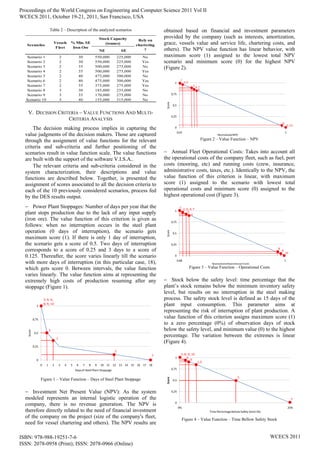
 Power Plant Stoppages: Number of days per year that the
plant stops production due to the lack of any input supply
(iron ore). The value function of this criterion is given as
follows: when no interruption occurs in the steel plant
operation (0 days of interruption), the scenario gets
maximum score (1). If there is only 1 day of interruption,
the scenario gets a score of 0.5. Two days of interruption
corresponds to a score of 0.25 and 3 days to a score of
0.125. Thereafter, the score varies linearly till the scenario
with more days of interruption (in this particular case, 18),
which gets score 0. Between intervals, the value function
varies linearly. The value function aims at representing the
extremely high costs of production resuming after any
stoppage (Figure 1).
0
0,25
0,5
0,75
1
0 1 2 3 4 5 6 7 8 9 10 11 12 13 14 15 16 17 18
Score
Days of Steel Plant Stoppage
2; 4; 6; 
8; 9; 10
3
1
5
7
Figure 1 – Value Function – Days of Steel Plant Stoppage
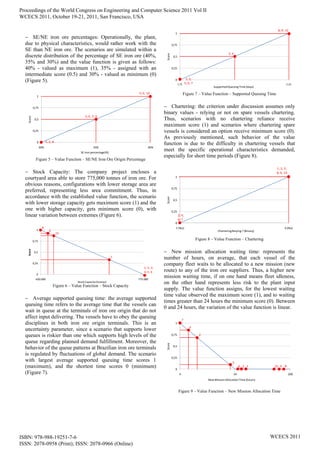
 Investment Net Present Value (NPV): As the system
modeled represents an internal logistic operation of the
company, there is no revenue generation. The NPV is
therefore directly related to the need of financial investment
of the company on the project (size of the company's fleet,
need for vessel chartering and others). The NPV results are
obtained based on financial and investment parameters
provided by the company (such as interests, amortization,
grace, vessels value and service life, chartering costs, and
others). The NPV value function has linear behavior, with
maximum score (1) assigned to the lowest total NPV
scenario and minimum score (0) for the highest NPV
(Figure 2).
0
0,25
0,5
0,75
1
0,65 1
Score
Normalized NPV
1
3; 5
2 4; 7
6
8
9, 10
Figure 2 – Value Function – NPV
 Annual Fleet Operational Costs: Takes into account all
the operational costs of the company fleet, such as fuel, port
costs (mooring, etc) and running costs (crew, insurance,
administrative costs, taxes, etc.). Identically to the NPV, the
value function of this criterion is linear, with maximum
score (1) assigned to the scenario with lowest total
operational costs and minimum score (0) assigned to the
highest operational cost (Figure 3).
0
0,25
0,5
0,75
1
0,68 1
Score
NormalizedOperational Costs
1
2; 3; 4; 7
5
6
8
9
10
Figure 3 – Value Function – Operational Costs
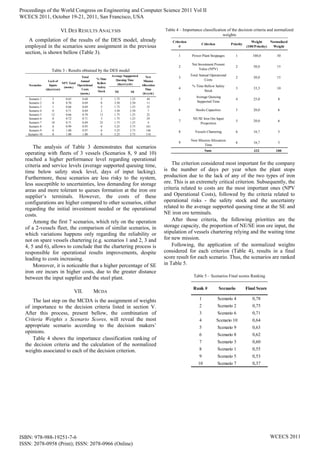
 Stock below the safety level: time percentage that the
plant’s stock remains below the minimum inventory safety
level, but results on no interruption in the steel making
process. The safety stock level is defined as 15 days of the
plant input consumption. This parameter aims at
representing the risk of interruption of plant production. A
value function of this criterion assigns maximum score (1)
to a zero percentage (0%) of observation days of stock
below the safety level, and minimum value (0) to the highest
percentage. The variation between the extremes is linear
(Figure 4).
0
0,25
0,5
0,75
1
0% 25%
Score
Time Percentage Bellow Safety Stock (%)
2; 8; 9; 10
4
1;3
5
6
7
Figure 4 – Value Function – Time Bellow Safety Stock
Proceedings of the World Congress on Engineering and Computer Science 2011 Vol II
WCECS 2011, October 19-21, 2011, San Francisco, USA
ISBN: 978-988-19251-7-6
ISSN: 2078-0958 (Print); ISSN: 2078-0966 (Online)
WCECS 2011
 SE/NE iron ore percentages: Operationally, the plant,
due to physical characteristics, would rather work with the
SE than NE iron ore. The scenarios are simulated within a
discrete distribution of the percentage of SE iron ore (40%,
35% and 30%) and the value function is given as follows:
40% - valued as maximum (1), 35% - assigned with an
intermediate score (0.5) and 30% - valued as minimum (0)
(Figure 5).
0
0,25
0,5
0,75
1
30% 35% 40%
Score
SE iron percentage(%)
3; 4; 7; 9
5; 6; 10
1; 2; 8
Figure 5 – Value Function – SE/NE Iron Ore Origin Percentage
 Stock Capacity: The company project encloses a
courtyard area able to store 775,000 tonnes of iron ore. For
obvious reasons, configurations with lower storage area are
preferred, representing less area commitment. Thus, in
accordance with the established value function, the scenario
with lower storage capacity gets maximum score (1) and the
one with higher capacity, gets minimum score (0), with
linear variation between extremes (Figure 6).
0
0,25
0,5
0,75
1
420.000  775.000 
Score
Stock Capacity (tonnes)
8
1; 2; 3; 
4; 5; 6
9
10
7
Figure 6 – Value Function – Stock Capacity
 Average supported queuing time: the average supported
queuing time refers to the average time that the vessels can
wait in queue at the terminals of iron ore origin that do not
affect input delivering. The vessels have to obey the queuing
disciplines in both iron ore origin terminals. This is an
uncertainty parameter, since a scenario that supports lower
queues is riskier than one which supports high levels of the
queue regarding planned demand fulfillment. Moreover, the
behavior of the queue patterns at Brazilian iron ore terminals
is regulated by fluctuations of global demand. The scenario
with largest average supported queuing time scores 1
(maximum), and the shortest time scores 0 (minimum)
(Figure 7).
0
0,25
0,5
0,75
1
1,75  5,25 
Score
Supported Queuing Time (days)
2; 4
8; 9; 10
1; 3; 
5; 6; 7
Figure 7 – Value Function – Supported Queuing Time
 Chartering: the criterion under discussion assumes only
binary values - relying or not on spare vessels chartering.
Thus, scenarios with no chartering reliance receive
maximum score (1) and scenarios where chartering spare
vessels is considered an option receive minimum score (0).
As previously mentioned, such behavior of the value
function is due to the difficulty in chartering vessels that
meet the specific operational characteristics demanded,
especially for short time periods (Figure 8).
0
0,25
0,5
0,75
1
1 (Yes) 0 (No)
Score
Chartering Relying ? (Binary)
1; 3; 5; 
8; 9; 10
2; 4; 
6; 7
Figure 8 – Value Function – Chartering
 New mission allocation waiting time: represents the
number of hours, on average, that each vessel of the
company fleet waits to be allocated to a new mission (new
route) to any of the iron ore suppliers. Thus, a higher new
mission waiting time, if on one hand means fleet idleness,
on the other hand represents less risk to the plant input
supply. The value function assigns, for the lowest waiting
time value observed the maximum score (1), and to waiting
times greater than 24 hours the minimum score (0). Between
0 and 24 hours, the variation of the value function is linear.
0
0,25
0,5
0,75
1
4 24 200
Score
New Mission Allocation Time (hours)
5
8910136
7
4
2
Figure 9 – Value Function – New Mission Allocation Time
Proceedings of the World Congress on Engineering and Computer Science 2011 Vol II
WCECS 2011, October 19-21, 2011, San Francisco, USA
ISBN: 978-988-19251-7-6
ISSN: 2078-0958 (Print); ISSN: 2078-0966 (Online)
WCECS 2011
VI.DES RESULTS ANALYSIS
A compilation of the results of the DES model, already
employed in the scenarios score assignment in the previous
section, is shown bellow (Table 3).
Table 3 - Results obtained by the DES model
NE SE
Scenario 1 2 0.65 0.68 5 1.75 1.25 44
Scenario 2 0 0.70 0.69 0 3.50 2.50 11
Scenario 3 1 0.66 0.69 5 1.75 1.25 35
Scenario 4 0 0.71 0.69 2 3.50 2.50 7
Scenario 5 12 0.66 0.70 13 1.75 1.25 22
Scenario 6 0 0.72 0.71 3 1.75 1.25 29
Scenario 7 18 0.71 0.69 25 1.75 1.25 4
Scenario 8 0 0.99 0.95 0 5.25 3.75 161
Scenario 9 0 1.00 0.97 0 5.25 3.75 146
Scenario 10 0 1.00 1.00 0 5.25 3.75 118
Total
Annual
Operational
Costs
(norm.)
% Time
Bellow
Safety
Stock
New
Mission
Allocation
Time
(h/cycle)
Average Suppported
Queuing Time
(days/cycle)Scenarios
Lack of
Inputs
(days/year)
NPV Total
(norm.)
The analysis of Table 3 demonstrates that scenarios
operating with fleets of 3 vessels (Scenarios 8, 9 and 10)
reached a higher performance level regarding operational
criteria and service levels (average supported queuing time,
time below safety stock level, days of input lacking).
Furthermore, these scenarios are less risky to the system,
less susceptible to uncertainties, less demanding for storage
areas and more tolerant to queues formation at the iron ore
supplier’s terminals. However, the costs of these
configurations are higher compared to other scenarios, either
regarding the initial investment needed or the operational
costs.
Among the first 7 scenarios, which rely on the operation
of a 2-vessels fleet, the comparison of similar scenarios, in
which variations happens only regarding the reliability or
not on spare vessels chartering (e.g. scenarios 1 and 2, 3 and
4, 5 and 6), allows to conclude that the chartering process is
responsible for operational results improvements, despite
leading to costs increasing.
Moreover, it is noticeable that a higher percentage of SE
iron ore incurs in higher costs, due to the greater distance
between the input supplier and the steel plant.
VII. MCDA
The last step on the MCDA is the assignment of weights
of importance to the decision criteria listed in section V.
After this process, present bellow, the combination of
Criteria Weights x Scenario Scores, will reveal the most
appropriate scenario according to the decision makers’
opinions.
Table 4 shows the importance classification ranking of
the decision criteria and the calculation of the normalized
weights associated to each of the decision criterion.
Table 4 – Importance classification of the decision criteria and normalized
weights
Criterion
#
Criterion Priority
Weight
(100/Priority)
Normalized
Weight
1 Power Plant Stoppages 1 100,0 30
2
Net Investment Present
Value (NPV)
2 50,0 15
3
Total Annual Operational
Costs
2 50,0 15
4
% Time Bellow Safety
Stock
3 33,3 10
5
Average Queuing
Supported Time
4 25,0 8
6 Stocks Capacities 5 20,0 6
7
NE/SE Iron Ore Input
Proportion
5 20,0 6
8 Vessels Chartering 6 16,7 5
9
New Mission Allocation
Time
6 16,7 5
332 100Sum
The criterion considered most important for the company
is the number of days per year when the plant stops
production due to the lack of any of the two types of iron
ore. This is an extremely critical criterion. Subsequently, the
criteria related to costs are the most important ones (NPV
and Operational Costs), followed by the criteria related to
operational risks - the safety stock and the uncertainty
related to the average supported queuing time at the SE and
NE iron ore terminals.
After those criteria, the following priorities are the
storage capacity, the proportion of NE/SE iron ore input, the
stipulation of vessels chartering relying and the waiting time
for new mission.
Following, the application of the normalized weights
considered for each criterion (Table 4), results in a final
score result for each scenario. Thus, the scenarios are ranked
in Table 5.
Table 5 – Scenarios Final scores Ranking
Rank # Scenario Final Score
1 Scenario 4 0,78
2 Scenario 2 0,75
3 Scenario 6 0,71
4 Scenario 10 0,64
5 Scenario 9 0,63
6 Scenario 8 0,62
7 Scenario 3 0,60
8 Scenario 1 0,55
9 Scenario 5 0,53
10 Scenario 7 0,37
Proceedings of the World Congress on Engineering and Computer Science 2011 Vol II
WCECS 2011, October 19-21, 2011, San Francisco, USA
ISBN: 978-988-19251-7-6
ISSN: 2078-0958 (Print); ISSN: 2078-0966 (Online)
WCECS 2011
Analyzing Table 5, one can verify that the scenario with
the highest final score is Scenario 4. Scenarios 2 and 6 final
scores are, however, close to Scenario 4 final score.
Scenario 2 differs from scenario 4 only by a smaller
proportion of SE iron ore, while scenario 6 employs a higher
proportion of SE iron ore than scenario 4. However,
scenario 6 supports less queuing time than scenarios 4 and 2.
Scenario 10 is ranked fourth, virtually tied with
Scenarios 9, 8 and 3. Scenario 3 is very similar to Scenario
4, but with no vessels chartering and lower average
supported queuing time. The difference between Scenarios
10, 9 and 8, which are scenarios with a dedicated 3-vessels
fleet operation, is the proportion of SE iron ore employed in
the steel making process: 40, 35 and 30% respectively.
Given the proximity of the final scores of the 3 best
ranked scenarios (Scenarios 4, 2 and 6), a reasonable
configuration is supposed to be chosen between them. The 3
scenarios are composed by fleets of 2 vessels – what
comprehends to a very close NPV value and annual total
operational costs, have the same total storage capacity
(775,000 tonnes), rely on chartering of vessels during the
fleet docking periods and their steel making process is
subject to no interruption. Therefore, the final pick between
these 3 scenarios will be based on the average supported
queuing time in the supplier’s terminal and the SE iron ore
percentage.
Scenario 2, second final score overall place, is the
scenario with lowest SE iron ore percentage (30%) while
scenario 6, third final score overall place is the scenario with
highest SE proportion (40%). However, scenario 6 supports
only 50% of the average queuing time of scenarios 2 and 4
(1.75 days versus 3.5 days).
The final recommendation is for the pick of the first final
score overall place, Scenario 4, basically because its high
average queuing time supported compared to Scenarios 2
and 6, and its intermediate percentage of SE iron ore
employment in the steel process.
VIII. CONCLUSIONS AND RECOMMENDATIONS
During the present study, the developed tool, employing
the DES and MCDA combined methodology, was proved to
be effective as a complex logistic problem decision-making
support. Besides, the analysis developed tool (DES +
MCDA), with some minor modifications, can be applied to
other similar logistics systems evaluations. Furthermore, it
was possible to base the selection of alternatives in a set of
quantitative criteria, process usually neglected in a
conventional DES analysis - the DES analysis usually
classifies the evaluated scenarios as viable or unviable, and
the choice is usually based on a single and “obvious”
decision criteria (i.e.: lower total cost, higher profit margin,
etc.). Thus, the use of a multi-criteria model emerges as an
effective option for the complementation of a DES model.
Based on the methodology applied in this study, it can be
concluded that, given the model assumptions, the decision
criteria analysis and weights evaluations, the system will
perform “more adequately” according to scenario 4
configuration (2-vessels company fleet, 65% of NE and 35%
of SE iron ore supply origin and storage capacity of
500,000 tons (NE iron ore) and 275,000 (SE iron ore)),
guaranteeing no interruption on the steel making process
and only 2% of the plant operational time bellow the input
safety stock level. Furthermore, the system is supposed to
rely on the chartering for temporary replacement of the
company fleet vessels during the docking periods. The
expected average queuing supported time in this scenario is
about 3.5 and 2.5 days in the NE and SE iron ore origin
terminals, respectively.
The analysis of storage capacities were based on the
availability of the company areas and the existing equipment
in the site. The possibility of studying other areas and
storage equipment acquisition (increasing the storage
capacity or reducing the store area demanded) is a possible
recommendation for further works.
Other additional recommendation is the possibility of a
sensitivity analysis of the decision criteria weights
realization, in order to test the MCDA model robustness or
just test the model response subjected to others decision-
makers evaluation.
REFERENCES
[1] Saaty. T.L.2001. Decision making for leaders. RWS Publications.
Pittsburgh, 2001.
[2] Sweetser, A. 1999. A comparison of System Dynamics (SD) and
Discrete Event Simulation (DES). 17th International Conference of the
System Dynamics Society, July 20 - 23, 1999, Wellington, New
Zealand.
[3] Pedgen, C.D.; Shannon, R.E. & Sadowski, R.P.1995. Introduction to
simulation using SIMAN, McGraw-Hill. 2ª Edition. New York,.
[4] Botter, R.C.2002. Treatment of data in a discrete events simulation,
Thesis (Associated Professor) – POLI - USP, Department of Naval
and Oceanic Eng., São Paulo.
[5] Brito, T.B. 2008. Modeling and simulation of a conteiner’s regulator
terminal. Graduation Thesis – Escola Politécnica of São Paulo
University, São Paulo
[6] Montibeller, G. e Franco L.A. 2007. Decision and Risk Analysis for the
evaluation of strategic options. In: O’Brien, F.A., Dyson, R.G. (Eds.),
Supporting Strategy: Frameworks, Methods and Models. Wiley,
Chichester, p. 251-284.
[7] Prado, A.A.A., Souza, K. Yoshizaki, H. 2009. Transportation Suppliers
Selection using Multi-Criteria Decision Analysis Methodology.
Proceeding of the XXIII Congress of the National Association on
Research and Education on Transport p. 194. November 9-13, 2009,
Vitória,
[8] Montibeller, G. e Franco L.A. 2008. – Multi-criteria Decision Analysis
for Strategic Decision Making.
[9] Botter, R. C. Brinati, M. A. Roque, J. R. R. 1988. Sizing of a integrated
system of transportation of alcohol and diesel oil in the region of
influence of the Tiete-Parana waterway. In: XII National Congress of
Maritime Transports and Naval Construction, Rio de Janeiro. p. 13-44.
[10] Mendes, A.B. 1999. Economic-Operational Model for the sizing of
intermodal transportation of load by the Tiete-Parana waterway ,
Dissertation (Master’s Degree) – POLI - USP, Department. of Naval
and Oceanic Eng., São Paulo, 212p.
Proceedings of the World Congress on Engineering and Computer Science 2011 Vol II
WCECS 2011, October 19-21, 2011, San Francisco, USA
ISBN: 978-988-19251-7-6
ISSN: 2078-0958 (Print); ISSN: 2078-0966 (Online)
WCECS 2011

2011 - WCECS2011

  • 1.
    Modeling of aClosed-Loop Maritime Transportation System with Discrete Event Simulation and Multi-Criteria Decision Analysis Rodolfo Celestino dos Santos Silva, Thiago Barros Brito, Rui Carlos Botter, Newton Narciso Pereira, 1 Abstract - The present paper approaches the development and application of a Discrete Event Simulation (DES) model with a Multiple Criteria Decision Analysis (MCDA) tool for the simulation and sizing of a closed-loop maritime transportation system. This system is responsible for the supply of raw materials, especially iron ore, to a steel plant, and its sizing involves the analysis of the transportation fleet and of the storage area for the inputs to the steel making process. This work characterizes the problem, shows the methodology employed and highlights the main results achieved by the simulation. Concomitantly, the choice of the best solution between the simulation results is made based in the application of the MCDA methodology. The main conclusion of the study is that the use of DES combined with MCDA is an efficient way to help decision-making on complex logistics transportations systems. Index Terms: Modeling, Discrete-Event Simulation, Multi- Criteria, Decision Analysis, Closed-Loop Transportation. I. INTRODUCTION Iron ore is an abundant recourse in the Brazilian economy. A multinational company, owner of iron ore mines, intends to implement, in the country’s northeast region - an important strategic location for the company’s business, a steel making plant, fed by the company’s mines outputs. The company has exclusive concession of a maritime terminal, located very close to the steel plant, through which it will receive the main inputs (coal and iron ore) and dispatch the finished goods (steel plates destined to exportation). A particularity of this system refers to the fact that the company’s mines – one located in the Northeast Region (NE) and the other in the Southeast Region (SE) of Brazil – produce ores with distinct and complementary physic- chemical characteristics. It implies in the necessity of the Manuscript received July 22, 2010. Rodolfo Celestino Silva is with Department of Naval Engineering of the University of Sao Paulo (USP) and the CILIP (Innovation Center for Logistics and Ports Infrastructure); email: rodolfocs.silva@gmail.com Thiago Barros Brito is with Department of Logistic Systems of the USP and the CILIP; email: tbbrito@gmail.com Rui Carlos Botter is with Department of Naval Engineering of the USP and the CILIP; email: rcbotter@usp.br Newton Narciso Pereira is with Department of Naval Engineering of the USP and the CILIP; newtonnaval@gmail.com Department of Naval Engineering of USP - Av. Professor Mello Moraes, 2231 - Cidade Universitária São Paulo - SP - Brasil - CEP 05508-030; CILIP - belonging to the Department of Naval and Oceanic Engineering at USP, objective’s is to create an excellent center for research and education in port logistics and infra-structure, on a collaborative environment with the industry and the public sector. It is composed of several teachers and researchers in the logistics, transportation and port infra-structure areas. plant supply being done with both types of iron ore. According to technical considerations, the proportion of the iron ore originated from the SE Region is supposed to vary between 30% and 40%. The company will manage only one fleet of vessels to transport both types of iron ore, operating in closed-loop circuits. Also, a single storage area is supposed to be shared between the different types of iron ore materials. Both resources (fleet and storage area) should be able to provide an uninterrupted and constant operation of the plant. Thus, this paper presents a DES model built to simulate several possible configurations in the fleet and stocks sizing process. It also introduces a MCDA model developed for the analysis and choice of the best simulated alternative, which embodies the selected decision criteria, The methodology employed in the development of the study and the built models, along with their applications are described below. II. METHODOLOGY The aim of the present work is to develop a hybrid methodology, combining the techniques of DES Modeling and MCDA, able to help decision-makers taking decisions that best fit their needs based on their general understanding of complex logistics problems. The problem proposed in this work – a closed-loop transportation system - is naturally complex, composed of several elements interacting among themselves simultaneously, influencing each other in a complex relationship network, often under conditions that involve randomness, and requires the observation and evaluation of numerous decision criteria, being leaded by multiple goals (often intangible and even antagonistic) and commonly running in long time horizons, where the risks and uncertainties are salient elements, the technique of MCDA is a strong ally in the decision making process. The MCDA is a structured technique for dealing with problems with multiple and complex criteria influencing decision making, since it allows the visualization of the rational-logical structure of the problem by representing and quantifying the importance of its elements, relating them to an overall goal [1]. Under the same circumstances, DES has been efficiently applied for evaluation of complex systems. Capable of replicating the behavior of any real system very closely, DES provides the decision maker with valuable information about the system behavior and how it can be modified [2]. In the development of the simulation model, the methodology applied was based on the steps proposed by [3] and later modified by [4] and [5]: Proceedings of the World Congress on Engineering and Computer Science 2011 Vol II WCECS 2011, October 19-21, 2011, San Francisco, USA ISBN: 978-988-19251-7-6 ISSN: 2078-0958 (Print); ISSN: 2078-0966 (Online) WCECS 2011
  • 2.
    a) Problem definition; b)Project planning; c) Definition of the system; d) Formulation of the conceptual model; e) Preliminary design of the experiment; f) Input data preparation; g) Model coding; h) Verification and validation of the model; i) Final design of the experiment; j) Experimentation and sensitivity analysis; k) Analysis and interpretation of results; l) Implementation and documentation. The state of art of MCDA methodology application is presented by [6]. The work explores the MCDA technical and practical aspects, and confirms it as an excellent supporting tool to decision makers in situations of high complexity decisions. Other factor constantly mentioned is the long-time horizon analysis and the MCDA capability to deal with it. Also, the MCDA methodology, when properly applied, is considered robust, allowing several benchmarks and sensitivities analysis to be done. Functionally, the methodology organizes and synthesizes information, includes measures objectively and considers value judgments of decision makers ([7], [8]), in an interactive and iterative process. The value judgments of decision makers are captured as preference compensation, creating a common and robust evaluation instrument. In order to satisfy all chosen criteria, the arguments of all decision markers will be taken into account when structuring the decision model, no matter how diverse this group is. The 10 major advantages of MCDA, summarized by [1] are: maintenance of the unity of the problem, complexity understanding, criteria interdependence relationship representation, capability of measuring criteria preference, maintenance of the consistency, synthesis, trade-offs evaluation, consideration of decision makers value judgments and consensus reaching. To model the proposed transportation system, a methodological basis was sought in literature works dealing with maritime closed-loop transportation. In the Brazilian literature, some publications in this context were addressed, such as [9], which presents a simulation model for the design of fuel transportation through the Tiete-Paraná Waterway in a closed-loop system –the work executes a brief description of the simulation model and performs the economic analysis of various generated scenarios. [10] also employs the DES methodology in the development of a techno-economic model for the design of cargo intermodal transportation through the Tiete-Paraná Waterway in closed- loop system. The author also addresses the DES support capability in the decision making process. III. INPUT PARAMETERS AND ANALYSIS CRITERIA All the common input parameters to the DES model are listed in Table 1 bellow: Table 1 – Input data common to all scenarios Parameter Value Unit Planned Demand 5 mtpy Vessels Capacity 120,000 tonnes Travel Time (Plant-NE) 2.7 days Berthing Time (SE Port) 1.5 days Travel Time (Plant-NE) 7.9 days Berthing Time (SE Port) 1.4 days Berthing Time (Private Port) 3.25 days However, a number of variables were considered in the simulation run process:  Company Fleet: number of vessels in the company’s private fleet;  SE/NE iron ore percentage: the iron ore employed in the steel making process is originally from either the southeast (SE) or northeast (NE) regions of Brazil. Due to the specifics physical and technical characteristics of each iron ore type, the percentage of SE iron ore may vary from 30 to 40% of the final composition of the steel process output. Whereas the production department prefers working with the maximum percentage of SE iron ore, due to its enhanced physical properties, the procurement and transportation departments prefer working with the minimum percentage of SE iron ore (given the largest distance from company private port to the SE port compared to the NE port);  Stocks Capacities: storage capacities (in tonnes) for each type of iron ore (SE and NE).  Chartering: this variable determines whether or not vessels will be chartered during the periods when the vessels of the company fleet are docked due to maintenance. The dockage is done every 2 and ½ years, and ships may be unavailable from 7 to 40 days. Chartering vessels with the same fleet operational characteristics is particularly difficult, especially for short time periods. Thus, with the variation of the proposed variables, it was possible to create a hall of simulation scenarios, which will be later evaluated. IV.SCENARIOS DESCRIPTIONS Initially, 50 scenarios were built and run with the DES model, with the variation of the above mentioned components. From the initial simulated scenarios, 10 viable scenarios were selected for further evaluation with the multi-criteria methodology support. These scenarios cover all the variation range of the input parameters and variables of the DES model described and their descriptions are listed in Table 2 . Proceedings of the World Congress on Engineering and Computer Science 2011 Vol II WCECS 2011, October 19-21, 2011, San Francisco, USA ISBN: 978-988-19251-7-6 ISSN: 2078-0958 (Print); ISSN: 2078-0966 (Online) WCECS 2011
  • 3.
    Table 2 –Description of the analyzed scenarios NE SE Scenario 1 2 30 550,000 225,000 No Scenario 2 2 30 550,000 225,000 Yes Scenario 3 2 35 500,000 275,000 No Scenario 4 2 35 500,000 275,000 Yes Scenario 5 2 40 475,000 300,000 No Scenario 6 2 40 475,000 300,000 Yes Scenario 7 2 35 375,000 275,000 Yes Scenario 8 3 30 185,000 235,000 No Scenario 9 3 35 170,000 275,000 No Scenario 10 3 40 155,000 315,000 No % Min. SE Iron Ore Scenarios Vessels Fleet Stock Capacity (tonnes) Rely on chartering ? V. DECISION CRITERIA – VALUE FUNCTIONS AND MULTI- CRITERIA ANALYSIS The decision making process implies in capturing the value judgments of the decision makers. Those are captured through the assignment of value functions for the relevant criteria and sub-criteria and further positioning of the scenarios result in value function scale. The value functions are built with the support of the software V.I.S.A.. The relevant criteria and sub-criteria considered in the system characterization, their descriptions and value functions are described below. Together, is presented the assignment of scores associated to all the decision criteria to each of the 10 previously considered scenarios, process fed by the DES results output.  Power Plant Stoppages: Number of days per year that the plant stops production due to the lack of any input supply (iron ore). The value function of this criterion is given as follows: when no interruption occurs in the steel plant operation (0 days of interruption), the scenario gets maximum score (1). If there is only 1 day of interruption, the scenario gets a score of 0.5. Two days of interruption corresponds to a score of 0.25 and 3 days to a score of 0.125. Thereafter, the score varies linearly till the scenario with more days of interruption (in this particular case, 18), which gets score 0. Between intervals, the value function varies linearly. The value function aims at representing the extremely high costs of production resuming after any stoppage (Figure 1). 0 0,25 0,5 0,75 1 0 1 2 3 4 5 6 7 8 9 10 11 12 13 14 15 16 17 18 Score Days of Steel Plant Stoppage 2; 4; 6;  8; 9; 10 3 1 5 7 Figure 1 – Value Function – Days of Steel Plant Stoppage  Investment Net Present Value (NPV): As the system modeled represents an internal logistic operation of the company, there is no revenue generation. The NPV is therefore directly related to the need of financial investment of the company on the project (size of the company's fleet, need for vessel chartering and others). The NPV results are obtained based on financial and investment parameters provided by the company (such as interests, amortization, grace, vessels value and service life, chartering costs, and others). The NPV value function has linear behavior, with maximum score (1) assigned to the lowest total NPV scenario and minimum score (0) for the highest NPV (Figure 2). 0 0,25 0,5 0,75 1 0,65 1 Score Normalized NPV 1 3; 5 2 4; 7 6 8 9, 10 Figure 2 – Value Function – NPV  Annual Fleet Operational Costs: Takes into account all the operational costs of the company fleet, such as fuel, port costs (mooring, etc) and running costs (crew, insurance, administrative costs, taxes, etc.). Identically to the NPV, the value function of this criterion is linear, with maximum score (1) assigned to the scenario with lowest total operational costs and minimum score (0) assigned to the highest operational cost (Figure 3). 0 0,25 0,5 0,75 1 0,68 1 Score NormalizedOperational Costs 1 2; 3; 4; 7 5 6 8 9 10 Figure 3 – Value Function – Operational Costs  Stock below the safety level: time percentage that the plant’s stock remains below the minimum inventory safety level, but results on no interruption in the steel making process. The safety stock level is defined as 15 days of the plant input consumption. This parameter aims at representing the risk of interruption of plant production. A value function of this criterion assigns maximum score (1) to a zero percentage (0%) of observation days of stock below the safety level, and minimum value (0) to the highest percentage. The variation between the extremes is linear (Figure 4). 0 0,25 0,5 0,75 1 0% 25% Score Time Percentage Bellow Safety Stock (%) 2; 8; 9; 10 4 1;3 5 6 7 Figure 4 – Value Function – Time Bellow Safety Stock Proceedings of the World Congress on Engineering and Computer Science 2011 Vol II WCECS 2011, October 19-21, 2011, San Francisco, USA ISBN: 978-988-19251-7-6 ISSN: 2078-0958 (Print); ISSN: 2078-0966 (Online) WCECS 2011
  • 4.
     SE/NE ironore percentages: Operationally, the plant, due to physical characteristics, would rather work with the SE than NE iron ore. The scenarios are simulated within a discrete distribution of the percentage of SE iron ore (40%, 35% and 30%) and the value function is given as follows: 40% - valued as maximum (1), 35% - assigned with an intermediate score (0.5) and 30% - valued as minimum (0) (Figure 5). 0 0,25 0,5 0,75 1 30% 35% 40% Score SE iron percentage(%) 3; 4; 7; 9 5; 6; 10 1; 2; 8 Figure 5 – Value Function – SE/NE Iron Ore Origin Percentage  Stock Capacity: The company project encloses a courtyard area able to store 775,000 tonnes of iron ore. For obvious reasons, configurations with lower storage area are preferred, representing less area commitment. Thus, in accordance with the established value function, the scenario with lower storage capacity gets maximum score (1) and the one with higher capacity, gets minimum score (0), with linear variation between extremes (Figure 6). 0 0,25 0,5 0,75 1 420.000  775.000  Score Stock Capacity (tonnes) 8 1; 2; 3;  4; 5; 6 9 10 7 Figure 6 – Value Function – Stock Capacity  Average supported queuing time: the average supported queuing time refers to the average time that the vessels can wait in queue at the terminals of iron ore origin that do not affect input delivering. The vessels have to obey the queuing disciplines in both iron ore origin terminals. This is an uncertainty parameter, since a scenario that supports lower queues is riskier than one which supports high levels of the queue regarding planned demand fulfillment. Moreover, the behavior of the queue patterns at Brazilian iron ore terminals is regulated by fluctuations of global demand. The scenario with largest average supported queuing time scores 1 (maximum), and the shortest time scores 0 (minimum) (Figure 7). 0 0,25 0,5 0,75 1 1,75  5,25  Score Supported Queuing Time (days) 2; 4 8; 9; 10 1; 3;  5; 6; 7 Figure 7 – Value Function – Supported Queuing Time  Chartering: the criterion under discussion assumes only binary values - relying or not on spare vessels chartering. Thus, scenarios with no chartering reliance receive maximum score (1) and scenarios where chartering spare vessels is considered an option receive minimum score (0). As previously mentioned, such behavior of the value function is due to the difficulty in chartering vessels that meet the specific operational characteristics demanded, especially for short time periods (Figure 8). 0 0,25 0,5 0,75 1 1 (Yes) 0 (No) Score Chartering Relying ? (Binary) 1; 3; 5;  8; 9; 10 2; 4;  6; 7 Figure 8 – Value Function – Chartering  New mission allocation waiting time: represents the number of hours, on average, that each vessel of the company fleet waits to be allocated to a new mission (new route) to any of the iron ore suppliers. Thus, a higher new mission waiting time, if on one hand means fleet idleness, on the other hand represents less risk to the plant input supply. The value function assigns, for the lowest waiting time value observed the maximum score (1), and to waiting times greater than 24 hours the minimum score (0). Between 0 and 24 hours, the variation of the value function is linear. 0 0,25 0,5 0,75 1 4 24 200 Score New Mission Allocation Time (hours) 5 8910136 7 4 2 Figure 9 – Value Function – New Mission Allocation Time Proceedings of the World Congress on Engineering and Computer Science 2011 Vol II WCECS 2011, October 19-21, 2011, San Francisco, USA ISBN: 978-988-19251-7-6 ISSN: 2078-0958 (Print); ISSN: 2078-0966 (Online) WCECS 2011
  • 5.
    VI.DES RESULTS ANALYSIS Acompilation of the results of the DES model, already employed in the scenarios score assignment in the previous section, is shown bellow (Table 3). Table 3 - Results obtained by the DES model NE SE Scenario 1 2 0.65 0.68 5 1.75 1.25 44 Scenario 2 0 0.70 0.69 0 3.50 2.50 11 Scenario 3 1 0.66 0.69 5 1.75 1.25 35 Scenario 4 0 0.71 0.69 2 3.50 2.50 7 Scenario 5 12 0.66 0.70 13 1.75 1.25 22 Scenario 6 0 0.72 0.71 3 1.75 1.25 29 Scenario 7 18 0.71 0.69 25 1.75 1.25 4 Scenario 8 0 0.99 0.95 0 5.25 3.75 161 Scenario 9 0 1.00 0.97 0 5.25 3.75 146 Scenario 10 0 1.00 1.00 0 5.25 3.75 118 Total Annual Operational Costs (norm.) % Time Bellow Safety Stock New Mission Allocation Time (h/cycle) Average Suppported Queuing Time (days/cycle)Scenarios Lack of Inputs (days/year) NPV Total (norm.) The analysis of Table 3 demonstrates that scenarios operating with fleets of 3 vessels (Scenarios 8, 9 and 10) reached a higher performance level regarding operational criteria and service levels (average supported queuing time, time below safety stock level, days of input lacking). Furthermore, these scenarios are less risky to the system, less susceptible to uncertainties, less demanding for storage areas and more tolerant to queues formation at the iron ore supplier’s terminals. However, the costs of these configurations are higher compared to other scenarios, either regarding the initial investment needed or the operational costs. Among the first 7 scenarios, which rely on the operation of a 2-vessels fleet, the comparison of similar scenarios, in which variations happens only regarding the reliability or not on spare vessels chartering (e.g. scenarios 1 and 2, 3 and 4, 5 and 6), allows to conclude that the chartering process is responsible for operational results improvements, despite leading to costs increasing. Moreover, it is noticeable that a higher percentage of SE iron ore incurs in higher costs, due to the greater distance between the input supplier and the steel plant. VII. MCDA The last step on the MCDA is the assignment of weights of importance to the decision criteria listed in section V. After this process, present bellow, the combination of Criteria Weights x Scenario Scores, will reveal the most appropriate scenario according to the decision makers’ opinions. Table 4 shows the importance classification ranking of the decision criteria and the calculation of the normalized weights associated to each of the decision criterion. Table 4 – Importance classification of the decision criteria and normalized weights Criterion # Criterion Priority Weight (100/Priority) Normalized Weight 1 Power Plant Stoppages 1 100,0 30 2 Net Investment Present Value (NPV) 2 50,0 15 3 Total Annual Operational Costs 2 50,0 15 4 % Time Bellow Safety Stock 3 33,3 10 5 Average Queuing Supported Time 4 25,0 8 6 Stocks Capacities 5 20,0 6 7 NE/SE Iron Ore Input Proportion 5 20,0 6 8 Vessels Chartering 6 16,7 5 9 New Mission Allocation Time 6 16,7 5 332 100Sum The criterion considered most important for the company is the number of days per year when the plant stops production due to the lack of any of the two types of iron ore. This is an extremely critical criterion. Subsequently, the criteria related to costs are the most important ones (NPV and Operational Costs), followed by the criteria related to operational risks - the safety stock and the uncertainty related to the average supported queuing time at the SE and NE iron ore terminals. After those criteria, the following priorities are the storage capacity, the proportion of NE/SE iron ore input, the stipulation of vessels chartering relying and the waiting time for new mission. Following, the application of the normalized weights considered for each criterion (Table 4), results in a final score result for each scenario. Thus, the scenarios are ranked in Table 5. Table 5 – Scenarios Final scores Ranking Rank # Scenario Final Score 1 Scenario 4 0,78 2 Scenario 2 0,75 3 Scenario 6 0,71 4 Scenario 10 0,64 5 Scenario 9 0,63 6 Scenario 8 0,62 7 Scenario 3 0,60 8 Scenario 1 0,55 9 Scenario 5 0,53 10 Scenario 7 0,37 Proceedings of the World Congress on Engineering and Computer Science 2011 Vol II WCECS 2011, October 19-21, 2011, San Francisco, USA ISBN: 978-988-19251-7-6 ISSN: 2078-0958 (Print); ISSN: 2078-0966 (Online) WCECS 2011
  • 6.
    Analyzing Table 5,one can verify that the scenario with the highest final score is Scenario 4. Scenarios 2 and 6 final scores are, however, close to Scenario 4 final score. Scenario 2 differs from scenario 4 only by a smaller proportion of SE iron ore, while scenario 6 employs a higher proportion of SE iron ore than scenario 4. However, scenario 6 supports less queuing time than scenarios 4 and 2. Scenario 10 is ranked fourth, virtually tied with Scenarios 9, 8 and 3. Scenario 3 is very similar to Scenario 4, but with no vessels chartering and lower average supported queuing time. The difference between Scenarios 10, 9 and 8, which are scenarios with a dedicated 3-vessels fleet operation, is the proportion of SE iron ore employed in the steel making process: 40, 35 and 30% respectively. Given the proximity of the final scores of the 3 best ranked scenarios (Scenarios 4, 2 and 6), a reasonable configuration is supposed to be chosen between them. The 3 scenarios are composed by fleets of 2 vessels – what comprehends to a very close NPV value and annual total operational costs, have the same total storage capacity (775,000 tonnes), rely on chartering of vessels during the fleet docking periods and their steel making process is subject to no interruption. Therefore, the final pick between these 3 scenarios will be based on the average supported queuing time in the supplier’s terminal and the SE iron ore percentage. Scenario 2, second final score overall place, is the scenario with lowest SE iron ore percentage (30%) while scenario 6, third final score overall place is the scenario with highest SE proportion (40%). However, scenario 6 supports only 50% of the average queuing time of scenarios 2 and 4 (1.75 days versus 3.5 days). The final recommendation is for the pick of the first final score overall place, Scenario 4, basically because its high average queuing time supported compared to Scenarios 2 and 6, and its intermediate percentage of SE iron ore employment in the steel process. VIII. CONCLUSIONS AND RECOMMENDATIONS During the present study, the developed tool, employing the DES and MCDA combined methodology, was proved to be effective as a complex logistic problem decision-making support. Besides, the analysis developed tool (DES + MCDA), with some minor modifications, can be applied to other similar logistics systems evaluations. Furthermore, it was possible to base the selection of alternatives in a set of quantitative criteria, process usually neglected in a conventional DES analysis - the DES analysis usually classifies the evaluated scenarios as viable or unviable, and the choice is usually based on a single and “obvious” decision criteria (i.e.: lower total cost, higher profit margin, etc.). Thus, the use of a multi-criteria model emerges as an effective option for the complementation of a DES model. Based on the methodology applied in this study, it can be concluded that, given the model assumptions, the decision criteria analysis and weights evaluations, the system will perform “more adequately” according to scenario 4 configuration (2-vessels company fleet, 65% of NE and 35% of SE iron ore supply origin and storage capacity of 500,000 tons (NE iron ore) and 275,000 (SE iron ore)), guaranteeing no interruption on the steel making process and only 2% of the plant operational time bellow the input safety stock level. Furthermore, the system is supposed to rely on the chartering for temporary replacement of the company fleet vessels during the docking periods. The expected average queuing supported time in this scenario is about 3.5 and 2.5 days in the NE and SE iron ore origin terminals, respectively. The analysis of storage capacities were based on the availability of the company areas and the existing equipment in the site. The possibility of studying other areas and storage equipment acquisition (increasing the storage capacity or reducing the store area demanded) is a possible recommendation for further works. Other additional recommendation is the possibility of a sensitivity analysis of the decision criteria weights realization, in order to test the MCDA model robustness or just test the model response subjected to others decision- makers evaluation. REFERENCES [1] Saaty. T.L.2001. Decision making for leaders. RWS Publications. Pittsburgh, 2001. [2] Sweetser, A. 1999. A comparison of System Dynamics (SD) and Discrete Event Simulation (DES). 17th International Conference of the System Dynamics Society, July 20 - 23, 1999, Wellington, New Zealand. [3] Pedgen, C.D.; Shannon, R.E. & Sadowski, R.P.1995. Introduction to simulation using SIMAN, McGraw-Hill. 2ª Edition. New York,. [4] Botter, R.C.2002. Treatment of data in a discrete events simulation, Thesis (Associated Professor) – POLI - USP, Department of Naval and Oceanic Eng., São Paulo. [5] Brito, T.B. 2008. Modeling and simulation of a conteiner’s regulator terminal. Graduation Thesis – Escola Politécnica of São Paulo University, São Paulo [6] Montibeller, G. e Franco L.A. 2007. Decision and Risk Analysis for the evaluation of strategic options. In: O’Brien, F.A., Dyson, R.G. (Eds.), Supporting Strategy: Frameworks, Methods and Models. Wiley, Chichester, p. 251-284. [7] Prado, A.A.A., Souza, K. Yoshizaki, H. 2009. Transportation Suppliers Selection using Multi-Criteria Decision Analysis Methodology. Proceeding of the XXIII Congress of the National Association on Research and Education on Transport p. 194. November 9-13, 2009, Vitória, [8] Montibeller, G. e Franco L.A. 2008. – Multi-criteria Decision Analysis for Strategic Decision Making. [9] Botter, R. C. Brinati, M. A. Roque, J. R. R. 1988. Sizing of a integrated system of transportation of alcohol and diesel oil in the region of influence of the Tiete-Parana waterway. In: XII National Congress of Maritime Transports and Naval Construction, Rio de Janeiro. p. 13-44. [10] Mendes, A.B. 1999. Economic-Operational Model for the sizing of intermodal transportation of load by the Tiete-Parana waterway , Dissertation (Master’s Degree) – POLI - USP, Department. of Naval and Oceanic Eng., São Paulo, 212p. Proceedings of the World Congress on Engineering and Computer Science 2011 Vol II WCECS 2011, October 19-21, 2011, San Francisco, USA ISBN: 978-988-19251-7-6 ISSN: 2078-0958 (Print); ISSN: 2078-0966 (Online) WCECS 2011