Toward semantic modeling of
pharmacogenomic knowledge
for clinical and translational
decision support
Richard Boyce*, University of Pittsburgh
Robert Freimuth, Mayo Clinic
Katrina M. Romagnoli, University of Pittsburgh
Tara Pummer, University of Pittsburgh
Harry Hochheiser, University of Pittsburgh
Philip E. Empey, University of Pittsburgh


                                       1         Biomedical Informatics
Department of Biomedical Informatics
Scenario
• Lauren is a physician in an outpatient
  clinic. She receives a pharmacogenomics
  test result for one of her female patients.
• The result states that the patient has the
  genotype CYP2D6*2X2.
• Lauren wants to quickly know what the
  implications are for each drug that her
  patient is taking


                    2            Biomedical Informatics
What does she need to know?
For each drug ?d taken by her patient,
who carries the CYP2D6*2X2 genotype,
what is the…
…potential impact
   – pharmacokinetic / pharmacodynamic
...patient specific risk factors
   – Concomitant medications
   – Medical conditions
…recommendations
   – dosage, drug administration, alternatives,
     monitoring, and tests
                          3               Biomedical Informatics
Where can she look?
• Local clinical setting
  – Institution/clinic specific information
  – Likely to be very few in number
• Scientific literature
  – CPIC and Dutch pharmacogenomics working
    group guidelines
  – High quality but may be infrequently updated
  – Available in PharmGKB, does she know that?
• Product Labeling
  – Concise, clinically oriented information
  – Possibly the first place many clinicians look
                          4              Biomedical Informatics
This talk is going focus on product
labeling…


                 5         Biomedical Informatics
FDA’s goals for pharmacogenomics
and product labeling [1]
“Inform prescribers about the impact,
or lack of impact, of genotype on
phenotype”

“Indicate whether a genomic test is
available and if so, whether testing
should be considered, recommended,
or necessary.”
1.   FDA. Clinical Pharmacogenomics: Premarketing Evaluation in Early Phase Clinical Studies.
     Rockville, MD: Federal Drug Administration; 2011.


                                           6                         Biomedical Informatics
The current status of pharmgx
statements in labeling
• March 2013 [1]:
      – 38 biomarkers
      – 107 active ingredients
             • > 1000 products
      – 19 indications


1.   FDA. Clinical Pharmacogenomics: Premarketing Evaluation in Early Phase Clinical Studies. Rockville, MD: Federal Drug
     Administration; 2011.
2.   FDA. Table of Pharmacogenomic Biomarkers in Drug Labels. 2012. Available at:
     http://www.fda.gov/Drugs/ScienceResearch/ResearchAreas/Pharmacogenetics/ucm083378.htm.


                                                       7                                Biomedical Informatics
Examples
“For HLA-B*5701-positive
patients, initiating or
reinitiating treatment with an
abacavir-containing regimen
is not recommended”


                                 8   Biomedical Informatics
Examples
               “Nursing mothers who are
               ultra-rapid metabolizers may
               also experience overdose
               symptoms such as extreme
               sleepiness, confusion, or
               shallow breathing.”


           9                Biomedical Informatics
Examples


“Patients with low or absent
TPMT activity are at an
increased risk of developing
severe, life-threatening
myelotoxicity if receiving
conventional doses of
azathioprine.”
                               10   Biomedical Informatics
Examples


            “There is no relevant effect of
            genetic variation in CYP2B6,
            CYP2C9, CYP2C19, or CYP3A5
            on the pharmacokinetics of
            prasugrel's active metabolite or
            its inhibition”

           11             Biomedical Informatics
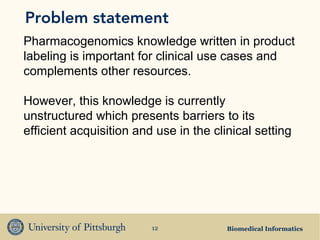
Problem statement
Pharmacogenomics knowledge written in product
labeling is important for clinical use cases and
complements other resources.

However, this knowledge is currently
unstructured which presents barriers to its
efficient acquisition and use in the clinical setting


                         12             Biomedical Informatics
Our approach
• Work with pharmacists to:
    – Develop a semantic model for
      pharmacogenomics statements
    – Train them on how to annotate the
      statements
• Publish annotated statements using
  the Open Annotation standard [1]
• Integrate the annotated statements
  with other sources of pharmgx
  information
    – an interactive prototype
1. http://www.openannotation.org/spec/core/

                                      13      Biomedical Informatics
What is “Open Annotation”
   • An extensible and interoperable
     framework for expressing annotations
     [1]


1. http://www.openannotation.org/spec/core/

                                              14   Biomedical Informatics
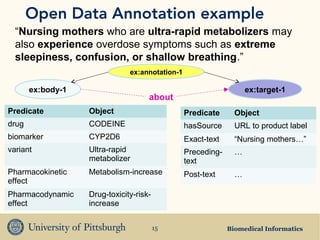
Open Data Annotation example
  “Nursing mothers who are ultra-rapid metabolizers may
  also experience overdose symptoms such as extreme
  sleepiness, confusion, or shallow breathing.”
                               ex:annotation-1

       ex:body-1                                                    ex:target-1
                                     about
Predicate          Object                        Predicate      Object
drug               CODEINE                       hasSource      URL to product label
biomarker          CYP2D6                        Exact-text     “Nursing mothers…”
variant            Ultra-rapid                   Preceding-     …
                   metabolizer                   text
Pharmacokinetic    Metabolism-increase           Post-text      …
effect
Pharmacodynamic    Drug-toxicity-risk-
effect             increase


                                         15                   Biomedical Informatics
Semantic model - descriptions


                16       Biomedical Informatics
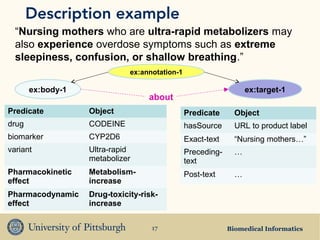
Description example
  “Nursing mothers who are ultra-rapid metabolizers may
  also experience overdose symptoms such as extreme
  sleepiness, confusion, or shallow breathing.”
                              ex:annotation-1

       ex:body-1                                                   ex:target-1
                                   about
Predicate          Object                       Predicate      Object
drug               CODEINE                      hasSource      URL to product label
biomarker          CYP2D6                       Exact-text     “Nursing mothers…”
variant            Ultra-rapid                  Preceding-     …
                   metabolizer                  text
Pharmacokinetic    Metabolism-                  Post-text      …
effect             increase
Pharmacodynamic    Drug-toxicity-risk-
effect             increase


                                    17                       Biomedical Informatics
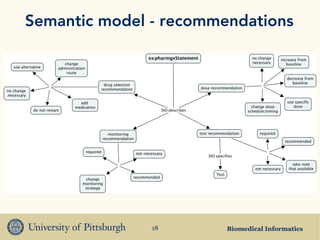
Semantic model - recommendations


               18       Biomedical Informatics
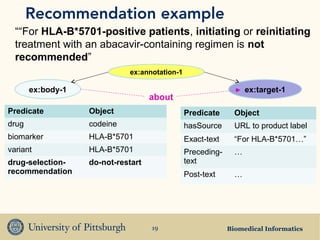
Recommendation example
  ““For HLA-B*5701-positive patients, initiating or reinitiating
  treatment with an abacavir-containing regimen is not
  recommended”
                             ex:annotation-1

       ex:body-1                                                  ex:target-1
                                    about
Predicate          Object                      Predicate      Object
drug               codeine                     hasSource      URL to product label
biomarker          HLA-B*5701                  Exact-text     “For HLA-B*5701…”
variant            HLA-B*5701                  Preceding-     …
drug-selection-    do-not-restart              text
recommendation                                 Post-text      …


                                    19                      Biomedical Informatics
Semantic model - references


                20       Biomedical Informatics
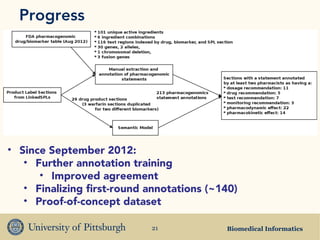
Progress


• Since September 2012:
   • Further annotation training
      • Improved agreement
   • Finalizing first-round annotations (~140)
   • Proof-of-concept dataset

                            21             Biomedical Informatics
Want more information?
• Proof-of-concept:
   – Dataset (RDF/XML): http://goo.gl/Spd0p
   – Example queries: http://goo.gl/3pQ8q (under GRAPH:
     http://purl.org/net/nlprepository/spl-pharmgx-annotation-poc)
   – Integration with W3C Genomic-CDS: https://genomic-
     cds.googlecode.com/svn
• Google code project
   – code.google.com/p/swat-4-med-safety/
• Open Data Anotation
   – http://www.openannotation.org/spec/core/
• Semantic Science Integrated Ontology
   – http://code.google.com/p/semanticscience/


                                22                 Biomedical Informatics
Acknowledgements
• Agency for Healthcare Research and
  Quality (K12HS019461).
• NIH/NCATS (KL2TR000146),
• NIH/NIGMS (U19 GM61388; the
  Pharmacogenomic Research Network)
• NIH/NLM (T15 LM007059-24)


                 23        Biomedical Informatics
Backup Slides


                24   Biomedical Informatics
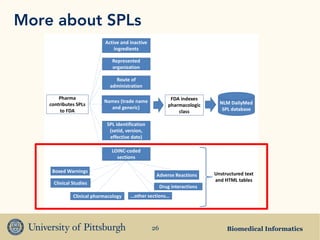
Structured Product Labels (SPLs)
• All package inserts for currently marketed
  drugs are available in this format [1-3]


                    1. http://www.fda.gov/OHRMS/DOCKETS/98fr/FDA-2005-N-0464-gdl.pdf
                    2. http://www.fda.gov/ForIndustry/DataStandards/StructuredProductLabeling/default.htm
                    3. http://dailymed.nlm.nih.gov/dailymed/downloadLabels.cfm


                          25                                      Biomedical Informatics
More about SPLs


                  26   Biomedical Informatics

Toward semantic modeling of pharmacogenomic knowledge for clinical and translational decision support

  • 1.
    Toward semantic modelingof pharmacogenomic knowledge for clinical and translational decision support Richard Boyce*, University of Pittsburgh Robert Freimuth, Mayo Clinic Katrina M. Romagnoli, University of Pittsburgh Tara Pummer, University of Pittsburgh Harry Hochheiser, University of Pittsburgh Philip E. Empey, University of Pittsburgh 1 Biomedical Informatics Department of Biomedical Informatics
  • 2.
    Scenario • Lauren isa physician in an outpatient clinic. She receives a pharmacogenomics test result for one of her female patients. • The result states that the patient has the genotype CYP2D6*2X2. • Lauren wants to quickly know what the implications are for each drug that her patient is taking 2 Biomedical Informatics
  • 3.
    What does sheneed to know? For each drug ?d taken by her patient, who carries the CYP2D6*2X2 genotype, what is the… …potential impact – pharmacokinetic / pharmacodynamic ...patient specific risk factors – Concomitant medications – Medical conditions …recommendations – dosage, drug administration, alternatives, monitoring, and tests 3 Biomedical Informatics
  • 4.
    Where can shelook? • Local clinical setting – Institution/clinic specific information – Likely to be very few in number • Scientific literature – CPIC and Dutch pharmacogenomics working group guidelines – High quality but may be infrequently updated – Available in PharmGKB, does she know that? • Product Labeling – Concise, clinically oriented information – Possibly the first place many clinicians look 4 Biomedical Informatics
  • 5.
    This talk isgoing focus on product labeling… 5 Biomedical Informatics
  • 6.
    FDA’s goals forpharmacogenomics and product labeling [1] “Inform prescribers about the impact, or lack of impact, of genotype on phenotype” “Indicate whether a genomic test is available and if so, whether testing should be considered, recommended, or necessary.” 1. FDA. Clinical Pharmacogenomics: Premarketing Evaluation in Early Phase Clinical Studies. Rockville, MD: Federal Drug Administration; 2011. 6 Biomedical Informatics
  • 7.
    The current statusof pharmgx statements in labeling • March 2013 [1]: – 38 biomarkers – 107 active ingredients • > 1000 products – 19 indications 1. FDA. Clinical Pharmacogenomics: Premarketing Evaluation in Early Phase Clinical Studies. Rockville, MD: Federal Drug Administration; 2011. 2. FDA. Table of Pharmacogenomic Biomarkers in Drug Labels. 2012. Available at: http://www.fda.gov/Drugs/ScienceResearch/ResearchAreas/Pharmacogenetics/ucm083378.htm. 7 Biomedical Informatics
  • 8.
    Examples “For HLA-B*5701-positive patients, initiatingor reinitiating treatment with an abacavir-containing regimen is not recommended” 8 Biomedical Informatics
  • 9.
    Examples “Nursing mothers who are ultra-rapid metabolizers may also experience overdose symptoms such as extreme sleepiness, confusion, or shallow breathing.” 9 Biomedical Informatics
  • 10.
    Examples “Patients with lowor absent TPMT activity are at an increased risk of developing severe, life-threatening myelotoxicity if receiving conventional doses of azathioprine.” 10 Biomedical Informatics
  • 11.
    Examples “There is no relevant effect of genetic variation in CYP2B6, CYP2C9, CYP2C19, or CYP3A5 on the pharmacokinetics of prasugrel's active metabolite or its inhibition” 11 Biomedical Informatics
  • 12.
    Problem statement Pharmacogenomics knowledgewritten in product labeling is important for clinical use cases and complements other resources. However, this knowledge is currently unstructured which presents barriers to its efficient acquisition and use in the clinical setting 12 Biomedical Informatics
  • 13.
    Our approach • Workwith pharmacists to: – Develop a semantic model for pharmacogenomics statements – Train them on how to annotate the statements • Publish annotated statements using the Open Annotation standard [1] • Integrate the annotated statements with other sources of pharmgx information – an interactive prototype 1. http://www.openannotation.org/spec/core/ 13 Biomedical Informatics
  • 14.
    What is “OpenAnnotation” • An extensible and interoperable framework for expressing annotations [1] 1. http://www.openannotation.org/spec/core/ 14 Biomedical Informatics
  • 15.
    Open Data Annotationexample “Nursing mothers who are ultra-rapid metabolizers may also experience overdose symptoms such as extreme sleepiness, confusion, or shallow breathing.” ex:annotation-1 ex:body-1 ex:target-1 about Predicate Object Predicate Object drug CODEINE hasSource URL to product label biomarker CYP2D6 Exact-text “Nursing mothers…” variant Ultra-rapid Preceding- … metabolizer text Pharmacokinetic Metabolism-increase Post-text … effect Pharmacodynamic Drug-toxicity-risk- effect increase 15 Biomedical Informatics
  • 16.
    Semantic model -descriptions 16 Biomedical Informatics
  • 17.
    Description example “Nursing mothers who are ultra-rapid metabolizers may also experience overdose symptoms such as extreme sleepiness, confusion, or shallow breathing.” ex:annotation-1 ex:body-1 ex:target-1 about Predicate Object Predicate Object drug CODEINE hasSource URL to product label biomarker CYP2D6 Exact-text “Nursing mothers…” variant Ultra-rapid Preceding- … metabolizer text Pharmacokinetic Metabolism- Post-text … effect increase Pharmacodynamic Drug-toxicity-risk- effect increase 17 Biomedical Informatics
  • 18.
    Semantic model -recommendations 18 Biomedical Informatics
  • 19.
    Recommendation example ““For HLA-B*5701-positive patients, initiating or reinitiating treatment with an abacavir-containing regimen is not recommended” ex:annotation-1 ex:body-1 ex:target-1 about Predicate Object Predicate Object drug codeine hasSource URL to product label biomarker HLA-B*5701 Exact-text “For HLA-B*5701…” variant HLA-B*5701 Preceding- … drug-selection- do-not-restart text recommendation Post-text … 19 Biomedical Informatics
  • 20.
    Semantic model -references 20 Biomedical Informatics
  • 21.
    Progress • Since September2012: • Further annotation training • Improved agreement • Finalizing first-round annotations (~140) • Proof-of-concept dataset 21 Biomedical Informatics
  • 22.
    Want more information? •Proof-of-concept: – Dataset (RDF/XML): http://goo.gl/Spd0p – Example queries: http://goo.gl/3pQ8q (under GRAPH: http://purl.org/net/nlprepository/spl-pharmgx-annotation-poc) – Integration with W3C Genomic-CDS: https://genomic- cds.googlecode.com/svn • Google code project – code.google.com/p/swat-4-med-safety/ • Open Data Anotation – http://www.openannotation.org/spec/core/ • Semantic Science Integrated Ontology – http://code.google.com/p/semanticscience/ 22 Biomedical Informatics
  • 23.
    Acknowledgements • Agency forHealthcare Research and Quality (K12HS019461). • NIH/NCATS (KL2TR000146), • NIH/NIGMS (U19 GM61388; the Pharmacogenomic Research Network) • NIH/NLM (T15 LM007059-24) 23 Biomedical Informatics
  • 24.
    Backup Slides 24 Biomedical Informatics
  • 25.
    Structured Product Labels(SPLs) • All package inserts for currently marketed drugs are available in this format [1-3] 1. http://www.fda.gov/OHRMS/DOCKETS/98fr/FDA-2005-N-0464-gdl.pdf 2. http://www.fda.gov/ForIndustry/DataStandards/StructuredProductLabeling/default.htm 3. http://dailymed.nlm.nih.gov/dailymed/downloadLabels.cfm 25 Biomedical Informatics
  • 26.
    More about SPLs 26 Biomedical Informatics

Editor's Notes

  • #7 Manufacturers write recommendations into the product label In 2011 FDA introduced the “pharmacogenomics” section for detailed information [1] Other sections used to convey relevant information in summary form
  • #26 Discuss the shortcomings of Structured Product Labels published by FDA