Dynamic Enhancement
  of Drug Product Labels
  Through Semantic Web
  Technologies
  (A W3C HCLS IG Use Case)
  Richard Boyce, University of Pittsburgh
  Maria Liakata, Aberystwyh University/EBI
  Jodi Schneider, DERI, Galway
  Anita de Waard, Elsevier


                                       1     Biomedical Informatics
Department of Biomedical Informatics
Overview
• The motivation for the W3C Use Case
• What we are suggesting
• How it can be accomplished
  – Proof of concept
• Issues to be addressed
• Discussion


                       2     Biomedical Informatics
The problem
• Much of the information in drug package
  inserts (aka product labels) is incomplete
  or has not been updated


                       3         Biomedical Informatics
Missing drug-drug interactions
• Example:
       – “Both clopidogrel and ticlopidine significantly inhibited the
         CYP2B6-catalyzed bupropion hydroxylation. Patients
         receiving either clopidogrel or ticlopidine are likely to require
         dose adjustments when treated with drugs primarily
         metabolized by CYP2B6.” [1]

• Search bupropion drug package inserts for
  “clopidogrel”
       – No mention at all in Aplenzin ER insert [2]
       – Mention in the generic tablet insert [3], but refers only
         to hypothetical interaction
1. Turpeinen M, Tolonen A, Uusitalo J, Jalonen J, Pelkonen O, Laine K. Effect of clopidogrel and ticlopidine on cytochrome P450 2B6 activity as measured by
bupropion hydroxylation. Clin Pharmacol Ther. 2005 Jun;77(6):553-9.
2. http://dailymed.nlm.nih.gov/dailymed/lookup.cfm?setid=2315d6e5-144d-4163-9711-f855c759cf8e
3. http://dailymed.nlm.nih.gov/dailymed/lookup.cfm?setid=e537ed50-6677-45eb-9e62-af62d3831f19


                                                                              4                                   Biomedical Informatics
Missing metabolic properties
     • Cimetidine inhibition of CYP3A4 and CYP1A2
       metabolism
           – Noted in an FDA draft guidance [1] but not PI for the
             generic tablet [2]
     • Fluconazole inhibition of CYP3A4 metabolism
           – Noted in an FDA draft guidance [1] but not directly in
             the fluconazole solution PI [3]
                   • Inferable from the stated interaction with midazolam

     • See others like this in [4]
1.   FDA. FDA Guideline: Drug Interaction Studies – Study Design, Data Analysis, and Implications for Dosing and Labeling. Rockville, MD: Food and Drug
     Administration; 2006. Available at: http://www.fda.gov/downloads/Drugs/GuidanceComplianceRegulatoryInformation/Guidances/ucm072101.pdf.
2.   http://dailymed.nlm.nih.gov/dailymed/lookup.cfm?setid=3a2f773d-b67f-4e83-b8d7-fce6b2887efe
3.   http://dailymed.nlm.nih.gov/dailymed/lookup.cfm?setid=26672a97-adf3-9f1d-4bdc-b2606747bbf5
4.   Boyce R, Harkema H, Conway M. Leveraging the semantic web and natural language processing to enhance drug-mechanism knowledge in drug product labels.
     In: Proceedings of the 1st ACM International Health Informatics Symposium. IHI ’10. New York, NY, USA: ACM; 2010:492–496. Available at:
     http://doi.acm.org/10.1145/1882992.1883070.


                                                                             5                                 Biomedical Informatics
Missing age-related clearance data
     • The PI for citalopram [1] notes age-related
       pharmacokinetic changes
              – “…subjects ≥ 60 years of age were compared to younger
                subjects in two normal volunteer studies. In a single-dose study,
                citalopram AUC and half-life were increased in the elderly
                subjects by 30% and 50%, respectively”
     • However, clearance (Cl) would be the preferred measure
       of age-related change – is there literature on this?
        – Yes! [2-4]
     • The package inserts rarely have this information even
       when published [5]
1.   http://dailymed.nlm.nih.gov/dailymed/lookup.cfm?setid=4259d9b1-de34-43a4-85a8-41dd214e9177
2.   Reis M, Lundmark J, Bengtsson F. Therapeutic drug monitoring of racemic citalopram: a 5-year experience in Sweden, 1992-1997. Ther Drug Monit. 2003;25(2):183-
     191.
3.   Gutierrez M, Abramowitz W. Steady-state pharmacokinetics of citalopram in young and elderly subjects. Pharmacotherapy. 2000;20(12):1441-1447.
4.   Bies RR, Feng Y, Lotrich FE, et al. Utility of sparse concentration sampling for citalopram in elderly clinical trial subjects. J Clin Pharmacol. 2004;44(12):1352-1359.
5.   Boyce RD, Handler SM, Karp JF, Hanlon JT. Age-Related Changes in Antidepressant Pharmacokinetics and Potential Drug-Drug Interactions: A Comparison of
     Evidence-Based Literature and Package Insert Information. Am J Geriatr Pharmacother. 2012 Jan 27. [Epub ahead of print] PubMed PMID: 22285509.


                                                                                       6                                    Biomedical Informatics
Is there any requirement that the inserts
     be kept up to date?
• Yes - 2006 regulations explicitly require that studies of
  drug-drug interactions, metabolic pathways, and special
  populations be discussed [1]


1.    FDA. Code of Federal Regulations 21 Part 201.56, chapter Requirements on content and format of labeling for human prescription drug and biological
      products. Washington, DC: US Government Printing Office, 2010. http://www.accessdata.fda.gov/scripts/cdrh/cfdocs/cfcfr/CFRSearch.cfm?fr=201.57


                                                                                 7                                  Biomedical Informatics
Why are package inserts important?
     • Package inserts are primarily intended to be a reference
       for prescribing clinicians [1]


1.    Marroum PJ, Gobburu J. The product label: how pharmacokinetics and
      pharmacodynamics reach the prescriber. Clin Pharmacokinet. 2002;41(3):161-169.
2.    Ko, Y. et al. Prescribers’ knowledge of and sources of information for potential drug-
      drug interactions: a postal survey of US prescribers. Drug Saf. 31, 525-536 (2008).


                                                                                     8         Biomedical Informatics
Why is the package insert apparently
so influential?
• Authoritative
• Simple (for a drug expert) to follow
• Often the only source of information besides
  FDA approval documentation for new drugs
• No standard for searching the scientific
  literature
• No standard for judging the quality of
  published studies


                        9           Biomedical Informatics
What are we suggesting then?

• “Use natural language processing and scientific
  discourse ontologies to build a linked open data
  store of scientific information that updates or
  elaborates on medication safety statements
  present in drug product labels.”
             - W3C HCLS IG Use Case (http://goo.gl/wP4Mz)


                             10           Biomedical Informatics
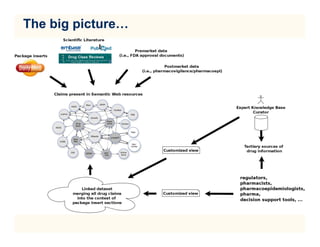
Current use of package inserts
Proposed innovation – take claims present in
semantic web resources….
…create a linked dataset that merges those claims
and identifies where they should be located in the
package insert….
…create customized views of the new linked dataset
tailored toward various drug experts and decision
support tools
The big picture…
How can this be accomplished?


                16      Biomedical Informatics
The Structured Product Label (SPL)
 standard makes this possible
• All package inserts for currently marketed drugs
  are available in this format [1-3]


                      1. http://www.fda.gov/OHRMS/DOCKETS/98fr/FDA-2005-N-0464-gdl.pdf
                      2. http://www.fda.gov/ForIndustry/DataStandards/StructuredProductLabeling/default.htm
                      3. http://dailymed.nlm.nih.gov/dailymed/downloadLabels.cfm


                                 17                                  Biomedical Informatics
FDA law dictates the kinds of claims
that should be present in each section


                   18      Biomedical Informatics
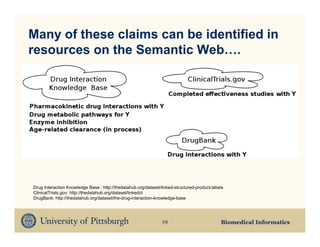
Many of these claims can be identified in
resources on the Semantic Web….


Drug Interaction Knowledge Base : http://thedatahub.org/dataset/linked-structured-product-labels
ClinicalTrials.gov: http://thedatahub.org/dataset/linkedct
DrugBank: http://thedatahub.org/dataset/the-drug-interaction-knowledge-base


                                                                 19                           Biomedical Informatics
…and then linked to package insert
sections published on the Semantic Web


   Linked SPLs: http://thedatahub.org/dataset/linked-structured-product-labels


                                                          20                     Biomedical Informatics
Proof of concept


                   21   Biomedical Informatics
Overview of the proof of concept

• http://goo.gl/rs3Fy
   – Package inserts for drug products containing
     citalopram and venlafaxine
   – Created using three Semantic Web nodes
     • http://thedatahub.org/dataset/linked-structured-product-labels
     • http://thedatahub.org/dataset/linkedct
     • http://thedatahub.org/dataset/the-drug-interaction-knowledge-base


                                    22              Biomedical Informatics
More about the data nodes
• http://goo.gl/rs3Fy


 1. http://thedatahub.org/dataset/linked-structured-product-labels
 2. http://thedatahub.org/dataset/linkedct
 3. http://thedatahub.org/dataset/the-drug-interaction-knowledge-base


                                                                 23     Biomedical Informatics
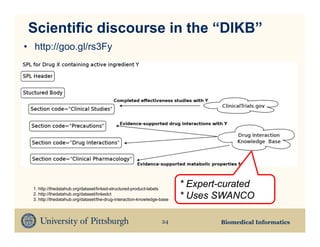
Scientific discourse in the “DIKB”
• http://goo.gl/rs3Fy


  1. http://thedatahub.org/dataset/linked-structured-product-labels
                                                                         * Expert-curated
  2. http://thedatahub.org/dataset/linkedct
  3. http://thedatahub.org/dataset/the-drug-interaction-knowledge-base
                                                                         * Uses SWANCO

                                                                  24             Biomedical Informatics
Take the drug interactions section of a
drug package insert…


                     25        Biomedical Informatics
Make it simple for the package insert
reader to see claims that could expand or
update the information in this section…


                    26        Biomedical Informatics
Example: an interaction affecting venlafaxine that may
not be in this section…


                            27           Biomedical Informatics
Example: an interaction affecting venlafaxine that may
not be in this section…


NLP determined that evidence for a
diphenhydramine/venlafaxine interaction is not
mentioned
                              28            Biomedical Informatics
Clicking on the link provides a path to
evidence for (or against) the drug interaction
claim…
One goal is to link directly to statements
  and sections within scientific documents
  from which evidence was derived
• For example, assume a drug interaction claim
   – identify core scientific concepts (CoreSC) in the
     paper containing the evidence for/against the claim
     (background, methods, results,…)
  – Identify the text containing evidence for/against a
    claim within the CoreSC
  – Link the specific CoreSC element back to the
    package insert section (via the interaction claim)
• Currently testing this approach using SAPIENTA
  (www.sapientaproject.com)
Just a couple of the issues to be
addressed
• Ensuring the quality of the claims linked to the
  package insert sections
   – Provenance is key
   – Would nanopublications help here?
      • The sky could be the limit if a drug information “knowledge
        market” could be created

• Technical issues with some existing linked
  open drug data nodes
   – Now is the time to improve linked open drug data
      • Correct RDF mappings, accurate encodings
      • Graph and data provenance

                                 31              Biomedical Informatics
Want more information?
• Use Case description
   – http://goo.gl/wP4Mz
• Google code project
   – code.google.com/p/swat-4-med-safety/
• Proof of concept
   – http://goo.gl/rs3Fy
• Linked data nodes used in the proof of concept
   – http://thedatahub.org/dataset/linked-structured-product-labels
   – http://thedatahub.org/dataset/the-drug-interaction-knowledge-base
   – http://thedatahub.org/dataset/linkedct


                                     32              Biomedical Informatics
Acknowledgements
• The Drug Interaction Knowledge Base team
  – John Horn Pharm.D, Carol Collins MD, Greg
    Gardner, Rob Guzman
• W3C LODD Task Force
• Early comments on the Use Case:
  – Michel Dumontier and several others who attend
    W3C HCLS calls


                          33           Biomedical Informatics
Discussion/questions


                34     Biomedical Informatics
The package insert’s influence is
    significant
   • How frequently do three drug interaction checking
     tools agree on an interaction by source? (unpublished)
      – 44 interactions from the package insert or scientific
        literature (25 newer psychotropics)
       – Agreement 3.25 times more likely for package
          insert only interactions then for literature only
Scientific literature                                 Package insert


            15.4%            38.5%               50%


                                   35            Biomedical Informatics

Boyce cshals-2012-linked-sp ls-final

  • 1.
    Dynamic Enhancement of Drug Product Labels Through Semantic Web Technologies (A W3C HCLS IG Use Case) Richard Boyce, University of Pittsburgh Maria Liakata, Aberystwyh University/EBI Jodi Schneider, DERI, Galway Anita de Waard, Elsevier 1 Biomedical Informatics Department of Biomedical Informatics
  • 2.
    Overview • The motivationfor the W3C Use Case • What we are suggesting • How it can be accomplished – Proof of concept • Issues to be addressed • Discussion 2 Biomedical Informatics
  • 3.
    The problem • Muchof the information in drug package inserts (aka product labels) is incomplete or has not been updated 3 Biomedical Informatics
  • 4.
    Missing drug-drug interactions •Example: – “Both clopidogrel and ticlopidine significantly inhibited the CYP2B6-catalyzed bupropion hydroxylation. Patients receiving either clopidogrel or ticlopidine are likely to require dose adjustments when treated with drugs primarily metabolized by CYP2B6.” [1] • Search bupropion drug package inserts for “clopidogrel” – No mention at all in Aplenzin ER insert [2] – Mention in the generic tablet insert [3], but refers only to hypothetical interaction 1. Turpeinen M, Tolonen A, Uusitalo J, Jalonen J, Pelkonen O, Laine K. Effect of clopidogrel and ticlopidine on cytochrome P450 2B6 activity as measured by bupropion hydroxylation. Clin Pharmacol Ther. 2005 Jun;77(6):553-9. 2. http://dailymed.nlm.nih.gov/dailymed/lookup.cfm?setid=2315d6e5-144d-4163-9711-f855c759cf8e 3. http://dailymed.nlm.nih.gov/dailymed/lookup.cfm?setid=e537ed50-6677-45eb-9e62-af62d3831f19 4 Biomedical Informatics
  • 5.
    Missing metabolic properties • Cimetidine inhibition of CYP3A4 and CYP1A2 metabolism – Noted in an FDA draft guidance [1] but not PI for the generic tablet [2] • Fluconazole inhibition of CYP3A4 metabolism – Noted in an FDA draft guidance [1] but not directly in the fluconazole solution PI [3] • Inferable from the stated interaction with midazolam • See others like this in [4] 1. FDA. FDA Guideline: Drug Interaction Studies – Study Design, Data Analysis, and Implications for Dosing and Labeling. Rockville, MD: Food and Drug Administration; 2006. Available at: http://www.fda.gov/downloads/Drugs/GuidanceComplianceRegulatoryInformation/Guidances/ucm072101.pdf. 2. http://dailymed.nlm.nih.gov/dailymed/lookup.cfm?setid=3a2f773d-b67f-4e83-b8d7-fce6b2887efe 3. http://dailymed.nlm.nih.gov/dailymed/lookup.cfm?setid=26672a97-adf3-9f1d-4bdc-b2606747bbf5 4. Boyce R, Harkema H, Conway M. Leveraging the semantic web and natural language processing to enhance drug-mechanism knowledge in drug product labels. In: Proceedings of the 1st ACM International Health Informatics Symposium. IHI ’10. New York, NY, USA: ACM; 2010:492–496. Available at: http://doi.acm.org/10.1145/1882992.1883070. 5 Biomedical Informatics
  • 6.
    Missing age-related clearancedata • The PI for citalopram [1] notes age-related pharmacokinetic changes – “…subjects ≥ 60 years of age were compared to younger subjects in two normal volunteer studies. In a single-dose study, citalopram AUC and half-life were increased in the elderly subjects by 30% and 50%, respectively” • However, clearance (Cl) would be the preferred measure of age-related change – is there literature on this? – Yes! [2-4] • The package inserts rarely have this information even when published [5] 1. http://dailymed.nlm.nih.gov/dailymed/lookup.cfm?setid=4259d9b1-de34-43a4-85a8-41dd214e9177 2. Reis M, Lundmark J, Bengtsson F. Therapeutic drug monitoring of racemic citalopram: a 5-year experience in Sweden, 1992-1997. Ther Drug Monit. 2003;25(2):183- 191. 3. Gutierrez M, Abramowitz W. Steady-state pharmacokinetics of citalopram in young and elderly subjects. Pharmacotherapy. 2000;20(12):1441-1447. 4. Bies RR, Feng Y, Lotrich FE, et al. Utility of sparse concentration sampling for citalopram in elderly clinical trial subjects. J Clin Pharmacol. 2004;44(12):1352-1359. 5. Boyce RD, Handler SM, Karp JF, Hanlon JT. Age-Related Changes in Antidepressant Pharmacokinetics and Potential Drug-Drug Interactions: A Comparison of Evidence-Based Literature and Package Insert Information. Am J Geriatr Pharmacother. 2012 Jan 27. [Epub ahead of print] PubMed PMID: 22285509. 6 Biomedical Informatics
  • 7.
    Is there anyrequirement that the inserts be kept up to date? • Yes - 2006 regulations explicitly require that studies of drug-drug interactions, metabolic pathways, and special populations be discussed [1] 1. FDA. Code of Federal Regulations 21 Part 201.56, chapter Requirements on content and format of labeling for human prescription drug and biological products. Washington, DC: US Government Printing Office, 2010. http://www.accessdata.fda.gov/scripts/cdrh/cfdocs/cfcfr/CFRSearch.cfm?fr=201.57 7 Biomedical Informatics
  • 8.
    Why are packageinserts important? • Package inserts are primarily intended to be a reference for prescribing clinicians [1] 1. Marroum PJ, Gobburu J. The product label: how pharmacokinetics and pharmacodynamics reach the prescriber. Clin Pharmacokinet. 2002;41(3):161-169. 2. Ko, Y. et al. Prescribers’ knowledge of and sources of information for potential drug- drug interactions: a postal survey of US prescribers. Drug Saf. 31, 525-536 (2008). 8 Biomedical Informatics
  • 9.
    Why is thepackage insert apparently so influential? • Authoritative • Simple (for a drug expert) to follow • Often the only source of information besides FDA approval documentation for new drugs • No standard for searching the scientific literature • No standard for judging the quality of published studies 9 Biomedical Informatics
  • 10.
    What are wesuggesting then? • “Use natural language processing and scientific discourse ontologies to build a linked open data store of scientific information that updates or elaborates on medication safety statements present in drug product labels.” - W3C HCLS IG Use Case (http://goo.gl/wP4Mz) 10 Biomedical Informatics
  • 11.
    Current use ofpackage inserts
  • 12.
    Proposed innovation –take claims present in semantic web resources….
  • 13.
    …create a linkeddataset that merges those claims and identifies where they should be located in the package insert….
  • 14.
    …create customized viewsof the new linked dataset tailored toward various drug experts and decision support tools
  • 15.
  • 16.
    How can thisbe accomplished? 16 Biomedical Informatics
  • 17.
    The Structured ProductLabel (SPL) standard makes this possible • All package inserts for currently marketed drugs are available in this format [1-3] 1. http://www.fda.gov/OHRMS/DOCKETS/98fr/FDA-2005-N-0464-gdl.pdf 2. http://www.fda.gov/ForIndustry/DataStandards/StructuredProductLabeling/default.htm 3. http://dailymed.nlm.nih.gov/dailymed/downloadLabels.cfm 17 Biomedical Informatics
  • 18.
    FDA law dictatesthe kinds of claims that should be present in each section 18 Biomedical Informatics
  • 19.
    Many of theseclaims can be identified in resources on the Semantic Web…. Drug Interaction Knowledge Base : http://thedatahub.org/dataset/linked-structured-product-labels ClinicalTrials.gov: http://thedatahub.org/dataset/linkedct DrugBank: http://thedatahub.org/dataset/the-drug-interaction-knowledge-base 19 Biomedical Informatics
  • 20.
    …and then linkedto package insert sections published on the Semantic Web Linked SPLs: http://thedatahub.org/dataset/linked-structured-product-labels 20 Biomedical Informatics
  • 21.
    Proof of concept 21 Biomedical Informatics
  • 22.
    Overview of theproof of concept • http://goo.gl/rs3Fy – Package inserts for drug products containing citalopram and venlafaxine – Created using three Semantic Web nodes • http://thedatahub.org/dataset/linked-structured-product-labels • http://thedatahub.org/dataset/linkedct • http://thedatahub.org/dataset/the-drug-interaction-knowledge-base 22 Biomedical Informatics
  • 23.
    More about thedata nodes • http://goo.gl/rs3Fy 1. http://thedatahub.org/dataset/linked-structured-product-labels 2. http://thedatahub.org/dataset/linkedct 3. http://thedatahub.org/dataset/the-drug-interaction-knowledge-base 23 Biomedical Informatics
  • 24.
    Scientific discourse inthe “DIKB” • http://goo.gl/rs3Fy 1. http://thedatahub.org/dataset/linked-structured-product-labels * Expert-curated 2. http://thedatahub.org/dataset/linkedct 3. http://thedatahub.org/dataset/the-drug-interaction-knowledge-base * Uses SWANCO 24 Biomedical Informatics
  • 25.
    Take the druginteractions section of a drug package insert… 25 Biomedical Informatics
  • 26.
    Make it simplefor the package insert reader to see claims that could expand or update the information in this section… 26 Biomedical Informatics
  • 27.
    Example: an interactionaffecting venlafaxine that may not be in this section… 27 Biomedical Informatics
  • 28.
    Example: an interactionaffecting venlafaxine that may not be in this section… NLP determined that evidence for a diphenhydramine/venlafaxine interaction is not mentioned 28 Biomedical Informatics
  • 29.
    Clicking on thelink provides a path to evidence for (or against) the drug interaction claim…
  • 30.
    One goal isto link directly to statements and sections within scientific documents from which evidence was derived • For example, assume a drug interaction claim – identify core scientific concepts (CoreSC) in the paper containing the evidence for/against the claim (background, methods, results,…) – Identify the text containing evidence for/against a claim within the CoreSC – Link the specific CoreSC element back to the package insert section (via the interaction claim) • Currently testing this approach using SAPIENTA (www.sapientaproject.com)
  • 31.
    Just a coupleof the issues to be addressed • Ensuring the quality of the claims linked to the package insert sections – Provenance is key – Would nanopublications help here? • The sky could be the limit if a drug information “knowledge market” could be created • Technical issues with some existing linked open drug data nodes – Now is the time to improve linked open drug data • Correct RDF mappings, accurate encodings • Graph and data provenance 31 Biomedical Informatics
  • 32.
    Want more information? •Use Case description – http://goo.gl/wP4Mz • Google code project – code.google.com/p/swat-4-med-safety/ • Proof of concept – http://goo.gl/rs3Fy • Linked data nodes used in the proof of concept – http://thedatahub.org/dataset/linked-structured-product-labels – http://thedatahub.org/dataset/the-drug-interaction-knowledge-base – http://thedatahub.org/dataset/linkedct 32 Biomedical Informatics
  • 33.
    Acknowledgements • The DrugInteraction Knowledge Base team – John Horn Pharm.D, Carol Collins MD, Greg Gardner, Rob Guzman • W3C LODD Task Force • Early comments on the Use Case: – Michel Dumontier and several others who attend W3C HCLS calls 33 Biomedical Informatics
  • 34.
    Discussion/questions 34 Biomedical Informatics
  • 35.
    The package insert’sinfluence is significant • How frequently do three drug interaction checking tools agree on an interaction by source? (unpublished) – 44 interactions from the package insert or scientific literature (25 newer psychotropics) – Agreement 3.25 times more likely for package insert only interactions then for literature only Scientific literature Package insert 15.4% 38.5% 50% 35 Biomedical Informatics