Pharmacokinetics
biotransformation &
elimination
By:zeel mevada
Dept of pharmacology,
LMCP
Biotransformation
Biotransformation means chemical alteration of the
drug in the body. It is needed to render nonpolar
(lipid-soluble) compounds polar (lipid insoluble).
Biotransformation/ metabolism of drug or
xenobiotic requires because lipophilic drug can not
be easily excreted out through the kidney as
lipophilic drugs are reabsorbed into the systemic
circulation during passage through the renal
tubules.
• The primary site for drug metabolism is liver;
• others are—kidney, intestine, lungs and plasma.
Significance of metabolism
Inactivation: Most drugs and their active
metabolites are rendered inactive or less active,
e.g.ibuprofen,paracetamol,lidocaine,chlorampheni
c-ol, propranolol
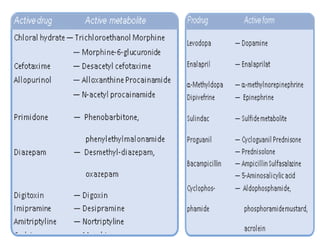
Active metabolite from an active drug Many drugs
have been found to be partially converted
to one or more active metabolite; the effects
observed are the sum total of that due to the parent
drug and its active metabolite.
Continue..
Activation of inactive drug Few drugs are
inactive as such and need conversion in the body
to one or more active metabolites. Such a drug is
called a prodrug.
advantages of prodrug
• Better bioavailability
• Less side effects or reduced toxicity
• Some prodrug are activated selectively at a site of
action
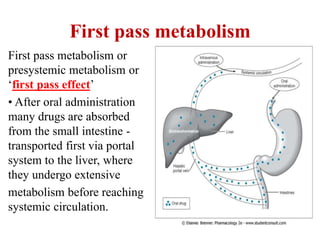
First pass metabolism
First pass metabolism or
presystemic metabolism or
‘first pass effect’
• After oral administration
many drugs are absorbed
from the small intestine -
transported first via portal
system to the liver, where
they undergo extensive
metabolism before reaching
systemic circulation.
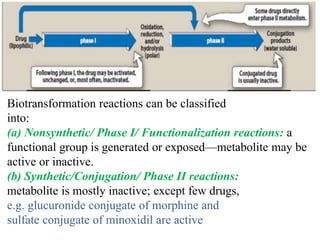
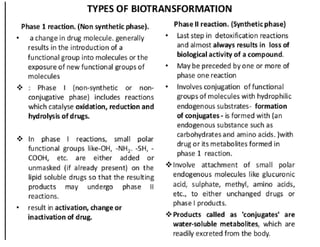
Biotransformation reactions can be classified
into:
(a) Nonsynthetic/ Phase I/ Functionalization reactions: a
functional group is generated or exposed—metabolite may be
active or inactive.
(b) Synthetic/Conjugation/ Phase II reactions:
metabolite is mostly inactive; except few drugs,
e.g. glucuronide conjugate of morphine and
sulfate conjugate of minoxidil are active
Phase I reactions utilizing the P450
system
The phase I reactions involved in drug metabolism are
catalyzed by the cytochrome P450 system (also called
microsomal mixed-function oxidases).
Cytochrome P450, designated as CYP, is a superfamily of
heme-containing isozymes that are located in most cells,
but primarily in the liver and GI tract.
Nomenclature:
The family name is indicated by the Arabic number that
follows CYP, and the capital letter designates the
subfamily, for example, CYP3A (Figure 1.17). A second
number indicates the specific isozyme, as in CYP3A4
• Specificity: Because there are many different genes that
encode multiple enzymes, there are many different P450
isoforms.
• Four isozymes are responsible for the vast majority of
P450-catalyzed reactions. They are CYP3A4/5,
CYP2D6, CYP2C8/9, and CYP1A2
• Considerable amounts of CYP3A4 are found in
intestinal
• mucosa, accounting for first-pass metabolism of drugs
such as chlorpromazine and clonazepam.
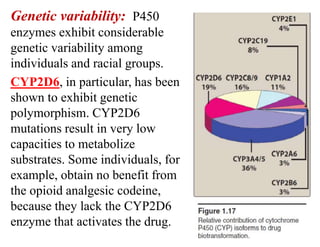
Genetic variability: P450
enzymes exhibit considerable
genetic variability among
individuals and racial groups.
CYP2D6, in particular, has been
shown to exhibit genetic
polymorphism. CYP2D6
mutations result in very low
capacities to metabolize
substrates. Some individuals, for
example, obtain no benefit from
the opioid analgesic codeine,
because they lack the CYP2D6
enzyme that activates the drug.
Phase I reaction
Oxidation: Addition of oxygen (-ve charged
radical) or removal hydrogen (+ve ).
REACTION:
Microsomal oxidation
• Hydroxylation
(Phenobarbitone to
hydroxyphenobarbitone)
• Oxygenation
• Deamination
• Dealkylation
Non Microsomal oxidation
• Mitochondrial oxidation
(Epinephrine by MAO)
• Cytoplasmic oxidation
(alcohol by alcohol
dehydrogenase)
• Oxidative deamination
(Histamine)
Phase I reaction
REDUCTION
Azo reduction (Microsomal)
e.g.: prontosil to
sulfanilamide
• Carbonyl reduction (Non
microsomal)
Alcohol dehydrogenase
(ADH)
• Chloral hydrate is reduced
to trichlorothanol
HYDROLYSIS
Carboxyesterases (Non
microsomal)
• Hydrolysis of esters :
procaine to PABA by
plasma cholinesterase
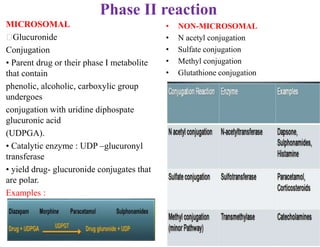
Phase II reaction
MICROSOMAL
Glucuronide
Conjugation
• Parent drug or their phase I metabolite
that contain
phenolic, alcoholic, carboxylic group
undergoes
conjugation with uridine diphospate
glucuronic acid
(UDPGA).
• Catalytic enzyme : UDP –glucuronyl
transferase
• yield drug- glucuronide conjugates that
are polar.
Examples :
• NON-MICROSOMAL
• N acetyl conjugation
• Sulfate conjugation
• Methyl conjugation
• Glutathione conjugation
FACTORS AFFECTING BIOTRANSFORMATION OF
DRUGS
1. Physicochemical properties of the drug
2. Chemical factors
a. Induction of drug metabolizing enzymes
b. Inhibition of drug metabolising enzymes
c. Environmental chemicals
3. Biological factors
a. Species differences
b. Strains differences
c. Sex differences
d. Age
e. Diet
f. Altered physiological factors: (pregnancy, hormonal
imbalance, disease states)
g. Temporal factors: ( circadian rhythm, circannual rhythm)
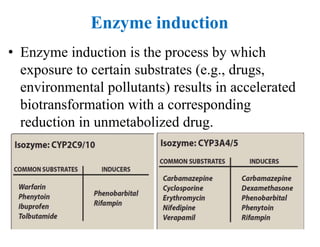
Enzyme induction
• Enzyme induction is the process by which
exposure to certain substrates (e.g., drugs,
environmental pollutants) results in accelerated
biotransformation with a corresponding
reduction in unmetabolized drug.
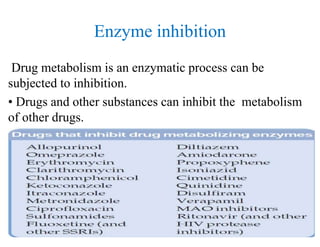
Enzyme inhibition
Drug metabolism is an enzymatic process can be
subjected to inhibition.
• Drugs and other substances can inhibit the metabolism
of other drugs.
Excretion
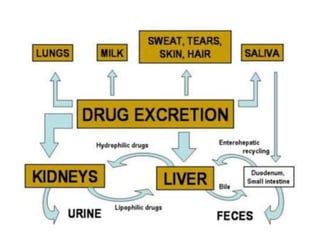
• Excretion is the passage out of systemically
absorbed drug. Drugs and their metabolites are
excreted in:
• Urine Through the kidney. It is the most important
channel of excretion for majority of drugs
• Faeces:Drugs that attain high concentrations in bile
are erythromycin, ampicillin, rifampin, tetra-
cycline, oral contraceptives, phenolphthalein.
• Certain drugs are excreted directly in colon,
• e.g. anthracene purgatives, heavy metals.
• Exhaled air Gases and volatile liquids (general
anaesthetics, paraldehyde, alcohol) are eliminated by
lungs,
• Saliva and sweat These are of minor impor- tance for
drug excretion. Lithium, pot. iodide, rifampin and
heavy metals are present in these secretions in
significant amounts
• Milk The excretion of drug in milk is not important
for the mother, but the suckling infant inadvertently
receives the drug. Most drugs enter breast milk by
passive diffusion.
Continue.
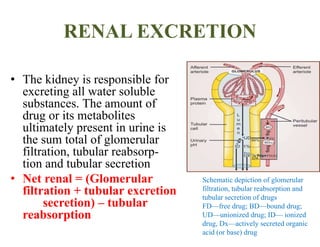
RENAL EXCRETION
• The kidney is responsible for
excreting all water soluble
substances. The amount of
drug or its metabolites
ultimately present in urine is
the sum total of glomerular
filtration, tubular reabsorp-
tion and tubular secretion
• Net renal = (Glomerular
filtration + tubular excretion
secretion) – tubular
reabsorption
Schematic depiction of glomerular
filtration, tubular reabsorption and
tubular secretion of drugs
FD—free drug; BD—bound drug;
UD—unionized drug; ID— ionized
drug, Dx—actively secreted organic
acid (or base) drug
Glomerular filtration
1) Glomerular filtration:
• Drugs enter the kidney through renal
arteries, which divide to form a glomerular
capillary plexus.
• Lipid solubility and pH do not influence the
passage of drugs into the glomerular filtrate.
• But glomerular filtration rate and plasma
protein binding affects this process.
• As in the renal disease GFR may diminished.
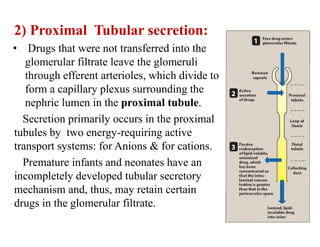
2) Proximal Tubular secretion:
• Drugs that were not transferred into the
glomerular filtrate leave the glomeruli
through efferent arterioles, which divide to
form a capillary plexus surrounding the
nephric lumen in the proximal tubule.
Secretion primarily occurs in the proximal
tubules by two energy-requiring active
transport systems: for Anions & for cations.
Premature infants and neonates have an
incompletely developed tubular secretory
mechanism and, thus, may retain certain
drugs in the glomerular filtrate.
3) Distal tubular reabsorption:
• The drug, if uncharged, may diffuse out of the nephric
lumen, back into the systemic circulation.
Ion trapping:
• Ionized drug gets trapped on one side of a membrane
that divides compartments with different pH.
• So, weak acids can be eliminated by alkalinization
of the urine, whereas elimination of weak bases may
be increased by acidification of the urine.
• For example, a patient presenting with phenobarbital
(weak acid) overdose can be given bicarbonate,
which alkalinizes the urine and keeps the drug
ionized, thereby decreasing its reabsorption.
A. Total body clearance
• The total body (systemic) clearance, CLTotal, is the sum
of all clearances from the drug-metabolizing and drug-
eliminating organs.
• Total clearance is calculated using the following
equation:
• CLTotal = CLhepatic + CLRenal + CLPulmonary + CLOther
• where CLhepatic + CLrenal are typically the most
important.
B. clinical situation resulting in changes in drug half-
life:
• When a patient has an abnormality that alters the half-
life of a drug, adjustment in dosage is required
• Patients who may have an increase in drug half-life include
those with
• 1) diminished renal or hepatic blood flow, for example,
in cardiogenic shock, heart failure, or hemorrhage;
• 2) decreased ability to extract drug from plasma, for
example, in renal disease; and
• 3) decreased metabolism, for example, when a
concomitant drug inhibits metabolism or in hepatic
insufficiency, as with cirrhosis.
• These patients may require a decrease in dosage or less
frequent dosing intervals.
• In contrast, the half-life of a drug may be decreased by
increased hepatic blood flow, decreased protein
binding, or increased metabolism.
SIGNIFICANCE OF PROTEIN BINDING OF
DRUG
A. Absorption:
• As we know the conventional dosage form follow first
order kinetics. So when there is more protein binding
then it disturbs the absorption equilibrium.
B. Distribution:
• A protein bound drug in particular does not cross the
BBB, the Placental barrier, the glomerulus.
• So, protein binding decreases the distribution of
drugs.
C. Metabolism:
• Protein binding decreases the metabolism of drugs &
enhances the biological half life.
• Only unbound fraction get metabolized.
• Eg. Phenylbutazone, Sulfonamide.
D. Elimination:
• Only the unbound drug is capable of being eliminated.
• Protein binding prevent the entry of drug to the
metabolizing organ (liver) & to glomerulus filtration.
• Eg. Tetracycline is eliminated mainly by glomerular
filtration.
E. Systemic solubility of drug:
• Lipoprotein act as vehicle for hydrophobic drugs like
steroids, heparin, oil soluble vitamin.
F. Drug action:
• Protein binding inactivates the drugs because sufficient
concentration of drug can not be build up in the receptor
site for action.
• Eg. Nephloquinone
G. Sustain release:
• The complex of drug protein in the blood act as a
reservoir & continuously supply the free drug.
• Eg. Suramin sodium-protein binding for
antitrypanosomal action.
H. Diagnosis:
• The chlorine atom of chloroquine replaced with
radiolabeled I-131 can be used to visualize-
melanomas of eye & disorders of thyroid gland.
Reference
o Lippincott illustrated reviews pharmacology,
Sixth Edition.
o Goodman and Gillman's the pharmacological
basis of Therapeutics

biotransformation

  • 1.
  • 2.
    Biotransformation Biotransformation means chemicalalteration of the drug in the body. It is needed to render nonpolar (lipid-soluble) compounds polar (lipid insoluble). Biotransformation/ metabolism of drug or xenobiotic requires because lipophilic drug can not be easily excreted out through the kidney as lipophilic drugs are reabsorbed into the systemic circulation during passage through the renal tubules. • The primary site for drug metabolism is liver; • others are—kidney, intestine, lungs and plasma.
  • 3.
    Significance of metabolism Inactivation:Most drugs and their active metabolites are rendered inactive or less active, e.g.ibuprofen,paracetamol,lidocaine,chlorampheni c-ol, propranolol Active metabolite from an active drug Many drugs have been found to be partially converted to one or more active metabolite; the effects observed are the sum total of that due to the parent drug and its active metabolite.
  • 4.
    Continue.. Activation of inactivedrug Few drugs are inactive as such and need conversion in the body to one or more active metabolites. Such a drug is called a prodrug. advantages of prodrug • Better bioavailability • Less side effects or reduced toxicity • Some prodrug are activated selectively at a site of action
  • 5.
    First pass metabolism Firstpass metabolism or presystemic metabolism or ‘first pass effect’ • After oral administration many drugs are absorbed from the small intestine - transported first via portal system to the liver, where they undergo extensive metabolism before reaching systemic circulation.
  • 7.
    Biotransformation reactions canbe classified into: (a) Nonsynthetic/ Phase I/ Functionalization reactions: a functional group is generated or exposed—metabolite may be active or inactive. (b) Synthetic/Conjugation/ Phase II reactions: metabolite is mostly inactive; except few drugs, e.g. glucuronide conjugate of morphine and sulfate conjugate of minoxidil are active
  • 9.
    Phase I reactionsutilizing the P450 system The phase I reactions involved in drug metabolism are catalyzed by the cytochrome P450 system (also called microsomal mixed-function oxidases). Cytochrome P450, designated as CYP, is a superfamily of heme-containing isozymes that are located in most cells, but primarily in the liver and GI tract. Nomenclature: The family name is indicated by the Arabic number that follows CYP, and the capital letter designates the subfamily, for example, CYP3A (Figure 1.17). A second number indicates the specific isozyme, as in CYP3A4
  • 10.
    • Specificity: Becausethere are many different genes that encode multiple enzymes, there are many different P450 isoforms. • Four isozymes are responsible for the vast majority of P450-catalyzed reactions. They are CYP3A4/5, CYP2D6, CYP2C8/9, and CYP1A2 • Considerable amounts of CYP3A4 are found in intestinal • mucosa, accounting for first-pass metabolism of drugs such as chlorpromazine and clonazepam.
  • 11.
    Genetic variability: P450 enzymesexhibit considerable genetic variability among individuals and racial groups. CYP2D6, in particular, has been shown to exhibit genetic polymorphism. CYP2D6 mutations result in very low capacities to metabolize substrates. Some individuals, for example, obtain no benefit from the opioid analgesic codeine, because they lack the CYP2D6 enzyme that activates the drug.
  • 12.
    Phase I reaction Oxidation:Addition of oxygen (-ve charged radical) or removal hydrogen (+ve ). REACTION: Microsomal oxidation • Hydroxylation (Phenobarbitone to hydroxyphenobarbitone) • Oxygenation • Deamination • Dealkylation Non Microsomal oxidation • Mitochondrial oxidation (Epinephrine by MAO) • Cytoplasmic oxidation (alcohol by alcohol dehydrogenase) • Oxidative deamination (Histamine)
  • 13.
    Phase I reaction REDUCTION Azoreduction (Microsomal) e.g.: prontosil to sulfanilamide • Carbonyl reduction (Non microsomal) Alcohol dehydrogenase (ADH) • Chloral hydrate is reduced to trichlorothanol HYDROLYSIS Carboxyesterases (Non microsomal) • Hydrolysis of esters : procaine to PABA by plasma cholinesterase
  • 14.
    Phase II reaction MICROSOMAL Glucuronide Conjugation •Parent drug or their phase I metabolite that contain phenolic, alcoholic, carboxylic group undergoes conjugation with uridine diphospate glucuronic acid (UDPGA). • Catalytic enzyme : UDP –glucuronyl transferase • yield drug- glucuronide conjugates that are polar. Examples : • NON-MICROSOMAL • N acetyl conjugation • Sulfate conjugation • Methyl conjugation • Glutathione conjugation
  • 15.
    FACTORS AFFECTING BIOTRANSFORMATIONOF DRUGS 1. Physicochemical properties of the drug 2. Chemical factors a. Induction of drug metabolizing enzymes b. Inhibition of drug metabolising enzymes c. Environmental chemicals 3. Biological factors a. Species differences b. Strains differences c. Sex differences d. Age e. Diet f. Altered physiological factors: (pregnancy, hormonal imbalance, disease states) g. Temporal factors: ( circadian rhythm, circannual rhythm)
  • 16.
    Enzyme induction • Enzymeinduction is the process by which exposure to certain substrates (e.g., drugs, environmental pollutants) results in accelerated biotransformation with a corresponding reduction in unmetabolized drug.
  • 17.
    Enzyme inhibition Drug metabolismis an enzymatic process can be subjected to inhibition. • Drugs and other substances can inhibit the metabolism of other drugs.
  • 18.
  • 20.
    • Excretion isthe passage out of systemically absorbed drug. Drugs and their metabolites are excreted in: • Urine Through the kidney. It is the most important channel of excretion for majority of drugs • Faeces:Drugs that attain high concentrations in bile are erythromycin, ampicillin, rifampin, tetra- cycline, oral contraceptives, phenolphthalein. • Certain drugs are excreted directly in colon, • e.g. anthracene purgatives, heavy metals.
  • 21.
    • Exhaled airGases and volatile liquids (general anaesthetics, paraldehyde, alcohol) are eliminated by lungs, • Saliva and sweat These are of minor impor- tance for drug excretion. Lithium, pot. iodide, rifampin and heavy metals are present in these secretions in significant amounts • Milk The excretion of drug in milk is not important for the mother, but the suckling infant inadvertently receives the drug. Most drugs enter breast milk by passive diffusion. Continue.
  • 22.
    RENAL EXCRETION • Thekidney is responsible for excreting all water soluble substances. The amount of drug or its metabolites ultimately present in urine is the sum total of glomerular filtration, tubular reabsorp- tion and tubular secretion • Net renal = (Glomerular filtration + tubular excretion secretion) – tubular reabsorption Schematic depiction of glomerular filtration, tubular reabsorption and tubular secretion of drugs FD—free drug; BD—bound drug; UD—unionized drug; ID— ionized drug, Dx—actively secreted organic acid (or base) drug
  • 23.
    Glomerular filtration 1) Glomerularfiltration: • Drugs enter the kidney through renal arteries, which divide to form a glomerular capillary plexus. • Lipid solubility and pH do not influence the passage of drugs into the glomerular filtrate. • But glomerular filtration rate and plasma protein binding affects this process. • As in the renal disease GFR may diminished.
  • 24.
    2) Proximal Tubularsecretion: • Drugs that were not transferred into the glomerular filtrate leave the glomeruli through efferent arterioles, which divide to form a capillary plexus surrounding the nephric lumen in the proximal tubule. Secretion primarily occurs in the proximal tubules by two energy-requiring active transport systems: for Anions & for cations. Premature infants and neonates have an incompletely developed tubular secretory mechanism and, thus, may retain certain drugs in the glomerular filtrate.
  • 25.
    3) Distal tubularreabsorption: • The drug, if uncharged, may diffuse out of the nephric lumen, back into the systemic circulation. Ion trapping: • Ionized drug gets trapped on one side of a membrane that divides compartments with different pH. • So, weak acids can be eliminated by alkalinization of the urine, whereas elimination of weak bases may be increased by acidification of the urine. • For example, a patient presenting with phenobarbital (weak acid) overdose can be given bicarbonate, which alkalinizes the urine and keeps the drug ionized, thereby decreasing its reabsorption.
  • 26.
    A. Total bodyclearance • The total body (systemic) clearance, CLTotal, is the sum of all clearances from the drug-metabolizing and drug- eliminating organs. • Total clearance is calculated using the following equation: • CLTotal = CLhepatic + CLRenal + CLPulmonary + CLOther • where CLhepatic + CLrenal are typically the most important. B. clinical situation resulting in changes in drug half- life: • When a patient has an abnormality that alters the half- life of a drug, adjustment in dosage is required
  • 27.
    • Patients whomay have an increase in drug half-life include those with • 1) diminished renal or hepatic blood flow, for example, in cardiogenic shock, heart failure, or hemorrhage; • 2) decreased ability to extract drug from plasma, for example, in renal disease; and • 3) decreased metabolism, for example, when a concomitant drug inhibits metabolism or in hepatic insufficiency, as with cirrhosis. • These patients may require a decrease in dosage or less frequent dosing intervals. • In contrast, the half-life of a drug may be decreased by increased hepatic blood flow, decreased protein binding, or increased metabolism.
  • 28.
    SIGNIFICANCE OF PROTEINBINDING OF DRUG A. Absorption: • As we know the conventional dosage form follow first order kinetics. So when there is more protein binding then it disturbs the absorption equilibrium. B. Distribution: • A protein bound drug in particular does not cross the BBB, the Placental barrier, the glomerulus. • So, protein binding decreases the distribution of drugs. C. Metabolism: • Protein binding decreases the metabolism of drugs & enhances the biological half life. • Only unbound fraction get metabolized. • Eg. Phenylbutazone, Sulfonamide.
  • 29.
    D. Elimination: • Onlythe unbound drug is capable of being eliminated. • Protein binding prevent the entry of drug to the metabolizing organ (liver) & to glomerulus filtration. • Eg. Tetracycline is eliminated mainly by glomerular filtration. E. Systemic solubility of drug: • Lipoprotein act as vehicle for hydrophobic drugs like steroids, heparin, oil soluble vitamin. F. Drug action: • Protein binding inactivates the drugs because sufficient concentration of drug can not be build up in the receptor site for action. • Eg. Nephloquinone
  • 30.
    G. Sustain release: •The complex of drug protein in the blood act as a reservoir & continuously supply the free drug. • Eg. Suramin sodium-protein binding for antitrypanosomal action. H. Diagnosis: • The chlorine atom of chloroquine replaced with radiolabeled I-131 can be used to visualize- melanomas of eye & disorders of thyroid gland.
  • 31.
    Reference o Lippincott illustratedreviews pharmacology, Sixth Edition. o Goodman and Gillman's the pharmacological basis of Therapeutics