Lung Function Tests
•Also called pulmonary function tests (PFTs)
• Evaluate how well your lungs work.
• The tests determine how much air your lungs
can hold, how quickly you can move air in and
out of your lungs, and how well your lungs add
oxygen and remove carbon dioxide from your
blood.
• The tests can diagnose lung diseases and
measure the severity of lung problems
3.
Clinical Significances:
Lung functiontests are valuable because
they give some measure of
• Lung compliance or elasticity
• Airway resistance
• Respiratory muscle strength
These three factors determine how much air
a person can move into lungs per unit of
time and this is what the pulmonary
function tests measure.
4.
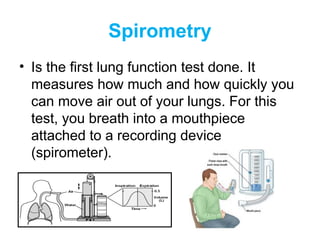
Spirometry
• Is thefirst lung function test done. It
measures how much and how quickly you
can move air out of your lungs. For this
test, you breath into a mouthpiece
attached to a recording device
(spirometer).
5.
Spirometer
• There aretow types of spirometer:
1- Mechanical devices:
(Incentive spirometer)
2- Electronic devices
6.
Respiratory Volumes
• Thetotal capacity of the lungs is divided into various volumes and
capacities according to the function of these in the intake or
exhalation of air. For a proper understanding of respiratory
processes it is necessary that you became familiar with these
volumes and capacities.
• The average total lung capacity of an adult human male is about 6
liters of air, but only a small amount of this capacity is used during
normal breathing.
• The average human respiratory rate is 30-60 breaths per minute at
birth, decreasing to 12-20 breaths per minute in adults.
• The total amount of air one’s lung can possibly hold can be
subdivided into four Volumes defined as follow:
7.
[1] The TidalVolume (TV):
• Is the volume of air inspired or expired with each normal
breath and it is about 500 ml in average young adult
man.
8.
[2] The inspiratoryreserve
volume (IRV):
• Is the extra volume of air that can be inspired over and
beyond tidal volume and it is about 3000 ml.
9.
[3] The expiratoryreserve
volume (ERV):
• Is the amount of air that can be expired after the normal
tidal expiration, which is about 1100 ml
10.
[4] The residualvolume (RV):
• Is the volume of air still remaining in the lungs after the most forceful
expiration, which is about 1200 ml.
• This volume can not be measured directly by spirometer. Therefore,
an indirect method must be used usually the helium dilution method.
11.
Lung Capacities
In additionto four volumes, which don’t overlap, there are four
capacities
,which are combined of two or more volumes:
[1] The inspiratory capacity (IC) = TV +IRV = 500 +3000 = 3500 ml.
This is the amount of air that a person can breathe beginning at the
normal expiratory level and distending the lungs to the maximum
amount.
12.
[2] The functionalresidual capacity (FRC) = ERV + RV = 1100 +
1200 = 2300 ml. This is the amount of air remaining in the lungs at
the end of normal expiration.
13.
[3] The vitalcapacity (VC) = IRV + TV + ERV = 3000 + 500 + 1100 =
4600 ml. This is the maximum amount of air that a person can expel
from the lungs after filling the lungs first to their maximum extent,
and then expiring to the maximum extent.
14.
[4] The totallung capacity (TLC) = VC + RV = 4600 + 1200 = 5800
ml. This is the maximum volume to which the lungs can be
expanded with the greatest possible inspiratory effort.
15.
Peak expiratory flow(PEF):
• Is the maximum or peak rate (or velocity), in liters per
minute, with which air is expelled with maximum force
after a deep inspiration.
• It can be measured by wright peak flow meter. The
maximum expiratory flow is much greater when the lungs
are filled with a large volume of air than when they are
almost empty
16.
Is spirometry thesame as peak
flow readings?
• No. A peak flow meter is a small device
that measures the fastest rate of air that
you can blow out of your lungs.
• Like spirometry, it can detect airways
narrowing. It is more convenient than
spirometry and is commonly used to help
diagnose asthma.
Factors affecting lungvolume
Several factors affect lung volumes, some that can be
controlled and some that can not. These factors include:
Larger volumes Smaller volumes
Males females
Taller people shorter people
Non-smokers heavy smokers
Professional athletes non-athletes
People living at high altitudes people living at low altitudes
19.
Restrictive and obstructive
Pulmonarydisease
Pulmonary function testing primarily detects two abnormal patterns:
1- Obstructive ventilatory defects
• such as asthma and COPD.
• There is obstruction to the outflow of air
• The main feature is a decrease in expiratory flow rate throughout
expiration
2- Restrictive (constricted) ventilatory defects
• such as interstitial fibrosis and chest wall deformities.
• That reduce the air in the lungs. There is no obstruction to the
outflow of air.
• The main feature is reduced lung volume (mainly TLC and RV).
20.
Is there anyrisk in having
spirometry?
Spirometry is a very low risk test. However, blowing out
hard can increase the pressure in your chest, abdomen
and eye. So, you may be advised not to have spirometry
if you have:
1- Unstable angina.
2- Had a recent pneumothorax (air trapped beneath the
chest wall).
3- Had a recent heart attack or stroke.
4- Had recent eye or abdominal surgery.
5- Coughed up blood recently and the cause is not known.
21.
Experimental procedure
1- TidalVolume(TV)
Set the spirometer dial at zero. Take normal inspiration, place your
mouth over the mouthpiece into spirometer. You will to make a
conscious effort not to exceed your normal volume.
Read the amount exhaled on the dial
2- Expiratory Reverse Volume (ERV)
Set the Spirometer dial at zero. After a normal expiration, place your
mouth over the mouthpiece and the forcefully exhale as much air as
possible into the spirometer.
3- Vital Capacity(VC)
Set the spirometer dial at zero, inhale as deeply as possible; place your
mouth over the mouthpiece, hold your nose, and exhale into
spirometer with a maximal effort .
4- inspiratory reverse Volume (IRV) and inspiration Capacity (IC):
from the three previous volume measurements you can calculate the
IRV and the IC
22.
Question
A person whois born and lives at sea level will develop a slightly
smaller lung capacity than a person who spends their life at a high
altitude.
23.
Answer
This is becausethe partial pressure of oxygen is lower at higher
altitude which, as a result means that oxygen less readily diffuses
into the bloodstream. In response to higher altitude, the body's
diffusing capacity increases in order to process more air.




![[1] The Tidal Volume (TV):
• Is the volume of air inspired or expired with each normal
breath and it is about 500 ml in average young adult
man.](https://image.slidesharecdn.com/pftcfermtc-250706014308-ccef03d2/85/PFT-PULMONARY-LUNG-FUNCTION-TEST-POERPOINT-PRESENTATION-7-320.jpg)
![[2] The inspiratory reserve
volume (IRV):
• Is the extra volume of air that can be inspired over and
beyond tidal volume and it is about 3000 ml.](https://image.slidesharecdn.com/pftcfermtc-250706014308-ccef03d2/85/PFT-PULMONARY-LUNG-FUNCTION-TEST-POERPOINT-PRESENTATION-8-320.jpg)
![[3] The expiratory reserve
volume (ERV):
• Is the amount of air that can be expired after the normal
tidal expiration, which is about 1100 ml](https://image.slidesharecdn.com/pftcfermtc-250706014308-ccef03d2/85/PFT-PULMONARY-LUNG-FUNCTION-TEST-POERPOINT-PRESENTATION-9-320.jpg)
![[4] The residual volume (RV):
• Is the volume of air still remaining in the lungs after the most forceful
expiration, which is about 1200 ml.
• This volume can not be measured directly by spirometer. Therefore,
an indirect method must be used usually the helium dilution method.](https://image.slidesharecdn.com/pftcfermtc-250706014308-ccef03d2/85/PFT-PULMONARY-LUNG-FUNCTION-TEST-POERPOINT-PRESENTATION-10-320.jpg)
![Lung Capacities
In addition to four volumes, which don’t overlap, there are four
capacities
,which are combined of two or more volumes:
[1] The inspiratory capacity (IC) = TV +IRV = 500 +3000 = 3500 ml.
This is the amount of air that a person can breathe beginning at the
normal expiratory level and distending the lungs to the maximum
amount.](https://image.slidesharecdn.com/pftcfermtc-250706014308-ccef03d2/85/PFT-PULMONARY-LUNG-FUNCTION-TEST-POERPOINT-PRESENTATION-11-320.jpg)
![[2] The functional residual capacity (FRC) = ERV + RV = 1100 +
1200 = 2300 ml. This is the amount of air remaining in the lungs at
the end of normal expiration.](https://image.slidesharecdn.com/pftcfermtc-250706014308-ccef03d2/85/PFT-PULMONARY-LUNG-FUNCTION-TEST-POERPOINT-PRESENTATION-12-320.jpg)
![[3] The vital capacity (VC) = IRV + TV + ERV = 3000 + 500 + 1100 =
4600 ml. This is the maximum amount of air that a person can expel
from the lungs after filling the lungs first to their maximum extent,
and then expiring to the maximum extent.](https://image.slidesharecdn.com/pftcfermtc-250706014308-ccef03d2/85/PFT-PULMONARY-LUNG-FUNCTION-TEST-POERPOINT-PRESENTATION-13-320.jpg)
![[4] The total lung capacity (TLC) = VC + RV = 4600 + 1200 = 5800
ml. This is the maximum volume to which the lungs can be
expanded with the greatest possible inspiratory effort.](https://image.slidesharecdn.com/pftcfermtc-250706014308-ccef03d2/85/PFT-PULMONARY-LUNG-FUNCTION-TEST-POERPOINT-PRESENTATION-14-320.jpg)