SYSTEMS OF UNITS,
ENGINEERING DESIGN & ANALYSIS
MEG 212 Week 2 Lecture
At the end of this lecture, you will be able to,
• Discuss the need for a system of units
• Identify two major systems of units used by engineers
• Discuss the differences primary and secondary dimensions with
examples
• Identify the three key intensive properties in engineering
thermodynamics
• Discuss the steps involved in engineering design and analysis of
thermodynamic systems
Lecture Learning Outcomes
Why do we need a System of Units?
As a result, engineers need to
be concerned with the units of
physical quantities
• Engineers perform calculations
to carry out their design and
analysis
• These calculations give outputs
in numerical values.
A unit of measurement is a
definite magnitude of a
quantity
Things to Note about Units
For example, meters,
centimeters, kilometers, feet,
inches, and miles are all units
of length
• A unit of measurement is defined
and adopted by convention
• That is, it is used as a standard
for measurement for the same
kind of quantity
Seconds, minutes and hours
are units of time
Primary and Secondary Dimensions
For example, meters and feet
are both units used to quantify
the dimension of length
• What is the difference between a
dimension and a unit?
• A unit is the standard used to
quantify a dimension
Seconds, minutes and hours
are units used to quantify the
dimension of time
Primary and Secondary Dimensions
• Secondary Dimensions
• Primary Dimensions
Independent dimensions from
which all other dimensions can be
obtained.
They are mass (𝑀), length (𝐿), and
time (𝑇)
Dimensions expressed in
terms of the primary (also
called fundamental)
dimensions
Can you give examples?
System of Units: SI Units
• Legally accepted system in most
countries
• Conventions of the SI are controlled
by an international treaty organization
SI base unit of length is meter
(𝑚)
The length of the path
traveled by light in a
vacuum during a specified
time interval
SI base unit of time is seconds
(𝑠)
The duration of 9,
192,631,770 cycles of the
radiation associated with a
specified transition of the
cesium atom
SI base unit of mass is kilogram
(𝑘𝑔)
The mass of a particular
cylinder of platinum-iridium
alloy kept by the International
Bureau of Weights and
Measures near Paris
Practice Exercises: The Use of SI Units
 Determine the weight in Newton of an
object whose mass is 1000 kg at a place
on the earth’s surface where the
acceleration due to gravity equals a
standard value defined as 9.80665 𝑚. 𝑠−2
.
 If the object were on the surface of a
planet at a point where the acceleration of
gravity is one-tenth of the value used
above, would the mass change? How does
this new value of the acceleration of
gravity affect the weight?
 What type of unit is the Newton?
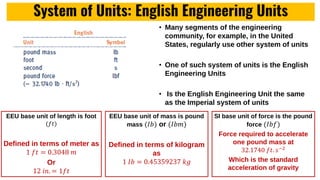
System of Units: English Engineering Units
• Many segments of the engineering
community, for example, in the United
States, regularly use other system of units
• One of such system of units is the English
Engineering Units
• Is the English Engineering Unit the same
as the Imperial system of units
EEU base unit of length is foot
(𝑓𝑡)
Defined in terms of meter as
1 𝑓𝑡 = 0.3048 𝑚
Or
12 𝑖𝑛. = 1𝑓𝑡
EEU base unit of mass is pound
mass (𝐼𝑏) or (𝐼𝑏𝑚)
Defined in terms of kilogram
as
1 𝐼𝑏 = 0.45359237 𝑘𝑔
SI base unit of force is the pound
force (𝐼𝑏𝑓)
Force required to accelerate
one pound mass at
32.1740 𝑓𝑡. 𝑠−2
Which is the standard
acceleration of gravity
Important Intensive Properties
• There are three measurable intensive
properties that are particularly important in
engineering thermodynamics.
• They are, specific volume, pressure and
temperature
• From the macroscopic view of
thermodynamics, the description of matter is
simplified by assuming that it is distributed
continuously throughout a region to be
studied
• This is known as the continuum hypothesis
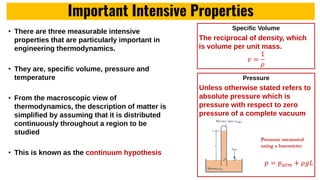
Specific Volume
The reciprocal of density, which
is volume per unit mass.
𝑣 =
1
𝜌
Pressure
Unless otherwise stated refers to
absolute pressure which is
pressure with respect to zero
pressure of a complete vacuum
𝑝 = 𝑝𝑎𝑡𝑚 + 𝜌𝑔𝐿
Pressure measured
using a barometer
Important Intensive Properties
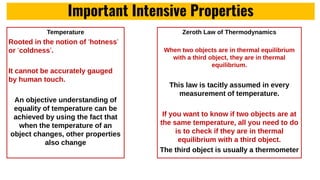
Temperature
Rooted in the notion of ‘hotness’
or ‘coldness’.
It cannot be accurately gauged
by human touch.
An objective understanding of
equality of temperature can be
achieved by using the fact that
when the temperature of an
object changes, other properties
also change
Zeroth Law of Thermodynamics
When two objects are in thermal equilibrium
with a third object, they are in thermal
equilibrium.
This law is tacitly assumed in every
measurement of temperature.
If you want to know if two objects are at
the same temperature, all you need to do
is to check if they are in thermal
equilibrium with a third object.
The third object is usually a thermometer
Important Intensive Properties
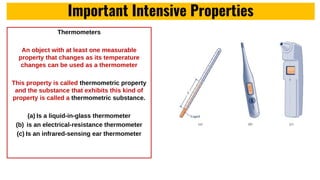
Thermometers
An object with at least one measurable
property that changes as its temperature
changes can be used as a thermometer
This property is called thermometric property
and the substance that exhibits this kind of
property is called a thermometric substance.
(a) Is a liquid-in-glass thermometer
(b) is an electrical-resistance thermometer
(c) Is an infrared-sensing ear thermometer
Important Intensive Properties
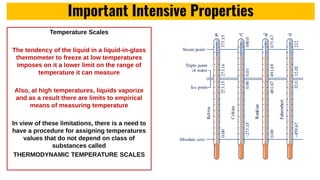
Temperature Scales
The tendency of the liquid in a liquid-in-glass
thermometer to freeze at low temperatures
imposes on it a lower limit on the range of
temperature it can measure
Also, at high temperatures, liquids vaporize
and as a result there are limits to empirical
means of measuring temperature
In view of these limitations, there is a need to
have a procedure for assigning temperatures
values that do not depend on class of
substances called
THERMODYNAMIC TEMPERATURE SCALES
Important Intensive Properties
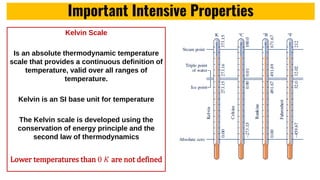
Kelvin Scale
Is an absolute thermodynamic temperature
scale that provides a continuous definition of
temperature, valid over all ranges of
temperature.
Kelvin is an SI base unit for temperature
The Kelvin scale is developed using the
conservation of energy principle and the
second law of thermodynamics
Lower temperatures than 0 𝐾 are not defined
Important Intensive Properties
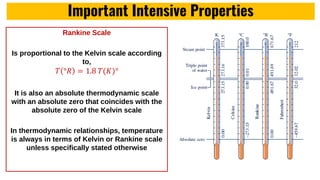
Rankine Scale
Is proportional to the Kelvin scale according
to,
𝑇 °𝑅 = 1.8 𝑇(𝐾)°
It is also an absolute thermodynamic scale
with an absolute zero that coincides with the
absolute zero of the Kelvin scale
In thermodynamic relationships, temperature
is always in terms of Kelvin or Rankine scale
unless specifically stated otherwise
Important Intensive Properties
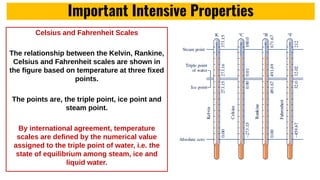
Celsius and Fahrenheit Scales
The relationship between the Kelvin, Rankine,
Celsius and Fahrenheit scales are shown in
the figure based on temperature at three fixed
points.
The points are, the triple point, ice point and
steam point.
By international agreement, temperature
scales are defined by the numerical value
assigned to the triple point of water, i.e. the
state of equilibrium among steam, ice and
liquid water.
Engineering Design and Analysis
Engineers are the “go to people” when
there is a need for design and
analysis of devices required to meet
human needs
Invention is the key function of an
engineering discipline having
many aspects ranging from
developing new devices to
addressing complex social issues
using technology
The word ENGINEER comes from a Latin word which means INVENTION
Engineering Design and Analysis
What are the fundamental elements of
design?
• Establishment of objectives
• Synthesis
• Analysis
• Construction testing
• Evaluation
• Redesign (if necessary)
What is Design?
Engineering design is a decision
making process in which principles
drawn from engineering and other
fields such as economics and
statistics are applied iteratively, to
devise a system, system component
or process
Engineering Design and Analysis
What to consider for workable designs
• Lowest cost
• Highest efficiency
• Smallest size
• Lightest weight
• Reliability
• Manufacturability
• Maintainability
• Marketplace considerations
Where do Design Projects originate
from?
Recognition of a need or an
opportunity (which initially might not
be fully understood)
Before birthing solutions to these
needs, design objectives need to be
defined first
Engineering Design and Analysis
Major Components
• Overhead piping network for water
• Numerous sprinkler heads
How do we decide the specific sizing of the
pipes, pipe material, the number of
sprinklers, etc.?
ENGINEERING ANALYSIS
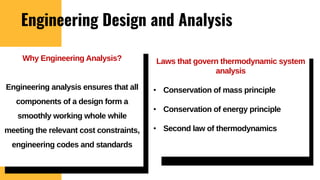
Why Engineering Analysis?
If, for example, we have a proposed
design for a fire-protection system in
our classrooms, what components
would we need to put together for this
system?
Engineering Design and Analysis
Laws that govern thermodynamic system
analysis
• Conservation of mass principle
• Conservation of energy principle
• Second law of thermodynamics
Why Engineering Analysis?
Engineering analysis ensures that all
components of a design form a
smoothly working whole while
meeting the relevant cost constraints,
engineering codes and standards
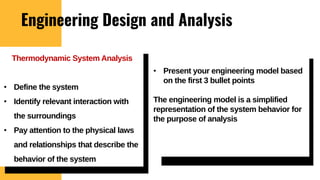
Engineering Design and Analysis
• Present your engineering model based
on the first 3 bullet points
The engineering model is a simplified
representation of the system behavior for
the purpose of analysis
Thermodynamic System Analysis
• Define the system
• Identify relevant interaction with
the surroundings
• Pay attention to the physical laws
and relationships that describe the
behavior of the system
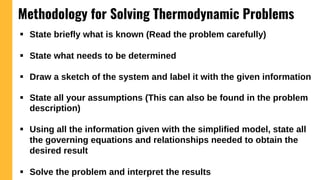
 State briefly what is known (Read the problem carefully)
 State what needs to be determined
 Draw a sketch of the system and label it with the given information
 State all your assumptions (This can also be found in the problem
description)
 Using all the information given with the simplified model, state all
the governing equations and relationships needed to obtain the
desired result
 Solve the problem and interpret the results
Methodology for Solving Thermodynamic Problems
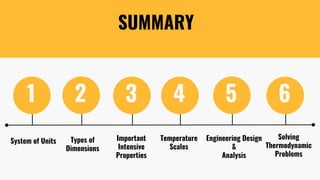
SUMMARY
1 2 3 4 5 6
System of Units Important
Intensive
Properties
Types of
Dimensions
Engineering Design
&
Analysis
Temperature
Scales
Solving
Thermodynamic
Problems
 Reading assignment: pages 39 to 60
 Work and kinetic energy
 Potential energy
 Conservation of energy
 Sign convention and notation
 Power, Modeling expansion and compression work in actual
processes
Next Lecture

MEG 212 Lecture 2 (2024) Engineering ThermoDynamics

  • 1.
    SYSTEMS OF UNITS, ENGINEERINGDESIGN & ANALYSIS MEG 212 Week 2 Lecture
  • 2.
    At the endof this lecture, you will be able to, • Discuss the need for a system of units • Identify two major systems of units used by engineers • Discuss the differences primary and secondary dimensions with examples • Identify the three key intensive properties in engineering thermodynamics • Discuss the steps involved in engineering design and analysis of thermodynamic systems Lecture Learning Outcomes
  • 3.
    Why do weneed a System of Units? As a result, engineers need to be concerned with the units of physical quantities • Engineers perform calculations to carry out their design and analysis • These calculations give outputs in numerical values. A unit of measurement is a definite magnitude of a quantity
  • 4.
    Things to Noteabout Units For example, meters, centimeters, kilometers, feet, inches, and miles are all units of length • A unit of measurement is defined and adopted by convention • That is, it is used as a standard for measurement for the same kind of quantity Seconds, minutes and hours are units of time
  • 5.
    Primary and SecondaryDimensions For example, meters and feet are both units used to quantify the dimension of length • What is the difference between a dimension and a unit? • A unit is the standard used to quantify a dimension Seconds, minutes and hours are units used to quantify the dimension of time
  • 6.
    Primary and SecondaryDimensions • Secondary Dimensions • Primary Dimensions Independent dimensions from which all other dimensions can be obtained. They are mass (𝑀), length (𝐿), and time (𝑇) Dimensions expressed in terms of the primary (also called fundamental) dimensions Can you give examples?
  • 7.
    System of Units:SI Units • Legally accepted system in most countries • Conventions of the SI are controlled by an international treaty organization SI base unit of length is meter (𝑚) The length of the path traveled by light in a vacuum during a specified time interval SI base unit of time is seconds (𝑠) The duration of 9, 192,631,770 cycles of the radiation associated with a specified transition of the cesium atom SI base unit of mass is kilogram (𝑘𝑔) The mass of a particular cylinder of platinum-iridium alloy kept by the International Bureau of Weights and Measures near Paris
  • 8.
    Practice Exercises: TheUse of SI Units  Determine the weight in Newton of an object whose mass is 1000 kg at a place on the earth’s surface where the acceleration due to gravity equals a standard value defined as 9.80665 𝑚. 𝑠−2 .  If the object were on the surface of a planet at a point where the acceleration of gravity is one-tenth of the value used above, would the mass change? How does this new value of the acceleration of gravity affect the weight?  What type of unit is the Newton?
  • 9.
    System of Units:English Engineering Units • Many segments of the engineering community, for example, in the United States, regularly use other system of units • One of such system of units is the English Engineering Units • Is the English Engineering Unit the same as the Imperial system of units EEU base unit of length is foot (𝑓𝑡) Defined in terms of meter as 1 𝑓𝑡 = 0.3048 𝑚 Or 12 𝑖𝑛. = 1𝑓𝑡 EEU base unit of mass is pound mass (𝐼𝑏) or (𝐼𝑏𝑚) Defined in terms of kilogram as 1 𝐼𝑏 = 0.45359237 𝑘𝑔 SI base unit of force is the pound force (𝐼𝑏𝑓) Force required to accelerate one pound mass at 32.1740 𝑓𝑡. 𝑠−2 Which is the standard acceleration of gravity
  • 10.
    Important Intensive Properties •There are three measurable intensive properties that are particularly important in engineering thermodynamics. • They are, specific volume, pressure and temperature • From the macroscopic view of thermodynamics, the description of matter is simplified by assuming that it is distributed continuously throughout a region to be studied • This is known as the continuum hypothesis Specific Volume The reciprocal of density, which is volume per unit mass. 𝑣 = 1 𝜌 Pressure Unless otherwise stated refers to absolute pressure which is pressure with respect to zero pressure of a complete vacuum 𝑝 = 𝑝𝑎𝑡𝑚 + 𝜌𝑔𝐿 Pressure measured using a barometer
  • 11.
    Important Intensive Properties Temperature Rootedin the notion of ‘hotness’ or ‘coldness’. It cannot be accurately gauged by human touch. An objective understanding of equality of temperature can be achieved by using the fact that when the temperature of an object changes, other properties also change Zeroth Law of Thermodynamics When two objects are in thermal equilibrium with a third object, they are in thermal equilibrium. This law is tacitly assumed in every measurement of temperature. If you want to know if two objects are at the same temperature, all you need to do is to check if they are in thermal equilibrium with a third object. The third object is usually a thermometer
  • 12.
    Important Intensive Properties Thermometers Anobject with at least one measurable property that changes as its temperature changes can be used as a thermometer This property is called thermometric property and the substance that exhibits this kind of property is called a thermometric substance. (a) Is a liquid-in-glass thermometer (b) is an electrical-resistance thermometer (c) Is an infrared-sensing ear thermometer
  • 13.
    Important Intensive Properties TemperatureScales The tendency of the liquid in a liquid-in-glass thermometer to freeze at low temperatures imposes on it a lower limit on the range of temperature it can measure Also, at high temperatures, liquids vaporize and as a result there are limits to empirical means of measuring temperature In view of these limitations, there is a need to have a procedure for assigning temperatures values that do not depend on class of substances called THERMODYNAMIC TEMPERATURE SCALES
  • 14.
    Important Intensive Properties KelvinScale Is an absolute thermodynamic temperature scale that provides a continuous definition of temperature, valid over all ranges of temperature. Kelvin is an SI base unit for temperature The Kelvin scale is developed using the conservation of energy principle and the second law of thermodynamics Lower temperatures than 0 𝐾 are not defined
  • 15.
    Important Intensive Properties RankineScale Is proportional to the Kelvin scale according to, 𝑇 °𝑅 = 1.8 𝑇(𝐾)° It is also an absolute thermodynamic scale with an absolute zero that coincides with the absolute zero of the Kelvin scale In thermodynamic relationships, temperature is always in terms of Kelvin or Rankine scale unless specifically stated otherwise
  • 16.
    Important Intensive Properties Celsiusand Fahrenheit Scales The relationship between the Kelvin, Rankine, Celsius and Fahrenheit scales are shown in the figure based on temperature at three fixed points. The points are, the triple point, ice point and steam point. By international agreement, temperature scales are defined by the numerical value assigned to the triple point of water, i.e. the state of equilibrium among steam, ice and liquid water.
  • 17.
    Engineering Design andAnalysis Engineers are the “go to people” when there is a need for design and analysis of devices required to meet human needs Invention is the key function of an engineering discipline having many aspects ranging from developing new devices to addressing complex social issues using technology The word ENGINEER comes from a Latin word which means INVENTION
  • 18.
    Engineering Design andAnalysis What are the fundamental elements of design? • Establishment of objectives • Synthesis • Analysis • Construction testing • Evaluation • Redesign (if necessary) What is Design? Engineering design is a decision making process in which principles drawn from engineering and other fields such as economics and statistics are applied iteratively, to devise a system, system component or process
  • 19.
    Engineering Design andAnalysis What to consider for workable designs • Lowest cost • Highest efficiency • Smallest size • Lightest weight • Reliability • Manufacturability • Maintainability • Marketplace considerations Where do Design Projects originate from? Recognition of a need or an opportunity (which initially might not be fully understood) Before birthing solutions to these needs, design objectives need to be defined first
  • 20.
    Engineering Design andAnalysis Major Components • Overhead piping network for water • Numerous sprinkler heads How do we decide the specific sizing of the pipes, pipe material, the number of sprinklers, etc.? ENGINEERING ANALYSIS Why Engineering Analysis? If, for example, we have a proposed design for a fire-protection system in our classrooms, what components would we need to put together for this system?
  • 21.
    Engineering Design andAnalysis Laws that govern thermodynamic system analysis • Conservation of mass principle • Conservation of energy principle • Second law of thermodynamics Why Engineering Analysis? Engineering analysis ensures that all components of a design form a smoothly working whole while meeting the relevant cost constraints, engineering codes and standards
  • 22.
    Engineering Design andAnalysis • Present your engineering model based on the first 3 bullet points The engineering model is a simplified representation of the system behavior for the purpose of analysis Thermodynamic System Analysis • Define the system • Identify relevant interaction with the surroundings • Pay attention to the physical laws and relationships that describe the behavior of the system
  • 23.
     State brieflywhat is known (Read the problem carefully)  State what needs to be determined  Draw a sketch of the system and label it with the given information  State all your assumptions (This can also be found in the problem description)  Using all the information given with the simplified model, state all the governing equations and relationships needed to obtain the desired result  Solve the problem and interpret the results Methodology for Solving Thermodynamic Problems
  • 24.
    SUMMARY 1 2 34 5 6 System of Units Important Intensive Properties Types of Dimensions Engineering Design & Analysis Temperature Scales Solving Thermodynamic Problems
  • 25.
     Reading assignment:pages 39 to 60  Work and kinetic energy  Potential energy  Conservation of energy  Sign convention and notation  Power, Modeling expansion and compression work in actual processes Next Lecture