The Petri Net Method
By
Dr Chris Ling
School of Computer Science & Software Engineering
Monash University
Chris.Ling@csse.monash.edu.au
(C) Copyright 2001, Chris Ling
Introduction
First introduced by Carl Adam Petri in
1962.
A diagrammatic tool to model concurrency
and synchronization in distributed systems.
Very similar to State Transition Diagrams.
Used as a visual communication aid to
model the system behaviour.
Based on strong mathematical foundation.
(C) Copyright 2001, Chris Ling
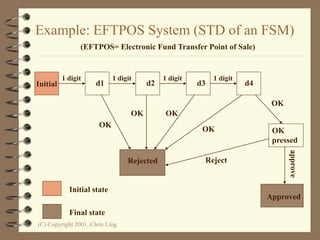
Example: EFTPOS System (STD of an FSM)
Initial
1 digit 1 digit 1 digit 1 digit
d1 d2 d3 d4
OK
OK
pressed
Approved
Rejected
OK
OK
OK
OK
Initial state
Final state
Reject
(EFTPOS= Electronic Fund Transfer Point of Sale)
(C) Copyright 2001, Chris Ling
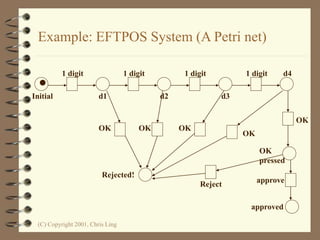
Example: EFTPOS System (A Petri net)
Initial
1 digit 1 digit 1 digit 1 digit
d1 d2 d3
d4
OK
OK
pressed
approve
approved
OK OK OK
OK
Reject
Rejected!
(C) Copyright 2001, Chris Ling
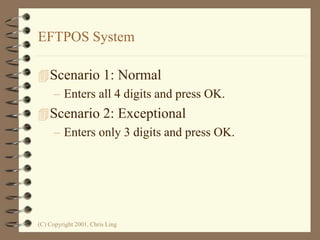
EFTPOS System
Scenario 1: Normal
– Enters all 4 digits and press OK.
Scenario 2: Exceptional
– Enters only 3 digits and press OK.
(C) Copyright 2001, Chris Ling
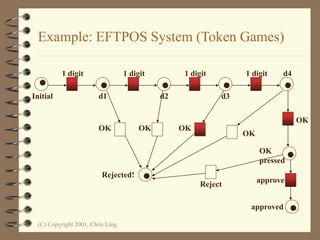
Example: EFTPOS System (Token Games)
Initial
1 digit 1 digit 1 digit 1 digit
d1 d2 d3
d4
OK
OK
pressed
approve
approved
OK OK OK
OK
Reject
Rejected!
(C) Copyright 2001, Chris Ling
A Petri Net Specification ...
consists of three types of components:
places (circles), transitions (rectangles) and
arcs (arrows):
– Places represent possible states of the system;
– Transitions are events or actions which cause
the change of state; And
– Every arc simply connects a place with a
transition or a transition with a place.
(C) Copyright 2001, Chris Ling
A Change of State …
is denoted by a movement of token(s) (black
dots) from place(s) to place(s); and is
caused by the firing of a transition.
The firing represents an occurrence of the
event or an action taken.
The firing is subject to the input conditions,
denoted by token availability.
(C) Copyright 2001, Chris Ling
A Change of State
A transition is firable or enabled when there
are sufficient tokens in its input places.
After firing, tokens will be transferred from
the input places (old state) to the output
places, denoting the new state.
Note that the EFTPOS example is a Petri
net representation of a finite state machine
(FSM).
(C) Copyright 2001, Chris Ling
Example: Vending Machine
The machine dispenses two kinds of snack
bars – 20c and 15c.
Only two types of coins can be used
– 10c coins and 5c coins.
The machine does not return any change.
(C) Copyright 2001, Chris Ling
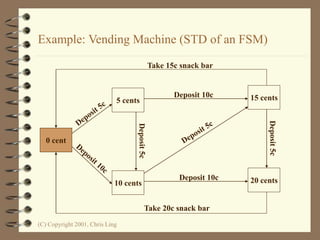
Example: Vending Machine (STD of an FSM)
0 cent
5 cents
10 cents
15 cents
20 cents
Deposit 10c
Deposit 10c
Take 20c snack bar
Take 15c snack bar
(C) Copyright 2001, Chris Ling
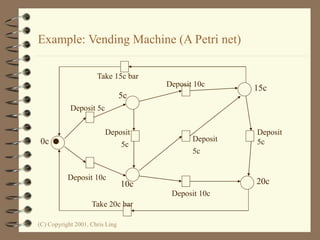
Example: Vending Machine (A Petri net)
5c
Take 15c bar
Deposit 5c
0c
Deposit 10c
Deposit
5c
10c
Deposit 10c
Deposit
5c
Deposit 10c
20c
Deposit
5c
15c
Take 20c bar
(C) Copyright 2001, Chris Ling
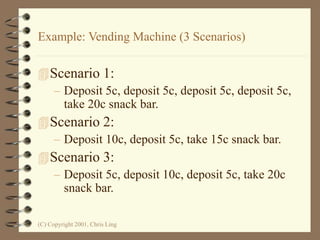
Example: Vending Machine (3 Scenarios)
Scenario 1:
– Deposit 5c, deposit 5c, deposit 5c, deposit 5c,
take 20c snack bar.
Scenario 2:
– Deposit 10c, deposit 5c, take 15c snack bar.
Scenario 3:
– Deposit 5c, deposit 10c, deposit 5c, take 20c
snack bar.
(C) Copyright 2001, Chris Ling
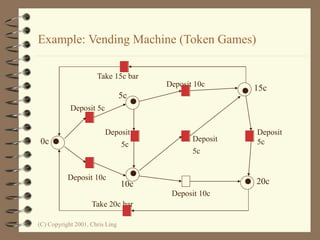
Example: Vending Machine (Token Games)
5c
Take 15c bar
Deposit 5c
0c
Deposit 10c
Deposit
5c
10c
Deposit 10c
Deposit
5c
Deposit 10c
20c
Deposit
5c
15c
Take 20c bar
(C) Copyright 2001, Chris Ling
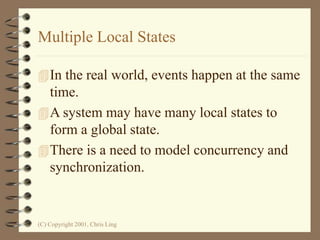
Multiple Local States
In the real world, events happen at the same
time.
A system may have many local states to
form a global state.
There is a need to model concurrency and
synchronization.
(C) Copyright 2001, Chris Ling
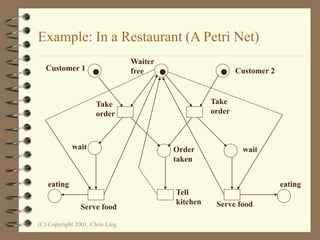
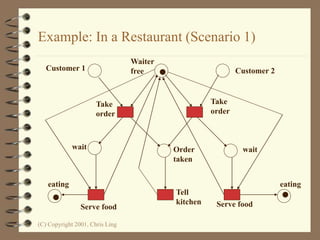
Example: In a Restaurant (A Petri Net)
Waiter
free
Customer 1 Customer 2
Take
order
Take
order
Order
taken
Tell
kitchen
wait wait
Serve food Serve food
eating eating
(C) Copyright 2001, Chris Ling
Example: In a Restaurant (Two Scenarios)
Scenario 1:
– Waiter takes order from customer 1; serves
customer 1; takes order from customer 2; serves
customer 2.
Scenario 2:
– Waiter takes order from customer 1; takes order
from customer 2; serves customer 2; serves
customer 1.
(C) Copyright 2001, Chris Ling
Example: In a Restaurant (Scenario 1)
Waiter
free
Customer 1 Customer 2
Take
order
Take
order
Order
taken
Tell
kitchen
wait wait
Serve food Serve food
eating eating
(C) Copyright 2001, Chris Ling
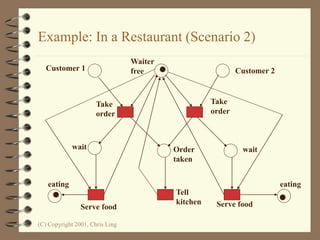
Example: In a Restaurant (Scenario 2)
Waiter
free
Customer 1 Customer 2
Take
order
Take
order
Order
taken
Tell
kitchen
wait wait
Serve food Serve food
eating eating
(C) Copyright 2001, Chris Ling
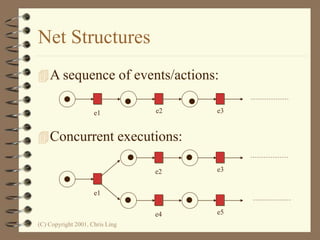
Net Structures
A sequence of events/actions:
Concurrent executions:
e1 e2 e3
e1
e2 e3
e4 e5
(C) Copyright 2001, Chris Ling
Net Structures
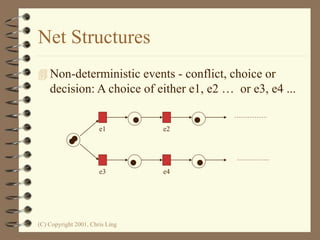
 Non-deterministic events - conflict, choice or
decision: A choice of either e1, e2 … or e3, e4 ...
e1 e2
e3 e4
(C) Copyright 2001, Chris Ling
Net Structures
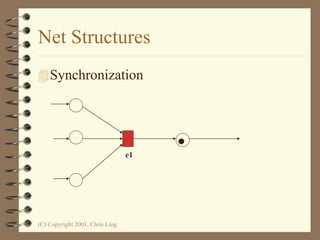
Synchronization
e1
(C) Copyright 2001, Chris Ling
Net Structures
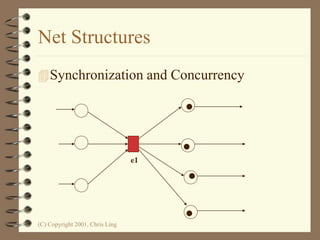
Synchronization and Concurrency
e1
(C) Copyright 2001, Chris Ling
Another Example
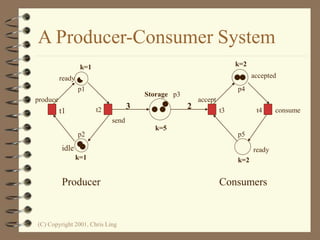
• A producer-consumer system, consist of one
producer, two consumers and one storage buffer
with the following conditions:
• The storage buffer may contain at most 5 items;
• The producer sends 3 items in each production;
• At most one consumer is able to access the storage
buffer at one time;
• Each consumer removes two items when accessing the
storage buffer
(C) Copyright 2001, Chris Ling
A Producer-Consumer System
ready
p1
t1
produce
idle
send
p2
t2
k=1
k=1
k=5
Storage p3
3 2 t3 t4
p4
p5
k=2
k=2
accept
accepted
consume
ready
Producer Consumers
(C) Copyright 2001, Chris Ling
A Producer-Consumer Example
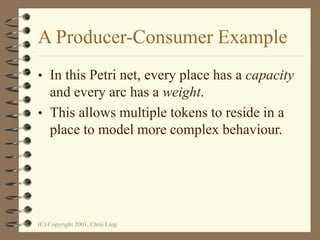
• In this Petri net, every place has a capacity
and every arc has a weight.
• This allows multiple tokens to reside in a
place to model more complex behaviour.
(C) Copyright 2001, Chris Ling
Behavioural Properties
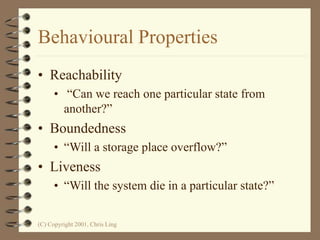
• Reachability
• “Can we reach one particular state from
another?”
• Boundedness
• “Will a storage place overflow?”
• Liveness
• “Will the system die in a particular state?”
(C) Copyright 2001, Chris Ling
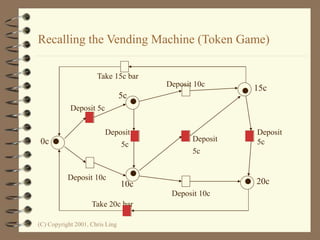
Recalling the Vending Machine (Token Game)
5c
Take 15c bar
Deposit 5c
0c
Deposit 10c
Deposit
5c
10c
Deposit 10c
Deposit
5c
Deposit 10c
20c
Deposit
5c
15c
Take 20c bar
(C) Copyright 2001, Chris Ling
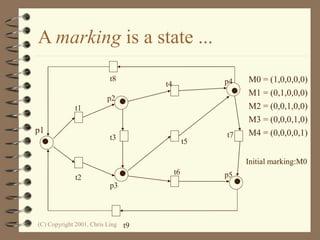
A marking is a state ...
t8
t1
p1
t2
p2
t3
p3
t4
t5
t6 p5
t7
p4
t9
M0 = (1,0,0,0,0)
M1 = (0,1,0,0,0)
M2 = (0,0,1,0,0)
M3 = (0,0,0,1,0)
M4 = (0,0,0,0,1)
Initial marking:M0
(C) Copyright 2001, Chris Ling
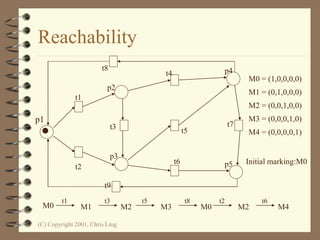
Reachability
t8
t1
p1
t2
p2
t3
p3
t4
t5
t6 p5
t7
p4
t9
Initial marking:M0
M0 M1 M2 M3 M0 M2 M4
t3
t1 t5 t8 t2 t6
M0 = (1,0,0,0,0)
M1 = (0,1,0,0,0)
M2 = (0,0,1,0,0)
M3 = (0,0,0,1,0)
M4 = (0,0,0,0,1)
(C) Copyright 2001, Chris Ling
Reachability
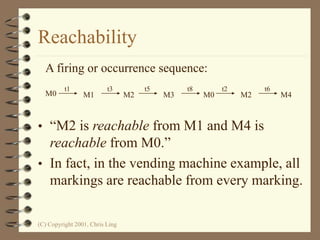
• “M2 is reachable from M1 and M4 is
reachable from M0.”
• In fact, in the vending machine example, all
markings are reachable from every marking.
M0 M1 M2 M3 M0 M2 M4
t3
t1 t5 t8 t2 t6
A firing or occurrence sequence:
(C) Copyright 2001, Chris Ling
Boundedness
• A Petri net is said to be k-bounded or
simply bounded if the number of tokens in
each place does not exceed a finite number
k for any marking reachable from M0.
• The Petri net for vending machine is 1-
bounded.
• A 1-bounded Petri net is also safe.
(C) Copyright 2001, Chris Ling
Liveness
• A Petri net with initial marking M0 is live
if, no matter what marking has been reached
from M0, it is possible to ultimately fire any
transition by progressing through some
further firing sequence.
• A live Petri net guarantees deadlock-free
operation, no matter what firing sequence is
chosen.
(C) Copyright 2001, Chris Ling
Liveness
• The vending machine is live and the
producer-consumer system is also live.
• A transition is dead if it can never be fired
in any firing sequence.
(C) Copyright 2001, Chris Ling
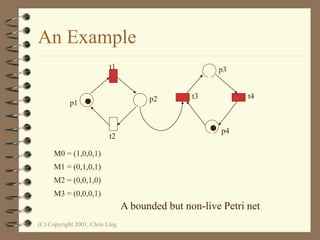
An Example
A bounded but non-live Petri net
p1 p2
p3
p4
t1
t2
t3 t4
M0 = (1,0,0,1)
M1 = (0,1,0,1)
M2 = (0,0,1,0)
M3 = (0,0,0,1)
(C) Copyright 2001, Chris Ling
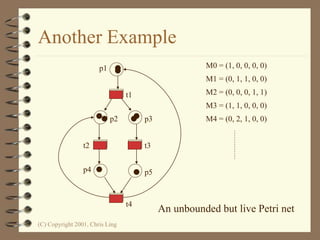
Another Example
p1
t1
p2 p3
t2 t3
p4 p5
t4
An unbounded but live Petri net
M0 = (1, 0, 0, 0, 0)
M1 = (0, 1, 1, 0, 0)
M2 = (0, 0, 0, 1, 1)
M3 = (1, 1, 0, 0, 0)
M4 = (0, 2, 1, 0, 0)
(C) Copyright 2001, Chris Ling
Analysis Methods
• Reachability Analysis:
• Reachability or coverability tree.
• State explosion problem.
• Incidence Matrix and State Equations.
• Structural Analysis
• Based on net structures.
(C) Copyright 2001, Chris Ling
Other Types of Petri Nets
• High-level Petri nets
• Tokens have “colours”, holding complex
information.
• Timed Petri nets
• Time delays associated with transitions and/or
places.
• Fixed delays or interval delays.
• Stochastic Petri nets: exponentially distributed
random variables as delays.
(C) Copyright 2001, Chris Ling
Other Types of Petri Nets
• Object-Oriented Petri nets
• Tokens are instances of classes, moving from
one place to another, calling methods and
changing attributes.
• Net structure models the inner behaviour of
objects.
• The purpose is to use object-oriented constructs
to structure and build the system.
(C) Copyright 2001, Chris Ling
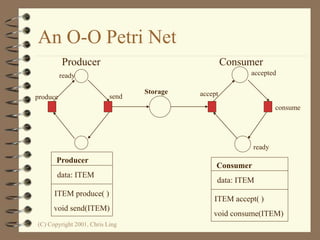
An O-O Petri Net
ready
produce
Storage
accepted
consume
ready
Producer Consumer
send accept
Producer
data: ITEM
ITEM produce( )
void send(ITEM)
Consumer
data: ITEM
ITEM accept( )
void consume(ITEM)
(C) Copyright 2001, Chris Ling
Petri Net References
 Murata, T. (1989, April). Petri nets: properties, analysis
and applications. Proceedings of the IEEE, 77(4), 541-80.
 Peterson, J.L. (1981). Petri Net Theory and the Modeling
of Systems. Prentice-Hall.
 Reisig, W and G. Rozenberg (eds) (1998). Lectures on
Petri Nets 1: Basic Models. Springer-Verlag.
 The World of Petri nets:
http://www.daimi.au.dk/PetriNets/

petri.ppt

  • 1.
    The Petri NetMethod By Dr Chris Ling School of Computer Science & Software Engineering Monash University Chris.Ling@csse.monash.edu.au
  • 2.
    (C) Copyright 2001,Chris Ling Introduction First introduced by Carl Adam Petri in 1962. A diagrammatic tool to model concurrency and synchronization in distributed systems. Very similar to State Transition Diagrams. Used as a visual communication aid to model the system behaviour. Based on strong mathematical foundation.
  • 3.
    (C) Copyright 2001,Chris Ling Example: EFTPOS System (STD of an FSM) Initial 1 digit 1 digit 1 digit 1 digit d1 d2 d3 d4 OK OK pressed Approved Rejected OK OK OK OK Initial state Final state Reject (EFTPOS= Electronic Fund Transfer Point of Sale)
  • 4.
    (C) Copyright 2001,Chris Ling Example: EFTPOS System (A Petri net) Initial 1 digit 1 digit 1 digit 1 digit d1 d2 d3 d4 OK OK pressed approve approved OK OK OK OK Reject Rejected!
  • 5.
    (C) Copyright 2001,Chris Ling EFTPOS System Scenario 1: Normal – Enters all 4 digits and press OK. Scenario 2: Exceptional – Enters only 3 digits and press OK.
  • 6.
    (C) Copyright 2001,Chris Ling Example: EFTPOS System (Token Games) Initial 1 digit 1 digit 1 digit 1 digit d1 d2 d3 d4 OK OK pressed approve approved OK OK OK OK Reject Rejected!
  • 7.
    (C) Copyright 2001,Chris Ling A Petri Net Specification ... consists of three types of components: places (circles), transitions (rectangles) and arcs (arrows): – Places represent possible states of the system; – Transitions are events or actions which cause the change of state; And – Every arc simply connects a place with a transition or a transition with a place.
  • 8.
    (C) Copyright 2001,Chris Ling A Change of State … is denoted by a movement of token(s) (black dots) from place(s) to place(s); and is caused by the firing of a transition. The firing represents an occurrence of the event or an action taken. The firing is subject to the input conditions, denoted by token availability.
  • 9.
    (C) Copyright 2001,Chris Ling A Change of State A transition is firable or enabled when there are sufficient tokens in its input places. After firing, tokens will be transferred from the input places (old state) to the output places, denoting the new state. Note that the EFTPOS example is a Petri net representation of a finite state machine (FSM).
  • 10.
    (C) Copyright 2001,Chris Ling Example: Vending Machine The machine dispenses two kinds of snack bars – 20c and 15c. Only two types of coins can be used – 10c coins and 5c coins. The machine does not return any change.
  • 11.
    (C) Copyright 2001,Chris Ling Example: Vending Machine (STD of an FSM) 0 cent 5 cents 10 cents 15 cents 20 cents Deposit 10c Deposit 10c Take 20c snack bar Take 15c snack bar
  • 12.
    (C) Copyright 2001,Chris Ling Example: Vending Machine (A Petri net) 5c Take 15c bar Deposit 5c 0c Deposit 10c Deposit 5c 10c Deposit 10c Deposit 5c Deposit 10c 20c Deposit 5c 15c Take 20c bar
  • 13.
    (C) Copyright 2001,Chris Ling Example: Vending Machine (3 Scenarios) Scenario 1: – Deposit 5c, deposit 5c, deposit 5c, deposit 5c, take 20c snack bar. Scenario 2: – Deposit 10c, deposit 5c, take 15c snack bar. Scenario 3: – Deposit 5c, deposit 10c, deposit 5c, take 20c snack bar.
  • 14.
    (C) Copyright 2001,Chris Ling Example: Vending Machine (Token Games) 5c Take 15c bar Deposit 5c 0c Deposit 10c Deposit 5c 10c Deposit 10c Deposit 5c Deposit 10c 20c Deposit 5c 15c Take 20c bar
  • 15.
    (C) Copyright 2001,Chris Ling Multiple Local States In the real world, events happen at the same time. A system may have many local states to form a global state. There is a need to model concurrency and synchronization.
  • 16.
    (C) Copyright 2001,Chris Ling Example: In a Restaurant (A Petri Net) Waiter free Customer 1 Customer 2 Take order Take order Order taken Tell kitchen wait wait Serve food Serve food eating eating
  • 17.
    (C) Copyright 2001,Chris Ling Example: In a Restaurant (Two Scenarios) Scenario 1: – Waiter takes order from customer 1; serves customer 1; takes order from customer 2; serves customer 2. Scenario 2: – Waiter takes order from customer 1; takes order from customer 2; serves customer 2; serves customer 1.
  • 18.
    (C) Copyright 2001,Chris Ling Example: In a Restaurant (Scenario 1) Waiter free Customer 1 Customer 2 Take order Take order Order taken Tell kitchen wait wait Serve food Serve food eating eating
  • 19.
    (C) Copyright 2001,Chris Ling Example: In a Restaurant (Scenario 2) Waiter free Customer 1 Customer 2 Take order Take order Order taken Tell kitchen wait wait Serve food Serve food eating eating
  • 20.
    (C) Copyright 2001,Chris Ling Net Structures A sequence of events/actions: Concurrent executions: e1 e2 e3 e1 e2 e3 e4 e5
  • 21.
    (C) Copyright 2001,Chris Ling Net Structures  Non-deterministic events - conflict, choice or decision: A choice of either e1, e2 … or e3, e4 ... e1 e2 e3 e4
  • 22.
    (C) Copyright 2001,Chris Ling Net Structures Synchronization e1
  • 23.
    (C) Copyright 2001,Chris Ling Net Structures Synchronization and Concurrency e1
  • 24.
    (C) Copyright 2001,Chris Ling Another Example • A producer-consumer system, consist of one producer, two consumers and one storage buffer with the following conditions: • The storage buffer may contain at most 5 items; • The producer sends 3 items in each production; • At most one consumer is able to access the storage buffer at one time; • Each consumer removes two items when accessing the storage buffer
  • 25.
    (C) Copyright 2001,Chris Ling A Producer-Consumer System ready p1 t1 produce idle send p2 t2 k=1 k=1 k=5 Storage p3 3 2 t3 t4 p4 p5 k=2 k=2 accept accepted consume ready Producer Consumers
  • 26.
    (C) Copyright 2001,Chris Ling A Producer-Consumer Example • In this Petri net, every place has a capacity and every arc has a weight. • This allows multiple tokens to reside in a place to model more complex behaviour.
  • 27.
    (C) Copyright 2001,Chris Ling Behavioural Properties • Reachability • “Can we reach one particular state from another?” • Boundedness • “Will a storage place overflow?” • Liveness • “Will the system die in a particular state?”
  • 28.
    (C) Copyright 2001,Chris Ling Recalling the Vending Machine (Token Game) 5c Take 15c bar Deposit 5c 0c Deposit 10c Deposit 5c 10c Deposit 10c Deposit 5c Deposit 10c 20c Deposit 5c 15c Take 20c bar
  • 29.
    (C) Copyright 2001,Chris Ling A marking is a state ... t8 t1 p1 t2 p2 t3 p3 t4 t5 t6 p5 t7 p4 t9 M0 = (1,0,0,0,0) M1 = (0,1,0,0,0) M2 = (0,0,1,0,0) M3 = (0,0,0,1,0) M4 = (0,0,0,0,1) Initial marking:M0
  • 30.
    (C) Copyright 2001,Chris Ling Reachability t8 t1 p1 t2 p2 t3 p3 t4 t5 t6 p5 t7 p4 t9 Initial marking:M0 M0 M1 M2 M3 M0 M2 M4 t3 t1 t5 t8 t2 t6 M0 = (1,0,0,0,0) M1 = (0,1,0,0,0) M2 = (0,0,1,0,0) M3 = (0,0,0,1,0) M4 = (0,0,0,0,1)
  • 31.
    (C) Copyright 2001,Chris Ling Reachability • “M2 is reachable from M1 and M4 is reachable from M0.” • In fact, in the vending machine example, all markings are reachable from every marking. M0 M1 M2 M3 M0 M2 M4 t3 t1 t5 t8 t2 t6 A firing or occurrence sequence:
  • 32.
    (C) Copyright 2001,Chris Ling Boundedness • A Petri net is said to be k-bounded or simply bounded if the number of tokens in each place does not exceed a finite number k for any marking reachable from M0. • The Petri net for vending machine is 1- bounded. • A 1-bounded Petri net is also safe.
  • 33.
    (C) Copyright 2001,Chris Ling Liveness • A Petri net with initial marking M0 is live if, no matter what marking has been reached from M0, it is possible to ultimately fire any transition by progressing through some further firing sequence. • A live Petri net guarantees deadlock-free operation, no matter what firing sequence is chosen.
  • 34.
    (C) Copyright 2001,Chris Ling Liveness • The vending machine is live and the producer-consumer system is also live. • A transition is dead if it can never be fired in any firing sequence.
  • 35.
    (C) Copyright 2001,Chris Ling An Example A bounded but non-live Petri net p1 p2 p3 p4 t1 t2 t3 t4 M0 = (1,0,0,1) M1 = (0,1,0,1) M2 = (0,0,1,0) M3 = (0,0,0,1)
  • 36.
    (C) Copyright 2001,Chris Ling Another Example p1 t1 p2 p3 t2 t3 p4 p5 t4 An unbounded but live Petri net M0 = (1, 0, 0, 0, 0) M1 = (0, 1, 1, 0, 0) M2 = (0, 0, 0, 1, 1) M3 = (1, 1, 0, 0, 0) M4 = (0, 2, 1, 0, 0)
  • 37.
    (C) Copyright 2001,Chris Ling Analysis Methods • Reachability Analysis: • Reachability or coverability tree. • State explosion problem. • Incidence Matrix and State Equations. • Structural Analysis • Based on net structures.
  • 38.
    (C) Copyright 2001,Chris Ling Other Types of Petri Nets • High-level Petri nets • Tokens have “colours”, holding complex information. • Timed Petri nets • Time delays associated with transitions and/or places. • Fixed delays or interval delays. • Stochastic Petri nets: exponentially distributed random variables as delays.
  • 39.
    (C) Copyright 2001,Chris Ling Other Types of Petri Nets • Object-Oriented Petri nets • Tokens are instances of classes, moving from one place to another, calling methods and changing attributes. • Net structure models the inner behaviour of objects. • The purpose is to use object-oriented constructs to structure and build the system.
  • 40.
    (C) Copyright 2001,Chris Ling An O-O Petri Net ready produce Storage accepted consume ready Producer Consumer send accept Producer data: ITEM ITEM produce( ) void send(ITEM) Consumer data: ITEM ITEM accept( ) void consume(ITEM)
  • 41.
    (C) Copyright 2001,Chris Ling Petri Net References  Murata, T. (1989, April). Petri nets: properties, analysis and applications. Proceedings of the IEEE, 77(4), 541-80.  Peterson, J.L. (1981). Petri Net Theory and the Modeling of Systems. Prentice-Hall.  Reisig, W and G. Rozenberg (eds) (1998). Lectures on Petri Nets 1: Basic Models. Springer-Verlag.  The World of Petri nets: http://www.daimi.au.dk/PetriNets/