“e-Learning Learning Enterprises” (eLLE)
Learning and Teaching Office
Dr. Ainslie Robinson & Vijay Jesuraj
Academic Developer & Senior Lecturer Application Administrator
- LMS
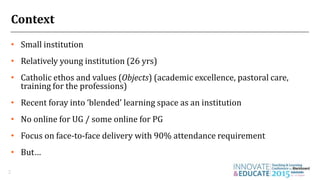
Context
• Small institution
• Relatively young institution (26 yrs)
• Catholic ethos and values (Objects) (academic excellence, pastoral care,
training for the professions)
• Recent foray into ‘blended’ learning space as an institution
• No online for UG / some online for PG
• Focus on face-to-face delivery with 90% attendance requirement
• But…
2
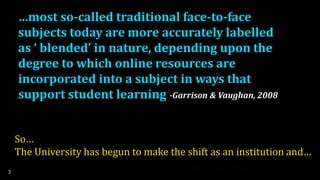
…most so-called traditional face-to-face
subjects today are more accurately labelled
as ‘ blended’ in nature, depending upon the
degree to which online resources are
incorporated into a subject in ways that
support student learning
3
-Garrison & Vaughan, 2008
So…
The University has begun to make the shift as an institution and…
4
To…
Plan, implement and evaluate effective online and blended
learning opportunities for students - Reeves & Reeves, 2012
– Untried teach-nologies for our university may not seem “new” to
other more advanced eLearning spaces but the concept we’re
introducing today allows institutions to find their own level and
therefore could be applied anywhere
– The LMS in this concept is used as a site of Academic Development
and is designed for staff
5
• eLLE is a Bb Organisation (a.k.a. “Community Site”)
• eLLE stands for eLearning Learning Enterprises
• “Enterprises” substituted early for the original term “Experts”
so as not to intimidate creators or viewers of the site offerings
• “Enterprise” defined as “a project or undertaking, typically one
that is difficult or requires effort” or as “the ability or desire to
do difficult things or to solve problems in new ways”
6
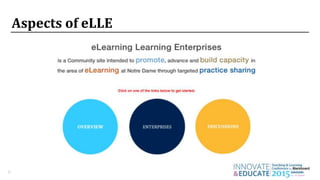
Aspects of eLLE
Innovation
• One small step from “enterprise” to “innovation”
• Innovation = “something new or different introduced”
• eLLE identifies learning challenges that have been solved “in
new ways”, and introduces these solutions in a way that
directly benefits and professionally develops our teaching staff
7
Theoretical Underpinnings
8
…of the eLLE philosophy
Foundational building blocks of all L&T (Hattie, 2009)
• Clarity in explaining content
• High academic challenge
• Time on task
• Timely feedback to students
• Positive teacher-student relationships
9
5 core strategies for blended learning (Reeves, 2012)
• Attend first to fundamentals of L&T keeping pedagogy ahead of technology
(Hattie 2009)
• Maximise alignment of critical components of an effective blended/online
environment
• Establish and maintain cognitive, social and teaching presence in the
blended/online environment
• Intro new technologies selectively seeking help from others (peers, learners
etc.)
• Use formative evaluations to refine the online/blended material
systematically each iteration
10
Key components of design (Reeves, 2012)
• Unit design should not begin with fancy technologies,
…but with aligned key components of L&T:
• learning objectives
• content
• learning activities
• assessment strategies
…and the design of these together to achieve effective L&T
11
Alignment critical
Alignment is critically required in the components of:
• Objectives
• Content
• Model of instruction
• Learner tasks
• Teacher roles
• Technology roles
• Assessment
12
Communities of Practice
• Etienne Wenger (2007)
• 3 distinguishing elements of COP:
1. A shared domain of interest/shared competence
2. Members engage in joint activities, discussions, help each other, share
information, build relationships for mutual learning
3. Members are practitioners who develop shared repertoire of resources.
• Characterised by time and sustained interaction
13
Think Global - Act Local
• eLLE positioning
• Small scale innovation – large scale engagement
• Realistic, local purpose/global application, skills development,
opportunity
• Graduate capabilities
• Responsibility to deliver big world view to staff/students
14
eLLE is for our teaching staff a studio space of
small-scale innovation…
15
eLLE showcases local innovation but positions
it in a broader context of global expectations
for graduate competency
16
17
demonstrates that “innovation
need not be system level transformation, but
rather can be small scale initiatives designed to
engage students in relevant and meaningful
learning activities” (Kuhn & Couros, 2012)

e-Learning Learning Enterprises (eLLE): Blackboard Organisations enriching academic development in the blended learning space - Dr. Ainslie Robinson and Vijay Jesuraj, University of Notre Dame | ANZTLC15

  • 1.
    “e-Learning Learning Enterprises”(eLLE) Learning and Teaching Office Dr. Ainslie Robinson & Vijay Jesuraj Academic Developer & Senior Lecturer Application Administrator - LMS
  • 2.
    Context • Small institution •Relatively young institution (26 yrs) • Catholic ethos and values (Objects) (academic excellence, pastoral care, training for the professions) • Recent foray into ‘blended’ learning space as an institution • No online for UG / some online for PG • Focus on face-to-face delivery with 90% attendance requirement • But… 2
  • 3.
    …most so-called traditionalface-to-face subjects today are more accurately labelled as ‘ blended’ in nature, depending upon the degree to which online resources are incorporated into a subject in ways that support student learning 3 -Garrison & Vaughan, 2008 So… The University has begun to make the shift as an institution and…
  • 4.
    4 To… Plan, implement andevaluate effective online and blended learning opportunities for students - Reeves & Reeves, 2012 – Untried teach-nologies for our university may not seem “new” to other more advanced eLearning spaces but the concept we’re introducing today allows institutions to find their own level and therefore could be applied anywhere – The LMS in this concept is used as a site of Academic Development and is designed for staff
  • 5.
    5 • eLLE isa Bb Organisation (a.k.a. “Community Site”) • eLLE stands for eLearning Learning Enterprises • “Enterprises” substituted early for the original term “Experts” so as not to intimidate creators or viewers of the site offerings • “Enterprise” defined as “a project or undertaking, typically one that is difficult or requires effort” or as “the ability or desire to do difficult things or to solve problems in new ways”
  • 6.
  • 7.
    Innovation • One smallstep from “enterprise” to “innovation” • Innovation = “something new or different introduced” • eLLE identifies learning challenges that have been solved “in new ways”, and introduces these solutions in a way that directly benefits and professionally develops our teaching staff 7
  • 8.
  • 9.
    Foundational building blocksof all L&T (Hattie, 2009) • Clarity in explaining content • High academic challenge • Time on task • Timely feedback to students • Positive teacher-student relationships 9
  • 10.
    5 core strategiesfor blended learning (Reeves, 2012) • Attend first to fundamentals of L&T keeping pedagogy ahead of technology (Hattie 2009) • Maximise alignment of critical components of an effective blended/online environment • Establish and maintain cognitive, social and teaching presence in the blended/online environment • Intro new technologies selectively seeking help from others (peers, learners etc.) • Use formative evaluations to refine the online/blended material systematically each iteration 10
  • 11.
    Key components ofdesign (Reeves, 2012) • Unit design should not begin with fancy technologies, …but with aligned key components of L&T: • learning objectives • content • learning activities • assessment strategies …and the design of these together to achieve effective L&T 11
  • 12.
    Alignment critical Alignment iscritically required in the components of: • Objectives • Content • Model of instruction • Learner tasks • Teacher roles • Technology roles • Assessment 12
  • 13.
    Communities of Practice •Etienne Wenger (2007) • 3 distinguishing elements of COP: 1. A shared domain of interest/shared competence 2. Members engage in joint activities, discussions, help each other, share information, build relationships for mutual learning 3. Members are practitioners who develop shared repertoire of resources. • Characterised by time and sustained interaction 13
  • 14.
    Think Global -Act Local • eLLE positioning • Small scale innovation – large scale engagement • Realistic, local purpose/global application, skills development, opportunity • Graduate capabilities • Responsibility to deliver big world view to staff/students 14
  • 15.
    eLLE is forour teaching staff a studio space of small-scale innovation… 15
  • 16.
    eLLE showcases localinnovation but positions it in a broader context of global expectations for graduate competency 16
  • 17.
    17 demonstrates that “innovation neednot be system level transformation, but rather can be small scale initiatives designed to engage students in relevant and meaningful learning activities” (Kuhn & Couros, 2012)

Editor's Notes

  • #6 Introducing Vijay Jesuraj (Bb Application Administrator, Notre Dame) Vijay’s role in creating eLLE with Ainslie Launch eLLE on Blackboard
  • #7 Introducing Vijay Jesuraj (Bb Application Administrator, Notre Dame) Vijay’s role in creating eLLE with Ainslie Launch eLLE on Blackboard