Synthesis
of
PESTICIDES
to KILL
LOCUSTS
Submitted to:
Dr. Samina Aslam
Assistant professor
Deptt of Chemistry
The Women University
Multan.
Submitted by :
Sidra
MP-CHM-04
1ST Semester
Course code: CHM-529
M.Phil. Organic Chemistry
Session: 2020-2022
Content:
1. Introduction to pesticides
2. Types of pesticides
3. Locusts
4. Locusts effects
5. Control of locusts( different chemical treatment)
6. Efficient pesticide synthesis
7. Referene
Pesticides:
Pesticides are the Substances that are used for
lessening or destroying the damages that caused
by the pests( insect , weed, bacteria etc).
It can be a chemical, biological component or
antimicrobial.
All pesticides have their own mode of action,
potency, speed of effect and dose requirements.
Types of Pesticides:
Herbicides:
These are substances used to prevent unwanted plants.
Insecticides:
These are used to prevent from Insects.
Rodenticides:
Theses are used to kill rodents.
Fungicide( to kill fungi).
Bactericide(to kill bacteria).
Molluscicide(to kill molluscs).
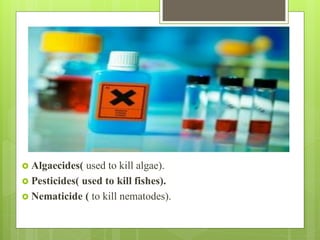
 Algaecides( used to kill algae).
 Pesticides( used to kill fishes).
 Nematicide ( to kill nematodes).
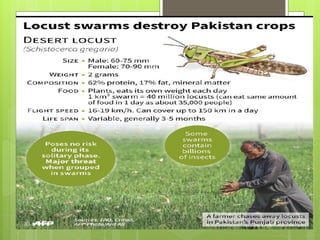
Locusts:
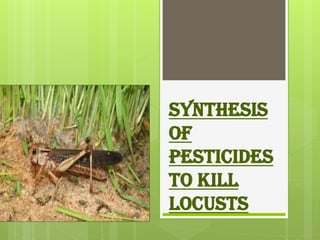
• Locusts are species of short-horned grasshoppers in
the family Acrididae. These insects are usually
solitary, but under certain circumstances become
more abundant and change their behavior and
habits, becoming gregarious.
• Locusts attack at day time during sunlight, hide
themselves during night time.
Locusts facts:
Locusts feed on crops (corn, wheat,
rice, cotton, oats and peanuts), trees
and other plants.
This feeding leads to waste of crops
and plants that cause shortage of
grasses, food and crops for usage of
people and livestock's.
Locusts cause respiratory problems in
animals and cause allergies in human.
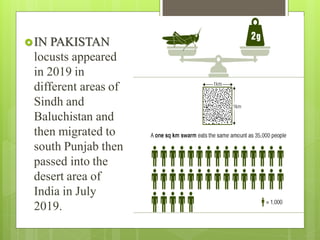
IN PAKISTAN
locusts appeared
in 2019 in
different areas of
Sindh and
Baluchistan and
then migrated to
south Punjab then
passed into the
desert area of
India in July
2019.
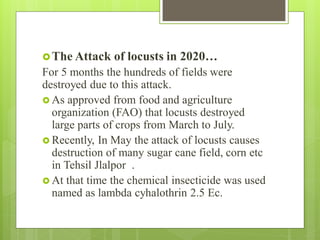
The Attack of locusts in 2020…
For 5 months the hundreds of fields were
destroyed due to this attack.
 As approved from food and agriculture
organization (FAO) that locusts destroyed
large parts of crops from March to July.
 Recently, In May the attack of locusts causes
destruction of many sugar cane field, corn etc
in Tehsil Jlalpor .
 At that time the chemical insecticide was used
named as lambda cyhalothrin 2.5 Ec.
CONTROL OF
LOCUSTS BY
PESTICIDES
To kill locusts…
There are four classes of pesticides including
insecticides, that are
 Organochlorine
 Organo phosphate
 Carbamate
 Pyrethroids
Of these Organo chloride are more persistent.
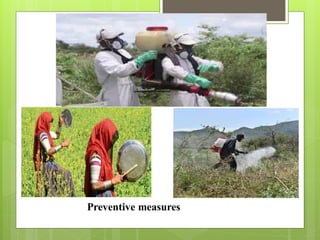
Preventive measures
Pesticides including
insecticides:
• Dichlorvos
• Fipronil
• Malathion
• Dieldrin
• Talster P
• Chlorpyrifos
• HCN
Dieldrin used as pesticide:
 Aldrin and dieldrin are the insecticides that contact stomach
and inhalation poisons. Aldrin converted to dieldrin which
was considered the most effective to kill pests like locusts.
Both Aldrin and Dieldrin have same chemical structure used
by Africa in1950 to 1960.
 If sprayed on 1000 acres of infected land, within 15 minutes
billion of locusts was destroyed to protect thousand of tons of
crops. It causes no effects on animals and humans by eating
flesh and drinking milk.
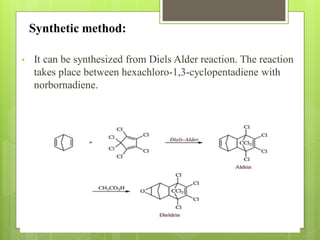
Synthetic method:
• It can be synthesized from Diels Alder reaction. The reaction
takes place between hexachloro-1,3-cyclopentadiene with
norbornadiene.
Dieldrin was suppressed…
 Environmental Defense Fund in1970 declared that
dieldrin was long lived in the environment and
cause carcinogenic issues in humans.

 It cause dizziness, headache and gastrointestinal
and environmental problems.
 In 1974, the use of dieldrin was completely
banned.
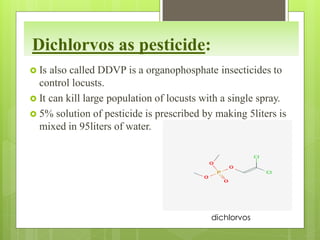
Dichlorvos as pesticide:
 Is also called DDVP is a organophosphate insecticides to
control locusts.
 It can kill large population of locusts with a single spray.
 5% solution of pesticide is prescribed by making 5liters is
mixed in 95liters of water.
dichlorvos
DDVP BANNED…
 Dichlorvos was banned in 31 December 2020 due
to side effects in human.
 It is highly toxic, cancer causing and having
potential to damage human nervous system.
 India ordered in august 2018 , and complete ban in
december31, 2020.
Fipronil as pesticide:
 It is a phenyl pyrazole, a new pesticide to kill
locusts.
 It acts on insect nervous system.
 It is highly active agent against locusts.
 Only low dose of fipronil is required to kill large
infested area and leave 95% land uncontaminated.
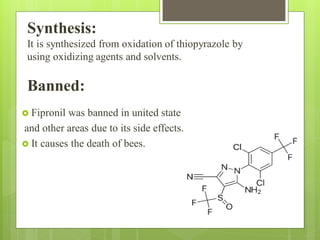
Synthesis:
It is synthesized from oxidation of thiopyrazole by
using oxidizing agents and solvents.
Banned:
 Fipronil was banned in united state
and other areas due to its side effects.
 It causes the death of bees.
Malathione 96:
 It is cocidered the most effective against locusts .
 It is organophosphate insecticide.
Synthesis:
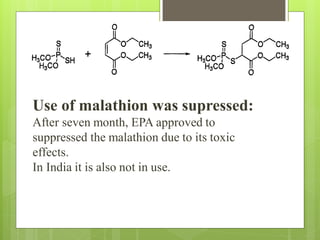
 Malathion is produced by addition
dimethyldithiophsphoric DMDP acid to diethyl maleate
or diethyle fumarate.this compound is in chair form.
Use of malathion was supressed:
After seven month, EPA approved to
suppressed the malathion due to its toxic
effects.
In India it is also not in use.
Effective pesticide
to kill locusts…
Botanical pesticides
 Food and Agriculture organization of United Nationshas been
develop a bio pesticide based on fugus Metarhizium acridium.
The commercial name of this pesticide is Green Muscle.
But this pesticide has several shortcomings.
 Recently the plant oils used as natural pesticides to kill
locusts.This pesticide is not harmful than other chemical
pesticides. This botanical pesticide is synthesized by green
synthesis, so it is environment friendly.
 This botanical pesticide is strong agent to kill desert and as
well migratory locusts.
 Within 24h this formulation cause destruction of 80 to 100%
population of locusts.
 A novel pesticide was prepared by mixture of three
oils that is very effective to kill 2 species
gregarious locusts.
 Firstly coating of locusts with oil that is quite
difficult to remove huge population of locusts.
Synthetic method
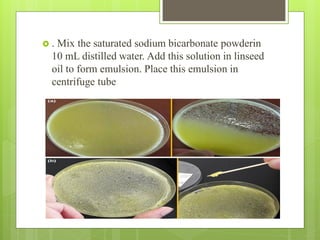
 . Mix the saturated sodium bicarbonate powderin
10 mL distilled water. Add this solution in linseed
oil to form emulsion. Place this emulsion in
centrifuge tube
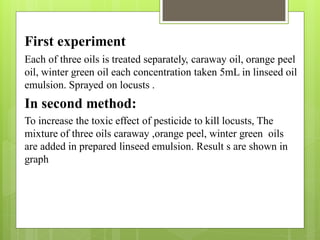
Each of three oils is treated separately, caraway oil, orange peel
oil, winter green oil each concentration taken 5mL in linseed oil
emulsion. Sprayed on locusts .
In second method:
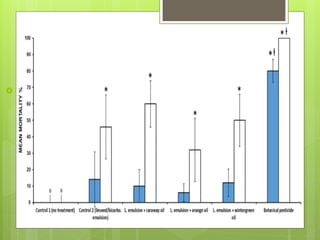
To increase the toxic effect of pesticide to kill locusts, The
mixture of three oils caraway ,orange peel, winter green oils
are added in prepared linseed emulsion. Result s are shown in
graph
First experiment
Conclusion:
Each oil( caraway. Orange peel, winter green oils)
is separately used to treat locusts. But the results
was not efficient as compared to use the mixture of
oils in a single spray. Due to environment friendly
nature and great efficacy this method was
considered the best of all using green synthesis
method. Recently this spray is used to kill two
classes of Gregoria and defend 80 to 100% infested
land. The mortality rate of mixture treatment is
efficient than separate oil treatment, clear from
graph.

7.Reference:
 US9029564B2
 www.nzdl.org
 Pubmed.ncbi.nlm.nih.gov
 www.thethirdpole.net
 US8507693B2
 www.abc.net.au
 India.mongabay.com
 Link.springer.com
 Journal of pest science 93,341-353(2020)
Any Question?

Pesticide to kill locusts

  • 2.
  • 3.
    Submitted to: Dr. SaminaAslam Assistant professor Deptt of Chemistry The Women University Multan. Submitted by : Sidra MP-CHM-04 1ST Semester Course code: CHM-529 M.Phil. Organic Chemistry Session: 2020-2022
  • 5.
    Content: 1. Introduction topesticides 2. Types of pesticides 3. Locusts 4. Locusts effects 5. Control of locusts( different chemical treatment) 6. Efficient pesticide synthesis 7. Referene
  • 6.
    Pesticides: Pesticides are theSubstances that are used for lessening or destroying the damages that caused by the pests( insect , weed, bacteria etc). It can be a chemical, biological component or antimicrobial. All pesticides have their own mode of action, potency, speed of effect and dose requirements.
  • 7.
    Types of Pesticides: Herbicides: Theseare substances used to prevent unwanted plants. Insecticides: These are used to prevent from Insects. Rodenticides: Theses are used to kill rodents. Fungicide( to kill fungi). Bactericide(to kill bacteria). Molluscicide(to kill molluscs).
  • 8.
     Algaecides( usedto kill algae).  Pesticides( used to kill fishes).  Nematicide ( to kill nematodes).
  • 9.
    Locusts: • Locusts arespecies of short-horned grasshoppers in the family Acrididae. These insects are usually solitary, but under certain circumstances become more abundant and change their behavior and habits, becoming gregarious. • Locusts attack at day time during sunlight, hide themselves during night time.
  • 10.
    Locusts facts: Locusts feedon crops (corn, wheat, rice, cotton, oats and peanuts), trees and other plants. This feeding leads to waste of crops and plants that cause shortage of grasses, food and crops for usage of people and livestock's. Locusts cause respiratory problems in animals and cause allergies in human.
  • 11.
    IN PAKISTAN locusts appeared in2019 in different areas of Sindh and Baluchistan and then migrated to south Punjab then passed into the desert area of India in July 2019.
  • 12.
    The Attack oflocusts in 2020… For 5 months the hundreds of fields were destroyed due to this attack.  As approved from food and agriculture organization (FAO) that locusts destroyed large parts of crops from March to July.  Recently, In May the attack of locusts causes destruction of many sugar cane field, corn etc in Tehsil Jlalpor .  At that time the chemical insecticide was used named as lambda cyhalothrin 2.5 Ec.
  • 15.
  • 16.
    To kill locusts… Thereare four classes of pesticides including insecticides, that are  Organochlorine  Organo phosphate  Carbamate  Pyrethroids Of these Organo chloride are more persistent.
  • 17.
  • 18.
    Pesticides including insecticides: • Dichlorvos •Fipronil • Malathion • Dieldrin • Talster P • Chlorpyrifos • HCN
  • 19.
    Dieldrin used aspesticide:  Aldrin and dieldrin are the insecticides that contact stomach and inhalation poisons. Aldrin converted to dieldrin which was considered the most effective to kill pests like locusts. Both Aldrin and Dieldrin have same chemical structure used by Africa in1950 to 1960.  If sprayed on 1000 acres of infected land, within 15 minutes billion of locusts was destroyed to protect thousand of tons of crops. It causes no effects on animals and humans by eating flesh and drinking milk.
  • 20.
    Synthetic method: • Itcan be synthesized from Diels Alder reaction. The reaction takes place between hexachloro-1,3-cyclopentadiene with norbornadiene.
  • 21.
    Dieldrin was suppressed… Environmental Defense Fund in1970 declared that dieldrin was long lived in the environment and cause carcinogenic issues in humans.  It cause dizziness, headache and gastrointestinal and environmental problems.  In 1974, the use of dieldrin was completely banned.
  • 22.
    Dichlorvos as pesticide: Is also called DDVP is a organophosphate insecticides to control locusts.  It can kill large population of locusts with a single spray.  5% solution of pesticide is prescribed by making 5liters is mixed in 95liters of water. dichlorvos
  • 23.
    DDVP BANNED…  Dichlorvoswas banned in 31 December 2020 due to side effects in human.  It is highly toxic, cancer causing and having potential to damage human nervous system.  India ordered in august 2018 , and complete ban in december31, 2020.
  • 24.
    Fipronil as pesticide: It is a phenyl pyrazole, a new pesticide to kill locusts.  It acts on insect nervous system.  It is highly active agent against locusts.  Only low dose of fipronil is required to kill large infested area and leave 95% land uncontaminated.
  • 25.
    Synthesis: It is synthesizedfrom oxidation of thiopyrazole by using oxidizing agents and solvents. Banned:  Fipronil was banned in united state and other areas due to its side effects.  It causes the death of bees.
  • 26.
    Malathione 96:  Itis cocidered the most effective against locusts .  It is organophosphate insecticide. Synthesis:  Malathion is produced by addition dimethyldithiophsphoric DMDP acid to diethyl maleate or diethyle fumarate.this compound is in chair form.
  • 27.
    Use of malathionwas supressed: After seven month, EPA approved to suppressed the malathion due to its toxic effects. In India it is also not in use.
  • 28.
  • 29.
    Botanical pesticides  Foodand Agriculture organization of United Nationshas been develop a bio pesticide based on fugus Metarhizium acridium. The commercial name of this pesticide is Green Muscle. But this pesticide has several shortcomings.  Recently the plant oils used as natural pesticides to kill locusts.This pesticide is not harmful than other chemical pesticides. This botanical pesticide is synthesized by green synthesis, so it is environment friendly.  This botanical pesticide is strong agent to kill desert and as well migratory locusts.  Within 24h this formulation cause destruction of 80 to 100% population of locusts.
  • 30.
     A novelpesticide was prepared by mixture of three oils that is very effective to kill 2 species gregarious locusts.  Firstly coating of locusts with oil that is quite difficult to remove huge population of locusts. Synthetic method
  • 31.
     . Mixthe saturated sodium bicarbonate powderin 10 mL distilled water. Add this solution in linseed oil to form emulsion. Place this emulsion in centrifuge tube
  • 32.
    Each of threeoils is treated separately, caraway oil, orange peel oil, winter green oil each concentration taken 5mL in linseed oil emulsion. Sprayed on locusts . In second method: To increase the toxic effect of pesticide to kill locusts, The mixture of three oils caraway ,orange peel, winter green oils are added in prepared linseed emulsion. Result s are shown in graph First experiment
  • 33.
    Conclusion: Each oil( caraway.Orange peel, winter green oils) is separately used to treat locusts. But the results was not efficient as compared to use the mixture of oils in a single spray. Due to environment friendly nature and great efficacy this method was considered the best of all using green synthesis method. Recently this spray is used to kill two classes of Gregoria and defend 80 to 100% infested land. The mortality rate of mixture treatment is efficient than separate oil treatment, clear from graph.
  • 34.
  • 35.
    7.Reference:  US9029564B2  www.nzdl.org Pubmed.ncbi.nlm.nih.gov  www.thethirdpole.net  US8507693B2  www.abc.net.au  India.mongabay.com  Link.springer.com  Journal of pest science 93,341-353(2020)
  • 36.