Collections After Compliance
The Changing Landscape
An Experian Perspective
The current financial situation
is a result of many factors, including the actions of both large and small
financial institutions, their consumers and the relationships between
them. As a response, Congress passed the Dodd-Frank Wall Street
Reform and Consumer Protection Act (Dodd-Frank), producing the most
reform to financial regulation since the Great Depression, and with it a
new regulatory body was formed. The Consumer Financial Protection
Bureau (CFPB) was created to administer rulings protecting consumer
interests from abusive financial services practices. Since then came
an increasing awareness and accountability of financial institutions to
operate responsibly in dealing with collections.
2 | Like what you’re reading? Visit experian.com/insights or call us at 1 888 414 1120.
In addition to large financial institutions, in January
2013 the CFPB began supervision and enforcement over
several non-banking industries, including debt collection,
consumer reporting and payday lending markets (about
175 debt collectors and buyers) accounting for more than
60 percent of the annual receipts in the consumer debt
collection market. From November 2013 to February
2014, the CFPB’s supervisory activities resulted in more
than $70 million in remediation to approximately 775,000
consumers.1
Though the CFPB began to accept debt
collections complaints in June 2013, it only began to add
such complaints to its Consumer Complaint Database in
November 2013.
The percentage of consumers in collections has increased
over the past 10 years at a relatively constant rate of 14
percent over the past four years.2
Moreover, nearly one
out of every 10 Americans, about 30 million consumers,
has at least one debt in collections averaging $1,500.3
Though repaying debt is an assumed obligation and most
debt collectors are conducting their work properly, it is
inevitable to have complaints just given the sheer volume
of debt holders. Debt collection complaints to the CFPB
are increasing, with consumers citing continued attempts
to collect debt not owed, communication tactics, improper
contact or sharing of information, false statements or
representation, and taking/threatening illegal action.
It is clear that these complaints are a priority and a focus
for the CFPB based on many of its recent rulings falling
under what is Unfair, Deceptive and Abusive Acts or
Practices (UDAAP). Violations ranged from deceptive
marketing tactics including unfair telemarketing acts to
deceptive and unfair practices such as promoting features
unavailable to customers, charging fees not clearly
disclosed, misrepresentation of cost and coverage of
add-on products, and unfairly billing for products.
In addition, a financial institution is potentially liable
and subject to penalties and fines for the conduct of its
service providers relating to consumer financial products
or services if the CFPB believes them to be unlawful.
With increasing scrutiny on the financial services industry
and ever-changing data, compliance for the collection
industry with the growing number of regulations and new
regulators should not only be a top priority for financial
institutions, but also a part of their standard operating
procedures carried across the Customer Life Cycle.
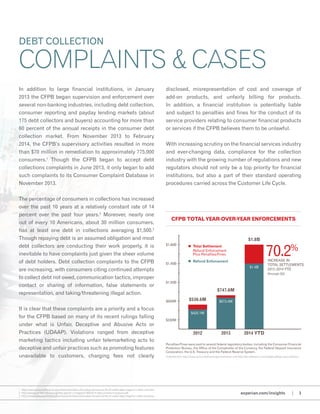
DEBT COLLECTION
COMPLAINTS & CASES
2012 2013 2014 YTD
$536.6M
$425.1M
$673.4M
$1.4B
$747.6M
$1.8B
Penalties/Fines were paid to several federal regulatory bodies, including the Consumer Financial
Protection Bureau, the Office of the Comptroller of the Currency, the Federal Deposit Insurance
Corporation, the U.S. Treasury and the Federal Reserve System.
$200M
$600M
$1.00B
$1.40B
$1.80B n 	Total Settlement
	 Refund Enforcement
	 Plus Penalties/Fines
n	 Refund Enforcement
70.2%
Increase in
Total Settlements
2012–2014 YTD
(through Q2)
CFPB Total Year-over-year Enforcements
experian.com/insights | 3
1 http://www.consumerfinance.gov/newsroom/steve-antonakes-remarks-at-life-of-a-debt-data-integrity-in-debt-collection
2 http://www.acainternational.org/files.aspx?p=/images/31369/0314-cfpb-complaint-analysis.pdf
3 http://www.consumerfinance.gov/newsroom/steve-antonakes-remarks-at-life-of-a-debt-data-integrity-in-debt-collection
Collected from http://www.consumerfinance.gov/newsroom and http://dev.webrecon.com/category/fdcpa-case-statistics
The Dynamic Nature of Data
Consumer data is both always changing and
growing, and people are becoming even more
difficult to track. Collectors need certain safeguards
in place to ensure regulatory compliance with
the accuracy, security and delivery of their data.
Consumer information noted on an annual basis.
4 | experian.com/insights
4M
Births
4
U.S. Vital Statistics
2.5M
deaths
5
4M
marriages
6
4,5,6,7 http://www.cdc.gov/nchs/fastats/default.htm
“All of us have a stake in ensuring
the integrity of information
that’s used in the debt collection process.
It’s fundamental to fairness and transparency
that consumers are able to trust the information
they receive from collectors and to make decisions
that are in their best interests. But the nature of
information is that it’s a systemic responsibility.
Multiple market participants create, communicate,
update, and use common sets of information
or even shared information systems in their roles
in the debt collection process. So each of us
has a role to play in formulating solutions —
whether they are technologies,
record-keeping practices, data standards,
or designing new systems, disclosures, or rules.”
Steve Antonakes
Deputy Director and Associate Director
Supervision, Enforcement and Fair Lending
Consumer Financial Protection Bureau
CFPB/FTC Debt Collection Roundtable
“Life of a Debt: Data Integrity in Debt Collection”
Washington, D.C., June 6, 2013
The CFPB’s Consumer Complaint Database also raises
concerns on the accuracy of data. Economic challenges
and strict lending practices have cultivated more
educated, empowered and financially aware consumers.
They want more insight into their credit data and on how
they can improve creditworthiness, further increasing the
demand for accurate credit reports.
To ensure federal consumer financial law is observed, the
CFPB along with the Federal Trade Commission (FTC)
held a round table in June 2013 to evaluate solutions to
overall challenges in the debt collection market. The focus
of this meeting was to address the integrity of the record-
keeping processes and the data used to collect on a debt.
•	 Is the data used to pursue and communicate to
consumers accurate? Original creditors should
provide an adequate amount of information about
the debt being collected or ensure it is available.
Of the total number of complaints, only approximately
20 percent were made against first-party collections.
•	 How much of the information deteriorates as it
is passed along? Third-party debt collectors make
approximately 1 billion contacts with consumers per
year.8
Isitthecorrectconsumer for thecorrectamount?
Debt can become unrecognizable if any fact about the
original debt was not passed down accurately.
•	 Consumers should be able to dispute debts they
find and believe to be incorrect. Debt collectors
may have a duty beyond reporting information to
investigate disputes and provide further information
on their findings.
Regulators appear less likely to accept small subset
data samples, or proxy samples, to satisfy their data
assessments; they are often looking for larger data sets,
from the originating data systems (or systems of record).
It can be said they may take the largest possible data
samples in order to assert credibility and viability of
complex data systems and platforms.
It is critical to capture accurate consumer information, as
well as to implement processes that continually evaluate
the validity of the data. Applying such methods will help
reduce the risk of receiving incomplete or imprecise data
throughout the Customer Life Cycle. The investment
made into quality assurance will maximize targeting and
marketing efforts, ensure effective cross-sell and drive a
higher return of quality consumer data.
Visit experian.com/insights or call us at 1 888 414 1120 | 5
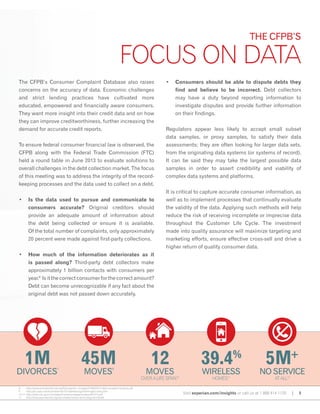
12
moves
OVER A LIFE SPAN10
45M
moves
9
1M
divorces
7
39.4%
wireless
homes11
5M+
no service
at all12
THE CFPB’S
FOCUS ON DATA
8 http://www.acainternational.org/files.aspx?p=/images/31369/0314-cfpb-complaint-analysis.pdf
9 http://pe.usps.com/businessmail101/addressing/checkingaccuracy.htm
10,12 http://www.cdc.gov/nchs/data/nhis/earlyrelease/wireless201312.pdf
11 http://www.pewinternet.org/fact-sheets/mobile-technology-fact-sheet
http://www.consumerfinance.gov/f/201210_cfpb_debt-collection-examination-procedures.pdf
the CFPB’s debt collection
Examination Objectives
•	 To assess the quality of the regulated entity’s
compliance management systems, including its
internal controls and policies and procedures,
for its debt collection business
•	 To identify acts or practices that materially increase
the risk of violations of federal consumer financial
laws in connection with debt collection
•	 To gather facts that help to determine whether
a regulated entity engages in acts or practices
that violate the requirements of federal consumer
financial laws
•	 To determine, in accordance with CFPB internal
consultation requirements, whether a violation of
a federal consumer financial law has occurred and
whether further supervisory or enforcement actions
are appropriate
Benefits of compliance
Aside from not being subject to large monetary
consequences via penalties and fines, taking a
proactive approach toward regulatory compliance has
many other positive effects — most notably, avoiding
punitive damages and public scrutiny. Not only do
regulatory bodies publicly announce any regulatory
violations next to company names, but the CFPB
publishes an online Consumer Complaint Database
(www.consumerfinance.gov/complaintdatabase) and
an annual Consumer Response Report analyzing and
discussing such complaints.
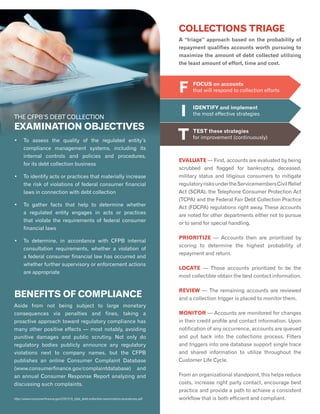
EVALUATE — First, accounts are evaluated by being
scrubbed and flagged for bankruptcy, deceased,
military status and litigious consumers to mitigate
regulatoryrisksundertheServicemembersCivilRelief
Act (SCRA), the Telephone Consumer Protection Act
(TCPA) and the Federal Fair Debt Collection Practice
Act (FDCPA) regulations right away. These accounts
are noted for other departments either not to pursue
or to send for special handling.
PRIORITIZE — Accounts then are prioritized by
scoring to determine the highest probability of
repayment and return.
LOCATE — Those accounts prioritized to be the
most collectible obtain the best contact information.
REVIEW — The remaining accounts are reviewed
and a collection trigger is placed to monitor them.
MONITOR — Accounts are monitored for changes
in their credit profile and contact information. Upon
notification of any occurrence, accounts are queued
and put back into the collections process. Filters
and triggers into one database support single trace
and shared information to utilize throughout the
Customer Life Cycle.
From an organizational standpoint, this helps reduce
costs, increase right party contact, encourage best
practice and provide a path to achieve a consistent
workflow that is both efficient and compliant.
Collections Triage
FOCUS on accounts
that will respond to collection efforts
IDENTIFY and implement
the most effective strategies
TEST these strategies
for improvement (continuously)
F
I
T
A “triage” approach based on the probability of
repayment qualifies accounts worth pursuing to
maximize the amount of debt collected utilizing
the least amount of effort, time and cost.
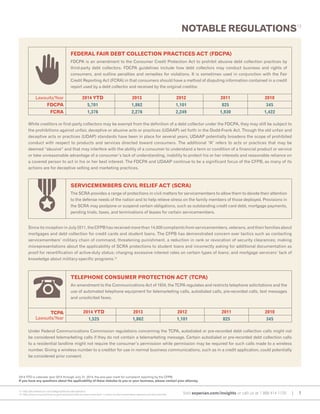
Federal Fair Debt Collection Practices Act (FDCPA)
FDCPA is an amendment to the Consumer Credit Protection Act to prohibit abusive debt collection practices by
third-party debt collectors. FDCPA guidelines include how debt collectors may conduct business and rights of
consumers, and outline penalties and remedies for violations. It is sometimes used in conjunction with the Fair
Credit Reporting Act (FCRA) in that consumers should have a method of disputing information contained in a credit
report used by a debt collector and received by the original creditor.
While creditors or first-party collectors may be exempt from the definition of a debt collector under the FDCPA, they may still be subject to
the prohibitions against unfair, deceptive or abusive acts or practices (UDAAP) set forth in the Dodd-Frank Act. Though the old unfair and
deceptive acts or practices (UDAP) standards have been in place for several years, UDAAP potentially broadens the scope of prohibited
conduct with respect to products and services directed toward consumers. The additional “A” refers to acts or practices that may be
deemed “abusive” and that may interfere with the ability of a consumer to understand a term or condition of a financial product or service
or take unreasonable advantage of a consumer’s lack of understanding, inability to protect his or her interests and reasonable reliance on
a covered person to act in his or her best interest. The FDCPA and UDAAP continue to be a significant focus of the CFPB, as many of its
actions are for deceptive selling and marketing practices.
2014 YTD
5,701
2013
1,862
2012
1,101
2011
825
2010
345
Lawsuits/Year
FDCPA
FCRA 1,376 2,276 2,249 1,930 1,422
notable regulations13
ServiceMembers Civil Relief Act (SCRA)
The SCRA provides a range of protections in civil matters for servicemembers to allow them to devote their attention
to the defense needs of the nation and to help relieve stress on the family members of those deployed. Provisions in
the SCRA may postpone or suspend certain obligations, such as outstanding credit card debt, mortgage payments,
pending trials, taxes, and terminations of leases for certain servicemembers.
Since its inception in July 2011, the CFPB has received more than 14,000 complaints from servicemembers, veterans, and their families about
mortgages and debt collection for credit cards and student loans. The CFPB has demonstrated concern over tactics such as contacting
servicemembers’ military chain of command, threatening punishment, a reduction in rank or revocation of security clearances; making
misrepresentations about the applicability of SCRA protections to student loans and incorrectly asking for additional documentation as
proof for recertification of active-duty status; charging excessive interest rates on certain types of loans; and mortgage servicers’ lack of
knowledge about military-specific programs.14
Telephone Consumer Protection Act (TCPA)
An amendment to the Communications Act of 1934, the TCPA regulates and restricts telephone solicitations and the
use of automated telephone equipment for telemarketing calls, autodialed calls, pre-recorded calls, text messages
and unsolicited faxes.
Under Federal Communications Commission regulations concerning the TCPA, autodialed or pre-recorded debt collection calls might not
be considered telemarketing calls if they do not contain a telemarketing message. Certain autodialed or pre-recorded debt collection calls
to a residential landline might not require the consumer’s permission while permission may be required for such calls made to a wireless
number. Giving a wireless number to a creditor for use in normal business communications, such as in a credit application, could potentially
be considered prior consent.
2014 YTD
1,525
2013
1,862
2012
1,101
2011
825
2010
345
TCPA
Lawsuits/Year
Visit experian.com/insights or call us at 1 888 414 1120 | 7
13 http://dev.webrecon.com/category/fdcpa-case-statistics
14 http://www.consumerfinance.gov/newsroom/cfpb-recovers-more-than-1-million-for-servicemembers-veterans-and-their-families
2014 YTD is calendar year 2014 through July 31, 2014, the one-year mark for complaint reporting by the CFPB.
If you have any questions about the applicability of these statutes to you or your business, please contact your attorney.
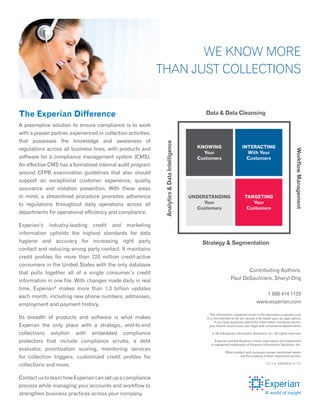
The Experian Difference
A preemptive solution to ensure compliance is to work
with a proven partner, experienced in collection activities,
that possesses the knowledge and awareness of
regulations across all business lines, with products and
software for a compliance management system (CMS).
An effective CMS has a formalized internal audit program
around CFPB examination guidelines that also should
support an exceptional customer experience, quality
assurance and violation prevention. With these areas
in mind, a streamlined procedure promotes adherence
to regulations throughout daily operations across all
departments for operational efficiency and compliance.
Experian’s industry-leading credit and marketing
information upholds the highest standards for data
hygiene and accuracy for increasing right party
contact and reducing wrong party contact. It maintains
credit profiles for more than 220 million credit-active
consumers in the United States with the only database
that pulls together all of a single consumer’s credit
information in one file. With changes made daily in real
time, Experian®
makes more than 1.3 billion updates
each month, including new phone numbers, addresses,
employment and payment history.
Its breadth of products and software is what makes
Experian the only place with a strategic, end-to-end
collections solution with embedded compliance
protectors that include compliance scrubs, a debt
evaluator, prioritization scoring, monitoring services
for collection triggers, customized credit profiles for
collections and more.
Contact us to learn how Experian can set up a compliance
process while managing your accounts and workflow to
strengthen business practices across your company.
The information contained herein is for education purposes only.
It is not intended to be nor should it be relied upon as legal advice.
If you have questions about the information contained herein,
you should consult your own legal and compliance departments.
© 2014 Experian Information Solutions, Inc. All rights reserved.
Experian and the Experian marks used herein are trademarks
or registered trademarks of Experian Information Solutions, Inc.
Other product and company names mentioned herein
are the property of their respective owners.
09/14 n
1224/2914 n
7282
Contributing Authors:
Paul DeSaulniers, Sheryl Ong
1 888 414 1120
www.experian.com
We Know More
Than Just Collections
KNOWING
Your
Customers
Targeting
Your
Customers
Interacting
With Your
Customers
Understanding
Your
Customers
Data & Data Cleansing
Strategy & Segmentation
Analytics&DataIntelligence
WorkflowManagement

Collections Compliance White Paper

  • 1.
    Collections After Compliance TheChanging Landscape An Experian Perspective
  • 2.
    The current financialsituation is a result of many factors, including the actions of both large and small financial institutions, their consumers and the relationships between them. As a response, Congress passed the Dodd-Frank Wall Street Reform and Consumer Protection Act (Dodd-Frank), producing the most reform to financial regulation since the Great Depression, and with it a new regulatory body was formed. The Consumer Financial Protection Bureau (CFPB) was created to administer rulings protecting consumer interests from abusive financial services practices. Since then came an increasing awareness and accountability of financial institutions to operate responsibly in dealing with collections. 2 | Like what you’re reading? Visit experian.com/insights or call us at 1 888 414 1120.
  • 3.
    In addition tolarge financial institutions, in January 2013 the CFPB began supervision and enforcement over several non-banking industries, including debt collection, consumer reporting and payday lending markets (about 175 debt collectors and buyers) accounting for more than 60 percent of the annual receipts in the consumer debt collection market. From November 2013 to February 2014, the CFPB’s supervisory activities resulted in more than $70 million in remediation to approximately 775,000 consumers.1 Though the CFPB began to accept debt collections complaints in June 2013, it only began to add such complaints to its Consumer Complaint Database in November 2013. The percentage of consumers in collections has increased over the past 10 years at a relatively constant rate of 14 percent over the past four years.2 Moreover, nearly one out of every 10 Americans, about 30 million consumers, has at least one debt in collections averaging $1,500.3 Though repaying debt is an assumed obligation and most debt collectors are conducting their work properly, it is inevitable to have complaints just given the sheer volume of debt holders. Debt collection complaints to the CFPB are increasing, with consumers citing continued attempts to collect debt not owed, communication tactics, improper contact or sharing of information, false statements or representation, and taking/threatening illegal action. It is clear that these complaints are a priority and a focus for the CFPB based on many of its recent rulings falling under what is Unfair, Deceptive and Abusive Acts or Practices (UDAAP). Violations ranged from deceptive marketing tactics including unfair telemarketing acts to deceptive and unfair practices such as promoting features unavailable to customers, charging fees not clearly disclosed, misrepresentation of cost and coverage of add-on products, and unfairly billing for products. In addition, a financial institution is potentially liable and subject to penalties and fines for the conduct of its service providers relating to consumer financial products or services if the CFPB believes them to be unlawful. With increasing scrutiny on the financial services industry and ever-changing data, compliance for the collection industry with the growing number of regulations and new regulators should not only be a top priority for financial institutions, but also a part of their standard operating procedures carried across the Customer Life Cycle. DEBT COLLECTION COMPLAINTS & CASES 2012 2013 2014 YTD $536.6M $425.1M $673.4M $1.4B $747.6M $1.8B Penalties/Fines were paid to several federal regulatory bodies, including the Consumer Financial Protection Bureau, the Office of the Comptroller of the Currency, the Federal Deposit Insurance Corporation, the U.S. Treasury and the Federal Reserve System. $200M $600M $1.00B $1.40B $1.80B n Total Settlement Refund Enforcement Plus Penalties/Fines n Refund Enforcement 70.2% Increase in Total Settlements 2012–2014 YTD (through Q2) CFPB Total Year-over-year Enforcements experian.com/insights | 3 1 http://www.consumerfinance.gov/newsroom/steve-antonakes-remarks-at-life-of-a-debt-data-integrity-in-debt-collection 2 http://www.acainternational.org/files.aspx?p=/images/31369/0314-cfpb-complaint-analysis.pdf 3 http://www.consumerfinance.gov/newsroom/steve-antonakes-remarks-at-life-of-a-debt-data-integrity-in-debt-collection Collected from http://www.consumerfinance.gov/newsroom and http://dev.webrecon.com/category/fdcpa-case-statistics
  • 4.
    The Dynamic Natureof Data Consumer data is both always changing and growing, and people are becoming even more difficult to track. Collectors need certain safeguards in place to ensure regulatory compliance with the accuracy, security and delivery of their data. Consumer information noted on an annual basis. 4 | experian.com/insights 4M Births 4 U.S. Vital Statistics 2.5M deaths 5 4M marriages 6 4,5,6,7 http://www.cdc.gov/nchs/fastats/default.htm “All of us have a stake in ensuring the integrity of information that’s used in the debt collection process. It’s fundamental to fairness and transparency that consumers are able to trust the information they receive from collectors and to make decisions that are in their best interests. But the nature of information is that it’s a systemic responsibility. Multiple market participants create, communicate, update, and use common sets of information or even shared information systems in their roles in the debt collection process. So each of us has a role to play in formulating solutions — whether they are technologies, record-keeping practices, data standards, or designing new systems, disclosures, or rules.” Steve Antonakes Deputy Director and Associate Director Supervision, Enforcement and Fair Lending Consumer Financial Protection Bureau CFPB/FTC Debt Collection Roundtable “Life of a Debt: Data Integrity in Debt Collection” Washington, D.C., June 6, 2013
  • 5.
    The CFPB’s ConsumerComplaint Database also raises concerns on the accuracy of data. Economic challenges and strict lending practices have cultivated more educated, empowered and financially aware consumers. They want more insight into their credit data and on how they can improve creditworthiness, further increasing the demand for accurate credit reports. To ensure federal consumer financial law is observed, the CFPB along with the Federal Trade Commission (FTC) held a round table in June 2013 to evaluate solutions to overall challenges in the debt collection market. The focus of this meeting was to address the integrity of the record- keeping processes and the data used to collect on a debt. • Is the data used to pursue and communicate to consumers accurate? Original creditors should provide an adequate amount of information about the debt being collected or ensure it is available. Of the total number of complaints, only approximately 20 percent were made against first-party collections. • How much of the information deteriorates as it is passed along? Third-party debt collectors make approximately 1 billion contacts with consumers per year.8 Isitthecorrectconsumer for thecorrectamount? Debt can become unrecognizable if any fact about the original debt was not passed down accurately. • Consumers should be able to dispute debts they find and believe to be incorrect. Debt collectors may have a duty beyond reporting information to investigate disputes and provide further information on their findings. Regulators appear less likely to accept small subset data samples, or proxy samples, to satisfy their data assessments; they are often looking for larger data sets, from the originating data systems (or systems of record). It can be said they may take the largest possible data samples in order to assert credibility and viability of complex data systems and platforms. It is critical to capture accurate consumer information, as well as to implement processes that continually evaluate the validity of the data. Applying such methods will help reduce the risk of receiving incomplete or imprecise data throughout the Customer Life Cycle. The investment made into quality assurance will maximize targeting and marketing efforts, ensure effective cross-sell and drive a higher return of quality consumer data. Visit experian.com/insights or call us at 1 888 414 1120 | 5 12 moves OVER A LIFE SPAN10 45M moves 9 1M divorces 7 39.4% wireless homes11 5M+ no service at all12 THE CFPB’S FOCUS ON DATA 8 http://www.acainternational.org/files.aspx?p=/images/31369/0314-cfpb-complaint-analysis.pdf 9 http://pe.usps.com/businessmail101/addressing/checkingaccuracy.htm 10,12 http://www.cdc.gov/nchs/data/nhis/earlyrelease/wireless201312.pdf 11 http://www.pewinternet.org/fact-sheets/mobile-technology-fact-sheet
  • 6.
    http://www.consumerfinance.gov/f/201210_cfpb_debt-collection-examination-procedures.pdf the CFPB’s debtcollection Examination Objectives • To assess the quality of the regulated entity’s compliance management systems, including its internal controls and policies and procedures, for its debt collection business • To identify acts or practices that materially increase the risk of violations of federal consumer financial laws in connection with debt collection • To gather facts that help to determine whether a regulated entity engages in acts or practices that violate the requirements of federal consumer financial laws • To determine, in accordance with CFPB internal consultation requirements, whether a violation of a federal consumer financial law has occurred and whether further supervisory or enforcement actions are appropriate Benefits of compliance Aside from not being subject to large monetary consequences via penalties and fines, taking a proactive approach toward regulatory compliance has many other positive effects — most notably, avoiding punitive damages and public scrutiny. Not only do regulatory bodies publicly announce any regulatory violations next to company names, but the CFPB publishes an online Consumer Complaint Database (www.consumerfinance.gov/complaintdatabase) and an annual Consumer Response Report analyzing and discussing such complaints. EVALUATE — First, accounts are evaluated by being scrubbed and flagged for bankruptcy, deceased, military status and litigious consumers to mitigate regulatoryrisksundertheServicemembersCivilRelief Act (SCRA), the Telephone Consumer Protection Act (TCPA) and the Federal Fair Debt Collection Practice Act (FDCPA) regulations right away. These accounts are noted for other departments either not to pursue or to send for special handling. PRIORITIZE — Accounts then are prioritized by scoring to determine the highest probability of repayment and return. LOCATE — Those accounts prioritized to be the most collectible obtain the best contact information. REVIEW — The remaining accounts are reviewed and a collection trigger is placed to monitor them. MONITOR — Accounts are monitored for changes in their credit profile and contact information. Upon notification of any occurrence, accounts are queued and put back into the collections process. Filters and triggers into one database support single trace and shared information to utilize throughout the Customer Life Cycle. From an organizational standpoint, this helps reduce costs, increase right party contact, encourage best practice and provide a path to achieve a consistent workflow that is both efficient and compliant. Collections Triage FOCUS on accounts that will respond to collection efforts IDENTIFY and implement the most effective strategies TEST these strategies for improvement (continuously) F I T A “triage” approach based on the probability of repayment qualifies accounts worth pursuing to maximize the amount of debt collected utilizing the least amount of effort, time and cost.
  • 7.
    Federal Fair DebtCollection Practices Act (FDCPA) FDCPA is an amendment to the Consumer Credit Protection Act to prohibit abusive debt collection practices by third-party debt collectors. FDCPA guidelines include how debt collectors may conduct business and rights of consumers, and outline penalties and remedies for violations. It is sometimes used in conjunction with the Fair Credit Reporting Act (FCRA) in that consumers should have a method of disputing information contained in a credit report used by a debt collector and received by the original creditor. While creditors or first-party collectors may be exempt from the definition of a debt collector under the FDCPA, they may still be subject to the prohibitions against unfair, deceptive or abusive acts or practices (UDAAP) set forth in the Dodd-Frank Act. Though the old unfair and deceptive acts or practices (UDAP) standards have been in place for several years, UDAAP potentially broadens the scope of prohibited conduct with respect to products and services directed toward consumers. The additional “A” refers to acts or practices that may be deemed “abusive” and that may interfere with the ability of a consumer to understand a term or condition of a financial product or service or take unreasonable advantage of a consumer’s lack of understanding, inability to protect his or her interests and reasonable reliance on a covered person to act in his or her best interest. The FDCPA and UDAAP continue to be a significant focus of the CFPB, as many of its actions are for deceptive selling and marketing practices. 2014 YTD 5,701 2013 1,862 2012 1,101 2011 825 2010 345 Lawsuits/Year FDCPA FCRA 1,376 2,276 2,249 1,930 1,422 notable regulations13 ServiceMembers Civil Relief Act (SCRA) The SCRA provides a range of protections in civil matters for servicemembers to allow them to devote their attention to the defense needs of the nation and to help relieve stress on the family members of those deployed. Provisions in the SCRA may postpone or suspend certain obligations, such as outstanding credit card debt, mortgage payments, pending trials, taxes, and terminations of leases for certain servicemembers. Since its inception in July 2011, the CFPB has received more than 14,000 complaints from servicemembers, veterans, and their families about mortgages and debt collection for credit cards and student loans. The CFPB has demonstrated concern over tactics such as contacting servicemembers’ military chain of command, threatening punishment, a reduction in rank or revocation of security clearances; making misrepresentations about the applicability of SCRA protections to student loans and incorrectly asking for additional documentation as proof for recertification of active-duty status; charging excessive interest rates on certain types of loans; and mortgage servicers’ lack of knowledge about military-specific programs.14 Telephone Consumer Protection Act (TCPA) An amendment to the Communications Act of 1934, the TCPA regulates and restricts telephone solicitations and the use of automated telephone equipment for telemarketing calls, autodialed calls, pre-recorded calls, text messages and unsolicited faxes. Under Federal Communications Commission regulations concerning the TCPA, autodialed or pre-recorded debt collection calls might not be considered telemarketing calls if they do not contain a telemarketing message. Certain autodialed or pre-recorded debt collection calls to a residential landline might not require the consumer’s permission while permission may be required for such calls made to a wireless number. Giving a wireless number to a creditor for use in normal business communications, such as in a credit application, could potentially be considered prior consent. 2014 YTD 1,525 2013 1,862 2012 1,101 2011 825 2010 345 TCPA Lawsuits/Year Visit experian.com/insights or call us at 1 888 414 1120 | 7 13 http://dev.webrecon.com/category/fdcpa-case-statistics 14 http://www.consumerfinance.gov/newsroom/cfpb-recovers-more-than-1-million-for-servicemembers-veterans-and-their-families 2014 YTD is calendar year 2014 through July 31, 2014, the one-year mark for complaint reporting by the CFPB. If you have any questions about the applicability of these statutes to you or your business, please contact your attorney.
  • 8.
    The Experian Difference Apreemptive solution to ensure compliance is to work with a proven partner, experienced in collection activities, that possesses the knowledge and awareness of regulations across all business lines, with products and software for a compliance management system (CMS). An effective CMS has a formalized internal audit program around CFPB examination guidelines that also should support an exceptional customer experience, quality assurance and violation prevention. With these areas in mind, a streamlined procedure promotes adherence to regulations throughout daily operations across all departments for operational efficiency and compliance. Experian’s industry-leading credit and marketing information upholds the highest standards for data hygiene and accuracy for increasing right party contact and reducing wrong party contact. It maintains credit profiles for more than 220 million credit-active consumers in the United States with the only database that pulls together all of a single consumer’s credit information in one file. With changes made daily in real time, Experian® makes more than 1.3 billion updates each month, including new phone numbers, addresses, employment and payment history. Its breadth of products and software is what makes Experian the only place with a strategic, end-to-end collections solution with embedded compliance protectors that include compliance scrubs, a debt evaluator, prioritization scoring, monitoring services for collection triggers, customized credit profiles for collections and more. Contact us to learn how Experian can set up a compliance process while managing your accounts and workflow to strengthen business practices across your company. The information contained herein is for education purposes only. It is not intended to be nor should it be relied upon as legal advice. If you have questions about the information contained herein, you should consult your own legal and compliance departments. © 2014 Experian Information Solutions, Inc. All rights reserved. Experian and the Experian marks used herein are trademarks or registered trademarks of Experian Information Solutions, Inc. Other product and company names mentioned herein are the property of their respective owners. 09/14 n 1224/2914 n 7282 Contributing Authors: Paul DeSaulniers, Sheryl Ong 1 888 414 1120 www.experian.com We Know More Than Just Collections KNOWING Your Customers Targeting Your Customers Interacting With Your Customers Understanding Your Customers Data & Data Cleansing Strategy & Segmentation Analytics&DataIntelligence WorkflowManagement