Debt CollectionAn OverviewPresented By: Satyakam Biswas
AgendaDebt Collection – DefinitionTypes of Collections A Flowchart Debt Collection – Legal AspectsTop 10 Collection agencies in USCredit Bureaus and Credit ReportingSources of Money (SOM)Payment OptionsStrategies used for liquidationCollection Call Flow Collection Pyramid
What is Debt Collection?	Debt collection is a simple mean that pursues payments on debts owed by individuals or businessesDebt  collection can be done in various ways:1. Legal notification 2. Lettering 3. Via Phone Calls4. Legal proceedingsDebt collection can be either done by original creditor by their in house collections department or by any third party collection agency appointed by original creditor
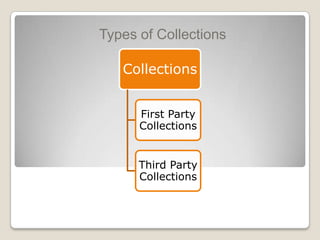
Types of Collections
First / Third Party CollectionsConsumer CollectionsCommercial CollectionsPLCC’sTelecomMedical BillsAuto/Home LoansIT & AutomationWaste ManagementFinancial ServicesLogin Hour based billing modelContingency / Commission based billing modelPre charge off accounts primarily 0-180 daysPost Charge off accountsSmall ticket size/ Dialer EnvironmentBig ticket size/ Dialer + Manual
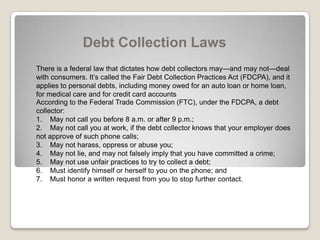
Debt Collection LawsThere is a federal law that dictates how debt collectors may—and may not—deal with consumers. It’s called the Fair Debt Collection Practices Act (FDCPA), and it applies to personal debts, including money owed for an auto loan or home loan, for medical care and for credit card accountsAccording to the Federal Trade Commission (FTC), under the FDCPA, a debt collector:1.    May not call you before 8 a.m. or after 9 p.m.; 2.    May not call you at work, if the debt collector knows that your employer does     not approve of such phone calls; 3.    May not harass, oppress or abuse you; 4.    May not lie, and may not falsely imply that you have committed a crime; 5.    May not use unfair practices to try to collect a debt; 6.    Must identify himself or herself to you on the phone; and 7.    Must honor a written request from you to stop further contact.
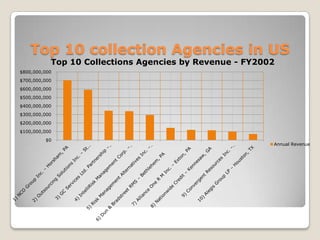
Top 10 collection Agencies in US
Credit bureaus’ in the U.S.There are three major credit bureau’s in the US and then there are other sub bureau’s which fall under these three.Trans-unionEquifaxExperian
Why is Credit Reporting Important?Credit reporting helps in repairing consumers credit score
Helps build consumers credit worthiness
Every time an account is paid off, has to be reported to the Credit Bureau
 In third party collections credit reporting Is usually done by third party collection agency
 In the case of First Party Collections reporting is done by the original creditor
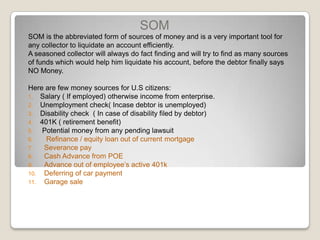
 Post paying off the account, even the consumer can contact any of the credit bureau and get the status updated with the help of the final notification from the collection agency. This is more relevant to third party collections scenario, usually when a consumer settles or pays off his/her old outstanding debtSOMSOM is the abbreviated form of sources of money and is a very important tool for any collector to liquidate an account efficiently.A seasoned collector will always do fact finding and will try to find as many sources of funds which would help him liquidate his account, before the debtor finally says NO Money.Here are few money sources for U.S citizens:Salary ( If employed) otherwise income from enterprise.Unemployment check( Incase debtor is unemployed)Disability check  ( In case of disability filed by debtor)401K ( retirement benefit) Potential money from any pending lawsuitRefinance / equity loan out of current mortgageSeverance pay Cash Advance from POEAdvance out of employee’s active 401kDeferring of car paymentGarage sale
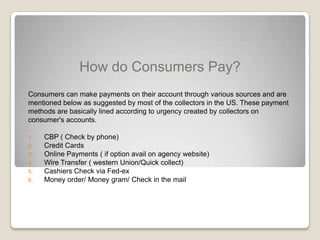
How do Consumers Pay?Consumers can make payments on their account through various sources and are mentioned below as suggested by most of the collectors in the US. These payment methods are basically lined according to urgency created by collectors on consumer's accounts.CBP ( Check by phone)Credit CardsOnline Payments ( if option avail on agency website)Wire Transfer ( western Union/Quick collect)Cashiers Check via Fed-exMoney order/ Money gram/ Check in the mail
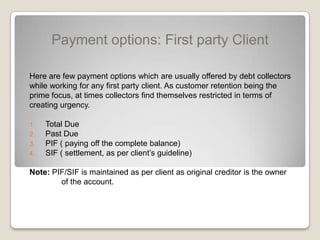
Payment options: First party ClientHere are few payment options which are usually offered by debt collectors while working for any first party client. As customer retention being the prime focus, at times collectors find themselves restricted in terms of creating urgency.Total DuePast DuePIF ( paying off the complete balance)SIF ( settlement, as per client’s guideline)Note: PIF/SIF is maintained as per client as original creditor is the owner   	of the account.
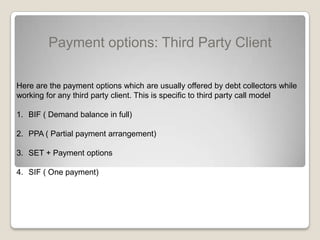
Payment options: Third Party ClientHere are the payment options which are usually offered by debt collectors while working for any third party client. This is specific to third party call modelBIF ( Demand balance in full)PPA ( Partial payment arrangement)SET + Payment optionsSIF ( One payment)
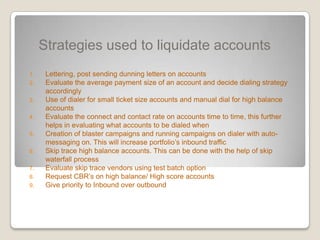
Strategies used to liquidate accountsLettering, post sending dunning letters on accountsEvaluate the average payment size of an account and decide dialing strategy accordinglyUse of dialer for small ticket size accounts and manual dial for high balance accountsEvaluate the connect and contact rate on accounts time to time, this further helps in evaluating what accounts to be dialed whenCreation of blaster campaigns and running campaigns on dialer with auto-messaging on. This will increase portfolio’s inbound trafficSkip trace high balance accounts. This can be done with the help of skip waterfall processEvaluate skip trace vendors using test batch optionRequest CBR’s on high balance/ High score accountsGive priority to Inbound over outbound

Collections Overview

  • 1.
    DebtCollectionAn OverviewPresented By: Satyakam Biswas
  • 2.
    AgendaDebt Collection –DefinitionTypes of Collections A Flowchart Debt Collection – Legal AspectsTop 10 Collection agencies in USCredit Bureaus and Credit ReportingSources of Money (SOM)Payment OptionsStrategies used for liquidationCollection Call Flow Collection Pyramid
  • 3.
    What is DebtCollection? Debt collection is a simple mean that pursues payments on debts owed by individuals or businessesDebt collection can be done in various ways:1. Legal notification 2. Lettering 3. Via Phone Calls4. Legal proceedingsDebt collection can be either done by original creditor by their in house collections department or by any third party collection agency appointed by original creditor
  • 4.
  • 5.
    First / ThirdParty CollectionsConsumer CollectionsCommercial CollectionsPLCC’sTelecomMedical BillsAuto/Home LoansIT & AutomationWaste ManagementFinancial ServicesLogin Hour based billing modelContingency / Commission based billing modelPre charge off accounts primarily 0-180 daysPost Charge off accountsSmall ticket size/ Dialer EnvironmentBig ticket size/ Dialer + Manual
  • 6.
    Debt Collection LawsThereis a federal law that dictates how debt collectors may—and may not—deal with consumers. It’s called the Fair Debt Collection Practices Act (FDCPA), and it applies to personal debts, including money owed for an auto loan or home loan, for medical care and for credit card accountsAccording to the Federal Trade Commission (FTC), under the FDCPA, a debt collector:1. May not call you before 8 a.m. or after 9 p.m.; 2. May not call you at work, if the debt collector knows that your employer does not approve of such phone calls; 3. May not harass, oppress or abuse you; 4. May not lie, and may not falsely imply that you have committed a crime; 5. May not use unfair practices to try to collect a debt; 6. Must identify himself or herself to you on the phone; and 7. Must honor a written request from you to stop further contact.
  • 7.
    Top 10 collectionAgencies in US
  • 8.
    Credit bureaus’ inthe U.S.There are three major credit bureau’s in the US and then there are other sub bureau’s which fall under these three.Trans-unionEquifaxExperian
  • 9.
    Why is CreditReporting Important?Credit reporting helps in repairing consumers credit score
  • 10.
    Helps build consumerscredit worthiness
  • 11.
    Every time anaccount is paid off, has to be reported to the Credit Bureau
  • 12.
    In thirdparty collections credit reporting Is usually done by third party collection agency
  • 13.
    In thecase of First Party Collections reporting is done by the original creditor
  • 14.
    Post payingoff the account, even the consumer can contact any of the credit bureau and get the status updated with the help of the final notification from the collection agency. This is more relevant to third party collections scenario, usually when a consumer settles or pays off his/her old outstanding debtSOMSOM is the abbreviated form of sources of money and is a very important tool for any collector to liquidate an account efficiently.A seasoned collector will always do fact finding and will try to find as many sources of funds which would help him liquidate his account, before the debtor finally says NO Money.Here are few money sources for U.S citizens:Salary ( If employed) otherwise income from enterprise.Unemployment check( Incase debtor is unemployed)Disability check ( In case of disability filed by debtor)401K ( retirement benefit) Potential money from any pending lawsuitRefinance / equity loan out of current mortgageSeverance pay Cash Advance from POEAdvance out of employee’s active 401kDeferring of car paymentGarage sale
  • 15.
    How do ConsumersPay?Consumers can make payments on their account through various sources and are mentioned below as suggested by most of the collectors in the US. These payment methods are basically lined according to urgency created by collectors on consumer's accounts.CBP ( Check by phone)Credit CardsOnline Payments ( if option avail on agency website)Wire Transfer ( western Union/Quick collect)Cashiers Check via Fed-exMoney order/ Money gram/ Check in the mail
  • 16.
    Payment options: Firstparty ClientHere are few payment options which are usually offered by debt collectors while working for any first party client. As customer retention being the prime focus, at times collectors find themselves restricted in terms of creating urgency.Total DuePast DuePIF ( paying off the complete balance)SIF ( settlement, as per client’s guideline)Note: PIF/SIF is maintained as per client as original creditor is the owner of the account.
  • 17.
    Payment options: ThirdParty ClientHere are the payment options which are usually offered by debt collectors while working for any third party client. This is specific to third party call modelBIF ( Demand balance in full)PPA ( Partial payment arrangement)SET + Payment optionsSIF ( One payment)
  • 18.
    Strategies used toliquidate accountsLettering, post sending dunning letters on accountsEvaluate the average payment size of an account and decide dialing strategy accordinglyUse of dialer for small ticket size accounts and manual dial for high balance accountsEvaluate the connect and contact rate on accounts time to time, this further helps in evaluating what accounts to be dialed whenCreation of blaster campaigns and running campaigns on dialer with auto-messaging on. This will increase portfolio’s inbound trafficSkip trace high balance accounts. This can be done with the help of skip waterfall processEvaluate skip trace vendors using test batch optionRequest CBR’s on high balance/ High score accountsGive priority to Inbound over outbound
  • 19.
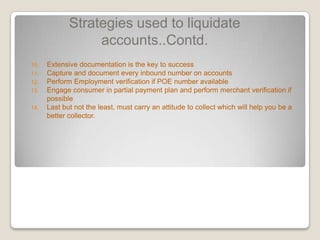
    Strategies used toliquidate accounts..Contd.Extensive documentation is the key to successCapture and document every inbound number on accountsPerform Employment verification if POE number availableEngage consumer in partial payment plan and perform merchant verification if possibleLast but not the least, must carry an attitude to collect which will help you be a better collector.
  • 20.
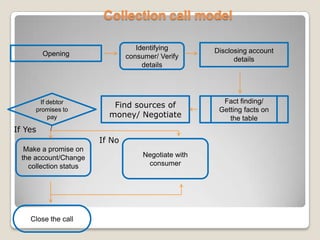
    Collection call modelIdentifyingconsumer/ Verify detailsDisclosing account detailsOpeningIf debtor promises to payFact finding/ Getting facts on the tableFind sources of money/ NegotiateIf YesIf NoMake a promise on the account/Change collection statusNegotiate with consumerClose the call
  • 21.
  • 22.