Personalized Job Recommendation
System at LinkedIn: Practical
Challenges and Lessons Learned
Krishnaram Kenthapadi
Staff Software Engineer - LinkedIn
Benjamin Le
Senior Software Engineer - LinkedIn
Ganesh Venkataraman
Engineering Manager - Airbnb
Practical Challenges in JYMBII
• Candidate Selection
• Personalized Relevance Models at Scale
• Jobs Marketplace
2
Candidate Selection
Why Candidate Selection?
•Need to meet latency requirements of an online recommendation system
•Only subset of jobs is relevant to a user based on their domain and expertise
•Enables scoring with more complex and computationally expensive models
4
past_applied_title ^ job_title
Past_searched_loc ^ job_location
Activity Based Clauses
How to combine query clauses ?
user_title ^ job_title
user_skills ^ job_skills
Profile – Job Match Clauses
title_pref ^ job_title
location_pref ^ job_location
Explicit Preference Clauses
aspiring_sen ^ job_seniority
location_pref ^ job_location
Latent Preference Clauses
5
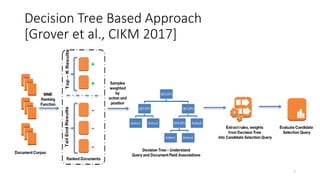
Decision Tree Based Approach
[Grover et al., CIKM 2017]
• Train on top-k ranked documents
as positives and tail end as
negatives.
• Extract combinations of clauses
decision tree by traversing root
to leaf paths.
• Do a weighted combination of
the clauses.
6
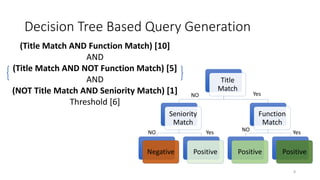
Decision Tree Based Query Generation
• Trees are a natural way to
learn combinations of clauses
• Weighted combinations can
be learned by looking at
purity of the nodes in a
WAND query
7
Title
Match
Seniority
Match
Negative Positive
Function
Match
Positive Positive
NO Yes
YesYes NONO
7 7
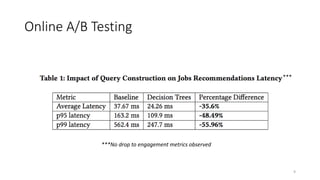
Online A/B Testing
8
***No drop to engagement metrics observed
***
Personalized Relevance
Models
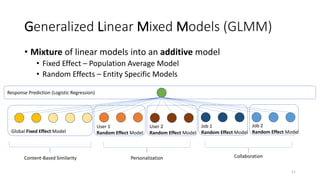
Generalized Linear Mixed Models (GLMM)
• Mixture of linear models into an additive model
• Fixed Effect – Population Average Model
• Random Effects – Entity Specific Models
Response Prediction (Logistic Regression)
User 1
Random Effect Model
User 2
Random Effect Model
Personalization
Job 2
Random Effect Model
Job 1
Random Effect Model
Collaboration
Global Fixed Effect Model
Content-Based Similarity
10
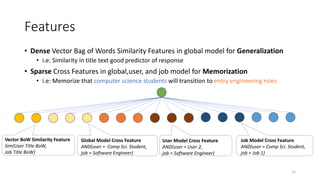
Features
• Dense Vector Bag of Words Similarity Features in global model for Generalization
• i.e: Similarity in title text good predictor of response
• Sparse Cross Features in global,user, and job model for Memorization
• i.e: Memorize that computer science students will transition to entry engineering roles
Vector BoW Similarity Feature
Sim(User Title BoW,
Job Title BoW)
Global Model Cross Feature
AND(user = Comp Sci. Student,
job = Software Engineer)
User Model Cross Feature
AND(user = User 2,
job = Software Engineer)
Job Model Cross Feature
AND(user = Comp Sci. Student,
job = Job 1)
11
Training a GLMM at Scale
• Millions of random effect models * thousands of features per model
= Billions of parameters
• Infeasible to run traditional fitting methods on this very large linear
model with industry scale datasets
• Key Idea: For each entity's random effect, only the labeled data
associated with that entity is needed to fit its model
12
Parallel Block-wise Coordinate Descent
[Zhang et al., KDD 2016]
13
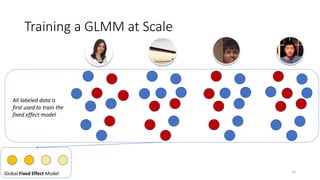
Training a GLMM at Scale
14
Global Fixed Effect Model
All labeled data is
first used to train the
fixed effect model
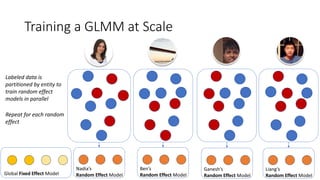
Training a GLMM at Scale
15
Global Fixed Effect Model
Nadia’s
Random Effect Model
Ben’s
Random Effect Model
Ganesh’s
Random Effect Model
Liang’s
Random Effect Model
Labeled data is
partitioned by entity to
train random effect
models in parallel
Repeat for each random
effect
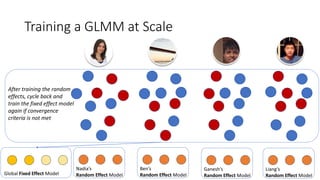
Training a GLMM at Scale
16
Global Fixed Effect Model
After training the random
effects, cycle back and
train the fixed effect model
again if convergence
criteria is not met
Nadia’s
Random Effect Model
Ben’s
Random Effect Model
Ganesh’s
Random Effect Model
Liang’s
Random Effect Model
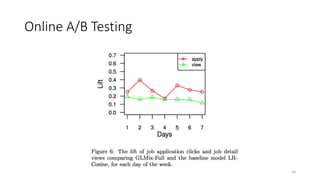
Online A/B Testing
17
Jobs Marketplace
The Ideal Jobs Marketplace
• Maximize number of confirmed hires while minimizing number of job
applications
• This maximizes utility of job seeker and job posters
• Ranking by 𝑃 User 𝑢 applies to Job 𝑗 𝑢, 𝑗) only optimizes for user
engagement
1. Recommend highly relevant jobs to users
2. Ensure each job posting
• Receives sufficient number of applications from qualified candidates to
guarantee a hire
• But not overwhelm the job poster with too many applications
19
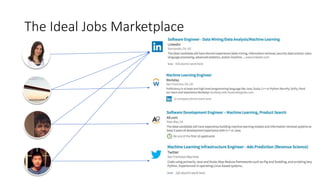
The Ideal Jobs Marketplace
20
Potential Solution?
• Rank by likelihood that user will apply for the job and pass the
interview and accept the job offer?
• Data on whether a candidate passed an interview is confidential
• Data about the offer to the candidate is confidential too
• More importantly, modeling this requires careful understanding on potential
bias and unfairness of a model due to societal bias in the data
• Practically, we solve the job application redistribution problem instead
• Ensure a job does not receive too many or too few applications
21
Diminishing Return of #Applications
22
Our High-level Idea: Early Intervention
[Borisyuk et al., KDD 2017]
• Say a job expires at time T
• At any time t < T
• Predict #applications it would receive at time T
• Given data received from time 0 to t
• If too few => Boost ranking score 𝑃 User 𝑢 applies to Job 𝑗 𝑢, 𝑗)
• If too many => Penalize ranking score 𝑃 User 𝑢 applies to Job 𝑗 𝑢, 𝑗)
• Otherwise => No intervention
• Key: Forecasting model of #applications per Job, using signals from:
• # Applies / Impressions the job has received so far
• Other features (xjt): e.g.
• Seasonality (time of day, day of week)
• Job attributes: title, company, industry, qualifications, …
23
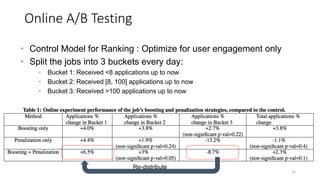
• Control Model for Ranking : Optimize for user engagement only
• Split the jobs into 3 buckets every day:
• Bucket 1: Received <8 applications up to now
• Bucket 2: Received [8, 100] applications up to now
• Bucket 3: Received >100 applications up to now
Re-distribute
Online A/B Testing
24
Summary
• Model candidate selection query generation using decision trees
• Personalization at Scale through GLMM
• Realizing the ideal jobs marketplace through application
redistribution
• But a lot of research work still needed to
• Reformulate problem to model optimizing for a healthy marketplace directly
• Understand and quantify bias and fairness in those potential new models
25
References
• [Borisyuk et al., 2016] CaSMoS: A framework for learning candidate
selection models over structured queries and documents, KDD 2016
• [Borisyuk et al., 2017] LiJAR: A System for Job Application
Redistribution towards Efficient Career Marketplace, KDD 2017
• [Grover et al., 2017] Latency reduction via decision tree based query
construction, CIKM 2017
• [Zhang et al., 2016] GLMix: Generalized Linear Mixed Models For
Large-Scale Response Prediction, KDD 2016
26
Appendix
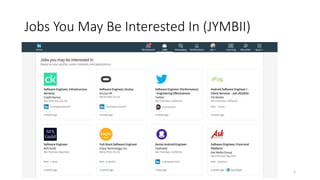
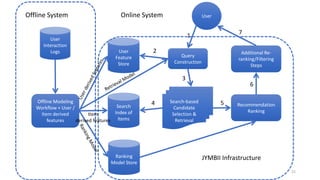
Jobs You May Be Interested In (JYMBII)
28
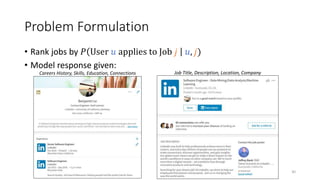
Problem Formulation
• Rank jobs by 𝑃 User 𝑢 applies to Job 𝑗 𝑢, 𝑗)
• Model response given:
29
Careers History, Skills, Education, Connections Job Title, Description, Location, Company
29
User
Interaction
Logs
Offline Modeling
Workflow + User /
Item derived
features
User
Search-based
Candidate
Selection &
Retrieval
Query
Construction
User
Feature
Store
Search
Index of
Items
Recommendation
Ranking
Ranking
Model Store
Additional Re-
ranking/Filtering
Steps
1
2
3
4 5
6
7
Offline System Online System
Item
derived features
JYMBII Infrastructure
30
Understanding WAND Query
Query : “Quality Assurance Engineer”
AND Query: “Quality AND Assurance AND Engineer”
✅ ❌ 31
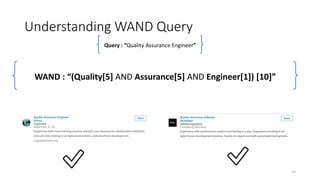
Understanding WAND Query
Query : “Quality Assurance Engineer”
WAND : “(Quality[5] AND Assurance[5] AND Engineer[1]) [10]”
✅ ✅ 32
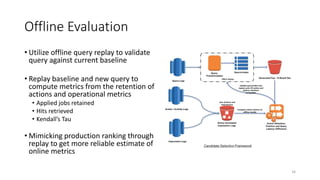
Offline Evaluation
• Utilize offline query replay to validate
query against current baseline
• Replay baseline and new query to
compute metrics from the retention of
actions and operational metrics
• Applied jobs retained
• Hits retrieved
• Kendall’s Tau
• Mimicking production ranking through
replay to get more reliable estimate of
online metrics
33
34

Personalized Job Recommendation System at LinkedIn: Practical Challenges and Lessons Learned

  • 1.
    Personalized Job Recommendation Systemat LinkedIn: Practical Challenges and Lessons Learned Krishnaram Kenthapadi Staff Software Engineer - LinkedIn Benjamin Le Senior Software Engineer - LinkedIn Ganesh Venkataraman Engineering Manager - Airbnb
  • 2.
    Practical Challenges inJYMBII • Candidate Selection • Personalized Relevance Models at Scale • Jobs Marketplace 2
  • 3.
  • 4.
    Why Candidate Selection? •Needto meet latency requirements of an online recommendation system •Only subset of jobs is relevant to a user based on their domain and expertise •Enables scoring with more complex and computationally expensive models 4
  • 5.
    past_applied_title ^ job_title Past_searched_loc^ job_location Activity Based Clauses How to combine query clauses ? user_title ^ job_title user_skills ^ job_skills Profile – Job Match Clauses title_pref ^ job_title location_pref ^ job_location Explicit Preference Clauses aspiring_sen ^ job_seniority location_pref ^ job_location Latent Preference Clauses 5
  • 6.
    Decision Tree BasedApproach [Grover et al., CIKM 2017] • Train on top-k ranked documents as positives and tail end as negatives. • Extract combinations of clauses decision tree by traversing root to leaf paths. • Do a weighted combination of the clauses. 6
  • 7.
    Decision Tree BasedQuery Generation • Trees are a natural way to learn combinations of clauses • Weighted combinations can be learned by looking at purity of the nodes in a WAND query 7 Title Match Seniority Match Negative Positive Function Match Positive Positive NO Yes YesYes NONO 7 7
  • 8.
    Online A/B Testing 8 ***Nodrop to engagement metrics observed ***
  • 9.
  • 10.
    Generalized Linear MixedModels (GLMM) • Mixture of linear models into an additive model • Fixed Effect – Population Average Model • Random Effects – Entity Specific Models Response Prediction (Logistic Regression) User 1 Random Effect Model User 2 Random Effect Model Personalization Job 2 Random Effect Model Job 1 Random Effect Model Collaboration Global Fixed Effect Model Content-Based Similarity 10
  • 11.
    Features • Dense VectorBag of Words Similarity Features in global model for Generalization • i.e: Similarity in title text good predictor of response • Sparse Cross Features in global,user, and job model for Memorization • i.e: Memorize that computer science students will transition to entry engineering roles Vector BoW Similarity Feature Sim(User Title BoW, Job Title BoW) Global Model Cross Feature AND(user = Comp Sci. Student, job = Software Engineer) User Model Cross Feature AND(user = User 2, job = Software Engineer) Job Model Cross Feature AND(user = Comp Sci. Student, job = Job 1) 11
  • 12.
    Training a GLMMat Scale • Millions of random effect models * thousands of features per model = Billions of parameters • Infeasible to run traditional fitting methods on this very large linear model with industry scale datasets • Key Idea: For each entity's random effect, only the labeled data associated with that entity is needed to fit its model 12
  • 13.
    Parallel Block-wise CoordinateDescent [Zhang et al., KDD 2016] 13
  • 14.
    Training a GLMMat Scale 14 Global Fixed Effect Model All labeled data is first used to train the fixed effect model
  • 15.
    Training a GLMMat Scale 15 Global Fixed Effect Model Nadia’s Random Effect Model Ben’s Random Effect Model Ganesh’s Random Effect Model Liang’s Random Effect Model Labeled data is partitioned by entity to train random effect models in parallel Repeat for each random effect
  • 16.
    Training a GLMMat Scale 16 Global Fixed Effect Model After training the random effects, cycle back and train the fixed effect model again if convergence criteria is not met Nadia’s Random Effect Model Ben’s Random Effect Model Ganesh’s Random Effect Model Liang’s Random Effect Model
  • 17.
  • 18.
  • 19.
    The Ideal JobsMarketplace • Maximize number of confirmed hires while minimizing number of job applications • This maximizes utility of job seeker and job posters • Ranking by 𝑃 User 𝑢 applies to Job 𝑗 𝑢, 𝑗) only optimizes for user engagement 1. Recommend highly relevant jobs to users 2. Ensure each job posting • Receives sufficient number of applications from qualified candidates to guarantee a hire • But not overwhelm the job poster with too many applications 19
  • 20.
    The Ideal JobsMarketplace 20
  • 21.
    Potential Solution? • Rankby likelihood that user will apply for the job and pass the interview and accept the job offer? • Data on whether a candidate passed an interview is confidential • Data about the offer to the candidate is confidential too • More importantly, modeling this requires careful understanding on potential bias and unfairness of a model due to societal bias in the data • Practically, we solve the job application redistribution problem instead • Ensure a job does not receive too many or too few applications 21
  • 22.
    Diminishing Return of#Applications 22
  • 23.
    Our High-level Idea:Early Intervention [Borisyuk et al., KDD 2017] • Say a job expires at time T • At any time t < T • Predict #applications it would receive at time T • Given data received from time 0 to t • If too few => Boost ranking score 𝑃 User 𝑢 applies to Job 𝑗 𝑢, 𝑗) • If too many => Penalize ranking score 𝑃 User 𝑢 applies to Job 𝑗 𝑢, 𝑗) • Otherwise => No intervention • Key: Forecasting model of #applications per Job, using signals from: • # Applies / Impressions the job has received so far • Other features (xjt): e.g. • Seasonality (time of day, day of week) • Job attributes: title, company, industry, qualifications, … 23
  • 24.
    • Control Modelfor Ranking : Optimize for user engagement only • Split the jobs into 3 buckets every day: • Bucket 1: Received <8 applications up to now • Bucket 2: Received [8, 100] applications up to now • Bucket 3: Received >100 applications up to now Re-distribute Online A/B Testing 24
  • 25.
    Summary • Model candidateselection query generation using decision trees • Personalization at Scale through GLMM • Realizing the ideal jobs marketplace through application redistribution • But a lot of research work still needed to • Reformulate problem to model optimizing for a healthy marketplace directly • Understand and quantify bias and fairness in those potential new models 25
  • 26.
    References • [Borisyuk etal., 2016] CaSMoS: A framework for learning candidate selection models over structured queries and documents, KDD 2016 • [Borisyuk et al., 2017] LiJAR: A System for Job Application Redistribution towards Efficient Career Marketplace, KDD 2017 • [Grover et al., 2017] Latency reduction via decision tree based query construction, CIKM 2017 • [Zhang et al., 2016] GLMix: Generalized Linear Mixed Models For Large-Scale Response Prediction, KDD 2016 26
  • 27.
  • 28.
    Jobs You MayBe Interested In (JYMBII) 28
  • 29.
    Problem Formulation • Rankjobs by 𝑃 User 𝑢 applies to Job 𝑗 𝑢, 𝑗) • Model response given: 29 Careers History, Skills, Education, Connections Job Title, Description, Location, Company 29
  • 30.
    User Interaction Logs Offline Modeling Workflow +User / Item derived features User Search-based Candidate Selection & Retrieval Query Construction User Feature Store Search Index of Items Recommendation Ranking Ranking Model Store Additional Re- ranking/Filtering Steps 1 2 3 4 5 6 7 Offline System Online System Item derived features JYMBII Infrastructure 30
  • 31.
    Understanding WAND Query Query: “Quality Assurance Engineer” AND Query: “Quality AND Assurance AND Engineer” ✅ ❌ 31
  • 32.
    Understanding WAND Query Query: “Quality Assurance Engineer” WAND : “(Quality[5] AND Assurance[5] AND Engineer[1]) [10]” ✅ ✅ 32
  • 33.
    Offline Evaluation • Utilizeoffline query replay to validate query against current baseline • Replay baseline and new query to compute metrics from the retention of actions and operational metrics • Applied jobs retained • Hits retrieved • Kendall’s Tau • Mimicking production ranking through replay to get more reliable estimate of online metrics 33
  • 34.

Editor's Notes

  • #3 - Passive Job Seekers: Allow them to discover what is avaliable in the marketplace. - Not Alot of Data for Passives, show them jobs that make the most sense to them given their current career history and experience - Active Job Seekers: Reinforce their job seeking experience. Show them similar jobs that they applied to that they may have missed. Make sure they don't miss opportunities - Powers alot of modules including jobs home, feed, email, ads
  • #9 Cite any examples
  • #12 - Content Based Recommendations, Personalization, and Collaboration are incorporated through a GLMM Model - Generalized link function - Mixed due to ensemble of models in additive - Fixed effect model - Random Effects for variation - All Linear Models
  • #13 - Example of features in each of the model. Generalization, on most of the time to share learning across examples in a linear model - Sparse Features for memorization - Need to choose good features to memorize - Random effect sparse features model personal affinity
  • #31 - Goal: Get people hired - Confirmed Hires - Time Lag on signal - Proxy in Total Job Applies - Metric: Total Job Applies - Optimize probability of Apply. Not View. Showing users popular/attractive jobs not as important as showing them actual good matches - User, Job, Activity