Sequence-Aware
Recommenders
Massimo Quadrana
Pandora
Paolo Cremonesi
Politecnico di Milano
About today’s presenter(s)
• Paolo Cremonesi
• Politecnico di Milano, Italy
• Massimo Quadrana
• Pandora, Italy
202/10/18 RecSys 2018 - Vancouver
Today’s tutorial based on
M. Quadrana, P. Cremonesi, D. Jannach,
"Sequence-Aware Recommender Systems“
ACM Computing Surveys, 2018
bit.ly/sequence-aware-rs
02/10/18 RecSys 2018 - Vancouver3
About you?
02/10/18 RecSys 2018 - Vancouver4
Agenda
• 14:00 – 14:45 Introduction & Problem Definition (Paolo)
• 14:45 – 15:15 Evaluation (Paolo)
• 15:15 – 15:30 Algorithms I (Massimo)
• 15:30 – 16:00 Coffee break
• 16:00 – 16:45 Algorithms II (Massimo)
• 16:45 – 17:20 Hands-on (Massimo)
• 17:20 – 17:30 Conclusion / Questions
02/10/18 RecSys 2018 - Vancouver5
Introduction
&
Problem Definition
02/10/18 RecSys 2018 - Vancouver6
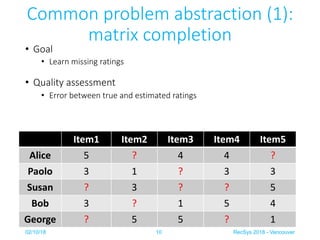
Common problem abstraction (1):
matrix completion
• Goal
• Learn missing ratings
• Quality assessment
• Error between true and estimated ratings
02/10/18 RecSys 2018 - Vancouver10
Item1 Item2 Item3 Item4 Item5
Alice 5 ? 4 4 ?
Paolo 3 1 ? 3 3
Susan ? 3 ? ? 5
Bob 3 ? 1 5 4
George ? 5 5 ? 1
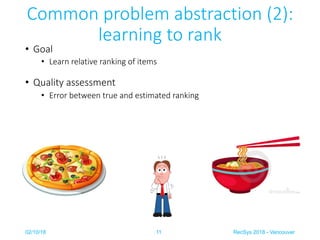
Common problem abstraction (2):
learning to rank
• Goal
• Learn relative ranking of items
• Quality assessment
• Error between true and estimated ranking
02/10/18 RecSys 2018 - Vancouver11
Real-world problem situations
• User intent
• Short-term intent/context vs. long term taste
• Order can matter
• Order matters (constraints)
• Interest drift
• Reminders
• Repeated purchases
02/10/18 RecSys 2018 - Vancouver13
User intent
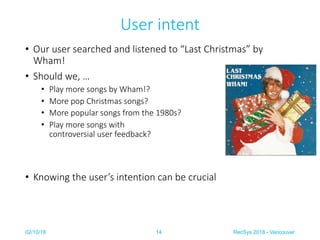
• Our user searched and listened to “Last Christmas” by
Wham!
• Should we, …
• Play more songs by Wham!?
• More pop Christmas songs?
• More popular songs from the 1980s?
• Play more songs with
controversial user feedback?
• Knowing the user’s intention can be crucial
02/10/18 RecSys 2018 - Vancouver14
Short-term intent/context vs.
long term taste
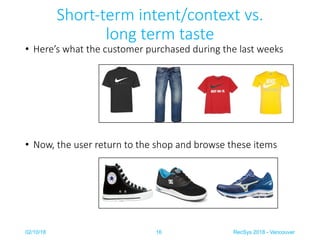
• Here’s what the customer purchased during the last weeks
• Now, the user return to the shop and browse these items
02/10/18 RecSys 2018 - Vancouver16
Short-term intent/context vs.
long term taste
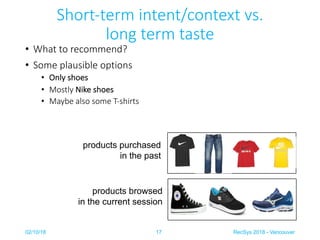
• What to recommend?
• Some plausible options
• Only shoes
• Mostly Nike shoes
• Maybe also some T-shirts
02/10/18 RecSys 2018 - Vancouver17
products purchased
in the past
products browsed
in the current session
Short-term intent/context vs.
long term taste
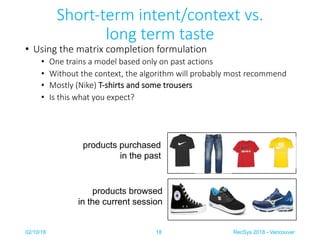
• Using the matrix completion formulation
• One trains a model based only on past actions
• Without the context, the algorithm will probably most recommend
• Mostly (Nike) T-shirts and some trousers
• Is this what you expect?
02/10/18 RecSys 2018 - Vancouver18
products purchased
in the past
products browsed
in the current session
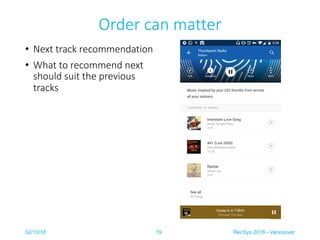
Order can matter
• Next track recommendation
• What to recommend next
should suit the previous
tracks
02/10/18 RecSys 2018 - Vancouver19
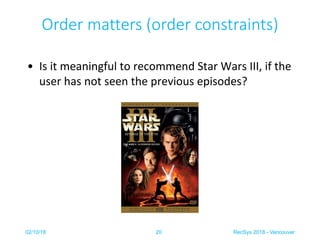
• Is it meaningful to recommend Star Wars III, if the
user has not seen the previous episodes?
Order matters (order constraints)
02/10/18 RecSys 2018 - Vancouver20
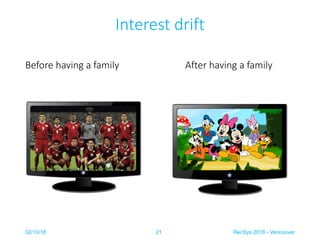
Interest drift
Before having a family After having a family
02/10/18 RecSys 2018 - Vancouver21
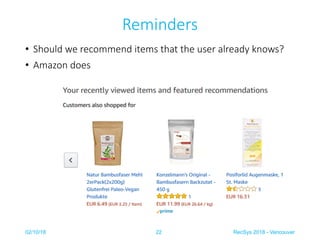
Reminders
• Should we recommend items that the user already knows?
• Amazon does
02/10/18 RecSys 2018 - Vancouver22
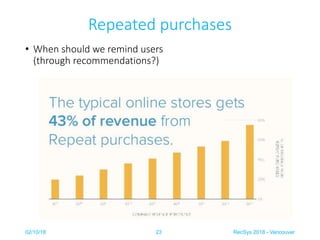
Repeated purchases
• When should we remind users
(through recommendations?)
02/10/18 RecSys 2018 - Vancouver23
Algorithms depends on …
The choice of the best recommender algorithm depends on
• Goal (user task, application domain, context, …)
• Data available
• Target quality
02/10/18 RecSys 2018 - Vancouver24
Examples based on goal …
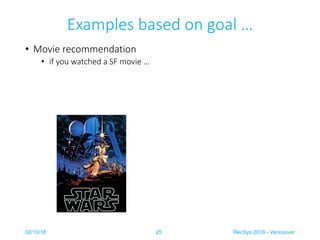
• Movie recommendation
• if you watched a SF movie …
02/10/18 RecSys 2018 - Vancouver25
Examples based on goal …
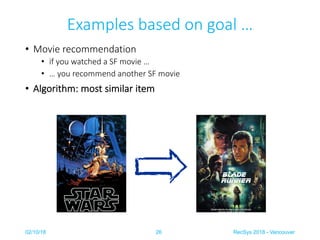
• Movie recommendation
• if you watched a SF movie …
• … you recommend another SF movie
• Algorithm: most similar item
02/10/18 RecSys 2018 - Vancouver26
Examples based on goal …
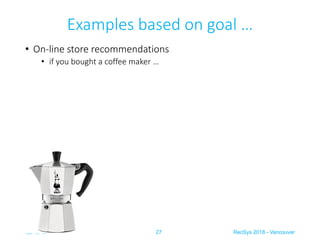
• On-line store recommendations
• if you bought a coffee maker …
02/10/18 RecSys 2018 - Vancouver27
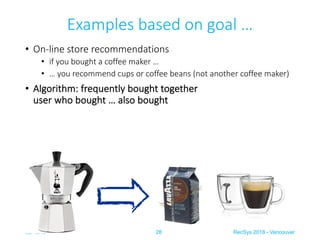
Examples based on goal …
• On-line store recommendations
• if you bought a coffee maker …
• … you recommend cups or coffee beans (not another coffee maker)
• Algorithm: frequently bought together
user who bought … also bought
02/10/18 RecSys 2018 - Vancouver28
Example based on data …
• If you have
• all items with many ratings
• no item attributes
• You need CF
• If you have
• no ratings
• all item with many attributes
• You need CBF
02/10/18 RecSys 2018 - Vancouver29
Examples for
sequence-aware algorithms …
Goal
• next track recommendation, …
Data
• new users, …
Need for quality
• context, intent, …
02/10/18 RecSys 2018 - Vancouver30
Implications for research
Many of the scenarios cannot be addressed by a matrix
completion or learning-to-rank problem formulation
• No short-term context
• Only one single user-item interaction pair
• Often only one type of interaction (e.g., ratings)
• Rating timestamps sometimes exist, but might be
disconnected from actually experiencing/using the item
02/10/18 RecSys 2018 - Vancouver31
Sequence-Aware Recommenders
A family of recommenders that
• uses different input data
• often bases the recommendations on certain types of
sequential patterns in the data
• addresses the mentioned practical problem settings
02/10/18 RecSys 2018 - Vancouver32
Problem Characterization
02/10/18 RecSys 2018 - Vancouver33
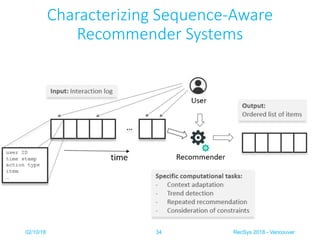
Characterizing Sequence-Aware
Recommender Systems
02/10/18 RecSys 2018 - Vancouver34
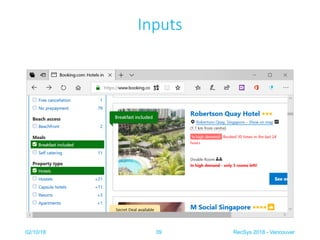
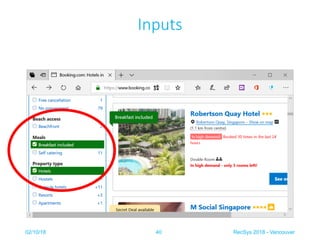
Inputs
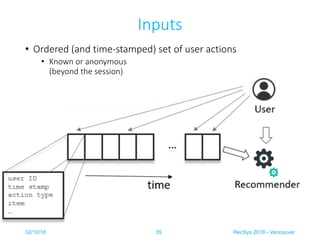
• Ordered (and time-stamped) set of user actions
• Known or anonymous
(beyond the session)
02/10/18 RecSys 2018 - Vancouver35
Inputs
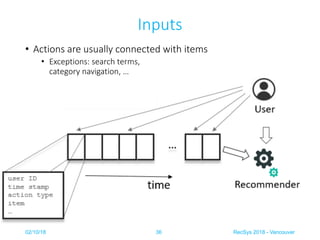
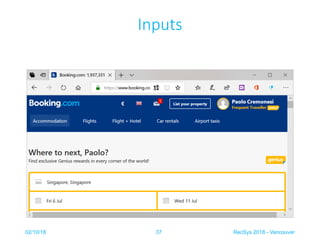
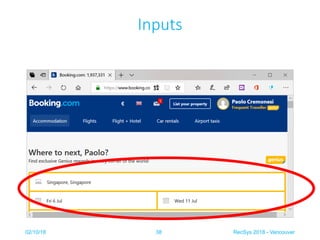
• Actions are usually connected with items
• Exceptions: search terms,
category navigation, …
02/10/18 RecSys 2018 - Vancouver36
Inputs
02/10/18 RecSys 2018 - Vancouver37
Inputs
02/10/18 RecSys 2018 - Vancouver38
Inputs
02/10/18 RecSys 2018 - Vancouver39
Inputs
02/10/18 RecSys 2018 - Vancouver40
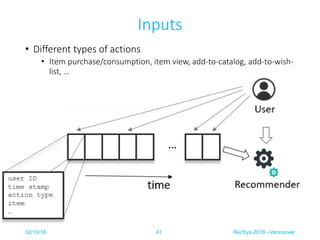
Inputs
• Different types of actions
• Item purchase/consumption, item view, add-to-catalog, add-to-wish-
list, …
02/10/18 RecSys 2018 - Vancouver41
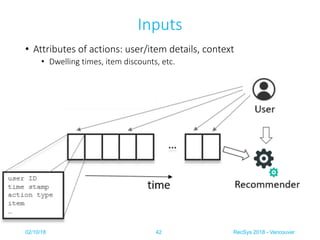
Inputs
• Attributes of actions: user/item details, context
• Dwelling times, item discounts, etc.
02/10/18 RecSys 2018 - Vancouver42
Inputs
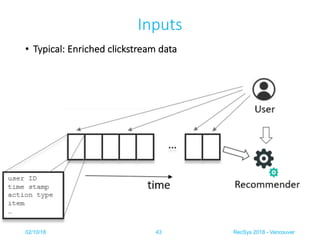
• Typical: Enriched clickstream data
02/10/18 RecSys 2018 - Vancouver43
Inputs: differences with traditional
RSs
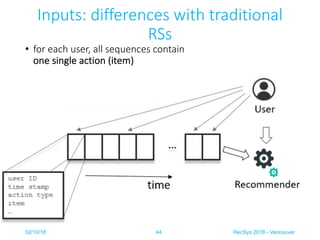
• for each user, all sequences contain
one single action (item)
02/10/18 RecSys 2018 - Vancouver44
Inputs: differences with traditional
RSs (with time-stamp)
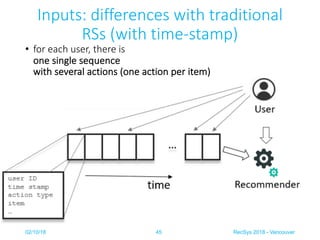
• for each user, there is
one single sequence
with several actions (one action per item)
02/10/18 RecSys 2018 - Vancouver45
Output (1)
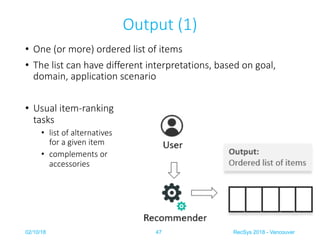
• One (or more) ordered list of items
• The list can have different interpretations, based on goal,
domain, application scenario
• Usual item-ranking
tasks
• list of alternatives
for a given item
• complements or
accessories
02/10/18 RecSys 2018 - Vancouver47
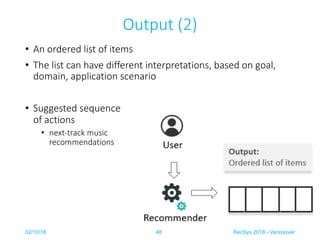
Output (2)
• An ordered list of items
• The list can have different interpretations, based on goal,
domain, application scenario
• Suggested sequence
of actions
• next-track music
recommendations
02/10/18 RecSys 2018 - Vancouver48
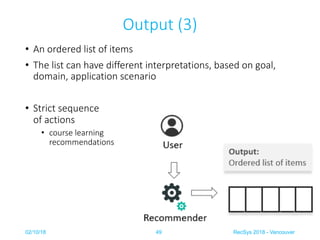
Output (3)
• An ordered list of items
• The list can have different interpretations, based on goal,
domain, application scenario
• Strict sequence
of actions
• course learning
recommendations
02/10/18 RecSys 2018 - Vancouver49
Typical computational tasks
• Find sequence-related in the data, e.g.,
• co-occurrence patterns
• sequential patterns
• distance patterns
• Reasoning about order constraints
• weak and strong constraints
• Relate patterns with user profile and current point in time
• e.g., items that match the current session
02/10/18 RecSys 2018 - Vancouver51
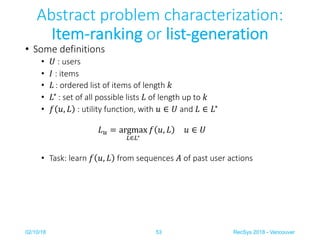
Abstract problem characterization:
Item-ranking or list-generation
• Some definitions
• ! : users
• " : items
• # : ordered list of items of length $
• #∗ : set of all possible lists # of length up to $
• & ', # : utility function, with ' ∈ ! and # ∈ #∗
#* = argmax
1∈1∗
& ', # ' ∈ !
• Task: learn & ', # from sequences 2 of past user actions
02/10/18 RecSys 2018 - Vancouver53
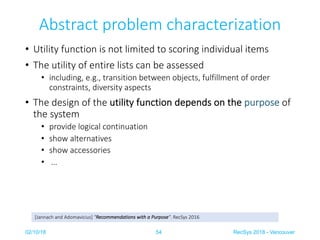
Abstract problem characterization
• Utility function is not limited to scoring individual items
• The utility of entire lists can be assessed
• including, e.g., transition between objects, fulfillment of order
constraints, diversity aspects
• The design of the utility function depends on the purpose of
the system
• provide logical continuation
• show alternatives
• show accessories
• …
02/10/18 RecSys 2018 - Vancouver54
[Jannach and Adomavicius] "Recommendations with a Purpose". RecSys 2016
On recommendation purposes
• Often, researchers are not explicit about the purpose
• Traditionally, could be information filtering or discovery, with
conflicting goals
• Commonly used abstraction
• e.g., predict hidden rating
• For sequence-aware recommenders
• often: predict next (hidden) action, e.g., for a given session
beginning
02/10/18 RecSys 2018 - Vancouver55
Relation to other areas
• Implicit feedback recommender systems
• Sequence-aware recommenders are often built on implicit feedback
signals (action logs)
• Problem formulation is however not based on matrix completion
• Context-aware recommender systems
• Sequence-aware recommenders often are special forms of context-
aware systems
• Here: Interactional context is relevant, which is only implicitly
defined through the user’s actions
02/10/18 RecSys 2018 - Vancouver56
Relation to other areas
• Time-Aware RSs
• Sequence-aware recommenders do not necessarily need explicit
timestamps
• Time-Aware RSs use explicit time
• e.g., to detect long-term user drifts
• Other:
• interest drift
• user-modeling
02/10/18 RecSys 2018 - Vancouver57
Categorization
02/10/18 RecSys 2018 - Vancouver58
Categorization of tasks
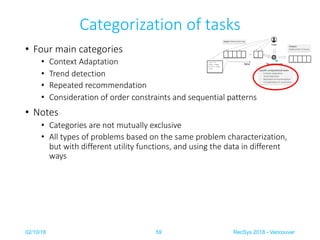
• Four main categories
• Context Adaptation
• Trend detection
• Repeated recommendation
• Consideration of order constraints and sequential patterns
• Notes
• Categories are not mutually exclusive
• All types of problems based on the same problem characterization,
but with different utility functions, and using the data in different
ways
02/10/18 RecSys 2018 - Vancouver59
Context Adaptation (CA)
• Traditional context-aware recommenders are often based on
the representational context
• defined set of variables and observations, e.g., weather, time of the
day etc.
• Here, the interactional context is relevant
• no explicit representation of the variables
• contextual situation has to be inferred from user actions
02/10/18 RecSys 2018 - Vancouver60
CA: How much past information is
considered?
• Last-N interactions based recommendation:
• Often used in Next-Point-Of-Interest recommendation scenarios
• In many cases only the very last visited location is considered
• Also: “Customers who bought … also bought”
• Reasons to limit oneself:
• Not more information available
• Previous information not relevant
02/10/18 RecSys 2018 - Vancouver61
CA: How much past information is
considered?
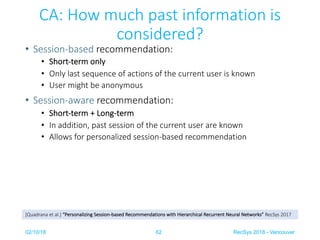
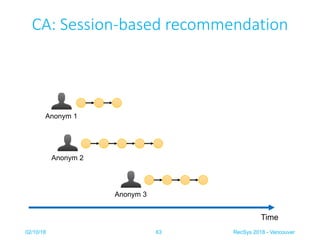
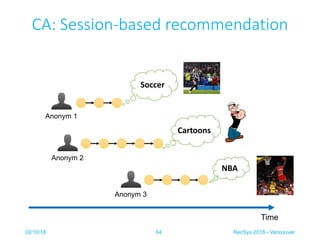
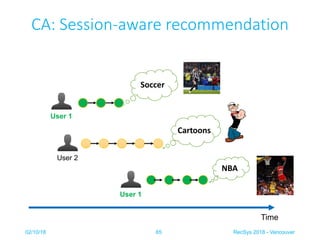
• Session-based recommendation:
• Short-term only
• Only last sequence of actions of the current user is known
• User might be anonymous
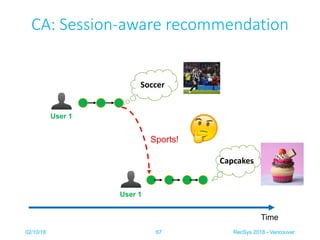
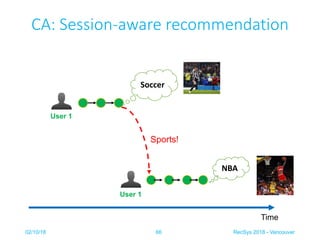
• Session-aware recommendation:
• Short-term + Long-term
• In addition, past session of the current user are known
• Allows for personalized session-based recommendation
02/10/18 RecSys 2018 - Vancouver62
[Quadrana et al.] “Personalizing Session-based Recommendations with Hierarchical Recurrent Neural Networks” RecSys 2017
Anonym 1
Anonym 2
Time
CA: Session-based recommendation
02/10/18 RecSys 2018 - Vancouver63
Anonym 3
Soccer
Anonym 1
Anonym 2
Time
CA: Session-based recommendation
02/10/18 RecSys 2018 - Vancouver64
Cartoons
NBA
Anonym 3
User 1
User 2
Time
CA: Session-aware recommendation
02/10/18 RecSys 2018 - Vancouver65
User 1
Soccer
Cartoons
NBA
User 1
Time
CA: Session-aware recommendation
02/10/18 RecSys 2018 - Vancouver66
User 1
Sports!
Soccer
NBA
User 1
Time
CA: Session-aware recommendation
02/10/18 RecSys 2018 - Vancouver67
Capcakes
User 1
Sports!
Soccer
CA: What to find?
• Next
• Alternatives
• Complements
• Continuations
02/10/18 RecSys 2018 - Vancouver68
CA: What to pick
• One
• All
02/10/18 RecSys 2018 - Vancouver69
Trend detection
• Less explored than context adaptation
• Community trends:
• Consider the recent or seasonal popularity of items, e.g., in the
fashion domain and, in particular, in the news domain
• Individual trends:
• E.g., natural interest drift
• Over time, because of influence of other people, because of a recent
purchase, because something new was discovered (e.g., a new artist)
02/10/18 RecSys 2018 - Vancouver70
[Jannach et al.] "Session-based Item Recommendation in E-Commerce: On Short-Term Intents, Reminders, Trends, and Discounts".
UMAP 2017
Repeated Recommendation
• Identifying repeated user behavior patterns:
• Recommendation of repeat purchases or actions
• E.g., ink for a printer, next app to open after call on mobile
• Patterns can be mined from the individual or the community as a
whole
• Repeated recommendations as reminders
• Remind users of things they found interesting in the past
• To remind the of things they might have forgotten
• As navigational shortcuts, e.g., in a decision situation
• Timing as an interesting question in both situations
02/10/18 RecSys 2018 - Vancouver71
Consideration of Order Constraints
and Observed Sequential Patterns
• Two types of sequentiality information
• External domain knowledge: strict or weak ordering constraints
• Strict, e.g., sequence of learning courses
• Weak, e.g., when recommending sequels to movies
• Information that is mined from the user behavior
• Learn that one movie is always consumed after another
• Predict next web page, e.g., using sequential pattern mining techniques
02/10/18 RecSys 2018 - Vancouver72
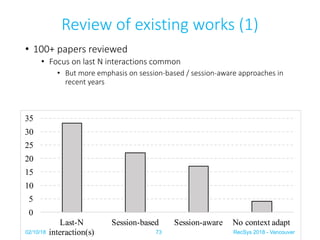
Review of existing works (1)
• 100+ papers reviewed
• Focus on last N interactions common
• But more emphasis on session-based / session-aware approaches in
recent years
02/10/18 RecSys 2018 - Vancouver73
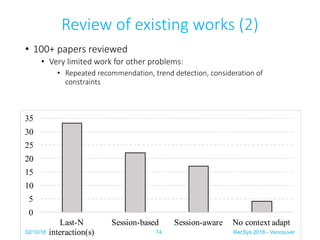
Review of existing works (2)
• 100+ papers reviewed
• Very limited work for other problems:
• Repeated recommendation, trend detection, consideration of
constraints
02/10/18 RecSys 2018 - Vancouver74
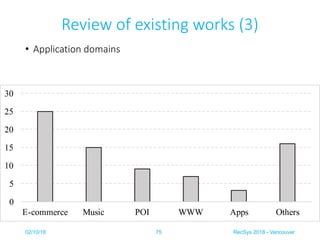
Review of existing works (3)
• Application domains
02/10/18 RecSys 2018 - Vancouver75
Summary of first part
• Matrix completion abstraction not well suited for many
practical problems
• In reality, rich user interaction logs are available
• Different types of information can be derived from the
sequential information in the logs
• and used for special recommendation tasks, in particular for the
prediction of the next-action
• Coming next:
• Algorithms and evaluation
02/10/18 RecSys 2018 - Vancouver76
Evaluation and Datasets
02/10/18 RecSys 2018 - Vancouver77
Agenda
• 14:00 – 14:45 Introduction & Problem Definition (Paolo)
• 14:45 – 15:15 Evaluation (Paolo)
• 15:15 – 15:30 Algorithms I (Massimo)
• 15:30 – 16:00 Coffee break
• 16:00 – 16:45 Algorithms II (Massimo)
• 16:45 – 17:20 Hands-on (Massimo)
• 17:20 – 17:30 Conclusion / Questions
02/10/18 RecSys 2018 - Vancouver78
• Off-line
• evaluation metrics
• Error metrics: RMSE, MAE
• Classification metrics: Precision, Recall, …
• Ranking metrics: MAP, MRR, NDCG, …
• dataset partitioning (hold-out, leave-one-out, …)
• available datasets
• On-line evaluation
• users studies
• field test
Traditional evaluation approaches
02/10/18 RecSys 2018 - Vancouver79
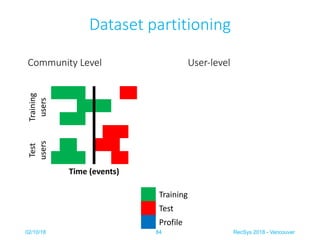
• Splitting the data into training and test sets
event-level session-level
Dataset partitioning
02/10/18 RecSys 2018 - Vancouver80
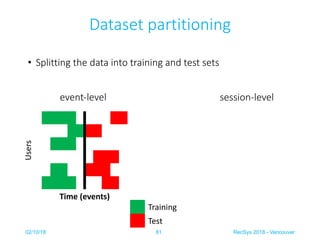
• Splitting the data into training and test sets
event-level session-level
Dataset partitioning
Training
Test
Users
Time (events)
02/10/18 RecSys 2018 - Vancouver81
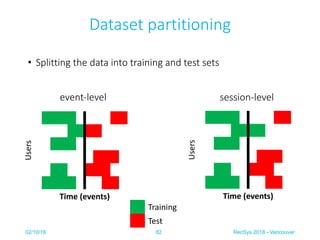
• Splitting the data into training and test sets
event-level session-level
Dataset partitioning
Training
Test
Users
Time (events)
Users Time (events)
02/10/18 RecSys 2018 - Vancouver82
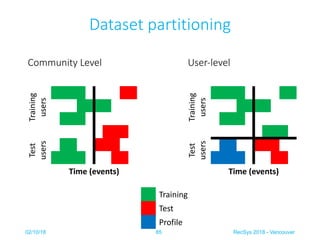
Community Level User-level
Dataset partitioning
02/10/18 RecSys 2018 - Vancouver83
Community Level User-level
Dataset partitioning
Training
Test
Profile
Training
users
Test
users
Time (events)
02/10/18 RecSys 2018 - Vancouver84
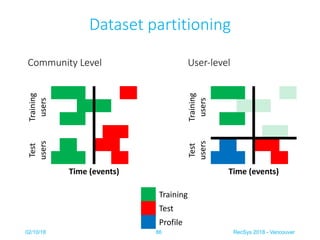
Community Level User-level
Dataset partitioning
Training
users
Test
users
Time (events)
Training
Test
Profile
Training
users
Test
users
Time (events)
02/10/18 RecSys 2018 - Vancouver85
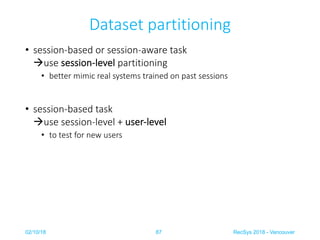
Community Level User-level
Dataset partitioning
Training
users
Test
users
Time (events)
Training
Test
Profile
Training
users
Test
users
Time (events)
02/10/18 RecSys 2018 - Vancouver86
• session-based or session-aware task
àuse session-level partitioning
• better mimic real systems trained on past sessions
• session-based task
àuse session-level + user-level
• to test for new users
Dataset partitioning
02/10/18 RecSys 2018 - Vancouver87
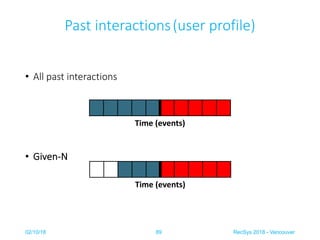
Past interactions(user profile)
• All past interactions
• Given-N
02/10/18 RecSys 2018 - Vancouver89
Time (events)
Time (events)
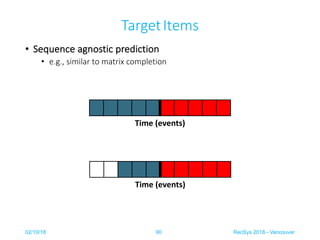
TargetItems
• Sequence agnostic prediction
• e.g., similar to matrix completion
02/10/18 RecSys 2018 - Vancouver90
Time (events)
Time (events)
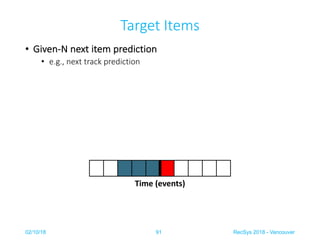
Target Items
• Given-N next item prediction
• e.g., next track prediction
02/10/18 RecSys 2018 - Vancouver91
Time (events)
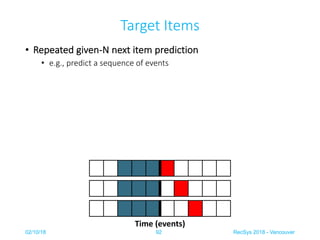
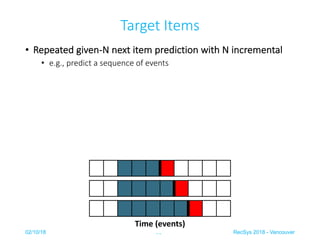
• Repeated given-N next item prediction
• e.g., predict a sequence of events
Target Items
Time (events)
02/10/18 RecSys 2018 - Vancouver92
• Repeated given-N next item prediction with N incremental
• e.g., predict a sequence of events
Target Items
02/10/18 RecSys 2018 - Vancouver93
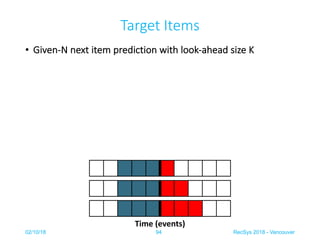
Time (events)
• Given-N next item prediction with look-ahead size K
Target Items
Time (events)
02/10/18 RecSys 2018 - Vancouver94
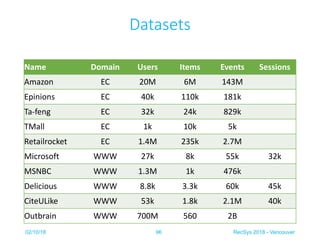
Datasets
02/10/18 RecSys 2018 - Vancouver96
Name Domain Users Items Events Sessions
Amazon EC 20M 6M 143M
Epinions EC 40k 110k 181k
Ta-feng EC 32k 24k 829k
TMall EC 1k 10k 5k
Retailrocket EC 1.4M 235k 2.7M
Microsoft WWW 27k 8k 55k 32k
MSNBC WWW 1.3M 1k 476k
Delicious WWW 8.8k 3.3k 60k 45k
CiteULike WWW 53k 1.8k 2.1M 40k
Outbrain WWW 700M 560 2B
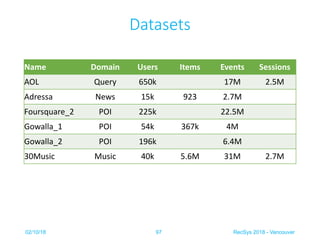
Datasets
02/10/18 RecSys 2018 - Vancouver97
Name Domain Users Items Events Sessions
AOL Query 650k 17M 2.5M
Adressa News 15k 923 2.7M
Foursquare_2 POI 225k 22.5M
Gowalla_1 POI 54k 367k 4M
Gowalla_2 POI 196k 6.4M
30Music Music 40k 5.6M 31M 2.7M
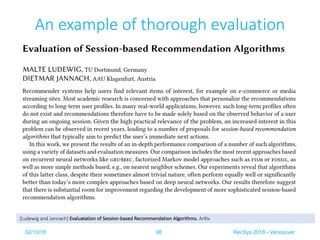
An example of thorough evaluation
02/10/18 RecSys 2018 - Vancouver98
[Ludewig and Jannach] Evaluatation of Session-based Recommendation Algorithms. ArXiv
Algorithms
02/10/18 RecSys 2018 - Vancouver99
Agenda
02/10/18 RecSys 2018 - Vancouver100
• 14:00 – 14:45 Introduction & Problem Definition (Paolo)
• 14:45 – 15:15 Evaluation (Paolo)
• 15:15 – 15:30 Algorithms I (Massimo)
• 15:30 – 16:00 Coffee break
• 16:00 – 16:45 Algorithms II (Massimo)
• 16:45 – 17:20 Hands-on (Massimo)
• 17:20 – 17:30 Conclusion / Questions
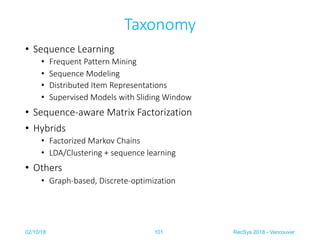
Taxonomy
• Sequence Learning
• Frequent Pattern Mining
• Sequence Modeling
• Distributed Item Representations
• Supervised Models with Sliding Window
• Sequence-aware Matrix Factorization
• Hybrids
• Factorized Markov Chains
• LDA/Clustering + sequence learning
• Others
• Graph-based, Discrete-optimization
02/10/18 RecSys 2018 - Vancouver101
Taxonomy
• Sequence Learning
• Frequent Pattern Mining
• Sequence Modeling
• Distributed Item Representations
• Supervised Models with Sliding Window
• Sequence-aware Matrix Factorization
• Hybrids
• Factorized Markov Chains
• LDA/Clustering + sequence learning
• Others
• Graph-based, Discrete-optimization
02/10/18 RecSys 2018 - Vancouver102
Sequence Learning (SL)
• Useful in application domains where input data has an
inherent sequential nature
• Natural Language Processing
• Time-series prediction
• DNA modelling
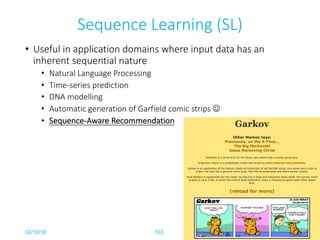
• Automatic generation of Garfield comic strips J
• Sequence-Aware Recommendation
02/10/18 RecSys 2018 - Vancouver103
Frequent Pattern Mining (FPM)
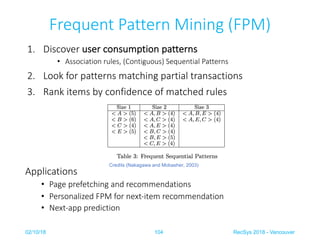
1. Discover user consumption patterns
• Association rules, (Contiguous) Sequential Patterns
2. Look for patterns matching partial transactions
3. Rank items by confidence of matched rules
Applications
• Page prefetching and recommendations
• Personalized FPM for next-item recommendation
• Next-app prediction
02/10/18 RecSys 2018 - Vancouver104
Credits (Nakagawa and Mobasher, 2003)
FPM
• Association Rule Mining
• items co-occurring within the same sessions
• no check on order
• if you like A and B, you also like C (aka: learning to rank)
• Sequential Pattern Mining
• Items co-occurring in the same order
• no check on distance
• If you watch A and later watch B, you will later watch C
• Contiguous Sequential Pattern Mining
• Item co-occurring in the same order and distance
• If you watch A and B one after the other, if now watch C
02/10/18 RecSys 2018 - Vancouver105
[Mobasher et al] Using sequential and non-sequential patterns in predictive web usage mining tasks. ICDM ’02
FPM
• Two steps approach
1. Offline: rule mining
2. Online: rule matching (with current user session)
• Rules have
• Support: number of examples (main parameter)
• Confidence: conditional probability
• Lower thresholds -> fewer rules
• few rules: difficult to find rules matching a session
• many rules: noisy rules (low quality)
02/10/18 RecSys 2018 - Vancouver106
Frequent Pattern Mining (FPM)
• Pros
• Easy to implement
• Explainable predictions
• Cons
• Choice of the minimum support/confidence thresholds
• Data sparsity
• Limited scalability
02/10/18 RecSys 2018 - Vancouver108
[C. Lu et al] Mining mobile application sequential patterns for usage prediction. GrC ’14
[Nakagawa and Mobasher] Impact of site characteristics on recommendation models based on association rules and sequential patterns.
IJCAI ’03
[Yap et al.] Effective next-items recommendation via personalized sequential pattern mining. DASFAA ’12
[Zhou et al.] An intelligent recommender system using sequential web access patterns. CIS ’04
02/10/18 RecSys 2018 - Vancouver109
Sequence Modeling
• Sequences of past user actions as time series with discrete
observations
• Timestamps used only to order user actions (optionally to model
time intervals)
• Aim to learn models from past observations to predict future
ones
• Categories of SM models
• Markov Models
• Reinforcement Learning
• Recurrent Neural Networks
02/10/18 RecSys 2018 - Vancouver110
Markov Models
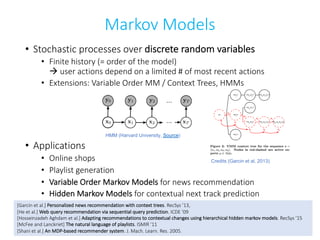
• Stochastic processes over discrete random variables
• Finite history (= order of the model)
à user actions depend on a limited # of most recent actions
• Extensions: Variable Order MM / Context Trees, HMMs
• Applications
• Online shops
• Playlist generation
• Variable Order Markov Models for news recommendation
• Hidden Markov Models for contextual next track prediction
02/10/18 RecSys 2018 - Vancouver111
[Garcin et al.] Personalized news recommendation with context trees. RecSys ’13,
[He et al.] Web query recommendation via sequential query prediction. ICDE ’09
[Hosseinzadeh Aghdam et al.] Adapting recommendations to contextual changes using hierarchical hidden markov models. RecSys ’15
[McFee and Lanckriet] The natural language of playlists. ISMIR ’11
[Shani et al.] An MDP-based recommender system. J. Mach. Learn. Res. 2005.
Credits (Garcin et al, 2013)
HMM (Harvard University, Source)