Personalization and
Customization in E-commerce
By
Dr.Y.Vinodhini
• Digital marketers can’t depend on any
one-size fits all approach with their
campaigns because consumers expect
more from brands than ever before.
People require brands to understand
their exact problem and provide the
perfect solution in the moment
Technology has evolved to the point
where marketers can create laser-
focused messages for specific
audience segments with a variety of ad
types. But the question then becomes:
which is the right approach, a
customized or personalized advertising
strategy
• Customization and personalization are
often thought to be synonymous, but
that isn’t the case. There is some overlap
between the two (both aim to tailor
marketing experiences to a user’s
interest and improve their experience)
yet they take two paths to reach their
end goal. They have inherent differences.
• While customization is initiated by the
user, personalization is done for the user.
Customization
• Customization is done by the user. Users are asked to
identify their preferences and they are then shown
things that they prefer. For example, when customers
sign up for Netflix, the service asks users to select a
few shows they like and then displays a list of options
based on those choices. Then, Netflix customizes the
user’s account based on the identified preferences.
• On other platforms, another example of customization
happens when you click the “hide ad” option for
Facebook ads or Google Display Network ads.
• When you click to hide ads on display ads, Google
sends you to a page where you can select your ad
preferences, customizing what kind of ads you see
while you browse websites:
Personalization
• personalization is more about emotions and
intangibility than buying the products available
off-the-shelves. Customization Favorite Fashion
Trend of Millennials and Gen Z Customization is
a philosophy that believes in creating a unique
value proposition for every customer.
Customization is a subset of personalization
where customers can customize a pre-existing
product by applying designs, prints, images,
colors, monograms, and texts
Contd…Personalization
• Personalization uses data points — information about
the consumer, to increase user relevancy to the ads or
other cross-channel messages such as emails and text
messages that they are shown.
• Advertising personalization uses:
reason such as personalization…
• Helps marketers understand customers.
Personalization can help marketing teams learn
customers' current needs and potential future
interests. ...
• Lets brands stand out. Personalization can also help
brands stand out. ...
• Enables higher conversion rates. ...
• Creates higher brand loyalty. ...
• Builds trust.
Contd…Personalization
insights such as basic demographic information,
behavioral patterns, and buying preferences to
craft marketing experiences for a specific
audience segment, increasing the likelihood of a
higher ROI.
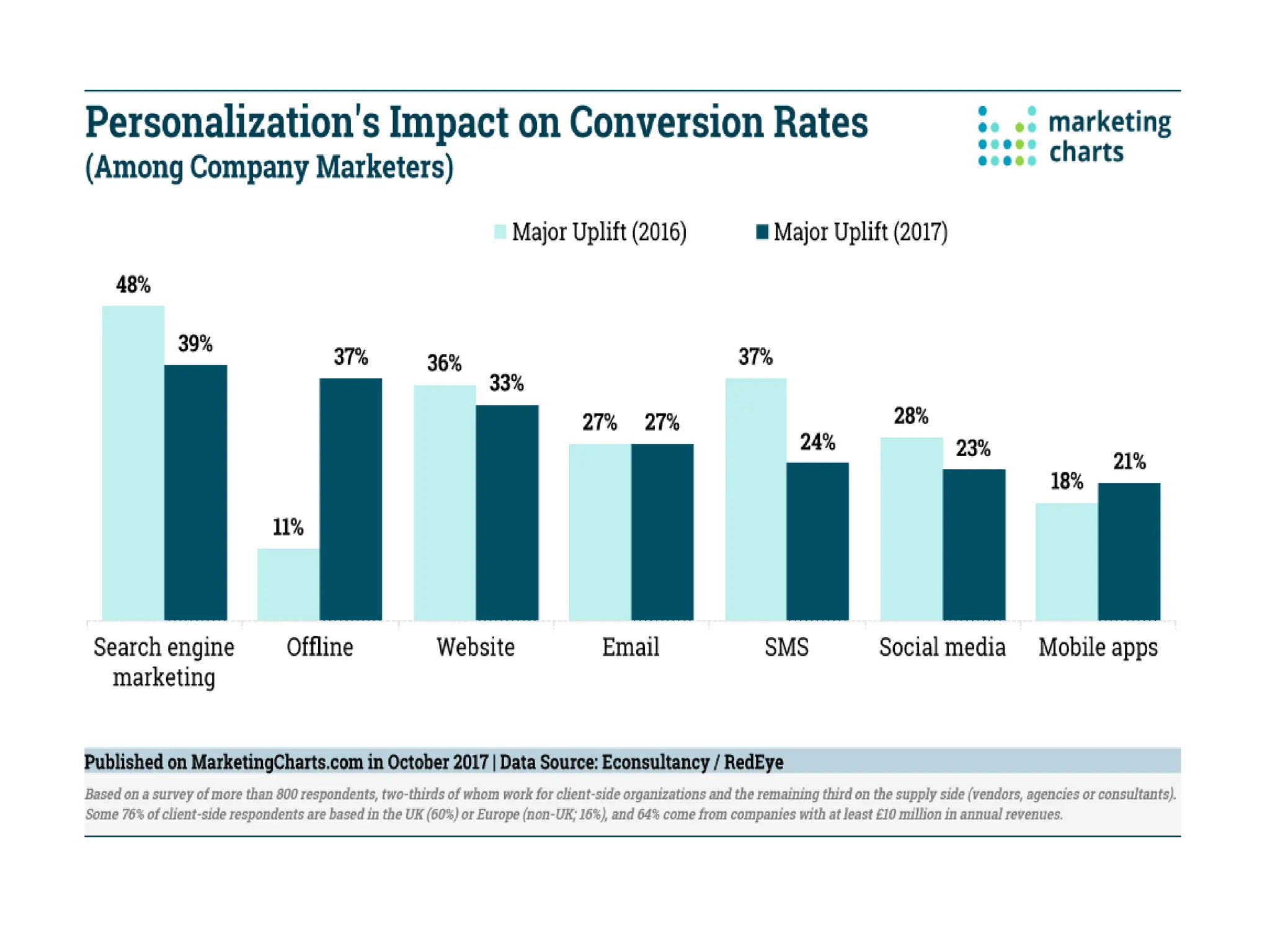
To demonstrate, this graph shows the impact of
personalization on conversion rates by
advertising channel:
Personalization in PPC ads
The amount of user data available has changed
how marketers run personalization campaigns in
PPC marketing, email marketing, and marketing
automation. Facebook and Google, in particular,
give you access to a plethora of user data such
as demographics, devices, interests, behaviors,
and connections to help you create personalized
campaigns for every audience segment.
With PPC marketing, at the most basic level,
personalized campaigns can simply refer to
message matching relevant campaigns based on
a user’s search query or their online browsing
behavior.
Message matching user queries or browsing
behavior with ads and relevant post-click
landing pages is one instance of PPC advertising
personalization. Optimove demonstrates
message match with its remarketing ad
and corresponding post-click landing page
below. Both feature the same (or similar)
headline, copy, branding imagery, and colors:
• Personalization in PPC marketing also includes
geo-targeting the ad’s content and post-click
landing pages to audiences in specific regions.
You can use dynamic text replacement(Dynamic
Text Replacement (DTR) is a powerful feature to
add personalization to your popups using a
range of variables. It allows you to build a single
popup and automatically change the text to
show your visitors relevant message ) with your
ads and post-click landing pages by using URL
parameters of your post-click landing page to
personalize the page.
Customization vs. personalization in
user experience
• User experience is the feeling a user has when
they interact with a web page,(A website
interaction is any kind of movement,
communication, or interactivity between a user
and a website. For example, interaction can
happen when a user clicks on something to move
forward, views a video, comments on a post,
provide feedback, visits internal links, etc) an ad,
or any other component of digital marketing.
Both customization and personalization have a
positive impact on user experience since they
enhance the user’s experience on a web page.
Refer to the Netflix customized signup process
earlier.
• Both customization and personalization have a positive impact on
user experience(User experience happens whether we do anything
or not. Both good and bad user experiences result from some effort
at shaping the initial experience; however, the chances of having a
positive user experience are definitely increased with the right
efforts.
• The best efforts pay off, too, increasing conversion, satisfaction,
retention and loyalty – you know, all of those things every
marketing department clamors for and every successful product
requires. since they enhance the user’s experience on a web page.
Refer to the Netflix customized signup process earlier.)
• Customization improves user experience because it allows users to
select their preferences, by outlining what they want, it becomes
easy for marketers to show them marketing campaigns that are
tailored for their specific needs.
Importance of User Experience
From the perspective of the user, the only thing that
differentiates you from your competitors is the experience.
Although “user experience” umbrellas all aspects of the user’s
interaction with your company, services and products, the digital
design component of those interactions has an impact, too:
• In one survey, 52 percent of users said a bad
mobile experience made them less likely to
engage with a company.
• In another study, 88 percent of online consumers
said they would not to return to a site after a bad
experience, and 79 percent of online shoppers
admitted they’d be less likely to buy from a site
again if they experienced a dissatisfying visit.
• Another study found that 75 percent of users
based the entire company’s credibility on its
website design.
• Customization improves user experience
because it allows users to select their
preferences, by outlining what they want, it
becomes easy for marketers to show them
marketing campaigns that are tailored for
their specific needs.
Need for personalization
• Personalization is important in ecommerce
because consumers today expect personalized
experiences across all digital touchpoints,
from product recommendations to tailored
content and offers. Personalization helps
improve conversion rate optimization,
increase engagement, and drive sales
Example: fashion companies are enticing
millennial and Gen Z population with exclusive
designs. Whether apparel, footwear, or jewelry
companies are extending opportunities to
customize them as per their preferences.
• The dynamics of the fashion industry are changed
as we have moved from push to pull economy.
Instead of pushing products based on forecasts,
fashion is now pulled as per the demand. The
journey has been beautiful, but now we are here
in the age of tech-driven fashion, enabling
customers to personalize their style. If you are
playing in the fashion industry and are keen to
remain abreast with trends while becoming a top
of the mind recall brand,
• Retailers are tapping into this privileged
experience by
creating meaningful engagements for their
customers. They are adopting a direct-to-
consumer
business model where customers do not need to
enter into the realm of haute couture to enjoy
luxury fashion. They can create their own using
ultra-modern technologies and flaunt their
creative liberty.
• The speed with which customization and
personalization are spreading
their wings in the industry, the time is not far
when every fashion retailer will trade on these
models. And those who turn their backs may be
thrown out of the competition as customers and
their preferences dictate the current economy.
Gone are the days when seasonal fashion was
desperately awaited
PERSONALIZATION IN GLOBAL SYSTEMS THROUGH
ML AND OTHER RECOMMENDED SYSTEMS
In today’s digital land scape Personalization is
gaining greater acceptance. E-global systems
from e-commerce and news platforms to
entertainment and educational portals leverage
machine learning and recommended systems to
tailor content and services to individual users.
This creates a more engaging and satisfying user
experience, driving increased engagement,
conversions and loyalty
Working of Machine Learning
ML algorithms analyze vast amount of user data
including
• Browsing history
• Purchase records
• Click through rates
• Reviews and ratings
• Demographic information
• Social Media activity
Contd…working of ML
• They identify patterns and
correlations within this data to
understand user preferences,
interests and behaviours.
Based on these insights the
algorithms Predict, recommend and
Optimize
working of ML
• Predict: which items or services a
user is most likely to engage with
• Recommend: Personalized content,
products or experience
• Optimize: Content layout, search
results and promotional offers
Benefits of personalization
• Increased User Engagement: Relevant
content keeps users interacting with the
platform longer
• Boosted customer loyalty: Tailored
experiences foster deeper connections with
users
• More Efficient marketing: Targeting specific
user segments with relevant messaging
Examples of personalization in Action
• Amazon: recommends products
based on your purchase history,
browsing behaviour and reviews the
user has written
• Spotify: Creates personalized playlist
based on your listening habits and
musical tastes
Contd…Examples of personalization in
Action
• Netflix: Suggests movies and shows based
on your watch history, ratings and genre
preferences
• Google search: tailors search results based
on your location, previous searches and
interests
• Duolingo: Adjusts the difficulty of language
learning lessons based on your progress and
performance
Different types of Recommendation
systems
• Content based : recommends items
similar to those the user has interacted
within the past
• Collaborative Filtering: Recommends
items based on the preferences of
similar users
• Hybrid: combines both content and
collaborative filtering approaches
Few more examples of Recommended
systems in E-Global Businesses
• Apart from regular systems
there are few more examples
that are considered are
• 1. Skyscanner, Air bnb,
Linkedin, Quora, Zolando,
klarna
conclusion
Effective personalization requires strong focus
on data privacy and ethical considerations.
Users should be informed about how their
data is used and have control over their
privacy settings
As technology advances m many sophisticated
and high graded approaches to personalizing
the digital experience, making e-global
systems even more enjoyable and relevant for
individual user

personalization and customization in e-commerce.pptx

  • 1.
    Personalization and Customization inE-commerce By Dr.Y.Vinodhini
  • 2.
    • Digital marketerscan’t depend on any one-size fits all approach with their campaigns because consumers expect more from brands than ever before. People require brands to understand their exact problem and provide the perfect solution in the moment
  • 3.
    Technology has evolvedto the point where marketers can create laser- focused messages for specific audience segments with a variety of ad types. But the question then becomes: which is the right approach, a customized or personalized advertising strategy
  • 4.
    • Customization andpersonalization are often thought to be synonymous, but that isn’t the case. There is some overlap between the two (both aim to tailor marketing experiences to a user’s interest and improve their experience) yet they take two paths to reach their end goal. They have inherent differences. • While customization is initiated by the user, personalization is done for the user.
  • 5.
    Customization • Customization isdone by the user. Users are asked to identify their preferences and they are then shown things that they prefer. For example, when customers sign up for Netflix, the service asks users to select a few shows they like and then displays a list of options based on those choices. Then, Netflix customizes the user’s account based on the identified preferences. • On other platforms, another example of customization happens when you click the “hide ad” option for Facebook ads or Google Display Network ads. • When you click to hide ads on display ads, Google sends you to a page where you can select your ad preferences, customizing what kind of ads you see while you browse websites:
  • 6.
    Personalization • personalization ismore about emotions and intangibility than buying the products available off-the-shelves. Customization Favorite Fashion Trend of Millennials and Gen Z Customization is a philosophy that believes in creating a unique value proposition for every customer. Customization is a subset of personalization where customers can customize a pre-existing product by applying designs, prints, images, colors, monograms, and texts
  • 7.
    Contd…Personalization • Personalization usesdata points — information about the consumer, to increase user relevancy to the ads or other cross-channel messages such as emails and text messages that they are shown. • Advertising personalization uses: reason such as personalization… • Helps marketers understand customers. Personalization can help marketing teams learn customers' current needs and potential future interests. ... • Lets brands stand out. Personalization can also help brands stand out. ... • Enables higher conversion rates. ... • Creates higher brand loyalty. ... • Builds trust.
  • 8.
    Contd…Personalization insights such asbasic demographic information, behavioral patterns, and buying preferences to craft marketing experiences for a specific audience segment, increasing the likelihood of a higher ROI. To demonstrate, this graph shows the impact of personalization on conversion rates by advertising channel:
  • 10.
    Personalization in PPCads The amount of user data available has changed how marketers run personalization campaigns in PPC marketing, email marketing, and marketing automation. Facebook and Google, in particular, give you access to a plethora of user data such as demographics, devices, interests, behaviors, and connections to help you create personalized campaigns for every audience segment. With PPC marketing, at the most basic level, personalized campaigns can simply refer to message matching relevant campaigns based on a user’s search query or their online browsing behavior.
  • 11.
    Message matching userqueries or browsing behavior with ads and relevant post-click landing pages is one instance of PPC advertising personalization. Optimove demonstrates message match with its remarketing ad and corresponding post-click landing page below. Both feature the same (or similar) headline, copy, branding imagery, and colors:
  • 12.
    • Personalization inPPC marketing also includes geo-targeting the ad’s content and post-click landing pages to audiences in specific regions. You can use dynamic text replacement(Dynamic Text Replacement (DTR) is a powerful feature to add personalization to your popups using a range of variables. It allows you to build a single popup and automatically change the text to show your visitors relevant message ) with your ads and post-click landing pages by using URL parameters of your post-click landing page to personalize the page.
  • 13.
    Customization vs. personalizationin user experience • User experience is the feeling a user has when they interact with a web page,(A website interaction is any kind of movement, communication, or interactivity between a user and a website. For example, interaction can happen when a user clicks on something to move forward, views a video, comments on a post, provide feedback, visits internal links, etc) an ad, or any other component of digital marketing. Both customization and personalization have a positive impact on user experience since they enhance the user’s experience on a web page. Refer to the Netflix customized signup process earlier.
  • 14.
    • Both customizationand personalization have a positive impact on user experience(User experience happens whether we do anything or not. Both good and bad user experiences result from some effort at shaping the initial experience; however, the chances of having a positive user experience are definitely increased with the right efforts. • The best efforts pay off, too, increasing conversion, satisfaction, retention and loyalty – you know, all of those things every marketing department clamors for and every successful product requires. since they enhance the user’s experience on a web page. Refer to the Netflix customized signup process earlier.) • Customization improves user experience because it allows users to select their preferences, by outlining what they want, it becomes easy for marketers to show them marketing campaigns that are tailored for their specific needs.
  • 15.
    Importance of UserExperience From the perspective of the user, the only thing that differentiates you from your competitors is the experience. Although “user experience” umbrellas all aspects of the user’s interaction with your company, services and products, the digital design component of those interactions has an impact, too: • In one survey, 52 percent of users said a bad mobile experience made them less likely to engage with a company. • In another study, 88 percent of online consumers said they would not to return to a site after a bad experience, and 79 percent of online shoppers admitted they’d be less likely to buy from a site again if they experienced a dissatisfying visit. • Another study found that 75 percent of users based the entire company’s credibility on its website design.
  • 16.
    • Customization improvesuser experience because it allows users to select their preferences, by outlining what they want, it becomes easy for marketers to show them marketing campaigns that are tailored for their specific needs.
  • 17.
    Need for personalization •Personalization is important in ecommerce because consumers today expect personalized experiences across all digital touchpoints, from product recommendations to tailored content and offers. Personalization helps improve conversion rate optimization, increase engagement, and drive sales
  • 18.
    Example: fashion companiesare enticing millennial and Gen Z population with exclusive designs. Whether apparel, footwear, or jewelry companies are extending opportunities to customize them as per their preferences.
  • 19.
    • The dynamicsof the fashion industry are changed as we have moved from push to pull economy. Instead of pushing products based on forecasts, fashion is now pulled as per the demand. The journey has been beautiful, but now we are here in the age of tech-driven fashion, enabling customers to personalize their style. If you are playing in the fashion industry and are keen to remain abreast with trends while becoming a top of the mind recall brand,
  • 20.
    • Retailers aretapping into this privileged experience by creating meaningful engagements for their customers. They are adopting a direct-to- consumer business model where customers do not need to enter into the realm of haute couture to enjoy luxury fashion. They can create their own using ultra-modern technologies and flaunt their creative liberty.
  • 21.
    • The speedwith which customization and personalization are spreading their wings in the industry, the time is not far when every fashion retailer will trade on these models. And those who turn their backs may be thrown out of the competition as customers and their preferences dictate the current economy. Gone are the days when seasonal fashion was desperately awaited
  • 22.
    PERSONALIZATION IN GLOBALSYSTEMS THROUGH ML AND OTHER RECOMMENDED SYSTEMS In today’s digital land scape Personalization is gaining greater acceptance. E-global systems from e-commerce and news platforms to entertainment and educational portals leverage machine learning and recommended systems to tailor content and services to individual users. This creates a more engaging and satisfying user experience, driving increased engagement, conversions and loyalty
  • 23.
    Working of MachineLearning ML algorithms analyze vast amount of user data including • Browsing history • Purchase records • Click through rates • Reviews and ratings • Demographic information • Social Media activity
  • 24.
    Contd…working of ML •They identify patterns and correlations within this data to understand user preferences, interests and behaviours. Based on these insights the algorithms Predict, recommend and Optimize
  • 25.
    working of ML •Predict: which items or services a user is most likely to engage with • Recommend: Personalized content, products or experience • Optimize: Content layout, search results and promotional offers
  • 26.
    Benefits of personalization •Increased User Engagement: Relevant content keeps users interacting with the platform longer • Boosted customer loyalty: Tailored experiences foster deeper connections with users • More Efficient marketing: Targeting specific user segments with relevant messaging
  • 27.
    Examples of personalizationin Action • Amazon: recommends products based on your purchase history, browsing behaviour and reviews the user has written • Spotify: Creates personalized playlist based on your listening habits and musical tastes
  • 28.
    Contd…Examples of personalizationin Action • Netflix: Suggests movies and shows based on your watch history, ratings and genre preferences • Google search: tailors search results based on your location, previous searches and interests • Duolingo: Adjusts the difficulty of language learning lessons based on your progress and performance
  • 29.
    Different types ofRecommendation systems • Content based : recommends items similar to those the user has interacted within the past • Collaborative Filtering: Recommends items based on the preferences of similar users • Hybrid: combines both content and collaborative filtering approaches
  • 30.
    Few more examplesof Recommended systems in E-Global Businesses • Apart from regular systems there are few more examples that are considered are • 1. Skyscanner, Air bnb, Linkedin, Quora, Zolando, klarna
  • 31.
    conclusion Effective personalization requiresstrong focus on data privacy and ethical considerations. Users should be informed about how their data is used and have control over their privacy settings As technology advances m many sophisticated and high graded approaches to personalizing the digital experience, making e-global systems even more enjoyable and relevant for individual user