The TAACCCT Program A tool for promoting
Economic Development in the Athens area
Presented by the Athens Technical College TAACCCT Team

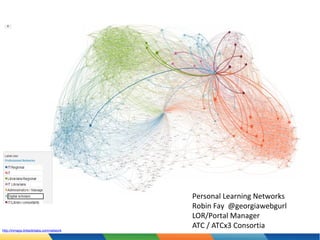
http://inmaps.linkedinlabs.com/network

Personal Learning Networks
Robin Fay @georgiawebgurl
LOR/Portal Manager
ATC / ATCx3 Consortia
Personal Learning
Network
Resources for staying current in the
ever-changing field of technology,
professional networking tools and
tips, case studies, and suggestions
for building your own personal
learning network (PLN).

Robin Fay, LOR/Portal Manager @georgiawebgurl
ATC / ATCx3 Consortia
Personal Learning Networks for IT professionals
Not THAT kind of network, this kind of network

•Personal Learning Networks (PLNs) aren’t really new;
however it is a way of looking at learning and organizing the
process
•PLNs is about making a connection.
•PLNs can be informal or formal.
•Learning can be scheduled or at your own pace.
•Learning can be face to face, virtual, or hybrid.
•Anyone that you interact with can be part of your PLN:
mentors, supervisors, peers, colleagues, teachers,
instructors, conference presenters, bloggers, discussion
forum leaders, Facebook friends, Twitter followers, the list
goes on….

Robin Fay, LOR/Portal Manager @georgiawebgurl
ATC / ATCx3 Consortia
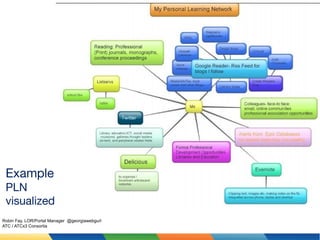
Example of
PLN
visualized
Robin Fay, LOR/Portal Manager @georgiawebgurl
ATC / ATCx3 Consortia
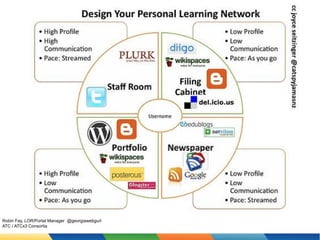
PLN example
Robin Fay, LOR/Portal Manager @georgiawebgurl
ATC / ATCx3 Consortia
Robin Fay, LOR/Portal Manager @georgiawebgurl
ATC / ATCx3 Consortia
Personal Learning Networks for IT professionals
Staying current is a huge challenge in technology fields. So, how do you
do it?
Join a meetup. Check out meetup.com, Facebook & listservs for face to face learning opportunities. Unconferences and meetups are super cheap
(ThatCamp, WordCamp, WPCamp, DrupalCamps, GLAMLOD – a Georgia Linked Data Group, etc.)
o

Social media: Facebook, Twitter, Linkedin, Quora, Google+ . Join groups that are relevant to your field and join in discussions (Twitterchat – I like blogchat
on Sunday evenings but there are many others). http://blog.tweetchat.com/calendar/
o

Robin Fay, LOR/Portal Manager @georgiawebgurl
ATC / ATCx3 Consortia
Personal Learning Networks for IT professionals - Resources
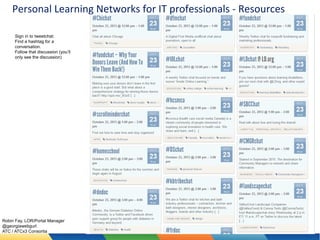
Sign in to tweetchat.
Find a hashtag for a
conversation.
Follow that discussion (you’ll
only see the discussion)

Robin Fay, LOR/Portal Manager
@georgiawebgurl
ATC / ATCx3 Consortia
Personal Learning Networks for IT professionals
Connect with experts. Check out their websites and connect with them in social spaces. Linkedin (http://www.linkedin/robinfay ) and Google+ are both good,
but academia.edu for higher ed is another choice.
o

o

Find a mentor. (UGA EITS Mentoring program, Women in Technology http://www.womenintechnology.org/career-development/, etc.)

Discussion forums: Many software, especially opensource, have discussion forums. Join the community but also check the forums for answers to your
questions.
o

o

Watch: Youtube and slideshare are treasure troves of educational resources

Robin Fay, LOR/Portal Manager @georgiawebgurl
ATC / ATCx3 Consortia
Personal Learning Networks for IT professionals - Resources
Category 5 Technology TV
http://www.category5.tv/ hosts all
kinds of programs related to
technology (also videos from tv
such as CNN; radio shows are
often streamed as well.
o

Robin Fay, LOR/Portal Manager
@georgiawebgurl
ATC / ATCx3 Consortia
Personal Learning Networks for IT professionals - Resources
o

Play a game like Rails for Zombies, http://railsforzombies.org/

Robin Fay, LOR/Portal Manager @georgiawebgurl
ATC / ATCx3 Consortia
Personal Learning Networks for IT professionals - Resources

o

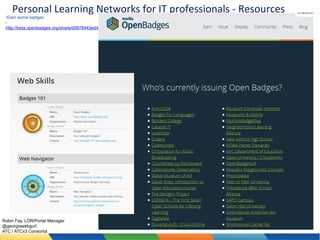
Earn some badges

o

http://beta.openbadges.org/share/d5878443ed409da8461a07e71e320f46/

Robin Fay, LOR/Portal Manager
@georgiawebgurl
ATC / ATCx3 Consortia
Personal Learning Networks for IT professionals - Resources
Get step by step instructions: Check out wikihow: Great tips on how to learn a programming language :
http://www.wikihow.com/Start-Learning-Computer-Programming ), starting programming in python http://www.wikihow.com/Start-Programming-in-Python and
much more.
o

o

Build a portfolio (one just for programmers!) https://coderbits.com/

Find examples and demos. Github https://github.com/ Google code https://developers.google.com/ and sourceforge http://sourceforge.net/ are all useful
resources (and don’t forget the Google Webmaster tools, https://www.google.com/webmasters/tools/home?hl=en, Google Labs,
http://www.google.com/enterprise/labs/ , the Bing Webmaster tools , http://www.bing.com/toolbox/webmaster, and Microsoft research
http://research.microsoft.com/en-us/
o

Robin Fay, LOR/Portal Manager @georgiawebgurl
ATC / ATCx3 Consortia
Personal Learning Networks for IT professionals - Resources
o

Read: Mashable, techcrunch, cnn technology – whatever is interesting to you. I also use keep Twitter searches and Google alerts to keep up with news.

o

Read a book - seriously ! many technology related books are available as ebooks (some for free).
SecondLife and Virtual worlds? Sure, educational groups do meet in such spaces!

o

o

Make a playlist - use Itunes or Youtube to make playlists of useful videos.

Use tools: RSS readers (thunderbird, feedly, etc. and bookmarking (delicious, pinterest, etc.) to find and/or save items to read later (I pin on IT, linkeddata
and all kinds of stuff at pinterest) and social media management tools like hootsuite to keep up.
o

Robin Fay, LOR/Portal Manager @georgiawebgurl
ATC / ATCx3 Consortia
Personal Learning Networks for IT professionals - Resources
oDo

a tutorial : W3C schools http://www.w3schools.com/, webmonkey http://www.webmonkey.com/tutorials/ Opera Introduction to Web Standards
http://dev.opera.com/articles/view/1-introduction-to-the-web-standards-cur/#toc , Google University (!) https://developers.google.com/university/, Codeschool
https://www.codeschool.com/ and Team Treehouse http://teamtreehouse.com/ both offer badges, CodeAcademy http://www.codecademy.com/ and specific
sites like alistapart.com and http://stackoverflow.com/

Robin Fay, LOR/Portal Manager @georgiawebgurl
ATC / ATCx3 Consortia
Personal Learning Networks for IT professionals - Resources
oWebinars ! O’Reilly has a huge list of free webinars on all sorts of technology topics from specific
programming languages to more general IT topics. Archives are also available. http://oreilly.com/webcasts/

Robin Fay, LOR/Portal Manager @georgiawebgurl
ATC / ATCx3 Consortia
Personal Learning Networks for IT professionals
Training on the cheap:
•

Inhouse training

•

Training resources purchased by your institution such as Lynda.com (‘like’ Lynda on Facebook for more free content & courses) - & Skillsoft.

MOOCs (Massive Open Online Classes)
Coursera includes topics such as Computer Science 101, Metadata and More. https://www.coursera.org/course/cs101
Stanford’s Engineering Everywhere includes topics such as AI, Natural Language Processing, Programming Methodology, iphone Application
programming, among others. http://see.stanford.edu/see/courses.aspx ; webcast. Berkley http://webcast.berkeley.edu/ includes Computer Science 164
(classes are often posted on youtube as well: http://www.youtube.com/playlist?list=PL7A7B0FAED3635BAF ) ; UCLA’s free classes include courses on
Project management https://www.uclaextension.edu/pages/search.aspx?c=free+courses ; Harvard; MIT (http://ocw.mit.edu/index.htm) & others
http://www.extension.harvard.edu/open-learning-initiative
•

Robin Fay, LOR/Portal Manager @georgiawebgurl
ATC / ATCx3 Consortia
Personal Learning Networks for IT professionals
Tips for social media:
•Use social networks to discover new people to add your network
•Use social networks to learn – find answers to tech questions
•Use social networks to find a new job
•Use social networks to find about new resources
•Use social networks to keep up with the news
•Use social networks to stash useful info and resources
•Use social networks to find collaborators

Robin Fay, LOR/Portal Manager @georgiawebgurl
ATC / ATCx3 Consortia
Personal Learning Networks for IT professionals - Resources
Quick aside:
•Remember as you use webspace publicly, you will be adding to your digital footprint.
So, if you’re contributing code or help to a forum, you can add that to your linkedin or
aboutme page. The more you participate online, the more important it is to develop a
central web presence. (Remember, Google is your resume).

Robin Fay, LOR/Portal Manager @georgiawebgurl
ATC / ATCx3 Consortia
Personal Learning Networks for IT professionals - Resources
Cheatsheet:
•Read! Articles, guides, blogposts and more
•Use social media management & productivity tools (RSS readers, hootsuite, etc.)
•Start a conversation
•Pay it forward – share and build the network ; share your presentations, documents, projects
•Blog your learning, blog your process – share your process and invite others into the process (can
be an easy way to find users for usability testing)
•Follow and network with experts
•Bookmark it ! Social bookmarking (even pinterest!) can be great resources
•Meetup: Virtual meetups (Skype, google hangout), face to face (meetup.com, unconferences, etc.)
•Take a class!
•Teach yourself – tutorials, videos, and more
Questions?

Robin Fay, LOR/Portal Manager @georgiawebgurl
ATC / ATCx3 Consortia

Personal learning networks

  • 1.
    The TAACCCT ProgramA tool for promoting Economic Development in the Athens area Presented by the Athens Technical College TAACCCT Team http://inmaps.linkedinlabs.com/network Personal Learning Networks Robin Fay @georgiawebgurl LOR/Portal Manager ATC / ATCx3 Consortia
  • 2.
    Personal Learning Network Resources forstaying current in the ever-changing field of technology, professional networking tools and tips, case studies, and suggestions for building your own personal learning network (PLN). Robin Fay, LOR/Portal Manager @georgiawebgurl ATC / ATCx3 Consortia
  • 3.
    Personal Learning Networksfor IT professionals Not THAT kind of network, this kind of network •Personal Learning Networks (PLNs) aren’t really new; however it is a way of looking at learning and organizing the process •PLNs is about making a connection. •PLNs can be informal or formal. •Learning can be scheduled or at your own pace. •Learning can be face to face, virtual, or hybrid. •Anyone that you interact with can be part of your PLN: mentors, supervisors, peers, colleagues, teachers, instructors, conference presenters, bloggers, discussion forum leaders, Facebook friends, Twitter followers, the list goes on…. Robin Fay, LOR/Portal Manager @georgiawebgurl ATC / ATCx3 Consortia
  • 4.
    Example of PLN visualized Robin Fay,LOR/Portal Manager @georgiawebgurl ATC / ATCx3 Consortia
  • 5.
    PLN example Robin Fay,LOR/Portal Manager @georgiawebgurl ATC / ATCx3 Consortia
  • 6.
    Robin Fay, LOR/PortalManager @georgiawebgurl ATC / ATCx3 Consortia
  • 7.
    Personal Learning Networksfor IT professionals Staying current is a huge challenge in technology fields. So, how do you do it? Join a meetup. Check out meetup.com, Facebook & listservs for face to face learning opportunities. Unconferences and meetups are super cheap (ThatCamp, WordCamp, WPCamp, DrupalCamps, GLAMLOD – a Georgia Linked Data Group, etc.) o Social media: Facebook, Twitter, Linkedin, Quora, Google+ . Join groups that are relevant to your field and join in discussions (Twitterchat – I like blogchat on Sunday evenings but there are many others). http://blog.tweetchat.com/calendar/ o Robin Fay, LOR/Portal Manager @georgiawebgurl ATC / ATCx3 Consortia
  • 8.
    Personal Learning Networksfor IT professionals - Resources Sign in to tweetchat. Find a hashtag for a conversation. Follow that discussion (you’ll only see the discussion) Robin Fay, LOR/Portal Manager @georgiawebgurl ATC / ATCx3 Consortia
  • 9.
    Personal Learning Networksfor IT professionals Connect with experts. Check out their websites and connect with them in social spaces. Linkedin (http://www.linkedin/robinfay ) and Google+ are both good, but academia.edu for higher ed is another choice. o o Find a mentor. (UGA EITS Mentoring program, Women in Technology http://www.womenintechnology.org/career-development/, etc.) Discussion forums: Many software, especially opensource, have discussion forums. Join the community but also check the forums for answers to your questions. o o Watch: Youtube and slideshare are treasure troves of educational resources Robin Fay, LOR/Portal Manager @georgiawebgurl ATC / ATCx3 Consortia
  • 10.
    Personal Learning Networksfor IT professionals - Resources Category 5 Technology TV http://www.category5.tv/ hosts all kinds of programs related to technology (also videos from tv such as CNN; radio shows are often streamed as well. o Robin Fay, LOR/Portal Manager @georgiawebgurl ATC / ATCx3 Consortia
  • 11.
    Personal Learning Networksfor IT professionals - Resources o Play a game like Rails for Zombies, http://railsforzombies.org/ Robin Fay, LOR/Portal Manager @georgiawebgurl ATC / ATCx3 Consortia
  • 12.
    Personal Learning Networksfor IT professionals - Resources o Earn some badges o http://beta.openbadges.org/share/d5878443ed409da8461a07e71e320f46/ Robin Fay, LOR/Portal Manager @georgiawebgurl ATC / ATCx3 Consortia
  • 13.
    Personal Learning Networksfor IT professionals - Resources Get step by step instructions: Check out wikihow: Great tips on how to learn a programming language : http://www.wikihow.com/Start-Learning-Computer-Programming ), starting programming in python http://www.wikihow.com/Start-Programming-in-Python and much more. o o Build a portfolio (one just for programmers!) https://coderbits.com/ Find examples and demos. Github https://github.com/ Google code https://developers.google.com/ and sourceforge http://sourceforge.net/ are all useful resources (and don’t forget the Google Webmaster tools, https://www.google.com/webmasters/tools/home?hl=en, Google Labs, http://www.google.com/enterprise/labs/ , the Bing Webmaster tools , http://www.bing.com/toolbox/webmaster, and Microsoft research http://research.microsoft.com/en-us/ o Robin Fay, LOR/Portal Manager @georgiawebgurl ATC / ATCx3 Consortia
  • 14.
    Personal Learning Networksfor IT professionals - Resources o Read: Mashable, techcrunch, cnn technology – whatever is interesting to you. I also use keep Twitter searches and Google alerts to keep up with news. o Read a book - seriously ! many technology related books are available as ebooks (some for free). SecondLife and Virtual worlds? Sure, educational groups do meet in such spaces! o o Make a playlist - use Itunes or Youtube to make playlists of useful videos. Use tools: RSS readers (thunderbird, feedly, etc. and bookmarking (delicious, pinterest, etc.) to find and/or save items to read later (I pin on IT, linkeddata and all kinds of stuff at pinterest) and social media management tools like hootsuite to keep up. o Robin Fay, LOR/Portal Manager @georgiawebgurl ATC / ATCx3 Consortia
  • 15.
    Personal Learning Networksfor IT professionals - Resources oDo a tutorial : W3C schools http://www.w3schools.com/, webmonkey http://www.webmonkey.com/tutorials/ Opera Introduction to Web Standards http://dev.opera.com/articles/view/1-introduction-to-the-web-standards-cur/#toc , Google University (!) https://developers.google.com/university/, Codeschool https://www.codeschool.com/ and Team Treehouse http://teamtreehouse.com/ both offer badges, CodeAcademy http://www.codecademy.com/ and specific sites like alistapart.com and http://stackoverflow.com/ Robin Fay, LOR/Portal Manager @georgiawebgurl ATC / ATCx3 Consortia
  • 16.
    Personal Learning Networksfor IT professionals - Resources oWebinars ! O’Reilly has a huge list of free webinars on all sorts of technology topics from specific programming languages to more general IT topics. Archives are also available. http://oreilly.com/webcasts/ Robin Fay, LOR/Portal Manager @georgiawebgurl ATC / ATCx3 Consortia
  • 17.
    Personal Learning Networksfor IT professionals Training on the cheap: • Inhouse training • Training resources purchased by your institution such as Lynda.com (‘like’ Lynda on Facebook for more free content & courses) - & Skillsoft. MOOCs (Massive Open Online Classes) Coursera includes topics such as Computer Science 101, Metadata and More. https://www.coursera.org/course/cs101 Stanford’s Engineering Everywhere includes topics such as AI, Natural Language Processing, Programming Methodology, iphone Application programming, among others. http://see.stanford.edu/see/courses.aspx ; webcast. Berkley http://webcast.berkeley.edu/ includes Computer Science 164 (classes are often posted on youtube as well: http://www.youtube.com/playlist?list=PL7A7B0FAED3635BAF ) ; UCLA’s free classes include courses on Project management https://www.uclaextension.edu/pages/search.aspx?c=free+courses ; Harvard; MIT (http://ocw.mit.edu/index.htm) & others http://www.extension.harvard.edu/open-learning-initiative • Robin Fay, LOR/Portal Manager @georgiawebgurl ATC / ATCx3 Consortia
  • 18.
    Personal Learning Networksfor IT professionals Tips for social media: •Use social networks to discover new people to add your network •Use social networks to learn – find answers to tech questions •Use social networks to find a new job •Use social networks to find about new resources •Use social networks to keep up with the news •Use social networks to stash useful info and resources •Use social networks to find collaborators Robin Fay, LOR/Portal Manager @georgiawebgurl ATC / ATCx3 Consortia
  • 19.
    Personal Learning Networksfor IT professionals - Resources Quick aside: •Remember as you use webspace publicly, you will be adding to your digital footprint. So, if you’re contributing code or help to a forum, you can add that to your linkedin or aboutme page. The more you participate online, the more important it is to develop a central web presence. (Remember, Google is your resume). Robin Fay, LOR/Portal Manager @georgiawebgurl ATC / ATCx3 Consortia
  • 20.
    Personal Learning Networksfor IT professionals - Resources Cheatsheet: •Read! Articles, guides, blogposts and more •Use social media management & productivity tools (RSS readers, hootsuite, etc.) •Start a conversation •Pay it forward – share and build the network ; share your presentations, documents, projects •Blog your learning, blog your process – share your process and invite others into the process (can be an easy way to find users for usability testing) •Follow and network with experts •Bookmark it ! Social bookmarking (even pinterest!) can be great resources •Meetup: Virtual meetups (Skype, google hangout), face to face (meetup.com, unconferences, etc.) •Take a class! •Teach yourself – tutorials, videos, and more
  • 21.
    Questions? Robin Fay, LOR/PortalManager @georgiawebgurl ATC / ATCx3 Consortia

Editor's Notes