“Your eye and brain can hold on to a series of images long enough to
form a single complete picture.”
When we look through a narrow slit, you can see only a thin strip of the world
around us. Then again if you move the slit around rapidly, our eye and brain fuse
these thin strips in order to make a solitary complete picture.
Animation occurs by utilizing an optical illusion. By showing a series of still
images in quick enough succession, the viewer interprets them as a continuous
moving image. This is the same principle that allows live action film making and
projection to work. Film theorists tend to refer to this illusion of movement as the
persistence of vision.
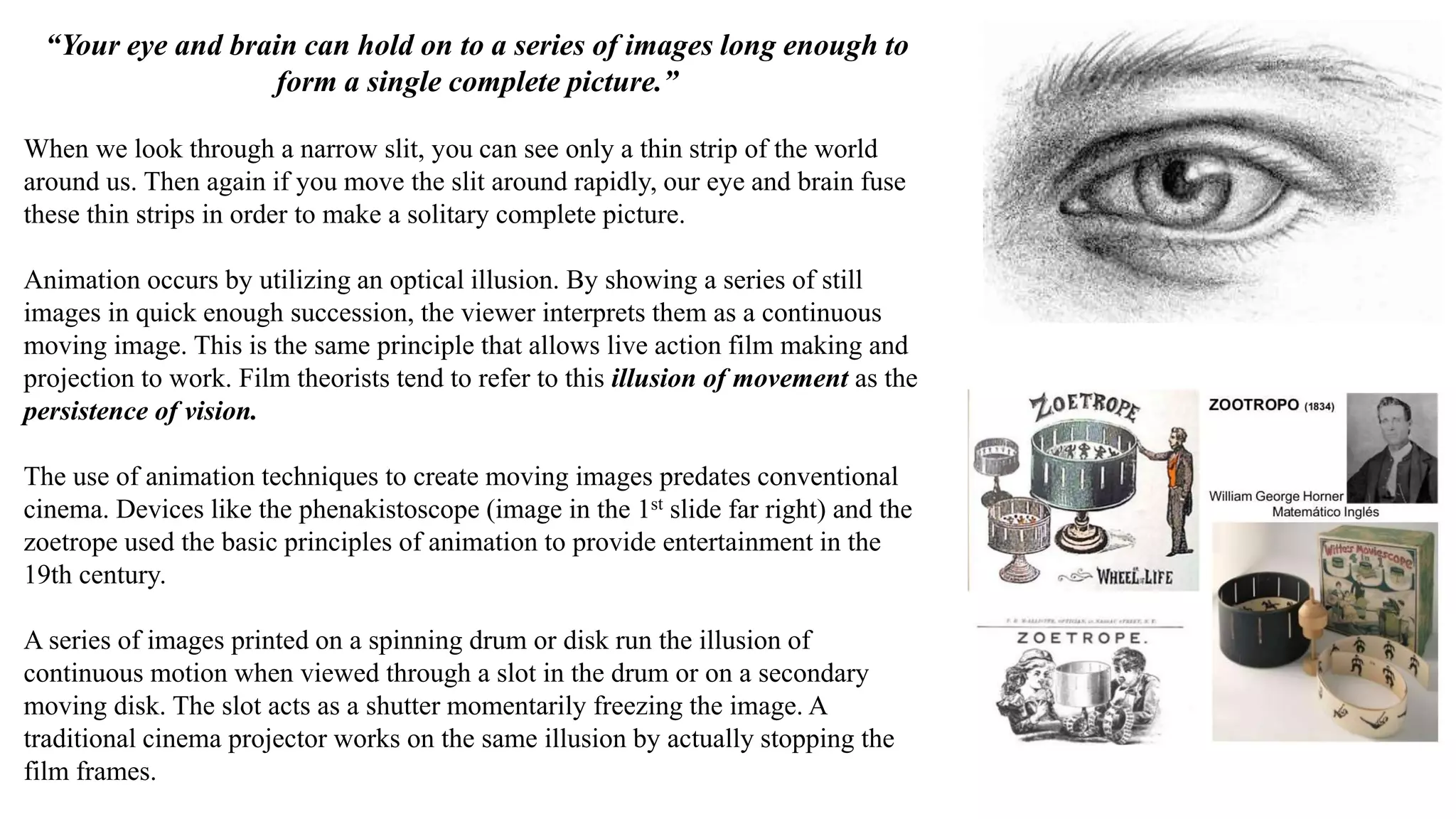
The use of animation techniques to create moving images predates conventional
cinema. Devices like the phenakistoscope (image in the 1st slide far right) and the
zoetrope used the basic principles of animation to provide entertainment in the
19th century.
A series of images printed on a spinning drum or disk run the illusion of
continuous motion when viewed through a slot in the drum or on a secondary
moving disk. The slot acts as a shutter momentarily freezing the image. A
traditional cinema projector works on the same illusion by actually stopping the
film frames.
We utilize this principal truth of the way we see to our advantage. When we go to the
movies, we realise that a motion picture makes an illusion of a continually lit screen by
flashing individual photos in quick progression. It was the flickering image on the screen
that gave rise to the term flicks in the early days of movies. Modern motion pictures flash
images on the screen at 24 frames per second (fps) (or 48, in that each frame is flashed
twice) for a flicker-free picture. "Flipbooks", they worked on this same principle: the more
images per second, the smoother the picture.
TV, as well, utilizes a complicated type of irregular light driving forces to truly construct
the picture we see. On the off chance that a picture can be developed rapidly enough, the
eye will be unaware that this procedure is even happening. American television actually
transmits and recreates 30 complete images per second to give the fantasy of a illusion of a
solitary continuous picture.
Comprehending persistence of vision benefits animators to make smooth and lifelike
animations in the most proficient path by demonstrating the viewer simply enough frames
to create the sense of motion. In animation, moving characters are frequently shot "on
twos", which implies one picture has appeared for every two frames of the film, a sum of 12
drawings per second. In spite of the fact that this is simply on the farthest point of our
‘persistence of vision,' it is normally satisfactory for making smooth and lifelike animation
activity.
However, when a character is needed to perform a quick movement, it is typically necessary
to revert to animating “on ones”. Changing the two techniques keeps the eye fooled without
excessive production cost. Cheaper cartoons often work on “threes”, or even “fours”, i.e.
three or four frames per drawing. This translates to only 8 or 6 drawings per second.
• FutureLearn. (n.d.). Persistence of vision: how does animation work? - Explore Animation -
National Film and Television School. [online] Available at:
https://www.futurelearn.com/courses/explore-animation/0/steps/12222 [Accessed 3 May 2017].
• McKinney, M. (2008). The Persistence of Vision. [online] Vision.org. Available at:
http://www.vision.org/visionmedia/philosophy-and-ideas/persistence-of-vision/136.aspx [Accessed
3 May 2017].
BIBLIOGRAPHIES

Persistence of vision

  • 2.
    “Your eye andbrain can hold on to a series of images long enough to form a single complete picture.” When we look through a narrow slit, you can see only a thin strip of the world around us. Then again if you move the slit around rapidly, our eye and brain fuse these thin strips in order to make a solitary complete picture. Animation occurs by utilizing an optical illusion. By showing a series of still images in quick enough succession, the viewer interprets them as a continuous moving image. This is the same principle that allows live action film making and projection to work. Film theorists tend to refer to this illusion of movement as the persistence of vision. The use of animation techniques to create moving images predates conventional cinema. Devices like the phenakistoscope (image in the 1st slide far right) and the zoetrope used the basic principles of animation to provide entertainment in the 19th century. A series of images printed on a spinning drum or disk run the illusion of continuous motion when viewed through a slot in the drum or on a secondary moving disk. The slot acts as a shutter momentarily freezing the image. A traditional cinema projector works on the same illusion by actually stopping the film frames.
  • 3.
    We utilize thisprincipal truth of the way we see to our advantage. When we go to the movies, we realise that a motion picture makes an illusion of a continually lit screen by flashing individual photos in quick progression. It was the flickering image on the screen that gave rise to the term flicks in the early days of movies. Modern motion pictures flash images on the screen at 24 frames per second (fps) (or 48, in that each frame is flashed twice) for a flicker-free picture. "Flipbooks", they worked on this same principle: the more images per second, the smoother the picture. TV, as well, utilizes a complicated type of irregular light driving forces to truly construct the picture we see. On the off chance that a picture can be developed rapidly enough, the eye will be unaware that this procedure is even happening. American television actually transmits and recreates 30 complete images per second to give the fantasy of a illusion of a solitary continuous picture. Comprehending persistence of vision benefits animators to make smooth and lifelike animations in the most proficient path by demonstrating the viewer simply enough frames to create the sense of motion. In animation, moving characters are frequently shot "on twos", which implies one picture has appeared for every two frames of the film, a sum of 12 drawings per second. In spite of the fact that this is simply on the farthest point of our ‘persistence of vision,' it is normally satisfactory for making smooth and lifelike animation activity. However, when a character is needed to perform a quick movement, it is typically necessary to revert to animating “on ones”. Changing the two techniques keeps the eye fooled without excessive production cost. Cheaper cartoons often work on “threes”, or even “fours”, i.e. three or four frames per drawing. This translates to only 8 or 6 drawings per second.
  • 4.
    • FutureLearn. (n.d.).Persistence of vision: how does animation work? - Explore Animation - National Film and Television School. [online] Available at: https://www.futurelearn.com/courses/explore-animation/0/steps/12222 [Accessed 3 May 2017]. • McKinney, M. (2008). The Persistence of Vision. [online] Vision.org. Available at: http://www.vision.org/visionmedia/philosophy-and-ideas/persistence-of-vision/136.aspx [Accessed 3 May 2017]. BIBLIOGRAPHIES