Investigations and
Management of Arterial
diseases
Moderator - Dr Shubhakar Bhandary / Dr Airind Mathai
Investigations
Physiological testing and imaging
Non Invasive
Invasive
Non invasive testing
• Confirmation 

• Localise 

• Demonstrate end points following surgery 

• Follow up - detect recurrence
Segmental limb pressure
Significant disease - decrease in pressure of 20 mm of Hg
Exercise testing
Resting pressure
walk at a set speed (5km/hr)
with fixed inclination (12
degree) for 5 mins or until
forced to stop due to
symptoms
Arm and ankle pressure
measured immediately and
every 2 mins for 10 mins
Patients with more than 20 mm of Hg pressure drop at ankle in comparison to upper
extremity significantly benefit from vascular reconstruction
Photoplethysmography
Photo electrode is
used to detect
changes in
cutaneous blood flow
Particularly useful in patients with pedal artery occlusive disease or
highly calcified vessels.
Duplex scanning
Pulsed Doppler + B mode imaging
Detect and quantitate PVD
Color duplex scanner Carotid vessels - stenosis at bifurcation
Vascular Imaging
Vascular Imaging
Angiography
DiagnosticTherapeutic and
Catheter Angiography
Invasive procedure requiring catheter placement in the
area of interest of the vascular system, iodine-based
contrast media injection and ionising radiation based
images.
Indications
Diagnostic
Emergency
Guidance in elective
procedures
1. Percutaneous vessel puncture with a
puncture needle
Seldinger Technique
2. Backflow is observed
3. Guidewire is advanced through the needle
4. Pressure is held over the puncture site
while the needle is pulled out with the guide
wire in place
5 - 6. a diagnostic catheter or an introducer
sheath may be advanced over the wire
7. the wire is removed and percutaneous
intravascular access is obtained
Contrast Media
Ionic Non-ionic
High Osmolality
possible to reduce
the osmolality
Low Viscosity Increased viscosity
Higher
Complications
Lower
Complications
1. Abdominal Aortography
Multiside catheter - side of
diaphragm
• Abdominal aorta
• Celiac
• Superior mesenteric
• Inferior mesenteric
• Aortic bifurcation
2. Pelvic angiography
Multiside hole catheter - at the
aortic bifurcation
• Bilateral common iliac
• External Iliac
• Common femoral
• Proximal Superficial femoral
• Profunda Femoral
4. Ipsilateral Common Iliac artery
Access sheath is pulled back to
visualise the ipsilateral limb
3. Contralateral Common Femoral
artery
End Hole catheter
• SFA
• Profunda
• Popliteal
• Tibial
• pedal vessels
Risks of endo vascular
procedures
Groin Hematoma
Retroperitoneal bleeding
Pseudoaneurysm
Arterial dissection
Brachial sheath hematoma - Neural compromise
Contrast Nephropathy
Increase Oral hydration prior and following procedure
Metformin, ACE inhiitors and Diuretics are avoided
Acetylcysteine - 1200mg PO BID
IVF - 1/2 NS with 1.5 ampules of Sodium Bicarbonate
Digital
Subtraction
Angiography
Fluoroscopic image is amplified
and digitised
Initial non contrast image is
electronically subtracted
CT angiography
• Single Contrast bolus
• Depiction of the entire vessel,
appreciate thrombus and
calcification
• Three dimensional reconstruction
and multiplanar reformatting
• Iodinized contrast agents
complications - Nephrotoxicity
Significant radiation exposure
MR angiography
• Does not require iodine based
contrast agents
• Contrast - Gadolinium
• Contraindicated - Pts with
pacemakers, defibrillatorrs, spinal
cord simulators, intracerebral shunts,
cochlear implants and cranial clips
• Limitations - slow and expensive
Intravascular Ultrasound
Transverse, 360 degree
image of the lumen of the
vessel
Provides qualitative data
about the wall anatomy
Virtual histology
Diagnostic tool - assess and measure
the severity
Measure the completeness of the
treatment
Medical Management
Aspirin and Clopidogrel
Aspirin
Mechanism of Action
Inhibits cyclooxyrgenase-
mediated production of
thromboxane A2
Side Effects
Gastrointestinal
Dosages
75 to 325 mg once daily
Indications
Secondary prevention of
vascular events in patients
with established coronary,
cerebrovascular or peripheral
arterial disease
Clopidogrel
Clopidogrel
Mechanism of Action
Inhibits ADP induced platelet
aggregation
Side Effects
Rashes, diarrhoea and
pruritus
Dosages
75 mg once daily
Indications
Reduce risk for
Cardiovascular death, MI and
stroke - marginally more
effective than aspirin
Cilostazol
↑ cellular levels of cAMP
Inhibits platelet aggregation and thrombus formation
↓vascular smooth muscle cell proliferation
Oxypentifylline
Reduces blood viscosity
↑Red cell deformablity
↓plasma fibrinogen levels
Side effects - Headache and GI disturbance
• Antioxidants

• Prostaglandins 

Prostaglandin E1 and prostacyclin
derivatives - iloprost and beraprost
Risk factors modification
• Smoking Cessation 

• Hyperlipidemia (LDL < 100mg/dl)

• Statins 

• Hypertension (systolic < 140 and diastolic < 90) 

• Beta blockers 

• ACE inhibitors 

• Diabetes (HbA1c - < 7)
Surgical revascularization
procedures
Problems of classification
Lifestyle Limiting Claudication
Trans-Atlantic Inter-Society Consensus
Document on Management of Peripheral
Arterial Disease - 2000
Lesion Location
Lesion Morphology
Trans-Atlantic Inter-Society Consensus Document on Management of Peripheral
Arterial Disease - II, 2007
Classification of Aortoiliac Lesions
TYPE - A
• Unilateral / Bilateral
stenosis of CIA 

• Unilateral / Bilateral single
short (< 3 cms) stenosis of
EIA
Classification of Aortoiliac Lesions
TYPE - B
• Short (< 3 cms) stenosis of
infrarenal aorta 

• Unilateral CIA occlusion 

• Single or Multiple stenosis
totalling 3 - 10 cms
involving the EIA not
extending into the CFA 

• Unilateral EIA occlusion not
involving the origins of
internal iliac artery or CFA
Trans-Atlantic Inter-Society Consensus Document on Management of Peripheral
Arterial Disease - II, 2007
Classification of Aortoiliac Lesions
TYPE - C
• Bilateral CIA occlusions 

• Bilateral EIA stenosis 3 - 10
cms long not extending into
the CFA 

• Unilateral EIA occlusion that
involves the origins of internal
iliac artery and/or CFA 

• Heavily calcified unilateral EIA
occlusion with or without
involvement of origins of
internal iliac artery and/or CFA
Trans-Atlantic Inter-Society Consensus Document on Management of Peripheral
Arterial Disease - II, 2007
Classification of Aortoiliac Lesions
TYPE - D
• Infra renal aortic occlusion 

• Diffuse disease involving the
aorta and both iliac arteries
requiring treatment 

• Diffuse multiple stenosis involving
the unilateral CIA, EIA and CFA 

• Unilateral occlusion of both CIA
and EIA 

• Bilateral occlusion of EIA 

• Iliac Stenosis in patients with AAA
requiring treatment and not
amenable to endograft placement
or other lesions
Trans-Atlantic Inter-Society Consensus Document on Management of Peripheral
Arterial Disease - II, 2007
Classification of Femoropopliteal
Lesions
Trans-Atlantic Inter-Society Consensus Document on Management of Peripheral
Arterial Disease - II, 2007
• single stenosis < 10 cms in length
• single occlusion < 5 cms in length
• Multiple lesions (stenosis or occlusions)
each <5 cms
• Single stenosis or occlusion <15 cms not
involving the intrageniculate popliteal
artery
• SIngle or multiple lesions in the absence
of continuous tibial vessels to improve
inflow for a distal bypass
• Heavily calcified occlusion <5 cm in
length
• Single popliteal stenosis
Classification of Femoropopliteal
Lesions
Trans-Atlantic Inter-Society Consensus Document on Management of Peripheral
Arterial Disease - II, 2007
• Multiple stenosis or occlusion tattling >15 cms
with or without heavy calcification
• Recurrent stenosis or occlusion that need
treatment after two endovascular
interventions
• Chronic total occlusion of CFA or SFA (>20
cms involving the popliteal artery )
• Chronic total occlusions of popliteal artery
and proximal bifurcation vessels
TYPE A
Endovascular -
recommended
TYPE B Endovascular - preferred
TYPE C open surgery - preferred
TYPE D
open surgery -
recommended
Endovascular
management
Endovascular management
Balloon Angioplasty
Subintimal Angioplasty
Stenting
Atherectomy
Subintimal Angioplasty
Arterial dissection done
using wire to create
false tract
False Lumen’s diameter is
increased by balloon
angioplasty
Balloon Angioplasty
Successful -
residual stenosis is
<30% or there is no
pressure gradient
across the area
treated
Stenting
Balloon-expandable stents
Passively enlarged to a desired diameter
at the site of implantation by dilatation
of the balloon
Self Expanding stents
Open actively after being released from
a dedicated delivery system
Atherectomy
Revascularization
Surgical Reconstruction of Aortoiliac
Occlusive Disease
Arterial Substitutes
• Arterial autograft – Internal mammary artery (common), internal iliac
artery. 

• Venous autograft – Long saphenous vein (common), small saphenous
vein, basilic vein, cephalic vein. 

• Venous allograft – Umbilical vein graft.

• Prosthetic grafts: 

• Textile grafts -Dacron graft and Teflon graft – Knitted or woven types.

• Non-textile semi-inert polymer graft - -ePTFE graft – Expanded
polytetrafl uoroethylene graft.
Conduits
Great saphenous vein Polytetrafluoroethylene
Aortoiliac diseases
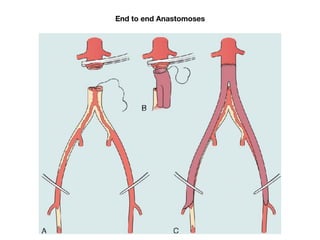
• Indications - disease involving the external iliac artery /
extending to common femoral artery 

• Transabdominal or Retroperitoneal approach 

• Proximal anastomosis 

• End to End 

• End to side
Aortobifemoral Bypass
End to end Anastomoses
Aortobifemoral Bypass
Aortoiliac endartectomy
Axillobifemoral bypass
Medical Complications
Perioperative myocardial infarction
Respiratory failure 

Ischemia-induced renal failure 

Bleeding from IV heparinization Stroke
Procedure related early
complications
Declamping shock

Graft thrombosis 

Retroperitoneal bleeding
Groin hematoma

Bowel ischemia/infarction 

Peripheral embolization
Erectile dysfunction 

Lymphatic leak

Chylous ascites 

Paraplegia
Graft infection

Anastomotic pseudoaneurysm 

Aortoenteric fistula Aortourinary fistula

Graft thrombosis
Procedure related late
complications
Lower extremity
occlusive disease
Femoropopliteal Bypass
Profundaplasty
Thank you

Arterial disease

  • 1.
    Investigations and Management ofArterial diseases Moderator - Dr Shubhakar Bhandary / Dr Airind Mathai
  • 2.
    Investigations Physiological testing andimaging Non Invasive Invasive
  • 3.
    Non invasive testing •Confirmation • Localise • Demonstrate end points following surgery • Follow up - detect recurrence
  • 4.
    Segmental limb pressure Significantdisease - decrease in pressure of 20 mm of Hg
  • 5.
    Exercise testing Resting pressure walkat a set speed (5km/hr) with fixed inclination (12 degree) for 5 mins or until forced to stop due to symptoms Arm and ankle pressure measured immediately and every 2 mins for 10 mins Patients with more than 20 mm of Hg pressure drop at ankle in comparison to upper extremity significantly benefit from vascular reconstruction
  • 6.
    Photoplethysmography Photo electrode is usedto detect changes in cutaneous blood flow Particularly useful in patients with pedal artery occlusive disease or highly calcified vessels.
  • 7.
    Duplex scanning Pulsed Doppler+ B mode imaging Detect and quantitate PVD Color duplex scanner Carotid vessels - stenosis at bifurcation
  • 8.
  • 9.
  • 10.
    Catheter Angiography Invasive procedurerequiring catheter placement in the area of interest of the vascular system, iodine-based contrast media injection and ionising radiation based images. Indications Diagnostic Emergency Guidance in elective procedures
  • 11.
    1. Percutaneous vesselpuncture with a puncture needle Seldinger Technique 2. Backflow is observed 3. Guidewire is advanced through the needle 4. Pressure is held over the puncture site while the needle is pulled out with the guide wire in place 5 - 6. a diagnostic catheter or an introducer sheath may be advanced over the wire 7. the wire is removed and percutaneous intravascular access is obtained
  • 12.
    Contrast Media Ionic Non-ionic HighOsmolality possible to reduce the osmolality Low Viscosity Increased viscosity Higher Complications Lower Complications
  • 13.
    1. Abdominal Aortography Multisidecatheter - side of diaphragm • Abdominal aorta • Celiac • Superior mesenteric • Inferior mesenteric • Aortic bifurcation 2. Pelvic angiography Multiside hole catheter - at the aortic bifurcation • Bilateral common iliac • External Iliac • Common femoral • Proximal Superficial femoral • Profunda Femoral 4. Ipsilateral Common Iliac artery Access sheath is pulled back to visualise the ipsilateral limb 3. Contralateral Common Femoral artery End Hole catheter • SFA • Profunda • Popliteal • Tibial • pedal vessels
  • 14.
    Risks of endovascular procedures Groin Hematoma Retroperitoneal bleeding Pseudoaneurysm Arterial dissection Brachial sheath hematoma - Neural compromise Contrast Nephropathy Increase Oral hydration prior and following procedure Metformin, ACE inhiitors and Diuretics are avoided Acetylcysteine - 1200mg PO BID IVF - 1/2 NS with 1.5 ampules of Sodium Bicarbonate
  • 15.
    Digital Subtraction Angiography Fluoroscopic image isamplified and digitised Initial non contrast image is electronically subtracted
  • 16.
    CT angiography • SingleContrast bolus • Depiction of the entire vessel, appreciate thrombus and calcification • Three dimensional reconstruction and multiplanar reformatting • Iodinized contrast agents complications - Nephrotoxicity Significant radiation exposure
  • 17.
    MR angiography • Doesnot require iodine based contrast agents • Contrast - Gadolinium • Contraindicated - Pts with pacemakers, defibrillatorrs, spinal cord simulators, intracerebral shunts, cochlear implants and cranial clips • Limitations - slow and expensive
  • 18.
    Intravascular Ultrasound Transverse, 360degree image of the lumen of the vessel Provides qualitative data about the wall anatomy Virtual histology Diagnostic tool - assess and measure the severity Measure the completeness of the treatment
  • 19.
  • 20.
  • 21.
    Aspirin Mechanism of Action Inhibitscyclooxyrgenase- mediated production of thromboxane A2 Side Effects Gastrointestinal Dosages 75 to 325 mg once daily Indications Secondary prevention of vascular events in patients with established coronary, cerebrovascular or peripheral arterial disease
  • 22.
  • 23.
    Clopidogrel Mechanism of Action InhibitsADP induced platelet aggregation Side Effects Rashes, diarrhoea and pruritus Dosages 75 mg once daily Indications Reduce risk for Cardiovascular death, MI and stroke - marginally more effective than aspirin
  • 24.
    Cilostazol ↑ cellular levelsof cAMP Inhibits platelet aggregation and thrombus formation ↓vascular smooth muscle cell proliferation Oxypentifylline Reduces blood viscosity ↑Red cell deformablity ↓plasma fibrinogen levels Side effects - Headache and GI disturbance
  • 25.
    • Antioxidants • Prostaglandins Prostaglandin E1 and prostacyclin derivatives - iloprost and beraprost
  • 26.
    Risk factors modification •Smoking Cessation • Hyperlipidemia (LDL < 100mg/dl) • Statins • Hypertension (systolic < 140 and diastolic < 90) • Beta blockers • ACE inhibitors • Diabetes (HbA1c - < 7)
  • 27.
  • 28.
  • 29.
    Trans-Atlantic Inter-Society Consensus Documenton Management of Peripheral Arterial Disease - 2000 Lesion Location Lesion Morphology
  • 30.
    Trans-Atlantic Inter-Society ConsensusDocument on Management of Peripheral Arterial Disease - II, 2007 Classification of Aortoiliac Lesions TYPE - A • Unilateral / Bilateral stenosis of CIA • Unilateral / Bilateral single short (< 3 cms) stenosis of EIA
  • 31.
    Classification of AortoiliacLesions TYPE - B • Short (< 3 cms) stenosis of infrarenal aorta • Unilateral CIA occlusion • Single or Multiple stenosis totalling 3 - 10 cms involving the EIA not extending into the CFA • Unilateral EIA occlusion not involving the origins of internal iliac artery or CFA Trans-Atlantic Inter-Society Consensus Document on Management of Peripheral Arterial Disease - II, 2007
  • 32.
    Classification of AortoiliacLesions TYPE - C • Bilateral CIA occlusions • Bilateral EIA stenosis 3 - 10 cms long not extending into the CFA • Unilateral EIA occlusion that involves the origins of internal iliac artery and/or CFA • Heavily calcified unilateral EIA occlusion with or without involvement of origins of internal iliac artery and/or CFA Trans-Atlantic Inter-Society Consensus Document on Management of Peripheral Arterial Disease - II, 2007
  • 33.
    Classification of AortoiliacLesions TYPE - D • Infra renal aortic occlusion • Diffuse disease involving the aorta and both iliac arteries requiring treatment • Diffuse multiple stenosis involving the unilateral CIA, EIA and CFA • Unilateral occlusion of both CIA and EIA • Bilateral occlusion of EIA • Iliac Stenosis in patients with AAA requiring treatment and not amenable to endograft placement or other lesions Trans-Atlantic Inter-Society Consensus Document on Management of Peripheral Arterial Disease - II, 2007
  • 34.
    Classification of Femoropopliteal Lesions Trans-AtlanticInter-Society Consensus Document on Management of Peripheral Arterial Disease - II, 2007 • single stenosis < 10 cms in length • single occlusion < 5 cms in length • Multiple lesions (stenosis or occlusions) each <5 cms • Single stenosis or occlusion <15 cms not involving the intrageniculate popliteal artery • SIngle or multiple lesions in the absence of continuous tibial vessels to improve inflow for a distal bypass • Heavily calcified occlusion <5 cm in length • Single popliteal stenosis
  • 35.
    Classification of Femoropopliteal Lesions Trans-AtlanticInter-Society Consensus Document on Management of Peripheral Arterial Disease - II, 2007 • Multiple stenosis or occlusion tattling >15 cms with or without heavy calcification • Recurrent stenosis or occlusion that need treatment after two endovascular interventions • Chronic total occlusion of CFA or SFA (>20 cms involving the popliteal artery ) • Chronic total occlusions of popliteal artery and proximal bifurcation vessels
  • 36.
    TYPE A Endovascular - recommended TYPEB Endovascular - preferred TYPE C open surgery - preferred TYPE D open surgery - recommended
  • 37.
  • 38.
  • 39.
    Subintimal Angioplasty Arterial dissectiondone using wire to create false tract False Lumen’s diameter is increased by balloon angioplasty
  • 40.
    Balloon Angioplasty Successful - residualstenosis is <30% or there is no pressure gradient across the area treated
  • 41.
    Stenting Balloon-expandable stents Passively enlargedto a desired diameter at the site of implantation by dilatation of the balloon Self Expanding stents Open actively after being released from a dedicated delivery system
  • 42.
  • 43.
  • 44.
    Arterial Substitutes • Arterialautograft – Internal mammary artery (common), internal iliac artery. • Venous autograft – Long saphenous vein (common), small saphenous vein, basilic vein, cephalic vein. • Venous allograft – Umbilical vein graft. • Prosthetic grafts: • Textile grafts -Dacron graft and Teflon graft – Knitted or woven types. • Non-textile semi-inert polymer graft - -ePTFE graft – Expanded polytetrafl uoroethylene graft.
  • 45.
    Conduits Great saphenous veinPolytetrafluoroethylene
  • 46.
  • 47.
    • Indications -disease involving the external iliac artery / extending to common femoral artery • Transabdominal or Retroperitoneal approach • Proximal anastomosis • End to End • End to side Aortobifemoral Bypass
  • 48.
    End to endAnastomoses
  • 49.
  • 50.
  • 51.
  • 52.
    Medical Complications Perioperative myocardialinfarction Respiratory failure Ischemia-induced renal failure Bleeding from IV heparinization Stroke
  • 53.
    Procedure related early complications Declampingshock Graft thrombosis Retroperitoneal bleeding Groin hematoma
 Bowel ischemia/infarction Peripheral embolization Erectile dysfunction Lymphatic leak
 Chylous ascites Paraplegia
  • 54.
    Graft infection
 Anastomotic pseudoaneurysm Aortoenteric fistula Aortourinary fistula
 Graft thrombosis Procedure related late complications
  • 55.
  • 56.
  • 57.
  • 58.