AMNA HASSAN
           ROLL NO : 12
                   Chapter : 25
Molecular biology of the host microbe interaction in
                periodontal disease
Topics outline
1 . I N N AT E I M M U N I T Y
    ADAPTIVE IMMUNITY

   PAT H O B I O LO G Y O F P E R I O D O N TA L
   DISEASE

   HOST CELL SIGNALING
INTRODUCTION

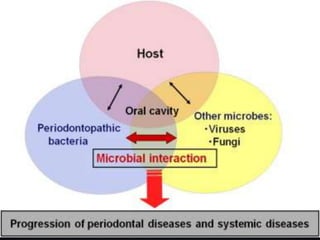
 Provides an overview of molecular biology of the host-parasite
relationship

 Deals with the microbiota associated LPS and other MAMPs
,innate responses,tLRs signaling and periodontal pathogenesis

 Includes pathobiology of periodontal disease

 Induction of disease by pro inflammatory cytokines
PATHOGENESIS OUTLINE

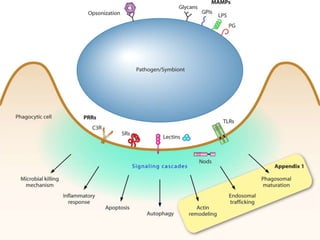
 Direct recognition of microbes by the host is mediated by the
recognition of MAMPs by PPR
 It requires expression of number of bioactive agents i.e. pro

inflammatory and anti inflammatory cytokines , growth factors and
enzymes
 Activated Biologic mediators are involved in the induction of
adaptive immunity
INNATE IMMUNITY

 Innate immunity is rapidly activated with in minutes

 Responsible for the defiance during initial hours and days of
   infection

 Challenge is to discriminate among a large number of
   periodontal pathogen from the host with a limited number of
   cell surface receptor
H OW I N N AT E I M M U N E SYST E M
              FUNCTIONS?

 The discovery of TLRs proved to b critical for recognition of
microbes.
 With in the periodontal tissues , the expression of various TLRs
appears to b increased in severe diseased states

 TLR are a type of PRR ( pattern recognition receptor) Egg
TLR1,TLR2,TLR3.TLR4. etch
CONTD..

 PPR can b secreted into plasma as humoral protein

 others are localized in the cytoplasm as intracellular sensors

 Soluble PRR include collectins,ficolins and acute phase
pentraxins (e.g. C reactive protein)

 The soluble mannose binding receptors can interact with
structures and activate complement system
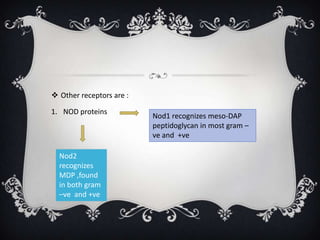
 Other receptors are :

1. NOD proteins
                          Nod1 recognizes meso-DAP
                          peptidoglycan in most gram –
                          ve and +ve

  Nod2
  recognizes
  MDP ,found
  in both gram
  –ve and +ve
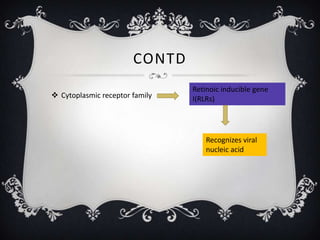
CONTD
                                Retinoic inducible gene
 Cytoplasmic receptor family   I(RLRs)


                                    Recognizes viral
                                    nucleic acid
 Receptors not only recognize various MAMPs to activate
INNATE RESPONSE but they also have a role in inflammation and
adaptive responses.

 Other cells also play important role and respond by expressing
biologically active molecules such as cytokines n MMPs which will
effect homeostasis of host tissue in periodontal environment
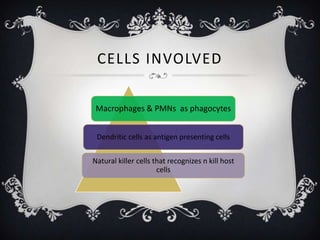
CELLS INVOLVED

 Macrophages & PMNs as phagocytes


 Dendritic cells as antigen presenting cells

Natural killer cells that recognizes n kill host
                      cells
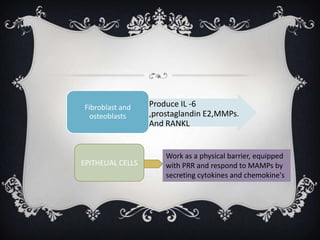
Fibroblast and    • Produce IL -6
   osteoblasts       ,prostaglandin E2,MMPs.
                     And RANKL


                         Work as a physical barrier, equipped
EPITHELIAL CELLS         with PRR and respond to MAMPs by
                         secreting cytokines and chemokine's
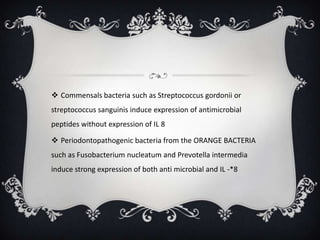
 Commensals bacteria such as Streptococcus gordonii or
streptococcus sanguinis induce expression of antimicrobial
peptides without expression of IL 8

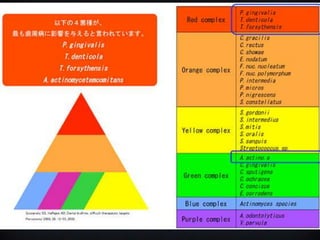
 Periodontopathogenic bacteria from the ORANGE BACTERIA
such as Fusobacterium nucleatum and Prevotella intermedia
induce strong expression of both anti microbial and IL -*8
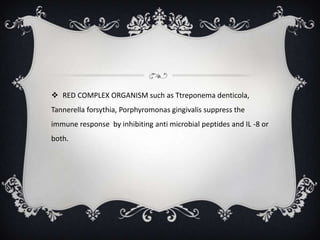
 RED COMPLEX ORGANISM such as Ttreponema denticola,
Tannerella forsythia, Porphyromonas gingivalis suppress the
immune response by inhibiting anti microbial peptides and IL -8 or
both.
C E L L U L A R S I G N A L I N G I N I N N AT E I M M U N I T Y
                              RESPONSE


 MAMPs get recognize by PRR as a result signal is initiated -
>signal is transduced through cytoplasm and nucleus -> post
transitional modifications take place --- determine the cell
response to MMAPs

 Recognition of a ligand by TLR-- signals generated use
pathways similar to IL 1 receptors .
ADAPTIVE IMMUNITY

 Innate immunity plays a role in initiating and modulating
adaptive immune responses

 Innate immune mechanisms are not turned off once the
adaptive responses is activated

 Cells from adaptive immune response also express PRRs and
respond to MAMPs
 The adaptive immune response is characterized by the activities of
pathogen-specific B and T lymphocytes

 the cell type primarily responsible for translating innate signals into
adaptive immunity is the dendritic cell (DC).

    adaptive immunity initiates with DCs recognizing MAMPs in the sites
     of infection then subs migrating into the regional draining lymph
     nodes

    It then present the processed antigen peptides in the context of
     major histocompatibility complex (MHC) molecules to naive T
     lymphocytes
 in periodontal diseases, both MAMPs and inflammatory
cytokines are usually present to fully activate the DCs, which
suggests that there is no impairment to a competent activation of
adaptive immunity.
H O ST M I C RO B E I N T E R AC T I O N S

 DCs activated by MAMPs and inflammatory cytokines (also induced by MAMPs in
innate immune/resident cells) will initiate an adaptive immune response by driving
naive T lymphocytes into a CD8+ (for cytotoxic response) or CD4+ with Th1 or
Th2 phenotypes.
 more pieces have been added to the puzzle, including the regulatory T
lymphocytes (Tregs), which appear to have their inhibitory functions suppressed by
activated DCs.
 Activated T cells and their “specific” cytokine profiles will modulate the
inflammatory response and also the activation of B lymphocytes.
PAT H O B I O L O G Y O F P E R I O D O N TA L
                       DISEASE


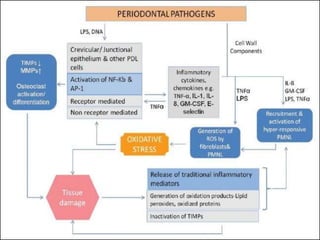
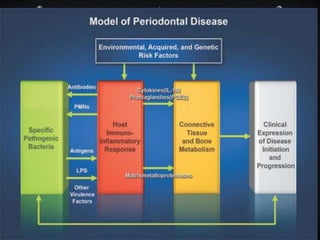
 Host response to periodontal expression of various pro
inflammatory and anti inflammatory cytokines, growth factors and
enzymes that are the result of activation of multiple signaling
pathways

 PPR signaling is the most important interface between the host
and the microbes
C Y T O K I N E S A N D M E D I AT O R S O F
                     I N F L A M M AT I O N


 Local inflammatory reaction is characterized by an initial
increase in blood flow , enhanced vascular permeability , and
influx of cell from blood to crevice
 For acute and rapid defense the mediators involved are
1. Histamine
2. Bradykinin
3. PGE2 and nitrous oxide
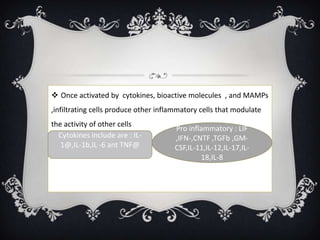
 Once activated by cytokines, bioactive molecules , and MAMPs
,infiltrating cells produce other inflammatory cells that modulate
the activity of other cells
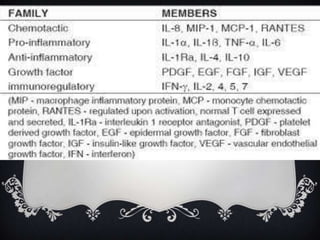
                                      Pro inflammatory : LIF
  Cytokines include are : IL-         ,IFN-,CNTF ,TGFb ,GM-
 Ccytkines include
   1@,IL-1b,IL -6 ant TNF@            CSF,IL-11,IL-12,IL-17,IL-
                                              18,IL-8
Anti inflammatory are : IL-4,IL-10,IL-13,IL-
           16,INF-@,IL-1Ra etc
 A characteristic type of cytokine profile is associated with each type of
periodontal disease ( gingivitis or periodontitis)


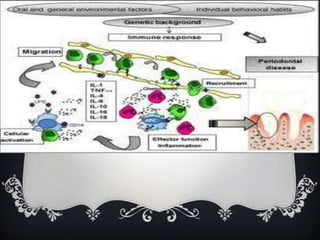
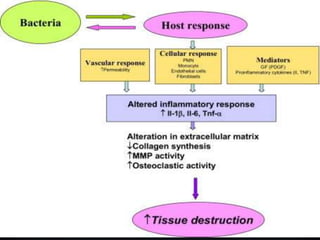
 Once immune and inflammatory processes are initiated and
    complex cytokines network is established ,inflammatory
    molecules play a direct role in degradation of both mineralized
    and non mineralized tissues of periodontium
R O L E O F R A N K L I N P E R I O D O N TA L
                     DISEASE

 Rankl plays a pivotal role in bone response since it is involved in
osteoclast differentiation , activation and survival

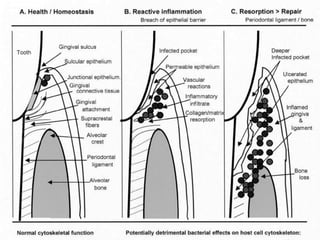
 As periodontal disease progresses - collagen fibres &
connective tissue attachment to tht tooth is destroyed ---
junctional epithelial cells proliferate apically along the root surface
---- CLINICALLY seen as ATTACHMENT LOSS
 E.g. : MMPs released from different cell lesions --- capable of
degrading all components of ECM

 MMPs increases with inflammation and disease activity

 Detection in saliva is a host response bio marker of periodontal
disease
CONTD…

 RANKL is secreted by fibroblasts ,osteoblast, chondrocytes
,mesenchymal cells and T and B lymphocytes.


           • OPG is the endogenous inhibitor of RANKL
               • It functions as its decoy receptor
       • Secreted by osteoblastic cells ,bone marrow stromal
                         cells and fibroblast
 The ratio between RANKL and OPG is the current
paradigm for modulation of coupled bone turnover and
specifically in periodontal disease

 Patients with advanced periodontitis presents with high
level of RANKL.
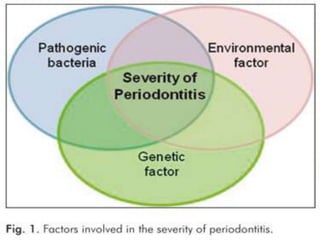
Based on susceptibility analysis ,individual
difference in the host response to MAMPs and to
  host derived cytokines that are the result of
genetic variations may also play important role in
   modulating the pathogenesis of periodontal
                     disease
CELL SIGNALING EVENTS

1. Production of cytokines and inflammatory mediators is usually
   a tightly controlled that is initiated by external stimuli>

2. Signals are rapidly transduced through the cytoplasm into the
nucleus ----gene expression === DNA transcription

3. Final assembly of biologically active protein there a great
number of regulatory mechanism
T H E R A P E U T I C ST R AT EG I ES

 Strategies have develop to target the host response to LPS
mediated tissue destruction

 Doxycycline

 Scaling root planning

 Surgical therapy

 MMP inhibitors

 TNF & IL -1 antagonist
Perio 2
Perio 2

Perio 2

  • 3.
    AMNA HASSAN ROLL NO : 12 Chapter : 25 Molecular biology of the host microbe interaction in periodontal disease
  • 4.
    Topics outline 1 .I N N AT E I M M U N I T Y ADAPTIVE IMMUNITY PAT H O B I O LO G Y O F P E R I O D O N TA L DISEASE HOST CELL SIGNALING
  • 5.
    INTRODUCTION  Provides anoverview of molecular biology of the host-parasite relationship  Deals with the microbiota associated LPS and other MAMPs ,innate responses,tLRs signaling and periodontal pathogenesis  Includes pathobiology of periodontal disease  Induction of disease by pro inflammatory cytokines
  • 6.
    PATHOGENESIS OUTLINE  Directrecognition of microbes by the host is mediated by the recognition of MAMPs by PPR  It requires expression of number of bioactive agents i.e. pro inflammatory and anti inflammatory cytokines , growth factors and enzymes  Activated Biologic mediators are involved in the induction of adaptive immunity
  • 8.
    INNATE IMMUNITY  Innateimmunity is rapidly activated with in minutes  Responsible for the defiance during initial hours and days of infection  Challenge is to discriminate among a large number of periodontal pathogen from the host with a limited number of cell surface receptor
  • 9.
    H OW IN N AT E I M M U N E SYST E M FUNCTIONS?  The discovery of TLRs proved to b critical for recognition of microbes.  With in the periodontal tissues , the expression of various TLRs appears to b increased in severe diseased states  TLR are a type of PRR ( pattern recognition receptor) Egg TLR1,TLR2,TLR3.TLR4. etch
  • 10.
    CONTD..  PPR canb secreted into plasma as humoral protein  others are localized in the cytoplasm as intracellular sensors  Soluble PRR include collectins,ficolins and acute phase pentraxins (e.g. C reactive protein)  The soluble mannose binding receptors can interact with structures and activate complement system
  • 11.
     Other receptorsare : 1. NOD proteins Nod1 recognizes meso-DAP peptidoglycan in most gram – ve and +ve Nod2 recognizes MDP ,found in both gram –ve and +ve
  • 12.
    CONTD Retinoic inducible gene  Cytoplasmic receptor family I(RLRs) Recognizes viral nucleic acid
  • 13.
     Receptors notonly recognize various MAMPs to activate INNATE RESPONSE but they also have a role in inflammation and adaptive responses.  Other cells also play important role and respond by expressing biologically active molecules such as cytokines n MMPs which will effect homeostasis of host tissue in periodontal environment
  • 14.
    CELLS INVOLVED Macrophages& PMNs as phagocytes Dendritic cells as antigen presenting cells Natural killer cells that recognizes n kill host cells
  • 15.
    Fibroblast and • Produce IL -6 osteoblasts ,prostaglandin E2,MMPs. And RANKL Work as a physical barrier, equipped EPITHELIAL CELLS with PRR and respond to MAMPs by secreting cytokines and chemokine's
  • 16.
     Commensals bacteriasuch as Streptococcus gordonii or streptococcus sanguinis induce expression of antimicrobial peptides without expression of IL 8  Periodontopathogenic bacteria from the ORANGE BACTERIA such as Fusobacterium nucleatum and Prevotella intermedia induce strong expression of both anti microbial and IL -*8
  • 17.
     RED COMPLEXORGANISM such as Ttreponema denticola, Tannerella forsythia, Porphyromonas gingivalis suppress the immune response by inhibiting anti microbial peptides and IL -8 or both.
  • 20.
    C E LL U L A R S I G N A L I N G I N I N N AT E I M M U N I T Y RESPONSE  MAMPs get recognize by PRR as a result signal is initiated - >signal is transduced through cytoplasm and nucleus -> post transitional modifications take place --- determine the cell response to MMAPs  Recognition of a ligand by TLR-- signals generated use pathways similar to IL 1 receptors .
  • 22.
    ADAPTIVE IMMUNITY  Innateimmunity plays a role in initiating and modulating adaptive immune responses  Innate immune mechanisms are not turned off once the adaptive responses is activated  Cells from adaptive immune response also express PRRs and respond to MAMPs
  • 23.
     The adaptiveimmune response is characterized by the activities of pathogen-specific B and T lymphocytes  the cell type primarily responsible for translating innate signals into adaptive immunity is the dendritic cell (DC).  adaptive immunity initiates with DCs recognizing MAMPs in the sites of infection then subs migrating into the regional draining lymph nodes  It then present the processed antigen peptides in the context of major histocompatibility complex (MHC) molecules to naive T lymphocytes
  • 25.
     in periodontaldiseases, both MAMPs and inflammatory cytokines are usually present to fully activate the DCs, which suggests that there is no impairment to a competent activation of adaptive immunity.
  • 27.
    H O STM I C RO B E I N T E R AC T I O N S  DCs activated by MAMPs and inflammatory cytokines (also induced by MAMPs in innate immune/resident cells) will initiate an adaptive immune response by driving naive T lymphocytes into a CD8+ (for cytotoxic response) or CD4+ with Th1 or Th2 phenotypes.  more pieces have been added to the puzzle, including the regulatory T lymphocytes (Tregs), which appear to have their inhibitory functions suppressed by activated DCs.  Activated T cells and their “specific” cytokine profiles will modulate the inflammatory response and also the activation of B lymphocytes.
  • 32.
    PAT H OB I O L O G Y O F P E R I O D O N TA L DISEASE  Host response to periodontal expression of various pro inflammatory and anti inflammatory cytokines, growth factors and enzymes that are the result of activation of multiple signaling pathways  PPR signaling is the most important interface between the host and the microbes
  • 34.
    C Y TO K I N E S A N D M E D I AT O R S O F I N F L A M M AT I O N  Local inflammatory reaction is characterized by an initial increase in blood flow , enhanced vascular permeability , and influx of cell from blood to crevice  For acute and rapid defense the mediators involved are 1. Histamine 2. Bradykinin 3. PGE2 and nitrous oxide
  • 36.
     Once activatedby cytokines, bioactive molecules , and MAMPs ,infiltrating cells produce other inflammatory cells that modulate the activity of other cells Pro inflammatory : LIF Cytokines include are : IL- ,IFN-,CNTF ,TGFb ,GM-  Ccytkines include 1@,IL-1b,IL -6 ant TNF@ CSF,IL-11,IL-12,IL-17,IL- 18,IL-8
  • 37.
    Anti inflammatory are: IL-4,IL-10,IL-13,IL- 16,INF-@,IL-1Ra etc
  • 38.
     A characteristictype of cytokine profile is associated with each type of periodontal disease ( gingivitis or periodontitis)  Once immune and inflammatory processes are initiated and complex cytokines network is established ,inflammatory molecules play a direct role in degradation of both mineralized and non mineralized tissues of periodontium
  • 39.
    R O LE O F R A N K L I N P E R I O D O N TA L DISEASE  Rankl plays a pivotal role in bone response since it is involved in osteoclast differentiation , activation and survival  As periodontal disease progresses - collagen fibres & connective tissue attachment to tht tooth is destroyed --- junctional epithelial cells proliferate apically along the root surface ---- CLINICALLY seen as ATTACHMENT LOSS
  • 41.
     E.g. :MMPs released from different cell lesions --- capable of degrading all components of ECM  MMPs increases with inflammation and disease activity  Detection in saliva is a host response bio marker of periodontal disease
  • 42.
    CONTD…  RANKL issecreted by fibroblasts ,osteoblast, chondrocytes ,mesenchymal cells and T and B lymphocytes. • OPG is the endogenous inhibitor of RANKL • It functions as its decoy receptor • Secreted by osteoblastic cells ,bone marrow stromal cells and fibroblast
  • 43.
     The ratiobetween RANKL and OPG is the current paradigm for modulation of coupled bone turnover and specifically in periodontal disease  Patients with advanced periodontitis presents with high level of RANKL.
  • 44.
    Based on susceptibilityanalysis ,individual difference in the host response to MAMPs and to host derived cytokines that are the result of genetic variations may also play important role in modulating the pathogenesis of periodontal disease
  • 45.
    CELL SIGNALING EVENTS 1.Production of cytokines and inflammatory mediators is usually a tightly controlled that is initiated by external stimuli> 2. Signals are rapidly transduced through the cytoplasm into the nucleus ----gene expression === DNA transcription 3. Final assembly of biologically active protein there a great number of regulatory mechanism
  • 46.
    T H ER A P E U T I C ST R AT EG I ES  Strategies have develop to target the host response to LPS mediated tissue destruction  Doxycycline  Scaling root planning  Surgical therapy  MMP inhibitors  TNF & IL -1 antagonist