Perinatal asphyxia
Pediatrics department
Incidence
-Approximately 1.5% of live births in developed countries
-Inversely related to gestational age and birth weight (BW).
-0.5% of live-born newborns >36 weeks' gestation
-20% of perinatal deaths (50% if stillbirths are included)
- diabetic or toxemic mothers
-intrauterine growth restriction
-breech presentation
-postdate.
PERINATAL ASPHYXIA
1]First and second stage of labor
2]Impaired gas exchange:- fetal acidosis,
hypoxemia, and hypercarbia.
3]Fetal acidosis:-umbilical arterial blood pH
<7.0,
4]The likelihood of brain injury is
relatively low with this degree of acidosis in
cord blood at birth
A]Perinatal hypoxia, ischaemia,
and asphyxia
B]Perinatal/Neonatal depression
C]Neonatal encephalopathy
D]Hypoxic encephalopathy
E]Hypoxic ischaemic brain injury
Perinatal hypoxia, ichaemia, and
asphyxia
1]Decreased oxygen
2]decreased blood flow
3]Decreased gas exchange
PRENATAL, PERINATAL, POSTNATAL DATA
Perinatal/Neonatal depression
Physical examination:First hour after birth.
1]Depressed mental status
2]Muscle hypotonia, and/or
3]Disturbances in spontaneous respiration and
cardiovascular function.
After the first hour or so of life: neonatal
encephalopathy
Neonatal encephalopathy
Clinical and not an etiologic:abnormal neurobehavioral
state
1]Altered consciousness (including hyperalert state)
2]Brainstem and/or motor dysfunction.
3]No specific etiology
irreversible OR reversible conditions as maternal
medications or hypoglycemia in baby.
Hypoxic ischaemic
encephalopathy
1]Clinical evidence of encephalopathy
2]Objective data: Hypoxic-ischemic (HI) mechanism as the
underlying cause
Hypoxic ischaemic brain injury
1]Neuropathology attributable to hypoxia and/or
ischemia
2]neuroimaging HUS, MRI, CT] or pathologic
(postmortem)
3]Biochemical markers of brain injury such as
CK-BB and neuron specific enolase (NSE) are not
used routinely in clinical practice
1. Prenatal history
2. Perinatal history
3. Postnatal data
a. Admission physical exam: neurologic exam and presence of any
dysmorphic features
b. Clinical course including presence or absence of seizures (and time of
onset), oliguria, cardiorespiratory dysfunction, and treatment (e.g., need
for pressor medications, ventilator support)
c. Laboratory testing
d. Imaging studies
e. EEG
Risk factors
1. Impairment of maternal oxygenation
2. Decreased blood flow from mother to placenta
3. Decreased blood flow from placenta to fetus
4. Impaired gas exchange across the placenta or at the
fetal tissue level
5. Increased fetal O2 requirement
Causes
1. Maternal factors
2. Placental factors
3. Uterine rupture
4. Umbilical cord accidents
5. Abnormalities of umbilical vessels
6. Fetal factors
7. Neonatal factors
Maternal factors:
-Hypertension (acute or chronic)
-Hypotension
-Infection (including chorioamnionitis)
-Hypoxia from pulmonary or cardiac disorders
-Diabetes
-Maternal vascular disease
-in utero exposure to cocaine
Placental factors:
1]Abnormal placentation
2]Abruption
3]Infarction
4]Fibrosis
5]Hydrops
Umbilical cord accidents:
1] Prolapse
2] Entanglement
3] True knot
4] Compression
Fetal factors:-
1] anemia (e.g., from fetal-maternal hemorrhage)
2]infection
3]cardiomyopathy
4]hydrops
5]severe cardiac/circulatory insufficiency
Neonatal factors:
1] cyanotic congenital heart disease
2]PPHN
3]cardiomyopathy
4]neonatal cardiogenic and/or septic shock
5]meconium aspiration syndrome
6]neonatal pneumonia
7]pneumothorax
Pathophysiology
Normal course of labor cause most babies to be born with
little O2 reserve.
These include the following:
1. Decreased blood flow
- uterine contractions
- some degree of cord compression
- maternal dehydration
- maternal alkalosis due to hyperventilation
2. Decreased O2 delivery to the fetus from reduced placental
blood flow
3. Increased O2 consumption in both mother and fetus
Hypoxia-ischemia causes a number of
physiologic and biochemical
alterations
Brief asphyxia:
- a transient increase, followed by a decrease in heart rate
- mild elevation blood pressure
- an increase in central venous pressure
- essentially no change in cardiac output(CO)
- redistribution of CO (diving reflex)
- severe but brief asphyxia (e.g., placental abruption then
stat cesarian section)
- diversion of blood flow to vital deep nuclear structures
of the brain doesnt occur
Prolonged asphyxia:
-loss of pressure autoregulation and/or CO2 vasoreactivity.
-disturbances in cerebral perfusion
-cardiovascular involvement with hypotension and/or
decreased CO.
-A decrease in cerebral blood flow (CBF) results in anaerobic
metabolism
-eventual cellular energy failure
-increased glucose utilization in the brain
-fall in the concentration of glycogen, phosphocreatine, and
adenosine triphosphate (ATP). Prolonged asphyxia
-diffuse injury to both cortical and subcortical structures
Cellular dysfunction
Immediate neuronal death (necrosis):
- Intracellular osmotic overload of Na+ and Ca2+
- Ion pump failure as above or
- Excitatory neurotransmitters acting on in
otropic receptors (such as the N-methyl-Daspartate
[NMDA] receptor).
Delayed neuronal death (apoptosis):-
- Uncontrolled activation of enzymes
- Second messenger systems within the cell
- Mitochondrial respiratory electron chain transport
- Generation of free radicals and leukotrienes
- Generation of nitric oxide (NO) through NO synthase
- Depletion of energy stores.
Reperfusion :-
- Previously ischemic tissue
- Formation of excess reactive oxygen
- Overwhelm the endogenous scavenger
- Damage to cellular lipids, proteins, and nucleic
acids as well as to blood-brain barrier.
- Influx of neutrophils, activated microglia, release
injurious cytokines
DIAGNOSIS
Perinatal assessment:-
- Preexisting maternal or fetal problems
- Changing placental and fetal conditions
- Ultrasonographic examination
- Biophysical profile
- Nonstress tests.
Low Apgar scores and need for resuscitation
- Cardiovascular integrity not neurologic dysfunction
resulting from asphyxia
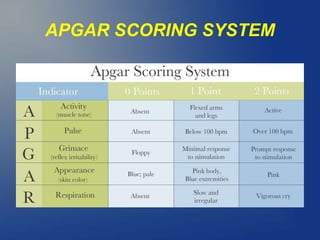
APGAR SCORING SYSTEM
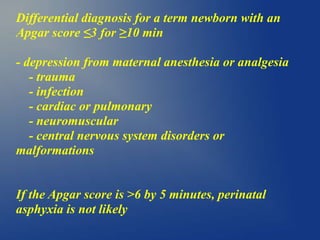
Differential diagnosis for a term newborn with an
Apgar score ≤3 for ≄10 min
- depression from maternal anesthesia or analgesia
- trauma
- infection
- cardiac or pulmonary
- neuromuscular
- central nervous system disorders or
malformations
If the Apgar score is >6 by 5 minutes, perinatal
asphyxia is not likely
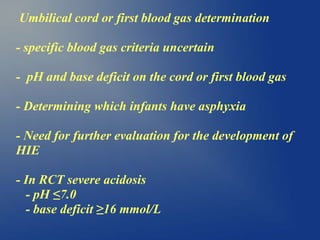
Umbilical cord or first blood gas determination
- specific blood gas criteria uncertain
- pH and base deficit on the cord or first blood gas
- Determining which infants have asphyxia
- Need for further evaluation for the development of
HIE
- In RCT severe acidosis
- pH ≤7.0
- base deficit ≄16 mmol/L
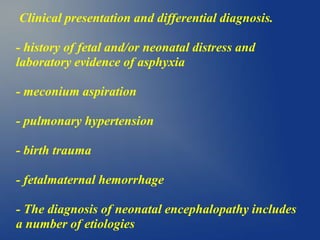
Clinical presentation and differential diagnosis.
- history of fetal and/or neonatal distress and
laboratory evidence of asphyxia
- meconium aspiration
- pulmonary hypertension
- birth trauma
- fetalmaternal hemorrhage
- The diagnosis of neonatal encephalopathy includes
a number of etiologies
Asphyxia may be suspected and HIE reasonably
included in the differential diagnosis when there is:
1. Prolonged (>1 hour) antenatal acidosis
2. Fetal HR <60 beats per minute
3. Apgar score ≤3 at ≄10 minutes
4. Need for positive pressure ventilation for >1
minute or first cry delayed >5 minutes
5. Seizures within 12 to 24 hours of birth
6. Burst suppression or suppressed background
Neurological signs
1]encephalopathy
2]brainstem and cranial nerve signs
3]motor signs
4]seizures
5]increased ICP
Encephalopathy
- Abnormal consciousness by definition
- Mild encephalopathy:- apparent hyperalert or
jittery state consciousness is abnormal.
- Moderate and severe encephalopathy:-
- impaired responses to stimuli such as light,
touch, or even noxious stimuli.
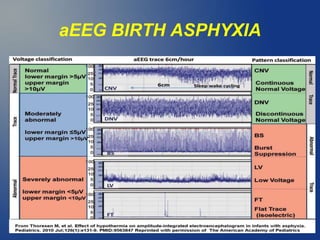
The background pattern detected by EEG or aEEG is
useful for determining the severity of
encephalopathy
BRAINSTEM AND CRANIAL
NERVES
- Abnormal or absent brainstem reflexes
- There can be abnormal eye movements
- An absence of visual fixation or blink to light.
- Facial weakness (usually symmetric)
- Weak or absent suck and swallow with poor feeding
- Apnea or abnormal respiratory patterns
MOTOR ABNORMALITY
- Greater severity greater hypotonia, weakness
- Abnormal posture with lack of flexor tone, which is usually
symmetric
- Primitive reflexes such as the Moro or grasp reflex may be
diminished.
- Over days to weeks, the initial hypotonia may
evolve into spasticity and hyperreflexia
- Hypertonia within the first day or so after birth indicates
hypoxia earlier in the antepartum period
SEIZURE
Severity of encephalopathy is moderate or severe, not
mild.
1. Seizures may be subtle, tonic, or clonic
2. Often subclinical (electrographic only) and
abnormal movements or posture may not be seizure
3. EEG remains the gold standard for diagnosing
neonatal seizures
4. Adequately support respiration to avoid additional
hypoxic injury
INCREASED ICP
-Diffuse cerebral edema
- Extensive cerebral necrosis
- Indicates a poor prognosis
- Treatment to reduce ICP does not affect outcome.
Multiorgan dysfunction
1]Kidney injury
2]Cardiac
3]Pulmonary
4]Liver
5]Gastrointestinal
6]Hematologic
Lab evaluations
Cardiac evaluation.
- An elevation CK-MB fraction of >5% to
10%
- Cardiac troponin I (cTnI)
- cardiac troponin T (cTnT)
they are not currently used in clinical practice.
Neurological markers
-not routinely used to evaluate for the presence of
brain injury or to predict outcome.
RENAL EVALUATION
1. Blood urea nitrogen (BUN) and serum Cr - 2
to 4 days after the insult.
2. Fractional excretion of Na+ (FENa)
3. Urine levels of β2-microglobulin
Brain imaging
Cranial sonographic examination
- Generally insensitive for the detection of HI brain
injury
- To rule out large intracranial hemorrhage-
contraindication to therapeutic hypothermia
CT SCAN
- cerebral edema
- hemorrhage
- eventually HI brain injury
- if imaging is urgently needed to determine clinical
treatment
MRI.
- Best modality for determining the severity
and extent of irreversible
- By atleast 7 to 10 days, and a scan as late as 14 days
or older
EEG
- detect and monitor seizure activity
- abnormal background patterns
- interpretation depends very much on the
experience and expertise of the reader.
TREATMENT
Perinatal management of high-risk pregnancies
1. Fetal HR abnormalities
2. Measurement of fetal scalp pH is a better
determinant of fetal oxygenation than PO2.
3. Close monitoring of progress of labor
4. a constellation of abnormal findings
Postnatal management of neurologic effects of
asphyxia
1. Ventilation. CO2 should be maintained in the
normal range.
(ā€œsteal phenomenonā€)
2. Oxygenation. O2 levels should be maintained in
normal range
3. Temperature. Passive cooling
4. Perfusion. Cardiovascular stability and adequate
mean systemic arterial BP
Maintain physiologic metabolic state
a. Hypocalcemia- maintain calcium in the normal
range
b. Hypoglycemia- Blood in the normal
range for term newborns
- Hyperglycemia.
Judicious fluid management is needed
a. ATN ā€œdiving reflexā€ and result in oliguria followed
by polyuria.
b. SIADH
c. Fluid restriction
Acute anticonvulsant management
i. Phenobarbital is the initial drug loading.
ii. Phenytoin second line
iii. Benzodiazepines are considered third-line
iv. Levetiracetam.
Long-term anticonvulsant management.
-Weaned when the clinical exam and EEG
phenobarbital being weaned last.
- Controversy regarding when phenobarbital should be
discontinued
-higher risk of developing epilepsy - large area of HI brain
injury and persistently epileptiform EEG.
Multiorgan dysfunction
- Managed according to the organs involved
- a bad prognostic marker
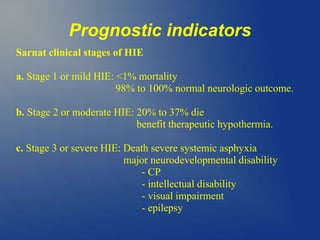
Prognostic indicators
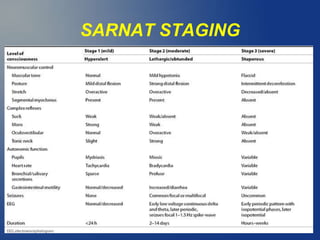
Sarnat clinical stages of HIE
a. Stage 1 or mild HIE: <1% mortality
98% to 100% normal neurologic outcome.
b. Stage 2 or moderate HIE: 20% to 37% die
benefit therapeutic hypothermia.
c. Stage 3 or severe HIE: Death severe systemic asphyxia
major neurodevelopmental disability
- CP
- intellectual disability
- visual impairment
- epilepsy
SARNAT STAGING
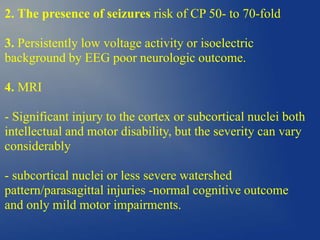
2. The presence of seizures risk of CP 50- to 70-fold
3. Persistently low voltage activity or isoelectric
background by EEG poor neurologic outcome.
4. MRI
- Significant injury to the cortex or subcortical nuclei both
intellectual and motor disability, but the severity can vary
considerably
- subcortical nuclei or less severe watershed
pattern/parasagittal injuries -normal cognitive outcome
and only mild motor impairments.
aEEG BIRTH ASPHYXIA

Perinatal asphyxia

  • 1.
  • 3.
    Incidence -Approximately 1.5% oflive births in developed countries -Inversely related to gestational age and birth weight (BW). -0.5% of live-born newborns >36 weeks' gestation -20% of perinatal deaths (50% if stillbirths are included) - diabetic or toxemic mothers -intrauterine growth restriction -breech presentation -postdate.
  • 4.
    PERINATAL ASPHYXIA 1]First andsecond stage of labor 2]Impaired gas exchange:- fetal acidosis, hypoxemia, and hypercarbia. 3]Fetal acidosis:-umbilical arterial blood pH <7.0, 4]The likelihood of brain injury is relatively low with this degree of acidosis in cord blood at birth
  • 5.
    A]Perinatal hypoxia, ischaemia, andasphyxia B]Perinatal/Neonatal depression C]Neonatal encephalopathy D]Hypoxic encephalopathy E]Hypoxic ischaemic brain injury
  • 6.
    Perinatal hypoxia, ichaemia,and asphyxia 1]Decreased oxygen 2]decreased blood flow 3]Decreased gas exchange PRENATAL, PERINATAL, POSTNATAL DATA
  • 7.
    Perinatal/Neonatal depression Physical examination:Firsthour after birth. 1]Depressed mental status 2]Muscle hypotonia, and/or 3]Disturbances in spontaneous respiration and cardiovascular function. After the first hour or so of life: neonatal encephalopathy
  • 8.
    Neonatal encephalopathy Clinical andnot an etiologic:abnormal neurobehavioral state 1]Altered consciousness (including hyperalert state) 2]Brainstem and/or motor dysfunction. 3]No specific etiology irreversible OR reversible conditions as maternal medications or hypoglycemia in baby.
  • 9.
    Hypoxic ischaemic encephalopathy 1]Clinical evidenceof encephalopathy 2]Objective data: Hypoxic-ischemic (HI) mechanism as the underlying cause
  • 10.
    Hypoxic ischaemic braininjury 1]Neuropathology attributable to hypoxia and/or ischemia 2]neuroimaging HUS, MRI, CT] or pathologic (postmortem) 3]Biochemical markers of brain injury such as CK-BB and neuron specific enolase (NSE) are not used routinely in clinical practice
  • 11.
    1. Prenatal history 2.Perinatal history 3. Postnatal data a. Admission physical exam: neurologic exam and presence of any dysmorphic features b. Clinical course including presence or absence of seizures (and time of onset), oliguria, cardiorespiratory dysfunction, and treatment (e.g., need for pressor medications, ventilator support) c. Laboratory testing d. Imaging studies e. EEG
  • 12.
    Risk factors 1. Impairmentof maternal oxygenation 2. Decreased blood flow from mother to placenta 3. Decreased blood flow from placenta to fetus 4. Impaired gas exchange across the placenta or at the fetal tissue level 5. Increased fetal O2 requirement
  • 13.
    Causes 1. Maternal factors 2.Placental factors 3. Uterine rupture 4. Umbilical cord accidents 5. Abnormalities of umbilical vessels 6. Fetal factors 7. Neonatal factors
  • 14.
    Maternal factors: -Hypertension (acuteor chronic) -Hypotension -Infection (including chorioamnionitis) -Hypoxia from pulmonary or cardiac disorders -Diabetes -Maternal vascular disease -in utero exposure to cocaine
  • 15.
  • 16.
    Umbilical cord accidents: 1]Prolapse 2] Entanglement 3] True knot 4] Compression
  • 17.
    Fetal factors:- 1] anemia(e.g., from fetal-maternal hemorrhage) 2]infection 3]cardiomyopathy 4]hydrops 5]severe cardiac/circulatory insufficiency
  • 18.
    Neonatal factors: 1] cyanoticcongenital heart disease 2]PPHN 3]cardiomyopathy 4]neonatal cardiogenic and/or septic shock 5]meconium aspiration syndrome 6]neonatal pneumonia 7]pneumothorax
  • 19.
    Pathophysiology Normal course oflabor cause most babies to be born with little O2 reserve. These include the following: 1. Decreased blood flow - uterine contractions - some degree of cord compression - maternal dehydration - maternal alkalosis due to hyperventilation 2. Decreased O2 delivery to the fetus from reduced placental blood flow 3. Increased O2 consumption in both mother and fetus
  • 20.
    Hypoxia-ischemia causes anumber of physiologic and biochemical alterations
  • 21.
    Brief asphyxia: - atransient increase, followed by a decrease in heart rate - mild elevation blood pressure - an increase in central venous pressure - essentially no change in cardiac output(CO) - redistribution of CO (diving reflex) - severe but brief asphyxia (e.g., placental abruption then stat cesarian section) - diversion of blood flow to vital deep nuclear structures of the brain doesnt occur
  • 22.
    Prolonged asphyxia: -loss ofpressure autoregulation and/or CO2 vasoreactivity. -disturbances in cerebral perfusion -cardiovascular involvement with hypotension and/or decreased CO. -A decrease in cerebral blood flow (CBF) results in anaerobic metabolism -eventual cellular energy failure -increased glucose utilization in the brain -fall in the concentration of glycogen, phosphocreatine, and adenosine triphosphate (ATP). Prolonged asphyxia -diffuse injury to both cortical and subcortical structures
  • 23.
  • 24.
    Immediate neuronal death(necrosis): - Intracellular osmotic overload of Na+ and Ca2+ - Ion pump failure as above or - Excitatory neurotransmitters acting on in otropic receptors (such as the N-methyl-Daspartate [NMDA] receptor).
  • 25.
    Delayed neuronal death(apoptosis):- - Uncontrolled activation of enzymes - Second messenger systems within the cell - Mitochondrial respiratory electron chain transport - Generation of free radicals and leukotrienes - Generation of nitric oxide (NO) through NO synthase - Depletion of energy stores.
  • 26.
    Reperfusion :- - Previouslyischemic tissue - Formation of excess reactive oxygen - Overwhelm the endogenous scavenger - Damage to cellular lipids, proteins, and nucleic acids as well as to blood-brain barrier. - Influx of neutrophils, activated microglia, release injurious cytokines
  • 27.
  • 28.
    Perinatal assessment:- - Preexistingmaternal or fetal problems - Changing placental and fetal conditions - Ultrasonographic examination - Biophysical profile - Nonstress tests.
  • 29.
    Low Apgar scoresand need for resuscitation - Cardiovascular integrity not neurologic dysfunction resulting from asphyxia
  • 30.
  • 31.
    Differential diagnosis fora term newborn with an Apgar score ≤3 for ≄10 min - depression from maternal anesthesia or analgesia - trauma - infection - cardiac or pulmonary - neuromuscular - central nervous system disorders or malformations If the Apgar score is >6 by 5 minutes, perinatal asphyxia is not likely
  • 32.
    Umbilical cord orfirst blood gas determination - specific blood gas criteria uncertain - pH and base deficit on the cord or first blood gas - Determining which infants have asphyxia - Need for further evaluation for the development of HIE - In RCT severe acidosis - pH ≤7.0 - base deficit ≄16 mmol/L
  • 33.
    Clinical presentation anddifferential diagnosis. - history of fetal and/or neonatal distress and laboratory evidence of asphyxia - meconium aspiration - pulmonary hypertension - birth trauma - fetalmaternal hemorrhage - The diagnosis of neonatal encephalopathy includes a number of etiologies
  • 34.
    Asphyxia may besuspected and HIE reasonably included in the differential diagnosis when there is: 1. Prolonged (>1 hour) antenatal acidosis 2. Fetal HR <60 beats per minute 3. Apgar score ≤3 at ≄10 minutes 4. Need for positive pressure ventilation for >1 minute or first cry delayed >5 minutes 5. Seizures within 12 to 24 hours of birth 6. Burst suppression or suppressed background
  • 35.
    Neurological signs 1]encephalopathy 2]brainstem andcranial nerve signs 3]motor signs 4]seizures 5]increased ICP
  • 36.
    Encephalopathy - Abnormal consciousnessby definition - Mild encephalopathy:- apparent hyperalert or jittery state consciousness is abnormal. - Moderate and severe encephalopathy:- - impaired responses to stimuli such as light, touch, or even noxious stimuli. The background pattern detected by EEG or aEEG is useful for determining the severity of encephalopathy
  • 37.
    BRAINSTEM AND CRANIAL NERVES -Abnormal or absent brainstem reflexes - There can be abnormal eye movements - An absence of visual fixation or blink to light. - Facial weakness (usually symmetric) - Weak or absent suck and swallow with poor feeding - Apnea or abnormal respiratory patterns
  • 38.
    MOTOR ABNORMALITY - Greaterseverity greater hypotonia, weakness - Abnormal posture with lack of flexor tone, which is usually symmetric - Primitive reflexes such as the Moro or grasp reflex may be diminished. - Over days to weeks, the initial hypotonia may evolve into spasticity and hyperreflexia - Hypertonia within the first day or so after birth indicates hypoxia earlier in the antepartum period
  • 39.
    SEIZURE Severity of encephalopathyis moderate or severe, not mild. 1. Seizures may be subtle, tonic, or clonic 2. Often subclinical (electrographic only) and abnormal movements or posture may not be seizure 3. EEG remains the gold standard for diagnosing neonatal seizures 4. Adequately support respiration to avoid additional hypoxic injury
  • 40.
    INCREASED ICP -Diffuse cerebraledema - Extensive cerebral necrosis - Indicates a poor prognosis - Treatment to reduce ICP does not affect outcome.
  • 41.
  • 42.
    Lab evaluations Cardiac evaluation. -An elevation CK-MB fraction of >5% to 10% - Cardiac troponin I (cTnI) - cardiac troponin T (cTnT) they are not currently used in clinical practice.
  • 43.
    Neurological markers -not routinelyused to evaluate for the presence of brain injury or to predict outcome.
  • 44.
    RENAL EVALUATION 1. Bloodurea nitrogen (BUN) and serum Cr - 2 to 4 days after the insult. 2. Fractional excretion of Na+ (FENa) 3. Urine levels of β2-microglobulin
  • 45.
    Brain imaging Cranial sonographicexamination - Generally insensitive for the detection of HI brain injury - To rule out large intracranial hemorrhage- contraindication to therapeutic hypothermia
  • 46.
    CT SCAN - cerebraledema - hemorrhage - eventually HI brain injury - if imaging is urgently needed to determine clinical treatment
  • 47.
    MRI. - Best modalityfor determining the severity and extent of irreversible - By atleast 7 to 10 days, and a scan as late as 14 days or older
  • 48.
    EEG - detect andmonitor seizure activity - abnormal background patterns - interpretation depends very much on the experience and expertise of the reader.
  • 49.
  • 50.
    Perinatal management ofhigh-risk pregnancies 1. Fetal HR abnormalities 2. Measurement of fetal scalp pH is a better determinant of fetal oxygenation than PO2. 3. Close monitoring of progress of labor 4. a constellation of abnormal findings
  • 51.
    Postnatal management ofneurologic effects of asphyxia 1. Ventilation. CO2 should be maintained in the normal range. (ā€œsteal phenomenonā€) 2. Oxygenation. O2 levels should be maintained in normal range 3. Temperature. Passive cooling 4. Perfusion. Cardiovascular stability and adequate mean systemic arterial BP
  • 52.
    Maintain physiologic metabolicstate a. Hypocalcemia- maintain calcium in the normal range b. Hypoglycemia- Blood in the normal range for term newborns - Hyperglycemia.
  • 53.
    Judicious fluid managementis needed a. ATN ā€œdiving reflexā€ and result in oliguria followed by polyuria. b. SIADH c. Fluid restriction
  • 54.
    Acute anticonvulsant management i.Phenobarbital is the initial drug loading. ii. Phenytoin second line iii. Benzodiazepines are considered third-line iv. Levetiracetam.
  • 55.
    Long-term anticonvulsant management. -Weanedwhen the clinical exam and EEG phenobarbital being weaned last. - Controversy regarding when phenobarbital should be discontinued -higher risk of developing epilepsy - large area of HI brain injury and persistently epileptiform EEG.
  • 56.
    Multiorgan dysfunction - Managedaccording to the organs involved - a bad prognostic marker
  • 57.
    Prognostic indicators Sarnat clinicalstages of HIE a. Stage 1 or mild HIE: <1% mortality 98% to 100% normal neurologic outcome. b. Stage 2 or moderate HIE: 20% to 37% die benefit therapeutic hypothermia. c. Stage 3 or severe HIE: Death severe systemic asphyxia major neurodevelopmental disability - CP - intellectual disability - visual impairment - epilepsy
  • 58.
  • 59.
    2. The presenceof seizures risk of CP 50- to 70-fold 3. Persistently low voltage activity or isoelectric background by EEG poor neurologic outcome. 4. MRI - Significant injury to the cortex or subcortical nuclei both intellectual and motor disability, but the severity can vary considerably - subcortical nuclei or less severe watershed pattern/parasagittal injuries -normal cognitive outcome and only mild motor impairments.
  • 60.