Full Length Article
Performance evaluation of efficient segmentation and classification based
iris recognition using sheaf attention network☆
Sushilkumar S. Salve a,*
, Sandipann P Narote b
a
Research Scholar, Department of Electronics and Telecommunication, Shri J.J.T. University, Jhunjhunu, Rajasthan 333001, India
b
Head of Department, Department of Electronics and Telecommunication, Government Polytechnic, Pune, Maharashtra 411016, India
A R T I C L E I N F O
Keywords:
Iris recognition
Sheaf attention network
Grayscale transformation
Wavelet transform
Up sampling network
A B S T R A C T
Iris recognition, a precise biometric identification technique, relies on the distinct epigenetic patterns within the
iris. Existing methods often face challenges related to segmentation accuracy and classification efficiency. To
improve the accuracy and efficiency of iris recognition systems, this research proposes an innovative approach
for iris recognition, focusing on efficient segmentation and classification using Convolutional neural networks
with Sheaf Attention Networks (CSAN). Main objective is to develop an integrated framework that optimizes iris
segmentation and classification. Subsequently, dense extreme inception multipath guided up sampling network is
employed for accurate segmentation. Finally, classifiers including convolutional neural network with sheaf
attention networks are evaluated. The findings indicate that the proposed method achieves superior iris recog­
nition accuracy and robustness, making it suitable for applications such as secure authentication and access
control. By comparing with existing approaches CSAN obtains 99.98%, 99.35%, 99.45% and 99.65% accuracy
for the four different proposed datasets respectively.
1. Introduction
Iris recognition stands out as a cutting-edge biometric technology
due to its unparalleled accuracy and reliability in identifying individuals
based on the unique patterns within the iris [1,2]. The iris is an ideal
biometric trait because its patterns are established early in life and
remain stable over time, ensuring consistency and permanence for
identity verification purposes [3]. One of the key advantages of iris
recognition is its resistance to fraud and spoofing attempts. Unlike some
biometric modalities such as fingerprints, which can be replicated or
altered, the intricate and complex patterns of the iris are extremely
difficult to duplicate [4,5]. This makes iris recognition a highly secure
method for authentication, particularly in applications where robust
security measures are essential, such as border control, secure access
management, and national identification systems [6,7]. In practice, iris
recognition systems capture high-resolution images of the iris, extract­
ing unique features such as crypts, furrows, and freckles [8,9]. These
features are then converted into mathematical templates that can be
compared with stored templates in a database. The matching process is
typically fast and accurate, providing reliable identification of
individuals even in challenging conditions such as varying lighting or
occlusions [10].
As technology continues to evolve, iris recognition is expected to
play an increasingly important role in enhancing security and identity
verification across various domains, including law enforcement,
healthcare, finance, and public services [26]. Its exceptional accuracy
and resistance to fraud make it a trusted biometric modality for ensuring
secure and reliable identification. The success and reliability of iris
recognition systems hinge on several critical components, each serving a
specific role in the authentication process. Beginning with preprocess­
ing, iris images undergo enhancement techniques to optimize their
quality and improve the visibility of intricate details [27]. This step
often includes contrast adjustments, normalization, and noise reduction,
crucial for preparing iris images for subsequent stages. Iris segmentation
is a pivotal phase aimed at isolating the iris region from the overall eye
image. Accurate segmentation requires precise detection of iris bound­
aries and proper exclusion of irrelevant areas [28]. Central to this pro­
cess is the accurate localization of the pupil, which establishes the center
of the iris and aids in its delineation.
Feature extraction follows segmentation and involves transforming
☆
This paper has been recommended for acceptance by Kuo-Liang Chung.
* Corresponding author.
E-mail addresses: sushil.472@gmail.com (S.S. Salve), snarote@gmail.com (S.P. Narote).
Contents lists available at ScienceDirect
Journal of Visual Communication and Image Representation
journal homepage: www.elsevier.com/locate/jvci
https://doi.org/10.1016/j.jvcir.2024.104262
Received 18 October 2023; Received in revised form 29 April 2024; Accepted 16 August 2024
J. Vis. Commun. Image R. 103 (2024) 104262
Available online 17 August 2024
1047-3203/© 2024 Elsevier Inc. All rights are reserved, including those for text and data mining, AI training, and similar technologies.
the complex patterns of the iris into a compact and unique representa­
tion. This process distills the iris features into an iris template or code,
which serves as a mathematical representation of the iris’s distinguish­
ing characteristics [29]. The iris template is securely stored for subse­
quent comparison and verification tasks. In the classification stage, an
individual’s iris template is compared against previously stored tem­
plates in a database [30,31]. Matching algorithms are employed to
assess the similarity between templates and determine potential
matches. This final stage of the process enables secure and reliable
identification based on the unique iris patterns. These sequential stages
collectively contribute to the accuracy, reliability, and robustness of iris
recognition technology, making it a valuable tool in various applications
requiring precise and secure biometric authentication.The major
contribution of the work are,
• The hybrid preprocessing method combines the strengths of both
Hybrid multi-scale Retinex Adaptive grayscale Transformation
(HRAT) and Quantized Haar Wavelet Transform (QHWT). This en­
hances image quality by improving contrast, reducing noise, and
preserving texture and fine details.
• Dense extreme Inception Multipath guided up sampling Network
(DIMNet) is capable of accurately delineate the iris boundaries from
the surrounding ocular structures, thereby improving the precision
of the segmentation process.
• Double layer angle Multi kernel Extreme Learning Analysis (DMELA)
is designed to efficiently extract features from segmented images. It
reduces feature space dimensions while preserving relevant infor­
mation. This leads to faster and more efficient processing during
classification.
• The use of Convolutional Neural Networks (CNN) in conjunction
with sheaf attention networks for classification is a powerful com­
bination. It allows for high accuracy in recognizing and classifying
iris patterns, which are critical in biometric authentication.
• This classification approach is adaptable across diverse image clas­
sification tasks, making it versatile and suitable for various appli­
cations beyond iris recognition.
The remaining part of this work is organized as: Section 2 summaries
various existing methods related to biometric iris recognition, Section 3
describes various proposed methods, Section 4 includes results and
performance evaluation and Section 5 involves conclusion and future
work.
2. Literature survey
Iris Recognition (IR) technology has made significant advancements
in recent years, with researchers continuously exploring innovative
techniques to enhance its accuracy and applicability. The selected arti­
cles encompass various aspects of iris recognition, including biometric
techniques, edge detection methods, deep learning neural networks,
feature extraction, and instant learning.
In 2022, Farouk RH et al. [11] proposed a Hamming Distance (HD)
like biometric technique to enhance iris recognition, reflecting the
ongoing efforts to expand the reliability and accuracy of IR systems. It
underscores the significance of robust biometric methods for secure
authentication in various applications. In 2023, Khan SN et al. [12]
focused on iris recognition using edge detection methods, particularly
for user identification in flight simulators. This highlights the practical
applications of iris recognition beyond traditional security measures. In
2023, Ali EH et al. [13] presented a method for IR using deep learning
neural networks, such as CNN, with Semi-Discrete Matrix Decomposi­
tion (SDD) as the feature extraction method. Deep learning has emerged
as a game-changer in biometrics, offering increased accuracy and
robustness. In 2022, Babu G and Khayum PA [14] explored a hybrid
approach that combines Elephant Herding with Whale Optimization
Algorithm (EH-WOA) and CNN for IR. This fusion approach signifies the
integration of traditional computer vision techniques with cutting-edge
deep learning models to enhance recognition accuracy. In 2023,
Abdulhasan et al. [15] focused on achieving instant learning in iris
recognition by combining Deep Neural Networks (DNN) with Linear
Discriminant Analysis (LDA) to enhance accuracy. Instant learning aims
to make iris recognition systems more user-friendly and adaptable.
Abdellatef et al. [16], in 2022, introduced an iris recognition system
that employs deep learning techniques and allows users to cancel and re-
enroll their biometric data, addressing security concerns and improving
system robustness.
The classification methods used here are CNN and Support Vector
Machine (SVM) In 2022, Kagawade and Angadi [17] proposed a novel
scheme for iris recognition using the Polar Fast Fourier Transform
(PFFT) code, leveraging symbolic modeling to enhance accuracy and
efficiency. Sun et al. [18] in 2022, presented an IR system based on Local
Circular Gabor Filters (LCGF) and a Multi-scale Convolution Feature
Fusion Network (MCFFN), demonstrating the use of advanced image
processing techniques to extract relevant features from iris images. In
2022, Sun et al. [19] explored open-set IR using deep learning and the
Open-Class Features Outlier Network (OCFON), offering a solution for
classifying iris images, even when encountering unknown or unautho­
rized users. In 2022, Lei et al. [20] introduced an attention Meta-
Transfer Learning (MTL) approach for few-shot IR adapting the recog­
nition system to new, unseen iris samples. Table 1represents the sum­
mary of reviewed works.
Table 1 provides a concised summary of various methods employed
in iris recognition, along with their specific objectives and associated
limitations. Each method offers unique advantages and faces specific
limitations, highlighting the diverse challenges and opportunities within
the field of iris recognition.
• Problem Statement
Iris recognition using deep learning is to develop an accurate and
reliable biometric authentication system that automatically identify and
verify individuals based on the unique patterns present in the iris of the
eye. This system aims to address challenges related to identity verifi­
cation and access control by leveraging deep neural networks to extract
and learn intricate iris features from high-resolution images. In this
research work, an efficient segmentation and classification-based iris
recognition using CSAN is proposed. The primary objectives include
achieving high recognition accuracy, robustness to variations in lighting
and occlusions. The ability to distinguish genuine iris samples from
impostors while ensuring data privacy and security in deployment sce­
narios such as border control, secure authentication, and access
management.
3. Proposed method
The proposed methodology for iris recognition represents a
comprehensive and sophisticated approach that combines advance
techniques to improve the efficiency and accuracy of the recognition
process. This method revolves around four key components: pre­
processing, segmentation, feature extraction, and classification.
From Fig. 1, the preprocessing stage, powered by HRAT and QHWT,
optimizes image quality, setting the foundation for precise segmenta­
tion. DIMNet, employed for segmentation, efficiently detects iris
boundaries and edges, crucial for accurate isolation. DMELA serves as a
powerful feature extraction tool, reducing classifier runtime while
capturing essential iris features., K-Nearest Neighbors (KNN), SVM,
CSAN and Random Forest (RF) are the classification method used to
classify the extracted features for iris recognition.
3.1. Preprocessing to enhance image quality
Initially, iris images undergo a critical preprocessing stage, which
S.S. Salve and S.P. Narote Journal of Visual Communication and Image Representation 103 (2024) 104262
2
plays a pivotal role in optimizing image quality [21,22]. This phase
employs a HRAT and QHWT. HRAT enhances image quality by adjusting
contrast, reducing noise, and ensuring uniform lighting conditions.
QHWT, on the other hand, allows for the transformation of image data
into a more analyzable frequency domain, preserving intricate iris
details.
• Multi-Scale Retinex Adaptive Grayscale Transformation
The HRAT model plays a pivotal role in enhancing eye images as part
of the preprocessing stage. It essentially converts the gray values
attained from real sampling into corresponding gray values using a
linear function. It achieves several important objectives including the
extraction of edge and texture information from the image and the
enhancement of image contrast. Eqn. (1) shows the mathematical rep­
resentation of grayscale function.
Xʹ(u, v) = [X(u, v) + B − L]⋅tan(T⋅π) + B + L (1)
where X(u, v) represents the grayscale value of the input image, Xʹ(u, v)
signifies the grayscale value of the resulting output image, u, v represents
pixel coordinates of image, T stands for parameters related to contrast
correction, L denotes the offset for the overall transformation, typically
set to a value of 127. The parameter B is equally important, as it is
associated with brightness correction parameters. Its value is propor­
tional to the average brightness of the image, as expressed in Eqn. (2).
B ∝
1
mean
(2)
The adaptive nature of the parameters ensures that the preprocessing
method effectively addresses the specific challenges posed by different
conditions within the datasets, ultimately leading to improved image
quality and readiness for subsequent analysis and recognition tasks.
HRAT enhances iris image clarity by optimizing contrast and
brightness, revealing fine details crucial for feature extraction. It reduces
noise without compromising textural integrity, crucial for precise bio­
metric recognition. Additionally, HRAT adjusts to different lighting
conditions, ensuring consistent image quality essential for accurate iris
recognition.
• Quantized Haar Wavelet Transform
QHWT is a powerful mathematical technique used for data analysis,
particularly in the context of eye image preprocessing for the collected
image. QHWT is designed to efficiently organize data by their fre­
quencies. This transformation shifts data from the spatial domain into
the frequency domain, preserving each component at its respective
resolution scale. Consider a wavelet as a foundational set for a vector
space. The forward Haar transform explained as a combination of
averaging and differencing operations. Eqn. (3) represents the scaling
function ϕ(s) for low pass and the partial Haar function ψ(s) for high
pass.
ψ(s) =
⎧
⎪
⎨
⎪
⎩
1 s ∈ [0, 1/2)
− 1 s ∈ [1/2, 1)
0 s ∈ [0, 1)
ψi
j(s) =
̅̅̅̅
2i
√
× ψ
(
2i
s − j
)
,
i = 0, 1, .... and j = 0, 1, ....,
(
2i
− 1
)
,
ϕ(s) =
{
1 0 ≤ s < 1
0 otherwise
(3)
where i , s and j represents the variables of Haar function. When dealing
with an input signified a list of 2n
numbers, QHWT is a straightforward
process of pairing up input values, storing the differences, and then
adding up the sums. This recursive process continues by pairing up the
sums, ultimately yielding 2n− 1
transformations and a concluding sum.
Consider a vector y with N values, represented as Y = [y1, y2, ..., yN]
where N must be a power of 2. The total number of recursive steps Ω in a
wavelet transform is determined by a certain parameter like log2N.
Then, calculate the directional distances between pairs of numbers pa for
the high pass and the average of pairs of numbers in the vector ha for the
low pass, as described in Eqn. (4).
ha =
(y2a + ysa+1)
2
pa =
(y2a − y2a+1)
2
for a = 0, ...,
(
N
2
− 1
) (4)
where a represents the variable QHWT functions; N represents the
number of values. The next data list p is obtained, in a way that allows to
reconstruct the original vector Y from h and p as Y→[h|p]. Eqn. (5)
represents the inverse operation function.
[y1, y2, ...yN]→[h|p] = [h1, ....hN/2|p1, ..., pN/2] (5)
Table 1
Summary of existing methods.
References Methods Objectives Limitations
[11] CNN and HD Improve Iris
Recognition. Potential
for increased security
Specific details of the
technique are not
verified.
[12] Edge detection
methods
Use Edge Detection for
User Identification.
Improve recognition
speed
Lack of information on
scalability
[13] SDD and CNN Utilizes deep learning
for iris localization
Potential
computational
complexity
[14] EH-WOA Fusion of traditional
CV and deep learning
techniques. Improved
feature extraction for
iris recognition
Required more
computational
resources
[15] LDA Iris recognition
employs a hybrid
LDADNN model, which
combines 1D deep
learning for the
classification process
and delivers precise
outcomes.
This model doesn’t
necessitate an
extensive training
dataset or specialized
hardware for
deployment.
[16] CNN and SVM To enhance security by
allowing users to
cancel and re-enroll
biometric data
The demands for
computational
resources could be
substantial.
[17] PFFT Symbolic modeling
approach improves
accuracy and
efficiency. Potential for
enhanced recognition
in non-standard
conditions
Lack of information
regarding scalability.
[18] LCGF+MCFFN The image processing
techniques improve
feature extraction.
Enhanced recognition
accuracy and
reliability
No attention is given to
distinguishing
unknown classes.
[19] OCFON To address the
scenarios where the
system encounters
unknown irises
Potential for overfitting
[20] MTL To address the few-
shot recognition
scenarios with limited
training samples.
Utilizes meta-transfer
learning and attention
mechanisms
Need a more in-depth
examination of the
integration of attention
mechanisms and few-
shot learning.
S.S. Salve and S.P. Narote Journal of Visual Communication and Image Representation 103 (2024) 104262
3
Finally, in the reverse operation, the vector is decomposed and
mapped as part of the eye image preprocessing procedure for datasets.
QHWT shifts iris image data to the frequency domain, capturing
detailed features at multiple resolutions to enhance pattern differenti­
ation. It segments data into frequency components, boosting processing
efficiency, crucial for managing large datasets and ensuring rapid real-
time analysis.
• Hybrid Multi-Scale Retinex Adaptive Grayscale Transformation
with Quantized Haar Wavelet Transform
Apply the grayscale transformation approach to the initial eye
image. This initial step serves to enhance image contrast, refine edge and
texture details, and adjust brightness and contrast settings. Following
this initial enhancement, proceed to apply the QHWT to the output
obtained in the previous step. The QHWT analysis operates in the fre­
quency domain, offering further insights into the transformed image.
Given that the multi-scale retinex transformation has already improved
image contrast and texture, the QHWT is employed to extract frequency-
based features from these enhanced images. Apply the QHWT at various
scales to capture both fine and coarse image details. Now, combine the
outcomes of both methods. Consider either a weighted or linear com­
bination of the enhanced image generated by the multi-scale retinex
transformation and the wavelet coefficients obtained through the
QHWT. Eqn. (6) provides the formula for the integrated and recon­
structed image, expressing this combination process.
PI = α ∗ X[u, v] + β ∗ [h|p] (6)
where α and β are weighting coefficients that determine the influence of
each method on the result. Adjust these coefficients according to the
unique characteristics of the dataset and the desired outcome. This
adjustment (P1) represents the combined image that incorporates both
the contrast-enhanced features from HRAT and the frequency-based
information from QHWT. The collected data undergoes preprocessing
using the hybrid method and is subsequently segmented using the
DIMNet approach. The functions of the segmentation process are
described as follows.
3.2. Segmenting to separate the iris region
Accurate segmentation is vital for isolating the iris region from the
rest of the eye. DIMNet is tailored to excel in this specific task, effectively
detecting and delineating the boundaries of the iris.
• Dense Extreme Inception Multipath guided up sampling
Network for Edge Detection (DIMNet)
DIMNet inspired from the architecture of xception but introduces a
unique enhancement: two parallel skip-connections. These skip-
connections play a pivotal role in preserving vital edge information
across various network layers [23]. Fig. 2 represents the architecture of
DIMNet.
The architecture is structured around six blocks, each serving as an
encoder. Each block encompasses sub-blocks that consist of convolu­
tional layers. Skip-connections establish connections not only between
blocks but also among sub-blocks. Feature-maps generated at each block
are then dispatched to an independent upsampling network, where they
undergo processing to yield intermediate edge-maps. These intermedi­
ate edge-maps are then combined by stacking them, creating a collection
of learned filters, which are ultimately merged to generate a unified
edge-map.
Each sub-block comprises two convolutional layers, both featuring
3×3 kernels. Following each convolution operation, a batch normali­
zation and rectified linear unit activation function are applied. Notably,
starting from block 3 onward, the last convolutional layer within the
final sub-block ignores the rectifier linear unit function. Red rectangles
denote the presence of max-pooling operators characterized by 3×3
kernels and a stride of 2.
To combat the issue of significant edge features vanishing during the
processing pipeline, the architecture introduces parallel skip-
connections. Starting from block-3 and onwards, the output of each
sub-block undergoes averaging with an additional skip-connection
referred to as “second skip-connections” (SSC). This averaged output
is then merged with the output of the first skip-connection (FSC).
Concurrently, the output from max-pooling layers is directly passed on
to the following sub-blocks.
• Upsampling Network (USNet)
USNet is composed of two conditional blocks, each featuring a
sequence comprising a convolutional layer and a deconvolutional layer
designed for up-sampling features. Block-2 exclusively activates to scale
Fig. 1. Proposed architecture.
S.S. Salve and S.P. Narote Journal of Visual Communication and Image Representation 103 (2024) 104262
4
input feature-maps derived from the Dense inception network, and this
process continues iteratively until the feature-map size ranges twice that
of the ground truth. Upon reaching this condition, the feature-map is
directed to block-1. Block-1 commences processing with a 1x1 kernel,
followed by a rectified linear unit activation and subsequently un­
dertakes a transpose convolution operation with a kernel size of s × s. s
corresponds to the scale level of the input feature-map. It is significant to
note that the last convolutional layer within block-1 does not employ an
activation function.
DIMNet able to detect edges and highlight boundaries ensures that
the iris region is precisely isolated from the rest of the eye. Iris images
vary significantly in terms of lighting conditions, occlusions and image
quality. DIMNets multi-scale processing and edge detection capabilities
make it robust to these variations, ensuring reliable segmentation results
across diverse image conditions. The segmented iris regions are sub­
jected to the feature extraction process.
3.3. Feature extraction to optimize classifier runtime
Feature extraction is to reduce computational complexity and
enhance classifier runtime. DMELA specializes in extracting essential iris
features, capture unique characteristics while optimizing runtime
efficiency.
DMELA operates as a feature extraction method specifically tailored
to expand the efficiency of the IR system [24]. The main objective is to
reduce the dimensionality of the iris data while capturing meaningful
and distinctive features. The feature extraction transforms the complex
iris patterns into a more compact and informative representation that
efficiently utilized by subsequent stages, such as classification. Fig. 3
represents the process of DMELA approach.
This method leverages a double-layer architecture, which enables it
to extract features comprehensively from the segmented iris image. The
input layer takes the raw pixel values of an image. The first hidden layer
of DMELA is responsible for processing the input data and extracting
low-level features. It employs a set of kernels or filters that convolve
with the input to capture various patterns and edges. The second hidden
layer builds upon the features extracted in the first hidden layer. It
combines the low-level features to form higher-level representations.
The output layer synthesizes the features obtained from the second
kernal layer into a final feature representation.
DMELA excels at reducing data dimensionality while capturing
distinctive iris features, streamlining the computational process and
enhancing system runtime efficiency. In essence, after segmentation,
DMELA contributes to the iris recognition process by extracting essential
iris features. These features serve as the basis for subsequent classifi­
cation, allowing the system to accurately identify and verify individuals
based on the unique patterns present in the iris of the eye.
3.4. Image interpretability classification
Finally, the features that have been extracted are employed for the
purpose of classification.. The methodology evaluates classifiers,
including CSAN, KNN, RF and SVM [25]. This combination of neural
network architectures is renowned for its accuracy and interpretability
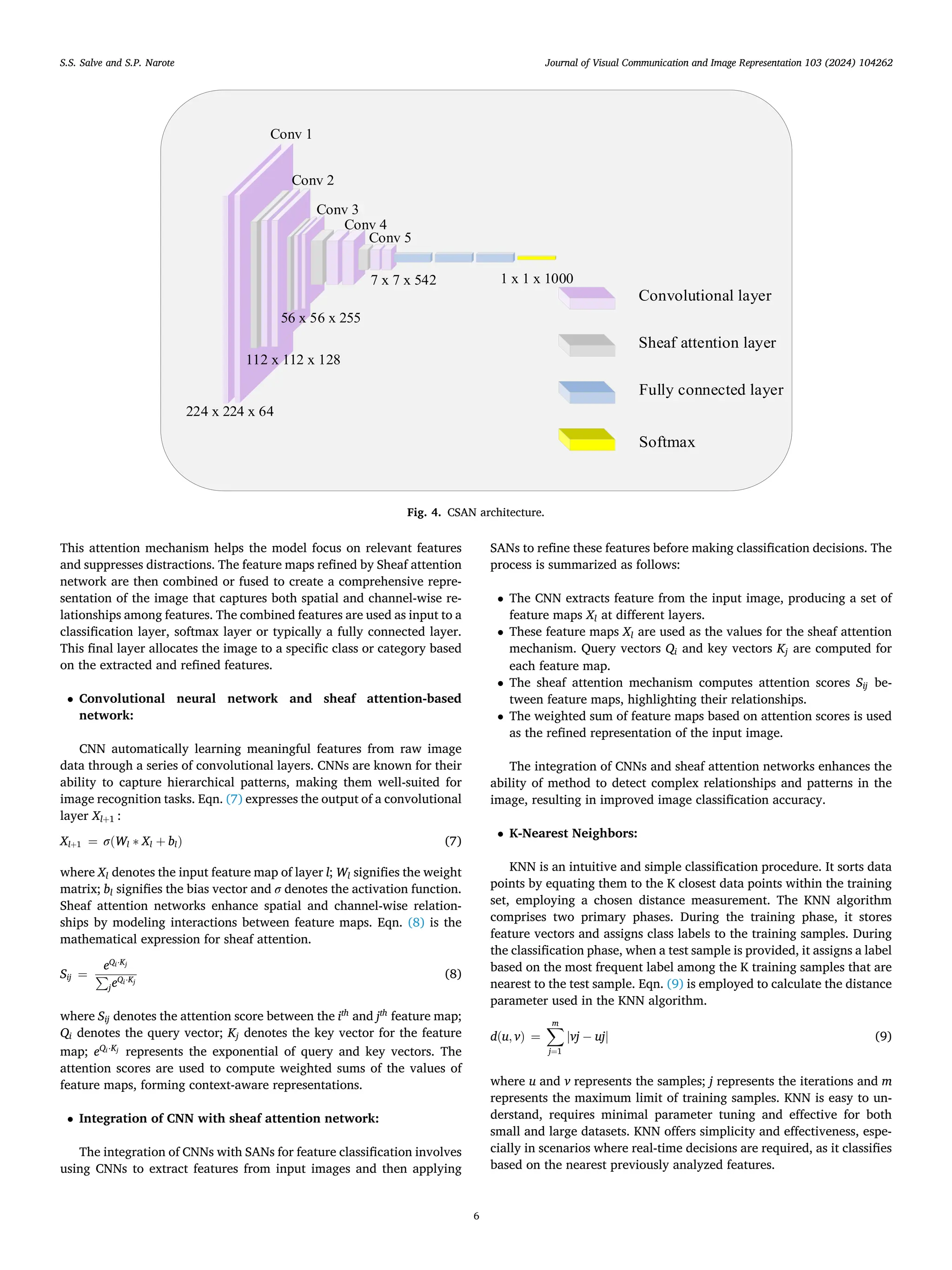
in image classification tasks. Fig. 4 represents the architecture of CSAN
classification method.
The CNN component of the model processes input images through
multiple convolutional layers. These layers automatically extract hier­
archical features from the images, creating a feature map hierarchy.
Sheaf attention network operate on the feature maps produced by the
CNN. For each feature map, Sheaf attention network compute attention
scores that highlight the importance of different regions and channels.
Fig. 2. DIMNet architecture.
Fig. 3. Process of DMELA.
S.S. Salve and S.P. Narote Journal of Visual Communication and Image Representation 103 (2024) 104262
5
This attention mechanism helps the model focus on relevant features
and suppresses distractions. The feature maps refined by Sheaf attention
network are then combined or fused to create a comprehensive repre­
sentation of the image that captures both spatial and channel-wise re­
lationships among features. The combined features are used as input to a
classification layer, softmax layer or typically a fully connected layer.
This final layer allocates the image to a specific class or category based
on the extracted and refined features.
• Convolutional neural network and sheaf attention-based
network:
CNN automatically learning meaningful features from raw image
data through a series of convolutional layers. CNNs are known for their
ability to capture hierarchical patterns, making them well-suited for
image recognition tasks. Eqn. (7) expresses the output of a convolutional
layer Xl+1 :
Xl+1 = σ(Wl ∗ Xl + bl) (7)
where Xl denotes the input feature map of layer l; Wl signifies the weight
matrix; bl signifies the bias vector and σ denotes the activation function.
Sheaf attention networks enhance spatial and channel-wise relation­
ships by modeling interactions between feature maps. Eqn. (8) is the
mathematical expression for sheaf attention.
Sij =
eQi⋅Kj
∑
jeQi⋅Kj
(8)
where Sij denotes the attention score between the ith
and jth
feature map;
Qi denotes the query vector; Kj denotes the key vector for the feature
map; eQi⋅Kj represents the exponential of query and key vectors. The
attention scores are used to compute weighted sums of the values of
feature maps, forming context-aware representations.
• Integration of CNN with sheaf attention network:
The integration of CNNs with SANs for feature classification involves
using CNNs to extract features from input images and then applying
SANs to refine these features before making classification decisions. The
process is summarized as follows:
• The CNN extracts feature from the input image, producing a set of
feature maps Xl at different layers.
• These feature maps Xl are used as the values for the sheaf attention
mechanism. Query vectors Qi and key vectors Kj are computed for
each feature map.
• The sheaf attention mechanism computes attention scores Sij be­
tween feature maps, highlighting their relationships.
• The weighted sum of feature maps based on attention scores is used
as the refined representation of the input image.
The integration of CNNs and sheaf attention networks enhances the
ability of method to detect complex relationships and patterns in the
image, resulting in improved image classification accuracy.
• K-Nearest Neighbors:
KNN is an intuitive and simple classification procedure. It sorts data
points by equating them to the K closest data points within the training
set, employing a chosen distance measurement. The KNN algorithm
comprises two primary phases. During the training phase, it stores
feature vectors and assigns class labels to the training samples. During
the classification phase, when a test sample is provided, it assigns a label
based on the most frequent label among the K training samples that are
nearest to the test sample. Eqn. (9) is employed to calculate the distance
parameter used in the KNN algorithm.
d(u, v) =
∑
m
j=1
|vj − uj| (9)
where u and v represents the samples; j represents the iterations and m
represents the maximum limit of training samples. KNN is easy to un­
derstand, requires minimal parameter tuning and effective for both
small and large datasets. KNN offers simplicity and effectiveness, espe­
cially in scenarios where real-time decisions are required, as it classifies
based on the nearest previously analyzed features.
Fig. 4. CSAN architecture.
S.S. Salve and S.P. Narote Journal of Visual Communication and Image Representation 103 (2024) 104262
6
• Random Forest:
RF is a machine learning technique that utilizes ensemble learning. It
combines multiple decision trees to make predictions. Each separate
decision tree is trained using a randomly chosen subset of both the data
and the available features. Their outcomes are then averaged or voted
upon to arrive at the final prediction. In RF, a training set with M cases
are randomly sampled to create a new training set. This set is used to
grow decision trees. If there are N variables, a subset with n << N
variables are selected for node splitting. The trees are grown without
pruning. Each tree provides its classification for a given input vector and
this is considered as voting. The forest selects the class with the most
votes. During the training process, estimating the classification error
involves sampling feature vectors and leaving some out, typically in a
subset of about M/3 size. The calculation of the classification error
follows these steps:
A prediction is generated for each vector with respect to the tree. The
class with the most votes among the vectors is compared to the actual
ground-truth response. The classification error is determined by the
ratio of misclassified vectors to all vectors in the original dataset. The
overall forest error depends on two crucial factors:
• The level of correlation between any two trees in the forest. An in­
crease in correlation results in a higher error rate.
• The individual predictive power of each tree in the forest. Higher
predictive power of each tree tends to decrease the error rate.
RF provides robustness and accuracy, employing multiple decision
trees to reduce the risk of overfitting and ensuring reliable predictions
even with substantial input data variability.
• Support Vector Machine Classifier:
SVM is a robust and versatile classification algorithm. It operates by
identifying a hyperplane that effectively separates data points belonging
to distinct classes, with an emphasis on maximizing the margin between
these classes. SVM takes a dataset as input and predicts the class to
which each input belongs. The input data is considered as an x-dimen­
sional vector, and SVM builds a model by creating a set of hyperplanes in
a high-dimensional space. For an x-dimensional vector, several hyper­
planes are produced. Effective separation is attained by determining the
hyperplane that maximizes the distance to the closest training data
points from any class, a measure referred to as the functional margin. A
larger margin corresponds to improved classification performance. SVM
is effective in high-dimensional spaces, capable of generating optimal
hyperplanes that distinctly categorize different classes with a high de­
gree of accuracy.
CNN with sheaf attention networks excels in complex image classi­
fication tasks, while KNN is simple and suitable for small datasets. SVM
is versatile and effective in high-dimensional spaces, and RF is known for
its accuracy and robustness.
4. Results
The performance of the proposed systems is estimated by comparing
them to preceding literature based on recognition accuracy. The iris
image serves as the input for feature extraction, and the classification
process is carried out using CSAN. Testing is conducted on four publicly
available datasets: CASIA-Iris-Interval V3, MMU, CASIA-Iris-Interval
V4and MRL eye dataset. The entire Iris Recognition scheme proposed
is implemented using MATLAB. The implementation is takes place on a
PC featuring a 3.40 GHz Intel Core i7-6700 CPU and 16 GB of RAM. The
iris classification process is implemented using a Matlab script within
the Matlab R2021b environment. For dataset preparation, the databases
are randomly split into two groups: 80 % of the database was allocated
as the training set, 20 % of the entire database was set aside as the test
set.
4.1. Dataset description
The MMU V1 dataset, sourced from Multimedia University, com­
prises 450 images collected from 45 individuals, resulting in 90 different
classes. These images were captured using a specialized iris scanning
sensor. The MRL Eye dataset includes images collected from 37 in­
dividuals, predominantly men, with 33 men and 4 women represented.
The CASIA dataset emphasizes iris samples captured under infrared
illumination, featuring 108 unique iris categories. Each category in­
cludes 7 images of the same iris taken during two distinct imaging ses­
sions, with each image having a resolution of 280 × 320 pixels. Table 2
provides specifications for the datasets utilized in the study.
4.2. Performance evaluation of proposed approach
For experimentation, several datasets were utilized with specific
image counts and characteristics. These datasets include 600 JPEG iris
images from the CASIA V4 database, 500 JPEG iris images from the
CASIA V3 database, 150 BMP iris images from the MRL dataset, and 45
BMP format images from the MMU V1 database. The images from CASIA
databases have a resolution of 320 × 280 pixels, while those from the
MRL dataset have a resolution of 320 × 240 pixels. The MMU V1 dataset
consists of images with a resolution of 320 × 280 pixels. To evaluate
precision, false negative and true positive matches were calculated by
dividing the number of matches by the total number of picture samples
in each dataset. Table 3 presents the classification accuracy results
achieved using various methods.
The methods listed include RF, KNN, SVM and CSAN. These methods
achieved high accuracy percentages in their respective classification
tasks, with these CSAN performs more better than other methods,
achieving an accuracy of 99.89 %. These accuracy values indicate the
effectiveness of these methods in appropriately classifying and recog­
nizing iris patterns, a crucial aspect of iris recognition systems. Table 4
represents the performance evaluation metrics for iris recognition
without segmentation using proposed classification methods.
The RF method achieves an accuracy of 95.12 %, KNN reaches 96.34
%, SVM also attains 96.34 %, and the CSAN method leads with an ac­
curacy of 97.89 %. These metrics collectively provide a comprehensive
assessment of the iris recognition performance for each method. Table 5
provides a comprehensive evaluation of iris recognition performance
with segmentation using proposed classification methods. Segmentation
significantly improves iris recognition methods by isolating the iris,
enhancing feature extraction and classification. CSAN achieves 99.89 %
accuracy, demonstrating effective iris pattern recognition with superior
precision and recall. Methods show strong ROC values, indicating reli­
able discrimination between positive and negative cases, but FAR and
FRR should be minimized for better performance in authentication.
Segmentation significantly improves iris recognition methods by
isolating the iris, enhancing feature extraction and classification. CSAN
achieves 99.89 % accuracy, demonstrating effective iris pattern
Table 2
Specification of the used dataset.
Dataset MMU iris
dataset
MRL eye
dataset
CASIA V3 iris
dataset
CASIA V4 iris
dataset
Number of
subjects
90 37 249 60
Samples per
subject
45 7 10 7
Number of
images
450 150 500 600
Image size
(pixels)
(320 x 480) (320 x 240) (320 x 280) (320 x 280)
Image format JPEG JPEG JPEG JPEG
S.S. Salve and S.P. Narote Journal of Visual Communication and Image Representation 103 (2024) 104262
7
recognition with superior precision and recall. Methods show strong
ROC values, indicating reliable discrimination between positive and
negative cases, but FAR and FRR should be minimized for better per­
formance in authentication.
Table 6 presents the success rates for various classification methods
across different numbers of features per image. All methods achieve
exceptionally high accuracy, with RF at 99.12 %, KNN at 99.34 %, SVM
also at 99.34 %, and the CSAN method leading with an accuracy of
99.89 %. The CSAN method stands out with the highest accuracy, pre­
cision, and ROC value while maintaining low FAR and FRR rates.
As the number of features per image decreases, there is a variation in
success rates across the classification methods. Notably, when 50 fea­
tures per image are used, RF, KNN, and CSAN achieve similar high
success rates, around 99.12 % to 99.15 %. As the number of features
decreases, some methods, like KNN, RF and SVM, maintain high success
rates like CSAN experience a slight drop-in success rate.
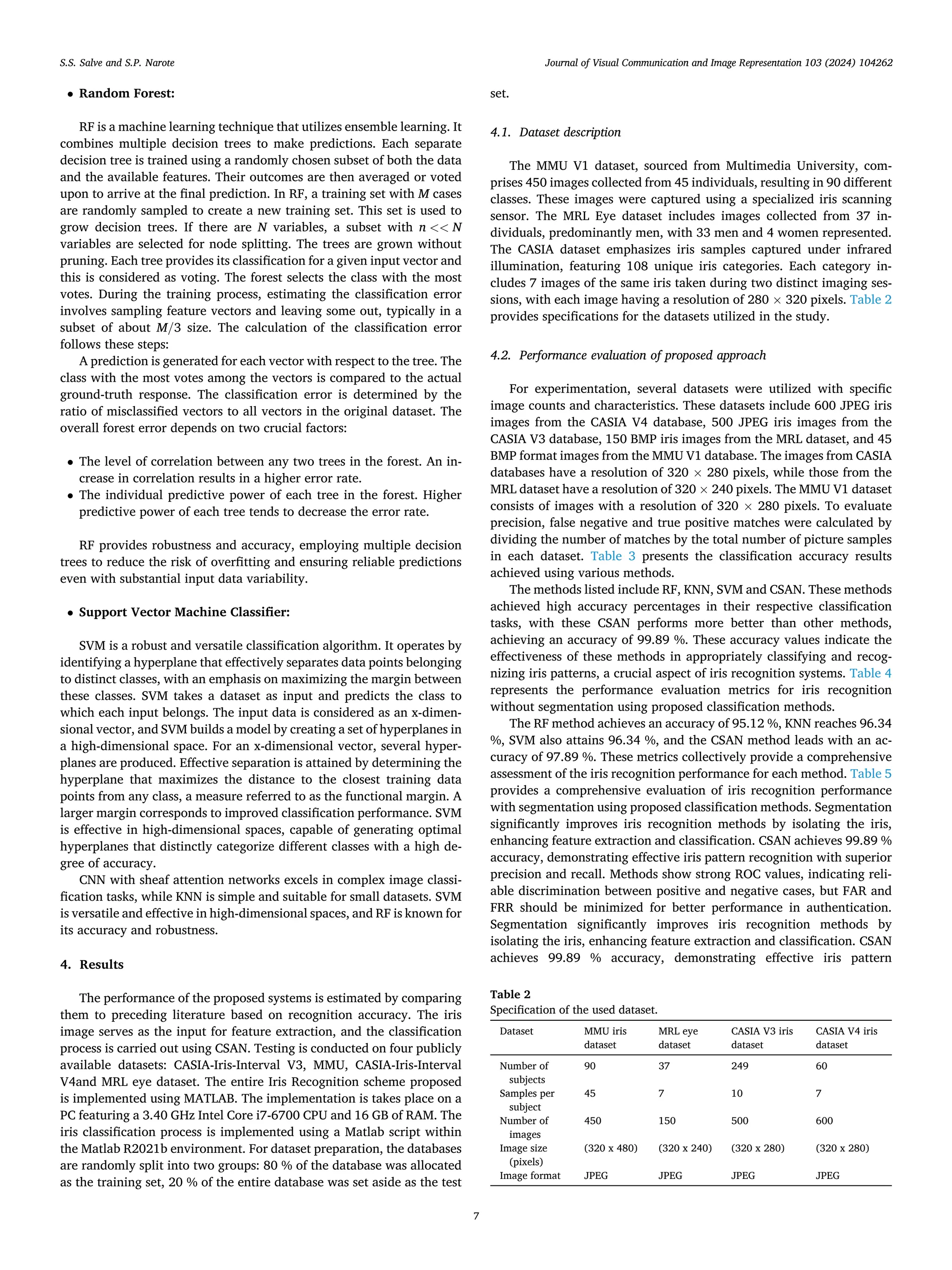
Fig. 5 represents the performance of proposed classification models
using two key metrics: The Genuine Accept Rate (GAR) and the False
Non-Match Rate (FNMR). The GAR indicates the system’s ability to
accurately identify legitimate users, while the FNMR reflects the rate at
which the system incorrectly fails to recognize genuine users. The CSAN
model showcases exceptional performance with a consistent GAR sur­
passing 99 %. This outstanding GAR highlights the CSAN model’s pro­
ficiency in accurately identifying genuine users, thereby ensuring a
robust and dependable authentication process. The FNMR remains
remarkably low, reaffirming the CSAN model’s ability to minimize in­
stances of failing to recognize legitimate users.
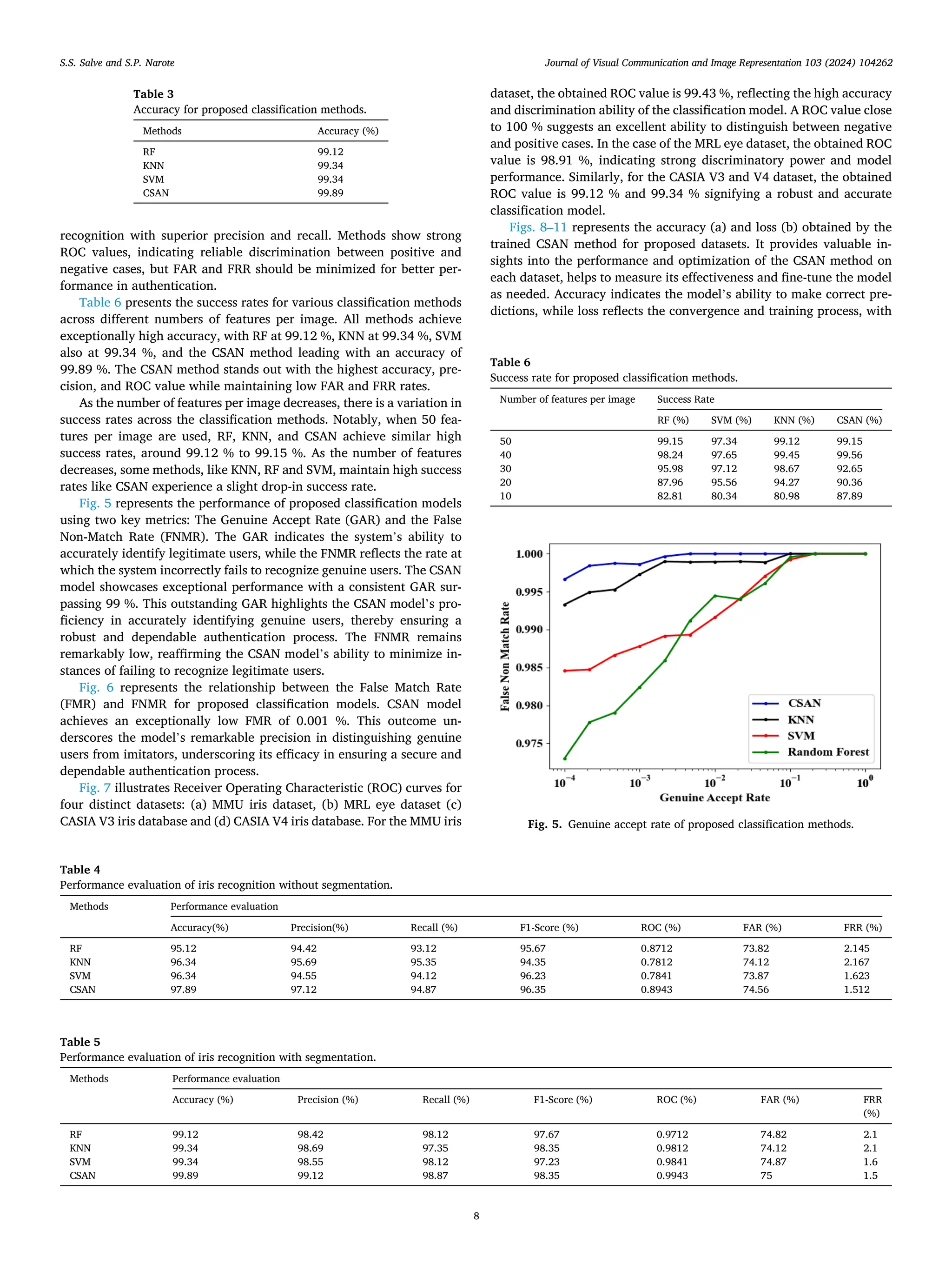
Fig. 6 represents the relationship between the False Match Rate
(FMR) and FNMR for proposed classification models. CSAN model
achieves an exceptionally low FMR of 0.001 %. This outcome un­
derscores the model’s remarkable precision in distinguishing genuine
users from imitators, underscoring its efficacy in ensuring a secure and
dependable authentication process.
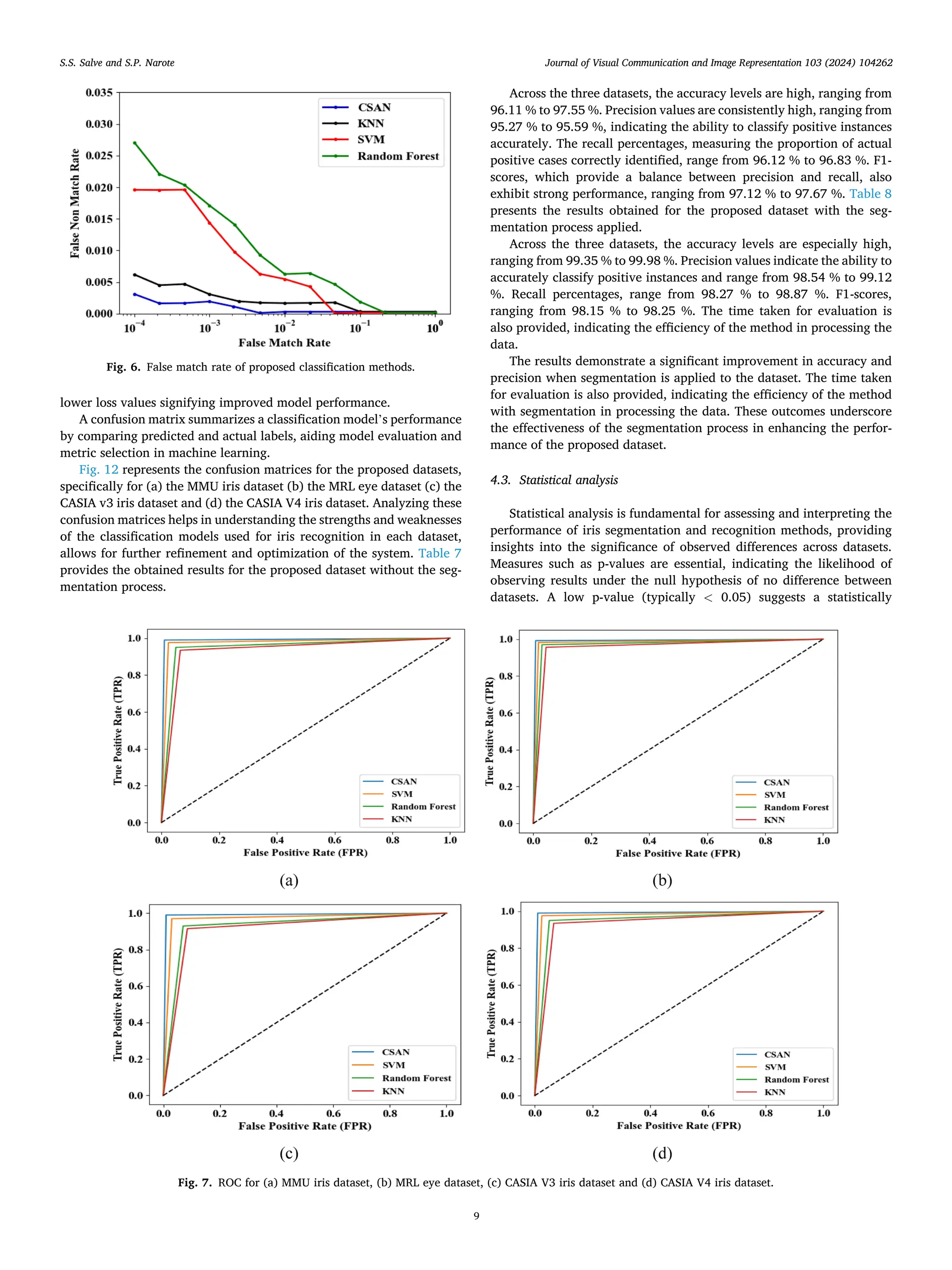
Fig. 7 illustrates Receiver Operating Characteristic (ROC) curves for
four distinct datasets: (a) MMU iris dataset, (b) MRL eye dataset (c)
CASIA V3 iris database and (d) CASIA V4 iris database. For the MMU iris
dataset, the obtained ROC value is 99.43 %, reflecting the high accuracy
and discrimination ability of the classification model. A ROC value close
to 100 % suggests an excellent ability to distinguish between negative
and positive cases. In the case of the MRL eye dataset, the obtained ROC
value is 98.91 %, indicating strong discriminatory power and model
performance. Similarly, for the CASIA V3 and V4 dataset, the obtained
ROC value is 99.12 % and 99.34 % signifying a robust and accurate
classification model.
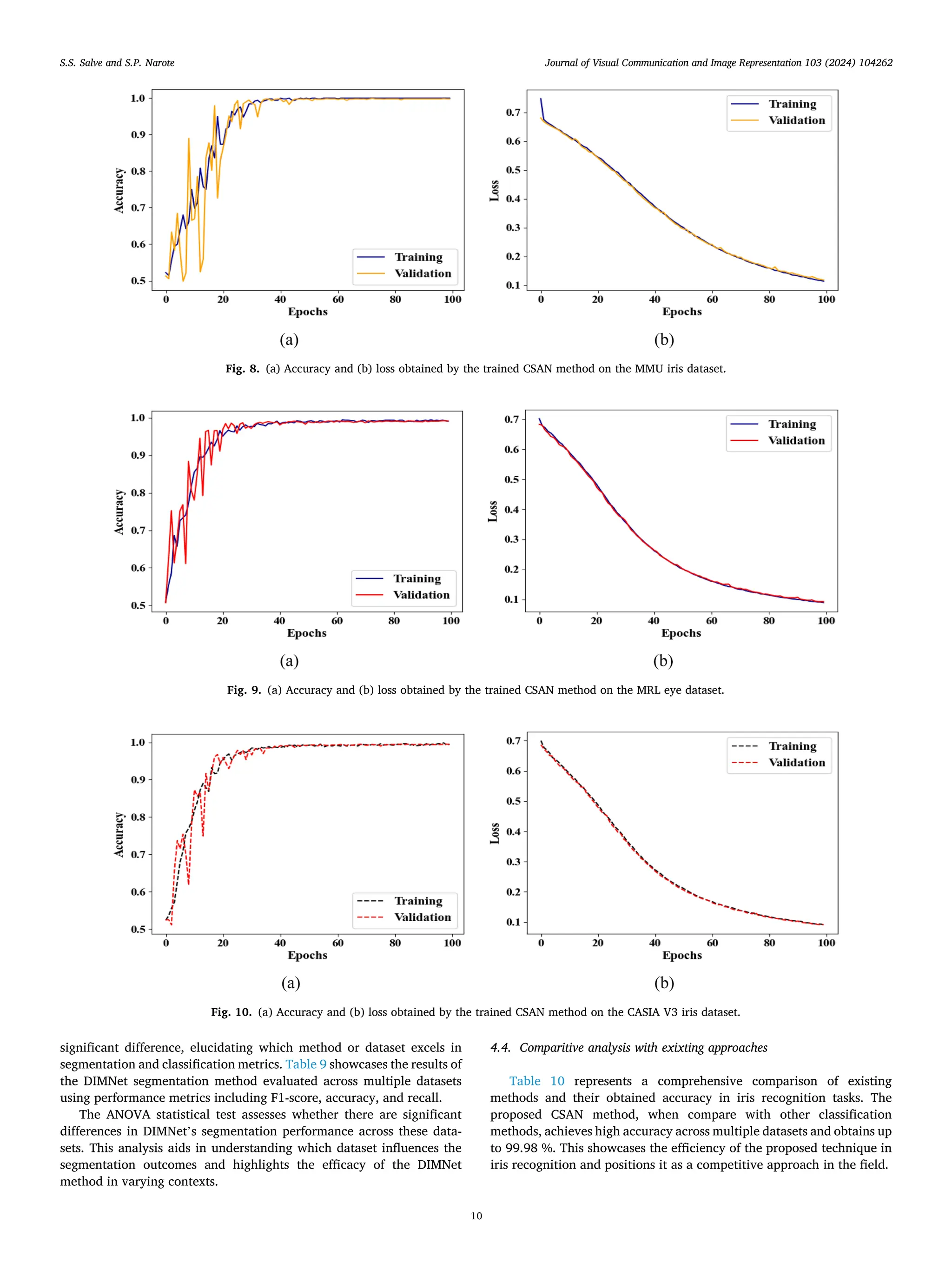
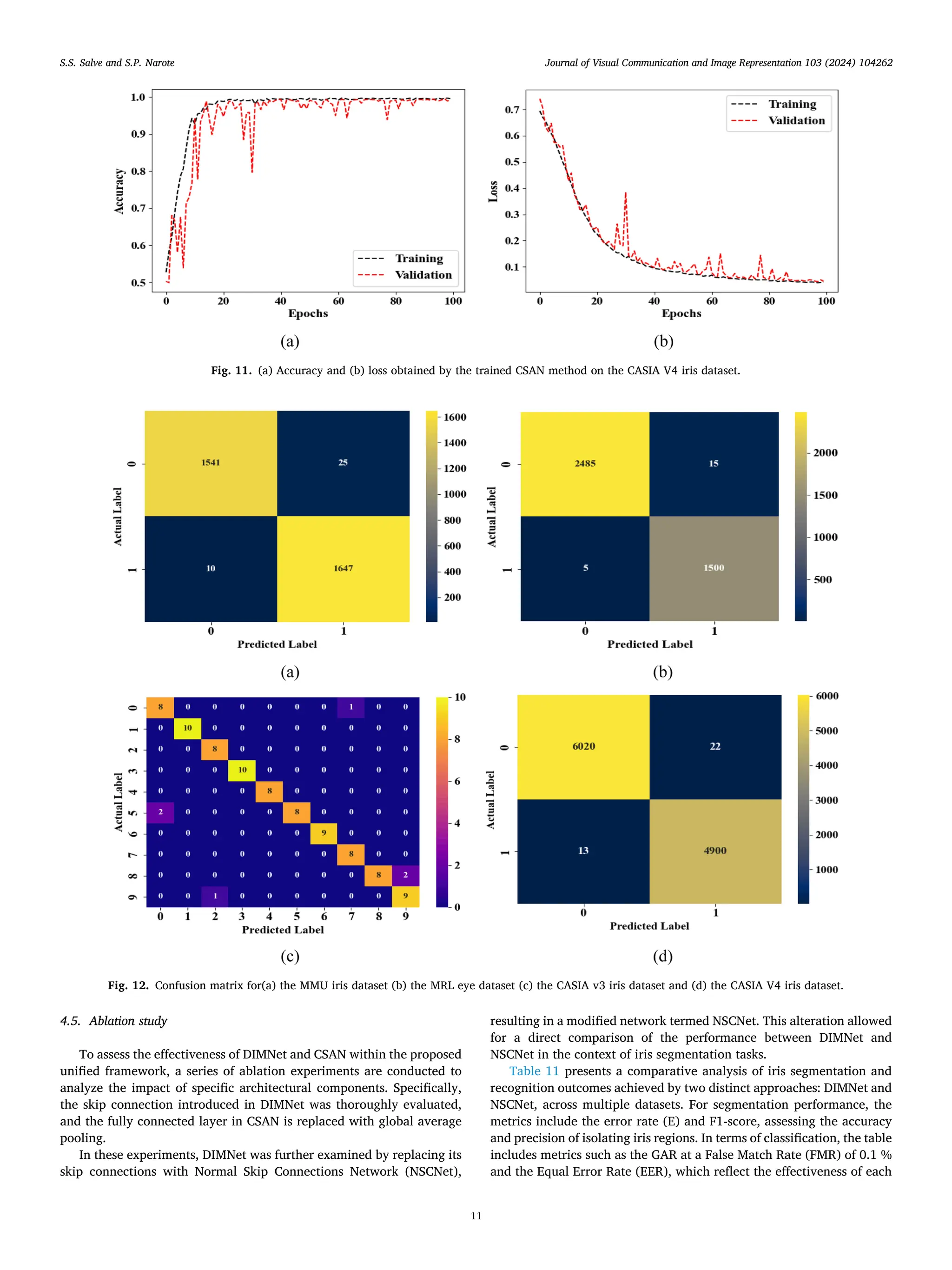
Figs. 8–11 represents the accuracy (a) and loss (b) obtained by the
trained CSAN method for proposed datasets. It provides valuable in­
sights into the performance and optimization of the CSAN method on
each dataset, helps to measure its effectiveness and fine-tune the model
as needed. Accuracy indicates the model’s ability to make correct pre­
dictions, while loss reflects the convergence and training process, with
Table 3
Accuracy for proposed classification methods.
Methods Accuracy (%)
RF 99.12
KNN 99.34
SVM 99.34
CSAN 99.89
Table 4
Performance evaluation of iris recognition without segmentation.
Methods Performance evaluation
Accuracy(%) Precision(%) Recall (%) F1-Score (%) ROC (%) FAR (%) FRR (%)
RF 95.12 94.42 93.12 95.67 0.8712 73.82 2.145
KNN 96.34 95.69 95.35 94.35 0.7812 74.12 2.167
SVM 96.34 94.55 94.12 96.23 0.7841 73.87 1.623
CSAN 97.89 97.12 94.87 96.35 0.8943 74.56 1.512
Table 5
Performance evaluation of iris recognition with segmentation.
Methods Performance evaluation
Accuracy (%) Precision (%) Recall (%) F1-Score (%) ROC (%) FAR (%) FRR
(%)
RF 99.12 98.42 98.12 97.67 0.9712 74.82 2.1
KNN 99.34 98.69 97.35 98.35 0.9812 74.12 2.1
SVM 99.34 98.55 98.12 97.23 0.9841 74.87 1.6
CSAN 99.89 99.12 98.87 98.35 0.9943 75 1.5
Table 6
Success rate for proposed classification methods.
Number of features per image Success Rate
RF (%) SVM (%) KNN (%) CSAN (%)
50 99.15 97.34 99.12 99.15
40 98.24 97.65 99.45 99.56
30 95.98 97.12 98.67 92.65
20 87.96 95.56 94.27 90.36
10 82.81 80.34 80.98 87.89
Fig. 5. Genuine accept rate of proposed classification methods.
S.S. Salve and S.P. Narote Journal of Visual Communication and Image Representation 103 (2024) 104262
8
lower loss values signifying improved model performance.
A confusion matrix summarizes a classification model’s performance
by comparing predicted and actual labels, aiding model evaluation and
metric selection in machine learning.
Fig. 12 represents the confusion matrices for the proposed datasets,
specifically for (a) the MMU iris dataset (b) the MRL eye dataset (c) the
CASIA v3 iris dataset and (d) the CASIA V4 iris dataset. Analyzing these
confusion matrices helps in understanding the strengths and weaknesses
of the classification models used for iris recognition in each dataset,
allows for further refinement and optimization of the system. Table 7
provides the obtained results for the proposed dataset without the seg­
mentation process.
Across the three datasets, the accuracy levels are high, ranging from
96.11 % to 97.55 %. Precision values are consistently high, ranging from
95.27 % to 95.59 %, indicating the ability to classify positive instances
accurately. The recall percentages, measuring the proportion of actual
positive cases correctly identified, range from 96.12 % to 96.83 %. F1-
scores, which provide a balance between precision and recall, also
exhibit strong performance, ranging from 97.12 % to 97.67 %. Table 8
presents the results obtained for the proposed dataset with the seg­
mentation process applied.
Across the three datasets, the accuracy levels are especially high,
ranging from 99.35 % to 99.98 %. Precision values indicate the ability to
accurately classify positive instances and range from 98.54 % to 99.12
%. Recall percentages, range from 98.27 % to 98.87 %. F1-scores,
ranging from 98.15 % to 98.25 %. The time taken for evaluation is
also provided, indicating the efficiency of the method in processing the
data.
The results demonstrate a significant improvement in accuracy and
precision when segmentation is applied to the dataset. The time taken
for evaluation is also provided, indicating the efficiency of the method
with segmentation in processing the data. These outcomes underscore
the effectiveness of the segmentation process in enhancing the perfor­
mance of the proposed dataset.
4.3. Statistical analysis
Statistical analysis is fundamental for assessing and interpreting the
performance of iris segmentation and recognition methods, providing
insights into the significance of observed differences across datasets.
Measures such as p-values are essential, indicating the likelihood of
observing results under the null hypothesis of no difference between
datasets. A low p-value (typically < 0.05) suggests a statistically
Fig. 6. False match rate of proposed classification methods.
Fig. 7. ROC for (a) MMU iris dataset, (b) MRL eye dataset, (c) CASIA V3 iris dataset and (d) CASIA V4 iris dataset.
S.S. Salve and S.P. Narote Journal of Visual Communication and Image Representation 103 (2024) 104262
9
significant difference, elucidating which method or dataset excels in
segmentation and classification metrics. Table 9 showcases the results of
the DIMNet segmentation method evaluated across multiple datasets
using performance metrics including F1-score, accuracy, and recall.
The ANOVA statistical test assesses whether there are significant
differences in DIMNet’s segmentation performance across these data­
sets. This analysis aids in understanding which dataset influences the
segmentation outcomes and highlights the efficacy of the DIMNet
method in varying contexts.
4.4. Comparitive analysis with exixting approaches
Table 10 represents a comprehensive comparison of existing
methods and their obtained accuracy in iris recognition tasks. The
proposed CSAN method, when compare with other classification
methods, achieves high accuracy across multiple datasets and obtains up
to 99.98 %. This showcases the efficiency of the proposed technique in
iris recognition and positions it as a competitive approach in the field.
Fig. 8. (a) Accuracy and (b) loss obtained by the trained CSAN method on the MMU iris dataset.
Fig. 9. (a) Accuracy and (b) loss obtained by the trained CSAN method on the MRL eye dataset.
Fig. 10. (a) Accuracy and (b) loss obtained by the trained CSAN method on the CASIA V3 iris dataset.
S.S. Salve and S.P. Narote Journal of Visual Communication and Image Representation 103 (2024) 104262
10
4.5. Ablation study
To assess the effectiveness of DIMNet and CSAN within the proposed
unified framework, a series of ablation experiments are conducted to
analyze the impact of specific architectural components. Specifically,
the skip connection introduced in DIMNet was thoroughly evaluated,
and the fully connected layer in CSAN is replaced with global average
pooling.
In these experiments, DIMNet was further examined by replacing its
skip connections with Normal Skip Connections Network (NSCNet),
resulting in a modified network termed NSCNet. This alteration allowed
for a direct comparison of the performance between DIMNet and
NSCNet in the context of iris segmentation tasks.
Table 11 presents a comparative analysis of iris segmentation and
recognition outcomes achieved by two distinct approaches: DIMNet and
NSCNet, across multiple datasets. For segmentation performance, the
metrics include the error rate (E) and F1-score, assessing the accuracy
and precision of isolating iris regions. In terms of classification, the table
includes metrics such as the GAR at a False Match Rate (FMR) of 0.1 %
and the Equal Error Rate (EER), which reflect the effectiveness of each
Fig. 11. (a) Accuracy and (b) loss obtained by the trained CSAN method on the CASIA V4 iris dataset.
Fig. 12. Confusion matrix for(a) the MMU iris dataset (b) the MRL eye dataset (c) the CASIA v3 iris dataset and (d) the CASIA V4 iris dataset.
S.S. Salve and S.P. Narote Journal of Visual Communication and Image Representation 103 (2024) 104262
11
method in accurately identifying and classifying iris patterns. This su­
perior performance is largely attributed to the unique skip connection
strategy employed within DIMNet, which effectively compensates for
both semantic and spatial information deficits associated with low-level
and high-level features. This compensation enhances feature fusion
within the network, thereby enabling more accurate differentiation
between iris and non-iris regions. The skip connection mechanism in
DIMNet plays a crucial role in information propagation across different
network layers, facilitating improved feature learning and representa­
tion. By addressing missing semantic and spatial cues inherent in
traditional skip connections, DIMNet achieves enhanced performance in
iris segmentation tasks, underscoring its effectiveness within the pro­
posed framework.
4.6. Discussion
The comprehensive evaluation of iris recognition methods presented
in this study underscores the effectiveness of various classification ap­
proaches across multiple datasets. High accuracy percentages achieved
by RF, KNN, SVM, and CSAN demonstrate their robustness in classifying
iris patterns accurately. Segmentation significantly enhances recogni­
tion methods by isolating the iris, improving feature extraction, and
classification accuracy. CSAN emerges as the top performer with 99.89
% accuracy, demonstrating superior precision and recall. ROC values
indicate strong discrimination ability, although efforts are needed to
minimize FAR and FRR for optimal authentication performance. Sta­
tistical analyses, including ANOVA, provide insights into segmentation
performance variations across datasets, guiding methodological
improvements.
5. Conclusion
This research presents a comprehensive framework for improving
iris recognition accuracy and efficiency, addressing challenges in seg­
mentation and classification. Proposed CSAN classification method has
demonstrated better accuracy, precision and recall, making it a prom­
ising choice for real-world applications that demand robust security and
reliable user identification. The experimental study was conducted for
both segmented and non-segmented classification processes, and it was
observed that segmentation significantly outperforms the non-
segmented approach in terms of recognition accuracy. Limitations of
the current work include the reliance on traditional segmentation
techniques, which may be less robust for complex iris patterns. Inves­
tigating more advanced and robust segmentation techniques could
further improve the accuracy and speed of iris recognition. Exploring
deep learning-based segmentation methods may yield even better
results.
Table 7
Obtained results for proposed dataset without segmentation.
Datasets Performance Evaluation Time
(sec)
Accuracy
(%)
Precision
(%)
Recall
(%)
F1-score
(%)
MMU [11] 97.34 95.27 96.12 97.35 1.871
MRL [11] 97.55 95.44 96.65 97.67 2.345
CASIA V3
[16]
96.11 95.59 96.83 97.12 1.976
CASIA V4
[11]
97.06 96.57 96.72 97.07 1.876
Table 8
Obtained results for proposed dataset with segmentation.
Datasets Performance Evaluation Time
(sec)
Accuracy
(%)
Precision
(%)
Recall
(%)
F1-score
(%)
MMU [11] 99.98 99.12 98.35 97.56 0.875
MRL [11] 99.35 98.78 98.87 98.25 1.890
CASIA V3
[16]
99.45 98.54 98.27 98.15 1.654
CASIA V4
[11]
99.65 98.25 98.27 98.15 1.625
Table 9
Segmentation method using statistical methods.
Method Datasets Performance metrices
F1-score Accuracy Recall
DIMNet MMU 0.048721 0.04726 0.03672
MRL 0.041243 0.03672 0.04261
CASIA V3 0.039821 0.04261 0.04726
CASIA V4 0.038232 0.04321 0.04321
Table 10
Comparison of existing methods with obtained accuracy.
References Feature
extraction
methods
Classification
methods
Datasets Obtained
accuracy
[11] CNN CNN and
Hamming
Distance
IITD 94.88 %
CASIA-Iris-
Interval V4,
96.56 %
MMU 98.01 %
[13] SDD CNN CASIA 95.5 %
MMU 95 %
[14] EH-WOA CNN IITD 92 %
MMU 95 %
[15] LDA DNN MMU 98.2 %
[16] DL CNN, SVM LFW 99.15 %
FERET 98.35 %
IITD 97.89 %
CASIA-
IrisV3
95.48 %
[17] PFFT KNN, SVM,
PNN
CASIA 1.1 99.99 %
CASIA 4.0 98.26 %
SCCSIE&T 99.25 %
VISA Iris 96.67 %
[18] MCFFN CNN CASIA-Iris-
Syn
99.55 %
CASIA-Iris-
Lamp
98.32 %
[19] OCFON Deep learning
methods
CASIA-Iris-
Twins
99.94 %
CASIA-Iris-
Lamp
99.57 %
[20] − MTL CASIA-Iris-
Lamp
99.95 %
Proposedmethods DMELA CSAN, SVM,
KNN, RF
MMU 99.98 %
MRL 99.35 %
CASIA V3 99.45 %
CASIA V4 99.65 %
Table 11
Iris segmentation and recognition results obtained through various approaches
are compared.
Methods Datasets Segmentation Classification
E (%) F1-score (%) GAR(FMR=0.1)
(%)
EER (%)
DIMNet MMU 0.43 98.38 99.01 0.27
MRL 0.34 97.65 99.26 0.06
CASIA V3 1.02 99.42 99.53 0.43
CASIA V4 1.06 98.76 99.17 0.32
NSCNet MMU 0.43 97.32 98.21 0.37
MRL 0.36 96.34 98.25 0.18
CASIA V3 1.03 98.43 99.05 0.56
CASIA V4 1.05 97.26 98.87 0.47
S.S. Salve and S.P. Narote Journal of Visual Communication and Image Representation 103 (2024) 104262
12
Funding
This research did not receive any specific grant from funding
agencies in the public, commercial, or not-for-profit sectors.
CRediT authorship contribution statement
Sushilkumar S. Salve: Conceptualization. Sandipann P Narote:
Supervision.
Declaration of competing interest
The authors declare that they have no known competing financial
interests or personal relationships that could have appeared to influence
the work reported in this paper.
Data availability
Data sharing not applicable to this article as no datasets were
generated or analyzed during the current study.
Acknowledgement
None.
References
[1] K. Nguyen, H. Proença, F. Alonso-Fernandez, Deep Learning for Iris Recognition: A
Survey. arXiv Preprint arXiv:2210.05866. (2022).
[2] J. Wei, H. Huang, Y. Wang, R. He, Z. Sun, Towards more discriminative and robust
iris recognition by learning uncertain factors, IEEE Trans. Inf. Forensics Secur. 17
(2022) 865–879, https://doi.org/10.1109/tifs.2022.3154240.
[3] S. Jamaludin, A.F. Ayob, M.F. Akhbar, A.A. Ali, M.M. Imran, S.M. Norzeli, et al.,
Efficient, accurate and fast pupil segmentation for pupillary boundary in Iris
recognition, Adv. Eng. Softw. 175 (2023) 103352, https://doi.org/10.1016/j.
advengsoft.2022.103352.
[4] B. Karthik, G. Ramkumar, Comparison of feature extraction technique for
segmentation in human iris recognition under uncontrolled environment using
CNN algorithm with SVM classifier, ECS Trans. 107 (2022) 16785–16795, https://
doi.org/10.1149/10701.16785ecst.
[5] A. Boyd, S. Yadav, T. Swearingen, A. Kuehlkamp, M. Trokielewicz, E. Benjamin, et
al., Post-mortem iris recognition—a survey and assessment of the state of the art,
IEEE Access 8 (2020) 136570–136593, https://doi.org/10.1109/
access.2020.3011364.
[6] N. Ahmadi, M. Nilashi, S. Samad, T.A. Rashid, H. Ahmadi, An intelligent method
for Iris recognition using supervised machine learning techniques, Optics Laser
Technol. 120 (2019) 105701, https://doi.org/10.1016/j.optlastec.2019.105701.
[7] H. Hafeez, M.N. Zafar, C.A. Abbas, H. Elahi, M.O. Ali, Real-time human
authentication system based on Iris recognition, Eng. 3 (2022) 693–708, https://
doi.org/10.3390/eng3040047.
[8] B. Abd El-Rahiem, F.E. Abd El Samie, M. Amin, Efficient cancellable multi-
biometric recognition system based on Deep Learning and bio-hashing, Appl. Intell.
53 (2022) 1792–1806, https://doi.org/10.1007/s10489-021-03153-0.
[9] N.D. AL-Shakarchy, H.K. Obayes, Z.N. Abdullah, Person identification based on
voice biometric using deep neural network. Int. J. Inf. Technol. 15 (2022) 789–795.
DOI: 10.1007/s41870-022-01142-1.
[10] N. Alay, H.H. Al-Baity, Deep Learning Approach for multimodal biometric
recognition system based on fusion of Iris, face, and finger vein traits, Sens. 20
(2020) 5523, https://doi.org/10.3390/s20195523.
[11] R.H. Farouk, H. Mohsen, Y.M. El-Latif, A proposed biometric technique for
improving iris recognition, Int. J. Comput. Intell. Syst. 15 (2022), https://doi.org/
10.1007/s44196-022-00135-z.
[12] S.N. Khan, S.U. Khan, O.J. Nwobodo, K. Adam, Cyran, Iris recognition through
edge detection methods: application in flight simulator user identification, Int. J.
Adv. Comput. Sci. Appl. 14 (2023), https://doi.org/10.14569/
ijacsa.2023.0140425.
[13] E. Hussein Ali, H. Abbas Jaber, N. Naji Kadhim, New algorithm for localization of
iris recognition using Deep Learning Neural Networks, Indonesian J. Electr. Eng.
Comput. Sci. 29 (2022) 110, https://doi.org/10.11591/ijeecs.v29.i1.pp110-119.
[14] G. Babu, P.A. Khayum, Elephant herding with whale optimization enabled orb
features and CNN for Iris recognition, Multimed. Tools Appl. 81 (2021)
5761–5794, https://doi.org/10.1007/s11042-021-11746-7.
[15] R.A. Abdulhasan, S.T. Abd Al-latief, S.M. Kadhim, Instant learning based on deep
neural network with linear discriminant analysis features extraction for accurate
iris recognition system, Multimed. Tools Appl. (2023), https://doi.org/10.1007/
s11042-023-16751-6.
[16] E. Abdellatef, R.F. Soliman, E.M. Omran, N.A. Ismail, S.E. Elrahman, K.N. Ismail, et
al., Cancelable face and Iris recognition system based on Deep Learning, Optical
Quantum Electron. 54 (2022), https://doi.org/10.1007/s11082-022-03770-0.
[17] V.C. Kagawade, S.A. Angadi, A new scheme of Polar Fast Fourier transform code
for iris recognition through symbolic modelling approach, Exp. Syst. Appl. 197
(2022) 116745, https://doi.org/10.1016/j.eswa.2022.116745.
[18] J. Sun, S. Zhao, Y. Yu, X. Wang, L. Zhou, Iris recognition based on local circular
Gabor filters and multi-scale Convolution Feature Fusion Network, Multimed.
Tools Appl. 81 (2022) 33051–33065, https://doi.org/10.1007/s11042-022-13098-
2.
[19] J. Sun, S. Zhao, S. Miao, X. Wang, Y. Yu, Open-set iris recognition based on Deep
Learning, IET Image Proc. 16 (2022) 2361–2372, https://doi.org/10.1049/
ipr2.12493.
[20] S. Lei, B. Dong, A. Shan, Y. Li, W. Zhang, F. Xiao, Attention meta-transfer learning
approach for few-shot Iris recognition, Comput. Electr. Eng. 99 (2022) 107848,
https://doi.org/10.1016/j.compeleceng.2022.107848.
[21] J. Zhou, J. Yao, W. Zhang, D. Zhang, Multi-scale retinex-based adaptive gray-scale
transformation method for underwater image enhancement, Multimed. Tools Appl.
81 (2021) 1811–1831, https://doi.org/10.1007/s11042-021-11327-8.
[22] F. Bulut, Low dynamic range histogram equalization (LDR-HE) via quantized Haar
wavelet transform, Visual Comput. 38 (2021) 2239–2255, https://doi.org/
10.1007/s00371-021-02281-5.
[23] X. Soria, A. Sappa, P. Humanante, A. Akbarinia, Dense extreme inception network
for edge detection, Pattern Recogn. 139 (2023) 109461, https://doi.org/10.1016/
j.patcog.2023.109461.
[24] Y. Zhou, B. Sun, W. Sun, Z. Lei, Tool wear condition monitoring based on a two-
layer angle kernel extreme learning machine using sound sensor for milling
process, J. Intell. Manuf. 33 (2020) 247–258, https://doi.org/10.1007/s10845-
020-01663-1.
[25] M.A. Mohammed, A. Lakhan, K.H. Abdulkareem, B. Garcia-Zapirain, A hybrid
cancer prediction based on multi-omics data and Reinforcement Learning State
Action Reward State Action (Sarsa), Comput. Biol. Med. 154 (2023) 106617,
https://doi.org/10.1016/j.compbiomed.2023.106617.
[26] C. Yan, B. Gong, Y. Wei, Y. Gao, Deep multi-view enhancement hashing for image
retrieval, IEEE Trans. Pattern Anal. Mach. Intell. (2020), https://doi.org/10.1109/
TPAMI.2020.2975798.
[27] C. Yan, Z. Li, Y. Zhang, Y. Liu, X. Ji, Y. Zhang, Depth image denoising using nuclear
norm and learning graph model, ACM Trans. Multimed. Comput. Commun. Appl.
(2020), https://doi.org/10.1145/3404374.
[28] C. Yan, Y. Hao, L. Li, J. Yin, A. Liu, Z. Mao, Z. Chen, X. Gao, Task-adaptive
attention for image captioning, IEEE Trans. Circuits Syst. Video Technol. 32 (2021)
42–51, https://doi.org/10.1109/TCSVT.2021.3067449.
[29] C. Yan, T. Teng, Y. Liu, Y. Zhang, H. Wang, X. Ji, Precise no-reference image
quality evaluation based on distortion identification, ACM Trans. Multimed.
Comput. Commun. Appl. 17 (2021) 1–21, https://doi.org/10.1145/3468872.
[30] C. Yan, L. Meng, L. Li, J. Zhang, Z. Wang, J. Yin, J. Zhang, Y. Sun, B. Zheng, Age-
invariant face recognition by multi-feature fusion and decomposition with self-
attention, ACM Trans. Multimed. Comput. Commun. Appl. 18 (2021) 1–8, https://
doi.org/10.1145/3472810.
[31] C. Yan, Y. Sun, H. Zhong, C. Zhu, Z. Zhu, B. Zheng, X. Zhou, Review of omnimedia
content quality evaluation, J. Signal Process. 38 (2022) 1111–1143, https://doi.
org/10.16798/j.issn.1003-0530.2022.06.001.
S.S. Salve and S.P. Narote Journal of Visual Communication and Image Representation 103 (2024) 104262
13

Performance evaluation of efficient segmentation and classification based iris recognition using sheaf attention network

  • 1.
    Full Length Article Performanceevaluation of efficient segmentation and classification based iris recognition using sheaf attention network☆ Sushilkumar S. Salve a,* , Sandipann P Narote b a Research Scholar, Department of Electronics and Telecommunication, Shri J.J.T. University, Jhunjhunu, Rajasthan 333001, India b Head of Department, Department of Electronics and Telecommunication, Government Polytechnic, Pune, Maharashtra 411016, India A R T I C L E I N F O Keywords: Iris recognition Sheaf attention network Grayscale transformation Wavelet transform Up sampling network A B S T R A C T Iris recognition, a precise biometric identification technique, relies on the distinct epigenetic patterns within the iris. Existing methods often face challenges related to segmentation accuracy and classification efficiency. To improve the accuracy and efficiency of iris recognition systems, this research proposes an innovative approach for iris recognition, focusing on efficient segmentation and classification using Convolutional neural networks with Sheaf Attention Networks (CSAN). Main objective is to develop an integrated framework that optimizes iris segmentation and classification. Subsequently, dense extreme inception multipath guided up sampling network is employed for accurate segmentation. Finally, classifiers including convolutional neural network with sheaf attention networks are evaluated. The findings indicate that the proposed method achieves superior iris recog­ nition accuracy and robustness, making it suitable for applications such as secure authentication and access control. By comparing with existing approaches CSAN obtains 99.98%, 99.35%, 99.45% and 99.65% accuracy for the four different proposed datasets respectively. 1. Introduction Iris recognition stands out as a cutting-edge biometric technology due to its unparalleled accuracy and reliability in identifying individuals based on the unique patterns within the iris [1,2]. The iris is an ideal biometric trait because its patterns are established early in life and remain stable over time, ensuring consistency and permanence for identity verification purposes [3]. One of the key advantages of iris recognition is its resistance to fraud and spoofing attempts. Unlike some biometric modalities such as fingerprints, which can be replicated or altered, the intricate and complex patterns of the iris are extremely difficult to duplicate [4,5]. This makes iris recognition a highly secure method for authentication, particularly in applications where robust security measures are essential, such as border control, secure access management, and national identification systems [6,7]. In practice, iris recognition systems capture high-resolution images of the iris, extract­ ing unique features such as crypts, furrows, and freckles [8,9]. These features are then converted into mathematical templates that can be compared with stored templates in a database. The matching process is typically fast and accurate, providing reliable identification of individuals even in challenging conditions such as varying lighting or occlusions [10]. As technology continues to evolve, iris recognition is expected to play an increasingly important role in enhancing security and identity verification across various domains, including law enforcement, healthcare, finance, and public services [26]. Its exceptional accuracy and resistance to fraud make it a trusted biometric modality for ensuring secure and reliable identification. The success and reliability of iris recognition systems hinge on several critical components, each serving a specific role in the authentication process. Beginning with preprocess­ ing, iris images undergo enhancement techniques to optimize their quality and improve the visibility of intricate details [27]. This step often includes contrast adjustments, normalization, and noise reduction, crucial for preparing iris images for subsequent stages. Iris segmentation is a pivotal phase aimed at isolating the iris region from the overall eye image. Accurate segmentation requires precise detection of iris bound­ aries and proper exclusion of irrelevant areas [28]. Central to this pro­ cess is the accurate localization of the pupil, which establishes the center of the iris and aids in its delineation. Feature extraction follows segmentation and involves transforming ☆ This paper has been recommended for acceptance by Kuo-Liang Chung. * Corresponding author. E-mail addresses: sushil.472@gmail.com (S.S. Salve), snarote@gmail.com (S.P. Narote). Contents lists available at ScienceDirect Journal of Visual Communication and Image Representation journal homepage: www.elsevier.com/locate/jvci https://doi.org/10.1016/j.jvcir.2024.104262 Received 18 October 2023; Received in revised form 29 April 2024; Accepted 16 August 2024 J. Vis. Commun. Image R. 103 (2024) 104262 Available online 17 August 2024 1047-3203/© 2024 Elsevier Inc. All rights are reserved, including those for text and data mining, AI training, and similar technologies.
  • 2.
    the complex patternsof the iris into a compact and unique representa­ tion. This process distills the iris features into an iris template or code, which serves as a mathematical representation of the iris’s distinguish­ ing characteristics [29]. The iris template is securely stored for subse­ quent comparison and verification tasks. In the classification stage, an individual’s iris template is compared against previously stored tem­ plates in a database [30,31]. Matching algorithms are employed to assess the similarity between templates and determine potential matches. This final stage of the process enables secure and reliable identification based on the unique iris patterns. These sequential stages collectively contribute to the accuracy, reliability, and robustness of iris recognition technology, making it a valuable tool in various applications requiring precise and secure biometric authentication.The major contribution of the work are, • The hybrid preprocessing method combines the strengths of both Hybrid multi-scale Retinex Adaptive grayscale Transformation (HRAT) and Quantized Haar Wavelet Transform (QHWT). This en­ hances image quality by improving contrast, reducing noise, and preserving texture and fine details. • Dense extreme Inception Multipath guided up sampling Network (DIMNet) is capable of accurately delineate the iris boundaries from the surrounding ocular structures, thereby improving the precision of the segmentation process. • Double layer angle Multi kernel Extreme Learning Analysis (DMELA) is designed to efficiently extract features from segmented images. It reduces feature space dimensions while preserving relevant infor­ mation. This leads to faster and more efficient processing during classification. • The use of Convolutional Neural Networks (CNN) in conjunction with sheaf attention networks for classification is a powerful com­ bination. It allows for high accuracy in recognizing and classifying iris patterns, which are critical in biometric authentication. • This classification approach is adaptable across diverse image clas­ sification tasks, making it versatile and suitable for various appli­ cations beyond iris recognition. The remaining part of this work is organized as: Section 2 summaries various existing methods related to biometric iris recognition, Section 3 describes various proposed methods, Section 4 includes results and performance evaluation and Section 5 involves conclusion and future work. 2. Literature survey Iris Recognition (IR) technology has made significant advancements in recent years, with researchers continuously exploring innovative techniques to enhance its accuracy and applicability. The selected arti­ cles encompass various aspects of iris recognition, including biometric techniques, edge detection methods, deep learning neural networks, feature extraction, and instant learning. In 2022, Farouk RH et al. [11] proposed a Hamming Distance (HD) like biometric technique to enhance iris recognition, reflecting the ongoing efforts to expand the reliability and accuracy of IR systems. It underscores the significance of robust biometric methods for secure authentication in various applications. In 2023, Khan SN et al. [12] focused on iris recognition using edge detection methods, particularly for user identification in flight simulators. This highlights the practical applications of iris recognition beyond traditional security measures. In 2023, Ali EH et al. [13] presented a method for IR using deep learning neural networks, such as CNN, with Semi-Discrete Matrix Decomposi­ tion (SDD) as the feature extraction method. Deep learning has emerged as a game-changer in biometrics, offering increased accuracy and robustness. In 2022, Babu G and Khayum PA [14] explored a hybrid approach that combines Elephant Herding with Whale Optimization Algorithm (EH-WOA) and CNN for IR. This fusion approach signifies the integration of traditional computer vision techniques with cutting-edge deep learning models to enhance recognition accuracy. In 2023, Abdulhasan et al. [15] focused on achieving instant learning in iris recognition by combining Deep Neural Networks (DNN) with Linear Discriminant Analysis (LDA) to enhance accuracy. Instant learning aims to make iris recognition systems more user-friendly and adaptable. Abdellatef et al. [16], in 2022, introduced an iris recognition system that employs deep learning techniques and allows users to cancel and re- enroll their biometric data, addressing security concerns and improving system robustness. The classification methods used here are CNN and Support Vector Machine (SVM) In 2022, Kagawade and Angadi [17] proposed a novel scheme for iris recognition using the Polar Fast Fourier Transform (PFFT) code, leveraging symbolic modeling to enhance accuracy and efficiency. Sun et al. [18] in 2022, presented an IR system based on Local Circular Gabor Filters (LCGF) and a Multi-scale Convolution Feature Fusion Network (MCFFN), demonstrating the use of advanced image processing techniques to extract relevant features from iris images. In 2022, Sun et al. [19] explored open-set IR using deep learning and the Open-Class Features Outlier Network (OCFON), offering a solution for classifying iris images, even when encountering unknown or unautho­ rized users. In 2022, Lei et al. [20] introduced an attention Meta- Transfer Learning (MTL) approach for few-shot IR adapting the recog­ nition system to new, unseen iris samples. Table 1represents the sum­ mary of reviewed works. Table 1 provides a concised summary of various methods employed in iris recognition, along with their specific objectives and associated limitations. Each method offers unique advantages and faces specific limitations, highlighting the diverse challenges and opportunities within the field of iris recognition. • Problem Statement Iris recognition using deep learning is to develop an accurate and reliable biometric authentication system that automatically identify and verify individuals based on the unique patterns present in the iris of the eye. This system aims to address challenges related to identity verifi­ cation and access control by leveraging deep neural networks to extract and learn intricate iris features from high-resolution images. In this research work, an efficient segmentation and classification-based iris recognition using CSAN is proposed. The primary objectives include achieving high recognition accuracy, robustness to variations in lighting and occlusions. The ability to distinguish genuine iris samples from impostors while ensuring data privacy and security in deployment sce­ narios such as border control, secure authentication, and access management. 3. Proposed method The proposed methodology for iris recognition represents a comprehensive and sophisticated approach that combines advance techniques to improve the efficiency and accuracy of the recognition process. This method revolves around four key components: pre­ processing, segmentation, feature extraction, and classification. From Fig. 1, the preprocessing stage, powered by HRAT and QHWT, optimizes image quality, setting the foundation for precise segmenta­ tion. DIMNet, employed for segmentation, efficiently detects iris boundaries and edges, crucial for accurate isolation. DMELA serves as a powerful feature extraction tool, reducing classifier runtime while capturing essential iris features., K-Nearest Neighbors (KNN), SVM, CSAN and Random Forest (RF) are the classification method used to classify the extracted features for iris recognition. 3.1. Preprocessing to enhance image quality Initially, iris images undergo a critical preprocessing stage, which S.S. Salve and S.P. Narote Journal of Visual Communication and Image Representation 103 (2024) 104262 2
  • 3.
    plays a pivotalrole in optimizing image quality [21,22]. This phase employs a HRAT and QHWT. HRAT enhances image quality by adjusting contrast, reducing noise, and ensuring uniform lighting conditions. QHWT, on the other hand, allows for the transformation of image data into a more analyzable frequency domain, preserving intricate iris details. • Multi-Scale Retinex Adaptive Grayscale Transformation The HRAT model plays a pivotal role in enhancing eye images as part of the preprocessing stage. It essentially converts the gray values attained from real sampling into corresponding gray values using a linear function. It achieves several important objectives including the extraction of edge and texture information from the image and the enhancement of image contrast. Eqn. (1) shows the mathematical rep­ resentation of grayscale function. Xʹ(u, v) = [X(u, v) + B − L]⋅tan(T⋅π) + B + L (1) where X(u, v) represents the grayscale value of the input image, Xʹ(u, v) signifies the grayscale value of the resulting output image, u, v represents pixel coordinates of image, T stands for parameters related to contrast correction, L denotes the offset for the overall transformation, typically set to a value of 127. The parameter B is equally important, as it is associated with brightness correction parameters. Its value is propor­ tional to the average brightness of the image, as expressed in Eqn. (2). B ∝ 1 mean (2) The adaptive nature of the parameters ensures that the preprocessing method effectively addresses the specific challenges posed by different conditions within the datasets, ultimately leading to improved image quality and readiness for subsequent analysis and recognition tasks. HRAT enhances iris image clarity by optimizing contrast and brightness, revealing fine details crucial for feature extraction. It reduces noise without compromising textural integrity, crucial for precise bio­ metric recognition. Additionally, HRAT adjusts to different lighting conditions, ensuring consistent image quality essential for accurate iris recognition. • Quantized Haar Wavelet Transform QHWT is a powerful mathematical technique used for data analysis, particularly in the context of eye image preprocessing for the collected image. QHWT is designed to efficiently organize data by their fre­ quencies. This transformation shifts data from the spatial domain into the frequency domain, preserving each component at its respective resolution scale. Consider a wavelet as a foundational set for a vector space. The forward Haar transform explained as a combination of averaging and differencing operations. Eqn. (3) represents the scaling function ϕ(s) for low pass and the partial Haar function ψ(s) for high pass. ψ(s) = ⎧ ⎪ ⎨ ⎪ ⎩ 1 s ∈ [0, 1/2) − 1 s ∈ [1/2, 1) 0 s ∈ [0, 1) ψi j(s) = ̅̅̅̅ 2i √ × ψ ( 2i s − j ) , i = 0, 1, .... and j = 0, 1, ...., ( 2i − 1 ) , ϕ(s) = { 1 0 ≤ s < 1 0 otherwise (3) where i , s and j represents the variables of Haar function. When dealing with an input signified a list of 2n numbers, QHWT is a straightforward process of pairing up input values, storing the differences, and then adding up the sums. This recursive process continues by pairing up the sums, ultimately yielding 2n− 1 transformations and a concluding sum. Consider a vector y with N values, represented as Y = [y1, y2, ..., yN] where N must be a power of 2. The total number of recursive steps Ω in a wavelet transform is determined by a certain parameter like log2N. Then, calculate the directional distances between pairs of numbers pa for the high pass and the average of pairs of numbers in the vector ha for the low pass, as described in Eqn. (4). ha = (y2a + ysa+1) 2 pa = (y2a − y2a+1) 2 for a = 0, ..., ( N 2 − 1 ) (4) where a represents the variable QHWT functions; N represents the number of values. The next data list p is obtained, in a way that allows to reconstruct the original vector Y from h and p as Y→[h|p]. Eqn. (5) represents the inverse operation function. [y1, y2, ...yN]→[h|p] = [h1, ....hN/2|p1, ..., pN/2] (5) Table 1 Summary of existing methods. References Methods Objectives Limitations [11] CNN and HD Improve Iris Recognition. Potential for increased security Specific details of the technique are not verified. [12] Edge detection methods Use Edge Detection for User Identification. Improve recognition speed Lack of information on scalability [13] SDD and CNN Utilizes deep learning for iris localization Potential computational complexity [14] EH-WOA Fusion of traditional CV and deep learning techniques. Improved feature extraction for iris recognition Required more computational resources [15] LDA Iris recognition employs a hybrid LDADNN model, which combines 1D deep learning for the classification process and delivers precise outcomes. This model doesn’t necessitate an extensive training dataset or specialized hardware for deployment. [16] CNN and SVM To enhance security by allowing users to cancel and re-enroll biometric data The demands for computational resources could be substantial. [17] PFFT Symbolic modeling approach improves accuracy and efficiency. Potential for enhanced recognition in non-standard conditions Lack of information regarding scalability. [18] LCGF+MCFFN The image processing techniques improve feature extraction. Enhanced recognition accuracy and reliability No attention is given to distinguishing unknown classes. [19] OCFON To address the scenarios where the system encounters unknown irises Potential for overfitting [20] MTL To address the few- shot recognition scenarios with limited training samples. Utilizes meta-transfer learning and attention mechanisms Need a more in-depth examination of the integration of attention mechanisms and few- shot learning. S.S. Salve and S.P. Narote Journal of Visual Communication and Image Representation 103 (2024) 104262 3
  • 4.
    Finally, in thereverse operation, the vector is decomposed and mapped as part of the eye image preprocessing procedure for datasets. QHWT shifts iris image data to the frequency domain, capturing detailed features at multiple resolutions to enhance pattern differenti­ ation. It segments data into frequency components, boosting processing efficiency, crucial for managing large datasets and ensuring rapid real- time analysis. • Hybrid Multi-Scale Retinex Adaptive Grayscale Transformation with Quantized Haar Wavelet Transform Apply the grayscale transformation approach to the initial eye image. This initial step serves to enhance image contrast, refine edge and texture details, and adjust brightness and contrast settings. Following this initial enhancement, proceed to apply the QHWT to the output obtained in the previous step. The QHWT analysis operates in the fre­ quency domain, offering further insights into the transformed image. Given that the multi-scale retinex transformation has already improved image contrast and texture, the QHWT is employed to extract frequency- based features from these enhanced images. Apply the QHWT at various scales to capture both fine and coarse image details. Now, combine the outcomes of both methods. Consider either a weighted or linear com­ bination of the enhanced image generated by the multi-scale retinex transformation and the wavelet coefficients obtained through the QHWT. Eqn. (6) provides the formula for the integrated and recon­ structed image, expressing this combination process. PI = α ∗ X[u, v] + β ∗ [h|p] (6) where α and β are weighting coefficients that determine the influence of each method on the result. Adjust these coefficients according to the unique characteristics of the dataset and the desired outcome. This adjustment (P1) represents the combined image that incorporates both the contrast-enhanced features from HRAT and the frequency-based information from QHWT. The collected data undergoes preprocessing using the hybrid method and is subsequently segmented using the DIMNet approach. The functions of the segmentation process are described as follows. 3.2. Segmenting to separate the iris region Accurate segmentation is vital for isolating the iris region from the rest of the eye. DIMNet is tailored to excel in this specific task, effectively detecting and delineating the boundaries of the iris. • Dense Extreme Inception Multipath guided up sampling Network for Edge Detection (DIMNet) DIMNet inspired from the architecture of xception but introduces a unique enhancement: two parallel skip-connections. These skip- connections play a pivotal role in preserving vital edge information across various network layers [23]. Fig. 2 represents the architecture of DIMNet. The architecture is structured around six blocks, each serving as an encoder. Each block encompasses sub-blocks that consist of convolu­ tional layers. Skip-connections establish connections not only between blocks but also among sub-blocks. Feature-maps generated at each block are then dispatched to an independent upsampling network, where they undergo processing to yield intermediate edge-maps. These intermedi­ ate edge-maps are then combined by stacking them, creating a collection of learned filters, which are ultimately merged to generate a unified edge-map. Each sub-block comprises two convolutional layers, both featuring 3×3 kernels. Following each convolution operation, a batch normali­ zation and rectified linear unit activation function are applied. Notably, starting from block 3 onward, the last convolutional layer within the final sub-block ignores the rectifier linear unit function. Red rectangles denote the presence of max-pooling operators characterized by 3×3 kernels and a stride of 2. To combat the issue of significant edge features vanishing during the processing pipeline, the architecture introduces parallel skip- connections. Starting from block-3 and onwards, the output of each sub-block undergoes averaging with an additional skip-connection referred to as “second skip-connections” (SSC). This averaged output is then merged with the output of the first skip-connection (FSC). Concurrently, the output from max-pooling layers is directly passed on to the following sub-blocks. • Upsampling Network (USNet) USNet is composed of two conditional blocks, each featuring a sequence comprising a convolutional layer and a deconvolutional layer designed for up-sampling features. Block-2 exclusively activates to scale Fig. 1. Proposed architecture. S.S. Salve and S.P. Narote Journal of Visual Communication and Image Representation 103 (2024) 104262 4
  • 5.
    input feature-maps derivedfrom the Dense inception network, and this process continues iteratively until the feature-map size ranges twice that of the ground truth. Upon reaching this condition, the feature-map is directed to block-1. Block-1 commences processing with a 1x1 kernel, followed by a rectified linear unit activation and subsequently un­ dertakes a transpose convolution operation with a kernel size of s × s. s corresponds to the scale level of the input feature-map. It is significant to note that the last convolutional layer within block-1 does not employ an activation function. DIMNet able to detect edges and highlight boundaries ensures that the iris region is precisely isolated from the rest of the eye. Iris images vary significantly in terms of lighting conditions, occlusions and image quality. DIMNets multi-scale processing and edge detection capabilities make it robust to these variations, ensuring reliable segmentation results across diverse image conditions. The segmented iris regions are sub­ jected to the feature extraction process. 3.3. Feature extraction to optimize classifier runtime Feature extraction is to reduce computational complexity and enhance classifier runtime. DMELA specializes in extracting essential iris features, capture unique characteristics while optimizing runtime efficiency. DMELA operates as a feature extraction method specifically tailored to expand the efficiency of the IR system [24]. The main objective is to reduce the dimensionality of the iris data while capturing meaningful and distinctive features. The feature extraction transforms the complex iris patterns into a more compact and informative representation that efficiently utilized by subsequent stages, such as classification. Fig. 3 represents the process of DMELA approach. This method leverages a double-layer architecture, which enables it to extract features comprehensively from the segmented iris image. The input layer takes the raw pixel values of an image. The first hidden layer of DMELA is responsible for processing the input data and extracting low-level features. It employs a set of kernels or filters that convolve with the input to capture various patterns and edges. The second hidden layer builds upon the features extracted in the first hidden layer. It combines the low-level features to form higher-level representations. The output layer synthesizes the features obtained from the second kernal layer into a final feature representation. DMELA excels at reducing data dimensionality while capturing distinctive iris features, streamlining the computational process and enhancing system runtime efficiency. In essence, after segmentation, DMELA contributes to the iris recognition process by extracting essential iris features. These features serve as the basis for subsequent classifi­ cation, allowing the system to accurately identify and verify individuals based on the unique patterns present in the iris of the eye. 3.4. Image interpretability classification Finally, the features that have been extracted are employed for the purpose of classification.. The methodology evaluates classifiers, including CSAN, KNN, RF and SVM [25]. This combination of neural network architectures is renowned for its accuracy and interpretability in image classification tasks. Fig. 4 represents the architecture of CSAN classification method. The CNN component of the model processes input images through multiple convolutional layers. These layers automatically extract hier­ archical features from the images, creating a feature map hierarchy. Sheaf attention network operate on the feature maps produced by the CNN. For each feature map, Sheaf attention network compute attention scores that highlight the importance of different regions and channels. Fig. 2. DIMNet architecture. Fig. 3. Process of DMELA. S.S. Salve and S.P. Narote Journal of Visual Communication and Image Representation 103 (2024) 104262 5
  • 6.
    This attention mechanismhelps the model focus on relevant features and suppresses distractions. The feature maps refined by Sheaf attention network are then combined or fused to create a comprehensive repre­ sentation of the image that captures both spatial and channel-wise re­ lationships among features. The combined features are used as input to a classification layer, softmax layer or typically a fully connected layer. This final layer allocates the image to a specific class or category based on the extracted and refined features. • Convolutional neural network and sheaf attention-based network: CNN automatically learning meaningful features from raw image data through a series of convolutional layers. CNNs are known for their ability to capture hierarchical patterns, making them well-suited for image recognition tasks. Eqn. (7) expresses the output of a convolutional layer Xl+1 : Xl+1 = σ(Wl ∗ Xl + bl) (7) where Xl denotes the input feature map of layer l; Wl signifies the weight matrix; bl signifies the bias vector and σ denotes the activation function. Sheaf attention networks enhance spatial and channel-wise relation­ ships by modeling interactions between feature maps. Eqn. (8) is the mathematical expression for sheaf attention. Sij = eQi⋅Kj ∑ jeQi⋅Kj (8) where Sij denotes the attention score between the ith and jth feature map; Qi denotes the query vector; Kj denotes the key vector for the feature map; eQi⋅Kj represents the exponential of query and key vectors. The attention scores are used to compute weighted sums of the values of feature maps, forming context-aware representations. • Integration of CNN with sheaf attention network: The integration of CNNs with SANs for feature classification involves using CNNs to extract features from input images and then applying SANs to refine these features before making classification decisions. The process is summarized as follows: • The CNN extracts feature from the input image, producing a set of feature maps Xl at different layers. • These feature maps Xl are used as the values for the sheaf attention mechanism. Query vectors Qi and key vectors Kj are computed for each feature map. • The sheaf attention mechanism computes attention scores Sij be­ tween feature maps, highlighting their relationships. • The weighted sum of feature maps based on attention scores is used as the refined representation of the input image. The integration of CNNs and sheaf attention networks enhances the ability of method to detect complex relationships and patterns in the image, resulting in improved image classification accuracy. • K-Nearest Neighbors: KNN is an intuitive and simple classification procedure. It sorts data points by equating them to the K closest data points within the training set, employing a chosen distance measurement. The KNN algorithm comprises two primary phases. During the training phase, it stores feature vectors and assigns class labels to the training samples. During the classification phase, when a test sample is provided, it assigns a label based on the most frequent label among the K training samples that are nearest to the test sample. Eqn. (9) is employed to calculate the distance parameter used in the KNN algorithm. d(u, v) = ∑ m j=1 |vj − uj| (9) where u and v represents the samples; j represents the iterations and m represents the maximum limit of training samples. KNN is easy to un­ derstand, requires minimal parameter tuning and effective for both small and large datasets. KNN offers simplicity and effectiveness, espe­ cially in scenarios where real-time decisions are required, as it classifies based on the nearest previously analyzed features. Fig. 4. CSAN architecture. S.S. Salve and S.P. Narote Journal of Visual Communication and Image Representation 103 (2024) 104262 6
  • 7.
    • Random Forest: RFis a machine learning technique that utilizes ensemble learning. It combines multiple decision trees to make predictions. Each separate decision tree is trained using a randomly chosen subset of both the data and the available features. Their outcomes are then averaged or voted upon to arrive at the final prediction. In RF, a training set with M cases are randomly sampled to create a new training set. This set is used to grow decision trees. If there are N variables, a subset with n << N variables are selected for node splitting. The trees are grown without pruning. Each tree provides its classification for a given input vector and this is considered as voting. The forest selects the class with the most votes. During the training process, estimating the classification error involves sampling feature vectors and leaving some out, typically in a subset of about M/3 size. The calculation of the classification error follows these steps: A prediction is generated for each vector with respect to the tree. The class with the most votes among the vectors is compared to the actual ground-truth response. The classification error is determined by the ratio of misclassified vectors to all vectors in the original dataset. The overall forest error depends on two crucial factors: • The level of correlation between any two trees in the forest. An in­ crease in correlation results in a higher error rate. • The individual predictive power of each tree in the forest. Higher predictive power of each tree tends to decrease the error rate. RF provides robustness and accuracy, employing multiple decision trees to reduce the risk of overfitting and ensuring reliable predictions even with substantial input data variability. • Support Vector Machine Classifier: SVM is a robust and versatile classification algorithm. It operates by identifying a hyperplane that effectively separates data points belonging to distinct classes, with an emphasis on maximizing the margin between these classes. SVM takes a dataset as input and predicts the class to which each input belongs. The input data is considered as an x-dimen­ sional vector, and SVM builds a model by creating a set of hyperplanes in a high-dimensional space. For an x-dimensional vector, several hyper­ planes are produced. Effective separation is attained by determining the hyperplane that maximizes the distance to the closest training data points from any class, a measure referred to as the functional margin. A larger margin corresponds to improved classification performance. SVM is effective in high-dimensional spaces, capable of generating optimal hyperplanes that distinctly categorize different classes with a high de­ gree of accuracy. CNN with sheaf attention networks excels in complex image classi­ fication tasks, while KNN is simple and suitable for small datasets. SVM is versatile and effective in high-dimensional spaces, and RF is known for its accuracy and robustness. 4. Results The performance of the proposed systems is estimated by comparing them to preceding literature based on recognition accuracy. The iris image serves as the input for feature extraction, and the classification process is carried out using CSAN. Testing is conducted on four publicly available datasets: CASIA-Iris-Interval V3, MMU, CASIA-Iris-Interval V4and MRL eye dataset. The entire Iris Recognition scheme proposed is implemented using MATLAB. The implementation is takes place on a PC featuring a 3.40 GHz Intel Core i7-6700 CPU and 16 GB of RAM. The iris classification process is implemented using a Matlab script within the Matlab R2021b environment. For dataset preparation, the databases are randomly split into two groups: 80 % of the database was allocated as the training set, 20 % of the entire database was set aside as the test set. 4.1. Dataset description The MMU V1 dataset, sourced from Multimedia University, com­ prises 450 images collected from 45 individuals, resulting in 90 different classes. These images were captured using a specialized iris scanning sensor. The MRL Eye dataset includes images collected from 37 in­ dividuals, predominantly men, with 33 men and 4 women represented. The CASIA dataset emphasizes iris samples captured under infrared illumination, featuring 108 unique iris categories. Each category in­ cludes 7 images of the same iris taken during two distinct imaging ses­ sions, with each image having a resolution of 280 × 320 pixels. Table 2 provides specifications for the datasets utilized in the study. 4.2. Performance evaluation of proposed approach For experimentation, several datasets were utilized with specific image counts and characteristics. These datasets include 600 JPEG iris images from the CASIA V4 database, 500 JPEG iris images from the CASIA V3 database, 150 BMP iris images from the MRL dataset, and 45 BMP format images from the MMU V1 database. The images from CASIA databases have a resolution of 320 × 280 pixels, while those from the MRL dataset have a resolution of 320 × 240 pixels. The MMU V1 dataset consists of images with a resolution of 320 × 280 pixels. To evaluate precision, false negative and true positive matches were calculated by dividing the number of matches by the total number of picture samples in each dataset. Table 3 presents the classification accuracy results achieved using various methods. The methods listed include RF, KNN, SVM and CSAN. These methods achieved high accuracy percentages in their respective classification tasks, with these CSAN performs more better than other methods, achieving an accuracy of 99.89 %. These accuracy values indicate the effectiveness of these methods in appropriately classifying and recog­ nizing iris patterns, a crucial aspect of iris recognition systems. Table 4 represents the performance evaluation metrics for iris recognition without segmentation using proposed classification methods. The RF method achieves an accuracy of 95.12 %, KNN reaches 96.34 %, SVM also attains 96.34 %, and the CSAN method leads with an ac­ curacy of 97.89 %. These metrics collectively provide a comprehensive assessment of the iris recognition performance for each method. Table 5 provides a comprehensive evaluation of iris recognition performance with segmentation using proposed classification methods. Segmentation significantly improves iris recognition methods by isolating the iris, enhancing feature extraction and classification. CSAN achieves 99.89 % accuracy, demonstrating effective iris pattern recognition with superior precision and recall. Methods show strong ROC values, indicating reli­ able discrimination between positive and negative cases, but FAR and FRR should be minimized for better performance in authentication. Segmentation significantly improves iris recognition methods by isolating the iris, enhancing feature extraction and classification. CSAN achieves 99.89 % accuracy, demonstrating effective iris pattern Table 2 Specification of the used dataset. Dataset MMU iris dataset MRL eye dataset CASIA V3 iris dataset CASIA V4 iris dataset Number of subjects 90 37 249 60 Samples per subject 45 7 10 7 Number of images 450 150 500 600 Image size (pixels) (320 x 480) (320 x 240) (320 x 280) (320 x 280) Image format JPEG JPEG JPEG JPEG S.S. Salve and S.P. Narote Journal of Visual Communication and Image Representation 103 (2024) 104262 7
  • 8.
    recognition with superiorprecision and recall. Methods show strong ROC values, indicating reliable discrimination between positive and negative cases, but FAR and FRR should be minimized for better per­ formance in authentication. Table 6 presents the success rates for various classification methods across different numbers of features per image. All methods achieve exceptionally high accuracy, with RF at 99.12 %, KNN at 99.34 %, SVM also at 99.34 %, and the CSAN method leading with an accuracy of 99.89 %. The CSAN method stands out with the highest accuracy, pre­ cision, and ROC value while maintaining low FAR and FRR rates. As the number of features per image decreases, there is a variation in success rates across the classification methods. Notably, when 50 fea­ tures per image are used, RF, KNN, and CSAN achieve similar high success rates, around 99.12 % to 99.15 %. As the number of features decreases, some methods, like KNN, RF and SVM, maintain high success rates like CSAN experience a slight drop-in success rate. Fig. 5 represents the performance of proposed classification models using two key metrics: The Genuine Accept Rate (GAR) and the False Non-Match Rate (FNMR). The GAR indicates the system’s ability to accurately identify legitimate users, while the FNMR reflects the rate at which the system incorrectly fails to recognize genuine users. The CSAN model showcases exceptional performance with a consistent GAR sur­ passing 99 %. This outstanding GAR highlights the CSAN model’s pro­ ficiency in accurately identifying genuine users, thereby ensuring a robust and dependable authentication process. The FNMR remains remarkably low, reaffirming the CSAN model’s ability to minimize in­ stances of failing to recognize legitimate users. Fig. 6 represents the relationship between the False Match Rate (FMR) and FNMR for proposed classification models. CSAN model achieves an exceptionally low FMR of 0.001 %. This outcome un­ derscores the model’s remarkable precision in distinguishing genuine users from imitators, underscoring its efficacy in ensuring a secure and dependable authentication process. Fig. 7 illustrates Receiver Operating Characteristic (ROC) curves for four distinct datasets: (a) MMU iris dataset, (b) MRL eye dataset (c) CASIA V3 iris database and (d) CASIA V4 iris database. For the MMU iris dataset, the obtained ROC value is 99.43 %, reflecting the high accuracy and discrimination ability of the classification model. A ROC value close to 100 % suggests an excellent ability to distinguish between negative and positive cases. In the case of the MRL eye dataset, the obtained ROC value is 98.91 %, indicating strong discriminatory power and model performance. Similarly, for the CASIA V3 and V4 dataset, the obtained ROC value is 99.12 % and 99.34 % signifying a robust and accurate classification model. Figs. 8–11 represents the accuracy (a) and loss (b) obtained by the trained CSAN method for proposed datasets. It provides valuable in­ sights into the performance and optimization of the CSAN method on each dataset, helps to measure its effectiveness and fine-tune the model as needed. Accuracy indicates the model’s ability to make correct pre­ dictions, while loss reflects the convergence and training process, with Table 3 Accuracy for proposed classification methods. Methods Accuracy (%) RF 99.12 KNN 99.34 SVM 99.34 CSAN 99.89 Table 4 Performance evaluation of iris recognition without segmentation. Methods Performance evaluation Accuracy(%) Precision(%) Recall (%) F1-Score (%) ROC (%) FAR (%) FRR (%) RF 95.12 94.42 93.12 95.67 0.8712 73.82 2.145 KNN 96.34 95.69 95.35 94.35 0.7812 74.12 2.167 SVM 96.34 94.55 94.12 96.23 0.7841 73.87 1.623 CSAN 97.89 97.12 94.87 96.35 0.8943 74.56 1.512 Table 5 Performance evaluation of iris recognition with segmentation. Methods Performance evaluation Accuracy (%) Precision (%) Recall (%) F1-Score (%) ROC (%) FAR (%) FRR (%) RF 99.12 98.42 98.12 97.67 0.9712 74.82 2.1 KNN 99.34 98.69 97.35 98.35 0.9812 74.12 2.1 SVM 99.34 98.55 98.12 97.23 0.9841 74.87 1.6 CSAN 99.89 99.12 98.87 98.35 0.9943 75 1.5 Table 6 Success rate for proposed classification methods. Number of features per image Success Rate RF (%) SVM (%) KNN (%) CSAN (%) 50 99.15 97.34 99.12 99.15 40 98.24 97.65 99.45 99.56 30 95.98 97.12 98.67 92.65 20 87.96 95.56 94.27 90.36 10 82.81 80.34 80.98 87.89 Fig. 5. Genuine accept rate of proposed classification methods. S.S. Salve and S.P. Narote Journal of Visual Communication and Image Representation 103 (2024) 104262 8
  • 9.
    lower loss valuessignifying improved model performance. A confusion matrix summarizes a classification model’s performance by comparing predicted and actual labels, aiding model evaluation and metric selection in machine learning. Fig. 12 represents the confusion matrices for the proposed datasets, specifically for (a) the MMU iris dataset (b) the MRL eye dataset (c) the CASIA v3 iris dataset and (d) the CASIA V4 iris dataset. Analyzing these confusion matrices helps in understanding the strengths and weaknesses of the classification models used for iris recognition in each dataset, allows for further refinement and optimization of the system. Table 7 provides the obtained results for the proposed dataset without the seg­ mentation process. Across the three datasets, the accuracy levels are high, ranging from 96.11 % to 97.55 %. Precision values are consistently high, ranging from 95.27 % to 95.59 %, indicating the ability to classify positive instances accurately. The recall percentages, measuring the proportion of actual positive cases correctly identified, range from 96.12 % to 96.83 %. F1- scores, which provide a balance between precision and recall, also exhibit strong performance, ranging from 97.12 % to 97.67 %. Table 8 presents the results obtained for the proposed dataset with the seg­ mentation process applied. Across the three datasets, the accuracy levels are especially high, ranging from 99.35 % to 99.98 %. Precision values indicate the ability to accurately classify positive instances and range from 98.54 % to 99.12 %. Recall percentages, range from 98.27 % to 98.87 %. F1-scores, ranging from 98.15 % to 98.25 %. The time taken for evaluation is also provided, indicating the efficiency of the method in processing the data. The results demonstrate a significant improvement in accuracy and precision when segmentation is applied to the dataset. The time taken for evaluation is also provided, indicating the efficiency of the method with segmentation in processing the data. These outcomes underscore the effectiveness of the segmentation process in enhancing the perfor­ mance of the proposed dataset. 4.3. Statistical analysis Statistical analysis is fundamental for assessing and interpreting the performance of iris segmentation and recognition methods, providing insights into the significance of observed differences across datasets. Measures such as p-values are essential, indicating the likelihood of observing results under the null hypothesis of no difference between datasets. A low p-value (typically < 0.05) suggests a statistically Fig. 6. False match rate of proposed classification methods. Fig. 7. ROC for (a) MMU iris dataset, (b) MRL eye dataset, (c) CASIA V3 iris dataset and (d) CASIA V4 iris dataset. S.S. Salve and S.P. Narote Journal of Visual Communication and Image Representation 103 (2024) 104262 9
  • 10.
    significant difference, elucidatingwhich method or dataset excels in segmentation and classification metrics. Table 9 showcases the results of the DIMNet segmentation method evaluated across multiple datasets using performance metrics including F1-score, accuracy, and recall. The ANOVA statistical test assesses whether there are significant differences in DIMNet’s segmentation performance across these data­ sets. This analysis aids in understanding which dataset influences the segmentation outcomes and highlights the efficacy of the DIMNet method in varying contexts. 4.4. Comparitive analysis with exixting approaches Table 10 represents a comprehensive comparison of existing methods and their obtained accuracy in iris recognition tasks. The proposed CSAN method, when compare with other classification methods, achieves high accuracy across multiple datasets and obtains up to 99.98 %. This showcases the efficiency of the proposed technique in iris recognition and positions it as a competitive approach in the field. Fig. 8. (a) Accuracy and (b) loss obtained by the trained CSAN method on the MMU iris dataset. Fig. 9. (a) Accuracy and (b) loss obtained by the trained CSAN method on the MRL eye dataset. Fig. 10. (a) Accuracy and (b) loss obtained by the trained CSAN method on the CASIA V3 iris dataset. S.S. Salve and S.P. Narote Journal of Visual Communication and Image Representation 103 (2024) 104262 10
  • 11.
    4.5. Ablation study Toassess the effectiveness of DIMNet and CSAN within the proposed unified framework, a series of ablation experiments are conducted to analyze the impact of specific architectural components. Specifically, the skip connection introduced in DIMNet was thoroughly evaluated, and the fully connected layer in CSAN is replaced with global average pooling. In these experiments, DIMNet was further examined by replacing its skip connections with Normal Skip Connections Network (NSCNet), resulting in a modified network termed NSCNet. This alteration allowed for a direct comparison of the performance between DIMNet and NSCNet in the context of iris segmentation tasks. Table 11 presents a comparative analysis of iris segmentation and recognition outcomes achieved by two distinct approaches: DIMNet and NSCNet, across multiple datasets. For segmentation performance, the metrics include the error rate (E) and F1-score, assessing the accuracy and precision of isolating iris regions. In terms of classification, the table includes metrics such as the GAR at a False Match Rate (FMR) of 0.1 % and the Equal Error Rate (EER), which reflect the effectiveness of each Fig. 11. (a) Accuracy and (b) loss obtained by the trained CSAN method on the CASIA V4 iris dataset. Fig. 12. Confusion matrix for(a) the MMU iris dataset (b) the MRL eye dataset (c) the CASIA v3 iris dataset and (d) the CASIA V4 iris dataset. S.S. Salve and S.P. Narote Journal of Visual Communication and Image Representation 103 (2024) 104262 11
  • 12.
    method in accuratelyidentifying and classifying iris patterns. This su­ perior performance is largely attributed to the unique skip connection strategy employed within DIMNet, which effectively compensates for both semantic and spatial information deficits associated with low-level and high-level features. This compensation enhances feature fusion within the network, thereby enabling more accurate differentiation between iris and non-iris regions. The skip connection mechanism in DIMNet plays a crucial role in information propagation across different network layers, facilitating improved feature learning and representa­ tion. By addressing missing semantic and spatial cues inherent in traditional skip connections, DIMNet achieves enhanced performance in iris segmentation tasks, underscoring its effectiveness within the pro­ posed framework. 4.6. Discussion The comprehensive evaluation of iris recognition methods presented in this study underscores the effectiveness of various classification ap­ proaches across multiple datasets. High accuracy percentages achieved by RF, KNN, SVM, and CSAN demonstrate their robustness in classifying iris patterns accurately. Segmentation significantly enhances recogni­ tion methods by isolating the iris, improving feature extraction, and classification accuracy. CSAN emerges as the top performer with 99.89 % accuracy, demonstrating superior precision and recall. ROC values indicate strong discrimination ability, although efforts are needed to minimize FAR and FRR for optimal authentication performance. Sta­ tistical analyses, including ANOVA, provide insights into segmentation performance variations across datasets, guiding methodological improvements. 5. Conclusion This research presents a comprehensive framework for improving iris recognition accuracy and efficiency, addressing challenges in seg­ mentation and classification. Proposed CSAN classification method has demonstrated better accuracy, precision and recall, making it a prom­ ising choice for real-world applications that demand robust security and reliable user identification. The experimental study was conducted for both segmented and non-segmented classification processes, and it was observed that segmentation significantly outperforms the non- segmented approach in terms of recognition accuracy. Limitations of the current work include the reliance on traditional segmentation techniques, which may be less robust for complex iris patterns. Inves­ tigating more advanced and robust segmentation techniques could further improve the accuracy and speed of iris recognition. Exploring deep learning-based segmentation methods may yield even better results. Table 7 Obtained results for proposed dataset without segmentation. Datasets Performance Evaluation Time (sec) Accuracy (%) Precision (%) Recall (%) F1-score (%) MMU [11] 97.34 95.27 96.12 97.35 1.871 MRL [11] 97.55 95.44 96.65 97.67 2.345 CASIA V3 [16] 96.11 95.59 96.83 97.12 1.976 CASIA V4 [11] 97.06 96.57 96.72 97.07 1.876 Table 8 Obtained results for proposed dataset with segmentation. Datasets Performance Evaluation Time (sec) Accuracy (%) Precision (%) Recall (%) F1-score (%) MMU [11] 99.98 99.12 98.35 97.56 0.875 MRL [11] 99.35 98.78 98.87 98.25 1.890 CASIA V3 [16] 99.45 98.54 98.27 98.15 1.654 CASIA V4 [11] 99.65 98.25 98.27 98.15 1.625 Table 9 Segmentation method using statistical methods. Method Datasets Performance metrices F1-score Accuracy Recall DIMNet MMU 0.048721 0.04726 0.03672 MRL 0.041243 0.03672 0.04261 CASIA V3 0.039821 0.04261 0.04726 CASIA V4 0.038232 0.04321 0.04321 Table 10 Comparison of existing methods with obtained accuracy. References Feature extraction methods Classification methods Datasets Obtained accuracy [11] CNN CNN and Hamming Distance IITD 94.88 % CASIA-Iris- Interval V4, 96.56 % MMU 98.01 % [13] SDD CNN CASIA 95.5 % MMU 95 % [14] EH-WOA CNN IITD 92 % MMU 95 % [15] LDA DNN MMU 98.2 % [16] DL CNN, SVM LFW 99.15 % FERET 98.35 % IITD 97.89 % CASIA- IrisV3 95.48 % [17] PFFT KNN, SVM, PNN CASIA 1.1 99.99 % CASIA 4.0 98.26 % SCCSIE&T 99.25 % VISA Iris 96.67 % [18] MCFFN CNN CASIA-Iris- Syn 99.55 % CASIA-Iris- Lamp 98.32 % [19] OCFON Deep learning methods CASIA-Iris- Twins 99.94 % CASIA-Iris- Lamp 99.57 % [20] − MTL CASIA-Iris- Lamp 99.95 % Proposedmethods DMELA CSAN, SVM, KNN, RF MMU 99.98 % MRL 99.35 % CASIA V3 99.45 % CASIA V4 99.65 % Table 11 Iris segmentation and recognition results obtained through various approaches are compared. Methods Datasets Segmentation Classification E (%) F1-score (%) GAR(FMR=0.1) (%) EER (%) DIMNet MMU 0.43 98.38 99.01 0.27 MRL 0.34 97.65 99.26 0.06 CASIA V3 1.02 99.42 99.53 0.43 CASIA V4 1.06 98.76 99.17 0.32 NSCNet MMU 0.43 97.32 98.21 0.37 MRL 0.36 96.34 98.25 0.18 CASIA V3 1.03 98.43 99.05 0.56 CASIA V4 1.05 97.26 98.87 0.47 S.S. Salve and S.P. Narote Journal of Visual Communication and Image Representation 103 (2024) 104262 12
  • 13.
    Funding This research didnot receive any specific grant from funding agencies in the public, commercial, or not-for-profit sectors. CRediT authorship contribution statement Sushilkumar S. Salve: Conceptualization. Sandipann P Narote: Supervision. Declaration of competing interest The authors declare that they have no known competing financial interests or personal relationships that could have appeared to influence the work reported in this paper. Data availability Data sharing not applicable to this article as no datasets were generated or analyzed during the current study. Acknowledgement None. References [1] K. Nguyen, H. Proença, F. Alonso-Fernandez, Deep Learning for Iris Recognition: A Survey. arXiv Preprint arXiv:2210.05866. (2022). [2] J. Wei, H. Huang, Y. Wang, R. He, Z. Sun, Towards more discriminative and robust iris recognition by learning uncertain factors, IEEE Trans. Inf. Forensics Secur. 17 (2022) 865–879, https://doi.org/10.1109/tifs.2022.3154240. [3] S. Jamaludin, A.F. Ayob, M.F. Akhbar, A.A. Ali, M.M. Imran, S.M. Norzeli, et al., Efficient, accurate and fast pupil segmentation for pupillary boundary in Iris recognition, Adv. Eng. Softw. 175 (2023) 103352, https://doi.org/10.1016/j. advengsoft.2022.103352. [4] B. Karthik, G. Ramkumar, Comparison of feature extraction technique for segmentation in human iris recognition under uncontrolled environment using CNN algorithm with SVM classifier, ECS Trans. 107 (2022) 16785–16795, https:// doi.org/10.1149/10701.16785ecst. [5] A. Boyd, S. Yadav, T. Swearingen, A. Kuehlkamp, M. Trokielewicz, E. Benjamin, et al., Post-mortem iris recognition—a survey and assessment of the state of the art, IEEE Access 8 (2020) 136570–136593, https://doi.org/10.1109/ access.2020.3011364. [6] N. Ahmadi, M. Nilashi, S. Samad, T.A. Rashid, H. Ahmadi, An intelligent method for Iris recognition using supervised machine learning techniques, Optics Laser Technol. 120 (2019) 105701, https://doi.org/10.1016/j.optlastec.2019.105701. [7] H. Hafeez, M.N. Zafar, C.A. Abbas, H. Elahi, M.O. Ali, Real-time human authentication system based on Iris recognition, Eng. 3 (2022) 693–708, https:// doi.org/10.3390/eng3040047. [8] B. Abd El-Rahiem, F.E. Abd El Samie, M. Amin, Efficient cancellable multi- biometric recognition system based on Deep Learning and bio-hashing, Appl. Intell. 53 (2022) 1792–1806, https://doi.org/10.1007/s10489-021-03153-0. [9] N.D. AL-Shakarchy, H.K. Obayes, Z.N. Abdullah, Person identification based on voice biometric using deep neural network. Int. J. Inf. Technol. 15 (2022) 789–795. DOI: 10.1007/s41870-022-01142-1. [10] N. Alay, H.H. Al-Baity, Deep Learning Approach for multimodal biometric recognition system based on fusion of Iris, face, and finger vein traits, Sens. 20 (2020) 5523, https://doi.org/10.3390/s20195523. [11] R.H. Farouk, H. Mohsen, Y.M. El-Latif, A proposed biometric technique for improving iris recognition, Int. J. Comput. Intell. Syst. 15 (2022), https://doi.org/ 10.1007/s44196-022-00135-z. [12] S.N. Khan, S.U. Khan, O.J. Nwobodo, K. Adam, Cyran, Iris recognition through edge detection methods: application in flight simulator user identification, Int. J. Adv. Comput. Sci. Appl. 14 (2023), https://doi.org/10.14569/ ijacsa.2023.0140425. [13] E. Hussein Ali, H. Abbas Jaber, N. Naji Kadhim, New algorithm for localization of iris recognition using Deep Learning Neural Networks, Indonesian J. Electr. Eng. Comput. Sci. 29 (2022) 110, https://doi.org/10.11591/ijeecs.v29.i1.pp110-119. [14] G. Babu, P.A. Khayum, Elephant herding with whale optimization enabled orb features and CNN for Iris recognition, Multimed. Tools Appl. 81 (2021) 5761–5794, https://doi.org/10.1007/s11042-021-11746-7. [15] R.A. Abdulhasan, S.T. Abd Al-latief, S.M. Kadhim, Instant learning based on deep neural network with linear discriminant analysis features extraction for accurate iris recognition system, Multimed. Tools Appl. (2023), https://doi.org/10.1007/ s11042-023-16751-6. [16] E. Abdellatef, R.F. Soliman, E.M. Omran, N.A. Ismail, S.E. Elrahman, K.N. Ismail, et al., Cancelable face and Iris recognition system based on Deep Learning, Optical Quantum Electron. 54 (2022), https://doi.org/10.1007/s11082-022-03770-0. [17] V.C. Kagawade, S.A. Angadi, A new scheme of Polar Fast Fourier transform code for iris recognition through symbolic modelling approach, Exp. Syst. Appl. 197 (2022) 116745, https://doi.org/10.1016/j.eswa.2022.116745. [18] J. Sun, S. Zhao, Y. Yu, X. Wang, L. Zhou, Iris recognition based on local circular Gabor filters and multi-scale Convolution Feature Fusion Network, Multimed. Tools Appl. 81 (2022) 33051–33065, https://doi.org/10.1007/s11042-022-13098- 2. [19] J. Sun, S. Zhao, S. Miao, X. Wang, Y. Yu, Open-set iris recognition based on Deep Learning, IET Image Proc. 16 (2022) 2361–2372, https://doi.org/10.1049/ ipr2.12493. [20] S. Lei, B. Dong, A. Shan, Y. Li, W. Zhang, F. Xiao, Attention meta-transfer learning approach for few-shot Iris recognition, Comput. Electr. Eng. 99 (2022) 107848, https://doi.org/10.1016/j.compeleceng.2022.107848. [21] J. Zhou, J. Yao, W. Zhang, D. Zhang, Multi-scale retinex-based adaptive gray-scale transformation method for underwater image enhancement, Multimed. Tools Appl. 81 (2021) 1811–1831, https://doi.org/10.1007/s11042-021-11327-8. [22] F. Bulut, Low dynamic range histogram equalization (LDR-HE) via quantized Haar wavelet transform, Visual Comput. 38 (2021) 2239–2255, https://doi.org/ 10.1007/s00371-021-02281-5. [23] X. Soria, A. Sappa, P. Humanante, A. Akbarinia, Dense extreme inception network for edge detection, Pattern Recogn. 139 (2023) 109461, https://doi.org/10.1016/ j.patcog.2023.109461. [24] Y. Zhou, B. Sun, W. Sun, Z. Lei, Tool wear condition monitoring based on a two- layer angle kernel extreme learning machine using sound sensor for milling process, J. Intell. Manuf. 33 (2020) 247–258, https://doi.org/10.1007/s10845- 020-01663-1. [25] M.A. Mohammed, A. Lakhan, K.H. Abdulkareem, B. Garcia-Zapirain, A hybrid cancer prediction based on multi-omics data and Reinforcement Learning State Action Reward State Action (Sarsa), Comput. Biol. Med. 154 (2023) 106617, https://doi.org/10.1016/j.compbiomed.2023.106617. [26] C. Yan, B. Gong, Y. Wei, Y. Gao, Deep multi-view enhancement hashing for image retrieval, IEEE Trans. Pattern Anal. Mach. Intell. (2020), https://doi.org/10.1109/ TPAMI.2020.2975798. [27] C. Yan, Z. Li, Y. Zhang, Y. Liu, X. Ji, Y. Zhang, Depth image denoising using nuclear norm and learning graph model, ACM Trans. Multimed. Comput. Commun. Appl. (2020), https://doi.org/10.1145/3404374. [28] C. Yan, Y. Hao, L. Li, J. Yin, A. Liu, Z. Mao, Z. Chen, X. Gao, Task-adaptive attention for image captioning, IEEE Trans. Circuits Syst. Video Technol. 32 (2021) 42–51, https://doi.org/10.1109/TCSVT.2021.3067449. [29] C. Yan, T. Teng, Y. Liu, Y. Zhang, H. Wang, X. Ji, Precise no-reference image quality evaluation based on distortion identification, ACM Trans. Multimed. Comput. Commun. Appl. 17 (2021) 1–21, https://doi.org/10.1145/3468872. [30] C. Yan, L. Meng, L. Li, J. Zhang, Z. Wang, J. Yin, J. Zhang, Y. Sun, B. Zheng, Age- invariant face recognition by multi-feature fusion and decomposition with self- attention, ACM Trans. Multimed. Comput. Commun. Appl. 18 (2021) 1–8, https:// doi.org/10.1145/3472810. [31] C. Yan, Y. Sun, H. Zhong, C. Zhu, Z. Zhu, B. Zheng, X. Zhou, Review of omnimedia content quality evaluation, J. Signal Process. 38 (2022) 1111–1143, https://doi. org/10.16798/j.issn.1003-0530.2022.06.001. S.S. Salve and S.P. Narote Journal of Visual Communication and Image Representation 103 (2024) 104262 13