International Journal of Applied Engineering Research ISSN 0973-4562 Volume 11, Number 8 (2016) pp 6058-6062
© Research India Publications. http://www.ripublication.com
6058
Performance Analysis of Wireless Mobile Network
Oboyerulu E. Agboje
Department of Electrical and Information Engineering, Covenant University, Ota
Augustus E. Ibhaze*
Department of Electrical and Information Engineering, Covenant University, Ota
Olabode B. Idowu-Bismark
Department of Electrical and Information Engineering, Covenant University, Ota
Abstract
Improved quality of service and excellent signal coverage is the
hallmark of any installed wireless mobile infrastructure. As
technology evolve, the need to rely on seamless mobile services
become crucial. For this reason, this paper investigates the
performance of a wireless mobile network cluster of 27 base
stations using call quality and drive test approach while
proposing continual system optimization as the network system
becomes more robust. The Key Performance Indicators (KPIs)
were compared before and after base station tuning and results
showed that the optimization approach resulted in better
performance.
Keywords: Received signal, signal quality, speech quality
index, call attempt, call success rate
INTRODUCTION
The evolutional trend in wireless mobile architecture has
metamorphosed over the years so as to cater for the increasing
demand of the world’s growing population.
Telecommunication vendors and mobile operators in an
attempt to improve the quality of service have over time
deployed pilot equipment, commissioned and decommissioned
them on the basis of performance check. While the Key
Performance Indicators (KPIs) of individual
telecommunication infrastructure is benchmarked with
customers demand, the impact of the terrain and mobile
network congestion rate are also considered to be contributory
to the overall performance. Now that global linkages has come
to rely on an efficient wireless mobile network, the need to
improve the quality of service is necessitated by improved
planning, equipment tuning or swapping in order to attain the
expected grade of service.
COVERAGE OPTIMIZATION
Wireless mobile network is implemented to ensure optimal
network performance in terms of coverage efficiency, quality
of service and ultimately subscriber’s satisfaction. As
technological trend in mobile network evolution transcends, the
need to ensure efficient voice and data services becomes
paramount. While packet switched services are improved to
reduce latency, delay, improve quality of service; speed of
transmission and data rates are also engaged as technology
switches from UMTS to HSPA, HSPA+, LTE and e-LTE. In as
much as we rely on improved data services relative to evolved
technologies, the need for the improvement of an
heterogeneous architecture is not far-fetched. The need
therefore arises for vertical handoff between different
technologies as well as horizontal handoff between similar
technologies. Since lower frequency technologies are
optimized for coverage, their optimality for voice services
considering their larger coverage area demands improved
performance, which follows directly from an efficient network
optimization process. The core objective of mobile network
tuning which is a norm in network planning is to provide
efficient radio coverage to as many subscribers as possible [1].
The delimiting factor to ascertain good coverage is set to a
typical value of about -95dBm signal strength [2, 3], below
which the signal strength will require tuning. While improved
signal strength does not necessitate improved signal quality, [4]
clearly represented the need for system upgrade and
optimization as a means to improving quality of service.
Despite the implementation of 3G systems with respect to its
power efficiency, it is greatly limited by its smaller size of
coverage [5]. In order to optimally manage the coverage bound
between GSM technology, 3G and LTE systems, 2G systems
can be optimized for voice services while emerging
technologies for data services attributed to their high data rates.
This does not in any way undermine the voice capability of
emerging technologies but merely explicates optimum usage of
the entire network with respect to coverage area. The signal
quality of the mobile network is greatly impacted by the level
of interference control within the cluster of interest. As part of
the optimization process for signal quality, overshooting sites
are down tilted and power controlled to minimize their impact
on the site of interest. Power control guarantees efficient
operation of the mobile network in the management of quality
of service and interference control [6]. This interference control
strategy is directly followed by varying the antenna tilt angle of
the site of interest while adjusting the transmit power. This is
carefully executed in order not to distort the coverage design.
PERFORMANCE ANALYSIS
The performance analysis of twenty-seven (27) base stations
was carried out using TEMS investigation setup. The cluster of
International Journal of Applied Engineering Research ISSN 0973-4562 Volume 11, Number 8 (2016) pp 6058-6062
© Research India Publications. http://www.ripublication.com
6059
27 sites lies within the coordinates of 9.0273xxo
N and
7.4656xxo
E; where xx varies for the 27 sites within the middle
belt metropolis of Nigeria. The terrain is hilly which provides
a fairly good radio environment and good coverage.
Received Signal Analysis
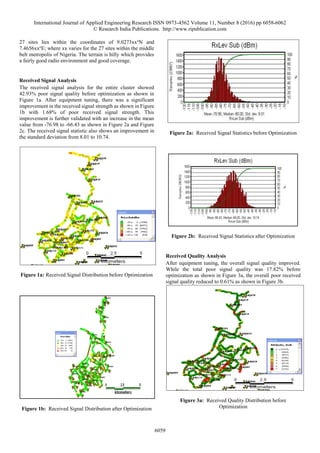
The received signal analysis for the entire cluster showed
42.93% poor signal quality before optimization as shown in
Figure 1a. After equipment tuning, there was a significant
improvement in the received signal strength as shown in Figure
1b with 1.68% of poor received signal strength. This
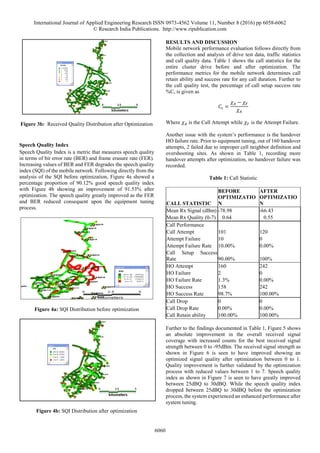
improvement is further validated with an increase in the mean
value from -76.98 to -66.43 as shown in Figure 2a and Figure
2c. The received signal statistic also shows an improvement in
the standard deviation from 8.01 to 10.74.
Figure 1a: Received Signal Distribution before Optimization
Figure 1b: Received Signal Distribution after Optimization
Figure 2a: Received Signal Statistics before Optimization
Figure 2b: Received Signal Statistics after Optimization
Received Quality Analysis
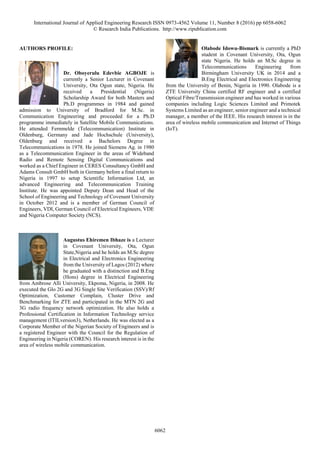
After equipment tuning, the overall signal quality improved.
While the total poor signal quality was 17.82% before
optimization as shown in Figure 3a, the overall poor received
signal quality reduced to 0.61% as shown in Figure 3b.
Figure 3a: Received Quality Distribution before
Optimization
International Journal of Applied Engineering Research ISSN 0973-4562 Volume 11, Number 8 (2016) pp 6058-6062
© Research India Publications. http://www.ripublication.com
6060
Figure 3b: Received Quality Distribution after Optimization
Speech Quality Index
Speech Quality Index is a metric that measures speech quality
in terms of bit error rate (BER) and frame erasure rate (FER).
Increasing values of BER and FER degrades the speech quality
index (SQI) of the mobile network. Following directly from the
analysis of the SQI before optimization, Figure 4a showed a
percentage proportion of 90.12% good speech quality index
with Figure 4b showing an improvement of 91.53% after
optimization. The speech quality greatly improved as the FER
and BER reduced consequent upon the equipment tuning
process.
Figure 4a: SQI Distribution before optimization
Figure 4b: SQI Distribution after optimization
RESULTS AND DISCUSSION
Mobile network performance evaluation follows directly from
the collection and analysis of drive test data, traffic statistics
and call quality data. Table 1 shows the call statistics for the
entire cluster drive before and after optimization. The
performance metrics for the mobile network determines call
retain ability and success rate for any call duration. Further to
the call quality test, the percentage of call setup success rate
%Cs is given as
𝐶𝑠 =
𝜒 𝐴 − 𝜒 𝐹
𝜒 𝐴
Where 𝜒 𝐴 is the Call Attempt while 𝜒 𝐹 is the Attempt Failure.
Another issue with the system’s performance is the handover
HO failure rate. Prior to equipment tuning, out of 160 handover
attempts, 2 failed due to improper cell neighbor definition and
overshooting sites. As shown in Table 1, recording more
handover attempts after optimization, no handover failure was
recorded.
Table 1: Call Statistic
CALL STATISTIC
BEFORE
OPTIMIZATIO
N
AFTER
OPTIMIZATIO
N
Mean Rx Signal (dBm) -78.98 -66.43
Mean Rx Quality (0-7) 0.64 0.55
Call Performance
Call Attempt 101 120
Attempt Failure 10 0
Attempt Failure Rate 10.00% 0.00%
Call Setup Success
Rate 90.00% 100%
HO Attempt 160 242
HO Failure 2 0
HO Failure Rate 1.3% 0.00%
HO Success 158 242
HO Success Rate 98.7% 100.00%
Call Drop 0 0
Call Drop Rate 0.00% 0.00%
Call Retain ability 100.00% 100.00%
Further to the findings documented in Table 1, Figure 5 shows
an absolute improvement in the overall received signal
coverage with increased counts for the best received signal
strength between 0 to -95dBm. The received signal strength as
shown in Figure 6 is seen to have improved showing an
optimized signal quality after optimization between 0 to 1.
Quality improvement is further validated by the optimization
process with reduced values between 1 to 7. Speech quality
index as shown in Figure 7 is seen to have greatly improved
between 25dBQ to 30dBQ. While the speech quality index
dropped between 25dBQ to 30dBQ before the optimization
process, the system experienced an enhanced performance after
system tuning.
International Journal of Applied Engineering Research ISSN 0973-4562 Volume 11, Number 8 (2016) pp 6058-6062
© Research India Publications. http://www.ripublication.com
6061
Figure 5: Received signal strength before and after
optimization
Figure 6: Received signal quality before and after
optimization
Figure 7: Speech quality index before and after optimization
CONCLUSION
The performance of existing base stations has been investigated
and optimized. Results showed that the optimization process
improves the received signal strength, signal quality and speech
quality index. The handover success rate is also greatly
improved thereby enhancing call connectivity capability in the
network. As the subscriber’s demand for any mobile network
increases, periodic optimization can be carried out to maintain
the quality of the existing network. In as much as human
interactions such as erection of new buildings and mobility
within the coverage zone will always alter the network
performance, system tuning will remain an approach to
retaining system stability.
REFERENCES
[1] R. K. Rawnsley, and S. Hurley, “Towards automatic
cell planning,” Proceedings of the 11th IEEE
International Symposium on Personal, Indoor, and
Mobile Radio Communications, Sept. 2000, pp. 1583-
1588.
[2] U S Rahman, M. A. Matin, and M R Rahman, “A
Practical Approach of Planning and Optimization for
Efficient Usage of GSM Network,” International
Journal of Communications (IJC) Volume 1 Issue 1,
December 2012, pp. 1-6
[3] Joseph Isabona, “Maximising Coverage and Capacity
with QOS Guarantee in GSM Network by Means of
Cell Cluster Optimization,” International Journal of
Advanced Research in Physical Science (IJARPS)
Volume 1, Issue 6, October 2014, PP 44-55.
[4] Sireesha B.V., Varadarajan S., Vivek and Naresh,
“Increasing of Call Success Rate in GSM Service Area
Using RF Optimization,” International Journal of
Engineering Research and Applications (IJERA) ISSN:
2248-9622 www.ijera.com Vol. 1, Issue 4, pp.1479-
1485.
[5] Malcolm W. Oliphant's, “The mobile phone meets the
Internet”, IEEE Spectrum, Vol. 8, 1999, pp. 20-28.
[6] M.Xiao, Ness B.Shroff and Edwin K.P.Chong,
“Autility based power control scheme in wireless
system,” IEEE/ACM Transactions On Networking,
Vol. 11, No. 2, 2003.
-120 -100 -80 -60 -40 -20 0
0
2000
4000
6000
8000
10000
12000
RECIVED SIGNAL STRENGTH (dBm)
PROPRTIONOFSIGNALSTRENGTH(COUNT)
COMPARISON OF RECEIVED SIGNAL STRENGTH BEFORE AND AFTER OPTIMIZATION
RX SIGNAL BEFORE OPT
RX SIGNAL AFTER OPT
0 1 2 3 4 5 6 7
0
0.5
1
1.5
2
2.5
3
3.5
4
x 10
5
RECEIVED SIGNAL QUALITY
PROPORTIONOFSIGNALQUALITY
COMPARISON OF RECEIVED SIGNAL QUALITY BEFORE AND AFTER OPTIMIZATION
RX QUALITY BEFORE OPT
RX QUALITY AFTER OPT
0 5 10 15 20 25 30
0
0.2
0.4
0.6
0.8
1
1.2
1.4
1.6
1.8
2
x 10
4
SPEECH QUALITY INDEX (dBQ)
PROPORTIONOFSPEECHQUALITYINDEX
COMPARISON OF SQI BEFORE AND AFTER OPTIMIZATION
SQI BEFORE OPT
SQI AFTER OPT
International Journal of Applied Engineering Research ISSN 0973-4562 Volume 11, Number 8 (2016) pp 6058-6062
© Research India Publications. http://www.ripublication.com
6062
AUTHORS PROFILE:
Dr. Oboyerulu Edevbie AGBOJE is
currently a Senior Lecturer in Covenant
University, Ota Ogun state, Nigeria. He
received a Presidential (Nigeria)
Scholarship Award for both Masters and
Ph.D programmes in 1984 and gained
admission to University of Bradford for M.Sc. in
Communication Engineering and proceeded for a Ph.D
programme immediately in Satellite Mobile Communications.
He attended Fernmelde (Telecommunication) Institute in
Oldenburg, Germany and Jade Hochschule (University),
Oldenburg and received a Bachelors Degree in
Telecommunications in 1978. He joined Siemens Ag. in 1980
as a Telecommunication Engineer in the areas of Wideband
Radio and Remote Sensing Digital Communications and
worked as a Chief Engineer in CERES Consultancy GmbH and
Adams Consult GmbH both in Germany before a final return to
Nigeria in 1997 to setup Scientific Information Ltd, an
advanced Engineering and Telecommunication Training
Institute. He was appointed Deputy Dean and Head of the
School of Engineering and Technology of Covenant University
in October 2012 and is a member of German Council of
Engineers, VDI, German Council of Electrical Engineers, VDE
and Nigeria Computer Society (NCS).
Augustus Ehiremen Ibhaze is a Lecturer
in Covenant University, Ota, Ogun
State,Nigeria and he holds an M.Sc degree
in Electrical and Electronics Engineering
from the University of Lagos (2012) where
he graduated with a distinction and B.Eng
(Hons) degree in Electrical Engineering
from Ambrose Alli University, Ekpoma, Nigeria, in 2008. He
executed the Glo 2G and 3G Single Site Verification (SSV)/Rf
Optimization, Customer Complain, Cluster Drive and
Benchmarking for ZTE and participated in the MTN 2G and
3G radio frequency network optimization. He also holds a
Professional Certification in Information Technology service
management (ITILversion3), Netherlands. He was elected as a
Corporate Member of the Nigerian Society of Engineers and is
a registered Engineer with the Council for the Regulation of
Engineering in Nigeria (COREN). His research interest is in the
area of wireless mobile communication.
Olabode Idowu-Bismark is currently a PhD
student in Covenant University, Ota, Ogun
state Nigeria. He holds an M.Sc degree in
Telecommunications Engineering from
Birmingham University UK in 2014 and a
B.Eng Electrical and Electronics Engineering
from the University of Benin, Nigeria in 1990. Olabode is a
ZTE University China certified RF engineer and a certified
Optical Fibre/Transmission engineer and has worked in various
companies including Logic Sciences Limited and Primotek
Systems Limited as an engineer, senior engineer and a technical
manager, a member of the IEEE. His research interest is in the
area of wireless mobile communication and Internet of Things
(IoT).

Performance analysis of wireless mobile network

  • 1.
    International Journal ofApplied Engineering Research ISSN 0973-4562 Volume 11, Number 8 (2016) pp 6058-6062 © Research India Publications. http://www.ripublication.com 6058 Performance Analysis of Wireless Mobile Network Oboyerulu E. Agboje Department of Electrical and Information Engineering, Covenant University, Ota Augustus E. Ibhaze* Department of Electrical and Information Engineering, Covenant University, Ota Olabode B. Idowu-Bismark Department of Electrical and Information Engineering, Covenant University, Ota Abstract Improved quality of service and excellent signal coverage is the hallmark of any installed wireless mobile infrastructure. As technology evolve, the need to rely on seamless mobile services become crucial. For this reason, this paper investigates the performance of a wireless mobile network cluster of 27 base stations using call quality and drive test approach while proposing continual system optimization as the network system becomes more robust. The Key Performance Indicators (KPIs) were compared before and after base station tuning and results showed that the optimization approach resulted in better performance. Keywords: Received signal, signal quality, speech quality index, call attempt, call success rate INTRODUCTION The evolutional trend in wireless mobile architecture has metamorphosed over the years so as to cater for the increasing demand of the world’s growing population. Telecommunication vendors and mobile operators in an attempt to improve the quality of service have over time deployed pilot equipment, commissioned and decommissioned them on the basis of performance check. While the Key Performance Indicators (KPIs) of individual telecommunication infrastructure is benchmarked with customers demand, the impact of the terrain and mobile network congestion rate are also considered to be contributory to the overall performance. Now that global linkages has come to rely on an efficient wireless mobile network, the need to improve the quality of service is necessitated by improved planning, equipment tuning or swapping in order to attain the expected grade of service. COVERAGE OPTIMIZATION Wireless mobile network is implemented to ensure optimal network performance in terms of coverage efficiency, quality of service and ultimately subscriber’s satisfaction. As technological trend in mobile network evolution transcends, the need to ensure efficient voice and data services becomes paramount. While packet switched services are improved to reduce latency, delay, improve quality of service; speed of transmission and data rates are also engaged as technology switches from UMTS to HSPA, HSPA+, LTE and e-LTE. In as much as we rely on improved data services relative to evolved technologies, the need for the improvement of an heterogeneous architecture is not far-fetched. The need therefore arises for vertical handoff between different technologies as well as horizontal handoff between similar technologies. Since lower frequency technologies are optimized for coverage, their optimality for voice services considering their larger coverage area demands improved performance, which follows directly from an efficient network optimization process. The core objective of mobile network tuning which is a norm in network planning is to provide efficient radio coverage to as many subscribers as possible [1]. The delimiting factor to ascertain good coverage is set to a typical value of about -95dBm signal strength [2, 3], below which the signal strength will require tuning. While improved signal strength does not necessitate improved signal quality, [4] clearly represented the need for system upgrade and optimization as a means to improving quality of service. Despite the implementation of 3G systems with respect to its power efficiency, it is greatly limited by its smaller size of coverage [5]. In order to optimally manage the coverage bound between GSM technology, 3G and LTE systems, 2G systems can be optimized for voice services while emerging technologies for data services attributed to their high data rates. This does not in any way undermine the voice capability of emerging technologies but merely explicates optimum usage of the entire network with respect to coverage area. The signal quality of the mobile network is greatly impacted by the level of interference control within the cluster of interest. As part of the optimization process for signal quality, overshooting sites are down tilted and power controlled to minimize their impact on the site of interest. Power control guarantees efficient operation of the mobile network in the management of quality of service and interference control [6]. This interference control strategy is directly followed by varying the antenna tilt angle of the site of interest while adjusting the transmit power. This is carefully executed in order not to distort the coverage design. PERFORMANCE ANALYSIS The performance analysis of twenty-seven (27) base stations was carried out using TEMS investigation setup. The cluster of
  • 2.
    International Journal ofApplied Engineering Research ISSN 0973-4562 Volume 11, Number 8 (2016) pp 6058-6062 © Research India Publications. http://www.ripublication.com 6059 27 sites lies within the coordinates of 9.0273xxo N and 7.4656xxo E; where xx varies for the 27 sites within the middle belt metropolis of Nigeria. The terrain is hilly which provides a fairly good radio environment and good coverage. Received Signal Analysis The received signal analysis for the entire cluster showed 42.93% poor signal quality before optimization as shown in Figure 1a. After equipment tuning, there was a significant improvement in the received signal strength as shown in Figure 1b with 1.68% of poor received signal strength. This improvement is further validated with an increase in the mean value from -76.98 to -66.43 as shown in Figure 2a and Figure 2c. The received signal statistic also shows an improvement in the standard deviation from 8.01 to 10.74. Figure 1a: Received Signal Distribution before Optimization Figure 1b: Received Signal Distribution after Optimization Figure 2a: Received Signal Statistics before Optimization Figure 2b: Received Signal Statistics after Optimization Received Quality Analysis After equipment tuning, the overall signal quality improved. While the total poor signal quality was 17.82% before optimization as shown in Figure 3a, the overall poor received signal quality reduced to 0.61% as shown in Figure 3b. Figure 3a: Received Quality Distribution before Optimization
  • 3.
    International Journal ofApplied Engineering Research ISSN 0973-4562 Volume 11, Number 8 (2016) pp 6058-6062 © Research India Publications. http://www.ripublication.com 6060 Figure 3b: Received Quality Distribution after Optimization Speech Quality Index Speech Quality Index is a metric that measures speech quality in terms of bit error rate (BER) and frame erasure rate (FER). Increasing values of BER and FER degrades the speech quality index (SQI) of the mobile network. Following directly from the analysis of the SQI before optimization, Figure 4a showed a percentage proportion of 90.12% good speech quality index with Figure 4b showing an improvement of 91.53% after optimization. The speech quality greatly improved as the FER and BER reduced consequent upon the equipment tuning process. Figure 4a: SQI Distribution before optimization Figure 4b: SQI Distribution after optimization RESULTS AND DISCUSSION Mobile network performance evaluation follows directly from the collection and analysis of drive test data, traffic statistics and call quality data. Table 1 shows the call statistics for the entire cluster drive before and after optimization. The performance metrics for the mobile network determines call retain ability and success rate for any call duration. Further to the call quality test, the percentage of call setup success rate %Cs is given as 𝐶𝑠 = 𝜒 𝐴 − 𝜒 𝐹 𝜒 𝐴 Where 𝜒 𝐴 is the Call Attempt while 𝜒 𝐹 is the Attempt Failure. Another issue with the system’s performance is the handover HO failure rate. Prior to equipment tuning, out of 160 handover attempts, 2 failed due to improper cell neighbor definition and overshooting sites. As shown in Table 1, recording more handover attempts after optimization, no handover failure was recorded. Table 1: Call Statistic CALL STATISTIC BEFORE OPTIMIZATIO N AFTER OPTIMIZATIO N Mean Rx Signal (dBm) -78.98 -66.43 Mean Rx Quality (0-7) 0.64 0.55 Call Performance Call Attempt 101 120 Attempt Failure 10 0 Attempt Failure Rate 10.00% 0.00% Call Setup Success Rate 90.00% 100% HO Attempt 160 242 HO Failure 2 0 HO Failure Rate 1.3% 0.00% HO Success 158 242 HO Success Rate 98.7% 100.00% Call Drop 0 0 Call Drop Rate 0.00% 0.00% Call Retain ability 100.00% 100.00% Further to the findings documented in Table 1, Figure 5 shows an absolute improvement in the overall received signal coverage with increased counts for the best received signal strength between 0 to -95dBm. The received signal strength as shown in Figure 6 is seen to have improved showing an optimized signal quality after optimization between 0 to 1. Quality improvement is further validated by the optimization process with reduced values between 1 to 7. Speech quality index as shown in Figure 7 is seen to have greatly improved between 25dBQ to 30dBQ. While the speech quality index dropped between 25dBQ to 30dBQ before the optimization process, the system experienced an enhanced performance after system tuning.
  • 4.
    International Journal ofApplied Engineering Research ISSN 0973-4562 Volume 11, Number 8 (2016) pp 6058-6062 © Research India Publications. http://www.ripublication.com 6061 Figure 5: Received signal strength before and after optimization Figure 6: Received signal quality before and after optimization Figure 7: Speech quality index before and after optimization CONCLUSION The performance of existing base stations has been investigated and optimized. Results showed that the optimization process improves the received signal strength, signal quality and speech quality index. The handover success rate is also greatly improved thereby enhancing call connectivity capability in the network. As the subscriber’s demand for any mobile network increases, periodic optimization can be carried out to maintain the quality of the existing network. In as much as human interactions such as erection of new buildings and mobility within the coverage zone will always alter the network performance, system tuning will remain an approach to retaining system stability. REFERENCES [1] R. K. Rawnsley, and S. Hurley, “Towards automatic cell planning,” Proceedings of the 11th IEEE International Symposium on Personal, Indoor, and Mobile Radio Communications, Sept. 2000, pp. 1583- 1588. [2] U S Rahman, M. A. Matin, and M R Rahman, “A Practical Approach of Planning and Optimization for Efficient Usage of GSM Network,” International Journal of Communications (IJC) Volume 1 Issue 1, December 2012, pp. 1-6 [3] Joseph Isabona, “Maximising Coverage and Capacity with QOS Guarantee in GSM Network by Means of Cell Cluster Optimization,” International Journal of Advanced Research in Physical Science (IJARPS) Volume 1, Issue 6, October 2014, PP 44-55. [4] Sireesha B.V., Varadarajan S., Vivek and Naresh, “Increasing of Call Success Rate in GSM Service Area Using RF Optimization,” International Journal of Engineering Research and Applications (IJERA) ISSN: 2248-9622 www.ijera.com Vol. 1, Issue 4, pp.1479- 1485. [5] Malcolm W. Oliphant's, “The mobile phone meets the Internet”, IEEE Spectrum, Vol. 8, 1999, pp. 20-28. [6] M.Xiao, Ness B.Shroff and Edwin K.P.Chong, “Autility based power control scheme in wireless system,” IEEE/ACM Transactions On Networking, Vol. 11, No. 2, 2003. -120 -100 -80 -60 -40 -20 0 0 2000 4000 6000 8000 10000 12000 RECIVED SIGNAL STRENGTH (dBm) PROPRTIONOFSIGNALSTRENGTH(COUNT) COMPARISON OF RECEIVED SIGNAL STRENGTH BEFORE AND AFTER OPTIMIZATION RX SIGNAL BEFORE OPT RX SIGNAL AFTER OPT 0 1 2 3 4 5 6 7 0 0.5 1 1.5 2 2.5 3 3.5 4 x 10 5 RECEIVED SIGNAL QUALITY PROPORTIONOFSIGNALQUALITY COMPARISON OF RECEIVED SIGNAL QUALITY BEFORE AND AFTER OPTIMIZATION RX QUALITY BEFORE OPT RX QUALITY AFTER OPT 0 5 10 15 20 25 30 0 0.2 0.4 0.6 0.8 1 1.2 1.4 1.6 1.8 2 x 10 4 SPEECH QUALITY INDEX (dBQ) PROPORTIONOFSPEECHQUALITYINDEX COMPARISON OF SQI BEFORE AND AFTER OPTIMIZATION SQI BEFORE OPT SQI AFTER OPT
  • 5.
    International Journal ofApplied Engineering Research ISSN 0973-4562 Volume 11, Number 8 (2016) pp 6058-6062 © Research India Publications. http://www.ripublication.com 6062 AUTHORS PROFILE: Dr. Oboyerulu Edevbie AGBOJE is currently a Senior Lecturer in Covenant University, Ota Ogun state, Nigeria. He received a Presidential (Nigeria) Scholarship Award for both Masters and Ph.D programmes in 1984 and gained admission to University of Bradford for M.Sc. in Communication Engineering and proceeded for a Ph.D programme immediately in Satellite Mobile Communications. He attended Fernmelde (Telecommunication) Institute in Oldenburg, Germany and Jade Hochschule (University), Oldenburg and received a Bachelors Degree in Telecommunications in 1978. He joined Siemens Ag. in 1980 as a Telecommunication Engineer in the areas of Wideband Radio and Remote Sensing Digital Communications and worked as a Chief Engineer in CERES Consultancy GmbH and Adams Consult GmbH both in Germany before a final return to Nigeria in 1997 to setup Scientific Information Ltd, an advanced Engineering and Telecommunication Training Institute. He was appointed Deputy Dean and Head of the School of Engineering and Technology of Covenant University in October 2012 and is a member of German Council of Engineers, VDI, German Council of Electrical Engineers, VDE and Nigeria Computer Society (NCS). Augustus Ehiremen Ibhaze is a Lecturer in Covenant University, Ota, Ogun State,Nigeria and he holds an M.Sc degree in Electrical and Electronics Engineering from the University of Lagos (2012) where he graduated with a distinction and B.Eng (Hons) degree in Electrical Engineering from Ambrose Alli University, Ekpoma, Nigeria, in 2008. He executed the Glo 2G and 3G Single Site Verification (SSV)/Rf Optimization, Customer Complain, Cluster Drive and Benchmarking for ZTE and participated in the MTN 2G and 3G radio frequency network optimization. He also holds a Professional Certification in Information Technology service management (ITILversion3), Netherlands. He was elected as a Corporate Member of the Nigerian Society of Engineers and is a registered Engineer with the Council for the Regulation of Engineering in Nigeria (COREN). His research interest is in the area of wireless mobile communication. Olabode Idowu-Bismark is currently a PhD student in Covenant University, Ota, Ogun state Nigeria. He holds an M.Sc degree in Telecommunications Engineering from Birmingham University UK in 2014 and a B.Eng Electrical and Electronics Engineering from the University of Benin, Nigeria in 1990. Olabode is a ZTE University China certified RF engineer and a certified Optical Fibre/Transmission engineer and has worked in various companies including Logic Sciences Limited and Primotek Systems Limited as an engineer, senior engineer and a technical manager, a member of the IEEE. His research interest is in the area of wireless mobile communication and Internet of Things (IoT).