PERFORM PRUNING
FOLLOWING SAFETY
PROCEDURES
ACCORDING TO OSHS
AND PNS
OSHS- Occupational Safety and Health Standards
PNS- Philippine National Standards.
WHAT IS THE PRUNING OF
PLANTS?
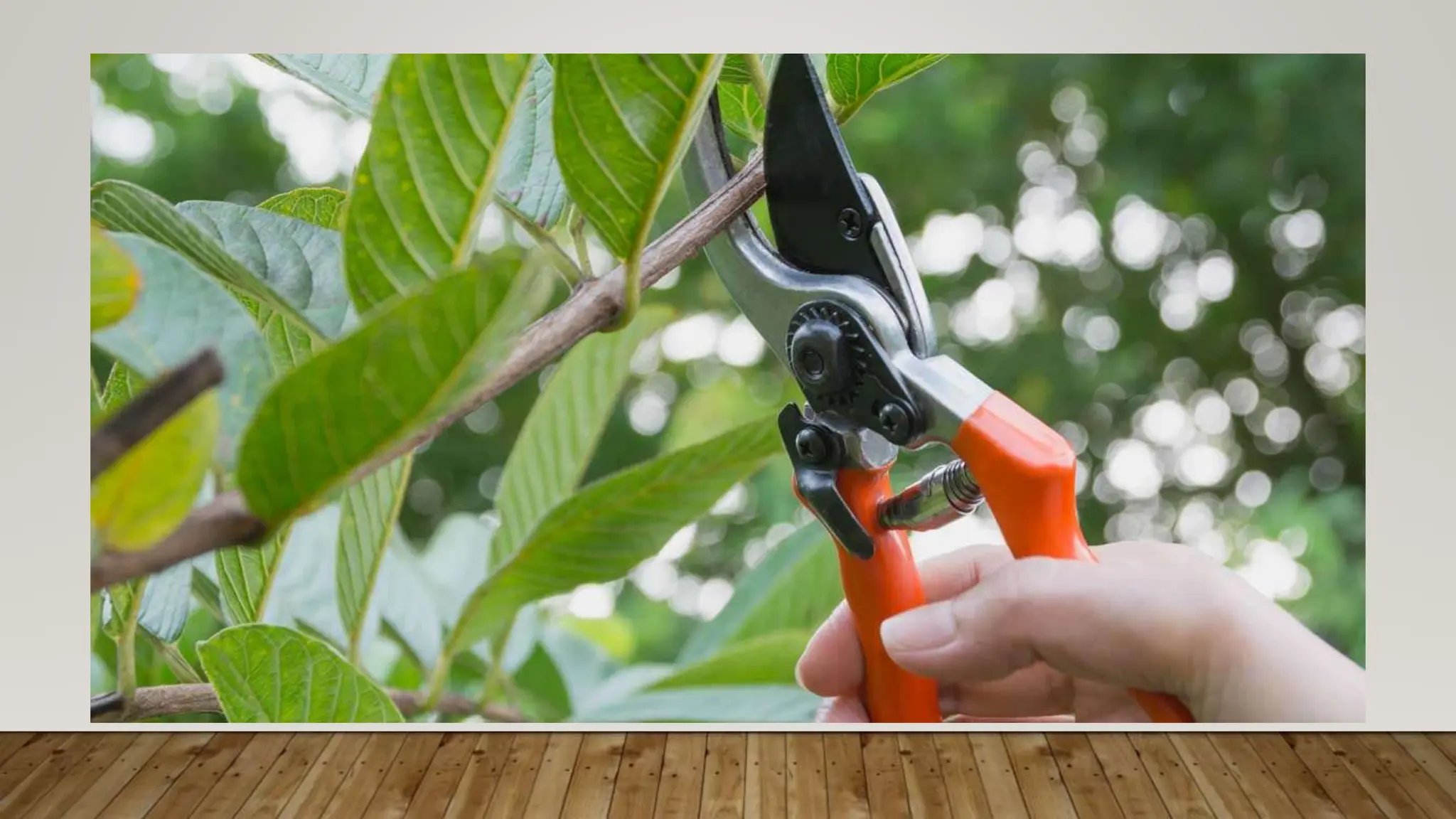
• Pruning is defined as the act of trimming leaves,
branches, and dead matter from plants. Pruning
also plays into the overall health of a plant. You
certainly want to maintain the well-being of your
plants, train them to grow properly, improve
quality, and even restrict their growth in some
cases.
WHAT IS THE PRUNING OF
PLANTS?
• Pruning plants can enhance the aesthetic and
longevity of your landscape. This frequently avoided
task could save your plants from both insects and
disease as well. To prune, you’re strategically
removing branches, roots, buds, etc. These
elements might be diseased, infested with insects or
other pests, or lacking sunlight during the shorter
days
WHAT IS THE PRUNING OF PLANTS?
•Pruning is also essential to a plant’s
growth. Pruning and trimming improve
plant health, making it stronger and
sturdier. It’s all about the long term. Sure,
you won’t see immediate results, but
plants are about patience anyway.
REASONS FOR PRUNING
•to train the plant
•to maintain plant health
•to improve the quality of flowers, fruit,
foliage or stems
•to restrict growth
TYPES OF TREE PRUNING
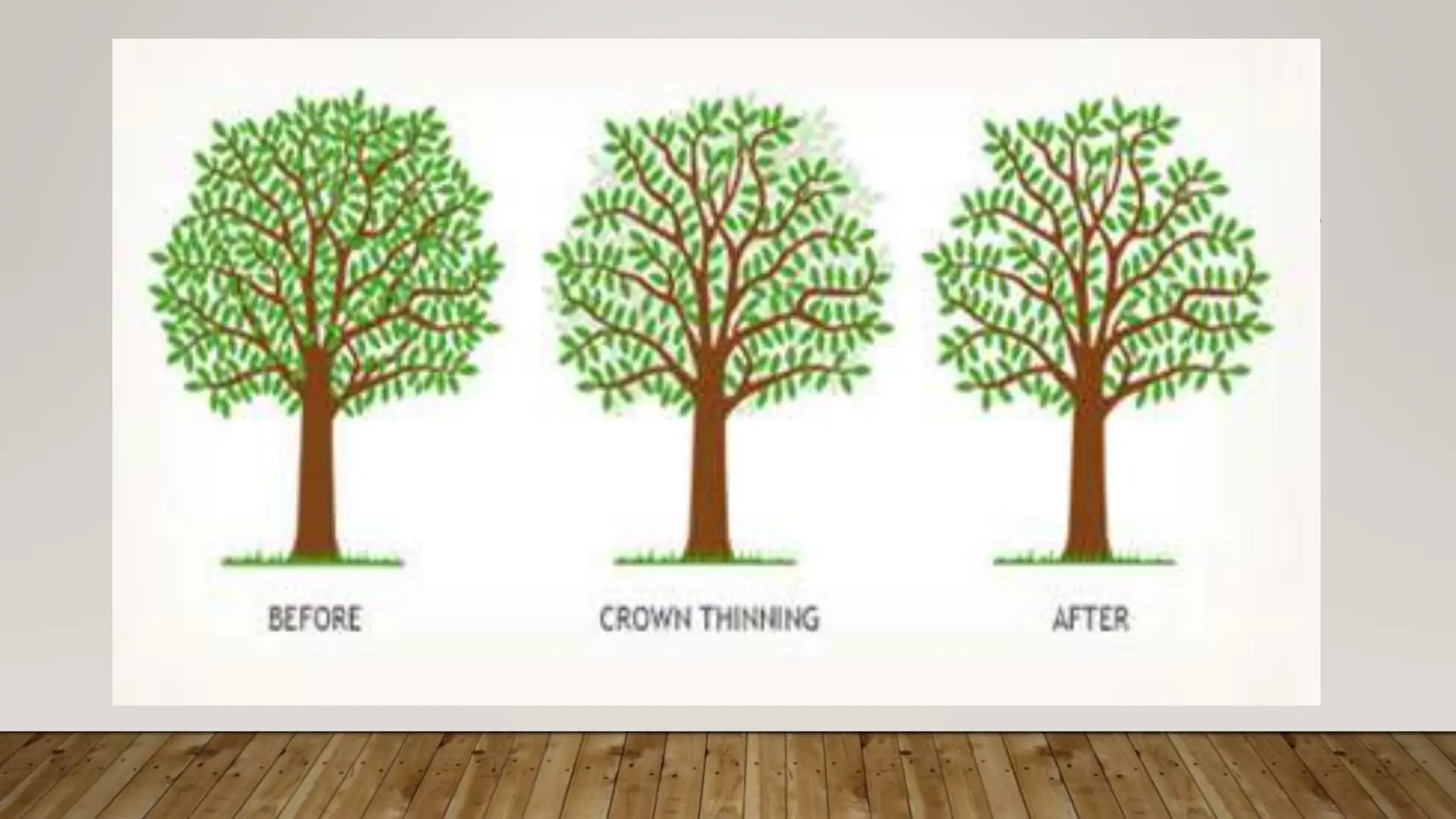
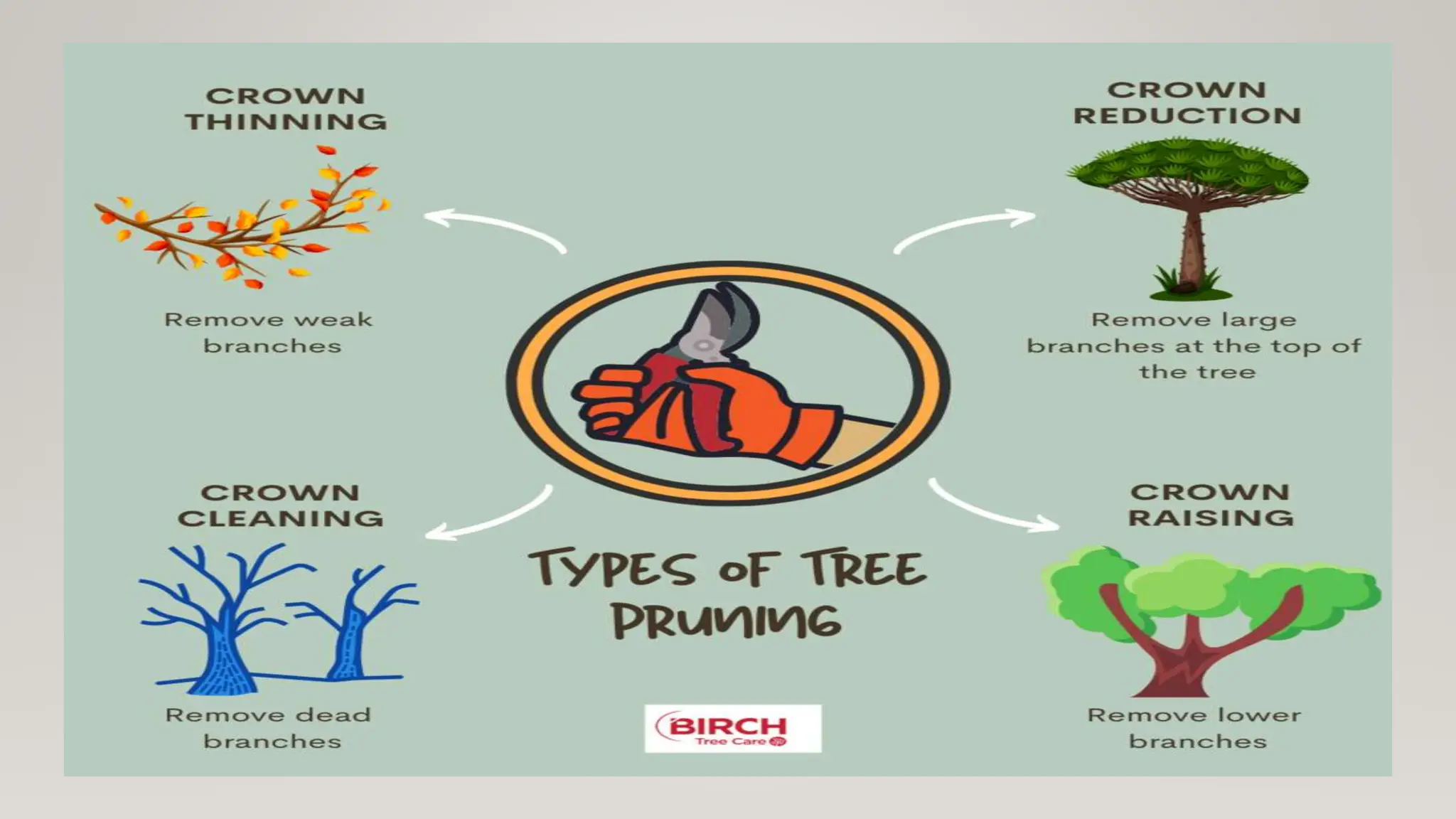
1. Thinning – This type involves removing
branches at the base, alongside the trunk, or
stalk.
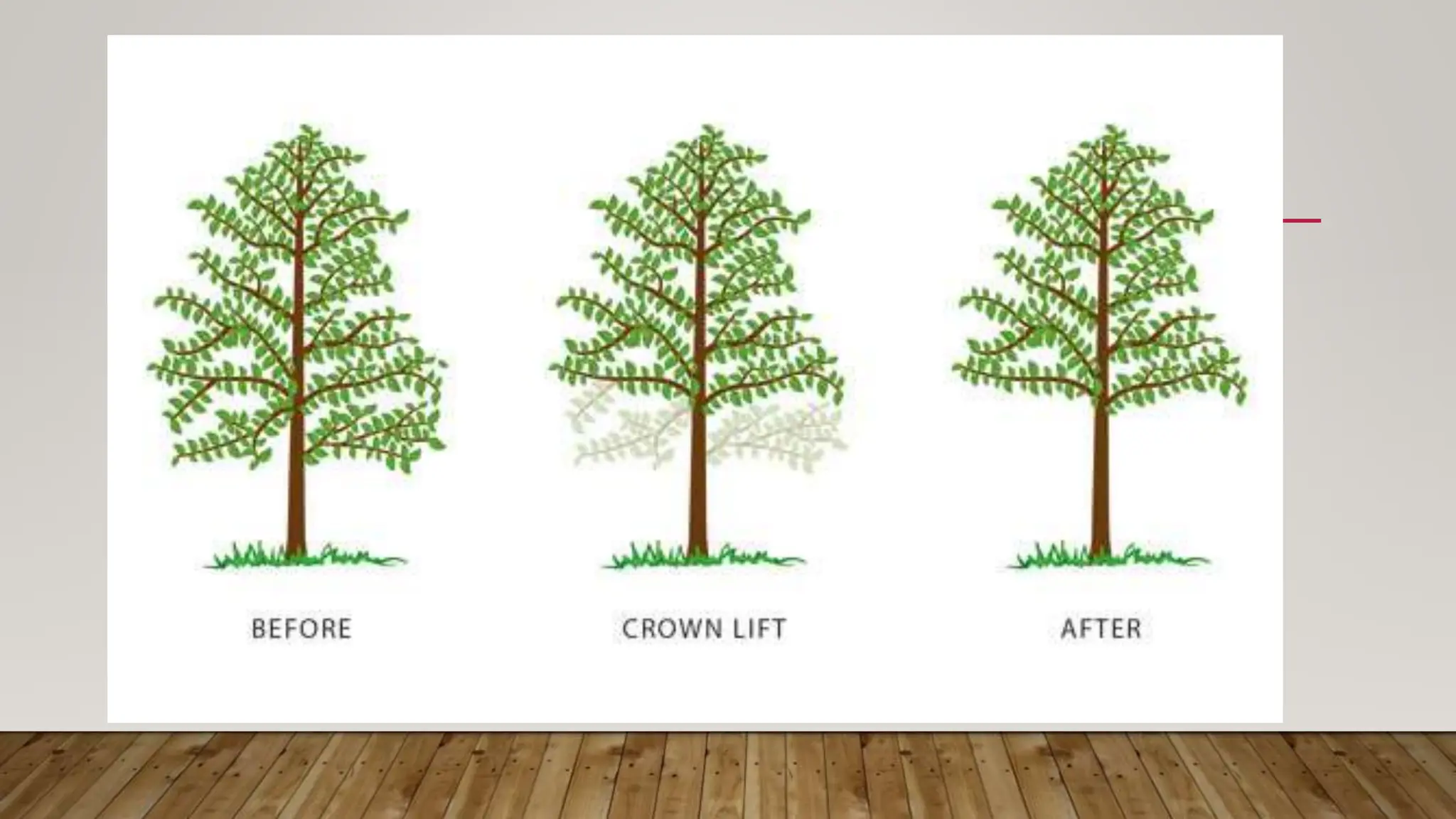
2. Raising – This is all about creating headspace
for entries, walkways, cars, and people. Low-
hanging branches are trimmed.
TYPES OF TREE PRUNING
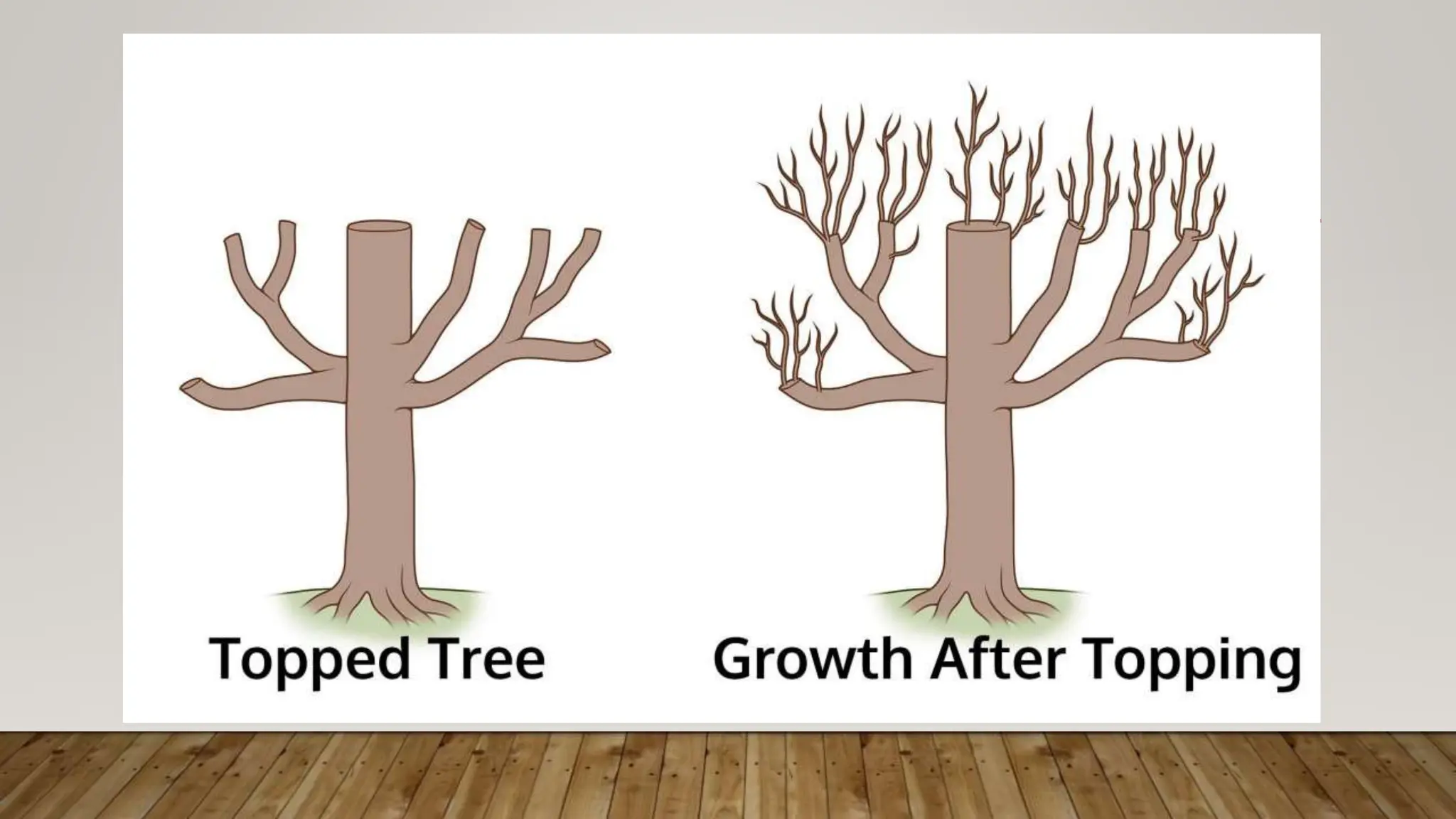
3. Topping – This process is a huge undertaking.
Most branches are being removed, all the way
down to the trunk. This method is employed
when you need your trees to grow in very
particular ways.
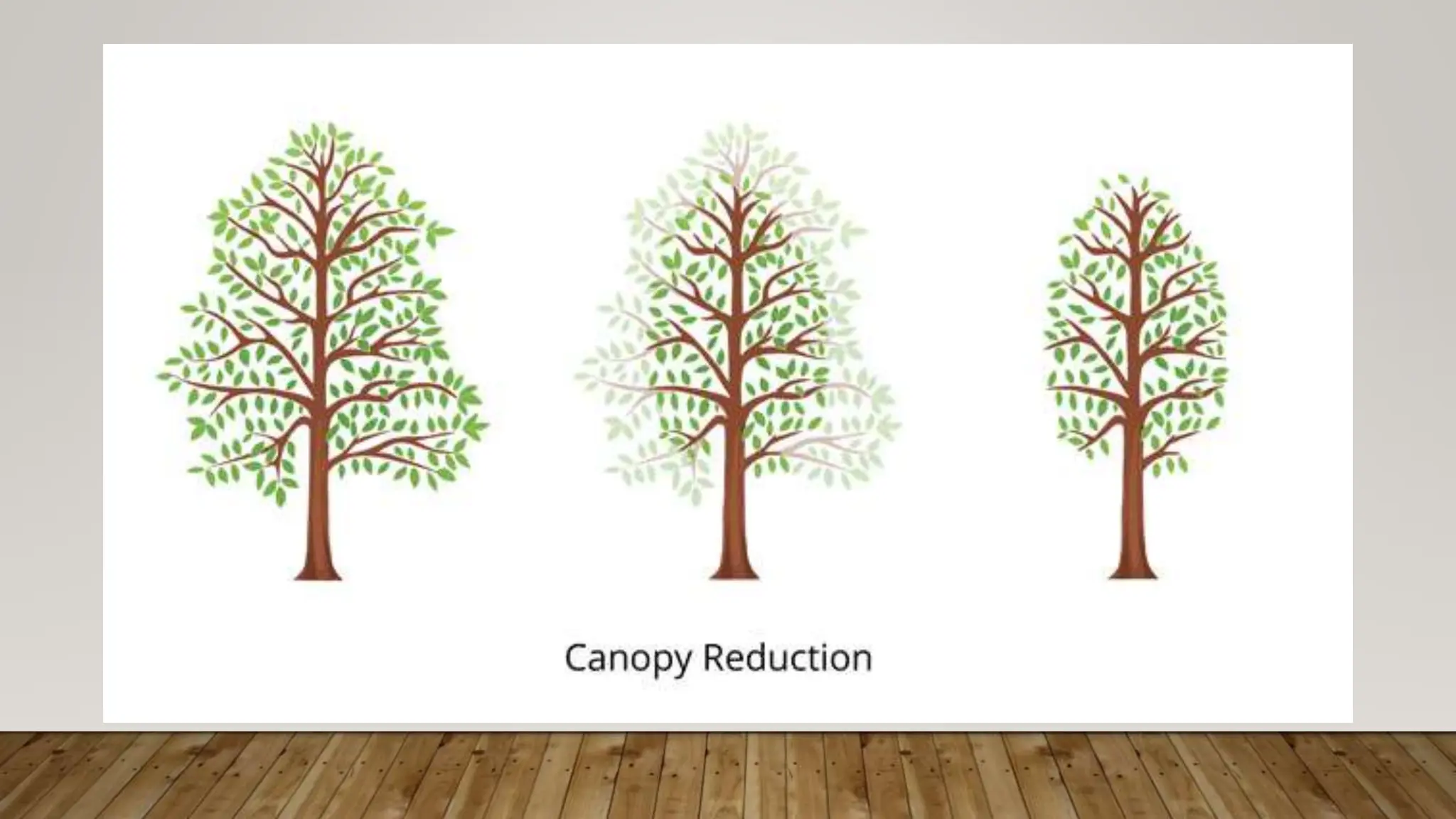
4. Reduction – Here, you’re trimming back the
tree’s overall volume. You do this to create more
space for structures like power poles and lines.
TOOLS USED TO DO
THE PRUNING
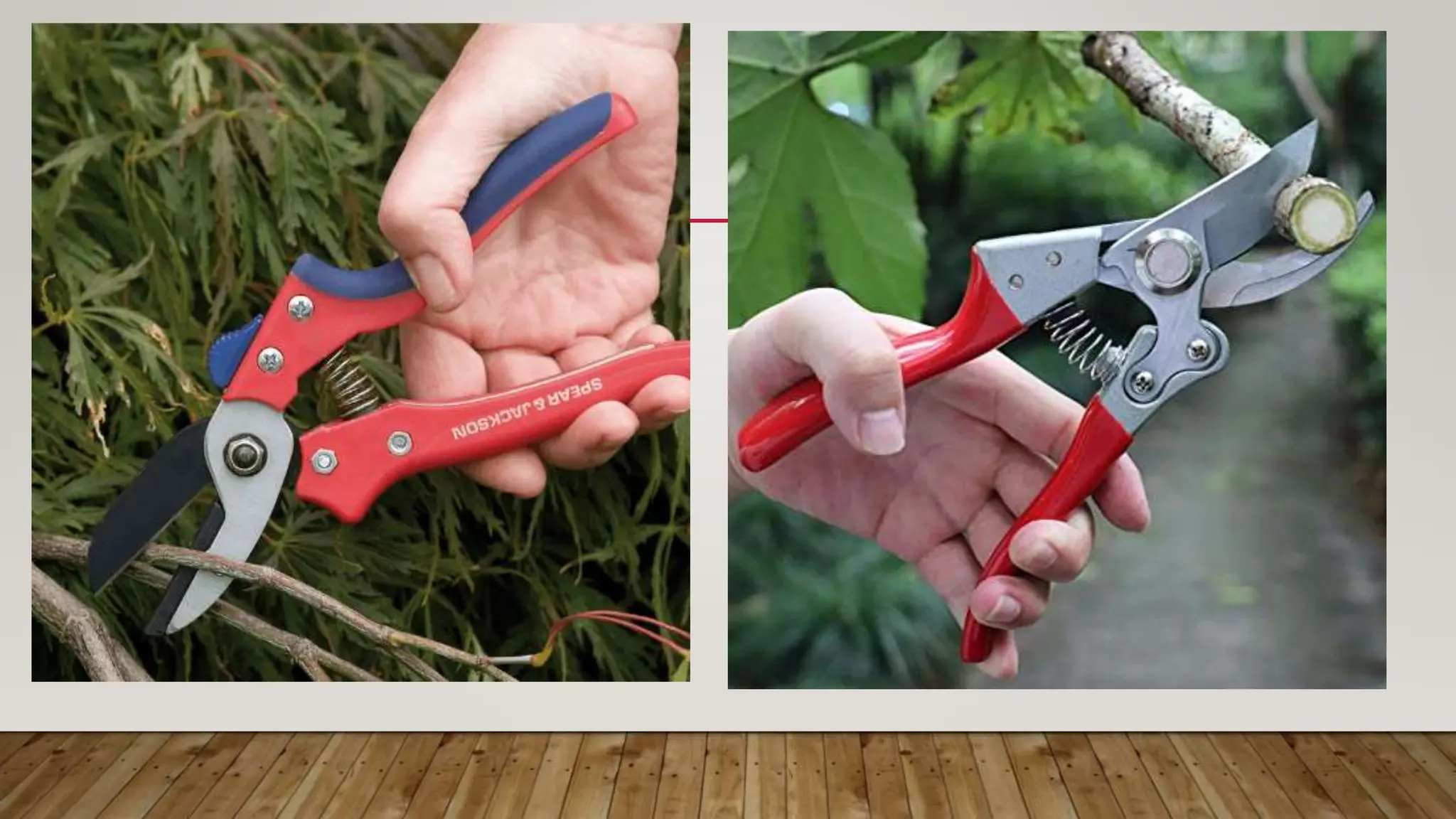
1. SECATEURS
•These tools are used for deadheading
and cutting branches up to 20 mm in
diameter. Good quality heavy-duty
scissors can be used for smaller twigs
and branches.
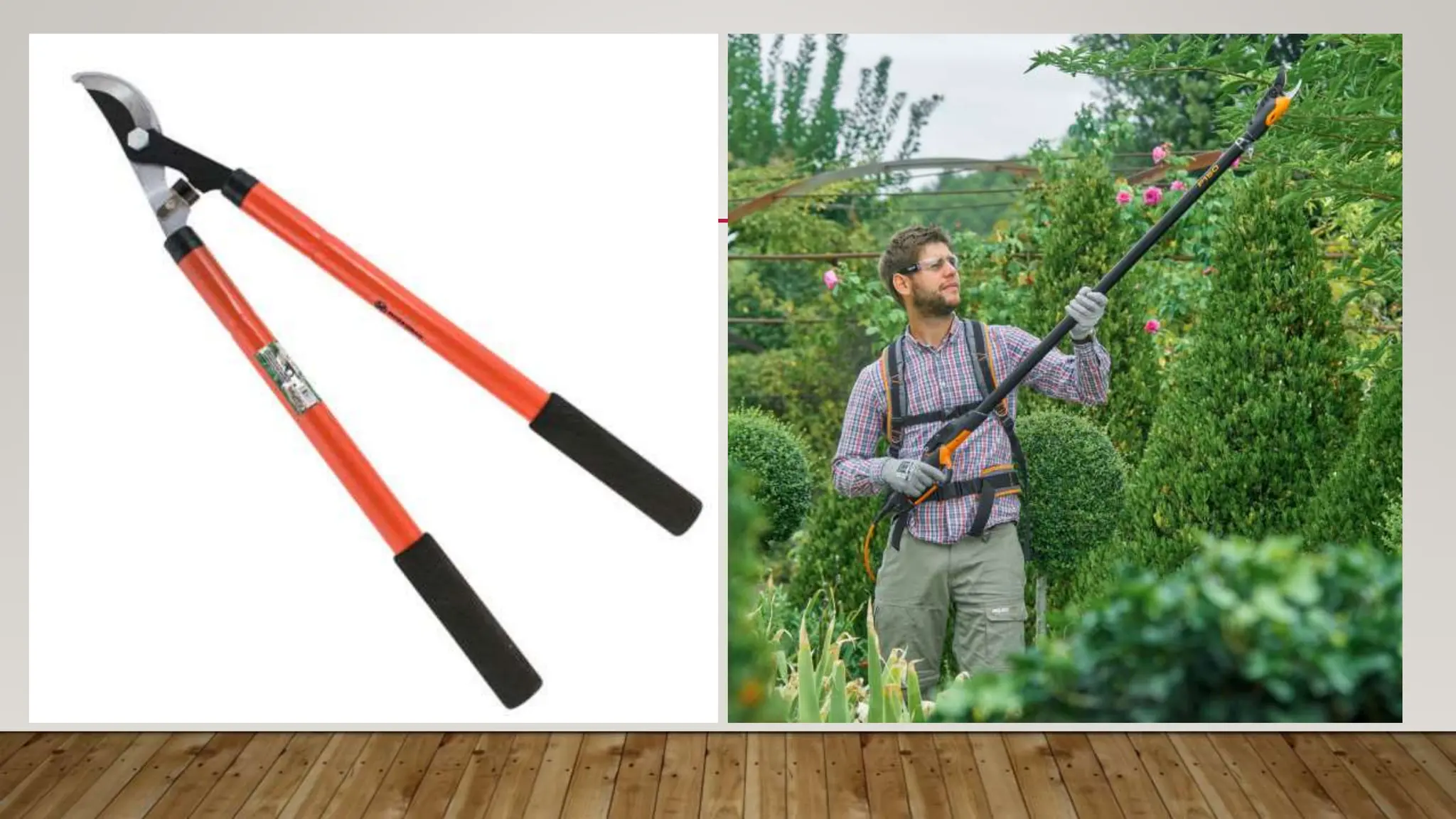
2. LONG-HANDLED PRUNERS
• These tools are used for cutting off larger branches,
say up to 40mm, you will need a pair of long-
handled pruners, sometimes called loppers. Even
when the material you are cutting is not
particularly thick it will save you unnecessary
reaching and stretching. Long-handled pruners are
used for cutting back, sucker removal, and
thinning.
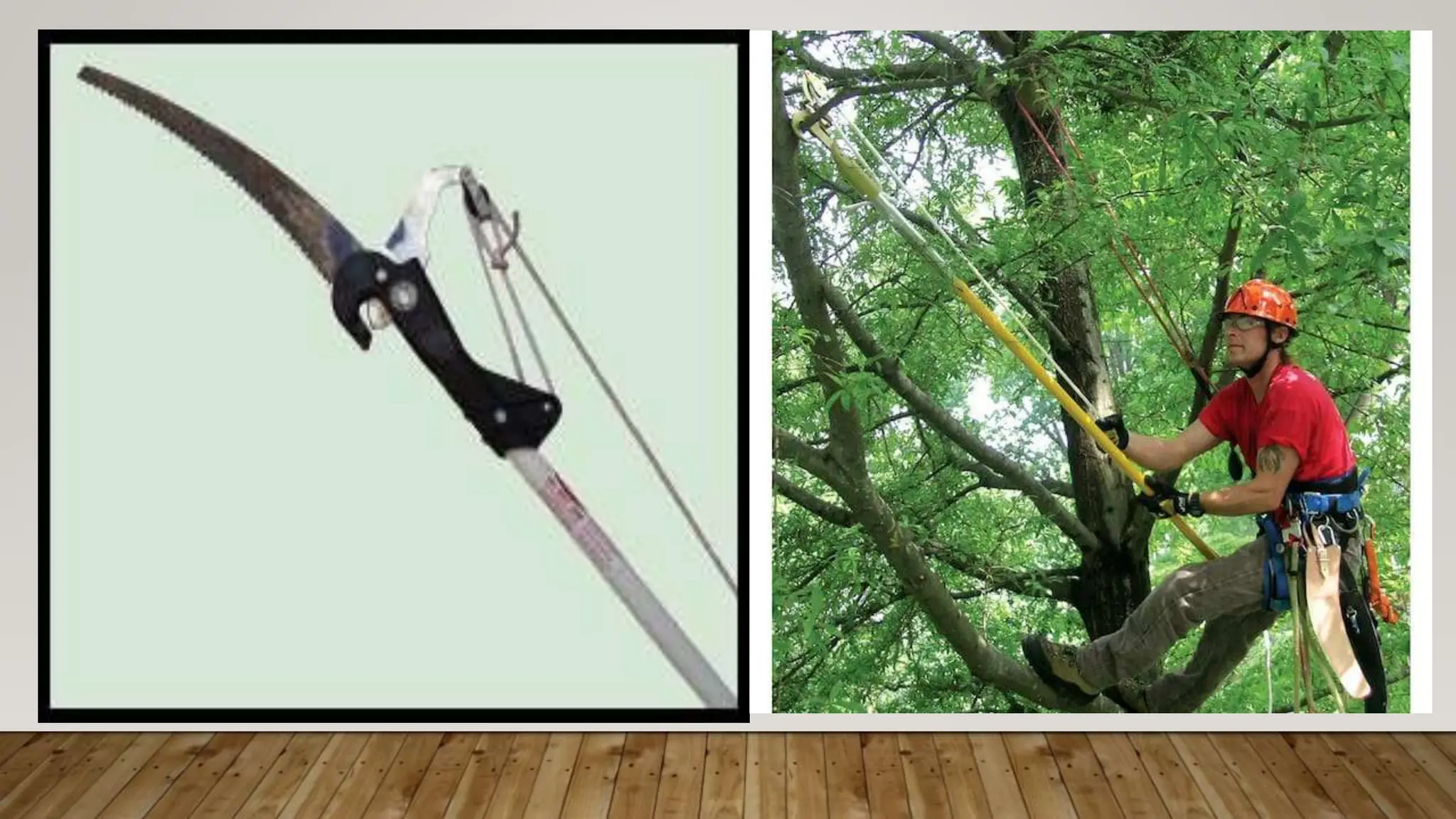
3. AERIAL PRUNERS
•These tools are used to remove
branches that are higher than you can
reach. these are also called extension
or pole pruners. These are used for
cutting back and thinning.
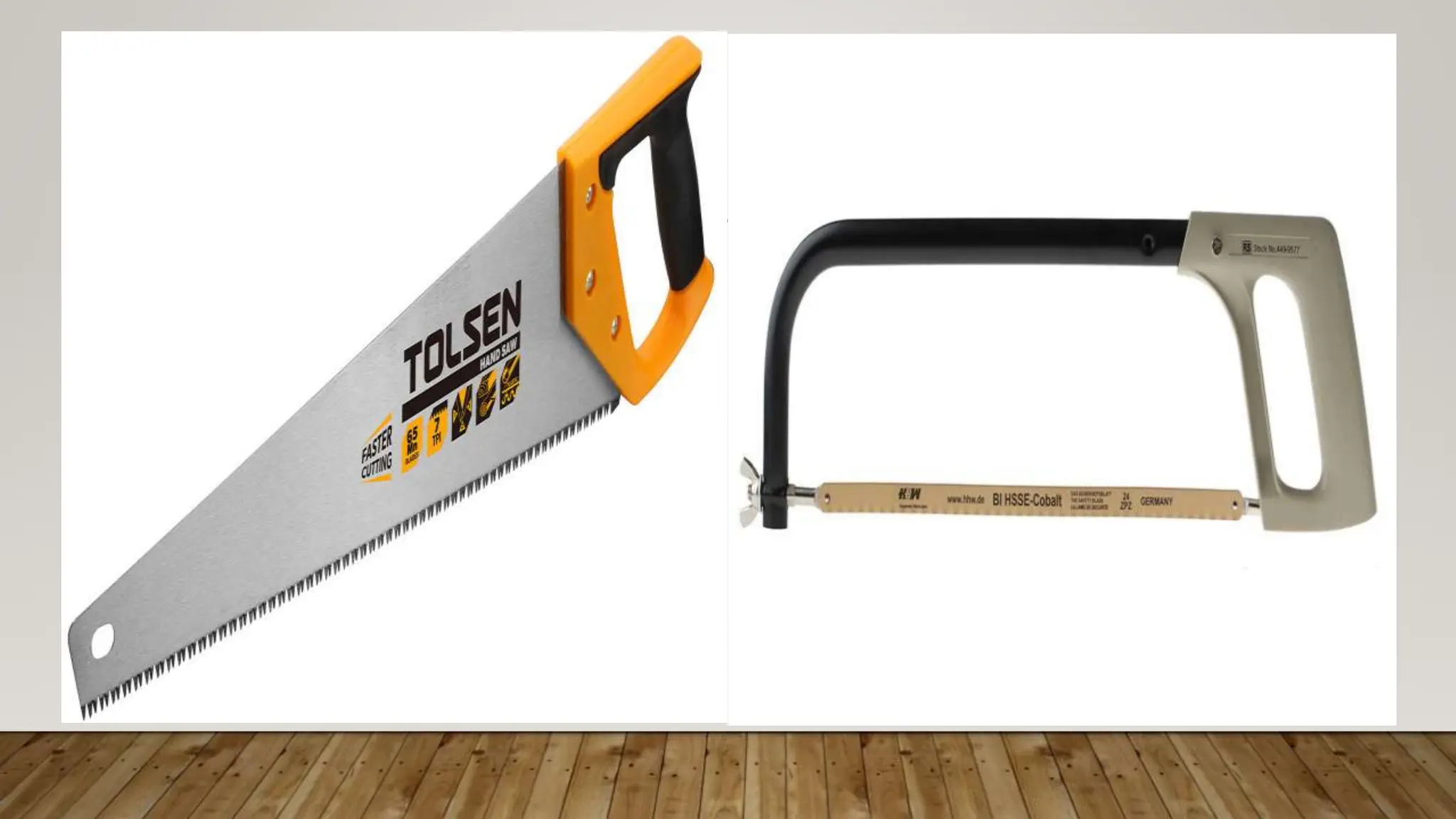
4. HANDSAWS.
•These tools are used to remove
branches that are greater than 50
mm. There are two main types of
hand saw used; these are the bow
saw and the pruning saw.
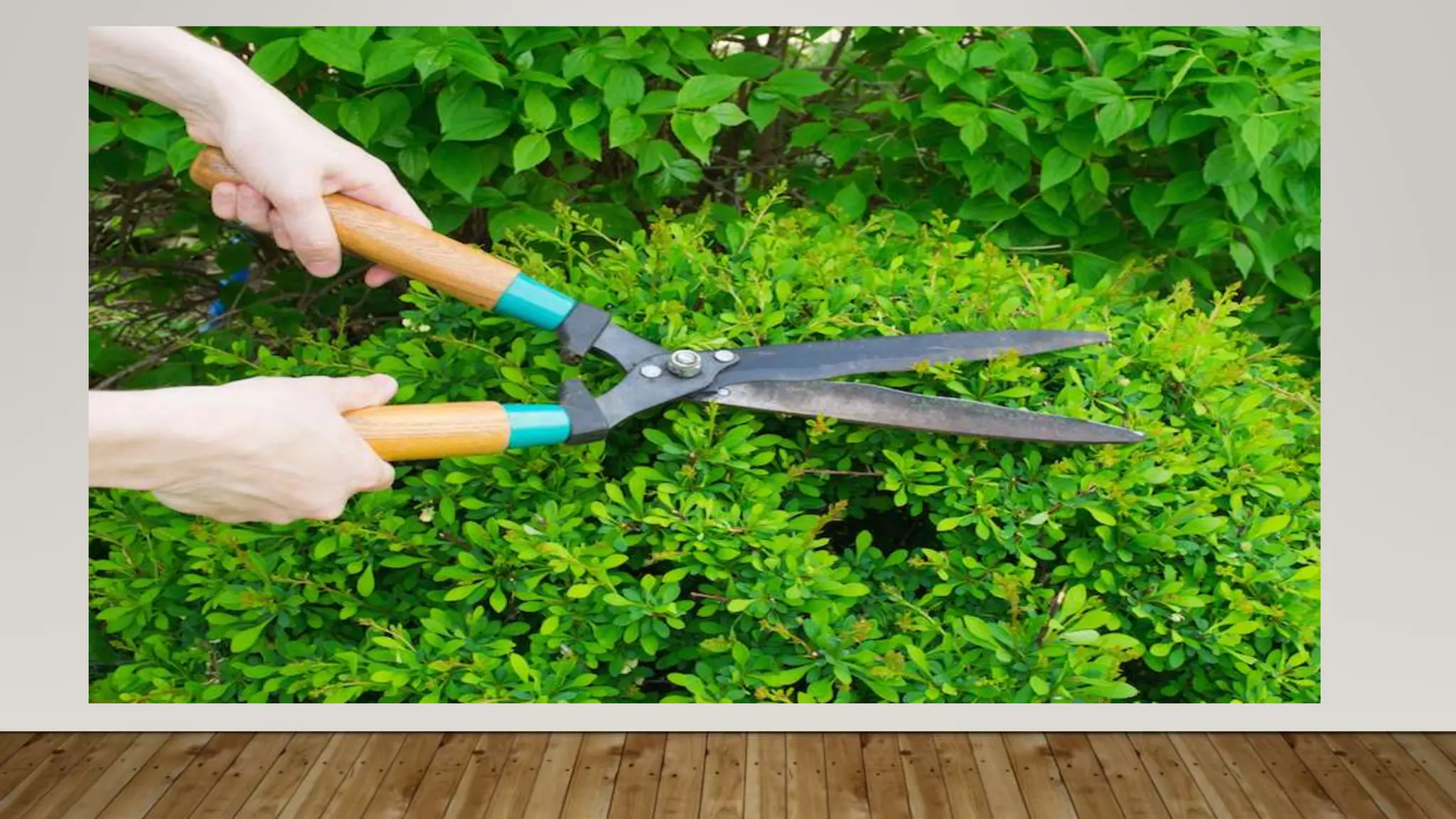
5. HEDGE SHEARS.
• These tools are used to shape plants or trim hedges. These
are designed to cut or prune branches up to 1 cm in
diameter. There are two basic types of hedge shear; one
has a straight cutting blade while the other has a wavy
(serrated) blade. The wavy type is designed to hold and
prevent larger branches from slipping out of the blades.
They can be purchased as either long or short handled
models.
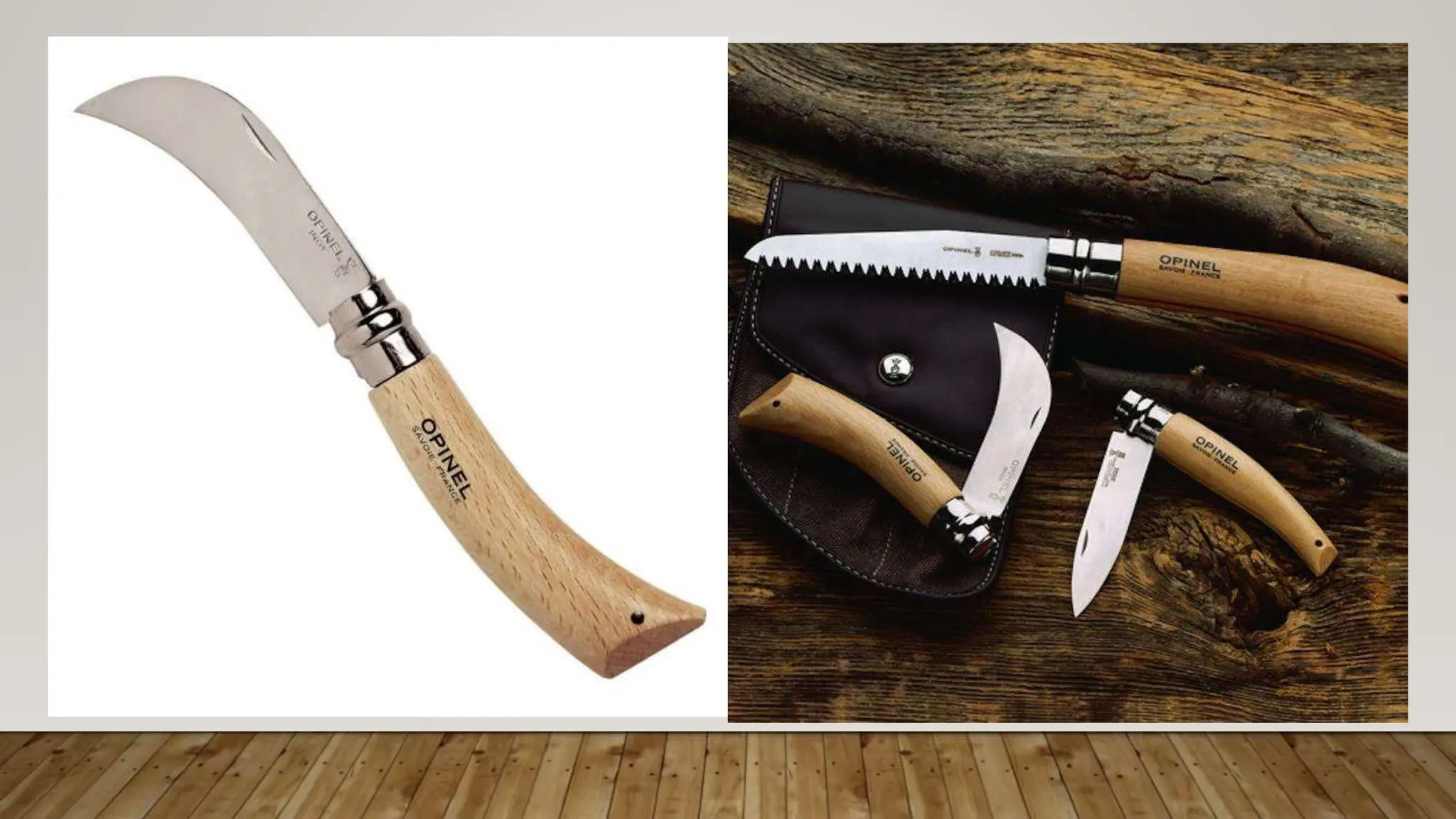
6. PRUNING KNIFE.
•This is used to give your pruning task
professional look knives to trim and bevel
the edges of your pruning cut. This is done
to improve the look of large wounds and
help in the healing process. You could also
use your knife to take off developing
unwanted lateral growth.
Perform Pruning Following Safety Procedures According to OSHS.pptx

Perform Pruning Following Safety Procedures According to OSHS.pptx

  • 1.
    PERFORM PRUNING FOLLOWING SAFETY PROCEDURES ACCORDINGTO OSHS AND PNS OSHS- Occupational Safety and Health Standards PNS- Philippine National Standards.
  • 2.
    WHAT IS THEPRUNING OF PLANTS? • Pruning is defined as the act of trimming leaves, branches, and dead matter from plants. Pruning also plays into the overall health of a plant. You certainly want to maintain the well-being of your plants, train them to grow properly, improve quality, and even restrict their growth in some cases.
  • 3.
    WHAT IS THEPRUNING OF PLANTS? • Pruning plants can enhance the aesthetic and longevity of your landscape. This frequently avoided task could save your plants from both insects and disease as well. To prune, you’re strategically removing branches, roots, buds, etc. These elements might be diseased, infested with insects or other pests, or lacking sunlight during the shorter days
  • 5.
    WHAT IS THEPRUNING OF PLANTS? •Pruning is also essential to a plant’s growth. Pruning and trimming improve plant health, making it stronger and sturdier. It’s all about the long term. Sure, you won’t see immediate results, but plants are about patience anyway.
  • 6.
    REASONS FOR PRUNING •totrain the plant •to maintain plant health •to improve the quality of flowers, fruit, foliage or stems •to restrict growth
  • 7.
    TYPES OF TREEPRUNING 1. Thinning – This type involves removing branches at the base, alongside the trunk, or stalk. 2. Raising – This is all about creating headspace for entries, walkways, cars, and people. Low- hanging branches are trimmed.
  • 10.
    TYPES OF TREEPRUNING 3. Topping – This process is a huge undertaking. Most branches are being removed, all the way down to the trunk. This method is employed when you need your trees to grow in very particular ways. 4. Reduction – Here, you’re trimming back the tree’s overall volume. You do this to create more space for structures like power poles and lines.
  • 14.
    TOOLS USED TODO THE PRUNING
  • 15.
    1. SECATEURS •These toolsare used for deadheading and cutting branches up to 20 mm in diameter. Good quality heavy-duty scissors can be used for smaller twigs and branches.
  • 17.
    2. LONG-HANDLED PRUNERS •These tools are used for cutting off larger branches, say up to 40mm, you will need a pair of long- handled pruners, sometimes called loppers. Even when the material you are cutting is not particularly thick it will save you unnecessary reaching and stretching. Long-handled pruners are used for cutting back, sucker removal, and thinning.
  • 19.
    3. AERIAL PRUNERS •Thesetools are used to remove branches that are higher than you can reach. these are also called extension or pole pruners. These are used for cutting back and thinning.
  • 21.
    4. HANDSAWS. •These toolsare used to remove branches that are greater than 50 mm. There are two main types of hand saw used; these are the bow saw and the pruning saw.
  • 23.
    5. HEDGE SHEARS. •These tools are used to shape plants or trim hedges. These are designed to cut or prune branches up to 1 cm in diameter. There are two basic types of hedge shear; one has a straight cutting blade while the other has a wavy (serrated) blade. The wavy type is designed to hold and prevent larger branches from slipping out of the blades. They can be purchased as either long or short handled models.
  • 25.
    6. PRUNING KNIFE. •Thisis used to give your pruning task professional look knives to trim and bevel the edges of your pruning cut. This is done to improve the look of large wounds and help in the healing process. You could also use your knife to take off developing unwanted lateral growth.