Performance Appraisal
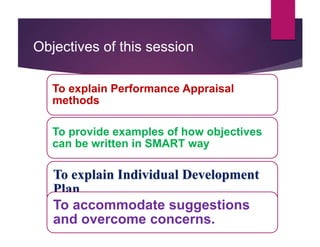
Objectives of this session
To explain Performance Appraisal
methods
To provide examples of how objectives
can be written in SMART way
To explain Individual Development
Plan
To accommodate suggestions
and overcome concerns.
Basic Concepts in Performance
Management and Appraisal
Performance Appraisal
Setting work
standards, assessing
performance, and
providing feedback to
employees to
motivate, correct, and
continue their
performance.
Performance
Management
An integrated
approach to ensuring
that an employee’s
performance supports
and contributes to the
organization’s
strategic aims.
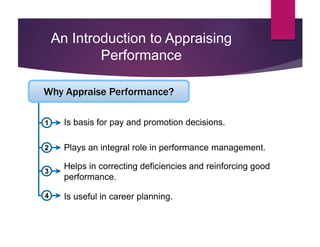
An Introduction to Appraising
Performance
1
Is useful in career planning.
Plays an integral role in performance management.
Why Appraise Performance?
Is basis for pay and promotion decisions.
Helps in correcting deficiencies and reinforcing good
performance.
2
3
4
5
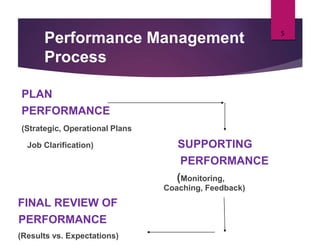
Performance Management
Process
PLAN
PERFORMANCE
(Strategic, Operational Plans
Job Clarification) SUPPORTING
PERFORMANCE
(Monitoring,
Coaching, Feedback)
FINAL REVIEW OF
PERFORMANCE
(Results vs. Expectations)
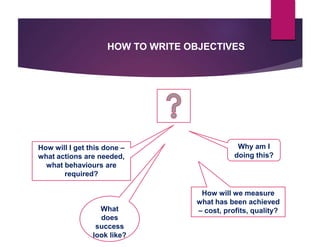
HOW TO WRITE OBJECTIVES
Why am I
doing this?
How will we measure
what has been achieved
– cost, profits, quality?
What
does
success
look like?
How will I get this done –
what actions are needed,
what behaviours are
required?
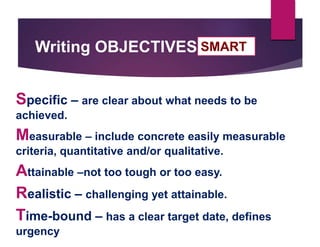
Writing OBJECTIVES
Specific – are clear about what needs to be
achieved.
Measurable – include concrete easily measurable
criteria, quantitative and/or qualitative.
Attainable –not too tough or too easy.
Realistic – challenging yet attainable.
Time-bound – has a clear target date, defines
urgency
SMART
9–8
Performance Appraisal Methods
1
2
3
4
5
Paired comparison
Simple ranking
Forced Distribution
Graphic Rating
Behavioral
Observation
6
7
8
9
10
Critical Incidents
Behaviorally anchored rating
scales (BARS)
Management by objectives (MBO)
Computerized and Web-based
performance appraisal
Merged methods
Appraisal Methodologies
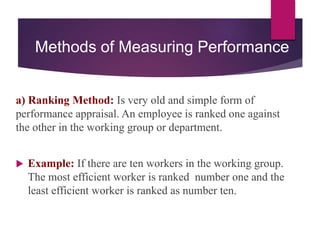
Methods of Measuring Performance
a) Ranking Method: Is very old and simple form of
performance appraisal. An employee is ranked one against
the other in the working group or department.
 Example: If there are ten workers in the working group.
The most efficient worker is ranked number one and the
least efficient worker is ranked as number ten.
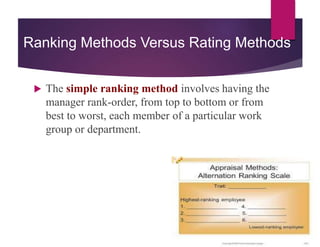
Ranking Methods Versus Rating Methods
 The simple ranking method involves having the
manager rank-order, from top to bottom or from
best to worst, each member of a particular work
group or department.
Ranking Methods Versus Rating Methods
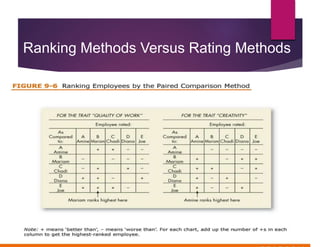
 The paired comparison method
 It involves comparing each individual employee
with every other individual employee, one at a
time.
 It helps make the ranking method more precise.
Ranking Methods Versus Rating Methods
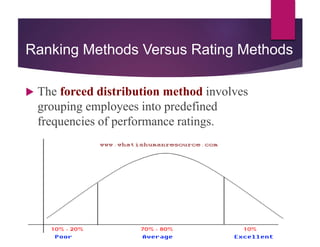
 The forced distribution method involves
grouping employees into predefined
frequencies of performance ratings.
Forced Ranking/Distribution
 Forced ranking can help build high performance org. by
ensuring that managers clearly distinguish among employee
performance level.
 Can be arbitrary, unfair, & expose organization to
lawsuits
 Inherent subjectivity
 Forced rankings tend to be more effective in organizations
with high-pressure, results-driven culture
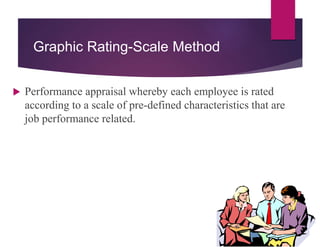
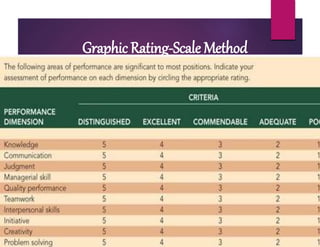
Graphic Rating-Scale Method
 Performance appraisal whereby each employee is rated
according to a scale of pre-defined characteristics that are
job performance related.
Graphic Rating-Scale Method
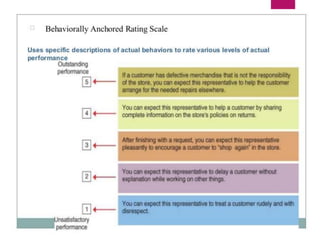
Behaviorally Anchored Rating Scale
(BARS)
 A behavioral approach to performance appraisal
that consists of a series of vertical scales, one for
each important dimension of job performance.
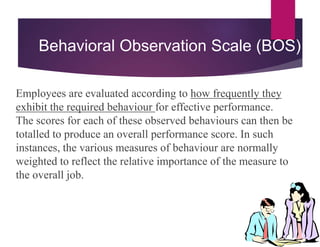
Behavioral Observation Scale (BOS)
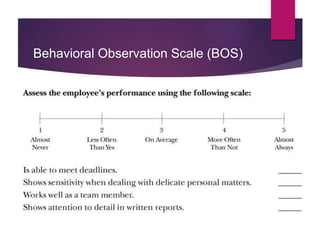
Employees are evaluated according to how frequently they
exhibit the required behaviour for effective performance.
The scores for each of these observed behaviours can then be
totalled to produce an overall performance score. In such
instances, the various measures of behaviour are normally
weighted to reflect the relative importance of the measure to
the overall job.
Behavioral Observation Scale (BOS)
Critical Incidents
Do not generally utilizes scale. The evaluator provides
specific examples of behaviors / outcomes recorded over
the feedback/evaluation period.
This process can be very time consuming but it allows the
feedback to cite specific examples of general measures
instead of general impression
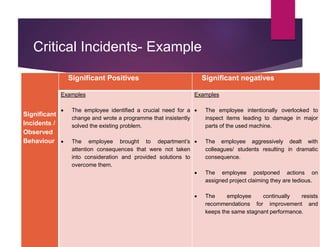
Critical Incidents- Example
Significant
Incidents /
Observed
Behaviour
Significant Positives Significant negatives
Examples
 The employee identified a crucial need for a
change and wrote a programme that insistently
solved the existing problem.
 The employee brought to department’s
attention consequences that were not taken
into consideration and provided solutions to
overcome them.
Examples
 The employee intentionally overlooked to
inspect items leading to damage in major
parts of the used machine.
 The employee aggressively dealt with
colleagues/ students resulting in dramatic
consequence.
 The employee postponed actions on
assigned project claiming they are tedious.
 The employee continually resists
recommendations for improvement and
keeps the same stagnant performance.
Management By Objective (MBO)
 Philosophy of management that rates performance
on the basis of employee achievement of goals set
by mutual agreement of employee and manager.
Advantages of MBO
 Employees Can Measure Performance
 Quantifiable Goals
 Joint Effort
 Employee Satisfaction in Participation
25
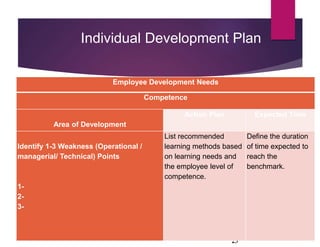
Individual Development Plan
Employee Development Needs
Competence
Area of Development
Action Plan Expected Time
Identify 1-3 Weakness (Operational /
managerial/ Technical) Points
1-
2-
3-
List recommended
learning methods based
on learning needs and
the employee level of
competence.
Define the duration
of time expected to
reach the
benchmark.
26
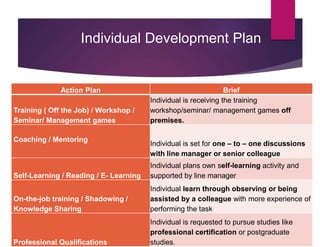
Individual Development Plan
Action Plan Brief
Training ( Off the Job) / Workshop /
Seminar/ Management games
Individual is receiving the training
workshop/seminar/ management games off
premises.
Coaching / Mentoring
Individual is set for one – to – one discussions
with line manager or senior colleague
Self-Learning / Reading / E- Learning
Individual plans own self-learning activity and
supported by line manager
On-the-job training / Shadowing /
Knowledge Sharing
Individual learn through observing or being
assisted by a colleague with more experience of
performing the task
Professional Qualifications
Individual is requested to pursue studies like
professional certification or postgraduate
studies.

Performance Appraisal Methods.ppt

  • 1.
  • 2.
    Objectives of thissession To explain Performance Appraisal methods To provide examples of how objectives can be written in SMART way To explain Individual Development Plan To accommodate suggestions and overcome concerns.
  • 3.
    Basic Concepts inPerformance Management and Appraisal Performance Appraisal Setting work standards, assessing performance, and providing feedback to employees to motivate, correct, and continue their performance. Performance Management An integrated approach to ensuring that an employee’s performance supports and contributes to the organization’s strategic aims.
  • 4.
    An Introduction toAppraising Performance 1 Is useful in career planning. Plays an integral role in performance management. Why Appraise Performance? Is basis for pay and promotion decisions. Helps in correcting deficiencies and reinforcing good performance. 2 3 4
  • 5.
    5 Performance Management Process PLAN PERFORMANCE (Strategic, OperationalPlans Job Clarification) SUPPORTING PERFORMANCE (Monitoring, Coaching, Feedback) FINAL REVIEW OF PERFORMANCE (Results vs. Expectations)
  • 6.
    HOW TO WRITEOBJECTIVES Why am I doing this? How will we measure what has been achieved – cost, profits, quality? What does success look like? How will I get this done – what actions are needed, what behaviours are required?
  • 7.
    Writing OBJECTIVES Specific –are clear about what needs to be achieved. Measurable – include concrete easily measurable criteria, quantitative and/or qualitative. Attainable –not too tough or too easy. Realistic – challenging yet attainable. Time-bound – has a clear target date, defines urgency SMART
  • 8.
    9–8 Performance Appraisal Methods 1 2 3 4 5 Pairedcomparison Simple ranking Forced Distribution Graphic Rating Behavioral Observation 6 7 8 9 10 Critical Incidents Behaviorally anchored rating scales (BARS) Management by objectives (MBO) Computerized and Web-based performance appraisal Merged methods Appraisal Methodologies
  • 9.
    Methods of MeasuringPerformance a) Ranking Method: Is very old and simple form of performance appraisal. An employee is ranked one against the other in the working group or department.  Example: If there are ten workers in the working group. The most efficient worker is ranked number one and the least efficient worker is ranked as number ten.
  • 10.
    Ranking Methods VersusRating Methods  The simple ranking method involves having the manager rank-order, from top to bottom or from best to worst, each member of a particular work group or department.
  • 11.
    Ranking Methods VersusRating Methods  The paired comparison method  It involves comparing each individual employee with every other individual employee, one at a time.  It helps make the ranking method more precise.
  • 12.
    Ranking Methods VersusRating Methods
  • 13.
    Ranking Methods VersusRating Methods  The forced distribution method involves grouping employees into predefined frequencies of performance ratings.
  • 14.
    Forced Ranking/Distribution  Forcedranking can help build high performance org. by ensuring that managers clearly distinguish among employee performance level.  Can be arbitrary, unfair, & expose organization to lawsuits  Inherent subjectivity  Forced rankings tend to be more effective in organizations with high-pressure, results-driven culture
  • 15.
    Graphic Rating-Scale Method Performance appraisal whereby each employee is rated according to a scale of pre-defined characteristics that are job performance related.
  • 16.
  • 17.
    Behaviorally Anchored RatingScale (BARS)  A behavioral approach to performance appraisal that consists of a series of vertical scales, one for each important dimension of job performance.
  • 19.
    Behavioral Observation Scale(BOS) Employees are evaluated according to how frequently they exhibit the required behaviour for effective performance. The scores for each of these observed behaviours can then be totalled to produce an overall performance score. In such instances, the various measures of behaviour are normally weighted to reflect the relative importance of the measure to the overall job.
  • 20.
  • 21.
    Critical Incidents Do notgenerally utilizes scale. The evaluator provides specific examples of behaviors / outcomes recorded over the feedback/evaluation period. This process can be very time consuming but it allows the feedback to cite specific examples of general measures instead of general impression
  • 22.
    Critical Incidents- Example Significant Incidents/ Observed Behaviour Significant Positives Significant negatives Examples  The employee identified a crucial need for a change and wrote a programme that insistently solved the existing problem.  The employee brought to department’s attention consequences that were not taken into consideration and provided solutions to overcome them. Examples  The employee intentionally overlooked to inspect items leading to damage in major parts of the used machine.  The employee aggressively dealt with colleagues/ students resulting in dramatic consequence.  The employee postponed actions on assigned project claiming they are tedious.  The employee continually resists recommendations for improvement and keeps the same stagnant performance.
  • 23.
    Management By Objective(MBO)  Philosophy of management that rates performance on the basis of employee achievement of goals set by mutual agreement of employee and manager.
  • 24.
    Advantages of MBO Employees Can Measure Performance  Quantifiable Goals  Joint Effort  Employee Satisfaction in Participation
  • 25.
    25 Individual Development Plan EmployeeDevelopment Needs Competence Area of Development Action Plan Expected Time Identify 1-3 Weakness (Operational / managerial/ Technical) Points 1- 2- 3- List recommended learning methods based on learning needs and the employee level of competence. Define the duration of time expected to reach the benchmark.
  • 26.
    26 Individual Development Plan ActionPlan Brief Training ( Off the Job) / Workshop / Seminar/ Management games Individual is receiving the training workshop/seminar/ management games off premises. Coaching / Mentoring Individual is set for one – to – one discussions with line manager or senior colleague Self-Learning / Reading / E- Learning Individual plans own self-learning activity and supported by line manager On-the-job training / Shadowing / Knowledge Sharing Individual learn through observing or being assisted by a colleague with more experience of performing the task Professional Qualifications Individual is requested to pursue studies like professional certification or postgraduate studies.