Perceptual Mapping Techniques
Perceptual Map
Need 2
Need 1
+20
+20
-20
-20
SELF
Pr
Hi
Bu
Si
Ot
SEMI
SONO
SOLD
SUL
I
SAMA
SUSI
SALT
SIBI
SIRO
Semantic Scaling
Research Illustration
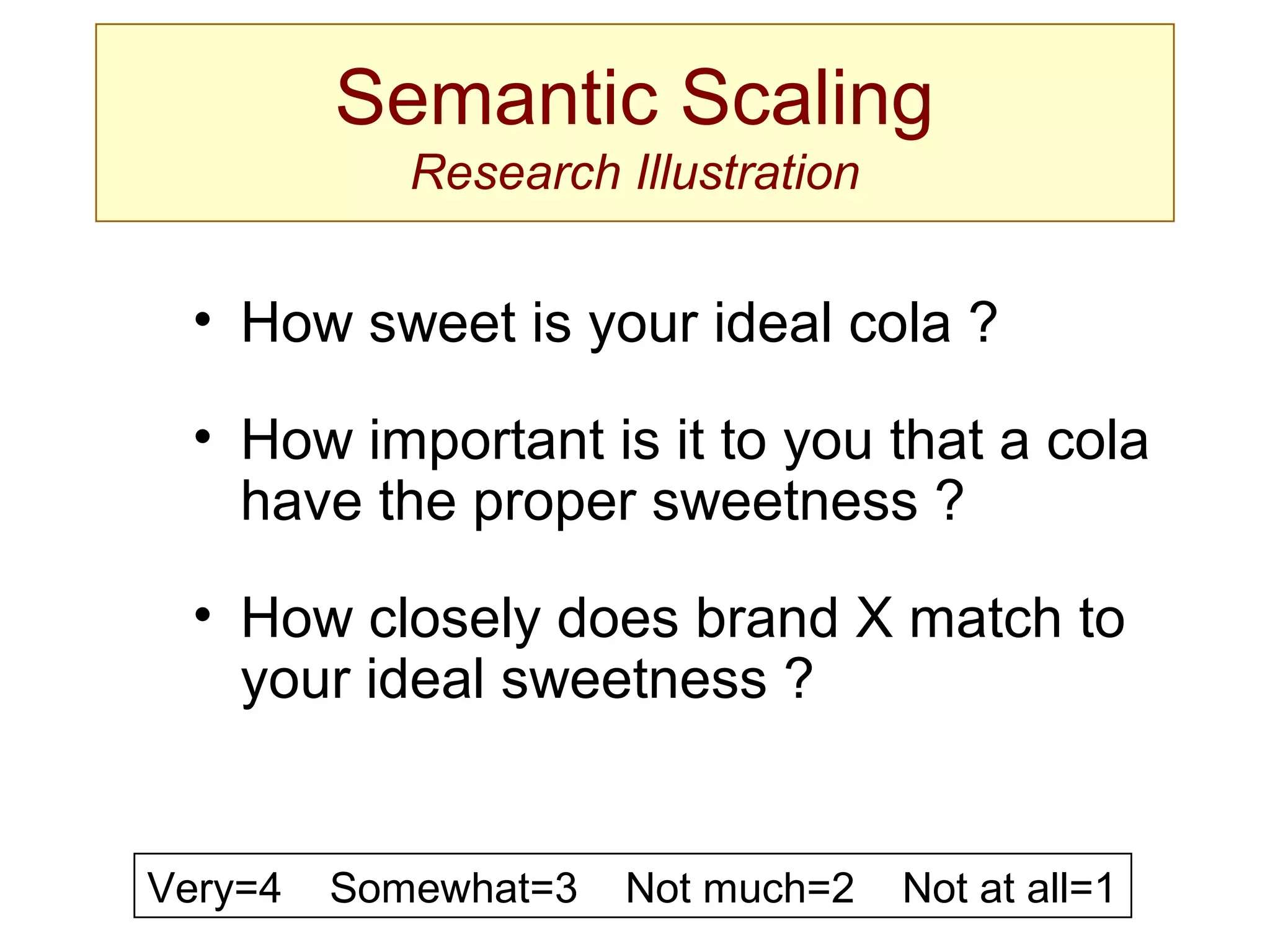
• How sweet is your ideal cola ?
• How important is it to you that a cola
have the proper sweetness ?
• How closely does brand X match to
your ideal sweetness ?
Very=4 Somewhat=3 Not much=2 Not at all=1
Semantic Scaling
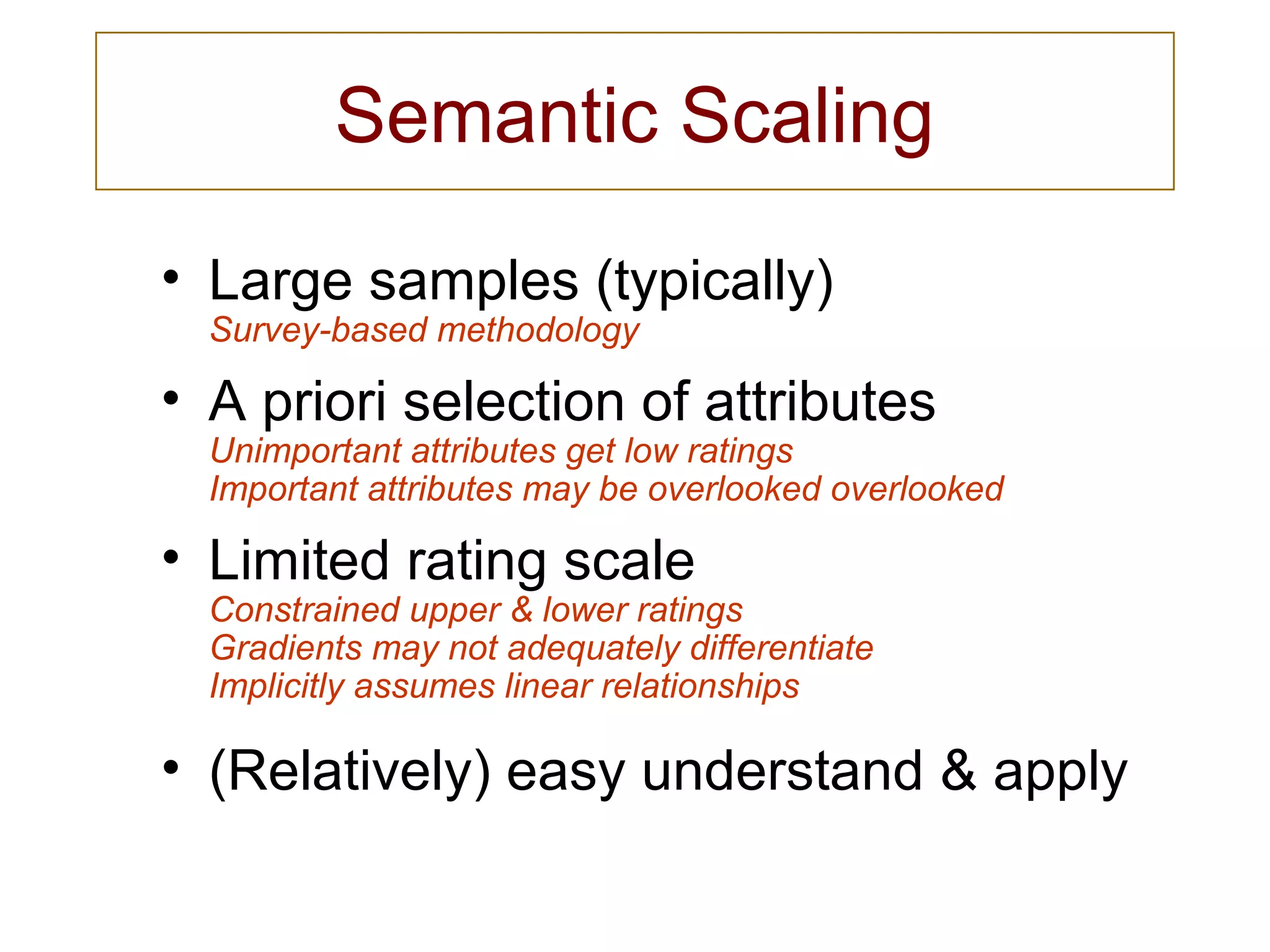
• Large samples (typically)
Survey-based methodology
• A priori selection of attributes
Unimportant attributes get low ratings
Important attributes may be overlooked overlooked
• Limited rating scale
Constrained upper & lower ratings
Gradients may not adequately differentiate
Implicitly assumes linear relationships
• (Relatively) easy understand & apply
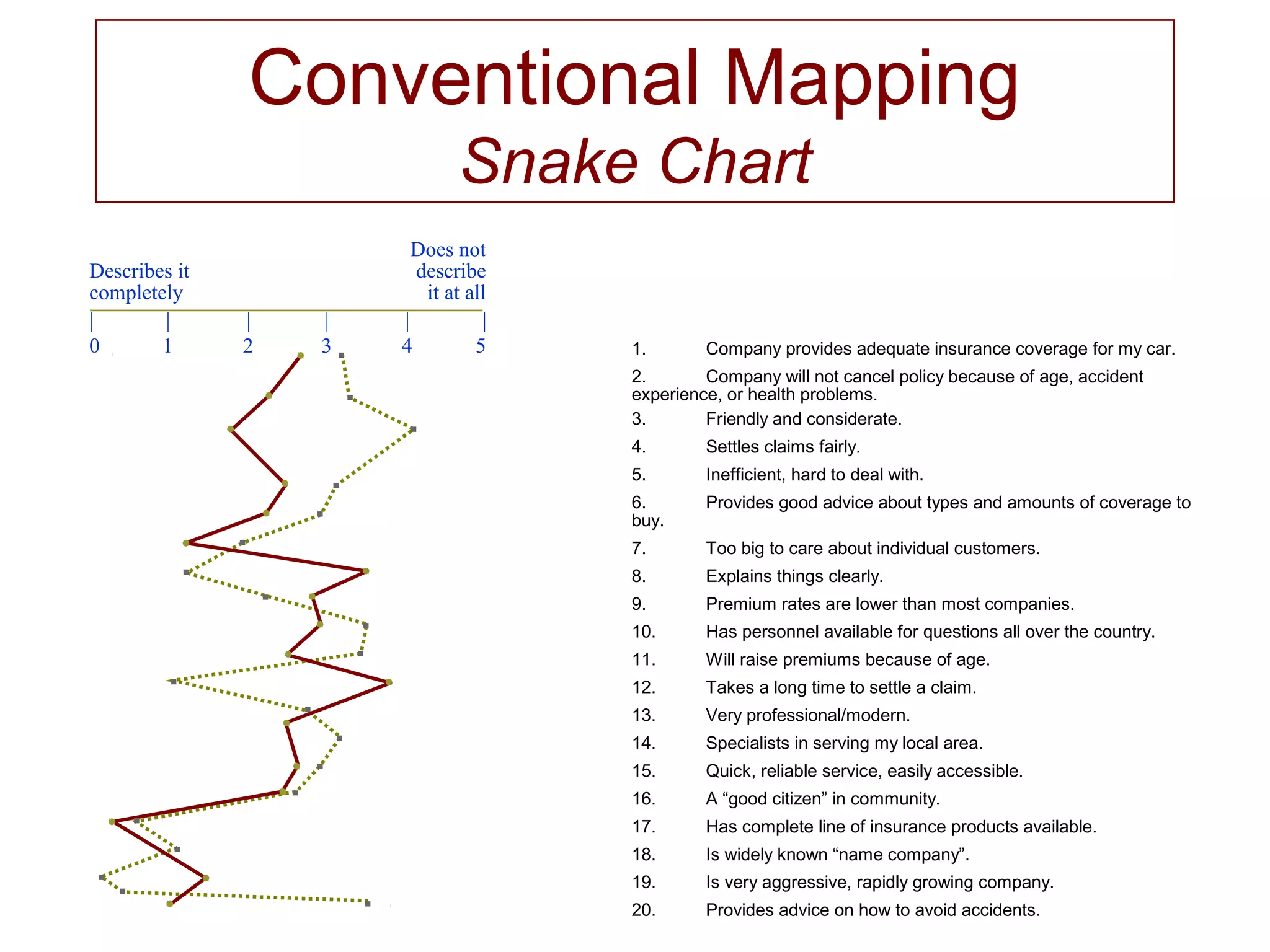
1. Company provides adequate insurance coverage for my car.
2. Company will not cancel policy because of age, accident
experience, or health problems.
3. Friendly and considerate.
4. Settles claims fairly.
5. Inefficient, hard to deal with.
6. Provides good advice about types and amounts of coverage to
buy.
7. Too big to care about individual customers.
8. Explains things clearly.
9. Premium rates are lower than most companies.
10. Has personnel available for questions all over the country.
11. Will raise premiums because of age.
12. Takes a long time to settle a claim.
13. Very professional/modern.
14. Specialists in serving my local area.
15. Quick, reliable service, easily accessible.
16. A “good citizen” in community.
17. Has complete line of insurance products available.
18. Is widely known “name company”.
19. Is very aggressive, rapidly growing company.
20. Provides advice on how to avoid accidents.
Does not
Describes it describe
completely it at all
| | | | | |
0 1 2 3 4 5
Conventional Mapping
Snake Chart
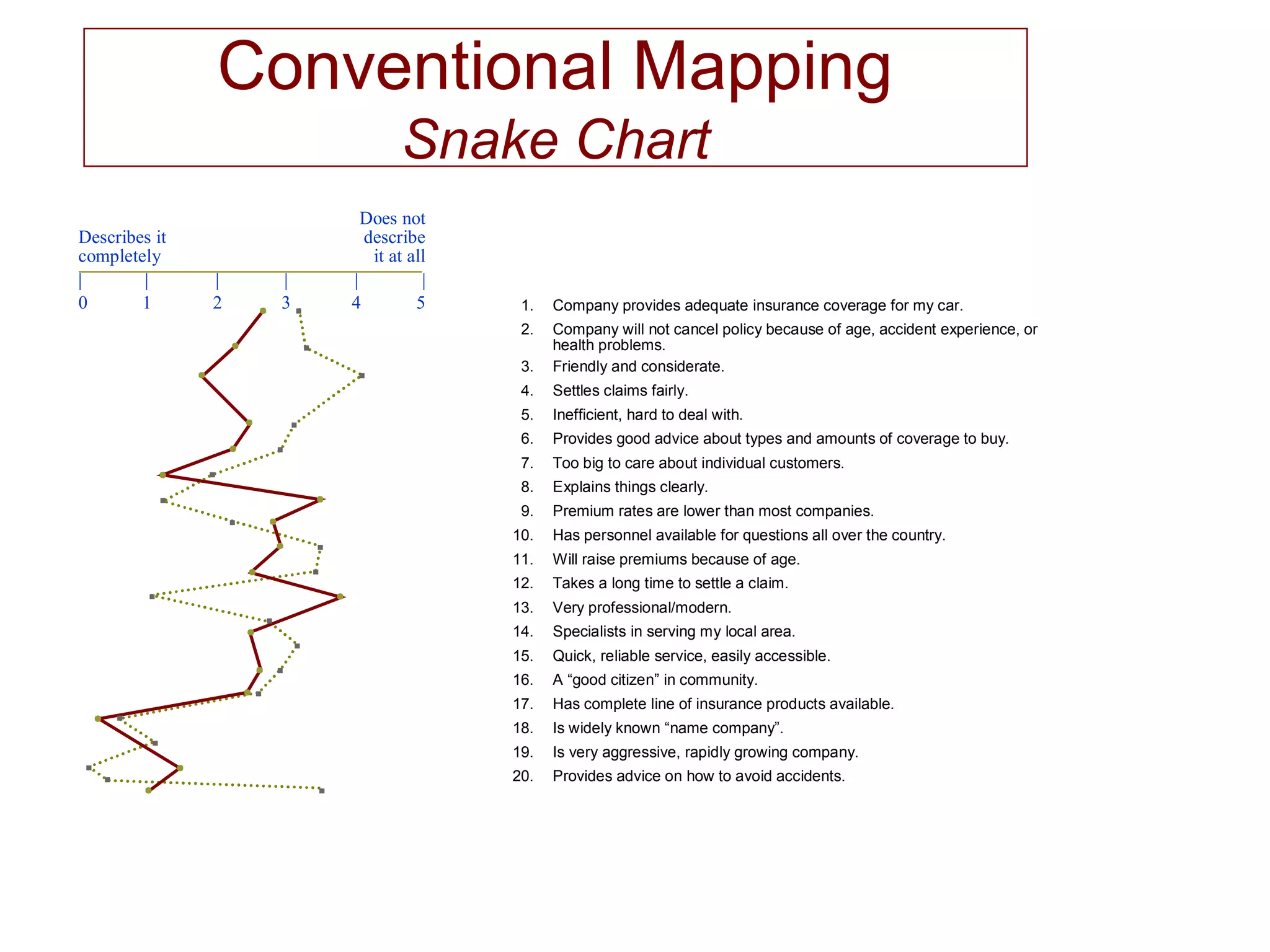
1. Company provides adequate insurance coverage for my car.
2. Company will not cancel policy because of age, accident experience, or
health problems.
3. Friendly and considerate.
4. Settles claims fairly.
5. Inefficient, hard to deal with.
6. Provides good advice about types and amounts of coverage to buy.
7. Too big to care about individual customers.
8. Explains things clearly.
9. Premium rates are lower than most companies.
10. Has personnel available for questions all over the country.
11. Will raise premiums because of age.
12. Takes a long time to settle a claim.
13. Very professional/modern.
14. Specialists in serving my local area.
15. Quick, reliable service, easily accessible.
16. A “good citizen” in community.
17. Has complete line of insurance products available.
18. Is widely known “name company”.
19. Is very aggressive, rapidly growing company.
20. Provides advice on how to avoid accidents.
Does not
Describes it describe
completely it at all
| | | | | |
0 1 2 3 4 5
Conventional Mapping
Snake Chart
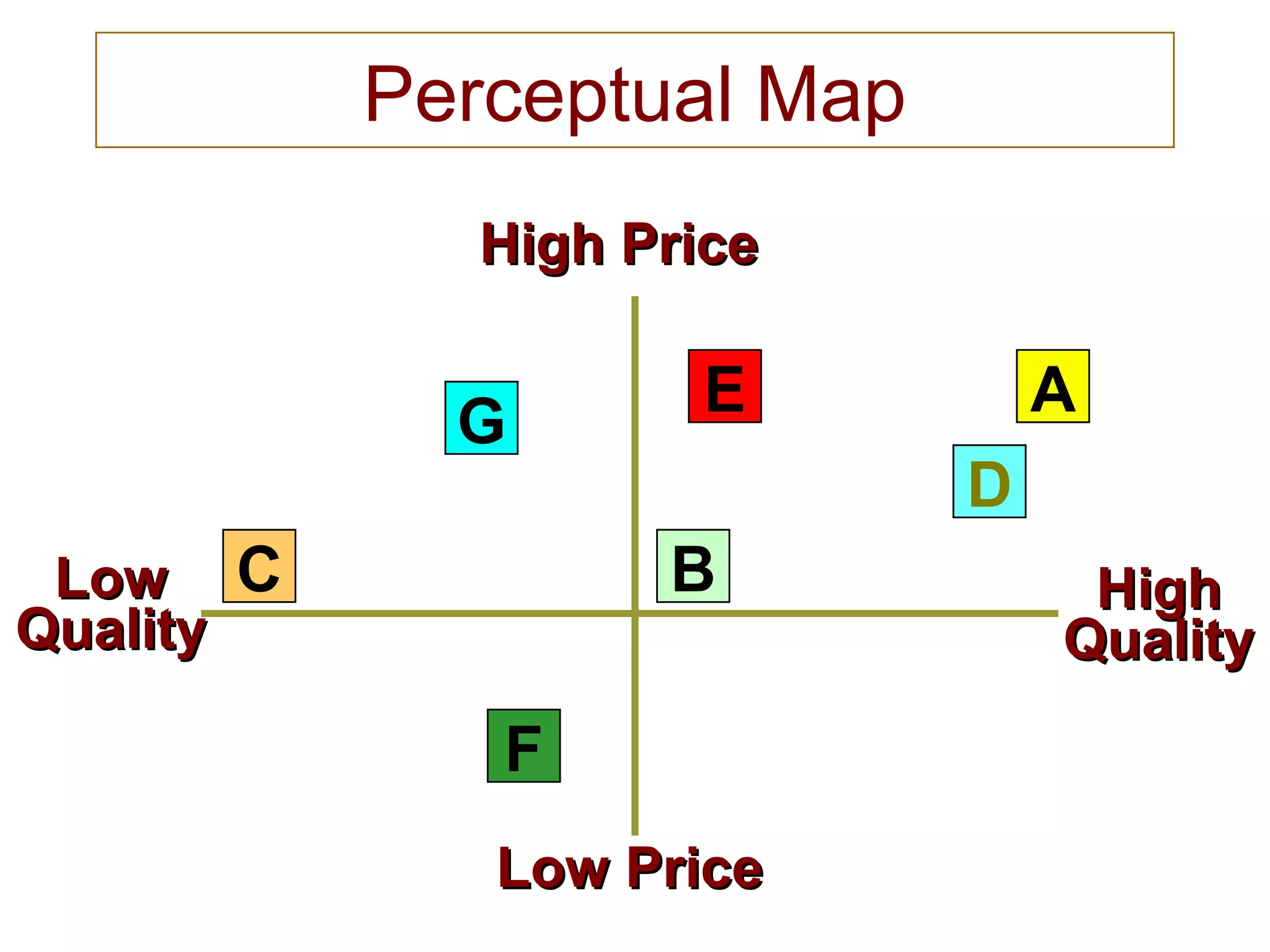
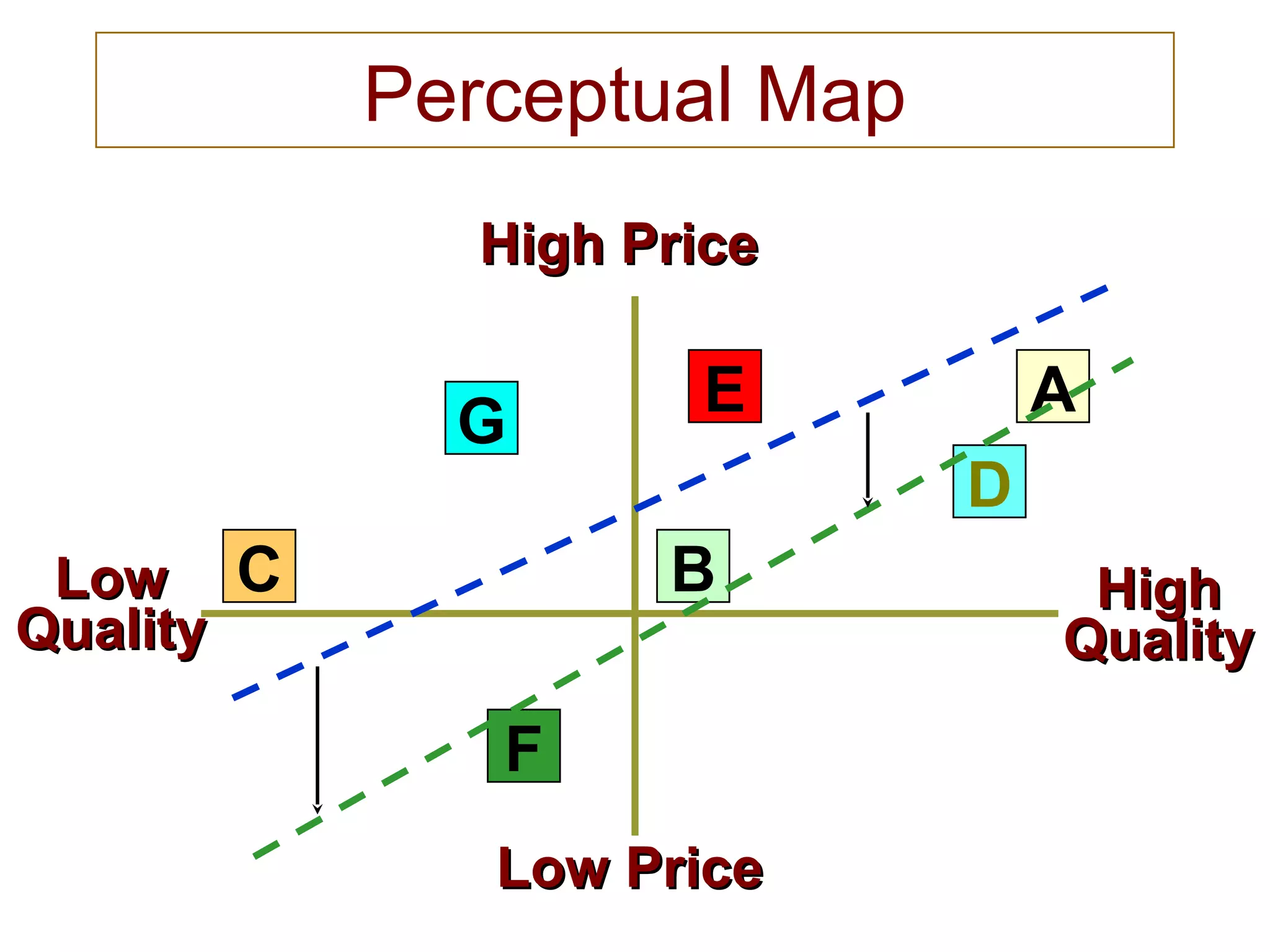
Perceptual Map
LowLow
QualityQuality
Low PriceLow Price
High PriceHigh Price
HighHigh
QualityQuality
G
C
F
E
B
D
A
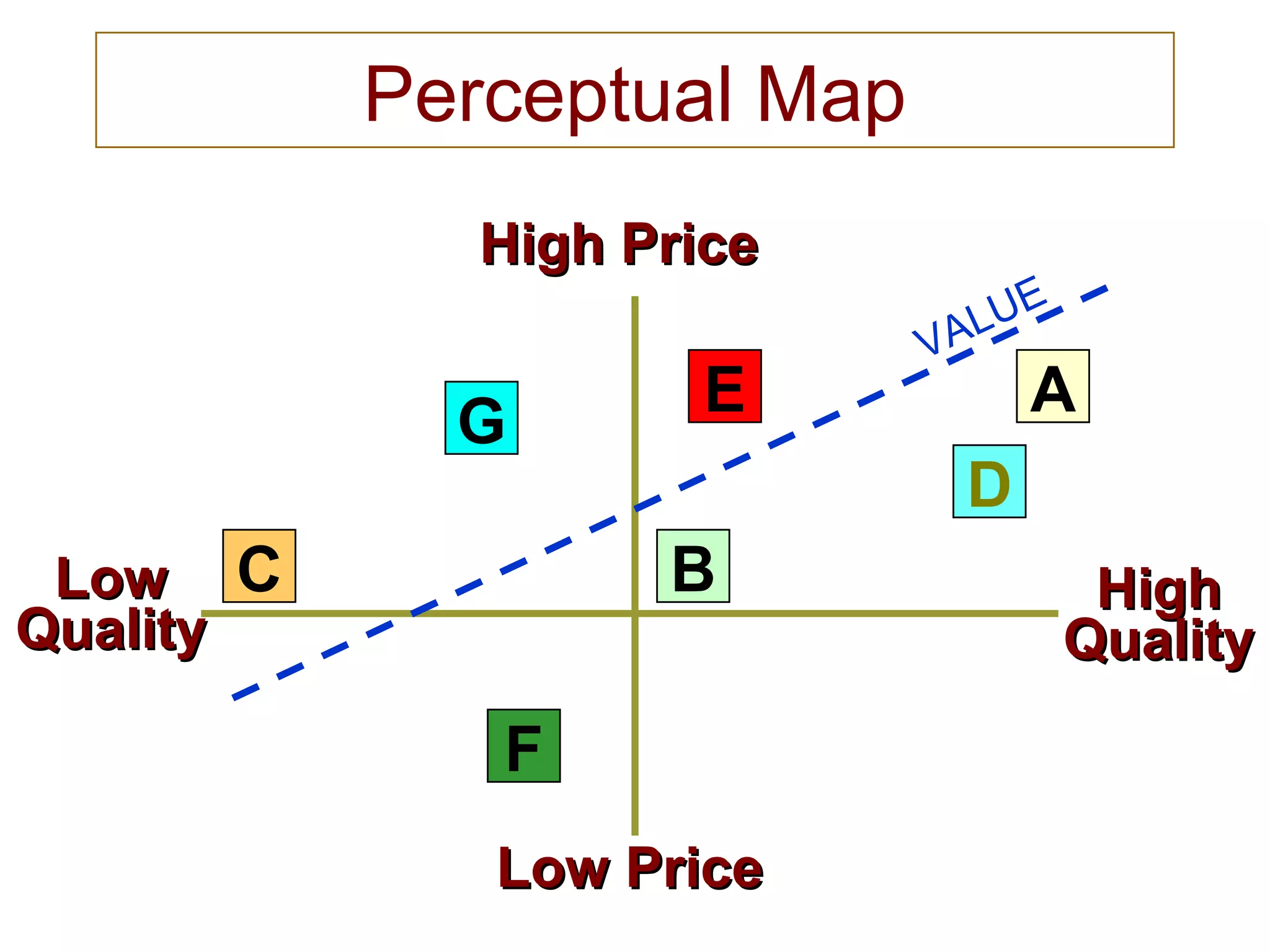
Perceptual Map
LowLow
QualityQuality
Low PriceLow Price
High PriceHigh Price
HighHigh
QualityQuality
G
C
F
E
B
D
A
VALUE
Perceptual Map
LowLow
QualityQuality
Low PriceLow Price
High PriceHigh Price
HighHigh
QualityQuality
G
C
F
E
B
D
A
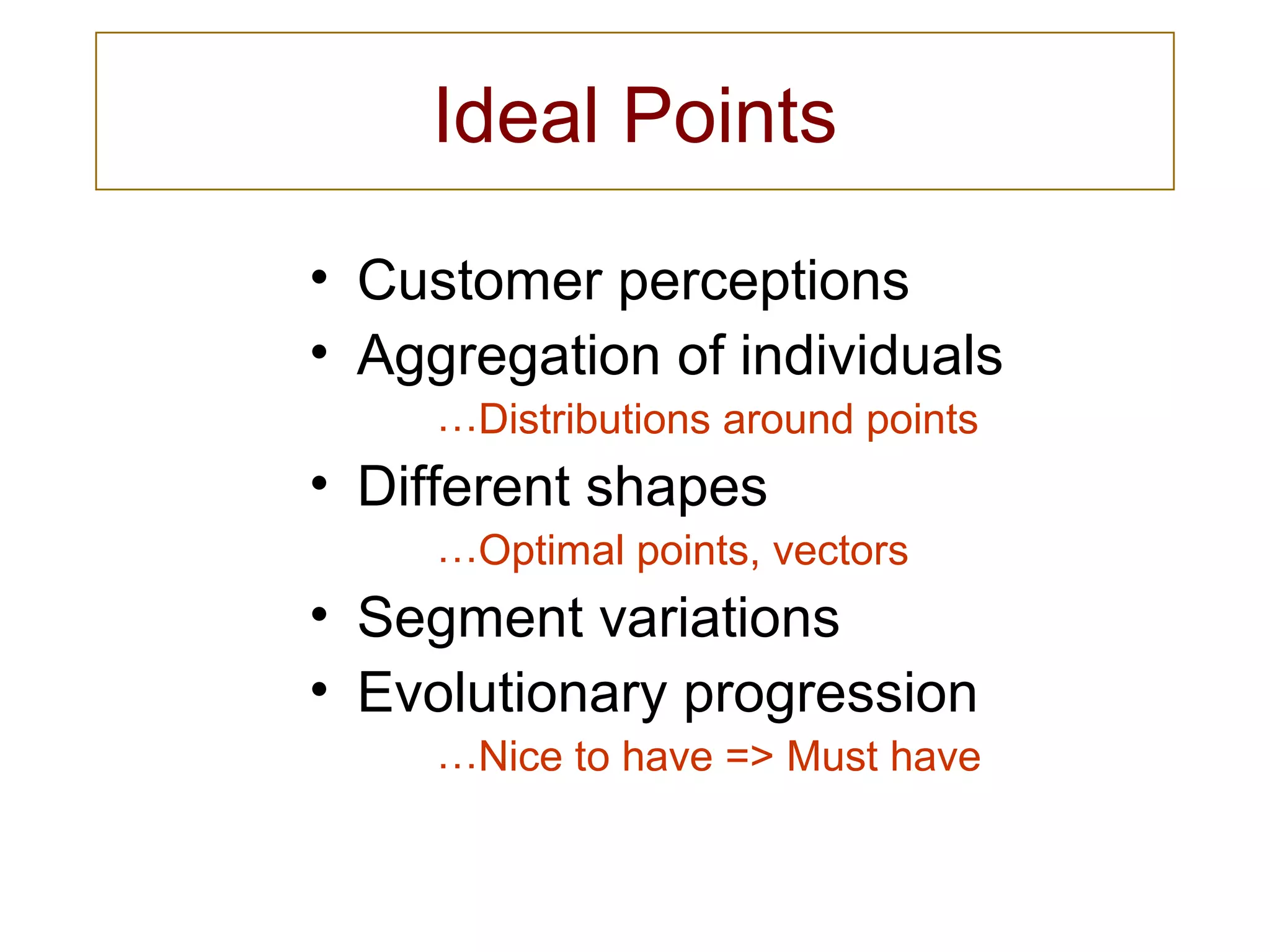
Ideal Points
• Customer perceptions
• Aggregation of individuals
…Distributions around points
• Different shapes
…Optimal points, vectors
• Segment variations
• Evolutionary progression
…Nice to have => Must have
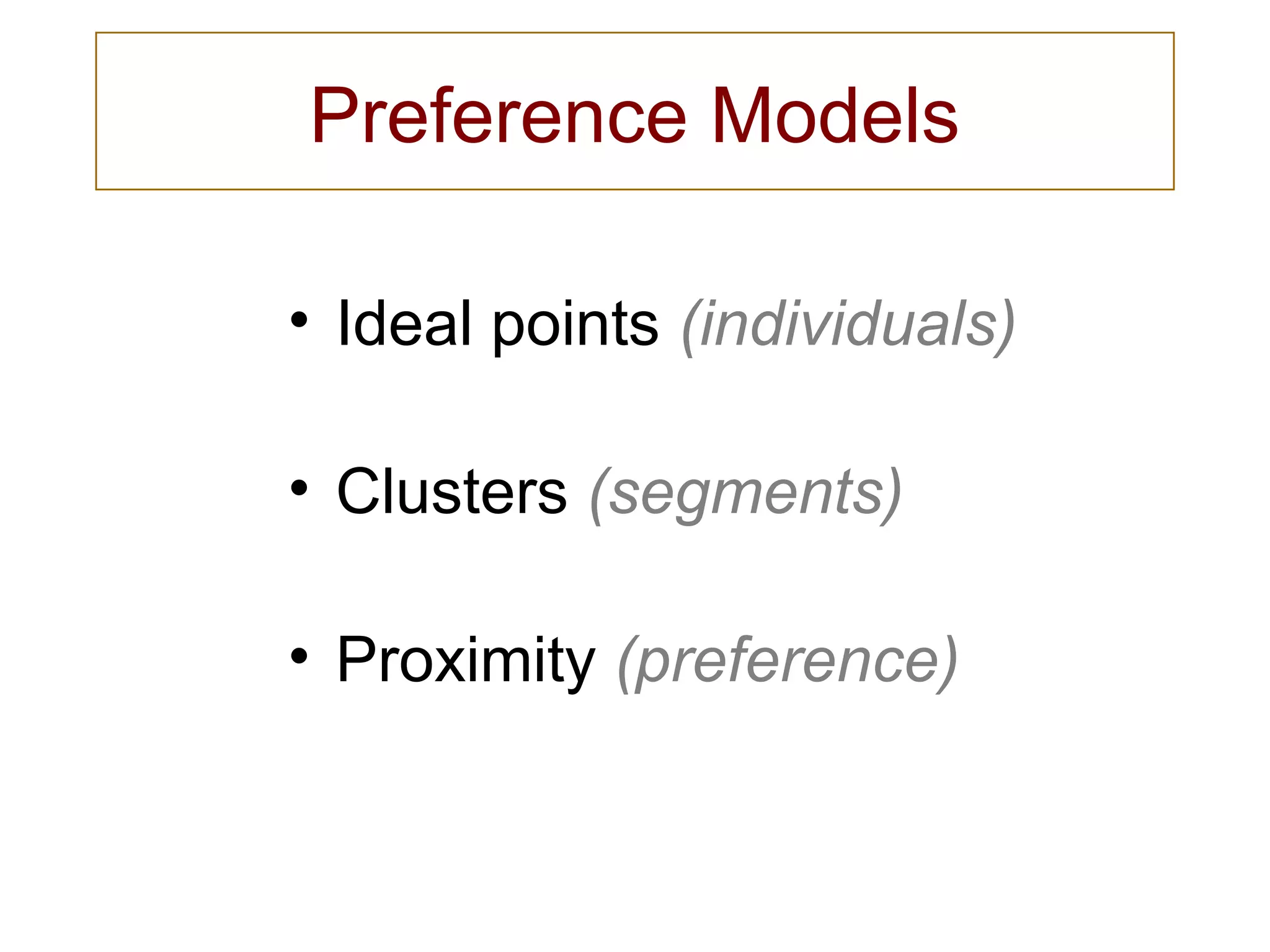
Preference Models
• Ideal points (individuals)
• Clusters (segments)
• Proximity (preference)
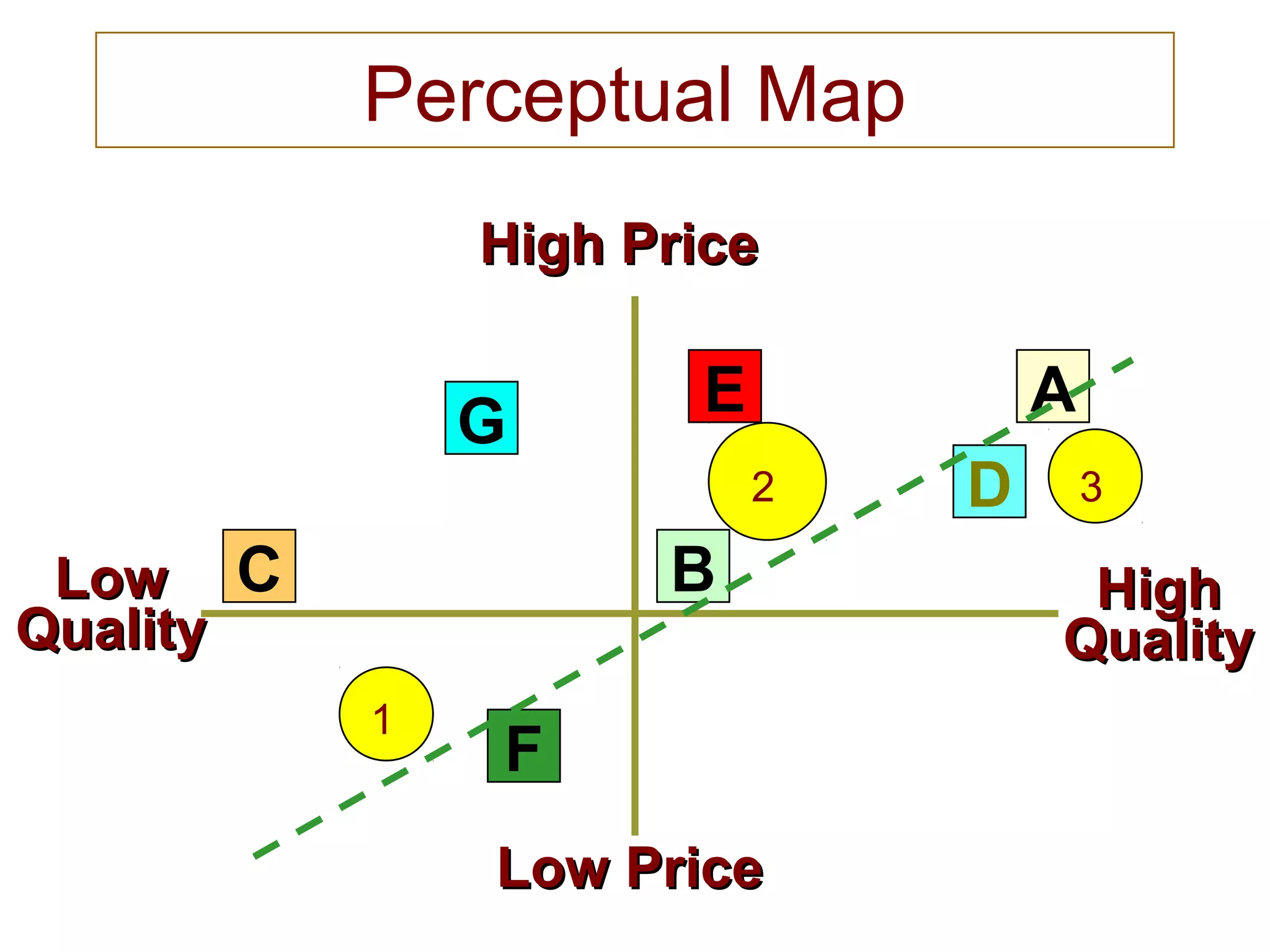
Perceptual Map
LowLow
QualityQuality
Low PriceLow Price
High PriceHigh Price
HighHigh
QualityQuality
G
C
F
E
B
D
A
1
2 3
In general ...
• Most of a brand’s sales will come from the
segments with the closest ideal points
• Most of a segment’s sales (share) will go
to the brands closest to its ideal point
Targeting Strategies
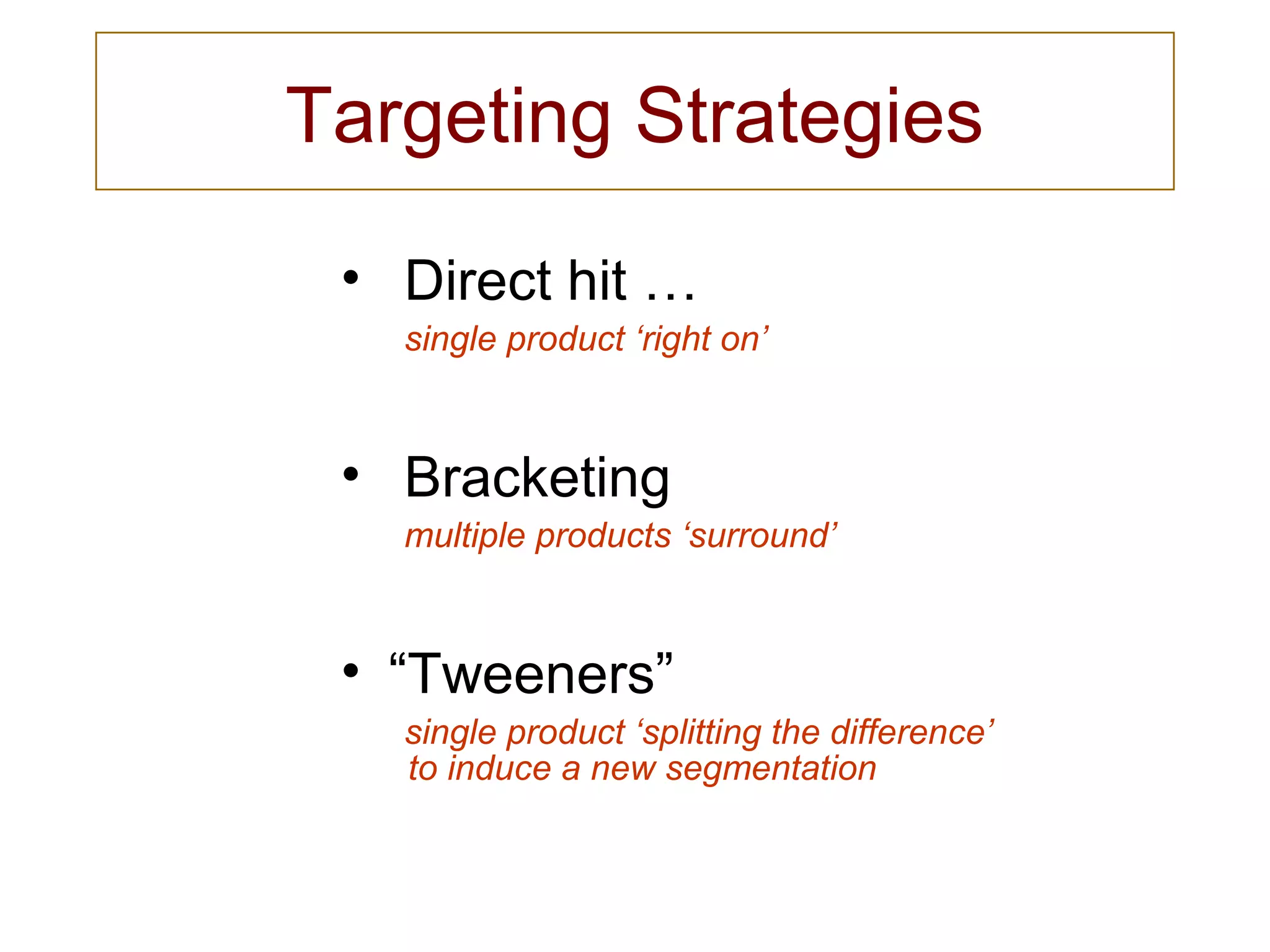
• Direct hit …
single product ‘right on’
• Bracketing
multiple products ‘surround’
• “Tweeners”
single product ‘splitting the difference’
to induce a new segmentation
Multidimensional Scaling
(MDS)
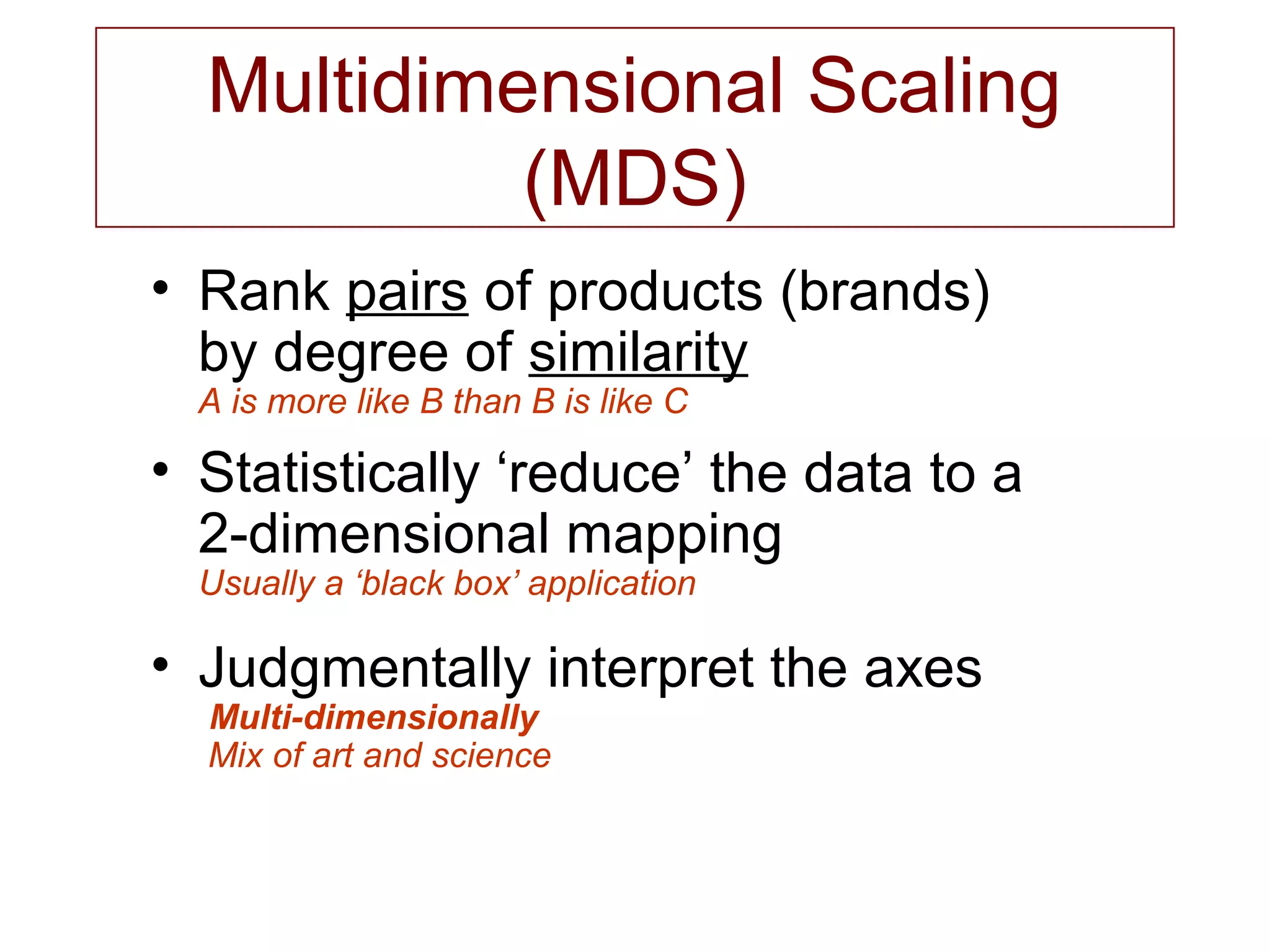
• Rank pairs of products (brands)
by degree of similarity
A is more like B than B is like C
• Statistically ‘reduce’ the data to a
2-dimensional mapping
Usually a ‘black box’ application
• Judgmentally interpret the axes
Multi-dimensionally
Mix of art and science
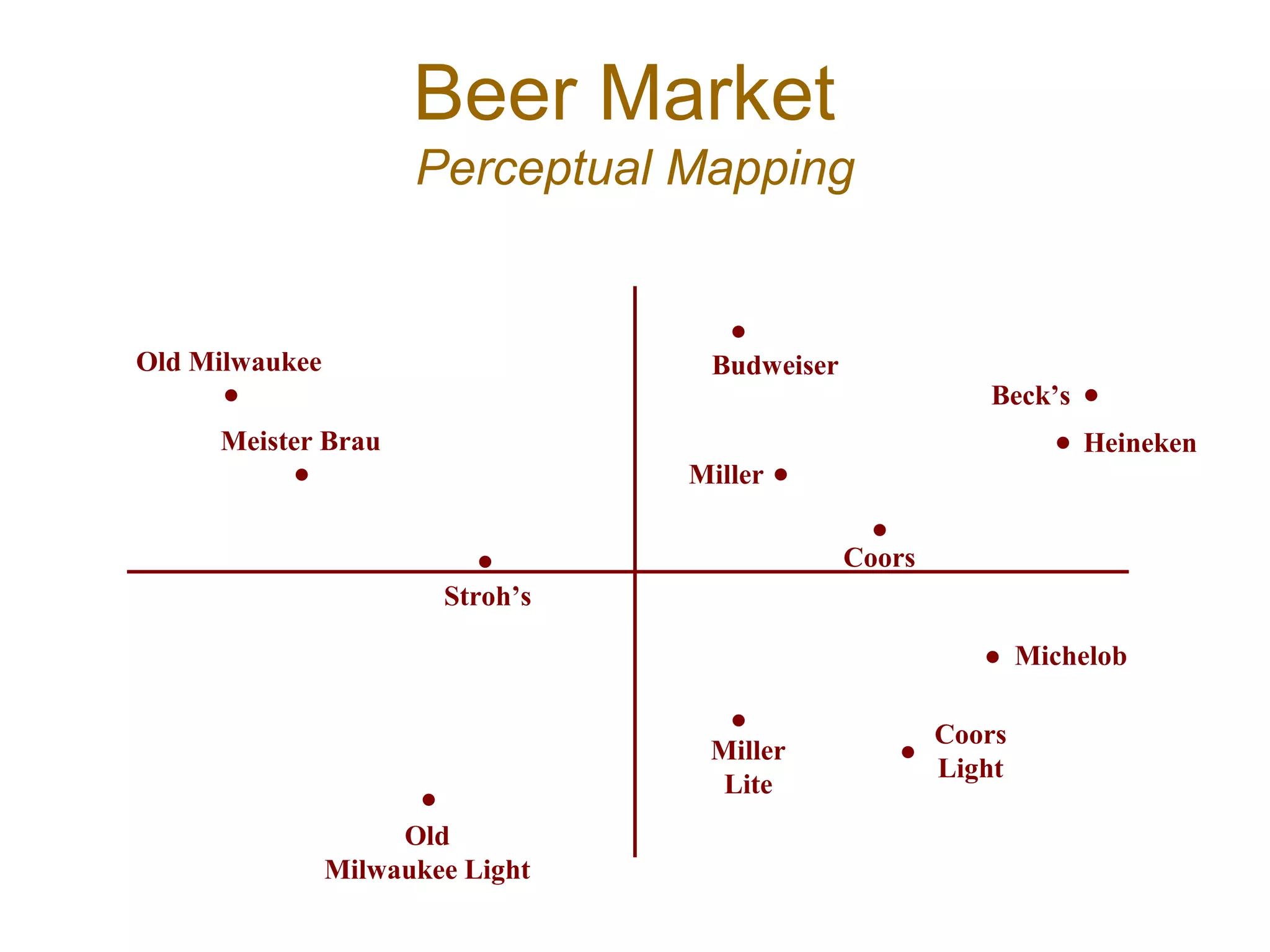
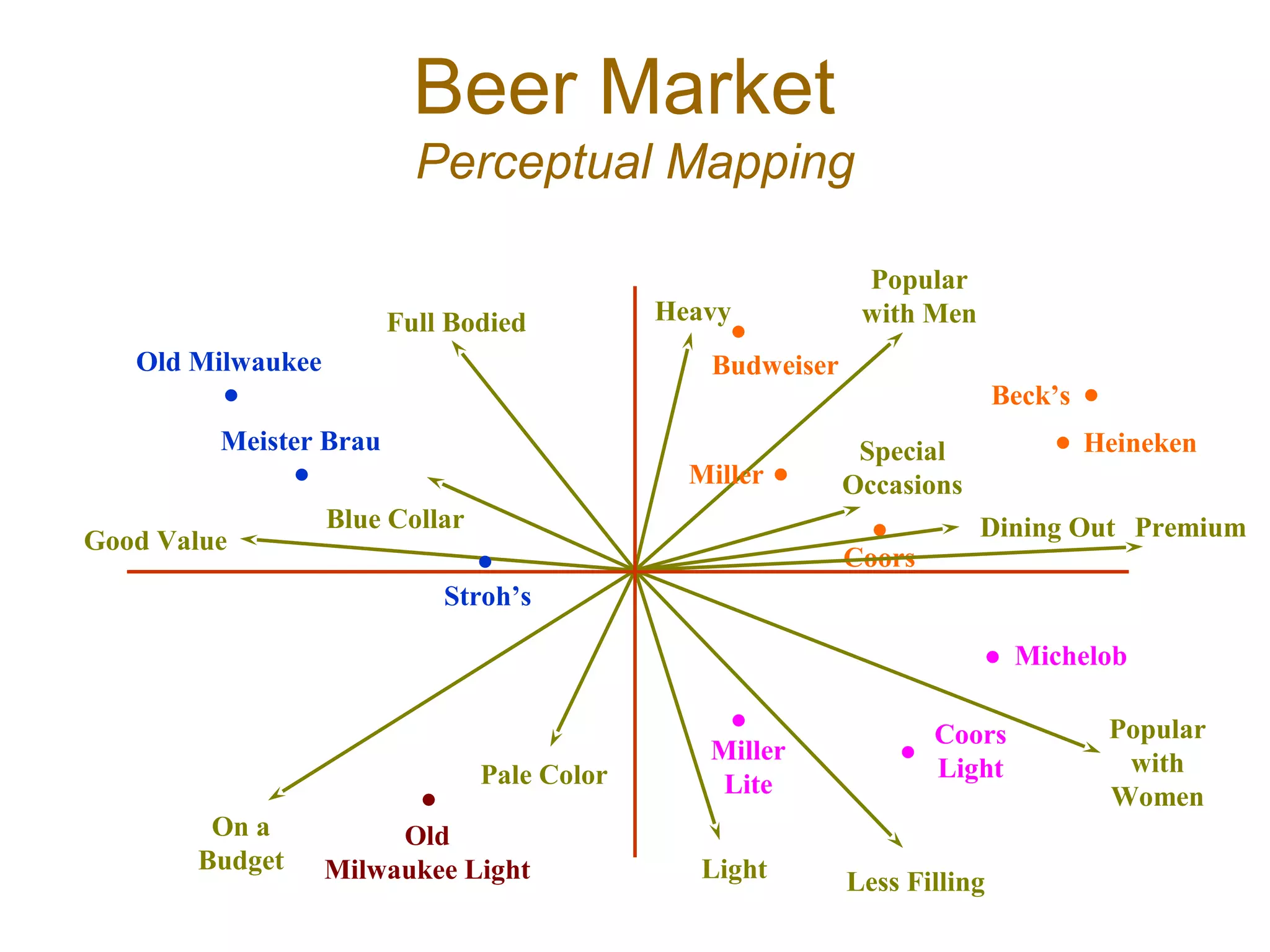
Beer Market
Perceptual Mapping
•
Meister Brau
Stroh’s
•
•
•
Beck’s
• Heineken
Old Milwaukee
•
Miller •
Coors
•
Michelob•
Miller
Lite
• Coors
Light•
Old
Milwaukee Light
•
Budweiser
•Coors
Popular
with MenHeavy
Special
Occasions
Dining Out Premium
Popular
with
Women
Light
Pale Color
On a
Budget
Good Value
Blue Collar
Full Bodied
•
Meister Brau
Stroh’s
•
•
•
Beck’s
• Heineken
Old Milwaukee
•
Miller •
Michelob•
Miller
Lite
• Coors
Light•
Old
Milwaukee Light
•
Budweiser
Less Filling
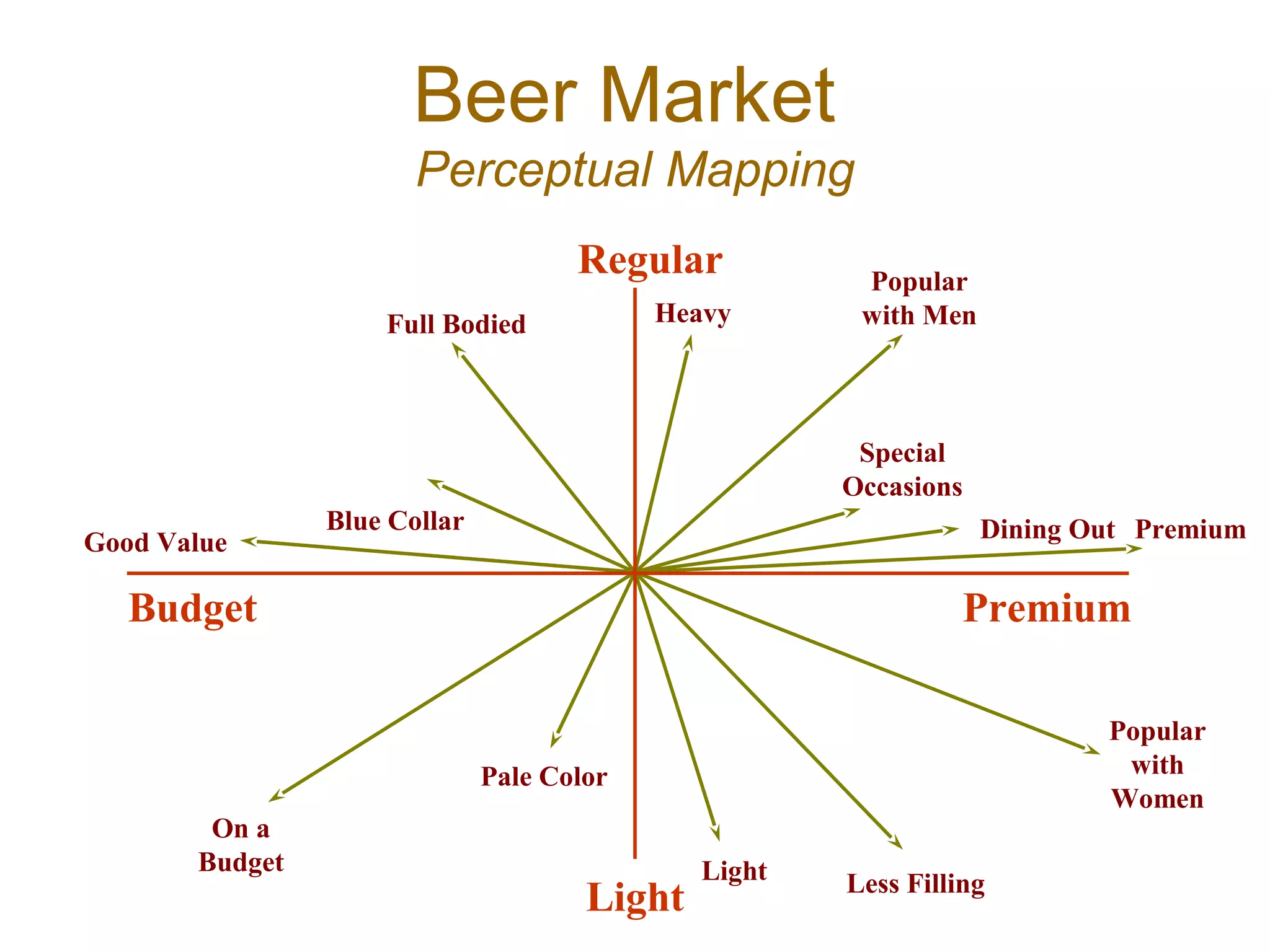
Beer Market
Perceptual Mapping
Popular
with MenHeavy
Special
Occasions
Dining Out Premium
Popular
with
Women
Light
Pale Color
On a
Budget
Good Value
Blue Collar
Full Bodied
PremiumBudget
Light
Regular
Less Filling
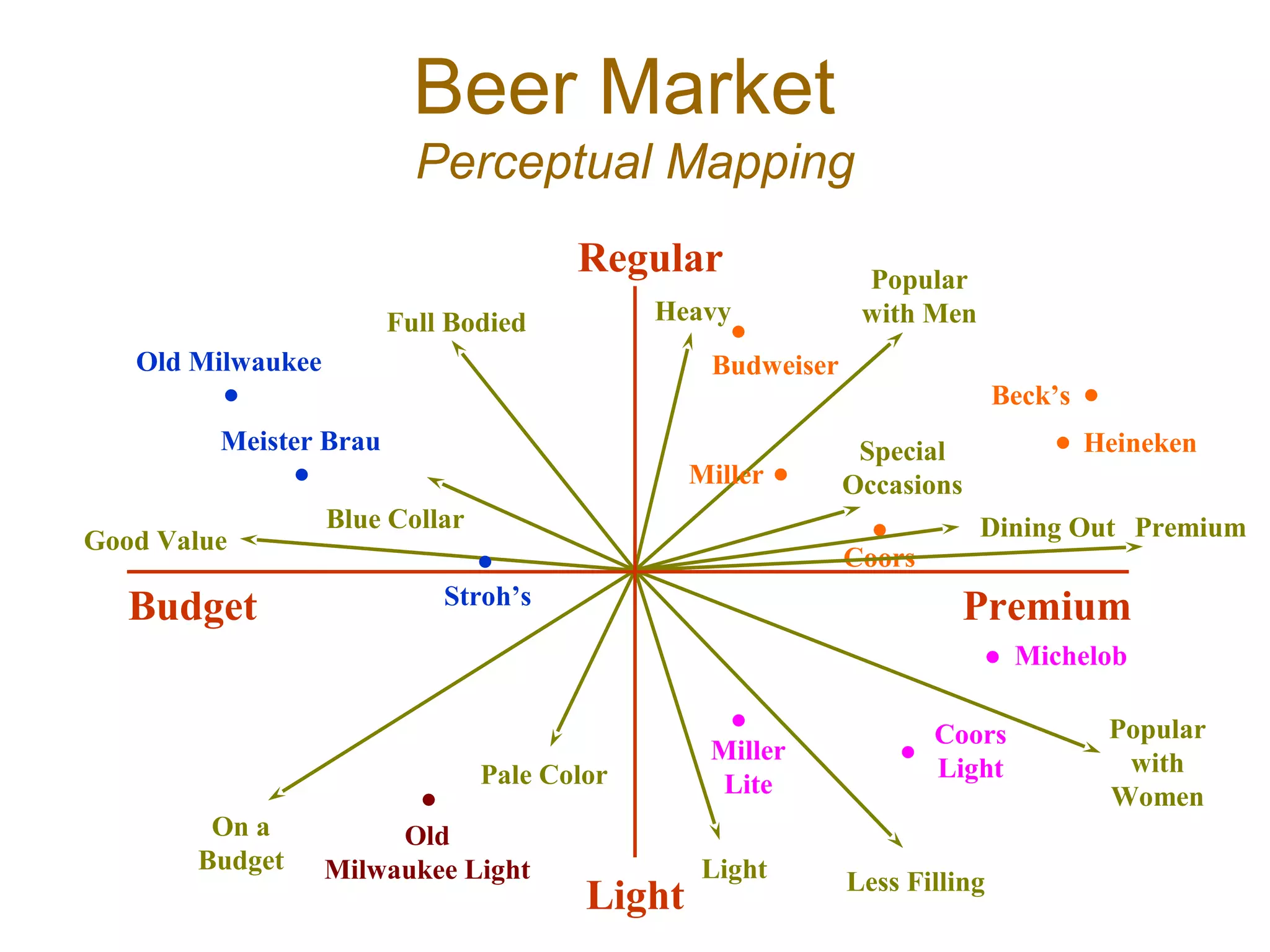
Beer Market
Perceptual Mapping
•Coors
Popular
with MenHeavy
Special
Occasions
Dining Out Premium
Popular
with
Women
Light
Pale Color
On a
Budget
Good Value
Blue Collar
Full Bodied
PremiumBudget
Light
Regular
•
Meister Brau
Stroh’s
•
•
•
Beck’s
• Heineken
Old Milwaukee
•
Miller •
Michelob•
Miller
Lite
• Coors
Light•
Old
Milwaukee Light
•
Budweiser
Less Filling
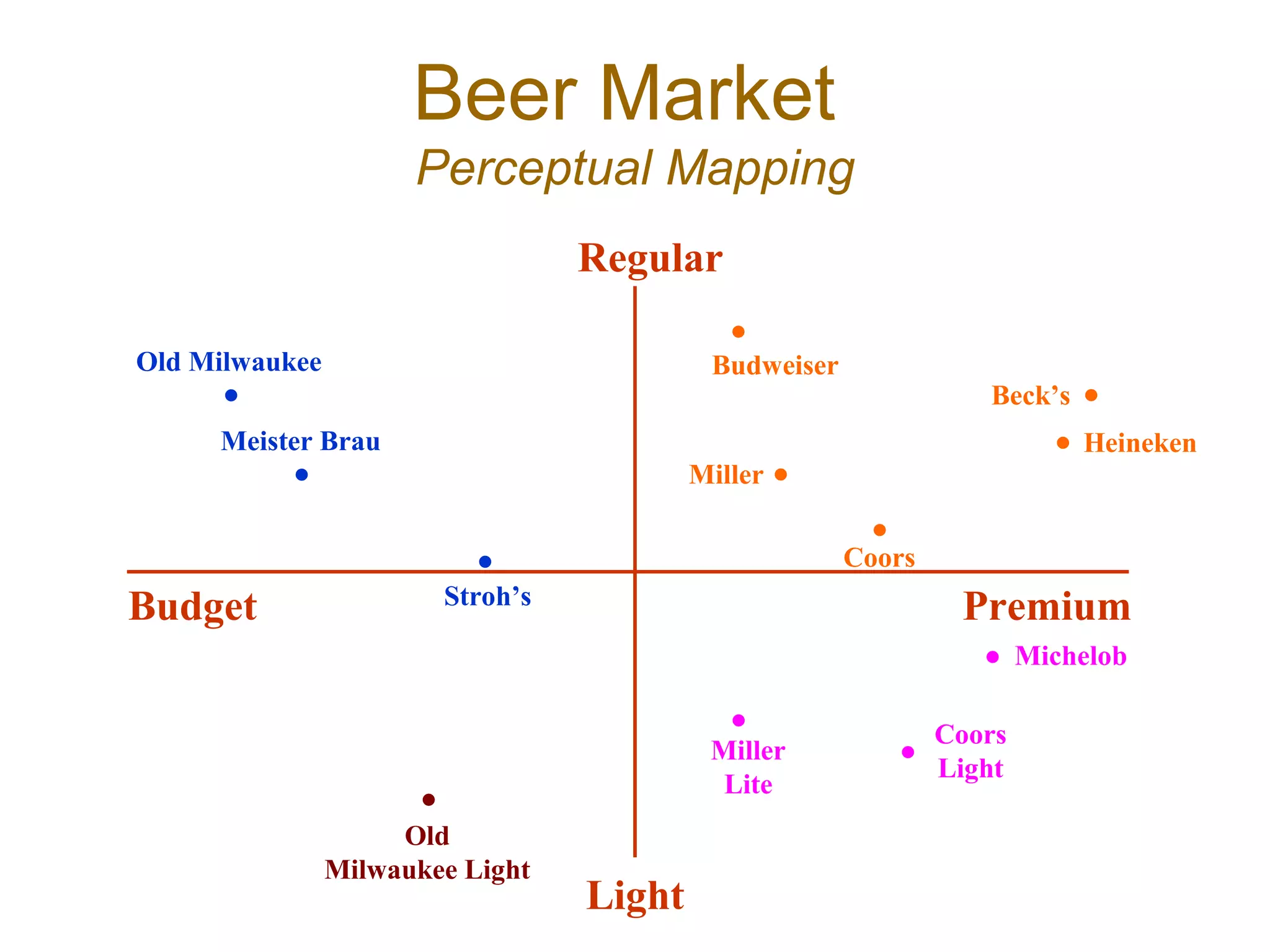
Beer Market
Perceptual Mapping
•Coors
PremiumBudget
Light
Regular
•
Meister Brau
Stroh’s
•
•
•
Beck’s
• Heineken
Old Milwaukee
•
Miller •
Michelob•
Miller
Lite
• Coors
Light•
Old
Milwaukee Light
•
Budweiser
Beer Market
Perceptual Mapping
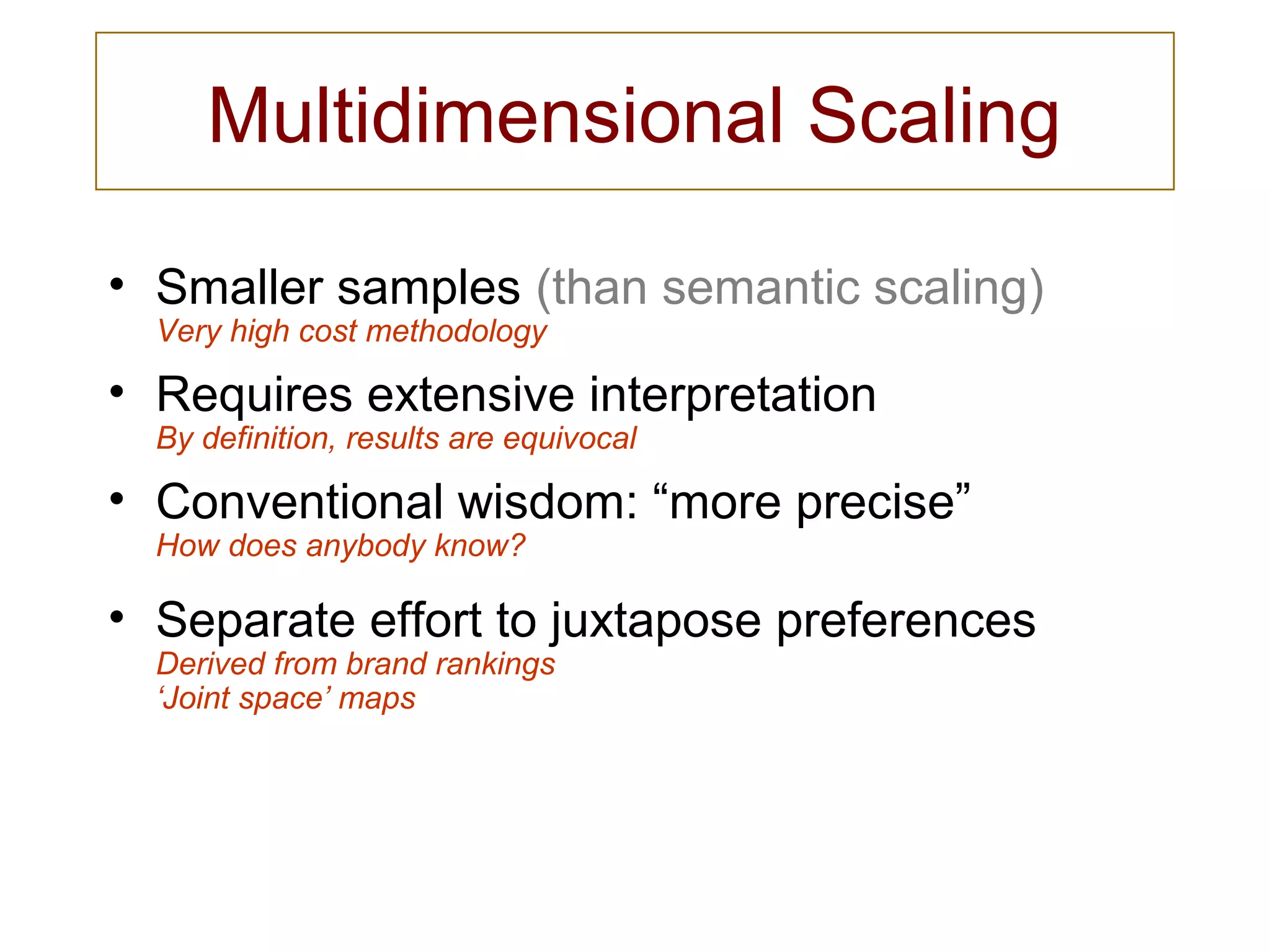
Multidimensional Scaling
• Smaller samples (than semantic scaling)
Very high cost methodology
• Requires extensive interpretation
By definition, results are equivocal
• Conventional wisdom: “more precise”
How does anybody know?
• Separate effort to juxtapose preferences
Derived from brand rankings
‘Joint space’ maps
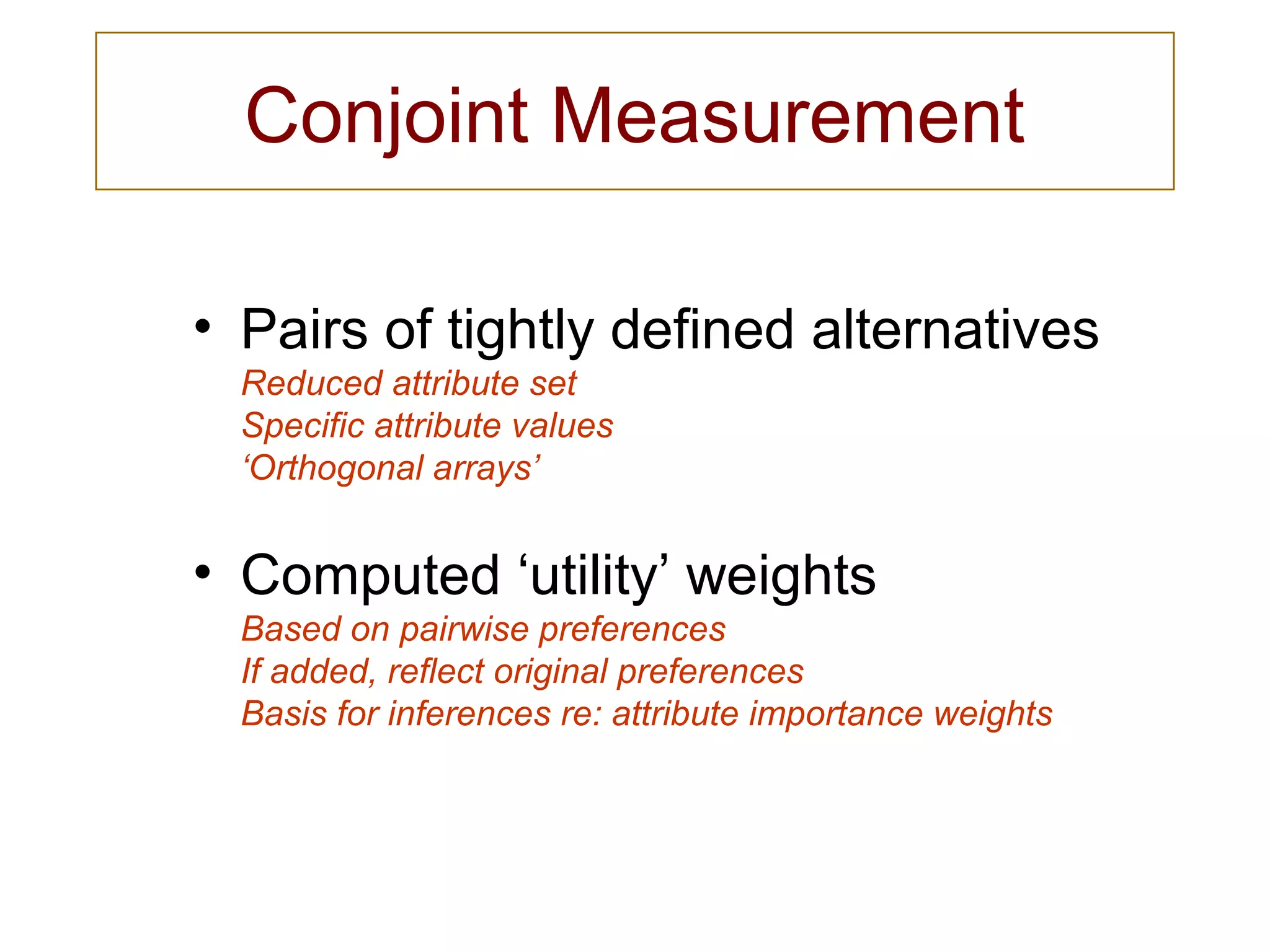
Conjoint Measurement
• Pairs of tightly defined alternatives
Reduced attribute set
Specific attribute values
‘Orthogonal arrays’
• Computed ‘utility’ weights
Based on pairwise preferences
If added, reflect original preferences
Basis for inferences re: attribute importance weights
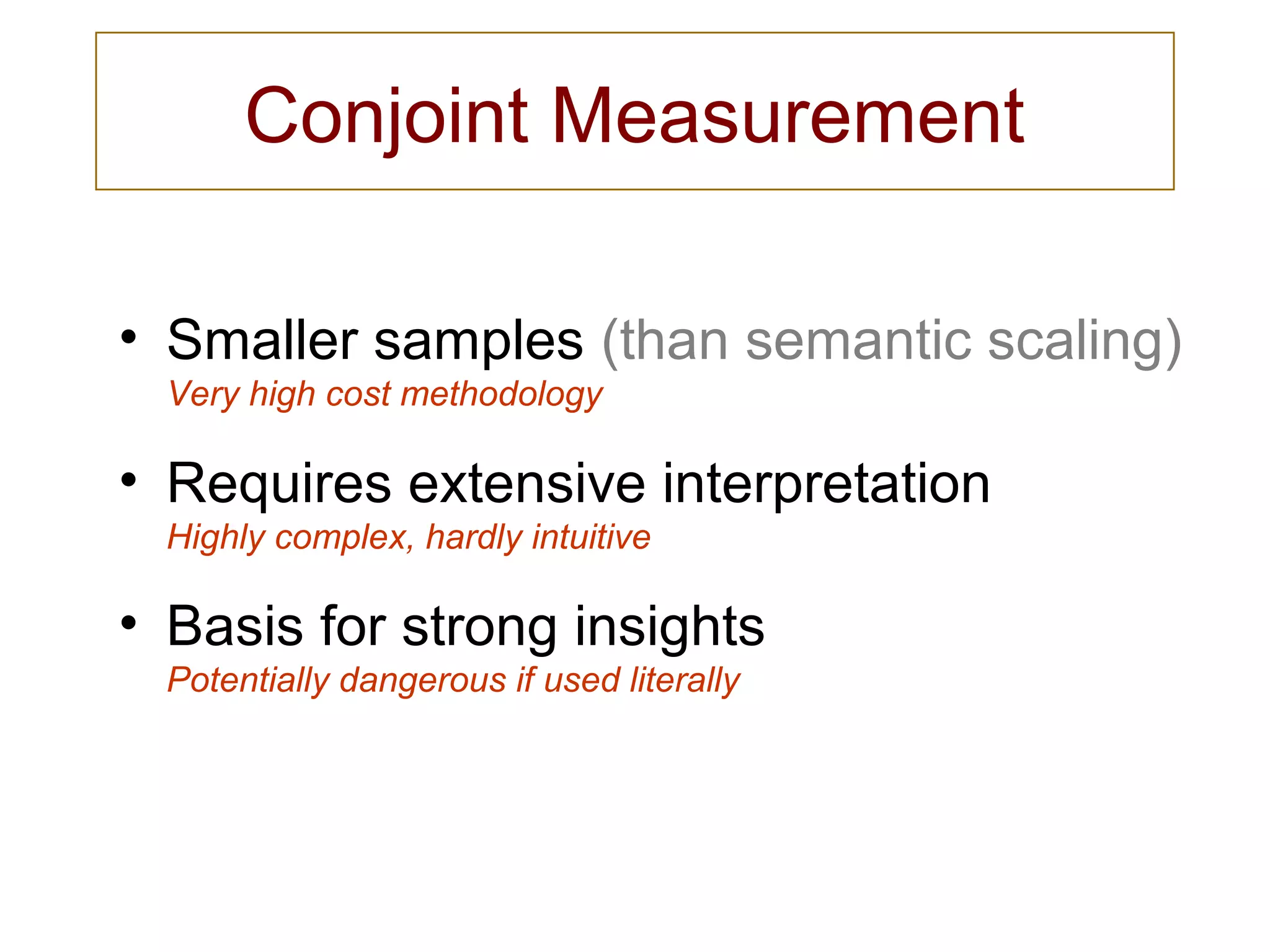
Conjoint Measurement
• Smaller samples (than semantic scaling)
Very high cost methodology
• Requires extensive interpretation
Highly complex, hardly intuitive
• Basis for strong insights
Potentially dangerous if used literally

Perceptual mapping techniques

  • 1.
  • 2.
    Perceptual Map Need 2 Need1 +20 +20 -20 -20 SELF Pr Hi Bu Si Ot SEMI SONO SOLD SUL I SAMA SUSI SALT SIBI SIRO
  • 3.
    Semantic Scaling Research Illustration •How sweet is your ideal cola ? • How important is it to you that a cola have the proper sweetness ? • How closely does brand X match to your ideal sweetness ? Very=4 Somewhat=3 Not much=2 Not at all=1
  • 4.
    Semantic Scaling • Largesamples (typically) Survey-based methodology • A priori selection of attributes Unimportant attributes get low ratings Important attributes may be overlooked overlooked • Limited rating scale Constrained upper & lower ratings Gradients may not adequately differentiate Implicitly assumes linear relationships • (Relatively) easy understand & apply
  • 5.
    1. Company providesadequate insurance coverage for my car. 2. Company will not cancel policy because of age, accident experience, or health problems. 3. Friendly and considerate. 4. Settles claims fairly. 5. Inefficient, hard to deal with. 6. Provides good advice about types and amounts of coverage to buy. 7. Too big to care about individual customers. 8. Explains things clearly. 9. Premium rates are lower than most companies. 10. Has personnel available for questions all over the country. 11. Will raise premiums because of age. 12. Takes a long time to settle a claim. 13. Very professional/modern. 14. Specialists in serving my local area. 15. Quick, reliable service, easily accessible. 16. A “good citizen” in community. 17. Has complete line of insurance products available. 18. Is widely known “name company”. 19. Is very aggressive, rapidly growing company. 20. Provides advice on how to avoid accidents. Does not Describes it describe completely it at all | | | | | | 0 1 2 3 4 5 Conventional Mapping Snake Chart
  • 6.
    1. Company providesadequate insurance coverage for my car. 2. Company will not cancel policy because of age, accident experience, or health problems. 3. Friendly and considerate. 4. Settles claims fairly. 5. Inefficient, hard to deal with. 6. Provides good advice about types and amounts of coverage to buy. 7. Too big to care about individual customers. 8. Explains things clearly. 9. Premium rates are lower than most companies. 10. Has personnel available for questions all over the country. 11. Will raise premiums because of age. 12. Takes a long time to settle a claim. 13. Very professional/modern. 14. Specialists in serving my local area. 15. Quick, reliable service, easily accessible. 16. A “good citizen” in community. 17. Has complete line of insurance products available. 18. Is widely known “name company”. 19. Is very aggressive, rapidly growing company. 20. Provides advice on how to avoid accidents. Does not Describes it describe completely it at all | | | | | | 0 1 2 3 4 5 Conventional Mapping Snake Chart
  • 7.
    Perceptual Map LowLow QualityQuality Low PriceLowPrice High PriceHigh Price HighHigh QualityQuality G C F E B D A
  • 8.
    Perceptual Map LowLow QualityQuality Low PriceLowPrice High PriceHigh Price HighHigh QualityQuality G C F E B D A VALUE
  • 9.
    Perceptual Map LowLow QualityQuality Low PriceLowPrice High PriceHigh Price HighHigh QualityQuality G C F E B D A
  • 10.
    Ideal Points • Customerperceptions • Aggregation of individuals …Distributions around points • Different shapes …Optimal points, vectors • Segment variations • Evolutionary progression …Nice to have => Must have
  • 11.
    Preference Models • Idealpoints (individuals) • Clusters (segments) • Proximity (preference)
  • 12.
    Perceptual Map LowLow QualityQuality Low PriceLowPrice High PriceHigh Price HighHigh QualityQuality G C F E B D A 1 2 3
  • 13.
    In general ... •Most of a brand’s sales will come from the segments with the closest ideal points • Most of a segment’s sales (share) will go to the brands closest to its ideal point
  • 14.
    Targeting Strategies • Directhit … single product ‘right on’ • Bracketing multiple products ‘surround’ • “Tweeners” single product ‘splitting the difference’ to induce a new segmentation
  • 15.
    Multidimensional Scaling (MDS) • Rankpairs of products (brands) by degree of similarity A is more like B than B is like C • Statistically ‘reduce’ the data to a 2-dimensional mapping Usually a ‘black box’ application • Judgmentally interpret the axes Multi-dimensionally Mix of art and science
  • 16.
    Beer Market Perceptual Mapping • MeisterBrau Stroh’s • • • Beck’s • Heineken Old Milwaukee • Miller • Coors • Michelob• Miller Lite • Coors Light• Old Milwaukee Light • Budweiser
  • 17.
    •Coors Popular with MenHeavy Special Occasions Dining OutPremium Popular with Women Light Pale Color On a Budget Good Value Blue Collar Full Bodied • Meister Brau Stroh’s • • • Beck’s • Heineken Old Milwaukee • Miller • Michelob• Miller Lite • Coors Light• Old Milwaukee Light • Budweiser Less Filling Beer Market Perceptual Mapping
  • 18.
    Popular with MenHeavy Special Occasions Dining OutPremium Popular with Women Light Pale Color On a Budget Good Value Blue Collar Full Bodied PremiumBudget Light Regular Less Filling Beer Market Perceptual Mapping
  • 19.
    •Coors Popular with MenHeavy Special Occasions Dining OutPremium Popular with Women Light Pale Color On a Budget Good Value Blue Collar Full Bodied PremiumBudget Light Regular • Meister Brau Stroh’s • • • Beck’s • Heineken Old Milwaukee • Miller • Michelob• Miller Lite • Coors Light• Old Milwaukee Light • Budweiser Less Filling Beer Market Perceptual Mapping
  • 20.
    •Coors PremiumBudget Light Regular • Meister Brau Stroh’s • • • Beck’s • Heineken OldMilwaukee • Miller • Michelob• Miller Lite • Coors Light• Old Milwaukee Light • Budweiser Beer Market Perceptual Mapping
  • 21.
    Multidimensional Scaling • Smallersamples (than semantic scaling) Very high cost methodology • Requires extensive interpretation By definition, results are equivocal • Conventional wisdom: “more precise” How does anybody know? • Separate effort to juxtapose preferences Derived from brand rankings ‘Joint space’ maps
  • 22.
    Conjoint Measurement • Pairsof tightly defined alternatives Reduced attribute set Specific attribute values ‘Orthogonal arrays’ • Computed ‘utility’ weights Based on pairwise preferences If added, reflect original preferences Basis for inferences re: attribute importance weights
  • 23.
    Conjoint Measurement • Smallersamples (than semantic scaling) Very high cost methodology • Requires extensive interpretation Highly complex, hardly intuitive • Basis for strong insights Potentially dangerous if used literally

Editor's Notes

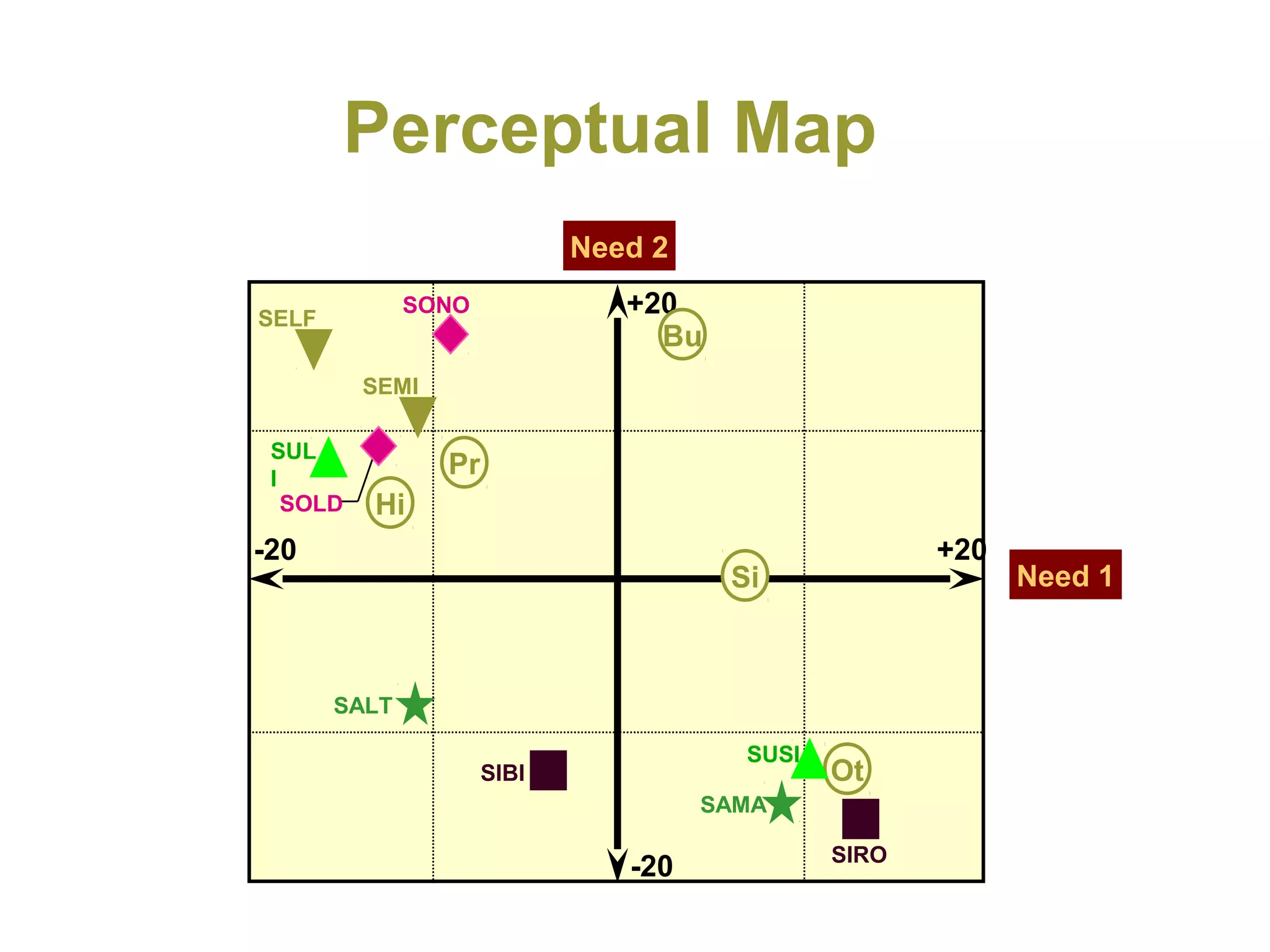
  • #3 Multidimensional scaling of brands similarities and preferences One basis for analysing the positioning of each competitive brand is the perceptual mapping of similarities and preferences based on the Multidimensional scaling study. The data are obtained through interviews with a sample of 200 individuals. This is a two-dimensional map whose axes are arbitrarily scaled from -20 to +20 and represent composite dimensions. Axis one represents the first most important need of the consumers and axis 2 the second most important need for that product category. The study will provide the best interpretation of the composite dimensions for each axis. The circles 'Bu', 'Si', 'Pr', 'Hi', and 'Ot' on the graph represent the ideal points of each of the five segments. Each circle only represents the 'center of gravity' of the whole segment. Each consumer has a different preference, however, the preferences within a segment are sufficiently similar so that the ideal point represents well the overall global preference of the segment. The various geometric shapes (square, triangle, star...) correspond to the positioning of the brands as they are perceived by the market at the time of the study. Each brand name is clearly labeled. One specific color and shape is attached to each firm (for example, all brands marketed by firm A are represented by red stars). This study differs from the semantic scales study in that the respondent is not provided with criteria to evaluate the brands. Instead, these criteria are deduced by the approach which is based on global assessment of similarities of pairs of brands. This is a complex task which necessitates a number of brands to be able to derive a solution. This study is therefore not available for the Vodite market until sufficient competing brands are marketed.