White Paper #24 


Perception: It’s Not What You Think. 
 
 
November 2013 


By:  

Garth Holloway  
Managing Director  
Sixfootfour  
Tel: +61 (0)2 9451 0707  
garthh@sixfoot4.com  
www.sixfoot4.com.au
 

Maybe each human being lives in a unique world, a private world different from those inhabited and 
experienced by all other humans…  If reality differs from person to person, can we speak of reality 
singular, or shouldn't we really be talking about plural realities? And if there are plural realities, are 
some more true (more real) than others? What about the world of a schizophrenic? Maybe it's as real 
as our world. Maybe we cannot say that we are in touch with reality and he is not, but should instead 
say, His reality is so different from ours that he can't explain his to us, and we can't explain ours to 
him. The problem, then, is that if subjective worlds are experienced too differently, there occurs a 
breakdown in communication ... and there is the real illness.”  
I read the above quote by Philip K. Dick and it reinforced how relevant perception is to change 
management and the importance of what we say and allow others to say.  
This was first highlighted to me when I was working with IBM on the Mercedes‐Benz South Africa 
business transformation project. In the early part of the project we spent considerable time 
collecting data, the bulk of which was qualitative. I asked the seasoned project manager on what 
basis we could rely on qualitative data to make far‐reaching recommendations. His reply was: if 
enough people repeat something to be true, then it is true, irrespective of the facts. In other words, 
perception is reality. 
The primary agenda of any change management program is to deliver a change in behaviour. This is 
equally true for very large programs such as national “Don’t Drink and Drive” campaigns to small 
localised programs, internal to a business, such as how to code an invoice properly. In all cases 
people only change when they perceive the need to change, and it is the change manager’s role to 
socialise a message that will create this perception at the individual level and within the crowd. 
It is not difficult to determine the view of the crowd as people will readily repeat what they perceive 
to be a commonly held truth. It is considerably more difficult to reliably determine how an individual 
perceives the world as their views are coloured by an unlimited range of personal circumstances to 
which the change manager is not privy. Consequently, it is a waste of time to try and change an 
individual’s foundation perceptions. 
Rather the change manager should focus on managing how individuals express their perception of 
the work environment and the changes within it.  
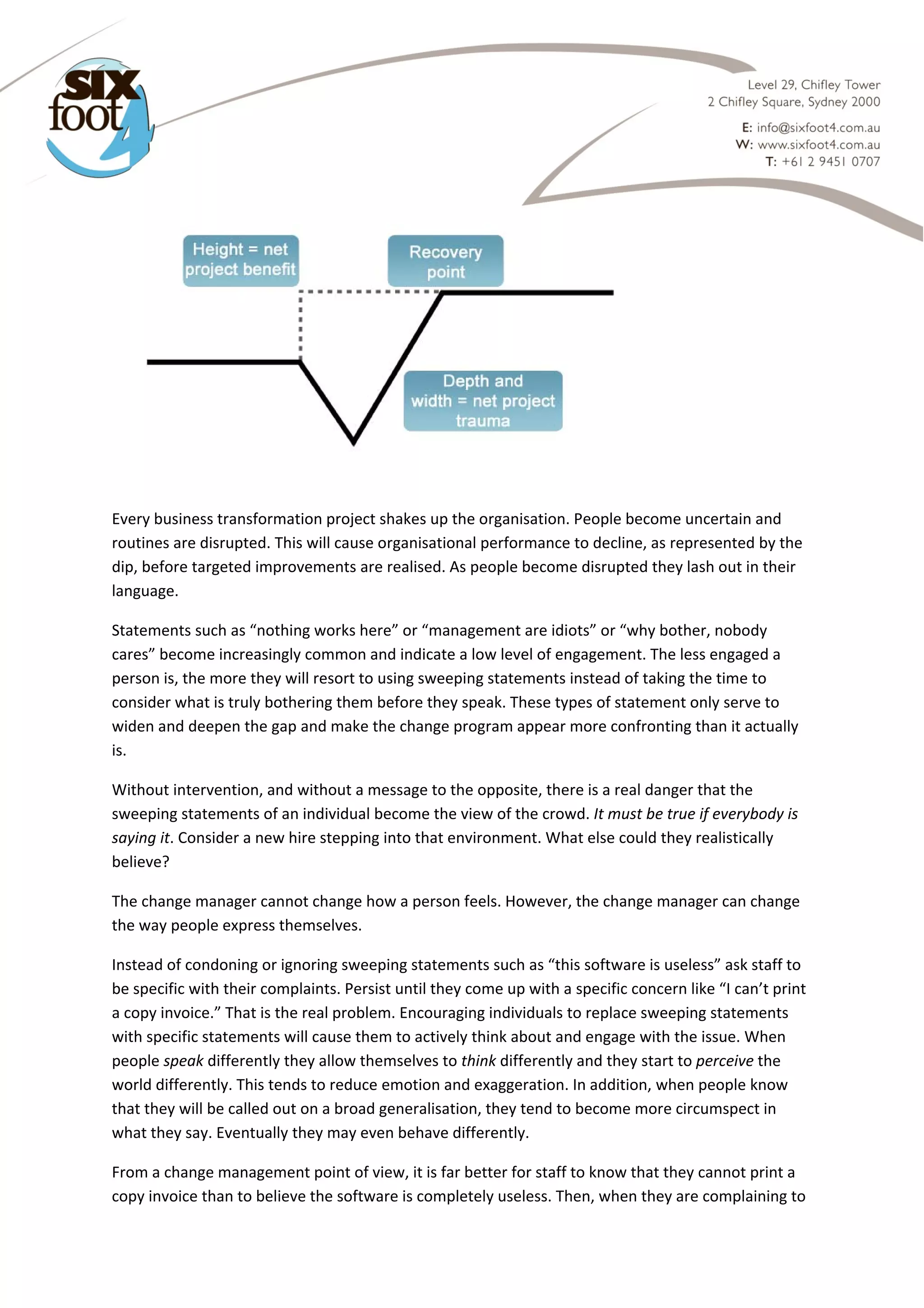
The importance of managing perception is represented by the dip in the graphic. 


Every business transformation project shakes up the organisation. People become uncertain and 
routines are disrupted. This will cause organisational performance to decline, as represented by the 
dip, before targeted improvements are realised. As people become disrupted they lash out in their 
language. 
Statements such as “nothing works here” or “management are idiots” or “why bother, nobody 
cares” become increasingly common and indicate a low level of engagement. The less engaged a 
person is, the more they will resort to using sweeping statements instead of taking the time to 
consider what is truly bothering them before they speak. These types of statement only serve to 
widen and deepen the gap and make the change program appear more confronting than it actually 
is. 
Without intervention, and without a message to the opposite, there is a real danger that the 
sweeping statements of an individual become the view of the crowd. It must be true if everybody is 
saying it. Consider a new hire stepping into that environment. What else could they realistically 
believe?  
The change manager cannot change how a person feels. However, the change manager can change 
the way people express themselves.  
Instead of condoning or ignoring sweeping statements such as “this software is useless” ask staff to 
be specific with their complaints. Persist until they come up with a specific concern like “I can’t print 
a copy invoice.” That is the real problem. Encouraging individuals to replace sweeping statements 
with specific statements will cause them to actively think about and engage with the issue. When 
people speak differently they allow themselves to think differently and they start to perceive the 
world differently. This tends to reduce emotion and exaggeration. In addition, when people know 
that they will be called out on a broad generalisation, they tend to become more circumspect in 
what they say. Eventually they may even behave differently. 
From a change management point of view, it is far better for staff to know that they cannot print a 
copy invoice than to believe the software is completely useless. Then, when they are complaining to 
 

other staff, they will be accurate and specific, not vague and inaccurate. The crowd becomes 
infected with the truth, which is, in this case, that you can’t print a copy invoice, rather than by 
broad inaccuracies about perceived deficiencies in the software. 
Only when a person changes the way they express themselves, will they really be able to change the 
way they perceive their work environment, and subsequently change the way they present 
themselves in the work environment. Occasionally you will hear that someone has had a real change 
of attitude. What this really means is that their language has changed, from negative to positive. 
When people say positive things their colleagues will respond positively.  
The same can apply to the group, but to achieve it the change manager needs to introduce a 
common vocabulary, a company lexicon. It will promote an environment where individuals use the 
same words for the same things. That way everybody knows what is meant when statements are 
made. Conversations should get shorter and the disquiet caused by miscommunication should be 
reduced. Introducing a common vocabulary is exceptionally difficult. It requires that the change 
manager has the vocabulary to start with and a mindset that realises that change management is 
not just about training people in a technical skill.  
I recognise, that despite the change manager’s best efforts, it is impossible to get everyone in an 
entire organisation to change the way they speak. The best mitigation is to introduce scorecards. 
Using a scorecard moves the conversation from subjective perceptions about what happened to 
factual data. It should cause the conversation to start with a discussion on actual business results 
rather than a particular person’s behaviour, or more importantly, the manager’s perception of the 
employee’s behaviour.  
I close with the thought that trying to manage perception is similar to standing in a hall between two 
mirrors. Each mirror reflects the other and this continues until each mirror appears to have an 
infinite number of reflections in it. These reflections represent the perceptions two people could 
have of each other. To know which two “perceptions” are active in the conversation is impossible. 


Perception it’s not what you think