White Paper #26 


Saving the Team 
December 2013 


By:   Garth Holloway  
Managing Director  
Sixfootfour  
Tel: +61 (0)2 9451 0707  
garthh@sixfoot4.com  
www.sixfoot4.com.au
One of the great projects I had the opportunity to work on was the IBM consultancy to Mercedes‐
Benz South Africa. The project managers did everything right. At the start of the project they took 
the time to properly establish a  project team  comprising of  MBSA and  IBM  staff. This included 
classroom training for the team to ensure a common approach, team‐building activities and 
engaging with the client. This foundation ensured that the project was enjoyable and rewarding. The 
hours were long as is normal on a consultancy but nobody seemed to mind. 
The  end of my involvement on  the project correlated well with my move to Australia. I made the 
final recommendations presentation to the MBSA executive team and two days later I moved to 
Australia. The presentation had gone very well and I was on a high. 
Once I found my feet in Australia, I reapplied to IBM to join the local consulting practice. My 
application was accepted and I was soon on the projects. The problem was that the projects were 
not MBSA. The teams were new, the  objectives were different, and  the  project culture was 
different. In short I was unhappy and I quit. On the MBSA project I had been part of a high‐
performing team, established over months of focused project work. I mourned for what I had left 
behind. 
As a consultant you are expected to move from project to project without difficulty, and I do it today 
without thought. What made the MBSA experience different is that I left it at the high point. I had 
delivered a successful final presentation and walked out of the boardroom, out of IBM and out of 
the country. I took no time to celebrate success with my colleagues. No time to debrief from the 
project and no time to bring closure to my role. 
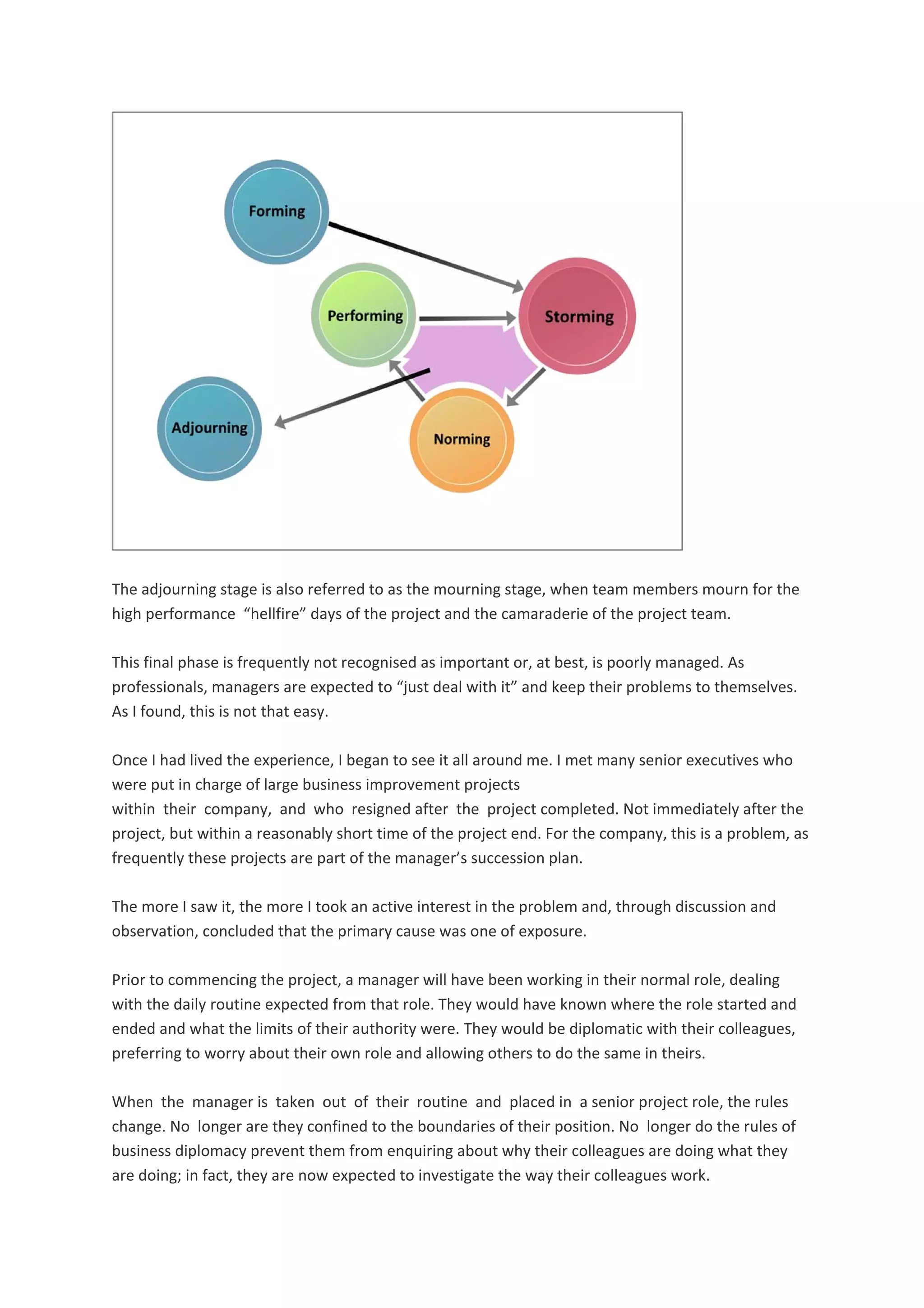
 My experience provided me with firsthand practical insight into  Dr. Bruce Tuckman’s model on 
teaming. Dr. Bruce  Tuckman   published  his  “Forming  Storming  Norming Performing” model in 
1965. He added a fifth stage, “Adjourning,” in the 1970s. Tuckman’s model explains that as a team 
develops maturity and ability, relationships establish, and the leader changes leadership style to 
further the team’s evolution. He or she begins with a directing style, moves through  coaching, 
then  participating, then  finishes delegating and ends with a style that is almost detached. At this 
point the team may produce a successor leader and the previous leader can move on to develop a 
new team. 
 
The adjourning stage is also referred to as the mourning stage, when team members mourn for the 
high performance  “hellfire” days of the project and the camaraderie of the project team. 
This final phase is frequently not recognised as important or, at best, is poorly managed. As 
professionals, managers are expected to “just deal with it” and keep their problems to themselves. 
As I found, this is not that easy. 
Once I had lived the experience, I began to see it all around me. I met many senior executives who 
were put in charge of large business improvement projects 
within  their  company,  and  who  resigned after  the  project completed. Not immediately after the 
project, but within a reasonably short time of the project end. For the company, this is a problem, as 
frequently these projects are part of the manager’s succession plan. 
The more I saw it, the more I took an active interest in the problem and, through discussion and 
observation, concluded that the primary cause was one of exposure. 
Prior to commencing the project, a manager will have been working in their normal role, dealing 
with the daily routine expected from that role. They would have known where the role started and 
ended and what the limits of their authority were. They would be diplomatic with their colleagues, 
preferring to worry about their own role and allowing others to do the same in theirs.  
When  the  manager is  taken  out  of  their  routine  and  placed in  a senior project role, the rules 
change. No  longer are they confined to the boundaries of their position. No  longer do the rules of 
business diplomacy prevent them from enquiring about why their colleagues are doing what they 
are doing; in fact, they are now expected to investigate the way their colleagues work. 
Driving a large business improvement project gives them licence to ask questions of the company 
and to review material they would not typically see in their daily role. Through the project they are 
exposed to the “soul” of the company. They are exposed to  the inadequacies of the senior 
managers. When you look into the soul of a company, you cannot forget, you cannot “un‐see” what 
you have seen. You cannot go back. The firm assumption that  senior managers know what they are 
doing becomes less firm. 
As a project lead, they are expected to think strategically and consider the big picture. This can be 
vastly different from their previous role as a silo manager. 
When the project is over, it is almost impossible for the manager to return to their old position. They 
have just spent six months or more working harder, longer, and  with more freedom than  they ever 
had before. They have had almost unlimited access to the executive team. 
In short, they are no longer the same employee as they were when they started the project and it is 
foolhardy to expect them to forget and return to the comparatively bland existence of their previous 
routine. If they are asked to, they quit. 
There is an equally dark flip side to this issue. As the manager grows in confidence through the 
project and develops their insights into the company, they become a threat to more senior 
management who don’t want their “dirty washing” exposed and don’t want the manager getting 
ahead of themselves. The end result is that the manager is forced out of the company. 
To address the issue and to save the skills within the company, senior executives  need to create a 
new role for the manager coming off the project. Invariably this requires that the company find or 
create a suitably senior role that allows the manager to come “back into” the company whilst 
respecting the journey of discovery  the manager went through over the course of the project. It  is 
important  to  recognise that  the manager who led the project is not a professional project manager 
and frequently they wish to keep their line management career intact. 
The same issues exist for more junior staff members seconded to projects to work with consultants, 
either as subject matter experts or as a general project resource. These employees are also exposed 
to company details they would not normally see and witness or participate in conversations with the 
consultants that discuss the failings of the company. Under the influence of this often negative 
messaging, they start to see their managers in a different light. They will also start to work longer 
hours than their colleagues. As an individual, they will grow in confidence and as part of a team, they 
start to “perform.” 
Project staff do not expect to get promoted when a project ends, but they do expect to be 
recognised for their contribution and to this end it is important to hold structured celebratory events 
to recognise the project and individual efforts. Failure to recognise an individual’s  contribution will 
almost certainly cause the staff member to  become disillusioned with the company. They will feel as 
if they have become an expendable commodity and not a valuable contributor to the company. 
It is unlikely that they will resign, but it reasonable to expect that they will be less engaged with the 
company. This feeling of isolation can be amplified if the project has caused them to drift apart from 
their colleagues. Before they could gossip and share information. Now that they have had  access 
to  confidential information, they cannot  share information and invariably this creates distance 
between themselves and their colleagues. 
There is no easy remedy for this problem. The most successful mitigation strategy is to agree the 
post‐project role description for the employee before the  project starts. The  new role should 
stretch the  employee more than the project did. In this way they will rely on skills they learnt 
through the project and will not have time to mourn the end of the project. Done well, the 
employee will hardly notice the change. 
An equally viable strategy and similar to  the above, is to  ensure the employee has a structured 
succession or  career development plan in place. This plan should supersede the project enabling the 
employee to contextualise the project as part of their greater development program. In this case, it 
is expected that the employee will come off the project requiring  less 
structured  support  for  their  re‐assimilation into  the business‐as‐usual routine. Their period of 
mourning should be reduced but it is unlikely to be removed altogether. 
Both of these strategies will be of immense benefit if the company works with the consultancy from 
the beginning to agree how the consultants should  develop the employee. This  will includes 
activities such  as allowing the employee to deliver important presentations through the course of 
the project. 
In closing, I note that the above observations and strategies are general in their nature and will assist 
executives  and managers to retain staff, but when it comes to human nature, each person is 
different and has different needs. Those staff who are in “deep mourning” will require a re‐
assimilation strategy personalised to their specific needs. 
 

Saving the team