Organizing for Societal Security and 
Crisis Management: Building Goverance 
Capacity and Legitimacy (GOVCAP) 
New trends in societal security research in 
the Nordic countries 
Stockholm, November 26-27 2014 
1
The research project 
• Funded by the Norwegian Research Council 
• Four year project. 2014-2018. Started 
September 1 2014 
• Overall budget: NOK 10 millions (1,3 mill EUR) 
• Project administrator: Uni Rokkan Centre, in 
collaboration with Department of 
administration and organization theory, 
University of Bergen 
• Project leader Per Lægreid, project manager Lise 
H. Rykkja 
2
Project participants 
• Jacob Aars, Dag Arne Christensen, Tom 
Christensen 
• International partners: Werner Jann, 
Potsdam, Martin Lodge, LSE, Arjen Boin, 
Leiden; Martin Marcussen, Copenhagen, 
Fredrik Bynander, Stockholm 
• Affiliated: two PhD students, master 
students, 
3
Main focus 
• Public adminsitration 
• The authorities capacity for crisis 
management and the citizens’ trust in 
government 
• A comparative design: Norway, Sweden, 
Denmanrk, Netherland, Germany, UK 
4
Research questions 
• What makes a well performing governmental 
system for societal security and crisis 
management? 
– How to manage and build capacity and 
legitimacy to handle transboundary crises? 
– What are the relations between government 
capacity, performance and public perceptions? 
5
Theses 
• Organizational capacity as well as legitimacy is 
needed for a well performing administrative structure 
• Organizational arrangements will affect performance 
• There is no one best organizational solution for crisis 
management 
• Context matters for crisis response 
– type of crisis 
– country features (polity, administrative culture) 
– Risk and vulnerability assessments 
– Citizens’ perceptions of governance performance 
6
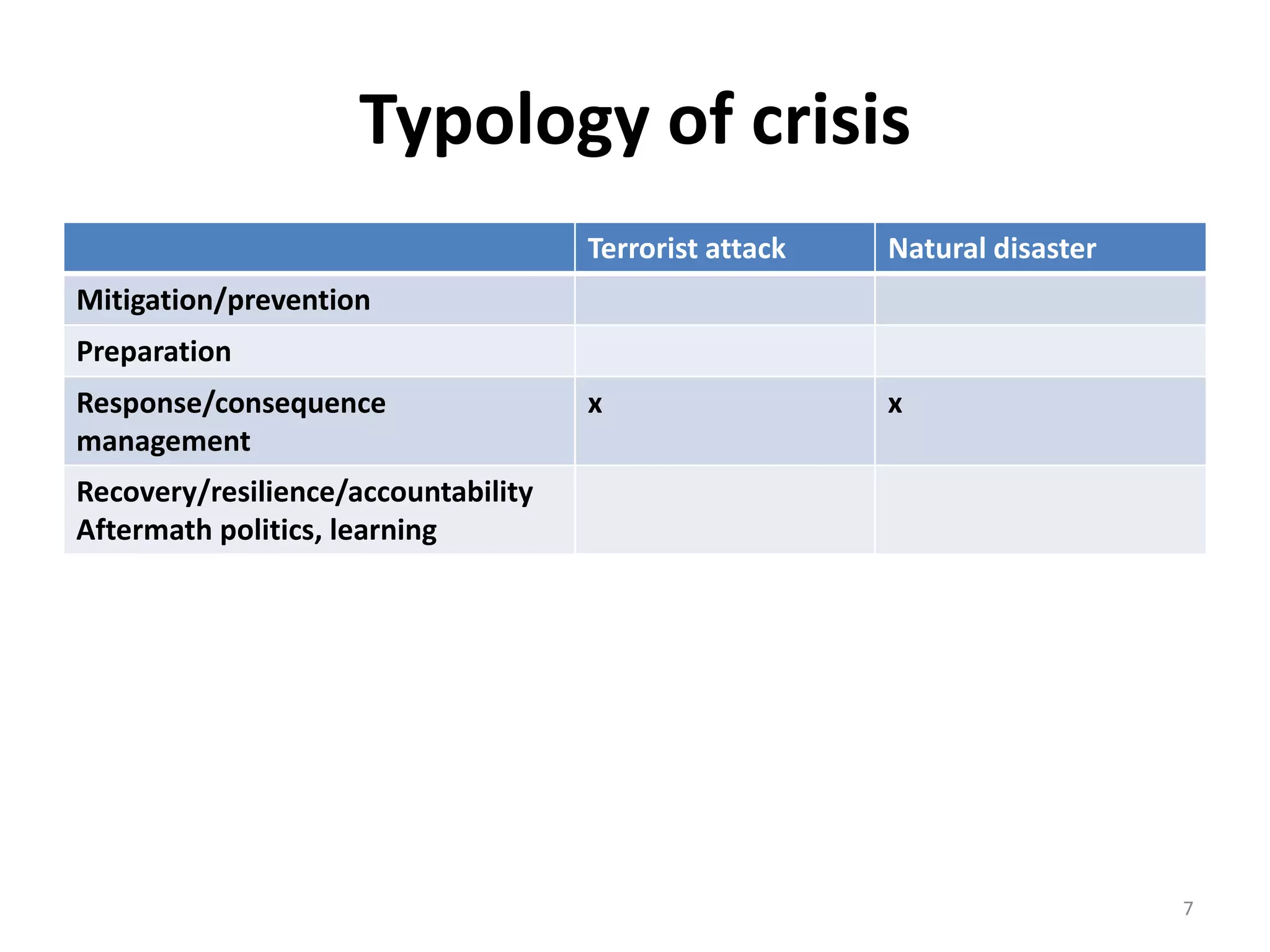
Typology of crisis 
Terrorist attack Natural disaster 
Mitigation/prevention 
Preparation 
Response/consequence 
management 
x x 
Recovery/resilience/accountability 
Aftermath politics, learning 
7
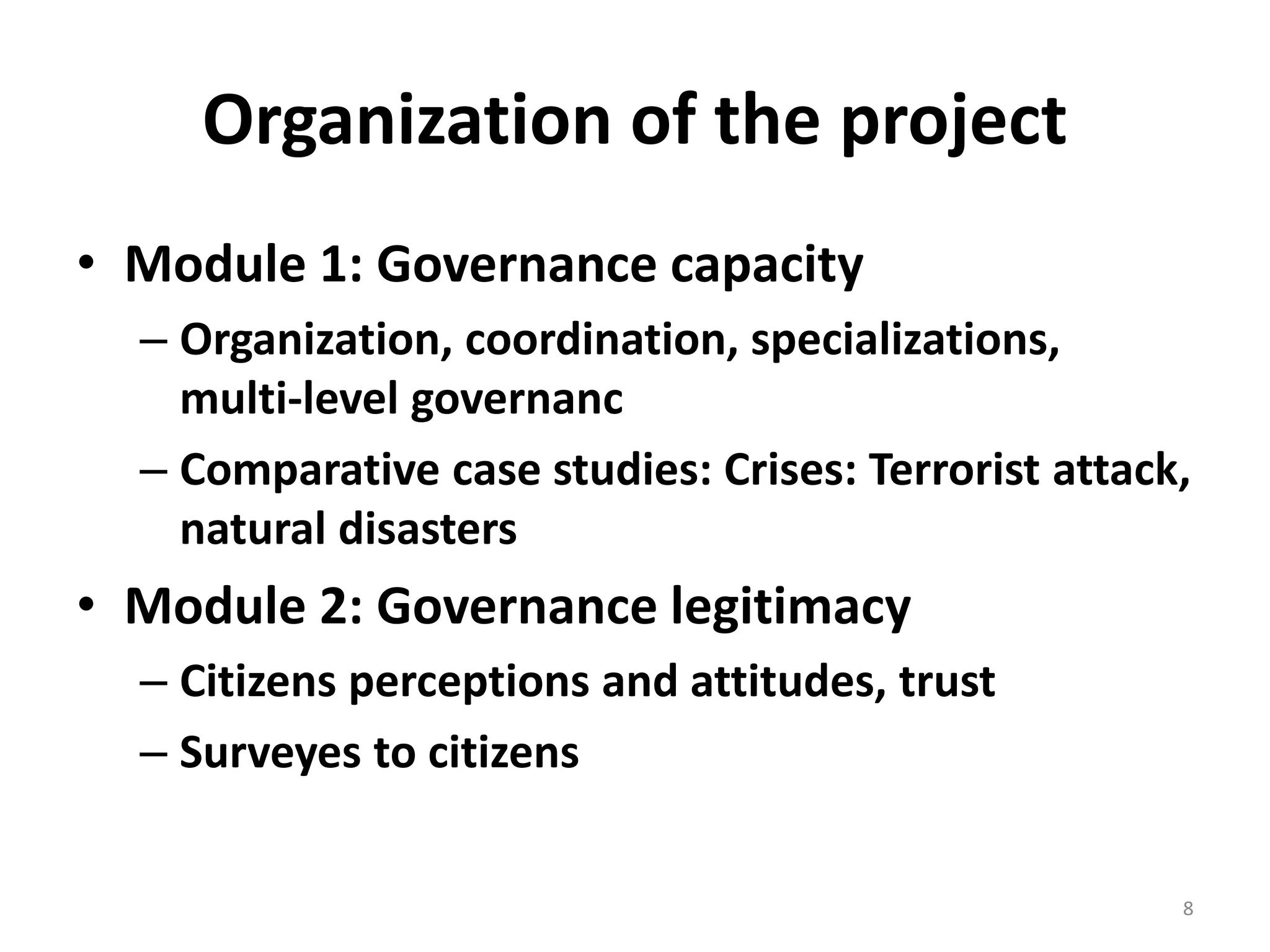
Organization of the project 
• Module 1: Governance capacity 
– Organization, coordination, specializations, 
multi-level governanc 
– Comparative case studies: Crises: Terrorist attack, 
natural disasters 
• Module 2: Governance legitimacy 
– Citizens perceptions and attitudes, trust 
– Surveyes to citizens 
8
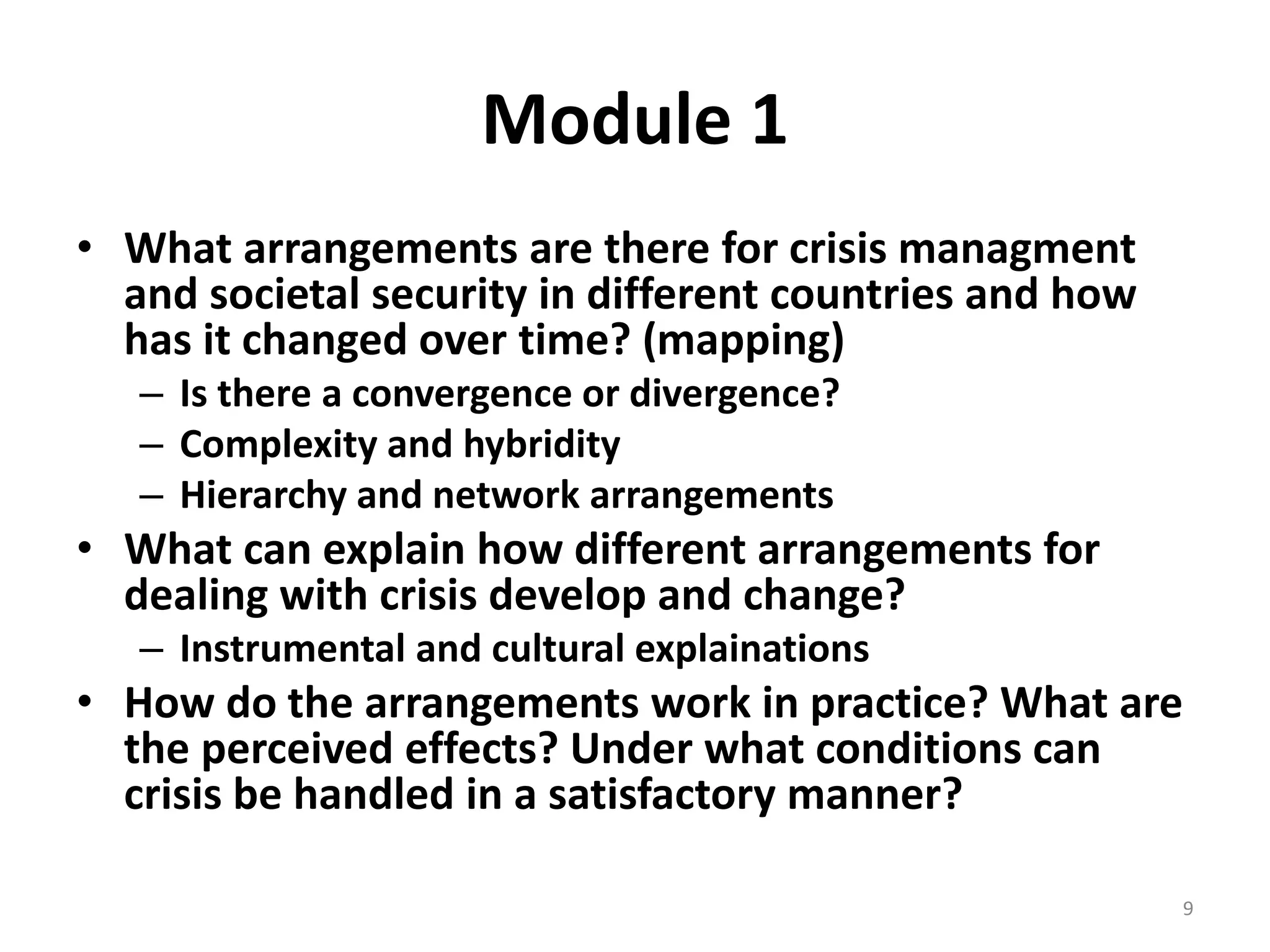
Module 1 
• What arrangements are there for crisis managment 
and societal security in different countries and how 
has it changed over time? (mapping) 
– Is there a convergence or divergence? 
– Complexity and hybridity 
– Hierarchy and network arrangements 
• What can explain how different arrangements for 
dealing with crisis develop and change? 
– Instrumental and cultural explainations 
• How do the arrangements work in practice? What are 
the perceived effects? Under what conditions can 
crisis be handled in a satisfactory manner? 
9
Module 2 
• How to balance individual freedom and societal 
security 
– To what extent is security and civil liberties traded 
off against each other in different contexts? 
• Governance representativity. Citizens trust in 
government 
• How do crises affect the legitimacy, reputation 
and trust in the relevant government 
institutions? 
• What can explain variations? 
10
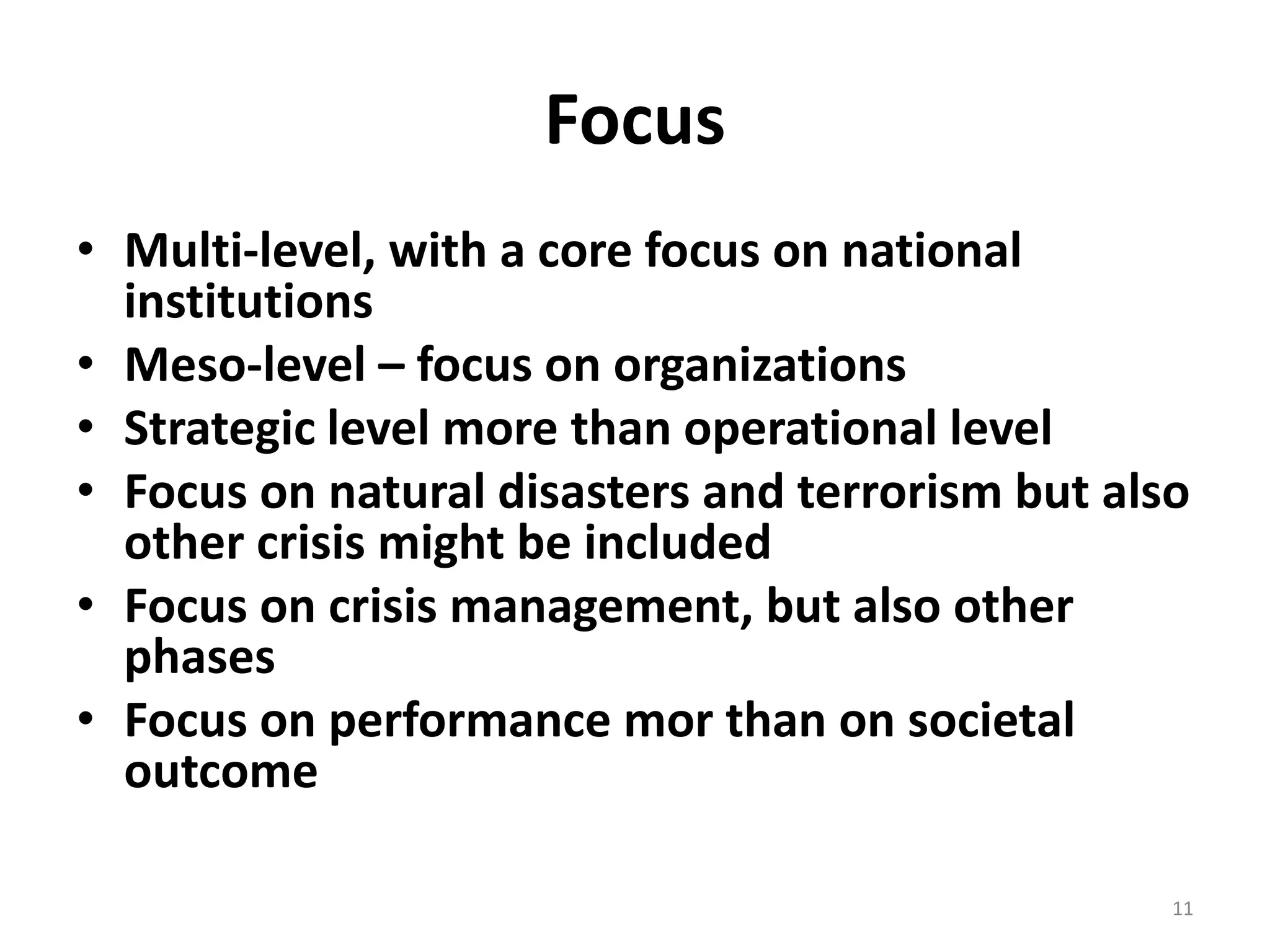
Focus 
• Multi-level, with a core focus on national 
institutions 
• Meso-level – focus on organizations 
• Strategic level more than operational level 
• Focus on natural disasters and terrorism but also 
other crisis might be included 
• Focus on crisis management, but also other 
phases 
• Focus on performance mor than on societal 
outcome 
11
Litteratur 
• Fimreite, A.L., P. Lango, P. Lægreid og L.H. Rykkja, red. (2014). Organisering, Samfunnssikkerhet og krisehåndtering. 2. utgåve. Oslo: 
Universitetsforlaget. 
• Fimreite, A.L., P. Lango, P. Lægreid and L.H. Rykkja (2012). «»22.juli kommisjonen. Organisering, styring og ansvar». Nordiske 
Organisasjonsstudier, 14(4): 49-58. 
• Lango, P., P. Lægreid and L.H. Rykkja (2013). «Samordning for samfunnsikkerhet: Utviklingen av Justisdepartementets 
samordningsansvar». Nordiske Organisasjonsstudier , 15 (3): 7-33. 
• Christensen, T., P. Lægreid and L.H. Rykkja (2013) «After a Terrorist Attack: Challenges for Political and Administrative Leadership in 
Norway». Journal of Contingencies and Crisis Management., 21 (3)167-177. 
• Fimreite,A.L., P. Lango, P. Lægreid and L.H. Rykkja (2013). «After Oslo and Utøya: A Shift in the balance between Security and Liberty 
in Norway?». Studies in Conflict and Terrorism, 36 (10): 839-856. 
• Christensen, T., P. Lægreid and L.H., Rykkja (2014) «Ambiguitets of Accountability – analyzing the Failure of a Preventive Security 
Project in Norway». Under review. 
• Christensen, T., P. Lægreid and L.H. Rykkja (2014). «The challenges of Coordination in National Security Management – the case of 
the Terrorist Attack in Norway». International Review of Administrative Sciences (forthcoming). 
• Christensen, T. and P. Lægreid “Reputation management in times of crisis – how the police handled the Norwegian terrorist attack in 
2011” . In M. Major and A. Wæraas, eds. Organizational Reputation in the Public Sector. London: Routledge (forthcoming). 
• Christensen, T., O.A. Danielsen, P. Lægreid and L.H. Rykkja: “The Governance of Wicked Issues: A Comparative analysis of 
Coordination for Societal security in Europe,). Presented at the IPSA World Conference in Montreal, July 20-24 2014. 
• Christensen, T., P. Lægreid and L. H. Rykkja: ” Organizing for Crises Management: Building Governance Capacity and Legitimacy” 
Paper prsented the International Conference on ‘Next Steps for Public Administration in Theory and Practice: Looking Backward and 
Moving Forward’, November 16–18, 2014 Sun Yat-sen University, Guangzhou, China. 
• Lægreid, P. and L. H. Rykkja: “Governance for Complexity – How to organize for the handling of wicked issues. The case of internal 
security and the welfare administration in Norway”. Paper presented at the Policy & Politics Conference, Bristol September 16-17 
2014. 
12
Project Home Page 
• http://rokkan.uni.no/sites/govcap/ 
13

Per lagræd. govcap

  • 1.
    Organizing for SocietalSecurity and Crisis Management: Building Goverance Capacity and Legitimacy (GOVCAP) New trends in societal security research in the Nordic countries Stockholm, November 26-27 2014 1
  • 2.
    The research project • Funded by the Norwegian Research Council • Four year project. 2014-2018. Started September 1 2014 • Overall budget: NOK 10 millions (1,3 mill EUR) • Project administrator: Uni Rokkan Centre, in collaboration with Department of administration and organization theory, University of Bergen • Project leader Per Lægreid, project manager Lise H. Rykkja 2
  • 3.
    Project participants •Jacob Aars, Dag Arne Christensen, Tom Christensen • International partners: Werner Jann, Potsdam, Martin Lodge, LSE, Arjen Boin, Leiden; Martin Marcussen, Copenhagen, Fredrik Bynander, Stockholm • Affiliated: two PhD students, master students, 3
  • 4.
    Main focus •Public adminsitration • The authorities capacity for crisis management and the citizens’ trust in government • A comparative design: Norway, Sweden, Denmanrk, Netherland, Germany, UK 4
  • 5.
    Research questions •What makes a well performing governmental system for societal security and crisis management? – How to manage and build capacity and legitimacy to handle transboundary crises? – What are the relations between government capacity, performance and public perceptions? 5
  • 6.
    Theses • Organizationalcapacity as well as legitimacy is needed for a well performing administrative structure • Organizational arrangements will affect performance • There is no one best organizational solution for crisis management • Context matters for crisis response – type of crisis – country features (polity, administrative culture) – Risk and vulnerability assessments – Citizens’ perceptions of governance performance 6
  • 7.
    Typology of crisis Terrorist attack Natural disaster Mitigation/prevention Preparation Response/consequence management x x Recovery/resilience/accountability Aftermath politics, learning 7
  • 8.
    Organization of theproject • Module 1: Governance capacity – Organization, coordination, specializations, multi-level governanc – Comparative case studies: Crises: Terrorist attack, natural disasters • Module 2: Governance legitimacy – Citizens perceptions and attitudes, trust – Surveyes to citizens 8
  • 9.
    Module 1 •What arrangements are there for crisis managment and societal security in different countries and how has it changed over time? (mapping) – Is there a convergence or divergence? – Complexity and hybridity – Hierarchy and network arrangements • What can explain how different arrangements for dealing with crisis develop and change? – Instrumental and cultural explainations • How do the arrangements work in practice? What are the perceived effects? Under what conditions can crisis be handled in a satisfactory manner? 9
  • 10.
    Module 2 •How to balance individual freedom and societal security – To what extent is security and civil liberties traded off against each other in different contexts? • Governance representativity. Citizens trust in government • How do crises affect the legitimacy, reputation and trust in the relevant government institutions? • What can explain variations? 10
  • 11.
    Focus • Multi-level,with a core focus on national institutions • Meso-level – focus on organizations • Strategic level more than operational level • Focus on natural disasters and terrorism but also other crisis might be included • Focus on crisis management, but also other phases • Focus on performance mor than on societal outcome 11
  • 12.
    Litteratur • Fimreite,A.L., P. Lango, P. Lægreid og L.H. Rykkja, red. (2014). Organisering, Samfunnssikkerhet og krisehåndtering. 2. utgåve. Oslo: Universitetsforlaget. • Fimreite, A.L., P. Lango, P. Lægreid and L.H. Rykkja (2012). «»22.juli kommisjonen. Organisering, styring og ansvar». Nordiske Organisasjonsstudier, 14(4): 49-58. • Lango, P., P. Lægreid and L.H. Rykkja (2013). «Samordning for samfunnsikkerhet: Utviklingen av Justisdepartementets samordningsansvar». Nordiske Organisasjonsstudier , 15 (3): 7-33. • Christensen, T., P. Lægreid and L.H. Rykkja (2013) «After a Terrorist Attack: Challenges for Political and Administrative Leadership in Norway». Journal of Contingencies and Crisis Management., 21 (3)167-177. • Fimreite,A.L., P. Lango, P. Lægreid and L.H. Rykkja (2013). «After Oslo and Utøya: A Shift in the balance between Security and Liberty in Norway?». Studies in Conflict and Terrorism, 36 (10): 839-856. • Christensen, T., P. Lægreid and L.H., Rykkja (2014) «Ambiguitets of Accountability – analyzing the Failure of a Preventive Security Project in Norway». Under review. • Christensen, T., P. Lægreid and L.H. Rykkja (2014). «The challenges of Coordination in National Security Management – the case of the Terrorist Attack in Norway». International Review of Administrative Sciences (forthcoming). • Christensen, T. and P. Lægreid “Reputation management in times of crisis – how the police handled the Norwegian terrorist attack in 2011” . In M. Major and A. Wæraas, eds. Organizational Reputation in the Public Sector. London: Routledge (forthcoming). • Christensen, T., O.A. Danielsen, P. Lægreid and L.H. Rykkja: “The Governance of Wicked Issues: A Comparative analysis of Coordination for Societal security in Europe,). Presented at the IPSA World Conference in Montreal, July 20-24 2014. • Christensen, T., P. Lægreid and L. H. Rykkja: ” Organizing for Crises Management: Building Governance Capacity and Legitimacy” Paper prsented the International Conference on ‘Next Steps for Public Administration in Theory and Practice: Looking Backward and Moving Forward’, November 16–18, 2014 Sun Yat-sen University, Guangzhou, China. • Lægreid, P. and L. H. Rykkja: “Governance for Complexity – How to organize for the handling of wicked issues. The case of internal security and the welfare administration in Norway”. Paper presented at the Policy & Politics Conference, Bristol September 16-17 2014. 12
  • 13.
    Project Home Page • http://rokkan.uni.no/sites/govcap/ 13