SAMRISK II project: 
New Strains of Society – Hidden, Dynamic 
and Emergent Vulnerabilities 
SINTEF Technology and Society 
NordForsk Conference 
New trends in societal security research 
in the Nordic countries 
26-27 November 2014, Stockholm 
1 
Tor Olav Grøtan 
Senior Research Scientist 
Dpt of Safety Research 
tor.o.grotan@sintef.no
SINTEF Technology and Society 
• Participants 
• SINTEF Technology and Society, Safety Research 
• The Norwegian University of Science and Technology (NTNU) 
• University of Tulsa, USA 
• Forsvarets Forskningsinstitutt (FFI) 
• ….. 
• Budget: 7MNOK from SAMRISK II 
• Duration: 2014-17 
• Project management SINTEF 
• Fred Størseth (fred.storseth@sintef.no) 
2 
The project
• Adressing vulnerabilities that may be "unknown" in any sense: 
• Ignored – forgotten - never contemplated - impossible to identify - misunderstood or 
underestimated – stemming from emergence, rupture, discontinuity, variability, etc - 
• Presumed impact; society (as a whole) under enormous strain 
• Will the (beliefs in the) institutions endure the strain? 
• The deafening silence from missing answers – or unrealistic assumptions? 
• Will the public still be comforted by "we will revise our routines"? 
• Armed police in Norway November 2014 – of course (?) 
SINTEF Technology and Society 
• Drivers, e.g., 
• New forms of crime - safety & security – climate change , ++ 
• Dependencies, dynamics and dynamism between systems and domains 
• Need for new foci, e.g. 
• From threat pictures to threat landscapes 
• Vulnerability patterns 
3 
New Strains of Society – Hidden, Dynamic and Emergent 
Vulnerabilities
SINTEF Technology and Society 
• A "shrinking" world 
• Where are the boundaries between society and systems? How do multiple systems 
cohere? How can vulnerabilities be identified? Can we see it as an "ecology"? E.g. 
• Safety/security "mindsets" as "industrial enclaves" in an open/dynamic society? 
• 9/11 signifies a crossroad, a new epoch, a rupture/discontinuity 
• Malicious, intended action; terror: A continual, persistent but unspecified threat 
• What is the impact on society, what is the strain? 
• ICT as a central analytical dimension: "the world connected through it" 
• Vulnerabilities when ICT fail 
• Failure, breakdown, disturbance (maintenance), virus/hacking etc etc 
• Vulnerabilities when ICT function as intended (ICT as prime mediator of interaction) 
• ICT as re-presentation technology, as organ-izing technology 
• Shared awareness and understanding? A matter of modelling? 
• Vertbatim vs gist; different (native) languages; Conditions for sensemaking? 
• Intensified potential for vulnerability: The "state of the world" as well as the 
threats and risks defined, transfused and understood by and through ICT 
4 
Some ideas and presumptions
• New threats against society produce new patterns of risk and vulnerability 
• The recognition of this may imply the challenging of some core principles 
• The idea of distinct roles and clear responsibilities: Somebody must "own" (at 
least part of) the problem 
• What if the distinct roles cannot be identified? 
• What if there are no clear areas of responsibility? 
• New threats can "play out" in ways that influence an array of systems 
SINTEF Technology and Society 
• The idea of control: 
• The prevalent imperative of identifying and "translating" risk into cintrollable 
parameters 
• How can we identfy and act on risks that are constantly changing, crossing 
and traversing system boundaries, affecting a number of parties ? 
• We must acknowldge the fact that the "standard toolbox" and approaches are 
insufficient 
• New threats demand new thinking and new methods – for vulnerability as well as risk 
5 
New Strains: Foundations
• Out point of departure is what we actually have (predominantly from industrial safety) 
• Methods, theoretical foundations, views and contemplations 
• The aim is however not just to "re-contextualize" into the societal context. 
• We will approach the borderlines and the impasses – where methods stalemate , 
SINTEF Technology and Society 
where understanding stops 
• We will explore how existing methods and principles can be related to, developed and 
translated into addressing complex landscapes of threats that 
• involve multiple systems in interplay 
• is imprinted by substantial uncertainty , e.g., related to 
• Extent, potential of escalation, degree of danger, vulnerability by coupling 
• can imply generation, transfer and relocation of risk 
• We will build "landscapes" of threat and vulnerability within different areas, e.g.: 
• Offshore activity in sensitive areas 
• Pandemic 
• Critical infrastructure integrated with ICT (incl. "ICT as mediator") 
6 
New Strains; Approach
• Develop an analytical framework for understanding and managing new threats and 
SINTEF Technology and Society 
vulnerabilities towards society 
• The objective is not to generate more knowledge to reduce uncertainty, but 
• to establish new principles for contemplation and approach, and 
• new ways to acknowledge and explore the new strains 
• Point of departure; existing methods and theory, with a special focus on: 
• Risk analysis 
• Barrier management 
• Resilience 
• Stress-testing 
• Intention: to put ourselves (safety science, practice) to the test 
• Establish borderlines and limitations of existing/prevalent approaches 
• Objective: to identifiy how approaches and methods must be developed in order to 
adress the societal threats we will face, including 
• Where it stops – where "control", methods and tools can promise no more 
• Including the new & "promising", e.g. resilience (engineering) 
7 
New Strains; Defined targets
1. The potential of development related to stress-testing as a specific method (e.g., 
simulated barrier breakdown) to address societal threats 
2. Stress-testing in a wider sense, as a principle or metaphor: 
• We intend to "stress-teste" our inventory of approaches and methods – in order 
to identify where and when our "tools" stop working 
SINTEF Technology and Society 
• INCLUDING the recent advances, 
• e.g., resilience (engineering) 
8 
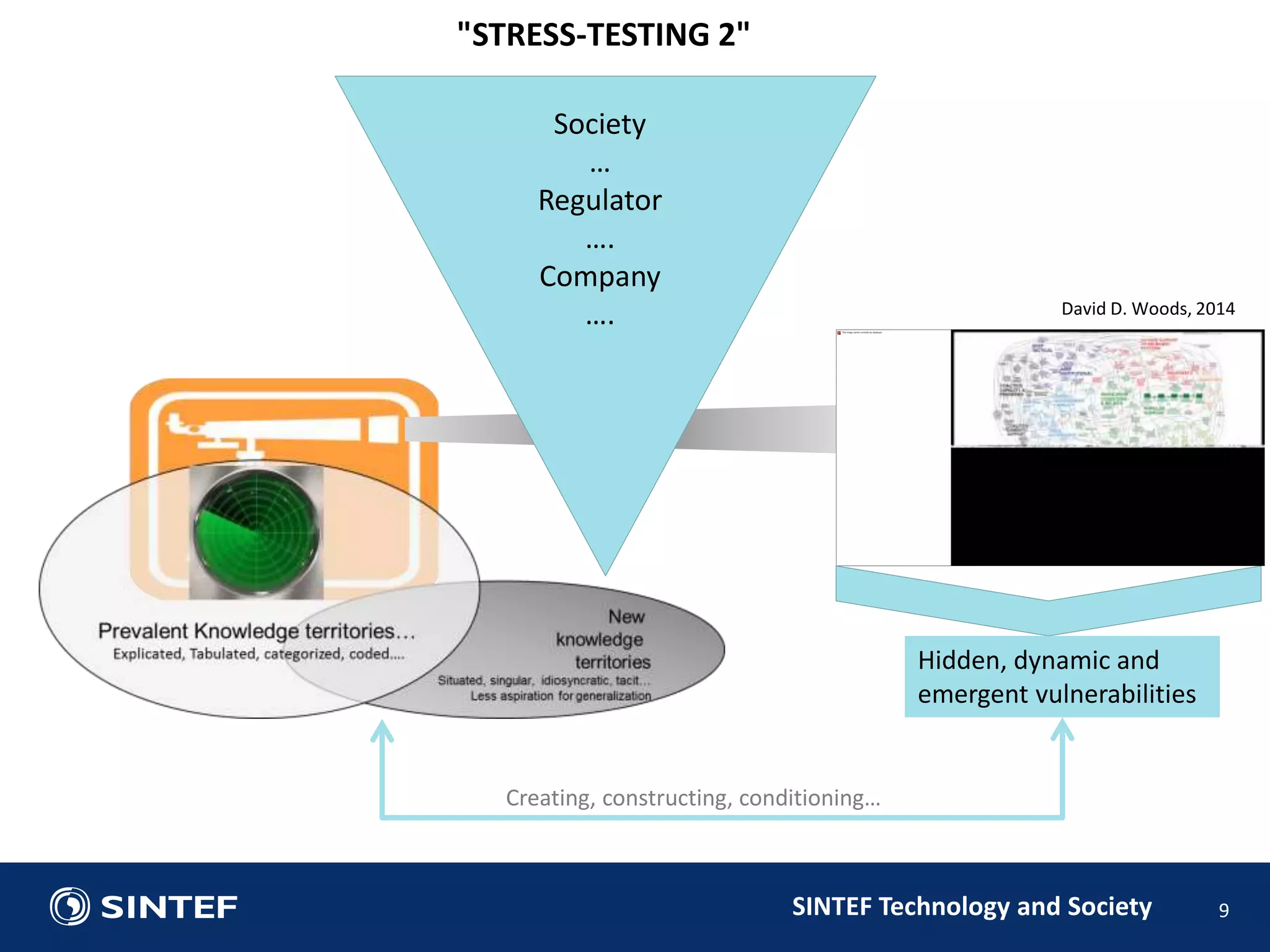
Stress-testing; a double meaning
David D. Woods, 2014 
Hidden, dynamic and 
emergent vulnerabilities 
SINTEF Technology and Society 9 
"STRESS-TESTING 2" 
Society 
… 
Regulator 
…. 
Company 
…. 
Creating, constructing, conditioning…
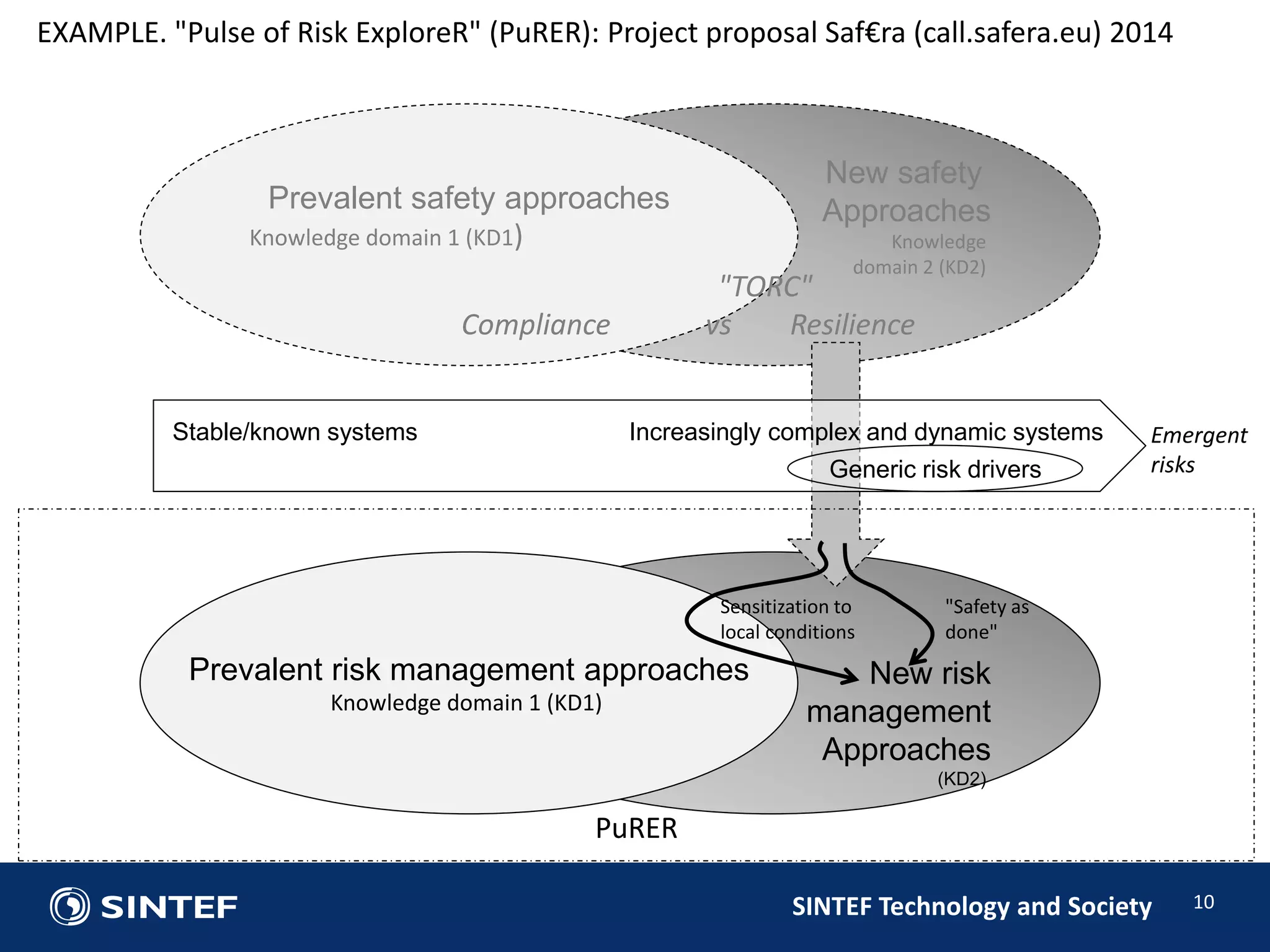
EXAMPLE. "Pulse of Risk ExploreR" (PuRER): Project proposal Saf€ra (call.safera.eu) 2014 
New safety 
Approaches 
Knowledge 
domain 2 (KD2) 
Stable/known systems Increasingly complex and dynamic systems 
SINTEF Technology and Society 
10 
Prevalent safety approaches 
Knowledge domain 1 (KD1) 
New risk 
management 
Approaches 
(KD2) 
Prevalent risk management approaches 
Knowledge domain 1 (KD1) 
PuRER 
"TORC" 
Compliance vs Resilience 
Emergent 
Generic risk drivers risks 
Sensitization to 
local conditions 
"Safety as 
done"
SINTEF Technology and Society 
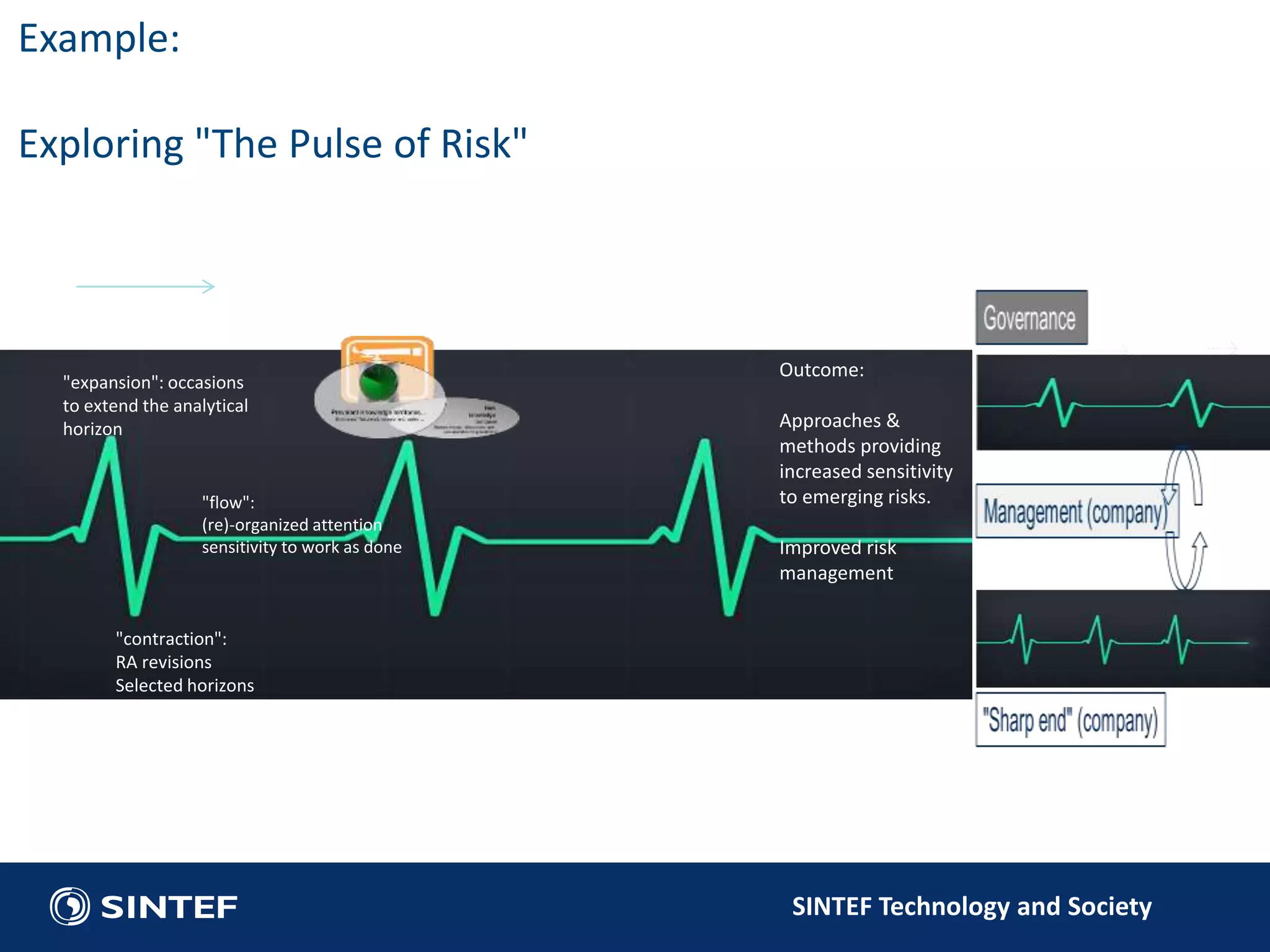
"expansion": occasions 
to extend the analytical 
horizon 
"flow": 
(re)-organized attention 
sensitivity to work as done 
"contraction": 
RA revisions 
Selected horizons 
Outcome: 
Approaches & 
methods providing 
increased sensitivity 
to emerging risks. 
Improved risk 
management 
Example: 
Exploring "The Pulse of Risk"
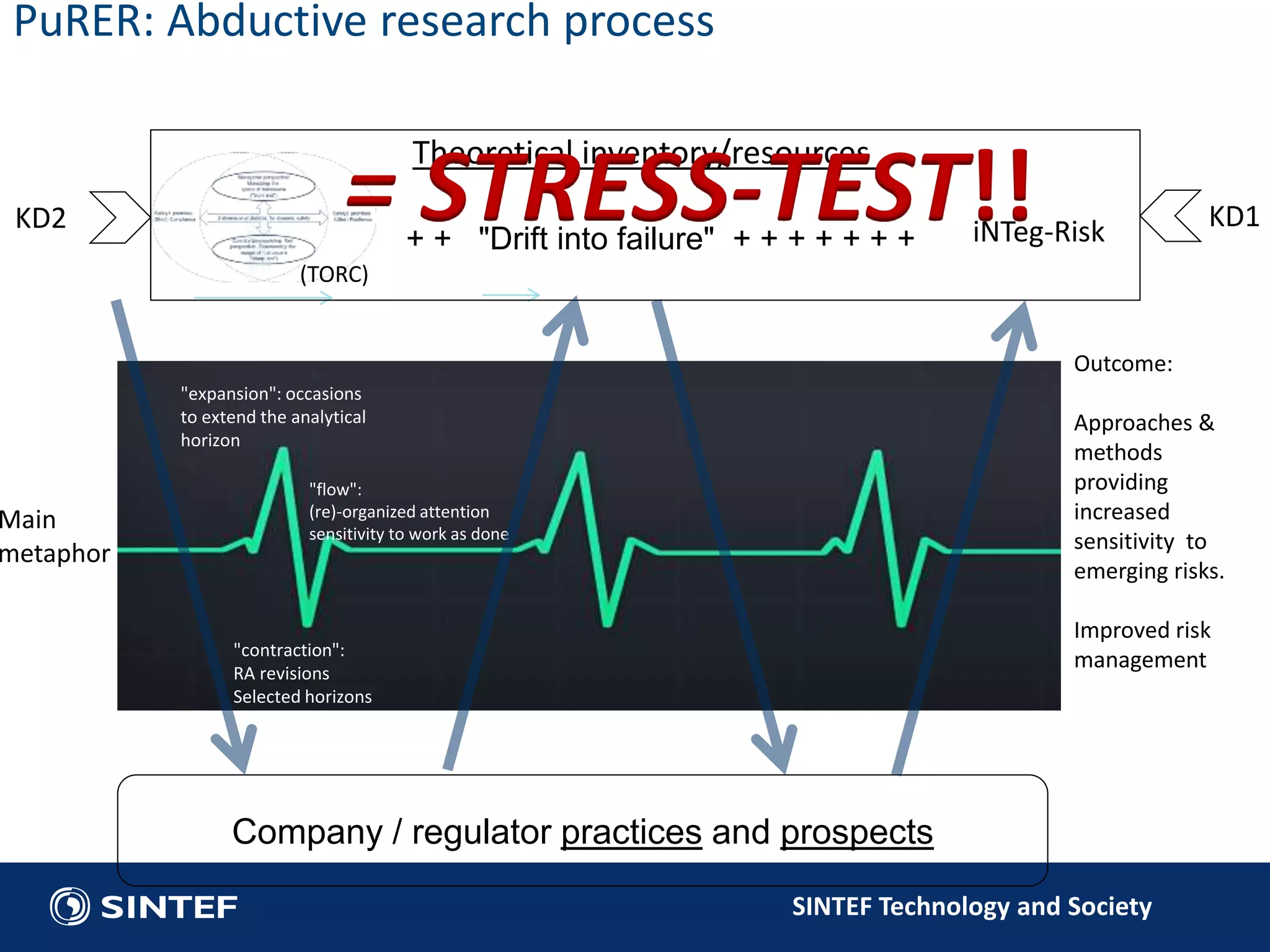
KD2 iNTeg-Risk KD1 = STRESS-TEST!! 
SINTEF Technology and Society 
"expansion": occasions 
to extend the analytical 
horizon 
"flow": 
(re)-organized attention 
sensitivity to work as done 
"contraction": 
RA revisions 
Selected horizons 
Outcome: 
Approaches & 
methods 
providing 
increased 
sensitivity to 
emerging risks. 
Improved risk 
management 
PuRER: Abductive research process 
Theoretical inventory/resources 
+ + "Drift into failure" + + + + + + + 
(TORC) 
Company / regulator practices and prospects 
Main 
metaphor
SINTEF Technology and Society 
• Hermeneutical ideal 
• Continuous exchange 
• Part vs whole 
• Pre-understanding Understanding …. 
• "Safety" or "security" ? 
• Build/understand landscapes of threats 
• Analyse, stress-test our methods & approaches 
13 
Ambition: "Zoom In/Out" in large ("infinite") systems
SINTEF Technology and Society 14 
"Mantra" 
Forget your perfect offering 
There's a crack in everything 
That's where the light gets in 
Leonard Cohen (Anthem)

Fred størseth. new strains of society hidden, dynamic and emergent vulnerabilities

  • 1.
    SAMRISK II project: New Strains of Society – Hidden, Dynamic and Emergent Vulnerabilities SINTEF Technology and Society NordForsk Conference New trends in societal security research in the Nordic countries 26-27 November 2014, Stockholm 1 Tor Olav Grøtan Senior Research Scientist Dpt of Safety Research tor.o.grotan@sintef.no
  • 2.
    SINTEF Technology andSociety • Participants • SINTEF Technology and Society, Safety Research • The Norwegian University of Science and Technology (NTNU) • University of Tulsa, USA • Forsvarets Forskningsinstitutt (FFI) • ….. • Budget: 7MNOK from SAMRISK II • Duration: 2014-17 • Project management SINTEF • Fred Størseth (fred.storseth@sintef.no) 2 The project
  • 3.
    • Adressing vulnerabilitiesthat may be "unknown" in any sense: • Ignored – forgotten - never contemplated - impossible to identify - misunderstood or underestimated – stemming from emergence, rupture, discontinuity, variability, etc - • Presumed impact; society (as a whole) under enormous strain • Will the (beliefs in the) institutions endure the strain? • The deafening silence from missing answers – or unrealistic assumptions? • Will the public still be comforted by "we will revise our routines"? • Armed police in Norway November 2014 – of course (?) SINTEF Technology and Society • Drivers, e.g., • New forms of crime - safety & security – climate change , ++ • Dependencies, dynamics and dynamism between systems and domains • Need for new foci, e.g. • From threat pictures to threat landscapes • Vulnerability patterns 3 New Strains of Society – Hidden, Dynamic and Emergent Vulnerabilities
  • 4.
    SINTEF Technology andSociety • A "shrinking" world • Where are the boundaries between society and systems? How do multiple systems cohere? How can vulnerabilities be identified? Can we see it as an "ecology"? E.g. • Safety/security "mindsets" as "industrial enclaves" in an open/dynamic society? • 9/11 signifies a crossroad, a new epoch, a rupture/discontinuity • Malicious, intended action; terror: A continual, persistent but unspecified threat • What is the impact on society, what is the strain? • ICT as a central analytical dimension: "the world connected through it" • Vulnerabilities when ICT fail • Failure, breakdown, disturbance (maintenance), virus/hacking etc etc • Vulnerabilities when ICT function as intended (ICT as prime mediator of interaction) • ICT as re-presentation technology, as organ-izing technology • Shared awareness and understanding? A matter of modelling? • Vertbatim vs gist; different (native) languages; Conditions for sensemaking? • Intensified potential for vulnerability: The "state of the world" as well as the threats and risks defined, transfused and understood by and through ICT 4 Some ideas and presumptions
  • 5.
    • New threatsagainst society produce new patterns of risk and vulnerability • The recognition of this may imply the challenging of some core principles • The idea of distinct roles and clear responsibilities: Somebody must "own" (at least part of) the problem • What if the distinct roles cannot be identified? • What if there are no clear areas of responsibility? • New threats can "play out" in ways that influence an array of systems SINTEF Technology and Society • The idea of control: • The prevalent imperative of identifying and "translating" risk into cintrollable parameters • How can we identfy and act on risks that are constantly changing, crossing and traversing system boundaries, affecting a number of parties ? • We must acknowldge the fact that the "standard toolbox" and approaches are insufficient • New threats demand new thinking and new methods – for vulnerability as well as risk 5 New Strains: Foundations
  • 6.
    • Out pointof departure is what we actually have (predominantly from industrial safety) • Methods, theoretical foundations, views and contemplations • The aim is however not just to "re-contextualize" into the societal context. • We will approach the borderlines and the impasses – where methods stalemate , SINTEF Technology and Society where understanding stops • We will explore how existing methods and principles can be related to, developed and translated into addressing complex landscapes of threats that • involve multiple systems in interplay • is imprinted by substantial uncertainty , e.g., related to • Extent, potential of escalation, degree of danger, vulnerability by coupling • can imply generation, transfer and relocation of risk • We will build "landscapes" of threat and vulnerability within different areas, e.g.: • Offshore activity in sensitive areas • Pandemic • Critical infrastructure integrated with ICT (incl. "ICT as mediator") 6 New Strains; Approach
  • 7.
    • Develop ananalytical framework for understanding and managing new threats and SINTEF Technology and Society vulnerabilities towards society • The objective is not to generate more knowledge to reduce uncertainty, but • to establish new principles for contemplation and approach, and • new ways to acknowledge and explore the new strains • Point of departure; existing methods and theory, with a special focus on: • Risk analysis • Barrier management • Resilience • Stress-testing • Intention: to put ourselves (safety science, practice) to the test • Establish borderlines and limitations of existing/prevalent approaches • Objective: to identifiy how approaches and methods must be developed in order to adress the societal threats we will face, including • Where it stops – where "control", methods and tools can promise no more • Including the new & "promising", e.g. resilience (engineering) 7 New Strains; Defined targets
  • 8.
    1. The potentialof development related to stress-testing as a specific method (e.g., simulated barrier breakdown) to address societal threats 2. Stress-testing in a wider sense, as a principle or metaphor: • We intend to "stress-teste" our inventory of approaches and methods – in order to identify where and when our "tools" stop working SINTEF Technology and Society • INCLUDING the recent advances, • e.g., resilience (engineering) 8 Stress-testing; a double meaning
  • 9.
    David D. Woods,2014 Hidden, dynamic and emergent vulnerabilities SINTEF Technology and Society 9 "STRESS-TESTING 2" Society … Regulator …. Company …. Creating, constructing, conditioning…
  • 10.
    EXAMPLE. "Pulse ofRisk ExploreR" (PuRER): Project proposal Saf€ra (call.safera.eu) 2014 New safety Approaches Knowledge domain 2 (KD2) Stable/known systems Increasingly complex and dynamic systems SINTEF Technology and Society 10 Prevalent safety approaches Knowledge domain 1 (KD1) New risk management Approaches (KD2) Prevalent risk management approaches Knowledge domain 1 (KD1) PuRER "TORC" Compliance vs Resilience Emergent Generic risk drivers risks Sensitization to local conditions "Safety as done"
  • 11.
    SINTEF Technology andSociety "expansion": occasions to extend the analytical horizon "flow": (re)-organized attention sensitivity to work as done "contraction": RA revisions Selected horizons Outcome: Approaches & methods providing increased sensitivity to emerging risks. Improved risk management Example: Exploring "The Pulse of Risk"
  • 12.
    KD2 iNTeg-Risk KD1= STRESS-TEST!! SINTEF Technology and Society "expansion": occasions to extend the analytical horizon "flow": (re)-organized attention sensitivity to work as done "contraction": RA revisions Selected horizons Outcome: Approaches & methods providing increased sensitivity to emerging risks. Improved risk management PuRER: Abductive research process Theoretical inventory/resources + + "Drift into failure" + + + + + + + (TORC) Company / regulator practices and prospects Main metaphor
  • 13.
    SINTEF Technology andSociety • Hermeneutical ideal • Continuous exchange • Part vs whole • Pre-understanding Understanding …. • "Safety" or "security" ? • Build/understand landscapes of threats • Analyse, stress-test our methods & approaches 13 Ambition: "Zoom In/Out" in large ("infinite") systems
  • 14.
    SINTEF Technology andSociety 14 "Mantra" Forget your perfect offering There's a crack in everything That's where the light gets in Leonard Cohen (Anthem)

Editor's Notes

  • #11  Eksempel PuRER
  • #12 Visualizing (different) cases ?
  • #13 Abuktivt premiss for nyutvikling av metoder NS: Stressteste våre egne nyutviklinger …. Tvinges til å definere gyldighetsområde