Pentose Phosphate Pathway
Gatewayto Ribose and NADPH
The pentose phosphate (PP) pathway serves a number of functions.
As the name implies, pentose biosynthesis is through this pathway. Ribose,
ribulose, xylulose, are typical 5-carbon sugars made in the pathway.
Because pathway reactions lead to fructose-6-PO4 and glyceraldehyde-3-PO4
in a round about way, early workers considered its only function was to
backup glycolysis. The PP pathway, however, is a major producer of
NADPH for the synthesis of fatty acids, which you will study later. Look for
two unique enzymes “transketolase and transaldolase” in the PP pathway.
2.
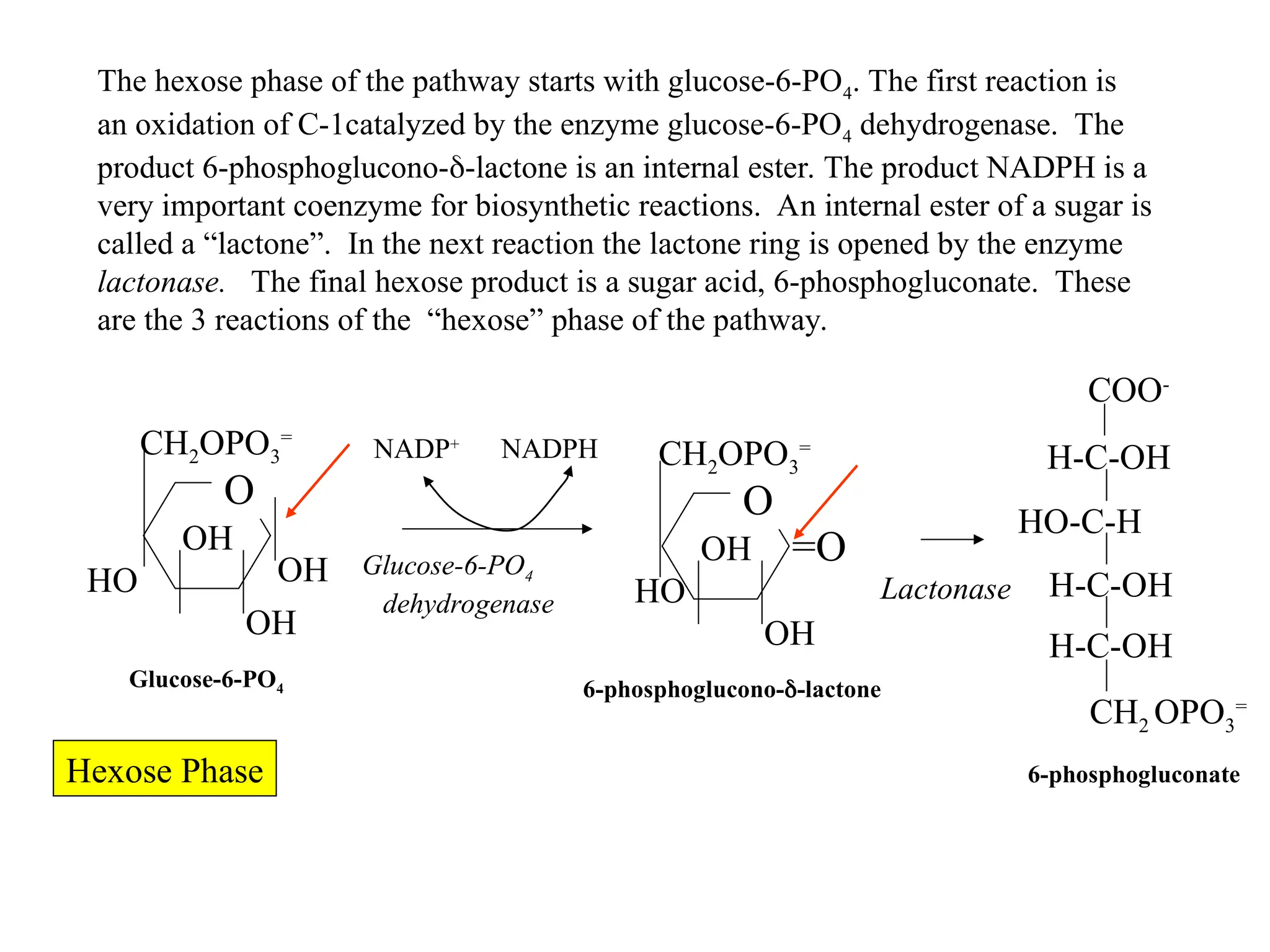
The hexose phaseof the pathway starts with glucose-6-PO4. The first reaction is
an oxidation of C-1catalyzed by the enzyme glucose-6-PO4 dehydrogenase. The
product 6-phosphoglucono--lactone is an internal ester. The product NADPH is a
very important coenzyme for biosynthetic reactions. An internal ester of a sugar is
called a “lactone”. In the next reaction the lactone ring is opened by the enzyme
lactonase. The final hexose product is a sugar acid, 6-phosphogluconate. These
are the 3 reactions of the “hexose” phase of the pathway.
NADP+
NADPH
Glucose-6-PO4
dehydrogenase Lactonase
O
CH2OPO3
=
OH
OH
OH
HO
Glucose-6-PO4
O
CH2OPO3
=
OH
OH
HO
=O
6-phosphoglucono--lactone
CH2 OPO3
=
HO-C-H
H-C-OH
COO-
H-C-OH
H-C-OH
6-phosphogluconate
Hexose Phase
3.
The second phaseis catalyzed by one enzyme, 6-phosphogluconate dehydrogenase. The
sugars ribulose-5-PO4 (Ru5P) is the first 5-C sugar to appear. To make this sugar, a carbon
as CO2 must be removed. The CO2 comes from a –COOH group. This is why it was
necessary to oxidize C-1 of glucose-6-PO4. Recall, that when a –COOH group is removed
the electron pair stays with the source molecule. The electron pair attracts a proton to form a
–CH2OH on the new C-1. In the final reaction a hydride ion (red) is abstracted from C-2
leaving a carbonium ion on C-2. That reaction requires a NADP+
and in the process a second
NADPH is formed in the pathway. The final step is to rearrange electrons on C-2 to give the
product ribulose-5-PO4 . Note that there are two intermediate forms that remain bound to the
enzyme.
NADP+
NADPH
CO2
CH2 OPO3
=
HO-C-H
H-C-OH
H-C-OH
H-C-OH
[Enzyme-bound intermediates]
CH2 OPO3
=
H-C-OH
H-C-OH
CH2OH
C=O
Ribulose-5-PO4
CH2 OPO3
=
HO-C-H
H-C-OH
COO-
H-C-OH
H-C-OH
6-phosphogluconate
6-phosphogluconate dehydrogenase
H
H
HO-C
CH2 OPO3
=
H-C-OH
H-C-OH
H-C-OH
+
4.
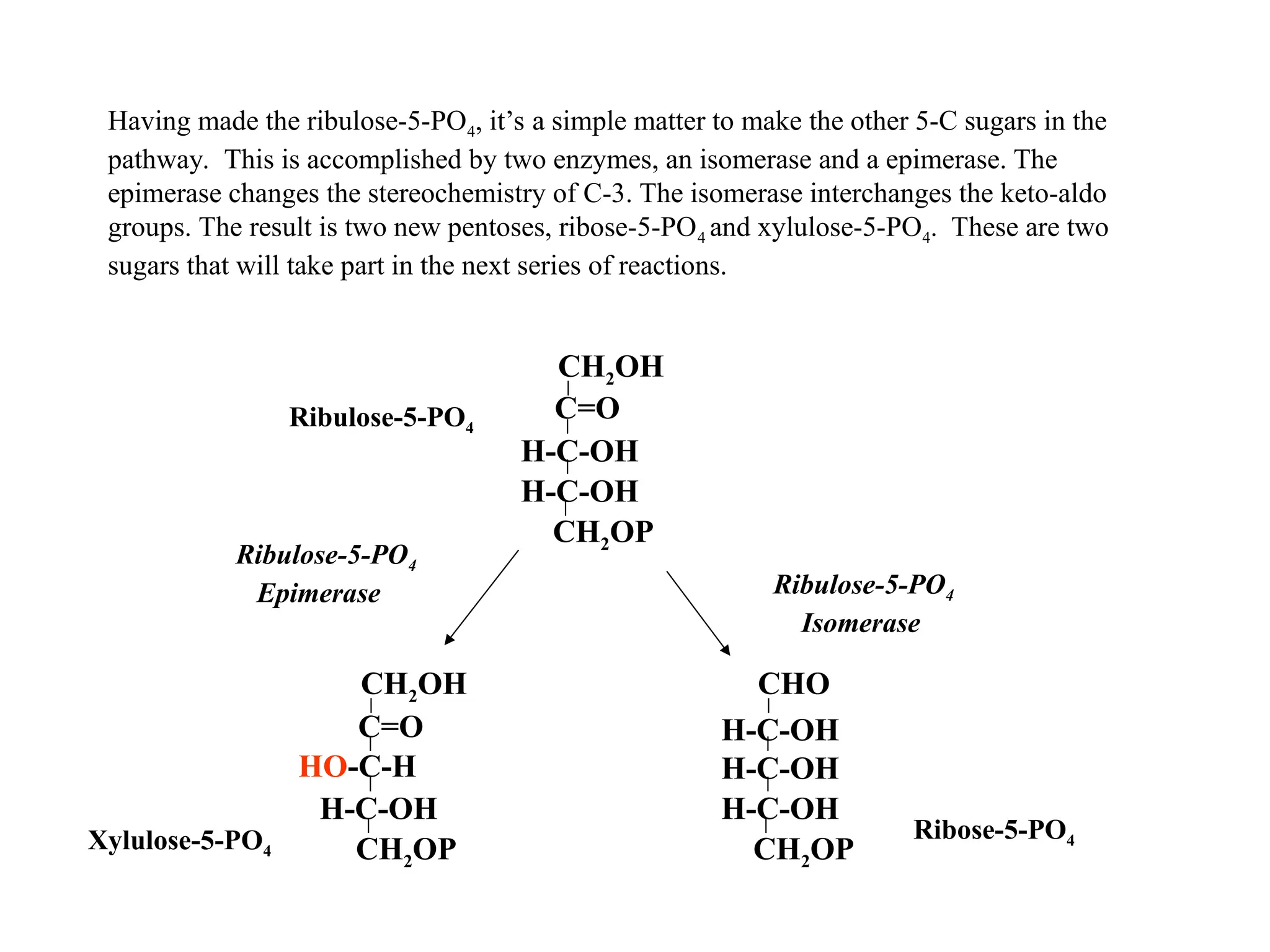
Having made theribulose-5-PO4, it’s a simple matter to make the other 5-C sugars in the
pathway. This is accomplished by two enzymes, an isomerase and a epimerase. The
epimerase changes the stereochemistry of C-3. The isomerase interchanges the keto-aldo
groups. The result is two new pentoses, ribose-5-PO4 and xylulose-5-PO4. These are two
sugars that will take part in the next series of reactions.
CH2OH
H-C-OH
HO-C-H
CH2OP
C=O
CHO
H-C-OH
CH2OP
H-C-OH
H-C-OH
CH2OH
H-C-OH
CH2OP
C=O
H-C-OH
Ribulose-5-PO4
Xylulose-5-PO4
Ribose-5-PO4
Ribulose-5-PO4
Isomerase
Ribulose-5-PO4
Epimerase
5.
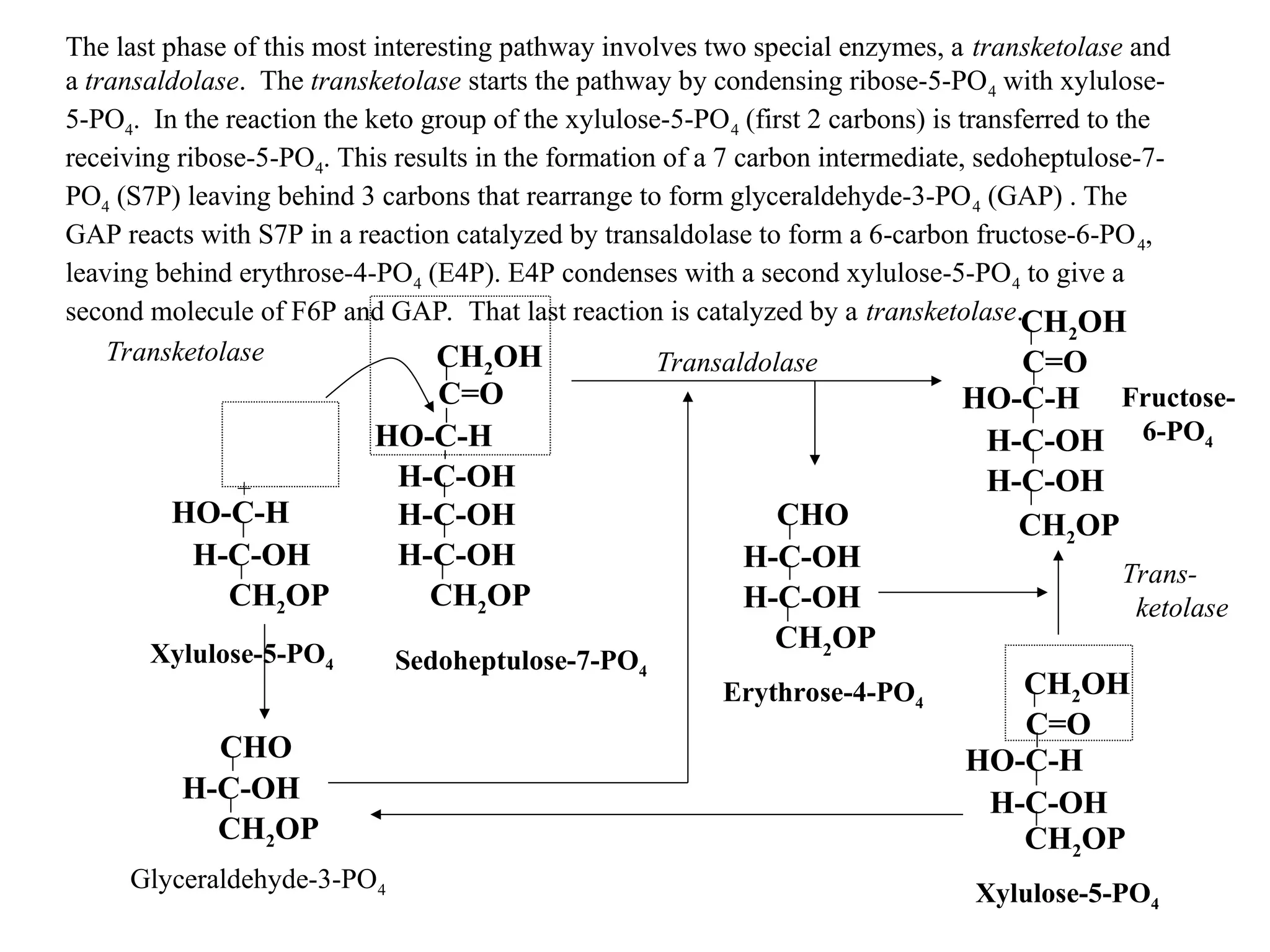
The last phaseof this most interesting pathway involves two special enzymes, a transketolase and
a transaldolase. The transketolase starts the pathway by condensing ribose-5-PO4 with xylulose-
5-PO4. In the reaction the keto group of the xylulose-5-PO4 (first 2 carbons) is transferred to the
receiving ribose-5-PO4. This results in the formation of a 7 carbon intermediate, sedoheptulose-7-
PO4 (S7P) leaving behind 3 carbons that rearrange to form glyceraldehyde-3-PO4 (GAP) . The
GAP reacts with S7P in a reaction catalyzed by transaldolase to form a 6-carbon fructose-6-PO4,
leaving behind erythrose-4-PO4 (E4P). E4P condenses with a second xylulose-5-PO4 to give a
second molecule of F6P and GAP. That last reaction is catalyzed by a transketolase.
CH2OH
H-C-OH
HO-C-H
CH2OP
C=O
CHO
H-C-OH
CH2OP
H-C-OH
H-C-OH
HO-C-H
C=O
CH2OH
+
Xylulose-5-PO4 Ribose-5-PO4
Sedoheptulose-7-PO4
Glyceraldehyde-3-PO4
H-C-OH
CHO
CH2OP
CH2OH
C=O
H-C-OH
CH2OP
H-C-OH
HO-C-H
CHO
H-C-OH
CH2OP
H-C-OH
CH2OH
C=O
CH2OP
H-C-OH
HO-C-H
Xylulose-5-PO4
Erythrose-4-PO4
Transaldolase
Trans-
ketolase
Transketolase
Fructose-
6-PO4
6.
The primary resultsof the pathway are:
The generation of reducing equivalents, in the form of NADPH, used in reductive
biosynthesis reactions within cells (e.g. fatty acid synthesis).
Production of ribose 5-phosphate (R5P), used in the synthesis of nucleotides and nucleic
acids.
Production of erythrose 4-phosphate (E4P) used in the synthesis of aromatic amino
acids.
![The second phase is catalyzed by one enzyme, 6-phosphogluconate dehydrogenase. The
sugars ribulose-5-PO4 (Ru5P) is the first 5-C sugar to appear. To make this sugar, a carbon
as CO2 must be removed. The CO2 comes from a –COOH group. This is why it was
necessary to oxidize C-1 of glucose-6-PO4. Recall, that when a –COOH group is removed
the electron pair stays with the source molecule. The electron pair attracts a proton to form a
–CH2OH on the new C-1. In the final reaction a hydride ion (red) is abstracted from C-2
leaving a carbonium ion on C-2. That reaction requires a NADP+
and in the process a second
NADPH is formed in the pathway. The final step is to rearrange electrons on C-2 to give the
product ribulose-5-PO4 . Note that there are two intermediate forms that remain bound to the
enzyme.
NADP+
NADPH
CO2
CH2 OPO3
=
HO-C-H
H-C-OH
H-C-OH
H-C-OH
[Enzyme-bound intermediates]
CH2 OPO3
=
H-C-OH
H-C-OH
CH2OH
C=O
Ribulose-5-PO4
CH2 OPO3
=
HO-C-H
H-C-OH
COO-
H-C-OH
H-C-OH
6-phosphogluconate
6-phosphogluconate dehydrogenase
H
H
HO-C
CH2 OPO3
=
H-C-OH
H-C-OH
H-C-OH
+](https://image.slidesharecdn.com/pentosephosphatepathway-250217073049-425ed70b/75/Pentose-Phosphate-Pathway-and-its-process-3-2048.jpg)