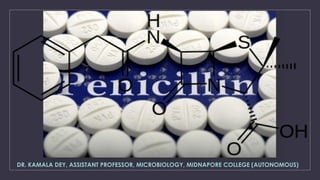
DR. KAMALA DEY, ASSISTANT PROFESSOR, MICROBIOLOGY, MIDNAPORE COLLEGE (AUTONOMOUS)
Antibiotics
◦ The term antibiotic has been defined by Selman Waksman as being an
organic compound produced by one microorganism that inhibits the growth
of or kills a group of harmful microorganisms (Bacteria).
◦ These enter and stick to important parts (think of targets) of the bacterial cell,
and interfere with its ability to survive and multiply [1].
If the bacteria are susceptible to the antibiotic, then they will stop growing or
simply die.
◦ These important parts include:
◦ Proteins/sugars in the bacterial wall.
◦ Important enzymes that make new bacterial DNA or proteins[2].
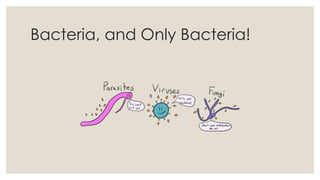
Bacteria, and Only Bacteria!
First Naturally-occuring Antibiotic
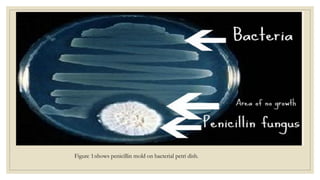
◦ Fleming was already well known upon
his return from a long holiday in September
1928, he noted that one petri dish contained
colonies of staphylococcus bacteria except for
clear area contaminated with a fungus that
appeared to inhibit bacterial growth. The
mold was found to be penicillium notatum[3].
Figure 1:shows penicillin mold on bacterial petri dish.
Staphylococcus Aureus
◦ Staphylococcus is a genus of Gram-positive bacteria. Under the microscope, they
appear spherical, and form in grape-like clusters. It can cause scarlet fever, pneumonia
or sepsis [3].
Figure 2: illustrations of staphylococci bacteria and its arrangement.
General Structure
of Penicillin
Penicillin is not a single compound but a
group of closely related compounds, all
with the same basic ring-like structure (a
β-lactam) derived from two amino acids
(valine and cysteine) via a tripeptide
intermediate.
The third amino acid of this tripeptide is
replaced by an acyl group (R) and the
nature of this acyl group produces
specific properties on different types of
penicillin.[4].
Figure 3: Shows the chemical Structure of Penicillins
group.
Figure 4: Pathway of penicillin G by Penicillium Chrysogenum[4].
Types of β-lactam antibiotics:
◦ Penicillins are either :
1. Natural penicillin.
2. Semisynthetic penicillin.
Penicillin Production
Aim:
To provide sterile, controlled and homogeneous environment in which the fermentation can carryout
in a manner that is safe and practical and which optimizes the Penicillin production for ultimate use.
UPSTREAM PROCESSING :
It the steps taken that lead to the synthesis of a product.
Upstream includes the development and production.
DOWNSTREAM PROCESSING :
The extraction and purification of a product from fermentation.
Step 1: Inoculum Preparation.
◦ Inoculum: A small amount of material containing bacteria, viruses,
or other microorganisms that is used to start a culture[5].
◦ Out of various species of the fungus Penicillium, mainly two species are used in
the fermentation:
◦ These are P. notatum & P. chrysogenum but P. chrysogenum is high yielding
strain and therefore most widely used as production strain[6].
Penicillium Chrysogenum
◦ It is able to synthesize penicillins with specific hydrophobic side chains when the
appropriate precursor is fed to the production medium.
◦ PA appears to be the best precursor, but the phenyl group can be substituted or
replaced by other ring systems.
◦ penicillin G, penicillin V, or penicillin O. In the absence of an exogenous side
chain precursor, P. chrysogenum produces mainly 6-aminopenicillanic acid.
Myceilium
◦ The mycelium is well developed and
copiously branched.
◦ It is composed of colourless, slender,
tubular, branched and septate hyphae.
◦ The hyphae run in all directions and
become intertwined with one another
to form a loose network of hyphae
constituting the mycelium.
◦ Myceilium is the vegitative part of
the mold [7].
Figure 5: Shows the Mycelium structure and how
spores germinate.
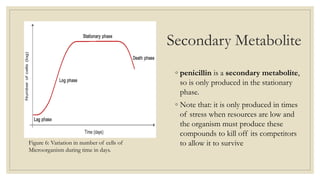
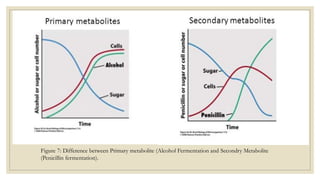
Secondary Metabolite
◦ penicillin is a secondary metabolite,
so is only produced in the stationary
phase.
◦ Note that: it is only produced in times
of stress when resources are low and
the organism must produce these
compounds to kill off its competitors
to allow it to survive
Figure 6: Variation in number of cells of
Microorganism during time in days.
Figure 7: Difference between Primary metabolite (Alcohol Fermentation and Secondry Metabolite
(Penicillin fermentation).
Maintenance of Strain.
◦ The production strain should be carefully maintained because
appropriate maintenance and production of reliable pure cultures with desirable
quality is a key operation.
◦ The Microorganism was maintained as lyophilized spore suspension until usage.
Step 2: Nutrients Sterilization.
◦ Throughout the fermentation industry, heating using steam is widely used as a
sterilization method, since it is reliable and easy to control.
◦ Sterilization of culture is necessary to prevent contamination.
Step 3: Inoculum Build-up.
◦ Here the chief purpose is to develop a pure inoculum in an adequate amount
and in the fast growing phase for the production stage fermenter.
1. Starter culture is transferred into agar-plate to allow growth.
When spores are placed on a vegetative media , the spores start to germinate and form
myceilia.
2. after growth on agar-plate, Cultures were incubated for approximately 70 h in
a rotary shaker at 200 rpm and 25C, to improve oxygen diffusion.
3. two growth stages (2 days incubation)are allowed upon transfer into seed
fermenter.
Step 4: Seed Fermenters.
◦ Initial stages of fermentation are designed for considerable microbial growth and the
can be distiguished from main Bioreactors by several factors; these are:
1. Smaller in size than the main fermenters approx. 2 Liter capacity
2. Made of stainless steel.
3. Equipped with agitators, which allow continuous mixing of growth medium.
4. Provided with pump to deliver sterilized, filtered air.
◦ Must contain all the nutrients including Growth factors.
◦ After about 24-28 hours, the content of the seed tanks is transferred to fermentation
tank.
Step 5: Bioreactor Set-up.
Fed-Batch culture: to feed a batch by controlled addition of a carbon source
and/or other nutrients, resulting in a fed-batch culture.
Air-lift Bioreactor:
◦ Advantages:
considerably higher volumetric and specific productivities since the phenotype
of the cell is under better control[8].
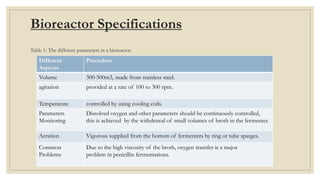
Bioreactor Specifications
Table 1: The different parameters in a bioreactor.
Different
Aspects
Procedure
Volume 300-500m3, made from stainless steel.
agitation provided at a rate of 100 to 300 rpm.
Temperature controlled by using cooling coils.
Parameters
Monitoring
Dissolved oxygen and other parameters should be continuously controlled,
this is achieved by the withdrawal of small volumes of broth in the fermenter.
Aeration Vigorous supplied from the bottom of fermenters by ring or tube sparges.
Common
Problems
Due to the high viscosity of the broth, oxygen transfer is a major
problem in penicillin fermentations.
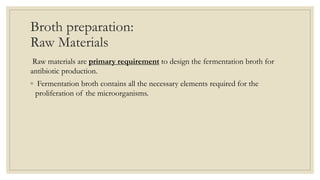
Broth preparation:
Raw Materials
Raw materials are primary requirement to design the fermentation broth for
antibiotic production.
◦ Fermentation broth contains all the necessary elements required for the
proliferation of the microorganisms.
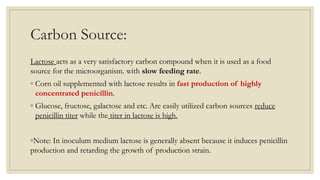
Carbon Source:
Lactose acts as a very satisfactory carbon compound when it is used as a food
source for the microorganism. with slow feeding rate.
◦ Corn oil supplemented with lactose results in fast production of highly
concentrated penicillin.
◦ Glucose, fructose, galactose and etc. Are easily utilized carbon sources reduce
penicillin titer while the titer in lactose is high.
◦Note: In inoculum medium lactose is generally absent because it induces penicillin
production and retarding the growth of production strain.
Nitrogen Source:
◦ Another essential compound for metabolism of organisms is nitrogen.
◦ We use Corn steep liquor (CSL), since it results in higher penicillin yields as
compared to the other nitrogen sources. Some compounds in CSL are
converted to phenylacetic acid or other side-chain precursors.
◦ Cottonseed flour or soybean meal may also be used as nitrogen sources; however,
they are more expensive than CSL [9].
Ammonium Source.
◦ Continuous addition of ammonium sulfate to keep the ammonium concentration
around 250–300 mg/L is required for continued synthesis of penicillin and
to avoid lysis of the mycelium.
◦ The omission of ammonium nitrate decreased the penicillin activity in the
original fermentation medium (Table I).
◦ This result agrees with the findings of [10] they reported that ammonium
nitrogen is a limiting factor in penicillin production.
Mineral Source:
◦Additionally, some minerals are necessary for the proper growth of these
organisms. are included.
◦ These elements include phosphorus, sulfur, magnesium, zinc, iron, and copper
which generally added in the form of water soluble salts.
◦For example:
◦However, the pH at the end of the fermentation period is slightly lower, when
low concentrations of calcium carbonate were used[10]
AntiFoam Agents:
Anti-foaming agents such as lard oil to reduce foam formation.
Disadvantages of Foaming:
1. Reduce process productivity since bursting bubbles can damage proteins[11],
2. Can result in loss of sterility if the foam escapes the bioreactor[13].
3. leads to over-pressure if a foam-out blocks an exit filter.
Precursors.
◦ Certain precursors of the penicillin side chain need to be added into the
fermentation medium.
◦ This constitutes a major cost item. Penicillin G requires 0.47g sodium phenylacetate.
◦ the precursor must be added repeatedly in small amounts during the fermentation:
why?
In order to avoid toxic effects.
◦ The Phenylacetic acid appears to be the best precursor, but it can be substituted or
replaced by other ring systems[14]. it is transported across the plasma membrane by
free diffusion into myceilium.
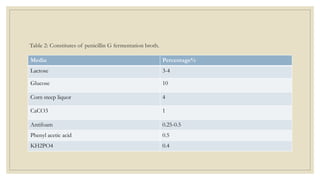
Table 2: Constitutes of penicillin G fermentation broth.
Media Percentage%
Lactose 3-4
Glucose 10
Corn steep liquor 4
CaCO3 1
Antifoam 0.25-0.5
Phenyl acetic acid 0.5
KH2PO4 0.4
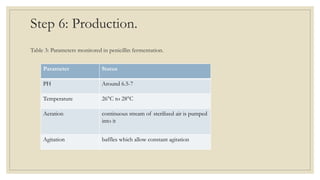
Step 6: Production.
Table 3: Parameters monitored in penicillin fermentation.
Parameter Status
PH Around 6.5-7
Temperature 26°C to 28°C
Aeration continuous stream of sterilized air is pumped
into it
Agitation baffles which allow constant agitation
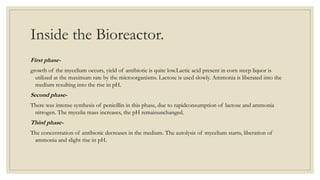
Inside the Bioreactor.
First phase-
growth of the mycelium occurs, yield of antibiotic is quite low.Lactic acid present in corn steep liquor is
utilized at the maximum rate by the microorganisms. Lactose is used slowly. Ammonia is liberated into the
medium resulting into the rise in pH.
Second phase-
There was intense synthesis of penicillin in this phase, due to rapidconsumption of lactose and ammonia
nitrogen. The mycelia mass increases, the pH remainunchanged.
Third phase-
The concentration of antibiotic decreases in the medium. The autolysis of mycelium starts, liberation of
ammonia and slight rise in pH.
Final product.
◦ Benzylpenicillin (Penicillin G)[15].
Figure 8: Biosynthesis of 6(APA) to Penicillin g.
Kinetic Models
◦ The original model has been extended by including additional input variables such as agitation power and
aeration rate [12].
Initial conditions and kinetic parameters.
Table 4:Original fermentation Kinetic model and its initial conditions [12].
Figure 9: Glucose and penicillin concentrations at initial glucose concentrations of 15, 25, 30 g/l [12].
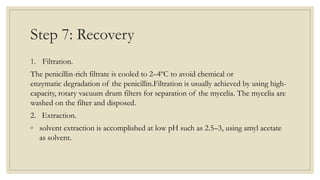
Step 7: Recovery
1. Filtration.
The penicillin-rich filtrate is cooled to 2–4ºC to avoid chemical or
enzymatic degradation of the penicillin.Filtration is usually achieved by using high-
capacity, rotary vacuum drum filters for separation of the mycelia. The mycelia are
washed on the filter and disposed.
2. Extraction.
◦ solvent extraction is accomplished at low pH such as 2.5–3, using amyl acetate
as solvent.
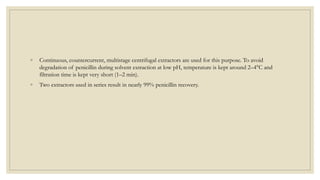
◦ Continuous, countercurrent, multistage centrifugal extractors are used for this purpose. To avoid
degradation of penicillin during solvent extraction at low pH, temperature is kept around 2–4°C and
filtration time is kept very short (1–2 min).
◦ Two extractors used in series result in nearly 99% penicillin recovery.
Step 8:Purification
1. Adsorption.
◦ Carbon adsorption is used to remove impurities and pigments from penicillin-rich
solvent after extraction. Several activated carbon columns in series can be used for
this purpose.
2. Crystallization.
◦ Na and penicillin concentrations, pH, and temperature need to be adjusted for
crystallization.
◦ Excess amounts of Na are added to the penicillin-rich solvent before
crystallization in an agitated vessel. The crystals are separated by a rotary vacuum
filter.
◦ The crystals are washed and predried with anhydrous butyl alcohol to remove some
impurities. Large horizontal belt filters are used for collection and drying of the crystals.
Figure 9: Main Bioreactor Configuration [16].
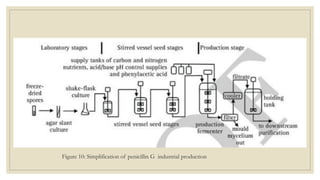
Figure 10: Simplification of penicillin G industrial production

Penicillin structure and its uses kd.pdf

  • 1.
    DR. KAMALA DEY,ASSISTANT PROFESSOR, MICROBIOLOGY, MIDNAPORE COLLEGE (AUTONOMOUS)
  • 2.
    Antibiotics ◦ The termantibiotic has been defined by Selman Waksman as being an organic compound produced by one microorganism that inhibits the growth of or kills a group of harmful microorganisms (Bacteria). ◦ These enter and stick to important parts (think of targets) of the bacterial cell, and interfere with its ability to survive and multiply [1]. If the bacteria are susceptible to the antibiotic, then they will stop growing or simply die. ◦ These important parts include: ◦ Proteins/sugars in the bacterial wall. ◦ Important enzymes that make new bacterial DNA or proteins[2].
  • 3.
  • 4.
    First Naturally-occuring Antibiotic ◦Fleming was already well known upon his return from a long holiday in September 1928, he noted that one petri dish contained colonies of staphylococcus bacteria except for clear area contaminated with a fungus that appeared to inhibit bacterial growth. The mold was found to be penicillium notatum[3].
  • 5.
    Figure 1:shows penicillinmold on bacterial petri dish.
  • 6.
    Staphylococcus Aureus ◦ Staphylococcusis a genus of Gram-positive bacteria. Under the microscope, they appear spherical, and form in grape-like clusters. It can cause scarlet fever, pneumonia or sepsis [3]. Figure 2: illustrations of staphylococci bacteria and its arrangement.
  • 7.
    General Structure of Penicillin Penicillinis not a single compound but a group of closely related compounds, all with the same basic ring-like structure (a β-lactam) derived from two amino acids (valine and cysteine) via a tripeptide intermediate. The third amino acid of this tripeptide is replaced by an acyl group (R) and the nature of this acyl group produces specific properties on different types of penicillin.[4]. Figure 3: Shows the chemical Structure of Penicillins group.
  • 8.
    Figure 4: Pathwayof penicillin G by Penicillium Chrysogenum[4].
  • 9.
    Types of β-lactamantibiotics: ◦ Penicillins are either : 1. Natural penicillin. 2. Semisynthetic penicillin.
  • 10.
    Penicillin Production Aim: To providesterile, controlled and homogeneous environment in which the fermentation can carryout in a manner that is safe and practical and which optimizes the Penicillin production for ultimate use. UPSTREAM PROCESSING : It the steps taken that lead to the synthesis of a product. Upstream includes the development and production. DOWNSTREAM PROCESSING : The extraction and purification of a product from fermentation.
  • 11.
    Step 1: InoculumPreparation. ◦ Inoculum: A small amount of material containing bacteria, viruses, or other microorganisms that is used to start a culture[5]. ◦ Out of various species of the fungus Penicillium, mainly two species are used in the fermentation: ◦ These are P. notatum & P. chrysogenum but P. chrysogenum is high yielding strain and therefore most widely used as production strain[6].
  • 12.
    Penicillium Chrysogenum ◦ Itis able to synthesize penicillins with specific hydrophobic side chains when the appropriate precursor is fed to the production medium. ◦ PA appears to be the best precursor, but the phenyl group can be substituted or replaced by other ring systems. ◦ penicillin G, penicillin V, or penicillin O. In the absence of an exogenous side chain precursor, P. chrysogenum produces mainly 6-aminopenicillanic acid.
  • 13.
    Myceilium ◦ The myceliumis well developed and copiously branched. ◦ It is composed of colourless, slender, tubular, branched and septate hyphae. ◦ The hyphae run in all directions and become intertwined with one another to form a loose network of hyphae constituting the mycelium. ◦ Myceilium is the vegitative part of the mold [7]. Figure 5: Shows the Mycelium structure and how spores germinate.
  • 14.
    Secondary Metabolite ◦ penicillinis a secondary metabolite, so is only produced in the stationary phase. ◦ Note that: it is only produced in times of stress when resources are low and the organism must produce these compounds to kill off its competitors to allow it to survive Figure 6: Variation in number of cells of Microorganism during time in days.
  • 15.
    Figure 7: Differencebetween Primary metabolite (Alcohol Fermentation and Secondry Metabolite (Penicillin fermentation).
  • 16.
    Maintenance of Strain. ◦The production strain should be carefully maintained because appropriate maintenance and production of reliable pure cultures with desirable quality is a key operation. ◦ The Microorganism was maintained as lyophilized spore suspension until usage.
  • 17.
    Step 2: NutrientsSterilization. ◦ Throughout the fermentation industry, heating using steam is widely used as a sterilization method, since it is reliable and easy to control. ◦ Sterilization of culture is necessary to prevent contamination.
  • 18.
    Step 3: InoculumBuild-up. ◦ Here the chief purpose is to develop a pure inoculum in an adequate amount and in the fast growing phase for the production stage fermenter. 1. Starter culture is transferred into agar-plate to allow growth. When spores are placed on a vegetative media , the spores start to germinate and form myceilia. 2. after growth on agar-plate, Cultures were incubated for approximately 70 h in a rotary shaker at 200 rpm and 25C, to improve oxygen diffusion. 3. two growth stages (2 days incubation)are allowed upon transfer into seed fermenter.
  • 19.
    Step 4: SeedFermenters. ◦ Initial stages of fermentation are designed for considerable microbial growth and the can be distiguished from main Bioreactors by several factors; these are: 1. Smaller in size than the main fermenters approx. 2 Liter capacity 2. Made of stainless steel. 3. Equipped with agitators, which allow continuous mixing of growth medium. 4. Provided with pump to deliver sterilized, filtered air. ◦ Must contain all the nutrients including Growth factors. ◦ After about 24-28 hours, the content of the seed tanks is transferred to fermentation tank.
  • 20.
    Step 5: BioreactorSet-up. Fed-Batch culture: to feed a batch by controlled addition of a carbon source and/or other nutrients, resulting in a fed-batch culture. Air-lift Bioreactor: ◦ Advantages: considerably higher volumetric and specific productivities since the phenotype of the cell is under better control[8].
  • 21.
    Bioreactor Specifications Table 1:The different parameters in a bioreactor. Different Aspects Procedure Volume 300-500m3, made from stainless steel. agitation provided at a rate of 100 to 300 rpm. Temperature controlled by using cooling coils. Parameters Monitoring Dissolved oxygen and other parameters should be continuously controlled, this is achieved by the withdrawal of small volumes of broth in the fermenter. Aeration Vigorous supplied from the bottom of fermenters by ring or tube sparges. Common Problems Due to the high viscosity of the broth, oxygen transfer is a major problem in penicillin fermentations.
  • 22.
    Broth preparation: Raw Materials Rawmaterials are primary requirement to design the fermentation broth for antibiotic production. ◦ Fermentation broth contains all the necessary elements required for the proliferation of the microorganisms.
  • 23.
    Carbon Source: Lactose actsas a very satisfactory carbon compound when it is used as a food source for the microorganism. with slow feeding rate. ◦ Corn oil supplemented with lactose results in fast production of highly concentrated penicillin. ◦ Glucose, fructose, galactose and etc. Are easily utilized carbon sources reduce penicillin titer while the titer in lactose is high. ◦Note: In inoculum medium lactose is generally absent because it induces penicillin production and retarding the growth of production strain.
  • 24.
    Nitrogen Source: ◦ Anotheressential compound for metabolism of organisms is nitrogen. ◦ We use Corn steep liquor (CSL), since it results in higher penicillin yields as compared to the other nitrogen sources. Some compounds in CSL are converted to phenylacetic acid or other side-chain precursors. ◦ Cottonseed flour or soybean meal may also be used as nitrogen sources; however, they are more expensive than CSL [9].
  • 25.
    Ammonium Source. ◦ Continuousaddition of ammonium sulfate to keep the ammonium concentration around 250–300 mg/L is required for continued synthesis of penicillin and to avoid lysis of the mycelium. ◦ The omission of ammonium nitrate decreased the penicillin activity in the original fermentation medium (Table I). ◦ This result agrees with the findings of [10] they reported that ammonium nitrogen is a limiting factor in penicillin production.
  • 26.
    Mineral Source: ◦Additionally, someminerals are necessary for the proper growth of these organisms. are included. ◦ These elements include phosphorus, sulfur, magnesium, zinc, iron, and copper which generally added in the form of water soluble salts. ◦For example: ◦However, the pH at the end of the fermentation period is slightly lower, when low concentrations of calcium carbonate were used[10]
  • 27.
    AntiFoam Agents: Anti-foaming agentssuch as lard oil to reduce foam formation. Disadvantages of Foaming: 1. Reduce process productivity since bursting bubbles can damage proteins[11], 2. Can result in loss of sterility if the foam escapes the bioreactor[13]. 3. leads to over-pressure if a foam-out blocks an exit filter.
  • 28.
    Precursors. ◦ Certain precursorsof the penicillin side chain need to be added into the fermentation medium. ◦ This constitutes a major cost item. Penicillin G requires 0.47g sodium phenylacetate. ◦ the precursor must be added repeatedly in small amounts during the fermentation: why? In order to avoid toxic effects. ◦ The Phenylacetic acid appears to be the best precursor, but it can be substituted or replaced by other ring systems[14]. it is transported across the plasma membrane by free diffusion into myceilium.
  • 29.
    Table 2: Constitutesof penicillin G fermentation broth. Media Percentage% Lactose 3-4 Glucose 10 Corn steep liquor 4 CaCO3 1 Antifoam 0.25-0.5 Phenyl acetic acid 0.5 KH2PO4 0.4
  • 30.
    Step 6: Production. Table3: Parameters monitored in penicillin fermentation. Parameter Status PH Around 6.5-7 Temperature 26°C to 28°C Aeration continuous stream of sterilized air is pumped into it Agitation baffles which allow constant agitation
  • 31.
    Inside the Bioreactor. Firstphase- growth of the mycelium occurs, yield of antibiotic is quite low.Lactic acid present in corn steep liquor is utilized at the maximum rate by the microorganisms. Lactose is used slowly. Ammonia is liberated into the medium resulting into the rise in pH. Second phase- There was intense synthesis of penicillin in this phase, due to rapidconsumption of lactose and ammonia nitrogen. The mycelia mass increases, the pH remainunchanged. Third phase- The concentration of antibiotic decreases in the medium. The autolysis of mycelium starts, liberation of ammonia and slight rise in pH.
  • 32.
    Final product. ◦ Benzylpenicillin(Penicillin G)[15]. Figure 8: Biosynthesis of 6(APA) to Penicillin g.
  • 33.
    Kinetic Models ◦ Theoriginal model has been extended by including additional input variables such as agitation power and aeration rate [12].
  • 34.
    Initial conditions andkinetic parameters. Table 4:Original fermentation Kinetic model and its initial conditions [12].
  • 35.
    Figure 9: Glucoseand penicillin concentrations at initial glucose concentrations of 15, 25, 30 g/l [12].
  • 36.
    Step 7: Recovery 1.Filtration. The penicillin-rich filtrate is cooled to 2–4ºC to avoid chemical or enzymatic degradation of the penicillin.Filtration is usually achieved by using high- capacity, rotary vacuum drum filters for separation of the mycelia. The mycelia are washed on the filter and disposed. 2. Extraction. ◦ solvent extraction is accomplished at low pH such as 2.5–3, using amyl acetate as solvent.
  • 37.
    ◦ Continuous, countercurrent,multistage centrifugal extractors are used for this purpose. To avoid degradation of penicillin during solvent extraction at low pH, temperature is kept around 2–4°C and filtration time is kept very short (1–2 min). ◦ Two extractors used in series result in nearly 99% penicillin recovery.
  • 38.
    Step 8:Purification 1. Adsorption. ◦Carbon adsorption is used to remove impurities and pigments from penicillin-rich solvent after extraction. Several activated carbon columns in series can be used for this purpose. 2. Crystallization. ◦ Na and penicillin concentrations, pH, and temperature need to be adjusted for crystallization. ◦ Excess amounts of Na are added to the penicillin-rich solvent before crystallization in an agitated vessel. The crystals are separated by a rotary vacuum filter.
  • 39.
    ◦ The crystalsare washed and predried with anhydrous butyl alcohol to remove some impurities. Large horizontal belt filters are used for collection and drying of the crystals.
  • 40.
    Figure 9: MainBioreactor Configuration [16].
  • 41.
    Figure 10: Simplificationof penicillin G industrial production