Penguins
Abegaill Villacruz
Definition of Terms

•   Penguins – aquatic, flightless birds
•   Waddle/rookies – group of penguins (land)
•   Raft – group of penguins (sea/ocean)
•   Chick – young penguin
•   Colony – group of young penguin
•   Breeding – producing offspring
•   Breeding cycle – from courtship to
    producing the chick
Taxonomic Classification

•   Kingdom:      Animalia
•   Phylum:       Chordata
•   Class:        Aves
•   Subclass:     Neornithes (modern birds)
•   Superorder:   Neognathae
•   Order:        Sphenisciformes
•   Family:       Spheniscidae
•   Genus:        6 genera
•   Species:      ranges from 17 to 20 living
                  species
Examples
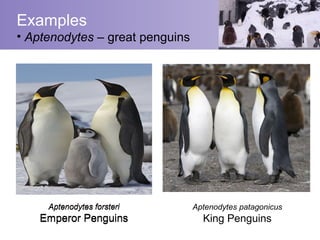
• Aptenodytes – great penguins


     Aptenodytes forsteri        Aptenodytes patagonicus
    Emperor Penguins               King Penguins
Examples
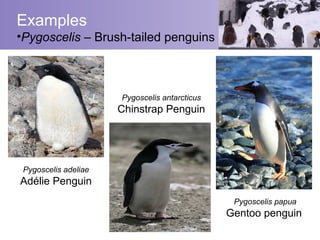
•Pygoscelis – Brush-tailed penguins


                      Pygoscelis antarcticus
                      Chinstrap Penguin


 Pygoscelis adeliae
Adélie Penguin
                                                Pygoscelis papua
                                               Gentoo penguin
Examples
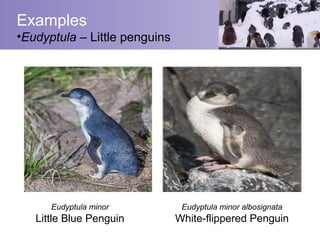
•Eudyptula – Little penguins


      Eudyptula minor           Eudyptula minor albosignata
   Little Blue Penguin         White-flippered Penguin
Examples
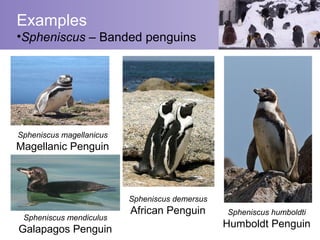
•Spheniscus – Banded penguins


Spheniscus magellanicus
Magellanic Penguin


                          Spheniscus demersus
                          African Penguin       Spheniscus humboldti
 Spheniscus mendiculus
Galapagos Penguin                               Humboldt Penguin
Examples
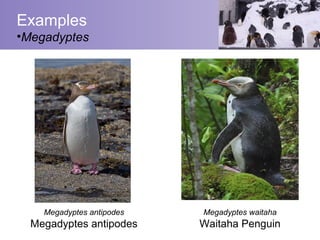
•Megadyptes


    Megadyptes antipodes   Megadyptes waitaha
  Megadyptes antipodes     Waitaha Penguin
Examples
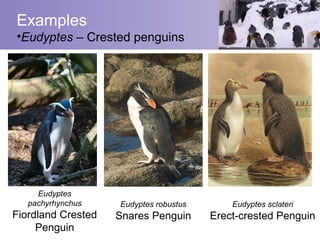
•Eudyptes – Crested penguins


     Eudyptes
   pachyrhynchus    Eudyptes robustus       Eudyptes sclateri
Fiordland Crested   Snares Penguin      Erect-crested Penguin
     Penguin
Examples
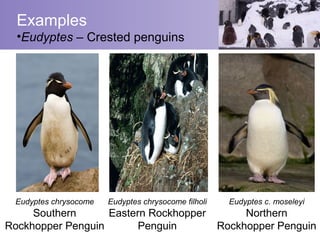
  •Eudyptes – Crested penguins


 Eudyptes chrysocome   Eudyptes chrysocome filholi     Eudyptes c. moseleyi
     Southern      Eastern Rockhopper                     Northern
Rockhopper Penguin       Penguin                     Rockhopper Penguin
Examples
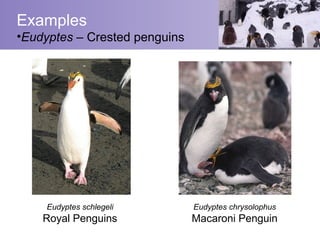
•Eudyptes – Crested penguins


     Eudyptes schlegeli        Eudyptes chrysolophus
    Royal Penguins             Macaroni Penguin
Distribution and Habitat

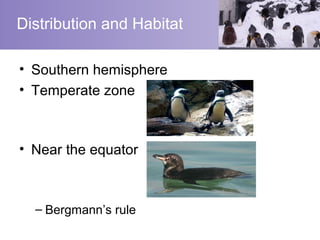
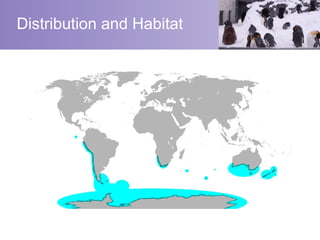
• Southern hemisphere
• Temperate zone


• Near the equator


  – Bergmann’s rule
Distribution and Habitat


• Islands and remote continental areas
• Nutrient-rich, cold-water currents
• Spend half of their lives on land, and half
  in the oceans
Distribution and Habitat
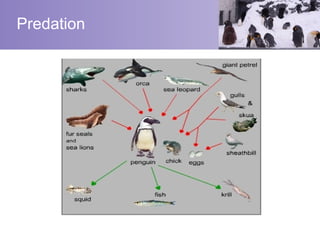
Predation

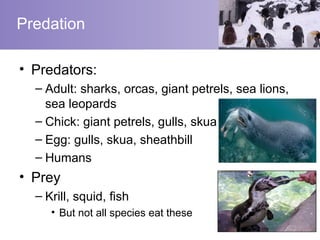
• Predators:
  – Adult: sharks, orcas, giant petrels, sea lions,
    sea leopards
  – Chick: giant petrels, gulls, skua
  – Egg: gulls, skua, sheathbill
  – Humans
• Prey
  – Krill, squid, fish
     • But not all species eat these
Predation
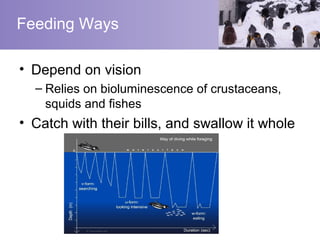
Feeding Ways

• Depend on vision
  – Relies on bioluminescence of crustaceans,
    squids and fishes
• Catch with their bills, and swallow it whole
Feeding Ways

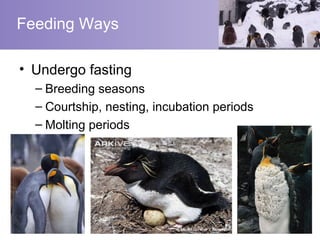
• Undergo fasting
  – Breeding seasons
  – Courtship, nesting, incubation periods
  – Molting periods
Physical Characteristics


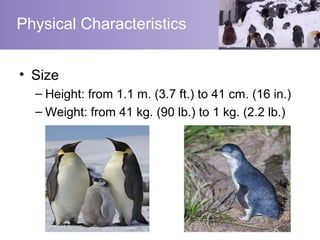
• Size
  – Height: from 1.1 m. (3.7 ft.) to 41 cm. (16 in.)
  – Weight: from 41 kg. (90 lb.) to 1 kg. (2.2 lb.)
Physical Characteristics


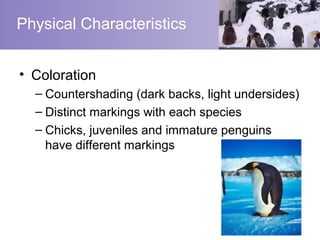
• Coloration
  – Countershading (dark backs, light undersides)
  – Distinct markings with each species
  – Chicks, juveniles and immature penguins
    have different markings
Senses


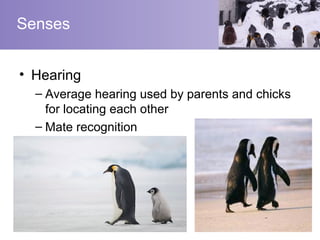
• Hearing
  – Average hearing used by parents and chicks
    for locating each other
  – Mate recognition
Senses


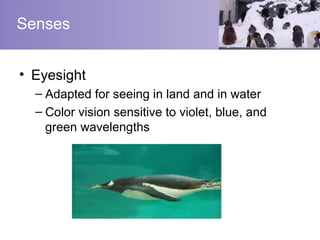
• Eyesight
  – Adapted for seeing in land and in water
  – Color vision sensitive to violet, blue, and
    green wavelengths
Senses


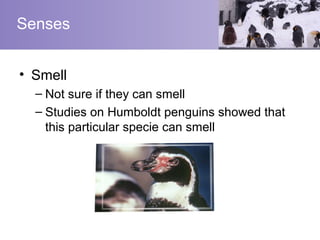
• Smell
  – Not sure if they can smell
  – Studies on Humboldt penguins showed that
    this particular specie can smell
Adaptations

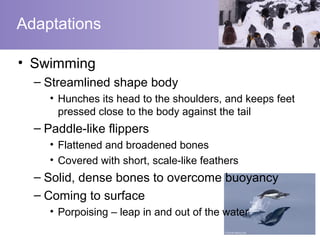
• Swimming
  – Streamlined shape body
     • Hunches its head to the shoulders, and keeps feet
       pressed close to the body against the tail
  – Paddle-like flippers
     • Flattened and broadened bones
     • Covered with short, scale-like feathers
  – Solid, dense bones to overcome buoyancy
  – Coming to surface
     • Porpoising – leap in and out of the water
Adaptations


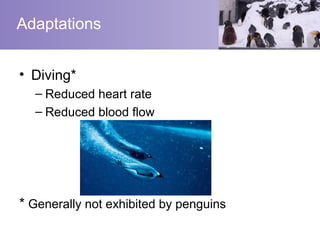
• Diving*
  – Reduced heart rate
  – Reduced blood flow


* Generally not exhibited by penguins
Adaptations


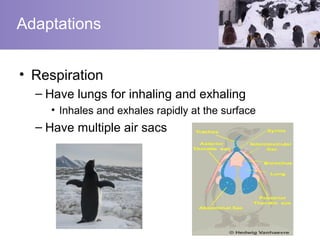
• Respiration
  – Have lungs for inhaling and exhaling
    • Inhales and exhales rapidly at the surface
  – Have multiple air sacs
Adaptations


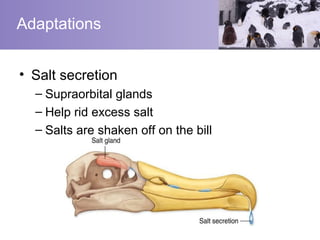
• Salt secretion
  – Supraorbital glands
  – Help rid excess salt
  – Salts are shaken off on the bill
Adaptations


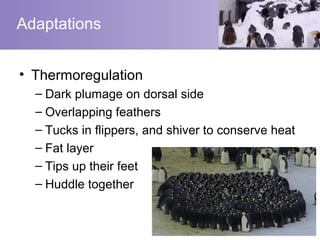
• Thermoregulation
  – Dark plumage on dorsal side
  – Overlapping feathers
  – Tucks in flippers, and shiver to conserve heat
  – Fat layer
  – Tips up their feet
  – Huddle together
Adaptations


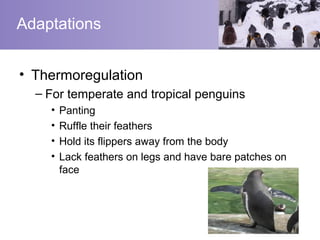
• Thermoregulation
  – For temperate and tropical penguins
    •   Panting
    •   Ruffle their feathers
    •   Hold its flippers away from the body
    •   Lack feathers on legs and have bare patches on
        face
Communication


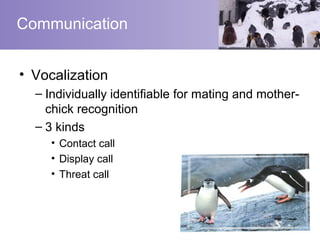
• Vocalization
  – Individually identifiable for mating and mother-
    chick recognition
  – 3 kinds
     • Contact call
     • Display call
     • Threat call
Reproduction


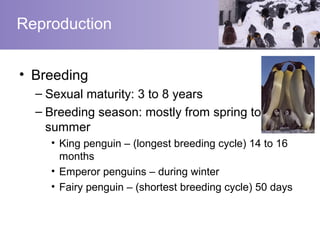
• Breeding
  – Sexual maturity: 3 to 8 years
  – Breeding season: mostly from spring to
    summer
    • King penguin – (longest breeding cycle) 14 to 16
      months
    • Emperor penguins – during winter
    • Fairy penguin – (shortest breeding cycle) 50 days
Reproduction


• Courtship
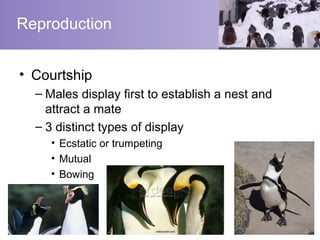
  – Males display first to establish a nest and
    attract a mate
  – 3 distinct types of display
     • Ecstatic or trumpeting
     • Mutual
     • Bowing
Reproduction


• Courtship
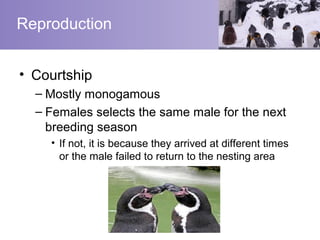
  – Mostly monogamous
  – Females selects the same male for the next
    breeding season
    • If not, it is because they arrived at different times
      or the male failed to return to the nesting area
Reproduction


• Nesting
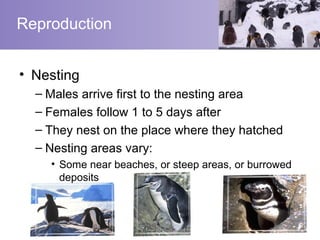
  – Males arrive first to the nesting area
  – Females follow 1 to 5 days after
  – They nest on the place where they hatched
  – Nesting areas vary:
    • Some near beaches, or steep areas, or burrowed
      deposits
Care of the Chicks


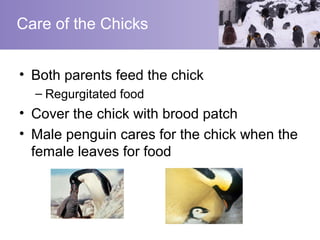
• Both parents feed the chick
  – Regurgitated food
• Cover the chick with brood patch
• Male penguin cares for the chick when the
  female leaves for food
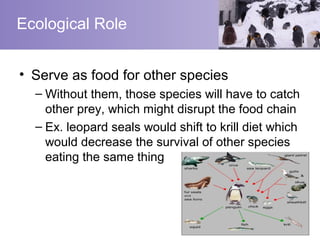
Ecological Role


• Serve as food for other species
  – Without them, those species will have to catch
    other prey, which might disrupt the food chain
  – Ex. leopard seals would shift to krill diet which
    would decrease the survival of other species
    eating the same thing
References

•   http://www.pinguins.info/Engels/taxonomie_eng.html
•   http://en.wikipedia.org/wiki/Penguin
•   http://en.wikipedia.org/wiki/Bird
•   http://en.wikipedia.org/wiki/Neognathae
•   http://en.wikipedia.org/wiki/Neornithes
•   www.pinguins.info
•   http://www.seaworld.org/animal-info/info-books/penguin.htm
•   http://www.penguinscience.com/education/ask_answers_4.php
•   http://www.penguinworld.com/map/map.php
•   http://www.penguinworld.com/profpenguin/faq.html
•   http://www.kidzone.ws/animals/penguins/facts3.htm
•   http://laaquariumvolunteers.org/index.php?topic=animal&id=104
•   http://www.buzzle.com/articles/penguin-facts.html
•   www.arkive.org
Thank you

Penguins

  • 1.
  • 3.
    Definition of Terms • Penguins – aquatic, flightless birds • Waddle/rookies – group of penguins (land) • Raft – group of penguins (sea/ocean) • Chick – young penguin • Colony – group of young penguin • Breeding – producing offspring • Breeding cycle – from courtship to producing the chick
  • 4.
    Taxonomic Classification • Kingdom: Animalia • Phylum: Chordata • Class: Aves • Subclass: Neornithes (modern birds) • Superorder: Neognathae • Order: Sphenisciformes • Family: Spheniscidae • Genus: 6 genera • Species: ranges from 17 to 20 living species
  • 5.
    Examples • Aptenodytes –great penguins Aptenodytes forsteri Aptenodytes patagonicus Emperor Penguins King Penguins
  • 6.
    Examples •Pygoscelis – Brush-tailedpenguins Pygoscelis antarcticus Chinstrap Penguin Pygoscelis adeliae Adélie Penguin Pygoscelis papua Gentoo penguin
  • 7.
    Examples •Eudyptula – Littlepenguins Eudyptula minor Eudyptula minor albosignata Little Blue Penguin White-flippered Penguin
  • 8.
    Examples •Spheniscus – Bandedpenguins Spheniscus magellanicus Magellanic Penguin Spheniscus demersus African Penguin Spheniscus humboldti Spheniscus mendiculus Galapagos Penguin Humboldt Penguin
  • 9.
    Examples •Megadyptes Megadyptes antipodes Megadyptes waitaha Megadyptes antipodes Waitaha Penguin
  • 10.
    Examples •Eudyptes – Crestedpenguins Eudyptes pachyrhynchus Eudyptes robustus Eudyptes sclateri Fiordland Crested Snares Penguin Erect-crested Penguin Penguin
  • 11.
    Examples •Eudyptes– Crested penguins Eudyptes chrysocome Eudyptes chrysocome filholi Eudyptes c. moseleyi Southern Eastern Rockhopper Northern Rockhopper Penguin Penguin Rockhopper Penguin
  • 12.
    Examples •Eudyptes – Crestedpenguins Eudyptes schlegeli Eudyptes chrysolophus Royal Penguins Macaroni Penguin
  • 13.
    Distribution and Habitat •Southern hemisphere • Temperate zone • Near the equator – Bergmann’s rule
  • 14.
    Distribution and Habitat •Islands and remote continental areas • Nutrient-rich, cold-water currents • Spend half of their lives on land, and half in the oceans
  • 15.
  • 16.
    Predation • Predators: – Adult: sharks, orcas, giant petrels, sea lions, sea leopards – Chick: giant petrels, gulls, skua – Egg: gulls, skua, sheathbill – Humans • Prey – Krill, squid, fish • But not all species eat these
  • 17.
  • 18.
    Feeding Ways • Dependon vision – Relies on bioluminescence of crustaceans, squids and fishes • Catch with their bills, and swallow it whole
  • 19.
    Feeding Ways • Undergofasting – Breeding seasons – Courtship, nesting, incubation periods – Molting periods
  • 20.
    Physical Characteristics • Size – Height: from 1.1 m. (3.7 ft.) to 41 cm. (16 in.) – Weight: from 41 kg. (90 lb.) to 1 kg. (2.2 lb.)
  • 21.
    Physical Characteristics • Coloration – Countershading (dark backs, light undersides) – Distinct markings with each species – Chicks, juveniles and immature penguins have different markings
  • 22.
    Senses • Hearing – Average hearing used by parents and chicks for locating each other – Mate recognition
  • 23.
    Senses • Eyesight – Adapted for seeing in land and in water – Color vision sensitive to violet, blue, and green wavelengths
  • 24.
    Senses • Smell – Not sure if they can smell – Studies on Humboldt penguins showed that this particular specie can smell
  • 25.
    Adaptations • Swimming – Streamlined shape body • Hunches its head to the shoulders, and keeps feet pressed close to the body against the tail – Paddle-like flippers • Flattened and broadened bones • Covered with short, scale-like feathers – Solid, dense bones to overcome buoyancy – Coming to surface • Porpoising – leap in and out of the water
  • 26.
    Adaptations • Diving* – Reduced heart rate – Reduced blood flow * Generally not exhibited by penguins
  • 27.
    Adaptations • Respiration – Have lungs for inhaling and exhaling • Inhales and exhales rapidly at the surface – Have multiple air sacs
  • 28.
    Adaptations • Salt secretion – Supraorbital glands – Help rid excess salt – Salts are shaken off on the bill
  • 29.
    Adaptations • Thermoregulation – Dark plumage on dorsal side – Overlapping feathers – Tucks in flippers, and shiver to conserve heat – Fat layer – Tips up their feet – Huddle together
  • 30.
    Adaptations • Thermoregulation – For temperate and tropical penguins • Panting • Ruffle their feathers • Hold its flippers away from the body • Lack feathers on legs and have bare patches on face
  • 31.
    Communication • Vocalization – Individually identifiable for mating and mother- chick recognition – 3 kinds • Contact call • Display call • Threat call
  • 32.
    Reproduction • Breeding – Sexual maturity: 3 to 8 years – Breeding season: mostly from spring to summer • King penguin – (longest breeding cycle) 14 to 16 months • Emperor penguins – during winter • Fairy penguin – (shortest breeding cycle) 50 days
  • 33.
    Reproduction • Courtship – Males display first to establish a nest and attract a mate – 3 distinct types of display • Ecstatic or trumpeting • Mutual • Bowing
  • 34.
    Reproduction • Courtship – Mostly monogamous – Females selects the same male for the next breeding season • If not, it is because they arrived at different times or the male failed to return to the nesting area
  • 35.
    Reproduction • Nesting – Males arrive first to the nesting area – Females follow 1 to 5 days after – They nest on the place where they hatched – Nesting areas vary: • Some near beaches, or steep areas, or burrowed deposits
  • 36.
    Care of theChicks • Both parents feed the chick – Regurgitated food • Cover the chick with brood patch • Male penguin cares for the chick when the female leaves for food
  • 37.
    Ecological Role • Serveas food for other species – Without them, those species will have to catch other prey, which might disrupt the food chain – Ex. leopard seals would shift to krill diet which would decrease the survival of other species eating the same thing
  • 38.
    References • http://www.pinguins.info/Engels/taxonomie_eng.html • http://en.wikipedia.org/wiki/Penguin • http://en.wikipedia.org/wiki/Bird • http://en.wikipedia.org/wiki/Neognathae • http://en.wikipedia.org/wiki/Neornithes • www.pinguins.info • http://www.seaworld.org/animal-info/info-books/penguin.htm • http://www.penguinscience.com/education/ask_answers_4.php • http://www.penguinworld.com/map/map.php • http://www.penguinworld.com/profpenguin/faq.html • http://www.kidzone.ws/animals/penguins/facts3.htm • http://laaquariumvolunteers.org/index.php?topic=animal&id=104 • http://www.buzzle.com/articles/penguin-facts.html • www.arkive.org
  • 39.

Editor's Notes

  • #5 As opposed to Archaeornithes and Enantiornithes birds which have teeth neognath – fused metacarpals and modern jawbones There are other species under different subfamilies
  • #6 emperor - largest
  • #14 Blackfooted penguin larger species are in cold places
  • #15 - Free from land predators
  • #17 - Krill – shrimp-like crustacean - For example, Adelie eat small krills only. Most of the time smaller penguins eat krill and squid, larger ones eat fishes.
  • #20 For building up fat layer for reserves Length of fasting depends on sex, species and type of fasting
  • #21 - emperor, fairy penguin
  • #22 - Avoidance of predators and catching of prey’ Dark blends with ocean depth when viewed from above light blends with the light surface of the sea when viewed from below
  • #29 - Not a penguin, but just to show the supraorbital gland
  • #30 Overlapping feathers – waterproofing from cold water Trapping of air – provide thermal insulation Tips feet – to lessen contact with ice
  • #32 Contact – to search for members Display – between partners Threat – defending and warning against enemies
  • #33 Breeding season – varies from species to species Why winter? So that the conditions for the growing chick would be favorable
  • #34 Ecstatic – for males, used to defend its nest, attracts females, and warn other males; outstretched flippers and squawk Mutual – done in unison Bowing – strengthen recognition among partners
  • #37 - Able to recognize their chick through the distinctive call