PENDAMPINGAN
TK PEEK A BOO &
VISION PRIMARY
    7 APRIL 2012
 RENDRA PRIHANDONO
    @GuruInspiratif
SUGGESTED PRINCIPLES
#CLASS RULES IS TRAINED AND
  PUT INTO A HABIT – SKILLS
        INTEGRATED
#NOBODY’S IDLE
#KEEP “TEACHER-CENTERED”
         SESSIONS
?
#TRY AS MUCH AS POSSIBLE TO
  INTEGRATE SUBJECTS INTO
 OUTCOMES TO ACCOMPLISH
#DESIGN INTEGRATED LEARNING
       EXPERIENCE INTO
      CENTRES/CORNERS
#EACH CORNERS/CENTRE
 PURSUES A TARGET, BUT
ACCOMPLISHED THROUGH
    INDIVIDUAL PACE
#MAKE THE UNINTEGRATED
LEARNING EXPERIENCE A “FREE
   CHOICE” CENTRE/CORNER
#SCAFFOLDING
#AUTHENTIC ASSESSMENT
(PERFORMANCE-BASED),
   NO WRITTEN TEST
THE ASSESSMENT SHOULD BE
  BASED ON MEASURABLE
 PARAMETERS/INDICATORS
TRY TO OBSERVE THE NEXT
VIDEO AND COMMENT IT.
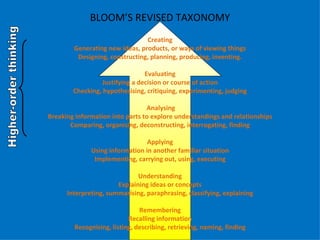
BLOOM’S REVISED TAXONOMY
                                Creating
        Generating new ideas, products, or ways of viewing things
         Designing, constructing, planning, producing, inventing.

                                 Evaluating
                  Justifying a decision or course of action
        Checking, hypothesising, critiquing, experimenting, judging

                                 Analysing
Breaking information into parts to explore understandings and relationships
       Comparing, organising, deconstructing, interrogating, finding

                                 Applying
              Using information in another familiar situation
               Implementing, carrying out, using, executing

                              Understanding
                       Explaining ideas or concepts
      Interpreting, summarising, paraphrasing, classifying, explaining

                               Remembering
                           Recalling information
        Recognising, listing, describing, retrieving, naming, finding
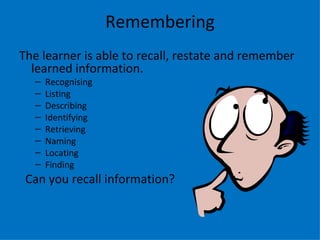
Remembering
The learner is able to recall, restate and remember
  learned information.
  –   Recognising
  –   Listing
  –   Describing
  –   Identifying
  –   Retrieving
  –   Naming
  –   Locating
  –   Finding
 Can you recall information?
Classroom Roles for Remembering
Teacher roles       Student roles

•   Directs         •   Responds
•   Tells           •   Absorbs
•   Shows           •   Remembers
•   Examines        •   Recognises
•   Questions       •   Memorises
•   Evaluates       •   Defines
                    •   Describes
                    •   Retells
                    •   Passive recipient
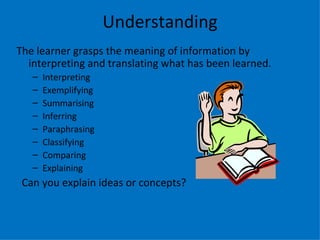
Understanding
The learner grasps the meaning of information by
  interpreting and translating what has been learned.
   –   Interpreting
   –   Exemplifying
   –   Summarising
   –   Inferring
   –   Paraphrasing
   –   Classifying
   –   Comparing
   –   Explaining
 Can you explain ideas or concepts?
Classroom Roles for Understanding
Teacher roles        Student roles

•   Demonstrates     •   Explains
•   Listens          •   Describes
•   Questions        •   Outlines
•   Compares         •   Restates
•   Contrasts        •   Translates
•   Examines         •   Demonstrates
                     •   Interprets
                     •   Active participant
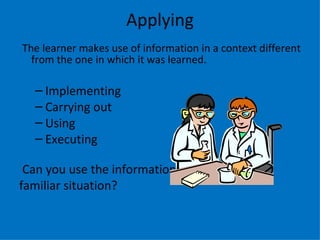
Applying
The learner makes use of information in a context different
  from the one in which it was learned.

  – Implementing
  – Carrying out
  – Using
  – Executing

 Can you use the information in another
familiar situation?
Classroom Roles for Applying
Teacher roles       Student roles

•   Shows           • Solves problems
•   Facilitates     • Demonstrates use of
•   Observes          knowledge
•   Evaluates       • Calculates
•   Organises       • Compiles
•   Questions       • Completes
                    • Illustrates
                    • Constructs
                    • Active recipient
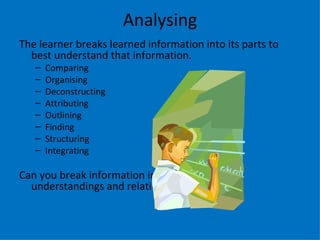
Analysing
The learner breaks learned information into its parts to
  best understand that information.
   –   Comparing
   –   Organising
   –   Deconstructing
   –   Attributing
   –   Outlining
   –   Finding
   –   Structuring
   –   Integrating

Can you break information into parts to explore
  understandings and relationships?
Classroom Roles for Analysing
Teacher roles            Student roles

•   Probes               •   Discusses
•   Guides               •   Uncovers
•   Observes             •   Argues
•   Evaluates            •   Debates
•   Acts as a resource   •   Thinks deeply
•   Questions            •   Tests
•   Organises            •   Examines
•   Dissects             •   Questions
                         •   Calculates
                         •   Investigates
                         •   Inquires
                         •   Active participant
Evaluating
The learner makes decisions based on in-depth
  reflection, criticism and assessment.
  –   Checking
  –   Hypothesising
  –   Critiquing
  –   Experimenting
  –   Judging
  –   Testing
  –   Detecting
  –   Monitoring
Can you justify a decision or course of action?
Classroom Roles for Evaluating
Teacher roles           Student roles

•   Clarifies           •   Judges
•   Accepts             •   Disputes
•   Guides              •   Compares
                        •   Critiques
                        •   Questions
                        •   Argues
                        •   Assesses
                        •   Decides
                        •   Selects
                        •   Justifies
                        •   Active participant
Creating
The learner creates new ideas and information using
  what has been previously learned.
  –   Designing
  –   Constructing
  –   Planning
  –   Producing
  –   Inventing
  –   Devising
  –   Making
Can you generate new products, ideas, or ways of
 viewing things?
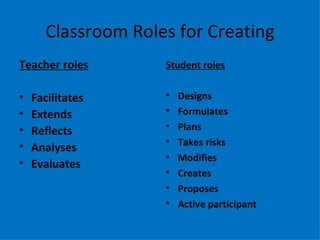
Classroom Roles for Creating
Teacher roles        Student roles


•   Facilitates      •   Designs
•   Extends          •   Formulates
•   Reflects         •   Plans
                     •   Takes risks
•   Analyses
                     •   Modifies
•   Evaluates
                     •   Creates
                     •   Proposes
                     •   Active participant
WRITE A LEARNING EXPERIENCE
 VIA EVERY BLOOM’S LADDER
BASED ON YOUR LESSON PLAN
RENDRA PRIHANDONO, S.Sos
Twitter   : @GuruInspiratif
E-mail    : rendraprihandono@gmail.com
Pin BB    : 294D9885

Pendampingan tk peek a boo 2

  • 1.
    PENDAMPINGAN TK PEEK ABOO & VISION PRIMARY 7 APRIL 2012 RENDRA PRIHANDONO @GuruInspiratif
  • 2.
  • 3.
    #CLASS RULES ISTRAINED AND PUT INTO A HABIT – SKILLS INTEGRATED
  • 4.
  • 5.
  • 6.
  • 7.
    #TRY AS MUCHAS POSSIBLE TO INTEGRATE SUBJECTS INTO OUTCOMES TO ACCOMPLISH
  • 8.
    #DESIGN INTEGRATED LEARNING EXPERIENCE INTO CENTRES/CORNERS
  • 9.
    #EACH CORNERS/CENTRE PURSUESA TARGET, BUT ACCOMPLISHED THROUGH INDIVIDUAL PACE
  • 10.
    #MAKE THE UNINTEGRATED LEARNINGEXPERIENCE A “FREE CHOICE” CENTRE/CORNER
  • 11.
  • 12.
  • 13.
    THE ASSESSMENT SHOULDBE BASED ON MEASURABLE PARAMETERS/INDICATORS
  • 14.
    TRY TO OBSERVETHE NEXT VIDEO AND COMMENT IT.
  • 15.
    BLOOM’S REVISED TAXONOMY Creating Generating new ideas, products, or ways of viewing things Designing, constructing, planning, producing, inventing. Evaluating Justifying a decision or course of action Checking, hypothesising, critiquing, experimenting, judging Analysing Breaking information into parts to explore understandings and relationships Comparing, organising, deconstructing, interrogating, finding Applying Using information in another familiar situation Implementing, carrying out, using, executing Understanding Explaining ideas or concepts Interpreting, summarising, paraphrasing, classifying, explaining Remembering Recalling information Recognising, listing, describing, retrieving, naming, finding
  • 16.
    Remembering The learner isable to recall, restate and remember learned information. – Recognising – Listing – Describing – Identifying – Retrieving – Naming – Locating – Finding Can you recall information?
  • 17.
    Classroom Roles forRemembering Teacher roles Student roles • Directs • Responds • Tells • Absorbs • Shows • Remembers • Examines • Recognises • Questions • Memorises • Evaluates • Defines • Describes • Retells • Passive recipient
  • 18.
    Understanding The learner graspsthe meaning of information by interpreting and translating what has been learned. – Interpreting – Exemplifying – Summarising – Inferring – Paraphrasing – Classifying – Comparing – Explaining Can you explain ideas or concepts?
  • 19.
    Classroom Roles forUnderstanding Teacher roles Student roles • Demonstrates • Explains • Listens • Describes • Questions • Outlines • Compares • Restates • Contrasts • Translates • Examines • Demonstrates • Interprets • Active participant
  • 20.
    Applying The learner makesuse of information in a context different from the one in which it was learned. – Implementing – Carrying out – Using – Executing Can you use the information in another familiar situation?
  • 21.
    Classroom Roles forApplying Teacher roles Student roles • Shows • Solves problems • Facilitates • Demonstrates use of • Observes knowledge • Evaluates • Calculates • Organises • Compiles • Questions • Completes • Illustrates • Constructs • Active recipient
  • 22.
    Analysing The learner breakslearned information into its parts to best understand that information. – Comparing – Organising – Deconstructing – Attributing – Outlining – Finding – Structuring – Integrating Can you break information into parts to explore understandings and relationships?
  • 23.
    Classroom Roles forAnalysing Teacher roles Student roles • Probes • Discusses • Guides • Uncovers • Observes • Argues • Evaluates • Debates • Acts as a resource • Thinks deeply • Questions • Tests • Organises • Examines • Dissects • Questions • Calculates • Investigates • Inquires • Active participant
  • 24.
    Evaluating The learner makesdecisions based on in-depth reflection, criticism and assessment. – Checking – Hypothesising – Critiquing – Experimenting – Judging – Testing – Detecting – Monitoring Can you justify a decision or course of action?
  • 25.
    Classroom Roles forEvaluating Teacher roles Student roles • Clarifies • Judges • Accepts • Disputes • Guides • Compares • Critiques • Questions • Argues • Assesses • Decides • Selects • Justifies • Active participant
  • 26.
    Creating The learner createsnew ideas and information using what has been previously learned. – Designing – Constructing – Planning – Producing – Inventing – Devising – Making Can you generate new products, ideas, or ways of viewing things?
  • 27.
    Classroom Roles forCreating Teacher roles Student roles • Facilitates • Designs • Extends • Formulates • Reflects • Plans • Takes risks • Analyses • Modifies • Evaluates • Creates • Proposes • Active participant
  • 28.
    WRITE A LEARNINGEXPERIENCE VIA EVERY BLOOM’S LADDER BASED ON YOUR LESSON PLAN
  • 29.
    RENDRA PRIHANDONO, S.Sos Twitter : @GuruInspiratif E-mail : rendraprihandono@gmail.com Pin BB : 294D9885

Editor's Notes

  • #16 Facilitator explains the stages of the taxonomy and asks: What language experiences and thinking tools will empower students to Remember, Understand etc.
  • #19 No notes needed